EP3838979A1 - Schmelzepolycarbonat mit verbesserten optischen eigenschaften - Google Patents
Schmelzepolycarbonat mit verbesserten optischen eigenschaften Download PDFInfo
- Publication number
- EP3838979A1 EP3838979A1 EP19216896.1A EP19216896A EP3838979A1 EP 3838979 A1 EP3838979 A1 EP 3838979A1 EP 19216896 A EP19216896 A EP 19216896A EP 3838979 A1 EP3838979 A1 EP 3838979A1
- Authority
- EP
- European Patent Office
- Prior art keywords
- weight
- thermoplastic composition
- bis
- composition according
- polycarbonate
- Prior art date
- Legal status (The legal status is an assumption and is not a legal conclusion. Google has not performed a legal analysis and makes no representation as to the accuracy of the status listed.)
- Granted
Links
- 0 CC(c1cc(*c(cc2)ccc2OC)ccc1OC)=O Chemical compound CC(c1cc(*c(cc2)ccc2OC)ccc1OC)=O 0.000 description 2
- FGTBCSALJAZWCF-UHFFFAOYSA-N CC(C)(c(cc1)ccc1O)c(cc1)ccc1Oc1ccc(C(C)(C)c(cc2)ccc2O)cc1C(O)=O Chemical compound CC(C)(c(cc1)ccc1O)c(cc1)ccc1Oc1ccc(C(C)(C)c(cc2)ccc2O)cc1C(O)=O FGTBCSALJAZWCF-UHFFFAOYSA-N 0.000 description 1
Classifications
-
- C—CHEMISTRY; METALLURGY
- C08—ORGANIC MACROMOLECULAR COMPOUNDS; THEIR PREPARATION OR CHEMICAL WORKING-UP; COMPOSITIONS BASED THEREON
- C08K—Use of inorganic or non-macromolecular organic substances as compounding ingredients
- C08K5/00—Use of organic ingredients
- C08K5/04—Oxygen-containing compounds
- C08K5/15—Heterocyclic compounds having oxygen in the ring
- C08K5/151—Heterocyclic compounds having oxygen in the ring having one oxygen atom in the ring
- C08K5/1515—Three-membered rings
-
- C—CHEMISTRY; METALLURGY
- C08—ORGANIC MACROMOLECULAR COMPOUNDS; THEIR PREPARATION OR CHEMICAL WORKING-UP; COMPOSITIONS BASED THEREON
- C08K—Use of inorganic or non-macromolecular organic substances as compounding ingredients
- C08K5/00—Use of organic ingredients
- C08K5/36—Sulfur-, selenium-, or tellurium-containing compounds
- C08K5/41—Compounds containing sulfur bound to oxygen
- C08K5/42—Sulfonic acids; Derivatives thereof
Definitions
- the present invention relates to transparent compositions based on melt polycarbonate, molded parts made from these compositions and the use of a specific additive for improving the transmission of transparent compositions based on melt polycarbonate.
- Polycarbonate can be manufactured using various processes.
- the polycarbonate (LPC) produced in solution from bisphenols and phosgene in solution by the phase boundary process first achieved industrial importance.
- LPC polycarbonate
- SPC melt polycarbonate
- the polycarbonate produced by means of the melting process which is known from the prior art, has, among other things, the disadvantage that the YI (yellowness index), which is higher in the melt polycarbonate compared to the phase boundary process (solution process) continues to increase in the course of thermal aging.
- YI yellowness index
- solution process phase boundary process
- the polycarbonate described there shows an increase in the YI of an injection-molded part, which was produced from melt polycarbonate and is stored at 160 ° C. for 30 days (720 hours), of more than 14 YI units. It is not apparent from the document why the YI is changing so much.
- EP 0 622 418 A2 describes a discoloration and, after the production of the melt polycarbonate, increasing yellowing with heat aging.
- the phenolic end groups can oxidatively bond with one another and thereby form dimer products or even go through degradation processes, the reaction products of which are likewise not stable and further reactions take place. This results in yellowing of the polycarbonate, which is undesirable. Such yellowing processes can already occur during processing at the injection moulder.
- melt polycarbonate often has poorer optical properties, especially a higher Y.I. and often associated therewith a low transmission, as such that has been produced by interfacial polycondensation.
- the object of the present invention was to improve the optical properties of transparent melt polycarbonate (SPC), in particular by increasing the transmission, if possible also by reducing the yellowness index (Y.I.).
- SPC transparent melt polycarbonate
- ESBO epoxidized soybean oil
- derivatives are understood to mean those compounds whose molecular structure has another atom or another atom group instead of an H atom or a functional group or from which one or more atoms / atom groups have been removed. The root connection can still be seen.
- At least potassium perfluoro-1-butanesulfonate is very particularly preferably contained.
- compositions described above contain no further components, but rather the amounts of components A, B - optionally B1 (epoxidized soybean oil, containing epoxidized triacylglycerol) - each optionally C1, C2, C3, D and / or E, in particular in the the preferred embodiments described above, add up to 100% by weight.
- B1 epoxidized soybean oil, containing epoxidized triacylglycerol
- the specified% by weight of components A, B, C - or C1- and optionally D and / or E - unless explicitly stated otherwise - in each case relate to the total weight of the composition. It goes without saying that all of the components contained in a composition according to the invention add up to 100% by weight.
- the composition can contain further components, for example further additives in the form of component E.
- the composition can also contain one or more other thermoplastics as blend partners, provided these are compatible with the polycarbonates and lead to transparent blends.
- compositions described above very particularly preferably contain no further components, but rather the amounts of components A, B, C (or C1) and optionally D and / or E, in particular in the preferred ones described above Embodiments add up to 100% by weight, ie the compositions consist of components A, B, C (optionally C1), optionally D and / or E.
- the components used can contain customary impurities, for example resulting from their manufacturing process. It is preferred to use components that are as pure as possible. It is further understood that these impurities can also be contained in a closed formulation of the composition. They then contribute to the respective weight percentage of the component from which they originate and must be included in this.
- compositions according to the invention are transparent.
- Transparent in the context of the present invention means a transmission Ty, measured on a test specimen with a thickness of 4 mm according to ISO 13468-2: 2006, of at least 85%, preferably of at least 86%, particularly preferably of at least 87% more preferably at least 87.5% and preferably a haze of less than 3.0%, more preferably less than 2.5%, even more preferably less than 2.0%, particularly preferably less than 1.0%, determined according to ASTM D1003: 2013 with a layer thickness of 4 mm.
- compositions according to the invention are preferably used for the production of molded parts.
- the compositions preferably have a melt volume flow rate (MVR) of 3 to 34 cm 3 / (10 min), more preferably from 6 to 27 cm 3 / (10 min), particularly preferably from 8 to 22 cm 3 / (10 min) , very particularly preferably from 12 to 20 cm 3 / (10 min), determined according to ISO 1133: 2012-3 (test temperature 300 ° C., mass 1.2 kg).
- the invention also relates to increasing the transmission Ty, determined in accordance with DIN EN ISO 13468-2: 2006 at a layer thickness of 4 mm, of a transparent thermoplastic composition based on aromatic melt polycarbonate by adding epoxidized triacylglycerol, in particular in the form of an epoxidized soybean oil .
- the increase in transmission relates to the corresponding compositions without epoxidized triacylglycerol, in particular in the form of an epoxidized soybean oil, as a comparison composition. It goes without saying that the embodiments described as preferred for the composition according to the invention also apply to the use mentioned.
- compositions according to the invention contain as component A 50.0% by weight to 99.95% by weight of aromatic polycarbonate.
- a proportion of at least 50.0% by weight of aromatic polycarbonate on the overall composition means according to the invention that the composition is based on aromatic polycarbonate.
- the amount of aromatic polycarbonate in the composition is 74.0 to 99.9 wt%, more preferably 77.0 to 99.9 wt%, even more preferably 78.0 to 99.8 wt% , particularly preferably 95.0 to 99.6% by weight, it being possible for a single polycarbonate or a mixture of several polycarbonates to be present.
- Polycarbonate in the context of the invention is understood to mean both aromatic homopolycarbonates and aromatic copolycarbonates, as long as they are melt polycarbonates.
- the polycarbonates can be linear or branched in a known manner. Mixtures of polycarbonates can also be used according to the invention.
- dihydroxyaryl compounds are reacted with diaryl carbonates with a gradual increase in temperature and reduction in pressure in the reactor with elimination of the aryl radical of the diaryl carbonates to form polycarbonates.
- Preferred diaryl carbonates are, for example, diphenyl carbonate, di (methyl salicylate) carbonate, di (ethyl salicylate) carbonate, di (n-propyl salicylate) carbonate, di (iso-propyl salicylate) carbonate, di- (n-butyl salicylate) - carbonate, di (iso-butyl salicylate) carbonate, di (tert-butyl salicylate) carbonate, di (phenyl salicylate) carbonate and di (benzyl salicylate) carbonate.
- Particularly preferred diaryl compounds are diphenyl carbonate and di (methyl salicylate) carbonate.
- Diphenyl carbonate (DPC) is very particularly preferred.
- diaryl carbonates can also be used with residual amounts of the monohydroxyaryl compounds from which they were produced.
- the residual contents of the monohydroxyaryl compounds can be up to 20% by weight, preferably up to 10% by weight, particularly preferably up to 5% by weight and very particularly preferably up to 2% by weight.
- the dihydroxyaryl compound (s) in general 1.02 to 1.30 mol of the diaryl carbonate (s), preferably 1.04 to 1.25 mol, particularly preferably 1.045 to 1.22 mol, very particularly preferably 1, 05 to 1.20 mol, used per mol of dihydroxyaryl compound.
- Mixtures of the abovementioned diaryl carbonates can also be used, the molar data given above per mole of dihydroxyaryl compound then relating to the total amount of the mixture of diaryl carbonates.
- branching agents or branching mixtures are added to the synthesis in the same way. Usually, however, branching agents are added before the chain terminators.
- branching agents are added before the chain terminators.
- trisphenols, quarter phenols or acid chlorides of tri- or tetracarboxylic acids or their anhydrides or mixtures of the polyphenols or the acid chlorides are used.
- Some of the compounds with three or more phenolic hydroxyl groups which are suitable as branching agents are, for example, phloroglucinol, 4,6-dimethyl-2,4,6-tri- (4-hydroxyphenyl) -hepten-2, 4,6-dimethyl-2,4, 6-tri- (4-hydroxyphenyl) -heptane, 1,3,5-tri- (4-hydroxyphenyl) -benzene, 1,1,1-tri- (4-hydroxyphenyl) -ethane, tri- (4-hydroxyphenyl) ) -phenylmethane, 2,2-bis- (4,4-bis- (4-hydroxyphenyl) -cyclohexyl] -propane, 2,4-bis- (4-hydroxyphenyl-isopropyl) -phenol and tetra- (4-hydroxyphenyl
- Some of the other trifunctional compounds are 2,4-dihydroxybenzoic acid, trimesic acid, cyanuric chloride and 3,3-bis- (3-methyl
- catalysts are tetraphenylphosphonium chloride, tetraphenylphosphonium hydroxide and tetraphenylphosphonium phenolate, and tetraphenylphosphonium phenolate is very particularly preferred.
- the catalysts are preferably used in amounts of 10 -8 to 10 -3 mol, particularly preferably in amounts of 10 -7 to 10 -4 mol, based on one mol of dihydroxyaryl compound. It is also possible, if appropriate, to use cocatalysts in order to increase the rate of the polycondensation.
- alkaline salts of alkali metals and alkaline earth metals such as hydroxides, optionally substituted C 1 to C 10 alkoxides and C 6 to C 14 aryloxides of lithium, sodium and potassium, preferably hydroxides, optionally substituted C 1 to C 10 alkoxides or C 6 to C 14 aryloxides of sodium.
- Sodium hydroxide, sodium phenolate or the disodium salt of 2,2-bis- (4-hydroxyphenyl) propane are preferred.
- alkali or alkaline earth metal ions are supplied in the form of their salts
- the amount of alkali or alkaline earth metal ions is 1 to 500 ppb, preferably 5 to 300 ppb and most preferably 5 to 200 ppb, based on the total weight of the polycarbonate to be formed. In preferred embodiments of the process according to the invention, however, no alkali salts are used.
- rearrangement structures the structural units of the formulas (I) to (IV) can be referred to as rearrangement structures. They result from the dihydroxyaryl compounds or mixtures of dihydroxyaryl compounds used for polycarbonate production. For example, in the case of bisphenol A as diphenol, the phenyl rings of the rearrangement structures are unsubstituted.
- the cyclic oligomers of the general formula (VIII) contained in the polycarbonate compositions according to the invention are preferably in amounts of 0.2 to 1.2% by weight, particularly preferably 0.2 to 1.1% by weight and very particularly preferably 0, 3 to 1% by weight, based on the total weight of the polycarbonate.
- linear oligomers of the general formulas (V) to (VII) contained in the polycarbonate compositions according to the invention are preferably in amounts of 0.2 to 1.2, particularly preferably 0.3 to 1.1 and very particularly preferably 0.4 to 0, 9% by weight, based on the total weight of the polycarbonate.
- the amount of oligomers is determined as follows: After dissolving in dichloromethane, the polycarbonate is reprecipitated with acetone. The precipitated polycarbonate is filtered off and the filtrate is then concentrated to dryness. The residue is dissolved and analyzed by HPLC with UV detection. The assignment is made by comparison with a standing sample. The analysis is carried out according to the short method K0195TSC from Currenta GmbH & Co. KG, as of November 2019.
- the rearrangement structures defined above occur in different amounts and ratios to one another. Their amount can be determined by total saponification of the polycarbonate composition. This is done by concentrating the sample solution to dryness after total saponification of the polycarbonate with sodium methylate under reflux. The residue is analyzed by HPLC with UV detection. The assignment is made by comparison with a standing sample. The analysis is carried out according to the laboratory's internal short method K0190TSC from Currenta GmbH & Co. KG, as of November 2019.
- the low molecular weight degradation products of the formulas (Ia) to (IVa) that are characteristic of the respective rearrangement structure are formed, for example bisphenol A as diphenol , ie X is isopropylidene, the amount of which is determined by means of HPLC, it being possible for the phenyl rings to be substituted as indicated above in the description of formulas (I) to (IV).
- the amount of the compound of the formula (Ia) released in the process is typically from 50 to 800 ppm, preferably from 70 to 700 ppm, particularly preferably from 100 to 600 ppm and very particularly preferably from 100 to 550 ppm.
- the amount of the compound of the formula (IIa) released in the process is typically from 0 (below the detection limit of ⁇ 5 ppm) to 100 ppm, preferably from 0 to 90 ppm, particularly preferably from 0 to 80 ppm and very particularly preferably from 0 to 70 ppm .
- the amount of the compound of the formula (IIIa) released is typically from 0 (below the detection limit of ⁇ 5 ppm) to 60 ppm, preferably from 0 to 50 ppm, particularly preferably from 5 to 40 ppm and very particularly preferably from 5 to 30 ppm .
- the amount of the compound of the formula (IVa) released is typically from 0 (below the detection limit of ⁇ 5 ppm) to 300 ppm, preferably from 5 to 280, particularly preferably from 5 to 270 ppm and very particularly preferably from 10 to 260 ppm.
- the amount of the structures of the formulas (I) to (IV) is equated with the amount of the released compounds of the formulas (Ia) to (IVa).
- Dihydroxyaryl compounds suitable for the production of the polycarbonates are, for example, hydroquinone, resorcinol, dihydroxydiphenyls, bis (hydroxyphenyl) alkanes, bis (hydroxyphenyl) cycloalkanes, Bis (hydroxyphenyl) sulfides, bis (hydroxyphenyl) ethers, bis (hydroxyphenyl) ketones, bis (hydroxyphenyl) sulfones, bis (hydroxyphenyl) sulfoxides, alpha - alpha '- bis (hydroxyphenyl) -diisopropylbenzenes, phthalimidines derived from isatin or phenolphthalein derivatives and their ring-alkylated, ring-arylated and ring-halogenated compounds.
- Preferred dihydroxyaryl compounds are 4,4'-dihydroxydiphenyl, 2,2-bis- (4-hydroxyphenyl) -propane, 2,4-bis- (4-hydroxyphenyl) -2-methylbutane, 1,1-bis- (4-hydroxyphenyl ) -phenylethane, 1,3-bis- [2- (4-hydroxyphenyl) -2-propyl] benzene (bisphenol M), 1,1-bis- (4-hydroxyphenyl) -p-diisopropylbenzene, 2,2-bis - (3-methyl-4-hydroxyphenyl) propane, 2,2-bis (3-chloro-4-hydroxyphenyl) propane, bis (3,5-dimethyl-4-hydroxyphenyl) methane, 2.2 -Bis- (3,5-dimethyl-4-hydroxyphenyl) -propane, bis- (3,5-dimethyl-4-hydroxyphenyl) -sulfone, 2,4-bis- (3,5-dimethyl-4-hydroxyphen
- dihydroxyaryl compounds are 4,4'-dihydroxydiphenyl, 1,1-bis- (4-hydroxyphenyl) -phenyl-ethane, 2,2-bis- (4-hydroxyphenyl) -propane, 2,2-bis- (3, 5-dibromo-4-hydroxyphenyl) propane, 2,2-bis (3,5-dichloro-4-hydroxyphenyl) propane, 2,2-bis (3,5-dimethyl-4-hydroxyphenyl) propane, 1,1-bis- (4-hydroxyphenyl) -cyclohexane and 1,1-bis- (4-hydroxyphenyl) -3,3,5-trimethylcyclohexane (Bisphenol TMC) and the dihydroxyaryl compounds of the formulas (I), (II) and / or (III).
- Dihydroxyaryl compounds are generally known or can be prepared by generally known processes (e.g. WO 2006/072344 , EP-A 1609818 and literature cited therein).
- Preferred diphenols of the formula (1) are: 2,2-bis- (4-hydroxyphenyl) -propane (BPA), bis- (4-hydroxyphenyl) -3,3,5-trimethyl-cyclohexane and 4,4'-dihydroxydiphenyl .
- Both a dihydroxyaryl compound to form homopolycarbonates and various dihydroxyaryl compounds to form copolycarbonates can be used.
- the latter is particularly important when products with special combinations of properties are to be manufactured.
- the dihydroxyaryl compounds can also be used with residual contents of the monohydroxyaryl compounds from which they were produced or the low molecular weight oligocarbonates with residual contents of the monohydroxyaryl compounds which were split off during the production of the oligomers.
- the residual contents of the monohydroxyaryl compounds can be up to 20% by weight, preferably 10% by weight, particularly preferably up to 5% by weight and very particularly preferably up to 2% by weight (see e.g. EP 1 240 232 A1 ).
- diaryl carbonates suitable for the reaction with the dihydroxyaryl compounds are those of the above formula (1). Such diaryl carbonates are for example in EP-A-1 609 818 A2 described.
- Preferred diaryl compounds are diphenyl carbonate, 4-tert-butylphenyl-phenyl-carbonate, di- (4-tert-butyl-phenyl) -carbonate, biphenyl-4-yl-phenyl-carbonate, di- (biphenyl-4-yl) -carbonate, 4 - (1-Methyl-1-phenylethyl) -phenyl-phenyl-carbonate and di- [4- (1-methyl-1-phenylethyl) -phenyl] -carbonate.
- Diphenyl carbonate is particularly preferred.
- the diaryl carbonates can also be used with residual amounts of the monohydroxyaryl compounds from which they were produced.
- the residual contents of the monohydroxyaryl compounds can be up to 20% by weight, preferably 10% by weight, particularly preferably up to 5% by weight and very particularly preferably up to 2% by weight.
- the diaryl carbonates are generally 1.02 to 1.30 mol, preferably 1.04 to 1.25 mol, particularly preferably 1.06 to 1.22 mol, very particularly preferably 1.06 to 1.20, used per mole of dihydroxyaryl compound. Mixtures of the abovementioned diaryl carbonates can also be used.
- a monohydroxyaryl compound which was not used to produce the diaryl carbonate used can also be used. It is represented by the following general formula (3): where R, R 'and R "have the meanings given for R1 and R2 in formula (1a). Phenol is preferred, ie all radicals in (3) represent H.
- a monohydroxyaryl compound is to be selected whose boiling point is above that of the monohydroxyaryl compound which was used to prepare the diaryl carbonate used.
- the monohydroxyaryl compound can be added at any point in time during the course of the reaction. It is preferably added at the beginning of the reaction or at any point in the course of the process.
- the proportion of free monohydroxyaryl compound can be 0.2-20 mol%, preferably 0.4-10 mol%, based on the dihydroxyaryl compound.
- the end groups can also be changed by using a diaryl carbonate whose base monohydroxyaryl compound has a higher boiling point than the base monohydroxyaryl compound of the diaryl carbonate mainly used.
- the diaryl carbonate can be added at any point in time during the course of the reaction. It is preferably added at the beginning of the reaction or at any point in the course of the process.
- the proportion of the diaryl carbonate with the higher-boiling base monohydroxyaryl compound in the total amount of diaryl carbonate used can be 1-40 mol%, preferably 1-20 mol% and particularly preferably 1-10 mol%.
- the disc or basket reactors are characterized by the fact that they provide a very large, constantly renewing surface in the vacuum with long dwell times.
- the disk or basket reactors are geometrically designed according to the melt viscosities of the products. For example, reactors such as those described in FIG EN 44 47 422 C2 and EP A 1 253 163 , or twin-shaft reactors as described in the WO A 99/28 370 are described.
- component A is preferably used in the form of powders, granules or mixtures of powders and granules.
- compositions according to the invention contain epoxidized triacylglycerol as component B.
- Component B can be a specific or a mixture of different epoxy group-containing (“epoxidized”) triacylglycerols. It is preferably a mixture of different triacylglycerols.
- Component B preferably contains a mixture of triesters of glycerol with oleic acid, linoleic acid, linolenic acid, palmitic acid and / or stearic acid. More preferably, the esters according to component B only comprise esters of glycerol with the fatty acids mentioned.
- Component B is particularly preferably incorporated into the compositions according to the invention in the form of epoxidized soybean oil (B1). The The CAS number of epoxidized soybean oil is 8013-07-8 .
- the epoxy groups in component B can be introduced using methods with which the person skilled in the art is familiar. Such are, in particular, epoxidation with peroxides or peracids, ie esters of glycerol with carboxylic acids containing double bonds are reacted with peroxides or peracids.
- the triacylglycerols are thus partially or completely epoxidized.
- Component B is preferably a mixture of different compounds, as is the case, for example, with the use of epoxidized soybean oil.
- the OH numbers of these mixtures are preferably between 180 and 300 mg KOH / g (method 2011-0232602-92D from Currenta GmbH & Co. OHG, Leverkusen, according to DIN EN ISO2554: 1998-10 with pyridine as solvent).
- the acid numbers of these mixtures are preferably below 1 mg KOH / g, more preferably they are 0.5 mg KOH / g, determined by means of DIN EN ISO 2114: 2006-11.
- the iodine number of the mixtures according to Wijs is preferably 5.0 g iodine / 100 g, more preferably 3.0 g iodine / 100 g (method 2201-0152902-95D from Currenta GmbH & Co. OHG, Leverkusen).
- the oxirane is preferably 5 to 10 g O 2/100 g, particularly preferably 6.3 to 8.0 g O 2/100 g.
- the polycarbonate-containing compositions contain 0.05 to 10.0% by weight, preferably 0.1 to 8.0% by weight, more preferably 0.2 to 6.0% by weight, even more preferably 0, 2 to 1.0 wt%, especially preferably up to 0.8% by weight of component B.
- "Bis" here and elsewhere includes the limit value mentioned in each case.
- the transparent thermoplastic compositions can contain flame retardants as component C1, in particular alkali, alkaline earth and / or ammonium salts of aliphatic or aromatic sulfonic acid, sulfonamide and sulfonimide derivatives.
- flame retardants as component C1, in particular alkali, alkaline earth and / or ammonium salts of aliphatic or aromatic sulfonic acid, sulfonamide and sulfonimide derivatives.
- Compositions according to the invention particularly preferably comprise, as flame retardants, one or more compounds selected from the group consisting of sodium or potassium perfluorobutane sulfate, sodium or potassium perfluoromethanesulfonate, sodium or potassium perfluorooctane sulfate, sodium or potassium 2,5-dichlorobenzene sulfate, sodium or potassium 2,4,5-trichlorobenzene sulphate, sodium or potassium diphenylsulphone sulphonate, sodium or potassium 2-formylbenzenesulphonate, sodium or potassium (N-benzenesulphonyl) -benzenesulphonamide or mixtures thereof.
- one or more compounds selected from the group consisting of sodium or potassium perfluorobutane sulfate, sodium or potassium perfluoromethanesulfonate, sodium or potassium perfluorooctane sulfate, sodium or potassium 2,5-dichlorobenzene sulfate
- Sodium or potassium perfluorobutane sulphate, sodium or potassium perfluorooctane sulphate, sodium or potassium diphenyl sulphone sulphonate or mixtures thereof are preferably used.
- Potassium perfluoro-1-butanesulfonate which is commercially available, inter alia as Bayowet® C4 from Lanxess, Leverkusen, Germany, is very particularly preferred.
- the amounts of alkali, alkaline earth and / or ammonium salts of aliphatic or aromatic sulfonic acid, sulfonamide and sulfonimide derivatives in the composition are preferably at least 0.01% by weight and more preferably up to 0.065% by weight .-%, since corresponding compositions are still transparent here.
- the transparent thermoplastic compositions according to the invention can contain a mold release agent as component C2, preferably in an amount of up to 2.0% by weight, more preferably up to 1.0% by weight, particularly preferably up to 0.5% by weight.
- a mold release agent as component C2
- up to (up to) includes the respective value.
- the compositions particularly preferably contain mold release agents based on a fatty acid ester, preferably a stearic acid ester, particularly preferably based on pentaerythritol. Additionally or alternatively, glycerol monostearate (GMS) can also be used.
- GMS glycerol monostearate
- compositions according to the invention preferably contain at least one UV absorber as an additive.
- the UV absorbers have the lowest possible transmission below 400 nm and the highest possible transmission above 400 nm.
- Particularly suitable ultraviolet absorbers are benzotriazoles, triazines, benzophenones and / or arylated cyanoacrylates.
- Particularly suitable ultraviolet absorbers are hydroxy-benzotriazoles, such as 2- (3 ', 5'-bis (1,1-dimethylbenzyl) -2'-hydroxyphenyl) -benzotriazole (Tinuvin® 234, BASF SE, Ludwigshafen), 2- (2'-Hydroxy-5 '- (tert-octyl) -phenyl) -benzotriazole (Tinuvin® 329, BASF SE, Ludwigshafen), bis- (3- (2H-benztriazolyl) -2-hydroxy-5- tert-octyl) methane (Tinuvin® 360, BASF SE, Ludwigshafen), 2- (4,6-diphenyl-1,3,5-triazin-2-yl) -5- (hexyloxy) -phenol (Tinuvin® 1577 , BASF SE, Ludwigshafen), as well as benzophenones such as 2,4-dihydroxybenzophenone (Chimasorb® 22, BASF SE
- Particularly preferred special UV stabilizers are Tinuvin® 360, Tinuvin® 329, Tinuvin® 312, Tinuvin® 326 and / or Tinuvin® 1600, Tinuvin® 329, Tinuvin® 326 and / or Tinuvin® 360 are very particularly preferred.
- the composition preferably contains ultraviolet absorbers in an amount of up to 1.0% by weight, more preferably up to 0.8% by weight, particularly preferably 0.05% by weight to 0.5 % By weight, very particularly preferably 0.08% by weight to 0.4% by weight, extremely preferably 0.1% by weight to 0.3% by weight, based on the total composition.
- compositions according to the invention can contain triisooctyl phosphate as a transesterification stabilizer.
- Triisooctyl phosphate is preferably used in amounts from 0.003% by weight to 0.05% by weight, more preferably 0.004% by weight to 0.04% by weight and particularly preferably from 0.005% by weight to 0.03% by weight. -%, very particularly preferably 0.007 to 0.02% by weight, based on the total composition, used.
- component additives preferably up to 10.0% by weight, more preferably 0.1 to 6.0% by weight, particularly preferably 0.1 to 3.0% by weight, are optional. %, very particularly preferably 0.2 to 1.0% by weight, in particular up to 0.5% by weight, of other customary additives (“other additives”) included.
- the group of other additives does not include flame retardants, mold release agents, UV absorbers and triisooctyl phosphate, as these have already been described as components C1, C2, C3 and D.
- component E does not include any triacylglycerol containing epoxy groups, nor any epoxidized soybean oil, since this has already been described as component B.
- Such additives are in particular antioxidants, thermal stabilizers, transesterification stabilizers other than triisooctyl phosphate, IR absorbers, antistatic agents, optical brighteners, colorants such as organic pigments, such as those described in, for example EP-A-0 839 623 , WO-A 96/15102 , EP-A 0 500 496 or " Plastics Additives Handbook ", Hans Zweifel, 5th Edition 2000, Hanser Verlag , Kunststoff, in the amounts customary for polycarbonate. These additives can be added individually or as a mixture. In general, only those additives should be used that are compatible with the polycarbonate matrix and do not lead to a haze greater than 2.0% with a layer thickness of 4 mm.
- compositions according to the invention can also contain other phosphates than triisooctyl phosphate or sulfonic acid esters as transesterification stabilizers.
- compositions according to the invention preferably contain no glass fibers and no carbon fibers.
- compositions according to the invention containing components A and B and optionally C1, C2, C3, D and / or E, are produced using common incorporation processes by combining, mixing and homogenizing the individual components, with homogenization in particular preferably taking place in the melt Action of shear forces takes place. If necessary, the bringing together and mixing takes place before the melt homogenization using powder premixes.
- Premixes of granules or granules and powders with components B, optionally C1, optionally C2, optionally C3 and optionally D and E can also be used.
- premixes which have been prepared from solutions of the mixture components in suitable solvents, with homogenization, if necessary, in solution and then removing the solvent.
- components B to E of the composition according to the invention can be introduced into the polycarbonate by known methods or as a masterbatch.
- masterbatches are preferred for introducing components B to E, individually or as a mixture.
- composition according to the invention can be brought together, mixed, homogenized and then extruded in conventional devices such as screw extruders (for example twin-screw extruders, ZSK), kneaders, Brabender or Banbury mills. After the extrusion, the extrudate can be cooled and crushed. Individual components can also be premixed and then the remaining starting materials can be added individually and / or also mixed.
- the merging and mixing of a premix in the melt can also take place in the plasticizing unit of an injection molding machine.
- the melt is converted directly into a shaped body.
- compositions according to the invention can be processed in the customary manner on customary machines, for example on extruders or injection molding machines, to give any shaped bodies.
- the molded parts are preferably produced by injection molding, extrusion or from solution in a casting process.
- compositions according to the invention are suitable for the production of multilayer systems.
- the polycarbonate-containing composition is applied in one or more layer (s) to a shaped object made of a plastic.
- the application can take place at the same time as or immediately after the molding of the shaped body, for example by back-molding a film, coextrusion or multi-component injection molding.
- it can also be applied to the finished molded base body, for example by lamination with a film, injection molding around an existing molded body or by coating from a solution.
- compositions according to the invention are suitable for the production of components in the automotive sector, for example for visors, headlight covers or frames, lenses and collimators or light guides, and for the production of transparent frame components in the EE (electrical / electronics) and IT sectors, in particular for applications that place high demands on flowability (thin-film applications).
- EE electrical / electronics
- IT sectors in particular for applications that place high demands on flowability (thin-film applications).
- applications are, for example, 2K housings, for example for ultrabooks, or frames / frame parts for LED display technologies, e.g. OLED displays or LCD displays or also for e-ink devices.
- housing parts of mobile communication terminals such as smartphones, tablets, ultrabooks, notebooks or laptops, but also housing parts for navigation devices, smartwatches or heart rate monitors, as well as for electrical applications in thin-walled versions, e.g. B. House and industrial networking units and smart meter housing components.
- compositions according to the invention consisting of the compositions according to the invention, including the molded parts which represent a layer of a multilayer system or an element of an above-mentioned component, from ("consisting of") these compositions according to the invention, are also the subject of this application.
- compositions according to the invention are distinguished in particular by the fact that, owing to the presence of component B, they have excellent rheological and optical properties. They are therefore particularly suitable for the production of sophisticated injection-molded parts, especially for thin-walled applications that require good flowability. Examples of such applications are ultrabook housing parts, laptop covers, headlight covers, LED applications or components for E / E applications.
- Thin-wall applications are preferably those applications in which there are wall thicknesses of less than 3 mm, more preferably less than 2.5 mm, even more preferably less than 2.0 mm, very particularly preferably less than 1.5 mm.
- Wall thickness in this specific case is defined as the thickness of the wall perpendicular to the surface of the molded part with the greatest extent, the thickness mentioned being over at least 60%, preferably over at least 75%, more preferably over at least 90%, particularly preferably over the entire surface .
- the invention therefore relates to molded parts comprising or consisting of the compositions according to the invention which are part of the stated application elements.
- compositions according to the invention also apply - if applicable - to the use according to the invention.
- the polycarbonate-based compositions described in the following examples were produced by compounding on a ZE 25 extruder from Berstorff with a throughput of 10 kg / h.
- the melt temperature was 275 ° C.
- Component A1 bisphenol A-based melt polycarbonate with a melt volume flow rate MVR of 12 cm 3 / (10 min) (according to ISO 1133: 2012-03, at a test temperature of 300 ° C and 1.2 kg load).
- Component A2 bisphenol A-based melt polycarbonate in powder form with a melt volume flow rate MVR of 6 cm 3 / (10 min) (according to ISO 1133: 2012-03, at a test temperature of 300 ° C and 1.2 kg load).
- Component A3 Bisphenol A-based melt polycarbonate in powder form with a melt volume flow rate MVR of 14 cm 3 / (10 min) (according to ISO 1133: 2012-03, at a test temperature of 300 ° C and 1.2 kg load).
- the polycarbonate powders A2 and A3 were used to better incorporate the additives.
- Component B Epoxidized soybean oil from Faci, Italy, with an acid number ⁇ 0.5 mg KOH / g, determined using DIN EN ISO 2114: 2006-11, an oxirane value (epoxy oxygen ES, calculated from the epoxy number EEW, are specifies how many grams of oxygen per 100 g of oil contained; EEW determined according to DIN 16945: 1987-09) of ⁇ 6.3 g of O 2/100 g.
- EEW determined according to DIN 16945: 1987-09
- Mainly fully epoxidized triacylglycerols which are a mixture of triesters of glycerine with oleic acid, linoleic acid, linolenic acid, palmitic acid and / or stearic acid.
- Component C1 potassium perfluoro-1-butanesulfonate, commercially available as Bayowet® C4 from Lanxess AG, Leverkusen, Germany, CAS no. 29420-49-3 .
- Component C2 Mold release agent PETS (pentaerythritol tetrastearate) from Emery Oleochemicals.
- Component C3 UV absorber Tinuvin 329 from BASF SE.
- Component D triisooctyl phosphate from Lanxess AG.
- the melt volume flow rate was determined in accordance with ISO 1133: 2012-03 (predominantly at a test temperature of 300 ° C, mass 1.2 kg) using the Zwick 4106 device Zwick Roell company.
- the MVR value was measured after a preheating time of 20 minutes (IMVR20 '). This is a measure of the melt stability under increased thermal stress.
- the Izod impact strength was determined according to ISO 180: 2019 / 1C (4 mm).
- the notched Izod impact strength was determined according to ISO 7391 / i.A. 180: 2019 ISO 7391 / 180A (3 mm).
- the solution viscosity (eta rel) was determined in accordance with ISO 1628-4: 1999-03 using an Ubbelohde viscometer. For this purpose, the granules were dissolved and the fillers were separated off by filtration. The filtrate was concentrated and dried. The obtained film was used to measure the solution viscosity.
- the Yellowness Index (YI) was measured according to ASTM E313-10.
- the YI was evaluated according to D65.10 ° (type of light: D65 / observer: 10 °).
- the samples measured had a geometry of 60 mm ⁇ 40 mm ⁇ 4 mm.
- the transmission Ty was determined in accordance with DIN EN ISO 13468-2: 2006 with a layer thickness of 4 mm
- the haze was determined according to ASTM D1003: 2013 with a layer thickness of 4 mm
- the Vicat softening temperature VST / B50 as a measure of the heat resistance was determined in accordance with ISO 306: 2013 on test specimens measuring 80 mm x 10 mm x 4 mm with a stamp load of 50 N and a heating rate of 50 ° C / h using the Coesfeld Eco 2920 from Coesfeld Materialtest determined.
- test specimens measuring 125 mm ⁇ 13 mm ⁇ 1.5 mm were produced, with the thickness d corresponding to the smallest wall thickness in the intended application.
- a V0 classification means that the flame goes out by itself after a maximum of 10 s. Burning droplets do not occur. An afterglow after the second flame application takes place for a maximum of 30 s.
- the polycarbonate compositions described in the following examples were produced by compounding on an Evolum EV32HT extruder from Clextral-France with a screw diameter of 32 mm.
- a snail stock L7-8.2 was used with a throughput of 40-70 kg / h.
- the speed was 200-300 rpm at a melt temperature of 240-320 ° C. (depending on the composition).
- the granules of the test formulations listed were dried in a dry air dryer from Labotek, type DDM180, at 80 ° C. for 4 hours.
- Table 1 Melt polycarbonate with epoxidized soybean oil (ESBO) Recipe V1 2 3 4th 5 6th A1 Wt% 93 93 93 93 93 A2 Wt% 7th 6.9 6.8 6.6 6.4 6.2 B. Wt% - 0.1 0.2 0.4 0.6 0.8 Exams: ⁇ rel granulate 1.277 1.277 1.276 1.276 1.274 MVR 7 '/ 300 ° C / 1.2 kg ml / (10 min) 12.0 12.5 12.5 12.8 14.6 15.4 Vicat VSTB 50 146.1 144.8 145.1 142.9 141.8 140.4 Melt viscosity.
- ESBO epoxidized soybean oil
- ESBO Yellowness Index
- ESBO Yellowness Index
Landscapes
- Chemical & Material Sciences (AREA)
- Health & Medical Sciences (AREA)
- Chemical Kinetics & Catalysis (AREA)
- Medicinal Chemistry (AREA)
- Polymers & Plastics (AREA)
- Organic Chemistry (AREA)
- Compositions Of Macromolecular Compounds (AREA)
Abstract
Description
- Die vorliegende Erfindung betrifft auf Schmelzepolycarbonat basierende, transparente Zusammensetzungen, Formteile aus diesen Zusammensetzungen sowie die Verwendung eines bestimmten Additivs zur Verbesserung der Transmission von auf Schmelzepolycarbonat basierenden, transparenten Zusammensetzungen.
- Polycarbonat kann über verschiedene Prozesse hergestellt werden. Großtechnische Bedeutung erlangte zunächst das in Lösung über das Phasengrenzflächenverfahren aus Bisphenolen und Phosgen hergestellte Polycarbonat (LPC). Bei dem heute zunehmend an Bedeutung gewinnendem Umesterungs-Verfahren werden Bisphenole mit organischen Carbonaten in der Schmelze zu sogenanntem Schmelzepolycarbonat (SPC) umgesetzt.
- Die Herstellung aromatischer Polycarbonate durch das Schmelzeumesterungsverfahren ist bekannt und beispielsweise beschrieben in "Schnell, Chemistry and Physics of Polycarbonats", Polymer Reviews, Vol. 9, Interscience Publishers, New York, London, Sydney 1964, in D.C. Prevorsek, B.T. Debona und Y. Kersten, Corporate Research Center, Allied Chemical Corporation, Moristown, New Jersey 07960, in "Synthesis of Poly(ester)carbonate Copolymers" im Journal of Polymer Science, Polymer Chemistry Edition, Vol. 19, 75-90 (1980), in D. Freitag, U. Grigo, P.R. Müller, N. Nouvertne, BAYER AG, "Polycarbonates" in der "Encyclopedia of Polymere Science and Engineering", Vol. 11, Second Edition, 1988, pages 648-718 und in Dr. U. Grigo, K. Kircher und P.R. Müller, in "Polycarbonate" in "Becker/Braun, Kunststoff-Handbuch [Plastics Handbook], Volume 3/1, Polycarbonate, Polyacetale, Polyester, Celluloseester [Polycarbonates, polyacetals, polyesters, cellulose esters]", Carl Hanser Verlag, München, Wien, 1992, Seiten 117-299.
- Verglichen mit Polycarbonaten, die durch Grenzflächenpolykondensation hergestellt wurden, weist das mittels Schmelzprozess hergestellte Polycarbonat, das aus dem Stand der Technik bekannt ist, unter anderem den Nachteil auf, dass der beim Schmelzepolycarbonat im Vergleich zum Phasengrenzflächenverfahren (Lösungsverfahren) verfahrensbedingt erhöhte Y.I. (Yellowness Index) im Zuge von Thermoalterung weiter ansteigt. Dieses ist beispielsweise in
JP H 08183847 A EP 0 622 418 A2 beschreibt eine Verfärbung und nach der Herstellung des Schmelzepolycarbonats zunehmende Vergilbung bei Wärmealterung. - Dieses hängt u.a. damit zusammen, dass Polycarbonate, die nach dem Schmelzepolykondensationsverfahren hergestellt werden, verfahrensbedingt höhere phenolische OH-Werte aufweisen, als Polycarbonate, die nach dem Phasengrenzflächenverfahren gewonnen wurden. Die Konzentration an phenolischen Endgruppen soll so niedrig wie möglich sein, da sie zu unerwünschten Nebenreaktionen führen können, die sich z. B. durch höhere Vergilbung (höherer Y.I.) äußern können. Sie hängt im Schmelzepolykondensationsverfahren u. a. von Druck, Temperatur und Reaktionszeit ab.
- Die phenolischen Endgruppen können sich oxidativ miteinander verbinden und dabei Dimer-Produkte bilden oder selbst Degradationsprozesse durchlaufen, deren Reaktionsprodukte ebenfalls nicht stabil sind und weitere Reaktionen eingehen. Hieraus resultiert eine Vergilbung des Polycarbonats, die unerwünscht ist. Derartige Vergilbungsprozesse können bereits während der Verarbeitung beim Spritzgießer auftreten.
- Aus dem Stand der Technik ergibt sich somit, dass Schmelzepolycarbonat verfahrensbedingt häufig schlechtere optische Eigenschaften, speziell einen höheren Y.I. und damit häufig verbunden eine geringe Transmission, aufweist als solches, das durch Grenzflächenpolykondensation hergestellt wurde.
- Aufgabe der vorliegenden Erfindung war es, die optischen Eigenschaften von transparentem Schmelzepolycarbonat (SPC) zu verbessern, insbesondere durch eine Erhöhung der Transmission, möglichst auch durch Reduktion des Yellowness Index (Y.I.). Dabei sollten die Kerneigenschaften des Polycarbonates wie Zähigkeit und ggf. auch Flammwidrigkeit, möglichst erhalten bleiben.
- Überraschenderweise wurde gefunden, dass epoxidiertes Sojabohnenöl (ESBO) die Transmission von Schmelzepolycarbonat sowie überwiegend auch den Y.I. verbessert. Dabei bleiben Zähigkeit und auch Flammwidrigkeit auf hohem Niveau. Gleichzeitig ist zudem eine Erniedrigung der Schmelzeviskositäten zu beobachten, was die Verarbeitbarkeit der Compounds erleichtert.
- Erfindungsgemäße transparente Zusammensetzungen sind daher thermoplastische Zusammensetzungen, enthaltend
- A) 50,0 Gew.-% bis 99,95 Gew.-% aromatisches Schmelzepolycarbonat,
- B) 0,05 Gew.-% bis 10,0 Gew.-% epoxidiertes Triacylglycerol, bevorzugt in die Zusammensetzung eingebracht in Form von epoxidiertem Sojabohnenöl.
- Bevorzugt enthalten die Zusammensetzungen
- A) 77,0 bis 99,9 Gew.-% aromatisches Schmelzepolycarbonat,
- B) 0,1 bis 1,0 Gew.-% epoxidiertes Triacylglycerol, insbesondere in die Zusammensetzung eingebracht in Form von epoxidiertem Sojabohnenöl,
- C1) 0 bis 0,065 Gew.-% mindestens eines Alkali-, Erdalkali- und/oder Ammoniumsalzes eines aliphatischen oder aromatischen Sulfonsäure-, Sulfonamid- oder Sulfonimidderivates,
- C2) 0 bis 2,0 Gew.-% eines Entformungsmittels,
- C3) 0 bis 1,0 Gew.-% eines UV-Absorbers
- D) 0 bis 0,05 Gew.-% Triisooctylphosphat und
- E) ggf. von den Komponenten B, C1, C2, C3 und D verschiedene, weitere Additive.
- Unter "Derivaten" werden erfindungsgemäß solche Verbindungen verstanden, deren Molekülstruktur an der Stelle eines H-Atoms oder einer funktionellen Gruppe ein anderes Atom oder eine andere Atomgruppe besitzt bzw. bei denen ein oder mehrere Atome/Atomgruppen entfernt wurden. Die Stammverbindung ist somit noch weiterhin erkennbar.
- Besonders bevorzugt enthalten die Zusammensetzungen
- A) 90,0 bis 99,9 Gew.-% aromatisches Schmelzepolycarbonat,
- B) 0,1 bis 1,0 Gew.-% epoxidiertes Triacylglycerol, insbesondere in die Zusammensetzung eingebracht in Form von epoxidiertem Sojabohnenöl,
- C1) 0 bis 0,065 Gew.-% mindestens eines Alkali-, Erdalkali- und/oder Ammoniumsalzes eines aliphatischen oder aromatischen Sulfonsäure-, Sulfonamid- oder Sulfonimidderivates,
- C2) 0 bis 1,0 Gew.-% eines Entformungsmittels,
- C3) 0 bis 0,4 Gew.-% eines UV-Absorbers
- D) 0 bis 0,05 Gew.-% Triisooctylphosphat und
- E) ggf. von den Komponenten B, C1, C2, C3 und D verschiedene, weitere Additive.
- Ganz besonders bevorzugt ist mindestens Kaliumperfluor-1-butansulfonat enthalten.
- Äußerst bevorzugt enthalten die vorbeschriebenen Zusammensetzungen keine weiteren Komponenten, sondern die Mengen der Komponenten A, B- ggf. B1 (epoxidiertes Sojabohnenöl, enthaltend epoxidiertes Triacylglycerol) -, jeweils ggf. C1, C2, C3, D und/oder E, insbesondere in den vorbeschriebenen bevorzugten Ausführungsformen, ergänzen sich zu 100 Gew.-%.
- Im Rahmen der vorliegenden Erfindung beziehen sich die angegebenen Gew.-% der Komponenten A, B, C - bzw. C1- und ggf. D und/oder E - soweit nicht explizit anders angegeben - jeweils auf das Gesamtgewicht der Zusammensetzung. Es versteht sich, dass sämtliche in einer erfindungsgemäßen Zusammensetzung enthaltenen Komponenten zusammen 100 Gew.-% ergeben. Die Zusammensetzung kann neben den Komponenten A, B, C und D weitere Komponenten, etwa weitere Additive in Form der Komponente E, enthalten. Ebenso kann die Zusammensetzung einen oder mehrere weitere Thermoplasten als Blendpartner enthalten, soweit diese mit den Polycarbonaten verträglich sind und zu transparenten Blends führen. Ganz besonders bevorzugt enthalten die vorbeschriebenen Zusammensetzungen keine weiteren Komponenten, sondern die Mengen der Komponenten A, B, C (bzw. C1) und ggf. D und/oder E, insbesondere in den vorbeschriebenen bevorzugten Ausführungsformen, ergänzen sich zu 100 Gew.-%, d.h. die Zusammensetzungen bestehen aus den Komponenten A, B, C (ggf. C1), ggf. D und/oder E.
- Es versteht sich, dass die eingesetzten Komponenten übliche Verunreinigungen, die beispielsweise aus ihrem Herstellungsprozess herrühren, enthalten können. Es ist bevorzugt, möglichst reine Komponenten einzusetzen. Es versteht sich weiterhin, dass diese Verunreinigungen auch bei einer geschlossenen Formulierung der Zusammensetzung enthalten sein können. Sie tragen dann zum jeweiligen Gewichtsanteil der Komponente, von der sie herrühren, bei und sind in diesen einzurechnen.
- Die erfindungsgemäßen Zusammensetzungen sind transparent. "Transparent" im Sinne der vorliegenden Erfindung bedeutet eine Transmission Ty, gemessen an einem Prüfkörper bei einer Dicke von 4 mm gemäß ISO 13468-2:2006, von mindestens 85 %, bevorzugt von mindestens 86 %, besonders bevorzugt von mindestens 87 %, noch weiter bevorzugt mindestens 87,5 % und vorzugsweise eine Trübung von weniger als 3,0 %, weiter bevorzugt von weniger als 2,5 %, noch weiter bevorzugt von weniger als 2,0 %, besonders bevorzugt von weniger als 1,0 %, bestimmt nach ASTM D1003:2013 bei einer Schichtdicke von 4 mm.
- Die erfindungsgemäßen Zusammensetzungen werden vorzugsweise zur Herstellung von Formteilen verwendet. Die Zusammensetzungen weisen bevorzugt eine Schmelze-Volumenfließrate (MVR) von 3 bis 34 cm3/(10 min), weiter bevorzugt von 6 bis 27 cm3/(10 min), besonders bevorzugt von 8 bis 22 cm3/(10 min), ganz besonders bevorzugt von 12 bis 20 cm3/(10 min), bestimmt nach ISO 1133:2012-3 (Prüftemperatur 300°C, Masse 1,2 kg), auf.
- Gegenstand der Erfindung ist auch die Erhöhung der Transmission Ty, bestimmt nach DIN EN ISO 13468-2:2006 bei einer Schichtdicke von 4 mm, einer transparenten thermoplastischen Zusammensetzung auf Basis von aromatischem Schmelzepolycarbonat durch den Zusatz von epoxidiertem Triacylglycerol, insbesondere in Form eines epoxidierten Sojabohnenöls. Die Erhöhung der Transmission bezieht sich auf die entsprechenden Zusammensetzungen ohne epoxidiertes Triacylglycerol, insbesondere in Form eines epoxidiertes Sojabohnenöls, als Vergleichszusammensetzung. Es versteht sich, dass die für die erfindungsgemäße Zusammensetzung als bevorzugt beschriebenen Ausführungsformen ebenso für genannte Verwendung gelten.
- Die einzelnen Bestandteile der erfindungsgemäßen Zusammensetzungen sind im Folgenden noch näher erläutert:
- Erfindungsgemäße Zusammensetzungen enthalten als Komponente A 50,0 Gew.-% bis 99,95 Gew.-% aromatisches Polycarbonat. Ein Anteil von mindestens 50,0 Gew.-% aromatischem Polycarbonat an der Gesamtzusammensetzung bedeutet erfindungsgemäß, dass die Zusammensetzung auf aromatischem Polycarbonat basiert. Vorzugsweise beträgt die Menge des aromatischen Polycarbonats in der Zusammensetzung 74,0 bis 99,9 Gew.-%, weiter bevorzugt 77,0 bis 99,9 Gew.-%, noch weiter bevorzugt 78,0 bis 99,8 Gew.-%, besonders bevorzugt 95,0 bis 99,6 Gew.-%, wobei ein einzelnes Polycarbonat oder eine Mischung mehrerer Polycarbonate vorliegen kann.
- Unter "Polycarbonat" im erfindungsgemäßen Sinne werden sowohl aromatische Homopolycarbonate als auch aromatische Copolycarbonate verstanden, solange es Schmelzepolycarbonate sind. Dabei können die Polycarbonate in bekannter Weise linear oder verzweigt sein. Erfindungsgemäß können auch Mischungen von Polycarbonaten verwendet werden.
- Beim Schmelzepolykondensationsverfahren werden Dihydroxyarylverbindungen mit Diarylcarbonaten bei schrittweiser Erhöhung der Temperatur und Reduktion des Drucks im Reaktor unter Abspaltung des Arylrestes der Diarylcarbonate zu Polycarbonaten umgesetzt.
- Die für die Umsetzung mit den Dihydroxyarylverbindungen geeigneten Diarylcarbonate bei der Schmelzeumesterung sind solche der allgemeinen Formel (1)

- R, R' und R"
- jeweils unabhängig voneinander, gleich oder verschieden für Wasserstoff, lineares oder verzweigtes C1- bis C34-Alkyl, C7- bis C34-Alkylaryl oder C6- bis C34-Aryl stehen, R weiterhin auch -COO-R'" bedeuten kann, wobei R'" für Wasserstoff, lineares oder verzweigtes C1- bis C34-Alkyl, C7- bis C34-Alkylaryl oder C6- bis C34-Aryl steht.
- Bevorzugte Diarylcarbonate sind beispielsweise Diphenylcarbonat, Di-(methylsalicylat)-carbonat, Di-(ethylsalicylat)-carbonat, Di-(n-propylsalicylat)-carbonat, Di-(iso-propylsalicylat)-carbonat, Di-(n-butylsalicylat)-carbonat, Di-(iso-butylsalicylat)-carbonat, Di-(tert-butylsalicylat)-carbonat, Di-(phenylsalicylat)-carbonat und Di-(benzylsalicylat)-carbonat. Besonders bevorzugte Diarylverbindungen sind Diphenylcarbonat und Di-(methylsalicylat)-carbonat. Ganz besonders bevorzugt ist Diphenylcarbonat (DPC).
- Es können sowohl ein Diarylcarbonat als auch verschiedene Diarylcarbonate verwendet werden. Die Diarylcarbonate können auch mit Restgehalten der Monohydroxyarylverbindungen, aus denen sie hergestellt wurden, eingesetzt werden. Die Restgehalte der Monohydroxyarylverbindungen können bis zu 20 Gew.-%, vorzugsweise bis zu 10 Gew.-%, besonders bevorzugt bis zu 5 Gew.-% und ganz besonders bevorzugt bis zu 2 Gew.-% betragen.
- Bezogen auf die Dihydroxyarylverbindung(en) werden im Allgemeinen 1,02 bis 1,30 Mol des oder der Diarylcarbonat(e), bevorzugt 1,04 bis 1,25 Mol, besonders bevorzugt 1,045 bis 1,22 Mol, ganz besonders bevorzugt 1,05 bis 1,20 Mol, pro Mol Dihydroxyarylverbindung eingesetzt. Es können auch Mischungen der oben genannten Diarylcarbonate eingesetzt werden, wobei die vorangehend aufgeführten Molangaben pro Mol Dihydroxyarylverbindung sich dann auf die Gesamtstoffmenge der Mischung der Diarylcarbonate beziehen.
- In der gleichen Weise werden ggf. Verzweiger oder Verzweigermischungen der Synthese zugesetzt. Üblicherweise werden Verzweiger jedoch vor den Kettenabbrechern zugesetzt. In der Regel werden Trisphenole, Quarterphenole oder Säurechloride von Tri- oder Tetracarbonsäuren bzw. deren Anhydride oder Gemische der Polyphenole oder der Säurechloride verwendet. Einige der als Verzweiger geeigneten Verbindungen mit drei oder mehr phenolischen Hydroxylgruppen sind beispielsweise Phloroglucin, 4,6-Dimethyl-2,4,6-tri-(4-hydroxyphenyl)-hepten-2, 4,6-Dimethyl-2,4,6-tri-(4-hydroxyphenyl)-heptan, 1,3,5-Tri-(4-hydroxyphenyl)-benzol, 1,1,1-Tri-(4-hydroxyphenyl)-ethan, Tri-(4-hydroxyphenyl)-phenylmethan, 2,2-Bis-(4,4-bis-(4-hydroxyphenyl)-cyclohexyl]-propan, 2,4-Bis-(4-hydroxyphenyl-isopropyl)-phenol und Tetra-(4-hydroxyphenyl)-methan. Einige der sonstigen trifunktionellen Verbindungen sind 2,4-Dihydroxybenzoesäure, Trimesinsäure, Cyanurchlorid und 3,3-Bis-(3-methyl-4-hydroxyphenyl)-2-oxo-2,3-dihydroindol. Bevorzugte Verzweiger sind 3,3-Bis-(3-methyl-4-hydroxyphenyl)-2-oxo-2,3-dihydroindol und 1,1,1-Tri-(4-hydroxyphenyl)-ethan.
- Als Katalysatoren können im Schmelzeumesterungsverfahren zur Herstellung von Polycarbonaten die in der Literatur bekannten basischen Katalysatoren wie beispielsweise Alkali- und Erdalkalihydroxyde und -oxyde und/oder Oniumsalze, wie z.B. Ammonium- oder Phosphoniumsalze, eingesetzt werden. Bevorzugt werden bei der Synthese Oniumsalze, besonders bevorzugt Phosphoniumsalze, eingesetzt. Solche Phosphoniumsalze sind beispielsweise solche der allgemeinen Formel (2)

- R7-10
- für gleiche oder verschiedene, gegebenenfalls substituierte, C1- bis C10-Alkyl-, C6- bis C14-Aryl-, C7- bis C15-Arylalkyl- oder C5- bis C6-Cycloalkylreste, bevorzugt für Methyl oder C6- bis C14-Aryl, besonders bevorzugt Methyl oder Phenyl, stehen und
- X-
- für ein Anion, ausgewählt aus der Gruppe Hydroxid, Sulfat, Hydrogensulfat, Hydrogencarbonat, Carbonat, Halogenid, bevorzugt Chlorid, Alkylat oder Arylat der Formel -OR11 steht, wobei R11 für einen gegebenenfalls substituierten C6- bis C14-Aryl-, C7- bis C15-Arylalkyl- oder C5- bis C6-Cycloalkylrest, C1- bis C20-Alkyl, bevorzugt Phenyl, steht.
- Besonders bevorzugte Katalysatoren sind Tetraphenylphosphoniumchlorid, Tetraphenylphosphoniumhydroxid und Tetraphenylphosphoniumphenolat, ganz besonders bevorzugt ist Tetraphenylphosphoniumphenolat.
- Die Katalysatoren werden bevorzugt in Mengen von 10-8 bis 10-3 mol, besonders bevorzugt in Mengen von 10-7 bis 10-4 mol, bezogen auf ein mol Dihydroxyarylverbindung, eingesetzt. Es können gegebenenfalls auch Cokatalysatoren verwendet werden, um die Geschwindigkeit der Polykondensation zu erhöhen.
- Dies können beispielsweise alkalisch wirkende Salze von Alkalimetallen und Erdalkalimetallen, wie Hydroxide, gegebenenfalls substituierte C1- bis C10-Alkoxide und C6- bis C14-Aryloxide von Lithium, Natrium und Kalium, vorzugsweise Hydroxide, gegebenenfalls substituierte C1- bis C10-Alkoxide oder C6- bis C14-Aryloxide von Natrium sein. Bevorzugt sind Natriumhydroxid, Natriumphenolat oder das Dinatriumsalz des 2,2-Bis-(4-hydroxyphenyl)-propans.
- Falls Alkali- oder Erdalkalimetallionen in Form ihrer Salze zugeführt werden, beträgt die Menge an Alkali- oder Erdalkaliionen, bestimmt z.B. durch Atomabsorptionsspektroskopie, 1 bis 500 ppb, vorzugsweise 5 bis 300 ppb und am meisten bevorzugt 5 bis 200 ppb, bezogen auf das Gesamtgewicht des zu bildenden Polycarbonats. In bevorzugten Ausführungsformen des erfindungsgemäßen Verfahrens werden allerdings keine Alkalisalze verwendet.
- Die aromatischen Schmelzepolycarbonate weisen eine oder mehreren Strukturen der allgemeinen Formeln (I) bis (IV) auf


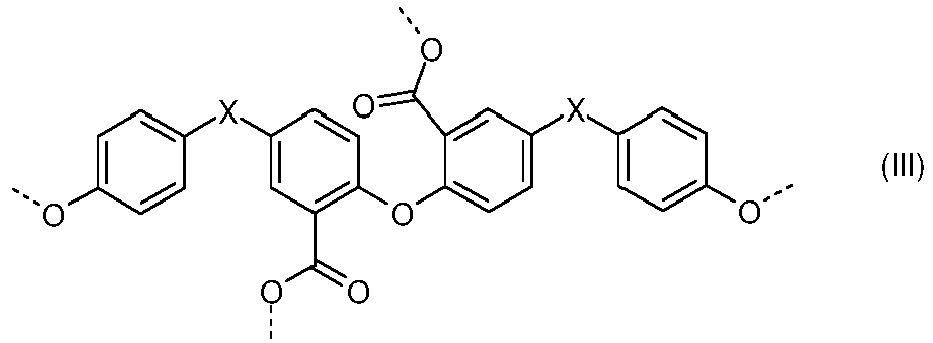

wobei die Menge der Struktureinheiten (I) bis (IV) in Summe 50 bis 900 ppm, bezogen auf das Gesamtgewicht des zugrunde liegenden Polycarbonats, beträgt,
weiterhin enthaltend in Summe lineare und cyclische Oligomere in einer Menge von 0,1 bis 2 Gew.-%, bezogen auf das Gesamtgewicht des aromatischen Schmelzepolycarbonats, wobei die linearen Oligomere solche der Formeln (V) bis (VII) sind


- n eine ganze Zahl von 2 bis 6 ist und
- Z für einen Rest der Formel (1a)

- R1 und R2 unabhängig voneinander für H, C1- bis C8-Alkyl, bevorzugt für H oder C1- bis C4-Alkyl, besonders bevorzugt für Wasserstoff oder Methyl, stehen und
- X für eine Einfachbindung, C1- bis C6-Alkylen, C2- bis Cs-Alkyliden oder C5- bis C6- Cycloalkyliden, welches mit C1- bis C6-Alkyl substituiert sein kann, steht.
- Vereinfachend lassen sich die Struktureinheiten der Formeln (I) bis (IV) als Umlagerungsstrukturen bezeichnen. Sie resultieren aus den für die Polycarbonatherstellung eingesetzten Dihydroxyarylverbindungen bzw. Dihydroxyarylverbindungsgemischen. So sind z.B. im Falle von Bisphenol A als Diphenol die Phenylringe der Umlagerungsstrukturen unsubstituiert.
- Die in den erfindungsgemäßen Polycarbonatzusammensetzungen enthaltenen cyclischen Oligomere der allgemeinen Formel (VIII) sind bevorzugt in Mengen von 0,2 bis 1,2 Gew.-%, besonders bevorzugt 0,2 bis 1,1 Gew.-% und ganz besonders bevorzugt 0,3 bis 1 Gew.-%, bezogen auf das Gesamtgewicht des Polycarbonats, enthalten.
- Im Wesentlichen, d.h. zu mehr als 95 %, haben die enthaltenen Cyclen Ringgrößen mit n = 2 bis 6. Bevorzugt treten Ringgrößen mit n = 3 und/oder n = 4, besonders bevorzugt n = 3 auf.
- Die in den erfindungsgemäßen Polycarbonatzusammensetzungen enthaltenen linearen Oligomere der allgemeinen Formel (V) bis (VII) sind bevorzugt in Mengen von 0,2 bis 1,2, besonders bevorzugt 0,3 bis 1,1 und ganz besonders bevorzugt 0,4 bis 0,9 Gew.-%, bezogen auf das Gesamtgewicht des Polycarbonats, enthalten.
- Die Menge der Oligomeren wird folgendermaßen bestimmt: Nach Lösen in Dichlormethan wird das Polycarbonat mit Aceton umgefällt. Das ausgefallene Polycarbonat wird abfiltriert und das Filtrat wird anschließend bis zur Trockene eingeengt. Der Rückstand wird gelöst und per HPLC mit UV-Detektion analysiert. Die Zuordnung erfolgt durch Vergleich mit einem Standmuster. Die Analyse erfolgt nach der Kurzmethode K0195TSC der Currenta GmbH & Co. KG, Stand November 2019.
- Die vorstehend definierten Umlagerungsstrukturen treten in unterschiedlichen Mengen und Verhältnissen zueinander auf. Ihre Menge lässt sich durch Totalverseifung der Polycarbonatzusammensetzung bestimmen. Dieses geschieht, indem nach Totalverseifung des Polycarbonates mit Natriummethylat unter Rückfluß die Probelösung bis zur Trockene eingeengt wird. Der Rückstand wird per HPLC mit UV-Detektion analysiert. Die Zuordnung erfolgt durch Vergleich mit einem Standmuster. Die Analyse erfolgt nach laborinterner Kurzmethode K0190TSC der Currenta GmbH & Co. KG, Stand November 2019. Bei dem Abbau zu Analysezwecken werden die für die jeweilige Umlagerungsstruktur charakteristischen niedermolekularen Abbauprodukte der Formeln (Ia) bis (IVa) gebildet, beispielhaft für Bisphenol A als Diphenol, d.h. X ist Isopropyliden, deren Menge mittels HPLC bestimmt wird, wobei die Phenylringe wie oben bei der Beschreibung der Formeln (I) bis (IV) angegeben substituiert sein können.

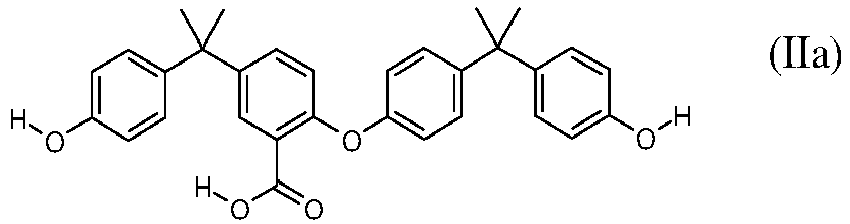


- Typischerweise beträgt die Menge der dabei freigesetzten Verbindung der Formel (Ia) 50 bis 800 ppm, bevorzugt von 70 bis 700 ppm, besonders bevorzugt von 100 bis 600 ppm und ganz besonders bevorzugt von 100 bis 550 ppm.
- Typischerweise beträgt die Menge der dabei freigesetzten Verbindung der Formel (IIa) 0 (unterhalb der Nachweisgrenze von < 5 ppm) bis 100 ppm, bevorzugt von 0 bis 90 ppm, besonders bevorzugt von 0 bis 80 ppm und ganz besonders bevorzugt von 0 bis 70 ppm.
- Typischerweise beträgt die Menge der dabei freigesetzten Verbindung der Formel (IIIa) 0 (unterhalb der Nachweisgrenze von < 5 ppm) bis 60 ppm, bevorzugt von 0 bis 50 ppm, besonders bevorzugt von 5 bis 40 ppm und ganz besonders bevorzugt von 5 bis 30 ppm.
- Typischerweise beträgt die Menge der dabei freigesetzten Verbindung der Formel (IVa) 0 (unterhalb der Nachweisgrenze von < 5 ppm) bis 300 ppm, bevorzugt von 5 bis 280 , besonders bevorzugt von 5 bis 270 ppm und ganz besonders bevorzugt von 10 bis 260 ppm.
- Aus Gründen der Vereinfachung wird die Menge der Strukturen der Formel (I) bis (IV) mit der Menge der freigesetzten Verbindungen der Formeln (Ia) bis (IVa) gleichgesetzt.
- Für die Herstellung der Polycarbonate geeignete Dihydroxyarylverbindungen sind beispielsweise Hydrochinon, Resorcin, Dihydroxydiphenyle, Bis-(hydroxyphenyl)-alkane, Bis(hydroxyphenyl)-cycloalkane, Bis-(hydroxyphenyl)-sulfide, Bis-(hydroxyphenyl)-ether, Bis-(hydroxyphenyl)-ketone, Bis-(hydroxyphenyl)-sulfone, Bis-(hydroxyphenyl)-sulfoxide, alpha - alpha '-Bis-(hydroxyphenyl)-diisopropylbenzole, Phtalimidine abgeleitet von Isatin- oder Phenolphthaleinderivaten sowie deren kernalkylierte, kernarylierte und kernhalogenierte Verbindungen.
- Bevorzugte Dihydroxyarylverbindungen sind 4,4'-Dihydroxydiphenyl, 2,2-Bis-(4-hydroxyphenyl)-propan, 2,4-Bis-(4-hydroxyphenyl)-2-methylbutan, 1,1-Bis-(4-hydroxyphenyl)-phenylethan, 1,3-Bis-[2-(4-hydroxyphenyl)-2-propyl]benzol (Bisphenol M), 1,1-Bis-(4-hydroxyphenyl)-p-diisopropylbenzol, 2,2-Bis-(3-methyl-4-hydroxyphenyl)-propan, 2,2-Bis-(3-chlor-4-hydroxyphenyl)-propan, Bis-(3,5-dimethyl-4-hydroxyphenyl)-methan, 2,2-Bis-(3,5-dimethyl-4-hydroxyphenyl)-propan, Bis-(3,5-dimethyl-4-hydroxyphenyl)-sulfon, 2,4-Bis-(3,5-dimethyl-4-hydroxyphenyl)-2-methylbutan, 1,1 -Bis-(3,5-dimethyl-4-hydroxyphenyl)-p-diisopropylbenzol, 2,2-Bis-(3,5-dichlor-4-hydroxyphenyl)-propan, 2,2-Bis-(3,5-dibrom-4-hydroxyphenyl)-propan, 1,3-Bis-[2-(3,5-dimethyl-4-hydroxyphenyl)-2-propyl]-benzol und 1,1-Bis-(4-hydroxyphenyl)-3,3,5-trimethylcyclohexan (Bisphenol TMC) sowie die Bisphenole der Formeln (I) bis (III)

- Besonders bevorzugte Dihydroxyarylverbindungen sind 4,4'-Dihydroxydiphenyl, 1,1-Bis-(4-hydroxyphenyl)-phenyl-ethan, 2,2-Bis-(4-hydroxyphenyl)-propan, 2,2-Bis-(3,5-dibrom-4-hydroxyphenyl)-propan, 2,2-Bis-(3,5-dichlor-4-hydroxyphenyl)-propan, 2,2-Bis(3,5-dimethyl-4-hydroxyphenyl)-propan, 1,1-Bis-(4-hydroxyphenyl)-cyclohexan und 1,1-Bis-(4-hydroxyphenyl)-3,3,5-trimethylcyclohexan (Bisphenol TMC) sowie die Dihydroxyarylverbindungen der Formeln (I), (II) und/oder (III).
- Diese und weitere geeignete Dihydroxyarylverbindungen sind z.B. in
US 2 999 835 A ,3 148 172 A ,2 991 273 A ,3 271 367 A ,4 982 014 A und2 999 846 A , in den deutschen Offenlegungsschriften1 570 703 A ,2 063 050 A ,2 036 052 A ,2 211 956 A und3 832 396 A , der französischen Patentschrift1 561 518 A1 - Im Fall der Homopolycarbonate ist nur eine Dihydroxyarylverbindung eingesetzt, im Fall der Copolycarbonate sind mehrere Dihydroxyarylverbindungen eingesetzt.
- Dihydroxyarylverbindungen sind allgemein bekannt oder lassen sich nach allgemein bekannten Verfahren herstellen (z.B.
WO 2006/072344 ,EP-A 1609818 und darin zitierte Literatur). Bevorzugte Diphenole der Formel (1) sind: 2,2-Bis-(4-hydroxyphenyl)-propan (BPA), Bis-(4-hydroxyphenyl)-3,3,5-trimethyl-cyclohexan und 4,4'-Dihydroxydiphenyl. - Es können sowohl eine Dihydroxyarylverbindung unter Bildung von Homopolycarbonaten als auch verschiedene Dihydroxyarylverbindungen unter Bildung von Copolycarbonaten verwendet werden. Letzteres ist insbesondere dann von Bedeutung, wenn Produkte mit besonderen Eigenschaftskombinationen hergestellt werden sollen.
- Anstelle der monomeren Dihydroxyarylverbindungen können auch niedermolekulare, überwiegend OH-endgruppengestoppte Oligocarbonate als Ausgangsverbindung eingesetzt werden.
- Die Dihydroxyarylverbindungen können auch mit Restgehalten der Monohydroxyarylverbindungen, aus denen sie hergestellt wurden bzw. die niedermolekularen Oligocarbonate mit Restgehalten der Monohydroxyarylverbindungen, die bei der Herstellung der Oligomeren abgespalten wurden, eingesetzt werden. Die Restgehalte der Monohydroxyarylverbindungen können bis zu 20 Gew.-%, vorzugsweise 10 Gew.-%, besonders bevorzugt bis 5 Gew.-% und ganz besonders bevorzugt bis zu 2 Gew.-% betragen (s. z.B.
EP 1 240 232 A1 ). - Die verwendeten Dihydroxyarylverbindungen, wie auch alle anderen der Synthese zugesetzten Rohstoffe, Chemikalien und Hilfsstoffe können mit den aus ihrer eigenen Synthese, Handhabung und Lagerung stammenden Verunreinigungen kontaminiert sein, obwohl es wünschenswert und Ziel ist, mit möglichst sauberen Rohstoffen, Chemikalien und Hilfsstoffen zu arbeiten.
- Die für die Umsetzung mit den Dihydroxyarylverbindungen geeigneten Diarylcarbonate sind solche obiger Formel (1). Solche Diarylcarbonate sind beispielsweise in
EP-A 1 609 818 A2 beschrieben. Bevorzugte Diarylverbindungen sind Diphenylcarbonat, 4-tert-Butylphenyl-phenyl-carbonat, Di-(4-tert-butylphenyl)-carbonat, Biphenyl-4-yl-phenyl-carbonat, Di-(biphenyl-4-yl)-carbonat, 4-(1-Methyl-1-phenylethyl)-phenyl-phenyl-carbonat und Di-[4-(1-methyl-1-phenylethyl)-phenyl] - carbonat. Besonders bevorzugt ist Diphenylcarbonat. - Die Diarylcarbonate können auch mit Restgehalten der Monohydroxyarylverbindungen, aus denen sie hergestellt wurden, eingesetzt werden. Die Restgehalte der Monohydroxyarylverbindungen können bis zu 20 Gew.-%, vorzugsweise 10 Gew.-%, besonders bevorzugt bis 5 Gew.-% und ganz besonders bevorzugt bis zu 2 Gew.-% betragen.
- Bezogen auf die Dihydroxyarylverbindung werden die Diarylcarbonate im Allgemeinen mit 1,02 bis 1,30 Mol, bevorzugt mit 1,04 bis 1,25 Mol, besonders bevorzugt mit 1,06 bis 1,22 Mol, ganz besonders bevorzugt mit 1,06 bis 1,20, pro Mol Dihydroxyarylverbindung eingesetzt. Es können auch Mischungen der oben genannten Diarylcarbonate eingesetzt werden.
- Zur Steuerung bzw. Veränderung der Endgruppen kann zusätzlich eine Monohydroxyarylverbindung eingesetzt werden, die nicht zur Herstellung des verwendeten Diarylcarbonats benutzt wurde. Sie wird durch folgende allgemeine Formel (3) dargestellt:

- Dabei ist eine Monohydroxyarylverbindung zu wählen, deren Siedepunkt über dem der Monohydroxyarylverbindung liegt, die zur Herstellung des verwendeten Diarylcarbonates eingesetzt wurde. Die Monohydroxyarylverbindung kann zu jedem Zeitpunkt im Reaktionsverlauf zugegeben werden. Sie wird bevorzugt zu Beginn der Reaktion zugegeben oder aber auch an beliebiger Stelle im Verfahrensverlauf. Der Anteil an freier Monohydroxyarylverbindung kann 0,2 - 20 Mol %, bevorzugt 0,4 - 10 Mol %, bezogen auf die Dihydroxyarylverbindung, betragen.
- Die Endgruppen können auch durch Mitverwendung eines Diarylcarbonates, dessen Basis-Monohydroxyarylverbindung einen höheren Siedepunkt hat als die Basis-Monohydroxyarylverbindung des hauptsächlich eingesetzten Diarylcarbonates, verändert werden. Auch hier kann das Diarylcarbonat zu jedem Zeitpunkt im Reaktionsverlauf zugegeben werden. Es wird bevorzugt zu Beginn der Reaktion zugegeben oder aber auch an beliebiger Stelle im Verfahrensverlauf. Der Anteil des Diarylcarbonates mit der höher siedenden Basis-Monohydroxyarylverbindung an der gesamt eingesetzten Diarylcarbonatmenge kann 1 - 40 Mol %, bevorzugt 1 - 20 Mol % und besonders bevorzugt 1 - 10 Mol %, betragen. Die Scheiben- oder Korbreaktoren zeichnen sich dadurch aus, dass sie bei hohen Verweilzeiten eine sehr große, sich ständig erneuernde Oberfläche am Vakuum bereitstellen. Die Scheiben- oder Korbreaktoren sind entsprechend den Schmelzviskositäten der Produkte geometrisch ausgebildet. Geeignet sind beispielsweise Reaktoren, wie sie in der
DE 44 47 422 C2 undEP A 1 253 163 , oder Zweiwellenreaktoren, wie sie in derWO A 99/28 370 - Zur Einarbeitung von Additiven wird die Komponente A bevorzugt in Form von Pulvern, Granulaten oder von Gemischen aus Pulvern und Granulaten eingesetzt.
- Die erfindungsgemäßen Zusammensetzungen enthalten als Komponente B epoxidiertes Triacylglycerol. Es kann sich bei Komponente B um ein bestimmtes oder eine Mischung verschiedener Epoxygruppen-enthaltender ("epoxidierter") Triacylglycerole handeln. Bevorzugt handelt es sich um eine Mischung verschiedener Triacylglycerole. Bevorzugt enthält Komponente B eine Mischung von Triestern aus Glycerin mit Ölsäure, Linolsäure, Linolensäure, Palmitinsäure und/oder Stearinsäure. Weiter bevorzugt umfassen die Ester gemäß Komponente B nur Ester aus Glycerin mit den genannten Fettsäuren. Besonders bevorzugt wird Komponente B in Form von epoxidiertem Sojabohnenöl (B1) in die erfindungsgemäßen Zusammensetzungen eingebracht. Die CAS-Nummer von epoxidiertem Sojabohnenöl lautet 8013-07-8.
- Die Epoxy-Gruppen in Komponente B können in dem Fachmann geläufigen Verfahren eingeführt werden. Solche sind insbesondere die Epoxidierung mit Peroxiden oder Persäuren, d.h. Ester von Glycerin mit Doppelbindungen enthaltenden Carbonsäuren werden mit Peroxiden oder Persäuren umgesetzt. Die C=C-Doppelbindungen in den Triacylglycerolen reagieren dabei teilweise oder vollständig zu Epoxidgruppen. Die Triacylglycerole sind also teilweise oder vollständig epoxidiert. Bevorzugt sind mindestens 90 %, weiter bevorzugt mindestens 95 %, noch weiter bevorzugt mindestens 98 % der aus den ungesättigten Carbonsäuren stammenden C=C-Doppelbindungen der Triacylglycerole epoxidiert. Bei Komponente B handelt es sich bevorzugt um eine Mischung verschiedener Verbindungen, wie sie z.B. durch den Einsatz von epoxidiertem Sojabohnenöl gegeben ist. Die OH-Zahlen dieser Mischungen liegen vorzugsweise zwischen 180 und 300 mg KOH/g (Methode 2011-0232602-92D der Currenta GmbH & Co. OHG, Leverkusen, entsprechend DIN EN ISO2554:1998-10 mit Pyridin als Lösungsmittel). Die Säurezahlen dieser Mischungen liegen vorzugsweise unter 1 mg KOH/g, weiter bevorzugt sind sie ≤ 0,5 mg KOH/g, bestimmt mittels DIN EN ISO 2114:2006-11. Die Jodzahl der Mischungen nach Wijs beträgt vorzugsweise ≤ 5,0 g Jod/100 g, weiter bevorzugt ≤ 3,0 g Jod/100 g (Methode 2201-0152902-95D der Currenta GmbH & Co. OHG, Leverkusen). Die Oxiranzahl beträgt bevorzugt 5 bis 10 g O2/100 g, besonders bevorzugt 6,3 bis 8,0 g O2/100 g.
- Die Polycarbonat-haltigen Zusammensetzungen enthalten 0,05 bis 10,0 Gew.-%, bevorzugt 0,1 bis 8,0 Gew.-%, weiter bevorzugt 0,2 bis 6,0 Gew.-%, noch weiter bevorzugt 0,2 bis 1,0 Gew.-%, besonders bevorzugt bis 0,8 Gew.-%, der Komponente B. "Bis" hier und an anderer Stelle schließt den jeweils genannten Grenzwert ein.
- Als Komponente C1 können die transparenten thermoplastischen Zusammensetzungen Flammschutzmittel enthalten, insbesondere Alkali-, Erdalkali- und/oder Ammoniumsalze von aliphatischen bzw. aromatischen Sulfonsäure-, Sulfonamid- und Sulfonimidderivaten. Besonders bevorzugt umfassen erfindungsgemäße Zusammensetzungen als Flammschutzmittel ein oder mehrere Verbindungen, ausgewählt aus der Gruppe, bestehend aus Natrium- oder Kaliumperfluorbutansulfat, Natrium- oder Kaliumperfluormethansulfonat, Natrium- oder Kaliumperfluoroctansulfat, Natrium- oder Kalium-2,5-dichlorbenzolsulfat, Natrium- oder Kalium-2,4,5-trichlorbenzolsulfat, Natrium- oder Kaliumdiphenylsulfonsulfonat, Natrium- oder Kalium-2-formylbenzolsulfonat, Natrium- oder Kalium-(N-benzolsulfonyl)-benzolsulfonamid oder deren Mischungen.
- Bevorzugt werden Natrium- oder Kaliumperfluorbutansulfat, Natrium- oder Kaliumperfluoroctansulfat, Natrium- oder Kaliumdiphenylsulfonsulfonat oder deren Mischungen eingesetzt. Ganz besonders bevorzugt ist Kaliumperfluor-1-butansulfonat, welches kommerziell erhältlich ist, unter anderem als Bayowet® C4 von der Firma Lanxess, Leverkusen, Deutschland.
- Die Mengen von Alkali-, Erdalkali- und/oder Ammoniumsalzen von aliphatischen bzw. aromatischen Sulfonsäure-, Sulfonamid- und Sulfonimidderivaten in der Zusammensetzung, sofern diese eingesetzt werden, betragen bevorzugt mindestens 0,01 Gew.-% und weiter bevorzugt bis zu 0,065 Gew.-%, da entsprechende Zusammensetzungen hier noch transparent sind.
- Die erfindungsgemäßen transparenten thermoplastischen Zusammensetzungen können ein Entformungsmittel als Komponente C2 enthalten, bevorzugt in einer Menge bis 2,0 Gew.-%, weiter bevorzugt bis 1,0 Gew.-%, besonders bevorzugt bis 0,5 Gew.-%. "Bis (zu)" schließt erfindungsgemäß den jeweiligen Wert ein. Besonders bevorzugt enthalten die Zusammensetzungen Entformungsmittel auf Basis eines Fettsäureesters, bevorzugt eines Stearinsäureesters, insbesondere bevorzugt auf Pentaerythritbasis. Zusätzlich oder alternativ kann auch Glycerinmonostearat (GMS) eingesetzt werden.
- Die erfindungsgemäßen Zusammensetzungen enthalten bevorzugt als Additiv mindestens einen UV-Absorber. Die UV-Absorber weisen eine möglichst geringe Transmission unterhalb 400 nm und eine möglichst hohe Transmission oberhalb von 400 nm auf. Für den Einsatz in der erfindungsgemäßen Zusammensetzung besonders geeignete Ultraviolett-Absorber sind Benzotriazole, Triazine, Benzophenone und/oder arylierte Cyanoacrylate.
- Besonders geeignete Ultraviolett-Absorber sind Hydroxy-Benzotriazole, wie 2-(3',5'-Bis-(1,1-dimethylbenzyl)-2'-hydroxy-phenyl)-benzotriazol (Tinuvin® 234, BASF SE, Ludwigshafen), 2-(2'-Hydroxy-5'-(tert.-octyl)-phenyl)-benzotriazol (Tinuvin® 329, BASF SE, Ludwigshafen), Bis-(3-(2H-benztriazolyl)-2-hydroxy-5-tert.-octyl)methan (Tinuvin® 360, BASF SE, Ludwigshafen), 2-(4,6-Diphenyl-1,3,5-triazin-2-yl)-5-(hexyloxy)-phenol (Tinuvin® 1577, BASF SE, Ludwigshafen), sowie Benzophenone wie 2,4-Dihydroxybenzophenon (Chimasorb® 22 , BASF SE, Ludwigshafen) und 2-Hydroxy-4-(octyloxy)-benzophenon (Chimassorb® 81, BASF SE, Ludwigshafen), 2,2-Bis[[(2-cyano-1-oxo-3,3-diphenyl-2-propenyl)oxy]-methyl]-1,3-propandiylester (9CI) (Uvinul® 3030, BASF SE, Ludwigshafen), 2-[2-Hydroxy-4-(2-ethylhexyl)oxy]phenyl-4,6-di(4-phenyl)phenyl-1,3,5-triazine (Tinuvin® 1600, BASF SE, Ludwigshafen), Tetraethyl-2,2'-(1,4-phenylen-dimethyliden)-bismalonat (Hostavin® B-Cap, Clariant AG) oder N-(2-Ethoxyphenyl)-N'-(2-ethylphenyl)-ethandiamid (Tinuvin® 312, CAS-Nr. 23949-66-8, BASF SE, Ludwigshafen).
- Besonders bevorzugte spezielle UV-Stabilisatoren sind Tinuvin® 360, Tinuvin® 329, Tinuvin® 312, Tinuvin® 326 und/oder Tinuvin® 1600, ganz besonders bevorzugt sind Tinuvin® 329, Tinuvin® 326 und/oder Tinuvin® 360.
- Es können auch Mischungen der genannten Ultraviolett-Absorber eingesetzt werden.
- Sofern UV-Absorber enthalten sind, enthält die Zusammensetzung bevorzugt Ultraviolett-Absorber in einer Menge bis 1,0 Gew.-%, weiter bevorzugt bis 0,8 Gew.-%, besonders bevorzugt 0,05 Gew.-% bis 0,5 Gew.-%, ganz besonders bevorzugt 0,08 Gew.-% bis 0,4 Gew.-%, äußerst bevorzugt 0,1 Gew.-% bis 0,3 Gew.-%, bezogen auf die Gesamtzusammensetzung.
- Die erfindungsgemäßen Zusammensetzungen können Triisooctylphosphat als Umesterungsstabilisator enthalten. Triisooctylphosphat wird bevorzugt in Mengen von 0,003 Gew.-% bis 0,05 Gew.-%, weiter bevorzugt 0,004 Gew.-% bis 0,04 Gew.-% und besonders bevorzugt von 0,005 Gew.-% bis 0,03 Gew.-%, ganz besonders bevorzugt 0,007 bis 0,02 Gew.-%, bezogen auf die Gesamtzusammensetzung, eingesetzt.
- Zusätzlich sind optional sonstige übliche Additive ("weitere Additive"), vorzugsweise bis zu 10,0 Gew.-%, weiter bevorzugt 0,1 bis 6,0 Gew.-%, besonders bevorzugt 0,1 bis 3,0 Gew.-%, ganz besonders bevorzugt 0,2 bis 1,0 Gew.-%, insbesondere bis 0,5 Gew.-%, sonstige übliche Additive ("weitere Additive") enthalten. Die Gruppe der weiteren Additive umfasst keine Flammschutzmittel, keine Entformungsmittel, keine UV-Absorber und kein Triisooctylphosphat, da diese bereits als Komponenten C1, C2, C3 und D beschrieben sind. Es versteht sich, dass Komponente E auch kein Epoxy-Gruppen enthaltendes Triacylglycerol, auch kein epoxidiertes Sojabohnenöl umfasst, da dieses bereits als Komponente B beschrieben ist.
- Solche Additive, wie sie üblicherweise bei Polycarbonaten zugesetzt werden, sind insbesondere Antioxidantien, Thermostabilisatoren, von Triisooctylphosphat verschiedene Umesterungsstabilisatoren, IR-Absorber, Antistatika, optische Aufheller, Farbmittel wie organische Pigmente, wie sie beispielsweise in
EP-A 0 839 623 ,WO-A 96/15102 EP-A 0 500 496 oder "Plastics Additives Handbook", Hans Zweifel, 5th Edition 2000, Hanser Verlag, München beschrieben sind, in den für Polycarbonat üblichen Mengen. Diese Additive können einzeln oder auch im Gemisch zugesetzt werden. Generell sollten nur solche Additive verwendet werden, die mit der Polycarbonatmatrix kompatibel sind und nicht zu einer Trübung größer 2,0 % bei einer Schichtdicke von 4 mm führen. - Die erfindungsgemäßen Zusammensetzungen können auch andere Phosphate als Triisooctylphosphat oder Sulfonsäureester als Umesterungsstabilisatoren enthalten.
- Die erfindungsgemäßen Zusammensetzungen enthalten bevorzugt keine Glasfasern und keine Carbonfasern.
- Die Herstellung der erfindungsgemäßen Zusammensetzungen, enthaltend die Komponenten A und B sowie ggf. C1, C2, C3, D und/oder E, erfolgt mit gängigen Einarbeitungsverfahren durch Zusammenführung, Vermischen und Homogenisieren der einzelnen Bestandteile, wobei insbesondere die Homogenisierung bevorzugt in der Schmelze unter Einwirkung von Scherkräften stattfindet. Gegebenenfalls erfolgt das Zusammenführen und Vermischen vor der Schmelzehomogenisierung unter Verwendung von Pulvervormischungen.
- Es können auch Vormischungen aus Granulaten oder Granulaten und Pulvern mit den Komponenten B, ggf. C1, ggf. C2, ggf. C3 und ggf. D und E verwendet werden.
- Es können auch Vormischungen verwendet werden, die aus Lösungen der Mischungskomponenten in geeigneten Lösungsmitteln hergestellt worden sind, wobei gegebenenfalls in Lösung homogenisiert wird und das Lösungsmittel anschließend entfernt wird.
- Insbesondere können hierbei die Komponenten B bis E der erfindungsgemäßen Zusammensetzung durch bekannte Verfahren oder als Masterbatch in das Polycarbonat eingebracht werden.
- Die Verwendung von Masterbatchen ist zum Einbringen der Komponenten B bis E, einzeln oder in Mischung, bevorzugt.
- In diesem Zusammenhang kann die erfindungsgemäße Zusammensetzung in üblichen Vorrichtungen wie Schneckenextrudern (zum Beispiel Zweischneckenextruder, ZSK), Knetern, Brabender- oder Banbury-Mühlen zusammengeführt, vermischt, homogenisiert und anschließend extrudiert werden. Nach der Extrusion kann das Extrudat abgekühlt und zerkleinert werden. Es können auch einzelne Komponenten vorgemischt werden und dann können die restlichen Ausgangsstoffe einzeln und/oder ebenfalls gemischt hinzugegeben werden.
- Die Zusammenführung und Durchmischung einer Vormischung in der Schmelze kann auch in der Plastifiziereinheit einer Spritzgussmaschine erfolgen. Hierbei wird die Schmelze im anschließenden Schritt direkt in einen Formkörper überführt.
- Die erfindungsgemäßen Zusammensetzungen können auf üblichen Maschinen, beispielsweise auf Extrudern oder Spritzgussmaschinen, zu beliebigen Formkörpern in üblicher Weise verarbeitet werden.
- Die Herstellung der Formteile erfolgt vorzugsweise durch Spritzguss, Extrusion oder aus Lösung in einem Gießprozess.
- Beispielsweise weisen die erfindungsgemäßen Zusammensetzungen wenigstens eine der nachfolgenden Eigenschaften auf:
- einen Vicat VST/B50 nach ISO 306:2013 von ≥ 140,0°C bis ≤ 150°C,
- eine Transmission, bestimmt nach DIN EN ISO 13468-2:2006 bei einer Schichtdicke von 4 mm, von ≥ 86,0% bis 89,6% (Obergrenze inkludiert),
- eine Kerbschlagzähigkeit nach ISO7391/180A, 3mm, von ≥ 50 kJ/m2 bis ≤ 75 kJ/m2,
- eine Einstufung im Brandtest UL94 (1,5 mm Wandstärke) von mindestens V2, sofern die Zusammensetzung Flammschutzmittel enthält.
- Die erfindungsgemäßen Zusammensetzungen sind zur Herstellung von Mehrschichtsystemen geeignet. Hierbei wird die Polycarbonat-haltige Zusammensetzung in einer oder mehreren Schicht(en) auf einen geformten Gegenstand aus einem Kunststoff aufgebracht. Das Aufbringen kann zugleich mit oder unmittelbar nach der Formgebung des Formkörpers geschehen, zum Beispiel durch Hinterspritzen einer Folie, Coextrusion oder Mehrkomponentenspritzguss. Das Aufbringen kann aber auch auf den fertig geformten Grundkörper geschehen, z.B. durch Lamination mit einem Film, Umspritzen eines vorhandenen Formkörpers oder durch Beschichtung aus einer Lösung.
- Die erfindungsgemäßen Zusammensetzungen sind zur Herstellung von Bauteilen im Automotive-Bereich, etwa für Blenden, Scheinwerferabdeckungen oder -rahmen, Linsen und Kollimatoren oder Lichtleiter sowie zur Herstellung von transparenten Rahmenbauteilen im EE (Elektro/Elektronik)- und IT-Bereich geeignet, insbesondere für Anwendungen, die hohe Anforderungen an die Fließfähigkeit stellen (Dünnschichtanwendungen). Solche Anwendungen sind beispielsweise 2K-Gehäuse, etwa für Ultrabooks, oder Rahmen/Rahmenteile für LED-Display-Technologien, z.B. OLED-Displays oder LCD-Displays oder auch für E-Ink-Geräte. Weitere Anwendungsfelder sind Gehäuseteile von mobilen Kommunikationsendgeräten, wie Smartphones, Tablets, Ultrabooks, Notebooks oder Laptops, aber auch Gehäuseteile für Navigationsgeräte, Smartwatches oder Herzfrequenzmesser, sowie für Elektroanwendungen in Dünnwand-Ausfertigungen, z. B. Haus- und Industrie-Vernetzungseinheiten und Smart-Meter-Gehäusebauteile.
- Die Formteile, bestehend aus den erfindungsgemäßen Zusammensetzungen, einschließlich der Formteile, die eine Schicht eines Mehrschichtsystems bzw. ein Element eines oben genannten Bauteils darstellen, aus ("bestehend aus") diesen erfindungsgemäßen Zusammensetzungen, sind ebenfalls Gegenstand dieser Anmeldung.
- Die erfindungsgemäßen Zusammensetzungen zeichnen sich insbesondere dadurch aus, dass sie aufgrund der Anwesenheit von Komponente B über ausgezeichnete rheologische und optische Eigenschaften verfügen. Sie eignen sich daher insbesondere für die Herstellung von anspruchsvollen Spritzgussteilen, besonders für Dünnwandanwendungen, bei denen eine gute Fließfähigkeit erforderlich ist. Beispiele für derartige Anwendungen sind Ultrabook-Gehäuseteile, Laptop-Cover, Scheinwerferabdeckungen, LED-Anwendungen oder Bauteile für E/E-Anwendungen. Dünnwandanwendungen sind bevorzugt solche Anwendungen, bei denen Wandstärken von weniger als 3 mm, weiter bevorzugt von weniger als 2,5 mm, noch weiter bevorzugt weniger als 2,0 mm, ganz besonders bevorzugt von weniger als 1,5 mm vorliegen. Wandstärke in diesem konkreten Fall ist definiert als Dicke der Wand lotrecht zur Fläche des Formteils mit der größten Ausdehnung, wobei über mindestens 60 %, bevorzugt über mindestens 75 %, weiter bevorzugt über mindestens 90 %, besonders bevorzugt über die gesamte Fläche die genannte Dicke vorliegt.
- Gegenstand der Erfindung sind daher Formteile, umfassend die, bzw. bestehend aus den erfindungsgemäßen Zusammensetzungen, die Teil der genannten Anwendungselemente sind.
- Die für die erfindungsgemäßen Zusammensetzungen vorstehend beschriebenen Ausführungsformen gelten - soweit anwendbar - auch für die erfindungsgemäße Verwendung.
- Die nachfolgenden Beispiele sollen die Erfindung illustrieren, ohne sie jedoch einzuschränken.
- Die in den folgenden Beispielen beschriebenen Polycarbonat-basierten Zusammensetzungen wurden auf einem Extruder ZE 25 der Fa. Berstorff mit einem Durchsatz von 10 kg/h durch Compoundierung hergestellt. Die Schmelzetemperatur betrug 275 °C.
- Komponente A1: Bisphenol A-basiertes Schmelzepolycarbonat mit einer Schmelze-Volumenfließrate MVR von 12 cm3/(10 min) (gemäß ISO 1133:2012-03, bei einer Prüftemperatur 300°C und 1,2 kg Belastung).
- Komponente A2: Bisphenol A-basiertes Schmelzepolycarbonat in Pulverform mit einer Schmelze-Volumenfließrate MVR von 6 cm3/(10 min) (gemäß ISO 1133:2012-03, bei einer Prüftemperatur von 300°C und 1,2 kg Belastung).
- Komponente A3: Bisphenol A-basiertes Schmelzepolycarbonat in Pulverform mit einer Schmelze-Volumenfließrate MVR von 14 cm3/(10 min) (gemäß ISO 1133:2012-03, bei einer Prüftemperatur von 300°C und 1,2 kg Belastung).
- Die Polycarbonat-Pulver A2 und A3 dienten der besseren Einarbeitung der Additive.
- Komponente B: Epoxidiertes Sojabohnenöl der Firma Faci, Italien, mit einer Säurezahl ≤ 0,5 mg KOH/g, bestimmt mittels DIN EN ISO 2114:2006-11, einem Oxiranwert (Epoxid-Sauerstoff ES, berechnet aus der Epoxid-Zahl EEW, gibt an wieviel Gramm Sauerstoff pro 100 g Öl enthalten sind; EEW bestimmt nach DIN 16945:1987-09) von ≥ 6,3 g O2/100 g. Überwiegend vollständig epoxidierte Triacylglycerole, welche eine Mischung aus Triestern aus Glycerin mit Ölsäure, Linolsäure, Linolensäure, Palmitinsäure und/oder Stearinsäure sind.
- Komponente C1: Kaliumperfluor-1-butansulfonat, kommerziell erhältlich als Bayowet® C4 der Firma Lanxess AG, Leverkusen, Deutschland, CAS-Nr. 29420-49-3.
- Komponente C2: Entformungsmittel PETS (Pentaerythrittetrastearat) der Firma Emery Oleochemicals.
- Komponente C3: UV-Absorber Tinuvin 329 der Firma BASF SE.
- Komponente D: Triisooctylphosphat der Firma Lanxess AG.
- Die Bestimmung des Schmelze-Volumenfließrate (MVR) erfolgte nach ISO 1133:2012-03 (überwiegend bei einer Prüftemperatur von 300 °C, Masse 1,2 kg) mit dem Gerät Zwick 4106 der Firma Zwick Roell. Zusätzlich wurde der MVR-Wert nach 20 Minuten Vorwärmzeit gemessen (IMVR20'). Dies ist ein Maß für die Schmelzestabilität unter erhöhtem thermischem Stress.
- Die Izod-Schlagzähigkeit wurde nach ISO 180:2019/1C (4 mm) bestimmt.
- Die Izod-Kerbschlagzähigkeit wurde nach ISO 7391/ i.A. 180:2019 ISO 7391/180A (3 mm) bestimmt.
- Die Bestimmung der Lösungsviskosität (eta rel) erfolgte nach ISO 1628-4:1999-03 mit einem Ubbelohde-Viskosimeter. Dazu wurden die Granulate gelöst und die Füllstoffe durch Filtration abgetrennt. Das Filtrat wurde eingeengt und getrocknet. Der erhaltene Film wurde zur Messung der Lösungsviskosität verwendet.
- Der Yellowness-Index (Y.I.) wurde gemessen nach ASTM E313-10. Der Y.I. wurde nach D65,10° (Lichtart: D65/Beobachter: 10°) ausgewertet. Die vermessenen Proben hatten eine Geometrie von 60 mm x 40 mm x 4 mm.
- Die Transmission Ty wurde bestimmt nach DIN EN ISO 13468-2:2006 bei einer Schichtdicke von 4 mm
- Die Trübung wurde bestimmt nach ASTM D1003:2013 bei einer Schichtdicke von 4 mm
- Die Vicat-Erweichungstemperatur VST/B50 als Maß für die Wärmeformbeständigkeit wurde gemäß ISO 306:2013 an Prüfkörpern der Abmessung 80 mm x 10 mm x 4 mm mit einer Stempellast von 50 N und einer Aufheizgeschwindigkeit von 50°C/h mit dem Gerät Coesfeld Eco 2920 der Firma Coesfeld Materialtest bestimmt.
- Es wurde außerdem die Brennbarkeit der untersuchten Proben beurteilt und klassifiziert, und zwar nach UL94. Dazu wurden Probenkörper der Abmessung 125 mm x 13 mm x 1,5 mm herstellt, wobei die Dicke d dabei der kleinsten Wandstärke in der vorgesehenen Anwendung entspricht. Eine V0-Klassifizierung bedeutet, dass die Flamme nach maximal 10 s von selbst erlischt. Ein brennendes Abtropfen tritt nicht auf. Ein Nachglimmen nach der zweiten Beflammung erfolgt für maximal 30 s.
- Die in den folgenden Beispielen beschriebenen Polycarbonatzusammensetzungen wurden auf einem Extruder Evolum EV32HT der Firma Clextral-Frankreich mit einem Schneckendurchmesser von 32 mm durch Compoundierung hergestellt. Als Schneckenbesatz kam dabei L7-8,2 bei einem Durchsatz von 40-70 kg/h zum Einsatz. Die Drehzahl betrug 200-300 U/min bei einer Massetemperatur von 240-320 °C (je nach Zusammensetzung).
- Das Granulat der aufgeführten Versuchsformulierungen wurde in einem Trockenlufttrockner der Firma Labotek, Typ DDM180 für 4 Stunden bei 80°C getrocknet.
-
Tabelle 1: Schmelzepolycarbonat mit epoxidiertem Sojabohnenöl (ESBO) Rezeptur V1 2 3 4 5 6 A1 Gew.-% 93 93 93 93 93 93 A2 Gew.-% 7 6,9 6,8 6,6 6,4 6,2 B Gew.-% - 0,1 0,2 0,4 0,6 0,8 Prüfungen: ηrel Granulat 1,277 1,277 1,276 1,276 1,276 1,274 MVR 7'/300 °C/1,2 kg ml/(10 min) 12,0 12,5 12,5 12,8 14,6 15,4 Vicat VSTB 50 146,1 144,8 145,1 142,9 141,8 140,4 Schmelzevisk. bei 280°C eta 50 Pa·s 763 760 691 666 659 639 eta 100 Pa·s 722 707 681 652 622 617 eta 200 Pa·s 667 651 626 607 575 570 eta 500 Pa·s 538 525 507 495 470 466 eta 1000 Pa·s 406 399 388 380 364 361 eta 1500 Pa·s 328 324 316 311 299 297 eta 5000 Pa·s 150 148 146 144 139 139 Schmelzevisk. bei 300°C eta 50 Pa·s 397 355 354 327 306 292 eta 100 Pa·s 380 348 347 320 299 284 eta 200 Pa·s 357 334 334 313 291 276 eta 500 Pa·s 307 291 292 275 258 245 eta 1000 Pa·s 256 245 244 232 218 207 eta 1500 Pa·s 221 211 211 201 187 181 eta 5000 Pa·s 117 111 111 106 102 100 Schmelzevisk. bei 320°C eta 50 Pa·s 222 211 203 165 141 129 eta 100 Pa·s 219 207 201 162 140 128 eta 200 Pa·s 214 200 198 157 139 126 eta 500 Pa·s 195 183 180 152 137 119 eta 1000 Pa·s 170 161 159 137 122 108 eta 1500 Pa·s 150 142 142 124 109 98 eta 5000 Pa·s 85 86 85 78 70 66 Kerbschlagzähigkeit RT kJ/m2 65z 64z 66z 65z 66z 66z 10°C kJ/m2 - - - - - 64z 0°C kJ/m2 61z - - 61z 61z 8x59z 2x21s -10°C kJ/m2 8x55z 2x28s - 60z 59z 8x59z 1x21s 8x57z 2x23s -20°C kJ/m2 20s 59z 9x61z 1x20s 17s 17s 16s Schlagzähigkeit 23°C kJ/m2 n.g. n.g. n.g. n.g. n.g. n.g. Optik 4mm 290°C Transmission % 87,52 88,65 88,76 88,94 89,14 89,15 Trübung % 0,70 0,44 0,51 0,45 0,34 0,30 Y.I. 3,09 2,65 2,59 2,57 2,53 2,54 300°C Transmission % 87,37 88,60 88,74 88,94 89,16 89,18 Trübung % 0,64 0,44 0,41 0,45 0,35 0,36 Y.I. 3,31 2,79 2,72 2,71 2,62 2,66 320°C Transmission % 87,50 88,60 88,65 88,95 89,16 89,10 Trübung % 0,60 0,43 0,41 0,46 0,36 0,40 Y.I. 3,26 2,84 2,78 2,52 2,62 2,84 Thermoalterung bei 120°C Ausgang Transmission % 87,52 88,65 88,76 88,94 89,14 89,15 Trübung % 0,70 0,44 0,51 0,45 0,34 0,30 Y.I. 3,09 2,65 2,59 2,57 2,53 2,54 500h Transmission % 87,36 88,52 88,57 88,51 88,98 88,97 Trübung % 0,67 0,47 0,46 0,56 0,37 0,39 Y.I. 3,72 3,4 3,51 3,96 3,84 4,17 1000h Transmission % 87,02 88,14 88 88,11 88,47 88,37 Trübung % 0,63 0,46 0,41 0,49 0,5 0,4 Y.I. 5,34 5,02 5,35 6,26 6,08 6,88 n.g. = nicht gebrochen - Durch die Zugabe von ESBO wird die optische Transmission der Compounds erhöht. Gleichzeitig wird in den meisten Fällen der Yellowness Index (YI) reduziert. Höhere Konzentrationen an ESBO können zu einem etwas höheren YI führen.
- Die Zähigkeiten bleiben auf hohem Niveau erhalten. Die Schmelzviskositäten werden gleichzeitig reduziert, was sich positiv auf die Verarbeitung im Spritzguss auswirkt.
Tabelle 2: Schmelzepolycarbonat mit epoxidiertem Sojabohnenöl (ESBO) und Flammschutzmittel Rezeptur V7 8 9 10 11 12 A1 Gew.-% 93 93 93 93 93 93 A2 Gew.-% 6,935 6,835 6,735 6,535 6,335 6,135 B Gew.-% - 0,1 0,2 0,4 0,6 0,8 C1 Gew.-% 0,065 0,065 0,065 0,065 0,065 0,065 Prüfungen: ηrel Granulat 1,276 1,275 1,275 1,275 1,274 1,273 MVR 7'/300 °C/1,2 Kg ml/(10 min) 11,8 12,5 13,4 14,5 16,2 17,3 Vicat VSTB 50 145,3 144,5 144,0 142,5 140,5 141,3 Schmelzevisk. bei 280°C eta 50 Pa·s 729 617 410 531 500 473 eta 100 Pa·s 646 595 407 515 496 468 eta 200 Pa·s 598 556 384 488 475 438 eta 500 Pa·s 491 462 340 414 405 376 eta 1000 Pa·s 381 363 274 332 325 306 eta 1500 Pa·s 313 301 212 276 270 256 eta 5000 Pa·s 146 142 110 135 133 127 Schmelzevisk. bei 300°C eta 50 Pa·s 343 339 315 250 207 186 eta 100 Pa·s 328 324 302 245 201 184 eta 200 Pa·s 308 300 282 233 203 184 eta 500 Pa·s 280 274 256 218 191 173 eta 1000 Pa·s 238 232 209 187 170 154 eta 1500 Pa·s 209 201 193 171 156 138 eta 5000 Pa·s 115 99 107 99 93 88 Schmelzevisk. bei 320°C eta 50 Pa·s 184 170 167 102 107 78 eta 100 Pa·s 184 170 155 98 105 76 eta 200 Pa·s 172 165 147 95 102 74 eta 500 Pa·s 158 154 139 93 100 73 eta 1000 Pa·s 145 137 126 88 96 70 eta 1500 Pa·s 137 124 115 84 90 68 eta 5000 Pa·s 85 81 59 60 70 60 Kerbschlagzähigkeit RT kJ/m2 70z 69z 69z 69z 65z 67z 0°C kJ/m2 63z 64z 63z 64z 62z 62z -10°C kJ/m2 60z 62z 7x61z 3x34s 7x60z 3x21s 17s 16s -20°C kJ/m2 19s 19s 18s 17s 21s 18s Optik 4 mm 300°C Transmission % 88,63 89,01 89,05 89,08 89,17 89,17 Trübung % 1,55 0,47 0,32 0,30 0,36 0,35 Y.I. 2,78 2,68 2,65 2,65 2,75 2,84 UL94V in 1,5 mm (48h 23°C) V2 V2 V2 V2 V2 V2 Einzelbew. V0/V1/V2/Vn.b. 3/-/2/- -/-/5/- -/-/5/- 1/-/4/- -/-/5/- 2/-/3/- Nachbrennzeit 43 43 37 36 29 38 Nachbrennzeit (1. Brennsatz ) s - - - - - - (7d 70°C) s V0 V2 V2 V2 V2 V2 Einzelbew. V0/V1/V2/Vn.b. 5/-/-/- 1/2/2/- 1/-/4/- 3/-/2/- 3/-/2/- 3/-/2/- Nachbrennzeit 47 62 53 68 55 44 Nachbrennzeit (1. Brennsatz ) s - - - - - - Gesamtbewertung s V2 V2 V2 V2 V2 V2 - Durch die Zugabe von ESBO wird die optische Transmission der Compounds erhöht. Die Compounds sind trotz Flammschutzmittel transparent. Gleichzeitig wird der Yellowness Index (YI) reduziert. Erst bei höheren Konzentrationen an ESBO kommt es zu einem etwas höheren YI.
- Die Zähigkeiten sowie das Flammschutzverhalten bleiben auf hohem Niveau erhalten, die Schmelzviskositäten werden zusätzlich reduziert, was sich positiv auf die Verarbeitung im Spritzguss auswirkt.


Tabelle 4: Schmelzepolycarbonat mit ESBO, UV-Schutz Additiv und Flammschutzmittel Rezeptur V17 18 19 20 A1 Gew.-% 93,00 93,00 93,00 93,00 A3 Gew.-% 6,21 6,11 6,01 5,81 B Gew.-% 0,10 0,20 0,40 C2 Gew.-% 0,40 0,40 0,40 0,40 C3 Gew.-% 0,25 0,25 0,25 0,25 C1 Gew.-% 0,13 0,13 0,13 0,13 D Gew.-% 0,01 0,01 0,01 0,010 Prüfung Bedingung Einheit ηrel Granulat 1,271 1,272 1,270 1,271 MVR 300 °C; 1,20 kg; 7 min cm3/(10 min) 14,4 15,1 15,9 15,4 Vicat VSTB50 °C 140,1 139,4 138,1 137,2 UL94-V 3,00 mm Bewertungsstufe V-0 V-0 V-0 V-0 Tabelle 5: Schmelzepolycarbonat mit ESBO, UV-Schutz-Additiv und Flammschutzmittel (Fortsetzung) Rezeptur V21 22 23 24 A1 Gew.-% 93,00 93,00 93,00 93,000000 A3 Gew.-% 6,275 6,175 6,075 5,875000 B Gew.-% 0,10 0,20 0,40 C2 Gew.-% 0,40 0,40 0,40 0,40 C3 Gew.-% 0,25 0,25 0,25 0,25 C1 Gew.-% 0,065 0,065 0,065 0,065 D Gew.-% 0,01 0,010 0,01 0,01 Prüfung Einheit ηrel Granulat 1,272 1,273 1,273 1,272 MVR 300 °C; 1,20 kg; 7 min cm3/(10 min) 14,8 14,7 15,3 15,9 MVR 300 °C; 1,20 kg; 20 min cm3/(10 min) 15,6 16 16,8 18,2 Delta MVR/IMVR20' 0,8 1,3 1,5 2,3 Vicat VSTB50 °C 142,3 141,6 140,6 139,4 Brand UL94-V 3,00 mm Bewertungsstufe V-2 V-2 V-2 V-2 Optische Daten Transmissions-messung Hunter Ultra-ScanPRO, diffus/8°; D65; 10° Probendicke mm 1 2 3 4 1 2 3 4 1 2 3 4 1 2 3 4 Transmission [%] 89,4 88,8 88,3 87,8 89,5 89,1 88,6 88,2 89,5 89,2 88,7 88,2 89,6 89,3 89,0 88,6 Y.I. 1,21 1,63 2,12 2,62 1,11 1,56 2,04 2,47 1,16 1,54 2,01 2,43 1,11 1,56 2,02 2,45 Trübung [%] 0,73 0,88 1,44 1,59 0,66 0,74 1,17 1,21 0,62 0,76 1,08 1,42 0,56 0,69 0,88 1.19 V"X": Vergleichsversuch "X" - Aus Tabelle 4 und Tabelle 5 ist zu erkennen, dass bei Anwesenheit von Komponente B die optischen Eigenschaften bei Einsatz eines Flammschutzmittels, hier C1, nicht negativ beeinflusst werden.
Claims (15)
- Thermoplastische Zusammensetzung, enthaltendA) 50,0 Gew.-% bis 99,95 Gew.-% aromatisches Schmelzepolycarbonat,B) 0,05 Gew.-% bis 10,0 Gew.-% epoxidiertes Triacylglycerol,C1) 0 bis 0,5 Gew.-% mindestens eines Alkali-, Erdalkali- und/oder Ammoniumsalz eines aliphatischen oder aromatischen Sulfonsäure-, Sulfonamid- oder Sulfonimidderivates,C2) 0 bis 2,0 Gew.-% eines Entformungsmittels,C3) 0 bis 1,0 Gew.-% eines UV-Absorbers,D) 0 bis 0,05 Gew.-% Triisooctylphosphat undE) ggf. von den Komponenten B, C1, C2, C3 und D verschiedene, weitere Additive,
wobei sich die Gew.-%-Angaben auf das Gesamtgewicht der Zusammensetzung beziehen. - Thermoplastische Zusammensetzung nach Anspruch 1, wobei die ZusammensetzungA) 77,0 Gew.-% bis 99,9 Gew.-% aromatisches Schmelzepolycarbonat,B) 0,1 bis 1,0 Gew.-% epoxidiertes Triacylglycerol,C1) 0 bis 0,065 Gew.-% mindestens eines Alkali-, Erdalkali- und/oder Ammoniumsalz eines aliphatischen oder aromatischen Sulfonsäure-, Sulfonamid- oder Sulfonimidderivates,C2) 0 bis 2,0 Gew.-% eines Entformungsmittels,C3) 0 bis 1,0 Gew.-% eines UV-Absorbers,D) 0 bis 0,05 Gew.-% Triisooctylphosphat undE) ggf. von den Komponenten B, C1, C2, C3 und D verschiedene, weitere Additive enthält.
- Thermoplastische Zusammensetzung nach Anspruch 1 oder 2, wobei die Zusammensetzung mindestens 0,1 Gew.-% der Komponente C1 enthält.
- Thermoplastische Zusammensetzung nach einem der vorhergehenden Ansprüche, wobei als Komponente C1 Kaliumperfluor-1-butansulfonat enthalten ist.
- Thermoplastische Zusammensetzung nach einem der vorhergehenden Ansprüche, wobei die Menge an epoxidiertem Triacylglycerol in der Zusammensetzung ≤ 0,8 Gew.-% beträgt.
- Thermoplastische Zusammensetzung nach einem der vorhergehenden Ansprüche, wobei als aromatisches Schmelzepolycarbonat Bisphenol A-basiertes Polycarbonat enthalten ist.
- Thermoplastische Zusammensetzung nach einem der vorhergehenden Ansprüche, wobei das epoxidierte Triacylglycerol eine Mischung von Triestern aus Glycerin mit Ölsäure, Linolsäure, Linolensäure, Palmitinsäure und/oder Stearinsäure enthält.
- Thermoplastische Zusammensetzung nach einem der vorhergehenden Ansprüche, wobei als aromatisches Schmelzepolycarbonat ausschließlich aromatisches Homopolycarbonat enthalten ist.
- Thermoplastische Zusammensetzung nach einem der vorhergehenden Ansprüche, wobei mindestens 90 Gew.-% der C=C-Doppelbindungen aus den Carbonsäureanteilen der Triacylglycerole vollständig epoxidiert sind.
- Thermoplastische Zusammensetzung nach einem der vorhergehenden Ansprüche, wobei die Komponente B durch die Zumischung von epoxidiertem Sojabohnenöl (CAS-Nummer 8013-07-8) in die thermoplastische Zusammensetzung gelangt.
- Thermoplastische Zusammensetzung nach Anspruch 10, wobei das aromatische Schmelzepolycarbonat eine oder mehreren Strukturen der allgemeinen Formeln (I) bis (IV) enthält


wobei die Menge der Struktureinheiten (I) bis (IV) in Summe 50 bis 900 ppm, bezogen auf das Gesamtgewicht des aromatischen Schmelzepolycarbonats, beträgt,
und das aromatische Schmelzepolycarbonat weiterhin enthält: in Summe lineare und cyclische Oligomere in einer Menge von 0,1 bis 2 Gew.-%, bezogen auf das Gesamtgewicht des aromatischen Schmelzepolycarbonats, wobei die
linearen Oligomere solche der Formeln (V) bis (VII) sind


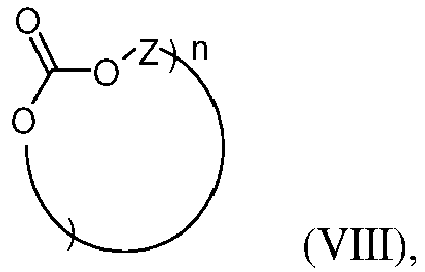 n eine ganze Zahl von 2 bis 6 ist undZ für einen Rest der Formel (1a)
 R1 und R2 unabhängig voneinander für H, C1- bis C8-Alkyl stehen undX für eine Einfachbindung, C1- bis C6-Alkylen, C2- bis Cs-Alkyliden oder C5- bis C6- Cycloalkyliden, welches mit C1- bis C6-Alkyl substituiert sein kann, steht.
 - Thermoplastische Zusammensetzung nach einem der vorhergenenden Ansprüche, wobei die Additive ausgewählt sind aus der Gruppe der Antioxidantien, Thermostabilisatoren, von Triisooctylphosphat verschiedene Umesterungsstabilisatoren, IR-Absorber, Antistatika, Farbmittel wie organische Pigmente und/oder Additive zur Lasermarkierung und wobei die Zusammensetzung keine weiteren Komponenten als die genannten enthält.
- Thermoplastische Zusammensetzung nach einem der vorhergehenden Ansprüche, wobei die Zusammensetzung bis zu 0,065 Gew.-% Flammschutzmittel gemäß Komponente C1 enthält.
- Formteil aus einer thermoplastischen Zusammensetzung gemäß einem der vorhergehenden Ansprüche.
- Verwendung von epoxidiertem Triacylglycerol, insbesondere in Form von epoxidiertem Sojabohnenöl, zur Erhöhung der Transmission, bestimmt nach DIN EN ISO 13468-2:2006 bei einer Schichtdicke von 4 mm, einer transparenten thermoplastischen Zusammensetzung auf Basis von aromatischem Schmelzepolycarbonat.
Priority Applications (1)
| Application Number | Priority Date | Filing Date | Title |
|---|---|---|---|
| EP19216896.1A EP3838979B1 (de) | 2019-12-17 | 2019-12-17 | Schmelzepolycarbonat mit verbesserten optischen eigenschaften |
Applications Claiming Priority (1)
| Application Number | Priority Date | Filing Date | Title |
|---|---|---|---|
| EP19216896.1A EP3838979B1 (de) | 2019-12-17 | 2019-12-17 | Schmelzepolycarbonat mit verbesserten optischen eigenschaften |
Publications (2)
| Publication Number | Publication Date |
|---|---|
| EP3838979A1 true EP3838979A1 (de) | 2021-06-23 |
| EP3838979B1 EP3838979B1 (de) | 2024-06-26 |
Family
ID=68944170
Family Applications (1)
| Application Number | Title | Priority Date | Filing Date |
|---|---|---|---|
| EP19216896.1A Active EP3838979B1 (de) | 2019-12-17 | 2019-12-17 | Schmelzepolycarbonat mit verbesserten optischen eigenschaften |
Country Status (1)
| Country | Link |
|---|---|
| EP (1) | EP3838979B1 (de) |
Cited By (1)
| Publication number | Priority date | Publication date | Assignee | Title |
|---|---|---|---|---|
| US20250257210A1 (en) * | 2022-07-18 | 2025-08-14 | Covestro Deutschland Ag | Method for producing a composite component with a support comprising polycarbonate of a specific oh content |
Citations (26)
| Publication number | Priority date | Publication date | Assignee | Title |
|---|---|---|---|---|
| US2991273A (en) | 1956-07-07 | 1961-07-04 | Bayer Ag | Process for manufacture of vacuum moulded parts of high molecular weight thermoplastic polycarbonates |
| US2999846A (en) | 1956-11-30 | 1961-09-12 | Schnell Hermann | High molecular weight thermoplastic aromatic sulfoxy polycarbonates |
| US2999835A (en) | 1959-01-02 | 1961-09-12 | Gen Electric | Resinous mixture comprising organo-polysiloxane and polymer of a carbonate of a dihydric phenol, and products containing same |
| US3148172A (en) | 1956-07-19 | 1964-09-08 | Gen Electric | Polycarbonates of dihydroxyaryl ethers |
| US3271367A (en) | 1955-03-26 | 1966-09-06 | Bayer Ag | Thermoplastic polycarbonates of dihydroxydiarylene sulfones and their preparation |
| FR1561518A (de) | 1967-03-10 | 1969-03-28 | ||
| DE1570703A1 (de) | 1964-10-07 | 1970-02-12 | Gen Electric | Hydrolytisch stabile Polycarbonate sowie Verfahren zu deren Herstellung |
| DE2036052A1 (en) | 1970-07-21 | 1972-01-27 | Milchwirtschafthche Forschungs und Untersuchungs Gesellschaft mbH, 2100 Hamburg | Working up of additives in fat and protein - contng foodstuffs |
| DE2063050A1 (de) | 1970-12-22 | 1972-07-13 | Bayer | Verseifungsbeständige Polycarbonate |
| DE2211956A1 (de) | 1972-03-11 | 1973-10-25 | Bayer Ag | Verfahren zur herstellung verseifungsstabiler blockcopolycarbonate |
| US3839247A (en) * | 1973-01-05 | 1974-10-01 | Gen Electric | Water-clear hydrolytically stable polycarbonate composition containing an aromatic or aliphatic epoxy stabilizer |
| DE3832396A1 (de) | 1988-08-12 | 1990-02-15 | Bayer Ag | Dihydroxydiphenylcycloalkane, ihre herstellung und ihre verwendung zur herstellung von hochmolekularen polycarbonaten |
| US4982014A (en) | 1988-08-12 | 1991-01-01 | Bayer Aktiengesellschaft | Dihydroxydiphenyl cycloalkanes, their production and their use for the production of high molecular weight polycarbonates |
| EP0500496A1 (de) | 1991-02-21 | 1992-08-26 | Ciba-Geigy Ag | Stabilisierte Polymere mit Heteroatomen in der Hauptkette |
| EP0622418A2 (de) | 1993-04-28 | 1994-11-02 | Daicel Chemical Industries, Ltd. | (Co-)Polycarbonat-Zusammensetzung und Verfahren zu deren Herstellung |
| WO1996015102A2 (de) | 1994-11-10 | 1996-05-23 | Basf Aktiengesellschaft | 2-cyanacrylsäureester |
| JPH08183847A (ja) | 1994-12-28 | 1996-07-16 | Daicel Chem Ind Ltd | ポリカーボネートの製造法 |
| DE4447422C2 (de) | 1994-12-30 | 1996-10-31 | Fischer Karl Ind Gmbh | Reaktorvorrichtung für fließfähige Medien |
| US5663280A (en) * | 1995-10-23 | 1997-09-02 | The Dow Chemical Company | Carbonate polymer resins containing low volatility aromatic phosphate ester compounds |
| EP0839623A1 (de) | 1996-10-30 | 1998-05-06 | Ciba SC Holding AG | Stabilisatorkombination für das Rotomolding-Verfahren |
| WO1999028370A1 (en) | 1997-11-28 | 1999-06-10 | Hitachi, Ltd. | Method and device for manufacturing polycarbonate |
| EP1240232A1 (de) | 1999-11-15 | 2002-09-18 | Bayer Aktiengesellschaft | Verfahren zur herstellung von polycarbonat |
| EP1253163A1 (de) | 2001-04-24 | 2002-10-30 | Bayer Ag | Verfahren zur kontinuierlichen Herstellung von Polycarbonaten nach dem Schmelzumesterungsverfahren |
| EP1609818A2 (de) | 2004-06-24 | 2005-12-28 | Bayer MaterialScience AG | Thermostabilisierte Polycarbonat-Zusammensetzungen |
| WO2006072344A1 (de) | 2004-12-22 | 2006-07-13 | Bayer Materialscience Ag | Polycarbonate mit guter benetzbarkeit |
| WO2014054710A1 (ja) * | 2012-10-05 | 2014-04-10 | 帝人株式会社 | フルオレン骨格を有する熱可塑性樹脂組成物及び光学部材 |
-
2019
- 2019-12-17 EP EP19216896.1A patent/EP3838979B1/de active Active
Patent Citations (26)
| Publication number | Priority date | Publication date | Assignee | Title |
|---|---|---|---|---|
| US3271367A (en) | 1955-03-26 | 1966-09-06 | Bayer Ag | Thermoplastic polycarbonates of dihydroxydiarylene sulfones and their preparation |
| US2991273A (en) | 1956-07-07 | 1961-07-04 | Bayer Ag | Process for manufacture of vacuum moulded parts of high molecular weight thermoplastic polycarbonates |
| US3148172A (en) | 1956-07-19 | 1964-09-08 | Gen Electric | Polycarbonates of dihydroxyaryl ethers |
| US2999846A (en) | 1956-11-30 | 1961-09-12 | Schnell Hermann | High molecular weight thermoplastic aromatic sulfoxy polycarbonates |
| US2999835A (en) | 1959-01-02 | 1961-09-12 | Gen Electric | Resinous mixture comprising organo-polysiloxane and polymer of a carbonate of a dihydric phenol, and products containing same |
| DE1570703A1 (de) | 1964-10-07 | 1970-02-12 | Gen Electric | Hydrolytisch stabile Polycarbonate sowie Verfahren zu deren Herstellung |
| FR1561518A (de) | 1967-03-10 | 1969-03-28 | ||
| DE2036052A1 (en) | 1970-07-21 | 1972-01-27 | Milchwirtschafthche Forschungs und Untersuchungs Gesellschaft mbH, 2100 Hamburg | Working up of additives in fat and protein - contng foodstuffs |
| DE2063050A1 (de) | 1970-12-22 | 1972-07-13 | Bayer | Verseifungsbeständige Polycarbonate |
| DE2211956A1 (de) | 1972-03-11 | 1973-10-25 | Bayer Ag | Verfahren zur herstellung verseifungsstabiler blockcopolycarbonate |
| US3839247A (en) * | 1973-01-05 | 1974-10-01 | Gen Electric | Water-clear hydrolytically stable polycarbonate composition containing an aromatic or aliphatic epoxy stabilizer |
| US4982014A (en) | 1988-08-12 | 1991-01-01 | Bayer Aktiengesellschaft | Dihydroxydiphenyl cycloalkanes, their production and their use for the production of high molecular weight polycarbonates |
| DE3832396A1 (de) | 1988-08-12 | 1990-02-15 | Bayer Ag | Dihydroxydiphenylcycloalkane, ihre herstellung und ihre verwendung zur herstellung von hochmolekularen polycarbonaten |
| EP0500496A1 (de) | 1991-02-21 | 1992-08-26 | Ciba-Geigy Ag | Stabilisierte Polymere mit Heteroatomen in der Hauptkette |
| EP0622418A2 (de) | 1993-04-28 | 1994-11-02 | Daicel Chemical Industries, Ltd. | (Co-)Polycarbonat-Zusammensetzung und Verfahren zu deren Herstellung |
| WO1996015102A2 (de) | 1994-11-10 | 1996-05-23 | Basf Aktiengesellschaft | 2-cyanacrylsäureester |
| JPH08183847A (ja) | 1994-12-28 | 1996-07-16 | Daicel Chem Ind Ltd | ポリカーボネートの製造法 |
| DE4447422C2 (de) | 1994-12-30 | 1996-10-31 | Fischer Karl Ind Gmbh | Reaktorvorrichtung für fließfähige Medien |
| US5663280A (en) * | 1995-10-23 | 1997-09-02 | The Dow Chemical Company | Carbonate polymer resins containing low volatility aromatic phosphate ester compounds |
| EP0839623A1 (de) | 1996-10-30 | 1998-05-06 | Ciba SC Holding AG | Stabilisatorkombination für das Rotomolding-Verfahren |
| WO1999028370A1 (en) | 1997-11-28 | 1999-06-10 | Hitachi, Ltd. | Method and device for manufacturing polycarbonate |
| EP1240232A1 (de) | 1999-11-15 | 2002-09-18 | Bayer Aktiengesellschaft | Verfahren zur herstellung von polycarbonat |
| EP1253163A1 (de) | 2001-04-24 | 2002-10-30 | Bayer Ag | Verfahren zur kontinuierlichen Herstellung von Polycarbonaten nach dem Schmelzumesterungsverfahren |
| EP1609818A2 (de) | 2004-06-24 | 2005-12-28 | Bayer MaterialScience AG | Thermostabilisierte Polycarbonat-Zusammensetzungen |
| WO2006072344A1 (de) | 2004-12-22 | 2006-07-13 | Bayer Materialscience Ag | Polycarbonate mit guter benetzbarkeit |
| WO2014054710A1 (ja) * | 2012-10-05 | 2014-04-10 | 帝人株式会社 | フルオレン骨格を有する熱可塑性樹脂組成物及び光学部材 |
Non-Patent Citations (7)
Cited By (1)
| Publication number | Priority date | Publication date | Assignee | Title |
|---|---|---|---|---|
| US20250257210A1 (en) * | 2022-07-18 | 2025-08-14 | Covestro Deutschland Ag | Method for producing a composite component with a support comprising polycarbonate of a specific oh content |
Also Published As
| Publication number | Publication date |
|---|---|
| EP3838979B1 (de) | 2024-06-26 |
Similar Documents
| Publication | Publication Date | Title |
|---|---|---|
| EP2354182B1 (de) | Erzeugnisse mit verbesserter Flammwidrigkeit | |
| EP3443033B1 (de) | Polycarbonat-zusammensetzungen enthaltend isosorbiddiester | |
| EP3116971B1 (de) | Thermisch leitfähige thermoplastische zusammensetzungen mit ausgewogener verarbeitbarkeit | |
| EP3464440B1 (de) | Polycarbonat-zusammensetzungen enthaltend füllstoffe, eine carbonsäure und deren glycerol- oder diglycerolester | |
| EP3247743A1 (de) | Flammgeschützte, glasfaser-haltige formmassen enthaltend siloxan-haltiges polycarbonat-blockcokondensat | |
| EP1290078B1 (de) | Transparente thermoplastische zusammensetzung | |
| EP3227373B1 (de) | Verbesserung der fliessfähigkeit von polycarbonatzusammensetzungen | |
| EP1238002B1 (de) | Polycarbonatformmassen | |
| EP3838979B1 (de) | Schmelzepolycarbonat mit verbesserten optischen eigenschaften | |
| EP3458510B2 (de) | Polycarbonat-zusammensetzungen enthaltend eine carbonsäure und deren glycerol- oder diglycerolester | |
| DE102010018235A1 (de) | Polymeres Antistatikum | |
| EP4077520B1 (de) | Polycarbonat-zusammensetzungen enthaltend füllstoffe und epoxy-gruppen enthaltendes triacylglycerol | |
| EP3502183B1 (de) | Talk-gefüllte polycarbonat-zusammensetzungen | |
| WO2019121229A1 (de) | Stabilisierte, gefüllte polycarbonat-zusammensetzungen | |
| EP3572469A1 (de) | Polycarbonatzusammensetzung mit perlglanzpigment und/oder interferenzpigment | |
| EP4247887A1 (de) | Flammgeschützte, titandioxid enthaltende polycarbonat-zusammensetzungen | |
| WO2022106534A1 (de) | Verbesserung der reflexion und des yellowness-index bei thermoplastischen reflective white-zusammensetzungen | |
| EP4194479A1 (de) | Gute schlagzähigkeit bei mechanisch recyceltem polycarbonat | |
| EP4251688B1 (de) | Polycarbonat-zusammensetzungen enthaltend titandioxid und eine titandioxid-beschichtung umfassende glas-plättchen | |
| EP4247886A1 (de) | Polycarbonat-zusammensetzungen enthaltend titandioxid und epoxy-gruppen enthaltendes triacylglycerol | |
| EP4524200A1 (de) | Transparente polycarbonat/polyacrylat-blends | |
| EP3387056B1 (de) | Polyglycidylether-haltige polycarbonatzusammensetzungen | |
| EP4083136A1 (de) | Polycarbonat-zusammensetzungen mit zinksulfid als weisspigment | |
| EP4092075A1 (de) | Flammwidrige zusammensetzung umfassend 0,040 bis 0,095 gew.-% eines flammschutzmittels |
Legal Events
| Date | Code | Title | Description |
|---|---|---|---|
| PUAI | Public reference made under article 153(3) epc to a published international application that has entered the european phase |
Free format text: ORIGINAL CODE: 0009012 |
|
| STAA | Information on the status of an ep patent application or granted ep patent |
Free format text: STATUS: THE APPLICATION HAS BEEN PUBLISHED |
|
| AK | Designated contracting states |
Kind code of ref document: A1 Designated state(s): AL AT BE BG CH CY CZ DE DK EE ES FI FR GB GR HR HU IE IS IT LI LT LU LV MC MK MT NL NO PL PT RO RS SE SI SK SM TR |
|
| STAA | Information on the status of an ep patent application or granted ep patent |
Free format text: STATUS: REQUEST FOR EXAMINATION WAS MADE |
|
| 17P | Request for examination filed |
Effective date: 20211223 |
|
| RBV | Designated contracting states (corrected) |
Designated state(s): AL AT BE BG CH CY CZ DE DK EE ES FI FR GB GR HR HU IE IS IT LI LT LU LV MC MK MT NL NO PL PT RO RS SE SI SK SM TR |
|
| GRAJ | Information related to disapproval of communication of intention to grant by the applicant or resumption of examination proceedings by the epo deleted |
Free format text: ORIGINAL CODE: EPIDOSDIGR1 |
|
| STAA | Information on the status of an ep patent application or granted ep patent |
Free format text: STATUS: GRANT OF PATENT IS INTENDED |
|
| GRAP | Despatch of communication of intention to grant a patent |
Free format text: ORIGINAL CODE: EPIDOSNIGR1 |
|
| INTG | Intention to grant announced |
Effective date: 20240228 |
|
| RIN1 | Information on inventor provided before grant (corrected) |
Inventor name: BOUMANS, ANKE Inventor name: HEUER, HELMUT WERNER Inventor name: WEHRMANN, ROLF |
|
| GRAS | Grant fee paid |
Free format text: ORIGINAL CODE: EPIDOSNIGR3 |
|
| GRAA | (expected) grant |
Free format text: ORIGINAL CODE: 0009210 |
|
| STAA | Information on the status of an ep patent application or granted ep patent |
Free format text: STATUS: THE PATENT HAS BEEN GRANTED |
|
| AK | Designated contracting states |
Kind code of ref document: B1 Designated state(s): AL AT BE BG CH CY CZ DE DK EE ES FI FR GB GR HR HU IE IS IT LI LT LU LV MC MK MT NL NO PL PT RO RS SE SI SK SM TR |
|
| REG | Reference to a national code |
Ref country code: GB Ref legal event code: FG4D Free format text: NOT ENGLISH |
|
| REG | Reference to a national code |
Ref country code: CH Ref legal event code: EP |
|
| REG | Reference to a national code |
Ref country code: DE Ref legal event code: R096 Ref document number: 502019011511 Country of ref document: DE |
|
| PG25 | Lapsed in a contracting state [announced via postgrant information from national office to epo] |
Ref country code: BG Free format text: LAPSE BECAUSE OF FAILURE TO SUBMIT A TRANSLATION OF THE DESCRIPTION OR TO PAY THE FEE WITHIN THE PRESCRIBED TIME-LIMIT Effective date: 20240626 |
|
| PG25 | Lapsed in a contracting state [announced via postgrant information from national office to epo] |
Ref country code: HR Free format text: LAPSE BECAUSE OF FAILURE TO SUBMIT A TRANSLATION OF THE DESCRIPTION OR TO PAY THE FEE WITHIN THE PRESCRIBED TIME-LIMIT Effective date: 20240626 Ref country code: FI Free format text: LAPSE BECAUSE OF FAILURE TO SUBMIT A TRANSLATION OF THE DESCRIPTION OR TO PAY THE FEE WITHIN THE PRESCRIBED TIME-LIMIT Effective date: 20240626 |
|
| REG | Reference to a national code |
Ref country code: LT Ref legal event code: MG9D |
|
| PG25 | Lapsed in a contracting state [announced via postgrant information from national office to epo] |
Ref country code: GR Free format text: LAPSE BECAUSE OF FAILURE TO SUBMIT A TRANSLATION OF THE DESCRIPTION OR TO PAY THE FEE WITHIN THE PRESCRIBED TIME-LIMIT Effective date: 20240927 |
|
| PG25 | Lapsed in a contracting state [announced via postgrant information from national office to epo] |
Ref country code: LV Free format text: LAPSE BECAUSE OF FAILURE TO SUBMIT A TRANSLATION OF THE DESCRIPTION OR TO PAY THE FEE WITHIN THE PRESCRIBED TIME-LIMIT Effective date: 20240626 |
|
| REG | Reference to a national code |
Ref country code: NL Ref legal event code: MP Effective date: 20240626 |
|
| PG25 | Lapsed in a contracting state [announced via postgrant information from national office to epo] |
Ref country code: NO Free format text: LAPSE BECAUSE OF FAILURE TO SUBMIT A TRANSLATION OF THE DESCRIPTION OR TO PAY THE FEE WITHIN THE PRESCRIBED TIME-LIMIT Effective date: 20240926 Ref country code: LV Free format text: LAPSE BECAUSE OF FAILURE TO SUBMIT A TRANSLATION OF THE DESCRIPTION OR TO PAY THE FEE WITHIN THE PRESCRIBED TIME-LIMIT Effective date: 20240626 Ref country code: HR Free format text: LAPSE BECAUSE OF FAILURE TO SUBMIT A TRANSLATION OF THE DESCRIPTION OR TO PAY THE FEE WITHIN THE PRESCRIBED TIME-LIMIT Effective date: 20240626 Ref country code: GR Free format text: LAPSE BECAUSE OF FAILURE TO SUBMIT A TRANSLATION OF THE DESCRIPTION OR TO PAY THE FEE WITHIN THE PRESCRIBED TIME-LIMIT Effective date: 20240927 Ref country code: FI Free format text: LAPSE BECAUSE OF FAILURE TO SUBMIT A TRANSLATION OF THE DESCRIPTION OR TO PAY THE FEE WITHIN THE PRESCRIBED TIME-LIMIT Effective date: 20240626 Ref country code: BG Free format text: LAPSE BECAUSE OF FAILURE TO SUBMIT A TRANSLATION OF THE DESCRIPTION OR TO PAY THE FEE WITHIN THE PRESCRIBED TIME-LIMIT Effective date: 20240626 Ref country code: RS Free format text: LAPSE BECAUSE OF FAILURE TO SUBMIT A TRANSLATION OF THE DESCRIPTION OR TO PAY THE FEE WITHIN THE PRESCRIBED TIME-LIMIT Effective date: 20240926 |
|
| PG25 | Lapsed in a contracting state [announced via postgrant information from national office to epo] |
Ref country code: NL Free format text: LAPSE BECAUSE OF FAILURE TO SUBMIT A TRANSLATION OF THE DESCRIPTION OR TO PAY THE FEE WITHIN THE PRESCRIBED TIME-LIMIT Effective date: 20240626 |
|
| PG25 | Lapsed in a contracting state [announced via postgrant information from national office to epo] |
Ref country code: NL Free format text: LAPSE BECAUSE OF FAILURE TO SUBMIT A TRANSLATION OF THE DESCRIPTION OR TO PAY THE FEE WITHIN THE PRESCRIBED TIME-LIMIT Effective date: 20240626 |
|
| PG25 | Lapsed in a contracting state [announced via postgrant information from national office to epo] |
Ref country code: PT Free format text: LAPSE BECAUSE OF FAILURE TO SUBMIT A TRANSLATION OF THE DESCRIPTION OR TO PAY THE FEE WITHIN THE PRESCRIBED TIME-LIMIT Effective date: 20241028 |
|
| PG25 | Lapsed in a contracting state [announced via postgrant information from national office to epo] |
Ref country code: PT Free format text: LAPSE BECAUSE OF FAILURE TO SUBMIT A TRANSLATION OF THE DESCRIPTION OR TO PAY THE FEE WITHIN THE PRESCRIBED TIME-LIMIT Effective date: 20241028 |
|
| PG25 | Lapsed in a contracting state [announced via postgrant information from national office to epo] |
Ref country code: PL Free format text: LAPSE BECAUSE OF FAILURE TO SUBMIT A TRANSLATION OF THE DESCRIPTION OR TO PAY THE FEE WITHIN THE PRESCRIBED TIME-LIMIT Effective date: 20240626 |
|
| PG25 | Lapsed in a contracting state [announced via postgrant information from national office to epo] |
Ref country code: EE Free format text: LAPSE BECAUSE OF FAILURE TO SUBMIT A TRANSLATION OF THE DESCRIPTION OR TO PAY THE FEE WITHIN THE PRESCRIBED TIME-LIMIT Effective date: 20240626 |
|
| PG25 | Lapsed in a contracting state [announced via postgrant information from national office to epo] |
Ref country code: IS Free format text: LAPSE BECAUSE OF FAILURE TO SUBMIT A TRANSLATION OF THE DESCRIPTION OR TO PAY THE FEE WITHIN THE PRESCRIBED TIME-LIMIT Effective date: 20241026 |
|
| PG25 | Lapsed in a contracting state [announced via postgrant information from national office to epo] |
Ref country code: CZ Free format text: LAPSE BECAUSE OF FAILURE TO SUBMIT A TRANSLATION OF THE DESCRIPTION OR TO PAY THE FEE WITHIN THE PRESCRIBED TIME-LIMIT Effective date: 20240626 |
|
| PG25 | Lapsed in a contracting state [announced via postgrant information from national office to epo] |
Ref country code: SK Free format text: LAPSE BECAUSE OF FAILURE TO SUBMIT A TRANSLATION OF THE DESCRIPTION OR TO PAY THE FEE WITHIN THE PRESCRIBED TIME-LIMIT Effective date: 20240626 Ref country code: RO Free format text: LAPSE BECAUSE OF FAILURE TO SUBMIT A TRANSLATION OF THE DESCRIPTION OR TO PAY THE FEE WITHIN THE PRESCRIBED TIME-LIMIT Effective date: 20240626 |
|
| PG25 | Lapsed in a contracting state [announced via postgrant information from national office to epo] |
Ref country code: SM Free format text: LAPSE BECAUSE OF FAILURE TO SUBMIT A TRANSLATION OF THE DESCRIPTION OR TO PAY THE FEE WITHIN THE PRESCRIBED TIME-LIMIT Effective date: 20240626 Ref country code: ES Free format text: LAPSE BECAUSE OF FAILURE TO SUBMIT A TRANSLATION OF THE DESCRIPTION OR TO PAY THE FEE WITHIN THE PRESCRIBED TIME-LIMIT Effective date: 20240626 |
|
| PG25 | Lapsed in a contracting state [announced via postgrant information from national office to epo] |
Ref country code: SM Free format text: LAPSE BECAUSE OF FAILURE TO SUBMIT A TRANSLATION OF THE DESCRIPTION OR TO PAY THE FEE WITHIN THE PRESCRIBED TIME-LIMIT Effective date: 20240626 Ref country code: SK Free format text: LAPSE BECAUSE OF FAILURE TO SUBMIT A TRANSLATION OF THE DESCRIPTION OR TO PAY THE FEE WITHIN THE PRESCRIBED TIME-LIMIT Effective date: 20240626 Ref country code: RO Free format text: LAPSE BECAUSE OF FAILURE TO SUBMIT A TRANSLATION OF THE DESCRIPTION OR TO PAY THE FEE WITHIN THE PRESCRIBED TIME-LIMIT Effective date: 20240626 Ref country code: PL Free format text: LAPSE BECAUSE OF FAILURE TO SUBMIT A TRANSLATION OF THE DESCRIPTION OR TO PAY THE FEE WITHIN THE PRESCRIBED TIME-LIMIT Effective date: 20240626 Ref country code: IS Free format text: LAPSE BECAUSE OF FAILURE TO SUBMIT A TRANSLATION OF THE DESCRIPTION OR TO PAY THE FEE WITHIN THE PRESCRIBED TIME-LIMIT Effective date: 20241026 Ref country code: ES Free format text: LAPSE BECAUSE OF FAILURE TO SUBMIT A TRANSLATION OF THE DESCRIPTION OR TO PAY THE FEE WITHIN THE PRESCRIBED TIME-LIMIT Effective date: 20240626 Ref country code: EE Free format text: LAPSE BECAUSE OF FAILURE TO SUBMIT A TRANSLATION OF THE DESCRIPTION OR TO PAY THE FEE WITHIN THE PRESCRIBED TIME-LIMIT Effective date: 20240626 Ref country code: CZ Free format text: LAPSE BECAUSE OF FAILURE TO SUBMIT A TRANSLATION OF THE DESCRIPTION OR TO PAY THE FEE WITHIN THE PRESCRIBED TIME-LIMIT Effective date: 20240626 |
|
| PG25 | Lapsed in a contracting state [announced via postgrant information from national office to epo] |
Ref country code: IT Free format text: LAPSE BECAUSE OF FAILURE TO SUBMIT A TRANSLATION OF THE DESCRIPTION OR TO PAY THE FEE WITHIN THE PRESCRIBED TIME-LIMIT Effective date: 20240626 |
|
| REG | Reference to a national code |
Ref country code: DE Ref legal event code: R097 Ref document number: 502019011511 Country of ref document: DE |
|
| PG25 | Lapsed in a contracting state [announced via postgrant information from national office to epo] |
Ref country code: DK Free format text: LAPSE BECAUSE OF FAILURE TO SUBMIT A TRANSLATION OF THE DESCRIPTION OR TO PAY THE FEE WITHIN THE PRESCRIBED TIME-LIMIT Effective date: 20240626 |
|
| PLBE | No opposition filed within time limit |
Free format text: ORIGINAL CODE: 0009261 |
|
| STAA | Information on the status of an ep patent application or granted ep patent |
Free format text: STATUS: NO OPPOSITION FILED WITHIN TIME LIMIT |
|
| 26N | No opposition filed |
Effective date: 20250327 |
|
| PG25 | Lapsed in a contracting state [announced via postgrant information from national office to epo] |
Ref country code: MC Free format text: LAPSE BECAUSE OF FAILURE TO SUBMIT A TRANSLATION OF THE DESCRIPTION OR TO PAY THE FEE WITHIN THE PRESCRIBED TIME-LIMIT Effective date: 20240626 |
|
| REG | Reference to a national code |
Ref country code: CH Ref legal event code: PL |
|
| PG25 | Lapsed in a contracting state [announced via postgrant information from national office to epo] |
Ref country code: LU Free format text: LAPSE BECAUSE OF NON-PAYMENT OF DUE FEES Effective date: 20241217 |
|
| GBPC | Gb: european patent ceased through non-payment of renewal fee |
Effective date: 20241217 |
|
| PG25 | Lapsed in a contracting state [announced via postgrant information from national office to epo] |
Ref country code: SE Free format text: LAPSE BECAUSE OF FAILURE TO SUBMIT A TRANSLATION OF THE DESCRIPTION OR TO PAY THE FEE WITHIN THE PRESCRIBED TIME-LIMIT Effective date: 20240626 |
|
| REG | Reference to a national code |
Ref country code: BE Ref legal event code: MM Effective date: 20241231 |
|
| PG25 | Lapsed in a contracting state [announced via postgrant information from national office to epo] |
Ref country code: GB Free format text: LAPSE BECAUSE OF NON-PAYMENT OF DUE FEES Effective date: 20241217 Ref country code: BE Free format text: LAPSE BECAUSE OF NON-PAYMENT OF DUE FEES Effective date: 20241231 |
|
| PG25 | Lapsed in a contracting state [announced via postgrant information from national office to epo] |
Ref country code: FR Free format text: LAPSE BECAUSE OF NON-PAYMENT OF DUE FEES Effective date: 20241231 |
|
| PG25 | Lapsed in a contracting state [announced via postgrant information from national office to epo] |
Ref country code: CH Free format text: LAPSE BECAUSE OF NON-PAYMENT OF DUE FEES Effective date: 20241231 |
|
| PG25 | Lapsed in a contracting state [announced via postgrant information from national office to epo] |
Ref country code: IE Free format text: LAPSE BECAUSE OF NON-PAYMENT OF DUE FEES Effective date: 20241217 |
|
| PGFP | Annual fee paid to national office [announced via postgrant information from national office to epo] |
Ref country code: DE Payment date: 20251119 Year of fee payment: 7 |
|
| REG | Reference to a national code |
Ref country code: AT Ref legal event code: MM01 Ref document number: 1697665 Country of ref document: AT Kind code of ref document: T Effective date: 20241217 |
|
| PG25 | Lapsed in a contracting state [announced via postgrant information from national office to epo] |
Ref country code: AT Free format text: LAPSE BECAUSE OF NON-PAYMENT OF DUE FEES Effective date: 20241217 |
|
| PG25 | Lapsed in a contracting state [announced via postgrant information from national office to epo] |
Ref country code: CY Free format text: LAPSE BECAUSE OF FAILURE TO SUBMIT A TRANSLATION OF THE DESCRIPTION OR TO PAY THE FEE WITHIN THE PRESCRIBED TIME-LIMIT Effective date: 20240626 |