EP3837313B1 - Quellbare elastomere füllzusammensetzung für kunstrasen - Google Patents
Quellbare elastomere füllzusammensetzung für kunstrasen Download PDFInfo
- Publication number
- EP3837313B1 EP3837313B1 EP19756307.5A EP19756307A EP3837313B1 EP 3837313 B1 EP3837313 B1 EP 3837313B1 EP 19756307 A EP19756307 A EP 19756307A EP 3837313 B1 EP3837313 B1 EP 3837313B1
- Authority
- EP
- European Patent Office
- Prior art keywords
- acid
- composition
- meth
- weight percent
- swellable
- Prior art date
- Legal status (The legal status is an assumption and is not a legal conclusion. Google has not performed a legal analysis and makes no representation as to the accuracy of the status listed.)
- Active
Links
Images

Classifications
-
- C—CHEMISTRY; METALLURGY
- C08—ORGANIC MACROMOLECULAR COMPOUNDS; THEIR PREPARATION OR CHEMICAL WORKING-UP; COMPOSITIONS BASED THEREON
- C08L—COMPOSITIONS OF MACROMOLECULAR COMPOUNDS
- C08L23/00—Compositions of homopolymers or copolymers of unsaturated aliphatic hydrocarbons having only one carbon-to-carbon double bond; Compositions of derivatives of such polymers
- C08L23/02—Compositions of homopolymers or copolymers of unsaturated aliphatic hydrocarbons having only one carbon-to-carbon double bond; Compositions of derivatives of such polymers not modified by chemical after-treatment
- C08L23/16—Ethylene-propylene or ethylene-propylene-diene copolymers
-
- C—CHEMISTRY; METALLURGY
- C08—ORGANIC MACROMOLECULAR COMPOUNDS; THEIR PREPARATION OR CHEMICAL WORKING-UP; COMPOSITIONS BASED THEREON
- C08L—COMPOSITIONS OF MACROMOLECULAR COMPOUNDS
- C08L101/00—Compositions of unspecified macromolecular compounds
-
- E—FIXED CONSTRUCTIONS
- E01—CONSTRUCTION OF ROADS, RAILWAYS, OR BRIDGES
- E01C—CONSTRUCTION OF, OR SURFACES FOR, ROADS, SPORTS GROUNDS, OR THE LIKE; MACHINES OR AUXILIARY TOOLS FOR CONSTRUCTION OR REPAIR
- E01C13/00—Pavings or foundations specially adapted for playgrounds or sports grounds; Drainage, irrigation or heating of sports grounds
- E01C13/08—Surfaces simulating grass ; Grass-grown sports grounds
-
- C—CHEMISTRY; METALLURGY
- C08—ORGANIC MACROMOLECULAR COMPOUNDS; THEIR PREPARATION OR CHEMICAL WORKING-UP; COMPOSITIONS BASED THEREON
- C08L—COMPOSITIONS OF MACROMOLECULAR COMPOUNDS
- C08L2205/00—Polymer mixtures characterised by other features
- C08L2205/03—Polymer mixtures characterised by other features containing three or more polymers in a blend
Definitions
- This disclosure is directed to granular infill used for artificial turf pitches, methods of manufacture, and methods of use.
- CN-A-106832536 relates to a leisure landscape artificial lawn which is characterized by being prepared from linear low density polyethylene, a color master batch, a polyolefin elastomer, an antiaging agent, an antistatic agent and a macromolecular water-absorbent resin master batch.
- EP-A-3,141,579 relates to an elastic infill for artificial turf that is produced by pelletization of an elastomer composition comprising a silane coupling agent and a mixture of an olefin copolymer-containing base resin and an inorganic filler wherein the silane coupling agent is present in admixture with the mixture or is grafted onto the olefin copolymer to allow cross-linking of the olefin copolymer in the presence of water.
- US-A-2017/081807 relates to synthetic poured in place surfacing materials and methods of making such materials.
- the method comprises: preparing a substrate for receiving the surfacing; mixing rubber particles with at least one binder to form a surfacing mixture; placing the mixture over the substrate; and allowing the mixture to dry; wherein the dried mixture forms the poured in place surfacing; wherein a coating material is included with the surfacing to substantially modify the surfacing material with water retention or hydrophilic properties.
- Artificial turf also known as pitches, comprises polymer fibers such as polyethylene fibers (yarns) that mimic grass blades.
- the fibers are tufted to a primary backing and coated with a secondary backing to keep yarn distributed and fixed.
- a granular infill is spread between the fibers and over the primary backing to maintain yarn in upright position and provide shock absorption.
- polymer-based artificial turf systems absorb significant heat from the sun. Particularly in hot climates, the artificial turf becomes very warm and uncomfortable for users. Watering of artificial turf pitches is used today as a solution to decrease the surface temperature of the artificial turf via evaporative cooling.
- the artificial turf yarn and infill are typically based on non-polar polymers, a significant amount of water is drained away and not accessible for cooling.
- a swellable infill composition comprises 10 to 50 weight percent of a polyolefin elastomer; 5 to 20 weight percent of a hydrophobic plasticizer; 1 to 10 weight percent of a co-plasticizer having a hydrophilic-lipophilic balance value of greater than or equal to 6; 5 to 40 weight percent of an organic absorbent material; and optionally, 10 to 65 weight percent of an inorganic absorbent material; wherein weight percent is based on the total weight percent of materials present in the composition.
- An artificial turf system comprises a primary backing; a plurality of turf fibers extending upwardly from a first surface of the primary turf backing; a secondary backing disposed on a second surface of the primary backing opposite the first surface; and an infill layer comprising particulates comprising the infill composition disposed between the turf fibers upon the first surface of the primary backing.
- the present inventors have unexpectedly discovered granular infill compositions having improved heat management properties, in particular improved evaporative cooling.
- the heat management properties are obtained using a specific combination of polyolefin elastomer, at least two different plasticizers, and a water-absorbent composition in specific amounts.
- the improved heat management properties can be achieved together with desirable shock absorption, durability and other properties.
- an aspect of the present disclosure is a swellable infill composition
- a swellable infill composition comprising particular amounts of a polyolefin elastomer, a hydrophobic plasticizer, a co-plasticizer having a hydrophilic-lipophilic balance value of greater than or equal to 6, an organic absorbent material, and, optionally, an inorganic absorbent material.
- the polyolefin elastomer can be present in an amount of 10 to 50 weight percent (wt%), based on the total weight percent of materials present in the composition. Within this range, the polyolefin elastomer can be present in an amount of 15 to 50 wt%, or 15 to 45 wt%, or 20 to 45 wt%, or 15 to 40 wt%, or 15 to 15 wt%, or 20 to 30 wt%.
- the polyolefin elastomer can be a polyolefin block copolymer.
- the polyolefin block copolymer can be an ethylene-based elastomer, a propylene-based elastomer, or a combination thereof.
- the polyolefin elastomer is an ethylene-based block copolymer elastomer.
- the polyolefin elastomer can be crosslinked or non-crosslinked.
- the ethylene-or propylene-based elastomer can include a combination of ethylene and propylene, and can further include a comonomer, i.e., an additional polymerizable monomer other than ethylene or propylene.
- suitable comonomers include straight-chain or branched ⁇ -olefins of 3 to 30, preferably 3 to 20, carbon atoms, such as propylene, 1-butene, 1-pentene, 3-methyl-1-butene, 1-hexene, 4-methyl-1-pentene, 3-methyl-1-pentene, 1-octene, 1-decene, 1-dodecene, 1-tetradecene, 1-hexadecene, 1-octadecene and 1-eicosene; cycloolefins of 3 to 30, preferably 3 to 20, carbon atoms, such as cyclopentene, cycloheptene, norbornene, 5-methyl-2-norbornene,
- the polyolefin elastomer can be an olefin block copolymer (OBC) comprising two or more chemically distinct regions or segments ("blocks") preferably joined in a linear manner, rather than in pendent or grafted fashion.
- OBCs can be produced via a chain shuttling process, and are described in US 7858706 , US 7608668 , US 7893166 , and US 7947793 .
- OBCs are characterized by unique distributions of both polydispersity (PDI, or Mw/Mn), block length distribution, and/or block number distribution, due, in an embodiment, to the effect of the shuttling agent in combination with multiple catalysts used in their preparation.
- the OBC can be represented by the formula (AB) n where n is at least 1, preferably an integer greater than 1, such as 2, 5, 10, 20, 50, 100, or higher, "A” a hard block and "B” is a soft block or segment.
- the OBCs can include various amounts of hard and soft segments.
- Hard segments are blocks of polymerized units in which ethylene or propylene is present in an amount greater than 95 wt%, or greater than 98 wt%, each based on the weight of the OBC, up to 100 wt%. The remainder can be comonomer, which can be absent in some embodiments.
- Soft segments are blocks of polymerized units including a comonomer in an amount of greater than 5 wt%, or greater than 10 wt%, or greater than 20 wt%, or greater than 40 wt%, or greater than 60 wt%, and may be up to 100 wt%, each based on the weight of the OBC.
- the soft segments can be present in the OBCs in an amount of 1 to 99 wt%, or 10 to 90 wt%, or 30 to 70 wt%, or 40 to 60 wt%, or 45 to 55 wt%, each based on the weight of the OBC.
- the hard segments can be present in similar ranges.
- the weight percent of the soft segment and the hard segment can be calculated based on data obtained from differential scanning calorimetry (DSC) or nuclear magnetic resonance (NMR) spectroscopy. Such methods and calculations are disclosed in, for example, US 7608668 .
- the polyolefin elastomer is an ethylene-based elastomer in which ethylene comprises the majority mole fraction of the polyolefin elastomer, i.e., ethylene comprises at least 50 mole percent (mol%) of the whole polymer. More preferably ethylene comprises at least 60 mol%, at least 70 mol%, or at least 80 mol%, with the substantial remainder of the whole polymer comprising at least one other comonomer that is preferably an ⁇ -olefin having 3 or more carbon atoms, for example, propylene or octene.
- the ethylene-based elastomer can comprise 50 to 90 mol% ethylene, preferably 60 to 85 mol%, or more preferably 65 to 80 mol%.
- the ethylene-based elastomer is an ethylene/ ⁇ -olefin block copolymer comprising polymerized ethylene and one ⁇ -olefin as the only monomer types.
- the ⁇ -olefin is propylene, 1-butene, 1-hexene, or 1-octene, preferably propylene or 1-octene, more preferably 1-octene.
- the ethylene/ ⁇ -olefin block copolymer can have a melt index (MI or I2) from 0.1 to 50 grams per 10 minutes (g/10 min), or from 0.3 to 30 g/10 min, or from 0.5 to 20 g/10 min, or from 0.5 to 10 g/10 min, each as measured according to ASTM D1238 at 190° C using a load of 2.16 kg).
- the ethylene/alpha-olefin block copolymer can have a melt index from 0.5 to 10 g/10 min, as measured according to ASTM D1238 (230°C/2.16 kg).
- the ethylene/alpha-olefin block copolymer can have a melt index from 1.0 to 15 g/10 min, as measured according to ASTM D1238 (230°C/2.16 kg).
- the ethylene-based elastomer can have a density of 0.860 to 0.890 grams per cubic centimeter (g/cc), or 0.860 to 0.880 g/cc as measured according to ASTM D792.
- Suitable ethylene-based elastomers can include INFUSE TM 9007, INFUSE TM 9010, INFUSE TM 9107, INFUSE TM 9100, INFUSE TM 9507, INFUSE TM 9500, INFUSE TM 9807, ENGAGE TM 8100, ENGAGE TM 8200, ENGAGE TM 8150, AFFINITY TM EG 8100G, and AFFINITY TM EG 8200G, all of which are commercially available from The Dow Chemical Company (Midland, MI); can also include QUEO TM 6800LA, QUEO TM 7001LA, and QUEO TM 8203, all of which are commercially available from Borealis (Vienna, Austria); and can also include EXACT TM 4053 and EXACT TM 4049, all of which are commercially available from ExxonMobil Chemical Company (Spring, TX).
- the polyolefin elastomer is a propylene-based elastomer in which propylene comprises the majority mole fraction of the polyolefin elastomer, i.e., propylene comprises at least 50 mol% of the whole polymer. More preferably propylene comprises at least 60 mol%, at least 70 mol%, or at least 80 mol%, with the substantial remainder of the whole polymer comprising ethylene or at least one other comonomer that is an ⁇ -olefin more than 3 carbon atoms, for example, 1-hexene or 1-octene.
- the propylene-based elastomer comprises 50 to 90 mol% propylene, preferably 60 to 85 mol% propylene, or more preferably 65 to 80 mol% propylene.
- the propylene-based elastomer can have from 3 to 15 mol% of ethylene, or from 5 to 14 mol% of ethylene, or 7 to 12 mol% ethylene. In some embodiments no comonomer is present in addition to the ethylene.
- the propylene-based elastomer can have a melt flow rate (MF) from The ethylene/alpha-olefin block copolymer may have a melt index from 1.0 to 15 g/10 min, as measured according to ASTM D1238 at 230°C using a load of 2.16 kg.
- the density of the propylene-based elastomer can be of 0.860 to 0.890 grams per cubic centimeter (g/cc), or 0.860 to 0.880 g/cc, as measured according to ASTM D792.
- Suitable propylene-based elastomers can include VERSIFY TM 2000, VERSIFY TM 2200, VERSIFY TM 2300, VERSIFY TM 3200, and VERSIFY TM 3401, which are commercially available from The Dow Chemical Company (Midland, MI) or VISTAMAXX TM 6102FL, VISTAMAXX TM 3020FL, which is commercially available from ExxonMobil Chemical Co. (Spring, TX).
- the composition comprises a hydrophobic plasticizer.
- plasticizer refers to a compound or a mixture of compounds that can be introduced to the compositions to impart softness or flexibility. Thus a plasticizer can be used to attenuate hardness of a given resin.
- the hydrophobic plasticizer can be present in an amount of 5 to 20 wt%, based on the total weight percent of materials present in the composition. Within this range, the hydrophobic plasticizer can be present in an amount of 5 to 18 wt%, or 8 to 18 wt%, or 10 to 18 wt%, or 10 to 16 wt%, or 14 to 18 wt%.
- the hydrophobic plasticizer is a liquid at 25°C.
- the hydrophobic plasticizer is a naphthenic oil, a paraffinic oil, or a combination thereof.
- the hydrophobic plasticizer comprises a paraffinic oil.
- An example of a suitable paraffinic oil is available under the tradename SUNPAR.
- the composition further comprises a co-plasticizer.
- the co-plasticizer can be present in an amount of 1 to 10 wt%, based on the total weight percent of materials present in the composition. Within this range, the co-plasticizer can be present in an amount of 1 to 8 wt%, or 2 to 8 wt%, or 2 to 6 wt%, or 3 to 5 wt%. In some embodiments, the hydrophobic plasticizer and the co-plasticizer are present in a weight ratio of 1.5:1.0 to 5.0:1.0, or 2.0:1.0 to 4.5:1.0, or 2.2:1.0 to 4.2:1.0, or 2.5:1 to 4.0:1.
- the co-plasticizer can be water-dispersible or water-soluble, preferably water-soluble.
- the co-plasticizer can a hydrophilic-lipophilic balance (HLB) of greater than or equal to 6, or greater than or equal to 10, or greater than or equal to 15, or greater than or equal to 20.
- HLB is an empirical expression for the relationship of the hydrophilic ("water-loving") and hydrophobic ("water-hating") groups of a molecule.
- This computation provides a numerical result on a scale of 0 to 20, wherein "0" is highly lipophilic/hydrophobic, and a value of "20" corresponds to a lipophobic/hydrophilic molecule.
- HLB system is particularly useful to identify surfactants for oil and water emulsification, for example, the present inventors have discovered that a combination of two plasticizers, one of high lipophilicity (low HLB value, e.g., less than 6), and one of higher hydrophilicity (high HLB values, e.g., greater than or equal to 6) can provide infill compositions with good thermal management properties.
- the co-plasticizer can be a water soluble polymer, for example, including poly(vinyl alcohol) (“PVA”); poly(alkylene oxides) such as poly(ethylene glycol) (“PEG”) and polypropylene glycol) (“PPG”) and the like; and poly(oxyethylated polyols) such as poly(oxyethylated glycerol), poly(oxyethylated sorbitol), and poly(oxyethylated glucose), and the like.
- PVA poly(vinyl alcohol)
- PEG poly(ethylene glycol)
- PPG polypropylene glycol)
- poly(oxyethylated polyols) such as poly(oxyethylated glycerol), poly(oxyethylated sorbitol), and poly(oxyethylated glucose), and the like.
- the polymers can be homopolymers or random or block copolymers and terpolymers based on the monomers of the above polymers
- the co-plasticizer is preferably a poly((C 2-3 alkyl)ene glycol).
- the poly((C 2-3 alkyl)ene glycol)s suitable for use in the composition are polymers characterized by the general formula: HO(CRHCH 2 O) n H, wherein R is H, methyl, or a combination thereof, and n is preferably an integer of from 4 to 455.
- R When R is H, the materials are polymers of ethylene oxide and are commonly known as poly(ethylene oxide)s, poly(oxyethylene)s, poly(ethylene glycol)s, or "PEG.” When R is methyl, these materials are polymers of propylene oxide and are commonly known as polypropylene oxide)s, poly(oxypropylene), polypropylene glycol)s, or "PPG.” When R is methyl, positional isomers of these polymers can exist.
- the co-plasticizer is preferably a poly(ethylene glycol), preferably a poly(ethylene glycol) having a number average molecular weight (MW) of 300 to 20,000 grams per mole (g/mol), for example 1,000 to 20,000 g/mol, or 1,000 to 15,000 g/mole, or 1,000 to 10,000 g/mol.
- Number average molecular weight of the poly(ethylene glycol) can be determined, for example, by gel permeation chromatography.
- suitable poly(ethylene glycol) polymers can include: 3,600-4,400 MW polyethylene glycol (PEG-90, available as CARBOWAX 4000 from Dow Chemical); 4,400-4,800 MW polyethylene glycol (PEG-100, available as CARBOWAX 4600 from Dow Chemical); 7,000-9,000 MW polyethylene glycol (PEG-180, available as CARBOWAX 8000 from Dow Chemical); 100,000 MW polyethylene glycol (available as POLYOX WSR N-10 from Dow Chemical); 200,000 MW polyethylene glycol (available as POLYOX WSR N-80 from Dow Chemical); 300,000 MW polyethylene glycol (available as POLYOX WSR N-750 from Dow Chemical); 400,000 MW polyethylene glycol (available as POLYOX WSR N-3000 from Dow Chemical); 600,000 MW polyethylene glycol (available as POLYOX WSR N-205 from Dow Chemical); 900,000 MW polyethylene glycol (available as POLYOX WSR N-1105 from Dow Chemical); 1,000,000 MW poly(ethylene
- the composition further comprises an organic absorbent material.
- the organic absorbent material can be present in an amount of 5 to 40 wt%, based on the total weight percent of materials present in the composition. Within this range, the organic absorbent material can be present in an amount of 8 to 38 wt%, or 9 to 37 wt%, or 10 to 36 wt%, or 10 to 3 0 wt%, or 10 to 20 wt%, or 20 to 40 wt%.
- the organic absorbent material can comprise an absorbent polymer, for example, a superabsorbent polymer (SAP).
- SAP superabsorbent polymer
- a superabsorbent polymer comprises a hydrophilic network that can retain large amounts of aqueous fluid relative to the weight of the polymer particle (e.g., in a dry state, the superabsorbent polymer absorbs and retains a weight amount of water equal to or greater than its own weight).
- the polymer can comprise a variety of organic polymers that can react with or absorb water and swell when contacted with an aqueous fluid.
- polymers examples include a polysaccharide, poly(C 1-8 alkyl (meth)acrylate)s, poly(hydroxyC 1-8 alkyl (meth)acrylate)s such as (2-hydroxyethyl acrylate), poly((meth)acrylamide), poly(vinyl pyrrolidine), poly(vinyl acetate), and the like.
- copolymers for example copolymers of (meth)acrylamide with maleic anhydride, vinyl acetate, ethylene oxide, ethylene glycol, or acrylonitrile, or a combination thereof.
- a combination of different polymers can be used.
- Exemplary polysaccharides include starch, cellulose, xanthan gum, agar, pectin, alginic acid, tragacanth gum, pluran, gellan gum, tamarind seed gum, cardlan gum, guar gum, arabic, glucomannan, chitin, chitosan, hyaluronic acid, and combinations thereof.
- the superabsorbent polymer can be prepared by polymerization of a nonionic, anionic, or cationic monomers, or a combination comprising at least one of the foregoing.
- Polymerization to form the superabsorbent polymer can include free radical polymerization, solution polymerization, gel polymerization, emulsion polymerization, dispersion polymerization, or suspension polymerization.
- the polymerization can be performed in an aqueous phase, an inverse emulsion, or an inverse suspension.
- nonionic monomers for preparing the superabsorbent polymer include (meth)acrylamide, C 1-8 alkyl-substituted (meth)acrylamides, aminoCi-s alkyl)-substituted (meth)acrylamides, vinyl alcohol, vinyl acetate, allyl alcohol, C 1-8 alkyl (meth)acrylates, hydroxyl C 1-8 alkyl (meth)acrylates such as hydroxyethyl (meth)acrylate, N-vinylformamide, N-vinylacetamide, and (meth)acrylonitrile.
- poly((meth)acrylamide)s includes polymer comprising units derived from (meth)acrylamide, alkyl-substituted (meth)acrylamides such as N-C 1-8 alkyl (meth)acrylamides and N,N-di(C 1-8 alkyl) (meth)acrylamides, dialkylaminoalkyl-substituted (meth)acrylamides such as (N,N-di(C 1-8 alkyl)amino)C 1-8 alkyl-substituted (meth)acrylamides.
- alkyl-substituted (meth)acrylamides such as N-C 1-8 alkyl (meth)acrylamides and N,N-di(C 1-8 alkyl) (meth)acrylamides
- dialkylaminoalkyl-substituted (meth)acrylamides such as (N,N-di(C 1-8 alkyl)amino)C 1-8 alkyl-substi
- Specific examples of the foregoing monomers include methacrylamide, N-methyl acrylamide, N-methyl methacrylamide, N,N-dimethyl acrylamide, N-ethyl acrylamide, N,N-diethyl acrylamide, N-cyclohexyl acrylamide, N-benzyl acrylamide, N,N-dimethylaminopropyl acrylamide, N,N-dimethylaminoethyl acrylamide, N-tert-butyl acrylamide, or a combination thereof.
- anionic monomers include ethylenically-unsaturated anionic monomers having acidic groups, for example, a carboxylic group, a sulfonic group, a phosphonic group, a salt thereof, the corresponding anhydride or acyl halide, or a combination comprising at least one of the foregoing acidic groups.
- the anionic monomer can be (meth)acrylic acid, maleic acid, maleic anhydride, fumaric acid, itaconic acid, ⁇ -chloroacrylic acid, ⁇ -cyanoacrylic acid, ⁇ -methylacrylic acid, ⁇ -phenylacrylic acid, ⁇ -acryloyloxypropionic acid, sorbic acid, ⁇ -chlorosorbic acid, 2'-methylisocrotonic acid, cinnamic acid, p-chlorocinnamic acid, ⁇ -stearyl acid, citraconic acid, mesaconic acid, glutaconic acid, aconitic acid, 2-acrylamido-2-methylpropanesulfonic acid, allyl sulfonic acid, vinyl sulfonic acid, allyl phosphonic acid, vinyl phosphonic acid, or a combination thereof.
- cationic monomers include (N,N-di(C 1-8 alkylamino)(C 1-8 alkyl) (meth)acrylates (e.g., N,N-dimethylaminoethyl acrylate and N,N-dimethylaminoethyl methacrylate), (wherein the amino group is subsequently quaternized with, e.g., a methyl chloride), diallyldimethyl ammonium chloride, or any of the foregoing alkyl-substituted (meth)acrylamides and dialkylaminoalkyl-substituted (meth)acrylamides, such as (N,N-di(C 1-8 alkyl)amino)C 1-8 alkyl acrylamide, and the quaternary forms thereof such as acrylamidopropyl trimethyl ammonium chloride.
- methacrylates e.g., N,N-dimethylaminoethyl acrylate and N
- the superabsorbent polymer can comprise both cationic and anionic monomers.
- the cationic and anionic monomers can occur in various stoichiometric ratios, for example, a ratio of 1:1.
- One monomer can be present in a greater stoichiometric amount than the other monomer.
- amphoteric superabsorbent polymers include terpolymers of nonionic monomers, anionic monomers, and cationic monomers.
- the superabsorbent polymer can optionally include a plurality of crosslinks among the polymer chains of the superabsorbent polymer.
- the crosslinks can be covalent and result from crosslinking the polymer chains using a crosslinker.
- the crosslinker can be an ethylenically-unsaturated monomer that contains, for example, two sites of ethylenic unsaturation (i.e., two ethylenically unsaturated double bonds), an ethylenically unsaturated double bond and a functional group that is reactive toward a functional group (e.g., an amide group) of the polymer chains of the superabsorbent polymer, or several functional groups that are reactive toward functional groups of the polymer chains of the superabsorbent polymer.
- a functional group e.g., an amide group
- the degree of crosslinking can be selected so as to control the amount of swelling of the superabsorbent polymer.
- the degree of crosslinking can be used to control the amount of fluid absorption or the volume expansion of the superabsorbent polymer. Accordingly, when the polymer particles comprise a superabsorbent polymer, the degree of crosslinking can be used to control the amount of fluid absorption or the volume expansion of the polymer particles.
- Exemplary crosslinkers can include a di(meth)acrylamide of a diamine such as a diacrylamide of piperazine, a C 1-8 alkylene bisacrylamide such as methylene bisacrylamide and ethylene bisacrylamide, an N-methylol compounds of an unsaturated amide such as N-methylol methacrylamide or N-methylol acrylamide, a (meth)acrylate esters of a di-, tri-, or tetrahydroxy compound such as ethylene glycol diacrylate, poly(ethyleneglycol) di(meth)acrylate, trimethylopropane tri(meth)acrylate, ethoxylated trimethylol tri(meth)acrylate, glycerol tri(meth)acrylate), ethoxylated glycerol tri(meth)acrylate, pentaerythritol tetra(meth)acrylate, ethoxylated pentaerythritol tetra(meth)acrylate
- the superabsorbent polymer can comprise a starch graft copolymer, a cross-linked carboxymethylcellulose derivative, a crosslinked poly(meth)acrylic acid, a salt of a crosslinked poly(meth)acrylic acid, or a combination thereof.
- the superabsorbent polymer can comprise a poly(meth)acrylic acid, for example a crosslinked poly(meth)acrylic acid, preferably a crosslinked polyacrylic acid.
- the composition can optionally further comprise an inorganic absorbent material.
- the inorganic absorbent material can be included in the composition in an amount of 10 to 65 wt%, based on the total weight percent of materials present in the composition. Within this range, the inorganic absorbent can be present in an amount of 10 to 63 wt%, or 20 to 60 wt%, or 25 to 60 wt%, or 30 to 60 wt%, or 30 to 45 wt%, or 10 to 45 wt%.
- the total amount of absorbent material i.e., organic absorbent material and, when present, inorganic absorbent material
- the weight ratio of total absorbent material to the polyolefin block copolymer is 0.5:1.0 to 5.0:1.0, preferably 0.8:1 to 3.0:1.0.
- the inorganic absorbent material can comprise, for example, sodium bentonite, calcium bentonite, aluminum trihydroxide, barium sulfate, calcium carbonate, calcium sulfate, magnesium carbonate, magnesium trihydroxide, diatomaceous earth, dolomite, glass beads, ceramic beads, kaolin, mica, perlite, natural silica, synthetic silica, wollastonite, whiskers, or a combination thereof.
- the inorganic absorbent comprises calcium carbonate, sodium bentonite, or a combination thereof.
- the inorganic absorbent comprises sodium bentonite.
- the inorganic absorbent comprises calcium carbonate and the calcium carbonate is preferably uncoated.
- composition of the present disclosure can optionally further include one or more additives, such as antimicrobial agents, antioxidants (e.g., hindered phenolics such as IRGANOX 1010 or IRGANOX 1076 supplied by Ciba Geigy), antistats, biocides, dyes, flame retardants, heat stabilizers, lubricants, pigments, processing aids, ultraviolet light stabilizer, wax, and the like, or a combination thereof.
- additives such as antimicrobial agents, antioxidants (e.g., hindered phenolics such as IRGANOX 1010 or IRGANOX 1076 supplied by Ciba Geigy), antistats, biocides, dyes, flame retardants, heat stabilizers, lubricants, pigments, processing aids, ultraviolet light stabilizer, wax, and the like, or a combination thereof.
- additives such as antimicrobial agents, antioxidants (e.g., hindered phenolics such as IRGANOX 1010 or IR
- the swellable infill composition of the present disclosure comprises 20 to 30 wt% of the polyolefin elastomer wherein the polyolefin elastomer is an ethylene/alpha-olefin block copolymer; 10 to 16 wt% of a paraffinic oil; 3 to 5 weight percent of a poly(ethylene glycol), preferably having a molecular weight of 300 to 20,000 g/mol; 20 to 40 wt% of the organic absorbent material wherein the organic absorbent material is a crosslinked poly(acrylic acid); and 10 to 45 weight percent of the inorganic absorbent material comprising sodium bentonite, calcium carbonate, or a combination thereof. Weight percent of each composition is based on the total weight percent of materials present in the composition.
- the infill composition of the present disclosure as described above can advantageously exhibit desirable swelling and evaporative cooling properties.
- a molded sample of the composition of the present disclosure can exhibit a change in volume of 25 to 1900% after immersion in water for 48 hours. Within this range, the change in volume can be 500 to 1900%, or 500 to 800%, or 25 to 300%, or 25 to 250%, or 25 to 100%.
- Swelling behavior can be determined by immersing molded samples comprising the above composition in distilled water for a specified time. The molded samples can be analyzed for dimensional changes over time in order to assess change in volume of the same. Additionally, the molded samples can be weighed at specified times, and the weight compared to the dry weight of the sample to determine water absorption. This procedure is further described in the working examples below.
- the composition also preferably has a density of greater than 1.0 gram/cubic centimeter, for example 1.0 to 1.5 grams/cubic centimeter. After swelling, the composition can preferably have a density 0.850 to 1.500 grams/cubic centimeter, preferably 1.000 to 1.500 grams/cubic centimeter. Densities of greater than 1.0 can be preferred when using the composition as an infill composition to avoid floating of the composition when watering an artificial turf system or during rain.
- the composition can also exhibit desirable mechanical properties.
- a molded sample comprising the composition can have a tensile strength of 2.0 to 6.0 MPa and a Shore hardness of 55 to 90. After swelling, the same molded sample comprising the composition can have a tensile strength 0.50 to 5.00 MPa, or 1.00 to 4.50 MPa, and a Shore hardness of 0.1 to 35, or 5 to 30.
- compositions of the present disclosure can be made by dispersing the organic absorbent material in the hydrophobic plasticizer.
- the polyolefin block copolymer can be combined with the co-plasticizer, and the inorganic absorbent can be added to the polyolefin block copolymer/co-plasticizer mixture.
- the organic absorbent/hydrophobic plasticizer mixture can be added to the polyolefin block copolymer/co-plasticizer mixture, as well as any desired additives.
- the composition can optionally be molded, for example, compression molded.
- the swellable infill composition of the present disclosure can be particularly useful as a component of an artificial turf system. Therefore another aspect of the present disclosure is an artificial turf system comprising the swellable infill composition.
- the artificial turf system can comprise a primary backing, a plurality of turf fibers extending upwardly from a first surface of the primary turf backing, a secondary backing disposed on a second surface of the primary backing opposite the first surface, and an infill layer comprising particulates comprising the infill composition disposed between the turf fibers upon the first surface of the primary backing.
- the primary backing can be made of one to three layers of woven or non-woven fabrics. These fabrics can be made of polypropylene, polyester or other synthetic materials. In some embodiments, the primary backing can have a two-layer structure. In some embodiments, the primary backing can have a three layer structure with the outside layers comprising a woven and fleeced material known as "FLW", and the center layer comprising a dimensionally stabilizing woven or non-woven material.
- FLW woven and fleeced material known as "FLW”
- the total weight of the primary backing can vary between 102 grams per square meter (3 ounces per square yard) and 407 grams per square meter (12 ounces per square yard), with the preferred total weight at 339 grams per square meter (10 ounces per square yard).
- the secondary backing can be a polymeric coating, which can be formed by applying a liquid polymer on the primary backing.
- the polymeric coating can comprise, for example, latex or urethane.
- the coating weight can vary between 407 grams per square meter (12 ounces per square yard) and 1017 grams per square meter (30 ounces per square yard), with 949 grams per square meter (28 ounces per square yard) being the preferred weight.
- the turf fibers can comprise any suitable synthetic material which is extruded in a strip which is relatively wide and thin.
- the turf fibers can vary in thickness and size to give an appearance of natural grass.
- the turf fibers comprise one or more polyolefins, one or more nylons, or the like.
- a preferred material is polyethylene which is soft and has good abrasion resistance.
- polypropylene can also be used in making the turf fibers.
- the particulate infill can be applied to any desired depth.
- the particulate infill comprises greater than 10% of an average height of the turf fibers to 90% of the average height of the turf fibers.
- the particulate infill comprises greater than 25% of an average height of the turf fibers to 75% of the average height of the turf fibers.
- the infill layer comprises particulates comprising the infill composition of the present disclosure in combination with one or more particulates different from the infill composition of the present disclosure.
- the infill layer can comprise infill composition of the present disclosure and particulates comprising one or more of a styrene butadiene rubber (SBR), a thermoplastic elastomer (TPE), ethylene propylene diene monomer rubber (EPDM), poly(ethylene) (PE), and the like.
- SBR styrene butadiene rubber
- TPE thermoplastic elastomer
- EPDM ethylene propylene diene monomer rubber
- PE poly(ethylene)
- the infill layer comprises at least 10 wt% of the infill composition of the present disclosure, or at least 20 wt% of the infill composition of the present disclosure.
- Table 1 Component Description Supplier OBC Olefin block copolymer having a density of 0.877 g/cm 3 and a melt index of 0.5 g/10 min (190°C/2.16 kg) obtained as INFUSE 9010 The Dow Chemical Company Paraffinic Oil Hydrophobic plasticizer, obtained as Sunpar 2280 R.E.
- Samples having an area of 1 centimeter x 1 centimeter and a 2 millimeter thickness were prepared according to the following procedure.
- the SAP was pre-dispersed in the paraffinic oil.
- the OBC was mixed with the PEG and then the CaCO 3 was added.
- the SAP-oil mixture was blended in, and the sodium bentonite was added to the resulting mixture. After mixing, the composition was compression molded to form plaques which were cut into the above dimensions.
- the molded samples were initially weighed and then immersed into distilled water for the indicated time at room temperature to determine water absorption (i.e., swelling).
- compositions tested are summarized in Table 2. The amount of each component is given as weight percent based on the total weight of the composition. Also shown in Table 2 for each composition is the weight ratio of the inorganic absorbent to the OBC, the organic absorbent to the OBC, and the total absorbent to the OBC.
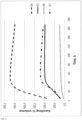
- FIG. 1 shows the relative change in volume of the compositions of E1-E4 during the immersion test described above.
- FIG. 1 illustrates that the composition can be tailored such that the amount of swelling and the swelling rate can be controlled.
- E1 showed a 628% volume increase (550% weight increase) due to swelling with water.
- a mineral absorbent e.g., sodium bentonite
- the stationary amounts of swelling could be increased. Stated another way, the maximum absorption capacity of the composition was higher.
- calcium carbonate was added, as in E3, the swelling rate could also be modified, for example compared to E1.
- E4 shows that different ratios between the components can deliver specific swelling and swelling rate performance.
- FIG. 2 and Table 4 show that the compositions can be modified to also adjust the swelling effect to keep a desired dimensional change.
- the compositions shown in FIG. 2 include lower amounts of polymer, which can be advantageous due to low cost.
- Table 4 Swelling after 48 hours E4 E5 E6 E7 Volume percent 543.7 195.1 36.4 237.1 Weight percent 387.5 137.9 28.7 149.6
- the composition can be particularly advantageous for the composition to maintain a density of greater than 1 g/cc.
- the composition of E7 retained a density of greater than 1 g/cc and showed good mechanical properties and swelling performance of 243 vol% after 48 hours.
- Samples having the compositions of CE2, CE3, E2, and E5 were also subjected to heat testing.
- the heat tests were performed based on FIFA test method 14: " Procedure for the determination of heat on artificial turf products" in the FIFA Handbook of Test Methods, October 2015 Editi on.
- a chamber compliant with EN60068-2-5 was used to simulate solar irradiance, temperature, and humidity.
- the test conditions were as follows: the exposure time was 8 hours; the samples were exposed together (i.e., using the same weathering cycles), each with a separate sensor for surface temperature measurement; the infill compositions were put on a standard turf carpet and the fibers were cut to avoid and showing effect over the granules.
- Two sets of tests were run. The first started on dry conditions and exposed the samples directly to heat lamps. The second test pre-watered the samples with 2 L/m 2 of water and then exposed the samples to the heat lamps.
- test standards are the most recent standard in effect as of the filing date of this application, or, if priority is claimed, the filing date of the earliest priority application in which the test standard appears.
Landscapes
- Chemical & Material Sciences (AREA)
- Health & Medical Sciences (AREA)
- Chemical Kinetics & Catalysis (AREA)
- Medicinal Chemistry (AREA)
- Polymers & Plastics (AREA)
- Organic Chemistry (AREA)
- Engineering & Computer Science (AREA)
- Architecture (AREA)
- Civil Engineering (AREA)
- Structural Engineering (AREA)
- Compositions Of Macromolecular Compounds (AREA)
Claims (15)
- Quellbare Füllzusammensetzung, umfassend:zu 10 bis 50 Gewichtsprozent ein Polyolefinelastomer;zu 5 bis 20 Gewichtsprozent hydrophoben Weichmacher;zu 1 bis 10 Gewichtsprozent einen Co-Weichmacher mit einem Hydrophil-Lipophil-Gleichgewichtswert von mehr als oder gleich 6, wie unter Verwendung des in der Beschreibung definierten Verfahrens bestimmt;zu 5 bis 40 Gewichtsprozent ein organisches Absorptionsmaterial; undwahlweise zu 10 bis 65 Gewichtsprozent ein anorganisches Absorptionsmaterial;wobei Gewichtsprozent auf dem Gesamtgewichtsprozent von in der Zusammensetzung vorhandenen Materialien beruht.
- Quellbare Füllzusammensetzung nach Anspruch 1, wobei das Gewichtsverhältnis von hydrophobem Weichmacher zu Co-Weichmacher von 1,5:1,0 bis 5,0:1,0 beträgt.
- Quellbare Füllzusammensetzung nach Anspruch 1 oder 2, wobei das Polyolefinelastomer ein Polyolefin-Blockcopolymer ist, wobei vorzugsweise das Polyolefin-Blockcopolymer ein propylenbasiertes Elastomer, ein ethylenbasiertes Elastomer oder eine Kombination davon ist, wobei mehr bevorzugt das Polyolefin-Blockcopolymer ein ethylenbasiertes Elastomer ist.
- Quellbare Füllzusammensetzung nach einem oder mehreren der Ansprüche 1 bis 3, wobei das Polyolefinelastomer ein Ethylen/alpha-Olefin-Blockcopolymer ist; vorzugsweise ein Ethylen/alpha-Olefin-Blockcopolymer, das einen Schmelzindex von 0,1 bis 50,0 Gramm, eluiert pro 10 Minuten, aufweist, wie gemäß ASTM D1238 bei 190 °C unter Verwendung einer Last von 2,16 Kilogramm bestimmt.
- Quellbare Füllzusammensetzung nach einem oder mehreren der Ansprüche 1 bis 4, wobei der hydrophobe Weichmacher eine Flüssigkeit bei 25 °C ist, wobei vorzugsweise der hydrophobe Weichmacher ein Naphthenöl oder ein Paraffinöl ist.
- Quellbare Füllzusammensetzung nach einem oder mehreren der Ansprüche 1 bis 5, wobei der hydrophobe Weichmacher ein Paraffinöl ist.
- Quellbare Füllzusammensetzung nach einem oder mehreren der Ansprüche 1 bis 6, wobei
der Co-Weichmacher ein Poly(vinylalkohol), Poly((C2-3-alkyl)englycol), Poly(oxyethylierter Polyol) oder eine Kombination davon ist, vorzugsweise ein Poly((C2-3-alkyl)englycol). - Quellbare Füllzusammensetzung nach einem oder mehreren der Ansprüche 1 bis 7, wobei der Co-Weichmacher ein Poly(ethylenglycol) ist, vorzugsweise mit einem Molekulargewicht von 300 bis 20.000 Gramm pro Mol.
- Quellbare Füllzusammensetzung nach einem oder mehreren der Ansprüche 1 bis 8, wobei das organische Absorptionsmaterial ein superabsorbierendes organisches Polymer umfasst.
- Quellbare Füllzusammensetzung nach Anspruch 9, wobei das superabsorbierende organische Polymer ein Stärkepfropfcopolymer, ein vernetztes Carboxymethylcellulosederivat, eine vernetzte Poly(meth)acrylsäure, ein Salz einer vernetzten Poly(meth)acrylsäure, ein Polymer, das von mindestens einem von einem (Meth)acrylamid, C1-8-alkylsubstituierten (Meth)acrylamiden, amino(C1-8-alkyl)-substituierten (Meth)acrylamiden, Vinylalkohol, Vinylacetat, Allylalkohol, C1-8-Alkyl(meth)acrylaten, Hydroxyl-C1-8-alkyl(meth)acrylaten, N-Vinylformamid, N-Vinylacetamid und (Meth)acrylonitril abgeleitet ist, ein Copolymer der Vorstehenden mit Maleinsäureanhydrid, Vinylacetat, Ethylenoxid, Ethylenglycol oder Acrylnitril oder einer Kombination davon, ein Polymer, das von mindestens einem von Meth)acrylsäure, Ethacrylsäure, Maleinsäure, Maleinsäureanhydrid, Fumarsäure, Itaconsäure, α-Chloracrylsäure, β-Cyanoacrylsäure, β -Methylacrylsäure, α-Phenylacrylsäure, β-Acryloyloxypropionsäure, Sorbinsäure, α-Chlorsorbinsäure, 2'-Methylisocrotonsäure, Zimtsäure, p-Chlorzimtsäure, β-Stearylsäure, Citraconsäure, Mesaconsäure, Glutaconsäure, Aconitsäure, 2-Acrylamido-2-methylpropansulfonsäure, Allylsulfonsäure, Vinylsulfonsäure, Allylphosphonsäure, Vinylphosphonsäure oder einer Kombination davon abgeleitet ist, ein Polymer, das von einem N,N-Di(C1-8-alkylamino)(C1-8-alkyl)(meth)acrylat, wobei die Aminogruppe nachfolgend quaternisiert wird, Allyldimethylammoniumchlorid oder einer Kombination davon abgeleitet ist, umfasst.
- Quellbare Füllzusammensetzung nach Anspruch 9, wobei das superabsorbierende organische Polymer eine vernetzte Poly(meth)acrylsäure umfasst.
- Quellbare Füllzusammensetzung nach einem oder mehreren der Ansprüche 1 bis 11, wobei das anorganische Absorptionsmaterial vorhanden ist und Natriumbentonit, Calciumbentonit, Aluminiumtrihydroxid, Bariumsulfat, Calciumcarbonat, Calciumsulfat, Magnesiumcarbonat, Magnesiumtrihydroxid, Kieselgur, Dolomit, Glaskügelchen, Keramikkügelchen, Kaolin, Glimmer, Perlit, natürliches Siliciumdioxid, synthetisches Siliciumdioxid, Wollastonit, Barthaare oder eine Kombination davon umfasst.
- Quellbare Füllzusammensetzung nach einem oder mehreren der Ansprüche 1 bis 12, ferner umfassend einen Zusatzstoff, wobei der Zusatzstoff ein antimikrobielles Mittel, Antioxidationsmittel, antistatisches Mittel, Biozid, Farbstoff, Flammschutzmittel, Wärmestabilisator, Schmiermittel, Pigment, Verarbeitungshilfsmittel, Ultraviolettlichtstabilisierungsmittel, Wachs oder eine Kombination davon ist.
- Quellbare Füllzusammensetzung nach einem oder mehreren der Ansprüche 1 bis 13, umfassend:zu 20 bis 30 Gewichtsprozent ein Ethylen/alpha-Olefin-Blockcopolymer,zu 10 bis 16 Gewichtsprozent ein Paraffinöl;zu 3 bis 5 Gewichtsprozent ein Poly(ethylenglycol);zu 20 bis 40 Gewichtsprozent eine vernetzte Poly(acrylsäure); undzu 10 bis 45 Gewichtsprozent Natriumbentonit, Calciumcarbonat oder eine Kombination davon,wobei Gewichtsprozent auf dem Gesamtgewichtsprozent von in der Zusammensetzung vorhandenen Materialien beruht.
- Kunstrasensystem, umfassend:eine primäre Trägerschicht;eine Vielzahl von Rasenfasern, die sich von einer ersten Oberfläche der primären Rasenträgerschicht nach oben erstrecken;eine sekundäre Trägerschicht, die auf einer zweiten Oberfläche der primären Trägerschicht gegenüber der ersten Oberfläche angeordnet ist; undeine Füllschicht, die Teilchen umfasst, die die Füllzusammensetzung nach einem oder mehreren der Ansprüche 1 bis 14 umfassen, die zwischen den Rasenfasern auf der ersten Oberfläche der primären Trägerschicht angeordnet ist.
Applications Claiming Priority (2)
| Application Number | Priority Date | Filing Date | Title |
|---|---|---|---|
| EP18382612 | 2018-08-16 | ||
| PCT/US2019/046472 WO2020037028A1 (en) | 2018-08-16 | 2019-08-14 | Swellable elastomeric infill composition for artificial turf |
Publications (2)
| Publication Number | Publication Date |
|---|---|
| EP3837313A1 EP3837313A1 (de) | 2021-06-23 |
| EP3837313B1 true EP3837313B1 (de) | 2023-05-17 |
Family
ID=63311963
Family Applications (1)
| Application Number | Title | Priority Date | Filing Date |
|---|---|---|---|
| EP19756307.5A Active EP3837313B1 (de) | 2018-08-16 | 2019-08-14 | Quellbare elastomere füllzusammensetzung für kunstrasen |
Country Status (7)
| Country | Link |
|---|---|
| US (1) | US20210171751A1 (de) |
| EP (1) | EP3837313B1 (de) |
| CN (1) | CN112513172B (de) |
| AR (1) | AR120967A1 (de) |
| BR (1) | BR112021000591B1 (de) |
| ES (1) | ES2947388T3 (de) |
| WO (1) | WO2020037028A1 (de) |
Families Citing this family (2)
| Publication number | Priority date | Publication date | Assignee | Title |
|---|---|---|---|---|
| KR102424163B1 (ko) * | 2021-06-28 | 2022-07-22 | 주식회사 필드글로벌 | 흡수성과 내구성이 우수한 인조잔디 충진재 |
| AU2023375716A1 (en) * | 2022-11-11 | 2025-06-26 | Tarkett Sports Canada Inc. | Corn cob based infill material for synthetic turf fields |
Family Cites Families (27)
| Publication number | Priority date | Publication date | Assignee | Title |
|---|---|---|---|---|
| JPH06157839A (ja) * | 1992-11-25 | 1994-06-07 | Tonen Chem Corp | 吸水性樹脂組成物 |
| US6534572B1 (en) * | 1998-05-07 | 2003-03-18 | H. B. Fuller Licensing & Financing, Inc. | Compositions comprising a thermoplastic component and superabsorbent polymer |
| AUPS146402A0 (en) * | 2002-03-28 | 2002-05-09 | Compco Pty Ltd | Nanofiller compositions |
| US20050245393A1 (en) * | 2002-08-23 | 2005-11-03 | Norbert Herfert | Superabsorbent polymers and method of manufacturing the same |
| US7608668B2 (en) | 2004-03-17 | 2009-10-27 | Dow Global Technologies Inc. | Ethylene/α-olefins block interpolymers |
| BRPI0508148B1 (pt) | 2004-03-17 | 2015-09-01 | Dow Global Technologies Inc. | Interpolímero de etileno em multibloco, derivado reticulado e composição |
| KR100799262B1 (ko) * | 2007-08-03 | 2008-01-30 | 코오롱글로텍주식회사 | 친환경 인조잔디용 충진재 조성물 |
| KR100780229B1 (ko) * | 2007-09-05 | 2007-11-28 | 이태흥 | 인조잔디용 열가소성 탄성체 칩과 그 제조방법 |
| US8481634B2 (en) * | 2007-09-07 | 2013-07-09 | Bostik, Inc. | Hot melt desiccant matrix composition based on plasticized polyolefin binder |
| EP2238187B1 (de) | 2008-01-30 | 2017-05-10 | Dow Global Technologies LLC | Ethylen-/alpha-olefin-blockinterpolymere |
| DE102008030712A1 (de) * | 2008-06-27 | 2009-12-31 | Construction Research & Technology Gmbh | Zeitverzögerte superabsorbierende Polymere |
| DE102008039671A1 (de) * | 2008-08-26 | 2010-03-04 | Melos Gmbh | Verwendung eines Granulats als Einstreugranulat für Kunstrasen |
| US9540510B2 (en) * | 2008-12-17 | 2017-01-10 | The Yokohama Rubber Co., Ltd | Stabilized dynamically vulcanized thermoplastic elastomer compositions useful in fluid barrier applications |
| US8795834B2 (en) * | 2009-02-09 | 2014-08-05 | Sapturf, Llc | Synthetic turf having cooling layer |
| EP2374917B1 (de) * | 2010-04-07 | 2013-02-13 | Dow Global Technologies LLC | Kunstrasengarn |
| KR101193598B1 (ko) * | 2011-04-12 | 2012-10-23 | 주식회사 정영씨엠 | 인조잔디구장의 시공구조 및 그 시공방법 |
| ES2625475T3 (es) * | 2011-10-24 | 2017-07-19 | Dow Global Technologies Llc | Hebra de césped artificial |
| US9540777B1 (en) * | 2012-04-25 | 2017-01-10 | Christopher Tetrault | Method for cooling of synthetic turf |
| KR101462486B1 (ko) * | 2014-06-20 | 2014-11-19 | 화인케미칼 주식회사 | 인조잔디용 탄성 충진재 |
| CN104151766A (zh) * | 2014-07-30 | 2014-11-19 | 广东金源科技股份有限公司 | Tpe材料及其制备方法 |
| US20170081807A1 (en) * | 2015-09-22 | 2017-03-23 | Christopher Tetrault | Poured in place surface cooling technology |
| CN106832536A (zh) * | 2016-09-23 | 2017-06-13 | 泰山体育产业集团有限公司 | 一种休闲景观人造草坪及其制备方法 |
| KR101879628B1 (ko) * | 2016-12-14 | 2018-07-18 | 주식회사 히기아 | 왕겨를 구비한 인조 잔디용 친환경 충진재 그 구조체 |
| KR101875399B1 (ko) * | 2017-07-06 | 2018-08-02 | 최진희 | 프로세스 오일을 사용하지 않고 재활용 소재를 활용한 무독성 인조잔디 충진재 조성물 |
| CN107501800A (zh) * | 2017-09-15 | 2017-12-22 | 江苏攸途健身器材有限公司 | 一种新型瑜伽垫 |
| KR101965206B1 (ko) * | 2019-03-12 | 2019-05-07 | 주식회사 월드그린 | 초미세 발포 및 형상유지기술을 이용하여 고충격 흡수성과 수분을 유지하는 인조잔디 충전재 제조방법 및 이를 이용한 인조잔디 충전재 |
| KR102036890B1 (ko) * | 2019-05-09 | 2019-10-28 | 주식회사 베노 | 인조잔디용 기능성 탄성체 칩 및 그 제조방법 |
-
2019
- 2019-08-14 EP EP19756307.5A patent/EP3837313B1/de active Active
- 2019-08-14 BR BR112021000591-9A patent/BR112021000591B1/pt not_active IP Right Cessation
- 2019-08-14 ES ES19756307T patent/ES2947388T3/es active Active
- 2019-08-14 US US17/259,717 patent/US20210171751A1/en not_active Abandoned
- 2019-08-14 WO PCT/US2019/046472 patent/WO2020037028A1/en not_active Ceased
- 2019-08-14 CN CN201980047160.2A patent/CN112513172B/zh active Active
- 2019-08-16 AR ARP190102357A patent/AR120967A1/es active IP Right Grant
Also Published As
| Publication number | Publication date |
|---|---|
| CN112513172A (zh) | 2021-03-16 |
| BR112021000591B1 (pt) | 2023-09-26 |
| BR112021000591A2 (pt) | 2021-04-13 |
| ES2947388T3 (es) | 2023-08-08 |
| WO2020037028A1 (en) | 2020-02-20 |
| EP3837313A1 (de) | 2021-06-23 |
| AR120967A1 (es) | 2022-04-06 |
| CN112513172B (zh) | 2023-10-20 |
| US20210171751A1 (en) | 2021-06-10 |
Similar Documents
| Publication | Publication Date | Title |
|---|---|---|
| EP1137714B1 (de) | Superabsorbierende wasserbeständige beschichtungen für faserverstärkte gegenstände | |
| US9527974B2 (en) | Ethylene-based polymer compositions and foams | |
| EP1619217B1 (de) | Kabel mit thermoplastischer Isolierung | |
| JP4934259B2 (ja) | 超吸収性耐水性コーティング | |
| US20210171751A1 (en) | Swellable elastomeric infill composition for artificial turf | |
| US20110178195A1 (en) | Compositions for abrasion resistant foams and methods for making the same | |
| EP0475778B1 (de) | Wasserdichtendes Mittel | |
| KR101887103B1 (ko) | 인조잔디 구조체 | |
| EP0423962A2 (de) | Äthylen-Polymerzusammensetzungen | |
| WO2016054242A1 (en) | High frequency weldable ethylene-based polymer compositions with good flame retardancy | |
| CN104136513B (zh) | 具有烯烃嵌段共聚物凝胶颗粒的泡沫体组合物 | |
| KR20170117500A (ko) | 가교체 및 제진재 | |
| CN112020536A (zh) | 具有改进的可加工性和摩擦管理的人造草皮纱线 | |
| JP3982904B2 (ja) | 農業用フィルム | |
| EP3898829B9 (de) | Wässrige ionomerdispersionen und verfahren dafür | |
| CN110785517A (zh) | 人造草皮长丝和由其制成的制品 | |
| CN110832141B (zh) | 人造草皮长丝和由其制成的制品 | |
| KR960009061B1 (ko) | 흡수제 조성물 | |
| US12264233B2 (en) | Compositions containing low molecular weight propylene-based polymers and an olefin multi-block copolymer | |
| CN115746609A (zh) | 阻燃剂组合物 | |
| JP2004292753A (ja) | 汚れ防止性フィルム | |
| CN121799006A (zh) | 一种塑料编织防渗布及其制备方法和应用 | |
| AU2004212524B2 (en) | Superabsorbent water-resistant coatings | |
| JPH09309981A (ja) | 衝撃吸収ゲル材 | |
| TH59161A (th) | พอลิเมอร์แบบเชื่อมโยง และกระบวนการสำหรับผลิตพอลิเมอร์ดังกล่าว โครงสร้างแบบดูดซับ และชิ้นงานดูดซับ |
Legal Events
| Date | Code | Title | Description |
|---|---|---|---|
| STAA | Information on the status of an ep patent application or granted ep patent |
Free format text: STATUS: UNKNOWN |
|
| STAA | Information on the status of an ep patent application or granted ep patent |
Free format text: STATUS: THE INTERNATIONAL PUBLICATION HAS BEEN MADE |
|
| PUAI | Public reference made under article 153(3) epc to a published international application that has entered the european phase |
Free format text: ORIGINAL CODE: 0009012 |
|
| STAA | Information on the status of an ep patent application or granted ep patent |
Free format text: STATUS: REQUEST FOR EXAMINATION WAS MADE |
|
| 17P | Request for examination filed |
Effective date: 20210226 |
|
| AK | Designated contracting states |
Kind code of ref document: A1 Designated state(s): AL AT BE BG CH CY CZ DE DK EE ES FI FR GB GR HR HU IE IS IT LI LT LU LV MC MK MT NL NO PL PT RO RS SE SI SK SM TR |
|
| DAV | Request for validation of the european patent (deleted) | ||
| DAX | Request for extension of the european patent (deleted) | ||
| STAA | Information on the status of an ep patent application or granted ep patent |
Free format text: STATUS: EXAMINATION IS IN PROGRESS |
|
| 17Q | First examination report despatched |
Effective date: 20221006 |
|
| GRAP | Despatch of communication of intention to grant a patent |
Free format text: ORIGINAL CODE: EPIDOSNIGR1 |
|
| STAA | Information on the status of an ep patent application or granted ep patent |
Free format text: STATUS: GRANT OF PATENT IS INTENDED |
|
| INTG | Intention to grant announced |
Effective date: 20221209 |
|
| GRAS | Grant fee paid |
Free format text: ORIGINAL CODE: EPIDOSNIGR3 |
|
| GRAA | (expected) grant |
Free format text: ORIGINAL CODE: 0009210 |
|
| STAA | Information on the status of an ep patent application or granted ep patent |
Free format text: STATUS: THE PATENT HAS BEEN GRANTED |
|
| AK | Designated contracting states |
Kind code of ref document: B1 Designated state(s): AL AT BE BG CH CY CZ DE DK EE ES FI FR GB GR HR HU IE IS IT LI LT LU LV MC MK MT NL NO PL PT RO RS SE SI SK SM TR |
|
| REG | Reference to a national code |
Ref country code: GB Ref legal event code: FG4D |
|
| REG | Reference to a national code |
Ref country code: CH Ref legal event code: EP |
|
| REG | Reference to a national code |
Ref country code: DE Ref legal event code: R096 Ref document number: 602019029089 Country of ref document: DE |
|
| REG | Reference to a national code |
Ref country code: IE Ref legal event code: FG4D |
|
| REG | Reference to a national code |
Ref country code: AT Ref legal event code: REF Ref document number: 1568364 Country of ref document: AT Kind code of ref document: T Effective date: 20230615 |
|
| REG | Reference to a national code |
Ref country code: NL Ref legal event code: FP |
|
| P01 | Opt-out of the competence of the unified patent court (upc) registered |
Effective date: 20230526 |
|
| REG | Reference to a national code |
Ref country code: ES Ref legal event code: FG2A Ref document number: 2947388 Country of ref document: ES Kind code of ref document: T3 Effective date: 20230808 |
|
| REG | Reference to a national code |
Ref country code: LT Ref legal event code: MG9D |
|
| REG | Reference to a national code |
Ref country code: AT Ref legal event code: MK05 Ref document number: 1568364 Country of ref document: AT Kind code of ref document: T Effective date: 20230517 |
|
| PG25 | Lapsed in a contracting state [announced via postgrant information from national office to epo] |
Ref country code: SE Free format text: LAPSE BECAUSE OF FAILURE TO SUBMIT A TRANSLATION OF THE DESCRIPTION OR TO PAY THE FEE WITHIN THE PRESCRIBED TIME-LIMIT Effective date: 20230517 Ref country code: PT Free format text: LAPSE BECAUSE OF FAILURE TO SUBMIT A TRANSLATION OF THE DESCRIPTION OR TO PAY THE FEE WITHIN THE PRESCRIBED TIME-LIMIT Effective date: 20230918 Ref country code: NO Free format text: LAPSE BECAUSE OF FAILURE TO SUBMIT A TRANSLATION OF THE DESCRIPTION OR TO PAY THE FEE WITHIN THE PRESCRIBED TIME-LIMIT Effective date: 20230817 Ref country code: AT Free format text: LAPSE BECAUSE OF FAILURE TO SUBMIT A TRANSLATION OF THE DESCRIPTION OR TO PAY THE FEE WITHIN THE PRESCRIBED TIME-LIMIT Effective date: 20230517 |
|
| PGFP | Annual fee paid to national office [announced via postgrant information from national office to epo] |
Ref country code: ES Payment date: 20230907 Year of fee payment: 5 |
|
| PG25 | Lapsed in a contracting state [announced via postgrant information from national office to epo] |
Ref country code: RS Free format text: LAPSE BECAUSE OF FAILURE TO SUBMIT A TRANSLATION OF THE DESCRIPTION OR TO PAY THE FEE WITHIN THE PRESCRIBED TIME-LIMIT Effective date: 20230517 Ref country code: PL Free format text: LAPSE BECAUSE OF FAILURE TO SUBMIT A TRANSLATION OF THE DESCRIPTION OR TO PAY THE FEE WITHIN THE PRESCRIBED TIME-LIMIT Effective date: 20230517 Ref country code: LV Free format text: LAPSE BECAUSE OF FAILURE TO SUBMIT A TRANSLATION OF THE DESCRIPTION OR TO PAY THE FEE WITHIN THE PRESCRIBED TIME-LIMIT Effective date: 20230517 Ref country code: LT Free format text: LAPSE BECAUSE OF FAILURE TO SUBMIT A TRANSLATION OF THE DESCRIPTION OR TO PAY THE FEE WITHIN THE PRESCRIBED TIME-LIMIT Effective date: 20230517 Ref country code: IS Free format text: LAPSE BECAUSE OF FAILURE TO SUBMIT A TRANSLATION OF THE DESCRIPTION OR TO PAY THE FEE WITHIN THE PRESCRIBED TIME-LIMIT Effective date: 20230917 Ref country code: HR Free format text: LAPSE BECAUSE OF FAILURE TO SUBMIT A TRANSLATION OF THE DESCRIPTION OR TO PAY THE FEE WITHIN THE PRESCRIBED TIME-LIMIT Effective date: 20230517 Ref country code: GR Free format text: LAPSE BECAUSE OF FAILURE TO SUBMIT A TRANSLATION OF THE DESCRIPTION OR TO PAY THE FEE WITHIN THE PRESCRIBED TIME-LIMIT Effective date: 20230818 |
|
| PG25 | Lapsed in a contracting state [announced via postgrant information from national office to epo] |
Ref country code: FI Free format text: LAPSE BECAUSE OF FAILURE TO SUBMIT A TRANSLATION OF THE DESCRIPTION OR TO PAY THE FEE WITHIN THE PRESCRIBED TIME-LIMIT Effective date: 20230517 |
|
| PG25 | Lapsed in a contracting state [announced via postgrant information from national office to epo] |
Ref country code: SK Free format text: LAPSE BECAUSE OF FAILURE TO SUBMIT A TRANSLATION OF THE DESCRIPTION OR TO PAY THE FEE WITHIN THE PRESCRIBED TIME-LIMIT Effective date: 20230517 |
|
| PG25 | Lapsed in a contracting state [announced via postgrant information from national office to epo] |
Ref country code: SM Free format text: LAPSE BECAUSE OF FAILURE TO SUBMIT A TRANSLATION OF THE DESCRIPTION OR TO PAY THE FEE WITHIN THE PRESCRIBED TIME-LIMIT Effective date: 20230517 Ref country code: SK Free format text: LAPSE BECAUSE OF FAILURE TO SUBMIT A TRANSLATION OF THE DESCRIPTION OR TO PAY THE FEE WITHIN THE PRESCRIBED TIME-LIMIT Effective date: 20230517 Ref country code: RO Free format text: LAPSE BECAUSE OF FAILURE TO SUBMIT A TRANSLATION OF THE DESCRIPTION OR TO PAY THE FEE WITHIN THE PRESCRIBED TIME-LIMIT Effective date: 20230517 Ref country code: EE Free format text: LAPSE BECAUSE OF FAILURE TO SUBMIT A TRANSLATION OF THE DESCRIPTION OR TO PAY THE FEE WITHIN THE PRESCRIBED TIME-LIMIT Effective date: 20230517 Ref country code: DK Free format text: LAPSE BECAUSE OF FAILURE TO SUBMIT A TRANSLATION OF THE DESCRIPTION OR TO PAY THE FEE WITHIN THE PRESCRIBED TIME-LIMIT Effective date: 20230517 Ref country code: CZ Free format text: LAPSE BECAUSE OF FAILURE TO SUBMIT A TRANSLATION OF THE DESCRIPTION OR TO PAY THE FEE WITHIN THE PRESCRIBED TIME-LIMIT Effective date: 20230517 |
|
| REG | Reference to a national code |
Ref country code: DE Ref legal event code: R097 Ref document number: 602019029089 Country of ref document: DE |
|
| PG25 | Lapsed in a contracting state [announced via postgrant information from national office to epo] |
Ref country code: MC Free format text: LAPSE BECAUSE OF FAILURE TO SUBMIT A TRANSLATION OF THE DESCRIPTION OR TO PAY THE FEE WITHIN THE PRESCRIBED TIME-LIMIT Effective date: 20230517 |
|
| PLBE | No opposition filed within time limit |
Free format text: ORIGINAL CODE: 0009261 |
|
| STAA | Information on the status of an ep patent application or granted ep patent |
Free format text: STATUS: NO OPPOSITION FILED WITHIN TIME LIMIT |
|
| REG | Reference to a national code |
Ref country code: CH Ref legal event code: PL |
|
| PG25 | Lapsed in a contracting state [announced via postgrant information from national office to epo] |
Ref country code: MC Free format text: LAPSE BECAUSE OF FAILURE TO SUBMIT A TRANSLATION OF THE DESCRIPTION OR TO PAY THE FEE WITHIN THE PRESCRIBED TIME-LIMIT Effective date: 20230517 |
|
| PG25 | Lapsed in a contracting state [announced via postgrant information from national office to epo] |
Ref country code: LU Free format text: LAPSE BECAUSE OF NON-PAYMENT OF DUE FEES Effective date: 20230814 |
|
| 26N | No opposition filed |
Effective date: 20240220 |
|
| GBPC | Gb: european patent ceased through non-payment of renewal fee |
Effective date: 20230817 |
|
| PG25 | Lapsed in a contracting state [announced via postgrant information from national office to epo] |
Ref country code: LU Free format text: LAPSE BECAUSE OF NON-PAYMENT OF DUE FEES Effective date: 20230814 Ref country code: CH Free format text: LAPSE BECAUSE OF NON-PAYMENT OF DUE FEES Effective date: 20230831 |
|
| PG25 | Lapsed in a contracting state [announced via postgrant information from national office to epo] |
Ref country code: SI Free format text: LAPSE BECAUSE OF FAILURE TO SUBMIT A TRANSLATION OF THE DESCRIPTION OR TO PAY THE FEE WITHIN THE PRESCRIBED TIME-LIMIT Effective date: 20230517 |
|
| REG | Reference to a national code |
Ref country code: BE Ref legal event code: MM Effective date: 20230831 |
|
| REG | Reference to a national code |
Ref country code: IE Ref legal event code: MM4A |
|
| PG25 | Lapsed in a contracting state [announced via postgrant information from national office to epo] |
Ref country code: SI Free format text: LAPSE BECAUSE OF FAILURE TO SUBMIT A TRANSLATION OF THE DESCRIPTION OR TO PAY THE FEE WITHIN THE PRESCRIBED TIME-LIMIT Effective date: 20230517 |
|
| PG25 | Lapsed in a contracting state [announced via postgrant information from national office to epo] |
Ref country code: IE Free format text: LAPSE BECAUSE OF NON-PAYMENT OF DUE FEES Effective date: 20230814 |
|
| PG25 | Lapsed in a contracting state [announced via postgrant information from national office to epo] |
Ref country code: GB Free format text: LAPSE BECAUSE OF NON-PAYMENT OF DUE FEES Effective date: 20230817 |
|
| PGFP | Annual fee paid to national office [announced via postgrant information from national office to epo] |
Ref country code: NL Payment date: 20240613 Year of fee payment: 6 |
|
| PG25 | Lapsed in a contracting state [announced via postgrant information from national office to epo] |
Ref country code: IE Free format text: LAPSE BECAUSE OF NON-PAYMENT OF DUE FEES Effective date: 20230814 Ref country code: GB Free format text: LAPSE BECAUSE OF NON-PAYMENT OF DUE FEES Effective date: 20230817 Ref country code: FR Free format text: LAPSE BECAUSE OF NON-PAYMENT OF DUE FEES Effective date: 20230831 |
|
| PG25 | Lapsed in a contracting state [announced via postgrant information from national office to epo] |
Ref country code: BE Free format text: LAPSE BECAUSE OF NON-PAYMENT OF DUE FEES Effective date: 20230831 |
|
| PGFP | Annual fee paid to national office [announced via postgrant information from national office to epo] |
Ref country code: DE Payment date: 20240618 Year of fee payment: 6 |
|
| PGFP | Annual fee paid to national office [announced via postgrant information from national office to epo] |
Ref country code: IT Payment date: 20240710 Year of fee payment: 6 |
|
| PG25 | Lapsed in a contracting state [announced via postgrant information from national office to epo] |
Ref country code: BG Free format text: LAPSE BECAUSE OF FAILURE TO SUBMIT A TRANSLATION OF THE DESCRIPTION OR TO PAY THE FEE WITHIN THE PRESCRIBED TIME-LIMIT Effective date: 20230517 |
|
| PG25 | Lapsed in a contracting state [announced via postgrant information from national office to epo] |
Ref country code: BG Free format text: LAPSE BECAUSE OF FAILURE TO SUBMIT A TRANSLATION OF THE DESCRIPTION OR TO PAY THE FEE WITHIN THE PRESCRIBED TIME-LIMIT Effective date: 20230517 |
|
| PGFP | Annual fee paid to national office [announced via postgrant information from national office to epo] |
Ref country code: TR Payment date: 20240724 Year of fee payment: 6 |
|
| PG25 | Lapsed in a contracting state [announced via postgrant information from national office to epo] |
Ref country code: CY Free format text: LAPSE BECAUSE OF FAILURE TO SUBMIT A TRANSLATION OF THE DESCRIPTION OR TO PAY THE FEE WITHIN THE PRESCRIBED TIME-LIMIT; INVALID AB INITIO Effective date: 20190814 |
|
| PG25 | Lapsed in a contracting state [announced via postgrant information from national office to epo] |
Ref country code: HU Free format text: LAPSE BECAUSE OF FAILURE TO SUBMIT A TRANSLATION OF THE DESCRIPTION OR TO PAY THE FEE WITHIN THE PRESCRIBED TIME-LIMIT; INVALID AB INITIO Effective date: 20190814 |
|
| REG | Reference to a national code |
Ref country code: ES Ref legal event code: FD2A Effective date: 20250926 |
|
| PG25 | Lapsed in a contracting state [announced via postgrant information from national office to epo] |
Ref country code: ES Free format text: LAPSE BECAUSE OF NON-PAYMENT OF DUE FEES Effective date: 20240815 |
|
| REG | Reference to a national code |
Ref country code: DE Ref legal event code: R119 Ref document number: 602019029089 Country of ref document: DE |
|
| REG | Reference to a national code |
Ref country code: NL Ref legal event code: MM Effective date: 20250901 |