EP3837204B1 - Aufzugsanlage - Google Patents
Aufzugsanlage Download PDFInfo
- Publication number
- EP3837204B1 EP3837204B1 EP19752686.6A EP19752686A EP3837204B1 EP 3837204 B1 EP3837204 B1 EP 3837204B1 EP 19752686 A EP19752686 A EP 19752686A EP 3837204 B1 EP3837204 B1 EP 3837204B1
- Authority
- EP
- European Patent Office
- Prior art keywords
- repositioning
- elevator system
- shaft
- transfer
- assembly
- Prior art date
- Legal status (The legal status is an assumption and is not a legal conclusion. Google has not performed a legal analysis and makes no representation as to the accuracy of the status listed.)
- Active
Links
Images
Classifications
-
- B—PERFORMING OPERATIONS; TRANSPORTING
- B66—HOISTING; LIFTING; HAULING
- B66B—ELEVATORS; ESCALATORS OR MOVING WALKWAYS
- B66B9/00—Kinds or types of lifts in, or associated with, buildings or other structures
-
- B—PERFORMING OPERATIONS; TRANSPORTING
- B66—HOISTING; LIFTING; HAULING
- B66B—ELEVATORS; ESCALATORS OR MOVING WALKWAYS
- B66B9/00—Kinds or types of lifts in, or associated with, buildings or other structures
- B66B9/003—Kinds or types of lifts in, or associated with, buildings or other structures for lateral transfer of car or frame, e.g. between vertical hoistways or to/from a parking position
-
- B—PERFORMING OPERATIONS; TRANSPORTING
- B66—HOISTING; LIFTING; HAULING
- B66B—ELEVATORS; ESCALATORS OR MOVING WALKWAYS
- B66B7/00—Other common features of elevators
- B66B7/02—Guideways; Guides
-
- B—PERFORMING OPERATIONS; TRANSPORTING
- B66—HOISTING; LIFTING; HAULING
- B66B—ELEVATORS; ESCALATORS OR MOVING WALKWAYS
- B66B7/00—Other common features of elevators
- B66B7/02—Guideways; Guides
- B66B7/023—Mounting means therefor
-
- B—PERFORMING OPERATIONS; TRANSPORTING
- B66—HOISTING; LIFTING; HAULING
- B66B—ELEVATORS; ESCALATORS OR MOVING WALKWAYS
- B66B7/00—Other common features of elevators
- B66B7/06—Arrangements of ropes or cables
- B66B7/062—Belts
Definitions
- the invention relates to an elevator installation.
- the invention can be used in elevator systems in which a plurality of cabins can travel simultaneously in a common shaft.
- the elevator system comprises a plurality of shafts. Using a transfer arrangement, the cabins can be transferred from a first shaft to a second shaft.
- Such an elevator system is basically in the EP 3 318 526 A1
- a transfer arrangement comprises a plurality of transfer modules 162, which can be assembled depending on the configuration of the elevator system.
- Each such module comprises a rail (reference number 176 in Figure 3 ), which together form a transfer track.
- a cabin guide (reference number 172 in Figure 3 ) represents a transfer carrier which transfers the cabin from a first transfer position in a first shaft to a second transfer position in a second shaft along the rail.
- These modules are connected by means of a frame (reference number 170 in Figure 3 ) on one floor.
- this modular arrangement is quite limited in its variability.
- the subsequently published patent application PCT/EP2018/050265 discloses a multi-cabin elevator system.
- a transfer arrangement is formed by a rotatable rail segment.
- the elevator system has an adjustment arrangement for adjusting the axis of rotation.
- the advantage of the elevator system according to the invention is that the assembly of the transfer arrangement can be carried out with fairly large tolerances.
- the assembled transfer arrangement can be adjusted in such a way that the cabins are positioned as precisely as possible in the respective target shaft during operation after the transfer process. Due to deformations during operation, it may be necessary to readjust the alignment of the transfer arrangement.
- the cabin includes guide rollers mounted on opposite sides of the cabin.
- the transfer arrangement does not have any rotatable rail segments.
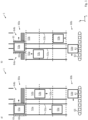
- FIG. 1 shows parts of an elevator system 1 according to the invention.
- the elevator system 1 comprises fixed guide rails 52, along which cabins 53 can be guided in a vertical direction.
- First vertical guide rails 52a are arranged in a first shaft 51a and second guide rails 52b are arranged in a second shaft 51b.
- the elevator system comprises a plurality of cabins 53a, 53b, 53c, 53d, whereby in one shaft in particular more than two cabins can travel simultaneously.
- the elevator system 1 comprises several transfer arrangements 60a, 60b. Using such a transfer arrangement 60, a cabin can be transferred from one shaft to the other shaft.
- a transfer process of the cabin 53a from the first shaft 51a to the second shaft 51b is considered using the upper transfer arrangement 60a.
- the cabin 53a moves vertically along the vertical guide rails 52a into the transfer arrangement 60a.
- the cabin 53a is now in the first transfer position 64a.
- the cabin 53 could, on the one hand, continue vertically to the next floor along the vertical guide rails 52a.
- the cabin 53a can also be transferred to a second transfer position 64b, in which the cabin is then arranged in the second shaft 51b.
- the transfer arrangement 60a has a transfer frame 61 as a transfer support, which is also located in the first transfer position 64a. If both the transfer frame 61 and the cabin 53a are in the first transfer position 64a, the transfer frame 61 can accommodate the cabin 53a.
- a rail section 62 of the vertical guide rail 52 can be separated from the rest of the guide rail 52 and is firmly connected to the transfer frame 61.
- the cabin 53a now enters the guide area of the rail section 62.
- the transfer frame 61 is now moved horizontally, this rail section 62, together with the cabin 53 guided on the rail section 62, moves together with the transfer frame 61.
- the transfer frame 61 is now displaced from the first transfer position 64a to the second transfer position 64b along a transfer track 63.
- the transfer track 63 can be a horizontal rail on which the transfer frame 61 is guided. This transfer principle is basically in the EP 3 318 526 A1 described.
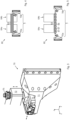
- FIG. 3 shows an exemplary adjustment device 70 in a possible embodiment.
- the adjustment device 70 comprises an adjustment base 71, which can be fastened in a predetermined position, e.g. on the shaft wall 54.
- An adjustment support 72 is fastened to the transfer track 63 in a predetermined position.
- the adjustment support 72 can also be an integral part of the transfer track 63.
- the relative position of the adjustment support 72 with respect to the respective adjustment base 71 defines the position of the transfer track, at least locally.
- An adjustment rail 73 is held on the adjustment base 71 so that it can be moved in the y-direction.
- An adjustment slide 74 is held on the adjustment rail 73 so that it can be moved in a direction x.
- An adjustment screw 75 is placed on top of the adjustment slide 74. The adjustment screw 75 is guided through a threaded hole in the adjustment support 72.
- the directions of the individual adjustment means do not necessarily have to correlate with the spatial directions x, y, z.
- the displaceability can be achieved by a dovetail guide, as shown at the connection between the adjustment rail 73 and the adjustment slide 74.
- a dovetail guide is also present between the adjustment base 71 and the adjustment rail 73, but is not visible in this illustration.
- the transfer arrangement may also comprise a conveyor belt arrangement 60b, such as Figure 5 illustrated.
- Conveyor belt arrangement 60b comprises a conveyor belt 66, wherein the car 52d to be transferred is placed on this conveyor belt.
- the area of the conveyor belt on which the cabin is mounted is regarded as the transfer support 61.
- the conveyor belt 66 and thus the transfer support 61 are guided by means of bearing rollers 67.
- the transfer track 63 is determined by the arrangement and alignment of the bearing rollers.
- the bearing rollers are aligned by the adjustment arrangement 7, analogously to the previous embodiment.
- the transfer positions 64a, 64b are thus set.
- the adjustment can be carried out once during commissioning. Continuous adjustment is not necessary during operation.
- the correct alignment can be checked during regular maintenance work.
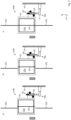
- FIG. 2 shows the transfer carrier is guided by a roller guide 65 on the transfer track 63.
- the transfer track can be formed by a horizontal rail, whereby such a rail can also be present on the other side.
- the transfer track 63 is held on the shaft wall 54 by several adjustment devices 70 (see also Figure 4 ).
- FIG. 2a shows the transfer carrier in 61 together with the cabin 53a in the second, not yet aligned transfer position 64b. It can be seen that the rail section 62, which together with the cabin 53a from the first transfer position to the second transfer position is not aligned with the vertical guide rail 52b in the second shaft.
- the adjustment device 70b the position of the transfer track 63 in the area of the second transfer position 64b is changed initially in the z direction ( Figure 2b ) and then in the x direction. The rail section 62 is then aligned, at least in side view, with the vertical guide rail 52 in the second transfer position 64b.
- Alignment in the position in the X direction can be carried out using a stop (not shown), which can also be part of the adjustment arrangement.
- the stop can be used to define the travel path of the transfer carrier 61 along the track 63.
- the cabin 53 can now move vertically in the second shaft.
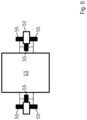
- Figure 7 shows the mounting of the cabin during vertical travel.
- the cabin is guided by guide rollers on the at least two vertical guide rails.
- the at least two vertical guide rails are arranged on opposite sides of the cabin.
Landscapes
- Engineering & Computer Science (AREA)
- Automation & Control Theory (AREA)
- Structural Engineering (AREA)
- Lift-Guide Devices, And Elevator Ropes And Cables (AREA)
- Elevator Control (AREA)
Description
- Die Erfindung betrifft eine Aufzugsanlage.
- Die Erfindung ist anwendbar bei Aufzugsanlagen, bei denen eine Mehrzahl von Kabinen gleichzeitig in einem gemeinsamen Schacht fahren können. Zudem umfasst die Aufzugsanlage eine Mehrzahl von Schächten. Anhand einer Umsetzanordnung können die Kabinen von einem ersten Schacht in einen zweiten Schacht überführt werden.
- Eine solche Aufzugsanlage ist dem Grunde nach in der
EP 3 318 526 A1 offenbart. Eine Umsetzanordnung umfasst hierbei eine Vielzahl von Umsetzmodulen 162, die je nach Konfiguration der Aufzugsanlage zusammengesetzt werden können. Ein jede solcher Module umfasst eine Schiene (Bezugszeichen 176 inFigur 3 ), die zusammen eine Umsetzspur bilden. Eine Kabinenführung (Bezugszeichen 172 inFigur 3 ) stellt einen Umsetzträger dar, welcher die Kabine von einer ersten Umsetzposition in einem ersten Schacht in eine zweite Umsetzposition in einen zweiten Schacht entlang der Schiene überführt. Diese Module werden anhand eines Rahmens (Bezugszeichen 170 inFigur 3 ) in einer Etage platziert. Allerdings ist diese modulare Anordnung recht beschränkt in der Variabilität. Zudem müssen bei der Montage die Rahmen sehr exakt platziert werden. Ähnliche Aufzugsanlagen sind in derEP 3 133 038 A1 sowie in derWO 2012/154178 A1 beschrieben. - Es ist Aufgabe der vorliegenden Erfindung eine eingangs genannte Aufzugsanlage weiterzuentwickeln.
- Die nachveröffentlichte Patentanmeldung
PCT/EP2018/050265 - Die der Erfindung zugrunde liegende Aufgabe wird gelöst durch eine Aufzugsanlage sowie einem Verfahren nach den Hauptansprüchen Ausgestaltungen ergeben sich aus den Unteransprüche sowie der Beschreibung.
- Der Vorteil der erfindungsgemäßen Aufzugsanlage liegt nun insbesondere darin, dass die Montage der Umsetzanordnung mit recht groben Toleranzen erfolgen kann. Anhand der Einstellanordnung kann die montierte Umsetzanordnung derart eingestellt werden, dass die Kabinen im Betrieb nach dem Umsetzvorgang möglichst exakt in dem jeweiligen Zielschacht angeordnet sind. Durch Verformungen im Betrieb kann es dabei erforderlich werden, die Ausrichtung der Umsetzanordnung nachzustellen.
- Im Gegensatz zur Aufzugsanlage der
PCT/EP2018/050265 - Insbesondere umfasst die Kabine Führungsrollen, die an gegenüberliegenden Seiten der Kabine angebracht sind.
- Insbesondere weist die Umsetzanordnung keine drehbaren Schienensegmente auf.
- Die bezüglich der Vorrichtung bzw. des Verfahrens genannten Vorteile und weiteren Ausgestaltungsmöglichkeiten sind ohne weiteres auf das Verfahren bzw. die Vorrichtung abwendbar.
- Die Erfindung wird nachfolgend anhand der Figuren näher erläutert. Es zeigen jeweils
- Fig.1
- schematisch den grundlegenden Aufbau einer erfindungsgemäßen Aufzugsanlage mit zwei Umsetzanordnungen,
- Fig.2
- eine Umsetzanordnung in einer ersten Ausgestaltung in Seitenansicht in unterschiedlichen Ausrichtungszuständen;
- Fig.3
- detailliert und vergrößert eine Einstellanordnung in perspektivischer Darstellung,
- Fig.4
- schematisch die Einstellanordnung in Zusammenschau mit der Umsetzanordnung in einer ersten Ausgestaltung;
- Fig.5
- schematisch die Einstellanordnung in Zusammenschau mit der Umsetzanordnung in einer zweiten Ausgestaltung;
- Fig.6
- schematische die Kabine und die vertikalen Führungsschienen von oben.
-
Figur 1 zeigt Teile einer erfindungsgemäßen Aufzugsanlage 1. Die Aufzugsanlage 1 umfasst feststehende Führungsschienen 52, entlang welcher Kabinen 53 in vertikaler Richtung geführt werden kann. Dabei sind erste vertikale Führungsschienen 52a in einem ersten Schacht 51a angeordnet und zweite Führungsschienen 52b sind in einem zweiten Schacht 51b angeordnet. Die Aufzugsanlage umfasst dabei eine Mehrzahl an Kabinen 53a, 53b, 53c, 53d wobei in einem Schacht insbesondere mehr als zwei Kabinen gleichzeitig verfahren können. - Die Aufzugsanlage 1 umfasst mehrere Umsetzanordnungen 60a, 60b. Anhand einer solchen Umsetzanordnung 60 kann eine Kabine von einem Schacht in den anderen Schacht umgesetzt werden.
- Es wird beispielhaft ein Umsetzvorgang der Kabine 53a von dem ersten Schacht 51a in den zweiten Schacht 51b anhand der oberen Umsetzanordnung 60a betrachtet. Dazu fährt die Kabine 53a entlang der vertikalen Führungsschienen 52a vertikal in die Umsetzanordnung 60a ein. Nun befindet sich die Kabine 53a in der ersten Umsetzposition 64a. Aus dieser Umsetzposition 64a könnte die Kabine 53 zum einen vertikal weiter in die nächstgelegene Etage entlang der vertikalen Führungsschienen 52a weiterfahren. Zum anderen kann die Kabine 53a auch in eine zweite Umsetzposition 64b überführt werden, in der die Kabine dann im zweiten Schacht 51b angeordnet ist.
- Dazu weist die Umsetzanordnung 60a ein Umsetzgestell 61 als Umsetzträger auf, welches sich ebenfalls in der ersten Umsetzposition 64a befindet. Wenn sich sowohl das Umsetzgestell 61 als auch die Kabine 53a in der ersten Umsetzposition 64a befindet, kann das Umsetzgestell 61 die Kabine 53a aufnehmen.
- Ein Schienenabschnitt 62 der vertikalen Führungsschiene 52 ist hierbei von der übrigen Führungsschiene 52 trennbar und mit dem Umsetzgestell 61 fest verbunden. Durch das Einfahren in die erste Umsetzposition 64a gelangt die Kabine 53a nun in den Führungsbereich des Schienenabschnitts 62. Wird das Umsetzgestell 61 nun horizontal bewegt, so bewegt sich die dieser Schienenabschnitt 62 mitsamt der an dem Schienenabschnitt 62 geführten Kabine 53 gemeinsam mit dem Umsetzgestell 61. Das Umsetzgestell 61 ist nun verlagert von der ersten Umsetzposition 64a in die zweite Umsetzposition 64b entlang einer Umsetzspur 63. Die Umsetzspur 63 kann eine horizontale Schiene sein, an der das Umsetzgestell 61 geführt ist. Dieses Umsetzprinzip ist dem Grunde nach in der
EP 3 318 526 A1 beschrieben. -
Figur 3 zeigt eine beispielhafte Einstelleinrichtung 70 in einer möglichen Ausgestaltung. Die Einstelleinrichtung 70 umfasst eine Einstellbasis 71, die in einer vorgegebenen Position z.B. an der Schachtwand 54 befestigt werden kann. Ein Einstellaufleger 72 ist am an der Umsetzspur 63 in einer vorgegebenen Position befestigt. Der Einstellaufleger 72 kann auch integraler Bestandteil der Umsetzspur 63 ein. Die Relativposition des Einstellauflegers 72 gegenüber der jeweiligen Einstellbasis 71 definiert die Position der Umsetzspur zumindest örtlich begrenzt. - An der Einstellbasis 71 ist eine Einstellschiene 73 in der y-Richtung verschiebbar gehalten. An der Einstellschiene 73 ist ein Einstellschieber 74 in einer Richtung x verschiebbar gehalten. Am Einstellschieber 74 ist eine Einstellschraube 75 von oben aufgesetzt. Die Einstellschraube 75 ist durch eine Gewindebohrung im Einstellaufleger 72 geführt. Die Richtungen der einzelnen Einstellmittel müssen nicht zwangsläufig mit den Raumrichtungen x,y,z korrelieren.
- Die Verschiebbarkeit kann, wie an der Verbindung zwischen Einstellschiene 73 und Einstellschieber 74 gezeigt, durch eine Schwalbenschwanzführung realisiert werden. Eine solche Schwalbenschwanzführung ist auch zwischen der Einstellbasis 71 und der Einstellschiene 73 vorhanden, aber in dieser Darstellung nicht sichtbar. Durch Drehen der Einstellschraube 75 kann der Einstellaufleger 72 gegenüber dem Einstellschieber 74 in der z-Richtung angehoben oder abgesenkt werden. Die eingestellte Relativposition des Einstellauflegers 72 gegenüber der Einstellbasis 71 wird nach dem Einstellen fixiert.
- Alternativ kann die Umsetzanordnung auch eine Förderbandanordnung 60b umfassen, wie
Figur 5 illustriert. Insbesondere an einer unteren Umsetzanordnung kann eine solche Anordnung verwendet werden. Förderbandanordnung 60b umfasst ein Förderband 66, wobei der umzusetzende Fahrkorb 52d auf dieses Förderband aufgesetzt wird. Derjenige Bereich des Förderbandes, auf welchem die Kabine gelagert ist, wird als Umsetzträger 61 angesehen. Anhand von Lagerrollen 67 ist das Förderband 66 und damit der Umsetzträger 61 geführt ist. Die Umsetzspur 63 wird durch die Anordnung und Ausrichtung der Lagerrollen festgelegt. Die Lagerollen werden durch die Einstellanordnung 7 ausgerichtet, analog zur vorherigen Ausgestaltung. Damit werden die Umsetzpositionen 64a, 64b ein eingestellt. - Es ist nicht erforderlich, dass bei der Förderbandausgestaltung Schienenabschnitte 62 mit der Kabine 53 umgesetzt werden. Im Übrigen ist die Funktionsweise identisch zur vorbeschriebenen Ausgestaltung mit dem Umsetzgestell.
- Das Einstellen kann einmalig während der Inbetriebnahme durchgeführt werden. Während des laufenden Betriebs ist ein kontinuierliches Einstellen nicht erforderlich. Zu regelmäßigen Wartungsarbeiten kann die korrekte Ausrichtung überprüft werden.
- Wie
Figur 2 zeigt ist der Umsetzträger anhand einer Rollenführung 65 an der Umsetzspur 63 geführt. Die Umsetzspur kann hierbei durch eine horizontale Schiene gebildet sein, wobei an der anderen Seite ebenfalls eine solche Schiene vorhanden sein kann. Die Umsetzspur 63 ist an der Schachtwand 54 über mehrere Einstelleinrichtungen 70 gehalten (siehe auchFigur 4 ). - Ein Einstellvorgang wird in
Figur 2 anhand der ersten Umsetzanordnung 60a illustriert.Figur 2a zeigt dabei den Umsetzträger in 61 mitsamt der Kabine 53a in der zweiten, noch nicht ausgerichteten Umsetzposition 64b. Zu erkennen ist, dass der Schienenabschnitt 62, der sich mitsamt der Kabine 53a von der ersten Umsetzposition in die zweite Umsetzposition bewegt wurde nicht mit der vertikalen Führungsschiene 52b im zweiten Schacht ausgerichtet ist. Es erfolgt anhand der Einstelleinrichtung 70b eine Änderung der Position der Umsetzspur 63 im Bereich der zweiten Umsetzposition 64b zunächst in z Richtung (Figur 2b ) und anschließend in x Richtung. Anschließend ist der Schienenabschnitt 62 zumindest in Seitenansicht mit der vertikalen Führungsschiene 52 in der zweiten Umsetzposition 64b ausgerichtet. Ein Ausrichten in der Position in X-Richtung kann anhand eines Anschlages (nicht dargestellt) vorgenommen werden, der ebenfalls Bestandteil der Einstellanordnung sein kann. Durch den Anschlag kann der Fahrweg des Umsetzträgers 61 entlang der Spur 63 definiert begrenzt werden. Nun kann nun die Kabine 53 vertikal in dem zweiten Schacht verfahren. - Figur 7 zeigt die Lagerung der Kabine während einer Vertikalfahrt. Die Kabine ist anhand von Führungsrollen an den zumindest zwei vertikalen Führungsschienen geführt ist. Die die zumindest zwei vertikalen Führungsschienen sind an gegenüberliegenden Seiten der Kabine angeordnet.
-
- 1
- Aufzugsanlage
- 51
- Schacht
- 52
- Führungsschienen
- 53
- Kabine
- 54
- Schachtwand
- 55
- Führungsrollen
- 60
- Umsetzanordnung
- 61
- Umsetzgestell
- 62
- Schienenabschnitt
- 63
- Umsetzspur
- 64
- Umsetzposition
- 65
- Rollenführung
- 66
- Förderband
- 67
- Lagerrollen
- 7
- Einstellanordnung
- 70
- Einstelleinrichtung
- 71
- Einstellbasis
- 72
- Einstellaufleger
- 73
- Einstellschiene
- 74
- Einstellschieber
- 75
- Einstellschraube
Claims (15)
- Aufzugsanlage (1), umfassend- zumindest einen ersten und einen zweiten Schacht (51a, 51b),- zumindest eine erste vertikale Führungsschienen (52a), die in dem ersten Schacht (51a) gehalten ist,- zumindest eine zweite vertikale Führungsschiene (52b), die in dem zweiten Schacht (51b) gehalten ist,- eine Mehrzahl an Kabinen (53), die in den Schächten (51) entlang der vertikalen Führungsschienen (52) verfahrbar sind,- zumindest eine Umsetzanordnung (60), die eingerichtet ist, die Kabinen (53) vom ersten Schacht (51a) in den zweiten Schacht (51b) zu überführen,wobei die Umsetzanordnung (60) eingerichtet ist, die Kabine entlang einer Umsetzspur (63) zwischen einer ersten Umsetzposition (64b) im ersten Schacht (51a) und einer zweiten Umsetzposition (64b) im zweiten Schacht (51b) in einer Umsetzrichtung (y) entlang der Umsetzspur (63) zu überführen,wobei die Umsetzanordnung (60) einen Umsetzträger (61) aufweist, welcher entlang der Umsetzspur (63) zwischen der ersten Umsetzposition (64a) und der zweiten Umsetzposition (64b) überführbar ist,gekennzeichnet durcheine Einstellanordnung (7), welche eingerichtet ist, die Position der ersten und/oder zweiten Umsetzposition (64) zumindest quer zur Umsetzrichtung (y) einzustellen.
- Aufzugsanlage (1) nach dem vorherigen Anspruch,
dadurch gekennzeichnet,
dass die Einstellanordnung (7) eingerichtet ist, die Position der ersten und/oder zweiten Umsetzposition (64) zumindest horizontal quer (x) und/oder vertikal quer (z) zur Umsetzrichtung (y) einzustellen. - Aufzugsanlage (1) nach einem der vorherigen Ansprüche,
dadurch gekennzeichnet,
dass die Einstellanordnung (7) eingerichtet ist, die Position der Umsetzspur (63) im Bereich der ersten und/oder zweiten Umsetzposition (64) zumindest quer, insbesondere horizontal quer (x) und/oder vertikal quer (z), zur Umsetzrichtung (y) einzustellen. - Aufzugsanlage (1) nach einem der vorherigen Ansprüche,
dadurch gekennzeichnet,dass der Umsetzträger (61) eingerichtet ist,die Kabine (53) in der ersten Umsetzposition (64a) aufzunehmen,mitsamt der Kabine (53) von der ersten Umsetzposition (64a) in die zweite Umsetzposition (64b) zu verfahren unddie Kabine (53) in der zweiten Umsetzposition (64b) wieder freizugeben. - Aufzugsanlage (1) nach einem der vorherigen Ansprüche,
dadurch gekennzeichnet,
dass der Umsetzträger (61) ein Umsetzgestell (61) ist. - Aufzugsanlage (1) nach einem der vorherigen Ansprüche,
dadurch gekennzeichnet,
dass der Umsetzträger (61) durch einen Abschnitt eines Förderbandes (66) gebildet ist. - Aufzugsanlage (1) nach einem der vorherigen Ansprüche,
dadurch gekennzeichnet,dass die Aufzugsanlage (1) eingerichtet ist,dass ein Schienenabschnitt (62) der vertikalen Führungsschiene (52) während des Umsetzvorgangs aus der ersten Umsetzposition (64a) entfernt wird. - Aufzugsanlage (1) nach einem der vorherigen Ansprüche,
dadurch gekennzeichnet,
dass der Schienenabschnitt (62) mitsamt der Kabine (53) aus der ersten Umsetzposition in die zweite Umsetzposition überführt wird. - Aufzugsanlage (1) nach einem der vorherigen Ansprüche,
dadurch gekennzeichnet,
dass der Schienenabschnitt (62) fest am Umsetzträger (61) angebracht ist. - Aufzugsanlage (1) nach einem der vorherigen Ansprüche,
dadurch gekennzeichnet,
dass die Einstellanordnung (7) eine Mehrzahl an Einstelleinrichtungen (70) umfasst. - Aufzugsanlage (1) nach dem vorherigen Anspruch,
dadurch gekennzeichnet,
dass die Einstelleinrichtung (70) einen an der Umsetzanordnung (60) angebrachten Einstellaufleger (72) und einem im Schacht (51) befestigte Einstellbasis (71) umfasst, wobei die Relativposition des Einstellauflegers (72) zur Einstellbasis (71) in zumindest zwei lateralen Freiheitsgraden (x, z), insbesondere drei lateralen Freiheitsgraden (x, y, z), einstellbar ist. - Aufzugsanlage (1) nach einem der vorherigen Ansprüche,
dadurch gekennzeichnet,
dass die Kabine (53) anhand von Führungsrollen (55) an zumindest zwei vertikalen Führungsschienen (52) führbar ist, wobei die zumindest zwei vertikalen Führungsschienen (52) an gegenüberliegenden Seiten der Kabine (53) angeordnet sind. - Aufzugsanlage (1) nach einem der vorherigen Ansprüche,
dadurch gekennzeichnet,
dass die Umsetzanordnung (60) keine drehbaren Schienensegmente aufweist. - Verfahren zur Montage einer Aufzugsanlage nach einem der vorherigen Ansprüche, umfassend die folgenden Verfahrensschritte- Befestigen der Umsetzanordnung (60) in den Schächten (51);- nachfolgend Einstellen der Umsetzpositionen (64a, 64b) anhand der Einstellanordnung (7).
- Verfahren nach dem vorherigen Anspruch, wobei das Einstellen der Umsetzpositionen durch Einstellen der Umsetzspur (63) erfolgt.
Applications Claiming Priority (2)
| Application Number | Priority Date | Filing Date | Title |
|---|---|---|---|
| DE102018213760.9A DE102018213760A1 (de) | 2018-08-15 | 2018-08-15 | Aufzugsanlage |
| PCT/EP2019/071313 WO2020035388A1 (de) | 2018-08-15 | 2019-08-08 | Aufzugsanlage |
Publications (2)
| Publication Number | Publication Date |
|---|---|
| EP3837204A1 EP3837204A1 (de) | 2021-06-23 |
| EP3837204B1 true EP3837204B1 (de) | 2024-10-02 |
Family
ID=67614570
Family Applications (1)
| Application Number | Title | Priority Date | Filing Date |
|---|---|---|---|
| EP19752686.6A Active EP3837204B1 (de) | 2018-08-15 | 2019-08-08 | Aufzugsanlage |
Country Status (6)
| Country | Link |
|---|---|
| US (1) | US12459785B2 (de) |
| EP (1) | EP3837204B1 (de) |
| CN (2) | CN112566862A (de) |
| DE (1) | DE102018213760A1 (de) |
| FI (1) | FI3837204T3 (de) |
| WO (1) | WO2020035388A1 (de) |
Families Citing this family (3)
| Publication number | Priority date | Publication date | Assignee | Title |
|---|---|---|---|---|
| DE102020205501A1 (de) | 2020-04-30 | 2021-11-04 | Thyssenkrupp Elevator Innovation And Operations Ag | Verfahren zur Montage von Schienen in einer Aufzugsanlage |
| DE102020205909A1 (de) | 2020-05-12 | 2021-11-18 | Thyssenkrupp Elevator Innovation And Operations Ag | Umsetzanordnung für eine Aufzugsanlage |
| US20220055865A1 (en) * | 2020-08-21 | 2022-02-24 | Otis Elevator Company | Autonomous elevator car mover configured with guide wheels |
Citations (2)
| Publication number | Priority date | Publication date | Assignee | Title |
|---|---|---|---|---|
| WO2017001332A1 (de) * | 2015-06-30 | 2017-01-05 | Thyssenkrupp Elevator Ag | Lagerelement zur halterung einer führungsschienenbefestigung eines aufzugsystems |
| EP3583061B1 (de) * | 2017-02-15 | 2020-12-02 | thyssenkrupp Elevator Innovation and Operations AG | Halteeinrichtung |
Family Cites Families (14)
| Publication number | Priority date | Publication date | Assignee | Title |
|---|---|---|---|---|
| JP2529761B2 (ja) | 1990-07-02 | 1996-09-04 | 三菱電機株式会社 | エレベ―タ装置 |
| JPH05310384A (ja) * | 1991-11-01 | 1993-11-22 | Toshiba Corp | エレベータ |
| JP2788366B2 (ja) * | 1991-11-07 | 1998-08-20 | 株式会社東芝 | エレベータ |
| EP2070860A1 (de) | 2007-12-11 | 2009-06-17 | Inventio Ag | Aufzugssystem mit vertikal und horizontal verfahrbaren Aufzugkabinen |
| EP2161233B1 (de) * | 2008-09-01 | 2012-02-01 | ThyssenKrupp Elevator AG | Tragvorrichtung zum Umsetzen eines Fahrkorbs eines Aufzugs |
| GB2504907B (en) * | 2011-05-11 | 2016-11-02 | Otis Elevator Co | Circulation transport system |
| WO2016109338A1 (en) * | 2014-12-30 | 2016-07-07 | Otis Elevator Company | Transfer station for a ropeless elevator system with redundancy of subcomponents and parking zone |
| CN106395552B (zh) | 2015-08-03 | 2020-03-17 | 奥的斯电梯公司 | 无绳电梯系统导轨组件 |
| CN108059062B (zh) * | 2016-11-07 | 2020-05-26 | 奥的斯电梯公司 | 模块化调转站 |
| DE102016222837A1 (de) * | 2016-11-21 | 2018-05-24 | Thyssenkrupp Ag | Verfahren zum Betreiben einer Aufzugsanlage |
| CN106927336A (zh) * | 2017-03-22 | 2017-07-07 | 山东建筑大学 | 一种面向双井道可水平和垂直运行的电梯 |
| CN107458947A (zh) * | 2017-07-31 | 2017-12-12 | 江苏速升自动化装备股份有限公司 | 一种轿厢能平移的电梯 |
| CN108313855B (zh) * | 2018-04-11 | 2023-06-30 | 河南理工大学 | 一种多轿厢立体循环电梯系统及协同运行方法 |
| KR102422889B1 (ko) * | 2020-09-03 | 2022-07-21 | 현대무벡스 주식회사 | 수직 이송 시스템 |
-
2018
- 2018-08-15 DE DE102018213760.9A patent/DE102018213760A1/de not_active Ceased
-
2019
- 2019-08-08 US US17/250,641 patent/US12459785B2/en active Active
- 2019-08-08 CN CN201980054227.5A patent/CN112566862A/zh active Pending
- 2019-08-08 CN CN202511663636.9A patent/CN121553796A/zh active Pending
- 2019-08-08 FI FIEP19752686.6T patent/FI3837204T3/fi active
- 2019-08-08 EP EP19752686.6A patent/EP3837204B1/de active Active
- 2019-08-08 WO PCT/EP2019/071313 patent/WO2020035388A1/de not_active Ceased
Patent Citations (2)
| Publication number | Priority date | Publication date | Assignee | Title |
|---|---|---|---|---|
| WO2017001332A1 (de) * | 2015-06-30 | 2017-01-05 | Thyssenkrupp Elevator Ag | Lagerelement zur halterung einer führungsschienenbefestigung eines aufzugsystems |
| EP3583061B1 (de) * | 2017-02-15 | 2020-12-02 | thyssenkrupp Elevator Innovation and Operations AG | Halteeinrichtung |
Also Published As
| Publication number | Publication date |
|---|---|
| DE102018213760A1 (de) | 2020-02-20 |
| CN121553796A (zh) | 2026-02-24 |
| US20210171319A1 (en) | 2021-06-10 |
| FI3837204T3 (fi) | 2024-12-27 |
| WO2020035388A1 (de) | 2020-02-20 |
| CN112566862A (zh) | 2021-03-26 |
| EP3837204A1 (de) | 2021-06-23 |
| US12459785B2 (en) | 2025-11-04 |
Similar Documents
| Publication | Publication Date | Title |
|---|---|---|
| EP1609532B1 (de) | Lackieranlage und zugehöriges Betriebsverfahren | |
| EP3837204B1 (de) | Aufzugsanlage | |
| DE69418169T2 (de) | Verfahren und Vorrichtung für die Montage eines Geländers von Rolltreppen oder Fahrsteigen | |
| EP3212556B1 (de) | Verfahren zur installation von führungsschienen | |
| DE102016222837A1 (de) | Verfahren zum Betreiben einer Aufzugsanlage | |
| DE202014006420U1 (de) | Transfermodul, Montagemodul und Umsetzmodul für ein modulares Montage-Transfersystem sowie modulares Montage-Transfersystem | |
| EP3658462B1 (de) | Bearbeitungsanlage für flugzeugstrukturbauteile | |
| EP3947232A2 (de) | Ausrichtvorrichtung und verfahren zum ausrichten einer führungsschiene einer aufzuganlage | |
| EP3052420B1 (de) | Aufzuganlage | |
| EP2006453B1 (de) | U-Spreizrahmen | |
| EP4031729B1 (de) | Druckervorrichtung zur erstellung eines betontragwerkes einer personentransportanlage | |
| WO2019197201A1 (de) | Verfahren zur montage von schienen in einer aufzugsanlage | |
| EP2677094B1 (de) | Oberwagen einer Befahranlage | |
| DE29502449U1 (de) | Ortsveränderliche Montagestation | |
| DE69015461T2 (de) | Fliessband für Unterhalt und Reparatur von Fahrzeug-Aufbauten. | |
| DE102004015152B4 (de) | Eigenfortbewegungsfähige Vorrichtung für Gebäudefassaden | |
| EP3924285B1 (de) | Aufzugsystem | |
| DE9400343U1 (de) | Bodenfördersystem | |
| EP3515658B1 (de) | Montageverfahren und montagevorrichtung | |
| AT519207A1 (de) | Fördereinrichtung zum Fördern von Produkten | |
| EP3575031A1 (de) | Bearbeitungsvorrichtung sowie verfahren zur montage der bearbeitungsvorrichtung | |
| DE102017200864B4 (de) | Hubvorrichtung zum Heben von Komponenten | |
| WO2026037657A1 (de) | Verfahren zur erstellung eines aus aufeinandergesetzten schachtmodulen zusammengesetzten aufzugschachts | |
| DE10211215A1 (de) | Anlage zum beidseitigen Behandeln, insbesondere zum beidseitigen Pulverlackieren, von Blechzuschnitten | |
| EP4540163A1 (de) | Schachtmodul zur bildung eines aus aufeinandergesetzten schachtmodulen zusammengesetzten aufzugschachts für eine aufzuganlage |
Legal Events
| Date | Code | Title | Description |
|---|---|---|---|
| STAA | Information on the status of an ep patent application or granted ep patent |
Free format text: STATUS: UNKNOWN |
|
| STAA | Information on the status of an ep patent application or granted ep patent |
Free format text: STATUS: THE INTERNATIONAL PUBLICATION HAS BEEN MADE |
|
| PUAI | Public reference made under article 153(3) epc to a published international application that has entered the european phase |
Free format text: ORIGINAL CODE: 0009012 |
|
| STAA | Information on the status of an ep patent application or granted ep patent |
Free format text: STATUS: REQUEST FOR EXAMINATION WAS MADE |
|
| 17P | Request for examination filed |
Effective date: 20210212 |
|
| AK | Designated contracting states |
Kind code of ref document: A1 Designated state(s): AL AT BE BG CH CY CZ DE DK EE ES FI FR GB GR HR HU IE IS IT LI LT LU LV MC MK MT NL NO PL PT RO RS SE SI SK SM TR |
|
| DAV | Request for validation of the european patent (deleted) | ||
| DAX | Request for extension of the european patent (deleted) | ||
| STAA | Information on the status of an ep patent application or granted ep patent |
Free format text: STATUS: EXAMINATION IS IN PROGRESS |
|
| 17Q | First examination report despatched |
Effective date: 20221019 |
|
| GRAP | Despatch of communication of intention to grant a patent |
Free format text: ORIGINAL CODE: EPIDOSNIGR1 |
|
| STAA | Information on the status of an ep patent application or granted ep patent |
Free format text: STATUS: GRANT OF PATENT IS INTENDED |
|
| INTG | Intention to grant announced |
Effective date: 20240318 |
|
| RAP3 | Party data changed (applicant data changed or rights of an application transferred) |
Owner name: TK ELEVATOR INNOVATION AND OPERATIONS GMBH |
|
| GRAS | Grant fee paid |
Free format text: ORIGINAL CODE: EPIDOSNIGR3 |
|
| P01 | Opt-out of the competence of the unified patent court (upc) registered |
Free format text: CASE NUMBER: APP_40247/2024 Effective date: 20240705 |
|
| GRAA | (expected) grant |
Free format text: ORIGINAL CODE: 0009210 |
|
| STAA | Information on the status of an ep patent application or granted ep patent |
Free format text: STATUS: THE PATENT HAS BEEN GRANTED |
|
| AK | Designated contracting states |
Kind code of ref document: B1 Designated state(s): AL AT BE BG CH CY CZ DE DK EE ES FI FR GB GR HR HU IE IS IT LI LT LU LV MC MK MT NL NO PL PT RO RS SE SI SK SM TR |
|
| REG | Reference to a national code |
Ref country code: GB Ref legal event code: FG4D Free format text: NOT ENGLISH |
|
| REG | Reference to a national code |
Ref country code: CH Ref legal event code: EP |
|
| REG | Reference to a national code |
Ref country code: DE Ref legal event code: R096 Ref document number: 502019012228 Country of ref document: DE |
|
| REG | Reference to a national code |
Ref country code: IE Ref legal event code: FG4D Free format text: LANGUAGE OF EP DOCUMENT: GERMAN |
|
| REG | Reference to a national code |
Ref country code: FI Ref legal event code: FGE |
|
| REG | Reference to a national code |
Ref country code: LT Ref legal event code: MG9D |
|
| REG | Reference to a national code |
Ref country code: NL Ref legal event code: MP Effective date: 20241002 |
|
| PG25 | Lapsed in a contracting state [announced via postgrant information from national office to epo] |
Ref country code: NL Free format text: LAPSE BECAUSE OF FAILURE TO SUBMIT A TRANSLATION OF THE DESCRIPTION OR TO PAY THE FEE WITHIN THE PRESCRIBED TIME-LIMIT Effective date: 20241002 |
|
| PG25 | Lapsed in a contracting state [announced via postgrant information from national office to epo] |
Ref country code: NL Free format text: LAPSE BECAUSE OF FAILURE TO SUBMIT A TRANSLATION OF THE DESCRIPTION OR TO PAY THE FEE WITHIN THE PRESCRIBED TIME-LIMIT Effective date: 20241002 |
|
| PG25 | Lapsed in a contracting state [announced via postgrant information from national office to epo] |
Ref country code: IS Free format text: LAPSE BECAUSE OF FAILURE TO SUBMIT A TRANSLATION OF THE DESCRIPTION OR TO PAY THE FEE WITHIN THE PRESCRIBED TIME-LIMIT Effective date: 20250202 Ref country code: PT Free format text: LAPSE BECAUSE OF FAILURE TO SUBMIT A TRANSLATION OF THE DESCRIPTION OR TO PAY THE FEE WITHIN THE PRESCRIBED TIME-LIMIT Effective date: 20250203 Ref country code: HR Free format text: LAPSE BECAUSE OF FAILURE TO SUBMIT A TRANSLATION OF THE DESCRIPTION OR TO PAY THE FEE WITHIN THE PRESCRIBED TIME-LIMIT Effective date: 20241002 |
|
| PG25 | Lapsed in a contracting state [announced via postgrant information from national office to epo] |
Ref country code: BG Free format text: LAPSE BECAUSE OF FAILURE TO SUBMIT A TRANSLATION OF THE DESCRIPTION OR TO PAY THE FEE WITHIN THE PRESCRIBED TIME-LIMIT Effective date: 20241002 |
|
| PG25 | Lapsed in a contracting state [announced via postgrant information from national office to epo] |
Ref country code: ES Free format text: LAPSE BECAUSE OF FAILURE TO SUBMIT A TRANSLATION OF THE DESCRIPTION OR TO PAY THE FEE WITHIN THE PRESCRIBED TIME-LIMIT Effective date: 20241002 |
|
| PG25 | Lapsed in a contracting state [announced via postgrant information from national office to epo] |
Ref country code: NO Free format text: LAPSE BECAUSE OF FAILURE TO SUBMIT A TRANSLATION OF THE DESCRIPTION OR TO PAY THE FEE WITHIN THE PRESCRIBED TIME-LIMIT Effective date: 20250102 |
|
| PG25 | Lapsed in a contracting state [announced via postgrant information from national office to epo] |
Ref country code: LV Free format text: LAPSE BECAUSE OF FAILURE TO SUBMIT A TRANSLATION OF THE DESCRIPTION OR TO PAY THE FEE WITHIN THE PRESCRIBED TIME-LIMIT Effective date: 20241002 Ref country code: GR Free format text: LAPSE BECAUSE OF FAILURE TO SUBMIT A TRANSLATION OF THE DESCRIPTION OR TO PAY THE FEE WITHIN THE PRESCRIBED TIME-LIMIT Effective date: 20250103 |
|
| PG25 | Lapsed in a contracting state [announced via postgrant information from national office to epo] |
Ref country code: PL Free format text: LAPSE BECAUSE OF FAILURE TO SUBMIT A TRANSLATION OF THE DESCRIPTION OR TO PAY THE FEE WITHIN THE PRESCRIBED TIME-LIMIT Effective date: 20241002 Ref country code: CZ Free format text: LAPSE BECAUSE OF FAILURE TO SUBMIT A TRANSLATION OF THE DESCRIPTION OR TO PAY THE FEE WITHIN THE PRESCRIBED TIME-LIMIT Effective date: 20241002 |
|
| PG25 | Lapsed in a contracting state [announced via postgrant information from national office to epo] |
Ref country code: RS Free format text: LAPSE BECAUSE OF FAILURE TO SUBMIT A TRANSLATION OF THE DESCRIPTION OR TO PAY THE FEE WITHIN THE PRESCRIBED TIME-LIMIT Effective date: 20250102 |
|
| PG25 | Lapsed in a contracting state [announced via postgrant information from national office to epo] |
Ref country code: SM Free format text: LAPSE BECAUSE OF FAILURE TO SUBMIT A TRANSLATION OF THE DESCRIPTION OR TO PAY THE FEE WITHIN THE PRESCRIBED TIME-LIMIT Effective date: 20241002 |
|
| REG | Reference to a national code |
Ref country code: DE Ref legal event code: R097 Ref document number: 502019012228 Country of ref document: DE |
|
| PG25 | Lapsed in a contracting state [announced via postgrant information from national office to epo] |
Ref country code: DK Free format text: LAPSE BECAUSE OF FAILURE TO SUBMIT A TRANSLATION OF THE DESCRIPTION OR TO PAY THE FEE WITHIN THE PRESCRIBED TIME-LIMIT Effective date: 20241002 |
|
| PG25 | Lapsed in a contracting state [announced via postgrant information from national office to epo] |
Ref country code: EE Free format text: LAPSE BECAUSE OF FAILURE TO SUBMIT A TRANSLATION OF THE DESCRIPTION OR TO PAY THE FEE WITHIN THE PRESCRIBED TIME-LIMIT Effective date: 20241002 |
|
| PG25 | Lapsed in a contracting state [announced via postgrant information from national office to epo] |
Ref country code: RO Free format text: LAPSE BECAUSE OF FAILURE TO SUBMIT A TRANSLATION OF THE DESCRIPTION OR TO PAY THE FEE WITHIN THE PRESCRIBED TIME-LIMIT Effective date: 20241002 |
|
| PG25 | Lapsed in a contracting state [announced via postgrant information from national office to epo] |
Ref country code: SK Free format text: LAPSE BECAUSE OF FAILURE TO SUBMIT A TRANSLATION OF THE DESCRIPTION OR TO PAY THE FEE WITHIN THE PRESCRIBED TIME-LIMIT Effective date: 20241002 |
|
| PG25 | Lapsed in a contracting state [announced via postgrant information from national office to epo] |
Ref country code: IT Free format text: LAPSE BECAUSE OF FAILURE TO SUBMIT A TRANSLATION OF THE DESCRIPTION OR TO PAY THE FEE WITHIN THE PRESCRIBED TIME-LIMIT Effective date: 20241002 |
|
| PLBE | No opposition filed within time limit |
Free format text: ORIGINAL CODE: 0009261 |
|
| STAA | Information on the status of an ep patent application or granted ep patent |
Free format text: STATUS: NO OPPOSITION FILED WITHIN TIME LIMIT |
|
| PG25 | Lapsed in a contracting state [announced via postgrant information from national office to epo] |
Ref country code: SE Free format text: LAPSE BECAUSE OF FAILURE TO SUBMIT A TRANSLATION OF THE DESCRIPTION OR TO PAY THE FEE WITHIN THE PRESCRIBED TIME-LIMIT Effective date: 20241002 |
|
| 26N | No opposition filed |
Effective date: 20250703 |
|
| PGFP | Annual fee paid to national office [announced via postgrant information from national office to epo] |
Ref country code: FI Payment date: 20250822 Year of fee payment: 7 |
|
| PGFP | Annual fee paid to national office [announced via postgrant information from national office to epo] |
Ref country code: DE Payment date: 20250820 Year of fee payment: 7 |
|
| PGFP | Annual fee paid to national office [announced via postgrant information from national office to epo] |
Ref country code: CH Payment date: 20250901 Year of fee payment: 7 |
|
| PG25 | Lapsed in a contracting state [announced via postgrant information from national office to epo] |
Ref country code: MC Free format text: LAPSE BECAUSE OF FAILURE TO SUBMIT A TRANSLATION OF THE DESCRIPTION OR TO PAY THE FEE WITHIN THE PRESCRIBED TIME-LIMIT Effective date: 20241002 |
|
| PG25 | Lapsed in a contracting state [announced via postgrant information from national office to epo] |
Ref country code: LU Free format text: LAPSE BECAUSE OF NON-PAYMENT OF DUE FEES Effective date: 20250808 |