EP3830602B1 - Distributed modular solid-state lidar system - Google Patents
Distributed modular solid-state lidar system Download PDFInfo
- Publication number
- EP3830602B1 EP3830602B1 EP19843301.3A EP19843301A EP3830602B1 EP 3830602 B1 EP3830602 B1 EP 3830602B1 EP 19843301 A EP19843301 A EP 19843301A EP 3830602 B1 EP3830602 B1 EP 3830602B1
- Authority
- EP
- European Patent Office
- Prior art keywords
- optical
- view
- emitters
- target range
- generate
- Prior art date
- Legal status (The legal status is an assumption and is not a legal conclusion. Google has not performed a legal analysis and makes no representation as to the accuracy of the status listed.)
- Active
Links
Images









Classifications
-
- G—PHYSICS
- G01—MEASURING; TESTING
- G01S—RADIO DIRECTION-FINDING; RADIO NAVIGATION; DETERMINING DISTANCE OR VELOCITY BY USE OF RADIO WAVES; LOCATING OR PRESENCE-DETECTING BY USE OF THE REFLECTION OR RERADIATION OF RADIO WAVES; ANALOGOUS ARRANGEMENTS USING OTHER WAVES
- G01S7/00—Details of systems according to groups G01S13/00, G01S15/00, G01S17/00
- G01S7/48—Details of systems according to groups G01S13/00, G01S15/00, G01S17/00 of systems according to group G01S17/00
- G01S7/481—Constructional features, e.g. arrangements of optical elements
- G01S7/4811—Constructional features, e.g. arrangements of optical elements common to transmitter and receiver
- G01S7/4813—Housing arrangements
-
- B—PERFORMING OPERATIONS; TRANSPORTING
- B60—VEHICLES IN GENERAL
- B60W—CONJOINT CONTROL OF VEHICLE SUB-UNITS OF DIFFERENT TYPE OR DIFFERENT FUNCTION; CONTROL SYSTEMS SPECIALLY ADAPTED FOR HYBRID VEHICLES; ROAD VEHICLE DRIVE CONTROL SYSTEMS FOR PURPOSES NOT RELATED TO THE CONTROL OF A PARTICULAR SUB-UNIT
- B60W40/00—Estimation or calculation of non-directly measurable driving parameters for road vehicle drive control systems not related to the control of a particular sub unit, e.g. by using mathematical models
- B60W40/02—Estimation or calculation of non-directly measurable driving parameters for road vehicle drive control systems not related to the control of a particular sub unit, e.g. by using mathematical models related to ambient conditions
-
- G—PHYSICS
- G01—MEASURING; TESTING
- G01S—RADIO DIRECTION-FINDING; RADIO NAVIGATION; DETERMINING DISTANCE OR VELOCITY BY USE OF RADIO WAVES; LOCATING OR PRESENCE-DETECTING BY USE OF THE REFLECTION OR RERADIATION OF RADIO WAVES; ANALOGOUS ARRANGEMENTS USING OTHER WAVES
- G01S17/00—Systems using the reflection or reradiation of electromagnetic waves other than radio waves, e.g. lidar systems
- G01S17/87—Combinations of systems using electromagnetic waves other than radio waves
-
- G—PHYSICS
- G01—MEASURING; TESTING
- G01S—RADIO DIRECTION-FINDING; RADIO NAVIGATION; DETERMINING DISTANCE OR VELOCITY BY USE OF RADIO WAVES; LOCATING OR PRESENCE-DETECTING BY USE OF THE REFLECTION OR RERADIATION OF RADIO WAVES; ANALOGOUS ARRANGEMENTS USING OTHER WAVES
- G01S17/00—Systems using the reflection or reradiation of electromagnetic waves other than radio waves, e.g. lidar systems
- G01S17/88—Lidar systems specially adapted for specific applications
- G01S17/93—Lidar systems specially adapted for specific applications for anti-collision purposes
- G01S17/931—Lidar systems specially adapted for specific applications for anti-collision purposes of land vehicles
-
- G—PHYSICS
- G01—MEASURING; TESTING
- G01S—RADIO DIRECTION-FINDING; RADIO NAVIGATION; DETERMINING DISTANCE OR VELOCITY BY USE OF RADIO WAVES; LOCATING OR PRESENCE-DETECTING BY USE OF THE REFLECTION OR RERADIATION OF RADIO WAVES; ANALOGOUS ARRANGEMENTS USING OTHER WAVES
- G01S7/00—Details of systems according to groups G01S13/00, G01S15/00, G01S17/00
- G01S7/48—Details of systems according to groups G01S13/00, G01S15/00, G01S17/00 of systems according to group G01S17/00
- G01S7/481—Constructional features, e.g. arrangements of optical elements
- G01S7/4814—Constructional features, e.g. arrangements of optical elements of transmitters alone
-
- G—PHYSICS
- G01—MEASURING; TESTING
- G01S—RADIO DIRECTION-FINDING; RADIO NAVIGATION; DETERMINING DISTANCE OR VELOCITY BY USE OF RADIO WAVES; LOCATING OR PRESENCE-DETECTING BY USE OF THE REFLECTION OR RERADIATION OF RADIO WAVES; ANALOGOUS ARRANGEMENTS USING OTHER WAVES
- G01S7/00—Details of systems according to groups G01S13/00, G01S15/00, G01S17/00
- G01S7/48—Details of systems according to groups G01S13/00, G01S15/00, G01S17/00 of systems according to group G01S17/00
- G01S7/481—Constructional features, e.g. arrangements of optical elements
- G01S7/4814—Constructional features, e.g. arrangements of optical elements of transmitters alone
- G01S7/4815—Constructional features, e.g. arrangements of optical elements of transmitters alone using multiple transmitters
-
- G—PHYSICS
- G01—MEASURING; TESTING
- G01S—RADIO DIRECTION-FINDING; RADIO NAVIGATION; DETERMINING DISTANCE OR VELOCITY BY USE OF RADIO WAVES; LOCATING OR PRESENCE-DETECTING BY USE OF THE REFLECTION OR RERADIATION OF RADIO WAVES; ANALOGOUS ARRANGEMENTS USING OTHER WAVES
- G01S7/00—Details of systems according to groups G01S13/00, G01S15/00, G01S17/00
- G01S7/48—Details of systems according to groups G01S13/00, G01S15/00, G01S17/00 of systems according to group G01S17/00
- G01S7/481—Constructional features, e.g. arrangements of optical elements
- G01S7/4816—Constructional features, e.g. arrangements of optical elements of receivers alone
-
- G—PHYSICS
- G01—MEASURING; TESTING
- G01S—RADIO DIRECTION-FINDING; RADIO NAVIGATION; DETERMINING DISTANCE OR VELOCITY BY USE OF RADIO WAVES; LOCATING OR PRESENCE-DETECTING BY USE OF THE REFLECTION OR RERADIATION OF RADIO WAVES; ANALOGOUS ARRANGEMENTS USING OTHER WAVES
- G01S7/00—Details of systems according to groups G01S13/00, G01S15/00, G01S17/00
- G01S7/48—Details of systems according to groups G01S13/00, G01S15/00, G01S17/00 of systems according to group G01S17/00
- G01S7/491—Details of non-pulse systems
- G01S7/4911—Transmitters
-
- H—ELECTRICITY
- H01—ELECTRIC ELEMENTS
- H01S—DEVICES USING THE PROCESS OF LIGHT AMPLIFICATION BY STIMULATED EMISSION OF RADIATION [LASER] TO AMPLIFY OR GENERATE LIGHT; DEVICES USING STIMULATED EMISSION OF ELECTROMAGNETIC RADIATION IN WAVE RANGES OTHER THAN OPTICAL
- H01S5/00—Semiconductor lasers
- H01S5/10—Construction or shape of the optical resonator, e.g. extended or external cavity, coupled cavities, bent-guide, varying width, thickness or composition of the active region
- H01S5/18—Surface-emitting [SE] lasers, e.g. having both horizontal and vertical cavities
- H01S5/183—Surface-emitting [SE] lasers, e.g. having both horizontal and vertical cavities having only vertical cavities, e.g. vertical cavity surface-emitting lasers [VCSEL]
-
- B—PERFORMING OPERATIONS; TRANSPORTING
- B60—VEHICLES IN GENERAL
- B60W—CONJOINT CONTROL OF VEHICLE SUB-UNITS OF DIFFERENT TYPE OR DIFFERENT FUNCTION; CONTROL SYSTEMS SPECIALLY ADAPTED FOR HYBRID VEHICLES; ROAD VEHICLE DRIVE CONTROL SYSTEMS FOR PURPOSES NOT RELATED TO THE CONTROL OF A PARTICULAR SUB-UNIT
- B60W50/00—Details of control systems for road vehicle drive control not related to the control of a particular sub-unit, e.g. process diagnostic or vehicle driver interfaces
- B60W2050/0001—Details of the control system
- B60W2050/0043—Signal treatments, identification of variables or parameters, parameter estimation or state estimation
- B60W2050/005—Sampling
-
- B—PERFORMING OPERATIONS; TRANSPORTING
- B60—VEHICLES IN GENERAL
- B60W—CONJOINT CONTROL OF VEHICLE SUB-UNITS OF DIFFERENT TYPE OR DIFFERENT FUNCTION; CONTROL SYSTEMS SPECIALLY ADAPTED FOR HYBRID VEHICLES; ROAD VEHICLE DRIVE CONTROL SYSTEMS FOR PURPOSES NOT RELATED TO THE CONTROL OF A PARTICULAR SUB-UNIT
- B60W50/00—Details of control systems for road vehicle drive control not related to the control of a particular sub-unit, e.g. process diagnostic or vehicle driver interfaces
- B60W2050/0001—Details of the control system
- B60W2050/0043—Signal treatments, identification of variables or parameters, parameter estimation or state estimation
- B60W2050/0052—Filtering, filters
-
- B—PERFORMING OPERATIONS; TRANSPORTING
- B60—VEHICLES IN GENERAL
- B60W—CONJOINT CONTROL OF VEHICLE SUB-UNITS OF DIFFERENT TYPE OR DIFFERENT FUNCTION; CONTROL SYSTEMS SPECIALLY ADAPTED FOR HYBRID VEHICLES; ROAD VEHICLE DRIVE CONTROL SYSTEMS FOR PURPOSES NOT RELATED TO THE CONTROL OF A PARTICULAR SUB-UNIT
- B60W2420/00—Indexing codes relating to the type of sensors based on the principle of their operation
- B60W2420/40—Photo, light or radio wave sensitive means, e.g. infrared sensors
- B60W2420/408—Radar; Laser, e.g. lidar
-
- B—PERFORMING OPERATIONS; TRANSPORTING
- B60—VEHICLES IN GENERAL
- B60W—CONJOINT CONTROL OF VEHICLE SUB-UNITS OF DIFFERENT TYPE OR DIFFERENT FUNCTION; CONTROL SYSTEMS SPECIALLY ADAPTED FOR HYBRID VEHICLES; ROAD VEHICLE DRIVE CONTROL SYSTEMS FOR PURPOSES NOT RELATED TO THE CONTROL OF A PARTICULAR SUB-UNIT
- B60W2554/00—Input parameters relating to objects
- B60W2554/20—Static objects
-
- B—PERFORMING OPERATIONS; TRANSPORTING
- B60—VEHICLES IN GENERAL
- B60W—CONJOINT CONTROL OF VEHICLE SUB-UNITS OF DIFFERENT TYPE OR DIFFERENT FUNCTION; CONTROL SYSTEMS SPECIALLY ADAPTED FOR HYBRID VEHICLES; ROAD VEHICLE DRIVE CONTROL SYSTEMS FOR PURPOSES NOT RELATED TO THE CONTROL OF A PARTICULAR SUB-UNIT
- B60W2554/00—Input parameters relating to objects
- B60W2554/40—Dynamic objects, e.g. animals, windblown objects
-
- G—PHYSICS
- G05—CONTROLLING; REGULATING
- G05D—SYSTEMS FOR CONTROLLING OR REGULATING NON-ELECTRIC VARIABLES
- G05D2111/00—Details of signals used for control of position, course, altitude or attitude of land, water, air or space vehicles
- G05D2111/10—Optical signals
- G05D2111/17—Coherent light, e.g. laser signals
Definitions
- Autonomous, self-driving, and semi-autonomous automobiles use a combination of different sensors and technologies such as radar, image-recognition cameras, and sonar for detection and location of surrounding objects.
- sensors enable a host of improvements in driver safety including collision warning, automatic-emergency braking, lane-departure warning, lane-keeping assistance, adaptive cruise control, and piloted driving.
- LIDAR light detection and ranging
- LIDAR systems used for autonomous vehicles today utilize a small number of lasers, combined with some method of mechanically scanning the environment.
- LIDAR systems with transmit/receive optics located on a spinning motor in order provide a 360° horizontal field-of-view.
- a one-dimensional (1D) fixed array of lasers is used for the vertical direction, and the horizontal scan is accomplished through the rotation.
- 128 lasers the largest 1D array in the commercial market contains 128 lasers.
- Some vendors utilize a moving mirror to scan the FOV. For example, the mirror can be actuated using MEMS or galvanometers. In these systems, often only 1 or 2 lasers are used, in combination with two mirrors, one for the horizontal direction and one for the vertical direction.
- the scanning method puts physical constraints on the receiver and transmitter optics.
- the receiver is typically placed together with the transmitter on the same motor in order allow the transmitter and receiver to "look at the same spot" during operation.
- the receiver in the scanning mirror devices is often positioned to make use of the same moving mirror as the transmitter so that the light reflected from the target travels back through the shared mirror optics to reach the receiver.
- These physical constraints can put limits on the size of the LIDAR system(s) and the size and location of individual components. In addition, these physical constraints impact performance features like measurement range and SNR/cross-talk.
- EP 2 775 316 A2 discloses a collision mitigation system which makes use of forward mounted long range ladar sensors and short range ladar sensors to identify obstacles.
- US 2018/0062345 A1 discloses an optical apparatus including an array of lasers, which are arranged in a grid pattern and are configured to emit respective beams of pulses of optical radiation toward a target.
- US 2017/0307736 A1 discloses a multi-wavelength LIDAR system including a first laser source and a second laser source that form first and second beam profiles at a target plane.
- a modular light detection and ranging system is provided according to claim 1.
- a method of modular light detection and ranging is provided according to claim 13.
- Optional features of the present invention are provided in the dependent claims.
- Known LIDAR systems with moving parts are problematic for many reasons including being prone to reliability issues.
- One aspect of the present teaching is the realization that a solid-state LIDAR system that requires no moving parts for scanning the field-of-view can be designed with fewer physical constraints, allowing for both performance improvement and increased flexibility in integration of the LIDAR system within an autonomous vehicle.
- a solid-state system with substantially more lasers makes possible operational modes that are not achievable with mechanical scanning, such as the ability to randomly scan the field-of-view without any mechanical constraint on the scanning pattern.
- LIDAR systems generally require multiple separate units to support the measurement requirements. These reasons include, for example, size limitations, mounting restrictions, measurement requirements, integrations with other systems and many others. As such, LIDAR systems are needed that are modular and easily distributed.
- the present teaching relates to solid-state LIDAR systems that contain no moving parts, with a plurality of lasers, where each laser can correspond to a single fixed projection angle.
- the use of solid-state lasers by itself does not mean that there are no moving parts, as MEMS devices are often referred to as solid-state.
- MEMS devices in LIDAR systems typically incorporate physical motion, which can be a concern for reliability and device lifetime.
- One feature of the LIDAR system according to the present teaching is that the modular distributed system design is compatible with all solid-state systems, including those systems that use solid-state laser arrays and/or systems without MEMS devices. This includes systems with no physical motion.
- FIG. 1 illustrates the operation of a LIDAR system implemented in a vehicle.
- the LIDAR system 100 includes a laser projector, also referred to as an illuminator, that projects light beams 102 generated by a light source toward a target scene and a receiver that receives the light 104 that reflects of an object, shown as a person 106, in that target scene.
- LIDAR systems typically also include a controller and/or system processor that computes the distance information about the object 106 from the reflected light, and an element that can scan or provide a particular pattern of the light that may be a static pattern across a desired range and field-of-view.
- the receiver, controller, and system processor are used to convert the received signal light into measurements that represent a pointwise 3D map of the surrounding environment that falls within the LIDAR system range and field-of-view.
- the controller can be a simple electrical circuit or can be a more complicated processor, depending on the particular application and desired performance.
- the laser source and optical beam projection system that form the illuminator and the receiver may be located on the front side of a vehicle 108.
- the laser source and optical beam projection system may also be referred to as a transmitter.
- a person 106, and/or another object, such as a car or light pole, will provide light reflected from the source back to the receiver.
- a controller or processor determines the range, or distance, to the object.
- a LIDAR receiver calculates range information based on time-of-flight measurements of light pulses emitted from the light source.
- known information about the optical beam profile that illuminates the scene in a target plane associated with a particular range and, based on the particular design of the source and projector system, is used to determine location information about the reflecting surface, thereby generating a complete X,Y, Z or three-dimensional picture of the scene.
- the pointwise three-dimensional (3D) map of the surrounding environment represents a collection of measurement data that indicates position information from all the surfaces that reflect the illumination from the source to the receiver within the field-of-view of the LIDAR system. In this way, a 3D representation of objects in the field-of-view of the LIDAR system is obtained.
- the pointwise 3D data map may also be referred to as a measurement point cloud.
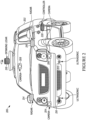
- FIG. 2 illustrates a distributed sensor system 200 for an autonomous vehicle 202 that utilizes multiple types of known sensors 204, 206, 208, 210, 212, 214, 216, 218. Each sensor technology has strengths and weaknesses. The combination of measurements output from the different sensors 204, 206, 208, 210, 212, 214, 216, 218 is used to produce a set of data from the scene. The data set from the distributed sensor system 200 that includes a variety of measurements from the scene is processed together, enabling error-free, safe, and reliable navigation under all conditions.
- the distributed sensor system 200 includes multiple cameras 204, 206, 208, multiple ultrasonic sensors 210, 212, multiple radars 214, 216, a rotating LIDAR system 218, and a controller 220.
- the autonomous car 202 uses cameras 204, 206, 208 that can distinguish colors. Cameras 204, 206, 208 may also be used to see traffic lights, turn signals, and other emitted light from the scene being measured. Cameras 204, 206, 208 can also be mounted with small physical separation, and their images combined to produce a stereo image.
- Ultrasonic sensors 210, 212 are used to detect proximity of objects within a few meters of the car. Radar 214, 216 is used to detect moving objects at long distance.
- radar 214, 216 does not operate with the high resolution of the LIDAR system 218.
- the LIDAR system 218 is used to produce a high-resolution 3D point cloud of the environment in real-time.
- the controller 220 is used to generate and process the data set that is provided by the outputs of measurements from all the various sensors 204, 206, 208, 210, 212, 214, 216, 218.
- the controller may also be used to coordinate the operation of the various sensors 204, 206, 208, 210, 212, 214.
- FIG. 3 illustrates a schematic diagram representing a multi-sensor LIDAR system 300 with multiple two-dimensional fields-of-view and ranges for an automobile 302.
- the system includes multiple LIDAR modules.
- the modules are not shown, only resulting fields-of-view and ranges are shown.
- an adaptive cruise control function may require a field-of-view and range 304 with a narrow field-of-view, but with a longer-distance range requirement, compared to a system with a wider field-of-view and shorter range with a side-looking "surround view" field-of-view and range 306, 308.
- the composite field-of-view for the automobile is the combined field-of-view of all the LIDAR modules positioned around the vehicle, which can differ in performance characteristics of some or all of the modules.
- five LIDAR modules (not shown) are used to create the composite field-of-view.
- the field-of-view and range 304 of the long-distance forward-looking LIDAR system has a field-of-view that overlaps with a second LIDAR module, which has a field-of-view and range 310 with a wider field-of-view, but a shorter range capability.
- LIDAR LIDAR systems in the context of automotive vehicles, where LIDAR is widely used for autonomous, or self-driving, or driver-assisted vehicles
- the embodiments may be applicable to any type of vehicle.
- Other types of vehicles might include robots, tractors, trucks, airplanes, drones, boats, ships, and others.
- the present teachings are also applicable to various stationary applications. For example, in high density, metropolitan areas, LIDAR can be employed to monitor traffic, both vehicular and pedestrian. It is anticipated that LIDAR systems will be deployed in many different applications, especially as the cost of the LIDAR systems becomes reduced in the near future.
- the present teaching is not limited by the types of target objects described herein as being detected and ranged, but is more broadly applicable to any type of target.
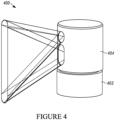
- FIG. 4 illustrates a schematic diagram of known rotating LIDAR system 400 for a vehicle.
- the LIDAR system 400 uses a rotating motor to provide a 360° horizontal scan of the environment.
- the LIDAR system 400 has a base 402.
- the base 402 can be fixed to an automobile (not shown).
- the top portion 404 of the LIDAR system rotates relative to the base and contains the receiver optics and transmitter optics.
- the field-of-view of the transmitter and the field-of-view of the receiver overlap over the distances corresponding to the target image plane.
- the receiver and transmitter optics may be 1D arrays of lasers and detectors that are fixed in a fashion so as to cover the desired vertical field-of-view.
- Arrays of 16, 32, 64, and even 128 lasers are sometimes used with rotating LIDAR systems, such as LIDAR system 400 shown in FIG. 4 .
- the vertical angular resolution is fixed, and typically equal to the ratio of the vertical field-of-view to the number of lasers in the fixed array.
- the horizontal angular resolution is a function of the rotation speed and the operating parameters of the system, and can be varied based on the application and desired performance.
- FIG. 5 illustrates an autonomous vehicle equipped with multiple known rotating LIDAR systems 500.
- the system illustrated in FIG. 5 includes multiple separate rotating LIDAR systems 502 mounted on a roof rack, each configured to achieve a separate field-of-view that is less than 180°.
- Some systems include more than twelve separate rotating LIDAR systems 502. Note that, in general, a substantial portion of each rotating LIDAR unit has the field-of-view blocked in a direction to minimize optical cross-talk of the multiple rotating LIDAR units.
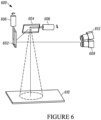
- FIG. 6 illustrates a known LIDAR system 600 with multiple moving parts.
- the system 600 uses a first 602 and second mirror 604 mounted on an X-Y galvanometer 606 that scans the environment in both a vertical and a horizontal direction.
- One or two lasers are typically used in these systems, instead of larger laser arrays like in rotating LIDAR systems, because of the physical difficulty of aligning multiple lasers/receivers onto the mirror system without substantial optical losses and complexity.
- the transmitted light reflects off a target at the image plane 610 and a receiver 612 is configured to have a field-of-view overlapping with the target at the image plane 610 so that the receiver 612 captures the reflected light.
- the size and physical orientation of the mirror place various mechanical constraints on the design. For example, the size of the mirrors constrains the amount of reflected light that can be gathered, acting as an effective maximum aperture. Mirror size also impacts the performance, with tradeoffs in power consumption, scanning speed, and system performance.
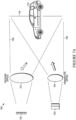
- FIG. 7A illustrates a schematic diagram of a solid-state LIDAR system.
- the transmitter 702 includes a plurality of lasers that can be configured in an array. Each individual laser can be fired independently, with the optical beam emitted by each laser corresponding to a 3D projection angle subtending only a portion of the total system field-of-view. Thus, each laser emitter generates an optical beam when energized (fired) that illuminates a corresponding field-of-view at a target range.
- the transmitter field-of-view is a combination of the various energized emitter fields-of-view. While some embodiments of the present teaching use laser emitters, it should be understood that other emitters may be used, for example LEDs, or other devices that generate optical beams when energized.
- all of the light beams from the lasers in the laser array share the transmitter optics 704 to produce projected light (illumination) 706.
- the reflected light 708 from the target range 710 shares the receiver optics 712.
- an automobile 714 is shown in the target range 710.
- a transmitter is described in detail in U.S. Patent Publication No. 2017/0307736 A1 , which is assigned to the present assignee.
- the LIDAR system 700 illustrated in FIG. 7A uses a detector array 716 that typically has a fewer number of individual detector elements than the transmitter array has individual lasers. These detectors can be individually controlled such that individual or groups of detectors are activated that detect light over a particular receiver field-of-view at the target range.
- the receiver field-of-view represents the composite of the activated detector fields-of-view. Activation may include, for example, a controllable shutter in front of the detectors that only passes light from a particular field-of-view at the target range, or biases applied to particular detectors or groups of detectors.
- FIG. 7B illustrates a two-dimensional projection of the system field-of-view 750 of the LIDAR system 700 described in connection with FIG. 7A .
- An individual detector field-of-view of the detector array is shown as a small square 752.
- An illuminated measurement point associated with an individual laser that is energized in the transmitter is illustrated by a circle 754.
- the ratio of the number of detectors (i.e. number of small squares 752) to the number of lasers (i.e. number of circles 754) in each array is one to nine.
- the detector array is a 5X5 array.
- the measurement resolution of the system in FIG. 7A is not determined by the size of the detector elements, but instead is determined by the number of lasers in the transmitter and the collimation of the individual laser beams. These parameters translate in a known way to the size of the circle 754 at the target range, and the relative size of the circles 754 and the squares 752 that represent field-of-view of a detector element.
- FIG. 7B illustrates a critical aspect of the LIDAR system of FIG. 7A .
- a single 3D measurement point in the overall field-of-view of the LIDAR system of FIG. 7A is highlighted by hash marks in a particular square 756, with that measurement point shown as particular dark circle 758, which corresponds to a specific individual laser in the laser array. It can be further seen in FIG. 7B that this measurement point falls within an individual detector where the field-of-view of that individual detector has been shown with a cross-hatch pattern for identification.
- This figure illustrates that the 3D resolution of the LIDAR system 700 is determined by the number of lasers, as each laser corresponds to a specific angular projection angle that gives rise to the size of the circles 754 at the target range, and the relative size of the circles 754 and the squares 752 that represent the field-of-view of a detector element.
- the LIDAR modules are solid-state with no moving parts.
- the LIDAR modules incorporate a plurality of lasers with each laser generating an optical beam with a fixed projection angle.
- the resulting composite field-of-view and the angular resolution of the LIDAR system which includes one or more modules, are determined by the arrangement of optics and lasers and modules.
- the lasers in each module are grouped into 2D arrays, that when combined with corresponding optics, are positioned to both provide the desired module composite field-of-view, as well as the desired module angular resolution.
- Each individual laser generates an optical beam that corresponds to a single pointing angle.
- the angular resolution can be achieved by interleaving the field-of-view of two or more 2D laser arrays. When two fields-of-view generated by two separate 2D laser arrays are overlapped in space, a resulting composite field-of-view is generated with finer angular resolution.
- LIDAR The physical size of a LIDAR system is important for integration into the autonomous vehicle.
- current state-of-the-art systems are generally bulky, and often mounted on roof racks, the goal is to eventually integrate LIDAR systems into the chassis such that they can be visually seamless with the exterior, and cosmetically attractive.
- One aspect of the LIDAR system described herein is that it can be separated into small, modular components to support the desire to make LIDAR unobtrusive visually in the future.
- FIG. 8A illustrates a measurement point cloud 800 for a single 2D laser array source illuminating a field-of-view.
- Each measurement point 802 represents a measurement signal based on light emitted by a particular laser element in the array.
- the distance 804 between the vertical spacing of the measurement points 802 determines the vertical angular resolution.
- the horizontal spacing 806 of the points 802 on the point cloud determines the horizontal angular resolution of the point cloud 800.
- FIG. 8B illustrates a measurement point cloud 850 for an embodiment of the present teaching where the illumination of a second 2D laser array has been projected to substantially overlap with a first 2D laser array.
- a measurement point 852 corresponding to the first 2D VCSEL array is shown as a circle
- a measurement point 854 from the second 2D VCSEL array is shown as a triangle.
- the composite point cloud 850 is formed by the interleaving of the field-of-view of the two separate 2D arrays in order to achieve a finer angular resolution in the horizontal, vertical, or a combination of horizontal and vertical directions.
- U.S. Patent Application Serial Number 62/538,149 entitled "VCSEL Array LIDAR With Small Angular Divergence", which is assigned to the present assignee.
- a LIDAR system of the present teaching can utilize substantially more lasers than a prior art mechanically scanning LIDAR system since each laser corresponds to a specific projection angle. For example, if an autonomous vehicle requires the full 360° horizontal field-of-view, with a uniform vertical field-of-view of 20°, and the average angular resolution in both direction is 0.5°, then the number of lasers required equals 28,800. Not all types of lasers can be implemented in a practical manner for a LIDAR system that requires thousands of individual lasers. In practice, various embodiments of the LIDAR system of the present teaching that require large numbers of lasers will likely use 2D arrays of vertical cavity surface emitting lasers (VCSEL) due to their current size, cost, and performance capabilities. However, other kinds of transmitter arrays can also be used. One skilled in the will appreciate that numerous types of lasers can be used in the LIDAR systems according to the present teaching.
- VCSEL vertical cavity surface emitting lasers
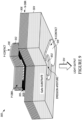
- FIG. 9 illustrates a schematic diagram of a cross-section of a structure of a known bottom-emitting VCSEL laser 900 that can be used in a LIDAR system of the present teaching.
- the area of the emission aperture 902 of the VCSEL laser 900 typically ranges from a few microns in diameter for mW power operation, up to 100 microns diameter or more for 100 mW and greater CW power operation.
- the VCSEL 900 is fabricated on a substrate 904 that can be, for example, GaAs, or numerous other semiconductor materials.
- An n-type distributed Bragg reflector (DBR) layer 906 is positioned on the substrate.
- An active region 908 is constructed on the n-type DBR layer 906, followed by an aperture that can be made formed in an oxide material.
- a p-type Distributed Bragg Grating DBR layer 912 is then grown on the active region.
- the p-type DBR is highly reflecting, and the n-type DBR is partially reflecting, resulting in light output 914 from the bottom, substrate-side of the layer structure.
- the active region 908, oxide aperture 910, and p-type DBR layer 912 are formed in a mesa structure.
- a top contact 916 and a bottom contact 918 are used to provide an electrical current to the active region to generate the output light.
- An oxide aperture 910 provides current confinement to the active region 908.
- the top contact 916 is p-type, and the bottom contact 918 is n-type.
- Emission apertures 902 are formed in the bottom contact 918 to allow the output light 914 to emerge from the bottom, substrate side of the bottom-emitting VCSEL. Note that only one emission aperture 902 is shown in FIG. 9 which illustrates one element of a multi-element array.
- This type of VCSEL 900 may be a single element, or multiple element VCSEL that can be fabricated as one- or two-dimensional arrays on the substrate 904.
- the VCSEL array is monolithic and the lasers all share a common substrate.
- a variety of common substrate types can be used.
- the common substrate can be a semiconductor material.
- the common substrate can also include a ceramic material.
- the 2D VCSEL array is assembled from a group of 1D laser bars.
- the VCSELs are top-emitting VCSELS. In other embodiments, the VCSELs are bottom-emitting VCSELS.
- the individual VCSELS can have either a single large emission aperture, or the individual VCSELS can be formed from two or more sub-apertures within a larger effective emission diameter. A group of sub-apertures forming a larger effective emission region is sometimes referred to as a cluster.
- the contacts on the VCSELS can connect a drive signal to one or more individual elements, or all the elements, or subsets of elements to provide various different illumination patterns when one or more electrical drive signals are supplied to the contacts.
- FIG. 10 illustrates a schematic diagram of an embodiment of a 2D monolithic VCSEL array 1000 with 256 separate laser emitters 1002 according to the present teaching.
- Each laser emitter 1002 has an emission aperture of diameter "a" 1004. Emission from each single laser emitter 1002 substantially fills the full emission aperture.
- the laser emitters 1002 are spaced uniformly in the horizontal direction with a spacing dx 1006.
- the laser emitters are spaced uniformly in the vertical direction with a spacing dy 1008.
- the overall size of the array, measured from the centers of the outermost lasers is distance Dx 1010 in the horizontal direction and distance Dy 1012 in the vertical direction.
- the emitters 1002 may produce beams with various shapes other than the circular emitter shape. For example, oval, square, rectangular and various odd shapes may be realized in various embodiments.
- the rows and columns of the lasers can be driven electrically in a matrix addressable fashion.
- Some embodiments of the present teaching utilize bottom-emitting high-power arrays of VCSELs with a single large aperture per laser, such as the configuration shown in FIG. 9 .
- Other embodiments of the present teaching utilize top-emitting or bottom-emitting high-power arrays of VCSELs with an overall emission area comprising sub-apertures.
- the present teaching is not limited to any single configurations of top- and bottom-emitting VCSELs and associated emission apertures.
- 2D VCSEL arrays as a building block of the LIDAR systems described herein, establishes a platform that allows a small physical size for the transmitter.
- the laser 2D array is then used together with optics that are chosen to keep the physical dimension as small as possible, for example through the use of micro-lens arrays, shared lenses of dimension ⁇ 20 mm, or diffractive optics of maximum dimension of 20mm as examples.
- FIG. 11 illustrates a schematic diagram of an embodiment of a modular LIDAR system 1100 according to the present teaching that includes a single transmitter and single receiver per module.
- the transmitter, receiver, and controller are physically separate modules 1102, 1104, 1106, 1108.
- Connections 1110 exist between the modules 1102, 1104, 1106, 1108 for provision of electrical power, and communication between the controller module 1108 and the other modules 1102, 1104, 1106.
- Communication between the modules 1102, 1104, 1106, 1108 could take place either optically or electrically, and they may use a variety of communication protocols, including Ethernet or other various other communication protocols.
- the modular LIDAR system 1100 is a relatively simple configuration, including only two transmitter modules 1102, 1104 and a single receiver module 1106. In other embodiments, a single controller module 1108 is used to control one or more transmitters and/or one or more receivers.
- FIG. 12 illustrates an embodiment of an example composite field-of-view 1200 that is generated by the modular LIDAR system 1100 described in connection with FIG. 11 .
- FIGS. 11 and 12 there is a region representing field-of-view 1202 for one transmitter module 1102 and a region representing field-of-view 1204 for the other transmitter module 1104.
- each transmitter module 1102, 1104 uses at least two 2D laser arrays that are substantially overlapped in the field-of-view to produce a finer angular measurement resolution.
- the field-of-view for individual laser elements from the first array is illustrated by circles 1206.
- the field-of-view for individual laser elements from the second array is illustrated by squares 1208.
- each transmit module 1102, 1104. there are two 16X16 arrays of 256 lasers in each transmit module 1102, 1104. They produce the substantially overlapped fields-of-view shown by the close-packed arrays of corresponding circles 1206 and squares 1208.
- the dual-array configuration for both modules 1102, 1104 is the same in this embodiment.
- the fields-of-view 1202, 1204 for the corresponding transmitters are configured to sit side-by-side at the target range.
- the total composite field-of-view of the two transmitters is made up of 1,024 laser fields-of-view.
- the emission wavelengths of laser arrays in the first transmit module 1102 and the second transmit module 1104 are not the same.
- the laser wavelengths within a single transmitter module 1102, 1104 is not the same.
- each laser array may emit at a different wavelength.
- the laser fields-of-view represented by circles 1206 could be different in wavelength from the laser fields-of-view represented by squares 1208.
- a field-of-view of the single receiver module is shown by the dashed box 1210, which is slightly larger than the field-of-view of the combined transmitter fields-of-view 1202, 1204.
- the receiver field-of-view 1210 comprises multiple detector fields-of-view from multiple detectors that are configured as an array. It is typically desired to have the receiver field-of-view 1210 slightly larger than the transmitter fields-of-view 1202, 1204 to simplify alignment of the receiver and transmitter fields-of-view.
- the controller module 1108 manages the operation of the two transmitter modules 1102, 1104 to minimize optical cross-talk, as well as optical power levels for eye safe operation.
- the controller module 1108 also manages the receiver module 1106 which, in some embodiments uses at least one 2D array of detectors, and in other embodiments, uses a plurality of 2D arrays of detectors. The number and position of the various detector arrays are chosen to achieve a particular receive field-of-view at the target range. For example, if two wavelengths are used, then the receiver can have two separate 2D arrays of detector, one for each wavelength.
- the transmitter modules of the present teaching include a plurality of laser emitters.
- Each laser emitter is positioned to illuminate a particular emitter field-of-view at a target range.
- the plurality of emitters is positioned in various patterns.
- the plurality of emitters can be a one- and/or two-dimensional array with a particular spacing between emitters in the vertical and/or horizontal direction.
- Central to the invention is the fact that individual and/or groups of emitters are positioned to illuminate a particular emitter field-of-view at the target range. This information is typically known by the controller, and is used to produce illumination in particular fields-of-view at the target range by controlling the energizing of individual and/or groups of emitters.
- the field-of-view of the one or more emitter fields-of-view contained in a particular transmitter that are illuminated based on a signal from the controller at any particular time is referred to as the transmitter field-of-view.
- the receiver modules of the present teaching include a plurality of detector elements. Each detector element is positioned to detect light from a particular detector field-of-view at a target range.
- the plurality of detectors is positioned in various patterns.
- the plurality of detectors may be a one- and/or two-dimensional array with a particular spacing between detectors in the vertical and/or horizontal direction.
- One aspect of the present teaching is the fact that individual and/or groups of detectors can be positioned to detect light from a particular detection field-of-view at the target range.
- This information on field-of-view can be known by the controller, and is used to detect illumination from particular fields-of-view at the target range by controlling the detectors/receiver such that select detectors are activated to detect light reflected from the target range in the field-of-view of the activated detector or detectors.
- the field-of-view of the one or more detector fields-of-view contained in a particular receiver that are activated to detect based on a signal from the controller at any particular time is referred to as the receiver field-of-view.
- the controller may control the activation of particular detectors by any of a number of known control mechanisms.
- a controllable aperture may be used to control the activation of one or more detector fields-of-view in a receiver field-of-view.
- Individual detector biases can also be controlled to control the activation of individual detector fields-of-view within a receive field-of-view.
- Overlap regions between different transmitters (and optionally different receivers) are designed into the system to provide continuous tracking of objects across particular composite fields-of-view.
- a continuous composite field-of-view is provided by two transmitters when at least some of the fields-of-view of the emitters of each transmitter overlap to some degree.
- a continuous transmit receive composite field-of-view is provided when at least one detector field-of-view is overlapped with the overlapped emitter fields-of-view. Overlap of at least some individual detector fields-of-view from two receivers is also used to provide a continuous composite receive field-of-view across two different receivers.
- a controller In the overlap regions, a controller is used to achieve performance objectives from the system.
- the controller controls energizing select emitters that generate optical beams with the fields-of-view that overlap at the target range so that only one emitter from each of two overlapped transmitters generate an optical beam that when reflected off the object at the target range is detected by one of the optical detectors during a particular light detection and ranging measurement. This eliminates or substantially reduces cross talk, especially of those transmitters operating at the same wavelength.
- One feature of the present teaching is that the controlling of the emitters and detectors can be used to support performance of a modular LIDAR system.
- the controller has the information about various FOV positions as well as ability to control energizing of individual and groups of laser emitters and to control activation of individual detectors. The knowledge can extend beyond an individual transmitter and/or receiver to include all the connected modules. As such, the controller is able to provide a particular transmitter field-of-view and a particular receiver field-of-view at any particular time and/or for any desired measurement sequence at the target range from all connected transmit, receive, and/or transmit/receive modules. If different wavelengths are used within single transmitters or across multiple transmitters, the details of the transmission and detection for the multiple wavelengths is typically known and also actively managed by the controller.
- the receiver can detect different wavelengths separately.
- the laser emitters can be simultaneously energized in an overlapping field-of-view, thereby allowing simultaneous measurements and improved angular resolution, as described in connection with FIG. 8B .
- One aspect of the present teaching is the realization that configuring the LIDAR system with a controller that has the ability to control the energizing of particular emitters and the activation of particular detectors provides the designer with control over a number of important performance parameters of the system.
- the controller can be configured to control energizing of transmitters such that the illumination at a target range does not exceed an eye-safe Maximum Permissible Exposure (MPE) limit for optical power in a particular aperture size.
- Maximum Permissible Exposure can be exceeded, for example, if two or more emitter fields-of-view overlap such that the sum of the optical power within an aperture defined by eye safety standards is too high.
- MPE Maximum Permissible Exposure
- the controller can also be configured to control the transmitter emitters and the receiver detectors such that a one-to-one correspondence is maintained between an energized emitter and a detector configured to detect.
- the controller can control the transmitter emitters and the receiver detectors such that a one-to-one correspondence is maintained between an energized transmitter field-of-view from a group of emitters and a receiver field-of-view from a group of detectors configured to detect.
- the controller can also be configured to control the energizing of emitters and/or the detecting of detectors to improve various performance metrics, such as reducing measurement cross talk. For example, measurement cross talk can arise when a field-of-view of more than one emitter overlaps with a detector and/or receiver field-of-view.
- overlap regions are often designed into the system to provide continuous tracking of objects across a composite field-of-view. That is, a continuous composite field-of-view is provided by two transmitters when at least some of the fields-of-view of the emitters of each transmitter overlap to some degree. Further, at least one detector field-of-view is overlapped with the emitter fields-of-view. In general, overlap of at least some individual detector fields-of-view from two receivers is also used to provide a continuous composite field-of-view across two different receivers.
- the controller can be configured to control the energizing of emitters and/or the activation of detectors to produce a desired and/or varying angular resolution at the target range.
- the controller can also be configured to control the energizing of emitters and/or the activation of detectors to track an object across a composite field-of-view.
- the composite field-of-view can be provided by one or more transmitters, one or more receivers, and/or one or more modules that form the modular LIDAR system.
- FIG. 13 illustrates an autonomous car integrated with an embodiment of a modular LIDAR system 1300 according to the present teaching.
- Three receiver modules 1302, 1304, 1306 are depicted near the roof of the car 1306.
- Eight transmitter modules 1310, 1312, 1314, 1316, 1318, 1320, 1322, 1324 are shown, located in various areas, such as the side mirrors, the headlights, and the grill of the automobile 1308.
- the controller module 1326 is separately located in the trunk area of the automobile 1308.
- the ability to have multiple modules of relatively small size allows the location of the transmitters and receives in virtually any location of the automobile 1308, which allows for seamless integration into the vehicle.
- the controller module 1326 acts to coordinate the operation of the various receiver modules 1302, 1304, 1306 and transmitter modules 1310, 1312, 1314, 1316, 1318, 1320, 1322, 1324 to minimize optical cross-talk, and to control eye safety.
- controller module 1326 also allows for the smooth tracking of an object crossing in front of the vehicle, since with the solid-state system, the system can control the laser energizing pattern of elements in the laser arrays within various transmitter modules 1310, 1312, 1314, 1316, 1318, 1320, 1322, 1324 to continuously measure an object of interest. As the object crosses the boundary from one transmitter field-of-view to the next transmitter field-of-view, the controller module 1326 can coordinate the transmitter modules 1310, 1312, 1314, 1316, 1318, 1320, 1322, 1324 and the receiver modules 1302, 1304, 1306 to prevent any gap in the measurements.
- the modular design described herein is also easier to integrate into different types of vehicles as the physical size is relatively small.
- One feature of the modular LIDAR systems of the present teaching is the ability to minimize electrical cross-talk between the transmitter and the receiver elements.
- the lasers used for automotive LIDAR typically are relatively high-power, operating at the limit of eye safety and often require large electrical driving pulse currents to generate optical pulses.
- the electrical signal from the transmitter if allowed to electromagnetically couple to the receive circuit, produces excess noise that may provide a false return signal. This is a particularly difficult problem in the case of a LIDAR system that has capability to energize more than one laser pulse, using a different wavelength.
- the energizing time of any particular transmit laser can be completely independent of receiver timing.
- the modular LIDAR systems of the present teaching can separate the transmit and the receive signals to substantially mitigate any electrical cross-talk concern. This separation also can be used improve EMI emissions.
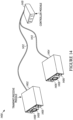
- FIG. 14 illustrates a schematic diagram of an embodiment of a modular LIDAR system 1400 according to the present teaching that includes multiple transmitters per module.
- one modular unit 1402, 1404 contains several transmitters 1406 and a single receiver 1408.
- the controller module 1410 is a separate module. Connections exist between the modules using cables 1412 for provision of electrical power and for communication. Communication between the modules 1402, 1404, 1410 could take place either optically or electrically, and in a variety of communication protocols including Ethernet or other communication protocols. Power to the transmit/receive modules could be supplied through the controller module 1410 as shown, or separately.
- FIG. 15 illustrates an embodiment of a composite field-of-view 1500 generated by the modular LIDAR system 1400 of FIG. 14 .
- a field-of-view 1502 generated for the transmit/receive module 1402
- a field-of-view 1504 generated for the transmit/receive module 1404.
- Each of these fields-of-view 1502, 1504 include transmit fields-of-view 1506, 1508, 1510, 1512 for each the two transmitters in each module 1402, 1404 and receive fields-of-view 1514, 1516 for each receiver in each module 1402, 1404.
- the transmit/receive field-of-view 1502, 1504 for each module 1402, 1404 is nominally the same as that shown in FIG.
- the controller module 1410 operates both transmit-receive modules 1402, 1404 and acts to minimize optical cross-talk between modules and also to maintain eye safety by controlling the laser drive energizing patterns for the transmit arrays.
- the composite field-of-view is designed to allow continuous tracking of an object across a field-of-view.
- the advantage of continuous tracking is that there are no gaps between the transmit fields-of-view, 1506, 1508, 1510, 1512. However, there are overlaps in the receive fields-of-view 1514, 1516. This produces an overlap region 1518 where both the receive fields-of-view 1514, 1516 can detect light from both transmit fields-of-view 1508, 1510.
- the controller module 1410 is used to manage the energizing of particular lasers in the transmit arrays that produce light in the overlap region 1518 so that there is only minimal cross-talk.
- the controller module 1410 manages energizing particular lasers in the transmitter arrays such that a peak power within the composite field-of-view 1500 never exceeds an eye safe threshold power.
- the controller controls energizing particular lasers in the transmitter arrays that generate optical beams with the overlap region 1518 at the target range so that only one of the first transmitter in transmit/receive module 1402 and second transmitter in transmit/receive module 1404 generate an optical beam that when reflected off the object at the target range is detected by one of the plurality of optical detectors in only one of the first and second transmit/receive modules 1402, 1404 during a particular light detection and ranging measurement.
- FIG. 16 illustrates an embodiment a modular LIDAR system 1600 according to the present teaching that is integrated into an autonomous vehicle 1602.
- FIG. 16 shows how the modular transmit/receive modules 1604, 1606, 1608 can be positioned on the automobile 1602.
- the two transmit/receive modules 1604, 1606 are placed close the roof 1610, while a single module 1606 is placed in the grill 1612 of the car 1602.
- the controller module 1614 is in the trunk of the car 1602. This arrangement allows easier integration into a variety of vehicles, as compared to known large mechanical rotating LIDAR systems.
- FIG. 17 illustrates a schematic diagram of an embodiment of a modular LIDAR system 1700 of the present teaching with co-located controller module 1702.
- a single enclosure 1704 is used to group together a set of transmit/receive modules 1706, 1708, 1710, 1712, 1714, 1716 with a single controller module 1702.
- a large vehicle such as a semi-trailer truck or a garbage truck
- Such a common enclosure 1704 could provide additional robustness to environmental factors.
- FIG. 18 illustrates an embodiment of a composite field-of-view 1800 generated by the modular LIDAR system 1700 of FIG. 17 .
- each transmit/receive module 1706, 1708, 1710, 1712, 1714, 1716 has a corresponding receive field-of-view 1802, 1804, 1806, 1808, 1810, 1812 and two corresponding transmit field-of-views1814, 1816, 1818, 1820, 1822, 1824, 1826, 1828, 1830, 1832, 1834, 1836.
- the transmit/receive modules 1706, 1708, 1710, 1712, 1714, 1716 use twenty-four 2D laser arrays with 256 lasers each.
- the controller module 1702 operates all the transmit/receive modules 1706, 1708, 1710, 1712, 1714, 1716 to ensure safety and performance specifications are satisfied, as well as allowing for optimization of functions like the tracking of an object within the composite field-of-view 1800.
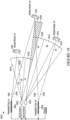
- FIG. 19 illustrates an embodiment of an operating scenario 1900 comprising a modular LIDAR system according to the present teaching with two separate receivers 1902, 1904 and two separate transmitters 1906, 1908.
- the two receivers 1902, 1904 each have an overall field-of-view equal to 30° and are configured to have some overlap in their field-of-view in order ensure that there are no gaps in coverage.
- This allows continuous tracking of, for example, pedestrians 1910, 1912, 1914.
- the two separate transmitters 1906, 1908 each contain a plurality of lasers.
- the two pairs of dashed lines 1916, 1918, 1920, 1922 from each transmitter show the projection angle of two lasers within each transmitter.
- the two lasers are chosen to correspond to the pedestrians 1910, 1912, 1914.
- Pedestrian #1 1910 is only within the field-of-view of transmitter#1 1906 and the receiver#1 1902.
- Pedestrian #3 1914 is only within the field-of-view of transmitter#2 1908 and receiver#2 1904.
- Pedestrian #2 1912 is within the field-of-view of both transmitters 1906, 1908 and both receivers 1902, 1904.
- Both receivers 1902, 1904 use an array of detectors.
- Each detector in the array of detectors has a field-of-view that is a subset of the overall receiver field-of-view. See, for example, FIG. 7B and the associated description.
- the field-of-view of each receiver is illustrated as split into three sections, each with a 10° field-of-view.
- regions 2A 1930, 2B 1932 and 2C 1934 are regions 1A 1930, 2B 1932 and 2C 1934.
- a three-element detector array of uniform dimension in the horizontal plane would correspond to the fields-of-view 1924, 1926, 1928, 1930, 1932, 1934 for either receiver 1902, 1904.
- the operating scenario 1900 is drawn for simplicity and that the detector array size might be larger in actual practice in order to have a smaller field-of-view per individual detector.
- the field-of-view of each detector is labeled uniquely (1A, 1B, 1C, 2A, 2B, 2C) for reference.
- a single controller 1938 can be used to control both receivers 1902, 1904 and both transmitters 1906, 1908.
- the operating scenario 1900 shown in FIG. 19 illustrates that pedestrian #1 is only seen by Receiver #1, but by both detectors 1A and 1B.
- Pedestrian #2 can be seen by both Receiver #1 and Receiver #2, as the field-of-view of detector 1C and detector 2A have substantial overlap.
- the overlap is indicated by the diagonally hatched region 1936.
- the controller 1938 has knowledge of the particular fields-of-view 1924, 1926, 1928, 1930, 1932, 1934 corresponding to each detector element for both receivers 1902, 1904 and, thus has knowledge of this region of overlap.
- the controller 1938 also has knowledge of the projection angles 1916, 1918, 1920, 1922 of the lasers within transmitter#1 1906 and within transmitter#2 1908 and, thus can compute which detectors at which range distance can be used to measure the reflected pulse from each laser within each transmitter 1906, 1908.
- the controller 1938 sets the laser energizing pattern for lasers in the two transmitters 1906, 1908, and selects which detector or combination of detectors within all possible receivers 1902, 1904 to measure the return signal pulse.
- a typical criteria for selection of the optimum detector to measure each laser and range might include maximum received signal power, or highest SNR.
- pedestrian #2 1912 can be measured using either transmitter 1906, 1908.
- controller 1938 If the controller 1938 energized a pulse from transmitter #1 1906 at pedestrian #2 1912, and before that pulse was measured by a receiver 1902, 1904, energized a second pulse from transmitter #2 1908, then both pulses would be observed at a single detector during a single measurement. This would result in an error in distance and/or a false object being detected.
- the controller 1938 controls the energizing pattern so as to maintain a strict one-to-one mapping between laser and detector during a single measurement, within the field-of-view of that chosen detector. This prevents optical cross-talk and errors in measurement within the modular LIDAR system.
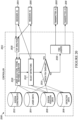
- FIG. 20 illustrates a block diagram 2000 of an embodiment of a controller 2002 of the present teaching.
- the controller 2002 is shown communicating with two receivers 2004, 2006 and two transmitters 2008, 2010, whereas in actual use, any number of receivers and controllers could be present.
- the controller 2002 has various sets of information stored and available. This information can be determined during setup/calibration and/or updated during the operation of the system.
- This information includes system constraints 2012. For example, system constraints can include the maximum duty cycle for a single laser, eye safety constraints on the system operation, and other types of constraints.
- laser data 2014 that includes the projection angle and origin point of each laser with respect to the corresponding transmitter.
- detector data 2016 that includes the field-of-view of the each detector and the origin of each detector with respect to its corresponding receiver.
- the controller 2002 has system position information 2018, for example, information on the position of each transmitter and receiver module within the system, relative to some global origin and/or axes.
- the controller 2002 can utilize the TOF measurement information from the receivers as additional inputs to determine the laser selection and energizing pattern algorithm/process.
- the TOF computation can be performed within the same physical unit as the optical receiver or can be performed elsewhere.
- the controller 2002 executes an algorithm that controls the laser selection and energizing pattern. Since this is a solid-state system, many types of energizing and scanning patterns are possible within the field-of-view.
- the controller 2002 executes a first step 2020 of selecting lasers to be fired for each transmitter.
- the controller selects corresponding detectors.
- the controller checks for overlap in the field-of-view of those lasers and detectors. If there is no overlap that could result in errors and/or optical cross talk, the controller proceeds to a fourth step 2026 where the lasers are energized. The corresponding return pulses are received at receiver #1 2004 and/or receiver #2 2006.
- the controller 2002 proceeds back to the first step 2020 and chooses a new set of lasers to energize accordingly and adjusts the energizing pattern as required to accommodate the desired overlap conditions.
- a TOF analysis 2028 is performed. The results of the analysis 2028 can be used in step one 2020 to determine which energizing pattern to proceed with next.
Landscapes
- Engineering & Computer Science (AREA)
- Physics & Mathematics (AREA)
- General Physics & Mathematics (AREA)
- Remote Sensing (AREA)
- Radar, Positioning & Navigation (AREA)
- Computer Networks & Wireless Communication (AREA)
- Electromagnetism (AREA)
- Optics & Photonics (AREA)
- Automation & Control Theory (AREA)
- Condensed Matter Physics & Semiconductors (AREA)
- Mechanical Engineering (AREA)
- Transportation (AREA)
- Mathematical Physics (AREA)
- Optical Radar Systems And Details Thereof (AREA)
- Aviation & Aerospace Engineering (AREA)
Description
- The section headings used herein are for organizational purposes only and should not to be construed as limiting the subject matter described in the present application in any way.
- Autonomous, self-driving, and semi-autonomous automobiles use a combination of different sensors and technologies such as radar, image-recognition cameras, and sonar for detection and location of surrounding objects. These sensors enable a host of improvements in driver safety including collision warning, automatic-emergency braking, lane-departure warning, lane-keeping assistance, adaptive cruise control, and piloted driving. Among these sensor technologies, light detection and ranging (LIDAR) systems take a critical role, enabling real-time, high resolution 3D mapping of the surrounding environment.
- The majority of commercially available LIDAR systems used for autonomous vehicles today utilize a small number of lasers, combined with some method of mechanically scanning the environment. For example, several manufacturers provide rotating LIDAR systems with transmit/receive optics located on a spinning motor in order provide a 360° horizontal field-of-view. A one-dimensional (1D) fixed array of lasers is used for the vertical direction, and the horizontal scan is accomplished through the rotation. Currently, the largest 1D array in the commercial market contains 128 lasers. Some vendors utilize a moving mirror to scan the FOV. For example, the mirror can be actuated using MEMS or galvanometers. In these systems, often only 1 or 2 lasers are used, in combination with two mirrors, one for the horizontal direction and one for the vertical direction.
- In mechanically scanned LIDAR systems, the scanning method puts physical constraints on the receiver and transmitter optics. For example, in a rotating motor scanned LIDAR system, the receiver is typically placed together with the transmitter on the same motor in order allow the transmitter and receiver to "look at the same spot" during operation. Similarly, the receiver in the scanning mirror devices is often positioned to make use of the same moving mirror as the transmitter so that the light reflected from the target travels back through the shared mirror optics to reach the receiver. These physical constraints can put limits on the size of the LIDAR system(s) and the size and location of individual components. In addition, these physical constraints impact performance features like measurement range and SNR/cross-talk.
EP 2 775 316 A2 discloses a collision mitigation system which makes use of forward mounted long range ladar sensors and short range ladar sensors to identify obstacles.
US 2018/0062345 A1 discloses an optical apparatus including an array of lasers, which are arranged in a grid pattern and are configured to emit respective beams of pulses of optical radiation toward a target.
US 2017/0307736 A1 discloses a multi-wavelength LIDAR system including a first laser source and a second laser source that form first and second beam profiles at a target plane.
According to a first aspect of the present invention, a modular light detection and ranging system is provided according toclaim 1.
According to a second aspect of the present invention, a method of modular light detection and ranging is provided according to claim 13.
Optional features of the present invention are provided in the dependent claims. - The present teaching, in accordance with preferred and exemplary embodiments, together with further advantages thereof, is more particularly described in the following detailed description, taken in conjunction with the accompanying drawings. The skilled person in the art will understand that the drawings, described below, are for illustration purposes only. The drawings are not necessarily to scale, emphasis instead generally being placed upon illustrating principles of the teaching. The drawings are not intended to limit the scope of the Applicant's teaching in any way.
-
FIG. 1 illustrates the operation of a LIDAR system implemented in a vehicle. -
FIG. 2 illustrates a distributed sensor system for an autonomous vehicle that utilizes multiple types of known sensors. -
FIG. 3 illustrates a schematic diagram representing a multi-sensor LIDAR system with multiple two-dimensional fields-of-view and ranges for an automobile. -
FIG. 4 illustrates a schematic diagram of known rotating LIDAR system for a vehicle. -
FIG. 5 illustrates an autonomous vehicle equipped with multiple known rotating LIDAR systems. -
FIG. 6 illustrates a known LIDAR system with multiple moving parts. -
FIG. 7A illustrates a schematic diagram of a solid-state LIDAR system. -
FIG. 7B illustrates a two-dimensional projection of the system field-of-view (FOV) of the LIDAR system ofFIG. 7A . -
FIG. 8A illustrates a measurement point cloud for a LIDAR system according to the present teaching with a single 2D laser array source illuminating a field-of-view. -
FIG. 8B illustrates a measurement point cloud for a LIDAR system according to the present teaching with two 2D laser array sources illuminating a field-of-view. -
FIG. 9 illustrates a schematic diagram of a cross-section of a structure of a known bottom-emitting VCSEL laser that can be used in a LIDAR system of the present teaching. -
FIG. 10 illustrates a schematic diagram of an embodiment of a 2D monolithic VCSEL array with 256 separate laser emitters according to the present teaching. -
FIG. 11 illustrates a schematic diagram of an embodiment of a modular LIDAR system according to the present teaching that includes a separate transmit module and receive module. -
FIG. 12 illustrates an embodiment of a composite FOV generated by the modular LIDAR system ofFIG. 11 . -
FIG. 13 illustrates an autonomous car integrated with an embodiment of a modular LIDAR system of the present teaching. -
FIG. 14 illustrates a schematic diagram of an embodiment of a modular LIDAR system according to the present teaching that includes a joint transmit/receive module. -
FIG. 15 illustrates an embodiment of a composite field-of-view generated by the modular LIDAR system ofFIG.14 . -
FIG. 16 illustrates an embodiment of a modular LIDAR system according to the present teaching that is integrated into an autonomous vehicle. -
FIG. 17 illustrates a schematic diagram of an embodiment of a modular LIDAR system of the present teaching with co-located controller module. -
FIG. 18 illustrates an embodiment of a composite field-of-view generated by the modular LIDAR system ofFIG. 17 . -
FIG. 19 illustrates an embodiment of an operating scenario comprising a modular LIDAR system according to the present teaching including two separate receivers and two separate transmitters. -
FIG. 20 illustrates a block diagram of an embodiment of a controller of the present teaching. - The present teaching will now be described in more detail with reference to exemplary embodiments thereof as shown in the accompanying drawings. While the present teaching is described in conjunction with various embodiments and examples, it is not intended that the present teaching be limited to such embodiments. On the contrary, the present teaching encompasses various alternatives, modifications and equivalents, as will be appreciated by those of skill in the art. Those of ordinary skill in the art having access to the teaching herein will recognize additional implementations, modifications, and embodiments, as well as other fields of use, which are within the scope of the present disclosure as described herein.
- Reference in the specification to "one embodiment" or "an embodiment" means that a particular feature, structure, or characteristic described in connection with the embodiment is included in at least one embodiment of the teaching. The appearances of the phrase "in one embodiment" in various places in the specification are not necessarily all referring to the same embodiment.
- It should be understood that the individual steps of the methods of the present teaching can be performed in any order and/or simultaneously as long as the teaching remains operable. Furthermore, it should be understood that the apparatus and methods of the present teaching can include any number or all of the described embodiments as long as the teaching remains operable.
- Known LIDAR systems with moving parts are problematic for many reasons including being prone to reliability issues. One aspect of the present teaching is the realization that a solid-state LIDAR system that requires no moving parts for scanning the field-of-view can be designed with fewer physical constraints, allowing for both performance improvement and increased flexibility in integration of the LIDAR system within an autonomous vehicle. In addition, a solid-state system with substantially more lasers makes possible operational modes that are not achievable with mechanical scanning, such as the ability to randomly scan the field-of-view without any mechanical constraint on the scanning pattern.
- For many reasons, LIDAR systems generally require multiple separate units to support the measurement requirements. These reasons include, for example, size limitations, mounting restrictions, measurement requirements, integrations with other systems and many others. As such, LIDAR systems are needed that are modular and easily distributed.
- The present teaching relates to solid-state LIDAR systems that contain no moving parts, with a plurality of lasers, where each laser can correspond to a single fixed projection angle. The use of solid-state lasers by itself does not mean that there are no moving parts, as MEMS devices are often referred to as solid-state. MEMS devices in LIDAR systems, however, typically incorporate physical motion, which can be a concern for reliability and device lifetime. One feature of the LIDAR system according to the present teaching is that the modular distributed system design is compatible with all solid-state systems, including those systems that use solid-state laser arrays and/or systems without MEMS devices. This includes systems with no physical motion.
-
FIG. 1 illustrates the operation of a LIDAR system implemented in a vehicle. TheLIDAR system 100 includes a laser projector, also referred to as an illuminator, that projectslight beams 102 generated by a light source toward a target scene and a receiver that receives the light 104 that reflects of an object, shown as aperson 106, in that target scene. LIDAR systems typically also include a controller and/or system processor that computes the distance information about theobject 106 from the reflected light, and an element that can scan or provide a particular pattern of the light that may be a static pattern across a desired range and field-of-view. The receiver, controller, and system processor are used to convert the received signal light into measurements that represent a pointwise 3D map of the surrounding environment that falls within the LIDAR system range and field-of-view. In various embodiments, the controller can be a simple electrical circuit or can be a more complicated processor, depending on the particular application and desired performance. - The laser source and optical beam projection system that form the illuminator and the receiver may be located on the front side of a
vehicle 108. The laser source and optical beam projection system may also be referred to as a transmitter. Aperson 106, and/or another object, such as a car or light pole, will provide light reflected from the source back to the receiver. A controller or processor then determines the range, or distance, to the object. As is known in the art, a LIDAR receiver calculates range information based on time-of-flight measurements of light pulses emitted from the light source. In addition, known information about the optical beam profile that illuminates the scene in a target plane associated with a particular range and, based on the particular design of the source and projector system, is used to determine location information about the reflecting surface, thereby generating a complete X,Y, Z or three-dimensional picture of the scene. In other words, the pointwise three-dimensional (3D) map of the surrounding environment represents a collection of measurement data that indicates position information from all the surfaces that reflect the illumination from the source to the receiver within the field-of-view of the LIDAR system. In this way, a 3D representation of objects in the field-of-view of the LIDAR system is obtained. The pointwise 3D data map may also be referred to as a measurement point cloud. -
FIG. 2 illustrates a distributedsensor system 200 for anautonomous vehicle 202 that utilizes multiple types of knownsensors different sensors sensor system 200 that includes a variety of measurements from the scene is processed together, enabling error-free, safe, and reliable navigation under all conditions. The distributedsensor system 200 includesmultiple cameras ultrasonic sensors multiple radars rotating LIDAR system 218, and acontroller 220. Theautonomous car 202 usescameras Cameras Cameras Ultrasonic sensors Radar radar LIDAR system 218. TheLIDAR system 218 is used to produce a high-resolution 3D point cloud of the environment in real-time. Thecontroller 220 is used to generate and process the data set that is provided by the outputs of measurements from all thevarious sensors various sensors -
FIG. 3 illustrates a schematic diagram representing amulti-sensor LIDAR system 300 with multiple two-dimensional fields-of-view and ranges for anautomobile 302. The system includes multiple LIDAR modules. The modules are not shown, only resulting fields-of-view and ranges are shown. For example, an adaptive cruise control function may require a field-of-view andrange 304 with a narrow field-of-view, but with a longer-distance range requirement, compared to a system with a wider field-of-view and shorter range with a side-looking "surround view" field-of-view andrange system 300 illustratedFIG. 3 , five LIDAR modules (not shown) are used to create the composite field-of-view. The field-of-view andrange 304 of the long-distance forward-looking LIDAR system has a field-of-view that overlaps with a second LIDAR module, which has a field-of-view andrange 310 with a wider field-of-view, but a shorter range capability. There is also a rear-view module that has field-of-view andrange 312 with similar dimensions of the field-of-view andrange 310 of the second LIDAR system. - Although the present teaching describes LIDAR systems in the context of automotive vehicles, where LIDAR is widely used for autonomous, or self-driving, or driver-assisted vehicles, it should be understood that the embodiments may be applicable to any type of vehicle. Other types of vehicles might include robots, tractors, trucks, airplanes, drones, boats, ships, and others. The present teachings are also applicable to various stationary applications. For example, in high density, metropolitan areas, LIDAR can be employed to monitor traffic, both vehicular and pedestrian. It is anticipated that LIDAR systems will be deployed in many different applications, especially as the cost of the LIDAR systems becomes reduced in the near future. One skilled in the art will appreciate that the present teaching is not limited by the types of target objects described herein as being detected and ranged, but is more broadly applicable to any type of target.
-
FIG. 4 illustrates a schematic diagram of knownrotating LIDAR system 400 for a vehicle. TheLIDAR system 400 uses a rotating motor to provide a 360° horizontal scan of the environment. TheLIDAR system 400 has abase 402. For example, the base 402 can be fixed to an automobile (not shown). Thetop portion 404 of the LIDAR system rotates relative to the base and contains the receiver optics and transmitter optics. The field-of-view of the transmitter and the field-of-view of the receiver overlap over the distances corresponding to the target image plane. The receiver and transmitter optics may be 1D arrays of lasers and detectors that are fixed in a fashion so as to cover the desired vertical field-of-view. Arrays of 16, 32, 64, and even 128 lasers are sometimes used with rotating LIDAR systems, such asLIDAR system 400 shown inFIG. 4 . The vertical angular resolution is fixed, and typically equal to the ratio of the vertical field-of-view to the number of lasers in the fixed array. The horizontal angular resolution is a function of the rotation speed and the operating parameters of the system, and can be varied based on the application and desired performance. - In concept, a single rotating LIDAR system can provide a full 360° view, enabling the use of a single LIDAR system. However, in practice, multiple rotating LIDAR systems are used in order to split the field-of-view around the vehicle.
FIG. 5 illustrates an autonomous vehicle equipped with multiple knownrotating LIDAR systems 500. The system illustrated inFIG. 5 includes multiple separaterotating LIDAR systems 502 mounted on a roof rack, each configured to achieve a separate field-of-view that is less than 180°. Some systems include more than twelve separaterotating LIDAR systems 502. Note that, in general, a substantial portion of each rotating LIDAR unit has the field-of-view blocked in a direction to minimize optical cross-talk of the multiple rotating LIDAR units. When the rotating units are pointed in the direction where the field-of-view is blocked, no useful data is being generated by that particular LIDAR unit. In that regard, a significant penalty in cost and efficiency results from the use of rotating LIDAR versus a LIDAR system that operates continuously with a field-of-view of less than 180°. -
FIG. 6 illustrates a knownLIDAR system 600 with multiple moving parts. Thesystem 600 uses a first 602 andsecond mirror 604 mounted on anX-Y galvanometer 606 that scans the environment in both a vertical and a horizontal direction. Light from alaser transmitter 608, which typically includes one or two lasers, reflects off thefirst mirror 602 onto thesecond mirror 604, and the combination of the twomirrors image plane 610 and areceiver 612 is configured to have a field-of-view overlapping with the target at theimage plane 610 so that thereceiver 612 captures the reflected light. The size and physical orientation of the mirror place various mechanical constraints on the design. For example, the size of the mirrors constrains the amount of reflected light that can be gathered, acting as an effective maximum aperture. Mirror size also impacts the performance, with tradeoffs in power consumption, scanning speed, and system performance. -
FIG. 7A illustrates a schematic diagram of a solid-state LIDAR system. Thetransmitter 702 includes a plurality of lasers that can be configured in an array. Each individual laser can be fired independently, with the optical beam emitted by each laser corresponding to a 3D projection angle subtending only a portion of the total system field-of-view. Thus, each laser emitter generates an optical beam when energized (fired) that illuminates a corresponding field-of-view at a target range. The transmitter field-of-view is a combination of the various energized emitter fields-of-view. While some embodiments of the present teaching use laser emitters, it should be understood that other emitters may be used, for example LEDs, or other devices that generate optical beams when energized. In some embodiments of the LIDAR system of present teaching, all of the light beams from the lasers in the laser array share thetransmitter optics 704 to produce projected light (illumination) 706. The reflected light 708 from thetarget range 710 shares thereceiver optics 712. In this example, anautomobile 714 is shown in thetarget range 710. One example of a transmitter is described in detail inU.S. Patent Publication No. 2017/0307736 A1 , which is assigned to the present assignee. - The
LIDAR system 700 illustrated inFIG. 7A uses adetector array 716 that typically has a fewer number of individual detector elements than the transmitter array has individual lasers. These detectors can be individually controlled such that individual or groups of detectors are activated that detect light over a particular receiver field-of-view at the target range. The receiver field-of-view represents the composite of the activated detector fields-of-view. Activation may include, for example, a controllable shutter in front of the detectors that only passes light from a particular field-of-view at the target range, or biases applied to particular detectors or groups of detectors. -
FIG. 7B illustrates a two-dimensional projection of the system field-of-view 750 of theLIDAR system 700 described in connection withFIG. 7A . An individual detector field-of-view of the detector array is shown as asmall square 752. An illuminated measurement point associated with an individual laser that is energized in the transmitter is illustrated by acircle 754. - In
FIG. 7B , the ratio of the number of detectors (i.e. number of small squares 752) to the number of lasers (i.e. number of circles 754) in each array is one to nine. In the particular example shown inFIG. 7B , the detector array is a 5X5 array. Compared to a prior art flash LIDAR system with equivalent angular resolution, the cost of the detector array can be significantly lower because the number of detectors required can be significantly lower. The measurement resolution of the system inFIG. 7A is not determined by the size of the detector elements, but instead is determined by the number of lasers in the transmitter and the collimation of the individual laser beams. These parameters translate in a known way to the size of thecircle 754 at the target range, and the relative size of thecircles 754 and thesquares 752 that represent field-of-view of a detector element. -
FIG. 7B illustrates a critical aspect of the LIDAR system ofFIG. 7A . A single 3D measurement point in the overall field-of-view of the LIDAR system ofFIG. 7A is highlighted by hash marks in aparticular square 756, with that measurement point shown as particulardark circle 758, which corresponds to a specific individual laser in the laser array. It can be further seen inFIG. 7B that this measurement point falls within an individual detector where the field-of-view of that individual detector has been shown with a cross-hatch pattern for identification. This figure illustrates that the 3D resolution of theLIDAR system 700 is determined by the number of lasers, as each laser corresponds to a specific angular projection angle that gives rise to the size of thecircles 754 at the target range, and the relative size of thecircles 754 and thesquares 752 that represent the field-of-view of a detector element. - One feature of the present teaching is that the LIDAR modules are solid-state with no moving parts. The LIDAR modules incorporate a plurality of lasers with each laser generating an optical beam with a fixed projection angle. The resulting composite field-of-view and the angular resolution of the LIDAR system, which includes one or more modules, are determined by the arrangement of optics and lasers and modules. The lasers in each module are grouped into 2D arrays, that when combined with corresponding optics, are positioned to both provide the desired module composite field-of-view, as well as the desired module angular resolution. Each individual laser generates an optical beam that corresponds to a single pointing angle. The angular resolution can be achieved by interleaving the field-of-view of two or more 2D laser arrays. When two fields-of-view generated by two separate 2D laser arrays are overlapped in space, a resulting composite field-of-view is generated with finer angular resolution.
- The physical size of a LIDAR system is important for integration into the autonomous vehicle. Although current state-of-the-art systems are generally bulky, and often mounted on roof racks, the goal is to eventually integrate LIDAR systems into the chassis such that they can be visually seamless with the exterior, and cosmetically attractive. There are certain components, such as the headlights, where synergies can be gained by co-packaging with part or all of the LIDAR system. One aspect of the LIDAR system described herein is that it can be separated into small, modular components to support the desire to make LIDAR unobtrusive visually in the future.
-
FIG. 8A illustrates ameasurement point cloud 800 for a single 2D laser array source illuminating a field-of-view. Eachmeasurement point 802 represents a measurement signal based on light emitted by a particular laser element in the array. Thedistance 804 between the vertical spacing of the measurement points 802 determines the vertical angular resolution. Thehorizontal spacing 806 of thepoints 802 on the point cloud determines the horizontal angular resolution of thepoint cloud 800. -
FIG. 8B illustrates ameasurement point cloud 850 for an embodiment of the present teaching where the illumination of a second 2D laser array has been projected to substantially overlap with a first 2D laser array. Ameasurement point 852 corresponding to the first 2D VCSEL array is shown as a circle, ameasurement point 854 from the second 2D VCSEL array is shown as a triangle. Thecomposite point cloud 850 is formed by the interleaving of the field-of-view of the two separate 2D arrays in order to achieve a finer angular resolution in the horizontal, vertical, or a combination of horizontal and vertical directions. One example of such a transmitter is describedU.S. Patent Application Serial Number 62/538,149 - A LIDAR system of the present teaching can utilize substantially more lasers than a prior art mechanically scanning LIDAR system since each laser corresponds to a specific projection angle. For example, if an autonomous vehicle requires the full 360° horizontal field-of-view, with a uniform vertical field-of-view of 20°, and the average angular resolution in both direction is 0.5°, then the number of lasers required equals 28,800. Not all types of lasers can be implemented in a practical manner for a LIDAR system that requires thousands of individual lasers. In practice, various embodiments of the LIDAR system of the present teaching that require large numbers of lasers will likely use 2D arrays of vertical cavity surface emitting lasers (VCSEL) due to their current size, cost, and performance capabilities. However, other kinds of transmitter arrays can also be used. One skilled in the will appreciate that numerous types of lasers can be used in the LIDAR systems according to the present teaching.
- One feature of the present teaching is that it can use a variety of known VCSEL devices, including top-emitting VCSELs, bottom-emitting VCSELS, and various types of high-power VCSELs.
FIG. 9 illustrates a schematic diagram of a cross-section of a structure of a known bottom-emittingVCSEL laser 900 that can be used in a LIDAR system of the present teaching. The area of theemission aperture 902 of theVCSEL laser 900 typically ranges from a few microns in diameter for mW power operation, up to 100 microns diameter or more for 100 mW and greater CW power operation. TheVCSEL 900 is fabricated on asubstrate 904 that can be, for example, GaAs, or numerous other semiconductor materials. An n-type distributed Bragg reflector (DBR)layer 906 is positioned on the substrate. An active region 908 is constructed on the n-type DBR layer 906, followed by an aperture that can be made formed in an oxide material. A p-type Distributed BraggGrating DBR layer 912 is then grown on the active region. Typically, the p-type DBR is highly reflecting, and the n-type DBR is partially reflecting, resulting inlight output 914 from the bottom, substrate-side of the layer structure. The active region 908,oxide aperture 910, and p-type DBR layer 912 are formed in a mesa structure. Atop contact 916 and abottom contact 918 are used to provide an electrical current to the active region to generate the output light. Anoxide aperture 910 provides current confinement to the active region 908. Thetop contact 916 is p-type, and thebottom contact 918 is n-type.Emission apertures 902 are formed in thebottom contact 918 to allow theoutput light 914 to emerge from the bottom, substrate side of the bottom-emitting VCSEL. Note that only oneemission aperture 902 is shown inFIG. 9 which illustrates one element of a multi-element array. This type ofVCSEL 900 may be a single element, or multiple element VCSEL that can be fabricated as one- or two-dimensional arrays on thesubstrate 904. - In some embodiments, the VCSEL array is monolithic and the lasers all share a common substrate. A variety of common substrate types can be used. For example, the common substrate can be a semiconductor material. The common substrate can also include a ceramic material. In some embodiments, the 2D VCSEL array is assembled from a group of 1D laser bars.
- In some embodiments, the VCSELs are top-emitting VCSELS. In other embodiments, the VCSELs are bottom-emitting VCSELS. The individual VCSELS can have either a single large emission aperture, or the individual VCSELS can be formed from two or more sub-apertures within a larger effective emission diameter. A group of sub-apertures forming a larger effective emission region is sometimes referred to as a cluster. The contacts on the VCSELS can connect a drive signal to one or more individual elements, or all the elements, or subsets of elements to provide various different illumination patterns when one or more electrical drive signals are supplied to the contacts.
-
FIG. 10 illustrates a schematic diagram of an embodiment of a 2Dmonolithic VCSEL array 1000 with 256separate laser emitters 1002 according to the present teaching. Eachlaser emitter 1002 has an emission aperture of diameter "a" 1004. Emission from eachsingle laser emitter 1002 substantially fills the full emission aperture. Eachlaser emitter 1002, therefore, generates a laser beam with initial diameter "a" which is equal to the diameter 1004 of the emission aperture. Thelaser emitters 1002 are spaced uniformly in the horizontal direction with a spacingdx 1006. The laser emitters are spaced uniformly in the vertical direction with aspacing dy 1008. The overall size of the array, measured from the centers of the outermost lasers isdistance Dx 1010 in the horizontal direction and distance Dy 1012 in the vertical direction. The actual chip size will be slightly larger than in dimension than thedistance Dx 1010 and the distance Dy 1012. In various embodiments, theemitters 1002 may produce beams with various shapes other than the circular emitter shape. For example, oval, square, rectangular and various odd shapes may be realized in various embodiments. In embodiments in which lasers are arranged as 2D arrays, the rows and columns of the lasers can be driven electrically in a matrix addressable fashion. - Some embodiments of the present teaching utilize bottom-emitting high-power arrays of VCSELs with a single large aperture per laser, such as the configuration shown in
FIG. 9 . Other embodiments of the present teaching utilize top-emitting or bottom-emitting high-power arrays of VCSELs with an overall emission area comprising sub-apertures. However, one skilled in the art will appreciate that the present teaching is not limited to any single configurations of top- and bottom-emitting VCSELs and associated emission apertures. - The use of 2D VCSEL arrays as a building block of the LIDAR systems described herein, establishes a platform that allows a small physical size for the transmitter. A typical 2D array with 256 high-power individual lasers, would be possible on with a monolithic chip of ~4mm × 4mm. The laser 2D array is then used together with optics that are chosen to keep the physical dimension as small as possible, for example through the use of micro-lens arrays, shared lenses of dimension < 20 mm, or diffractive optics of maximum dimension of 20mm as examples.
-
FIG. 11 illustrates a schematic diagram of an embodiment of amodular LIDAR system 1100 according to the present teaching that includes a single transmitter and single receiver per module. The transmitter, receiver, and controller are physicallyseparate modules transmitter modules receiver module 1106 and acontroller module 1108.Connections 1110 exist between themodules controller module 1108 and theother modules modules receiver modules controller module 1108 as shown, or can be supplied separately. Themodular LIDAR system 1100 is a relatively simple configuration, including only twotransmitter modules single receiver module 1106. In other embodiments, asingle controller module 1108 is used to control one or more transmitters and/or one or more receivers. -
FIG. 12 illustrates an embodiment of an example composite field-of-view 1200 that is generated by themodular LIDAR system 1100 described in connection withFIG. 11 . Referring to bothFIGS. 11 and12 , there is a region representing field-of-view 1202 for onetransmitter module 1102 and a region representing field-of-view 1204 for theother transmitter module 1104. As previously described, eachtransmitter module circles 1206. The field-of-view for individual laser elements from the second array is illustrated bysquares 1208. As shown in the figure, there are two 16X16 arrays of 256 lasers in each transmitmodule corresponding circles 1206 andsquares 1208. The dual-array configuration for bothmodules view - The total composite field-of-view of the two transmitters is made up of 1,024 laser fields-of-view. In some embodiments, the emission wavelengths of laser arrays in the first transmit
module 1102 and the second transmitmodule 1104 are not the same. Also, in some embodiments, the laser wavelengths within asingle transmitter module circles 1206 could be different in wavelength from the laser fields-of-view represented bysquares 1208. In general, there is no limitation on the number and distribution of wavelengths within either arrays or modules. The number and positions of the different laser wavelengths is chosen based on a desired effect on the field-of-view at the measurement target range. For composite field-of-view 1200 a field-of-view of the single receiver module is shown by the dashedbox 1210, which is slightly larger than the field-of-view of the combined transmitter fields-of-view view 1210 comprises multiple detector fields-of-view from multiple detectors that are configured as an array. It is typically desired to have the receiver field-of-view 1210 slightly larger than the transmitter fields-of-view - The
controller module 1108 manages the operation of the twotransmitter modules controller module 1108 also manages thereceiver module 1106 which, in some embodiments uses at least one 2D array of detectors, and in other embodiments, uses a plurality of 2D arrays of detectors. The number and position of the various detector arrays are chosen to achieve a particular receive field-of-view at the target range. For example, if two wavelengths are used, then the receiver can have two separate 2D arrays of detector, one for each wavelength. - In general, the transmitter modules of the present teaching include a plurality of laser emitters. Each laser emitter is positioned to illuminate a particular emitter field-of-view at a target range. In various embodiments, the plurality of emitters is positioned in various patterns. For example, the plurality of emitters can be a one- and/or two-dimensional array with a particular spacing between emitters in the vertical and/or horizontal direction. Central to the invention is the fact that individual and/or groups of emitters are positioned to illuminate a particular emitter field-of-view at the target range. This information is typically known by the controller, and is used to produce illumination in particular fields-of-view at the target range by controlling the energizing of individual and/or groups of emitters. The field-of-view of the one or more emitter fields-of-view contained in a particular transmitter that are illuminated based on a signal from the controller at any particular time is referred to as the transmitter field-of-view.
- In general, the receiver modules of the present teaching include a plurality of detector elements. Each detector element is positioned to detect light from a particular detector field-of-view at a target range. In various embodiments, the plurality of detectors is positioned in various patterns. For example, the plurality of detectors may be a one- and/or two-dimensional array with a particular spacing between detectors in the vertical and/or horizontal direction. One aspect of the present teaching is the fact that individual and/or groups of detectors can be positioned to detect light from a particular detection field-of-view at the target range. This information on field-of-view can be known by the controller, and is used to detect illumination from particular fields-of-view at the target range by controlling the detectors/receiver such that select detectors are activated to detect light reflected from the target range in the field-of-view of the activated detector or detectors. The field-of-view of the one or more detector fields-of-view contained in a particular receiver that are activated to detect based on a signal from the controller at any particular time is referred to as the receiver field-of-view.
- The controller may control the activation of particular detectors by any of a number of known control mechanisms. For example, a controllable aperture may be used to control the activation of one or more detector fields-of-view in a receiver field-of-view. Individual detector biases can also be controlled to control the activation of individual detector fields-of-view within a receive field-of-view.
- Overlap regions between different transmitters (and optionally different receivers) are designed into the system to provide continuous tracking of objects across particular composite fields-of-view. According to the invention, a continuous composite field-of-view is provided by two transmitters when at least some of the fields-of-view of the emitters of each transmitter overlap to some degree. Furthermore, a continuous transmit receive composite field-of-view is provided when at least one detector field-of-view is overlapped with the overlapped emitter fields-of-view. Overlap of at least some individual detector fields-of-view from two receivers is also used to provide a continuous composite receive field-of-view across two different receivers.
- In the overlap regions, a controller is used to achieve performance objectives from the system. According to the invention, the controller controls energizing select emitters that generate optical beams with the fields-of-view that overlap at the target range so that only one emitter from each of two overlapped transmitters generate an optical beam that when reflected off the object at the target range is detected by one of the optical detectors during a particular light detection and ranging measurement. This eliminates or substantially reduces cross talk, especially of those transmitters operating at the same wavelength.
- One feature of the present teaching is that the controlling of the emitters and detectors can be used to support performance of a modular LIDAR system. The controller has the information about various FOV positions as well as ability to control energizing of individual and groups of laser emitters and to control activation of individual detectors. The knowledge can extend beyond an individual transmitter and/or receiver to include all the connected modules. As such, the controller is able to provide a particular transmitter field-of-view and a particular receiver field-of-view at any particular time and/or for any desired measurement sequence at the target range from all connected transmit, receive, and/or transmit/receive modules. If different wavelengths are used within single transmitters or across multiple transmitters, the details of the transmission and detection for the multiple wavelengths is typically known and also actively managed by the controller.
- In some embodiments of the LIDAR system of the present teaching, the receiver can detect different wavelengths separately. In these embodiments, the laser emitters can be simultaneously energized in an overlapping field-of-view, thereby allowing simultaneous measurements and improved angular resolution, as described in connection with
FIG. 8B . One aspect of the present teaching is the realization that configuring the LIDAR system with a controller that has the ability to control the energizing of particular emitters and the activation of particular detectors provides the designer with control over a number of important performance parameters of the system. For example, the controller can be configured to control energizing of transmitters such that the illumination at a target range does not exceed an eye-safe Maximum Permissible Exposure (MPE) limit for optical power in a particular aperture size. Maximum Permissible Exposure can be exceeded, for example, if two or more emitter fields-of-view overlap such that the sum of the optical power within an aperture defined by eye safety standards is too high. - The controller can also be configured to control the transmitter emitters and the receiver detectors such that a one-to-one correspondence is maintained between an energized emitter and a detector configured to detect. The controller can control the transmitter emitters and the receiver detectors such that a one-to-one correspondence is maintained between an energized transmitter field-of-view from a group of emitters and a receiver field-of-view from a group of detectors configured to detect. The controller can also be configured to control the energizing of emitters and/or the detecting of detectors to improve various performance metrics, such as reducing measurement cross talk. For example, measurement cross talk can arise when a field-of-view of more than one emitter overlaps with a detector and/or receiver field-of-view. These overlap regions are often designed into the system to provide continuous tracking of objects across a composite field-of-view. That is, a continuous composite field-of-view is provided by two transmitters when at least some of the fields-of-view of the emitters of each transmitter overlap to some degree. Further, at least one detector field-of-view is overlapped with the emitter fields-of-view. In general, overlap of at least some individual detector fields-of-view from two receivers is also used to provide a continuous composite field-of-view across two different receivers.
- In addition, the controller can be configured to control the energizing of emitters and/or the activation of detectors to produce a desired and/or varying angular resolution at the target range. The controller can also be configured to control the energizing of emitters and/or the activation of detectors to track an object across a composite field-of-view. The composite field-of-view can be provided by one or more transmitters, one or more receivers, and/or one or more modules that form the modular LIDAR system.
- One feature of the modular approach to LIDAR system design according to the present teaching is the ability to easily integrate the various modules into an autonomous vehicle.
FIG. 13 illustrates an autonomous car integrated with an embodiment of amodular LIDAR system 1300 according to the present teaching. Threereceiver modules car 1306. Eighttransmitter modules automobile 1308. Thecontroller module 1326, is separately located in the trunk area of theautomobile 1308. The ability to have multiple modules of relatively small size allows the location of the transmitters and receives in virtually any location of theautomobile 1308, which allows for seamless integration into the vehicle. Thecontroller module 1326 acts to coordinate the operation of thevarious receiver modules transmitter modules - The use of a
single controller module 1326 also allows for the smooth tracking of an object crossing in front of the vehicle, since with the solid-state system, the system can control the laser energizing pattern of elements in the laser arrays withinvarious transmitter modules controller module 1326 can coordinate thetransmitter modules receiver modules FIG. 5 . Clearly, the automobile described in connection withFIG. 5 is impacted aesthetically in an unattractive manner by the need to have a large roof rack with a mechanical rotating LIDAR and will have undesirable air flow dynamics effecting efficiency of the automobile. - One feature of the modular LIDAR systems of the present teaching is the ability to minimize electrical cross-talk between the transmitter and the receiver elements. The lasers used for automotive LIDAR typically are relatively high-power, operating at the limit of eye safety and often require large electrical driving pulse currents to generate optical pulses. The electrical signal from the transmitter, if allowed to electromagnetically couple to the receive circuit, produces excess noise that may provide a false return signal. This is a particularly difficult problem in the case of a LIDAR system that has capability to energize more than one laser pulse, using a different wavelength. In these system configurations, the energizing time of any particular transmit laser can be completely independent of receiver timing. The modular LIDAR systems of the present teaching can separate the transmit and the receive signals to substantially mitigate any electrical cross-talk concern. This separation also can be used improve EMI emissions.
-
FIG. 14 illustrates a schematic diagram of an embodiment of amodular LIDAR system 1400 according to the present teaching that includes multiple transmitters per module. InFIG. 14 , onemodular unit several transmitters 1406 and asingle receiver 1408. Thecontroller module 1410 is a separate module. Connections exist between themodules using cables 1412 for provision of electrical power and for communication. Communication between themodules controller module 1410 as shown, or separately. -
FIG. 15 illustrates an embodiment of a composite field-of-view 1500 generated by themodular LIDAR system 1400 ofFIG. 14 . Referring to bothFIGS. 14 and15 , there is a field-of-view 1502 generated for the transmit/receivemodule 1402, and a field-of-view 1504 generated for the transmit/receivemodule 1404. Each of these fields-of-view view module view module view module FIG. 12 , and includes fields-of-view for each of 1,024 lasers that are substantially overlapped. The composite field-of-view, therefore, has fields-of-view for each of 2,048 lasers. The field-of-view 1500 of the twomodules controller module 1410 operates both transmit-receivemodules - One feature of the modular LIDAR system of the present teaching is that the composite field-of-view is designed to allow continuous tracking of an object across a field-of-view. Referring to the composite field-of-
view 1500 described in connection withFIG. 15 , the advantage of continuous tracking is that there are no gaps between the transmit fields-of-view, 1506, 1508, 1510, 1512. However, there are overlaps in the receive fields-of-view overlap region 1518 where both the receive fields-of-view view controller module 1410 is used to manage the energizing of particular lasers in the transmit arrays that produce light in theoverlap region 1518 so that there is only minimal cross-talk. Consequently, the laser light produced in the transmit field-of-view 1510 is minimized in the receive field-of-view 1514. Also, the laser light from the transmit field-of-view 1508 is minimized in the receive field-of-view 1516. In addition, thecontroller module 1410 manages energizing particular lasers in the transmitter arrays such that a peak power within the composite field-of-view 1500 never exceeds an eye safe threshold power. In addition, the controller controls energizing particular lasers in the transmitter arrays that generate optical beams with theoverlap region 1518 at the target range so that only one of the first transmitter in transmit/receivemodule 1402 and second transmitter in transmit/receivemodule 1404 generate an optical beam that when reflected off the object at the target range is detected by one of the plurality of optical detectors in only one of the first and second transmit/receivemodules -
FIG. 16 illustrates an embodiment amodular LIDAR system 1600 according to the present teaching that is integrated into anautonomous vehicle 1602.FIG. 16 shows how the modular transmit/receivemodules automobile 1602. The two transmit/receivemodules roof 1610, while asingle module 1606 is placed in thegrill 1612 of thecar 1602. Thecontroller module 1614 is in the trunk of thecar 1602. This arrangement allows easier integration into a variety of vehicles, as compared to known large mechanical rotating LIDAR systems. - One feature of the present teaching is that the transmit, receive, and/or transmit/receive modules do not necessarily need to be packaged separately from the controller module. As such, the transmit, receive, and/or transmit/receive modules and controller module do not have to be located in physically different locations.
FIG. 17 illustrates a schematic diagram of an embodiment of amodular LIDAR system 1700 of the present teaching withco-located controller module 1702. Asingle enclosure 1704 is used to group together a set of transmit/receivemodules single controller module 1702. For example, in the case of a large vehicle, such as a semi-trailer truck or a garbage truck, it might be desired to use a modular system with a single,common enclosure 1704. Such acommon enclosure 1704 could provide additional robustness to environmental factors. -
FIG. 18 illustrates an embodiment of a composite field-of-view 1800 generated by themodular LIDAR system 1700 ofFIG. 17 . Referring to bothFIGS. 17 and18 , each transmit/receivemodule view modules FIG. 18 illustrates that there are multiple overlaps in the receiver fields-of-view view controller module 1702 operates all the transmit/receivemodules view 1800. -
FIG. 19 illustrates an embodiment of anoperating scenario 1900 comprising a modular LIDAR system according to the present teaching with twoseparate receivers separate transmitters operating scenario 1900, the tworeceivers pedestrians separate transmitters lines pedestrians Pedestrian # 1 1910 is only within the field-of-view oftransmitter# 1 1906 and thereceiver# 1 1902.Pedestrian # 3 1914 is only within the field-of-view oftransmitter# 2 1908 andreceiver# 2 1904.Pedestrian # 2 1912, however, is within the field-of-view of bothtransmitters receivers - Both
receivers FIG. 7B and the associated description. In theoperating scenario 1900 shown, the field-of-view of each receiver is illustrated as split into three sections, each with a 10° field-of-view. Forreceiver # 1 1902 these areregions 1A1B 1C 1928. Forreceiver # 2 1904, these areregions 2A2B 2C 1934. A three-element detector array of uniform dimension in the horizontal plane would correspond to the fields-of-view receiver operating scenario 1900 is drawn for simplicity and that the detector array size might be larger in actual practice in order to have a smaller field-of-view per individual detector. The field-of-view of each detector is labeled uniquely (1A, 1B, 1C, 2A, 2B, 2C) for reference. - A
single controller 1938 can be used to control bothreceivers transmitters operating scenario 1900 shown inFIG. 19 illustrates thatpedestrian # 1 is only seen byReceiver # 1, but by bothdetectors Pedestrian # 2 can be seen by bothReceiver # 1 andReceiver # 2, as the field-of-view ofdetector 1C anddetector 2A have substantial overlap. The overlap is indicated by the diagonally hatchedregion 1936. Thecontroller 1938 has knowledge of the particular fields-of-view receivers controller 1938 also has knowledge of the projection angles 1916, 1918, 1920, 1922 of the lasers withintransmitter# 1 1906 and withintransmitter# 2 1908 and, thus can compute which detectors at which range distance can be used to measure the reflected pulse from each laser within eachtransmitter - The
controller 1938 sets the laser energizing pattern for lasers in the twotransmitters possible receivers controller 1938 does not control the energizing pattern in theoverlap region 1936 between the detectors in the tworeceivers pedestrian # 2 1912 can be measured using eithertransmitter controller 1938 energized a pulse fromtransmitter # 1 1906 atpedestrian # 2 1912, and before that pulse was measured by areceiver transmitter # 2 1908, then both pulses would be observed at a single detector during a single measurement. This would result in an error in distance and/or a false object being detected. Thecontroller 1938 controls the energizing pattern so as to maintain a strict one-to-one mapping between laser and detector during a single measurement, within the field-of-view of that chosen detector. This prevents optical cross-talk and errors in measurement within the modular LIDAR system. -
FIG. 20 illustrates a block diagram 2000 of an embodiment of acontroller 2002 of the present teaching. For simplicity, thecontroller 2002 is shown communicating with tworeceivers transmitters controller 2002 has various sets of information stored and available. This information can be determined during setup/calibration and/or updated during the operation of the system. This information includessystem constraints 2012. For example, system constraints can include the maximum duty cycle for a single laser, eye safety constraints on the system operation, and other types of constraints. There is alsolaser data 2014 that includes the projection angle and origin point of each laser with respect to the corresponding transmitter. In addition, there isdetector data 2016 that includes the field-of-view of the each detector and the origin of each detector with respect to its corresponding receiver. Furthermore, thecontroller 2002 hassystem position information 2018, for example, information on the position of each transmitter and receiver module within the system, relative to some global origin and/or axes. - The
controller 2002 can utilize the TOF measurement information from the receivers as additional inputs to determine the laser selection and energizing pattern algorithm/process. The TOF computation can be performed within the same physical unit as the optical receiver or can be performed elsewhere. - The
controller 2002 executes an algorithm that controls the laser selection and energizing pattern. Since this is a solid-state system, many types of energizing and scanning patterns are possible within the field-of-view. In one embodiment of a method according to the present teaching, thecontroller 2002 executes afirst step 2020 of selecting lasers to be fired for each transmitter. In asecond step 2022, the controller selects corresponding detectors. In athird step 2024, the controller checks for overlap in the field-of-view of those lasers and detectors. If there is no overlap that could result in errors and/or optical cross talk, the controller proceeds to afourth step 2026 where the lasers are energized. The corresponding return pulses are received atreceiver # 1 2004 and/orreceiver # 2 2006. If there is overlap, then thecontroller 2002 proceeds back to thefirst step 2020 and chooses a new set of lasers to energize accordingly and adjusts the energizing pattern as required to accommodate the desired overlap conditions. After return pulses are received atreceiver # 1 2004 and/orreceiver # 2 2006, aTOF analysis 2028 is performed. The results of theanalysis 2028 can be used in step one 2020 to determine which energizing pattern to proceed with next. - While the Applicant's teaching is described in conjunction with various embodiments, it is not intended that the Applicant's teaching be limited to such embodiments. On the contrary, the Applicant's teaching encompasses various alternatives, modifications, and equivalents, as will be appreciated by those of skill in the art, which may be made therein without departing from the scope of the claims.
Claims (15)
- A modular light detection and ranging system (1100; 1300; 1400; 1600; 1700) comprising:a) a first optical transmitter (1102; 1310-1324; 1406; 1906; 2008) comprising a plurality of first emitters, each of the plurality of first emitters being positioned to generate an optical beam with a field-of-view (1206, 1208; 1506-1512; 1814-1836) at a target range when energized;b) a second optical transmitter (1104; 1310-1324; 1406; 1908; 2010) comprising a plurality of second emitters, each of the plurality of second emitters being positioned to generate an optical beam with a field-of-view (1206, 1208; 1506-1512; 1814-1836) at the target range when energized, wherein the first and second optical transmitters (1102, 1104; 1310-1324; 1406; 1906, 1908; 2008, 2010) are positioned relative to each other so the fields-of-view of at least some of the optical beams generated by the first and second optical transmitter when energized overlap at the target range so as to provide a composite field-of-view, thereby providing continuous tracking of a target across the composite field-of-view at the target range;c) an optical receiver (1106; 1302-1306; 1408; 1902; 2004) comprising a plurality of optical detectors, a respective one of the plurality of optical detectors being positioned to detect a respective optical beam generated by at least one of the first and second optical transmitter (1102, 1104; 1310-1324; 1406; 1906, 1908; 2008, 2010) and reflected by the target in the composite field-of-view at the target range; andd) a controller (1108; 1326; 1410; 1614; 1702; 1938; 2002) comprising a first and second output being connected to respective control inputs of the first and second optical transmitters (1102, 1104; 1310-1324; 1406; 1906, 1908; 2008, 2010), and a third output being connected to a control input of the optical receiver (1106; 1302-1306; 1408; 1902; 2004), the controller being arranged to generate control signals at the first and second outputs that control energizing select ones of the plurality of first and the plurality of second emitters that generate optical beams with the fields-of-view that overlap at the target range so that only one of the plurality of first emitters and the plurality of second emitters generate an optical beam that when reflected off the target at the target range is detected by one of the optical detectors during a particular light detection and ranging measurement, and to generate a control signal at the third output that activates selected ones of the plurality of optical detectors to detect optical beams reflected from the target at the target range.
- The modular light detection and ranging system (1100; 1300; 1400; 1600; 1700) of claim 1 wherein the controller (1108; 1326; 1410; 1614; 1702; 1938; 2002) is arranged:to control energizing select ones of the plurality of first and the plurality of second emitters that generate optical beams with the fields-of-view that overlap at the target range so that cross talk resulting from the optical beams with fields-of-view that overlap at the target range is reduced and/or minimized, and/orto generate control signals at the first and second outputs that control energizing select ones of the plurality of first and the plurality of second emitters that generate optical beams with fields-of-view that overlap at the target range so that an optical power in an aperture at the target range is less than a predetermined amount, optionally wherein the predetermined amount is less than a maximum permissible exposure.
- The modular light detection and ranging system (1100; 1300; 1400; 1600; 1700) of claim 1 or 2 further comprising:a) a second optical receiver (1106; 1302-1306; 1408; 1904; 2006) comprising a plurality of optical detectors, a respective one of the plurality of optical detectors in the second optical receiver being positioned to detect a respective optical beam generated by at least one of the first and second optical transmitter and reflected by the target in the composite field-of-view at the target range; andb) the controller (1108; 1326; 1410; 1614; 1702; 1938; 2002) further comprising a fourth output being connected to a control input of the second optical receiver (1106; 1302-1306; 1408; 1904; 2006), the controller being arranged to generate a control signal at the fourth output that activates selected ones of the plurality of optical detectors in the second optical receiver to detect optical beams reflected from the object at the target range,wherein the controller (1106; 1302-1306; 1408; 1904; 2006) is arranged to generate control signals at the third and fourth outputs such that only selected ones of the plurality of optical detectors in either the first optical receiver (1106; 1302-1306; 1408; 1902; 2004) or the plurality of optical detectors in the second optical receiver (1106; 1302-1306; 1408; 1904; 2006) detect optical beams reflected from the object at the target range at one time.
- The modular light detection and ranging system (1100; 1300; 1400; 1600; 1700) of claim 1, 2 or 3 wherein the first and second optical transmitters (1102, 1104; 1310-1324; 1406; 1906, 1908; 2008, 2010) are housed in a single enclosure (1704) or in physically separate enclosures.
- The modular light detection and ranging system (1100; 1300; 1400; 1600; 1700) of any preceding claim wherein the optical receiver (1106; 1302-1306; 1408; 1902; 2004) is housed in an enclosure that is physically separate from enclosures housing the first and second optical transmitters (1102, 1104; 1310-1324; 1406; 1906, 1908; 2008, 2010), or
wherein at least one of the first and second optical transmitters (1102, 1104; 1310-1324; 1406; 1906, 1908; 2008, 2010) and the optical receiver (1106; 1302-1306; 1408; 1902; 2004) are housed in a same enclosure (1704), or wherein at least one of the first and second optical transmitters, the optical receiver, and the controller (1106; 1302-1306; 1408; 1904; 2006) are housed in a same enclosure (1704). - The modular light detection and ranging system (1100; 1300; 1400; 1600; 1700) of any preceding claim wherein the plurality of optical detectors in the optical receiver (1106; 1302-1306; 1408; 1902; 2004) comprises a two-dimensional array.
- The modular light detection and ranging system (1100; 1300; 1400; 1600; 1700) of any preceding claim wherein the plurality of first emitters in the first optical transmitter (1102; 1310-1324; 1406; 1906; 2008) comprises a two-dimensional array of emitters, optionally wherein the two-dimensional array of emitters comprises a matrix addressable array of emitters.
- The modular light detection and ranging system (1100; 1300; 1400; 1600; 1700) of any preceding claim wherein the plurality of first emitters in the first optical transmitter (1102; 1310-1324; 1406; 1906; 2008) comprises a first and second two-dimensional array of emitters, optionally wherein the first and second two-dimensional array of emitters are arranged to generate optical beams with an interleaved field-of-view.
- The modular light detection and ranging system (1100; 1300; 1400; 1600; 1700) of any preceding claim wherein the plurality of first emitters in the first optical transmitter (1102; 1310-1324; 1406; 1906; 2008) comprises a VCSEL array, and/orwherein the plurality of first emitters are arranged to generate optical beams at a first wavelength and the plurality of second emitters are arranged to generate optical beams at a second wavelength, orwherein at least two of the plurality of first emitters are arranged to generate optical beams at different wavelengths.
- The modular light detection and ranging system (1100; 1300; 1400; 1600; 1700) of any preceding claim wherein the controller (1106; 1302-1306; 1408; 1904; 2006) is arranged to generate the control signals at the first and second outputs that control energizing selected ones of the plurality of first and the plurality of second emitters based on a relative position of the first and second optical transmitters (1102, 1104; 1310-1324; 1406; 1906, 1908; 2008, 2010), and/or
wherein the controller (1106; 1302-1306; 1408; 1904; 2006) is arranged to generate control signals at the first, second, and third outputs that control energizing select ones of the plurality of first and the plurality of second emitters and to control the activation of selected ones of the plurality of optical detectors based on relative positions of the first optical transmitter (1102; 1310-1324; 1406; 1906; 2008), the second optical transmitter (1104; 1310-1324; 1406; 1908; 2010), and the optical receiver (1106; 1302-1306; 1408; 1902; 2004). - The modular light detection and ranging system (1100; 1300; 1400; 1600; 1700) of any of claims 1 to 6, wherein:the plurality of first emitters in the first optical transmitter (1102; 1310-1324; 1406; 1906; 2008) comprises a first and second two-dimensional array of emitters that are arranged to generate a first and second array of optical beams with interleaved fields-of-view (1206, 1208; 1506-1512; 1814-1836) at a target range when energized; andthe plurality of second emitters in the second optical transmitter (1104; 1310-1324; 1406; 1908; 2010) comprises a first and second two-dimensional array of emitters that are arranged to generate a first and second array of optical beams with interleaved fields-of-view (1206, 1208; 1506-1512; 1814-1836) at the target range when energized.
- The modular light detection and ranging system (1100; 1300; 1400; 1600; 1700) of claim 11 wherein a relative position of the first and second array of at least one of the first and second optical transmitters (1102, 1104; 1310-1324; 1406; 1906, 1908; 2008, 2010) is selected to provide a desired angular resolution of the modular light detection and ranging system, and/orwherein a wavelength of the first two-dimensional array of emitters is different from a wavelength of the second two-dimensional array of emitters in at least one of the first and second optical transmitters (1102, 1104; 1310-1324; 1406; 1906, 1908; 2008, 2010), and/orwherein at least one of the first and second two-dimensional arrays of at least one of the first and second optical transmitters (1102, 1104; 1310-1324; 1406; 1906, 1908; 2008, 2010) comprises a VCSEL array.
- A method of modular light detection and ranging, the method comprising:a) generating a plurality of optical beams having a field-of-view (1206, 1208; 1506-1512; 1814-1836) at a target range by energizing a plurality of first emitters in a first transmitter (1102; 1310-1324; 1406; 1906; 2008);b) generating a plurality of optical beams having a field-of-view (1206, 1208; 1506-1512; 1814-1836) at the target range by energizing a plurality of second emitters in a second transmitter (1104; 1310-1324; 1406; 1908; 2010);c) positioning the first and second optical transmitters (1102, 1104; 1310-1324; 1406; 1906, 1908; 2008, 2010) relative to each other so the fields-of-view of at least some of the optical beams generated by the first and second optical transmitter when energized overlap at the target range so as to provide a composite field-of-view, thereby providing continuous tracking of a target across the composite field-of-view at the target range;d) positioning a plurality of optical detectors so that respective ones of the plurality of optical detectors detect respective optical beams generated by at least one of the first and second optical transmitter (1102, 1104; 1310-1324; 1406; 1906, 1908; 2008, 2010) that are reflected by a target in the composite field-of-view at the target range; ande) energizing select ones of the plurality of first and the plurality of second emitters that generate optical beams with fields-of-view that overlap at the target range so that only one of the plurality of first emitters and the plurality of second emitters generate an optical beam that when reflected off the target at the target range is detected by one of the optical detectors during a particular light detection and ranging measurement, and activating selected ones of the plurality of optical detectors to detect optical beams reflected from the target at the target range.
- The method of modular LIDAR of claim 13 further comprising energizing select ones of the plurality of first and the plurality of second emitters that generate optical beams with the fields-of-view that overlap at the target range so that only one of the first and second transmitters (1102, 1104; 1310-1324; 1406; 1906, 1908; 2008, 2010) generate an optical beam that when reflected off the object at the target range is detected by one of the plurality of optical detectors during a particular light detection and ranging measurement, and/or cross talk resulting from the optical beams with fields-of-view that overlap at the target range is reduced, and/or an optical power in a particular eye safety measurement aperture is less than a predetermined amount.
- The method of modular LIDAR of claim 13 or 14 wherein the plurality of optical beams generated by the first emitters has a first wavelength and the plurality optical beams generated by the second emitters has a second wavelength, or
wherein at least two of the plurality of first emitters generate optical beams at different wavelengths.
Applications Claiming Priority (2)
| Application Number | Priority Date | Filing Date | Title |
|---|---|---|---|
| US201862714463P | 2018-08-03 | 2018-08-03 | |
| PCT/US2019/043674 WO2020028173A1 (en) | 2018-08-03 | 2019-07-26 | Distributed modular solid-state lidar system |
Publications (3)
| Publication Number | Publication Date |
|---|---|
| EP3830602A1 EP3830602A1 (en) | 2021-06-09 |
| EP3830602A4 EP3830602A4 (en) | 2022-03-23 |
| EP3830602B1 true EP3830602B1 (en) | 2025-02-26 |
Family
ID=69228577
Family Applications (1)
| Application Number | Title | Priority Date | Filing Date |
|---|---|---|---|
| EP19843301.3A Active EP3830602B1 (en) | 2018-08-03 | 2019-07-26 | Distributed modular solid-state lidar system |
Country Status (6)
| Country | Link |
|---|---|
| US (2) | US12153163B2 (en) |
| EP (1) | EP3830602B1 (en) |
| JP (2) | JP2021532368A (en) |
| KR (2) | KR102398080B1 (en) |
| CN (1) | CN112543875B (en) |
| WO (1) | WO2020028173A1 (en) |
Families Citing this family (43)
| Publication number | Priority date | Publication date | Assignee | Title |
|---|---|---|---|---|
| US10761195B2 (en) | 2016-04-22 | 2020-09-01 | OPSYS Tech Ltd. | Multi-wavelength LIDAR system |
| CN110402398B (en) | 2017-03-13 | 2023-12-01 | 欧普赛斯技术有限公司 | Eye-safe scanning lidar system |
| US10514444B2 (en) | 2017-07-28 | 2019-12-24 | OPSYS Tech Ltd. | VCSEL array LIDAR transmitter with small angular divergence |
| KR102634870B1 (en) | 2017-11-15 | 2024-02-13 | 옵시스 테크 엘티디 | Noise adaptive solid-state lidar system |
| JP7324518B2 (en) | 2018-04-01 | 2023-08-10 | オプシス テック リミテッド | Noise adaptive solid-state lidar system |
| WO2020013833A1 (en) | 2018-07-13 | 2020-01-16 | Massachusetts Institute Of Technology | Dimethylacrylamide (dmaa) hydrogel for expansion microscopy (exm) |
| CN112543875B (en) | 2018-08-03 | 2024-12-13 | 欧普赛斯技术有限公司 | Distributed Modular Solid-State LIDAR System |
| CA3130889A1 (en) | 2019-02-22 | 2020-08-27 | Massachusetts Institute Of Technology | Iterative direct expansion microscopy |
| KR102634887B1 (en) | 2019-04-09 | 2024-02-08 | 옵시스 테크 엘티디 | Solid-state LIDAR transmitter with laser control |
| KR20220003600A (en) | 2019-05-30 | 2022-01-10 | 옵시스 테크 엘티디 | Eye-safe long-distance LIDAR system using actuators |
| KR102580722B1 (en) | 2019-06-10 | 2023-09-22 | 옵시스 테크 엘티디 | Eye-safe long-range solid-state LIDAR system |
| WO2020263735A1 (en) | 2019-06-25 | 2020-12-30 | OPSYS Tech Ltd. | Adaptive multiple-pulse lidar system |
| US12222445B2 (en) | 2019-07-31 | 2025-02-11 | OPSYS Tech Ltd. | High-resolution solid-state LIDAR transmitter |
| KR102220950B1 (en) * | 2019-07-31 | 2021-02-26 | 엘지전자 주식회사 | Method for controlling vehicle in autonomous driving system and apparatus thereof |
| CN114450604B (en) | 2019-08-08 | 2025-08-01 | 神经推进系统股份有限公司 | Distributed aperture optical ranging system |
| CN112578390A (en) * | 2019-09-29 | 2021-03-30 | 睿镞科技(北京)有限责任公司 | Laser radar and method for generating laser point cloud data |
| JP2021148746A (en) * | 2020-03-23 | 2021-09-27 | 株式会社リコー | Distance measuring device and distance measuring method |
| JP2023085576A (en) * | 2020-04-27 | 2023-06-21 | ソニーセミコンダクタソリューションズ株式会社 | Distance measuring device |
| US11947048B2 (en) * | 2020-05-06 | 2024-04-02 | Waymo Llc | Crosstalk reduction for light detection and ranging (lidar) devices using wavelength locking |
| DE102020206817A1 (en) * | 2020-05-29 | 2021-12-02 | Robert Bosch Gesellschaft mit beschränkter Haftung | LiDAR system |
| JP7294256B2 (en) * | 2020-07-03 | 2023-06-20 | トヨタ自動車株式会社 | Laser radar mounting method |
| US12085651B2 (en) * | 2020-11-09 | 2024-09-10 | Aurora Operations, Inc. | Light detection and ranging (LIDAR) assembly using a dichroic optic to widen a field of view |
| CN115201844B (en) * | 2021-04-08 | 2026-01-23 | 上海禾赛科技有限公司 | Solid-state laser radar and detection method using same |
| KR20230150331A (en) * | 2021-04-08 | 2023-10-30 | 헤사이 테크놀로지 씨오., 엘티디. | Solid-state laser radar and detection method using the same |
| WO2022271265A2 (en) * | 2021-04-26 | 2022-12-29 | Neural Propulsion Systems, Inc. | Long-range lidar |
| US12292534B2 (en) * | 2021-05-03 | 2025-05-06 | Velodyne Lidar Usa, Inc. | LiDAR systems for near-field and far-field detection, and related methods and apparatus |
| JP2022182704A (en) * | 2021-05-28 | 2022-12-08 | トヨタ自動車株式会社 | Sensor fitting structure for vehicle |
| CN113189609A (en) * | 2021-05-31 | 2021-07-30 | 阿波罗智联(北京)科技有限公司 | Base, roadside sensing equipment and intelligent transportation system |
| US20230084560A1 (en) * | 2021-09-12 | 2023-03-16 | James Thomas O'Keeffe | Distributed lidar with shared light emitter |
| CN116008949B (en) * | 2021-10-22 | 2024-02-27 | 深圳市速腾聚创科技有限公司 | Radar data processing method, terminal equipment and computer readable storage medium |
| CN116413686A (en) * | 2021-12-30 | 2023-07-11 | 上海禾赛科技有限公司 | Optical transceiver module and laser radar |
| CN118613744A (en) * | 2022-01-17 | 2024-09-06 | 株式会社小糸制作所 | Measuring device |
| US20240369711A1 (en) * | 2022-01-25 | 2024-11-07 | Sony Semiconductor Solutions Corporation | Time-of-flight system and method |
| WO2023143985A1 (en) * | 2022-01-25 | 2023-08-03 | Sony Semiconductor Solutions Corporation | Wide field-of-view time-of-flight camera and method |
| EP4469819A1 (en) * | 2022-01-25 | 2024-12-04 | Sony Semiconductor Solutions Corporation | Time-of-flight system and method |
| CN117368886B (en) * | 2022-06-30 | 2024-09-27 | 深圳市速腾聚创科技有限公司 | Laser emission module and laser radar |
| WO2024047697A1 (en) * | 2022-08-29 | 2024-03-07 | 富士通株式会社 | Sensor system, master device, and slave device |
| US11754687B1 (en) * | 2022-12-30 | 2023-09-12 | Aurora Operations, Inc. | Light detection and ranging (LIDAR) system including a modular assembly |
| US20240319343A1 (en) * | 2023-03-20 | 2024-09-26 | Gm Cruise Holdings Llc | SYSTEMS AND TECHNIQUES FOR MITIGATING CROSSTALK AND INTERFERENCE FOR FLASH IMAGING LIGHT DETECTION AND RANGING (LiDAR) DEVICES |
| JP2025042122A (en) * | 2023-09-14 | 2025-03-27 | 株式会社小糸製作所 | Measurement device, measurement program, and computer-readable recording medium having computer program recorded thereon |
| WO2025179204A1 (en) * | 2024-02-23 | 2025-08-28 | Seyond, Inc. | Variable firing patterns for crosstalk removal |
| WO2025243439A1 (en) * | 2024-05-22 | 2025-11-27 | Ntt株式会社 | Three-dimensional measurement apparatus, three-dimensional measurement method, and program |
| WO2026005428A1 (en) * | 2024-06-25 | 2026-01-02 | 엘지이노텍 주식회사 | Lidar system and driving method thereof |
Family Cites Families (269)
| Publication number | Priority date | Publication date | Assignee | Title |
|---|---|---|---|---|
| US5157257A (en) | 1990-06-18 | 1992-10-20 | Lasen, Inc. | Mid-infrared light hydrocarbon DIAL LIDAR |
| JP3111599B2 (en) | 1992-03-02 | 2000-11-27 | 松下電器産業株式会社 | Optoelectronic integrated circuits |
| JP3042278B2 (en) | 1993-09-17 | 2000-05-15 | 三菱電機株式会社 | Distance measuring device |
| JPH07253460A (en) | 1994-03-14 | 1995-10-03 | Nikon Corp | Distance measuring device |
| JPH08280173A (en) | 1995-02-08 | 1996-10-22 | Meidensha Corp | Capacitor charging device |
| US6057909A (en) | 1995-06-22 | 2000-05-02 | 3Dv Systems Ltd. | Optical ranging camera |
| JPH10126007A (en) | 1996-10-21 | 1998-05-15 | Fuji Xerox Co Ltd | Two-dimensional semiconductor laser array light emitting device and its driving method |
| US5909296A (en) | 1997-04-04 | 1999-06-01 | The United States Of America As Represented By The Secretary Of The Air Force | Effective wide angle beam steering using spherical laser diode arrays |
| DE19717399C2 (en) | 1997-04-24 | 2001-05-23 | Martin Spies | Device for determining the distance and type of objects and the visibility |
| US6246708B1 (en) | 1997-08-27 | 2001-06-12 | Xerox Corporation | Semiconductor laser with associated electronic components integrally formed therewith |
| KR20010041181A (en) * | 1998-02-19 | 2001-05-15 | 벨 론 이. | High performance vehicle radar system |
| JP2000056020A (en) | 1998-08-07 | 2000-02-25 | Honda Motor Co Ltd | Object detection device |
| US6775480B1 (en) | 1998-09-10 | 2004-08-10 | Nortel Networks Limited | Free space optical interconnect system |
| JP2000147604A (en) | 1998-11-13 | 2000-05-26 | Matsushita Electric Ind Co Ltd | Range finder |
| US6560262B1 (en) | 1999-01-26 | 2003-05-06 | Triquint Technology Holding Co. | Vertical cavity surface emitting laser array and a process for making same |
| US6959870B2 (en) | 1999-06-07 | 2005-11-01 | Metrologic Instruments, Inc. | Planar LED-based illumination array (PLIA) chips |
| GB0000908D0 (en) | 2000-01-14 | 2000-03-08 | Scient Generics Ltd | Parallel free-space optical communications |
| DE10004398A1 (en) | 2000-02-02 | 2001-08-16 | Infineon Technologies Ag | VCSEL with monolithically integrated photodetector |
| AT408818B (en) | 2000-02-11 | 2002-03-25 | Riegl Laser Measurement Sys | METHOD FOR RECORDING AN OBJECT SPACE |
| EP1160540A1 (en) | 2000-06-03 | 2001-12-05 | Leica Geosystems AG | Optical rangefinder |
| RU2172560C1 (en) | 2000-06-08 | 2001-08-20 | Васильев Владимир Павлович | Optical communication facility |
| US6353502B1 (en) | 2000-06-13 | 2002-03-05 | Eastman Kodak Company | VCSEL field correction |
| US6888871B1 (en) | 2000-07-12 | 2005-05-03 | Princeton Optronics, Inc. | VCSEL and VCSEL array having integrated microlenses for use in a semiconductor laser pumped solid state laser system |
| US6680788B1 (en) | 2000-10-12 | 2004-01-20 | Mcnc | Scanning apparatus and associated method |
| FR2816264B1 (en) | 2000-11-09 | 2003-02-21 | Thomas Bleiner | VISUAL SIGNALING DEVICE ADAPTABLE TO A VEHICLE |
| JP3789757B2 (en) | 2001-01-22 | 2006-06-28 | 小糸工業株式会社 | Object detection device |
| US20020117340A1 (en) | 2001-01-31 | 2002-08-29 | Roger Stettner | Laser radar based collision avoidance system for stationary or moving vehicles, automobiles, boats and aircraft |
| AUPR301401A0 (en) | 2001-02-09 | 2001-03-08 | Commonwealth Scientific And Industrial Research Organisation | Lidar system and method |
| US6556282B2 (en) | 2001-09-04 | 2003-04-29 | Rosemount Aerospace, Inc. | Combined LOAS and LIDAR system |
| NO316632B1 (en) | 2001-11-16 | 2004-03-15 | Thin Film Electronics Asa | Matrix addressable optoelectronic apparatus and electrode assembly in the same |
| JP2003258359A (en) | 2002-03-06 | 2003-09-12 | Sharp Corp | Optical system |
| JP3931127B2 (en) | 2002-09-03 | 2007-06-13 | オリンパス株式会社 | LIGHTING DEVICE AND DISPLAY DEVICE USING THE SAME |
| WO2004036705A1 (en) | 2002-10-17 | 2004-04-29 | Lumenis Inc. | System, method, and apparatus to provide laser beams of two or more wavelengths |
| US20040120717A1 (en) | 2002-12-18 | 2004-06-24 | Lightpointe Communications, Inc. | Extended source free-space optical communication system |
| US6860350B2 (en) | 2002-12-20 | 2005-03-01 | Motorola, Inc. | CMOS camera with integral laser ranging and velocity measurement |
| US7065112B2 (en) | 2003-05-12 | 2006-06-20 | Princeton Optronics, Inc. | Wavelength locker |
| US6788715B1 (en) | 2003-05-30 | 2004-09-07 | Princeton Optronics | Stabilized laser using multiphoton absorption to reduce intensity fluctuations |
| JP2004361315A (en) | 2003-06-06 | 2004-12-24 | Nissan Motor Co Ltd | Radar equipment |
| EP1511138B1 (en) | 2003-09-01 | 2010-08-04 | Avalon Photonics AG | A high power top emitting vertical cavity surface emitting laser |
| JP3940395B2 (en) | 2003-11-14 | 2007-07-04 | パイオニア株式会社 | Method and apparatus for driving light emitting element |
| DE102004002221B3 (en) | 2004-01-15 | 2005-05-19 | Unique-M.O.D.E. Ag | Optical symmetry device for high power laser diode array used in materials processing, medical, telecommunications, illumination, display, analysis, printing or photographic device, or for laser pumping |
| US7209502B2 (en) | 2004-02-12 | 2007-04-24 | Avago Technologies Ecbu Ip (Singapore) Pte. Ltd. | Open loop laser power control for optical navigation devices and optical systems |
| US7026600B2 (en) | 2004-02-26 | 2006-04-11 | Rosemount Aerospace Inc. | System and method of identifying an object in a laser beam illuminated scene based on material types |
| JP3962929B2 (en) | 2004-05-18 | 2007-08-22 | 防衛省技術研究本部長 | Laser distance image generating apparatus and method |
| EP1800255A4 (en) | 2004-10-15 | 2012-06-06 | Auto Sense Llc | Object detection system with a vcsel diode array |
| US7741618B2 (en) * | 2004-11-19 | 2010-06-22 | Science & Engineering Services, Inc. | Enhanced portable digital lidar system |
| JP2006162386A (en) | 2004-12-06 | 2006-06-22 | Canon Inc | 3D model generation apparatus, 3D model generation system, and 3D model generation program |
| US7440084B2 (en) | 2004-12-16 | 2008-10-21 | Arete' Associates | Micromechanical and related lidar apparatus and method, and fast light-routing components |
| US7566861B2 (en) | 2005-04-27 | 2009-07-28 | Sanyo Electric Co., Ltd. | Detection device controlled by driving speed and driving direction |
| US7652752B2 (en) | 2005-07-14 | 2010-01-26 | Arete' Associates | Ultraviolet, infrared, and near-infrared lidar system and method |
| US7339670B2 (en) | 2005-07-29 | 2008-03-04 | Lockheed Martin Coherent Technologies, Inc. | Wavelength normalized depolarization ratio lidar |
| US20070071056A1 (en) | 2005-09-09 | 2007-03-29 | Ye Chen | Laser ranging with large-format VCSEL array |
| US7417717B2 (en) | 2005-10-05 | 2008-08-26 | Utah State University | System and method for improving lidar data fidelity using pixel-aligned lidar/electro-optic data |
| US7253386B2 (en) | 2005-12-12 | 2007-08-07 | Xerox Corporation | Method and apparatus for monitoring and controlling laser intensity in a ROS scanning system |
| US7936448B2 (en) | 2006-01-27 | 2011-05-03 | Lightwire Inc. | LIDAR system utilizing SOI-based opto-electronic components |
| ATE481653T1 (en) | 2006-01-29 | 2010-10-15 | Rafael Armament Dev Authority | LADAR WITH PASSIVE FIBER OPTICAL SCANNER |
| US7544945B2 (en) | 2006-02-06 | 2009-06-09 | Avago Technologies General Ip (Singapore) Pte. Ltd. | Vertical cavity surface emitting laser (VCSEL) array laser scanner |
| US8050863B2 (en) | 2006-03-16 | 2011-11-01 | Gray & Company, Inc. | Navigation and control system for autonomous vehicles |
| ATE523806T1 (en) | 2006-03-30 | 2011-09-15 | Cambridge Mechatronics Ltd | CAMERA LENS ACTUATOR |
| US9592375B2 (en) | 2006-05-18 | 2017-03-14 | Hyprotek, Inc. | Intravascular line and port cleaning methods, methods of administering an agent intravascularly, methods of obtaining/testing blood, and devices for performing such methods |
| US20090154306A1 (en) | 2006-06-01 | 2009-06-18 | Koninklijke Philips Electronics N.V. | Optimizing focus crosstalk cancelling |
| JP2008015434A (en) | 2006-07-10 | 2008-01-24 | Nippon Telegr & Teleph Corp <Ntt> | Optical module and manufacturing method thereof |
| WO2008008970A2 (en) | 2006-07-13 | 2008-01-17 | Velodyne Acoustics, Inc | High definition lidar system |
| US7773204B1 (en) | 2006-07-20 | 2010-08-10 | United States Of America As Represented By The Secretary Of The Navy | Apparatus and method for spatial encoding of a search space |
| EP1901093B1 (en) | 2006-09-15 | 2018-11-14 | Triple-IN Holding AG | Capture of distance images |
| US7701558B2 (en) | 2006-09-22 | 2010-04-20 | Leica Geosystems Ag | LIDAR system |
| CN100429478C (en) | 2007-01-15 | 2008-10-29 | 哈尔滨工业大学 | Measurement method of laser beam divergence angle based on microlens array |
| US8072581B1 (en) | 2007-01-19 | 2011-12-06 | Rockwell Collins, Inc. | Laser range finding system using variable field of illumination flash lidar |
| DE102007011804A1 (en) | 2007-01-25 | 2008-07-31 | Osram Opto Semiconductors Gmbh | Measuring arrangement and measuring system |
| US7746450B2 (en) | 2007-08-28 | 2010-06-29 | Science Applications International Corporation | Full-field light detection and ranging imaging system |
| JP5169136B2 (en) | 2007-10-22 | 2013-03-27 | 株式会社デンソー | Laser beam irradiation device |
| US7963447B2 (en) | 2007-11-30 | 2011-06-21 | Symbol Technologies, Inc. | Enhanced monitoring of laser output power in electro-optical readers |
| DE102008062544B4 (en) | 2007-12-20 | 2017-11-09 | Denso Corporation | Laser array circuit |
| JP4831151B2 (en) | 2007-12-20 | 2011-12-07 | 株式会社デンソー | Laser array drive circuit |
| JP2009204691A (en) | 2008-02-26 | 2009-09-10 | Toyota Central R&D Labs Inc | Optical scanner, laser radar device and optical scanning method |
| DE102008022941A1 (en) | 2008-02-29 | 2009-09-03 | Osram Opto Semiconductors Gmbh | Sensor system with a lighting device and a detector device |
| US7702191B1 (en) | 2008-03-13 | 2010-04-20 | Compass Electro-Optical Systems Ltd | Electro-optical chip assembly |
| US20090273770A1 (en) | 2008-04-30 | 2009-11-05 | Honeywell International Inc. | Systems and methods for safe laser imaging, detection and ranging (lidar) operation |
| US8301027B2 (en) | 2008-05-02 | 2012-10-30 | Massachusetts Institute Of Technology | Agile-beam laser array transmitter |
| CN102203551B (en) | 2008-10-06 | 2015-02-11 | 曼蒂斯影像有限公司 | Method and system for providing three-dimensional and distance interplanetary determinations |
| JP2010091855A (en) | 2008-10-09 | 2010-04-22 | Denso Corp | Laser beam irradiation device |
| US7949024B2 (en) | 2009-02-17 | 2011-05-24 | Trilumina Corporation | Multibeam arrays of optoelectronic devices for high frequency operation |
| US20130223846A1 (en) | 2009-02-17 | 2013-08-29 | Trilumina Corporation | High speed free-space optical communications |
| US10038304B2 (en) | 2009-02-17 | 2018-07-31 | Trilumina Corp. | Laser arrays for variable optical properties |
| JP2010256291A (en) | 2009-04-28 | 2010-11-11 | Toyota Motor Corp | Distance imaging device |
| CN101545582B (en) | 2009-05-05 | 2011-01-05 | 浙江大学 | Semiconductor laser array beam shaping illumination system |
| WO2010141631A1 (en) | 2009-06-02 | 2010-12-09 | Velodyne Acoustics, Inc. | Color lidar scanner |
| JP5515445B2 (en) * | 2009-06-19 | 2014-06-11 | 富士ゼロックス株式会社 | Surface emitting semiconductor laser, surface emitting semiconductor laser device, optical transmission device, and information processing device |
| KR101733422B1 (en) | 2009-08-20 | 2017-05-10 | 코닌클리케 필립스 엔.브이. | Laser device with configurable intensity distribution |
| CN101692126B (en) | 2009-09-30 | 2012-12-05 | 中国科学院安徽光学精密机械研究所 | Method and device for emitting and receiving symmetrically-distributed light beams of laser radar |
| EP2388615B1 (en) | 2010-05-17 | 2020-03-18 | Velodyne LiDAR, Inc. | High definition lidar system |
| CA2802784C (en) | 2010-06-28 | 2016-03-15 | Institut National D'optique | Method and apparatus for compensating for a parameter change in a synthetic aperture imaging system |
| US8736818B2 (en) | 2010-08-16 | 2014-05-27 | Ball Aerospace & Technologies Corp. | Electronically steered flash LIDAR |
| US8488055B2 (en) | 2010-09-30 | 2013-07-16 | Apple Inc. | Flash synchronization using image sensor interface timing signal |
| EP2469301A1 (en) | 2010-12-23 | 2012-06-27 | André Borowski | Methods and devices for generating a representation of a 3D scene at very high speed |
| EP2469295A1 (en) | 2010-12-23 | 2012-06-27 | André Borowski | 3D landscape real-time imager and corresponding imaging methods |
| EP2469294A1 (en) | 2010-12-23 | 2012-06-27 | André Borowski | 2D/3D real-time imager and corresponding imaging methods |
| DE102011005740A1 (en) | 2011-03-17 | 2012-09-20 | Robert Bosch Gmbh | Measuring device for measuring a distance between the measuring device and a target object by means of optical measuring radiation |
| EP2721593B1 (en) | 2011-06-17 | 2017-04-05 | Leddartech Inc. | System and method for traffic side detection and characterization |
| US20160025993A1 (en) | 2014-07-28 | 2016-01-28 | Apple Inc. | Overlapping pattern projector |
| JP5858688B2 (en) | 2011-08-30 | 2016-02-10 | スタンレー電気株式会社 | Distance image generator |
| JP2013113669A (en) | 2011-11-28 | 2013-06-10 | Mitsubishi Electric Corp | Laser radar device |
| US8675706B2 (en) | 2011-12-24 | 2014-03-18 | Princeton Optronics Inc. | Optical illuminator |
| US8576885B2 (en) | 2012-02-09 | 2013-11-05 | Princeton Optronics, Inc. | Optical pump for high power laser |
| US20130163627A1 (en) | 2011-12-24 | 2013-06-27 | Princeton Optronics | Laser Illuminator System |
| US20150253428A1 (en) | 2013-03-15 | 2015-09-10 | Leap Motion, Inc. | Determining positional information for an object in space |
| WO2013107709A1 (en) | 2012-01-18 | 2013-07-25 | Acreo Swedish Ict Ab | Optical system for range finding |
| US20130208256A1 (en) | 2012-02-10 | 2013-08-15 | Optical Air Data Systems, Llc. | LDV with Diffractive Optical Element for Transceiver Lens |
| US9651417B2 (en) | 2012-02-15 | 2017-05-16 | Apple Inc. | Scanning depth engine |
| US20150103358A1 (en) | 2012-03-09 | 2015-04-16 | Galil Soft Ltd. | System and method for non-contact measurement of 3d geometry |
| US9915726B2 (en) * | 2012-03-16 | 2018-03-13 | Continental Advanced Lidar Solutions Us, Llc | Personal LADAR sensor |
| US9091535B2 (en) | 2012-05-22 | 2015-07-28 | Korea Institute Of Industrial Technology | 3D scanning system and method of obtaining 3D image |
| US8793046B2 (en) | 2012-06-01 | 2014-07-29 | Google Inc. | Inferring state of traffic signal and other aspects of a vehicle's environment based on surrogate data |
| KR102038533B1 (en) | 2012-06-14 | 2019-10-31 | 한국전자통신연구원 | Laser Radar System and Method for Acquiring Target Image |
| WO2014014838A2 (en) | 2012-07-15 | 2014-01-23 | 2R1Y | Interactive illumination for gesture and/or object recognition |
| KR101908304B1 (en) | 2012-08-10 | 2018-12-18 | 엘지전자 주식회사 | Distance detecting device and Image processing apparatus including the same |
| US9297889B2 (en) | 2012-08-14 | 2016-03-29 | Microsoft Technology Licensing, Llc | Illumination light projection for a depth camera |
| US9506750B2 (en) | 2012-09-07 | 2016-11-29 | Apple Inc. | Imaging range finding device and method |
| EP2708913A1 (en) | 2012-09-18 | 2014-03-19 | Sick Ag | Opto-electronic sensor and object detection method |
| JP6236758B2 (en) | 2012-10-09 | 2017-11-29 | 株式会社豊田中央研究所 | Optical distance measuring device |
| US20140139467A1 (en) | 2012-11-21 | 2014-05-22 | Princeton Optronics Inc. | VCSEL Sourced Touch Screen Sensor Systems |
| BR112015012073A2 (en) | 2012-11-29 | 2017-07-11 | Koninklijke Philips Nv | laser device to project a structured light pattern over a scene, and use a device |
| US9264679B2 (en) | 2012-12-10 | 2016-02-16 | Texas Instruments Incorporated | Maintaining distortion-free projection from a mobile device |
| US9285477B1 (en) | 2013-01-25 | 2016-03-15 | Apple Inc. | 3D depth point cloud from timing flight of 2D scanned light beam pulses |
| ES2512965B2 (en) | 2013-02-13 | 2015-11-24 | Universitat Politècnica De Catalunya | System and method to scan a surface and computer program that implements the method |
| US8824519B1 (en) | 2013-03-01 | 2014-09-02 | Princeton Optronics Inc. | VCSEL pumped fiber optic gain systems |
| US9110169B2 (en) | 2013-03-08 | 2015-08-18 | Advanced Scientific Concepts, Inc. | LADAR enabled impact mitigation system |
| US20140267701A1 (en) | 2013-03-12 | 2014-09-18 | Ziv Aviv | Apparatus and techniques for determining object depth in images |
| US9185762B2 (en) | 2013-04-19 | 2015-11-10 | Infineon Technologies Ag | Time of flight illumination circuit |
| US9069080B2 (en) * | 2013-05-24 | 2015-06-30 | Advanced Scientific Concepts, Inc. | Automotive auxiliary ladar sensor |
| CN113745962A (en) | 2013-06-19 | 2021-12-03 | 苹果公司 | Integrated structured light projector |
| WO2015003714A1 (en) | 2013-07-10 | 2015-01-15 | Nkt Photonics A/S | Supercontinuum generation in microstructured optical fibers by tapering and tailoring of zero-dispersion wavelength (s) |
| US9268012B2 (en) | 2013-07-12 | 2016-02-23 | Princeton Optronics Inc. | 2-D planar VCSEL source for 3-D imaging |
| US20150260830A1 (en) | 2013-07-12 | 2015-09-17 | Princeton Optronics Inc. | 2-D Planar VCSEL Source for 3-D Imaging |
| US10126412B2 (en) | 2013-08-19 | 2018-11-13 | Quanergy Systems, Inc. | Optical phased array lidar system and method of using same |
| US8836922B1 (en) | 2013-08-20 | 2014-09-16 | Google Inc. | Devices and methods for a rotating LIDAR platform with a shared transmit/receive path |
| US9038883B2 (en) | 2013-09-11 | 2015-05-26 | Princeton Optronics Inc. | VCSEL packaging |
| WO2015040671A1 (en) | 2013-09-17 | 2015-03-26 | 三菱電機株式会社 | Vehicle-mounted headlight |
| US9443310B2 (en) | 2013-10-09 | 2016-09-13 | Microsoft Technology Licensing, Llc | Illumination modules that emit structured light |
| KR102136401B1 (en) | 2013-10-21 | 2020-07-21 | 한국전자통신연구원 | Multi-wave image lidar sensor apparatus and signal processing method thereof |
| CN105659106B (en) | 2013-10-23 | 2018-12-28 | 脸谱公司 | 3D Depth Mapping Using Dynamic Structured Light |
| EP3441790A1 (en) | 2013-10-23 | 2019-02-13 | Ladar Limited | A laser detection and ranging device for detecting an object under a water surface |
| US9424672B2 (en) | 2013-11-07 | 2016-08-23 | Here Global B.V. | Method and apparatus for processing and aligning data point clouds |
| US10203399B2 (en) | 2013-11-12 | 2019-02-12 | Big Sky Financial Corporation | Methods and apparatus for array based LiDAR systems with reduced interference |
| JP6292533B2 (en) | 2013-12-06 | 2018-03-14 | 株式会社リコー | Object detection device and sensing device |
| CN103633557B (en) | 2013-12-11 | 2016-08-17 | 中国科学院合肥物质科学研究院 | A kind of laser radar semiconductor laser light resource collimator and extender device |
| SG11201605587WA (en) | 2014-01-10 | 2016-08-30 | Palmer Labs Llc | Diverged-beam communications system |
| WO2015115676A1 (en) | 2014-01-28 | 2015-08-06 | 알피니언메디칼시스템 주식회사 | Image synthesis method and apparatus using plane wave in transducer having sub-array |
| US9831630B2 (en) | 2014-02-06 | 2017-11-28 | GM Global Technology Operations LLC | Low cost small size LiDAR for automotive |
| US9520696B2 (en) | 2014-03-04 | 2016-12-13 | Princeton Optronics Inc. | Processes for making reliable VCSEL devices and VCSEL arrays |
| US9658322B2 (en) | 2014-03-13 | 2017-05-23 | Garmin Switzerland Gmbh | LIDAR optical scanner system |
| US9360554B2 (en) | 2014-04-11 | 2016-06-07 | Facet Technology Corp. | Methods and apparatus for object detection and identification in a multiple detector lidar array |
| US20150311673A1 (en) | 2014-04-29 | 2015-10-29 | Princeton Optronics Inc. | Polarization Control in High Peak Power, High Brightness VCSEL |
| US9575184B2 (en) * | 2014-07-03 | 2017-02-21 | Continental Advanced Lidar Solutions Us, Inc. | LADAR sensor for a dense environment |
| US9476968B2 (en) | 2014-07-24 | 2016-10-25 | Rosemount Aerospace Inc. | System and method for monitoring optical subsystem performance in cloud LIDAR systems |
| US9823350B2 (en) | 2014-07-31 | 2017-11-21 | Raytheon Company | Linear mode computational sensing LADAR |
| DE102014216390A1 (en) | 2014-08-19 | 2016-02-25 | Siemens Aktiengesellschaft | projector |
| WO2016038536A1 (en) | 2014-09-09 | 2016-03-17 | Leddartech Inc. | Discretization of detection zone |
| US20160072258A1 (en) | 2014-09-10 | 2016-03-10 | Princeton Optronics Inc. | High Resolution Structured Light Source |
| US9578311B2 (en) | 2014-10-22 | 2017-02-21 | Microsoft Technology Licensing, Llc | Time of flight depth camera |
| US9635231B2 (en) | 2014-12-22 | 2017-04-25 | Google Inc. | Time-of-flight camera system and method to improve measurement quality of weak field-of-view signal regions |
| US9674415B2 (en) | 2014-12-22 | 2017-06-06 | Google Inc. | Time-of-flight camera system with scanning illuminator |
| JP2016146417A (en) | 2015-02-09 | 2016-08-12 | パナソニックIpマネジメント株式会社 | Semiconductor light emitting device, distance measuring device using the same, and driving method of distance measuring device |
| US9553423B2 (en) | 2015-02-27 | 2017-01-24 | Princeton Optronics Inc. | Miniature structured light illuminator |
| US10036801B2 (en) * | 2015-03-05 | 2018-07-31 | Big Sky Financial Corporation | Methods and apparatus for increased precision and improved range in a multiple detector LiDAR array |
| US10126411B2 (en) | 2015-03-13 | 2018-11-13 | Continental Advanced Lidar Solutions Us, Llc. | Beam steering LADAR sensor |
| JP6671629B2 (en) | 2015-03-18 | 2020-03-25 | 株式会社リコー | Object detection device, sensing device, and mobile device |
| US9625582B2 (en) | 2015-03-25 | 2017-04-18 | Google Inc. | Vehicle with multiple light detection and ranging devices (LIDARs) |
| JP2016188808A (en) | 2015-03-30 | 2016-11-04 | 竹前 義博 | Range sensor and components thereof |
| US10043282B2 (en) | 2015-04-13 | 2018-08-07 | Gerard Dirk Smits | Machine vision for ego-motion, segmenting, and classifying objects |
| KR102326479B1 (en) | 2015-04-16 | 2021-11-16 | 삼성전자주식회사 | Cleaning robot and controlling method thereof |
| US10288736B2 (en) | 2015-05-07 | 2019-05-14 | GM Global Technology Operations LLC | Multi-wavelength array lidar |
| EP3298432B1 (en) | 2015-05-18 | 2019-07-10 | Lasermotive, Inc. | Multi-layered safety system |
| US9574541B2 (en) | 2015-05-27 | 2017-02-21 | Princeton Optronics Inc. | Compact laser ignition device for combustion engine |
| US10356392B2 (en) | 2015-05-28 | 2019-07-16 | University College Cork—National Univesity of Ireland, Cork | Coded access optical sensor |
| US10527726B2 (en) | 2015-07-02 | 2020-01-07 | Texas Instruments Incorporated | Methods and apparatus for LIDAR with DMD |
| US9798126B2 (en) | 2015-08-25 | 2017-10-24 | Rockwell Automation Technologies, Inc. | Modular illuminator for extremely wide field of view |
| JP2017053833A (en) | 2015-09-10 | 2017-03-16 | ソニー株式会社 | Correction device, correction method, and distance measuring device |
| US9992477B2 (en) * | 2015-09-24 | 2018-06-05 | Ouster, Inc. | Optical system for collecting distance information within a field |
| US10063849B2 (en) | 2015-09-24 | 2018-08-28 | Ouster, Inc. | Optical system for collecting distance information within a field |
| CN108604053B (en) | 2015-10-21 | 2021-11-02 | 普林斯顿光电子股份有限公司 | Coded Pattern Projector |
| EP3159711A1 (en) | 2015-10-23 | 2017-04-26 | Xenomatix NV | System and method for determining a distance to an object |
| US10436909B2 (en) | 2015-10-30 | 2019-10-08 | The Government Of The United States Of America, As Represented By The Secretary Of The Navy | Compressive line sensing imaging using individually addressable laser diode array |
| US10488496B2 (en) | 2015-11-05 | 2019-11-26 | Luminar Technologies, Inc. | Lidar system with improved scanning speed for high-resolution depth mapping |
| EP3168641B1 (en) | 2015-11-11 | 2020-06-03 | Ibeo Automotive Systems GmbH | Method and device for optically measuring distances |
| FR3043797A1 (en) | 2015-11-16 | 2017-05-19 | Stmicroelectronics (Grenoble 2) Sas | |
| WO2017095817A1 (en) | 2015-11-30 | 2017-06-08 | Luminar Technologies, Inc. | Lidar system with distributed laser and multiple sensor heads and pulsed laser for lidar system |
| US20170168162A1 (en) | 2015-12-09 | 2017-06-15 | The Boeing Company | Light detection and ranging (lidar) imaging systems and methods |
| US10324171B2 (en) | 2015-12-20 | 2019-06-18 | Apple Inc. | Light detection and ranging sensor |
| JP6644892B2 (en) | 2015-12-20 | 2020-02-12 | アップル インコーポレイテッドApple Inc. | Light detection distance measuring sensor |
| CN107025642B (en) | 2016-01-27 | 2018-06-22 | 百度在线网络技术(北京)有限公司 | Vehicle's contour detection method and device based on point cloud data |
| UA124098C2 (en) | 2016-01-29 | 2021-07-21 | Аустер, Інк. | SYSTEMS AND METHODS OF CALIBRATION OF OPTICAL DISTANCE SENSOR |
| US11723762B2 (en) | 2016-01-31 | 2023-08-15 | Velodyne Lidar, Inc. | LIDAR based 3-D imaging with far-field illumination overlap |
| US9933513B2 (en) | 2016-02-18 | 2018-04-03 | Aeye, Inc. | Method and apparatus for an adaptive ladar receiver |
| WO2017151846A1 (en) | 2016-03-04 | 2017-09-08 | Princeton Optronics, Inc. | High-speed vcsel device |
| EP3433633B1 (en) | 2016-03-21 | 2023-05-03 | Velodyne Lidar USA, Inc. | Lidar based 3-d imaging with varying pulse repetition |
| US11300666B2 (en) | 2016-04-13 | 2022-04-12 | Oulun Yliopisto | Distance measuring device and transmitter, receiver and method thereof |
| US10761195B2 (en) | 2016-04-22 | 2020-09-01 | OPSYS Tech Ltd. | Multi-wavelength LIDAR system |
| US10451740B2 (en) | 2016-04-26 | 2019-10-22 | Cepton Technologies, Inc. | Scanning lidar systems for three-dimensional sensing |
| EP3465845B1 (en) | 2016-06-03 | 2023-01-11 | Princeton Optronics, Inc. | Vcsel illuminator package |
| US9909862B2 (en) | 2016-06-13 | 2018-03-06 | Google Llc | Curved array of light-emitting elements for sweeping out an angular range |
| JP6867762B2 (en) | 2016-08-09 | 2021-05-12 | 浜松ホトニクス株式会社 | Divergence angle adjustment device and divergence angle adjustment method |
| US10890649B2 (en) | 2016-08-11 | 2021-01-12 | Qualcomm Incorporated | System and method for measuring reference and returned light beams in an optical system |
| US11320514B2 (en) | 2016-08-12 | 2022-05-03 | Fastree3D Sa | Method and device for measuring a distance to a target in a multi-user environment by means of at least one detector |
| US10948572B2 (en) | 2016-08-24 | 2021-03-16 | Ouster, Inc. | Optical system for collecting distance information within a field |
| US10305247B2 (en) * | 2016-08-30 | 2019-05-28 | Apple Inc. | Radiation source with a small-angle scanning array |
| US10066986B2 (en) | 2016-08-31 | 2018-09-04 | GM Global Technology Operations LLC | Light emitting sensor having a plurality of secondary lenses of a moveable control structure for controlling the passage of light between a plurality of light emitters and a primary lens |
| US20180074198A1 (en) | 2016-09-15 | 2018-03-15 | Qualcomm Incorporated | Optical beam identification using optical demodulation |
| US9791557B1 (en) | 2016-09-15 | 2017-10-17 | Qualcomm Incorporated | System and method for multi-area LIDAR ranging |
| KR102554215B1 (en) | 2016-09-20 | 2023-07-11 | 이노비즈 테크놀로지스 엘티디 | Lidar systems and methods |
| US10379540B2 (en) | 2016-10-17 | 2019-08-13 | Waymo Llc | Light detection and ranging (LIDAR) device having multiple receivers |
| US11493614B2 (en) | 2016-11-01 | 2022-11-08 | Fastree3D Sa | Method and device for measuring a distance to a target in a multi-user environment using at least two wavelengths |
| KR101866084B1 (en) | 2016-11-04 | 2018-06-08 | 한국광기술원 | Apparatus for controlling light emitting of lidar system with matrix structure |
| KR102035018B1 (en) | 2016-12-06 | 2019-10-22 | 주식회사 유진로봇 | Apparatus for controlling cleaning function and robotic cleaner with the apparatus |
| US10690754B2 (en) | 2016-12-23 | 2020-06-23 | Cepton Technologies, Inc. | Scanning apparatuses and methods for a lidar system |
| US11255951B1 (en) | 2016-12-30 | 2022-02-22 | Zoox, Inc. | Aligning optical components in LIDAR systems |
| KR102609223B1 (en) | 2017-03-01 | 2023-12-06 | 아우스터, 인크. | Accurate photodetector measurements for lidar |
| US11105925B2 (en) | 2017-03-01 | 2021-08-31 | Ouster, Inc. | Accurate photo detector measurements for LIDAR |
| CN110402398B (en) | 2017-03-13 | 2023-12-01 | 欧普赛斯技术有限公司 | Eye-safe scanning lidar system |
| WO2018166610A1 (en) | 2017-03-16 | 2018-09-20 | Fastree3D Sa | Method and device for optimizing the use of multiple emitters and a detector in an active remote sensing application |
| WO2018166611A1 (en) | 2017-03-16 | 2018-09-20 | Fastree3D Sa | Method and device for optimizing the use of emitter and detector in an active remote sensing application |
| US9905992B1 (en) | 2017-03-16 | 2018-02-27 | Luminar Technologies, Inc. | Self-Raman laser for lidar system |
| US11487128B2 (en) | 2017-03-16 | 2022-11-01 | Fastree3D Sa | Apparatus for beam shaping the pulsed laser emission of a remote sensing operating at wavelengths in the retinal hazard region |
| US10007001B1 (en) | 2017-03-28 | 2018-06-26 | Luminar Technologies, Inc. | Active short-wave infrared four-dimensional camera |
| WO2018181250A1 (en) | 2017-03-30 | 2018-10-04 | パナソニックIpマネジメント株式会社 | Distance image generation device and distance image generation method |
| JP6846708B2 (en) | 2017-03-30 | 2021-03-24 | パナソニックIpマネジメント株式会社 | Image recognition device and distance image generation method |
| US9989629B1 (en) | 2017-03-30 | 2018-06-05 | Luminar Technologies, Inc. | Cross-talk mitigation using wavelength switching |
| WO2018191489A1 (en) | 2017-04-12 | 2018-10-18 | Sense Photonics, Inc. | Ultra-small vertical cavity surface emitting laser (vcsel) and arrays incorporating the same |
| US10473767B2 (en) | 2017-06-19 | 2019-11-12 | Hesai Photonics Technology Co., Ltd. | Lidar system and method |
| US10830879B2 (en) | 2017-06-29 | 2020-11-10 | Apple Inc. | Time-of-flight depth mapping with parallax compensation |
| JP6535053B2 (en) | 2017-06-30 | 2019-06-26 | 本田技研工業株式会社 | Intake manifold |
| JP6395958B1 (en) * | 2017-07-04 | 2018-09-26 | 三菱電機株式会社 | Laser radar equipment |
| CN113466882B (en) | 2017-07-05 | 2026-03-24 | 奥斯特公司 | Optical ranging device |
| DE102017115710A1 (en) | 2017-07-12 | 2019-02-07 | Airbus Defence and Space GmbH | LIDAR arrangement and lidar method |
| WO2019023401A1 (en) | 2017-07-25 | 2019-01-31 | Trilumina Corp. | A single-chip series connected vcsel array |
| US10514444B2 (en) | 2017-07-28 | 2019-12-24 | OPSYS Tech Ltd. | VCSEL array LIDAR transmitter with small angular divergence |
| EP3460520B1 (en) | 2017-09-25 | 2023-07-19 | Hexagon Technology Center GmbH | Multi-beam laser scanner |
| JP6914158B2 (en) | 2017-09-25 | 2021-08-04 | シャープ株式会社 | Distance measurement sensor |
| WO2019064062A1 (en) | 2017-09-26 | 2019-04-04 | Innoviz Technologies Ltd. | Lidar systems and methods |
| JP2019068528A (en) | 2017-09-28 | 2019-04-25 | 株式会社リコー | Step-up circuit, power supply circuit, light source drive circuit and distance measuring device |
| US10523880B2 (en) | 2017-09-28 | 2019-12-31 | Waymo Llc | Synchronized spinning LIDAR and rolling shutter camera system |
| CN107728156B (en) | 2017-09-29 | 2019-11-22 | 西安知微传感技术有限公司 | A kind of method and system enhancing laser radar anti-interference |
| KR102634870B1 (en) | 2017-11-15 | 2024-02-13 | 옵시스 테크 엘티디 | Noise adaptive solid-state lidar system |
| US10690773B2 (en) | 2017-12-07 | 2020-06-23 | Velodyne Lidar, Inc. | Systems and methods for efficient multi-return light detectors |
| US10942244B2 (en) | 2017-12-12 | 2021-03-09 | Waymo Llc | Systems and methods for LIDARs with adjustable resolution and failsafe operation |
| DE102017222971A1 (en) | 2017-12-15 | 2019-07-11 | Ibeo Automotive Systems GmbH | LIDAR receiving unit |
| DE102017223102A1 (en) | 2017-12-18 | 2019-06-19 | Robert Bosch Gmbh | Multipulse lidar system for multi-dimensional detection of objects |
| KR102132519B1 (en) | 2017-12-22 | 2020-07-10 | 주식회사 에스오에스랩 | Device and method for controlling detection signal of lidar |
| US11061234B1 (en) | 2018-02-01 | 2021-07-13 | Facebook Technologies, Llc | Depth camera assembly based on near infra-red illuminator |
| US10739607B2 (en) | 2018-03-22 | 2020-08-11 | Industrial Technology Research Institute | Light source module, sensing device and method for generating superposition structured patterns |
| JP7324518B2 (en) | 2018-04-01 | 2023-08-10 | オプシス テック リミテッド | Noise adaptive solid-state lidar system |
| US11822020B2 (en) | 2018-07-10 | 2023-11-21 | Cepton Technologies, Inc. | Scanning lidar systems with moving lens assembly |
| TWI801572B (en) | 2018-07-24 | 2023-05-11 | 南韓商三星電子股份有限公司 | Image sensor, imaging unit and method to generate a greyscale image |
| CN112543875B (en) | 2018-08-03 | 2024-12-13 | 欧普赛斯技术有限公司 | Distributed Modular Solid-State LIDAR System |
| DE102019005059A1 (en) | 2018-08-21 | 2020-02-27 | Semiconductor Components Industries Llc | Lidar driver systems and methods and diode drivers for controlling the same |
| US11425359B2 (en) | 2018-08-23 | 2022-08-23 | Lg Electronics Inc. | Apparatus and method for generating three-dimensional image |
| US11086018B2 (en) | 2018-10-22 | 2021-08-10 | The Government of the United States of America, as represented by the Secretary of Homeland Security | Orbiting actuated three-dimensional spinning sensor |
| US11585906B2 (en) | 2018-12-26 | 2023-02-21 | Ouster, Inc. | Solid-state electronic scanning laser array with high-side and low-side switches for increased channels |
| US12007504B2 (en) | 2019-03-01 | 2024-06-11 | Vixar, Inc. | 3D and LiDAR sensing modules |
| KR102634887B1 (en) | 2019-04-09 | 2024-02-08 | 옵시스 테크 엘티디 | Solid-state LIDAR transmitter with laser control |
| KR20220003600A (en) | 2019-05-30 | 2022-01-10 | 옵시스 테크 엘티디 | Eye-safe long-distance LIDAR system using actuators |
| KR102580722B1 (en) | 2019-06-10 | 2023-09-22 | 옵시스 테크 엘티디 | Eye-safe long-range solid-state LIDAR system |
| WO2020263735A1 (en) | 2019-06-25 | 2020-12-30 | OPSYS Tech Ltd. | Adaptive multiple-pulse lidar system |
| US12222445B2 (en) | 2019-07-31 | 2025-02-11 | OPSYS Tech Ltd. | High-resolution solid-state LIDAR transmitter |
| EP3994493A1 (en) | 2019-08-07 | 2022-05-11 | Velodyne Lidar USA, Inc. | Apparatus and methods for safe pulsed laser operation |
| KR102750638B1 (en) | 2019-09-27 | 2025-01-08 | 엘지전자 주식회사 | Lidar system and method of controlling the lidar system, and autonomous driving system including the lidar system |
| EP4094093A4 (en) | 2020-01-23 | 2024-03-06 | Opsys Tech Ltd. | MATRIX ADDRESSED VCSEL FOR SOLID-STATE LIDAR |
| EP4115198A4 (en) | 2020-03-05 | 2024-03-20 | Opsys Tech Ltd. | NOISE FILTERING SYSTEM AND METHOD FOR SOLID STATE LIDAR |
| EP4244653B1 (en) | 2020-11-12 | 2025-06-18 | Opsys Tech Ltd. | Lidar system with transmit optical power monitor |
-
2019
- 2019-07-26 CN CN201980051834.6A patent/CN112543875B/en active Active
- 2019-07-26 KR KR1020217006391A patent/KR102398080B1/en active Active
- 2019-07-26 KR KR1020227015754A patent/KR102604047B1/en active Active
- 2019-07-26 EP EP19843301.3A patent/EP3830602B1/en active Active
- 2019-07-26 JP JP2021505773A patent/JP2021532368A/en active Pending
- 2019-07-26 WO PCT/US2019/043674 patent/WO2020028173A1/en not_active Ceased
- 2019-07-26 US US16/523,459 patent/US12153163B2/en active Active
-
2022
- 2022-07-05 JP JP2022108166A patent/JP2022130697A/en active Pending
-
2024
- 2024-10-19 US US18/920,877 patent/US20260110775A1/en active Pending
Also Published As
| Publication number | Publication date |
|---|---|
| US20260110775A1 (en) | 2026-04-23 |
| EP3830602A1 (en) | 2021-06-09 |
| KR102604047B1 (en) | 2023-11-22 |
| KR102398080B1 (en) | 2022-05-16 |
| US20200041614A1 (en) | 2020-02-06 |
| US12153163B2 (en) | 2024-11-26 |
| WO2020028173A1 (en) | 2020-02-06 |
| JP2022130697A (en) | 2022-09-06 |
| KR20210029831A (en) | 2021-03-16 |
| CN112543875B (en) | 2024-12-13 |
| CN112543875A (en) | 2021-03-23 |
| KR20220066422A (en) | 2022-05-24 |
| EP3830602A4 (en) | 2022-03-23 |
| JP2021532368A (en) | 2021-11-25 |
Similar Documents
| Publication | Publication Date | Title |
|---|---|---|
| US20260110775A1 (en) | Distributed Modular Solid-State LIDAR System | |
| US20230258778A1 (en) | Eye-Safe Long-Range Solid-State LIDAR System | |
| JP7545170B6 (en) | Eye-safe long-range LIDAR system using actuators | |
| US20230384430A1 (en) | Multi-Wavelength LIDAR System | |
| EP3658949A1 (en) | Vcsel array lidar transmitter with small angular divergence | |
| WO2021126083A1 (en) | Lidar transmitter, system and method | |
| WO2025179204A1 (en) | Variable firing patterns for crosstalk removal |
Legal Events
| Date | Code | Title | Description |
|---|---|---|---|
| STAA | Information on the status of an ep patent application or granted ep patent |
Free format text: STATUS: THE INTERNATIONAL PUBLICATION HAS BEEN MADE |
|
| PUAI | Public reference made under article 153(3) epc to a published international application that has entered the european phase |
Free format text: ORIGINAL CODE: 0009012 |
|
| STAA | Information on the status of an ep patent application or granted ep patent |
Free format text: STATUS: REQUEST FOR EXAMINATION WAS MADE |
|
| 17P | Request for examination filed |
Effective date: 20210209 |
|
| AK | Designated contracting states |
Kind code of ref document: A1 Designated state(s): AL AT BE BG CH CY CZ DE DK EE ES FI FR GB GR HR HU IE IS IT LI LT LU LV MC MK MT NL NO PL PT RO RS SE SI SK SM TR |
|
| DAV | Request for validation of the european patent (deleted) | ||
| DAX | Request for extension of the european patent (deleted) | ||
| A4 | Supplementary search report drawn up and despatched |
Effective date: 20220218 |
|
| RIC1 | Information provided on ipc code assigned before grant |
Ipc: G01S 17/931 20200101ALI20220215BHEP Ipc: G01S 17/87 20200101ALI20220215BHEP Ipc: H01S 5/183 20060101ALI20220215BHEP Ipc: G01S 7/491 20200101ALI20220215BHEP Ipc: G01S 7/481 20060101AFI20220215BHEP |
|
| RAP3 | Party data changed (applicant data changed or rights of an application transferred) |
Owner name: OPSYS TECH LTD. |
|
| GRAP | Despatch of communication of intention to grant a patent |
Free format text: ORIGINAL CODE: EPIDOSNIGR1 |
|
| STAA | Information on the status of an ep patent application or granted ep patent |
Free format text: STATUS: GRANT OF PATENT IS INTENDED |
|
| INTG | Intention to grant announced |
Effective date: 20241111 |
|
| GRAS | Grant fee paid |
Free format text: ORIGINAL CODE: EPIDOSNIGR3 |
|
| GRAA | (expected) grant |
Free format text: ORIGINAL CODE: 0009210 |
|
| STAA | Information on the status of an ep patent application or granted ep patent |
Free format text: STATUS: THE PATENT HAS BEEN GRANTED |
|
| AK | Designated contracting states |
Kind code of ref document: B1 Designated state(s): AL AT BE BG CH CY CZ DE DK EE ES FI FR GB GR HR HU IE IS IT LI LT LU LV MC MK MT NL NO PL PT RO RS SE SI SK SM TR |
|
| REG | Reference to a national code |
Ref country code: GB Ref legal event code: FG4D |
|
| REG | Reference to a national code |
Ref country code: CH Ref legal event code: EP |
|
| REG | Reference to a national code |
Ref country code: DE Ref legal event code: R096 Ref document number: 602019066604 Country of ref document: DE |
|
| REG | Reference to a national code |
Ref country code: IE Ref legal event code: FG4D |
|
| REG | Reference to a national code |
Ref country code: NL Ref legal event code: MP Effective date: 20250226 |
|
| PG25 | Lapsed in a contracting state [announced via postgrant information from national office to epo] |
Ref country code: RS Free format text: LAPSE BECAUSE OF FAILURE TO SUBMIT A TRANSLATION OF THE DESCRIPTION OR TO PAY THE FEE WITHIN THE PRESCRIBED TIME-LIMIT Effective date: 20250526 |
|
| PG25 | Lapsed in a contracting state [announced via postgrant information from national office to epo] |
Ref country code: FI Free format text: LAPSE BECAUSE OF FAILURE TO SUBMIT A TRANSLATION OF THE DESCRIPTION OR TO PAY THE FEE WITHIN THE PRESCRIBED TIME-LIMIT Effective date: 20250226 |
|
| PG25 | Lapsed in a contracting state [announced via postgrant information from national office to epo] |
Ref country code: PL Free format text: LAPSE BECAUSE OF FAILURE TO SUBMIT A TRANSLATION OF THE DESCRIPTION OR TO PAY THE FEE WITHIN THE PRESCRIBED TIME-LIMIT Effective date: 20250226 |
|
| PG25 | Lapsed in a contracting state [announced via postgrant information from national office to epo] |
Ref country code: ES Free format text: LAPSE BECAUSE OF FAILURE TO SUBMIT A TRANSLATION OF THE DESCRIPTION OR TO PAY THE FEE WITHIN THE PRESCRIBED TIME-LIMIT Effective date: 20250226 |
|
| REG | Reference to a national code |
Ref country code: LT Ref legal event code: MG9D |
|
| PG25 | Lapsed in a contracting state [announced via postgrant information from national office to epo] |
Ref country code: IS Free format text: LAPSE BECAUSE OF FAILURE TO SUBMIT A TRANSLATION OF THE DESCRIPTION OR TO PAY THE FEE WITHIN THE PRESCRIBED TIME-LIMIT Effective date: 20250626 Ref country code: NO Free format text: LAPSE BECAUSE OF FAILURE TO SUBMIT A TRANSLATION OF THE DESCRIPTION OR TO PAY THE FEE WITHIN THE PRESCRIBED TIME-LIMIT Effective date: 20250526 |
|
| PG25 | Lapsed in a contracting state [announced via postgrant information from national office to epo] |
Ref country code: NL Free format text: LAPSE BECAUSE OF FAILURE TO SUBMIT A TRANSLATION OF THE DESCRIPTION OR TO PAY THE FEE WITHIN THE PRESCRIBED TIME-LIMIT Effective date: 20250226 |
|
| PG25 | Lapsed in a contracting state [announced via postgrant information from national office to epo] |
Ref country code: HR Free format text: LAPSE BECAUSE OF FAILURE TO SUBMIT A TRANSLATION OF THE DESCRIPTION OR TO PAY THE FEE WITHIN THE PRESCRIBED TIME-LIMIT Effective date: 20250226 |
|
| PG25 | Lapsed in a contracting state [announced via postgrant information from national office to epo] |
Ref country code: PT Free format text: LAPSE BECAUSE OF FAILURE TO SUBMIT A TRANSLATION OF THE DESCRIPTION OR TO PAY THE FEE WITHIN THE PRESCRIBED TIME-LIMIT Effective date: 20250626 Ref country code: LV Free format text: LAPSE BECAUSE OF FAILURE TO SUBMIT A TRANSLATION OF THE DESCRIPTION OR TO PAY THE FEE WITHIN THE PRESCRIBED TIME-LIMIT Effective date: 20250226 |
|
| PG25 | Lapsed in a contracting state [announced via postgrant information from national office to epo] |
Ref country code: BG Free format text: LAPSE BECAUSE OF FAILURE TO SUBMIT A TRANSLATION OF THE DESCRIPTION OR TO PAY THE FEE WITHIN THE PRESCRIBED TIME-LIMIT Effective date: 20250226 Ref country code: GR Free format text: LAPSE BECAUSE OF FAILURE TO SUBMIT A TRANSLATION OF THE DESCRIPTION OR TO PAY THE FEE WITHIN THE PRESCRIBED TIME-LIMIT Effective date: 20250527 |
|
| REG | Reference to a national code |
Ref country code: AT Ref legal event code: MK05 Ref document number: 1771145 Country of ref document: AT Kind code of ref document: T Effective date: 20250226 |
|
| PG25 | Lapsed in a contracting state [announced via postgrant information from national office to epo] |
Ref country code: SE Free format text: LAPSE BECAUSE OF FAILURE TO SUBMIT A TRANSLATION OF THE DESCRIPTION OR TO PAY THE FEE WITHIN THE PRESCRIBED TIME-LIMIT Effective date: 20250226 |
|
| PG25 | Lapsed in a contracting state [announced via postgrant information from national office to epo] |
Ref country code: SM Free format text: LAPSE BECAUSE OF FAILURE TO SUBMIT A TRANSLATION OF THE DESCRIPTION OR TO PAY THE FEE WITHIN THE PRESCRIBED TIME-LIMIT Effective date: 20250226 |
|
| PG25 | Lapsed in a contracting state [announced via postgrant information from national office to epo] |
Ref country code: DK Free format text: LAPSE BECAUSE OF FAILURE TO SUBMIT A TRANSLATION OF THE DESCRIPTION OR TO PAY THE FEE WITHIN THE PRESCRIBED TIME-LIMIT Effective date: 20250226 |
|
| PGFP | Annual fee paid to national office [announced via postgrant information from national office to epo] |
Ref country code: DE Payment date: 20250729 Year of fee payment: 7 |
|
| PG25 | Lapsed in a contracting state [announced via postgrant information from national office to epo] |
Ref country code: IT Free format text: LAPSE BECAUSE OF FAILURE TO SUBMIT A TRANSLATION OF THE DESCRIPTION OR TO PAY THE FEE WITHIN THE PRESCRIBED TIME-LIMIT Effective date: 20250226 |
|
| PGFP | Annual fee paid to national office [announced via postgrant information from national office to epo] |
Ref country code: GB Payment date: 20250728 Year of fee payment: 7 |
|
| PG25 | Lapsed in a contracting state [announced via postgrant information from national office to epo] |
Ref country code: AT Free format text: LAPSE BECAUSE OF FAILURE TO SUBMIT A TRANSLATION OF THE DESCRIPTION OR TO PAY THE FEE WITHIN THE PRESCRIBED TIME-LIMIT Effective date: 20250226 |
|
| PGFP | Annual fee paid to national office [announced via postgrant information from national office to epo] |
Ref country code: FR Payment date: 20250728 Year of fee payment: 7 |
|
| PG25 | Lapsed in a contracting state [announced via postgrant information from national office to epo] |
Ref country code: CZ Free format text: LAPSE BECAUSE OF FAILURE TO SUBMIT A TRANSLATION OF THE DESCRIPTION OR TO PAY THE FEE WITHIN THE PRESCRIBED TIME-LIMIT Effective date: 20250226 Ref country code: EE Free format text: LAPSE BECAUSE OF FAILURE TO SUBMIT A TRANSLATION OF THE DESCRIPTION OR TO PAY THE FEE WITHIN THE PRESCRIBED TIME-LIMIT Effective date: 20250226 |
|
| PG25 | Lapsed in a contracting state [announced via postgrant information from national office to epo] |
Ref country code: RO Free format text: LAPSE BECAUSE OF FAILURE TO SUBMIT A TRANSLATION OF THE DESCRIPTION OR TO PAY THE FEE WITHIN THE PRESCRIBED TIME-LIMIT Effective date: 20250226 |
|
| PG25 | Lapsed in a contracting state [announced via postgrant information from national office to epo] |
Ref country code: SK Free format text: LAPSE BECAUSE OF FAILURE TO SUBMIT A TRANSLATION OF THE DESCRIPTION OR TO PAY THE FEE WITHIN THE PRESCRIBED TIME-LIMIT Effective date: 20250226 |
|
| REG | Reference to a national code |
Ref country code: DE Ref legal event code: R097 Ref document number: 602019066604 Country of ref document: DE |
|
| PLBE | No opposition filed within time limit |
Free format text: ORIGINAL CODE: 0009261 |
|
| STAA | Information on the status of an ep patent application or granted ep patent |
Free format text: STATUS: NO OPPOSITION FILED WITHIN TIME LIMIT |
|
| REG | Reference to a national code |
Ref country code: CH Ref legal event code: L10 Free format text: ST27 STATUS EVENT CODE: U-0-0-L10-L00 (AS PROVIDED BY THE NATIONAL OFFICE) Effective date: 20260107 |
|
| 26N | No opposition filed |
Effective date: 20251127 |
|
| REG | Reference to a national code |
Ref country code: CH Ref legal event code: H13 Free format text: ST27 STATUS EVENT CODE: U-0-0-H10-H13 (AS PROVIDED BY THE NATIONAL OFFICE) Effective date: 20260224 |
|
| PG25 | Lapsed in a contracting state [announced via postgrant information from national office to epo] |
Ref country code: LU Free format text: LAPSE BECAUSE OF NON-PAYMENT OF DUE FEES Effective date: 20250726 |
|
| REG | Reference to a national code |
Ref country code: BE Ref legal event code: MM Effective date: 20250731 |
|
| PG25 | Lapsed in a contracting state [announced via postgrant information from national office to epo] |
Ref country code: BE Free format text: LAPSE BECAUSE OF NON-PAYMENT OF DUE FEES Effective date: 20250731 |
|
| PG25 | Lapsed in a contracting state [announced via postgrant information from national office to epo] |
Ref country code: CH Free format text: LAPSE BECAUSE OF NON-PAYMENT OF DUE FEES Effective date: 20250731 |