EP3827049B1 - Thermoplastische formmassen - Google Patents
Thermoplastische formmassen Download PDFInfo
- Publication number
- EP3827049B1 EP3827049B1 EP19745122.2A EP19745122A EP3827049B1 EP 3827049 B1 EP3827049 B1 EP 3827049B1 EP 19745122 A EP19745122 A EP 19745122A EP 3827049 B1 EP3827049 B1 EP 3827049B1
- Authority
- EP
- European Patent Office
- Prior art keywords
- weight
- thermoplastic molding
- component
- molding material
- iso
- Prior art date
- Legal status (The legal status is an assumption and is not a legal conclusion. Google has not performed a legal analysis and makes no representation as to the accuracy of the status listed.)
- Active
Links
Images

Classifications
-
- C—CHEMISTRY; METALLURGY
- C08—ORGANIC MACROMOLECULAR COMPOUNDS; THEIR PREPARATION OR CHEMICAL WORKING-UP; COMPOSITIONS BASED THEREON
- C08F—MACROMOLECULAR COMPOUNDS OBTAINED BY REACTIONS ONLY INVOLVING CARBON-TO-CARBON UNSATURATED BONDS
- C08F210/00—Copolymers of unsaturated aliphatic hydrocarbons having only one carbon-to-carbon double bond
- C08F210/04—Monomers containing three or four carbon atoms
- C08F210/06—Propene
-
- C—CHEMISTRY; METALLURGY
- C08—ORGANIC MACROMOLECULAR COMPOUNDS; THEIR PREPARATION OR CHEMICAL WORKING-UP; COMPOSITIONS BASED THEREON
- C08F—MACROMOLECULAR COMPOUNDS OBTAINED BY REACTIONS ONLY INVOLVING CARBON-TO-CARBON UNSATURATED BONDS
- C08F210/00—Copolymers of unsaturated aliphatic hydrocarbons having only one carbon-to-carbon double bond
- C08F210/16—Copolymers of ethene with alpha-alkenes, e.g. EP rubbers
-
- C—CHEMISTRY; METALLURGY
- C08—ORGANIC MACROMOLECULAR COMPOUNDS; THEIR PREPARATION OR CHEMICAL WORKING-UP; COMPOSITIONS BASED THEREON
- C08F—MACROMOLECULAR COMPOUNDS OBTAINED BY REACTIONS ONLY INVOLVING CARBON-TO-CARBON UNSATURATED BONDS
- C08F4/00—Polymerisation catalysts
- C08F4/42—Metals; Metal hydrides; Metallo-organic compounds; Use thereof as catalyst precursors
- C08F4/44—Metals; Metal hydrides; Metallo-organic compounds; Use thereof as catalyst precursors selected from light metals, zinc, cadmium, mercury, copper, silver, gold, boron, gallium, indium, thallium, rare earths or actinides
- C08F4/60—Metals; Metal hydrides; Metallo-organic compounds; Use thereof as catalyst precursors selected from light metals, zinc, cadmium, mercury, copper, silver, gold, boron, gallium, indium, thallium, rare earths or actinides together with refractory metals, iron group metals, platinum group metals, manganese, rhenium technetium or compounds thereof
- C08F4/62—Refractory metals or compounds thereof
- C08F4/64—Titanium, zirconium, hafnium or compounds thereof
- C08F4/659—Component covered by group C08F4/64 containing a transition metal-carbon bond
-
- C—CHEMISTRY; METALLURGY
- C08—ORGANIC MACROMOLECULAR COMPOUNDS; THEIR PREPARATION OR CHEMICAL WORKING-UP; COMPOSITIONS BASED THEREON
- C08L—COMPOSITIONS OF MACROMOLECULAR COMPOUNDS
- C08L23/00—Compositions of homopolymers or copolymers of unsaturated aliphatic hydrocarbons having only one carbon-to-carbon double bond; Compositions of derivatives of such polymers
- C08L23/02—Compositions of homopolymers or copolymers of unsaturated aliphatic hydrocarbons having only one carbon-to-carbon double bond; Compositions of derivatives of such polymers not modified by chemical after-treatment
- C08L23/10—Homopolymers or copolymers of propene
- C08L23/12—Polypropene
-
- C—CHEMISTRY; METALLURGY
- C08—ORGANIC MACROMOLECULAR COMPOUNDS; THEIR PREPARATION OR CHEMICAL WORKING-UP; COMPOSITIONS BASED THEREON
- C08L—COMPOSITIONS OF MACROMOLECULAR COMPOUNDS
- C08L23/00—Compositions of homopolymers or copolymers of unsaturated aliphatic hydrocarbons having only one carbon-to-carbon double bond; Compositions of derivatives of such polymers
- C08L23/02—Compositions of homopolymers or copolymers of unsaturated aliphatic hydrocarbons having only one carbon-to-carbon double bond; Compositions of derivatives of such polymers not modified by chemical after-treatment
- C08L23/10—Homopolymers or copolymers of propene
- C08L23/14—Copolymers of propene
-
- C—CHEMISTRY; METALLURGY
- C08—ORGANIC MACROMOLECULAR COMPOUNDS; THEIR PREPARATION OR CHEMICAL WORKING-UP; COMPOSITIONS BASED THEREON
- C08L—COMPOSITIONS OF MACROMOLECULAR COMPOUNDS
- C08L23/00—Compositions of homopolymers or copolymers of unsaturated aliphatic hydrocarbons having only one carbon-to-carbon double bond; Compositions of derivatives of such polymers
- C08L23/02—Compositions of homopolymers or copolymers of unsaturated aliphatic hydrocarbons having only one carbon-to-carbon double bond; Compositions of derivatives of such polymers not modified by chemical after-treatment
- C08L23/16—Ethylene-propylene or ethylene-propylene-diene copolymers
-
- C—CHEMISTRY; METALLURGY
- C09—DYES; PAINTS; POLISHES; NATURAL RESINS; ADHESIVES; COMPOSITIONS NOT OTHERWISE PROVIDED FOR; APPLICATIONS OF MATERIALS NOT OTHERWISE PROVIDED FOR
- C09J—ADHESIVES; NON-MECHANICAL ASPECTS OF ADHESIVE PROCESSES IN GENERAL; ADHESIVE PROCESSES NOT PROVIDED FOR ELSEWHERE; USE OF MATERIALS AS ADHESIVES
- C09J123/00—Adhesives based on homopolymers or copolymers of unsaturated aliphatic hydrocarbons having only one carbon-to-carbon double bond; Adhesives based on derivatives of such polymers
- C09J123/02—Adhesives based on homopolymers or copolymers of unsaturated aliphatic hydrocarbons having only one carbon-to-carbon double bond; Adhesives based on derivatives of such polymers not modified by chemical after-treatment
- C09J123/10—Homopolymers or copolymers of propene
- C09J123/14—Copolymers of propene
-
- C—CHEMISTRY; METALLURGY
- C08—ORGANIC MACROMOLECULAR COMPOUNDS; THEIR PREPARATION OR CHEMICAL WORKING-UP; COMPOSITIONS BASED THEREON
- C08F—MACROMOLECULAR COMPOUNDS OBTAINED BY REACTIONS ONLY INVOLVING CARBON-TO-CARBON UNSATURATED BONDS
- C08F2500/00—Characteristics or properties of obtained polyolefins; Use thereof
- C08F2500/12—Melt flow index or melt flow ratio
-
- C—CHEMISTRY; METALLURGY
- C08—ORGANIC MACROMOLECULAR COMPOUNDS; THEIR PREPARATION OR CHEMICAL WORKING-UP; COMPOSITIONS BASED THEREON
- C08F—MACROMOLECULAR COMPOUNDS OBTAINED BY REACTIONS ONLY INVOLVING CARBON-TO-CARBON UNSATURATED BONDS
- C08F2500/00—Characteristics or properties of obtained polyolefins; Use thereof
- C08F2500/17—Viscosity
-
- C—CHEMISTRY; METALLURGY
- C08—ORGANIC MACROMOLECULAR COMPOUNDS; THEIR PREPARATION OR CHEMICAL WORKING-UP; COMPOSITIONS BASED THEREON
- C08L—COMPOSITIONS OF MACROMOLECULAR COMPOUNDS
- C08L2205/00—Polymer mixtures characterised by other features
- C08L2205/02—Polymer mixtures characterised by other features containing two or more polymers of the same C08L -group
- C08L2205/025—Polymer mixtures characterised by other features containing two or more polymers of the same C08L -group containing two or more polymers of the same hierarchy C08L, and differing only in parameters such as density, comonomer content, molecular weight, structure
-
- C—CHEMISTRY; METALLURGY
- C08—ORGANIC MACROMOLECULAR COMPOUNDS; THEIR PREPARATION OR CHEMICAL WORKING-UP; COMPOSITIONS BASED THEREON
- C08L—COMPOSITIONS OF MACROMOLECULAR COMPOUNDS
- C08L2205/00—Polymer mixtures characterised by other features
- C08L2205/03—Polymer mixtures characterised by other features containing three or more polymers in a blend
- C08L2205/035—Polymer mixtures characterised by other features containing three or more polymers in a blend containing four or more polymers in a blend
-
- C—CHEMISTRY; METALLURGY
- C08—ORGANIC MACROMOLECULAR COMPOUNDS; THEIR PREPARATION OR CHEMICAL WORKING-UP; COMPOSITIONS BASED THEREON
- C08L—COMPOSITIONS OF MACROMOLECULAR COMPOUNDS
- C08L2314/00—Polymer mixtures characterised by way of preparation
- C08L2314/06—Metallocene or single site catalysts
-
- C—CHEMISTRY; METALLURGY
- C08—ORGANIC MACROMOLECULAR COMPOUNDS; THEIR PREPARATION OR CHEMICAL WORKING-UP; COMPOSITIONS BASED THEREON
- C08L—COMPOSITIONS OF MACROMOLECULAR COMPOUNDS
- C08L91/00—Compositions of oils, fats or waxes; Compositions of derivatives thereof
- C08L91/06—Waxes
Definitions
- thermoplastic molding compositions for use in or as hot melt adhesives, comprising components A and B, wherein component A comprises one or more C 3 /C 2 copolymers, each prepared using metallocene catalysts and each having a melt viscosity at 170 °C of less than 20,000 mPas, measured according to DIN 53019, and a molecular weight M w of 1,000 g/mol to 50,000 g/mol, and component B comprises one or more C 2 /C 3 copolymers, each prepared using metallocene catalysts and each having a melt index MI of 1 to 100 g/10 min, measured at 190 °C/2.16 kg, according to ASTM D 1238, and a molecular weight M w of 50,000 g/mol to 300,000 g/mol, characterized in that component A has an elongation at break less than 1,000%, measured according to ISO 527, with the exception of the test specimen used, and component B has an elongation at break greater than 1,000%,
- the hot melt adhesive according to the invention is suitable for bonding substrates to one another or for fixing powder or granules to substrates of all kinds, wherein the hot melt adhesives may contain, in addition to the thermoplastic molding compositions according to the invention, tackifiers, plasticizers, organic or inorganic pigments, fillers, flame retardants, stabilizers, antistatic agents, antioxidants and light stabilizers.
- Hot melt adhesives are thermoplastic compositions that are solid at room temperature. When heated, they change to a liquid or molten state, meaning the hot melt adhesive is open, and can be applied to a substrate. If a second substrate is applied to the hot melt adhesive before it has cooled back to its solid state, an adhesive bond can be formed that bonds the two substrates.
- the hot melt adhesive has an open time optimized for the application and permanently bonds the adherends.
- Hot melt adhesives typically contain a cohesive base polymer, an adhesive tackifier, and optionally waxes, plasticizers (oils), and other additives. Typical hot melt adhesives and their function are described in US 5,026,756 described.
- Polymers such as natural and synthetic rubbers, polyacrylates, polyisobutylenes, polyolefins, polyesters, polychloroprenes, polyvinyl ethers, polyurethanes, styrene-butadiene (SBS), styrene-isobutene (SIS), styrene-ethylene-butadiene (SEBS), or styrene-ethylene-propylene (SEPS) block copolymers are used as cohesive base polymers. These base polymers generally provide the cohesive effect of the adhesive system.
- the adhesive effect of hot melt adhesives is primarily determined by the tackifier, which is often a resin or contains one.
- These resins are, for example, low-molecular-weight products from the C 5 or C 9 stream of petroleum processing, often contain aromatics, and usually have a glass transition temperature above room temperature.
- Polyterpene resins natural and modified rosin resins, especially resin esters, glycerol esters of tree resins, phenol-modified pentaerythritol esters, and phenol-modified terpene resins are also used as resins. These resin types contain irritating/health-hazardous substances such as abietic acid and can trigger allergies, making them questionable for applications in the hygiene sector, food packaging, and medical applications.
- Resins typically have densities exceeding 1 g/ cm3 .
- the use of such resins in hot melt adhesive formulations therefore increases the density, especially in formulations with polyolefin as the cohesive base polymer. This requires more hot melt adhesive by weight for a constant application volume, which represents both a negative cost factor and results in a higher weight of the bonded substrates.
- the plasticizer in the hot melt adhesive formulation serves to reduce the viscosity of the adhesive composition and thus improve its processability and Application capability.
- Hot melt adhesives usually contain mineral oils as plasticizers, sometimes in significant quantities.
- Mineral oils are petroleum-based and therefore contain paraffinic, naphthenic, aromatic, and polycyclic compounds, as well as volatile organic compounds (VOCs), which contribute to increased indoor air pollution.
- VOCs volatile organic compounds
- Mineral oils are usually poorly incorporated into hot melt adhesive formulations and are therefore prone to increased migration.
- hot melt adhesives are extremely diverse. They are particularly used for permanent bonding. Because they are applied from the melt, hot melt adhesives do not require solvents.
- hot melt adhesives especially their application to the corresponding substrates, can be achieved using various methods, such as spraying, extrusion, roller application, bead application, or slotted application.
- various methods such as spraying, extrusion, roller application, bead application, or slotted application.
- the hot melt adhesive must exhibit rheological properties appropriate to the application method.
- Spray application is a common application technique in hot melt adhesive technology.
- spin spraying a melt thread exits a spray nozzle, is stretched by an air stream (if necessary, without breaking), and then spirally deposited on a substrate.
- application temperatures range from 150°C to 250°C.
- EP 0 442 045 A2 Provides excellently sprayable hotmelt adhesives that produce a uniform spray pattern. They are largely based on amorphous poly-alpha-olefins that are not produced with metallocenes and have the following characteristics: a softening point between 70 °C and 130 °C, a melt viscosity (at 190 °C) between 1000 mPas and 20,000 mPas, a needle penetration between eight and 40 [0.1 mm], and a polydispersity of a maximum of six.
- the compositions of the invention can be applied equally advantageously by atomization and spin spraying.
- EP 1 631 641 describes hot melt adhesives containing polyolefin waxes, wherein the polyolefin waxes are produced using metallocene catalysts and have a ring/ball dropping or softening point between 80 °C and 165 °C and a maximum melt viscosity of 40,000 mPas, measured at a temperature of 10 °C above the dropping or softening point.
- the document EP 1 645 608 discloses a hot melt composition
- a hot melt composition comprising polyolefin waxes prepared using metallocene catalysts, having a ring/ball dropping or softening point between 80°C - 165°C, a melt viscosity, measured at 170°C, between 20 mPas - 40,000 mPas and a glass transition temperature of maximum -10°C.
- EP 2 081 609 refers to a hot melt adhesive for bonding fibrous materials such as matted nonwovens or woven textiles to smooth substrate surfaces, such as plastic or metal foils, and for laminating these materials.
- This substance is characterized by containing at least one polyolefin produced by polymerization in the presence of a metallocene as a catalyst and having a ring/ball softening point between 50°C and 165°C and a melt viscosity, measured at a temperature of 170°C. between 20 mPas and 40,000 mPas.
- the hot melt adhesive may contain at least one adhesive component and is used in an amount between 3 g/m 2 and 6 g/m 2 , preferably between 4 g/m 2 and 5.5 g/m 2 , for adhering a film to a nonwoven fabric in the manufacture of hygiene articles such as disposable diapers, baby diapers, incontinence products, panty liners and/or sanitary towels.
- EP1 290 100 relates to a process for atomizing, spiral spraying, oscillating spraying, or meltblowing propylene copolymers onto a substrate, comprising selecting a poly-alpha-olefin interpolymer comprising: A) 60 to 94 mol% of units derived from an alpha-monoolefin having 3 to 6 carbon atoms, and B) 6 to 40 mol% of units derived from ethylene or one or more other monoolefins having 4 to 10 carbon atoms and at least one carbon atom more than A); and C) optionally 0 to 10 mol% of units derived from another copolymerizable unsaturated hydrocarbon other than A) and B); i) and Mw/Mn of 6 or less; ii) has a storage modulus G' which, when determined on cooling, intersects a value of 0.3 MPa when measured at a temperature of less than 85°C.
- iii) has a ratio of G"/G' of 18 or more when G' is 10 Pa at a frequency of 1 Hz; and iv) a viscosity of 5,000 mPa.s or less at 190 °C, and atomizing, spiral spraying, oscillating spraying, or meltblowing the interpolymer into a substrate.
- Blends of the above-mentioned copolymers can also be used here.
- EP 2 976 403 relates to ready-to-use hotmelt adhesives containing at least 95% by weight of one or more polyolefin copolymer waxes which have been prepared with the aid of metallocene catalysts, characterized in that the polyolefin copolymer wax consists of propylene and one or more further monomers selected from ethylene and branched or unbranched 1-alkenes having 4 to 20 C atoms and the content of structural units derived from propylene in the copolymer waxes is 80 to 99.9% by weight, and the hotmelt adhesive has a surface tension of the melt, measured at a temperature of 170 °C, of at most 23 mN/m.
- the document EP 3 271 436 discloses a sprayable olefin-based hot melt adhesive and absorbent articles containing the adhesive.
- the sprayable olefin-based hot melt adhesive is particularly suitable for spraying at low application temperatures.
- These low-application-temperature sprayable hot melt adhesives are characterized by high initial strength, excellent bond strength, and aging resistance.
- These low-application-temperature sprayable hot melt adhesives also enable thin bonds without the risk of bleed-through or burn-through on heat-sensitive substrates.
- WO 2014/047317 describes a hot melt adhesive and articles made using the hot melt adhesive to bond structures within an article.
- the hot melt adhesive is typically prepared by blending an amorphous polymer with a heterophasic polymer having a substantial crystalline portion.
- EP 3 271 436 A1 describes a hot melt adhesive made of two polyolefins that can be sprayed onto objects.
- the hot melt adhesives described in the prior art can be applied to the substrate either by extrusion, application using a roller, bead, or slot nozzle, or by spraying. Depending on the application technique, a different viscosity range is used. Sprayable hot melt adhesives are primarily in the low viscosity range. The low viscosity of a sprayable hot melt adhesive is usually associated with insufficient mechanical properties, which negatively impact the cohesive properties of the material. Properties such as elongation at break or material strength are particularly noteworthy here. Such substrates bonded by spray application usually withstand only low mechanical loads. They are optimized to ensure the most homogeneous and material-saving coating possible for the substrate to be bonded.
- the focus here is on the adhesive bond between the substrates, while the cohesive polymer must ensure sufficient stability to prevent the adhesive bond itself from becoming brittle.
- the elasticity of the adhesive bond plays only a subordinate role. Hot melt adhesives with higher viscosity can be made sprayable by increasing the application temperature However, such an increase in temperature leads to increased energy requirements and can lead to undesirable thermally induced degradation of the components used.
- the object of the invention is to provide improved hot melt adhesives that can be applied using energy- and material-saving application techniques while still maintaining high mechanical stability of the adhesive bond, thus opening up application possibilities that place increased demands on the stability of the bond.
- Fiber mesh spray applications which can fix granules or powders without hindering mass transfer with the environment, are particularly noteworthy here. Since many hot melt adhesives are frequently used in direct contact with the human body or with everyday objects, it is advantageous if the hot melt adhesive contains neither resins nor mineral oils. This improves environmental compatibility and reduces toxicity and enables sustainable production.
- thermoplastic molding compositions having a melt viscosity of less than 30,000 mPas, comprising components A and B, wherein component A comprises one or more C 3 /C 2 copolymers, each of which was prepared using metallocene catalysts and each has a melt viscosity at 170 °C of less than 20,000 mPas, measured according to DIN 53019, and a molecular weight M w of 1,000 g/mol to 50,000 g/mol, and component B comprises one or more C 2 /C 3 copolymers, each of which was prepared using metallocene catalysts and each has a melt index MI of 1 to 100 g/min, measured at 190 °C/2.16 kg, according to ASTM D 1238, and a molecular weight M w of 50,000 g/mol to 300,000 g/mol, measured according to ISO16014, characterized in that component A has an elongation at break of less than 1,000%, measured according to ISO 527, with the
- melt viscosity depends not only on the molecular structure, but also on temperature and shear conditions. Accordingly, melt viscosity is measured for different temperatures as a function of shear rate using a rotational viscometer according to DIN 53019. For high viscosities, viscosity determination using a rotational viscometer is not common, which is why the "melt index" (MI) is specified for high-viscosity polymers. This is determined according to ASTM D 1238.
- thermoplastic molding compound consists of components A and B.
- Component A preferably consists of one or more C 3 /C 2 copolymers, each prepared using metallocene catalysts and each having a melt viscosity at 170 °C of less than 20,000 mPas, measured according to DIN 53019, and a molecular weight Mw of 1,000 g/mol to 50,000 g/mol.
- Component B preferably consists of one or more C 2 /C 3 copolymers, each prepared using metallocene catalysts and each having a melt index MI of 1 to 100 g/min, measured at 190 °C/2.16 kg, according to ASTM D 1238, and a molecular weight Mw of 50,000 g/mol to 300,000 g/mol.
- metallocene catalysts consisting of chiral or non-chiral transition metal compounds of the formula M 1 L x can be used.
- the transition metal compound M 1 L x contains at least one central metal atom M 1 to which at least one ⁇ -ligand L, e.g. a cyclopentadienyl ligand, is bonded.
- substituents such as halogen, alkyl, alkoxy or aryl groups can be bonded to the central metal atom M 1.
- M 1 is preferably an element of groups III, IV, V or VI. Main group of the periodic table of elements, such as Ti, Zr, or Hf.
- Cyclopentadienyl ligands include unsubstituted cyclopentadienyl radicals and substituted cyclopentadienyl radicals such as methylcyclopentadienyl, indenyl, 2-methylindenyl, 2-methyl-4-phenylindenyl, tetrahydroindenyl, or octahydrofluorenyl radicals.
- the ⁇ -ligands can be bridged or unbridged, with single and multiple bridges - also via ring systems - being possible.
- Suitable cocatalysts are used to activate the single-center catalyst systems, e.g., organoaluminium compounds, especially alumoxanes, or aluminum-free systems.
- metallocene catalysts their activation and handling for polymerization are described, for example, in EP 0384264 or EP 0571882
- metallocene also includes compounds with more than one metallocene fragment, so-called polynuclear metallocenes. These can exhibit any substitution pattern and bridging variants.
- the individual metallocene fragments of such polynuclear metallocenes can be both similar and different from one another. Examples of such polynuclear metallocenes are described, for example, in EP 0632063 .
- supported single-site catalysts can also be used.
- Preferred catalyst systems are those in which the residual contents of support material and cocatalyst do not exceed a concentration of 100 ppm in the product.
- the melt viscosity of the thermoplastic molding compositions according to the invention is between 100 - 25,000 mPas, preferably between 500 - 20,000 mPas, particularly preferably between 1,000 - 15,000 mPas, measured according to DIN 53019. In these viscosity ranges, an optimal spraying result can be achieved using standard spraying methods.
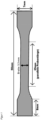
- the thermoplastic molding compound has a strength greater than or equal to 8 MPa, measured according to ISO 527, with the exception of the bone-shaped test specimen used (cf. Figure 1 ), which has the following dimensions deviating from the specification according to ISO 527: total length: 50 mm, width of the narrow part: 3.3 mm, width at the ends: 7 mm, length of the narrow parallel part: 25 mm, thickness: 1 mm.
- the (tensile) strength at break is determined according to ISO 527 using a tensile-elongation test. This determines the force per unit area (specified in MPa) required for the test specimen to break.
- the thermoplastic molding compound has an elongation at break of more than 1,000%, measured according to ISO 527, with the exception of the test specimen used, which has the following dimensions deviating from the specification according to ISO 527: total length: 50 mm, width of the narrow part: 3.3 mm, width at the ends: 7 mm, length of the narrow parallel part: 25 mm, thickness: 1 mm
- Elongation at break is a measure of the deformation behavior of a polymer and is determined according to ISO 527 by a tensile-strain test in the same test run as the strength determination. The elongation at break value indicates the percentage elongation of the test specimen until the material fails.
- Component A is preferably present in the thermoplastic molding composition in weight proportions of 2 wt.% to 98 wt.%, based on the total weight of thermoplastic molding composition, more preferably from 30 wt.% to 95 wt.%, particularly preferably from 40 wt.% to 90 wt.%.
- Component B is preferably present in the thermoplastic molding compound in weight proportions of 2 wt.% to 98 wt.%, based on the total weight of the thermoplastic molding compound, more preferably from 5 wt.% to 70 wt.%, and particularly preferably from 10 wt.% to 60 wt.%. These weight ratios optimally combine the properties of the individual components of the corresponding molding compounds.
- component B is an elastomeric, semicrystalline C3 / C2 copolymer with a propylene content greater than 80 wt. %, determined by 13 C NMR, whereby component B provides a balanced ratio of crystalline to amorphous components in the polymer for the application.
- "Semicrystalline" in the sense of the invention means that the properties of the copolymer are determined by both the crystalline and amorphous regions of the copolymer. The degree of crystallinity can influence the thermal and mechanical properties of the copolymer.
- the thermoplastic molding composition is characterized in that component B has a melting enthalpy, measured according to ISO 11357-2, of 0 to 50 J/g, preferably of 1 to 30 J/g, particularly preferably of 2 to 20 J/g.
- the theoretical heat of fusion of a perfectly crystalline isotactic polypropylene is 207 J/g. This results in a crystallinity of 46% for a semicrystalline random copolymer, which has a heat of fusion of 95 J/g.
- component A is preferably a random copolymer of propylene with a propylene content of 70 wt.% to 95 wt.%, based on the molecular weight M W of the copolymer, and an ethylene content of 5 wt.% to 30 wt.%, which makes the amorphous character of the polymer adjustable according to the application due to the random distribution of the monomers.
- component A has a weight-average molecular weight of 1,000 to 50,000 g/mol, preferably 5,000 to 30,000 g/mol
- component B has a weight-average molecular weight according to ISO 16014 of 50,000 to 300,000 g/mol, preferably 70,000 to 150,000 g/mol.
- component A in a preferred embodiment has a melt viscosity at 170 °C measured according to DIN 53019 of less than 20,000 mPas, preferably 10 to 10,000 mPas, particularly preferably 100 to 5,000 mPas and component B has a melt viscosity at 170 °C measured according to DIN 53019 of more than 20 Pas, preferably 50 to 10,000 Pas, particularly preferably 100 to 5,000 Pas.
- Optimum spraying results can be achieved in these viscosity ranges.
- component A has a melting temperature T m , determined via the DSC peak temperature according to DIN EN ISO 11357-1, between 50 °C and 120 °C, preferably between 60 °C and 110 °C and particularly preferably between 70 °C and 100 °C.
- component A has a glass transition temperature T G determined by DSC, according to DIN EN ISO 11357-2, of less than -10 °C, preferably less than -15 °C and particularly preferably less than -20 °C.
- component A has a zero shear viscosity (NsV), determined according to DIN 53019-4, between 0.01 mPas and 10,000 mPas, preferably between 0.1 mPas and 1,000 mPas and particularly preferably between 1 mPas and 850 mPas.
- NsV zero shear viscosity
- component A has a density, determined according to ISO 1183, of less than 0.95 g/cm 3 , preferably less than 0.92 g/cm 3 and particularly preferably less than 0.90 g/cm 3 .
- component A has a polydispersity index of less than 5, preferably less than 3, particularly preferably less than 2.5.
- the polydispersity index PDI is calculated from the quotient of the weight-average molecular weight M w and the number-average molecular weight M n and was determined according to the ISO 16014 standard.
- the propylene copolymers used as component A in the thermoplastic molding compositions of the invention can both assume the function of the base polymer in the formulation and replace the functions of plasticizer and tackifier. This results in further advantages for the user. For example, fewer components need to be melted and mixed, leading to faster and more cost-effective work processes. Furthermore, purely polyolefin-based hotmelt adhesives can be produced.
- copolymers of propylene from component A in the thermoplastic molding composition according to the invention as tackifiers, ensures improved incorporation of these into the polyolefin matrix, resulting in reduced migration (no "bleed-through") and reduced formation of VOCs.
- Component A has an elongation at break, measured according to ISO 527, of less than 1,000% and component B, measured according to ISO 527, of greater than 1,000%.
- the invention relates to a hot melt adhesive which consists of the thermoplastic molding compound according to the invention or contains it in addition to other components.
- thermoplastic molding composition according to the invention may contain tackifiers, in particular resins, or plasticizers as additives.
- the hot melt adhesive is produced without the addition of tackifier or plasticizer, which is why this embodiment is particularly environmentally friendly and toxicologically safe and is therefore suitable for use on the human body.
- Resin and mineral oil-free in the sense of the invention means that the resin or mineral oil content is less than 1 wt.%, based on the pressure-sensitive adhesive according to the invention.
- the hot melt adhesive according to the invention may contain, in addition to the thermoplastic molding composition according to the invention, organic or inorganic pigments, fillers, flame retardants, stabilizers, antistatic agents, antioxidants and light stabilizers.
- the invention also relates to a process for producing the thermoplastic molding composition according to the invention by mixing components A and B, wherein component A comprises one or more C 3 /C 2 copolymers, each of which was prepared using metallocene catalysts and each has a melt viscosity at 170 °C of less than 20,000 mPas, measured according to DIN 53019, and a molecular weight Mw of 1000 g/mol to 50,000 g/mol, and component B comprises one or more C 2 /C 3 copolymers, each of which was prepared using metallocene catalysts and each has a melt index MI of 1 to 100 g/10 min, measured at 190 °C/2.16 kg, according to ASTM D 1238, and a molecular weight M w of 50,000 g/mol to 300,000 g/mol.
- component A comprises one or more C 3 /C 2 copolymers, each of which was prepared using metallocene catalysts and each has a melt viscosity at 170
- the process according to the invention comprises mixing components A and B, in particular by means of a co-rotating twin-screw extruder at a processing temperature between 150 °C and 200 °C.
- the invention relates to the use of the thermoplastic molding compound according to the invention or the hot melt adhesive according to the invention for bonding flexible and/or rigid substrates of all types.
- the hot melt adhesives or thermoplastic molding compounds according to the invention are suitable for bonding flexible and/or rigid substrates of all types, such as paper, cardboard, glass, wood, PP, PE, ABS, in particular for structured substrates or textile substrates, such as nonwovens, woven or nonwoven textiles.
- structured substrates to be those with a profile depth Pt of greater than 1 mm.
- the hot melt adhesive according to the invention or the thermoplastic molding composition according to the invention is particularly preferably used for bonding and fixing coarse-grained bulk materials, such as granules.
- the improved hot melt adhesives can be applied in such a way that they do not form a compact, homogeneous film, but rather a net-like, air- and moisture-permeable structure.
- These net-like, air- and moisture-permeable structures are particularly suitable, for example, for fixing absorbers to substrates of all kinds.
- This type of fixation can be used to fix filler materials, desiccants or moisture absorbers, for example in hygiene articles, packaging materials, vehicle bodies, furniture, upholstered furniture or mattresses, as well as on surfaces of all kinds in which the fixed Absorbent must withstand a certain mechanical stress.
- Thermoplastic molding compounds with the described features combine, quite surprisingly, good processability, due to their low viscosity, with excellent mechanical properties that can otherwise only be achieved with higher-viscosity molding compounds. These combinations of the described properties qualify the molding compounds of the invention for use as high-performance hot melt adhesives.
- the weight-average molecular weights M w of the copolymers were determined in 1,3-ortho-dichlorobenzene using a PP calibration. The measurement was performed by gel permeation chromatography at a temperature of 135°C. The determination was carried out according to ISO 16014-1.
- the melt viscosity was determined according to DIN 53019.
- the polydispersity index PDI is calculated from the quotient of the weight-average molecular weight Mw and the number-average molecular weight Mn and was determined according to ISO 16014-1.
- the mechanical properties (strength, elongation at break) of the polyolefins and hot melt adhesives were determined according to ISO 527, with the exception that a non-standard test specimen was used in each case. This specimen was produced by melt compression and differs from the standard test specimen in its dimensions.
- the test specimens used to measure strength and elongation at break had the following dimensions: total length: 50 mm, narrow section width: 3.3 mm, end width: 7 mm, narrow parallel section length: 25 mm, and thickness: 1 mm.
- polymers 1 and 2 were used as component A and polymers 3 and 4 as component B.
- Components A and B are characterized in more detail in Tables 1 and 2, respectively.
- Table 1 The components in Table 1 are commercial copolymers available under the trade names Licocene ® 1302 and Licocene ® 2502.
- Table 2 The components in Table 2 are commercial copolymers available under the trade names Vistamaxx ® 3000 and Vistamaxx ® 6502.
- the polyolefins described in Tables 1 and 2 were prepared by melt extrusion as melt blends of the components.
- the extrusion throughput was 7 kg/h.
- the comparative examples show mixtures according to the state of the art which, in addition to a poly-alpha-olefin, use an SEBS block copolymer Kraton ® MD 1648 or a resin as a further component.
- thermoplastic molding compounds and hot melt adhesives were tested for their suitability for their intended use: Two flexible substrates measuring 5 cm x 30 cm were coated with the hot melt adhesive by spray application and bonded together. The application weight should be between 3 and 5 g/ m2 . If the tested thermoplastic molding compounds and hot melt adhesives were sprayable, the static peel test described below was performed: The bond strength of the resulting composite (test specimen) was determined by subjecting a test specimen to a static peel test at room temperature. The test specimen is split open along one narrow side, creating two tabs to which the substrates can be attached (see Figure 2 ). One of these so-called handles is attached to a holding device, while a 100 g weight is attached to the other handle.
- the measurement begins with the removal of the weight in the tensile direction (3), thereby separating one joining partner (1) from the other substrate (2) at a peel angle of 180°.
- the time elapsed from the removal of the weight until complete delamination is recorded.
- the test is repeated five times, and the average time is recorded as a parameter. The longer the elapsed time, the better the bond strength.
- an average running time of more than 250 seconds can be considered a good result. This is a comparative test, the results of which can vary greatly depending on the nature of the substrates.
- Kraton ® MD 1648 from Table 4 is a styrene block copolymer (SEBS) manufactured by Kraton.
Landscapes
- Chemical & Material Sciences (AREA)
- Organic Chemistry (AREA)
- Health & Medical Sciences (AREA)
- Chemical Kinetics & Catalysis (AREA)
- Medicinal Chemistry (AREA)
- Polymers & Plastics (AREA)
- Crystallography & Structural Chemistry (AREA)
- Engineering & Computer Science (AREA)
- Materials Engineering (AREA)
- Adhesives Or Adhesive Processes (AREA)
- Compositions Of Macromolecular Compounds (AREA)
Description
- Die Erfindung betrifft thermoplastische Formmassen zur Verwendung in oder als Schmelzklebstoff, umfassend die Komponenten A und B, wobei die Komponente A ein oder mehrere C3/C2-Copolymere umfasst, die jeweils mit Metallocen-Katalysatoren hergestellt wurden und jeweils eine Schmelzviskosität bei 170 °C kleiner 20.000 mPas, gemessen nach DIN 53019, und ein Molekulargewicht Mw von 1000 g/mol bis 50.000 g/mol aufweisen und die Komponente B ein oder mehrere C2/C3-Copolymere umfasst, die jeweils mit Metallocen-Katalysatoren hergestellt wurden und jeweils einen Schmelzindex MI von 1 bis 100 g/10min, gemessen bei 190 °C/2,16 kg, nach ASTM D 1238, und ein Molekulargewicht Mw von 50.000 g/mol bis 300.000 g/mol aufweisen, dadurch gekennzeichnet, dass Komponente A eine Bruchdehnung kleiner 1.000%, gemessen nach ISO 527, mit Ausnahme des verwendeten Prüfkörpers, besitzt, und Komponente B eine Bruchdehnung größer 1.000%, gemessen nach ISO 527, mit Ausnahme des verwendeten Prüfkörpers, welcher die folgenden Maße aufweist: Gesamtlänge: 50 mm, Breite des engen Teils: 3,3 mm, Breite an den Enden: 7 mm, Länge des engen parallelen Teils: 25 mm, Dicke: 1 mm.
- Der erfindungsgemäße Schmelzklebstoff eignet sich zur Verklebung von Substraten untereinander oder zur Fixierung von Pulver oder Granulaten auf Substraten aller Art, wobei die Schmelzklebstoffe neben den erfindungsgemäßen thermoplastischen Formmassen Klebrigmacher, Weichmacher, organische oder anorganische Pigmente, Füllstoffe, Flammschutzmittel, Stabilisatoren, Antistatika, Antioxidantien und Lichtschutzmittel enthalten können.
- Schmelzklebstoffe sind thermoplastische Zusammensetzungen, die bei Raumtemperatur fest sind. Wenn sie durch Erwärmen in den flüssigen oder geschmolzenen Zustand übergehen, d.h. der Schmelzklebstoff offen ist, kann der Schmelzklebstoff auf ein Substrat aufgetragen werden. Falls ein zweites Substrat auf den Schmelzklebstoff aufgebracht wird, bevor dieser wieder in den festen Zustand abgekühlt ist, kann eine adhäsive Verbindung entstehen, die die zwei Substrate verbindet. Der Schmelzkleber besitzt eine für die Anwendung optimierte offene Zeit und verklebt die Fügeteile permanent. Schmelzklebstoffe enthalten typischerweise ein kohäsives Basispolymer, einen adhäsiven Klebrigmacher und gegebenenfalls Wachse, Weichmacher (Öle) und weitere Zusätze. Typische Schmelzklebstoffe und ihre Funktion werden in
US 5,026,756 beschrieben. - Als kohäsives Basispolymer werden Polymere wie z.B. Natur- und Synthesekautschuke, Polyacrylate, Polyisobutylene, Polyolefin(e), Polyester, Polychroprene, Polyvinylether, Polyurethane, Styrol-Butadien-(SBS) Styrol-Isobuten- (SIS), Styrol-Ethylen-Butadien- (SEBS) oder Styrol-Ethylen-Propylen- (SEPS) Blockcopolymere verwendet. Diese Basispolymere sorgen in der Regel für die kohäsive Wirkung des Klebstoffsystems.
- Die adhäsive Wirkung von Schmelzklebstoffen wird in erster Linie vom Klebrigmacher bestimmt, der häufig ein Harz ist oder eines enthält. Diese Harze sind z.B. niedermolekulare Produkte aus dem C5- oder C9-Strom der Erdölaufbereitung, enthalten oft Aromaten und haben für gewöhnlich eine Glasübergangstemperatur, die über Raumtemperatur liegt.
- Somit erhöht die Beimischung von Harzen in Schmelzklebstoffformulierungen die Glastemperaturen der Formulierungen, sodass entsprechende Schmelzklebstoffe unter verringerter Kälteflexibilität leiden und der Temperaturbereich in dem der Schmelzklebstoff verwendet werden kann, eingeschränkt ist.
- Als Harze kommen auch Polyterpen-Harze, natürliche und modifizierte Kolophoniumharze, insbesondere Harzester, Glycerinester von Baumharzen, phenolmodifizierte Pentaerythritolester und phenolmodifizierte Terpen-Harze zum Einsatz. Solche Harztypen enthalten reizende/gesundheitsbedenkliche Stoffe wie Abietinsäure und können Allergien auslösen, weshalb sie für Anwendungen im Hygienebereich, für Lebensmittelverpackungen und im medizinischen Bereich fragwürdig sind.
- Harze weisen üblicherweise Dichten von z.T. mehr als 1 g/cm3 auf. Die Verwendung solcher Harze in Schmelzklebstoffformulierungen sorgt daher für eine Erhöhung der Dichte, insbesondere in Formulierungen mit Polyolefin als kohäsivem Basispolymer. Dadurch wird bei konstantem Appliziervolumen mehr Schmelzklebstoff nach Gewicht benötigt, was sowohl einen negativen Kostenfaktor darstellt als auch ein höheres Gewicht der geklebten Substrate bedeutet.
- Der Weichmacher in der Schmelzklebstoffformulierung dient der Viskositätsabsenkung der Klebstoffzusammensetzung und damit ihrer besseren Verarbeitbarkeit und Applikationsfähigkeit. In der Regel enthalten Schmelzklebstoffe Mineralöle als Weichmacher, zum Teil in bedeutender Menge.
- Mineralöle sind erdölbasiert und enthalten dementsprechend paraffinische, naphtenische, aromatischen und polycyclische Verbindungen, sowie leichtflüchtige organische Verbindungen (volatile organic compounds: VOC), die zu einer erhöhten Belastung der Raumluft beitragen. Die auch als MOSH und MOAH (mineral oil saturated hydrocarbons bzw. mineral oil aromatic hydrocarbons) in Mineralölen enthaltenen Verbindungen werden wegen ihrer Neigung, in menschlichem Gewebe zu kumulieren, als toxikologisch riskant eingestuft. Mineralöle sind für gewöhnlich schlecht in Schmelzklebstoffformulierungen eingebunden und neigen deshalb zu verstärkter Migration.
- Die Anwendungsmöglichkeiten von Schmelzklebstoffen sind sehr vielseitig. Sie werden insbesondere für Klebeverbindungen eingesetzt, die permanent sind. Durch den Auftrag aus der Schmelze können Schmelzkleber auf Lösungsmittel verzichten.
- Die Verarbeitung von Schmelzklebstoffen, insbesondere der Auftrag, d.h. die Applikation, auf die entsprechenden Substrate kann durch diverse Verfahren realisiert werden, so z.B. durch Aufsprühen, Applizieren durch Extrusion, Auftragen mittels einer Walze, einer Raupe oder einer Schlitzdüse. Um für die diversen Applikationsverfahren optimal geeignet zu sein, muss der Schmelzkleber der Applikationsmethode angemessene rheologische Eigenschaften aufweisen.
- In der Schmelzklebstofftechnologie ist die Sprühapplikation eine gängige Applikationstechnik. Beim Spinnsprühen verlässt ein Schmelzefaden eine Sprühdüse, wird gegebenenfalls durch einen Luftstrom ohne abzureißen verstreckt, und anschließend spiralförmig auf einem Substrat abgelegt. Die Applikationstemperaturen liegen je nach Material bei 150 °C bis 250 °C. Konventionelle Hotmelt-Formulierungen auf Basis von Styrol-Blockcopolymeren, aber auch Polyolefinen lassen sich bei Temperaturen von 160 °C und weniger nicht gut versprühen. Es entstehen schlechte Sprühbilder, welche das Anwendungsgebiet stark einschränken. Höhere Applikationstemperaturen sorgen für erhöhten Energieverbrauch und vorzeitiger Alterung des Klebstoffes, was zu mechanischen Einbußen führt.
- In
EP 0 442 045 A2 werden ausgezeichnet sprühbare Schmelzklebmassen bereitgestellt, die ein gleichmäßiges Sprühbild ergeben. Sie basieren weitgehend auf amorphen Poly-alpha-Olefinen, die nicht mit Metallocenen hergestellt sind und folgende Merkmale aufweisen: ein Erweichungspunkt zwischen 70 °C und 130 °C, eine Schmelzviskosität (bei 190 °C) zwischen 1000 mPas und 20.000 mPas, eine Nadelpenetration zwischen acht und 40 [0,1 mm] und eine Polydispersität von maximal sechs. Die erfindungsgemäßen Massen lassen sich gleichermaßen vorteilhaft durch Atomisierung als auch durch Spinnsprühen applizieren. -
EP 1 631 641 beschreibt Schmelzklebstoffe, die Polyolefinwachse enthalten, wobei die Polyolefinwachse mit Hilfe von Metallocenkatalysatoren hergestellt werden und einen Tropf- oder Erweichungspunkt Ring/Kugel zwischen 80 °C und 165 °C und eine maximale Schmelzviskosität von 40000 mPas, gemessen bei einer Temperatur von 10 °C über dem Tropf- oder Erweichungspunkt, aufweisen. - Das Dokument
EP 1 645 608 offenbart eine Heißschmelzzusammensetzung, umfassend Polyolefinwachse, hergestellt unter Verwendung von Metallocenkatalysatoren, mit einem Tropf- oder Erweichungspunkt Ring/Kugel zwischen 80 °C - 165 °C, mit einer Schmelzviskosität, gemessen bei 170 °C, zwischen 20 mPas - 40.000 mPas und mit einer Glasübergangstemperatur von maximal -10°C. -
US 5,401,792 beschreibt sprühbare Schmelzklebstoffzusammensetzungen umfassend (A) Styrol-Block-Copolymeren, (B) klebrigmachendes Harz, und (C) EthylenCopolymer. Methoden zur Herstellung und die Verwendung besagter Zusammensetzungen werden ebenfalls offenbart. -
EP 2 081 609 bezieht sich auf einen Schmelzklebstoff zum Verkleben von Fasermaterialien wie mattierten Vliesstoffen oder gewebten Textilien mit glatten Substratoberflächen, wie Kunststoff- oder Metallfolien und zum Laminieren dieser Materialien. Diese Substanz ist dadurch gekennzeichnet, dass sie mindestens ein Polyolefin enthält, das durch Polymerisation in Gegenwart eines Metallocens als Katalysator hergestellt wurde und einen Ring/Kugel-Erweichungspunkt zwischen 50 °C und 165 °C und eine Schmelzviskosität, gemessen bei einer Temperatur von 170 °C, zwischen 20 mPas und 40.000 mPas aufweist. Der Schmelzklebstoff kann mindestens eine Klebstoffkomponente enthalten und wird in einer Menge zwischen 3 g/m2 und 6 g/m2, vorzugsweise zwischen 4 g/m2 und 5,5 g/m2, zum Aufkleben einer Folie auf einen Vliesstoff bei der Herstellung von Hygieneartikeln wie Einwegwindeln, Babywindeln, Inkontinenzprodukten, Slipeinlagen und/oder Damenbinden verwendet. -
EP 1 290 100 betrifft ein Verfahren zum Zerstäuben, Spiralspritzen, Oszillationsspritzen oder Schmelzblasen von Propylencopolymeren auf ein Substrat, umfassend die Auswahl eines Poly-alpha-Olefin-Interpolymers, umfassend: A) 60 bis 94 Mol-% Einheiten, die von einem alpha-Monoolefin mit 3 bis 6 Kohlenstoffatomen abgeleitet sind, und B) 6 bis 40 Mol-% Einheiten, die von Ethylen oder einem oder mehreren anderen Monoolefinen mit 4 bis 10 Kohlenstoffatomen und mindestens einem Kohlenstoffatom mehr als A) abgeleitet sind; und C) gegebenenfalls 0 bis 10 Mol-% Einheiten, die von einem anderen copolymerisierbaren ungesättigten Kohlenwasserstoff abgeleitet sind, der von A) und B) verschieden ist; i) und Mw/Mn von 6 oder weniger; ii) ein Speichermodul G' aufweist, das, wenn es beim Abkühlen bestimmt wird, bei einer Temperatur von weniger als 85 °C gemessen einen Wert von 0,3 MPa schneidet.; iii) ein Verhältnis von G"/G' von 18 oder mehr aufweist, wenn G' bei einer Frequenz von 1 Hz 10 Pa beträgt; und iv) eine Viskosität von 5.000 mPa.s oder weniger bei 190 °C, und Zerstäuben, Spiralspritzen, Oszillationsspritzen oder Schmelzblasen des Interpolymers in ein Substrat. Auch Mischungen der oben genannten Copolymere können hier eingesetzt werden. -
EP 2 976 403 betrifft gebrauchsfertige Heissschmelzklebemassen, enthaltend mindestens 95 Gew.-% eines oder mehrerer Polyolefincopolymerwachse, die mit Hilfe von Metallocenkatalysatoren hergestellt wurden, dadurch gekennzeichnet, dass das Polyolefincopolymerwachs aus Propylen und einem oder mehreren weiteren Monomeren ausgewählt aus Ethylen und verzweigten oder unverzweigten 1-Alkenen mit 4 bis 20 C-Atomen besteht und der Gehalt an Struktureinheiten hervorgegangen aus Propylen in den Copolymerwachsen 80 bis 99,9 Gew.-% beträgt, und die Heissschmelzklebemasse eine Oberflächenspannung der Schmelze, gemessen bei einer Temperatur von 170 °C, von maximal 23 mN/m aufweist. - Das Dokument
EP 3 271 436 offenbart einen sprühbaren Schmelzklebstoff auf Olefinbasis und absorbierende Artikel, die den Klebstoff enthalten. Der sprühbare Schmelzklebstoff auf Olefinbasis eignet sich besonders für das Sprühen bei niedrigen Auftragstemperaturen. Die sprühbaren Schmelzklebstoffe mit niedriger Auftragstemperatur zeichnen sich durch hohe Anfangsfestigkeit, hervorragende Haftfestigkeit und Alterungsbeständigkeit aus. Die sprühbaren Schmelzklebstoffe mit niedriger Auftragstemperatur ermöglichen zudem dünne Verklebungen ohne Durchblutungs- und Durchbrandrisiken für wärmeempfindliche Substrate. -
WO 2014/047317 beschreibt einen Heißschmelzklebstoff und Gegenstände, die unter Verwendung des Heißschmelzklebstoffs hergestellt werden, um Strukturen in einem Gegenstand zu verbinden. Die Schmelzklebemasse wird typischerweise durch Mischen eines amorphen Polymers mit einem, einen substantiellen kristallinen Anteil aufweisenden, Heterophasenpolymer hergestellt. -
EP 3 271 436 A1 beschreibt einen Schmelzklebstoff aus zwei Polyolefinen, der auf Gegenstände gesprüht werden kann. - Die im Stand der Technik beschriebenen Schmelzklebstoffe können entweder durch Extrusion, Auftragen mittels einer Walze, Raupe oder Schlitzdüse oder durch Sprühapplikation auf das Substrat aufgebracht werden. Je nach Applikationstechnik kommt ein anderer Viskositätsbereich zum Einsatz. Sprühbare Schmelzklebemassen liegen vornehmlich im niedrigen Viskositätsbereich. Die niedrige Viskosität eines sprühbaren Schmelzklebstoffs geht normalerweise mit unzureichenden mechanischen Eigenschaften einher, die die kohäsiven Eigenschaften des Materials negativ beeinflussen. Hier sind insbesondere Eigenschaften, wie die Bruchdehnung oder die Festigkeit des Materials zu nennen. Derartige, durch Sprühapplikationen verklebte Substrate, halten meist nur geringen mechanischen Belastungen stand. Sie sind dahingehend optimiert, eine möglichst homogene und dabei materialsparende Beschichtung des zu verklebenden Substrates zu gewährleisten. Hierbei steht die adhäsive Verbindung der Substrate im Vordergrund, das kohäsive Polymer soll hingegen eine ausreichende Stabilität gewährleisten, um die Klebeverbindung an sich nicht brüchig werden zu lassen. Die Elastizität der Klebeverbindung spielt dabei nur eine untergeordnete Rolle. Schmelzklebstoffe mit höherer Viskosität können zwar durch eine Erhöhung der Applikationstemperatur sprühbar gemacht werden, eine solche Temperaturerhöhung führt allerdings zu einem erhöhten Energiebedarf und kann zu einem unerwünschten thermisch-induzierten Abbau der eingesetzten Komponenten führen.
- Aufgabe der Erfindung ist es, verbesserte Schmelzklebstoffe bereitzustellen, die über energie- und materialsparende Applikationstechniken auftragbar sind und trotzdem mit einer hohen mechanischen Stabilität der Klebeverbindung einhergehen und damit Anwendungsmöglichkeiten eröffnen, die erhöhte Anforderungen an die Stabilität der Verklebung stellen. Hier sind insbesondere Fasernetz-Sprühapplikationen zu nennen, die Granulate oder Pulver fixieren können, ohne den Stoffaustausch mit der Umgebung zu behindern. Da viele Schmelzkleber häufig in direktem Kontakt zum menschlichen Körper oder zu Gegenständen des täglichen Gebrauchs angewendet werden, ist es von Vorteil, wenn der Schmelzklebstoffe weder Harze noch Mineralöle enthält, damit eine verbesserte Umweltverträglichkeit und eine geringere Toxikologie aufweist und nachhaltig herstellbar ist.
- Diese Aufgabe wird gelöst durch thermoplastische Formmassen mit einer Schmelzviskosität kleiner als 30.000 mPas, umfassend die Komponenten A und B, wobei die Komponente A ein oder mehrere C3/C2-Copolymere umfasst, die jeweils mit Metallocen-Katalysatoren hergestellt wurden und jeweils eine Schmelzviskosität bei 170 °C kleiner 20.000 mPas, gemessen nach DIN 53019, und ein Molekulargewicht Mw von 1000 g/mol bis 50.000 g/mol aufweisen und die Komponente B ein oder mehrere C2/C3-Copolymere umfasst, die jeweils mit Metallocen-Katalysatoren hergestellt wurden und jeweils einen Schmelzindex MI von 1 bis 100 g/min, gemessen bei 190 °C/2,16 kg, nach ASTM D 1238, und ein Molekulargewicht Mw von 50.000 g/mol bis 300.000 g/mol, gemessen nach ISO16014, aufweisen, dadurch gekennzeichnet, dass Komponente A eine Bruchdehnung kleiner 1.000%, gemessen nach ISO 527, mit Ausnahme des verwendeten Prüfkörpers, besitzt, und Komponente B eine Bruchdehnung größer 1.000%, gemessen nach ISO 527, mit Ausnahme des verwendeten Prüfkörpers, welcher die folgenden Maße aufweist: Gesamtlänge: 50 mm, Breite des engen Teils: 3,3 mm, Breite an den Enden: 7 mm, Länge des engen parallelen Teils: 25 mm, Dicke: 1 mm.
- Die Schmelzviskosität ist nicht nur vom Molekülaufbau, sondern auch von der Temperatur und den Scherbedingungen abhängig. Demzufolge wird die Schmelzviskosität für jeweils verschiedene Temperaturen in Abhängigkeit von der Schergeschwindigkeit im Rotationsviskosimeter gemäß der DIN 53019 gemessen. Bei hohen Viskositäten ist die Viskositätsbestimmung über das Rotationsviskosimeter nicht üblich, weshalb für hochviskose Polymere der "melt index" MI angegeben wird. Dieser wird nach ASTM D 1238 bestimmt.
- In einer alternativen Ausführungsform besteht die thermoplastische Formmasse aus den Komponenten A und B.
- Vorzugsweise besteht die Komponente A aus einem oder mehreren C3/C2-Copolymeren, die jeweils mit Metallocen-Katalysatoren hergestellt wurden und jeweils eine Schmelzviskosität bei 170 °C kleiner 20.000 mPas, gemessen nach DIN 53019, und ein Molekulargewicht Mw von 1000 g/mol bis 50.000 g/mol aufweisen.
- Vorzugsweise besteht die Komponente B aus einem oder mehreren C2/C3-Copolymeren, die jeweils mit Metallocen-Katalysatoren hergestellt wurden und jeweils einen Schmelzindex MI von 1 bis 100 g/min, gemessen bei 190 °C/2,16 kg, nach ASTM D 1238, und ein Molekulargewicht Mw von 50.000 g/mol bis 300.000 g/mol aufweisen.
- Zur Herstellung der für die erfindungsgemäßen thermoplastischen Formmasse verwendeten Copolymere des Propylens können Metallocenkatalysatoren verwendet werden, die aus chiralen oder nichtchiralen Übergangsmetallverbindungen der Formel M1Lx bestehen. Die Übergangsmetallverbindung M1Lx enthält mindestens ein Metallzentralatom M1, an das mindestens ein π-Ligand L, z. B. ein Cyclopentadienylligand, gebunden ist. Darüber hinaus können Substituenten, wie z. B. Halogen-, Alkyl-, Alkoxy- oder Arylgruppen an das Metallzentralatom M1 gebunden sein. M1 ist bevorzugt ein Element der III, IV., V. oder VI. Hauptgruppe des Periodensystems der Elemente, wie Ti, Zr oder Hf. Unter Cyclopentadienylligand sind unsubstituierte Cyclopentadienylreste und substituierte Cyclopentadienylreste wie Methylcyclopentadienyl-, Indenyl-, 2-Methylindenyl-, 2-Methyl-4-phenylindenyl-, Tetrahydroindenyl- oder Octahydrofluorenylreste zu verstehen. Die π-Liganden können verbrückt oder unverbrückt sein, wobei einfache und mehrfache Verbrückungen - auch über Ringsysteme - möglich sind. Zur Aktivierung der Einzentren-Katalysatorsysteme werden geeignete Cokatalysatoren eingesetzt, z.B. aluminiumorganische Verbindungen, insbesondere Alumoxane oder auch aluminiumfreie Systeme. Beispiele für Metallocenkatalysatoren, deren Aktivierung und Handhabung für die Polymerisation sind z.B. in
EP 0384264 bzw.EP 0571882 beschrieben. Die Bezeichnung Metallocen umfasst auch Verbindungen mit mehr als einem Metallocenfragment, sogenannte mehrkernige Metallocene. Diese können beliebige Substitutionsmuster und Verbrückungsvarianten aufweisen. Die einzelnen Metallocenfragmente solcher mehrkernigen Metallocene können sowohl gleichartig als auch voneinander verschieden sein. Beispiele für solche mehrkernigen Metallocene sind z. B. beschrieben inEP 0632063 . - Je nach Verfahren können auch geträgerte Einzentren-Katalysatoren zur Anwendung kommen. Bevorzugt sind Katalysatorsysteme, bei welchen die Restgehalte von Trägermaterial und Cokatalysator eine Konzentration von 100 ppm im Produkt nicht überschreiten.
- In einer bevorzugten Ausführungsform liegt die Schmelzviskosität der erfindungsgemäßen thermoplastischen Formmassen gemessen nach DIN 53019 zwischen 100 - 25.000 mPas, bevorzugt zwischen 500 - 20.000 mPas, besonders bevorzugt zwischen 1.000 - 15.000 mPas, gemessen nach DIN 53019. In diesen Viskositätsbereichen lässt sich mit den Standard-Sprühverfahren ein optimales Sprühergebnis erzielen.
- In einer weiteren bevorzugten Ausführungsform weist die thermoplastische Formmasse eine Festigkeit größer gleich 8 MPa, gemessen nach ISO 527, mit Ausnahme des verwendeten knochenförmigen Prüfkörpers (vgl.
Figur 1 ), welcher folgende von der Vorschrift nach ISO 527 abweichende Maße aufweist: Gesamtlänge: 50 mm, Breite des engen Teils: 3,3 mm, Breite an den Enden: 7 mm, Länge des engen parallelen Teils: 25 mm, Dicke: 1 mm. - Die (Zug-)Festigkeit bei Bruch wird nach ISO 527 durch einen Zug-Dehnungsversuch ermittelt. Hier wird bestimmt, welche Kraft pro Fläche (angegeben in MPa) für den Bruch des Prüfkörpers notwendig ist.
- In einer weiteren bevorzugten Ausführungsform weist die thermoplastische Formmasse eine Bruchdehnung von mehr als 1.000% auf, gemessen nach ISO 527, mit Ausnahme des verwendeten Prüfkörpers, welcher folgende von der Vorschrift nach ISO 527 abweichende Maße aufweist: Gesamtlänge: 50 mm, Breite des engen Teils: 3,3 mm, Breite an den Enden: 7 mm, Länge des engen parallelen Teils: 25 mm, Dicke: 1 mm
- Die Bruchdehnung ist ein Maß für das Deformationsverhalten eines Polymers und wird nach ISO 527 durch einen Zug-Dehnungs-Versuch im gleichen Versuchslauf wie bei der Ermittlung der Festigkeit bestimmt. Der Wert für die Bruchdehnung gibt die prozentuale Verlängerung des Prüfkörpers bis zum Versagen des Materials an.
- Die Komponenten A kommt in der thermoplastischen Formmasse bevorzugt in Gewichtsanteilen von 2 Gew.-% bis 98 Gew.-% vor, bezogen auf das Gesamtgewicht thermoplastischen Formmasse, stärker bevorzugt von 30 Gew.% bis 95 Gew.-%, besonders bevorzugt von 40 Gew.% bis 90 Gew.-%.
- Die Komponente B kommt in der thermoplastischen Formmasse bevorzugt in Gewichtsanteilen von 2 Gew.-% bis 98 Gew.-% vor, bezogen auf das Gesamtgewicht thermoplastischen Formmasse, stärker bevorzugt von 5 Gew.% bis 70 Gew.%, besonders bevorzugt von 10 Gew.% bis 60 Gew.%. Bei diesen Gewichtsverhältnissen werden die Eigenschaften der Einzelkomponenten der entsprechenden Formmassen in optimaler Weise verbunden.
- In einer bevorzugten Ausführungsform wird der Einfluss der Komponente B dahingehend verbessert, dass Komponente B ein elastomeres, semikristallines C3/C2-Copolymer mit einem Anteil von Propylen größer 80 Gew.-%, bestimmt mittels 13C-NMR, ist, wodurch die Komponente B ein für die Anwendung ausgewogenes Verhältnis von kristallinen zu amorphen Anteilen im Polymer liefert. "Semikristallin" im Sinne der Erfindung bedeutet, dass die Eigenschaften des Copolymers sowohl von den kristallinen als auch von den amorphen Bereichen des Copolymers bestimmt werden. Mit dem Kristallinitätsgrad lassen sich die thermischen und mechanischen Eigenschaften des Copolymers beeinflussen.
- In einer besonders bevorzugten Ausführungsform ist die thermoplastische Formmasse dadurch gekennzeichnet, dass die Komponente B eine Schmelzenthalpie, gemessen nach ISO 11357-2, von 0 bis 50 J/g, bevorzugt von 1 bis 30 J/g, besonders bevorzugt von 2 bis 20 J/g aufweist. Die Kristallinität eines Copolymers kann quantitativ in Prozent ausgedrückt werden. Normalerweise bezieht sich eine solche Prozentangabe auf eine Referenzkristallinität. In diesem Fall ist die Referenz 100 % kristallines, isotaktisches Polypropylen-Homopolymer (Schmelzwärme des 100%-kristallinen, isotaktischen Polypropylen-Homopolymer: ΔH100% = 207 J/g). Der Kristallinitätsgrad lässt sich über die Schmelzwärme der zweiten Aufheizkurve ΔH2.Heizen bestimmen, nachdem das Material nach einem ersten Aufheizen auf 180 °C mit 10 K/min auf -50°C abgekühlt wurde und anschließend mit 10 K/min ein zweites Mal aufgeheizt wurde:

- So liegt die theoretische Schmelzwärme eines perfekt kristallinen isotaktischen Polypropylens bei 207 J/g. Damit ergibt sich für die Kristallinität eines semikristallinen random-Copolymers, welches eine Schmelzwärme von 95 J/g hat, eine Kristallinität von 46 %.
- In einer weiteren bevorzugten Ausführungsform handelt es sich bei der Komponente A bevorzugt um ein statistisches Copolymer des Propylens mit einem Propylenanteil von 70 Gew.% bis 95 Gew.-%, bezogen auf das Molekulargewicht MW des Copolymers, und einem Ethylenanteil von 5 Gew.% bis 30 Gew.%, die durch die statistische Verteilung der Monomere den amorphen Charakter des Polymers der Anwendung entsprechend einstellbar macht.
- In einer besonders bevorzugten Ausführungsform besitzt die Komponente A ein gewichtsmittleres Molekulargewicht von 1.000 bis 50.000 g/mol, bevorzugt 5.000 bis 30.000 g/mol und die Komponente B ein gewichtsmittleres Molekulargewicht nach ISO 16014 von 50.000 bis 300.000 g/mol, bevorzugt 70.000 bis 150.000 g/mol. Um ein Viskositätsoptimum für die Verarbeitung der thermoplastischen Formmassen zu erreichen, besitzt die Komponente A in einer bevorzugten Ausführungsform eine Schmelzviskosität bei 170 °C gemessen nach DIN 53019 von kleiner 20.000 mPas, bevorzugt 10 bis 10.000 mPas, besonders bevorzugt 100 bis 5000 mPas und Komponente B eine Schmelzviskosität bei 170 °C gemessen nach DIN 53019 von mehr als 20 Pas, bevorzugt 50 bis 10.000 Pas, besonders bevorzugt 100 bis 5000 Pas. In diesen Viskositätsbereichen können optimale Sprühergebnisse erzielt werden.
- In einer bevorzugten Ausführungsform besitzt die Komponente A eine Schmelztemperatur Tm, ermittelt über die DSC Peaktemperatur gemäß DIN EN ISO 11357-1, zwischen 50 °C und 120 °C, bevorzugt zwischen 60 °C und 110 °C und besonders bevorzugt zwischen 70 °C und 100 °C.
- In einer weiteren bevorzugten Ausführungsform besitzt die Komponente A eine Glasübergangstemperatur TG bestimmt mittels DSC, gemäß DIN EN ISO 11357-2 kleiner -10 °C, bevorzugt kleiner -15 °C und besonders bevorzugt kleiner -20 °C.
- In einer weiteren bevorzugten Ausführungsform besitzt die Komponente A eine Nullscherviskosität (NsV), bestimmt gemäß DIN 53019-4, zwischen 0,01 mPas und 10.000 mPas, bevorzugt zwischen 0,1 mPas und 1.000 mPas und besonders bevorzugt zwischen 1 mPas und 850 mPas.
- In einer weiteren bevorzugten Ausführungsform besitzt die Komponente A eine Dichte, bestimmt gemäß ISO 1183 kleiner 0,95 g/cm3, bevorzugt kleiner 0,92 g/cm3 und besonders bevorzugt kleiner 0,90 g/cm3.
- In einer weiteren bevorzugten Ausführungsform besitzt die Komponente A eine Polydispersitätsindex kleiner 5, bevorzugt kleiner 3, besonders bevorzugt kleiner 2,5. Der Polydispersitätsindex PDI errechnet sich aus dem Quotienten aus gewichtsmittleren Molekulargewicht Mw und dem zahlenmittleren Molekulargewicht Mn und wurde gemäß der Norm ISO 16014 bestimmt.
- Die für die erfindungsgemäßen thermoplastischen Formmassen als Komponente A verwendeten Copolymere des Propylens können in der Formulierung sowohl die Funktion des Basispolymers übernehmen, als auch die Funktionen von Weich- und Klebrigmacher ersetzen. Dadurch ergeben sich weitere Vorteile für den Anwender. Er muss beispielsweise weniger Komponenten schmelzen und mischen, was zu schnelleren und kostengünstigeren Arbeitsprozessen führt. Außerdem lassen sich rein Polyolefin- basierte Schmelzklebemassen darstellen.
- Der Einsatz von Copolymeren des Propylens aus Komponente A in der erfindungsgemäßen thermoplastischen Formmasse als Klebrigmacher, anstelle von Harzen und Weichmachern, sorgt für eine verbesserte Einbindung dieser in die Polyolefinmatrix, was zu verringerter Migration (kein "Durchbluten") und verringerter Bildung von VOCs führt.
- Die Komponente A weist eine Bruchdehnung, gemessen nach ISO 527 kleiner 1.000% und Komponente B gemessen nach ISO 527, größer 1.000% auf.
- Weiterhin betrifft die Erfindung einen Schmelzklebstoff der aus der erfindungsgemäßen thermoplastischen Formmasse besteht oder diese neben weiteren Komponenten enthält.
- Die erfindungsgemäße thermoplastische Formmasse kann als Zusatz Klebrigmacher, insbesondere Harze, oder Weichmacher enthalten.
- In einer besonders bevorzugten Ausführungsform wird der Schmelzklebstoff ohne Zusatz von Klebrigmacher oder Weichmacher hergestellt, weshalb diese Ausführungsform besonders umweltverträglich und toxikologisch unbedenklich ist und sich damit für den Einsatz am menschlichen Körper eignet.
- Harz- und mineralölfrei im Sinne der Erfindung bedeutet, dass der Harz- bzw. Mineralölanteil jeweils unter 1 Gew.-%, bezogen auf die erfindungsgemäße Haftklebemasse liegt.
- Der erfindungsgemäße Schmelzklebstoff kann neben der erfindungsgemäßen thermoplastischen Formmasse organische oder anorganische Pigmente, Füllstoffe, Flammschutzmittel, Stabilisatoren, Antistatika, Antioxidantien und Lichtschutzmittel enthalten.
- Außerdem betrifft die Erfindung ein Verfahren zur Herstellung der erfindungsgemäßen thermoplastischen Formmasse durch Vermischung der Komponenten A und B, wobei die Komponente A ein oder mehrere C3/C2-Copolymere umfasst, die jeweils mit Metallocen-Katalysatoren hergestellt wurden und jeweils eine Schmelzviskosität bei 170 °C kleiner 20.000 mPas, gemessen nach DIN 53019, und ein Molekulargewicht Mw von 1000 g/mol bis 50.000 g/mol aufweisen und die Komponente B ein oder mehrere C2/C3-Copolymere umfasst, die jeweils mit Metallocen-Katalysatoren hergestellt wurden und jeweils einen Schmelzindex MI von 1 bis 100 g/10min, gemessen bei 190 °C/2,16 kg, nach ASTM D 1238, und ein Molekulargewicht Mw von 50.000 g/mol bis 300.000 g/mol aufweisen.
- Das erfindungsgemäße Verfahren umfasst das Vermischen der Komponenten A und B, insbesondere mittels eines gleichläufigen Doppelschneckenextruders bei einer Verarbeitungstemperatur zwischen 150 °C und 200 °C.
- Weiterhin betrifft die Erfindung die Verwendung der erfindungsgemäßen thermoplastischen Formmasse bzw. des erfindungsgemäßen Schmelzklebstoffs zum Verbinden von flexiblen und/oder starren Substraten aller Art.
- Die erfindungsgemäßen Schmelzklebstoff bzw. thermoplastischen Formmassen eignen sich zum Verbinden von flexiblen und/oder starren Substraten aller Art, wie z.B. Papier, Kartonagen, Glas, Holz, PP, PE, ABS, insbesondere für strukturierte Substrate oder textile Substrate, wie z.B. Vliese, gewebte oder nicht-gewebte Textilien ("woven" oder "non-woven"). Der Fachmann versteht unter strukturierten Substraten, solche mit einer Profiltiefe Pt von größer 1 mm.
- Besonders bevorzugt dient der erfindungsgemäße Schmelzklebstoff bzw. die erfindungsgemäße thermoplastische Formmasse der Verbindung und Fixierung von grobkörnigen Schüttgütern, wie z.B. Granulaten. Für diese Anwendungen sind die verbesserten Schmelzklebstoffe so applizierbar, dass sie keinen kompakten, homogenen Film bilden, sondern eine netzartige, luft- und feuchtigkeitsdurchlässige Struktur ausbilden. Diese netzartigen luft- und feuchtigkeitsdurchlässigen Strukturen eigenen sich insbesondere, um zum Beispiel dazu Absorber auf Substraten aller Art zu fixieren. Durch diese Art der Fixierung können insbesondere Füllmaterialien, Trockenmittel oder Feuchtigkeitsabsorber zum Beispiel in Hygieneartikeln, Verpackungsmaterialien, Fahrzeugkarosserien, Möbeln, Polstermöbeln oder Matrazen sowie auf Oberflächen aller Art fixiert werden, in denen das fixierte Absorbens einer gewissen mechanischen Belastung standhalten muss.
- Thermoplastische Formmassen mit den beschriebenen Merkmalen verbinden völlig überraschend eine gute Verarbeitbarkeit der Formmasse, bewirkt durch die niedrige Viskosität derselben, mit hervorragenden mechanischen Eigenschaften, die sich sonst nur durch Formmassen mit höheren Viskosität realisieren lassen. Diese Kombinationen der beschriebenen Eigenschaften qualifizieren die erfindungsgemäßen Formmassen für ihren Einsatz als Hochleistungsschmelzkleber.
- Die aufgeführten Polyolefine wurden analog den aufgeführten Normen charakterisiert. Von der Norm abweichende Charakterisierungen erfolgten gemäß der Beschreibung.
- Die Bestimmung der gewichtsmittleren Molekulargewichte Mw der Copolymere wurde in 1,3-ortho-Dichlorbenzol durchgeführt und mit einer PP-Kalibrierung bestimmt. Die Messung erfolgte gelpermeationschromatographisch bei einer Temperatur von 135°C. Die Bestimmung erfolgte gemäß ISO 16014-1.
- Die Bestimmung der Schmelzviskosität erfolgte gemäß der Norm DIN 53019.
- Der Polydispersitätsindex PDI errechnet sich aus dem Quotienten aus gewichtsmittleren Molekulargewicht Mw und dem zahlenmittleren Molekulargewicht Mn und wurde gemäß der Norm ISO 16014-1 bestimmt.
- Die mechanischen Eigenschaften (Festigkeit, Bruchdehnung) der Polyolefine und der Schmelzklebemassen wurden nach ISO 527 bestimmt, mit der Ausnahme, dass jeweils ein nicht-normgemäßer Prüfkörper verwendet wurde, der durch Schmelzpressen erzeugt wurde und der sich von dem Prüfkörper gemäß Norm durch seine Maße unterscheidet. Die zur Messung von Festigkeit und Bruchdehnung verwendeten Prüfkörper weisen folgende Maße auf: Gesamtlänge: 50 mm, Breite des engen Teils: 3,3 mm, Breite an den Enden: 7 mm, Länge des engen parallelen Teils: 25 mm, Dicke: 1 mm.
- Die Bruchdehnung entspricht der Zug-Festigkeit bei Bruch und wird nach ISO 527 durch einen Zug-Dehnungsversuch ermittelt. Hier wird bestimmt, welche Kraft pro Fläche (angegeben in MPa) für den Bruch des Prüfkörpers notwendig ist. Die Zugprüfung erfolgte mit Ausnahme des Prüfkörpers nach Norm ISO 527.
-
Figur 1 : Schematische Darstellung des bei der Ermittlung der Bruchdehnung verwendeten Prüfkörpers. -
Figur 2 : Schematische Darstellung des statischen Schältests. - Zur Herstellung der erfindungsgemäßen Formmassen wurden die Polymere 1 und 2 als Komponente A und die Polymere 3 und 4 als Komponente B verwendet. Die Komponenten A und B werden jeweils in den Tabellen 1 und 2 näher charakterisiert.
-
Tabelle 1 Polyolefin A1 Polyolefin A2 Schmelzviskosität @ 170°C [mPas] (DIN 53019) 200 2200 Gewichtsmittleres Molekulargewicht Mw [g/mol] (ISO 16014) 8.700 17.800 PDI (ISO 16014) 1,5 2,1 Glasübergangstemperatur TG [°C] (DIN EN ISO 11357-2:2016) -30 -25 Dichte (ISO 1183) [g/cm3] 0,87 0,884 Schmelztemperatur Tm [°C] (DIN EN ISO 11357-1:2016) 77 95 Schmelzwärme ΔHm [J/g] (DIN EN ISO 11357-1:2016) 36 37 Bruchdehnung [%] (ISO 527) 10 600 Festigkeit [MPa] (ISO 527) 2 9.0 - Die Komponenten aus der Tabelle 1 sind kommerzielle Copolymere erhältlich unter dem Handelsnamen Licocene® 1302 und Licocene® 2502.
-
Tabelle 2 Polyolefin B1 Polyolefin B2 MI [g/10 min] (190°C/2.15 kg, ASTM D1238) 21 8 Gewichtsmittleres Molekulargewicht Mw [g/mol] (ISO 16014) 80.300 128.400 PDI (ISO 16014) 2,5 2,5 Schmelztemperatur Tm [°C] (DIN EN ISO 11357-1:2016) 95 60 Schmelzwärme ΔHm [J/g] (DIN EN ISO 11357-1:2016) 12 17,7 Bruchdehnung [%] (ISO 527) 1.356 1.100 Festigkeit [MPa] (ISO 527) 17.7 29.5 - Die Komponenten aus der Tabelle 2 sind kommerzielle Copolymere erhältlich unter dem Handelsnamen Vistamaxx®3000 und Vistamaxx®6502.
- Die in den Tabellen 1 und 2 beschriebenen Polyolefine wurden Schmelzmischungen der Komponenten durch Schmelzextrusion hergestellt. Dafür wurde ein gleichläufiger Doppelschneckenextruder mit einer Drehzahl von 130 rpm und einer Verarbeitungstemperatur von 180 °C verwendet. Der Durchsatz der Extrusion lag bei 7 kg/h.
- Die Vergleichsbeispiele zeigen Mischungen gemäß dem Stand-der-Technik, die neben einem Poly-alpha-Olefine als weitere Komponente ein SEBS-Blockcopolymer Kraton® MD 1648 einsetzen oder aber ein Harz.
- Von den so hergestellten Schmelzklebemassen wurden die folgenden Eigenschaften bestimmt:
- die Schmelzviskosität bei 170 °C,
- die Zugfestigkeit in MPa,
- die Bruchdehnung in [%].
- Außerdem wurden thermoplastischen Formmassen bzw. Schmelzklebstoffe in ihrer Eignung für die bestimmungsgemäße Anwendung getestet: Hierfür wurden zwei flexible Substrate mit den Dimensionen 5 cm x 30 cm durch Sprühapplikation mit der Schmelzklebemasse beschichtet und miteinander verbunden. Das Auftragsgewicht sollte zwischen 3 bis 5 g/m2 liegen. Sofern die getesteten thermoplastischen Formmassen bzw. Schmelzklebstoffe sprühbar waren, wurde der im Folgenden beschriebene statische Schältest durchgeführt:
Von dem gebildeten Verbund (Testkörper) wurde die Verbundstärke ermittelt, indem ein Testkörper in einem statischen Schältest bei Raumtemperatur geprüft wird. Hierbei wird der Testkörper an einer Schmalseite aufgetrennt; so dass zwei Laschen entstehen an denen die Substrate befestigt werden können (sieheFigur 2 ). Einer dieser so genannten Anfasser wird an einer Haltevorrichtung befestigt, während an dem anderen Anfasser ein Gewicht von 100 g befestigt wird. - Die Messung startet mit Entlastung des Gewichtes in Zugrichtung (3), dadurch wird ein Fügepartner (1) mit einem Schälwinkel von 180° vom andern Substrat (2) abgetrennt. Nun wird die Zeit erfasst, die vom Entlasten des Gewichtes bis zur vollständigen Delamination verstreicht. Der Test wird 5 Mal wiederholt und die mittlere Zeit als Kenngröße notiert. Je länger die verstrichene Zeit, desto besser die Verbundstärke. Bei einem non-woven als Substrat kann eine mittlere Laufzeit von mehr als 250 Sekunden als gutes Ergebnis betrachtet werden. Es handelt sich um einen vergleichenden Test, dessen Resultat je nach Beschaffenheit der Substrate stark variieren kann.
-
Tabelle 3 Bsp. 1 Bsp. 2 Bsp. 3 Bsp. 4 Bsp. 5 Bsp. 6 Bsp. 7 Polyolefin A1 50 23 20 Polyolefin A2 50 70 58 50 85 95 Polyolefin B1 50 30 50 19 5 Polyolefin (IIb) B2 30 15 Schmelzviskosität@170°C [mPa·s] 23.638 12.535 10.425 6.314 7.470 9.230 3.025 Zug-Festigkeit [N/mm2] 12,3 11,0 8,8 9,3 8,3 11,2 9,8 Bruchdehnung [%] 1.470 1.250 1.497 1.290 1.210 1.298 1091 static peel hang-time test (sec) > 300 > 300 >300 > 300 > 300 > 300 > 300 -
Tabelle 4 V1 V2 V3 V4 V5 Polyolefin A1 60 8 Polyolefin A2 50 60 32 Polyolefin B2 20 Kraton MD 1648 50 40 40 40 100 Viskosität@170°C [mPa·s] 70.000 12.000 13.250 32.900 400.000 Festigkeit [N/mm2] 6,05 1,7 6,6 3,2 8.1 Bruchdehnung [%] 815 344 850 426 673 static peel hang-time test (sec) nicht anwendbar, da nicht sprühbar 40 sec 90 sec nicht anwendbar, da nicht sprühbar nicht anwendbar, da nicht sprühbar - Kraton® MD 1648 aus Tabelle 4 ist ein Styrol-Blockcopolymer (SEBS) des Herstellers Kraton.
- Die erfindungsgemäßen Beispiele zeigen im Vergleich zu den Vergleichsbeispielen beim statischen Schältest deutlich bessere Werte, sofern der Schmelzklebeformulierung versprüht werden konnte. Vergleichsformulierung die zwar gute mechanische Eigenschaften aufwiesen aber nicht versprühbar sind, konnte die erfindungsgemäße Aufgabe einer besseren Verarbeitbarkeit nicht lösen. Nur die erfindungsgemäßen Beispiele weisen sowohl eine ausreichende Viskosität, Festigkeit und Bruchdehnung auf, um für die Realisierung von Fasernetz-Sprühapplikationen geeignet zu sein. Die Vergleichsformulierungen versagen in mindestens einer der erwähnten Eigenschaften (Viskosität, Festigkeit, Bruchfestigkeit) und sind somit für eine Applikation für Fasernetz-Anwendungen ungeeignet.
Claims (16)
- Thermoplastische Formmasse, umfassend die Komponenten A und B, wobei die thermoplastische Formmasse eine Schmelzviskosität bei 170°C kleiner 30.000 mPas aufweist, dadurch gekennzeichnet, dass- die Komponente A ein oder mehrere C3/C2-Copolymere umfasst, die jeweils mit Metallocen-Katalysatoren hergestellt wurden und eine Schmelzviskosität bei 170 °C kleiner 20.000 mPas, gemessen nach DIN 53019, und ein Molekulargewicht Mw von 1000 g/mol bis 50.000 g/mol aufweisen und- die Komponente B ein oder mehrere C2/C3-Copolymere umfasst, die jeweils mit Metallocen-Katalysatoren hergestellt wurden und einen Schmelzindex MI von 1 bis 100 g/10min, gemessen bei 190 °C/2,16 kg, nach ASTM D 1238, und ein Molekulargewicht Mw von 50.000 g/mol bis 300.000 g/mol aufweisen.dadurch gekennzeichnet, dass Komponente A eine Bruchdehnung kleiner 1.000%, gemessen nach ISO 527, mit Ausnahme des verwendeten Prüfkörpers, besitzt, und Komponente B eine Bruchdehnung größer 1.000%, gemessen nach ISO 527, mit Ausnahme des verwendeten Prüfkörpers, welcher die folgenden Maße aufweist: Gesamtlänge: 50 mm, Breite des engen Teils: 3,3 mm, Breite an den Enden: 7 mm, Länge des engen parallelen Teils: 25 mm, Dicke: 1 mm.
- Thermoplastische Formmasse nach Anspruch 1, dadurch gekennzeichnet, dass die thermoplastische Formmasse eine Schmelzviskosität bei 170 °C von 100 bis 25.000 mPas, bevorzugt 500 bis 20.000 mPas, besonders bevorzugt 1.000 bis 15.000 mPas gemessen nach DIN 53019 aufweist.
- Thermoplastische Formmasse nach einem der vorhergehenden Ansprüche, dadurch gekennzeichnet, dass die thermoplastische Formmasse eine Festigkeit größer gleich 8 MPa aufweist, gemessen nach ISO 527 mit der Ausnahme, dass ein nicht-normgemäßer Prüfkörper verwendet wurde, der durch Schmelzpressen erzeugt wurde und der sich von dem Prüfkörper gemäß Norm durch seine Maße unterscheidet. Die verwendeten Prüfkörper weisen folgende Maße auf: Gesamtlänge: 50 mm, Breite des engen Teils: 3,3 mm, Breite an den Enden: 7 mm, Länge des engen parallelen Teils: 25 mm, Dicke: 1 mm.
- Thermoplastische Formmasse nach einem der vorhergehenden Ansprüche, dadurch gekennzeichnet, dass die thermoplastische Formmasse eine Bruchdehnung von mehr als 1.000% aufweist, gemessen nach ISO 527, mit Ausnahme des verwendeten Prüfkörpers, welcher folgende von der Vorschrift abweichende Maße aufweist: Gesamtlänge: 50 mm, Breite des engen Teils: 3,3 mm, Breite an den Enden: 7 mm, Länge des engen parallelen Teils: 25 mm, Dicke: 1 mm.
- Thermoplastische Formmasse nach einem der vorhergehenden Ansprüche, dadurch gekennzeichnet, dass sie 2 Gew.-% bis 98 Gew.-%, bevorzugt 30 Gew.-% bis 95 Gew.-%, besonders bevorzugt 40 Gew.-% bis 90 Gew.-% bezogen auf das Gesamtgewicht der thermoplastischen Formmasse, der Komponente A und 2 Gew.-% bis 98 Gew.-%, bevorzugt 5 Gew.-% bis 70 Gew.-%, bevorzugt 10 Gew.-% bis 60 Gew.-%, bezogen auf das Gesamtgewicht der thermoplastischen Formmasse, der Komponente B enthält.
- Thermoplastische Formmasse nach einem der vorhergehenden Ansprüche dadurch gekennzeichnet, dass Komponente B ein elastomeres, semikristallines C3/C2-Copolymer ist, das mit einem Anteil von Propylen größer 80 Gew.-% aufweist.
- Thermoplastische Formmasse nach einem der vorhergehenden Ansprüche dadurch gekennzeichnet, dass die Komponente A ein statistisches Copolymer des Propylens ist, welches aus 70 bis 95 Gew.-% Propylen und aus 5 bis 30 Gew.-% Ethylen hervorgegangen ist.
- Thermoplastische Formmasse nach einem der vorhergehenden Ansprüche dadurch gekennzeichnet, dass die Komponente B eine Schmelzenthalpie, gemessen nach ISO 11357-2, von 0 bis 50 J/g, bevorzugt von 1 J/g bis 30 J/g, besonders bevorzugt von 2 J/g bis 20 J/g aufweist.
- Thermoplastische Formmasse nach einem der vorhergehenden Ansprüche gekennzeichnet dadurch, dass die Komponente A ein gewichtsmittleres Molekulargewicht nach ISO 16014 von 1000 bis 50.000 g/mol, bevorzugt 5000 bis 30.000 g/mol aufweist und Komponente B ein gewichtsmittleres Molekulargewicht nach ISO 16014 von 50.000 bis 300.000 g/mol, bevorzugt 70.000 bis 150.000 g/mol aufweist.
- Thermoplastische Formmasse nach einem der vorhergehenden Ansprüche dadurch gekennzeichnet, dass die Komponente A eine Schmelzviskosität bei 170 °C gemessen nach DIN 53019 von 10 bis 10.000 mPas, bevorzugt 100 bis 5.000 mPas aufweist und Komponente B einen Schmelzindex bei 190°C/2,16kg,gemessen nach ASTM D1238 zwischen 1 g/10min und 50 g/10min, bevorzugt zwischen 1 g/10min und 30 g/10min aufweist.
- Schmelzklebstoff enthaltend eine thermoplastischen Formmasse gemäß einem der Ansprüche 1 bis 10.
- Schmelzklebstoff nach Anspruch 11, dadurch gekennzeichnet, dass er keine Klebrigmacher oder Weichmacher enthält.
- Schmelzklebstoff nach Anspruch 11 oder 12, dadurch gekennzeichnet, dass dieser organische oder anorganische Pigmente, Füllstoffe, Flammschutzmittel, Stabilisatoren, Antistatika, Antioxidantien und Lichtschutzmittel enthält.
- Verfahren zur Herstellung einer thermoplastischen Formmasse nach einem der Ansprüche 1 bis 10, durch Vermischen der Komponenten A und B.
- Verwendung der thermoplastischen Formmasse gemäß einem der Ansprüche 1-10 oder des Schmelzklebstoffs gemäß einem der Ansprüche 11 -13 zum Verbinden oder Fixieren von Substraten.
- Verwendung der thermoplastischen Formmasse oder des Schmelzklebstoffs gemäß Anspruch 15, wobei das Verbinden in einem Fixieren von Füllmaterialien oder granularen oder pulverförmigen Materialien auf strukturierten oder textilen Substraten besteht.
Applications Claiming Priority (2)
| Application Number | Priority Date | Filing Date | Title |
|---|---|---|---|
| DE102018118105.1A DE102018118105A1 (de) | 2018-07-26 | 2018-07-26 | Thermoplastische Formmassen |
| PCT/EP2019/069925 WO2020020949A1 (de) | 2018-07-26 | 2019-07-24 | Thermoplastische formmassen |
Publications (2)
| Publication Number | Publication Date |
|---|---|
| EP3827049A1 EP3827049A1 (de) | 2021-06-02 |
| EP3827049B1 true EP3827049B1 (de) | 2025-04-09 |
Family
ID=67441135
Family Applications (1)
| Application Number | Title | Priority Date | Filing Date |
|---|---|---|---|
| EP19745122.2A Active EP3827049B1 (de) | 2018-07-26 | 2019-07-24 | Thermoplastische formmassen |
Country Status (10)
| Country | Link |
|---|---|
| US (1) | US11572463B2 (de) |
| EP (1) | EP3827049B1 (de) |
| JP (1) | JP7232314B2 (de) |
| KR (1) | KR102558607B1 (de) |
| CN (2) | CN112585209B (de) |
| DE (1) | DE102018118105A1 (de) |
| DK (1) | DK3827049T3 (de) |
| ES (1) | ES3031507T3 (de) |
| PL (1) | PL3827049T3 (de) |
| WO (1) | WO2020020949A1 (de) |
Families Citing this family (4)
| Publication number | Priority date | Publication date | Assignee | Title |
|---|---|---|---|---|
| EP4097188A1 (de) | 2020-01-27 | 2022-12-07 | Clariant International Ltd | Thermoplastische formmassen mit verbessertem eigenschaftsprofil |
| CN116348566B (zh) | 2020-10-30 | 2026-03-20 | 宝洁公司 | 增粘的热熔粘合剂组合物 |
| US20220332985A1 (en) | 2021-04-20 | 2022-10-20 | The Procter & Gamble Company | Tackified hotmelt adhesive |
| PT117210B (pt) * | 2021-04-30 | 2023-07-31 | Colquimica Industria Nac De Colas S A | Cola termofusível indicadora de humidade e seu processo de produção |
Citations (1)
| Publication number | Priority date | Publication date | Assignee | Title |
|---|---|---|---|---|
| WO2014194074A1 (en) * | 2013-05-29 | 2014-12-04 | H.B. Fuller Company | An elastic attachment adhesive and a disposable absorbent article made with the same |
Family Cites Families (20)
| Publication number | Priority date | Publication date | Assignee | Title |
|---|---|---|---|---|
| US5026756A (en) | 1988-08-03 | 1991-06-25 | Velsicol Chemical Corporation | Hot melt adhesive composition |
| DE3904468A1 (de) | 1989-02-15 | 1990-08-16 | Hoechst Ag | Polypropylenwachs und verfahren zu seiner herstellung |
| DE4000696A1 (de) | 1990-01-12 | 1991-07-18 | Huels Chemische Werke Ag | Spruehbare heissschmelzmasse mit massgeschneiderter rheologie |
| ATE150037T1 (de) | 1992-05-26 | 1997-03-15 | Hoechst Ag | Verfahren zur herstellung von polyolefinwachsen |
| US5372980A (en) | 1993-06-03 | 1994-12-13 | Polysar | Bimetallic metallocene alumoxane catalyst system and its use in the preparation of ethylene-alpha olefin and ethylene-alpha olefin-non-conjugated diolefin elastomers |
| US5401792A (en) | 1993-11-10 | 1995-03-28 | Minnesota Mining And Manufacturing Company | Sprayable thermoplastic compositions |
| CA2388850A1 (en) | 2000-04-21 | 2001-11-01 | Exxonmobil Chemical Patents, Inc. | Process for spraying hot melt adhesives |
| DE10323617A1 (de) * | 2003-05-26 | 2004-12-23 | Clariant Gmbh | Schmelzklebemassen |
| DE102004048536B4 (de) | 2004-10-06 | 2008-09-18 | Clariant Produkte (Deutschland) Gmbh | Verwendung von Heißschmelzmassen in Straßenmarkierungen |
| DE102006049089A1 (de) | 2006-10-18 | 2008-04-30 | Clariant International Limited | Heißschmelzklebemasse |
| JP5850682B2 (ja) * | 2011-09-16 | 2016-02-03 | ヘンケルジャパン株式会社 | ホットメルト接着剤 |
| US8865824B2 (en) * | 2012-09-19 | 2014-10-21 | IFS Industries Inc. | Hot melt adhesive |
| DE102013005089A1 (de) | 2013-03-23 | 2014-09-25 | Clariant International Ltd. | Gebrauchsfertige Heißschmelzklebemasse mit verbessertem Eigenschaftsprofil |
| US9522213B2 (en) | 2013-06-18 | 2016-12-20 | H.B. Fuller Company | Pressure-sensitive hot melt adhesive composition including propylene thermoplastic elastomer and articles including the same |
| MX2016003609A (es) * | 2013-09-25 | 2016-08-17 | Bostik Inc | Adhesivo termofusible con poliolefinas de metaloceno catalizadas funcionalizado. |
| KR102494179B1 (ko) * | 2014-10-23 | 2023-01-31 | 헨켈 아게 운트 코. 카게아아 | 폴리올레핀 필름용 핫 멜트 접착제 |
| US10507144B2 (en) | 2015-03-16 | 2019-12-17 | The Procter & Gamble Company | Absorbent articles with improved strength |
| WO2016153663A1 (en) | 2015-03-20 | 2016-09-29 | Henkel IP & Holding GmbH | Hot melt adhesive composition and use thereof |
| MX2018008739A (es) * | 2016-01-14 | 2018-11-29 | Bostik Inc | Composicion de adhesivo termofusible basada en una mezcla de copolimeros de propileno preparados utilizando catalizadores de sitio unico y metodos para el uso del mismo. |
| EP3440145B1 (de) | 2016-04-08 | 2020-01-22 | H. B. Fuller Company | Polyolefinkonstruktionskleber mit hoher kohäsionsstärke |
-
2018
- 2018-07-26 DE DE102018118105.1A patent/DE102018118105A1/de active Pending
-
2019
- 2019-07-24 US US17/251,336 patent/US11572463B2/en active Active
- 2019-07-24 CN CN201980044104.3A patent/CN112585209B/zh active Active
- 2019-07-24 EP EP19745122.2A patent/EP3827049B1/de active Active
- 2019-07-24 KR KR1020217005901A patent/KR102558607B1/ko active Active
- 2019-07-24 JP JP2021503574A patent/JP7232314B2/ja active Active
- 2019-07-24 ES ES19745122T patent/ES3031507T3/es active Active
- 2019-07-24 CN CN202410180540.6A patent/CN118027569A/zh active Pending
- 2019-07-24 PL PL19745122.2T patent/PL3827049T3/pl unknown
- 2019-07-24 DK DK19745122.2T patent/DK3827049T3/da active
- 2019-07-24 WO PCT/EP2019/069925 patent/WO2020020949A1/de not_active Ceased
Patent Citations (2)
| Publication number | Priority date | Publication date | Assignee | Title |
|---|---|---|---|---|
| WO2014194074A1 (en) * | 2013-05-29 | 2014-12-04 | H.B. Fuller Company | An elastic attachment adhesive and a disposable absorbent article made with the same |
| US10350325B2 (en) * | 2013-05-29 | 2019-07-16 | H.B. Fuller Company | Disposable absorbent article and a method for making the same |
Non-Patent Citations (4)
| Title |
|---|
| Krishnamuthy, Dynamic Mechanical Analysis of Rextac Amorphous Polyalphaolefins (APAO) and Blends with Styrene Block Copolymers, Hot Melt Symposium, 1992 * |
| Norm ASTM D 1238 * |
| Produktdatenblatt Vistamaxx ® 3000 * |
| Produktdatenblatt Vistamaxx ® 6502 * |
Also Published As
| Publication number | Publication date |
|---|---|
| EP3827049A1 (de) | 2021-06-02 |
| ES3031507T3 (en) | 2025-07-09 |
| CN112585209A (zh) | 2021-03-30 |
| US11572463B2 (en) | 2023-02-07 |
| DK3827049T3 (da) | 2025-05-26 |
| CN118027569A (zh) | 2024-05-14 |
| JP7232314B2 (ja) | 2023-03-02 |
| KR102558607B1 (ko) | 2023-07-25 |
| US20210277216A1 (en) | 2021-09-09 |
| WO2020020949A1 (de) | 2020-01-30 |
| PL3827049T3 (pl) | 2025-07-07 |
| CN112585209B (zh) | 2024-03-12 |
| JP2021532225A (ja) | 2021-11-25 |
| DE102018118105A1 (de) | 2020-01-30 |
| KR20210037710A (ko) | 2021-04-06 |
Similar Documents
| Publication | Publication Date | Title |
|---|---|---|
| EP2235072B1 (de) | Verwendung von polyolefinen mit isotaktischen strukturelementen in bodenbelägen | |
| EP2976403B1 (de) | Gebrauchsfertige heissschmelzklebemasse mit verbessertem eigenschaftsprofil | |
| EP3481896B1 (de) | Buten-1 polymerzusammensetzung mit hoher schmelzflussrate | |
| DE10197075B3 (de) | Laminatstruktur und deren verwendung | |
| DE10197131B4 (de) | Modifizierte Klebemittel auf Gummibasis, laminierte Struktur und deren Verwendung | |
| DE10197108B3 (de) | Laminierte Struktur | |
| DE68916179T2 (de) | Wegwerfartikelaufbau. | |
| EP1124911B1 (de) | Sprühbarer schmelzklebstoff | |
| DE69637205T2 (de) | Heisschmelzkleber mit verbesserter feuchtigkeitsbeständigkeit | |
| DE69912540T2 (de) | Heissschmelzklebstoff auf der basis von polyolefin | |
| JP5919273B2 (ja) | 低塗布温度の非晶質ポリ−α−オレフィン接着剤 | |
| EP3268428B1 (de) | Hüllenmaterial für haftklebrige schmelzklebstoffe | |
| EP3159388B1 (de) | Schmelzklebstoffzusammensetzung für elastische befestigungen | |
| CN101426877A (zh) | 基于全同立构的聚丙烯的无规共聚物和辅助聚合物的热熔粘合剂组合物 | |
| EP3827049A1 (de) | Thermoplastische formmassen | |
| DE69912336T2 (de) | Heissschmelzklebstoff | |
| DE69609111T2 (de) | Heissschmelzklebstoff und darauf basierende Wegwerfprodukte | |
| EP1171540A1 (de) | Niedrigviskoser schmelzklebstoff | |
| DE69218238T2 (de) | Thermoplastische klebestoff-zusammensetzung und entsprechender artikel | |
| EP1177266A1 (de) | Trägermaterial mit kohäsiver haftmasse | |
| AU2020405270A1 (en) | Hot melt adhesive composition | |
| DE69926414T2 (de) | Verfahren zum verpacken einer thermoplastischen zusammensetzung mit einer niedrigviskosen folie und die entsprechende verpackung | |
| DE10249253B4 (de) | Polymermischung zur Herstellung eines Faservliesstoffes aus elastomeren Mikrofasern |
Legal Events
| Date | Code | Title | Description |
|---|---|---|---|
| STAA | Information on the status of an ep patent application or granted ep patent |
Free format text: STATUS: UNKNOWN |
|
| STAA | Information on the status of an ep patent application or granted ep patent |
Free format text: STATUS: THE INTERNATIONAL PUBLICATION HAS BEEN MADE |
|
| PUAI | Public reference made under article 153(3) epc to a published international application that has entered the european phase |
Free format text: ORIGINAL CODE: 0009012 |
|
| STAA | Information on the status of an ep patent application or granted ep patent |
Free format text: STATUS: REQUEST FOR EXAMINATION WAS MADE |
|
| 17P | Request for examination filed |
Effective date: 20210226 |
|
| AK | Designated contracting states |
Kind code of ref document: A1 Designated state(s): AL AT BE BG CH CY CZ DE DK EE ES FI FR GB GR HR HU IE IS IT LI LT LU LV MC MK MT NL NO PL PT RO RS SE SI SK SM TR |
|
| DAV | Request for validation of the european patent (deleted) | ||
| DAX | Request for extension of the european patent (deleted) | ||
| TPAC | Observations filed by third parties |
Free format text: ORIGINAL CODE: EPIDOSNTIPA |
|
| GRAP | Despatch of communication of intention to grant a patent |
Free format text: ORIGINAL CODE: EPIDOSNIGR1 |
|
| STAA | Information on the status of an ep patent application or granted ep patent |
Free format text: STATUS: GRANT OF PATENT IS INTENDED |
|
| INTG | Intention to grant announced |
Effective date: 20241010 |
|
| GRAJ | Information related to disapproval of communication of intention to grant by the applicant or resumption of examination proceedings by the epo deleted |
Free format text: ORIGINAL CODE: EPIDOSDIGR1 |
|
| STAA | Information on the status of an ep patent application or granted ep patent |
Free format text: STATUS: REQUEST FOR EXAMINATION WAS MADE |
|
| GRAP | Despatch of communication of intention to grant a patent |
Free format text: ORIGINAL CODE: EPIDOSNIGR1 |
|
| STAA | Information on the status of an ep patent application or granted ep patent |
Free format text: STATUS: GRANT OF PATENT IS INTENDED |
|
| INTC | Intention to grant announced (deleted) | ||
| GRAS | Grant fee paid |
Free format text: ORIGINAL CODE: EPIDOSNIGR3 |
|
| GRAA | (expected) grant |
Free format text: ORIGINAL CODE: 0009210 |
|
| STAA | Information on the status of an ep patent application or granted ep patent |
Free format text: STATUS: THE PATENT HAS BEEN GRANTED |
|
| INTG | Intention to grant announced |
Effective date: 20250206 |
|
| AK | Designated contracting states |
Kind code of ref document: B1 Designated state(s): AL AT BE BG CH CY CZ DE DK EE ES FI FR GB GR HR HU IE IS IT LI LT LU LV MC MK MT NL NO PL PT RO RS SE SI SK SM TR |
|
| REG | Reference to a national code |
Ref country code: GB Ref legal event code: FG4D Free format text: NOT ENGLISH |
|
| REG | Reference to a national code |
Ref country code: CH Ref legal event code: EP |
|
| REG | Reference to a national code |
Ref country code: DE Ref legal event code: R096 Ref document number: 502019013186 Country of ref document: DE |
|
| REG | Reference to a national code |
Ref country code: IE Ref legal event code: FG4D Free format text: LANGUAGE OF EP DOCUMENT: GERMAN |
|
| REG | Reference to a national code |
Ref country code: DK Ref legal event code: T3 Effective date: 20250521 |
|
| REG | Reference to a national code |
Ref country code: SE Ref legal event code: TRGR |
|
| P01 | Opt-out of the competence of the unified patent court (upc) registered |
Free format text: CASE NUMBER: APP_23774/2025 Effective date: 20250519 |
|
| REG | Reference to a national code |
Ref country code: ES Ref legal event code: FG2A Ref document number: 3031507 Country of ref document: ES Kind code of ref document: T3 Effective date: 20250709 |
|
| REG | Reference to a national code |
Ref country code: NL Ref legal event code: MP Effective date: 20250409 |
|
| PG25 | Lapsed in a contracting state [announced via postgrant information from national office to epo] |
Ref country code: NL Free format text: LAPSE BECAUSE OF FAILURE TO SUBMIT A TRANSLATION OF THE DESCRIPTION OR TO PAY THE FEE WITHIN THE PRESCRIBED TIME-LIMIT Effective date: 20250409 |
|
| PG25 | Lapsed in a contracting state [announced via postgrant information from national office to epo] |
Ref country code: PT Free format text: LAPSE BECAUSE OF FAILURE TO SUBMIT A TRANSLATION OF THE DESCRIPTION OR TO PAY THE FEE WITHIN THE PRESCRIBED TIME-LIMIT Effective date: 20250811 Ref country code: FI Free format text: LAPSE BECAUSE OF FAILURE TO SUBMIT A TRANSLATION OF THE DESCRIPTION OR TO PAY THE FEE WITHIN THE PRESCRIBED TIME-LIMIT Effective date: 20250409 |
|
| PGFP | Annual fee paid to national office [announced via postgrant information from national office to epo] |
Ref country code: ES Payment date: 20250811 Year of fee payment: 7 |
|
| PGFP | Annual fee paid to national office [announced via postgrant information from national office to epo] |
Ref country code: DE Payment date: 20250728 Year of fee payment: 7 |
|
| REG | Reference to a national code |
Ref country code: LT Ref legal event code: MG9D |
|
| PG25 | Lapsed in a contracting state [announced via postgrant information from national office to epo] |
Ref country code: GR Free format text: LAPSE BECAUSE OF FAILURE TO SUBMIT A TRANSLATION OF THE DESCRIPTION OR TO PAY THE FEE WITHIN THE PRESCRIBED TIME-LIMIT Effective date: 20250710 Ref country code: NO Free format text: LAPSE BECAUSE OF FAILURE TO SUBMIT A TRANSLATION OF THE DESCRIPTION OR TO PAY THE FEE WITHIN THE PRESCRIBED TIME-LIMIT Effective date: 20250709 |
|
| PGFP | Annual fee paid to national office [announced via postgrant information from national office to epo] |
Ref country code: PL Payment date: 20250714 Year of fee payment: 7 Ref country code: TR Payment date: 20250714 Year of fee payment: 7 Ref country code: IT Payment date: 20250721 Year of fee payment: 7 |
|
| PG25 | Lapsed in a contracting state [announced via postgrant information from national office to epo] |
Ref country code: BG Free format text: LAPSE BECAUSE OF FAILURE TO SUBMIT A TRANSLATION OF THE DESCRIPTION OR TO PAY THE FEE WITHIN THE PRESCRIBED TIME-LIMIT Effective date: 20250409 |
|
| PGFP | Annual fee paid to national office [announced via postgrant information from national office to epo] |
Ref country code: BE Payment date: 20250724 Year of fee payment: 7 Ref country code: GB Payment date: 20250722 Year of fee payment: 7 |
|
| PG25 | Lapsed in a contracting state [announced via postgrant information from national office to epo] |
Ref country code: HR Free format text: LAPSE BECAUSE OF FAILURE TO SUBMIT A TRANSLATION OF THE DESCRIPTION OR TO PAY THE FEE WITHIN THE PRESCRIBED TIME-LIMIT Effective date: 20250409 |
|
| PGFP | Annual fee paid to national office [announced via postgrant information from national office to epo] |
Ref country code: FR Payment date: 20250725 Year of fee payment: 7 Ref country code: AT Payment date: 20250718 Year of fee payment: 7 |
|
| PGFP | Annual fee paid to national office [announced via postgrant information from national office to epo] |
Ref country code: SE Payment date: 20250725 Year of fee payment: 7 |
|
| PG25 | Lapsed in a contracting state [announced via postgrant information from national office to epo] |
Ref country code: RS Free format text: LAPSE BECAUSE OF FAILURE TO SUBMIT A TRANSLATION OF THE DESCRIPTION OR TO PAY THE FEE WITHIN THE PRESCRIBED TIME-LIMIT Effective date: 20250709 |
|
| PG25 | Lapsed in a contracting state [announced via postgrant information from national office to epo] |
Ref country code: IS Free format text: LAPSE BECAUSE OF FAILURE TO SUBMIT A TRANSLATION OF THE DESCRIPTION OR TO PAY THE FEE WITHIN THE PRESCRIBED TIME-LIMIT Effective date: 20250809 |
|
| PG25 | Lapsed in a contracting state [announced via postgrant information from national office to epo] |
Ref country code: LV Free format text: LAPSE BECAUSE OF FAILURE TO SUBMIT A TRANSLATION OF THE DESCRIPTION OR TO PAY THE FEE WITHIN THE PRESCRIBED TIME-LIMIT Effective date: 20250409 |
|
| REG | Reference to a national code |
Ref country code: DE Ref legal event code: R097 Ref document number: 502019013186 Country of ref document: DE |
|
| PG25 | Lapsed in a contracting state [announced via postgrant information from national office to epo] |
Ref country code: SM Free format text: LAPSE BECAUSE OF FAILURE TO SUBMIT A TRANSLATION OF THE DESCRIPTION OR TO PAY THE FEE WITHIN THE PRESCRIBED TIME-LIMIT Effective date: 20250409 |
|
| PG25 | Lapsed in a contracting state [announced via postgrant information from national office to epo] |
Ref country code: CZ Free format text: LAPSE BECAUSE OF FAILURE TO SUBMIT A TRANSLATION OF THE DESCRIPTION OR TO PAY THE FEE WITHIN THE PRESCRIBED TIME-LIMIT Effective date: 20250409 |
|
| PG25 | Lapsed in a contracting state [announced via postgrant information from national office to epo] |
Ref country code: EE Free format text: LAPSE BECAUSE OF FAILURE TO SUBMIT A TRANSLATION OF THE DESCRIPTION OR TO PAY THE FEE WITHIN THE PRESCRIBED TIME-LIMIT Effective date: 20250409 |
|
| PG25 | Lapsed in a contracting state [announced via postgrant information from national office to epo] |
Ref country code: SK Free format text: LAPSE BECAUSE OF FAILURE TO SUBMIT A TRANSLATION OF THE DESCRIPTION OR TO PAY THE FEE WITHIN THE PRESCRIBED TIME-LIMIT Effective date: 20250409 Ref country code: RO Free format text: LAPSE BECAUSE OF FAILURE TO SUBMIT A TRANSLATION OF THE DESCRIPTION OR TO PAY THE FEE WITHIN THE PRESCRIBED TIME-LIMIT Effective date: 20250409 |
|
| PLBE | No opposition filed within time limit |
Free format text: ORIGINAL CODE: 0009261 |
|
| STAA | Information on the status of an ep patent application or granted ep patent |
Free format text: STATUS: NO OPPOSITION FILED WITHIN TIME LIMIT |
|
| REG | Reference to a national code |
Ref country code: DK Ref legal event code: EBP Effective date: 20250731 |
|
| REG | Reference to a national code |
Ref country code: CH Ref legal event code: L10 Free format text: ST27 STATUS EVENT CODE: U-0-0-L10-L00 (AS PROVIDED BY THE NATIONAL OFFICE) Effective date: 20260218 |
|
| REG | Reference to a national code |
Ref country code: CH Ref legal event code: H13 Free format text: ST27 STATUS EVENT CODE: U-0-0-H10-H13 (AS PROVIDED BY THE NATIONAL OFFICE) Effective date: 20260224 |
|
| PG25 | Lapsed in a contracting state [announced via postgrant information from national office to epo] |
Ref country code: LU Free format text: LAPSE BECAUSE OF NON-PAYMENT OF DUE FEES Effective date: 20250724 |
|
| 26N | No opposition filed |
Effective date: 20260112 |
|
| PG25 | Lapsed in a contracting state [announced via postgrant information from national office to epo] |
Ref country code: CH Free format text: LAPSE BECAUSE OF NON-PAYMENT OF DUE FEES Effective date: 20250731 |