EP3820002B1 - Vorschubvorrichtung für eine crimpvorrichtung sowie crimpvorrichtung - Google Patents
Vorschubvorrichtung für eine crimpvorrichtung sowie crimpvorrichtung Download PDFInfo
- Publication number
- EP3820002B1 EP3820002B1 EP20205873.1A EP20205873A EP3820002B1 EP 3820002 B1 EP3820002 B1 EP 3820002B1 EP 20205873 A EP20205873 A EP 20205873A EP 3820002 B1 EP3820002 B1 EP 3820002B1
- Authority
- EP
- European Patent Office
- Prior art keywords
- feed
- crimping device
- feed element
- relative
- crimping
- Prior art date
- Legal status (The legal status is an assumption and is not a legal conclusion. Google has not performed a legal analysis and makes no representation as to the accuracy of the status listed.)
- Active
Links
Images



Classifications
-
- H—ELECTRICITY
- H01—ELECTRIC ELEMENTS
- H01R—ELECTRICALLY-CONDUCTIVE CONNECTIONS; STRUCTURAL ASSOCIATIONS OF A PLURALITY OF MUTUALLY-INSULATED ELECTRICAL CONNECTING ELEMENTS; COUPLING DEVICES; CURRENT COLLECTORS
- H01R43/00—Apparatus or processes specially adapted for manufacturing, assembling, maintaining, or repairing of line connectors or current collectors or for joining electric conductors
- H01R43/04—Apparatus or processes specially adapted for manufacturing, assembling, maintaining, or repairing of line connectors or current collectors or for joining electric conductors for forming connections by deformation, e.g. crimping tool
- H01R43/048—Crimping apparatus or processes
- H01R43/055—Crimping apparatus or processes with contact member feeding mechanism
Definitions
- the invention relates to a feed device for a crimping device, with which a contact element strip can be guided in the direction of a processing area, in particular a crimping die and an anvil.
- the invention further relates to a crimping device which comprises a feed device and a table.
- Crimping devices are known in the prior art that have a feed device for moving a contact element strip in the direction of a crimping die.
- the feed device comprises a feed element that is held by a feed element holder.
- the feed element pushes the contact element strip step by step in the direction of the crimping die, where a contact element of the contact element strip is applied to an electrical conductor.
- the feed device is designed for a translatory movement, whereby a feed movement pushes the contact element strip forward to the crimping die on This occurs because the feed element engages in an opening on the contact element strip and when the feed device moves back, the feed element can be pivoted about a horizontal axis in order to be moved out of the opening on the contact element strip by a pivoting movement.
- the feed element is guided to a secondary opening on the contact element strip and can push the contact element strip in the direction of the crimping die during a further feed movement.
- a crimping tool is described with a base body comprising a pressing device and a clamp assigned to the base body for guiding the crimp contacts.
- the aim of the invention is to provide a feed device and a crimping device which is characterized by increased user-friendliness.
- claim 1 provides a corresponding feed device. Preferred embodiments are shown in the dependent claims. Furthermore, the invention provides a crimping device which comprises a feed device and a table.
- the invention provides a feed device for a crimping device, comprising: a feed element adapted to engage a contact element band (in particular an opening provided on the contact element band), a feed element holder connected to the feed element.
- the feed element holder has a feed element holder base and a feed element attachment element, which are adjustable relative to each other.
- the feed element holder is thus designed in two parts.
- the feed element attachment element can be adjusted relative to the feed element holder base, so that in particular the position of the feed element attachment element can be adjusted.
- the invention also has the advantage that the feed device and/or the table can be retrofitted.
- the elements of the feed device form a unit, so that pre-assembly or storage is possible. Furthermore, fine adjustment or readjustment can be carried out more easily and quickly.
- the feed device provides a self-contained system in which the forces for adjustment do not act on other components.
- the feed element is connected to a feed element holder by attaching the feed element to the feed element attachment element.
- the feed element holder can be pivoted relative to the feed arm. Due to the pivoting ability, the feed element connected to the feed element holder can be guided out of an opening in a contact element band during a retraction movement/backward movement, for example.
- the feed arm is provided with a connected to a movement element that is configured to perform a translational movement. In this way, a retraction movement/backward movement can be provided.
- a first adjusting element is provided for the relative adjustment of the feed element holder base and the feed element attachment element, which is prestressed by means of a first elastic element.
- the first elastic element is a spring, for example a disc spring. In this way, a fine and precise adjustment can be carried out.
- the first adjusting element in particular an adjusting screw, can extend in a horizontal direction.
- the first adjusting element can thus be operated from one operating side.
- the actuating element can, for example, be wedge-shaped.
- the feed element attachment element is adjustable in the range of +/- 1 mm to the feed element holder base. This enables adjustability of the position or fine positioning of the feed element attachment element.
- a section of the feed element holder base is inserted into the feed element attachment element in such a way that the feed element attachment element is movable along a degree of freedom, in particular along a translational axis.
- the adjustability is therefore directed towards precise adjustability.
- the feed device may further be designed such that the feed element holder base and the feed element attachment element are manufactured by means of wire cutting and/or milling in order to provide a precisely fitting formation.
- a crimping device which has: a feed device which is designed according to the invention.
- the crimping device comprises a table which has a carrier body and a table element which are connected to one another and adjustable relative to one another.
- the table is therefore made up of two parts.
- the table element can be adjusted relative to the table body, so that the position of the table element in particular can be adjusted. This enables positioning without complex conversion measures.
- the feed device which in a preferred embodiment is designed according to one of the preceding aspects, with the said table in a crimping device in order to be able to carry out a fine adjustment of the feed device, in particular the feed element, on the one hand and the table on the other hand.
- the crimping device can have an adjusting element, for example an adjusting screw, for the relative adjustment of the carrier body and the table element, which is pre-tensioned by means of a second elastic element.
- the second elastic element can be a spring, in particular a disc spring. In this way, a fine and precise adjustment can be carried out.
- the second actuating element extends in a horizontal direction.
- the second actuating element can thus be operated from an operating side.
- the carrier body and the table element are fastened to one another by means of at least one fastening component, for example a fastening screw.
- the table element and the carrier body are thus connected to one another and adjustability can be achieved by introducing force. It is preferred that the table element is adjustable in the range of +/-1 mm to the carrier body. This enables adjustment of the position and fine positioning of the feed element attachment element 6a.
- the crimping device can have a guide, in particular a translational guide, in order to guide the relative adjustment of the table element to the carrier body.
- a strip guide attached to one side of the table element can be provided, wherein the table element has a first groove and/or a second groove on the side facing the strip guide.
- a contact element that is to be moved in the direction of a processing area can be guided in the first groove.
- the second groove can provide a guide and/or a receptacle for the feed element.
- a tip of the feed element can be accommodated in the second groove.
- the second groove can also provide a free space if required, in case a contact element strip is provided with embossings or similar mechanical guides.
- a further unclaimed method relates to a method for adjusting a crimping device according to one of the aforementioned aspects, in particular for adjusting a table of the crimping device.
- Fig. 1 shows a crimping device 100 that can be used to apply a contact element to an electrical conductor.
- Such contact elements are usually combined in a contact element strip that is fed to the crimping device 100.
- a contact element strip in roll form can be provided adjacent to the crimping device 100 and guided from the roll into the area of the crimping device 100. The individual contact elements are then processed by means of the crimping device 100.
- the crimping device 100 comprises a base body 101 which has several sections/areas.
- a crimping die 150 of the crimping device 100 is provided below a portion of the base body 101, which can be moved in a vertical direction downwards towards an anvil 151 and in this way can be brought into engagement with the supplied contact element.
- the crimping device 100 also comprises a table 120, the structure of which will be explained in more detail below.
- a brake 130 and an eccentric disk 131 are provided adjacent to the table 120.
- a front contact guide 132 is also attached to the table 120, to which a feed element guide 133 is attached.
- the feed element guide 133 can be moved relative to the front contact guide 132 after loosening the fastening means (screws) connecting them.
- a strip guide 134 in the form of a sheet metal is attached to the table 120. Before the crimping device 100 is put into operation, the strip guide 134 is aligned and fixed to the table 120.
- the contact elements of the contact element strip are guided between the strip guide 134 provided above the table 120 and the feed element guide 133, which is held by the front contact guide 132 (in Figure 1 from left to right).
- a feed device 140 is provided in the vertical direction above the strip guide 134.
- the feed device 140 comprises a feed element 141, which comprises a section extending substantially in a horizontal direction and a section extending substantially in a vertical direction.
- the section extending substantially in a vertical direction extends in sections into an area between the feed element guide 133 and the strip guide 134.
- the feed element holder 142 comprises a feed element holder base 142a and a feed element attachment element 142b.
- the feed element holder 142 is thus designed in two parts.
- an adjusting screw (adjusting element) 143 is provided in order to connect interengaging sections of the feed element holder base 142a and the feed element attachment element 142b to one another.
- the feed element 141 is connected to a feed element holder 142 by fastening the feed element 141 to the feed element attachment element 142b.
- a slot is provided on the feed element attachment element 142b through which a fastening element, such as a screw, can be guided.
- the feed element 141 can also be connected to the Feed element holder 142 by forming the feed element 141 integrally with the feed element attachment element 142b.
- a disc spring 144 (first elastic element) is provided within the feed element holder base 142a, with which a preload of the feed element holder base 142a and the feed element attachment member 142b is provided.
- the two-part design of the feed element holder 142 has the advantage that the accessibility of the adjusting screw 143 allows a fine adjustment of the position of the feed element attachment element 142b relative to the feed element holder base 142a, so that the feed element 141 can be moved in a horizontal direction relative to the strip guide 134.
- the adjustment movement is preferably in the range of +/-1 mm.
- the feed element holder 142 is connected to a feed arm 145 by means of a pivot axis 146.
- the feed element holder 142 can thus pivot about the pivot axis 146 (preferably extending in a horizontal direction) relative to the feed arm 145. This pivoting movement allows the feed element 141 to skip over an opening in the contact element band during operation of the crimping device during a backward movement/retraction movement of the feed device 140.
- the feed arm 145 is connected to a moving element 147, which is held by a guide 148.
- the guide 148 specifies a direction of movement of the moving element 147.
- a contact element can be displaced in the direction of the section of the base body 101 receiving the crimping die by the feed element 141 when the movement element 147 is moved in the direction of the section of the base body 101 receiving the crimping die.
- the crimping die 150 of the crimping device 100 is provided below the section of the base body 101 receiving the crimping die, which can be moved in a vertical direction downwards in the direction of the anvil 151 and in this way can be brought into engagement with the supplied contact element.
- the movement element 147 is removed in a backward movement from the section of the base body 101 receiving the crimping die 150.
- the feed element 141 is also moved back from the section of the base body receiving the crimping die 150, and thus from the actuation area of the crimping die and the anvil 151.
- the feed element holder 142 Since the feed element holder 142 is pivotally mounted on the feed arm 145, the feed element holder 142 folds/pivots upwards during the backward movement of the movement element 147 (in Fig. 1 counterclockwise about the pivot axis 146) when the feed element 141 is guided out of an opening provided on the contact element band.
- the crimping device 100 can also be designed for feeding in an opposite direction.
- the feed element holder would fold upwards during the backward movement of the moving element in a clockwise direction.
- the feed element 141 is then moved to a secondary opening on the contact element band and can be inserted into this
- the contact element to be fed in a subsequent processing step can be moved by the feed element 141 in the direction of the anvil 151 by engaging in the secondary opening of the contact element band.
- the table 120 has, for example, a table element 121 which is provided with a first groove 122 and a second groove 123 on one side (upper in a vertical direction). A contact element can be guided in the first groove 122.
- the second groove 123 can provide a guide for the feed element 141. In particular, a tip of the feed element 141 is received in the second groove 123.
- the second groove 123 also provides a free space if required, in case a contact element strip should be provided with embossings or similar mechanical guides.
- a set screw hole 124 is provided on the side of the table element 121 facing the front contact guide 132.
- the table 120 described in the present embodiment has the first groove 122 and the second groove 123, a table having only one of these grooves or a table having no groove may also be provided according to further modifications.
- a support body 125 is provided on one side (lower in the vertical direction) of the table element 121, which provides a guide 126 for the table element 121.
- adjusting screw adjusting element
- the adjusting screw 127 connects the carrier body 125 to the table element 121.
- a disc spring 128 (second elastic element) is provided in the connection area, which is compressed by tightening the adjusting screw 127.
- fastening screws 129 are provided, which are guided through an elongated hole 125a of the carrier body 125 and screwed into the table element 121.
- the fastening screws 129 are preloaded in the embodiment by means of springs 129a.
- the table element 121 and the support body 125 are fastened to one another in a pre-stressed manner by the fastening screws 129.
- the pre-stressed fastening enables the table element 121 and the support body 125 to be adjusted relative to one another.
- two grub screws 160 are provided in the table element 121.
- the grub screws 160 are provided at their tip with a plastic element 161 which, when the grub screws 160 are actuated, engages with the fastening screws 129 and is pressed into their thread, preventing rotation.
- the two-part construction of the table 120 with the table element 121 and the support body 125 has the advantage that the position of the table element 121 can be finely adjusted in the installed state of the table 120 without removing components of the crimping device 100 from it.
- an adjustment of the feed element 141 by means of the adjusting screw 143 can be carried out by a quantitatively similar adjustment movement of the table element 121 by means of the adjusting screw 127 in order to always maintain the same relative position of the table 120 to the feed element 141. This can also be done in the installed state of the table 120, in particular from an operating side.
- the embodiment describes an adjustment possibility of the table element 121 relative to the carrier body 125 and an adjustment movement of the feed element attachment element 142b relative to the feed element holder base 142, in further embodiments only one of the adjustment movements mentioned can be implemented in a crimping device.
Landscapes
- Engineering & Computer Science (AREA)
- Manufacturing & Machinery (AREA)
- Manufacturing Of Electrical Connectors (AREA)
Description
- Die Erfindung betrifft eine Vorschubvorrichtung für eine Crimpvorrichtung, mit der ein Kontaktelementband in Richtung eines Bearbeitungsbereichs, insbesondere eines Crimpstempels und eines Ambosses, geführt werden kann. Ferner betrifft die Erfindung eine Crimpvorrichtung, die eine Vorschubvorrichtung sowie einen Tisch umfasst.
- Im Stand der Technik sind Crimpvorrichtungen bekannt, die eine Vorschubvorrichtung zum Bewegen eines Kontaktelementbandes in Richtung eines Crimpstempels aufweisen. Die Vorschubvorrichtung umfasst dabei ein Vorschubelement, das von einem Vorschubelementhalter gehalten wird. Das Vorschubelement schiebt das Kontaktelementband schrittweise in Richtung des Crimpstempels, wo ein Kontaktelement des Kontaktelementbandes auf einen elektrischen Leiter aufgebracht wird.
- Die Vorschubvorrichtung ist dabei für eine translatorische Bewegung ausgelegt, wobei bei einer Zustellbewegung ein Vorschieben des Kontaktelementbandes zum Crimpstempel auf Grund des in eine Öffnung am Kontaktelementband eingreifenden Vorschubelements stattfindet und bei einer Rückzugsbewegung der Vorschubvorrichtung das Vorschubelement um eine horizontale Achse schwenkbar ist, um durch eine Schwenkbewegung aus der Öffnung am Kontaktelementband herausbewegt zu werden. Bei der Rückzugsbewegung wird das Vorschubelement zu einer nachrangigen Öffnung am Kontaktelementband geführt und kann bei einer weiteren Vorschubbewegung das Kontaktelementband in Richtung des Crimpstempels schieben.
- In den Dokumenten
US 5,666,719 A ,US 2012/0042508 A sowieUS 5,577,318 A werden Zuführmechanismen für Anschlüsse beschrieben. - In der Anmeldung
DE 197 50 770 A1 wird ein Crimpwerkzeug mit einem eine Preßeinrichtung umfassenden Grundkörper und einem dem Grundkörper zugeordneten Tsch zur Führung der Crimpkontakte beschrieben. - Weitere Dokumente sind die Veröffentlichungen
KR 10-2005-0021411 A JP 2015-079666 A WO 2018/155796 A1 . - Ziel der Erfindung ist es, eine Vorschubvorrichtung und eine Crimpvorrichtung bereitzustellen, die sich durch eine gesteigerte Bedienerfreundlichkeit auszeichnet.
- Der Gegenstand des Anspruchs 1 stellt eine entsprechende Vorschubvorrichtung bereit. In den abhängigen Ansprüchen sind bevorzugte Ausführungsformen dargestellt. Ferner stellt die Erfindung eine Crimpvorrichtung bereit, die eine Vorschubvorrichtung sowie einen Tisch umfasst.
- Die Erfindung stellt eine Vorschubvorrichtung für eine Crimpvorrichtung bereit, die aufweist: ein Vorschubelement, das für einen Eingriff an einem Kontaktelementband (insbesondere einer am Kontaktelementband vorgesehenen Öffnung) eingerichtet ist, einen Vorschubelementhalter, der mit dem Vorschubelement verbunden ist. Der Vorschubelementhalter hat eine Vorschubelementhalterbasis und ein Vorschubelementanbringungselement, die relativ zueinander verstellbar sind.
- Somit ist der Vorschubelementhalter zweiteilig ausgeführt. Beispielsweise kann das Vorschubelementanbringungselement relativ zur Vorschubelementhalterbasis verstellt werden, so dass insbesondere die Position des Vorschubelementanbringungselements justiert werden kann.
- Die Erfindung hat ferner den Vorteil, dass die Vorschubvorrichtung und/oder der Tisch nachrüstbar sind. Die Elemente der Vorschubvorrichtung bilden eine Einheit, sodass eine Vormontage oder Einlagerung möglich ist. Ferner kann eine Feinjustierung oder Nachjustierung einfacher und schneller durchgeführt werden.
- Darüber hinaus wird durch die Vorschubvorrichtung ein in sich geschlossenes System bereitgestellt, bei dem die Kräfte zur Verstellung nicht auf andere Bauteile wirken.
- Erfindungsgemäß ist das Vorschubelement mit einem Vorschubelementhalter verbunden, indem das Vorschubelement am Vorschubelementanbringungselement befestigt ist. Der Vorschubelementhalter ist relativ zum Vorschubarm schwenkbar ist. Durch die Schwenkbarkeit kann das mit dem Vorschubelementhalter in Verbindung stehende Vorschubelement bei einer Rückzugsbewegung/Rückwärtsbewegung beispielsweise aus einer Öffnung in einem Kontaktelementband herausgeführt werden. Der Vorschubarm ist mit einem Bewegungselement verbunden, das eingerichtet ist, eine translatorische Bewegung durchzuführen. Auf diese Weise kann eine Rückzugsbewegung/Rückwärtsbewegung bereitgestellt werden.
- Erfindungsgemäß ist es vorgesehen, dass zur relativen Verstellung der Vorschubelementhalterbasis und des Vorschubelementanbringungselements ein erstes Stellelement vorgesehen ist, das mittels eines ersten elastischen Elements vorgespannt ist. In einer Ausführungsform ist das erste elastische Element eine Feder, beispielsweise eine Tellerfeder. Auf diese Weise kann eine feine und präzise Verstellung vorgenommen werden.
- Dabei kann sich das erste Stellelement, insbesondere eine Stellschraube, in einer horizontalen Richtung erstrecken. Somit ist das erste Stellelement von einer Bedienseite bedienbar.
- Ist das erste Stellelement gemäß einer Modifikation so ausgebildet, dass sich das Stellelement in einer vertikalen Richtung erstreckt, kann das Stellelement beispielsweise keilförmig ausgebildet sein.
- Es ist bevorzugt, dass das Vorschubelementanbringungselement im Bereich von +/- 1mm zur Vorschubelementhalterbasis verstellbar ist. Somit wird eine Justierbarkeit der Position oder Feinpositionierung des Vorschubelementanbringungselements ermöglicht.
- In einer weiteren Ausführungsform ist es vorgesehen, dass ein Abschnitt der Vorschubelementhalterbasis derart in das Vorschubelementanbringungselement eingeführt ist, dass das Vorschubelementanbringungselement entlang eines Freiheitsgrads, insbesondere entlang einer translatorischen Achse, bewegbar ist. Die Verstellbarkeit ist demnach auf eine präzise Justierbarkeit gerichtet.
- Die Vorschubvorrichtung kann ferner derart ausgebildet sein, dass die Vorschubelementhalterbasis und das Vorschubelementanbringungselement mittels Drahtschneiden und/oder Fräsen hergestellt sind, um eine passgenaue Ausbildung bereitzustellen.
- Ferner wird eine Crimpvorrichtung bereitgestellt, die aufweist: eine Vorschubvorrichtung, die erfindungsgemäß ausgebildet ist. Die Crimpvorrichtung umfasst einen Tisch, der einen Trägerkörper und ein Tischelement aufweist, die miteinander verbunden und relativ zueinander verstellbar sind.
- Somit ist der Tisch zweiteilig ausgeführt. Beispielsweise kann das Tischelement relativ zum Tischkörper verstellt werden, so dass insbesondere die Position des Tischelements justiert werden kann. Dies ermöglicht eine Positionierung ohne aufwendige Umbaumaßnahmen.
- Es hat sich als besonders vorteilhaft erwiesen, die Vorschubvorrichtung, die in einer bevorzugten Ausführungsform nach einem der vorangegangenen Aspekte ausgebildet ist, mit dem genannten Tisch in einer Crimpvorrichtung zu kombinieren, um eine Feineinstellung der Vorschubvorrichtung, insbesondere des Vorschubelements, einerseits und des Tisches andererseits vornehmen zu können.
- Die Crimpvorrichtung kann zur relativen Verstellung des Trägerkörpers und des Tischelements ein Stellelement, beispielsweise eine Stellschraube, aufweisen, das mittels eines zweiten elastischen Elements vorgespannt ist. Das zweite elastische Element kann eine Feder, insbesondere eine Tellerfeder, sein. Auf diese Weise kann eine feine und präzise Verstellung vorgenommen werden.
- Es ist bevorzugt, dass sich das zweite Stellelement in einer horizontalen Richtung erstreckt. Somit ist das zweite Stellelement von einer Bedienseite bedienbar.
- In einer weiteren Ausführungsform ist es vorgesehen, dass der Trägerkörper und das Tischelement mittels zumindest eines Befestigungsbauteils, beispielsweise einer Befestigungsschraube, miteinander befestigt sind. Somit sind das Tischelement und der Trägerkörper miteinander verbunden und die Verstellbarkeit kann durch Krafteinleitung erfolgen. Es ist bevorzugt, dass das Tischelement im Bereich von +/-1mm zum Trägerkörper verstellbar ist. Somit wird eine Justierbarkeit der Position Feinpositionierung des Vorschubelementanbringungselei 6a rmöglicht.
- Die Crimpvorrichtung kann eine, insbesondere translatorische, Führung aufweisen, um die relative Verstellung des Tischelements zum Trägerkörper zu führen.
- Ferner kann eine an einer Seite des Tischelements angebrachte Streifenführung vorgesehen sein, wobei das Tischelement an der zur Streifenführung weisenden Seite eine erste Nut und/oder eine zweite Nut aufweist.
- In der ersten Nut kann ein Kontaktelement geführt werden, welches in Richtung eines Bearbeitungsbereichs bewegt werden soll. Die zweite Nut kann eine Führung und/oder eine Aufnahme für das Vorschubelement bereithalten. Insbesondere kann eine Spitze des Vorschubelements in der zweiten Nut aufgenommen werden. Die zweite Nut kann bei Bedarf auch einen Freiraum bereitstellen, falls ein Kontaktelementband mit Prägungen oder ähnlichen mechanischen Führungen versehen sein sollte.
- Zusätzlich zur Vorschubvorrichtung wird ein nicht beanspruchtes Verfahren zum Einstellen eines Vorschubelementhalters gemäß einem der zuvor genannten Aspekte bereitgestellt.
- Ein weiteres nicht beanspruchtes Verfahren betrifft ein Verfahren zum Einstellen einer Crimpvorrichtung gemäß einem der zuvor genannten Aspekte, insbesondere zum Einstellen eines Tisches der Crimpvorrichtung.
- Kurze Beschreibung der Zeichnungen
- Fig. 1
- zeigt eine Crimpvorrichtung, die mit einer Ausführungsform der erfindungsgemäßen Vorschubvorrichtung ausgestattet ist.
- Fig. 2
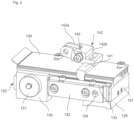
- ist eine perspektivische Ansicht eines Abschnitts der in
Fig. 1 dargestellten Crimpvorrichtung. - Fig. 3
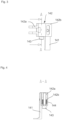
- ist eine Draufsicht auf den in
Fig. 1 und2 dargestellten Vorschubelementhalter. - Fig. 4
- ist eine Schnittansicht des in
Fig. 3 dargestellten Vorschubelementhalters in der Schnittebene A-A. - Fig. 5
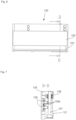
- zeigt eine Detailansicht des Tisches der Crimpvorrichtung gemäß
Fig. 1 . - Fig. 6
- zeigt eine Draufsicht auf den in
Fig. 5 dargestellten Tisch. - Fig. 7
- ist eine Schnittansicht in der Schnittebene B-B in
Fig. 6 . - Fig. 8
- zeigt eine perspektivische Ansicht eines Trägerkörpers.
- Anhand der beigefügten Figuren wird eine bevorzugte Ausführungsform im Detail erläutert.
-
Fig. 1 zeigt eine Crimpvorrichtung 100, die zum Aufbringen eines Kontaktelements an einem elektrischen Leiter verwendet werden kann. Derartige Kontaktelemente sind üblicherweise in einem Kontaktelementband zusammengefasst, das der Crimpvorrichtung 100 zugeführt wird. Beispielsweise kann ein Kontaktelementband in Rollenform benachbart zur Crimpvorrichtung 100 vorgesehen sein und von der Rolle in den Bereich der Crimpvorrichtung 100 geführt werden. Mittels der Crimpvorrichtung 100 werden dann die einzelnen Kontaktelemente verarbeitet. - Die Crimpvorrichtung 100 umfasst einen Grundkörper 101, der mehrere Abschnitte/Bereiche aufweist.
- Unterhalb eines Abschnitts des Grundkörpers 101 ist ein Crimpstempel 150 der Crimpvorrichtung 100 vorgesehen, der in einer vertikalen Richtung nach unten in Richtung eines Amboss 151 bewegt und auf diese Weise mit dem zugeführten Kontaktelement in Eingriff gebracht werden kann.
- Ferner umfasst die Crimpvorrichtung 100 einen Tisch 120, dessen Aufbau nachfolgend nochmals detaillierter erläutert werden soll. Benachbart zum Tisch 120 ist eine Bremse 130 sowie eine Exzenterscheibe 131 vorgesehen. Ferner ist am Tisch 120 eine vordere Kontaktführung 132 angebracht, an der eine Vorschubelementführung 133 befestigt ist. Die Vorschubelementführung 133 kann nach Lösen der diese verbindenden Befestigungsmittel (Schrauben) relativ zur vorderen Kontaktführung 132 bewegt werden.
- Am Tisch 120 ist eine in Form eines Blechs ausgebildete Streifenführung 134 befestigt. Vor Inbetriebnahme der Crimpvorrichtung 100 wird die Streifenführung 134 am Tisch 120 ausgerichtet und fixiert.
- Zwischen der oberhalb des Tischs 120 vorgesehenen Streifenführung 134 und der Vorschubelementführung 133, die durch die vordere Kontaktführung 132 gehalten wird, werden im Betrieb der Crimpvorrichtung die Kontaktelemente des Kontaktelementbandes geführt (in
Figur 1 von links nach rechts). - In vertikaler Richtung oberhalb der Streifenführung 134 ist eine Vorschubvorrichtung 140 vorgesehen.
- Die Vorschubvorrichtung 140 umfasst ein Vorschubelement 141, das einen sich im Wesentlichen in einer horizontalen Richtung erstreckenden Abschnitt sowie einen sich im Wesentlichen in vertikaler Richtung erstreckenden Abschnitt umfasst. Der sich im Wesentlichen in vertikaler Richtung erstreckende Abschnitt erstreckt sich abschnittsweise in einen Bereich zwischen der Vorschubelementführung 133 und der Streifenführung 134.
- Der Vorschubelementhalter 142 umfasst eine Vorschubelementhalterbasis 142a sowie ein Vorschubelementanbringungselement 142b. Somit ist der Vorschubelementhalter 142 zweiteilig ausgestaltet. Zur Verbindung der Vorschubelementhalterbasis 142a und des Vorschubelementanbringungselements 142b ist eine Stellschraube (Stellelement) 143 vorgesehen, um ineinander eingreifende Abschnitte der Vorschubelementhalterbasis 142a und des Vorschubelementanbringungselements 142b miteinander zu verbinden.
- Das Vorschubelement 141 ist mit einem Vorschubelementhalter 142 verbunden, indem das Vorschubelement 141 am Vorschubelementanbringungselement 142b befestigt ist. Hierzu ist am Vorschubelementanbringungselement 142b ein Langloch vorgesehen, durch das ein Befestigungselement, wie eine Schraube, geführt werden kann. Gemäß einer weiteren Ausführungsform kann das Vorschubelement 141 auch mit dem Vorschubelementhalter 142 verbunden sein, indem das Vorschubelement 141 einstückig mit dem Vorschubelementanbringungselement 142b ausgebildet ist.
- Aus der Schnittansicht entlang der Linie A-A von
Fig. 3 , die inFig. 4 dargestellt ist, ist ersichtlich, dass innerhalb der Vorschubelementhalterbasis 142a eine Tellerfeder 144 (erstes elastisches Element) vorgesehen ist, mit der eine Vorspannung der Vorschubelementhalterbasis 142a und des Vorschubelementanbringungselements 142b bereitgestellt wird. - Gegenüber einer konventionellen Bauweise hat die zweiteilige Ausgestaltung des Vorschubelementhalters 142 den Vorteil, dass durch die Zugänglichkeit der Stellschraube 143 eine Feineinstellung der Position des Vorschubelementanbringungselements 142b relativ zur Vorschubelementhalterbasis 142a durchgeführt werden kann, sodass das Vorschubelement 141 in einer horizontalen Richtung relativ zur Streifenführung 134 bewegt werden kann. Die Verstellbewegung liegt hierbei bevorzugt im Bereich von +/-1mm.
- Der Vorschubelementhalter 142 ist mittels einer Schwenkachse 146 mit einem Vorschubarm 145 verbunden. Somit ist der Vorschubelementhalter 142 um die sich (bevorzugt in einer horizontalen Richtung erstreckende) Schwenkachse 146 relativ zum Vorschubarm 145 schwenkbar. Durch diese Schwenkbewegung kann das Vorschubelement 141 im Betrieb der Crimpvorrichtung bei einer Rückwärtsbewegung/Rückzugsbewegung der Vorschubvorrichtung 140 eine Öffnung im Kontaktelementband überspringen.
- Der Vorschubarm 145 ist mit einem Bewegungselement 147 verbunden, das durch eine Führung 148 gehalten wird. Durch die Führung 148 wird eine Bewegungsrichtung des Bewegungselements 147 vorgegeben.
- Wird das Bewegungselement 147 beim Betrieb der Crimpvorrichtung 100 in einer Richtung der Führung 148 bewegt, so kann bei einer Bewegung des Bewegungselements 147 in Richtung des den Crimpstempel aufnehmenden Abschnitts des Grundkörpers 101 durch das Vorschubelement 141 ein Kontaktelement in Richtung des den Crimpstempel aufnehmenden Abschnitts des Grundkörpers 101 verschoben werden. Unterhalb des den Crimpstempel aufnehmenden Abschnitts des Grundkörpers 101 ist der Crimpstempel 150 der Crimpvorrichtung 100 vorgesehen, der in einer vertikalen Richtung nach unten in Richtung des Amboss 151 bewegt und auf diese Weise mit dem zugeführten Kontaktelement in Eingriff gebracht werden kann.
- Nachdem ein Kontaktelement am elektrischen Leiter aufgebracht wurde, wird das Bewegungselement 147 in einer Rückwärtsbewegung vom den Crimpstempel 150 aufnehmenden Abschnitt des Grundkörpers 101 entfernt. Hierdurch wird das Vorschubelement 141 ebenfalls vom den Crimpstempel 150 aufnehmenden Abschnitt des Grundkörpers, und somit vom Betätigungsbereich des Crimpstempels und des Amboss 151, zurückbewegt.
- Da der Vorschubelementhalter 142 schwenkbar am Vorschubarm 145 angebracht ist, klappt/schwenkt der Vorschubelementhalter 142 bei der Rückwärtsbewegung des Bewegungselements 147 nach oben (in
Fig. 1 entgegen des Uhrzeigersinns um die Schwenkachse 146), wenn das Vorschubelement 141 aus einer am Kontaktelementband vorgesehenen Öffnung herausgeführt wird. - Gemäß einer Modifikation kann die Crimpvorrichtung 100 jedoch auch für eine Zuführung in einer entgegengesetzten Richtung ausgebildet sein. In diesem Fall würde der Vorschubelementhalter bei der Rückwärtsbewegung des Bewegungselements im Uhrzeigersinn nach oben klappen.
- Das Vorschubelement 141 wird dann zu einer nachrangigen Öffnung am Kontaktelementband bewegt und kann in diese eingreifen. Somit kann das in einem nachfolgenden Bearbeitungsgang zuzuführende Kontaktelement vom Vorschubelement 141 durch Eingriff in die nachrangige Öffnung des Kontaktelementbands in Richtung des Amboss 151 bewegt werden.
- Der Tisch 120 weist beispielsweise ein Tischelement 121 auf, das in einer (in einer vertikalen Richtung oberen) Seite mit einer ersten Nut 122 sowie einer zweiten Nut 123 versehen ist. In der ersten Nut 122 kann ein Kontaktelement geführt werden. Die zweite Nut 123 kann eine Führung für das Vorschubelement 141 bereithalten. Insbesondere wird eine Spitze des Vorschubelements 141 in der zweiten Nut 123 aufgenommen. Die zweite Nut 123 stellt bei Bedarf auch einen Freiraum bereit, falls ein Kontaktelementband mit Prägungen oder ähnlichen mechanischen Führungen versehen sein sollte.
- An der zur vorderen Kontaktführung 132 weisenden Seite des Tischelements 121 ist eine Stellschraubenbohrung 124 vorgesehen.
- Obwohl der in der vorliegenden Ausführungsform beschriebene Tisch 120 die erste Nut 122 und die zweite Nut 123 aufweist, kann gemäß weiteren Modifikationen auch ein Tisch mit nur einer dieser Nuten oder ein Tisch ohne Nut bereitgestellt werden.
- An einer (in vertikaler Richtung unteren) Seite des Tischelements 121 ist beispielsweise ein Trägerkörper 125 vorgesehen, der eine Führung 126 für das Tischelement 121 bereitstellt.
- In der Darstellung von
Fig. 5 ist zum Zwecke der Illustration in der Stellschraubenbohrung 124 keine Schraube eingefügt. Im Betriebszustand der Crimpvorrichtung 100 befindet sich jedoch in der Stellschraubenbohrung 124 eine Stellschraube (Stellelement) 127, die in der Schnittansicht B-B gemäßFig. 7 dargestellt ist. Die Stellschraube 127 verbindet den Trägerkörper 125 mit dem Tischelement 121. Dabei ist im Verbindungsbereich eine Tellerfeder 128 (zweites elastisches Element) vorgesehen, die durch ein Anziehen der Stellschraube 127 komprimiert wird. - Ferner sind Befestigungsschrauben 129 vorgesehen, die durch ein Langloch 125a des Trägerkörpers 125 geführt und in das Tischelement 121 eingeschraubt sind. Die Befestigungsschrauben 129 sind im Ausführungsbeispiel mittels Federn 129a vorgespannt.
- Durch die Befestigungsschrauben 129 werden das Tischelement 121 und der Trägerkörper 125 vorgespannt aneinander befestigt. Durch die vorgespannte Befestigung ist ein relatives Verstellen des Tischelements 121 und des Trägerkörpers 125 relativ zueinander möglich.
- Zur zusätzlichen Verankerung der Befestigungsschrauben 129 sind zwei Madenschrauben 160 im Tischelement 121 vorgesehen. Die Madenschrauben 160 sind an ihrer Spitze mit einem Kunststoffelement 161 versehen, das bei einer Betätigung der Madenschrauben 160 mit den Befestigungsschrauben 129 in Eingriff gelangt und in deren Gewinde eingedrückt wird und eine Verdrehung verhindert.
- Obwohl im Ausführungsbeispiel zwei Madenschrauben 160 eingesetzt werden, können gemäß weiteren Modifikationen auch ein anderes Fixiermittel oder andere Fixiermittel zum Einsatz kommen.
- Der zweiteilige Aufbau des Tisches 120 mit dem Tischelement 121 und dem Trägerkörper 125 hat den Vorteil, dass mittels der durch eine Öffnung in der vorderen Kontaktführung 132 zugänglichen Stellschraube 127 eine Feinjustierung der Position des Tischelements 121 im eingebauten Zustand des Tisches 120 vorgenommen werden kann, ohne Bauteile der Crimpvorrichtung 100 aus dieser zu entnehmen.
- Dabei kann eine Verstellung des Vorschubelements 141 mittels der Stellschraube 143 durch eine quantitative gleichartige Verstellbewegung des Tischelements 121 mittels der Stellschraube 127 durchgeführt werden, um stets eine gleiche relative Position des Tisches 120 zum Vorschubelement 141 beizubehalten. Dies kann auch im eingebauten Zustand des Tisches 120, insbesondere von einer Bedienseite, erfolgen.
- Obwohl in der Ausführungsform eine Verstellmöglichkeit des Tischelements 121 relativ zum Trägerkörper 125 sowie eine Verstellbewegung des Vorschubelementanbringungselements 142b relativ zur Vorschubelementhalterbasis 142 beschrieben ist, kann bei weiteren Ausführungsformen auch lediglich eine der genannten Verstellbewegungen bei einer Crimpvorrichtung implementiert sein.
Claims (13)
- Vorschubvorrichtung (140) für eine Crimpvorrichtung (100), umfassend:ein Vorschubelement (141), das für einen Eingriff an einem Kontaktelementband eingerichtet ist,einen Vorschubelementhalter (142), der mit dem Vorschubelement (141) verbunden ist,
wobei der Vorschubelementhalter (142) eine Vorschubelementhalterbasis (142a) und ein Vorschubelementanbringungselement (142b) aufweist, die relativ zueinander verstellbar sind, ferner umfassend einen Vorschubarm (145) und ein Bewegungselement (147), wobei der Vorschubelementhalter (142) relativ zum Vorschubarm (145) schwenkbar ist, wobei der Vorschubarm (145) mit dem Bewegungselement (147) verbunden ist, das eingerichtet ist, eine translatorische Bewegung durchzuführen,dadurch gekennzeichet, dass das Vorschubelement (141) am Vorschubelementanbringungselement (142b) befestigt ist, und dass zur relativen Verstellung der Vorschubelementhalterbasis (142a) und des Vorschubelementanbringungselements (142b) ein erstes Stellelement (143) vorgesehen ist, das mittels eines ersten elastischen Elements (144) vorgespannt ist. - Vorschubvorrichtung (140) gemäß Anspruch 1, wobei das erste elastische Element (144) eine Feder, insbesondere eine Tellerfeder, ist.
- Vorschubvorrichtung (140) gemäß Anspruch 2, wobei sich das erste Stellelement (143) in einer horizontalen Richtung erstreckt.
- Vorschubvorrichtung (140) gemäß einem der vorangegangenen Ansprüche, wobei das Vorschubelementanbringungselement (142b) im Bereich von +/- 1mm zur Vorschubelementhalterbasis (142a) verstellbar ist.
- Vorschubvorrichtung (140) gemäß einem der vorangegangenen Ansprüche, wobei ein Abschnitt der Vorschubelementhalterbasis (142a) derart in das Vorschubelementanbringungselement (142b) eingeführt ist, dass das Vorschubelementanbringungselement (142b) entlang eines Freiheitsgrads, insbesondere entlang einer translatorischen Achse, bewegbar ist.
- Vorschubvorrichtung (140) gemäß einem der vorangegangenen Ansprüche, wobei die Vorschubelementhalterbasis (142a) und das Vorschubelementanbringungselement (142b) mittels Drahtschneiden und/oder Fräsen hergestellt sind.
- Crimpvorrichtung (100), umfassend:eine Vorschubvorrichtung (140) nach einem der vorangegangenen Ansprüche,einen Tisch (120), der einen Trägerkörper (125) und ein Tischelement (121) aufweist, die miteinander verbunden und relativ zueinander verstellbar sind.
- Crimpvorrichtung (100) gemäß Anspruch 7, wobei zur relativen Verstellung des Trägerkörpers (125) und des Tischelements (121) ein zweites Stellelement (127) vorgesehen ist, das mittels eines zweiten elastischen Elements (128), bevorzugt einer Feder, insbesondere einer Tellerfeder, vorgespannt ist.
- Crimpvorrichtung (100) gemäß Anspruch 8, wobei sich das zweite Stellelement (127) in einer horizontalen Richtung erstreckt.
- Crimpvorrichtung (100) gemäß einem der Ansprüche 7-9, wobei der Trägerkörper (125) und das Tischelement (121) mittels zumindest eines Befestigungsbauteils (129), insbesondere einer Befestigungsschraube, miteinander befestigt sind.
- Crimpvorrichtung (100) gemäß einem der Ansprüche 7-10, wobei das Tischelement (121) im Bereich von +/- 1mm zum Trägerkörper (125) verstellbar ist.
- Crimpvorrichtung (100) gemäß einem der Ansprüche 7-11, ferner umfassend eine, insbesondere translatorische, Führung (126), um die relative Verstellung des Tischelements (121) zum Trägerkörper (125) zu führen.
- Crimpvorrichtung (100) gemäß einem der Ansprüche 7-12, ferner umfassend eine an einer Seite des Tischelements (121) angebrachte Streifenführung (134), wobei das Tischelement (121) an der zur Streifenführung weisenden Seite eine erste Nut (122) und/oder eine zweite Nut (123) aufweist.
Applications Claiming Priority (1)
| Application Number | Priority Date | Filing Date | Title |
|---|---|---|---|
| DE102019217305.5A DE102019217305A1 (de) | 2019-11-08 | 2019-11-08 | Vorschubvorrichtung für eine Crimpvorrichtung sowie Crimpvorrichtung |
Publications (3)
| Publication Number | Publication Date |
|---|---|
| EP3820002A1 EP3820002A1 (de) | 2021-05-12 |
| EP3820002C0 EP3820002C0 (de) | 2024-10-09 |
| EP3820002B1 true EP3820002B1 (de) | 2024-10-09 |
Family
ID=73138660
Family Applications (1)
| Application Number | Title | Priority Date | Filing Date |
|---|---|---|---|
| EP20205873.1A Active EP3820002B1 (de) | 2019-11-08 | 2020-11-05 | Vorschubvorrichtung für eine crimpvorrichtung sowie crimpvorrichtung |
Country Status (3)
| Country | Link |
|---|---|
| EP (1) | EP3820002B1 (de) |
| DE (1) | DE102019217305A1 (de) |
| PL (1) | PL3820002T3 (de) |
Families Citing this family (1)
| Publication number | Priority date | Publication date | Assignee | Title |
|---|---|---|---|---|
| CN116845666B (zh) * | 2023-06-29 | 2024-03-19 | 佛山市通宝华龙控制器有限公司 | 一种温控器端子的压弯设备 |
Family Cites Families (7)
| Publication number | Priority date | Publication date | Assignee | Title |
|---|---|---|---|---|
| US5577318A (en) * | 1995-07-27 | 1996-11-26 | Molex Incorporated | Electrical terminal applicator with improved track adjustment means |
| US5666719A (en) * | 1996-07-01 | 1997-09-16 | The Whitaker Corporation | Feed mechanism for a terminal applicator |
| DE19750770A1 (de) * | 1997-11-10 | 1999-06-02 | Wolfgang Hanke | Crimpwerkzeug |
| KR100497526B1 (ko) * | 2005-02-02 | 2005-07-01 | 이지봉 | 단자결착기의 단자이송 조절기구 |
| US8578597B2 (en) * | 2010-08-23 | 2013-11-12 | Tyco Electronics Corporation | Feed mechanism for a terminal crimping machine |
| JP6100138B2 (ja) * | 2013-10-17 | 2017-03-22 | 日本オートマチックマシン株式会社 | 端子送り装置、端子圧着機用アプリケータ、端子圧着機及び端子圧着電線の製造方法 |
| KR101798566B1 (ko) * | 2017-02-23 | 2017-11-17 | 임다영 | 전원단자 결착장치 |
-
2019
- 2019-11-08 DE DE102019217305.5A patent/DE102019217305A1/de active Pending
-
2020
- 2020-11-05 EP EP20205873.1A patent/EP3820002B1/de active Active
- 2020-11-05 PL PL20205873.1T patent/PL3820002T3/pl unknown
Also Published As
| Publication number | Publication date |
|---|---|
| EP3820002C0 (de) | 2024-10-09 |
| EP3820002A1 (de) | 2021-05-12 |
| DE102019217305A1 (de) | 2021-05-12 |
| PL3820002T3 (pl) | 2025-03-03 |
Similar Documents
| Publication | Publication Date | Title |
|---|---|---|
| DE10229873B4 (de) | Durchstoßanschluss, sowie Vorrichtung und Verfahren zum Anquetschen eines Durchstoßanschlusses | |
| DE69700388T2 (de) | Fahrzeugsitzverriegelung und Sitz mit einem solchen Mechanismus | |
| EP3198681B1 (de) | Leiteranschlussklemme und verfahren zu deren montage | |
| DE69917387T2 (de) | Verbinder mit Hebel | |
| EP0988172A1 (de) | Fahrzeugsitz mit verschiebbarer kopfstütze | |
| EP3504756B1 (de) | Anschlussklemme | |
| EP2685573A2 (de) | Crimpwerkzeug für gedrehte Kontakte | |
| DE4111054C2 (de) | ||
| DE102017107943B3 (de) | Verriegelungsmechanismus zur lösbaren Verriegelung eines ersten Bauteils an einem zweiten Bauteil sowie damit gebildete Anordnung | |
| EP4358310A1 (de) | Anschlussklemme zum anschliessen einer elektrischen leitung | |
| EP0490066A2 (de) | Crimpzange zum Verpressen von Aderendhülsen | |
| EP1671407B1 (de) | Automatische abisolierzange | |
| EP1410959B1 (de) | Baugruppe mit einem Lenkradgrundkörper und einem Gassackmodul | |
| DE602005003366T2 (de) | Schnelle Kupplungs- und Unkupplungs-Vorrichtung für das Oberwerkzeug einer Biegepresse | |
| EP3820002A1 (de) | Vorschubvorrichtung für eine crimpvorrichtung sowie crimpvorrichtung | |
| DE102024106285A1 (de) | Leiteranschlussklemme | |
| EP4358309A1 (de) | Anschlussklemme zum anschliessen einer elektrischen leitung | |
| DE10255617A1 (de) | Fassung für elektrische Bauteile | |
| DE102018123923A1 (de) | Anschlussklemme | |
| DE69401271T3 (de) | Werkzeug zum gleichzeitigen verpressen einer vielzahl von isolierten drähten in einem elektrischen verbinder | |
| LU503120B1 (de) | Anschlussklemme zum Anschließen einer elektrischen Leitung | |
| LU503121B1 (de) | Anschlussklemme zum Anschließen einer elektrischen Leitung | |
| EP4338238B1 (de) | Anschlussvorrichtung | |
| EP4498528B1 (de) | Einteilige federkraftklemme für mindestens einen elektrischen leiter | |
| DE102004002462B3 (de) | Anschlussklemme |
Legal Events
| Date | Code | Title | Description |
|---|---|---|---|
| PUAI | Public reference made under article 153(3) epc to a published international application that has entered the european phase |
Free format text: ORIGINAL CODE: 0009012 |
|
| STAA | Information on the status of an ep patent application or granted ep patent |
Free format text: STATUS: THE APPLICATION HAS BEEN PUBLISHED |
|
| AK | Designated contracting states |
Kind code of ref document: A1 Designated state(s): AL AT BE BG CH CY CZ DE DK EE ES FI FR GB GR HR HU IE IS IT LI LT LU LV MC MK MT NL NO PL PT RO RS SE SI SK SM TR |
|
| STAA | Information on the status of an ep patent application or granted ep patent |
Free format text: STATUS: REQUEST FOR EXAMINATION WAS MADE |
|
| 17P | Request for examination filed |
Effective date: 20211011 |
|
| RBV | Designated contracting states (corrected) |
Designated state(s): AL AT BE BG CH CY CZ DE DK EE ES FI FR GB GR HR HU IE IS IT LI LT LU LV MC MK MT NL NO PL PT RO RS SE SI SK SM TR |
|
| STAA | Information on the status of an ep patent application or granted ep patent |
Free format text: STATUS: EXAMINATION IS IN PROGRESS |
|
| 17Q | First examination report despatched |
Effective date: 20220913 |
|
| GRAP | Despatch of communication of intention to grant a patent |
Free format text: ORIGINAL CODE: EPIDOSNIGR1 |
|
| STAA | Information on the status of an ep patent application or granted ep patent |
Free format text: STATUS: GRANT OF PATENT IS INTENDED |
|
| INTG | Intention to grant announced |
Effective date: 20240528 |
|
| GRAS | Grant fee paid |
Free format text: ORIGINAL CODE: EPIDOSNIGR3 |
|
| GRAA | (expected) grant |
Free format text: ORIGINAL CODE: 0009210 |
|
| STAA | Information on the status of an ep patent application or granted ep patent |
Free format text: STATUS: THE PATENT HAS BEEN GRANTED |
|
| AK | Designated contracting states |
Kind code of ref document: B1 Designated state(s): AL AT BE BG CH CY CZ DE DK EE ES FI FR GB GR HR HU IE IS IT LI LT LU LV MC MK MT NL NO PL PT RO RS SE SI SK SM TR |
|
| REG | Reference to a national code |
Ref country code: CH Ref legal event code: EP |
|
| REG | Reference to a national code |
Ref country code: DE Ref legal event code: R096 Ref document number: 502020009421 Country of ref document: DE |
|
| REG | Reference to a national code |
Ref country code: IE Ref legal event code: FG4D Free format text: LANGUAGE OF EP DOCUMENT: GERMAN |
|
| U01 | Request for unitary effect filed |
Effective date: 20241009 |
|
| U07 | Unitary effect registered |
Designated state(s): AT BE BG DE DK EE FI FR IT LT LU LV MT NL PT RO SE SI Effective date: 20241015 |
|
| U20 | Renewal fee for the european patent with unitary effect paid |
Year of fee payment: 5 Effective date: 20241120 |
|
| PG25 | Lapsed in a contracting state [announced via postgrant information from national office to epo] |
Ref country code: HR Free format text: LAPSE BECAUSE OF FAILURE TO SUBMIT A TRANSLATION OF THE DESCRIPTION OR TO PAY THE FEE WITHIN THE PRESCRIBED TIME-LIMIT Effective date: 20241009 Ref country code: IS Free format text: LAPSE BECAUSE OF FAILURE TO SUBMIT A TRANSLATION OF THE DESCRIPTION OR TO PAY THE FEE WITHIN THE PRESCRIBED TIME-LIMIT Effective date: 20250209 |
|
| PG25 | Lapsed in a contracting state [announced via postgrant information from national office to epo] |
Ref country code: ES Free format text: LAPSE BECAUSE OF FAILURE TO SUBMIT A TRANSLATION OF THE DESCRIPTION OR TO PAY THE FEE WITHIN THE PRESCRIBED TIME-LIMIT Effective date: 20241009 |
|
| PG25 | Lapsed in a contracting state [announced via postgrant information from national office to epo] |
Ref country code: NO Free format text: LAPSE BECAUSE OF FAILURE TO SUBMIT A TRANSLATION OF THE DESCRIPTION OR TO PAY THE FEE WITHIN THE PRESCRIBED TIME-LIMIT Effective date: 20250109 |
|
| PG25 | Lapsed in a contracting state [announced via postgrant information from national office to epo] |
Ref country code: GR Free format text: LAPSE BECAUSE OF FAILURE TO SUBMIT A TRANSLATION OF THE DESCRIPTION OR TO PAY THE FEE WITHIN THE PRESCRIBED TIME-LIMIT Effective date: 20250110 |
|
| PG25 | Lapsed in a contracting state [announced via postgrant information from national office to epo] |
Ref country code: RS Free format text: LAPSE BECAUSE OF FAILURE TO SUBMIT A TRANSLATION OF THE DESCRIPTION OR TO PAY THE FEE WITHIN THE PRESCRIBED TIME-LIMIT Effective date: 20250109 |
|
| PG25 | Lapsed in a contracting state [announced via postgrant information from national office to epo] |
Ref country code: SM Free format text: LAPSE BECAUSE OF FAILURE TO SUBMIT A TRANSLATION OF THE DESCRIPTION OR TO PAY THE FEE WITHIN THE PRESCRIBED TIME-LIMIT Effective date: 20241009 |
|
| PG25 | Lapsed in a contracting state [announced via postgrant information from national office to epo] |
Ref country code: MC Free format text: LAPSE BECAUSE OF FAILURE TO SUBMIT A TRANSLATION OF THE DESCRIPTION OR TO PAY THE FEE WITHIN THE PRESCRIBED TIME-LIMIT Effective date: 20241009 |
|
| PG25 | Lapsed in a contracting state [announced via postgrant information from national office to epo] |
Ref country code: SK Free format text: LAPSE BECAUSE OF FAILURE TO SUBMIT A TRANSLATION OF THE DESCRIPTION OR TO PAY THE FEE WITHIN THE PRESCRIBED TIME-LIMIT Effective date: 20241009 |
|
| PG25 | Lapsed in a contracting state [announced via postgrant information from national office to epo] |
Ref country code: CZ Free format text: LAPSE BECAUSE OF FAILURE TO SUBMIT A TRANSLATION OF THE DESCRIPTION OR TO PAY THE FEE WITHIN THE PRESCRIBED TIME-LIMIT Effective date: 20241009 |
|
| PLBE | No opposition filed within time limit |
Free format text: ORIGINAL CODE: 0009261 |
|
| STAA | Information on the status of an ep patent application or granted ep patent |
Free format text: STATUS: NO OPPOSITION FILED WITHIN TIME LIMIT |
|
| 26N | No opposition filed |
Effective date: 20250710 |
|
| GBPC | Gb: european patent ceased through non-payment of renewal fee |
Effective date: 20250109 |
|
| PG25 | Lapsed in a contracting state [announced via postgrant information from national office to epo] |
Ref country code: GB Free format text: LAPSE BECAUSE OF NON-PAYMENT OF DUE FEES Effective date: 20250109 |
|
| PG25 | Lapsed in a contracting state [announced via postgrant information from national office to epo] |
Ref country code: IE Free format text: LAPSE BECAUSE OF NON-PAYMENT OF DUE FEES Effective date: 20241105 |
|
| REG | Reference to a national code |
Ref country code: CH Ref legal event code: U11 Free format text: ST27 STATUS EVENT CODE: U-0-0-U10-U11 (AS PROVIDED BY THE NATIONAL OFFICE) Effective date: 20251201 |
|
| U20 | Renewal fee for the european patent with unitary effect paid |
Year of fee payment: 6 Effective date: 20251127 |
|
| PGFP | Annual fee paid to national office [announced via postgrant information from national office to epo] |
Ref country code: CH Payment date: 20251201 Year of fee payment: 6 |
|
| PGFP | Annual fee paid to national office [announced via postgrant information from national office to epo] |
Ref country code: PL Payment date: 20251020 Year of fee payment: 6 |
|
| PG25 | Lapsed in a contracting state [announced via postgrant information from national office to epo] |
Ref country code: HU Free format text: LAPSE BECAUSE OF FAILURE TO SUBMIT A TRANSLATION OF THE DESCRIPTION OR TO PAY THE FEE WITHIN THE PRESCRIBED TIME-LIMIT; INVALID AB INITIO Effective date: 20201105 |
|
| PG25 | Lapsed in a contracting state [announced via postgrant information from national office to epo] |
Ref country code: CY Free format text: LAPSE BECAUSE OF FAILURE TO SUBMIT A TRANSLATION OF THE DESCRIPTION OR TO PAY THE FEE WITHIN THE PRESCRIBED TIME-LIMIT; INVALID AB INITIO Effective date: 20201105 |