EP3817840B1 - Verwendung eines katalysators zur selektiven katalytischen oxidation von stickstoffhaltigen organischen verbindungen - Google Patents
Verwendung eines katalysators zur selektiven katalytischen oxidation von stickstoffhaltigen organischen verbindungen Download PDFInfo
- Publication number
- EP3817840B1 EP3817840B1 EP19737493.7A EP19737493A EP3817840B1 EP 3817840 B1 EP3817840 B1 EP 3817840B1 EP 19737493 A EP19737493 A EP 19737493A EP 3817840 B1 EP3817840 B1 EP 3817840B1
- Authority
- EP
- European Patent Office
- Prior art keywords
- catalyst
- component
- nitrogen
- zeolite
- exhaust gas
- Prior art date
- Legal status (The legal status is an assumption and is not a legal conclusion. Google has not performed a legal analysis and makes no representation as to the accuracy of the status listed.)
- Active
Links
Images
Classifications
-
- B—PERFORMING OPERATIONS; TRANSPORTING
- B01—PHYSICAL OR CHEMICAL PROCESSES OR APPARATUS IN GENERAL
- B01D—SEPARATION
- B01D53/00—Separation of gases or vapours; Recovering vapours of volatile solvents from gases; Chemical or biological purification of waste gases, e.g. engine exhaust gases, smoke, fumes, flue gases, aerosols
- B01D53/34—Chemical or biological purification of waste gases
- B01D53/74—General processes for purification of waste gases; Apparatus or devices specially adapted therefor
- B01D53/86—Catalytic processes
- B01D53/8621—Removing nitrogen compounds
-
- A—HUMAN NECESSITIES
- A23—FOODS OR FOODSTUFFS; TREATMENT THEREOF, NOT COVERED BY OTHER CLASSES
- A23F—COFFEE; TEA; THEIR SUBSTITUTES; MANUFACTURE, PREPARATION, OR INFUSION THEREOF
- A23F5/00—Coffee; Coffee substitutes; Preparations thereof
- A23F5/04—Methods of roasting coffee
-
- B—PERFORMING OPERATIONS; TRANSPORTING
- B01—PHYSICAL OR CHEMICAL PROCESSES OR APPARATUS IN GENERAL
- B01D—SEPARATION
- B01D53/00—Separation of gases or vapours; Recovering vapours of volatile solvents from gases; Chemical or biological purification of waste gases, e.g. engine exhaust gases, smoke, fumes, flue gases, aerosols
- B01D53/34—Chemical or biological purification of waste gases
- B01D53/74—General processes for purification of waste gases; Apparatus or devices specially adapted therefor
- B01D53/86—Catalytic processes
- B01D53/8678—Removing components of undefined structure
- B01D53/8687—Organic components
-
- B—PERFORMING OPERATIONS; TRANSPORTING
- B01—PHYSICAL OR CHEMICAL PROCESSES OR APPARATUS IN GENERAL
- B01D—SEPARATION
- B01D2255/00—Catalysts
- B01D2255/20—Metals or compounds thereof
- B01D2255/204—Alkaline earth metals
-
- B—PERFORMING OPERATIONS; TRANSPORTING
- B01—PHYSICAL OR CHEMICAL PROCESSES OR APPARATUS IN GENERAL
- B01D—SEPARATION
- B01D2255/00—Catalysts
- B01D2255/20—Metals or compounds thereof
- B01D2255/206—Rare earth metals
- B01D2255/2065—Cerium
-
- B—PERFORMING OPERATIONS; TRANSPORTING
- B01—PHYSICAL OR CHEMICAL PROCESSES OR APPARATUS IN GENERAL
- B01D—SEPARATION
- B01D2255/00—Catalysts
- B01D2255/20—Metals or compounds thereof
- B01D2255/207—Transition metals
- B01D2255/2073—Manganese
-
- B—PERFORMING OPERATIONS; TRANSPORTING
- B01—PHYSICAL OR CHEMICAL PROCESSES OR APPARATUS IN GENERAL
- B01D—SEPARATION
- B01D2255/00—Catalysts
- B01D2255/20—Metals or compounds thereof
- B01D2255/207—Transition metals
- B01D2255/20738—Iron
-
- B—PERFORMING OPERATIONS; TRANSPORTING
- B01—PHYSICAL OR CHEMICAL PROCESSES OR APPARATUS IN GENERAL
- B01D—SEPARATION
- B01D2255/00—Catalysts
- B01D2255/20—Metals or compounds thereof
- B01D2255/207—Transition metals
- B01D2255/20761—Copper
-
- B—PERFORMING OPERATIONS; TRANSPORTING
- B01—PHYSICAL OR CHEMICAL PROCESSES OR APPARATUS IN GENERAL
- B01D—SEPARATION
- B01D2255/00—Catalysts
- B01D2255/50—Zeolites
-
- B—PERFORMING OPERATIONS; TRANSPORTING
- B01—PHYSICAL OR CHEMICAL PROCESSES OR APPARATUS IN GENERAL
- B01D—SEPARATION
- B01D2255/00—Catalysts
- B01D2255/50—Zeolites
- B01D2255/502—Beta zeolites
-
- B—PERFORMING OPERATIONS; TRANSPORTING
- B01—PHYSICAL OR CHEMICAL PROCESSES OR APPARATUS IN GENERAL
- B01D—SEPARATION
- B01D2255/00—Catalysts
- B01D2255/50—Zeolites
- B01D2255/504—ZSM 5 zeolites
-
- B—PERFORMING OPERATIONS; TRANSPORTING
- B01—PHYSICAL OR CHEMICAL PROCESSES OR APPARATUS IN GENERAL
- B01D—SEPARATION
- B01D2255/00—Catalysts
- B01D2255/90—Physical characteristics of catalysts
- B01D2255/908—O2-storage component incorporated in the catalyst
-
- B—PERFORMING OPERATIONS; TRANSPORTING
- B01—PHYSICAL OR CHEMICAL PROCESSES OR APPARATUS IN GENERAL
- B01D—SEPARATION
- B01D2258/00—Sources of waste gases
- B01D2258/02—Other waste gases
- B01D2258/0275—Other waste gases from food processing plants or kitchens
Definitions
- the invention relates to the use of a catalyst for the selective catalytic oxidation of nitrogen-containing organic compounds, namely in the exhaust gas of a coffee roasting device or a coffee roasting process.
- emission limits for example for VOCs (volatile organic compounds), carbon monoxide and nitrogen oxides.
- Exhaust gas aftertreatment of the exhaust gas from the roasting processes can contribute to this.
- Exhaust gas aftertreatment of exhaust gas from roasting processes with (precious metal-containing) oxidation catalysts has already been proposed.
- Corresponding oxidation catalysts help to oxidize organic compounds and carbon monoxide.
- the nitrogen oxides are preferentially reduced to nitrogen, while undesirable side reactions such as the formation of nitrous oxide (N 2 O) are largely suppressed.
- the disadvantages of SCR technology are that it requires complex process control and that an additional additive or reducing agent, such as urea or ammonia, is required.
- an additional additive or reducing agent such as urea or ammonia, is required.
- such substances are not used in the food industry. fundamentally undesirable, so their use in this context should be avoided wherever possible.
- the object of the present invention is to at least partially solve the problems described with reference to the prior art.
- a use of a catalyst for treating nitrogen-containing organic compounds in the exhaust gas is to be specified, which at least contributes to making a catalytic conversion of the nitrogen-containing organic compounds possible without (significant) formation of nitrogen oxides and without the addition of an additive (in particular a reducing agent such as urea or ammonia).
- the solution proposed here has the particular advantage that a catalytic conversion of the nitrogen-containing organic compounds, in particular from the exhaust gas of (coffee) roasting processes, can be carried out without the formation of nitrogen oxides and without the addition of a reducing agent such as urea or ammonia.
- a catalytic conversion of the nitrogen-containing organic compounds in particular from the exhaust gas of (coffee) roasting processes, can be carried out without the formation of nitrogen oxides and without the addition of a reducing agent such as urea or ammonia.
- a reducing agent such as urea or ammonia.
- the catalyst is designed in particular for the selective catalytic oxidation of nitrogen-containing organic compounds, in particular nitrogen-containing organic hydrocarbons.
- nitrogen-containing organic hydrocarbons in particular nitrogen-containing organic hydrocarbons.
- carbon groups within (organic hydrocarbons) are preferably oxidized to carbon monoxide (CO) and carbon dioxide (CO 2 ), while undesirable side reactions such as in particular the total oxidation of nitrogen, for example to nitrogen oxide (NO) or nitrogen dioxide (NO 2 ), are largely or almost completely suppressed.
- the catalyst is designed to oxidize only carbon groups and/or only chemical elements that differ from nitrogen.
- the catalyst is so selective that it (in particular within a nitrogen-containing organic compound or during the oxidation of a nitrogen-containing organic compound) only oxidizes carbon groups within an organic compound to CO and CO 2 and/or only partially or completely oxidizes certain chemical elements, in particular chemical elements that differ from nitrogen.
- the catalyst is so selective that it selectively oxidizes nitrogen-containing molecular groups within the hydrocarbon chain to nitrogen and not to NOx, in particular during the Oxidation of a nitrogen-containing organic compound does not oxidize the nitrogen to NOx.
- An example of a nitrogen-containing organic compound that can play a role in roasting processes is caffeine.
- Caffeine has the chemical formula C 8 H 10 N 4 O 2 .
- the following example of caffeine illustrates the selective oxidation of this nitrogen-containing organic compound using a corresponding reaction equation: 2 C 8 H 10 N 4 O 2 + 19 O 2 ⁇ 4 N 2 + 16 CO 2 + 10 H 2 O
- the catalyst is preferably used for the selective catalytic oxidation or selective catalytic oxidation of nitrogen-containing organic compounds in the exhaust gas of a coffee roasting device.
- the exhaust gas of the coffee roasting device usually concerns the exhaust air from the roasting processes. This exhaust air usually contains nitrogen-containing organic compounds, such as caffeine.
- Roasted coffee contains about 835 volatile compounds. These can be divided into 21 compound classes. These classes of compounds include aliphatic hydrocarbons (with 45 volatile compounds), aromatic hydrocarbons (with 35 volatile compounds), alcohols (with 25 volatile compounds), aldehydes (with 37 volatile compounds), ketones (with 85 volatile compounds), acids (with 28 volatile compounds), esters (with 33 volatile compounds), amines (with 13 volatile compounds), pyrroles (with 72 volatile compounds), pyridines (with 20 volatile compounds), pyrazines (with 89 volatile compounds), quinoxalines (with 11 volatile compounds), furanones (with 128 volatile compounds), oxazoles (with 35 volatile compounds), thiols (with 7 volatile compounds), sulfides (with 13 volatile compounds), disulfides (with 10 volatile compounds), thiophenes (with 28 volatile compounds), Thiazoles (with 27 volatile compounds), phenols (with 49 volatile compounds) and others (with 45 volatile compounds).
- aliphatic hydrocarbons with 45 volatile compounds
- aromatic hydrocarbons with
- the catalyst for selective catalytic oxidation
- the catalyst can in principle also comprise further components.
- the catalyst consists (only) of the first component, the second component and the third component.
- the catalyst has a first component comprising at least one element from the group consisting of copper, manganese, iron or a mixture thereof.
- first component comprises copper, manganese and/or iron and/or comprises a mixture of copper, manganese and/or iron.
- Manganese and/or copper are particularly preferably used as the first component.
- the chemical elements from the first component group exhibit a mild oxidation activity (compared to noble metals) and can therefore be particularly well suited for the partial oxidation of nitrogen-containing organic compounds compared to noble metals, which would lead to their complete oxidation.
- the catalyst further has a second component comprising cerium.
- the elements of the second component can form mixed oxides with elements of the first component, which are particularly advantageous for selective oxidation.
- the catalyst also has a third component comprising at least one element from the group consisting of a zeolite, an oxygen storage material, an inorganic oxide or a mixture thereof.
- a third component comprising at least one element from the group consisting of a zeolite, an oxygen storage material, an inorganic oxide or a mixture thereof.
- the third component comprises a zeolite, an oxygen storage material and/or an inorganic oxide and/or a mixture of a zeolite, an oxygen storage material and/or an inorganic oxide.
- the third component serves as a carrier for the active metals of the first component and/or second component.
- the complex structure of zeolites as a carrier for the active metals can help to achieve a selective oxidation of nitrogen-containing organic materials. This mode of action is also referred to as "shape selectivity".
- the oxygen storage material supports the oxidation of organic materials adsorbed on the catalyst surface by providing a highly reactive oxygen atom from the lattice.
- a zeolite is particularly preferably used as the third component.
- a mixture of zeolites can also be used as the third component.
- the zeolite or the mixture of zeolites can be in the H form, the Na form, the ammonium form or a mixture thereof.
- the zeolite or the mixture of zeolites is particularly preferably in the H form.
- an oxygen storage material can preferably be used as the third component.
- An oxygen storage material can comprise a cerium oxide-based material.
- An oxygen storage material can absorb oxygen from oxygen-rich feed streams and release (the stored) oxygen (again) to oxygen-poor feed streams.
- the oxygen storage material can also be a carrier for the first component and/or the second component.
- an inorganic oxide can preferably be used as the third component.
- the inorganic oxide can, for example, be at least one of the group consisting of aluminum oxide, silicon dioxide, titanium dioxide and silicon dioxide-aluminum oxide.
- the inorganic oxide can be present as a solid solution, as a composite and/or as mixtures from the above-mentioned group of inorganic oxides.
- a preferably used inorganic oxide is silicon oxide.
- the inorganic oxides can be used, for example, as part of a washcoat.
- Inorganic oxides can advantageously improve the rheology of aqueous slurries for the (optional) washcoat and/or improve washcoat adhesion to a substrate, particularly when the catalyst is to be coated on a monolith.
- the first component constitutes (about) 1 to (about) 15 weight percent of the catalyst. Preferably, the first component constitutes 2 to 10 weight percent of the catalyst.
- the weight percentages refer to the dry mass of the catalyst.
- the minimum specified can ensure that there are still enough active metals on the surface of the catalyst to provide enough active sites for adsorption and catalytic reaction.
- the maximum amount should be determined based on the available surface area of the support. Too high a proportion of active metals in the first component could lead to reduced dispersion and thus to rapid sintering of the active metals during use and thus to loss of activity.
- the second component constitutes (about) 2 to (about) 25 weight percent of the catalyst. Preferably, the second component constitutes 5 to 20 weight percent of the catalyst.
- a (pre)determinable ratio range between the first component and the second component can lead to a better activity of the catalyst. Therefore, the amount of the second component in the catalyst should depend on the amount of the first component.
- the second component can be provided with a larger, approximately equal or smaller weight proportion than the first component.
- the third component constitutes (about) 5 to (about) 95 weight percent of the catalyst. Preferably, the third component constitutes 50 to 85 weight percent of the catalyst.
- the third component provides a surface for a good dispersion of the selected active metals (combination of the first component and the second component). Therefore, an appropriate ratio range between the third component and the sum of the first component and the second components must be selected.
- the third component comprises a zeolite.
- the zeolite is one from the group consisting of EMC-2, beta zeolite, mordenite, faujasite, AIPO-5, theta-1, ZSM zeolite, MCM zeolite, ferrierite or a mixture thereof.
- ZSM-5 is preferably used as the zeolite.
- Zeolites containing large rings (8 or more T atoms) in the framework may be particularly advantageous for the application (" shape selectivity ”) .
- the catalyst is used in particular in such a way that the formation of nitrogen oxides in the exhaust gas is at least partially prevented.
- the catalyst is used in such a way that no additive is added for the reaction with the exhaust gas. This means in particular that the "untreated" Exhaust gas is fed to the catalyst directly or without the addition of an exhaust-external fluid or solid.
- the use is preferred such that the (entire) exhaust gas is fed to the catalyst in the first (catalytic) treatment step.
- an oxidation catalyst is used for the aftertreatment of the exhaust gas of the coffee roasting device.
- the oxidation catalyst only comes into contact with the exhaust gas (spatially and/or temporally) after the catalyst for selective catalytic oxidation.
- the oxidation catalyst is used in particular to oxidize the carbon monoxide in the (pretreated) exhaust gas.
- an oxidation catalyst which comprises platinum (Pt) and/or palladium (Pd) as a carrier on an inorganic oxide (e.g., aluminum oxide, titanium oxide, or the like).
- an inorganic oxide e.g., aluminum oxide, titanium oxide, or the like.
- the catalyst is used without the addition of an additive, e.g. a reducing agent for the SCR reaction.
- a reducing agent for the SCR reaction e.g. a reducing agent for the SCR reaction.
- the reducing agent is, for example, urea or ammonia.
- urea is also referred to as a so-called reducing agent precursor, from which the actual reducing agent ammonia can be generated.
- the catalyst does not require such a reducing agent, in particular because the catalyst is used (only) for selective oxidation (and not for reduction).
- the catalyst is used at an exhaust gas temperature greater than or equal to 350°C [degrees Celsius]. Particularly preferably, the catalyst is used at an exhaust gas temperature greater than or equal to 400°C. In the case of coffee roasting It can be provided that the exhaust gas is first heated before it is fed to the catalyst.
- the catalyst can be formed into a shape such as a honeycomb structure, pellets or beads.
- the catalyst is applied to a metallic or ceramic honeycomb structure.
- the catalyst can be extruded into an extrudate, in particular a monolith.
- the catalyst can have a substrate and a catalytic layer, in particular a catalytic coating, connected to the substrate.
- the substrate can be formed in the form of a (solid) catalyst carrier body, for example by means of a ceramic or metallic monolith. Alternatively or cumulatively, the substrate can comprise pellets or beads.
- the substrate can be, for example, a structure that forms channels through which the exhaust gas can flow.
- the structure can be metallic or ceramic.
- the structure is preferably a honeycomb structure, in particular a ceramic or metallic honeycomb structure. If the catalyst has a substrate, the above weight percentages generally refer to the catalytic layer or coating located thereon and not to the total weight including the substrate.
- the use of the catalyst is particularly suitable for the aftertreatment of exhaust gases from a coffee roasting process.
- coffee beans are exposed to high heat (roasted) in order to release their aromatic substances. This is done in particular in a dry or steam-containing environment at temperatures of approx. 100 °C to approx. 500 °C (roasting temperature) over a predetermined time of, for example, 2 to 20 minutes.
- the gases produced during roasting are subjected to exhaust gas aftertreatment, preferably using the catalyst proposed here.
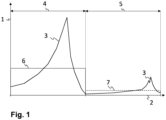
- Fig. 1 shows a schematic illustration of a reduction in nitrogen oxide emissions in coffee roasting exhaust gases that could be achieved with the solution proposed here.
- the NOx concentration 1 is plotted against time 2.
- the illustration shows a curve 3 of the NOx concentration against time.
- Fig. 1 concerns an exhaust gas measurement result in a test for which a drum roaster was used as the roasting device, in which the roasting time was twelve minutes in each case and in which a Robusta bean was used as the bean type.
- roasting processes were carried out, each with a roasting time of twelve minutes.
- the roasting exhaust gases were treated with a conventional oxidation catalyst.
- the roasting exhaust gases were additionally treated using the solution proposed here (and post-treated with the oxidation catalyst).
- a first average NOx concentration 6 of approximately 500 mg/Nm 3 was measured.
- a second mean NOx concentration 7 of approximately 100 mg/Nm 3 was measured.
- the conventional oxidation catalyst used in the experiment has the following characteristics: 60 g/ ft3 of noble metal loading in a ratio of 1/2/0 (Pt/Pd/Rh) on base metal oxide.
- a catalyst for the selective catalytic oxidation of nitrogen-containing organic compounds in the exhaust gas of a coffee roasting device which at least partially solves the problems described with reference to the prior art.
- the use of a catalyst for the selective catalytic oxidation of nitrogen-containing organic compounds in the exhaust gas of a coffee roasting device is specified, which at least contributes to the catalytic conversion of the nitrogen-containing organic compounds from the exhaust air of roasting processes being possible, if possible without the formation of nitrogen oxides and without the addition of a reducing agent, such as urea or ammonia.
Landscapes
- Engineering & Computer Science (AREA)
- Chemical & Material Sciences (AREA)
- Environmental & Geological Engineering (AREA)
- General Chemical & Material Sciences (AREA)
- Biomedical Technology (AREA)
- Analytical Chemistry (AREA)
- Health & Medical Sciences (AREA)
- Oil, Petroleum & Natural Gas (AREA)
- Chemical Kinetics & Catalysis (AREA)
- Life Sciences & Earth Sciences (AREA)
- Food Science & Technology (AREA)
- Polymers & Plastics (AREA)
- Catalysts (AREA)
Description
- Die Erfindung betrifft eine Verwendung eines Katalysators zur selektiven katalytischen Oxidation von stickstoffhaltigen organischen Verbindungen, nämlich im Abgas einer Kaffeeröstvorrichtung bzw. eines Kaffeeröstprozesses. Auch im Zusammenhang mit Kaffeeröstvorgängen sind Emissionsgrenzwerte, etwa für VOC's (flüchtige organische Verbindungen), Kohlenstoffmonoxid und Stickoxide einzuhalten. Hierzu kann eine Abgasnachbehandlung des Abgases aus den Röstvorgängen beitragen. Vorgeschlagen wurde bereits eine Abgasnachbehandlung von Abgas aus Röstvorgängen mit (edelmetallhaltigen) Oxidationskatalysatoren. Entsprechende Oxidationskatalysatoren tragen dazu bei, organische Verbindungen und Kohlenstoffmonoxid zu oxidieren.
- Ein Nachteil solcher Oxidationskatalysatoren ist jedoch die Bildung von Stickoxiden (NOx) durch die Oxidation stickstoffhaltiger organischer Verbindungen. Um diesem Nachteil entgegenzuwirken, wurden bisher verschiedene Möglichkeiten vorgeschlagen. Eine Möglichkeit besteht in der selektiven nicht katalytischen Reduktion (sog. SNCR-Technologie), die sehr energieaufwendig bei hohen Temperaturen mit Hilfe eines Reduktionsmittels, wie etwa Ammoniak oder Harnstoff erfolgt. Diese ist allerdings platzaufwändig sowie unpraktisch für kleinere Anlagen und lässt sich daher nicht immer realisieren. Eine weitere Möglichkeit besteht darin, zusätzlich einen Katalysator zur selektiven katalytischen Reduktion (sog. SCR-Technologie) einzusetzen. Dieser dient der Reduktion von Stickoxiden (NOx) im Abgas, wobei die chemische Reaktion am SCR-Katalysator selektiv ist, d.h., dass die Stickoxide (NO, NO2) bevorzugt zu Stickstoff reduziert werden, während unerwünschte Nebenreaktionen wie die Bildung von Lachgas (N2O) weitgehend unterdrückt werden. Nachteile der SCR-Technologie sind jedoch darin zu sehen, dass diese zum einen eine ggf. aufwendige Prozesssteuerung erforderlich macht und zum anderen hierzu ein zusätzliches Additiv bzw. Reduktionsmittel, wie etwa Harnstoff oder Ammoniak notwendig ist. Solche Stoffe sind jedoch in der Lebensmittelindustrie grundsätzlich unerwünscht, sodass deren Einsatz in diesem Zusammenhang möglichst zu vermeiden ist.
- Aus der
WO 2017/064654 A1 ist ein Verfahren zur Behandlung der Abgase einer Kaffeeröstanlage bekannt. - Hiervon ausgehend ist es Aufgabe der vorliegenden Erfindung, die mit Bezug auf den Stand der Technik geschilderten Probleme zumindest teilweise zu lösen. Insbesondere soll eine Verwendung eines Katalysators zur Behandlung von stickstoffhaltigen organischen Verbindungen im Abgas (insbesondere einer Kaffeeröstvorrichtung) angegeben werden, die zumindest dazu beiträgt, dass eine katalytische Umsetzung der stickstoffhaltigen organischen Verbindungen möglichst ohne (beachtliche) Bildung von Stickoxiden und ohne Zugabe eines Additives (insbesondere Reduktionsmittels, wie etwa Harnstoff oder Ammoniak) möglich ist.
- Hierzu trägt eine Verwendung eines Katalysators zur selektiven katalytischen Oxidation von stickstoffhaltigen organischen Verbindungen zur Nachbehandlung eines Abgases eines Kaffeeröstprozesses bei, wobei die Bildung von Stickoxiden im Abgas zumindest teilweise unterbunden wird, wobei der Katalysator umfasst:
- eine erste Komponente, umfassend zumindest ein Element der Gruppe bestehend aus Kupfer, Mangan, Eisen oder eine Mischung davon, wobei die erste Komponente 1 bis 15 Gewichtsprozent des Katalysators bildet;
- eine zweite Komponente umfassend Cer, wobei die zweite Komponente 2 bis 25 Gewichtsprozent des Katalysators bildet; und
- eine dritte Komponente, umfassend zumindest ein Element der Gruppe bestehend aus einem Zeolith, einem Sauerstoffspeichermaterial, einem anorganischen Oxid oder eine Mischung davon, wobei die dritte Komponente 5 bis 95 Gewichtsprozent des Katalysators bildet.
- Die hier vorgeschlagene Lösung erlaubt den besonderen Vorteil, dass eine katalytische Umsetzung der stickstoffhaltigen organischen Verbindungen, insbesondere aus dem Abgas von (Kaffee-)Röstprozessen, möglichst ohne Bildung von Stickoxiden und ohne Zusatz eines Reduktionsmittels, wie etwa Harnstoff oder Ammoniak möglich ist. Dies wird insbesondere dadurch erreicht, dass die hier vorgeschlagene Kombination von erster Komponente, zweiter Komponente und dritter Komponente in vorteilhafter Weise dazu beiträgt, dass die Oxidation selektiv ausgeführt wird, was insbesondere bedeutet, dass bei der Oxidation von stickstoffhaltigen organischen Verbindungen der Stickstoff gezielt nicht oxidiert wird, wodurch die Bildung ungewünschter Stickoxide (NOx) praktisch vermieden werden kann. Dadurch kann eine (sich an herkömmliche Oxidationskatalysatoren anschließende) Reduktion von Stickoxiden vorteilhaft entfallen, sodass kein Reduktionsmittel verwendet werden muss.
- Der Katalysator ist insbesondere zur selektiven katalytischen Oxidation von stickstoffhaltigen organischen Verbindungen, insbesondere stickstoffhaltigen organischen Kohlenwasserstoffen, eingerichtet. Dies bedeutet mit anderen Worten insbesondere, dass die chemische Reaktion am Katalysator selektiv ist. Hierbei werden bevorzugt Kohlenstoffgruppen innerhalb (organischer Kohlenwasserstoffe zu Kohlenmonoxid (CO) und Kohlendioxid (CO2) oxidiert, während unerwünschte Nebenreaktionen wie insbesondere die Totaloxidation von Stickstoff, beispielsweise zu Stickstoffoxid (NO) oder Stickstoffdioxid (NO2), weitgehend oder nahezu vollständig unterdrückt werden.
- Insbesondere ist der Katalysator dazu eingerichtet, nur Kohlenstoffgruppen und/oder nur sich von Stickstoff unterscheidende chemische Elemente zu oxidieren. Dies bedeutet mit anderen Worten insbesondere, dass der Katalysator derart selektiv ist, dass er (insbesondere innerhalb einer stickstoffhaltigen organischen Verbindung bzw. bei der Oxidation einer stickstoffhaltigen organischen Verbindung) nur Kohlenstoffgruppen innerhalb einer organischen Verbindung zu CO und CO2 oxidiert und/oder nur bestimmte chemische Elemente, insbesondere sich von Stickstoff unterscheidende chemische Elemente partiell oder vollständig oxidiert. Dies bedeutet mit noch anderen Worten insbesondere, dass der Katalysator derart selektiv ist, dass er stickstoffhaltige Molekülgruppen innerhalb der Kohlenwasserstoffkette selektiv zu Stickstoff und nicht zu NOx oxidiert, insbesondere bei der Oxidation einer stickstoffhaltigen organischen Verbindung den Stickstoff nicht zu NOx oxidiert.
- Ein Beispiel für eine stickstoffhaltige organische Verbindung, die im Zusammenhang mit Röstvorgängen eine Rolle spielen kann, ist Koffein. Koffein hat die chemische Summenformel C8H10N4O2. Nachfolgend wird am Beispiel von Koffein eine selektive Oxidation dieser stickstoffhaltigen organischen Verbindung anhand einer entsprechenden Reaktionsgleichung veranschaulicht:
2 C8H10N4O2 + 19 O2 → 4 N2 + 16 CO2 + 10 H2O
- Der Katalysator wird bevorzugt zur selektiven katalytischen Oxidation bzw. zum selektiven katalytischen Oxidieren von stickstoffhaltigen organischen Verbindungen im Abgas einer Kaffeeröstvorrichtung verwendet. Das Abgas der Kaffeeröstvorrichtung betrifft hierbei regelmäßig die Abluft aus den Röstvorgängen. Diese Abluft enthält in der Regel stickstoffhaltige organische Verbindungen, wie etwa Koffein.
- Röstkaffe enthält ca. 835 flüchtige Verbindungen. Diese können in 21 Verbindungsklassen eingeteilt werden. Zu diesen Verbindungsklassen zählen aliphatische Kohlenwasserstoffe (mit 45 flüchtigen Verbindungen), aromatische Kohlenwasserstoffe (mit 35 flüchtigen Verbindungen), Alkohole (mit 25 flüchtigen Verbindungen), Aldehyde (mit 37 flüchtigen Verbindungen), Ketone (mit 85 flüchtigen Verbindungen), Säuren (mit 28 flüchtigen Verbindungen), Ester (mit 33 flüchtigen Verbindungen), Amine (mit 13 flüchtigen Verbindungen), Pyrrole (mit 72 flüchtigen Verbindungen), Pyridine (mit 20 flüchtigen Verbindungen), Pyrazine (mit 89 flüchtigen Verbindungen), Chinoxaline (mit 11 flüchtigen Verbindungen), Furanone (mit 128 flüchtigen Verbindungen), Oxazole (mit 35 flüchtigen Verbindungen), Thiole (mit 7 flüchtigen Verbindungen), Sulfide (mit 13 flüchtigen Verbindungen), Disulfide (mit 10 flüchtigen Verbindungen), Thiophene (mit 28 flüchtigen Verbindungen), Thiazole (mit 27 flüchtigen Verbindungen), Phenole (mit 49 flüchtigen Verbindungen) und sonstige (mit 45 flüchtigen Verbindungen).
- Der Katalysator (zur selektiven katalytischen Oxidation) umfasst mindestens drei Komponenten, nämlich zumindest eine erste Komponente, eine zweite Komponente und eine dritte Komponente. Darüber hinaus kann der Katalysator grundsätzlich auch noch weitere Komponenten umfassen. Nach einer vorteilhaften Ausgestaltung besteht der Katalysator (nur) aus der ersten Komponente, der zweiten Komponente und der dritten Komponente.
- Der Katalysator hat eine erste Komponente, umfassend zumindest ein Element der Gruppe bestehend aus Kupfer, Mangan, Eisen oder eine Mischung davon. Dies bedeutet mit anderen Worten insbesondere, dass die erste Komponente Kupfer, Mangan und/oder Eisen umfasst und/oder eine Mischung von Kupfer, Mangan und/oder Eisen umfasst. Als erste Komponente werden besonders bevorzugt Mangan und/oder Kupfer verwendet.
- Die chemischen Elemente aus der ersten Komponentengruppe weisen eine (gegenüber Edelmetallen) milde Oxidationsaktivität auf und können daher besonders gut für die partielle Oxidation der stickstoffhaltigen organischen Verbindungen im Vergleich zu Edelmetallen, die zu ihrer vollständigen Oxidation führen würden, geeignet sein.
- Der Katalysator hat weiterhin eine zweite Komponente, umfassend Cer.
- Die Elemente der zweiten Komponente können Mischoxide mit Elementen der ersten Komponente bilden, welche insbesondere vorteilhaft zur selektiven Oxidation sind.
- Der Katalysator hat zudem eine dritte Komponente, umfassend zumindest ein Element der Gruppe bestehend aus einem Zeolith, einem Sauerstoffspeichermaterial, einem anorganischen Oxid oder eine Mischung davon. Dies bedeutet mit anderen Worten insbesondere, dass die dritte Komponente einen Zeolith, ein Sauerstoffspeichermaterial und/oder ein anorganisches Oxid umfasst und/oder eine Mischung von einem Zeolith, einem Sauerstoffspeichermaterial und/oder einem anorganischen Oxid umfasst.
- Die dritte Komponente dient als Träger für die aktiven Metalle der ersten Komponente und/oder zweiten Komponente.
- Die komplexe Struktur von Zeolithen als Träger für die aktiven Metalle kann dazu beitragen, eine selektive Oxidation von stickstoffhaltigen organischen Materialien zu erreichen. Diese Wirkungsweise wird auch als "shape selectivity" bezeichnet.
- Das Sauerstoffspeichermaterial unterstützt die Oxidation von organischen Materialien, die an der Katalysatoroberfläche adsorbiert sind, indem es ein hochreaktives Sauerstoffatom aus dem Gitter bereitstellt.
- Als dritte Komponente wird besonders bevorzugt ein Zeolith verwendet. Als dritte Komponente kann darüber hinaus auch eine Mischung von Zeolithen verwendet werden. Der Zeolith oder die Mischung von Zeolithen kann in der H-Form, der Na-Form, der Ammoniumform oder einer Mischung davon vorliegen. Besonders bevorzugt liegt der Zeolith oder die Mischung von Zeolithen in der H-Form vor.
- Alternativ oder kumulativ kann als dritte Komponente bevorzugt ein Sauerstoffspeichermaterial verwendet werden. Ein Sauerstoffspeichermaterial kann ein Material auf Cer-Oxid-Basis umfassen. Ein Sauerstoffspeichermaterial kann Sauerstoff aus sauerstoffreichen Zufuhrströmen aufnehmen und (den gespeicherten) Sauerstoff (wieder) an sauerstoffarme Zufuhrströme abgeben. Das Sauerstoffspeichermaterial kann auch ein Träger für die erste Komponente und/oder die zweite Komponente sein.
- Besonders bevorzugt ist die Verwendung einer Mischung aus einem Zeolith und einem Sauerstoffspeichermaterial.
- Alternativ oder kumulativ kann als dritte Komponente bevorzugt ein anorganisches Oxid verwendet werden. Bei dem anorganischen Oxid kann es sich beispielsweise um zumindest eines der Gruppe bestehend aus Aluminiumoxid, Siliciumdioxid, Titandioxid und Siliciumdioxid-Aluminiumoxid handeln. Darüber hinaus kann das anorganische Oxid als feste Lösung, als Verbundstoff und/oder als Mischungen aus der genannten Gruppe von anorganischen Oxiden vorliegen. Ein bevorzugt verwendetes anorganisches Oxid ist Siliziumoxid.
- Die anorganischen Oxide können beispielsweise als Teil eines Washcoats verwendet werden. Anorganische Oxide können in vorteilhafter Weise die Rheologie von wässrigen Aufschlämmungen für den (optionalen) Washcoat verbessern und/oder die Washcoat-Haftung an einem Substrat verbessern, insbesondere wenn der Katalysator auf einen Monolithen aufgetragen werden soll.
- Die erste Komponente bildet (etwa) 1 bis (etwa) 15 Gewichtsprozent des Katalysators. Bevorzugt bildet die erste Komponente 2 bis 10 Gewichtsprozent des Katalysators.
- Die Gewichtsprozentangaben beziehen sich auf die Trockenmasse des Katalysators.
- Mit dem angegebenen Minimum kann erreicht werden, dass noch ausreichend aktive Metalle auf der Oberfläche des Katalysators vorhanden sind, um genügend aktive Stellen für die Adsorption und die katalytische Reaktion bereitzustellen. Die maximale Menge sollte basierend auf der verfügbaren Oberfläche des Trägers bestimmt werden. Ein zu großer Anteil an aktiven Metallen der ersten Komponente könnte zu einer reduzierten Dispergierung und damit zu einem schnellen Sintern der aktiven Metalle während des Einsatzes und damit zum Aktivitätsverlust führen.
- Die zweite Komponente bildet (etwa) 2 bis (etwa) 25 Gewichtsprozent des Katalysators. Bevorzugt bildet die zweite Komponente 5 bis 20 Gewichtsprozent des Katalysators.
- Ein (vor)bestimmbarer Verhältnisbereich zwischen der ersten Komponente und der zweiten Komponente kann zu einer besseren Aktivität des Katalysators führen. Daher sollte die Menge der zweiten Komponente in dem Katalysator von der Menge der ersten Komponente abhängen. Beispielsweise kann die zweite Komponente mit einem größeren, etwa gleichen oder kleineren Gewichtsanteil als die erste Komponente vorgesehen sein.
- Die dritte Komponente bildet (etwa) 5 bis (etwa) 95 Gewichtsprozent des Katalysators. Bevorzugt bildet die dritte Komponente 50 bis 85 Gewichtsprozent des Katalysators.
- Die dritte Komponente liefert eine Oberfläche für eine gute Dispersion der gewählten aktiven Metalle (Kombination der ersten Komponente und zweiten Komponente). Daher ist ein angepasster Verhältnisbereich zwischen der dritten Komponente und der Summe der ersten Komponente und zweiten Komponenten zu wählen.
- Nach einer vorteilhaften Ausgestaltung wird vorgeschlagen, dass die dritte Komponente einen Zeolith umfasst. In diesem Zusammenhang ist es besonders bevorzugt, wenn der Zeolith einer aus der Gruppe bestehend aus EMC-2, Beta-Zeolith, Mordenit, Faujasit, AIPO-5, Theta-1, ZSM-Zeolith, MCM-Zeolith, Ferrierit oder eine Mischung davon ist. Bevorzugt wird ZSM-5 als Zeolith verwendet.
- Zeolithe, die im Gerüst große Ringe (8 oder mehr T-Atome) enthalten, können für die Anwendung besonders vorteilhaft sein ("shape selectivity").
- Der Katalysator wird insbesondere so verwendet, dass die Bildung von Stickoxiden im Abgas zumindest teilweise unterbunden wird.
- Der Katalysator wird insbesondere so verwendet, dass für die Reaktion mit dem Abgas kein Additiv zugegeben wird. Das meint insbesondere, dass das "unbehandelte" Abgas direkt bzw. ohne Hinzufügen eines abgasexternen Fluids oder Feststoffs dem Katalysator zugeführt wird.
- Die Verwendung ist so bevorzugt, dass das (gesamte) Abgas im ersten (katalytischen) Behandlungsschritt dem Katalysator zugeführt wird.
- Nach einer vorteilhaften Ausgestaltung wird vorgeschlagen, dass zusätzlich zu dem Katalysator zur selektiven katalytischen Oxidation ein Oxidationskatalysator zur Nachbehandlung des Abgases der Kaffeeröstvorrichtung verwendet wird.
- In der Regel kommt der Oxidationskatalysator dabei insbesondere erst (räumlich und/oder zeitlich) nach dem Katalysator zur selektiven katalytischen Oxidation in Kontakt mit dem Abgas. Das bedeutet mit anderen Worten insbesondere, dass der Oxidationskatalysator stromab des Katalysators zur selektiven katalytischen Oxidation angeordnet ist. Der Oxidationskatalysator wird insbesondere dazu verwendet, im Kohlenmonoxid im (vorbehandelten) Abgas zu oxidieren.
- Als Beispiel für einen solchen Oxidationskatalysator sei hier einer angegeben, der Platin (Pt) oder/und Palladium (Pd) als Träger auf einem anorganischen Oxid (z.B. Aluminiumoxid, Titanoxid, oder dergleichen) umfasst.
- Grundsätzlich wird der Katalysator ohne Zusatz eines Additivs, z. B. eines Reduktionsmittels für die SCR-Reaktion verwendet. Bei dem Reduktionsmittel handelt es sich beispielsweise um Harnstoff oder Ammoniak. In diesem Zusammenhang wird Harnstoff auch als sog. Reduktionsmittelvorläufer bezeichnet, aus dem das eigentliche Reduktionsmittel Ammoniak generiert werden kann. Der Katalysator kommt insbesondere deshalb ohne ein solches Reduktionsmittel aus, da der Katalysator (nur) zur selektiven Oxidation (und nicht zur Reduktion) dient.
- Bevorzugt wird der Katalysator bei einer Abgastemperatur größer oder gleich 350°C [Grad Celsius] verwendet. Besonders bevorzugt wird der Katalysator bei einer Abgastemperatur größer oder gleich 400°C verwendet. Für den Fall der Kaffeeröstung kann vorgesehen sein, dass das Abgas zunächst noch erhitzt wird, bevor es dem Katalysator zugeführt wird.
- In einer Ausführungsform kann der Katalysator in eine Form, wie etwa eine Wabenstruktur, Pellets oder Kügelchen geformt sein. Bevorzugt ist der Katalysator auf eine metallische oder keramische Wabenstruktur aufgebracht. In einer alternativen Ausführungsform kann der Katalysator zu einem Extrudat, insbesondere Monolith extrudiert sein.
- Darüber hinaus kann der Katalysator ein Substrat und eine mit dem Substrat verbundene katalytische Schicht, insbesondere katalytische Beschichtung aufweisen. Das Substrat kann in der Art eines (festen) Katalysatorträgerkörpers, beispielsweise mittels eines keramischen oder metallischen Monoliths gebildet sein. Alternativ oder kumulativ kann das Substrat Pellets oder Kügelchen umfassen. Bei dem Substrat kann es sich beispielsweise um eine insbesondere für das Abgas durchströmbare Kanäle ausbildende Struktur handeln. Die Struktur kann metallisch oder keramisch sein. Bevorzugt handelt es sich bei der Struktur um eine insbesondere keramische oder metallische Wabenstruktur. Wenn der Katalysator ein Substrat aufweist, beziehen sich die obigen Gewichtsprozentangaben grundsätzlich auf die darauf befindliche katalytische Schicht bzw. Beschichtung und nicht auf das Gesamtgewicht inklusive Substrat.
- Die Verwendung des Katalysators eignet sich insbesondere zur Nachbehandlung eines Abgases eines Kaffeeröstprozesses.
- Bei einem Kaffeeröstprozess werden Kaffeebohnen einer großen Hitze ausgesetzt (also geröstet), um ihre Aromastoffe zu lösen. Dies erfolgt insbesondere in einer trockenen oder wasserdampfhaltigen Umgebung bei Temperaturen von ca. 100 °C bis ca. 500 °C (Rösttemperatur) über eine vorgegebene Zeit von beispielsweise 2 bis 20 min. Die während der Röstung entstehenden Gase werden einer Abgasnachbehandlung unterzogen, wobei bevorzugt der hier vorgeschlagenen Katalysator verwendet wird.
- Die hier vorgestellte Lösung sowie deren technisches Umfeld werden nachfolgend anhand der Figuren näher erläutert. Es ist darauf hinzuweisen, dass die Erfindung durch die gezeigten Ausführungsbeispiele nicht beschränkt werden soll. Insbesondere ist es, soweit nicht explizit anders dargestellt, auch möglich, Teilaspekte der in den Figuren erläuterten Sachverhalte zu extrahieren und mit anderen Bestandteilen und/oder Erkenntnissen aus anderen Figuren und/oder der vorliegenden Beschreibung zu kombinieren. Es zeigt schematisch:
- Fig. 1:
- eine Veranschaulichung einer Reduzierung der Stickoxid-Emission in Kaffee-Röstabgasen, die mit der hier vorgeschlagenen Lösung erzielt werden konnte.
-
Fig. 1 zeigt schematisch eine Veranschaulichung einer Reduzierung der Stickoxid-Emission in Kaffee-Röstabgasen, die mit der hier vorgeschlagenen Lösung erzielt werden konnte. Hierbei ist die NOx-Konzentration 1 über der Zeit 2 aufgetragen. Die Veranschaulichung zeigt einen Verlauf 3 der NOx-Konzentration über der Zeit. - Die Veranschaulichung gemäß
Fig. 1 betrifft ein Abgasmessergebnis bei einem Versuch, für den als Röstvorrichtung ein Trommelröster verwendet wurde, bei dem die Röstdauer jeweils zwölf Minuten betragen hat und bei dem als Bohnenart eine Robusta-Bohne verwendet wurde. - Es wurden zwei Röstvorgänge durchgeführt, die jeweils eine Röstdauer von zwölf Minuten aufwiesen. Während der ersten Röstdauer 4 wurden die Röstabgase mit einem herkömmlichen Oxidationskatalysator behandelt. Während der zweiten Röstdauer 5 wurden die Röstabgase zusätzlich unter Verwendung der hier vorgeschlagenen Lösung behandelt (und mit dem Oxidationskatalysator nachbehandelt).
- Während der ersten Röstdauer 4 konnte eine erste mittlere NOx-Konzentration 6 von ca. 500 mg/Nm3 gemessen werden. Während der zweiten Röstdauer 5 konnte eine zweite mittlere NOx-Konzentration 7 von ca. 100 mg/Nm3 gemessen werden. Somit konnte die hier vorgeschlagenen Lösung zu einer deutlichen Reduzierung der Stickoxid-Emission (hier um ca. 80%) beitragen.
- Der dazu verwendete, beispielhafte Katalysator umfasste:
- als erste Komponente: Kupfer und Mangan (ca. 9 Gewichtsprozent);
- als zweite Komponente: Cer (ca. 12 Gewichtsprozent);
- als dritte Komponente: einen Zeolith, nämlich ZSM-5, ein Sauerstoffspeichermaterial und Siliziumoxid (ca. 79 Gewichtsprozent).
- Der bei dem Versuch verwendete herkömmliche Oxidationskatalysator weist folgende Merkmale auf: 60 g / ft3 Edelmetallbeladung im Verhältnis 1/2/0 (Pt / Pd / Rh) auf Basismetalloxid.
- Hier vorgeschlagen wird (somit) eine Verwendung eines Katalysators zur selektiven katalytischen Oxidation von stickstoffhaltigen organischen Verbindungen im Abgas einer Kaffeeröstvorrichtung, welche die mit Bezug auf den Stand der Technik geschilderten Probleme zumindest teilweise löst. Insbesondere wird eine Verwendung eines Katalysators zur selektiven katalytischen Oxidation von stickstoffhaltigen organischen Verbindungen im Abgas einer Kaffeeröstvorrichtung angegeben, die zumindest dazu beiträgt, dass eine katalytische Umsetzung der stickstoffhaltigen organischen Verbindungen aus der Abluft von Röstprozessen möglichst ohne Bildung von Stickoxiden und ohne Zusatz eines Reduktionsmittels, wie etwa Harnstoff oder Ammoniak möglich ist.
-
- 1
- NOx-Konzentration
- 2
- Zeit
- 3
- Verlauf
- 4
- erste Röstdauer
- 5
- zweite Röstdauer
- 6
- erste mittlere NOx-Konzentration
- 7
- zweite mittlere NOx-Konzentration
Claims (5)
- Verwendung eines Katalysators zur selektiven katalytischen Oxidation von stickstoffhaltigen organischen Verbindungen zur Nachbehandlung eines Abgases eines Kaffeeröstprozesse, wobei die Bildung von Stickoxiden im Abgas zumindest teilweise unterbunden wird, wobei der Katalysator umfasst:- eine erste Komponente, umfassend zumindest ein Element der Gruppe bestehend aus Kupfer, Mangan, Eisen oder eine Mischung davon, wobei die erste Komponente 1 bis 15 Gewichtsprozent des Katalysators bildet;- eine zweite Komponente, umfassend Cer, wobei die zweite Komponente 2 bis 25 Gewichtsprozent des Katalysators bildet; und- eine dritte Komponente, umfassend zumindest ein Element der Gruppe bestehend aus einem Zeolith, einem Sauerstoffspeichermaterial, einem anorganischen Oxid oder eine Mischung davon, wobei die dritte Komponente 5 bis 95 Gewichtsprozent des Katalysators bildet.
- Verwendung nach Anspruch 1, wobei die dritte Komponente einen Zeolith umfasst.
- Verwendung nach Anspruch 2, wobei der Zeolith einer aus der Gruppe bestehend aus EMC-2, Beta-Zeolith, Mordenit, Faujasit, AIPO-5, Theta-1, ZSM-Zeolith, MCM-Zeolith, Ferrierit oder eine Mischung davon ist.
- Verwendung nach einem der vorhergehenden Ansprüche, wobei das Abgas ohne Additiv mit dem Katalysator verwendet wird.
- Verwendung nach einem der vorhergehenden Ansprüche, wobei zusätzlich und nachfolgend zu dem Katalysator zur selektiven katalytischen Oxidation ein Oxidationskatalysator verwendet wird.
Applications Claiming Priority (2)
| Application Number | Priority Date | Filing Date | Title |
|---|---|---|---|
| DE102018116058.5A DE102018116058A1 (de) | 2018-07-03 | 2018-07-03 | Verwendung eines Katalysators zur selektiven katalytischen Oxidation von stickstoffhaltigen organischen Verbindungen |
| PCT/EP2019/067652 WO2020007815A1 (de) | 2018-07-03 | 2019-07-02 | Verwendung eines katalysators zur selektiven katalytischen oxidation von stickstoffhaltigen organischen verbindungen |
Publications (3)
| Publication Number | Publication Date |
|---|---|
| EP3817840A1 EP3817840A1 (de) | 2021-05-12 |
| EP3817840C0 EP3817840C0 (de) | 2024-10-30 |
| EP3817840B1 true EP3817840B1 (de) | 2024-10-30 |
Family
ID=67220786
Family Applications (1)
| Application Number | Title | Priority Date | Filing Date |
|---|---|---|---|
| EP19737493.7A Active EP3817840B1 (de) | 2018-07-03 | 2019-07-02 | Verwendung eines katalysators zur selektiven katalytischen oxidation von stickstoffhaltigen organischen verbindungen |
Country Status (3)
| Country | Link |
|---|---|
| EP (1) | EP3817840B1 (de) |
| DE (1) | DE102018116058A1 (de) |
| WO (1) | WO2020007815A1 (de) |
Family Cites Families (6)
| Publication number | Priority date | Publication date | Assignee | Title |
|---|---|---|---|---|
| IT1319198B1 (it) * | 2000-10-11 | 2003-09-26 | Sued Chemie Mt Srl | Catalizzatori per ossidazione. |
| DE102011012799A1 (de) * | 2010-09-15 | 2012-03-15 | Umicore Ag & Co. Kg | Katalysator zur Entfernung von Stickoxiden aus dem Abgas von Dieselmotoren |
| DE102010055728A1 (de) * | 2010-12-22 | 2012-06-28 | Süd-Chemie AG | Verfahren zur Umsetzung stickstoffhaltiger Verbindungen |
| JP2017521246A (ja) * | 2014-07-02 | 2017-08-03 | ジョンソン、マッセイ、パブリック、リミテッド、カンパニーJohnson Matthey Public Limited Company | アンモニア酸化触媒として上部層scrコンポーネントを有するペロブスカイト、及びディーゼル機関における排気エミッション制御のためのシステム |
| ITUB20154976A1 (it) * | 2015-10-16 | 2017-04-16 | Lavazza Luigi Spa | Procedimento per il trattamento degli effluenti gassosi sviluppati in un impianto di tostatura del caffe. |
| GB2554517B (en) * | 2016-07-22 | 2021-02-03 | Johnson Matthey Plc | Catalyst binders for filter substrates |
-
2018
- 2018-07-03 DE DE102018116058.5A patent/DE102018116058A1/de active Pending
-
2019
- 2019-07-02 WO PCT/EP2019/067652 patent/WO2020007815A1/de not_active Ceased
- 2019-07-02 EP EP19737493.7A patent/EP3817840B1/de active Active
Also Published As
| Publication number | Publication date |
|---|---|
| DE102018116058A1 (de) | 2020-01-09 |
| WO2020007815A1 (de) | 2020-01-09 |
| EP3817840C0 (de) | 2024-10-30 |
| EP3817840A1 (de) | 2021-05-12 |
Similar Documents
| Publication | Publication Date | Title |
|---|---|---|
| DE102012222801B4 (de) | Abgassystem und Verwendung einer Washcoatbeschichtung | |
| EP2043783B1 (de) | Verfahren zur herstellung metalldotierter zeolithe und ihre verwendung bei der katalytischen umwandlung von stickoxiden | |
| EP2678270B1 (de) | Verfahren zur beseitigung von n2o und nox aus dem prozess zur salpetersäureherstellung und dafür geeignete anlage | |
| EP3074126B1 (de) | Scr-katalysator und verfahren zur verminderung von stickoxiden in abgasen | |
| DE3781373T2 (de) | Denitrierungskatalysator zum reduzieren von stickstoffoxiden in abgasen. | |
| DE69205669T2 (de) | Katalysator zur Reinigung von Abgasen. | |
| DE112012002601T5 (de) | Katalysiertes Substrat und Abgassystem für Verbrennungsmotoren | |
| DE102014107667A1 (de) | Katalysiertes filter zum behandeln von abgas | |
| DE2613417C3 (de) | Verfahren zur Entfernung von Stickstoffoxiden aus Abgasen | |
| DE102017111879A1 (de) | Vanadiumkatalysatoren für einen hohen NO₂-Gehalt am Motorausgang aufweisende Systeme | |
| DE102012222806A1 (de) | Abgassystem für einen mager verbrennenden Verbrennungsmotor, das eine PGM-Komponente und einen SCR-Katalysator umfasst | |
| DE102015209987A1 (de) | Nicht-PGM-Ammoniakschlupfkatalysator | |
| DE102018107544A1 (de) | Katalysatorartikel zur verwendung in einem emissionsbehandlungssystem | |
| DE102004041154A1 (de) | Mehrteiliges Katalysatorsystem für Abgasbehandlungselemente | |
| DE102018100092B4 (de) | Verfahren zur Herstellung eines sinter-beständigen Katalysatorsystems | |
| EP3576865A1 (de) | Katalysator zur reinigung der abgase von dieselmotoren | |
| DE3917890A1 (de) | Traegergestuetzte katalysatoren zum entfernen von stickoxiden, kohlenmonoxid und organischen verbindungen aus abgasen | |
| EP3389860B1 (de) | Verfahren zur verhinderung der kontamination eines katalysators zur selektiven katalytischen reduktion (scr) mit platin | |
| EP2258479A1 (de) | Verfahren zum Behandeln von Rauchgas-Katalysatoren | |
| EP3817840B1 (de) | Verwendung eines katalysators zur selektiven katalytischen oxidation von stickstoffhaltigen organischen verbindungen | |
| DE102015209988A1 (de) | Beschichtete Artikel mit hohen KNOx/KSOx-Verhältnissen für die selektive katalytische Reduktion | |
| EP2108441B1 (de) | Schwefelresistentes abgasnachbehandlungssystem zur oxidation von no | |
| AT515616A1 (de) | Vorrichtung und Verfahren zur Herstellung von Lackdrähten | |
| DE102012000419A1 (de) | Niedertemperaturoxidation von ammoniak bei der salpetersäureherstellung | |
| DE102012018629A1 (de) | Verfahren zur Reinigung von Abgas und zur Regenerierung eines Oxidationskatalysators |
Legal Events
| Date | Code | Title | Description |
|---|---|---|---|
| STAA | Information on the status of an ep patent application or granted ep patent |
Free format text: STATUS: UNKNOWN |
|
| STAA | Information on the status of an ep patent application or granted ep patent |
Free format text: STATUS: THE INTERNATIONAL PUBLICATION HAS BEEN MADE |
|
| PUAI | Public reference made under article 153(3) epc to a published international application that has entered the european phase |
Free format text: ORIGINAL CODE: 0009012 |
|
| STAA | Information on the status of an ep patent application or granted ep patent |
Free format text: STATUS: REQUEST FOR EXAMINATION WAS MADE |
|
| 17P | Request for examination filed |
Effective date: 20210125 |
|
| AK | Designated contracting states |
Kind code of ref document: A1 Designated state(s): AL AT BE BG CH CY CZ DE DK EE ES FI FR GB GR HR HU IE IS IT LI LT LU LV MC MK MT NL NO PL PT RO RS SE SI SK SM TR |
|
| DAV | Request for validation of the european patent (deleted) | ||
| DAX | Request for extension of the european patent (deleted) | ||
| STAA | Information on the status of an ep patent application or granted ep patent |
Free format text: STATUS: EXAMINATION IS IN PROGRESS |
|
| 17Q | First examination report despatched |
Effective date: 20231127 |
|
| GRAP | Despatch of communication of intention to grant a patent |
Free format text: ORIGINAL CODE: EPIDOSNIGR1 |
|
| STAA | Information on the status of an ep patent application or granted ep patent |
Free format text: STATUS: GRANT OF PATENT IS INTENDED |
|
| INTG | Intention to grant announced |
Effective date: 20240624 |
|
| GRAS | Grant fee paid |
Free format text: ORIGINAL CODE: EPIDOSNIGR3 |
|
| GRAA | (expected) grant |
Free format text: ORIGINAL CODE: 0009210 |
|
| STAA | Information on the status of an ep patent application or granted ep patent |
Free format text: STATUS: THE PATENT HAS BEEN GRANTED |
|
| AK | Designated contracting states |
Kind code of ref document: B1 Designated state(s): AL AT BE BG CH CY CZ DE DK EE ES FI FR GB GR HR HU IE IS IT LI LT LU LV MC MK MT NL NO PL PT RO RS SE SI SK SM TR |
|
| REG | Reference to a national code |
Ref country code: GB Ref legal event code: FG4D Free format text: NOT ENGLISH |
|
| REG | Reference to a national code |
Ref country code: CH Ref legal event code: EP |
|
| REG | Reference to a national code |
Ref country code: IE Ref legal event code: FG4D Free format text: LANGUAGE OF EP DOCUMENT: GERMAN |
|
| REG | Reference to a national code |
Ref country code: DE Ref legal event code: R096 Ref document number: 502019012396 Country of ref document: DE |
|
| U01 | Request for unitary effect filed |
Effective date: 20241114 |
|
| U07 | Unitary effect registered |
Designated state(s): AT BE BG DE DK EE FI FR IT LT LU LV MT NL PT RO SE SI Effective date: 20241120 |
|
| PG25 | Lapsed in a contracting state [announced via postgrant information from national office to epo] |
Ref country code: HR Free format text: LAPSE BECAUSE OF FAILURE TO SUBMIT A TRANSLATION OF THE DESCRIPTION OR TO PAY THE FEE WITHIN THE PRESCRIBED TIME-LIMIT Effective date: 20241030 Ref country code: IS Free format text: LAPSE BECAUSE OF FAILURE TO SUBMIT A TRANSLATION OF THE DESCRIPTION OR TO PAY THE FEE WITHIN THE PRESCRIBED TIME-LIMIT Effective date: 20250228 |
|
| PG25 | Lapsed in a contracting state [announced via postgrant information from national office to epo] |
Ref country code: ES Free format text: LAPSE BECAUSE OF FAILURE TO SUBMIT A TRANSLATION OF THE DESCRIPTION OR TO PAY THE FEE WITHIN THE PRESCRIBED TIME-LIMIT Effective date: 20241030 |
|
| PG25 | Lapsed in a contracting state [announced via postgrant information from national office to epo] |
Ref country code: NO Free format text: LAPSE BECAUSE OF FAILURE TO SUBMIT A TRANSLATION OF THE DESCRIPTION OR TO PAY THE FEE WITHIN THE PRESCRIBED TIME-LIMIT Effective date: 20250130 |
|
| PG25 | Lapsed in a contracting state [announced via postgrant information from national office to epo] |
Ref country code: GR Free format text: LAPSE BECAUSE OF FAILURE TO SUBMIT A TRANSLATION OF THE DESCRIPTION OR TO PAY THE FEE WITHIN THE PRESCRIBED TIME-LIMIT Effective date: 20250131 |
|
| PG25 | Lapsed in a contracting state [announced via postgrant information from national office to epo] |
Ref country code: PL Free format text: LAPSE BECAUSE OF FAILURE TO SUBMIT A TRANSLATION OF THE DESCRIPTION OR TO PAY THE FEE WITHIN THE PRESCRIBED TIME-LIMIT Effective date: 20241030 |
|
| PG25 | Lapsed in a contracting state [announced via postgrant information from national office to epo] |
Ref country code: RS Free format text: LAPSE BECAUSE OF FAILURE TO SUBMIT A TRANSLATION OF THE DESCRIPTION OR TO PAY THE FEE WITHIN THE PRESCRIBED TIME-LIMIT Effective date: 20250130 |
|
| PG25 | Lapsed in a contracting state [announced via postgrant information from national office to epo] |
Ref country code: SM Free format text: LAPSE BECAUSE OF FAILURE TO SUBMIT A TRANSLATION OF THE DESCRIPTION OR TO PAY THE FEE WITHIN THE PRESCRIBED TIME-LIMIT Effective date: 20241030 |
|
| PG25 | Lapsed in a contracting state [announced via postgrant information from national office to epo] |
Ref country code: SK Free format text: LAPSE BECAUSE OF FAILURE TO SUBMIT A TRANSLATION OF THE DESCRIPTION OR TO PAY THE FEE WITHIN THE PRESCRIBED TIME-LIMIT Effective date: 20241030 |
|
| PG25 | Lapsed in a contracting state [announced via postgrant information from national office to epo] |
Ref country code: CZ Free format text: LAPSE BECAUSE OF FAILURE TO SUBMIT A TRANSLATION OF THE DESCRIPTION OR TO PAY THE FEE WITHIN THE PRESCRIBED TIME-LIMIT Effective date: 20241030 |
|
| U20 | Renewal fee for the european patent with unitary effect paid |
Year of fee payment: 7 Effective date: 20250722 |
|
| PLBE | No opposition filed within time limit |
Free format text: ORIGINAL CODE: 0009261 |
|
| STAA | Information on the status of an ep patent application or granted ep patent |
Free format text: STATUS: NO OPPOSITION FILED WITHIN TIME LIMIT |
|
| 26N | No opposition filed |
Effective date: 20250731 |
|
| REG | Reference to a national code |
Ref country code: CH Ref legal event code: H13 Free format text: ST27 STATUS EVENT CODE: U-0-0-H10-H13 (AS PROVIDED BY THE NATIONAL OFFICE) Effective date: 20260224 |
|
| GBPC | Gb: european patent ceased through non-payment of renewal fee |
Effective date: 20250702 |
|
| PG25 | Lapsed in a contracting state [announced via postgrant information from national office to epo] |
Ref country code: GB Free format text: LAPSE BECAUSE OF NON-PAYMENT OF DUE FEES Effective date: 20250702 |