EP3814471B1 - Wasch-oder reinigungsmittel enthaltend polyesterase - Google Patents
Wasch-oder reinigungsmittel enthaltend polyesterase Download PDFInfo
- Publication number
- EP3814471B1 EP3814471B1 EP19734049.0A EP19734049A EP3814471B1 EP 3814471 B1 EP3814471 B1 EP 3814471B1 EP 19734049 A EP19734049 A EP 19734049A EP 3814471 B1 EP3814471 B1 EP 3814471B1
- Authority
- EP
- European Patent Office
- Prior art keywords
- polyesterase
- washing
- cleaning agent
- amino acid
- cleaning
- Prior art date
- Legal status (The legal status is an assumption and is not a legal conclusion. Google has not performed a legal analysis and makes no representation as to the accuracy of the status listed.)
- Active
Links
Classifications
-
- C—CHEMISTRY; METALLURGY
- C12—BIOCHEMISTRY; BEER; SPIRITS; WINE; VINEGAR; MICROBIOLOGY; ENZYMOLOGY; MUTATION OR GENETIC ENGINEERING
- C12N—MICROORGANISMS OR ENZYMES; COMPOSITIONS THEREOF; PROPAGATING, PRESERVING, OR MAINTAINING MICROORGANISMS; MUTATION OR GENETIC ENGINEERING; CULTURE MEDIA
- C12N9/00—Enzymes; Proenzymes; Compositions thereof; Processes for preparing, activating, inhibiting, separating or purifying enzymes
- C12N9/14—Hydrolases (3)
- C12N9/16—Hydrolases (3) acting on ester bonds (3.1)
- C12N9/18—Carboxylic ester hydrolases (3.1.1)
-
- C—CHEMISTRY; METALLURGY
- C11—ANIMAL OR VEGETABLE OILS, FATS, FATTY SUBSTANCES OR WAXES; FATTY ACIDS THEREFROM; DETERGENTS; CANDLES
- C11D—DETERGENT COMPOSITIONS; USE OF SINGLE SUBSTANCES AS DETERGENTS; SOAP OR SOAP-MAKING; RESIN SOAPS; RECOVERY OF GLYCEROL
- C11D3/00—Other compounding ingredients of detergent compositions covered in group C11D1/00
- C11D3/16—Organic compounds
- C11D3/38—Products with no well-defined composition, e.g. natural products
- C11D3/386—Preparations containing enzymes, e.g. protease or amylase
- C11D3/38636—Preparations containing enzymes, e.g. protease or amylase containing enzymes other than protease, amylase, lipase, cellulase, oxidase or reductase
-
- C—CHEMISTRY; METALLURGY
- C11—ANIMAL OR VEGETABLE OILS, FATS, FATTY SUBSTANCES OR WAXES; FATTY ACIDS THEREFROM; DETERGENTS; CANDLES
- C11D—DETERGENT COMPOSITIONS; USE OF SINGLE SUBSTANCES AS DETERGENTS; SOAP OR SOAP-MAKING; RESIN SOAPS; RECOVERY OF GLYCEROL
- C11D2111/00—Cleaning compositions characterised by the objects to be cleaned; Cleaning compositions characterised by non-standard cleaning or washing processes
- C11D2111/10—Objects to be cleaned
- C11D2111/12—Soft surfaces, e.g. textile
Definitions
- the present invention is in the field of enzyme technology, in particular the anti-pilling effect of enzymes, such as those used in washing or cleaning agents, for example.
- the invention relates to an agent, in particular a washing or cleaning agent, which contains a polyesterase as defined herein.
- the present invention also relates to a method for cleaning textiles and the use of the agent according to the invention for removing soiling.
- the invention is also directed to the use of a polyesterase for reducing pilling effects and anti-graying in an agent, preferably a washing or cleaning agent.
- Pilling is the formation of small balls or lint in fabrics. These small balls of lint are particularly common in short-fiber fabrics. Long-fiber and twisted fibers, on the other hand, pill less. These balls are generally caused by loose fibers in the fabric or fibers that have come loose from the fabric. Synthetic fibers tend to pill more than natural fibers due to their smooth surface, because synthetic fibers can come loose from the fabric more quickly than rough natural fibers. In wool fabrics, these fibers "felt” mainly due to mechanical friction and form balls on the surface.
- pilling is a visual impairment.
- the formation of knots on the surface quickly makes fabrics look used and older than they are.
- colored textiles appear less bright.
- the functionality of the fabric is hardly or not at all affected. Pilling occurs in particular in areas subject to high mechanical stress, usually the shoulder and waistband areas. As the fabric continues to thin out, these stressed areas are particularly at risk of developing holes or even tearing.
- the undesirable pilling means that affected textiles are sorted out and thrown away by consumers more quickly than would be necessary based on the functionality of the textile.
- textiles tend to turn grey when washed. This is because both dirt and pigments that have detached from coloured clothing are released during the washing process. Although attempts are made to keep these in the wash water using various detergent ingredients, it is often not possible to prevent the dirt/pigments from settling on the clothing and remaining there. This is the so-called greying effect. This is particularly pronounced with some synthetic fibres such as polyamide, but also polyester.
- WO 2017/129436 A1 Improved anti-pilling on polyester by using a cutinase. Cutinases are also available from WO 2012/113827 A1 in connection with food processing processes.
- polyesterase prevents white laundry from turning grey and colored laundry from fading/turning grey. It was also found that with the appropriate dosage, all of these positive washing properties can be achieved without causing significant damage to the fiber. Because the textiles look new for longer, they are worn for longer and are replaced less quickly. This leads to a reduction in the CO2 footprint, as less polyester is used.
- the present invention is directed to a washing or cleaning agent, characterized in that it contains a polyesterase which has at least 83% sequence identity with the amino acid sequence given in SEQ ID NO:1 over its entire length.
- the present invention is directed to methods for cleaning textiles, characterized in that in at least one method step a the washing or cleaning agent according to the invention is used.
- the textiles are preferably polyester-containing textiles or consist of polyester.
- the present invention is further directed to the use of a washing or cleaning agent as described herein, particularly preferably a liquid washing agent, for removing soiling.
- a further aspect of the invention includes the use of the polyesterase described herein for reducing pilling effects and/or increasing the anti-gray effect of a washing or cleaning agent, particularly preferably a liquid detergent, wherein the agent contains the polyesterase.
- the polyesterase contained in the agent according to the invention comprises the amino acid sequence given in SEQ ID NO:1 or consists essentially thereof or consists thereof.
- the invention also comprises polyesterases which are derived from the amino acid sequence according to SEQ ID NO:1, for example by means of mutagenesis.
- the polyesterase comprises an amino acid sequence which is at least 84%, 85%, 86%, 87%, 88%, 89%, 90%, 90.5%, 91%, 91.5%, 92%, 92.5%, 93%, 93.5%, 94%, 94.5%, 95%, 95.5%, 96%, 96.5%, 97%, 97.5%, 98%, 98.5%, 98.8%, 99.0%, 99.2%, 99.4% or 99.6% identical to the amino acid sequence given in SEQ ID NO:1 over its entire length, or consists of such a sequence.
- the agents according to the invention preferably contain the polyesterase in an amount of 0.00001 to 1% by weight, more preferably in an amount of 0.0001 to 0.5% by weight, particularly preferably in an amount of 0.001 to 0.1% by weight, in each case based on the active protein.
- sequence comparison is based on the BLAST algorithm, which is established in the state of the art and is commonly used (see e.g. Altschul et al. (1990) “Basic local alignment search tool,” J. Mol. Biol. 215:403-410 , and Altschul et al. (1997) "Gapped BLAST and PSI-BLAST: a new generation of protein database search programs", Nucleic Acids Res. 25:3389-3402 ) and is done in principle by assigning similar sequences of nucleotides or amino acids in the nucleic acid or amino acid sequences to one another. A tabular assignment of the relevant positions is called an alignment.
- Sequence comparisons are also possible using the computer program Vector NTI ® Suite 10.3 (Invitrogen Corporation, 1600 Faraday Avenue, Carlsbad, California, USA) with the specified standard parameters, whose AlignX module for sequence comparisons is based on ClustalW.
- Such a comparison also allows a statement to be made about the similarity of the sequences being compared to one another. This is usually expressed as percent identity, i.e. the proportion of identical nucleotides or amino acid residues at the same positions or positions that correspond to one another in an alignment.
- the broader term homology includes conserved amino acid exchanges in amino acid sequences, i.e. amino acids with similar chemical activity, since these usually perform similar chemical activities within the protein. Therefore, the similarity of the sequences being compared can also be expressed as percent homology or percent similarity. Identity and/or homology statements can be made for entire polypeptides or genes or just for individual regions. Homologous or identical regions of different nucleic acid or amino acid sequences are therefore defined by similarities in the sequences.
- Such regions often have identical functions. They can be small and contain only a few nucleotides or amino acids. Such small regions often perform essential functions for the overall activity of the protein. It can therefore be useful to relate sequence similarities only to individual, possibly small regions. Unless otherwise stated, however, information on identity or homology in the present application refers to the total length of the respective nucleic acid or amino acid sequence indicated.
- the polyesterase comprises an amino acid sequence that is at least 84%, 85%, 86%, 87%, 88%, 89%, 90%, 90.5%, 91%, 91.5%, 92%, 92.5%, 93%, 93.5%, 94%, 94.5%, 95%, 95.5%, 96%, 96.5%, 97%, 97.5%, 98%, 98.5%, 98.8%, 99.0%, 99.2%, 99.4%, or 99.6% homologous to the amino acid sequence set forth in SEQ ID NO:1 over its entire length.
- the polyesterase is characterized in that its anti-pilling performance is not significantly reduced compared to that of a polyesterase which comprises an amino acid sequence which corresponds to the amino acid sequences given in SEQ ID NO:1, i.e. it has at least 70%, 75%, 80%, 85%, 90%, 95% of the reference anti-pilling performance.
- the anti-pilling performance can be determined in a washing system which contains a detergent in a dosage of between 4.5 and 7.0 grams per liter of washing liquor and the polyesterase, wherein the polyesterases to be compared are used in the same concentration (based on active protein) and the anti-pilling performance is determined as described herein.
- the washing process can take place for 60 minutes at a temperature of 60 °C and the water can have a water hardness of between 15.5° and 16.5° (German hardness).
- the concentration of polyesterase in the detergent intended for this washing system is from 0.00001 to 1 wt.%, preferably from 0.0001 to 0.5 wt.%, particularly preferably from 0.001 to 0.1 wt.%, based on active, purified protein.
- a preferred liquid detergent for such a washing system is composed as follows (all information in % by weight): 4.4% alkylbenzenesulfonic acid, 5.6% anionic surfactants, 2.4% C 12 -C 18 Na salts of fatty acids, 4.4% non-ionic surfactants, 0.2% phosphonates, 1.4% citric acid, 0.95% NaOH, 0.01% antifoam, 2% glycerin, 0.08% preservatives, 1% ethanol, 1.6% enzyme mix (protease, amylase, cellulase, mannanase), rest demineralized water.
- the dosage of the liquid detergent is preferably between 4.5 and 6.0 grams per liter of washing liquor, for example 4.7, 4.9 or 5.9 grams per liter of washing liquor.
- washing is carried out in a pH range between pH 8 and pH 10.5, preferably between pH 8 and pH 9.
- the anti-pilling performance is determined at 60 °C using a liquid detergent as indicated above, wherein the washing process is preferably carried out for 60 minutes.
- the anti-pilling performance can be monitored by visual inspection.
- a group of testers assigns a value on a scale of 1-5 to the laundry being tested.
- the respective polyesterase By using the same activity of the respective polyesterase, it is ensured that even if there is a discrepancy in the ratio of active substance to total protein (the values of the specific activity), the respective enzymatic properties, such as the anti-pilling performance, are compared. In general, a low specific activity can be compensated for by adding a larger amount of protein.
- Proteins can be combined into groups of immunologically related proteins by reacting with an antiserum or a specific antibody.
- the members of such a group are characterized by the fact that they have the same antigenic determinant recognized by an antibody. They are therefore structurally so similar to one another that they are recognized by an antiserum or specific antibodies.
- Another subject of the invention therefore relates to polyesterases which are characterized by the fact that they have at least one and increasingly preferably two, three or four antigenic determinants that match a polyesterase used in an agent according to the invention. Due to their immunological similarities, such polyesterases are structurally so similar to the polyesterases used in the agents according to the invention that it can be assumed that they also have a similar function.
- polyesterases used in the agents according to the invention can have further amino acid changes, in particular amino acid substitutions, insertions or deletions, compared to the polyesterase described in SEQ ID NO:1.
- Such polyesterases are further developed, for example, by targeted genetic modification, i.e. by mutagenesis methods, and optimized for specific applications or with regard to special properties (for example with regard to their catalytic activity, stability, etc.).
- nucleic acids that encode the polyesterases used can be introduced into recombination approaches and thus used to generate completely new types of polyesterases or other polypeptides.
- the aim is to introduce targeted mutations such as substitutions, insertions or deletions into the known molecules in order, for example, to improve the cleaning performance of enzymes according to the invention.
- the surface charges and/or the isoelectric point of the molecules and thus their interactions with the substrate can be changed.
- the net charge of the enzymes can be changed in order to influence substrate binding, particularly for use in washing and cleaning agents.
- one or more corresponding mutations can further increase the stability of the polyesterase and thereby improve its cleaning performance.
- Advantageous properties of individual mutations, e.g. individual substitutions can complement each other.
- a polyesterase that has already been optimized with regard to certain properties, for example For example, with regard to its activity and/or its anti-pilling performance, it can therefore be further developed within the scope of the invention.
- a further subject matter of the invention is therefore an agent containing a polyesterase, which is characterized in that it is obtainable from a polyesterase as described above as the starting molecule by single or multiple conservative amino acid substitution.
- conservative amino acid substitution means the exchange (substitution) of an amino acid residue for another amino acid residue, whereby this exchange does not lead to a change in the polarity or charge at the position of the exchanged amino acid, e.g. the exchange of a non-polar amino acid residue for another non-polar amino acid residue.
- the homology of the polyesterases modified in this way to the polyesterase with SEQ ID NO:1 is preferably as defined above.
- the polyesterase is characterized in that it is obtainable from a polyesterase contained in an agent according to the invention as a starting molecule by fragmentation, deletion, insertion or substitution mutagenesis and comprises an amino acid sequence which corresponds to the starting molecule over a length of at least 180, 190, 200, 210, 220, 230, 240, 245, 250, 251, 252, 253, 254, 255, 256, 257, 258, 259, 260 or 261 contiguous amino acids.
- the polyesterases obtainable in this way still have the sequence identities defined herein of at least 83% with the sequence according to SEQ ID NO:1 even after mutagenesis/substitution.
- the polyesterase may have one or more further amino acids at the N- or C-terminal in addition to the sequence given in SEQ ID NO:1.
- such N-terminal peptides may be the naturally occurring signal peptides for the polyesterase or a single methionine residue.
- the polyesterase has, for example, the amino acid sequence given in SEQ ID NO:2. All embodiments disclosed above in the context of the mature polyesterase according to SEQ ID NO:1 are also applicable to the polyesterase with the sequence according to SEQ ID NO:2.
- alkaline earth metals are mentioned below as counterions for monovalent anions, this means that the alkaline earth metal is naturally present in only half the amount of the anion - sufficient to balance the charge.
- washing or cleaning agents both concentrates and agents that can be used undiluted, for use on a commercial scale, in the washing machine or for hand washing.
- these include, for example, detergents for textiles, carpets or natural fibers, for which the term detergent is used.
- the washing and cleaning agents within the scope of the invention also include washing aids that are added to the actual washing agent during manual or machine textile washing in order to achieve an additional effect.
- washing and cleaning agents within the scope of the invention also include textile pre- and post-treatment agents, i.e.
- the washing or cleaning agents according to the invention which can be in the form of powdered solids, in compressed particle form, as homogeneous solutions, gels or suspensions, can contain, in addition to the polyesterase described above, all known ingredients that are customary in such agents, with at least one further ingredient preferably being present in the agent.
- the agents according to the invention can in particular contain surfactants, builders, bleaching agents, in particular peroxygen compounds, or bleach activators. They can also contain water-miscible organic solvents, other enzymes, sequestering agents, electrolytes, pH regulators and/or other auxiliary substances such as optical brighteners, graying inhibitors, foam regulators and dyes and fragrances and combinations thereof.
- a combination of the agent according to the invention with one or more other ingredients is advantageous, since such an agent in preferred embodiments according to the invention has an improved cleaning performance due to resulting synergisms.
- Such a synergism can be achieved in particular by combining the agent according to the invention with a surfactant and/or a builder and/or a peroxygen compound and/or a bleach activator.
- the agents according to the invention preferably also contain at least one compound from the class of surfactants, in particular selected from anionic and nonionic, but also cationic, zwitterionic or amphoteric surfactants.
- R is a linear or branched unsubstituted alkylaryl radical.
- Y + is a monovalent cation or the nth part of an n-valent cation, preference being given to the alkali metal ions and among these Na + or K + , with Na + being extremely preferred. Further cations Y + can be selected from NH 4 + , 1 ⁇ 2 Zn 2+ , 1 ⁇ 2 Mg 2+ , 1 ⁇ 2 Ca 2+ , 1 ⁇ 2 Mn 2+ and mixtures thereof.
- Alkylaryl refers to organic radicals consisting of an alkyl radical and an aromatic radical. Typical examples of such radicals include, but are not limited to, alkylbenzene radicals such as benzyl, butylbenzene radicals, nonylbenzene radicals, decylbenzene radicals, undecylbenzene radicals, dodecylbenzene radicals, tridecylbenzene radicals, and the like.
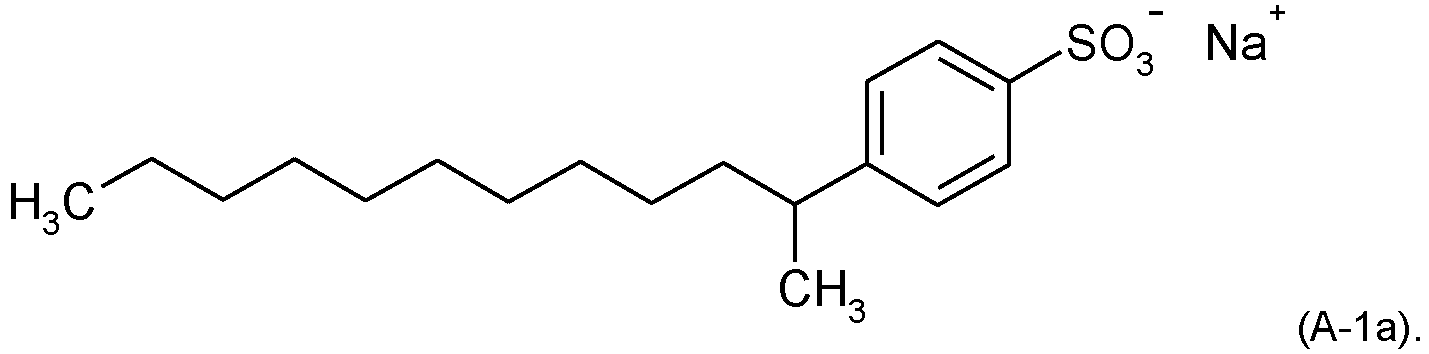
- such surfactants are selected from linear or branched alkylbenzenesulfonates of the formula A-1 in which R' and R" together contain 9 to 19, preferably 11 to 15 and in particular 11 to 13 C atoms.
- R' and R" together contain 9 to 19, preferably 11 to 15 and in particular 11 to 13 C atoms.
- a particularly preferred representative can be described by the formula A-1a:
- the compound of formula (I) is preferably the sodium salt of a linear alkylbenzenesulfonate.
- the at least one compound from the class of anionic surfactants of the formula (I) is contained in the washing or cleaning agent in an amount of 0.001 to 30 wt. %, preferably 0.001 to 10 wt. %, further preferably 2 to 6 wt. %, even more preferably 3 to 5 wt. %, in each case based on the total weight of the cleaning agent.
- the agents according to the invention preferably contain at least one anionic surfactant of the formula R 1 -O-(AO) n -SO 3 - X + (II).
- R 1 is a linear or branched, substituted or unsubstituted alkyl, aryl or alkylaryl radical, preferably a linear, unsubstituted alkyl radical, particularly preferably a fatty alcohol radical.
- Preferred radicals R 1 are selected from decyl, undecyl, dodecyl, tridecyl, tetradecyl, pentadecyl, hexadecyl, heptadecyl, octadecyl, nonadecyl, eicosyl radicals and mixtures thereof, with the representatives with an even number of C atoms being preferred.
- AO stands for an ethylene oxide (EO) or propylene oxide (PO) group, preferably for an ethylene oxide group.
- the index n stands for an integer from 1 to 50, preferably from 1 to 20 and in particular from 2 to 10. Most preferably, n stands for the numbers 2, 3, 4, 5, 6, 7 or 8.
- X + stands for a monovalent cation or the nth part of an n-valent cation, preference being given to the alkali metal ions and among these Na + or K + , with Na + being extremely preferred. Further cations X + can be selected from NH 4 + , 1 ⁇ 2 Zn 2+ , 1 ⁇ 2 Mg 2+ , 1 ⁇ 2 Ca 2+ , 1 ⁇ 2 Mn 2+ and mixtures thereof.
- the cleaning agent contains at least one anionic surfactant of the formula (II) in an amount of 2 to 10 wt.%, preferably 3 to 8 wt.%, based on the total weight of the cleaning agent.
- anionic surfactants that can be used are the alkyl sulfates of the formula R 2 -O-SO 3 - X + (III).
- radicals R 2 are derived from C 12 -C 18 fatty alcohols, for example from coconut fatty alcohol, tallow fatty alcohol, lauryl, myristyl, cetyl or stearyl alcohol or from C 10 -C 20 oxo alcohols.
- X + represents a monovalent cation or the nth part of an n-valent cation, preferred are the alkali metal ions and among these Na + or K + , with Na + being extremely preferred.
- Other cations X + can be selected from NH 4 + , 1 ⁇ 2 Zn 2+ , 1 ⁇ 2 Mg 2+ , 1 ⁇ 2 Ca 2+ , 1 ⁇ 2 Mn 2+ and mixtures thereof.
- the agent can contain at least one other surfactant in addition to the anionic surfactants described above, in particular those of the formulas (I) to (III), or alternatively thereto.
- Alternative or additional surfactants that can be considered are in particular other anionic surfactants, nonionic surfactants and mixtures thereof, but also cationic, zwitterionic and amphoteric surfactants.
- Suitable nonionic surfactants are those of the formula R 3 -O-(AO) m -H (IV), in which R 3 stands for a linear or branched, substituted or unsubstituted alkyl radical, AO stands for an ethylene oxide (EO) or propylene oxide (PO) group and m stands for integers from 1 to 50.
- R 3 is a linear or branched, substituted or unsubstituted alkyl radical, preferably a linear, unsubstituted alkyl radical, particularly preferably a fatty alcohol radical.
- Preferred radicals R 2 are selected from decyl, undecyl, dodecyl, tridecyl, tetradecyl, pentadecyl, hexadecyl, heptadecyl, octadecyl, nonadecyl, eicosyl radicals and mixtures thereof, with the representatives with an even number of C atoms being preferred.
- radicals R 3 are derived from C 12 -C 18 fatty alcohols, for example from coconut fatty alcohol, tallow fatty alcohol, lauryl, myristyl, cetyl or stearyl alcohol or from C 10 -C 20 oxo alcohols.
- AO stands for an ethylene oxide (EO) or propylene oxide (PO) group, preferably for an ethylene oxide group.
- EO ethylene oxide
- PO propylene oxide
- the index m stands for an integer from 1 to 50, preferably from 1 to 20 and in particular from 2 to 10. Most preferably, m stands for the numbers 2, 3, 4, 5, 6, 7 or 8.
- nonionic surfactants which may be contained in the described agents within the meaning of the present invention include, but are not limited to, alkyl glycosides, alkoxylated fatty acid alkyl esters, amine oxides, fatty acid alkanolamides, hydroxy mixed ethers, sorbitan fatty acid esters, polyhydroxy fatty acid amides and alkoxylated alcohols.
- Suitable amphoteric surfactants are, for example, betaines of the formula (R iii )(R iv )(R v )N + CH 2 COO - , in which R iii is an alkyl radical optionally interrupted by heteroatoms or heteroatom groups having 8 to 25, preferably 10 to 21 carbon atoms and R iv and R v are identical or different alkyl radicals having 1 to 3 carbon atoms, in particular C 10 -C 18 alkyldimethylcarboxymethylbetaine and C 11 -C 17 alkylamidopropyldimethylcarboxymethylbetaine.
- Suitable cationic surfactants include the quaternary ammonium compounds of the formula (R vi )(R vii )(R viii )(R ix )N + X-, in which R vi to R ix are four identical or different, in particular two long-chain and two short-chain, alkyl radicals and X - is an anion, in particular a halide ion, for example didecyldimethylammonium chloride, alkylbenzyldidecylammonium chloride and mixtures thereof.
- Suitable cationic surfactants are the quaternary surface-active compounds, in particular with a sulfonium, phosphonium, iodonium or arsonium group, which are also known as antimicrobial agents.
- the agent can be designed with an antimicrobial effect or its already existing antimicrobial effect can be improved, if necessary due to other ingredients.
- the total amount of surfactants based on the weight of the agent is 2 to 30 wt.%, preferably 5 to 25 wt.%, more preferably 10 to 20 wt.%, most preferably 14 to 18 wt.%, wherein the (linear) alkylbenzenesulfonates are present at most in an amount of 0.001 to 30 wt.%, preferably 0.001 to 10 wt.%, further preferably 2 to 6 wt.%, more preferably 3 to 5 wt.%, based on the weight of the agent.
- Detergents or cleaning agents according to the invention can contain other enzymes in addition to polyesterase. These can be hydrolytic enzymes or other enzymes in a concentration suitable for the effectiveness of the agent.
- One embodiment of the invention thus represents agents that comprise one or more enzymes.
- Enzymes that can preferably be used are all enzymes that can develop a catalytic activity in the agent according to the invention, in particular a protease, amylase, cellulase, hemicellulase, mannanase, tannase, xylanase, xanthanase, xyloglucanase, ⁇ -glucosidase, pectinase, carrageenase, perhydrolase, oxidase, oxidoreductase or a lipase, as well as mixtures thereof.
- Enzymes are advantageously contained in the agent in an amount of 1 ⁇ 10 -8 to 5% by weight, based on active protein.
- Each enzyme is increasingly preferably contained in agents according to the invention in an amount of from 1 x 10 -7 to 3% by weight, from 0.00001 to 1% by weight, from 0.00005 to 0.5% by weight, from 0.0001 to 0.1% by weight and particularly preferably from 0.0001 to 0.05% by weight, based on active protein.
- the enzymes particularly preferably show synergistic cleaning performance against certain soilings or stains, ie the enzymes contained in the agent composition support each other in their cleaning performance. Synergistic effects can occur not only between different enzymes, but also between one or more enzymes and other ingredients of the agent according to the invention.
- the amylase(s) is/are preferably an ⁇ -amylase.
- the hemicellulase is preferably a ⁇ -glucanase, a pectinase, a pullulanase and/or a mannanase.
- the cellulase is preferably a cellulase mixture or a single-component cellulase, preferably or predominantly an endoglucanase and/or a cellobiohydrolase.
- the oxidoreductase is preferably an oxidase, in particular a choline oxidase, or a perhydrolase.
- the proteases used are preferably alkaline serine proteases. They act as non-specific endopeptidases, i.e. they hydrolyze any acid amide bonds that are located inside peptides or proteins and thereby cause the breakdown of protein-containing soiling on the items being cleaned. Their pH optimum is usually in the clearly alkaline range.
- the protein concentration can be determined using known methods, for example the BCA method (bicinchoninic acid; 2,2'-biquinolyl-4,4'-dicarboxylic acid) or the biuret method.
- the active protein concentration is determined by titrating the active centers using a suitable irreversible inhibitor (for proteases, for example, phenylmethylsulfonyl fluoride (PMSF)) and determining the residual activity (cf. M. Bender et al. (1966), J. Am. Chem. Soc. 88(24):5890-5913 ).
- a suitable irreversible inhibitor for proteases, for example, phenylmethylsulfonyl fluoride (PMSF)
- the enzymes to be used can also be formulated together with accompanying substances, for example from fermentation.
- the enzymes are preferably used as enzyme liquid formulation(s).
- the enzymes can be encapsulated for both the solid and the liquid dosage form, for example by spray drying or extrusion of the enzyme solution together with a preferably natural polymer or in the form of capsules, for example those in which the enzymes are enclosed as if in a solidified gel or in those of the core-shell type in which an enzyme-containing core is covered with a water, air and/or chemical-impermeable protective layer.
- Additional active ingredients for example stabilizers, emulsifiers, pigments, bleaching agents or dyes, can also be applied in superimposed layers.
- Such capsules are produced using methods known per se, for example, by shaking or rolling granulation or in fluid bed processes. Such granules, for example by applying polymer film formers, are advantageously low in dust and are storage-stable due to the coating.
- the agent according to the invention can comprise one or more enzyme stabilizers. Therefore, the agent according to the invention can further comprise an enzyme stabilizer, for example selected from the group consisting of sodium formate, sodium sulfate, lower aliphatic alcohols and boric acid and their esters and salts. Of course, two or more of these compounds can also be used in combination.
- the salts of the compounds mentioned can also be used in the form of hydrates, such as sodium sulfate decahydrate.
- lower aliphatic alcohols as used herein includes monoalcohols, diols and higher alcohols with up to 6 carbon atoms.
- polyols for example glycerin, (mono)ethylene glycol, (mono)propylene glycol or sorbitol, may be mentioned in particular as belonging to the group of lower aliphatic alcohols, without the invention being restricted to these.
- Reversible protease inhibitors protect the enzymes contained in a washing or cleaning agent from proteolytic degradation by reversibly inhibiting the enzymatic activity of the proteases contained in the agent.
- Benzamidine hydrochloride, boronic acids or their salts or esters are often used as reversible protease inhibitors, including in particular derivatives with aromatic groups, such as ortho-, meta- or para-substituted phenylboronic acids, in particular 4-formylphenylboronic acid, or the salts or esters of the compounds mentioned.
- Peptide aldehydes i.e. oligopeptides with a reduced C-terminus, in particular those made up of 2 to 50 monomers, are also used for this purpose.
- Peptide reversible protease inhibitors include ovomucoid and leupeptin.
- enzyme stabilizers are amino alcohols such as mono-, di-, triethanol- and propanolamine and their mixtures, aliphatic carboxylic acids up to C 12 , such as succinic acid, other dicarboxylic acids or salts of the above-mentioned acids. End-capped Fatty acid amide alkoxylates are suitable for this purpose. Some organic acids used as builders can also stabilize an enzyme. Calcium and/or magnesium salts are also used for this purpose, such as calcium acetate.
- Polyamide oligomers or polymeric compounds such as lignin, water-soluble vinyl copolymers or cellulose ethers, acrylic polymers and/or polyamides stabilize the enzyme preparation against physical influences or pH fluctuations, among other things.
- Polyamine N-oxide-containing polymers act simultaneously as enzyme stabilizers and as color transfer inhibitors.
- Other polymeric stabilizers are linear C 8 -C 18 polyoxyalkylenes.
- Alkyl polyglycosides can also stabilize the enzymatic components of the agent according to the invention and are preferably able to additionally increase their performance.
- Cross-linked N-containing compounds preferably fulfill a dual function as soil release agents and as enzyme stabilizers. Hydrophobic, non-ionic polymer stabilizes in particular any cellulase that may be present.
- Reducing agents and antioxidants increase the stability of the enzymes against oxidative decomposition; for example, sulfur-containing reducing agents such as sodium sulfite and reducing sugars are common.
- the agents according to the present invention are liquid and contain water as the main solvent, i.e. they are aqueous agents.
- the water content of the aqueous agent according to the invention is usually 15 to 70% by weight, preferably 20 to 60% by weight. In various embodiments, the water content is more than 5% by weight, preferably more than 15% by weight and particularly preferably more than 50% by weight, in each case based on the total amount of agent.
- non-aqueous solvents can be added to the agent.
- Suitable non-aqueous solvents include mono- or polyhydric alcohols, alkanolamines or glycol ethers, provided they are miscible with water in the specified concentration range.
- the solvents are selected from ethanol, n-propanol, i-propanol, butanols, glycol, propanediol, butanediol, methylpropanediol, glycerin, diglycol, propyl diglycol, butyl diglycol, hexylene glycol, ethylene glycol methyl ether, ethylene glycol ethyl ether, ethylene glycol propyl ether, ethylene glycol mono-n-butyl ether, diethylene glycol methyl ether, diethylene glycol ethyl ether, propylene glycol methyl ether, propylene glycol ethyl ether, propylene glycol propyl propyl
- the one or more non-aqueous solvents are usually present in an amount of 0.1 to 10 wt.%, preferably 1 to 8 wt.%, based on the total composition.
- the agents according to the invention can contain other ingredients that further improve the application and/or aesthetic properties of the cleaning agent.
- these include, for example, additives to improve the flow and drying behavior, to adjust the viscosity and/or for stabilization, as well as other auxiliary and additional substances commonly used in cleaning agents, such as UV stabilizers, perfume, pearlescent agents, dyes, corrosion inhibitors, preservatives, bitter substances, organic salts, disinfectants, structural polymers, defoamers, encapsulated ingredients (e.g. encapsulated perfume), pH adjusters and skin-feel-improving or care additives.
- additives to improve the flow and drying behavior to adjust the viscosity and/or for stabilization
- other auxiliary and additional substances commonly used in cleaning agents such as UV stabilizers, perfume, pearlescent agents, dyes, corrosion inhibitors, preservatives, bitter substances, organic salts, disinfectants, structural polymers, defoamers, encapsulated ingredients (e.g. encapsulated perfume), pH adjusters and skin-feel-
- An agent according to the invention in particular a washing or cleaning agent, preferably contains at least one water-soluble and/or water-insoluble, organic and/or inorganic builder.
- the builders that can generally be used include aminocarboxylic acids and their salts, zeolites, silicates, carbonates, organic (co)builders and - where there are no ecological prejudices against their use - also phosphates.
- the agents are phosphate-free.
- the water-soluble organic builder substances include polycarboxylic acids, in particular citric acid and sugar acids, monomeric and polymeric aminopolycarboxylic acids, in particular methylglycinediacetic acid, nitrilotriacetic acid and ethylenediaminetetraacetic acid as well as polyaspartic acid, polyphosphonic acids, in particular aminotris(methylenephosphonic acid), ethylenediaminetetrakis(methylenephosphonic acid) and 1-hydroxyethane-1,1-diphosphonic acid, polymeric hydroxy compounds such as dextrin and polymeric (poly)carboxylic acids, polymeric acrylic acids, methacrylic acids, maleic acids and copolymers thereof, which may also contain small proportions of polymerizable substances without carboxylic acid functionality.
- polycarboxylic acids in particular citric acid and sugar acids
- monomeric and polymeric aminopolycarboxylic acids in particular methylglycinediacetic acid, nitrilotriacetic acid and
- Suitable, although less preferred, compounds of this class are copolymers of acrylic acid or methacrylic acid with vinyl ethers, such as vinyl methyl ethers, vinyl esters, ethylene, propylene and styrene, in which the proportion of acid is at least 50% by weight.
- the organic builder substances can be used, particularly for the production of liquid agents, in the form of aqueous solutions, preferably in the form of 30 to 50 percent by weight aqueous solutions. All of the acids mentioned are generally used in the form of their water-soluble salts, particularly their alkali salts.
- Organic builder substances can, if desired, be present in amounts of up to 40% by weight, in particular up to 25% by weight and preferably from 1 to 8% by weight. Amounts close to the stated upper limit are preferably used in paste-like or liquid, in particular water-containing, agents according to the invention. Laundry aftertreatment agents according to the invention, such as fabric softeners, can optionally also be free of organic builders.
- Suitable water-soluble inorganic builder materials are, in particular, alkali silicates and, if there are no concerns about their use, also polyphosphates, preferably sodium triphosphate.
- Suitable water-insoluble, water-dispersible inorganic builder materials are, in particular, crystalline or amorphous alkali aluminosilicates, if desired, in amounts of up to 50% by weight, preferably not more than 40% by weight and in liquid agents in particular from 1 to 5% by weight.
- the crystalline sodium aluminosilicates in detergent quality, in particular zeolite A, P and optionally X are preferred. Amounts close to the upper limit mentioned are preferably used in solid, particulate agents.
- Suitable aluminosilicates in particular have no particles with a grain size of more than 30 ⁇ m and preferably consist of at least 80% by weight of particles with a size of less than 10 ⁇ m.
- Suitable substitutes or partial substitutes for the aluminosilicate mentioned are crystalline alkali silicates, which can be present alone or in a mixture with amorphous silicates.
- the alkali silicates which can be used as builders in the agents according to the invention preferably have a molar ratio of alkali oxide to SiO 2 of less than 0.95, in particular from 1:1.1 to 1:12, and can be amorphous or crystalline.
- Preferred alkali silicates are the sodium silicates, in particular the amorphous sodium silicates, with a molar ratio Na 2 O:SiO 2 of 1:2 to 1:2.8.
- Virtually anhydrous crystalline alkali silicates of the above general formula, in which x is a number from 1.9 to 2.1, produced from amorphous alkali silicates, can also be used in agents according to the invention.
- a crystalline sodium layer silicate with a modulus of 2 to 3 is used, as can be produced from sand and soda.
- Crystalline sodium silicates with a modulus in the range of 1.9 to 3.5 are used in a further preferred embodiment of the inventive agent.
- alkali aluminosilicate in particular zeolite
- the weight ratio of aluminosilicate to silicate in each case based on anhydrous active substances, preferably 1:10 to 10:1.
- the weight ratio of amorphous alkali silicate to crystalline alkali silicate is preferably 1:2 to 2:1 and in particular 1:1 to 2:1.
- builder substances are contained in the agents according to the invention preferably in amounts of up to 60% by weight, in particular from 5 to 40% by weight.
- Water-soluble builders are particularly preferred in liquid formulations.
- Laundry aftertreatment agents according to the invention, such as fabric softeners, are preferably free of inorganic builders.
- Polymeric thickeners in the sense of the present invention are the polycarboxylates which act as polyelectrolytes to thicken, preferably homo- and copolymers of acrylic acid, in particular acrylic acid copolymers such as acrylic acid-methacrylic acid copolymers, and the polysaccharides, in particular heteropolysaccharides, as well as other conventional thickening polymers.
- Suitable polysaccharides or heteropolysaccharides are the polysaccharide gums, for example gum arabic, agar, alginates, carrageenans and their salts, guar, guaran, tragacanth, gellan, ramsan, dextran or xanthan and their derivatives, e.g. propoxylated guar, and their mixtures.
- Other polysaccharide thickeners such as starches or cellulose derivatives, can be used alternatively, but preferably in addition to a polysaccharide gum, for example starches of various origins and starch derivatives, e.g.
- hydroxyethyl starch starch phosphate esters or starch acetates, or carboxymethyl cellulose or its sodium salt, methyl, ethyl, hydroxyethyl, hydroxypropyl, hydroxypropylmethyl or hydroxyethylmethyl cellulose or cellulose acetate.
- Acrylic acid polymers suitable as polymeric thickeners are, for example, high molecular weight homopolymers of acrylic acid (INCI Carbomer) cross-linked with a polyalkenyl polyether, in particular an allyl ether of sucrose, pentaerythritol or propylene, which are also referred to as carboxyvinyl polymers.
- a polyalkenyl polyether in particular an allyl ether of sucrose, pentaerythritol or propylene, which are also referred to as carboxyvinyl polymers.
- Particularly suitable polymeric thickeners are the following acrylic acid copolymers: (i) Copolymers of two or more monomers from the group of acrylic acid, methacrylic acid and their simple esters, preferably formed with C 1-4 alkanols (INCI Acrylates Copolymer), which include the copolymers of methacrylic acid, butyl acrylate and methyl methacrylate ( CAS 25035-69-2 ) or butyl acrylate and methyl methacrylate ( CAS 25852-37-3 ); (ii) cross-linked high molecular weight acrylic acid copolymers, which include, for example, copolymers of C 10-30 alkyl acrylates cross-linked with an allyl ether of sucrose or pentaerythritol with one or more monomers from the group consisting of acrylic acid, methacrylic acid and their simple esters, preferably formed with C 1-4 alkanols (INCI Acrylates/C 10-30 Alkyl Acrylate Crosspolymer).
- the content of polymeric thickener is usually not more than 8 wt.%, preferably between 0.1 and 7 wt.%, particularly preferably between 0.5 and 6 wt.%, in particular between 1 and 5 wt.% and extremely preferably between 1.5 and 4 wt.%, for example between 2 and 2.5 wt.%, based on the total weight of the agent.
- one or more dicarboxylic acids and/or their salts can be added, in particular a composition of Na salts of adipic, succinic and glutaric acid, such as is available under the trade name Sokalan ® DSC.
- the use is advantageously carried out in amounts of 0.1 to 8 wt.%, preferably 0.5 to 7 wt.%, in particular 1.3 to 6 wt.% and particularly preferably 2 to 4 wt.%, based on the total weight of the cleaning agent.
- the agent according to the invention is preferably free of dicarboxylic acids (salts).
- the detergents according to the invention can be compared with reference detergents in order to determine the increased anti-pilling performance of the detergents according to the invention.
- a washing system can be composed as follows (all information in % by weight): Reference detergent: 4.4% alkylbenzenesulfonic acid, 5.6% other anionic surfactants, 2.4% C 12 -C 18 Na salts of fatty acids (soaps), 4.4% non-ionic surfactants, 0.2% phosphonates, 1.4% citric acid, 0.95% NaOH, 0.01% defoamers, 2.0% glycerin, 0.08% preservatives, 1% ethanol, 1.6% enzyme mix (protease, amylase, cellulase, mannanase), remainder demineralized water.
- Reference detergent 4.4% alkylbenzenesulfonic acid, 5.6% other anionic surfactants, 2.4% C 12 -C 18 Na salts of fatty acids (soaps), 4.4% non-ionic surfact
- the aforementioned embodiments of the present invention include all solid, powdery, liquid, gel-like or pasty dosage forms of agents according to the invention, which may optionally also consist of several phases and may be in compressed or non-compressed form.
- the agent may be in the form of a free-flowing powder, in particular with a bulk density of 300 g/l to 1200 g/l, in particular 500 g/l to 900 g/l or 600 g/l to 850 g/l.
- the solid dosage forms of the agent also include extrudates, granules, tablets or pouches.
- the agent may also be liquid, gel-like or pasty, for example in the form of a non-aqueous liquid detergent or a non-aqueous Paste or in the form of an aqueous liquid detergent or a water-based paste.
- the agent can also be present as a single-component system. Such agents consist of one phase. Alternatively, an agent can also consist of several phases. Such an agent is therefore divided into several components (multi-component system).
- Another subject matter of the invention is a method for cleaning textiles, which is characterized in that an agent according to the invention is used in at least one method step.
- the textiles preferably contain polyester or consist of it.
- the method described above is characterized in that the agent according to the invention is used at a temperature of 0 to 100 °C, preferably 0 to 80 °C, more preferably 30 to 70 °C and most preferably at 40 to 60 °C.
- Processes for cleaning textiles are generally characterized by the fact that various cleaning-active substances are applied to the items to be cleaned in several process steps and washed off after the exposure time, or that the items to be cleaned are treated in some other way with a detergent or a solution or dilution of this agent. All conceivable washing or cleaning processes can be enriched in at least one of the process steps by the use of a washing or cleaning agent according to the invention and then represent embodiments of the present invention. All facts, objects and embodiments that are described for agents according to the invention are also applicable to this subject matter of the invention. Therefore, at this point, express reference is made to the disclosure at the appropriate point with the note that this disclosure also applies to the above methods according to the invention.
- a single and/or the only step of such a process can consist in bringing a polyesterase, as the only cleaning-active component, into contact with the soil, preferably in a buffer solution or in water. This represents a further embodiment of this subject matter of the invention.
- Alternative embodiments of this subject matter of the invention also represent processes for treating textile raw materials or for textile care, in which an agent according to the invention is active in at least one process step.
- processes for textile raw materials, fibers or textiles with synthetic components are preferred, and very particularly for those with polyester.
- the invention also covers the use of the agent described herein, for example as washing or cleaning agents as described above, for the (improved) removal of soiling, for example from textiles, in particular polyester textiles.
- the invention also relates to the use of a polyesterase for reducing pilling effects of a washing or cleaning agent, preferably a detergent, particularly preferably a liquid detergent, wherein the washing or cleaning agent contains the polyesterase.
- the polyesterase is a polyesterase as defined herein.
- the polyesterase is contained in the washing or cleaning agent in an amount of 0.00001 to 1% by weight, preferably in an amount of 0.0001 to 0.5% by weight, particularly preferably in an amount of 0.001 to 0.1% by weight.
- the polyesterase, which reduces the pilling effect is applied to textiles, in particular textiles that consist of polyester or comprise polyester.
- the polyesterase according to the invention significantly improves the pill appearance.
Landscapes
- Chemical & Material Sciences (AREA)
- Life Sciences & Earth Sciences (AREA)
- Wood Science & Technology (AREA)
- Engineering & Computer Science (AREA)
- Organic Chemistry (AREA)
- Health & Medical Sciences (AREA)
- Bioinformatics & Cheminformatics (AREA)
- Zoology (AREA)
- Genetics & Genomics (AREA)
- Oil, Petroleum & Natural Gas (AREA)
- Chemical Kinetics & Catalysis (AREA)
- Microbiology (AREA)
- Biotechnology (AREA)
- Biochemistry (AREA)
- General Engineering & Computer Science (AREA)
- General Health & Medical Sciences (AREA)
- Biomedical Technology (AREA)
- Molecular Biology (AREA)
- Medicinal Chemistry (AREA)
- Detergent Compositions (AREA)
Description
- Die vorliegende Erfindung liegt auf dem Gebiet der Enzymtechnologie, insbesondere der Anti-Pilling Wirkung von Enzymen, wie sie zum Beispiel in Wasch- oder Reinigungsmitteln, verwendet werden. Die Erfindung betrifft ein Mittel, insbesondere Wasch- oder Reinigungsmittel, welches eine Polyesterase, wie hierin definiert, enthält. Ferner betrifft die vorliegende Erfindung ein Verfahren zur Reinigung von Textilien sowie die Verwendung des erfindungsgemäßen Mittels zur Entfernung von Anschmutzungen. Des Weiteren richtet sich die Erfindung auf die Verwendung einer Polyesterase zur Verringerung von Pilling-Effekten und Anti-Grau in einem Mittel, vorzugsweise einem Wasch- oder Reinigungsmittel.
- Bei mehrfacher Wäsche weisen Textilien jeglicher Art mit der Zeit ein Pilling auf. Als Pilling bezeichnet man die Knötchen- oder Fusselbildung bei Stoffen. Diese kleinen Fussel entstehen insbesondere bei kurzfaserigen Stoffen. Bei langfaserigen und verzwirnten Fasern entsteht dagegen weniger Pilling. Allgemein entstehen diese Knötchen durch lose Fasern im Stoff oder solche die sich aus dem Gewebe gelöst haben. Synthetische Fasern neigen, durch ihre glatte Oberfläche, eher zum Pilling als Naturfasern, weil synthetische Fasern schneller aus dem Gewebe gelöst werden können als raue Naturfasern. Bei Wollstoffen "verfilzen" diese Fasern hauptsächlich durch mechanische Reibung und bilden Knötchen an der Oberfläche.
- Die Hauptauswirkung von Pilling ist eine optische Beeinträchtigung. Durch die Knötchenbildung an der Oberfläche sehen Stoffe schnell gebraucht und älter aus als sie sind. Zusätzlich wirken farbige Textilien weniger leuchtend. Dagegen wird die Funktionalität des Stoffes kaum bis gar nicht beeinträchtigt. Pilling findet insbesondere an mechanisch stark beanspruchten Stellen statt, meist sind dies Schulter- und Bundbereich. Durch die fortlaufende Ausdünnung des Stoffes sind vor allem diese beanspruchten Bereiche gefährdet Löcher zu bilden oder gar zu reißen. Das unerwünschte Pilling hat zur Folge, dass entsprechend beeinträchtigte Textilien von den Verbrauchern schneller aussortiert und weggeworfen werden, als es auf Basis der Funktionalität des Textils notwendig wäre.
- Des Weiteren neigen Textilien beim Waschen dazu zu vergrauen. Das liegt daran, dass im Waschprozess sowohl Schmutz als auch abgelöste Pigmente aus farbiger Kleidung freigesetzt werden. Obwohl versucht wird, diese durch verschiedene Waschmittelinhaltstoffe in der Waschflotte zu halten, kann trotzdem oft nicht verhindert werden, dass sich der Schmutz/die Pigmente auf der Kleidung ablagern und dort verbleiben. Dies ist der sogenannte Vergrauungs-Effekt. Besonders stark ist dieser bei einigen synthetischen Fasern wie z.B. Polyamid, aber auch Polyester ausgeprägt.
- Eine technische Lösung, um den Pilling-Effekt zu verringern, liegt bislang nur für Baumwolltextilien vor. Hierbei werden Cellulasen im Reinigungsmittel verwendet, um den Pilling-Effekt zu verringern (
DE 69632910 T3 ). Das heißt, dass Cellulasen im Waschmittel eingesetzt werden, um Anti-Pilling bzw. Anti-Grau Wirkung zu zeigen und so dafür zu sorgen, dass Kleidung länger wie neu wirkt. Cellulasen wirken jedoch ausschließlich auf Baumwolltextilien. Für andere Textilien, wie z.B. Polyestertextilien, gibt es keine vergleichbare Möglichkeit Pilling zu reduzieren. Daher ist es wünschenswert und es besteht eine Nachfrage nach Lösungen, die das Pilling von Textilien, insbesondere Textilien, die synthetische Fasern wie Polyester enthalten, zu reduzieren, um Kleidung so lange wie möglich neu aussehen zu lassen, d.h. die Farben sollen kräftig bleiben, die Form soll erhalten bleiben und die Oberflächen sollen glatt und unbeschädigt bleiben. - Ferner offenbart
WO 2017/129436 A1 ein verbessertes Anti-Pilling auf Polyester durch Einsatz einer Cutinase. Cutinasen sind außerdem ausWO 2012/113827 A1 im Zusammenhang mit Verfahren zur Nahrungsmittelverarbeitung bekannt. - Überraschenderweise haben die Erfinder der vorliegenden Erfindung gefunden, dass die hierin beschriebene Polyesterase aus Thermomonospora curvata unter Waschprozess-Bedingungen aktiv ist und hier verschiedene pflegende Eigenschaften für PET-Textilien aufweist. Dies ist insoweit überraschend, als dass bisher bekannte Cutinasen und PET-Esterasen eher bei höheren Temperaturen (>= 60 °C) aktiv sind, und außerdem nur in der Lage sind PET sehr langsam abzubauen. Die vorliegend eingesetzte Polyesterase zeigt jedoch einen schnellen PET-Abbau bei 40 °C. Es wurde gefunden, dass das Enzym zum einen das Pilling auf neuen Polyestertextilien verhindert bzw. diesen Effekt in Kombination mit einer Cellulase auf Polyester/Baumwollmisch-Textilien unterstützt. Zum anderen können bereits gebildete Pills reduziert werden, d.h. es kann einen sogenannten "Renew"-Effekt bewirken. Des Weiteren verhindert die Polyesterase die Vergrauung von weißer Wäsche und das Verblassen/Vergrauen von farbiger Wäsche. Es wurde weiterhin gefunden, dass bei entsprechender Dosierung alle diese positiven Wascheigenschaften erreicht werden, ohne die Faser signifikant zu schädigen. Dadurch, dass die Textilien länger neu aussehen, werden sie länger getragen und werden weniger schnell ersetzt. Dies führt zu einer Reduktion des CO2 Footprints, da weniger Polyester verbraucht wird.
- Daher richtet sich in einem ersten Aspekt die vorliegende Erfindung auf einWasch- oder Reinigungsmittel, dadurch gekennzeichnet, dass es eine Polyesterase enthält, die mindestens 83 % Sequenzidentität mit der in SEQ ID NO:1 angegebenen Aminosäuresequenz über deren Gesamtlänge aufweist.
- In einem weiteren Aspekt richtet sich die vorliegende Erfindung auf Verfahren zur Reinigung von Textilien, dadurch gekennzeichnet, dass in mindestens einem Verfahrensschritt ein erfindungsgemäßes Wasch- oder Reinigungsmittel angewendet wird. Die Textilien sind vorzugsweise Polyester-haltige Textilien oder bestehen aus Polyester.
- In noch einem Aspekt richtet sich die vorliegende Erfindung ferner auf die Verwendung eines wie hierin beschriebenen Wasch- oder Reinigungsmittels, besonders bevorzugt flüssigen Waschmittels, zur Entfernung von Anschmutzungen.
- Darüber hinaus beinhaltet ein weiterer Aspekt der Erfindung, die Verwendung der hierin beschriebenen Polyesterase zur Verringerung von Pilling-Effekten und/oder Steigerung der Anti-Grau-Wirkung eines Wasch- oder Reinigungsmittels, besonders bevorzugt eines Flüssigwaschmittels, wobei das Mittel die Polyesterase enthält.
- In weiter bevorzugten Ausführungsformen umfasst die im erfindungsgemäßen Mittel enthaltene Polyesterase die in SEQ ID NO:1 angegebene Aminosäuresequenz oder besteht im Wesentlichen daraus oder besteht daraus. In verschiedenen Ausführungsformen der Erfindung umfasst die Erfindung auch Polyesterasen, die von der Aminosäuresequenz gemäß SEQ ID NO:1, beispielsweise mittels Mutagenese, abgeleitet sind.
- In verschiedenen Ausführungsformen der Erfindung umfasst die Polyesterase eine Aminosäuresequenz, die zu der in SEQ ID NO:1 angegebenen Aminosäuresequenz über deren Gesamtlänge zu mindestens 84 %, 85 %, 86 %, 87 %, 88 %, 89 %, 90 %, 90,5 %, 91 %, 91,5 %, 92 %, 92,5 %, 93 %, 93,5 %, 94 %, 94,5 %, 95 %, 95,5 %, 96 %, 96,5 %, 97 %, 97,5 %, 98 %, 98,5 %, 98,8 %, 99,0 %, 99,2 %, 99,4 % oder 99,6 % identisch ist oder besteht aus einer solchen Sequenz.
- In verschiedenen weiteren Ausführungsformen ist das Mittel dadurch gekennzeichnet, dass
- (a) die Polyesterase aus einer wie oben definierten Polyesterase als Ausgangsmolekül durch ein- oder mehrfache konservative Aminosäuresubstitution erhältlich ist; und/oder
- (b) die Polyesterase aus einer wie oben definierten Polyesterase als Ausgangsmolekül durch Fragmentierung, Deletions-, Insertions- oder Substitutionsmutagenese erhältlich ist und eine Aminosäuresequenz umfasst, die über eine Länge von mindestens 180, 190, 200, 210, 220, 230, 240, 245, 250, 251, 252, 253, 254, 255, 256, 257, 258, 259, 260, 261 oder 262 zusammenhängenden Aminosäuren mit dem Ausgangsmolekül übereinstimmt.
- Die erfindungsgemäßen Mittel enthalten die Polyesterase vorzugsweise in einer Menge von 0,00001 bis 1 Gew.-%, weiter bevorzugt in einer Menge von 0,0001 bis 0,5 Gew.-%, besonders bevorzugt in einer Menge von 0,001 bis 0,1 Gew.-%, jeweils bezogen auf das aktive Protein.
- Die Bestimmung der Identität von Nukleinsäure- oder Aminosäuresequenzen erfolgt durch einen Sequenzvergleich. Dieser Sequenzvergleich basiert auf dem im Stand der Technik etablierten und üblicherweise genutzten BLAST-Algorithmus (vgl. z.B. Altschul et al. (1990) "Basic local alignment search tool", J. Mol. Biol. 215:403-410, und Altschul et al. (1997) "Gapped BLAST and PSI-BLAST: a new generation of protein database search programs", Nucleic Acids Res. 25:3389-3402) und geschieht prinzipiell dadurch, dass ähnliche Abfolgen von Nukleotiden oder Aminosäuren in den Nukleinsäure- oder Aminosäuresequenzen einander zugeordnet werden. Eine tabellarische Zuordnung der betreffenden Positionen wird als Alignment bezeichnet. Ein weiterer im Stand der Technik verfügbarer Algorithmus ist der FASTA-Algorithmus. Sequenzvergleiche (Alignments), insbesondere multiple Sequenzvergleiche, werden mit Computerprogrammen erstellt. Häufig genutzt werden beispielsweise die Clustal-Serie (vgl. z.B. Chenna et al. (2003) "Multiple sequence alignment with the Clustal series of programs", Nucleic Acid Res. 31:3497-3500), T-Coffee (vgl. z.B. Notredame et al. (2000) "T-Coffee: A novel method for multiple sequence alignments", J. Mol. Biol. 302:205-217) oder Programme, die auf diesen Programmen beziehungsweise Algorithmen basieren. Ferner möglich sind Sequenzvergleiche (Alignments) mit dem Computer-Programm Vector NTI® Suite 10.3 (Invitrogen Corporation, 1600 Faraday Avenue, Carlsbad, Kalifornien, USA) mit den vorgegebenen Standardparametern, dessen AlignX-Modul für die Sequenzvergleiche auf ClustalW basiert.
- Solch ein Vergleich erlaubt auch eine Aussage über die Ähnlichkeit der verglichenen Sequenzen zueinander. Sie wird üblicherweise in Prozent Identität, das heißt dem Anteil der identischen Nukleotide oder Aminosäurereste an denselben oder in einem Alignment einander entsprechenden Positionen angegeben. Der weiter gefasste Begriff der Homologie bezieht bei Aminosäuresequenzen konservierte Aminosäureaustausche in die Betrachtung mit ein, also Aminosäuren mit ähnlicher chemischer Aktivität, da diese innerhalb des Proteins meist ähnliche chemische Aktivitäten ausüben. Daher kann die Ähnlichkeit der verglichenen Sequenzen auch in Prozent Homologie oder Prozent Ähnlichkeit angegeben sein. Identitäts- und/oder Homologieangaben können über ganze Polypeptide oder Gene oder nur über einzelne Bereiche getroffen werden. Homologe oder identische Bereiche von verschiedenen Nukleinsäure- oder Aminosäuresequenzen sind daher durch Übereinstimmungen in den Sequenzen definiert. Solche Bereiche weisen oftmals identische Funktionen auf. Sie können klein sein und nur wenige Nukleotide oder Aminosäuren umfassen. Oftmals üben solche kleinen Bereiche für die Gesamtaktivität des Proteins essentielle Funktionen aus. Es kann daher sinnvoll sein, Sequenzübereinstimmungen nur auf einzelne, gegebenenfalls kleine Bereiche zu beziehen. Soweit nicht anders angegeben beziehen sich Identitäts- oder Homologieangaben in der vorliegenden Anmeldung aber auf die Gesamtlänge der jeweils angegebenen Nukleinsäure- oder Aminosäuresäuresequenz.
- In verschiedenen Ausführungsformen umfasst die Polyesterase eine Aminosäuresequenz, die zu der in SEQ ID NO:1 angegebenen Aminosäuresequenz über deren Gesamtlänge zu mindestens 84 %, 85 %, 86 %, 87 %, 88 %, 89 %, 90 %, 90,5 %, 91 %, 91,5 %, 92 %, 92,5 %, 93 %, 93,5 %, 94 %, 94,5 %, 95 %, 95,5 %, 96 %, 96,5 %, 97 %, 97,5 %, 98 %, 98,5 %, 98,8 %, 99,0 %, 99,2 %, 99,4 % oder 99,6 % homolog ist.
- In einer weiteren Ausführungsform der Erfindung ist die Polyesterase dadurch gekennzeichnet, dass ihre Anti-Pilling-Leistung gegenüber derjenigen einer Polyesterase, die eine Aminosäuresequenz umfasst, die der in SEQ ID NO:1 angegebenen Aminosäuresequenzen entspricht, nicht signifikant verringert ist, d.h. mindestens 70 %, 75 %, 80 %, 85 %, 90 %, 95 % der Referenz-Anti-Pilling-leistung besitzt. Die Anti-Pilling-Leistung kann in einem Waschsystem bestimmt werden, das ein Waschmittel in einer Dosierung zwischen 4,5 und 7,0 Gramm pro Liter Waschflotte sowie die Polyesterase enthält, wobei die zu vergleichenden Polyesterasen konzentrationsgleich (bezogen auf aktives Protein) eingesetzt sind und die Anti-Pilling-Leistung wie hierin beschrieben ermittelt wird. Beispielsweise kann der Waschvorgang für 60 Minuten bei einer Temperatur von 60 °C erfolgen und das Wasser eine Wasserhärte zwischen 15,5° und 16,5° (deutsche Härte) aufweisen. Die Konzentration der Polyesterase in dem für dieses Waschsystem bestimmten Waschmittel beträgt von 0,00001 bis 1 Gew.-%, bevorzugt von 0,0001 bis 0,5 Gew.-%, besonders bevorzugt von 0,001 bis 0,1 Gew.-%, bezogen auf aktives, gereinigtes Protein.
- Ein bevorzugtes flüssiges Waschmittel für ein solches Waschsystem ist wie folgt zusammengesetzt (alle Angaben in Gewichts-%): 4,4 % Alkylbenzolsulfonsäure, 5,6 % anionische Tenside, 2,4 % C12-C18 Na-Salze von Fettsäuren, 4,4 % nicht-ionische Tenside, 0,2 % Phosphonate, 1,4 % Zitronensäure, 0,95 % NaOH, 0,01 % Antischaum, 2 % Glycerin, 0,08 % Konservierungsstoffe, 1 % Ethanol, 1,6 % Enzymmix (Protease, Amylase, Cellulase, Mannanase), Rest demineralisiertes Wasser. Bevorzugt beträgt die Dosierung des flüssigen Waschmittels zwischen 4,5 und 6,0 Gramm pro Liter Waschflotte, beispielsweise 4,7, 4,9 oder 5,9 Gramm pro Liter Waschflotte. Bevorzugt wird gewaschen in einem pH-Wertebereich zwischen pH 8 und pH 10,5, bevorzugt zwischen pH 8 und pH 9.
- Im Rahmen der Erfindung erfolgt die Bestimmung der Anti-Pilling-Leistung bei 60 °C unter Verwendung eines flüssigen Waschmittels wie vorstehend angegeben, wobei der Waschvorgang vorzugsweise für 60 Minuten erfolgt.
- Die Anti-Pilling-Leistung kann anhand von visueller Abmusterung verfolgen. Eine Prüfergruppe ordnet in diesem Fall der zu untersuchenden Wäsche einen Wert einer Skala von 1-5 zu. Dabei steht der Wert = 1 für sehr stark gepillte Wäsche, während der Wert = 5 nicht gepillter Wäsche zugeordnet wird.
- Durch den aktivitätsgleichen Einsatz der jeweiligen Polyesterase wird sichergestellt, dass auch bei einem etwaigen Auseinanderklaffen des Verhältnisses von Aktivsubstanz zu Gesamtprotein (die Werte der spezifischen Aktivität) die jeweiligen enzymatischen Eigenschaften, also beispielsweise die Anti-Pilling-Leistung, verglichen werden. Generell gilt, dass eine niedrige spezifische Aktivität durch Zugabe einer größeren Proteinmenge ausgeglichen werden kann.
- Proteine können über die Reaktion mit einem Antiserum oder einem bestimmten Antikörper zu Gruppen immunologisch verwandter Proteine zusammengefasst werden. Die Angehörigen einer solchen Gruppe zeichnen sich dadurch aus, dass sie dieselbe, von einem Antikörper erkannte antigene Determinante aufweisen. Sie sind daher einander strukturell so ähnlich, dass sie von einem Antiserum oder bestimmten Antikörpern erkannt werden. Einen weiteren Erfindungsgegenstand bilden daher Polyesterasen, die dadurch gekennzeichnet sind, dass sie mindestens eine und zunehmend bevorzugt zwei, drei oder vier übereinstimmende antigene Determinanten mit einer in einem erfindungsgemäßen Mittel verwendeten Polyesterase aufweisen. Solche Polyesterasen sind auf Grund ihrer immunologischen Übereinstimmungen den in den erfindungsgemäßen Mitteln verwendeten Polyesterasen strukturell so ähnlich, dass auch von einer gleichartigen Funktion auszugehen ist.
- Weitere in den erfindungsgemäßen Mitteln verwendete Polyesterasen können im Vergleich zu der in SEQ ID NO:1 beschriebenen Polyesterase weitere Aminosäureveränderungen, insbesondere Aminosäure-Substitutionen, -Insertionen oder -Deletionen, aufweisen. Solche Polyesterasen sind beispielsweise durch gezielte genetische Veränderung, d.h. durch Mutageneseverfahren, weiterentwickelt und für bestimmte Einsatzzwecke oder hinsichtlich spezieller Eigenschaften (beispielsweise hinsichtlich ihrer katalytischen Aktivität, Stabilität, usw.) optimiert. Ferner können Nukleinsäuren, die die verwendeten Polyesterasen kodieren, in Rekombinationsansätze eingebracht und damit zur Erzeugung völlig neuartiger Polyesterasen oder anderer Polypeptide genutzt werden.
- Das Ziel ist es, in die bekannten Moleküle gezielte Mutationen wie Substitutionen, Insertionen oder Deletionen einzuführen, um beispielsweise die Reinigungsleistung von erfindungsgemäßen Enzymen zu verbessern. Hierzu können insbesondere die Oberflächenladungen und/oder der isoelektrische Punkt der Moleküle und dadurch ihre Wechselwirkungen mit dem Substrat verändert werden. So kann beispielsweise die Nettoladung der Enzyme verändert werden, um darüber die Substratbindung insbesondere für den Einsatz in Wasch- und Reinigungsmitteln zu beeinflussen. Alternativ oder ergänzend kann durch eine oder mehrere entsprechende Mutationen die Stabilität der Polyesterase noch weiter erhöht und dadurch ihre Reinigungsleistung verbessert werden. Vorteilhafte Eigenschaften einzelner Mutationen, z.B. einzelner Substitutionen, können sich ergänzen. Eine hinsichtlich bestimmter Eigenschaften bereits optimierte Polyesterasen, zum Beispiel hinsichtlich ihrer Aktivität und/oder ihrer Anti-Pilling-Leistung, kann daher im Rahmen der Erfindung zusätzlich weiterentwickelt sein.
- Ein weiterer Gegenstand der Erfindung ist daher ein Mittel enthaltend eine Polyesterase, die dadurch gekennzeichnet ist, dass sie aus einer Polyesterase wie vorstehend beschrieben als Ausgangsmolekül erhältlich ist durch ein- oder mehrfache konservative Aminosäuresubstitution. Der Begriff "konservative Aminosäuresubstitution" bedeutet den Austausch (Substitution) eines Aminosäurerestes gegen einen anderen Aminosäurerest, wobei dieser Austausch nicht zu einer Änderung der Polarität oder Ladung an der Position der ausgetauschten Aminosäure führt, z. B. der Austausch eines unpolaren Aminosäurerestes gegen einen anderen unpolaren Aminosäurerest. Konservative Aminosäuresubstitutionen im Rahmen der Erfindung umfassen beispielsweise: G=A=S, I=V=L=M, D=E, N=Q, K=R, Y=F, S=T, G=A=I=V=L=M=Y=F=W=P=S=T. Dabei ist die Homologie der derartig modifizierten Polyesterasen zu der Polyesterase mit der SEQ ID NO:1 vorzugsweise wie oben definiert.
- Alternativ oder ergänzend ist die Polyesterase dadurch gekennzeichnet, dass sie aus einer in einem erfindungsgemäßen Mittel enthaltenen Polyesterase als Ausgangsmolekül durch Fragmentierung, Deletions-, Insertions- oder Substitutionsmutagenese erhältlich ist und eine Aminosäuresequenz umfasst, die über eine Länge von mindestens 180, 190, 200, 210, 220, 230, 240, 245, 250, 251, 252, 253, 254, 255, 256, 257, 258, 259, 260 oder 261 zusammenhängenden Aminosäuren mit dem Ausgangsmolekül übereinstimmt.
- In verschiedenen Ausführungsformen weisen die derart erhältlichen Polyesterasen auch nach der Mutagenese/Substitution noch die hierin definierten Sequenzidentitäten von mindestens 83 % mit der Sequenz gemäß SEQ ID NO:1 auf.
- So ist es beispielsweise möglich, an den Termini oder in den Loops des Enzyms einzelne Aminosäuren zu deletieren, ohne dass dadurch die hydrolytische Aktivität verloren oder vermindert wird. Ferner kann durch derartige Fragmentierung, Deletions-, Insertions- oder Substitutionsmutagenese beispielsweise auch die Allergenizität betreffender Enzyme gesenkt und somit insgesamt ihre Einsetzbarkeit verbessert werden. Vorteilhafterweise behalten die Enzyme auch nach der Mutagenese ihre hydrolytische Aktivität, d.h. ihre hydrolytische Aktivität entspricht mindestens derjenigen des Ausgangsenzyms, d.h. in einer bevorzugten Ausführungsform beträgt die hydrolytische Aktivität mindestens 80 %, vorzugsweise mindestens 90 % der Aktivität des Ausgangsenzyms. Auch weitere Substitutionen können vorteilhafte Wirkungen zeigen. Sowohl einzelne wie auch mehrere zusammenhängende Aminosäuren können gegen andere Aminosäuren ausgetauscht werden.
- In verschiedenen Ausführungsformen kann die Polyesterase zusätzlich zu der in SEQ ID NO:1 angegebenen Sequenz N- oder C-terminal eine oder mehrere weitere Aminosäuren aufweisen. In bestimmten Ausführungsformen kann es sich bei solchen N-terminalen Peptiden um die natürlicherweise vorkommenden Signalpeptide für die Polyesterase handeln oder auch um einen einzelnen Methionin-Rest. In solchen Ausführungsformen hat die Polyesterase beispielsweise die in SEQ ID NO:2 angegebene Aminosäuresequenz. Alle Ausführungsformen die oben im Kontext mit der maturen Polyesterase gemäß SEQ ID NO:1 offenbart sind, sind ebenso auf die Polyesterase mit der Sequenz gemäß SEQ ID NO:2 anwendbar.
- Ein Gegenstand der Erfindung ist ein Mittel, das dadurch gekennzeichnet ist, dass es eine Polyesterase, wie hierin definiert, enthält. Das Mittel ist ein Wasch- oder Reinigungsmittel.
- Alle Prozentangaben, die im Zusammenhang mit den hierin beschriebenen Zusammensetzungen/Mitteln gemacht werden, beziehen sich, sofern nicht explizit anders angegeben auf Gew.-%, jeweils bezogen auf die jeweilige Mischung/das jeweilige Mittel.
- Im Rahmen der vorliegenden Erfindung stehen Fettsäuren bzw. Fettalkohole bzw. deren Derivate - soweit nicht anders angegeben - stellvertretend für verzweigte oder unverzweigte Carbonsäuren bzw. Alkohole bzw. deren Derivate mit vorzugsweise 6 bis 22 Kohlenstoffatomen. Insbesondere sind auch die beispielsweise nach der ROELENschen Oxo-Synthese erhältlichen Oxo-Alkohole bzw. deren Derivate entsprechend einsetzbar.
- Wann immer im Folgenden Erdalkalimetalle als Gegenionen für einwertige Anionen genannt sind, so bedeutet das, dass das Erdalkalimetall natürlich nur in der halben - zum Ladungsausgleich ausreichenden - Stoffmenge wie das Anion vorliegt.
- Zu diesem Erfindungsgegenstand zählen alle denkbaren Wasch- oder Reinigungsmittelarten, sowohl Konzentrate als auch unverdünnt anzuwendende Mittel, zum Einsatz im kommerziellen Maßstab, in der Waschmaschine oder in der Handwäsche. Dazu gehören beispielsweise Waschmittel für Textilien, Teppiche, oder Naturfasern, für die die Bezeichnung Waschmittel verwendet wird. Zu den Wasch- und Reinigungsmitteln im Rahmen der Erfindung zählen ferner Waschhilfsmittel, die bei der manuellen oder maschinellen Textilwäsche zum eigentlichen Waschmittel hinzudosiert werden, um eine weitere Wirkung zu erzielen. Ferner zählen zu Wasch-und Reinigungsmittel im Rahmen der Erfindung auch Textilvor- und Nachbehandlungsmittel, also solche Mittel, mit denen das Wäschestück vor der eigentlichen Wäsche in Kontakt gebracht wird, beispielsweise zum Anlösen hartnäckiger Verschmutzungen, und auch solche Mittel, die in einem der eigentlichen Textilwäsche nachgeschalteten Schritt dem Waschgut weitere wünschenswerte Eigenschaften wie angenehmen Griff, Knitterfreiheit oder geringe statische Aufladung verleihen. Zu letztgenannten Mittel werden u.a. die Weichspüler gerechnet.
- Die erfindungsgemäßen Wasch- oder Reinigungsmittel, die als pulverförmige Feststoffe, in nachverdichteter Teilchenform, als homogene Lösungen, Gele oder Suspensionen vorliegen können, können neben der oben beschriebenen Polyesterase alle bekannten und in derartigen Mitteln üblichen Inhaltsstoffe enthalten, wobei bevorzugt mindestens ein weiterer Inhaltsstoff in dem Mittel vorhanden ist. Die erfindungsgemäßen Mittel können insbesondere Tenside, Builder (Gerüststoffe), Bleichmittel, insbesondere Persauerstoffverbindungen, oder Bleichaktivatoren enthalten. Ferner können sie wassermischbare organische Lösungsmittel, weitere Enzyme, Sequestrierungsmittel, Elektrolyte, pH-Regulatoren und/oder weitere Hilfsstoffe wie optische Aufheller, Vergrauungsinhibitoren, Schaumregulatoren sowie Farb- und Duftstoffe sowie Kombinationen hiervon enthalten.
- Insbesondere eine Kombination des erfindungsgemäßen Mittels mit einem oder mehreren weiteren Inhaltsstoff(en) ist vorteilhaft, da ein solches Mittel in bevorzugten erfindungsgemäßen Ausgestaltungen eine verbesserte Reinigungsleistung durch sich ergebende Synergismen aufweist. Insbesondere durch die Kombination des erfindungsgemäßen Mittels mit einem Tensid und/oder einem Builder (Gerüststoff) und/oder einer Persauerstoffverbindung und/oder einem Bleichaktivator kann ein solcher Synergismus erreicht werden.
- Vorteilhafte Inhaltsstoffe erfindungsgemäßer Mittel sind offenbart in der internationalen Patentanmeldung
WO 2009/121725 , dort beginnend auf Seite 5, vorletzter Absatz, und endend auf Seite 13 nach dem zweiten Absatz. - Es ist selbstverständlich, dass die hierin enthaltenen Beispiele die Erfindung beschreiben und veranschaulichen sollen, diese aber nicht einschränken und insbesondere die Erfindung nicht auf diese Beispiele beschränkt ist. Alle Prozentangaben sind, sofern nicht anders angegeben, Gewichts-% bezogen auf das Gesamtgewicht der Zusammensetzung. Numerische Bereiche, die in dem Format "von x bis y" angegeben sind, schließen die genannten Werte ein. Wenn mehrere bevorzugte numerische Bereiche in diesem Format angegeben sind, ist es selbstverständlich, dass alle Bereiche, die durch die Kombination der verschiedenen Endpunkte entstehen, ebenfalls erfasst werden.
- Die erfindungsgemäßen Mittel enthalten neben der Polyesterase vorzugsweise auch mindestens eine Verbindung aus der Klasse der Tenside, insbesondere ausgewählt aus anionischen und nichtionischen, aber auch kationischen, zwitterionischen oder amphoteren Tensiden.
- Geeignete Tenside sind beispielsweise anionische Tenside der Formel (I)
R-SO3 - Y+ (I).
- In dieser Formel (I) steht R für einen linearen oder verzweigten unsubstituierten Alkylarylrest. Y+ steht für ein einwertiges Kation oder den n-ten Teil eines n-wertigen Kations, bevorzugt sind dabei die Alkalimetallionen und darunter Na+ oder K+, wobei Na+ äußerst bevorzugt ist. Weitere Kationen Y+ können ausgewählt sein aus NH4 +, ½ Zn2+, ½ Mg2+, ½ Ca2+, ½ Mn2+ und deren Mischungen.
- "Alkylaryl", wie hierin verwendet, bezieht sich auf organische Reste, die aus einem Alkylrest und einem aromatischen Rest bestehen. Typische Beispiele für derartige Reste schließen ein, sind aber nicht beschränkt auf Alkylbenzolreste, wie Benzyl, Butylbenzolreste, Nonylbenzolreste, Decylbenzolreste, Undecylbenzolreste, Dodecylbenzolreste, Tridecylbenzolreste und ähnliche.
- In verschiedenen Ausführungsformen sind derartige Tenside ausgewählt aus linearen oder verzweigten Alkylbenzolsulfonaten der Formel A-1

- In verschiedenen Ausführungsformen handelt es sich bei der Verbindung der Formel (I) vorzugsweise um das Natriumsalz eines linearen Alkylbenzolsulfonats.
- In erfindungsgemäßen Mitteln ist die mindestens eine Verbindung aus der Klasse der anionischen Tenside der Formel (I) in einer Menge von 0,001 bis 30 Gew.-%, vorzugsweise 0,001 bis 10 Gew.-%, ferner bevorzugt 2 bis 6 Gew.-%, noch bevorzugter 3 bis 5 Gew.-%, in dem Wasch- oder Reinigungsmittel enthalten, jeweils bezogen auf das Gesamtgewicht des Reinigungsmittels.
- In verschiedenen Ausführungsformen enthalten die erfindungsgemäßen Mittel vorzugsweise mindestens ein anionisches Tensid der Formel
R1-O-(AO)n-SO3 - X+ (II).
- In dieser Formel (II) steht R1 für einen linearen oder verzweigten, substituierten oder unsubstituierten Alkyl-, Aryl- oder Alkylarylrest, vorzugsweise für einen linearen, unsubstituierten Alkylrest, besonders bevorzugt für einen Fettalkoholrest. Bevorzugte Reste R1 sind ausgewählt aus Decyl-, Undecyl-, Dodecyl-, Tridecyl-, Tetradecyl, Pentadecyl-, Hexadecyl-, Heptadecyl-, Octadecyl-, Nonadecyl-, Eicosylresten und deren Mischungen, wobei die Vertreter mit gerader Anzahl an C-Atomen bevorzugt sind. Besonders bevorzugte Reste R1 sind abgeleitet von C12-C18-Fettalkoholen, beispielsweise von Kokosfettalkohol, Talgfettalkohol, Lauryl-, Myristyl-, Cetyl- oder Stearylalkohol oder von C10-C20-Oxoalkoholen.
- AO steht für eine Ethylenoxid-(EO)- oder Propylenoxid-(PO)-Gruppierung, vorzugsweise für eine Ethylenoxidgruppierung. Der Index n steht für eine ganze Zahl von 1 bis 50, vorzugsweise von 1 bis 20 und insbesondere von 2 bis 10. Ganz besonders bevorzugt steht n für die Zahlen 2, 3, 4, 5, 6, 7 oder 8. X+ steht für ein einwertiges Kation oder den n-ten Teil eines n-wertigen Kations, bevorzugt sind dabei die Alkalimetallionen und darunter Na+ oder K+, wobei Na+ äußerst bevorzugt ist. Weitere Kationen X+ können ausgewählt sein aus NH4 +, ½ Zn2+, ½ Mg2+, ½ Ca2+, ½ Mn2+ und deren Mischungen.
- Zusammenfassend enthalten Mittel in verschiedenen Ausführungsformen somit mindestens ein anionisches Tensid ausgewählt aus Fettalkoholethersulfaten der Formel A-2

- In verschiedenen Ausführungsformen enthält das Reinigungsmittel das mindestens ein anionisches Tensid der Formel (II) in einer Menge von 2 bis 10 Gew.-%, vorzugsweise 3 bis 8 Gew.-%, bezogen auf das Gesamtgewicht des Reinigungsmittels.
- Weitere einsetzbare anionische Tenside sind die Alkylsulfate der Formel
R2-O-SO3 - X+ (III).
- In dieser Formel (III) steht R2 für einen linearen oder verzweigten, substituierten oder unsubstituierten Alkylrest, vorzugsweise für einen linearen, unsubstituierten Alkylrest, besonders bevorzugt für einen Fettalkoholrest. Bevorzugte Reste R2 sind ausgewählt aus Decyl-, Undecyl-, Dodecyl-, Tridecyl-, Tetradecyl-, Pentadecyl-, Hexadecyl-, Heptadecyl-, Octadecyl-, Nonadecyl-, Eicosylresten und deren Mischungen, wobei die Vertreter mit gerader Anzahl an C-Atomen bevorzugt sind. Besonders bevorzugte Reste R2 sind abgeleitet von C12-C18-Fettalkoholen, beispielsweise von Kokosfettalkohol, Talgfettalkohol, Lauryl-, Myristyl-, Cetyl- oder Stearylalkohol oder von C10-C20-Oxoalkoholen. X+ steht für ein einwertiges Kation oder den n-ten Teil eines n-wertigen Kations, bevorzugt sind dabei die Alkalimetallionen und darunter Na+ oder K+, wobei Na+ äußerst bevorzugt ist. Weitere Kationen X+ können ausgewählt sein aus NH4 +, ½ Zn2+, ½ Mg2+, ½ Ca2+, ½ Mn2+ und deren Mischungen.
- In verschiedenen Ausführungsformen sind diese Tenside ausgewählt aus Fettalkoholsulfaten der Formel A-3
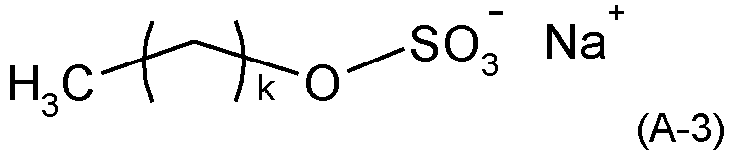
- In verschiedenen Ausführungsformen kann das Mittel neben den vorstehend beschriebenen Aniontensiden, insbesondere solchen der Formeln (I) bis (III), oder alternativ dazu mindestens ein anderes Tensid enthalten. Als alternative oder zusätzliche Tenside kommen insbesondere weitere anionische Tenside, nichtionische Tenside und deren Gemische, aber auch kationische, zwitterionische und amphotere Tenside in Frage.
- In verschiedenen Ausführungsformen umfassen die Mittel mindestens ein nichtionisches Tensid, insbesondere mindestens ein Fettalkoholalkoxylat.
- Geeignete nichtionische Tenside sind solche der Formel
R3-O-(AO)m-H (IV),
in der R3 für einen linearen oder verzweigten, substituierten oder unsubstituierten Alkylrest, AO für eine Ethylenoxid-(EO)- oder Propylenoxid-(PO)-Gruppierung und m für ganze Zahlen von 1 bis 50 stehen. - In der vorstehend genannten Formel (IV) steht R3 für einen linearen oder verzweigten, substituierten oder unsubstituierten Alkylrest, vorzugsweise für einen linearen, unsubstituierten Alkylrest, besonders bevorzugt für einen Fettalkoholrest. Bevorzugte Reste R2 sind ausgewählt aus Decyl-, Undecyl-, Dodecyl-, Tridecyl-, Tetradecyl, Pentadecyl-, Hexadecyl-, Heptadecyl-, Octadecyl-, Nonadecyl-, Eicosylresten und deren Mischungen, wobei die Vertreter mit gerader Anzahl an C-Atomen bevorzugt sind. Besonders bevorzugte Reste R3 sind abgeleitet von C12-C18-Fettalkoholen, beispielsweise von Kokosfettalkohol, Talgfettalkohol, Lauryl-, Myristyl-, Cetyl- oder Stearylalkohol oder von C10-C20-Oxoalkoholen.
- AO steht für eine Ethylenoxid-(EO)- oder Propylenoxid-(PO)-Gruppierung, vorzugsweise für eine Ethylenoxidgruppierung. Der Index m steht für eine ganze Zahl von 1 bis 50, vorzugsweise von 1 bis 20 und insbesondere von 2 bis 10. Ganz besonders bevorzugt steht m für die Zahlen 2, 3, 4, 5, 6, 7 oder 8.
- Zusammenfassend handelt es sich bei vorzugsweise einzusetzenden Fettalkoholalkoxylaten um Verbindungen der Formel

- Weitere nichtionische Tenside, die im Sinne der vorliegenden Erfindung in den beschriebenen Mitteln enthalten sein können, schließen ein, sind aber nicht beschränkt auf Alkylglykoside, alkoxylierte Fettsäurealkylester, Aminoxide, Fettsäurealkanolamide, Hydroxymischether, Sorbitanfettsäurester, Polyhydroxyfettsäureamide und alkoxylierte Alkohole.
- Geeignete Amphotenside sind beispielsweise Betaine der Formel (Riii)(Riv)(Rv)N+CH2COO-, in der Riii einen gegebenenfalls durch Heteroatome oder Heteroatomgruppen unterbrochenen Alkylrest mit 8 bis 25, vorzugsweise 10 bis 21 Kohlenstoffatomen und Riv sowie Rv gleichartige oder verschiedene Alkylreste mit 1 bis 3 Kohlenstoffatomen bedeuten, insbesondere C10-C18-Alkyl-dimethylcarboxymethylbetain und C11-C17-Alkylamidopropyl-dimethylcarboxymethylbetain.
- Geeignete Kationtenside sind u.a. die quartären Ammoniumverbindungen der Formel (Rvi)(Rvii)(Rviii)(Rix)N+ X-, in der Rvi bis Rix für vier gleich- oder verschiedenartige, insbesondere zwei lang- und zwei kurzkettige, Alkylreste und X- für ein Anion, insbesondere ein Halogenidion, stehen, beispielsweise Didecyldimethylammoniumchlorid, Alkylbenzyldidecylammoniumchlorid und deren Mischungen. Weitere geeignete kationische Tenside sind die quaternären oberflächenaktiven Verbindungen, insbesondere mit einer Sulfonium-, Phosphonium-, Jodonium- oder Arsoniumgruppe, die auch als antimikrobielle Wirkstoffe bekannt sind. Durch den Einsatz von quaternären oberflächenaktiven Verbindungen mit antimikrobieller Wirkung kann das Mittel mit einer antimikrobiellen Wirkung ausgestaltet werden bzw. dessen gegebenenfalls aufgrund anderer Inhaltsstoffe bereits vorhandene antimikrobielle Wirkung verbessert werden.
- In verschiedenen Ausführungsformen beträgt die Gesamtmenge der Tenside bezogen auf das Gewicht des Mittels 2 bis 30 Gew.-%, vorzugsweise 5 bis 25 Gew.-%, noch bevorzugter 10 bis 20 Gew.-%, am bevorzugtesten 14 bis 18 Gew.-%, wobei die (linearen) Alkylbenzolsulfonate höchstens in einer Menge von 0,001 bis 30 Gew.-%, vorzugsweise 0,001 bis 10 Gew.-%, ferner bevorzugt 2 bis 6 Gew.-%, noch bevorzugter 3 bis 5 Gew.-%, bezogen auf das Gewicht des Mittels vorliegen.
- Erfindungsgemäße Wasch- oder Reinigungsmittel können neben der Polyesterase weitere Enzyme enthalten. Dies können hydrolytische Enzyme oder andere Enzyme in einer für die Wirksamkeit des Mittels zweckmäßigen Konzentration sein. Eine Ausführungsform der Erfindung stellen somit Mittel dar, die eines oder mehrere Enzyme umfassen. Als Enzyme bevorzugt einsetzbar sind alle Enzyme, die in dem erfindungsgemäßen Mittel eine katalytische Aktivität entfalten können, insbesondere eine Protease, Amylase, Cellulase, Hemicellulase, Mannanase, Tannase, Xylanase, Xanthanase, Xyloglucanase, β-Glucosidase, Pektinase, Carrageenase, Perhydrolase, Oxidase, Oxidoreduktase oder eine Lipase, sowie deren Gemische. Enzyme sind in dem Mittel vorteilhafterweise jeweils in einer Menge von 1 × 10⁻⁸ bis 5 Gew.-%bezogen auf aktives Protein enthalten. Zunehmend bevorzugt ist jedes Enzym in einer Menge von 1 × 10⁻⁷ bis 3 Gew.-%, von 0,00001 bis 1 Gew.-%, von 0,00005 bis 0,5 Gew.-%, von 0,0001 bis 0,1 Gew.-% und besonders bevorzugt von 0,0001 bis 0,05 Gew.-% in erfindungsgemäßen Mitteln enthalten, bezogen auf aktives Protein. Besonders bevorzugt zeigen die Enzyme synergistische Reinigungsleistungen gegenüber bestimmten Anschmutzungen oder Flecken, d.h. die in der Mittelzusammensetzung enthaltenen Enzyme unterstützen sich in ihrer Reinigungsleistung gegenseitig. Synergistische Effekte können nicht nur zwischen verschiedenen Enzymen, sondern auch zwischen einem oder mehreren Enzymen und weiteren Inhaltsstoffen des erfindungsgemäßen Mittels auftreten.
- Bei der/den Amylase(n) handelt es sich vorzugsweise um eine α-Amylase. Bei der Hemicellulase handelt es sich vorzugsweise um eine β-Glucanase, eine Pektinase, eine Pullulanase und/oder eine Mannanase. Bei der Cellulase handelt es sich vorzugsweise um ein Cellulase-Gemisch oder eine Einkomponenten-Cellulase, vorzugsweise bzw. überwiegend um eine Endoglucanase und/oder eine Cellobiohydrolase. Bei der Oxidoreduktase handelt es sich vorzugsweise um eine Oxidase, insbesondere eine Cholin-Oxidase, oder um eine Perhydrolase.
- Die eingesetzten Proteasen sind vorzugsweise alkalische Serin-Proteasen. Sie wirken als unspezifische Endopeptidasen, das heißt, sie hydrolysieren beliebige Säureamidbindungen, die im Inneren von Peptiden oder Proteinen liegen und bewirken dadurch den Abbau proteinhaltiger Anschmutzungen auf dem Reinigungsgut. Ihr pH-Optimum liegt meist im deutlich alkalischen Bereich.
- Die Proteinkonzentration kann mit Hilfe bekannter Methoden, zum Beispiel dem BCA-Verfahren (Bicinchoninsäure; 2,2'-Bichinolyl-4,4'-dicarbonsäure) oder dem Biuret-Verfahren bestimmt werden. Die Bestimmung der Aktivproteinkonzentration erfolgt diesbezüglich über eine Titration der aktiven Zentren unter Verwendung eines geeigneten irreversiblen Inhibitors (für Proteasen beispielsweise Phenylmethylsulfonylfluorid (PMSF)) und Bestimmung der Restaktivität (vgl. M. Bender et al. (1966), J. Am. Chem. Soc. 88(24):5890-5913).
- In den hierin beschriebenen Reinigungsmitteln können die einzusetzenden Enzyme ferner zusammen mit Begleitstoffen, etwa aus der Fermentation, konfektioniert sein. In flüssigen Formulierungen werden die Enzyme bevorzugt als Enzymflüssigformulierung(en) eingesetzt.
- Die Enzyme werden in der Regel nicht in Form des reinen Proteins, sondern vielmehr in Form stabilisierter, lager- und transportfähiger Zubereitungen bereitgestellt. Zu diesen vorkonfektionierten Zubereitungen zählen beispielsweise die durch Granulation, Extrusion oder Lyophilisierung erhaltenen festen Präparationen oder, insbesondere bei flüssigen oder gelförmigen Mitteln, Lösungen der Enzyme, vorteilhafterweise möglichst konzentriert, wasserarm und/oder mit Stabilisatoren oder weiteren Hilfsmitteln versetzt.
- Alternativ können die Enzyme sowohl für die feste als auch für die flüssige Darreichungsform verkapselt werden, beispielsweise durch Sprühtrocknung oder Extrusion der Enzymlösung zusammen mit einem vorzugsweise natürlichen Polymer oder in Form von Kapseln, beispielsweise solchen, bei denen die Enzyme wie in einem erstarrten Gel eingeschlossen sind oder in solchen vom Kern-Schale-Typ, bei dem ein enzymhaltiger Kern mit einer Wasser-, Luft- und/oder Chemikalien-undurchlässigen Schutzschicht überzogen ist. In aufgelagerten Schichten können zusätzlich weitere Wirkstoffe, beispielsweise Stabilisatoren, Emulgatoren, Pigmente, Bleich- oder Farbstoffe aufgebracht werden. Derartige Kapseln werden nach an sich bekannten Methoden, beispielsweise durch Schüttel- oder Rollgranulation oder in Fluid-bed-Prozessen aufgebracht. Vorteilhafterweise sind derartige Granulate, beispielsweise durch Aufbringen polymerer Filmbildner, staubarm und aufgrund der Beschichtung lagerstabil.
- Weiterhin ist es möglich, zwei oder mehrere Enzyme zusammen zu konfektionieren, so dass ein einzelnes Granulat mehrere Enzymaktivitäten aufweist.
- In verschiedenen Ausführungsformen kann das erfindungsgemäße Mittel einen oder mehrere Enzymstabilisatoren aufweisen. Daher kann das erfindungsgemäße Mittel ferner einen Enzymstabilisator beispielsweise ausgewählt aus der Gruppe bestehend aus Natriumformiat, Natriumsulfat, niederen aliphatischen Alkoholen und Borsäure sowie deren Estern und Salzen enthalten. Natürlich können auch zwei oder mehr dieser Verbindungen in Kombination eingesetzt werden. Die Salze der genannten Verbindungen können auch in Form von Hydraten, wie beispielsweise Natriumsulfat Decahydrat, eingesetzt werden.
- Der Begriff "niedere aliphatische Alkohole", wie hierin verwendet, schließt Monoalkohole, Diole und höherwertige Alkohole mit bis zu 6 Kohlenstoffatomen ein. Als zu der Gruppe der niederen aliphatischen Alkohole gehörend seien in diesem Zusammenhang insbesondere Polyole, beispielsweise Glycerin, (Mono)Ethylenglykol, (Mono)Propylenglykol oder Sorbit genannt, ohne dass die Erfindung auf diese beschränkt ist.
- Neben dem mindestens einen Enzymstabilisator, ausgewählt aus der obenstehenden Gruppe, kann ein erfindungsgemäßes Mittel auch mindestens einen weiteren Stabilisator enthalten. Derartige Stabilisatoren sind im Stand der Technik bekannt.
- Reversible Proteaseinhibitoren schützen die in einem Wasch- oder Reinigungsmittel enthaltenen Enzyme vor proteolytischem Abbau, indem die enzymatische Tätigkeit der in dem Mittel enthaltenen Proteasen reversibel inhibiert wird. Als reversible Proteaseinhibitoren werden häufig Benzamidinhydrochlorid, Boronsäuren oder deren Salze oder Ester eingesetzt, darunter vor allem Derivate mit aromatischen Gruppen, etwa ortho-, meta- oder para-substituierte Phenylboronsäuren, insbesondere 4-Formylphenyl-Boronsäure, beziehungsweise die Salze oder Ester der genannten Verbindungen. Auch Peptidaldehyde, das heißt Oligopeptide mit reduziertem C-Terminus, insbesondere solche aus 2 bis 50 Monomeren werden zu diesem Zweck eingesetzt. Zu den peptidischen reversiblen Proteaseinhibitoren gehören unter anderem Ovomucoid und Leupeptin.
- Weitere Enzymstabilisatoren sind Aminoalkohole wie Mono-, Di-, Triethanol- und -Propanolamin und deren Mischungen, aliphatische Carbonsäuren bis zu C12, wie beispielsweise Bernsteinsäure, andere Dicarbonsäuren oder Salze der genannten Säuren. Auch endgruppenverschlossene Fettsäureamidalkoxylate sind für diesen Zweck geeignet. Auch manche als Builder eingesetzte organische Säuren vermögen zusätzlich ein Enzym zu stabilisieren. Auch Calcium- und/oder Magnesiumsalze werden zu diesem Zwecke eingesetzt, wie beispielsweise Calciumacetat.
- Polyamid-Oligomere oder polymere Verbindungen wie Lignin, wasserlösliche Vinyl-Copolymere oder Cellulose-Ether, Acryl-Polymere und/oder Polyamide stabilisieren die Enzym-Präparation unter anderem gegenüber physikalischen Einflüssen oder pH-Wert-Schwankungen. Polyamin-N-Oxid-enthaltende Polymere wirken gleichzeitig als Enzymstabilisatoren und als Farbübertragungsinhibitoren. Andere polymere Stabilisatoren sind lineare C8-C18 Polyoxyalkylene. Auch Alkylpolyglycoside können die enzymatischen Komponenten des erfindungsgemäßen Mittels stabilisieren und vermögen vorzugsweise, diese zusätzlich in ihrer Leistung zu steigern. Vernetzte N-haltige Verbindungen erfüllen vorzugsweise eine Doppelfunktion als Soil-release-Agentien und als Enzym-Stabilisatoren. Hydrophobes, nichtionisches Polymer stabilisiert insbesondere eine gegebenenfalls enthaltene Cellulase.
- Reduktionsmittel und Antioxidantien erhöhen die Stabilität der Enzyme gegenüber oxidativem Zerfall; hierfür sind beispielsweise schwefelhaltige Reduktionsmittel geläufig, etwa Natrium-Sulfit und reduzierende Zucker.
- In einer Ausführungsform sind die Mittel gemäß der vorliegenden Erfindung flüssig und enthalten Wasser als Hauptlösungsmittel, d.h. es handelt sich um wässrige Mittel. Der Wassergehalt des erfindungsgemäßen wässrigen Mittels beträgt üblicherweise 15 bis 70 Gew.-%, vorzugsweise 20 bis 60 Gew.-%. In verschiedenen Ausführungsformen beträgt der Wassergehalt mehr als 5 Gew.-%, bevorzugt mehr als 15 Gew.-% und insbesondere bevorzugt mehr als 50 Gew.-%, jeweils bezogen auf die Gesamtmenge an Mittel.
- Daneben können dem Mittel nichtwässrige Lösungsmittel zugesetzt werden. Geeignete nichtwässrige Lösungsmittel umfassen ein- oder mehrwertige Alkohole, Alkanolamine oder Glykolether, sofern sie im angegebenen Konzentrationsbereich mit Wasser mischbar sind. Vorzugsweise werden die Lösungsmittel ausgewählt aus Ethanol, n-Propanol, i-Propanol, Butanolen, Glykol, Propandiol, Butandiol, Methylpropandiol, Glycerin, Diglykol, Propyldiglykol, Butyldiglykol, Hexylenglykol, Ethylenglykolmethylether, Ethylenglykolethylether, Ethylenglykolpropylether, Ethylenglykolmono-n-butylether, Diethylenglykolmethylether, Diethylenglykolethylether, Propylenglykolmethylether, Propylenglykolethylether, Propylenglykolpropylether, Dipropylenglykolmonomethylether, Dipropylenglykolmonoethylether, Methoxytriglykol, Ethoxytriglykol, Butoxytriglykol, 1-Butoxyethoxy-2-propanol, 3-Methyl-3-methoxybutanol, Propylen-glykol-t-butylether, Di-n-octylether sowie Mischungen dieser Lösungsmittel.
- Das eine oder die mehreren nichtwässrigen Lösungsmittel ist/sind üblicherweise in einer Menge von 0,1 bis 10 Gew.-%, vorzugsweise 1 bis 8 Gew.-% bezogen auf die Gesamtzusammensetzung enthalten.
- Neben den bisher genannten Komponenten können die erfindungsgemäßen Mittel weitere Inhaltsstoffe enthalten, die die anwendungstechnischen und/oder ästhetischen Eigenschaften des Reinigungsmittels weiter verbessern. Hierzu zählen beispielsweise Additive zur Verbesserung des Ablauf- und Trocknungsverhaltens, zur Einstellung der Viskosität und/oder zur Stabilisierung, sowie weitere in Reinigungsmitteln übliche Hilfs- und Zusatzstoffe, etwa UV-Stabilisatoren, Parfüm, Perlglanzmittel, Farbstoffe, Korrosionsinhibitoren, Konservierungsmittel, Bitterstoffe, organische Salze, Desinfektionsmittel, strukturgebende Polymere, Entschäumer, verkapselte Inhaltsstoffe (z.B. verkapseltes Parfum), pH-Stellmittel sowie Hautgefühl-verbessernde oder pflegende Additive.
- Ein erfindungsgemäßes Mittel, insbesondere Wasch- oder Reinigungsmittel, enthält vorzugsweise mindestens einen wasserlöslichen und/oder wasserunlöslichen, organischen und/oder anorganischen Builder (Gerüststoffe).
- Zu den generell einsetzbaren Gerüststoffen zählen insbesondere die Aminocarbonsäuren und deren Salze, Zeolithe, Silikate, Carbonate, organische (Co)Builder und - wo keine ökologischen Vorurteile gegen ihren Einsatz bestehen - auch die Phosphate. Vorzugsweise sind die Mittel aber phosphatfrei.
- Zu den wasserlöslichen organischen Buildersubstanzen gehören Polycarbonsäuren, insbesondere Citronensäure und Zuckersäuren, monomere und polymere Aminopolycarbonsäuren, insbesondere Methylglycindiessigsäure, Nitrilotriessigsäure und Ethylendiamintetraessigsäure sowie Polyasparaginsäure, Polyphosphonsäuren, insbesondere Aminotris(methylenphosphonsäure), Ethylendiamintetrakis(methylenphosphonsäure) und 1-Hydroxyethan-1,1-diphosphonsäure, polymere Hydroxyverbindungen wie Dextrin sowie polymere (Poly-)carbonsäuren, polymere Acrylsäuren, Methacrylsäuren, Maleinsäuren und Mischpolymere aus diesen, die auch geringe Anteile polymerisierbarer Substanzen ohne Carbonsäurefunktionalität einpolymerisiert enthalten können. Geeignete, wenn auch weniger bevorzugte Verbindungen dieser Klasse sind Copolymere der Acrylsäure oder Methacrylsäure mit Vinylethern, wie Vinylmethylethern, Vinylester, Ethylen, Propylen und Styrol, in denen der Anteil der Säure mindestens 50 Gew.-% beträgt. Die organischen Buildersubstanzen können, insbesondere zur Herstellung flüssiger Mittel, in Form wässriger Lösungen, vorzugsweise in Form 30- bis 50-gewichtsprozentiger wässriger Lösungen eingesetzt werden. Alle genannten Säuren werden in der Regel in Form ihrer wasserlöslichen Salze, insbesondere ihre Alkalisalze, eingesetzt.
- Organische Buildersubstanzen können, falls gewünscht, in Mengen bis zu 40 Gew.-%, insbesondere bis zu 25 Gew.-% und vorzugsweise von 1 bis 8 Gew.-% enthalten sein. Mengen nahe der genannten Obergrenze werden vorzugsweise in pastenförmigen oder flüssigen, insbesondere wasserhaltigen, erfindungsgemäßen Mitteln eingesetzt. Erfindungsgemäße Wäschenachbehandlungsmittel, wie z.B. Weichspüler, können gegebenenfalls auch frei von organischem Builder sein.
- Als wasserlösliche anorganische Buildermaterialien kommen insbesondere Alkalisilikate und, falls keine Bedenken wegen ihres Einsatzes bestehen, auch Polyphosphate, vorzugsweise Natriumtriphosphat, in Betracht. Als wasserunlösliche, wasserdispergierbare anorganische Buildermaterialien können insbesondere kristalline oder amorphe Alkalialumosilikate, falls gewünscht, in Mengen von bis zu 50 Gew.-%, vorzugsweise nicht über 40 Gew.-% und in flüssigen Mitteln insbesondere von 1 bis 5 Gew.-%, eingesetzt werden. Unter diesen sind die kristallinen Natriumalumosilikate in Waschmittelqualität, insbesondere Zeolith A, P und gegebenenfalls X, bevorzugt. Mengen nahe der genannten Obergrenze werden vorzugsweise in festen, teilchenförmigen Mitteln eingesetzt. Geeignete Alumosilikate weisen insbesondere keine Teilchen mit einer Korngröße über 30 µm auf und bestehen vorzugsweise zu wenigstens 80 Gew.-% aus Teilchen mit einer Größe unter 10 µm.
- Geeignete Substitute beziehungsweise Teilsubstitute für das genannte Alumosilikat sind kristalline Alkalisilikate, die allein oder im Gemisch mit amorphen Silikaten vorliegen können. Die in den erfindungsgemäßen Mitteln als Gerüststoffe brauchbaren Alkalisilikate weisen vorzugsweise ein molares Verhältnis von Alkalioxid zu SiO2 unter 0,95, insbesondere von 1:1,1 bis 1:12 auf und können amorph oder kristallin vorliegen. Bevorzugte Alkalisilikate sind die Natriumsilikate, insbesondere die amorphen Natriumsilikate, mit einem molaren Verhältnis Na2O:SiO2 von 1:2 bis 1:2,8. Als kristalline Silikate, die allein oder im Gemisch mit amorphen Silikaten vorliegen können, werden vorzugsweise kristalline Schichtsilikate der allgemeinen Formel Na2SixO2x+1 · y H2O eingesetzt, in der x, das sogenannte Modul, eine Zahl von 1,9 bis 4 und y eine Zahl von 0 bis 20 ist und bevorzugte Werte für x 2, 3 oder 4 sind. Bevorzugte kristalline Schichtsilikate sind solche, bei denen x in der genannten allgemeinen Formel die Werte 2 oder 3 annimmt. Insbesondere sind sowohl beta- als auch delta-Natriumdisilikate (Na2Si2O5 · y H2O) bevorzugt. Auch aus amorphen Alkalisilikaten hergestellte, praktisch wasserfreie kristalline Alkalisilikate der obengenannten allgemeinen Formel, in der x eine Zahl von 1,9 bis 2,1 bedeutet, können in erfindungsgemäßen Mitteln eingesetzt werden. In einer weiteren bevorzugten Ausführungsform erfindungsgemäßer Mittel wird ein kristallines Natriumschichtsilikat mit einem Modul von 2 bis 3 eingesetzt, wie es aus Sand und Soda hergestellt werden kann. Kristalline Natriumsilikate mit einem Modul im Bereich von 1,9 bis 3,5 werden in einer weiteren bevorzugten Ausführungsform erfindungsgemäßer Mittel eingesetzt. Falls als zusätzliche Buildersubstanz auch Alkalialumosilikat, insbesondere Zeolith, vorhanden ist, beträgt das Gewichtsverhältnis Alumosilikat zu Silikat, jeweils bezogen auf wasserfreie Aktivsubstanzen, vorzugsweise 1:10 bis 10:1. In Mitteln, die sowohl amorphe als auch kristalline Alkalisilikate enthalten, beträgt das Gewichtsverhältnis von amorphem Alkalisilikat zu kristallinem Alkalisilikat vorzugsweise 1:2 bis 2:1 und insbesondere 1:1 bis 2:1.
- Buildersubstanzen sind, falls gewünscht, in den erfindungsgemäßen Mitteln vorzugsweise in Mengen bis zu 60 Gew.-%, insbesondere von 5 bis 40 Gew.-%, enthalten. Besonders bevorzugt sind in flüssigen Formulierungen wasserlösliche Builder. Erfindungsgemäße Wäschenachbehandlungsmittel, wie z.B. Weichspüler, sind vorzugsweise frei von anorganischem Builder.
- Polymere Verdickungsmittel im Sinne der vorliegenden Erfindung sind die als Polyelektrolyte verdickend wirkenden Polycarboxylate, vorzugsweise Homo- und Copolymerisate der Acrylsäure, insbesondere Acrylsäure-Copolymere wie Acrylsäure-Methacrylsäure-Copolymere, und die Polysaccharide, insbesondere Heteropolysaccharide, sowie andere übliche verdickende Polymere.
- Geeignete Polysaccharide bzw. Heteropolysaccharide sind die Polysaccharidgummen, beispielsweise Gummi arabicum, Agar, Alginate, Carrageene und ihre Salze, Guar, Guaran, Tragacant, Gellan, Ramsan, Dextran oder Xanthan und ihre Derivate, z.B. propoxyliertes Guar, sowie ihre Mischungen. Andere Polysaccharidverdicker, wie Stärken oder Cellulosederivate, können alternativ, vorzugsweise aber zusätzlich zu einem Polysaccharidgummi eingesetzt werden, beispielsweise Stärken verschiedensten Ursprungs und Stärkederivate, z.B. Hydroxyethylstärke, Stärkephosphatester oder Stärkeacetate, oder Carboxymethylcellulose bzw. ihr Natriumsalz, Methyl-, Ethyl-, Hydroxyethyl-, Hydroxypropyl-, Hydroxypropylmethyl- oder Hydroxyethylmethyl-Cellulose oder Celluloseacetat.
- Als polymere Verdickungsmittel geeignete Acrylsäure-Polymere sind beispielsweise hochmolekulare mit einem Polyalkenylpolyether, insbesondere einem Allylether von Saccharose, Pentaerythrit oder Propylen, vernetzte Homopolymere der Acrylsäure (INCI Carbomer), die auch als Carboxyvinylpolymere bezeichnet werden.
- Besonders geeignete polymere Verdickungsmittel sind aber folgende Acrylsäure-Copolymere: (i) Copolymere von zwei oder mehr Monomeren aus der Gruppe der Acrylsäure, Methacrylsäure und ihrer einfachen, vorzugsweise mit C1-4-Alkanolen gebildeten, Ester (INCI Acrylates Copolymer), zu denen etwa die Copolymere von Methacrylsäure, Butylacrylat und Methylmethacrylat (CAS 25035-69-2) oder von Butylacrylat und Methylmethacrylat (CAS 25852-37-3) gehören; (ii) vernetzte hochmolekulare Acrylsäurecopolymere, zu denen etwa die mit einem Allylether der Saccharose oder des Pentaerythrits vernetzten Copolymere von C10-30-Alkylacrylaten mit einem oder mehreren Monomeren aus der Gruppe der Acrylsäure, Methacrylsäure und ihrer einfachen, vorzugsweise mit C1-4-Alkanolen gebildeten, Ester (INCI Acrylates/C10-30 Alkyl Acrylate Crosspolymer) gehören.
- Der Gehalt an polymerem Verdickungsmittel beträgt üblicherweise nicht mehr als 8 Gew.-%, vorzugsweise zwischen 0,1 und 7 Gew.-%, besonders bevorzugt zwischen 0,5 und 6 Gew.-%, insbesondere zwischen 1 und 5 Gew.-% und äußerst bevorzugt zwischen 1,5 und 4 Gew.-%, beispielsweise zwischen 2 und 2,5 Gew.-%, bezogen auf das Gesamtgewicht des Mittels.
- Zur Stabilisierung des erfindungsgemäßen Mittels, insbesondere bei hohem Tensidgehalt, können ein oder mehrere Dicarbonsäuren und/oder deren Salze zugesetzt werden, insbesondere eine Zusammensetzung aus Na-Salzen der Adipin-, Bernstein- und Glutarsäure, wie sie z.B. unter dem Handelsnamen Sokalan® DSC erhältlich ist. Der Einsatz erfolgt hierbei vorteilhafterweise in Mengen von 0,1 bis 8 Gew.-%, vorzugsweise 0,5 bis 7 Gew.-%, insbesondere 1,3 bis 6 Gew.-% und besonders bevorzugt 2 bis 4 Gew.-%, bezogen auf das Gesamtgewicht des Reinigungsmittels.
- Kann jedoch auf deren Einsatz verzichtet werden, so ist das erfindungsgemäße Mittel vorzugsweise frei von Dicarbonsäure(salze)n.
- Die erfindungsgemäßen Waschmittel können mit Referenzwaschmitteln verglichen werden, um die erhöhte Anti-Pilling-Leistung der erfindungsgemäßen Mittel festzustellen. Ein solches Waschsystem kann wie folgt zusammengesetzt sein (alle Angaben in Gewichts-%): Referenzmittel: 4,4 % Alkylbenzolsulfonsäure, 5,6 % weitere anionische Tenside, 2,4 % C12-C18 Na-Salze von Fettsäuren (Seifen), 4,4 % nicht-ionische Tenside, 0,2 % Phosphonate, 1,4 % Zitronensäure, 0,95 % NaOH, 0,01 % Entschäumer, 2,0 % Glycerin, 0,08 % Konservierungsstoffe, 1 % Ethanol, 1,6 % Enzymmix (Protease, Amylase, Cellulase, Mannanase), Rest demineralisiertes Wasser. Erfindungsgemäßes Mittel: 4,4 % Alkylbenzolsulfonsäure, 5,6 % weitere anionische Tenside, 2,4 % C12-C18 Na-Salze von Fettsäuren (Seifen), 4,4 % nicht-ionische Tenside, 0,2 % Phosphonate, 1,4 % Zitronensäure, 0,95 % NaOH, 0,01 % Entschäumer, 2,0 % Glycerin, 0,08 % Konservierungsstoffe, 1 % Ethanol, 1,6 % Enzymmix (Protease, Amylase, Cellulase, Mannanase), 0,009 % Polyesterase, Rest demineralisiertes Wasser. Bevorzugt beträgt die Dosierung des flüssigen Waschmittels zwischen 4,5 und 6,0 Gramm pro Liter Waschflotte, beispielsweise 4,7, 4,9 oder 5,9 Gramm pro Liter Waschflotte. Bevorzugt wird gewaschen in einem pH-Wertebereich zwischen pH 8 und pH 10,5, bevorzugt zwischen pH 8 und pH 9.
- Die zuvor genannten Ausführungsformen der vorliegenden Erfindung umfassen alle festen, pulverförmigen, flüssigen, gelförmigen oder pastösen Darreichungsformen erfindungsgemäßer Mittel, die gegebenenfalls auch aus mehreren Phasen bestehen können sowie in komprimierter oder nicht komprimierter Form vorliegen können. Das Mittel kann als rieselfähiges Pulver vorliegen, insbesondere mit einem Schüttgewicht von 300 g/l bis 1200 g/l, insbesondere 500 g/l bis 900 g/l oder 600 g/l bis 850 g/l. Zu den festen Darreichungsformen des Mittels zählen ferner Extrudate, Granulate, Tabletten oder Pouches. Alternativ kann das Mittel auch flüssig, gelförmig oder pastös sein, beispielsweise in Form eines nicht-wässrigen Flüssigwaschmittels oder einer nicht-wässrigen Paste oder in Form eines wässrigen Flüssigwaschmittels oder einer wasserhaltigen Paste. Weiterhin kann das Mittel als Einkomponentensystem vorliegen. Solche Mittel bestehen aus einer Phase. Alternativ kann ein Mittel auch aus mehreren Phasen bestehen. Ein solches Mittel ist demnach in mehrere Komponenten aufgeteilt (Mehrkomponentensystem).
- Ein weiterer Erfindungsgegenstand ist ein Verfahren zur Reinigung von Textilien, das dadurch gekennzeichnet ist, dass in mindestens einem Verfahrensschritt ein erfindungsgemäßes Mittel angewendet wird. Die Textilien enthalten vorzugsweise Polyester oder bestehen aus diesem.
- In verschieden Ausführungsformen zeichnet sich das oben beschriebene Verfahren dadurch aus, dass das erfindungsgemäße Mittel bei einer Temperatur von 0 bis 100 °C, bevorzugt 0 bis 80 °C, weiter bevorzugt 30 bis 70 °C und am meisten bevorzugt bei 40 bis 60 °C eingesetzt wird.
- Hierunter fallen sowohl manuelle als auch maschinelle Verfahren, wobei maschinelle Verfahren bevorzugt sind. Verfahren zur Reinigung von Textilien zeichnen sich im Allgemeinen dadurch aus, dass in mehreren Verfahrensschritten verschiedene reinigungsaktive Substanzen auf das Reinigungsgut aufgebracht und nach der Einwirkzeit abgewaschen werden, oder dass das Reinigungsgut in sonstiger Weise mit einem Waschmittel oder einer Lösung oder Verdünnung dieses Mittels behandelt wird. Alle denkbaren Wasch- oder Reinigungsverfahren können in wenigstens einem der Verfahrensschritte um die Anwendung eines erfindungsgemäßen Wasch-oder Reinigungsmittels bereichert werden und stellen dann Ausführungsformen der vorliegenden Erfindung dar. Alle Sachverhalte, Gegenstände und Ausführungsformen, die für erfindungsgemäße Mittel beschrieben sind, sind auch auf diesen Erfindungsgegenstand anwendbar. Daher wird an dieser Stelle ausdrücklich auf die Offenbarung an entsprechender Stelle verwiesen mit dem Hinweis, dass diese Offenbarung auch für die vorstehenden erfindungsgemäßen Verfahren gilt.
- Da Enzyme natürlicherweise bereits eine katalytische Aktivität besitzen und diese auch in Medien entfalten, die sonst keine Reinigungskraft besitzen wie beispielsweise in bloßem Puffer, kann ein einzelner und/oder der einzige Schritt eines solchen Verfahrens darin bestehen, dass als einzige reinigungsaktive Komponente eine Polyesterase mit der Anschmutzung in Kontakt gebracht wird, bevorzugt in einer Pufferlösung oder in Wasser. Dies stellt eine weitere Ausführungsform dieses Erfindungsgegenstandes dar.
- Alternative Ausführungsformen dieses Erfindungsgegenstandes stellen auch Verfahren zur Behandlung von Textilrohstoffen oder zur Textilpflege dar, bei denen in wenigstens einem Verfahrensschritt ein erfindungsgemäßes Mittel aktiv wird. Hierunter sind Verfahren für Textilrohstoffe, Fasern oder Textilien mit synthetischen Bestandteilen bevorzugt, und ganz besonders für solche mit Polyester.
- Des Weiteren erfasst die Erfindung auch die Verwendung des hierin beschriebenen Mittels, beispielsweise als Wasch- oder Reinigungsmitteln wie oben beschrieben, zur (verbesserten) Entfernung von Anschmutzungen, beispielsweise von Textilien, insbesondere Polyester-Textilien.
- Schließlich bezieht sich die Erfindung auch auf die Verwendung einer Polyesterase zur Verringerung von Pilling-Effekten eines Wasch- oder Reinigungsmittels, vorzugsweise eines Waschmittels, besonders bevorzugt eines Flüssigwaschmittels, wobei das Wasch- oder Reinigungsmittel die Polyesterase enthält. Die Polyesterase ist eine Polyesterase wie sie hierin definiert ist. In verschiedenen Ausführungsformen der Verwendung ist die Polyesterase in einer Menge von 0,00001 bis 1 Gew.-%, bevorzugt in einer Menge von 0,0001 bis 0,5 Gew.-%, besonders bevorzugt in einer Menge von 0,001 bis 0,1 Gew.-%, in dem Wasch- oder Reinigungsmittel enthalten. In weiteren verschiedenen Ausführungsformen wird die Polyesterase, die eine Verringerung des Pilling-Effekts bewirkt, auf Textilien, insbesondere Textilien, die aus Polyester bestehen oder Polyester umfassen, angewendet.
- Alle Sachverhalte, Gegenstände und Ausführungsformen, die für erfindungsgemäße Mittel und die Polyesterase beschrieben sind, sind auch auf die weiteren Erfindungsgegenstände anwendbar. Daher wird an dieser Stelle ausdrücklich auf die Offenbarung an entsprechender Stelle verwiesen mit dem Hinweis, dass diese Offenbarung auch für das vorstehende erfindungsgemäße Verfahren und die erfindungsgemäßen Verwendungen gilt.
- Für die Expression der Polyesterase wurde ein synthetisches Gen mit einer an die Trichoderma codon-usage angepassten Nukleotidsequenz genutzt. Das Gen wurde mittels Gibson-Assembly mit verschiedenen Sekretionssignalen fusioniert und in ein Plasmid zur Amplifikation in Escherichia coli kloniert. Dieses Expressionsplasmid verfügt über einen starken Promotor zur Expression der entsprechenden mRNA des Polyesterasegens und über weitere Elemente, die eine Selektion von Escherichia coli Zellen erlauben, die das Expressionskonstrukt nach der Transformation aufgenommen haben.
- Das entsprechende Konstrukt zur Transformation und anschließender Integration in das Genom von Trichoderma reesei wurde aus diesem Plasmid durch Restriktion mit NotI erhalten. Dieses Transformationsfragment beinhaltet die Elemente zur Expression des Polyesterasegens und ein Gen, welches die Selektion erfolgreich transformierter Zellen in Trichoderma reesei erlaubt.
- Nach erfolgter Auswahl des produktivsten Expressionsstammes wurde die Polyesterase in ausreichender Menge durch Fermentation hergestellt, um für Waschanwendungstests eingesetzt werden zu können.
- Dies ist eine handelsübliche Waschmittelmatrix, die für den Waschtest verwendet wurde:
Chemischer Name Gew.-% Aktivsubstanz im Rohmaterial Gew.-% Aktivsubstanz in der Formulierung Wasser demin. 100 Rest Alkylbenzolsulfonsäure 96 3-7 Anionische Tenside (FAEOS) 70 2-6 C12-C18 Fettsäure Na-Salz 30 0,3-1 Nicht-ionische Tenside (FAEO) 100 3-7 Phosphonate 40 0,1-0,8 Zitronensäure 100 0,1-2 NaOH 50 0,3-1 Entschäumer t.q. 0,005-0,01 Glycerin 99,5 0,3-1 Konservierungsmittel 100 0,05-0,1 Borsäure 100 0,3-1 Optischer Aufheller 90 0,01-0,08 Verdicker 25 1-3 Enzyme (außer Polyesterase) 100 0,5-2 Farbstoff, Parfüm Dosierung 50 mL - In einer handelsüblichen Waschmaschine werden 20 identische Versuche hintereinander durchgeführt. Als zu beurteilende Textilien werden verschiedene Polyester und Mischtextilien benutzt, welche einmal neu und einmal vorgepillt sind. Nach den 20 Versuchen wird die Pillreduktion der vorgepillten Gewebe und die Pillbildung der neuen Gewebe optisch beurteilt.
- Die vorgepillten Gewebe werden durch 20-fach wiederholte Waschzyklen bei 40 °C in handelsüblichen Waschmaschinen hergestellt.
- Nach jedem Waschzyklus wird die komplette Wäsche im Trockner getrocknet.
-
- Wasser mit 16° dH, 2,5 kg saubere Füllwäsche, 40 °C Normalprogramm, 50 ml Waschmittel wie oben beschrieben pro Maschine
- Dosierung der zu untersuchenden Polyesterase: 50 mg Aktivenzym pro Waschmaschine
- Probe 1: nur Waschmittel wie oben beschrieben (Vergleichsreferenz)
- Probe 2: Waschmittel + 50 mg Polyesterase (SEQ ID NO:1) (erfindungsgemäß)
- Ergebnis nach 20 Wäschen auf 100 % Polyestertextil:
- Visuelle Abmusterung der Pills, Skala 1-5, sehr stark gepillt =1, nicht gepillt = 5
- Probe 1: 1,6
- Probe 2: 3,3
- Eine Änderung von 0,5 Einheiten ist als signifikant anzusehen.
- Die erfindungsgemäße Polyesterase verbessert das Pill-Erscheinungsbild signifikant.
Claims (10)
- Wasch- oder Reinigungsmittel, dadurch gekennzeichnet, dass es eine Polyesterase enthält, die mindestens 83 % Sequenzidentität mit der in SEQ ID NO:1 angegebenen Aminosäuresequenz über deren Gesamtlänge aufweist.
- Das Wasch- oder Reinigungsmittel nach Anspruch 1, dadurch gekennzeichnet, dass die Polyesterase eine Aminosäuresequenz umfasst, die zu der in SEQ ID NO:1 angegebenen Aminosäuresequenz über deren Gesamtlänge zu mindestens 84 %, 85 %, 86 %, 87 %, 88 %, 89 %, 90 %, 90,5 %, 91 %, 91,5 %, 92 %, 92,5 %, 93 %, 93,5 %, 94 %, 94,5 %, 95 %, 95,5 %, 96 %, 96,5 %, 97 %, 97,5 %, 98 %, 98,5 %, 98,8 %, 99,0 %, 99,2 %, 99,4 % oder 99,6 % identisch ist.
- Das Wasch- oder Reinigungsmittel nach Anspruch 1 oder 2, dadurch gekennzeichnet, dass(a) die Polyesterase aus einer Polyesterase nach Anspruch 1 oder 2 als Ausgangsmolekül durch ein- oder mehrfache konservative Aminosäuresubstitution erhältlich ist; und/oder(b) die Polyesterase aus einer Polyesterase nach Anspruch 1 oder 2 als Ausgangsmolekül durch Fragmentierung, Deletions-, Insertions- oder Substitutionsmutagenese erhältlich ist und eine Aminosäuresequenz umfasst, die über eine Länge von mindestens 180, 190, 200, 210, 220, 230, 240, 245, 250, 251, 252, 253, 254, 255, 256, 257, 258, 259, 260, 261 oder 262 zusammenhängenden Aminosäuren mit dem Ausgangsmolekül übereinstimmt.
- Das Wasch- oder Reinigungsmittel nach einem der Ansprüche 1 bis 3, wobei die Polyesterase in einer Menge von 0,00001 bis 1 Gew.-%, bevorzugt in einer Menge von 0,0001 bis 0,5 Gew.-%, besonders bevorzugt in einer Menge von 0,001 bis 0,1 Gew.-% in dem Wasch- oder Reinigungsmittel enthalten ist.
- Das Wasch- oder Reinigungsmittel nach einem der Ansprüche 1 bis 4, dadurch gekennzeichnet, dass(a) es mindestens einen zusätzlichen Inhaltsstoff ausgewählt aus der Gruppe bestehend aus Tensiden, Buildern (Gerüststoffe), Bleichmitteln, Bleichaktivatoren, wassermischbare organische Lösungsmittel, weitere Enzyme, Sequestrierungsmittel, Elektrolyte, pH-Regulatoren, optische Aufheller, Vergrauungsinhibitoren, Schaumregulatoren, Farb- und Duftstoffe sowie Kombinationen hiervon enthält;
und/oder(b) es in fester oder flüssiger, bevorzugt flüssiger, Form vorliegt. - Verfahren zur Reinigung von Textilien, dadurch gekennzeichnet, dass in mindestens einem Verfahrensschritt ein Wasch- oder Reinigungsmittel nach einem der Ansprüche 1 bis 5 angewendet wird.
- Verfahren nach Anspruch 6, dadurch gekennzeichnet, dass die Textilien Polyester enthalten oder daraus bestehen.
- Verwendung eines Wasch- oder Reinigungsmittels nach einem der Ansprüche 1 bis 5 zur Entfernung von Anschmutzungen, insbesondere von Polyester-haltigen Textilien.
- Verwendung einer Polyesterase, die mindestens 83 % Sequenzidentität mit der in SEQ ID NO:1 angegebenen Aminosäuresequenz über deren Gesamtlänge aufweist, zur Verringerung von Pilling-Effekten und/oder Steigerung der Anti-Grau-Wirkung eines Wasch-oder Reinigungsmittels, vorzugsweise eines Waschmittels, besonders bevorzugt eines Flüssigwaschmittels, wobei das Wasch- oder Reinigungsmittel die Polyesterase enthält.
- Die Verwendung nach Anspruch 9, wobei(a) die Polyesterase wie in Anspruch 2 oder 3 definiert ist; und/oder(b) die Polyesterase in einer Menge wie in Anspruch 4 definiert in dem Wasch- oder Reinigungsmittel enthalten ist;
und/oder(c) das Wasch- oder Reinigungsmittel wie in Anspruch 5 definiert ist.
Applications Claiming Priority (2)
| Application Number | Priority Date | Filing Date | Title |
|---|---|---|---|
| DE102018210608.8A DE102018210608A1 (de) | 2018-06-28 | 2018-06-28 | Mittel enthaltend Polyesterase I |
| PCT/EP2019/066795 WO2020002310A1 (de) | 2018-06-28 | 2019-06-25 | Mittel enthaltend polyesterase i |
Publications (2)
| Publication Number | Publication Date |
|---|---|
| EP3814471A1 EP3814471A1 (de) | 2021-05-05 |
| EP3814471B1 true EP3814471B1 (de) | 2025-03-05 |
Family
ID=67106038
Family Applications (1)
| Application Number | Title | Priority Date | Filing Date |
|---|---|---|---|
| EP19734049.0A Active EP3814471B1 (de) | 2018-06-28 | 2019-06-25 | Wasch-oder reinigungsmittel enthaltend polyesterase |
Country Status (6)
| Country | Link |
|---|---|
| US (1) | US20210254036A1 (de) |
| EP (1) | EP3814471B1 (de) |
| KR (1) | KR102894104B1 (de) |
| DE (1) | DE102018210608A1 (de) |
| PL (1) | PL3814471T3 (de) |
| WO (1) | WO2020002310A1 (de) |
Families Citing this family (6)
| Publication number | Priority date | Publication date | Assignee | Title |
|---|---|---|---|---|
| DE102018210605A1 (de) | 2018-06-28 | 2020-01-02 | Henkel Ag & Co. Kgaa | Mittel enthaltend rekombinante Polyesterase |
| EP4237549A1 (de) * | 2020-10-27 | 2023-09-06 | Carbios | Neuartige esterasen und verwendungen davon |
| CN117597424A (zh) * | 2021-06-30 | 2024-02-23 | 汉高股份有限及两合公司 | 具有改进的水分管理性能的组合物 |
| EP4363544A1 (de) * | 2021-06-30 | 2024-05-08 | Henkel AG & Co. KGaA | Reinigungszusammensetzung mit verbesserter anti-grauungs- und/oder anti-tödungsleistung |
| KR20240027617A (ko) * | 2021-06-30 | 2024-03-04 | 헨켈 아게 운트 코. 카게아아 | 폴리에스테라제 활성을 갖는 지질분해 효소를 포함하는 세정 조성물 |
| WO2024237738A1 (ko) | 2023-05-18 | 2024-11-21 | 주식회사 자이엔 | Pet 분해 활성을 갖는 변이형 폴리펩티드 |
Citations (1)
| Publication number | Priority date | Publication date | Assignee | Title |
|---|---|---|---|---|
| WO2013096653A1 (en) * | 2011-12-22 | 2013-06-27 | Danisco Us Inc. | Compositions and methods comprising a lipolytic enzyme variant |
Family Cites Families (5)
| Publication number | Priority date | Publication date | Assignee | Title |
|---|---|---|---|---|
| CN1185807A (zh) | 1995-04-28 | 1998-06-24 | 金克克国际有限公司 | 含纤维素酶的洗涤剂 |
| DE102008017103A1 (de) | 2008-04-02 | 2009-10-08 | Henkel Ag & Co. Kgaa | Wasch- und Reinigungsmittel enthaltend Proteasen aus Xanthomonas |
| EP2677881B1 (de) * | 2011-02-24 | 2020-04-01 | Erber Aktiengesellschaft | Enzyme zur futtermittel behandlung |
| CN103781903A (zh) * | 2011-08-31 | 2014-05-07 | 丹尼斯科美国公司 | 包含脂肪分解酶变体的组合物和方法 |
| DE102016201173A1 (de) * | 2016-01-27 | 2017-07-27 | Henkel Ag & Co. Kgaa | Verbessertes Anti-Pilling auf Polyester Textilien durch Einsatz einer Cutinase |
-
2018
- 2018-06-28 DE DE102018210608.8A patent/DE102018210608A1/de not_active Withdrawn
-
2019
- 2019-06-25 KR KR1020217002722A patent/KR102894104B1/ko active Active
- 2019-06-25 US US16/973,444 patent/US20210254036A1/en not_active Abandoned
- 2019-06-25 PL PL19734049.0T patent/PL3814471T3/pl unknown
- 2019-06-25 WO PCT/EP2019/066795 patent/WO2020002310A1/de not_active Ceased
- 2019-06-25 EP EP19734049.0A patent/EP3814471B1/de active Active
Patent Citations (1)
| Publication number | Priority date | Publication date | Assignee | Title |
|---|---|---|---|---|
| WO2013096653A1 (en) * | 2011-12-22 | 2013-06-27 | Danisco Us Inc. | Compositions and methods comprising a lipolytic enzyme variant |
Also Published As
| Publication number | Publication date |
|---|---|
| KR102894104B1 (ko) | 2025-12-03 |
| US20210254036A1 (en) | 2021-08-19 |
| EP3814471A1 (de) | 2021-05-05 |
| WO2020002310A1 (de) | 2020-01-02 |
| KR20210025622A (ko) | 2021-03-09 |
| PL3814471T3 (pl) | 2025-07-07 |
| DE102018210608A1 (de) | 2020-01-02 |
Similar Documents
| Publication | Publication Date | Title |
|---|---|---|
| EP3638762A1 (de) | Pseudomonas stutzeri lipase und ihre verwendung | |
| EP3638780A1 (de) | Microbulbifer thermotolerans lipase und ihre verwendung | |
| EP3673035B1 (de) | Verbesserte pflegeeigenschaften von polyester textilien ii | |
| EP3814471A1 (de) | Mittel enthaltend polyesterase i | |
| EP3408367B1 (de) | Verbessertes anti-pilling auf polyester textilien durch einsatz einer cutinase | |
| EP3538633B1 (de) | Amylase für wasch- und reinigungsmittelanwendungen | |
| WO2020002308A1 (de) | Mittel enthaltend rekombinante polyesterase | |
| DE102016214381A1 (de) | Wollwaschmittel enthaltend Transglutaminase | |
| WO2020002307A1 (de) | Polyesterase ii | |
| DE102017223275A1 (de) | Aminoxid enthaltende Reinigungsmittel mit synergistisch wirkenden Proteasen und Amylasen | |
| WO2017198463A1 (de) | Wasch- oder reinigungsmittel enthaltend eine polyethylenterephthalat hydrolase | |
| EP3420061A1 (de) | Optimierte tensid-enzym mischungen | |
| DE102019106038A1 (de) | Wasch- oder Reinigungsmittel umfassend Chlorophyll-bindendes Protein | |
| DE102015225463A1 (de) | Wasch- oder Reinigungsmittel mit verbesserter Enzymstabilität | |
| DE102016214382A1 (de) | Waschmittel enthaltend Keratinase | |
| DE102019212972A1 (de) | Stabile Handgeschirrspülzusammensetzung mit Bleiche | |
| DE102019107448A1 (de) | Schaumstabilisierung durch spezifisches Tensidgemisch | |
| WO2017211661A1 (de) | Festes wasch- und reinigungsmittel mit amylase, protease und löslichem builder | |
| WO2017144623A1 (de) | Stabilisierung von protease in alkylbenzolsulfonat-haltigen reinigungsmitteln |
Legal Events
| Date | Code | Title | Description |
|---|---|---|---|
| STAA | Information on the status of an ep patent application or granted ep patent |
Free format text: STATUS: UNKNOWN |
|
| STAA | Information on the status of an ep patent application or granted ep patent |
Free format text: STATUS: THE INTERNATIONAL PUBLICATION HAS BEEN MADE |
|
| PUAI | Public reference made under article 153(3) epc to a published international application that has entered the european phase |
Free format text: ORIGINAL CODE: 0009012 |
|
| STAA | Information on the status of an ep patent application or granted ep patent |
Free format text: STATUS: REQUEST FOR EXAMINATION WAS MADE |
|
| 17P | Request for examination filed |
Effective date: 20201124 |
|
| AK | Designated contracting states |
Kind code of ref document: A1 Designated state(s): AL AT BE BG CH CY CZ DE DK EE ES FI FR GB GR HR HU IE IS IT LI LT LU LV MC MK MT NL NO PL PT RO RS SE SI SK SM TR |
|
| DAV | Request for validation of the european patent (deleted) | ||
| DAX | Request for extension of the european patent (deleted) | ||
| P01 | Opt-out of the competence of the unified patent court (upc) registered |
Effective date: 20230530 |
|
| STAA | Information on the status of an ep patent application or granted ep patent |
Free format text: STATUS: EXAMINATION IS IN PROGRESS |
|
| 17Q | First examination report despatched |
Effective date: 20240429 |
|
| GRAP | Despatch of communication of intention to grant a patent |
Free format text: ORIGINAL CODE: EPIDOSNIGR1 |
|
| STAA | Information on the status of an ep patent application or granted ep patent |
Free format text: STATUS: GRANT OF PATENT IS INTENDED |
|
| INTG | Intention to grant announced |
Effective date: 20241114 |
|
| GRAS | Grant fee paid |
Free format text: ORIGINAL CODE: EPIDOSNIGR3 |
|
| GRAA | (expected) grant |
Free format text: ORIGINAL CODE: 0009210 |
|
| STAA | Information on the status of an ep patent application or granted ep patent |
Free format text: STATUS: THE PATENT HAS BEEN GRANTED |
|
| AK | Designated contracting states |
Kind code of ref document: B1 Designated state(s): AL AT BE BG CH CY CZ DE DK EE ES FI FR GB GR HR HU IE IS IT LI LT LU LV MC MK MT NL NO PL PT RO RS SE SI SK SM TR |
|
| REG | Reference to a national code |
Ref country code: GB Ref legal event code: FG4D Free format text: NOT ENGLISH |
|
| REG | Reference to a national code |
Ref country code: CH Ref legal event code: EP |
|
| REG | Reference to a national code |
Ref country code: DE Ref legal event code: R096 Ref document number: 502019013023 Country of ref document: DE |
|
| REG | Reference to a national code |
Ref country code: IE Ref legal event code: FG4D Free format text: LANGUAGE OF EP DOCUMENT: GERMAN |
|
| PG25 | Lapsed in a contracting state [announced via postgrant information from national office to epo] |
Ref country code: RS Free format text: LAPSE BECAUSE OF FAILURE TO SUBMIT A TRANSLATION OF THE DESCRIPTION OR TO PAY THE FEE WITHIN THE PRESCRIBED TIME-LIMIT Effective date: 20250605 |
|
| PG25 | Lapsed in a contracting state [announced via postgrant information from national office to epo] |
Ref country code: FI Free format text: LAPSE BECAUSE OF FAILURE TO SUBMIT A TRANSLATION OF THE DESCRIPTION OR TO PAY THE FEE WITHIN THE PRESCRIBED TIME-LIMIT Effective date: 20250305 |
|
| REG | Reference to a national code |
Ref country code: NL Ref legal event code: MP Effective date: 20250305 |
|
| PG25 | Lapsed in a contracting state [announced via postgrant information from national office to epo] |
Ref country code: ES Free format text: LAPSE BECAUSE OF FAILURE TO SUBMIT A TRANSLATION OF THE DESCRIPTION OR TO PAY THE FEE WITHIN THE PRESCRIBED TIME-LIMIT Effective date: 20250305 |
|
| REG | Reference to a national code |
Ref country code: LT Ref legal event code: MG9D |
|
| PG25 | Lapsed in a contracting state [announced via postgrant information from national office to epo] |
Ref country code: NO Free format text: LAPSE BECAUSE OF FAILURE TO SUBMIT A TRANSLATION OF THE DESCRIPTION OR TO PAY THE FEE WITHIN THE PRESCRIBED TIME-LIMIT Effective date: 20250605 |
|
| PG25 | Lapsed in a contracting state [announced via postgrant information from national office to epo] |
Ref country code: HR Free format text: LAPSE BECAUSE OF FAILURE TO SUBMIT A TRANSLATION OF THE DESCRIPTION OR TO PAY THE FEE WITHIN THE PRESCRIBED TIME-LIMIT Effective date: 20250305 |
|
| PG25 | Lapsed in a contracting state [announced via postgrant information from national office to epo] |
Ref country code: LV Free format text: LAPSE BECAUSE OF FAILURE TO SUBMIT A TRANSLATION OF THE DESCRIPTION OR TO PAY THE FEE WITHIN THE PRESCRIBED TIME-LIMIT Effective date: 20250305 |
|
| PG25 | Lapsed in a contracting state [announced via postgrant information from national office to epo] |
Ref country code: GR Free format text: LAPSE BECAUSE OF FAILURE TO SUBMIT A TRANSLATION OF THE DESCRIPTION OR TO PAY THE FEE WITHIN THE PRESCRIBED TIME-LIMIT Effective date: 20250606 Ref country code: BG Free format text: LAPSE BECAUSE OF FAILURE TO SUBMIT A TRANSLATION OF THE DESCRIPTION OR TO PAY THE FEE WITHIN THE PRESCRIBED TIME-LIMIT Effective date: 20250305 |
|
| PG25 | Lapsed in a contracting state [announced via postgrant information from national office to epo] |
Ref country code: NL Free format text: LAPSE BECAUSE OF FAILURE TO SUBMIT A TRANSLATION OF THE DESCRIPTION OR TO PAY THE FEE WITHIN THE PRESCRIBED TIME-LIMIT Effective date: 20250305 |
|
| PG25 | Lapsed in a contracting state [announced via postgrant information from national office to epo] |
Ref country code: SE Free format text: LAPSE BECAUSE OF FAILURE TO SUBMIT A TRANSLATION OF THE DESCRIPTION OR TO PAY THE FEE WITHIN THE PRESCRIBED TIME-LIMIT Effective date: 20250305 |
|
| PG25 | Lapsed in a contracting state [announced via postgrant information from national office to epo] |
Ref country code: SM Free format text: LAPSE BECAUSE OF FAILURE TO SUBMIT A TRANSLATION OF THE DESCRIPTION OR TO PAY THE FEE WITHIN THE PRESCRIBED TIME-LIMIT Effective date: 20250305 |
|
| PG25 | Lapsed in a contracting state [announced via postgrant information from national office to epo] |
Ref country code: PT Free format text: LAPSE BECAUSE OF FAILURE TO SUBMIT A TRANSLATION OF THE DESCRIPTION OR TO PAY THE FEE WITHIN THE PRESCRIBED TIME-LIMIT Effective date: 20250707 |
|
| PG25 | Lapsed in a contracting state [announced via postgrant information from national office to epo] |
Ref country code: IT Free format text: LAPSE BECAUSE OF FAILURE TO SUBMIT A TRANSLATION OF THE DESCRIPTION OR TO PAY THE FEE WITHIN THE PRESCRIBED TIME-LIMIT Effective date: 20250305 |
|
| PG25 | Lapsed in a contracting state [announced via postgrant information from national office to epo] |
Ref country code: CZ Free format text: LAPSE BECAUSE OF FAILURE TO SUBMIT A TRANSLATION OF THE DESCRIPTION OR TO PAY THE FEE WITHIN THE PRESCRIBED TIME-LIMIT Effective date: 20250305 Ref country code: EE Free format text: LAPSE BECAUSE OF FAILURE TO SUBMIT A TRANSLATION OF THE DESCRIPTION OR TO PAY THE FEE WITHIN THE PRESCRIBED TIME-LIMIT Effective date: 20250305 |
|
| PG25 | Lapsed in a contracting state [announced via postgrant information from national office to epo] |
Ref country code: RO Free format text: LAPSE BECAUSE OF FAILURE TO SUBMIT A TRANSLATION OF THE DESCRIPTION OR TO PAY THE FEE WITHIN THE PRESCRIBED TIME-LIMIT Effective date: 20250305 |
|
| PG25 | Lapsed in a contracting state [announced via postgrant information from national office to epo] |
Ref country code: SK Free format text: LAPSE BECAUSE OF FAILURE TO SUBMIT A TRANSLATION OF THE DESCRIPTION OR TO PAY THE FEE WITHIN THE PRESCRIBED TIME-LIMIT Effective date: 20250305 |
|
| PG25 | Lapsed in a contracting state [announced via postgrant information from national office to epo] |
Ref country code: IS Free format text: LAPSE BECAUSE OF FAILURE TO SUBMIT A TRANSLATION OF THE DESCRIPTION OR TO PAY THE FEE WITHIN THE PRESCRIBED TIME-LIMIT Effective date: 20250705 |
|
| REG | Reference to a national code |
Ref country code: DE Ref legal event code: R097 Ref document number: 502019013023 Country of ref document: DE |
|
| PLBE | No opposition filed within time limit |
Free format text: ORIGINAL CODE: 0009261 |
|
| STAA | Information on the status of an ep patent application or granted ep patent |
Free format text: STATUS: NO OPPOSITION FILED WITHIN TIME LIMIT |
|
| PG25 | Lapsed in a contracting state [announced via postgrant information from national office to epo] |
Ref country code: DK Free format text: LAPSE BECAUSE OF FAILURE TO SUBMIT A TRANSLATION OF THE DESCRIPTION OR TO PAY THE FEE WITHIN THE PRESCRIBED TIME-LIMIT Effective date: 20250305 |
|
| REG | Reference to a national code |
Ref country code: CH Ref legal event code: L10 Free format text: ST27 STATUS EVENT CODE: U-0-0-L10-L00 (AS PROVIDED BY THE NATIONAL OFFICE) Effective date: 20260114 |
|
| REG | Reference to a national code |
Ref country code: CH Ref legal event code: H13 Free format text: ST27 STATUS EVENT CODE: U-0-0-H10-H13 (AS PROVIDED BY THE NATIONAL OFFICE) Effective date: 20260127 |
|
| PG25 | Lapsed in a contracting state [announced via postgrant information from national office to epo] |
Ref country code: MC Free format text: LAPSE BECAUSE OF FAILURE TO SUBMIT A TRANSLATION OF THE DESCRIPTION OR TO PAY THE FEE WITHIN THE PRESCRIBED TIME-LIMIT Effective date: 20250305 |
|
| 26N | No opposition filed |
Effective date: 20251208 |
|
| PG25 | Lapsed in a contracting state [announced via postgrant information from national office to epo] |
Ref country code: LU Free format text: LAPSE BECAUSE OF NON-PAYMENT OF DUE FEES Effective date: 20250625 |
|
| REG | Reference to a national code |
Ref country code: BE Ref legal event code: MM Effective date: 20250630 |
|
| REG | Reference to a national code |
Ref country code: DE Ref legal event code: R084 Ref document number: 502019013023 Country of ref document: DE |
|
| PG25 | Lapsed in a contracting state [announced via postgrant information from national office to epo] |
Ref country code: IE Free format text: LAPSE BECAUSE OF NON-PAYMENT OF DUE FEES Effective date: 20250625 |
|
| PG25 | Lapsed in a contracting state [announced via postgrant information from national office to epo] |
Ref country code: BE Free format text: LAPSE BECAUSE OF NON-PAYMENT OF DUE FEES Effective date: 20250630 |
|
| PG25 | Lapsed in a contracting state [announced via postgrant information from national office to epo] |
Ref country code: CH Free format text: LAPSE BECAUSE OF NON-PAYMENT OF DUE FEES Effective date: 20250630 |
|
| PG25 | Lapsed in a contracting state [announced via postgrant information from national office to epo] |
Ref country code: LT Free format text: LAPSE BECAUSE OF FAILURE TO SUBMIT A TRANSLATION OF THE DESCRIPTION OR TO PAY THE FEE WITHIN THE PRESCRIBED TIME-LIMIT Effective date: 20250305 |
|
| PGFP | Annual fee paid to national office [announced via postgrant information from national office to epo] |
Ref country code: GB Payment date: 20260626 Year of fee payment: 8 Ref country code: PL Payment date: 20260611 Year of fee payment: 8 |
|
| PGFP | Annual fee paid to national office [announced via postgrant information from national office to epo] |
Ref country code: DE Payment date: 20260622 Year of fee payment: 8 |
|
| PGFP | Annual fee paid to national office [announced via postgrant information from national office to epo] |
Ref country code: FR Payment date: 20260626 Year of fee payment: 8 |
|
| PG25 | Lapsed in a contracting state [announced via postgrant information from national office to epo] |
Ref country code: AT Free format text: LAPSE BECAUSE OF NON-PAYMENT OF DUE FEES Effective date: 20250625 Ref country code: CY Free format text: LAPSE BECAUSE OF FAILURE TO SUBMIT A TRANSLATION OF THE DESCRIPTION OR TO PAY THE FEE WITHIN THE PRESCRIBED TIME-LIMIT Effective date: 20250305 |