EP3813612B1 - Automatische fritteuse mit heizvorrichtungen für reduzierte ölmenge - Google Patents
Automatische fritteuse mit heizvorrichtungen für reduzierte ölmenge Download PDFInfo
- Publication number
- EP3813612B1 EP3813612B1 EP19826151.3A EP19826151A EP3813612B1 EP 3813612 B1 EP3813612 B1 EP 3813612B1 EP 19826151 A EP19826151 A EP 19826151A EP 3813612 B1 EP3813612 B1 EP 3813612B1
- Authority
- EP
- European Patent Office
- Prior art keywords
- cooking
- vat
- heating element
- cooking vat
- automatic
- Prior art date
- Legal status (The legal status is an assumption and is not a legal conclusion. Google has not performed a legal analysis and makes no representation as to the accuracy of the status listed.)
- Active
Links
Images



Classifications
-
- A—HUMAN NECESSITIES
- A47—FURNITURE; DOMESTIC ARTICLES OR APPLIANCES; COFFEE MILLS; SPICE MILLS; SUCTION CLEANERS IN GENERAL
- A47J—KITCHEN EQUIPMENT; COFFEE MILLS; SPICE MILLS; APPARATUS FOR MAKING BEVERAGES
- A47J37/00—Baking; Roasting; Grilling; Frying
- A47J37/12—Deep fat fryers, e.g. for frying fish or chips
- A47J37/1257—Deep fat fryers, e.g. for frying fish or chips electrically heated
- A47J37/1261—Details of the heating elements; Fixation of the heating elements to the frying vessel
-
- A—HUMAN NECESSITIES
- A47—FURNITURE; DOMESTIC ARTICLES OR APPLIANCES; COFFEE MILLS; SPICE MILLS; SUCTION CLEANERS IN GENERAL
- A47J—KITCHEN EQUIPMENT; COFFEE MILLS; SPICE MILLS; APPARATUS FOR MAKING BEVERAGES
- A47J37/00—Baking; Roasting; Grilling; Frying
- A47J37/12—Deep fat fryers, e.g. for frying fish or chips
- A47J37/1214—Deep fat fryers, e.g. for frying fish or chips the food being transported through an oil-bath
-
- A—HUMAN NECESSITIES
- A47—FURNITURE; DOMESTIC ARTICLES OR APPLIANCES; COFFEE MILLS; SPICE MILLS; SUCTION CLEANERS IN GENERAL
- A47J—KITCHEN EQUIPMENT; COFFEE MILLS; SPICE MILLS; APPARATUS FOR MAKING BEVERAGES
- A47J37/00—Baking; Roasting; Grilling; Frying
- A47J37/12—Deep fat fryers, e.g. for frying fish or chips
- A47J37/1223—Deep fat fryers, e.g. for frying fish or chips with means for filtering the frying liquid
-
- A—HUMAN NECESSITIES
- A47—FURNITURE; DOMESTIC ARTICLES OR APPLIANCES; COFFEE MILLS; SPICE MILLS; SUCTION CLEANERS IN GENERAL
- A47J—KITCHEN EQUIPMENT; COFFEE MILLS; SPICE MILLS; APPARATUS FOR MAKING BEVERAGES
- A47J37/00—Baking; Roasting; Grilling; Frying
- A47J37/12—Deep fat fryers, e.g. for frying fish or chips
- A47J37/1233—Deep fat fryers, e.g. for frying fish or chips the frying liquid being heated outside the frying vessel, e.g. by pumping it through a heat exchanger
-
- A—HUMAN NECESSITIES
- A47—FURNITURE; DOMESTIC ARTICLES OR APPLIANCES; COFFEE MILLS; SPICE MILLS; SUCTION CLEANERS IN GENERAL
- A47J—KITCHEN EQUIPMENT; COFFEE MILLS; SPICE MILLS; APPARATUS FOR MAKING BEVERAGES
- A47J37/00—Baking; Roasting; Grilling; Frying
- A47J37/12—Deep fat fryers, e.g. for frying fish or chips
- A47J37/1266—Control devices, e.g. to control temperature, level or quality of the frying liquid
-
- A—HUMAN NECESSITIES
- A47—FURNITURE; DOMESTIC ARTICLES OR APPLIANCES; COFFEE MILLS; SPICE MILLS; SUCTION CLEANERS IN GENERAL
- A47J—KITCHEN EQUIPMENT; COFFEE MILLS; SPICE MILLS; APPARATUS FOR MAKING BEVERAGES
- A47J37/00—Baking; Roasting; Grilling; Frying
- A47J37/12—Deep fat fryers, e.g. for frying fish or chips
- A47J37/1276—Constructional details
- A47J37/129—Frying vessels
-
- H—ELECTRICITY
- H05—ELECTRIC TECHNIQUES NOT OTHERWISE PROVIDED FOR
- H05B—ELECTRIC HEATING; ELECTRIC LIGHT SOURCES NOT OTHERWISE PROVIDED FOR; CIRCUIT ARRANGEMENTS FOR ELECTRIC LIGHT SOURCES, IN GENERAL
- H05B1/00—Details of electric heating devices
- H05B1/02—Automatic switching arrangements specially adapted to apparatus ; Control of heating devices
- H05B1/0227—Applications
- H05B1/023—Industrial applications
- H05B1/0244—Heating of fluids
-
- H—ELECTRICITY
- H05—ELECTRIC TECHNIQUES NOT OTHERWISE PROVIDED FOR
- H05B—ELECTRIC HEATING; ELECTRIC LIGHT SOURCES NOT OTHERWISE PROVIDED FOR; CIRCUIT ARRANGEMENTS FOR ELECTRIC LIGHT SOURCES, IN GENERAL
- H05B3/00—Ohmic-resistance heating
- H05B3/20—Heating elements having extended surface area substantially in a two-dimensional [2D] plane, e.g. plate-heater
- H05B3/22—Heating elements having extended surface area substantially in a two-dimensional [2D] plane, e.g. plate-heater non-flexible
- H05B3/26—Heating elements having extended surface area substantially in a two-dimensional [2D] plane, e.g. plate-heater non-flexible heating conductor mounted on insulating base
-
- A—HUMAN NECESSITIES
- A47—FURNITURE; DOMESTIC ARTICLES OR APPLIANCES; COFFEE MILLS; SPICE MILLS; SUCTION CLEANERS IN GENERAL
- A47J—KITCHEN EQUIPMENT; COFFEE MILLS; SPICE MILLS; APPARATUS FOR MAKING BEVERAGES
- A47J2202/00—Devices having temperature indicating means
-
- H—ELECTRICITY
- H05—ELECTRIC TECHNIQUES NOT OTHERWISE PROVIDED FOR
- H05B—ELECTRIC HEATING; ELECTRIC LIGHT SOURCES NOT OTHERWISE PROVIDED FOR; CIRCUIT ARRANGEMENTS FOR ELECTRIC LIGHT SOURCES, IN GENERAL
- H05B2203/00—Aspects relating to Ohmic resistive heating covered by group H05B3/00
- H05B2203/002—Heaters using a particular layout for the resistive material or resistive elements
- H05B2203/005—Heaters using a particular layout for the resistive material or resistive elements using multiple resistive elements or resistive zones isolated from each other
-
- H—ELECTRICITY
- H05—ELECTRIC TECHNIQUES NOT OTHERWISE PROVIDED FOR
- H05B—ELECTRIC HEATING; ELECTRIC LIGHT SOURCES NOT OTHERWISE PROVIDED FOR; CIRCUIT ARRANGEMENTS FOR ELECTRIC LIGHT SOURCES, IN GENERAL
- H05B2203/00—Aspects relating to Ohmic resistive heating covered by group H05B3/00
- H05B2203/013—Heaters using resistive films or coatings
Definitions
- the invention generally relates to systems and methods for automatically heating and cooking food products using cooking medium in a cooking apparatus, such as a fryer and, more particularly, to systems and methods for optimizing the heating and use of the cooking medium in such fryers.
- Oil-based frying is commonly used as a cooking method for a wide range of food, such as poultry, fish, potato products, and the like.
- Commercial fryers include one or more fry pots (also referred to as cooking chambers) that are filled with a cooking medium such as oil or solid fats. Heat is typically provided to the cooking medium using an electrical heating element submerged in the cooking medium or a gas burner thermally coupled to the cooking medium through the walls of the fry pot.
- a preset cooking temperature food products are placed into the cooking medium for a predetermined amount of time during which the food products are cooked by heat from the cooking medium.
- the food products are typically placed inside a container, such as a wire basket, and the container lowered into the cooking medium for the predetermined amount of time.
- the cooking medium of a conventional fryer is normally re-used for multiple cooking cycles, which may include cooking cycles for different food products.
- the cooking medium degrades over time. This degradation may be due to contamination by particles shed by the food products being cooked and from chemical degradation due to heat, oxidation, and reactions with the food products.
- the flavor characteristics of the food particles may become infused in the cooking medium. This infusion may adversely affect the quality of cooked food.
- the cooking medium must occasionally be replaced and/or filtered.
- Known contemporary filtering systems require the operator to manipulate manual valves to route the cooking medium through the filter and to return it to a cooking vessel, e.g., a frypot, disposed within the fryer.
- an automatic cooking system for frying food products includes a cooking vat configured to hold a cooking medium and to receive food product.
- the cooking vat defines at least one elongated lane extending between an inlet end where the food product is inserted into the cooking vat and an outlet end where the food product is removed from the cooking vat.
- Each lane of the cooking vat includes a bottom wall and sidewalls extending along the lane.
- the system also includes an oil recirculation and filtration system in communication with the inlet and outlet ends. The oil recirculation and filtration system is configured to generate a continuous flow of cooking medium from the inlet end to the outlet end.
- the system further includes a heating element coupled to an exterior of the cooking vat along at least one of the bottom wall and the sidewalls.
- the heating element is configured to transfer heat by conduction into the cooking vat to uniformly heat the cooking medium. Positioning the heating element on the exterior of the cooking vat reduces a volume of the cooking medium that is needed to operate the automatic cooking system with the continuous flow of the cooking medium, which moves food product between the inlet and outlet ends during a cooking process.
- the heating element includes at least one printed heating element directly coupled to the exterior of the cooking vat.
- the printed heating element further includes a resistor circuit trace that is spread over the exterior of the cooking vat to provide heat energy into the cooking vat.
- the heating element is connected to the bottom wall of the cooking vat.
- the heating element may be sized to engage a substantial majority of a surface area defined along the bottom wall of the cooking vat, to thereby provide generally uniform heating of cooking medium in the cooking vat.
- the heating element may be connected to only the bottom wall of the cooking vat.
- the heating element is connected to the bottom wall and the sidewalls of the cooking vat.
- the system also includes a controller and a temperature sensor.
- the controller is operatively coupled to the oil recirculation and filtration system and to the heating element.
- the temperature sensor is coupled directly to the heating element and configured to measure a heater temperature of the heating element, and then communicate the heater temperature to the controller.
- the controller controls the heating element to prevent the heater temperature from exceeding a temperature that may lead to a dry fire condition.
- the heating element in some embodiments, may include a plurality of heating elements connected to the exterior of the cooking vat, and each heating element has a temperature sensor coupled directly to the heating element.
- the bottom surface of each lane in the cooking vat is angled upwardly along at least a portion of a length from the inlet end to the outlet end.
- an automatic cooking system for frying food products includes a cooking vat configured to hold a cooking medium and to receive food product.
- the cooking vat defines at least one elongated lane extending between an inlet end where the food product is inserted into the cooking vat and an outlet end where the food product is removed from the cooking vat.
- Each lane of the cooking vat includes a bottom wall and sidewalls extending along the lane.
- the system also includes an oil recirculation and filtration system in communication with the inlet and outlet ends. The oil recirculation and filtration system is configured to generate a continuous flow of cooking medium from the inlet end to the outlet end.
- the system further includes a heating element coupled to at least one of the bottom wall and the sidewalls.
- the heating element includes at least one printed heating element directly coupled to the cooking vat so as to transfer heat by conduction to uniformly heat the cooking medium.
- the printed heating element defines a low profile that does not impede the continuous flow of the cooking medium. This arrangement reduces a volume of the cooking medium that is needed to operate the automatic cooking system with the continuous flow of the cooking medium, which moves food product between the inlet and outlet ends during a cooking process.
- the printed heating element is coupled to the cooking vat by being printed on at least one of the bottom wall and the sidewalls of the cooking vat, thereby making the printed heating element and the cooking vat define a unitary, one-piece construction.
- Embodiments of the invention are directed to automatic cooking systems and methods of controlling a fryer, which reduce and/or optimize the amount of cooking medium required to operate the fryers. Additionally, the invention also provides optimization of heating and use of cooking medium in various fryer designs.
- the cooking vat of the system in all embodiments is designed with one or more heating elements that may be provided along an exterior thereof (and/or are provided with a low profile) and multiple lanes for flow of cooking medium and food products, thereby reducing the total volume of retained cooking medium used in the cooking process.
- the use of continuous oil flow and filtration in combination with the new profiles of the lanes in the cooking vat reduce or remove altogether the need to discard used oil when a periodic top off with new oil/cooking medium is required.
- the embodiments described herein help minimize use and waste of cooking medium and therefore operate more efficiently than conventional fryer designs.
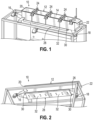
- the system 10 includes a cooking vat 12 with one lane 14 for cooking medium and food product movement, but it will be appreciated that more than one of the lanes 14 may be provided in larger versions of the cooking vat 12.
- the cooking vat 12 is shown empty in these Figures.
- the cooking vat 12 includes a pump (not shown) and an oil recirculation system (not shown except for inlet and outlet pipes 16, 18 extending from the cooking vat) to generate a continuous flow of cooking medium from an inlet end 20 of the cooking vat 12 to an outlet end 22 of the cooking vat 12.
- Food products move from portion to portion along the lane 14 of the cooking vat 12 because of the cooking medium flow, with control of the food product movement provided by the series of gates 24 shown in FIG. 1 .
- the gates 24 are perforated and otherwise function in a similar manner as locks on a river.
- the food products can be retained in the heated cooking medium for a time sufficient for fully cooking the food products, and then the food products can be removed from the outlet end 22 of the cooking vat 12 at the completion of the cooking cycle.
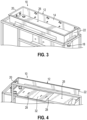
- the lane 14 of the cooking vat 12 in this embodiment is generally rectangular in cross-section, having a bottom surface 26 (also referred to as the "bottom wall” in this and other embodiments) that is 12 inches wide between the corners of the cooking vat 12, in one example.
- the heating elements 28 are provided on the exterior of the cooking vat 12.
- the heating elements 28 include a rod heater 30 cast into an aluminum bar 32 (or block), which is then coupled in face-to-face abutting contact with the bottom surface 26 of the cooking vat 12.
- the heating elements 28 therefore transfer heat energy by conduction through the cooking vat 12 and into the cooking medium.
- a heating element configured to output 7 to 8 kW was sufficient in testing results to heat the cooking medium in the cooking vat 12 to an operating temperature of at least 350°F and maintain the cooking medium at that temperature through multiple cooking cycles of food products.
- the large contact surface between the cast bar 32 of the heating elements 28 and the bottom surface 26 advantageously generates a uniform heat transfer and temperature in the shallow pool of cooking medium within the cooking vat 12.
- the exemplary cooking vat 12 shown in this embodiment requires approximately 35 pounds of cooking medium per lane 14, to provide an oil depth of 1.5 inches, which provides desirable flow of batches of food products (of approximately 0.75 pounds) from gate to gate 24 when the cooking medium is circulated using the oil recirculation system.
- this embodiment of the automatic cooking system 10 reduces oil use compared to conventional fryer designs, while also improving oil life, e.g., the total length of time or number of cooking cycles that can be performed before cooking medium replacement is required.
- the reduced oil volume is achieved at least in part by positioning the heating elements 28 on an exterior surface of the cooking vat 12.
- FIGS. 5 through 6C A four-lane cooking vat of a second embodiment of the automatic cooking system 70 is shown in FIGS. 5 through 6C .
- Each of the 12-inch wide lanes 14 from the first embodiment is effectively replaced by two of the lanes 52 in the cooking vat 54 shown in FIG. 5 .
- each lane 52 is about 6 inches wide at the top opening thereof, and the cross section of the lane 52 is modified to have chamfered corner surfaces 56 at the bottom to provide a hexagonal shape and a narrowed bottom surface 58 that is about 5 inches in width.
- the bottom surface 58 of the lanes 52 are angled upwardly along at least a portion of the length from an inlet end 60 of the cooking vat 54 to an outlet end 62 of the cooking vat 54, most clearly shown in FIG.
- the bottom surface 58 is angled upwardly along an entire length of the lane 52 in the illustrated embodiment.
- the oil which levels out due to gravity, is therefore deeper at the inlet end 60 to assure full food product coverage when the food products are initially placed into the cooking vat 54.
- These revisions to the cooking vat 54 result in oil volume of about 12.5 pounds per lane 52. This is an improvement of oil volume use (2 lanes use 25 pounds of cooking medium as compared to 35 pounds in the first embodiment).
- the cooking vat 54 and lanes 52 in the second embodiment improve oil life span by pulling off an amount of oil volume approaching a 20% top off volume per hour of operation, while also significantly reducing the total oil volume needed within the cooking system 50.
- the cooking vat may also achieve reduced use of cooking medium volume by placing heating elements 72, 86 externally to the cooking vat.
- the flow characteristics of the cooking medium and the food products are improved thanks to the design of the lanes 52 of the cooking vat 54.
- the angled bottom surface 58 and the chamfered corner surfaces 56 at the bottom of the lanes 52 help avoid impeding cooking medium flow in a manner that would generate turbulence in the cooking medium that can increase oxidation of the oil (reduces oil life span) while also improving reliability of flow of food products from gate to gate (gates not shown in these views).
- the generally increasing velocity of oil along the length of each lane 52 also helps assure reliable food product movement from gate to gate.
- the heating elements 72, 86 are once again provided outside the interior of the cooking vat 54 to improve flow characteristics and avoid generation of turbulence in the cooking medium.
- the second embodiment of the automatic cooking system 50 provides several functional advantages, including improved oil life span, reduced oil volume use, and better flow of food products between inlet and outlet ends 60, 62 of the cooking vat 54.
- the heating elements of the automatic cooking system are designed to be heater rods cast in aluminum bars or blocks that are coupled to the bottom surface(s) of the lanes defining the cooking vat, to thereby provide uniform heating of the cooking medium via conduction through the cooking vat walls.
- alternative types of heating elements such as printed heating elements with a low profile may also be used in accordance with this invention.
- the heating elements may be positioned and configured in various manners, some examples of which are shown in FIGS. 6A through 6C in association with the second embodiment of the automatic cooking system.
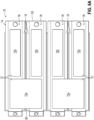
- FIGS. 6A and 6B show two different configurations of heating elements 72 in association with the second embodiment of the automatic cooking system.
- the cooking vat 74 of this cooking system 70 includes four parallel lanes 76
- FIG. 6A shows one configuration for heating elements 72 along the bottom surfaces 78 of the cooking vat 74.
- Larger size heaters 72a are positioned across two or more of the lanes 76 adjacent the inlet end 80 of the cooking vat 74, while smaller size heaters 72b are positioned on each lane 76 individually adjacent the outlet end 82 of the cooking vat 74.
- the combination of larger and smaller heaters 72a, 72b collectively engages with a substantial majority (e.g., 80% or more) of the surface area along the bottom surfaces 78 (the about 5-inch-wide surfaces) of each lane 76 of the cooking vat 74, thereby enabling the uniform heat transfer desired and needed to maintain the cooking medium at operating temperatures of 350°F or higher. That arrangement of engagement with a large amount of surface area on the lanes 76 is maintained in each of the examples shown.
- Each lane 76 of the cooking vat 74 includes a single elongated heating element 86 connected to the about 5-inch wide bottom surface 78 thereof in this embodiment.
- the heating element 86 follows the angling of this bottom surface 78, as described above in connection with the second embodiment of the system.
- Such an embodiment may be used to individually control the lanes 76 when such individual control is desired (e.g., when fewer than the maximum number of lanes 76 may be used in operation of the cooking system 10).
- this and other embodiments of the cooking system 70 may use heating elements 86 that include rod heaters in cast blocks of aluminum, or printed heating elements, or other known designs for conducting heat into the cooking vat 74.
- FIG. 6C a further configuration is shown of a cooking system 90, which includes similar elements as one of the lanes 52 in the cooking vat 54 shown in FIG. 5 (identical reference numbers are used where elements are unchanged from the embodiment described above).
- This cooking system 90 includes heating elements 92 mounted on the exterior of the cooking vat 54 along both the bottom surface 58 and the chamfered corner surfaces 56 at the bottom end of each lane 52 of the cooking vat 54.
- the heating elements 92 of each configuration may be coupled to the cooking vat 54 using various methods, including but not limited to, welded studs on the bottom surface 58 of each lane 52, and/or springloaded clamps. Regardless of the configuration and coupling mechanism chosen, the heating elements 92 provide uniform heating and temperatures within the cooking medium during cooking operations, and the heat transfer and temperature uniformity is further improved by the continuous flow of cooking medium through the cooking vat 54 and through the oil recirculation system.
- the external heating elements shown and described in connection with the embodiments of the automatic cooking system shown in FIGS. 1 through 6D is a clamped-on or bolted-on aluminum block heater
- alternative designs of heating elements can also be used in these embodiments.
- the heating elements used with an electric fryer such as these automatic cooking systems can instead be defined by printed heating elements such as the thick film conduction heaters available commercially from supplies such as Watlow of St. Louis, MO.
- the "430 stainless steel thick film conduction heater” available from Watlow includes a resistor circuit trace embedded in the material printing process into one or more dielectric glass layers, which may also be incorporated on one or more 430 stainless steel substrates, and the heater can also include additional layers like a mica insulator along one side to ensure heat energy is transferred from the heater into the element to which the heater is directly connected.
- the thick film conduction heater defines a low profile based on a small thickness when fully printed, while allowing for efficient heating of elements that the thick film conduction heater is directly applied to.
- FIGS. 7 through 13 Further examples showing one or more printed heating elements as described above in connection with a fryer are shown in the embodiments of FIGS. 7 through 13 . More specifically, these Figures illustrate the printed heating elements in combination with an automatic cooking system including one or more lanes for moving food product and cooking it as the food product moves between gates and stations, as set forth in the embodiments described above.
- FIGS. 7 through 9 several views are provided of a cooking vat 100 for another embodiment of an automatic cooking system, this one defining a single lane for food product movement during the cooking process.
- the cooking vat 100 has a profiled and/or angled bottom wall 102 which allows for reduction in oil volume level as the food product moves along the length of the cooking vat 100, with increased oil flow velocity towards the end of the fryer.
- the bottom wall 102 may include a first portion 102a along an inlet end 104 and a second portion 102b along an outlet end 106, each portion being angled slightly upwardly from horizontal along the movement direction of food product traveling between the inlet end 104 and the outlet end 106.
- the first and second portions 102a, 102b are connected in this embodiment by a transition portion 102c of the bottom wall 102 that is angled from the orientation of the other two portions 102a, 102b.
- a transition portion 102c of the bottom wall 102 may be desirable to achieve certain flow characteristics along the lane defined by the cooking vat 100.
- the cooking vat 100 may transition from a generally flat bottom along the first portion 102a of the bottom wall 102 to a bottom with chamfered corners (or sidewall portions) proximate the edges of the bottom wall 102 along the second portion 102b, see FIG.
- the flow of cooking medium and food products is enhanced by the change in shape of the cooking vat 100 towards the outlet end 106 (the transition portion 102c helps accommodate this variation of shape of the cooking vat 100). It will be understood that this is but one example of the shape of an elongated cooking lane defined by the cooking vat 100, and other shapes and profiles may be used without departing from the scope of the invention.
- each of the printed heating elements 108 includes a temperature sensor 110 mounted directly on the surface of the heating element 108, with a control wire 112 (shown in partial form) leading to the system controller for the automatic cooking system.
- each temperature sensor 110 may be an RTD sensor, and the temperature sensors 110 are thus positioned to detect the heater temperature defined by the printed heating elements 108.
- the printed heating elements 108 define an internal resistor circuit trace 114 that is used to produce the heat energy for the cooking medium in the cooking vat 100.
- the resistor circuit trace 114 within the printed heating elements 108 is terminated in this design at a series of threaded studs 116 which are connected by wires 118 (partially shown) to a power source.
- the control of the heating elements 108 through the threaded studs 116 allows the design to remain low profile, limiting the space required for mounting the heating elements 108 to the cooking vat 100.
- the printed heating elements 108 may be directly coupled to the bottom wall 102 of the cooking vat 100 using adherence, welding, clamp connections, or the like, and the heating elements 108 contain layers or internal features that guide heat energy from the heating elements 108 into the cooking vat 100 and the cooking medium flowing therein.
- this embodiment of the cooking vat 100 is both space-efficient and energy-efficient because losses of thermal energy are minimized by the arrangement of elements and their internal designs.
- the external mounting of the heating elements 108 avoids the need to place these elements inside the cooking vat 100, which therefore reduces the overall cooking medium volume that must be used in this automatic cooking system. Oil life may also be improved when placing the heating elements 108 out of direct contact with the cooking medium, in some implementations.
- FIGS. 10 through 12 another cooking vat 130 in accordance with another embodiment of an automatic cooking system of this invention is shown in detail.
- This embodiment of the cooking vat 130 includes a shape and profile largely similar to the cooking vat 100 of the previous embodiment, and as such, similar reference numbers are used on elements that are essentially unchanged from the previous embodiment. These elements include the bottom wall 102 (with first portion 102a, second portion 102b, and transition portion 102c), the inlet end 104, the outlet end 106, the printed heating elements 108, the temperature sensors 110, and the resistor circuit traces 114, among other elements.
- the cooking vat 130 does not include angled sidewall portions or chamfered corners along the second portion 102b of the bottom wall 102, and as such, the total planar surface area defined by the first and second portions 102a, 102b of the bottom wall 102 are slightly larger in size than in the previous embodiment in FIGS. 7 through 9 .
- the printed heating elements 108 are modified only in this embodiment to be larger in size, thereby being engaged with and covering a larger overall surface area of the first and second portions 102a, 102b of bottom wall 102. This design allows for more heat energy to be delivered efficiently into the cooking vat 130 and the cooking medium and food product flowing therein, e.g., providing uniform heating. Regardless, the same benefits of a low profile and reduced oil volume use are achieved by this alternative embodiment.
- FIG. 12 the termination of the resistor circuit traces 114 of the heating elements 108 at threaded studs 116 is shown in greater detail.
- the wires 118 delivering electrical energy to cause the resistor circuit traces 114 to produce heat energy are shown connected in position by the threaded studs 116.
- a controller or power source of the automatic cooking system controls the amount of heat energy being produced via the energy provided by the wires 118, and such control may be based on temperature sensor readings from within the cooking vat 130 as well as based on signals from the temperature sensors 110 mounted directly on the heating elements 108, thereby enabling the controller to avoid heating the heating elements 108 to a temperature that would risk a dry fire condition.
- this embodiment of the cooking vat 130 provides many of the same technical advantages as described in association with other embodiments. It will be understood that the particular size and shape of the cooking vat 130 and the heating elements 108 may be modified in other embodiments, including, for example, having multiple lanes in adjacent relation for the automatic cooking system, and mounting the heating elements 108 to additional/alternative surfaces like the sidewalls.
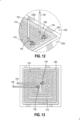
- FIG. 13 illustrates an alternative embodiment of a printed heating element 140 that may be used with any of the embodiments of the automatic cooking systems described herein.
- the printed heating element 140 is square in shape and is configured to cover a substantial portion of a bottom surface of a cooking vat or portion thereof, so as to thereby provide generally uniform heating of the cooking vat and the cooking medium therein.
- the printed heating element 140 again includes a resistor circuit trace 114 terminated at threaded studs 116 connected to power supply wires 118.
- One or more of these printed heating elements 140 may be combined to cover the external surfaces of the cooking vat of the automatic cooking systems of this invention.
- the heating elements may be repositioned or reconfigured in other embodiments of the invention depending on the needs and desires of the end user.
- the printed heating elements may be coupled to side surfaces of a cooking vat as well as the bottom surface, as was alluded to above in the example with clamped plate heaters.
- the external mounting of the heaters is configured to provide uniform heating while allowing for reduced oil volume use when operating automatic cooking devices using elongated lanes defined by the cooking vats and cooking medium and food product flow during the cooking process.
- the printed heating elements may also be located inside the cooking vat, but the low profile and small thickness of these heating elements continues to allow for minimized oil volume use even when placed within the cooking vat (e.g., the low profile provides minimal disruption to cooking medium flow and thus produces less turbulence that can also reduce oil lifespan). Additional modifications to the embodiments shown and described herein with the external mounted heating elements will be understood by those skilled in the art when using these heaters internally, such as connecting the temperature sensor and control wires to the heater when submersed within a cooking medium.
- the various designs of the automated cooking system and other fryers using printed heating elements achieve advantages and additional functionalities (such as increased safety and reduced risk of dry fires) over the known fryer designs.
Landscapes
- Engineering & Computer Science (AREA)
- Food Science & Technology (AREA)
- Chemical & Material Sciences (AREA)
- Oil, Petroleum & Natural Gas (AREA)
- Frying-Pans Or Fryers (AREA)
Claims (9)
- Automatisches Kochsystem (10, 70, 90) zum Frittieren von Lebensmittelprodukten, aufweisend:einen Kochbehälter (12, 54, 74, 100, 130), der dazu ausgebildet ist, ein Kochmedium zu enthalten und ein Lebensmittelprodukt aufzunehmen, wobei der Kochbehälter mindestens eine längliche Bahn (14, 52, 76) definiert, die sich zwischen einem Einlassende (20, 60, 80, 104), an dem das Lebensmittelprodukt in den Kochbehälter eingeführt wird, und einem Auslassende (22, 62, 82, 106), an dem das Lebensmittelprodukt aus dem Kochbehälter entfernt wird, erstreckt, wobei jede Bahn des Kochbehälters eine Bodenwand und Seitenwände aufweist, die sich entlang der Bahn erstrecken; undein Ölumlauf- und Filtersystem (16, 18), das mit dem Einlassende und dem Auslassende des Kochbehälters kommuniziert, wobei das Ölumlauf- und Filtersystem dazu ausgebildet ist, einen kontinuierlichen Strom des Kochmediums vom Einlassende zum Auslassende zu erzeugen;gekennzeichnet durch:ein Heizelement, das mit mindestens einer von der Bodenwand und den Seitenwänden des Kochbehälters gekoppelt ist, wobei das Heizelement mindestens ein gedrucktes Heizelement (108, 140) aufweist, das direkt mit dem Kochbehälter gekoppelt ist, um Wärme durch Leitung zu übertragen, um das Kochmedium gleichmäßig zu erhitzen;
ein Steuergerät, das mit dem Ölumlauf- und Filtersystem und dem Heizelement wirkend gekoppelt ist; undeinen Temperatursensor, der direkt mit dem Heizelement gekoppelt und dazu ausgebildet ist, eine Heizertemperatur des Heizelements zu messen und die Heizertemperatur an das Steuergerät zu übermitteln, wobei das Steuergerät das Heizelement steuert, um zu verhindern, dass die Heizertemperatur des Heizelements eine Temperatur übersteigt, die zu einem Trockenbrandzustand führen kann. - Automatisches Kochsystem nach Anspruch 1, bei dem das bedruckte Heizelement mit dem Kochgefäß gekoppelt ist, indem es auf mindestens eine von der Bodenwand und den Seitenwänden des Kochgefäßes gedruckt ist.
- Automatisches Kochsystem nach einem der vorhergehenden Ansprüche, wobei das mindestens eine gedruckte Heizelement ferner eine Widerstandsbahn aufweist, die über eine Oberfläche des Kochbehälters verteilt ist, um Wärmeenergie in den Kochbehälter zu leiten.
- Automatisches Kochsystem nach einem der vorhergehenden Ansprüche, wobei das Heizelement eine Vielzahl von Heizelementen umfasst, die mit der Außenseite des Kochbehälters verbunden sind, und jedes Heizelement einen Temperatursensor aufweist, der direkt mit dem Heizelement gekoppelt ist.
- Automatisches Kochsystem nach einem der vorhergehenden Ansprüche, wobei das Heizelement mit der Bodenwand des Kochbehälters verbunden ist.
- Automatisches Kochsystem nach Anspruch 5, wobei das Heizelement so bemessen ist, dass es eine Mehrheit einer entlang der Bodenwand des Kochbehälters definierten Oberfläche beaufschlagt, um dadurch für eine allgemein gleichmäßige Erwärmung des Kochmediums im Kochbehälter zu sorgen.
- Automatisches Kochsystem nach Anspruch 5 oder 6, wobei das Heizelement auch mit den Seitenwänden des Kochbehälters verbunden ist.
- Automatisches Kochsystem nach einem der vorhergehenden Ansprüche, bei dem die Bodenwand jeder Bahn im Kochbehälter entlang mindestens eines Teils der Länge vom Einlassende zum Auslassende nach oben geneigt ist.
- Automatisches Kochsystem nach einem der vorhergehenden Ansprüche, wobei das mindestens eine gedruckte Heizelement direkt mit der Außenseite des Kochbehälters gekoppelt ist.
Applications Claiming Priority (2)
| Application Number | Priority Date | Filing Date | Title |
|---|---|---|---|
| US201862692029P | 2018-06-29 | 2018-06-29 | |
| PCT/US2019/039766 WO2020006380A1 (en) | 2018-06-29 | 2019-06-28 | Automatic fryer with heaters enabling reduced oil volume |
Publications (4)
| Publication Number | Publication Date |
|---|---|
| EP3813612A1 EP3813612A1 (de) | 2021-05-05 |
| EP3813612A4 EP3813612A4 (de) | 2022-08-24 |
| EP3813612C0 EP3813612C0 (de) | 2024-09-18 |
| EP3813612B1 true EP3813612B1 (de) | 2024-09-18 |
Family
ID=68987589
Family Applications (1)
| Application Number | Title | Priority Date | Filing Date |
|---|---|---|---|
| EP19826151.3A Active EP3813612B1 (de) | 2018-06-29 | 2019-06-28 | Automatische fritteuse mit heizvorrichtungen für reduzierte ölmenge |
Country Status (3)
| Country | Link |
|---|---|
| US (1) | US12329318B2 (de) |
| EP (1) | EP3813612B1 (de) |
| WO (1) | WO2020006380A1 (de) |
Family Cites Families (44)
| Publication number | Priority date | Publication date | Assignee | Title |
|---|---|---|---|---|
| US3831002A (en) * | 1973-05-21 | 1974-08-20 | Sunbeam Corp | Frypan with removable handles and heat shield |
| US4366749A (en) * | 1976-06-21 | 1983-01-04 | Heat And Control, Inc. | Apparatus for processing food products |
| US4478140A (en) * | 1982-08-02 | 1984-10-23 | Bullock Robert F | Fryer with oil circulation and conveyor |
| US4488478A (en) * | 1983-07-08 | 1984-12-18 | J. C. Pitman Company, Inc. | Continuous fryer for potato chips and other snack foods |
| US4658709A (en) * | 1984-05-29 | 1987-04-21 | Anderson Edward M | Multitrack apparatus for frying food |
| US5137740A (en) * | 1985-02-04 | 1992-08-11 | Heat And Control, Inc. | Continuous food processing method |
| US4706556A (en) * | 1986-01-13 | 1987-11-17 | Vanmark Corporation | Potato chip manufacturing machine |
| US4863750A (en) * | 1986-05-07 | 1989-09-05 | Frito-Lay, Inc. | Method for making potato chips having batch-fried texture and flavor |
| US4913042A (en) | 1989-08-21 | 1990-04-03 | Stein, Inc. | Deep fat fryer |
| JP2884362B2 (ja) * | 1990-04-20 | 1999-04-19 | 日本石油化学株式会社 | 電磁調理器用調理台 |
| US5454297A (en) * | 1994-04-05 | 1995-10-03 | Phillips; James L. | Deep fryer with dual conveyors |
| US5629039A (en) * | 1995-06-08 | 1997-05-13 | Ventura Foods, Llc | Cooking oil extending process |
| US5580598A (en) * | 1995-11-03 | 1996-12-03 | Heat And Control. Inc. | Multi-product food cooking system |
| FR2747299B1 (fr) * | 1996-04-11 | 1998-12-18 | Moulinex Sa | Appareil electrique de cuisson, en particulier friteuse |
| WO1998004174A1 (en) * | 1996-07-29 | 1998-02-05 | Philips Electronics N.V. | Deep-frying device |
| US6095037A (en) * | 1996-09-27 | 2000-08-01 | Pitco Frialator, Inc. | High efficient convection fryer with continuous filtration |
| DE19648332C2 (de) * | 1996-11-22 | 2000-11-23 | Messko Albert Hauser Gmbh & Co | Verfahren zur Nachbildung und Anzeige der Wicklungstemperatur eines elektrischen Leistungstransformators und Thermometer zur Durchführung des Verfahrens |
| US6762396B2 (en) * | 1997-05-06 | 2004-07-13 | Thermoceramix, Llc | Deposited resistive coatings |
| EP1447185B1 (de) * | 1997-11-12 | 2010-06-16 | Chippery, Inc. (a Delaware company, USA) | Schneidevorrichtung zur Vorbereitung von Kartoffeln |
| FR2771616B1 (fr) | 1997-11-28 | 2000-12-22 | Moulinex Sa | Appareil electrique de cuisson, en particulier friteuse, comportant un element chauffant plat a resistance serigraphiee |
| FR2775178B1 (fr) * | 1998-02-25 | 2000-05-12 | Moulinex Sa | Appareil electrique de cuisson, en particulier friteuse |
| US6058245A (en) * | 1998-08-05 | 2000-05-02 | Afc Enterprises, Inc. | Electric boost heater for deep fryer |
| CN1244370A (zh) * | 1998-08-10 | 2000-02-16 | 宁波唐人锅业有限公司 | 多功能电气压力锅 |
| GB2350494B (en) | 1999-05-25 | 2003-04-09 | Otter Controls Ltd | Improvements relating to electrically heated liquid containers |
| US6222166B1 (en) * | 1999-08-09 | 2001-04-24 | Watlow Electric Manufacturing Co. | Aluminum substrate thick film heater |
| JP3437165B2 (ja) * | 2000-11-08 | 2003-08-18 | 株式会社 ケイ・エス・エイ | フライヤー |
| WO2002098266A1 (en) | 2001-05-31 | 2002-12-12 | The Nisshin Oillio, Ltd. | Method of frying and frying device |
| FR2830734B1 (fr) * | 2001-10-17 | 2004-02-06 | Seb Sa | Appareil de cuisson a cuve comportant un dispositif de vidange securise |
| FR2848403B1 (fr) * | 2002-12-13 | 2009-01-30 | Seb Sa | Friteuse electrique avec un dispositif pour le maintien au chaud des aliments frits |
| CA2542271A1 (en) * | 2003-10-20 | 2005-05-12 | Bunn-O-Matic Corporation | System, method and apparatus for heating water |
| US8318229B2 (en) * | 2005-01-24 | 2012-11-27 | Frito-Lay North America, Inc. | Method for controlling bulk density of fried snack pieces |
| US7256372B2 (en) * | 2005-12-07 | 2007-08-14 | Aos Holding Company | Fluid-heating apparatus, circuit for heating a fluid, and method of operating the same |
| US7209651B1 (en) * | 2005-12-07 | 2007-04-24 | Aos Holding Company | Fluid-heating apparatus, circuit for heating a fluid, and method of operating the same |
| US7789165B1 (en) * | 2007-08-17 | 2010-09-07 | Ping Li Yen | Industrial oil cooker fire protection system |
| FR2933287B1 (fr) * | 2008-07-02 | 2013-04-05 | Seb Sa | Appareil de cuisson a resistance electrique plongeante comportant un dispositif d'aspiration des vapeurs de cuisson |
| TW201227761A (en) * | 2010-12-28 | 2012-07-01 | Du Pont | Improved thick film resistive heater compositions comprising ag & ruo2, and methods of making same |
| US20130008320A1 (en) * | 2010-12-30 | 2013-01-10 | Michael Christian Kilmer | Cooking Oil Filtration System |
| GB2481467B (en) * | 2011-01-31 | 2012-06-13 | Frito Lay Trading Co Gmbh | Apparatus and method in the manufacture of low oil potato chips |
| GB2493719A (en) * | 2011-08-15 | 2013-02-20 | Strix Ltd | Flow heater with temperature sensing and a heat sink |
| US10123555B2 (en) * | 2013-04-19 | 2018-11-13 | Frito-Lay North America, Inc. | Method, apparatus and system for producing a food product |
| WO2015048258A1 (en) * | 2013-09-25 | 2015-04-02 | Nothum Robert G | Fryer cabinet thermal oil heat exchange |
| US10373745B2 (en) * | 2014-06-12 | 2019-08-06 | LMS Consulting Group | Electrically conductive PTC ink with double switching temperatures and applications thereof in flexible double-switching heaters |
| AU2015296148A1 (en) * | 2014-08-01 | 2017-02-16 | Frymaster L.L.C. | Method and apparatus for a cooking oil quality sensor |
| CN107136955A (zh) | 2017-05-24 | 2017-09-08 | 佛山市顺阅丰贸易有限公司 | 一种家用低温油炸机 |
-
2019
- 2019-06-28 EP EP19826151.3A patent/EP3813612B1/de active Active
- 2019-06-28 US US17/254,363 patent/US12329318B2/en active Active
- 2019-06-28 WO PCT/US2019/039766 patent/WO2020006380A1/en not_active Ceased
Also Published As
| Publication number | Publication date |
|---|---|
| US12329318B2 (en) | 2025-06-17 |
| EP3813612A4 (de) | 2022-08-24 |
| US20210267414A1 (en) | 2021-09-02 |
| EP3813612C0 (de) | 2024-09-18 |
| WO2020006380A1 (en) | 2020-01-02 |
| EP3813612A1 (de) | 2021-05-05 |
Similar Documents
| Publication | Publication Date | Title |
|---|---|---|
| EP3403552B1 (de) | Heizelementsteuergerät für ölbasierte fritteuse | |
| EP3429369B1 (de) | Temperaturmanagement eines kochmediums in fritteusen um filterzyklen | |
| EP2194827B1 (de) | Fritteuse mit geringer ölmenge sowie automatischer filtrierungs- und abschöpffunktion | |
| US4798939A (en) | Pressurized liquid cooker with integrated radiant heating apparatus | |
| US20080121578A1 (en) | Automatic cooking medium filtering systems and methods | |
| EP0931492B1 (de) | Fritiergerät | |
| JP2021098123A (ja) | 自動フライヤ | |
| US12329318B2 (en) | Automatic fryer with heaters enabling reduced oil volume | |
| KR20120119666A (ko) | 순환식 위생 튀김기 | |
| EP3678524B1 (de) | Automatische fritteuse mit produktbewegung und reduziertem ölmengenbedarf | |
| KR101379444B1 (ko) | 후라이팬 기능이 부과된 가정용 튀김기 | |
| JP2003339555A (ja) | フライヤー | |
| US20250120545A1 (en) | System to remove food particles from a vat for continuously cooking food | |
| US10383478B2 (en) | Industrial food fryer | |
| KR20130080303A (ko) | 여과장치가 구비된 튀김기 | |
| JP2002034799A (ja) | フライヤ |
Legal Events
| Date | Code | Title | Description |
|---|---|---|---|
| STAA | Information on the status of an ep patent application or granted ep patent |
Free format text: STATUS: THE INTERNATIONAL PUBLICATION HAS BEEN MADE |
|
| PUAI | Public reference made under article 153(3) epc to a published international application that has entered the european phase |
Free format text: ORIGINAL CODE: 0009012 |
|
| STAA | Information on the status of an ep patent application or granted ep patent |
Free format text: STATUS: REQUEST FOR EXAMINATION WAS MADE |
|
| 17P | Request for examination filed |
Effective date: 20201222 |
|
| AK | Designated contracting states |
Kind code of ref document: A1 Designated state(s): AL AT BE BG CH CY CZ DE DK EE ES FI FR GB GR HR HU IE IS IT LI LT LU LV MC MK MT NL NO PL PT RO RS SE SI SK SM TR |
|
| RAP3 | Party data changed (applicant data changed or rights of an application transferred) |
Owner name: HENNY PENNY CORPORATION |
|
| DAV | Request for validation of the european patent (deleted) | ||
| DAX | Request for extension of the european patent (deleted) | ||
| A4 | Supplementary search report drawn up and despatched |
Effective date: 20220727 |
|
| RIC1 | Information provided on ipc code assigned before grant |
Ipc: F24H 9/18 20060101ALI20220722BHEP Ipc: F24H 1/36 20060101ALI20220722BHEP Ipc: A47J 37/00 20060101ALI20220722BHEP Ipc: A47J 37/12 20060101AFI20220722BHEP |
|
| GRAP | Despatch of communication of intention to grant a patent |
Free format text: ORIGINAL CODE: EPIDOSNIGR1 |
|
| STAA | Information on the status of an ep patent application or granted ep patent |
Free format text: STATUS: GRANT OF PATENT IS INTENDED |
|
| INTG | Intention to grant announced |
Effective date: 20240506 |
|
| GRAS | Grant fee paid |
Free format text: ORIGINAL CODE: EPIDOSNIGR3 |
|
| GRAA | (expected) grant |
Free format text: ORIGINAL CODE: 0009210 |
|
| STAA | Information on the status of an ep patent application or granted ep patent |
Free format text: STATUS: THE PATENT HAS BEEN GRANTED |
|
| AK | Designated contracting states |
Kind code of ref document: B1 Designated state(s): AL AT BE BG CH CY CZ DE DK EE ES FI FR GB GR HR HU IE IS IT LI LT LU LV MC MK MT NL NO PL PT RO RS SE SI SK SM TR |
|
| REG | Reference to a national code |
Ref country code: GB Ref legal event code: FG4D |
|
| REG | Reference to a national code |
Ref country code: CH Ref legal event code: EP |
|
| REG | Reference to a national code |
Ref country code: IE Ref legal event code: FG4D |
|
| REG | Reference to a national code |
Ref country code: DE Ref legal event code: R096 Ref document number: 602019059194 Country of ref document: DE |
|
| U01 | Request for unitary effect filed |
Effective date: 20240923 |
|
| U07 | Unitary effect registered |
Designated state(s): AT BE BG DE DK EE FI FR IT LT LU LV MT NL PT RO SE SI Effective date: 20241016 |
|
| PG25 | Lapsed in a contracting state [announced via postgrant information from national office to epo] |
Ref country code: NO Free format text: LAPSE BECAUSE OF FAILURE TO SUBMIT A TRANSLATION OF THE DESCRIPTION OR TO PAY THE FEE WITHIN THE PRESCRIBED TIME-LIMIT Effective date: 20241218 |
|
| PG25 | Lapsed in a contracting state [announced via postgrant information from national office to epo] |
Ref country code: GR Free format text: LAPSE BECAUSE OF FAILURE TO SUBMIT A TRANSLATION OF THE DESCRIPTION OR TO PAY THE FEE WITHIN THE PRESCRIBED TIME-LIMIT Effective date: 20241219 |
|
| PG25 | Lapsed in a contracting state [announced via postgrant information from national office to epo] |
Ref country code: HR Free format text: LAPSE BECAUSE OF FAILURE TO SUBMIT A TRANSLATION OF THE DESCRIPTION OR TO PAY THE FEE WITHIN THE PRESCRIBED TIME-LIMIT Effective date: 20240918 |
|
| PG25 | Lapsed in a contracting state [announced via postgrant information from national office to epo] |
Ref country code: RS Free format text: LAPSE BECAUSE OF FAILURE TO SUBMIT A TRANSLATION OF THE DESCRIPTION OR TO PAY THE FEE WITHIN THE PRESCRIBED TIME-LIMIT Effective date: 20241218 |
|
| PG25 | Lapsed in a contracting state [announced via postgrant information from national office to epo] |
Ref country code: RS Free format text: LAPSE BECAUSE OF FAILURE TO SUBMIT A TRANSLATION OF THE DESCRIPTION OR TO PAY THE FEE WITHIN THE PRESCRIBED TIME-LIMIT Effective date: 20241218 Ref country code: NO Free format text: LAPSE BECAUSE OF FAILURE TO SUBMIT A TRANSLATION OF THE DESCRIPTION OR TO PAY THE FEE WITHIN THE PRESCRIBED TIME-LIMIT Effective date: 20241218 Ref country code: HR Free format text: LAPSE BECAUSE OF FAILURE TO SUBMIT A TRANSLATION OF THE DESCRIPTION OR TO PAY THE FEE WITHIN THE PRESCRIBED TIME-LIMIT Effective date: 20240918 Ref country code: GR Free format text: LAPSE BECAUSE OF FAILURE TO SUBMIT A TRANSLATION OF THE DESCRIPTION OR TO PAY THE FEE WITHIN THE PRESCRIBED TIME-LIMIT Effective date: 20241219 |
|
| PG25 | Lapsed in a contracting state [announced via postgrant information from national office to epo] |
Ref country code: IS Free format text: LAPSE BECAUSE OF FAILURE TO SUBMIT A TRANSLATION OF THE DESCRIPTION OR TO PAY THE FEE WITHIN THE PRESCRIBED TIME-LIMIT Effective date: 20250118 |
|
| PG25 | Lapsed in a contracting state [announced via postgrant information from national office to epo] |
Ref country code: SM Free format text: LAPSE BECAUSE OF FAILURE TO SUBMIT A TRANSLATION OF THE DESCRIPTION OR TO PAY THE FEE WITHIN THE PRESCRIBED TIME-LIMIT Effective date: 20240918 |
|
| PG25 | Lapsed in a contracting state [announced via postgrant information from national office to epo] |
Ref country code: ES Free format text: LAPSE BECAUSE OF FAILURE TO SUBMIT A TRANSLATION OF THE DESCRIPTION OR TO PAY THE FEE WITHIN THE PRESCRIBED TIME-LIMIT Effective date: 20240918 |
|
| PG25 | Lapsed in a contracting state [announced via postgrant information from national office to epo] |
Ref country code: PL Free format text: LAPSE BECAUSE OF FAILURE TO SUBMIT A TRANSLATION OF THE DESCRIPTION OR TO PAY THE FEE WITHIN THE PRESCRIBED TIME-LIMIT Effective date: 20240918 Ref country code: CZ Free format text: LAPSE BECAUSE OF FAILURE TO SUBMIT A TRANSLATION OF THE DESCRIPTION OR TO PAY THE FEE WITHIN THE PRESCRIBED TIME-LIMIT Effective date: 20240918 |
|
| PG25 | Lapsed in a contracting state [announced via postgrant information from national office to epo] |
Ref country code: SK Free format text: LAPSE BECAUSE OF FAILURE TO SUBMIT A TRANSLATION OF THE DESCRIPTION OR TO PAY THE FEE WITHIN THE PRESCRIBED TIME-LIMIT Effective date: 20240918 |
|
| PLBE | No opposition filed within time limit |
Free format text: ORIGINAL CODE: 0009261 |
|
| STAA | Information on the status of an ep patent application or granted ep patent |
Free format text: STATUS: NO OPPOSITION FILED WITHIN TIME LIMIT |
|
| U20 | Renewal fee for the european patent with unitary effect paid |
Year of fee payment: 7 Effective date: 20250628 |
|
| 26N | No opposition filed |
Effective date: 20250619 |
|
| REG | Reference to a national code |
Ref country code: CH Ref legal event code: H13 Free format text: ST27 STATUS EVENT CODE: U-0-0-H10-H13 (AS PROVIDED BY THE NATIONAL OFFICE) Effective date: 20260127 |
|
| PG25 | Lapsed in a contracting state [announced via postgrant information from national office to epo] |
Ref country code: MC Free format text: LAPSE BECAUSE OF FAILURE TO SUBMIT A TRANSLATION OF THE DESCRIPTION OR TO PAY THE FEE WITHIN THE PRESCRIBED TIME-LIMIT Effective date: 20240918 |
|
| PG25 | Lapsed in a contracting state [announced via postgrant information from national office to epo] |
Ref country code: IE Free format text: LAPSE BECAUSE OF NON-PAYMENT OF DUE FEES Effective date: 20250628 |
|
| PG25 | Lapsed in a contracting state [announced via postgrant information from national office to epo] |
Ref country code: CH Free format text: LAPSE BECAUSE OF NON-PAYMENT OF DUE FEES Effective date: 20250630 |
|
| PGFP | Annual fee paid to national office [announced via postgrant information from national office to epo] |
Ref country code: GB Payment date: 20260629 Year of fee payment: 8 |
|
| U20 | Renewal fee for the european patent with unitary effect paid |
Year of fee payment: 8 Effective date: 20260629 |
|
| PG25 | Lapsed in a contracting state [announced via postgrant information from national office to epo] |
Ref country code: CY Free format text: LAPSE BECAUSE OF FAILURE TO SUBMIT A TRANSLATION OF THE DESCRIPTION OR TO PAY THE FEE WITHIN THE PRESCRIBED TIME-LIMIT Effective date: 20240918 |