EP3813552B1 - Process for obtaining a product in the form of gazeified granules, particles or beads, and corresponding installation - Google Patents
Process for obtaining a product in the form of gazeified granules, particles or beads, and corresponding installation Download PDFInfo
- Publication number
- EP3813552B1 EP3813552B1 EP19745668.4A EP19745668A EP3813552B1 EP 3813552 B1 EP3813552 B1 EP 3813552B1 EP 19745668 A EP19745668 A EP 19745668A EP 3813552 B1 EP3813552 B1 EP 3813552B1
- Authority
- EP
- European Patent Office
- Prior art keywords
- matrix
- gas
- drops
- beads
- granules
- Prior art date
- Legal status (The legal status is an assumption and is not a legal conclusion. Google has not performed a legal analysis and makes no representation as to the accuracy of the status listed.)
- Active
Links
Images
Classifications
-
- A—HUMAN NECESSITIES
- A23—FOODS OR FOODSTUFFS; TREATMENT THEREOF, NOT COVERED BY OTHER CLASSES
- A23B—PRESERVATION OF FOODS, FOODSTUFFS OR NON-ALCOHOLIC BEVERAGES; CHEMICAL RIPENING OF FRUIT OR VEGETABLES
- A23B2/00—Preservation of foods or foodstuffs, in general
- A23B2/80—Freezing; Subsequent thawing; Cooling
- A23B2/85—Freezing; Subsequent thawing; Cooling with addition of or treatment with chemicals
- A23B2/88—Freezing; Subsequent thawing; Cooling with addition of or treatment with chemicals with direct contact between the food and the chemical, e.g. liquid N2 at cryogenic temperature
-
- A—HUMAN NECESSITIES
- A23—FOODS OR FOODSTUFFS; TREATMENT THEREOF, NOT COVERED BY OTHER CLASSES
- A23L—FOODS, FOODSTUFFS OR NON-ALCOHOLIC BEVERAGES, NOT OTHERWISE PROVIDED FOR; PREPARATION OR TREATMENT THEREOF
- A23L2/00—Non-alcoholic beverages; Dry compositions or concentrates therefor; Preparation or treatment thereof
- A23L2/52—Adding ingredients
- A23L2/54—Mixing with gases
-
- B—PERFORMING OPERATIONS; TRANSPORTING
- B01—PHYSICAL OR CHEMICAL PROCESSES OR APPARATUS IN GENERAL
- B01J—CHEMICAL OR PHYSICAL PROCESSES, e.g. CATALYSIS OR COLLOID CHEMISTRY; THEIR RELEVANT APPARATUS
- B01J2/00—Processes or devices for granulating materials, e.g. fertilisers in general; Rendering particulate materials free flowing in general, e.g. making them hydrophobic
- B01J2/02—Processes or devices for granulating materials, e.g. fertilisers in general; Rendering particulate materials free flowing in general, e.g. making them hydrophobic by dividing the liquid material into drops, e.g. by spraying, and solidifying the drops
- B01J2/06—Processes or devices for granulating materials, e.g. fertilisers in general; Rendering particulate materials free flowing in general, e.g. making them hydrophobic by dividing the liquid material into drops, e.g. by spraying, and solidifying the drops in a liquid medium
-
- A—HUMAN NECESSITIES
- A23—FOODS OR FOODSTUFFS; TREATMENT THEREOF, NOT COVERED BY OTHER CLASSES
- A23B—PRESERVATION OF FOODS, FOODSTUFFS OR NON-ALCOHOLIC BEVERAGES; CHEMICAL RIPENING OF FRUIT OR VEGETABLES
- A23B2/00—Preservation of foods or foodstuffs, in general
- A23B2/80—Freezing; Subsequent thawing; Cooling
- A23B2/803—Materials being transported through or in the apparatus, with or without shaping, e.g. in the form of powders, granules or flakes
-
- A—HUMAN NECESSITIES
- A23—FOODS OR FOODSTUFFS; TREATMENT THEREOF, NOT COVERED BY OTHER CLASSES
- A23F—COFFEE; TEA; THEIR SUBSTITUTES; MANUFACTURE, PREPARATION, OR INFUSION THEREOF
- A23F5/00—Coffee; Coffee substitutes; Preparations thereof
- A23F5/24—Extraction of coffee; Coffee extracts; Making instant coffee
- A23F5/243—Liquid, semi-liquid or non-dried semi-solid coffee extract preparations; Coffee gels; Liquid coffee in solid capsules
-
- A—HUMAN NECESSITIES
- A23—FOODS OR FOODSTUFFS; TREATMENT THEREOF, NOT COVERED BY OTHER CLASSES
- A23V—INDEXING SCHEME RELATING TO FOODS, FOODSTUFFS OR NON-ALCOHOLIC BEVERAGES AND LACTIC OR PROPIONIC ACID BACTERIA USED IN FOODSTUFFS OR FOOD PREPARATION
- A23V2002/00—Food compositions, function of food ingredients or processes for food or foodstuffs
-
- F—MECHANICAL ENGINEERING; LIGHTING; HEATING; WEAPONS; BLASTING
- F25—REFRIGERATION OR COOLING; COMBINED HEATING AND REFRIGERATION SYSTEMS; HEAT PUMP SYSTEMS; MANUFACTURE OR STORAGE OF ICE; LIQUEFACTION SOLIDIFICATION OF GASES
- F25D—REFRIGERATORS; COLD ROOMS; ICE-BOXES; COOLING OR FREEZING APPARATUS NOT OTHERWISE PROVIDED FOR
- F25D2400/00—General features of, or devices for refrigerators, cold rooms, ice-boxes, or for cooling or freezing apparatus not covered by any other subclass
- F25D2400/30—Quick freezing
Definitions
- the invention relates to the field of pressurized cryogenics of fluid products.
- the invention relates more particularly to a process and associated equipment for obtaining a product in the form of frozen granules, particles or beads rich in dissolved gas, from a liquid, semi-liquid or pasty matrix, comprising the steps consisting of gasifying the matrix by incorporating a gas, dispensing the matrix in the form of drops and cryogenicizing the matrix drops by immersion in a cryogenic fluid.
- the invention is intended in particular but not exclusively for obtaining a product in the form of granules, particles or beads from a food (food or drink) or cosmetic (lotion, milk or fluid cream for example) matrix. present in a fluid state (i.e. liquid, semi-liquid or pasty).
- the advantage of this process lies mainly in the properties provided to the final product, both during its storage and during its re-use.
- properties provided let us cite for example the development of protection against oxidation during storage on the one hand and the formation of foam during reheating on the other hand.
- the process is, however, very delicate to implement because it requires very specific equipment, capable of withstanding both extreme temperature and pressure conditions while ensuring the safety of people.
- the invention aims to remedy these problems by proposing a method and associated equipment for obtaining a product in the form of granules, particles or frozen beads containing dissolved gas in large quantities, simple and safe to implement for the people.
- the process according to the invention and the equipment implemented also aim to preserve the integrity of the starting matrix, particularly in terms of its physicochemical and organoleptic properties when it is a food matrix.
- the invention proposes a process for obtaining a product in the form of frozen granules, particles or beads rich in dissolved gas, from a liquid, semi-liquid or pasty matrix. , including the steps consisting of gasifying the matrix by incorporating a gas, dispensing the matrix in the form of drops and cryogenicizing the matrix drops by immersion in a cryogenic fluid, the process being remarkable in that the step of gasifying the matrix consists to dissolve, in large quantities, the gas generated by the evaporation of the cryogenic fluid in the matrix drops by increasing the number of gas molecules in a zone of high gas density, called a zone of high molecular density, located above of the surface of the cryogenic fluid and on the trajectory of the matrix drops before their immersion in the fluid, said zone of high molecular density being created by carrying out the gasification and cryogenization of the gasified drops within a closed enclosure provided with a vent arranged to allow evacuation of the gas generated by the evaporation of the cryogenic fluid by natural convection
- dissolved in large quantity we mean that the product is at least saturated in said gas, see preferably that it is supersaturated in said gas, that is to say that the dissolved quantity corresponds to that obtained by equilibrium with a pressure partial of the gas greater than atmospheric pressure.
- concentration of dissolved gas is then at least equal to the saturation concentration of said gas, given by its solubility and it is preferably greater than this saturation concentration in the matrix.
- the process according to the invention makes it possible to prepare cryogenic products containing dissolved gas in a single step and without the necessary equipment being necessary. complex realization. It also makes it possible to significantly dissolve gas in a fluid matrix, by supersaturation, without there being an increase in the pressure measured inside the associated equipment. It makes it possible to preserve the integrity of the starting matrix and its properties, particularly in terms of its physicochemical and organoleptic properties when it is a food matrix.
- the gasification step is carried out at a pressure greater than or equal to atmospheric pressure, preferably equal to atmospheric pressure.
- the step of cryogenizing the gasified drops to form supersaturated granules, particles or beads is carried out by immersion in a bath of cryogenic fluid in the same enclosure as that where the gasification is carried out.
- the process comprises a step of continuous or semi-continuous collection of granules, particles or supersaturated beads. Extraction can also be done batchwise, extracting the frozen products only once dripping is complete.
- the process according to the invention can be applied to liquid products, such as food drinks, cosmetic milks or even suspensions of living materials (bacteria, yeasts, viruses, stem cells, etc.), to fluid products, such as fluid creams for the face, dessert creams, fruit purees, as well as pasty products, such as cake mixes or fresh seaweed preparations.
- liquid products such as food drinks, cosmetic milks or even suspensions of living materials (bacteria, yeasts, viruses, stem cells, etc.
- fluid products such as fluid creams for the face, dessert creams, fruit purees, as well as pasty products, such as cake mixes or fresh seaweed preparations.
- the properties provided to the products are numerous and may differ depending on their nature.
- an inert gas such as nitrogen for example
- This aspect is particularly interesting for the conservation of certain highly oxidizable active ingredients.
- Another example concerns the formation of foam when defrosting the balls, a particularly interesting phenomenon for drinks such as coffee or chocolate for example.
- the shape and dimensions of the balls, added to the presence of dissolved gas, also makes it easier to use the products by other technologies. For example, freeze-drying of cryogenically-containing gas-containing products is faster than freeze-drying from the raw product. The products are also better preserved in terms of their integrity and their properties.
- the invention also relates to equipment for obtaining a product in the form of granules, particles or frozen beads rich in dissolved gas, from a liquid, semi-liquid or pasty matrix, comprising means for dispensing the matrix in the form of drops and a cryogenic receptacle containing a cryogenic fluid in which the matrix drops are received to be cryogenicized and transformed into granules, particles or supersaturated beads, characterized in that the equipment comprises a zone of high molecular density of gas located between the means dispensing the matrix under drop shape and the cryogenic receptacle, the zone of high molecular density of gas and the cryogenic receptacle being located inside a closed enclosure provided with at least one evacuation vent capable of evacuating the gas generated by the evaporation of the cryogenic fluid by natural convection.
- the vent is dimensioned in accordance with the quantity of gas that can be generated in the enclosure and, therefore, with the flow rate of the matrix that it is desired to treat, such that the flow rate of gas to be extracted can flow through the vent without the enclosure building up pressure.
- the gas evacuation vent is arranged to maintain the interior of the enclosure at a pressure greater than or equal to atmospheric pressure.
- it can be planned to size the vent such that the pressure in the enclosure is greater than atmospheric pressure, so that the molecular density is thus even higher at the level of the high molecular density zone.
- cryogenization receptacle is located under the means dispensing the matrix in the form of drops so as to receive the drops of matrix by gravity flow from the means dispensing the matrix in the form of drops into the cryogenization receptacle.
- the means dispensing the matrix in the form of drops are located inside the enclosure.
- the equipment comprises a device for collecting, at the outlet of the cryogenics receptacle, granules, particles or beads.
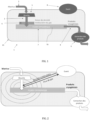
- THE figures 1 and 2 respectively represent a schematic view of equipment 1 and its operating principle for obtaining a product in the form of granules, particles or frozen beads rich in dissolved gas, from a liquid, semi-liquid or pasty matrix .
- the equipment 1 comprises means 5 for dispensing the matrix in the form of drops 3, a cryogenic receptacle 7 containing a cryogenic fluid 70 and in which the drops 3 of matrix are received to be cryogenicized and transformed into granules, particles or beads containing the dissolved gas.
- the cryogenization receptacle 7 is arranged under the means 5 dispensing the matrix in the form of drops so that the drops 3 of matrix leaving said means 5 fall by gravity into the cryogenization receptacle 7.
- the equipment 1 further comprises a zone of high molecular density 6 of gas located between the means 5 dispensing the matrix in the form of drops and the cryogenization receptacle 7.
- the means 5 dispensing the matrix in the form of drops, the zone of high molecular density 6 of gas and the cryogenic receptacle 7 are arranged inside a closed enclosure 10 provided with an evacuation vent 8 to evacuate the gas generated by the evaporation of the cryogenic fluid 70.
- the vent 8 is arranged to maintain the interior of the enclosure 10 at a pressure in the example described equal to the pressure atmospheric. Vent 8 is arranged to allow gas to be evacuated by natural convection. However, for particular needs, means may be provided for closing the vent to put the enclosure 10 under pressure.
- the equipment 1 further comprises a device 9 for extracting cryogenic granules, particles or beads.
- the extraction device 9 is configured to maintain the seal of the enclosure 10, preventing the gas contained in the enclosure 10 from escaping.
- the extraction device 9 can for example be an airlock or bucket wheel system, the airlock or the buckets preventing the escape of gas other than that present with the balls or granules present in the airlock or the buckets.
- the extraction device 9 is connected to a collection device (not shown) located outside the enclosure 10.
- FIG. 2 presents a basic diagram of the operation of the equipment according to the invention.
- the matrix 2 to be treated flows through a shower 5, so as to form drops 3 which fall into the cryogenic fluid 70.
- the drops 3 cross the zone of high molecular density 6 of the increasing gas, generated by the boiling of the cryogenic fluid 70.
- This increasing density allows a strong dissolution of the gas in the matrix 2.
- the maximum dissolution is reached as close as possible to the bath of cryogenic fluid 70, where the molecular density is the most high.
- the zone of high gas density is created when a permanent regime is established within the enclosure 10, which is reached due to the diffusion of the gas by natural convection towards the outside of the enclosure through only of the vent 8.
- the molecular density gradient applied to the product drops, influencing the quantity of gas incorporated in them, is linked to the dimensioning of the enclosure itself, but also to the pressure which is established in the enclosure.
- the latter are extracted from the enclosure 10 by a dedicated system making it possible not to let the gas escape continuously into the room where the machine is located, of the airlock type composed for example of two valves which are not open at the same time, or a bucket wheel.
- the granules, beads or particles are then packaged in packaging, then stored at a temperature sufficient to ensure that the product remains solid, depending on its melting temperature.
- the storage temperature can thus vary from -18 to -80 degrees Celsius, depending on the initial composition of the matrix. For example, most food matrices can be stored at -18°C.
- test 2 corresponding to the method according to the invention.
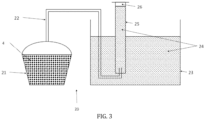
- Test 1 Water beads cryogenized under pressure are produced according to the process described in the application WO2008/043909 , under a pressure of 4 bars, in equipment 1 as described above but whose vent 8 has been closed. The enclosure 10 is thus completely closed. The gas incorporation operation is carried out in the matrix 2, before passing through the shower, by bringing said matrix 2 into contact with an atmosphere whose partial gas pressure is also equal to 4 bars. The beads are stored for 48 hours in a domestic freezer, at a temperature of -18°C. The quantity of gas present in the balls is then measured using a device 20 illustrated on the Figure 3 and described below. To do this, 200g of balls are placed in a first waterproof container 21.
- An advantageously flexible pipe 22 is connected to the container and is immersed in a second container 23 containing water 24, such that bubbles escaping from the pipe rises in a graduated test tube also filled with water and placed upside down.
- a graduated test tube also filled with water and placed upside down.
- Test 2 Cryogenized water beads are produced in the same equipment 1 as previously, but without pressure with only the vent 8 open. With the exception of vent 8, enclosure 10 is entirely closed. During treatment, the pressure observed in enclosure 10 is indeed 0 bar. The beads are stored for 48 hours in a domestic freezer, at a temperature of -18°C. The quantity of gas present in the balls is then measured using the device 20 of the Figure 3 .
- Test 3 Cryogenicized water beads are produced in the same equipment 1 as previously, but without pressure and under air suction through the open vent 8. With the exception of vent 8, enclosure 10 is entirely closed. The beads are stored for 48 hours in a domestic freezer, at a temperature of -18°C. The quantity of gas present in the balls is then measured using the device 20 of the Figure 3 .
- Test 4 Water beads are produced outside the device, by drop by drop using a syringe above a dewar filled with liquid nitrogen. The beads are stored for 48 hours in a domestic freezer, at a temperature of -18°C. The quantity of gas present in the balls is then measured using the device 20 illustrated on the Figure 3 .
- Test 5 Water ice cubes are made by conventional freezing, by filling the hemispherical cells of a mold before placing the latter in the freezer at -18°C. After 48 hours, the balls are unmolded and the quantity of gas present in them is measured using the device 20 illustrated on the Figure 3 .
- test 1 makes it possible to measure a large quantity of gas, necessarily obtained by supersaturation of the product.
- test 2 also allows gas to be dissolved in the products, so that supersaturation is also observed.
- the quantity of gas observed in test 2 is significantly lower than that obtained in test 1. This is explained by the reduced dimensions of the treatment device used, which only makes it possible to generate a small gradient. molecular density of gas and limited dissolution of the latter in water. We therefore see that by carrying out the gas incorporation step in the drops 3 of the matrix and not on the matrix 2 and by simple application of a molecular density gradient, a supersaturation of the drops 3 is observed.
- the equivalent pressure calculated in Table 1 corresponds to the pressure to which the product should have been subjected to achieve the measured gas dissolution.
Landscapes
- Chemical & Material Sciences (AREA)
- Engineering & Computer Science (AREA)
- Life Sciences & Earth Sciences (AREA)
- Food Science & Technology (AREA)
- Polymers & Plastics (AREA)
- Health & Medical Sciences (AREA)
- Nutrition Science (AREA)
- Zoology (AREA)
- Wood Science & Technology (AREA)
- Organic Chemistry (AREA)
- Chemical Kinetics & Catalysis (AREA)
- Freezing, Cooling And Drying Of Foods (AREA)
- General Chemical & Material Sciences (AREA)
Description
L'invention concerne le domaine de la cryogénie sous pression de produits fluides.The invention relates to the field of pressurized cryogenics of fluid products.
L'invention concerne plus particulièrement un procédé et équipement associé pour l'obtention d'un produit sous forme de granules, particules ou billes surgelées riches en gaz dissous, à partir d'une matrice liquide, semi-liquide ou pâteuse, comprenant les étapes consistant à gazéifier la matrice par incorporation d'un gaz, à dispenser la matrice sous forme de gouttes et à cryogéniser les gouttes de matrice par immersion dans un fluide cryogénique.The invention relates more particularly to a process and associated equipment for obtaining a product in the form of frozen granules, particles or beads rich in dissolved gas, from a liquid, semi-liquid or pasty matrix, comprising the steps consisting of gasifying the matrix by incorporating a gas, dispensing the matrix in the form of drops and cryogenicizing the matrix drops by immersion in a cryogenic fluid.
L'invention est destinée notamment mais non exclusivement à l'obtention d'un produit sous forme de granules, particules ou billes à partir d'une matrice alimentaire (aliment ou boisson) ou cosmétique (lotion, lait ou crème fluide par exemple) se présentant dans un état fluide (i.e. liquide, semi-liquide ou pâteux).The invention is intended in particular but not exclusively for obtaining a product in the form of granules, particles or beads from a food (food or drink) or cosmetic (lotion, milk or fluid cream for example) matrix. present in a fluid state (i.e. liquid, semi-liquid or pasty).
Parmi les solutions proposées pour la réalisation de billes ou de granulés de produits cryogénisés, il est connu de la demande
L'avantage de ce procédé réside principalement dans les propriétés apportées au produit final, à la fois lors de son stockage et lors de sa remise en oeuvre. Parmi les propriétés apportées, citons par exemple le développement d'une protection vis-à-vis de l'oxydation pendant le stockage d'une part et la formation de mousse lors du réchauffage d'autre part. Le procédé est toutefois très délicat à mettre en oeuvre car il nécessite des équipements très particuliers, capables de résister à la fois à des conditions de température et de pression extrêmes tout en assurant la sécurité des personnes.The advantage of this process lies mainly in the properties provided to the final product, both during its storage and during its re-use. Among the properties provided, let us cite for example the development of protection against oxidation during storage on the one hand and the formation of foam during reheating on the other hand. The process is, however, very delicate to implement because it requires very specific equipment, capable of withstanding both extreme temperature and pressure conditions while ensuring the safety of people.
D'autres solutions ont été proposées par le passé ou encore aujourd'hui pour la réalisation de billes ou de granulés de produits cryogénisés. La demande de brevet
Les procédés de ce type présentent cependant des inconvénients. En particulier, ils sont toujours ouverts sur leur environnement de manière à permettre la récupération en continu des produits issus du traitement. Aussi, une extraction de gaz est-elle nécessaire de manière à assurer la protection des personnes travaillant dans l'environnement des machines vis-à-vis du risque d'anoxie. Ils ne permettent pas par ailleurs d'obtenir des produits ayant les propriétés observées avec le procédé décrit dans la demande de brevet
L'invention vise à remédier à ces problèmes en proposant un procédé et un équipement associé pour l'obtention d'un produit sous forme de granules, particules ou billes surgelées contenant du gaz dissous en grande quantité, de mise en oeuvre simple et sécuritaire pour les personnes.The invention aims to remedy these problems by proposing a method and associated equipment for obtaining a product in the form of granules, particles or frozen beads containing dissolved gas in large quantities, simple and safe to implement for the people.
Le procédé selon l'invention et l'équipement mis en oeuvre visent également à préserver l'intégrité de la matrice de départ, notamment au niveau de ses propriétés physico-chimiques et organoleptiques lorsqu'il s'agit d'une matrice alimentaire.The process according to the invention and the equipment implemented also aim to preserve the integrity of the starting matrix, particularly in terms of its physicochemical and organoleptic properties when it is a food matrix.
A cet effet, et selon un premier aspect, l'invention propose un procédé d'obtention d'un produit sous forme de granules, particules ou billes surgelées riches en gaz dissous, à partir d'une matrice liquide, semi-liquide ou pâteuse, comprenant les étapes consistant à gazéifier la matrice par incorporation d'un gaz, à dispenser la matrice sous forme de gouttes et à cryogéniser les gouttes de matrice par immersion dans un fluide cryogénique, le procédé étant remarquable en ce que l'étape de gazéification de la matrice consiste à dissoudre, en grande quantité, le gaz généré par l'évaporation du fluide cryogénique dans les gouttes de matrice par accroissement du nombre de molécules de gaz dans une zone de haute densité de gaz, dite zone de haute densité moléculaire, située au-dessus de la surface du fluide cryogénique et sur la trajectoire des gouttes de matrice avant leur immersion dans le fluide, ladite zone de haute densité moléculaire étant créée en réalisant la gazéification et la cryogénisation des gouttes gazéifiées au sein d'une enceinte fermée pourvue d'un évent arrangé pour permettre une évacuation du gaz généré par l'évaporation du fluide cryogénique par convection naturelle et maintenir l'intérieur de l'enceinte à une pression supérieure ou égale à la pression atmosphérique.For this purpose, and according to a first aspect, the invention proposes a process for obtaining a product in the form of frozen granules, particles or beads rich in dissolved gas, from a liquid, semi-liquid or pasty matrix. , including the steps consisting of gasifying the matrix by incorporating a gas, dispensing the matrix in the form of drops and cryogenicizing the matrix drops by immersion in a cryogenic fluid, the process being remarkable in that the step of gasifying the matrix consists to dissolve, in large quantities, the gas generated by the evaporation of the cryogenic fluid in the matrix drops by increasing the number of gas molecules in a zone of high gas density, called a zone of high molecular density, located above of the surface of the cryogenic fluid and on the trajectory of the matrix drops before their immersion in the fluid, said zone of high molecular density being created by carrying out the gasification and cryogenization of the gasified drops within a closed enclosure provided with a vent arranged to allow evacuation of the gas generated by the evaporation of the cryogenic fluid by natural convection and maintain the interior of the enclosure at a pressure greater than or equal to atmospheric pressure.
Par dissous en grande quantité, on entend que le produit est a minima saturé en ledit gaz, voir préférentiellement qu'il est sursaturé en ledit gaz, c'est-à-dire que la quantité dissoute correspond à celle obtenue par équilibre avec une pression partielle du gaz supérieure à la pression atmosphérique. La concentration en gaz dissous est alors a minima égale à la concentration de saturation dudit gaz, donnée par sa solubilité et elle est préférentiellement supérieure à cette concentration de saturation dans la matrice.By dissolved in large quantity, we mean that the product is at least saturated in said gas, see preferably that it is supersaturated in said gas, that is to say that the dissolved quantity corresponds to that obtained by equilibrium with a pressure partial of the gas greater than atmospheric pressure. The concentration of dissolved gas is then at least equal to the saturation concentration of said gas, given by its solubility and it is preferably greater than this saturation concentration in the matrix.
Dans la suite, par commodité de langage, on parlera de densité moléculaire de gaz en lieu et place de l'expression « nombre de molécules de gaz ».In the following, for convenience of language, we will speak of molecular density of gas instead of the expression “number of gas molecules”.
Ainsi, grâce à l'application d'un gradient de densité moléculaire directement sur les gouttes de matrice, le procédé selon l'invention permet de préparer des produits cryogénisés contenant du gaz dissous en une seule étape et sans que les équipements nécessaires ne soient de réalisation complexe. Il permet en outre de dissoudre de manière importante du gaz dans une matrice fluide, par sursaturation, sans pour autant qu'il y ait un accroissement de la pression mesurée à l'intérieur de l'équipement associé. Il permet de préserver l'intégrité de la matrice de départ et ses propriétés, notamment au niveau de ses propriétés physico-chimiques et organoleptiques lorsqu'il s'agit d'une matrice alimentaire.Thus, thanks to the application of a molecular density gradient directly on the matrix drops, the process according to the invention makes it possible to prepare cryogenic products containing dissolved gas in a single step and without the necessary equipment being necessary. complex realization. It also makes it possible to significantly dissolve gas in a fluid matrix, by supersaturation, without there being an increase in the pressure measured inside the associated equipment. It makes it possible to preserve the integrity of the starting matrix and its properties, particularly in terms of its physicochemical and organoleptic properties when it is a food matrix.
Selon l'invention, l' 'étape de gazéification est réalisée à une pression supérieure ou égale à la pression atmosphérique, préférentiellement égale à la pression atmosphérique.According to the invention, the gasification step is carried out at a pressure greater than or equal to atmospheric pressure, preferably equal to atmospheric pressure.
Avantageusement, l'étape de cryogénisation des gouttes gazéifiées pour former des granules, particules ou billes sursaturées est réalisée par immersion dans un bain de fluide cryogénique dans la même enceinte que celle où est réalisée la gazéification.Advantageously, the step of cryogenizing the gasified drops to form supersaturated granules, particles or beads is carried out by immersion in a bath of cryogenic fluid in the same enclosure as that where the gasification is carried out.
Avantageusement, le procédé comporte une étape de collecte continue ou semi-continue des granules, particules ou billes sursaturées. L'extraction peut également se faire en discontinu, en n'extrayant les produits surgelés qu'une fois le gouttage terminé.Advantageously, the process comprises a step of continuous or semi-continuous collection of granules, particles or supersaturated beads. Extraction can also be done batchwise, extracting the frozen products only once dripping is complete.
Le procédé selon l'invention peut être appliqué aux produits liquides, tels que des boissons alimentaires, des laits cosmétiques ou encore des suspensions de matériels vivants (bactéries, levures, virus, cellules souches, etc.), aux produits fluides, tels que des crèmes fluides pour le visage, des crèmes dessert, des purées de fruits, ainsi qu'au produits pâteux, tels que des appareils à gâteaux ou des préparations d'algues fraiches.The process according to the invention can be applied to liquid products, such as food drinks, cosmetic milks or even suspensions of living materials (bacteria, yeasts, viruses, stem cells, etc.), to fluid products, such as fluid creams for the face, dessert creams, fruit purees, as well as pasty products, such as cake mixes or fresh seaweed preparations.
Les propriétés apportées aux produits sont nombreuses et peuvent différer en fonction de la nature de ceux-ci. Par exemple, l'inertage induit par la dissolution d'un gaz inerte, tel que l'azote par exemple, permet une résistance accrue à l'oxydation des produits, dont la conservation se trouve alors prolongée. Cet aspect est particulièrement intéressant pour la conservation de certains principes actifs hautement oxydables. Un autre exemple concerne la formation de mousse lors de la décongélation des billes, phénomène particulièrement intéressant pour des boisons telles que le café ou le chocolat par exemple. La forme et les dimensions des billes, ajouté à la présence de gaz dissous, permet également de faciliter l'emploi des produits par d'autres technologie. Par exemple, la lyophilisation de produits cryogénisés et contenant du gaz est plus rapide qu'une lyophilisation à partir du produit brut. Les produits sont également mieux préservés au niveau de leur intégrité et de leurs propriétés.The properties provided to the products are numerous and may differ depending on their nature. For example, the inerting induced by the dissolution of an inert gas, such as nitrogen for example, allows increased resistance to oxidation of the products, the conservation of which is then prolonged. This aspect is particularly interesting for the conservation of certain highly oxidizable active ingredients. Another example concerns the formation of foam when defrosting the balls, a particularly interesting phenomenon for drinks such as coffee or chocolate for example. The shape and dimensions of the balls, added to the presence of dissolved gas, also makes it easier to use the products by other technologies. For example, freeze-drying of cryogenically-containing gas-containing products is faster than freeze-drying from the raw product. The products are also better preserved in terms of their integrity and their properties.
L'invention concerne également un équipement pour l'obtention d'un produit sous forme de granules, particules ou billes surgelées riches en gaz dissous, à partir d'une matrice liquide, semi-liquide ou pâteuse, comprenant des moyens pour dispenser la matrice sous forme de gouttes et un réceptacle de cryogénisation contenant un fluide cryogénique dans lequel les gouttes de matrice sont reçues pour y être cryogénisées et transformées en granules, particules ou billes sursaturées, caractérisé en ce que l'équipement comporte une zone de haute densité moléculaire de gaz située entre les moyens dispensant la matrice sous forme de gouttes et le réceptacle de cryogénisation, la zone de haute densité moléculaire de gaz et le réceptacle de cryogénisation étant situés à l'intérieur d'une enceinte fermée pourvue d'au moins un évent d'évacuation apte à évacuer le gaz généré par l'évaporation du fluide cryogénique par convection naturelle.The invention also relates to equipment for obtaining a product in the form of granules, particles or frozen beads rich in dissolved gas, from a liquid, semi-liquid or pasty matrix, comprising means for dispensing the matrix in the form of drops and a cryogenic receptacle containing a cryogenic fluid in which the matrix drops are received to be cryogenicized and transformed into granules, particles or supersaturated beads, characterized in that the equipment comprises a zone of high molecular density of gas located between the means dispensing the matrix under drop shape and the cryogenic receptacle, the zone of high molecular density of gas and the cryogenic receptacle being located inside a closed enclosure provided with at least one evacuation vent capable of evacuating the gas generated by the evaporation of the cryogenic fluid by natural convection.
L'évent est dimensionné en cohérence avec la quantité de gaz pouvant être générée dans l'enceinte et, donc, avec le débit d'écoulement de la matrice que l'on souhaite traiter, de telle sorte que le débit de gaz à extraire peut s'écouler par l'évent sans que l'enceinte ne monte en pression.The vent is dimensioned in accordance with the quantity of gas that can be generated in the enclosure and, therefore, with the flow rate of the matrix that it is desired to treat, such that the flow rate of gas to be extracted can flow through the vent without the enclosure building up pressure.
Ainsi, l'évent d'évacuation du gaz est arrangé pour maintenir l'intérieur de l'enceinte à une pression supérieure ou égale à la pression atmosphérique. Pour certaines applications particulières nécessitant de très grande quantité de gaz dissous dans la matrice, il peut être prévu de dimensionner l'évent de telle sorte que la pression dans l'enceinte soit supérieure à la pression atmosphérique, pour qu'ainsi la densité moléculaire soit encore plus élevée au niveau de la zone de haute densité moléculaire.Thus, the gas evacuation vent is arranged to maintain the interior of the enclosure at a pressure greater than or equal to atmospheric pressure. For certain particular applications requiring very large quantities of gas dissolved in the matrix, it can be planned to size the vent such that the pressure in the enclosure is greater than atmospheric pressure, so that the molecular density is thus even higher at the level of the high molecular density zone.
Avantageusement, le réceptacle de cryogénisation est situé sous les moyens dispensant la matrice sous forme de gouttes de manière à recevoir les gouttes de matrice par écoulement gravitaire depuis les moyens dispensant la matrice sous forme de gouttes jusque dans le réceptacle de cryogénisation.Advantageously, the cryogenization receptacle is located under the means dispensing the matrix in the form of drops so as to receive the drops of matrix by gravity flow from the means dispensing the matrix in the form of drops into the cryogenization receptacle.
Avantageusement, les moyens dispensant la matrice sous forme de gouttes sont situés à l'intérieur de l'enceinte.Advantageously, the means dispensing the matrix in the form of drops are located inside the enclosure.
Avantageusement, l'équipement comporte un dispositif de collecte, en sortie du réceptacle de cryogénisation, des granules, particules ou billes.Advantageously, the equipment comprises a device for collecting, at the outlet of the cryogenics receptacle, granules, particles or beads.
D'autres objets et avantages de l'invention apparaîtront au cours de la description qui suit, faite en référence aux dessins annexés, dans lesquels :
- la
figure 1 représente une vue schématique d'un équipement selon l'invention permettant l'obtention d'un produit sous forme de granules, particules ou billes surgelées riches en gaz dissous, à partir d'une matrice liquide, semi-liquide ou pâteuse ; - la
figure 2 montre une représentation schématique du principe de fonctionnement de l'équipement de lafigure 1 ; - la
figure 3 représente une vue schématique du dispositif de mesure utilisé pour mesurer la quantité de gaz présente dans des billes de matrices obtenues selon différents essais.
- there
figure 1 represents a schematic view of equipment according to the invention making it possible to obtain a product in the form of granules, particles or frozen balls rich in dissolved gas, from a liquid, semi-liquid or pasty matrix; - there
figure 2 shows a schematic representation of the principle of operation of the equipment of thefigure 1 ; - there
Figure 3 represents a schematic view of the measuring device used to measure the quantity of gas present in matrix balls obtained according to different tests.
Les
L'équipement 1 comprend des moyens 5 pour dispenser la matrice sous forme de gouttes 3, un réceptacle de cryogénisation 7 contenant un fluide cryogénique 70 et dans lequel les gouttes 3 de matrice sont reçues pour y être cryogénisées et transformées en granules, particules ou billes contenant le gaz dissous.The
Le réceptacle de cryogénisation 7 est disposé sous les moyens 5 dispensant la matrice sous forme de gouttes de sorte que les gouttes 3 de matrice en sortie desdits moyens 5 tombent par gravité dans le réceptacle de cryogénisation 7.The cryogenization receptacle 7 is arranged under the means 5 dispensing the matrix in the form of drops so that the drops 3 of matrix leaving said means 5 fall by gravity into the cryogenization receptacle 7.
L'équipement 1 comporte en outre une zone de haute densité moléculaire 6 de gaz située entre les moyens 5 dispensant la matrice sous forme de gouttes et le réceptacle de cryogénisation 7.The
Les moyens 5 dispensant la matrice sous forme de gouttes, la zone de haute densité moléculaire 6 de gaz et le réceptacle de cryogénisation 7 sont disposés à l'intérieur d'une enceinte 10 fermée pourvue d'un évent 8 d'évacuation pour évacuer le gaz généré par l'évaporation du fluide cryogénique 70. Il peut bien entendu être prévu plusieurs évents d'évacuation de gaz sans sortir du cadre de l'invention. L'évent 8 est arrangé pour maintenir l'intérieur de l'enceinte 10 à une pression dans l'exemple décrit égale à la pression atmosphérique. L'évent 8 est arrangé pour permettre une évacuation du gaz par convection naturelle. Il peut être prévu cependant, pour des besoins particuliers, des moyens permettant de fermer l'évent pour mettre l'enceinte 10 sous pression.The means 5 dispensing the matrix in the form of drops, the zone of high molecular density 6 of gas and the cryogenic receptacle 7 are arranged inside a closed
L'équipement 1 comporte en outre un dispositif d'extraction 9 des granules, particules ou billes cryogénisées. Le dispositif d'extraction 9 est configuré pour maintenir l'étanchéité de l'enceinte 10, empêchant le gaz contenu dans l'enceinte 10 de s'échapper. Le dispositif d'extraction 9 peut être par exemple un système de sas ou de roue à auget, le sas ou les augets empêchant l'échappement de gaz autre que celui présent avec les billes ou granulés présents dans le sas ou les augets.The
Le dispositif d'extraction 9 est raccordé à un dispositif de collecte (non représenté) situé à l'extérieur de l'enceinte 10.The extraction device 9 is connected to a collection device (not shown) located outside the
La
Après un temps d'immersion dans le fluide cryogénique 70 suffisant pour que les gouttes 3 deviennent des billes entièrement solides, ces dernières sont extraites de l'enceinte 10 par un système dédié permettant de ne pas laisser le gaz s'échapper en continu dans la pièce où se situe la machine, du type sas composé par exemple de deux vannes qui ne sont pas ouvertes en même temps, ou une roue à auget.After a time of immersion in the
Les granules, billes ou particules sont ensuite conditionnées dans un emballage, puis stockées à une température suffisante pour assurer que le produit reste solide, en fonction de sa température de fusion. La température de stockage peut ainsi varier de -18 à -80 degrés Celsius, en fonction de la composition initiale de la matrice. Par exemple, la plupart des matrices alimentaires peuvent être stockées à -18°C.The granules, beads or particles are then packaged in packaging, then stored at a temperature sufficient to ensure that the product remains solid, depending on its melting temperature. The storage temperature can thus vary from -18 to -80 degrees Celsius, depending on the initial composition of the matrix. For example, most food matrices can be stored at -18°C.
Sont présentés ci-après des essais réalisés selon différentes conditions de mise en oeuvre, l'essai 2 correspondant au procédé selon l'invention.Tests carried out according to different implementation conditions are presented below,
Essai 1 : Des billes d'eau cryogénisées sous pression sont réalisées selon le procédé décrit dans la demande
Essai 2 : Des billes d'eau cryogénisées sont réalisées dans le même équipement 1 que précédemment, mais sans pression avec seulement l'évent 8 ouvert. A l'exception de l'évent 8, l'enceinte 10 est entièrement fermée. Lors du traitement, la pression observée dans l'enceinte 10 est bien de 0 bar. Les billes sont stockées 48h dans un congélateur domestique, à une température de -18°C. La quantité de gaz présente dans les billes est alors mesurée à l'aide du dispositif 20 de la
Essai 3 : Des billes d'eau cryogénisées sont réalisées dans le même équipement 1 que précédemment, mais sans pression et sous aspiration d'air par l'évent 8 ouvert. A l'exception de l'évent 8, l'enceinte 10 est entièrement fermée. Les billes sont stockées 48h dans un congélateur domestique, à une température de -18°C. La quantité de gaz présente dans les billes est alors mesurée à l'aide du dispositif 20 de la
Essai 4 : Des billes d'eau sont réalisées hors dispositif, par goutte à goutte à l'aide d'une seringue au-dessus d'un dewar rempli d'azote liquide. Les billes sont stockées 48h dans un congélateur domestique, à une température de -18°C. La quantité de gaz présente dans les billes est alors mesurée à l'aide du dispositif 20 illustré sur la
Essai 5 : Des glaçons d'eau sont réalisés par congélation classique, en remplissant les alvéoles hémisphériques d'un moule avant de placer ce dernier au congélateur à -18°C. Après 48h, les billes sont démoulées et la quantité de gaz présente dans celles-ci est mesurée à l'aide du dispositif 20 illustré sur la
Les résultats obtenus sont donnés dans le tableau 1 ci-après :
On observe premièrement qu'aucun gaz n'est présent dans les produits lorsque ceux-ci sont préparés en dehors de tout équipement spécifique ou dans un équipement présentant une aspiration du gaz généré. En effet, les essais 3, 4 et 5 permettent bien d'obtenir des billes, mais celles-ci ne contiennent absolument aucun gaz dissous.It is firstly observed that no gas is present in the products when they are prepared outside of any specific equipment or in equipment having suction of the gas generated. Indeed, tests 3, 4 and 5 make it possible to obtain balls, but these contain absolutely no dissolved gas.
On observe également que le procédé selon la demande
Enfin, on observe que le procédé tel que décrit dans la présente demande, correspondant à l'essai 2, permet également de dissoudre du gaz dans les produits, de telle sorte qu'une sursaturation est également observée. Dans cet exemple, la quantité de gaz observée à l'essai 2 est sensiblement inférieure à celle obtenue à l'essai 1. Ceci s'explique par les dimensions réduites du dispositif de traitement utilisé, qui ne permet de générer qu'un faible gradient de densité moléculaire de gaz et une dissolution limitée de ce dernier dans l'eau. On constate donc qu'en réalisant l'étape d'incorporation de gaz dans les gouttes 3 de matrice et non sur la matrice 2 et par simple application d'un gradient de densité moléculaire, une sursaturation des gouttes 3 est observées. La pression équivalente calculée dans le tableau 1 correspond à la pression à laquelle le produit aurait dû être soumis pour obtenir la dissolution de gaz mesurée. On calcule bien une pression de 3,5 bars pour le produit ayant été soumis à une pression de 4 bars (la dissolution n'a pas été totale mais elle est tout de même significative, de l'ordre de 88%). On calcule par ailleurs une pression équivalente de 1,5 bars pour le produit n'ayant été soumis à aucune pression, ce qui confirme bien l'existence d'une sursaturation sous l'effet de la haute densité moléculaire de gaz générée au-dessus du bain d'azote.Finally, we observe that the process as described in the present application, corresponding to test 2, also allows gas to be dissolved in the products, so that supersaturation is also observed. In this example, the quantity of gas observed in
L'invention est décrite dans ce qui précède à titre d'exemple. Il est entendu que l'homme du métier est à même de réaliser différentes variantes de réalisation de l'invention sans pour autant sortir du cadre de l'invention.The invention is described in the above by way of example. It is understood that those skilled in the art are able to carry out different embodiments of the invention without departing from the scope of the invention.
Claims (7)
- A method for obtaining a product in the form of deep-frozen, dissolved-gas-rich granules, particles or beads from a liquid, semi-liquid or pasty matrix (2) comprising the steps of gasifying the matrix (2) by incorporating a gas, dispensing the matrix (2) in the form of drops and cryogenizing the matrix drops by immersion in a cryogenic fluid (70), characterized in that the step of gasification of the matrix (2) consists in dissolving in large quantities the gas generated by the evaporation of the cryogenic fluid in the matrix drops so that the product is at least saturated with said gas, the dissolution being carried out by increasing the number of gas molecules in a zone of high gas density, called a high molecular density zone, located above the surface of the cryogenic fluid and on the path of the matrix drops before their immersion in the fluid, said high molecular density zone being created by carrying out the gasification and cryogenization of the gasified drops within a closed chamber provided with a vent (8) arranged to allow evacuation of the gas generated by the evaporation of the cryogenic fluid by natural convection and to keep the inside of the chamber at a pressure greater than or equal to atmospheric pressure.
- The method according to claim 1, characterized in that the gasification and cryogenization steps of the gasified drops are carried out in the same closed chamber provided with at least one exhaust vent, sized to allow the evacuation of the gas generated by the evaporation of cryogenic fluid by natural convection.
- The method according to any of the preceding claims, characterized in that it comprises a step of continuous or semi-continuous collection of the supersaturated granules, particles or beads.
- Equipment (1) for obtaining a product in the form of deep-frozen, dissolved-gas-rich granules, particles or beads from a liquid, semi-liquid or pasty matrix (2), comprising means for dispensing the matrix (2) in the form of drops and a cryonics receptacle (7) containing a cryogenic fluid (70) in which the matrix drops are received in order to be cryogenized and transformed into supersaturated granules, particles or beads, characterized in that the equipment (1) comprises a high gas molecular density zone (6) located between the means for dispensing the matrix (2) in the form of drops and the cryonics receptacle (7), the high gas molecular density zone (6) and the cryonics receptacle (7) being located inside a closed chamber (10) provided with at least one exhaust vent (8) for evacuating the gas generated by the evaporation of the cryogenic fluid (70) by natural convection, the vent (8) being arranged to keep the inside of the chamber (10) at a pressure greater than or equal to atmospheric pressure.
- Equipment (1) according to claim 4, characterized in that the cryonics receptacle (7) is located under the means for dispensing the matrix (2) in the form of drops so as to receive the matrix drops (3) by gravitational flow from the means for dispensing the matrix (2) in the form of drops into the cryonics receptacle (7).
- Equipment (1) according to claim 4 or claim 5, characterized in that the means for dispensing the matrix (2) in the form of drops are located inside the chamber (10).
- Equipment (1) according to any of claims 4 to 6, characterized in that it comprises a collection device of the granules, particles or beads at the outlet of the cryonics receptacle (7).
Priority Applications (1)
| Application Number | Priority Date | Filing Date | Title |
|---|---|---|---|
| DE19745668.4T DE19745668T1 (en) | 2018-06-04 | 2019-06-04 | METHOD FOR RECEIVING A PRODUCT IN DEEP FROZEN GRAINS, PARTICLES OR PEARLS RICH IN SOLVED GAS, AND RELATED EQUIPMENT |
Applications Claiming Priority (2)
| Application Number | Priority Date | Filing Date | Title |
|---|---|---|---|
| FR1854814A FR3081684B1 (en) | 2018-06-04 | 2018-06-04 | PROCESS FOR OBTAINING A PRODUCT IN THE FORM OF FROZEN PELLETS, PARTICLES OR BALLS RICH IN DISSOLVED GAS AND ASSOCIATED EQUIPMENT |
| PCT/FR2019/051307 WO2019234341A1 (en) | 2018-06-04 | 2019-06-04 | Method for obtaining a product in the form of deep-frozen, dissolved-gas-rich granules, particles or beads, and associated equipment |
Publications (3)
| Publication Number | Publication Date |
|---|---|
| EP3813552A1 EP3813552A1 (en) | 2021-05-05 |
| EP3813552C0 EP3813552C0 (en) | 2024-07-31 |
| EP3813552B1 true EP3813552B1 (en) | 2024-07-31 |
Family
ID=63490607
Family Applications (1)
| Application Number | Title | Priority Date | Filing Date |
|---|---|---|---|
| EP19745668.4A Active EP3813552B1 (en) | 2018-06-04 | 2019-06-04 | Process for obtaining a product in the form of gazeified granules, particles or beads, and corresponding installation |
Country Status (7)
| Country | Link |
|---|---|
| US (2) | US12225921B2 (en) |
| EP (1) | EP3813552B1 (en) |
| CA (1) | CA3102669A1 (en) |
| DE (1) | DE19745668T1 (en) |
| ES (1) | ES2988771T3 (en) |
| FR (1) | FR3081684B1 (en) |
| WO (1) | WO2019234341A1 (en) |
Families Citing this family (4)
| Publication number | Priority date | Publication date | Assignee | Title |
|---|---|---|---|---|
| FR3098091B1 (en) | 2019-07-05 | 2021-06-04 | Genialis | PROCESS FOR DEHYDRATION OF LIQUID, SEMI-LIQUID OR PASTE PRODUCTS INCLUDING A PRESSURE CRYOGENY STAGE AND A LYOPHILIZATION STAGE |
| FR3103827B1 (en) * | 2019-12-02 | 2025-04-25 | Genialis | PROCESS FOR THE FREEZE-DRYING OF A CRYOGENIZED CELLULAR COMPOSITION CONTAINING DISSOLVED GAS |
| FR3109733B1 (en) * | 2020-04-29 | 2022-04-01 | Marine Desjardins | PERFUME IN DRY POWDER FORM AND USE OF POWDERS FOR THE PREPARATION OF A COMPLEX PERFUME |
| FR3109731B1 (en) | 2020-04-29 | 2022-04-01 | Genialis | METHOD FOR EXTRACTING ODOR FROM PLANT MATTER, IN PARTICULAR MUTE FLOWERS, IN SOLID FORM |
Family Cites Families (7)
| Publication number | Priority date | Publication date | Assignee | Title |
|---|---|---|---|---|
| US5126156A (en) * | 1989-03-06 | 1992-06-30 | Jones Curt D | Method of preparing and storing a free flowing, frozen alimentary dairy product |
| US5162156A (en) | 1990-09-21 | 1992-11-10 | Lord Corporation | Phenolic resin adhesion promoters and adhesive compositions, and bonding method employing same |
| US6000229A (en) * | 1998-04-24 | 1999-12-14 | Dippin' Dots, Inc. | Cryogenic processor for liquid feed preparation of a free-flowing frozen product and method for freezing liquid composition |
| FR2808583B1 (en) * | 2000-05-05 | 2002-08-30 | Air Liquide | INSTALLATION FOR TREATING OBJECTS WITH A CRYOGENIC LIQUID |
| ES2194558B1 (en) * | 2000-07-04 | 2005-03-01 | Ricardo Ros Sanmartin | FREEZE INSTALLATION BY CRIOGENIZATION OF FRUIT LIQUID JUICES IN THE FORM OF DIFFERENT GRANULES IN FORM AND SIZE. |
| US9521854B2 (en) * | 2006-05-31 | 2016-12-20 | Air Liquide Industrial U.S. Lp | Method and device for creating frozen pellets of a foodstuff |
| FR2906688B1 (en) * | 2006-10-09 | 2012-04-20 | Lavisse Isabelle Desjardins | PROCESS FOR OBTAINING A PRODUCT SUBJECT TO GASIFICATION AND FREEZING |
-
2018
- 2018-06-04 FR FR1854814A patent/FR3081684B1/en active Active
-
2019
- 2019-06-04 EP EP19745668.4A patent/EP3813552B1/en active Active
- 2019-06-04 CA CA3102669A patent/CA3102669A1/en active Pending
- 2019-06-04 US US16/972,364 patent/US12225921B2/en active Active
- 2019-06-04 ES ES19745668T patent/ES2988771T3/en active Active
- 2019-06-04 WO PCT/FR2019/051307 patent/WO2019234341A1/en not_active Ceased
- 2019-06-04 DE DE19745668.4T patent/DE19745668T1/en active Pending
-
2025
- 2025-01-24 US US19/036,396 patent/US20250160348A1/en active Pending
Also Published As
| Publication number | Publication date |
|---|---|
| FR3081684B1 (en) | 2021-08-06 |
| FR3081684A1 (en) | 2019-12-06 |
| EP3813552C0 (en) | 2024-07-31 |
| ES2988771T3 (en) | 2024-11-21 |
| CA3102669A1 (en) | 2019-12-12 |
| WO2019234341A1 (en) | 2019-12-12 |
| US12225921B2 (en) | 2025-02-18 |
| DE19745668T1 (en) | 2020-05-07 |
| US20250160348A1 (en) | 2025-05-22 |
| EP3813552A1 (en) | 2021-05-05 |
| US20210235731A1 (en) | 2021-08-05 |
Similar Documents
| Publication | Publication Date | Title |
|---|---|---|
| WO2019234341A1 (en) | Method for obtaining a product in the form of deep-frozen, dissolved-gas-rich granules, particles or beads, and associated equipment | |
| EP3189737A1 (en) | Continuous method, system of devices and devices for pasteurising or sterilising foodstuffs in a rigid container followed by deep-vacuum sealing of same by rotary steam injection and uniform rapid cooling | |
| FR2552630A2 (en) | IMPROVED METHOD OF WHITENING MUSHROOMS AND OTHER VEGETABLES AND APPARATUS FOR IMPLEMENTING IT | |
| CA2666518A1 (en) | Method for obtaining a product sequentially submitted to gasification and cryogenic deep-freezing | |
| FR3048163B1 (en) | METHOD AND SYSTEM FOR DEGASSING AND RE-INJECTING FOOD FLUIDS | |
| FR2553975A1 (en) | PREPARATION OF FOOD PRODUCTS | |
| FR2561620A1 (en) | High-vacuum packed aqueous food product, method of obtaining it and a device implementing the latter | |
| BE1023093B1 (en) | Method of making jam | |
| EP3573457B1 (en) | Process for cooling a biological material and the storage thereof | |
| EP0085426A1 (en) | Process for the semi-continuous production of foodstuffs, and installation for carrying out the process | |
| EP3700349A1 (en) | Device for preparing a fermented beverage | |
| EP3501288B1 (en) | Method for packaging raw fish, for transport and its final packaging | |
| EP3993632A1 (en) | Method for dehydrating liquid, semi-liquid or pastelike products, including a pressure cryogenic step and a lyophilization step | |
| LU87232A1 (en) | CONTINUOUS COOKING AND HEAT STABILIZATION PROCESS OF SUSPENDED FOOD PARTICLES IN A LIQUID FOLLOWED BY ASEPTIC STORAGE OF STABILIZED SUSPENSIONS AND APPARATUS SUITABLE PARTICULARLY FOR IMPLEMENTING THE PROCESS | |
| EP1920664A1 (en) | Method and device for freezing fruit or vegetable purée | |
| CH616568A5 (en) | Method and apparatus for continuous impregnation of food | |
| FR2669811A1 (en) | PROCESS AND DEVICE FOR MANUFACTURING AND PACKAGING A STERILE FOAMED PREPARATION, AND STERILE FOAMED PREPARATION OBTAINED WITH SUCH A PROCESS. | |
| CH361245A (en) | Process for dehydration of a liquid product and installation for its implementation | |
| FR2905934A1 (en) | PROCESS FOR TREATING CONSUMABLE PRODUCTS PRECUITS. | |
| BE511232A (en) | ||
| WO2018020134A1 (en) | Device for vacuum-packing a product, in particular a solid food product |
Legal Events
| Date | Code | Title | Description |
|---|---|---|---|
| STAA | Information on the status of an ep patent application or granted ep patent |
Free format text: STATUS: UNKNOWN |
|
| STAA | Information on the status of an ep patent application or granted ep patent |
Free format text: STATUS: THE INTERNATIONAL PUBLICATION HAS BEEN MADE |
|
| REG | Reference to a national code |
Ref country code: DE Ref legal event code: R210 Ref country code: DE Ref legal event code: R210 Ref document number: 602019056117 Country of ref document: DE |
|
| PUAI | Public reference made under article 153(3) epc to a published international application that has entered the european phase |
Free format text: ORIGINAL CODE: 0009012 |
|
| STAA | Information on the status of an ep patent application or granted ep patent |
Free format text: STATUS: REQUEST FOR EXAMINATION WAS MADE |
|
| 17P | Request for examination filed |
Effective date: 20201204 |
|
| AK | Designated contracting states |
Kind code of ref document: A1 Designated state(s): AL AT BE BG CH CY CZ DE DK EE ES FI FR GB GR HR HU IE IS IT LI LT LU LV MC MK MT NL NO PL PT RO RS SE SI SK SM TR |
|
| DAV | Request for validation of the european patent (deleted) | ||
| DAX | Request for extension of the european patent (deleted) | ||
| GRAP | Despatch of communication of intention to grant a patent |
Free format text: ORIGINAL CODE: EPIDOSNIGR1 |
|
| STAA | Information on the status of an ep patent application or granted ep patent |
Free format text: STATUS: GRANT OF PATENT IS INTENDED |
|
| INTG | Intention to grant announced |
Effective date: 20240304 |
|
| GRAS | Grant fee paid |
Free format text: ORIGINAL CODE: EPIDOSNIGR3 |
|
| GRAA | (expected) grant |
Free format text: ORIGINAL CODE: 0009210 |
|
| STAA | Information on the status of an ep patent application or granted ep patent |
Free format text: STATUS: THE PATENT HAS BEEN GRANTED |
|
| REG | Reference to a national code |
Ref country code: DE Ref legal event code: R082 Ref document number: 602019056117 Country of ref document: DE |
|
| AK | Designated contracting states |
Kind code of ref document: B1 Designated state(s): AL AT BE BG CH CY CZ DE DK EE ES FI FR GB GR HR HU IE IS IT LI LT LU LV MC MK MT NL NO PL PT RO RS SE SI SK SM TR |
|
| REG | Reference to a national code |
Ref country code: CH Ref legal event code: EP Ref country code: GB Ref legal event code: FG4D Free format text: NOT ENGLISH |
|
| REG | Reference to a national code |
Ref country code: DE Ref legal event code: R096 Ref document number: 602019056117 Country of ref document: DE |
|
| REG | Reference to a national code |
Ref country code: IE Ref legal event code: FG4D Free format text: LANGUAGE OF EP DOCUMENT: FRENCH |
|
| U01 | Request for unitary effect filed |
Effective date: 20240828 |
|
| U07 | Unitary effect registered |
Designated state(s): AT BE BG DE DK EE FI FR IT LT LU LV MT NL PT RO SE SI Effective date: 20240911 |
|
| REG | Reference to a national code |
Ref country code: ES Ref legal event code: FG2A Ref document number: 2988771 Country of ref document: ES Kind code of ref document: T3 Effective date: 20241121 |
|
| PG25 | Lapsed in a contracting state [announced via postgrant information from national office to epo] |
Ref country code: NO Free format text: LAPSE BECAUSE OF FAILURE TO SUBMIT A TRANSLATION OF THE DESCRIPTION OR TO PAY THE FEE WITHIN THE PRESCRIBED TIME-LIMIT Effective date: 20241031 |
|
| PG25 | Lapsed in a contracting state [announced via postgrant information from national office to epo] |
Ref country code: GR Free format text: LAPSE BECAUSE OF FAILURE TO SUBMIT A TRANSLATION OF THE DESCRIPTION OR TO PAY THE FEE WITHIN THE PRESCRIBED TIME-LIMIT Effective date: 20241101 Ref country code: PL Free format text: LAPSE BECAUSE OF FAILURE TO SUBMIT A TRANSLATION OF THE DESCRIPTION OR TO PAY THE FEE WITHIN THE PRESCRIBED TIME-LIMIT Effective date: 20240731 |
|
| PG25 | Lapsed in a contracting state [announced via postgrant information from national office to epo] |
Ref country code: IS Free format text: LAPSE BECAUSE OF FAILURE TO SUBMIT A TRANSLATION OF THE DESCRIPTION OR TO PAY THE FEE WITHIN THE PRESCRIBED TIME-LIMIT Effective date: 20241130 |
|
| PG25 | Lapsed in a contracting state [announced via postgrant information from national office to epo] |
Ref country code: HR Free format text: LAPSE BECAUSE OF FAILURE TO SUBMIT A TRANSLATION OF THE DESCRIPTION OR TO PAY THE FEE WITHIN THE PRESCRIBED TIME-LIMIT Effective date: 20240731 |
|
| PG25 | Lapsed in a contracting state [announced via postgrant information from national office to epo] |
Ref country code: RS Free format text: LAPSE BECAUSE OF FAILURE TO SUBMIT A TRANSLATION OF THE DESCRIPTION OR TO PAY THE FEE WITHIN THE PRESCRIBED TIME-LIMIT Effective date: 20241031 |
|
| PG25 | Lapsed in a contracting state [announced via postgrant information from national office to epo] |
Ref country code: RS Free format text: LAPSE BECAUSE OF FAILURE TO SUBMIT A TRANSLATION OF THE DESCRIPTION OR TO PAY THE FEE WITHIN THE PRESCRIBED TIME-LIMIT Effective date: 20241031 Ref country code: PL Free format text: LAPSE BECAUSE OF FAILURE TO SUBMIT A TRANSLATION OF THE DESCRIPTION OR TO PAY THE FEE WITHIN THE PRESCRIBED TIME-LIMIT Effective date: 20240731 Ref country code: NO Free format text: LAPSE BECAUSE OF FAILURE TO SUBMIT A TRANSLATION OF THE DESCRIPTION OR TO PAY THE FEE WITHIN THE PRESCRIBED TIME-LIMIT Effective date: 20241031 Ref country code: IS Free format text: LAPSE BECAUSE OF FAILURE TO SUBMIT A TRANSLATION OF THE DESCRIPTION OR TO PAY THE FEE WITHIN THE PRESCRIBED TIME-LIMIT Effective date: 20241130 Ref country code: HR Free format text: LAPSE BECAUSE OF FAILURE TO SUBMIT A TRANSLATION OF THE DESCRIPTION OR TO PAY THE FEE WITHIN THE PRESCRIBED TIME-LIMIT Effective date: 20240731 Ref country code: GR Free format text: LAPSE BECAUSE OF FAILURE TO SUBMIT A TRANSLATION OF THE DESCRIPTION OR TO PAY THE FEE WITHIN THE PRESCRIBED TIME-LIMIT Effective date: 20241101 |
|
| PG25 | Lapsed in a contracting state [announced via postgrant information from national office to epo] |
Ref country code: SM Free format text: LAPSE BECAUSE OF FAILURE TO SUBMIT A TRANSLATION OF THE DESCRIPTION OR TO PAY THE FEE WITHIN THE PRESCRIBED TIME-LIMIT Effective date: 20240731 |
|
| PG25 | Lapsed in a contracting state [announced via postgrant information from national office to epo] |
Ref country code: CZ Free format text: LAPSE BECAUSE OF FAILURE TO SUBMIT A TRANSLATION OF THE DESCRIPTION OR TO PAY THE FEE WITHIN THE PRESCRIBED TIME-LIMIT Effective date: 20240731 |
|
| PG25 | Lapsed in a contracting state [announced via postgrant information from national office to epo] |
Ref country code: SK Free format text: LAPSE BECAUSE OF FAILURE TO SUBMIT A TRANSLATION OF THE DESCRIPTION OR TO PAY THE FEE WITHIN THE PRESCRIBED TIME-LIMIT Effective date: 20240731 |
|
| PLBE | No opposition filed within time limit |
Free format text: ORIGINAL CODE: 0009261 |
|
| STAA | Information on the status of an ep patent application or granted ep patent |
Free format text: STATUS: NO OPPOSITION FILED WITHIN TIME LIMIT |
|
| 26N | No opposition filed |
Effective date: 20250501 |
|
| PGFP | Annual fee paid to national office [announced via postgrant information from national office to epo] |
Ref country code: GB Payment date: 20250602 Year of fee payment: 7 |
|
| U20 | Renewal fee for the european patent with unitary effect paid |
Year of fee payment: 7 Effective date: 20250623 |
|
| PGFP | Annual fee paid to national office [announced via postgrant information from national office to epo] |
Ref country code: ES Payment date: 20250701 Year of fee payment: 7 |
|
| PGFP | Annual fee paid to national office [announced via postgrant information from national office to epo] |
Ref country code: CH Payment date: 20250701 Year of fee payment: 7 |
|
| PG25 | Lapsed in a contracting state [announced via postgrant information from national office to epo] |
Ref country code: MC Free format text: LAPSE BECAUSE OF FAILURE TO SUBMIT A TRANSLATION OF THE DESCRIPTION OR TO PAY THE FEE WITHIN THE PRESCRIBED TIME-LIMIT Effective date: 20240731 |
|
| PG25 | Lapsed in a contracting state [announced via postgrant information from national office to epo] |
Ref country code: IE Free format text: LAPSE BECAUSE OF NON-PAYMENT OF DUE FEES Effective date: 20250604 |