EP3813552B1 - Verfahren zur herstellung eines produkts in form von gas-enthaltendem granulat, partikeln, oder kugeln, und zugehörige anlage - Google Patents
Verfahren zur herstellung eines produkts in form von gas-enthaltendem granulat, partikeln, oder kugeln, und zugehörige anlage Download PDFInfo
- Publication number
- EP3813552B1 EP3813552B1 EP19745668.4A EP19745668A EP3813552B1 EP 3813552 B1 EP3813552 B1 EP 3813552B1 EP 19745668 A EP19745668 A EP 19745668A EP 3813552 B1 EP3813552 B1 EP 3813552B1
- Authority
- EP
- European Patent Office
- Prior art keywords
- matrix
- gas
- drops
- beads
- granules
- Prior art date
- Legal status (The legal status is an assumption and is not a legal conclusion. Google has not performed a legal analysis and makes no representation as to the accuracy of the status listed.)
- Active
Links
Images
Classifications
-
- A—HUMAN NECESSITIES
- A23—FOODS OR FOODSTUFFS; TREATMENT THEREOF, NOT COVERED BY OTHER CLASSES
- A23B—PRESERVATION OF FOODS, FOODSTUFFS OR NON-ALCOHOLIC BEVERAGES; CHEMICAL RIPENING OF FRUIT OR VEGETABLES
- A23B2/00—Preservation of foods or foodstuffs, in general
- A23B2/80—Freezing; Subsequent thawing; Cooling
- A23B2/85—Freezing; Subsequent thawing; Cooling with addition of or treatment with chemicals
- A23B2/88—Freezing; Subsequent thawing; Cooling with addition of or treatment with chemicals with direct contact between the food and the chemical, e.g. liquid N2 at cryogenic temperature
-
- A—HUMAN NECESSITIES
- A23—FOODS OR FOODSTUFFS; TREATMENT THEREOF, NOT COVERED BY OTHER CLASSES
- A23L—FOODS, FOODSTUFFS OR NON-ALCOHOLIC BEVERAGES, NOT OTHERWISE PROVIDED FOR; PREPARATION OR TREATMENT THEREOF
- A23L2/00—Non-alcoholic beverages; Dry compositions or concentrates therefor; Preparation or treatment thereof
- A23L2/52—Adding ingredients
- A23L2/54—Mixing with gases
-
- B—PERFORMING OPERATIONS; TRANSPORTING
- B01—PHYSICAL OR CHEMICAL PROCESSES OR APPARATUS IN GENERAL
- B01J—CHEMICAL OR PHYSICAL PROCESSES, e.g. CATALYSIS OR COLLOID CHEMISTRY; THEIR RELEVANT APPARATUS
- B01J2/00—Processes or devices for granulating materials, e.g. fertilisers in general; Rendering particulate materials free flowing in general, e.g. making them hydrophobic
- B01J2/02—Processes or devices for granulating materials, e.g. fertilisers in general; Rendering particulate materials free flowing in general, e.g. making them hydrophobic by dividing the liquid material into drops, e.g. by spraying, and solidifying the drops
- B01J2/06—Processes or devices for granulating materials, e.g. fertilisers in general; Rendering particulate materials free flowing in general, e.g. making them hydrophobic by dividing the liquid material into drops, e.g. by spraying, and solidifying the drops in a liquid medium
-
- A—HUMAN NECESSITIES
- A23—FOODS OR FOODSTUFFS; TREATMENT THEREOF, NOT COVERED BY OTHER CLASSES
- A23B—PRESERVATION OF FOODS, FOODSTUFFS OR NON-ALCOHOLIC BEVERAGES; CHEMICAL RIPENING OF FRUIT OR VEGETABLES
- A23B2/00—Preservation of foods or foodstuffs, in general
- A23B2/80—Freezing; Subsequent thawing; Cooling
- A23B2/803—Materials being transported through or in the apparatus, with or without shaping, e.g. in the form of powders, granules or flakes
-
- A—HUMAN NECESSITIES
- A23—FOODS OR FOODSTUFFS; TREATMENT THEREOF, NOT COVERED BY OTHER CLASSES
- A23F—COFFEE; TEA; THEIR SUBSTITUTES; MANUFACTURE, PREPARATION, OR INFUSION THEREOF
- A23F5/00—Coffee; Coffee substitutes; Preparations thereof
- A23F5/24—Extraction of coffee; Coffee extracts; Making instant coffee
- A23F5/243—Liquid, semi-liquid or non-dried semi-solid coffee extract preparations; Coffee gels; Liquid coffee in solid capsules
-
- A—HUMAN NECESSITIES
- A23—FOODS OR FOODSTUFFS; TREATMENT THEREOF, NOT COVERED BY OTHER CLASSES
- A23V—INDEXING SCHEME RELATING TO FOODS, FOODSTUFFS OR NON-ALCOHOLIC BEVERAGES AND LACTIC OR PROPIONIC ACID BACTERIA USED IN FOODSTUFFS OR FOOD PREPARATION
- A23V2002/00—Food compositions, function of food ingredients or processes for food or foodstuffs
-
- F—MECHANICAL ENGINEERING; LIGHTING; HEATING; WEAPONS; BLASTING
- F25—REFRIGERATION OR COOLING; COMBINED HEATING AND REFRIGERATION SYSTEMS; HEAT PUMP SYSTEMS; MANUFACTURE OR STORAGE OF ICE; LIQUEFACTION SOLIDIFICATION OF GASES
- F25D—REFRIGERATORS; COLD ROOMS; ICE-BOXES; COOLING OR FREEZING APPARATUS NOT OTHERWISE PROVIDED FOR
- F25D2400/00—General features of, or devices for refrigerators, cold rooms, ice-boxes, or for cooling or freezing apparatus not covered by any other subclass
- F25D2400/30—Quick freezing
Definitions
- the invention relates to the field of pressurized cryogenics of fluid products.
- the invention relates more particularly to a process and associated equipment for obtaining a product in the form of frozen granules, particles or beads rich in dissolved gas, from a liquid, semi-liquid or pasty matrix, comprising the steps consisting of gasifying the matrix by incorporating a gas, dispensing the matrix in the form of drops and cryogenicizing the matrix drops by immersion in a cryogenic fluid.
- the invention is intended in particular but not exclusively for obtaining a product in the form of granules, particles or beads from a food (food or drink) or cosmetic (lotion, milk or fluid cream for example) matrix. present in a fluid state (i.e. liquid, semi-liquid or pasty).
- the advantage of this process lies mainly in the properties provided to the final product, both during its storage and during its re-use.
- properties provided let us cite for example the development of protection against oxidation during storage on the one hand and the formation of foam during reheating on the other hand.
- the process is, however, very delicate to implement because it requires very specific equipment, capable of withstanding both extreme temperature and pressure conditions while ensuring the safety of people.
- the invention aims to remedy these problems by proposing a method and associated equipment for obtaining a product in the form of granules, particles or frozen beads containing dissolved gas in large quantities, simple and safe to implement for the people.
- the process according to the invention and the equipment implemented also aim to preserve the integrity of the starting matrix, particularly in terms of its physicochemical and organoleptic properties when it is a food matrix.
- the invention proposes a process for obtaining a product in the form of frozen granules, particles or beads rich in dissolved gas, from a liquid, semi-liquid or pasty matrix. , including the steps consisting of gasifying the matrix by incorporating a gas, dispensing the matrix in the form of drops and cryogenicizing the matrix drops by immersion in a cryogenic fluid, the process being remarkable in that the step of gasifying the matrix consists to dissolve, in large quantities, the gas generated by the evaporation of the cryogenic fluid in the matrix drops by increasing the number of gas molecules in a zone of high gas density, called a zone of high molecular density, located above of the surface of the cryogenic fluid and on the trajectory of the matrix drops before their immersion in the fluid, said zone of high molecular density being created by carrying out the gasification and cryogenization of the gasified drops within a closed enclosure provided with a vent arranged to allow evacuation of the gas generated by the evaporation of the cryogenic fluid by natural convection
- dissolved in large quantity we mean that the product is at least saturated in said gas, see preferably that it is supersaturated in said gas, that is to say that the dissolved quantity corresponds to that obtained by equilibrium with a pressure partial of the gas greater than atmospheric pressure.
- concentration of dissolved gas is then at least equal to the saturation concentration of said gas, given by its solubility and it is preferably greater than this saturation concentration in the matrix.
- the process according to the invention makes it possible to prepare cryogenic products containing dissolved gas in a single step and without the necessary equipment being necessary. complex realization. It also makes it possible to significantly dissolve gas in a fluid matrix, by supersaturation, without there being an increase in the pressure measured inside the associated equipment. It makes it possible to preserve the integrity of the starting matrix and its properties, particularly in terms of its physicochemical and organoleptic properties when it is a food matrix.
- the gasification step is carried out at a pressure greater than or equal to atmospheric pressure, preferably equal to atmospheric pressure.
- the step of cryogenizing the gasified drops to form supersaturated granules, particles or beads is carried out by immersion in a bath of cryogenic fluid in the same enclosure as that where the gasification is carried out.
- the process comprises a step of continuous or semi-continuous collection of granules, particles or supersaturated beads. Extraction can also be done batchwise, extracting the frozen products only once dripping is complete.
- the process according to the invention can be applied to liquid products, such as food drinks, cosmetic milks or even suspensions of living materials (bacteria, yeasts, viruses, stem cells, etc.), to fluid products, such as fluid creams for the face, dessert creams, fruit purees, as well as pasty products, such as cake mixes or fresh seaweed preparations.
- liquid products such as food drinks, cosmetic milks or even suspensions of living materials (bacteria, yeasts, viruses, stem cells, etc.
- fluid products such as fluid creams for the face, dessert creams, fruit purees, as well as pasty products, such as cake mixes or fresh seaweed preparations.
- the properties provided to the products are numerous and may differ depending on their nature.
- an inert gas such as nitrogen for example
- This aspect is particularly interesting for the conservation of certain highly oxidizable active ingredients.
- Another example concerns the formation of foam when defrosting the balls, a particularly interesting phenomenon for drinks such as coffee or chocolate for example.
- the shape and dimensions of the balls, added to the presence of dissolved gas, also makes it easier to use the products by other technologies. For example, freeze-drying of cryogenically-containing gas-containing products is faster than freeze-drying from the raw product. The products are also better preserved in terms of their integrity and their properties.
- the invention also relates to equipment for obtaining a product in the form of granules, particles or frozen beads rich in dissolved gas, from a liquid, semi-liquid or pasty matrix, comprising means for dispensing the matrix in the form of drops and a cryogenic receptacle containing a cryogenic fluid in which the matrix drops are received to be cryogenicized and transformed into granules, particles or supersaturated beads, characterized in that the equipment comprises a zone of high molecular density of gas located between the means dispensing the matrix under drop shape and the cryogenic receptacle, the zone of high molecular density of gas and the cryogenic receptacle being located inside a closed enclosure provided with at least one evacuation vent capable of evacuating the gas generated by the evaporation of the cryogenic fluid by natural convection.
- the vent is dimensioned in accordance with the quantity of gas that can be generated in the enclosure and, therefore, with the flow rate of the matrix that it is desired to treat, such that the flow rate of gas to be extracted can flow through the vent without the enclosure building up pressure.
- the gas evacuation vent is arranged to maintain the interior of the enclosure at a pressure greater than or equal to atmospheric pressure.
- it can be planned to size the vent such that the pressure in the enclosure is greater than atmospheric pressure, so that the molecular density is thus even higher at the level of the high molecular density zone.
- cryogenization receptacle is located under the means dispensing the matrix in the form of drops so as to receive the drops of matrix by gravity flow from the means dispensing the matrix in the form of drops into the cryogenization receptacle.
- the means dispensing the matrix in the form of drops are located inside the enclosure.
- the equipment comprises a device for collecting, at the outlet of the cryogenics receptacle, granules, particles or beads.
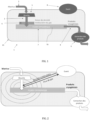
- THE figures 1 and 2 respectively represent a schematic view of equipment 1 and its operating principle for obtaining a product in the form of granules, particles or frozen beads rich in dissolved gas, from a liquid, semi-liquid or pasty matrix .
- the equipment 1 comprises means 5 for dispensing the matrix in the form of drops 3, a cryogenic receptacle 7 containing a cryogenic fluid 70 and in which the drops 3 of matrix are received to be cryogenicized and transformed into granules, particles or beads containing the dissolved gas.
- the cryogenization receptacle 7 is arranged under the means 5 dispensing the matrix in the form of drops so that the drops 3 of matrix leaving said means 5 fall by gravity into the cryogenization receptacle 7.
- the equipment 1 further comprises a zone of high molecular density 6 of gas located between the means 5 dispensing the matrix in the form of drops and the cryogenization receptacle 7.
- the means 5 dispensing the matrix in the form of drops, the zone of high molecular density 6 of gas and the cryogenic receptacle 7 are arranged inside a closed enclosure 10 provided with an evacuation vent 8 to evacuate the gas generated by the evaporation of the cryogenic fluid 70.
- the vent 8 is arranged to maintain the interior of the enclosure 10 at a pressure in the example described equal to the pressure atmospheric. Vent 8 is arranged to allow gas to be evacuated by natural convection. However, for particular needs, means may be provided for closing the vent to put the enclosure 10 under pressure.
- the equipment 1 further comprises a device 9 for extracting cryogenic granules, particles or beads.
- the extraction device 9 is configured to maintain the seal of the enclosure 10, preventing the gas contained in the enclosure 10 from escaping.
- the extraction device 9 can for example be an airlock or bucket wheel system, the airlock or the buckets preventing the escape of gas other than that present with the balls or granules present in the airlock or the buckets.
- the extraction device 9 is connected to a collection device (not shown) located outside the enclosure 10.
- FIG. 2 presents a basic diagram of the operation of the equipment according to the invention.
- the matrix 2 to be treated flows through a shower 5, so as to form drops 3 which fall into the cryogenic fluid 70.
- the drops 3 cross the zone of high molecular density 6 of the increasing gas, generated by the boiling of the cryogenic fluid 70.
- This increasing density allows a strong dissolution of the gas in the matrix 2.
- the maximum dissolution is reached as close as possible to the bath of cryogenic fluid 70, where the molecular density is the most high.
- the zone of high gas density is created when a permanent regime is established within the enclosure 10, which is reached due to the diffusion of the gas by natural convection towards the outside of the enclosure through only of the vent 8.
- the molecular density gradient applied to the product drops, influencing the quantity of gas incorporated in them, is linked to the dimensioning of the enclosure itself, but also to the pressure which is established in the enclosure.
- the latter are extracted from the enclosure 10 by a dedicated system making it possible not to let the gas escape continuously into the room where the machine is located, of the airlock type composed for example of two valves which are not open at the same time, or a bucket wheel.
- the granules, beads or particles are then packaged in packaging, then stored at a temperature sufficient to ensure that the product remains solid, depending on its melting temperature.
- the storage temperature can thus vary from -18 to -80 degrees Celsius, depending on the initial composition of the matrix. For example, most food matrices can be stored at -18°C.
- test 2 corresponding to the method according to the invention.
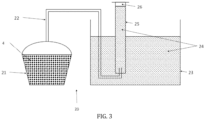
- Test 1 Water beads cryogenized under pressure are produced according to the process described in the application WO2008/043909 , under a pressure of 4 bars, in equipment 1 as described above but whose vent 8 has been closed. The enclosure 10 is thus completely closed. The gas incorporation operation is carried out in the matrix 2, before passing through the shower, by bringing said matrix 2 into contact with an atmosphere whose partial gas pressure is also equal to 4 bars. The beads are stored for 48 hours in a domestic freezer, at a temperature of -18°C. The quantity of gas present in the balls is then measured using a device 20 illustrated on the Figure 3 and described below. To do this, 200g of balls are placed in a first waterproof container 21.
- An advantageously flexible pipe 22 is connected to the container and is immersed in a second container 23 containing water 24, such that bubbles escaping from the pipe rises in a graduated test tube also filled with water and placed upside down.
- a graduated test tube also filled with water and placed upside down.
- Test 2 Cryogenized water beads are produced in the same equipment 1 as previously, but without pressure with only the vent 8 open. With the exception of vent 8, enclosure 10 is entirely closed. During treatment, the pressure observed in enclosure 10 is indeed 0 bar. The beads are stored for 48 hours in a domestic freezer, at a temperature of -18°C. The quantity of gas present in the balls is then measured using the device 20 of the Figure 3 .
- Test 3 Cryogenicized water beads are produced in the same equipment 1 as previously, but without pressure and under air suction through the open vent 8. With the exception of vent 8, enclosure 10 is entirely closed. The beads are stored for 48 hours in a domestic freezer, at a temperature of -18°C. The quantity of gas present in the balls is then measured using the device 20 of the Figure 3 .
- Test 4 Water beads are produced outside the device, by drop by drop using a syringe above a dewar filled with liquid nitrogen. The beads are stored for 48 hours in a domestic freezer, at a temperature of -18°C. The quantity of gas present in the balls is then measured using the device 20 illustrated on the Figure 3 .
- Test 5 Water ice cubes are made by conventional freezing, by filling the hemispherical cells of a mold before placing the latter in the freezer at -18°C. After 48 hours, the balls are unmolded and the quantity of gas present in them is measured using the device 20 illustrated on the Figure 3 .
- test 1 makes it possible to measure a large quantity of gas, necessarily obtained by supersaturation of the product.
- test 2 also allows gas to be dissolved in the products, so that supersaturation is also observed.
- the quantity of gas observed in test 2 is significantly lower than that obtained in test 1. This is explained by the reduced dimensions of the treatment device used, which only makes it possible to generate a small gradient. molecular density of gas and limited dissolution of the latter in water. We therefore see that by carrying out the gas incorporation step in the drops 3 of the matrix and not on the matrix 2 and by simple application of a molecular density gradient, a supersaturation of the drops 3 is observed.
- the equivalent pressure calculated in Table 1 corresponds to the pressure to which the product should have been subjected to achieve the measured gas dissolution.
Landscapes
- Chemical & Material Sciences (AREA)
- Engineering & Computer Science (AREA)
- Life Sciences & Earth Sciences (AREA)
- Food Science & Technology (AREA)
- Polymers & Plastics (AREA)
- Health & Medical Sciences (AREA)
- Nutrition Science (AREA)
- Zoology (AREA)
- Wood Science & Technology (AREA)
- Organic Chemistry (AREA)
- Chemical Kinetics & Catalysis (AREA)
- Freezing, Cooling And Drying Of Foods (AREA)
- General Chemical & Material Sciences (AREA)
Claims (7)
- Verfahren zum Gewinnen eines Produkts in Form von tiefgefrorenen Körnchen, Partikeln oder Kügelchen, die reich an gelöstem Gas sind, aus einer flüssigen, halbflüssigen oder pastösen Matrix (2), umfassend die Schritte bestehend aus Vergasen der Matrix (2) durch Einbeziehen eines Gases, Abgeben der Matrix (2) in Form von Tropfen und Kryogenisieren der Tropfen der Matrix durch Eintauchen in ein kryogenes Fluid (70), dadurch gekennzeichnet, dass der Schritt der Vergasung der Matrix (2) aus dem Auflösen, in großen Mengen, des durch die Verdampfung des kryogenen Fluids erzeugten Gases in den Tropfen der Matrix besteht, so dass das Produkt zumindest mit dem genannten Gas gesättigt ist, wobei die Auflösung durch Erhöhen der Anzahl der Gasmoleküle in einer Zone mit hoher Gasdichte, die als Zone mit hoher Molekulardichte bezeichnet wird, die oberhalb der Oberfläche des kryogenen Fluids und auf dem Weg der Tropfen der Matrix vor ihrem Eintauchen in das Fluid befindlich ist, durchgeführt wird, wobei die Zone mit hoher Molekulardichte dadurch erzeugt wird, dass die Vergasung und Kryogenisierung der vergasten Tropfen innerhalb einer geschlossenen Kammer durchgeführt werden, die mit einer Öffnung (8) versehen ist, die angeordnet ist, um eine Evakuierung des durch die Verdampfung des kryogenen Fluids erzeugten Gases durch natürliche Konvektion zu ermöglichen, und um das Innere der Kammer auf einem Druck zu halten, der größer als oder gleich dem atmosphärischen Druck ist.
- Verfahren nach Anspruch 1, dadurch gekennzeichnet, dass die Schritte der Vergasung und Kryogenisierung der vergasten Tropfen in ein und derselben geschlossenen Kammer durchgeführt werden, die mit mindestens einer Ablassöffnung versehen ist, die so dimensioniert ist, dass die Evakuierung des durch die Verdampfung des kryogenen Fluids erzeugten Gases durch natürliche Konvektion ermöglicht wird.
- Verfahren nach einem der vorhergehenden Ansprüche, dadurch gekennzeichnet, dass es einen Schritt der kontinuierlichen oder halbkontinuierlichen Sammlung der übersättigten Körnchen, Partikel oder Kügelchen beinhaltet.
- Ausrüstung (1) zum Gewinnen eines Produkts in Form von tiefgefrorenen Körnchen, Partikeln oder Kügelchen, die reich an gelöstem Gas sind, aus einer flüssigen, halbflüssigen oder pastösen Matrix (2), umfassend Mittel zum Abgeben der Matrix (2) in Form von Tropfen und einen Kryonik-Behälter (7), der ein kryogenes Fluid (70) enthält, in dem die Tropfen der Matrix aufgenommen werden, um dort kryogenisiert und in übersättigte Körnchen, Partikel oder Kügelchen umgewandelt zu werden, dadurch gekennzeichnet, dass die Ausrüstung (1) eine Zone (6) mit hoher Gasmolekulardichte beinhaltet, die zwischen den die Matrix (2) in Form von Tropfen abgebenden Mitteln und dem Kryonik-Behälter (7) befindlich ist, wobei die Zone (6) mit hoher Gasmolekulardichte und der Kryonik-Behälter (7) im Inneren einer geschlossenen Kammer (10) befindlich sind, die mit mindestens einer Ablassöffnung (8) zum Evakuieren des durch die Verdampfung des kryogenen Fluids (70) erzeugten Gases durch natürliche Konvektion versehen ist, wobei die Öffnung (8) angeordnet ist, um das Innere der Kammer (10) auf einem Druck zu halten, der größer als oder gleich dem atmosphärischen Druck ist.
- Ausrüstung (1) nach Anspruch 4, dadurch gekennzeichnet, dass der Kryonik-Behälter (7) unter den die Matrix (2) in Form von Tropfen abgebenden Mitteln befindlich ist, um die Tropfen (3) der Matrix durch Schwerkraftfluss aus den die Matrix (2) in Form von Tropfen abgebenden Mitteln in den Kryonik-Behälter (7) aufzunehmen.
- Ausrüstung (1) nach Anspruch 4 oder Anspruch 5, dadurch gekennzeichnet, dass die die Matrix (2) in Form von Tropfen abgebenden Mittel im Inneren der Kammer (10) befindlich sind.
- Ausrüstung (1) nach einem der Ansprüche 4 bis 6, dadurch gekennzeichnet, dass sie eine Vorrichtung zum Sammeln der Körnchen, Partikel oder Kügelchen am Auslass des Kryonik-Behälters (7) beinhaltet.
Priority Applications (1)
| Application Number | Priority Date | Filing Date | Title |
|---|---|---|---|
| DE19745668.4T DE19745668T1 (de) | 2018-06-04 | 2019-06-04 | Verfahren zum erhalten eines produktes in tiefgefrorenen, an gelöstem gas reichen körnern, partikeln oder perlen und zugehörige ausrüstung |
Applications Claiming Priority (2)
| Application Number | Priority Date | Filing Date | Title |
|---|---|---|---|
| FR1854814A FR3081684B1 (fr) | 2018-06-04 | 2018-06-04 | Procede d’obtention d’un produit sous forme de granules, particules ou billes surgelees riches en gaz dissous et equipement associe |
| PCT/FR2019/051307 WO2019234341A1 (fr) | 2018-06-04 | 2019-06-04 | Procede d'obtention d'un produit sous forme de granules, particules ou billes surgelees riches en gaz dissous et equipement associe |
Publications (3)
| Publication Number | Publication Date |
|---|---|
| EP3813552A1 EP3813552A1 (de) | 2021-05-05 |
| EP3813552C0 EP3813552C0 (de) | 2024-07-31 |
| EP3813552B1 true EP3813552B1 (de) | 2024-07-31 |
Family
ID=63490607
Family Applications (1)
| Application Number | Title | Priority Date | Filing Date |
|---|---|---|---|
| EP19745668.4A Active EP3813552B1 (de) | 2018-06-04 | 2019-06-04 | Verfahren zur herstellung eines produkts in form von gas-enthaltendem granulat, partikeln, oder kugeln, und zugehörige anlage |
Country Status (7)
| Country | Link |
|---|---|
| US (2) | US12225921B2 (de) |
| EP (1) | EP3813552B1 (de) |
| CA (1) | CA3102669A1 (de) |
| DE (1) | DE19745668T1 (de) |
| ES (1) | ES2988771T3 (de) |
| FR (1) | FR3081684B1 (de) |
| WO (1) | WO2019234341A1 (de) |
Families Citing this family (4)
| Publication number | Priority date | Publication date | Assignee | Title |
|---|---|---|---|---|
| FR3098091B1 (fr) | 2019-07-05 | 2021-06-04 | Genialis | Procede de deshydratation de produits liquides, semi-liquides ou pateux comprenant une etape de cryogenie sous pression et une etape de lyophilisation |
| FR3103827B1 (fr) * | 2019-12-02 | 2025-04-25 | Genialis | Procede de lyophilisation d’une composition cellulaire cryogenisee et contenant du gaz dissous |
| FR3109733B1 (fr) * | 2020-04-29 | 2022-04-01 | Marine Desjardins | Parfum sous forme de poudre seche et utilisation des poudres pour la preparation d’un parfum complexe |
| FR3109731B1 (fr) | 2020-04-29 | 2022-04-01 | Genialis | Procede d’extraction d’odeur a partir d’une matiere vegetale, notamment de fleurs muettes, sous forme solide |
Family Cites Families (7)
| Publication number | Priority date | Publication date | Assignee | Title |
|---|---|---|---|---|
| US5126156A (en) * | 1989-03-06 | 1992-06-30 | Jones Curt D | Method of preparing and storing a free flowing, frozen alimentary dairy product |
| US5162156A (en) | 1990-09-21 | 1992-11-10 | Lord Corporation | Phenolic resin adhesion promoters and adhesive compositions, and bonding method employing same |
| US6000229A (en) * | 1998-04-24 | 1999-12-14 | Dippin' Dots, Inc. | Cryogenic processor for liquid feed preparation of a free-flowing frozen product and method for freezing liquid composition |
| FR2808583B1 (fr) * | 2000-05-05 | 2002-08-30 | Air Liquide | Installation de traitement d'objets par un liquide cryogenique |
| ES2194558B1 (es) * | 2000-07-04 | 2005-03-01 | Ricardo Ros Sanmartin | Instalacion de congelacion por criogenizacion de zumos liquidos de frutas en forma de granulos diferentes en forma y tamaño. |
| US9521854B2 (en) * | 2006-05-31 | 2016-12-20 | Air Liquide Industrial U.S. Lp | Method and device for creating frozen pellets of a foodstuff |
| FR2906688B1 (fr) * | 2006-10-09 | 2012-04-20 | Lavisse Isabelle Desjardins | Procede d'obtention d'un produit subissant a la fois une gazeification et une surgelation |
-
2018
- 2018-06-04 FR FR1854814A patent/FR3081684B1/fr active Active
-
2019
- 2019-06-04 EP EP19745668.4A patent/EP3813552B1/de active Active
- 2019-06-04 CA CA3102669A patent/CA3102669A1/fr active Pending
- 2019-06-04 US US16/972,364 patent/US12225921B2/en active Active
- 2019-06-04 ES ES19745668T patent/ES2988771T3/es active Active
- 2019-06-04 WO PCT/FR2019/051307 patent/WO2019234341A1/fr not_active Ceased
- 2019-06-04 DE DE19745668.4T patent/DE19745668T1/de active Pending
-
2025
- 2025-01-24 US US19/036,396 patent/US20250160348A1/en active Pending
Also Published As
| Publication number | Publication date |
|---|---|
| FR3081684B1 (fr) | 2021-08-06 |
| FR3081684A1 (fr) | 2019-12-06 |
| EP3813552C0 (de) | 2024-07-31 |
| ES2988771T3 (es) | 2024-11-21 |
| CA3102669A1 (fr) | 2019-12-12 |
| WO2019234341A1 (fr) | 2019-12-12 |
| US12225921B2 (en) | 2025-02-18 |
| DE19745668T1 (de) | 2020-05-07 |
| US20250160348A1 (en) | 2025-05-22 |
| EP3813552A1 (de) | 2021-05-05 |
| US20210235731A1 (en) | 2021-08-05 |
Similar Documents
| Publication | Publication Date | Title |
|---|---|---|
| WO2019234341A1 (fr) | Procede d'obtention d'un produit sous forme de granules, particules ou billes surgelees riches en gaz dissous et equipement associe | |
| EP3189737A1 (de) | Kontinuierliches verfahren, system von vorrichtungen und vorrichtungen für die pasteurisierung oder sterilisierung von lebensmitteln in einem starren behälter, gefolgt von dessen vakuumverschluss durch rotative dampfeinspritzung und homogene schnelle kühlung | |
| FR2552630A2 (fr) | Procede ameliore de blanchiment de champignons et autres legumes, et appareillage pour sa mise en oeuvre | |
| CA2666518A1 (fr) | Procede d'obtention d'un produit subissant consecutivement une gazeification et une surgelation cryogenique | |
| FR3048163B1 (fr) | Procede et systeme de degazage et de re-injection de fluides de produits alimentaires | |
| FR2553975A1 (fr) | Preparation de produits alimentaires | |
| FR2561620A1 (fr) | Produit alimentaire aqueux emballe sous vide profond, un procede d'obtention et un appareil pour la mise en oeuvre de ce dernier | |
| BE1023093B1 (fr) | Procédé de fabrication de confiture | |
| EP3573457B1 (de) | Verfahren zur kühlung eines biologischen materials und zur lagerung davon | |
| EP0085426A1 (de) | Semi-kontinuierliches Verfahren zur Herstellung eines Nahrungsmittelgemisches und Vorrichtung zur Durchführung des Verfahrens | |
| EP3700349A1 (de) | Vorrichtung zur herstellung eines fermentierten getränks | |
| EP3501288B1 (de) | Verpackungsverfahren von rohem fisch für den transport und seine endgültige verpackung | |
| EP3993632A1 (de) | Verfahren zur entwässerung von flüssigen, halbflüssigen oder pastösen produkten mit einem druckkryogenen schritt und einem lyophilisierungsschritt | |
| LU87232A1 (fr) | Procede continu de cuisson et de stabilisation par la chaleur de particules alimentaires en suspension dans un liquide suivi d'un stockage aseptique des suspensions stabilisees et appareillage convenant particulierement a la mise en oeuvre du procede | |
| EP1920664A1 (de) | Verfahren und Vorrichtung zum Gefrieren von Frucht- oder Gemüsepürees | |
| CH616568A5 (en) | Method and apparatus for continuous impregnation of food | |
| FR2669811A1 (fr) | Procede et dispositif de fabrication et de conditionnement d'une preparation alimentaire foisonnee sterile, et preparation alimentaire foisonnee sterile obrenue avec un tel procede. | |
| CH361245A (fr) | Procédé de déshydratation d'un produit liquide et installation pour sa mise en oeuvre | |
| FR2905934A1 (fr) | Procede pour traiter des produits consommables precuits. | |
| BE511232A (de) | ||
| WO2018020134A1 (fr) | Dispositif pour la mise sous vide d'un produit, notamment un aliment solide |
Legal Events
| Date | Code | Title | Description |
|---|---|---|---|
| STAA | Information on the status of an ep patent application or granted ep patent |
Free format text: STATUS: UNKNOWN |
|
| STAA | Information on the status of an ep patent application or granted ep patent |
Free format text: STATUS: THE INTERNATIONAL PUBLICATION HAS BEEN MADE |
|
| REG | Reference to a national code |
Ref country code: DE Ref legal event code: R210 Ref country code: DE Ref legal event code: R210 Ref document number: 602019056117 Country of ref document: DE |
|
| PUAI | Public reference made under article 153(3) epc to a published international application that has entered the european phase |
Free format text: ORIGINAL CODE: 0009012 |
|
| STAA | Information on the status of an ep patent application or granted ep patent |
Free format text: STATUS: REQUEST FOR EXAMINATION WAS MADE |
|
| 17P | Request for examination filed |
Effective date: 20201204 |
|
| AK | Designated contracting states |
Kind code of ref document: A1 Designated state(s): AL AT BE BG CH CY CZ DE DK EE ES FI FR GB GR HR HU IE IS IT LI LT LU LV MC MK MT NL NO PL PT RO RS SE SI SK SM TR |
|
| DAV | Request for validation of the european patent (deleted) | ||
| DAX | Request for extension of the european patent (deleted) | ||
| GRAP | Despatch of communication of intention to grant a patent |
Free format text: ORIGINAL CODE: EPIDOSNIGR1 |
|
| STAA | Information on the status of an ep patent application or granted ep patent |
Free format text: STATUS: GRANT OF PATENT IS INTENDED |
|
| INTG | Intention to grant announced |
Effective date: 20240304 |
|
| GRAS | Grant fee paid |
Free format text: ORIGINAL CODE: EPIDOSNIGR3 |
|
| GRAA | (expected) grant |
Free format text: ORIGINAL CODE: 0009210 |
|
| STAA | Information on the status of an ep patent application or granted ep patent |
Free format text: STATUS: THE PATENT HAS BEEN GRANTED |
|
| REG | Reference to a national code |
Ref country code: DE Ref legal event code: R082 Ref document number: 602019056117 Country of ref document: DE |
|
| AK | Designated contracting states |
Kind code of ref document: B1 Designated state(s): AL AT BE BG CH CY CZ DE DK EE ES FI FR GB GR HR HU IE IS IT LI LT LU LV MC MK MT NL NO PL PT RO RS SE SI SK SM TR |
|
| REG | Reference to a national code |
Ref country code: CH Ref legal event code: EP Ref country code: GB Ref legal event code: FG4D Free format text: NOT ENGLISH |
|
| REG | Reference to a national code |
Ref country code: DE Ref legal event code: R096 Ref document number: 602019056117 Country of ref document: DE |
|
| REG | Reference to a national code |
Ref country code: IE Ref legal event code: FG4D Free format text: LANGUAGE OF EP DOCUMENT: FRENCH |
|
| U01 | Request for unitary effect filed |
Effective date: 20240828 |
|
| U07 | Unitary effect registered |
Designated state(s): AT BE BG DE DK EE FI FR IT LT LU LV MT NL PT RO SE SI Effective date: 20240911 |
|
| REG | Reference to a national code |
Ref country code: ES Ref legal event code: FG2A Ref document number: 2988771 Country of ref document: ES Kind code of ref document: T3 Effective date: 20241121 |
|
| PG25 | Lapsed in a contracting state [announced via postgrant information from national office to epo] |
Ref country code: NO Free format text: LAPSE BECAUSE OF FAILURE TO SUBMIT A TRANSLATION OF THE DESCRIPTION OR TO PAY THE FEE WITHIN THE PRESCRIBED TIME-LIMIT Effective date: 20241031 |
|
| PG25 | Lapsed in a contracting state [announced via postgrant information from national office to epo] |
Ref country code: GR Free format text: LAPSE BECAUSE OF FAILURE TO SUBMIT A TRANSLATION OF THE DESCRIPTION OR TO PAY THE FEE WITHIN THE PRESCRIBED TIME-LIMIT Effective date: 20241101 Ref country code: PL Free format text: LAPSE BECAUSE OF FAILURE TO SUBMIT A TRANSLATION OF THE DESCRIPTION OR TO PAY THE FEE WITHIN THE PRESCRIBED TIME-LIMIT Effective date: 20240731 |
|
| PG25 | Lapsed in a contracting state [announced via postgrant information from national office to epo] |
Ref country code: IS Free format text: LAPSE BECAUSE OF FAILURE TO SUBMIT A TRANSLATION OF THE DESCRIPTION OR TO PAY THE FEE WITHIN THE PRESCRIBED TIME-LIMIT Effective date: 20241130 |
|
| PG25 | Lapsed in a contracting state [announced via postgrant information from national office to epo] |
Ref country code: HR Free format text: LAPSE BECAUSE OF FAILURE TO SUBMIT A TRANSLATION OF THE DESCRIPTION OR TO PAY THE FEE WITHIN THE PRESCRIBED TIME-LIMIT Effective date: 20240731 |
|
| PG25 | Lapsed in a contracting state [announced via postgrant information from national office to epo] |
Ref country code: RS Free format text: LAPSE BECAUSE OF FAILURE TO SUBMIT A TRANSLATION OF THE DESCRIPTION OR TO PAY THE FEE WITHIN THE PRESCRIBED TIME-LIMIT Effective date: 20241031 |
|
| PG25 | Lapsed in a contracting state [announced via postgrant information from national office to epo] |
Ref country code: RS Free format text: LAPSE BECAUSE OF FAILURE TO SUBMIT A TRANSLATION OF THE DESCRIPTION OR TO PAY THE FEE WITHIN THE PRESCRIBED TIME-LIMIT Effective date: 20241031 Ref country code: PL Free format text: LAPSE BECAUSE OF FAILURE TO SUBMIT A TRANSLATION OF THE DESCRIPTION OR TO PAY THE FEE WITHIN THE PRESCRIBED TIME-LIMIT Effective date: 20240731 Ref country code: NO Free format text: LAPSE BECAUSE OF FAILURE TO SUBMIT A TRANSLATION OF THE DESCRIPTION OR TO PAY THE FEE WITHIN THE PRESCRIBED TIME-LIMIT Effective date: 20241031 Ref country code: IS Free format text: LAPSE BECAUSE OF FAILURE TO SUBMIT A TRANSLATION OF THE DESCRIPTION OR TO PAY THE FEE WITHIN THE PRESCRIBED TIME-LIMIT Effective date: 20241130 Ref country code: HR Free format text: LAPSE BECAUSE OF FAILURE TO SUBMIT A TRANSLATION OF THE DESCRIPTION OR TO PAY THE FEE WITHIN THE PRESCRIBED TIME-LIMIT Effective date: 20240731 Ref country code: GR Free format text: LAPSE BECAUSE OF FAILURE TO SUBMIT A TRANSLATION OF THE DESCRIPTION OR TO PAY THE FEE WITHIN THE PRESCRIBED TIME-LIMIT Effective date: 20241101 |
|
| PG25 | Lapsed in a contracting state [announced via postgrant information from national office to epo] |
Ref country code: SM Free format text: LAPSE BECAUSE OF FAILURE TO SUBMIT A TRANSLATION OF THE DESCRIPTION OR TO PAY THE FEE WITHIN THE PRESCRIBED TIME-LIMIT Effective date: 20240731 |
|
| PG25 | Lapsed in a contracting state [announced via postgrant information from national office to epo] |
Ref country code: CZ Free format text: LAPSE BECAUSE OF FAILURE TO SUBMIT A TRANSLATION OF THE DESCRIPTION OR TO PAY THE FEE WITHIN THE PRESCRIBED TIME-LIMIT Effective date: 20240731 |
|
| PG25 | Lapsed in a contracting state [announced via postgrant information from national office to epo] |
Ref country code: SK Free format text: LAPSE BECAUSE OF FAILURE TO SUBMIT A TRANSLATION OF THE DESCRIPTION OR TO PAY THE FEE WITHIN THE PRESCRIBED TIME-LIMIT Effective date: 20240731 |
|
| PLBE | No opposition filed within time limit |
Free format text: ORIGINAL CODE: 0009261 |
|
| STAA | Information on the status of an ep patent application or granted ep patent |
Free format text: STATUS: NO OPPOSITION FILED WITHIN TIME LIMIT |
|
| 26N | No opposition filed |
Effective date: 20250501 |
|
| PGFP | Annual fee paid to national office [announced via postgrant information from national office to epo] |
Ref country code: GB Payment date: 20250602 Year of fee payment: 7 |
|
| U20 | Renewal fee for the european patent with unitary effect paid |
Year of fee payment: 7 Effective date: 20250623 |
|
| PGFP | Annual fee paid to national office [announced via postgrant information from national office to epo] |
Ref country code: ES Payment date: 20250701 Year of fee payment: 7 |
|
| PGFP | Annual fee paid to national office [announced via postgrant information from national office to epo] |
Ref country code: CH Payment date: 20250701 Year of fee payment: 7 |
|
| PG25 | Lapsed in a contracting state [announced via postgrant information from national office to epo] |
Ref country code: MC Free format text: LAPSE BECAUSE OF FAILURE TO SUBMIT A TRANSLATION OF THE DESCRIPTION OR TO PAY THE FEE WITHIN THE PRESCRIBED TIME-LIMIT Effective date: 20240731 |
|
| PG25 | Lapsed in a contracting state [announced via postgrant information from national office to epo] |
Ref country code: IE Free format text: LAPSE BECAUSE OF NON-PAYMENT OF DUE FEES Effective date: 20250604 |