EP3812559B1 - Spülfluid-versorgung einer aktiven vorkammer eines aufgeladenen ottomotors in kombination mit einer turbokühlung - Google Patents
Spülfluid-versorgung einer aktiven vorkammer eines aufgeladenen ottomotors in kombination mit einer turbokühlung Download PDFInfo
- Publication number
- EP3812559B1 EP3812559B1 EP20200283.8A EP20200283A EP3812559B1 EP 3812559 B1 EP3812559 B1 EP 3812559B1 EP 20200283 A EP20200283 A EP 20200283A EP 3812559 B1 EP3812559 B1 EP 3812559B1
- Authority
- EP
- European Patent Office
- Prior art keywords
- air
- exhaust gas
- fresh air
- combustion chamber
- line
- Prior art date
- Legal status (The legal status is an assumption and is not a legal conclusion. Google has not performed a legal analysis and makes no representation as to the accuracy of the status listed.)
- Active
Links
Images

Classifications
-
- F—MECHANICAL ENGINEERING; LIGHTING; HEATING; WEAPONS; BLASTING
- F02—COMBUSTION ENGINES; HOT-GAS OR COMBUSTION-PRODUCT ENGINE PLANTS
- F02B—INTERNAL-COMBUSTION PISTON ENGINES; COMBUSTION ENGINES IN GENERAL
- F02B19/00—Engines characterised by precombustion chambers
- F02B19/02—Engines characterised by precombustion chambers the chamber being periodically isolated from its cylinder
-
- F—MECHANICAL ENGINEERING; LIGHTING; HEATING; WEAPONS; BLASTING
- F02—COMBUSTION ENGINES; HOT-GAS OR COMBUSTION-PRODUCT ENGINE PLANTS
- F02B—INTERNAL-COMBUSTION PISTON ENGINES; COMBUSTION ENGINES IN GENERAL
- F02B19/00—Engines characterised by precombustion chambers
- F02B19/10—Engines characterised by precombustion chambers with fuel introduced partly into pre-combustion chamber, and partly into cylinder
- F02B19/1019—Engines characterised by precombustion chambers with fuel introduced partly into pre-combustion chamber, and partly into cylinder with only one pre-combustion chamber
- F02B19/108—Engines characterised by precombustion chambers with fuel introduced partly into pre-combustion chamber, and partly into cylinder with only one pre-combustion chamber with fuel injection at least into pre-combustion chamber, i.e. injector mounted directly in the pre-combustion chamber
-
- F—MECHANICAL ENGINEERING; LIGHTING; HEATING; WEAPONS; BLASTING
- F02—COMBUSTION ENGINES; HOT-GAS OR COMBUSTION-PRODUCT ENGINE PLANTS
- F02M—SUPPLYING COMBUSTION ENGINES IN GENERAL WITH COMBUSTIBLE MIXTURES OR CONSTITUENTS THEREOF
- F02M26/00—Engine-pertinent apparatus for adding exhaust gases to combustion-air, main fuel or fuel-air mixture, e.g. by exhaust gas recirculation [EGR] systems
- F02M26/02—EGR systems specially adapted for supercharged engines
- F02M26/04—EGR systems specially adapted for supercharged engines with a single turbocharger
- F02M26/06—Low pressure loops, i.e. wherein recirculated exhaust gas is taken out from the exhaust downstream of the turbocharger turbine and reintroduced into the intake system upstream of the compressor
-
- F—MECHANICAL ENGINEERING; LIGHTING; HEATING; WEAPONS; BLASTING
- F02—COMBUSTION ENGINES; HOT-GAS OR COMBUSTION-PRODUCT ENGINE PLANTS
- F02B—INTERNAL-COMBUSTION PISTON ENGINES; COMBUSTION ENGINES IN GENERAL
- F02B19/00—Engines characterised by precombustion chambers
- F02B19/10—Engines characterised by precombustion chambers with fuel introduced partly into pre-combustion chamber, and partly into cylinder
- F02B19/1019—Engines characterised by precombustion chambers with fuel introduced partly into pre-combustion chamber, and partly into cylinder with only one pre-combustion chamber
- F02B19/1023—Engines characterised by precombustion chambers with fuel introduced partly into pre-combustion chamber, and partly into cylinder with only one pre-combustion chamber pre-combustion chamber and cylinder being fed with fuel-air mixture(s)
-
- F—MECHANICAL ENGINEERING; LIGHTING; HEATING; WEAPONS; BLASTING
- F02—COMBUSTION ENGINES; HOT-GAS OR COMBUSTION-PRODUCT ENGINE PLANTS
- F02B—INTERNAL-COMBUSTION PISTON ENGINES; COMBUSTION ENGINES IN GENERAL
- F02B19/00—Engines characterised by precombustion chambers
- F02B19/12—Engines characterised by precombustion chambers with positive ignition
-
- F—MECHANICAL ENGINEERING; LIGHTING; HEATING; WEAPONS; BLASTING
- F02—COMBUSTION ENGINES; HOT-GAS OR COMBUSTION-PRODUCT ENGINE PLANTS
- F02B—INTERNAL-COMBUSTION PISTON ENGINES; COMBUSTION ENGINES IN GENERAL
- F02B29/00—Engines characterised by provision for charging or scavenging not provided for in groups F02B25/00, F02B27/00 or F02B33/00 - F02B39/00; Details thereof
- F02B29/04—Cooling of air intake supply
- F02B29/0406—Layout of the intake air cooling or coolant circuit
-
- F—MECHANICAL ENGINEERING; LIGHTING; HEATING; WEAPONS; BLASTING
- F02—COMBUSTION ENGINES; HOT-GAS OR COMBUSTION-PRODUCT ENGINE PLANTS
- F02B—INTERNAL-COMBUSTION PISTON ENGINES; COMBUSTION ENGINES IN GENERAL
- F02B29/00—Engines characterised by provision for charging or scavenging not provided for in groups F02B25/00, F02B27/00 or F02B33/00 - F02B39/00; Details thereof
- F02B29/04—Cooling of air intake supply
- F02B29/0481—Intake air cooling by means others than heat exchangers, e.g. by rotating drum regenerators, cooling by expansion or by electrical means
-
- F—MECHANICAL ENGINEERING; LIGHTING; HEATING; WEAPONS; BLASTING
- F02—COMBUSTION ENGINES; HOT-GAS OR COMBUSTION-PRODUCT ENGINE PLANTS
- F02B—INTERNAL-COMBUSTION PISTON ENGINES; COMBUSTION ENGINES IN GENERAL
- F02B37/00—Engines characterised by provision of pumps driven at least for part of the time by exhaust
- F02B37/04—Engines with exhaust drive and other drive of pumps, e.g. with exhaust-driven pump and mechanically-driven second pump
-
- F—MECHANICAL ENGINEERING; LIGHTING; HEATING; WEAPONS; BLASTING
- F02—COMBUSTION ENGINES; HOT-GAS OR COMBUSTION-PRODUCT ENGINE PLANTS
- F02B—INTERNAL-COMBUSTION PISTON ENGINES; COMBUSTION ENGINES IN GENERAL
- F02B39/00—Component parts, details, or accessories relating to, driven charging or scavenging pumps, not provided for in groups F02B33/00 - F02B37/00
- F02B39/02—Drives of pumps; Varying pump drive gear ratio
- F02B39/08—Non-mechanical drives, e.g. fluid drives having variable gear ratio
- F02B39/10—Non-mechanical drives, e.g. fluid drives having variable gear ratio electric
-
- F—MECHANICAL ENGINEERING; LIGHTING; HEATING; WEAPONS; BLASTING
- F02—COMBUSTION ENGINES; HOT-GAS OR COMBUSTION-PRODUCT ENGINE PLANTS
- F02M—SUPPLYING COMBUSTION ENGINES IN GENERAL WITH COMBUSTIBLE MIXTURES OR CONSTITUENTS THEREOF
- F02M26/00—Engine-pertinent apparatus for adding exhaust gases to combustion-air, main fuel or fuel-air mixture, e.g. by exhaust gas recirculation [EGR] systems
- F02M26/02—EGR systems specially adapted for supercharged engines
- F02M26/08—EGR systems specially adapted for supercharged engines for engines having two or more intake charge compressors or exhaust gas turbines, e.g. a turbocharger combined with an additional compressor
-
- F—MECHANICAL ENGINEERING; LIGHTING; HEATING; WEAPONS; BLASTING
- F02—COMBUSTION ENGINES; HOT-GAS OR COMBUSTION-PRODUCT ENGINE PLANTS
- F02M—SUPPLYING COMBUSTION ENGINES IN GENERAL WITH COMBUSTIBLE MIXTURES OR CONSTITUENTS THEREOF
- F02M26/00—Engine-pertinent apparatus for adding exhaust gases to combustion-air, main fuel or fuel-air mixture, e.g. by exhaust gas recirculation [EGR] systems
- F02M26/13—Arrangement or layout of EGR passages, e.g. in relation to specific engine parts or for incorporation of accessories
- F02M26/17—Arrangement or layout of EGR passages, e.g. in relation to specific engine parts or for incorporation of accessories in relation to the intake system
- F02M26/20—Feeding recirculated exhaust gases directly into the combustion chambers or into the intake runners
-
- F—MECHANICAL ENGINEERING; LIGHTING; HEATING; WEAPONS; BLASTING
- F02—COMBUSTION ENGINES; HOT-GAS OR COMBUSTION-PRODUCT ENGINE PLANTS
- F02B—INTERNAL-COMBUSTION PISTON ENGINES; COMBUSTION ENGINES IN GENERAL
- F02B2710/00—Gas engines
-
- Y—GENERAL TAGGING OF NEW TECHNOLOGICAL DEVELOPMENTS; GENERAL TAGGING OF CROSS-SECTIONAL TECHNOLOGIES SPANNING OVER SEVERAL SECTIONS OF THE IPC; TECHNICAL SUBJECTS COVERED BY FORMER USPC CROSS-REFERENCE ART COLLECTIONS [XRACs] AND DIGESTS
- Y02—TECHNOLOGIES OR APPLICATIONS FOR MITIGATION OR ADAPTATION AGAINST CLIMATE CHANGE
- Y02T—CLIMATE CHANGE MITIGATION TECHNOLOGIES RELATED TO TRANSPORTATION
- Y02T10/00—Road transport of goods or passengers
- Y02T10/10—Internal combustion engine [ICE] based vehicles
- Y02T10/12—Improving ICE efficiencies
Definitions
- the invention relates to an internal combustion engine comprising at least one cylinder, wherein the at least one cylinder has a main combustion chamber for combustion of a fuel/air mixture or a fuel/air/exhaust gas mixture and a flushed antechamber connected on the fluid side to the main combustion chamber via at least one overflow channel and a Has exhaust gas turbocharger.
- each cylinder is provided with a reciprocating piston and a pre-combustion chamber and the method includes the steps of introducing gaseous fuel into an intake duct of the engine, injecting liquid pilot fuel into the pre-combustion chamber, igniting the liquid pilot fuel by means of compression by the piston and utilizing combustion of the liquid pilot fuel to ignite the gaseous fuel, wherein the exhaust gas is introduced into the pre-combustion chamber prior to injecting the liquid pilot fuel.
- the exhaust gas is cooled before being introduced into the pre-combustion chamber, and the intake air is mixed with the exhaust gas before introducing the mixture of the exhaust gas and the intake air into the pre-combustion chamber.
- gasoline engine and an associated method of the generic type for supplying a main combustion chamber with compressed combustion air and an antechamber with a fuel/air mixture is from the publication DE 10 2016 112 537 A1 known.
- the gasoline engine comprises at least one cylinder, wherein the at least one cylinder comprises a main combustion chamber for combustion of a fuel gas-air mixture and a flushed antechamber coupled to the main combustion chamber via an overflow channel.
- the gasoline engine further comprises at least one exhaust gas turbocharger, which has a turbine for expanding the exhaust gas leaving at least one cylinder and a compressor for compressing the air to be supplied to the at least one cylinder, with several air paths being present for the air to be supplied to the at least one cylinder, with over a first air path with a first compressor at least air can be compressed and fed to the main combustion chamber of the at least one cylinder, and via a second air path with a second compressor, a fuel gas-air mixture can be compressed and fed to the antechamber of at least one of each cylinder.
- at least one exhaust gas turbocharger which has a turbine for expanding the exhaust gas leaving at least one cylinder and a compressor for compressing the air to be supplied to the at least one cylinder, with several air paths being present for the air to be supplied to the at least one cylinder, with over a first air path with a first compressor at least air can be compressed and fed to the main combustion chamber of the at least one cylinder, and via a second air path with a second compressor
- the invention is based on the object of creating a new, generic gasoline engine and a new method for operating the gasoline engine.
- This task is solved by a gasoline engine internal combustion engine and an associated method for operating the internal combustion engine.
- the starting point of the invention is an internal combustion engine comprising at least one cylinder, the at least one cylinder having a main combustion chamber for combustion of a fuel/air mixture or a fuel/air/exhaust gas mixture and a flushed antechamber connected on the fluid side to the main combustion chamber via at least one overflow channel , and at least one exhaust gas turbocharger, which has a turbine for expanding the exhaust gas leaving at least one cylinder and a compressor for compressing fresh air or a fresh air/exhaust gas mixture to be supplied to the at least one cylinder as compressed charge air.
- a combustion chamber charge air line is formed to supply the combustion chamber and a prechamber scavenging line branching off at an extraction point is formed to supply the antechamber, with at least one charge air cooler downstream of the compressor of the exhaust gas turbocharger upstream of the extraction point for cooling the Charge air is arranged in the charge air line.
- an air turbine is arranged downstream of the extraction point in the combustion chamber charge air line, in which the fresh air or a fresh air/exhaust gas mixture, which is compressed to a higher degree in the exhaust gas turbocharger than is necessary for filling the cylinders of the combustion chamber, expands.
- a first charge air cooler and a further compressor of an air turbine compressor unit as well as a further charge air cooler are arranged in front of the extraction point, the air turbine being arranged downstream of the extraction point in the combustion chamber charge air line.
- a first intercooler is arranged upstream of the extraction point and an air turbine is arranged downstream of the extraction point in the combustion chamber charge air line.
- a first charge air cooler is arranged upstream of the extraction point and an air turbine compressor unit is arranged downstream of the extraction point, the air turbine being arranged downstream of the extraction point in the combustion chamber charge air line and the compressor arranged downstream of the extraction point in the branching-off prechamber flushing line are.
- the internal combustion engine is preferably characterized in that a check valve or a check valve and a buffer container is/are arranged downstream of the removal point in the antechamber flushing line.
- a second charge air cooler is arranged downstream of the removal point in the prechamber flushing line.
- the internal combustion engine has a feed point of a fuel supply line for supplying fuel to the flushing fluid in the prechamber flushing line, with either fresh air or a fresh air/exhaust gas mixture being present in the prechamber flushing line at the feed point of the fuel feed line, which can be supplied with fuel.
- a method for operating an internal combustion engine comprising at least one cylinder, the at least one cylinder having a main combustion chamber for combustion of a fuel/air mixture or a fuel/air/exhaust gas mixture and one with the Main combustion chamber has a flushed antechamber connected on the fluid side via at least one overflow channel, and which comprises at least one exhaust gas turbocharger, which has a turbine for expanding the exhaust gas leaving at least one cylinder and a compressor for compressing fresh air or a fresh air/exhaust gas mixture to be supplied to the at least one cylinder has compressed charge air, it being provided that a combustion chamber charge air line is formed in a charge air line downstream of the compressor to supply the combustion chamber and a prechamber flushing line branching off at a removal point to supply the antechamber, so that the combustion chamber has a cooled first Charge air subset and the antechamber a cooled second charge air subset is supplied as a flushing fluid with optional
- a prechamber pressure that is higher than a combustion chamber pressure is generated in the prechamber by turbo cooling, the fresh air or a fresh air/exhaust gas mixture being compressed to a higher degree in the exhaust gas turbocharger than is necessary for filling the cylinders of the combustion chamber, after which the fresh air is subsequently added or the fresh air/exhaust gas mixture is cooled by at least one charge air cooler, the fresh air or the fresh air/exhaust gas mixture being removed as a second charge air subset, starting from the pressure level of the higher prechamber pressure, at the extraction point to supply the antechamber with compressed and cooled flushing fluid , while the first subset of charge air to supply the combustion chamber is expanded via an air turbine downstream of the extraction point in the combustion chamber charge air line, whereby the temperature and pressure of the fresh air or the fresh air/exhaust gas mixture compared to the fresh air or the fresh air/exhaust gas mixture in the prechamber Flushing strand is reduced.
- the cooled first charge air subset is expanded to supply the combustion chamber in an air turbine.
- the cooled second charge air subset is previously compressed in the further compressor in order to supply the antechamber with flushing fluid, to which fuel is optionally added.
- fresh air is supplied to the compressor of the exhaust gas turbocharger from a fresh air line arranged upstream, so that fresh air is supplied to the combustion chamber charge air line for supplying the combustion chamber and to the prechamber purging line for flushing the antechamber.
- a fresh air/exhaust gas mixture is supplied to the compressor of the exhaust gas turbocharger from an upstream fresh air line, since the fresh air line is connected upstream of the compressor to an exhaust gas recirculation line of an exhaust line, so that the combustion chamber charge air line is used to supply the combustion chamber and the A fresh air/exhaust gas mixture is supplied to the prechamber flushing line for flushing the prechamber.
- the method is further characterized in that fuel is optionally supplied as needed to the compressed charge air, in particular the fresh air or the fresh air/exhaust gas mixture in the prechamber purge line downstream of the extraction point, so that the at least one prechamber is filled with a fuel/fresh air mixture or a Fuel/air/exhaust gas mixture is flushed as a flushing fluid.
- the present invention relates to a gasoline engine internal combustion engine 1, in particular a gasoline engine operated with a fuel K, in particular with a gas or a liquid gasoline fuel, and a method for operating such a gasoline engine.
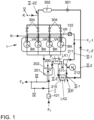
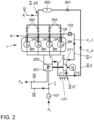
- the Figures 1 to 3 each show a diagram of the gasoline engine 1 according to the invention, which includes several cylinders Z.
- Each of the cylinders Z has a main combustion chamber BK and an antechamber VK, the respective antechamber VK being coupled to the main combustion chamber BK of the respective cylinder Z via at least one overflow channel (not shown).
- a mixture of fuel K and fresh air F F or a fuel/fresh air/exhaust gas mixture K/F F /F A is burned, with the resulting exhaust gas Fa, via an exhaust gas turbocharger 200, in particular via a turbine 201 of the exhaust gas turbocharger 200, and in the exemplary embodiment is discharged in an exhaust line III via catalytic converters, in particular via a pre-catalyst (not shown) and a main catalytic converter (not shown).
- energy obtained in the area of the turbine 201 of the exhaust gas turbocharger 200 is used to compress combustion air, in particular fresh air F F or a fresh air/exhaust gas mixture F F /F A in a compressor 202, which is then used as compressed charge air F L in charge air lines II- 1, II-2 is supplied to the main combustion chambers BK of the gasoline engine 1 and the antechambers VK of the gasoline engine 1.
- a gasoline engine 1 with externally ignited internal mixture formation that is, the fresh air F F or the fresh air/exhaust gas mixture F F /F A is fuel K by direct injection, liquid fuel by injection or gaseous fuel by injection via injection/injection valves (not shown) is fed into the main combustion chamber BK and ignited by means of an ignition device (not shown).
- an exhaust gas recirculation line IV is formed, which in the usual way comprises an exhaust gas recirculation cooler (not shown) and an exhaust gas recirculation flap (not shown), the exhaust gas recirculation line IV with the exhaust gas F A guided therein downstream of an air filter 101 of the fresh air line I is integrated into the fresh air line I upstream of the compressor 202.
- the gasoline engine 1 has two partial charge air lines II-1 and II-2, via which charge air FL-1 and FL-2 is delivered to the main combustion chambers BK and the pre-chambers VK, compare Figure 1 , which are formed downstream of the compressor 202 starting from the common charge air line II, which will be discussed below.
- the first partial charge air line II-1 starting from the common charge air line II, delivers compressed charge air F L -1 from the compressor 202 to the main combustion chambers BK of the respective cylinders Z.
- the second partial charge air line II-2 starting from the common charge air line II, delivers compressed charge air F L -2 from the compressor 202 to the antechambers of the respective cylinders Z.
- the charge air line II has a removal point II-E (upstream of the throttle valve 102), at which compressed charge air F L with the boost pressure present in front of the throttle valve 102 is removed as flushing fluid for the antechambers VK of the respective cylinder Z, which is why second partial charge air line II-2 forms the prechamber purging line for the prechambers VK and the first partial charge air line II-1 for the main combustion chambers BK.
- Fresh air F F or a fresh air/exhaust gas mixture F F /F A is considered charge air F L.
- the flushing fluid is fresh air F F or a fresh air/exhaust gas mixture F F /F A or, when fuel K is supplied, a fuel/fresh air F F mixture K/F F or a fuel/fresh air/exhaust gas mixture k/ F F /F A viewed.
- a check valve 301 preferably a buffer container 302 is assigned to the prechamber flushing line II-2 and, after the prechamber flushing line II-2 has been appropriately divided into individual flushing fluid lines for each cylinder, clock valves 304 are assigned, via which a predeterminable amount is provided at predeterminable times Flushing fluid F L -2 is guided via the prechamber flushing strand II-2 to the prechambers VK of the respective cylinder Z.
- the active antechambers VK are flushed with charge air F L -2, in particular with fresh air F F or the fresh air/exhaust gas mixture F F /F A or the fuel/fresh air/exhaust gas mixture K/F F /F A
- a pressure level above the charge pressure of the compressor 202 of the charge air F L -1 is required in the area of the main combustion chamber BK, as shown below using the three in the Figures 1 to 3 illustrated embodiments will be explained.
- a pressure level is above the intake manifold pressure in the combustion chamber charge air line II -1 is needed in front of the main combustion chamber BK.
- the prechamber pressure in the prechamber VK which is higher than the intake manifold pressure (analogous to the combustion chamber pressure), is generated according to the invention in combination with turbo cooling.
- the fresh air F F or a fresh air/exhaust gas mixture F F /F A for the gasoline engine 1 is first compressed to a higher degree in the exhaust gas turbocharger 201, 202 than is necessary for filling the cylinders Z of the main combustion chamber BK and then the fresh air F F or the fresh air/exhaust gas mixture F F /F A is cooled by at least one intercooler LK1, LK2.
- the charge air F L -2 in particular the fresh air F F or also the fresh air/exhaust gas mixture F F /F A , is discharged at a removal point (II-E', II- E", II-E′′′) to supply the antechambers VK with compressed and cooled flushing fluid (F F ; F F /F A ; K/F F ; K/ F F /F A ).
- the charge air F L -1 which is not taken at a withdrawal point (II-E', II-E", II-E′′′) for the antechambers VK, the so-called cooled main air flow for supplying the main combustion chambers BK, is then fed downstream via an air turbine 211 the extraction point (II-E', II-E", II-E′′′) in the charge air line II-1 (compare Figures 1 to 3 ) expands, whereby the temperature and pressure of the fresh air F F or the fresh air/exhaust gas mixture F F /F A compared to the fresh air F F or the fresh air/exhaust gas mixture F F /F A in the prechamber purging line II-2 still is further reduced.
- the overall structure is therefore possible and sensible in combination with an external exhaust gas recirculation eEGR [external exhaust gas recirculation], as explained previously and will be explained below, so that a fresh air/exhaust gas mixture F is used as charge air FL-1, FL-2 and as flushing fluid F /F A can be used.
- eEGR exhaust gas recirculation
- the Figure 1 shows a schematic representation of a gasoline engine 1 charged according to the invention with a flushing fluid supply to an active antechamber VK - in a first embodiment - with a charge air extraction (fresh air F F or the fresh air / exhaust gas mixture F F / F A ) after an exhaust gas turbocharger 201, 202 in combination with turbo cooling LK1, LK2.
- a charge air extraction fresh air F F or the fresh air / exhaust gas mixture F F / F A
- the Figure 2 shows a schematic representation of a supercharged gasoline engine 1 according to the invention with a flushing fluid supply to an active antechamber VK - in a second embodiment - with a charge air extraction of fresh air F F or the fresh air / exhaust gas mixture F F / F A ) after an exhaust gas turbocharger 201, 202 in Combination with a turbo cooling LK1.
- the Figure 3 shows a schematic representation of a supercharged gasoline engine 1 according to the invention with a flushing fluid supply to an active antechamber VK - in a third embodiment - with a charge air extraction of fresh air F F or the fresh air / exhaust gas mixture F F / F A ) after an exhaust gas turbocharger 201, 202 in Combination with a turbo cooling LK1.
- the pressure is generated by at least one compressor 202, 210 in combination with turbo cooling.
- fresh air F F or a fresh air/exhaust gas mixture F F /F A for the main combustion chamber BK of the gasoline engine is first compressed to a higher level than is necessary to fill the cylinder Z and then cooled by at least one intercooler LK1 or two intercoolers LK2.
- the flushing fluid for the antechamber VK is removed.
- the main air flow to the main combustion chamber BK (first partial charge air flow II-1) of fresh air F F or fresh air/exhaust gas mixture F F /F A is then expanded via an air turbine 211, whereby the temperature of the charge air F L -1 is further reduced in addition to the pressure drop , which ultimately means that the highest pressure in the charge air path, from which the flushing fluid for the antechamber VK is taken, is higher than the main air flow in the intake manifold or in the main combustion chambers BK.
- the overall structure is possible with an external exhaust gas recirculation eEGR, as the pre-chamber ignition in the pre-chambers VK is particularly suitable for igniting diluted charges.
- This embodiment is particularly suitable for engines operating lean (with excess air).
- an electric machine 212 is connected to the air turbine compressor unit 202, 211, 212 ( Figure 1 ) or 202, 211, 212 ( Figure 2 ) or 211, 201, 212 is arranged on a common shaft.
- the electric machine 212 can optionally be used as an electric booster, especially transiently or even stationary over shorter periods of time. In operating points with In excess of torque, the electric machine 212 can preferably also be used as a generator.
- the first embodiment relates to the turbo cooling of the charge air F L with two separate turbine compressor units 201, 202 and 211, 212, 213, compare Figure 1 , with double compression of the charge air F L and double turbo cooling of the charge air F L upstream of the extraction point II-E'.
- the second embodiment concerns the turbo cooling of the charge air F L with all machines 201, 202, 211, 212 on one shaft, compare Figure 2 , with simple charge air F L upstream of the extraction point II-E".
- the compressor 202 of the exhaust gas turbocharger 201, 202 must generate the highest boost pressure compared to the other two (first and third embodiments), since post-compression via the compressor 210 an additional turbine compressor unit 211, 210 is no longer necessary.
- the third embodiment relates to the turbo cooling of the charge air F L with two separate turbine compressor units 201, 202 and 211, 212, 213, compare Figure 1 , with double compression of the charge air F L and single turbo cooling of the charge air F L upstream of the extraction point II-E′′′.
- the ATL compressor 202 compresses the total charge air mass flow only slightly higher than necessary.
- the main mass flow (approximately 97%) is expanded via the air turbine 211 and only approximately 3% of the flushing fluid mass flow is compressed via the second compressor 211 to the higher predeterminable pressure level. Due to the mass flow ratio of approximately 97% via the air turbine 211 and approximately 3% via the second compressor stage 210 in the prechamber purge line II-2, the turbo cooling effect is lower in this embodiment.
Landscapes
- Engineering & Computer Science (AREA)
- Chemical & Material Sciences (AREA)
- Combustion & Propulsion (AREA)
- Mechanical Engineering (AREA)
- General Engineering & Computer Science (AREA)
- Physics & Mathematics (AREA)
- Thermal Sciences (AREA)
- Supercharger (AREA)
- Exhaust-Gas Circulating Devices (AREA)
Description
- Die Erfindung betrifft eine Brennkraftmaschine, umfassend mindestens einen Zylinder, wobei der mindestens eine Zylinder eine Hauptbrennkammer zur Verbrennung eines Kraftstoff/Luft-Gemischs oder eines Kraftstoff/Luft/Abgas-Gemischs und eine mit der Hauptbrennkammer über mindestens einen Überströmkanal fluidseitig verbundene gespülte Vorkammer und einen Abgasturbolader aufweist.
- Die Druckschrift
EP 2 948 667 B1 beschreibt ein Verfahren zum Betreiben eines Mehrzylinderkolbenmotors. Vorgesehen ist, dass in dem Motor jeder Zylinder mit einem Hubkolben und einer Vorverbrennungskammer versehen ist und das Verfahren die Schritte des Einführens von gasförmigem Kraftstoff in einen Ansaugkanal des Motors, Einspritzen von flüssigem Pilotkraftstoff in die Vorverbrennungskammer, Zünden des flüssigen Pilotkraftstoffs mittels Verdichtung durch den Kolben und Nutzen der Verbrennung des flüssigen Pilotkraftstoffs, um den gasförmigen Kraftstoff zu entzünden, aufweist, wobei das Abgas vor dem Einspritzen des flüssigen Pilotkraftstoffs in die Vorverbrennungskammer eingeführt wird. Bei diesem Verfahren wird das Abgas abgekühlt, bevor es in die Vorverbrennungskammer eingeführt wird, und die Ansaugluft wird mit dem Abgas vor dem Einführen der Mischung aus dem Abgas und der Ansaugluft in die Vorverbrennungskammer gemischt. - Eine weiterer Ottomotor und ein zugehöriges Verfahren der gattungsgemäßen Art zur Versorgung einer Hauptbrennkammer mit verdichteter Verbrennungsluft und einer Vorkammer mit einem Kraftstoff/Luft-Gemisch ist aus der Druckschrift
DE 10 2016 112 537 A1 bekannt. Vorgesehen ist hier, dass der Ottomotor mindestens einen Zylinder umfasst, wobei der mindestens eine Zylinder eine Hauptbrennkammer zur Verbrennung eines Brenngas-Luft-Gemischs und eine mit der Hauptbrennkammer über einen Überströmkanal gekoppelte, gespülte Vorkammer umfasst. Der Ottomotor umfasst ferner mindestens einen Abgasturbolader, der eine Turbine zur Entspannung von den mindestens einen Zylinder verlassendem Abgas und einen Verdichter zur Verdichtung von den mindestens einen Zylinder zuzuführender Luft aufweist, wobei mehrere Luftpfade für die den mindestens einen Zylinder zuzuführende Luft vorhanden sind, wobei über einen ersten Luftpfad mit einem ersten Verdichter zumindest Luft verdichtbar und der Hauptbrennkammer des mindestens einen Zylinders zuführbar ist, und wobei über einen zweiten Luftpfad mit einem zweiten Verdichter ein Brenngas-Luft-Gemisch verdichtbar und der Vorkammer des mindestens einen jeden Zylinders zuführbar ist. - Es wird ferner auf die Druckschriften
DE 10 2016 113 307 B3 ,EP 0 655 550 A1 ,EP 0 192 219 ,AT 13 417 U1 US 2020/158005 A1 verwiesen. - Der Erfindung liegt nun die Aufgabe zugrunde, einen neuartigen gattungsgemäßen Ottomotor und ein neues Verfahren zum Betreiben des Ottomotors zu schaffen.
- Diese Aufgabe wird durch eine ottomotorische Brennkraftmaschine und ein zugehöriges Verfahren zum Betrieb der Brennkraftmaschine gelöst.
- Ausgangspunkt der Erfindung ist eine Brennkraftmaschine, umfassend mindestens einen Zylinder, wobei der mindestens eine Zylinder eine Hauptbrennkammer zur Verbrennung eines Kraftstoff/Luft-Gemischs oder eines Kraftstoff/Luft/Abgas-Gemischs und eine mit der Hauptbrennkammer über mindestens einen Überströmkanal fluidseitig verbundene gespülte Vorkammer aufweist, und mindestens einen Abgasturbolader, der eine Turbine zur Entspannung von den mindestens einen Zylinder verlassendem Abgas und einen Verdichter zur Verdichtung von dem mindestens einen Zylinder zuzuführender Frischluft oder eines Frischluft/Abgas-Gemischs als verdichtete Ladeluft aufweist. Es ist vorgesehen, dass in einem Ladeluftstrang stromab des Verdichters zur Versorgung der Brennkammer ein Brennkammer-Ladeluftstrang und zur Versorgung der Vorkammer ein an einer Entnahmestelle abzweigender Vorkammer-Spülstrang ausgebildet ist, wobei stromab des Verdichters des Abgasturboladers stromauf der Entnahmestelle zumindest ein Ladeluftkühler zur Kühlung der Ladeluft im Ladeluftstrang angeordnet ist.
- Erfindungsgemäß ist vorgesehen, dass stromab der Entnahmestelle im Brennkammer-Ladeluftstrang eine Luftturbine angeordnet ist, in der die Frischluft oder auch ein Frischluft/Abgas-Gemisch, die im Abgasturbolader höher verdichtet wird als für die Füllung der Zylinder der Brennkammer nötig ist, expandiert.
- Bevorzugt ist gemäß einer ersten Ausführungsform vorgesehen, dass vor der Entnahmestelle ein erster Ladeluftkühler und ein weiterer Verdichter einer Luftturbinen-Verdichter-Einheit sowie ein weiterer Ladeluftkühler angeordnet sind, wobei die Luftturbine stromab der Entnahmestelle im Brennkammer-Ladeluftstrang angeordnet ist.
- Bevorzugt ist in einer zweiten Ausführungsform vorgesehen, dass stromauf der Entnahmestelle ein erster Ladeluftkühler und stromab der Entnahmestelle im Brennkammer-Ladeluftstrang eine Luftturbine angeordnet sind.
- In einer dritten Ausführungsform ist bevorzugt vorgesehen, dass stromauf der Entnahmestelle ein erster Ladeluftkühler und stromab der Entnahmestelle eine Luftturbinen-Verdichter-Einheit angeordnet sind, wobei die Luftturbine stromab der Entnahmestelle im Brennkammer-Ladeluftstrang und der Verdichter stromab der Entnahmestelle im abzweigenden Vorkammer-Spülstrang angeordnet sind.
- Die Brennkraftmaschine ist bevorzugt dadurch gekennzeichnet, dass stromab der Entnahmestelle im Vorkammer-Spülstrang ein Rückschlagventil oder ein Rückschlagventil und ein Pufferbehälter angeordnet ist/sind.
- In einer Ausführungsvariante ist vorgesehen, dass gemäß der zweiten und dritten Ausführungsform stromab der Entnahmestelle im Vorkammer-Spülstrang ein zweiter Ladeluftkühler angeordnet ist.
- In weiterer Ausgestaltung der Erfindung ist vorgesehen, dass die Brennkraftmaschine im Vorkammer-Spülstrang eine Zuführstelle einer Kraftstoffzuleitung zur Zuführung von Kraftstoff zu dem Spülfluid angeordnet ist, wobei im Vorkammer-Spülstrang an der Zuführstelle der Kraftstoffzuleitung entweder Frischluft oder ein Frischluft/Abgas-Gemisch anliegt, der oder dem Kraftstoff zuführbar ist.
- Mittels einer der möglichen Ausführungsformen ist ein Verfahren zum Betreiben einer Brennkraftmaschine durchführbar, wobei die Brennkraftmaschine mindestens einen Zylinder umfasst, wobei der mindestens eine Zylinder eine Hauptbrennkammer zur Verbrennung eines Kraftstoff/Luft-Gemischs oder eines Kraftstoff/Luft/Abgas-Gemischs und eine mit der Hauptbrennkammer über mindestens einen Überströmkanal fluidseitig verbundene gespülte Vorkammer aufweist, und die mindestens einen Abgasturbolader umfasst, der eine Turbine zur Entspannung von den mindestens einen Zylinder verlassendem Abgas und einen Verdichter zur Verdichtung von dem mindestens einen Zylinder zuzuführender Frischluft oder eines Frischluft/Abgas-Gemischs als verdichtete Ladeluft aufweist, wobei vorgesehen ist, dass in einem Ladeluftstrang stromab des Verdichters zur Versorgung der Brennkammer ein Brennkammer-Ladeluftstrang und zur Versorgung der Vorkammer ein an einer Entnahmestelle abzweigender Vorkammer-Spülstrang ausgebildet ist, so dass der Brennkammer eine gekühlte erste Ladeluftteilmenge und der Vorkammer eine gekühlte zweite Ladeluftteilmenge als Spülfluid mit optionaler Zumischung von Kraftstoff zugeführt wird.
- Erfindungsgemäß ist vorgesehen, dass ein gegenüber einem Brennkammerdruck höherer Vorkammerdruck in der Vorkammer durch eine Turbokühlung erzeugt wird, wobei die Frischluft oder ein Frischluft/Abgas-Gemisch im Abgasturbolader höher verdichtet wird als für die Füllung der Zylinder der Brennkammer nötig ist, wonach nachfolgend die Frischluft oder auch das Frischluft/Abgas-Gemisch durch mindestens einen Ladeluftkühler gekühlt wird, wobei die Frischluft oder das Frischluft/Abgas-Gemisch als zweite Ladeluftteilmenge, vom Druckniveau des höheren Vorkammerdrucks ausgehend, an der Entnahmestelle zur Versorgung der Vorkammer mit verdichtetem und gekühltem Spülfluid abgenommen wird, während die erste Ladeluftteilmenge zur Versorgung der Brennkammer über eine Luftturbine stromab der Entnahmestelle im Brennkammer-Ladeluftstrang expandiert wird, wodurch die Temperatur und der Druck der Frischluft oder des Frischluft/Abgas-Gemischs gegenüber der Frischluft oder des Frischluft/Abgas-Gemischs im Vorkammer-Spülstrang verringert wird.
- Verfahrensgemäß ist bevorzugt in allen Ausführungsformen vorgesehen, dass die gekühlte erste Ladeluftteilmenge zur Versorgung der Brennkammer in einer Luftturbine expandiert wird.
- Bevorzugt ist ferner verfahrensgemäß in der dritten Ausführungsformen vorgesehen, dass die gekühlte zweite Ladeluftteilmenge zur Versorgung der Vorkammer mit Spülfluid, dem optional Kraftstoff zugemischt wird, zuvor in dem weiteren Verdichter nachverdichtet wird.
- In einer Ausgestaltung des Verfahrens wird dem Verdichter des Abgasturboladers aus einem stromauf angeordneten Frischluftstrang Frischluft zugeführt, so dass dem Brennkammer-Ladeluftstrang zur Versorgung der Brennkammer und dem Vorkammer-Spülstrang zur Spülung der Vorkammer Frischluft zugeführt wird.
- In einer anderen Ausgestaltung des Verfahrensschrittes wird dem Verdichter des Abgasturboladers aus einem stromauf angeordneten Frischluftstrang ein Frischluft/Abgas-Gemisch zugeführt, da der Frischluftstrang stromauf des Verdichters mit einem Abgasrückführungsstrang eines Abgasstrangs verbunden ist, so dass dem Brennkammer-Ladeluftstrang zur Versorgung der Brennkammer und dem Vorkammer-Spülstrang zur Spülung der Vorkammer ein Frischluft/Abgas-Gemisch zugeführt wird.
- Das Verfahren ist ferner dadurch gekennzeichnet, dass der verdichteten Ladeluft, insbesondere der Frischluft oder dem Frischluft/Abgas-Gemisch im Vorkammer-Spülstrang stromab der Entnahmestelle optional bedarfsabhängig Kraftstoff zugeführt wird, so dass die mindestens eine Vorkammer mit einem Kraftstoff/Frischluft-Gemisch oder einem Kraftstoff/Luft/Abgas-Gemisch als Spülfluid gespült wird.
- Die Erfindung wird nachfolgend anhand der zugehörigen Zeichnungen erläutert. Es zeigt:
- Figur 1
- eine schematische Darstellung eines erfindungsgemäßen aufgeladenen Ottomotors mit einer Versorgung einer aktiven Vorkammer - in einer ersten Ausführungsform - mit einer Ladeluftentnahme nach einem Abgasturbolader in Kombination mit einer Turbokühlung;
- Figur 2
- eine schematische Darstellung eines erfindungsgemäßen aufgeladenen Ottomotors mit einer Versorgung einer aktiven Vorkammer - in einer zweiten Ausführungsform - mit einer Ladeluftentnahme nach einem Abgasturbolader in Kombination mit einer Turbokühlung;
- Figur 3
- eine schematische Darstellung eines erfindungsgemäßen aufgeladenen Ottomotors mit einer Versorgung einer aktiven Vorkammer - in einer dritten Ausführungsform - mit einer Ladeluftentnahme nach einem Abgasturbolader in Kombination mit einer Turbokühlung.
- Die hier vorliegende Erfindung betrifft eine ottomotorische Brennkraftmaschine 1, insbesondere einen mit einem Kraftstoff K, insbesondere mit einem Gas oder einem flüssigen Ottokraftstoff betriebenen Ottomotor sowie ein Verfahren zum Betreiben eines solchen Ottomotors.
- Die
Figuren 1 bis 3 zeigen jeweils ein Schema des erfindungsgemäßen Ottomotors 1, der mehrere Zylinder Z umfasst. Jeder der Zylinder Z verfügt über eine Hauptbrennkammer BK sowie eine Vorkammer VK, wobei die jeweilige Vorkammer VK mit der Hauptbrennkammer BK des jeweiligen Zylinders Z über mindestens einen Überströmkanal (nicht dargestellt) gekoppelt ist. - In den Zylindern Z des Ottomotors 1, nämlich im Bereich der Hauptbrennkammern BK der Zylinder Z, wird ein Gemisch aus Kraftstoff K und Frischluft FF oder ein Kraftstoff/Frischluft/Abgas-Gemisch K/FF/FA verbrannt, wobei hierbei entstehendes Abgas Fa, über einen Abgasturbolader 200, insbesondere über eine Turbine 201 des Abgasturboladers 200, und im Ausführungsbeispiel in einem Abgasstrang III über Katalysatoren, insbesondere über einen Vor-Katalysator (nicht dargestellt) und einen Haupt-Katalysator (nicht dargestellt), abgeführt wird.
- Hierbei wird im Bereich der Turbine 201 des Abgasturboladers 200 gewonnene Energie zum Verdichten von Verbrennungsluft, insbesondere Frischluft FF oder einem Frischluft/Abgas-Gemisch FF/FA in einem Verdichter 202 genutzt, die dann als verdichtete Ladeluft FL in Ladeluftsträngen II-1, II-2 den Hauptbrennkammern BK des Ottomotors 1 und den Vorkammern VK des Ottomotors 1 zugeführt wird.
- Es handelt sich bei den in den
Figuren 1 bis 3 gezeigten Ausführungsformen um einen Ottomotor 1 mit fremdgezündeter innerer Gemischbildung, das heißt, der Frischluft FF oder dem Frischluft/Abgas-Gemisch FF/FA wird durch Direkteinspritzung Kraftstoff K, durch Einspritzung flüssiger Kraftstoff oder durch Einblasung gasförmiger Kraftstoff über Einspritz-/Einblasventile (nicht dargestellt ) in der Hauptbrennkammer BK zugeführt und mittels einer Zündeinrichtung (nicht dargestellt) gezündet. - Das beschriebene Verfahren kann aber auch bei äußerer Gemischbildung analog eingesetzt werden. Das heißt, die Darstellung und die nachfolgende Beschreibung erfolgt anhand einer von mehreren Ausführungsvarianten der Gemischbildung.
- Stromauf der Turbine 201 ist im Ausführungsbeispiel ein Abgasrückführungsstrang IV ausgebildet, der in üblicher Weise einen Abgasrückführungs-Kühler (nicht dargestellt) und eine Abgasrückführungs-Klappe (nicht dargestellt) umfasst, wobei der Abgasrückführungsstrang IV mit dem darin geführten Abgas FA stromab eines Luftfilters 101 des Frischluftstrangs I stromauf des Verdichters 202 in den Frischluftstrang I eingebunden ist.
- Der erfindungsgemäße Ottomotor 1 verfügt erfindungsgemäß über zwei Teil-Ladeluftstränge II-1 und II-2, über die Ladeluft FL-1 und FL-2 zu den Hauptbrennkammern BK und den Vorkammern VK geliefert wird, vergleiche
Figur 1 , die stromab des Verdichters 202 ausgehend von dem gemeinsamen Ladeluftstrang II ausgebildet sind, worauf nachfolgend noch eingegangen wird. - Der erste Teil-Ladeluftstrang II-1 liefert ausgehend von dem gemeinsamen Ladeluftstrang II verdichtete Ladeluft FL-1 vom Verdichter 202 zu den Hauptbrennkammern BK der jeweiligen Zylinder Z.
- Der zweite Teil-Ladeluftstrang II-2 liefert ausgehend von dem gemeinsamen Ladeluftstrang II verdichtete Ladeluft FL-2 vom Verdichter 202 zu den Vorkammern der jeweiligen Zylinder Z.
- Mit anderen Worten, der Ladeluftstrang II weist eine Entnahmestelle II-E (stromauf der Drosselklappe 102) auf, an der verdichtete Ladeluft FL mit dem vor der Drosselklappe 102 anliegenden Ladedruck als Spülfluid für die Vorkammern VK der jeweiligen Zylinder Z entnommen wird, weshalb der zweite Teil-Ladeluftstrang II-2 den Vorkammer-Spülstrang für die Vorkammern VK und der erste Teil-Ladeluftstrang II-1 für die Hauptbrennkammern BK bildet.
- Als Ladeluft FL wird Frischluft FF oder ein Frischluft/Abgas-Gemisch FF/FA angesehen.
- Als Spülfluid wird Frischluft FF oder ein Frischluft/Abgas-Gemisch FF/FA oder bei Zuführung Kraftstoff K ein Kraftstoff/Frischluft FF-Gemisch K/FF oder ein Kraftstoff/Frischluft/Abgas-Gemisch k/ FF/FA angesehen.
- Dem Vorkammer-Spülstrang II-2 ist hinter der Entnahmestelle II-E ein Rückschlagventil 301, bevorzugt ein Pufferbehälter 302 sowie nach entsprechender Aufteilung des Vorkammer-Spülstrangs II-2 in einzelne Spülfluidleitungen je Zylinder Taktventile 304 zugordnet, über die zu vorgebbaren Zeitpunkten eine vorgebbare Menge Spülfluid FL-2 über den Vorkammer-Spülstrang II-2 zu den Vorkammern VK der jeweiligen Zylinder Z geführt wird.
- Es liegt entweder Frischluft FF oder ein Frischluft/Abgas-Gemisch FF/FA oder bei zusätzlicher Zuführung von Kraftstoff K ein Kraftstoff/Frischluft FF-Gemisch K/FF oder ein Kraftstoff/Frischluft/Abgas-Gemisch K/ FF/FA vor, so dass den Vorkammern VK der jeweiligen Zylinder Z zu vorgebbaren Zeitpunkten eine vorgebbare Menge Spülfluid zugeführt werden kann.
- Erfindungsgemäß wird für die Spülung der aktiven Vorkammern VK mit Ladeluft FL-2, insbesondere mit Frischluft FF oder auch dem Frischluft/Abgas-Gemisch FF/FA oder dem Kraftstoff/Frischluft/Abgas-Gemisch K/FF/FA für das zuzuführende Spülfluid ein Druckniveau über dem Ladedruck des Verdichters 202 der Ladeluft FL-1 im Bereich der Hauptbrennkammer BK benötigt, wie nachfolgend anhand der drei in den
Figuren 1 bis 3 dargestellten Ausführungsformen noch erläutert wird. - Generell gilt erfindungsgemäß, dass für die Spülung einer aktiven Vorkammer VK mit dem jeweils zuzuführenden Spülfluid (FF; FF/FA; K/FF; K/ FF/FA) ein Druckniveau über dem Saugrohrdruck im Brennkammer-Ladeluftstrang II-1 vor der Hauptbrennkammer BK benötigt wird.
- Der gegenüber dem Saugrohrdruck (analog Brennkammerdruck) höhere Vorkammerdruck in der Vorkammer VK wird erfindungsgemäß in Kombination mit einer Turbokühlung erzeugt.
- Bei der Turbokühlung wird die Frischluft FF oder auch ein Frischluft/Abgas-Gemisch FF/FA für den Ottomotor 1 zunächst im Abgasturbolader 201, 202 höher verdichtet als für die Füllung der Zylinder Z der Hauptbrennkammer BK nötig ist und nachfolgend wird die Frischluft FF oder auch das Frischluft/Abgas-Gemisch FF/FA durch mindestens einen Ladeluftkühler LK1, LK2 gekühlt.
- Von diesem durch den Abgasturbolader 201, 202 erzeugten höchsten Druckniveau ausgehend, wird die Ladeluft FL-2, insbesondere die Frischluft FF oder auch das Frischluft/Abgas-Gemisch FF/FA an einer Entnahmestelle (II-E', II-E", II-E‴) zur Versorgung der Vorkammern VK mit verdichtetem und gekühltem Spülfluid (FF; FF/FA; K/FF; K/ FF/FA) abgenommen.
- Die nicht an einer Entnahmestelle (II-E', II-E", II-E‴) für die Vorkammern VK abgenommene Ladeluft FL-1, der so genannte gekühlte Hauptluftstrom zur Versorgung der Hauptbrennkammern BK, wird anschließend über eine Luftturbine 211 stromab der Entnahmestelle (II-E', II-E", II-E‴) im Ladeluftstrang II-1 (vergleiche
Figuren 1 bis 3 ) expandiert, wodurch die Temperatur und der Druck der Frischluft FF oder des Frischluft/Abgas-Gemischs FF/FA gegenüber der Frischluft FF oder des Frischluft/Abgas-Gemischs FF/FA im Vorkammer-Spülstrang II-2 noch weiter verringert wird. - Der Gesamtaufbau ist somit in Kombination mit einer externen Abgasrückführung eAGR [externe Abgasrückführung] möglich und sinnvoll, wie zuvor erläutert wurde und nachfolgend erläutert wird, so dass als Ladeluft FL-1, FL-2 und als Spülfluid jeweils ein Frischluft/Abgas-Gemisch FF/FA eingesetzt werden kann.
- Die
Figur 1 zeigt eine schematische Darstellung eines erfindungsgemäß aufgeladenen Ottomotors 1 mit einer Spülfluid-Versorgung einer aktiven Vorkammer VK - in einer ersten Ausführungsform - mit einer Ladeluftentnahme (Frischluft FF oder des Frischluft/Abgas-Gemischs FF/FA) nach einem Abgasturbolader 201, 202 in Kombination mit einer Turbokühlung LK1, LK2. - Hauptmerkmale der ersten Ausführungsform gemäß
Figur 1 :
Gekennzeichnet durch - a) einen Ottomotor 1 mit aktiven Vorkammern VK, wobei Ladeluft zur Versorgung der Vorkammern VK der Ladeluftstrecke stromab eines Verdichters 202 des Turboladers 201, 202 und eines ersten Ladeluftkühlers LK1 an der Entnahmestelle II-E' entnommen wird, wobei
- b) die Ladeluftstrecke stromab des ersten Ladeluftkühlers LK1 eine Verdichter/Luftturbinen-Einheit 210, 211 umfasst, wobei ein zweiter Ladeluftkühler LK2 zwischen dem Verdichter 210 und der Luftturbine 211 angeordnet ist, und wobei die Ladeluftentnahme FL-2 (der Frischluft FF oder des Frischluft/Abgas-Gemischs FF/FA) für die Vorkammern VK zwischen dem zweiten Ladeluftkühler LK2 und der Luftturbine 211 an der Entnahmestelle II-E' erfolgt, und
- c) Zuführung von Kraftstoff K in die Ladeluft FL-2, so dass aus der Frischluft FF oder dem Frischluft/Abgas-Gemisch FF/FA als Spülfluid nach der Kraftstoffzuführung ein Kraftstoff/Frischluft FF-Gemisch K/FF oder ein Kraftstoff/Frischluft/Abgas-Gemisch K/FF/FA als Spülfluid zur Spülung der Vorkammern VK gebildet wird.
- Die
Figur 2 zeigt eine schematische Darstellung eines erfindungsgemäßen aufgeladenen Ottomotors 1 mit einer Spülfluid-Versorgung einer aktiven Vorkammer VK - in einer zweiten Ausführungsform - mit einer Ladeluftentnahme Frischluft FF oder des Frischluft/Abgas-Gemischs FF/FA) nach einem Abgasturbolader 201, 202 in Kombination mit einer Turbokühlung LK1. - Hauptmerkmale der zweiten Ausführungsform gemäß
Figur 2 :
Gekennzeichnet durch - a) einen Ottomotor 1 mit aktiven Vorkammern VK, wobei die Ladeluft zur Versorgung der Vorkammern VK der Ladeluftstrecke stromab eines Verdichters 202 des Turboladers 201, 202 und des ersten Ladeluftkühlers LK1 an der Entnahmestelle II-E" entnommen wird, wobei
- b) die Ladeluftstrecke stromab des ersten Ladeluftkühlers LK eine Luftturbine 211 umfasst, wobei die Luftturbine 211 und der Turbolader 201, 202 auf einer gemeinsamen Welle liegen, wobei die Ladeluftentnahme (Frischluft FF oder des Frischluft/Abgas-Gemischs FF/FA) für die Vorkammern VK zwischen dem ersten Ladeluftkühler LK1 und der Luftturbine 211 erfolgt, und
- c) Zuführung von Kraftstoff K in die Ladeluft FL-2, so dass aus der Frischluft FF oder dem Frischluft/Abgas-Gemisch FF/FA als Spülfluid nach der Kraftstoffzuführung ein Kraftstoff/Frischluft FF-Gemisch K/FF oder ein Kraftstoff/Frischluft/Abgas-Gemisch K/FF/FA als Spülfluid zur Spülung der Vorkammern VK gebildet wird.
- Die
Figur 3 zeigt eine schematische Darstellung eines erfindungsgemäßen aufgeladenen Ottomotors 1 mit einer Spülfluid-Versorgung einer aktiven Vorkammer VK - in einer dritten Ausführungsform - mit einer Ladeluftentnahme Frischluft FF oder des Frischluft/Abgas-Gemischs FF/FA) nach einem Abgasturbolader 201, 202 in Kombination mit einer Turbokühlung LK1. - Hauptmerkmale der dritten Ausführungsform gemäß
Figur 3 :
Gekennzeichnet durch - a) einen Ottomotor 1 mit aktiven Vorkammern VK, wobei die Ladeluft zur Versorgung der Vorkammern VK der Ladeluftstrecke stromab eines Verdichters 202 des Turboladers 201, 202 und des ersten Ladeluftkühlers LK1 an der Entnahmestelle II-E" entnommen wird, wobei
- b) die Ladeluftstrecke stromab des ersten Ladeluftkühlers LK eine Verdichter/Luftturbinen-Einheit 210, 211 umfasst, wobei die Verdichter/Luftturbinen-Einheit 210, 211 und der Turbolader 201, 202 nicht auf einer gemeinsamen Welle liegen, wobei die Ladeluftentnahme (Frischluft FF oder des Frischluft/Abgas-Gemischs FF/FA) für die Vorkammern VK stromab des Verdichters 202 des Abgasturboladers 201, 202 und des ersten Ladeluftkühlers LK1 an der Entnahmestelle II-E‴ erfolgt, dass vorgebbare xMassen%, insbesondere zirka 97 % der Ladeluftmasse FL-1 für die Hauptbrennkammer BK in der Luftturbine 211 der Verdichter/Luftturbinen-Einheit 210, 211 entspannt werden und vorgebbare xMassen%, insbesondere zirka 3 % der Ladeluftmasse FL-2 (Spülfluidmasse) im Verdichter 211 der Verdichter/Luftturbinen-Einheit 210, 211 zur Versorgung der Vorkammern VK nachverdichtet wird.
- c) Zuführung von Kraftstoff K in die Ladeluft FL-2, so dass aus der Frischluft FF oder dem Frischluft/Abgas-Gemisch FF/FA als Spülfluid nach der Kraftstoffzuführung ein Kraftstoff/Frischluft FF-Gemisch K/FF oder ein Kraftstoff/Frischluft/Abgas-Gemisch K/FF/FA als Spülfluid zur Spülung der Vorkammern VK gebildet wird.
- Die Ausführungsformen gemäß den
Figuren 1 bis 3 zusammenfassend ist vorgesehen, dass bei der Spülung einer aktiven Vorkammer VK mit dem Spülfluid (FF; FF/FA; K/FF; K/ FF/FA) ein Druckniveau über dem Saugrohrdruck benötigt wird. Vorgeschlagen wird bevorzugt ein Druckniveau bis zirka zum doppelten Saugrohrdruck. - Die Erzeugung des Drucks erfolgt erfindungsgemäß durch mindestens einen Verdichter 202, 210 in Kombination mit einer Turbokühlung.
- Bei der Turbokühlung wird Frischluft FF oder ein Frischluft/Abgas-Gemisch FF/FA für die Hauptbrennkammer BK des Ottomotors zuerst höher verdichtet als für die Füllung der Zylinder Z nötig ist und anschließend durch mindestens einen Ladeluftkühler LK1 oder zwei Ladeluftkühler LK2 gekühlt.
- Von diesem Druckniveau hinter dem mindestens einen Ladeluftkühler LK1 oder den zwei Ladeluftkühlern LK2 ausgehend, dem dort anliegenden höchsten Druck in der Ladeluftstrecke, wird das Spülfluid für die Vorkammer VK abgenommen.
- Der Hauptluftstrom zur Hauptbrennkammer BK (erster Ladeluftteilstrom II-1) an Frischluft FF oder Frischluft/Abgas-Gemisch FF/FA wird anschließend über eine Luftturbine 211 expandiert, wodurch die Temperatur der Ladeluft FL-1 neben dem Druckabfall nochmal verringert wird, wodurch schließlich der höchste Druck in der Ladeluftstrecke, von dem das Spülfluid für die Vorkammer VK abgenommen wird, höher liegt als des Hauptluftstroms im Saugrohr, respektive in den Hauptbrennkammern BK.
- Der Gesamtaufbau ist mit einer externen Abgasrückführung eAGR möglich, da die Vorkammerzündung in den Vorkammern VK besonders geeignet ist, verdünnte Ladungen zu entflammen. Diese Ausführungsform eignet sich besonders für mager (mit Luftüberschuss) betriebene Motoren.
- Mögliche Ausführungsformen sind anhand der Figuren erläutert. Bevorzugt ist vorgesehen, dass eine Elektromaschine 212 an der Luftturbinen-Verdichter-Einheit 202, 211, 212 (
Figur 1 ) oder 202, 211, 212 (Figur 2 ) oder 211, 201, 212 auf einer gemeinsamen Welle angeordnet ist. - Die Elektromaschine 212 kann in allen Ausführungsformen optional als E-Booster eingesetzt werden, vor allem transient oder auch über kürzere Zeitspannen stationär. In Betriebspunkten mit Momentenüberschuss kann die Elektromaschine 212 bevorzugt auch als Generator verwendet werden.
- Die erste Ausführungsform betrifft die Turbokühlung der Ladeluft FL mit zwei getrennten Turbinen-Verdichtereinheiten 201, 202 und 211, 212, 213, vergleiche
Figur 1 , mit zweifacher Verdichtung der Ladeluft FL und zweifacher Turbokühlung der Ladeluft FL stromauf der Entnahmestelle II-E'. - Die zweite Ausführungsform betrifft die Turbokühlung der Ladeluft FL mit allen Maschinen 201, 202, 211, 212 auf einer Welle, vergleiche
Figur 2 , mit einfacher Ladeluft FL stromauf der Entnahmestelle II-E". Bei dieser Ausführungsform muss der Verdichter 202 des Abgasturboladers 201, 202 im Vergleich zu den anderen beiden (erste und dritte Ausführungsform) den höchsten Ladedruck erzeugen, da eine Nachverdichtung über den Verdichter 210 einer zusätzlichen Turbinen-Verdichtereinheit 211, 210 entfällt. - Die dritte Ausführungsform betrifft die Turbokühlung der Ladeluft FL mit zwei getrennten Turbinen-Verdichtereinheiten 201, 202 und 211, 212, 213, vergleiche
Figur 1 , mit zweifacher Verdichtung der Ladeluft FL und einfacher Turbokühlung der Ladeluft FL stromauf der Entnahmestelle II-E‴. Bei der dritten Ausführungsform verdichtet der ATL-Verdichter 202 den gesamten Ladeluftmassenstrom nur etwas höher als nötig. Der Hauptmassenstrom (zirka 97 %) wird über die Luftturbine 211 entspannt und nur zirka 3 % des Spülfluidmassenstroms über den zweiten Verdichter 211 auf das höhere vorgebbare Druckniveau verdichtet. Aufgrund des Massenstromverhältnisses zirka 97 % über die Luftturbine 211 und zirka 3 % über die zweite Verdichterstufe 210 im Vorkammer-Spülstrang II-2 ist der Turbokühlungseffekt bei dieser Ausführungsform geringer. -
- 1
- Brennkraftmaschine
- 101
- Luftfilter
- 102
- Drosselklappe
- Z
- Zylinder
- BK
- Hauptbrennkammer
- VK
- Vorkammer
- 200
- Abgasturbolader
- 201
- Turbine
- 202
- Verdichter
- 210
- Verdichter
- 211
- Luftturbine
- 212
- Elektromaschine
- 301
- Rückschlagventil
- 302
- Pufferbehälter
- 304
- Taktventile
- LK1
- erster Ladeluftkühler
- LK2
- zweiter Ladeluftkühler
- I
- Frischluftstrang
- II
- Ladeluftstrang
- II-E'
- Entnahmestelle (erste Ausführungsform)
- II-E"
- Entnahmestelle (zweite Ausführungsform)
- II-E‴
- Entnahmestelle (dritte Ausführungsform)
- II-1
- erster Teil-Ladeluftstrang, Brennkammer-Ladeluftstrang
- II-2
- zweiter Teil-Ladeluftstrang, Vorkammer-Spülstrang
- II-2Z
- Zuführstelle
- III
- Abgasstrang
- IV
- Abgasrückführung
- V
- Kraftstoffzuleitung
- FF
- Frischluft/Verbrennungsluft
- FL
- Ladeluft vor Entnahmestelle II-E
- FL-1
- Ladeluft in II-1
- FL-2
- Ladeluft/Spülfluid in II-2
- FL-2/K
- Ladeluft-Kraftstoffgemisch
- FA
- Abgas
- FF/FA
- Frischluft/Abgas-Gemisch
- K
- Kraftstoff
- K/FF
- Kraftstoff-Frischluft-Gemisch
- K/FF/FA
- Kraftstoff/Luft/Abgas-Gemisch
Claims (13)
- Brennkraftmaschine (1), umfassend mindestens einen Zylinder (Z), wobei der mindestens eine Zylinder (Z) eine Hauptbrennkammer (BK) zur Verbrennung eines Kraftstoff/Luft-Gemischs (K/FL) oder eines Kraftstoff/Luft/Abgas-Gemischs (K/FF/FA) und eine mit der Hauptbrennkammer (BK) über mindestens einen Überströmkanal fluidseitig verbundene gespülte Vorkammer (VK) aufweist, undmindestens einen Abgasturbolader (200), der eine Turbine (201) zur Entspannung von den mindestens einen Zylinder (Z) verlassendem Abgas (FA) und einen Verdichter (202) zur Verdichtung von dem mindestens einen Zylinder (Z) zuzuführender Frischluft (FF) oder eines Frischluft/Abgas-Gemischs (FF/FA) als verdichtete Ladeluft (FL) aufweist, wobei in einem Ladeluftstrang (II) stromab des Verdichters (202) zur Versorgung der Hauptbrennkammer (BK) ein Brennkammer-Ladeluftstrang (II-1) und zur Versorgung der Vorkammer (VK; II-2) ein an einer Entnahmestelle (II-E', II-E", II-E‴) abzweigender Vorkammer-Spülstrang (II-2) ausgebildet ist, wobei stromab des Verdichters (202) des Abgasturboladers (200) stromauf der Entnahmestelle (II-E', II-E", II-E‴) zumindest ein Ladeluftkühler (LK1, LK2) zur Kühlung der Ladeluft (FL) im Ladeluftstrang (II) angeordnet ist,dadurch gekennzeichnet, dassstromab der Entnahmestelle (II-E', II-E", II-E‴) im Brennkammer-Ladeluftstrang (II-1) eine Luftturbine (211) angeordnet ist, in der die Frischluft (FF) oder auch ein Frischluft/Abgas-Gemisch (FF/FA), die im Abgasturbolader (201, 202) höher verdichtet wird als für die Füllung der Zylinder (Z) der Hauptbrennkammer (BK) nötig ist, expandiert.
- Brennkraftmaschine (1) nach Anspruch 1, dadurch gekennzeichnet, dass vor der Entnahmestelle (II-E') ein erster Ladeluftkühler (LK1) und ein weiterer Verdichter (210) einer Luftturbinen-Verdichter-Einheit (211, 210) sowie ein weiterer Ladeluftkühler (LK2) angeordnet sind, wobei die Luftturbine (211) stromab der Entnahmestelle (II-E') im Brennkammer-Ladeluftstrang (II-1) angeordnet ist.
- Brennkraftmaschine (1) nach Anspruch 1, dadurch gekennzeichnet, dass stromauf der Entnahmestelle (II-E") ein erster Ladeluftkühler (LK1) und stromab der Entnahmestelle (II-E") im Brennkammer-Ladeluftstrang (II-1) eine Luftturbine (211) angeordnet sind.
- Brennkraftmaschine (1) nach Anspruch 1, dadurch gekennzeichnet, dass stromauf der Entnahmestelle (II-E‴) ein erster Ladeluftkühler (LK1) und stromab der Entnahmestelle (II-E") eine Luftturbinen-Verdichter-Einheit (201, 211) angeordnet sind, wobei die Luftturbine (211) stromab der Entnahmestelle (II-E‴) im Brennkammer-Ladeluftstrang (II-1) und der Verdichter (210) stromab der Entnahmestelle (II-E') im abzweigenden Vorkammer-Spülstrang (II-2) angeordnet sind.
- Brennkraftmaschine (1) nach Anspruch 1, dadurch gekennzeichnet, dass stromab der Entnahmestelle (II-E', II-E", II-E‴) im Vorkammer-Spülstrang (II-2) ein Rückschlagventil (301) oder ein Rückschlagventil (301) und ein Pufferbehälter (302) angeordnet ist/sind.
- Brennkraftmaschine (1) nach Anspruch 3 und 5 oder 4 und 5, dadurch gekennzeichnet, dass stromab der Entnahmestelle (II-E", II-E‴) im Vorkammer-Spülstrang (II-2) ein zweiter Ladeluftkühler (LK2) angeordnet ist.
- Brennkraftmaschine (1) nach Anspruch 1, dadurch gekennzeichnet, dass im Vorkammer-Spülstrang (II-2) eine Zuführstelle (II-2Z) einer Kraftstoffzuleitung (V) zur Zuführung von Kraftstoff (K) zu dem Spülfluid (FL-2) angeordnet ist, wobei im Vorkammer-Spülstrang (II-2) an der Zuführstelle (II-2Z) der Kraftstoffzuleitung (V) Frischluft (FF) oder ein Frischluft/Abgas-Gemischs (FF/FA) anliegt.
- Verfahren zum Betreiben einer Brennkraftmaschine (1), die mindestens einen Zylinder (Z) umfasst, wobei der mindestens eine Zylinder (Z) eine Hauptbrennkammer (BK) zur Verbrennung eines Kraftstoff/Luft-Gemischs (K/FL) oder eines Kraftstoff/Luft/Abgas-Gemischs (K/FF/FA) und eine mit der Hauptbrennkammer (BK) über mindestens einen Überströmkanal fluidseitig verbundene gespülte Vorkammer aufweist, und die mindestens einen Abgasturbolader (200) umfasst, der eine Turbine (201) zur Entspannung von den mindestens einen Zylinder (Z) verlassendem Abgas (FA) und einen Verdichter (202) zur Verdichtung von dem mindestens einen Zylinder (Z) zuzuführender Frischluft (FF) oder eines Frischluft/Abgas-Gemischs (FF/FA) als verdichtete Ladeluft (FL) aufweist, wobei in einem Ladeluftstrang (II) stromab des Verdichters (202) zur Versorgung der Hauptbrennkammer (BK) ein Brennkammer-Ladeluftstrang (II-1) und zur Versorgung der Vorkammer (VK; II-2) ein an einer Entnahmestelle (II-E', II-E", II-E‴) abzweigender Vorkammer-Spülstrang (II-2) ausgebildet ist, so dass der Hauptbrennkammer (BK) eine gekühlte erste Ladeluftteilmenge (FL-1) und der Vorkammer (VK) eine gekühlte zweite Ladeluftteilmenge (FL-2) zugeführt wird, dadurch gekennzeichnet, dass
ein gegenüber einem Brennkammerdruck höherer Vorkammerdruck in der Vorkammer (VK) durch eine Turbokühlung erzeugt wird, wobei die Frischluft (FF) oder ein Frischluft/Abgas-Gemisch (FF/FA) im Abgasturbolader (201, 202) höher verdichtet wird als für die Füllung der Zylinder (Z) der Hauptbrennkammer (BK) nötig ist, wonach nachfolgend die Frischluft (FF) oder auch das Frischluft/Abgas-Gemisch (FF/FA) durch mindestens einen Ladeluftkühler (LK1, LK2) gekühlt wird, wobei die Frischluft (FF) oder das Frischluft/Abgas-Gemisch (FF/FA) als zweite Ladeluftteilmenge (FL-2), vom Druckniveau des höheren Vorkammerdrucks ausgehend, an der Entnahmestelle (II-E', II-E", II-E‴) zur Versorgung der Vorkammer (VK) mit verdichtetem und gekühltem Spülfluid (FF; FF/FA; K/FF; K/ FF/FA) abgenommen wird, während die erste Ladeluftteilmenge (FL-1) zur Versorgung der Hauptbrennkammer (BK) über eine Luftturbine (211) stromab der Entnahmestelle (II-E', II-E", II-E‴) im Brennkammer- Ladeluftstrang (II-1) expandiert wird, wodurch die Temperatur und der Druck der Frischluft (FF) oder des Frischluft/Abgas-Gemischs (FF/FA) gegenüber der Frischluft (FF) oder des Frischluft/Abgas-Gemischs (FF/FA) im zweiten Vorkammer-Spülstrang (II-2) verringert wird. - Verfahren nach Anspruch 8, dadurch gekennzeichnet, dass die gekühlte erste Ladeluftteilmenge (FL-1) zur Versorgung der Hauptbrennkammer (BK) in einer Luftturbine (211) expandiert wird.
- Verfahren nach Anspruch 8, dadurch gekennzeichnet, dass die gekühlte zweite Ladeluftteilmenge (FL-2) zur Versorgung der Vorkammer (VK; II-2) in einem weiteren Verdichter (211) nachverdichtet wird.
- Verfahren nach Anspruch 10, dadurch gekennzeichnet, dass dem Verdichter (202) des Abgasturboladers (210, 202) aus einem stromauf angeordneten Frischluftstrang (I) Frischluft (FF) zugeführt wird, so dass dem Brennkammer-Ladeluftstrang (II-1) zur Versorgung der Hauptbrennkammer (BK) und dem Vorkammer-Spülstrang (II-2) zur Spülung der Vorkammer (VK) Frischluft (FF) zugeführt wird.
- Verfahren nach Anspruch 10, dadurch gekennzeichnet, dass dem Verdichter (202) aus einem stromauf angeordneten Frischluftstrang (I) ein Frischluft/Abgas-Gemisch zugeführt wird, da der Frischluftstrang (I) stromauf des Verdichters (202) mit einem Abgasrückführungsstrang (IV) eines Abgasstrangs (III) verbunden ist, so dass dem Brennkammer-Ladeluftstrang (II-1) zur Versorgung der Hauptbrennkammer (BK) und dem Vorkammer-Spülstrang (II-2) zur Spülung der Vorkammer (VK) ein Frischluft/Abgas-Gemisch (FF/FA) zugeführt wird.
- Verfahren nach mindestens einem der Ansprüche 11 oder 12, dadurch gekennzeichnet, dass der verdichteten Ladeluft (FL), insbesondere der Frischluft (FF) oder dem Frischluft/Abgas-Gemisch (FF/FA) im Vorkammer-Spülstrang (II-2) stromab der Entnahmestelle (II-E', II-E", II-E‴) bedarfsabhängig Kraftstoff (K) zugeführt wird, so dass die mindestens eine Vorkammer (VK) mit einem Kraftstoff/Frischluft-Gemisch (K/FF) oder einem Kraftstoff/Luft/Abgas-Gemisch (K/FF/FA) gespült wird.
Applications Claiming Priority (1)
| Application Number | Priority Date | Filing Date | Title |
|---|---|---|---|
| DE102019128334.5A DE102019128334A1 (de) | 2019-10-21 | 2019-10-21 | Spülfluid-Versorgung einer aktiven Vorkammer eines aufgeladenen Ottomotors in Kombination mit einer Turbokühlung |
Publications (2)
| Publication Number | Publication Date |
|---|---|
| EP3812559A1 EP3812559A1 (de) | 2021-04-28 |
| EP3812559B1 true EP3812559B1 (de) | 2023-12-06 |
Family
ID=72752773
Family Applications (1)
| Application Number | Title | Priority Date | Filing Date |
|---|---|---|---|
| EP20200283.8A Active EP3812559B1 (de) | 2019-10-21 | 2020-10-06 | Spülfluid-versorgung einer aktiven vorkammer eines aufgeladenen ottomotors in kombination mit einer turbokühlung |
Country Status (4)
| Country | Link |
|---|---|
| US (1) | US11346273B2 (de) |
| EP (1) | EP3812559B1 (de) |
| CN (1) | CN112761774B (de) |
| DE (1) | DE102019128334A1 (de) |
Cited By (1)
| Publication number | Priority date | Publication date | Assignee | Title |
|---|---|---|---|---|
| WO2026019521A1 (en) * | 2024-07-16 | 2026-01-22 | Caterpillar Inc. | System and method for in-cylinder engine pressure sensor cooling |
Families Citing this family (6)
| Publication number | Priority date | Publication date | Assignee | Title |
|---|---|---|---|---|
| BR102017014513B1 (pt) | 2017-07-05 | 2020-04-22 | Duo Engenharia Criativa Ltda Epp | disposição construtiva em turbocompressor de baixa temperatura para motor de combustão interna |
| US12146435B2 (en) | 2017-07-05 | 2024-11-19 | Duo Engenharia Criativa Ltda | Structural arrangement in a low-temperature turbocompressor using other power connections |
| DE102019128111A1 (de) * | 2019-10-17 | 2021-04-22 | Volkswagen Aktiengesellschaft | Versorgung einer aktiven Vorkammer für aufgeladene Ottomotoren mit einer Luftentnahme nach einem Abgasturbolader |
| DE102019128334A1 (de) * | 2019-10-21 | 2021-04-22 | Volkswagen Aktiengesellschaft | Spülfluid-Versorgung einer aktiven Vorkammer eines aufgeladenen Ottomotors in Kombination mit einer Turbokühlung |
| US11300038B2 (en) * | 2020-04-23 | 2022-04-12 | Liebherr Machines Bulle Sa | Engine having prechamber ignition and method of controlling such an engine |
| US12378921B2 (en) * | 2021-09-03 | 2025-08-05 | Innio Jenbacher Gmbh & Co Og | Internal combustion engine and a method for operating an internal combustion engine |
Citations (2)
| Publication number | Priority date | Publication date | Assignee | Title |
|---|---|---|---|---|
| EP0192219B1 (de) * | 1985-02-22 | 1991-04-03 | FEV Forschungsgesellschaft für Energietechnik und Verbrennungsmotoren mbH | Betriebsverfahren einer Brennkraftmaschine |
| EP3808951A1 (de) * | 2019-10-17 | 2021-04-21 | Volkswagen Ag | Versorgung einer aktiven vorkammer für aufgeladene ottomotoren mit einer luftentnahme nach einem abgasturbolader |
Family Cites Families (15)
| Publication number | Priority date | Publication date | Assignee | Title |
|---|---|---|---|---|
| JPH07150956A (ja) * | 1993-11-26 | 1995-06-13 | Mitsubishi Heavy Ind Ltd | ターボクーリングエンジン |
| AT506561B1 (de) * | 2009-05-07 | 2011-05-15 | Avl List Gmbh | Verfahren zum starten einer mit brenngas betriebenen brennkraftmaschine |
| AT13417U1 (de) * | 2012-09-26 | 2013-12-15 | Ge Jenbacher Gmbh & Co Og | Verfahren zum Betreiben einer Brennkraftmaschine |
| AT512922B1 (de) * | 2012-10-24 | 2013-12-15 | Ge Jenbacher Gmbh & Co Og | Verbrennungsmotor |
| FI124730B (en) * | 2013-01-22 | 2014-12-31 | Wärtsilä Finland Oy | A method of operating a piston engine and a piston engine |
| DE102015202193B4 (de) * | 2015-02-06 | 2019-11-07 | Mtu Friedrichshafen Gmbh | Verfahren zum Betreiben einer Brennkraftmaschine sowie Brennkraftmaschine |
| DE102015206074B4 (de) * | 2015-04-02 | 2019-12-19 | Mtu Friedrichshafen Gmbh | Brennkraftmaschine und Verfahren zum Betreiben einer Brennkraftmaschine |
| AT517669A1 (de) * | 2015-09-04 | 2017-03-15 | Ge Jenbacher Gmbh & Co Og | Brennkraftmaschine |
| DE102016112537B4 (de) * | 2016-07-08 | 2026-02-12 | Everllence Se | Gasmotor und Verfahren zum Betreiben desselben |
| DE102016113307B3 (de) * | 2016-07-19 | 2018-01-11 | Ge Jenbacher Gmbh & Co Og | Dual-Fuel-Brennkraftmaschine |
| US9995202B2 (en) * | 2016-08-05 | 2018-06-12 | Caterpillar Inc. | Sparkplug assembly with prechamber volume |
| US10337397B2 (en) * | 2017-06-14 | 2019-07-02 | Ford Global Technologies, Llc | Pre-chamber ignition system |
| US11187142B2 (en) * | 2017-08-01 | 2021-11-30 | Board Of Trustees Of Michigan State University | Diesel engine with turbulent jet ignition |
| US11002177B2 (en) * | 2018-11-15 | 2021-05-11 | Caterpillar Inc. | System and method for staged pre-chamber purging |
| DE102019128334A1 (de) * | 2019-10-21 | 2021-04-22 | Volkswagen Aktiengesellschaft | Spülfluid-Versorgung einer aktiven Vorkammer eines aufgeladenen Ottomotors in Kombination mit einer Turbokühlung |
-
2019
- 2019-10-21 DE DE102019128334.5A patent/DE102019128334A1/de active Pending
-
2020
- 2020-10-06 EP EP20200283.8A patent/EP3812559B1/de active Active
- 2020-10-21 US US17/076,763 patent/US11346273B2/en active Active
- 2020-10-21 CN CN202011130798.3A patent/CN112761774B/zh active Active
Patent Citations (2)
| Publication number | Priority date | Publication date | Assignee | Title |
|---|---|---|---|---|
| EP0192219B1 (de) * | 1985-02-22 | 1991-04-03 | FEV Forschungsgesellschaft für Energietechnik und Verbrennungsmotoren mbH | Betriebsverfahren einer Brennkraftmaschine |
| EP3808951A1 (de) * | 2019-10-17 | 2021-04-21 | Volkswagen Ag | Versorgung einer aktiven vorkammer für aufgeladene ottomotoren mit einer luftentnahme nach einem abgasturbolader |
Cited By (1)
| Publication number | Priority date | Publication date | Assignee | Title |
|---|---|---|---|---|
| WO2026019521A1 (en) * | 2024-07-16 | 2026-01-22 | Caterpillar Inc. | System and method for in-cylinder engine pressure sensor cooling |
Also Published As
| Publication number | Publication date |
|---|---|
| US11346273B2 (en) | 2022-05-31 |
| CN112761774A (zh) | 2021-05-07 |
| DE102019128334A1 (de) | 2021-04-22 |
| EP3812559A1 (de) | 2021-04-28 |
| CN112761774B (zh) | 2023-05-26 |
| US20210115840A1 (en) | 2021-04-22 |
Similar Documents
| Publication | Publication Date | Title |
|---|---|---|
| EP3812559B1 (de) | Spülfluid-versorgung einer aktiven vorkammer eines aufgeladenen ottomotors in kombination mit einer turbokühlung | |
| DE19730403C1 (de) | Mehrzylindrige, luftverdichtende Einspritzbrennkraftmaschine | |
| EP3808951B1 (de) | Aufgeladener ottomotor mit einer aktiven vorkammer mit einer luftentnahme nach dem turbolader | |
| WO2023036710A1 (de) | Verfahren zum betreiben einer brennkraftmaschine und brennkraftmaschine | |
| DE102016208208A1 (de) | Verbrennungsmotor und Kraftfahrzeug | |
| EP4028655A1 (de) | Vorrichtung zur kraftstoffeinspritzung für verbrennungsmotoren | |
| DE102008045915A1 (de) | Brennkraftmaschine mit Vorkammerzündung | |
| DE102017108367A1 (de) | Unterschiedliche Brennstoffversorgung zwischen Geber- und Nichtgeberzylindern in Motoren | |
| WO2004074666A1 (de) | Verfahren zum betrieb einer fremdgezündeten brennkraftmaschine | |
| DE3539578A1 (de) | Fremdgezuendete, mehrzylindrige brennkraftmaschine mit abgasturboaufladung | |
| DE2450956C3 (de) | Brennkraftmaschine | |
| DE102020107951A1 (de) | Versorgung einer aktiven Vorkammer für aufgeladene Ottomotoren mit einem Frischluftstrang entnommener und verdichteter Spülluft | |
| DE102017125575B4 (de) | Brennkraftmaschine mit Zylinderspülung und Spülluftrückführung | |
| DE102020108261A1 (de) | Verbrennungskraftmaschine für ein kraftfahrzeug und verfahren zum betreiben einer verbrennungskraftmaschine | |
| DE102017206616A1 (de) | Verfahren zum Betreiben einer Verbrennungskraftmaschine, sowie Verbrennungskraftmaschine | |
| DE102018208000A1 (de) | Verbrennungskraftmaschine für ein Kraftfahrzeug, insbesondere für einen Kraftwagen, sowie Verfahren zum Betreiben einer solchen Verbrennungskraftmaschine | |
| EP1736640B1 (de) | Brennkraftmaschine mit einer Brennstoffeinspritzung direkt in einen Brennraum | |
| AT524430B1 (de) | Brennkraftmaschine mit Fremdzündung | |
| DE2548013A1 (de) | Brennkraftmaschine | |
| WO2003100236A1 (de) | Fremdgezündete brennkraftmaschine | |
| DE102021206542A1 (de) | Brennkraftmaschine mit zwei Abgasturboladern | |
| DE102023109364A1 (de) | Brennkraftmaschine umfassend eine Brennstoffzuführvorrichtung aufweisende Abgasrückführleitung und Verfahren zum Betreiben einer Brennkraftmaschine | |
| DE102021125400A1 (de) | Ottomotor | |
| DE102020117001A1 (de) | Einspritzvorrichtung einer Verbrennungskraftmaschine und Verfahren zum Betreiben einer Verbrennungskraftmaschine | |
| DE102020208866A1 (de) | Aufgeladene Brennkraftmaschine mit zwei Frischgasteilsträngen und zwei Abgasteilsträngen |
Legal Events
| Date | Code | Title | Description |
|---|---|---|---|
| PUAI | Public reference made under article 153(3) epc to a published international application that has entered the european phase |
Free format text: ORIGINAL CODE: 0009012 |
|
| STAA | Information on the status of an ep patent application or granted ep patent |
Free format text: STATUS: THE APPLICATION HAS BEEN PUBLISHED |
|
| AK | Designated contracting states |
Kind code of ref document: A1 Designated state(s): AL AT BE BG CH CY CZ DE DK EE ES FI FR GB GR HR HU IE IS IT LI LT LU LV MC MK MT NL NO PL PT RO RS SE SI SK SM TR |
|
| AX | Request for extension of the european patent |
Extension state: BA ME |
|
| STAA | Information on the status of an ep patent application or granted ep patent |
Free format text: STATUS: REQUEST FOR EXAMINATION WAS MADE |
|
| 17P | Request for examination filed |
Effective date: 20211028 |
|
| RBV | Designated contracting states (corrected) |
Designated state(s): AL AT BE BG CH CY CZ DE DK EE ES FI FR GB GR HR HU IE IS IT LI LT LU LV MC MK MT NL NO PL PT RO RS SE SI SK SM TR |
|
| GRAP | Despatch of communication of intention to grant a patent |
Free format text: ORIGINAL CODE: EPIDOSNIGR1 |
|
| STAA | Information on the status of an ep patent application or granted ep patent |
Free format text: STATUS: GRANT OF PATENT IS INTENDED |
|
| RIC1 | Information provided on ipc code assigned before grant |
Ipc: F02B 39/10 20060101ALN20230616BHEP Ipc: F02B 37/04 20060101ALI20230616BHEP Ipc: F02M 26/20 20160101ALI20230616BHEP Ipc: F02M 26/08 20160101ALI20230616BHEP Ipc: F02M 26/06 20160101ALI20230616BHEP Ipc: F02M 26/00 20160101ALI20230616BHEP Ipc: F02B 39/08 20060101ALI20230616BHEP Ipc: F02B 19/12 20060101ALI20230616BHEP Ipc: F02B 19/10 20060101ALI20230616BHEP Ipc: F02B 29/04 20060101AFI20230616BHEP |
|
| INTG | Intention to grant announced |
Effective date: 20230705 |
|
| GRAS | Grant fee paid |
Free format text: ORIGINAL CODE: EPIDOSNIGR3 |
|
| P01 | Opt-out of the competence of the unified patent court (upc) registered |
Effective date: 20230926 |
|
| GRAA | (expected) grant |
Free format text: ORIGINAL CODE: 0009210 |
|
| STAA | Information on the status of an ep patent application or granted ep patent |
Free format text: STATUS: THE PATENT HAS BEEN GRANTED |
|
| AK | Designated contracting states |
Kind code of ref document: B1 Designated state(s): AL AT BE BG CH CY CZ DE DK EE ES FI FR GB GR HR HU IE IS IT LI LT LU LV MC MK MT NL NO PL PT RO RS SE SI SK SM TR |
|
| REG | Reference to a national code |
Ref country code: GB Ref legal event code: FG4D Free format text: NOT ENGLISH |
|
| REG | Reference to a national code |
Ref country code: DE Ref legal event code: R096 Ref document number: 502020006281 Country of ref document: DE |
|
| REG | Reference to a national code |
Ref country code: CH Ref legal event code: EP |
|
| REG | Reference to a national code |
Ref country code: IE Ref legal event code: FG4D Free format text: LANGUAGE OF EP DOCUMENT: GERMAN |
|
| REG | Reference to a national code |
Ref country code: LT Ref legal event code: MG9D |
|
| PG25 | Lapsed in a contracting state [announced via postgrant information from national office to epo] |
Ref country code: GR Free format text: LAPSE BECAUSE OF FAILURE TO SUBMIT A TRANSLATION OF THE DESCRIPTION OR TO PAY THE FEE WITHIN THE PRESCRIBED TIME-LIMIT Effective date: 20240307 |
|
| REG | Reference to a national code |
Ref country code: NL Ref legal event code: MP Effective date: 20231206 |
|
| PG25 | Lapsed in a contracting state [announced via postgrant information from national office to epo] |
Ref country code: LT Free format text: LAPSE BECAUSE OF FAILURE TO SUBMIT A TRANSLATION OF THE DESCRIPTION OR TO PAY THE FEE WITHIN THE PRESCRIBED TIME-LIMIT Effective date: 20231206 |
|
| PG25 | Lapsed in a contracting state [announced via postgrant information from national office to epo] |
Ref country code: ES Free format text: LAPSE BECAUSE OF FAILURE TO SUBMIT A TRANSLATION OF THE DESCRIPTION OR TO PAY THE FEE WITHIN THE PRESCRIBED TIME-LIMIT Effective date: 20231206 |
|
| PG25 | Lapsed in a contracting state [announced via postgrant information from national office to epo] |
Ref country code: LT Free format text: LAPSE BECAUSE OF FAILURE TO SUBMIT A TRANSLATION OF THE DESCRIPTION OR TO PAY THE FEE WITHIN THE PRESCRIBED TIME-LIMIT Effective date: 20231206 Ref country code: GR Free format text: LAPSE BECAUSE OF FAILURE TO SUBMIT A TRANSLATION OF THE DESCRIPTION OR TO PAY THE FEE WITHIN THE PRESCRIBED TIME-LIMIT Effective date: 20240307 Ref country code: ES Free format text: LAPSE BECAUSE OF FAILURE TO SUBMIT A TRANSLATION OF THE DESCRIPTION OR TO PAY THE FEE WITHIN THE PRESCRIBED TIME-LIMIT Effective date: 20231206 Ref country code: BG Free format text: LAPSE BECAUSE OF FAILURE TO SUBMIT A TRANSLATION OF THE DESCRIPTION OR TO PAY THE FEE WITHIN THE PRESCRIBED TIME-LIMIT Effective date: 20240306 |
|
| PG25 | Lapsed in a contracting state [announced via postgrant information from national office to epo] |
Ref country code: NL Free format text: LAPSE BECAUSE OF FAILURE TO SUBMIT A TRANSLATION OF THE DESCRIPTION OR TO PAY THE FEE WITHIN THE PRESCRIBED TIME-LIMIT Effective date: 20231206 |
|
| PG25 | Lapsed in a contracting state [announced via postgrant information from national office to epo] |
Ref country code: SE Free format text: LAPSE BECAUSE OF FAILURE TO SUBMIT A TRANSLATION OF THE DESCRIPTION OR TO PAY THE FEE WITHIN THE PRESCRIBED TIME-LIMIT Effective date: 20231206 Ref country code: RS Free format text: LAPSE BECAUSE OF FAILURE TO SUBMIT A TRANSLATION OF THE DESCRIPTION OR TO PAY THE FEE WITHIN THE PRESCRIBED TIME-LIMIT Effective date: 20231206 Ref country code: NO Free format text: LAPSE BECAUSE OF FAILURE TO SUBMIT A TRANSLATION OF THE DESCRIPTION OR TO PAY THE FEE WITHIN THE PRESCRIBED TIME-LIMIT Effective date: 20240306 Ref country code: NL Free format text: LAPSE BECAUSE OF FAILURE TO SUBMIT A TRANSLATION OF THE DESCRIPTION OR TO PAY THE FEE WITHIN THE PRESCRIBED TIME-LIMIT Effective date: 20231206 Ref country code: LV Free format text: LAPSE BECAUSE OF FAILURE TO SUBMIT A TRANSLATION OF THE DESCRIPTION OR TO PAY THE FEE WITHIN THE PRESCRIBED TIME-LIMIT Effective date: 20231206 Ref country code: HR Free format text: LAPSE BECAUSE OF FAILURE TO SUBMIT A TRANSLATION OF THE DESCRIPTION OR TO PAY THE FEE WITHIN THE PRESCRIBED TIME-LIMIT Effective date: 20231206 |
|
| PG25 | Lapsed in a contracting state [announced via postgrant information from national office to epo] |
Ref country code: IS Free format text: LAPSE BECAUSE OF FAILURE TO SUBMIT A TRANSLATION OF THE DESCRIPTION OR TO PAY THE FEE WITHIN THE PRESCRIBED TIME-LIMIT Effective date: 20240406 |
|
| PG25 | Lapsed in a contracting state [announced via postgrant information from national office to epo] |
Ref country code: CZ Free format text: LAPSE BECAUSE OF FAILURE TO SUBMIT A TRANSLATION OF THE DESCRIPTION OR TO PAY THE FEE WITHIN THE PRESCRIBED TIME-LIMIT Effective date: 20231206 |
|
| PG25 | Lapsed in a contracting state [announced via postgrant information from national office to epo] |
Ref country code: SK Free format text: LAPSE BECAUSE OF FAILURE TO SUBMIT A TRANSLATION OF THE DESCRIPTION OR TO PAY THE FEE WITHIN THE PRESCRIBED TIME-LIMIT Effective date: 20231206 |
|
| PG25 | Lapsed in a contracting state [announced via postgrant information from national office to epo] |
Ref country code: SM Free format text: LAPSE BECAUSE OF FAILURE TO SUBMIT A TRANSLATION OF THE DESCRIPTION OR TO PAY THE FEE WITHIN THE PRESCRIBED TIME-LIMIT Effective date: 20231206 Ref country code: SK Free format text: LAPSE BECAUSE OF FAILURE TO SUBMIT A TRANSLATION OF THE DESCRIPTION OR TO PAY THE FEE WITHIN THE PRESCRIBED TIME-LIMIT Effective date: 20231206 Ref country code: RO Free format text: LAPSE BECAUSE OF FAILURE TO SUBMIT A TRANSLATION OF THE DESCRIPTION OR TO PAY THE FEE WITHIN THE PRESCRIBED TIME-LIMIT Effective date: 20231206 Ref country code: IT Free format text: LAPSE BECAUSE OF FAILURE TO SUBMIT A TRANSLATION OF THE DESCRIPTION OR TO PAY THE FEE WITHIN THE PRESCRIBED TIME-LIMIT Effective date: 20231206 Ref country code: IS Free format text: LAPSE BECAUSE OF FAILURE TO SUBMIT A TRANSLATION OF THE DESCRIPTION OR TO PAY THE FEE WITHIN THE PRESCRIBED TIME-LIMIT Effective date: 20240406 Ref country code: EE Free format text: LAPSE BECAUSE OF FAILURE TO SUBMIT A TRANSLATION OF THE DESCRIPTION OR TO PAY THE FEE WITHIN THE PRESCRIBED TIME-LIMIT Effective date: 20231206 Ref country code: CZ Free format text: LAPSE BECAUSE OF FAILURE TO SUBMIT A TRANSLATION OF THE DESCRIPTION OR TO PAY THE FEE WITHIN THE PRESCRIBED TIME-LIMIT Effective date: 20231206 |
|
| PG25 | Lapsed in a contracting state [announced via postgrant information from national office to epo] |
Ref country code: PL Free format text: LAPSE BECAUSE OF FAILURE TO SUBMIT A TRANSLATION OF THE DESCRIPTION OR TO PAY THE FEE WITHIN THE PRESCRIBED TIME-LIMIT Effective date: 20231206 Ref country code: PT Free format text: LAPSE BECAUSE OF FAILURE TO SUBMIT A TRANSLATION OF THE DESCRIPTION OR TO PAY THE FEE WITHIN THE PRESCRIBED TIME-LIMIT Effective date: 20240408 |
|
| PG25 | Lapsed in a contracting state [announced via postgrant information from national office to epo] |
Ref country code: PT Free format text: LAPSE BECAUSE OF FAILURE TO SUBMIT A TRANSLATION OF THE DESCRIPTION OR TO PAY THE FEE WITHIN THE PRESCRIBED TIME-LIMIT Effective date: 20240408 Ref country code: PL Free format text: LAPSE BECAUSE OF FAILURE TO SUBMIT A TRANSLATION OF THE DESCRIPTION OR TO PAY THE FEE WITHIN THE PRESCRIBED TIME-LIMIT Effective date: 20231206 |
|
| REG | Reference to a national code |
Ref country code: DE Ref legal event code: R097 Ref document number: 502020006281 Country of ref document: DE |
|
| PG25 | Lapsed in a contracting state [announced via postgrant information from national office to epo] |
Ref country code: DK Free format text: LAPSE BECAUSE OF FAILURE TO SUBMIT A TRANSLATION OF THE DESCRIPTION OR TO PAY THE FEE WITHIN THE PRESCRIBED TIME-LIMIT Effective date: 20231206 |
|
| PLBE | No opposition filed within time limit |
Free format text: ORIGINAL CODE: 0009261 |
|
| STAA | Information on the status of an ep patent application or granted ep patent |
Free format text: STATUS: NO OPPOSITION FILED WITHIN TIME LIMIT |
|
| PG25 | Lapsed in a contracting state [announced via postgrant information from national office to epo] |
Ref country code: SI Free format text: LAPSE BECAUSE OF FAILURE TO SUBMIT A TRANSLATION OF THE DESCRIPTION OR TO PAY THE FEE WITHIN THE PRESCRIBED TIME-LIMIT Effective date: 20231206 |
|
| PG25 | Lapsed in a contracting state [announced via postgrant information from national office to epo] |
Ref country code: SI Free format text: LAPSE BECAUSE OF FAILURE TO SUBMIT A TRANSLATION OF THE DESCRIPTION OR TO PAY THE FEE WITHIN THE PRESCRIBED TIME-LIMIT Effective date: 20231206 Ref country code: DK Free format text: LAPSE BECAUSE OF FAILURE TO SUBMIT A TRANSLATION OF THE DESCRIPTION OR TO PAY THE FEE WITHIN THE PRESCRIBED TIME-LIMIT Effective date: 20231206 |
|
| 26N | No opposition filed |
Effective date: 20240909 |
|
| REG | Reference to a national code |
Ref country code: DE Ref legal event code: R082 Ref document number: 502020006281 Country of ref document: DE |
|
| REG | Reference to a national code |
Ref country code: CH Ref legal event code: PL |
|
| GBPC | Gb: european patent ceased through non-payment of renewal fee |
Effective date: 20241006 |
|
| PG25 | Lapsed in a contracting state [announced via postgrant information from national office to epo] |
Ref country code: MC Free format text: LAPSE BECAUSE OF FAILURE TO SUBMIT A TRANSLATION OF THE DESCRIPTION OR TO PAY THE FEE WITHIN THE PRESCRIBED TIME-LIMIT Effective date: 20231206 |
|
| PG25 | Lapsed in a contracting state [announced via postgrant information from national office to epo] |
Ref country code: GB Free format text: LAPSE BECAUSE OF NON-PAYMENT OF DUE FEES Effective date: 20241006 |
|
| PG25 | Lapsed in a contracting state [announced via postgrant information from national office to epo] |
Ref country code: BE Free format text: LAPSE BECAUSE OF NON-PAYMENT OF DUE FEES Effective date: 20241031 Ref country code: LU Free format text: LAPSE BECAUSE OF NON-PAYMENT OF DUE FEES Effective date: 20241006 |
|
| PG25 | Lapsed in a contracting state [announced via postgrant information from national office to epo] |
Ref country code: FR Free format text: LAPSE BECAUSE OF NON-PAYMENT OF DUE FEES Effective date: 20241031 |
|
| PG25 | Lapsed in a contracting state [announced via postgrant information from national office to epo] |
Ref country code: CH Free format text: LAPSE BECAUSE OF NON-PAYMENT OF DUE FEES Effective date: 20241031 |
|
| REG | Reference to a national code |
Ref country code: BE Ref legal event code: MM Effective date: 20241031 |
|
| PG25 | Lapsed in a contracting state [announced via postgrant information from national office to epo] |
Ref country code: FI Free format text: LAPSE BECAUSE OF FAILURE TO SUBMIT A TRANSLATION OF THE DESCRIPTION OR TO PAY THE FEE WITHIN THE PRESCRIBED TIME-LIMIT Effective date: 20231207 |
|
| PG25 | Lapsed in a contracting state [announced via postgrant information from national office to epo] |
Ref country code: IE Free format text: LAPSE BECAUSE OF NON-PAYMENT OF DUE FEES Effective date: 20241006 |
|
| PGFP | Annual fee paid to national office [announced via postgrant information from national office to epo] |
Ref country code: DE Payment date: 20251031 Year of fee payment: 6 |
|
| PGFP | Annual fee paid to national office [announced via postgrant information from national office to epo] |
Ref country code: AT Payment date: 20260113 Year of fee payment: 5 |
|
| PG25 | Lapsed in a contracting state [announced via postgrant information from national office to epo] |
Ref country code: CY Free format text: LAPSE BECAUSE OF FAILURE TO SUBMIT A TRANSLATION OF THE DESCRIPTION OR TO PAY THE FEE WITHIN THE PRESCRIBED TIME-LIMIT; INVALID AB INITIO Effective date: 20201006 |
|
| PG25 | Lapsed in a contracting state [announced via postgrant information from national office to epo] |
Ref country code: HU Free format text: LAPSE BECAUSE OF FAILURE TO SUBMIT A TRANSLATION OF THE DESCRIPTION OR TO PAY THE FEE WITHIN THE PRESCRIBED TIME-LIMIT; INVALID AB INITIO Effective date: 20201006 |