EP3798739B1 - Uhrkomponente - Google Patents
Uhrkomponente Download PDFInfo
- Publication number
- EP3798739B1 EP3798739B1 EP19199142.1A EP19199142A EP3798739B1 EP 3798739 B1 EP3798739 B1 EP 3798739B1 EP 19199142 A EP19199142 A EP 19199142A EP 3798739 B1 EP3798739 B1 EP 3798739B1
- Authority
- EP
- European Patent Office
- Prior art keywords
- equal
- elastic material
- layers
- component
- layer
- Prior art date
- Legal status (The legal status is an assumption and is not a legal conclusion. Google has not performed a legal analysis and makes no representation as to the accuracy of the status listed.)
- Active
Links
Images


Classifications
-
- G—PHYSICS
- G04—HOROLOGY
- G04B—MECHANICALLY-DRIVEN CLOCKS OR WATCHES; MECHANICAL PARTS OF CLOCKS OR WATCHES IN GENERAL; TIME PIECES USING THE POSITION OF THE SUN, MOON OR STARS
- G04B13/00—Gearwork
-
- G—PHYSICS
- G04—HOROLOGY
- G04B—MECHANICALLY-DRIVEN CLOCKS OR WATCHES; MECHANICAL PARTS OF CLOCKS OR WATCHES IN GENERAL; TIME PIECES USING THE POSITION OF THE SUN, MOON OR STARS
- G04B13/00—Gearwork
- G04B13/02—Wheels; Pinions; Spindles; Pivots
-
- G—PHYSICS
- G04—HOROLOGY
- G04B—MECHANICALLY-DRIVEN CLOCKS OR WATCHES; MECHANICAL PARTS OF CLOCKS OR WATCHES IN GENERAL; TIME PIECES USING THE POSITION OF THE SUN, MOON OR STARS
- G04B13/00—Gearwork
- G04B13/02—Wheels; Pinions; Spindles; Pivots
- G04B13/021—Wheels; Pinions; Spindles; Pivots elastic fitting with a spindle, axis or shaft
-
- G—PHYSICS
- G04—HOROLOGY
- G04B—MECHANICALLY-DRIVEN CLOCKS OR WATCHES; MECHANICAL PARTS OF CLOCKS OR WATCHES IN GENERAL; TIME PIECES USING THE POSITION OF THE SUN, MOON OR STARS
- G04B15/00—Escapements
- G04B15/14—Component parts or constructional details, e.g. construction of the lever or the escape wheel
-
- G—PHYSICS
- G04—HOROLOGY
- G04B—MECHANICALLY-DRIVEN CLOCKS OR WATCHES; MECHANICAL PARTS OF CLOCKS OR WATCHES IN GENERAL; TIME PIECES USING THE POSITION OF THE SUN, MOON OR STARS
- G04B17/00—Mechanisms for stabilising frequency
- G04B17/04—Oscillators acting by spring tension
- G04B17/045—Oscillators acting by spring tension with oscillating blade springs
-
- G—PHYSICS
- G04—HOROLOGY
- G04B—MECHANICALLY-DRIVEN CLOCKS OR WATCHES; MECHANICAL PARTS OF CLOCKS OR WATCHES IN GENERAL; TIME PIECES USING THE POSITION OF THE SUN, MOON OR STARS
- G04B17/00—Mechanisms for stabilising frequency
- G04B17/04—Oscillators acting by spring tension
- G04B17/06—Oscillators with hairsprings, e.g. balance
- G04B17/066—Manufacture of the spiral spring
-
- G—PHYSICS
- G04—HOROLOGY
- G04B—MECHANICALLY-DRIVEN CLOCKS OR WATCHES; MECHANICAL PARTS OF CLOCKS OR WATCHES IN GENERAL; TIME PIECES USING THE POSITION OF THE SUN, MOON OR STARS
- G04B18/00—Mechanisms for setting frequency
- G04B18/08—Component parts or constructional details
-
- G—PHYSICS
- G04—HOROLOGY
- G04B—MECHANICALLY-DRIVEN CLOCKS OR WATCHES; MECHANICAL PARTS OF CLOCKS OR WATCHES IN GENERAL; TIME PIECES USING THE POSITION OF THE SUN, MOON OR STARS
- G04B19/00—Indicating the time by visual means
- G04B19/04—Hands; Discs with a single mark or the like
- G04B19/042—Construction and manufacture of the hands; arrangements for increasing reading accuracy
-
- G—PHYSICS
- G04—HOROLOGY
- G04B—MECHANICALLY-DRIVEN CLOCKS OR WATCHES; MECHANICAL PARTS OF CLOCKS OR WATCHES IN GENERAL; TIME PIECES USING THE POSITION OF THE SUN, MOON OR STARS
- G04B29/00—Frameworks
-
- G—PHYSICS
- G04—HOROLOGY
- G04B—MECHANICALLY-DRIVEN CLOCKS OR WATCHES; MECHANICAL PARTS OF CLOCKS OR WATCHES IN GENERAL; TIME PIECES USING THE POSITION OF THE SUN, MOON OR STARS
- G04B29/00—Frameworks
- G04B29/02—Plates; Bridges; Cocks
- G04B29/027—Materials and manufacturing
-
- G—PHYSICS
- G04—HOROLOGY
- G04B—MECHANICALLY-DRIVEN CLOCKS OR WATCHES; MECHANICAL PARTS OF CLOCKS OR WATCHES IN GENERAL; TIME PIECES USING THE POSITION OF THE SUN, MOON OR STARS
- G04B29/00—Frameworks
- G04B29/04—Connecting or supporting parts
-
- G—PHYSICS
- G04—HOROLOGY
- G04B—MECHANICALLY-DRIVEN CLOCKS OR WATCHES; MECHANICAL PARTS OF CLOCKS OR WATCHES IN GENERAL; TIME PIECES USING THE POSITION OF THE SUN, MOON OR STARS
- G04B3/00—Normal winding of clockworks by hand or mechanically; Winding up several mainsprings or driving weights simultaneously
- G04B3/04—Rigidly-mounted keys, knobs or crowns
Definitions
- the present invention relates to a watch component made from a fragile material, in particular silicon. It also relates to a watch movement and a timepiece, in particular a wristwatch, comprising at least one such watch component.
- WO2014/006229A1 discloses a silicon watch hairspring.
- This hairspring has a multi-layer coating with a succession of alternating layers of TiO 2 and Al 2 O 3 , respectively.
- Silicon is a material with multiple advantages for the manufacture of watch components. On the one hand, it allows the simultaneous manufacture of a large number of small parts, with micrometric precision. On the other hand, it has a low density and a diamagnetic character. This material does, however, have a disadvantage: it has little or no plastic deformation domain, which makes it a relatively fragile material. Mechanical stress or shock can lead to breakage of the component. This fragility of silicon watch components is accentuated by their cutting in a silicon substrate, generally carried out using a deep etching technique, for example by deep reactive ion etching (DRIE). A specific feature of this type of etching is to form openings with slightly wrinkled sides which have surface flatness defects in the form of ripples (in English "scalloping").
- DRIE deep reactive ion etching
- An object of the present invention is to provide a watch component which does not include the drawbacks of the state of the art.
- a first object of the invention is to propose a watch component which does not produce a multitude of scattered debris in the event of breakage.
- the invention is based on a watch component as defined by the claims.
- the invention is particularly concerned with watch components based on fragile materials, i.e. materials likely to break by generating several debris which dissociate from the watch component and scatter in a watch movement.
- fragile material a non-ductile material which breaks without prior and residual plastic deformation.
- These materials are preferably micro-machinable, i.e. obtained from micro-fabrication techniques involving photolithography.
- the invention is particularly suitable for silicon, in any form, for example including doped or porous silicon, but could alternatively also be adapted for other materials such as for example diamond, quartz, glass, silicon carbide, ceramic based on alumina or zirconia, fragile amorphous metals or sapphire.
- Such a watch component may be entirely or almost entirely formed from said fragile or brittle material, ignoring its thin coating which will be described later.
- a watch component could be based on such a material, that is to say comprise by weight at least 51% of such a material, or even at least 80% of such a material. It may therefore be a hybrid material which has a fragile or brittle effect.
- fragment material improperly to designate the entire heart of the watch component, including the parts of said heart which may not be directly in the fragile material at the base of the watch component.
- the concept of the invention consists in covering at least a portion of the surface of the watch component, preferably the surface of the area of the watch component subjected to the greatest tensile stress, using a multi-layer coating comprising at least two layers of elastic material separated by a layer of material more resistant than the elastic material.
- a coating forms a protective layer for the watch component to prevent the scattering of debris in the event of breakage of the component by holding the different pieces together.
- the coating may be applied to the watch component. deformation, such a coating is considered to form an encapsulation of the watch component.
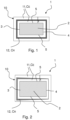
- FIG. 1 schematically illustrates a watch component 1 according to a first embodiment of the invention.
- This watch component 1 comprises a main volume or core 2 made of silicon, originating for example from a step of cutting a silicon wafer. It further comprises a coating 10 which extends over its entire outer surface, over its entire periphery, more particularly over the periphery of its core 2.
- this outer surface is formed by cutting a wafer, and mainly has three surfaces.
- a first surface 3 is substantially planar and corresponds to the upper face of the cut wafer, a second opposite surface 4, substantially planar and parallel to the first surface 3, corresponds to the lower face of the cut wafer.
- a third surface 5 forms a flank, which continuously connects the two aforementioned surfaces 3, 4.
- the coating 10 is a multi-layer coating, which comprises a first layer C E , in contact with the silicon core 2 of the watch component 1, in an elastic material 11. It comprises a third outer layer C E in the same elastic material 11. These two layers are separated by a second layer CR in a more resistant material 12.
- the layers C E are made of parylene and the layer CR is made of aluminum oxide deposited by ALD.
- FIG. 2 illustrates a second embodiment, which differs from the first in that the intermediate CR layer of the coating of more resistant material 12, made of silicon oxide, has a variable thickness at the sidewall 5.
- This intermediate layer also has a constant thickness at the first and second surfaces 3, 4, this thickness being greater at the first surface 3 than at the second surface 4.
- the two layers C E of elastic material 11 complete this intermediate layer to form a overall coating of constant thickness.
- the C E layers are made of parylene and the CR layer is made of silicon oxide deposited by PVD.
- the thickness of the coating 10 is not to scale, it is greatly increased in order to better visualize this coating, which is in reality very thin. Its thickness E is likely to vary within a certain range.
- the coating 10 comprises at least one layer C E of elastic material 11 with a thickness greater than or equal to 0.05 ⁇ m, or even greater than or equal to 0.3 ⁇ m.
- the coating 10 also advantageously comprises at least one layer C E of elastic material 11 with a thickness less than or equal to 5 ⁇ m, or even less than or equal to 3 ⁇ m.
- the materials of the coating 10 may be different from those used in the embodiments described.
- the elastic material 11 has a modulus of elasticity less than or equal to 10 GPa, or even less than or equal to 5 GPa, or even less than or equal to 3 GPa.
- the elastic material 11 has an elongation at break greater than or equal to 10%, or even greater than or equal to 20%, or even greater than or equal to 30%.
- This elastic material 11 can therefore be parylene, or alternatively a PTFE, an acrylic resin, silicone or a polymer from the urethane family.
- Different layers of elastic material 11 of the same coating 10 can be in the same elastic material or in a different elastic material.
- the more resistant material 12 is said to be “more resistant” in comparison with the resistance of the so-called “elastic” material. It has a modulus of elasticity greater than or equal to 30 GPa, or even greater than or equal to 45 GPa, or even greater than or equal to 60 GPa. Alternatively, it has a modulus of elasticity intermediate between that of the fragile material of the core of the watch component and that of the elastic material of the elastic layer. It advantageously has a modulus of elasticity greater than or equal to that of an adjacent layer of elastic material 11 increased by 50%.
- This more resistant material 12 may be a metal or an alloy or graphite or an oxide, more particularly silicon oxide or silicon nitride. Different layers of more resistant material 12 of the same coating 10 may be in the same material or in a different material.
- the coating 10 may comprise any other number of layers than the three layers shown. It may for example comprise at least two, or even at least three, or four, layers of elastic material 11 and at least one, or even at least two, or three, layers of more resistant material 12. In order to limit the influence thereof on the dimensions and behavior of the component, it advantageously comprises a maximum of four layers of elastic material 11 and a maximum of three layers of more resistant material 12, but could comprise more. It advantageously comprises an alternation of layers of elastic material 11 and layers of more resistant material 12. It further advantageously comprises a first inner layer of elastic material 11 and a last outer layer of elastic material 11.
- the adjectives “inside” and “outside” are used in reference to any direction from the core 2 of the watch component 1 to the outside of the watch component 1.
- Comparative bending tests were carried out on silicon specimens obtained by DRIE cutting from a silicon wafer, according to methods known to those skilled in the art.
- the same treatments on the same specimen lead to different results from one watch component to another identical one a priori subjected to the same constraints. For this reason, it is necessary to carry out tests on batches of identical specimens, then to make a statistical analysis to determine whether or not an effect exists.
- the following two batches correspond to specimens similar to batch OXY3 but covered with a pure, single-layer, uniform parylene coating, with respective thicknesses of 0.5 ⁇ m and 5 ⁇ m.
- a pure, single-layer, uniform parylene coating with respective thicknesses of 0.5 ⁇ m and 5 ⁇ m.
- the addition of such a coating made of elastic, low-strength material significantly increases the tensile strength of the specimens. Indeed, the average strength is around 5000 MPa.
- the last batch corresponds to the second embodiment of the invention, comprising a coating consisting of alternating four layers of parylene of approximately 1 ⁇ m, and three intermediate layers of silicon oxide with a thickness of 0.01 ⁇ m, for a total coating thickness varying between 3.7 and 4.7 ⁇ m.
- the average resistance of this batch exceeds 6000 MPa with minimum values above 4000 MPa: the invention therefore makes it possible to optimize the resistance of a watch component.
- the invention therefore also relates to a watch component having an average resistance greater than or equal to 6000 MPa, and/or having a minimum resistance greater than or equal to 3000 MPa, or even greater than or equal to 4000 MPa.
- the invention makes it possible to limit the scattering of debris.
- a coating combining a flexible material (an elastic material as defined previously) with a more resistant material (also as defined previously) makes it possible to take advantage of the synergy between the two materials, not only to address the technical problem of non-dispersion of debris in the event of rupture, an effective protective effect thanks to the elastic material, but also at the same time makes it possible to optimize the resistance of the watch component, in particular thanks to the addition of a more resistant material to the elastic material in the thickness of the coating 10. This very advantageous behavior was unpredictable and therefore proves to be surprising.
- the invention also relates to a watch movement and a timepiece as such, comprising one or more watch components as described previously.
- the method for manufacturing a watch component according to the invention comprises a first phase of manufacturing a blank of a watch component, in a known manner.
- this first phase may comprise an initial step consisting of providing a substrate made of fragile micro-machinable material.
- This substrate is for example a silicon wafer.
- the wafer is covered with a protective coating, in particular at least one of its two so-called upper and lower faces, for example with a photosensitive resin.
- the method continues with a step of forming a pattern in the protective coating.
- the pattern is produced by creating openings through the layer of photosensitive resin.
- the protective coating providing openings constitutes a protective mask.
- a step of etching the silicon wafer through the protective mask in particular by deep reactive ion etching (DRIE) then makes it possible to dig openings in the silicon at the level of the opening(s) of the mask, in order to obtain a blank of a silicon watch component.
- DRIE deep reactive ion etching
- Such a blank of a watch component can be formed by any other process than that mentioned above, for example by a laser cutting technique.
- the blank obtained forms the core 2 of the watch component 1. It has a shape very close to the final watch component.
- the invention relates to a second manufacturing phase, consisting of depositing a coating as described previously on all or part of the surface of said blank.
- the coating deposition step is carried out by alternating the deposition of layers of elastic material and more resistant material respectively.
- This deposition step can be done uniformly, by evaporation, CVD or ALD.
- CVD chemical vapor deposition
- PECVD plasma-enhanced chemical vapor deposition
- the coating flow is oriented on the first surface 3, perpendicular to this surface.
- the manufacturing method may comprise an intermediate step, before the step of depositing the coating, consisting of a step of smoothing and/or thermal oxidation of the surface of the blank of the watch component.
- the core 2 of the watch component may be covered with an oxidation layer, for example a silicon oxide, before the deposition of the coating according to the invention.
Landscapes
- Physics & Mathematics (AREA)
- General Physics & Mathematics (AREA)
- Engineering & Computer Science (AREA)
- Manufacturing & Machinery (AREA)
- Metallurgy (AREA)
- Laminated Bodies (AREA)
- Micromachines (AREA)
- Physical Vapour Deposition (AREA)
Claims (12)
- Uhrenkomponente auf der Basis eines spröden Materials, die zumindest einen Oberflächenabschnitt des spröden Materials umfasst, der mit einer Beschichtung (10) beschichtet ist, die mindestens zwei Schichten CE aus einem elastischen Material (11) umfasst, die durch eine Schicht CR aus einem Material (12) getrennt sind, das belastbarer als das elastische Material (11) ist, wobei das elastische Material (11) der beiden Schichten CE einen Elastizitätsmodul kleiner als oder gleich 10 GPa oder sogar kleiner als oder gleich 5 GPa oder sogar kleiner als oder gleich 3 GPa aufweist und/oder das elastische Material (11) der beiden Schichten CE eine Reißdehnung größer als oder gleich 10 % oder sogar größer als oder gleich 20 % oder sogar größer als oder gleich 30 % aufweist und
das belastbarere Material (12) einen Elastizitätsmodul größer als oder gleich 30 GPa oder sogar größer als oder gleich 45 GPa oder sogar größer als oder gleich 60 GPa aufweist und/oder einen Elastizitätsmodul aufweist, der größer als oder gleich demjenigen einer angrenzenden Schicht aus elastischem Material (11), erhöht um 50 %, ist, und/oder einen Elastizitätsmodul zwischen demjenigen einer angrenzenden Schicht aus elastischem Material und demjenigen des spröden Materials aufweist. - Uhrenkomponente nach dem vorhergehenden Anspruch, dadurch gekennzeichnet, dass das elastische Material (11) der beiden Schichten CE dasselbe oder ein verschiedenes Material ist.
- Uhrenkomponente nach einem der vorhergehenden Ansprüche, dadurch gekennzeichnet, dass die Beschichtung mindestens eine Schicht CE aus einem elastischen Material (11) umfasst, bei dem es sich um Parylen oder ein PTFE, ein Acrylharz, Silicon oder ein Polymer aus der Familie der Urethane handelt.
- Uhrenkomponente nach einem der vorhergehenden Ansprüche, dadurch gekennzeichnet, dass die Beschichtung mindestens eine Schicht CE aus einem elastischen Material (11) mit einer Dicke größer als oder gleich 0,05 µm oder sogar größer als oder gleich 0,3 µm und/oder kleiner als oder gleich 5 µm oder sogar kleiner als oder gleich 3 µm umfasst und/oder
dass die Summe der Dicken der verschiedenen Schichten CE aus einem elastischen Material (11) der Beschichtung größer als oder gleich 0,1 µm oder sogar größer als oder gleich 0,6 µm und/oder kleiner als oder gleich 20 µm oder sogar kleiner als oder gleich 12 µm ist. - Uhrenkomponente nach einem der vorhergehenden Ansprüche, dadurch gekennzeichnet, dass es sich bei dem belastbareren Material um ein Metall oder eine Legierung oder ein Oxid oder ein Nitrid, insbesondere Siliciumoxid oder Siliciumnitrid, handelt.
- Uhrenkomponente nach einem der vorhergehenden Ansprüche, dadurch gekennzeichnet, dass die Schicht CR aus einem belastbareren Material (12) eine Dicke es größer als oder gleich 15 nm oder sogar größer als oder gleich 30 nm und/oder kleiner als oder gleich 150 nm oder sogar kleiner als oder gleich 100 nm oder sogar kleiner als oder gleich 70 nm aufweist und/oder
dass die Gesamtdicke der Schicht oder der Schichten CR aus einem belastbareren Material (12) der Beschichtung (10) größer als oder gleich 15 nm oder sogar größer als oder gleich 30 nm und/oder kleiner als oder gleich 450 nm oder sogar kleiner als oder gleich 300 nm oder sogar kleiner als oder gleich 210 nm ist. - Uhrenkomponente nach einem der vorhergehenden Ansprüche, dadurch gekennzeichnet, dass die Beschichtung (10) alle oder einen Teil der folgenden Merkmale aufweist:- sie erstreckt sich über die gesamte Umfangsfläche des spröden Materials, insbesondere über die gesamte Außenfläche der Uhrenkomponente; und/oder- jede Schicht aus einem elastischen Material (11) weist eine konstante oder veränderliche Dicke auf und/oder- die Schicht oder die Schichten aus einem belastbareren Material (12) weist bzw. weisen eine konstante oder veränderliche Dicke auf, die insbesondere an den Seiten (5) veränderlich ist; und/oder- sie umfasst abwechselnd Schichten CE aus einem elastischen Material (11) und Schichten CR aus einem belastbareren Material (12) und/oder- sie umfasst mindestens zwei oder drei oder vier Schichten aus einem elastischen Material (11) und mindestens eine Schicht oder zwei oder drei Schichten aus einem belastbareren Material (12) und/oder- sie umfasst eine erste Innenschicht aus einem elastischen Material (11) und eine letzte Außenschicht aus einem elastischen Material (11).
- Uhrenkomponente nach einem der vorhergehenden Ansprüche, dadurch gekennzeichnet, dass es sich bei dem spröden Material um Silicium, mit Oxid beschichtetes Silicium, Quarz, Glas, Siliciumcarbid, eine Keramik auf der Basis von Aluminiumoxid oder Zirkonoxid oder Diamant, Saphir oder spröde amorphe Metalle handelt.
- Uhrenkomponente nach einem der vorhergehenden Ansprüche, dadurch gekennzeichnet, dass es sich um eines der Elemente der Gruppe handelt, die aus einem Zahnrad, einem Hemmungsrad, einem Zeiger, einem Hebelstein, einem Anker, einer Wippe, einer Palette, einer Flachfeder, wie einer Spirale, einem System mit einem flexiblen Blatt oder einer anderen Komponente mit einer Federfunktion besteht.
- Uhrenkomponente nach einem der vorhergehenden Ansprüche, dadurch gekennzeichnet, dass sie eine mittlere Festigkeit größer als oder gleich 6000 MPa aufweist und/oder dass die Uhrenkomponente eine Mindestfestigkeit größer als oder gleich 3000 MPa aufweist.
- Uhrwerk, dadurch gekennzeichnet, dass es eine Uhrenkomponente nach einem der vorhergehenden Ansprüche umfasst.
- Uhr, dadurch gekennzeichnet, dass sie eine Uhrenkomponente nach einem der Ansprüche 1 bis 10 oder ein Uhrwerk nach dem vorhergehenden Anspruch umfasst.
Priority Applications (5)
| Application Number | Priority Date | Filing Date | Title |
|---|---|---|---|
| EP19199142.1A EP3798739B1 (de) | 2019-09-24 | 2019-09-24 | Uhrkomponente |
| EP25185812.2A EP4600758A3 (de) | 2019-09-24 | 2019-09-24 | Uhrenkomponente |
| JP2020157686A JP7774380B2 (ja) | 2019-09-24 | 2020-09-18 | 時計部品 |
| US17/026,330 US12449768B2 (en) | 2019-09-24 | 2020-09-21 | Horology component |
| CN202011018049.1A CN112631104A (zh) | 2019-09-24 | 2020-09-24 | 计时器部件 |
Applications Claiming Priority (1)
| Application Number | Priority Date | Filing Date | Title |
|---|---|---|---|
| EP19199142.1A EP3798739B1 (de) | 2019-09-24 | 2019-09-24 | Uhrkomponente |
Related Child Applications (1)
| Application Number | Title | Priority Date | Filing Date |
|---|---|---|---|
| EP25185812.2A Division EP4600758A3 (de) | 2019-09-24 | 2019-09-24 | Uhrenkomponente |
Publications (2)
| Publication Number | Publication Date |
|---|---|
| EP3798739A1 EP3798739A1 (de) | 2021-03-31 |
| EP3798739B1 true EP3798739B1 (de) | 2025-07-02 |
Family
ID=68066588
Family Applications (2)
| Application Number | Title | Priority Date | Filing Date |
|---|---|---|---|
| EP25185812.2A Pending EP4600758A3 (de) | 2019-09-24 | 2019-09-24 | Uhrenkomponente |
| EP19199142.1A Active EP3798739B1 (de) | 2019-09-24 | 2019-09-24 | Uhrkomponente |
Family Applications Before (1)
| Application Number | Title | Priority Date | Filing Date |
|---|---|---|---|
| EP25185812.2A Pending EP4600758A3 (de) | 2019-09-24 | 2019-09-24 | Uhrenkomponente |
Country Status (4)
| Country | Link |
|---|---|
| US (1) | US12449768B2 (de) |
| EP (2) | EP4600758A3 (de) |
| JP (1) | JP7774380B2 (de) |
| CN (1) | CN112631104A (de) |
Family Cites Families (17)
| Publication number | Priority date | Publication date | Assignee | Title |
|---|---|---|---|---|
| JPS51141666A (en) * | 1975-06-02 | 1976-12-06 | Seiko Epson Corp | Solar cell wrist watch |
| JP4167468B2 (ja) * | 2002-10-08 | 2008-10-15 | 新日本製鐵株式会社 | 金属板表面処理剤、張り剛性に優れた表面処理金属板およびその製造方法ならびに高剛性パネル |
| JP4033220B2 (ja) * | 2005-07-06 | 2008-01-16 | セイコーエプソン株式会社 | 時計用文字板および時計 |
| JP4491422B2 (ja) * | 2006-02-23 | 2010-06-30 | セイコーエプソン株式会社 | 時計用文字板および時計 |
| WO2008072605A1 (ja) * | 2006-12-15 | 2008-06-19 | Seiko Epson Corporation | 時計用文字板および時計 |
| CH702576B1 (fr) * | 2010-01-18 | 2014-11-14 | Sigatec Sa | Pièce de micro-mécanique revêtue. |
| US10372083B2 (en) * | 2012-07-06 | 2019-08-06 | Rolex Sa | Method for treating a surface of a timepiece component, and timepiece component obtained from such a method |
| CH709705B1 (fr) * | 2014-05-28 | 2019-04-15 | Sigatec Sa | Procédé de fabrication d'une pièce de micro-mécanique et pièce de micro-mécanique correspondante. |
| EP3002638B1 (de) * | 2014-09-08 | 2021-08-18 | Richemont International S.A. | Herstellungsverfahren einer thermokompensierten spiralfeder |
| CN107003641B (zh) * | 2014-12-12 | 2021-02-19 | 西铁城时计株式会社 | 钟表部件以及钟表部件的制造方法 |
| EP3037893B1 (de) * | 2014-12-22 | 2018-02-28 | Patek Philippe SA Genève | Mikromechanische Komponente oder Uhr mit flexiblem Führungsdraht |
| US10131802B2 (en) | 2015-11-02 | 2018-11-20 | Metashield Llc | Nanosilica based compositions, structures and apparatus incorporating same and related methods |
| CN205777082U (zh) | 2016-07-13 | 2016-12-07 | 鲁东大学 | 一种用于高校图书馆的安全幕墙玻璃 |
| EP3326963B1 (de) * | 2016-11-23 | 2020-01-01 | The Swatch Group Research and Development Ltd | Flexibles blatt für uhrwerk und herstellungsverfahren |
| EP3339983B1 (de) * | 2016-12-23 | 2020-07-01 | The Swatch Group Research and Development Ltd | Perlmuttsubstrat, das mit einer gelben schicht beschichtet ist |
| CN108375892B (zh) * | 2017-01-30 | 2022-02-01 | 精工爱普生株式会社 | 钟表用部件以及钟表 |
| CN107857951A (zh) | 2017-10-31 | 2018-03-30 | 芜湖辉灿电子科技有限公司 | 一种手机屏幕玻璃用防爆贴膜 |
-
2019
- 2019-09-24 EP EP25185812.2A patent/EP4600758A3/de active Pending
- 2019-09-24 EP EP19199142.1A patent/EP3798739B1/de active Active
-
2020
- 2020-09-18 JP JP2020157686A patent/JP7774380B2/ja active Active
- 2020-09-21 US US17/026,330 patent/US12449768B2/en active Active
- 2020-09-24 CN CN202011018049.1A patent/CN112631104A/zh active Pending
Also Published As
| Publication number | Publication date |
|---|---|
| US12449768B2 (en) | 2025-10-21 |
| JP7774380B2 (ja) | 2025-11-21 |
| EP4600758A2 (de) | 2025-08-13 |
| CN112631104A (zh) | 2021-04-09 |
| JP2021063798A (ja) | 2021-04-22 |
| US20210088972A1 (en) | 2021-03-25 |
| EP4600758A3 (de) | 2025-09-24 |
| EP3798739A1 (de) | 2021-03-31 |
Similar Documents
| Publication | Publication Date | Title |
|---|---|---|
| EP2380864B1 (de) | Verfahren zur Herstellung eines Keramikelements mit mindestens einem Metalldekoreinsatz | |
| EP2237698B1 (de) | Mit einem graphischen element auf einem träger versehenes objekt und verfahren zur herstellung des objekts | |
| EP2347036B1 (de) | Heterogenes liga-verfahren | |
| EP2237697B1 (de) | Mit einem graphischen element auf einem träger versehenes objekt und verfahren zur herstellung des objekts | |
| EP3495894B1 (de) | Verfahren zur herstellung einer uhrkomponente | |
| EP3632839A1 (de) | Uhrkomponente | |
| EP3781992B1 (de) | Herstellungsverfahren einer zugfeder aus silizium für eine uhr | |
| CH699476B1 (fr) | Procédé de fabrication d'un composant horloger en silicium. | |
| EP3798739B1 (de) | Uhrkomponente | |
| EP2472340A1 (de) | Bestandteil einer Uhr und sein Herstellungsverfahren | |
| EP4121821A1 (de) | Verfahren zur herstellung eines uhrenbauteils auf siliziumbasis | |
| EP4471506A1 (de) | Leichtes und robustes uhrenbauteil | |
| CH715668B1 (fr) | Composant horloger en matériau micro-usinable et procédé de fabrication d'un tel composant. | |
| EP3954247B1 (de) | Mit steinen verzierte schwarze komponente und ihr herstellungsverfahren | |
| EP2889703B1 (de) | Herstellungsverfahren eines mechanischen bauteils aus diamant für das uhrwerk einer armbanduhr, und nach diesem verfahren hergestelltes bauteil | |
| CH721409A2 (fr) | Composant d'habillage et procédé de réalisation d'un tel composant d'habillage | |
| EP4524288A1 (de) | Verfahren zum dekorieren eines substrats durch auftragen einer maskenschicht auf sol-gel-basis zur herstellung eines verkleidungsteils | |
| EP3412625A1 (de) | Herstellungsverfahren eines mikromechanischen bauteils | |
| EP3954802A1 (de) | Mit steinen verzierte schwarze komponente und ihr herstellungsverfahren | |
| EP4478133A1 (de) | Uhr- oder schmuckverkleidung mit einer goniochromatischen beschichtung und verfahren zur herstellung dieser komponente | |
| CH721122A2 (fr) | Procédé de décoration d'un substrat par le dépôt d'une couche de masquage par voie sol-gel afin de réaliser une pièce d'habillage | |
| CH719817B1 (fr) | Article irisé et son procédé de fabrication | |
| CH720849A2 (fr) | Pièce d'habillage d'horlogerie ou de bijouterie comprenant un revêtement goniochromatique et procédé de fabrication de ladite pièce | |
| EP4512273A1 (de) | Verfahren zur dreidimensionalen dekoration eines substrats zur herstellung eines verkleidungsteils | |
| CH720291A2 (fr) | Procédé de réalisation d'un composant d'habillage comprenant un décor complexe |
Legal Events
| Date | Code | Title | Description |
|---|---|---|---|
| PUAI | Public reference made under article 153(3) epc to a published international application that has entered the european phase |
Free format text: ORIGINAL CODE: 0009012 |
|
| STAA | Information on the status of an ep patent application or granted ep patent |
Free format text: STATUS: THE APPLICATION HAS BEEN PUBLISHED |
|
| AK | Designated contracting states |
Kind code of ref document: A1 Designated state(s): AL AT BE BG CH CY CZ DE DK EE ES FI FR GB GR HR HU IE IS IT LI LT LU LV MC MK MT NL NO PL PT RO RS SE SI SK SM TR |
|
| AX | Request for extension of the european patent |
Extension state: BA ME |
|
| STAA | Information on the status of an ep patent application or granted ep patent |
Free format text: STATUS: REQUEST FOR EXAMINATION WAS MADE |
|
| 17P | Request for examination filed |
Effective date: 20210928 |
|
| RBV | Designated contracting states (corrected) |
Designated state(s): AL AT BE BG CH CY CZ DE DK EE ES FI FR GB GR HR HU IE IS IT LI LT LU LV MC MK MT NL NO PL PT RO RS SE SI SK SM TR |
|
| STAA | Information on the status of an ep patent application or granted ep patent |
Free format text: STATUS: EXAMINATION IS IN PROGRESS |
|
| 17Q | First examination report despatched |
Effective date: 20230526 |
|
| P01 | Opt-out of the competence of the unified patent court (upc) registered |
Effective date: 20230530 |
|
| GRAP | Despatch of communication of intention to grant a patent |
Free format text: ORIGINAL CODE: EPIDOSNIGR1 |
|
| STAA | Information on the status of an ep patent application or granted ep patent |
Free format text: STATUS: GRANT OF PATENT IS INTENDED |
|
| INTG | Intention to grant announced |
Effective date: 20250130 |
|
| GRAS | Grant fee paid |
Free format text: ORIGINAL CODE: EPIDOSNIGR3 |
|
| GRAA | (expected) grant |
Free format text: ORIGINAL CODE: 0009210 |
|
| STAA | Information on the status of an ep patent application or granted ep patent |
Free format text: STATUS: THE PATENT HAS BEEN GRANTED |
|
| AK | Designated contracting states |
Kind code of ref document: B1 Designated state(s): AL AT BE BG CH CY CZ DE DK EE ES FI FR GB GR HR HU IE IS IT LI LT LU LV MC MK MT NL NO PL PT RO RS SE SI SK SM TR |
|
| REG | Reference to a national code |
Ref country code: GB Ref legal event code: FG4D Free format text: NOT ENGLISH |
|
| REG | Reference to a national code |
Ref country code: CH Ref legal event code: EP |
|
| REG | Reference to a national code |
Ref country code: DE Ref legal event code: R096 Ref document number: 602019071865 Country of ref document: DE |
|
| REG | Reference to a national code |
Ref country code: IE Ref legal event code: FG4D Free format text: LANGUAGE OF EP DOCUMENT: FRENCH |
|
| REG | Reference to a national code |
Ref country code: CH Ref legal event code: U11 Free format text: ST27 STATUS EVENT CODE: U-0-0-U10-U11 (AS PROVIDED BY THE NATIONAL OFFICE) Effective date: 20251001 |
|
| PGFP | Annual fee paid to national office [announced via postgrant information from national office to epo] |
Ref country code: DE Payment date: 20250916 Year of fee payment: 7 |
|
| PGFP | Annual fee paid to national office [announced via postgrant information from national office to epo] |
Ref country code: GB Payment date: 20250919 Year of fee payment: 7 |
|
| PGFP | Annual fee paid to national office [announced via postgrant information from national office to epo] |
Ref country code: FR Payment date: 20250929 Year of fee payment: 7 |
|
| REG | Reference to a national code |
Ref country code: NL Ref legal event code: MP Effective date: 20250702 |
|
| PG25 | Lapsed in a contracting state [announced via postgrant information from national office to epo] |
Ref country code: PT Free format text: LAPSE BECAUSE OF FAILURE TO SUBMIT A TRANSLATION OF THE DESCRIPTION OR TO PAY THE FEE WITHIN THE PRESCRIBED TIME-LIMIT Effective date: 20251103 |
|
| PG25 | Lapsed in a contracting state [announced via postgrant information from national office to epo] |
Ref country code: NL Free format text: LAPSE BECAUSE OF FAILURE TO SUBMIT A TRANSLATION OF THE DESCRIPTION OR TO PAY THE FEE WITHIN THE PRESCRIBED TIME-LIMIT Effective date: 20250702 |
|
| REG | Reference to a national code |
Ref country code: AT Ref legal event code: MK05 Ref document number: 1809911 Country of ref document: AT Kind code of ref document: T Effective date: 20250702 |
|
| PG25 | Lapsed in a contracting state [announced via postgrant information from national office to epo] |
Ref country code: IS Free format text: LAPSE BECAUSE OF FAILURE TO SUBMIT A TRANSLATION OF THE DESCRIPTION OR TO PAY THE FEE WITHIN THE PRESCRIBED TIME-LIMIT Effective date: 20251102 |
|
| PG25 | Lapsed in a contracting state [announced via postgrant information from national office to epo] |
Ref country code: NO Free format text: LAPSE BECAUSE OF FAILURE TO SUBMIT A TRANSLATION OF THE DESCRIPTION OR TO PAY THE FEE WITHIN THE PRESCRIBED TIME-LIMIT Effective date: 20251002 |
|
| REG | Reference to a national code |
Ref country code: LT Ref legal event code: MG9D |
|
| PG25 | Lapsed in a contracting state [announced via postgrant information from national office to epo] |
Ref country code: AT Free format text: LAPSE BECAUSE OF FAILURE TO SUBMIT A TRANSLATION OF THE DESCRIPTION OR TO PAY THE FEE WITHIN THE PRESCRIBED TIME-LIMIT Effective date: 20250702 |
|
| PG25 | Lapsed in a contracting state [announced via postgrant information from national office to epo] |
Ref country code: FI Free format text: LAPSE BECAUSE OF FAILURE TO SUBMIT A TRANSLATION OF THE DESCRIPTION OR TO PAY THE FEE WITHIN THE PRESCRIBED TIME-LIMIT Effective date: 20250702 |
|
| PG25 | Lapsed in a contracting state [announced via postgrant information from national office to epo] |
Ref country code: HR Free format text: LAPSE BECAUSE OF FAILURE TO SUBMIT A TRANSLATION OF THE DESCRIPTION OR TO PAY THE FEE WITHIN THE PRESCRIBED TIME-LIMIT Effective date: 20250702 |
|
| PG25 | Lapsed in a contracting state [announced via postgrant information from national office to epo] |
Ref country code: GR Free format text: LAPSE BECAUSE OF FAILURE TO SUBMIT A TRANSLATION OF THE DESCRIPTION OR TO PAY THE FEE WITHIN THE PRESCRIBED TIME-LIMIT Effective date: 20251003 |
|
| PGFP | Annual fee paid to national office [announced via postgrant information from national office to epo] |
Ref country code: CH Payment date: 20251001 Year of fee payment: 7 |
|
| PG25 | Lapsed in a contracting state [announced via postgrant information from national office to epo] |
Ref country code: SE Free format text: LAPSE BECAUSE OF FAILURE TO SUBMIT A TRANSLATION OF THE DESCRIPTION OR TO PAY THE FEE WITHIN THE PRESCRIBED TIME-LIMIT Effective date: 20250702 Ref country code: CZ Free format text: LAPSE BECAUSE OF FAILURE TO SUBMIT A TRANSLATION OF THE DESCRIPTION OR TO PAY THE FEE WITHIN THE PRESCRIBED TIME-LIMIT Effective date: 20250702 |
|
| PG25 | Lapsed in a contracting state [announced via postgrant information from national office to epo] |
Ref country code: LV Free format text: LAPSE BECAUSE OF FAILURE TO SUBMIT A TRANSLATION OF THE DESCRIPTION OR TO PAY THE FEE WITHIN THE PRESCRIBED TIME-LIMIT Effective date: 20250702 |
|
| PG25 | Lapsed in a contracting state [announced via postgrant information from national office to epo] |
Ref country code: PL Free format text: LAPSE BECAUSE OF FAILURE TO SUBMIT A TRANSLATION OF THE DESCRIPTION OR TO PAY THE FEE WITHIN THE PRESCRIBED TIME-LIMIT Effective date: 20250702 Ref country code: BG Free format text: LAPSE BECAUSE OF FAILURE TO SUBMIT A TRANSLATION OF THE DESCRIPTION OR TO PAY THE FEE WITHIN THE PRESCRIBED TIME-LIMIT Effective date: 20250702 |
|
| PG25 | Lapsed in a contracting state [announced via postgrant information from national office to epo] |
Ref country code: RS Free format text: LAPSE BECAUSE OF FAILURE TO SUBMIT A TRANSLATION OF THE DESCRIPTION OR TO PAY THE FEE WITHIN THE PRESCRIBED TIME-LIMIT Effective date: 20251002 |
|
| PG25 | Lapsed in a contracting state [announced via postgrant information from national office to epo] |
Ref country code: ES Free format text: LAPSE BECAUSE OF FAILURE TO SUBMIT A TRANSLATION OF THE DESCRIPTION OR TO PAY THE FEE WITHIN THE PRESCRIBED TIME-LIMIT Effective date: 20250702 |
|
| PG25 | Lapsed in a contracting state [announced via postgrant information from national office to epo] |
Ref country code: RO Free format text: LAPSE BECAUSE OF FAILURE TO SUBMIT A TRANSLATION OF THE DESCRIPTION OR TO PAY THE FEE WITHIN THE PRESCRIBED TIME-LIMIT Effective date: 20250702 |
|
| PG25 | Lapsed in a contracting state [announced via postgrant information from national office to epo] |
Ref country code: SM Free format text: LAPSE BECAUSE OF FAILURE TO SUBMIT A TRANSLATION OF THE DESCRIPTION OR TO PAY THE FEE WITHIN THE PRESCRIBED TIME-LIMIT Effective date: 20250702 |
|
| PG25 | Lapsed in a contracting state [announced via postgrant information from national office to epo] |
Ref country code: DK Free format text: LAPSE BECAUSE OF FAILURE TO SUBMIT A TRANSLATION OF THE DESCRIPTION OR TO PAY THE FEE WITHIN THE PRESCRIBED TIME-LIMIT Effective date: 20250702 |
|
| PG25 | Lapsed in a contracting state [announced via postgrant information from national office to epo] |
Ref country code: IT Free format text: LAPSE BECAUSE OF FAILURE TO SUBMIT A TRANSLATION OF THE DESCRIPTION OR TO PAY THE FEE WITHIN THE PRESCRIBED TIME-LIMIT Effective date: 20250702 |
|
| PG25 | Lapsed in a contracting state [announced via postgrant information from national office to epo] |
Ref country code: SK Free format text: LAPSE BECAUSE OF FAILURE TO SUBMIT A TRANSLATION OF THE DESCRIPTION OR TO PAY THE FEE WITHIN THE PRESCRIBED TIME-LIMIT Effective date: 20250702 Ref country code: EE Free format text: LAPSE BECAUSE OF FAILURE TO SUBMIT A TRANSLATION OF THE DESCRIPTION OR TO PAY THE FEE WITHIN THE PRESCRIBED TIME-LIMIT Effective date: 20250702 |