EP3788386B1 - Nanoscale dynamic mechanical analysis via atomic force microscopy (afm-ndma) - Google Patents
Nanoscale dynamic mechanical analysis via atomic force microscopy (afm-ndma) Download PDFInfo
- Publication number
- EP3788386B1 EP3788386B1 EP19759105.0A EP19759105A EP3788386B1 EP 3788386 B1 EP3788386 B1 EP 3788386B1 EP 19759105 A EP19759105 A EP 19759105A EP 3788386 B1 EP3788386 B1 EP 3788386B1
- Authority
- EP
- European Patent Office
- Prior art keywords
- sample
- probe
- force
- afm
- frequency
- Prior art date
- Legal status (The legal status is an assumption and is not a legal conclusion. Google has not performed a legal analysis and makes no representation as to the accuracy of the status listed.)
- Active
Links
Images



Classifications
-
- G—PHYSICS
- G01—MEASURING; TESTING
- G01Q—SCANNING-PROBE TECHNIQUES OR APPARATUS; APPLICATIONS OF SCANNING-PROBE TECHNIQUES, e.g. SCANNING PROBE MICROSCOPY [SPM]
- G01Q60/00—Particular types of SPM [Scanning Probe Microscopy] or microscopes; Essential components thereof
- G01Q60/24—AFM [Atomic Force Microscopy] or apparatus therefor, e.g. AFM probes
- G01Q60/36—DC mode
- G01Q60/366—Nanoindenters, i.e. wherein the indenting force is measured
-
- G—PHYSICS
- G01—MEASURING; TESTING
- G01Q—SCANNING-PROBE TECHNIQUES OR APPARATUS; APPLICATIONS OF SCANNING-PROBE TECHNIQUES, e.g. SCANNING PROBE MICROSCOPY [SPM]
- G01Q10/00—Scanning or positioning arrangements, i.e. arrangements for actively controlling the movement or position of the probe
- G01Q10/04—Fine scanning or positioning
- G01Q10/06—Circuits or algorithms therefor
- G01Q10/065—Feedback mechanisms, i.e. wherein the signal for driving the probe is modified by a signal coming from the probe itself
-
- G—PHYSICS
- G01—MEASURING; TESTING
- G01N—INVESTIGATING OR ANALYSING MATERIALS BY DETERMINING THEIR CHEMICAL OR PHYSICAL PROPERTIES
- G01N3/00—Investigating strength properties of solid materials by application of mechanical stress
- G01N3/08—Investigating strength properties of solid materials by application of mechanical stress by applying steady tensile or compressive forces
-
- G—PHYSICS
- G01—MEASURING; TESTING
- G01N—INVESTIGATING OR ANALYSING MATERIALS BY DETERMINING THEIR CHEMICAL OR PHYSICAL PROPERTIES
- G01N3/00—Investigating strength properties of solid materials by application of mechanical stress
- G01N3/32—Investigating strength properties of solid materials by application of mechanical stress by applying repeated or pulsating forces
-
- G—PHYSICS
- G01—MEASURING; TESTING
- G01N—INVESTIGATING OR ANALYSING MATERIALS BY DETERMINING THEIR CHEMICAL OR PHYSICAL PROPERTIES
- G01N3/00—Investigating strength properties of solid materials by application of mechanical stress
- G01N3/40—Investigating hardness or rebound hardness
- G01N3/42—Investigating hardness or rebound hardness by performing impressions under a steady load by indentors, e.g. sphere, pyramid
-
- G—PHYSICS
- G01—MEASURING; TESTING
- G01Q—SCANNING-PROBE TECHNIQUES OR APPARATUS; APPLICATIONS OF SCANNING-PROBE TECHNIQUES, e.g. SCANNING PROBE MICROSCOPY [SPM]
- G01Q10/00—Scanning or positioning arrangements, i.e. arrangements for actively controlling the movement or position of the probe
- G01Q10/04—Fine scanning or positioning
-
- G—PHYSICS
- G01—MEASURING; TESTING
- G01Q—SCANNING-PROBE TECHNIQUES OR APPARATUS; APPLICATIONS OF SCANNING-PROBE TECHNIQUES, e.g. SCANNING PROBE MICROSCOPY [SPM]
- G01Q10/00—Scanning or positioning arrangements, i.e. arrangements for actively controlling the movement or position of the probe
- G01Q10/04—Fine scanning or positioning
- G01Q10/06—Circuits or algorithms therefor
-
- G—PHYSICS
- G01—MEASURING; TESTING
- G01Q—SCANNING-PROBE TECHNIQUES OR APPARATUS; APPLICATIONS OF SCANNING-PROBE TECHNIQUES, e.g. SCANNING PROBE MICROSCOPY [SPM]
- G01Q20/00—Monitoring the movement or position of the probe
- G01Q20/04—Self-detecting probes, i.e. wherein the probe itself generates a signal representative of its position, e.g. piezoelectric gauge
-
- G—PHYSICS
- G01—MEASURING; TESTING
- G01Q—SCANNING-PROBE TECHNIQUES OR APPARATUS; APPLICATIONS OF SCANNING-PROBE TECHNIQUES, e.g. SCANNING PROBE MICROSCOPY [SPM]
- G01Q30/00—Auxiliary means serving to assist or improve the scanning probe techniques or apparatus, e.g. display or data processing devices
- G01Q30/04—Display or data processing devices
-
- G—PHYSICS
- G01—MEASURING; TESTING
- G01Q—SCANNING-PROBE TECHNIQUES OR APPARATUS; APPLICATIONS OF SCANNING-PROBE TECHNIQUES, e.g. SCANNING PROBE MICROSCOPY [SPM]
- G01Q30/00—Auxiliary means serving to assist or improve the scanning probe techniques or apparatus, e.g. display or data processing devices
- G01Q30/04—Display or data processing devices
- G01Q30/06—Display or data processing devices for error compensation
-
- G—PHYSICS
- G01—MEASURING; TESTING
- G01Q—SCANNING-PROBE TECHNIQUES OR APPARATUS; APPLICATIONS OF SCANNING-PROBE TECHNIQUES, e.g. SCANNING PROBE MICROSCOPY [SPM]
- G01Q30/00—Auxiliary means serving to assist or improve the scanning probe techniques or apparatus, e.g. display or data processing devices
- G01Q30/08—Means for establishing or regulating a desired environmental condition within a sample chamber
- G01Q30/10—Thermal environment
-
- G—PHYSICS
- G01—MEASURING; TESTING
- G01Q—SCANNING-PROBE TECHNIQUES OR APPARATUS; APPLICATIONS OF SCANNING-PROBE TECHNIQUES, e.g. SCANNING PROBE MICROSCOPY [SPM]
- G01Q60/00—Particular types of SPM [Scanning Probe Microscopy] or microscopes; Essential components thereof
- G01Q60/24—AFM [Atomic Force Microscopy] or apparatus therefor, e.g. AFM probes
- G01Q60/36—DC mode
- G01Q60/363—Contact-mode AFM
-
- G—PHYSICS
- G01—MEASURING; TESTING
- G01Q—SCANNING-PROBE TECHNIQUES OR APPARATUS; APPLICATIONS OF SCANNING-PROBE TECHNIQUES, e.g. SCANNING PROBE MICROSCOPY [SPM]
- G01Q60/00—Particular types of SPM [Scanning Probe Microscopy] or microscopes; Essential components thereof
- G01Q60/24—AFM [Atomic Force Microscopy] or apparatus therefor, e.g. AFM probes
- G01Q60/38—Probes, their manufacture, or their related instrumentation, e.g. holders
-
- B—PERFORMING OPERATIONS; TRANSPORTING
- B82—NANOTECHNOLOGY
- B82Y—SPECIFIC USES OR APPLICATIONS OF NANOSTRUCTURES; MEASUREMENT OR ANALYSIS OF NANOSTRUCTURES; MANUFACTURE OR TREATMENT OF NANOSTRUCTURES
- B82Y35/00—Methods or apparatus for measurement or analysis of nanostructures
-
- G—PHYSICS
- G01—MEASURING; TESTING
- G01N—INVESTIGATING OR ANALYSING MATERIALS BY DETERMINING THEIR CHEMICAL OR PHYSICAL PROPERTIES
- G01N2203/00—Investigating strength properties of solid materials by application of mechanical stress
- G01N2203/0001—Type of application of the stress
- G01N2203/0003—Steady
-
- G—PHYSICS
- G01—MEASURING; TESTING
- G01N—INVESTIGATING OR ANALYSING MATERIALS BY DETERMINING THEIR CHEMICAL OR PHYSICAL PROPERTIES
- G01N2203/00—Investigating strength properties of solid materials by application of mechanical stress
- G01N2203/0001—Type of application of the stress
- G01N2203/0005—Repeated or cyclic
-
- G—PHYSICS
- G01—MEASURING; TESTING
- G01N—INVESTIGATING OR ANALYSING MATERIALS BY DETERMINING THEIR CHEMICAL OR PHYSICAL PROPERTIES
- G01N2203/00—Investigating strength properties of solid materials by application of mechanical stress
- G01N2203/0014—Type of force applied
- G01N2203/0016—Tensile or compressive
- G01N2203/0019—Compressive
-
- G—PHYSICS
- G01—MEASURING; TESTING
- G01N—INVESTIGATING OR ANALYSING MATERIALS BY DETERMINING THEIR CHEMICAL OR PHYSICAL PROPERTIES
- G01N2203/00—Investigating strength properties of solid materials by application of mechanical stress
- G01N2203/0058—Kind of property studied
- G01N2203/0069—Fatigue, creep, strain-stress relations or elastic constants
- G01N2203/0075—Strain-stress relations or elastic constants
-
- G—PHYSICS
- G01—MEASURING; TESTING
- G01N—INVESTIGATING OR ANALYSING MATERIALS BY DETERMINING THEIR CHEMICAL OR PHYSICAL PROPERTIES
- G01N2203/00—Investigating strength properties of solid materials by application of mechanical stress
- G01N2203/0058—Kind of property studied
- G01N2203/0092—Visco-elasticity, solidification, curing, cross-linking degree, vulcanisation or strength properties of semi-solid materials
- G01N2203/0094—Visco-elasticity
-
- G—PHYSICS
- G01—MEASURING; TESTING
- G01N—INVESTIGATING OR ANALYSING MATERIALS BY DETERMINING THEIR CHEMICAL OR PHYSICAL PROPERTIES
- G01N2203/00—Investigating strength properties of solid materials by application of mechanical stress
- G01N2203/02—Details not specific for a particular testing method
- G01N2203/026—Specifications of the specimen
- G01N2203/0286—Miniature specimen; Testing on microregions of a specimen
-
- G—PHYSICS
- G01—MEASURING; TESTING
- G01N—INVESTIGATING OR ANALYSING MATERIALS BY DETERMINING THEIR CHEMICAL OR PHYSICAL PROPERTIES
- G01N2203/00—Investigating strength properties of solid materials by application of mechanical stress
- G01N2203/02—Details not specific for a particular testing method
- G01N2203/06—Indicating or recording means; Sensing means
- G01N2203/067—Parameter measured for estimating the property
- G01N2203/0676—Force, weight, load, energy, speed or acceleration
Definitions
- the present invention relates generally to methodologies of determination of dynamic mechanical properties of materials and, more particularly, to nanoscale rheology of materials performed with the use of atomic force microscopy in specific range of frequencies - a low-frequency range that is practically relevant to rheology of soft materials.
- Dynamic Mechanical Analysis is a measurement methodology designed to characterize viscoelastic mechanical properties of different materials (such as metals, composites, polymers, elastomers, etc).
- Viscoelasticity is recognized to be the property of those materials that exhibit both viscous and elastic characteristics when undergoing deformation. Viscous materials under stress typically resist shear flow and strain linearly with time. Elastic materials strain when stretched and quickly return to their original state once the stress is removed. Considering viscoelasticity, the deformation (strain) exhibited by a solid material in response to a load force (stress) is typically time-dependent: such deformation (strain) depends not only on load (stress) magnitude, but on the rate of loading ( ⁇ loading rate) and relaxation time as well.
- a periodic (harmonic) tensile, compressive, flexural or shear stress is typically applied to a material sample, causing excitation of the sample as a result of such load.
- the material's mechanical response (for example, amplitude and phase of such response) are then analyzed at the frequency of excitation (excitation frequency).
- the analysis is conventionally performed with the use of a lock-in amplifier.
- the DMA methodology has been established to measure material's storage modulus (E') and material loss modulus (E"), typically expressed in MPa or GPa, as well as the ratio E"/E' of these moduli (referred to as the "tan-delta”, also known as a “loss-factor", “loss-tangent, or “damping”). These material properties are characterized as a function of frequency, temperature, time, stress or load, environmental conditions, or a combination of the above. (The alternative term - Dynamic Mechanical Thermal Analysis, DMTA - is sometimes used to emphasize the temperature dimension or dependency of the results of DMA measurements).
- the low-frequency mechanical characteristics that is, mechanical characteristics at frequencies up to several hundred Hz, for example up to 300 Hz
- the ability to determine the low-frequency mechanical characteristic of biomaterials and cells would significantly expand the current knowledge of soft materials.
- the detailed understanding of low-frequency performance of various other materials is also desired - for example, polymer and rubber databases of the storage and loss moduli used in industry at the moment are well known to substantially lack microscopic and nanoscale data.
- the existing DMA techniques (such as the use of nanoindentation of the materials, almost universally used in related art) are recognized to have limited spatial resolution when used on soft materials, which limits or even prevents such techniques from being used to study the mechanics of the soft materials on the length scale that AFM based instruments operates.
- some of currently existing DMA techniques - such as those employing nanoindenter systems that by definition are not employing any AFM-like instrumentation and is recognized as such in related art (see, for example, Pharr, G. M., Oliver, W. C. & Brotzen, F. R., Journal of Materials Research 7, 613-617, 1992 ; S.A. Syed Asif and J.P.
- US 8,973,161 B2 suggests improving a method of microscopy for a test specimen using an atomic force microscope.
- the atomic force microscope has a probe with a cantilever beam, wherein the beam deflects in response to the probe being brought into proximity with the surface of a sample.
- the probe is displaced in in a first direction.
- the deflection of the cantilever beam in the first direction is sensed and signals indicative of the deflection are provided.
- the displacement of the probe in response to the signals indicative of the deflection is controlled.
- US 9,417,170 B2 discloses mapping of a mechanical property of a viscoelastic surface by applying an indenting probe to a first indentation depth on the viscoelastic surface and generating an oscillatory signal comprising the sum of a first set of at least two different predefined frequencies. This oscillatory signal is used to generate mechanical oscillations of said viscoelastic surface. At said pre-defined frequencies, a viscoelastic parameter is measured at said first indentation depth.
- Embodiments of the invention are judiciously configured to perform AFM-based nanoscale measurements (that is, measurements on the geometrical scale of nanometers) of mechanical response of soft materials at low frequencies (as defined herein) with the use of atomic microscopy modalities judiciously configured
- Embodiments of the invention provide an AFM-based system configured to determine a mechanical property of a surface of a viscoelastic sample.
- Such system includes a signal generator configured to generate a first oscillatory signal at at least one frequency, and a mechanical sub-system in operable cooperation with the signal generator.
- the mechanical system is configured i) to reposition one of the sample and a cantilevered probe of an AFM of the system with respect to another until a point where a cantilever of the probe is deflected by a pre-determined amount from a nominal orientation of the cantilever; ii) to maintain the probe in a position, with respect to the surface of the sample, in which position at least one of 1) an average sample-loading force, generated by the probe, and 2) an area of contact between a tip of the probe and the surface is kept substantially constant; iii) to cause a mechanical oscillation of one of the sample and the probe with respect to another as a result of a transfer of the first oscillatory signal at the signal frequency to the mechanical system.
- the system further includes a position-detecting system configured to detect a deflection of the cantilever as a function of at least one of temporal and spatial factor characterizing an operation of the system.
- the system additionally includes a programmable processor that is in electrical communication with the mechanical sub-system and that is programmed to transfer the first oscillatory signal from the signal generator to the mechanical sub-system, to suspend an operation of the mechanical sub-system for a period of time sufficient for relaxation of a creep of the surface (caused by repositioning of one of the sample and the cantilevered probe of the AFM with respect to another of the sample and the probe); and to acquire data, from the position-detecting system, to determine a viscoelastic parameter of the surface after a relaxation period of time lapsed.
- a programmable processor that is in electrical communication with the mechanical sub-system and that is programmed to transfer the first oscillatory signal from the signal generator to the mechanical sub-system, to suspend an operation of the mechanical sub-system for a period of time sufficient for relaxation of a creep of the surface (caused by repositioning of one of the sample and the cantilevered probe of the AFM with respect to another of the sample and the probe); and to acquire data, from the position
- the relaxation period of time is a period of time sufficient for relaxation of the creep (of the surface) that has been caused by repositioning of one of the sample and the cantilevered probe of the AFM with respect to another of the sample and the cantilevered probe.
- the system may additionally include electronic circuitry configured to measure, at a set of pre-defined frequencies, the viscoelastic parameter of the surface while compensating for the creep of the surface; and/or a recording device in operable communication with the processor and configured to produce an output that is perceivable by the user and that represents the viscoelastic parameter as a function of at least one of variable conditions of the process of measurement of the viscoelastic parameter.
- the signal generator may be intentionally configured to generate the first oscillatory signal at the only, the single frequency.
- Embodiments additionally provide a method for determining a mechanical property of a soft viscoelastic sample with an atomic-force-microscope (AFM)-based system.
- the method includes the steps of: 1) repositioning a cantilevered probe of the system towards a surface of the sample until a cantilever of the probe is deflected by a pre-determined amount from a nominal orientation of the cantilever; and 2) modifying the process of repositioning to maintain at least one of i) an average sample-loading force, generated by the probe, and ii) an area of contact between a tip of the probe and the surface to be substantially constant.
- AFM atomic-force-microscope
- the method further includes the steps of measuring, at a set of pre-defined frequencies, a viscoelastic parameter of the surface while compensating or correcting for at least one of creep of the surface and a spatial drift of the system; and producing an output that is perceivable by a user and that is representing the viscoelastic parameter as a function of at least one of variable conditions of the process of measuring.
- the process of measuring the viscoelastic parameter may be carried out simultaneously at multiple frequencies from said set of pre-defined frequencies.
- the step of modifying the process of repositioning includes modulating a sample-loading force applied by the probe to the sample at a given excitation frequency from the set of pre-defined frequencies.
- the modulating a sample-loading force may be performed by adjusting an amplitude and a phase of each oscillator component of the sample-loading force at each given excitation frequency from the set of pre-defined frequencies to a respectively-corresponding target value, while such adjusting is made dependent on response of a material of the sample applied modulated sample-loading force.
- the process of modifying the repositioning may include maintaining the average sample-loading force substantially constant while a separation between the surface and the base of the probe is being modulated.
- measuring the viscoelastic parameter may be carried out by performing dual-channel demodulation of operation of the system to effectuate at least one of: (a) simultaneously measuring both a force of excitation imposed on the sample by the probe and a deformation of the surface caused by the force of excitation, and (b) avoiding / preventing reiterative calibration of the system.
- performing dual-channel demodulation may include combining first and second data respectively received, during the step of measuring, from a first sensor of electronic circuitry of the system and a second sensor of the electronic circuitry of the system.
- the first data represent a position of the probe with respect to the surface and the second data represent a degree of deflection of a cantilever of the probe from the nominal orientation.
- the method additionally includes pausing or suspending an operation of the system for a period of time sufficient for relaxation of a creep of the surface that has been caused by the process of repositioning.
- the step of performing dual-channel demodulation may include introducing correction of at least one of drift-induced changes and creep-induced changes in signal data that have been received from at least one of first and second channels.
- the method may further include the step of continuously monitoring, with at least one of the first electronic circuitry and the second electronic circuitry of the system, an operation of the system at a reference frequency to compensate / correct for a change in the area of contact caused by the creep of the surface.
- the continuously monitoring may be carried out by continuously monitoring using only one of the first electronic circuitry and the second electronic circuitry, and further include a step of acquiring calibration data representing signal from another of the first electronic circuitry and the second electronic circuitry obtained from a hard calibration sample.
- the method may include the step of compensating for the change in the area of contact caused by the creep of the surface, wherein such compensating includes at least one of i) accounting for the change in the contact area while calculating the viscoelastic parameter with a programmable processor of the system, the programmable processor being operably connected with the AFM; and ii) repositioning the probe to compensate for such change.
- the choice of the reference frequency may include choosing the reference frequency that is not part of the set of pre-defined frequencies.
- the step of measuring may be configured to include i) the process of acquisition (during a first period of time), from a sensor of electronic circuitry of the system, a first set of electrical signals at a frequency from the set of frequencies to determine a degree of indentation of the surface with the tip of the probe, and ii) the process of acquisition (during a second period of time), from the sensor of the electronic circuitry of the system, a second set of electrical signals at a reference frequency to compensate for a change in the area of contact caused by the creep of the surface.
- the sensor includes at least one of a deflection sensor and a sensor configured to measure a position of the probe with respect to the surface.
- a method may additionally include a step of compensating for the change in the area of contact based on determining a change in dynamic stiffness of the contact between the probe and the sample.
- Embodiments of the system of the invention are implemented on the basis of a state-of-the-art Atomic Force Microscope (AFM) instrument equipped with a digital controller and a programmable processor (a computer system).
- AFM Atomic Force Microscope
- NDMA Nanoscale Dynamic Mechanical Analysis
- the frequency (or multiple frequencies) of the oscillatory component of the force can be in the range that substantially matches the frequency range that is commonly of interest to the bulk, macroscopic DMA investigation of soft materials and various polymers - namely, within the limits of several decades of sub-Hz and low-Hz frequency range (e.g., from 0.01Hz to about 200-300 Hz, as identified above).
- soft materials in the disclosure below, refers to materials the elastic modulus (Young modulus) of which does not exceed 10 GPa.
- a hard sample - used for calibration purposes, for example - can be defined as having the elastic modulus in the 100GPa range.
- Approximate modulus values for some of hard materials include: for Sapphire - about 350GPa; for Silicon - about 150GPa; for Mica - greater or equal about130GPa; for Aluminum - greater or equal to about 70GPa; for Copper - greater or equal to 1 10GPa.)
- an AFM probe is often made of silicon or silicon nitride, so a "soft material" with elastic modulus of less than about 10GPa will be ⁇ 10% of the elastic modulus of the tip material.
- a hard calibration sample in this case, may be defined as having an elastic modulus the value of which is substantially equal to, or preferably about 50% or more greater than the elastic modulus of the material of the AFM tip being used during the operation of the system.
- Embodiments of the system and method of the invention - generally referred to below as "AFM-nDMA" - utilize a cantilevered AFM-probe with well-defined specific geometrical configuration of the tip that applies a dynamic oscillatory load force to a material sample under test referred to as SUT (i.e. exposes such material sample to dynamic stress) in a low frequency range (defined, depending on implementation, as a sub-Hertz frequency range, or a frequency range of up to a few Hertz below 10 Hz, for example; or as a frequency range below about 300 Hz, in a specific implementation; see also below) that is of practical importance to rheology of soft materials, to enable the measurement of SUT's localized on the nanoscale dynamic response.
- SUT i.e. exposes such material sample to dynamic stress
- a low frequency range defined, depending on implementation, as a sub-Hertz frequency range, or a frequency range of up to a few Hertz below 10 Hz, for example; or as a frequency
- nanoscale refers to and is used to represent dimensions of probe-sample contact(s) that are sub-micron.
- the embodiments specifically make it possible to characterize the nanoscale dynamic response of the SUTs dimensioned as thin films of coatings, or composite materials.
- the measurement methodology is specifically devised to account for the relaxation of the material creep.
- a viscoelastic storage and loss moduli of the material SUT are determined in the low frequency range that are especially relevant to rheological analysis of soft materials in such a fashion as to allow direct comparison with material properties measured with the use of conventional DMA methods configured for macroscopic (bulk) analysis of material properties.
- the presented methodology generally facilitates and is particularly useful for the measurements in several frequency decades (in sub-Hertz, few Hertz, tens of Hertz, of about 100 Hertz, and few hundred Hertz such as up to 300 Hertz.
- the embodiments of the invention provide operational advantages for measurements at frequencies from 0.001 Hz to 1000 Hz, preferably in a range from 0.01 Hz to 300 Hz, more preferably in the range from 0.1 Hz to 150 Hz, and most preferably in the range from 0.1 Hz to 100 Hz.
- embodiments of the present invention are judiciously configured to employ atomic force microscopy and related techniques (in contradistinction with, for example, nanoindenter-like system known in the art to be different) and to carry out AFM-nDMA measurements specifically over long measurement times (from second to several minutes) at a set of pre-defined frequencies (which set is defined to include at least one and preferably multiple frequencies) due to the combination of the following technical features:
- Force Setpoint Modulation methodology according to which the AFM-nDMA system of the invention is configured to maintain, in operation, at least one of (i) a specified level of pre-load force exerted onto the SUT and (ii) a probe-sample contact that is retained to have substantially constant dimension(s) (in one case - unchanging dimensions) regardless of and despite the presence of thermal drift and material creep - when such drift and/or creep occur during the measurement.
- an AFM-based dual-channel demodulation scheme configured, as a measurement sub-system, to combine data / information acquired from two measurement channels of the data-acquisition electronic circuitry (referred to, for short, as a Z-sensor and a Deflection sensor), to allow for simultaneous and instantaneous measurements of both the excitation force and the resulting deformation of the SUT.
- the Z-channel of an embodiment of the invention is configured to measure the separation between the base of the probe and the SUT, to extract the information about both the amplitude and the phase of the signal representing the interaction between the tip and the SUT.
- the base of the probe corresponds to an end of the probe that is opposite to the end carrying or containing a tip; it is the base of the probe that is typically affixed in the AFM probe holder contraption.
- the use of a dual-channel scheme therefore, enables an embodiment to not rely on (and, in operation, to be free from) keeping the calibration of amplitude and phase of the excitation force up-to-date during a potentially long measurement time.
- a typical Deflection Sensor is realized with the use of a laser source configured to deliver a beam of light and focusing this beam of light on the upper surface of the probe lever, and then the reflecting the beam towards a four-quadrant photodetector.
- a change in deflection of probe's cantilever results is translated into the angular change of the reflected laser beam and change in position of the reflected beam on the photodetector.
- the judiciously-defined, as known in the art, difference electronic signal from four-quadrant photodetector circuitry is amplified and serves as a signal representing the vertical deflection of the probe. With appropriate calibration, the deflection signal can be used to detect a nanometer-scale deflection or a force exerted by the probe on the nano-Newton scale.
- an embodiment of the invention includes a method in which performing dual-channel demodulation includes combining first and second data respectively received, during the measuring, from a first sensor of electronic circuitry of the system and a second sensor of the electronic circuitry of the system.
- the first data represent a position of the probe with respect to the surface and the second data represent a degree of deflection of a cantilever of the probe from the nominal (undeflected, un-influenced) orientation.
- the Z-sensor channel is not used or is not available - such as in the case of the sample actuator excitation - one makes up for a missing channel by using the calibration with the first channel on a hard-surface calibration sample.
- Such calibration can be provided by measuring the deflection on the sample of sapphire and using the results as Z amplitude and phase on the target sample later, if Z sensor proves to be unavailable).
- a more sophisticated algorithm can be run: in one example, a drift trend-line estimated with a moving average filter is subtracted from the stored or buffered signal, leaving just the oscillatory component for lock-in demodulation function.
- an error introduced into the lock-in amplitude (and/or, especially, phase) by drift/creep is dramatically reduced.
- Such demodulation is implemented in contradistinction with the use, in related art, of hardware lock-in and/or Fourier-Transform-based (FFT/DFT) spectral analysis that do not allow for correction of drift or creep of the material (thereby causing inevitable errors in determination of each of amplitude and phase values for the excitation force, which errors are especially significant at a frequency scale that is substantially equal to the range of material drift frequency).
- FFT/DFT Fourier-Transform-based
- an embodiment can additionally employ an electronic circuitry configured to continuously monitor an operation of the system at a reference frequency to correct for change in the contact area between the tip of the probe and the sample due to a material creep or adhesion creep.
- excitation of the probe at a pre-selected reference frequency is continuously mixed or interleaved or complemented with the excitation of the probe at other measurement (excitation) frequencies, so the dynamic stiffness of the probe-sample contact at the reference frequency could be continuously measured in parallel to and substantially during the other measurements performed at such other excitation frequencies.
- interleaved reference frequency measurement can be used instead of continuous monitoring at reference frequency (that is, reference frequency segments can be interleaved among other frequency measurements).
- first and second processes for example, processes A and B
- these two processes are arranged to be performed in a general, not necessarily regularly alternating fashion, to form substantially any continuing sequence in which both A and B are present multiple times, such as ABABAB..., AABABBBA..., ABABBABABA... etc.
- the described reference-frequency-monitoring-based correction typically may not be required (but is optionally possible) in conjunction with the implementation Force Setpoint modulation, where contact area can be maintained virtually unchanging (substantially constant) via force feedback.
- the proposed reference frequency based correction may be gainfully implemented in addition to Force Setpoint Modulation.
- embodiments of the invention address the problems caused by the presence of initial creep and improve the accuracy of the overall measurement of material's viscoelastic properties at low frequencies by expressly including, as a step in operation of the AFM-nDMA system, a waiting period or time segment (for example, of about 10 second of duration, or about 20 seconds of duration, or about 30 seconds duration, depending on the particular implementation) that precedes the steps at which the AFM-nDMA performs the actions of excitation and measurement steps, to allow for relaxation of material under applied pre-load step.
- a waiting period or time segment for example, of about 10 second of duration, or about 20 seconds of duration, or about 30 seconds duration, depending on the particular implementation
- Embodiments of the present invention employ a flexible Ramp-Scripting methodology to seamlessly assign such initial relaxation "wait segment", which in practice can be followed by a step of nDMA measurement at the only, single frequency or at multiple mixed frequencies in parallel.
- the present invention provides AFM-based nanoscale DMA (AFM-nDMA) method that is configured to extend the classical macroscopic bulk DMA approach to a spatial scale that is well below 1 micrometer.
- nanoDMA TM is a trade mark for a viscoelastic-characteristic measurement technique on instrumented nanoindenter (not AFM-based) platform (Bruker-Hysitron).
- the general scope of this invention and of this disclosure is, therefore, a nano(-scale) DMA implemented specifically on the AFM platform, which will be further referred to as "AFM-nDMA" to avoid confusion with the above mentioned trade-marked "nanoDMA” technique name that is specific to a technique used with and implemented with the use of a nanoindenter instrumentation.
- the Nanoscale Dynamic Mechanical Analysis requires a resonance-free "flat drive” mechanical excitation, which can be challenging to achieve in the upper, kHz end of the frequency range.
- the embodiments of the present invention approach this challenge by using a specially designed sample actuator with high natural resonance frequency.
- the present invention employs a special sample mounting scheme that does not significantly affect resonant properties of the actuator, and also allows for calibration of actuator's amplitude and phase response by in-situ measurement with AFM system. Contrary to other designs utilizing a probe-holder actuator, this sample actuator does not excite or "back-drive” resonances of AFM scanner. Contrary to other designs based on electric- or magnetic-force or photo-thermal drive, the present invention can use conventional AFM probes and does not require AFM probes with specialized (drive) levers.
- Implementation of an AFM-nDMA system includes an AFM instrument that has been judiciously modified / transformed / augmented to achieve the above-identified goals.
- the AFM-nDMA apparatus (and the associated method of characterization of an SUT) are based on an AFM platform with a closed-loop scanner.
- the AFM scanner (interchangeably referred to as a scanner head or an AFM head) employs a piezo-based actuator (with three orthogonal axis of operation, x-axis, y-axis, and z-axis) appropriately programmed for positioning and scanning of an AFM probe with a probe tip relative to a sample and/or a sample-scanner or actuator configured to position and scan the sample with respect to the AFM probe.
- the probe can be positioned or scanned in a sample plane (for example, an xy-plane) while a separation distance (along the z-axis) between the probe and sample is maintained with a dedicated electronic circuitry.
- the scanner is configured to perform an indentation z-ramp with a hold period (hold time) on or at the sample surface ("Ramp & Hold"), where a predetermined level of load force (interchangeably referred to as trigger force, preload force, or indentation force) is reached by the time when the hold period starts.
- the tip-sample interaction force is determined by the (vertical) deflection of the AFM probe's lever, which is tracked by optical means and sensed on a four-quadrant photo-detector.
- a detector channel that in operation registers the lateral (for example, horizontal) deflection of the probe lever is configured to provide information about the rolling or sliding of the probe tip. (Such detector channel may be referred to as a "friction" channel).
- the AFM probe includes a flexible lever member (or lever, for short) that is characterized by a spring constant or stiffness k (and measured, for example, in Newton per meter, N/m) with a nanoscale-size tip (having a tip radius, nominally dimensioned in [nm], the shape of which is typically approximated by a cone-and-sphere combination).
- the lever is attached to a substrate "chip" (of few mm in size) that can be spring-clipped or otherwise attached to a probe-holder of various types known in the art.
- a probe-holder is dimensioned to be attached to the AFM head's XYZ scanner device (for example, via an attachment member including with several leaf-spring sockets and metal pins).
- the AFM instrument is operably connected to a specialized (programmable) controller circuitry that preferably contains a digital signal processor (DSP) and a Field Programmable Gate Array (FPGA) configured to establish and maintain real-time control and digital feedback during the operation of the instrument; a computer processor runs application code and communicates with the AFM controller circuitry.
- DSP digital signal processor
- FPGA Field Programmable Gate Array
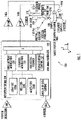
- the embodiment 100 includes an atomic-force microscope (AFM,shown in a simplified version, as a combination of the probe 104 with a tip 104A that in operation is disposed above a surface of the SUT 108).
- An instantaneous position of the flexible probe 104 and/or its deviation from a reference position is (a) assessed based on the deviation of a beam 110 from a laser source 114 (usually configured to generate visible light), in reflection of such beam from a surface of the probe 104, and (b) recorded after the so-reflected beam 110 has been received by a position-sensitive detector 118.
- AFM atomic-force microscope
- the AFM controller electronic circuitry system 122 is equipped with the specialized control module that allows a specific type(s) of excitation signal to be delivered to AFM feedback electronic circuitry 130 (configured to govern the operation of the system 100 in a Force Setpoint Modulation regime) and/or to a Z-scanner Modulation programmable electronic-circuitry module 134 (configured to change, during the operation of the system 100, a position and/or modulate the position of the probe 104 with the use of the Z-repositioner 140 and/or a position of the sample 108, with the use of the Z-repositioner 144, along a direction normal to the surface of the sample 108).
- DDS Direct Digital Synthesizer (a particular form of a digitally-implemented waveform generator, as known in related art.
- Z-modulation The process of changing a position and/or modulating the position of either the sample 108 or the probe 104 or both along the direction normal to the surface of the sample 108 (as show - z-axis) is generally referred herein as "Z-modulation".
- Z-modulation Examples of repositioners include electronically-controlled micro- and sub-micro-stepping positioning equipment known in related art.
- the probe is driven with an electrical signal combining 9 frequency components, among which the component #1 is considered to be a fundamental harmonic and the frequencies of the remaining components are harmonics of the frequency of the component #1.
- the amplitude of each of the frequency components is chosen to vary from -1 to +1.
- the phase-shift (as specified) is introduced between and among the itemized components of the signal driving the probe.
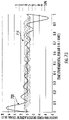
- FIG. 7A shows - in dashed lines - nine plots 704 representing each of the driving sub-signals at these frequency components and in a solid line (710) - the resulting aggregate excitation force applied to the probe to displace it (or, analogously, a resulting aggregate displacement signal delivered to the probe by the electronic circuitry of the overall system).
- Table 2 and Fig. 7B illustrate the situation when the probe is driven with the mix of 9 signals that represent the harmonics of the chosen fundamental frequency (of component #1 of Table 2) however these harmonic signals are simultaneously applied to the p[robe without any predetermined phase shift - in fact, with the same phase.
- Fig. 7B shows nine plots 714 (in dashed lines) representing the harmonic components, while the curve 720 shows the resulting excitation force applied to the tip of the probe.
- the specialized electronic-circuitry control module 122 can generally be implemented in firmware on the basis of, for example, existing flexible AFM control with the use of a Field Programmable Gate Array (FPGA) and Digital Signal Processor (DSP), in one embodiment.
- the excitation signal provided to (as shown by lines 140A, 144A) and governing the operation of at least one of the probe Z-repositioner 140 and the sample Z-repositioner 144 (at a frequency preferably in the range from about a hundred Hz to 100 kHz) can also be routed by the AFM-nDMA control module 122 to a specialized "high-frequency" sample actuator / sample heater 148, as shown by the line 148A.
- the AFM Digital Feedback electronic module 122 may be configured with the use of a PID (Proportional Integral Derivative) or PI (Proportional Integral) electronic-circuitry controller, which, in operation, receives as input the Deflection signal (shown as 150) or the signal from the Z-sensor (shown as 140 or 144, and generates a control output towards positioning a Z-scanner with the aim to minimize the difference (error signal) between the input and a setpoint.
- a PID Proportional Integral Derivative
- PI Proportional Integral
- Set point is understood as a desired value of the signal controlled in a feedback loop.
- the AFM In case of a Deflection signal being an input, for example, the AFM will hold, maintain the load force at a chosen level; in case of the signal from the Z-sensor being an input, the AFM will hold/maintain the Z-position.
- the AFM digital feedback When an AC signal is mixed into the setpoint (the situation referred to as setpoint modulation), the AFM digital feedback will follow the signal representing both DC and AC parts of the setpoint - for example, in a force-setpoint modulation regime.
- the Signal routing control electronic circuitry 160 includes a digitally-controlled multiplexer configured to govern outputs and signal inputs, which is intended to realize various AFM control schemes and/or modes of operation: a force setpoint modulation, a z-setpoint modulation, and a z-modulation, for example.
- this module 160 connects an input signal, a setpoint signal, a setpoint modulation signal to the AFM digital feedback module 130, and also routes a waveform from the appropriate DDS (Direct Digital Synthesizer - a generator of oscillatory waveform) 126A, 126B, and/or 126C and input signals (150, Deflection signal, and signal from Z- or Height sensor, not shown in Fig. 1 ) for acquisition and lock-in processing.
- DDS Direct Digital Synthesizer - a generator of oscillatory waveform
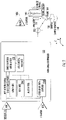
- Fig. 2 is a simplified schematic diagram 100' of a specific version of the embodiment 100 of Fig. 1 , configured to implement the Force Setpoint Modulation mode of operation of the system.
- the Deflection Setpoint is representing a desired, or target, value of the Deflection signal controlled by AFM feedback loop.
- Deflection Setpoint includes modulation component (setpoint modulation), is denoted as 152.
- sample under test, SUT shown as 108 in Fig. 1
- sample to be measured with an AFM-nDMA embodiment of the invention can be dimensioned as a thin ( ⁇ few microns in thickness) section or slice of material, or, alternatively, as a bulk piece (for example, up to 3mm in thickness) with a cryo-sectioned surface (a substantially flat block-face surface).
- substantially flat identifies a surface the spatial profile of which is characterized by an average peak-to-valley difference not exceeding 20 nm, more preferably not exceeding 10 nm.
- Such substantially flat or substantially planar surface can be prepared with cryo-microtome sectioning, or with casting a thermosetting polymer onto Mica surface, or by spin-casting onto the surface of the sample a dissolved polymer, for example.
- the prepared sample section is mounted on a chosen substrate (such as, for example, a sapphire or stainless-steel disk of about 10 mm-to-12 mm in diameter and less than 1 mm in thickness, in one case) to form a sample-substrate assembly.
- the sample-substrate assembly can then secured in the heater-cooler device with the use of magnetic attachment or with thermal compound grease.
- AFM-nDMA measurements of a sample at variable temperatures may generally require a sample heater / cooler device (shown as 148; interchangeably referred to as heater or heater device, for simplicity). It may be desirable to utilize a sample heater specifically designed for highly spatially-localized/ focused containment of thermal gradient in the area of the sample only, in which case only the sample is heated up as opposed to heating the whole sample and AFM stage mechanical structure, to minimize overall thermal drift).
- such judiciously-designed sample heater/cooler circuitry is configured to achieve low levels of thermal drift rate in lateral and vertical spatial directions (x-, y-, and z- directions, in reference to the local coordinate system of Fig. 1 ), in equilibrium state of the thermal gradient.
- low drift rate defines and refers to such drift observed during the measurement time the spatial value of which is small as compared to dimensions of measured nanoscale features.
- thermal drift in the cooler/heater manifests in lateral (XY) or vertical (Z) drift of relative position of a probe vs. sample.
- Drift rate is measured as a position change per unit time.
- Lateral drift represents the speed at which the XY position of probe relative to sample is changing.
- Vertical drift, or simply Z-drift would indicate how fast the vertical position of a probe vs. sample is changing.
- the probe heater In addition to the sample heater device, a dedicated heater of the probe (the probe heater, shown as 154) is utilized to facilitate localization of the thermal gradient (top and down heater plates, one below and one above the sample, from both sides of the sample) and prevent the probe lever 104 from accumulating the condensation deposits.
- the probe heater device 154 may include first and second heater plates disposed in cooperation with the top and bottom surfaces of the sample.
- the calibration of the sample-surface temperature (with respect to a heater 148 setpoint and temperature measured by a dedicated sensor that is internal to the heating element of the heater 148) can be realized in practice with the aid of a small thermocouple attached to the surface of the sample carrier (not shown in Fig. 1 ; configured, in one example, as a 10 mm diameter sapphire disk or a steel puck) mechanically-supporting and carrying the sample, in proximity to the location of the sample 108 on the sample carrier.
- the embodiment 100 of the AFM-nDMA system can be optionally equipped with the Sample Heater holder / Sample Actuator 148 containing electronic circuitry designed to ensure a low thermal drift (on the order of 2 nm/minute or lower) of a reference surface of the holder 148 in X-, Y- and Z-directions).
- the sample 108 is cooperated with the reference surface, and the temperature of the heater of the holder 148 is controlled with a thermal controller (not shown for simplicity of illustration) that establishes programmable temperature setpoint and feedback (for example, the PID-feedback, or Proportional Integral Derivative controller / feedback).
- a thermal controller not shown for simplicity of illustration
- the use of such sample holder that is equipped with the judiciously-devised electronic heating circuitry facilitates the measurement of viscoelastic properties of the sample 108 at a substantially any pre-determined temperature in the range of temperatures spanning through glass transition of certain polymeric materials (with the glass transition temperature, Tg, falling into the heater's temperature space, for example, from the RT to 250 degC).
- Tg glass transition temperature
- a preferred pre-determined temperature would be within a range from room temperature (of about 25 C) to the upper limit of about 140C-150C.
- the system 100 may also be equipped with a top plate heater, or probe heater 154, configured to maintain a low thermal gradient in the space of probe-sample.
- a top plate heater or probe heater 154, configured to maintain a low thermal gradient in the space of probe-sample.
- a Heater-Cooler hardware option addresses the temperature space below RT, for example from the RT to -35 deg C.
- the AFM scanning mechanism (whether the Z-scanner 144 of the sample, and/or the Z-scanner 140 of the AFM probe 104, depending on the particular implementation) must be well thermaly-insulated from the source of the heating/cooling - otherwise, the scanner performance (drift, calibration, dynamics, etc.) are likely to be diversely and adversely affected throughout the temperature space.
- the desired thermal insulation can be achieved, in one case, with the use of a specialized probe holder made out of material with low thermal conductivity (for example, MACOR, a machinable ceramic material).
- the AFM tip 104A should at the same time be preferably maintained at a temperature close to the temperature at which the sample 108 is kept, in order to prevent the formation of condensation on the lever surface(s), thermal bending of the lever, from sample local cooling and from thermal gradients.
- tip 104A at the temperature substantially equal to the temperature of the sample 108 can be achieved (for a heater) with the use of a Tip heater hardware in the probe holder, which constitutes a heater element (and optionally, a thermocouple or other temperature sensor) under the so-called probe nest (that is, under the portion of the probe where the probe chip is spring-clipped or otherwise attached to the probe holder).
- a Tip heater hardware in the probe holder which constitutes a heater element (and optionally, a thermocouple or other temperature sensor) under the so-called probe nest (that is, under the portion of the probe where the probe chip is spring-clipped or otherwise attached to the probe holder).
- the use of the Heater-Cooler option in the embodiment of the AFM-nDMA system preferably additionally requires environmental control (humidity control - RH, and inert atmosphere, e.g., dry Nitrogen purge) to prevent the sample surface from oxidation and deterioration due to moisture absorption.
- environmental control can be achieved with the use of a flexible sealing sleeve attached to the probe holder, which sleeve creates an insulated local environment that can be purged with dry Nitrogen gas at a low flow rate.
- a specialized sealed Local Environmental Cell LEC, incorporating heater-cooler
- the system is configured to hold the sample stationary, fixed in space while the AFM-nDMA-caused mechanical excitation is delivered via the spatial actuation of the tip 104. (This is accomplished either with the use of the AFM Z-scanner 140, or with an additional probe-holder piezo actuator). It is recognized, however, that when the measurements are intended to be performed only at room temperature, the mechanical excitation or actuation of the mutual orientation between the sample 108 and the tip 104 can be alternatively carried out via (harmonic, small amplitude) spatial actuation of the sample holder.
- the combination of the sample holder actuator 148 and the sample Z-scanner device 144 is judiciously designed to operate by causing the mechanical movements of the sample 108 at least at one frequency within a wide frequency range (for example, from about 100 Hz to about 100 kHz).
- the (sample holder actuator 148 and/or the sample Z-scanner device 144 typically do not have an associated Z-sensor configured to detect and provide a readout of the mechanical vibration amplitude and phase of the mechanical movements.
- the amplitude and phase of the mechanical movement provided by the devices 144 and/or148 as a function of frequency can be calibrated in a separate, additional reference “calibration” measurement by placing the AFM probe in contact with a hard reference sample and measuring the deflection of the probe (that is, the amplitude and/or the phase of such deflection).
- An embodiment of the AFM-nDMA system of the invention is configured to measure viscoelastic properties at (user-) selected point locations on the sample's surface.
- the embodiment of the AFM-nDMA methodology of the invention is generally not a surface imaging technique, although an imaging mode with "mapping" of viscoelastic properties in limited frequency range is possible.
- the primary target of the proposed methodology is point measurements/ point spectroscopy (multi-frequency)applications, but it can also be used for surface imaging/mapping at a single selected frequency, or a limited number of selected frequencies.
- the Z scanner 140 is spatially extended along the z-axis to bring the tip 104A of the probe 104 toward the surface of the sample 108 (a ramp motion) until a specified and/or pre-determined threshold value in a probe's cantilever deflection is reached as detected with the use of the PSD 118.
- the pre-set of the cantilever deflection corresponds to the specific pre-load (normal) force (referred to as Trigger Force) exerted by the probe tip 104A onto the sample 108, which in turn allows the system 100 to determine the sought-after sample deformation under the corresponding load.
- tapping mode is a different, intermittent-contact AFM technique.
- a probe is caused to approach the surface of the sample to make full contact and to actually deform/indent the surface, after which the modulation - an oscillatory component of force or Z displacement - is turned on.
- the probe is retracted; then the probe can move/transition to another point of the surface laterally, and be used to perform another point-measurement at another location of the surface.
- Force-distance curve (“FDC”).
- the AFM Force-distance curves also known as Deflection vs. Z scanner extension
- Deflection vs. Z scanner extension are recorded during forward ramp and reverse ramp (retraction of the probe).
- a Force-Distance Curve is a plot or trace of Deflection/Force signal vs. Z-separation signal, acquired as the Z-scanner 140 moves the tip 104A towards the sample surface ( ⁇ the Extension curve) or moves the tip 104A away from the prior contact with the surface ( ⁇ the Retraction curve).
- FDCs can be analyzed with a Contact Mechanics Model (such as one represented by any of the Hertzian, Johnson-Kendall-Roberts (JKR), Derjaguin-Muller-Toporov (DMT) models) in order to calculate the elastic properties (such as reduced modulus and Young modulus) of the sample and, more importantly for the AFM-nDMA embodiment of the invention, to estimate the size of the tip-sample contact area, or "contact radius".
- a Contact Mechanics Model such as one represented by any of the Hertzian, Johnson-Kendall-Roberts (JKR), Derjaguin-Muller-Toporov (DMT) models
- JKR Johnson-Kendall-Roberts
- DMT Derjaguin-Muller-Toporov
- the JKR model typically provides best results in fitting experimental data.
- force-distance curves on viscoelastic materials should be analyzed with a contact mechanics model for viscoelastic adhesive surfaces.
- a contact radius calculated from a retraction curve applies only to conditions at the very end of the Hold period, and does not really provide information about the contact radius for every moment during or within the whole Hold period, which may be necessary for accurate quantitative AFM-nDMA results.
- the contact area (between the tip and the sample) can change during Hold/measurement time because of the sample creep.
- the dynamic stiffness (of the contact between the probe and the sample, measured at a preselected "reference" frequency) is proportional to the contact radius. If the system is configured to monitor this dynamic stiffness (continuously or in the "interleaved" with the major measurements fashion) during the whole Hold/measurement time, then the determination of a relative change in the contact radius can be carried out during the measurement.
- the contact radius is determined after or before the Hold period from a force-distance indentation curve (Ramp); then this correction of the contact radius is applied to each specific moment of the Hold period.
- the ramp-and-hold based measurements are performed with the use of the AFM-nDMA embodiment of the invention at a substantially constant temperature, after thermal equilibrium in the system of instrument-sample-heater has been reached.
- the AFM-nDMA measurements as a function of temperature are carried out by sequentially going through a list of temperature setpoints/steps (according to a specific temperature program), and waiting for reaching the thermal equilibrium at each temperature setpoint before performing the AFM-nDMA ramp-and-hold point measurements at that temperature point.
- the degree of thermal equilibrium that has been reached before the ramp-and hold measurements can commence can be assessed by measuring the rate of thermal drift in the Z direction, for example while waiting and performing "zero-size" scans on the surface in Peak-Force Tapping AFM mode (and optionally, assessing XY drift by performing non-zero-size scans and tracking a topographical feature or a boundary feature in a map of material property like DMT-modulus or adhesion or deformation), until a desired (low) drift rate figure is reached.
- the Z scanner 140 While waiting for thermal equilibration and staying in the AFM feedback loop on the surface, the Z scanner 140 may reach a limit in extension or retraction of the Z piezo due to thermal drift and material thermal expansion/contraction/flow. Accordingly, it is preferred to have the Z scanner continuously re-centered by stepping the Z engage motor up or down, so that the scanner's Z position is maintained in the center of the piezo's dynamic range.
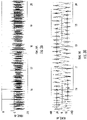
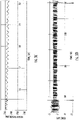
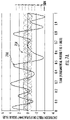
- Figs. 3A, 3B , and 3C provide examples of Signal Traces for Force Setpoint Modulation.
- the AFM feedback electronic module is tracking both static ("DC") and dynamic, oscillatory (“AC") component of the setpoint.
- the error signal trace (provided by the AFM feedback control electronic circuitry 130 of the system 100 of Fig. 1 ) and shown in Fig. 3A possesses a high-frequency noise and a very small residual oscillatory (AC) error (these data example was acquired at the modulation frequency of 5.6Hz), and the residual possesses a high level of noise.
- AFM feedback circuitry 130 is tracking the oscillatory setpoint component and provides a modulation of the load force exerted by the probe 104 onto the sample 108 (which constitutes the "force setpoint modulation” mode of operation).
- the actual vertical deflection trace in Fig. 3B shows the oscillatory (AC) component - that is, the force modulation (here the normal force exerted by the probe on the sample is equal to vertical deflection of the lever multiplied by the lever's spring constant).
- the Z-sensor or "Height" signal trace is shown in Fig. 3C .
- an overall downward slope in the trace line can be attributed to a thermal drift of the system and/or a viscoelastic creep in the sample material (The drift correction technique described in Software Lock-in processing method is useful in alleviating the detrimental effect of such slope/trend on the accuracy of signal's amplitude and phase measurement).
- Figs. 3D , 3E, and 3F are analogous to those of Figs. 3A, 3B , and 3C , but represent an example corresponding to a measurement at a different, lower modulation frequency - 0.32Hz (vs 5.6Hz of Figs. 3A, 3B , 3C ).
- the residual oscillatory (AC) component in the error signal trace in Fig. 3D is practically not discernible in the noise, in contrast to that of Fig. 3A .
- This fact is due to AFM feedback control frequency response (dependent on PID-feedback gains) and effective better feedback tracking at lower frequencies as compared to higher frequencies.
- the Z-sensor "Height" signal trace in Fig. 3F as compared to Fig.
- Figs. 4A, 4B illustrate results of experimental AFM-nDMA measurements performed with an embodiment of the system of the invention.
- Fig. 4A shows Storage (E') and Figure 4B shows Loss (E") modulus data vs. measurement Frequency (at fixed, room temperature), for a sample of Polydimethylsiloxane (PDMS) material.
- the comparison of AFM-nDMA results (red, crosses, 410 and 420) to bulk DMA measurements (green, dashed line, 415, 425) on a sample from the same material shows substantial agreement between storage and loss moduli measured at nanoscale (AFM-nDMA) and using bulk macroscopic methods (DMA) (the latter being used in related art as ground truth, a reference to verify other results).
- AFM-nDMA nanoscale
- DMA bulk macroscopic methods
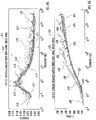
- Figs. 5A, 5B , 5C, 5D , 5E, 5F illustrate results of the experimental AFM-nDMA measurements of the Storage and Loss Moduli of the Fluorinated Ethylene Propylene (FEP) material as a function of temperature (at three different fixed low frequencies: 0.1Hz, 1.0Hz, and 5.6Hz). The comparison is provided between the results of the measurement performed with an AFM-nDMA -based embodiment of the invention and those performed with a conventional bulk DMA methodology.
- Figs. 5A, 5B , 5C show dependence of storage modulus vs. temperature
- Figs. 5D , 5E, and 5F show the dependence of loss modulus vs.
- Fig. 6A illustrates the experimentally-defined dependency of loss tangent (the ratio, of the loss modulus to the storage modulus) for FEP, on frequency, presented via the time-temperature superposition (TTS).
- TTS time-temperature superposition
- Fig. 6D illustrates an example of time-temperature superposition (TTS) of shift factors (well known by a person of skill in the art) with the comparison between the results of a measurement performed with the use of an embodiment of the invention (open circles; 640) with those of a measurement performed with the conventional bulk DMA methodology (solid circles; 645).
- TTS time-temperature superposition
- Figs. 6A, 6B , 6C, and 6D data were measured with both the nanoscale AFM-nDMA methodology configured according to the idea of the invention and with the conventional macroscopic bulk DMA method (for the same Fluorinated ethylene propylene, FEP, material as that in the examples of Figs. 5A through 5F discussed above) in the frequency range from 0.1Hz to that above 100Hz, and in the temperature range from room temperature to a temperature exceeding 120 deg. C.
- Those data for all temperatures and frequencies are super-imposed via Time-Temperature Superposition (TTS), which is a rheological data analysis technique commonly used for macroscopic measurements, and plotted on a scale of "TTS-shifted" frequency.
- TTS Time-Temperature Superposition
- FIG. 6A shows a TTS-plot of loss tangent ("tan delta") vs. shifted frequency; Figs. 6A and 6B show a TTS-plot of storage and loss modulus, respectively.
- Figs 6D illustrates the TTS "shift factors" that were applied to frequencies during TTS processing.
- the disclosed AFM-nDMA methodology provides a novel and unique capability (with respect to nanoscale measurements at low frequencies) that allows for a direct comparison with the results obtained via traditional, bulk macroscopic rheological techniques and methods such as DMA and TTS.
- these AFM-nDMA results are the first example of time-temperature superposition data at nanoscale via AFM).
- Force setpoint modulation scheme can be realized in FPGA firmware with addition of a low-frequency Direct Digital Synthesis (DDS) component.
- DDS Direct Digital Synthesis
- Amplitudes and phases of Force and Displacement (Deformation) can be measured via two channels, Deflection and Z sensor, either via hardware lock-in in FPGA or by capturing/recording signal traces and demodulating them with drift- and creep-corrected "software lock-in” methodology realized in software (“Software Lock-in”).
- Hold period in this frequency range can be relatively short, and Hold Z drive mode (or Hold Z Sensor with AFM feedback tracking both DC position and AC modulation in Z Sensor channel) can be acceptable for low or moderate drift and creep rates. Therefore, Z scanner modulation (with Hold Z Sensor or Hold Z drive) can be used. Alternatively, Force Setpoint modulation can be used, since AFM feedback can have sufficient bandwidth to track AC setpoint in this frequency range.
- Reference frequency technique for correcting (subtracting the value of, in one case) the creep in contact area and/or tracking the contact area during the process of correction of the associated creep. If AFM-nDMA, the modulus of the material at one particular frequency is measured (monitored) throughout the whole duration of Hold segment, in parallel with AFM-nDMA measurements at other frequencies, then contact radius calculated from JKR fit of retraction curve at the end of Hold can be corrected (creep in contact size during hold can be accounted for). This requires excitation at at least two frequencies simultaneously. Alternatively, measurements at reference frequency can be interleaved with measurements at other frequencies.
- Multi-frequency excitation can shorten AFM-nDMA measurement time.
- results of multi-frequency excitation should be equivalent to sequential measurements (provided drift and creep are properly accounted for in the latter).
- nonlinearities which are inherently present in the tip-sample contact
- a "cross-talk" between frequencies is possible during multi-frequency excitation.
- the AFM-nDMA is a nanoscale Dynamic Mechanical Analysis of a sample that is performed with the aid of a cantilevered probe indenting the sample surface with a controlled force that includes both a quasi-static (DC) component and a dynamic (AC), oscillatory component.
- the frequency, or multiple frequencies, of the oscillatory component of the force applied to the sample is judiciously chosen to match the low frequency range that is usually of interest for bulk macroscopic DMA of soft materials and various polymers -- from sub-Hertz to several hundred Hertz.
- the operation of an embodiment of the present invention results in assessment of viscoelastic material properties of the material of the sample using one common theoretical framework (referred to as "Dynamic Stiffness in harmonic excitation") based on the equations for both inverse and forward problem of nanoscale Dynamic Mechanical Analysis.
- Inverse problem equations allow for calculation of dynamic stiffness of the contact, and from that material properties like storage and loss modulus and tan delta (loss tangent, damping factor) from the results of the AFM-nDMA measurements that provide for amplitudes and phases of the acquired signals.
- the forward problem equations can be utilized for optimization of an experiment by calculating a desired excitation amplitude and pre-load force.
- the oscillatory deformation can then be determined as a difference between displacement and probe deflection, or in complex-valued form:
- L * Z 1 e i ⁇ t + ⁇ ⁇ D 1 e i ⁇ t + ⁇
- the size of the nanoscale contact cannot be readily visualized or measured directly, but can be determined from the analysis of indentation force-distance curve, for example, by applying Johnson-Kendall-Roberts (JKR) contact mechanics model to a retract portion of force-distance curve.
- JKR Johnson-Kendall-Roberts
- an embodiment of the AFM-nDMA methodology of the present invention utilizes the well-known Johnson-Kendall-Roberts (JKR) contact mechanics model for calculation of the contact size, in conjunction with the use of a probe having well-characterized spherical tip geometry.
- JKR Johnson-Kendall-Roberts
- an embodiment of the present invention additionally provides a verification methodology that utilizes a specialized "Punch Probe" AFM tip with known size of the contact area and does not rely on any particular contact mechanics model for calculation of material properties from dynamic stiffness. Such feature is not known or used in AFM-related art.) Notably - and in reference to Eqs.
- the determination of storage and loss moduli requires inference of the contact radius from indentation contact mechanics analysis.
- the determination of the loss tangent does not require knowing the contact radius, and is calculated directly from a ratio of deflection and displacement amplitude, and a difference in phase between deflection and displacement.
- the contact radius - which is required for calculation of viscoelastic storage and loss modulus values - is determined from a retract part of force-distance curve -- after all hold segments with AFM-nDMA measurements at all predetermined frequencies are completed.
- This contact radius value estimated at the very end of indentation Hold, would need to be applied in calculations across all frequency segments, which could have preceded the retract event by a potentially long time (possibly several minutes for sub-Hertz frequencies).
- sample creep relaxation under preload force
- the contact radius can remain practically constant for the whole duration of the AFM-nDMA measurement Hold.
- loss stiffness S (Eq. 7.2) can, in principle, also be used in a similar way for contact radius creep compensation; however, using storage stiffness S' makes more practical sense from signal-to-noise ratio considerations.
- a processor controlled by application-specific instructions stored in a tangible memory element may be required.
- required algorithmical functions, operations, and decisions may be implemented as computer program instructions, software, hardware, firmware or combinations thereof.
- instructions or programs defining the functions and elements of the present invention may be delivered to a processor in many forms, including, but not limited to, information permanently stored on non-writable storage media (e.g. read-only memory devices within a computer, such as ROM, or devices readable by a computer I/O attachment, such as CD-ROM or DVD disks), information alterably stored on writable storage media (e.g.
- the invention may be embodied in software, the functions necessary to implement the invention may optionally or alternatively be embodied in part or in whole using firmware and/or hardware components, such as combinatorial logic, Application Specific Integrated Circuits (ASICs), Field-Programmable Gate Arrays (FPGAs) or other hardware or some combination of hardware, software and/or firmware components.
- ASICs Application Specific Integrated Circuits
- FPGAs Field-Programmable Gate Arrays
- two values being "substantially equal" to one another implies that the difference between the two values may be within the range of +/- 20% of the value itself, preferably within the +/- 10% range of the value itself, more preferably within the range of +/- 5% of the value itself, and even more preferably within the range of +/- 2% or less of the value itself.
Landscapes
- Health & Medical Sciences (AREA)
- General Health & Medical Sciences (AREA)
- General Physics & Mathematics (AREA)
- Physics & Mathematics (AREA)
- Nuclear Medicine, Radiotherapy & Molecular Imaging (AREA)
- Radiology & Medical Imaging (AREA)
- Chemical & Material Sciences (AREA)
- Analytical Chemistry (AREA)
- Life Sciences & Earth Sciences (AREA)
- Biochemistry (AREA)
- Immunology (AREA)
- Pathology (AREA)
- Engineering & Computer Science (AREA)
- Nanotechnology (AREA)
- Length Measuring Devices With Unspecified Measuring Means (AREA)
- Investigating Strength Of Materials By Application Of Mechanical Stress (AREA)
Priority Applications (1)
| Application Number | Priority Date | Filing Date | Title |
|---|---|---|---|
| EP22192136.4A EP4134680A1 (en) | 2018-08-06 | 2019-08-02 | Nanoscale dynamic mechanical analysis via atomic force microscopy |
Applications Claiming Priority (3)
| Application Number | Priority Date | Filing Date | Title |
|---|---|---|---|
| US201862715166P | 2018-08-06 | 2018-08-06 | |
| US201862769905P | 2018-11-20 | 2018-11-20 | |
| PCT/US2019/044952 WO2020033269A1 (en) | 2018-08-06 | 2019-08-02 | Nanoscale dynamic mechanical analysis via atomic force microscopy (afm-ndma) |
Related Child Applications (2)
| Application Number | Title | Priority Date | Filing Date |
|---|---|---|---|
| EP22192136.4A Division EP4134680A1 (en) | 2018-08-06 | 2019-08-02 | Nanoscale dynamic mechanical analysis via atomic force microscopy |
| EP22192136.4A Division-Into EP4134680A1 (en) | 2018-08-06 | 2019-08-02 | Nanoscale dynamic mechanical analysis via atomic force microscopy |
Publications (2)
| Publication Number | Publication Date |
|---|---|
| EP3788386A1 EP3788386A1 (en) | 2021-03-10 |
| EP3788386B1 true EP3788386B1 (en) | 2022-10-05 |
Family
ID=67766272
Family Applications (2)
| Application Number | Title | Priority Date | Filing Date |
|---|---|---|---|
| EP19759105.0A Active EP3788386B1 (en) | 2018-08-06 | 2019-08-02 | Nanoscale dynamic mechanical analysis via atomic force microscopy (afm-ndma) |
| EP22192136.4A Pending EP4134680A1 (en) | 2018-08-06 | 2019-08-02 | Nanoscale dynamic mechanical analysis via atomic force microscopy |
Family Applications After (1)
| Application Number | Title | Priority Date | Filing Date |
|---|---|---|---|
| EP22192136.4A Pending EP4134680A1 (en) | 2018-08-06 | 2019-08-02 | Nanoscale dynamic mechanical analysis via atomic force microscopy |
Country Status (6)
| Country | Link |
|---|---|
| US (6) | US11029330B2 (enExample) |
| EP (2) | EP3788386B1 (enExample) |
| JP (5) | JP7011739B2 (enExample) |
| KR (1) | KR102339797B1 (enExample) |
| CN (2) | CN112585479B (enExample) |
| WO (1) | WO2020033269A1 (enExample) |
Families Citing this family (12)
| Publication number | Priority date | Publication date | Assignee | Title |
|---|---|---|---|---|
| US11029330B2 (en) * | 2018-08-06 | 2021-06-08 | Bruker Nano, Inc. | Nanoscale dynamic mechanical analysis via atomic force microscopy (AFM-nDMA) |
| EP3722817B1 (en) * | 2019-04-12 | 2022-05-11 | attocube systems AG | Active bimodal afm operation for measurements of optical interaction |
| CN111896775B (zh) * | 2020-08-17 | 2023-09-05 | 四川轻化工大学 | 一种基于结合胶检测天然橡胶中炭黑的补强性能的方法 |
| US20240151742A1 (en) * | 2021-03-15 | 2024-05-09 | Uti Limited Partnership | Transitional tapping atomic force microscopy for high-resolution imaging |
| US11714104B2 (en) * | 2021-05-25 | 2023-08-01 | Bruker Nano, Inc. | AFM imaging with creep correction |
| CN114544876B (zh) * | 2022-02-23 | 2022-11-25 | 上海大学 | 一种粘弹性材料特性确定方法及系统 |
| CN114720502B (zh) * | 2022-04-11 | 2024-06-25 | 重庆大学 | 用于微观形貌观测的阵列式定位方法及装置 |
| US20250370002A1 (en) * | 2022-06-23 | 2025-12-04 | Trustees Of Tufts College | Controlled Indentation Instrumentation Working in Dynamical Mechanical Analysis Mode |
| CN115753502B (zh) * | 2022-11-14 | 2023-08-18 | 西安交通大学 | 一种生物组织微纳米流变学特性的测试装置及方法 |
| WO2024211750A1 (en) * | 2023-04-05 | 2024-10-10 | Laser Thermal Analysis, Inc. | Nano-probe thermoreflectance microscopy |
| CN117030430B (zh) * | 2023-08-04 | 2024-02-06 | 青岛海洋地质研究所 | 一种水合物纳米压痕装置 |
| CN119479946B (zh) * | 2025-01-09 | 2025-04-29 | 中南大学 | 一种蠕变松弛时效宏微观统一本构模型参数确定方法及系统 |
Family Cites Families (19)
| Publication number | Priority date | Publication date | Assignee | Title |
|---|---|---|---|---|
| JP2000346784A (ja) * | 1999-06-04 | 2000-12-15 | Shimadzu Corp | 粘弾性分布測定方法 |
| US7596990B2 (en) | 2004-04-14 | 2009-10-06 | Veeco Instruments, Inc. | Method and apparatus for obtaining quantitative measurements using a probe based instrument |
| US7555940B2 (en) * | 2006-07-25 | 2009-07-07 | Veeco Instruments, Inc. | Cantilever free-decay measurement system with coherent averaging |
| DE112006004092T5 (de) * | 2006-10-23 | 2009-08-13 | Cynthia Trempel Batchelder | Vorrichtung und Verfahren zum Messen von Oberflächenenergien |
| CN105319396B (zh) * | 2008-11-13 | 2019-06-04 | 布鲁克纳米公司 | 使用峰值力轻敲模式来测量样本的物理特性的方法和设备 |
| MY167278A (en) * | 2010-03-19 | 2018-08-15 | Bruker Nano Inc | Low drift scanning probe microscope |
| KR101535519B1 (ko) * | 2011-02-10 | 2015-07-09 | 하이지트론, 인코포레이티드 | 나노기계 테스트 시스템 |
| US9417170B2 (en) | 2011-07-15 | 2016-08-16 | Clarkson University | High resolution, high speed multi-frequency dynamic study of visco-elastic properites |
| US8973161B2 (en) * | 2012-06-22 | 2015-03-03 | Rutgers, The State University Of New Jersey | Method and apparatus for nanomechanical measurement using an atomic force microscope |
| EP2932277B1 (en) * | 2012-12-12 | 2024-04-03 | Universität Basel | Method and device for controlling a scanning probe microscope |
| JP6360735B2 (ja) * | 2014-07-02 | 2018-07-18 | 国立大学法人北海道大学 | 細胞の複素弾性率の計測方法および計測システム |
| US9778194B2 (en) * | 2014-07-16 | 2017-10-03 | Purdue Research Foundation | In-situ combined sensing of uniaxial nanomechanical and micromechanical stress with simultaneous measurement of surface temperature profiles by raman shift in nanoscale and microscale structures |
| JP6766351B2 (ja) | 2014-12-26 | 2020-10-14 | 株式会社リコー | 微小物特性計測装置 |
| US10072920B2 (en) * | 2015-05-22 | 2018-09-11 | Cornell University | Optical sensing based on measurements of displacements induced by optical scattering forces in viscoelastic media using phase-sensitive optical coherence tomography |
| EP3452837A1 (en) * | 2016-05-04 | 2019-03-13 | Institut National de la Sante et de la Recherche Medicale (INSERM) | A method of operating an afm |
| EP3747950A1 (en) * | 2016-08-09 | 2020-12-09 | A.L.M. Holding Company | Sterol blends as an additive in asphalt binder |
| CN107045075B (zh) * | 2017-03-31 | 2019-08-02 | 国家纳米科学中心 | 一种基于多孔介质模型的细胞物理状态的表征方法 |
| CN107449939B (zh) * | 2017-08-03 | 2020-04-24 | 哈尔滨工业大学 | 采用磁驱峰值力调制原子力显微镜进行的多参数同步测量方法 |
| US11029330B2 (en) | 2018-08-06 | 2021-06-08 | Bruker Nano, Inc. | Nanoscale dynamic mechanical analysis via atomic force microscopy (AFM-nDMA) |
-
2019
- 2019-08-02 US US16/530,725 patent/US11029330B2/en active Active
- 2019-08-02 EP EP19759105.0A patent/EP3788386B1/en active Active
- 2019-08-02 CN CN201980052345.2A patent/CN112585479B/zh active Active
- 2019-08-02 CN CN202210389607.8A patent/CN114966119B/zh active Active
- 2019-08-02 JP JP2020566686A patent/JP7011739B2/ja active Active
- 2019-08-02 KR KR1020217006698A patent/KR102339797B1/ko active Active
- 2019-08-02 WO PCT/US2019/044952 patent/WO2020033269A1/en not_active Ceased
- 2019-08-02 EP EP22192136.4A patent/EP4134680A1/en active Pending
-
2021
- 2021-04-19 US US17/234,185 patent/US11307220B2/en active Active
-
2022
- 2022-01-14 JP JP2022004078A patent/JP7062842B2/ja active Active
- 2022-04-18 US US17/722,603 patent/US11635449B2/en active Active
- 2022-04-20 JP JP2022069161A patent/JP7349529B2/ja active Active
-
2023
- 2023-04-11 US US18/133,054 patent/US11940461B2/en active Active
- 2023-09-11 JP JP2023146623A patent/JP7654040B2/ja active Active
-
2024
- 2024-02-02 US US18/431,503 patent/US12241911B2/en active Active
-
2025
- 2025-01-08 US US19/014,003 patent/US20250147066A1/en active Pending
- 2025-03-18 JP JP2025043396A patent/JP2025089351A/ja active Pending
Also Published As
| Publication number | Publication date |
|---|---|
| CN112585479A (zh) | 2021-03-30 |
| US11307220B2 (en) | 2022-04-19 |
| JP2022089945A (ja) | 2022-06-16 |
| US20210239732A1 (en) | 2021-08-05 |
| US20240175895A1 (en) | 2024-05-30 |
| JP2022036270A (ja) | 2022-03-04 |
| US11635449B2 (en) | 2023-04-25 |
| JP7654040B2 (ja) | 2025-03-31 |
| EP3788386A1 (en) | 2021-03-10 |
| EP4134680A1 (en) | 2023-02-15 |
| JP2021524584A (ja) | 2021-09-13 |
| JP7349529B2 (ja) | 2023-09-22 |
| JP2023162445A (ja) | 2023-11-08 |
| US20230243867A1 (en) | 2023-08-03 |
| US11940461B2 (en) | 2024-03-26 |
| WO2020033269A1 (en) | 2020-02-13 |
| US20250147066A1 (en) | 2025-05-08 |
| JP7062842B2 (ja) | 2022-05-06 |
| CN114966119A (zh) | 2022-08-30 |
| US11029330B2 (en) | 2021-06-08 |
| JP2025089351A (ja) | 2025-06-12 |
| CN114966119B (zh) | 2023-10-24 |
| US20200041541A1 (en) | 2020-02-06 |
| KR20210053293A (ko) | 2021-05-11 |
| KR102339797B1 (ko) | 2021-12-15 |
| US20220252638A1 (en) | 2022-08-11 |
| CN112585479B (zh) | 2022-04-19 |
| JP7011739B2 (ja) | 2022-01-27 |
| US12241911B2 (en) | 2025-03-04 |
Similar Documents
| Publication | Publication Date | Title |
|---|---|---|
| EP3788386B1 (en) | Nanoscale dynamic mechanical analysis via atomic force microscopy (afm-ndma) | |
| Jalili et al. | A review of atomic force microscopy imaging systems: application to molecular metrology and biological sciences | |
| US7055378B2 (en) | System for wide frequency dynamic nanomechanical analysis | |
| JP5000076B2 (ja) | 力走査型プローブ顕微鏡 | |
| US8484759B2 (en) | Spatially resolved quantitative mapping of thermomechanical properties and phase transition temperatures using scanning probe microscopy | |
| Rabe et al. | Atomic force acoustic microscopy | |
| Schillers | Measuring the elastic properties of living cells | |
| Hurley et al. | Dynamic contact AFM methods for nanomechanical properties | |
| Cumpson et al. | Cantilever spring-constant calibration in atomic force microscopy | |
| Modigunta et al. | Atomic Force Microscopy: An Advanced Imaging Technique—From Molecules to Morphologies | |
| Hangen et al. | Resolution limits of nanoindentation testing | |
| Perrino | Atomic force microscopy dynamic modes for the quantification of nanomechanical properties: From polymers to membrane proteins | |
| Giocondo et al. | Atomic force spectroscopies: A toolbox for probing the biological matter | |
| Ren et al. | A control-based approach to indentation quantification in broadband and in-liquid nanomechanical measurement using atomic force microscope | |
| WO2019224414A1 (es) | Método dinamico de microscopía de fuerzas y microscopio para adquirir de forma simultanea imágenes de topografia y mapas de fuerza | |
| Frentrup | Uncertainty Quantification in Calibration of AFM Probes Due to Non-uniform Cantilevers |
Legal Events
| Date | Code | Title | Description |
|---|---|---|---|
| STAA | Information on the status of an ep patent application or granted ep patent |
Free format text: STATUS: UNKNOWN |
|
| STAA | Information on the status of an ep patent application or granted ep patent |
Free format text: STATUS: THE INTERNATIONAL PUBLICATION HAS BEEN MADE |
|
| PUAI | Public reference made under article 153(3) epc to a published international application that has entered the european phase |
Free format text: ORIGINAL CODE: 0009012 |
|
| STAA | Information on the status of an ep patent application or granted ep patent |
Free format text: STATUS: REQUEST FOR EXAMINATION WAS MADE |
|
| 17P | Request for examination filed |
Effective date: 20201204 |
|
| AK | Designated contracting states |
Kind code of ref document: A1 Designated state(s): AL AT BE BG CH CY CZ DE DK EE ES FI FR GB GR HR HU IE IS IT LI LT LU LV MC MK MT NL NO PL PT RO RS SE SI SK SM TR |
|
| AX | Request for extension of the european patent |
Extension state: BA ME |
|
| RIN1 | Information on inventor provided before grant (corrected) |
Inventor name: OSECHINSKIY, SERGEY Inventor name: RUITER, ANTHONIUS Inventor name: PITTENGER, BEDE Inventor name: SYED-AMANULLA, SYED-ASIF |
|
| STAA | Information on the status of an ep patent application or granted ep patent |
Free format text: STATUS: EXAMINATION IS IN PROGRESS |
|
| 17Q | First examination report despatched |
Effective date: 20210421 |
|
| DAV | Request for validation of the european patent (deleted) | ||
| DAX | Request for extension of the european patent (deleted) | ||
| GRAP | Despatch of communication of intention to grant a patent |
Free format text: ORIGINAL CODE: EPIDOSNIGR1 |
|
| STAA | Information on the status of an ep patent application or granted ep patent |
Free format text: STATUS: GRANT OF PATENT IS INTENDED |
|
| INTG | Intention to grant announced |
Effective date: 20220518 |
|
| GRAS | Grant fee paid |
Free format text: ORIGINAL CODE: EPIDOSNIGR3 |
|
| GRAA | (expected) grant |
Free format text: ORIGINAL CODE: 0009210 |
|
| STAA | Information on the status of an ep patent application or granted ep patent |
Free format text: STATUS: THE PATENT HAS BEEN GRANTED |
|
| AK | Designated contracting states |
Kind code of ref document: B1 Designated state(s): AL AT BE BG CH CY CZ DE DK EE ES FI FR GB GR HR HU IE IS IT LI LT LU LV MC MK MT NL NO PL PT RO RS SE SI SK SM TR |
|
| REG | Reference to a national code |
Ref country code: GB Ref legal event code: FG4D |
|
| REG | Reference to a national code |
Ref country code: CH Ref legal event code: EP |
|
| REG | Reference to a national code |
Ref country code: AT Ref legal event code: REF Ref document number: 1523059 Country of ref document: AT Kind code of ref document: T Effective date: 20221015 |
|
| REG | Reference to a national code |
Ref country code: DE Ref legal event code: R096 Ref document number: 602019020315 Country of ref document: DE |
|
| REG | Reference to a national code |
Ref country code: IE Ref legal event code: FG4D |
|
| REG | Reference to a national code |
Ref country code: LT Ref legal event code: MG9D |
|
| REG | Reference to a national code |
Ref country code: NL Ref legal event code: MP Effective date: 20221005 |
|
| REG | Reference to a national code |
Ref country code: AT Ref legal event code: MK05 Ref document number: 1523059 Country of ref document: AT Kind code of ref document: T Effective date: 20221005 |
|
| PG25 | Lapsed in a contracting state [announced via postgrant information from national office to epo] |
Ref country code: NL Free format text: LAPSE BECAUSE OF FAILURE TO SUBMIT A TRANSLATION OF THE DESCRIPTION OR TO PAY THE FEE WITHIN THE PRESCRIBED TIME-LIMIT Effective date: 20221005 |
|
| PG25 | Lapsed in a contracting state [announced via postgrant information from national office to epo] |
Ref country code: SE Free format text: LAPSE BECAUSE OF FAILURE TO SUBMIT A TRANSLATION OF THE DESCRIPTION OR TO PAY THE FEE WITHIN THE PRESCRIBED TIME-LIMIT Effective date: 20221005 Ref country code: PT Free format text: LAPSE BECAUSE OF FAILURE TO SUBMIT A TRANSLATION OF THE DESCRIPTION OR TO PAY THE FEE WITHIN THE PRESCRIBED TIME-LIMIT Effective date: 20230206 Ref country code: NO Free format text: LAPSE BECAUSE OF FAILURE TO SUBMIT A TRANSLATION OF THE DESCRIPTION OR TO PAY THE FEE WITHIN THE PRESCRIBED TIME-LIMIT Effective date: 20230105 Ref country code: LT Free format text: LAPSE BECAUSE OF FAILURE TO SUBMIT A TRANSLATION OF THE DESCRIPTION OR TO PAY THE FEE WITHIN THE PRESCRIBED TIME-LIMIT Effective date: 20221005 Ref country code: FI Free format text: LAPSE BECAUSE OF FAILURE TO SUBMIT A TRANSLATION OF THE DESCRIPTION OR TO PAY THE FEE WITHIN THE PRESCRIBED TIME-LIMIT Effective date: 20221005 Ref country code: ES Free format text: LAPSE BECAUSE OF FAILURE TO SUBMIT A TRANSLATION OF THE DESCRIPTION OR TO PAY THE FEE WITHIN THE PRESCRIBED TIME-LIMIT Effective date: 20221005 Ref country code: AT Free format text: LAPSE BECAUSE OF FAILURE TO SUBMIT A TRANSLATION OF THE DESCRIPTION OR TO PAY THE FEE WITHIN THE PRESCRIBED TIME-LIMIT Effective date: 20221005 |
|
| PG25 | Lapsed in a contracting state [announced via postgrant information from national office to epo] |
Ref country code: RS Free format text: LAPSE BECAUSE OF FAILURE TO SUBMIT A TRANSLATION OF THE DESCRIPTION OR TO PAY THE FEE WITHIN THE PRESCRIBED TIME-LIMIT Effective date: 20221005 Ref country code: PL Free format text: LAPSE BECAUSE OF FAILURE TO SUBMIT A TRANSLATION OF THE DESCRIPTION OR TO PAY THE FEE WITHIN THE PRESCRIBED TIME-LIMIT Effective date: 20221005 Ref country code: LV Free format text: LAPSE BECAUSE OF FAILURE TO SUBMIT A TRANSLATION OF THE DESCRIPTION OR TO PAY THE FEE WITHIN THE PRESCRIBED TIME-LIMIT Effective date: 20221005 Ref country code: IS Free format text: LAPSE BECAUSE OF FAILURE TO SUBMIT A TRANSLATION OF THE DESCRIPTION OR TO PAY THE FEE WITHIN THE PRESCRIBED TIME-LIMIT Effective date: 20230205 Ref country code: HR Free format text: LAPSE BECAUSE OF FAILURE TO SUBMIT A TRANSLATION OF THE DESCRIPTION OR TO PAY THE FEE WITHIN THE PRESCRIBED TIME-LIMIT Effective date: 20221005 Ref country code: GR Free format text: LAPSE BECAUSE OF FAILURE TO SUBMIT A TRANSLATION OF THE DESCRIPTION OR TO PAY THE FEE WITHIN THE PRESCRIBED TIME-LIMIT Effective date: 20230106 |
|
| REG | Reference to a national code |
Ref country code: DE Ref legal event code: R097 Ref document number: 602019020315 Country of ref document: DE |
|
| PG25 | Lapsed in a contracting state [announced via postgrant information from national office to epo] |
Ref country code: SM Free format text: LAPSE BECAUSE OF FAILURE TO SUBMIT A TRANSLATION OF THE DESCRIPTION OR TO PAY THE FEE WITHIN THE PRESCRIBED TIME-LIMIT Effective date: 20221005 Ref country code: RO Free format text: LAPSE BECAUSE OF FAILURE TO SUBMIT A TRANSLATION OF THE DESCRIPTION OR TO PAY THE FEE WITHIN THE PRESCRIBED TIME-LIMIT Effective date: 20221005 Ref country code: EE Free format text: LAPSE BECAUSE OF FAILURE TO SUBMIT A TRANSLATION OF THE DESCRIPTION OR TO PAY THE FEE WITHIN THE PRESCRIBED TIME-LIMIT Effective date: 20221005 Ref country code: DK Free format text: LAPSE BECAUSE OF FAILURE TO SUBMIT A TRANSLATION OF THE DESCRIPTION OR TO PAY THE FEE WITHIN THE PRESCRIBED TIME-LIMIT Effective date: 20221005 Ref country code: CZ Free format text: LAPSE BECAUSE OF FAILURE TO SUBMIT A TRANSLATION OF THE DESCRIPTION OR TO PAY THE FEE WITHIN THE PRESCRIBED TIME-LIMIT Effective date: 20221005 |
|
| PLBE | No opposition filed within time limit |
Free format text: ORIGINAL CODE: 0009261 |
|
| STAA | Information on the status of an ep patent application or granted ep patent |
Free format text: STATUS: NO OPPOSITION FILED WITHIN TIME LIMIT |
|
| PG25 | Lapsed in a contracting state [announced via postgrant information from national office to epo] |
Ref country code: SK Free format text: LAPSE BECAUSE OF FAILURE TO SUBMIT A TRANSLATION OF THE DESCRIPTION OR TO PAY THE FEE WITHIN THE PRESCRIBED TIME-LIMIT Effective date: 20221005 Ref country code: AL Free format text: LAPSE BECAUSE OF FAILURE TO SUBMIT A TRANSLATION OF THE DESCRIPTION OR TO PAY THE FEE WITHIN THE PRESCRIBED TIME-LIMIT Effective date: 20221005 |
|
| 26N | No opposition filed |
Effective date: 20230706 |
|
| PG25 | Lapsed in a contracting state [announced via postgrant information from national office to epo] |
Ref country code: SI Free format text: LAPSE BECAUSE OF FAILURE TO SUBMIT A TRANSLATION OF THE DESCRIPTION OR TO PAY THE FEE WITHIN THE PRESCRIBED TIME-LIMIT Effective date: 20221005 |
|
| PG25 | Lapsed in a contracting state [announced via postgrant information from national office to epo] |
Ref country code: MC Free format text: LAPSE BECAUSE OF FAILURE TO SUBMIT A TRANSLATION OF THE DESCRIPTION OR TO PAY THE FEE WITHIN THE PRESCRIBED TIME-LIMIT Effective date: 20221005 |
|
| REG | Reference to a national code |
Ref country code: CH Ref legal event code: PL |
|
| PG25 | Lapsed in a contracting state [announced via postgrant information from national office to epo] |
Ref country code: MC Free format text: LAPSE BECAUSE OF FAILURE TO SUBMIT A TRANSLATION OF THE DESCRIPTION OR TO PAY THE FEE WITHIN THE PRESCRIBED TIME-LIMIT Effective date: 20221005 |
|
| PG25 | Lapsed in a contracting state [announced via postgrant information from national office to epo] |
Ref country code: LU Free format text: LAPSE BECAUSE OF NON-PAYMENT OF DUE FEES Effective date: 20230802 |
|
| PG25 | Lapsed in a contracting state [announced via postgrant information from national office to epo] |
Ref country code: LU Free format text: LAPSE BECAUSE OF NON-PAYMENT OF DUE FEES Effective date: 20230802 Ref country code: CH Free format text: LAPSE BECAUSE OF NON-PAYMENT OF DUE FEES Effective date: 20230831 |
|
| REG | Reference to a national code |
Ref country code: BE Ref legal event code: MM Effective date: 20230831 |
|
| REG | Reference to a national code |
Ref country code: IE Ref legal event code: MM4A |
|
| PG25 | Lapsed in a contracting state [announced via postgrant information from national office to epo] |
Ref country code: IT Free format text: LAPSE BECAUSE OF FAILURE TO SUBMIT A TRANSLATION OF THE DESCRIPTION OR TO PAY THE FEE WITHIN THE PRESCRIBED TIME-LIMIT Effective date: 20221005 |
|
| PG25 | Lapsed in a contracting state [announced via postgrant information from national office to epo] |
Ref country code: IE Free format text: LAPSE BECAUSE OF NON-PAYMENT OF DUE FEES Effective date: 20230802 |
|
| PG25 | Lapsed in a contracting state [announced via postgrant information from national office to epo] |
Ref country code: IE Free format text: LAPSE BECAUSE OF NON-PAYMENT OF DUE FEES Effective date: 20230802 |
|
| PG25 | Lapsed in a contracting state [announced via postgrant information from national office to epo] |
Ref country code: BE Free format text: LAPSE BECAUSE OF NON-PAYMENT OF DUE FEES Effective date: 20230831 |
|
| PG25 | Lapsed in a contracting state [announced via postgrant information from national office to epo] |
Ref country code: BG Free format text: LAPSE BECAUSE OF FAILURE TO SUBMIT A TRANSLATION OF THE DESCRIPTION OR TO PAY THE FEE WITHIN THE PRESCRIBED TIME-LIMIT Effective date: 20221005 |
|
| PG25 | Lapsed in a contracting state [announced via postgrant information from national office to epo] |
Ref country code: BG Free format text: LAPSE BECAUSE OF FAILURE TO SUBMIT A TRANSLATION OF THE DESCRIPTION OR TO PAY THE FEE WITHIN THE PRESCRIBED TIME-LIMIT Effective date: 20221005 |
|
| PG25 | Lapsed in a contracting state [announced via postgrant information from national office to epo] |
Ref country code: CY Free format text: LAPSE BECAUSE OF FAILURE TO SUBMIT A TRANSLATION OF THE DESCRIPTION OR TO PAY THE FEE WITHIN THE PRESCRIBED TIME-LIMIT; INVALID AB INITIO Effective date: 20190802 |
|
| PG25 | Lapsed in a contracting state [announced via postgrant information from national office to epo] |
Ref country code: HU Free format text: LAPSE BECAUSE OF FAILURE TO SUBMIT A TRANSLATION OF THE DESCRIPTION OR TO PAY THE FEE WITHIN THE PRESCRIBED TIME-LIMIT; INVALID AB INITIO Effective date: 20190802 |
|
| PGFP | Annual fee paid to national office [announced via postgrant information from national office to epo] |
Ref country code: DE Payment date: 20250821 Year of fee payment: 7 |
|
| PGFP | Annual fee paid to national office [announced via postgrant information from national office to epo] |
Ref country code: GB Payment date: 20250822 Year of fee payment: 7 |
|
| PGFP | Annual fee paid to national office [announced via postgrant information from national office to epo] |
Ref country code: FR Payment date: 20250821 Year of fee payment: 7 |
|
| PG25 | Lapsed in a contracting state [announced via postgrant information from national office to epo] |
Ref country code: TR Free format text: LAPSE BECAUSE OF FAILURE TO SUBMIT A TRANSLATION OF THE DESCRIPTION OR TO PAY THE FEE WITHIN THE PRESCRIBED TIME-LIMIT Effective date: 20221005 |