EP3787484B1 - Sensorsystem für okklusive versiegelung - Google Patents
Sensorsystem für okklusive versiegelung Download PDFInfo
- Publication number
- EP3787484B1 EP3787484B1 EP19723998.1A EP19723998A EP3787484B1 EP 3787484 B1 EP3787484 B1 EP 3787484B1 EP 19723998 A EP19723998 A EP 19723998A EP 3787484 B1 EP3787484 B1 EP 3787484B1
- Authority
- EP
- European Patent Office
- Prior art keywords
- sensor
- occlusive implant
- occlusive
- atrial appendage
- left atrial
- Prior art date
- Legal status (The legal status is an assumption and is not a legal conclusion. Google has not performed a legal analysis and makes no representation as to the accuracy of the status listed.)
- Active
Links
Images



Classifications
-
- A—HUMAN NECESSITIES
- A61—MEDICAL OR VETERINARY SCIENCE; HYGIENE
- A61B—DIAGNOSIS; SURGERY; IDENTIFICATION
- A61B5/00—Measuring for diagnostic purposes; Identification of persons
- A61B5/02—Detecting, measuring or recording for evaluating the cardiovascular system, e.g. pulse, heart rate, blood pressure or blood flow
- A61B5/021—Measuring pressure in heart or blood vessels
- A61B5/0215—Measuring pressure in heart or blood vessels by means inserted into the body
- A61B5/02158—Measuring pressure in heart or blood vessels by means inserted into the body provided with two or more sensor elements
-
- A—HUMAN NECESSITIES
- A61—MEDICAL OR VETERINARY SCIENCE; HYGIENE
- A61B—DIAGNOSIS; SURGERY; IDENTIFICATION
- A61B17/00—Surgical instruments, devices or methods
- A61B17/12—Surgical instruments, devices or methods for ligaturing or otherwise compressing tubular parts of the body, e.g. blood vessels or umbilical cord
- A61B17/12022—Occluding by internal devices, e.g. balloons or releasable wires
- A61B17/12027—Type of occlusion
- A61B17/12031—Type of occlusion complete occlusion
-
- A—HUMAN NECESSITIES
- A61—MEDICAL OR VETERINARY SCIENCE; HYGIENE
- A61B—DIAGNOSIS; SURGERY; IDENTIFICATION
- A61B5/00—Measuring for diagnostic purposes; Identification of persons
- A61B5/02—Detecting, measuring or recording for evaluating the cardiovascular system, e.g. pulse, heart rate, blood pressure or blood flow
- A61B5/02007—Evaluating blood vessel condition, e.g. elasticity, compliance
-
- A—HUMAN NECESSITIES
- A61—MEDICAL OR VETERINARY SCIENCE; HYGIENE
- A61B—DIAGNOSIS; SURGERY; IDENTIFICATION
- A61B5/00—Measuring for diagnostic purposes; Identification of persons
- A61B5/02—Detecting, measuring or recording for evaluating the cardiovascular system, e.g. pulse, heart rate, blood pressure or blood flow
- A61B5/02042—Determining blood loss or bleeding, e.g. during a surgical procedure
-
- A—HUMAN NECESSITIES
- A61—MEDICAL OR VETERINARY SCIENCE; HYGIENE
- A61B—DIAGNOSIS; SURGERY; IDENTIFICATION
- A61B5/00—Measuring for diagnostic purposes; Identification of persons
- A61B5/02—Detecting, measuring or recording for evaluating the cardiovascular system, e.g. pulse, heart rate, blood pressure or blood flow
- A61B5/0205—Simultaneously evaluating both cardiovascular conditions and different types of body conditions, e.g. heart and respiratory condition
- A61B5/02055—Simultaneously evaluating both cardiovascular condition and temperature
-
- A—HUMAN NECESSITIES
- A61—MEDICAL OR VETERINARY SCIENCE; HYGIENE
- A61B—DIAGNOSIS; SURGERY; IDENTIFICATION
- A61B5/00—Measuring for diagnostic purposes; Identification of persons
- A61B5/07—Endoradiosondes
-
- A—HUMAN NECESSITIES
- A61—MEDICAL OR VETERINARY SCIENCE; HYGIENE
- A61B—DIAGNOSIS; SURGERY; IDENTIFICATION
- A61B5/00—Measuring for diagnostic purposes; Identification of persons
- A61B5/48—Other medical applications
- A61B5/4851—Prosthesis assessment or monitoring
-
- A—HUMAN NECESSITIES
- A61—MEDICAL OR VETERINARY SCIENCE; HYGIENE
- A61B—DIAGNOSIS; SURGERY; IDENTIFICATION
- A61B5/00—Measuring for diagnostic purposes; Identification of persons
- A61B5/68—Arrangements of detecting, measuring or recording means, e.g. sensors, in relation to patient
- A61B5/6846—Arrangements of detecting, measuring or recording means, e.g. sensors, in relation to patient specially adapted to be brought in contact with an internal body part, i.e. invasive
- A61B5/6847—Arrangements of detecting, measuring or recording means, e.g. sensors, in relation to patient specially adapted to be brought in contact with an internal body part, i.e. invasive mounted on an invasive device
- A61B5/6852—Catheters
-
- A—HUMAN NECESSITIES
- A61—MEDICAL OR VETERINARY SCIENCE; HYGIENE
- A61B—DIAGNOSIS; SURGERY; IDENTIFICATION
- A61B5/00—Measuring for diagnostic purposes; Identification of persons
- A61B5/68—Arrangements of detecting, measuring or recording means, e.g. sensors, in relation to patient
- A61B5/6846—Arrangements of detecting, measuring or recording means, e.g. sensors, in relation to patient specially adapted to be brought in contact with an internal body part, i.e. invasive
- A61B5/6847—Arrangements of detecting, measuring or recording means, e.g. sensors, in relation to patient specially adapted to be brought in contact with an internal body part, i.e. invasive mounted on an invasive device
- A61B5/686—Permanently implanted devices, e.g. pacemakers, other stimulators, biochips
-
- A—HUMAN NECESSITIES
- A61—MEDICAL OR VETERINARY SCIENCE; HYGIENE
- A61B—DIAGNOSIS; SURGERY; IDENTIFICATION
- A61B17/00—Surgical instruments, devices or methods
- A61B17/12—Surgical instruments, devices or methods for ligaturing or otherwise compressing tubular parts of the body, e.g. blood vessels or umbilical cord
- A61B17/12022—Occluding by internal devices, e.g. balloons or releasable wires
- A61B17/12099—Occluding by internal devices, e.g. balloons or releasable wires characterised by the location of the occluder
- A61B17/12122—Occluding by internal devices, e.g. balloons or releasable wires characterised by the location of the occluder within the heart
-
- A—HUMAN NECESSITIES
- A61—MEDICAL OR VETERINARY SCIENCE; HYGIENE
- A61B—DIAGNOSIS; SURGERY; IDENTIFICATION
- A61B17/00—Surgical instruments, devices or methods
- A61B17/12—Surgical instruments, devices or methods for ligaturing or otherwise compressing tubular parts of the body, e.g. blood vessels or umbilical cord
- A61B17/12022—Occluding by internal devices, e.g. balloons or releasable wires
- A61B17/12131—Occluding by internal devices, e.g. balloons or releasable wires characterised by the type of occluding device
- A61B17/12168—Occluding by internal devices, e.g. balloons or releasable wires characterised by the type of occluding device having a mesh structure
- A61B17/12172—Occluding by internal devices, e.g. balloons or releasable wires characterised by the type of occluding device having a mesh structure having a pre-set deployed three-dimensional shape
-
- A—HUMAN NECESSITIES
- A61—MEDICAL OR VETERINARY SCIENCE; HYGIENE
- A61B—DIAGNOSIS; SURGERY; IDENTIFICATION
- A61B17/00—Surgical instruments, devices or methods
- A61B17/12—Surgical instruments, devices or methods for ligaturing or otherwise compressing tubular parts of the body, e.g. blood vessels or umbilical cord
- A61B17/12022—Occluding by internal devices, e.g. balloons or releasable wires
- A61B17/12131—Occluding by internal devices, e.g. balloons or releasable wires characterised by the type of occluding device
- A61B17/12168—Occluding by internal devices, e.g. balloons or releasable wires characterised by the type of occluding device having a mesh structure
- A61B17/12177—Occluding by internal devices, e.g. balloons or releasable wires characterised by the type of occluding device having a mesh structure comprising additional materials, e.g. thrombogenic, having filaments, having fibers or being coated
-
- A—HUMAN NECESSITIES
- A61—MEDICAL OR VETERINARY SCIENCE; HYGIENE
- A61B—DIAGNOSIS; SURGERY; IDENTIFICATION
- A61B17/00—Surgical instruments, devices or methods
- A61B2017/00004—(bio)absorbable, (bio)resorbable or resorptive
-
- A—HUMAN NECESSITIES
- A61—MEDICAL OR VETERINARY SCIENCE; HYGIENE
- A61B—DIAGNOSIS; SURGERY; IDENTIFICATION
- A61B17/00—Surgical instruments, devices or methods
- A61B17/0057—Implements for plugging an opening in the wall of a hollow or tubular organ, e.g. for sealing a vessel puncture or closing a cardiac septal defect
- A61B2017/00575—Implements for plugging an opening in the wall of a hollow or tubular organ, e.g. for sealing a vessel puncture or closing a cardiac septal defect for closure at remote site, e.g. closing atrial septum defects
- A61B2017/00632—Occluding a cavity, i.e. closing a blind opening
-
- A—HUMAN NECESSITIES
- A61—MEDICAL OR VETERINARY SCIENCE; HYGIENE
- A61B—DIAGNOSIS; SURGERY; IDENTIFICATION
- A61B2217/00—General characteristics of surgical instruments
- A61B2217/002—Auxiliary appliance
- A61B2217/005—Auxiliary appliance with suction drainage system
-
- A—HUMAN NECESSITIES
- A61—MEDICAL OR VETERINARY SCIENCE; HYGIENE
- A61B—DIAGNOSIS; SURGERY; IDENTIFICATION
- A61B2217/00—General characteristics of surgical instruments
- A61B2217/002—Auxiliary appliance
- A61B2217/007—Auxiliary appliance with irrigation system
-
- A—HUMAN NECESSITIES
- A61—MEDICAL OR VETERINARY SCIENCE; HYGIENE
- A61B—DIAGNOSIS; SURGERY; IDENTIFICATION
- A61B5/00—Measuring for diagnostic purposes; Identification of persons
- A61B5/02—Detecting, measuring or recording for evaluating the cardiovascular system, e.g. pulse, heart rate, blood pressure or blood flow
- A61B5/021—Measuring pressure in heart or blood vessels
- A61B5/0215—Measuring pressure in heart or blood vessels by means inserted into the body
-
- A—HUMAN NECESSITIES
- A61—MEDICAL OR VETERINARY SCIENCE; HYGIENE
- A61B—DIAGNOSIS; SURGERY; IDENTIFICATION
- A61B5/00—Measuring for diagnostic purposes; Identification of persons
- A61B5/02—Detecting, measuring or recording for evaluating the cardiovascular system, e.g. pulse, heart rate, blood pressure or blood flow
- A61B5/026—Measuring blood flow
Definitions
- the left atrial appendage is a small organ attached to the left atrium of the heart as a pouch-like extension.
- the left atrial appendage may not properly contract with the left atrium, causing stagnant blood to pool within its interior, which can lead to the undesirable formation of thrombi within the left atrial appendage.
- Thrombi forming in the left atrial appendage may break loose from this area and enter the blood stream. Thrombi that migrate through the blood vessels may eventually plug a smaller vessel downstream and thereby contribute to stroke or heart attack.
- Clinical studies have shown that the majority of blood clots in patients with atrial fibrillation are found in the left atrial appendage.
- US 9,314,584 B1 relates to a method of determining fractional flow reserve (FFR) in a blood vessel having stenosis.
- the method includes injecting fluid into the blood vessel upstream of the stenosis using a power fluid injector, measuring pressure drop across the stenosis, and calculating FFR from measured pressure drop.
- the injected fluid may comprise a contrast medium.
- Further actions may include placing a pressure sensor proximal of the stenosis, injecting fluid into the blood vessel upstream of the stenosis using the power fluid injector and measuring pressure in the blood vessel proximal of the stenosis.
- the pressure sensor may then be repositioned to a position distal of the stenosis, fluid may be reinjected into the blood vessel upstream of the stenosis using the power fluid injector, and pressure may be measured in the blood vessel distal of the stenosis.
- US 2014/180239 A1 relates to a catheter for administering a substance into a patient's tissue.
- the catheter includes a number of pressure sensors for detecting changes in the shape of the catheter or a backflow along the surface of the catheter.
- the physician may simulate or adapt the substance administration plan to accommodate the actual position of the catheter or the backflow along the surface of the catheter.
- US 2012/172731 A1 relates to a rapid exchange guide unit comprising an elongated support member, and a guide wire member provided with a guide wire lumen having a distal guide wire opening and a proximal guide wire opening.
- the guide wire lumen is arranged close to the distal end of said elongated support member and is adapted to receive a guide wire.
- the rapid exchange guide unit further comprises at least one sensor arranged close to the distal end of the elongated support member and being adapted to measure a parameter in a living body, and to generate a sensor signal in dependence of the measured parameter.
- the sensor signal is applied to a signal processing unit adapted to process the sensor signal and to generate a processed sensor signal.
- An example system for detecting leakage around an occlusive implant disposed in the left atrial appendage includes an elongate shaft having a port disposed at a distal end region thereof and a first sensor disposed adjacent the elongate shaft.
- the elongate shaft is configured to be positioned adjacent the occlusive implant such that the first sensor is positioned on a first side of the occlusive implant and the port is positioned on a second side of the occlusive implant.
- the first sensor is configured to measure a first parameter and the first parameter is utilized to determine a fluid leak between the occlusive implant and a tissue wall defining the left atrial appendage.
- the first parameter includes at least one of a fluid flowrate, a fluid pressure and a fluid temperature.
- the elongate shaft is configured to inject fluid into the left atrial appendage.
- the elongate shaft is configured to vacuum fluid out of the left atrial appendage.
- the first sensor is attached to the elongate shaft.
- the elongate shaft includes a core wire and a second sensor, wherein the core wire is coupled to the occlusive implant, and wherein the first sensor is disposed on the core wire on the first side of the implant, and wherein the second sensor is disposed on the core wire on the second side of the implant.
- the membrane is configured to prevent fluid from passing therethrough.
- the membrane includes an absorbable material.
- the senor is wireless
- Another system for detecting leakage around an occlusive implant disposed in the left atrial appendage includes:
- first parameter, the second parameter or both the first parameter and the second parameter include at least one of a fluid flowrate, a fluid pressure and a fluid temperature.
- the elongate shaft is coupled to a hub on the occlusive implant.
- first sensor, the second sensor or both the first and second sensor are wireless.
- a method for detecting leakage around an occlusive implant disposed in the left atrial appendage which method is not part of the present invention, includes:
- numeric values are herein assumed to be modified by the term "about,” whether or not explicitly indicated.
- the term “about”, in the context of numeric values, generally refers to a range of numbers that one of skill in the art would consider equivalent to the recited value (e.g., having the same function or result). In many instances, the term “about” may include numbers that are rounded to the nearest significant figure. Other uses of the term “about” (e.g., in a context other than numeric values) may be assumed to have their ordinary and customary definition(s), as understood from and consistent with the context of the specification, unless otherwise specified.
- proximal distal
- distal proximal
- distal proximal
- distal proximal
- distal proximal
- distal proximal
- distal proximal
- distal proximal
- distal may be arbitrarily assigned in an effort to facilitate understanding of the disclosure, and such instances will be readily apparent to the skilled artisan.
- Other relative terms such as “upstream”, “downstream”, “inflow”, and “outflow” refer to a direction of fluid flow within a lumen, such as a body lumen, a blood vessel, or within a device.
- extent may be understood to mean a greatest measurement of a stated or identified dimension, unless the extent or dimension in question is preceded by or identified as a "minimum”, which may be understood to mean a smallest measurement of the stated or identified dimension.
- outer extent may be understood to mean a maximum outer dimension
- radial extent may be understood to mean a maximum radial dimension
- longitudinal extent may be understood to mean a maximum longitudinal dimension, etc.
- Each instance of an “extent” may be different (e.g., axial, longitudinal, lateral, radial, circumferential, etc.) and will be apparent to the skilled person from the context of the individual usage.
- an "extent” may be considered a greatest possible dimension measured according to the intended usage, while a “minimum extent” may be considered a smallest possible dimension measured according to the intended usage.
- an “extent” may generally be measured orthogonally within a plane and/or cross-section, but may be, as will be apparent from the particular context, measured differently - such as, but not limited to, angularly, radially, circumferentially (e.g., along an arc), etc.
- monolithic and/or unitary shall generally refer to an element or elements made from or consisting of a single structure or base unit/element.
- a monolithic and/or unitary element shall exclude structure and/or features made by assembling or otherwise joining multiple discrete elements together.
- references in the specification to "an embodiment”, “some embodiments”, “other embodiments”, etc., indicate that the embodiment(s) described may include a particular feature, structure, or characteristic, but every embodiment may not necessarily include the particular feature, structure, or characteristic. Moreover, such phrases are not necessarily referring to the same embodiment. Further, when a particular feature, structure, or characteristic is described in connection with an embodiment, it would be within the knowledge of one skilled in the art to effect the particular feature, structure, or characteristic in connection with other embodiments, whether or not explicitly described, unless clearly stated to the contrary.
- LAA left atrial appendage
- the occurrence of thrombi in the left atrial appendage (LAA) during atrial fibrillation may be due to stagnancy of blood pooling in the LAA.
- the pooled blood may still be pulled out of the left atrium by the left ventricle, however less effectively due to the irregular contraction of the left atrium caused by atrial fibrillation. Therefore, instead of an active support of the blood flow by a contracting left atrium and left atrial appendage, filling of the left ventricle may depend primarily or solely on the suction effect created by the left ventricle. However, the contraction of the left atrial appendage may not be in sync with the cycle of the left ventricle.
- contraction of the left atrial appendage may be out of phase up to 180 degrees with the left ventricle, which may create significant resistance to the desired flow of blood.
- most left atrial appendage geometries are complex and highly variable, with large irregular surface areas and a narrow ostium or opening compared to the depth of the left atrial appendage.
- thrombi formation within the left atrial appendage In an effort to reduce the occurrence of thrombi formation within the left atrial appendage and prevent thrombi from entering the blood stream from within the left atrial appendage, it may be desirable to develop medical devices and/or occlusive implants that close off the left atrial appendage from the heart and/or circulatory system, thereby lowering the risk of stroke due to thromboembolic material entering the blood stream from the left atrial appendage.
- one or more factors e.g., improper placement, improper sizing, irregular-shaped left atrial appendage, etc.
- Example medical devices and/or occlusive implants which detect leakage around an occlusive implant disposed in the left atrial appendage are disclosed.
- FIG. 1 illustrates an example occlusive implant 10.
- the occlusive implant 10 may include an expandable framework 12.
- the expandable framework 12 may include a proximal end region 11 and a distal end region 13.
- FIG. 1 further illustrates that the expandable framework 12 may include one or more projections 17 extending in a proximal-to-distal direction.
- plurality of projections 17 may extend circumferentially around a longitudinal axis 53 of the expandable framework 12.
- the projections 17 may resemble the peaks of a "crown" extending circumferentially around a longitudinal axis 53 of the expandable framework 12. While the above discussion (and the illustration shown in FIG. 1 ), shows a plurality of projections 17, it is contemplated that the occlusive implant 10 may include 1, 2, 3, 4, 5, 6, 7, 8, 9, 10, 11, 12 or more individual projections 17 disposed in a variety of arrangements along the expandable framework 12.
- FIG. 1 illustrates that the proximal end region 11 of the expandable framework 12 may include a plurality of support members 19 extending circumferentially around the longitudinal axis 53 of the expandable framework 12.
- FIG. 1 illustrates that that plurality of support members 19 may include one or more curved portions which are shaped such that they define a "recess" 21 extending distally into the expandable framework 12.
- the recess 21 may extend circumferentially around the longitudinal axis 53.
- each of the plurality of support members 19 may include a first end 25 which is attached to a central hub 23. It can be appreciated that the central hub 23 may be aligned along the longitudinal axis 53 of the expandable framework 12.
- FIG. 1 illustrates that the hub 23 may be positioned such that it lies within the recess 21 defined by the plurality of support members 19.
- the occlusive implant 10 may also include a first occlusive member 14 disposed on, disposed over, disposed about, or covering at least a portion of the expandable framework 12.
- the first occlusive member 14 may be disposed on, disposed over, disposed about or cover at least a portion of an outer (or outwardly-facing) surface of the expandable framework 12.
- FIG. 1 further illustrates that the first occlusive member 14 may extend only partially along the longitudinal extent of the expandable framework 12. However, this is not intended to be limiting. Rather, the first occlusive member 14 may extend along the longitudinal extent of the expandable framework 12 to any degree (e.g., the full longitudinal extend of the expandable framework 12).
- the occlusive member 14 may be permeable or impermeable to blood and/or other fluids, such as water.
- the occlusive member 14 may include a woven, braided and/or knitted material, a fiber, a sheet-like material, a fabric, a polymeric membrane, a metallic or polymeric mesh, a porous filter-like material, or other suitable construction.
- the occlusive member 14 may prevent thrombi (i.e. blood clots, etc.) from passing through the occlusive member 14 and out of the left atrial appendage into the blood stream.
- the occlusive member 14 may promote endothelialization after implantation, thereby effectively removing the left atrial appendage from the patient's circulatory system.
- FIG. 1 further illustrates that the expandable framework 12 may include a plurality of anchor members 16 disposed about a periphery of the expandable framework 12.
- the plurality of anchor members 16 may extend radially outward from the expandable framework 12.
- at least some of the plurality of anchor members 16 may each have and/or include a body portion and a tip portion projecting circumferentially therefrom, as shown in FIG. 1 .
- materials for the expandable framework 12 and/or the plurality of anchor members 16 are discussed below.
- the expandable framework 12 and the plurality of anchor members 16 may be integrally formed and/or cut from a unitary member. In some embodiments, the expandable framework 12 and the plurality of anchor members 16 may be integrally formed and/or cut from a unitary tubular member and subsequently formed and/or heat set to a desired shape in the expanded configuration. In some embodiments, the expandable framework 12 and the plurality of anchor members 16 may be integrally formed and/or cut from a unitary flat member, and then rolled or formed into a tubular structure and subsequently formed and/or heat set to the desired shape in the expanded configuration. Some exemplary means and/or methods of making and/or forming the expandable framework 12 include laser cutting, machining, punching, stamping, electro discharge machining (EDM), chemical dissolution, welding, etc. Other means and/or methods are also contemplated.
- EDM electro discharge machining
- the plurality of anchor members 16 disposed along the expandable framework 12 may include two rows of anchor members 16. However, this is not intended to be limiting. Rather, the expandable framework 12 may include a single row of anchor members 16. In other examples, the expandable framework 12 may include more than two rows of anchor members 16. For example, in some instances the expandable framework 12 may include 1, 2, 3, 4 or more rows of anchor members 16.
- FIG. 2 illustrates an example occlusive implant 10 positioned within the left atrial appendage 50.
- FIG. 2 further illustrates that the occlusive implant 10 may be inserted and advanced through a body lumen via an occlusive implant delivery system 20.
- an occlusive implant delivery system 20 may include a delivery catheter 24 which is guided toward the left atrium via various chambers and lumens of the heart (e.g., the inferior vena cava, superior vena cava, the right atrium, etc.) to a position adjacent the left atrial appendage 50.
- the occlusive implant 10 may be configured to shift between a collapsed configuration and an expanded configuration.
- the occlusive implant 10 may be in a collapsed configuration during delivery via an occlusion implant delivery system, whereby the occlusive implant 10 expands to an expanded configuration once deployed from the occlusion implant delivery system 20.
- the delivery system 20 may include a hub member 22 coupled to a proximal region of the delivery catheter 24.
- the hub member 22 may be manipulated by a clinician to direct the distal end region of the delivery catheter 24 to a position adjacent the left atrial appendage 50.
- an occlusive implant delivery system may include a core wire 18.
- the core wire 18 may be a solid member.
- the core wire 18 may include a lumen (it is noted that the lumen of the core wire 18 is not shown in FIG. 2 ).
- the core wire 18 may be designed such that a fluid may be passed through a lumen extending therewithin.
- a proximal end 11 of the expandable framework 12 may be configured to releasably attach, join, couple, engage, or otherwise connect to the distal end of the core wire 18.
- an end region of the expandable framework 12 may include a threaded insert coupled thereto.
- the threaded insert may be configured to and/or adapted to couple with, join to, mate with, or otherwise engage a threaded member disposed at the distal end of a core wire 18.
- Other means of releasably coupling and/or engaging the proximal end of the expandable framework 12 to the distal end of the core wire 18 are also contemplated.
- FIG. 2 further illustrates that the distal end region 13 of the expandable framework 12 may extend farther into the left atrial appendage 50 as compared to the proximal end region 11 of the expandable framework 12.
- the distal end region 13 may engage with tissue defining the left atrial appendage 50.
- the distal end region 13 may be considered the "leading" region of the expandable framework 12 as it enters into the left atrial appendage 50.
- the proximal end region 11 may be considered the "leading" region of the expandable framework 12 as it enters into the left atrial appendage 50.
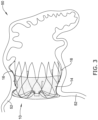
- FIG. 3 illustrates the example occlusive implant 10 positioned within the left atrial appendage 50. Additionally, FIG. 3 illustrates that the expandable framework 12 may be compliant and, therefore, substantially conform to and/or be in sealing engagement with the shape and/or geometry of a lateral wall of a left atrial appendage 50 in the expanded configuration. In some embodiments, the occlusive implant 10 may expand to a size, extent, or shape less than or different from a maximum unconstrained extent, as determined by the surrounding tissue 52 and/or lateral wall of the left atrial appendage. Additionally, FIG. 3 illustrates that the expandable framework 12 may be held fixed adjacent to the left atrial appendage by one or more anchoring members 16.
- the elements of the expandable framework 12 may be tailored to increase the flexibility and compliance of the expandable framework 12 and/or the occlusive implant 10, thereby permitting the expandable framework 12 and/or the occlusive implant 10 to conform to the tissue around it, rather than forcing the tissue to conform to the expandable framework 12 and/or the occlusive implant 10.
- Several example occlusion devices including various sealing features are disclosed below.
- one or more factors may result in improper sealing of the occlusive implant 10 along the tissue wall defining the left atrial appendage 50.
- the occlusive implant 10 may not conform to the tissue around it, whereby a gap forms between the occlusive implant 10 and the tissue wall defining the left atrial appendage.
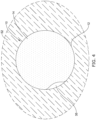
- FIG. 4 illustrates the occlusive implant 10 positioned within the left atrial appendage 50 (described above).
- the positioning of the occlusive implant 10 shown in FIG. 4 is similar to that shown in FIG. 3 , however, FIG. 4 illustrates an alternate view of the occlusive implant 10.
- FIG. 4 illustrates an end view of the occlusive implant 10 positioned in the left atrial appendage 50 (e.g., a view of the bottom of the occlusive device 10 looking inward at the left atrial appendage 50).
- FIG. 4 illustrates the occlusive member 14 spanning the proximal (e.g., left atrium facing) portion of the framework 12. Further, FIG.
- the occlusive member 14 may extend across the proximal portion of the framework 12 to a position where it contacts tissue 52 which is surrounding the left atrial appendage 50. It can be appreciated from FIG. 4 that the occlusive member 14 may extend circumferentially around the entire opening of the left atrial appendage. In other words, a portion of the occlusive member 14 may be positioned adjacent to the surrounding tissue 52 which is adjacent to the left atrial appendage (e.g., positioned around the circumference of the opening to the left atrial appendage 50).
- FIG. 4 illustrates that in some instances a gap 35 may form between the occlusive implant 10 and the surrounding tissue 52 defining the left atrial appendage 50.
- the occlusive device 10 may not entirely fill and/or conform to the specific shape and/or geometry of a lateral wall of a left atrial appendage 50 when positioned adjacent thereto, resulting in a gap 35.
- leakage may occur around an improperly sealed left occlusive implant. It can be appreciated that being able to identify leakage around an occlusive implant may allow a clinician to reposition the implant and seal off the leaking fluid. Alternatively, a clinician may opt to retrieve an occlusive implant which has been improperly positioned.
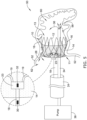
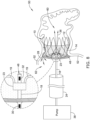
- FIG. 5 illustrates an example system and methodology for detecting fluid leakage around an occlusive implant 10.
- FIG. 5 illustrates the example occlusive implant 10 (including the framework 12 and the occlusive member 14) positioned within the left atrial appendage 50.
- FIG. 5 further illustrates that the distal end region 13 of the occlusive implant 10 extending farther into the left atrial appendage 50 as compared to the proximal end region 11 of the occlusive implant 10.
- FIG. 5 illustrates that the occlusive implant 10 may be compliant and, therefore, substantially conform to and/or be in sealing engagement with the shape and/or geometry of a lateral wall of a left atrial appendage 50 in the expanded configuration.
- the occlusive implant 10 may expand to a size, extent, or shape less than or different from a maximum unconstrained extent, as determined by the surrounding tissue 52 and/or lateral wall of the left atrial appendage 50. Additionally, FIG. 5 illustrates that the occlusive implant 10 may be held fixed adjacent to the left atrial appendage 50 by one or more anchoring members 16.
- FIG. 5 illustrates that the example occlusive implant 10 may be coupled to a core wire 18.
- the core wire 18 may be attached to the occlusive implant 10 via the central the hub 23.
- the detailed view of FIG. 5 illustrates the support members 19 of the framework 12 attached to the central hub 23.
- the detailed view of FIG. 5 further illustrates a first sensor 30 positioned along a portion of the core wire 18.
- the detailed view of FIG. 5 further illustrates a second sensor 32 disposed along a portion of the central hub 23.
- the examples described herein that include two sensors are not intended to be limiting. Rather, it is contemplated that any of the examples described herein may include more or less than two sensors. For example, the examples may include 1, 2, 3, 4, 5, 6 or more sensors.
- first sensor 30 and the second sensor 32 may be positioned and/or arranged along other portions of the core wire 18, the central hub 23, the framework 12 and/or the occlusive member 14.
- first sensor 30 and the second sensor 32 may each be positioned on the core wire 18.
- any of the sensors disclosed herein may be fully or partially embedded within any of the components (e.g., implants, core wires, catheters, expandable members, wires, etc.) described herein.
- the first sensor 30 and/or the second sensor 32 may be designed to sense, measure, collect, record, etc. one or more parameters related to the flow of fluid (e.g., blood) adjacent to the occlusive implant 10 and/or the left atrial appendage 50.
- the first sensor 30 and/or the second sensor 32 may be designed to sense, measure, collect and/or record fluid flowrates, fluid pressures, fluid temperature, etc.
- Any of the sensors described herein may include flow rates sensors, pressure sensors (e.g., piezoelectric sensors, Fiber Bragg sensors, optical pressure sensors, passive pressure sensors, etc.), temperature sensors, etc.
- any of the sensors described herein may be able to sense, measure, collect and/or record a combination of different parameters (e.g., a combination of fluid flowrates, fluid pressures, fluid temperature, etc.).
- the first sensor 30 and/or the second sensor 32 may be wired to a processor (not shown), whereby the processor may be designed to utilize the data sensed, measured and/or collected by the first sensor 30 and/or the second sensor 32 to calculate and/or compare one or more parameters (e.g., fluid flowrates, fluid pressures, fluid temperature, etc.).
- the processor may be designed to utilize the data sensed, measured and/or collected by the first sensor 30 and/or the second sensor 32 to calculate and/or compare one or more parameters (e.g., fluid flowrates, fluid pressures, fluid temperature, etc.).
- one or more parameters e.g., fluid flowrates, fluid pressures, fluid temperature, etc.
- the occlusive member 14 may substantially prevent fluid from flowing out of the left atrial appendage 50 and into the left atrium. Accordingly, it can be appreciated that the fluid flux between a properly sealed left atrial appendage 50 and the left atrium may be approximately zero (as no fluid would be flowing out any gaps between the occlusive implant 10 and the surrounding tissue 52). It is noted that the area inside the left atrial appendage 50 is denoted by the reference numeral "60" in FIG. 5 .
- the inside portion of the left atrial appendage 50 as contemplated herein may be defined as that portion of the left atrial appendage 50 bounded by the inner, concave surface of the occlusive implant 10. This is in contrast to the area “outside" the left atrial appendage 50 which is denoted by the reference numeral "62" in FIG. 5 . Further, “outside” the left atrial appendage 50 as contemplated herein may be defined as that portion of the left atrium located outside the outer, convex surface of the occlusive implant 10. In some examples, the occlusive member 14 may define the boundary between a fluid positioned inside the left atrial appendage 50 and the left atrium.
- a gap exists between the occlusive implant 10 and the surrounding tissue 52, it can be appreciated that fluid may flow from inside the left atrial appendage 50 to a location within the left atrium. Accordingly, the presence of leakage around the occlusive implant 10 may be detected by measuring a first parameter (e.g., a first fluid flowrate, a first fluid pressure, etc.) outside of the occlusive implant 10 and comparing it a second parameter (e.g., a second fluid flowrate, a second fluid pressure, etc.) on the inside of the occlusive implant 10.
- a first parameter e.g., a first fluid flowrate, a first fluid pressure, etc.
- a second parameter e.g., a second fluid flowrate, a second fluid pressure, etc.
- the difference between the first parameter value and the second parameter value may not only provide an indication of the presence of fluid leakage around the occlusive implant 10, but may also provide an indication of the degree (e.g., volumetric flow rate) of fluid leaking around the occlusive implant 10.
- FIG. 5 illustrates an example catheter 34 extending within a delivery catheter 24 ( FIG. 5 also shows the core wire 18 extending within the delivery catheter 24). Further, the catheter 34 may include a distal end region, a proximal end region and a lumen extending therein. As shown in FIG. 5 , the proximal end region of the catheter 34 may be coupled to a pump 38.
- a fluid e.g., saline
- the fluid may be pumped in a series of pulses (e.g., transient bolus injection).
- the fluid may be pumped as a steady-state fluid flow.
- FIG. 5 illustrates an example catheter 34 extending within a delivery catheter 24 ( FIG. 5 also shows the core wire 18 extending within the delivery catheter 24). Further, the catheter 34 may include a distal end region, a proximal end region and a lumen extending therein. As shown in FIG. 5 , the proximal end region of the catheter 34 may be coupled to a pump 38.
- FIG. 5 further illustrates that the catheter 34 may extend through the occlusive implant 10 such that the distal end region of the catheter 34 may be positioned inside the left atrial appendage 50. Further, FIG. 5 illustrates that fluid 36 may be pumped through a distal port 56 of the catheter 34 into the inside 60 of the left atrial appendage 50. For illustrative purposes, FIG. 5 shows fluid 28 leaking from one side of the occlusive implant 10 (e.g., from the inside area 60) to the other side of the occlusive implant 10 (e.g., to an area 62 within the left atrium).
- one side of the occlusive implant 10 e.g., from the inside area 60
- the other side of the occlusive implant 10 e.g., to an area 62 within the left atrium.
- the first sensor 30 may be utilized to measure a first parameter (e.g., a first fluid flowrate, a first fluid pressure, etc.) on the outside of the occlusive implant 10, while the second sensor 32 may be utilized to measure a second parameter (e.g., a second fluid flowrate, a second fluid pressure, etc.) on the inside of the occlusive implant 10.
- a first parameter e.g., a first fluid flowrate, a first fluid pressure, etc.
- a second parameter e.g., a second fluid flowrate, a second fluid pressure, etc.
- comparison of the parameter measurements may be utilized to determine the presence and extent of fluid leakage around the occlusive implant 10.
- any of the sensors described herein may be positioned externally to the body.
- Positioning one or more sensors outside of a patient's body may be beneficial because the complexity of the system may be reduced.
- externally-positioned sensors may be reused whereas sensors inside the body may be single-use (due to sterilization, for example).
- a leak may be calculated without having sensors inside the body by any means.
- external sensor readings may be coupled with internal sensor readings.
- the pump may measure flow rate externally while one or more pressures (or temperatures, etc.) may be measured internally on the implant or catheter.
- the parameters discussed above may vary with time. Therefore, changes in the parameters over time may provide additional information regarding the effective seal provided by the occlusive implant 10. For example, if the pump flow rate is held constant and the observed (e.g., measured, sensed) pressure inside the left atrial appendage 50 rises quasi-steadily over several hear beats, it may imply that the occlusive implant is providing a substantially effective seal. However, in another example, if the pump flowrate is held constant and the pressure rises and then becomes quasi-constant, provided that rise is negligible, it may imply that the there is a substantial leak between the occlusive implant 10 and the surrounding tissue 52. However, if the rise is relatively large, it may imply that the occlusive implant is providing a substantially effective seal.
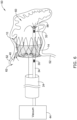
- FIG. 6 illustrates another example of a system and methodology to detect leakage around an example occlusive implant 10.
- FIG. 6 shows the occlusive implant 10 positioned within the opening of the left atrial appendage 50 similarly to that described above with respect to FIG. 5 .
- FIG. 6 illustrates that the catheter 34 may extend through the occlusive implant 10 such that the distal end region of the catheter 34 may be positioned inside the left atrial appendage 50.
- the first sensor 30 may be positioned along the catheter 34 at a location which is outside of the occlusive implant 10 and the second sensor 32 may be positioned along the distal end region of the catheter 34.
- FIG. 6 illustrates that the catheter 34 may be coupled to a vacuum 44. Accordingly, fluid 42 may be vacuumed into a distal port 56 of the catheter 34 from inside the left atrial appendage 50. The vacuuming of fluid into the catheter 34 from inside the left atrial appendage 50 may cause fluid to be pulled through gaps between the occlusive implant 10 and the surrounding tissue 52.
- FIG. 6 shows fluid 40 leaking into the occlusive implant 10 (e.g., from the outside area 62) to the other side of the occlusive implant 10 (e.g., to an area 60 inside the occlusive implant 10).
- the first sensor 30 may be utilized to measure a first parameter (e.g., a first fluid flowrate, a first fluid pressure, etc.) on the outside of the occlusive implant 10, while the second sensor 32 may be utilized to measure a second parameter (e.g., a second fluid flowrate, a second fluid pressure, etc.) on the inside of the occlusive implant 10.
- a first parameter e.g., a first fluid flowrate, a first fluid pressure, etc.
- a second parameter e.g., a second fluid flowrate, a second fluid pressure, etc.
- comparison of the parameter measurements may be utilized to determine the presence and extent of fluid leakage around the occlusive implant 10.
- FIG. 7 illustrates another example of a system and methodology to detect leakage around an example occlusive implant 10.
- FIG. 7 shows the occlusive implant 10 positioned within the opening of the left atrial appendage 50 similarly to that described above.
- FIG. 7 illustrates the catheter 34 may extend along occlusive implant 10 (e.g., between the occlusive implant 10 and the surrounding tissue 52), whereby the distal end region of the catheter 34 may be positioned inside the left atrial appendage 50.
- the first sensor 30 may be positioned along the catheter 34 at a location which is outside of the occlusive implant 10 and the second sensor 32 may be positioned along the distal end region of the catheter 34.
- FIG. 7 illustrates that the catheter 24 may be coupled to a pump 38. Accordingly, fluid 36 may be pumped through a distal port 56 of the catheter 34 into the inside 60 of the left atrial appendage 50.
- FIG. 7 shows fluid 28 leaking from one side of the occlusive implant 10 (e.g., from the inside area 60) to the other side of the occlusive implant 10 (e.g., to an area 62 within the left atrium).
- the first sensor 30 may be utilized to measure a first parameter (e.g., a first fluid flowrate, a first fluid pressure, etc.) on the outside of the occlusive implant 10, while the second sensor 32 may be utilized to measure a second parameter (e.g., a second fluid flowrate, a second fluid pressure, etc.) on the inside of the occlusive implant 10.
- a first parameter e.g., a first fluid flowrate, a first fluid pressure, etc.
- a second parameter e.g., a second fluid flowrate, a second fluid pressure, etc.
- comparison of the parameter measurements may be utilized to determine the presence and extent of fluid leakage around the occlusive implant 10.
- FIG. 8 illustrates another example of a system and methodology to detect leakage around an example occlusive implant 10.
- FIG. 8 shows the occlusive implant 10 positioned within the opening of the left atrial appendage 50 similarly to that described above.
- FIG. 8 illustrates that the example occlusive implant 10 may be coupled to a core wire 18.
- the core wire 18 may be coupled to a pump 38.
- the core wire 18 may be attached to the occlusive implant 10 via the central the hub 23.
- the detailed view of FIG. 8 illustrates the support members 19 of the framework 12 attached to the central hub 23.
- FIG. 8 further illustrates a first sensor 30 positioned along a portion of the core wire 18. Additionally, the detailed view of FIG. 8 further illustrates a second sensor 32 disposed along a portion of the core wire 18 adjacent to the central hub 23. It should be noted that in some examples, the core wire 18 is attached to the central hub 23.
- FIG. 8 further illustrates that, in some examples, a membrane 48 may be coupled to the core wire 18.
- the membrane 48 may extend along the outer surface of the framework 12, whereby the membrane is designed to prevent fluid from leaking out of the occlusive implant 10.
- the membrane 48 may be utilized to maintain a level of pressure within the occlusive implant 10 while fluid leakage is detected via any of the methodologies described above.
- the membrane 48 may be coated with a dissolvable wax, gel, sugar, salt or other similar media or compound to tailor the porosity of the membrane 48 and/or occlusive member 14. This coating may be designed to dissolve on its own or in accordance with a thermal or chemical means during and/or after leakage detection has taken place.
- FIG. 8 illustrates that in some instances the core wire 18 may include a lumen 46 through which fluid may be pumped.
- FIG. 8 further illustrates that the distal end region of the core wire 18 may extend through the occlusive implant 10 such that the distal end region of the core wire 18 may be positioned inside the left atrial appendage 50.
- FIG. 8 illustrates that fluid 36 may be pumped through the lumen 46 of the core wire 18 into the inside portion 60 of the left atrial appendage 50. The membrane may be held in place while the fluid 36 is pumped into the left atrial appendage 50.
- FIG. 8 shows fluid 28 leaking from one side of the occlusive implant 10 (e.g., from the inside area 60) to the other side of the occlusive implant 10 (e.g., to an area 62 within the left atrium).
- the first sensor 30 may be utilized to measure a first parameter (e.g., a first fluid flowrate, a first fluid pressure, etc.) on the outside of the occlusive implant 10, while the second sensor 32 may be utilized to measure a second parameter (e.g., a second fluid flowrate, a second fluid pressure, etc.) on the inside of the occlusive implant 10.
- a first parameter e.g., a first fluid flowrate, a first fluid pressure, etc.
- a second parameter e.g., a second fluid flowrate, a second fluid pressure, etc.
- comparison of the parameter measurements may be utilized to determine the presence and extent of fluid leakage around the occlusive implant 10.
- the membrane 48 may be retracted/removed after the first parameter and second parameters are determined.
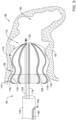
- FIG. 9 illustrates another example occlusive implant 110 positioned an opening of the left atrial appendage 50. Further, FIG. 9 illustrates another example of a system and methodology to detect leakage around an example occlusive implant 110.
- the occlusive implant 110 may be configured to shift between a collapsed configuration and an expanded configuration. For example, in some instances, the occlusive implant 110 may be in a collapsed configuration during delivery via an occlusive device delivery system, whereby the occlusive implant 110 expands to an expanded configuration once deployed from the occlusion implant delivery system.
- FIG. 9 further illustrates that the occlusive implant 110 may include a first end region 112 and a second end region 114.
- the first end region 112 may include the portion of the occlusive implant 110 which extends farthest into a left atrial appendage 50
- the second end region 114 may include the portion of the occlusive implant 110 which is positioned closer to an opening of the left atrial appendage 50.
- the occlusive implant 110 may include an expandable member 116.
- the expandable member 116 may also be referred to as an expandable balloon 116.
- the expandable member 116 may be formed from a highly compliant material (e.g., "inflation material") which permits the expandable member 116 to expand from a first unexpanded (e.g., deflated, collapsed, delivery) configuration to a second expanded (e.g., inflated, delivered) configuration.
- the expandable member 116 may be inflated to pressures from about 1 psi to about 200 psi. It can be appreciated that the outer diameter of the occlusive implant 110 may be larger in the expanded configuration versus the unexpanded configuration.
- Example materials used for the inflation material may be hydrogel beads (or other semi-solid materials), saline, etc.
- the expandable member 116 may be constructed from silicone or a low-durometer polymer, however, other materials are contemplated. Additionally, the expandable member 116 may be impermeable to blood and/or other fluids, such as water. In some embodiments, the expandable member 116 may include a woven, braided and/or knitted material, a fiber, a sheet-like material, a metallic or polymeric mesh, or other suitable construction. Further, in some embodiments, the expandable member 116 may prevent thrombi (e.g., blood clots, etc.) originating in the left atrial appendage from passing through the occlusive implant 110 and into the blood stream.
- thrombi e.g., blood clots, etc.
- the occlusive implant 110 may promote endothelial growth after implantation, thereby effectively removing the left atrial appendage from the patient's circulatory system.
- Some suitable, but non-limiting, examples of materials for the occlusive implant 110 are discussed below.
- FIG. 9 further illustrates that occlusive implant 110 may include one or more spine members 118 extending along the expandable member 116 from the second end region 114 to the first end region 112.
- the spine members 118 may be described as positioning members 118.
- FIG. 9 further illustrates that the each of the individual spine members 118 may be spaced apart from adjacent spine members 118. In other words, the spacing between adjacent spine members 118 may be substantially uniform around the circumference of the expandable member 116.
- the spine members 118 may include one or more materials which are stiffer, higher durometer materials than the material utilized to construct the expandable member 116. Some suitable, but non-limiting, examples of materials for the spine members 118 are discussed below.
- FIG. 9 further illustrates that the occlusive implant 110 may include a coating 128.
- the coating 128 may extend around the circumference of the occlusive implant 110 (including both the expandable member 116 and the spine members 118).
- the coating 128 may promote cellular growth along the surface thereof.
- the coating 128 may include elements which promote endothelial growth along the surface thereof.
- the endothelial growth elements may accelerate the ability for endothelial cellular tissue to form a seal across an opening of the left atrial appendage.
- the coating 128 may include a polymer mesh (e.g., PET mesh), a woven, braided and/or knitted material, a fiber, a sheet-like material, a metallic or polymeric mesh, or other similar materials which may be coupled to the outer surface of the expandable member 116.
- a polymer mesh e.g., PET mesh
- a woven, braided and/or knitted material e.g., PET mesh
- a fiber e.g., a woven, braided and/or knitted material
- a fiber e.g., a woven, braided and/or knitted material
- a fiber e.g., a woven, braided and/or knitted material
- a fiber e.g., a woven, braided and/or knitted material
- a fiber e.g., a woven, braided and/or knitted material
- a fiber e.g., a woven,
- FIG. 9 illustrates that the example occlusive implant 110 may be coupled to a core wire 119. Further, FIG. 9 illustrates that both the core wire 119 and a catheter 134 may extend through a delivery catheter 124. FIG. 9 also illustrates that the catheter 134 may extend along the occlusive implant 110 such that the distal end region of the catheter 134 may be positioned inside the left atrial appendage 50.
- FIG. 9 illustrates that a second catheter 164 may extend along the delivery catheter 124.
- the delivery catheter 124 may include a second lumen through which the second catheter 164 may extend.
- FIG. 9 illustrates that a first sensor 130 may be positioned along the catheter 164 at a location which is outside of the occlusive implant 110.
- FIG. 9 shows that, in some examples, a second sensor 132 may be positioned along the distal end region of the catheter 134.
- the first sensor 130 e.g., a first thermocouple
- a first parameter e.g., a first fluid temperature, a first fluid flowrate, a first fluid pressure, etc.
- the second sensor 132 e.g., a second thermocouple
- a second parameter e.g., a second fluid temperature, a second fluid flowrate, a second fluid pressure, etc.
- comparison of the parameter measurements may be utilized to determine the presence and extent of fluid leakage around the occlusive implant 110.
- the materials that can be used for the various components of the occlusive implant 10 and/or occlusive implant 110 (and variations, systems or components thereof disclosed herein) and the various elements thereof disclosed herein may include those commonly associated with medical devices.
- the following discussion makes reference to the occlusive implant 10 and/or occlusive implant 110 (and variations, systems or components disclosed herein). However, this is not intended to limit the devices and methods described herein, as the discussion may be applied to other elements, members, components, or devices disclosed herein.
- the occlusive implant 10 and/or occlusive implant 110 may be made from a metal, metal alloy, polymer (some examples of which are disclosed below), a metal-polymer composite, ceramics, combinations thereof, and the like, or other suitable material.
- suitable metals and metal alloys include stainless steel, such as 444V, 444L, and 314LV stainless steel; mild steel; nickel-titanium alloy such as linear-elastic and/or super-elastic nitinol; other nickel alloys such as nickel-chromium-molybdenum alloys (e.g., UNS: N06625 such as INCONEL ® 625, UNS: N06022 such as HASTELLOY ® C-22 ® , UNS: N10276 such as HASTELLOY ® C276 ® , other HASTELLOY ® alloys, and the like), nickel-copper alloys (e.g., UNS: N04400 such as MONEL ® 400, NICKELVAC ® 400, NICORROS ® 400, and the like), nickel-cobalt-chromium-molybdenum alloys (e.g., UNS: R44035 such as MP35-N ® and the like), nickel
- Linear elastic and/or non-super-elastic nitinol may be distinguished from super elastic nitinol in that the linear elastic and/or non-super-elastic nitinol does not display a substantial "superelastic plateau” or “flag region” in its stress/strain curve like super elastic nitinol does.
- linear elastic and/or non-super-elastic nitinol as recoverable strain increases, the stress continues to increase in a substantially linear, or a somewhat, but not necessarily entirely linear relationship until plastic deformation begins or at least in a relationship that is more linear than the super elastic plateau and/or flag region that may be seen with super elastic nitinol.
- linear elastic and/or non-super-elastic nitinol may also be termed "substantially" linear elastic and/or non-super-elastic nitinol.
- linear elastic and/or non-super-elastic nitinol may also be distinguishable from super elastic nitinol in that linear elastic and/or non-super-elastic nitinol may accept up to about 2-5% strain while remaining substantially elastic (e.g., before plastically deforming) whereas super elastic nitinol may accept up to about 8% strain before plastically deforming. Both of these materials can be distinguished from other linear elastic materials such as stainless steel (that can also be distinguished based on its composition), which may accept only about 0.2 to 0.44 percent strain before plastically deforming.
- the linear elastic and/or non-super-elastic nickel-titanium alloy is an alloy that does not show any martensite/austenite phase changes that are detectable by differential scanning calorimetry (DSC), dynamic mechanical thermal analysis (DMTA) analysis over a large temperature range and bend and free recovery (ASTM F2082).
- DSC differential scanning calorimetry
- DMTA dynamic mechanical thermal analysis
- ASTM F2082 bend and free recovery
- the mechanical bending properties of such material may therefore be generally inert to the effect of temperature over this very broad range of temperature.
- the mechanical bending properties of the linear elastic and/or non-super-elastic nickel-titanium alloy at ambient or room temperature are substantially the same as the mechanical properties at body temperature, for example, in that they do not display a super-elastic plateau and/or flag region.
- the linear elastic and/or non-super-elastic nickel-titanium alloy maintains its linear elastic and/or non-super-elastic characteristics and/or properties.
- the linear elastic and/or non-super-elastic nickel-titanium alloy may be in the range of about 50 to about 60 weight percent nickel, with the remainder being essentially titanium. In some embodiments, the composition is in the range of about 54 to about 57 weight percent nickel.
- a suitable nickel-titanium alloy is FHP-NT alloy commercially available from Furukawa Techno Material Co. of Kanagawa, Japan. Other suitable materials may include ULTANIUM TM (available from Neo-Metrics) and GUM METAL TM (available from Toyota).
- a superelastic alloy for example a superelastic nitinol can be used to achieve desired properties.
- portions or all of the occlusive implant 10 and/or occlusive implant 110 may also be doped with, made of, or otherwise include a radiopaque material.
- Radiopaque materials are understood to be materials capable of producing a relatively bright image on a fluoroscopy screen or another imaging technique during a medical procedure. This relatively bright image aids a user in determining the location of the occlusive implant 10 and/or occlusive implant 110 (and variations, systems or components thereof disclosed herein).
- Some examples of radiopaque materials can include, but are not limited to, gold, platinum, palladium, tantalum, tungsten alloy, polymer material loaded with a radiopaque filler, and the like. Additionally, other radiopaque marker bands and/or coils may also be incorporated into the design of the occlusive implant 10 and/or occlusive implant 110 (and variations, systems or components thereof disclosed herein) to achieve the same result.
- a degree of Magnetic Resonance Imaging (MRI) compatibility is imparted into the occlusive implant 10 and/or occlusive implant 110 (and variations, systems or components thereof disclosed herein).
- the occlusive implant 10 and/or occlusive implant 110 (and variations, systems or components thereof disclosed herein) and/or components or portions thereof may be made of a material that does not substantially distort the image and create substantial artifacts (e.g., gaps in the image). Certain ferromagnetic materials, for example, may not be suitable because they may create artifacts in an MRI image.
- the occlusive implant 10 (and variations, systems or components disclosed herein) or portions thereof may also be made from a material that the MRI machine can image.
- Some materials that exhibit these characteristics include, for example, tungsten, cobalt-chromium-molybdenum alloys (e.g., UNS: R44003 such as ELGILOY ® , PHYNOX ® , and the like), nickel-cobalt-chromium-molybdenum alloys (e.g., UNS: R44035 such as MP35-N ® and the like), nitinol, and the like, and others.
- cobalt-chromium-molybdenum alloys e.g., UNS: R44003 such as ELGILOY ® , PHYNOX ® , and the like
- nickel-cobalt-chromium-molybdenum alloys e.g., UNS: R44035 such as MP35-N ® and the like
- nitinol and the like, and others.
- the occlusive implant 10 and/or occlusive implant 110 may be made from or include a polymer or other suitable material.
- suitable polymers may include copolymers, polyisobutylene-polyurethane, polytetrafluoroethylene (PTFE), ethylene tetrafluoroethylene (ETFE), fluorinated ethylene propylene (FEP), polyoxymethylene (POM, for example, DELRIN ® available from DuPont), polyether block ester, polyurethane (for example, Polyurethane 85A), polypropylene (PP), polyvinylchloride (PVC), polyether-ester (for example, ARNITEL ® available from DSM Engineering Plastics), ether or ester based copolymers (for example, butylene/poly(alkylene ether) phthalate and/or other polyester elastomers such as HYTREL ® available from Du
- the occlusive implant 10 and/or occlusive implant 110 may include a textile material.
- suitable textile materials may include synthetic yarns that may be flat, shaped, twisted, textured, pre-shrunk or un-shrunk.
- Synthetic biocompatible yarns suitable for use in the present disclosure include, but are not limited to, polyesters, including polyethylene terephthalate (PET) polyesters, polypropylenes, polyethylenes, polyurethanes, polyolefins, polyvinyls, polymethylacetates, polyamides, naphthalene dicarboxylene derivatives, natural silk, and polytetrafluoroethylenes.
- PET polyethylene terephthalate
- the synthetic yarns may be a metallic yarn or a glass or ceramic yarn or fiber.
- Useful metallic yarns include those yarns made from or containing stainless steel, platinum, gold, titanium, tantalum or aNi-Co-Cr-based alloy.
- the yarns may further include carbon, glass or ceramic fibers.
- the yarns are made from thermoplastic materials including, but not limited to, polyesters, polypropylenes, polyethylenes, polyurethanes, polynaphthalenes, polytetrafluoroethylenes, and the like.
- the yarns may be of the multifilament, monofilament, or spun-types.
- the type and denier of the yarn chosen may be selected in a manner which forms a biocompatible and implantable prosthesis and, more particularly, a vascular structure having desirable properties.
- the occlusive implant 10 and/or occlusive implant 110 may include and/or be treated with a suitable therapeutic agent.
- suitable therapeutic agents may include anti-thrombogenic agents (such as heparin, heparin derivatives, urokinase, and PPack (dextrophenylalanine proline arginine chloromethylketone)); anti-proliferative agents (such as enoxaparin, angiopeptin, monoclonal antibodies capable of blocking smooth muscle cell proliferation, hirudin, and acetylsalicylic acid); anti-inflammatory agents (such as dexamethasone, prednisolone, corticosterone, budesonide, estrogen, sulfasalazine, and mesalamine); antineoplastic/antiproliferative/anti-mitotic agents (such as paclitaxel, 5-fluorouracil, cisplatin, vinblastine
- anti-thrombogenic agents such as heparin, he
- an occlusive implant for use in the left atrial appendage of the heart
- the aforementioned features may also be useful in other types of medical implants where a fabric or membrane is attached to a frame or support structure including, but not limited to, implants for the treatment of aneurysms (e.g., abdominal aortic aneurysms, thoracic aortic aneurysms, etc.), replacement valve implants (e.g., replacement heart valve implants, replacement aortic valve implants, replacement mitral valve implants, replacement vascular valve implants, etc.), and/or other types of occlusive devices (e.g., atrial septal occluders, cerebral aneurysm occluders, peripheral artery occluders, etc.).
- aneurysms e.g., abdominal aortic aneurysms, thoracic aortic aneurysms, etc.
- replacement valve implants e.g., replacement heart valve implants, replacement
Landscapes
- Health & Medical Sciences (AREA)
- Life Sciences & Earth Sciences (AREA)
- Surgery (AREA)
- Molecular Biology (AREA)
- General Health & Medical Sciences (AREA)
- Veterinary Medicine (AREA)
- Engineering & Computer Science (AREA)
- Biomedical Technology (AREA)
- Heart & Thoracic Surgery (AREA)
- Medical Informatics (AREA)
- Public Health (AREA)
- Animal Behavior & Ethology (AREA)
- Cardiology (AREA)
- Physics & Mathematics (AREA)
- Biophysics (AREA)
- Pathology (AREA)
- Physiology (AREA)
- Vascular Medicine (AREA)
- Nuclear Medicine, Radiotherapy & Molecular Imaging (AREA)
- Reproductive Health (AREA)
- Transplantation (AREA)
- Pulmonology (AREA)
- Surgical Instruments (AREA)
Claims (15)
- System zum Detektieren einer Undichtigkeit um ein okklusives Implantat, das im linken Herzohr angeordnet ist, wobei das System aufweist:ein okklusives Implantat (10), das dazu konfiguriert ist, in einem linken Herzohr (50) angeordnet zu werden;einen länglichen Schaft (34) mit einem Port (56), der an einem distalen Endbereich davon angeordnet ist;einen ersten Sensor (30), der benachbart zum länglichen Schaft (34) angeordnet ist; undeinen Kerndraht (18), der dazu konfiguriert ist, mit dem okklusiven Implantat (10) gekoppelt zu werden;wobei der längliche Schaft (34) dazu konfiguriert ist, benachbart zum okklusiven Implantat (10) so positioniert zu werden, dass der erste Sensor (30) auf einer ersten Seite des okklusiven Implantats (10) positioniert ist, und wobei der Port (56) auf einer zweiten Seite des okklusiven Implantats (10) positioniert ist;wobei der erste Sensor (30) dazu konfiguriert ist, einen ersten Parameter zu messen;wobei der erste Parameter genutzt wird, um eine Fluidundichtigkeit zwischen dem okklusiven Implantat (10) und einer das linke Herzohr (50) bildenden Gewebewand zu bestimmen; undwobei der erste Sensor (30) entlang eines Abschnitts des Kerndrahts (18) oder entlang des länglichen Schafts (34) positioniert ist.
- System nach Anspruch 1, wobei der erste Parameter einen Fluiddurchsatz, einen Fluiddruck und eine Fluidtemperatur aufweist.
- System nach Anspruch 1 oder 2, wobei der längliche Schaft (34) dazu konfiguriert ist, Fluid in das linke Herzohr (50) zu injizieren.
- System nach einem der Ansprüche 1 bis 3, wobei der längliche Schaft (34) dazu konfiguriert ist, Fluid aus dem linken Herzohr (50) abzusaugen.
- System nach einem der Ansprüche 1 bis 4, wobei der Kerndraht (18) mit dem okklusiven Implantat (10) gekoppelt ist und wobei der erste Sensor (30) auf dem Kerndraht (18) angeordnet ist.
- System nach einem der Ansprüche 1 bis 5, wobei der erste Sensor (30) entlang des Abschnitts des Kerndrahts (18) positioniert ist, ferner mit einem zweiten Sensor (32), der an einer zentralen Stelle (23) des okklusiven Implantats (10) angeordnet ist.
- System nach einem der Ansprüche 1 bis 4, wobei der erste Sensor (30) am länglichen Schaft (34) angebracht ist.
- System nach einem der Ansprüche 1 bis 4, wobei der erste Sensor (30) entlang des länglichen Schafts (34) positioniert ist, ferner mit einem zweiten Sensor (32), der am länglichen Schaft (34) auf der zweiten Seite des Implantats (10) angebracht ist.
- System nach einem der Ansprüche 1 bis 4, wobei der längliche Schaft (34) den Kerndraht (18) und einen zweiten Sensor (32) aufweist, wobei der Kerndraht (18) mit dem okklusiven Implantat (10) gekoppelt ist und wobei der erste Sensor (30) auf dem Kerndraht (18) auf der ersten Seite des Implantats (10) angeordnet ist und wobei der zweite Sensor (32) auf dem Kerndraht (18) auf der zweiten Seite des Implantats (10) angeordnet ist.
- System nach einem der Ansprüche 1 bis 9, ferner mit einer Membran (48), die mit der ersten Seite des okklusiven Implantats (10) gekoppelt ist.
- System nach Anspruch 10, wobei die Membran (48) dazu konfiguriert ist, Fluid daran zu hindern, sie zu durchlaufen.
- System nach Anspruch 10 oder 11, wobei die Membran (48) zurückziehbar ist.
- System nach einem der Ansprüche 10 bis 12, wobei die Membran (48) ein absorbierbares Material aufweist.
- System nach einem der Ansprüche 1 bis 13, wobei der Sensor (30) drahtlos ist.
- System nach einem der Ansprüche 1 bis 4, 10 bis 14,wobei der erste Sensor (30) entlang des länglichen Schafts (34) positioniert ist,wobei der längliche Schaft (34) den auf einem ersten Abschnitt davon positionierten ersten Sensor (30) und einen entlang eines zweiten Abschnitts davon angeordneten zweiten Sensor (32) hat;wobei der längliche Schaft (34) dazu konfiguriert ist, benachbart zum okklusiven Implantat (10) so positioniert zu werden, dass der erste Sensor (30) auf einer ersten Seite des okklusiven Implantats (10) positioniert ist, und wobei der zweite Sensor (32) auf einer zweiten Seite des okklusiven Implantats (10) positioniert ist;wobei der erste Sensor (30) so konfiguriert ist, dass er einen ersten Parameter misst;wobei der zweite Sensor (32) so konfiguriert ist, dass er einen zweiten Parameter misst;wobei der erste Parameter mit dem zweiten Parameter verglichen wird, um eine Fluidundichtigkeit zwischen dem okklusiven Implantat (10) und einer das linke Herzohr (50) bildenden Gewebewand zu bestimmen.
Priority Applications (1)
| Application Number | Priority Date | Filing Date | Title |
|---|---|---|---|
| EP24202749.8A EP4512318A3 (de) | 2018-05-02 | 2019-05-01 | Sensorsystem für okklusive versiegelung |
Applications Claiming Priority (2)
| Application Number | Priority Date | Filing Date | Title |
|---|---|---|---|
| US201862665830P | 2018-05-02 | 2018-05-02 | |
| PCT/US2019/030220 WO2019213274A1 (en) | 2018-05-02 | 2019-05-01 | Occlusive sealing sensor system |
Related Child Applications (2)
| Application Number | Title | Priority Date | Filing Date |
|---|---|---|---|
| EP24202749.8A Division EP4512318A3 (de) | 2018-05-02 | 2019-05-01 | Sensorsystem für okklusive versiegelung |
| EP24202749.8A Division-Into EP4512318A3 (de) | 2018-05-02 | 2019-05-01 | Sensorsystem für okklusive versiegelung |
Publications (2)
| Publication Number | Publication Date |
|---|---|
| EP3787484A1 EP3787484A1 (de) | 2021-03-10 |
| EP3787484B1 true EP3787484B1 (de) | 2024-11-27 |
Family
ID=66530506
Family Applications (2)
| Application Number | Title | Priority Date | Filing Date |
|---|---|---|---|
| EP19723998.1A Active EP3787484B1 (de) | 2018-05-02 | 2019-05-01 | Sensorsystem für okklusive versiegelung |
| EP24202749.8A Pending EP4512318A3 (de) | 2018-05-02 | 2019-05-01 | Sensorsystem für okklusive versiegelung |
Family Applications After (1)
| Application Number | Title | Priority Date | Filing Date |
|---|---|---|---|
| EP24202749.8A Pending EP4512318A3 (de) | 2018-05-02 | 2019-05-01 | Sensorsystem für okklusive versiegelung |
Country Status (3)
| Country | Link |
|---|---|
| US (1) | US11331104B2 (de) |
| EP (2) | EP3787484B1 (de) |
| WO (1) | WO2019213274A1 (de) |
Families Citing this family (19)
| Publication number | Priority date | Publication date | Assignee | Title |
|---|---|---|---|---|
| WO2014164572A1 (en) | 2013-03-13 | 2014-10-09 | Kaplan Aaron V | Devices and methods for excluding the left atrial appendage |
| US11399842B2 (en) | 2013-03-13 | 2022-08-02 | Conformal Medical, Inc. | Devices and methods for excluding the left atrial appendage |
| JP7071350B2 (ja) | 2016-10-27 | 2022-05-18 | コンフォーマル・メディカル・インコーポレイテッド | 左心耳を排除するためのデバイスおよび方法 |
| US11426172B2 (en) | 2016-10-27 | 2022-08-30 | Conformal Medical, Inc. | Devices and methods for excluding the left atrial appendage |
| JP7134229B2 (ja) | 2017-07-06 | 2022-09-09 | ラグビア バスデ, | 組織把持デバイスおよび関連方法 |
| WO2020142613A1 (en) | 2019-01-04 | 2020-07-09 | Shifamed Holdings, Llc | Internal recharging systems and methods of use |
| CN118717212A (zh) | 2019-02-08 | 2024-10-01 | 保形医疗公司 | 用于除去左心耳的装置 |
| US12144508B2 (en) | 2019-02-08 | 2024-11-19 | Conformal Medical, Inc. | Devices and methods for excluding the left atrial appendage |
| US12151071B2 (en) | 2019-09-09 | 2024-11-26 | Shifamed Holdings, Llc | Adjustable shunts and associated systems and methods |
| US11903589B2 (en) | 2020-03-24 | 2024-02-20 | Boston Scientific Scimed, Inc. | Medical system for treating a left atrial appendage |
| WO2021217059A1 (en) | 2020-04-23 | 2021-10-28 | Shifamed Holdings, Llc | Power management for interatrial shunts and associated systems and methods |
| CN116367795A (zh) | 2020-08-25 | 2023-06-30 | 施菲姆德控股有限责任公司 | 可调节的心房间分流器及相关联的系统和方法 |
| WO2022103973A1 (en) | 2020-11-12 | 2022-05-19 | Shifamed Holdings, Llc | Adjustable implantable devices and associated methods |
| WO2022115690A1 (en) * | 2020-11-30 | 2022-06-02 | Boston Scientific Scimed, Inc. | Implantable passive mean pressure sensor |
| JP7564370B2 (ja) * | 2020-12-18 | 2024-10-08 | ボストン サイエンティフィック サイムド,インコーポレイテッド | センシング機能を有する閉塞性医療装置 |
| WO2022155344A1 (en) * | 2021-01-14 | 2022-07-21 | Boston Scientific Scimed, Inc. | Medical system for treating a left atrial appendage |
| US12090290B2 (en) | 2021-03-09 | 2024-09-17 | Shifamed Holdings, Llc | Shape memory actuators for adjustable shunting systems, and associated systems and methods |
| WO2022246163A1 (en) * | 2021-05-21 | 2022-11-24 | Edwards Lifesciences Corporation | Implant-coupled sensors |
| US20230284918A1 (en) * | 2022-03-08 | 2023-09-14 | Medtronic Vascular, Inc. | Endovascular pressure gradient determination method |
Family Cites Families (244)
| Publication number | Priority date | Publication date | Assignee | Title |
|---|---|---|---|---|
| US1782830A (en) | 1927-01-29 | 1930-11-25 | Barium Reduction Corp | Manufacture of strontium oxide |
| US1967318A (en) | 1931-10-02 | 1934-07-24 | Monahan William | Apparatus for the treatment of the urethra |
| US3402710A (en) | 1966-06-27 | 1968-09-24 | Hydra Power Corp | Self-closing valve device for implantation in the human body |
| US3540431A (en) | 1968-04-04 | 1970-11-17 | Kazi Mobin Uddin | Collapsible filter for fluid flowing in closed passageway |
| US3638652A (en) | 1970-06-01 | 1972-02-01 | James L Kelley | Surgical instrument for intraluminal anastomosis |
| US3844302A (en) | 1970-09-14 | 1974-10-29 | Telesco Brophey Ltd | Collapsible umbrella |
| US3874388A (en) | 1973-02-12 | 1975-04-01 | Ochsner Med Found Alton | Shunt defect closure system |
| US5904680A (en) | 1992-09-25 | 1999-05-18 | Ep Technologies, Inc. | Multiple electrode support structures having optimal bio-mechanical characteristics |
| US4007743A (en) | 1975-10-20 | 1977-02-15 | American Hospital Supply Corporation | Opening mechanism for umbrella-like intravascular shunt defect closure device |
| US4603693A (en) | 1977-05-26 | 1986-08-05 | United States Surgical Corporation | Instrument for circular surgical stapling of hollow body organs and disposable cartridge therefor |
| US4341218A (en) | 1978-05-30 | 1982-07-27 | University Of California | Detachable balloon catheter |
| US4309776A (en) | 1980-05-13 | 1982-01-12 | Ramon Berguer | Intravascular implantation device and method of using the same |
| US4364392A (en) | 1980-12-04 | 1982-12-21 | Wisconsin Alumni Research Foundation | Detachable balloon catheter |
| US4545367A (en) | 1982-07-16 | 1985-10-08 | Cordis Corporation | Detachable balloon catheter and method of use |
| US4638803A (en) | 1982-09-30 | 1987-01-27 | Rand Robert W | Medical apparatus for inducing scar tissue formation in a body |
| US4585000A (en) | 1983-09-28 | 1986-04-29 | Cordis Corporation | Expandable device for treating intravascular stenosis |
| US4665906A (en) | 1983-10-14 | 1987-05-19 | Raychem Corporation | Medical devices incorporating sim alloy elements |
| EP0160025B1 (de) | 1983-10-20 | 1989-12-13 | KETHARANATHAN, Vettivetpillai | Biomaterial |
| US4611594A (en) | 1984-04-11 | 1986-09-16 | Northwestern University | Medical instrument for containment and removal of calculi |
| DK151404C (da) | 1984-05-23 | 1988-07-18 | Cook Europ Aps William | Sammenklappeligt filter til implantation i en patients blodkar |
| US4710192A (en) | 1985-12-30 | 1987-12-01 | Liotta Domingo S | Diaphragm and method for occlusion of the descending thoracic aorta |
| US4793348A (en) | 1986-11-15 | 1988-12-27 | Palmaz Julio C | Balloon expandable vena cava filter to prevent migration of lower extremity venous clots into the pulmonary circulation |
| US5037810A (en) | 1987-03-17 | 1991-08-06 | Saliba Jr Michael J | Medical application for heparin and related molecules |
| WO1989006551A1 (fr) | 1988-01-12 | 1989-07-27 | Kievsky Nauchno-Issledovatelsky Institut Neirokhir | Dispositif d'occlusion |
| US4832055A (en) | 1988-07-08 | 1989-05-23 | Palestrant Aubrey M | Mechanically locking blood clot filter |
| US6120437A (en) | 1988-07-22 | 2000-09-19 | Inbae Yoon | Methods for creating spaces at obstructed sites endoscopically and methods therefor |
| US4921484A (en) | 1988-07-25 | 1990-05-01 | Cordis Corporation | Mesh balloon catheter device |
| US4917089A (en) | 1988-08-29 | 1990-04-17 | Sideris Eleftherios B | Buttoned device for the transvenous occlusion of intracardiac defects |
| FR2641692A1 (fr) | 1989-01-17 | 1990-07-20 | Nippon Zeon Co | Bouchon de fermeture d'une breche pour application medicale et dispositif pour bouchon de fermeture l'utilisant |
| DE8904371U1 (de) | 1989-04-07 | 1989-06-08 | Herzberg, Wolfgang, Dr. med., 2000 Wedel | Auslaß- und Instrumentenkanal für die Arthroskopie |
| NL8901350A (nl) | 1989-05-29 | 1990-12-17 | Wouter Matthijs Muijs Van De M | Afsluitsamenstel. |
| US5421832A (en) | 1989-12-13 | 1995-06-06 | Lefebvre; Jean-Marie | Filter-catheter and method of manufacturing same |
| US5041093A (en) | 1990-01-31 | 1991-08-20 | Boston Scientific Corp. | Catheter with foraminous anchor |
| US5122136A (en) | 1990-03-13 | 1992-06-16 | The Regents Of The University Of California | Endovascular electrolytically detachable guidewire tip for the electroformation of thrombus in arteries, veins, aneurysms, vascular malformations and arteriovenous fistulas |
| DE69102515T2 (de) | 1990-04-02 | 1994-10-20 | Kanji Inoue | Vorrichtung zum verschliessen einer nebenschlussöffnung mittels eines nichtoperativen verfahrens. |
| US5071407A (en) | 1990-04-12 | 1991-12-10 | Schneider (U.S.A.) Inc. | Radially expandable fixation member |
| US5078736A (en) | 1990-05-04 | 1992-01-07 | Interventional Thermodynamics, Inc. | Method and apparatus for maintaining patency in the body passages |
| FR2663217B1 (fr) | 1990-06-15 | 1992-10-16 | Antheor | Dispositif filtrant destine a la prevention des embolies. |
| US5064435A (en) | 1990-06-28 | 1991-11-12 | Schneider (Usa) Inc. | Self-expanding prosthesis having stable axial length |
| US5098440A (en) | 1990-08-14 | 1992-03-24 | Cordis Corporation | Object retrieval method and apparatus |
| US5141515A (en) | 1990-10-11 | 1992-08-25 | Eberbach Mark A | Apparatus and methods for repairing hernias |
| US5042707A (en) | 1990-10-16 | 1991-08-27 | Taheri Syde A | Intravascular stapler, and method of operating same |
| US5116360A (en) | 1990-12-27 | 1992-05-26 | Corvita Corporation | Mesh composite graft |
| US5108420A (en) | 1991-02-01 | 1992-04-28 | Temple University | Aperture occlusion device |
| US5350398A (en) | 1991-05-13 | 1994-09-27 | Dusan Pavcnik | Self-expanding filter for percutaneous insertion |
| ES2120449T3 (es) | 1991-05-29 | 1998-11-01 | Origin Medsystems Inc | Dispositivo de retraccion para la cirujia endoscopica. |
| SE9101839L (sv) | 1991-06-14 | 1992-10-12 | Ams Medinvent Sa | Anordning foer transluminal uttagning eller implantation av en stent samt apparat innefattande en dylik anordning |
| US5735290A (en) | 1993-02-22 | 1998-04-07 | Heartport, Inc. | Methods and systems for performing thoracoscopic coronary bypass and other procedures |
| CA2078530A1 (en) | 1991-09-23 | 1993-03-24 | Jay Erlebacher | Percutaneous arterial puncture seal device and insertion tool therefore |
| US5366504A (en) | 1992-05-20 | 1994-11-22 | Boston Scientific Corporation | Tubular medical prosthesis |
| US5256146A (en) | 1991-10-11 | 1993-10-26 | W. D. Ensminger | Vascular catheterization system with catheter anchoring feature |
| DE69229539T2 (de) | 1991-11-05 | 2000-02-17 | Children's Medical Center Corp., Boston | Okklusionsvorrichtung zur Reparatur von Herz- und Gefäss-Defekten |
| CA2082090C (en) | 1991-11-05 | 2004-04-27 | Jack Fagan | Improved occluder for repair of cardiac and vascular defects |
| US5282827A (en) | 1991-11-08 | 1994-02-01 | Kensey Nash Corporation | Hemostatic puncture closure system and method of use |
| US5258000A (en) | 1991-11-25 | 1993-11-02 | Cook Incorporated | Tissue aperture repair device |
| US5176692A (en) | 1991-12-09 | 1993-01-05 | Wilk Peter J | Method and surgical instrument for repairing hernia |
| US5258042A (en) | 1991-12-16 | 1993-11-02 | Henry Ford Health System | Intravascular hydrogel implant |
| US5626605A (en) | 1991-12-30 | 1997-05-06 | Scimed Life Systems, Inc. | Thrombosis filter |
| DE69324239T2 (de) | 1992-01-21 | 1999-11-04 | The Regents Of The University Of Minnesota, Minneapolis | Verschlusseinrichtung eines septumschadens |
| US5409444A (en) | 1992-03-04 | 1995-04-25 | Kensey Nash Corporation | Method and apparatus to reduce injury to the vascular system |
| FR2689388B1 (fr) | 1992-04-07 | 1999-07-16 | Celsa Lg | Filtre sanguin perfectionne eventuellement resorbable. |
| US5637097A (en) | 1992-04-15 | 1997-06-10 | Yoon; Inbae | Penetrating instrument having an expandable anchoring portion |
| US5707362A (en) | 1992-04-15 | 1998-01-13 | Yoon; Inbae | Penetrating instrument having an expandable anchoring portion for triggering protrusion of a safety member and/or retraction of a penetrating member |
| US5766246A (en) | 1992-05-20 | 1998-06-16 | C. R. Bard, Inc. | Implantable prosthesis and method and apparatus for loading and delivering an implantable prothesis |
| US5527338A (en) | 1992-09-02 | 1996-06-18 | Board Of Regents, The University Of Texas System | Intravascular device |
| US5469867A (en) | 1992-09-02 | 1995-11-28 | Landec Corporation | Cast-in place thermoplastic channel occluder |
| US5443478A (en) | 1992-09-02 | 1995-08-22 | Board Of Regents, The University Of Texas System | Multi-element intravascular occlusion device |
| FR2696092B1 (fr) | 1992-09-28 | 1994-12-30 | Lefebvre Jean Marie | Kit à usage médical composé d'un filtre et de son dispositif de mise en place dans le vaisseau. |
| US5304184A (en) | 1992-10-19 | 1994-04-19 | Indiana University Foundation | Apparatus and method for positive closure of an internal tissue membrane opening |
| US5382259A (en) | 1992-10-26 | 1995-01-17 | Target Therapeutics, Inc. | Vasoocclusion coil with attached tubular woven or braided fibrous covering |
| US5643317A (en) | 1992-11-25 | 1997-07-01 | William Cook Europe S.A. | Closure prosthesis for transcatheter placement |
| US5443454A (en) | 1992-12-09 | 1995-08-22 | Terumo Kabushiki Kaisha | Catheter for embolectomy |
| US5417699A (en) | 1992-12-10 | 1995-05-23 | Perclose Incorporated | Device and method for the percutaneous suturing of a vascular puncture site |
| US5284488A (en) | 1992-12-23 | 1994-02-08 | Sideris Eleftherios B | Adjustable devices for the occlusion of cardiac defects |
| US5653690A (en) | 1992-12-30 | 1997-08-05 | Medtronic, Inc. | Catheter having a balloon with retention enhancement |
| US5797960A (en) | 1993-02-22 | 1998-08-25 | Stevens; John H. | Method and apparatus for thoracoscopic intracardiac procedures |
| US6161543A (en) | 1993-02-22 | 2000-12-19 | Epicor, Inc. | Methods of epicardial ablation for creating a lesion around the pulmonary veins |
| US5306234A (en) | 1993-03-23 | 1994-04-26 | Johnson W Dudley | Method for closing an atrial appendage |
| US5643309A (en) | 1993-03-25 | 1997-07-01 | Myler; Richard | Cardiovascular stent and retrieval apparatus |
| US5353784A (en) | 1993-04-02 | 1994-10-11 | The Research Foundation Of Suny | Endoscopic device and method of use |
| EP0630617B1 (de) | 1993-06-24 | 1998-09-02 | Schneider (Europe) GmbH | Aspirationskatheteranordnung |
| US5735892A (en) | 1993-08-18 | 1998-04-07 | W. L. Gore & Associates, Inc. | Intraluminal stent graft |
| US5527322A (en) | 1993-11-08 | 1996-06-18 | Perclose, Inc. | Device and method for suturing of internal puncture sites |
| US5490856A (en) | 1993-12-14 | 1996-02-13 | Untied States Surgical Corporation | Purse string stapler |
| US5591196A (en) | 1994-02-10 | 1997-01-07 | Endovascular Systems, Inc. | Method for deployment of radially expandable stents |
| US5634942A (en) | 1994-04-21 | 1997-06-03 | B. Braun Celsa | Assembly comprising a blood filter for temporary or definitive use and a device for implanting it |
| US5732872A (en) | 1994-06-17 | 1998-03-31 | Heartport, Inc. | Surgical stapling instrument |
| US5522836A (en) | 1994-06-27 | 1996-06-04 | Target Therapeutics, Inc. | Electrolytically severable coil assembly with movable detachment point |
| US5725552A (en) | 1994-07-08 | 1998-03-10 | Aga Medical Corporation | Percutaneous catheter directed intravascular occlusion devices |
| US6123715A (en) | 1994-07-08 | 2000-09-26 | Amplatz; Curtis | Method of forming medical devices; intravascular occlusion devices |
| US5846261A (en) | 1994-07-08 | 1998-12-08 | Aga Medical Corp. | Percutaneous catheter directed occlusion devices |
| US5397355A (en) | 1994-07-19 | 1995-03-14 | Stentco, Inc. | Intraluminal stent |
| US5433727A (en) | 1994-08-16 | 1995-07-18 | Sideris; Eleftherios B. | Centering buttoned device for the occlusion of large defects for occluding |
| US5643282A (en) | 1994-08-22 | 1997-07-01 | Kieturakis; Maciej J. | Surgical instrument and method for removing tissue from an endoscopic workspace |
| US5891558A (en) | 1994-11-22 | 1999-04-06 | Tissue Engineering, Inc. | Biopolymer foams for use in tissue repair and reconstruction |
| US5709704A (en) | 1994-11-30 | 1998-01-20 | Boston Scientific Corporation | Blood clot filtering |
| US6013093A (en) | 1995-11-28 | 2000-01-11 | Boston Scientific Corporation | Blood clot filtering |
| US5690671A (en) | 1994-12-13 | 1997-11-25 | Micro Interventional Systems, Inc. | Embolic elements and methods and apparatus for their delivery |
| US6171329B1 (en) | 1994-12-19 | 2001-01-09 | Gore Enterprise Holdings, Inc. | Self-expanding defect closure device and method of making and using |
| US5879366A (en) | 1996-12-20 | 1999-03-09 | W.L. Gore & Associates, Inc. | Self-expanding defect closure device and method of making and using |
| US5643292A (en) | 1995-01-10 | 1997-07-01 | Applied Medical Resources Corporation | Percutaneous suturing device |
| US5702421A (en) | 1995-01-11 | 1997-12-30 | Schneidt; Bernhard | Closure device for closing a vascular opening, such as patent ductus arteriosus |
| US5614204A (en) | 1995-01-23 | 1997-03-25 | The Regents Of The University Of California | Angiographic vascular occlusion agents and a method for hemostatic occlusion |
| US5634936A (en) | 1995-02-06 | 1997-06-03 | Scimed Life Systems, Inc. | Device for closing a septal defect |
| CA2566929C (en) | 1995-03-10 | 2009-04-21 | Bard Peripheral Vascular, Inc. | Endoluminal encapsulated stent and methods of manufacture and endoluminal delivery |
| US6124523A (en) | 1995-03-10 | 2000-09-26 | Impra, Inc. | Encapsulated stent |
| US5849005A (en) | 1995-06-07 | 1998-12-15 | Heartport, Inc. | Method and apparatus for minimizing the risk of air embolism when performing a procedure in a patient's thoracic cavity |
| US5645558A (en) | 1995-04-20 | 1997-07-08 | Medical University Of South Carolina | Anatomically shaped vasoocclusive device and method of making the same |
| US5681347A (en) | 1995-05-23 | 1997-10-28 | Boston Scientific Corporation | Vena cava filter delivery system |
| US5709224A (en) | 1995-06-07 | 1998-01-20 | Radiotherapeutics Corporation | Method and device for permanent vessel occlusion |
| US6132438A (en) | 1995-06-07 | 2000-10-17 | Ep Technologies, Inc. | Devices for installing stasis reducing means in body tissue |
| US5725568A (en) | 1995-06-27 | 1998-03-10 | Scimed Life Systems, Inc. | Method and device for recanalizing and grafting arteries |
| US5785679A (en) | 1995-07-19 | 1998-07-28 | Endotex Interventional Systems, Inc. | Methods and apparatus for treating aneurysms and arterio-venous fistulas |
| US5749883A (en) | 1995-08-30 | 1998-05-12 | Halpern; David Marcos | Medical instrument |
| EP0861049B1 (de) | 1995-10-30 | 2001-04-11 | Children's Medical Center Corporation | Selbstzentrierende, schirmartige vorrichtung zum verschliessen eines septal-defektes |
| US5769816A (en) | 1995-11-07 | 1998-06-23 | Embol-X, Inc. | Cannula with associated filter |
| US5989281A (en) | 1995-11-07 | 1999-11-23 | Embol-X, Inc. | Cannula with associated filter and methods of use during cardiac surgery |
| AU690862B2 (en) | 1995-12-04 | 1998-04-30 | Target Therapeutics, Inc. | Fibered micro vaso-occlusive devices |
| WO1997021402A1 (en) | 1995-12-14 | 1997-06-19 | Prograft Medical, Inc. | Stent-graft deployment apparatus and method |
| US5749894A (en) | 1996-01-18 | 1998-05-12 | Target Therapeutics, Inc. | Aneurysm closure method |
| US5800512A (en) | 1996-01-22 | 1998-09-01 | Meadox Medicals, Inc. | PTFE vascular graft |
| NL1002423C2 (nl) | 1996-02-22 | 1997-08-25 | Cordis Europ | Tijdelijk-filtercatheter. |
| US5885258A (en) | 1996-02-23 | 1999-03-23 | Memory Medical Systems, Inc. | Medical instrument with slotted memory metal tube |
| US5733294A (en) | 1996-02-28 | 1998-03-31 | B. Braun Medical, Inc. | Self expanding cardiovascular occlusion device, method of using and method of making the same |
| US6139527A (en) | 1996-03-05 | 2000-10-31 | Vnus Medical Technologies, Inc. | Method and apparatus for treating hemorrhoids |
| US5853422A (en) | 1996-03-22 | 1998-12-29 | Scimed Life Systems, Inc. | Apparatus and method for closing a septal defect |
| US5906207A (en) | 1996-04-04 | 1999-05-25 | Merck & Co., Inc. | Method for simulating heart failure |
| AR001590A1 (es) | 1996-04-10 | 1997-11-26 | Jorge Alberto Baccaro | Dispositivo oclusor de comunicaciones vasculares anormales y cartucho aplicador de dicho dispositivo |
| US6096053A (en) | 1996-05-03 | 2000-08-01 | Scimed Life Systems, Inc. | Medical retrieval basket |
| WO1997041778A1 (en) | 1996-05-08 | 1997-11-13 | Salviac Limited | An occluder device |
| US6048331A (en) | 1996-05-14 | 2000-04-11 | Embol-X, Inc. | Cardioplegia occluder |
| US5830228A (en) | 1996-05-29 | 1998-11-03 | Urosurge, Inc. | Methods and systems for deployment of a detachable balloon at a target site in vivo |
| US5928414A (en) | 1996-07-11 | 1999-07-27 | W. L. Gore & Associates, Inc. | Cleanable filter media and filter elements |
| GB9614950D0 (en) | 1996-07-16 | 1996-09-04 | Anson Medical Ltd | A ductus stent and delivery catheter |
| US5669933A (en) | 1996-07-17 | 1997-09-23 | Nitinol Medical Technologies, Inc. | Removable embolus blood clot filter |
| US5662671A (en) | 1996-07-17 | 1997-09-02 | Embol-X, Inc. | Atherectomy device having trapping and excising means for removal of plaque from the aorta and other arteries |
| US5980514A (en) | 1996-07-26 | 1999-11-09 | Target Therapeutics, Inc. | Aneurysm closure device assembly |
| US5823198A (en) | 1996-07-31 | 1998-10-20 | Micro Therapeutics, Inc. | Method and apparatus for intravasculer embolization |
| US5941249A (en) | 1996-09-05 | 1999-08-24 | Maynard; Ronald S. | Distributed activator for a two-dimensional shape memory alloy |
| DE942767T1 (de) | 1996-11-27 | 2000-04-06 | Boston Scientific Corp. | Mechanismus zum verankern und lösen eines dauerverweilimplantates |
| US6447530B1 (en) | 1996-11-27 | 2002-09-10 | Scimed Life Systems, Inc. | Atraumatic anchoring and disengagement mechanism for permanent implant device |
| US5876367A (en) | 1996-12-05 | 1999-03-02 | Embol-X, Inc. | Cerebral protection during carotid endarterectomy and downstream vascular protection during other surgeries |
| US6076012A (en) | 1996-12-19 | 2000-06-13 | Ep Technologies, Inc. | Structures for supporting porous electrode elements |
| US6071279A (en) | 1996-12-19 | 2000-06-06 | Ep Technologies, Inc. | Branched structures for supporting multiple electrode elements |
| US5776097A (en) | 1996-12-19 | 1998-07-07 | University Of California At Los Angeles | Method and device for treating intracranial vascular aneurysms |
| US5961545A (en) | 1997-01-17 | 1999-10-05 | Meadox Medicals, Inc. | EPTFE graft-stent composite device |
| US6391044B1 (en) | 1997-02-03 | 2002-05-21 | Angioguard, Inc. | Vascular filter system |
| US5782860A (en) | 1997-02-11 | 1998-07-21 | Biointerventional Corporation | Closure device for percutaneous occlusion of puncture sites and tracts in the human body and method |
| US5951589A (en) | 1997-02-11 | 1999-09-14 | Biointerventional Corporation | Expansile device for use in blood vessels and tracts in the body and tension application device for use therewith and method |
| EP1011529B1 (de) | 1997-03-05 | 2005-01-26 | Boston Scientific Limited | Konformanliegende, mehrschichtige stentvorrichtung |
| US5800457A (en) | 1997-03-05 | 1998-09-01 | Gelbfish; Gary A. | Intravascular filter and associated methodology |
| WO1998038929A1 (en) | 1997-03-06 | 1998-09-11 | Percusurge, Inc. | Intravascular aspiration system |
| US5851232A (en) | 1997-03-15 | 1998-12-22 | Lois; William A. | Venous stent |
| WO1998047447A1 (en) | 1997-04-23 | 1998-10-29 | Dubrul William R | Bifurcated stent and distal protection system |
| US5836913A (en) | 1997-05-02 | 1998-11-17 | Innerdyne, Inc. | Device and method for accessing a body cavity |
| US5868708A (en) | 1997-05-07 | 1999-02-09 | Applied Medical Resources Corporation | Balloon catheter apparatus and method |
| US5855597A (en) | 1997-05-07 | 1999-01-05 | Iowa-India Investments Co. Limited | Stent valve and stent graft for percutaneous surgery |
| US5911734A (en) | 1997-05-08 | 1999-06-15 | Embol-X, Inc. | Percutaneous catheter and guidewire having filter and medical device deployment capabilities |
| US5846260A (en) | 1997-05-08 | 1998-12-08 | Embol-X, Inc. | Cannula with a modular filter for filtering embolic material |
| US5957940A (en) | 1997-06-30 | 1999-09-28 | Eva Corporation | Fasteners for use in the surgical repair of aneurysms |
| US5951599A (en) | 1997-07-09 | 1999-09-14 | Scimed Life Systems, Inc. | Occlusion system for endovascular treatment of an aneurysm |
| US5928260A (en) | 1997-07-10 | 1999-07-27 | Scimed Life Systems, Inc. | Removable occlusion system for aneurysm neck |
| ATE286687T1 (de) | 1997-07-17 | 2005-01-15 | Schneider Europ Gmbh | Stent sowie herstellungsverfahren dafür |
| US5928192A (en) | 1997-07-24 | 1999-07-27 | Embol-X, Inc. | Arterial aspiration |
| AU8772198A (en) | 1997-08-05 | 1999-03-08 | Target Therapeutics, Inc. | Detachable aneurysm neck bridge |
| US6063070A (en) | 1997-08-05 | 2000-05-16 | Target Therapeutics, Inc. | Detachable aneurysm neck bridge (II) |
| DE29714242U1 (de) | 1997-08-08 | 1998-12-10 | Applied Biometrics, Inc., Burnsville, Minnesota | Verschlußeinrichtung zum Verschließen einer körperlichen Anomalie wie Gefäßöffnung oder Öffnung in einer Scheidewand |
| US6443972B1 (en) | 1997-11-19 | 2002-09-03 | Cordis Europa N.V. | Vascular filter |
| US5976174A (en) | 1997-12-15 | 1999-11-02 | Ruiz; Carlos E. | Medical hole closure device and methods of use |
| US6036720A (en) | 1997-12-15 | 2000-03-14 | Target Therapeutics, Inc. | Sheet metal aneurysm neck bridge |
| US5944738A (en) | 1998-02-06 | 1999-08-31 | Aga Medical Corporation | Percutaneous catheter directed constricting occlusion device |
| US5935145A (en) | 1998-02-13 | 1999-08-10 | Target Therapeutics, Inc. | Vaso-occlusive device with attached polymeric materials |
| WO1999044510A1 (en) | 1998-03-04 | 1999-09-10 | Bioguide Consulting, Inc. | Guidewire filter device |
| US6007557A (en) | 1998-04-29 | 1999-12-28 | Embol-X, Inc. | Adjustable blood filtration system |
| US5935148A (en) | 1998-06-24 | 1999-08-10 | Target Therapeutics, Inc. | Detachable, varying flexibility, aneurysm neck bridge |
| US6547760B1 (en) | 1998-08-06 | 2003-04-15 | Cardeon Corporation | Aortic catheter with porous aortic arch balloon and methods for selective aortic perfusion |
| US5954694A (en) | 1998-08-07 | 1999-09-21 | Embol-X, Inc. | Nested tubing sections and methods for making same |
| US6033420A (en) | 1998-09-02 | 2000-03-07 | Embol-X, Inc. | Trocar introducer system and methods of use |
| US6270490B1 (en) | 1998-09-08 | 2001-08-07 | Embol-X, Inc. | Venous drainage catheter and method of use |
| US6342062B1 (en) | 1998-09-24 | 2002-01-29 | Scimed Life Systems, Inc. | Retrieval devices for vena cava filter |
| US6319251B1 (en) | 1998-09-24 | 2001-11-20 | Hosheng Tu | Medical device and methods for treating intravascular restenosis |
| US6007523A (en) | 1998-09-28 | 1999-12-28 | Embol-X, Inc. | Suction support and method of use |
| US6051014A (en) | 1998-10-13 | 2000-04-18 | Embol-X, Inc. | Percutaneous filtration catheter for valve repair surgery and methods of use |
| US6152144A (en) | 1998-11-06 | 2000-11-28 | Appriva Medical, Inc. | Method and device for left atrial appendage occlusion |
| US7044134B2 (en) | 1999-11-08 | 2006-05-16 | Ev3 Sunnyvale, Inc | Method of implanting a device in the left atrial appendage |
| US7128073B1 (en) | 1998-11-06 | 2006-10-31 | Ev3 Endovascular, Inc. | Method and device for left atrial appendage occlusion |
| US6068621A (en) | 1998-11-20 | 2000-05-30 | Embol X, Inc. | Articulating cannula |
| US6056720A (en) | 1998-11-24 | 2000-05-02 | Embol-X, Inc. | Occlusion cannula and methods of use |
| US6083239A (en) | 1998-11-24 | 2000-07-04 | Embol-X, Inc. | Compliant framework and methods of use |
| US6080183A (en) | 1998-11-24 | 2000-06-27 | Embol-X, Inc. | Sutureless vessel plug and methods of use |
| US6024755A (en) | 1998-12-11 | 2000-02-15 | Embol-X, Inc. | Suture-free clamp and sealing port and methods of use |
| US20020138094A1 (en) | 1999-02-12 | 2002-09-26 | Thomas Borillo | Vascular filter system |
| US6368338B1 (en) | 1999-03-05 | 2002-04-09 | Board Of Regents, The University Of Texas | Occlusion method and apparatus |
| US6231589B1 (en) | 1999-03-22 | 2001-05-15 | Microvena Corporation | Body vessel filter |
| US6156055A (en) | 1999-03-23 | 2000-12-05 | Nitinol Medical Technologies Inc. | Gripping device for implanting, repositioning or extracting an object within a body vessel |
| US6277138B1 (en) | 1999-08-17 | 2001-08-21 | Scion Cardio-Vascular, Inc. | Filter for embolic material mounted on expandable frame |
| IL145979A0 (en) | 1999-05-07 | 2002-07-25 | Salviac Ltd | An embolic protection device |
| WO2000067665A1 (en) | 1999-05-07 | 2000-11-16 | Salviac Limited | Support frame for embolic protection device |
| US6179859B1 (en) | 1999-07-16 | 2001-01-30 | Baff Llc | Emboli filtration system and methods of use |
| US6468291B2 (en) | 1999-07-16 | 2002-10-22 | Baff Llc | Emboli filtration system having integral strut arrangement and methods of use |
| US6346116B1 (en) | 1999-08-03 | 2002-02-12 | Medtronic Ave, Inc. | Distal protection device |
| EP1210032B1 (de) | 1999-08-27 | 2003-12-17 | ev3 Inc. | Verschiebbarer vaskulärer filter |
| US6251122B1 (en) | 1999-09-02 | 2001-06-26 | Scimed Life Systems, Inc. | Intravascular filter retrieval device and method |
| ATE369178T1 (de) | 1999-09-20 | 2007-08-15 | Ev3 Endovascular Inc | Vorrichtung zur schliessung eines körperlumens |
| US6231561B1 (en) | 1999-09-20 | 2001-05-15 | Appriva Medical, Inc. | Method and apparatus for closing a body lumen |
| US6364895B1 (en) | 1999-10-07 | 2002-04-02 | Prodesco, Inc. | Intraluminal filter |
| US6375670B1 (en) | 1999-10-07 | 2002-04-23 | Prodesco, Inc. | Intraluminal filter |
| US6551303B1 (en) | 1999-10-27 | 2003-04-22 | Atritech, Inc. | Barrier device for ostium of left atrial appendage |
| US6652555B1 (en) | 1999-10-27 | 2003-11-25 | Atritech, Inc. | Barrier device for covering the ostium of left atrial appendage |
| US6689150B1 (en) | 1999-10-27 | 2004-02-10 | Atritech, Inc. | Filter apparatus for ostium of left atrial appendage |
| US6994092B2 (en) | 1999-11-08 | 2006-02-07 | Ev3 Sunnyvale, Inc. | Device for containing embolic material in the LAA having a plurality of tissue retention structures |
| US6371971B1 (en) | 1999-11-15 | 2002-04-16 | Scimed Life Systems, Inc. | Guidewire filter and methods of use |
| US6517573B1 (en) | 2000-04-11 | 2003-02-11 | Endovascular Technologies, Inc. | Hook for attaching to a corporeal lumen and method of manufacturing |
| US6551344B2 (en) | 2000-04-26 | 2003-04-22 | Ev3 Inc. | Septal defect occluder |
| US6214029B1 (en) | 2000-04-26 | 2001-04-10 | Microvena Corporation | Septal defect occluder |
| US6440152B1 (en) | 2000-07-28 | 2002-08-27 | Microvena Corporation | Defect occluder release assembly and method |
| CA2419811A1 (en) | 2000-08-18 | 2002-02-28 | Atritech, Inc. | Expandable implant devices for filtering blood flow from atrial appendages |
| US6558405B1 (en) | 2000-08-29 | 2003-05-06 | Advanced Cardiovascular Systems, Inc. | Embolic filter |
| US6511496B1 (en) | 2000-09-12 | 2003-01-28 | Advanced Cardiovascular Systems, Inc. | Embolic protection device for use in interventional procedures |
| JP2004508879A (ja) | 2000-09-21 | 2004-03-25 | アトリテック, インコーポレイテッド | 心耳内にデバイスを移植するための装置 |
| US6562058B2 (en) | 2001-03-02 | 2003-05-13 | Jacques Seguin | Intravascular filter system |
| US20030057156A1 (en) | 2001-03-08 | 2003-03-27 | Dean Peterson | Atrial filter implants |
| US6676692B2 (en) | 2001-04-27 | 2004-01-13 | Intek Technology L.L.C. | Apparatus for delivering, repositioning and/or retrieving self-expanding stents |
| US6855153B2 (en) | 2001-05-01 | 2005-02-15 | Vahid Saadat | Embolic balloon |
| US7011671B2 (en) | 2001-07-18 | 2006-03-14 | Atritech, Inc. | Cardiac implant device tether system and method |
| WO2003007825A1 (en) | 2001-07-19 | 2003-01-30 | Atritech, Inc. | Individually customized device for covering the ostium of left atrial appendage |
| CA2474324C (en) | 2002-01-25 | 2011-09-20 | Atritech, Inc. | Atrial appendage blood filtration systems |
| US7597704B2 (en) | 2003-04-28 | 2009-10-06 | Atritech, Inc. | Left atrial appendage occlusion device with active expansion |
| US7566336B2 (en) | 2003-11-25 | 2009-07-28 | Cardia, Inc. | Left atrial appendage closure device |
| US20080033241A1 (en) | 2006-08-01 | 2008-02-07 | Ruey-Feng Peh | Left atrial appendage closure |
| EP2049228A1 (de) | 2006-08-11 | 2009-04-22 | ETeCH AG | Nanopartikelfiltervorrichtung für umgebungsluft |
| EP1970001B1 (de) * | 2007-03-16 | 2014-07-23 | Brainlab AG | Katheter mit Drucksensorik |
| SE534637C2 (sv) | 2009-09-15 | 2011-11-01 | St Jude Medical Systems Ab | Snabbväxlingsguideenhet med trycksensor |
| GB201100136D0 (en) * | 2011-01-06 | 2011-02-23 | Davies Helen C S | Apparatus and method of characterising a narrowing in a filled tube |
| US9314584B1 (en) * | 2011-06-27 | 2016-04-19 | Bayer Healthcare Llc | Method and apparatus for fractional flow reserve measurements |
| US20140100596A1 (en) | 2012-10-09 | 2014-04-10 | Boston Scientific Scimed, Inc. | Centered balloon for the left atrial appendage |
| WO2014176448A2 (en) | 2013-04-25 | 2014-10-30 | Boston Scientific Scimed, Inc. | Thermodilution catheter systems and methods for determining blood flow rates |
| US9844383B2 (en) * | 2013-05-08 | 2017-12-19 | Embolx, Inc. | Devices and methods for low pressure tumor embolization |
| EP3060109B1 (de) | 2013-10-25 | 2019-03-13 | Boston Scientific Scimed, Inc. | Kathetersysteme zur bestimmung von blutflussraten mit optischer erfassung |
| US9730701B2 (en) | 2014-01-16 | 2017-08-15 | Boston Scientific Scimed, Inc. | Retrieval wire centering device |
| CN106859722B (zh) | 2017-03-17 | 2020-05-19 | 广州新诚生物科技有限公司 | 一种球囊左心耳封堵装置 |
| EP3606447A1 (de) * | 2017-04-05 | 2020-02-12 | National University of Ireland Galway | Implantierbare medizinische vorrichtung |
| EP3606449A1 (de) | 2017-04-07 | 2020-02-12 | Cornell University | Aufblasbare verankerungsstruktur für implantat und lieferungssystem |
| US12433597B2 (en) * | 2019-06-04 | 2025-10-07 | Trisalus Life Sciences, Inc. | Atraumatic occlusive system with compartment for measurement of vascular pressure change |
-
2019
- 2019-05-01 US US16/400,750 patent/US11331104B2/en active Active
- 2019-05-01 WO PCT/US2019/030220 patent/WO2019213274A1/en not_active Ceased
- 2019-05-01 EP EP19723998.1A patent/EP3787484B1/de active Active
- 2019-05-01 EP EP24202749.8A patent/EP4512318A3/de active Pending
Also Published As
| Publication number | Publication date |
|---|---|
| EP3787484A1 (de) | 2021-03-10 |
| US11331104B2 (en) | 2022-05-17 |
| EP4512318A3 (de) | 2025-04-09 |
| US20190336135A1 (en) | 2019-11-07 |
| EP4512318A2 (de) | 2025-02-26 |
| WO2019213274A1 (en) | 2019-11-07 |
Similar Documents
| Publication | Publication Date | Title |
|---|---|---|
| EP3787484B1 (de) | Sensorsystem für okklusive versiegelung | |
| US20240423599A1 (en) | Occlusive medical device with sealing member | |
| US11925356B2 (en) | Occlusive device with expandable member | |
| US11413048B2 (en) | Occlusive medical device with delivery system | |
| US20220142650A1 (en) | Occlusive medical device | |
| EP3700436B1 (de) | Okklusive medizinische vorrichtung mit dämpfungselementen | |
| US11992220B2 (en) | Occlusive medical device with fixation members | |
| WO2018200891A1 (en) | Occlusive medical device with fabric retention barb | |
| JP2024500763A (ja) | センシング機能を有する閉塞性医療装置 | |
| US11096696B2 (en) | Occlusive medical device |
Legal Events
| Date | Code | Title | Description |
|---|---|---|---|
| STAA | Information on the status of an ep patent application or granted ep patent |
Free format text: STATUS: UNKNOWN |
|
| STAA | Information on the status of an ep patent application or granted ep patent |
Free format text: STATUS: THE INTERNATIONAL PUBLICATION HAS BEEN MADE |
|
| PUAI | Public reference made under article 153(3) epc to a published international application that has entered the european phase |
Free format text: ORIGINAL CODE: 0009012 |
|
| STAA | Information on the status of an ep patent application or granted ep patent |
Free format text: STATUS: REQUEST FOR EXAMINATION WAS MADE |
|
| 17P | Request for examination filed |
Effective date: 20201202 |
|
| AK | Designated contracting states |
Kind code of ref document: A1 Designated state(s): AL AT BE BG CH CY CZ DE DK EE ES FI FR GB GR HR HU IE IS IT LI LT LU LV MC MK MT NL NO PL PT RO RS SE SI SK SM TR |
|
| AX | Request for extension of the european patent |
Extension state: BA ME |
|
| DAV | Request for validation of the european patent (deleted) | ||
| DAX | Request for extension of the european patent (deleted) | ||
| STAA | Information on the status of an ep patent application or granted ep patent |
Free format text: STATUS: EXAMINATION IS IN PROGRESS |
|
| 17Q | First examination report despatched |
Effective date: 20221221 |
|
| GRAP | Despatch of communication of intention to grant a patent |
Free format text: ORIGINAL CODE: EPIDOSNIGR1 |
|
| STAA | Information on the status of an ep patent application or granted ep patent |
Free format text: STATUS: GRANT OF PATENT IS INTENDED |
|
| INTG | Intention to grant announced |
Effective date: 20240718 |
|
| GRAS | Grant fee paid |
Free format text: ORIGINAL CODE: EPIDOSNIGR3 |
|
| GRAA | (expected) grant |
Free format text: ORIGINAL CODE: 0009210 |
|
| STAA | Information on the status of an ep patent application or granted ep patent |
Free format text: STATUS: THE PATENT HAS BEEN GRANTED |
|
| AK | Designated contracting states |
Kind code of ref document: B1 Designated state(s): AL AT BE BG CH CY CZ DE DK EE ES FI FR GB GR HR HU IE IS IT LI LT LU LV MC MK MT NL NO PL PT RO RS SE SI SK SM TR |
|
| REG | Reference to a national code |
Ref country code: GB Ref legal event code: FG4D |
|
| REG | Reference to a national code |
Ref country code: CH Ref legal event code: EP |
|
| REG | Reference to a national code |
Ref country code: IE Ref legal event code: FG4D |
|
| REG | Reference to a national code |
Ref country code: DE Ref legal event code: R096 Ref document number: 602019062549 Country of ref document: DE |
|
| REG | Reference to a national code |
Ref country code: NL Ref legal event code: FP |
|
| REG | Reference to a national code |
Ref country code: LT Ref legal event code: MG9D |
|
| PG25 | Lapsed in a contracting state [announced via postgrant information from national office to epo] |
Ref country code: PT Free format text: LAPSE BECAUSE OF FAILURE TO SUBMIT A TRANSLATION OF THE DESCRIPTION OR TO PAY THE FEE WITHIN THE PRESCRIBED TIME-LIMIT Effective date: 20250327 Ref country code: IS Free format text: LAPSE BECAUSE OF FAILURE TO SUBMIT A TRANSLATION OF THE DESCRIPTION OR TO PAY THE FEE WITHIN THE PRESCRIBED TIME-LIMIT Effective date: 20250327 Ref country code: HR Free format text: LAPSE BECAUSE OF FAILURE TO SUBMIT A TRANSLATION OF THE DESCRIPTION OR TO PAY THE FEE WITHIN THE PRESCRIBED TIME-LIMIT Effective date: 20241127 |
|
| PG25 | Lapsed in a contracting state [announced via postgrant information from national office to epo] |
Ref country code: FI Free format text: LAPSE BECAUSE OF FAILURE TO SUBMIT A TRANSLATION OF THE DESCRIPTION OR TO PAY THE FEE WITHIN THE PRESCRIBED TIME-LIMIT Effective date: 20241127 |
|
| REG | Reference to a national code |
Ref country code: AT Ref legal event code: MK05 Ref document number: 1744887 Country of ref document: AT Kind code of ref document: T Effective date: 20241127 |
|
| PG25 | Lapsed in a contracting state [announced via postgrant information from national office to epo] |
Ref country code: BG Free format text: LAPSE BECAUSE OF FAILURE TO SUBMIT A TRANSLATION OF THE DESCRIPTION OR TO PAY THE FEE WITHIN THE PRESCRIBED TIME-LIMIT Effective date: 20241127 |
|
| PG25 | Lapsed in a contracting state [announced via postgrant information from national office to epo] |
Ref country code: ES Free format text: LAPSE BECAUSE OF FAILURE TO SUBMIT A TRANSLATION OF THE DESCRIPTION OR TO PAY THE FEE WITHIN THE PRESCRIBED TIME-LIMIT Effective date: 20241127 |
|
| PG25 | Lapsed in a contracting state [announced via postgrant information from national office to epo] |
Ref country code: NO Free format text: LAPSE BECAUSE OF FAILURE TO SUBMIT A TRANSLATION OF THE DESCRIPTION OR TO PAY THE FEE WITHIN THE PRESCRIBED TIME-LIMIT Effective date: 20250227 |
|
| PG25 | Lapsed in a contracting state [announced via postgrant information from national office to epo] |
Ref country code: LV Free format text: LAPSE BECAUSE OF FAILURE TO SUBMIT A TRANSLATION OF THE DESCRIPTION OR TO PAY THE FEE WITHIN THE PRESCRIBED TIME-LIMIT Effective date: 20241127 Ref country code: GR Free format text: LAPSE BECAUSE OF FAILURE TO SUBMIT A TRANSLATION OF THE DESCRIPTION OR TO PAY THE FEE WITHIN THE PRESCRIBED TIME-LIMIT Effective date: 20250228 Ref country code: AT Free format text: LAPSE BECAUSE OF FAILURE TO SUBMIT A TRANSLATION OF THE DESCRIPTION OR TO PAY THE FEE WITHIN THE PRESCRIBED TIME-LIMIT Effective date: 20241127 |
|
| PG25 | Lapsed in a contracting state [announced via postgrant information from national office to epo] |
Ref country code: PL Free format text: LAPSE BECAUSE OF FAILURE TO SUBMIT A TRANSLATION OF THE DESCRIPTION OR TO PAY THE FEE WITHIN THE PRESCRIBED TIME-LIMIT Effective date: 20241127 |
|
| PG25 | Lapsed in a contracting state [announced via postgrant information from national office to epo] |
Ref country code: RS Free format text: LAPSE BECAUSE OF FAILURE TO SUBMIT A TRANSLATION OF THE DESCRIPTION OR TO PAY THE FEE WITHIN THE PRESCRIBED TIME-LIMIT Effective date: 20250227 |
|
| PGFP | Annual fee paid to national office [announced via postgrant information from national office to epo] |
Ref country code: NL Payment date: 20250423 Year of fee payment: 7 |
|
| PG25 | Lapsed in a contracting state [announced via postgrant information from national office to epo] |
Ref country code: SM Free format text: LAPSE BECAUSE OF FAILURE TO SUBMIT A TRANSLATION OF THE DESCRIPTION OR TO PAY THE FEE WITHIN THE PRESCRIBED TIME-LIMIT Effective date: 20241127 |
|
| PGFP | Annual fee paid to national office [announced via postgrant information from national office to epo] |
Ref country code: DE Payment date: 20250423 Year of fee payment: 7 |
|
| PG25 | Lapsed in a contracting state [announced via postgrant information from national office to epo] |
Ref country code: DK Free format text: LAPSE BECAUSE OF FAILURE TO SUBMIT A TRANSLATION OF THE DESCRIPTION OR TO PAY THE FEE WITHIN THE PRESCRIBED TIME-LIMIT Effective date: 20241127 |
|
| PGFP | Annual fee paid to national office [announced via postgrant information from national office to epo] |
Ref country code: GB Payment date: 20250423 Year of fee payment: 7 |
|
| PG25 | Lapsed in a contracting state [announced via postgrant information from national office to epo] |
Ref country code: EE Free format text: LAPSE BECAUSE OF FAILURE TO SUBMIT A TRANSLATION OF THE DESCRIPTION OR TO PAY THE FEE WITHIN THE PRESCRIBED TIME-LIMIT Effective date: 20241127 |
|
| PGFP | Annual fee paid to national office [announced via postgrant information from national office to epo] |
Ref country code: FR Payment date: 20250423 Year of fee payment: 7 |
|
| PG25 | Lapsed in a contracting state [announced via postgrant information from national office to epo] |
Ref country code: RO Free format text: LAPSE BECAUSE OF FAILURE TO SUBMIT A TRANSLATION OF THE DESCRIPTION OR TO PAY THE FEE WITHIN THE PRESCRIBED TIME-LIMIT Effective date: 20241127 |
|
| PG25 | Lapsed in a contracting state [announced via postgrant information from national office to epo] |
Ref country code: SK Free format text: LAPSE BECAUSE OF FAILURE TO SUBMIT A TRANSLATION OF THE DESCRIPTION OR TO PAY THE FEE WITHIN THE PRESCRIBED TIME-LIMIT Effective date: 20241127 |
|
| PG25 | Lapsed in a contracting state [announced via postgrant information from national office to epo] |
Ref country code: CZ Free format text: LAPSE BECAUSE OF FAILURE TO SUBMIT A TRANSLATION OF THE DESCRIPTION OR TO PAY THE FEE WITHIN THE PRESCRIBED TIME-LIMIT Effective date: 20241127 |
|
| PG25 | Lapsed in a contracting state [announced via postgrant information from national office to epo] |
Ref country code: IT Free format text: LAPSE BECAUSE OF FAILURE TO SUBMIT A TRANSLATION OF THE DESCRIPTION OR TO PAY THE FEE WITHIN THE PRESCRIBED TIME-LIMIT Effective date: 20241127 |
|
| PGFP | Annual fee paid to national office [announced via postgrant information from national office to epo] |
Ref country code: IE Payment date: 20250424 Year of fee payment: 7 |
|
| REG | Reference to a national code |
Ref country code: DE Ref legal event code: R097 Ref document number: 602019062549 Country of ref document: DE |
|
| PG25 | Lapsed in a contracting state [announced via postgrant information from national office to epo] |
Ref country code: SE Free format text: LAPSE BECAUSE OF FAILURE TO SUBMIT A TRANSLATION OF THE DESCRIPTION OR TO PAY THE FEE WITHIN THE PRESCRIBED TIME-LIMIT Effective date: 20241127 |
|
| PLBE | No opposition filed within time limit |
Free format text: ORIGINAL CODE: 0009261 |
|
| STAA | Information on the status of an ep patent application or granted ep patent |
Free format text: STATUS: NO OPPOSITION FILED WITHIN TIME LIMIT |
|
| REG | Reference to a national code |
Ref country code: CH Ref legal event code: L10 Free format text: ST27 STATUS EVENT CODE: U-0-0-L10-L00 (AS PROVIDED BY THE NATIONAL OFFICE) Effective date: 20251008 |
|
| 26N | No opposition filed |
Effective date: 20250828 |
|
| REG | Reference to a national code |
Ref country code: CH Ref legal event code: H13 Free format text: ST27 STATUS EVENT CODE: U-0-0-H10-H13 (AS PROVIDED BY THE NATIONAL OFFICE) Effective date: 20251223 |
|
| PG25 | Lapsed in a contracting state [announced via postgrant information from national office to epo] |
Ref country code: LU Free format text: LAPSE BECAUSE OF NON-PAYMENT OF DUE FEES Effective date: 20250501 |
|
| PG25 | Lapsed in a contracting state [announced via postgrant information from national office to epo] |
Ref country code: CH Free format text: LAPSE BECAUSE OF NON-PAYMENT OF DUE FEES Effective date: 20250531 |
|
| REG | Reference to a national code |
Ref country code: BE Ref legal event code: MM Effective date: 20250531 |
|
| PG25 | Lapsed in a contracting state [announced via postgrant information from national office to epo] |
Ref country code: MC Free format text: LAPSE BECAUSE OF FAILURE TO SUBMIT A TRANSLATION OF THE DESCRIPTION OR TO PAY THE FEE WITHIN THE PRESCRIBED TIME-LIMIT Effective date: 20241127 |