EP3784679B1 - Phosphinimin-amido-ether-komplexe - Google Patents
Phosphinimin-amido-ether-komplexe Download PDFInfo
- Publication number
- EP3784679B1 EP3784679B1 EP19725865.0A EP19725865A EP3784679B1 EP 3784679 B1 EP3784679 B1 EP 3784679B1 EP 19725865 A EP19725865 A EP 19725865A EP 3784679 B1 EP3784679 B1 EP 3784679B1
- Authority
- EP
- European Patent Office
- Prior art keywords
- group
- radical
- elements
- hydrogen
- formula
- Prior art date
- Legal status (The legal status is an assumption and is not a legal conclusion. Google has not performed a legal analysis and makes no representation as to the accuracy of the status listed.)
- Active
Links
Images
Classifications
-
- C—CHEMISTRY; METALLURGY
- C08—ORGANIC MACROMOLECULAR COMPOUNDS; THEIR PREPARATION OR CHEMICAL WORKING-UP; COMPOSITIONS BASED THEREON
- C08F—MACROMOLECULAR COMPOUNDS OBTAINED BY REACTIONS ONLY INVOLVING CARBON-TO-CARBON UNSATURATED BONDS
- C08F4/00—Polymerisation catalysts
- C08F4/42—Metals; Metal hydrides; Metallo-organic compounds; Use thereof as catalyst precursors
- C08F4/44—Metals; Metal hydrides; Metallo-organic compounds; Use thereof as catalyst precursors selected from light metals, zinc, cadmium, mercury, copper, silver, gold, boron, gallium, indium, thallium, rare earths or actinides
- C08F4/60—Metals; Metal hydrides; Metallo-organic compounds; Use thereof as catalyst precursors selected from light metals, zinc, cadmium, mercury, copper, silver, gold, boron, gallium, indium, thallium, rare earths or actinides together with refractory metals, iron group metals, platinum group metals, manganese, rhenium technetium or compounds thereof
- C08F4/62—Refractory metals or compounds thereof
- C08F4/64—Titanium, zirconium, hafnium or compounds thereof
- C08F4/64003—Titanium, zirconium, hafnium or compounds thereof the metallic compound containing a multidentate ligand, i.e. a ligand capable of donating two or more pairs of electrons to form a coordinate or ionic bond
- C08F4/64082—Tridentate ligand
- C08F4/6411—Monoanionic ligand
- C08F4/64117—NNO
-
- C—CHEMISTRY; METALLURGY
- C07—ORGANIC CHEMISTRY
- C07F—ACYCLIC, CARBOCYCLIC OR HETEROCYCLIC COMPOUNDS CONTAINING ELEMENTS OTHER THAN CARBON, HYDROGEN, HALOGEN, OXYGEN, NITROGEN, SULFUR, SELENIUM OR TELLURIUM
- C07F9/00—Compounds containing elements of Groups 5 or 15 of the Periodic Table
- C07F9/02—Phosphorus compounds
- C07F9/28—Phosphorus compounds with one or more P—C bonds
- C07F9/535—Organo-phosphoranes
- C07F9/5355—Phosphoranes containing the structure P=N-
-
- C—CHEMISTRY; METALLURGY
- C08—ORGANIC MACROMOLECULAR COMPOUNDS; THEIR PREPARATION OR CHEMICAL WORKING-UP; COMPOSITIONS BASED THEREON
- C08F—MACROMOLECULAR COMPOUNDS OBTAINED BY REACTIONS ONLY INVOLVING CARBON-TO-CARBON UNSATURATED BONDS
- C08F110/00—Homopolymers of unsaturated aliphatic hydrocarbons having only one carbon-to-carbon double bond
- C08F110/02—Ethene
-
- C—CHEMISTRY; METALLURGY
- C08—ORGANIC MACROMOLECULAR COMPOUNDS; THEIR PREPARATION OR CHEMICAL WORKING-UP; COMPOSITIONS BASED THEREON
- C08F—MACROMOLECULAR COMPOUNDS OBTAINED BY REACTIONS ONLY INVOLVING CARBON-TO-CARBON UNSATURATED BONDS
- C08F210/00—Copolymers of unsaturated aliphatic hydrocarbons having only one carbon-to-carbon double bond
- C08F210/16—Copolymers of ethene with alpha-alkenes, e.g. EP rubbers
-
- C—CHEMISTRY; METALLURGY
- C08—ORGANIC MACROMOLECULAR COMPOUNDS; THEIR PREPARATION OR CHEMICAL WORKING-UP; COMPOSITIONS BASED THEREON
- C08F—MACROMOLECULAR COMPOUNDS OBTAINED BY REACTIONS ONLY INVOLVING CARBON-TO-CARBON UNSATURATED BONDS
- C08F4/00—Polymerisation catalysts
- C08F4/42—Metals; Metal hydrides; Metallo-organic compounds; Use thereof as catalyst precursors
- C08F4/44—Metals; Metal hydrides; Metallo-organic compounds; Use thereof as catalyst precursors selected from light metals, zinc, cadmium, mercury, copper, silver, gold, boron, gallium, indium, thallium, rare earths or actinides
- C08F4/60—Metals; Metal hydrides; Metallo-organic compounds; Use thereof as catalyst precursors selected from light metals, zinc, cadmium, mercury, copper, silver, gold, boron, gallium, indium, thallium, rare earths or actinides together with refractory metals, iron group metals, platinum group metals, manganese, rhenium technetium or compounds thereof
- C08F4/62—Refractory metals or compounds thereof
- C08F4/64—Titanium, zirconium, hafnium or compounds thereof
- C08F4/642—Component covered by group C08F4/64 with an organo-aluminium compound
- C08F4/6428—Component covered by group C08F4/64 with an organo-aluminium compound with an aluminoxane, i.e. a compound containing an Al-O-Al- group
-
- C—CHEMISTRY; METALLURGY
- C08—ORGANIC MACROMOLECULAR COMPOUNDS; THEIR PREPARATION OR CHEMICAL WORKING-UP; COMPOSITIONS BASED THEREON
- C08F—MACROMOLECULAR COMPOUNDS OBTAINED BY REACTIONS ONLY INVOLVING CARBON-TO-CARBON UNSATURATED BONDS
- C08F4/00—Polymerisation catalysts
- C08F4/42—Metals; Metal hydrides; Metallo-organic compounds; Use thereof as catalyst precursors
- C08F4/44—Metals; Metal hydrides; Metallo-organic compounds; Use thereof as catalyst precursors selected from light metals, zinc, cadmium, mercury, copper, silver, gold, boron, gallium, indium, thallium, rare earths or actinides
- C08F4/60—Metals; Metal hydrides; Metallo-organic compounds; Use thereof as catalyst precursors selected from light metals, zinc, cadmium, mercury, copper, silver, gold, boron, gallium, indium, thallium, rare earths or actinides together with refractory metals, iron group metals, platinum group metals, manganese, rhenium technetium or compounds thereof
- C08F4/62—Refractory metals or compounds thereof
- C08F4/64—Titanium, zirconium, hafnium or compounds thereof
- C08F4/659—Component covered by group C08F4/64 containing a transition metal-carbon bond
-
- C—CHEMISTRY; METALLURGY
- C08—ORGANIC MACROMOLECULAR COMPOUNDS; THEIR PREPARATION OR CHEMICAL WORKING-UP; COMPOSITIONS BASED THEREON
- C08F—MACROMOLECULAR COMPOUNDS OBTAINED BY REACTIONS ONLY INVOLVING CARBON-TO-CARBON UNSATURATED BONDS
- C08F4/00—Polymerisation catalysts
- C08F4/42—Metals; Metal hydrides; Metallo-organic compounds; Use thereof as catalyst precursors
- C08F4/44—Metals; Metal hydrides; Metallo-organic compounds; Use thereof as catalyst precursors selected from light metals, zinc, cadmium, mercury, copper, silver, gold, boron, gallium, indium, thallium, rare earths or actinides
- C08F4/60—Metals; Metal hydrides; Metallo-organic compounds; Use thereof as catalyst precursors selected from light metals, zinc, cadmium, mercury, copper, silver, gold, boron, gallium, indium, thallium, rare earths or actinides together with refractory metals, iron group metals, platinum group metals, manganese, rhenium technetium or compounds thereof
- C08F4/62—Refractory metals or compounds thereof
- C08F4/64—Titanium, zirconium, hafnium or compounds thereof
- C08F4/659—Component covered by group C08F4/64 containing a transition metal-carbon bond
- C08F4/65908—Component covered by group C08F4/64 containing a transition metal-carbon bond in combination with an ionising compound other than alumoxane, e.g. (C6F5)4B-X+
-
- C—CHEMISTRY; METALLURGY
- C08—ORGANIC MACROMOLECULAR COMPOUNDS; THEIR PREPARATION OR CHEMICAL WORKING-UP; COMPOSITIONS BASED THEREON
- C08F—MACROMOLECULAR COMPOUNDS OBTAINED BY REACTIONS ONLY INVOLVING CARBON-TO-CARBON UNSATURATED BONDS
- C08F4/00—Polymerisation catalysts
- C08F4/42—Metals; Metal hydrides; Metallo-organic compounds; Use thereof as catalyst precursors
- C08F4/44—Metals; Metal hydrides; Metallo-organic compounds; Use thereof as catalyst precursors selected from light metals, zinc, cadmium, mercury, copper, silver, gold, boron, gallium, indium, thallium, rare earths or actinides
- C08F4/60—Metals; Metal hydrides; Metallo-organic compounds; Use thereof as catalyst precursors selected from light metals, zinc, cadmium, mercury, copper, silver, gold, boron, gallium, indium, thallium, rare earths or actinides together with refractory metals, iron group metals, platinum group metals, manganese, rhenium technetium or compounds thereof
- C08F4/62—Refractory metals or compounds thereof
- C08F4/64—Titanium, zirconium, hafnium or compounds thereof
- C08F4/659—Component covered by group C08F4/64 containing a transition metal-carbon bond
- C08F4/65912—Component covered by group C08F4/64 containing a transition metal-carbon bond in combination with an organoaluminium compound
Definitions
- Titanium complexes having a cyclopentadienyl ligand and a phosphinimine ligand is disclosed in USP 6,063,879 (Stephan et al, to NOVA Chemicals International S.A. ).
- Organometallic complexes having a phosphinimine ligand and another heteroatom ligand are disclosed in USP 6,147,172 (Brown et al., to NOVA Chemicals International S.A. ).
- Organometallic complexes (based on a group 3 to group 8 metal) that have two heteroatoms x and y (with each of x and y being selected from N, O, S and P) that are connected by a bridging group are disclosed in several patents in the name of Murray (See USP 6,103,657 ; 6,320,005 and 6,610,627 (Murray; to Union Carbide Corporation ). The use of several of these complexes as catalysts for olefin polymerization is also disclosed. Published U.S. application 2002/049288 Goh et al. ) also makes a similar disclosure to the Murray Patents.
- Metal-ligand complexes catalysts comprising or prepared from the metal-ligand complexes, and processes of catalyzing olefin polymerization reactions with the catalysts to prepare polyolefins are disclosed in WO 2015/094513 A1 (DOW GLOBAL TECHNOLOGIES LLC [US ]).
- the present invention provides a complex having the formula (PI)(AE)ML 2 , wherein:
- the present invention provides an olefin polymerization catalyst system comprising:
- the present invention provides a process for the polymerization of olefins employing the olefin polymerization catalyst system defined above.
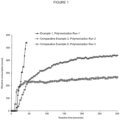
- Figure 1 illustrates rates of ethylene consumption.
- AE is an amido-ether ligand defined by the formula: where Q is a bridging group between oxygen, O and nitrogen, N 2 , and contains one or more atoms selected from group consisting of Group 13 to 16 elements; R 2 is a group containing 1 to 50 atoms selected from the group consisting of hydrogen and Group 13 to 17 elements; R 3 is a group containing 1 to 50 atoms selected from the group consisting of hydrogen and Group 13 to 17 elements; and wherein the R 2 group optionally joins together with the bridging group Q.
- the bridge Q is an aryl group.
- the N atom and the O atom of the above formula are substituents on adjacent atoms of an aryl group (as illustrated for example, by the organometallic complex shown in Example 1 of the present examples).
- the O atom is part of a furan ring.
- the phosphinimine ligand is chosen so that each R is a hydrocarbyl radical.
- the phosphinimine ligand is tri-(tertiarybutyl)phosphinimine (i.e. where each R 1 is a tertiary butyl group, or "t-Bu" for short).
- activatable ligand refers to a ligand which may be activated by a cocatalyst (also referred to as an "activator"), to facilitate olefin polymerization.
- An activatable ligand L may be cleaved from the metal center M via a protonolysis reaction or abstracted from the metal center M by suitable acidic or electrophilic catalyst activator compounds (also known as "co-catalyst” compounds) respectively, examples of which are described below.
- the activatable ligand L may also be transformed into another ligand which is cleaved or abstracted from the metal center M (e.g. a halide may be converted to an alkyl group).
- the activatable ligand, L is independently selected from the group consisting of a hydrogen atom; a halogen atom; a C 1-10 hydrocarbyl radical; a C 1-10 alkoxy radical; a C 6-10 aryl oxide radical, each of which said hydrocarbyl, alkoxy, and aryl oxide radicals may be unsubstituted by or further substituted by a halogen atom, a C 1-8 alkyl radical, a C 1-8 alkoxy radical, a C 6-10 aryl or aryloxy radical; an amido radical which is unsubstituted or substituted by up to two C 1-8 alkyl radicals; or a phosphido radical which is unsubstituted or substituted by up to two C 1-8 alkyl radicals.
- Two activatable L ligands may also be joined to one another and form for example, a substituted or unsubstituted diene ligand (i.e. 1,3-diene); or a delocalized heteroatom containing group such as an acetate group.
- a substituted or unsubstituted diene ligand i.e. 1,3-diene
- a delocalized heteroatom containing group such as an acetate group.
- the number of activatable ligands depends upon the valency of the metal and the valency of the activatable ligand.
- the preferred phosphinimine catalysts are based on group 4 metals in their highest oxidation state (i.e. 4 + ).
- Particularly suitable activatable ligands are monoanionic such as a halide (e.g. chloride) or a hydrocarbyl (e.g. methyl, benzyl).
- the metal of the phosphinimine catalyst may not be in the highest oxidation state.
- a titanium (III) component would contain only one activatable ligand.
- the single site catalyst is used in combination with at least one activator (or "cocatalyst") to form an active polymerization catalyst system for olefin polymerization.
- activators i.e. cocatalysts
- cocatalysts include ionic activator cocatalysts and aluminoxane cocatalysts.
- Aluminoxane also referred to as Alkylaluminoxane
- the activator used to activate the single site catalyst can be any suitable activator including one or more activators selected from the group consisting of alkylaluminoxanes and ionic activators, optionally together with an alkylating agent.
- the alkylaluminoxanes are complex aluminum compounds of the formula: R 4 2 Al 1 O(R 4 Al 1 O) m Al 1 R 4 2 , wherein each R 4 is independently selected from the group consisting of C 1-20 hydrocarbyl radicals and m is from 3 to 50.
- a hindered phenol can be added to the alkylaluminoxane to provide a molar ratio of Al 1 :hindered phenol of from 2:1 to 5:1 when the hindered phenol is present.
- R 3 of the alkylaluminoxane is a methyl radical and m is from 10 to 40.
- the alkylaluminoxanes are typically used in substantial molar excess compared to the amount of group 4 transition metal in the single site catalyst.
- the Al 1 :group 4 transition metal molar ratios are from 10:1 to 10,000:1, preferably about 30:1 to 500:1.
- alkylaluminoxane can serve dual roles as both an alkylator and an activator.
- an alkylaluminoxane activator is often used in combination with activatable ligands such as halogens.
- the activator of the present disclosure may be a combination of an alkylating agent (which may also serve as a scavenger) with an activator capable of ionizing the group 4 metal of the single site catalyst (i.e. an ionic activator).
- an ionic activator capable of ionizing the group 4 metal of the single site catalyst.
- the activator can be chosen from one or more alkylaluminoxane and/or an ionic activator.
- the alkylating agent may be selected from the group consisting of (R*) p MgX 2 2-p wherein X 2 is a halide and each R* is independently selected from the group consisting of C 1-10 alkyl radicals and p is 1 or 2; R*Li wherein in R* is as defined above, (R*) q ZnX 2 2-q wherein R* is as defined above, X 2 is halogen and q is 1 or 2; (R 4 ) s Al 2 X 2 3-s wherein R* is as defined above, X 2 is halogen and s is an integer from 1 to 3.
- R* is a C 1-4 alkyl radical, and X 2 is chlorine.
- Commercially available compounds include triethyl aluminum (TEAL), diethyl aluminum chloride (DEAC), dibutyl magnesium ((Bu) 2 Mg), and butyl ethyl magnesium (BuEtMg or BuMgEt).
- the ionic activator may be selected from the group consisting of: (i) compounds of the formula [R 5 ] + [B(R 6 ) 4 ] - wherein B is a boron atom, R 5 is a cyclic C 5-7 aromatic cation or a triphenyl methyl cation and each R 6 is independently selected from the group consisting of phenyl radicals which are unsubstituted or substituted with from 3 to 5 substituents selected from the group consisting of a fluorine atom, a C 1-4 alkyl or alkoxy radical which is unsubstituted or substituted by a fluorine atom; and a silyl radical of the formula --Si--(R 7 ) 3 ; wherein each R 7 is independently selected from the group consisting of a hydrogen atom and a C 1-4 alkyl radical; and (ii) compounds of the formula [(R 8 ) t ZH] + [B(R 6 ) 4 ] - wherein
- R 6 is a pentafluorophenyl radical
- R 5 is a triphenylmethyl cation
- Z is a nitrogen atom
- R 8 is a C 1-4 alkyl radical or one R 8 taken together with a nitrogen atom forms an anilinium radical (e.g. PhR 8 2 NH + , which is substituted by two R 8 radicals such as for example two C 1-4 alkyl radicals).
- Examples of compounds capable of ionizing the single site catalyst include the following compounds: triethylammonium tetra(phenyl)boron, tripropylammonium tetra(phenyl)boron, tri(n-butyl)ammonium tetra(phenyl)boron, trimethylammonium tetra(p-tolyl)boron, trimethylammonium tetra(o-tolyl)boron, tributylammonium tetra(pentafluorophenyl)boron, tripropylammonium tetra (o,p-dimethylphenyl)boron, tributylammonium tetra(m,m-dimethylphenyl)boron, tributylammonium tetra(p-trifluoromethylphenyl)boron, tributylammonium tetra(pentafluorophenyl)boron, tri(n-
- activators which are capable of ionizing the group 4 metal of the single site catalyst include: N,N-dimethylaniliniumtetrakispentafluorophenyl borate ("[Me 2 NHPh][B(C 6 F 5 ) 4 ]”); triphenylmethylium tetrakispentafluorophenyl borate ("[Ph 3 C][B(C 6 F 5 ) 4 ]”); and trispentafluorophenyl boron and MAO (methylaluminoxane) and MMAO (modified methylaluminoxane).
- the ionic activators compounds may be used in amounts which provide a molar ratio of group 4 transition metal to boron that will be from 1:1 to 1:6.
- mixtures of alkylaluminoxanes and ionic activators can be used as activators in the polymerization catalyst.
- the catalyst precursor, the activator, or the entire catalyst composition may be impregnated onto a solid, inert support, in liquid form such as a solution, dispersion or neat liquid, spray dried, in the form of a prepolymer, or formed in-situ during polymerization.
- the catalyst composition may be impregnated in or deposited on the surface of an inert substrate such as silica, carbon black, polyethylene, polycarbonate porous crosslinked polystyrene, porous crosslinked polypropylene, alumina, thoria, zirconia, or magnesium halide (e.g. magnesium dichloride), such that the catalyst composition is between 0.1 and 90 percent by weight of the total weight of the catalyst composition and the support.
- an inert substrate such as silica, carbon black, polyethylene, polycarbonate porous crosslinked polystyrene, porous crosslinked polypropylene, alumina, thoria, zirconia, or magnesium halide (e.g. magnesium dichloride), such that the catalyst composition is between 0.1 and 90 percent by weight of the total weight of the catalyst composition and the support.
- the catalyst composition may be used for the polymerization of olefins by any suspension, solution, slurry, or gas phase process, using known equipment and reaction conditions, and is not limited to any specific type of reaction system.
- olefin polymerization temperatures range from about 0°C to about 200°C at atmospheric, subatmospheric, or superatmospheric pressures.
- Slurry or solution polymerization processes may utilize subatmospheric or superatmospheric pressures and temperatures in the range of about 40°C to about 110°C.
- a useful liquid phase polymerization reaction system is described in U.S. Patent 3,324,095 .
- Liquid phase reaction systems generally comprise a reactor vessel to which olefin monomer and catalyst composition are added, and which contains a liquid reaction medium for dissolving or suspending the polyolefin.
- the liquid reaction medium may consist of the bulk liquid monomer or an inert liquid hydrocarbon that is nonreactive under the polymerization conditions employed.
- an inert liquid hydrocarbon need not function as a solvent for the catalyst composition or the polymer obtained by the process, it usually serves as solvent for the monomers employed in the polymerization.
- the inert liquid hydrocarbons suitable for this purpose are isopentane, hexane, cyclohexane, heptane, benzene, toluene, and the like.
- Reactive contact between the olefin monomer and the catalyst composition should be maintained by constant stirring or agitation.
- the reaction medium containing the olefin polymer product and unreacted olefin monomer is withdrawn from the reactor continuously.
- the olefin polymer product is separated, and the unreacted olefin monomer and liquid reaction medium are recycled into the reactor.
- Stirred or fluidized bed gas phase reaction systems are particularly useful.
- a conventional gas phase, fluidized bed process is conducted by passing a stream containing one or more olefin monomers continuously through a fluidized bed reactor under reaction conditions and in the presence of catalyst composition at a velocity sufficient to maintain a bed of solid particles in a suspended condition.
- a stream containing unreacted monomer is withdrawn from the reactor continuously, compressed, cooled, optionally fully or partially condensed as disclosed in U.S. Patent Nos. 4,528,790 and 5,462,999 , and recycled to the reactor.
- Product is withdrawn from the reactor and make-up monomer is added to the recycle stream.
- any gas inert to the catalyst composition and reactants may also be present in the gas stream.
- Polymerization may be carried out in a single reactor or in two or more reactors in series, and is conducted substantially in the absence of catalyst poisons.
- Organometallic compounds may be employed as scavenging agents for poisons to increase the catalyst activity.
- scavenging agents are metal alkyls, preferably aluminum alkyls, most preferably triisobutylaluminum.
- Hydrogen or a metal or non-metal hydride e.g., a silyl hydride
- Hydrogen may be used as a chain transfer agent in the process. Hydrogen may be used in amounts up to about 10 moles of hydrogen per mole of total monomer feed.
- Olefin polymers that may be produced according to the invention include, but are not limited to, ethylene homopolymers, homopolymers of linear or branched higher alpha-olefins containing 3 to about 20 carbon atoms, and interpolymers of ethylene and such higher alpha-olefins, with densities ranging from about 0.86 to about 0.96.
- Suitable higher alpha-olefins include, for example, propylene, 1-butene, 1-pentene, 1-hexene, 4-methyl-1-pentene, 1-octene, and 3,5,5-trimethyl-1-hexene.
- Olefin polymers according to the invention may also be based on or contain conjugated or non-conjugated dienes, such as linear, branched, or cyclic hydrocarbon dienes having from about 4 to about 20, preferably 4 to 12, carbon atoms.
- Preferred dienes include 1,4-pentadiene, 1,5-hexadiene, 5-vinyl-2-norbornene, 1,7-octadiene, vinyl cyclohexene, dicyclopentadiene, butadiene, isobutylene, isoprene, ethylidene norbornene and the like.
- Aromatic compounds having vinyl unsaturation such as styrene and substituted styrenes, and polar vinyl monomers such as acrylonitrile, maleic acid esters, vinyl acetate, acrylate esters, methacrylate esters, vinyl trialkyl silanes and the like may be polymerized according to the invention as well.
- Specific olefin polymers that may be made according to the invention include, for example, polyethylene, polypropylene, ethylene/propylene rubbers (EPR's), ethylene/propylene/diene terpolymers (EPDM's), polybutadiene, polyisoprene and the like.
- slurry polymerization processes are widely reported in the patent literature. For example, particle form polymerization, or a slurry process where the temperature is kept below the temperature at which the polymer goes into solution is described in U.S. Patent No. 3,248,179 .
- Slurry processes include those employing a loop reactor and those utilizing a single stirred reactor or a plurality of stirred reactors in series, parallel, or combinations thereof.
- Non-limiting examples of slurry processes include continuous loop or stirred tank processes. Further examples of slurry processes are described in U.S. Patent No. 4,613,484 .
- Slurry processes are conducted in the presence of a hydrocarbon diluent such as an alkane (including isoalkanes), an aromatic or a cycloalkane.
- a hydrocarbon diluent such as an alkane (including isoalkanes), an aromatic or a cycloalkane.
- the diluent may also be the alpha olefin comonomer used in copolymerizations.
- Alkane diluents include propane, butanes, (i.e. normal butane and/or isobutane), pentanes, hexanes, heptanes and octanes.
- the monomers may be soluble in (or miscible with) the diluent, but the polymer is not (under polymerization conditions).
- the polymerization temperature is preferably from about 5°C to about 200°C, most preferably less than about 120°C typically from about 10°C to 100°C.
- the reaction temperature is selected so that an ethylene copolymer is produced in the form of solid particles.
- the reaction pressure is influenced by the choice of diluent and reaction temperature. For example, pressures may range from 15 to 45 atmospheres (about 220 to 660 psi or about 1,500 to about 4,600 kPa) when isobutane is used as diluent (see, for example, U.S. Patent No. 4,325,849 ) to approximately twice that (i.e.
- the pressure in a slurry process must be kept sufficiently high to keep at least part of the ethylene monomer in the liquid phase.
- the reaction typically takes place in a jacketed closed loop reactor having an internal stirrer (e.g. an impeller) and at least one settling leg. Catalyst, monomers and diluents are fed to the reactor as liquids or suspensions. The slurry circulates through the reactor and the jacket is used to control the temperature of the reactor.
- the slurry enters a settling leg and then is let down in pressure to flash the diluent and unreacted monomers and recover the polymer generally in a cyclone.
- the diluent and unreacted monomers are recovered and recycled back to the reactor.
- Solution processes for the copolymerization of ethylene and an alpha olefin having from 3 to 12 carbon atoms are well known in the art. These processes are conducted in the presence of an inert hydrocarbon solvent typically a C 5-12 hydrocarbon which may be unsubstituted or substituted by a C 1-4 alkyl group, such as pentane, methyl pentane, hexane, heptane, octane, cyclohexane, methylcyclohexane and hydrogenated naphtha.
- an inert hydrocarbon solvent typically a C 5-12 hydrocarbon which may be unsubstituted or substituted by a C 1-4 alkyl group, such as pentane, methyl pentane, hexane, heptane, octane, cyclohexane, methylcyclohexane and hydrogenated naphtha.
- An example of a suitable solvent which is commercially available is "I
- a solution polymerization process may use one, two (or more) polymerization reactors.
- the polymerization temperature in at least one CSTR is from about 80°C to about 280°C (preferably from about 120°C to 220°C) and a tubular reactor is operated at a slightly higher temperature.
- Cold feed i.e. chilled solvent and/or monomer
- the polymerization enthalpy heats the reactor.
- the polymerization solution which exits in the reactor may be more than 100°C hotter than the reactor feed temperature.
- Agitation efficiency in the CSTR may be determined by measuring the reactor temperature at several different points. The largest temperature difference (i.e. between the hottest and coldest temperature measurements) is described as the internal temperature gradient for the polymerization reactor.
- a very well mixed CSTR has a maximum internal temperature gradient of less than 10°C.
- a particularly preferred agitator system is described in copending and commonly assigned U.S. Patent No. 6,024,483 .
- the most preferred reaction process is a "medium pressure process", which means that the pressure in each reactor is preferably less than about 6,000 psi (about 41,000 kiloPascals or kPa), and most preferably from about 1,500 psi to 3,000 psi (about 10,000-21,000 kPa).
- each CSTR it is preferable to add catalyst to each of the CSTR(s) in order to maintain a high reactor rate.
- the catalyst used in each CSTR may be the same or different but it is generally preferable to use the same type of catalyst in each CSTR. It is preferred that at least 60 weight % of the ethylene fed to the CSTR(s) is polymerized to polyethylene in the CSTR(s), with at least 70% ethylene conversion being highly preferred.
- a tubular reactor that is connected to the discharge of the at least on CSTR may also be employed. (For clarity, if two CSTR's are used in series, then the tubular reactor receives the discharge from the second CSTR.)
- tubular reactor is meant to convey its conventional meaning - namely a simple tube.
- the tubular reactor of this invention will have a length/diameter (UD) ratio of at least 10/1.
- the tubular reactor is not agitated.
- the tubular reactor is operated adiabatically.
- the temperature increase along the length of the tubular reactor may be greater than 3°C (i.e. that the discharge temperature from the tubular reactor is at least 3°C greater than the discharge temperature from the CSTR that feeds the tubular reactor).
- the tubular reactor may also have feed ports for additional catalyst, cocatalyst, comonomer and/or telomerization agent (such as hydrogen).
- additional catalyst such as hydrogen
- cocatalyst such as cocatalyst
- comonomer such as hydrogen
- telomerization agent such as hydrogen
- the total volume of the tubular reactor can be at least 10 volume % of the volume of the at least one CSTR, especially from 30% to 200% (for clarity, if the volume of the CSTR is 1,000 litres, then the volume of the tubular reactor is at least 100 litres and is preferably from 300 to 2,000 litres).
- Suitable monomers for copolymerization with ethylene include C 3-12 alpha olefins which are unsubstituted or substituted by up to two C 1-6 alkyl radicals.
- Illustrative non-limiting examples of such alpha-olefins are one or more of propylene, 1-butene, 1-pentene, 1-hexene, 1-octene and 1-decene.
- Octene-1 is highly preferred.
- the monomers are dissolved/dispersed in the solvent either prior to being fed to the first CSTR (or for gaseous monomers the monomer may be fed to the reactor so that it will dissolve in the reaction mixture).
- the solvent and monomers Prior to mixing, are generally purified to remove potential catalyst poisons such as water, oxygen or other polar impurities.
- the feedstock purification follows standard practices in the art, e.g. molecular sieves, alumina beds and oxygen removal catalysts are used for the purification of monomers.
- the solvent itself as well e.g. methyl pentane, cyclohexane, hexane or toluene is preferably treated in a similar manner.
- the catalyst components may be premixed in the solvent for the reaction or fed as separate streams to each reactor.
- premixing may be desirable to provide a reaction time for the catalyst components prior to entering the first CSTR.
- Such an "in-line mixing" technique is described in the patent literature (most notably U.S. Patent No. 5,589,555, issued December 31, 1996 to DuPont Canada Inc. ).
- the residence time in each reactor will depend on the design and the capacity of the reactor. Generally the reactors should be operated under conditions to achieve a thorough mixing of the reactants. As previously noted, the polymerization reactors are arranged in series (i.e. with the solution from the at least one CSTR being transferred to the tubular reactor).
- the phosphinimine ligand t -BusPNH and ( t -Bu 3 PN)TiMe 3 were prepared using the established methods (see Stephan, D. W. et al. Can. J. Chem. 2003, 81, 1471-1476 and Stephan, D. W. et al. Organometallics 2000, 19, 2994-3000 , respectively).
- the hafnium complex [(2-(OMe)C 6 H 4 )(2,4,6-Me 3 C 6 H 2 )N]Hf(CH 2 Ph) 3 was prepared as described by Murphy, V. et al. in J. Am. Chem. Soc. 2003, 125, 4306-4317 .
- Deuterated solvents were purchased from Sigma Aldrich (toluene- d 8 ) and were stored over 4 ⁇ molecular sieves prior to use. NMR spectra were recorded on a Bruker 400 MHz spectrometer ( 1 H NMR at 400.1 MHz, 31 P NMR at 162 MHz, and 19 F NMR at 376 MHz).
- Polymer sample solutions (1 to 2 mg/mL) were prepared by heating the polymer in 1,2,4-trichlorobenzene (TCB) and rotating on a wheel for 4 hours at 150°C in an oven.
- the antioxidant 2,6-di-tert-butyl-4-methylphenol (BHT) was added to the mixture in order to stabilize the polymer against oxidative degradation.
- the BHT concentration was 250 ppm.
- Sample solutions were chromatographed at 140°C on a PL 220 high-temperature chromatography unit equipped with four Shodex columns (HT803, HT804, HT805 and HT806) using TCB as the mobile phase with a flow rate of 1.0 mL/minute, with a differential refractive index (DRI) as the concentration detector.
- DRI differential refractive index
- BHT was added to the mobile phase at a concentration of 250 ppm to protect the columns from oxidative degradation.
- the sample injection volume was 200 mL.
- the raw data were processed with CIRRUS ® GPC software.
- the columns were calibrated with narrow distribution polystyrene standards.
- the polystyrene molecular weights were converted to polyethylene molecular weights using the Mark-Houwink equation, as described in the ASTM standard test method D6474.
- the branch frequency of copolymer samples i.e., the short chain branching, SCB per 1000 carbons
- C 6 comonomer content in wt% was determined by Fourier Transform Infrared Spectroscopy (FTIR) as per the ASTM D6645-01 method.
- FTIR Fourier Transform Infrared Spectroscopy
- Continuous polymerizations were conducted on a continuous polymerization unit (CPU) using cyclohexane as the solvent.
- the CPU contained a 71.5 mL stirred reactor and was operated between 130 to 160°C for the polymerization experiments.
- An upstream mixing reactor having a 20 mL volume was operated at 5°C lower than the polymerization reactor.
- the mixing reactor was used to preheat the ethylene, octene and some of the solvent streams.
- Catalyst feeds xylene or cyclohexane solutions of titanium phosphinimine complex, (Ph 3 C)[B(C 6 F 5 ) 4 ], and MMAO-7/BHEB) and additional solvent were added directly to the polymerization reactor in a continuous process.
- a total continuous flow of 27 mL/min into the polymerization reactor was maintained.
- Copolymers were made at 1-octene / ethylene weight ratios ranging from 0.15 to 0.5.
- the ethylene was fed at a 10 wt% ethylene concentration in the polymerization reactor.
- the CPU system operated at a pressure of 10.5 MPa.
- the solvent, monomer, and comonomer streams were all purified by the CPU systems before entering the reactor.
- Copolymer samples were collected at 90 ⁇ 1% ethylene conversion (Q), dried in a vacuum oven, ground, and then analyzed using FTIR (for short-chain branch frequency) and GPC-RI (for molecular weight and distribution). Copolymerization conditions and copolymer properties for Polymerization Runs 4 to 11 are listed in Table 2. TABLE 1 Semi-Batch Ethylene Homopolymerization Experiments Poly. Run. No. Procatalyst Example [M] ( ⁇ M) B (from Borate) / M Reactor Temp.
- a catalyst system for the (co ) polymerization of olefins especially for the copolymerization of ethylene with one or more C4 to C8 alpha olefins.
- the resulting ethylene copolymers are useful for the preparation of a wide variety of plastic goods, including extruded film; cast film and molded profiles and parts.
Landscapes
- Chemical & Material Sciences (AREA)
- Organic Chemistry (AREA)
- Health & Medical Sciences (AREA)
- Chemical Kinetics & Catalysis (AREA)
- Medicinal Chemistry (AREA)
- Polymers & Plastics (AREA)
- Engineering & Computer Science (AREA)
- Materials Engineering (AREA)
- Crystallography & Structural Chemistry (AREA)
- General Health & Medical Sciences (AREA)
- Molecular Biology (AREA)
- Biochemistry (AREA)
- Life Sciences & Earth Sciences (AREA)
- Transition And Organic Metals Composition Catalysts For Addition Polymerization (AREA)
- Addition Polymer Or Copolymer, Post-Treatments, Or Chemical Modifications (AREA)
Claims (7)
- Komplex der Formel (PI)(AE)ML2, worin:I) PI ein Phosphinimin-Ligand ist, der durch die folgende Formel definiert ist:
 II) AE ein Amido-Ether-Ligand ist, der durch die folgende Formel definiert ist:
 III) die L jeweils ein aktivierbarer Ligand sind; undIV) M ein Metall ist, das aus der aus Zr und Hf bestehenden Gruppe ausgewählt ist, und wobei N1, N2 und gegebenenfalls O an M gebunden sind;wobei jeder der aktivierbaren Liganden L jeweils unabhängig aus der aus einem Wasserstoffatom, einem C1-10-Kohlenwasserstoffrest, einem C1-10-Alkoxyrest und einem C6-10-Aryloxidrest bestehenden Gruppe ausgewählt ist, wobei jeder der Kohlenwasserstoff-, Alkoxy- und Aryloxid-Reste unsubstituiert oder mit einem Halogenatom, einem C1-8-Alkylrest, einem C1-8-Alkoxyrest, einem C6-10-Aryl- oder -Aryloxyrest, einem Amidorest, der unsubstituiert oder mit bis zu zwei C1-8-Alkylresten substituiert ist, oder einem Phosphidorest, der unsubstituiert oder mit bis zu zwei C1-8-Alkylresten substituiert ist, weiter substituiert ist;oder zwei aktivierbare Liganden L miteinander verbunden sind und einen substituierten oder unsubstituierten Dien-Liganden oder eine ein delokalisiertes Heteroatom enthaltende Gruppe bilden.
 - Komplex nach Anspruch 1, wobei in der Formel:
AE ein Amido-Ether-Ligand ist, der durch die folgende Formel definiert ist:
- Komplex nach Anspruch 1, wobei in der Formel:
AE ein Amido-Ether-Ligand ist, der durch die folgende Formel definiert ist:
- Olefin-Polymerisationskatalysator-System, umfassend:A) einen organometallischen Komplex nach Anspruch 1, 2 oder 3; undB) einen Aktivator.
- Olefin-Polymerisationskatalysator-System nach Anspruch 4, wobei der Aktivator aus der aus Folgendem bestehenden Gruppe ausgewählt ist:i) einem Aluminoxan;ii) einem ionischen Aktivator; undiii) Gemischen davon.
- Verfahren zur Polymerisation von Olefinen, welches das In-Kontakt-Bringen eines oder mehrerer C2-C10-α-Olefine mit einem Olefin-Polymerisationskatalysator-System nach Anspruch 4 oder 5 unter Polymerisationsbedingungen umfasst.
- Verfahren nach Anspruch 6, wobei das eine oder die mehreren C2-C10-α-Olefine aus a) Ethylen und b) einem oder mehreren Olefinen bestehen, die aus der aus 1-Buten, 1-Hexen und 1-Octen bestehenden Gruppe ausgewählt sind.
Applications Claiming Priority (2)
| Application Number | Priority Date | Filing Date | Title |
|---|---|---|---|
| US201862662915P | 2018-04-26 | 2018-04-26 | |
| PCT/IB2019/053035 WO2019207401A1 (en) | 2018-04-26 | 2019-04-12 | Phosphinimine amido-ether complexes |
Publications (3)
| Publication Number | Publication Date |
|---|---|
| EP3784679A1 EP3784679A1 (de) | 2021-03-03 |
| EP3784679B1 true EP3784679B1 (de) | 2023-07-19 |
| EP3784679C0 EP3784679C0 (de) | 2023-07-19 |
Family
ID=66630326
Family Applications (1)
| Application Number | Title | Priority Date | Filing Date |
|---|---|---|---|
| EP19725865.0A Active EP3784679B1 (de) | 2018-04-26 | 2019-04-12 | Phosphinimin-amido-ether-komplexe |
Country Status (12)
| Country | Link |
|---|---|
| US (2) | US10669355B2 (de) |
| EP (1) | EP3784679B1 (de) |
| JP (1) | JP2021521211A (de) |
| KR (1) | KR20210005594A (de) |
| CN (1) | CN111989334B (de) |
| AU (1) | AU2019259476A1 (de) |
| BR (1) | BR112020021822B1 (de) |
| CA (1) | CA3037503A1 (de) |
| ES (1) | ES2959547T3 (de) |
| MX (1) | MX2020011091A (de) |
| PE (1) | PE20210048A1 (de) |
| WO (1) | WO2019207401A1 (de) |
Families Citing this family (1)
| Publication number | Priority date | Publication date | Assignee | Title |
|---|---|---|---|---|
| DE112022005558T5 (de) * | 2021-12-23 | 2024-09-12 | Polyplastics Co., Ltd. | Verfahren zur Herstellung eines zyklischen Olefincopolymers |
Family Cites Families (16)
| Publication number | Priority date | Publication date | Assignee | Title |
|---|---|---|---|---|
| US3248179A (en) | 1962-02-26 | 1966-04-26 | Phillips Petroleum Co | Method and apparatus for the production of solid polymers of olefins |
| NL135065C (de) | 1965-05-14 | |||
| US4242241A (en) | 1977-10-31 | 1980-12-30 | The Celotex Corporation | Method for making a slurry containing particulate matter and fibers for a preformed insulation product |
| US4528790A (en) | 1983-07-13 | 1985-07-16 | Owens-Corning Fiberglas Corporation | Roof insulation system |
| US4613484A (en) | 1984-11-30 | 1986-09-23 | Phillips Petroleum Company | Loop reactor settling leg system for separation of solid polymers and liquid diluent |
| US5589555A (en) | 1991-10-03 | 1996-12-31 | Novacor Chemicals (International) S.A. | Control of a solution process for polymerization of ethylene |
| US5462999A (en) | 1993-04-26 | 1995-10-31 | Exxon Chemical Patents Inc. | Process for polymerizing monomers in fluidized beds |
| FI96216C (fi) | 1994-12-16 | 1996-05-27 | Borealis Polymers Oy | Prosessi polyeteenin valmistamiseksi |
| CA2201224C (en) | 1997-03-27 | 2004-12-07 | Annette Lynn Burke | Dual shear mixing element |
| CA2206944C (en) | 1997-05-30 | 2006-08-29 | Douglas W. Stephan | High temperature solution polymerization process |
| US6103657A (en) | 1997-07-02 | 2000-08-15 | Union Carbide Chemicals & Plastics Technology Corporation | Catalyst for the production of olefin polymers |
| CA2243783C (en) * | 1998-07-21 | 2007-06-05 | Nova Chemicals Ltd. | Bis-phosphinimine catalyst |
| CA2243726C (en) * | 1998-07-21 | 2006-12-12 | Nova Chemicals Ltd. | Cyclopentadienyl/phosphinimine catalyst with one and only one activatable ligand |
| CA2243775C (en) * | 1998-07-21 | 2007-06-12 | Nova Chemicals Ltd. | Phosphinimine/heteroatom catalyst component |
| US20020049288A1 (en) | 2000-04-04 | 2002-04-25 | Christopher Goh | Ether-amine based polymerization catalysts, compositions and processes using same |
| BR112016012971B1 (pt) * | 2013-12-19 | 2021-06-08 | Dow Global Technologies Llc | complexo de metal-ligante, catalisador e processo para preparar uma poliolefina |
-
2019
- 2019-03-22 CA CA3037503A patent/CA3037503A1/en active Pending
- 2019-04-12 BR BR112020021822-7A patent/BR112020021822B1/pt active IP Right Grant
- 2019-04-12 WO PCT/IB2019/053035 patent/WO2019207401A1/en not_active Ceased
- 2019-04-12 KR KR1020207030067A patent/KR20210005594A/ko not_active Withdrawn
- 2019-04-12 ES ES19725865T patent/ES2959547T3/es active Active
- 2019-04-12 JP JP2020556285A patent/JP2021521211A/ja active Pending
- 2019-04-12 EP EP19725865.0A patent/EP3784679B1/de active Active
- 2019-04-12 CN CN201980027879.XA patent/CN111989334B/zh active Active
- 2019-04-12 PE PE2020001643A patent/PE20210048A1/es unknown
- 2019-04-12 AU AU2019259476A patent/AU2019259476A1/en not_active Abandoned
- 2019-04-12 MX MX2020011091A patent/MX2020011091A/es unknown
- 2019-04-25 US US16/394,232 patent/US10669355B2/en active Active
-
2020
- 2020-04-28 US US16/860,461 patent/US11180581B2/en active Active
Also Published As
| Publication number | Publication date |
|---|---|
| US20190330387A1 (en) | 2019-10-31 |
| CN111989334A (zh) | 2020-11-24 |
| MX2020011091A (es) | 2020-11-06 |
| WO2019207401A1 (en) | 2019-10-31 |
| US11180581B2 (en) | 2021-11-23 |
| KR20210005594A (ko) | 2021-01-14 |
| US10669355B2 (en) | 2020-06-02 |
| ES2959547T3 (es) | 2024-02-26 |
| BR112020021822A2 (pt) | 2021-02-23 |
| PE20210048A1 (es) | 2021-01-08 |
| CA3037503A1 (en) | 2019-10-26 |
| US20200255550A1 (en) | 2020-08-13 |
| CN111989334B (zh) | 2024-03-08 |
| BR112020021822B1 (pt) | 2023-12-19 |
| JP2021521211A (ja) | 2021-08-26 |
| EP3784679A1 (de) | 2021-03-03 |
| EP3784679C0 (de) | 2023-07-19 |
| AU2019259476A1 (en) | 2020-09-17 |
Similar Documents
| Publication | Publication Date | Title |
|---|---|---|
| EP2380919B1 (de) | Katalysatorzusammensetzungen und Polyolefine für Extrusionsbeschichtungsanwendungen | |
| EP2718333B1 (de) | Verfahren zur steuerung von ethylencopolymereigenschaften | |
| US9771446B2 (en) | Controlling the placement of comonomer in an ethylene copolymer | |
| EP4139371B1 (de) | Cyclopentadienyl/adamantylphosphinimin-titan-komplexe | |
| US20060223960A1 (en) | Modified (MAO + aluminum alkyl) activator | |
| EP3953404B1 (de) | Neue bis-phosphinimid-katalysatoren zur olefinpolymerisation | |
| US11180581B2 (en) | Phosphinimine amido-ether complexes | |
| EP3953363B1 (de) | Neue bis-phosphinimid-katalysatoren zur olefinpolymerisation | |
| EP3774931B1 (de) | Steuerung einer polymerisationsreaktion | |
| EP3529283B1 (de) | Thermisch abstimmbare phosphiniminkatalysatoren | |
| WO2025172887A1 (en) | Solution phase polymerization process | |
| HK1097411B (en) | Catalyst compositions and polyolefins for extrusion coating applications |
Legal Events
| Date | Code | Title | Description |
|---|---|---|---|
| STAA | Information on the status of an ep patent application or granted ep patent |
Free format text: STATUS: UNKNOWN |
|
| STAA | Information on the status of an ep patent application or granted ep patent |
Free format text: STATUS: THE INTERNATIONAL PUBLICATION HAS BEEN MADE |
|
| PUAI | Public reference made under article 153(3) epc to a published international application that has entered the european phase |
Free format text: ORIGINAL CODE: 0009012 |
|
| STAA | Information on the status of an ep patent application or granted ep patent |
Free format text: STATUS: REQUEST FOR EXAMINATION WAS MADE |
|
| 17P | Request for examination filed |
Effective date: 20201019 |
|
| AK | Designated contracting states |
Kind code of ref document: A1 Designated state(s): AL AT BE BG CH CY CZ DE DK EE ES FI FR GB GR HR HU IE IS IT LI LT LU LV MC MK MT NL NO PL PT RO RS SE SI SK SM TR |
|
| AX | Request for extension of the european patent |
Extension state: BA ME |
|
| DAV | Request for validation of the european patent (deleted) | ||
| DAX | Request for extension of the european patent (deleted) | ||
| STAA | Information on the status of an ep patent application or granted ep patent |
Free format text: STATUS: EXAMINATION IS IN PROGRESS |
|
| 17Q | First examination report despatched |
Effective date: 20211118 |
|
| GRAP | Despatch of communication of intention to grant a patent |
Free format text: ORIGINAL CODE: EPIDOSNIGR1 |
|
| RIC1 | Information provided on ipc code assigned before grant |
Ipc: C08F 210/16 19740701ALI20230112BHEP Ipc: C08F 110/02 19740701ALI20230112BHEP Ipc: C08F 4/659 20060101ALI20230112BHEP Ipc: C07F 9/535 19800101AFI20230112BHEP |
|
| STAA | Information on the status of an ep patent application or granted ep patent |
Free format text: STATUS: GRANT OF PATENT IS INTENDED |
|
| INTG | Intention to grant announced |
Effective date: 20230216 |
|
| GRAS | Grant fee paid |
Free format text: ORIGINAL CODE: EPIDOSNIGR3 |
|
| GRAA | (expected) grant |
Free format text: ORIGINAL CODE: 0009210 |
|
| STAA | Information on the status of an ep patent application or granted ep patent |
Free format text: STATUS: THE PATENT HAS BEEN GRANTED |
|
| AK | Designated contracting states |
Kind code of ref document: B1 Designated state(s): AL AT BE BG CH CY CZ DE DK EE ES FI FR GB GR HR HU IE IS IT LI LT LU LV MC MK MT NL NO PL PT RO RS SE SI SK SM TR |
|
| REG | Reference to a national code |
Ref country code: GB Ref legal event code: FG4D |
|
| REG | Reference to a national code |
Ref country code: CH Ref legal event code: EP |
|
| REG | Reference to a national code |
Ref country code: DE Ref legal event code: R096 Ref document number: 602019033025 Country of ref document: DE |
|
| REG | Reference to a national code |
Ref country code: IE Ref legal event code: FG4D |
|
| U01 | Request for unitary effect filed |
Effective date: 20230731 |
|
| U07 | Unitary effect registered |
Designated state(s): AT BE BG DE DK EE FI FR IT LT LU LV MT NL PT SE SI Effective date: 20230804 |
|
| REG | Reference to a national code |
Ref country code: LT Ref legal event code: MG9D |
|
| PG25 | Lapsed in a contracting state [announced via postgrant information from national office to epo] |
Ref country code: GR Free format text: LAPSE BECAUSE OF FAILURE TO SUBMIT A TRANSLATION OF THE DESCRIPTION OR TO PAY THE FEE WITHIN THE PRESCRIBED TIME-LIMIT Effective date: 20231020 |
|
| PG25 | Lapsed in a contracting state [announced via postgrant information from national office to epo] |
Ref country code: IS Free format text: LAPSE BECAUSE OF FAILURE TO SUBMIT A TRANSLATION OF THE DESCRIPTION OR TO PAY THE FEE WITHIN THE PRESCRIBED TIME-LIMIT Effective date: 20231119 |
|
| PG25 | Lapsed in a contracting state [announced via postgrant information from national office to epo] |
Ref country code: RS Free format text: LAPSE BECAUSE OF FAILURE TO SUBMIT A TRANSLATION OF THE DESCRIPTION OR TO PAY THE FEE WITHIN THE PRESCRIBED TIME-LIMIT Effective date: 20230719 Ref country code: NO Free format text: LAPSE BECAUSE OF FAILURE TO SUBMIT A TRANSLATION OF THE DESCRIPTION OR TO PAY THE FEE WITHIN THE PRESCRIBED TIME-LIMIT Effective date: 20231019 Ref country code: IS Free format text: LAPSE BECAUSE OF FAILURE TO SUBMIT A TRANSLATION OF THE DESCRIPTION OR TO PAY THE FEE WITHIN THE PRESCRIBED TIME-LIMIT Effective date: 20231119 Ref country code: HR Free format text: LAPSE BECAUSE OF FAILURE TO SUBMIT A TRANSLATION OF THE DESCRIPTION OR TO PAY THE FEE WITHIN THE PRESCRIBED TIME-LIMIT Effective date: 20230719 Ref country code: GR Free format text: LAPSE BECAUSE OF FAILURE TO SUBMIT A TRANSLATION OF THE DESCRIPTION OR TO PAY THE FEE WITHIN THE PRESCRIBED TIME-LIMIT Effective date: 20231020 |
|
| REG | Reference to a national code |
Ref country code: ES Ref legal event code: FG2A Ref document number: 2959547 Country of ref document: ES Kind code of ref document: T3 Effective date: 20240226 |
|
| PG25 | Lapsed in a contracting state [announced via postgrant information from national office to epo] |
Ref country code: PL Free format text: LAPSE BECAUSE OF FAILURE TO SUBMIT A TRANSLATION OF THE DESCRIPTION OR TO PAY THE FEE WITHIN THE PRESCRIBED TIME-LIMIT Effective date: 20230719 |
|
| REG | Reference to a national code |
Ref country code: DE Ref legal event code: R097 Ref document number: 602019033025 Country of ref document: DE |
|
| U20 | Renewal fee for the european patent with unitary effect paid |
Year of fee payment: 6 Effective date: 20240320 |
|
| PG25 | Lapsed in a contracting state [announced via postgrant information from national office to epo] |
Ref country code: SM Free format text: LAPSE BECAUSE OF FAILURE TO SUBMIT A TRANSLATION OF THE DESCRIPTION OR TO PAY THE FEE WITHIN THE PRESCRIBED TIME-LIMIT Effective date: 20230719 Ref country code: RO Free format text: LAPSE BECAUSE OF FAILURE TO SUBMIT A TRANSLATION OF THE DESCRIPTION OR TO PAY THE FEE WITHIN THE PRESCRIBED TIME-LIMIT Effective date: 20230719 Ref country code: CZ Free format text: LAPSE BECAUSE OF FAILURE TO SUBMIT A TRANSLATION OF THE DESCRIPTION OR TO PAY THE FEE WITHIN THE PRESCRIBED TIME-LIMIT Effective date: 20230719 Ref country code: SK Free format text: LAPSE BECAUSE OF FAILURE TO SUBMIT A TRANSLATION OF THE DESCRIPTION OR TO PAY THE FEE WITHIN THE PRESCRIBED TIME-LIMIT Effective date: 20230719 |
|
| PLBE | No opposition filed within time limit |
Free format text: ORIGINAL CODE: 0009261 |
|
| STAA | Information on the status of an ep patent application or granted ep patent |
Free format text: STATUS: NO OPPOSITION FILED WITHIN TIME LIMIT |
|
| 26N | No opposition filed |
Effective date: 20240422 |
|
| PG25 | Lapsed in a contracting state [announced via postgrant information from national office to epo] |
Ref country code: MC Free format text: LAPSE BECAUSE OF FAILURE TO SUBMIT A TRANSLATION OF THE DESCRIPTION OR TO PAY THE FEE WITHIN THE PRESCRIBED TIME-LIMIT Effective date: 20230719 |
|
| PG25 | Lapsed in a contracting state [announced via postgrant information from national office to epo] |
Ref country code: MC Free format text: LAPSE BECAUSE OF FAILURE TO SUBMIT A TRANSLATION OF THE DESCRIPTION OR TO PAY THE FEE WITHIN THE PRESCRIBED TIME-LIMIT Effective date: 20230719 |
|
| PG25 | Lapsed in a contracting state [announced via postgrant information from national office to epo] |
Ref country code: IE Free format text: LAPSE BECAUSE OF NON-PAYMENT OF DUE FEES Effective date: 20240412 |
|
| U20 | Renewal fee for the european patent with unitary effect paid |
Year of fee payment: 7 Effective date: 20250319 |
|
| PGFP | Annual fee paid to national office [announced via postgrant information from national office to epo] |
Ref country code: GB Payment date: 20250319 Year of fee payment: 7 |
|
| PGFP | Annual fee paid to national office [announced via postgrant information from national office to epo] |
Ref country code: ES Payment date: 20250502 Year of fee payment: 7 |
|
| PGFP | Annual fee paid to national office [announced via postgrant information from national office to epo] |
Ref country code: CH Payment date: 20250501 Year of fee payment: 7 |
|
| PG25 | Lapsed in a contracting state [announced via postgrant information from national office to epo] |
Ref country code: CY Free format text: LAPSE BECAUSE OF FAILURE TO SUBMIT A TRANSLATION OF THE DESCRIPTION OR TO PAY THE FEE WITHIN THE PRESCRIBED TIME-LIMIT; INVALID AB INITIO Effective date: 20190412 |
|
| PG25 | Lapsed in a contracting state [announced via postgrant information from national office to epo] |
Ref country code: HU Free format text: LAPSE BECAUSE OF FAILURE TO SUBMIT A TRANSLATION OF THE DESCRIPTION OR TO PAY THE FEE WITHIN THE PRESCRIBED TIME-LIMIT; INVALID AB INITIO Effective date: 20190412 |