EP3778336B1 - Siège de véhicule à espace de stockage amélioré et véhicule associé - Google Patents
Siège de véhicule à espace de stockage amélioré et véhicule associé Download PDFInfo
- Publication number
- EP3778336B1 EP3778336B1 EP20190411.7A EP20190411A EP3778336B1 EP 3778336 B1 EP3778336 B1 EP 3778336B1 EP 20190411 A EP20190411 A EP 20190411A EP 3778336 B1 EP3778336 B1 EP 3778336B1
- Authority
- EP
- European Patent Office
- Prior art keywords
- seat
- segment
- longitudinal direction
- luggage
- vehicle
- Prior art date
- Legal status (The legal status is an assumption and is not a legal conclusion. Google has not performed a legal analysis and makes no representation as to the accuracy of the status listed.)
- Active
Links
Images


Classifications
-
- B—PERFORMING OPERATIONS; TRANSPORTING
- B60—VEHICLES IN GENERAL
- B60R—VEHICLES, VEHICLE FITTINGS, OR VEHICLE PARTS, NOT OTHERWISE PROVIDED FOR
- B60R7/00—Stowing or holding appliances inside vehicle primarily intended for personal property smaller than suit-cases, e.g. travelling articles, or maps
- B60R7/04—Stowing or holding appliances inside vehicle primarily intended for personal property smaller than suit-cases, e.g. travelling articles, or maps in driver or passenger space, e.g. using racks
- B60R7/043—Stowing or holding appliances inside vehicle primarily intended for personal property smaller than suit-cases, e.g. travelling articles, or maps in driver or passenger space, e.g. using racks mounted on or under a seat
-
- B—PERFORMING OPERATIONS; TRANSPORTING
- B60—VEHICLES IN GENERAL
- B60N—SEATS SPECIALLY ADAPTED FOR VEHICLES; VEHICLE PASSENGER ACCOMMODATION NOT OTHERWISE PROVIDED FOR
- B60N2/00—Seats specially adapted for vehicles; Arrangement or mounting of seats in vehicles
- B60N2/24—Seats specially adapted for vehicles; Arrangement or mounting of seats in vehicles for particular purposes or particular vehicles
- B60N2/242—Bus seats
-
- B—PERFORMING OPERATIONS; TRANSPORTING
- B60—VEHICLES IN GENERAL
- B60N—SEATS SPECIALLY ADAPTED FOR VEHICLES; VEHICLE PASSENGER ACCOMMODATION NOT OTHERWISE PROVIDED FOR
- B60N2/00—Seats specially adapted for vehicles; Arrangement or mounting of seats in vehicles
- B60N2/005—Arrangement or mounting of seats in vehicles, e.g. dismountable auxiliary seats
- B60N2/01—Arrangement of seats relative to one another
- B60N2/012—The seat support being a part of the vehicle body or chassis
-
- B—PERFORMING OPERATIONS; TRANSPORTING
- B60—VEHICLES IN GENERAL
- B60N—SEATS SPECIALLY ADAPTED FOR VEHICLES; VEHICLE PASSENGER ACCOMMODATION NOT OTHERWISE PROVIDED FOR
- B60N2/00—Seats specially adapted for vehicles; Arrangement or mounting of seats in vehicles
- B60N2/005—Arrangement or mounting of seats in vehicles, e.g. dismountable auxiliary seats
- B60N2/01—Arrangement of seats relative to one another
-
- B—PERFORMING OPERATIONS; TRANSPORTING
- B61—RAILWAYS
- B61D—BODY DETAILS OR KINDS OF RAILWAY VEHICLES
- B61D1/00—Carriages for ordinary railway passenger traffic
- B61D1/06—Carriages for ordinary railway passenger traffic with multiple deck arrangement
-
- B—PERFORMING OPERATIONS; TRANSPORTING
- B61—RAILWAYS
- B61D—BODY DETAILS OR KINDS OF RAILWAY VEHICLES
- B61D33/00—Seats
- B61D33/0007—Details; Accessories
-
- B—PERFORMING OPERATIONS; TRANSPORTING
- B61—RAILWAYS
- B61D—BODY DETAILS OR KINDS OF RAILWAY VEHICLES
- B61D33/00—Seats
- B61D33/0057—Seats characterised by their mounting in vehicles
-
- B—PERFORMING OPERATIONS; TRANSPORTING
- B61—RAILWAYS
- B61D—BODY DETAILS OR KINDS OF RAILWAY VEHICLES
- B61D33/00—Seats
- B61D33/0057—Seats characterised by their mounting in vehicles
- B61D33/0064—Seats characterised by their mounting in vehicles not adjustably mounted; supports therefor
-
- B—PERFORMING OPERATIONS; TRANSPORTING
- B61—RAILWAYS
- B61D—BODY DETAILS OR KINDS OF RAILWAY VEHICLES
- B61D33/00—Seats
- B61D33/0057—Seats characterised by their mounting in vehicles
- B61D33/0078—Seats characterised by their mounting in vehicles adjustably mounted
-
- B—PERFORMING OPERATIONS; TRANSPORTING
- B61—RAILWAYS
- B61D—BODY DETAILS OR KINDS OF RAILWAY VEHICLES
- B61D37/00—Other furniture or furnishings
- B61D37/003—Other furniture or furnishings luggage rack and umbrella-stand for rail vehicles
-
- B—PERFORMING OPERATIONS; TRANSPORTING
- B62—LAND VEHICLES FOR TRAVELLING OTHERWISE THAN ON RAILS
- B62D—MOTOR VEHICLES; TRAILERS
- B62D47/00—Motor vehicles or trailers predominantly for carrying passengers
- B62D47/02—Motor vehicles or trailers predominantly for carrying passengers for large numbers of passengers, e.g. omnibus
-
- B—PERFORMING OPERATIONS; TRANSPORTING
- B63—SHIPS OR OTHER WATERBORNE VESSELS; RELATED EQUIPMENT
- B63B—SHIPS OR OTHER WATERBORNE VESSELS; EQUIPMENT FOR SHIPPING
- B63B29/00—Accommodation for crew or passengers not otherwise provided for
- B63B29/02—Cabins or other living spaces; Construction or arrangement thereof
- B63B29/04—Furniture peculiar to vessels
-
- B—PERFORMING OPERATIONS; TRANSPORTING
- B64—AIRCRAFT; AVIATION; COSMONAUTICS
- B64D—EQUIPMENT FOR FITTING IN OR TO AIRCRAFT; FLIGHT SUITS; PARACHUTES; ARRANGEMENT OR MOUNTING OF POWER PLANTS OR PROPULSION TRANSMISSIONS IN AIRCRAFT
- B64D11/00—Passenger or crew accommodation; Flight-deck installations not otherwise provided for
- B64D11/003—Stowage devices for passengers' personal luggage
-
- B—PERFORMING OPERATIONS; TRANSPORTING
- B64—AIRCRAFT; AVIATION; COSMONAUTICS
- B64D—EQUIPMENT FOR FITTING IN OR TO AIRCRAFT; FLIGHT SUITS; PARACHUTES; ARRANGEMENT OR MOUNTING OF POWER PLANTS OR PROPULSION TRANSMISSIONS IN AIRCRAFT
- B64D11/00—Passenger or crew accommodation; Flight-deck installations not otherwise provided for
- B64D11/06—Arrangements of seats, or adaptations or details specially adapted for aircraft seats
- B64D11/0627—Seats combined with storage means
- B64D11/0636—Personal storage means or waste disposal bags
-
- B—PERFORMING OPERATIONS; TRANSPORTING
- B64—AIRCRAFT; AVIATION; COSMONAUTICS
- B64D—EQUIPMENT FOR FITTING IN OR TO AIRCRAFT; FLIGHT SUITS; PARACHUTES; ARRANGEMENT OR MOUNTING OF POWER PLANTS OR PROPULSION TRANSMISSIONS IN AIRCRAFT
- B64D11/00—Passenger or crew accommodation; Flight-deck installations not otherwise provided for
- B64D11/06—Arrangements of seats, or adaptations or details specially adapted for aircraft seats
- B64D11/0648—Lower frame constructions
-
- B—PERFORMING OPERATIONS; TRANSPORTING
- B64—AIRCRAFT; AVIATION; COSMONAUTICS
- B64D—EQUIPMENT FOR FITTING IN OR TO AIRCRAFT; FLIGHT SUITS; PARACHUTES; ARRANGEMENT OR MOUNTING OF POWER PLANTS OR PROPULSION TRANSMISSIONS IN AIRCRAFT
- B64D11/00—Passenger or crew accommodation; Flight-deck installations not otherwise provided for
- B64D11/06—Arrangements of seats, or adaptations or details specially adapted for aircraft seats
- B64D11/0696—Means for fastening seats to floors, e.g. to floor rails
-
- B—PERFORMING OPERATIONS; TRANSPORTING
- B60—VEHICLES IN GENERAL
- B60N—SEATS SPECIALLY ADAPTED FOR VEHICLES; VEHICLE PASSENGER ACCOMMODATION NOT OTHERWISE PROVIDED FOR
- B60N2/00—Seats specially adapted for vehicles; Arrangement or mounting of seats in vehicles
- B60N2/005—Arrangement or mounting of seats in vehicles, e.g. dismountable auxiliary seats
-
- B—PERFORMING OPERATIONS; TRANSPORTING
- B60—VEHICLES IN GENERAL
- B60N—SEATS SPECIALLY ADAPTED FOR VEHICLES; VEHICLE PASSENGER ACCOMMODATION NOT OTHERWISE PROVIDED FOR
- B60N2/00—Seats specially adapted for vehicles; Arrangement or mounting of seats in vehicles
- B60N2/90—Details or parts not otherwise provided for
-
- B—PERFORMING OPERATIONS; TRANSPORTING
- B63—SHIPS OR OTHER WATERBORNE VESSELS; RELATED EQUIPMENT
- B63B—SHIPS OR OTHER WATERBORNE VESSELS; EQUIPMENT FOR SHIPPING
- B63B29/00—Accommodation for crew or passengers not otherwise provided for
- B63B29/02—Cabins or other living spaces; Construction or arrangement thereof
- B63B29/04—Furniture peculiar to vessels
- B63B2029/043—Seats; Arrangements thereof on vessels
Definitions
- the present invention relates to a vehicle seat.
- the design of the passenger compartments requires taking into account both the space occupied by the seats of the passengers and the spaces intended for the luggage of these passengers, by providing spaces intended for their storage for the duration of the journey.
- Luggage is generally classified into two categories: bulky luggage, requiring specific storage space, and cabin luggage, of smaller dimensions, intended to be stored near the passenger.
- An object of the invention is thus to provide a luggage storage space minimizing the space occupied in the compartment, with simplified and secure access, and which is compatible with double-decker vehicles.
- the subject of the invention is a seat according to claim 1.
- Such a seat makes it possible to have a storage space under the seat suitable for receiving cabin baggage, without additional discomfort for the occupant of the seat or his neighbours.
- the luggage stored in this way is easily accessible and poses no risk of falling.
- luggage storage makes it possible to free up space under the ceiling by eliminating the need for a luggage rack above the seat, and is particularly suitable for vehicles with several levels.
- the invention also relates to a vehicle, in particular a rail vehicle, according to claim 9.
- the vehicle according to the invention has the characteristic of claim 10.
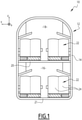
- a railway vehicle 10 is represented on the figure 1 , including a two-level 12 car.
- a longitudinal direction X extending substantially along the normal direction of movement of the vehicle 10
- a transverse direction Y orthogonal to the longitudinal direction X and substantially horizontal
- an elevation direction Z substantially vertical, as shown in the figure 1 .
- the car 12 comprises a body 14 defining a lower level 16 and an upper level 18 separated by an intermediate floor 20 from the upper level 18.
- the body 14 also defines a lower floor 21 for the lower level 16.
- Each of the lower level 16 and the upper level 18 comprises a cabin intended to accommodate passengers, each cabin comprising seats 22 intended to allow the passengers to travel seated.
- each seat 22 of the cabin defines at least two reception slots 24 suitable for accommodating a seated passenger.
- At least one of the seats 22 defines a single location 24 suitable for accommodating a seated passenger, in particular half of the seats 22 included in the cabin.
- each seat 22 comprises a seat 26 defining a seat surface, a backrest 28, at least one armrest 30 and at least one foot 32.
- the seat 26 extends substantially in an XY plane parallel to the longitudinal direction X and to the transverse direction Y.
- the seat 26 has a front edge 34 and a rear edge 36 spaced from each other relative to the longitudinal direction X, two side edges spaced apart relative to the transverse direction Y, as well as an upper face 38 and a lower face 40 spaced apart relative to the elevation direction Z .
- the backrest 28 is integral with the seat 26, in the vicinity of the rear edge 36.
- the backrest 28 is substantially flat and forms an angle with the plane XY of the seat 26, for example between 75° and 90°.
- each armrest 30 is fixed to the backrest 28 and/or to the seat 26, in a fixed or mobile manner in rotation around an axis parallel to the transverse direction Y.
- Each armrest 30 is for example arranged in the vicinity of a transverse edge of a location 26 along the longitudinal direction X.
- the seat 22 comprises a foot 32 in the vicinity of each of the side edges of the seat 26.
- the seat 22 comprises a single leg 32 in the vicinity of one of the side edges of the seat 26 and is fixed directly to a wall of the body 14 by a fixing member arranged in the vicinity of the other edge. side of the seat 26.
- Each foot 32 is integral with the underside 40 of the seat 26 and the corresponding floor 20, 21, so as to support the seat 26.
- the foot 32 comprises a first segment 44 and a second segment 46 both extending substantially along the longitudinal direction X, and a third segment 48 extending substantially along the elevation direction Z.
- the first segment 44 and the second segment are spaced apart in the direction of elevation Z and are joined to each other by the third segment 48, .
- the segments 44, 46, 48 of each foot 32 are arranged so as to form a C profile in an XZ plane parallel to the longitudinal direction X and to the elevation direction Z.
- the foot 32 is made from a rigid material, for example metal, in particular steel, or advantageously from a composite material comprising carbon fibers.
- the first segment 44, the second segment 46 and the third segment 48 are integral with each other.
- the foot 32 is formed by bending a bar or a straight section to form the first segment 44, the second segment 46 and the third segment 48.
- the first segment 44 is fixed to the underside 40 of the seat 26 and the second segment 46 is fixed to the floor of the cabin, for example by welding when the respective materials of the foot 32, of the floor 20, 21 and of the seat 26 allow it.
- the first segment 44 is fixed to the seat 26 by means of fasteners such as screws or rivets, or glued to the seat 26, and the second segment 46 is fixed to the floor 20, 21 by similar fasteners, or welded.
- the seat 22 defines with the floor of the cabin a housing 50 extending between the lower face 40 of the seat 26 and the floor 20, 21, the housing 50 being able to receive at least one piece of cabin baggage 52.
- the third segment 48 of the foot 32 forms a bottom stop of the housing 50, which limits the depth of the housing 50 and thus limits the width of the cabin baggage 52 received in the housing 50.
- the cabin baggage 52 does not protrude from the front edge 34 along the longitudinal direction X.
- the third segment 48 extends at a distance greater than or equal to 350 mm from the rear edge 36 of the seat 26, the distance being measured along the longitudinal direction X, in the plane XZ parallel to the longitudinal direction X and to the elevation direction Z.
- the housing 50 has a depth, measured along the longitudinal direction X, greater than or equal to 350 mm. The housing 50 is then able to receive the cabin baggage 52 without the latter protruding more than 100 mm from the rear edge 36 of the seat 26 in the longitudinal direction X.
- the excess of cabin baggage 52 from the rear edge 36 is zero.
- the third segment 48 has a length greater than or equal to 250 mm, the length of the third segment 48 being measured in the elevation direction Z, in the XZ plane, between the first segment 44 and the second segment 46.
- each of the segments 44, 46, 48 of the foot 32 has a thickness in the transverse direction Y greater than or equal to the length of the third segment 48, so that the foot 32 has significant rigidity for passenger comfort.
- the positioning of the third segment 48 is such that the housing 50 is accessible from the rear of the seat 22.
- the housing 50 is then intended to receive the baggage 52 of the passenger occupying the seat 22 located behind that defining the housing 50.
- the piece of baggage 52 has a length less than or equal to 550 mm, a width less than or equal to 350 mm and a height less than or equal to 250 mm.
- the housing 50 is suitable for receiving at least as much cabin baggage as the seat 22 has slots.
- the housing 50 is able to receive two cabin bags 52.
- the two cabin luggage 52 are arranged in L.
- the bag 52 closest to the foot 32 is arranged with its length substantially in the transverse direction Y while the second bag 52, adjacent to the walls of the box 14, is arranged with its length substantially in the longitudinal direction X.
- the two cabin bags 52 are arranged in the same direction, with the length of each bag 52 oriented substantially according to the transverse direction Y.
- a seat 22 according to a second embodiment is represented on the picture 3 .
- the seat 22 according to the second embodiment is identical to the seat 22 according to the first embodiment described above, the corresponding elements bearing the same references, with the exception of the following.
- the foot 32 is arranged so that the housing 50 is accessible from the front of the seat 22.
- the housing 50 is then intended to receive the luggage 52 of the passenger occupying the seat 22 defining the housing 50.
- the third segment 48 extends at a distance greater than or equal to 350 mm from the front edge 34 of the seat 26, the distance being measured in the plane XZ parallel to the longitudinal direction X and to the direction of elevation Z .
- the housing 50 thus has a depth suitable for receiving the cabin baggage 52 without the latter protruding excessively from the front edge 34 of the seat 22 in the longitudinal direction X.
- the maximum overhang of the cabin baggage 52 is less than 100 mm, and advantageously the overrun of cabin baggage 52 is zero.
- the foot 32 forms a bottom stop of the housing 50, so that the luggage 52 does not protrude from the rear edge 36 of the seat 26 in the longitudinal direction X either.
- the seat 22 according to this embodiment is advantageous in the case of seats 32 arranged face-to-face, as shown in the picture 3 , in order to allow the passengers occupying them to have a dedicated storage space.
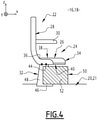
- a seat 22 according to a third embodiment is represented on the figure 4 .
- the seat 22 according to the third embodiment is identical to the seat 22 according to the first embodiment described above, the corresponding elements bearing the same references, with the exception of the following.
- the foot 32 comprises a third segment 48 having a cross section, in a horizontal plane XY, the surface of which increases going from the first segment 44 to the second segment 46.
- the foot 32 is typically produced by welding the three segments 44, 46, 48 the with each other, or by molding, depending on the material making up the foot 32.
- the foot 32 is fixed to the underside 40 of the seat 26 by fixing members, for example bolts.
- the foot 32 according to the embodiment of the figure 4 has greater stiffness, and therefore improved stability, as well as greater mechanical strength. On the other hand, it is more complex to make than the variants described above.
- the vehicle 10 is a road vehicle, for example a bus, in particular a bus with two levels, or else a maritime or air vehicle.
- the seat 22 according to the invention makes it possible to reduce the size under the seat 22, which makes it possible to use the volume between the seat 26 and the floor 20, 21 for storing luggage. This makes it possible to free up space intended for storing luggage elsewhere in the vehicle to increase the number of spaces intended for passengers, which is desirable in any type of vehicle, and in particular in second-class type cabins.
- the storage by a passenger of his luggage 52 under the seat 22 also makes it possible to monitor him easily during the trip, and the luggage 52 can be fixed simply to the foot 32, by means of a simple lock, for example during the movements of the passenger.
Landscapes
- Engineering & Computer Science (AREA)
- Mechanical Engineering (AREA)
- Aviation & Aerospace Engineering (AREA)
- Transportation (AREA)
- Chemical & Material Sciences (AREA)
- Combustion & Propulsion (AREA)
- Ocean & Marine Engineering (AREA)
- Seats For Vehicles (AREA)
- Passenger Equipment (AREA)
- Vehicle Step Arrangements And Article Storage (AREA)
- Automatic Cycles, And Cycles In General (AREA)
Description
- La présente invention concerne un siège de véhicule.
- Il est connu de placer des sièges dans les compartiments des véhicules destinés à accueillir des passagers, afin de leur permettre de s'assoir pour rendre leur voyage plus agréable. Cela est notamment le cas pour les véhicules destinés à effectuer des trajets de moyenne ou longue durée, comme des véhicules ferroviaires ou routiers, ainsi que pour des véhicules maritimes ou aériens.
- La conception des compartiments passagers nécessite de prendre en compte à la fois l'espace occupé par les sièges des passagers et les espaces destinés aux bagages de ces passagers, en prévoyant des espaces destinés à leur stockage pour la durée du voyage.
- Les bagages sont généralement classifiés en deux catégories : les bagages volumineux, nécessitant un espace de rangement spécifique, et les bagages cabine, de plus petites dimensions, destinés à être rangés à proximité du passager.
- Notamment, il est connu de prévoir des porte-bagages disposés au-dessus des sièges, pour accueillir les bagages cabine des passagers.
- Cependant, ces espaces de stockage de bagages peuvent encore être améliorés.
- En effet, ces porte-bagages en partie haute de la cabine sont généralement gênants pour les passagers qui se lèvent. De plus, il est parfois difficile de rangers des bagages très lourds dans un porte-bagage situé en hauteur. En outre, ces bagages peuvent tomber et mettre en danger les passagers.
- Enfin, dans le cas des véhicules à deux étages ou plus, la hauteur sous plafond est restreinte, ce qui rend difficile de placer un porte-bagage au-dessus des sièges passagers.
- Il est connu des documents
US 5 655 816 A1 ,EP 2 727 791 A1 etEP 1 266 790 A2 d'installer un siège de véhicule comprenant une assise, un dossier et un pied en trois segments. - Un but de l'invention est ainsi de fournir un espace de stockage de bagages minimisant l'espace occupé dans le compartiment, d'accès simplifié et sécurisé, et qui soit compatible avec les véhicules à deux étages.
- A cet effet, l'invention a pour objet un siège selon la revendication 1.
- Un tel siège permet de disposer d'un espace de rangement sous l'assise adapté pour recevoir un bagage cabine, sans gêne supplémentaire pour l'occupant du siège ou ses voisins. De plus, le bagage ainsi rangé est facilement accessible et ne pose aucun risque de chute. Enfin, un tel rangement des bagages permet de dégager de l'espace sous le plafond en supprimant la nécessité d'avoir un porte-bagage au-dessus du siège, et est particulièrement adapté aux véhicules à plusieurs niveaux.
- Selon des modes de réalisation particuliers, le siège selon l'invention présente l'une ou plusieurs des caractéristiques des revendications 2 à 8 et suivantes, prise(s) isolément ou selon toute combinaison techniquement réalisable :
- le pied est constitué d'un matériau composite comprenant des fibres de carbone.
- L'invention a également pour objet un véhicule, notamment ferroviaire, selon la revendication 9.
- Selon un mode de réalisation particulier, le véhicule selon l'invention présente la caractéristique de la revendication 10.
- L'invention sera mieux comprise à la lecture de la description qui va suivre, donnée uniquement à titre d'exemple et faite en se référant aux dessins annexés, parmi lesquels :
- [
Fig 1 ] lafigure 1 est une vue coupe transversale d'un véhicule selon l'invention ; - [
Fig 2 ] lafigure 2 est une vue latérale de deux sièges selon un premier mode de réalisation de l'invention : - [
Fig 3 ] lafigure 3 est une vue latérale de deux sièges selon un deuxième mode de réalisation de l'invention ; et - [
Fig 4 ] lafigure 4 est une vue latérale d'un siège selon un troisième mode de réalisation de l'invention. - Un véhicule 10 ferroviaire est représenté sur la
figure 1 , comprenant une voiture 12 à deux niveaux. - Dans tout ce qui suit, il est fait référence à une direction longitudinale X s'étendant sensiblement selon la direction de déplacement normale du véhicule 10, une direction transversale Y orthogonale à la direction longitudinale X et sensiblement horizontale, et une direction d'élévation Z sensiblement verticale, comme représenté sur la
figure 1 . - De plus, dans tout ce qui suit, par les termes « sensiblement selon une direction », « sensiblement parallèle » et « sensiblement perpendiculaire », on entend respectivement « selon une direction », « parallèle à » et « perpendiculaire à » à 10° près, et notamment à 5° près.
- La voiture 12 comprend une caisse 14 délimitant un niveau inférieur 16 et un niveau supérieur 18 séparés par un plancher intermédiaire 20 du niveau supérieur 18. La caisse 14 définit également un plancher inférieur 21 pour le niveau inférieur 16.
- Chacun du niveau inférieur 16 et du niveau supérieur 18 comprend une cabine destinée à accueillir des passagers, chaque cabine comprenant des sièges 22 destinés à permettre aux passagers de voyager assis.
- Selon le mode de réalisation de la
figure 1 , chaque siège 22 de la cabine définit au moins deux emplacements 24 de réception propres à accueillir un passager assis. - Selon un autre mode de réalisation, au moins un des sièges 22 définit un unique emplacement 24 propre à accueillir un passager assis, notamment la moitié des sièges 22 compris dans la cabine.
- Comme représenté sur la
figure 2 , chaque siège 22 comprend une assise 26 définissant une surface d'assise, un dossier 28, au moins un accoudoir 30 et au moins un pied 32. - L'assise 26 s'étend sensiblement dans un plan XY parallèle à la direction longitudinale X et à la direction transversale Y. L'assise 26 présente un bord avant 34 et un bord arrière 36 espacés l'un de l'autre relativement à la direction longitudinale X, deux bords latéraux espacés l'un de l'autre relativement à la direction transversale Y, ainsi qu'une face supérieure 38 et une face inférieure 40 espacées l'une de l'autre relativement à la direction d'élévation Z.
- Le dossier 28 est solidaire de l'assise 26, au voisinage du bord arrière 36. Le dossier 28 est sensiblement plan et forme un angle avec le plan XY de l'assise 26, par exemple compris entre 75° et 90°.
- Le ou chaque accoudoir 30 est fixé au dossier 28 et/ou à l'assise 26, de manière fixe ou mobile en rotation autour d'un axe parallèle à la direction transversale Y. Chaque accoudoir 30 est par exemple disposé au voisinage d'un bord transversal d'un emplacement 26 selon la direction longitudinale X.
- Selon une première variante, le siège 22 comprend un pied 32 au voisinage de chacun des bords latéraux de l'assise 26.
- Selon une autre variante, le siège 22 comprend un unique pied 32 au voisinage d'un des bords latéraux de l'assise 26 et est fixé directement à une paroi de la caisse 14 par un organe de fixation disposé au voisinage de l'autre bord latéral de l'assise 26.
- Chaque pied 32 est solidaire de la face inférieure 40 de l'assise 26 et du plancher 20, 21 correspondant, de manière à supporter l'assise 26.
- Le pied 32 comprend un premier segment 44 et un deuxième segment 46 s'étendant tous deux sensiblement selon la direction longitudinale X, et un troisième segment 48 s'étendant sensiblement selon la direction s'élévation Z.
- Le premier segment 44 et le deuxième segment sont espacés l'un de l'autre selon la direction d'élévation Z et sont joints l'un à l'autre par le troisième segment 48, .
- Avantageusement, les segments 44, 46, 48 de chaque pied 32 sont agencés de manière à former un profil en C dans un plan XZ parallèle à la direction longitudinale X et à la direction d'élévation Z.
- Le pied 32 est réalisé à partir d'un matériau rigide, par exemple en métal, notamment en acier, ou avantageusement à partir d'un matériau composite comprenant des fibres de carbone.
- Avantageusement, le premier segment 44, le deuxième segment 46 et le troisième segment 48 sont venus de matière les uns avec les autres. Par exemple, dans le mode de réalisation de la
figure 2 , le pied 32 est formé par pliage d'une barre ou d'un profilé rectiligne pour former le premier segment 44, le deuxième segment 46 et le troisième segment 48. - Le premier segment 44 est fixé à la face inférieure 40 de l'assise 26 et le deuxième segment 46 est fixé au plancher de la cabine, par exemple par soudage lorsque les matériaux respectifs du pied 32, du plancher 20, 21 et de l'assise 26 le permettent. En variante, le premier segment 44 est fixé à l'assise 26 au moyen d'organes de fixation comme des vis ou des rivets, ou collé à l'assise 26, et le deuxième segment 46 est fixé au plancher 20, 21 par des organes de fixation similaires, ou soudé.
- Ainsi, le siège 22 définit avec le plancher de la cabine un logement 50 s'étendant entre la face inférieure 40 de l'assise 26 et le plancher 20, 21, le logement 50 étant apte à recevoir au moins un bagage cabine 52.
- Le troisième segment 48 du pied 32 forme une butée de fond du logement 50, qui limite la profondeur du logement 50 et ainsi limite la largeur du bagage cabine 52 reçu dans le logement 50. Ainsi, le bagage cabine 52 ne dépasse pas du bord avant 34 selon la direction longitudinale X.
- Avantageusement, le troisième segment 48 s'étend à une distance supérieure ou égale à 350 mm du bord arrière 36 de l'assise 26, la distance étant mesurée selon la direction longitudinale X, dans le plan XZ parallèle à la direction longitudinale X et à la direction d'élévation Z.
- Ainsi, le logement 50 présente une profondeur, mesurée selon la direction longitudinale X, supérieure ou égale à 350 mm. Le logement 50 est alors apte à recevoir le bagage cabine 52 sans que celui-ci dépasse de plus de 100 mm du bord arrière 36 de l'assise 26 selon la direction longitudinale X.
- Avantageusement, le dépassement du bagage cabine 52 du bord arrière 36 est nul.
- Le troisième segment 48 présente une longueur supérieure ou égale à 250 mm, la longueur du troisième segment 48 étant mesurée selon la direction d'élévation Z, dans le plan XZ, entre le premier segment 44 et le deuxième segment 46.
- Avantageusement, chacun des segments 44, 46, 48 du pied 32 présente une épaisseur selon la direction transversale Y supérieure ou égale à la longueur du troisième segment 48, afin que le pied 32 présente une rigidité importante pour le confort des passagers.
- Le positionnement du troisième segment 48 est tel que le logement 50 est accessible depuis l'arrière du siège 22. Le logement 50 est alors destiné à recevoir le bagage 52 du passager occupant le siège 22 situé derrière celui définissant le logement 50.
- Par un bagage cabine, on entend que le bagage 52 présente une longueur inférieure ou égale à 550 mm, une largeur inférieure ou égale à 350 mm et une hauteur inférieure ou égale à 250 mm.
- Plus généralement, le logement 50 est adapté pour recevoir au moins autant de bagages cabine que le siège 22 comporte d'emplacements.
- Par exemple, dans le cas où le siège 22 définit deux emplacements 24, le logement 50 est apte à recevoir deux bagages cabine 52.
- Comme représenté sur la
figure 1 , lorsque la largeur du siège 22 est trop faible pour permettre l'arrangement des bagages 52 dans le même sens, notamment si le siège 22 est de type deuxième classe et comprend un unique pied 32, les deux bagages cabine 52 sont arrangés en L. On entend par là que le bagage 52 le plus proche du pied 32 est disposé avec sa longueur sensiblement selon la direction transversale Y tandis que le deuxième bagage 52, voisin des parois de la caisse 14, est disposé avec sa longueur sensiblement selon la direction longitudinale X. - En variante, lorsque la largeur du siège 22 selon la direction transversale Y le permet, notamment si le siège 22 est de type première classe, les deux bagages cabine 52 sont arrangés dans le même sens, avec la longueur de chaque bagage 52 orientée sensiblement selon la direction transversale Y.
- Un siège 22 selon un deuxième mode de réalisation est représenté sur la
figure 3 . Le siège 22 selon le deuxième mode de réalisation est identique au siège 22 selon le premier mode de réalisation décrit plus haut, les éléments correspondants portant les mêmes références, à l'exception de ce qui suit. - Dans ce deuxième mode de réalisation, le pied 32 est agencé de façon à ce que le logement 50 soit accessible depuis l'avant du siège 22. Le logement 50 est alors destiné à recevoir le bagage 52 du passager occupant le siège 22 définissant le logement 50.
- Avantageusement, le troisième segment 48 s'étendent à une distance supérieure ou égale à 350 mm du bord avant 34 de l'assise 26, la distance étant mesurée dans le plan XZ parallèle à la direction longitudinale X et à la direction d'élévation Z.
- Le logement 50 présente ainsi une profondeur adaptée pour recevoir le bagage cabine 52 sans que celui-ci ne dépasse de manière excessive du bord avant 34 du siège 22 selon la direction longitudinale X. Le dépassement maximal du bagage cabine 52 est inférieur à 100 mm, et avantageusement le dépassement du bagage cabine 52 est nul.
- Le pied 32 forme une butée de fond du logement 50, de sorte que le bagage 52 ne dépasse pas non plus du bord arrière 36 de l'assise 26 selon la direction longitudinale X.
- Le siège 22 selon ce mode de réalisation est avantageux dans le cas de sièges 32 disposés en face-à-face, comme représenté sur la
figure 3 , afin de permettre aux voyageurs les occupant de disposer d'un espace de rangement dédié. - Un siège 22 selon un troisième mode de réalisation est représenté sur la
figure 4 . Le siège 22 selon le troisième mode de réalisation est identique au siège 22 selon le premier mode de réalisation décrit plus haut, les éléments correspondants portant les mêmes références, à l'exception de ce qui suit. - Le pied 32 comprend un troisième segment 48 présentant une section transversale, dans un plan horizontal XY dont la surface augmente en allant du premier segment 44 au deuxième segment 46. Le pied 32 est typiquement réalisé par soudage des trois segments 44, 46, 48 les uns avec les autres, ou par moulage, en fonction du matériau composant le pied 32.
- Le pied 32 est fixé à la face inférieure 40 de l'assise 26 par des organes de fixation, par exemple des boulons.
- Le pied 32 selon le mode de réalisation de la
figure 4 présente une raideur plus importante, et donc une stabilité améliorée, ainsi qu'une résistance mécanique supérieure. Il est par contre plus complexe à confectionner que les variantes décrites plus haut. - Selon des variantes non représentées, le véhicule 10 est un véhicule routier, par exemple un car, notamment un car à deux niveaux, ou encore un véhicule maritime ou aérien.
- Le siège 22 selon l'invention permet de réduire l'encombrement sous le siège 22, ce qui permet d'utiliser le volume compris entre l'assise 26 et le plancher 20, 21 pour stocker des bagages. Cela permet de libérer de l'espace destiné au stockage des bagages ailleurs dans le véhicule d'augmenter le nombre d'emplacements destinés aux passagers, ce qui est souhaitable dans tout type de véhicule, et notamment dans les cabines de type deuxième classe.
- Le stockage par un passager de son bagage 52 sous le siège 22 permet de plus de le surveiller facilement pendant le voyage, et le bagage 52 peut être fixé simplement au pied 32, au moyen d'un simple antivol, par exemple pendant les déplacements du passager.
Claims (10)
- Siège (22) de véhicule (10), comprenant :- une assise (26), présentant un bord avant (34) et un bord arrière (36) espacés l'un de l'autre selon une direction longitudinale (X) et délimitant une surface d'assise, ainsi qu'une face supérieure (38) et une face inférieure (40) espacées l'une de l'autre selon une direction d'élévation (Z),- un dossier (28) solidaire de l'assise (26) au voisinage du bord arrière (36), et- au moins un pied (32) supportant l'assise (26), le pied (32) comprenant au moins trois segments (44, 46, 48), parmi lesquels :- un premier segment (44), s'étendant sensiblement selon la direction longitudinale (X), fixé à la face inférieure (40) de l'assise (26),- un deuxième segment (46), s'étendant sensiblement selon la direction longitudinale (X), destiné à être fixé à un plancher (20, 21) de cabine de véhicule (10) espacé du premier segment selon la direction d'élévation (Z), et- un troisième segment (48), s'étendant sensiblement selon la direction d'élévation (Z) joignant le premier segment (44) et le deuxième segment (46),le troisième segment (48) étant agencé pour que le pied (32) soit propre à définir, avec un plancher (20, 21), un logement (50) s'étendant entre la face inférieure (40) de l'assise (26) et le plancher (20, 21),le logement (50) étant apte à recevoir au moins un bagage cabine (52) présentant une longueur égale à 550 mm, une largeur égale à 350 mm et une hauteur égale à 250 mm manière à ce que le bagage cabine (52) ne dépasse pas de plus de 100 mm du bord avant (34) ni du bord arrière (36) de l'assise (26), selon la direction longitudinale (X),caractérisé en ce quele pied (32) forme une butée de fond du logement (50), de sorte que le bagage (52) ne dépasse pas du bord arrière (36) de l'assise (26), selon la direction longitudinale (X) ou en ce que le pied (32) forme une butée de fond du logement (50), de sorte que le bagage (52) ne dépasse pas du bord avant (34) de l'assise (26), selon la direction longitudinale (X).
- Siège selon la revendication 1, dans lequel le troisième segment (48) s'étend à une distance supérieure ou égale à 350 mm du bord avant (34) ou du bord arrière (36) de l'assise (26), la distance étant mesurée selon la direction longitudinale (X), dans un plan (XZ) parallèle à la direction longitudinale (X) et à la direction d'élévation (Z), le troisième segment (48) présentant avantageusement une longueur mesurée selon la direction d'élévation (Z) supérieure ou égale à 250 mm.
- Siège (22) selon la revendication 1 ou 2, dans lequel les segments (44, 46, 48) du pied sont agencés de manière à former un profil en C dans le plan (XZ) parallèle à la direction longitudinale (X) et à la direction d'élévation (Z).
- Siège (22) selon l'une quelconque des revendications 1 à 3, dans lequel le siège (22) comprend un unique pied (32) situé au voisinage d'un premier bord latéral de l'assise (26) selon une direction transversale (Y), le siège (22) étant agencé pour être fixé à une caisse (14) de véhicule (10) au voisinage d'un deuxième bord latéral de l'assise (26), le premier bord latéral et le deuxième bord latéral joignant les bords avant (34) et arrière (36) de part et d'autre de la surface d'assise.
- Siège (22) selon l'une quelconque des revendications 1 à 4, dans lequel le siège (22) définit au moins deux emplacements (24), chaque emplacement (24) étant propre à accueillir un passager assis.
- Siège (22) selon la revendication 5, dans lequel le logement (50) est apte à recevoir au moins autant de bagages cabine (52) que le siège (22) est apte à accueillir de passagers.
- Siège (22) selon la revendication 6, dans lequel le logement (50) est apte à recevoir au moins un des bagages (52) orienté avec sa hauteur selon la direction longitudinale (X) et au moins un autre des bagages (52) orienté avec sa hauteur selon une direction transversale (Y).
- Siège (22) selon l'une quelconque des revendications 1 à 7, dans lequel le troisième segment (48) du pied (32) présente une section transversale, dans un plan horizontal (XY), dont la surface augmente en allant du premier segment (44) au deuxième segment (46) du pied (32).
- Véhicule (10), notamment ferroviaire, comprenant au moins une cabine, la cabine comprenant une pluralité de sièges (22) selon l'une quelconque des revendications 1 à 8.
- Véhicule (10) selon la revendication 9, dans lequel le véhicule (10) comprend au moins une voiture (12) à plusieurs niveaux, chaque niveau (16, 18) comprenant une cabine.
Priority Applications (1)
| Application Number | Priority Date | Filing Date | Title |
|---|---|---|---|
| PL20190411T PL3778336T3 (pl) | 2019-08-12 | 2020-08-11 | Miejsce siedzące pojazdu o ulepszonej powierzchni do przechowywania oraz powiązany pojazd |
Applications Claiming Priority (1)
| Application Number | Priority Date | Filing Date | Title |
|---|---|---|---|
| FR1909151A FR3099896B1 (fr) | 2019-08-12 | 2019-08-12 | Siège de véhicule à espace de stockage amélioré et véhicule associé |
Publications (2)
| Publication Number | Publication Date |
|---|---|
| EP3778336A1 EP3778336A1 (fr) | 2021-02-17 |
| EP3778336B1 true EP3778336B1 (fr) | 2022-03-16 |
Family
ID=69104584
Family Applications (1)
| Application Number | Title | Priority Date | Filing Date |
|---|---|---|---|
| EP20190411.7A Active EP3778336B1 (fr) | 2019-08-12 | 2020-08-11 | Siège de véhicule à espace de stockage amélioré et véhicule associé |
Country Status (6)
| Country | Link |
|---|---|
| US (1) | US20210046855A1 (fr) |
| EP (1) | EP3778336B1 (fr) |
| CN (1) | CN112389283B (fr) |
| ES (1) | ES2917873T3 (fr) |
| FR (1) | FR3099896B1 (fr) |
| PL (1) | PL3778336T3 (fr) |
Families Citing this family (1)
| Publication number | Priority date | Publication date | Assignee | Title |
|---|---|---|---|---|
| US12600278B2 (en) * | 2023-12-19 | 2026-04-14 | Volvo Car Corporation | Vehicle seat floor filler |
Family Cites Families (45)
| Publication number | Priority date | Publication date | Assignee | Title |
|---|---|---|---|---|
| US1320854A (en) * | 1919-11-04 | Auxiliary seat for vehicles | ||
| US1201900A (en) * | 1916-06-03 | 1916-10-17 | George W Wells | Movable seat for vehicles. |
| US1964424A (en) * | 1933-10-03 | 1934-06-26 | Ralph A Borah | Automobile seat |
| US2270981A (en) * | 1940-01-27 | 1942-01-27 | Checker Cab Mfg Corp | Folding seat |
| US2636454A (en) * | 1952-03-27 | 1953-04-28 | Budd Co | Double-deck railway passenger car with increased seating capacity |
| US4577907A (en) * | 1984-10-19 | 1986-03-25 | Air-Lock Plastics, Inc. | Seat assembly |
| FR2587946B1 (fr) * | 1985-10-01 | 1988-01-15 | Compin Ets | Nouveau support de siege pour vehicule de transport en commun et siege equipe de ce support |
| US4756034A (en) * | 1986-11-28 | 1988-07-12 | David Stewart | Motorized seat-bed |
| US5482230A (en) * | 1993-06-25 | 1996-01-09 | B E Aerospace, Inc. | Vehicle bulkhead safety system |
| CA2156971C (fr) * | 1994-09-24 | 2001-08-21 | Richard C. Magnuson | Banquette pour vehicule de transport en commun |
| US5556167A (en) * | 1995-06-30 | 1996-09-17 | Johnson Siemion; Helen F. | Collapsible foot rest for seat backs |
| US6142572A (en) * | 1998-02-03 | 2000-11-07 | Allen; Dan | Buddy tractor seat and mounting |
| US20010050499A1 (en) * | 2000-02-12 | 2001-12-13 | Deloach Vera A. | School bus underseat storage container and method |
| DE10128338A1 (de) * | 2001-06-12 | 2003-01-02 | Grammer Ag | Fahrgastsitz für ein Personenbeförderungsfahrzeug |
| ITTO20020097A1 (it) * | 2002-02-01 | 2003-08-01 | Petra Italia S A S Di Marina B | Sedile per veicolo. |
| US6832741B2 (en) * | 2002-11-08 | 2004-12-21 | Alicja Jarosz | Aircraft seat footrest system and method |
| US7134729B2 (en) * | 2003-12-15 | 2006-11-14 | Be Aerospace, Inc. | Frame assembly for vehicle passenger seat |
| US7393167B2 (en) * | 2005-05-17 | 2008-07-01 | Be Aerospace, Inc. | Load-limiting and energy-dissipating mount for vehicle seating |
| US20070018494A1 (en) * | 2005-07-21 | 2007-01-25 | Be Aerospace, Inc. | Combination footrest and baggage bar for aircraft passenger seat |
| GB0606991D0 (en) * | 2006-04-06 | 2006-05-17 | Virgin Atlantic Airways Ltd | Vehicle seat assembly |
| DE102006049001B4 (de) * | 2006-10-17 | 2011-07-14 | Airbus Operations GmbH, 21129 | Sitzvorrichtung für ein Flugzeug |
| CN101601541A (zh) * | 2008-06-10 | 2009-12-16 | 马计强 | 一种通用的椅子 |
| GB0903907D0 (en) * | 2009-03-06 | 2009-04-22 | Robinson Dominic J | Seat assembly |
| US20110108666A1 (en) * | 2009-11-12 | 2011-05-12 | Be Aerospace, Inc. | Aircraft seats and seating arrangement |
| DE102011083811A1 (de) * | 2011-09-30 | 2013-04-04 | Airbus Operations Gmbh | Sitzvorrichtung für ein Luft- oder Raumfahrzeug |
| GB2497323A (en) * | 2011-12-07 | 2013-06-12 | James Shing Hin Lee | High density seating |
| DE102011122061A1 (de) * | 2011-12-22 | 2013-06-27 | Airbus Operations Gmbh | Passagiersitz mit einer Gepäckaufnahmevorrichtung |
| DE102012110609A1 (de) * | 2012-11-06 | 2014-05-22 | Bombardier Transportation Gmbh | Fahrgastsitzeinrichtung für Schienenfahrzeuge, Schienenfahrzeug mit einer Fahrgastsitzeinrichtung und Verfahren zur Anpassung des Sitzplatzangebots eines Schienenfahrzeugs |
| DE202012105089U1 (de) * | 2012-12-28 | 2013-01-29 | Airbus Operations Gmbh | Ablageanordnung für ein Fahrzeug, Passagiersitz und Flugzeug |
| EP2767474B1 (fr) * | 2013-02-19 | 2019-09-18 | MIRUS Aircraft Seating Ltd. | Partie de pied pour un ensemble de siège de passager d'avion léger |
| EP3079954A4 (fr) * | 2013-12-09 | 2017-11-01 | AmSafe, Inc. | Dispositifs, systèmes et procédés de retenue par prétension d'un occupant d'aéronef |
| EP3126235A1 (fr) * | 2014-04-04 | 2017-02-08 | B/E Aerospace, Inc. | Ossature d'embase de siège d'avion |
| DE102015216171A1 (de) * | 2015-08-25 | 2017-03-02 | Volkswagen Aktiengesellschaft | Sitzbefestigungssystem für ein Fahrzeug |
| CN105105540B (zh) * | 2015-09-17 | 2018-09-07 | 江西元月家具有限公司 | 一种午休椅 |
| DE102015116585A1 (de) * | 2015-09-30 | 2017-03-30 | Airbus Operations Gmbh | Kompakte Funktionsanordnung in einer Kabine eines Fahrzeugs und Fahrzeug mit einer solchen Funktionsanordnung |
| CN206979186U (zh) * | 2016-11-25 | 2018-02-09 | 黄骅渤海机械制造有限公司 | 一种高安全性的c型座椅 |
| DE102017117046A1 (de) * | 2017-07-27 | 2019-01-31 | Man Truck & Bus Ag | Variables Interieur eines Fahrgastraums |
| US10625867B2 (en) * | 2017-10-05 | 2020-04-21 | Fenton Mobility Products, Inc. | Integrable seat leg |
| US20190300173A1 (en) * | 2018-03-28 | 2019-10-03 | The Boeing Company | Bulkhead Partition Design, Seating Arrangement and Method for Using the Same |
| US11059589B2 (en) * | 2018-08-03 | 2021-07-13 | B/E Aerospace, Inc. | Three-place berthing aircraft divan |
| LU100955B1 (en) * | 2018-10-05 | 2020-04-06 | Alpha Ec Ind 2018 S A R L | Electric bus seat and electric battery arrangement |
| GB2582654A (en) * | 2019-03-29 | 2020-09-30 | Mirus Aircraft Seating Ltd | An aircraft seat assembly |
| US11167712B1 (en) * | 2020-04-24 | 2021-11-09 | Louis Sardo | Bus safety shield |
| EP4554858A1 (fr) * | 2022-07-13 | 2025-05-21 | Supernal, LLC | Siège monté sur une colonne structurale et procédés associés |
| EP4306356B1 (fr) * | 2022-07-13 | 2025-12-10 | ArianeGroup GmbH | Système de siège et zone de cabine destinée à être utilisée dans un système d'évacuation d'équipage d'un véhicule de transport spatial |
-
2019
- 2019-08-12 FR FR1909151A patent/FR3099896B1/fr not_active Expired - Fee Related
-
2020
- 2020-08-11 EP EP20190411.7A patent/EP3778336B1/fr active Active
- 2020-08-11 PL PL20190411T patent/PL3778336T3/pl unknown
- 2020-08-11 ES ES20190411T patent/ES2917873T3/es active Active
- 2020-08-11 CN CN202010801716.7A patent/CN112389283B/zh active Active
- 2020-08-12 US US16/991,201 patent/US20210046855A1/en active Pending
Also Published As
| Publication number | Publication date |
|---|---|
| FR3099896B1 (fr) | 2021-09-10 |
| FR3099896A1 (fr) | 2021-02-19 |
| PL3778336T3 (pl) | 2022-06-27 |
| CN112389283B (zh) | 2026-03-03 |
| US20210046855A1 (en) | 2021-02-18 |
| ES2917873T3 (es) | 2022-07-12 |
| CN112389283A (zh) | 2021-02-23 |
| EP3778336A1 (fr) | 2021-02-17 |
Similar Documents
| Publication | Publication Date | Title |
|---|---|---|
| FR2733945A1 (fr) | Dispositif d'armature de dossier pour siege arriere de vehicule automobile, et siege comportant un tel dispositif | |
| EP1907269B1 (fr) | Ensembles sieges reglables pour vehicules | |
| EP3778336B1 (fr) | Siège de véhicule à espace de stockage amélioré et véhicule associé | |
| EP2066562B1 (fr) | Aeronef comprenant un fuselage avec plancher s'etendant dans le plan longitudinal du fuselage | |
| FR2890366A1 (fr) | Plancher central de vehicule automobile | |
| FR3119805A1 (fr) | Siège de véhicule | |
| FR2975055A1 (fr) | Systeme d'amenagement modulable de l'habitacle d'un vehicule automobile. | |
| EP2776277A1 (fr) | Dispositif d'articulation ameliore d'un dossier de siege de vehicule automobile et siege de vehicule associe. | |
| EP4035945B1 (fr) | Siège de véhicule, notamment ferroviaire, caisse de véhicule, notamment ferroviaire, comprenant un tel siège et véhicule, notamment ferroviaire, comprenant une telle caisse | |
| EP1808330B1 (fr) | Siège pour véhicule automobile mobile selon un premier axe x et un second axe y et véhicule automobile comprenant un tel siège | |
| EP4626756A1 (fr) | Support pour un enrouleur de ceinture de sécurité de véhicule | |
| EP1240066A1 (fr) | Habitacle renforce de vehicule automobile | |
| FR3039469A1 (fr) | Banquette pour vehicule de transport comprenant un siege d'appoint | |
| FR3006283A1 (fr) | Traverse pour planche de bord comprenant un etrier de fixation d'airbag passager degageant un espace de rangement | |
| EP3795414B1 (fr) | Armature d'assise de siege pour vehicule automobile | |
| FR3151257A1 (fr) | Système de porte-gobelet pour véhicule automobile | |
| FR3061458B1 (fr) | Dispositif d’ancrage pour la fixation amovible d’un siege enfant sur un siege arriere d’un vehicule automobile rabattable en portefeuille. | |
| EP4660004A1 (fr) | Plancher renforcé pour structure de véhicule automobile | |
| FR3123857A1 (fr) | Porte-bagages pour un véhicule terrestre et véhicule associé | |
| FR3049912B1 (fr) | Console a structure flottante | |
| WO2024133252A1 (fr) | Plancher plastique fixé sur un réservoir de carburant | |
| FR2887190A1 (fr) | Structure de sieges coulissants longitudinalement et lateralement pour vehicule automobile | |
| FR3114552A3 (fr) | Dispositif de protection amovible pour conducteur de véhicule automobile de transport collectif | |
| FR2879975A1 (fr) | Siege de voiture automobile comprenant un dossier pourvu d'une coque | |
| FR3124441A1 (fr) | véhicule doté d’un dispositif d’accrochage de sièges de rang trois. |
Legal Events
| Date | Code | Title | Description |
|---|---|---|---|
| PUAI | Public reference made under article 153(3) epc to a published international application that has entered the european phase |
Free format text: ORIGINAL CODE: 0009012 |
|
| STAA | Information on the status of an ep patent application or granted ep patent |
Free format text: STATUS: THE APPLICATION HAS BEEN PUBLISHED |
|
| STAA | Information on the status of an ep patent application or granted ep patent |
Free format text: STATUS: REQUEST FOR EXAMINATION WAS MADE |
|
| AK | Designated contracting states |
Kind code of ref document: A1 Designated state(s): AL AT BE BG CH CY CZ DE DK EE ES FI FR GB GR HR HU IE IS IT LI LT LU LV MC MK MT NL NO PL PT RO RS SE SI SK SM TR |
|
| AX | Request for extension of the european patent |
Extension state: BA ME |
|
| 17P | Request for examination filed |
Effective date: 20210202 |
|
| RBV | Designated contracting states (corrected) |
Designated state(s): AL AT BE BG CH CY CZ DE DK EE ES FI FR GB GR HR HU IE IS IT LI LT LU LV MC MK MT NL NO PL PT RO RS SE SI SK SM TR |
|
| STAA | Information on the status of an ep patent application or granted ep patent |
Free format text: STATUS: EXAMINATION IS IN PROGRESS |
|
| 17Q | First examination report despatched |
Effective date: 20210528 |
|
| GRAP | Despatch of communication of intention to grant a patent |
Free format text: ORIGINAL CODE: EPIDOSNIGR1 |
|
| STAA | Information on the status of an ep patent application or granted ep patent |
Free format text: STATUS: GRANT OF PATENT IS INTENDED |
|
| INTG | Intention to grant announced |
Effective date: 20211028 |
|
| GRAS | Grant fee paid |
Free format text: ORIGINAL CODE: EPIDOSNIGR3 |
|
| GRAA | (expected) grant |
Free format text: ORIGINAL CODE: 0009210 |
|
| STAA | Information on the status of an ep patent application or granted ep patent |
Free format text: STATUS: THE PATENT HAS BEEN GRANTED |
|
| AK | Designated contracting states |
Kind code of ref document: B1 Designated state(s): AL AT BE BG CH CY CZ DE DK EE ES FI FR GB GR HR HU IE IS IT LI LT LU LV MC MK MT NL NO PL PT RO RS SE SI SK SM TR |
|
| REG | Reference to a national code |
Ref country code: GB Ref legal event code: FG4D Free format text: NOT ENGLISH |
|
| REG | Reference to a national code |
Ref country code: CH Ref legal event code: EP Ref country code: DE Ref legal event code: R096 Ref document number: 602020002236 Country of ref document: DE |
|
| REG | Reference to a national code |
Ref country code: IE Ref legal event code: FG4D Free format text: LANGUAGE OF EP DOCUMENT: FRENCH |
|
| REG | Reference to a national code |
Ref country code: AT Ref legal event code: REF Ref document number: 1475692 Country of ref document: AT Kind code of ref document: T Effective date: 20220415 |
|
| REG | Reference to a national code |
Ref country code: LT Ref legal event code: MG9D |
|
| REG | Reference to a national code |
Ref country code: ES Ref legal event code: FG2A Ref document number: 2917873 Country of ref document: ES Kind code of ref document: T3 Effective date: 20220712 |
|
| REG | Reference to a national code |
Ref country code: NL Ref legal event code: MP Effective date: 20220316 |
|
| PG25 | Lapsed in a contracting state [announced via postgrant information from national office to epo] |
Ref country code: SE Free format text: LAPSE BECAUSE OF FAILURE TO SUBMIT A TRANSLATION OF THE DESCRIPTION OR TO PAY THE FEE WITHIN THE PRESCRIBED TIME-LIMIT Effective date: 20220316 Ref country code: RS Free format text: LAPSE BECAUSE OF FAILURE TO SUBMIT A TRANSLATION OF THE DESCRIPTION OR TO PAY THE FEE WITHIN THE PRESCRIBED TIME-LIMIT Effective date: 20220316 Ref country code: NO Free format text: LAPSE BECAUSE OF FAILURE TO SUBMIT A TRANSLATION OF THE DESCRIPTION OR TO PAY THE FEE WITHIN THE PRESCRIBED TIME-LIMIT Effective date: 20220616 Ref country code: LT Free format text: LAPSE BECAUSE OF FAILURE TO SUBMIT A TRANSLATION OF THE DESCRIPTION OR TO PAY THE FEE WITHIN THE PRESCRIBED TIME-LIMIT Effective date: 20220316 Ref country code: HR Free format text: LAPSE BECAUSE OF FAILURE TO SUBMIT A TRANSLATION OF THE DESCRIPTION OR TO PAY THE FEE WITHIN THE PRESCRIBED TIME-LIMIT Effective date: 20220316 Ref country code: BG Free format text: LAPSE BECAUSE OF FAILURE TO SUBMIT A TRANSLATION OF THE DESCRIPTION OR TO PAY THE FEE WITHIN THE PRESCRIBED TIME-LIMIT Effective date: 20220616 |
|
| REG | Reference to a national code |
Ref country code: AT Ref legal event code: MK05 Ref document number: 1475692 Country of ref document: AT Kind code of ref document: T Effective date: 20220316 |
|
| PG25 | Lapsed in a contracting state [announced via postgrant information from national office to epo] |
Ref country code: LV Free format text: LAPSE BECAUSE OF FAILURE TO SUBMIT A TRANSLATION OF THE DESCRIPTION OR TO PAY THE FEE WITHIN THE PRESCRIBED TIME-LIMIT Effective date: 20220316 Ref country code: GR Free format text: LAPSE BECAUSE OF FAILURE TO SUBMIT A TRANSLATION OF THE DESCRIPTION OR TO PAY THE FEE WITHIN THE PRESCRIBED TIME-LIMIT Effective date: 20220617 Ref country code: FI Free format text: LAPSE BECAUSE OF FAILURE TO SUBMIT A TRANSLATION OF THE DESCRIPTION OR TO PAY THE FEE WITHIN THE PRESCRIBED TIME-LIMIT Effective date: 20220316 |
|
| PG25 | Lapsed in a contracting state [announced via postgrant information from national office to epo] |
Ref country code: NL Free format text: LAPSE BECAUSE OF FAILURE TO SUBMIT A TRANSLATION OF THE DESCRIPTION OR TO PAY THE FEE WITHIN THE PRESCRIBED TIME-LIMIT Effective date: 20220316 |
|
| PG25 | Lapsed in a contracting state [announced via postgrant information from national office to epo] |
Ref country code: SM Free format text: LAPSE BECAUSE OF FAILURE TO SUBMIT A TRANSLATION OF THE DESCRIPTION OR TO PAY THE FEE WITHIN THE PRESCRIBED TIME-LIMIT Effective date: 20220316 Ref country code: SK Free format text: LAPSE BECAUSE OF FAILURE TO SUBMIT A TRANSLATION OF THE DESCRIPTION OR TO PAY THE FEE WITHIN THE PRESCRIBED TIME-LIMIT Effective date: 20220316 Ref country code: RO Free format text: LAPSE BECAUSE OF FAILURE TO SUBMIT A TRANSLATION OF THE DESCRIPTION OR TO PAY THE FEE WITHIN THE PRESCRIBED TIME-LIMIT Effective date: 20220316 Ref country code: PT Free format text: LAPSE BECAUSE OF FAILURE TO SUBMIT A TRANSLATION OF THE DESCRIPTION OR TO PAY THE FEE WITHIN THE PRESCRIBED TIME-LIMIT Effective date: 20220718 Ref country code: EE Free format text: LAPSE BECAUSE OF FAILURE TO SUBMIT A TRANSLATION OF THE DESCRIPTION OR TO PAY THE FEE WITHIN THE PRESCRIBED TIME-LIMIT Effective date: 20220316 Ref country code: CZ Free format text: LAPSE BECAUSE OF FAILURE TO SUBMIT A TRANSLATION OF THE DESCRIPTION OR TO PAY THE FEE WITHIN THE PRESCRIBED TIME-LIMIT Effective date: 20220316 Ref country code: AT Free format text: LAPSE BECAUSE OF FAILURE TO SUBMIT A TRANSLATION OF THE DESCRIPTION OR TO PAY THE FEE WITHIN THE PRESCRIBED TIME-LIMIT Effective date: 20220316 |
|
| PG25 | Lapsed in a contracting state [announced via postgrant information from national office to epo] |
Ref country code: IS Free format text: LAPSE BECAUSE OF FAILURE TO SUBMIT A TRANSLATION OF THE DESCRIPTION OR TO PAY THE FEE WITHIN THE PRESCRIBED TIME-LIMIT Effective date: 20220716 Ref country code: AL Free format text: LAPSE BECAUSE OF FAILURE TO SUBMIT A TRANSLATION OF THE DESCRIPTION OR TO PAY THE FEE WITHIN THE PRESCRIBED TIME-LIMIT Effective date: 20220316 |
|
| REG | Reference to a national code |
Ref country code: DE Ref legal event code: R097 Ref document number: 602020002236 Country of ref document: DE |
|
| PLBE | No opposition filed within time limit |
Free format text: ORIGINAL CODE: 0009261 |
|
| STAA | Information on the status of an ep patent application or granted ep patent |
Free format text: STATUS: NO OPPOSITION FILED WITHIN TIME LIMIT |
|
| PG25 | Lapsed in a contracting state [announced via postgrant information from national office to epo] |
Ref country code: DK Free format text: LAPSE BECAUSE OF FAILURE TO SUBMIT A TRANSLATION OF THE DESCRIPTION OR TO PAY THE FEE WITHIN THE PRESCRIBED TIME-LIMIT Effective date: 20220316 |
|
| 26N | No opposition filed |
Effective date: 20221219 |
|
| PG25 | Lapsed in a contracting state [announced via postgrant information from national office to epo] |
Ref country code: SI Free format text: LAPSE BECAUSE OF FAILURE TO SUBMIT A TRANSLATION OF THE DESCRIPTION OR TO PAY THE FEE WITHIN THE PRESCRIBED TIME-LIMIT Effective date: 20220316 |
|
| PG25 | Lapsed in a contracting state [announced via postgrant information from national office to epo] |
Ref country code: MC Free format text: LAPSE BECAUSE OF FAILURE TO SUBMIT A TRANSLATION OF THE DESCRIPTION OR TO PAY THE FEE WITHIN THE PRESCRIBED TIME-LIMIT Effective date: 20220316 |
|
| PG25 | Lapsed in a contracting state [announced via postgrant information from national office to epo] |
Ref country code: LU Free format text: LAPSE BECAUSE OF NON-PAYMENT OF DUE FEES Effective date: 20220811 |
|
| REG | Reference to a national code |
Ref country code: BE Ref legal event code: MM Effective date: 20220831 |
|
| PG25 | Lapsed in a contracting state [announced via postgrant information from national office to epo] |
Ref country code: IE Free format text: LAPSE BECAUSE OF NON-PAYMENT OF DUE FEES Effective date: 20220811 |
|
| PG25 | Lapsed in a contracting state [announced via postgrant information from national office to epo] |
Ref country code: BE Free format text: LAPSE BECAUSE OF NON-PAYMENT OF DUE FEES Effective date: 20220831 |
|
| P01 | Opt-out of the competence of the unified patent court (upc) registered |
Effective date: 20231025 |
|
| PG25 | Lapsed in a contracting state [announced via postgrant information from national office to epo] |
Ref country code: CY Free format text: LAPSE BECAUSE OF FAILURE TO SUBMIT A TRANSLATION OF THE DESCRIPTION OR TO PAY THE FEE WITHIN THE PRESCRIBED TIME-LIMIT Effective date: 20220316 |
|
| PG25 | Lapsed in a contracting state [announced via postgrant information from national office to epo] |
Ref country code: MK Free format text: LAPSE BECAUSE OF FAILURE TO SUBMIT A TRANSLATION OF THE DESCRIPTION OR TO PAY THE FEE WITHIN THE PRESCRIBED TIME-LIMIT Effective date: 20220316 Ref country code: HU Free format text: LAPSE BECAUSE OF FAILURE TO SUBMIT A TRANSLATION OF THE DESCRIPTION OR TO PAY THE FEE WITHIN THE PRESCRIBED TIME-LIMIT; INVALID AB INITIO Effective date: 20200811 |
|
| PG25 | Lapsed in a contracting state [announced via postgrant information from national office to epo] |
Ref country code: MT Free format text: LAPSE BECAUSE OF FAILURE TO SUBMIT A TRANSLATION OF THE DESCRIPTION OR TO PAY THE FEE WITHIN THE PRESCRIBED TIME-LIMIT Effective date: 20220316 |
|
| PGFP | Annual fee paid to national office [announced via postgrant information from national office to epo] |
Ref country code: ES Payment date: 20250926 Year of fee payment: 6 |
|
| PGFP | Annual fee paid to national office [announced via postgrant information from national office to epo] |
Ref country code: DE Payment date: 20250820 Year of fee payment: 6 |
|
| PGFP | Annual fee paid to national office [announced via postgrant information from national office to epo] |
Ref country code: IT Payment date: 20250825 Year of fee payment: 6 Ref country code: PL Payment date: 20250731 Year of fee payment: 6 Ref country code: TR Payment date: 20250805 Year of fee payment: 6 |
|
| PGFP | Annual fee paid to national office [announced via postgrant information from national office to epo] |
Ref country code: GB Payment date: 20250820 Year of fee payment: 6 |
|
| PGFP | Annual fee paid to national office [announced via postgrant information from national office to epo] |
Ref country code: FR Payment date: 20250828 Year of fee payment: 6 |
|
| PGFP | Annual fee paid to national office [announced via postgrant information from national office to epo] |
Ref country code: CH Payment date: 20250901 Year of fee payment: 6 |