EP3774722B1 - Opioid-rezeptor-modulatoren sowie zugehörige produkte und verfahren - Google Patents
Opioid-rezeptor-modulatoren sowie zugehörige produkte und verfahren Download PDFInfo
- Publication number
- EP3774722B1 EP3774722B1 EP19718552.3A EP19718552A EP3774722B1 EP 3774722 B1 EP3774722 B1 EP 3774722B1 EP 19718552 A EP19718552 A EP 19718552A EP 3774722 B1 EP3774722 B1 EP 3774722B1
- Authority
- EP
- European Patent Office
- Prior art keywords
- mmol
- methyl
- compound
- propyl
- phenylcyclopropane
- Prior art date
- Legal status (The legal status is an assumption and is not a legal conclusion. Google has not performed a legal analysis and makes no representation as to the accuracy of the status listed.)
- Active
Links
Images

Classifications
-
- C—CHEMISTRY; METALLURGY
- C07—ORGANIC CHEMISTRY
- C07D—HETEROCYCLIC COMPOUNDS
- C07D213/00—Heterocyclic compounds containing six-membered rings, not condensed with other rings, with one nitrogen atom as the only ring hetero atom and three or more double bonds between ring members or between ring members and non-ring members
- C07D213/02—Heterocyclic compounds containing six-membered rings, not condensed with other rings, with one nitrogen atom as the only ring hetero atom and three or more double bonds between ring members or between ring members and non-ring members having three double bonds between ring members or between ring members and non-ring members
- C07D213/04—Heterocyclic compounds containing six-membered rings, not condensed with other rings, with one nitrogen atom as the only ring hetero atom and three or more double bonds between ring members or between ring members and non-ring members having three double bonds between ring members or between ring members and non-ring members having no bond between the ring nitrogen atom and a non-ring member or having only hydrogen or carbon atoms directly attached to the ring nitrogen atom
- C07D213/24—Heterocyclic compounds containing six-membered rings, not condensed with other rings, with one nitrogen atom as the only ring hetero atom and three or more double bonds between ring members or between ring members and non-ring members having three double bonds between ring members or between ring members and non-ring members having no bond between the ring nitrogen atom and a non-ring member or having only hydrogen or carbon atoms directly attached to the ring nitrogen atom with substituted hydrocarbon radicals attached to ring carbon atoms
- C07D213/36—Radicals substituted by singly-bound nitrogen atoms
- C07D213/42—Radicals substituted by singly-bound nitrogen atoms having hetero atoms attached to the substituent nitrogen atom
-
- A—HUMAN NECESSITIES
- A61—MEDICAL OR VETERINARY SCIENCE; HYGIENE
- A61P—SPECIFIC THERAPEUTIC ACTIVITY OF CHEMICAL COMPOUNDS OR MEDICINAL PREPARATIONS
- A61P23/00—Anaesthetics
-
- A—HUMAN NECESSITIES
- A61—MEDICAL OR VETERINARY SCIENCE; HYGIENE
- A61P—SPECIFIC THERAPEUTIC ACTIVITY OF CHEMICAL COMPOUNDS OR MEDICINAL PREPARATIONS
- A61P25/00—Drugs for disorders of the nervous system
-
- C—CHEMISTRY; METALLURGY
- C07—ORGANIC CHEMISTRY
- C07C—ACYCLIC OR CARBOCYCLIC COMPOUNDS
- C07C233/00—Carboxylic acid amides
- C07C233/57—Carboxylic acid amides having carbon atoms of carboxamide groups bound to carbon atoms of rings other than six-membered aromatic rings
- C07C233/62—Carboxylic acid amides having carbon atoms of carboxamide groups bound to carbon atoms of rings other than six-membered aromatic rings having the nitrogen atom of at least one of the carboxamide groups bound to a carbon atom of a hydrocarbon radical substituted by amino groups
-
- C—CHEMISTRY; METALLURGY
- C07—ORGANIC CHEMISTRY
- C07C—ACYCLIC OR CARBOCYCLIC COMPOUNDS
- C07C233/00—Carboxylic acid amides
- C07C233/57—Carboxylic acid amides having carbon atoms of carboxamide groups bound to carbon atoms of rings other than six-membered aromatic rings
- C07C233/63—Carboxylic acid amides having carbon atoms of carboxamide groups bound to carbon atoms of rings other than six-membered aromatic rings having the nitrogen atom of at least one of the carboxamide groups bound to a carbon atom of a hydrocarbon radical substituted by carboxyl groups
-
- C—CHEMISTRY; METALLURGY
- C07—ORGANIC CHEMISTRY
- C07C—ACYCLIC OR CARBOCYCLIC COMPOUNDS
- C07C233/00—Carboxylic acid amides
- C07C233/64—Carboxylic acid amides having carbon atoms of carboxamide groups bound to carbon atoms of six-membered aromatic rings
- C07C233/77—Carboxylic acid amides having carbon atoms of carboxamide groups bound to carbon atoms of six-membered aromatic rings having the nitrogen atom of at least one of the carboxamide groups bound to a carbon atom of a hydrocarbon radical substituted by amino groups
- C07C233/78—Carboxylic acid amides having carbon atoms of carboxamide groups bound to carbon atoms of six-membered aromatic rings having the nitrogen atom of at least one of the carboxamide groups bound to a carbon atom of a hydrocarbon radical substituted by amino groups with the substituted hydrocarbon radical bound to the nitrogen atom of the carboxamide group by an acyclic carbon atom
-
- C—CHEMISTRY; METALLURGY
- C07—ORGANIC CHEMISTRY
- C07C—ACYCLIC OR CARBOCYCLIC COMPOUNDS
- C07C235/00—Carboxylic acid amides, the carbon skeleton of the acid part being further substituted by oxygen atoms
- C07C235/42—Carboxylic acid amides, the carbon skeleton of the acid part being further substituted by oxygen atoms having carbon atoms of carboxamide groups bound to carbon atoms of six-membered aromatic rings and singly-bound oxygen atoms bound to the same carbon skeleton
- C07C235/44—Carboxylic acid amides, the carbon skeleton of the acid part being further substituted by oxygen atoms having carbon atoms of carboxamide groups bound to carbon atoms of six-membered aromatic rings and singly-bound oxygen atoms bound to the same carbon skeleton with carbon atoms of carboxamide groups and singly-bound oxygen atoms bound to carbon atoms of the same non-condensed six-membered aromatic ring
- C07C235/58—Carboxylic acid amides, the carbon skeleton of the acid part being further substituted by oxygen atoms having carbon atoms of carboxamide groups bound to carbon atoms of six-membered aromatic rings and singly-bound oxygen atoms bound to the same carbon skeleton with carbon atoms of carboxamide groups and singly-bound oxygen atoms bound to carbon atoms of the same non-condensed six-membered aromatic ring with carbon atoms of carboxamide groups and singly-bound oxygen atoms, bound in ortho-position to carbon atoms of the same non-condensed six-membered aromatic ring
- C07C235/60—Carboxylic acid amides, the carbon skeleton of the acid part being further substituted by oxygen atoms having carbon atoms of carboxamide groups bound to carbon atoms of six-membered aromatic rings and singly-bound oxygen atoms bound to the same carbon skeleton with carbon atoms of carboxamide groups and singly-bound oxygen atoms bound to carbon atoms of the same non-condensed six-membered aromatic ring with carbon atoms of carboxamide groups and singly-bound oxygen atoms, bound in ortho-position to carbon atoms of the same non-condensed six-membered aromatic ring having the nitrogen atoms of the carboxamide groups bound to hydrogen atoms or to acyclic carbon atoms
-
- C—CHEMISTRY; METALLURGY
- C07—ORGANIC CHEMISTRY
- C07C—ACYCLIC OR CARBOCYCLIC COMPOUNDS
- C07C237/00—Carboxylic acid amides, the carbon skeleton of the acid part being further substituted by amino groups
- C07C237/28—Carboxylic acid amides, the carbon skeleton of the acid part being further substituted by amino groups having the carbon atom of at least one of the carboxamide groups bound to a carbon atom of a non-condensed six-membered aromatic ring of the carbon skeleton
- C07C237/30—Carboxylic acid amides, the carbon skeleton of the acid part being further substituted by amino groups having the carbon atom of at least one of the carboxamide groups bound to a carbon atom of a non-condensed six-membered aromatic ring of the carbon skeleton having the nitrogen atom of the carboxamide group bound to hydrogen atoms or to acyclic carbon atoms
-
- C—CHEMISTRY; METALLURGY
- C07—ORGANIC CHEMISTRY
- C07C—ACYCLIC OR CARBOCYCLIC COMPOUNDS
- C07C237/00—Carboxylic acid amides, the carbon skeleton of the acid part being further substituted by amino groups
- C07C237/28—Carboxylic acid amides, the carbon skeleton of the acid part being further substituted by amino groups having the carbon atom of at least one of the carboxamide groups bound to a carbon atom of a non-condensed six-membered aromatic ring of the carbon skeleton
- C07C237/38—Carboxylic acid amides, the carbon skeleton of the acid part being further substituted by amino groups having the carbon atom of at least one of the carboxamide groups bound to a carbon atom of a non-condensed six-membered aromatic ring of the carbon skeleton having the nitrogen atom of the carboxamide group bound to a carbon atom of a ring other than a six-membered aromatic ring
-
- C—CHEMISTRY; METALLURGY
- C07—ORGANIC CHEMISTRY
- C07C—ACYCLIC OR CARBOCYCLIC COMPOUNDS
- C07C237/00—Carboxylic acid amides, the carbon skeleton of the acid part being further substituted by amino groups
- C07C237/28—Carboxylic acid amides, the carbon skeleton of the acid part being further substituted by amino groups having the carbon atom of at least one of the carboxamide groups bound to a carbon atom of a non-condensed six-membered aromatic ring of the carbon skeleton
- C07C237/42—Carboxylic acid amides, the carbon skeleton of the acid part being further substituted by amino groups having the carbon atom of at least one of the carboxamide groups bound to a carbon atom of a non-condensed six-membered aromatic ring of the carbon skeleton having nitrogen atoms of amino groups bound to the carbon skeleton of the acid part, further acylated
-
- C—CHEMISTRY; METALLURGY
- C07—ORGANIC CHEMISTRY
- C07C—ACYCLIC OR CARBOCYCLIC COMPOUNDS
- C07C237/00—Carboxylic acid amides, the carbon skeleton of the acid part being further substituted by amino groups
- C07C237/48—Carboxylic acid amides, the carbon skeleton of the acid part being further substituted by amino groups having the carbon atom of at least one of the carboxamide groups bound to a carbon atom of a six-membered aromatic ring being part of a condensed ring system of the same carbon skeleton
-
- C—CHEMISTRY; METALLURGY
- C07—ORGANIC CHEMISTRY
- C07C—ACYCLIC OR CARBOCYCLIC COMPOUNDS
- C07C271/00—Derivatives of carbamic acids, i.e. compounds containing any of the groups, the nitrogen atom not being part of nitro or nitroso groups
- C07C271/06—Esters of carbamic acids
- C07C271/08—Esters of carbamic acids having oxygen atoms of carbamate groups bound to acyclic carbon atoms
- C07C271/10—Esters of carbamic acids having oxygen atoms of carbamate groups bound to acyclic carbon atoms with the nitrogen atoms of the carbamate groups bound to hydrogen atoms or to acyclic carbon atoms
- C07C271/20—Esters of carbamic acids having oxygen atoms of carbamate groups bound to acyclic carbon atoms with the nitrogen atoms of the carbamate groups bound to hydrogen atoms or to acyclic carbon atoms to carbon atoms of hydrocarbon radicals substituted by nitrogen atoms not being part of nitro or nitroso groups
-
- C—CHEMISTRY; METALLURGY
- C07—ORGANIC CHEMISTRY
- C07C—ACYCLIC OR CARBOCYCLIC COMPOUNDS
- C07C275/00—Derivatives of urea, i.e. compounds containing any of the groups, the nitrogen atoms not being part of nitro or nitroso groups
- C07C275/04—Derivatives of urea, i.e. compounds containing any of the groups, the nitrogen atoms not being part of nitro or nitroso groups having nitrogen atoms of urea groups bound to acyclic carbon atoms
- C07C275/20—Derivatives of urea, i.e. compounds containing any of the groups, the nitrogen atoms not being part of nitro or nitroso groups having nitrogen atoms of urea groups bound to acyclic carbon atoms of an unsaturated carbon skeleton
- C07C275/24—Derivatives of urea, i.e. compounds containing any of the groups, the nitrogen atoms not being part of nitro or nitroso groups having nitrogen atoms of urea groups bound to acyclic carbon atoms of an unsaturated carbon skeleton containing six-membered aromatic rings
-
- C—CHEMISTRY; METALLURGY
- C07—ORGANIC CHEMISTRY
- C07D—HETEROCYCLIC COMPOUNDS
- C07D207/00—Heterocyclic compounds containing five-membered rings not condensed with other rings, with one nitrogen atom as the only ring hetero atom
- C07D207/02—Heterocyclic compounds containing five-membered rings not condensed with other rings, with one nitrogen atom as the only ring hetero atom with only hydrogen or carbon atoms directly attached to the ring nitrogen atom
- C07D207/04—Heterocyclic compounds containing five-membered rings not condensed with other rings, with one nitrogen atom as the only ring hetero atom with only hydrogen or carbon atoms directly attached to the ring nitrogen atom having no double bonds between ring members or between ring members and non-ring members
- C07D207/10—Heterocyclic compounds containing five-membered rings not condensed with other rings, with one nitrogen atom as the only ring hetero atom with only hydrogen or carbon atoms directly attached to the ring nitrogen atom having no double bonds between ring members or between ring members and non-ring members with hetero atoms or with carbon atoms having three bonds to hetero atoms with at the most one bond to halogen, e.g. ester or nitrile radicals, directly attached to ring carbon atoms
- C07D207/16—Carbon atoms having three bonds to hetero atoms with at the most one bond to halogen, e.g. ester or nitrile radicals
-
- C—CHEMISTRY; METALLURGY
- C07—ORGANIC CHEMISTRY
- C07D—HETEROCYCLIC COMPOUNDS
- C07D209/00—Heterocyclic compounds containing five-membered rings, condensed with other rings, with one nitrogen atom as the only ring hetero atom
- C07D209/02—Heterocyclic compounds containing five-membered rings, condensed with other rings, with one nitrogen atom as the only ring hetero atom condensed with one carbocyclic ring
- C07D209/04—Indoles; Hydrogenated indoles
- C07D209/10—Indoles; Hydrogenated indoles with substituted hydrocarbon radicals attached to carbon atoms of the hetero ring
- C07D209/14—Radicals substituted by nitrogen atoms, not forming part of a nitro radical
-
- C—CHEMISTRY; METALLURGY
- C07—ORGANIC CHEMISTRY
- C07D—HETEROCYCLIC COMPOUNDS
- C07D209/00—Heterocyclic compounds containing five-membered rings, condensed with other rings, with one nitrogen atom as the only ring hetero atom
- C07D209/02—Heterocyclic compounds containing five-membered rings, condensed with other rings, with one nitrogen atom as the only ring hetero atom condensed with one carbocyclic ring
- C07D209/04—Indoles; Hydrogenated indoles
- C07D209/30—Indoles; Hydrogenated indoles with hetero atoms or with carbon atoms having three bonds to hetero atoms with at the most one bond to halogen, directly attached to carbon atoms of the hetero ring
- C07D209/32—Oxygen atoms
- C07D209/34—Oxygen atoms in position 2
-
- C—CHEMISTRY; METALLURGY
- C07—ORGANIC CHEMISTRY
- C07D—HETEROCYCLIC COMPOUNDS
- C07D213/00—Heterocyclic compounds containing six-membered rings, not condensed with other rings, with one nitrogen atom as the only ring hetero atom and three or more double bonds between ring members or between ring members and non-ring members
- C07D213/02—Heterocyclic compounds containing six-membered rings, not condensed with other rings, with one nitrogen atom as the only ring hetero atom and three or more double bonds between ring members or between ring members and non-ring members having three double bonds between ring members or between ring members and non-ring members
- C07D213/04—Heterocyclic compounds containing six-membered rings, not condensed with other rings, with one nitrogen atom as the only ring hetero atom and three or more double bonds between ring members or between ring members and non-ring members having three double bonds between ring members or between ring members and non-ring members having no bond between the ring nitrogen atom and a non-ring member or having only hydrogen or carbon atoms directly attached to the ring nitrogen atom
- C07D213/24—Heterocyclic compounds containing six-membered rings, not condensed with other rings, with one nitrogen atom as the only ring hetero atom and three or more double bonds between ring members or between ring members and non-ring members having three double bonds between ring members or between ring members and non-ring members having no bond between the ring nitrogen atom and a non-ring member or having only hydrogen or carbon atoms directly attached to the ring nitrogen atom with substituted hydrocarbon radicals attached to ring carbon atoms
- C07D213/36—Radicals substituted by singly-bound nitrogen atoms
- C07D213/40—Acylated substituent nitrogen atom
-
- C—CHEMISTRY; METALLURGY
- C07—ORGANIC CHEMISTRY
- C07D—HETEROCYCLIC COMPOUNDS
- C07D213/00—Heterocyclic compounds containing six-membered rings, not condensed with other rings, with one nitrogen atom as the only ring hetero atom and three or more double bonds between ring members or between ring members and non-ring members
- C07D213/02—Heterocyclic compounds containing six-membered rings, not condensed with other rings, with one nitrogen atom as the only ring hetero atom and three or more double bonds between ring members or between ring members and non-ring members having three double bonds between ring members or between ring members and non-ring members
- C07D213/04—Heterocyclic compounds containing six-membered rings, not condensed with other rings, with one nitrogen atom as the only ring hetero atom and three or more double bonds between ring members or between ring members and non-ring members having three double bonds between ring members or between ring members and non-ring members having no bond between the ring nitrogen atom and a non-ring member or having only hydrogen or carbon atoms directly attached to the ring nitrogen atom
- C07D213/24—Heterocyclic compounds containing six-membered rings, not condensed with other rings, with one nitrogen atom as the only ring hetero atom and three or more double bonds between ring members or between ring members and non-ring members having three double bonds between ring members or between ring members and non-ring members having no bond between the ring nitrogen atom and a non-ring member or having only hydrogen or carbon atoms directly attached to the ring nitrogen atom with substituted hydrocarbon radicals attached to ring carbon atoms
- C07D213/54—Radicals substituted by carbon atoms having three bonds to hetero atoms with at the most one bond to halogen, e.g. ester or nitrile radicals
- C07D213/56—Amides
-
- C—CHEMISTRY; METALLURGY
- C07—ORGANIC CHEMISTRY
- C07D—HETEROCYCLIC COMPOUNDS
- C07D213/00—Heterocyclic compounds containing six-membered rings, not condensed with other rings, with one nitrogen atom as the only ring hetero atom and three or more double bonds between ring members or between ring members and non-ring members
- C07D213/02—Heterocyclic compounds containing six-membered rings, not condensed with other rings, with one nitrogen atom as the only ring hetero atom and three or more double bonds between ring members or between ring members and non-ring members having three double bonds between ring members or between ring members and non-ring members
- C07D213/04—Heterocyclic compounds containing six-membered rings, not condensed with other rings, with one nitrogen atom as the only ring hetero atom and three or more double bonds between ring members or between ring members and non-ring members having three double bonds between ring members or between ring members and non-ring members having no bond between the ring nitrogen atom and a non-ring member or having only hydrogen or carbon atoms directly attached to the ring nitrogen atom
- C07D213/24—Heterocyclic compounds containing six-membered rings, not condensed with other rings, with one nitrogen atom as the only ring hetero atom and three or more double bonds between ring members or between ring members and non-ring members having three double bonds between ring members or between ring members and non-ring members having no bond between the ring nitrogen atom and a non-ring member or having only hydrogen or carbon atoms directly attached to the ring nitrogen atom with substituted hydrocarbon radicals attached to ring carbon atoms
- C07D213/54—Radicals substituted by carbon atoms having three bonds to hetero atoms with at the most one bond to halogen, e.g. ester or nitrile radicals
- C07D213/58—Amidines
-
- C—CHEMISTRY; METALLURGY
- C07—ORGANIC CHEMISTRY
- C07D—HETEROCYCLIC COMPOUNDS
- C07D213/00—Heterocyclic compounds containing six-membered rings, not condensed with other rings, with one nitrogen atom as the only ring hetero atom and three or more double bonds between ring members or between ring members and non-ring members
- C07D213/02—Heterocyclic compounds containing six-membered rings, not condensed with other rings, with one nitrogen atom as the only ring hetero atom and three or more double bonds between ring members or between ring members and non-ring members having three double bonds between ring members or between ring members and non-ring members
- C07D213/04—Heterocyclic compounds containing six-membered rings, not condensed with other rings, with one nitrogen atom as the only ring hetero atom and three or more double bonds between ring members or between ring members and non-ring members having three double bonds between ring members or between ring members and non-ring members having no bond between the ring nitrogen atom and a non-ring member or having only hydrogen or carbon atoms directly attached to the ring nitrogen atom
- C07D213/60—Heterocyclic compounds containing six-membered rings, not condensed with other rings, with one nitrogen atom as the only ring hetero atom and three or more double bonds between ring members or between ring members and non-ring members having three double bonds between ring members or between ring members and non-ring members having no bond between the ring nitrogen atom and a non-ring member or having only hydrogen or carbon atoms directly attached to the ring nitrogen atom with hetero atoms or with carbon atoms having three bonds to hetero atoms with at the most one bond to halogen, e.g. ester or nitrile radicals, directly attached to ring carbon atoms
- C07D213/78—Carbon atoms having three bonds to hetero atoms, with at the most one bond to halogen, e.g. ester or nitrile radicals
- C07D213/79—Acids; Esters
- C07D213/80—Acids; Esters in position 3
-
- C—CHEMISTRY; METALLURGY
- C07—ORGANIC CHEMISTRY
- C07D—HETEROCYCLIC COMPOUNDS
- C07D217/00—Heterocyclic compounds containing isoquinoline or hydrogenated isoquinoline ring systems
-
- C—CHEMISTRY; METALLURGY
- C07—ORGANIC CHEMISTRY
- C07D—HETEROCYCLIC COMPOUNDS
- C07D217/00—Heterocyclic compounds containing isoquinoline or hydrogenated isoquinoline ring systems
- C07D217/02—Heterocyclic compounds containing isoquinoline or hydrogenated isoquinoline ring systems with only hydrogen atoms or radicals containing only carbon and hydrogen atoms, directly attached to carbon atoms of the nitrogen-containing ring; Alkylene-bis-isoquinolines
- C07D217/06—Heterocyclic compounds containing isoquinoline or hydrogenated isoquinoline ring systems with only hydrogen atoms or radicals containing only carbon and hydrogen atoms, directly attached to carbon atoms of the nitrogen-containing ring; Alkylene-bis-isoquinolines with the ring nitrogen atom acylated by carboxylic or carbonic acids, or with sulfur or nitrogen analogues thereof, e.g. carbamates
-
- C—CHEMISTRY; METALLURGY
- C07—ORGANIC CHEMISTRY
- C07D—HETEROCYCLIC COMPOUNDS
- C07D217/00—Heterocyclic compounds containing isoquinoline or hydrogenated isoquinoline ring systems
- C07D217/12—Heterocyclic compounds containing isoquinoline or hydrogenated isoquinoline ring systems with radicals, substituted by hetero atoms, attached to carbon atoms of the nitrogen-containing ring
- C07D217/14—Heterocyclic compounds containing isoquinoline or hydrogenated isoquinoline ring systems with radicals, substituted by hetero atoms, attached to carbon atoms of the nitrogen-containing ring other than aralkyl radicals
-
- C—CHEMISTRY; METALLURGY
- C07—ORGANIC CHEMISTRY
- C07D—HETEROCYCLIC COMPOUNDS
- C07D217/00—Heterocyclic compounds containing isoquinoline or hydrogenated isoquinoline ring systems
- C07D217/22—Heterocyclic compounds containing isoquinoline or hydrogenated isoquinoline ring systems with hetero atoms or with carbon atoms having three bonds to hetero atoms with at the most one bond to halogen, e.g. ester or nitrile radicals, directly attached to carbon atoms of the nitrogen-containing ring
- C07D217/26—Carbon atoms having three bonds to hetero atoms with at the most one bond to halogen
-
- C—CHEMISTRY; METALLURGY
- C07—ORGANIC CHEMISTRY
- C07D—HETEROCYCLIC COMPOUNDS
- C07D231/00—Heterocyclic compounds containing 1,2-diazole or hydrogenated 1,2-diazole rings
- C07D231/54—Heterocyclic compounds containing 1,2-diazole or hydrogenated 1,2-diazole rings condensed with carbocyclic rings or ring systems
- C07D231/56—Benzopyrazoles; Hydrogenated benzopyrazoles
-
- C—CHEMISTRY; METALLURGY
- C07—ORGANIC CHEMISTRY
- C07D—HETEROCYCLIC COMPOUNDS
- C07D241/00—Heterocyclic compounds containing 1,4-diazine or hydrogenated 1,4-diazine rings
- C07D241/02—Heterocyclic compounds containing 1,4-diazine or hydrogenated 1,4-diazine rings not condensed with other rings
- C07D241/10—Heterocyclic compounds containing 1,4-diazine or hydrogenated 1,4-diazine rings not condensed with other rings having three double bonds between ring members or between ring members and non-ring members
- C07D241/14—Heterocyclic compounds containing 1,4-diazine or hydrogenated 1,4-diazine rings not condensed with other rings having three double bonds between ring members or between ring members and non-ring members with hetero atoms or with carbon atoms having three bonds to hetero atoms with at the most one bond to halogen, e.g. ester or nitrile radicals, directly attached to ring carbon atoms
- C07D241/24—Carbon atoms having three bonds to hetero atoms with at the most one bond to halogen, e.g. ester or nitrile radicals
-
- C—CHEMISTRY; METALLURGY
- C07—ORGANIC CHEMISTRY
- C07D—HETEROCYCLIC COMPOUNDS
- C07D241/00—Heterocyclic compounds containing 1,4-diazine or hydrogenated 1,4-diazine rings
- C07D241/02—Heterocyclic compounds containing 1,4-diazine or hydrogenated 1,4-diazine rings not condensed with other rings
- C07D241/10—Heterocyclic compounds containing 1,4-diazine or hydrogenated 1,4-diazine rings not condensed with other rings having three double bonds between ring members or between ring members and non-ring members
- C07D241/14—Heterocyclic compounds containing 1,4-diazine or hydrogenated 1,4-diazine rings not condensed with other rings having three double bonds between ring members or between ring members and non-ring members with hetero atoms or with carbon atoms having three bonds to hetero atoms with at the most one bond to halogen, e.g. ester or nitrile radicals, directly attached to ring carbon atoms
- C07D241/24—Carbon atoms having three bonds to hetero atoms with at the most one bond to halogen, e.g. ester or nitrile radicals
- C07D241/26—Carbon atoms having three bonds to hetero atoms with at the most one bond to halogen, e.g. ester or nitrile radicals with nitrogen atoms directly attached to ring carbon atoms
- C07D241/28—Carbon atoms having three bonds to hetero atoms with at the most one bond to halogen, e.g. ester or nitrile radicals with nitrogen atoms directly attached to ring carbon atoms in which said hetero-bound carbon atoms have double bonds to oxygen, sulfur or nitrogen atoms
-
- C—CHEMISTRY; METALLURGY
- C07—ORGANIC CHEMISTRY
- C07D—HETEROCYCLIC COMPOUNDS
- C07D263/00—Heterocyclic compounds containing 1,3-oxazole or hydrogenated 1,3-oxazole rings
- C07D263/52—Heterocyclic compounds containing 1,3-oxazole or hydrogenated 1,3-oxazole rings condensed with carbocyclic rings or ring systems
- C07D263/54—Benzoxazoles; Hydrogenated benzoxazoles
- C07D263/58—Benzoxazoles; Hydrogenated benzoxazoles with hetero atoms or with carbon atoms having three bonds to hetero atoms with at the most one bond to halogen, e.g. ester or nitrile radicals, directly attached in position 2
-
- C—CHEMISTRY; METALLURGY
- C07—ORGANIC CHEMISTRY
- C07D—HETEROCYCLIC COMPOUNDS
- C07D295/00—Heterocyclic compounds containing polymethylene-imine rings with at least five ring members, 3-azabicyclo [3.2.2] nonane, piperazine, morpholine or thiomorpholine rings, having only hydrogen atoms directly attached to the ring carbon atoms
- C07D295/04—Heterocyclic compounds containing polymethylene-imine rings with at least five ring members, 3-azabicyclo [3.2.2] nonane, piperazine, morpholine or thiomorpholine rings, having only hydrogen atoms directly attached to the ring carbon atoms with substituted hydrocarbon radicals attached to ring nitrogen atoms
- C07D295/12—Heterocyclic compounds containing polymethylene-imine rings with at least five ring members, 3-azabicyclo [3.2.2] nonane, piperazine, morpholine or thiomorpholine rings, having only hydrogen atoms directly attached to the ring carbon atoms with substituted hydrocarbon radicals attached to ring nitrogen atoms substituted by singly or doubly bound nitrogen atoms
- C07D295/125—Heterocyclic compounds containing polymethylene-imine rings with at least five ring members, 3-azabicyclo [3.2.2] nonane, piperazine, morpholine or thiomorpholine rings, having only hydrogen atoms directly attached to the ring carbon atoms with substituted hydrocarbon radicals attached to ring nitrogen atoms substituted by singly or doubly bound nitrogen atoms with the ring nitrogen atoms and the substituent nitrogen atoms attached to the same carbon chain, which is not interrupted by carbocyclic rings
- C07D295/13—Heterocyclic compounds containing polymethylene-imine rings with at least five ring members, 3-azabicyclo [3.2.2] nonane, piperazine, morpholine or thiomorpholine rings, having only hydrogen atoms directly attached to the ring carbon atoms with substituted hydrocarbon radicals attached to ring nitrogen atoms substituted by singly or doubly bound nitrogen atoms with the ring nitrogen atoms and the substituent nitrogen atoms attached to the same carbon chain, which is not interrupted by carbocyclic rings to an acyclic saturated chain
-
- C—CHEMISTRY; METALLURGY
- C07—ORGANIC CHEMISTRY
- C07D—HETEROCYCLIC COMPOUNDS
- C07D401/00—Heterocyclic compounds containing two or more hetero rings, having nitrogen atoms as the only ring hetero atoms, at least one ring being a six-membered ring with only one nitrogen atom
- C07D401/02—Heterocyclic compounds containing two or more hetero rings, having nitrogen atoms as the only ring hetero atoms, at least one ring being a six-membered ring with only one nitrogen atom containing two hetero rings
- C07D401/12—Heterocyclic compounds containing two or more hetero rings, having nitrogen atoms as the only ring hetero atoms, at least one ring being a six-membered ring with only one nitrogen atom containing two hetero rings linked by a chain containing hetero atoms as chain links
-
- C—CHEMISTRY; METALLURGY
- C07—ORGANIC CHEMISTRY
- C07D—HETEROCYCLIC COMPOUNDS
- C07D403/00—Heterocyclic compounds containing two or more hetero rings, having nitrogen atoms as the only ring hetero atoms, not provided for by group C07D401/00
- C07D403/02—Heterocyclic compounds containing two or more hetero rings, having nitrogen atoms as the only ring hetero atoms, not provided for by group C07D401/00 containing two hetero rings
- C07D403/06—Heterocyclic compounds containing two or more hetero rings, having nitrogen atoms as the only ring hetero atoms, not provided for by group C07D401/00 containing two hetero rings linked by a carbon chain containing only aliphatic carbon atoms
-
- C—CHEMISTRY; METALLURGY
- C07—ORGANIC CHEMISTRY
- C07D—HETEROCYCLIC COMPOUNDS
- C07D471/00—Heterocyclic compounds containing nitrogen atoms as the only ring hetero atoms in the condensed system, at least one ring being a six-membered ring with one nitrogen atom, not provided for by groups C07D451/00 - C07D463/00
- C07D471/02—Heterocyclic compounds containing nitrogen atoms as the only ring hetero atoms in the condensed system, at least one ring being a six-membered ring with one nitrogen atom, not provided for by groups C07D451/00 - C07D463/00 in which the condensed system contains two hetero rings
- C07D471/04—Ortho-condensed systems
-
- C—CHEMISTRY; METALLURGY
- C07—ORGANIC CHEMISTRY
- C07B—GENERAL METHODS OF ORGANIC CHEMISTRY; APPARATUS THEREFOR
- C07B2200/00—Indexing scheme relating to specific properties of organic compounds
- C07B2200/07—Optical isomers
-
- C—CHEMISTRY; METALLURGY
- C07—ORGANIC CHEMISTRY
- C07C—ACYCLIC OR CARBOCYCLIC COMPOUNDS
- C07C2601/00—Systems containing only non-condensed rings
- C07C2601/02—Systems containing only non-condensed rings with a three-membered ring
Definitions
- the invention relates to opioid receptor modulators, and particularly to compounds that modulate the mu-opioid receptor (MOR) and/or the kappa-opioid receptor (KOR), and/or the delta-opioid receptor (DOR), as well as to products containing the same and to methods of their use and preparation.
- MOR mu-opioid receptor
- KOR kappa-opioid receptor
- DOR delta-opioid receptor
- Opioid receptors are a group of inhibitory G protein-coupled receptors with opioids as ligands, which have long been used to treat pain. Opioids generally act on these receptors as agonists, antagonists, or partial agonists. There are three classical opioid receptors, originally named mu (after morphine, its most commonly recognized exogenous ligand), delta (after vas deferens, the tissue within which it was first isolated) and kappa (after the first ligand to act at this receptor, ketocyclazocine). These opioid receptors are distributed widely within the central nervous system and, to a lesser extent, throughout the periphery.
- Opioids whether naturally occurring or synthetic, exhibit any number of problematic side effects, such as constipation, addiction and respiratory depression, and efforts to eliminate such attributes have been meet with only limited successes. Accordingly, there remains a need in the art for agents that can modulate opioid receptors in a manner that limit the side effects normally associated with such agents.
- WO 2017/007695 A1 (Univ. California; 12 January 2017 ) describes compositions and methods for modulating mu opioid receptor activity.
- WO 2018/129393 A1 (Univ. California; 12 July 2018 ) describes compositions and methods for modulating mu opioid receptor activity.
- compounds having the structure of Formula (I): or a pharmaceutically acceptable racemate, hydrate, solvate, isotope, or salt thereof, wherein A, B, L, R 3 , R 4 , R 5 , R 6 , R 8 , m and n are as defined below.
- compounds are provided having the structure of any one of Formulas (II) through (XI), or any one of the compounds listed in any one of Tables 1, 2 or 3.
- compounds are provided of Formula (I), or any one of Formulas (II) through (XI), with the various applicable provisos provided below.
- composition comprising a compound of any of the embodiments disclosed herein in combination with a pharmaceutically acceptable carrier, diluent, or excipient.
- references to methods of treatment by therapy or surgery or in vivo diagnosis methods in this description are to be interpreted as references to compounds, pharmaceutical compositions, and medicaments for use in those methods.
- the invention relates to compounds that modulate one, two or three of the mu opioid receptor (MOR), the kappa opioid receptor (KOR) and/or the delta opioid receptor (DOR).
- MOR mu opioid receptor
- KOR kappa opioid receptor
- DOR delta opioid receptor
- a "modulator" of MOR and/or KOR and/or DOR a compound which, when administered to a subject, provides the desired modulation of the target receptor.
- the compound may function as a full or partial antagonist or agonist of the receptor, either by interacting directly or indirectly with the target receptor.
- the compounds is a MOR agonist, a KOR antagonist, or both a MOR agonist and a KOR antagonist.
- compounds having the structure of Formula (I): or a pharmaceutically acceptable racemate, hydrate, solvate, isotope, or salt thereof, wherein:
- alkyl means a straight chain or branched saturated hydrocarbon group.
- “Lower alkyl” means a straight chain or branched alkyl group having from 1 to 8 carbon atoms, in some embodiments from 1 to 6 carbon atoms, in some embodiments from 1 to 4 carbon atoms, and in some embodiments from 1 to 2 carbon atoms.
- straight chain lower alkyl groups include, but are not limited to, methyl, ethyl, n-propyl, n-butyl, n-pentyl, n-hexyl, n-heptyl, and n-octyl groups.
- branched lower alkyl groups include, but are not limited to, isopropyl, iso-butyl, sec- butyl, t-butyl, neopentyl, isopentyl, and 2,2-dimethylpropyl groups.
- alkylene means a divalent alkyl group.
- straight chain lower alkylene groups include, but are not limited to, methylene (i.e., -CH 2 -), ethylene (i.e., -CH 2 CH 2 -), propylene (i.e., -CH 2 CH 2 CH 2 -), and butylene (i.e., -CH 2 CH 2 CH 2 CH 2 -).
- heteroalkylene is an alkylene group of which one or more carbon atoms is replaced with a heteroatom such as, but not limited to, N, O, S, or P.
- Alkoxy refers to an alkyl as defined above joined by way of an oxygen atom (i.e., - O - alkyl).
- Examples of lower alkoxy groups include, but are not limited to, methoxy, ethoxy, n- propoxy, n -butoxy, isopropoxy, sec -butoxy, tert -butoxy, and the like.
- Carbocyclic and “carbocycle” denote a ring structure wherein the atoms of the ring are carbon. Carbocycles may be monocyclic or polycyclic. Carbocycle encompasses both saturated and unsaturated rings. Carbocycle encompasses both cycloalkyl and aryl groups. In some embodiments, the carbocycle has 3 to 8 ring members, whereas in other embodiments the number of ring carbon atoms is 4, 5, 6, or 7.
- the carbocyclic ring can be substituted with as many as N substituents wherein N is the size of the carbocyclic ring with for example, amino, hydroxy, cyano, carboxy, nitro, thio, alkoxy, and halogen groups.
- Cycloalkyl groups are alkyl groups forming a ring structure, which can be substituted or unsubstituted.
- Examples of cycloalkyl include, but are not limited to, cyclopropyl, cyclobutyl, cyclopentyl, cyclohexyl, cycloheptyl, and cyclooctyl groups.
- the cycloalkyl group has 3 to 8 ring members, whereas in other embodiments the number of ring carbon atoms range from 3 to 5, 3 to 6, or 3 to 7.
- Cycloalkyl groups further include polycyclic cycloalkyl groups such as, but not limited to, norbornyl, adamantyl, bornyl, camphenyl, isocamphenyl, and carenyl groups, and fused rings such as, but not limited to, decalinyl, and the like. Cycloalkyl groups also include rings that are substituted with straight or branched chain alkyl groups as defined above.
- Representative substituted cycloalkyl groups can be mono-substituted or substituted more than once, such as, but not limited to, 2,2-, 2,3-, 2,4- 2,5- or 2,6-disubstituted cyclohexyl groups or mono-, di- or tri-substituted norbornyl or cycloheptyl groups, which can be substituted with, for example, amino, hydroxy, cyano, carboxy, nitro, thio, alkoxy, and halogen groups.
- Aryl groups are cyclic aromatic hydrocarbons that do not contain heteroatoms.
- aryl groups include, but are not limited to, phenyl, azulenyl, heptalenyl, biphenyl, indacenyl, fluorenyl, phenanthrenyl, triphenylenyl, pyrenyl, naphthacenyl, chrysenyl, biphenylenyl, anthracenyl, and naphthyl groups.
- aryl groups contain 6-14 carbons in the ring portions of the groups.
- aryl and aryl groups include fused rings wherein at least one ring, but not necessarily all rings, are aromatic, such as fused aromatic-aliphatic ring systems (e.g., indanyl, tetrahydronaphthyl, and the like).
- heterocycle or “heterocyclyl” groups include aromatic and non-aromatic ring compounds (heterocyclic rings) containing 3 or more ring members, of which one or more is a heteroatom such as, but not limited to, N, O, S, or P.
- a heterocyclyl group as defined herein can be a heteroaryl group or a partially or completely saturated cyclic group including at least one ring heteroatom.
- heterocyclyl groups include 3 to 20 ring members, whereas other such groups have 3 to 15 ring members. At least one ring contains a heteroatom, but every ring in a polycyclic system need not contain a heteroatom.
- a dioxolanyl ring and a benzdioxolanyl ring system are both heterocyclyl groups within the meaning herein.
- a heterocyclyl group designated as a C 2 -heterocyclyl can be a 5-membered ring with two carbon atoms and three heteroatoms, a 6-membered ring with two carbon atoms and four heteroatoms and so forth.
- a C 4 -heterocyclyl can be a 5-membered ring with one heteroatom, a 6-membered ring with two heteroatoms, and so forth.
- the number of carbon atoms plus the number of heteroatoms sums up to equal the total number of ring atoms.
- a saturated heterocyclic ring refers to a heterocyclic ring containing no unsaturated carbon atoms.
- Heteroaryl groups are aromatic ring compounds containing 5 or more ring members, of which, one or more is a heteroatom such as, but not limited to, N, O, and S.
- a heteroaryl group designated as a C2-heteroaryl can be a 5-membered ring with two carbon atoms and three heteroatoms, a 6-membered ring with two carbon atoms and four heteroatoms and so forth.
- a C4-heteroaryl can be a 5-membered ring with one heteroatom, a 6-membered ring with two heteroatoms, and so forth. The number of carbon atoms plus the number of heteroatoms sums up to equal the total number of ring atoms.
- Heteroaryl groups include, but are not limited to, groups such as pyrrolyl, pyrazolyl, triazolyl, tetrazolyl, oxazolyl, isoxazolyl, thiazolyl, pyridinyl, thiophenyl, benzothiophenyl, benzofuranyl, indolyl, azaindolyl, indazolyl, benzimidazolyl, azabenzimidazolyl, benzoxazolyl, benzothiazolyl, benzothiadiazolyl, imidazopyridinyl, isoxazolopyridinyl, thianaphthalenyl, purinyl, xanthinyl, adeninyl, guaninyl, quinolinyl, isoquinolinyl, tetrahydroquinolinyl, tetrahydroisoquinolinyl, quinoxalinyl, and quina
- heteroaryl and “heteroaryl groups” include fused ring compounds such as wherein at least one ring, but not necessarily all rings, are aromatic, including tetrahydroquinolinyl, tetrahydroisoquinolinyl, indolyl and 2,3-dihydro indolyl.
- Halo or halogen refers to fluorine, chlorine, bromine and iodine.
- Haloalkyl refers to an alkyl as defined above with one or more hydrogen atoms replaced with halogen.
- Examples of lower haloalkyl groups include, but are not limited to, -CF 3 , -CH 2 CF 3 , and the like.
- the term "optionally substituted” refers to a group (e.g., an alkyl, carbocycle, or heterocycle) having 0, 1, or more substituents, such as 0-25, 0-20, 0-10 or 0-5 substituents.
- substituents include, but are not limited to, halo, cyano, -OR', -NR'R", -S(O) 2 R' or -S(O) 2 OR', wherein each R' and R" is, independently, H or alkyl.
- compounds having the structure of Formula (I): or a pharmaceutically acceptable racemate, hydrate, solvate, isotope, or salt thereof, wherein:
- compounds are provided having the structure of Formula (II): or a pharmaceutically acceptable racemate, hydrate, solvate, isotope, or salt thereof, wherein:
- compounds are provided having the structure of Formula (III): or a pharmaceutically acceptable racemate, hydrate, solvate, isotope, or salt thereof, wherein:
- compounds are provided having the structure of Formula (IV): or a pharmaceutically acceptable racemate, hydrate, solvate, isotope, or salt thereof, wherein:
- compounds are provided having the structure of Formula (V): or a pharmaceutically acceptable racemate, hydrate, solvate, isotope, or salt thereof, wherein:
- compounds are provided having the structure of Formula (VI): or a pharmaceutically acceptable racemate, hydrate, solvate, isotope, or salt thereof, wherein:
- compounds are provided wherein Q 1 , Q 2 , Q 3 , and Q 4 are each C, and Q 5 is N and having the structure of Formula (VII): or a pharmaceutically acceptable racemate, hydrate, solvate, isotope, or salt thereof, wherein:
- compounds are provided having the structure of Formula (VIII): or a pharmaceutically acceptable racemate, hydrate, solvate, isotope, or salt thereof, wherein:
- compounds are provided having the structure of Formula (IX): or a pharmaceutically acceptable racemate, hydrate, solvate, isotope, or salt thereof, wherein:
- compounds are provided having the structure of Formula (X): or a pharmaceutically acceptable racemate, hydrate, solvate, isotope, or salt thereof, wherein:
- compounds are provided having the structure of Formula (XI): or a pharmaceutically acceptable racemate, hydrate, solvate, isotope, or salt thereof, wherein:
- a compound of any one of Formulas (I)-(XI) is provided, or a pharmaceutically acceptable racemate, hydrate, solvate, isotope, or salt thereof, wherein ring A is an aromatic carbocycle.
- a compound of any one of Formulas (I)-(XI) is provided, or a pharmaceutically acceptable racemate, hydrate, solvate, isotope, or salt thereof, wherein ring A is phenyl.
- a compound of any one of Formulas (I)-(XI) is provided, or a pharmaceutically acceptable racemate, hydrate, solvate, isotope, or salt thereof, wherein ring A is an aromatic heterocycle.
- a compound of any one of Formulas (I)-(XI) is provided, or a pharmaceutically acceptable racemate, hydrate, solvate, isotope, or salt thereof, wherein ring A is pyrrolyl, furanyl, pyrazolyl, imidazolyl, triazolyl, tetrazolyl, oxazolyl, isoxazolyl, thiazolyl, isothiazolyl, pyridinyl, thiophenyl, benzothiophenyl, benzofuranyl, indolyl, azaindolyl, indazolyl, benzimidazolyl, azabenzimidazolyl, benzoxazolyl, benzothiazolyl, benzothiadiazolyl, imidazopyridinyl, isoxazolopyridinyl, thianaphthalenyl, purinyl, xanthinyl, adeninyl, guanin
- a compound of any one of Formulas (I)-(XI) is provided, or a pharmaceutically acceptable racemate, hydrate, solvate, isotope, or salt thereof, wherein ring B is pyrrolyl, furanyl, pyrazolyl, imidazolyl, triazolyl, tetrazolyl, oxazolyl, isoxazolyl, thiazolyl, isothiazolyl, thiophenyl, benzothiophenyl, benzofuranyl, indolyl, azaindolyl, indazolyl, benzimidazolyl, azabenzimidazolyl, benzoxazolyl, benzothiazolyl, benzothiadiazolyl, imidazopyridinyl, isoxazolopyridinyl, thianaphthalenyl, purinyl, xanthinyl, adeninyl, guaninyl, quinoliny
- L is ring C.
- a compound of any one of Formulas (I)-(XI) is provided, or a pharmaceutically acceptable racemate, hydrate, solvate, isotope, or salt thereof, wherein ring C is cyclopropyl.
- a compound of any one of Formulas (I)-(XI) is provided, or a pharmaceutically acceptable racemate, hydrate, solvate, isotope, or salt thereof, wherein ring C is pyrrolidinyl.
- a compound of any one of Formulas (I)-(XI) is provided, or a pharmaceutically acceptable racemate, hydrate, solvate, isotope, or salt thereof, wherein R 3 and R 4 are each, independently, H, (C 1 -C 6 )alkyl, carbocycle, or carbocyclealkyl.
- a compound of any one of Formulas (I)-(XI) is provided, or a pharmaceutically acceptable racemate, hydrate, solvate, isotope, or salt thereof, wherein R 3 and R 4 are each methyl or ethyl.
- a compound of any one of Formulas (I)-(XI) is provided, or a pharmaceutically acceptable racemate, hydrate, solvate, isotope, or salt thereof, wherein R 3 and R 4 are each H.
- a compound of any one of Formulas (I)-(XI) is provided, or a pharmaceutically acceptable racemate, hydrate, solvate, isotope, or salt thereof, wherein R 3 is methyl and R 4 is cyclopropylmethyl.
- a compound of any one of Formulas (I)-(XI) is provided, or a pharmaceutically acceptable racemate, hydrate, solvate, isotope, or salt thereof, wherein R 3 and one R 5 , together with the atoms to which they are connected, form a 5-7 membered heterocycle.
- a compound of any one of Formulas (I)-(XI) is provided, or a pharmaceutically acceptable racemate, hydrate, solvate, isotope, or salt thereof, wherein at least one R 5 is -OH.
- a compound of any one of Formulas (I)-(XI) is provided, or a pharmaceutically acceptable racemate, hydrate, solvate, isotope, or salt thereof, wherein at least one R 5 is -C(O)NR 1 R 2 .
- a compound of any one of Formulas (I)-(XI) is provided, or a pharmaceutically acceptable racemate, hydrate, solvate, isotope, or salt thereof, wherein at least one R 5 is halo.
- a compound of any one of Formulas (I)-(XI) is provided, or a pharmaceutically acceptable racemate, hydrate, solvate, isotope, or salt thereof, wherein at least one R 5 is Cl or F.
- a compound of any one of Formulas (I)-(XI) is provided, or a pharmaceutically acceptable racemate, hydrate, solvate, isotope, or salt thereof, wherein at least one R 5 is (C 1 -C 6 )alkyl.
- a compound of any one of Formulas (I)-(XI) is provided, or a pharmaceutically acceptable racemate, hydrate, solvate, isotope, or salt thereof, wherein at least one R 5 is methyl.
- a compound of any one of Formulas (I)-(XI) is provided, or a pharmaceutically acceptable racemate, hydrate, solvate, isotope, or salt thereof, wherein at least one R 5 is -OC(O)R 1 .
- a compound of any one of Formulas (I)-(XI) is provided, or a pharmaceutically acceptable racemate, hydrate, solvate, isotope, or salt thereof, wherein at least one R 6 is carbocycle.
- a compound of any one of Formulas (I)-(XI) is provided, or a pharmaceutically acceptable racemate, hydrate, solvate, isotope, or salt thereof, wherein at least one R 6 is cycloalkyl.
- a compound of any one of Formulas (I)-(XI) is provided, or a pharmaceutically acceptable racemate, hydrate, solvate, isotope, or salt thereof, wherein at least one R 6 is cyclopropyl.
- a compound of any one of Formulas (I)-(XI) is provided, or a pharmaceutically acceptable racemate, hydrate, solvate, isotope, or salt thereof, wherein at least one R 6 is an aromatic carbocycle.
- a compound of any one of Formulas (I)-(XI) is provided, or a pharmaceutically acceptable racemate, hydrate, solvate, isotope, or salt thereof, wherein at least one R 6 is phenyl.
- a compound of any one of Formulas (I)-(XI) is provided, or a pharmaceutically acceptable racemate, hydrate, solvate, isotope, or salt thereof, wherein at least one R 6 is halo.
- a compound of any one of Formulas (I)-(XI) is provided, or a pharmaceutically acceptable racemate, hydrate, solvate, isotope, or salt thereof, wherein at least one R 6 is Cl, F or Br.
- a compound of any one of Formulas (I)-(XI) is provided, or a pharmaceutically acceptable racemate, hydrate, solvate, isotope, or salt thereof, wherein at least one R 6 is (C 1 -C 6 )alkyl.
- a compound of any one of Formulas (I)-(XI) is provided, or a pharmaceutically acceptable racemate, hydrate, solvate, isotope, or salt thereof, wherein the at least one R 6 is methyl.
- a compound of any one of Formulas (I)-(XI) is provided, or a pharmaceutically acceptable racemate, hydrate, solvate, isotope, or salt thereof, wherein at least one R 6 is (C 1 -C 6 )alkoxy.
- a compound of any one of Formulas (I)-(XI) is provided, or a pharmaceutically acceptable racemate, hydrate, solvate, isotope, or salt thereof, wherein the at least one R 6 is methoxy.
- a compound of any one of Formulas (I)-(XI) is provided, or a pharmaceutically acceptable racemate, hydrate, solvate, isotope, or salt thereof, wherein at least one R 7 is (C 1 -C 6 )alkyl.
- a compound of any one of Formulas (I)-(XI) is provided, or a pharmaceutically acceptable racemate, hydrate, solvate, isotope, or salt thereof, wherein at least one R 7 is methyl, ethyl, isopropyl, or tert-butyl.
- a compound of any one of Formulas (I)-(XI) is provided, or a pharmaceutically acceptable racemate, hydrate, solvate, isotope, or salt thereof, wherein at least one R 7 is carbocycle.
- a compound of any one of Formulas (I)-(XI) is provided, or a pharmaceutically acceptable racemate, hydrate, solvate, isotope, or salt thereof, wherein at least one R 7 is cycloalkyl.
- a compound of any one of Formulas (I)-(XI) is provided, or a pharmaceutically acceptable racemate, hydrate, solvate, isotope, or salt thereof, wherein at least one R 7 is cyclopropyl.
- a compound of any one of Formulas (I)-(XI) is provided, or a pharmaceutically acceptable racemate, hydrate, solvate, isotope, or salt thereof, wherein R 8 is H.
- a compound of any one of Formulas (I)-(XI) is provided, or a pharmaceutically acceptable racemate, hydrate, solvate, isotope, or salt thereof, wherein R 8 is methyl.
- a compound of any one of Formulas (I)-(XI) is provided, or a pharmaceutically acceptable racemate, hydrate, solvate, isotope, or salt thereof, having the structure of any one of the compounds listed in Table 1.
- a compound of any one of Formulas (I)-(XI) is provided, or a pharmaceutically acceptable racemate, hydrate, solvate, isotope, or salt thereof, having the structure of any one of the compounds listed in Table 2.
- a compound of any one of Formulas (I)-(XI) is provided, or a pharmaceutically acceptable racemate, hydrate, solvate, isotope, or salt thereof, having the structure of any one of the compounds listed in Table 3.
- Reference compounds include the compounds listed in Table 1 below. TABLE 1 REFERENCE COMPOUNDS Structure Compound No. A-1 A-2 A-3 A-4 A-5 A-6 A-7 A-8 A-9 A-10 A-11 A-12 A-13 A-14 A-15 A-16 A-17 A-18 A-19 A-20 A-21 A-22 A-23
- Reference compounds include the compounds listed in Table 3 below TABLE 3 REFERENCE COMPOUNDS Structure Compd. No. C-1 C-2 C-3 C-4 C-5 C-6 C-7 C-8 C-10 C-11 C-12 C-13 C-14 C-15 C-16 C-17 C-18 C-19 C-20 C-21 C-22 C-23 C-24 C-25 C-26 C-27 C-28 C-29 C-30 C-31 C-32 C-33 C-34 C-35 C-36 C-37 C-38 C-39 C-40 C-41 C-42 C-43 C-44 C-45 C-46 C-47 C-48 C-49 C-50 C-51 C-52 C-53 C-54 C-55 C-56 C-57 C-58 C-59 C-60 C-61 C-62 C-63 C-64 C-65 C-66 C-67 C-68 C-69
- Racemic is used herein to encompass all chiral, diastereomeric or racemic forms of a structure, unless a particular stereochemistry or isomeric form is specifically indicated. Such compounds can be enriched or resolved optical isomers at any or all asymmetric atoms as are apparent from the depictions, at any degree of enrichment. Both racemic and diastereomeric mixtures, as well as the individual optical isomers can be synthesized so as to be substantially free of their enantiomeric or diastereomeric partners, and these are all within the scope of certain embodiments of the disclosure.
- the isomers resulting from the presence of a chiral center comprise a pair of non-superimposable isomers that are called "enantiomers.”
- Single enantiomers of a pure compound are optically active (i.e., they are capable of rotating the plane of plane polarized light and designated R or S ).
- isolated optical isomer means a compound which has been substantially purified from the corresponding optical isomer(s) of the same formula.
- the isolated isomer may be at least about 80%, at least 80% or at least 85% pure. In other embodiments, the isolated isomer is at least 90% pure or at least 98% pure, or at least 99% pure by weight.
- substantially enantiomerically or diastereomerically pure means a level of enantiomeric or diastereomeric enrichment of one enantiomer with respect to the other enantiomer or diastereomer of at least about 80%, and more specifically in excess of 80%, 85%, 90%, 95%, 98%, 99%, 99.5% or 99.9%.
- racemate and “racemic mixture” refer to an equal mixture of two enantiomers.
- a racemate is labeled “( ⁇ )” because it is not optically active (i.e., will not rotate plane-polarized light in either direction since its constituent enantiomers cancel each other out).
- a “hydrate” is a compound that exists in combination with water molecules.
- the combination can include water in stoichiometric quantities, such as a monohydrate or a dihydrate, or can include water in random amounts.
- a "hydrate” refers to a solid form; that is, a compound in a water solution, while it may be hydrated, is not a hydrate as the term is used herein.
- a “solvate” is similar to a hydrate except that a solvent other that water is present.
- a solvent other that water For example, methanol or ethanol can form an “alcoholate", which can again be stoichiometric or non-stoichiometric.
- a “solvate” refers to a solid form; that is, a compound in a solvent solution, while it may be solvated, is not a solvate as the term is used herein.
- Isotope refers to atoms with the same number of protons but a different number of neutrons
- an isotope of a compound of Formulas (I)-(X) includes any such compound wherein one or more atoms are replaced by an isotope of that atom.
- carbon 12 the most common form of carbon, has six protons and six neutrons, whereas carbon 13 has six protons and seven neutrons, and carbon 14 has six protons and eight neutrons.
- Hydrogen has two stable isotopes, deuterium (one proton and one neutron) and tritium (one proton and two neutrons). While fluorine has a number of isotopes, fluorine 19 is longest-lived.
- an isotope of a compound having the structure of Formulas (I)-(X) includes, but not limited to, compounds of Formulas (I)-(X) wherein one or more carbon 12 atoms are replaced by carbon-13 and/or carbon-14 atoms, wherein one or more hydrogen atoms are replaced with deuterium and/or tritium, and/or wherein one or more fluorine atoms are replaced by fluorine-19.
- Salt generally refers to an organic compound, such as a carboxylic acid or an amine, in ionic form, in combination with a counter ion.
- acids in their anionic form and cations
- bases in the cationic form and anions
- pharmaceutically acceptable refers an agent that has been approved for human consumption and is generally non-toxic.
- pharmaceutically acceptable salt refers to nontoxic inorganic or organic acid and/or base addition salts (see, e.g., Lit et al., Salt Selection for Basic Drugs, Int. J. Pharm., 33, 201-217, 1986 ).
- Pharmaceutically acceptable base addition salts of compounds of the disclosure include, for example, metallic salts including alkali metal, alkaline earth metal, and transition metal salts such as, for example, calcium, magnesium, potassium, sodium, and zinc salts.
- Pharmaceutically acceptable base addition salts also include organic salts made from basic amines such as, for example, N,N' dibenzylethylenediamine, chloroprocaine, choline, diethanolamine, ethylenediamine, meglumine ( N -methylglucamine), and procaine.
- Pharmaceutically acceptable acid addition salts may be prepared from an inorganic acid or from an organic acid.
- inorganic acids include hydrochloric, hydrobromic, hydriodic, nitric, carbonic, sulfuric, and phosphoric acids.
- Appropriate organic acids may be selected from aliphatic, cycloaliphatic, aromatic, aromatic aliphatic, heterocyclic, carboxylic, and sulfonic classes of organic acids, examples of which include formic, acetic, propionic, succinic, glycolic, gluconic, lactic, malic, tartaric, citric, ascorbic, glucuronic, maleic, fumaric, pyruvic, aspartic, glutamic, benzoic, anthranilic, 4-hydroxybenzoic, phenylacetic, mandelic, hippuric, malonic, oxalic, embonic (pamoic), methanesulfonic, ethanesulfonic, benzenesulfonic,
- salts may be useful, for example as intermediates in the synthesis of compounds having the structure of Formulas (I)-(XI), for example in their purification by recrystallization.
- the disclosure provides a pharmaceutical composition
- a pharmaceutical composition comprising a compound of any one of Formulas (I)-(XI), or a pharmaceutically acceptable racemate, hydrate, solvate, isotope, or salt thereof, together with at least one pharmaceutically acceptable carrier, diluent, or excipient.
- the active compound will usually be mixed with a carrier, or diluted by a carrier, or enclosed within a carrier which can be in the form of an ampoule, capsule, sachet, paper, or other container.
- the active compound When the active compound is mixed with a carrier, or when the carrier serves as a diluent, it can be solid, semi-solid, or liquid material that acts as a vehicle, excipient, or medium for the active compound.
- the active compound can be adsorbed on a granular solid carrier, for example contained in a sachet.
- suitable carriers are water, salt solutions, alcohols, polyethylene glycols, polyhydroxyethoxylated castor oil, peanut oil, olive oil, gelatin, lactose, terra alba, sucrose, dextrin, magnesium carbonate, sugar, cyclodextrin, amylose, magnesium stearate, talc, gelatin, agar, pectin, acacia, stearic acid, or lower alkyl ethers of cellulose, silicic acid, fatty acids, fatty acid amines, fatty acid monoglycerides and diglycerides, pentaerythritol fatty acid esters, polyoxyethylene, hydroxymethylcellulose, and polyvinylpyrrolidone.
- the carrier or diluent can include any sustained release material known in the art, such as glyceryl monostearate or glyceryl diste
- the term "pharmaceutical composition” refers to a composition containing one or more of the compounds described herein, or a pharmaceutically acceptable racemate, hydrate, solvate, or salt thereof, formulated with a pharmaceutically acceptable carrier, which can also include other additives, and manufactured or sold with the approval of a governmental regulatory agency as part of a therapeutic regimen for the treatment of disease in a mammal.
- compositions can be formulated, for example, for oral administration in unit dosage form (e.g., a tablet, capsule, caplet, gelcap, or syrup); for topical administration (e.g., as a cream, gel, lotion, or ointment); for intravenous administration (e.g., as a sterile solution free of particulate emboli and in a solvent system suitable for intravenous use); or in any other formulation described herein.
- unit dosage form e.g., a tablet, capsule, caplet, gelcap, or syrup
- topical administration e.g., as a cream, gel, lotion, or ointment
- intravenous administration e.g., as a sterile solution free of particulate emboli and in a solvent system suitable for intravenous use
- a composition of a compound described herein including formulating a compound of the disclosure with a pharmaceutically acceptable carrier or diluent.
- the pharmaceutically acceptable carrier or diluent is suitable for oral administration.
- the methods can further include the step of formulating the composition into a tablet or capsule.
- the pharmaceutically acceptable carrier or diluent is suitable for parenteral administration.
- the methods further include the step of lyophilizing the composition to form a lyophilized preparation.
- the term "pharmaceutically acceptable carrier” refers to any ingredient other than the disclosed compounds, or a pharmaceutically acceptable racemate, hydrate, solvate, or salt thereof (e.g., a carrier capable of suspending or dissolving the active compound) and having the properties of being nontoxic and non-inflammatory in a patient.
- Excipients may include, for example: antiadherents, antioxidants, binders, coatings, compression aids, disintegrants, dyes (colors), emollients, emulsifiers, fillers (diluents), film formers or coatings, flavors, fragrances, glidants (flow enhancers), lubricants, preservatives, printing inks, sorbents, suspending or dispersing agents, sweeteners, or waters of hydration.
- antiadherents antioxidants, binders, coatings, compression aids, disintegrants, dyes (colors), emollients, emulsifiers, fillers (diluents), film formers or coatings, flavors, fragrances, glidants (flow enhancers), lubricants, preservatives, printing inks, sorbents, suspending or dispersing agents, sweeteners, or waters of hydration.
- excipients include, but are not limited to: butylated hydroxytoluene (BHT), calcium carbonate, calcium phosphate (dibasic), calcium stearate, croscarmellose, crosslinked polyvinyl pyrrolidone, citric acid, crospovidone, cysteine, ethylcellulose, gelatin, hydroxypropyl cellulose, hydroxypropyl methylcellulose, lactose, magnesium stearate, maltitol, mannitol, methionine, methylcellulose, methyl paraben, microcrystalline cellulose, polyethylene glycol, polyvinyl pyrrolidone, povidone, pregelatinized starch, propyl paraben, retinyl palmitate, shellac, silicon dioxide, sodium carboxymethyl cellulose, sodium citrate, sodium starch glycolate, sorbitol, starch (corn), stearic acid, stearic acid, sucrose, talc, titanium dioxide, vitamin A, B
- the formulations can be mixed with auxiliary agents which do not deleteriously react with the active compounds.
- auxiliary agents which do not deleteriously react with the active compounds.
- Such additives can include wetting agents, emulsifying and suspending agents, salt for influencing osmotic pressure, buffers and/or coloring substances, preserving agents, sweetening agents, or flavoring agents.
- the compositions can also be sterilized if desired.
- the route of administration can be any route which effectively transports the active compound of the disclosure to the appropriate or desired site of action, such as oral, nasal, pulmonary, buccal, subdermal, intradermal, transdermal, or parenteral, e.g., rectal, depot, subcutaneous, intravenous, intraurethral, intramuscular, intranasal, ophthalmic solution, or an ointment, the oral route being preferred.
- Dosage forms can be administered once a day, or more than once a day, such as twice or thrice daily. Alternatively, dosage forms can be administered less frequently than daily, such as every other day, or weekly, if found to be advisable by a prescribing physician.
- Dosing regimens include, for example, dose titration to the extent necessary or useful for the indication to be treated, thus allowing the patient's body to adapt to the treatment and/or to minimize or avoid unwanted side effects associated with the treatment.
- Other dosage forms include delayed or controlled-release forms. Suitable dosage regimens and/or forms include those set out, for example, in the latest edition of the Physicians' Desk Reference.
- administering refers to providing a compound, a pharmaceutical composition comprising the same, to a subject by any acceptable means or route, including (for example) by oral, parenteral (e.g., intravenous), or topical administration.
- treatment refers to an intervention that ameliorates a sign or symptom of a disease or pathological condition.
- treatment also refers to any observable beneficial effect of the treatment.
- the beneficial effect can be evidenced, for example, by a delayed onset of clinical symptoms of the disease in a susceptible subject, a reduction in severity of some or all clinical symptoms of the disease, a slower progression of the disease, a reduction in the number of relapses of the disease, an improvement in the overall health or well-being of the subject, or by other parameters well known in the art that are specific to the particular disease.
- a prophylactic treatment is a treatment administered to a subject who does not exhibit signs of a disease or exhibits only early signs, for the purpose of decreasing the risk of developing pathology.
- a therapeutic treatment is a treatment administered to a subject after signs and symptoms of the disease have developed.
- the term "subject" refers to an animal (e.g., a mammal, such as a human).
- a subject to be treated according to the methods described herein may be one who has been diagnosed with a neurodegenerative disease involving demyelination, insufficient myelination, or underdevelopment of a myelin sheath, e.g., a subject diagnosed with multiple sclerosis or cerebral palsy, or one at risk of developing the condition. Diagnosis may be performed by any method or technique known in the art.
- a subject to be treated according to the present disclosure may have been subjected to standard tests or may have been identified, without examination, as one at risk due to the presence of one or more risk factors associated with the disease or condition.
- an effective amount refers to a quantity of a specified agent sufficient to achieve a desired effect in a subject being treated with that agent.
- an effective amount of an agent is an amount sufficient to inhibit or treat the disease without causing substantial toxicity in the subject.
- the effective amount of an agent will be dependent on the subject being treated, the severity of the affliction, and the manner of administration of the pharmaceutical composition. Methods of determining an effective amount of the disclosed compound sufficient to achieve a desired effect in a subject will be understood by those of skill in the art in light of this disclosure.
- a method is provided of modulating an opioid receptor comprising contacting the opioid receptor with an effective amount of a compound having the structure of Formulas (I) through (XI), or a pharmaceutically acceptable racemate, hydrate, solvate, salt, or composition thereof.
- the opioid receptor may be the kappa opioid receptor (KOR), and the compound may be a KOR antagonist.
- the opioid receptor may be the mu opioid receptor (MOR), and the compound may be a MOR agonist.
- the compound may be both a KOR antagonist and a MOR agonist.
- the method may not modulate arrestin function.
- Also described herein is a method for treating pain, opioid overdose, addiction, a neuropsychiatric disorder, a sleep disorder, a gastrointestinal disorder, a skin disorder, dyspnea, autism spectrum disorder, Prader-Willi Syndrome, headache, or temporomandibular joint dysfunction, comprising administering to a subject in need thereof an effective amount of a compound of Formulas (I) through (XI), or a pharmaceutically acceptable racemate, hydrate, solvate, isotope, or salt thereof, or a pharmaceutical composition comprising the same.
- compounds for use in a method is of treating pain are provided, comprising administering to a subject in need thereof an effective amount of a compound having the structure of Formulas (I) through (XI), or a pharmaceutically acceptable racemate, hydrate, solvate, salt, or composition thereof.
- the method of treating pain does not increase the risk of respiratory depression or constipation in the subject.
- the pain is acute pain.
- the pain is chronic pain.
- the pain is fibromyalgia, neuropathic pain, chronic low back pain, surgical pain, cancer pain, or severe pain.
- reactions may be carried out in any suitable solvent, or other reagents to perform the transformation[s] necessary.
- suitable solvents are protic or aprotic solvents which are substantially non-reactive with the reactants, the intermediates or products at the temperatures at which the reactions are carried out ( i.e., temperatures which may range from the freezing to boiling temperatures).
- a given reaction may be carried out in one solvent or a mixture of more than one solvent.
- suitable solvents for a particular work-up following the reaction may be employed.
- Compounds A-1-A-23, B-37, B-43, B-68, and C-1-C-69 are Reference Compounds and do not form part of the present invention.
- the compounds and intermediates produced according to the methods of the invention may require purification. Purification of organic compounds is well known to a person skilled in the art and there may be several ways of purifying the same compound. In some cases, no purification may be necessary. In some cases, the compounds may be purified by crystallization. In some cases, impurities may be stirred out using a suitable solvent. In some cases, the compounds may be purified by chromatography, particularly flash column chromatography or reverse phase column chromatography, using prepacked silica gel cartridges. In some cases, the compounds may be purified by preparative HPLC using prepacked silica gel cartridges, e.g. RediSep ® R f and eluents such as gradients of 0-100% ethyl acetate in hexanes or 0-100% of 10% MeOH in CH 2 Cl 2 .
- prepacked silica gel cartridges e.g. RediSep ® R f and eluents such as gradients of
- Purification methods as described herein may provide compounds of the present disclosure which possess a sufficiently basic or acidic functionality in the form of a salt, such as, in the case of a compound of the present disclosure which is sufficiently basic, a trifluoroacetate or formate salt, or, in the case of a compound of the present disclosure which is sufficiently acidic, an ammonium salt.
- a salt of this type can either be transformed into its free base or free acid form, respectively, by various methods known to a person skilled in the art, or be used as salts in subsequent biological assays. It is to be understood that the specific form of a compound of the present disclosure as isolated and as described herein is not necessarily the only form in which said compound can be applied to a biological assay in order to quantify the specific biological activity.
- Chemical names were generated using the ChemDraw naming software (Version 17.0.0.206) by PerkinElmer Informatics, Inc. In some cases, generally accepted names of commercially available reagents were used in place of names generated by the naming software.
- Analytical Method A Column: Eclipse Plus C18 4.6 x 3.5 ⁇ m; eluent A: 0.1% TFA in H 2 O; eluent B: 0.1% TFA in CH 3 CN; gradient: 20-100% over 4 minutes; flow: 1.5mL/min; injection volumel-5 ⁇ L; temperature: 23 °C; UV scan:220 and 250 nm; signal settings- scan positive mode.
- Preparative Method A Instrument: Agilent Technologies 1200 Infinity Series Column: Gemini 5 ⁇ m NX-C18 110 ⁇ , 250 x 21.2 mm; eluent A: 0.1% TFA in H 2 O, eluent B: 0.1% TFA in CH 3 CN; gradient: 10-100%; flow: 20 mL/min; injection volume 0.5 - 2 mL; temperature: 23 °C; UV scan: 254 and 220 nm.
- Step 1 Synthesis of tert -butyl ( S )-(1-amino-3-(4-bromophenyl)-1-oxopropan-2-yl)carbamate (A-1b):
- Step 2 Synthesis of ( S )-2-amino-3-(4-bromophenyl)nropenamide ( A-1c ):
- Step 3 Synthesis of ( S )-3-(4-bromophenyl)-2-(dimethylamino)propenamide ( A-1d ):
- Step 4 Synthesis of ( S )-3-(4-bromophenyl)-N2, N2-dimethylpropane-1,2-diamine dihydrochloride ( A-1f ):
- Step 5 Synthesis of tert-butvl ( S )-(3-(4-bromophenyl)-2-(dimethylamino)propyl)carbamate ( A-1g ):
- Step 6 Synthesis of tert -butyl ( S )-(3-(4-cyano-phenyl)-2-(dimethylamino)propyl)carbamate ( A-1h ):
- Step 7 Synthesis of ( S )-4-(3-amino-2-(dimethylamino)propyl)benzonitrile dihydrochloride ( A-1i ):
- Step 8 Synthesis of 1-(( S )-3-(4-cyanophenyl)-2-(dimethylamino)propyl)-3-(( S )-1-phenylethyl)urea ( A-1k ):
- Step 9 Synthesis of 4-(( S )-2-(dimethylamino)-3-(3-(( S )-1-phenylethyl)ureido)propyl) benzamide (Compound A-1 )
- Step 1 Synthesis of tert-butvl ( S )-(1-amino-3-(4-carbamoylphenyl)propan-2-yl)carbamate intermediate ( A-2g )
- Step 2 Synthesis of tert -butyl (( S )-1-phenylethyl) (( S )-3-(4-carbamoylphenyl)propane-1,2-divl)dicarbamate ( A-2i )
- Step 3 Synthesis of ( S )-phenylethyl (( S )-2-amino-3-(4-carbamoylphenyl)propyl)carbamate (Compound A-2 ):
- Step 1 Synthesis of tert -butyl ( S )-(1-(4-cyanophenyl)-3-hydroxypropan-2-yl)carbamate (A- 2d ):
- Step 2 Synthesis of ZerZ-butyl ( S )-(1-(4-carbamoylphenyl)-3-hydroxypropan-2-yl)carbamate (A-2e):
- Step 3 Synthesis of tert -butyl ( S )-(1-(4-carbamoylphenyl)-3-(1,3-dioxoisoindolin-2-yl)propan-2-yl)carbamate ( A-2f ):
- Step 4 Synthesis of ( S )-4-(2-amino-3-(1,3-dioxoisoindolin-2-yl)propyl)benzamide hydrochloride ( A-4b ):
- Step 5 Synthesis of ( S )-4-(2-(dimethylamino)-3-(1,3-dioxoisoindolin-2-yl)propyl)benzamide ( A-4c ):
- Step 6 Synthesis of ( S )-4-(3-amino-2-(dimethylamino)propyl)benzamide ( A-4d ):
- Step 7 Synthesis of [ N , S ( R )]- N- (cyclohexylphenylmethylene)-2-methyl-2-propanesulfinamide ( A-4g ):
- Step 8 Synthesis of N- [( S )-cyclopropylphenylmethyl-2-methyl-[ S ( R )1-2-propanesulfmamide ( A-4h ):
- Step 9 Synthesis of ( S )-cyclopropyl(phenyl)methanamine hydrochloride ( A-4i ) :
- Step 10 Synthesis of 4-nitrophenyl ( S )-(-cyclopropyl(phenyl)methyl)carbamate ( A-4k ):
- Step 11 Synthesis of 4-(( S )-3-(3-(( S )-cyclopropyl(phenyl)methyl)ureido)-2-(dimethylamino)propyl)benzamide (Compound A-4 )
- Step 1 Synthesis of methyl ( S )-2- ⁇ tert -butoxycarbonyl)amino)-3-(4-cyano-2,6-dimethylphenyl)propanoate ( A-5b ):
- Step 2 Synthesis of tert -butyl ( S )-(1-(4-cyano-2,6-dimethylphenyl)-3-hydroxypropan-2-yl)carbamate ( A-5c ):
- Step 3 Synthesis of tert-butvl ( S )-(1-(4-carbamoyl-2,6-dimethylphenyl)-3-hydroxypropan-2-yl)carbamate ( A-5d ):
- Step 4 Synthesis of tert -butyl ( S )-(1-(4-carbamoyl-2,6-dimethylphenyl)-3-(1,3-dioxoisoindolin-2-yl)propan-2-yl)carbamate ( A-5e ):
- Step 5 Synthesis of ZerZ-butyl ( S )-(1-amino-3-(4-carbamoyl-2,6-dimethylphenyl)propan-2-yl)carbamate ( A-5f ):
- Step 6 ( S )-1-phenylethyl (( S )-2-amino-3-(4-carbamoyl-2,6-dimethylphenyl)propyl)carbamate ( Compound A-5 ):
- Step 1 Synthesis of triethyl ( R )-2-phenylropane-1,1,1-tricarboxylate ( A-8b ):
- Step 3 Synthesis of ( S )-4-(3-amino-2-(dimethylamino)propyl)-3,5-dimethylbenzamide ( A-8e ):
- Step 4 Synthesis of 4-(( S )-2-(dimethylamino)-3-(( S )-3-phenylbutanamido)propyl)-3,5-dimethylbenzamide ( Compound A-8 ):
- Step 1 Synthesis of triethyl ( S )-2-phenylpropane-1,1,1-tricarboxylate ( A-10b ):
- Step 3 Synthesis of ( R )- N -(( S )-3-(4-cyanophenyl)-2-(dimethylamino)propyl)-3-phenylbutanamide ( A-10e ):
- Step 4 Synthesis of (( R )-2-(dimethylamino)-3-(( S )-3-phenylbutanamido)propyl)benzamide ( Compound A-10 ):
- Step 1 Synthesis of ( S )-2-(( tert -butoxycarbonyl)amino)-3-(3-fluorophenyl)propanoic acid (Int-1)
- Step 2 Synthesis of tert -butyl ( S )-(1-amino-3-(3-fluorophenyl)-1-oxopropan-2-yl)carbamate (Int-2)
- Step 3 Synthesis of ( S )-2-amino-3-(3-fluorophenyl)propenamide hydrochloride (Int-3)
- Step 4 Synthesis of ( S )-2-(dimethylamino)-3-(3-fluorophenyl)propanamide hydrochloride (Int-4)
- Step 5 Synthesis of ( S )-3-(3-fluorophenyl)-N2,N2-dimethylpropane-1,2-diamine dihydrochloride ( Int-5 )
- Step 1 Synthesis of ( S )-2-(dimethylamino)-3-(4-hydroxyphenyl)propanamide hydrochloride (Int-6)
- Step 2 Synthesis of ( S )-4-(3-amino-2-(dimethylamino)propyl)phenol dihydrochloride ( Int-7 )
- Step 1 Synthesis of tert -butyl ( S )-(1-(4-cyanophenyl)-3-hydroxypropan-2-yl) carbamate ( Int-8 )
- Step 2 Synthesis of tert -butyl ( S )-(1-(4-carbamoylphenyl)-3-hydroxypropan-2-yl) carbamate (Int-9)
- Step 3 Synthesis of tert -butyl ( S )-(1-(4-carbamoylphenyl)-3-(1,3-dioxoisoindolin-2-yl)pronan-2-yl)carbamate ( Int-10 )
- Step 4 Synthesis of ( S )-4-(2-amino-3-(1,3-dioxoisoindolin-2-yl)propyl)benzamide hydrochloride (Int-11)
- Step 5 Synthesis of ( S )-4-(2-(dimethylamino)-3-(1,3-dioxoisoindolin-2-yl)propyl) benzamide (Int-12)
- Step 6 Synthesis of ( S )-4-(3-amino-2-(dimethylamino)propyl)benzamide (Int-13)
- Zinc dust (14.4 g, 4.26 mmol) was suspended in anhydrous DMF (90 mL) under argon atmosphere and trimethylsilyl chloride (4.59 mL, 36.2 mmol) was added slowly and allowed to stir for 30 minutes. The solution turned yellow orange from colorless precipitate in 30 minutes. The mixture with the precipitate was allowed to settle and the solution was removed with a syringe under argon atmosphere. The now activated zinc powder was washed with DMF until no yellow-brown color was observed in the solution.
- Step 1 Synthesis of methyl ( S )-2-(( tert -butoxycarbonyl)amino)-3-(2-chloro-4-hydroxyphenyl)propanoate
- Step 2 Synthesis of tert -butyl ( S )-(1-amino-3-(2-chloro-4-hydroxyphenyl)-1-oxopropan-2-yl)carbamate:
- Step 3 Synthesis of tert -butyl ( S )-(1-amino-3-(2-chloro-4-hydroxyphenyl)propan-2-yl)carbamate:
- Step 4 Synthesis of tert -butyl (( S )-1-(2-chloro-4-hydroxyphenyl)-3-((1 R ,2 R )-2-methyl-2-phenylcyclopropane-1-carboxamido)propan-2-yl)carbamate:
- Step 5 Synthesis of (1 R ,2 R )- N -(( S )-2-amino-3-(2-chloro-4-hydroxyphenyl)propyl)-2-methyl-2-phenylcyclopropane-1-carboxamide:
- Step 6 Synthesis of (1 R ,2 R )- N -(( S )-3-(2-chloro-4-hydroxyphenyl)-2-(dimethylamino)propyl)-2-methyl-2-phenylcyclopropane-1-carboxamide (Compound B-1)
- Step 1 Synthesis of methyl ( S )-2-(( tert -butoxycarbonyl)amino)-3-(3-fluoro-4-(methylcarbamoyl)phenyl)propanoate
- Step 2 Synthesis of tert -butyl ( S )-(1-(3-fluoro-4-(methylcarbamoyl)phenyl)-3-hydroxypropan-2-yl)carbamate
- Step 3 Synthesis of tert -butyl ( S )-(1-amino-3-(3-fluoro-4-(methylcarbamoyl)phenyl)propan-2-yl)carbamate
- Step 4 Synthesis of tert -butyl (( S )-1-(3-fluoro-4-(methylcarbamoyl)phenyl)-3-((1 R ,2 R )-2-methyl-2-phenylcyclopropane-1-carboxamido)propan-2-yl)carbamate
- Step 5 Synthesis of 4-(( S )-2-amino-3-((1 R ,2 R )-2-methyl-2-phenylcyclopropane-1-carboxamido)propyl)-2-fluoro- N -methylbenzamide HCl salt
- Step 6 Synthesis of 4-(( S )-2-(dimethylamino)-3-((1 R ,2 R )-2-methyl-2-phenylcyclopropane-1-carboxamido)propyl)-2-fluoro- N -methylbenzamide (Compound B-2)
- Step 1 Synthesis of methyl ( S )-2-( tert -butoxycarbonyl)amino)-3-(4-cyano-2,6-dimethylphenyl)propanoate
- Step 2 Synthesis of tert -butyl ( S )-(1-(4-cyano-2,6-dimethylphenyl)-3-hydroxypropan-2-yl)carbamate
- Step 3 Synthesis of tert -butyl ( S )-(1-(4-carbamoyl-2,6-dimethylphenyl)-3-hydroxypropan-2-yl)carbamate
- Step 4 Synthesis of tert- butyl ( S )-(1-(4-carbamoyl-2,6-dimethylphenyl)-3-(1,3-dioxoisoindolin-2-yl)propan-2-yl)carbamate
- Step 5 Synthesis of ( S )-4-(2-amino-3-(1,3-dioxoisoindolin-2-yl)propyl)-3,5-dimethylbenzamide
- Step 6 Synthesis of ( S )-4-(2-(dimethylamino)-3-(1,3-dioxoisoindolin-2-yl)propyl)-3,5-dimethylbenzamide
- Step 7 Synthesis of ( S )-4-(3-amino-2-(dimethylamino)propyl)-3,5-dimethylbenzamide
- Step 8 Synthesis of 4-(6 S )-2-(dimethylamino)-3-((1 R ,2 R )-2-methyl-2-phenylcyclopropane-1-carboxamido)-propyl)-3,5-dimethylbenzamide (Compound B-8)
- Step 1 Synthesis of phenyl-D-proline
- a microwave tube was charged under nitrogen with iodobenzene (810 mg, 4 mmol), D-proline (460 mg, 4 mmol), K 2 CO 3 (560 mg), n-Bu 4 NI (250 mg), CuI (40 mg), Pd(PPh 3 ) 4 (230 mg), TEA (1.6 mL), DMF (8 mL), and water (0.8 mL).
- the reaction was heated under microwave irradiation at 120°C for 1h.
- the mixture was diluted with water, adjusted to pH 2-3 with 2N aq. HCl, and extracted with EtOAc. The combined organic layers were washed with brine, dried over anhydrous sodium sulfate, and concentrated.
- Step 2 Synthesis of ( R )- N -(( S )-3-(4-carbamoylphenyl)-2-(dimethylamino)propyl)-1-phenylpyrrolidine-2-carboxamide (Compound B-9)
- Step 1 Synthesis of 1-( tert -butyl) 2-methyl ( S )-6-hydroxyindoline-1,2-dicarboxylate
- Step 2 Synthesis of tert -butyl ( S )-2-carbamoyl-6-hydroxyindoline-1-carboxylate
- Step 3 Synthesis of ( S )-2-(aminomethyl)indolin-6-ol
- Step 4 Synthesis of (1R,2R)- N -((( S )-6-hydroxyindolin-2-yl)methyl)-2-methyl-2-phenylcyclopropane-1-carboxamide (Compound B-16)
- Compound B-18 was prepared according to the procedure described in Example B17, using (1 S ,2 S )-2-phenylcyclopropane-1-carboxylic acid (AstaTech, F12973, Lot# P135-06597), in 68% yield.
- the compound was prepared by the same procedure above using ( S )-4-(3-amino-2-(dimethylamino)propyl)-2,5-difluoro-A-methylbenzamide and 2,5-dioxopyrrolidin-1-yl (1 R ,2 S )-2-methyl-2-phenylcyclopropane-1-carboxylate as starting materials.
- Step 1 Synthesis of ( S )-2-amino-3-(1-((2-(trimethylsilyl)ethyl)sulfonyl)-1H-indazol-5-yl)propenamide.
- Step 2 Synthesis of ( S )-2-morpholino-3-(1-(2-(trimethylsilyl)ethyl)sulfonyl)-1H-indazol-5-yl)propenamide.
- Step 3 Synthesis of ( S )-3-(1H-indazol-5-yl)-2-morpholinopropan-1-amine.
- Step 4 Synthesis of (1 R ,2 S )- N -(( S )-3-(1H-indazol-5-yl)-2-morpholinopropyl)-2-methyl-2-phenylcyclopropane-1-carboxamide.
- Compound B-49 was prepared by the same procedure above using ( S )-6-(3-amino-2-(dimethylamino)propyl)benzo[d]oxazol-2(3H)-one and 2,5-dioxopyrrolidin-1-yl (1 R ,2 S )-2-methyl-2-phenylcyclopropane-1-carboxylate as starting materials.
Landscapes
- Chemical & Material Sciences (AREA)
- Organic Chemistry (AREA)
- Health & Medical Sciences (AREA)
- General Chemical & Material Sciences (AREA)
- Veterinary Medicine (AREA)
- Public Health (AREA)
- General Health & Medical Sciences (AREA)
- Chemical Kinetics & Catalysis (AREA)
- Animal Behavior & Ethology (AREA)
- Medicinal Chemistry (AREA)
- Nuclear Medicine, Radiotherapy & Molecular Imaging (AREA)
- Pharmacology & Pharmacy (AREA)
- Life Sciences & Earth Sciences (AREA)
- Anesthesiology (AREA)
- Neurosurgery (AREA)
- Biomedical Technology (AREA)
- Bioinformatics & Cheminformatics (AREA)
- Engineering & Computer Science (AREA)
- Neurology (AREA)
- Pharmaceuticals Containing Other Organic And Inorganic Compounds (AREA)
- Hydrogenated Pyridines (AREA)
- Pyridine Compounds (AREA)
- Heterocyclic Carbon Compounds Containing A Hetero Ring Having Nitrogen And Oxygen As The Only Ring Hetero Atoms (AREA)
- Plural Heterocyclic Compounds (AREA)
- Acyclic And Carbocyclic Compounds In Medicinal Compositions (AREA)
- Organic Low-Molecular-Weight Compounds And Preparation Thereof (AREA)
- Furan Compounds (AREA)
- Nitrogen Condensed Heterocyclic Rings (AREA)
- Pyrrole Compounds (AREA)
- Indole Compounds (AREA)
Claims (15)
- Verbindung, die eine Struktur der Formel (I) aufweist:
 Ring A ein Carbozyklus oder ein Heterozyklus ist;Ring B ein Carbozyklus oder ein Heterozyklus ist;L Ring C ist;Ring C ein C3-7-Cycloalkyl, substituiert mit 0 bis 5 R7 ist;R1 und R2 jeweils unabhängig H oder (C1-6)-Alkyl oder C3-7-Cycloalkyl, substituiert mit 0 bis 5 Halogenatomen sind;R3 und R4 jeweils unabhängig H, (C1-6)-Alkyl, Carbocyclyl oder Carbocyclylalkyl sind;R5, R6 und R7 jeweils unabhängig -C(O)NR1R2, -NR1C(O)R2, -OC(O)R1, -C(O)OR1, -S(O)tNR1R2, -NR1S(O)tR2, -OH, -CN, Halogen, Oxo, (C1-6)-Alkyl, (C1-8)-Halogenalkyl, (C1-8)-Alkoxy oder Carbocyclyl sind;oder R3 und ein R5 zusammen mit den Atomen, an die sie gebunden sind, einen 5-bis 7-gliedrigen Heterozyklus bilden;R8 H oder (C1-6)-Alkyl ist;m = 0 bis 5 ist;n = 0 bis 5 ist; undt = 0 bis 2 ist;mit der Maßgabe, dass:
m nicht 0 ist, wenn Ring B Phenyl oder Pyrrolyl ist und R3 H, (C1-6)-Alkyl ist oder zusammen mit einem R5 einen 5- bis 7-gliedrigen Heterozyklus bildet. - Verbindung nach Anspruch 1, die eine Struktur der Formel (III) aufweist:

- Verbindung nach Anspruch 1 oder 2, die eine Struktur der Formel (IV) aufweist:

m' = 0 bis 4 ist. - Verbindung nach Anspruch 3, die eine Struktur der Formel (V) aufweist:

- Verbindung nach einem der Ansprüche 1 bis 4 oder ein pharmazeutisch annehmbares Racemat, Hydrat, Solvat, Isotop oder Salz davon,
worin Ring A Phenyl ist. - Verbindung nach einem der Ansprüche 1 bis 5 oder ein pharmazeutisch annehmbares Racemat, Hydrat, Solvat, Isotop oder Salz davon,
worin Ring C Cyclopropyl ist. - Verbindung nach einem der Ansprüche 1 bis 6 oder ein pharmazeutisch annehmbares Racemat, Hydrat, Solvat, Isotop oder ein Salz davon,
worin R3 und R4 jeweils Methyl oder Ethyl sind. - Verbindung nach einem der Ansprüche 1 bis 7 oder ein pharmazeutisch annehmbares Hydrat, Solvat, Isotop oder Salz davon,
worin zumindest ein R5 -OH, -C(O)NR1R2, Halogen oder (C1-6)-Alkyl ist. - Verbindung nach einem der Ansprüche 1 bis 7 oder ein pharmazeutisch annehmbares Racemat, Hydrat, Solvat, Isotop oder Salz davon,
worin zumindest ein R5 -OH, Cl, F oder Methyl ist. - Verbindung nach einem der Ansprüche 1 bis 6 oder ein pharmazeutisch annehmbares Racemat, Hydrat, Solvat, Isotop oder Salz davon,
worin zumindest ein R7 (C1-6)-Alkyl ist. - Verbindung nach Anspruch 10 oder ein pharmazeutisch annehmbares Racemat, Hydrat, Solvat, Isotop oder Salz davon,
worin zumindest ein R7 Methyl, Ethyl, Isopropyl oder t-Butyl ist. - Verbindung nach einem der Ansprüche 1 bis 11 oder ein pharmazeutisch annehmbares Racemat, Hydrat, Solvat, Isotop oder Salz davon,
worin R8 H ist. - Verbindung nach Anspruch 1 oder pharmazeutisch annehmbares Racemat, Hydrat, Solvat, Isotop oder Salz davon, ausgewählt aus:
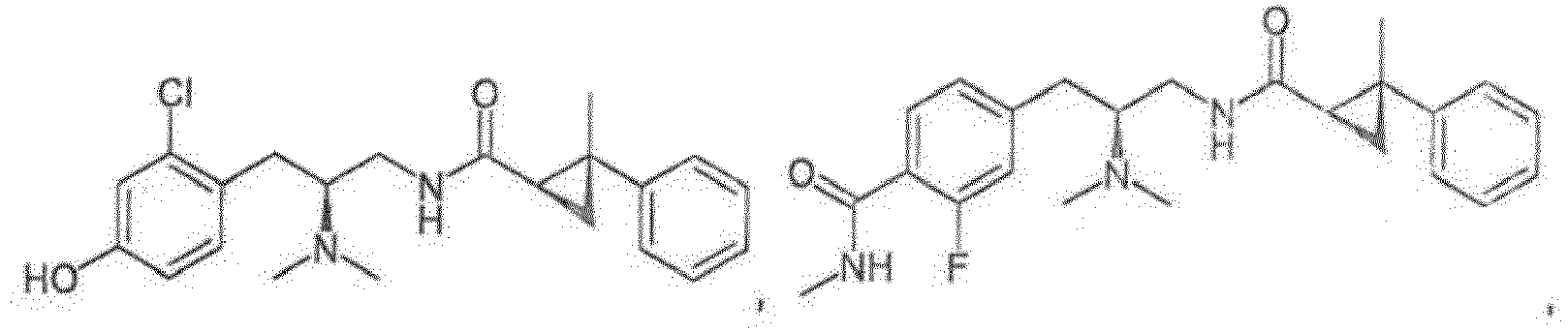



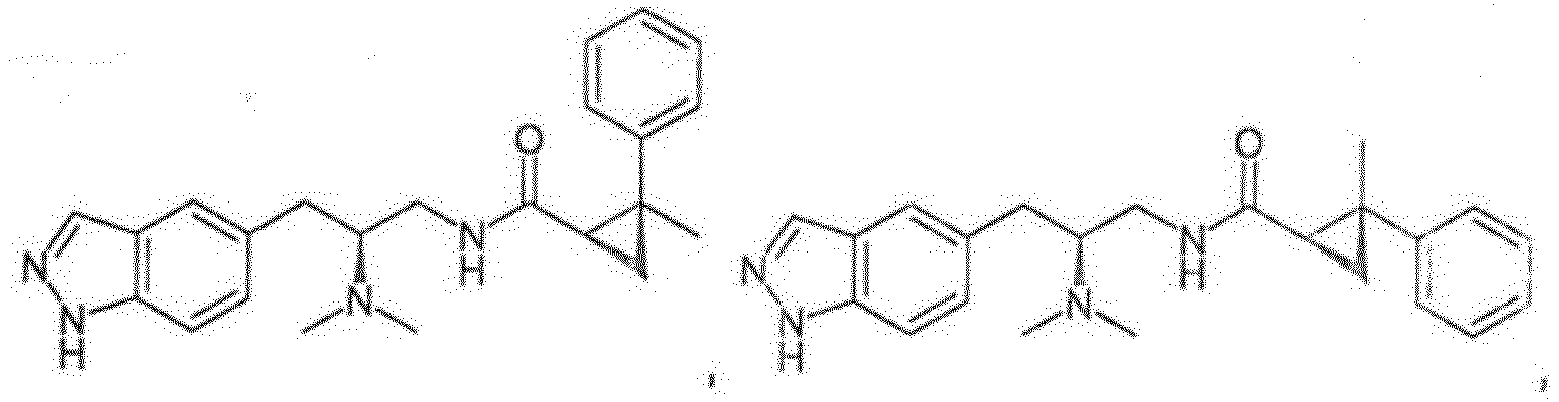
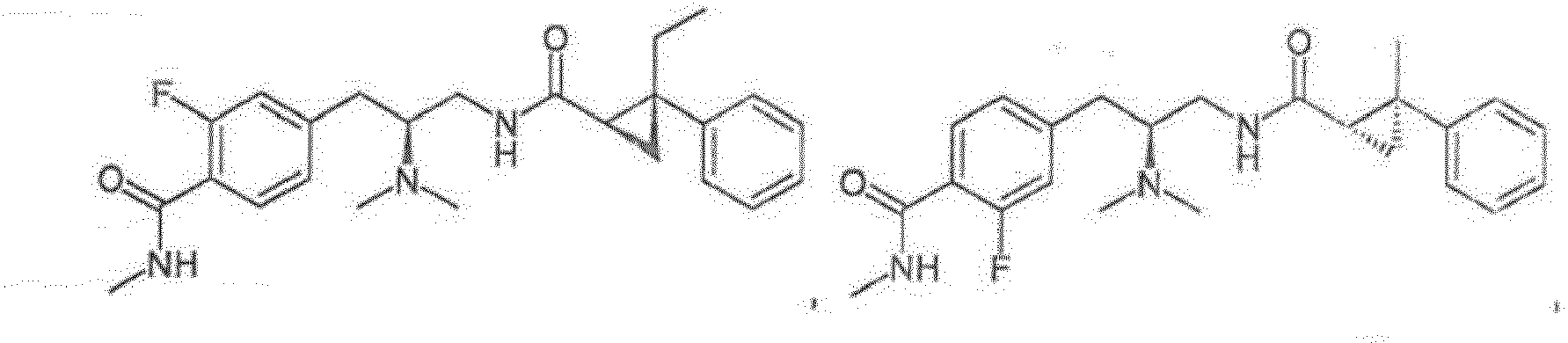


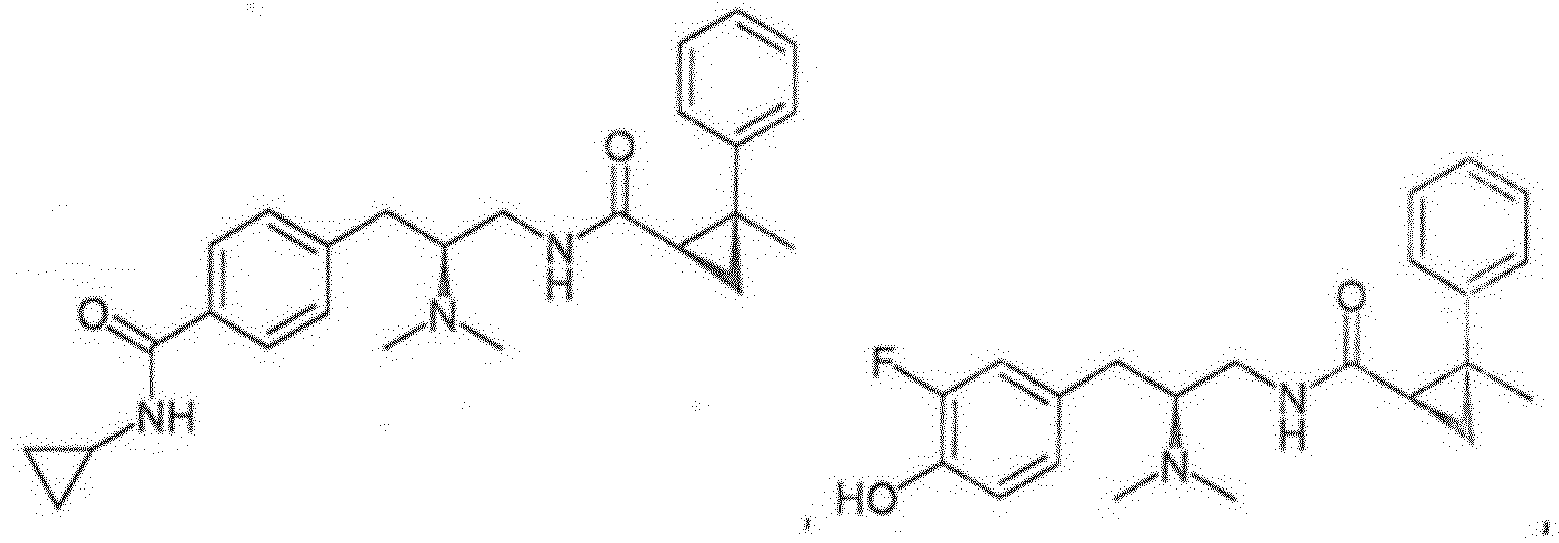


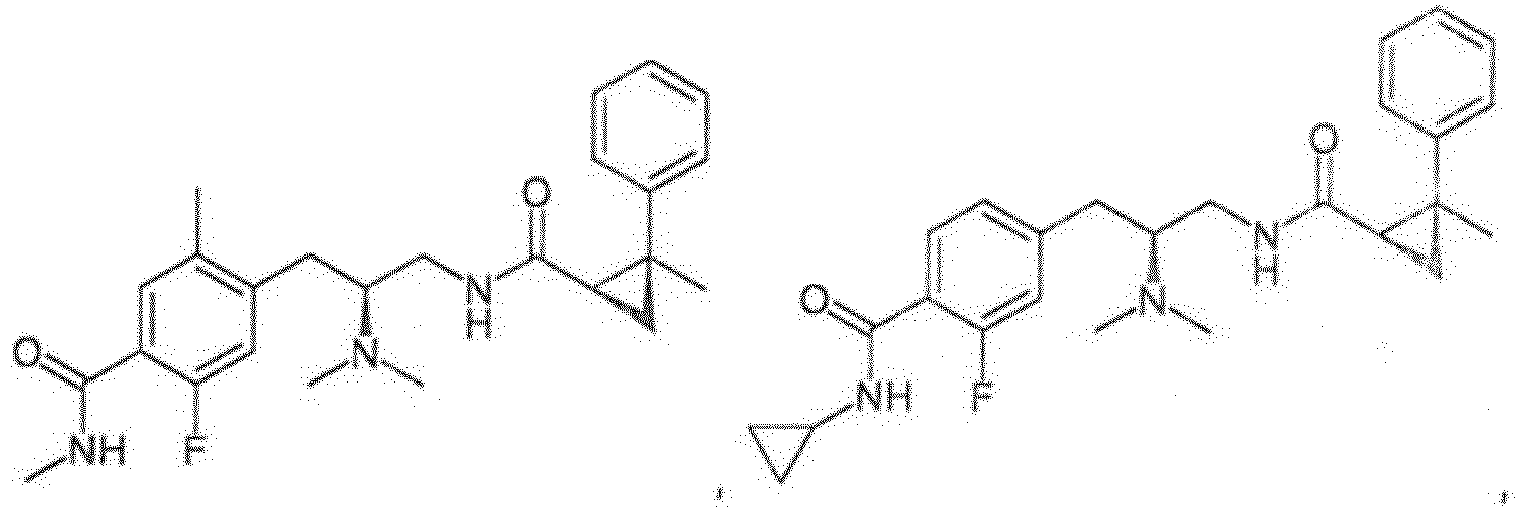


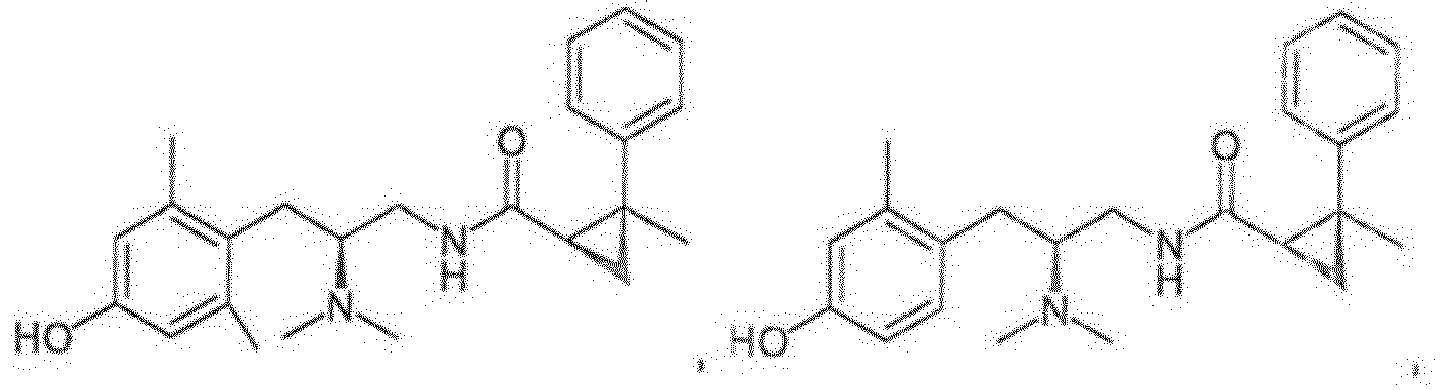


- Pharmazeutische Zusammensetzung, die eine Verbindung nach einem der Ansprüche 1 bis 13 oder ein pharmazeutisch annehmbares Racemat, Hydrat, Solvat, Isotop oder Salz davon und einen pharmazeutisch annehmbaren Träger, Verdünner oder Hilfsstoff umfasst.
- Verbindung nach einem der Ansprüche 1 bis 13 oder ein pharmazeutisch annehmbares Racemat, Hydrat, Solvat, Isotop oder Salz davon zur Verwendung in einem Verfahren zur Behandlung von Schmerzen bei einem bedürftigen Individuum.
Applications Claiming Priority (3)
| Application Number | Priority Date | Filing Date | Title |
|---|---|---|---|
| US201862652819P | 2018-04-04 | 2018-04-04 | |
| US201962792754P | 2019-01-15 | 2019-01-15 | |
| PCT/US2019/025910 WO2019195634A1 (en) | 2018-04-04 | 2019-04-04 | Opioid receptor modulators and products and methods related thereto |
Publications (3)
| Publication Number | Publication Date |
|---|---|
| EP3774722A1 EP3774722A1 (de) | 2021-02-17 |
| EP3774722C0 EP3774722C0 (de) | 2024-07-24 |
| EP3774722B1 true EP3774722B1 (de) | 2024-07-24 |
Family
ID=66223867
Family Applications (1)
| Application Number | Title | Priority Date | Filing Date |
|---|---|---|---|
| EP19718552.3A Active EP3774722B1 (de) | 2018-04-04 | 2019-04-04 | Opioid-rezeptor-modulatoren sowie zugehörige produkte und verfahren |
Country Status (7)
| Country | Link |
|---|---|
| US (2) | US20210147343A1 (de) |
| EP (1) | EP3774722B1 (de) |
| JP (1) | JP7402857B2 (de) |
| CN (1) | CN112867705B (de) |
| AU (1) | AU2019247842B2 (de) |
| CA (1) | CA3096059A1 (de) |
| WO (1) | WO2019195634A1 (de) |
Families Citing this family (5)
| Publication number | Priority date | Publication date | Assignee | Title |
|---|---|---|---|---|
| AU2019247842B2 (en) | 2018-04-04 | 2023-08-31 | Epiodyne, Inc. | Opioid receptor modulators and products and methods related thereto |
| CN112159401B (zh) * | 2019-11-05 | 2022-06-03 | 中国人民解放军军事科学院军事医学研究院 | 偏向性激动剂及其医药用途 |
| EP3964497A1 (de) * | 2020-09-04 | 2022-03-09 | Friedrich-Alexander-Universität Erlangen-Nürnberg | Substituierte vicinale diaminverbindungen und deren verwendung zur behandlung, linderung oder vorbeugung von schmerzen |
| TW202304869A (zh) | 2021-04-05 | 2023-02-01 | 美商艾碧奧戴股份有限公司 | 類鴉片受體調節劑 |
| CN117425644A (zh) * | 2021-04-05 | 2024-01-19 | 埃皮欧黛公司 | 阿片样物质受体调节剂 |
Family Cites Families (31)
| Publication number | Priority date | Publication date | Assignee | Title |
|---|---|---|---|---|
| NZ210669A (en) | 1983-12-27 | 1988-05-30 | Syntex Inc | Benzoxazin-4-one derivatives and pharmaceutical compositions |
| JPH05194406A (ja) | 1991-11-12 | 1993-08-03 | Yoshitomi Pharmaceut Ind Ltd | 新規アミド化合物 |
| IL115420A0 (en) * | 1994-09-26 | 1995-12-31 | Zeneca Ltd | Aminoheterocyclic derivatives |
| SE9600769D0 (sv) | 1996-02-28 | 1996-02-28 | Astra Ab | Compounds useful as analgesic |
| AU4674797A (en) | 1996-10-22 | 1998-05-15 | Ortho Pharmaceutical Corporation | Phenylalaninol derivatives for the treatment of central nervous system disorders |
| US6900228B1 (en) | 1998-03-10 | 2005-05-31 | Research Triangle Institute | Opiate compounds, methods of making and methods of use |
| EP1055665B1 (de) | 1999-05-28 | 2003-10-22 | Pfizer Products Inc. | 3-(3-Hydroxyphenyl)-3-amino-propionamidderivate |
| AU2001268951A1 (en) | 2000-07-07 | 2002-01-21 | Novo-Nordisk A/S | Modulators of protein tyrosine phosphatases (ptpases) |
| DE10252666A1 (de) | 2002-11-11 | 2004-08-05 | Grünenthal GmbH | N-Piperidyl-cyclohexan-Derivate |
| WO2005009315A1 (fr) | 2003-06-27 | 2005-02-03 | Applications Technologiques Avancees, A.T.A. | Caisson de confinement ou d'isolement d'un nouveau type |
| WO2005063704A1 (ja) | 2003-12-25 | 2005-07-14 | Ono Pharmaceutical Co., Ltd. | アゼチジン環化合物およびその医薬 |
| EP1598341A1 (de) | 2004-05-21 | 2005-11-23 | Santhera Pharmaceuticals (Deutschland) Aktiengesellschaft | DPP-IV-Hemmer |
| EP1604662A1 (de) | 2004-06-08 | 2005-12-14 | Santhera Pharmaceuticals (Deutschland) Aktiengesellschaft | 1-[(3R)-Amino-4-(2-fluoro-phenyl)-butyl]-pyrrolidin-(2R)-carbonsäure-benzylamine-Derivate und verwandte Verbindungen als Dipeptidyl-Peptidase IV (DPP-IV) Inhibitoren zur Behandlung von Typ 2 Diabetes Mellitus |
| WO2007076423A2 (en) | 2005-12-22 | 2007-07-05 | Smithkline Beecham Corporation | INHIBITORS OF Akt ACTIVITY |
| US7807704B2 (en) | 2006-03-30 | 2010-10-05 | Chemocentryx, Inc. | Bicyclic, nitrogen-containing compounds modulating CXCR4 and/or CCXCKR2 |
| KR20080071476A (ko) | 2007-01-30 | 2008-08-04 | 주식회사 엘지생명과학 | 신규한 디펩티딜 펩티데이즈 iv(dpp-iv) 저해제 |
| GB0813740D0 (en) | 2008-07-28 | 2008-09-03 | Angeletti P Ist Richerche Biologica | Therapeutic compounds |
| CN101823987B (zh) | 2009-03-06 | 2014-06-04 | 中国科学院上海药物研究所 | 一类新的dpp-ⅳ抑制剂及其制备方法和用途 |
| GB0919426D0 (en) | 2009-11-05 | 2009-12-23 | Glaxosmithkline Llc | Novel compounds |
| CA2787037C (en) | 2010-02-24 | 2018-04-10 | Research Triangle Institute | Arylpiperazine opioid receptor antagonists |
| EP2632897B1 (de) | 2010-10-29 | 2014-10-01 | Merz Pharma GmbH & Co. KGaA | Indolderivate und herstellungsverfahren dafür |
| WO2013006734A1 (en) | 2011-07-05 | 2013-01-10 | St. Jude Children's Research Hospital | Substituted 4-phenoxyphenol analogs as modulators of proliferating cell nuclear antigen activity |
| CA2840317C (en) | 2011-07-13 | 2016-11-01 | Pfizer Limited | Enkephalin analogues |
| WO2013033310A1 (en) | 2011-08-31 | 2013-03-07 | Theodore Mark Kamenecka | Modulators of rev-erb |
| WO2013068467A1 (en) | 2011-11-09 | 2013-05-16 | Grünenthal GmbH | Substituted pyrazolyl-based carboxamide and urea derivatives bearing a phenyl moiety substituted with a co-containing group as vanilloid receptor ligands |
| WO2016067143A1 (en) * | 2014-10-28 | 2016-05-06 | Pfizer Inc. | N-(2-alkyleneimino-3-phenylpropyl)acetamide compounds and their use against pain and pruritus via inhibition of trpa1 channels |
| US10702498B2 (en) * | 2015-07-09 | 2020-07-07 | The Regents Of The University Of California | MU opioid receptor modulators |
| US10053465B2 (en) | 2015-08-26 | 2018-08-21 | Incyte Corporation | Pyrrolopyrimidine derivatives as TAM inhibitors |
| EP3565543A4 (de) * | 2017-01-06 | 2020-10-14 | The Regents of The University of California | Mu-opioid-rezeptormodulatoren |
| EP3668852A1 (de) | 2017-08-17 | 2020-06-24 | The Regents of The University of California | Mu-opioid-rezeptormodulatoren |
| AU2019247842B2 (en) | 2018-04-04 | 2023-08-31 | Epiodyne, Inc. | Opioid receptor modulators and products and methods related thereto |
-
2019
- 2019-04-04 AU AU2019247842A patent/AU2019247842B2/en active Active
- 2019-04-04 JP JP2021503713A patent/JP7402857B2/ja active Active
- 2019-04-04 WO PCT/US2019/025910 patent/WO2019195634A1/en not_active Ceased
- 2019-04-04 CN CN201980037740.3A patent/CN112867705B/zh active Active
- 2019-04-04 CA CA3096059A patent/CA3096059A1/en active Pending
- 2019-04-04 EP EP19718552.3A patent/EP3774722B1/de active Active
- 2019-04-04 US US17/045,152 patent/US20210147343A1/en not_active Abandoned
-
2020
- 2020-07-10 US US16/926,536 patent/US11352316B2/en active Active
Also Published As
| Publication number | Publication date |
|---|---|
| EP3774722C0 (de) | 2024-07-24 |
| AU2019247842B2 (en) | 2023-08-31 |
| WO2019195634A1 (en) | 2019-10-10 |
| US11352316B2 (en) | 2022-06-07 |
| US20210147343A1 (en) | 2021-05-20 |
| JP7402857B2 (ja) | 2023-12-21 |
| EP3774722A1 (de) | 2021-02-17 |
| US20210163402A1 (en) | 2021-06-03 |
| CA3096059A1 (en) | 2019-10-10 |
| JP2021520415A (ja) | 2021-08-19 |
| CN112867705B (zh) | 2024-08-20 |
| AU2019247842A1 (en) | 2020-11-26 |
| CN112867705A (zh) | 2021-05-28 |
Similar Documents
| Publication | Publication Date | Title |
|---|---|---|
| EP3774722B1 (de) | Opioid-rezeptor-modulatoren sowie zugehörige produkte und verfahren | |
| KR102725185B1 (ko) | Fxr 수용체 작용제로서 락탐 화합물 | |
| CA3133753A1 (en) | Novel small molecule inhibitors of tead transcription factors | |
| TWI504604B (zh) | 雜環化合物及其用途 | |
| CN101583601B (zh) | 作为褪黑素受体mt1和mt2的亚型选择性激动剂的异喹诺酮化合物 | |
| US12162861B2 (en) | Dopamine D3 receptor selective antagonists/partial agonists; method of making; and use thereof | |
| JP7120549B2 (ja) | Trek(twik関連kチャネル)チャネルのアクチベータ | |
| CN108495618B (zh) | 新的化合物及其用途 | |
| AU2019340675B2 (en) | Dopamine D3 receptor selective antagonists/partial agonists and uses thereof | |
| EP2670245B1 (de) | Alpha-ketoheterocyclen sowie verfahren zu ihrer herstellung und verwendung | |
| AU2012212088A1 (en) | Alpha-ketoheterocycles and methods of making and using | |
| EP3077398A1 (de) | Neuartige opioidverbindungen und deren verwendungen | |
| WO2014138518A2 (en) | Potent and selective inhibitors of monoamine transporters; method of making; and use thereof | |
| ITMI951900A1 (it) | Derivati idroisochinolinici sostituiti | |
| US11299476B2 (en) | Dopamine D3 receptor selective antagonists/partial agonists; method of making; and use thereof | |
| CN119546577A (zh) | G蛋白偶联受体88的调节剂 | |
| JP2025523476A (ja) | Gタンパク質共役受容体88のモジュレーター | |
| JP2000080066A (ja) | アニリド誘導体及びそれを有効成分とする抗不整脈剤 |
Legal Events
| Date | Code | Title | Description |
|---|---|---|---|
| STAA | Information on the status of an ep patent application or granted ep patent |
Free format text: STATUS: UNKNOWN |
|
| STAA | Information on the status of an ep patent application or granted ep patent |
Free format text: STATUS: THE INTERNATIONAL PUBLICATION HAS BEEN MADE |
|
| PUAI | Public reference made under article 153(3) epc to a published international application that has entered the european phase |
Free format text: ORIGINAL CODE: 0009012 |
|
| STAA | Information on the status of an ep patent application or granted ep patent |
Free format text: STATUS: REQUEST FOR EXAMINATION WAS MADE |
|
| 17P | Request for examination filed |
Effective date: 20201008 |
|
| AK | Designated contracting states |
Kind code of ref document: A1 Designated state(s): AL AT BE BG CH CY CZ DE DK EE ES FI FR GB GR HR HU IE IS IT LI LT LU LV MC MK MT NL NO PL PT RO RS SE SI SK SM TR |
|
| AX | Request for extension of the european patent |
Extension state: BA ME |
|
| DAV | Request for validation of the european patent (deleted) | ||
| DAX | Request for extension of the european patent (deleted) | ||
| STAA | Information on the status of an ep patent application or granted ep patent |
Free format text: STATUS: EXAMINATION IS IN PROGRESS |
|
| 17Q | First examination report despatched |
Effective date: 20210714 |
|
| P01 | Opt-out of the competence of the unified patent court (upc) registered |
Effective date: 20230517 |
|
| GRAP | Despatch of communication of intention to grant a patent |
Free format text: ORIGINAL CODE: EPIDOSNIGR1 |
|
| STAA | Information on the status of an ep patent application or granted ep patent |
Free format text: STATUS: GRANT OF PATENT IS INTENDED |
|
| INTG | Intention to grant announced |
Effective date: 20230913 |
|
| GRAJ | Information related to disapproval of communication of intention to grant by the applicant or resumption of examination proceedings by the epo deleted |
Free format text: ORIGINAL CODE: EPIDOSDIGR1 |
|
| STAA | Information on the status of an ep patent application or granted ep patent |
Free format text: STATUS: EXAMINATION IS IN PROGRESS |
|
| GRAP | Despatch of communication of intention to grant a patent |
Free format text: ORIGINAL CODE: EPIDOSNIGR1 |
|
| STAA | Information on the status of an ep patent application or granted ep patent |
Free format text: STATUS: GRANT OF PATENT IS INTENDED |
|
| RIN1 | Information on inventor provided before grant (corrected) |
Inventor name: DUQUETTE, JASON Inventor name: LI, YIHONG Inventor name: NERURKAR, ALOK Inventor name: DING, PINGYU Inventor name: SPERANDIO, DAVID Inventor name: NGUYEN, THOMAS Inventor name: WANG, XIAODONG Inventor name: BHATT, ULHAS Inventor name: SEIDL, FREDERICK Inventor name: SADLOWSKI, CORINNE Inventor name: WEI, ZHI-LIANG Inventor name: MCGEE, LARRY Inventor name: MEDINA, JULIO CESAR |
|
| INTC | Intention to grant announced (deleted) | ||
| INTG | Intention to grant announced |
Effective date: 20240214 |
|
| GRAS | Grant fee paid |
Free format text: ORIGINAL CODE: EPIDOSNIGR3 |
|
| GRAA | (expected) grant |
Free format text: ORIGINAL CODE: 0009210 |
|
| STAA | Information on the status of an ep patent application or granted ep patent |
Free format text: STATUS: THE PATENT HAS BEEN GRANTED |
|
| AK | Designated contracting states |
Kind code of ref document: B1 Designated state(s): AL AT BE BG CH CY CZ DE DK EE ES FI FR GB GR HR HU IE IS IT LI LT LU LV MC MK MT NL NO PL PT RO RS SE SI SK SM TR |
|
| REG | Reference to a national code |
Ref country code: GB Ref legal event code: FG4D |
|
| REG | Reference to a national code |
Ref country code: CH Ref legal event code: EP |
|
| REG | Reference to a national code |
Ref country code: IE Ref legal event code: FG4D Ref country code: DE Ref legal event code: R096 Ref document number: 602019055665 Country of ref document: DE |
|
| U01 | Request for unitary effect filed |
Effective date: 20240821 |
|
| U07 | Unitary effect registered |
Designated state(s): AT BE BG DE DK EE FI FR IT LT LU LV MT NL PT RO SE SI Effective date: 20240902 |
|
| P04 | Withdrawal of opt-out of the competence of the unified patent court (upc) registered |
Free format text: CASE NUMBER: APP_49152/2024 Effective date: 20240828 |
|
| P05 | Withdrawal of opt-out of the competence of the unified patent court (upc) changed |
Free format text: CASE NUMBER: APP_49152/2024 Effective date: 20240902 |
|
| PG25 | Lapsed in a contracting state [announced via postgrant information from national office to epo] |
Ref country code: NO Free format text: LAPSE BECAUSE OF FAILURE TO SUBMIT A TRANSLATION OF THE DESCRIPTION OR TO PAY THE FEE WITHIN THE PRESCRIBED TIME-LIMIT Effective date: 20241024 |
|
| PG25 | Lapsed in a contracting state [announced via postgrant information from national office to epo] |
Ref country code: GR Free format text: LAPSE BECAUSE OF FAILURE TO SUBMIT A TRANSLATION OF THE DESCRIPTION OR TO PAY THE FEE WITHIN THE PRESCRIBED TIME-LIMIT Effective date: 20241025 Ref country code: PL Free format text: LAPSE BECAUSE OF FAILURE TO SUBMIT A TRANSLATION OF THE DESCRIPTION OR TO PAY THE FEE WITHIN THE PRESCRIBED TIME-LIMIT Effective date: 20240724 |
|
| PG25 | Lapsed in a contracting state [announced via postgrant information from national office to epo] |
Ref country code: IS Free format text: LAPSE BECAUSE OF FAILURE TO SUBMIT A TRANSLATION OF THE DESCRIPTION OR TO PAY THE FEE WITHIN THE PRESCRIBED TIME-LIMIT Effective date: 20241124 |
|
| PG25 | Lapsed in a contracting state [announced via postgrant information from national office to epo] |
Ref country code: HR Free format text: LAPSE BECAUSE OF FAILURE TO SUBMIT A TRANSLATION OF THE DESCRIPTION OR TO PAY THE FEE WITHIN THE PRESCRIBED TIME-LIMIT Effective date: 20240724 |
|
| PG25 | Lapsed in a contracting state [announced via postgrant information from national office to epo] |
Ref country code: RS Free format text: LAPSE BECAUSE OF FAILURE TO SUBMIT A TRANSLATION OF THE DESCRIPTION OR TO PAY THE FEE WITHIN THE PRESCRIBED TIME-LIMIT Effective date: 20241024 Ref country code: ES Free format text: LAPSE BECAUSE OF FAILURE TO SUBMIT A TRANSLATION OF THE DESCRIPTION OR TO PAY THE FEE WITHIN THE PRESCRIBED TIME-LIMIT Effective date: 20240724 |
|
| PG25 | Lapsed in a contracting state [announced via postgrant information from national office to epo] |
Ref country code: RS Free format text: LAPSE BECAUSE OF FAILURE TO SUBMIT A TRANSLATION OF THE DESCRIPTION OR TO PAY THE FEE WITHIN THE PRESCRIBED TIME-LIMIT Effective date: 20241024 Ref country code: PL Free format text: LAPSE BECAUSE OF FAILURE TO SUBMIT A TRANSLATION OF THE DESCRIPTION OR TO PAY THE FEE WITHIN THE PRESCRIBED TIME-LIMIT Effective date: 20240724 Ref country code: NO Free format text: LAPSE BECAUSE OF FAILURE TO SUBMIT A TRANSLATION OF THE DESCRIPTION OR TO PAY THE FEE WITHIN THE PRESCRIBED TIME-LIMIT Effective date: 20241024 Ref country code: IS Free format text: LAPSE BECAUSE OF FAILURE TO SUBMIT A TRANSLATION OF THE DESCRIPTION OR TO PAY THE FEE WITHIN THE PRESCRIBED TIME-LIMIT Effective date: 20241124 Ref country code: HR Free format text: LAPSE BECAUSE OF FAILURE TO SUBMIT A TRANSLATION OF THE DESCRIPTION OR TO PAY THE FEE WITHIN THE PRESCRIBED TIME-LIMIT Effective date: 20240724 Ref country code: GR Free format text: LAPSE BECAUSE OF FAILURE TO SUBMIT A TRANSLATION OF THE DESCRIPTION OR TO PAY THE FEE WITHIN THE PRESCRIBED TIME-LIMIT Effective date: 20241025 Ref country code: ES Free format text: LAPSE BECAUSE OF FAILURE TO SUBMIT A TRANSLATION OF THE DESCRIPTION OR TO PAY THE FEE WITHIN THE PRESCRIBED TIME-LIMIT Effective date: 20240724 |
|
| PG25 | Lapsed in a contracting state [announced via postgrant information from national office to epo] |
Ref country code: SM Free format text: LAPSE BECAUSE OF FAILURE TO SUBMIT A TRANSLATION OF THE DESCRIPTION OR TO PAY THE FEE WITHIN THE PRESCRIBED TIME-LIMIT Effective date: 20240724 |
|
| PG25 | Lapsed in a contracting state [announced via postgrant information from national office to epo] |
Ref country code: CZ Free format text: LAPSE BECAUSE OF FAILURE TO SUBMIT A TRANSLATION OF THE DESCRIPTION OR TO PAY THE FEE WITHIN THE PRESCRIBED TIME-LIMIT Effective date: 20240724 |
|
| PG25 | Lapsed in a contracting state [announced via postgrant information from national office to epo] |
Ref country code: SK Free format text: LAPSE BECAUSE OF FAILURE TO SUBMIT A TRANSLATION OF THE DESCRIPTION OR TO PAY THE FEE WITHIN THE PRESCRIBED TIME-LIMIT Effective date: 20240724 |
|
| PLBE | No opposition filed within time limit |
Free format text: ORIGINAL CODE: 0009261 |
|
| STAA | Information on the status of an ep patent application or granted ep patent |
Free format text: STATUS: NO OPPOSITION FILED WITHIN TIME LIMIT |
|
| U20 | Renewal fee for the european patent with unitary effect paid |
Year of fee payment: 7 Effective date: 20250428 |
|
| 26N | No opposition filed |
Effective date: 20250425 |
|
| PGFP | Annual fee paid to national office [announced via postgrant information from national office to epo] |
Ref country code: GB Payment date: 20250428 Year of fee payment: 7 |
|
| REG | Reference to a national code |
Ref country code: CH Ref legal event code: H13 Free format text: ST27 STATUS EVENT CODE: U-0-0-H10-H13 (AS PROVIDED BY THE NATIONAL OFFICE) Effective date: 20251125 |
|
| PG25 | Lapsed in a contracting state [announced via postgrant information from national office to epo] |
Ref country code: MC Free format text: LAPSE BECAUSE OF FAILURE TO SUBMIT A TRANSLATION OF THE DESCRIPTION OR TO PAY THE FEE WITHIN THE PRESCRIBED TIME-LIMIT Effective date: 20240724 |
|
| PG25 | Lapsed in a contracting state [announced via postgrant information from national office to epo] |
Ref country code: CH Free format text: LAPSE BECAUSE OF NON-PAYMENT OF DUE FEES Effective date: 20250430 |
|
| PG25 | Lapsed in a contracting state [announced via postgrant information from national office to epo] |
Ref country code: IE Free format text: LAPSE BECAUSE OF NON-PAYMENT OF DUE FEES Effective date: 20250404 |