EP3765619B1 - Inhibitoren der micro-rna 22 - Google Patents
Inhibitoren der micro-rna 22 Download PDFInfo
- Publication number
- EP3765619B1 EP3765619B1 EP19768368.3A EP19768368A EP3765619B1 EP 3765619 B1 EP3765619 B1 EP 3765619B1 EP 19768368 A EP19768368 A EP 19768368A EP 3765619 B1 EP3765619 B1 EP 3765619B1
- Authority
- EP
- European Patent Office
- Prior art keywords
- mir
- nucleic acid
- seq
- lna
- modifications
- Prior art date
- Legal status (The legal status is an assumption and is not a legal conclusion. Google has not performed a legal analysis and makes no representation as to the accuracy of the status listed.)
- Active
Links
Images





Classifications
-
- A—HUMAN NECESSITIES
- A61—MEDICAL OR VETERINARY SCIENCE; HYGIENE
- A61K—PREPARATIONS FOR MEDICAL, DENTAL OR TOILETRY PURPOSES
- A61K48/00—Medicinal preparations containing genetic material which is inserted into cells of the living body to treat genetic diseases; Gene therapy
-
- A—HUMAN NECESSITIES
- A61—MEDICAL OR VETERINARY SCIENCE; HYGIENE
- A61K—PREPARATIONS FOR MEDICAL, DENTAL OR TOILETRY PURPOSES
- A61K31/00—Medicinal preparations containing organic active ingredients
- A61K31/70—Carbohydrates; Sugars; Derivatives thereof
- A61K31/7088—Compounds having three or more nucleosides or nucleotides
- A61K31/713—Double-stranded nucleic acids or oligonucleotides
-
- A—HUMAN NECESSITIES
- A61—MEDICAL OR VETERINARY SCIENCE; HYGIENE
- A61P—SPECIFIC THERAPEUTIC ACTIVITY OF CHEMICAL COMPOUNDS OR MEDICINAL PREPARATIONS
- A61P1/00—Drugs for disorders of the alimentary tract or the digestive system
- A61P1/16—Drugs for disorders of the alimentary tract or the digestive system for liver or gallbladder disorders, e.g. hepatoprotective agents, cholagogues, litholytics
-
- A—HUMAN NECESSITIES
- A61—MEDICAL OR VETERINARY SCIENCE; HYGIENE
- A61P—SPECIFIC THERAPEUTIC ACTIVITY OF CHEMICAL COMPOUNDS OR MEDICINAL PREPARATIONS
- A61P3/00—Drugs for disorders of the metabolism
- A61P3/04—Anorexiants; Antiobesity agents
-
- A—HUMAN NECESSITIES
- A61—MEDICAL OR VETERINARY SCIENCE; HYGIENE
- A61P—SPECIFIC THERAPEUTIC ACTIVITY OF CHEMICAL COMPOUNDS OR MEDICINAL PREPARATIONS
- A61P3/00—Drugs for disorders of the metabolism
- A61P3/06—Antihyperlipidemics
-
- C—CHEMISTRY; METALLURGY
- C12—BIOCHEMISTRY; BEER; SPIRITS; WINE; VINEGAR; MICROBIOLOGY; ENZYMOLOGY; MUTATION OR GENETIC ENGINEERING
- C12N—MICROORGANISMS OR ENZYMES; COMPOSITIONS THEREOF; PROPAGATING, PRESERVING, OR MAINTAINING MICROORGANISMS; MUTATION OR GENETIC ENGINEERING; CULTURE MEDIA
- C12N15/00—Mutation or genetic engineering; DNA or RNA concerning genetic engineering, vectors, e.g. plasmids, or their isolation, preparation or purification; Use of hosts therefor
- C12N15/09—Recombinant DNA-technology
- C12N15/11—DNA or RNA fragments; Modified forms thereof; Non-coding nucleic acids having a biological activity
- C12N15/113—Non-coding nucleic acids modulating the expression of genes, e.g. antisense oligonucleotides; Antisense DNA or RNA; Triplex- forming oligonucleotides; Catalytic nucleic acids, e.g. ribozymes; Nucleic acids used in co-suppression or gene silencing
-
- C—CHEMISTRY; METALLURGY
- C12—BIOCHEMISTRY; BEER; SPIRITS; WINE; VINEGAR; MICROBIOLOGY; ENZYMOLOGY; MUTATION OR GENETIC ENGINEERING
- C12N—MICROORGANISMS OR ENZYMES; COMPOSITIONS THEREOF; PROPAGATING, PRESERVING, OR MAINTAINING MICROORGANISMS; MUTATION OR GENETIC ENGINEERING; CULTURE MEDIA
- C12N2310/00—Structure or type of the nucleic acid
- C12N2310/10—Type of nucleic acid
- C12N2310/11—Antisense
-
- C—CHEMISTRY; METALLURGY
- C12—BIOCHEMISTRY; BEER; SPIRITS; WINE; VINEGAR; MICROBIOLOGY; ENZYMOLOGY; MUTATION OR GENETIC ENGINEERING
- C12N—MICROORGANISMS OR ENZYMES; COMPOSITIONS THEREOF; PROPAGATING, PRESERVING, OR MAINTAINING MICROORGANISMS; MUTATION OR GENETIC ENGINEERING; CULTURE MEDIA
- C12N2310/00—Structure or type of the nucleic acid
- C12N2310/10—Type of nucleic acid
- C12N2310/11—Antisense
- C12N2310/113—Antisense targeting other non-coding nucleic acids, e.g. antagomirs
-
- C—CHEMISTRY; METALLURGY
- C12—BIOCHEMISTRY; BEER; SPIRITS; WINE; VINEGAR; MICROBIOLOGY; ENZYMOLOGY; MUTATION OR GENETIC ENGINEERING
- C12N—MICROORGANISMS OR ENZYMES; COMPOSITIONS THEREOF; PROPAGATING, PRESERVING, OR MAINTAINING MICROORGANISMS; MUTATION OR GENETIC ENGINEERING; CULTURE MEDIA
- C12N2310/00—Structure or type of the nucleic acid
- C12N2310/10—Type of nucleic acid
- C12N2310/14—Type of nucleic acid interfering nucleic acids [NA]
-
- C—CHEMISTRY; METALLURGY
- C12—BIOCHEMISTRY; BEER; SPIRITS; WINE; VINEGAR; MICROBIOLOGY; ENZYMOLOGY; MUTATION OR GENETIC ENGINEERING
- C12N—MICROORGANISMS OR ENZYMES; COMPOSITIONS THEREOF; PROPAGATING, PRESERVING, OR MAINTAINING MICROORGANISMS; MUTATION OR GENETIC ENGINEERING; CULTURE MEDIA
- C12N2310/00—Structure or type of the nucleic acid
- C12N2310/10—Type of nucleic acid
- C12N2310/14—Type of nucleic acid interfering nucleic acids [NA]
- C12N2310/141—MicroRNAs, miRNAs
-
- C—CHEMISTRY; METALLURGY
- C12—BIOCHEMISTRY; BEER; SPIRITS; WINE; VINEGAR; MICROBIOLOGY; ENZYMOLOGY; MUTATION OR GENETIC ENGINEERING
- C12N—MICROORGANISMS OR ENZYMES; COMPOSITIONS THEREOF; PROPAGATING, PRESERVING, OR MAINTAINING MICROORGANISMS; MUTATION OR GENETIC ENGINEERING; CULTURE MEDIA
- C12N2310/00—Structure or type of the nucleic acid
- C12N2310/30—Chemical structure
- C12N2310/32—Chemical structure of the sugar
- C12N2310/323—Chemical structure of the sugar modified ring structure
- C12N2310/3231—Chemical structure of the sugar modified ring structure having an additional ring, e.g. LNA, ENA
-
- C—CHEMISTRY; METALLURGY
- C12—BIOCHEMISTRY; BEER; SPIRITS; WINE; VINEGAR; MICROBIOLOGY; ENZYMOLOGY; MUTATION OR GENETIC ENGINEERING
- C12N—MICROORGANISMS OR ENZYMES; COMPOSITIONS THEREOF; PROPAGATING, PRESERVING, OR MAINTAINING MICROORGANISMS; MUTATION OR GENETIC ENGINEERING; CULTURE MEDIA
- C12N2310/00—Structure or type of the nucleic acid
- C12N2310/30—Chemical structure
- C12N2310/34—Spatial arrangement of the modifications
- C12N2310/344—Position-specific modifications, e.g. on every purine, at the 3'-end
-
- C—CHEMISTRY; METALLURGY
- C12—BIOCHEMISTRY; BEER; SPIRITS; WINE; VINEGAR; MICROBIOLOGY; ENZYMOLOGY; MUTATION OR GENETIC ENGINEERING
- C12N—MICROORGANISMS OR ENZYMES; COMPOSITIONS THEREOF; PROPAGATING, PRESERVING, OR MAINTAINING MICROORGANISMS; MUTATION OR GENETIC ENGINEERING; CULTURE MEDIA
- C12N2320/00—Applications; Uses
- C12N2320/50—Methods for regulating/modulating their activity
Definitions
- the disclosure relates to the agents that modulate the activity or expression of microRNAs.
- MicroRNAs are nucleic acid molecules that regulate the expression of target genes.
- MiRNAs are typically short (typically 18-24 nucleotides) and act as repressors of target mRNAs by promoting their degradation, when their sequences are perfectly complementary, and/or by inhibiting translation, when their sequences contain mismatches.
- Functional analyses of miRNAs have revealed that these small non-coding RNAs contribute to different physiological and metabolic processes, including regulating genes associated with various diseases or disorders. As such, there is a need for compositions and method that regulate miRs.
- W2013/18613 describes an antagomir targeting miR-22.
- the present disclosure provides new compositions and methods for inhibiting miR-22, for example by inhibiting microRNA expression and/or activity. Such inhibition can be mediated by sequence specific chemically modified oligonucleotides, including for example, locked nucleic acid (LNA).
- LNA locked nucleic acid
- the present invention provides a miR-22 inhibitory composition.
- the composition described herein comprises a nucleic acid having a sequence comprising tggcagct (SEQ ID NO: 2) and comprising at least one locked nucleic acid (LNA) modification.
- the disclosed nucleic acid comprises LNA modifications at positions 7 and 8 of tggcagct (SEQ ID NO: 2).
- the disclosed nucleic acid comprises about 8 to about 12 LNA modifications.
- the disclosed nucleic acid comprises no less than 4 LNA modifications.
- the nucleic acid comprises no more than four sequential LNA modifications.
- nucleic acids comprising a nucleic acid having a sequence selected from: tggcagct (SEQ ID NO: 2), cttcaactggcagct (SEQ ID NO: 3), tcttcaactggcagct (SEQ ID NO: 4) (comparative), ttcttcaactggcagct (SEQ ID NO: 5) (comparative), and gttcttcaactggcagct (SEQ ID NO: 6) (comparative).
- the nucleic acid comprises about 10 LNA modifications.
- the nucleic acid comprises cttcaactggcagct (SEQ ID NO: 3), and 10 LNA modifications, said modifications being at positions 1, 2, 3, 6, 7, 10, 11, 12, 14, and 15.
- the nucleic acid comprises tcttcaactggcagct (SEQ ID NO: 4), and at least 8 LNA modifications, at least 10 LNA modifications, or at least 11 LNA modifications.
- the nucleic acid comprises tcttcaactggcagct (SEQ ID NO: 4), and 10 LNA modifications, said modifications being at positions 1, 2, 4, 8, 10, 11, 12, 13, 15, and 16.
- the nucleic acid comprises tcttcaactggcagct (SEQ ID NO: 4), and 11 LNA modifications, said modifications being at positions 1, 2, 4, 5, 6, 8, 11, 12, 13, 15, and 16.
- the nucleic acid comprises tcttcaactggcagct (SEQ ID NO: 4), and 11 LNA modifications, said modifications being at positions 1, 2, 4, 5, 6, 9, 11, 12, 13, 15, and 16.
- the nucleic acid comprises ttcttcaactggcagct (SEQ ID NO: 5), and at least 10 LNA modifications or at least 11 LNA modifications.
- the nucleic acid comprises ttcttcaactggcagct (SEQ ID NO: 5), and 11 LNA modifications, said modifications being at positions 1, 2, 5, 6, 7, 10, 12, 13, 14, 16, and 17.
- the nucleic acid comprises gttcttcaactggcagct (SEQ ID NO: 6), and at least 9 LNA modifications or at least 10 LNA modifications.
- the nucleic acid comprises gttcttcaactggcagct (SEQ ID NO: 6), and 9 LNA modifications, said modifications being at positions 1, 2, 6, 10, 13, 14, 16, 17, and 18.
- the present invention provides a pharmaceutical composition
- a pharmaceutical composition comprising the nucleic acid of the above aspect or any of the above embodiments and a pharmaceutically acceptable excipient or carrier.
- Described herein is a vector or a plasmid comprising a nucleic acid of the disclosure.
- An aspect of the present invention provides a host cell comprising a nucleic acid of the above aspect or any of the above embodiments.
- the method comprising contacting miR-22 with a composition comprising an inhibitor of miR-22 that is a nucleic acid of the above aspect or any of the above embodiments.
- the present disclosure provides new compositions and methods for inhibiting miR-22, for example by inhibiting microRNA expression and/or activity.
- mature miRNAs are believed to be generated by pol II or pol III and arise from initial transcripts termed pri-miRNAs. These pri-miRNAs are frequently several thousand bases long and are therefore processed to make much shorter mature miRNAs. These pri-miRNAs may be multi cistronic and result from the transcription of several clustered sequences that organize what may develop into many miRNAs. The processing to yield miRNAs may be two-steps. First, pri-miRNAs may be processed in the nucleus by the RNase Drosha into about 70- to about IOO-nucleotide hairpin-shaped precursors (pre-miRNAs).
- pre-miRNAs IOO-nucleotide hairpin-shaped precursors
- the hairpin pre-miRNAs may be further processed by the RNase Dicer to produce a double-stranded miRNA.
- the mature miRNA strand may then be incorporated into the RNA- induced silencing complex (RISC), where it may associate with its target mRNAs by base-pair complementarity and lead to suppression of protein expression.
- RISC RNA- induced silencing complex
- the other strand of the miRNA duplex that is not preferentially selected for entry into a RISC silencing complex is known as the passenger strand or minor miRNA or star (*) strand. This strand may be degraded.
- a miRNA may refer to pri- and/or pre- and/or mature and/or minor (star) strand and/or duplex version of miRNA.
- miRNA genes may be located within introns of protein-coding genes or within introns or exons of noncoding transcriptional units.
- the expression of intronic miRNAs may coincide with that of the hosting transcriptional units because they are typically oriented in the same direction and are coordinately expressed with the pre-mRNAs in which they reside.
- miRNAs may bind to sequences within the 3' untranslated region (3'UTR) of target gene transcripts. In some embodiments, miRNAs may bind to sequences outside of the 3'UTR of target gene transcripts. In some embodiments, miRNAs may bind to both within and outside the 3'UTR of target gene transcripts.
- nucleotide pairing between the second and seventh nucleotides of the miRNA (the miRNA seed sequence) and the corresponding sequence along the target 3'UTR (seed match) may occur for target recognition.
- the binding between miRNA and target may comprise about a 5 nucleotide base pairing.
- the binding between miRNA and target may comprise more than a 5 nucleotide base pairing.
- the binding between a miRNA and the gene that it regulates may be mediated by the miRNA binding up to 2, up to 4, up to 6, up to 8, or up to 10 sites of the target nucleic acid.
- MiR-22 is highly conserved across many vertebrate species, including chimp, mouse, rat, dog and horse. This level of conservation suggests functional importance. MiR-22 was previously identified as having a role in erythrocyte maturation and later as having a role in oncogenesis. MiR-22 directly targets phosphatase and tensin homolog (PTEN) and tet methylcytosine dioxygenase (TET) to promote tumorigenesis, metastasis and metabolic disorders. In some embodiments, the nucleic acids of the present invention increase the activity and/or expression of PTEN and/or TET2.
- PTEN tensin homolog
- TET tet methylcytosine dioxygenase
- the predicted miR-22 hairpin precursor is contained entirely within exon 2 of a noncoding transcript, C17orf91, and the splicing pattern is generally conserved in human and mouse, despite the lack of protein-coding potential. See Rodriguez et al, Identification of mammalian microRNA host genes and transcription units. Genome Res. 2004 Oct; 14(10A): 1902-10 . Deletion of exon 2 of CI7orf9I encompassing mir-22 in mouse models has revealed that miR-22 may play a role in cardiac hypertrophy and remodeling by targeting SIRT1 (NAD-dependent deacetylase sirtuin-I), HDAC4 (histone deacetylase 4), PEIRB (purine-rich element binding protein B) and PTEN.
- SIRT1 NAD-dependent deacetylase sirtuin-I
- HDAC4 histone deacetylase 4
- PEIRB purine-rich element binding protein B
- an inhibitor of miRNA is a nucleic acid that acts as an antisense oligonucleotide.
- Nucleic acids here described can include ribonucleotides or deoxyribonucleotides or a combination thereof.
- Nucleic acids of the present disclosure may have at least one chemical modification (non-limiting examples are sugar or backbone modifications, e.g., a Locked Nucleic Acid (LNA)).
- LNA Locked Nucleic Acid
- the sequence of a nucleic acid that inhibits miR-22 is conserved across species.
- the sequence of the nucleic acid is complementary, in part, to the sequence of human miR-22.
- the inhibitor is selected to reduce the expression and/or activity of the target miR-22 in a cell or a subject.
- nucleic acids of the present invention inhibit human miR-22.
- human miR-22 comprises or consists of AAGCUGCCAGUUGAAGAACUGU (SEQ ID NO: 1).
- nucleic acids of the present invention bind with complete homology to a portion of miR-22.
- a nucleic acid here described may be 18 residues in length and each of the 18 residues is complementary to a nucleotide of miR-22.
- the nucleic acids of the present invention bind with complete homology to a portion of miR-22.
- a nucleic acid here described may be 16 residues in length and only 15 or fewer of the residues are complementary to a nucleotide of miR-22.
- a nucleic acid of the present invention binds to miR-22 with sufficient affinity to inhibit it.
- the nucleic acids bind to miR-22 with a high affinity (e.g., nM affinity).
- a nucleic acid of the present invention binds to miR-22 with a high affinity even if it differs from a portion of miR-22 at one or more positions.
- nucleic acid In a locked nucleic acid (LNA) the nucleic acid's ribose moiety is modified with an extra bridge connecting the 2' oxygen and 4' carbon, which locks the ribose in the 3'-endo conformation.
- Nucleic acids of the present invention, and comprising LNAs, provide for cost-effective agents that can be delivered efficiently and possess sufficient bioavailability for the treatment and prevention of various disorders.
- the nucleic acid described herein comprises or consists of a nucleic acid having a sequence selected from: tggcagct (SEQ ID NO: 2), cttcaactggcagct (SEQ ID NO: 3), tcttcaactggcagct (SEQ ID NO: 4) (comparative), ttcttcaactggcagct (SEQ ID NO: 5) (comparative), and gttcttcaactggcagct (SEQ ID NO: 6) (comparative).
- the disclosed nucleic acid comprises a nucleic acid having a sequence selected from: tggcagct (SEQ ID NO: 2), cttcaactggcagct (SEQ ID NO: 3), tcttcaactggcagct (SEQ ID NO: 4) (comparative), ttcttcaactggcagct (SEQ ID NO: 5) (comparative), and gttcttcaactggcagct (SEQ ID NO: 6) (comparative) and comprising about 10 LNA modifications.
- the nucleic acid comprises or consists of cttcaactggcagct (SEQ ID NO: 3), and at least 10 LNA modifications, as defined in the claims.
- the nucleic acid comprises or consists of cttcaactggcagct (SEQ ID NO: 3), and 8 LNA modifications, said modifications being at positions 1, 3, 6, 7, 10, 12, 14, and 15; for example, for description purpose only, the nucleic acid comprises or consists of the sequence CtTcaACtgGcAgCT (SEQ ID NO: 7), where capital letters are LNA modified and lower case are unmodified.
- the nucleic acid comprises or consists cttcaactggcagct (SEQ ID NO: 3), and 10 LNA modifications, said modifications being at positions 1, 2, 3, 6, 7, 10, 11, 12, 14, and 15; for example, the nucleic acid comprises or consists of the sequence CTTcaACtgGCAgCT (SEQ ID NO: 8), where capital letters are LNA modified and lower case are unmodified.
- the nucleic acid comprises or consists of tcttcaactggcagct (SEQ ID NO: 4), and at least 8 LNA modifications, at least 10 LNA modifications, or at least 11 LNA modifications.
- the nucleic acid comprises or consists of tcttcaactggcagct (SEQ ID NO: 4), and 10 LNA modifications, said modifications being at positions 1, 2, 4, 8, 10, 11, 12, 13, 15, and 16; for example, the nucleic acid comprises or consists of the sequence TCtTcaaCtGGCAgCT (SEQ ID NO: 10), where capital letters are LNA modified and lower case are unmodified.
- the nucleic acid comprises or consists of tcttcaactggcagct (SEQ ID NO: 4), and 11 LNA modifications, said modifications being at positions 1, 2, 4, 5, 6, 8, 11, 12, 13, 15, and 16; for example, the nucleic acid comprises or consists of the sequence TCtTCAaCtgGCAgCT (SEQ ID NO: 9), where capital letters are LNA modified and lower case are unmodified.
- the nucleic acid comprises or consists of tcttcaactggcagct (SEQ ID NO: 4), and 11 LNA modifications, said modifications being at positions 1, 2, 4, 5, 6, 9, 11, 12, 13, 15, and 16; for example, the nucleic acid comprises or consists of the sequence TCtTCAacTqGCAqCT (SEQ ID NO: 11), where capital letters are LNA modified and lower case are unmodified.
- the nucleic acid comprises or consists of ttcttcaactggcagct (SEQ ID NO: 5), and at least 10 LNA modifications or at least 11 LNA modifications.
- the nucleic acid comprises or consists of ttcttcaactggcagct (SEQ ID NO: 5), and 11 LNA modifications, said modifications being at positions 1, 2, 5, 6, 7, 10, 12, 13, 14, 16, and 17; for example, the nucleic acid comprises or consists of the sequence TTctTCAacTqGCAqCT (SEQ ID NO: 12), where capital letters are LNA modified and lower case are unmodified.
- the nucleic acid comprises or consists of gttcttcaactggcagct (SEQ ID NO: 6), and at least 9 LNA modifications or at least 10 LNA modifications.
- the nucleic acid comprises or consists of gttcttcaactggcagct (SEQ ID NO: 6), and 9 LNA modifications, said modifications being at positions 1, 2, 6, 10, 13, 14, 16, 17, and 18; for example, the nucleic acid comprises or consists of the sequence GTtctTcaaCtgGCaGCT (SEQ ID NO: 13), where capital letters are LNA modified and lower case are unmodified.
- nucleic acid comprising a sequence listed above, may further include additional nucleotides 5' to a herein-listed sequence and/or include additional nucleotides 3' to a herein-listed sequence.
- additional nucleotides may be unmodified or may be modified, e.g., LNA or an additional chemical modification.
- a nucleic acid may further include additional chemical modification.
- the chemical modification is one or more of a phosphorothioate, 2'-0-Methyl, or 2'-0-Methoxy ethyl, 2'-0-alkyl-RNA unit, 2'-OMe-RNA unit, 2'- amino-DNA unit, 2'-fluoro-DNA unit (including, but not limited to, a DNA analogue with a substitution to a fluorine at the 2' position (2' F)), LNA unit, PNA unit, HNA unit, INA unit, and a 2' MOE RNA unit.
- Suitable nucleic acids can be comprised of one or more conformationally constrained or bicyclic sugar nucleoside modifications (BSN) that confer enhanced thermal stability to complexes formed between the oligonucleotide containing BSN and their complementary miRNA target strand.
- BSN bicyclic sugar nucleoside modifications
- the nucleic acids contain at least one locked nucleic acid.
- Locked nucleic acids LNAs
- LNAs Locked nucleic acids
- structure A wherein the ribose sugar moiety is in a locked conformation.
- the nucleic acids contain at least one 2', 4'-C-bridged 2' deoxyribonucleoside (CDNA, structure B). See, e.g, U.S. Patent No.
- nucleic acids contain at least one modified nucleoside having the structure shown in structure C.
- the nucleic acids targeting miRNAs that regulate fat related metabolism and synthesis pathway targets can contain combinations of BSN (LNA, CDNA, and the like) or other modified nucleotides, and ribonucleotides or deoxyribonucleotides.
- the nucleic acids can comprise peptide nucleic acids (PNAs), which contain a peptide-based backbone rather than a sugar-phosphate backbone.
- PNAs peptide nucleic acids
- Other modified sugar or phosphodiester modifications to the nucleic acids are also contemplated.
- other chemical modifications can include 2'-o-alkyl (e.g., 2'-0-m ethyl, 2'-o-methoxyethyl), 2'-fluoro, and 4'-thio modifications, and backbone modifications, such as one or more phosphorothioate, morpholino, or phosphonocarboxylate linkages (see, e.g., U.S. Patent Nos.
- nucleic acids targeting oncogenic miRNAs contain 2'-0-methyl sugar modifications on each base and are linked by phosphorothioate linkages.
- Nucleic acids, particularly those of shorter lengths can comprise one or more affinity enhancing modifications, such as, but not limited to, LNAs, bicyclic nucleosides, phosphonoformates, 2' o-alkyl modifications, and the like.
- Suitable nucleic acids are 2'-0-methoxyethyl gapmers which contain 2'-0-methoxyethyl-modified ribonucleotides on both 5' and 3' ends with at least ten deoxyribonucleotides in the center. These gapmers are capable of triggering RNase H-dependent degradation mechanisms of RNA targets.
- Other modifications of nucleic acids to enhance stability and improve efficacy such as those described in U.S. Patent No. 6,838,283 , are known in the art and are suitable for use in the methods of the invention.
- the nucleic acids can be linked to a steroid, such as cholesterol moiety, a vitamin, a fatty acid, a carbohydrate or glycoside, a peptide, or other small molecule ligand at its 3' end.
- substantially complementary refers to a sequence that is at least about 95%, 96%, 97%, 98%, 99%, or 100% complementary to a target polynucleotide sequence (non- limiting examples are mature, minor, precursor miRNA, or pri-miRNA sequence of, for example, miR-22).
- antagomir is single-stranded, chemically-modified ribonucleotides that are at least partially complementary to miRNAs and therefore may silence them. See, e.g., Kriitzfeldt, et al, Nature (2005) 438 (7068): 685-9 .
- Antagomirs may comprise one or more modified nucleotides, such as 2'-0-methyl-sugar modifications. In some examples, antagomirs comprise only modified nucleotides.
- Antagomirs can also comprise one or more phosphorothioate linkages resulting in a partial or full phosphorothioate backbone.
- the antagomir can be linked to a cholesterol or other moiety at its 3' end.
- Antagomirs suitable for inhibiting can be about 15 to about 50 nucleotides in length, about 18 to about 30 nucleotides in length, and about 20 to about 25 nucleotides in length.
- the antagomirs can be at least about 75%, 80%, 85%, 90%, 95%, 96%, 97%, 98%, or 99% complementary to a mature or minor oncogenic miRNA sequence.
- the antagomir may be substantially complementary to a mature or minor oncogenic miRNA sequence, that is at least about 95%, 96%, 97%, 98%, or 99% complementary to a target polynucleotide sequence. In other examples, the antagomirs are 100% complementary to a mature or minor oncogenic miRNA sequence.
- Nucleic acids may comprise a sequence that is substantially complementary to a precursor miRNA sequence (pre-miRNA) or primary miRNA sequence (pri- miRNA) of an oncogenic miRNA. In some examples, nucleic acids comprises a sequence that is located outside the 3 '-untranslated region of a target of that miRNA. In some examples, nucleic acids comprises a sequence that is located inside the 3 '-untranslated region of a target of that miRNA.
- the nucleic acids have limited or no self-binding affinity. In examples, the nucleic acids have limited or no duplex structures. In examples, the nucleic acids have limited or no fold structures.
- a vector is a composition of matter which can be used to deliver a nucleic acid of interest to the interior of a cell.
- Numerous vectors are known in the art, including, but not limited to, linear polynucleotides, polynucleotides associated with ionic or amphiphilic compounds, plasmids, and viruses.
- the term vector includes an autonomously replicating plasmid or a virus.
- viral vectors include, but are not limited to, adenoviral vectors, adeno-associated virus vectors, retroviral vectors, and the like.
- An expression construct can be replicated in a living cell, or it can be made synthetically.
- the terms expression construct, expression vector, and vector are used interchangeably to demonstrate the application of the disclosure in a general, illustrative sense.
- an expression vector for expressing a nucleic acid of the present disclosure comprises a promoter operably linked to a polynucleotide encoding the nucleic acid of the present disclosure.
- phrases operably linked or under transcriptional control as used herein means that the promoter is in the correct location and orientation in relation to a polynucleotide to control the initiation of transcription by RNA polymerase and expression of the polynucleotide.
- a promoter refers to a DNA sequence recognized by the synthetic machinery of the cell, or introduced synthetic machinery, required to initiate the specific transcription of a gene.
- Suitable promoters include, but are not limited to, RNA pol I, pol II, pol III, and viral promoters (e.g., human cytomegalovirus (CMV) immediate early gene promoter, the SV40 early promoter, and the Rous sarcoma virus long terminal repeat).
- CMV human cytomegalovirus
- the promoter operably linked to a polynucleotide encoding a nucleic acid of the present disclosure can be an inducible promoter.
- Inducible promoters are known in the art and include, but are not limited to, the tetracycline promoter, the metallothionein IIA promoter, the heat shock promoter, the steroid/thyroid hormone/retinoic acid response elements, the adenovirus late promoter, and the inducible mouse mammary tumor virus LTR.
- Methods of delivering expression constructs and nucleic acids to cells are known in the art and can include, by way of non-limiting example, calcium phosphate co-precipitation, electroporation, microinjection, DEAE-dextran, lipofection, transfection employing polyamine transfection reagents, cell sonication, gene bombardment using high velocity microprojectiles, and receptor- mediated transfection.
- An aspect of the present invention provides a host cell comprising any herein-described nucleic acid of the present invention.
- the present invention provides a pharmaceutical composition
- a pharmaceutical composition comprising any herein-described nucleic acid of the present invention and a pharmaceutically acceptable excipient or carrier.
- compositions may be prepared in a form appropriate for the intended application. Generally, this will entail preparing compositions that are essentially free of pyrogens, as well as other impurities that could be harmful to humans or animals.
- a pharmaceutical composition comprises an effective dose of any herein-described nucleic acid of the present invention.
- An effective dose is an amount sufficient to affect a beneficial or desired clinical result.
- An effective dose may be from about 1 mg/kg to about 100 mg/kg, about 2.5 mg/kg to about 50 mg/kg, or about 5 mg/kg to about 25 mg/kg.
- the precise determination of what would be considered an effective dose may be based on factors individual to each patient, including their size, age, type of metabolic disorder, and nature of inhibitor or agonist (non-limitinq examples include antagomir, expression construct, antisense oligonucleotide, polynucleotide duplex, etc.). Therefore, dosages can be readily ascertained by those of ordinary skill in the art from this disclosure and the knowledge in the art. For example, doses may be determined with reference Physicians' Desk Reference, 66th Edition, PDR Network; 2012 Edition (December 27, 2011).
- Colloidal dispersion systems such as macromolecule complexes, nanocapsules, microspheres, beads, and lipid-based systems including oil-in-water emulsions, micelles, mixed micelles, and liposomes, may be used as delivery vehicles for the any herein-described nucleic acid of the present invention.
- Commercially available fat emulsions that are suitable for delivering the nucleic acids of the disclosure to adipose tissues (e.g., adipocytes) include INTRALIPIDO, LIPOSYN ® , LIPOSYN ® II, LIPOSYN ® III, Nutrilipid, and other similar lipid emulsions.
- a colloidal system for use as a delivery vehicle in vivo is a liposome (i.e., an artificial membrane vesicle).
- a liposome i.e., an artificial membrane vesicle.
- the preparation and use of such systems is well known in the art.
- Exemplary formulations are also disclosed in US 5,981,505 ; US6,217,900 ; US 6,383,512 ; US 5,783,565 ; US 7,202,227 ; US 6,379,965 ; US 6,127,170 ; US 5,837,533 ; US 6,747,014 ; and WO03/093449 .
- Aqueous compositions of the present invention comprise an effective amount of the delivery vehicle comprising any herein-described nucleic acid of the present invention (e.g., liposomes or other complexes or expression vectors) dissolved or dispersed in a pharmaceutically acceptable carrier or aqueous medium.
- nucleic acid of the present invention e.g., liposomes or other complexes or expression vectors
- pharmaceutically acceptable or pharmacologically acceptable refer to molecular entities and compositions that do not produce adverse, allergic, or other untoward reactions when administered to an animal or a human.
- pharmaceutically acceptable carrier includes solvents, buffers, solutions, dispersion media, coatings, antibacterial and antifungal agents, isotonic and absorption delaying agents and the like acceptable for use in formulating pharmaceuticals, such as pharmaceuticals suitable for administration to humans.
- the use of such media and agents for pharmaceutically active substances is well known in the art. Except insofar as any conventional media or agent is incompatible with the active ingredients of the present invention, its use in therapeutic compositions is contemplated. Supplementary active ingredients also can be incorporated into the compositions, provided they do not inactivate the vectors or polynucleotides of the compositions.
- sterile aqueous solutions or dispersions for the extemporaneous preparation of sterile injectable solutions or dispersions.
- these preparations are sterile and fluid to the extent that easy injectability exists.
- Preparations should be stable under the conditions of manufacture and storage and should be preserved against the contaminating action of microorganisms, such as bacteria and fungi.
- Appropriate solvents or dispersion media may contain, for example, water, ethanol, polyol (for example, glycerol, propylene glycol, and liquid polyethylene glycol, and the like), suitable mixtures thereof, and vegetable oils.
- the proper fluidity can be maintained, for example, by the use of a coating, such as lecithin, by the maintenance of the required particle size in the case of dispersion and by the use of surfactants.
- a coating such as lecithin
- surfactants for example, sodium sulfate, sodium sulfate, sodium sulfate, sodium sulfate, sodium sulfate, sodium sulfate, sodium sulfate, sodium sorbic acid, thimerosal, and the like.
- isotonic agents for example, sugars or sodium chloride.
- Prolonged absorption of the injectable compositions can be brought about by the use in the compositions of agents delaying absorption, for example, aluminum monostearate and gelatin.
- Sterile injectable solutions may be prepared by incorporating any herein-described nucleic acid of the present invention in an appropriate amount into a solvent along with any other ingredients (for example as enumerated above) as desired, followed by filtered sterilization.
- dispersions are prepared by incorporating the various sterilized active ingredients into a sterile vehicle which contains the basic dispersion medium and the desired other ingredients, e.g., as enumerated above.
- the preferred methods of preparation include vacuum-drying and freeze-drying techniques which yield a powder of the active ingredient(s) plus any additional desired ingredient from a previously sterile-filtered solution thereof.
- solutions may be administered in a manner compatible with the dosage formulation and in such amount as is therapeutically effective.
- LNA anti-miR-22 are useful in both human and mouse. Host gene showed a 49% complementarity between human and mouse and LNA anti HG-miR-22 works predominately in human.
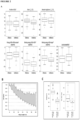
- constructs were designed to cover the seed sequence, contain between 8 nt and 20 nt in length, have a length-specific fraction of LNAs allowed and as high a binding affinity to miR-22 as possible (See Figures 1 and 2A-C ).
- Design elements included at least 2 LNA modifications at the end of the construct. Further design elements included no more than 4 LNA modifications in a row. Further still design elements included no more than 3 unmodified residues in a row.
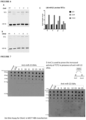
- constructs were designed to bind to miR-22 with sufficient affinity to inhibit it. Also, the constructs were designed to have limited or no self-binding affinity (e.g . no or limited duplex or fold structures). See Figures 3A-B .
- Example 1 Further validation of the ability of the constructs of Example 1 to inhibit miR-22 was assessed in vivo in an obesity model.
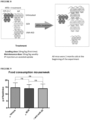
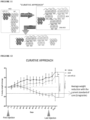
- Figure 11 is a pictorial of a curative approach showing miR-22 -/- and WT mice on a HFD treated with an anti-miR-22-LNA, SCR and a VHL and placed on a second HFD regimen.
- Figure 12 a construct of Example 1 inhibited miR-22, as evidenced by weight loss.
- FIG 14 is an Oil- Red O staining ( Figure 14A ) and a bar graph ( Figure 14B ) showing that anti- miR-22 treatment in Human Primary Mesenchymal cells cultured in Adipo differentiation media for 2 weeks with or without LNA anti-miR-22. Un- assisted uptake 500nM (LNAs added every 2 days).
- Figure 14B the data in the right (red) bars in each bar graph is for the with LNA# 10- treated cells.
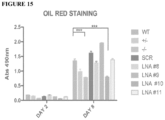
- Figure 15 is a bar graph showing that pharmacological inhibition of miR-22 is effective in impairing MEFs adipocytic differentiation.
- the order of data in the bar graphs, when reading from left to right corresponds with the legend (at the right of the graph) when reading from top to bottom.
- the number of LNAs corresponds to Example 1 above.
- nucleic acid constructs of Example 1 are effective in inhibiting miR-22.
Landscapes
- Health & Medical Sciences (AREA)
- Life Sciences & Earth Sciences (AREA)
- Engineering & Computer Science (AREA)
- Chemical & Material Sciences (AREA)
- Genetics & Genomics (AREA)
- Molecular Biology (AREA)
- General Health & Medical Sciences (AREA)
- Biomedical Technology (AREA)
- Bioinformatics & Cheminformatics (AREA)
- Organic Chemistry (AREA)
- Biotechnology (AREA)
- Animal Behavior & Ethology (AREA)
- Public Health (AREA)
- Veterinary Medicine (AREA)
- Medicinal Chemistry (AREA)
- Pharmacology & Pharmacy (AREA)
- General Engineering & Computer Science (AREA)
- Wood Science & Technology (AREA)
- Zoology (AREA)
- Biochemistry (AREA)
- Epidemiology (AREA)
- Plant Pathology (AREA)
- Biophysics (AREA)
- Physics & Mathematics (AREA)
- Microbiology (AREA)
- Chemical Kinetics & Catalysis (AREA)
- Nuclear Medicine, Radiotherapy & Molecular Imaging (AREA)
- General Chemical & Material Sciences (AREA)
- Diabetes (AREA)
- Obesity (AREA)
- Hematology (AREA)
- Child & Adolescent Psychology (AREA)
- Gastroenterology & Hepatology (AREA)
- Pharmaceuticals Containing Other Organic And Inorganic Compounds (AREA)
- Medicines That Contain Protein Lipid Enzymes And Other Medicines (AREA)
- Measuring Or Testing Involving Enzymes Or Micro-Organisms (AREA)
- Micro-Organisms Or Cultivation Processes Thereof (AREA)
- Peptides Or Proteins (AREA)
- Enzymes And Modification Thereof (AREA)
- Medicines Containing Antibodies Or Antigens For Use As Internal Diagnostic Agents (AREA)
Claims (4)
- Eine miR-22-inhibitorische Zusammensetzung, umfassend eine Nukleinsäure mit einer Sequenz, die CTTcaACtgGCAgCT (SEQ ID NO: 8) aufweist, wobei:die Großbuchstaben LNA (Locked Nucleic Acid) -veränderte Nukleotide sind unddie Kleinbuchstaben unveränderte Nukleotide sind.
- Pharmazeutische Zusammensetzung, die die Nukleinsäure nach Anspruch 1 und einen pharmazeutisch verträglichen Hilfsstoff oder Träger aufweist.
- Wirtszelle, die die Nukleinsäure nach Anspruch 1 aufweist.
- Zusammensetzung nach Anspruch 1 zur Verwendung bei der Behandlung einer Krankheit.
Applications Claiming Priority (2)
| Application Number | Priority Date | Filing Date | Title |
|---|---|---|---|
| US201862642934P | 2018-03-14 | 2018-03-14 | |
| PCT/US2019/022351 WO2019178411A1 (en) | 2018-03-14 | 2019-03-14 | Inhibitors of micro-rna 22 |
Publications (4)
| Publication Number | Publication Date |
|---|---|
| EP3765619A1 EP3765619A1 (de) | 2021-01-20 |
| EP3765619A4 EP3765619A4 (de) | 2021-12-08 |
| EP3765619B1 true EP3765619B1 (de) | 2024-10-09 |
| EP3765619C0 EP3765619C0 (de) | 2024-10-09 |
Family
ID=67908026
Family Applications (2)
| Application Number | Title | Priority Date | Filing Date |
|---|---|---|---|
| EP19768285.9A Pending EP3765610A4 (de) | 2018-03-14 | 2019-03-14 | Micro-rna und fettleibigkeit |
| EP19768368.3A Active EP3765619B1 (de) | 2018-03-14 | 2019-03-14 | Inhibitoren der micro-rna 22 |
Family Applications Before (1)
| Application Number | Title | Priority Date | Filing Date |
|---|---|---|---|
| EP19768285.9A Pending EP3765610A4 (de) | 2018-03-14 | 2019-03-14 | Micro-rna und fettleibigkeit |
Country Status (12)
| Country | Link |
|---|---|
| US (2) | US11753639B2 (de) |
| EP (2) | EP3765610A4 (de) |
| JP (2) | JP7318166B2 (de) |
| KR (2) | KR20200131287A (de) |
| CN (2) | CN112119159B (de) |
| AU (2) | AU2019234917B2 (de) |
| BR (2) | BR112020018705A2 (de) |
| CA (2) | CA3093572A1 (de) |
| ES (1) | ES3001019T3 (de) |
| RU (2) | RU2020131372A (de) |
| SG (2) | SG11202008925VA (de) |
| WO (2) | WO2019178410A1 (de) |
Families Citing this family (6)
| Publication number | Priority date | Publication date | Assignee | Title |
|---|---|---|---|---|
| KR20200131287A (ko) | 2018-03-14 | 2020-11-23 | 베스 이스라엘 데코니스 메디칼 센터 | 마이크로-rna 22의 억제제 |
| CN110609142A (zh) * | 2019-10-09 | 2019-12-24 | 广州医科大学附属第二医院 | 一种检测外周血fto蛋白与自身调控元件结合能力的方法与应用 |
| CN115029347B (zh) * | 2022-05-11 | 2024-02-20 | 珠海中科先进技术研究院有限公司 | 识别和调控肝肾细胞纤维化的分子监测序列、重组质粒、抑制病毒 |
| CN116082447A (zh) * | 2022-09-09 | 2023-05-09 | 湖南大学 | 一种多肽及其制备方法 |
| CN117304258B (zh) * | 2022-09-09 | 2024-09-24 | 湖南大学 | 一种多肽的用途 |
| EP4353823A1 (de) * | 2022-10-12 | 2024-04-17 | Resalis Therapeutics S.r.l. | Inhibitoren von mikro-rna 22 |
Family Cites Families (32)
| Publication number | Priority date | Publication date | Assignee | Title |
|---|---|---|---|---|
| US5981505A (en) | 1993-01-26 | 1999-11-09 | The Trustees Of The University Of Pennsylvania | Compositions and methods for delivery of genetic material |
| US5837533A (en) | 1994-09-28 | 1998-11-17 | American Home Products Corporation | Complexes comprising a nucleic acid bound to a cationic polyamine having an endosome disruption agent |
| US5840710A (en) | 1994-12-09 | 1998-11-24 | Genzyme Corporation | Cationic amphiphiles containing ester or ether-linked lipophilic groups for intracellular delivery of therapeutic molecules |
| US6217900B1 (en) | 1997-04-30 | 2001-04-17 | American Home Products Corporation | Vesicular complexes and methods of making and using the same |
| CA2294988C (en) | 1997-07-01 | 2015-11-24 | Isis Pharmaceuticals Inc. | Compositions and methods for the delivery of oligonucleotides via the alimentary canal |
| JP2002516256A (ja) | 1998-05-26 | 2002-06-04 | アイ・シー・エヌ・フアーマシユーテイカルズ・インコーポレイテツド | 二環式糖成分を有する新規ヌクレオシド |
| US6838283B2 (en) | 1998-09-29 | 2005-01-04 | Isis Pharmaceuticals Inc. | Antisense modulation of survivin expression |
| US6693187B1 (en) | 2000-10-17 | 2004-02-17 | Lievre Cornu Llc | Phosphinoamidite carboxlates and analogs thereof in the synthesis of oligonucleotides having reduced internucleotide charge |
| CA2487274A1 (en) | 2002-05-06 | 2003-11-13 | Nucleonics Inc. | Spermine chemically linked to lipids and cell-specific targeting molecules as a transfection agent |
| EP2302055B1 (de) * | 2004-11-12 | 2014-08-27 | Asuragen, Inc. | Verfahren und Zusammensetzungen, die miRNAs und miRNAa-inhibitorischen Molekülen verbunden sind |
| US20070213292A1 (en) * | 2005-08-10 | 2007-09-13 | The Rockefeller University | Chemically modified oligonucleotides for use in modulating micro RNA and uses thereof |
| KR101485071B1 (ko) * | 2005-12-12 | 2015-01-26 | 더 유니버시티 오브 노쓰 캐롤라이나 엣 채플 힐 | 마이크로 rna를 이용한 근육 세포 증식 및 분화 조절방법과 근육 세포 치료방법 및 유전자 발현 억제방법그리고 마이크로 rna 분자의 발현용 벡터와 이를 이용한키트 및 미오사이트 |
| AU2013254923A1 (en) * | 2006-04-03 | 2013-11-28 | Santaris Pharma A/S | Pharmaceutical compositions comprising anti-miRNA antisense oligonucleotide |
| EP2007888A2 (de) | 2006-04-03 | 2008-12-31 | Santaris Pharma A/S | Pharmazeutische zusammensetzung mit anti-mirna-antisense-oligonukleotiden |
| EP2623599B1 (de) * | 2007-10-04 | 2019-01-02 | Roche Innovation Center Copenhagen A/S | Mikromir-Moleküle |
| EP2419537B1 (de) * | 2009-04-13 | 2014-01-29 | Somagenics, Inc. | Verfahren und zusammensetzungen für den nachweis von kurzen rna |
| SG176716A1 (en) * | 2009-06-08 | 2012-01-30 | Miragen Therapeutics | CHEMICAL MODIFICATION MOTIFS FOR miRNA INHIBITORS AND MIMETICS |
| UY33807A (es) * | 2010-12-17 | 2012-07-31 | Sanofi Sa | miRNAs como indicadores del estado tisular o de enfermedades como osteoartritis |
| CA2832899A1 (en) | 2011-04-12 | 2012-10-18 | Beth Israel Deaconess Medical Center, Inc. | Micro-rna inhibitors and their uses in disease |
| JP6092655B2 (ja) * | 2012-02-23 | 2017-03-08 | 善基 村上 | テスト体液サンプルの分類方法 |
| US9034839B2 (en) | 2012-04-20 | 2015-05-19 | Aptamir Therapeutics, Inc. | miRNA modulators of thermogenesis |
| WO2013181613A1 (en) * | 2012-05-31 | 2013-12-05 | Research Development Foundation | Mirna for the diagnosis and treatment of autoimmune and inflammatory disease |
| CN107236735B (zh) * | 2012-06-21 | 2019-11-08 | 米拉根医疗股份有限公司 | 包含锁核酸基序的基于寡核苷酸的抑制剂 |
| US9822358B2 (en) | 2013-10-18 | 2017-11-21 | Beth Israel Deaconess Medical Center | Treatment of cancers with micro-RNA inhibitors |
| CA2935426C (en) * | 2014-01-30 | 2023-07-25 | F. Hoffmann-La Roche Ag | Polyoligomer compound with biocleavable conjugates for reducing or inhibiting expression of a nucleic acid target |
| WO2016127002A1 (en) | 2015-02-04 | 2016-08-11 | Bristol-Myers Squibb Company | Lna oligonucleotides with alternating flanks |
| WO2016149358A1 (en) * | 2015-03-16 | 2016-09-22 | Duncan Ross | Method of treatment comprising membrane-enclosed vesicle |
| WO2017187426A1 (en) * | 2016-04-29 | 2017-11-02 | Aptamir Therapeutics, Inc. | Inhibition of mir-22 mirna by apt-110 |
| CN107432933A (zh) * | 2017-07-13 | 2017-12-05 | 中南大学湘雅三医院 | miR‑22作为靶位点在制备膀胱癌的化疗增敏治疗药物中的应用 |
| WO2019053235A1 (en) * | 2017-09-15 | 2019-03-21 | Genfit | NON-INVASIVE DIAGNOSIS OF NON ALCOHOLIC LIVER DISEASES, NON ALCOHOLIC STHEATHEPATITIS AND / OR HEPATIC FIBROSIS |
| KR20200131287A (ko) | 2018-03-14 | 2020-11-23 | 베스 이스라엘 데코니스 메디칼 센터 | 마이크로-rna 22의 억제제 |
| WO2019217907A1 (en) * | 2018-05-11 | 2019-11-14 | The Regents Of The University Of California | Methods and compositions for the treatment of hepatic and metabolic diseases |
-
2019
- 2019-03-14 KR KR1020207029242A patent/KR20200131287A/ko not_active Withdrawn
- 2019-03-14 RU RU2020131372A patent/RU2020131372A/ru unknown
- 2019-03-14 RU RU2020132725A patent/RU2020132725A/ru unknown
- 2019-03-14 CA CA3093572A patent/CA3093572A1/en active Pending
- 2019-03-14 ES ES19768368T patent/ES3001019T3/es active Active
- 2019-03-14 KR KR1020207029243A patent/KR20200132920A/ko not_active Withdrawn
- 2019-03-14 JP JP2020573079A patent/JP7318166B2/ja active Active
- 2019-03-14 WO PCT/US2019/022350 patent/WO2019178410A1/en not_active Ceased
- 2019-03-14 CA CA3093844A patent/CA3093844A1/en active Pending
- 2019-03-14 EP EP19768285.9A patent/EP3765610A4/de active Pending
- 2019-03-14 CN CN201980032204.4A patent/CN112119159B/zh active Active
- 2019-03-14 SG SG11202008925VA patent/SG11202008925VA/en unknown
- 2019-03-14 SG SG11202008921YA patent/SG11202008921YA/en unknown
- 2019-03-14 BR BR112020018705-4A patent/BR112020018705A2/pt not_active Application Discontinuation
- 2019-03-14 BR BR112020018752-6A patent/BR112020018752A2/pt not_active Application Discontinuation
- 2019-03-14 US US16/979,777 patent/US11753639B2/en active Active
- 2019-03-14 AU AU2019234917A patent/AU2019234917B2/en active Active
- 2019-03-14 AU AU2019234916A patent/AU2019234916B2/en active Active
- 2019-03-14 CN CN201980018587.XA patent/CN111918968B/zh active Active
- 2019-03-14 WO PCT/US2019/022351 patent/WO2019178411A1/en not_active Ceased
- 2019-03-14 JP JP2020549635A patent/JP2021518841A/ja active Pending
- 2019-03-14 US US16/979,782 patent/US11499152B2/en active Active
- 2019-03-14 EP EP19768368.3A patent/EP3765619B1/de active Active
Also Published As
Similar Documents
| Publication | Publication Date | Title |
|---|---|---|
| EP3765619B1 (de) | Inhibitoren der micro-rna 22 | |
| JP6208228B2 (ja) | ロックド核酸モチーフを含むオリゴヌクレオチドベースの阻害剤 | |
| CN102803284B (zh) | 用于miRNA抑制剂和模拟物的化学修饰基序 | |
| RU2515926C2 (ru) | Двойное нацеливание нп mir-208 и mir 499 в лечении заболеваний сердца | |
| EP2547769B1 (de) | Mgb-oligonukleotid-mirna-antagonisten | |
| EP3797780B1 (de) | Zusammensetzungen und verfahren zur modulation der smn2-aufspaltung in einem patienten | |
| Philippen et al. | Antisense MicroRNA therapeutics in cardiovascular disease: quo vadis? | |
| WO2010120969A1 (en) | Targeting of the mir-30 family and let-7 family as a treatment for heart disease | |
| JP2015525081A (ja) | マイクロrnaのmir−15ファミリーの阻害剤 | |
| EP4353823A1 (de) | Inhibitoren von mikro-rna 22 | |
| HK40045636B (en) | Inhibitors of micro-rna 22 | |
| HK40045636A (en) | Inhibitors of micro-rna 22 | |
| US20230181613A1 (en) | Inhibitors of micro-rna 22 | |
| WO2010129950A1 (en) | Micro-rna that regulates cardiac remodeling | |
| HK40090166A (en) | Compositions and methods for modulation of smn2 splicing in a subject | |
| HK40049373B (en) | Compositions and methods for modulation of smn2 splicing in a subject | |
| HK40049373A (en) | Compositions and methods for modulation of smn2 splicing in a subject |
Legal Events
| Date | Code | Title | Description |
|---|---|---|---|
| STAA | Information on the status of an ep patent application or granted ep patent |
Free format text: STATUS: THE INTERNATIONAL PUBLICATION HAS BEEN MADE |
|
| PUAI | Public reference made under article 153(3) epc to a published international application that has entered the european phase |
Free format text: ORIGINAL CODE: 0009012 |
|
| STAA | Information on the status of an ep patent application or granted ep patent |
Free format text: STATUS: REQUEST FOR EXAMINATION WAS MADE |
|
| 17P | Request for examination filed |
Effective date: 20201006 |
|
| AK | Designated contracting states |
Kind code of ref document: A1 Designated state(s): AL AT BE BG CH CY CZ DE DK EE ES FI FR GB GR HR HU IE IS IT LI LT LU LV MC MK MT NL NO PL PT RO RS SE SI SK SM TR |
|
| AX | Request for extension of the european patent |
Extension state: BA ME |
|
| DAV | Request for validation of the european patent (deleted) | ||
| DAX | Request for extension of the european patent (deleted) | ||
| REG | Reference to a national code |
Ref country code: HK Ref legal event code: DE Ref document number: 40045636 Country of ref document: HK |
|
| A4 | Supplementary search report drawn up and despatched |
Effective date: 20211110 |
|
| RIC1 | Information provided on ipc code assigned before grant |
Ipc: A61K 31/713 20060101ALI20211104BHEP Ipc: C12N 15/113 20100101AFI20211104BHEP |
|
| STAA | Information on the status of an ep patent application or granted ep patent |
Free format text: STATUS: EXAMINATION IS IN PROGRESS |
|
| P01 | Opt-out of the competence of the unified patent court (upc) registered |
Effective date: 20230523 |
|
| 17Q | First examination report despatched |
Effective date: 20230607 |
|
| GRAP | Despatch of communication of intention to grant a patent |
Free format text: ORIGINAL CODE: EPIDOSNIGR1 |
|
| STAA | Information on the status of an ep patent application or granted ep patent |
Free format text: STATUS: GRANT OF PATENT IS INTENDED |
|
| INTG | Intention to grant announced |
Effective date: 20240523 |
|
| GRAS | Grant fee paid |
Free format text: ORIGINAL CODE: EPIDOSNIGR3 |
|
| GRAA | (expected) grant |
Free format text: ORIGINAL CODE: 0009210 |
|
| STAA | Information on the status of an ep patent application or granted ep patent |
Free format text: STATUS: THE PATENT HAS BEEN GRANTED |
|
| AK | Designated contracting states |
Kind code of ref document: B1 Designated state(s): AL AT BE BG CH CY CZ DE DK EE ES FI FR GB GR HR HU IE IS IT LI LT LU LV MC MK MT NL NO PL PT RO RS SE SI SK SM TR |
|
| REG | Reference to a national code |
Ref country code: CH Ref legal event code: EP |
|
| REG | Reference to a national code |
Ref country code: DE Ref legal event code: R096 Ref document number: 602019060117 Country of ref document: DE |
|
| REG | Reference to a national code |
Ref country code: IE Ref legal event code: FG4D |
|
| U01 | Request for unitary effect filed |
Effective date: 20241107 |
|
| REG | Reference to a national code |
Ref country code: LT Ref legal event code: MG9D |
|
| REG | Reference to a national code |
Ref country code: NL Ref legal event code: MP Effective date: 20241009 |
|
| REG | Reference to a national code |
Ref country code: ES Ref legal event code: FG2A Ref document number: 3001019 Country of ref document: ES Kind code of ref document: T3 Effective date: 20250304 |
|
| U07 | Unitary effect registered |
Designated state(s): AT BE BG DE DK EE FI FR IT LT LU LV MT NL PT RO SE SI Effective date: 20250225 |
|
| P04 | Withdrawal of opt-out of the competence of the unified patent court (upc) registered |
Free format text: CASE NUMBER: APP_8871/2025 Effective date: 20250221 |
|
| PG25 | Lapsed in a contracting state [announced via postgrant information from national office to epo] |
Ref country code: HR Free format text: LAPSE BECAUSE OF FAILURE TO SUBMIT A TRANSLATION OF THE DESCRIPTION OR TO PAY THE FEE WITHIN THE PRESCRIBED TIME-LIMIT Effective date: 20241009 Ref country code: IS Free format text: LAPSE BECAUSE OF FAILURE TO SUBMIT A TRANSLATION OF THE DESCRIPTION OR TO PAY THE FEE WITHIN THE PRESCRIBED TIME-LIMIT Effective date: 20250209 |
|
| PG25 | Lapsed in a contracting state [announced via postgrant information from national office to epo] |
Ref country code: NO Free format text: LAPSE BECAUSE OF FAILURE TO SUBMIT A TRANSLATION OF THE DESCRIPTION OR TO PAY THE FEE WITHIN THE PRESCRIBED TIME-LIMIT Effective date: 20250109 |
|
| PG25 | Lapsed in a contracting state [announced via postgrant information from national office to epo] |
Ref country code: GR Free format text: LAPSE BECAUSE OF FAILURE TO SUBMIT A TRANSLATION OF THE DESCRIPTION OR TO PAY THE FEE WITHIN THE PRESCRIBED TIME-LIMIT Effective date: 20250110 |
|
| PG25 | Lapsed in a contracting state [announced via postgrant information from national office to epo] |
Ref country code: PL Free format text: LAPSE BECAUSE OF FAILURE TO SUBMIT A TRANSLATION OF THE DESCRIPTION OR TO PAY THE FEE WITHIN THE PRESCRIBED TIME-LIMIT Effective date: 20241009 |
|
| PG25 | Lapsed in a contracting state [announced via postgrant information from national office to epo] |
Ref country code: RS Free format text: LAPSE BECAUSE OF FAILURE TO SUBMIT A TRANSLATION OF THE DESCRIPTION OR TO PAY THE FEE WITHIN THE PRESCRIBED TIME-LIMIT Effective date: 20250109 |
|
| U20 | Renewal fee for the european patent with unitary effect paid |
Year of fee payment: 7 Effective date: 20250323 |
|
| PG25 | Lapsed in a contracting state [announced via postgrant information from national office to epo] |
Ref country code: SM Free format text: LAPSE BECAUSE OF FAILURE TO SUBMIT A TRANSLATION OF THE DESCRIPTION OR TO PAY THE FEE WITHIN THE PRESCRIBED TIME-LIMIT Effective date: 20241009 |
|
| PGFP | Annual fee paid to national office [announced via postgrant information from national office to epo] |
Ref country code: ES Payment date: 20250401 Year of fee payment: 7 |
|
| PGFP | Annual fee paid to national office [announced via postgrant information from national office to epo] |
Ref country code: CH Payment date: 20250401 Year of fee payment: 7 |
|
| PG25 | Lapsed in a contracting state [announced via postgrant information from national office to epo] |
Ref country code: SK Free format text: LAPSE BECAUSE OF FAILURE TO SUBMIT A TRANSLATION OF THE DESCRIPTION OR TO PAY THE FEE WITHIN THE PRESCRIBED TIME-LIMIT Effective date: 20241009 |
|
| PG25 | Lapsed in a contracting state [announced via postgrant information from national office to epo] |
Ref country code: CZ Free format text: LAPSE BECAUSE OF FAILURE TO SUBMIT A TRANSLATION OF THE DESCRIPTION OR TO PAY THE FEE WITHIN THE PRESCRIBED TIME-LIMIT Effective date: 20241009 |
|
| PLBE | No opposition filed within time limit |
Free format text: ORIGINAL CODE: 0009261 |
|
| STAA | Information on the status of an ep patent application or granted ep patent |
Free format text: STATUS: NO OPPOSITION FILED WITHIN TIME LIMIT |
|
| 26N | No opposition filed |
Effective date: 20250710 |
|
| PG25 | Lapsed in a contracting state [announced via postgrant information from national office to epo] |
Ref country code: MC Free format text: LAPSE BECAUSE OF FAILURE TO SUBMIT A TRANSLATION OF THE DESCRIPTION OR TO PAY THE FEE WITHIN THE PRESCRIBED TIME-LIMIT Effective date: 20241009 |
|
| PG25 | Lapsed in a contracting state [announced via postgrant information from national office to epo] |
Ref country code: IE Free format text: LAPSE BECAUSE OF NON-PAYMENT OF DUE FEES Effective date: 20250314 |
|
| REG | Reference to a national code |
Ref country code: CH Ref legal event code: U11 Free format text: ST27 STATUS EVENT CODE: U-0-0-U10-U11 (AS PROVIDED BY THE NATIONAL OFFICE) Effective date: 20260401 |
|
| PGFP | Annual fee paid to national office [announced via postgrant information from national office to epo] |
Ref country code: GB Payment date: 20260330 Year of fee payment: 8 |
|
| U20 | Renewal fee for the european patent with unitary effect paid |
Year of fee payment: 8 Effective date: 20260323 |