EP3765002B1 - Pharmazeutische zusammensetzungen mit hohem wirkstoffgehalt an mittelkettigen triglyceriden und verfahren im zusammenhang damit - Google Patents
Pharmazeutische zusammensetzungen mit hohem wirkstoffgehalt an mittelkettigen triglyceriden und verfahren im zusammenhang damit Download PDFInfo
- Publication number
- EP3765002B1 EP3765002B1 EP19766575.5A EP19766575A EP3765002B1 EP 3765002 B1 EP3765002 B1 EP 3765002B1 EP 19766575 A EP19766575 A EP 19766575A EP 3765002 B1 EP3765002 B1 EP 3765002B1
- Authority
- EP
- European Patent Office
- Prior art keywords
- lmp
- formulations
- caprylic triglyceride
- optionally
- dissolution
- Prior art date
- Legal status (The legal status is an assumption and is not a legal conclusion. Google has not performed a legal analysis and makes no representation as to the accuracy of the status listed.)
- Active
Links
Images














Classifications
-
- A—HUMAN NECESSITIES
- A61—MEDICAL OR VETERINARY SCIENCE; HYGIENE
- A61K—PREPARATIONS FOR MEDICAL, DENTAL OR TOILETRY PURPOSES
- A61K31/00—Medicinal preparations containing organic active ingredients
- A61K31/21—Esters, e.g. nitroglycerine, selenocyanates
- A61K31/215—Esters, e.g. nitroglycerine, selenocyanates of carboxylic acids
-
- A—HUMAN NECESSITIES
- A61—MEDICAL OR VETERINARY SCIENCE; HYGIENE
- A61K—PREPARATIONS FOR MEDICAL, DENTAL OR TOILETRY PURPOSES
- A61K31/00—Medicinal preparations containing organic active ingredients
- A61K31/21—Esters, e.g. nitroglycerine, selenocyanates
- A61K31/215—Esters, e.g. nitroglycerine, selenocyanates of carboxylic acids
- A61K31/22—Esters, e.g. nitroglycerine, selenocyanates of carboxylic acids of acyclic acids, e.g. pravastatin
-
- A—HUMAN NECESSITIES
- A61—MEDICAL OR VETERINARY SCIENCE; HYGIENE
- A61K—PREPARATIONS FOR MEDICAL, DENTAL OR TOILETRY PURPOSES
- A61K31/00—Medicinal preparations containing organic active ingredients
- A61K31/21—Esters, e.g. nitroglycerine, selenocyanates
- A61K31/215—Esters, e.g. nitroglycerine, selenocyanates of carboxylic acids
- A61K31/22—Esters, e.g. nitroglycerine, selenocyanates of carboxylic acids of acyclic acids, e.g. pravastatin
- A61K31/23—Esters, e.g. nitroglycerine, selenocyanates of carboxylic acids of acyclic acids, e.g. pravastatin of acids having a carboxyl group bound to a chain of seven or more carbon atoms
-
- A—HUMAN NECESSITIES
- A61—MEDICAL OR VETERINARY SCIENCE; HYGIENE
- A61K—PREPARATIONS FOR MEDICAL, DENTAL OR TOILETRY PURPOSES
- A61K45/00—Medicinal preparations containing active ingredients not provided for in groups A61K31/00 - A61K41/00
- A61K45/06—Mixtures of active ingredients without chemical characterisation, e.g. antiphlogistics and cardiaca
-
- A—HUMAN NECESSITIES
- A61—MEDICAL OR VETERINARY SCIENCE; HYGIENE
- A61K—PREPARATIONS FOR MEDICAL, DENTAL OR TOILETRY PURPOSES
- A61K9/00—Medicinal preparations characterised by special physical form
- A61K9/14—Particulate form, e.g. powders, Processes for size reducing of pure drugs or the resulting products, Pure drug nanoparticles
- A61K9/16—Agglomerates; Granulates; Microbeadlets ; Microspheres; Pellets; Solid products obtained by spray drying, spray freeze drying, spray congealing,(multiple) emulsion solvent evaporation or extraction
- A61K9/1605—Excipients; Inactive ingredients
- A61K9/1611—Inorganic compounds
-
- A—HUMAN NECESSITIES
- A61—MEDICAL OR VETERINARY SCIENCE; HYGIENE
- A61K—PREPARATIONS FOR MEDICAL, DENTAL OR TOILETRY PURPOSES
- A61K9/00—Medicinal preparations characterised by special physical form
- A61K9/14—Particulate form, e.g. powders, Processes for size reducing of pure drugs or the resulting products, Pure drug nanoparticles
- A61K9/16—Agglomerates; Granulates; Microbeadlets ; Microspheres; Pellets; Solid products obtained by spray drying, spray freeze drying, spray congealing,(multiple) emulsion solvent evaporation or extraction
- A61K9/1605—Excipients; Inactive ingredients
- A61K9/1617—Organic compounds, e.g. phospholipids, fats
-
- A—HUMAN NECESSITIES
- A61—MEDICAL OR VETERINARY SCIENCE; HYGIENE
- A61K—PREPARATIONS FOR MEDICAL, DENTAL OR TOILETRY PURPOSES
- A61K9/00—Medicinal preparations characterised by special physical form
- A61K9/14—Particulate form, e.g. powders, Processes for size reducing of pure drugs or the resulting products, Pure drug nanoparticles
- A61K9/16—Agglomerates; Granulates; Microbeadlets ; Microspheres; Pellets; Solid products obtained by spray drying, spray freeze drying, spray congealing,(multiple) emulsion solvent evaporation or extraction
- A61K9/1605—Excipients; Inactive ingredients
- A61K9/1629—Organic macromolecular compounds
- A61K9/1641—Organic macromolecular compounds obtained otherwise than by reactions only involving carbon-to-carbon unsaturated bonds, e.g. polyethylene glycol, poloxamers
-
- A—HUMAN NECESSITIES
- A61—MEDICAL OR VETERINARY SCIENCE; HYGIENE
- A61K—PREPARATIONS FOR MEDICAL, DENTAL OR TOILETRY PURPOSES
- A61K9/00—Medicinal preparations characterised by special physical form
- A61K9/14—Particulate form, e.g. powders, Processes for size reducing of pure drugs or the resulting products, Pure drug nanoparticles
- A61K9/16—Agglomerates; Granulates; Microbeadlets ; Microspheres; Pellets; Solid products obtained by spray drying, spray freeze drying, spray congealing,(multiple) emulsion solvent evaporation or extraction
- A61K9/1605—Excipients; Inactive ingredients
- A61K9/1664—Compounds of unknown constitution, e.g. material from plants or animals
-
- A—HUMAN NECESSITIES
- A61—MEDICAL OR VETERINARY SCIENCE; HYGIENE
- A61P—SPECIFIC THERAPEUTIC ACTIVITY OF CHEMICAL COMPOUNDS OR MEDICINAL PREPARATIONS
- A61P25/00—Drugs for disorders of the nervous system
- A61P25/28—Drugs for disorders of the nervous system for treating neurodegenerative disorders of the central nervous system, e.g. nootropic agents, cognition enhancers, drugs for treating Alzheimer's disease or other forms of dementia
-
- A—HUMAN NECESSITIES
- A61—MEDICAL OR VETERINARY SCIENCE; HYGIENE
- A61K—PREPARATIONS FOR MEDICAL, DENTAL OR TOILETRY PURPOSES
- A61K2300/00—Mixtures or combinations of active ingredients, wherein at least one active ingredient is fully defined in groups A61K31/00 - A61K41/00
Definitions
- compositions comprising high drug loadings of medium chain triglycerides, as well as methods of making and methods of using such compositions.
- MCTs Medium Chain Tryglycerides
- MCTs are comprised of fatty acids with chain length between 5-12 carbons.
- MCTs have been researched extensively and have known nutritional and pharmaceutical uses.
- MCTs having melting points which are liquid at room temperature. Further, MCTs are relatively small and are ionizable at physiological pH, and hence are generally soluble in aqueous solutions.
- compositions of active ingredients that are present as a liquid at room temperature such as MCTs, as a solid dosage form.
- EP 2 319 508 A1 describes methods and compositions for treating or preventing the occurrence of senile dementia of the Alzheimer's type, or other conditions arising from reduced neuronal metabolism.
- WO 2017 /149392 Al discloses self-emulsifying compositions comprising at least one CB2 receptor modulator, a self-emulsifying vehicle and optionally one antipsychotic agent for use in the treatment of mental disorders.
- the invention relates to a pharmaceutical composition
- a pharmaceutical composition comprising a high drug loading of an MCT, i.e., caprylic triglyceride, and at least one matrix forming agent.
- the matrix forming agent is selected from the group consisting of glyceryl dibehenate, carnauba wax, or combinations thereof.
- the composition may form discrete particles including the high drug loading of an MCT and a matrix forming agent.
- the particles have an average diameter, of, e.g., between about 50 ⁇ m and about 350 ⁇ m.
- the particles exhibit a Carr Index of flowability of less than 10%.
- the composition may comprise a dissolution enhancer, a flow aid, a stiffening agent, and combinations thereof.
- the MCT is a caprylic triglyceride, which is present in an amount of between 30% and 50%, by weight of the total composition.
- the at least one matrix forming agent is selected from the group consisting of glyceryl dibehenate, carnauba wax and combinations thereof, and the matrix forming agent is present in an amount of between about 20% and about 70%, by weight of the total composition.
- the glyceride may be selected from glyceryl behenate, glyceryl trimyristate, glyceryl trilaurate, glyceryl tristearate, glyceryl monostearate, glyceryl palmitostearate, and glyceryl triacetate, and combinations thereof.
- the natural wax if present in the inventive compositions, is carnauba wax.
- the dissolution enhancer is selected from the group consisting of poly(ethylene glycol)-block-poly(propylene glycol)-block-poly(ethylene glycol) copolymer, polyethylene glycol copolymer, starch, rice starch, lecithin, polyvinylpyrrolidone (PVP), polyoxylglycerides, polyvinylpyrrolidone-vinyl acetate copolymer (PVP-VA), hydroxypropyl methylcellulose (HPMC), hypromellose acetate succinate (HPMCAS), Low-substituted hydroxypropyl cellulose (L-HPC), sorbitan esters, polyethylene glycol, sorbitan fatty acid esters, and combinations thereof.
- PVP polyvinylpyrrolidone
- PVP-VA polyoxylglycerides
- PVP-VA polyvinylpyrrolidone-vinyl acetate copolymer
- HPMC hydroxypropyl methylcellulose
- the flow aid is selected from the group consisting of amphorous silica gel, silica aerogel, magnesium alumino metasilicates, calcium silicate, ordered mesoporous silica, micronized talc, and combinations thereof.
- the stiffening agent is selected from the group consisting of carnauba wax, candelilla wax, and combinations thereof.
- the pharmaceutical composition when the pharmaceutical composition is subjected to dissolution testing using USP-II Sink dissolution post acid exposure methodology, at least 40% but not more than 60% of the caprylic triglyceride releases from the composition in the first 60 minutes, at least 60% but not more than 80% of the caprylic triglyceride releases from the composition in the 120 minutes, and at least 80% of the caprylic triglyceride releases from the composition in the first 240 minutes.
- at least 90% of the caprylic triglyceride releases from the composition in the first 360 minutes.
- the invention relates to a pharmaceutical composition for use in methods of treating a disease or disorder associated with reduced cognitive function in a subject in need thereof, the method comprising administering to the subject a pharmaceutical composition of the disclosure in an amount effective to elevate ketone body concentrations in said subject to thereby treat said disease or disorder.
- the disease or disorder associated with reduced cognitive function is selected from Alzheimer's disease and Age-Associated Memory Impairment.
- MCT Medium Chain Triglyceride
- LCTs Long Chain Triglycerides
- MCTs are more readily digested to release medium chain fatty acids (MCFAs), which exhibit increased rates of portal absorption, and undergo obligate oxidation.
- MCFAs medium chain fatty acids
- the small size and decreased hydrophobicity of MCTs increases the rate of digestion and absorption relative to LCTs.
- Some lipases in the pre-duodenum preferentially hydrolyze MCTs over LCTs, and the released MCFAs are then partly absorbed directly by the stomach mucosa. Those MCFAs which are not absorbed in the stomach are absorbed directly into the portal vein and not packaged into lipoproteins. Since blood transports much more rapidly than lymph, MCFAs quickly arrive at the liver. In the liver MCFAs undergo obligate oxidation.
- LCFAs long chain fatty acids derived from normal dietary fat are re-esterified into LCTs and packaged into chylomicrons for transport in the lymph. This greatly slows the metabolism of LCTs relative to MCTs.
- LCFAs undergo little oxidation in the liver, due mainly to the inhibitory effects of malonyl-CoA.
- malonyl-CoA is produced as an intermediate in lipogenesis.
- Malonyl-CoA allosterically inhibits carnitine palmitoyltransferase I, and thereby inhibits LCFA transport into the mitochondria. This feedback mechanism prevents futile cycles of lipolysis and lipogenesis.
- MCFAs are, to a large extent, immune to the regulations that control the oxidation of LCFAs. MCFAs enter the mitochondria without the use of carnitine palmitoyltransferase I, therefore MCFAs by-pass this regulatory step and are oxidized regardless of the metabolic state of the organism. Importantly, since MCFAs enter the liver rapidly and are quickly oxidized, large amounts of ketone bodies are readily produced from MCFAs. As such, a large oral dose of MCTs (e.g., about 20 mL to 40 mL) will result in sustained hyperketonemia.
- MCTs e.g., about 20 mL to 40 mL
- the present disclosure generally relates to pharmaceutical compositions comprising a high loading of at least one MCT, and methods of making and using such compositions.
- the MCT is caprylic triglyceride, as described herein.
- the pharmaceutical compositions provide for preferential release of the high drug loading of MCT in the lower gastrointestinal tract of a user.
- preferential release of MCT in the lower gastrointestinal tract, including the colon may provide reduced stomach upset and related adverse events as compared to standard administration of non-formulated MCT oil.
- the improved bioavailability of the MCT may generally lead to increased ketone body production in vivo, as compared to standard administration of non-formulated MCT oil.
- the pharmaceutical compositions of the invention are a pharmaceutical composition comprising a high drug loading of an MCT, i.e., caprylic triglyceride, and a matrix forming excipient.
- the matrix forming agent is selected from the group consisting of glyceryl dibehenate, carnauba wax, or combinations thereof.
- the composition may form discrete particles including the high drug loading of an MCT and the matrix forming excipient.
- the composition may further include a dissolution enhancer, a flow aid, a stiffening agent, and combinations thereof.
- the pharmaceutical compositions may comprise the components in amounts as claimed.
- compositions of the disclosure provide small, discrete particles having an average particle size e.g., between about 50 ⁇ m and about 350 ⁇ m, between about 100 ⁇ m and about 300 ⁇ m in diameter, etc.
- the pharmaceutical compositions of the disclosure provide discrete particles that form flowable powders.
- the flowable powders exhibit a Carr Index of less than about 20%, 15%, 10%, etc.
- the pharmaceutical compositions may include a high drug load of at least one MCT, namely caprylic triglyceride, of between 30 % by weight of the total composition to 50% by weight of the total composition.
- % by weight refers to “% by weight of the total composition”.
- MCTs refer to any glycerol molecule ester-linked to three fatty acid molecules, each fatty acid molecule having a carbon chain of 5-12 carbons.
- the pharmaceutical compositions may comprise an MCT represented by the following general formula: wherein R 1 , R 2 and R 3 are fatty acids having 5-12 carbons in the carbon backbone esterified to the a glycerol backbone.
- the MCTs of the disclosure may be prepared by any process known in the art, such as direct esterification, rearrangement, fractionation, transesterification, or the like.
- Sources of the MCT include any suitable source, semi-synthetic, synthetic or natural.
- natural sources of MCT include plant sources such as coconuts and coconut oil, palm kernels and palm kernel oils, and animal sources such as milk from any of a variety of species, e.g., goats.
- the lipids may be prepared by the rearrangement of a vegetable oil such as coconut oil. The length and distribution of the chain length may vary depending on the source oil. For example, MCT containing 1-10% C6, 30-60% C8, 30-60% C10, 1-10% C10 are commonly derived from palm and coconut oils.
- the pharmaceutical compositions of the invention comprise MCTs that have greater than about 95% C8 at R 1 , R 2 and R 3 , and are herein referred to herein as caprylic triglyceride ("CT").
- CT caprylic triglyceride
- exemplary sources of CT include MIGLYOL ® 808 or NEOBEE ® 895.
- CT may be obtained from coconut or palm kernel oil, made by semi-synthetic esterification of octanoic acid to glycerin, etc.
- the pharmaceutical compositions may comprise MCTs wherein R 1 , R 2 , and R 3 are fatty acids containing a ten-carbon backbone (tri-C10:0). In another embodiment, the pharmaceutical compositions may comprise MCTs wherein R 1 , R 2 , and R 3 are a mixture of C8:0 and C10:0 fatty acids. In another embodiment, the pharmaceutical compositions may comprise MCTs wherein R 1 , R 2 and R 3 are a mixture of C6:0, C8:0, C10:0, and C12:0 fatty acids. In another embodiment, the pharmaceutical compositions may comprise MCTs wherein greater than 95% of R 1 , R 2 and R 3 are 8 carbons in length.
- the pharmaceutical compositions may comprise MCTs wherein the R 1 , R 2 , and R 3 carbon chains are 6-carbon or 10-carbon chains. In another embodiment, the pharmaceutical compositions may comprise MCTs wherein about 50% of R 1 , R 2 and R 3 are 8 carbons in length and about 50% of R 1 , R 2 and R 3 10 carbons in length. In one embodiment, the pharmaceutical compositions may comprise MCTs wherein R 1 , R 2 and R 3 are 6, 8, 10 or 12 carbon chain length, or mixtures thereof. According to the invention, the pharmaceutical formulations comprise caprylic triglyceride.
- the pharmaceutical compositions of the invention include at least one matrix forming agent.
- the matrix forming agent is selected from the group consisting of glyceryl dibehenate, carnauba wax, or combinations thereof.
- the matrix forming agent may be present in amounts sufficient to provide desired particle formation.
- the matrix forming agent is present in an amount of between about 20% and about 70%, between about 40% and about 70%, between about 50% and about 60%, etc., by weight of the total composition.
- the glyceride may be glyceryl behenate, glyceryl dibehenate, glyceryl trimyristate, glyceryl trilaurate, glyceryl tristearate, glyceryl monostearate, glyceryl palmitostearate, and glyceryl triacetate, etc.
- the glyceride is glyceryl dibehenate, e.g., COMPRITOL ® 888.
- the natural wax may include standard natural waxes and hydrogenated oils, e.g., including hydrogenated castor oil (HCO), carnauba wax, rice bran wax, According to the invention, the natural wax is carnauba wax.
- HCO hydrogenated castor oil
- the pharmaceutical composition may include a dissolution enhancer, a flow aid, a stiffening agent, and combinations thereof.
- the dissolution enhancer may generally facilitate dissolution of the high drug loading of MCT by increasing the rate of water penetration into the composition.
- Any suitable dissolution enhancer known in the art which provides the desired particle formation and dissolution properties may be used.
- the dissolution enhancer may be selected from poly(ethylene glycol)-block-poly(propylene glycol)-block-poly(ethylene glycol) copolymer, polyethylene glycol copolymer, starch, rice starch, lecithin, polyvinylpyrrolidone (PVP), polyvinylpyrrolidone-vinyl acetate copolymer (PVP-VA), polyoxylglycerides, hydroxypropyl methylcellulose (HPMC), hypromellose acetate succinate (HPMCAS), low-substituted hydroxypropyl cellulose (L-HPC), sorbitan esters, polyethylene glycol, sorbitan fatty acid esters, and combinations thereof.
- PVP polyvinylpyrrolidone
- the dissolution enhancer is poly(ethylene glycol)-block-poly(propylene glycol)-block-poly(ethylene glycol) copolymer.
- Exemplary dissolution enhancers include the POLOXAMER ® 407, GELUCIRE ® 50/13, etc. Any suitable amount of dissolution enhancer may be used to achieve the desired dissolution of the MCT.
- the dissolution enhancer is present in an amount of about 1% to about 20%, about 1% to about 15%, about 1% to about 10%, about 2% to about 20%, about 2% to about 15%, by weight of the total composition, etc.
- the pharmaceutical compositions of the disclosure also include a flow aid.
- a flow aid Any suitable flow aid known in the art which provides the desired particle formation and flow properties may be used.
- the flow aid is a silica compound, e.g., colloidal silicon dioxide (AEROSIL ® , CAB-O-SIL ® ), amorphous silica gel (SYLOID ® , SYLYSIA ® ), granulated silicon dioxide (AEROPERL ® ), silica aerogel, magnesium alumino metasilicates (NEUILIN ® ), calcium silicate (FLORITE ® ), and ordered mesoporous silicates.
- the flow aide may be present in the composition in any suitable amount to provide the desired flowability.
- the flow aide may be present in an amount of at least about 2% by weight, at least about 5% by weight, at least about 10% by weight, at least about 15% by weight, at least about 20% by weight, at least about 25% by weight, at least about 30% by weight, between about 2.0% and about 30% by weight, between about 2.0% and about 20% by weight, etc.
- the pharmaceutical compositions of the disclosure also include a flow aid.
- the flow aid is a silica compound, e.g., colloidal silicon dioxide (AEROSIL ® , CAB-O-SIL ® ), amorphous silica gel (SYLOID ® , SYLYSIA ® ), granulated silicon dioxide (AEROPERL ® ), silica aerogel, magnesium alumino metasilicates (NEUILIN ® ), calcium silicate (FLORITE ® ), and ordered mesoporous silicates.
- colloidal silicon dioxide AEROSIL ® , CAB-O-SIL ®
- SYLOID ® amorphous silica gel
- SYLYSIA ® granulated silicon dioxide
- silica aerogel silica aerogel
- magnesium alumino metasilicates NEUILIN ®
- calcium silicate FLORITE ®
- ordered mesoporous silicates e.g.,
- the flow aid may be amphorous silica gel, silica aerogel, magnesium alumino metasilicates, calcium silicate, ordered mesoporous silica, micronized talc, and combinations thereof.
- the flow aid comprises micronized talc.
- the flow aid may be present in the composition in any suitable amount to provide the desired flowability.
- the flow aid may be present in an amount of at least about 2% by weight, at least about 5% by weight, etc.
- the flow aid may each be present in an amount ranging from about 0.1% % to 5.0% from about 0.1 wt% to about 4.0 wt%, from about 0.1 wt% to about 3.0 wt%, etc.
- the pharmaceutical compositions of the disclosure also include a stiffening agent.
- a stiffening agent Any suitable stiffening agent known in the art which provides the desired particle formation may be used.
- the stiffening agent may be carnauba wax, candelilla wax, and combinations thereof.
- the stiffening agent is carnauba wax. Any suitable amount of stiffening agent may be used to achieve the desired particle formation.
- the stiffening agent is present in an amount of about 1% to about 60%, about 5% to about 60%, about 10% to about 60%, about 20% to about 60%, by weight of the total composition, etc.
- the pharmaceutical compositions may comprise a high drug loading of at least one MCT such as caprylic triglyceride, and at least one matrix forming agent.
- the composition may form discrete particles including the high drug loading of an MCT and the matrix forming agent.
- the matrix forming agent may be selected from glycerides, natural waxes, and combinations thereof.
- the glyceride may be selected from glyceryl behenate, glyceral dibehenate, glyceryl trimyristate, glyceryl trilaurate, glyceryl tristearate, glyceryl monostearate, glyceryl palmitostearate, and glyceryl triacetate, and combinations thereof.
- the natural wax may include standard natural waxes and hydrogenated oils, and may be selected from hydrogenated castor oil (HCO), carnauba wax, rice bran wax, and combinations thereof.
- the particles have an average diameter of, e.g., between about 50 ⁇ m and about 350 ⁇ m. In other embodiments, the particles exhibit a Carr Index of flowability of less than 10%.
- the composition may further include a dissolution enhancer, a flow aid, a stiffening agent, and combinations thereof.
- any suitable method for making the pharmaceutical compositions of the disclosure may be used.
- reproducibility, particle size and morphology, and yield may be controlled by modifying manufacturing process as illustrated in the examples herein.
- Methods for making the pharmaceutical compositions do not form part of the invention.
- the disclosure relates to the claimed compositions for use in methods of treating a disease or disorder associated with reduced cognitive function in a subject in need thereof, the method comprising administering to the subject a pharmaceutical composition of the disclosure in an amount effective to elevate ketone body concentrations in said subject to thereby treat said disease or disorder.
- the pharmaceutical composition of the disclosure may be administered outside of the context of a ketogenic diet.
- carbohydrates may be consumed at the same time as pharmaceutical compositions disclosed herein.
- diseases and disorders associated with reduced cognitive function include h Age-Associated Memory Impairment (AAMI), Alzheimer's Disease (AD), Parkinson's Disease, Friedreich's Ataxia (FRDA), GLUT1-deficient Epilepsy, Leprechaunism, and Rabson-Mendenhall Syndrome, Coronary Arterial Bypass Graft (CABG) dementia, anesthesia-induced memory loss, Huntington's Disease, and many others.
- AAMI Age-Associated Memory Impairment
- AD Alzheimer's Disease
- FRDA Friedreich's Ataxia
- GLUT1-deficient Epilepsy Leprechaunism
- Rabson-Mendenhall Syndrome corres Arterial Bypass Graft
- CABG Coronary Arterial Bypass Graft
- the patient has or is at risk of developing disease-related reduced cognitive function caused by reduced neuronal metabolism, for example, reduced cognitive function associated with Alzheimer's Disease (AD), Parkinson's Disease, Friedreich's Ataxia (FRDA), GLUT1-deficient Epilepsy, Leprechaunism, and Rabson-Mendenhall Syndrome, Coronary Arterial Bypass Graft (CABG) dementia, anesthesia-induced memory loss, Huntington's Disease, and many others.
- AD Alzheimer's Disease
- FRDA Friedreich's Ataxia
- GLUT1-deficient Epilepsy Leprechaunism
- Rabson-Mendenhall Syndrome corretion Arterial Bypass Graft
- CABG Coronary Arterial Bypass Graft
- CABG Coronary Arterial Bypass Graft
- Huntington's Disease Huntington's Disease
- reduced neuronal metabolism refers to all possible mechanisms that could lead to a reduction in neuronal metabolism. Such mechanisms include, but are not limited to mitochondrial dysfunction, free radical attack, generation of reactive oxygen species (ROS), ROS-induced neuronal apoptosis, defective glucose transport or glycolysis, imbalance in membrane ionic potential, dysfunction in calcium flux, and the like.
- ROS reactive oxygen species
- high blood ketone levels will provide an energy source for brain cells that have compromised glucose metabolism, leading to improved performance in cognitive function.
- subject and patient are used interchangeably, and refer to any mammal, including humans that may benefit from treatment of disease and conditions associated with or resulting from reduced neuronal metabolism.
- Effective amount refers to an amount of a compound, material, or pharmaceutical composition, as described herein that is effective to achieve a particular biological result. Effectiveness for treatment of the aforementioned conditions may be assessed by improved results from at least one neuropsychological test.
- neuropsychological tests are known in the art and include Clinical Global Impression of Change (CGIC), Rey Auditory Verbal Learning Test (RAVLT), First-Last Names Association Test (FLN), Telephone Dialing Test (TDT), Memory Assessment Clinics Self-Rating Scale (MAC-S), Symbol Digit Coding (SDC), SDC Delayed Recall Task (DRT), Divided Attention Test (DAT), Visual Sequence Comparison (VSC), DAT Dual Task (DAT Dual), Mini-Mental State Examination (MMSE), and Geriatric Depression Scale (GDS), among others.
- CGIC Clinical Global Impression of Change
- RAVLT Rey Auditory Verbal Learning Test
- FLN First-Last Names Association Test
- TTT Telephone Dialing Test
- MAC-S Memory
- cognitive function refers to the special, normal, or proper physiologic activity of the brain, including, without limitation, at least one of the following: mental stability, memory/recall abilities, problem solving abilities, reasoning abilities, thinking abilities, judging abilities, capacity for learning, perception, intuition, attention, and awareness.
- Enhanced cognitive function or “improved cognitive function” refers to any improvement in the special, normal, or proper physiologic activity of the brain, including, without limitation, at least one of the following: mental stability, memory/recall abilities, problem solving abilities, reasoning abilities, thinking abilities, judging abilities, capacity for learning, perception, intuition, attention, and awareness, as measured by any means suitable in the art.
- Reduced cognitive function or “impaired cognitive function” refers to any decline in the special, normal, or proper physiologic activity of the brain.
- the methods of the present disclosure further comprise determination of the patients' genotype or particular alleles.
- the patient's alleles of the apolipoprotein E gene are determined. It has been found that non-E4 carriers performed better than those with the E4 allele when elevated ketone body levels were induced with MCT. Also, those with the E4 allele had higher fasting ketone body levels and the levels continued to rise at the two hour time interval. Therefore, E4 carriers may require higher ketone levels or agents that increase the ability to use the ketone bodies that are present.
- the pharmaceutical compositions of the disclosure are administered orally.
- Therapeutically effective amounts of the therapeutic agents can be any amount or dose sufficient to bring about the desired effect and depend, in part, on the severity and stage of the condition, the size and condition of the patient, as well as other factors readily known to those skilled in the art.
- the dosages can be given as a single dose, or as several doses, for example, divided over the course of several weeks, as discussed elsewhere herein.
- compositions of the disclosure are administered in a dosage required to increase blood ketone bodies to a level required to treat and/or prevent the occurrence of any disease- or age-associated cognitive decline, such as AD, AAMI, and the like.
- Appropriate dosages may be determined by one of skill in the art.
- oral administration of a pharmaceutical composition of the disclosure results in hyperketonemia.
- Hyperketonemia in one embodiment, results in ketone bodies being utilized for energy in the brain even in the presence of glucose. Additionally, hyperketonemia results in a substantial (39%) increase in cerebral blood flow ( Hasselbalch, S.G., et al., Changes in cerebral blood flow and carbohydrate metabolism during acute hyperketonemia, Am J Physiol, 1996, 270:E746-51 ).
- Hyperketonemia has been reported to reduce cognitive dysfunction associated with systemic hypoglycemia in normal humans ( Veneman, T., et al., Effect of hyperketonemia and hyperlacticacidemia on symptoms, cognitive dysfunction, and counterregulatory hormone responses during hypoglycemia in normal humans, Diabetes, 1994, 43:1311-7 ). Please note that systemic hypoglycemia is distinct from the local defects in glucose metabolism that occur in any disease- or age-associated cognitive decline, such as AD, AAMI, and the like.
- Administration can be on an as-needed or as-desired basis, for example, once-monthly, once-weekly, daily, or more than once daily. Similarly, administration can be every other day, week, or month, every third day, week, or month, every fourth day, week, or month, and the like. Administration can be multiple times per day.
- the composition may be administered directly to the patient or otherwise contacted with or admixed with daily feed or food.
- compositions provided herein are, in one embodiment, intended for "long term” consumption, sometimes referred to herein as for 'extended' periods.
- Long term administration as used herein generally refers to periods in excess of one month. Periods of longer than two, three, or four months comprise one embodiment of the instant disclosure. Also included are embodiments comprising more extended periods that include longer than 5, 6, 7, 8, 9, or 10 months. Periods in excess of 11 months or 1 year are also included. Longer terms use extending over 1, 2, 3 or more years are also contemplated herein.
- Regular basis as used herein refers to at least weekly, dosing with or consumption of the compositions. More frequent dosing or consumption, such as twice or thrice weekly are included.
- regimens that comprise at least once daily consumption.
- the blood level of ketone bodies, or a specific ketone body, achieved may be a valuable measure of dosing frequency. Any frequency, regardless of whether expressly exemplified herein, that allows maintenance of a blood level of the measured compound within acceptable ranges can be considered useful herein.
- dosing frequency will be a function of the composition that is being consumed or administered, and some compositions may require more or less frequent administration to maintain a desired blood level of the measured compound (e.g., a ketone body).
- Administration can be carried out on a regular basis, for example, as part of a treatment regimen in the patient.
- a treatment regimen may comprise causing the regular ingestion by the patient of a pharmaceutical composition of the disclosure in an amount effective to enhance cognitive function, memory, and behavior in the patient.
- Regular ingestion can be once a day, or two, three, four, or more times per day, on a daily or weekly basis.
- regular administration can be every other day or week, every third day or week, every fourth day or week, every fifth day or week, or every sixth day or week, and in such a regimen, administration can be multiple times per day.
- the goal of regular administration is to provide the patient with optimal dose of a pharmaceutical composition of the disclosure, as exemplified herein.
- Dosages of the inventive compositions may be administered in an effective in an effective amount to increase the cognitive ability of patients afflicted with diseases of reduced neuronal metabolism, such as in patients with any disease- or age-associated cognitive decline, such as, AD, AAMI, and the like.
- the inventive compositions result in elevating ketone concentrations in the body, and in this embodiment, the compositions are administered in an amount that is effective to induce hyperketonemia.
- hyperketonemia results in ketone bodies being utilized for energy in the brain.
- the composition increases the circulating concentration of at least one type of ketone body in the mammal or patient.
- the circulating ketone body is D-beta-hydroxybutyrate.
- the amount of circulating ketone body can be measured at a number of times post administration, and in one embodiment, is measured at a time predicted to be near the peak concentration in the blood, but can also be measured before or after the predicted peak blood concentration level. Measured amounts at these off-peak times are then optionally adjusted to reflect the predicted level at the predicted peak time. In one embodiment, the predicted peak time is at about two hours.
- Peak circulating blood level and timing can vary depending on factors known to those of skill in the art, including individual digestive rates, co-ingestion or pre- or post-ingestion of foods, drinks, etc., as known to one of skill in the art.
- the peak blood level reached of D-beta-hydroxybutyrate is between about 0.05 millimolar (mM) to about 50 mM.
- Another way to determine whether blood levels of D-beta-hydroxybutyrate are raised to about 0.05 to about 50 mM is by measurement of D-beta-hydroxybutyrate urinary excretion a range in the range of about 5 mg/dL to about 160 mg/dL.
- the peak blood level is raised to about 0.1 to about 50 mM, from about 0.1 to about 20 mM, from about 0.1 to about 10 mM, to about 0.1 to about 5 mM, more preferably raised to about 0.15 to about 2 mM, from about 0.15 to about 0.3 mM, and from about 0.2 to about 5 mM, although variations will necessarily occur depending on the formulation and host, for example, as discussed above.
- the peak blood level reached of D-beta-hydroxybutyrate will be at least about 0.05 mM, at least about 0.1 mM, at least about 0.15 mM, at least about 0.2 mM, at least about 0.5 mM, at least about 1 mM, at least about 1.5 mM, at least about 2 mM, at least about 2.5 mM, at least about 3 mM, at least about 4 mM, at least about 5 mM, at least about 10 mM, at least about 15 mM, at least about 20 mM, at least about 30 mM, at least about 40 mM, and at least about 50 mM.
- the MCT dose in one embodiment, is in the range of about 0.05 g/kg/day to about 10 g/kg/day of MCT. In other embodiments, the dose will be in the range of about 0.25 g/kg/day to about 5 g/kg/day of MCT.
- the dose will be in the range of about 0.5 g/kg/day to about 2 g/kg/day of MCT. In other embodiments, the dose will be in the range of about 0.1 g/kg/day to about 2 g/kg/day.
- the dose of MCT is at least about 0.05 g/kg/day, at least about 0.1 g/kg/day, at least about 0.15 g/kg/day, at least about 0.2 g/kg/day, at least about 0.5 g/kg/day, at least about 1 g/kg/day, at least about 1.5 g/kg/day, at least about 2 g/kg/day, at least about 2.5 g/kg/day, at least about 3 g/kg/day, at least about 4 g/kg/day, at least about 5 g/kg/day, at least about 10 g/kg/day, at least about 15 g/kg/day, at least about 20 g/kg/day, at least about 30 g/kg/day, at least about 40 g/kg/day, and at least about 50 g/kg/day.
- Convenient unit dosage containers and/or formulations include tablets, capsules, lozenges, troches, hard candies, nutritional bars, nutritional drinks, metered sprays, creams, and suppositories, among others.
- the compositions may be combined with a pharmaceutically acceptable excipient such as gelatin, oil(s), and/or other pharmaceutically active agent(s).
- a pharmaceutically acceptable excipient such as gelatin, oil(s), and/or other pharmaceutically active agent(s).
- the compositions may be advantageously combined and/or used in combination with other therapeutic or prophylactic agents, different from the subject compounds.
- administration in conjunction with the subject compositions enhances the efficacy of such agents.
- the compounds may be advantageously used in conjunction with antioxidants, compounds that enhance the efficiency of glucose utilization, and mixtures thereof.
- the daily dose of MCT can also be measured in terms of grams of MCT per kg of body weight (BW) of the mammal.
- the daily dose of MCT can range from about 0.01 g/kg to about 10.0 g/kg BW of the mammal.
- the daily dose of MCT is from about 0.1 g/kg to about 5 g/kg BW of the mammal.
- the daily dose of MCT is from about 0.2 g/kg to about 3 g/kg of the mammal.
- the daily dose of MCT is from about 0.5 g/kg to about 2 g/kg of the mammal.
- the inventive compounds may be co administered with carbohydrate, or be co-formulated with carbohydrate.
- Carbohydrate can include more than one type of carbohydrate.
- Appropriate carbohydrates are known in the art, and include simple sugars, such as glucose, fructose, sucrose, and the like, from conventional sources such as corn syrup, sugar beet, and the like.
- the amount of carbohydrate to use can include at least about 0.1 g, at least about 1g, at least about 10 g, at least about 50 g, at least about 100 g, at least about 150 g, at least about 200 g, at least about 250 g, at least about 300 g, at least about 400 g.
- Amounts of carnitine can be at least about 1 g, at least about 50 g, at least about 100 g.
- the compositions can comprise from about 15% to about 40% carbohydrate, on a dry weight basis.
- Sources of such carbohydrates include grains or cereals such as rice, corn, sorghum, alfalfa, barley, soybeans, canola, oats, wheat, or mixtures thereof.
- the compositions also optionally comprise other components that comprise carbohydrates such as dried whey and other dairy products or by-products.
- Table 1-A Formulations Batch Component Function Melting Point (°C) Caprylic Acid (wt%) LMP-2 (exemplary) Compritol 888 ATO (glyceryl dibehenate) Matrix 65 - 77 50 LMP-1 (comparative) Microcrystaline Wax (193/198) Matrix 54 - 102 50 LMP-3 (comparative) Kolliphor CSL (C16 and C18 fatty alcohols, and anionic emulsifiers) Emulsifying wax + surfactants 49 - 54 50 LMP-4 (comparative) Dynasan 118 (glyceryl tristearate) Digestable 70 - 73 50
- the formulations were made using a atomizer spinning disk processing unit equipped with a heat-jacketed melt tank.
- the tank was stirred using a Silverson high shear mixer outfitted with a general purpose 1.25-inch diameter working head.
- the atomizer was a 4-inch spinning disk driven by a variable speed motor.
- Product was contained and collected in an inflated 8-foot diameter disposable bag.
- the excipients were placed into the heat-jacketed melt tank along with the caprylic acid (Miglyol 808) oil and allowed to melt. When the components were mostly melted the high shear mixing head was lowered into the melt. The rotor was turned on for approximately one hour at 900 - 1000 rpm to allow for uniform dispersion of the active within the melt. The mixer was stopped and a pressure lid is placed onto the tank. Melt was delivered to the spinning disk atomizer by the pressure head alone. With this set-up, the rate that melt was delivered to the spinning disk atomizer was dependent on the melt viscosity and the pressure on the tank. The spinning disk atomizer was made of nylon and was heated to temperature within seconds as the melt flows over it.
- the melt flowing off the edge of the spinning disk atomizer formed small spherical droplets which congealed and hardened before striking the containment bag.
- the resulting particle size distribution was influenced by the melt viscosity and flow rate to the disk, but primarily by the rotation rate of the spinning disk atomizer.
- Table 1-B shows the manufacturing summary of all runs. All four formulations were processed on the spinning disk apparatus using a 4" nylon atomizer and a pressurized tank with head pressure as the feed system. LMP-1 producing the hardest particles and LMP-4 the softest.
- LMP-4 With the exception of LMP-4, sufficient material was collected for full characterization of the formulations. For LMP-4, the powder handling properties were poor. The particles appear cohesive and soft, and in some cases left what appeared to be oil residue on surfaces of equipment and packaging.
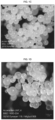
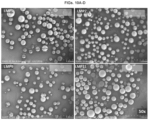
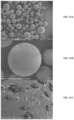
- FIG. 1A LMP-1
- FIG. 1B LMP-2
- FIG. 1C LMP-3
- FIG. 1D LMP-4
- All lots produced spherical particles with very few non-spherical defects. In general, all of the manufactured particles ranged from ⁇ 50 to 300 ⁇ m in diameter. Some variation in particle size was observed between formulations.
- LMP-1 was significantly larger than LMP-2. Particle size can be controlled by adjusting disk speed.
- LMPs 3 and 4 appear agglomerated.
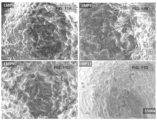
- FIGS. 2A-2D, FIGS. 3A-3D , and FIGS. 4A-4D show the SEM images of the particles. All lots produced spherical particles with diameters ranging from 50 - 350 ⁇ m in diameter. Size and shape are consistent with the optical microscopy. The surface morphology of each LMP formulation can be clearly seen in FIGS. 4A-4D at 1000 times magnification.
- the LMP-1 particles - with the microcrystalline wax matrix - have a relatively smooth surface with several small circular bumps.
- the Compritol based LMP-2 has a very rough surface but lack the characteristic surface morphology of Compritol. Compritol typically exhibits a smooth surface with hexagonal surface crystals. The difference in morphology suggests the caprylic acid is altering the crystal structure of Compritol.
- the surface of LMP-4 is very atypical. The surface appears phase separated. One phase may be predominantly liquid oil explaining the visual observation of an oily surface and the agglomeration.
- the true density of selected LMPs was measure using an AccuPyc 1330 Pycnometer. See Table 2-A.
- the true density of the microcrystalline wax LMP (LMP-1) was less than one, potentially leading to issues during dissolution if the particles float in water.
- the Compritol 888 (glyceryl dibehenate) LMP (LMP-2) was slightly greater than one. LMP-1 floated and LMP-2 partially sank when suspended in a 0.25% SLS / water solution consistent with the AccuPyc true density data.
- Thermal characteristics of the LMPs, excipients, and active caprylic acid (Miglyol 808) oil were tested by Differential Scanning Calorimetry (DSC) to further understand the melting and congealing characteristics.
- Thermal characteristics of caprylic triglyceride (Miglyol 808) were analyzed by using a range of ramp rates for both the congealing of the oil and the subsequent thermal and melting events. Ramp rates of 10, 5, 2, 1, and 0.2°C/min were used because the congealing temperature is often dependent on cooling rate. As shown in FIG. 5A , the congealing temperature of caprylic triglyceride (Miglyol 808) is highly dependent on the cooling rate.
- the primary goal for the Cool-Heat method was to detect any congealing of free caprylic triglyceride (Miglyol 808) oil in the solid LMP matrix - suggesting phase separated oil - and to identify exotherms before the melting point of caprylic triglyceride (Miglyol 808) - indicating form changes. Also, the melting point of the caprylic triglyceride (Miglyol 808) oil and the excipient were compared vs. the pure components of each. Comparing the three LMP Formulations it is clear that LMPs 1 and 2 have more desirable characteristics than LMP-3 due to the low temperature onset for the melting point of 33°C and congealing onset of 44°C (see Table 2-C).
- LMPs 1 and 2 show promise, from a thermal perspective, for formulating caprylic triglyceride into stable multiparticulate drug formulation as the onset of melting and congealing of the sample matrix is sufficiently high to process into a stable formulation at room temperature.
- the thermal data shows that a majority of the caprylic triglyceride is phase separated from the excipient material. If a completely miscible system were present, only one melting point would be expected. This is far from the case, as all three LMPs exhibit a melting point for caprylic triglyceride at 10°C and a subsequent melt of the excipient. As all three LPMs are 50% caprylic triglyceride, the maximum expected enthalpy of the melting event would be ⁇ 57 J/g.
- the enthalpy for the caprylic triglyceride melt is 50, 50, and 61 J/g for LMPs-1, 2, and 3, respectively (see Tables 2-D and 2-E) suggesting that >85% of the caprylic triglyceride is phase separated in the LMP.
- Visual melting point data was collected using an automated melting point apparatus (SRS Optimelt) at 2°C/min. Because of the wide thermal events by DSC, the insight gained by a visual assessment of the LMPs while heating allow for a greater degree of discrimination between the formulations that may be missed by calorimetry data alone.
- SRS Optimelt automated melting point apparatus
- LMP-2 has the sharpest melting point profile of the three LMPs, with a melting point onset of 62°C with melting endpoint at 75°C. This observation is in contrast to the observation that when placed between gloved fingers, the LMPs appeared to melt.
- the LMP-2 Compritol matrix may be compromised by the high oil content and physically breaks upon pressure from rubbing fingers together.
- LMP-1 starts to become translucent at 43°C, however no shrinking of the material is observed until 64°C.
- LMP-3 starts to melt immediately from the starting point of 40°C. Once melted the material is still opaque and does not become completely clear until 140°C, likely due to the SLS from the excipient (Kolliphor CSL) not becoming completely soluble in the melt until that point.
- Table 2-G contains the tabulated peak data for caprylic triglyceride (Miglyol 808) versus the three LMP formulations.
- FIGs. 7A-7C show example chromatograms for the three LMPs versus the excipient and caprylic triglyceride (Miglyol 808) control. The chromatograms are zoomed and show the significant contribution of peaks due to the excipients.
- the peaks at RRT 0.31 and 0.34 may be C-8 diglycerides and as such are included as an impurity.
- caprylic triglyceride (Miglyol 808) oil dissolves into an SLS / water solution.
- Two SLS stock solutions were made at 0.25% and 0.5% SLS in water. 10 ml of each SLS solution was added to a scintillation vial along with a magnetic stir bar. 250 mg of caprylic triglyceride (Miglyol 808) oil was added to each vial and stirred for 20 minutes. Images were taken after 10 minutes and two days. The images are shown in FIG. 9 . The majority of the oil floats on top of the water rather than going into solution.
- caprylic triglyceride (Miglyol 808)
- caprylic triglyceride would achieve 100% release as the dose was a 3x sink the chosen media.
- the centrifuged sample only achieved a 30% recovery.
- the oil dispersed into macroscopic droplets that were easily observed by eye. The size and number of these droplets did not appear to change overtime.
- the oil droplets may be stabilized by the SLS in the media and that is more kinetically stable than being solubilized into the SLS micelles.
- the oil was dosed in a large excess ( ⁇ 80x) versus the solubility. The large excess of oil may have overcome the kinetic component and driven the solubility to it thermodynamic solubility for the solubility experiment.
- LMP-1 has poor release of caprylic triglyceride (Miglyol 808) with no detectable peak (LOQ > 0.5%LC, approx.). After 17.5 hours all three isolation techniques resulted in a 1.6% LC release. LMP-2 exhibited the best overall performance of the three LMP formulations tested with 75 - 91 % LC release after 17.5 hours indicating the possibility for a desirable in vivo release profile.
- the Carr Index decreased from 31 to 10 and 18 to 6 for LMP run's 1 and 2 respectively with the addition of talc.
- the Carr index numbers corroborate with visual assessment of flowability.
- the un-talced material flowed poorly while the talc LMPs flowed well.
- BSV/TSV was also performed on LMP-3 talced particles and resulted in a Carr Index value of 21 indicating LMP-3 did not flow as well as LMP-1 or -2.
- a stiffening agent is intended to increase the hardness and melt temperature of the formulation to improve the handleability and physical stability.
- Stiffening agents have high hardness and high melting temperature.
- the stiffening agents carnauba and candelilla wax were examined.
- Carnauba wax has a melting temperature of approximately 82 °C and has very high hardness.
- Candelilla was has a melting temperature of approximately 68 °C and is known for hardening other waxes.
- Carnauba and candelilla wax were chosen as stiffening agents because they have a similar structure to microcrystalline wax, but have shorter chain lengths. The similar structure is intended to improve the handling characteristics of the LMPs but avoid the poor dissolution performance of LMP-1.
- the formulations screened are listed in Table 5-A.
- the melt screening was conducted.
- the excipients and caprylic triglyceride (Miglyol 808) oil were melted at 100 °C and mixed thoroughly.
- Small droplets were flicked onto a glass plate to observe the cooling rate.
- the congealed drops were collected and rubbed between ones fingers feeling for handleability.
- a small weigh boat was filled with melt and allowed to solidify. Observations were made on whether the solidified melt sweats oil.
- Each formulation was inspected for the following characteristics: do the excipients phase separate; how quickly do the droplets cool; does the solidified melt smear or feel oily when handled; how hard is solidified melt; and does solidified melt "sweat” oil.
- LMP-2 sample was included as a control to compare the formulations to.
- the LMPs were rank ordered in terms of physical characteristics. The results are shown in Table 5-B. Reducing the caprylic triglyceride (Miglyol 808) loading significantly improved the handleability of the melts. The 30 % and 40 % loading formulations were much better than the 50% loading while the 45% loading was only marginally better. The 30 % and 40 % caprylic triglyceride (Miglyol) formulations were non-greasy in the fingers and were very hard. The 30 % caprylic triglyceride (Miglyol) drug loading was the best performing formulation while the 40% loading was tied for third. The candelilla wax formulation was soft and smeared easily was not carried forward. Detailed melt screen results are shown in Table 5-C.
- the carnauba wax formulations had similar handleability characteristics at 50% drug loading to the 30 and 40 % caprylic triglyceride (Miglyol 808) / Compritol formulations, but were slightly softer and slightly greasier.
- the caprylic triglyceride (Miglyol 808) formulations were harder and had a more waxy texture.
- the carnauba wax formulations did not show oil sweating while the caprylic triglyceride (Miglyol 808) / Compritol formulations did.
- the caprylic triglyceride (Miglyol 808) / Compritol sweated which decreased with lower drug loading. No oil sweating was seen in formulations containing carnauba wax. Without being bound to any one theory, the clumping and poor flow of LMP-2 may have been caused by surface oil forming liquid bridges forming between particles.
- LMP- 5, 6, and 9 all cooled in a single phase and had a cloud temperature of 65-75 °C.
- Potential phase separation was seen in LMP-11.
- At 80-85°C about half of the melt was solidified with the bottom half appearing to be carnauba wax rich and the top half was caprylic triglyceride (Miglyol 808) rich based on the color of the two phases.
- a small amount was scraped off the top after the melt was cooled to room temperature and it felt greasy and smeared easily when handled. This phase separation was not seen when creating a large melt block, which suggests the phase separation is slow and will likely not occur during spinning disk apparatus manufacture.
- formulations with lower drug loading in Compritol are the most likely to have good dissolution performance and have improved handleability.
- the carnauba wax improved the physical characteristics of the melts while maintaining a 50% active loading.
- the spinning disk apparatus set up was nearly identical to EXAMPLE 1, except the nylon disc was replaced with a heated stainless steel disk.
- the stainless steel disc was brought up to melt temperature before the start of each run, and would be used for scale up batches.
- the melt temperature for each formulation was roughly 10-15°C above the cloud point from Table 5-D. Excipients were melted and allowed to reach the desired melt temperature prior to adding the caprylic triglyceride (Miglyol).
- the oil was added and high shear mixed at 2500 rpm for about 10 minutes until melt temperature was reached.
- the physical characterization was mainly done by visual and physical observations.
- the cores were observed in their collection bags and ranked on how well they flowed along with tendency of the LMP cores to clump.
- Physical stability of the cores was determined by handling and rubbing cores between ones fingers. The results of the physical observations are listed in Table 7-A.
- Particle size distribution was evaluated using light microscopy.
- the LMPs were spread into a uniform layer on a glass slide and approximately 200-300 particles were measured using a calibrated particle sizing software. Selection bias was minimized by measuring every particle within the field of view.
- the D10, D50, D90 and D4,3 statistics were calculated using a mass weighted basis because the historical LMP size data from laser diffraction and sieve analysis is a mass/volume weighted average. The distribution statistics are shown in Table 7-B.
- the particle size is within the expected range with a D50 between 150 and 200 ⁇ m.
- the span - D 90 ⁇ D 10 D 50 - range from around 0.6 to greater than 0.9, which is typical for the manufacturing scale.
- the LMPs were imaged using scanning electron microscopy (SEM) to assess particle size, shape, and morphology.
- FIG. 9 and FIG. 10 show representative images at different magnifications. Particle size and shape was qualitative assessed and can best be seen in FIG. 10 .
- the particle size ranged from 50 to 350 ⁇ m in diameter, consistent with sizes measured using light microscopy.
- the majority of the LMPs are spherical with few small or satellite particles indicating good atomization.
- FIG. 11 shows the surface morphology.
- the morphology is consistent with LMP- 1, 2, 3, and 4.
- the Compritol based LMPs, formulations LMP-5, LMP-7, and LMP-9, have a rough surface with significant surface undulations lacking any obvious pattern.
- Compritol alone typically exhibits a smooth surface with hexagonal surface crystals.
- the morphology indicates the caprylic triglyceride (Miglyol) alters the crystal structure of Compritol.
- the LMP-2 formulation has a similar surface morphology, however, there are more surface wrinkles on LMP-5 than seen on LMP-2.
- the carnauba wax based LMP-11 has a completely different morphology.
- LMP-11 appears more like deflated bubbles.
- the morphology is more consistent with a spray layered coating rather than an spinning disk apparatus. Overall, the morphology of the LMPs is not typical. However, the morphology is consistent with that for LMP- 1, 2, 3, and 4.
- the bulk and tapped density was measured and the Carr index calculated to quantify the flowability of LMPs dry blended with 2% talc as a flow aid.
- the results are shown in Table 7-C.
- the bulk density of the four formulations were similar, varying between 0.49 and 0.55 g/cm 3 .
- the maximum Carr index was 10 indicating good flowability. This is in agreement with the visual observations of good or very good flowability for each formulation (see Table 7-AError! Reference source not found.).
- the formulations were characterized by DSC and compared to the thermal characteristics of the individual components, including caprylic triglyceride (Miglyol 808), and excipients Compritol 888 and carnauba wax (see Table 2-C).
- the LMP samples were analyzed using the Heat-Cool and Cool-Heat DSC methods described in EXAMPLE 2 and outlined in Table 2-B.
- Table 7-D contains the average of three replicates for each of the samples.
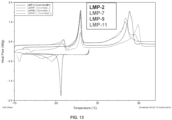
- FIG. 12 and FIG. 13 show thermogram overlays for LMP- 2, 7, 9, and 11, which all contain 50% caprylic triglyceride (Miglyol 808) with Compritol 888 and/or carnauba wax.
- LMP- 7 and 9, containing both Compritol and carnauba wax have a lower congealing and melt temp, and also showed the least handleability, poor flow, and mild agglomeration.
- LMP-11 with the highest carnauba wax content, exhibits a higher congealing temperature and melting points, and was easier to handle, and flowed better.
- LMP-2 which does not contain carnauba wax has a higher melting point than LMP- 7 and 9 which contain 20% and 10% carnauba wax, respectively.
- LMP-2 at 50% caprylic triglyceride has a slightly higher melting point than LMP-5 which has 40% caprylic triglyceride.
- LMP- 2, 5, and 11 formulations containing either Compritol or carnauba wax alone) all exhibit better handleability and flow compared to LMP- 7 and 9, which contain a blend of Compritol and carnauba. This is likely due to or related to a melting point depression for the formulations containing both excipients.
- FIG. 14A-H compares the LMP formulations to the ingoing excipients (Compritol 888 and/or carnauba wax).
- the data show that for all four formulations, the addition of caprylic triglyceride (Miglyol 808) decreases the melt point of the excipient, indicating at least partial miscibility.
- LMP- 7 and 9 exhibit distinctive thermal melt patterns consistent with each individual excipient (Compritol 888 and carnauba wax), indicating that these excipients are not miscible with each other and are likely phase-separated in the solid state. It was observed that the handling properties of LMP- 7 and 9 containing two excipients, were worse than that of LMP- 2, 5, and 11 containing one excipient. This would suggest unfavorable mixing leading to melting point depression of the matrix.
- the amount of potential impurities relative to the caprylic triglyceride (Miglyol) in LMP- 1, 2, and 3 is 0.83 - 2.00%.
- LMP- 5, 7, 9, and 11 formulations were tested in a USP Type II sink dissolution experiment sink performance test using methods outlined described in EXAMPLE 3 (Tables 3-A, 3-B).
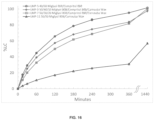
- FIG. 16 shows that LMP- 5, 7, and 9 released to 100 ⁇ 2 %LC by 24 hours.
- the release rate trends as expected, in that adding more carnauba wax to the LMP matrix slows the dissolution. This is because carnauba wax is more hydrophobic than Compritol 888.
- LMP-11 shows less than ideal performance and incomplete release at 24 hours. Adding a pore former to the base LMP-11 formulation may allow for increased dissolution performance by enhancing water permeability while maintaining the desirable physical and handling attributes.
- LMP-7 50/30/20 caprylic triglyceride (Miglyol)/Compritol/carnauba) and LMP-9 (50/40/10 caprylic triglyceride (Miglyol)/Compritol/carnauba) had disappointing handleability and physical stability.
- the cores were waxy, clumpy and smeared easily when handled, LMP-9 more so than LMP-7.
- LMP-5 and LMP-11 were examined over one, three, and six months. Approximately 8 grams of LMP were loaded into an LDPE bag and closed with a twist tie. Samples were loaded into appropriate chamber open to the condition without sealing or adding desiccant. Time points and conditions are shown in Table 8-A. Samples were pulled and allowed to equilibrate to ambient lab conditions prior to sampling. Samples were stored at ambient conditions during and following analysis.
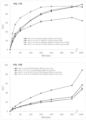
- LMP-5 dissolution results are shown in FIG. 17A .
- LMP-5 stored at 40°C/75%RH is most similar to initial performance.
- LMP-5 stored at 5°C had a similar dissolution rate through 60 minutes, followed by a drop in rate and extent with only 65%LC dissolved after 24 hours.
- the dissolution rate increased significantly, leading to full release by approximately 3 hours.
- Visual observations of the LMPs after storage showed that the LMPs stored at 25°C/60%RH and 40°C/75%RH were similar in appearance and flow to the initial sample.
- LMP-5 stored at 5°C was agglomerated and appeared oily with very poor flow.
- LMP-11 exhibited a different behavior than LMP-5 after 1 month stability storage. Results for LMP-11 are shown in FIG. 17B .
- the 25°C/60%RH and 40°C/75%RH samples showed similar release rate and extent as the initial LMP-11.
- the sample of LMP-11 stored at 5°C had a faster rate of dissolution.
- congealing or crystallization of caprylic triglyceride may have formed pores throughout the carnauba wax matrix, thereby increasing the dissolution rate.
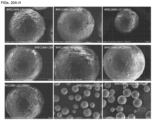
- FIG. 18A-H show SEM images of LMP-5 morphology at 1-month 5°C has a somewhat more nodular surface compared to initial, and the surface of LMP-5 stored 1-month at 25°C/60%RH and 40°C/75%RH appears somewhat smoother than initial.
- FIG. 19A-H shows SEM images for LMP-11 at initial and after 1-month storage. LMP-11 stored at 5°C has a smoother surface compared to initial, and LMP-11 stored 1-month at 25°C/60%RH and 40°C/75%RH has a slightly rougher surface.
- Thermal signals for the LMP-11 on stability are very similar to the initial sample.
- the one observable difference is the melting of the caprylic triglyceride for the 5°C sample in the cool-heat method is much higher amplitude than the other samples. This increase supports the hypothesis from the dissolution data that the caprylic triglyceride has undergone phase separation from the carnauba wax at 5°C.
- LMP-5 and LMP-11 had good handleability and physical characteristics but the dissolution rate not optimal. LMP-5 and LMP-11 released 80% of the API in 3 hours and > 24 hours respectively. Dissolution rate enhancers were added to maintain or improve the handleability while increasing the dissolution rate. Dissolution enhancers are water soluble or hydrophilic excipients that speed up dissolution by increasing the rate of water penetration into the LMP and/or increasing the transport of API out of the LMP formulation. The manufacturing process followed the same approach as the previous described.
- LMP formulations Seven LMP formulations were manufactured. The manufacturing summary and handleability rankings are shown in Table 9-A and Table 9-B.
- the LMPs were blended with 2 wt% talc and ranked in terms of handleability and flowability. Hardness was determined by pressing the LMP particles between ones fingers and the weight boat to see how well the particles held up. The smear was determined by rubbing the LMPs between ones fingers and assessing on how the particles clumped up, smeared and softened.
- the particle size distribution was evaluated using light microscopy.
- the LMPs were spread into a uniform layer on a glass slide and the particles were measured using a calibrated particle sizing software. Selection bias was minimized by measuring every particle within the field of view.
- the D10, D50, D90 and D4,3 statistics were calculated using a mass weighted basis because the historical LMP size data from laser diffraction and sieve analysis is a mass/volume weighted average.
- the particle size distribution statistics is shown below shown in Table 9-C.
- the particle size is within the expected range with a D50 between 150 and 250 ⁇ m.
- the spans range from around 0.4 to greater than 0.7, which is very tight indicating a uniform particle size distribution.
- the particles were imaged using a Scanning Electron Microscope to assess particle morphology and surface characteristics of the different formulations.
- the particle morphology of all formulations was consistent with the light microscope observations, in that all formulations had spherical particles.
- the two formulations that were the softest (BREC1690-155, 161) had surfaces that appeared softer, oily, and less rigid. These two soft formulation were the only ones that differed from the surface structures of LMP- 5, 7, 9, and 11. Representative images are shown in FIGS. 20A-H .
- Flowdex is a powder flow measurement in which the goal is to find the size of an orifice that the material will freely flow through.
- the material is poured into a cylinder container with a drop lever, and is allowed to settle for 30 seconds for consistency between tests.
- the lever is then dropped, which does not disturb the material, and then the material either flows through the hole or it does not.
- the material In order to pass the test the material must flow through the same size orifice 3 consecutive times.
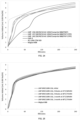
- Formulations BREC1690- 155, 156, 160, 161, and 162 were tested in a sink dissolution performance test using methods outlined herein at EXAMPLE 3 (Tables 3-A and 3-B). The dissolution rate was increased by the addition of a water soluble component (PVP 17PF, PVP-VA 64 or poloxamer P407). Dissolution was tested on formulations BREC1690-155, 156, 160, 161, and 162. Results are shown in FIG. 21 . Comparisons of previous Compritol based LMPs (LMP-2 and LMP-5) and BREC1690- 155, 156, and 162 with a dissolution enhancer are shown in FIG. 22 . Comparison of previous carnauba wax LMP-11 and the carnauba wax formulations with a dissolution enhancer are shown in FIG. 23 .
- BREC1690- 156 and 162 The stability of BREC1690- 156 and 162 was examined at two weeks and one month. BREC1690- 156 and 162 were added into an LDPE bag and closed with a twist tie. Approximately 9 grams were added per package for the following storage conditions: 25°C/60%RH, 30°C/65%RH, and 40°C/75%RH, and 6.5 grams were added per package for the 5°C and -20°C contingency storage conditions. Samples were placed in an appropriate stability chamber open to the condition, without sealing or adding desiccant. Samples were pulled and allowed to equilibrate to ambient conditions prior to sampling for testing. Contingency samples were stored at 5°C and -20°C were evaluated at each time point, and observations made of appearance.
- the digestion is greater than the P407 LMP, and similar to the caprylic triglyceride (Miglyol 808) control. Based on these data, it is likely that the P407 LMP would not require an annealing step post-manufacture, whereas the PVP 17PF formulation may require annealing.
- FIG. 27A-D Images by SEM and camera were acquired for the BREC1690- 156 and 162, 2 week stability samples.
- FIG. 27A-D Appearance of surface structures for the LMP on stability can be attributed to talc that was not present for the initial SEM images.
- BREC1690-156 LMP had minimal changes on stability, whereas the BREC1690-162 LMP had significant increases in surface roughness. Clumping was observed for many of the stability samples. However, all samples were easily broken up and returned to a free flowing powder after gentle agitation, with the exception of the 5°C samples which remained slightly greasy and clumped.
- the lot BREC1690-162 LMP containing PVP 17PF had little change for the 25°C/60%RH sample, however the sample stored at 40°C/75%RH showed a faster initial digestion rate compared to the initial/T0 sample and similar to the 2 week sample stored at the same condition.
- the digestion was greater than the P407 LMP, and similar to the caprylic triglyceride (Miglyol 808) control. Based on these data, it is likely that the P407 LMP would not require an annealing step post-manufacture, whereas the PVP 17PF formulation may require annealing for less than or equal to 2 weeks as the digestion rate has not changed significantly from the 2 week analysis.
- Additional pharmaceutical formulations were prepared in accordance with the spinning disk procedures described in the examples above and evaluated via an initial melt screen. Viability of tested formulations were compared to a baseline sample of 50/40/10 MCT/Compritol/PVP-17 (BREC1690-162). Approximately twenty unique formulations varying in matrix and excipient ratios were evaluated. Test formulations were hand tested for softness and gauged against the physical attributes of BREC1690-162. A positive result is generated if the test formulation has rapid congealing behavior and physical robustness comparable to BREC1690-162. An intermediate result is a formulation with acceptable physical robustness likely to have incomplete release of the MCT, and a negative result is a formulation that is too soft in hand.
- melt screening showed that hydrogenated castor oil (HCO) alone does not provide desired matrix forming properties, but does provide good results when used in combination with other waxes and excipients.
- HCO hydrogenated castor oil
- Table 11-A Formulation 50/25/25 MCT/HCO/Carnauba Wax 50/40/10 MCT/Rice Bran Wax/PVP-17 50/30/20 MCT/Carnauba Wax/Gelucire 50/13 50/50 MCT/Rice Bran Wax
- Congealing kinetics during "flicking" of hot melt was comparable across all the above formulations, with congealing of droplets comparable in size to the target diameter of LMPs rapidly congealing in 1-2 seconds.
- HCO 85-88 °C per USP32-NF27
- Compritol is a mixture of mono-, di-, and triglycerides of behenic acid (C22), while HCO is primarily the triglyceride of hydroxystearate (C18).
- HCO is primarily the triglyceride of hydroxystearate (C18).
- the presence of alcohol groups in the fatty acid chain may also play a role in the softness of the HCO formulations.
- the Compritol is able to solubilize a proportion of the PVP-17 while HCO was unable to disperse the polymer, much less solubilize it. This suggests that the dissolution of the PVP-17 into the Compritol may further add to the observed physical stability of the formulation.
- the carnauba wax/Gelucire-based formulation was observed to initially be soft and slightly pliable, but hardened up significantly on storage overnight at room temperature. Without intending to be limited by theory, this is believed to be due to the additional time allowing the long chains of the carnauba wax to rearrange and pack more tightly. This change was not noted in the HCO/carnauba wax system. This effect may be mitigated by the emulsifying action of the Gelucire 50/13. Previous Carnauba-based formulations made use of the much more hydrophilic dissolution enhancer Poloxamer 407.
- GELUCIRE ® 50/13 Increased levels of dissolution enhancer as well as the alternative hydrophilic dissolution enhancer GELUCIRE ® 50/13 were evaluated to investigate and improve release of the MCT oil from the LMPs.
- GELUCIRE ® 50/13 was selected as an exemplary polyoxylglyceride. It is more hydrophobic than Poloxamer, but maintains sufficient hydrophilic character to enable dissolution in aqueous media.
- Table 12-A Formulation Ref (BREC-2131-) 021 Carnauba Wax (30%) NA P407 (20%) 022 Carnauba Wax (30%) NA Gelucire 50/13 (20%) 031 Microcrystalline Wax (40%) NA P407 (10%)
- the 50/30/20 MCT/Carnauba Wax/P407 was too soft for further testing, but could be enhanced with a stiffening agent.
- the 50/40/10 MCT/Microcrystalline Wax/P407 system is considered an "intermediate" result because while the physical stability of the formulation was acceptable, it is considered unlikely to have good dissolution performance at this relatively low loading of surfactant.
- Table 13-A Rank 1 40/25/25/10 MCT/HCO/Carnauba Wax/Gelucire 50_13 2 45/50/5 MCT/Rice Bran Wax/Gelucire 50_13 3 40/50/10 MCT/Rice Bran Wax/Gelucire 50_13 NA 45/35/10/5 MCT/Rice Bran Wax/PVP-17/Gelucire 50_13
- Gelucire 50_13 was added to the 50/40/10 MCT/Rice Bran Wax/PVP-17 in order to stabilize the components into a single phase, but the PVP-17 formed hard agglomerates and was unable to be dispersed. Testing was suspended on that observation. This approach may still be tested with the dissolution enhancer Poloxamer 407, which is more like PVP-17 in hydrophilicity than the Gelucire 50_13. Previous testing showed that a small amount of Poloxamer may improve dispersion of the PVP-17 in the melt.
Landscapes
- Health & Medical Sciences (AREA)
- Life Sciences & Earth Sciences (AREA)
- Bioinformatics & Cheminformatics (AREA)
- Engineering & Computer Science (AREA)
- Chemical & Material Sciences (AREA)
- Animal Behavior & Ethology (AREA)
- Pharmacology & Pharmacy (AREA)
- General Health & Medical Sciences (AREA)
- Public Health (AREA)
- Veterinary Medicine (AREA)
- Medicinal Chemistry (AREA)
- Epidemiology (AREA)
- Emergency Medicine (AREA)
- Biomedical Technology (AREA)
- Neurosurgery (AREA)
- Neurology (AREA)
- Biophysics (AREA)
- Molecular Biology (AREA)
- Hospice & Palliative Care (AREA)
- Inorganic Chemistry (AREA)
- Psychiatry (AREA)
- Chemical Kinetics & Catalysis (AREA)
- General Chemical & Material Sciences (AREA)
- Nuclear Medicine, Radiotherapy & Molecular Imaging (AREA)
- Organic Chemistry (AREA)
- Botany (AREA)
- Zoology (AREA)
- Medicinal Preparation (AREA)
- Acyclic And Carbocyclic Compounds In Medicinal Compositions (AREA)
Claims (10)
- Pharmazeutische Formulierung, umfassend zwischen 30 Gew.-% und 50 Gew.-% der Gesamtzusammensetzung Capryltriglycerid und zumindest ein matrixbildendes Mittel, das in einer Menge von zwischen etwa 20 Gew.-% und etwa 70 Gew.-% der Gesamtzusammensetzung vorhanden ist, wobei das zumindest eine matrixbildende Mittel aus der aus Glyceryldibehenat, Carnaubawachs und Kombinationen davon bestehenden Gruppe ausgewählt ist.
- Pharmazeutische Zusammensetzung nach einem der vorangegangenen Ansprüche, wobei das matrixbildende Mittel in einer Menge zwischen etwa 40 Gew.-% und etwa 70 Gew.-% der Gesamtzusammensetzung vorhanden ist, gegebenenfalls wobei das Capryltriglycerid in einer Menge zwischen etwa 40 Gew.-% und etwa 50 Gew.-% der Gesamtzusammensetzung vorhanden ist und das matrixbildende Mittel in einer Menge von etwa zwischen 50 Gew.-% und etwa 60 Gew.-% der Gesamtzusammensetzung vorhanden ist.
- Pharmazeutische Zusammensetzung nach einem der vorangegangenen Ansprüche, wobei die pharmazeutische Zusammensetzung einen Auflösungsverbesserer umfasst, wobei der Auflösungsverbesserer gegebenenfalls aus der aus Poly(ethylenglykol)-Block-Poly(propylenglykol)-Block-Poly(ethylenglykol)-Copolymer, Polyethylenglykol-Copolymer, Stärke, Reisstärke, Lecithin, Polyvinylpyrrolidon (PVP), Polyoxylglyceriden, Polyvinylpyrrolidon-Vinylacetat-Copolymer (PVP-VA), Hydroxypropylmethylcellulose (HPMC), Hypromelloseacetatsuccinat (HPMCAS), niedersubstituierter Hydroxypropylcellulose (L-HPC), Sorbitanestern, Polyethylenglykol, Sorbitanfettsäureestern und Kombinationen daraus bestehenden Gruppe ausgewählt ist,wobei der Auflösungsverbesserer gegebenenfalls in einer Menge von etwa 1 Gew.-% bis etwa 20 Gew.-% der Gesamtzusammensetzung vorhanden ist undwobei der Auflösungsverbesserer gegebenenfalls Poly(ethylenglykol)-Block-Poly(propylenglykol)-Block-Poly(ethylenglykol)-Copolymer ist.
- Pharmazeutische Zusammensetzung nach einem der vorangegangenen Ansprüche, wobei die pharmazeutische Zusammensetzung eine Strömungshilfe umfasst,wobei die Strömungshilfe gegebenenfalls aus der aus amorphem Siliciumdioxidgel, Siliciumdioxidaerogel, Magnesiumaluminometasilikaten, Calciumsilikat, geordnetem mesoporösem Siliciumdioxid, mikronisiertem Talk und Kombinationen daraus bestehenden Gruppe ausgewählt ist,wobei die Strömungshilfe gegebenenfalls in einer Menge von 0,1 Gew.-% bis 5 Gew.-% der Gesamtzusammensetzung vorhanden ist.
- Pharmazeutische Zusammensetzung nach einem der vorangegangenen Ansprüche, wobei die pharmazeutische Zusammensetzung ein Versteifungsmittel umfasst,wobei das Versteifungsmittel gegebenenfalls aus der aus Carnaubawachs, Candelillawachs und Kombinationen daraus bestehenden Gruppe ausgewählt ist,wobei das Versteifungsmittel gegebenenfalls in einer Menge von 1 Gew.-% bis 60 Gew.-% der Gesamtzusammensetzung vorhanden ist.
- Pharmazeutische Zusammensetzung nach einem der vorangegangenen Ansprüche, wobei die Zusammensetzung aus diskreten Teilchen, einschließlich des Capryltriglycerids und des Glycerids, besteht, wobei die Teilchen gegebenenfalls einen mittleren Durchmesser, wie gemäß der Beschreibung gemessen, von zwischen etwa 50 µm und etwa 350 µm oder von zwischen etwa 100 µm und etwa 300 µm aufweisen, wobei die Teilchen gegebenenfalls einen Carr-Index der Strömbarkeit von weniger als 10 % aufweisen.
- Zusammensetzung nach einem der vorangegangenen Ansprüche, wobei die Reinheit des Capryltriglycerids zumindest 95 % beträgt.
- Pharmazeutische Zusammensetzung nach einem der vorangegangenen Ansprüche zur Verwendung in einem Verfahren zur Behandlung einer Erkrankung oder Störung in Zusammenhang mit reduzierter kognitiver Funktion, wobei das Verfahren das Verabreichen der Zusammensetzung an das Individuum in einer Menge umfasst, die wirksam ist, um die Ketonkörperkonzentrationen in dem Individuum zu erhöhen, um dadurch die Erkrankung oder Störung zu behandeln,
wobei das Verfahren gegebenenfalls weiters das Bestimmen umfasst, ob dem Patienten der ApoE4-Genotyp fehlt. - Pharmazeutische Zusammensetzung zur Verwendung nach Anspruch 8, wobei die Erkrankung oder die Störung in Zusammenhang mit reduzierter kognitiver Funktion aus Morbus Alzheimer und altersbedingter Gedächtnisverschlechterung ausgewählt ist.
- Pharmazeutische Zusammensetzung zur Verwendung nach Anspruch 8 oder Anspruch 9, wobei die Zusammensetzung in einer Dosis von etwa 0,05 g/kg/Tag bis etwa 10 g/kg/Tag verabreicht wird.
Applications Claiming Priority (2)
| Application Number | Priority Date | Filing Date | Title |
|---|---|---|---|
| US201862643479P | 2018-03-15 | 2018-03-15 | |
| PCT/US2019/022478 WO2019178482A1 (en) | 2018-03-15 | 2019-03-15 | Pharmaceutical compositions having high drug loadings of medium chain triglycerides and methods related thereto |
Publications (4)
| Publication Number | Publication Date |
|---|---|
| EP3765002A1 EP3765002A1 (de) | 2021-01-20 |
| EP3765002A4 EP3765002A4 (de) | 2021-12-15 |
| EP3765002B1 true EP3765002B1 (de) | 2025-03-05 |
| EP3765002C0 EP3765002C0 (de) | 2025-03-05 |
Family
ID=67908469
Family Applications (1)
| Application Number | Title | Priority Date | Filing Date |
|---|---|---|---|
| EP19766575.5A Active EP3765002B1 (de) | 2018-03-15 | 2019-03-15 | Pharmazeutische zusammensetzungen mit hohem wirkstoffgehalt an mittelkettigen triglyceriden und verfahren im zusammenhang damit |
Country Status (13)
| Country | Link |
|---|---|
| US (1) | US20210186915A1 (de) |
| EP (1) | EP3765002B1 (de) |
| JP (2) | JP7562414B2 (de) |
| KR (1) | KR102868233B1 (de) |
| CN (1) | CN112566629B (de) |
| AU (1) | AU2019236238B2 (de) |
| BR (1) | BR112020018765A2 (de) |
| EA (1) | EA202092092A1 (de) |
| IL (1) | IL277251B2 (de) |
| PH (1) | PH12020551470A1 (de) |
| SG (1) | SG11202008804UA (de) |
| WO (1) | WO2019178482A1 (de) |
| ZA (1) | ZA202005701B (de) |
Families Citing this family (1)
| Publication number | Priority date | Publication date | Assignee | Title |
|---|---|---|---|---|
| JP6908769B2 (ja) | 2017-03-15 | 2021-07-28 | セレシン・インコーポレーテッド | 高い薬物充填量の中鎖脂肪酸トリグリセリドを有する医薬組成物およびそれに関連する方法 |
Family Cites Families (9)
| Publication number | Priority date | Publication date | Assignee | Title |
|---|---|---|---|---|
| FR2775441B1 (fr) * | 1998-02-27 | 2000-04-28 | Serobiologiques Lab Sa | Matrice pour la preparation de microparticules ou de nanoparticules, procede de fabrication de telles particules et particules obtenues |
| TR200103188T2 (tr) * | 1999-05-07 | 2002-04-22 | Pharmasol Gmbh | Sıvı ve katı lipit karışımları temelli lipid parçacıklar. |
| US20080009467A1 (en) * | 2000-05-01 | 2008-01-10 | Accera, Inc. | Combinations of medium chain triglycerides and therapeutic agents for the treatment and prevention of alzheimers disease and other diseases resulting from reduced neuronal metabolism |
| PT1292294E (pt) * | 2000-05-01 | 2009-06-01 | Accera Inc | Utilização de triglicéridos de cadeia média para tratamento e prevenção da doença de alzheimer |
| CN101351196B (zh) * | 2005-10-26 | 2013-07-03 | 班纳制药公司 | 作为胶囊填充物的基于亲脂性载体的双重控释基质系统 |
| PT2500017T (pt) * | 2006-04-03 | 2017-11-14 | Accera Inc | Utilização de compostos cetogénicos para tratamento de comprometimento da memória associado à idade |
| WO2015121218A1 (en) * | 2014-02-11 | 2015-08-20 | Pharnext | Combination of baclofen, acamprosate and medium chain triglycerides for the treatment of neurological disorders |
| EP3173089B1 (de) * | 2014-07-23 | 2023-10-25 | The Food Science Institute Foundation | Mittel zur verbesserung der gehirnfunktion und mittel zur prävention kognitiver beeinträchtigung |
| EP3423047A4 (de) | 2016-03-04 | 2020-01-01 | Sharon Anavi-Goffer | Zusammensetzungen aus cb2-rezeptorselektiven agonisten zur behandlung von geisteskrankheiten |
-
2019
- 2019-03-15 CN CN201980029076.8A patent/CN112566629B/zh active Active
- 2019-03-15 BR BR112020018765-8A patent/BR112020018765A2/pt unknown
- 2019-03-15 KR KR1020207029620A patent/KR102868233B1/ko active Active
- 2019-03-15 WO PCT/US2019/022478 patent/WO2019178482A1/en not_active Ceased
- 2019-03-15 IL IL277251A patent/IL277251B2/en unknown
- 2019-03-15 JP JP2020549612A patent/JP7562414B2/ja active Active
- 2019-03-15 AU AU2019236238A patent/AU2019236238B2/en active Active
- 2019-03-15 EA EA202092092A patent/EA202092092A1/ru unknown
- 2019-03-15 SG SG11202008804UA patent/SG11202008804UA/en unknown
- 2019-03-15 US US16/980,773 patent/US20210186915A1/en active Pending
- 2019-03-15 EP EP19766575.5A patent/EP3765002B1/de active Active
-
2020
- 2020-09-14 PH PH12020551470A patent/PH12020551470A1/en unknown
- 2020-09-14 ZA ZA2020/05701A patent/ZA202005701B/en unknown
-
2023
- 2023-12-28 JP JP2023222223A patent/JP2024045146A/ja not_active Withdrawn
Also Published As
| Publication number | Publication date |
|---|---|
| CN112566629B (zh) | 2023-11-17 |
| IL277251B2 (en) | 2024-11-01 |
| CA3093703A1 (en) | 2019-09-19 |
| JP2021518355A (ja) | 2021-08-02 |
| SG11202008804UA (en) | 2020-10-29 |
| IL277251A (en) | 2020-10-29 |
| KR20200132950A (ko) | 2020-11-25 |
| EP3765002A1 (de) | 2021-01-20 |
| EP3765002A4 (de) | 2021-12-15 |
| BR112020018765A2 (pt) | 2020-12-29 |
| KR102868233B1 (ko) | 2025-10-13 |
| AU2019236238B2 (en) | 2024-12-19 |
| PH12020551470A1 (en) | 2021-09-01 |
| EP3765002C0 (de) | 2025-03-05 |
| US20210186915A1 (en) | 2021-06-24 |
| EA202092092A1 (ru) | 2021-02-15 |
| AU2019236238A1 (en) | 2020-10-08 |
| IL277251B1 (en) | 2024-07-01 |
| JP2024045146A (ja) | 2024-04-02 |
| WO2019178482A1 (en) | 2019-09-19 |
| ZA202005701B (en) | 2022-07-27 |
| JP7562414B2 (ja) | 2024-10-07 |
| CN112566629A (zh) | 2021-03-26 |
Similar Documents
| Publication | Publication Date | Title |
|---|---|---|
| US20230277459A1 (en) | Pharmaceutical compositions having high drug loadings of medium chain triglycerides and methods related thereto | |
| TW200803826A (en) | Method of producing drug-containing wax matrix particles, extruder to be used in the method and sustained-release preparation containing cilostazol | |
| TWI522360B (zh) | 包含6’-氟-(N-甲基-或N,N-二甲基-)-4-苯基-4’,9’-二氫-3’H-螺旋[環己烷-1,1’-吡喃並[3,4,b]吲哚]-4-胺之醫藥劑型 | |
| AU2018332191B2 (en) | Pharmaceutical composition | |
| JP2024045146A (ja) | 高い薬物充填量の中鎖脂肪酸トリグリセリドを有する医薬組成物およびそれに関連する方法 | |
| CA3093703C (en) | Pharmaceutical compositions having high drug loadings of medium chain triglycerides and methods related thereto | |
| HK40044101A (en) | Pharmaceutical compositions having high drug loadings of medium chain triglycerides and methods related thereto | |
| HK40044101B (en) | Pharmaceutical compositions having high drug loadings of medium chain triglycerides and methods related thereto | |
| AU2022283278A1 (en) | Stable liquid pharmaceutical compositions having high drug loadings of medium chain triglycerides and methods related thereto | |
| KR20140002810A (ko) | 안정한 나노입자 제형 | |
| HK40077205A (en) | Pharmaceutical compositions having high drug loadings of medium chain triglycerides and methods related thereto | |
| HK40014579B (en) | Pharmaceutical compositions having high drug loadings of medium chain triglycerides and methods related thereto | |
| HK40077205B (zh) | 具有高载药量的中链甘油三酯的药物组合物及其相关方法 | |
| HK40014579A (en) | Pharmaceutical compositions having high drug loadings of medium chain triglycerides and methods related thereto | |
| EP4486332A1 (de) | Cannabinoid-dosierform |
Legal Events
| Date | Code | Title | Description |
|---|---|---|---|
| STAA | Information on the status of an ep patent application or granted ep patent |
Free format text: STATUS: THE INTERNATIONAL PUBLICATION HAS BEEN MADE |
|
| PUAI | Public reference made under article 153(3) epc to a published international application that has entered the european phase |
Free format text: ORIGINAL CODE: 0009012 |
|
| STAA | Information on the status of an ep patent application or granted ep patent |
Free format text: STATUS: REQUEST FOR EXAMINATION WAS MADE |
|
| 17P | Request for examination filed |
Effective date: 20201005 |
|
| AK | Designated contracting states |
Kind code of ref document: A1 Designated state(s): AL AT BE BG CH CY CZ DE DK EE ES FI FR GB GR HR HU IE IS IT LI LT LU LV MC MK MT NL NO PL PT RO RS SE SI SK SM TR |
|
| AX | Request for extension of the european patent |
Extension state: BA ME |
|
| DAV | Request for validation of the european patent (deleted) | ||
| DAX | Request for extension of the european patent (deleted) | ||
| REG | Reference to a national code |
Ref country code: HK Ref legal event code: DE Ref document number: 40044101 Country of ref document: HK |
|
| A4 | Supplementary search report drawn up and despatched |
Effective date: 20211115 |
|
| RIC1 | Information provided on ipc code assigned before grant |
Ipc: A61K 45/06 20060101ALI20211109BHEP Ipc: A61K 31/23 20060101ALI20211109BHEP Ipc: A61K 31/215 20060101ALI20211109BHEP Ipc: A61P 25/28 20060101ALI20211109BHEP Ipc: A61K 31/21 20060101ALI20211109BHEP Ipc: A61K 31/12 20060101ALI20211109BHEP Ipc: A61K 9/16 20060101AFI20211109BHEP |
|
| REG | Reference to a national code |
Ref legal event code: R079 Ipc: A61K0009160000 Ref country code: DE Ref legal event code: R079 Ref document number: 602019066900 Country of ref document: DE Free format text: PREVIOUS MAIN CLASS: A61K0031120000 Ipc: A61K0009160000 |
|
| GRAP | Despatch of communication of intention to grant a patent |
Free format text: ORIGINAL CODE: EPIDOSNIGR1 |
|
| STAA | Information on the status of an ep patent application or granted ep patent |
Free format text: STATUS: GRANT OF PATENT IS INTENDED |
|
| RIC1 | Information provided on ipc code assigned before grant |
Ipc: A61K 45/06 20060101ALI20240123BHEP Ipc: A61K 31/23 20060101ALI20240123BHEP Ipc: A61K 31/215 20060101ALI20240123BHEP Ipc: A61P 25/28 20060101ALI20240123BHEP Ipc: A61K 31/21 20060101ALI20240123BHEP Ipc: A61K 31/12 20060101ALI20240123BHEP Ipc: A61K 9/16 20060101AFI20240123BHEP |
|
| INTG | Intention to grant announced |
Effective date: 20240207 |
|
| GRAJ | Information related to disapproval of communication of intention to grant by the applicant or resumption of examination proceedings by the epo deleted |
Free format text: ORIGINAL CODE: EPIDOSDIGR1 |
|
| STAA | Information on the status of an ep patent application or granted ep patent |
Free format text: STATUS: REQUEST FOR EXAMINATION WAS MADE |
|
| INTC | Intention to grant announced (deleted) | ||
| GRAP | Despatch of communication of intention to grant a patent |
Free format text: ORIGINAL CODE: EPIDOSNIGR1 |
|
| STAA | Information on the status of an ep patent application or granted ep patent |
Free format text: STATUS: GRANT OF PATENT IS INTENDED |
|
| INTG | Intention to grant announced |
Effective date: 20240717 |
|
| GRAS | Grant fee paid |
Free format text: ORIGINAL CODE: EPIDOSNIGR3 |
|
| GRAA | (expected) grant |
Free format text: ORIGINAL CODE: 0009210 |
|
| STAA | Information on the status of an ep patent application or granted ep patent |
Free format text: STATUS: THE PATENT HAS BEEN GRANTED |
|
| AK | Designated contracting states |
Kind code of ref document: B1 Designated state(s): AL AT BE BG CH CY CZ DE DK EE ES FI FR GB GR HR HU IE IS IT LI LT LU LV MC MK MT NL NO PL PT RO RS SE SI SK SM TR |
|
| REG | Reference to a national code |
Ref country code: GB Ref legal event code: FG4D |
|
| REG | Reference to a national code |
Ref country code: CH Ref legal event code: EP |
|
| REG | Reference to a national code |
Ref country code: DE Ref legal event code: R096 Ref document number: 602019066900 Country of ref document: DE |
|
| REG | Reference to a national code |
Ref country code: IE Ref legal event code: FG4D |
|
| U01 | Request for unitary effect filed |
Effective date: 20250319 |
|
| U07 | Unitary effect registered |
Designated state(s): AT BE BG DE DK EE FI FR IT LT LU LV MT NL PT RO SE SI Effective date: 20250325 |
|
| PGFP | Annual fee paid to national office [announced via postgrant information from national office to epo] |
Ref country code: GB Payment date: 20250327 Year of fee payment: 7 |
|
| U20 | Renewal fee for the european patent with unitary effect paid |
Year of fee payment: 7 Effective date: 20250407 |
|
| PG25 | Lapsed in a contracting state [announced via postgrant information from national office to epo] |
Ref country code: RS Free format text: LAPSE BECAUSE OF FAILURE TO SUBMIT A TRANSLATION OF THE DESCRIPTION OR TO PAY THE FEE WITHIN THE PRESCRIBED TIME-LIMIT Effective date: 20250605 |
|
| PG25 | Lapsed in a contracting state [announced via postgrant information from national office to epo] |
Ref country code: ES Free format text: LAPSE BECAUSE OF FAILURE TO SUBMIT A TRANSLATION OF THE DESCRIPTION OR TO PAY THE FEE WITHIN THE PRESCRIBED TIME-LIMIT Effective date: 20250305 |
|
| PG25 | Lapsed in a contracting state [announced via postgrant information from national office to epo] |
Ref country code: NO Free format text: LAPSE BECAUSE OF FAILURE TO SUBMIT A TRANSLATION OF THE DESCRIPTION OR TO PAY THE FEE WITHIN THE PRESCRIBED TIME-LIMIT Effective date: 20250605 |
|
| PG25 | Lapsed in a contracting state [announced via postgrant information from national office to epo] |
Ref country code: HR Free format text: LAPSE BECAUSE OF FAILURE TO SUBMIT A TRANSLATION OF THE DESCRIPTION OR TO PAY THE FEE WITHIN THE PRESCRIBED TIME-LIMIT Effective date: 20250305 |
|
| PG25 | Lapsed in a contracting state [announced via postgrant information from national office to epo] |
Ref country code: GR Free format text: LAPSE BECAUSE OF FAILURE TO SUBMIT A TRANSLATION OF THE DESCRIPTION OR TO PAY THE FEE WITHIN THE PRESCRIBED TIME-LIMIT Effective date: 20250606 |
|
| PGFP | Annual fee paid to national office [announced via postgrant information from national office to epo] |
Ref country code: CH Payment date: 20250402 Year of fee payment: 7 |
|
| PG25 | Lapsed in a contracting state [announced via postgrant information from national office to epo] |
Ref country code: SM Free format text: LAPSE BECAUSE OF FAILURE TO SUBMIT A TRANSLATION OF THE DESCRIPTION OR TO PAY THE FEE WITHIN THE PRESCRIBED TIME-LIMIT Effective date: 20250305 |
|
| PG25 | Lapsed in a contracting state [announced via postgrant information from national office to epo] |
Ref country code: PL Free format text: LAPSE BECAUSE OF FAILURE TO SUBMIT A TRANSLATION OF THE DESCRIPTION OR TO PAY THE FEE WITHIN THE PRESCRIBED TIME-LIMIT Effective date: 20250305 |
|
| PG25 | Lapsed in a contracting state [announced via postgrant information from national office to epo] |
Ref country code: CZ Free format text: LAPSE BECAUSE OF FAILURE TO SUBMIT A TRANSLATION OF THE DESCRIPTION OR TO PAY THE FEE WITHIN THE PRESCRIBED TIME-LIMIT Effective date: 20250305 |
|
| PG25 | Lapsed in a contracting state [announced via postgrant information from national office to epo] |
Ref country code: SK Free format text: LAPSE BECAUSE OF FAILURE TO SUBMIT A TRANSLATION OF THE DESCRIPTION OR TO PAY THE FEE WITHIN THE PRESCRIBED TIME-LIMIT Effective date: 20250305 |
|
| PG25 | Lapsed in a contracting state [announced via postgrant information from national office to epo] |
Ref country code: IS Free format text: LAPSE BECAUSE OF FAILURE TO SUBMIT A TRANSLATION OF THE DESCRIPTION OR TO PAY THE FEE WITHIN THE PRESCRIBED TIME-LIMIT Effective date: 20250705 |
|
| PG25 | Lapsed in a contracting state [announced via postgrant information from national office to epo] |
Ref country code: MC Free format text: LAPSE BECAUSE OF FAILURE TO SUBMIT A TRANSLATION OF THE DESCRIPTION OR TO PAY THE FEE WITHIN THE PRESCRIBED TIME-LIMIT Effective date: 20250305 |
|
| PLBE | No opposition filed within time limit |
Free format text: ORIGINAL CODE: 0009261 |
|
| STAA | Information on the status of an ep patent application or granted ep patent |
Free format text: STATUS: NO OPPOSITION FILED WITHIN TIME LIMIT |
|
| REG | Reference to a national code |
Ref country code: CH Ref legal event code: L10 Free format text: ST27 STATUS EVENT CODE: U-0-0-L10-L00 (AS PROVIDED BY THE NATIONAL OFFICE) Effective date: 20260114 |
|
| PG25 | Lapsed in a contracting state [announced via postgrant information from national office to epo] |
Ref country code: IE Free format text: LAPSE BECAUSE OF NON-PAYMENT OF DUE FEES Effective date: 20250315 |
|
| 26N | No opposition filed |
Effective date: 20251208 |