EP3760342B1 - Kupferlegierungspulver mit ausgezeichneter laserabsorptionsfähigkeit - Google Patents
Kupferlegierungspulver mit ausgezeichneter laserabsorptionsfähigkeit Download PDFInfo
- Publication number
- EP3760342B1 EP3760342B1 EP19760856.5A EP19760856A EP3760342B1 EP 3760342 B1 EP3760342 B1 EP 3760342B1 EP 19760856 A EP19760856 A EP 19760856A EP 3760342 B1 EP3760342 B1 EP 3760342B1
- Authority
- EP
- European Patent Office
- Prior art keywords
- copper alloy
- mass
- powder
- laser
- alloy powder
- Prior art date
- Legal status (The legal status is an assumption and is not a legal conclusion. Google has not performed a legal analysis and makes no representation as to the accuracy of the status listed.)
- Active
Links
Images

Classifications
-
- B—PERFORMING OPERATIONS; TRANSPORTING
- B22—CASTING; POWDER METALLURGY
- B22F—WORKING METALLIC POWDER; MANUFACTURE OF ARTICLES FROM METALLIC POWDER; MAKING METALLIC POWDER; APPARATUS OR DEVICES SPECIALLY ADAPTED FOR METALLIC POWDER
- B22F1/00—Metallic powder; Treatment of metallic powder, e.g. to facilitate working or to improve properties
- B22F1/16—Metallic particles coated with a non-metal
-
- B—PERFORMING OPERATIONS; TRANSPORTING
- B22—CASTING; POWDER METALLURGY
- B22F—WORKING METALLIC POWDER; MANUFACTURE OF ARTICLES FROM METALLIC POWDER; MAKING METALLIC POWDER; APPARATUS OR DEVICES SPECIALLY ADAPTED FOR METALLIC POWDER
- B22F1/00—Metallic powder; Treatment of metallic powder, e.g. to facilitate working or to improve properties
- B22F1/05—Metallic powder characterised by the size or surface area of the particles
-
- B—PERFORMING OPERATIONS; TRANSPORTING
- B33—ADDITIVE MANUFACTURING TECHNOLOGY
- B33Y—ADDITIVE MANUFACTURING, i.e. MANUFACTURING OF THREE-DIMENSIONAL [3D] OBJECTS BY ADDITIVE DEPOSITION, ADDITIVE AGGLOMERATION OR ADDITIVE LAYERING, e.g. BY 3D PRINTING, STEREOLITHOGRAPHY OR SELECTIVE LASER SINTERING
- B33Y70/00—Materials specially adapted for additive manufacturing
-
- C—CHEMISTRY; METALLURGY
- C22—METALLURGY; FERROUS OR NON-FERROUS ALLOYS; TREATMENT OF ALLOYS OR NON-FERROUS METALS
- C22C—ALLOYS
- C22C9/00—Alloys based on copper
-
- C—CHEMISTRY; METALLURGY
- C22—METALLURGY; FERROUS OR NON-FERROUS ALLOYS; TREATMENT OF ALLOYS OR NON-FERROUS METALS
- C22C—ALLOYS
- C22C9/00—Alloys based on copper
- C22C9/10—Alloys based on copper with silicon as the next major constituent
-
- B—PERFORMING OPERATIONS; TRANSPORTING
- B22—CASTING; POWDER METALLURGY
- B22F—WORKING METALLIC POWDER; MANUFACTURE OF ARTICLES FROM METALLIC POWDER; MAKING METALLIC POWDER; APPARATUS OR DEVICES SPECIALLY ADAPTED FOR METALLIC POWDER
- B22F10/00—Additive manufacturing of workpieces or articles from metallic powder
- B22F10/20—Direct sintering or melting
- B22F10/28—Powder bed fusion, e.g. selective laser melting [SLM] or electron beam melting [EBM]
-
- B—PERFORMING OPERATIONS; TRANSPORTING
- B22—CASTING; POWDER METALLURGY
- B22F—WORKING METALLIC POWDER; MANUFACTURE OF ARTICLES FROM METALLIC POWDER; MAKING METALLIC POWDER; APPARATUS OR DEVICES SPECIALLY ADAPTED FOR METALLIC POWDER
- B22F2301/00—Metallic composition of the powder or its coating
- B22F2301/10—Copper
-
- B—PERFORMING OPERATIONS; TRANSPORTING
- B22—CASTING; POWDER METALLURGY
- B22F—WORKING METALLIC POWDER; MANUFACTURE OF ARTICLES FROM METALLIC POWDER; MAKING METALLIC POWDER; APPARATUS OR DEVICES SPECIALLY ADAPTED FOR METALLIC POWDER
- B22F9/00—Making metallic powder or suspensions thereof
- B22F9/02—Making metallic powder or suspensions thereof using physical processes
- B22F9/06—Making metallic powder or suspensions thereof using physical processes starting from liquid material
- B22F9/08—Making metallic powder or suspensions thereof using physical processes starting from liquid material by casting, e.g. through sieves or in water, by atomising or spraying
- B22F9/082—Making metallic powder or suspensions thereof using physical processes starting from liquid material by casting, e.g. through sieves or in water, by atomising or spraying atomising using a fluid
-
- Y—GENERAL TAGGING OF NEW TECHNOLOGICAL DEVELOPMENTS; GENERAL TAGGING OF CROSS-SECTIONAL TECHNOLOGIES SPANNING OVER SEVERAL SECTIONS OF THE IPC; TECHNICAL SUBJECTS COVERED BY FORMER USPC CROSS-REFERENCE ART COLLECTIONS [XRACs] AND DIGESTS
- Y02—TECHNOLOGIES OR APPLICATIONS FOR MITIGATION OR ADAPTATION AGAINST CLIMATE CHANGE
- Y02P—CLIMATE CHANGE MITIGATION TECHNOLOGIES IN THE PRODUCTION OR PROCESSING OF GOODS
- Y02P10/00—Technologies related to metal processing
- Y02P10/25—Process efficiency
Definitions
- the present invention relates to a copper alloy powder having an excellent laser absorptivity, which is suitable for use in additive manufacturing or the like.
- metal additive manufacturing (AM) technologies have been developed, and in the metal additive manufacturing (AM) technologies, a metal powder is sintered or melted to be solidified through irradiation with laser light or electron beams; and thereby, a three-dimensional shaped object is manufactured.
- SLM selective laser melting
- Maraging steel, stainless steel (SUS), titanium (Ti), and the like, having a good laser absorptivity, have been mainly used as a metallic material to be applied.
- copper and copper alloys due to large energy diffusion by high thermal conductive properties, and a low absorptivity of laser light such as fiber laser or YAG laser in a near infrared wavelength region near 1,000 nm, copper and copper alloys are difficult to melt with laser, or have a problem of low efficiency even when being melted.
- laser absorptivity of copper is about 10%.
- Patent Document 1 a method has been proposed in which an oxide film or a black film is formed on the surface of a metal powder and the laser absorptivity is improved using these films.
- Patent Document 2 a technology has been disclosed in which a copper alloy powder containing a predetermined amount of at least one of Cr and Si is prepared by an atomization method or the like, and the copper alloy powder is irradiated with laser to be subjected to melting and bonding, and thus an additive manufactured object having a high relative density is manufactured.
- Patent Document 1 the technology using a copper alloy powder described in Patent Document 1 has a problem that the oxygen concentration in the additive manufactured object increases due to the formation of the oxide film; and thereby, the thermal conductivity of the copper alloy powder decreases.
- Patent Document 2 does not describe the influence of the addition of Cr or Si to the copper alloy powder on the laser absorptivity. Furthermore, there is a concern that the electric conductivity or the thermal conductivity of copper may be reduced in a case where Cr or Si is added, and there is a concern that heat exchange characteristics may be reduced in the application to a heat exchange member using additive manufacturing.
- Patent Document 3 relates to a copper powder and a method for producing the same.
- the copper powder contains 0.01 to 0.1 wt.% of boron.
- melted copper is admixed with boron in such a manner that its content reaches 0.01 to 0.1 wt.%, and thereafter is made into a powder by an atomizing process.
- an electric circuit is formed on an electric circuit board by patterning.
- the present invention is contrived in view of the above-described problems, and an object thereof is to provide a copper alloy powder which is suitable for additive manufacturing or the like and has an improved laser absorptivity in a near infrared wavelength region.
- a copper alloy powder contains S or B and S in an appropriate total amount, it is possible to provide a copper alloy powder having a good laser absorptivity in a near infrared wavelength region and having good heat generation efficiency.
- a copper alloy powder according to the present invention it is possible to provide a copper alloy powder which is effective in additive manufacturing by heat generation using laser light having a near infrared wavelength.
- a copper alloy powder according to the present invention contains sulfur (S) or both of boron (B) and S in a total amount of 0.003 mass% to 5.0 mass% with a remainder being Cu (Cu) and inevitable impurities.
- B and S of the copper alloy powder S or both of B and S are contained in a total amount of 0.003 mass% to 5.0 mass%; and thereby, it is possible to provide a coper alloy powder which can obtain an excellent laser absorptivity of 15% or greater in a case where laser light in a near infrared wavelength region near 1,000 nm is used.
- the amount of the additive element is less than 0.003 mass%, a sufficient laser absorptivity cannot be obtained.
- the amount of the additive element is greater than 5.0 mass%, segregation or cracking occurs during melting and casting in the manufacturing of an ingot for manufacturing a copper alloy powder, and there is a problem that a uniform ingot cannot be produced.
- the additive element is not uniformly dispersed in the ingot for manufacturing a copper alloy powder, it is not possible to obtain a copper alloy powder having a target composition.
- the amount of S in the copper alloy powder can be selected in a range of 0.005 mass% to 4.6 mass%, and in order to obtain a laser absorptivity of 20% or greater, the amount of S is preferably selected in a range of 0.02 mass% to 4.6 mass%.
- the laser absorptivity is hardly improved even in a case where S is contained in an amount of greater than 1 mass%. Accordingly, it is desirable that S is contained in an amount of about 0.02 mass% to 1.0 mass% in view of obtaining an excellent laser absorptivity compared with that of pure copper and in view of reducing the manufacturing cost.
- the amount of B in the copper alloy powder can be selected in a range of 0.005 mass% to 4.7 mass% in the above-described range, and in order to obtain a laser absorptivity of 20% or greater, the amount of B is preferably selected in a range of 0.05 mass% to 4.7 mass%.
- the laser absorptivity is hardly improved even in a case where B is contained in an amount of greater than 1.0 mass%. Accordingly, it is more desirable that B is contained in an amount of about 0.05 mass% to 1.0 mass% in view of obtaining an excellent laser absorptivity compared with that of pure copper and in view of reducing the manufacturing cost.
- the average particle diameter (50% median diameter) of the copper alloy powder according to the present invention is selected in a range of 20 ⁇ m to 80 ⁇ m. In the above-described range, the average particle diameter is preferably selected in a range of 30 ⁇ m to 60 ⁇ m.
- the average particle diameter of the copper alloy powder is less than 20 ⁇ m, there is a concern that the copper alloy powder particles may easily aggregate, and the fluidity of the powder may be reduced. In a case where the fluidity of the copper alloy powder is impaired, there is a concern that the supply of the copper alloy powder to the powder bed may be hindered in the additive manufacturing using an additive manufacturing machine. In a case where the average particle diameter of the copper alloy powder is greater than 80 ⁇ m, there is a concern that the thickness per layer in the powder bed formed during the additive manufacturing may be increased, and the shaping accuracy may be reduced. Accordingly, there is a concern that the copper alloy powder may not be suitable for metal additive manufacturing.
- the additive manufacturing using a metal powder is performed as follows.
- a lifting table is provided inside a container for shaping, and a thin film layer of a metal powder is provided on the lifting table. Only a necessary portion of the thin film layer is irradiated with laser light to melt the metal powder, and a solidified thin film layer is obtained after solidification.
- a thin film layer consisting of a metal powder is formed again on the solidified thin film layer. This thin film layer is irradiated with laser light again to melt only a necessary portion, and a solidified thin film layer is formed. This operation is repeated to laminate the solidified thin film layers, and a three-dimensional shaped object is prepared.
- the total concentration of the inevitable impurities excluding gas components (C, N, O) is set to be in a range of 5 mass ppm to 50 mass ppm.
- the total concentration of the gas components (C, N, O) is set to be in a range of 10 mass ppm to 10,000 mass ppm.
- high purity copper or oxygen-free copper (C10100, C10200) having a purity of 99 to 99.9999 mass% can be used as a raw material.
- the lower limit of the concentration of the inevitable impurities excluding the gas components (C, N, O) is preferably 10 mass ppm or greater, and more preferably 15 mass ppm or greater.
- the upper limit of the concentration of the inevitable impurities excluding the gas components (C, N, O) is preferably 45 mass ppm or less, and more preferably 40 mass ppm or less.
- the inevitable impurities other than the gas components (C, N, O) include Fe, Ni, As, Ag, Sn, Sb, Pb, Bi, P, Li, Be, F, Na, Mg, Al, Si, Cl, K, Sc, Ti, V, Cr, Mn, Nb, Co, Zn, Ga, Ge, Br, Rb, Sr, Y, Zr, Mo, Ru, Pd, Cd, In, I, Cs, Ba, rare earth elements (excluding La and Ce), Hf, Ta, W, Re, Os, Ir, Pt, Au, Hg, Tl, Th, and U.
- a gas atomization method can be applied as a method of manufacturing the copper alloy powder of the present invention.
- the gas atomization method is known as a method in which a molten copper alloy is dripped into a space at a high speed, and high pressure gas atomization is performed to obtain a copper alloy powder having a shape similar to a sphere.
- the laser absorptivity at 1,064 nm is preferably 20% or greater, and more preferably 25% or greater.
- the laser absorptivity of the copper alloy powder can be measured using, for example, an "ultraviolet-visible-near infrared spectrophotometer U-4100" manufactured by Hitachi High-Tech Science Corporation.
- the obtained copper alloy powder is processed into a compact having a diameter of about 30 mm and a height of about 5 mm; and thereby, a measurement sample is obtained.
- the compact is obtained by, for example, the following method. A copper alloy powder is subjected to pressure molding at about 500 MPa using a cylindrical mold having a diameter of 30 mm by a powder molding method.
- the average particle diameter (median diameter: 50% particle diameter) of the copper alloy powder for example, "MT3300EXII” manufactured by MicrotracBEL Corp. can be used, and the average particle diameter can be measured by a laser diffraction/scattering method.
- the fluidity of the copper alloy powder is preferably 22 sec/50 g or less, and more preferably 20 sec/50 g or less in order to stably achieve the supply of the powder and the formation of a powder bed.
- the fluidity of the copper alloy powder is measured by the following method. Based on JIS Z-2502, a time required until 50 g of a copper alloy powder is dropped from an orifice is measured, and the fluidity is evaluated by the time.
- the particle diameter is sufficiently small with respect to the layer thickness generally used in a general laser additive manufacturing machine, and thus the powder can be uniformly laminated, and additive manufacturing can be performed without shaping defects.
- B and S are contained in a suitable amount; and thereby, a reduction in the electric conductivity can be minimized, easiness for additive manufacturing is obtained, and a balance can be achieved between the electric conductive properties and the thermal conductive properties.
- Copper alloy ingots having various compositions shown in Table 1 were prepared. Using molten alloys obtained from these ingots, copper alloy powders having various compositions were manufactured by a gas atomization method. The obtained various copper alloy powders were classified such that the average particle diameter was in a range of 20 ⁇ m to 80 ⁇ m.
- the obtained copper alloy ingots having various compositions were subjected to the measurement of concentrations of alloy elements using a high-frequency inductively coupled plasma emission spectrometric analysis method and a gas component analysis method (NDIR, TCD).
- the copper alloy powders having various compositions obtained by the gas atomization method were subjected to the measurement of concentrations of alloy elements using a high-frequency inductively coupled plasma emission spectrometric analysis method and a gas component analysis method (NDIR, TCD).
- the laser absorptivity of a powder compact having each composition was measured using an "ultraviolet-visible-near infrared spectrophotometer U-4100" manufactured by Hitachi High-Tech Science Corporation.
- the wavelength of the laser light was set to 1,064 nm, which was the wavelength of fiber laser that was widely used in laser type metal additive manufacturing machines.
- the average particle diameter (median diameter: 50% particle diameter) of the obtained copper alloy powder sample was measured by a laser diffraction/scattering method using "MT3300EXII” manufactured by MicrotracBEL Corp.
- the copper alloy ingots having various compositions were rolled into a plate shape and cut into plate-shaped samples.
- the electric conductivity (%IACS) of each sample was measured by a four-terminal method based on JIS C2525.
- Examples 1 to 9 and Comparative Examples 1 to 5 shown in Table 1 represent examples in which a powder of a Cu-S alloy containing S in Cu was manufactured.
- the ingots of Examples 1 to 9 consisted of a copper alloy in which 0.005 to 4.53 mass% of S was included in Cu. It was possible to prepare the ingots of Examples 1 to 9 without problems.
- the ingot of Comparative Example 3 consisted of a copper alloy containing 5.26 mass% of S. When the ingot of Comparative Example 3 was rolled after casting, large cracks were generated by slight processing, and segregation was confirmed. Therefore, the evaluation was interrupted.
- the ingots of Examples 1 to 9 had an electric conductivity of 91.9 to 98.2%IACS, and exhibited a good electric conductivity.
- the copper alloy powders obtained from the ingots of Examples 1 to 9 exhibited an excellent laser absorptivity of 16.8% to 32.7%.
- the average particle diameter was in a range of 30 to 55 ⁇ m
- the fluidity was in a range of 18 to 25 sec/50 g
- good fluidity was exhibited.
- the sample of Comparative Example 1 was a copper ingot or a copper powder in which S was not added, and a low laser absorptivity of 8.0% was exhibited.
- the fluidity based on JISZ 2502 indicates a time required to flow a measurement target powder from the specified orifice, the fact that the fluidity value is large means that the powder has poor fluidity. It can be understood that the reason why the copper alloy powder having a fine diameter has poor fluidity is that the powder aggregates and forms aggregated particles having a large particle diameter; and as a result, the fluidity is impaired.
- the added amount of S was in a desirable range, and the electric conductivity and the laser absorptivity were excellent.
- the average particle diameter was 90 ⁇ m and the particle diameter was too large, the sample was not suitable as a raw material for additive manufacturing because it leads to a reduction in the filling density and a reduction in the accuracy of manufactured products.
- FIG. 1 shows dependence of the laser absorptivity on the amount of S of the samples of Examples 1 to 9 and the samples of Comparative Examples 1 and 2 shown in Table 1.
- Examples 10 to 18 Reference Examples
- Comparative Examples 6 to 9 shown in Table 2 represent examples in which a powder of a Cu-B alloy containing B in Cu was manufactured.
- the molten ingots of Examples 10 to 18 consisted of a copper alloy in which 0.005 to 4.65 mass% of B was included in Cu. It was possible to prepare the molten ingots of Examples 10 to 18 without segregation.
- the ingot of Comparative Example 8 consisted of a copper alloy containing 5.11 mass% of B. When the ingot of Comparative Example 8 was rolled after casting, large cracks were generated by slight processing, and segregation was confirmed. Therefore, the evaluation was interrupted.
- the molten ingots of Examples 10 to 18 had an electric conductivity of 86.5 to 98.1%IACS, and exhibited a good electric conductivity.
- the copper alloy powders obtained from the ingots of Examples 10 to 18 exhibited an excellent laser absorptivity of 16.9% to 26.7%.
- the average particle diameter was in a range of 32 to 60 ⁇ m
- the fluidity was in a range of 19 to 25 sec/50 g
- good fluidity was exhibited.
- the sample of Comparative Example 6 was a copper powder in which B was not added, and a low laser absorptivity of 8.0% was exhibited.
- the added amount of B was in a desirable range, and the electric conductivity and the laser absorptivity were excellent.
- the average particle diameter was 16 ⁇ m and the particle diameter was too small, the fluidity value was too large. Since the fluidity indicates a time required to flow a measurement target powder from the specified orifice, the fact that the fluidity value is large means that the powder has poor fluidity.
- FIG. 2 shows dependence of the laser absorptivity on the amount of B of the samples of Examples 10 to 18 (Reference Examples) and the samples of Comparative Examples 6 and 7 shown in Table 2.
- Examples 19 to 23 and Comparative Examples 10 and 11 shown in Table 3 represent examples in which a powder of a Cu-S-B alloy containing S and B in Cu was manufactured.
- the molten ingots of Examples 19 to 23 consisted of a copper alloy in which 0.005 to 2.20 mass% of S and B were included in Cu. It was possible to prepare the molten ingots of Examples 19 to 23 without segregation.
- the ingot of Comparative Example 11 consisted of a copper alloy containing 3.0 mass% of S and 3.0 mass% of B. When the ingot of Comparative Example 11 was rolled after casting, large cracks were generated by slight processing, and segregation was confirmed. Therefore, the evaluation was interrupted.
- the ingots of Examples 19 to 23 had an electric conductivity of 90.5 to 97.9%IACS, and exhibited a good electric conductivity.
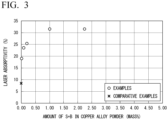
- the ingots of Examples 19 to 23 exhibited an excellent laser absorptivity of 18.9% to 31.5%.
- the average particle diameter was in a range of 40 to 50 ⁇ m
- the fluidity was in a range of 19 to 25 sec/50 g
- good fluidity was exhibited.
- the amount of S was 0.001 mass% and the amount of B was 0.001 mass%, and these amounts were small. Accordingly, a low laser absorptivity of 8.5% was exhibited.
- FIG. 3 shows dependence of the laser absorptivity on the total amount of S and B of the samples of Examples 19 to 23 and the sample of Comparative Example 10 shown in Table 3.
- a copper alloy powder according to the present invention has a good laser absorptivity in a near infrared wavelength region, and has good heat generation efficiency. Accordingly, the copper alloy powder according to the present invention can be suitably applied to a step of generating heat by laser light having a near infrared wavelength to perform additive manufacturing.
Landscapes
- Chemical & Material Sciences (AREA)
- Engineering & Computer Science (AREA)
- Materials Engineering (AREA)
- Manufacturing & Machinery (AREA)
- Mechanical Engineering (AREA)
- Metallurgy (AREA)
- Organic Chemistry (AREA)
- Powder Metallurgy (AREA)
Claims (2)
- Kupferlegierungspulver mit einem ausgezeichneten Laserabsorptionsvermögen, umfassend:S oder sowohl B als auch S in einer Gesamtmenge von 0,003 Masse-% bis 5,0 Masse-%,wobei ein Rest Cu und unvermeidliche Verunreinigungen ist,wobei ein durchschnittlicher Partikeldurchmesser 20 µm bis 80 µm beträgt undder durchschnittliche Partikeldurchmesser ein 50 %-Median-Durchmesser ist, der durch ein Laserbeugungs-/streuverfahren gemessen wird.
- Kupferlegierungspulver mit einem ausgezeichneten Laserabsorptionsvermögen gemäß Anspruch 1, wobei das Pulver ein Pulver für die additive Metallherstellung ist
Applications Claiming Priority (2)
| Application Number | Priority Date | Filing Date | Title |
|---|---|---|---|
| JP2018036502A JP7015976B2 (ja) | 2018-03-01 | 2018-03-01 | レーザー吸収率に優れた金属積層造形用銅合金粉末 |
| PCT/JP2019/008150 WO2019168166A1 (ja) | 2018-03-01 | 2019-03-01 | レーザー吸収率に優れた銅合金粉末 |
Publications (3)
| Publication Number | Publication Date |
|---|---|
| EP3760342A1 EP3760342A1 (de) | 2021-01-06 |
| EP3760342A4 EP3760342A4 (de) | 2021-11-24 |
| EP3760342B1 true EP3760342B1 (de) | 2024-09-11 |
Family
ID=67806186
Family Applications (1)
| Application Number | Title | Priority Date | Filing Date |
|---|---|---|---|
| EP19760856.5A Active EP3760342B1 (de) | 2018-03-01 | 2019-03-01 | Kupferlegierungspulver mit ausgezeichneter laserabsorptionsfähigkeit |
Country Status (5)
| Country | Link |
|---|---|
| US (1) | US11351601B2 (de) |
| EP (1) | EP3760342B1 (de) |
| JP (1) | JP7015976B2 (de) |
| CN (1) | CN111699061B (de) |
| WO (1) | WO2019168166A1 (de) |
Families Citing this family (2)
| Publication number | Priority date | Publication date | Assignee | Title |
|---|---|---|---|---|
| JP7425634B2 (ja) * | 2020-03-12 | 2024-01-31 | 山陽特殊製鋼株式会社 | Cu基合金粉末 |
| CN115961167A (zh) * | 2022-11-23 | 2023-04-14 | 山东源邦新材料有限公司 | 一种高中子吸收效率铜基复合材料的制备方法 |
Family Cites Families (14)
| Publication number | Priority date | Publication date | Assignee | Title |
|---|---|---|---|---|
| AU2001247961A1 (en) * | 2000-02-04 | 2001-08-14 | Optomec Design Company | Modified absorption through unique composite materials and material combinations |
| JP4409343B2 (ja) * | 2004-04-15 | 2010-02-03 | 山陽特殊製鋼株式会社 | クラッド性および耐摩耗性に優れた肉盛用銅合金粉末およびそれを用いたバルブシート |
| JP4888769B2 (ja) | 2006-10-16 | 2012-02-29 | 新東工業株式会社 | 銅粉末およびその製造方法 |
| JP2009270130A (ja) * | 2008-04-30 | 2009-11-19 | Aida Kagaku Kogyo Kk | 銀粉末または銀合金粉末、銀または銀合金の造形体の製造方法並びに銀または銀合金の造形体 |
| JP5958749B2 (ja) | 2012-06-22 | 2016-08-02 | 株式会社村田製作所 | 金属粉末の製造方法 |
| CN102912342B (zh) * | 2012-11-12 | 2014-05-14 | 南昌航空大学 | 一种激光-感应复合熔覆制备高强高导铜基合金涂层的方法 |
| CN103361521B (zh) * | 2013-07-22 | 2015-08-12 | 苏州有色金属研究院有限公司 | 具有优异激光焊接性能的铝合金板及其制备方法 |
| CN103726048B (zh) * | 2014-01-07 | 2016-03-02 | 张翀昊 | 一种专用于连续波光纤激光熔覆的镍基合金粉末 |
| JP6030186B1 (ja) | 2015-05-13 | 2016-11-24 | 株式会社ダイヘン | 銅合金粉末、積層造形物の製造方法および積層造形物 |
| JP6532396B2 (ja) | 2015-12-25 | 2019-06-19 | 株式会社ダイヘン | 銅合金粉末、積層造形物の製造方法および積層造形物 |
| JP2017141505A (ja) | 2016-02-09 | 2017-08-17 | 株式会社ジェイテクト | 造形物の製造装置、及び製造方法 |
| JP6799423B2 (ja) | 2016-08-31 | 2020-12-16 | エルジー ディスプレイ カンパニー リミテッド | 画像処理回路、画像変換装置、画像表示装置及び画像処理方法 |
| EP3628417A4 (de) * | 2017-04-28 | 2021-01-27 | Furukawa Electric Co., Ltd. | Kupferlegierungsteilchen, oberflächenbeschichtete teilchen auf kupferbasis und gemischte teilchen |
| JP2019108587A (ja) | 2017-12-18 | 2019-07-04 | メック株式会社 | 金属粉末およびその製造方法、ならびに積層造形物およびその製造方法 |
-
2018
- 2018-03-01 JP JP2018036502A patent/JP7015976B2/ja active Active
-
2019
- 2019-03-01 CN CN201980012710.7A patent/CN111699061B/zh active Active
- 2019-03-01 WO PCT/JP2019/008150 patent/WO2019168166A1/ja not_active Ceased
- 2019-03-01 US US16/975,355 patent/US11351601B2/en active Active
- 2019-03-01 EP EP19760856.5A patent/EP3760342B1/de active Active
Also Published As
| Publication number | Publication date |
|---|---|
| US11351601B2 (en) | 2022-06-07 |
| JP2019151872A (ja) | 2019-09-12 |
| US20200398337A1 (en) | 2020-12-24 |
| WO2019168166A1 (ja) | 2019-09-06 |
| CN111699061B (zh) | 2022-12-02 |
| EP3760342A1 (de) | 2021-01-06 |
| CN111699061A (zh) | 2020-09-22 |
| JP7015976B2 (ja) | 2022-02-04 |
| EP3760342A4 (de) | 2021-11-24 |
Similar Documents
| Publication | Publication Date | Title |
|---|---|---|
| JP7630554B2 (ja) | 銅合金粉末、積層造形物および積層造形物の製造方法ならびに各種金属部品 | |
| JP7195710B2 (ja) | 銅合金粒子、表面被覆銅系粒子および混合粒子 | |
| JP7419227B2 (ja) | 積層造形用銅合金粉末、積層造形物の製造方法及び積層造形物 | |
| EP3760342B1 (de) | Kupferlegierungspulver mit ausgezeichneter laserabsorptionsfähigkeit | |
| JP2024129057A (ja) | 金属am用銅合金粉末の製造方法 | |
| JP7394241B2 (ja) | 積層造形用銅合金粉末とその評価方法、銅合金積層造形体の製造方法および銅合金積層造形体 | |
| JP2012214857A (ja) | 酸素含有量が低いCu−Ga系合金粉末、Cu−Ga系合金ターゲット材、およびターゲット材の製造方法 | |
| EP3279366B1 (de) | Cu-ga-legierung-sputtertarget und verfahren zur herstellung davon | |
| JP7119266B2 (ja) | 銅合金粉末 | |
| EP4212638A1 (de) | Ni-basiertes legierungspulver und verfahren zur herstellung eines laminierten formartikels unter verwendung des ni-basierten legierungspulvers | |
| JP6559865B1 (ja) | 銅合金造形物の製造方法および銅合金造形物 | |
| EP4541484A1 (de) | Kupferlegierungspulver zur generativen fertigung, generativ gefertigter kupferlegierungsartikel und verfahren zur herstellung eines generativ gefertigten kupferlegierungsartikels | |
| US20210291275A1 (en) | Use of powders of highly reflective metals for additive manufacture | |
| JP7763997B1 (ja) | 銅合金粉末、及び該銅合金粉を用いた積層造形物の製造方法 | |
| JP7774710B2 (ja) | 積層造形用銅合金粉末とその製造方法および評価方法、銅合金積層造形体の製造方法および銅合金積層造形体 | |
| EP4556142A1 (de) | Kupferlegierungspulver für metall-am und verfahren zur herstellung eines laminatformartikels | |
| WO2025100263A1 (ja) | アルミニウム合金成形体及びその製造方法 | |
| TW202608579A (zh) | 銅合金粉末,以及使用該銅合金粉之積層造形物之製造方法 | |
| JP2026003389A (ja) | アルミニウム合金積層造形体及びその製造方法 | |
| CN119968243A (zh) | 高导电性铝合金 | |
| JP2024156538A (ja) | 銅合金粉末、それを用いた積層造形物、及び積層造形物からなる銅合金成形物 | |
| HK40115481A (zh) | 层叠造形用铜合金粉末、铜合金层叠造形体及铜合金层叠造形体的制造方法 | |
| JP2021143376A (ja) | レーザー光吸収率に優れる銅合金及びその製造方法 |
Legal Events
| Date | Code | Title | Description |
|---|---|---|---|
| STAA | Information on the status of an ep patent application or granted ep patent |
Free format text: STATUS: THE INTERNATIONAL PUBLICATION HAS BEEN MADE |
|
| PUAI | Public reference made under article 153(3) epc to a published international application that has entered the european phase |
Free format text: ORIGINAL CODE: 0009012 |
|
| STAA | Information on the status of an ep patent application or granted ep patent |
Free format text: STATUS: REQUEST FOR EXAMINATION WAS MADE |
|
| 17P | Request for examination filed |
Effective date: 20200818 |
|
| AK | Designated contracting states |
Kind code of ref document: A1 Designated state(s): AL AT BE BG CH CY CZ DE DK EE ES FI FR GB GR HR HU IE IS IT LI LT LU LV MC MK MT NL NO PL PT RO RS SE SI SK SM TR |
|
| AX | Request for extension of the european patent |
Extension state: BA ME |
|
| DAV | Request for validation of the european patent (deleted) | ||
| DAX | Request for extension of the european patent (deleted) | ||
| A4 | Supplementary search report drawn up and despatched |
Effective date: 20211022 |
|
| RIC1 | Information provided on ipc code assigned before grant |
Ipc: B22F 9/08 20060101ALN20211018BHEP Ipc: C22C 1/04 20060101ALI20211018BHEP Ipc: C22C 9/00 20060101ALI20211018BHEP Ipc: B33Y 70/00 20200101ALI20211018BHEP Ipc: B22F 3/16 20060101ALI20211018BHEP Ipc: B22F 3/105 20060101ALI20211018BHEP Ipc: B22F 1/00 20060101AFI20211018BHEP |
|
| RIC1 | Information provided on ipc code assigned before grant |
Ipc: B22F 9/08 20060101ALN20240322BHEP Ipc: B22F 1/05 20220101ALI20240322BHEP Ipc: C22C 1/04 20060101ALI20240322BHEP Ipc: C22C 9/00 20060101ALI20240322BHEP Ipc: B33Y 70/00 20150101ALI20240322BHEP Ipc: B22F 3/16 20060101ALI20240322BHEP Ipc: B22F 3/105 20060101ALI20240322BHEP Ipc: B22F 1/00 20060101AFI20240322BHEP |
|
| GRAP | Despatch of communication of intention to grant a patent |
Free format text: ORIGINAL CODE: EPIDOSNIGR1 |
|
| STAA | Information on the status of an ep patent application or granted ep patent |
Free format text: STATUS: GRANT OF PATENT IS INTENDED |
|
| RIC1 | Information provided on ipc code assigned before grant |
Ipc: B22F 10/28 20210101ALN20240422BHEP Ipc: B22F 9/08 20060101ALN20240422BHEP Ipc: B22F 1/05 20220101ALI20240422BHEP Ipc: C22C 1/04 20060101ALI20240422BHEP Ipc: C22C 9/00 20060101ALI20240422BHEP Ipc: B33Y 70/00 20150101ALI20240422BHEP Ipc: B22F 3/16 20060101ALI20240422BHEP Ipc: B22F 3/105 20060101ALI20240422BHEP Ipc: B22F 1/00 20060101AFI20240422BHEP |
|
| INTG | Intention to grant announced |
Effective date: 20240516 |
|
| RIN1 | Information on inventor provided before grant (corrected) |
Inventor name: MATSUKAWA, HIROYUKI Inventor name: ITO, YUKI Inventor name: KATO, JUN |
|
| GRAS | Grant fee paid |
Free format text: ORIGINAL CODE: EPIDOSNIGR3 |
|
| GRAA | (expected) grant |
Free format text: ORIGINAL CODE: 0009210 |
|
| STAA | Information on the status of an ep patent application or granted ep patent |
Free format text: STATUS: THE PATENT HAS BEEN GRANTED |
|
| AK | Designated contracting states |
Kind code of ref document: B1 Designated state(s): AL AT BE BG CH CY CZ DE DK EE ES FI FR GB GR HR HU IE IS IT LI LT LU LV MC MK MT NL NO PL PT RO RS SE SI SK SM TR |
|
| REG | Reference to a national code |
Ref country code: GB Ref legal event code: FG4D |
|
| REG | Reference to a national code |
Ref country code: CH Ref legal event code: EP |
|
| REG | Reference to a national code |
Ref country code: DE Ref legal event code: R096 Ref document number: 602019058726 Country of ref document: DE |
|
| REG | Reference to a national code |
Ref country code: IE Ref legal event code: FG4D |
|
| REG | Reference to a national code |
Ref country code: LT Ref legal event code: MG9D |
|
| PG25 | Lapsed in a contracting state [announced via postgrant information from national office to epo] |
Ref country code: NO Free format text: LAPSE BECAUSE OF FAILURE TO SUBMIT A TRANSLATION OF THE DESCRIPTION OR TO PAY THE FEE WITHIN THE PRESCRIBED TIME-LIMIT Effective date: 20241211 |
|
| REG | Reference to a national code |
Ref country code: NL Ref legal event code: MP Effective date: 20240911 |
|
| PG25 | Lapsed in a contracting state [announced via postgrant information from national office to epo] |
Ref country code: FI Free format text: LAPSE BECAUSE OF FAILURE TO SUBMIT A TRANSLATION OF THE DESCRIPTION OR TO PAY THE FEE WITHIN THE PRESCRIBED TIME-LIMIT Effective date: 20240911 Ref country code: GR Free format text: LAPSE BECAUSE OF FAILURE TO SUBMIT A TRANSLATION OF THE DESCRIPTION OR TO PAY THE FEE WITHIN THE PRESCRIBED TIME-LIMIT Effective date: 20241212 |
|
| PG25 | Lapsed in a contracting state [announced via postgrant information from national office to epo] |
Ref country code: BG Free format text: LAPSE BECAUSE OF FAILURE TO SUBMIT A TRANSLATION OF THE DESCRIPTION OR TO PAY THE FEE WITHIN THE PRESCRIBED TIME-LIMIT Effective date: 20240911 |
|
| PG25 | Lapsed in a contracting state [announced via postgrant information from national office to epo] |
Ref country code: LV Free format text: LAPSE BECAUSE OF FAILURE TO SUBMIT A TRANSLATION OF THE DESCRIPTION OR TO PAY THE FEE WITHIN THE PRESCRIBED TIME-LIMIT Effective date: 20240911 |
|
| PG25 | Lapsed in a contracting state [announced via postgrant information from national office to epo] |
Ref country code: HR Free format text: LAPSE BECAUSE OF FAILURE TO SUBMIT A TRANSLATION OF THE DESCRIPTION OR TO PAY THE FEE WITHIN THE PRESCRIBED TIME-LIMIT Effective date: 20240911 |
|
| PG25 | Lapsed in a contracting state [announced via postgrant information from national office to epo] |
Ref country code: RS Free format text: LAPSE BECAUSE OF FAILURE TO SUBMIT A TRANSLATION OF THE DESCRIPTION OR TO PAY THE FEE WITHIN THE PRESCRIBED TIME-LIMIT Effective date: 20241211 Ref country code: ES Free format text: LAPSE BECAUSE OF FAILURE TO SUBMIT A TRANSLATION OF THE DESCRIPTION OR TO PAY THE FEE WITHIN THE PRESCRIBED TIME-LIMIT Effective date: 20240911 |
|
| PG25 | Lapsed in a contracting state [announced via postgrant information from national office to epo] |
Ref country code: RS Free format text: LAPSE BECAUSE OF FAILURE TO SUBMIT A TRANSLATION OF THE DESCRIPTION OR TO PAY THE FEE WITHIN THE PRESCRIBED TIME-LIMIT Effective date: 20241211 Ref country code: NO Free format text: LAPSE BECAUSE OF FAILURE TO SUBMIT A TRANSLATION OF THE DESCRIPTION OR TO PAY THE FEE WITHIN THE PRESCRIBED TIME-LIMIT Effective date: 20241211 Ref country code: LV Free format text: LAPSE BECAUSE OF FAILURE TO SUBMIT A TRANSLATION OF THE DESCRIPTION OR TO PAY THE FEE WITHIN THE PRESCRIBED TIME-LIMIT Effective date: 20240911 Ref country code: HR Free format text: LAPSE BECAUSE OF FAILURE TO SUBMIT A TRANSLATION OF THE DESCRIPTION OR TO PAY THE FEE WITHIN THE PRESCRIBED TIME-LIMIT Effective date: 20240911 Ref country code: GR Free format text: LAPSE BECAUSE OF FAILURE TO SUBMIT A TRANSLATION OF THE DESCRIPTION OR TO PAY THE FEE WITHIN THE PRESCRIBED TIME-LIMIT Effective date: 20241212 Ref country code: FI Free format text: LAPSE BECAUSE OF FAILURE TO SUBMIT A TRANSLATION OF THE DESCRIPTION OR TO PAY THE FEE WITHIN THE PRESCRIBED TIME-LIMIT Effective date: 20240911 Ref country code: ES Free format text: LAPSE BECAUSE OF FAILURE TO SUBMIT A TRANSLATION OF THE DESCRIPTION OR TO PAY THE FEE WITHIN THE PRESCRIBED TIME-LIMIT Effective date: 20240911 Ref country code: BG Free format text: LAPSE BECAUSE OF FAILURE TO SUBMIT A TRANSLATION OF THE DESCRIPTION OR TO PAY THE FEE WITHIN THE PRESCRIBED TIME-LIMIT Effective date: 20240911 |
|
| PG25 | Lapsed in a contracting state [announced via postgrant information from national office to epo] |
Ref country code: NL Free format text: LAPSE BECAUSE OF FAILURE TO SUBMIT A TRANSLATION OF THE DESCRIPTION OR TO PAY THE FEE WITHIN THE PRESCRIBED TIME-LIMIT Effective date: 20240911 |
|
| PG25 | Lapsed in a contracting state [announced via postgrant information from national office to epo] |
Ref country code: IS Free format text: LAPSE BECAUSE OF FAILURE TO SUBMIT A TRANSLATION OF THE DESCRIPTION OR TO PAY THE FEE WITHIN THE PRESCRIBED TIME-LIMIT Effective date: 20250111 Ref country code: PT Free format text: LAPSE BECAUSE OF FAILURE TO SUBMIT A TRANSLATION OF THE DESCRIPTION OR TO PAY THE FEE WITHIN THE PRESCRIBED TIME-LIMIT Effective date: 20250113 |
|
| PG25 | Lapsed in a contracting state [announced via postgrant information from national office to epo] |
Ref country code: SM Free format text: LAPSE BECAUSE OF FAILURE TO SUBMIT A TRANSLATION OF THE DESCRIPTION OR TO PAY THE FEE WITHIN THE PRESCRIBED TIME-LIMIT Effective date: 20240911 Ref country code: RO Free format text: LAPSE BECAUSE OF FAILURE TO SUBMIT A TRANSLATION OF THE DESCRIPTION OR TO PAY THE FEE WITHIN THE PRESCRIBED TIME-LIMIT Effective date: 20240911 |
|
| PG25 | Lapsed in a contracting state [announced via postgrant information from national office to epo] |
Ref country code: EE Free format text: LAPSE BECAUSE OF FAILURE TO SUBMIT A TRANSLATION OF THE DESCRIPTION OR TO PAY THE FEE WITHIN THE PRESCRIBED TIME-LIMIT Effective date: 20240911 |
|
| PG25 | Lapsed in a contracting state [announced via postgrant information from national office to epo] |
Ref country code: CZ Free format text: LAPSE BECAUSE OF FAILURE TO SUBMIT A TRANSLATION OF THE DESCRIPTION OR TO PAY THE FEE WITHIN THE PRESCRIBED TIME-LIMIT Effective date: 20240911 Ref country code: PL Free format text: LAPSE BECAUSE OF FAILURE TO SUBMIT A TRANSLATION OF THE DESCRIPTION OR TO PAY THE FEE WITHIN THE PRESCRIBED TIME-LIMIT Effective date: 20240911 |
|
| PG25 | Lapsed in a contracting state [announced via postgrant information from national office to epo] |
Ref country code: SK Free format text: LAPSE BECAUSE OF FAILURE TO SUBMIT A TRANSLATION OF THE DESCRIPTION OR TO PAY THE FEE WITHIN THE PRESCRIBED TIME-LIMIT Effective date: 20240911 Ref country code: IT Free format text: LAPSE BECAUSE OF FAILURE TO SUBMIT A TRANSLATION OF THE DESCRIPTION OR TO PAY THE FEE WITHIN THE PRESCRIBED TIME-LIMIT Effective date: 20240911 |
|
| REG | Reference to a national code |
Ref country code: DE Ref legal event code: R097 Ref document number: 602019058726 Country of ref document: DE |
|
| PGFP | Annual fee paid to national office [announced via postgrant information from national office to epo] |
Ref country code: DE Payment date: 20250530 Year of fee payment: 7 |
|
| PG25 | Lapsed in a contracting state [announced via postgrant information from national office to epo] |
Ref country code: DK Free format text: LAPSE BECAUSE OF FAILURE TO SUBMIT A TRANSLATION OF THE DESCRIPTION OR TO PAY THE FEE WITHIN THE PRESCRIBED TIME-LIMIT Effective date: 20240911 |
|
| PGFP | Annual fee paid to national office [announced via postgrant information from national office to epo] |
Ref country code: GB Payment date: 20250530 Year of fee payment: 7 |
|
| PLBE | No opposition filed within time limit |
Free format text: ORIGINAL CODE: 0009261 |
|
| STAA | Information on the status of an ep patent application or granted ep patent |
Free format text: STATUS: NO OPPOSITION FILED WITHIN TIME LIMIT |
|
| PGFP | Annual fee paid to national office [announced via postgrant information from national office to epo] |
Ref country code: AT Payment date: 20250602 Year of fee payment: 7 |
|
| 26N | No opposition filed |
Effective date: 20250612 |
|
| PG25 | Lapsed in a contracting state [announced via postgrant information from national office to epo] |
Ref country code: SE Free format text: LAPSE BECAUSE OF FAILURE TO SUBMIT A TRANSLATION OF THE DESCRIPTION OR TO PAY THE FEE WITHIN THE PRESCRIBED TIME-LIMIT Effective date: 20240911 |
|
| PG25 | Lapsed in a contracting state [announced via postgrant information from national office to epo] |
Ref country code: MC Free format text: LAPSE BECAUSE OF FAILURE TO SUBMIT A TRANSLATION OF THE DESCRIPTION OR TO PAY THE FEE WITHIN THE PRESCRIBED TIME-LIMIT Effective date: 20240911 |
|
| REG | Reference to a national code |
Ref country code: AT Ref legal event code: UEP Ref document number: 1722258 Country of ref document: AT Kind code of ref document: T Effective date: 20240911 |
|
| REG | Reference to a national code |
Ref country code: CH Ref legal event code: H13 Free format text: ST27 STATUS EVENT CODE: U-0-0-H10-H13 (AS PROVIDED BY THE NATIONAL OFFICE) Effective date: 20251023 |
|
| PG25 | Lapsed in a contracting state [announced via postgrant information from national office to epo] |
Ref country code: LU Free format text: LAPSE BECAUSE OF NON-PAYMENT OF DUE FEES Effective date: 20250301 |
|
| REG | Reference to a national code |
Ref country code: BE Ref legal event code: MM Effective date: 20250331 |
|
| PG25 | Lapsed in a contracting state [announced via postgrant information from national office to epo] |
Ref country code: FR Free format text: LAPSE BECAUSE OF NON-PAYMENT OF DUE FEES Effective date: 20250331 |
|
| PG25 | Lapsed in a contracting state [announced via postgrant information from national office to epo] |
Ref country code: BE Free format text: LAPSE BECAUSE OF NON-PAYMENT OF DUE FEES Effective date: 20250331 |
|
| PG25 | Lapsed in a contracting state [announced via postgrant information from national office to epo] |
Ref country code: CH Free format text: LAPSE BECAUSE OF NON-PAYMENT OF DUE FEES Effective date: 20250331 |
|
| PG25 | Lapsed in a contracting state [announced via postgrant information from national office to epo] |
Ref country code: IE Free format text: LAPSE BECAUSE OF NON-PAYMENT OF DUE FEES Effective date: 20250301 |