EP3756948B1 - Modulare lichtsignalvorrichtung für fahrzeug - Google Patents
Modulare lichtsignalvorrichtung für fahrzeug Download PDFInfo
- Publication number
- EP3756948B1 EP3756948B1 EP20180538.9A EP20180538A EP3756948B1 EP 3756948 B1 EP3756948 B1 EP 3756948B1 EP 20180538 A EP20180538 A EP 20180538A EP 3756948 B1 EP3756948 B1 EP 3756948B1
- Authority
- EP
- European Patent Office
- Prior art keywords
- light
- modules
- module
- signaling device
- vehicle
- Prior art date
- Legal status (The legal status is an assumption and is not a legal conclusion. Google has not performed a legal analysis and makes no representation as to the accuracy of the status listed.)
- Active
Links
Images


Classifications
-
- B—PERFORMING OPERATIONS; TRANSPORTING
- B60—VEHICLES IN GENERAL
- B60Q—ARRANGEMENT OF SIGNALLING OR LIGHTING DEVICES, THE MOUNTING OR SUPPORTING THEREOF OR CIRCUITS THEREFOR, FOR VEHICLES IN GENERAL
- B60Q1/00—Arrangement of optical signalling or lighting devices, the mounting or supporting thereof or circuits therefor
- B60Q1/26—Arrangement of optical signalling or lighting devices, the mounting or supporting thereof or circuits therefor the devices being primarily intended to indicate the vehicle, or parts thereof, or to give signals, to other traffic
- B60Q1/2611—Indicating devices mounted on the roof of the vehicle
-
- B—PERFORMING OPERATIONS; TRANSPORTING
- B60—VEHICLES IN GENERAL
- B60Q—ARRANGEMENT OF SIGNALLING OR LIGHTING DEVICES, THE MOUNTING OR SUPPORTING THEREOF OR CIRCUITS THEREFOR, FOR VEHICLES IN GENERAL
- B60Q1/00—Arrangement of optical signalling or lighting devices, the mounting or supporting thereof or circuits therefor
- B60Q1/0088—Details of electrical connections
-
- B—PERFORMING OPERATIONS; TRANSPORTING
- B60—VEHICLES IN GENERAL
- B60Q—ARRANGEMENT OF SIGNALLING OR LIGHTING DEVICES, THE MOUNTING OR SUPPORTING THEREOF OR CIRCUITS THEREFOR, FOR VEHICLES IN GENERAL
- B60Q1/00—Arrangement of optical signalling or lighting devices, the mounting or supporting thereof or circuits therefor
- B60Q1/26—Arrangement of optical signalling or lighting devices, the mounting or supporting thereof or circuits therefor the devices being primarily intended to indicate the vehicle, or parts thereof, or to give signals, to other traffic
- B60Q1/32—Arrangement of optical signalling or lighting devices, the mounting or supporting thereof or circuits therefor the devices being primarily intended to indicate the vehicle, or parts thereof, or to give signals, to other traffic for indicating vehicle sides, e.g. clearance lights
-
- H—ELECTRICITY
- H05—ELECTRIC TECHNIQUES NOT OTHERWISE PROVIDED FOR
- H05B—ELECTRIC HEATING; ELECTRIC LIGHT SOURCES NOT OTHERWISE PROVIDED FOR; CIRCUIT ARRANGEMENTS FOR ELECTRIC LIGHT SOURCES, IN GENERAL
- H05B47/00—Circuit arrangements for operating light sources in general, i.e. where the type of light source is not relevant
- H05B47/10—Controlling the light source
- H05B47/175—Controlling the light source by remote control
- H05B47/18—Controlling the light source by remote control via data-bus transmission
-
- H—ELECTRICITY
- H04—ELECTRIC COMMUNICATION TECHNIQUE
- H04L—TRANSMISSION OF DIGITAL INFORMATION, e.g. TELEGRAPHIC COMMUNICATION
- H04L12/00—Data switching networks
- H04L12/28—Data switching networks characterised by path configuration, e.g. LAN [Local Area Networks] or WAN [Wide Area Networks]
- H04L12/40—Bus networks
- H04L2012/40208—Bus networks characterized by the use of a particular bus standard
- H04L2012/40215—Controller Area Network CAN
Definitions
- the present invention relates to a light signaling device of the type called "light bar” or light bar for vehicles.
- light signaling devices can for example be fixed on the roof of the vehicle and are described in WO2018231225 A1 , US8274397 B2 Where US9705597 B2 .
- Lightbars for vehicles belong to the category of special horns useful in the field of road traffic.
- Special horns are devices for signaling vehicles with a particular mission.
- These vehicles can be, for example, vehicles whose mission means that they have a positioning that makes them vulnerable to accidents: this is the case, for example, of works vehicles on the roadway (construction, road maintenance, etc.). .), intervention vehicles in the event of an accident (tow truck, roadside assistance, etc.), slow and/or bulky vehicles (exceptional convoy, etc.).
- These vehicles can also be vehicles whose mission has an emergency character authorizing them to overcome certain traffic constraints (traffic lights, priorities, etc.) such as police and gendarmerie vehicles, firefighters, ambulances, customs vehicles, graft transport vehicles.
- Warning devices often come in the form of warning lights. They can be placed in different places on the vehicle, for example at the front and/or on the roof, in the form of a light which can be fixed, rotating, scrolling or flashing, individual or multiple in a bar (or ramp), using different types of light sources, of different colors, for example, blue, red, amber.
- Some of the elements of known light-signalling devices generate electromagnetic noise capable of interfering with other electronic or luminous components of the vehicle.
- electromagnetic shielding in particular around the cables supplying the various light sources of these light bars.
- the increase in the number of light sources involved in the light bar has also increased the occurrence of the risk that one of these sources is defective.
- the light source sometimes the entire light bar, must be replaced with a new light source or a working bar.
- Such a repair operation requires time and causes a temporary stoppage of the vehicle, damaging the mission to which the vehicle is dedicated.
- modular light bars have been proposed, that is to say having several modules, such that a module presenting a defective light source can be replaced by another module, without having to change the light bar in its entirety.
- the known modular light bars do not make it possible to respond fully or simply to the very diverse needs of users. Indeed, the structure of the known modules limits the possibilities of customization.
- the present invention aims to meet these needs by proposing a modular light signaling device comprising a plurality of modules, each module being able to be installed or replaced by another module in a particularly simple and rapid manner, the modules being preferably connected to each other. using a connection other than a wired connection.
- the present invention relates to a modular light signaling device for a vehicle, comprising a plurality of modules, each module comprising an electronic card on which is/are arranged one or more light source(s), each light source having a dedicated lighting function, the plurality of modules comprising at least one master module and at least one slave module, said master module comprising a control unit capable of controlling the lighting function(s) of said master module and of said slave module.
- the modules are mechanically linked together by a connection of the male/female interlocking type, and each electronic card comprises at least one connector, the electronic cards of two adjacent modules being connected by said connectors, the connection between the different modules being free of wire connection.
- the slave module is free of any control unit, the slave module being controlled by the master module.
- the modulus slave is simple in structure and can be replaced by another slave module quickly and easily.
- the slave module is preferably located on the light signaling device in a position symmetrical to the master module with respect to the center of the signaling device.
- the invention thus provides a light signaling device whose modularity, and therefore adaptability to the specific needs of users, is particularly important and simple to implement. All you have to do is choose the desired modules from among all the available modules, and assemble them. This can be achieved very easily via the male/female interlocking, the electronic connection being carried out automatically via the connectors, without requiring further intervention by an operator. This makes it possible to limit the assembly time and the risk of error during this assembly.
- a mechanical connection of the male/female interlocking type is also particularly simple to make and undo. Replacing a module with a module of the same type (master or slave) is therefore particularly easy and quick to perform. This makes it possible to limit the downtime of a vehicle, necessary for such a repair.
- Another significant advantage of the invention is to allow late customization of the light signaling device, due to the design and manufacture of several subassembly references in the form of easily assemblable/connectable modules during a first installation or during a replacement.
- Each module can be in the form of a case, preferably in one piece, closed and not openable by the user, the internal structure of which is therefore fixed and cannot be modified.
- the mechanical assembly between them of the selected boxes allows the light signaling device to be quickly formed, the electronic connection being established between the modules and the control unit of the master module ensuring the appropriate operation of the light sources of the master module and of the other mods.
- the connectors therefore ensure the electronic connection between two modules i.e. both power supply transmission and data communication.
- each module there are conductors dedicated to the power supply (conductor + and ground conductor), as well as conductors dedicated to data communication, such as CAN buses or equivalent. These conductors connect an appropriate terminal of the connector and the control unit, on the one hand, and connect each light source to the control unit, on the other hand.
- these conductors are tracks made on each electronic card. In this way, not only is there no wired connection between modules, but also no wired connection inside each of the modules, which accordingly limits the problems of electromagnetic compatibility.
- the modules can be mechanically linked together by said connectors.
- the connectors ensure both the electronic link and the mechanical link.
- a connector comprises pins of a first type, in the form of a plate, and pins of a second type, in the form of a jaw.
- the connectors of two adjacent modules intended to be connected together are identical and arranged on the respective electronic cards of the modules so that the jaws of one connector can receive the plates of the other connector. This makes it possible to ensure, via the connectors, both the mechanical connection and the electronic connection between two adjacent modules.
- each module can include a pre-guiding member intended to cooperate with the pre-guiding member of an adjacent module to guide the mutual approach of said modules before their mechanical and electronic assembly.
- the pre-guiding member can be provided on, or form part of, the electronic card.
- the pre-guiding member preferably extends at least partly beyond the connector so as to be able to cooperate with the pre-guiding member of the adjacent module before the connection of the two connectors.
- the pre-guiding member may have a particular shape having parts of complementary shapes, for example at least one tooth and one hollow, so that a guiding member of an electronic card can engage in a guiding member of the adjacent electronic card, which can be arranged inverted.
- the electronic card of a module may comprise a main part and an appendix projecting with respect to the main part, the pre-guiding member being provided on the appendix, and the connector being mounted on the appendix.
- the appendage may extend beyond the housing defined by the module, so as to allow mounting.
- the plurality of modules may further comprise one or more secondary module(s), the control unit of said master module being capable of controlling the light function(s) of said module(s) secondary(ies).
- the secondary modules are preferably free of any control unit, and are of simple structure. They can therefore be replaced by other secondary modules in a particularly simple and quick way.
- the master module is preferably positioned at a first end of the light signaling device, the slave module being in this case positioned at the opposite end of the light signaling device.
- the light signaling device further comprises one or more secondary module(s)
- this (these) secondary module(s) is/are positioned in the central region of the light signaling device, in other words between the master module, forming a first end of the signaling device, and the slave module, forming the opposite end of the signaling device.
- a secondary module can typically have a plane of symmetry which, in the position mounted on a vehicle, corresponds to a longitudinal vertical plane of the vehicle. Symmetry does not concern the arrangement of components on the electronic board.
- the light signaling device may comprise as many secondary modules as necessary for the desired application for the vehicle, for example one, two, three, four secondary modules, or even more if necessary.
- the connectors are configured to make a connection between links of the CAN bus type - or any other multiplexed communication medium, such as a Lin bus - provided on the electronic boards of adjacent modules, so as to ensure the transmission of data between said modules.
- a Lin bus - provided on the electronic boards of adjacent modules
- the light signaling device thus allows good electromagnetic neighborhood.
- each light source of each module receives the information necessary for its operation from the control unit of the master module via a printed circuit in the electronic card(s) of the modules and, if necessary, via the corresponding connectors .
- a light source of the master module receives the information necessary for its operation from the control unit of the master module via the printed circuit in the electronic card of the master module.
- a light source of a slave or secondary module receives the information necessary for its operation from the control unit of the master module via the printed circuit in the electronic card of the master module, the connectors of the master module and of the module slave or secondary, and the printed circuit in the electronic card of the slave or secondary module.
- the master module receives the electrical power necessary for the operation of all the modules of the light signaling device via a wired link communicating with an electrical power source external to the signaling device.
- the wired connection with the external electrical power source is the only wired connection of the light signaling device according to the invention.
- the electromagnetic compatibility of the light signaling device according to the invention is particularly effective.
- the light functions of the modules of the plurality of modules can be chosen from flashers, revolving lights, working lights, side lights, 3-function repeater lights, traffic lights and combinations thereof.
- the master module and/or the slave module which are preferably located at the ends of the light signaling device, can comprise light sources having side lights functions as defined above. Alternatively or in combination, they can also include light sources with 3-function repeater functions.
- each module can include a control light source, able to light up when said module is faulty, for example if it is not working or is not working correctly: an example of erroneous operation would be the lighting of amber color of a module while all the other modules light up in blue, knowing that the information programmed and sent by the control unit of the master module provided for blue lighting for all the modules.
- a control light source able to light up when said module is faulty, for example if it is not working or is not working correctly: an example of erroneous operation would be the lighting of amber color of a module while all the other modules light up in blue, knowing that the information programmed and sent by the control unit of the master module provided for blue lighting for all the modules.
- the light signaling device comprises a frame capable of supporting all of the modules forming the signaling device.
- the chassis may include fixing means for fixing the chassis, and therefore the light signaling device, to a bodywork element of the vehicle, for example to the roof of the vehicle.
- the present invention also relates to a vehicle comprising a light signaling device as above, fixed to said vehicle, for example to a roof of the vehicle.
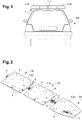
- a vehicle 100 provided with a light signaling device according to the invention, in the form of a modular light bar 1.
- the modular light bar 1 is intended to be positioned on the front or the roof, on the roof in the example represented, of a vehicle 100 having a particular mission, such as for example work vehicles on the roadway, vehicles emergency responders, such as ambulances, firefighters, police, etc., who need to make their presence known to other road users for safety reasons.
- a vehicle 100 having a particular mission such as for example work vehicles on the roadway, vehicles emergency responders, such as ambulances, firefighters, police, etc., who need to make their presence known to other road users for safety reasons.
- the purpose of the modular light bar 1 according to the invention is to project light and/or special lighting visible to all.
- the light bar 1 comprises four modules 2, including a master module 2a, located at a first end of the light bar 1, a slave module 2b, located at the opposite end of the light bar 1, and two secondary modules 2c, located between the master module 2a and the slave module 2b, in other words in the center of the light bar 1. All the modules 2 of the light bar 1 are provided with one or more light functions.
- the master module 2a further comprises a control unit 15 (see figure 2 ) capable of controlling the light function(s) of all the other modules, namely the slave module 2b and the secondary modules 2c.
- the master module 2a and the slave module 2b are essential, the secondary modules 2c being optional.
- the slave module 2b is generally located symmetrically to the master module 2a with respect to the center of the light bar 1.
- the light bar 1 can comprise as many secondary modules 2c as necessary for the intended application of the vehicle 100.
- the slave module 2b and the secondary modules 2c are free of any control unit, and are of simple structure. They can therefore be replaced by other modules of the same type (slave or secondary) in a particularly simple and fast way.
- each module 2 the light function or functions are produced by light sources carried by an electronic card 3.
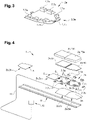
- this figure shows the electronic card 3a of the master module 2a, and the electronic cards 3c of the two modules 2c.
- Each electronic card 3 comprises a printed circuit in communication with ports 4 intended to receive light sources.
- Each electronic card (3, 3a, 3c) communicates with the adjacent electronic card (3, 3a, 3c) by means of a CAN bus type link.
- the electronic card 3a of the master module 2a which is located at one end of the light bar 1, comprises a connector 5 suitable for connecting to a complementary connector 5 of the electronic card 3c of the adjacent secondary module 2c.
- the electronic cards 3c of the secondary modules 2c each comprise two such connectors 5, opposite each other, each connector 5 of these cards being intended to be connected with the connector 5 of the electronic card 3 of the adjacent module in order to connect said card electronics 3c of the secondary module 2c with the electronic card (3a, 3c) of the module (2a, 2c) adjacent.
- connection of the modules 2 via the connectors 5 - both for the power supply and for the transmission of data - makes it possible to dispense with any wired connection between the modules 2 forming the bar 1.
- the means of communication between the different modules 2 are free of wire connection.
- the light bar 1 according to the invention thus allows good electromagnetic neighborhood.
- the electronic cards 3c of the two secondary modules 2c are connected together via their connectors 5.
- the connection between the electronic card 3a of the master module 2a and the electronic card 3c of the adjacent secondary module is shown before production.
- the connection may include a seal 6.
- the electronic card 3a of the master module 2a provided with the light sources 7 which will provide the light functions of the master module 2a, the light sources 7 being arranged in the ports 4 (see figure 2 ).
- the light bar 1 of the figure 1 is shown in exploded and partial perspective.
- the four electronic cards (3, 3a, 3b, 3c) of the light bar 1 are shown, namely the electronic card 3a of the master module 2a, the electronic cards 3c of the two secondary modules 2c, positioned in the center of the light bar 1, and the electronic card 3b of the slave module 2b.
- the electronic cards (3, 3a, 3c) of the master module 2a and of the secondary modules 2c are shown connected to each other, using connectors 5, while the electronic card 3b of the slave module is shown not yet connected to the electronic card 3c of the adjacent secondary module 2c.
- the light sources are not represented on the electronic boards (3b, 3c) of the slave module 2b and of the secondary module 2c directly adjacent to said slave module 2b.
- the electronic card 3c of the secondary module 2c adjacent to the slave module 2b could comprise the same set of light sources (7, 7a, 7d, 7e) as that of the electronic card 3c of the secondary module 2c adjacent to the master module 2a, or could include a different set of light sources.
- the electronic card 3b of the slave module 2b preferably includes the same set of light sources 7 as that of the master module 2a, but could possibly include a different set of light sources 7.
- the electronic card 3 of each module 2 can also include an indicator light source (not shown in the figures), able to light up when said module 2 is defective, for example when said module 2 no longer works or does not work correctly.
- the master module 2a receives the electrical power necessary for the operation of all the modules 2 of the light bar 1 via a cable 12 linked to an electrical power source 13 external to the bar 1. On the figure 4 , cable 12 passes under module 2c to connect to master module 2a.
- the cable 12 with the external electrical power source 13 is the only wire connection of the light bar 1 according to the invention.
- the electromagnetic compatibility of the light bar 1 according to the invention is particularly efficient.
- Each module 2 of the light bar 1 can comprise a support 8 able to receive the electronic card 3 of the module, as well as a cover 9 able to protect the electronic card 3 and the light sources placed on the electronic card 3.
- covers 10a and 10c make it possible, for example, to protect the covers (9a, 9c) from shocks, bad weather such as rain, etc. They also make it possible to give the light bar 1 a particular style if desired.
- the light bar 1 also comprises a frame 11 capable of supporting all of the modules 2 of the bar.
- the length of the frame 11 can vary depending on the number of modules 2 forming the light bar 1.
- the frame 11 makes it possible to facilitate the mounting of the modules 2 on the vehicle 100, and to stiffen the light signaling device 1, which can take on particular importance when the modules 2 are assembled together only by the connectors 5.
- the supports 8 of the modules 2 can be removably fixed to the frame 11 by any known removable fixing means, such as for example self-tapping screws.
- the frame 11 can be fixed to a bodywork element of the vehicle 100 (see figure 1 ) by any known fixing means (not shown), such as fixing lugs fixed to the roof and/or to a roof bar and/or to a roof gutter.
- the master module 2a and the adjacent secondary module 2c are shown the master module 2a and the adjacent secondary module 2c, not yet connected. These two modules (2a, 2ac) can be mechanically connected to each other by means of a male/female interlocking type connection 14.
- the master module 2a comprises the male interlocking part 14a
- the secondary module 2c includes the female interlocking part 14b.
- Such interlocking makes it possible to make and break the connection between the two modules extremely simply and quickly.
- the two modules (2a, 2c) of the figure 5 are shown in the nested configuration.
- the male/female fitting can be achieved by the connector 5, as will be described in detail later.
- a light bar 1 ' according to the invention similar to the light bar 1 of the figures 1-6 , the light bar 1' being distinguished from the latter essentially by the fact that it comprises only three modules, namely a master module 2a', a slave module 2b', both located at each end of the light bar 1' , and a secondary module 2c′, central.
- the light bar 1' is shown mounted, all the modules (2a', 2b', 2c') assembled and connected together.
- the first installation of a module or the replacement of a module by a module of the same type are particularly easy and quick to make, both from the point of view of the electrical connection (by means of the connectors 5 connecting the electronic boards 3 together), and from the point of view of the mechanical connection (using the male/female fitting described above).
- the downtime of a vehicle, necessary for such an installation or repair is particularly shortened.
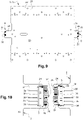
- the figure 8 and 9 represent an electronic card 3, here the electronic card 3c of a secondary module 2c.
- the electronic card 3 comprises a main part 20 which can be substantially rectangular, and which comprises a first face 21 - oriented upwards in the position of use - and a second face 22 opposite.
- the first face 21 can carry the various electronic components 23 as well as the light sources 7 (not represented on the figure 8 and 9 ).
- the electronic card 3 further comprises at least one appendix 24 projecting with respect to the main part 20, in the transverse direction of the vehicle 100 in the position of use.
- the electronic card 3c of a secondary module 2c comprises two appendages 24 projecting from two opposite edges of the main part 20, in opposite directions.
- each appendix 24 can form a crenel comprising at least one tooth 26 and a hollow 27, here a succession of two teeth and two hollows as can be seen in particular on the figure 9 .
- a connector 5 is mounted on each appendix 24, near its free edge 25.
- the connector 5 comprises pins of a first type, in the form of a plate 31, and pins of a second type, in the form of a jaw 32 , these pins extending away from the main part 20, that is to say towards the outside of the module 2.
- all the connectors 5 are identical and arranged symmetrically so as to be able to be mutually connected as will be seen below.
- each pin 31, 32 of a connector is electrically connected, within the connector 5, to a terminal 33 itself connected to a track of the electronic card 3.
- terminals 33 including: two terminals connected to a positive supply track 34, typically 24 V; two terminals connected to a ground track 35; and two CAN 36 buses (or equivalent).
- the assembly of two electronic cards 3 of two adjacent modules 2 is illustrated on the figure 10 .
- the appendages 24 have complementary shapes, typically symmetrical, in the vicinity of their free edges 25, so that they can cooperate.
- the teeth 26 and hollow 27 - or any other appropriate shape - form a pre-guiding member intended to cooperate with the pre-guiding member of an adjacent module 2 to guide the mutual approximation of said modules 2 before their mechanical assembly and electronic.
- the light signaling device 1 is therefore very simple to implement, to personalize. In addition, it offers increased mechanical robustness and generates little electromagnetic disturbance.
Landscapes
- Engineering & Computer Science (AREA)
- Mechanical Engineering (AREA)
- Non-Portable Lighting Devices Or Systems Thereof (AREA)
- Lighting Device Outwards From Vehicle And Optical Signal (AREA)
- Arrangement Of Elements, Cooling, Sealing, Or The Like Of Lighting Devices (AREA)
Claims (14)
- Modulares Lichtsignalisierungsvorrichtung (1; 1') für ein Fahrzeug (100), umfassend eine Vielzahl von Modulen (2, 2a, 2b, 2c; 2a', 2b', 2c'), wobei jedes Modul eine elektronische Karte (3, 3a, 3b, 3c), auf der eine oder mehrere Lichtquellen (7, 7a, 7b, 7c, 7d, 7e) angeordnet sind, jede Lichtquelle eine zugeordnete Lichtfunktion darstellt, die Vielzahl von Modulen mindestens ein Master-Modul (2a; 2a') und mindestens ein Slave-Modul (2b; 2b') umfasst, wobei das Master-Modul eine Steuereinheit (15) umfasst, die ausgelegt ist, die Lichtfunktion(en) des Master-Moduls und des Slave-Moduls zu steuern, dadurch gekennzeichnet, dass die Module (2) mechanisch miteinander durch eine männlich/weiblich-verriegelnde Verbindung (14, 14a, 14b) verbunden sind, und dadurch, dass jede elektronische Karte (3) mindestens einen Verbinder (5) umfasst, wobei die elektronische Karte (3) von zwei benachbarten Modulen (2) durch die Verbinder (5) verbunden sind, wobei die Verbindung zwischen den unterschiedlichen Module (2) ohne Drahtverbindung ist.
- Lichtsignalisierungsvorrichtung (1; 1') nach Anspruch 1, dadurch gekennzeichnet, dass die Module (2) mechanisch miteinander durch die Verbinder (5) verbunden sind.
- Lichtsignalisierungsvorrichtung (1; 1') nach Anspruch 1 oder 2, dadurch gekennzeichnet, dass ein Verbinder (5) Stifte (31) eines ersten Typs in Form einer Platte, und Stifte (32) eines zweiten Typs in Form einer Klemmbacke umfasst, wobei die Verbinder (5) von zwei benachbarten Modulen (2), die miteinander verbunden werden sollen, identisch sind und auf den jeweiligen elektronischen Karten (3) der Module (2) vorgesehen sind, so dass die Klemmbacken (32) eines Verbinders (5) die Platten (31) des anderen Verbinders (5) aufnehmen können.
- Lichtsignalisierungsvorrichtung (1; 1') nach einem der Ansprüche 1 bis 3, dadurch gekennzeichnet, dass jedes Modul (2) ein Vorführungselement (26, 27) umfasst, das dazu bestimmt ist, mit dem Vorführungselement eines benachbarten Moduls zusammenzuwirken, um die gegenseitige Annäherung der Module (2) vor ihrer mechanischen und elektronischen Montage zu führen.
- Lichtsignalisierungsvorrichtung (1; 1') nach Anspruch 4, dadurch gekennzeichnet, dass die elektronische Karte (3) eines Moduls (2) einen Hauptteil (20) und einen relativ zum Hauptteil (20) abstehenden Fortsatz (24) aufweist, wobei das Vorführungselement (26, 27) am Fortsatz (24) vorgesehen ist, und der Verbinder (5) am Fortsatz (24) montiert ist.
- Lichtsignalisierungsvorrichtung (1; 1') nach einem der Ansprüche 1 bis 5, dadurch gekennzeichnet, dass die Vielzahl von Modulen ferner ein oder mehrere Sekundärmodule (2c; 2c') umfasst, wobei die Steuereinheit des Master-Moduls ausgelegt ist, die Lichtfunktion(en) des bzw. der Sekundärmodule zu steuern.
- Lichtsignalisierungsvorrichtung (1; 1') nach einem der Ansprüche 1 bis 6, dadurch gekennzeichnet, dass die Verbinder (5) konfiguriert sind, um eine Verbindung zwischen den Verbindungen des CAN-Bus-Typs - oder jedem anderen Multiplex-Kommunikationsmedium, wie etwa einem Lin-Bus - herzustellen, die auf der elektronischen Karte (3) der benachbarten Module (2) derart angebracht sind, dass sie die Übertragung von Daten zwischen den Modulen (2) ermöglichen.
- Lichtsignalisierungsvorrichtung (1; 1') nach einem der Ansprüche 1 bis 7, dadurch gekennzeichnet, dass jede Lichtquelle (7) jedes Moduls (2) die für seinen Betrieb notwendigen Informationen von der Steuereinheit (15) des Master-Moduls (2a) über eine gedruckte Schaltung in der elektronischen Karte (3) der Module (2) erhält und, falls erforderlich, über die entsprechenden Verbinder (5) empfängt.
- Lichtsignalisierungsvorrichtung (1; 1') nach einem der Ansprüche 1 bis 8, dadurch gekennzeichnet, dass das Master-Modul (2a; 2a') die für den Betrieb der gesamten Module der Lichtsignalisierungsvorrichtung (1) notwendige Stromversorgung über eine Drahtverbindung (12), die mit einer elektrischen Stromquelle (13) außerhalb der Signalisierungsvorrichtung (1; 1') kommuniziert, empfängt.
- Lichtsignalisierungsvorrichtung (1; 1') nach einem der Ansprüche 1 bis 9, dadurch gekennzeichnet, dass die Lichtfunktion(en) der Module der Vielzahl von Modulen aus den Blinkern (7d), den Rundumlichtern (7a), den Arbeitsscheinwerfern (7e), den Seitenlichtern (7b), den 3-Funktions-Repeaterlichtern (7c), den Ampeln und deren Kombinationen ausgewählt ist (sind).
- Lichtsignalisierungsvorrichtung (1; 1') nach einem der Ansprüche 1 bis 10, dadurch gekennzeichnet, dass jedes Modul (2) eine Kontrolllichtquelle umfasst, die zum Aufleuchten ausgelegt ist, wenn das Modul defekt ist.
- Lichtsignalisierungsvorrichtung (1; 1') nach einem der Ansprüche 1 bis 11, dadurch gekennzeichnet, dass sie einen Rahmen (11) umfasst, der ausgelegt ist, um die gesamten Module (2), die die Signalisierungsvorrichtung (1) bilden, zu tragen.
- Lichtsignalisierungsvorrichtung (1; 1') nach einem der Ansprüche 1 bis 12, dadurch gekennzeichnet, dass jedes Modul der Vielzahl von Modulen einen Träger (8, 8a, 8c) umfasst, der ausgelegt ist, die elektronische Karte (3, 3a, 3c) und eine Abdeckung (9, 9a, 9c), die ausgelegt ist, die elektronische Karte und die Lichtquellen (7), die auf der Karte angeordnet sind, zu schützen, aufzunehmen, wobei die Abdeckung konfiguriert ist, Licht passieren zu lassen.
- Fahrzeug, umfassend eine Lichtsignalisierungsvorrichtung (1; 1) nach einem der vorhergehenden Ansprüche, die an dem Fahrzeug befestigt ist, beispielsweise auf einem Dach des Fahrzeugs.
Applications Claiming Priority (1)
| Application Number | Priority Date | Filing Date | Title |
|---|---|---|---|
| FR1906884A FR3097938B1 (fr) | 2019-06-25 | 2019-06-25 | Dispositif de signalisation lumineuse modulaire pour un véhicule |
Publications (2)
| Publication Number | Publication Date |
|---|---|
| EP3756948A1 EP3756948A1 (de) | 2020-12-30 |
| EP3756948B1 true EP3756948B1 (de) | 2022-04-27 |
Family
ID=67587888
Family Applications (1)
| Application Number | Title | Priority Date | Filing Date |
|---|---|---|---|
| EP20180538.9A Active EP3756948B1 (de) | 2019-06-25 | 2020-06-17 | Modulare lichtsignalvorrichtung für fahrzeug |
Country Status (4)
| Country | Link |
|---|---|
| US (1) | US20200406812A1 (de) |
| EP (1) | EP3756948B1 (de) |
| ES (1) | ES2914473T3 (de) |
| FR (1) | FR3097938B1 (de) |
Families Citing this family (7)
| Publication number | Priority date | Publication date | Assignee | Title |
|---|---|---|---|---|
| US11820281B2 (en) * | 2019-11-08 | 2023-11-21 | Hiviz Lighting, Inc. | Vehicle modular accessory mounting system |
| US12187189B2 (en) * | 2022-06-17 | 2025-01-07 | Evermore International Group Co., Ltd. | Vehicle roof rack |
| US11859789B1 (en) * | 2022-06-17 | 2024-01-02 | Evermore International Group Co., Ltd. | Vehicle roof rack |
| FR3137525B1 (fr) * | 2022-06-30 | 2024-05-31 | Valeo Vision | Dispositif lumineux automobile |
| US12018810B2 (en) * | 2022-07-08 | 2024-06-25 | Rivian Ip Holdings, Llc | Crossbar with lighting |
| US20240343215A1 (en) * | 2023-04-12 | 2024-10-17 | Oshkosh Corporation | Light system for response vehicle |
| FR3161161B1 (fr) * | 2024-04-11 | 2026-03-06 | Vignal Sesaly | Dispositif lumineux pour une structure telle qu’un véhicule |
Family Cites Families (3)
| Publication number | Priority date | Publication date | Assignee | Title |
|---|---|---|---|---|
| US8274397B2 (en) * | 2007-08-24 | 2012-09-25 | Sonoma Circuits, Inc. | Programmable light display |
| US9705597B2 (en) * | 2015-08-12 | 2017-07-11 | Electronic Controls Company | Modular light bar messaging system |
| EP3638540B1 (de) * | 2017-06-14 | 2023-12-27 | Code 3, Inc. | Verschachtelte serielle netzwerkkonfiguration für eine anordnung aus seriell verbundenen scheinwerfern |
-
2019
- 2019-06-25 FR FR1906884A patent/FR3097938B1/fr not_active Expired - Fee Related
-
2020
- 2020-06-17 ES ES20180538T patent/ES2914473T3/es active Active
- 2020-06-17 EP EP20180538.9A patent/EP3756948B1/de active Active
- 2020-06-25 US US16/912,134 patent/US20200406812A1/en not_active Abandoned
Also Published As
| Publication number | Publication date |
|---|---|
| FR3097938A1 (fr) | 2021-01-01 |
| FR3097938B1 (fr) | 2021-09-10 |
| US20200406812A1 (en) | 2020-12-31 |
| EP3756948A1 (de) | 2020-12-30 |
| ES2914473T3 (es) | 2022-06-13 |
Similar Documents
| Publication | Publication Date | Title |
|---|---|---|
| EP3756948B1 (de) | Modulare lichtsignalvorrichtung für fahrzeug | |
| FR2693516A1 (fr) | Dispositif à soupape. | |
| EP0567403A1 (de) | Hilfsplatine zum Steuerung und/oder Stromversorgung für elektrische Elemente in einem Kraftfahrzeug | |
| EP0430792B1 (de) | Verbesserung für Multiplex-Steuergeräte für eine Anordnung elektrischer Elemente in einem Kraftfahrzeug | |
| FR2916537A1 (fr) | Circuit,notamment pour projecteurs de vehicules automobiles et feux de vehicules automobiles. | |
| EP0194915A1 (de) | Gesteuertes elektrisches Energieverteilungssystem in einem Kraftfahrzeug | |
| FR3049531A3 (fr) | Dispositif de priorite formant barre lumineuse | |
| EP0340080A1 (de) | Signalleuchte mit mehreren Funktionen für Fahrzeuge | |
| WO2023209168A1 (fr) | Ensemble lumineux demontable | |
| FR3087395A1 (fr) | Dispositif d’eclairage avant pour vehicule automobile | |
| FR2814034A1 (fr) | Protection contre une panne d'eclairage | |
| FR3096756A1 (fr) | Procédé de commande d’un système de signalisation d’un véhicule automobile | |
| FR2589288A1 (fr) | Dispositif de connexion decentralisee d'un organe a une unite de commande programmable | |
| FR2565696A1 (fr) | Dispositif pour le controle des connexions de raccordement electrique de la signalisation routiere, entre un vehicule tracteur et un vehicule remorque | |
| FR3103252A1 (fr) | Module d’eclairage pour vehicule a coupure modulable entre conduite a gauche et conduite a droite | |
| EP2732681A1 (de) | Von einer vorrichtung entfernbare kommunikationskassette, vorrichtung und zugehöriges system | |
| EP1398213B1 (de) | Verbesserte Signaleinrichtung für Kfz | |
| FR3135860A1 (fr) | Faisceau électrique à agencements différents pour un dispositif d’éclairage | |
| FR2565726A1 (fr) | Procede de realisation d'un panneau lumineux de signalisation a diodes electroluminescentes et panneau ainsi obtenu. | |
| FR2669780A1 (fr) | Connecteur de derivation a sectionneur incorpore de ligne d'alimentation electrique. | |
| FR3135129A1 (fr) | Ensemble lumineux demontable | |
| FR3146296A1 (fr) | Systeme lumineux incluant un logo | |
| FR2744077A1 (fr) | Procede et dispositif de commande de l'eclairage des voyants lumineux d'un repetiteur de taxi | |
| EP2093483B1 (de) | LED-imitierende Kfz-Beleuchtungseinheit mit einer Blende | |
| RU7964U1 (ru) | Сигнальный фонарь для пассажирского вагона |
Legal Events
| Date | Code | Title | Description |
|---|---|---|---|
| PUAI | Public reference made under article 153(3) epc to a published international application that has entered the european phase |
Free format text: ORIGINAL CODE: 0009012 |
|
| STAA | Information on the status of an ep patent application or granted ep patent |
Free format text: STATUS: THE APPLICATION HAS BEEN PUBLISHED |
|
| AK | Designated contracting states |
Kind code of ref document: A1 Designated state(s): AL AT BE BG CH CY CZ DE DK EE ES FI FR GB GR HR HU IE IS IT LI LT LU LV MC MK MT NL NO PL PT RO RS SE SI SK SM TR |
|
| AX | Request for extension of the european patent |
Extension state: BA ME |
|
| STAA | Information on the status of an ep patent application or granted ep patent |
Free format text: STATUS: REQUEST FOR EXAMINATION WAS MADE |
|
| 17P | Request for examination filed |
Effective date: 20210608 |
|
| RBV | Designated contracting states (corrected) |
Designated state(s): AL AT BE BG CH CY CZ DE DK EE ES FI FR GB GR HR HU IE IS IT LI LT LU LV MC MK MT NL NO PL PT RO RS SE SI SK SM TR |
|
| RIC1 | Information provided on ipc code assigned before grant |
Ipc: B60Q 1/00 20060101ALI20210927BHEP Ipc: H04L 12/40 20060101ALI20210927BHEP Ipc: B60Q 1/26 20060101AFI20210927BHEP |
|
| GRAP | Despatch of communication of intention to grant a patent |
Free format text: ORIGINAL CODE: EPIDOSNIGR1 |
|
| STAA | Information on the status of an ep patent application or granted ep patent |
Free format text: STATUS: GRANT OF PATENT IS INTENDED |
|
| INTG | Intention to grant announced |
Effective date: 20220110 |
|
| GRAS | Grant fee paid |
Free format text: ORIGINAL CODE: EPIDOSNIGR3 |
|
| GRAA | (expected) grant |
Free format text: ORIGINAL CODE: 0009210 |
|
| STAA | Information on the status of an ep patent application or granted ep patent |
Free format text: STATUS: THE PATENT HAS BEEN GRANTED |
|
| AK | Designated contracting states |
Kind code of ref document: B1 Designated state(s): AL AT BE BG CH CY CZ DE DK EE ES FI FR GB GR HR HU IE IS IT LI LT LU LV MC MK MT NL NO PL PT RO RS SE SI SK SM TR |
|
| REG | Reference to a national code |
Ref country code: GB Ref legal event code: FG4D Free format text: NOT ENGLISH |
|
| REG | Reference to a national code |
Ref country code: CH Ref legal event code: EP |
|
| REG | Reference to a national code |
Ref country code: AT Ref legal event code: REF Ref document number: 1486709 Country of ref document: AT Kind code of ref document: T Effective date: 20220515 |
|
| REG | Reference to a national code |
Ref country code: DE Ref legal event code: R096 Ref document number: 602020002814 Country of ref document: DE |
|
| REG | Reference to a national code |
Ref country code: IE Ref legal event code: FG4D Free format text: LANGUAGE OF EP DOCUMENT: FRENCH |
|
| REG | Reference to a national code |
Ref country code: LT Ref legal event code: MG9D |
|
| REG | Reference to a national code |
Ref country code: NL Ref legal event code: MP Effective date: 20220427 |
|
| REG | Reference to a national code |
Ref country code: AT Ref legal event code: MK05 Ref document number: 1486709 Country of ref document: AT Kind code of ref document: T Effective date: 20220427 |
|
| PG25 | Lapsed in a contracting state [announced via postgrant information from national office to epo] |
Ref country code: NL Free format text: LAPSE BECAUSE OF FAILURE TO SUBMIT A TRANSLATION OF THE DESCRIPTION OR TO PAY THE FEE WITHIN THE PRESCRIBED TIME-LIMIT Effective date: 20220427 |
|
| PG25 | Lapsed in a contracting state [announced via postgrant information from national office to epo] |
Ref country code: SE Free format text: LAPSE BECAUSE OF FAILURE TO SUBMIT A TRANSLATION OF THE DESCRIPTION OR TO PAY THE FEE WITHIN THE PRESCRIBED TIME-LIMIT Effective date: 20220427 Ref country code: PT Free format text: LAPSE BECAUSE OF FAILURE TO SUBMIT A TRANSLATION OF THE DESCRIPTION OR TO PAY THE FEE WITHIN THE PRESCRIBED TIME-LIMIT Effective date: 20220829 Ref country code: NO Free format text: LAPSE BECAUSE OF FAILURE TO SUBMIT A TRANSLATION OF THE DESCRIPTION OR TO PAY THE FEE WITHIN THE PRESCRIBED TIME-LIMIT Effective date: 20220727 Ref country code: LT Free format text: LAPSE BECAUSE OF FAILURE TO SUBMIT A TRANSLATION OF THE DESCRIPTION OR TO PAY THE FEE WITHIN THE PRESCRIBED TIME-LIMIT Effective date: 20220427 Ref country code: HR Free format text: LAPSE BECAUSE OF FAILURE TO SUBMIT A TRANSLATION OF THE DESCRIPTION OR TO PAY THE FEE WITHIN THE PRESCRIBED TIME-LIMIT Effective date: 20220427 Ref country code: GR Free format text: LAPSE BECAUSE OF FAILURE TO SUBMIT A TRANSLATION OF THE DESCRIPTION OR TO PAY THE FEE WITHIN THE PRESCRIBED TIME-LIMIT Effective date: 20220728 Ref country code: FI Free format text: LAPSE BECAUSE OF FAILURE TO SUBMIT A TRANSLATION OF THE DESCRIPTION OR TO PAY THE FEE WITHIN THE PRESCRIBED TIME-LIMIT Effective date: 20220427 Ref country code: BG Free format text: LAPSE BECAUSE OF FAILURE TO SUBMIT A TRANSLATION OF THE DESCRIPTION OR TO PAY THE FEE WITHIN THE PRESCRIBED TIME-LIMIT Effective date: 20220727 Ref country code: AT Free format text: LAPSE BECAUSE OF FAILURE TO SUBMIT A TRANSLATION OF THE DESCRIPTION OR TO PAY THE FEE WITHIN THE PRESCRIBED TIME-LIMIT Effective date: 20220427 |
|
| PG25 | Lapsed in a contracting state [announced via postgrant information from national office to epo] |
Ref country code: RS Free format text: LAPSE BECAUSE OF FAILURE TO SUBMIT A TRANSLATION OF THE DESCRIPTION OR TO PAY THE FEE WITHIN THE PRESCRIBED TIME-LIMIT Effective date: 20220427 Ref country code: PL Free format text: LAPSE BECAUSE OF FAILURE TO SUBMIT A TRANSLATION OF THE DESCRIPTION OR TO PAY THE FEE WITHIN THE PRESCRIBED TIME-LIMIT Effective date: 20220427 Ref country code: LV Free format text: LAPSE BECAUSE OF FAILURE TO SUBMIT A TRANSLATION OF THE DESCRIPTION OR TO PAY THE FEE WITHIN THE PRESCRIBED TIME-LIMIT Effective date: 20220427 Ref country code: IS Free format text: LAPSE BECAUSE OF FAILURE TO SUBMIT A TRANSLATION OF THE DESCRIPTION OR TO PAY THE FEE WITHIN THE PRESCRIBED TIME-LIMIT Effective date: 20220827 |
|
| REG | Reference to a national code |
Ref country code: DE Ref legal event code: R119 Ref document number: 602020002814 Country of ref document: DE |
|
| PG25 | Lapsed in a contracting state [announced via postgrant information from national office to epo] |
Ref country code: SM Free format text: LAPSE BECAUSE OF FAILURE TO SUBMIT A TRANSLATION OF THE DESCRIPTION OR TO PAY THE FEE WITHIN THE PRESCRIBED TIME-LIMIT Effective date: 20220427 Ref country code: SK Free format text: LAPSE BECAUSE OF FAILURE TO SUBMIT A TRANSLATION OF THE DESCRIPTION OR TO PAY THE FEE WITHIN THE PRESCRIBED TIME-LIMIT Effective date: 20220427 Ref country code: RO Free format text: LAPSE BECAUSE OF FAILURE TO SUBMIT A TRANSLATION OF THE DESCRIPTION OR TO PAY THE FEE WITHIN THE PRESCRIBED TIME-LIMIT Effective date: 20220427 Ref country code: MC Free format text: LAPSE BECAUSE OF FAILURE TO SUBMIT A TRANSLATION OF THE DESCRIPTION OR TO PAY THE FEE WITHIN THE PRESCRIBED TIME-LIMIT Effective date: 20220427 Ref country code: EE Free format text: LAPSE BECAUSE OF FAILURE TO SUBMIT A TRANSLATION OF THE DESCRIPTION OR TO PAY THE FEE WITHIN THE PRESCRIBED TIME-LIMIT Effective date: 20220427 Ref country code: DK Free format text: LAPSE BECAUSE OF FAILURE TO SUBMIT A TRANSLATION OF THE DESCRIPTION OR TO PAY THE FEE WITHIN THE PRESCRIBED TIME-LIMIT Effective date: 20220427 Ref country code: CZ Free format text: LAPSE BECAUSE OF FAILURE TO SUBMIT A TRANSLATION OF THE DESCRIPTION OR TO PAY THE FEE WITHIN THE PRESCRIBED TIME-LIMIT Effective date: 20220427 |
|
| REG | Reference to a national code |
Ref country code: BE Ref legal event code: MM Effective date: 20220630 |
|
| PLBE | No opposition filed within time limit |
Free format text: ORIGINAL CODE: 0009261 |
|
| STAA | Information on the status of an ep patent application or granted ep patent |
Free format text: STATUS: NO OPPOSITION FILED WITHIN TIME LIMIT |
|
| PG25 | Lapsed in a contracting state [announced via postgrant information from national office to epo] |
Ref country code: AL Free format text: LAPSE BECAUSE OF FAILURE TO SUBMIT A TRANSLATION OF THE DESCRIPTION OR TO PAY THE FEE WITHIN THE PRESCRIBED TIME-LIMIT Effective date: 20220427 |
|
| 26N | No opposition filed |
Effective date: 20230130 |
|
| PG25 | Lapsed in a contracting state [announced via postgrant information from national office to epo] |
Ref country code: LU Free format text: LAPSE BECAUSE OF NON-PAYMENT OF DUE FEES Effective date: 20220617 Ref country code: IE Free format text: LAPSE BECAUSE OF NON-PAYMENT OF DUE FEES Effective date: 20220617 |
|
| PG25 | Lapsed in a contracting state [announced via postgrant information from national office to epo] |
Ref country code: SI Free format text: LAPSE BECAUSE OF FAILURE TO SUBMIT A TRANSLATION OF THE DESCRIPTION OR TO PAY THE FEE WITHIN THE PRESCRIBED TIME-LIMIT Effective date: 20220427 Ref country code: DE Free format text: LAPSE BECAUSE OF NON-PAYMENT OF DUE FEES Effective date: 20230103 Ref country code: BE Free format text: LAPSE BECAUSE OF NON-PAYMENT OF DUE FEES Effective date: 20220630 |
|
| REG | Reference to a national code |
Ref country code: CH Ref legal event code: PL |
|
| PG25 | Lapsed in a contracting state [announced via postgrant information from national office to epo] |
Ref country code: MK Free format text: LAPSE BECAUSE OF FAILURE TO SUBMIT A TRANSLATION OF THE DESCRIPTION OR TO PAY THE FEE WITHIN THE PRESCRIBED TIME-LIMIT Effective date: 20220427 Ref country code: CY Free format text: LAPSE BECAUSE OF FAILURE TO SUBMIT A TRANSLATION OF THE DESCRIPTION OR TO PAY THE FEE WITHIN THE PRESCRIBED TIME-LIMIT Effective date: 20220427 Ref country code: CH Free format text: LAPSE BECAUSE OF NON-PAYMENT OF DUE FEES Effective date: 20230630 |
|
| PG25 | Lapsed in a contracting state [announced via postgrant information from national office to epo] |
Ref country code: HU Free format text: LAPSE BECAUSE OF FAILURE TO SUBMIT A TRANSLATION OF THE DESCRIPTION OR TO PAY THE FEE WITHIN THE PRESCRIBED TIME-LIMIT; INVALID AB INITIO Effective date: 20200617 |
|
| PG25 | Lapsed in a contracting state [announced via postgrant information from national office to epo] |
Ref country code: MT Free format text: LAPSE BECAUSE OF FAILURE TO SUBMIT A TRANSLATION OF THE DESCRIPTION OR TO PAY THE FEE WITHIN THE PRESCRIBED TIME-LIMIT Effective date: 20220427 |
|
| PG25 | Lapsed in a contracting state [announced via postgrant information from national office to epo] |
Ref country code: BG Free format text: LAPSE BECAUSE OF FAILURE TO SUBMIT A TRANSLATION OF THE DESCRIPTION OR TO PAY THE FEE WITHIN THE PRESCRIBED TIME-LIMIT Effective date: 20220427 |
|
| PG25 | Lapsed in a contracting state [announced via postgrant information from national office to epo] |
Ref country code: BG Free format text: LAPSE BECAUSE OF FAILURE TO SUBMIT A TRANSLATION OF THE DESCRIPTION OR TO PAY THE FEE WITHIN THE PRESCRIBED TIME-LIMIT Effective date: 20220427 |
|
| PGFP | Annual fee paid to national office [announced via postgrant information from national office to epo] |
Ref country code: FR Payment date: 20250331 Year of fee payment: 6 |
|
| PGFP | Annual fee paid to national office [announced via postgrant information from national office to epo] |
Ref country code: GB Payment date: 20250418 Year of fee payment: 6 |
|
| PGFP | Annual fee paid to national office [announced via postgrant information from national office to epo] |
Ref country code: ES Payment date: 20250918 Year of fee payment: 6 |
|
| PGFP | Annual fee paid to national office [announced via postgrant information from national office to epo] |
Ref country code: IT Payment date: 20250617 Year of fee payment: 6 |
|
| PG25 | Lapsed in a contracting state [announced via postgrant information from national office to epo] |
Ref country code: TR Free format text: LAPSE BECAUSE OF FAILURE TO SUBMIT A TRANSLATION OF THE DESCRIPTION OR TO PAY THE FEE WITHIN THE PRESCRIBED TIME-LIMIT Effective date: 20220427 |