EP3753634B1 - Probenträger zur aufnahme von getrockneten blutbestandteilen und verfahren zur gewinnung eines membranelementes mit getrockneten blutbestandteilen - Google Patents
Probenträger zur aufnahme von getrockneten blutbestandteilen und verfahren zur gewinnung eines membranelementes mit getrockneten blutbestandteilen Download PDFInfo
- Publication number
- EP3753634B1 EP3753634B1 EP19181249.4A EP19181249A EP3753634B1 EP 3753634 B1 EP3753634 B1 EP 3753634B1 EP 19181249 A EP19181249 A EP 19181249A EP 3753634 B1 EP3753634 B1 EP 3753634B1
- Authority
- EP
- European Patent Office
- Prior art keywords
- membrane
- film layer
- sample support
- layer
- dried blood
- Prior art date
- Legal status (The legal status is an assumption and is not a legal conclusion. Google has not performed a legal analysis and makes no representation as to the accuracy of the status listed.)
- Active
Links
Images


Classifications
-
- A—HUMAN NECESSITIES
- A61—MEDICAL OR VETERINARY SCIENCE; HYGIENE
- A61B—DIAGNOSIS; SURGERY; IDENTIFICATION
- A61B5/00—Measuring for diagnostic purposes; Identification of persons
- A61B5/15—Devices for taking samples of blood
-
- B—PERFORMING OPERATIONS; TRANSPORTING
- B01—PHYSICAL OR CHEMICAL PROCESSES OR APPARATUS IN GENERAL
- B01L—CHEMICAL OR PHYSICAL LABORATORY APPARATUS FOR GENERAL USE
- B01L3/00—Containers or dishes for laboratory use, e.g. laboratory glassware; Droppers
- B01L3/50—Containers for the purpose of retaining a material to be analysed, e.g. test tubes
- B01L3/508—Rigid containers without fluid transport within
- B01L3/5088—Rigid containers without fluid transport within confining liquids at a location by surface tension, e.g. virtual wells on plates, wires
-
- B—PERFORMING OPERATIONS; TRANSPORTING
- B01—PHYSICAL OR CHEMICAL PROCESSES OR APPARATUS IN GENERAL
- B01L—CHEMICAL OR PHYSICAL LABORATORY APPARATUS FOR GENERAL USE
- B01L3/00—Containers or dishes for laboratory use, e.g. laboratory glassware; Droppers
- B01L3/50—Containers for the purpose of retaining a material to be analysed, e.g. test tubes
- B01L3/508—Rigid containers without fluid transport within
-
- G—PHYSICS
- G01—MEASURING; TESTING
- G01N—INVESTIGATING OR ANALYSING MATERIALS BY DETERMINING THEIR CHEMICAL OR PHYSICAL PROPERTIES
- G01N35/00—Automatic analysis not limited to methods or materials provided for in any single one of groups G01N1/00 - G01N33/00; Handling materials therefor
- G01N35/00009—Automatic analysis not limited to methods or materials provided for in any single one of groups G01N1/00 - G01N33/00; Handling materials therefor provided with a sample supporting tape, e.g. with absorbent zones
-
- G—PHYSICS
- G01—MEASURING; TESTING
- G01N—INVESTIGATING OR ANALYSING MATERIALS BY DETERMINING THEIR CHEMICAL OR PHYSICAL PROPERTIES
- G01N1/00—Sampling; Preparing specimens for investigation
- G01N1/28—Preparing specimens for investigation including physical details of (bio-)chemical methods covered elsewhere, e.g. G01N33/50, C12Q
- G01N1/286—Preparing specimens for investigation including physical details of (bio-)chemical methods covered elsewhere, e.g. G01N33/50, C12Q involving mechanical work, e.g. chopping, disintegrating, compacting, homogenising
-
- G—PHYSICS
- G01—MEASURING; TESTING
- G01N—INVESTIGATING OR ANALYSING MATERIALS BY DETERMINING THEIR CHEMICAL OR PHYSICAL PROPERTIES
- G01N33/00—Investigating or analysing materials by specific methods not covered by groups G01N1/00 - G01N31/00
- G01N33/48—Biological material, e.g. blood, urine; Haemocytometers
- G01N33/50—Chemical analysis of biological material, e.g. blood, urine; Testing involving biospecific ligand binding methods; Immunological testing
- G01N33/53—Immunoassay; Biospecific binding assay; Materials therefor
-
- B—PERFORMING OPERATIONS; TRANSPORTING
- B01—PHYSICAL OR CHEMICAL PROCESSES OR APPARATUS IN GENERAL
- B01L—CHEMICAL OR PHYSICAL LABORATORY APPARATUS FOR GENERAL USE
- B01L2300/00—Additional constructional details
- B01L2300/04—Closures and closing means
- B01L2300/041—Connecting closures to device or container
- B01L2300/043—Hinged closures
-
- B—PERFORMING OPERATIONS; TRANSPORTING
- B01—PHYSICAL OR CHEMICAL PROCESSES OR APPARATUS IN GENERAL
- B01L—CHEMICAL OR PHYSICAL LABORATORY APPARATUS FOR GENERAL USE
- B01L2300/00—Additional constructional details
- B01L2300/04—Closures and closing means
- B01L2300/041—Connecting closures to device or container
- B01L2300/044—Connecting closures to device or container pierceable, e.g. films, membranes
-
- B—PERFORMING OPERATIONS; TRANSPORTING
- B01—PHYSICAL OR CHEMICAL PROCESSES OR APPARATUS IN GENERAL
- B01L—CHEMICAL OR PHYSICAL LABORATORY APPARATUS FOR GENERAL USE
- B01L2300/00—Additional constructional details
- B01L2300/06—Auxiliary integrated devices, integrated components
- B01L2300/0672—Integrated piercing tool
-
- B—PERFORMING OPERATIONS; TRANSPORTING
- B01—PHYSICAL OR CHEMICAL PROCESSES OR APPARATUS IN GENERAL
- B01L—CHEMICAL OR PHYSICAL LABORATORY APPARATUS FOR GENERAL USE
- B01L2300/00—Additional constructional details
- B01L2300/06—Auxiliary integrated devices, integrated components
- B01L2300/069—Absorbents; Gels to retain a fluid
-
- B—PERFORMING OPERATIONS; TRANSPORTING
- B01—PHYSICAL OR CHEMICAL PROCESSES OR APPARATUS IN GENERAL
- B01L—CHEMICAL OR PHYSICAL LABORATORY APPARATUS FOR GENERAL USE
- B01L2300/00—Additional constructional details
- B01L2300/08—Geometry, shape and general structure
- B01L2300/0809—Geometry, shape and general structure rectangular shaped
- B01L2300/0816—Cards, e.g. flat sample carriers usually with flow in two horizontal directions
-
- B—PERFORMING OPERATIONS; TRANSPORTING
- B01—PHYSICAL OR CHEMICAL PROCESSES OR APPARATUS IN GENERAL
- B01L—CHEMICAL OR PHYSICAL LABORATORY APPARATUS FOR GENERAL USE
- B01L2300/00—Additional constructional details
- B01L2300/08—Geometry, shape and general structure
- B01L2300/0809—Geometry, shape and general structure rectangular shaped
- B01L2300/0825—Test strips
-
- B—PERFORMING OPERATIONS; TRANSPORTING
- B01—PHYSICAL OR CHEMICAL PROCESSES OR APPARATUS IN GENERAL
- B01L—CHEMICAL OR PHYSICAL LABORATORY APPARATUS FOR GENERAL USE
- B01L2300/00—Additional constructional details
- B01L2300/08—Geometry, shape and general structure
- B01L2300/0887—Laminated structure
-
- B—PERFORMING OPERATIONS; TRANSPORTING
- B01—PHYSICAL OR CHEMICAL PROCESSES OR APPARATUS IN GENERAL
- B01L—CHEMICAL OR PHYSICAL LABORATORY APPARATUS FOR GENERAL USE
- B01L2300/00—Additional constructional details
- B01L2300/12—Specific details about materials
-
- B—PERFORMING OPERATIONS; TRANSPORTING
- B01—PHYSICAL OR CHEMICAL PROCESSES OR APPARATUS IN GENERAL
- B01L—CHEMICAL OR PHYSICAL LABORATORY APPARATUS FOR GENERAL USE
- B01L3/00—Containers or dishes for laboratory use, e.g. laboratory glassware; Droppers
- B01L3/50—Containers for the purpose of retaining a material to be analysed, e.g. test tubes
- B01L3/505—Flexible containers without fluid transport within
- B01L3/5055—Hinged, e.g. opposable surfaces
-
- B—PERFORMING OPERATIONS; TRANSPORTING
- B01—PHYSICAL OR CHEMICAL PROCESSES OR APPARATUS IN GENERAL
- B01L—CHEMICAL OR PHYSICAL LABORATORY APPARATUS FOR GENERAL USE
- B01L9/00—Supporting devices; Holding devices
-
- B—PERFORMING OPERATIONS; TRANSPORTING
- B26—HAND CUTTING TOOLS; CUTTING; SEVERING
- B26F—PERFORATING; PUNCHING; CUTTING-OUT; STAMPING-OUT; SEVERING BY MEANS OTHER THAN CUTTING
- B26F1/00—Perforating; Punching; Cutting-out; Stamping-out; Apparatus therefor
- B26F1/38—Cutting-out; Stamping-out
-
- G—PHYSICS
- G01—MEASURING; TESTING
- G01N—INVESTIGATING OR ANALYSING MATERIALS BY DETERMINING THEIR CHEMICAL OR PHYSICAL PROPERTIES
- G01N1/00—Sampling; Preparing specimens for investigation
- G01N1/28—Preparing specimens for investigation including physical details of (bio-)chemical methods covered elsewhere, e.g. G01N33/50, C12Q
- G01N1/286—Preparing specimens for investigation including physical details of (bio-)chemical methods covered elsewhere, e.g. G01N33/50, C12Q involving mechanical work, e.g. chopping, disintegrating, compacting, homogenising
- G01N2001/2873—Cutting or cleaving
-
- G—PHYSICS
- G01—MEASURING; TESTING
- G01N—INVESTIGATING OR ANALYSING MATERIALS BY DETERMINING THEIR CHEMICAL OR PHYSICAL PROPERTIES
- G01N1/00—Sampling; Preparing specimens for investigation
- G01N1/28—Preparing specimens for investigation including physical details of (bio-)chemical methods covered elsewhere, e.g. G01N33/50, C12Q
- G01N1/286—Preparing specimens for investigation including physical details of (bio-)chemical methods covered elsewhere, e.g. G01N33/50, C12Q involving mechanical work, e.g. chopping, disintegrating, compacting, homogenising
- G01N2001/2873—Cutting or cleaving
- G01N2001/288—Filter punches
-
- G—PHYSICS
- G01—MEASURING; TESTING
- G01N—INVESTIGATING OR ANALYSING MATERIALS BY DETERMINING THEIR CHEMICAL OR PHYSICAL PROPERTIES
- G01N35/00—Automatic analysis not limited to methods or materials provided for in any single one of groups G01N1/00 - G01N33/00; Handling materials therefor
- G01N2035/00178—Special arrangements of analysers
- G01N2035/00277—Special precautions to avoid contamination (e.g. enclosures, glove- boxes, sealed sample carriers, disposal of contaminated material)
- G01N2035/00297—Antistatic arrangements
Definitions
- the invention relates to a sample carrier.
- the sample carrier has an absorbent membrane layer which is based on a non-woven polyolefin and which has at least one receiving area with dried blood components. It also has a film layer based on a plastic, the film layer having been pretreated antistatic.
- the membrane layer and the film layer are mechanically connected to one another in a partial area of the sample carrier, the layers furthermore not being mechanically connected to one another in the receiving area.
- the membrane layer preferably covers the film layer at least in the receiving area when the sample carrier is placed on a flat surface.
- the invention also relates to a method for obtaining a membrane element with dried blood components.
- a sample carrier is provided for the method, which is placed on a support area.
- a vessel is provided below the support area.
- the membrane element is punched out of the receiving area of the sample carrier by means of a punching device, so that the punched out membrane element and a film element punched out of the film layer fall into the vessel.
- the concentration of the analyte in the blood must be determined because a diagnostic reference concentration range is known. If the concentration of the analyte is in this range, this indicates that the patient is healthy. For such semi-quantitative or also purely quantitative determinations comes it is therefore important that the amount or concentration of the analyte be properly determined.
- venous blood is usually taken from the patient, followed by the preparation of the blood to serum.
- a qualified specialist such as a doctor or at least a nurse or experienced laboratory technician. To do this, the patient must go to a doctor's office or hospital.
- a piece of carrier with blood can be detached from a carrier with dried blood, preferably capillary blood. This can be done, for example, with a device as described in the US14 / 900,360 is described, or can be achieved by punching.
- the detached piece of carrier with dried blood is often referred to as a "Dried Blood Spot" or "DBS".
- a carrier mentioned here can be given, for example, by a membrane layer which can absorb the blood or blood components in a liquid state and on which the blood or blood components then dry up before the carrier is transported in the form of the absorbent membrane.
- the blood component absorbed by the membrane can be whole blood, in particular capillary blood. Alternatively, it is blood serum or blood plasma.
- the sample carrier in the form of the membrane is placed on a support device or a support area and then mechanically acted on the membrane from above by means of a punching device or a punching knife in such a way that a membrane element is cut out of the membrane, which is desired that the membrane element then falls into a vessel positioned below the sample carrier or below the membrane due to gravity.
- This vessel can then later be used for a biochemical analysis.
- the membrane or the membrane layer has a certain mechanical flexibility, it can happen that the membrane layer yields to the punching knife to a certain extent during the punching process, so that there is not really a clean cut to cut out the membrane element, but rather that it is in the fire area of the
- the membrane element or a cut edge causes the membrane material to tear. This can make it possible for additional forces to act on the membrane element due to the tearing process, so that the membrane element does not fall down vertically, but is deflected in its direction of fall. A static charge and deflection of the membrane element by electrostatic forces is reduced and possibly avoided by the antistatic film. Here it can happen that the membrane element does not fall into the desired and provided vessel.
- the membrane layer is dimensioned too thick or too strong, it can happen that the punching knife does not penetrate this membrane layer completely and successfully, so that the membrane element is not completely cut out of the membrane layer. Even then, the membrane element did not fall into the prepared vessel.
- this membrane layer is not in direct contact with other layers on its upper side than on its underside, in order to distribute the liquid blood constituent in the membrane layer or away from it not to influence the membrane layer.
- the membrane layer and the film layer are not mechanically connected to one another in the receiving area, so that the film layer lasts for a period of the drying process Blood component can be deflected away from the membrane layer in the receiving area.
- the fact that the film layer is mechanically connected to the membrane layer in a partial region, preferably an edge region, of the sample carrier ensures that the film layer can also be provided later in a simple manner for the punching process. A user would then only have to hide the film layer away from the membrane layer for the duration of the drying process.
- the membrane layer can also be referred to as the upper side or upper layer of the sample carrier and the film layer as the lower side or the lower layer of the sample carrier.
- Sample carrier cards for receiving dried blood components which have an absorption layer and a plastic film layer, are from the publications WO 2013/006904 A1 , WO 2016/156376 A1 , WO 2012/130457 A1 and WO 2009/095826 A2 famous.
- the object of the present invention is to provide a sample carrier which, when a punching method known from the prior art is carried out, enables a membrane element which has a dried blood component to be punched out successfully so that the punched out membrane element is inserted into a provided membrane element that is in particular below the membrane layer The vessel falls into it.
- a sample carrier according to the invention.
- This has an absorbent membrane layer which is based on a non-woven polyolefin and which has at least one receiving area with dried blood components. It also has a film layer based on a plastic, the film layer having been pretreated antistatic.
- the membrane layer and the film layer are mechanically connected to one another in a partial area of the sample carrier, the layers furthermore not being mechanically connected to one another in the receiving area.
- the membrane layer preferably covers the film layer at least in the receiving area when the sample carrier is placed on a flat surface.
- sample carrier due to the film layer provided in addition to the membrane layer, mechanical stabilization of the membrane layer is made possible during the punching process, so that yielding of the membrane layer during the punching or cutting process is reduced.
- membrane material does not fray in the region of the punched edge or the cut edge and thus the membrane element is not cut out can be reached more precisely from the membrane layer. Avoiding fraying in the area of the cut edge or punched edge prevents the punched membrane element from being steered in the wrong direction and possibly not falling into a vessel positioned below the punching device.
- the punched membrane element after falling into the vessel to be provided with its entire surface, i.e. on its rear side or the side facing the film layer, can come into contact with reagents or biochemical liquids in the vessel so that expected processional results are not falsified.
- the fact that the film layer is mechanically connected to the membrane layer in a partial area of the sample carrier, preferably an edge area of the sample carrier, results in simple handling for the user.
- the user only needs to touch the sample carrier at a certain point, for example the sub-area or edge area mentioned here, and can then position both the film layer and the membrane layer together on a support area of the punching device in a single work step, so that the membrane layer and the film layer are in one are arranged or aligned with one another as desired. It is therefore not necessary for the user to first apply a separate film layer and then apply the membrane layer to the film layer.
- the sample carrier can be used to take up blood components in a liquid aggregate state in a laboratory, a doctor's office or at a patient's place of residence and then, after the blood components have dried, be sent or brought to a laboratory workstation without a separate film layer being provided there got to.
- the punch knife cuts through both the membrane layer and the film layer during the punching process.
- Such a punch knife is usually made of metal. A rubbing of metal on a plastic during the punching process can cause an electrostatic charge of the foil and possibly also of the membrane element, so that electrostatic forces can act on the punched out foil element and possibly also the membrane element. This could lead to the punched-out film element and possibly also the membrane element being deflected in its direction of fall and not falling into the positioned vessel.
- the punched-out film element were to fall into another vessel located next to the desired vessel, cross-contamination between different blood components or different blood samples in the respective vessels could occur when several punching processes are carried out for several receiving areas of a sample carrier.
- the fact that the film layer has been pretreated antistatically prevents electrostatic forces from causing undesired misdirection of the punched-out membrane element and / or the punched-out film element.
- the film layer is preferably pretreated antistatically on both sides.
- the term “quantitative determination” is understood to mean a determination which allows a statement to be made about the absolute concentration of the analyte, more preferably with a numerical value.
- it can be a semi-quantitative determination in which the concentration can be assigned to a range of at least three, if possible four concentration ranges, e.g. negative, weakly positive and positive, or a relative concentration determination.
- the concentration is determined with the aid of calibrators, preferably two or more, preferably four units, preferably solutions or solid analytes coated on a diagnostically useful carrier, each containing a known amount of the analyte, the two or more units each comprise a different known amount.
- a quantitative determination is preferably carried out using a method selected from the group consisting of immunodiffusion, immunoelectrophoresis, light scattering, agglutination and immunoassay with labeling - such as those from the group comprising immunoassay with radioactive labeling, with enzymatic labeling, preferably ELISA, with chemiluminescence Labeling, preferably electrochemiluminescent labeling and with immunofluorescent labeling, more preferably indirect immunofluorescent labeling - comprises, preferably with ELISA.
- the dried blood component is eluted from the punched-out membrane element by contacting the punched-out membrane element with an appropriate liquid is to absorb the analyte from the dried blood component.
- Aqueous buffers with a suitable pH and salt content are particularly suitable, for example PBS.
- PBS aqueous buffers with a suitable pH and salt content
- the exact composition of the liquid and the conditions and the duration of contact can be found out through routine experiments for stabilization and optimization for the purpose of the most complete possible absorption of the analyte in the liquid and depend on the nature of the analyte.
- the liquid is also selected in such a way that it is compatible with the method used below for detecting the analyte.
- the analyte of interest is then detected in the liquid.
- the analyte is preferably detected semi-quantitatively or quantitatively.
- Various options for carrying out the method are described in the prior art, e.g. Grüner, N., Stambouli, O. and Ross, RS (2015) Dried Blood Spots - Preparing and Processing for Use in Immunoassays and in Molecular Techniques, J. Vis. Exp 97, 52619 .
- the plastic is preferably a polyester.
- the polyester is polyethylene terephthalate.
- the film layer is preferably antistatic pretreated in the sense that the film layer has an antistatic agent at least in a partial area of its surface.
- the film layer preferably has an antistatic agent in at least one partial area on both sides.
- the polyolefin is preferably selected from a group comprising polyethylene, polypropylene, polymethylpentene, polyisobutylene and polybutylene.
- the polyolefin is polypropylene.
- the sample carrier preferably has at least one adjustable positioning element, which is adjustable between a first configuration and the second configuration.
- the positioning element enables the membrane layer to be spaced apart from the film layer when the sample carrier is placed on a flat surface.
- the membrane layer covers the film layer at least in the receiving area.
- this positioning element in the first configuration can cause the film layer to be spaced apart from the membrane layer so that the blood constituent does not leave the membrane layer or the receiving area for a period of time during a drying process of the membrane layer reaches the film layer and is guided there away from the receiving area or away from the membrane layer.
- the blood component did not get onto the film layer, so that as much liquid blood component as possible remains in the membrane layer during the drying process.
- the sample carrier in the second configuration can then be fed to a punching process in the manner described.
- a method for obtaining a membrane element with dried blood constituents is also proposed.
- a sample carrier according to the invention is provided. This sample carrier is placed on a support area. A vessel is provided below the support area. A membrane element is then punched out of the receiving area of the sample carrier by means of a punching device or by means of a punching knife, so that the punched out membrane element and a film element punched out of the film layer fall into the vessel.
- a use of a sample carrier according to the invention is also proposed. This can be done for the qualitative determination of the presence of an analyte in the dried blood component. Alternatively, it can be used for the semi-quantitative determination of a concentration of an analyte in the dried blood component. It can preferably be used for the quantitative determination of a concentration of an analyte in the dried blood component.
- Figure 1 shows a sample carrier P with a membrane layer M, which is based on a raised polyolefin.
- the membrane layer M has at least one or more receiving areas A, at least one of the receiving areas A having a dried blood component B.
- This blood component can be whole blood, in particular capillary blood, or blood plasma or blood serum.
- a partial area T preferably an edge area, is indicated by dashed lines.
- the Figure 1 also shows an arrow R1, which indicates a side view perspective from which the sample carrier P in FIG Figure 2 is shown.
- the Figure 2 shows the sample carrier P with the membrane layer M and a receiving area A.
- the blood components B from the Figure 1 are not explicitly shown.
- the sample carrier P is placed on a flat surface E.
- the film layer F is based on a plastic, the film layer F being antistatic pretreated on at least one side, preferably both on the top and on the underside of the film layer F.
- the membrane layer M and the film layer F are mechanically connected to one another. This can be given, for example, by an adhesive strip in the sub-area T.
- the film layer F and the membrane layer M are not mechanically connected to one another.
- the membrane layer M covers the film layer F at least in the receiving area A.
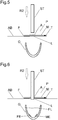
- the Figure 5 shows the sample carrier P from the Figure 2 and the Figure 1 in the side view from the Figure 2 in the event that the sample carrier P is placed on a support area AB.
- the support area AB preferably has a hole opening L.
- a vessel G is provided below the support area AB.
- a punching device ST By means of a punching device ST, a membrane element is punched out of the receiving area A of the sample carrier P from the membrane layer M, so that the punched out membrane element should then fall into the vessel G together with a film element punched out of the film layer F.
- the punching device or the punching knife ST is guided from above in a direction R2 running perpendicular to the support area AB.
- Figure 6 shows a further constellation in which the punching knife or the punching device ST has punched a membrane element ME and a film element FE from the sample carrier P.
- the punching process is successful when both the membrane element ME and the foil element FE fall into the vessel.
- the membrane element ME in the vessel G can then preferably be brought into contact with a biochemical liquid or a reagent liquid FL in order to determine the presence of an analyte or a semiquantitative or, alternatively, a quantitative determination of a concentration of an analyte in the dried blood component.
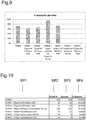
- Figure 9 shows percentage evaluation results of punching tests in which the Panthera Puncher 9 device from the manufacturer PerkinElmer was used as the punching device.
- the membrane layer of the sample carrier is based on a non-woven polyolefin and is here a membrane of the Porex BNW441435 type.
- a punching process was assessed as successful when both the membrane element and the foil element fell into the vessel provided for this purpose.
- the Figure 10 shows the percentage evaluation results of the Figure 9 the associated absolute values.
- the respective configurations of membrane layer (POREX) and associated film layers are listed in the first column SP1.
- the respective entries in column 1 also contain the exact product names of the corresponding film layers with their respective thicknesses in micrometers. It should be emphasized that only the Lumirror 45.11 film is an antistatic coated film.
- the number of punching attempts performed is listed in column SP2.
- the column SP3 shows the absolute number of successful punch attempts.
- the respective percentage shares of successfully performed punching attempts are listed.
- the film layer of the type Lumirror 45.11 used here is antistatic pretreated and is a film layer based on polyester.
- the Figure 3 shows a further preferred embodiment P2 of the sample carrier according to the invention.
- this embodiment P2 of the sample carrier also has one or more positioning elements AE.
- a positioning element AE is preferably provided by a cardboard or a paper element which is attached to an edge area RB of the membrane layer M.
- the erecting element AE can be folded along the edge area or a corresponding kink edge and aligned in this way.
- the Figure 3 shows the sample carrier P2 in a so-called second configuration, in which it is placed on a flat surface so that the membrane layer M in the receiving area A covers the film layer F.
- the Figure 4a shows the sample carrier P2 in this so-called second configuration, the positioning elements AE are bent slightly upwards in this side view, so that the membrane layer M, the film layer F in the from Figure 2 marked recording area A, which is not directly visible here, covered.
- the Figure 4b shows the sample carrier P2 in a first configuration, in which the mounting element AE so from the configuration of the Figure 3 is bent downwards so that it can be set up in such a way that the membrane layer M is spaced apart from the film layer F when the sample carrier P2 is also placed on the flat surface E.
- the erecting elements AE are therefore preferably folding elements on the sides of the sample carrier P2, so that the sample carrier P2 is supported by the folding elements AE in such a way that that in the first configuration the membrane layer M is spaced apart from the film layer in the region of the receiving area A.
- the set-up element AE or the set-up elements AE cause the film layer F to be spaced from the membrane layer M, so that the film layer F comes to rest on the flat surface E.
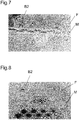
- the Figures 7 and 8 show respective membrane layers M and film layers F in which, due to the contact between the film layer F and the membrane layer M during the drying process, subsets B2 of blood constituents have dried on a respective surface of the respective film layers F. This is to be avoided and is made by the embodiment of the sample carrier P2 from the Figures 3, 4a and 4b achieved.
Landscapes
- Health & Medical Sciences (AREA)
- Life Sciences & Earth Sciences (AREA)
- Chemical & Material Sciences (AREA)
- General Health & Medical Sciences (AREA)
- Analytical Chemistry (AREA)
- Immunology (AREA)
- Hematology (AREA)
- Pathology (AREA)
- Physics & Mathematics (AREA)
- Engineering & Computer Science (AREA)
- Biochemistry (AREA)
- General Physics & Mathematics (AREA)
- Molecular Biology (AREA)
- Biomedical Technology (AREA)
- Clinical Laboratory Science (AREA)
- Chemical Kinetics & Catalysis (AREA)
- Urology & Nephrology (AREA)
- Heart & Thoracic Surgery (AREA)
- Cell Biology (AREA)
- Surgery (AREA)
- Animal Behavior & Ethology (AREA)
- Public Health (AREA)
- Veterinary Medicine (AREA)
- Biotechnology (AREA)
- Medical Informatics (AREA)
- Microbiology (AREA)
- Biophysics (AREA)
- Food Science & Technology (AREA)
- Medicinal Chemistry (AREA)
- Mechanical Engineering (AREA)
- Forests & Forestry (AREA)
- Investigating Or Analysing Biological Materials (AREA)
- Sampling And Sample Adjustment (AREA)
Priority Applications (8)
| Application Number | Priority Date | Filing Date | Title |
|---|---|---|---|
| EP19181249.4A EP3753634B1 (de) | 2019-06-19 | 2019-06-19 | Probenträger zur aufnahme von getrockneten blutbestandteilen und verfahren zur gewinnung eines membranelementes mit getrockneten blutbestandteilen |
| PL19181249T PL3753634T3 (pl) | 2019-06-19 | 2019-06-19 | Nośnik próbki do przyjmowania wysuszonych składników krwi i sposób uzyskiwania elementu membranowego z wysuszonymi składnikami krwi |
| ES19181249T ES2891400T3 (es) | 2019-06-19 | 2019-06-19 | Soporte para muestras para recibir componentes sanguíneos secos y procedimiento para obtener un elemento de membrana con componentes sanguíneos secos |
| BR102020010067-0A BR102020010067A2 (pt) | 2019-06-19 | 2020-05-20 | suporte de amostras para absorção de componentes sanguíneos secos e processo para obtenção de um elemento de membrana com componentes sanguíneos secos |
| US16/946,200 US20200398269A1 (en) | 2019-06-19 | 2020-06-10 | Sample support for the take-up of dried blood constituents and process for obtaining a membrane element with dried blood constituents |
| CA3083894A CA3083894C (en) | 2019-06-19 | 2020-06-17 | Sample support for the take-up of dried blood constituents and process for obtaining a membrane element with dried blood constituents |
| CN202010560758.6A CN112114158B (zh) | 2019-06-19 | 2020-06-18 | 用于吸收经干燥血液成分的样本载体以及用于获取带有经干燥血液成分的膜元件的方法 |
| MX2020005969A MX2020005969A (es) | 2019-06-19 | 2020-07-13 | Soporte de muestras para recibir agentes constitutivos de sangre seca y proceso para obtener un elemento de membrana con agentes constitutivos de sangre seca. |
Applications Claiming Priority (1)
| Application Number | Priority Date | Filing Date | Title |
|---|---|---|---|
| EP19181249.4A EP3753634B1 (de) | 2019-06-19 | 2019-06-19 | Probenträger zur aufnahme von getrockneten blutbestandteilen und verfahren zur gewinnung eines membranelementes mit getrockneten blutbestandteilen |
Publications (2)
| Publication Number | Publication Date |
|---|---|
| EP3753634A1 EP3753634A1 (de) | 2020-12-23 |
| EP3753634B1 true EP3753634B1 (de) | 2021-08-04 |
Family
ID=66999595
Family Applications (1)
| Application Number | Title | Priority Date | Filing Date |
|---|---|---|---|
| EP19181249.4A Active EP3753634B1 (de) | 2019-06-19 | 2019-06-19 | Probenträger zur aufnahme von getrockneten blutbestandteilen und verfahren zur gewinnung eines membranelementes mit getrockneten blutbestandteilen |
Country Status (8)
| Country | Link |
|---|---|
| US (1) | US20200398269A1 (pl) |
| EP (1) | EP3753634B1 (pl) |
| CN (1) | CN112114158B (pl) |
| BR (1) | BR102020010067A2 (pl) |
| CA (1) | CA3083894C (pl) |
| ES (1) | ES2891400T3 (pl) |
| MX (1) | MX2020005969A (pl) |
| PL (1) | PL3753634T3 (pl) |
Family Cites Families (16)
| Publication number | Priority date | Publication date | Assignee | Title |
|---|---|---|---|---|
| DE3247608A1 (de) * | 1982-12-23 | 1984-07-05 | Boehringer Mannheim Gmbh, 6800 Mannheim | Teststreifen |
| DE3630999A1 (de) * | 1986-09-12 | 1988-03-17 | Boehringer Mannheim Gmbh | Mehrschichtiger testtraeger |
| US5234813A (en) * | 1989-05-17 | 1993-08-10 | Actimed Laboratories, Inc. | Method and device for metering of fluid samples and detection of analytes therein |
| EP2410824A3 (en) * | 2006-02-20 | 2012-10-31 | Daicel Chemical Industries, Ltd. | Porous film and layered product including porous film |
| US8247220B2 (en) * | 2008-02-01 | 2012-08-21 | Kimberly-Clark Worldwide, Inc. | Optical indicator for detecting bacterial pathogens |
| CN101892290A (zh) * | 2009-05-19 | 2010-11-24 | 北京协和洛克生物技术研究开发中心 | 苯丙氨酸定量检测试剂盒(酶定量法) |
| CH704757B1 (de) * | 2011-03-29 | 2015-09-30 | Werner Döbelin | Verfahren und Probenträgerkarte zur automatischen Extraktion und direkten Analyse von Proben. |
| CN202101938U (zh) * | 2011-04-08 | 2012-01-04 | 广州市丰华生物工程有限公司 | 苯丙酮尿症筛查分析仪 |
| WO2013006904A1 (en) * | 2011-07-12 | 2013-01-17 | University Of Tasmania | Use of porous polymer materials for storage of biological samples |
| CN203203826U (zh) * | 2013-03-25 | 2013-09-18 | 江苏省血吸虫病防治研究所 | 一种血样本滤纸采集卡 |
| CN204613163U (zh) * | 2015-03-18 | 2015-09-02 | 杭州量康科技有限公司 | 用于检测干血样本的系统 |
| ES2903175T3 (es) * | 2015-03-31 | 2022-03-31 | Hoffmann La Roche | Tarjeta de separación de plasma |
| CN206573346U (zh) * | 2017-01-20 | 2017-10-20 | 广州市丰华生物工程有限公司 | 一种血片自动分离切割器 |
| CN207007592U (zh) * | 2017-07-18 | 2018-02-13 | 广州蓝勃生物科技有限公司 | 一种滤纸片冲裁装置 |
| CN108051494A (zh) * | 2017-11-17 | 2018-05-18 | 深圳华大生命科学研究院 | 一种同时检测多种遗传代谢疾病相关物质的方法和试剂盒 |
| CN208610853U (zh) * | 2018-03-02 | 2019-03-19 | 深圳会众生物技术有限公司 | 一种生物样本采集卡 |
-
2019
- 2019-06-19 PL PL19181249T patent/PL3753634T3/pl unknown
- 2019-06-19 ES ES19181249T patent/ES2891400T3/es active Active
- 2019-06-19 EP EP19181249.4A patent/EP3753634B1/de active Active
-
2020
- 2020-05-20 BR BR102020010067-0A patent/BR102020010067A2/pt not_active IP Right Cessation
- 2020-06-10 US US16/946,200 patent/US20200398269A1/en not_active Abandoned
- 2020-06-17 CA CA3083894A patent/CA3083894C/en active Active
- 2020-06-18 CN CN202010560758.6A patent/CN112114158B/zh active Active
- 2020-07-13 MX MX2020005969A patent/MX2020005969A/es unknown
Also Published As
| Publication number | Publication date |
|---|---|
| ES2891400T3 (es) | 2022-01-27 |
| MX2020005969A (es) | 2020-12-21 |
| CN112114158A (zh) | 2020-12-22 |
| CA3083894A1 (en) | 2020-12-19 |
| BR102020010067A2 (pt) | 2020-12-29 |
| CA3083894C (en) | 2022-05-24 |
| US20200398269A1 (en) | 2020-12-24 |
| EP3753634A1 (de) | 2020-12-23 |
| PL3753634T3 (pl) | 2022-01-03 |
| CN112114158B (zh) | 2025-02-11 |
Similar Documents
| Publication | Publication Date | Title |
|---|---|---|
| DE602005005485T2 (de) | Assayvorrichtung und verfahren mit gesteuertem fluss | |
| AT408696B (de) | Vorrichtung zum sammeln, testen und versenden von körperflüssigkeits-proben | |
| EP0208952B1 (de) | Testträger | |
| DE69016740T2 (de) | Analytisches element. | |
| DE68911395T3 (de) | Vorrichtung zum Transportieren von Flüssigkeiten und Vorrichtung zur diagnostischen Analyse. | |
| EP0045476B1 (de) | Verfahren zur Abtrennung von Plasma oder Serum aus Vollblut | |
| DE2854342A1 (de) | Vielschichtiges testmittel zum nachweis einer komponente in einer fluessigen probe und verfahren zu dessen anwendung | |
| EP0634215A1 (de) | Vorrichtung zur gleichzeitigen Bestimmung von Analyten | |
| EP0467175B1 (de) | Testkit zur Bestimmung eines Analyten in einer pastösen Probe, insbesondere in Stuhl | |
| DE3606124A1 (de) | Kolorimetrische pruefvorrichtung zur bestimmung einer spezifischen substanz in einem fluessigen medium, und verfahren zur verwendung der vorrichtung | |
| DE68909568T2 (de) | Analytisches Testgerät. | |
| EP1036330A1 (de) | Analytisches testelement mit sich verjüngendem kapillarkanal | |
| EP1522343B1 (de) | Analytisches Testelement umfassend ein hydrophiles Netzwerk zur Bildung eines Kapillarkanals, dessen Verwendung und Verfahren zur Bestimmung eines Analyten in einer Flüssigkeit | |
| EP0297389A2 (de) | Diagnostischer Testträger und Verfahren zu dessen Herstellung | |
| EP0443161B1 (de) | Testträger zur Analyse einer Probenflüssigkeit | |
| DE3616105A1 (de) | Teststreifen | |
| DE69837092T2 (de) | Immunoassayvorrichtung | |
| DE10234819A1 (de) | Testvorrichtung zur Untersuchung einer biologischen Probenflüssigkeit | |
| WO1999029427A1 (de) | Vorrichtung zum kapillaren flüssigkeitstransport | |
| EP0821235A2 (de) | Diagnostischer Testträger mit Kapillarspalt | |
| EP0863401B1 (de) | Analytisches Testelement mit flüssigkeitsgefüllten Blister | |
| EP3753634B1 (de) | Probenträger zur aufnahme von getrockneten blutbestandteilen und verfahren zur gewinnung eines membranelementes mit getrockneten blutbestandteilen | |
| DE102004009012A1 (de) | Testelement mit einer Kapillare zum Transport einer flüssigen Probe | |
| DE2655977A1 (de) | Teststreifen | |
| EP0457123B1 (de) | Testträger für die analytische Bestimmung eines Bestandteils einer Probenflüssigkeit |
Legal Events
| Date | Code | Title | Description |
|---|---|---|---|
| PUAI | Public reference made under article 153(3) epc to a published international application that has entered the european phase |
Free format text: ORIGINAL CODE: 0009012 |
|
| STAA | Information on the status of an ep patent application or granted ep patent |
Free format text: STATUS: REQUEST FOR EXAMINATION WAS MADE |
|
| 17P | Request for examination filed |
Effective date: 20200511 |
|
| AK | Designated contracting states |
Kind code of ref document: A1 Designated state(s): AL AT BE BG CH CY CZ DE DK EE ES FI FR GB GR HR HU IE IS IT LI LT LU LV MC MK MT NL NO PL PT RO RS SE SI SK SM TR |
|
| AX | Request for extension of the european patent |
Extension state: BA ME |
|
| GRAP | Despatch of communication of intention to grant a patent |
Free format text: ORIGINAL CODE: EPIDOSNIGR1 |
|
| STAA | Information on the status of an ep patent application or granted ep patent |
Free format text: STATUS: GRANT OF PATENT IS INTENDED |
|
| INTG | Intention to grant announced |
Effective date: 20210212 |
|
| GRAS | Grant fee paid |
Free format text: ORIGINAL CODE: EPIDOSNIGR3 |
|
| GRAA | (expected) grant |
Free format text: ORIGINAL CODE: 0009210 |
|
| STAA | Information on the status of an ep patent application or granted ep patent |
Free format text: STATUS: THE PATENT HAS BEEN GRANTED |
|
| AK | Designated contracting states |
Kind code of ref document: B1 Designated state(s): AL AT BE BG CH CY CZ DE DK EE ES FI FR GB GR HR HU IE IS IT LI LT LU LV MC MK MT NL NO PL PT RO RS SE SI SK SM TR |
|
| REG | Reference to a national code |
Ref country code: GB Ref legal event code: FG4D Free format text: NOT ENGLISH |
|
| REG | Reference to a national code |
Ref country code: AT Ref legal event code: REF Ref document number: 1416417 Country of ref document: AT Kind code of ref document: T Effective date: 20210815 |
|
| REG | Reference to a national code |
Ref country code: CH Ref legal event code: EP |
|
| REG | Reference to a national code |
Ref country code: DE Ref legal event code: R096 Ref document number: 502019001947 Country of ref document: DE |
|
| REG | Reference to a national code |
Ref country code: IE Ref legal event code: FG4D Free format text: LANGUAGE OF EP DOCUMENT: GERMAN |
|
| REG | Reference to a national code |
Ref country code: LT Ref legal event code: MG9D |
|
| REG | Reference to a national code |
Ref country code: NL Ref legal event code: MP Effective date: 20210804 |
|
| REG | Reference to a national code |
Ref country code: ES Ref legal event code: FG2A Ref document number: 2891400 Country of ref document: ES Kind code of ref document: T3 Effective date: 20220127 |
|
| PG25 | Lapsed in a contracting state [announced via postgrant information from national office to epo] |
Ref country code: SE Free format text: LAPSE BECAUSE OF FAILURE TO SUBMIT A TRANSLATION OF THE DESCRIPTION OR TO PAY THE FEE WITHIN THE PRESCRIBED TIME-LIMIT Effective date: 20210804 Ref country code: RS Free format text: LAPSE BECAUSE OF FAILURE TO SUBMIT A TRANSLATION OF THE DESCRIPTION OR TO PAY THE FEE WITHIN THE PRESCRIBED TIME-LIMIT Effective date: 20210804 Ref country code: FI Free format text: LAPSE BECAUSE OF FAILURE TO SUBMIT A TRANSLATION OF THE DESCRIPTION OR TO PAY THE FEE WITHIN THE PRESCRIBED TIME-LIMIT Effective date: 20210804 Ref country code: LT Free format text: LAPSE BECAUSE OF FAILURE TO SUBMIT A TRANSLATION OF THE DESCRIPTION OR TO PAY THE FEE WITHIN THE PRESCRIBED TIME-LIMIT Effective date: 20210804 Ref country code: BG Free format text: LAPSE BECAUSE OF FAILURE TO SUBMIT A TRANSLATION OF THE DESCRIPTION OR TO PAY THE FEE WITHIN THE PRESCRIBED TIME-LIMIT Effective date: 20211104 Ref country code: HR Free format text: LAPSE BECAUSE OF FAILURE TO SUBMIT A TRANSLATION OF THE DESCRIPTION OR TO PAY THE FEE WITHIN THE PRESCRIBED TIME-LIMIT Effective date: 20210804 Ref country code: PT Free format text: LAPSE BECAUSE OF FAILURE TO SUBMIT A TRANSLATION OF THE DESCRIPTION OR TO PAY THE FEE WITHIN THE PRESCRIBED TIME-LIMIT Effective date: 20211206 Ref country code: NO Free format text: LAPSE BECAUSE OF FAILURE TO SUBMIT A TRANSLATION OF THE DESCRIPTION OR TO PAY THE FEE WITHIN THE PRESCRIBED TIME-LIMIT Effective date: 20211104 |
|
| PG25 | Lapsed in a contracting state [announced via postgrant information from national office to epo] |
Ref country code: LV Free format text: LAPSE BECAUSE OF FAILURE TO SUBMIT A TRANSLATION OF THE DESCRIPTION OR TO PAY THE FEE WITHIN THE PRESCRIBED TIME-LIMIT Effective date: 20210804 Ref country code: GR Free format text: LAPSE BECAUSE OF FAILURE TO SUBMIT A TRANSLATION OF THE DESCRIPTION OR TO PAY THE FEE WITHIN THE PRESCRIBED TIME-LIMIT Effective date: 20211105 |
|
| PG25 | Lapsed in a contracting state [announced via postgrant information from national office to epo] |
Ref country code: NL Free format text: LAPSE BECAUSE OF FAILURE TO SUBMIT A TRANSLATION OF THE DESCRIPTION OR TO PAY THE FEE WITHIN THE PRESCRIBED TIME-LIMIT Effective date: 20210804 |
|
| PG25 | Lapsed in a contracting state [announced via postgrant information from national office to epo] |
Ref country code: DK Free format text: LAPSE BECAUSE OF FAILURE TO SUBMIT A TRANSLATION OF THE DESCRIPTION OR TO PAY THE FEE WITHIN THE PRESCRIBED TIME-LIMIT Effective date: 20210804 |
|
| REG | Reference to a national code |
Ref country code: DE Ref legal event code: R097 Ref document number: 502019001947 Country of ref document: DE |
|
| PG25 | Lapsed in a contracting state [announced via postgrant information from national office to epo] |
Ref country code: SM Free format text: LAPSE BECAUSE OF FAILURE TO SUBMIT A TRANSLATION OF THE DESCRIPTION OR TO PAY THE FEE WITHIN THE PRESCRIBED TIME-LIMIT Effective date: 20210804 Ref country code: SK Free format text: LAPSE BECAUSE OF FAILURE TO SUBMIT A TRANSLATION OF THE DESCRIPTION OR TO PAY THE FEE WITHIN THE PRESCRIBED TIME-LIMIT Effective date: 20210804 Ref country code: RO Free format text: LAPSE BECAUSE OF FAILURE TO SUBMIT A TRANSLATION OF THE DESCRIPTION OR TO PAY THE FEE WITHIN THE PRESCRIBED TIME-LIMIT Effective date: 20210804 Ref country code: EE Free format text: LAPSE BECAUSE OF FAILURE TO SUBMIT A TRANSLATION OF THE DESCRIPTION OR TO PAY THE FEE WITHIN THE PRESCRIBED TIME-LIMIT Effective date: 20210804 Ref country code: CZ Free format text: LAPSE BECAUSE OF FAILURE TO SUBMIT A TRANSLATION OF THE DESCRIPTION OR TO PAY THE FEE WITHIN THE PRESCRIBED TIME-LIMIT Effective date: 20210804 Ref country code: AL Free format text: LAPSE BECAUSE OF FAILURE TO SUBMIT A TRANSLATION OF THE DESCRIPTION OR TO PAY THE FEE WITHIN THE PRESCRIBED TIME-LIMIT Effective date: 20210804 |
|
| PLBE | No opposition filed within time limit |
Free format text: ORIGINAL CODE: 0009261 |
|
| STAA | Information on the status of an ep patent application or granted ep patent |
Free format text: STATUS: NO OPPOSITION FILED WITHIN TIME LIMIT |
|
| 26N | No opposition filed |
Effective date: 20220506 |
|
| PGFP | Annual fee paid to national office [announced via postgrant information from national office to epo] |
Ref country code: PL Payment date: 20220606 Year of fee payment: 4 Ref country code: BE Payment date: 20220621 Year of fee payment: 4 |
|
| PGFP | Annual fee paid to national office [announced via postgrant information from national office to epo] |
Ref country code: ES Payment date: 20220719 Year of fee payment: 4 |
|
| PG25 | Lapsed in a contracting state [announced via postgrant information from national office to epo] |
Ref country code: MC Free format text: LAPSE BECAUSE OF FAILURE TO SUBMIT A TRANSLATION OF THE DESCRIPTION OR TO PAY THE FEE WITHIN THE PRESCRIBED TIME-LIMIT Effective date: 20210804 |
|
| REG | Reference to a national code |
Ref country code: CH Ref legal event code: PL |
|
| PG25 | Lapsed in a contracting state [announced via postgrant information from national office to epo] |
Ref country code: LU Free format text: LAPSE BECAUSE OF NON-PAYMENT OF DUE FEES Effective date: 20220619 Ref country code: LI Free format text: LAPSE BECAUSE OF NON-PAYMENT OF DUE FEES Effective date: 20220630 Ref country code: IE Free format text: LAPSE BECAUSE OF NON-PAYMENT OF DUE FEES Effective date: 20220619 Ref country code: FR Free format text: LAPSE BECAUSE OF NON-PAYMENT OF DUE FEES Effective date: 20220630 Ref country code: CH Free format text: LAPSE BECAUSE OF NON-PAYMENT OF DUE FEES Effective date: 20220630 |
|
| P01 | Opt-out of the competence of the unified patent court (upc) registered |
Effective date: 20230605 |
|
| REG | Reference to a national code |
Ref country code: BE Ref legal event code: MM Effective date: 20230630 |
|
| GBPC | Gb: european patent ceased through non-payment of renewal fee |
Effective date: 20230619 |
|
| PG25 | Lapsed in a contracting state [announced via postgrant information from national office to epo] |
Ref country code: MK Free format text: LAPSE BECAUSE OF FAILURE TO SUBMIT A TRANSLATION OF THE DESCRIPTION OR TO PAY THE FEE WITHIN THE PRESCRIBED TIME-LIMIT Effective date: 20210804 Ref country code: CY Free format text: LAPSE BECAUSE OF FAILURE TO SUBMIT A TRANSLATION OF THE DESCRIPTION OR TO PAY THE FEE WITHIN THE PRESCRIBED TIME-LIMIT Effective date: 20210804 Ref country code: GB Free format text: LAPSE BECAUSE OF NON-PAYMENT OF DUE FEES Effective date: 20230619 |
|
| PG25 | Lapsed in a contracting state [announced via postgrant information from national office to epo] |
Ref country code: HU Free format text: LAPSE BECAUSE OF FAILURE TO SUBMIT A TRANSLATION OF THE DESCRIPTION OR TO PAY THE FEE WITHIN THE PRESCRIBED TIME-LIMIT; INVALID AB INITIO Effective date: 20190619 Ref country code: BE Free format text: LAPSE BECAUSE OF NON-PAYMENT OF DUE FEES Effective date: 20230630 |
|
| REG | Reference to a national code |
Ref country code: ES Ref legal event code: FD2A Effective date: 20240729 |
|
| PG25 | Lapsed in a contracting state [announced via postgrant information from national office to epo] |
Ref country code: MT Free format text: LAPSE BECAUSE OF FAILURE TO SUBMIT A TRANSLATION OF THE DESCRIPTION OR TO PAY THE FEE WITHIN THE PRESCRIBED TIME-LIMIT Effective date: 20210804 |
|
| PG25 | Lapsed in a contracting state [announced via postgrant information from national office to epo] |
Ref country code: ES Free format text: LAPSE BECAUSE OF NON-PAYMENT OF DUE FEES Effective date: 20230620 |
|
| PG25 | Lapsed in a contracting state [announced via postgrant information from national office to epo] |
Ref country code: ES Free format text: LAPSE BECAUSE OF NON-PAYMENT OF DUE FEES Effective date: 20230620 |
|
| PG25 | Lapsed in a contracting state [announced via postgrant information from national office to epo] |
Ref country code: PL Free format text: LAPSE BECAUSE OF NON-PAYMENT OF DUE FEES Effective date: 20230619 |
|
| PG25 | Lapsed in a contracting state [announced via postgrant information from national office to epo] |
Ref country code: PL Free format text: LAPSE BECAUSE OF NON-PAYMENT OF DUE FEES Effective date: 20230619 |
|
| PGFP | Annual fee paid to national office [announced via postgrant information from national office to epo] |
Ref country code: DE Payment date: 20250618 Year of fee payment: 7 |
|
| REG | Reference to a national code |
Ref country code: AT Ref legal event code: MM01 Ref document number: 1416417 Country of ref document: AT Kind code of ref document: T Effective date: 20240619 |
|
| PGFP | Annual fee paid to national office [announced via postgrant information from national office to epo] |
Ref country code: IT Payment date: 20250630 Year of fee payment: 7 |
|
| PG25 | Lapsed in a contracting state [announced via postgrant information from national office to epo] |
Ref country code: AT Free format text: LAPSE BECAUSE OF NON-PAYMENT OF DUE FEES Effective date: 20240619 |
|
| PG25 | Lapsed in a contracting state [announced via postgrant information from national office to epo] |
Ref country code: TR Free format text: LAPSE BECAUSE OF FAILURE TO SUBMIT A TRANSLATION OF THE DESCRIPTION OR TO PAY THE FEE WITHIN THE PRESCRIBED TIME-LIMIT Effective date: 20210804 |
|
| PG25 | Lapsed in a contracting state [announced via postgrant information from national office to epo] |
Ref country code: SI Free format text: LAPSE BECAUSE OF FAILURE TO SUBMIT A TRANSLATION OF THE DESCRIPTION OR TO PAY THE FEE WITHIN THE PRESCRIBED TIME-LIMIT Effective date: 20210804 |
|
| PGFP | Annual fee paid to national office [announced via postgrant information from national office to epo] |
Ref country code: AT Payment date: 20260410 Year of fee payment: 5 |