EP3750627A1 - Verfahren zur abtrennung von einer oder mehreren komponente(n) aus einem gemisch - Google Patents
Verfahren zur abtrennung von einer oder mehreren komponente(n) aus einem gemisch Download PDFInfo
- Publication number
- EP3750627A1 EP3750627A1 EP20178709.0A EP20178709A EP3750627A1 EP 3750627 A1 EP3750627 A1 EP 3750627A1 EP 20178709 A EP20178709 A EP 20178709A EP 3750627 A1 EP3750627 A1 EP 3750627A1
- Authority
- EP
- European Patent Office
- Prior art keywords
- acid
- mixture
- membrane
- separation
- catalyst system
- Prior art date
- Legal status (The legal status is an assumption and is not a legal conclusion. Google has not performed a legal analysis and makes no representation as to the accuracy of the status listed.)
- Granted
Links
Classifications
-
- B—PERFORMING OPERATIONS; TRANSPORTING
- B01—PHYSICAL OR CHEMICAL PROCESSES OR APPARATUS IN GENERAL
- B01J—CHEMICAL OR PHYSICAL PROCESSES, e.g. CATALYSIS OR COLLOID CHEMISTRY; THEIR RELEVANT APPARATUS
- B01J31/00—Catalysts comprising hydrides, coordination complexes or organic compounds
- B01J31/40—Regeneration or reactivation
- B01J31/4015—Regeneration or reactivation of catalysts containing metals
- B01J31/4061—Regeneration or reactivation of catalysts containing metals involving membrane separation
-
- B—PERFORMING OPERATIONS; TRANSPORTING
- B01—PHYSICAL OR CHEMICAL PROCESSES OR APPARATUS IN GENERAL
- B01D—SEPARATION
- B01D61/00—Processes of separation using semi-permeable membranes, e.g. dialysis, osmosis or ultrafiltration; Apparatus, accessories or auxiliary operations specially adapted therefor
-
- B—PERFORMING OPERATIONS; TRANSPORTING
- B01—PHYSICAL OR CHEMICAL PROCESSES OR APPARATUS IN GENERAL
- B01J—CHEMICAL OR PHYSICAL PROCESSES, e.g. CATALYSIS OR COLLOID CHEMISTRY; THEIR RELEVANT APPARATUS
- B01J31/00—Catalysts comprising hydrides, coordination complexes or organic compounds
- B01J31/16—Catalysts comprising hydrides, coordination complexes or organic compounds containing coordination complexes
- B01J31/18—Catalysts comprising hydrides, coordination complexes or organic compounds containing coordination complexes containing nitrogen, phosphorus, arsenic or antimony as complexing atoms, e.g. in pyridine ligands, or in resonance therewith, e.g. in isocyanide ligands C=N-R or as complexed central atoms
- B01J31/1845—Catalysts comprising hydrides, coordination complexes or organic compounds containing coordination complexes containing nitrogen, phosphorus, arsenic or antimony as complexing atoms, e.g. in pyridine ligands, or in resonance therewith, e.g. in isocyanide ligands C=N-R or as complexed central atoms the ligands containing phosphorus
- B01J31/185—Phosphites ((RO)3P), their isomeric phosphonates (R(RO)2P=O) and RO-substitution derivatives thereof
-
- B—PERFORMING OPERATIONS; TRANSPORTING
- B01—PHYSICAL OR CHEMICAL PROCESSES OR APPARATUS IN GENERAL
- B01D—SEPARATION
- B01D71/00—Semi-permeable membranes for separation processes or apparatus characterised by the material; Manufacturing processes specially adapted therefor
- B01D71/02—Inorganic material
- B01D71/024—Oxides
- B01D71/025—Aluminium oxide
-
- B—PERFORMING OPERATIONS; TRANSPORTING
- B01—PHYSICAL OR CHEMICAL PROCESSES OR APPARATUS IN GENERAL
- B01D—SEPARATION
- B01D71/00—Semi-permeable membranes for separation processes or apparatus characterised by the material; Manufacturing processes specially adapted therefor
- B01D71/02—Inorganic material
- B01D71/024—Oxides
- B01D71/027—Silicium oxide
-
- B—PERFORMING OPERATIONS; TRANSPORTING
- B01—PHYSICAL OR CHEMICAL PROCESSES OR APPARATUS IN GENERAL
- B01D—SEPARATION
- B01D71/00—Semi-permeable membranes for separation processes or apparatus characterised by the material; Manufacturing processes specially adapted therefor
- B01D71/06—Organic material
- B01D71/38—Polyalkenylalcohols; Polyalkenylesters; Polyalkenylethers; Polyalkenylaldehydes; Polyalkenylketones; Polyalkenylacetals; Polyalkenylketals
- B01D71/381—Polyvinylalcohol
-
- B—PERFORMING OPERATIONS; TRANSPORTING
- B01—PHYSICAL OR CHEMICAL PROCESSES OR APPARATUS IN GENERAL
- B01J—CHEMICAL OR PHYSICAL PROCESSES, e.g. CATALYSIS OR COLLOID CHEMISTRY; THEIR RELEVANT APPARATUS
- B01J31/00—Catalysts comprising hydrides, coordination complexes or organic compounds
- B01J31/40—Regeneration or reactivation
-
- B—PERFORMING OPERATIONS; TRANSPORTING
- B01—PHYSICAL OR CHEMICAL PROCESSES OR APPARATUS IN GENERAL
- B01J—CHEMICAL OR PHYSICAL PROCESSES, e.g. CATALYSIS OR COLLOID CHEMISTRY; THEIR RELEVANT APPARATUS
- B01J31/00—Catalysts comprising hydrides, coordination complexes or organic compounds
- B01J31/40—Regeneration or reactivation
- B01J31/4015—Regeneration or reactivation of catalysts containing metals
- B01J31/4053—Regeneration or reactivation of catalysts containing metals with recovery of phosphorous catalyst system constituents
-
- B—PERFORMING OPERATIONS; TRANSPORTING
- B01—PHYSICAL OR CHEMICAL PROCESSES OR APPARATUS IN GENERAL
- B01J—CHEMICAL OR PHYSICAL PROCESSES, e.g. CATALYSIS OR COLLOID CHEMISTRY; THEIR RELEVANT APPARATUS
- B01J38/00—Regeneration or reactivation of catalysts, in general
- B01J38/48—Liquid treating or treating in liquid phase, e.g. dissolved or suspended
- B01J38/60—Liquid treating or treating in liquid phase, e.g. dissolved or suspended using acids
-
- B—PERFORMING OPERATIONS; TRANSPORTING
- B01—PHYSICAL OR CHEMICAL PROCESSES OR APPARATUS IN GENERAL
- B01J—CHEMICAL OR PHYSICAL PROCESSES, e.g. CATALYSIS OR COLLOID CHEMISTRY; THEIR RELEVANT APPARATUS
- B01J8/00—Chemical or physical processes in general, conducted in the presence of fluids and solid particles; Apparatus for such processes
- B01J8/008—Details of the reactor or of the particulate material; Processes to increase or to retard the rate of reaction
- B01J8/009—Membranes, e.g. feeding or removing reactants or products to or from the catalyst bed through a membrane
-
- B—PERFORMING OPERATIONS; TRANSPORTING
- B01—PHYSICAL OR CHEMICAL PROCESSES OR APPARATUS IN GENERAL
- B01J—CHEMICAL OR PHYSICAL PROCESSES, e.g. CATALYSIS OR COLLOID CHEMISTRY; THEIR RELEVANT APPARATUS
- B01J2231/00—Catalytic reactions performed with catalysts classified in B01J31/00
- B01J2231/30—Addition reactions at carbon centres, i.e. to either C-C or C-X multiple bonds
- B01J2231/32—Addition reactions to C=C or C-C triple bonds
- B01J2231/321—Hydroformylation, metalformylation, carbonylation or hydroaminomethylation
-
- B—PERFORMING OPERATIONS; TRANSPORTING
- B01—PHYSICAL OR CHEMICAL PROCESSES OR APPARATUS IN GENERAL
- B01J—CHEMICAL OR PHYSICAL PROCESSES, e.g. CATALYSIS OR COLLOID CHEMISTRY; THEIR RELEVANT APPARATUS
- B01J2531/00—Additional information regarding catalytic systems classified in B01J31/00
- B01J2531/80—Complexes comprising metals of Group VIII as the central metal
- B01J2531/82—Metals of the platinum group
- B01J2531/824—Palladium
Definitions
- the present invention relates to a method for separating one or more component (s) from a mixture by means of a membrane separation, an acid or a base being added to the mixture before the membrane separation, depending on the component to be separated.
- Membrane separation processes are well known in the prior art and are nowadays used in many industrial areas, for example for the recovery of homogeneous catalyst systems. Basically, there is a constant need to improve the membrane properties, such as the retention or the permeability of the membrane. Typically, the focus is on the membrane material, which is intended to lead to the desired improvements through modification, which, however, is disadvantageously often associated with a high level of work and development effort.
- the object of the present invention resulting therefrom was to provide a process for the separation of one or more component (s) from a mixture by means of membrane separation which does not have the aforementioned disadvantages. Furthermore, the task was to provide a membrane separation process in which the addition of the additional component can be reduced to a minimum, so that neither space-time yields nor by-product formation rates or reaction conditions are noticeably influenced by recycling the retentate stream, so as not to endanger the economic viability of the process.
- the process according to the invention is a process for separating a homogeneous catalyst system, which comprises at least one metal from Group 8 to 10 of the Periodic Table of the Elements or a compound thereof and a phosphorus-containing ligand, from a reaction solution by means of a membrane separation, whereby the homogeneous catalyst system is depleted in the resulting permeate stream and is enriched in the resulting retentate stream, wherein at least one component of the homogeneous catalyst system comprises at least one acidic or basic functional group, preferably one basic functional group, characterized in that the reaction solution before the membrane separation, in the event that the at least one component to be separated has a basic functional group, an acid in an amount of ⁇ 0.1% by weight, preferably in an amount of ⁇ 0.1% by weight and contains ⁇ 5 wt .-%, based on the total weight of the mixture or, in the event that the at least one component to be separated has an acidic functional group, a base in an amount of ⁇ 0.1 wt .
- the membrane separation is based on the semi-permeability of the membrane material, which is permeable to certain substances and impermeable to other substances.
- the separation is usually based on the molecular weight.
- components with a Molecular weight from 0.1 to 1 kDa are separated from each other or from other low molecular weight components in the mixture.
- the components which have a molecular weight above a value defined by the membrane are enriched in the retentate, while all low molecular weight components are enriched in the permeate.
- this component will either accumulate in the permeate or in the retentate.
- the component (s) to be separated off are preferably enriched in the process according to the invention in the rent.
- any suitable membrane material can be used in the method according to the invention. Due to the addition of acid or base to the mixture according to the invention, however, the membrane should at least be acid- and / or base-stable or at least be stable with respect to the acids or bases used.
- the term "acid-stable" or base-stable means that the membrane material has been in the presence of the acid or base, in particular a Brönsted acid with a pKa ⁇ 5, particularly preferably a pKa 3 or a Lewis -Acid with an LAU value of more than 25, preferably with an LAU value of 29, is stable and is not destroyed, so that the actual separation effect could no longer be achieved.
- Such a membrane material preferably consists of at least a rather thin separating layer (also: active separation layer) and optionally a thicker backing on which the separation-active layer is located.
- the membrane material according to the invention preferably consists of at least one separating layer and a backing.
- One or more intermediate layers can be present between the separating layer and the backing.
- the membrane material consists only of the separating layer and the backing.
- the membrane material preferably comprises a polymer-based material as the active separation layer, which is selected from the group consisting of polyimide (PI), polydimethylsiloxane (PDMS), polyetherimide (PEI), poly (2,6-dimethyl-1,4-phenylene oxide (PPO), Polyvinyl alcohol (PVA), polyacrylic acid (PAA), polyurethanes (PU), poly (1-trimethylsilyl-1-propyne) (PTMSP), polybenzimidazoles (PBI), polydicyclopentadienes (pDCPD), polyaryl ether ketones (PAEK), e.g. polyether therketone (PEEK), and mixtures of these materials.
- PI polyimide
- PDMS polydimethylsiloxane
- PEI polyetherimide
- PPO poly (2,6-dimethyl-1,4-phenylene oxide
- PVA Polyvinyl alcohol
- PAA polyacrylic acid
- PU polyurethanes
- the backing has a porous structure that is permeable to the permeate that has passed through the active separation layer.
- the backing has a stabilizing function and serves as a carrier for the active separation layer.
- the backing can in principle consist of any suitable porous material. However, the prerequisite is that the material is acid and base stable.
- the backing can also consist of the same material as the separating layer.
- the active separation layer according to the invention preferably consists of a PAEK polymer (polyaryl ether ketone).
- PAEK is characterized in that aryl groups are linked alternately via an ether functionality and a ketone functionality within the repeating unit.
- a separating layer preferred according to the invention consists of PEEK (polyether ether ketone).
- PEEK polymers with a degree of sulfonation of less than 20%, particularly preferably with a degree of sulfonation of less than 10%, can be used as the separating layer.
- the corresponding PEEK polymers and their production are in the WO 2015/110843 A1 or in J. da Silva Burgal et al .; Journal of Membrane Science, Vol. 479 (2015), pp.
- the PEEK material according to the invention is characterized in that, when used as a separating layer, it preferably allows the esters formed to pass through, while even the educt alcohols used are at least partially retained and thereby accumulate in the retentate. As a result, the subsequent work-up of the remaining product mixture can be operated more economically and sustainably because fewer alcohols have to be separated off compared with known membrane materials.
- the membrane material for the method according to the invention can also be a ceramic membrane material.
- Suitable ceramic membrane materials are, for example, aluminum oxide, SiO 2 , TiO 2 , ZrO 2 or mixtures of these materials, of which the ceramic membrane material is preferably made.
- the ceramic membrane materials can also comprise or have a functionalization, for example a surface modification.
- These membrane materials can be purely ceramic and consist of the materials mentioned.
- the above-mentioned ceramic materials can also form the base body or the backing to which a separating layer made of the above-mentioned polymer materials is applied.
- the membrane separation i.e. in particular the structure of the corresponding system (s) and the properties such as pressure and temperature, depend on the mixture used and the component (s) to be separated from it. In principle, these parameters are known to the person skilled in the art.
- the membrane separation process according to the invention can be carried out either in one stage or in multiple stages.
- the membrane separation is preferably carried out at temperatures between 25 and 100.degree. C., further preferably between 30 and 80.degree. C. and particularly preferably between 40 and 70.degree.
- the mixture can be cooled to bring the mixture to the prevailing temperature preferred for membrane separation.
- cooling can also be achieved via a heat exchanger, whereby a another stream is heated within the process of the invention.
- the mixture is only expanded under the partial pressure of the dissolved components, so that they outgas, in order to then increase the pressure again, which is intended for the membrane separation.
- the transmembrane pressure (TMP) in the membrane separation can be 10 to 60 bar, preferably 15 to 55 bar, particularly preferably 20 to 50 bar (relative).
- the pressure on the permeate side can be up to 15 bar, preferably 3 to 7 bar, above atmospheric pressure, from which the pressure on the retentas side then results from the TMP.
- the retention can therefore assume values from 0 to 1 and is therefore often given in%.
- a retention of 0% means that the component under consideration permeates unhindered through the membrane, so that the mass fractions of the components in the retentate and in the permeate are the same.
- a retention of 100% means that the component under consideration is completely retained by the membrane, which, however, can hardly be achieved technically.
- the permeability is usually given in the unit kg / (h ⁇ m 2 ⁇ bar).
- the inventive method for membrane separation is characterized in that the mixture containing the component (s) to be separated, an acid or a base in an amount of ⁇ 0.1 wt .-%, based on the total weight of the mixture , will be added.
- An acid is added to the mixture in the event that the component (s) to be separated off contains at least one basic functional group.
- a base is added to the mixture in the event that the component (s) to be separated off contains at least one acidic functional group.
- the amount of acid or base is preferably limited to an amount of ⁇ 5% by weight in order not to introduce too high a proportion of components inherent in the system and in order not to dilute the mixture in an unreasonable manner.
- the acid can be a Brönsted or Lewis acid.
- Suitable Brönsted acids are perchloric acid, sulfuric acid, phosphoric acid, methylphosphonic acid or a sulfonic acid, for example methanesulfonic acid, trifluoromethanesulfonic acid, tert-butanesulfonic acid, p-toluenesulfonic acid (pTSA), 2-hydroxypropane-2-sulfonic acid, 2,4,6-trimethylbenzenesulfonic acid or dodecylsulfonic acid.
- Sulfuric acid or a sulfonic acid are preferably used as the Bronsted acid, particularly preferably sulfuric acid.
- Lewis acids are titanium (IV) isopropoxide, Bu 2 SnO, BuSn (O) OH, aluminum triflate, aluminum chloride, aluminum hydride, trimethyl aluminum, tris (pentafluorophenyl) borane, boron trifluoride, boron trichloride or mixtures thereof.
- Lewis acids used with preference are titanium (IV) isopropoxide and aluminum triflate
- a base which is selected from the groups consisting of alkali metals, alkali alkoxides, alkali or alkaline earth acetates, alkali or alkaline earth oxides, alkali or alkaline earth alcoholates, such as NaEtOH or MgEtOH, and Alkali carbonates such as K 2 CO 3 or Cs 2 CO 3 is selected.
- alkali metals alkali alkoxides, alkali or alkaline earth acetates, alkali or alkaline earth oxides, alkali or alkaline earth alcoholates, such as NaEtOH or MgEtOH, and Alkali carbonates such as K 2 CO 3 or Cs 2 CO 3 is selected.
- basic ion exchangers or NaOH can also be used. Preference is given to using Na or Mg alcoholates, such as NaEtOH or MgEtOH.
- the component to be separated off is a homogeneous catalyst system which is to be separated off from the reaction solution.
- the reaction solution originates from a hydroformylation or an alkoxycarbonylation.
- the alkoxycarbonylation means the usually homogeneously catalyzed reaction of a hydrocarbon having at least one olefinic double bond with carbon monoxide and an alcohol to form an ester.
- Hydroformylation means the usually homogeneously catalyzed reaction of a hydrocarbon, which has at least one multiple bond, preferably at least one olefinic double bond, with synthesis gas (mixture of CO and H 2 ) to form an aldehyde.
- a hydrocarbon with at least one multiple bond is used, in particular hydrocarbons with an olefinic double bond.
- C2 to C20 hydrocarbons and with at least one olefinic double bond are preferred.
- C3 to C16 hydrocarbons, particularly preferably C3 to C12 hydrocarbons with at least one multiple bond, preferably at least one olefinic double bond can be used.
- These include in particular n-alkenes, iso-alkenes, cycloalkenes and aromatic alkenes having 2 to 20 carbon atoms, preferably 3 to 16 carbon atoms, particularly preferably 3 to 12 carbon atoms.
- the hydrocarbons described above can contain one or more further functional groups in addition to the at least one olefinic double bond.
- suitable functional groups are carboxyl, thiocarboxyl, sulfo-, sulfinyl, carboxylic anhydride, imide, carboxylic acid ester, sulfonic acid ester, carbamoyl, sulfamoyl, cyano, carbonyl, carbonothioyl, hydroxyl, sulfhydryl , Amino, ether, thioether, aryl, heteroaryl or silyl groups and / or halogen substituents.
- Particularly preferred hydrocarbons which are used in the hydroformylation or the alkoxycarbonylation have only one olefinic double bond, in particular n-alkenes and iso-alkenes with 2 to 20 carbon atoms, preferably 3 to 16 carbon atoms, particularly preferably 3 to 12 carbon atoms.
- the hydrocarbons used are preferably unsubstituted.
- the alcohol used in the alkoxycarbonylation is a mono- or polyalcohol (two or more OH groups) having 1 to 50 carbon atoms, preferably 1 to 15 carbon atoms, particularly preferably 1 to 10 carbon atoms, or a mixture of two or more mono- and / or Polyalcohols.
- the polyalcohol is a diol, triol or tetrol, preferably a diol or triol with the aforementioned number of carbon atoms.
- Suitable alcohols for the alkoxycarbonylation are methanol, ethanol, 1-propanol, 1-butanol, 1-pentanol, 1-hexanol, 2-propanol, tert-butanol, 3-pentanol, 2-propylheptanol, cyclohexanol, phenol or mixtures thereof, preferably Ethanol, 1-propanol, 1-butanol, 1-pentanol, 1-hexanol, 2-propanol, tert-butanol, 3-pentanol, 2-propylheptanol.
- the alcohol used in the alkoxycarbonylation if it is a monoalcohol, is used in a molar ratio to the hydrocarbon used (monoalcohol: hydrocarbon) of from 2 to 20, preferably from 3 to 10 and particularly preferably from 4 to 6.
- the monoalcohol is thus added in a molar excess, based on the hydrocarbon used.
- the alcohol can act both as a starting material for the carbonylation and as a solvent.
- the alcohol used in the alkoxycarbonylation if it is a polyalcohol, is used in a molar ratio to the hydrocarbon used (hydrocarbon: polyalcohol) of 2 to 20, preferably 3 to 10 and particularly preferably 4 to 8.
- the polyalcohol is therefore added in a molar deficit based on the hydrocarbon used.
- homogeneous catalyst systems each of which comprises a metal from group 8 to 10 of the Periodic Table of the Elements (PSE) or a compound thereof and a phosphorus ligand.
- PSE Periodic Table of the Elements
- the homogeneous catalyst system preferably comprises at least one metal from group 8 to 10 of the Periodic Table of the Elements (PSE) or a compound thereof, a phosphorus-containing ligand and optionally an acid as co-catalyst.
- PSE Periodic Table of the Elements
- the metal from group 8 to 10 of the PSE is preferably palladium.
- the palladium is preferably used in the form of a precursor compound as a palladium compound which is coordinated by the phosphorus-containing ligand.
- Examples of palladium compounds that can be used as precursor compounds are palladium chloride [PdCl 2 ], palladium (II) acetylacetonate [Pd (acac) 2 ], palladium (II) acetate [Pd (OAc) 2 ], dichloro- (1 , 5-cyclooctadiene) palladium (II) [Pd (cod) Cl 2 ], bis (dibenzylideneacetone) palladium (0) [Pd (dba) 2 ], tris (dibenzylideneacetone) dipalladium (0) [Pd2 (dba) 3 ] bis (acetonitrile) dichloropalladium (II) [Pd (CH 3 CN) 2
- the compounds [Pd (acac) 2 ] or [Pd (OAc) 2 ] are preferably used.
- the metal concentration of palladium at the alkoxycarbonylation is preferably between 0.01 and 0.6 mol%, preferably between 0.03 and 0.3 mol%, particularly preferably between 0.04 and 0.2 mol%, based on the amount of substance of the hydrocarbon used.
- Suitable phosphorus-containing ligands of the catalyst system according to the invention for the alkoxycarbonylation preferably have a mono- or bidentate structure, preferably a bidentate structure.
- Preferred phosphorus-containing ligands for the catalyst system according to the invention are benzene-based diphosphine compounds, such as those described in, for example EP 3 121 184 A2 have been revealed.
- the ligands can be combined with the palladium in a pre-reaction, so that the palladium-ligand complex is fed to the reaction zone, or added to the reaction in situ and combined there with the palladium.
- the molar ratio of ligand: metal in the alkoxycarbonylation can be 1: 1 to 10: 1, preferably 2: 1 to 6: 1, particularly preferably 3: 1 to 5: 1.
- the homogeneous catalyst system preferably comprises an acid, which is in particular a Brönsted or a Lewis acid.
- Lewis acids with an LAU value of more than 25, preferably with an LAU value of 29.
- the LAU value is a method for determining the strength of Lewis acids ( JR Gaffen et al., Chem, Vol. 5, Issue 6, pp. 1567-1583 ).
- Aluminum triflate, aluminum chloride, aluminum hydride, trimethylaluminum, tris (pentafluorophenyl) borane, boron trifluoride, boron trichloride or mixtures thereof are preferably used as the Lewis acid.
- aluminum triflate is preferably used.
- the Lewis acid is preferably added in a Lewis acid: ligand molar ratio of 1: 1 to 20: 1, preferably 2: 1 to 15: 1, particularly preferably 5: 1 to 10: 1.
- Suitable Brönsted acids preferably have an acid strength of pKa 5, particularly preferably an acid strength of pKa 3.
- the acid strength pKa given relates to the pKa value determined under normal conditions (25 ° C., 1.01325 bar).
- the acid strength pKa relates in the context of this invention to the pKa value of the first protolysis step.
- the Brönsted acid is preferably added in a molar ratio of Brönsted acid: ligand of 1: 1 to 15: 1, preferably 2: 1 to 10: 1, particularly preferably 3: 1 to 5: 1.
- Perchloric acid, sulfuric acid, phosphoric acid, methylphosphonic acid or sulfonic acids in particular can be used as Brönsted acids.
- Suitable sulfonic acids are, for example, methanesulfonic acid, trifluoromethanesulfonic acid, tert-butanesulfonic acid, p-toluenesulfonic acid (PTSA), 2-hydroxypropane-2-sulfonic acid, 2,4,6-trimethylbenzenesulfonic acid and dodecylsulfonic acid.
- Particularly preferred acids are sulfuric acid, methanesulfonic acid, Trifluoromethanesulfonic acid and p-toluenesulfonic acid.
- the acid is preferably sulfuric acid.
- the acid as co-catalyst of the homogeneous catalyst system can in principle take over the function of the acid in the process according to the invention. It is important that the acid is present in the amount of 0.1% by weight necessary for the process. In order to achieve this, acid can be added after the reaction but before entering the membrane separation.
- the homogeneous catalyst system preferably comprises a metal from group 8 or 9 of the Periodic Table of the Elements (PSE) and at least one phosphorus-containing ligand.
- PSE Periodic Table of the Elements
- the phosphorus-containing ligand for the catalyst system for the hydrofomylation preferably has the general formula (I) R'-A- R "-A-R '''(I) where R ', R "and R''' are each organic radicals, with the proviso that R 'and R''' are not identical, and both A are each a bridging -OP (-O) 2 group, two being of the three oxygen atoms -O- are each bonded to the radical R 'and the radical R'''.
- R ', R "and R'"'in the compound of the formula (VI) are preferably selected from substituted or unsubstituted 1,1'-biphenyl, 1,1'-binaphthyl and ortho-phenyl groups, in particular of substituted or unsubstituted 1,1'-biphenyl groups, with the proviso that R 'and R "" are not identical.
- the substituted 1,1'-biphenyl groups are particularly preferably in 3,3'- and / or 5,5 'Position of the 1,1'-biphenyl basic body on an alkyl group and / or an alkoxy group, in particular a C1-C4-alkyl group, particularly preferably a tert-butyl and / or methyl group and / or preferably a C1-C5-alkox group, particularly preferably a methoxy group.
- iron, iridium, ruthenium, cobalt or rhodium, preferably cobalt or rhodium can be used as metals, and these can also be used in the form of their compounds as precursors.
- hydrocarbons used are reacted in the presence of the respective homogeneous catalyst system with carbon monoxide and an alcohol (alkoxycarbonylation) or only with synthesis gas (hydroformylation) and thereby converted to an ester (alkoxycarbonylation) or an aldehyde (hydroformylation).
- the reaction conditions are known to the person skilled in the art.
- the carbon monoxide can be provided directly as a feed mixture or by adding a carbon monoxide-containing gas selected from synthesis gas, water gas, generator gas and other carbon monoxide-containing gases.
- Synthesis gas is usually used in the hydroformylation.
- the carbon monoxide can still contain a certain amount of hydrogen or other gases because a complete separation can hardly be achieved.
- the alkoxycarbonylation gives a reaction solution as a product mixture which comprises at least the ester formed by the reaction, the homogeneous catalyst system, low boilers, for example low boiling by-products such as ethers, high boilers, unconverted alcohols and unconverted hydrocarbons.
- the product mixture is then fed to the subsequent membrane separation.
- the hydroformylation gives a reaction solution as a product mixture which comprises at least the aldehyde formed by the reaction, the homogeneous catalyst system, low boilers, high boilers, for example acetals and unreacted hydrocarbons.
- the product mixture is then fed to the subsequent membrane separation.
- the tests were carried out in a commercially available dead-end batch filtration cell of the type METcell from Evonik MET with two commercially available membranes from Evonik (Evonik DuraMem 300 based on polyimide) and Borsig (Borsig oNF-2 based on polydimethylsiloxane).
- the PEEK membrane according to the invention was made analogously to the publication J. da Silva Burgal et al .; Journal of Membrane Science, Vol. 479 (2015), pp. 105-116 (see also WO 2015/110843 A1 ) manufactured.
- the main constituents of the mixture examined are methanol at 43% by weight and methyl octanoate at 57% by weight.
- the ligand 4,4'-di-tert-butyl-2,2'-dipyridyl (44tB22) was added to the test mixture at 0.01% by weight. Then one measurement was carried out first. Then 0.5% by weight of aluminum triflate (based on the total weight of the mixture) was added as an acid and the measurement of permeability and retention was repeated.
- the METcell was filled with 200 ml of the above mixture, the operating pressure was then released and 100 ml of permeate were then withdrawn and the weight of the permeate was continuously recorded.
- samples were taken for GC and HPLC analysis.
- the stated permeability is an average value over the 100 ml of collected permeate.
- the permeate that had been driven out was refilled into the METcell, i.e. the permeate was mixed again with the retentate remaining in the cell.
- PEEK 44tB22 Al (OTf) 3 0.5 wt% 0.3 0.3 II Borsig ONF-2 44tB22 Al (OTf) 3 0.5 wt% 0.7 1.6 III PuraMem S 44tB22 Al (OTf) 3 0.5 wt% 0.7 2.0 example membrane Ligand acid w (acid) R 0 (before addition) R (after addition) - - % % I.
- the tests were carried out in a continuously operated test facility with complete recirculation of the permeate in a closed circuit.
- the system consists of an overflow high pressure circuit with a flat channel membrane cell that can be pressurized to up to 60 bar.
- the circuit is fed from a template filled with feed solution, mechanically mixed and covered with argon. Using an HPLC pump, the feed solution is brought to the operating pressure of the membrane circuit and thus into the high pressure area of the test facility.
- the high pressure area of the test facility essentially consists of a fluid circuit operated by a circuit pump and a flat membrane test cell as well as the required sensors (e.g. pressure measurement, temperature measurement).
- the flow of liquid penetrating through the membrane is discharged from the membrane module as permeate and fed back into the reservoir.
- the amount of permeate is measured using a balance.
- the excess feed quantity (flow rate of the high pressure pump minus the sum of the permeate of the membrane) is also fed back into the receiver. This feedback takes place via a mechanical pre-pressure regulator with which the pre-pressure of the nanofiltration stage is set.
- the circuit is heated by a thermostat so that a defined temperature is guaranteed for the separation.
- a feed solution consisting of 43% by weight of methanol and 57% by weight of methyl octanoate (molar ratio 4: 1) was investigated.
- 0.1% by weight of each of the phosphine ligands listed in Table 3 were used.
- 0.5% by weight of aluminum triflate was added as acid and the measurement of the retention was repeated.
- the retention of the ligands was determined by HPLC with a UV detector (220 nm) on a C 18 column.
- Table 3 Comparison of the retention of various phosphine ligands with aluminum triflate example Ligand R 0 (before addition) R (after addition) % % IV Diphenyl (2-pyridinyl) phosphines 60 85 V 1,2-bis (2-pyridyl, tert-butylphosphinomethyl) benzene 80 92 VI 1,1-bis (2-pyridyl, tert-butylphosphinomethyl) ferrocene 80 95 VII 2,6-bis (di-tert-butylphosphinomethyl) pyridine 80 99
- Table 3 shows that, regardless of the ligand structure and the number of phosphorus centers, there is an increase in retention after the addition of acid.
Landscapes
- Chemical & Material Sciences (AREA)
- Chemical Kinetics & Catalysis (AREA)
- Engineering & Computer Science (AREA)
- Organic Chemistry (AREA)
- Materials Engineering (AREA)
- Inorganic Chemistry (AREA)
- Water Supply & Treatment (AREA)
- Organic Low-Molecular-Weight Compounds And Preparation Thereof (AREA)
Abstract
Description
- Die vorliegende Erfindung betrifft ein Verfahren zur Abtrennung von einer oder mehreren Komponente(n) aus einem Gemisch mittels einer Membrantrennung, wobei dem Gemisch vor der Membrantrennung in Abhängigkeit von der abzutrennenden Komponente eine Säure oder eine Base hinzugefügt wird.
- Membrantrennverfahren sind im Stand der Technik hinlänglich bekannt und werden heutzutage in vielen industriellen Bereichen eingesetzt, beispielsweise zur Rückgewinnung homogener Katalysatorsysteme. Grundsätzlich besteht ein ständiger Bedarf nach Verbesserungen der Membraneigenschaften, wie dem Rückhalt oder der Permeabilität der Membran. Typischerweise wird dabei auf das Membranmaterial abgestellt, was durch Modifikation zu den gewünschten Verbesserungen führen soll, was jedoch in nachteiliger Weise oft mit einem hohen Arbeits- und Entwicklungsaufwand verknüpft ist.
- Zur Reduktion des Arbeits- und Entwicklungsaufwands wurde vorgeschlagen, die Trenneigenschaften durch die gezielte Zugabe von aromatischen Lösungsmitteln zu verbessern. Aus der
DE 10 2013 107 911 A1 ist nämlich ein Membrantrennverfahren bekannt, bei dem unter Verwendung einer sogenannten organophilen Nanofiltrations (oNF)-Membran eine Verbesserung des Rückhalts und/oder der Permeabilität dadurch erreicht werden konnte, dass mindestens 5 Gew.-% eines aromatischen Lösemittels zu einem Gemisch hinzugefügt wurde, aus dem dann mittels Membrantrennung eine Komponente abgetrennt wurde. Das dort eingesetzte aromatische Lösemittel ist insbesondere Toluol. - Nachteilig an dem dort beschriebenen Verfahren ist, dass eine nicht unerhebliche Menge an Lösungsmittel hinzugegeben werden muss. Dabei kann nicht ausgeschlossen werden, dass die erhöhte Konzentration von Lösungsmitteln, wie in diesem Fall ein zusätzliches aromatisches Lösungsmittel wie Toluol, die abzutrennende Komponente beeinflusst. Ein weiteres Problem ist, dass das Lösungsmittel an sich keine systemimmanente Komponente ist und dadurch zusätzliche Aufreinigungsschritte notwendig werden könnten.
- Weiterhin ist es das Ziel, besonders im Fall der homogenen Katalyse, den Retentatstom, der die abzutrennende Komponente enthält, in die Reaktionszone zurückzuführen. Durch erhöhte Mengen an zusätzlichem aromatischen Lösungsmittel wird ein nicht unerheblicher Anteil davon ebenfalls durch die Membran zurückgehalten und gelangt mit über den Retentatstrom in den Reaktor. Durch die Anwesenheit einer erhöhten Menge an Lösungsmittel ist eine Beeinträchtigung der Reaktionsbedingungen nicht ausgeschlossen. Auch eine erhöhte Nebenproduktbildung ist nicht ausgeschlossen. Selbst bei ausbleibender Nebenproduktbildung reduziert das zusätzliche Lösungsmittel die Raumzeitausbeute im Reaktor (in Abhängigkeit von der zugegebenen Menge).
- Die daraus resultierende Aufgabe der vorliegenden Erfindung war die Bereitstellung eines Verfahrens zur Abtrennung von einer oder mehreren Komponente(n) aus einem Gemisch mittels einer Membrantrennung, welches die vorgenannten Nachteile nicht aufweist. Weiterhin war die Aufgabe ein Membrantrennverfahren bereitzustellen, bei dem die Zugabe der zusätzlichen Komponente auf ein Mindestmaß reduziert werden kann, sodass durch die Rückführung des Retentatstroms weder Raumzeitausbeuten noch Nebenproduktbildungsraten oder Reaktionsbedingungen merklich beeinflusst werden, um die Wirtschaftlichkeit des Verfahrens nicht zu gefährden.
- Die zugrundeliegende Aufgabe der vorliegenden Erfindung konnte durch Verfahren nach Anspruch 1 gelöst werden. Bevorzugte Ausführungsformen sind in den Unteransprüchen angegeben.
- Das erfindungsgemäße Verfahren ist ein Verfahren zur Abtrennung eines homogenen Katalysatorsystems, welches zumindest ein Metall der Gruppe 8 bis 10 des Periodensystems der Elemente oder einer Verbindung davon und einen phosphorhaltigen Liganden umfasst, aus eine Reaktionslösung mittels einer Membrantrennung, wodurch das homogene Katalysatorsystem im resultierenden Permeatstrom abgereichert und im resultierenden Retentatstrom angereichert wird, wobei
mindestens eine Komponente des homogenen Katalysatorsystems mindestens eine saure oder basische funktionelle Gruppe, vorzugsweise eine basische funktionelle Gruppe umfasst, dadurch gekennzeichnet, dass
die Reaktionslösung vor der Membrantrennung, für den Fall, dass die mindestens eine abzutrennende Komponente eine basische funktionelle Gruppe aufweist, eine Säure in einer Menge von ≥ 0,1 Gew.-%, vorzugsweise in einer Menge von ≥ 0,1 Gew.-% und < 5 Gew.-%, bezogen auf das Gesamtgewicht des Gemisches enthält oder, für den Fall, dass die mindestens eine abzutrennende Komponente eine saure funktionelle Gruppe aufweist, eine Base in einer Menge von ≥ 0,1 Gew.-%, vorzugsweise in einer Menge von ≥ 0,1 Gew.-% und < 5 Gew.-%, bezogen auf das Gesamtgewicht des Gemisches enthält. - Die Membrantrennung beruht auf der Semipermeabilität des Membranmaterials, welches für bestimmte Stoffe durchlässig und für andere Stoffe undurchlässig ist. Üblicherweise erfolgt die Trennung über das Molekulargewicht. Im vorliegenden Fall können Komponenten mit einem Molekulargewicht von 0,1 bis 1 kDa voneinander oder von anderen niedermolekularen Komponenten im Gemisch getrennt werden. Dabei werden die Komponenten, die ein Molekulargewicht über einem durch die Membran definierten Wert aufweisen, im Retentat angereichert, während alle niedermolekularen Komponenten im Permeat angereichert werden. Je nach Molekulargewicht der abzutrennenden Komponente(n) wird sich diese Komponente entweder im Permeat oder im Retentat anreichern. Bevorzugt werden die abzutrennende(n) Komponente(n) im erfindungsgemäßen Verfahren im Rententat angereichert.
- Im erfindungsgemäßen Verfahren kann grundsätzlich jedes geeignete Membranmaterial eingesetzt werden. Aufgrund der erfindungsgemäßen Zugabe von Säure oder Base zum Gemisch sollte die Membran jedoch zumindest säure- und/oder basenstabil sein bzw. zumindest gegenüber den eingesetzten Säuren oder Basen stabil sein. Der Begriff "säurestabil" bzw. basenstabil meint im Rahmen der vorliegenden Erfindung, dass das Membranmaterial mindestens 300 h in Anwesenheit der Säure oder der Base, insbesondere einer Brönsted-Säure mit einem pKs ≤ 5, besonders bevorzugt mit einem pKs ≤ 3 oder einer Lewis-Säure mit einem LAU-Wert von mehr als 25, vorzugsweise mit einem LAU-Wert von 29, stabil ist und nicht zerstört wird, wodurch die eigentliche Trennwirkung nicht mehr erzielt werden könnte Ein solches Membranmaterial besteht vorzugsweise zumindest aus einer eher dünnen trennaktiven Schicht (auch: aktiven Trennschicht) und optional einem dickeren Backing, worauf sich die trennaktive Schicht befindet. Bevorzugt besteht das erfindungsgemäße Membranmaterial zumindest aus einer trennaktiven Schicht und einem Backing. Zwischen trennaktiver Schicht und Backing können eine oder mehrere Zwischenschichten vorhanden sein. In einer bevorzugten Ausführungsform besteht das Membranmaterial nur aus der trennaktiven Schicht und dem Backing.
- Das Membranmaterial umfasst als trennaktive Schicht vorzugsweise ein polymerbasiertes Material, welches aus der Gruppe, bestehend aus Polyimid (PI), Polydimethylsiloxan (PDMS), Polyetherimid (PEI), Poly(2,6-dimethyl-1,4-phenyleneoxid (PPO), Polyvinylalkohol (PVA), Polyacrylsäure (PAA), Polyurethane (PU), Poly(1-trimethylsilyl-1-propyne) (PTMSP), Polybenzimidazole (PBI), Polydicyclopentadiene (pDCPD), Polyaryletherketonen (PAEK), beispielsweise Polyethertherketon (PEEK), und Mischungen dieser Materialien, ausgewählt ist.
- Das Backing weist insbesondere eine poröse Struktur auf, die für das durch die trennaktive Schicht gelangte Permeat durchlässig ist. Das Backing hat eine stabilisierende Funktion und dient als Träger für die trennaktiven Schicht. Das Backing kann grundsätzlich aus jedem geeigneten porösen Material bestehen. Voraussetzung ist jedoch, dass das Material säure- und basenstabil ist. Das Backing kann auch aus dem gleichen Material bestehen wie die trennaktive Schicht.
- Die erfindungsgemäße trennaktive Schicht besteht vorzugsweise aus einem PAEK-Polymer (Polyaryletherketon). PAEK zeichnet sich dadurch aus, dass innerhalb der Widerholungseinheit Arylgruppen abwechselnd über eine Etherfunktionalität und eine Ketonfunktionalität verknüpft sind. Eine erfindungsgemäß bevorzugte trennaktive Schicht besteht aus PEEK (Polyetheretherketon). Als trennaktive Schicht können insbesondere bevorzugt PEEK-Polymere mit einem Sulfonierungsgrad von weniger als 20%, besonders bevorzugt mit einem Sulfonierungsgrad von weniger als 10% eingesetzt werden. Die entsprechenden PEEK-Polymere und deren Herstellung sind in der
WO 2015/110843 A1 oder in J. da Silva Burgal et al.; Journal of Membrane Science, Vol. 479 (2015), S. 105-116 beschrieben. Es hat sich überraschend gezeigt, dass dieses Material besonders stabil ist, insbesondere auch gegenüber der Säure oder Basen. Außerdem zeichnet sich das erfindungsgemäße PEEK-Material dadurch aus, dass es als trennaktive Schicht eingesetzt bevorzugt die gebildeten Ester durchlässt, während selbst die eingesetzten Eduktalkohole zumindest teilweise zurückgehalten werden und sich dadurch im Retentat anreichern. Dadurch kann die nachfolgende Aufarbeitung des restlichen Produktgemisches wirtschaftlicher und nachhaltiger betrieben werden, weil verglichen mit bekannten Membranmaterialien weniger Alkohole abgetrennt werden müssen. - Alternativ kann das Membranmaterial für das erfindungsgemäße Verfahren auch ein keramisches Membranmaterial sein. Geeignete keramische Membranmaterialien sind beispielsweise Aluminiumoxid, SiO2, TiO2, ZrO2 oder Mischungen dieser Materialien, aus denen das keramische Membranmaterial vorzugsweise besteht. Die keramischen Membranmaterialien können auch eine Funktionalisierung, beispielsweise eine Oberflächenmodifizierung, umfassen bzw. aufweisen. Diese Membranmaterialien können rein keramisch sein und aus den genannten Materialien bestehen. Andererseits können die oben genannten keramischen Materialien auch den Grundkörper bzw. das Backing bilden, auf den eine trennaktive Schicht aus den oben genannten Polymermaterialien aufgebracht wird.
- Die Membrantrennung, also insbesondere der Aufbau der entsprechenden Anlage(n) und die Eigenschaften wie Druck und Temperatur hängen von dem verwendeten Gemisch und der oder den daraus abzutrennende(n) Komponente(n) ab. Grundsätzlich sind diese Parameter dem Fachmann bekannt. Das erfindungsgemäße Membrantrennungsverfahren kann dabei sowohl einstufig als auch mehrstufig durchgeführt werden.
- Die Membrantrennung wird vorzugsweise bei Temperaturen zwischen 25 und 100°C, weiterhin bevorzugt zwischen 30 und 80°C und besonders bevorzugt zwischen 40 und 70°C durchgeführt. Um das Gemisch auf die bei der Membrantrennung bevorzugte vorherrschende Temperatur zu bringen, kann das Gemisch gekühlt werden. Neben einer aktiven Kühlung unter Verwendung eines Kühlmediums, kann die Kühlung auch über einen Wärmetauscher erreicht werden, wodurch ein anderer Strom innerhalb des erfindungsgemäßen Verfahrens erhitzt wird. Optional ist auch ein Degasingschritt zwischen der Reaktion und der Membrantrennung vorhanden, um vorher leicht flüchtige Verbindungen aus dem Gemisch zu entfernen. Dabei wird das Gemisch erst unter den Partialdruck der gelösten Komponenten entspannt, so dass diese ausgasen, um dann wieder den Druck zu erhöhen, der für die Membrantrennung vorgesehen ist.
- Der Transmembrandruck (TMP) kann bei der Membrantrennung 10 bis 60 bar, vorzugsweise 15 bis 55 bar, besonders bevorzugt 20 bis 50 bar betragen (relativ). Der permeatseitige Druck kann dabei oberhalb des atmosphärischen Drucks bis 15 bar, vorzugsweise 3 bis 7 bar betragen, woraus sich anhand des TMP dann der retentaseitige Druck ergibt. In einer bevorzugten Ausführungsform sollte bei den Druckverhältnissen und insbesondere beim permeatseitigen Druck darauf geachtet werden, dass der Druck in Abhängigkeit von den Komponenten im Gemisch und der vorhandenen Temperatur eingestellt wird, um eine Verdampfung nach dem Durchtritt durch die Membran zu vermeiden, da dadurch die gesamte Fahrweise instabil werden könnte. Gleiches gilt grundsätzlich auch für gelöste, beispielsweise gasförmige Komponenten die optional durch den bereits genannten Degasingschritt entfernt werden können.
- In der Membrantechnik wird zur Charakterisierung der Durchlässigkeit bzw. der Trennleistung einer Membran der Rückhalt R der Membran hinsichtlich einer bestimmten Komponente des Stoffgemisches gemäß nachfolgender Formel (1) definiert:

- Neben dem Rückhalt ist auch die sogenannte Permeabilität der Membran für die Charakterisierung ihrer Durchlässigkeit gemäß der nachfolgenden Formel (2) maßgeblich:

- Im Hinblick auf die Charakterisierung der Stabilität einer Membran kann eine relative Änderung der Permeabilität PRel gemäß der nachfolgenden Formel (3) definiert werden:

- Das erfindungsgemäße Verfahren zur Membranabtrennung zeichnet sich dadurch aus, dass dem Gemisch, welches die abzutrennende(n) Komponente(n) enthält, eine Säure oder eine Base in einer Menge von ≥ 0,1 Gew.-%, bezogen auf das Gesamtgewicht des Gemisches, hinzugefügt wird. Zu dem Gemisch wird in dem Fall eine Säure hinzugefügt, wenn die abzutrennende(n) Komponente(n) mindestens eine basische funktionelle Gruppe enthält. Andererseits wird zu dem Gemisch in dem Fall eine Base hinzugefügt, wenn die abzutrennende(n) Komponente(n) mindestens eine saure funktionelle Gruppe enthält. Vorzugsweise ist die Menge an Säure oder Base auf eine Menge von < 5 Gew.-% begrenzt, um keinen zu hohen Anteil systemimmanenter Komponenten einzutragen und um das Gemisch nicht in unzumutbarer Weise zu verdünnen.
- Für den Fall, dass dem Gemisch eine Säure hinzugefügt wird, kann es sich bei der Säure um eine Brönsted- oder Lewis-Säure handeln. Geeignete Brönsted-Säuren sind Perchlorsäure, Schwefelsäure, Phosphorsäure, Methylphosphonsäure oder eine Sulfonsäure, beispielsweise Methansulfonsäure, Trifluormethansulfonsäure, tert-Butansulfonsäure, p-Toluolsulfonsäure(pTSA), 2-Hydroxypropan-2-sulfonsäure, 2,4,6-Trimethylbenzolsulfonsäure oder Dodecylsulfonsäure. Vorzugsweise werden Schwefelsäure oder eine Sulfonsäure als Brönsted-Säure eingesetzt, besonders bevorzugt Schwefelsäure. Geeignete Lewis-Säuren sind Titan(IV)-isopropoxid, Bu2SnO, BuSn(O)OH, Aluminiumtriflat, Aluminiumchlorid, Aluminiumhydrid, Trimethylaluminium, Tris(pentafluorophenyl)boran, Bortrifluorid, Bortrichlorid oder Mischungen davon. Bevorzugt eingesetzte Lewis-Säuren sind Titan(IV)-isopropoxid, und Aluminiumtriflat
- Für den Fall, dass dem Gemisch eine Base hinzugefügt wird, kann eine Base eingesetzt werden, die aus der Gruppen, bestehend aus Alkalimetallen, Alkalialkoxiden, Alkali- oder Erdalkaliacetaten, Alkali- oder Erdalkalioxiden, Alkali- oder Erdalkalialkoholaten, wie NaEtOH oder MgEtOH, und Alkalicarbonaten, wie K2CO3 oder Cs2CO3, ausgewählt wird. Es können aber auch basische Ionenaustauscher oder NaOH eingesetzt werden. Bevorzugt werden Na- oder Mg-Alkoholate, wie NaEtOH oder MgEtOH, eingesetzt.
- Die abzutrennende Komponente ist in der vorliegenden Erfindung ein homogenes Katalysatorsystem, die aus der Reaktionslösung abgetrennt werden soll. Die Reaktionslösung entstammt einer Hydroformylierung oder eine Alkoxycarbonylierung.
- Die Alkoxycarbonylierung meint die üblicherweise homogen katalysierte Umsetzung eines Kohlenwasserstoffs mit mindestens eine olefinische Doppelbindung aufweist, mit Kohlenmonoxid und einem Alkohol zu einem Ester. Die Hydroformylierung meint die üblicherweise homogen katalysierte Umsetzung eines Kohlenwasserstoffs, der mindestens eine Mehrfachbindung, vorzugsweise mindestens eine olefinische Doppelbindung aufweist, mit Synthesegas (Mischung aus CO und H2) zu einem Aldehyd.
- Sowohl bei der Alkoxycarbonylierung, als auch bei der Hydroformylierung wird ein Kohlenwasserstoff mit mindestens einer Mehrfachbindung eingesetzt, insbesondere Kohlenwasserstoffe mit einer olefinischen Doppelbindung. Grundsätzlich ist die Anzahl der Kohlenstoffatome von Verbindung, die mindestens eine Mehrfachbindung, vorzugsweise mindestens eine olefinische Doppelbindung aufweisen, nicht begrenzt. Bevorzugt sind C2- bis C20-Kohlenwasserstoffen und mit mindestens einer olefinischen Doppelbindung. In einer bevorzugten Ausführungsform der vorliegenden Erfindung können C3- bis C16-Kohlenwasserstoffe, besonders bevorzugt C3- bis C12-Kohlenwasserstoffe mit mindestens einer Mehrfachbindung, vorzugsweise mindestens einer olefinischen Doppelbindung eingesetzt werden. Darunter fallen insbesondere n-Alkene, iso-Alkene, Cycloalkene und aromatische Alkene mit 2 bis 20 Kohlenstoffatomen, vorzugsweise 3 bis 16 Kohlenstoffatomen, besonders bevorzugt 3 bis 12 Kohlenstoffatomen.
- Die vorgenannt beschriebenen Kohlenwasserstoffe können zusätzlich zu der mindestens einen olefinischen Doppelbindungen eine oder mehrere weitere funktionelle Gruppen enthalten. Beispiele für geeignete funktionelle Gruppen sind Carboxyl-, Thiocarboxyl-, Sulfo-, Sulfinyl-, Carbonsäureanhydrid-, Imid-, Carbonsäureester-, Sulfonsäureester-, Carbamoyl-, Sulfamoyl-, Cyano-, Carbonyl-, Carbonothioyl-, Hydroxyl-, Sulfhydryl-, Amino-, Ether-, Thioether-, Aryl-, Heteroaryl- oder Silylgruppen und/oder Halogensubstituenten.
- Besonders bevorzugte Kohlenwasserstoffe, die bei der Hydroformylierung oder der Alkoxycarbonylierung eingesetzt werden, weisen nur eine olefinische Doppelbindung auf, insbesondere n-Alkene und iso-Alkene mit 2 bis 20 Kohlenstoffatomen, vorzugsweise 3 bis 16 Kohlenstoffatomen, besonders bevorzugt 3 bis 12 Kohlenstoffatomen. Die eingesetzten Kohlenwasserstoffe sind vorzugsweise unsubtituiert.
- Der bei der Alkoxycarbonylierung eingesetzte Alkohol ist ein Mono- oder Polyalkohol (zwei oder mehr OH-Gruppe) mit 1 bis 50 Kohlenstoffatomen, vorzugsweise 1 bis 15 Kohlenstoffatomen, besonders bevorzugt 1 bis 10 Kohlenstoffatomen oder eine Mischung aus zwei oder mehr Mono- und/oder Polyalkoholen. In einer bevorzugten Ausführungsform ist der Polyalkohol ein Diol, Triol oder Tetrol, vorzugsweise ein Diol oder Triol mit der vorgenannten Anzahl an Kohlenstoffatomen. Geeignete Alkohole für die Alkoxycarbonylierung sind Methanol, Ethanol, 1-Propanol, 1-Butanol, 1-Pentanol, 1-Hexanol, 2-Propanol, tert-Butanol, 3-Pentanol, 2-Propylheptanol, Cyclohexanol, Phenol oder Mischungen daraus, vorzugsweise Ethanol, 1-Propanol, 1-Butanol, 1-Pentanol, 1-Hexanol, 2-Propanol, tert-Butanol, 3-Pentanol, 2-Propylheptanol.
- Der bei der Alkoxycarbonylierung eingesetzte Alkohol wird, wenn es sich um einen Monoalkohol handelt, in einem Molverhältnis zum eingesetzten Kohlenwasserstoff (Monoalkohol : Kohlenwasserstoff) von 2 bis 20, vorzugsweise von 3 bis 10 und besonders bevorzugt von 4 bis 6 eingesetzt. Der Monoalkohol wird somit - bezogen auf den eingesetzten Kohlenwasserstoff - im molaren Überschuss hinzugefügt. Dadurch kann der Alkohol sowohl als Edukt für die Carbonylierung als auch als Lösemittel fungieren. Der bei der Alkoxycarbonylierung eingesetzte Alkohol wird, wenn es sich um einen Polyalkohol handelt, in einem Molverhältnis zum eingesetzten Kohlenwasserstoff (Kohlenwasserstoff: Polyalkohol) von 2 bis 20, vorzugsweise von 3 bis 10 und besonders bevorzugt von 4 bis 8 eingesetzt. Der Polyalkohol wird bezogen auf den eingesetzten Kohlenwasserstoff also im molaren Unterschuss hinzugefügt.
- Bei beiden Reaktionen, also bei Hydroformylierung und Akoxycarbonylierung, werden homogene Katalysatorsysteme, die jeweils ein Metall aus der Gruppe 8 bis 10 des Periodensystems der Elemente (PSE) oder eine Verbindung davon und einen phosphorhaltigen Liganden umfassen.
- Für die Alkoxycarbonylierung umfasst das homogene Katalysatorsystem vorzugsweise zumindest ein Metall aus der Gruppe 8 bis 10 des Periodensystems der Elemente (PSE) oder eine Verbindung davon, einen phosphorhaltigen Liganden und optional eine Säure als Co-Katalysator.
- Das Metall aus der Gruppe 8 bis 10 des PSE ist vorzugsweise Palladium. Das Palladium wird bevorzugt in Form einer Vorläuferverbindung als Palladiumverbindung eingesetzt, die durch den phosphorhaltigen Liganden koordiniert wird. Beispiele für Palladiumverbindungen, die als Vorläuferverbindungen eingesetzt werden können, sind Palladiumchlorid [PdCl2], Palladium(II)-Acetylacetonat [Pd(acac)2], Palladium(II)-Acetat [Pd(OAc)2], Dichloro-(1,5-cyclooctadien)palladium(II) [Pd(cod)Cl2], Bis(dibenzylideneaceton)palladium(0) [Pd(dba)2], Tris(dibenzylideneaceton)dipalladium(0) [Pd2(dba)3]Bis(acetonitril)-dichloropalladium(II) [Pd(CH3CN)2Cl2], Palladium(cinnamyl)-dichlorid [Pd(cinnamyl)Cl2]. Vorzugsweise kommen die Verbindungen [Pd(acac)2] oder [Pd(OAc)2] zum Einsatz. Die Metallkonzentration von Palladium bei der Alkoxycarbonylierung beträgt vorzugsweise zwischen 0,01 und 0,6 Mol-%, bevorzugt zwischen 0,03 und 0,3 Mol-%, besonders bevorzugt zwischen 0,04 und 0,2 Mol-% bezogen auf die Stoffmenge des eingesetzten Kohlenwasserstoffs.
- Geeignete phosphorhaltige Liganden des erfindungsgemäßen Katalysatorsystems für die Alkoxycarbonylierung weisen vorzugsweise eine Mono- oder Bidentat-Struktur, vorzugsweise eine Bidentat-Struktur auf. Bevorzugte phosphorhaltige Liganden für die das erfindungsgemäße Katalysatorsystem sind benzolbasierte Diphosphinverbindungen, wie sie beispielsweise in der
EP 3 121 184 A2 offenbart worden sind. Die Liganden können in einer Vorreaktion mit dem Palladium kombiniert werden, sodass der Palladium-Ligand-Komplex zur Reaktionszone geführt wird, oder in situ zur Reaktion gegeben und dort mit dem Palladium kombiniert werden. Das Molverhältnis von Ligand : Metall kann bei der Alkoxycarbonylierung 1 : 1 bis 10 : 1, vorzugsweise 2 : 1 bis 6 : 1, besonders bevorzugt 3 : 1 bis 5 : 1 betragen. - Das homogene Katalysatorsystem umfasst vorzugsweise eine Säure, wobei es sich insbesondere um eine Brönsted- oder eine Lewis-Säure handelt. Als Lewis-Säure können insbesondere Lewis Säuren mit einem LAU-Wert von mehr als 25, vorzugsweise mit einem LAU-Wert von 29. Der LAU-Wert ist eine Methode zur Bestimmung der Stärke von Lewis-Säuren (JR Gaffen et al., Chem, Vol. 5, Issue 6, S. 1567-1583). Als Lewis-Säure werden vorzugsweise Aluminiumtriflat, Aluminiumchlorid, Aluminiumhydrid, Trimethylaluminium, Tris(pentafluorophenyl)boran, Bortrifluorid, Bortrichlorid oder Mischungen daraus eingesetzt werden. Von den genannten Lewis-Säuren wird bevorzugt Aluminiumtriflat eingesetzt. Die Lewis-Säure wird vorzugsweise in einem Molverhältnis Lewis-Säure : Ligand von 1 : 1 bis 20 : 1, vorzugsweise 2 : 1 bis 15 : 1, besonders bevorzugt 5 : 1 bis 10 : 1 hinzugegeben.
- Geeignete Brönsted-Säuren haben vorzugsweise eine Säurestärke von pKs ≤ 5, besonders bevorzugt eine Säurestärke von pKs ≤ 3. Die angegebene Säurestärke pKs bezieht sich auf den bei Normalbedingungen (25°C, 1,01325 bar) bestimmten pKs-Wert. Bei einer mehrprotonigen Säure bezieht sich die Säurestärke pKs im Rahmen dieser Erfindung auf den pKs-Wert des ersten Protolyseschrittes. Die Brönsted-Säure wird vorzugsweise in einem Molverhältnis Brönsted-Säure : Ligand von 1 : 1 bis 15 : 1, vorzugsweise 2 : 1 bis 10 : 1, besonders bevorzugt 3 : 1 bis 5 : 1 hinzugegeben.
- Als Brönsted-Säuren können insbesondere Perchlorsäure, Schwefelsäure, Phosphorsäure, Methylphosphonsäure oder Sulfonsäuren eingesetzt werden. Geeignete Sulfonsäuren sind beispielsweise Methansulfonsäure, Trifluormethansulfonsäure, tert-Butansulfonsäure, p-Toluolsulfonsäure (PTSA), 2-Hydroxypropan-2-sulfonsäure, 2,4,6-Trimethylbenzolsulfonsäure und Dodecylsulfonsäure. Besonders bevorzugte Säuren sind Schwefelsäure, Methansulfonsäure, Trifluormethansulfonsäure und p-Toluolsulfonsäure. Vorzugsweise handelt es sich bei der Säure um Schwefelsäure.
- Die Säure als Co-Katalysator des homogenen Katalysatorsystems kann grundsätzlich die Funktion der Säure im erfindungsgemäßen Verfahren übernehmen. Wichtig ist, dass die Säure in der für das Verfahren notwendigen Menge von ≥ 0,1 Gew.-% vorhanden ist. Um dies zu erreichen, kann Säure noch nach der Reaktion aber vor dem Eintritt in die Membrantrennung hinzugefügt werden.
- Für die Hydroformylierung umfasst das homogene Katalysatorsystem vorzugsweise ein Metall aus der 8. oder 9. Gruppe des Periodensystems der Elemente (PSE) und mindestens einen phosphorhaltigen Liganden.
- Der phosphorhaltige Ligand für das Katalysatorsystem für die Hydrofomylierung weist vorzugsweise die allgemeine Formel (I)
R'-A- R"-A-R''' (I)
wobei R', R" und R''' jeweils organische Reste sind, mit der Maßgabe das R' und R''' nicht identisch sind, und beide A jeweils eine brückende -O-P(-O)2-Gruppe sind, wobei zwei der drei Sauerstoffatome -O-jeweils an Rest R' und den Rest R''' gebunden sind. - In einer bevorzugten Ausführungsform sind R', R" und R''' in der Verbindung der Formel (VI), vorzugsweise ausgewählt aus substituierten oder unsubstituierten 1,1'-Biphenyl-, 1,1'-Binaphthyl- und ortho-Phenylgruppen, insbesondere aus substituierten oder unsubstituierten 1,1'-Biphenylgruppen, mit der Maßgabe das R' und R''' nicht identisch sind. Besonders bevorzugt weisen die substituierten 1,1 '-Biphenylgruppen in 3,3'- und/oder 5,5'-Stellung des 1,1'-Biphenylgrundkörpers eine Alkylgruppe und/oder eine Alkoxygruppe auf, insbesondere eine C1-C4-Alkylgruppe, besonders bevorzugt eine tert.-Butyl- und/oder Methylgruppe und/oder bevorzugt einen C1-C5-Alkoxgruppe, besonders bevorzugt eine Methoxygruppe.
Als Metalle können insbesondere Eisen, Iridium, Ruthenium, Cobalt oder Rhodium, vorzugsweise Cobalt oder Rhodium eingesetzt werden, wobei diese auch in Form ihrer Verbindungen als Vorläuferstufe eingesetzt werden können. - Die eingesetzten Kohlenwasserstoffe werden in Anwesenheit des jeweiligen homogenen Katalysatorsystems mit Kohlenmonoxid und einem Alkohol (Alkoxycarbonylierung) oder nur mit Synthesegas (Hydroformylierung) zur Reaktion gebracht und dadurch zu einem Ester (Alkoxycarbonylierung) oder einem Aldehyd (Hydroformylierung) umgesetzt. Die Reaktionsbedingungen sind dem Fachmann bekannt.
- Das Kohlenmonoxid kann bei beiden Reaktionen direkt als Einsatzgemisch oder durch die Zugabe eines Kohlenmonoxid-haltigen Gases, ausgewählt aus Synthesegas, Wassergas, Generatorgas und anderen Kohlenmonoxid-haltigen Gasen bereitgestellt werden. Bei der Hydroformylierung wird üblicherweise Synthesegas eingesetzt. Bei der Alkoxycarbonylierung ist es auch möglich, das Kohlenmonoxid dadurch bereitzustellen, dass das Kohlenmonoxid-haltige Gas vorher in einer für den Fachmann bekannten Weise in seine Komponenten aufgetrennt wird und das Kohlenmonoxid zur Reaktionszone geleitet wird. Das Kohlenmonoxid kann dabei weiterhin einen gewissen Anteil an Wasserstoff oder anderen Gasen enthalten, weil eine vollständige Auftrennung kaum zu realisieren ist.
- Durch die Alkoxycarbonylierung wird eine Reaktionslösung als Produktgemisch erhalten, welche zumindest den durch die Umsetzung gebildeten Ester, das homogene Katalysatorsystem, Leichtsieder, beispielsweise leichtsiedende Nebenprodukte wie Ether, Hochsieder, nicht umgesetzte Alkohole und nicht umgesetzte Kohlenwasserstoffe umfasst. Das Produktgemisch wird dann der nachfolgenden Membrantrennung zugeführt.
- Durch die Hydroformylierung wird eine Reaktionslösung als Produktgemisch erhalten, welche zumindest den durch die Umsetzung gebildeten Aldehyd, das homogene Katalysatorsystem, Leichtsieder, Hochsieder, beispielsweise Acetale und nicht umgesetzte Kohlenwasserstoffe umfasst. Das Produktgemisch wird dann der nachfolgenden Membrantrennung zugeführt.
- Die Versuche wurden in einer kommerziell erhältlichen Dead-End Batch-Filtrationszelle des Typs METcell von Evonik MET mit zwei kommerziell erhältlichen Membranen von Evonik (Evonik DuraMem 300 auf Basis von Polyimid) und Borsig (Borsig oNF-2 auf Basis von Polydimethylsiloxan) durchgeführt. Die erfindungsgemäße PEEK Membran wurde analog zur Publikation J. da Silva Burgal et al.; Journal of Membrane Science, Vol. 479 (2015), S. 105-116 (s. auch
WO 2015/110843 A1 ) hergestellt. - Versuche wurden bei den folgenden Bedingungen gefahren: 56,7 cm2 aktive Membranfläche, 20 bar Transmembrandruck, 250 U/min Rührergeschwindgkeit.
- Hauptbestandteil der untersuchten Mischung sind Methanol mit 43 Gew.-% und Methyloctanoat mit 57 Gew.-%. Zur Bestimmung des Rückhalts wurde der Ligand 4,4'-Di-tert-butyl-2,2'-dipyridyl (44tB22) mit 0,01 Gew.-% dem Untersuchungsgemisch hinzugefügt. Dann wurde zunächst die eine Messung durchgeführt. Anschließend wurden 0,5 Gew.-% Aluminiumtriflat (bezogen auf das Gesamtgewicht der Mischung) als Säure hinzugegeben und die Messung von Permeabilität und Rückhalt wiederholt.
- Die METcell wurde mit 200 ml der obigen Mischung befüllt, es wurde dann der Betriebsdruck aufgegeben und es wurden dann 100 ml Permeat herausgefahren und das Gewicht des Permeats kontinuierlich erfasst. Zum Ende des Versuchs, nachdem 100 ml Permeat aus der METcell durch die Membran herauspermeiert sind, wurden Proben für GC und HPLC Analytik gezogen. Die angegebene Permeabilität ist ein Mittelwert über die 100 ml gesammeltes Permeat. Nach jedem Fahren der METcell wurde das ausgefahrene Permeat wieder in die METcell gefüllt, also das Permeat wieder mit dem in der Zelle verbliebenen Retentat gemischt.
- Der Rückhalt wurde per HPLC-UV auf einer C18-Säule bestimmt. Es eignet sich für die Analytik jede dem Fachmann bekannte Methode, bei welcher die Einzelkomponenten der Mischung chromatographisch zuverlässig getrennt werden und somit unterschieden werden können.
Tabelle 1: Vergleich der Permeabilität Beispiel Membran Ligand Säure w(Säure) P0 (vor Zugabe) P (nach Zugabe) - - L/m2h1bar1 L/m2h1bar1 I PEEK 44tB22 Al(OTf)3 0,5 Gew.-% 0,3 0,3 II Borsig oNF-2 44tB22 Al(OTf)3 0,5 Gew.-% 0,7 1,6 III PuraMem S 44tB22 Al(OTf)3 0,5 Gew.-% 0,7 2,0 Tabelle 2: Vergleich des Membranrückhaltes Beispiel Membran Ligand Säure w(Säure) R0(vor Zugabe) R(nach Zugabe) - - % % I PEEK 44tB22 Al(OTf)3 0,5 Gew.-% 54 81 II Borsig oNF-2 44tB22 Al(OTf)3 0,5 Gew.-% 20 94 III PuraMem S 44tB22 Al(OTf)3 0,5 Gew.-% 57 78 - Den Beispielen ist eindeutig zu entnehmen, dass durch die Zugabe einer Säure unabhängig vom eingesetzten Membranmaterial der Membranrückhalt gesteigert werden konnte. Während die Permeabilität bei den Membranen des Typs oNF-2 und PuraMem S zunächst prinzipiell vorteilhaft ansteigt, deuten sich langfristig Stabilitätsprobleme an. Die PEEK Membran zeigt sowohl einen erheblichen Anstieg des Rückhalts der zurückzuhaltenden Komponente als auch eine akzeptable Permeabilität, die sich durch die Säurezugabe nicht wesentlich ändert.
- Die Versuche wurden in einer durchgehend betriebenen Versuchsanlage mit vollständiger Rückführung des Permeats im geschlossenen Kreislauf durchgeführt. Im Kern besteht die Anlage aus einem auf bis zu 60 bar bedrückbaren, überströmten Hochdruckkreislauf mit einer Flachkanal-Membranzelle. Der Kreislauf wird aus einer mit Feedlösung gefüllten, mechanisch durchmischten und mit Argon überschleierten Vorlage gespeist. Mittels HPLC-Pumpe wird die Feedlösung auf den Betriebsdruck des Membrankreislaufs und somit in den Hochdruckbereich der Versuchsanlage gebracht. Der Hochdruckbereich der Versuchsanlage besteht im Wesentlichen aus einem Flüssigkeitskreislauf, der über eine Kreislaufpumpe betrieben wird, und einer Flachmembrantestzelle sowie der benötigten Sensorik (z.B. Druckmessung, Temperaturmessung). Aus dem Membranmodul wird der durch die Membran dringende Flüssigkeitsstrom als Permeat abgeführt und wieder der Vorlage zugeführt. Die Permeatmenge wird per Waage gemessen. Die überschüssige Feedmenge (Förderstrom der Hochdruckpumpe minus Summe des Permeats der Membran) wird ebenfalls zurück in die Vorlage geführt. Diese Rückführung erfolgt über einen mechanischen Vordruckregler, mit dem auch der Vordruck der Nanofiltrationsstufe eingestellt wird. Der Kreislauf wird durch einen Thermostaten beheizt, sodass eine definierte Temperatur für die Trennung gewährleistet wird.
- Die Versuche wurden bei den folgenden Bedingungen gefahren: 84,5 cm2 aktive Membranfläche, 45 bar Transmembrandruck, 50 °C Separationstemperatur. Als Membranmaterial wurde PEEK (Hergestellt analog Beispiel 1) eingesetzt.
- Eine Feedlösung bestehend aus 43 Gew.-% Methanol und 57 Gew.-% Methyloctanoat (molares Verhältnis 4:1) wurde untersucht. Zur Bestimmung des Rückhalts wurden je 0,1 Gew.-% der in Tabelle 3 gelisteten Phosphinliganden eingesetzt. Dann wurde zunächst der Rückhalt für die Liganden über einen Zeitraum von 70h bestimmt. Anschließend wurden 0,5 Gew.-% Aluminiumtriflat (bezogen auf das Gesamtgewicht der Mischung) als Säure hinzugegeben und die Messung des Rückhalts wiederholt. Der Rückhalt der Liganden wurde per HPLC mit UV-Detektor (220 nm) auf einer C18-Säule bestimmt.
Tabelle 3: Vergleich des Rückhalts verschiedener Phosphinliganden mit Aluminiumtriflat Beispiel Ligand R0(vor Zugabe) R(nach Zugabe) % % IV Diphenyl(2-pyridinyl)phosphine 
60 85 V 1,2-Bis(2-Pyridyl,tertbutylphosphinomethyl)benzol 
80 92 VI 1,1-Bis(2-Pyridyl,tertbutylphosphinomethyl)ferrocen 
80 95 VII 2,6-Bis(di-tert-butylphosphinomethyl)pyridin 
80 99 - An Tabelle 3 ist zu sehen, dass unabhängig von der Ligandenstruktur und der Anzahl der Phosphorzentren eine Steigerung des Rückhalts nach Säurezugabe erfolgt.
- Die gesamte Versuchsdurchführung wurde analog zu Beispiel 2 unter Zusatz von Schwefelsäure anstatt von Aluminiumtriflat wiederholt. Die Ergebnisse sind in Tabelle 4 zu finden.
Tabelle 4: Vergleich des Rückhalts verschiedener Phosphinliganden mit Schwefelsäure Beispiel Ligand R0(vor Zugabe) R(nach Zugabe) % % IV Diphenyl(2-pyridinyl)phosphine 
59 84 V 1,2-Bis(2-Pyridyl,tertbutylphosphinomethyl)benzol 
80 93 VI 1,1-Bis(2-Pyridyl,tertbutylphosphinomethyl)ferrocen 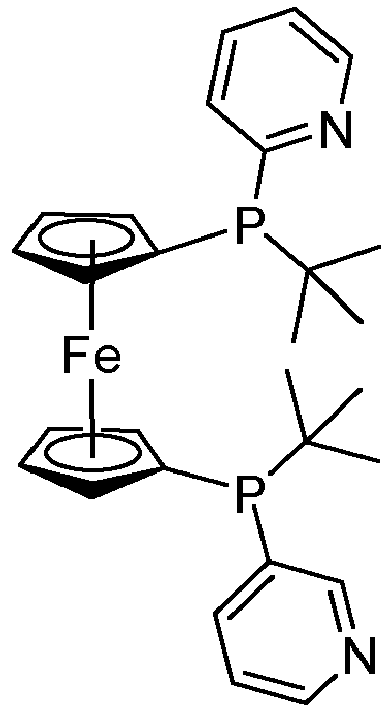
79 95 VII 2,6-Bis(di-tert-butylphosphinomethyl)pyridin 
81 99 - An Tabelle 4 ist zu erkennen, dass einer Steigerung des Liganden Rückhalts im selben Maße für Schwefelsäure stattfindet.
Claims (15)
- Verfahren zur Abtrennung eines homogenen Katalysatorsystems, welches zumindest ein Metall der Gruppe 8 bis 10 des Periodensystems der Elemente oder einer Verbindung davon und einen phosphorhaltigen Liganden umfasst, aus eine Reaktionslösung mittels einer Membrantrennung, wodurch das homogene Katalysatorsystem im resultierenden Permeatstrom abgereichert und im resultierenden Retentatstrom angereichert wird, wobei
mindestens eine Komponente des homogenen Katalysatorsystems mindestens eine saure oder basische funktionelle Gruppe, vorzugsweise eine basische funktionelle Gruppe umfasst, dadurch gekennzeichnet, dass
die Reaktionslösung vor der Membrantrennung, für den Fall, dass die mindestens eine abzutrennende Komponente eine basische funktionelle Gruppe aufweist, eine Säure in einer Menge von ≥ 0,1 Gew.-%, vorzugsweise in einer Menge von ≥ 0,1 Gew.-% und < 5 Gew.-%, bezogen auf das Gesamtgewicht des Gemisches enthält oder, für den Fall, dass die mindestens eine abzutrennende Komponente eine saure funktionelle Gruppe aufweist, eine Base in einer Menge von ≥ 0,1 Gew.-%, vorzugsweise in einer Menge von ≥ 0,1 Gew.-% und < 5 Gew.-%, bezogen auf das Gesamtgewicht des Gemisches enthält. - Verfahren nach Anspruch 1, wobei die Säure oder die Base in einer Menge von ≥ 0,1 Gew.-% und < 5 Gew.-% zum Gemisch hinzugefügt wird.
- Verfahren nach Anspruch 1 oder 2, wobei die Säure eine Brönsted-Säure mit einem pKs ≤ 5, vorzugsweise mit einem pKs ≤ 3 oder eine Lewis-Säure mit einem LAU-Wert von mehr als 25, vorzugsweise mit einem LAU-Wert von 29 ist
- Verfahren nach einem der vorhergehenden Ansprüche, wobei die Säure eine Brönsted- oder Lewis-Säure ist, wobei die Brönsted-Säure Perchlorsäure, Schwefelsäure, Phosphorsäure, Methylphosphonsäure oder eine Sulfonsäure ist und wobei die Lewis-Säure Aluminiumtriflat, Aluminiumchlorid, Aluminiumhydrid, Trimethylaluminium, Tris(pentafluorophenyl)boran, Bortrifluorid, Bortrichlorid, Titan(IV)-isopropoxid, Bu2SnO, BuSn(O)OH oder eine Mischung davon ist..
- Verfahren nach einem der vorhergehenden Ansprüche, wobei die Base aus der Gruppe, bestehend aus Alkalimetallen, Alkalialkoxiden, Alkali- oder Erdalkaliacetaten, Alkali- oder Erdalkalioxiden, Alkali- oder Erdalkalialkoholaten, wie NaEtOH oder MgEtOH, und Alkalicarbonaten, wie K2CO3 oder Cs2CO3, ausgewählt wird.
- Verfahren nach einem der vorhergehenden Ansprüche, wobei der phosphorhaltige Ligand des homogenen Katalysatorsystems eine Mono- oder Bidentat-Struktur aufweist.
- Verfahren nach einem der vorhergehenden Ansprüche, wobei der phosphorhaltige Ligand benzolbasierte Diphosphinverbindung ist.
- Verfahren nach einem der vorhergehenden Ansprüche, wobei bei der Membrantrennung ein keramisches Membranmaterial eingesetzt wird.
- Verfahren nach Anspruch 8, wobei das keramische Membranmaterial Aluminiumoxid, SiO2, TiO2, ZrO2 oder Mischungen dieser Materialien umfasst oder daraus besteht.
- Verfahren nach einem der vorhergehenden Ansprüche, wobei bei der Membrantrennung ein polymerbasiertes Membranmaterial eingesetzt wird und, wobei das polymerbasierte Membranmaterial zumindest eine trennaktive Schicht aufweist.
- Verfahren nach Anspruch 10, wobei das polymerbasierte Membranmaterial als trennaktive Schicht ein Material umfasst, welches aus der Gruppe, bestehend aus Polyimid (PI), Polydimethylsiloxan (PDMS), Polyetherimid (PEI), Poly(2,6-dimethyl-1,4-phenyleneoxid (PPO), Polyvinylalkohol (PVA), Polyacrylsäure (PAA), Polyurethane (PU), Poly(1-trimethylsilyl-1-propyne) (PTMSP), Polybenzimidazole (PBI), Polydicyclopentadiene (pDCPD), Polyaryetherketone (PAEK) und Mischungen dieser Materialien ausgewählt ist.
- Verfahren nach Anspruch 10 oder 11, wobei die trennaktive Schicht aus einem PAEK-Polymer besteht.
- Verfahren nach Anspruch 12, wobei die trennaktive Schicht aus PEEK besteht, vorzugsweise mit einem Sulfonierungsgrad von weniger als 20%, vorzugsweise weniger als 10%.
- Verfahren nach einem der vorhergehenden Ansprüche, wobei bei der Alkoxycarbonylierung ein C2- bis C20-Kohlenwasserstoff und mit mindestens einer olefinischen Doppelbindung mit einem Alkohol und Kohlenmonoxid in Anwesenheit des homogenen Katalysatorsystems umgesetzt wird.
- Verfahren nach Anspruch 14, wobei der bei Alkoxycarbonylierung eingesetzte Alkohol ein Mono- oder Polyalkohol (zwei oder mehr OH-Gruppen) mit 1 bis 50 Kohlenstoffatomen oder eine Mischung aus zwei oder mehr Mono- und/oder Polyalkoholen ist
Applications Claiming Priority (1)
| Application Number | Priority Date | Filing Date | Title |
|---|---|---|---|
| EP19179573 | 2019-06-12 |
Publications (2)
| Publication Number | Publication Date |
|---|---|
| EP3750627A1 true EP3750627A1 (de) | 2020-12-16 |
| EP3750627B1 EP3750627B1 (de) | 2024-01-03 |
Family
ID=67003182
Family Applications (1)
| Application Number | Title | Priority Date | Filing Date |
|---|---|---|---|
| EP20178709.0A Active EP3750627B1 (de) | 2019-06-12 | 2020-06-08 | Verfahren zur abtrennung von einer oder mehreren komponente(n) aus einem gemisch |
Country Status (3)
| Country | Link |
|---|---|
| US (1) | US12064755B2 (de) |
| EP (1) | EP3750627B1 (de) |
| CN (1) | CN112246103B (de) |
Families Citing this family (6)
| Publication number | Priority date | Publication date | Assignee | Title |
|---|---|---|---|---|
| US11396488B2 (en) | 2020-07-30 | 2022-07-26 | Evonik Operations Gmbh | Process for preparing aldehydes and separation of the catalyst system by membrane separation |
| US12296301B2 (en) | 2020-12-22 | 2025-05-13 | Evonik Oxeno Gmbh & Co. Kg | Variable, self-regulating permeate recycling in organophilic nanofiltration |
| US11806669B2 (en) | 2020-12-22 | 2023-11-07 | Evonik Operations Gmbh | Variable and self-regulating permeate recycling in organophilic nanofiltration |
| EP4091712B1 (de) | 2021-05-18 | 2024-05-15 | Evonik Oxeno GmbH & Co. KG | Verfahren zur regenerierung eines katalysators für die hydroformylierung von olefinen in der gasphase |
| EP4197622A1 (de) * | 2021-12-20 | 2023-06-21 | Evonik Operations GmbH | Membranen aus polyaryletherketonen auf unterstrukturen aus polyaryletherketonen und deren verwendung in der abtrennung homogener katalysatoren |
| EP4197623A1 (de) * | 2021-12-20 | 2023-06-21 | Evonik Operations GmbH | Verfahren zur herstellung eines esters und abtrennung des homogenen katalysatorsystems unter verwendung einer membran umfassend eine trennaktive schicht aus paek und einer unterstruktur, die paek umfasst |
Citations (8)
| Publication number | Priority date | Publication date | Assignee | Title |
|---|---|---|---|---|
| EP0823282A2 (de) * | 1996-05-15 | 1998-02-11 | Hoechst Aktiengesellschaft | Verfahren zur Herstellung von Aldehyden |
| US5786517A (en) * | 1995-12-06 | 1998-07-28 | Union Carbide Chemicals & Plastics Technology Corporation | Metal-ligand complex catalyzed processes |
| US5789625A (en) * | 1995-12-06 | 1998-08-04 | Union Carbide Chemicals & Plastics Technology Corporation | Metal-ligand complex catalyzed processes |
| DE102009001230A1 (de) * | 2009-02-27 | 2010-09-02 | Evonik Oxeno Gmbh | Verfahren zur Abtrennung und teilweiser Rückführung von Übergangsmetallen bzw. deren katalytisch wirksamen Komplexverbindungen aus Prozessströmen |
| WO2013107902A1 (en) * | 2012-01-20 | 2013-07-25 | Dsm Ip Assets B.V. | Process for the separation of a dissolved catalyst system from an alkoxycarbonylation reaction mixture |
| DE102013107911A1 (de) | 2013-07-24 | 2015-01-29 | Technische Universität Dortmund | Verbesserung der Trenneigenschaften von Membranen durch gezielte Lösungsmittelzugabe zum verwendeten Standardlösungsmittel |
| WO2015110843A1 (en) | 2014-01-27 | 2015-07-30 | Imperial Innovations Limited | Nanofiltration membrane |
| EP3121184A2 (de) | 2015-07-23 | 2017-01-25 | Evonik Degussa GmbH | Benzolbasierte diphosphinliganden für die alkoxycarbonylierung |
Family Cites Families (24)
| Publication number | Priority date | Publication date | Assignee | Title |
|---|---|---|---|---|
| DE19619527A1 (de) | 1996-05-15 | 1997-11-20 | Hoechst Ag | Katalysatorsysteme auf der Basis von Rhodium-Komplexverbindungen mit Diphosphin-Liganden und ihre Verwendung bei der Herstellung von Aldehyden |
| CA2204676A1 (en) | 1996-05-15 | 1997-11-15 | Helmut Bahrmann | Process for preparing aldehydes |
| DE10308110A1 (de) * | 2003-02-26 | 2004-09-23 | Hermsdorfer Institut Für Technische Keramik E.V. | Keramische Nanofiltrationsmembran für die Verwendung in organischen Lösungsmitteln und Verfahren zu deren Herstellung |
| WO2004099299A2 (en) * | 2003-05-05 | 2004-11-18 | Porogen Corporation | Porous poly(aryl ether ketone) membranes, processes for their preparation and use thereof |
| US20090012323A1 (en) | 2007-07-02 | 2009-01-08 | Sasol Technology (Proprietary) Limited | Production of detergent range alcohols |
| CN101648971A (zh) | 2009-08-20 | 2010-02-17 | 南通江山农药化工股份有限公司 | 一种利用膜技术浓缩分离草甘膦母液中草甘膦的方法 |
| EP2799465A1 (de) | 2013-04-29 | 2014-11-05 | Evonik Industries AG | Verfahren zur Aufreinigung von Poly(arylenethern) |
| DE102014201756A1 (de) | 2014-01-31 | 2015-08-06 | Evonik Degussa Gmbh | Reinigung chlorverschmutzter Organophosphorverbindungen |
| US10155200B2 (en) | 2015-02-18 | 2018-12-18 | Evonik Degussa Gmbh | Separation off of a homogeneous catalyst from a reaction mixture with the help of organophilic nanofiltration |
| SG10201601501QA (en) | 2015-03-05 | 2016-10-28 | Evonik Degussa Gmbh | Preparation of 2,2`-biaryls in the presence of molybdenum(v) chloride |
| EP3246303B8 (de) | 2016-05-19 | 2020-01-01 | Evonik Operations GmbH | Herstellung von n-pentanal aus butenarmen einsatzstoffgemischen |
| EP3263557A1 (de) * | 2016-06-30 | 2018-01-03 | Evonik Degussa GmbH | Verfahren zur reaktivierung eines homogenen oxidationskatalysators |
| US10245578B2 (en) | 2016-11-09 | 2019-04-02 | Evonik Degussa Gmbh | Chromium- and nickel-free hydrogenation of hydroformylation mixtures |
| DE102017208303A1 (de) * | 2017-05-17 | 2018-11-22 | Evonik Röhm Gmbh | Verfahren zur Herstellung eines homogenen Katalysators für die Tischtschenko-Reaktion |
| ZA201808003B (en) | 2017-12-01 | 2019-08-28 | Evonik Degussa Gmbh | Method for obtaining alcohols from aldehydes ii |
| TWI784094B (zh) | 2017-12-01 | 2022-11-21 | 德商贏創運營有限公司 | 自醛獲得醇之方法iii |
| ZA201808002B (en) | 2017-12-01 | 2019-08-28 | Evonik Degussa Gmbh | Method for obtaining alcohols from aldehydes |
| US10850261B2 (en) | 2018-03-14 | 2020-12-01 | Evonik Operations Gmbh | Oligomerization catalyst and process for the production thereof |
| US10882027B2 (en) | 2018-03-14 | 2021-01-05 | Evonik Operations Gmbh | Process for producing an oligomerization catalyst |
| US11253844B2 (en) | 2018-03-14 | 2022-02-22 | Evonik Operations Gmbh | Oligomerization catalyst and process for the production thereof |
| US10633302B2 (en) | 2018-07-25 | 2020-04-28 | Evonik Operations Gmbh | Process for oligomerization of butene with determination of the proportion of acidic catalysis |
| US10654784B2 (en) | 2018-10-05 | 2020-05-19 | Evonik Operations Gmbh | Process for hydroformylating short-chain olefins in the gas phase |
| US10647650B2 (en) | 2018-10-05 | 2020-05-12 | Evonik Operations Gmbh | Process for hydroformylating short-chain olefins using a heterogenized catalyst system without ionic liquid |
| CN109647527B (zh) * | 2018-12-12 | 2020-10-23 | 北京科技大学 | 一种报废铑均相催化剂再生利用的方法 |
-
2020
- 2020-06-01 US US16/888,925 patent/US12064755B2/en active Active
- 2020-06-08 EP EP20178709.0A patent/EP3750627B1/de active Active
- 2020-06-11 CN CN202010528506.5A patent/CN112246103B/zh active Active
Patent Citations (8)
| Publication number | Priority date | Publication date | Assignee | Title |
|---|---|---|---|---|
| US5786517A (en) * | 1995-12-06 | 1998-07-28 | Union Carbide Chemicals & Plastics Technology Corporation | Metal-ligand complex catalyzed processes |
| US5789625A (en) * | 1995-12-06 | 1998-08-04 | Union Carbide Chemicals & Plastics Technology Corporation | Metal-ligand complex catalyzed processes |
| EP0823282A2 (de) * | 1996-05-15 | 1998-02-11 | Hoechst Aktiengesellschaft | Verfahren zur Herstellung von Aldehyden |
| DE102009001230A1 (de) * | 2009-02-27 | 2010-09-02 | Evonik Oxeno Gmbh | Verfahren zur Abtrennung und teilweiser Rückführung von Übergangsmetallen bzw. deren katalytisch wirksamen Komplexverbindungen aus Prozessströmen |
| WO2013107902A1 (en) * | 2012-01-20 | 2013-07-25 | Dsm Ip Assets B.V. | Process for the separation of a dissolved catalyst system from an alkoxycarbonylation reaction mixture |
| DE102013107911A1 (de) | 2013-07-24 | 2015-01-29 | Technische Universität Dortmund | Verbesserung der Trenneigenschaften von Membranen durch gezielte Lösungsmittelzugabe zum verwendeten Standardlösungsmittel |
| WO2015110843A1 (en) | 2014-01-27 | 2015-07-30 | Imperial Innovations Limited | Nanofiltration membrane |
| EP3121184A2 (de) | 2015-07-23 | 2017-01-25 | Evonik Degussa GmbH | Benzolbasierte diphosphinliganden für die alkoxycarbonylierung |
Non-Patent Citations (1)
| Title |
|---|
| J. DA SILVA BURGAL ET AL., JOURNAL OF MEMBRANE SCIENCE, vol. 479, 2015, pages 105 - 116 |
Also Published As
| Publication number | Publication date |
|---|---|
| EP3750627B1 (de) | 2024-01-03 |
| CN112246103B (zh) | 2024-06-11 |
| US20200391194A1 (en) | 2020-12-17 |
| US12064755B2 (en) | 2024-08-20 |
| CN112246103A (zh) | 2021-01-22 |
Similar Documents
| Publication | Publication Date | Title |
|---|---|---|
| EP3750627B1 (de) | Verfahren zur abtrennung von einer oder mehreren komponente(n) aus einem gemisch | |
| EP3750620B1 (de) | Verfahren zur herstellung eines esters durch alkoxycarbonylierung | |
| EP1931472B1 (de) | Verfahren zur abtrennung von organischen übergangsmetallkomplexkatalysatoren | |
| EP2401078B1 (de) | Verfahren zur anreicherung eines homogenkatalysators aus einem prozessstrom | |
| EP3750866A1 (de) | Verfahren zur herstellung eines alkohols aus kohlenwasserstoffen | |
| EP3027298B1 (de) | Membrankaskade mit sinkender trenntemperatur | |
| EP2935187B1 (de) | Steuerung der viskosität von reaktionslösungen in hydroformylierungverfahren | |
| EP2817284B1 (de) | Verfahren und vorrichtung zur hydroformylierung von isobuten und zum auftrennen des produktgemisches | |
| EP3060334B1 (de) | Strahlschlaufenreaktor mit nanofiltration und gasseparator | |
| DE3546323A1 (de) | Wasserfreie membran zur kohlenwasserstofftrennung, verfahren zu ihrer herstellung und ihre verwendung | |
| DE69412595T2 (de) | Methode zur trennung eines katalysators von einem hydroformylierungs-reaktionsprodukt unter anwendung alkylierter liganden | |
| DE102013208759A1 (de) | Abtrennung von Homogenkatalysatoren mittels einer geregelten Membrantrenneinheit | |
| EP0811424A2 (de) | Katalysatorsysteme auf der Basis von Rhodium-Komplex-verbindungen mit Diphosphin-Liganden und ihre Verwendung bei der Herstellung von Aldehyden | |
| EP3068533A1 (de) | Immobilisierte katalytisch aktive zusammensetzung mit tridentaten phosphorliganden in einer ionischen flüssigkeit zur hydroformylierung von olefinhaltigen gemischen | |
| EP3038751B1 (de) | Geträgerte zusammensetzung und deren verwendung in verfahren zur hydroformylierung von ungesättigten verbindungen | |
| DE68904442T2 (de) | Hydroformylierung von wässrigem Formaldehyd mit einem Rhodium-tricyclohexylphosphin enthaltenden Katalysator. | |
| EP4197623A1 (de) | Verfahren zur herstellung eines esters und abtrennung des homogenen katalysatorsystems unter verwendung einer membran umfassend eine trennaktive schicht aus paek und einer unterstruktur, die paek umfasst | |
| DE102015207553A1 (de) | Partikuläres Poly-3-hydroxypropionat und Verfahren zu dessen Fällung | |
| EP4197992A1 (de) | Verfahren zur herstellung eines alkohols und abtrennung des homogenen katalysatorsystems unter verwendung einer membran umfassend eine trennaktive schicht aus paek und einer unterstruktur, die paek umfasst | |
| EP4389731B1 (de) | Verfahren zur aktivitätserhaltung bei der abstellung der hydroformylierung | |
| DE102014002103B4 (de) | Verfahren zur Regenerierung gebrauchter Hydroformylierungskatalysatoren | |
| EP4198014A1 (de) | Verfahren zur herstellung von carbonsäuren oder deren salzen und abtrennung des homogenen katalysatorsystems unter verwendung einer membran umfassend eine trennaktive schicht aus paek und einer unterstruktur, die paek umfasst | |
| EP4574804A1 (de) | Verfahren zur umsetzung von dibuten mit vorheriger destillation | |
| EP0054699A2 (de) | Verfahren zur katalytischen Hydrogenolyse von p-substituierten Benzaldehyd-dimethylacetalen zu den entsprechenden Benzylmethyl-ether-Derivaten | |
| DE102005060784A1 (de) | Verfahren zur Rückgewinnung eines an Hydroformylierungskatalysator angereicherten Stroms |
Legal Events
| Date | Code | Title | Description |
|---|---|---|---|
| PUAI | Public reference made under article 153(3) epc to a published international application that has entered the european phase |
Free format text: ORIGINAL CODE: 0009012 |
|
| STAA | Information on the status of an ep patent application or granted ep patent |
Free format text: STATUS: REQUEST FOR EXAMINATION WAS MADE |
|
| 17P | Request for examination filed |
Effective date: 20200608 |
|
| AK | Designated contracting states |
Kind code of ref document: A1 Designated state(s): AL AT BE BG CH CY CZ DE DK EE ES FI FR GB GR HR HU IE IS IT LI LT LU LV MC MK MT NL NO PL PT RO RS SE SI SK SM TR |
|
| AX | Request for extension of the european patent |
Extension state: BA ME |
|
| STAA | Information on the status of an ep patent application or granted ep patent |
Free format text: STATUS: EXAMINATION IS IN PROGRESS |
|
| 17Q | First examination report despatched |
Effective date: 20220825 |
|
| GRAP | Despatch of communication of intention to grant a patent |
Free format text: ORIGINAL CODE: EPIDOSNIGR1 |
|
| STAA | Information on the status of an ep patent application or granted ep patent |
Free format text: STATUS: GRANT OF PATENT IS INTENDED |
|
| INTG | Intention to grant announced |
Effective date: 20230918 |
|
| GRAS | Grant fee paid |
Free format text: ORIGINAL CODE: EPIDOSNIGR3 |
|
| RAP1 | Party data changed (applicant data changed or rights of an application transferred) |
Owner name: EVONIK OXENO GMBH & CO. KG |
|
| GRAA | (expected) grant |
Free format text: ORIGINAL CODE: 0009210 |
|
| STAA | Information on the status of an ep patent application or granted ep patent |
Free format text: STATUS: THE PATENT HAS BEEN GRANTED |
|
| AK | Designated contracting states |
Kind code of ref document: B1 Designated state(s): AL AT BE BG CH CY CZ DE DK EE ES FI FR GB GR HR HU IE IS IT LI LT LU LV MC MK MT NL NO PL PT RO RS SE SI SK SM TR |
|
| REG | Reference to a national code |
Ref country code: GB Ref legal event code: FG4D Free format text: NOT ENGLISH |
|
| REG | Reference to a national code |
Ref country code: DE Ref legal event code: R096 Ref document number: 502020006578 Country of ref document: DE |
|
| REG | Reference to a national code |
Ref country code: CH Ref legal event code: EP |
|
| P01 | Opt-out of the competence of the unified patent court (upc) registered |
Effective date: 20231219 |
|
| REG | Reference to a national code |
Ref country code: IE Ref legal event code: FG4D Free format text: LANGUAGE OF EP DOCUMENT: GERMAN |
|
| REG | Reference to a national code |
Ref country code: NL Ref legal event code: FP |
|
| REG | Reference to a national code |
Ref country code: LT Ref legal event code: MG9D |
|
| PG25 | Lapsed in a contracting state [announced via postgrant information from national office to epo] |
Ref country code: ES Free format text: LAPSE BECAUSE OF FAILURE TO SUBMIT A TRANSLATION OF THE DESCRIPTION OR TO PAY THE FEE WITHIN THE PRESCRIBED TIME-LIMIT Effective date: 20240103 |
|
| PG25 | Lapsed in a contracting state [announced via postgrant information from national office to epo] |
Ref country code: ES Free format text: LAPSE BECAUSE OF FAILURE TO SUBMIT A TRANSLATION OF THE DESCRIPTION OR TO PAY THE FEE WITHIN THE PRESCRIBED TIME-LIMIT Effective date: 20240103 |
|
| PG25 | Lapsed in a contracting state [announced via postgrant information from national office to epo] |
Ref country code: IS Free format text: LAPSE BECAUSE OF FAILURE TO SUBMIT A TRANSLATION OF THE DESCRIPTION OR TO PAY THE FEE WITHIN THE PRESCRIBED TIME-LIMIT Effective date: 20240503 |
|
| PG25 | Lapsed in a contracting state [announced via postgrant information from national office to epo] |
Ref country code: LT Free format text: LAPSE BECAUSE OF FAILURE TO SUBMIT A TRANSLATION OF THE DESCRIPTION OR TO PAY THE FEE WITHIN THE PRESCRIBED TIME-LIMIT Effective date: 20240103 |
|
| PG25 | Lapsed in a contracting state [announced via postgrant information from national office to epo] |
Ref country code: GR Free format text: LAPSE BECAUSE OF FAILURE TO SUBMIT A TRANSLATION OF THE DESCRIPTION OR TO PAY THE FEE WITHIN THE PRESCRIBED TIME-LIMIT Effective date: 20240404 |
|
| PG25 | Lapsed in a contracting state [announced via postgrant information from national office to epo] |
Ref country code: RS Free format text: LAPSE BECAUSE OF FAILURE TO SUBMIT A TRANSLATION OF THE DESCRIPTION OR TO PAY THE FEE WITHIN THE PRESCRIBED TIME-LIMIT Effective date: 20240403 Ref country code: HR Free format text: LAPSE BECAUSE OF FAILURE TO SUBMIT A TRANSLATION OF THE DESCRIPTION OR TO PAY THE FEE WITHIN THE PRESCRIBED TIME-LIMIT Effective date: 20240103 |
|
| PG25 | Lapsed in a contracting state [announced via postgrant information from national office to epo] |
Ref country code: CZ Free format text: LAPSE BECAUSE OF FAILURE TO SUBMIT A TRANSLATION OF THE DESCRIPTION OR TO PAY THE FEE WITHIN THE PRESCRIBED TIME-LIMIT Effective date: 20240103 |
|
| PG25 | Lapsed in a contracting state [announced via postgrant information from national office to epo] |
Ref country code: RS Free format text: LAPSE BECAUSE OF FAILURE TO SUBMIT A TRANSLATION OF THE DESCRIPTION OR TO PAY THE FEE WITHIN THE PRESCRIBED TIME-LIMIT Effective date: 20240403 Ref country code: NO Free format text: LAPSE BECAUSE OF FAILURE TO SUBMIT A TRANSLATION OF THE DESCRIPTION OR TO PAY THE FEE WITHIN THE PRESCRIBED TIME-LIMIT Effective date: 20240403 Ref country code: LT Free format text: LAPSE BECAUSE OF FAILURE TO SUBMIT A TRANSLATION OF THE DESCRIPTION OR TO PAY THE FEE WITHIN THE PRESCRIBED TIME-LIMIT Effective date: 20240103 Ref country code: IS Free format text: LAPSE BECAUSE OF FAILURE TO SUBMIT A TRANSLATION OF THE DESCRIPTION OR TO PAY THE FEE WITHIN THE PRESCRIBED TIME-LIMIT Effective date: 20240503 Ref country code: HR Free format text: LAPSE BECAUSE OF FAILURE TO SUBMIT A TRANSLATION OF THE DESCRIPTION OR TO PAY THE FEE WITHIN THE PRESCRIBED TIME-LIMIT Effective date: 20240103 Ref country code: GR Free format text: LAPSE BECAUSE OF FAILURE TO SUBMIT A TRANSLATION OF THE DESCRIPTION OR TO PAY THE FEE WITHIN THE PRESCRIBED TIME-LIMIT Effective date: 20240404 Ref country code: CZ Free format text: LAPSE BECAUSE OF FAILURE TO SUBMIT A TRANSLATION OF THE DESCRIPTION OR TO PAY THE FEE WITHIN THE PRESCRIBED TIME-LIMIT Effective date: 20240103 Ref country code: BG Free format text: LAPSE BECAUSE OF FAILURE TO SUBMIT A TRANSLATION OF THE DESCRIPTION OR TO PAY THE FEE WITHIN THE PRESCRIBED TIME-LIMIT Effective date: 20240103 |
|
| PG25 | Lapsed in a contracting state [announced via postgrant information from national office to epo] |
Ref country code: PT Free format text: LAPSE BECAUSE OF FAILURE TO SUBMIT A TRANSLATION OF THE DESCRIPTION OR TO PAY THE FEE WITHIN THE PRESCRIBED TIME-LIMIT Effective date: 20240503 Ref country code: PL Free format text: LAPSE BECAUSE OF FAILURE TO SUBMIT A TRANSLATION OF THE DESCRIPTION OR TO PAY THE FEE WITHIN THE PRESCRIBED TIME-LIMIT Effective date: 20240103 |
|
| PG25 | Lapsed in a contracting state [announced via postgrant information from national office to epo] |
Ref country code: SE Free format text: LAPSE BECAUSE OF FAILURE TO SUBMIT A TRANSLATION OF THE DESCRIPTION OR TO PAY THE FEE WITHIN THE PRESCRIBED TIME-LIMIT Effective date: 20240103 Ref country code: PT Free format text: LAPSE BECAUSE OF FAILURE TO SUBMIT A TRANSLATION OF THE DESCRIPTION OR TO PAY THE FEE WITHIN THE PRESCRIBED TIME-LIMIT Effective date: 20240503 Ref country code: PL Free format text: LAPSE BECAUSE OF FAILURE TO SUBMIT A TRANSLATION OF THE DESCRIPTION OR TO PAY THE FEE WITHIN THE PRESCRIBED TIME-LIMIT Effective date: 20240103 Ref country code: LV Free format text: LAPSE BECAUSE OF FAILURE TO SUBMIT A TRANSLATION OF THE DESCRIPTION OR TO PAY THE FEE WITHIN THE PRESCRIBED TIME-LIMIT Effective date: 20240103 |
|
| REG | Reference to a national code |
Ref country code: DE Ref legal event code: R097 Ref document number: 502020006578 Country of ref document: DE |
|
| PG25 | Lapsed in a contracting state [announced via postgrant information from national office to epo] |
Ref country code: DK Free format text: LAPSE BECAUSE OF FAILURE TO SUBMIT A TRANSLATION OF THE DESCRIPTION OR TO PAY THE FEE WITHIN THE PRESCRIBED TIME-LIMIT Effective date: 20240103 |
|
| PG25 | Lapsed in a contracting state [announced via postgrant information from national office to epo] |
Ref country code: SM Free format text: LAPSE BECAUSE OF FAILURE TO SUBMIT A TRANSLATION OF THE DESCRIPTION OR TO PAY THE FEE WITHIN THE PRESCRIBED TIME-LIMIT Effective date: 20240103 |
|
| PG25 | Lapsed in a contracting state [announced via postgrant information from national office to epo] |
Ref country code: EE Free format text: LAPSE BECAUSE OF FAILURE TO SUBMIT A TRANSLATION OF THE DESCRIPTION OR TO PAY THE FEE WITHIN THE PRESCRIBED TIME-LIMIT Effective date: 20240103 |
|
| PG25 | Lapsed in a contracting state [announced via postgrant information from national office to epo] |
Ref country code: SK Free format text: LAPSE BECAUSE OF FAILURE TO SUBMIT A TRANSLATION OF THE DESCRIPTION OR TO PAY THE FEE WITHIN THE PRESCRIBED TIME-LIMIT Effective date: 20240103 |
|
| PG25 | Lapsed in a contracting state [announced via postgrant information from national office to epo] |
Ref country code: SM Free format text: LAPSE BECAUSE OF FAILURE TO SUBMIT A TRANSLATION OF THE DESCRIPTION OR TO PAY THE FEE WITHIN THE PRESCRIBED TIME-LIMIT Effective date: 20240103 Ref country code: SK Free format text: LAPSE BECAUSE OF FAILURE TO SUBMIT A TRANSLATION OF THE DESCRIPTION OR TO PAY THE FEE WITHIN THE PRESCRIBED TIME-LIMIT Effective date: 20240103 Ref country code: RO Free format text: LAPSE BECAUSE OF FAILURE TO SUBMIT A TRANSLATION OF THE DESCRIPTION OR TO PAY THE FEE WITHIN THE PRESCRIBED TIME-LIMIT Effective date: 20240103 Ref country code: EE Free format text: LAPSE BECAUSE OF FAILURE TO SUBMIT A TRANSLATION OF THE DESCRIPTION OR TO PAY THE FEE WITHIN THE PRESCRIBED TIME-LIMIT Effective date: 20240103 Ref country code: DK Free format text: LAPSE BECAUSE OF FAILURE TO SUBMIT A TRANSLATION OF THE DESCRIPTION OR TO PAY THE FEE WITHIN THE PRESCRIBED TIME-LIMIT Effective date: 20240103 |
|
| PLBE | No opposition filed within time limit |
Free format text: ORIGINAL CODE: 0009261 |
|
| STAA | Information on the status of an ep patent application or granted ep patent |
Free format text: STATUS: NO OPPOSITION FILED WITHIN TIME LIMIT |
|
| PG25 | Lapsed in a contracting state [announced via postgrant information from national office to epo] |
Ref country code: IT Free format text: LAPSE BECAUSE OF FAILURE TO SUBMIT A TRANSLATION OF THE DESCRIPTION OR TO PAY THE FEE WITHIN THE PRESCRIBED TIME-LIMIT Effective date: 20240103 |
|
| 26N | No opposition filed |
Effective date: 20241007 |
|
| PG25 | Lapsed in a contracting state [announced via postgrant information from national office to epo] |
Ref country code: IT Free format text: LAPSE BECAUSE OF FAILURE TO SUBMIT A TRANSLATION OF THE DESCRIPTION OR TO PAY THE FEE WITHIN THE PRESCRIBED TIME-LIMIT Effective date: 20240103 |
|
| PG25 | Lapsed in a contracting state [announced via postgrant information from national office to epo] |
Ref country code: MC Free format text: LAPSE BECAUSE OF FAILURE TO SUBMIT A TRANSLATION OF THE DESCRIPTION OR TO PAY THE FEE WITHIN THE PRESCRIBED TIME-LIMIT Effective date: 20240103 |
|
| REG | Reference to a national code |
Ref country code: CH Ref legal event code: PL |
|
| PG25 | Lapsed in a contracting state [announced via postgrant information from national office to epo] |
Ref country code: LU Free format text: LAPSE BECAUSE OF NON-PAYMENT OF DUE FEES Effective date: 20240608 |
|
| GBPC | Gb: european patent ceased through non-payment of renewal fee |
Effective date: 20240608 |
|
| PG25 | Lapsed in a contracting state [announced via postgrant information from national office to epo] |
Ref country code: IE Free format text: LAPSE BECAUSE OF NON-PAYMENT OF DUE FEES Effective date: 20240608 |
|
| PG25 | Lapsed in a contracting state [announced via postgrant information from national office to epo] |
Ref country code: CH Free format text: LAPSE BECAUSE OF NON-PAYMENT OF DUE FEES Effective date: 20240630 Ref country code: SI Free format text: LAPSE BECAUSE OF FAILURE TO SUBMIT A TRANSLATION OF THE DESCRIPTION OR TO PAY THE FEE WITHIN THE PRESCRIBED TIME-LIMIT Effective date: 20240103 |
|
| PG25 | Lapsed in a contracting state [announced via postgrant information from national office to epo] |
Ref country code: FR Free format text: LAPSE BECAUSE OF NON-PAYMENT OF DUE FEES Effective date: 20240630 |
|
| PG25 | Lapsed in a contracting state [announced via postgrant information from national office to epo] |
Ref country code: GB Free format text: LAPSE BECAUSE OF NON-PAYMENT OF DUE FEES Effective date: 20240608 |
|
| PGFP | Annual fee paid to national office [announced via postgrant information from national office to epo] |
Ref country code: AT Payment date: 20250721 Year of fee payment: 5 |
|
| PG25 | Lapsed in a contracting state [announced via postgrant information from national office to epo] |
Ref country code: FI Free format text: LAPSE BECAUSE OF FAILURE TO SUBMIT A TRANSLATION OF THE DESCRIPTION OR TO PAY THE FEE WITHIN THE PRESCRIBED TIME-LIMIT Effective date: 20240103 |
|
| PG25 | Lapsed in a contracting state [announced via postgrant information from national office to epo] |
Ref country code: CY Free format text: LAPSE BECAUSE OF FAILURE TO SUBMIT A TRANSLATION OF THE DESCRIPTION OR TO PAY THE FEE WITHIN THE PRESCRIBED TIME-LIMIT; INVALID AB INITIO Effective date: 20200608 |
|
| PG25 | Lapsed in a contracting state [announced via postgrant information from national office to epo] |
Ref country code: HU Free format text: LAPSE BECAUSE OF FAILURE TO SUBMIT A TRANSLATION OF THE DESCRIPTION OR TO PAY THE FEE WITHIN THE PRESCRIBED TIME-LIMIT; INVALID AB INITIO Effective date: 20200608 |
|
| PG25 | Lapsed in a contracting state [announced via postgrant information from national office to epo] |
Ref country code: TR Free format text: LAPSE BECAUSE OF FAILURE TO SUBMIT A TRANSLATION OF THE DESCRIPTION OR TO PAY THE FEE WITHIN THE PRESCRIBED TIME-LIMIT Effective date: 20240103 |
|
| PGFP | Annual fee paid to national office [announced via postgrant information from national office to epo] |
Ref country code: DE Payment date: 20260622 Year of fee payment: 7 |
|
| PGFP | Annual fee paid to national office [announced via postgrant information from national office to epo] |
Ref country code: BE Payment date: 20260618 Year of fee payment: 7 |
|
| PGFP | Annual fee paid to national office [announced via postgrant information from national office to epo] |
Ref country code: NL Payment date: 20260618 Year of fee payment: 7 |
|
| PG25 | Lapsed in a contracting state [announced via postgrant information from national office to epo] |
Ref country code: AT Free format text: LAPSE BECAUSE OF NON-PAYMENT OF DUE FEES Effective date: 20250608 |