EP3749508B1 - Attachment for sealing seams - Google Patents
Attachment for sealing seams Download PDFInfo
- Publication number
- EP3749508B1 EP3749508B1 EP19748424.9A EP19748424A EP3749508B1 EP 3749508 B1 EP3749508 B1 EP 3749508B1 EP 19748424 A EP19748424 A EP 19748424A EP 3749508 B1 EP3749508 B1 EP 3749508B1
- Authority
- EP
- European Patent Office
- Prior art keywords
- rollers
- attachment
- polymer
- fabric members
- seam
- Prior art date
- Legal status (The legal status is an assumption and is not a legal conclusion. Google has not performed a legal analysis and makes no representation as to the accuracy of the status listed.)
- Active
Links
Images




Classifications
-
- D—TEXTILES; PAPER
- D05—SEWING; EMBROIDERING; TUFTING
- D05B—SEWING
- D05B17/00—Sewing machines for concurrently making thread and welded seams
-
- D—TEXTILES; PAPER
- D05—SEWING; EMBROIDERING; TUFTING
- D05B—SEWING
- D05B1/00—General types of sewing apparatus or machines without mechanism for lateral movement of the needle or the work or both
- D05B1/26—General types of sewing apparatus or machines without mechanism for lateral movement of the needle or the work or both for making fluid-tight seams
-
- D—TEXTILES; PAPER
- D05—SEWING; EMBROIDERING; TUFTING
- D05B—SEWING
- D05B19/00—Program-controlled sewing machines
- D05B19/02—Sewing machines having electronic memory or microprocessor control unit
- D05B19/12—Sewing machines having electronic memory or microprocessor control unit characterised by control of operation of machine
- D05B19/16—Control of workpiece movement, e.g. modulation of travel of feed dog
-
- D—TEXTILES; PAPER
- D05—SEWING; EMBROIDERING; TUFTING
- D05B—SEWING
- D05B35/00—Work-feeding or -handling elements not otherwise provided for
- D05B35/06—Work-feeding or -handling elements not otherwise provided for for attaching bands, ribbons, strips, or tapes or for binding
-
- D—TEXTILES; PAPER
- D05—SEWING; EMBROIDERING; TUFTING
- D05D—INDEXING SCHEME ASSOCIATED WITH SUBCLASSES D05B AND D05C, RELATING TO SEWING, EMBROIDERING AND TUFTING
- D05D2209/00—Use of special materials
- D05D2209/10—Particular use of plastics
-
- D—TEXTILES; PAPER
- D05—SEWING; EMBROIDERING; TUFTING
- D05D—INDEXING SCHEME ASSOCIATED WITH SUBCLASSES D05B AND D05C, RELATING TO SEWING, EMBROIDERING AND TUFTING
- D05D2305/00—Operations on the work before or after sewing
- D05D2305/22—Physico-chemical treatments
- D05D2305/26—Heating
Definitions
- This invention relates to an attachment for an existing sewing machine, including an improved mechanism for pulling fabric members to be sewn to one another using thread comprising a thermoplastic polymer, together with a strip of the same or a different thermoplastic polymer, through a sewing machine while applying heat and pressure thereto, so as to sew the seam and melt the polymer to seal the seam in a single operation.
- the most prevalent method of sealing a sewn seam is to apply a wide tape of thermoplastic polymer with an adhesive layer over a previously sewn seam.
- the garment or other object is supplied to a machine provided with a pair of opposed rollers.
- a polymer substrate on the order of one inch wide with adhesive on one side thereof is heated by a stream of hot air, to activate the adhesive, and is then urged against the seam by the rollers so as to be adhered to the fabric members over the seam as the tape cools, covering the seam.
- This method of seam sealing has many drawbacks, perhaps most notably that it requires the seam to be sealed in a separate operation from the sewing of the seam. Clearly if the seam could be sewn and sealed in a single operation substantial economies would be realized in terms of reduced labor requirements, reduced floor space requirements, and reduced equipment costs.
- the application of the polymer tape also stiffens the seam in ways that can be uncomfortable and restrict the wearer's motion in the case of garments, and adds additional weight.
- Ferreiro US patent application 13/594,415 filed August 24, 2012 claiming priority from provisional application 61/575,602, filed August 24, 2011 , and published as publication No. 2013/0048219 , and in copending continuation application 14/999,320, to issue February 13, 2018 as patent 9,889,598 .
- the Ferreiro applications describe a method for forming a waterproof seam while sewing the seam by employing a thread comprising a quantity of thermoplastic polymer and heating the seam while applying pressure, melting the polymer so as to fill the punctures.
- a strip of thermoplastic polymer can also be inserted between the fabric members during the sewing step and be bonded to the fabric members in the same step of applying heat and pressure, sealing the seam between the thread punctures.
- US patent US 5003902 A discloses a liquid proof seam construction.
- a double needle flat-felled seam is constructed having a melt adhesive polymer film disposed within the seam.
- the seam is then passed through a hot air/pressure device which melts the film and compresses the seam.
- This forms a liquid, e.g. waterproof, bond between adjacent layers of material and also fills up any area around the stitching formed by needle holes.
- Japanese patent JP 2004 208824 A discloses a method of producing a waterproof sewn product, wherein a waterproofed cloth is sewn into a flat felled seam.
- the method comprises: the first step of arranging a thermoplastic polyurethane hot melt film at a part which is between the lapped waterproofed clothes and which becomes a margin part for a seam; the second step of sewing up the waterproofed clothes with each other; and the third step of heating/pressurizing the margin part for the seam of the thermoplastic polyurethane hot melt film for thermally fusing the film.
- the present application relates to improvements in the mechanism and process described in the Ferreiro application, essentially taking it from the "proof-of-concept" status described therein to a fully commercialized device that can be attached readily to various commercial sewing machines.
- One particular improvement relates to the means of application of heat and pressure to seal the seam as it is being sewn.
- One aspect of the present invention is to replace the heated roller opposed to a heated plate or to another heated roller of the Ferriero application with a series of driven heated rollers, typically three, opposed to pairs of heated idler rollers, with a belt disposed over the heated idler rollers, such that the belt urges the fabric members to be joined against the heated driven rollers. This ensures that the fabric members are in contact with the heated driven rollers long enough to ensure effective melting of the polymer, and thereby ensuring that the seam is effectively sealed.
- Another improvement provided according to the present invention is driving the downstream roller slightly faster than the upstream rollers, slightly stretching the fabric while heating the seam, to ensure that the seam remains well-formed after the polymer cools and hardens.
- a typical commercial sewing machine 10 comprises an upright column 12, in which runs a drive belt from a motor (not shown) disposed under a table 14, the motor being controlled by a foot switch 20 or the like, a transverse arm 16, a sewing mechanism 18, including a needle 19 and a presser foot 21 (see Fig. 2 ), a lever 13 for lifting the foot 21 out of engagement with fabric members 7 and 9 to be sewn to one another, and a flywheel 22.
- an attachment 24 is attached to the sewing machine 10 by removing a cover plate (not shown) and assembling the attachment 24 in place of the cover plate.
- the details of this replacement of the cover plate by the attachment will of course vary somewhat from machine to machine; in each case, the attachment is designed so that the rollers (discussed further below) are disposed directly behind needle 19.
- a reel 23 dispensing a strip 25 of an adhesive thermoplastic polymer, and a feeder assembly 27 for directing the polymer strip 25 into the seam being sewn.
- the strip employed according to the invention may typically be 1/8 - 1 ⁇ 4 inch wide by 0.010- 0.020 inches thick, 0.014 inches being preferred.
- the feeder assembly 27 may be provided with a hot air duct and nozzle, to preheat the polymer strip 25 and activate its adhesive properties prior to its being sewn into the seam.
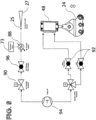
- Fig. 8 shows details of the air system used to preheat the polymer strip 25.
- an electronic control unit 26 which may comprise a touch screen 28 for receiving user input concerning the parameters necessary to control the process of sealing the seam, such as the temperature of heated rollers that apply heat and pressure to the seam to melt the polymer and seal the seam, and a microprocessor 29 (indicated as a component of computer device 26 as "MP") for receiving these user inputs and other data, and for providing control signals to the various components of the attachment.
- Fig. 7 shows a block diagram of this circuitry.
- a magnet 30 (see Fig. 6 ), mechanically affixed to the flywheel 22, and a Hall-effect sensor 32, likewise mechanically affixed to the upright column 12.
- the sewing machine 10 advances the fabric members 7 and 9 to be sewn together incrementally, by the desired length of the stitch, and the presser foot 21 then holds them in place, so that the needle 19 can puncture the fabric members while stationary.
- flywheel 22 is rotated intermittently.
- the attachment of the invention comprises heated rollers 40, 42, and 44 (see Fig. 4 ) that are driven to pull the fabric members through the attachment while applying heat and pressure to the seam so as to melt the polymer and seal the seam.
- the driven rollers In order to function properly, the driven rollers must cease pulling on the fabric members during the stitching process.
- HE a signal that is provided to the microprocessor 29 to control two motors 34 and 36 via signals M1 and M2 ( Figs. 1 and 7 ) that drive the rollers.
- Signal HE is thus used to synchronize the operation of the rollers to the remainder of the sewing machine, so as to avoid distorting the fabric.
- the circuitry connecting the microprocessor 29 to the various components providing and receiving the signals noted is not shown in Fig. 1 , for clarity of the drawing, but will be readily understood and easily implemented by those of skill in the art. As above, Fig. 7 shows a schematic diagram of this circuitry.
- operation of the sewing machine is controlled by a foot pedal 20 or the like, such as a knee- or hand-operated switch operated by an operator.
- a control signal SW from foot pedal 20 is provided to microprocessor 29 which in turn provides a control signal AC to an air cylinder 48.
- the assembly of rollers 40, 42, and 44 and of motors 34 and 36 is carried by air cylinder 48 and is withdrawn upwardly, out of engagement with the fabric members, when operation of the sewing machine 10 is stopped by the operator. At the same time the stream of hot air preheating the strip of polymer 25 is shut off.
- the signals provided by microprocessor 29 also include three control signals H1, H2 and H3 provided to rollers 40, 42 and 44 respectively, to control their surface temperature and thereby the amount of heat applied to the seam. Control of the surface temperature of these rollers is clearly important to obtaining adequate melting of the polymer of the thread and strip to provide good sealing without scorching or burning the fabric.
- the surface temperature of the rollers can be measured directly using infrared sensors, if such can be found that are sufficiently durable, or the temperature can be controlled indirectly using a feedback loop.
- the rollers can be heated using internal cartridge heaters 51. See Fig. 5 . Idler rollers 50 (discussed further below) are likewise heated.
- the cartridge heaters 51 in order that electrical connections can be made to the cartridge heaters 51, they must be stationary, while driven rollers 40, 42 and 46 and idler rollers 50 must rotate freely over heaters 51.
- the heaters 51 are designed to expand when current is applied, typically so as to fit snugly into a hole bored in a volume of material to be heated.
- the cartridge heaters can be disposed in sections 53 of steel tubing, while the rollers may be made of aluminum, bored to be a sliding fit over the steel tubes, and assembled with a small quantity of heat-conducting grease there- between.
- the greater coefficient of thermal expansion of aluminum as compared to that of steel will prevent the heating of the cartridge heaters 51 from interfering with rotation of the rollers.
- the temperatures of the surfaces of the rollers can be measured directly using infrared sensors, if suitably durable components can be found.
- thermocouples can be provided to measure the temperatures of the cartridge heaters 51, and this data used in a well-known proportional-integral-derivative (PID) feedback loop to control the temperatures of the surfaces of the rollers.
- PID proportional-integral-derivative
- Fig. 4 shows an end view of the assembly of driven heated rollers 40, 42 and 44, heated idler rollers 50, and belt 52 in detail;
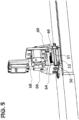
- Figs. 2 , 3 , 5 and 6 show further features provided according to the invention.
- Rollers 50 are carried by a chassis 56 that is assembled to the sewing machine 10, typically by attachment to the hinge (not shown) conventionally provided to allow the sewing machine to be pivoted out of its' “nest” in the sewing machine table 14.
- Fig. 4 is effectively taken from inside chassis 56, so as to show the ends of rollers 50.
- Chassis 56 has an inclined leading surface 56a (see Fig.
- Chassis 56 is preferably spaced from the sewing machine 10 by insulating spacers (not shown) to allow air to pass there between and avoid overheating the sewing machine 10.
- a continuous belt 52 fits over rollers 50 and moves together with the fabric members 7 and 9 to be sewn, which are indicated by a heavy broken line 58 in Fig. 4 .
- Belt 52 rides over a final, unheated roller 60, and is tensioned by springs 54 on either side of the chassis 56, biasing roller 60 (leftwardly in the view of Fig. 4 ) toward the "downstream" end of chassis 56; the degree of tension in belt 52 may be adjusted by provision of differing springs 54, or by adjustment of the preload provided.
- the biasing roller 60 is mounted in a slot 56b in chassis 56, to allow it to move to adjust the tension in belt 52.
- the fabric members 7 and 9 to be bonded to one another are urged by belt 52 into engagement with rollers 40, 42, and 44 along a lower portion of the circumference of each of rollers 40, 42, and 44 between the opposed pairs of idler rollers 50, ensuring good heat transfer between rollers 40, 42, and 46 on the upper side, to the fabric members indicated at 58.
- belt 52 can be made of a composite of fiberglass cloth coated by one or more layers of Teflon ® material.
- the extension of the heat transfer area provided by provision of the belt 52 is highly beneficial in ensuring sufficient heat transfer to effectively melt the polymer materials of the thread 17 and strip 25, and thereby effectively sealing the seam.
- Belt 52 also prevents the fabric members from being tangled in rollers 50.
- the axes of driven rollers 40, 42, and 44 are coplanar, as are those of the idler rollers 50, as illustrated by Fig. 4 .
- the spring tension provided to unheated idler roller 60 by springs 54 will cause roller 60 to move leftwardly, so that belt 52 will take a straight-line path over the upper surfaces of idler rollers 50.
- the driven rollers 40, 42, and 44 are brought back downwardly as sewing resumes, the belt 52 will be forced away from the straight-line path so as to conform to the lower circumferential surfaces of rollers 40, 42, and 44 between the respective pairs of idler rollers 50, taking the form shown in Fig. 4 , while the springs 54 allow the unheated idler roller 60 to move rightwardly in the view of Fig. 4 .
- the heat and pressure provided by the rollers melts the preheated polymer strip 25 and squeezes it laterally, filling the space between the fabric members 7 and 9.
- the practice of the invention will also involve the use of the polymer-laden thread 17 of the Ferriero applications, so that the polymer of the thread 17 is melted at the same time, filling the punctures left by the needle.
- the polymer strip 25 may be avoided and only the thread 17 used.
- the polymers applied to the thread 17 and that of strip 25 may be the same or may differ. As of the filing of this application, experimentation is being performed to identify the optimal materials for these purposes. They may be as disclosed in the Ferreiro application, that is, thermoplastic polyurethane, or possibly materials selected from the group including nylon, polyester, polyolefin and vinyl, and mixtures and combinations thereof. It will be appreciated that these materials have good adhesive properties, so that the seam is strengthened as well as sealed by practice of the invention. The materials used in the prior art seam sealing processes may also be used.
- the polymer is applied to the thread in a bath of molten polymer, so that the polymer is absorbed into the yarns of the thread, followed by passage through a die or the like, squeezing out extra polymer, so the final polymer content of the thread is 2 - 6 % by weight, as in the Ferreiro applications.
- the "upstream" rollers 42 and 44 are driven by motor 36 by way of a first belt 60, while the “downstream” roller 40 is driven separately by motor 34 by way of a second belt 62.
- the motors 34 and 36 are operated responsive to signals M1 and M2 ( Figs. 1 and 7 ) respectively, so that the rollers can be driven at different speeds as desired.
- the downstream roller 40 is driven at a slightly higher speed than the upstream rollers 42 and 44, so as to exert tension on the assembly of fabric members while the polymer is being melted and the seam compressed, ensuring that the seam is properly formed.
- driven rollers 40, 42, and 44 are knurled as illustrated, so as to ensure adequate friction between these surfaces and the fabric members 7 and 9. A coating is applied to produce a non-stick surface.
- An operator-controlled cutter (not shown) may be provided between the rollers 40, 42, and 44 and presser foot 21, to cut the polymer strip 25 at the end of the seam.
- Rollers 40, 42, and 44 are carried by a frame 64 ( Fig. 2 ) that is pivoted transversely at 66 with respect to the moving actuator 68 of air cylinder 48. This pivoting allows the rollers to remain in contact with the fabric members 7 and 9 despite some degree of irregularity in the thickness of the fabric members, such as where several fabric members cross one another.
- the rollers 40, 42, 44 may also be carried on individual suspensions, spring-biased downwardly with respect to frame 64, for similar reasons.
- Fig. 7 is a schematic diagram of the electrical circuitry provided according to the invention.
- an electronic control unit (ECU) 80 which may comprise microprocessor 29 and associated supporting components, including a user interface such as touch screen 26, receives sensor inputs and provides control signals through appropriate interface circuit boards.
- a set of temperature sensors 70 for the lower roller assembly that is, idler rollers 50
- a set of temperature sensors 72 for the driven rollers 40, 42, and 44 and an air process temperature sensor 73 for measuring the temperature of the stream of air preheating the polymer tape 25, each provide temperature data to a sensor input board 74.
- Sensor input board 74 then performs simple operations on the data, for example, analog-to-digital conversion, and provides the results to ECU 80 as indicated at 76.
- the signals responsive to roller temperature may represent direct measurement of the temperature of the rollers or may represent measurement of the temperature of the cartridge heaters 51.
- the temperature measurement signals are used by ECU 80 to generate temperature control signals by way of a well-known proportional-integral-derivative (PID) feedback loop.
- PID proportional-integral-derivative
- These control signals are then provided to a relay control board 82, which uses the control signals from ECU 80 to drive relays on board 82 to control supply of current to the various heating elements, including the lower assembly heating elements 84, that is, the cartridge heaters in idler rollers 50, the upper assembly heating elements 86, that is, the cartridge heaters in driven rollers 40, 42, and 44, and the air process heating element 88, heating the stream of air employed to preheat the polymer tape 25.
- the lower assembly heating elements 84 that is, the cartridge heaters in idler rollers 50
- the upper assembly heating elements 86 that is, the cartridge heaters in driven rollers 40, 42, and 44
- the air process heating element 88 heating the stream of air employed to preheat the polymer tape 25.
- the signal HE from the Hall-effect sensor 32 is provided to the ECU 80 and used to synchronize the operation of drive motors 34 and 36, by way of provision of signals M1 and M2 to a motor control board 84, which directly controls operation of motors 34 and 36.
- These motors may be of any of a variety of types; stepper motors are currently preferred.
- foot switch 20 provides signal SW to ECU 80, thereby indicating that sewing is to start or to stop.
- ECU 80 provides signal AC to relay control board 82, which then operates the air cylinder via solenoid valve(s) 92 to lift the heated driven rollers 40, 42, and 44 out of engagement with the fabric members to be joined, and likewise operates hot air solenoid 90 to cut off the supply of hot air preheating polymer tape 25. While the fabric members 7 and 9 may remain in contact with belt 52 while rollers 40, 42, and 44 are thus withdrawn, out of engagement with fabric members 7 and 9, the fact that no pressure is then being exerted prevents the fabric from being scorched by heat from the idler rollers 50.
- Fig. 8 shows as mentioned a schematic diagram of the pneumatic components employed.
- Compressed air is supplied at 94 and is supplied to a first solenoid valve 90 which controls flow of air for preheating the polymer strip 25.
- the pressure in the supply line is controlled by a regulator 96, and the air is heated by a heater 88.
- the heater is controlled by control unit 80 in response to a signal from sensor 73, as discussed above.
- the hot air impinges on the polymer strip 25 as it exits feeder 27, as illustrated.
- a second stream of air is provided to solenoid valves 92, connected to air cylinder 48 as shown, in order to controllably raise and lower roller assembly 24 as desired.
- the sewing machine 10 is first preferably supplied with the polymer-bearing thread 17 ( Fig. 4 ) according to the Ferreiro application referred to above.
- the polymer strip 25 is placed between the fabric members 7 and 9, and this assemblage is hand-fed under the presser foot 21.
- the foot switch 20 (or equivalent, such as a knee-operated lever switch) is then actuated by the operator, causing the sewing machine to operate as usual.
- rollers 40, 42, and 44 are brought into engagement with the assemblage of fabric members and polymer strip 25, and are driven in synchronism with the operation of the sewing machine 10 to pull the assemblage between rollers 40, 42, and 44 and idler rollers 50, with belt 52 therebetween, so that the assemblage is heated to melt the polymer of tape 25 and that of the thread 17.
- the preheated polymer strip 25 is drawn into the machine between the two fabric members 7 and 9, the fabric members are stitched together, and a final application of heat to raise the polymer above its solid-to-liquid transition temperature is provided from the rollers.
- the rollers also provide pressure, which flattens the seam, and squeezes the polymer in the seam between the needle punctures.
- the application of pressure also provides better heat transfer through the fabric to the polymer, as well as deforming the lower belt to give greater surface area for improved heat transfer efficiency.
- the polymer After exiting the roller assembly, the polymer rapidly cools and is set. At present, no separate cooling step appears necessary, but such is within the invention if needed.
Landscapes
- Engineering & Computer Science (AREA)
- Textile Engineering (AREA)
- Computer Hardware Design (AREA)
- Microelectronics & Electronic Packaging (AREA)
- Sewing Machines And Sewing (AREA)
- Treatment Of Fiber Materials (AREA)
- Lining Or Joining Of Plastics Or The Like (AREA)
Applications Claiming Priority (2)
| Application Number | Priority Date | Filing Date | Title |
|---|---|---|---|
| US15/932,105 US10934647B2 (en) | 2018-02-05 | 2018-02-05 | Attachment for sealing seams |
| PCT/US2019/016390 WO2019152867A1 (en) | 2018-02-05 | 2019-02-01 | Attachment for sealing seams |
Publications (4)
| Publication Number | Publication Date |
|---|---|
| EP3749508A1 EP3749508A1 (en) | 2020-12-16 |
| EP3749508A4 EP3749508A4 (en) | 2021-10-20 |
| EP3749508C0 EP3749508C0 (en) | 2023-08-16 |
| EP3749508B1 true EP3749508B1 (en) | 2023-08-16 |
Family
ID=67475967
Family Applications (1)
| Application Number | Title | Priority Date | Filing Date |
|---|---|---|---|
| EP19748424.9A Active EP3749508B1 (en) | 2018-02-05 | 2019-02-01 | Attachment for sealing seams |
Country Status (6)
| Country | Link |
|---|---|
| US (3) | US10934647B2 (https=) |
| EP (1) | EP3749508B1 (https=) |
| JP (1) | JP2021512766A (https=) |
| CN (1) | CN111819068B (https=) |
| ES (1) | ES2962759T3 (https=) |
| WO (1) | WO2019152867A1 (https=) |
Families Citing this family (8)
| Publication number | Priority date | Publication date | Assignee | Title |
|---|---|---|---|---|
| CN110973752A (zh) * | 2019-12-06 | 2020-04-10 | 山东舒朗服装服饰股份有限公司 | 一种服装面料嵌带粘烫装置及方法 |
| CN113774570B (zh) * | 2021-09-23 | 2023-05-16 | 常德远程医疗科技有限公司 | 一种一体式医护人员防护服生产设备 |
| US11690422B1 (en) * | 2022-04-01 | 2023-07-04 | CreateMe Technologies LLC | Garment assembly system |
| CN115581325B (zh) * | 2022-09-08 | 2023-05-09 | 河南省安邦卫材有限公司 | 一种医用防护服生产用热合装置 |
| TWI854700B (zh) * | 2023-06-13 | 2024-09-01 | 高林股份有限公司 | 旋梭電控散熱裝置 |
| CN117604727B (zh) * | 2023-12-07 | 2025-09-23 | 台州市产品质量安全检测研究院 | 一种具有定型机构的自动缝纫机 |
| CN117783127B (zh) * | 2023-12-26 | 2024-07-02 | 广州宇龙汽车零部件有限公司 | 一种通用型防漏焊自动化视觉检测工作站 |
| CN118216736A (zh) * | 2024-03-20 | 2024-06-21 | 安踏(中国)有限公司 | 一种热熔线缝合工艺及服装 |
Family Cites Families (42)
| Publication number | Priority date | Publication date | Assignee | Title |
|---|---|---|---|---|
| US1560712A (en) | 1921-07-21 | 1925-11-10 | Gem Shirt Company | Seam for garments |
| US2115368A (en) | 1935-08-03 | 1938-04-26 | Lustberg Benjamin Herbert | Seam |
| US2465374A (en) | 1944-03-20 | 1949-03-29 | Warren Featherbone Co | Waterproof fabric seam |
| US2702067A (en) | 1952-09-19 | 1955-02-15 | Metacomet Mfg Company Inc | Machine for making covered apparel belts |
| GB873347A (en) * | 1956-10-24 | 1961-07-26 | Baxter Brothers And Company Lt | Improvements in or relating to plastic coated or impregnated fabrics |
| US3272682A (en) | 1962-08-13 | 1966-09-13 | Cavitron Ultrasonics Inc | Apparatus for joining thermoplastic sheet material with ultrasonic rotary vibrators |
| US3457739A (en) | 1966-03-14 | 1969-07-29 | Minnesota Mining & Mfg | Bonding of fabric with adhesive thread |
| DE2363078C2 (de) * | 1973-12-19 | 1984-08-30 | Heinrich Kuper GmbH & Co KG, 4835 Rietberg | Vorrichtung zum Befestigen von zwei Materialschichten |
| US4016822A (en) * | 1975-11-20 | 1977-04-12 | Shap, Inc. | Seam folding and pressing attachment for sewing machines |
| HU180143B (en) * | 1980-05-29 | 1983-02-28 | Csepel Muevek Jarmue | Band furthering automatic sewing machine for making short seam |
| IT1140105B (it) * | 1980-12-19 | 1986-09-24 | Duerkoppwerke | Macchina da cicire con uno spingi stoffa superiore ed uno inferiore |
| EP0126705B1 (de) | 1983-05-20 | 1990-02-07 | Pfaff Industriemaschinen GmbH | Verfahren zum Verbinden von einseitig mit thermoplastischem Kunststoff beschichteten Gewebelagen, Verbinden nach dem Verfahren und Vorrichtung zur Durchführung des Verfahrens |
| FI73011C (fi) | 1983-09-12 | 1987-08-10 | Lasse Liukko | Foerfarande foer tillverkning av en soem. |
| DE3921010C1 (https=) | 1989-06-27 | 1990-06-21 | W.L. Gore & Associates Gmbh, 8011 Putzbrunn, De | |
| US5003902A (en) | 1989-10-13 | 1991-04-02 | Superior Surgical Manufacturing Co. Inc. | Seam having liquid proof threads stichably securing first and second liquid proof materials foldably enclosing a meltable adhesive polymer film and method of manufacture of same |
| US5162149A (en) | 1990-05-15 | 1992-11-10 | W. L. Gore & Associates, Inc. | Non-blocking seam tape |
| DE4215177A1 (de) | 1992-05-08 | 1993-11-11 | Ebert Gerd | Nähfaden, hiermit vernähtes Flächengebilde sowie Verfahren zur Herstellung einer spritzwasserdichten Naht |
| JPH0671079A (ja) * | 1992-08-27 | 1994-03-15 | Brother Ind Ltd | ミシンの針停止位置制御装置 |
| JP3266736B2 (ja) | 1994-05-17 | 2002-03-18 | 三菱電機株式会社 | 磁気センサ |
| JP3450429B2 (ja) * | 1994-05-30 | 2003-09-22 | クインライト電子精工株式会社 | 熱風式熱溶着装置 |
| US5885679A (en) | 1994-11-18 | 1999-03-23 | Asahi Kasei Kogyo Kabushiki Kaisha | Joining structure for waterproof fabric |
| US5670577A (en) | 1995-09-29 | 1997-09-23 | H. B. Fuller Licensing & Financing, Inc. | Waterproof hot melt composition for stitched seams |
| WO1998000600A1 (en) | 1996-06-28 | 1998-01-08 | Teijin Limited | Sewing thread for leather products and leather products produced by using the same |
| US6576078B2 (en) * | 2001-04-11 | 2003-06-10 | Xerox Corporation | Flashless hot melt bonding of adhesives for imageable seamed belts |
| US20030010439A1 (en) * | 2001-07-16 | 2003-01-16 | Fenton Jay Thomas | Seam sealing apparatus and process therefor |
| CN1158950C (zh) * | 2001-10-18 | 2004-07-28 | 广东溢达纺织有限公司 | 衬衫缝骨的抗皱整理方法 |
| FR2840327B1 (fr) * | 2002-05-29 | 2004-11-05 | Christian Guilhem | Procede et machine de realisation d'une couture non susceptible de se refaire |
| ES2263020T3 (es) | 2002-05-29 | 2006-12-01 | C Gex Systems C Gex, S.A.R.L. | Procedimiento y maquina para realizacion de una costura no susceptible de deshacerse. |
| TW587047B (en) | 2002-08-16 | 2004-05-11 | Primax Electronics Ltd | Hot laminating apparatus having single-side transmitting and hot laminating roller |
| US6789592B2 (en) * | 2002-10-18 | 2004-09-14 | Gore Enterprise Holdings, Inc. | Apparatus and method for guiding the seam allowance in seam sealing |
| JP2004208824A (ja) * | 2002-12-27 | 2004-07-29 | Nisshinbo Ind Inc | 防水縫製品及びその製造方法 |
| US7455743B2 (en) | 2003-05-21 | 2008-11-25 | Mountain Hardwear, Inc. | Adhesively bonded seams and methods of forming seams |
| FR2873545B1 (fr) * | 2004-07-29 | 2007-09-28 | Salomon Sa | Vetement de sport |
| JP4664096B2 (ja) * | 2005-03-04 | 2011-04-06 | 藤倉航装株式会社 | 防水性縫い目用シーリング機 |
| WO2012174566A2 (en) * | 2011-06-17 | 2012-12-20 | Columbia Sportwear North America, Inc. | Self sealing vulcanized system for waterproof coupling of uppers to outsoles |
| US20130048219A1 (en) | 2011-08-24 | 2013-02-28 | Roxanne Ferreiro | Adhesive Thread System |
| US9290870B2 (en) | 2013-02-04 | 2016-03-22 | Geoff McCue | Stitching apparatus and method of use |
| US10750799B2 (en) * | 2013-03-14 | 2020-08-25 | Medline Industries, Inc. | Surgeon gown with sealed sleeves and methods of manufacturing the same |
| KR20160064191A (ko) | 2013-09-30 | 2016-06-07 | 키 세이프티 시스템즈 인코포레이티드 | 하나 이상의 재봉 솔기를 밀봉하기 위한 진공 강화된 방법 및 장치 |
| JP6637699B2 (ja) * | 2015-09-02 | 2020-01-29 | ユニ・チャーム株式会社 | 吸収性物品に係る複合シートの製造方法、吸収性物品に係る複合シートの製造装置、及び吸収性物品に係る複合シート |
| JP2017074269A (ja) * | 2015-10-16 | 2017-04-20 | Juki株式会社 | ミシン |
| JP6757914B2 (ja) | 2016-04-01 | 2020-09-23 | ヤマトミシン製造株式会社 | 高周波ミシン |
-
2018
- 2018-02-05 US US15/932,105 patent/US10934647B2/en active Active
-
2019
- 2019-02-01 CN CN201980011886.0A patent/CN111819068B/zh active Active
- 2019-02-01 WO PCT/US2019/016390 patent/WO2019152867A1/en not_active Ceased
- 2019-02-01 EP EP19748424.9A patent/EP3749508B1/en active Active
- 2019-02-01 JP JP2020564029A patent/JP2021512766A/ja not_active Ceased
- 2019-02-01 ES ES19748424T patent/ES2962759T3/es active Active
-
2021
- 2021-01-08 US US16/974,389 patent/US11591731B2/en active Active
-
2022
- 2022-12-20 US US18/068,618 patent/US11746453B2/en active Active
Also Published As
| Publication number | Publication date |
|---|---|
| EP3749508A4 (en) | 2021-10-20 |
| US11746453B2 (en) | 2023-09-05 |
| ES2962759T3 (es) | 2024-03-21 |
| EP3749508C0 (en) | 2023-08-16 |
| JP2021512766A (ja) | 2021-05-20 |
| WO2019152867A1 (en) | 2019-08-08 |
| CN111819068B (zh) | 2022-09-30 |
| US10934647B2 (en) | 2021-03-02 |
| US11591731B2 (en) | 2023-02-28 |
| CN111819068A (zh) | 2020-10-23 |
| US20230141286A1 (en) | 2023-05-11 |
| US20190242044A1 (en) | 2019-08-08 |
| EP3749508A1 (en) | 2020-12-16 |
| US20210130995A1 (en) | 2021-05-06 |
Similar Documents
| Publication | Publication Date | Title |
|---|---|---|
| EP3749508B1 (en) | Attachment for sealing seams | |
| US6471803B1 (en) | Rotary hot air welder and stitchless seaming | |
| US6517651B2 (en) | Apparatus and method for joining fabrics without sewing | |
| KR920007788A (ko) | 광선조절 창 덮개 | |
| TWI731055B (zh) | 高頻縫紉機 | |
| US20180015676A1 (en) | Method for bonding at least partially overlapping material layers and automatic bonding apparatus for performing the method | |
| EP2216162B1 (en) | Cloth bonding apparatus | |
| ITMI20101270A1 (it) | Macchina per unire o nastrare un tessuto | |
| EP2366297A2 (en) | Cloth bonding apparatus | |
| US2422676A (en) | Means for producing a waterproof seam for polyvinyl resinous coated fabrics | |
| EP4378667A1 (en) | Apparatus and method for taping fabrics or similar articles | |
| Jones | The use of heat sealing, hot air and hot wedge to join textile materials | |
| KR102087190B1 (ko) | 접착심지 제조장치 | |
| JP6155096B2 (ja) | 接着装置 | |
| JP4145522B2 (ja) | 接合すべきプラスチックフィルムの温調をする方法、及び温度制御された搬送ロールを用いてプラスチックフィルムを接合する装置 | |
| KR101815221B1 (ko) | 무봉제 접합 또는 봉제선 코팅용 장치 | |
| CN117604727B (zh) | 一种具有定型机构的自动缝纫机 | |
| US7640879B2 (en) | Presser foot | |
| JP2014058148A (ja) | 高周波ミシン | |
| US4259131A (en) | Method and apparatus for fusing strips | |
| JPS5852113Y2 (ja) | 製袋機における溶断溶着装置 | |
| CN113442479A (zh) | 一种大周长无接缝环形输送带制作工艺 | |
| Samarasinghe | Design and manufacture of glue elastic making machine | |
| HK1110101B (en) | A fabric-processing device and a method of fusing an article of clothing | |
| HK1118676A1 (zh) | 用於给布料缝折边的缝折边系统和方法 |
Legal Events
| Date | Code | Title | Description |
|---|---|---|---|
| STAA | Information on the status of an ep patent application or granted ep patent |
Free format text: STATUS: THE INTERNATIONAL PUBLICATION HAS BEEN MADE |
|
| PUAI | Public reference made under article 153(3) epc to a published international application that has entered the european phase |
Free format text: ORIGINAL CODE: 0009012 |
|
| STAA | Information on the status of an ep patent application or granted ep patent |
Free format text: STATUS: REQUEST FOR EXAMINATION WAS MADE |
|
| 17P | Request for examination filed |
Effective date: 20200901 |
|
| AK | Designated contracting states |
Kind code of ref document: A1 Designated state(s): AL AT BE BG CH CY CZ DE DK EE ES FI FR GB GR HR HU IE IS IT LI LT LU LV MC MK MT NL NO PL PT RO RS SE SI SK SM TR |
|
| AX | Request for extension of the european patent |
Extension state: BA ME |
|
| DAV | Request for validation of the european patent (deleted) | ||
| DAX | Request for extension of the european patent (deleted) | ||
| A4 | Supplementary search report drawn up and despatched |
Effective date: 20210921 |
|
| RIC1 | Information provided on ipc code assigned before grant |
Ipc: A41H 43/04 20060101ALI20210915BHEP Ipc: D05B 17/00 20060101ALI20210915BHEP Ipc: D05B 1/26 20060101ALI20210915BHEP Ipc: B29C 65/72 20060101AFI20210915BHEP |
|
| GRAP | Despatch of communication of intention to grant a patent |
Free format text: ORIGINAL CODE: EPIDOSNIGR1 |
|
| STAA | Information on the status of an ep patent application or granted ep patent |
Free format text: STATUS: GRANT OF PATENT IS INTENDED |
|
| INTG | Intention to grant announced |
Effective date: 20230301 |
|
| GRAS | Grant fee paid |
Free format text: ORIGINAL CODE: EPIDOSNIGR3 |
|
| GRAA | (expected) grant |
Free format text: ORIGINAL CODE: 0009210 |
|
| STAA | Information on the status of an ep patent application or granted ep patent |
Free format text: STATUS: THE PATENT HAS BEEN GRANTED |
|
| AK | Designated contracting states |
Kind code of ref document: B1 Designated state(s): AL AT BE BG CH CY CZ DE DK EE ES FI FR GB GR HR HU IE IS IT LI LT LU LV MC MK MT NL NO PL PT RO RS SE SI SK SM TR |
|
| REG | Reference to a national code |
Ref country code: CH Ref legal event code: EP Ref country code: DE Ref legal event code: R096 Ref document number: 602019035152 Country of ref document: DE |
|
| REG | Reference to a national code |
Ref country code: IE Ref legal event code: FG4D |
|
| U01 | Request for unitary effect filed |
Effective date: 20230912 |
|
| U07 | Unitary effect registered |
Designated state(s): AT BE BG DE DK EE FI FR IT LT LU LV MT NL PT SE SI Effective date: 20230920 |
|
| REG | Reference to a national code |
Ref country code: NO Ref legal event code: T2 Effective date: 20230816 |
|
| PG25 | Lapsed in a contracting state [announced via postgrant information from national office to epo] |
Ref country code: GR Free format text: LAPSE BECAUSE OF FAILURE TO SUBMIT A TRANSLATION OF THE DESCRIPTION OR TO PAY THE FEE WITHIN THE PRESCRIBED TIME-LIMIT Effective date: 20231117 |
|
| PG25 | Lapsed in a contracting state [announced via postgrant information from national office to epo] |
Ref country code: IS Free format text: LAPSE BECAUSE OF FAILURE TO SUBMIT A TRANSLATION OF THE DESCRIPTION OR TO PAY THE FEE WITHIN THE PRESCRIBED TIME-LIMIT Effective date: 20231216 |
|
| PG25 | Lapsed in a contracting state [announced via postgrant information from national office to epo] |
Ref country code: RS Free format text: LAPSE BECAUSE OF FAILURE TO SUBMIT A TRANSLATION OF THE DESCRIPTION OR TO PAY THE FEE WITHIN THE PRESCRIBED TIME-LIMIT Effective date: 20230816 Ref country code: IS Free format text: LAPSE BECAUSE OF FAILURE TO SUBMIT A TRANSLATION OF THE DESCRIPTION OR TO PAY THE FEE WITHIN THE PRESCRIBED TIME-LIMIT Effective date: 20231216 Ref country code: HR Free format text: LAPSE BECAUSE OF FAILURE TO SUBMIT A TRANSLATION OF THE DESCRIPTION OR TO PAY THE FEE WITHIN THE PRESCRIBED TIME-LIMIT Effective date: 20230816 Ref country code: GR Free format text: LAPSE BECAUSE OF FAILURE TO SUBMIT A TRANSLATION OF THE DESCRIPTION OR TO PAY THE FEE WITHIN THE PRESCRIBED TIME-LIMIT Effective date: 20231117 |
|
| PG25 | Lapsed in a contracting state [announced via postgrant information from national office to epo] |
Ref country code: PL Free format text: LAPSE BECAUSE OF FAILURE TO SUBMIT A TRANSLATION OF THE DESCRIPTION OR TO PAY THE FEE WITHIN THE PRESCRIBED TIME-LIMIT Effective date: 20230816 |
|
| REG | Reference to a national code |
Ref country code: ES Ref legal event code: FG2A Ref document number: 2962759 Country of ref document: ES Kind code of ref document: T3 Effective date: 20240321 |
|
| PG25 | Lapsed in a contracting state [announced via postgrant information from national office to epo] |
Ref country code: SM Free format text: LAPSE BECAUSE OF FAILURE TO SUBMIT A TRANSLATION OF THE DESCRIPTION OR TO PAY THE FEE WITHIN THE PRESCRIBED TIME-LIMIT Effective date: 20230816 Ref country code: RO Free format text: LAPSE BECAUSE OF FAILURE TO SUBMIT A TRANSLATION OF THE DESCRIPTION OR TO PAY THE FEE WITHIN THE PRESCRIBED TIME-LIMIT Effective date: 20230816 Ref country code: SK Free format text: LAPSE BECAUSE OF FAILURE TO SUBMIT A TRANSLATION OF THE DESCRIPTION OR TO PAY THE FEE WITHIN THE PRESCRIBED TIME-LIMIT Effective date: 20230816 |
|
| REG | Reference to a national code |
Ref country code: DE Ref legal event code: R097 Ref document number: 602019035152 Country of ref document: DE |
|
| PLBE | No opposition filed within time limit |
Free format text: ORIGINAL CODE: 0009261 |
|
| STAA | Information on the status of an ep patent application or granted ep patent |
Free format text: STATUS: NO OPPOSITION FILED WITHIN TIME LIMIT |
|
| 26N | No opposition filed |
Effective date: 20240517 |
|
| PG25 | Lapsed in a contracting state [announced via postgrant information from national office to epo] |
Ref country code: MC Free format text: LAPSE BECAUSE OF FAILURE TO SUBMIT A TRANSLATION OF THE DESCRIPTION OR TO PAY THE FEE WITHIN THE PRESCRIBED TIME-LIMIT Effective date: 20230816 |
|
| REG | Reference to a national code |
Ref country code: CH Ref legal event code: PL |
|
| PG25 | Lapsed in a contracting state [announced via postgrant information from national office to epo] |
Ref country code: CH Free format text: LAPSE BECAUSE OF NON-PAYMENT OF DUE FEES Effective date: 20240229 |
|
| GBPC | Gb: european patent ceased through non-payment of renewal fee |
Effective date: 20240201 |
|
| PG25 | Lapsed in a contracting state [announced via postgrant information from national office to epo] |
Ref country code: CZ Free format text: LAPSE BECAUSE OF NON-PAYMENT OF DUE FEES Effective date: 20240201 |
|
| U90 | Renewal fees not paid: noting of loss of rights |
Free format text: RENEWAL FEE NOT PAID FOR YEAR 06 Effective date: 20240926 |
|
| PG25 | Lapsed in a contracting state [announced via postgrant information from national office to epo] |
Ref country code: NO Free format text: LAPSE BECAUSE OF NON-PAYMENT OF DUE FEES Effective date: 20240229 Ref country code: CZ Free format text: LAPSE BECAUSE OF NON-PAYMENT OF DUE FEES Effective date: 20240201 Ref country code: CH Free format text: LAPSE BECAUSE OF NON-PAYMENT OF DUE FEES Effective date: 20240229 |
|
| U93 | Unitary patent lapsed |
Free format text: RENEWAL FEE NOT PAID Effective date: 20240229 |
|
| PG25 | Lapsed in a contracting state [announced via postgrant information from national office to epo] |
Ref country code: GB Free format text: LAPSE BECAUSE OF NON-PAYMENT OF DUE FEES Effective date: 20240201 |
|
| PG25 | Lapsed in a contracting state [announced via postgrant information from national office to epo] |
Ref country code: IE Free format text: LAPSE BECAUSE OF NON-PAYMENT OF DUE FEES Effective date: 20240201 |
|
| PG25 | Lapsed in a contracting state [announced via postgrant information from national office to epo] |
Ref country code: IE Free format text: LAPSE BECAUSE OF NON-PAYMENT OF DUE FEES Effective date: 20240201 Ref country code: GB Free format text: LAPSE BECAUSE OF NON-PAYMENT OF DUE FEES Effective date: 20240201 |
|
| REG | Reference to a national code |
Ref country code: ES Ref legal event code: FD2A Effective date: 20250326 |
|
| PG25 | Lapsed in a contracting state [announced via postgrant information from national office to epo] |
Ref country code: ES Free format text: LAPSE BECAUSE OF NON-PAYMENT OF DUE FEES Effective date: 20240202 |
|
| PG25 | Lapsed in a contracting state [announced via postgrant information from national office to epo] |
Ref country code: CY Free format text: LAPSE BECAUSE OF FAILURE TO SUBMIT A TRANSLATION OF THE DESCRIPTION OR TO PAY THE FEE WITHIN THE PRESCRIBED TIME-LIMIT; INVALID AB INITIO Effective date: 20190201 |
|
| PG25 | Lapsed in a contracting state [announced via postgrant information from national office to epo] |
Ref country code: HU Free format text: LAPSE BECAUSE OF FAILURE TO SUBMIT A TRANSLATION OF THE DESCRIPTION OR TO PAY THE FEE WITHIN THE PRESCRIBED TIME-LIMIT; INVALID AB INITIO Effective date: 20190201 |