EP3744238B1 - Blutdruckmessvorrichtung und berechnungsverfahren dafür - Google Patents
Blutdruckmessvorrichtung und berechnungsverfahren dafür Download PDFInfo
- Publication number
- EP3744238B1 EP3744238B1 EP20176184.8A EP20176184A EP3744238B1 EP 3744238 B1 EP3744238 B1 EP 3744238B1 EP 20176184 A EP20176184 A EP 20176184A EP 3744238 B1 EP3744238 B1 EP 3744238B1
- Authority
- EP
- European Patent Office
- Prior art keywords
- measurement
- data
- pressure
- depressurized
- blood pressure
- Prior art date
- Legal status (The legal status is an assumption and is not a legal conclusion. Google has not performed a legal analysis and makes no representation as to the accuracy of the status listed.)
- Active
Links
Images




Classifications
-
- A—HUMAN NECESSITIES
- A61—MEDICAL OR VETERINARY SCIENCE; HYGIENE
- A61B—DIAGNOSIS; SURGERY; IDENTIFICATION
- A61B5/00—Measuring for diagnostic purposes; Identification of persons
- A61B5/02—Detecting, measuring or recording for evaluating the cardiovascular system, e.g. pulse, heart rate, blood pressure or blood flow
- A61B5/021—Measuring pressure in heart or blood vessels
- A61B5/022—Measuring pressure in heart or blood vessels by applying pressure to close blood vessels, e.g. against the skin; Ophthalmodynamometers
-
- A—HUMAN NECESSITIES
- A61—MEDICAL OR VETERINARY SCIENCE; HYGIENE
- A61B—DIAGNOSIS; SURGERY; IDENTIFICATION
- A61B5/00—Measuring for diagnostic purposes; Identification of persons
- A61B5/02—Detecting, measuring or recording for evaluating the cardiovascular system, e.g. pulse, heart rate, blood pressure or blood flow
- A61B5/021—Measuring pressure in heart or blood vessels
- A61B5/02141—Details of apparatus construction, e.g. pump units or housings therefor, cuff pressurising systems, arrangements of fluid conduits or circuits
-
- A—HUMAN NECESSITIES
- A61—MEDICAL OR VETERINARY SCIENCE; HYGIENE
- A61B—DIAGNOSIS; SURGERY; IDENTIFICATION
- A61B5/00—Measuring for diagnostic purposes; Identification of persons
- A61B5/02—Detecting, measuring or recording for evaluating the cardiovascular system, e.g. pulse, heart rate, blood pressure or blood flow
- A61B5/021—Measuring pressure in heart or blood vessels
- A61B5/02108—Measuring pressure in heart or blood vessels from analysis of pulse wave characteristics
- A61B5/02116—Measuring pressure in heart or blood vessels from analysis of pulse wave characteristics of pulse wave amplitude
-
- A—HUMAN NECESSITIES
- A61—MEDICAL OR VETERINARY SCIENCE; HYGIENE
- A61B—DIAGNOSIS; SURGERY; IDENTIFICATION
- A61B5/00—Measuring for diagnostic purposes; Identification of persons
- A61B5/02—Detecting, measuring or recording for evaluating the cardiovascular system, e.g. pulse, heart rate, blood pressure or blood flow
- A61B5/021—Measuring pressure in heart or blood vessels
- A61B5/022—Measuring pressure in heart or blood vessels by applying pressure to close blood vessels, e.g. against the skin; Ophthalmodynamometers
- A61B5/02225—Measuring pressure in heart or blood vessels by applying pressure to close blood vessels, e.g. against the skin; Ophthalmodynamometers using the oscillometric method
-
- A—HUMAN NECESSITIES
- A61—MEDICAL OR VETERINARY SCIENCE; HYGIENE
- A61B—DIAGNOSIS; SURGERY; IDENTIFICATION
- A61B5/00—Measuring for diagnostic purposes; Identification of persons
- A61B5/02—Detecting, measuring or recording for evaluating the cardiovascular system, e.g. pulse, heart rate, blood pressure or blood flow
- A61B5/021—Measuring pressure in heart or blood vessels
- A61B5/022—Measuring pressure in heart or blood vessels by applying pressure to close blood vessels, e.g. against the skin; Ophthalmodynamometers
- A61B5/02233—Occluders specially adapted therefor
-
- A—HUMAN NECESSITIES
- A61—MEDICAL OR VETERINARY SCIENCE; HYGIENE
- A61B—DIAGNOSIS; SURGERY; IDENTIFICATION
- A61B5/00—Measuring for diagnostic purposes; Identification of persons
- A61B5/02—Detecting, measuring or recording for evaluating the cardiovascular system, e.g. pulse, heart rate, blood pressure or blood flow
- A61B5/021—Measuring pressure in heart or blood vessels
- A61B5/022—Measuring pressure in heart or blood vessels by applying pressure to close blood vessels, e.g. against the skin; Ophthalmodynamometers
- A61B5/0225—Measuring pressure in heart or blood vessels by applying pressure to close blood vessels, e.g. against the skin; Ophthalmodynamometers the pressure being controlled by electric signals, e.g. derived from Korotkoff sounds
-
- A—HUMAN NECESSITIES
- A61—MEDICAL OR VETERINARY SCIENCE; HYGIENE
- A61B—DIAGNOSIS; SURGERY; IDENTIFICATION
- A61B5/00—Measuring for diagnostic purposes; Identification of persons
- A61B5/02—Detecting, measuring or recording for evaluating the cardiovascular system, e.g. pulse, heart rate, blood pressure or blood flow
- A61B5/021—Measuring pressure in heart or blood vessels
- A61B5/022—Measuring pressure in heart or blood vessels by applying pressure to close blood vessels, e.g. against the skin; Ophthalmodynamometers
- A61B5/0235—Valves specially adapted therefor
-
- A—HUMAN NECESSITIES
- A61—MEDICAL OR VETERINARY SCIENCE; HYGIENE
- A61B—DIAGNOSIS; SURGERY; IDENTIFICATION
- A61B5/00—Measuring for diagnostic purposes; Identification of persons
- A61B5/72—Signal processing specially adapted for physiological signals or for diagnostic purposes
- A61B5/7203—Signal processing specially adapted for physiological signals or for diagnostic purposes for noise prevention, reduction or removal
-
- A—HUMAN NECESSITIES
- A61—MEDICAL OR VETERINARY SCIENCE; HYGIENE
- A61B—DIAGNOSIS; SURGERY; IDENTIFICATION
- A61B5/00—Measuring for diagnostic purposes; Identification of persons
- A61B5/74—Details of notification to user or communication with user or patient; User input means
- A61B5/742—Details of notification to user or communication with user or patient; User input means using visual displays
Definitions
- the present invention relates to a measurement device and a measurement method, and more particularly to a blood pressure measurement device and a blood pressure calculation method.
- the oscillography can be implemented by pressurization measurement manner or depressurization measurement manner.
- the pressurization measurement oscillography is to obtain pulse characteristic signals for further blood pressure analysis during an inflating process, as shown in FIG. 1 .
- the pulse characteristic signals (such as amplitude) are captured to obtain the highest value point, which is defined as an average pressure (Am), and the average pressure (Am) of the pulse characteristic signals is then multiplied by clinical statistical parameters which include a threshold parameter Tsys of systolic blood pressure and a threshold parameter Tdia of diastolic blood pressure, to calculate a systolic pressure pulse characteristic signal (Asys) and a diastolic pressure pulse characteristic signal (Adia), respectively, and then the systolic blood pressure (Psys) and diastolic blood pressure (Pdia) can be found based on the two pulse characteristic signals Asys and Adia.
- depressurization measurement oscillography is just the opposite of that of the pressurization measurement oscillography.
- quick pressurization is first performed, and the pulse characteristic signals are then measured for further blood pressure analysis during a slow depressurization process, as shown in FIG. 2 .
- the air bag is quickly inflated by the pump, and then the pulse characteristic signals (such as amplitude) are captured to obtain the highest value point, which is defined as an average pressure (Am), during the slow depressurization process, and the average pressure (Am) of the pulse characteristic signal is multiplied by clinical statistical parameters which include the threshold parameter Tsys of systolic pressure and the threshold parameter Tdia of diastolic pressure, to calculate the systolic pressure pulse characteristic signal (Asys) and diastolic pressure pulse characteristic signal (Adia), respectively, and then the systolic pressure (Psys) and diastolic pressure (Pdia) can be found based on the two pulse characteristic signals Asys and Adia.
- the calculation formulas of single depressurization oscillography are the same as the above formulas (1) and (2).
- the measurement for pulse characteristic is stopped when it is determined the systolic pressure (Psys) is captured, and this scheme may terminate measurements for some subjects because of misjudgment for the systolic pressure even if the correct systolic blood pressure is not captured; in the other hand, during the single depressurization oscillography measurement shown in FIG. 2 , the measurement of the pulse characteristic is stopped when it is determined that the diastolic pressure (Pdia) is captured, but this scheme may terminate the measurement for some subjects because of misjudgment of the diastolic pressure even if the correct diastolic pressure is not captured.
- patent application publication WO 2018/217861 A1 discloses a blood pressure calculation method having the features of the preamble of claim 1, and also a blood pressure measurement device having the features of the preamble of claim 8.
- the method for measuring systolic arterial blood pressure of a patient described therein utilizes a finger cuff including an inflatable bladder and a pulsatility sensor that detects arterial pulsatility in a finger of the patient, wherein the method includes steps of inflating the bladder of the finger cuff until the finger cuff applies a first pressure to the finger; deflating the bladder of the finger cuff until the finger cuff applies a second pressure to the finger; monitoring the arterial pulsatility in the finger with the pulsatility sensor; and obtaining a measurement of the systolic arterial blood pressure based on pressure applied to the finger by the finger cuff and the arterial pulsatility in the finger.
- Patent application publication WO 2008/121454 A1 teaches a non-invasive arterial blood pressure monitor using an inflatable cuff that incorporates the first bladder that is filled with non-compressible liquid or gel. From patent specification US 4872461 A1 an electronic blood pressure meter is known, wherein pressurization requirement of the cuff is minimized by predicting a systolic blood pressure level from blood vessel information which may be obtained with an initial cuff pressure which is lower than the systolic blood pressure.
- Patent application publication JP 2018-153487 A discloses a biological body atrial fibrillation determination device, and an irregular pulse wave IHB is extracted out of multiple pulse waves. Other relevant prior art is disclosed in CN 104 068 839 B .
- the present invention is to develop a blood pressure measurement device and a blood pressure calculation method thereof to preclude the measurement inaccuracy caused by the misjudgment of the blood pressure measurement device, and adopt correct measurement data to improve accuracy of the obtained systolic pressure (Psys) and diastolic pressure (Pdia), so as to improve industrially applicability of the blood pressure measurement device.
- Psys systolic pressure
- Pdia diastolic pressure
- An objective of the present invention is to prevent a condition that the blood pressure measurement device determines wrong measurement data for extracting pulse characteristic signals, so as to extract correct measurement data to improve the accuracy of measuring a systolic pressure (Psys) and a diastolic pressure (Pdia), thereby providing a blood pressure measurement device and a blood pressure calculation method.
- Psys systolic pressure
- Pdia diastolic pressure
- the blood pressure calculation method is applied to a blood pressure measurement device including a pressurizing motor unit and at least one exhaust valve unit in communication with an airbag unit, and the blood pressure calculation method includes steps of controlling the pressurizing motor unit to pressurize the airbag unit; measuring pressurized measurement data from the airbag unit during a pressurization process; controlling the pressurizing motor unit to stop pressurizing the airbag unit, and then controlling the at least one exhaust valve unit to depressurize the airbag unit; measuring depressurized measurement data from the airbag unit during a depressurization process; extracting at least one blood pressure parameter from each of the pressurized measurement data and the depressurized measurement data; and calculating an average of the blood pressure parameters extracted from the pressurized measurement data and the depressurized measurement data, to obtain a blood pressure measurement result.
- the blood pressure calculation method further includes steps of extracting maximum amplitude data in pressurized measurement and maximum amplitude data in depressurized measurement from the pressurized measurement data and the depressurized measurement data, respectively; calculating an average of the maximum amplitude data in pressurized measurement and the maximum amplitude data in depressurized measurement; calculating an product of the average and a threshold parameter of the systolic pressure in depressurized measurement, and using the calculated product as an amplitude threshold of the systolic pressure in depressurized measurement; extracting or deducing pressure data from the depressurized measurement data based on the amplitude threshold of the systolic pressure in depressurized measurement, and using the pressure data as a systolic pressure value of the blood pressure measurement result.
- the blood pressure calculation method further includes steps of extracting maximum amplitude data in pressurized measurement and maximum amplitude data in depressurized measurement; calculating an average of the maximum amplitude data in pressurized measurement and the maximum amplitude data in depressurized measurement; calculating an product of the average and a threshold parameter of the diastolic pressure in pressurized measurement, and using the calculated product as an amplitude threshold of the diastolic pressure in pressurized measurement; extracting or deducing pressure data from the pressurized measurement data based on the amplitude threshold of the diastolic pressure in pressurized measurement, and using the pressure data as a diastolic pressure value of the blood pressure measurement result.
- the blood pressure measurement device includes an airbag unit, a pressurizing motor unit, at least one exhaust valve unit, a sensing unit, a display unit, a memory and a processing unit.
- the pressurizing motor unit is in communication with the airbag unit.
- the at least one exhaust valve unit is in communication with the airbag unit.
- the sensing unit is configured to obtain measurement data from the airbag unit.
- the display unit is configured to display a blood pressure measurement result.
- the memory is configured to store a program instruction set.
- the processing unit is configured to execute the program instruction set to control the pressurizing motor unit to pressurize the airbag unit; receive pressurized measurement data from the sensing unit during a pressurization process; control the pressurizing motor unit to stop pressurizing the airbag unit, and then control the exhaust valve unit to depressurize the airbag unit; receive depressurized measurement data from the sensing unit during a depressurization process; extracting at least one blood pressure parameter from each of the pressurized measurement data and the depressurized measurement data; calculate an average of the blood pressure parameters extracted from the pressurized measurement data and the depressurized measurement data, to obtain a blood pressure measurement result.
- the processing unit of the blood pressure measurement device is configured to execute the program instruction set to: extract maximum amplitude data in pressurized measurement and maximum amplitude data in depressurized measurement from the pressurized measurement data and the depressurized measurement data, respectively; calculate an average of the maximum amplitude data in pressurized measurement and the maximum amplitude data in depressurized measurement; calculate an product of the average and a threshold parameter of the systolic pressure in depressurized measurement, and use the calculated product as an amplitude threshold of the systolic pressure in depressurized measurement; extract or deduce pressure data from the depressurized measurement data based on the amplitude threshold of the systolic pressure in depressurized measurement, and use the pressure data as a systolic pressure value of the blood pressure measurement result.
- the processing unit of the blood pressure measurement device further executes the program instruction set to: extract maximum amplitude data in pressurized measurement and maximum amplitude data in depressurized measurement from the pressurized measurement data and the depressurized measurement data, respectively; calculate an average of the maximum amplitude data in pressurized measurement and the maximum amplitude data in depressurized measurement; calculate an product of the average and a threshold parameter of the diastolic pressure in pressurized measurement, and use the calculated product as an amplitude threshold of the diastolic pressure in pressurized measurement; extract or deduce pressure data from the pressurized measurement data based on the amplitude threshold of the diastolic pressure in pressurized measurement, and use the pressure data as a diastolic pressure value of the blood pressure measurement result.
- the pressurized measurement data and depressurized measurement data are extracted, respectively, and the correct measurement data can be extracted from the pressurized measurement data and depressurized measurement data, so that the accuracy of obtaining systolic pressure (Psys) and the diastolic pressure (Pdia) can be improved.
- a blood pressure measurement device 10 includes a micro-processor unit 11, a display output unit 12, a button unit 13, a memory 14, a pressurizing motor unit 15, a pressure sensing unit 16, a slow exhaust valve unit 17, a quick exhaust valve unit 18, an airbag unit 19 and a power supply unit.
- the power supply unit is not shown in FIG. 3 and configured to provide electrical power for the units of the blood pressure measurement device 10.
- the airbag unit 19 can be a cuff airbag unit
- the display output unit 12 can be a liquid crystal display (LCD) device.
- LCD liquid crystal display
- the pressurizing motor unit 15, the slow exhaust valve unit 17, and the quick exhaust valve unit 18 are in communication with the airbag unit 19.
- the micro-processor unit 11 can control the pressurizing motor unit 15, the slow exhaust valve unit 17 and the quick exhaust valve unit 18, to perform pressurization and depressurization of the airbag unit 19, and the pressure sensing unit 16 can sense the airbag unit 19 and the micro-processor unit 11 obtains measurement data from the pressure sensing unit 16.
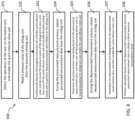
- a user can operate the button unit 13 to trigger the micro-processor unit 11 to execute the program instruction set stored in the memory 14; in an embodiment, the memory 14 can be embedded in the micro-processor unit 11, and the micro-processor unit 11 can execute the program instruction set to implement steps 101 to 108 of a blood pressure calculation method 100 shown in FIG. 4 .
- FIG. 4 shows a flowchart of a blood pressure calculation method.
- the blood pressure calculation method 100 includes steps 101 to 108.
- the micro-processor unit 11 executes the program instruction set to detect the operation of the user on the button unit 13, and then enable the quick exhaust valve unit 18 to quickly exhaust the airbag unit 19.
- the micro-processor unit 11 executes the program instruction set to read a pressure value of the airbag unit 19 from the pressure sensing unit 16.
- a step 103 the micro-processor unit 11 continuously executes the program instruction set until the quick exhaust valve unit 18 decreases the pressure value of the airbag unit 19 to zero, and the micro-processor unit 11 then turns off the quick exhaust valve unit 18 and enables the pressurizing motor unit 15 to perform slow pressurization and inflation on the airbag unit 19.
- FIG. 5 shows a schematic view of pulse signals and pressure values measured in single cycle of pressurization and depressurization of the blood pressure calculation method.
- the micro-processor unit 11 executes the program instruction set to obtain pressurized measurement data from the airbag unit 19 through the pressure sensing unit 16, and the pressurized measurement data can include amplitude data of a sequence of pulse signals, corresponding pressure data, and pulse interval data measured during the pressurized measurement process 201 shown in FIG. 5 .
- the micro-processor unit 11 executes the program instruction set to determine the pressurization stop timing based on the pressurized measurement data, and then turn off the pressurizing motor unit 15 to stop pressurizing the airbag unit 19 and enable the slow exhaust valve unit 17 to slowly exhaust the airbag unit 19 according to the pressurization stop timing.
- the pressurization stop timing can be the time when the amplitude of the extracted pulse is too small or no pulse signal can be extracted.
- a step 106 during the depressurized measurement process 202, the micro-processor unit 11 executes the program instruction set to obtain depressurized measurement data from the airbag unit 19 through the pressure sensing unit 16, and the depressurized measurement data can include the amplitude data of a sequence of pulse signals, the corresponding pressure data, and pulse interval data measured during the depressurized measurement process 202 shown in FIG. 5 .
- the micro-processor unit 11 executes the program instruction set to determine the measurement end timing based on the depressurized measurement data, and then enable the quick exhaust valve unit 18 to quickly exhaust the airbag unit 19.
- the measurement stop timing can be the time when the amplitude of the extracted pulse is too small or no pulse signal can be extracted.
- a step 108 the calculation is performed based on the depressurized measurement data and pressurized measurement data to obtain a blood pressure measurement result, and a systolic pressure (Psys) and a diastolic pressure (Pdia) are displayed on the display output unit 12.
- Psys systolic pressure
- Pdia diastolic pressure
- the micro-processor unit 11 can further execute the program instruction set to extract the at least one blood pressure parameter from each of the pressurized measurement data and the depressurized measurement data; in different embodiment of the present invention, the blood pressure parameter can include maximum amplitude data Am1 in pressurized measurement and maximum amplitude data Am2 in depressurized measurement, or a diastolic pressure value Pdia1 in pressurized measurement and a diastolic pressure value Pdia2 in depressurized measurement, or a systolic pressure value Psys1 in pressurized measurement and a systolic pressure value Psys2 in depressurized measurement.
- the blood pressure parameter can include maximum amplitude data Am1 in pressurized measurement and maximum amplitude data Am2 in depressurized measurement, or a diastolic pressure value Pdia1 in pressurized measurement and a diastolic pressure value Pdia2 in depressurized measurement, or a systolic
- the micro-processor unit 11 can further execute the program instruction set to perform calculation to obtain an average of the blood pressure parameters extracted from the pressurized measurement data and the depressurized measurement data; for example, the average can be, an average Am of the maximum amplitude data Am1 in pressurized measurement and the maximum amplitude data Am2 in depressurized measurement, as shown the following equation (5), to obtain a blood pressure measurement result.
- the average can be, an average Am of the maximum amplitude data Am1 in pressurized measurement and the maximum amplitude data Am2 in depressurized measurement, as shown the following equation (5), to obtain a blood pressure measurement result.
- the micro-processor unit 11 can further execute the program instruction set to calculate an product of the average Am and a threshold parameter Tdia1 of the diastolic pressure in pressurized measurement and use the calculated product as an amplitude threshold Adia of the diastolic pressure in pressurized measurement, and the micro-processor unit 11 further executes the program instruction set to calculate an product of the average Am and a threshold parameter Tsys2 of the systolic pressure in depressurized measurement, and use the calculated product as an amplitude threshold Asys of the systolic pressure in depressurized measurement, and then extract or deduce pressure values from the pressurized measurement data and the depressurized measurement data based on the amplitude threshold Adia of the diastolic pressure in pressurized measurement and the amplitude threshold Asys of the systolic pressure in depressurized measurement, respectively, and use the pressure values as the diastolic pressure value Pdi
- the systolic pressure Psys and the diastolic pressure Pdia are displayed on the display output unit 12.
- the threshold parameter Tdia1 of the diastolic pressure in pressurized measurement and the threshold parameter Tsys2 of the systolic pressure in depressurized measurement can be threshold values obtained from statistics of the clinical experimental results.
- a m A m 1 + A m 2 2
- a dia A m ⁇ T dia 1
- a sys A m ⁇ T sys 2
- FIG. 6 shows a measurement data table obtained in single cycle of pressurization and depressurization of the blood pressure calculation method.
- the blood pressure measurement device can perform single cycle of pressurization and depressurization of the blood pressure calculation method to obtain amplitude data of a sequence of pulse signals and corresponding pressure data.
- the measurement data table shown in FIG. 6 includes the pressurized measurement data measured from the airbag unit 19 in pressurized measurement process 201, and the depressurized measurement data measured from the airbag unit 19 in depressurized measurement process 202.
- the threshold parameter Tdia1 of the diastolic pressure in pressurized measurement is 0.45
- the threshold parameter Tsys2 of the systolic pressure in depressurized measurement is 0.8.
- the average Am of the maximum amplitude data Am1 in pressurized measurement and the maximum amplitude data Am2 in depressurized measurement is calculated to be 100.
- the amplitude threshold Adia of the diastolic pressure in pressurized measurement and the amplitude threshold Asys of the systolic pressure in depressurized measurement are calculated to be 45 and 80, respectively.
- the search is performed in the sequence of the amplitude data of the pulse signal in the pressurized measurement data from the location where the maximum amplitude data Am1 in pressurized measurement is equal to 97, in the decreasing direction of the pressure value, such as the direction from Am1 to Adia1 shown in FIG.
- the pressure data, with value of 78, corresponding to amplitude threshold Adia, with value of 45, of the diastolic pressure in pressurized measurement can be extracted, and the pressure data with value of 78 is used as the diastolic pressure value Pdia, with value of 78, of the blood pressure measurement result.
- the systolic pressure value Psys with the value of 115 mmHg and the diastolic pressure value Pdia with the value of 78 mmHg are displayed on the display output unit 12.
- the present disclosure further provides an accuracy comparison between the blood pressure calculation method of the present disclosure and the conventional single-pressurization oscillography shown in FIG. 1 and the conventional single- depressurization oscillography shown in FIG. 2 .
- the clinical test measures blood pressures of 30 people by using mercury auscultation as a standard manner, and each person measures 3 times, and a total of 90 pieces of comparison data are obtained.
- the pieces of data measure by the blood pressure calculation method of the present disclosure and by the conventional single-pressurization oscillography shown in FIG. 1 and the conventional single- depressurization oscillography shown in FIG.
- the average score of the measured systolic pressure (Psys) and the diastolic pressure (Pdia) of the blood pressure calculation method of the present disclosure is higher than that of the conventional single-pressurization oscillography and the single-depressurization oscillography Furthermore, according to the statistics result, it is obvious that the blood pressure calculation method of the present disclosure can improve the accuracy of the obtained systolic pressure (Psys) and the diastolic pressure (Pdia) because of precluding the data of systolic pressure (Psys) obtained in pressurized measurement and collecting correct depressurized measurement data to obtain systolic pressure (Psys), and precluding the data of the diastolic pressure (Pdia) obtained in depressurized measurement and collecting correct pressurized measurement data to obtain diastolic pressure (Pdia).
- the depressurized measurement data is used to obtain data of the systolic pressure (Psys) only, so in the step 107 of the blood pressure calculation method of the present invention, the measurement stop timing can be set as the time after the values of the maximum amplitude data Am2 in depressurized measurement and corresponding pressure are captured, and the quick exhaust valve unit 18 can then be enabled to complete the measurement. Furthermore, the micro-processor unit 11 can execute the program instruction set to further determine atrial fibrillation based on pulse interval data of the pressurized measurement data and the depressurized measurement data obtained in single pressurization process and depressurization process.
- the atrial fibrillation determination method of the present disclosure includes flows (A) to (C) described below.
- the coefficient of variation (CV) value is generally used to estimate the degree of data dispersion.
- the ratio of RMSSD to mean (M) can be used to estimate the degree of short-term data dispersion.
- Shannon entropy (ShEn) is a parameter statistic value used to measure the uncertainty of random variables.
- ShEn is related to the complexity of the data set and the ability of the data set to predict future data pointing from past data points.
- Turning point ratio is a non-parametric statistic used to measure the randomness of fluctuations in a data set. It is the only non-parametric test used in the AF calculation method of the present disclosure, so unlike ShEn and RMSSD, TPR is not affected by hypothesis about the distribution of the data set.
- the turning point is a point with a value higher than that of the previous and next one, or lower than that of the previous and next one.
- TPR is calculated by comparing the number of turning points in the data set with the maximum number of possible turning points. The turning point ratio calculation assumes that the data is stationary, especially the fluctuation is random and not faster or less frequent than explained by chance alone; in this case, the data contains trends.
- the statistical test used in the algorithm uses the null hypothesis H0 in which the sequence is stationary, and the other hypothesis H1 in which the sequence is non-stationary. More specifically, the null hypothesis is that the pulse interval is random and therefore corresponds to AF; the alternative hypothesis is that the pulse interval is non-random and corresponds to normal sinus rhythm. Any random data, such as white noise, is expected to have a turning point about every 1.5 data points.
- the extracted pulse signal is converted into a frequency spectrum by Fourier transform, and then clutter can be obtained based on statistics of peak points of the spectrum.
Landscapes
- Health & Medical Sciences (AREA)
- Life Sciences & Earth Sciences (AREA)
- Cardiology (AREA)
- Vascular Medicine (AREA)
- Engineering & Computer Science (AREA)
- Medical Informatics (AREA)
- Surgery (AREA)
- Biophysics (AREA)
- Pathology (AREA)
- Veterinary Medicine (AREA)
- Biomedical Technology (AREA)
- Heart & Thoracic Surgery (AREA)
- Public Health (AREA)
- Molecular Biology (AREA)
- Physics & Mathematics (AREA)
- Animal Behavior & Ethology (AREA)
- General Health & Medical Sciences (AREA)
- Physiology (AREA)
- Ophthalmology & Optometry (AREA)
- Signal Processing (AREA)
- Dentistry (AREA)
- Artificial Intelligence (AREA)
- Computer Vision & Pattern Recognition (AREA)
- Psychiatry (AREA)
- Measuring Pulse, Heart Rate, Blood Pressure Or Blood Flow (AREA)
Claims (9)
- Blutdruckberechnungsverfahren, das auf ein Blutdruckmessgerät (1) angewendet wird, das eine Motoreinheit zur Druckbeaufschlagung (15) und mindestens eine Auslassventileinheit (17, 18) umfasst, die mit einer Airbageinheit (19) in Verbindung stehen, wobei das Blutdruckberechnungsverfahren folgende Schritte umfasst:- Steuern der Motoreinheit zur Druckbeaufschlagung (15), um die Airbageinheit (19) mit Druck zu beaufschlagen;- Messen von Druckbeaufschlagungs-Messdaten von der Airbageinheit (19) während eines Druckbeaufschlagungsprozesses;- Steuern der Motoreinheit zur Druckbeaufschlagung (15), um die Beaufschlagung der Airbageinheit (19) mit Druck zu stoppen, und dann Steuern der mindestens einen Auslassventileinheit (17, 18), um die Airbageinheit (19) drucklos zu machen;- Messen von Druckentlastungs-Messdaten von der Airbageinheit (19) während eines Druckentlastungsprozesses;dadurch gekennzeichnet,dass die Druckbeaufschlagungs-Messdaten und die Druckentlastungs-Messdaten verarbeitet werden, um einen systolischen Druck und den diastolischen Druck eines Blutdruckmessergebnisses zu extrahieren oder abzuleiten;dass jeweils mindestens ein Blutdruckparameter aus den Druckbeaufschlagungs-Messdaten bzw. den Druckentlastungs-Messdaten extrahiert wird, wobei der Blutdruckparameter Amplitudendaten einer Sequenz von Pulssignalen und den Amplitudendaten entsprechende Druckdaten umfasst; unddass das Blutdruckberechnungsverfahren weiter folgende Schritte umfasst:- Extrahieren der jeweiligen Daten zur maximalen Amplitude bei Messung unter Druckbeaufschlagung und der jeweiligen Daten zur maximalen Amplitude bei Messung unter Druckentlastung aus den Druckbeaufschlagungs-Messdaten bzw. den Druckentlastungs-Messdaten;- Berechnen eines Durchschnittwerts der Daten zur maximalen Amplitude bei Messung unter Druckbeaufschlagung und der Daten zur maximalen Amplitude bei Messung unter Druckentlastung;- Berechnen eines Produkts aus dem Durchschnittwert und einem Schwellenparameter des systolischen Drucks bei Messung unter Druckentlastung und Verwenden des berechneten Produkts als Amplitudenschwelle des systolischen Drucks bei Messung unter Druckentlastung; und- Extrahieren oder Ableiten von Druckdaten aus den Druckentlastungs-Messdaten basierend auf der Amplitudenschwelle des systolischen Drucks bei Messung unter Druckentlastung und Verwenden der Druckdaten als systolischer Druckwert des Blutdruckmessergebnisses.
- Blutdruckberechnungsverfahren nach Anspruch 1,
dadurch gekennzeichnet,
dass das Verfahren ferner folgende Schritte umfasst:- Berechnen eines Produkts aus dem Durchschnittwert und einem Schwellenparameter des diastolischen Drucks bei Messung unter Druckbeaufschlagung und Verwenden des berechneten Produkts als Amplitudenschwelle des diastolischen Drucks bei Messung unter Druckbeaufschlagung; und- Extrahieren oder Ableiten von Druckdaten aus den Druckbeaufschlagungs-Messdaten basierend auf der Amplitudenschwelle des diastolischen Drucks bei Messung unter Druckbeaufschlagung und Verwenden der Druckdaten als diastolischer Druckwert des Blutdruckmessergebnisses. - Blutdruckberechnungsverfahren nach Anspruch 1,
dadurch gekennzeichnet,
dass das Verfahren ferner folgende Schritte umfasst:- Bestimmen von Vorhofflimmern basierend auf Pulsintervalldaten der Druckbeaufschlagungs-Messdaten und der Druckentlastungs-Messdaten, die in einem einzelnen Druckbeaufschlagungs- und Druckentlastungsprozess erfasst wurden. - Blutdruckberechnungsverfahren nach Anspruch 1,
dadurch gekennzeichnet,
dass das Verfahren ferner folgende Schritte umfasst:- Abschließen der Messung nach der Extrahierung der maximalen Amplitudendaten aus den Druckentlastungs-Messdaten. - Blutdruckmessgerät, umfassend:- eine Airbageinheit (19);- eine Motoreinheit zur Druckbeaufschlagung (15), die mit der Airbageinheit (19) in Verbindung steht;- mindestens eine Auslassventileinheit (17, 18), die mit der Airbageinheit (19) in Verbindung steht;- eine Sensoreinheit (16), die so konfiguriert ist, dass sie Messdaten von der Airbageinheit (19) erhält;- eine Anzeigeeinheit (12), die so konfiguriert ist, dass sie ein Blutdruckmessergebnis anzeigt;- einen Speicher (14), der so konfiguriert ist, dass er einen Programmbefehlssatz speichert; und- eine Verarbeitungseinheit (11), die so konfiguriert ist, dass sie den Programmbefehlssatz ausführt, um folgende Aufgaben zu erfüllen:- Steuern der Motoreinheit zur Druckbeaufschlagung (15), um die Airbageinheit (19) mit Druck zu beaufschlagen;- Empfangen von Druckbeaufschlagungs-Messdaten von der Sensoreinheit (16) während eines Druckbeaufschlagungsprozesses;- Steuern der Motoreinheit zur Druckbeaufschlagung (15) , um die Beaufschlagung der Airbageinheit (19) mit Druck zu stoppen, und dann Steuern der Auslassventileinheit (17, 18), die Airbageinheit (19) drucklos zu machen; und- Empfangen von Druckentlastungs-Messdaten von der Sensoreinheit (16) während eines Druckentlastungsprozesses;dadurch gekennzeichnet,dass die Druckbeaufschlagungs-Messdaten und die Druckentlastungs-Messdaten verarbeitet werden, um einen systolischen Druck und den diastolischen Druck des Blutdruckmessergebnisses zu extrahieren oder abzuleiten;dass jeweils mindestens ein Blutdruckparameter aus den Druckbeaufschlagungs-Messdaten bzw. den Druckentlastungs-Messdaten extrahiert wird, wobei der Blutdruckparameter Amplitudendaten einer Sequenz von Pulssignalen und den Amplitudendaten entsprechende Druckdaten umfasst; und dass die Verarbeitungseinheit (11) so konfiguriert ist, dass sie den Programmbefehlssatz ausführt, um folgende Aufgaben zu erfüllen:- Extrahieren der jeweiligen Daten zur maximalen Amplitude bei Messung unter Druckbeaufschlagung und der jeweiligen Daten zur maximalen Amplitude bei Messung unter Druckentlastung aus den Druckbeaufschlagungs-Messdaten bzw. den Druckentlastungs-Messdaten;- Berechnen eines Durchschnittwerts der Daten zur maximalen Amplitude bei Messung unter Druckbeaufschlagung und der Daten zur maximalen Amplitude bei Messung unter Druckentlastung;- Berechnen eines Produkts aus dem Durchschnittwert und einem Schwellenparameter des systolischen Drucks bei Messung unter Druckentlastung und Verwenden des berechneten Produkts als Amplitudenschwelle des systolischen Drucks bei Messung unter Druckentlastung; und- Extrahieren oder Ableiten von Druckdaten aus den Druckentlastungs-Messdaten basierend auf der Amplitudenschwelle des systolischen Drucks bei Messung unter Druckentlastung und Verwenden der Druckdaten als systolischer Druckwert des Blutdruckmessergebnisses.
- Blutdruckmessgerät nach Anspruch 5,
dadurch gekennzeichnet,
dass der mindestens eine Blutdruckparameter einen systolischen Druck oder einen diastolischen Druck umfasst. - Blutdruckmessgerät nach Anspruch 5,
dadurch gekennzeichnet,
dass die Verarbeitungseinheit den Programmbefehlssatz ausführt, um folgende Aufgaben zu erfüllen:- Berechnen eines Produkts aus dem Durchschnittwert und einem Schwellenparameter des diastolischen Drucks bei Messung unter Druckbeaufschlagung und Verwenden des berechneten Produkts als Amplitudenschwelle des diastolischen Drucks bei Messung unter Druckbeaufschlagung; und- Extrahieren oder Ableiten von Druckdaten aus den Druckbeaufschlagungs-Messdaten basierend auf der Amplitudenschwelle des diastolischen Drucks bei Messung unter Druckbeaufschlagung und Verwenden der Druckdaten als diastolischer Druckwert des Blutdruckmessergebnisses. - Blutdruckmessgerät nach Anspruch 5,
dadurch gekennzeichnet,
dass die Verarbeitungseinheit den Programmbefehlssatz ausführt, um folgende Aufgaben zu erfüllen:- Bestimmen von Vorhofflimmern basierend auf Pulsintervalldaten der Druckbeaufschlagungs-Messdaten und der Druckentlastungs-Messdaten, die in einem einzelnen Druckbeaufschlagungs- und Druckentlastungsprozess erfasst wurden. - Blutdruckmessgerät nach Anspruch 5,
dadurch gekennzeichnet,
dass die Verarbeitungseinheit den Programmbefehlssatz ausführt, um folgende Aufgaben zu erfüllen:- Abschließen der Messung nach der Extrahierung der maximalen Amplitudendaten bei der Messung unter Druckentlastung aus den Druckentlastungs-Messdaten.
Applications Claiming Priority (1)
| Application Number | Priority Date | Filing Date | Title |
|---|---|---|---|
| TW108118124A TWI734988B (zh) | 2019-05-24 | 2019-05-24 | 血壓機與該血壓機使用的血壓計算方法 |
Publications (3)
| Publication Number | Publication Date |
|---|---|
| EP3744238A1 EP3744238A1 (de) | 2020-12-02 |
| EP3744238C0 EP3744238C0 (de) | 2024-10-16 |
| EP3744238B1 true EP3744238B1 (de) | 2024-10-16 |
Family
ID=70804561
Family Applications (1)
| Application Number | Title | Priority Date | Filing Date |
|---|---|---|---|
| EP20176184.8A Active EP3744238B1 (de) | 2019-05-24 | 2020-05-22 | Blutdruckmessvorrichtung und berechnungsverfahren dafür |
Country Status (5)
| Country | Link |
|---|---|
| US (1) | US11638530B2 (de) |
| EP (1) | EP3744238B1 (de) |
| JP (1) | JP7073442B2 (de) |
| CN (1) | CN111973166B (de) |
| TW (1) | TWI734988B (de) |
Citations (1)
| Publication number | Priority date | Publication date | Assignee | Title |
|---|---|---|---|---|
| CN104068839A (zh) * | 2014-06-27 | 2014-10-01 | 广州视源电子科技股份有限公司 | 提高血压计测量准确度和速度的方法 |
Family Cites Families (23)
| Publication number | Priority date | Publication date | Assignee | Title |
|---|---|---|---|---|
| JP2574814B2 (ja) * | 1987-10-15 | 1997-01-22 | オムロン株式会社 | 電子血圧計 |
| JP2551669B2 (ja) * | 1989-10-09 | 1996-11-06 | テルモ株式会社 | 電子血圧計 |
| JP3147256B2 (ja) * | 1992-11-20 | 2001-03-19 | フクダ電子株式会社 | 非観血式血圧測定装置 |
| JP2003299627A (ja) | 2002-04-10 | 2003-10-21 | Omron Corp | 電子血圧計 |
| US7680532B2 (en) * | 2005-02-25 | 2010-03-16 | Joseph Wiesel | Detecting atrial fibrillation, method of and apparatus for |
| US7706868B2 (en) * | 2005-02-25 | 2010-04-27 | Joseph Wiesel | Detecting atrial fibrillation, method of and apparatus for |
| MX2009010337A (es) | 2007-03-28 | 2009-10-19 | Kaz Inc | Monitor de presion sanguinea arterial con un brazalete lleno con liquido. |
| KR20090084078A (ko) * | 2008-01-31 | 2009-08-05 | 헬스 앤드 라이프 컴퍼니 리미티드 | 전자식 혈압측정 장치 |
| JP5228620B2 (ja) | 2008-05-22 | 2013-07-03 | オムロンヘルスケア株式会社 | 血圧測定装置 |
| JP2010035804A (ja) | 2008-08-05 | 2010-02-18 | Omron Healthcare Co Ltd | 電子血圧計 |
| JP5026541B2 (ja) * | 2010-03-26 | 2012-09-12 | シチズンホールディングス株式会社 | 電子血圧計 |
| JP5364038B2 (ja) * | 2010-05-21 | 2013-12-11 | 日本光電工業株式会社 | 血圧測定装置および血圧測定方法 |
| TW201228634A (en) | 2011-01-07 | 2012-07-16 | Univ Ishou | Method for assessing vascular stiffness index |
| US9532722B2 (en) * | 2011-06-21 | 2017-01-03 | Masimo Corporation | Patient monitoring system |
| TWM460634U (zh) | 2013-03-19 | 2013-09-01 | Avita Corp | 監控生理狀態之裝置 |
| US11071467B2 (en) * | 2013-08-08 | 2021-07-27 | Welch Allyn, Inc. | Hybrid patient monitoring system |
| US10939832B2 (en) * | 2015-02-11 | 2021-03-09 | Microlife Intellectual Property Gmbh | Device and method for measuring blood pressure and for indication of the presence of atrial fibrillation |
| TWI619472B (zh) * | 2016-12-12 | 2018-04-01 | 張國源 | 用於判斷心房顫動的方法及裝置 |
| EP3375359B1 (de) * | 2017-03-15 | 2024-05-29 | Withings | Verfahren zur analyse von kardiovaskulären parametern eines individuums |
| JP6874258B2 (ja) | 2017-03-17 | 2021-05-19 | 株式会社エー・アンド・デイ | 生体の心房細動判定装置 |
| US20180338695A1 (en) * | 2017-05-24 | 2018-11-29 | Edwards Lifesciences Corporation | Systolic pressure calibration |
| US10874308B2 (en) | 2017-09-29 | 2020-12-29 | Fitbit, Inc. | Devices and methods for obtaining pulse information from blood pressure measurements |
| CN114222523B (zh) * | 2019-08-15 | 2025-02-25 | 欧姆龙健康医疗事业株式会社 | 血压计、血压计算方法、以及存储介质 |
-
2019
- 2019-05-24 TW TW108118124A patent/TWI734988B/zh active
-
2020
- 2020-05-19 CN CN202010426392.3A patent/CN111973166B/zh active Active
- 2020-05-21 JP JP2020089023A patent/JP7073442B2/ja active Active
- 2020-05-22 EP EP20176184.8A patent/EP3744238B1/de active Active
- 2020-05-24 US US16/882,538 patent/US11638530B2/en active Active
Patent Citations (1)
| Publication number | Priority date | Publication date | Assignee | Title |
|---|---|---|---|---|
| CN104068839A (zh) * | 2014-06-27 | 2014-10-01 | 广州视源电子科技股份有限公司 | 提高血压计测量准确度和速度的方法 |
Also Published As
| Publication number | Publication date |
|---|---|
| TWI734988B (zh) | 2021-08-01 |
| US11638530B2 (en) | 2023-05-02 |
| EP3744238C0 (de) | 2024-10-16 |
| JP7073442B2 (ja) | 2022-05-23 |
| CN111973166B (zh) | 2024-02-23 |
| JP2020192322A (ja) | 2020-12-03 |
| TW202042747A (zh) | 2020-12-01 |
| EP3744238A1 (de) | 2020-12-02 |
| US20200367768A1 (en) | 2020-11-26 |
| CN111973166A (zh) | 2020-11-24 |
Similar Documents
| Publication | Publication Date | Title |
|---|---|---|
| US7029448B2 (en) | Electronic hemomanometer and blood pressure measuring method of electronic hemomanometer | |
| US5680867A (en) | Electronic blood pressure measurment device | |
| US6702754B2 (en) | Arteriosclerosis inspecting apparatus | |
| JP5146543B2 (ja) | 電子血圧計および血圧測定方法 | |
| EP2939592B1 (de) | Nachweis von parametern in herzleistungsbezogenen wellenformen | |
| US7074192B2 (en) | Method and apparatus for measuring blood pressure using relaxed matching criteria | |
| US11006885B2 (en) | Apparatus for determining blood pressure | |
| US7594893B2 (en) | Method and apparatus for calculating blood pressure with signal transformation | |
| US20100286538A1 (en) | Apparatus and method for measuring blood pressure | |
| EP0353315A1 (de) | Verfahren und Vorrichtung zur automatischen Blutdruckmessung | |
| CN102197998B (zh) | 示波测量法中伪影的频谱的使用 | |
| CN101229058A (zh) | 脉搏波传输时间法测量动脉血压的初始校准装置 | |
| CN114533009B (zh) | 血压测量装置及其加压方法 | |
| WO2015023672A1 (en) | Oximetry signal, pulse-pressure correlator | |
| EP3744238B1 (de) | Blutdruckmessvorrichtung und berechnungsverfahren dafür | |
| CN107714022A (zh) | 具有血压深度测量功能的血压测量装置及其数据处理方法 | |
| CN115399742A (zh) | 血压测量设备的校准方法及血压测量设备 | |
| WO2012040428A2 (en) | Evaluation of peripheral arterial disease in a patient using an oscillometric pressure signal obtained at a lower extremity of the patient | |
| CN113679364A (zh) | 一种血压测量计算方法 | |
| EP3760110B1 (de) | Messverfahren und system für ein elektronisches sphygmomanometer, elektronisches sphygmomanometer und speichermedium | |
| KR100785901B1 (ko) | 혈압 측정 장치 | |
| KR20060032496A (ko) | 가속도 센서를 이용한 동잡음 제거수단을 구비하는오실로메트릭 방식 혈압계 | |
| CN112914531B (zh) | 确定血压包络波的方法、电子设备及存储介质 | |
| CN117100238A (zh) | 一种示波法与光电容积脉搏波结合的血压测量装置 | |
| US6716177B2 (en) | Inferior-and-superior-limb blood-pressure index measuring apparatus |
Legal Events
| Date | Code | Title | Description |
|---|---|---|---|
| PUAI | Public reference made under article 153(3) epc to a published international application that has entered the european phase |
Free format text: ORIGINAL CODE: 0009012 |
|
| STAA | Information on the status of an ep patent application or granted ep patent |
Free format text: STATUS: THE APPLICATION HAS BEEN PUBLISHED |
|
| AK | Designated contracting states |
Kind code of ref document: A1 Designated state(s): AL AT BE BG CH CY CZ DE DK EE ES FI FR GB GR HR HU IE IS IT LI LT LU LV MC MK MT NL NO PL PT RO RS SE SI SK SM TR |
|
| AX | Request for extension of the european patent |
Extension state: BA ME |
|
| STAA | Information on the status of an ep patent application or granted ep patent |
Free format text: STATUS: REQUEST FOR EXAMINATION WAS MADE |
|
| 17P | Request for examination filed |
Effective date: 20210602 |
|
| RBV | Designated contracting states (corrected) |
Designated state(s): AL AT BE BG CH CY CZ DE DK EE ES FI FR GB GR HR HU IE IS IT LI LT LU LV MC MK MT NL NO PL PT RO RS SE SI SK SM TR |
|
| STAA | Information on the status of an ep patent application or granted ep patent |
Free format text: STATUS: EXAMINATION IS IN PROGRESS |
|
| 17Q | First examination report despatched |
Effective date: 20221018 |
|
| GRAP | Despatch of communication of intention to grant a patent |
Free format text: ORIGINAL CODE: EPIDOSNIGR1 |
|
| STAA | Information on the status of an ep patent application or granted ep patent |
Free format text: STATUS: GRANT OF PATENT IS INTENDED |
|
| INTG | Intention to grant announced |
Effective date: 20240611 |
|
| GRAJ | Information related to disapproval of communication of intention to grant by the applicant or resumption of examination proceedings by the epo deleted |
Free format text: ORIGINAL CODE: EPIDOSDIGR1 |
|
| STAA | Information on the status of an ep patent application or granted ep patent |
Free format text: STATUS: EXAMINATION IS IN PROGRESS |
|
| STAA | Information on the status of an ep patent application or granted ep patent |
Free format text: STATUS: GRANT OF PATENT IS INTENDED |
|
| GRAS | Grant fee paid |
Free format text: ORIGINAL CODE: EPIDOSNIGR3 |
|
| GRAA | (expected) grant |
Free format text: ORIGINAL CODE: 0009210 |
|
| STAA | Information on the status of an ep patent application or granted ep patent |
Free format text: STATUS: THE PATENT HAS BEEN GRANTED |
|
| INTG | Intention to grant announced |
Effective date: 20240611 |
|
| AK | Designated contracting states |
Kind code of ref document: B1 Designated state(s): AL AT BE BG CH CY CZ DE DK EE ES FI FR GB GR HR HU IE IS IT LI LT LU LV MC MK MT NL NO PL PT RO RS SE SI SK SM TR |
|
| REG | Reference to a national code |
Ref country code: GB Ref legal event code: FG4D |
|
| REG | Reference to a national code |
Ref country code: CH Ref legal event code: EP |
|
| REG | Reference to a national code |
Ref country code: IE Ref legal event code: FG4D |
|
| REG | Reference to a national code |
Ref country code: DE Ref legal event code: R096 Ref document number: 602020039433 Country of ref document: DE |
|
| U01 | Request for unitary effect filed |
Effective date: 20241016 |
|
| U07 | Unitary effect registered |
Designated state(s): AT BE BG DE DK EE FI FR IT LT LU LV MT NL PT RO SE SI Effective date: 20241022 |
|
| PG25 | Lapsed in a contracting state [announced via postgrant information from national office to epo] |
Ref country code: IS Free format text: LAPSE BECAUSE OF FAILURE TO SUBMIT A TRANSLATION OF THE DESCRIPTION OR TO PAY THE FEE WITHIN THE PRESCRIBED TIME-LIMIT Effective date: 20250216 Ref country code: HR Free format text: LAPSE BECAUSE OF FAILURE TO SUBMIT A TRANSLATION OF THE DESCRIPTION OR TO PAY THE FEE WITHIN THE PRESCRIBED TIME-LIMIT Effective date: 20241016 |
|
| PG25 | Lapsed in a contracting state [announced via postgrant information from national office to epo] |
Ref country code: ES Free format text: LAPSE BECAUSE OF FAILURE TO SUBMIT A TRANSLATION OF THE DESCRIPTION OR TO PAY THE FEE WITHIN THE PRESCRIBED TIME-LIMIT Effective date: 20241016 |
|
| PG25 | Lapsed in a contracting state [announced via postgrant information from national office to epo] |
Ref country code: NO Free format text: LAPSE BECAUSE OF FAILURE TO SUBMIT A TRANSLATION OF THE DESCRIPTION OR TO PAY THE FEE WITHIN THE PRESCRIBED TIME-LIMIT Effective date: 20250116 |
|
| PG25 | Lapsed in a contracting state [announced via postgrant information from national office to epo] |
Ref country code: GR Free format text: LAPSE BECAUSE OF FAILURE TO SUBMIT A TRANSLATION OF THE DESCRIPTION OR TO PAY THE FEE WITHIN THE PRESCRIBED TIME-LIMIT Effective date: 20250117 |
|
| PG25 | Lapsed in a contracting state [announced via postgrant information from national office to epo] |
Ref country code: PL Free format text: LAPSE BECAUSE OF FAILURE TO SUBMIT A TRANSLATION OF THE DESCRIPTION OR TO PAY THE FEE WITHIN THE PRESCRIBED TIME-LIMIT Effective date: 20241016 |
|
| PG25 | Lapsed in a contracting state [announced via postgrant information from national office to epo] |
Ref country code: RS Free format text: LAPSE BECAUSE OF FAILURE TO SUBMIT A TRANSLATION OF THE DESCRIPTION OR TO PAY THE FEE WITHIN THE PRESCRIBED TIME-LIMIT Effective date: 20250116 |
|
| U20 | Renewal fee for the european patent with unitary effect paid |
Year of fee payment: 6 Effective date: 20250508 |
|
| PG25 | Lapsed in a contracting state [announced via postgrant information from national office to epo] |
Ref country code: SM Free format text: LAPSE BECAUSE OF FAILURE TO SUBMIT A TRANSLATION OF THE DESCRIPTION OR TO PAY THE FEE WITHIN THE PRESCRIBED TIME-LIMIT Effective date: 20241016 |
|
| PG25 | Lapsed in a contracting state [announced via postgrant information from national office to epo] |
Ref country code: SK Free format text: LAPSE BECAUSE OF FAILURE TO SUBMIT A TRANSLATION OF THE DESCRIPTION OR TO PAY THE FEE WITHIN THE PRESCRIBED TIME-LIMIT Effective date: 20241016 |
|
| PG25 | Lapsed in a contracting state [announced via postgrant information from national office to epo] |
Ref country code: CZ Free format text: LAPSE BECAUSE OF FAILURE TO SUBMIT A TRANSLATION OF THE DESCRIPTION OR TO PAY THE FEE WITHIN THE PRESCRIBED TIME-LIMIT Effective date: 20241016 |
|
| PLBE | No opposition filed within time limit |
Free format text: ORIGINAL CODE: 0009261 |
|
| STAA | Information on the status of an ep patent application or granted ep patent |
Free format text: STATUS: NO OPPOSITION FILED WITHIN TIME LIMIT |
|
| 26N | No opposition filed |
Effective date: 20250717 |
|
| REG | Reference to a national code |
Ref country code: CH Ref legal event code: H13 Free format text: ST27 STATUS EVENT CODE: U-0-0-H10-H13 (AS PROVIDED BY THE NATIONAL OFFICE) Effective date: 20251223 |
|
| PG25 | Lapsed in a contracting state [announced via postgrant information from national office to epo] |
Ref country code: CH Free format text: LAPSE BECAUSE OF NON-PAYMENT OF DUE FEES Effective date: 20250531 |
|
| GBPC | Gb: european patent ceased through non-payment of renewal fee |
Effective date: 20250522 |
|
| PG25 | Lapsed in a contracting state [announced via postgrant information from national office to epo] |
Ref country code: MC Free format text: LAPSE BECAUSE OF FAILURE TO SUBMIT A TRANSLATION OF THE DESCRIPTION OR TO PAY THE FEE WITHIN THE PRESCRIBED TIME-LIMIT Effective date: 20241016 |
|
| PG25 | Lapsed in a contracting state [announced via postgrant information from national office to epo] |
Ref country code: GB Free format text: LAPSE BECAUSE OF NON-PAYMENT OF DUE FEES Effective date: 20250522 |
|
| PG25 | Lapsed in a contracting state [announced via postgrant information from national office to epo] |
Ref country code: IE Free format text: LAPSE BECAUSE OF NON-PAYMENT OF DUE FEES Effective date: 20250522 |