EP3742584A1 - Rotor für elektrische drehmaschine - Google Patents
Rotor für elektrische drehmaschine Download PDFInfo
- Publication number
- EP3742584A1 EP3742584A1 EP19770519.7A EP19770519A EP3742584A1 EP 3742584 A1 EP3742584 A1 EP 3742584A1 EP 19770519 A EP19770519 A EP 19770519A EP 3742584 A1 EP3742584 A1 EP 3742584A1
- Authority
- EP
- European Patent Office
- Prior art keywords
- rotor core
- portions
- rotor
- facing surface
- specific
- Prior art date
- Legal status (The legal status is an assumption and is not a legal conclusion. Google has not performed a legal analysis and makes no representation as to the accuracy of the status listed.)
- Pending
Links
Images



Classifications
-
- H—ELECTRICITY
- H02—GENERATION; CONVERSION OR DISTRIBUTION OF ELECTRIC POWER
- H02K—DYNAMO-ELECTRIC MACHINES
- H02K1/00—Details of the magnetic circuit
- H02K1/06—Details of the magnetic circuit characterised by the shape, form or construction
- H02K1/22—Rotating parts of the magnetic circuit
- H02K1/27—Rotor cores with permanent magnets
-
- H—ELECTRICITY
- H02—GENERATION; CONVERSION OR DISTRIBUTION OF ELECTRIC POWER
- H02K—DYNAMO-ELECTRIC MACHINES
- H02K1/00—Details of the magnetic circuit
- H02K1/06—Details of the magnetic circuit characterised by the shape, form or construction
- H02K1/22—Rotating parts of the magnetic circuit
- H02K1/27—Rotor cores with permanent magnets
- H02K1/2706—Inner rotors
- H02K1/272—Inner rotors the magnetisation axis of the magnets being perpendicular to the rotor axis
- H02K1/274—Inner rotors the magnetisation axis of the magnets being perpendicular to the rotor axis the rotor consisting of two or more circumferentially positioned magnets
- H02K1/2753—Inner rotors the magnetisation axis of the magnets being perpendicular to the rotor axis the rotor consisting of two or more circumferentially positioned magnets the rotor consisting of magnets or groups of magnets arranged with alternating polarity
- H02K1/276—Magnets embedded in the magnetic core, e.g. interior permanent magnets [IPM]
-
- H—ELECTRICITY
- H02—GENERATION; CONVERSION OR DISTRIBUTION OF ELECTRIC POWER
- H02K—DYNAMO-ELECTRIC MACHINES
- H02K1/00—Details of the magnetic circuit
- H02K1/06—Details of the magnetic circuit characterised by the shape, form or construction
- H02K1/22—Rotating parts of the magnetic circuit
- H02K1/27—Rotor cores with permanent magnets
- H02K1/2706—Inner rotors
- H02K1/272—Inner rotors the magnetisation axis of the magnets being perpendicular to the rotor axis
- H02K1/274—Inner rotors the magnetisation axis of the magnets being perpendicular to the rotor axis the rotor consisting of two or more circumferentially positioned magnets
- H02K1/2753—Inner rotors the magnetisation axis of the magnets being perpendicular to the rotor axis the rotor consisting of two or more circumferentially positioned magnets the rotor consisting of magnets or groups of magnets arranged with alternating polarity
- H02K1/276—Magnets embedded in the magnetic core, e.g. interior permanent magnets [IPM]
- H02K1/2766—Magnets embedded in the magnetic core, e.g. interior permanent magnets [IPM] having a flux concentration effect
-
- H—ELECTRICITY
- H02—GENERATION; CONVERSION OR DISTRIBUTION OF ELECTRIC POWER
- H02K—DYNAMO-ELECTRIC MACHINES
- H02K1/00—Details of the magnetic circuit
- H02K1/06—Details of the magnetic circuit characterised by the shape, form or construction
- H02K1/22—Rotating parts of the magnetic circuit
- H02K1/28—Means for mounting or fastening rotating magnetic parts on to, or to, the rotor structures
-
- H—ELECTRICITY
- H02—GENERATION; CONVERSION OR DISTRIBUTION OF ELECTRIC POWER
- H02K—DYNAMO-ELECTRIC MACHINES
- H02K1/00—Details of the magnetic circuit
- H02K1/06—Details of the magnetic circuit characterised by the shape, form or construction
- H02K1/22—Rotating parts of the magnetic circuit
- H02K1/28—Means for mounting or fastening rotating magnetic parts on to, or to, the rotor structures
- H02K1/30—Means for mounting or fastening rotating magnetic parts on to, or to, the rotor structures using intermediate parts, e.g. spiders
Definitions
- the present invention is related to a rotor for a rotary electric machine that is provided with a cylindrical rotor core configured by stacking electromagnetic steel plates in an axial direction and having a plurality of magnet insertion holes, and a plurality of permanent magnets inserted into the magnet insertion holes, and that is supported from a radial inner side by a rotor supporting member.
- JP 2015-119557 A discloses a rotor (1) for a rotary electric machine in which a rotor core (20) configured by stacking a plurality of electromagnetic steel plates (23) in an axial direction is supported by a shaft body (10) serving as a rotor support member from a radial inner side (the reference signs in the brackets in the BACKGROUND ART are signs of the referenced document).
- a plurality of magnet insertion holes (24) extending in the axial direction are formed along a circumferential direction, and a permanent magnet (26) is inserted in each of the magnet insertion holes (24).
- the rotor core (20) and the shaft body (10) are joined by welding at end portions on an axial outer side of a contact portion between a core inner peripheral surface (21) and an outer peripheral surface (11) of the shaft body (10).
- the part of the bridge portion that abuts against the permanent magnet (26) receives from the permanent magnet (26) side, a force caused by a reaction of a force of contracting toward the radial inner side. Therefore, a large tensile stress may act on root parts positioned at end portions of the bridge portion in the circumferential direction.
- an adhesive force between the electromagnetic steel plates (23) in the axial direction near end portions of the rotor core (20) in the axial direction is small.
- a partial deformation such as lifting of the electromagnetic steel plates (23) easily occurs around the bridge portions near the end portions in the axial direction.
- Patent Document 1 Japanese Unexamined Patent Application Publication No. 2015-119557 ( JP 2015-119557 A )
- a rotor for a rotary electric machine is a rotor provided with a cylindrical rotor core that is configured by stacking electromagnetic steel plates in an axial direction and that has a plurality of magnet insertion holes, and provided with a plurality of permanent magnets that are inserted in the magnet insertion holes, and supported by a rotor support member from a radial inner side.
- Each of the magnet insertion holes is formed to extend in the axial direction, and the magnet insertion holes are arranged along a circumferential direction.
- Each of the permanent magnets has a side surface portion that is a surface along the axial direction, and an end surface portion that is an end surface in the axial direction, and has a plurality of corner portions formed in a part in which the side surface portion and the end surface portion intersect.
- a melted joint portion is formed on an end portion in the axial direction on an inner peripheral surface of the rotor core, and the rotor core is joined to the rotor support member at the melted joint portion.
- a region in the axial direction in which the melted joint portion is formed is set as an axial joint region.
- At least one corner portion that overlaps with the axial joint region when seen in a radial direction and that faces an outer peripheral surface of the rotor core is set as a specific corner portion.
- Parts on an inner wall surface of the magnet insertion hole that face the respective corner portions are set as facing surface portions, and among a plurality of the facing surface portions, the facing surface portion that faces the specific corner portion is set as a specific facing surface portion.
- a clearance formed between the specific corner portion and the specific facing surface portion is larger than a clearance formed between another corner portion and another facing surface portion.
- a clearance that is larger than a clearance formed between the other corner portion and the other facing surface portion is formed between the specific corner portion and the specific facing surface portion.
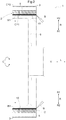
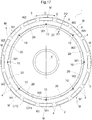
- FIG. 1 is a cross-sectional view of a rotor 1 (a rotor for a rotary electric machine) when seen in an axial direction L.
- the rotor 1 is configured to have a rotor core 2, permanent magnets 4, and a hub 9 (rotor support member) that supports the rotor core 2 and couples the rotor core 2 to a shaft (not shown) serving as a rotation axis X from a radial inner side R1.
- FIG. 2 is a cross-sectional view of the rotor core 2 in the axial direction L when the hub 9 is not attached to the rotor core 2.
- the rotor core 2 is formed by stacking a plurality of annular electromagnetic steel plates 3, and the electromagnetic steel plates 3 are joined to each other by welding before the hub 9 is attached to the rotor core 2.
- a symbol "W1" in FIG. 2 schematically indicates a joint portion (first joint portion) that has been melted and solidified by welding.
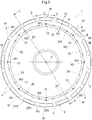
- FIG. 3 is a plan view of the rotor core 2 seen from a direction along the axial direction L.
- FIG. 1 shows a section passing through the first joint portion W1 before attaching the hub 9 to the rotor core 2.
- FIG. 1 shows a I-I section (a section passing through the second joint portion W2 and a buffer clearance G described below) in FIG. 3 after the hub 9 is attached to the rotor core 2.
- the rotor 1 according to the present embodiment will be described in detail.
- the "axial direction L", a "radial direction R", and a “circumferential direction C” are determined with reference to the shaft center the rotor core 2 (that is, the rotation axis X), unless otherwise specified.
- One side of the rotor core 2 in the radial direction R is set as a radial inner side R1, and the other side in the radial direction R is set as a radial outer side R2.
- the dimension of each member, the direction in which each member is disposed, and the position in which each member is disposed, and the like include a state in which there is a difference caused by errors (errors on a level allowable in manufacturing).
- the rotor 1 includes a cylindrical rotor core 2 having a plurality of magnet insertion holes 5, and a plurality of the permanent magnets 4 that are inserted into the magnet insertion holes 5, and is supported by the hub 9 from the radial inner side R1.
- the rotor core 2 that configures the rotor of the rotary electric machine is formed in a state of a stacked core in which a plurality of thin steel plates are stacked in a direction along the rotation axis, in order to reduce iron loss.
- the rotor core 2 is configured by stacking the electromagnetic steel plates 3 in the axial direction L.
- the rotor core 2 is fixed to the shaft (not shown) serving as the rotation axis X via the hub 9. As illustrated in FIG. 1 , the hub 9 abuts against an inner peripheral surface CP1, which is a peripheral surface of the rotor core 2 on the radial inner side R1 side, to support the rotor core 2 from the radial inner side R1.
- the hub 9 and the rotor core 2 are joined by welding and the rotor core 2 is supported so as not to be relatively moved to the hub 9.
- the hub 9 and the shaft (not shown) are coupled by shrink fitting, key connection, spline connection, or the like.
- the permanent magnets 4 are distributed in the circumferential direction C of the rotor core 2 so as to be dispersed.
- the magnet insertion holes 5 are arranged in the rotor core 2 along the circumferential direction.
- the permanent magnet 4 is disposed in each of the magnet insertion holes 5.
- the magnet insertion holes 5 extending through the rotor core 2 in the axial direction L are formed in the rotor core 2, and the permanent magnets 4 having approximately the same length in the axial direction L as the rotor core 2 are inserted into the magnet insertion holes 5 so as to be fixed to the rotor core 2.
- the rotor core 2 is configured by stacking the plurality of annular electromagnetic steel plates 3 in the axial direction L.
- the electromagnetic steel plates 3 that are adjacent in the axial direction L are joined to each other by welding.
- welded portions 10 for welding the electromagnetic steel plates 3 to each other are formed on the inner peripheral surface CP1 of the rotor core 2.
- An energy beam B such as an electron beam or a laser beam is emitted on the welded portions 10 to melt and then solidify the electromagnetic steel plates 3.
- the electromagnetic steel plates 3 that are adjacent in the axial direction L are welded.
- the energy beam B is emitted on the welded portions 10 along the axial direction L so as to join the electromagnetic steel plates 3 as one rotor core 2.
- the first joint portions W1 indicate parts in which the electromagnetic steel plates 3 are melted and solidified by the energy beam B that is emitted in the axial direction L.
- All parts of the welded portions 10 are each formed on the radial outer side R2 side with respect to a reference peripheral surface CR that is a peripheral surface of a general portion 20 of the inner peripheral surface CP1 of the rotor core 2 besides the welded portion 10.
- the reference peripheral surface CR corresponds to an inner wall of a virtual cylinder whose cross section with the rotation axis X as the center is a perfect circle. Since all parts of the welded portion 10 are each formed on the radial outer side R2 with respect to the reference peripheral surface CR, the first joint portions W1 are also formed on the radial outer side R2 with respect to the reference peripheral surface CR, and the first joint portions W1 do not hinder abutment between the hub 9 and the rotor core 2.
- the welded portion 10 is configured to have a first recessed groove portion 10a, a second recessed groove portion 10c, and a protruded portion 10b therebetween.
- the protruded portion 10b is formed so that a top portion, which is an end portion on the radial inner side R1, is positioned on the radial outer side R2 of the reference peripheral surface CR.
- the energy beam B is emitted with the top portion of the protruded portion 10b set as a target.
- the first recessed groove portion 10a and the second recessed groove portion 10c are formed on both sides of the protruded portion 10b in the circumferential direction C and are recessed toward the radial outer side R2.
- the first joint portion W1 is formed so as not to prevent the rotor core 2 and the hub 9 from being joined, without protruding to the radial inner side R1 of the reference peripheral surface CR.
- the hub 9 abuts against the general portion 20 and is fixed to the rotor core 2. Specifically, the hub 9 is fixed to the rotor core 2 while an outer peripheral surface 9A of the hub 9 abuts against the general portion 20 on the inner peripheral surface CP1 of the rotor core 2.
- the energy beam B is emitted on the parts in which the hub 9 and the general portion 20 abut, the hub 9 and the rotor core 2 are welded, and the second joint portions W2 are formed.
- one permanent magnet 4 forms one magnetic pole M, and a plurality of the magnetic poles M are arranged along the circumferential direction C.
- the second joint portions W2 are each formed in a partial region of the inner peripheral surface CP1 of the rotor core 2 in the circumferential direction C and are each disposed between two magnetic poles M that are adjacent in the circumferential direction C. Further, the second joint portions W2 are formed over the plurality of electromagnetic steel plates 3. As illustrated in FIG. 1 , a region in which the second joint portion W2 (melted joint portion) is formed in the axial direction L is referred to as an axial joint region JR.
- FIG. 5 is an enlarged plan view of the vicinity of the permanent magnet 4 of the rotor core 2.
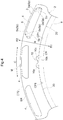
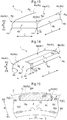
- FIG. 6 is a perspective view of the permanent magnet 4. As illustrated in FIG. 6 , each permanent magnet 4 has side surface portions 4a that are surfaces along the axial direction L and end surface portions 4b that are end surfaces in the axial direction L, and also has a plurality of corner portions 4c that are formed in a part in which the side surface portions 4a and the end surface portions 4b intersect.
- corner portions 4c At least one of the corner portions 4c that overlaps with the axial joint region JR when seen in the radial direction and that faces an outer peripheral surface CP2 of the rotor core 2 (faces the outer peripheral surface CP2 side of the rotor core 2) is referred to as a specific corner portion 4s.
- Each magnet insertion hole 5 has on the inner wall surface, facing surface portions 5p that are parts that face the corner portions 4c of the permanent magnet.
- the facing surface portion 5p that faces the specific corner portion 4s is referred to as a specific facing surface portion 5s.
- each clearance (G) that is formed between the specific corner portion 4s and the specific facing surface portion 5s is set to be a buffer clearance G that is larger than the clearances formed between the other corner portions 4c and the other facing surface portions 5p.
- the clearance (G) is a space formed between the corner portion 4c and the facing surface portion 5p.
- the corner portion 4c and the facing surface portion 5p face each other while no other member is disposed between the corner portion 4c and the facing surface portion 5p.
- the entire region sandwiched between the corner portion 4c and the facing surface portion 5p corresponds to the clearance (G).
- a length LG in the axial direction L of the region in which the buffer clearance G is formed is equal to or longer than a length LJ in the axial direction L of the axial joint region JR. Such a configuration is preferable in reducing tensile stress described below.
- the buffer clearances G are formed by forming chamfers 4g that are larger than the other corner portions 4c on the specific corner portion 4s of the permanent magnet 4, as illustrated in FIG. 6 . That is, by forming the chamfer 4g, it is possible to provide the buffer clearance G by setting the clearance formed between the specific corner portion 4s and the specific facing surface portion 5s to be larger than the clearance formed between the corner portions 4c excluding the specific corner portion 4s and the facing surface portions 5p.
- the permanent magnet 4 has a cross-sectional shape, which is orthogonal to the axial direction L, that is a rectangular shape.
- a "rectangular shape” is not limited to an accurate rectangular shape, but refers to a shape in which general shape is a rectangle.
- a "rectangular shape” also includes a shape in which one side is curved or a shape in which a spot corresponding to a corner of the rectangle is chamfered in a straight line or a curved line, when the general shape is assumed to be a rectangle, such as a shape in which the cross-sectional shape is a D-shape.
- the permanent magnet 4 having a rectangular cross-sectional shape has four side surface portions 4a and two end surface portions 4b since the general three-dimensional shape is a rectangular parallelepiped.
- the permanent magnet 4 has six side surface portions 4a when the cross-sectional shape is a D-shape (or a shape chamfered at positions corresponding to corners of the rectangle in the cross section).
- the side surface portion 4a indicated by a reference sign 43 is the side surface portion 4a (connection side surface portion 43) that connects the side surface portion 4a along the circumferential direction C indicated by a reference sign 41 (an outer peripheral side surface portion 41 (first main side surface portion) described below) and the side surface portion 4a along the radial direction R indicated by a reference sign 42 (a lateral side surface portion 42 (second main side surface portion)).
- connection side surface portion 43 can be included in the outer peripheral side surface portion 41 (first main side surface portion) or the lateral side surface portion 42 (second main side surface portion).
- the connection side surface portion 43 can be included in the outer peripheral side surface portion 41 (first main side surface portion) or the lateral side surface portion 42 (second main side surface portion).
- the general three-dimensional shape having four side surface portions 4a and two end surface portions 4b is a rectangular parallelepiped.
- the permanent magnet 4 having a rectangular cross-sectional shape orthogonal to the axial direction L of the permanent magnet 4 is disposed in the rotor core 2 so that the outer peripheral side surface portion 41 extends along the circumferential direction C.
- the outer peripheral side surface portion 41 is a surface that faces the outer peripheral surface CP2 (faces the outer peripheral surface CP2 side) of the rotor core 2, among the four side surface portions 4a.
- all the corner portions 4c (tetrahedral corner portions) in which the outer peripheral side surface portion 41 (including the connection side surface portions 43), other side portions 4a adjacent to the outer peripheral side surface portion 41 (here, the lateral side surface portions 42), and the end surface portions 4b intersect overlap with the axial joint regions JR.
- the buffer clearances G are each provided by forming the chamfer 4g on the specific corner portion 4s of the permanent magnet 4.
- the buffer clearances G may each be formed so that the specific facing surface portion 5s of the magnet insertion hole 5 is formed so as to have a shape recessed in the direction away from the permanent magnet 4 compared to the other facing surface portions 5p.
- the electromagnetic steel plates 3 that are the target be the electromagnetic steel plates 3 positioned on the axial end portion side in a range equal to or more than the length LJ of the axial joint region JR in the axial direction L. Further, it is preferable that the size in which the magnet insertion holes 5 are expanded increase toward the axial end portion.
- the form in which the buffer clearances G are provided by forming the chamfers 4g on the specific corner portions 4s of the permanent magnet 4, and the form in which the buffer clearances G are provided by expanding the magnet insertion holes 5, are each described above.
- the buffer clearances G may be provided by forming the chamfers 4g on the specific corner portions 4s of the permanent magnet 4 and expanding the magnet insertion holes 5.
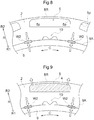
- FIG. 8 illustrates an example in which the electromagnetic steel plates 3 are stacked, the electromagnetic steel plates 3 are joined together with the first joint portions W1, and the rotor core 2 is formed.
- the permanent magnet 4 is not inserted in the magnet insertion hole 5.
- the permanent magnet 4 is inserted in the rotor core 2 in FIG. 8 .
- the stacked electromagnetic steel plates 3 are compressed to each other along the axial direction L.
- the adhesive force between the stacked electromagnetic steel plates 3 is higher particularly at an axial center part compared to both end parts. Thus, deformation of each electromagnetic steel plate 3 is suppressed.
- such adhesive force is small. Thus, there is a possibility that the electromagnetic steel plates 3 are deformed toward the axial outer side and float up from other electromagnetic steel plates 3 and the like, due to the tensile force generated in the root parts of the bridge portions BR.
- the root parts of the bridge portions BR in the circumferential direction C do not abut against the permanent magnet 4 at the axial end portions, or the force acting between the root parts and the permanent magnet 4 becomes small even if the root parts abut against the permanent magnet 4.
- the root parts of the bridge portions BR are less susceptible to the reaction from the permanent magnet 4 at the axial end portions. As a result, tensile stress caused by contraction force and reaction force becomes small.
- each of the permanent magnets 4 is disposed in the rotor core 2 so that one surface (outer peripheral side surface portion 41) that faces the outer peripheral surface CP2 of the rotor core 2 extends along the circumferential direction C, among the four side surface portions 4a of the permanent magnet 4 with a rectangular cross-sectional shape orthogonal to the axial direction L.
- the buffer clearances G be provided as described above.
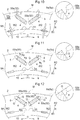
- FIG. 10 illustrates as an example, a form in which a pair of the permanent magnets 4 having a rectangular cross-sectional shape orthogonal to the axial direction L is disposed in the rotor core 2 so that the permanent magnets 4 are formed in a V-shape such that the distance between the permanent magnets 4 becomes closer toward the radial inner side R1 when seen in the axial direction.
- the magnet insertion holes 5 are formed so as to house the respective permanent magnets 4 with gaps serving as flux barriers.
- positioning portions 55 for disposing the permanent magnets 4 at prescribed positions in the magnet insertion holes 5 are formed in the magnet insertion holes 5.
- four positioning portions 55 are provided so that two surfaces of the four side surface portions 4a of each rectangular permanent magnet 4 abut against four corners (dihedral corner portions) that are adjacent thereto.
- the positioning portions 55 and the permanent magnets 4 abut against each other, reaction force from the permanent magnets 4 is applied to the positioning portions 55, when the contraction force of contracting from the radial outer side R2 toward the second joint portions W2 on the radial inner side R1 is generated. In this way, the positioning portions 55 receive tensile stress due to contraction force and reaction force.
- the buffer clearances G are formed between the facing surface portions 5p (specific facing surface portions 5s) of specific positioning portions 55s, which will be described below, and the specific corner portions 4s of the permanent magnets 4.
- all corner portions 4c that are corner portions 4c that face the positioning portions 55 which are formed in each of the magnet insertion holes 5 and position the permanent magnet 4 in the magnet insertion hole 5, that overlap with the axial joint regions JR when seen in the radial direction, and that face the outer peripheral surface CP2 of the rotor core 2 are set as the specific corner portions 4s.
- the positioning portions 55 facing the specific corner portion 4s are set as the specific positioning portions 55s.
- the buffer clearances G are formed by setting the clearances formed between the specific corner portions 4s and the specific facing surface portions 5s to be larger than the clearances formed between the corner portions 4c excluding the specific corner portions 4s and the facing surface portions 5p.
- FIG. 11 illustrates an example of a form in which the buffer clearances G are provided by forming the chamfers 4g on the specific corner portions 4s of each of the permanent magnets 4.
- FIG. 12 illustrates a form in which the buffer clearances G are provided by expanding each of the magnet insertion holes 5.
- the present invention is not limited to either one, and the buffer clearances G may be provided by forming the chamfers 4g on the specific corner portions 4s of the permanent magnets 4 and expanding the magnet insertion holes 5.
- the forms in which the buffer clearances G are provided are described above by illustrating examples of two forms of disposing the permanent magnets 4.
- tensile stress generated in the radial direction R of the rotor core 2 can be reduced by similarly providing the buffer clearances G. That is, among the corner portions 4c of the permanent magnets 4, at least one of the corner portions 4c that overlaps with the axial joint region JR when seen in the radial direction and that faces the outer peripheral surface CP2 of the rotor core 2 is set as the specific corner portion 4s.
- the facing surface portions 5p that face the specific corner portions 4s are set as the specific facing surface portions 5s.
- the buffer clearances G are provided between the specific corner portions 4s and the specific facing surface portions 5s. Thus, tensile stress can be reduced.
- the chamfers 4g are formed on the permanent magnets 4 having a D-shaped cross-sectional shape in the direction orthogonal to the axial direction L.
- the buffer clearances G can be formed by forming the chamfers 4g larger than the other corner portions 4c in the specific corner portions 4s, similar to the form described above.
- the chamfer 4g can be formed.
- FIG. 13 illustrates a case in which the cross-sectional shape is a rectangle
- FIG. 14 illustrates an example of a case in which the cross-sectional shape is a hexagon.
- the chamfers 4g larger than the chamfers formed on the other corner portions 4c are formed on the corner portions 4c (specific corner portion 4s) that overlap with the axial joint regions JR when seen in the radial direction and that face the outer peripheral surface CP2 of the rotor core 2, among the corner portions 4c of the permanent magnets 4.
- the buffer clearances G are formed.
- FIG. 15 and FIG. 16 a second embodiment of the rotor 1 will be described with reference to FIG. 15 and FIG. 16 .
- the corner portions 4c and the facing surface portions 5p face each other while no other members are disposed between the corner portions 4c and the facing surface portions 5p.
- the rotor 1 according to the present embodiment will be described focusing on the differences from the first embodiment. Points that are not particularly described are the same as those in the first embodiment.
- the clearances (G) formed between the corner portions 4c and the facing surface portions 5p are spaces formed in a part excluding the disposed members E, between the corner portions 4c and the facing surface portions 5p. That is, the clearances (G) formed between the corner portions 4c and the facing surface portions 5p are spaces in which there are no disposed members E and the bridge portion BR of the rotor core 2 is allowed to be deformed and moved. Also in this case, the clearances (G) formed between the specific corner portions 4s and the specific facing surface portions 5s are set to be the buffer clearances G that are larger than the clearances formed between the other corner portions 4c and the other facing surface portions 5p.
- the disposed members E are a fixing material F that is disposed between the inner wall surfaces of the magnet insertion holes 5 and the permanent magnets 4 to fix the permanent magnets 4 inside the respective magnet insertion holes 5.
- the fixing material F various known materials such as adhesives and various resins such as a thermoplastic resin, a thermosetting resin, and a foamable resin may be used.
- the fixing material F is a resin that is cured after being filled in a melted state between the inner wall surface of the magnet insertion holes 5 and the permanent magnets 4.
- the clearances (spaces) in which there are no fixing material F between the specific corner portions 4s and the specific facing surface portions 5s are set to be larger than the clearances (spaces) in which there is no fixing material F between the other corner portions 4c and the other facing surface portions 5p.
- the buffer clearances G are formed.
- the fixing material F is filled in parts between the inner wall portion of the magnet insertion hole 5 and the permanent magnet 4, while omitting the parts between the specific corner portions 4s and the specific facing surface portions 5s.
- the buffer clearances G are formed.
- the chamfers 4g larger than the chamfers formed on the other corner portions 4c are formed on the specific corner portions 4s of each permanent magnet 4.
- the distances between the specific corner portions 4s and the specific facing surface portions 5s are made larger than the distances between the corner portions 4c excluding the specific corner portions 4s and the facing surface portions 5p, so that larger buffer clearances G are more easily ensured.
- gaps defined by the inner wall surface of the magnet insertion hole 5 and the permanent magnet 4 that are spaced away from each other are formed on both sides of the permanent magnet 4 in the circumferential direction C.
- the gaps become fixing material filling portions 56 in which the fixing material F is filled.
- the fixing material filling portions 56 are formed continuously over the entire region of the magnet insertion hole 5 in the axial direction L.
- FIG. 16 illustrates the forming process of each buffer clearance G while focusing on a part corresponding to a XVI-XVI cross-section in FIG. 15 .
- the fixing material F is filled while the rotor core 2 is pressurized in the axial direction L by using a pressurizing member 8.
- the pressurizing member 8 has an abutting surface 81, a fixing material supply path 82, and a restricting protruded portion 83.
- the end surface on the other side of the rotor core 2 in the axial direction L is supported by a support member.
- the abutting surface 81 is a surface of the pressurizing member 8 that abuts against the end face of the rotor core 2 in the axial direction L.
- the pressurizing member 8 has a shape extending in the radial direction R and the circumferential direction C so as to cover the entire end surface of the rotor core 2 in the axial direction L. Accordingly, as illustrated in the middle drawing in FIG. 16 , the abutting surface 81 is formed so as to cover an opening portion of an end portion of the magnet insertion hole 5 in the axial direction L.
- the fixing material supply path 82 is a flow path for supplying the fixing material F to the magnet insertion hole 5.
- the fixing material supply path 82 is formed so as to extend through the pressurizing member 8 in the axial direction L.
- the opening portion of the fixing material supply path 82 on the abutting surface 81 side is provided at a position corresponding to the fixing material filling portion 56.
- the restricting protruded portion 83 is a protruded portion for restricting the fixing material F from entering, so as to form the buffer clearance G.
- the restricting protruded portion 83 has a shape that is protruded so as to fill at least a part of the space between the specific corner portion 4s and the specific facing surface portion 5s.
- the restricting protruded portion 83 has a shape corresponding to the entire space between the specific corner portion 4s and the specific facing surface portion 5s.
- the pressurizing member 8 is moved closer to the rotor core 2.
- the abutting surface 81 is abutted against the end surface of the rotor core 2 in the axial direction L and the rotor core 2 is pressurized in the axial direction L.
- the fixing material F in a flowable state is supplied to the fixing material supply path 82, as illustrated in the middle drawing in FIG. 16 .
- the fixing material supply path 82 is opened at a position corresponding to the fixing material filling portion 56 of the magnet insertion hole 5.
- the fixing material F is first supplied to the fixing material filling portion 56 and then to each portion in the magnet insertion hole 5. In this way, the fixing material F is filled between the inner wall surface of the magnet insertion hole 5 and the permanent magnet 4. At this time, since the restricting protruded portion 83 is disposed so as to fill the space between the specific corner portion 4s and the specific facing surface portion 5s, the fixing material F is restricted from entering the region between the specific corner portion 4s and the specific facing surface portion 5s. Then, after the fixing material F is cured, the pressurizing member 8 is detached from the rotor core 2, as illustrated in the bottom drawing in FIG. 16 .
- the buffer clearance G in which there is no fixing material F is formed in the space corresponding to the restricting protruded portion 83.
- the fixing material F is filled while the abutting surface 81 is abutted against the end surface of the rotor core 2 in the axial direction L and the rotor core 2 is pressurized by the pressurizing member 8 in the axial direction L.
- the buffer clearances G are formed between the specific corner portions 4s and the specific facing surface portions 5s.
- the fixing material F is filled between the inner wall surfaces of the magnet insertion holes 5 and the permanent magnets 4, it is possible to suppress the movement of the bridge portions BR to the radial inner side R1 with the fixing material F. Therefore, similar to the case of the first embodiment, when the rotor core 2 and the hub 9 are joined by the second joint portions W2 (melted joint portions), tensile stress that causes partial deformation of the rotor core 2 can be reduced.
- the fixing material F is suppressed from entering the entire space between the specific corner portions 4s and the specific facing surface portions 5s.
- the present invention is not limited to this, and the fixing material F may be disposed in a part of the space between the specific corner portions 4s and the specific facing surface portions 5s.
- the buffer clearances G formed between the specific corner portions 4s and the specific facing surface portions 5s are set to be larger than the clearances formed between the other corner portions 4c and the other facing surface portions 5p.
- a configuration is described as an example in which chamfers 4g that are larger than chamfers formed on the other corner portions 4c are formed on the specific corner portions 4s of the permanent magnets 4.
- the configuration is not limited to this.
- the specific facing surface portions 5s of each magnet insertion hole 5 may be formed so as to have a shape recessed in the direction away from the permanent magnet 4 compared to the other facing surface portions 5p, or the chamfers 4g may be formed on the specific corner portions 4s of the permanent magnet 4 and the specific facing surface portions 5s of the magnet insertion hole 5 may be expanded so as to be recessed.
- intervals at which the specific corner portions 4s and the specific facing surface portions 5s face each other maybe configured to be similar to intervals at which the other corner portions 4c and the other facing surface portions 5p face each other, and the buffer clearances G may be formed depending on the disposition state of the disposed members E such as the fixing material F.
- the spaces (buffer clearances G) formed in parts excluding the disposed members E, between the specific corner portions 4s and the specific facing surface portions 5s are set to be larger than the spaces formed in part excluding the disposed members E, between the other corner portions 4c and the other facing surface portions 5p.
- such a configuration can be realized by not filling the fixing material F as the disposed members E between the specific corner portions 4s and the specific facing surface portions 5s, and filling the fixing material F between the other corner portions 4c and the other facing surface portions 5p.
- the rotor (1) for a rotary electric machine is provided with a cylindrical rotor core (2) that is configured by stacking electromagnetic steel plates (3) in an axial direction (L) and that has a plurality of magnet insertion holes (5), and provided with a plurality of permanent magnets (4) that are inserted in the magnet insertion holes (5), and supported by a rotor support member (9) from a radial inner side (R1), in which each of the magnet insertion holes (5) is formed to extend in the axial direction (L), and the magnet insertion holes (5) are arranged along a circumferential direction (C), each of the permanent magnets (4) has a side surface portion (4a) that is a surface along the axial direction (L), and an end surface portion (4b) that is an end surface in the axial direction (L), and has a plurality of corner portions (4c) formed in a part in which the side surface portion (4a) and the end surface portion (4b) intersect, a melted joint portion (W2) is formed on an end
- the clearance (G) that is larger than the clearance formed between the other corner portion (4c) and the facing surface portion (5p) is formed between the specific corner portion (4s) and the specific facing surface portion (5s).
- the clearance (G) be a space formed between the corner portion (4c) and the facing surface portion (5p), and when there is another disposed member (E) between the corner portion (4c) and the facing surface portion (5p), the clearance (G) be a space formed in a part excluding the disposed member (E), between the corner portion (4c) and the facing surface portion (5p).
- the disposed member (E) be a fixing material (F) disposed between the inner wall surface of the magnet insertion hole (5) and the permanent magnet (4) to fix the permanent magnet (4) inside the magnet insertion hole (5).
- a chamfer (4g) larger than a chamfer formed in the other corner portion (4c) be formed in the specific corner portion (4s) of the permanent magnet (4).
- the specific facing surface portion (5s) of the magnet insertion hole (5) be formed so as to be a shape recessed toward a direction away from the permanent magnet (4) compared to the other facing surface portion (5p).
- a length (LG) in the axial direction (L) of a region in which a clearance (G) between the specific corner portion (4s) and the specific facing surface portion (5s) is formed be larger than a clearance between the other corner portion (4c) and the other facing surface portion (4p), be equal to or more than a length (LJ) in the axial direction (L) of the axial joint region (JR).
- contraction force from the radial outer side (R2) toward the radial inner side (R1) is generated in the rotor core (2) from the radial outer side (R2) to the melted joint portion (W2)
- contraction force in a range in the axial direction (L) in which the melted joint portion (W2) is formed can be easily increased.
- the clearance (G) between the specific corner portion (4s) and the specific facing surface portion (5s) be expanded so as to include the range in the axial direction (L) in which the melted joint portion (W2) is formed.
- a cross-sectional shape of the permanent magnet (4) orthogonal to the axial direction (L) be a rectangular shape, and the permanent magnet (4) be disposed in the rotor core (2) so that an outer peripheral side surface portion (41) that is one surface facing the outer peripheral surface (CP2) of the rotor core (2) among the four side surface portions (4a) extends along the circumferential direction (C), and among the corner portions (4c) formed in a part in which the outer peripheral side surface portion (41), other side surface portions (4a) adjacent to the outer peripheral side surface portion (41), and the end surface portion (4b) intersect, all of the corner portions (4c) that overlap with the axial joint region (JR) when seen in the radial direction be set as the specific corner portion (4s).
- a cross-sectional shape of the permanent magnet (4) orthogonal to the axial direction (L) be a rectangular shape, and the permanent magnet (4) be disposed in the rotor core (2) so that a pair of the permanent magnets (4) is disposed in a V-shape such that a distance between the permanent magnets (4) is reduced as the permanent magnets (4) extend toward the radial inner side (R1), and all of the corner portions (4c) that each face a positioning portion (55) formed in the magnet insertion hole (5) and which positions the permanent magnet (4), that overlap with the axial joint region (JR) when seen in the radial direction, and that face the outer peripheral surface (CP2) of the rotor core (2) be set as the specific corner portion (4s).
- one magnetic pole (M) be configured of at least one permanent magnet (4) and a plurality of magnetic poles (M) be arranged along the circumferential direction (C), and the melted joint portion (W2) be formed in a partial region of the inner peripheral surface (CP1) of the rotor core (2) in the circumferential direction (C), and be disposed between two magnetic poles (M) that are adjacent in the circumferential direction (C).
- the melted joint portion (W2) be provided between the adjacent magnetic poles (M) so as not to be a resistance of a magnetic path that is a path of a magnetic flux.
- the melted joint portion (W2) is disposed between the magnetic poles (M)
- the bridge portion (BR) is a part that is positioned on the radial outer side (R2) of the magnet insertion hole (5) in the rotor core (2) and that has a thin radial width.
Landscapes
- Engineering & Computer Science (AREA)
- Power Engineering (AREA)
- Permanent Field Magnets Of Synchronous Machinery (AREA)
- Iron Core Of Rotating Electric Machines (AREA)
Applications Claiming Priority (2)
| Application Number | Priority Date | Filing Date | Title |
|---|---|---|---|
| JP2018055845 | 2018-03-23 | ||
| PCT/JP2019/011512 WO2019181958A1 (ja) | 2018-03-23 | 2019-03-19 | 回転電機用ロータ |
Publications (2)
| Publication Number | Publication Date |
|---|---|
| EP3742584A1 true EP3742584A1 (de) | 2020-11-25 |
| EP3742584A4 EP3742584A4 (de) | 2021-03-10 |
Family
ID=67987649
Family Applications (1)
| Application Number | Title | Priority Date | Filing Date |
|---|---|---|---|
| EP19770519.7A Pending EP3742584A4 (de) | 2018-03-23 | 2019-03-19 | Rotor für elektrische drehmaschine |
Country Status (5)
| Country | Link |
|---|---|
| US (1) | US11482898B2 (de) |
| EP (1) | EP3742584A4 (de) |
| JP (1) | JP7024856B2 (de) |
| CN (1) | CN111919360B (de) |
| WO (1) | WO2019181958A1 (de) |
Families Citing this family (1)
| Publication number | Priority date | Publication date | Assignee | Title |
|---|---|---|---|---|
| JP7592509B2 (ja) * | 2021-02-16 | 2024-12-02 | 株式会社ミツバ | ブラシレスモータ |
Family Cites Families (23)
| Publication number | Priority date | Publication date | Assignee | Title |
|---|---|---|---|---|
| EP1198875B1 (de) * | 1999-07-16 | 2005-11-02 | Matsushita Electric Industrial Co., Ltd. | Synchronmotor mit dauermagneten |
| CN2706943Y (zh) * | 2004-05-24 | 2005-06-29 | 广东威灵电机制造有限公司 | 一种用于电动机的永磁转子 |
| JP4671997B2 (ja) * | 2007-10-23 | 2011-04-20 | 三菱電機株式会社 | 回転電機の回転子、及びその製造方法 |
| US8525381B2 (en) * | 2008-11-19 | 2013-09-03 | Mitsubishi Electric Corporation | Rotor of electric motor and electric motor and ventilation fan and compressor |
| JP2012114970A (ja) * | 2009-03-25 | 2012-06-14 | Sanso Electric Co Ltd | 永久磁石埋込型電動機 |
| FI121985B (fi) * | 2009-05-27 | 2011-06-30 | Abb Oy | Järjestely magneetin kiinnittämiseksi roottoriin ja roottori |
| CN102668343B (zh) * | 2009-12-22 | 2015-05-27 | 丰田自动车株式会社 | 转子和转子的制造方法 |
| JP5731338B2 (ja) * | 2011-09-20 | 2015-06-10 | 株式会社日本自動車部品総合研究所 | 回転電機 |
| JP5730736B2 (ja) * | 2011-10-04 | 2015-06-10 | 日立オートモティブシステムズ株式会社 | 永久磁石式回転電機および永久磁石式回転電機を備えた車両 |
| JP2013162617A (ja) * | 2012-02-03 | 2013-08-19 | Denso Corp | 回転電機のロータ |
| JP5904188B2 (ja) * | 2013-10-28 | 2016-04-13 | 株式会社デンソー | マルチギャップ型回転電機 |
| DE102013113657A1 (de) * | 2012-12-07 | 2014-06-12 | Denso Corporation | Rotierende elektrische Maschine in Mehrfach-Luftspalt-Ausführung |
| DE102013215812A1 (de) * | 2013-08-09 | 2015-03-05 | Bühler Motor GmbH | Elektrische Maschine |
| CN203691091U (zh) * | 2013-12-17 | 2014-07-02 | 山东华力电机集团股份有限公司 | 一种内转子永磁电机的转子冲片 |
| JP2015119557A (ja) | 2013-12-18 | 2015-06-25 | アイシン・エィ・ダブリュ株式会社 | 回転電機用ロータ及びその製造方法 |
| JP2015208184A (ja) * | 2014-04-23 | 2015-11-19 | 株式会社デンソー | 回転電機のロータ |
| EP3258572A4 (de) * | 2014-08-21 | 2019-04-03 | Jiangxi Gongbu Machinery Co., Ltd. | Elektromotoraussenrotor mit niedriger drehzahl und hohem drehmoment, elektromotor und zugehöriger kran |
| JP6137121B2 (ja) * | 2014-11-07 | 2017-05-31 | トヨタ自動車株式会社 | ロータ構造及びロータ製造方法 |
| JP6451402B2 (ja) * | 2015-02-27 | 2019-01-16 | アイシン・エィ・ダブリュ株式会社 | 回転電機用ロータ |
| KR20180108792A (ko) * | 2016-03-14 | 2018-10-04 | 아이신에이더블류 가부시키가이샤 | 로터의 제조 방법 |
| CN205846900U (zh) * | 2016-06-16 | 2016-12-28 | 新誉集团有限公司 | 高速永磁电机转子冲片 |
| DE202017100697U1 (de) * | 2017-02-09 | 2017-02-20 | Wittur Holding Gmbh | Elektromotor mit definiert verklebten Permanentmagneten |
| CN106921274A (zh) * | 2017-05-05 | 2017-07-04 | 吴凡 | 低速直驱自起动永磁电机 |
-
2019
- 2019-03-19 CN CN201980020824.6A patent/CN111919360B/zh active Active
- 2019-03-19 US US16/967,923 patent/US11482898B2/en active Active
- 2019-03-19 EP EP19770519.7A patent/EP3742584A4/de active Pending
- 2019-03-19 WO PCT/JP2019/011512 patent/WO2019181958A1/ja not_active Ceased
- 2019-03-19 JP JP2020507844A patent/JP7024856B2/ja active Active
Also Published As
| Publication number | Publication date |
|---|---|
| EP3742584A4 (de) | 2021-03-10 |
| US11482898B2 (en) | 2022-10-25 |
| CN111919360B (zh) | 2023-09-12 |
| JP7024856B2 (ja) | 2022-02-24 |
| WO2019181958A1 (ja) | 2019-09-26 |
| CN111919360A (zh) | 2020-11-10 |
| US20200373798A1 (en) | 2020-11-26 |
| JPWO2019181958A1 (ja) | 2020-12-03 |
Similar Documents
| Publication | Publication Date | Title |
|---|---|---|
| EP2549623B1 (de) | Rotor und herstellungsverfahren dafür | |
| EP3091639B1 (de) | Rotorkern für rotierende elektrische maschine und herstellungsverfahren dafür | |
| KR100950829B1 (ko) | 회전 전기기계의 회전자, 및 그 제조 방법 | |
| EP3399629B1 (de) | Rotorherstellungsverfahren | |
| US20120200185A1 (en) | Rotor for rotary electric machine and manufacturing method thereof | |
| KR20100134729A (ko) | 전기자 코어 | |
| JP2006254530A (ja) | 電動機 | |
| WO2011042984A1 (ja) | ロータおよびその製造方法 | |
| JP2016019300A (ja) | 回転子積層鉄心及びその製造方法 | |
| JP2019140843A (ja) | 回転電機用ロータ | |
| US11482898B2 (en) | Rotor for rotary electric machine | |
| EP3937349A1 (de) | Stator und motor | |
| JP7310141B2 (ja) | 回転電機のロータ | |
| US20250279683A1 (en) | Rotor assembly, method for manufacturing rotor assembly, and motor including rotor assembly | |
| JP2021069245A (ja) | 回転電機および回転電機の製造方法 | |
| CN110268600B (zh) | 转子及旋转电机 | |
| JP6685434B2 (ja) | 回転電機のステータおよび回転電機のステータの製造方法 | |
| JP6451402B2 (ja) | 回転電機用ロータ | |
| WO2014188608A1 (ja) | 杭の継手部構造 | |
| EP3886300A1 (de) | Plattenstapelkörper, gestapelter eisenkern und motor | |
| US20250219474A1 (en) | Stator core, manufacturing method for stator, and rotary electric machine | |
| US11336159B2 (en) | Manufacturing method of rotor | |
| JP3004189B2 (ja) | セグメント | |
| KR20260029747A (ko) | 차량용 모터 | |
| JP6696455B2 (ja) | 回転電機ロータ |
Legal Events
| Date | Code | Title | Description |
|---|---|---|---|
| STAA | Information on the status of an ep patent application or granted ep patent |
Free format text: STATUS: THE INTERNATIONAL PUBLICATION HAS BEEN MADE |
|
| PUAI | Public reference made under article 153(3) epc to a published international application that has entered the european phase |
Free format text: ORIGINAL CODE: 0009012 |
|
| STAA | Information on the status of an ep patent application or granted ep patent |
Free format text: STATUS: REQUEST FOR EXAMINATION WAS MADE |
|
| 17P | Request for examination filed |
Effective date: 20200818 |
|
| AK | Designated contracting states |
Kind code of ref document: A1 Designated state(s): AL AT BE BG CH CY CZ DE DK EE ES FI FR GB GR HR HU IE IS IT LI LT LU LV MC MK MT NL NO PL PT RO RS SE SI SK SM TR |
|
| AX | Request for extension of the european patent |
Extension state: BA ME |
|
| A4 | Supplementary search report drawn up and despatched |
Effective date: 20210209 |
|
| RIC1 | Information provided on ipc code assigned before grant |
Ipc: H02K 1/30 20060101ALI20210203BHEP Ipc: H02K 1/22 20060101ALI20210203BHEP Ipc: H02K 1/27 20060101AFI20210203BHEP Ipc: H02K 1/28 20060101ALI20210203BHEP |
|
| STAA | Information on the status of an ep patent application or granted ep patent |
Free format text: STATUS: EXAMINATION IS IN PROGRESS |
|
| 17Q | First examination report despatched |
Effective date: 20210319 |
|
| DAV | Request for validation of the european patent (deleted) | ||
| DAX | Request for extension of the european patent (deleted) | ||
| RAP1 | Party data changed (applicant data changed or rights of an application transferred) |
Owner name: AISIN CORPORATION |
|
| REG | Reference to a national code |
Ref country code: DE Ref legal event code: R079 Free format text: PREVIOUS MAIN CLASS: H02K0001270000 Ipc: H02K0001276000 |
|
| RIC1 | Information provided on ipc code assigned before grant |
Ipc: H02K 1/30 20060101ALI20230125BHEP Ipc: H02K 1/276 20220101AFI20230125BHEP |