EP3740229B1 - Injektionslösung mit ph-wert 7 mit mindestens einem basalinsulin mit einem pi zwischen 5,8 und 8,5 und einer copolyaminosäure mit carboxylatladungen und hydrophoben radikalen - Google Patents
Injektionslösung mit ph-wert 7 mit mindestens einem basalinsulin mit einem pi zwischen 5,8 und 8,5 und einer copolyaminosäure mit carboxylatladungen und hydrophoben radikalen Download PDFInfo
- Publication number
- EP3740229B1 EP3740229B1 EP18814899.3A EP18814899A EP3740229B1 EP 3740229 B1 EP3740229 B1 EP 3740229B1 EP 18814899 A EP18814899 A EP 18814899A EP 3740229 B1 EP3740229 B1 EP 3740229B1
- Authority
- EP
- European Patent Office
- Prior art keywords
- radical
- hydrophobic
- formula
- chosen
- radicals
- Prior art date
- Legal status (The legal status is an assumption and is not a legal conclusion. Google has not performed a legal analysis and makes no representation as to the accuracy of the status listed.)
- Active
Links
Classifications
-
- A—HUMAN NECESSITIES
- A61—MEDICAL OR VETERINARY SCIENCE; HYGIENE
- A61K—PREPARATIONS FOR MEDICAL, DENTAL OR TOILETRY PURPOSES
- A61K9/00—Medicinal preparations characterised by special physical form
- A61K9/08—Solutions
-
- A—HUMAN NECESSITIES
- A61—MEDICAL OR VETERINARY SCIENCE; HYGIENE
- A61K—PREPARATIONS FOR MEDICAL, DENTAL OR TOILETRY PURPOSES
- A61K38/00—Medicinal preparations containing peptides
- A61K38/16—Peptides having more than 20 amino acids; Gastrins; Somatostatins; Melanotropins; Derivatives thereof
- A61K38/17—Peptides having more than 20 amino acids; Gastrins; Somatostatins; Melanotropins; Derivatives thereof from animals; from humans
- A61K38/22—Hormones
- A61K38/28—Insulins
-
- A—HUMAN NECESSITIES
- A61—MEDICAL OR VETERINARY SCIENCE; HYGIENE
- A61K—PREPARATIONS FOR MEDICAL, DENTAL OR TOILETRY PURPOSES
- A61K47/00—Medicinal preparations characterised by the non-active ingredients used, e.g. carriers or inert additives; Targeting or modifying agents chemically bound to the active ingredient
- A61K47/30—Macromolecular organic or inorganic compounds, e.g. inorganic polyphosphates
- A61K47/34—Macromolecular compounds obtained otherwise than by reactions only involving carbon-to-carbon unsaturated bonds, e.g. polyesters, polyamino acids, polysiloxanes, polyphosphazines, copolymers of polyalkylene glycol or poloxamers
-
- A—HUMAN NECESSITIES
- A61—MEDICAL OR VETERINARY SCIENCE; HYGIENE
- A61K—PREPARATIONS FOR MEDICAL, DENTAL OR TOILETRY PURPOSES
- A61K47/00—Medicinal preparations characterised by the non-active ingredients used, e.g. carriers or inert additives; Targeting or modifying agents chemically bound to the active ingredient
- A61K47/30—Macromolecular organic or inorganic compounds, e.g. inorganic polyphosphates
- A61K47/42—Proteins; Polypeptides; Degradation products thereof; Derivatives thereof, e.g. albumin, gelatin or zein
-
- A—HUMAN NECESSITIES
- A61—MEDICAL OR VETERINARY SCIENCE; HYGIENE
- A61K—PREPARATIONS FOR MEDICAL, DENTAL OR TOILETRY PURPOSES
- A61K47/00—Medicinal preparations characterised by the non-active ingredients used, e.g. carriers or inert additives; Targeting or modifying agents chemically bound to the active ingredient
- A61K47/50—Medicinal preparations characterised by the non-active ingredients used, e.g. carriers or inert additives; Targeting or modifying agents chemically bound to the active ingredient the non-active ingredient being chemically bound to the active ingredient, e.g. polymer-drug conjugates
- A61K47/51—Medicinal preparations characterised by the non-active ingredients used, e.g. carriers or inert additives; Targeting or modifying agents chemically bound to the active ingredient the non-active ingredient being chemically bound to the active ingredient, e.g. polymer-drug conjugates the non-active ingredient being a modifying agent
- A61K47/62—Medicinal preparations characterised by the non-active ingredients used, e.g. carriers or inert additives; Targeting or modifying agents chemically bound to the active ingredient the non-active ingredient being chemically bound to the active ingredient, e.g. polymer-drug conjugates the non-active ingredient being a modifying agent the modifying agent being a protein, peptide or polyamino acid
-
- A—HUMAN NECESSITIES
- A61—MEDICAL OR VETERINARY SCIENCE; HYGIENE
- A61K—PREPARATIONS FOR MEDICAL, DENTAL OR TOILETRY PURPOSES
- A61K9/00—Medicinal preparations characterised by special physical form
- A61K9/0012—Galenical forms characterised by the site of application
- A61K9/0019—Injectable compositions; Intramuscular, intravenous, arterial, subcutaneous administration; Compositions to be administered through the skin in an invasive manner
-
- A—HUMAN NECESSITIES
- A61—MEDICAL OR VETERINARY SCIENCE; HYGIENE
- A61K—PREPARATIONS FOR MEDICAL, DENTAL OR TOILETRY PURPOSES
- A61K9/00—Medicinal preparations characterised by special physical form
- A61K9/20—Pills, tablets, discs, rods
- A61K9/2004—Excipients; Inactive ingredients
- A61K9/2022—Organic macromolecular compounds
- A61K9/2031—Organic macromolecular compounds obtained otherwise than by reactions only involving carbon-to-carbon unsaturated bonds, e.g. polyethylene glycol, polyethylene oxide, poloxamers
- A61K9/2045—Polyamides; Polyaminoacids, e.g. polylysine
-
- A—HUMAN NECESSITIES
- A61—MEDICAL OR VETERINARY SCIENCE; HYGIENE
- A61K—PREPARATIONS FOR MEDICAL, DENTAL OR TOILETRY PURPOSES
- A61K9/00—Medicinal preparations characterised by special physical form
- A61K9/48—Preparations in capsules, e.g. of gelatin, of chocolate
- A61K9/50—Microcapsules having a gas, liquid or semi-solid filling; Solid microparticles or pellets surrounded by a distinct coating layer, e.g. coated microspheres, coated drug crystals
- A61K9/5084—Mixtures of one or more drugs in different galenical forms, at least one of which being granules, microcapsules or (coated) microparticles according to A61K9/16 or A61K9/50, e.g. for obtaining a specific release pattern or for combining different drugs
-
- A—HUMAN NECESSITIES
- A61—MEDICAL OR VETERINARY SCIENCE; HYGIENE
- A61P—SPECIFIC THERAPEUTIC ACTIVITY OF CHEMICAL COMPOUNDS OR MEDICINAL PREPARATIONS
- A61P3/00—Drugs for disorders of the metabolism
- A61P3/08—Drugs for disorders of the metabolism for glucose homeostasis
-
- A—HUMAN NECESSITIES
- A61—MEDICAL OR VETERINARY SCIENCE; HYGIENE
- A61P—SPECIFIC THERAPEUTIC ACTIVITY OF CHEMICAL COMPOUNDS OR MEDICINAL PREPARATIONS
- A61P3/00—Drugs for disorders of the metabolism
- A61P3/08—Drugs for disorders of the metabolism for glucose homeostasis
- A61P3/10—Drugs for disorders of the metabolism for glucose homeostasis for hyperglycaemia, e.g. antidiabetics
-
- C—CHEMISTRY; METALLURGY
- C07—ORGANIC CHEMISTRY
- C07K—PEPTIDES
- C07K14/00—Peptides having more than 20 amino acids; Gastrins; Somatostatins; Melanotropins; Derivatives thereof
- C07K14/435—Peptides having more than 20 amino acids; Gastrins; Somatostatins; Melanotropins; Derivatives thereof from animals; from humans
- C07K14/575—Hormones
- C07K14/62—Insulins
-
- C—CHEMISTRY; METALLURGY
- C08—ORGANIC MACROMOLECULAR COMPOUNDS; THEIR PREPARATION OR CHEMICAL WORKING-UP; COMPOSITIONS BASED THEREON
- C08G—MACROMOLECULAR COMPOUNDS OBTAINED OTHERWISE THAN BY REACTIONS ONLY INVOLVING UNSATURATED CARBON-TO-CARBON BONDS
- C08G69/00—Macromolecular compounds obtained by reactions forming a carboxylic amide link in the main chain of the macromolecule
- C08G69/02—Polyamides derived from amino-carboxylic acids or from polyamines and polycarboxylic acids
- C08G69/08—Polyamides derived from amino-carboxylic acids or from polyamines and polycarboxylic acids derived from amino-carboxylic acids
- C08G69/10—Alpha-amino-carboxylic acids
-
- C—CHEMISTRY; METALLURGY
- C08—ORGANIC MACROMOLECULAR COMPOUNDS; THEIR PREPARATION OR CHEMICAL WORKING-UP; COMPOSITIONS BASED THEREON
- C08G—MACROMOLECULAR COMPOUNDS OBTAINED OTHERWISE THAN BY REACTIONS ONLY INVOLVING UNSATURATED CARBON-TO-CARBON BONDS
- C08G69/00—Macromolecular compounds obtained by reactions forming a carboxylic amide link in the main chain of the macromolecule
- C08G69/48—Polymers modified by chemical after-treatment
Definitions
- the invention relates to physically stable compositions in the form of an injectable aqueous solution, the pH of which is between 6.0 and 8.0, comprising at least one basal insulin whose isoelectric point (pI) is between 5.8 and 8.5 and a co-polyamino acid carrying carboxylate charges and hydrophobic radicals as defined in the claims.
- Insulin therapy or diabetes therapy using insulin injections, has seen remarkable progress in recent years, thanks in particular to the development of new insulins that offer better correction of patients' blood sugar levels compared to human insulin and that better simulate the physiological activity of the pancreas.
- OADs oral antidiabetic drugs
- Metformin oral antidiabetic drugs
- the patient may have treatment based on basal insulin such as insulin glargine or insulin detemir in addition to OADs, then, depending on the progression of the disease, a treatment based on basal insulin and prandial insulin.
- GLP-1 RAs for Glucagon-Like Peptide-1 Receptor Agonists, are insulinotropic or incretin peptides and belong to the family of gastrointestinal hormones (or Gut Hormones) that stimulate insulin secretion when blood sugar is too high, for example after a meal.
- Gastrointestinal hormones are also called satiety hormones. They include GLP-1 RA (Glucagon-like peptide-1 receptor agonist) and GIP (Glucose-dependent insulinotropic peptide), oxyntomodulin (a proglucagon derivative), peptide YY, amylin, cholecystokinin, pancreatic polypeptide (PP), ghrelin, and enterostatin, which have peptide or protein structures. They also stimulate insulin secretion in response to glucose and fatty acids, and are therefore potential candidates for the treatment of diabetes.
- GLP-1 RA Glucagon-like peptide-1 receptor agonist
- GIP Glucose-dependent insulinotropic peptide
- oxyntomodulin a proglucagon derivative
- peptide YY amylin
- cholecystokinin pancreatic polypeptide
- enterostatin enterostatin
- GLP-1 RAs have produced the best results in drug development to date. They have enabled patients with type 2 diabetes to lose weight while having better control of their blood sugar.
- a diabetic patient currently has, broadly speaking, two types of insulins with complementary actions: prandial insulins (or so-called rapid-acting insulins) and basal insulins (or so-called slow-acting insulins).
- Prandial insulins allow rapid management (metabolization and/or storage) of glucose provided during meals and snacks.
- the patient must inject prandial insulin before each meal, i.e. approximately 2 to 3 injections per day.
- the most commonly used prandial insulins are: recombinant human insulin, NovoLog ® (insulin aspart from NOVO NORDISK), Humalog ® (insulin lispro from ELI LILLY) and Apidra ® (insulin glulisine from SANOFI).
- Basal insulins ensure the maintenance of the patient's glycemic homeostasis, outside of periods of food intake. They act primarily to block the endogenous production of glucose (hepatic glucose).
- the daily dose of basal insulin generally corresponds to 40-50% of the total daily insulin requirements. Depending on the basal insulin used, this dose is administered in 1 or 2 injections, regularly spaced throughout the day.
- the most commonly used basal insulins are Levemir ® (insulin detemir from NOVO NORDISK) and Lantus ® (insulin glargine from SANOFI).
- NPH NPH insulin for Neutral Protamine Hagedorn; Humuline NPH ® , Insulatard ®
- This formulation is the result of precipitation of human insulin (anionic at neutral pH) by a cationic protein, protamine.
- the microcrystals thus formed are dispersed in an aqueous suspension and dissolve slowly after subcutaneous injection. This slow dissolution ensures a prolonged release of insulin. However, this release does not ensure a constant concentration of insulin over time.
- the release profile is bell-shaped and lasts only between 12 and 16 hours. It is therefore injected twice a day.
- This NPH basal insulin is much less effective than modern basal insulins, Levemir ® and Lantus ® .
- NPH is an intermediate-acting basal insulin.
- NPH The principle of NPH has evolved with the advent of rapid-acting insulin analogues to produce products called "Premix” offering both rapid and intermediate action.
- NovoLog Mix ® NOVO NORDISK
- Humalog Mix ® ELI LILLY
- formulations comprising a rapid-acting insulin analogue, Novolog ® and Humalog ® , partially complexed with protamine.
- These formulations contain microcrystals of insulin analogue, the action of which is said to be intermediate, and a portion of insulin that remains soluble, the action of which is rapid.
- These formulations offer the advantage of rapid-acting insulin, but they also have the disadvantage of NPH, i.e. a limited duration of action of between 12 and 16 hours and insulin released in a "bell".
- these products allow the patient to inject an intermediate-acting basal insulin with a rapid-acting prandial insulin at the same time.
- many patients are keen to reduce the number of injections they require.
- basal insulins can be classified according to the technical solution that allows for prolonged action and to date two approaches are used.
- insulin detemir The first, that of insulin detemir, is its binding to albumin in vivo. It is an analogue, soluble at pH 7, which includes a fatty acid side chain (tetradecanoyl) attached to position B29 which, in vivo, allows this insulin to associate with albumin. Its prolonged action is mainly due to this affinity for albumin after subcutaneous injection.
- insulin degludec marketed as Tresiba ®d . It also includes a fatty acid side chain attached to the insulin (hexadecandioyl- ⁇ -L-Glu).
- Insulin glargine is an analogue of human insulin obtained by elongation of the C-terminal part of the B chain of human insulin by two arginine residues, and by substitution of the asparagine residue A21, by a glycine residue ( US 5,656,722 ).
- the addition of two arginine residues was thought to adjust the pI (isoelectric point) of insulin glargine to physiological pH, and thus make this human insulin analogue insoluble in physiological media.
- the A21 substitution was designed to make insulin glargine stable at acidic pH and thus be able to formulate it in the form of an injectable solution at acidic pH.
- the transition of insulin glargine from an acidic pH (pH 4-4.5) to a physiological pH (neutral pH) causes it to precipitate under the skin.
- the slow redissolution of the insulin glargine microparticles ensures a slow and prolonged action.
- hypoglycemic effect of insulin glargine is almost constant over a 24-hour period, allowing most patients to limit themselves to a single injection per day.
- the necessarily acidic pH of basal insulin formulations, whose isoelectric point is between 5.8 and 8.5, of the insulin glargine type, can be a real disadvantage, because this acidic pH of the insulin glargine formulation sometimes causes pain in patients during injection and, above all, prevents any formulation with other proteins, particularly with prandial insulins, because the latter are not stable at acidic pH.
- the impossibility of formulating a prandial insulin at acidic pH is due to the fact that a prandial insulin undergoes, under these conditions, a secondary deamidation reaction at position A21, which does not meet the stability requirements applicable to injectable drugs.
- compositions in the form of an injectable aqueous solution comprising at least (a) a basal insulin whose isoelectric point pI is between 5.8 and 8.5 and (b) a co-polyamino acid carrying carboxylate charges substituted by hydrophobic radicals.
- the applicant has found that the co-polyamino acids carrying carboxylate charges and hydrophobic radicals according to the invention make it possible to obtain compositions in the form of solutions which not only meet the requirements described in WO 2013/104861 A1 but which are also able to confer improved physical stability to said compositions without having to increase the quantity of excipients used.
- basal insulin whose isoelectric point is between 5.8 and 8.5, is combined in the composition with a prandial insulin and/or a gastrointestinal hormone.
- the affinity of the co-polyamino acids according to the invention for insulin glargine has been increased in that it makes it possible to obtain solubilization and stabilization of insulin glargine solutions at a [Hy]/[basal insulin] ratio lower than that of the prior art; these results are furthermore obtained without altering, or even improving, the propensity of insulin glargine to precipitate as demonstrated in the experimental part.
- the invention also relates to a method for preparing stable injectable compositions.
- the pH of the compositions according to the invention is between 6.0 and 8.0, preferably between 6.6 and 7.8 or even more preferably between 6.8 and 7.6.
- Said co-polyamino acid carrying carboxylate charges and hydrophobic radicals Hy is soluble in aqueous solution at pH between 6.0 and 8.0, at a temperature of 25°C and at a concentration of less than 100 mg/ml.
- Said co-polyamino acid carrying carboxylate charges and hydrophobic radicals Hy is soluble in aqueous solution at pH between 6.0 and 8.0, at a temperature of 25°C and at a concentration of less than 60 mg/ml.
- Co-polyamino acid is a random co-polyamino acid in the chain of glutamic and/or aspartic units.
- alkyl radical means a linear or branched carbon chain which does not contain a heteroatom.
- the * indicates the attachment sites of the different elements represented.
- compositions that meet the criteria of visual inspection described in the European, American and International Pharmacopoeia, i.e. compositions that are clear and do not contain visible particles, but also colorless.
- injectable aqueous solution means solutions whose solvent is water and which meet the conditions of the EP and US pharmacopoeias.
- compositions in the form of an aqueous injectable solution according to the invention are clear solutions.
- “Clear solution” means compositions that meet the criteria described in the American and European Pharmacopoeias for injectable solutions.
- solutions are defined in part ⁇ 1151> referring to injection ⁇ 1> (referring to ⁇ 788> according to USP 35 and specified in ⁇ 788> according to USP 35 and in ⁇ 787>, ⁇ 788> and ⁇ 790> USP 38 (from August 1, 2014), according to USP 38).
- injectable solutions must meet the criteria given in sections 2.9.19 and 2.9.20.
- co-polyamino acid consisting of glutamic or aspartic units means non-cyclic linear chains of glutamic acid or aspartic acid units linked together by peptide bonds, said chains having a C-terminal part, corresponding to the carboxylic acid at one end, and an N-terminal part, corresponding to the amine at the other end of the chain.
- Soluble means capable of preparing a clear, particle-free solution at a concentration of less than 100 mg/ml in distilled water at 25°C.
- the radicals Hy, GpR, GpG, GpH, GpA, GpL and GpC are each independently the same or different from one residue to another.
- composition according to the invention is characterized in that Hy comprises between 15 and 100 carbon atoms.
- composition according to the invention is characterized in that Hy comprises between 40 and 60 carbon atoms.
- composition according to the invention is characterized in that Hy comprises between 20 and 30 carbon atoms.
- composition according to the invention is characterized in that Hy comprises more than 30 carbon atoms.
- the * indicates the sites of attachment of the hydrophobic radicals to the PLG or between the different GpR, GpG, GpH, GpA, GpL and GpC groups to form amide functions.
- Hy radicals are attached to PLG via amide functions.
- r 0 and the hydrophobic radical of formula X is linked to the PLG via a covalent bond between a carbonyl of the hydrophobic radical and a nitrogen atom carried by the PLG, thus forming an amide function resulting from the reaction of an amine function carried by the precursor of the PLG and an acid function carried by the precursor Hy' of the hydrophobic radical.
- the GpR group linked to the PLG is selected from GpRs of formula VII.
- the GpR group linked to the PLG is selected from GpRs of formula VII".
- At least one of g, h or l is different from 0.
- At least one of g and h is equal to 1.
- At least one of g and h is equal to 1.
- h is greater than or equal to 2 (h ⁇ 2).
- g or h is greater than or equal to 2 (g ⁇ 2) and b is equal to 0.
- r 0
- GpA is selected from radicals of formula VIIIa and VIIIb.
- r 1
- GpR is a radical of formula VII'
- the composition is characterized in that the hydrophobic radical of formulas X, Xa, Xb, Xb', Xc, Xe, Xf, Xg, Xh and Xi is a radical in which R is a divalent linear alkyl radical comprising from 1 to 11 carbon atoms.
- the composition is characterized in that the hydrophobic radical of formulas X, Xa, Xb, Xb', Xc, Xe, Xf, Xg, Xh and Xi is a radical in which R is a divalent alkyl radical comprising from 1 to 6 carbon atoms.
- the composition is characterized in that the hydrophobic radical of formulas X, Xa, Xb, Xb', Xc, Xe, Xf, Xg, Xh and Xi is a radical in which R is a radical of formula X1.
- the composition is characterized in that the hydrophobic radical of formulas X, Xa, Xb, Xb', Xc, Xe, Xf, Xg, Xh and Xi is a radical in which R is a radical of formula X2.
- the composition is characterized in that the hydrophobic radical of formulas X, Xa, Xb, Xb', Xc, Xe, Xf, Xg, Xh and Xi is a radical in which R is linked to the co-polyamino acid via an amide function carried by the carbon in the delta or epsilon position (or in position 4 or 5) relative to the amide function (-CONH 2 ).
- the composition is characterized in that the hydrophobic radical of formulas X, Xa, Xb, Xb', Xc, Xe, Xf, Xg, Xh and Xi is a radical in which R is an ether radical.
- the composition is characterized in that the hydrophobic radical of formulas X, Xa, Xb, Xb', Xc, Xe, Xf, Xg, Xh and Xi is a radical in which R is an ether radical comprising from 4 to 6 carbon atoms.
- the composition is characterized in that the hydrophobic radical of formulas X, Xa, Xb, Xb', Xc, Xe, Xf, Xg, Xh and Xi is a radical in which R is a divalent alkyl radical comprising 6 carbon atoms.
- the composition is characterized in that the hydrophobic radical of formulas X, Xa, Xb, Xb', Xc, Xe, Xf, Xg, Xh and Xi is a radical in which R is an ether radical represented by the formula
- the composition is characterized in that the hydrophobic radical of formulas X, Xa, Xb, Xb', Xc, Xe, Xf, Xg, Xh and Xi is a radical in which R is a polyether radical.
- the composition is characterized in that the hydrophobic radical of formulas X, Xa, Xb, Xb', Xc, Xe, Xf, Xg, Xh and Xi is a radical in which R is a polyether radical chosen from the group consisting of the radicals represented by the formulas below: Formula X3 Formula X4 Formula X5 Formula X6
- the composition is characterized in that the hydrophobic radical of formulas X, Xa, Xb, Xb', Xc, Xe, Xf, Xg, Xh and Xi is a radical in which R is a radical of formula X3.
- the composition is characterized in that the hydrophobic radical of formulas X, Xa, Xb, Xb', Xc, Xe, Xf, Xg, Xh and Xi is a radical in which R is a radical of formula X4.
- the composition is characterized in that the hydrophobic radical of formulas X, Xa, Xb, Xb', Xc, Xe, Xf, Xg, Xh and Xi is a radical in which R is a polyether radical chosen from the group consisting of the radicals represented by the formulas X5 and X6 below:
- the composition is characterized in that the hydrophobic radical of formulas X, Xa, Xb, Xb', Xc, Xe, Xf, Xg, Xh and Xi is a radical in which R is a polyether radical of formula X5.
- the composition is characterized in that the hydrophobic radical of formulas X, Xa, Xb, Xb', Xc, Xe, Xf, Xg, Xh and Xi is a radical in which R is a polyether radical of formula X6.
- Formula X5 Formula X6
- the composition is characterized in that the hydrophobic radical of formulas X, Xa, Xb, Xb', Xc, Xe, Xf, Xg, Xh and Xi is a radical in which the radical GpG and/or GpH is of formula XI' in which G is an alkyl radical comprising 6 carbon atoms represented by the formula Z below:
- the composition is characterized in that the hydrophobic radical of formulas X, Xa, Xb, Xb', Xc, Xe, Xf, Xg, Xh and Xi is a radical in which the radical GpG and/or GpH is of formula XI in which G is an alkyl radical comprising 4 carbon atoms represented by the formula Z below:
- the composition is characterized in that the hydrophobic radical of formulas X, Xa, Xb, Xb', Xc, Xe, Xf, Xg, Xh and Xi is a radical in which the radical GpG and/or GpH is of formula XI in which G is an alkyl radical comprising 4 carbon atoms represented by -(CH 2 ) 2 -CH(COOH)-.
- the composition is characterized in that the hydrophobic radical of formulas X, Xa, Xb, Xb', Xc, Xe, Xf, Xg, Xh and Xi is a radical in which the radical GpG and/or GpH is of formula XI in which G is an alkyl radical comprising 4 carbon atoms represented by -CH((CH 2 ) 2 COOH)-.
- the composition is characterized in that the hydrophobic radical of formulas X, Xa, Xb, Xb', Xc, Xe, Xf, Xg, Xh and Xi is a radical in which the radical GpG and/or GpH is of formula XI in which G is an alkyl radical comprising 3 carbon atoms represented by -CH 2 -CH-(COOH).
- the composition is characterized in that the hydrophobic radical of formulas X, Xa, Xb, Xb', Xc, Xe, Xf, Xg, Xh and Xi is a radical in which the radical GpG and/or GpH is of formula XI in which G is an alkyl radical comprising 3 carbon atoms represented by -CH(CH 2 )COOH)-.
- the composition is characterized in that the hydrophobic radical of formulas X, Xa, Xb, Xb', Xc, Xe, Xf, Xg, Xh and Xi is a radical in which the radical GpA is of formula VIII and in which A 1 , A 2 or A 3 is chosen from the group consisting of radicals represented by the formulas below:
- the composition is characterized in that the hydrophobic radical of formulas X, Xa, Xb, Xb', Xc, Xd, Xe, Xf, Xg, Xh and Xi is a radical in which the GpC radical of formula IX is chosen from the group consisting of radicals of formulas IXe, IXf or IXg represented below: Formula IX Formula IXf Formula IXg
- the composition is characterized in that the hydrophobic radical of formulas X, Xa, Xb, Xb', Xd, Xc, Xd, Xe, Xf, Xg, Xh and Xi is a radical in which the GpC radical of formula IX is chosen from the group consisting of radicals of formulas IXe, IXf or IXg in which b is equal to 0, corresponding respectively to formulas IXh, IXi, and IXj represented below: Formula IXh Formula IXi Formula IXj
- the composition is characterized in that the hydrophobic radical of formula X, Xa, Xb, Xb', Xc, Xd, Xe, Xf, Xg, Xh and Xi is a radical in which Cx is chosen from the group consisting of linear alkyl radicals.
- the composition is characterized in that the hydrophobic radical of formula X, Xa, Xb, Xb', Xc, Xd, Xe, Xf, Xg, Xh and Xi is a radical in which Cx is chosen from the group consisting of branched alkyl radicals.
- the composition is characterized in that the hydrophobic radical of formula X, Xa, Xb, Xb', Xc, Xd, Xe, Xf, Xg, Xh and Xi is a radical in which Cx is chosen from the group consisting of alkyl radicals comprising between 19 and 14 carbon atoms.
- the composition is characterized in that the hydrophobic radical of formula X, Xa, Xb, Xb', Xc, Xd, Xe, Xf, Xg, Xh and Xi is a radical in which Cx is chosen from the group consisting of alkyl radicals comprising between 15 and 16 carbon atoms.
- the composition is characterized in that the hydrophobic radical of formula X, Xa, Xb, Xb', Xc, Xd, Xe, Xf, Xg, Xh and Xi is a radical in which Cx is chosen from the group consisting of alkyl radicals comprising between 17 and 25 carbon atoms.
- the composition is characterized in that the hydrophobic radical of formula X, Xa, Xb, Xb', Xc, Xd, Xe, Xf, Xg, Xh and Xi is a radical in which Cx is chosen from the group consisting of alkyl radicals comprising between 17 and 18 carbon atoms.
- the composition is characterized in that the hydrophobic radical of formula X, Xa, Xb, Xb', Xc, Xd, Xe, Xf, Xg, Xh and Xi is a radical in which Cx is chosen from the group consisting of alkyl radicals comprising between 18 and 25 carbon atoms.
- the composition is characterized in that the hydrophobic radical is a radical of formula X, Xa, Xb, Xb', Xc, Xd, Xe, Xf, Xg, Xh and Xi in which the radical GpC of formula IX is chosen from the group consisting of radicals in which Cx is chosen from the group consisting of alkyl radicals comprising 14 or 15 carbon atoms.
- the hydrophobic radical is a radical of formula X, Xa, Xb, Xb', Xc, Xd, Xe, Xf, Xg, Xh and Xi in which the radical GpC of formula IX is chosen from the group consisting of radicals in which Cx is chosen from the group consisting of alkyl radicals comprising 14 or 15 carbon atoms.
- x is between 9 and 15 (9 ⁇ x ⁇ 15).
- the hydrophobic radical Hy is selected from the group of hydrophobic radicals of formula X, in which h is greater than or equal to 2 and GpC is of formula Ixe.
- the hydrophobic radical Hy is selected from the group of hydrophobic radicals of formula X, in which g is greater than or equal to 2 and a, l and h are equal to 0 and GpC is of formula Ixe.
- the copolyamino acid is a sodium poly-L-glutamate modified at one of its ends of the formula below represented described in example B1.
- the copolyamino acid is a sodium poly-L-glutamate modified at one of its ends of the formula below represented described in example B18.
- the composition according to the invention is characterized in that the ratio M between the number of hydrophobic radicals and the number of glutamic or aspartic units is between 0.007 and 0.3.
- the composition according to the invention is characterized in that the ratio M between the number of hydrophobic radicals and the number of glutamic or aspartic units is between 0.01 and 0.3.
- the composition according to the invention is characterized in that the ratio M between the number of hydrophobic radicals and the number of glutamic or aspartic units is between 0.02 and 0.2.
- the composition according to the invention is characterized in that the hydrophobic radical corresponds to formula X and the ratio M between the number of hydrophobic radicals and the number of glutamic or aspartic units is between 0.007 and 0.15.
- the composition according to the invention is characterized in that the hydrophobic radical corresponds to formula X and the ratio M between the number of hydrophobic radicals and the number of glutamic or aspartic units is between 0.01 and 0.1.
- the composition according to the invention is characterized in that the hydrophobic radical corresponds to formula X and the ratio M between the number of hydrophobic radicals and the number of glutamic or aspartic units is between 0.02 and 0.08.
- the composition according to the invention is characterized in that the hydrophobic radical corresponds to the formula X in which the radical Cx comprises between 9 and 10 carbon atoms and the ratio M between the number of hydrophobic radicals and the number of glutamic or aspartic units is between 0.03 and 0.15.
- the composition according to the invention is characterized in that the hydrophobic radical corresponds to the formula X in which the radical Cx comprises between 11 and 12 carbon atoms and the ratio M between the number of hydrophobic radicals and the number of glutamic or aspartic units is between 0.015 and 0.1.
- the composition according to the invention is characterized in that the hydrophobic radical corresponds to the formula X in which the radical Cx comprises between 11 and 12 carbon atoms and the ratio M between the number of hydrophobic radicals and the number of glutamic or aspartic units is between 0.02 and 0.08.
- the composition according to the invention is characterized in that the hydrophobic radical corresponds to the formula X in which the radical Cx comprises between 13 and 15 carbon atoms and the ratio M between the number of hydrophobic radicals and the number of glutamic or aspartic units is between 0.01 and 0.1.
- the composition according to the invention is characterized in that the hydrophobic radical corresponds to the formula X in which the radical Cx comprises between 13 and 15 carbon atoms and the ratio M between the number of hydrophobic radicals and the number of glutamic or aspartic units is between 0.01 and 0.06.
- the composition according to the invention is characterized in that the hydrophobic radical corresponds to formula X and the ratio M between the number of hydrophobic radicals and the number of glutamic or aspartic units is between 0.007 and 0.3.
- the composition according to the invention is characterized in that the hydrophobic radical corresponds to formula X and the ratio M between the number of hydrophobic radicals and the number of glutamic or aspartic units is between 0.01 and 0.3.
- the composition according to the invention is characterized in that the hydrophobic radical corresponds to formula X and the ratio M between the number of hydrophobic radicals and the number of glutamic or aspartic units is between 0.015 and 0.2.
- the composition according to the invention is characterized in that the hydrophobic radical corresponds to the formula X in which the radical Cx comprises between 11 and 14 carbon atoms and the ratio M between the number of hydrophobic radicals and the number of glutamic or aspartic units is between 0.1 and 0.2.
- the composition according to the invention is characterized in that the hydrophobic radical corresponds to the formula X in which the radical Cx comprises between 15 and 16 carbon atoms and the ratio M between the number of hydrophobic radicals and the number of glutamic or aspartic units is between 0.04 and 0.15.
- the composition according to the invention is characterized in that the hydrophobic radical corresponds to the formula X in which the radical Cx comprises between 17 and 18 carbon atoms and the ratio M between the number of hydrophobic radicals and the number of glutamic or aspartic units is between 0.02 and 0.06.
- the composition according to the invention is characterized in that the hydrophobic radical corresponds to the formula X in which the radical Cx comprises between 19 and 25 carbon atoms and the ratio M between the number of hydrophobic radicals and the number of glutamic or aspartic units is between 0.01 and 0.06.
- the composition according to the invention is characterized in that the hydrophobic radical corresponds to formula X in which the The Cx radical comprises between 19 and 25 carbon atoms and the ratio M between the number of hydrophobic radicals and the number of glutamic or aspartic units is between 0.01 and 0.05.
- co-polyamino acid comprises one or more aspartic units, these may undergo structural rearrangements.
- the composition according to the invention is characterized in that when the co-polyamino acid comprises aspartate units, then the co-polyamino acid may further comprise monomeric units of formula XXXI and/or XXXI':
- a "statistically grafted co-polyamino acid” is a co-polyamino acid carrying carboxylate charges and at least one hydrophobic radical, a co-polyamino acid of formula XXXa.
- the composition according to the invention is characterized in that the co-polyamino acid carrying carboxylate charges and hydrophobic radicals is chosen from the co-polyamino acids of formulas XXXa, in which Hy is a radical of formula X.
- the composition according to the invention is characterized in that the co-polyamino acid carrying carboxylate charges and hydrophobic radicals is chosen from co-polyamino acids of formula XXXa, in which Hy is a radical of formula X and in which GpC is a radical of formula IX.
- a "defined graft co-polyamino acid” is a co-polyamino acid carrying carboxylate charges and at least one hydrophobic radical, a co-polyamino acid of formula XXXb.
- the composition according to the invention is characterized in that the co-polyamino acid carrying carboxylate charges and hydrophobic radicals is chosen from co-polyamino acids of formula XXXb or XXXb" in which R 1 is a hydrophobic radical of formula X and GpR is of formula VII'.
- the composition according to the invention is characterized in that the co-polyamino acid carrying carboxylate charges and hydrophobic radicals is chosen from the co-polyamino acids of formula XXXb or XXXb" in which R 1 is a hydrophobic radical of formula X and GpR is of formula VII".
- the composition according to the invention is characterized in that the co-polyamino acid carrying carboxylate charges and hydrophobic radicals is chosen from the co-polyamino acids of formula XXXb or XXXb" in which R 1 is a hydrophobic radical of formula X and GpR is of formula VII' and GpC is of formula IX.
- the composition according to the invention is characterized in that the co-polyamino acid carrying carboxylate charges and hydrophobic radicals is chosen from the co-polyamino acids of formula XXXb or XXXb" in which R 1 is a hydrophobic radical of formula X and GpR is of formula VII' and GpC is of formula IX.
- the composition according to the invention is characterized in that the co-polyamino acid carrying carboxylate charges and hydrophobic radicals is chosen from the co-polyamino acids of formula XXX, XXXa, XXXa', XXXb, XXXb' or XXXb" in which the group D is a -CH 2 - group (aspartic unit).
- the composition according to the invention is characterized in that the co-polyamino acid carrying carboxylate charges and hydrophobic radicals is chosen from the co-polyamino acids of formula XXX, XXXa, XXXa', XXXb, XXXb' or XXXb" in which the group D is a -CH 2 -CH 2 - group (glutamic unit).
- the composition according to the invention is characterized in that R 1 is a radical chosen from the group consisting of a linear C 2 to C 10 acyl group, a branched C 4 to C 10 acyl group, a benzyl, a terminal “amino acid” unit and a pyroglutamate.
- composition according to the invention is characterized in that R 1 is a radical chosen from the group consisting of a linear C 2 to C 10 acyl group or a branched C 4 to C 10 acyl group.
- the composition according to the invention is characterized in that the co-polyamino acid carrying carboxylate charges and hydrophobic radicals is chosen from the co-polyamino acids of formulas XXXa, XXXb, XXXb' or XXXb" in which the co-polyamino acid is chosen from the co-polyamino acids in which the group D is a -CH 2 - group (aspartic unit).
- the composition according to the invention is characterized in that the co-polyamino acid carrying carboxylate charges and hydrophobic radicals is chosen from the co-polyamino acids of formulas XXXa XXXb, XXXb' or XXXb" in which the co-polyamino acid is chosen from the co-polyamino acids in which the D group is a -CH 2 -CH 2 - group (glutamic unit).
- composition according to the invention is characterized in that n + m is between 10 and 200.
- composition according to the invention is characterized in that n + m is between 15 and 150.
- composition according to the invention is characterized in that n + m is between 15 and 100.
- composition according to the invention is characterized in that n + m is between 15 and 80.
- composition according to the invention is characterized in that n + m is between 15 and 65.
- composition according to the invention is characterized in that n + m is between 20 and 60.
- composition according to the invention is characterized in that n + m is between 20 and 50.
- composition according to the invention is characterized in that n + m is between 20 and 40.
- the composition according to the invention is characterized in that the co-polyamino acid is derived from a polyamino acid obtained by polymerization.
- the composition according to the invention is characterized in that the co-polyamino acid is derived from a polyamino acid obtained by ring-opening polymerization of a glutamic acid N-carboxyanhydride derivative or an aspartic acid N-carboxyanhydride derivative.
- the composition according to the invention is characterized in that the co-polyamino acid is derived from a polyamino acid obtained by polymerization of a glutamic acid N-carboxyanhydride derivative or an aspartic acid N-carboxyanhydride derivative as described in the journal article Adv. Polym. Sci. 2006, 202, 1-18 (Deming, T.J. .).
- the composition according to the invention is characterized in that the co-polyamino acid is derived from a polyamino acid obtained by polymerization of a glutamic acid N-carboxyanhydride derivative.
- the composition according to the invention is characterized in that the co-polyamino acid is derived from a polyamino acid obtained by polymerization of a glutamic acid N-carboxyanhydride derivative chosen from the group consisting of methyl poly-glutamate N-carboxyanhydride (GluOMe-NCA), benzyl poly-glutamate N-carboxyanhydride (GluOBzl-NCA) and t-butyl poly-glutamate N-carboxyanhydride (GluOtBu-NCA).
- GluOMe-NCA methyl poly-glutamate N-carboxyanhydride
- GluOBzl-NCA benzyl poly-glutamate N-carboxyanhydride
- GluOtBu-NCA t-butyl poly-glutamate N-carboxyanhydride
- the glutamic acid N-carboxyanhydride derivative is poly-L-glutamate methyl N-carboxyanhydride (L-GluOMe-NCA).
- the glutamic acid N-carboxyanhydride derivative is benzyl poly-L-glutamate N-carboxyanhydride (L-GluOBzl-NCA).
- the composition according to the invention is characterized in that the co-polyamino acid is derived from a polyamino acid obtained by polymerization of a glutamic acid N-carboxyanhydride derivative or an aspartic acid N-carboxyanhydride derivative using as initiator an organometallic complex of a transition metal as described in the publication Nature 1997, 390, 386-389 (Deming, T.J. .).
- the composition according to the invention is characterized in that the co-polyamino acid is derived from a polyamino acid obtained by polymerization of a glutamic acid N-carboxyanhydride derivative or an aspartic acid N-carboxyanhydride derivative using ammonia or a primary amine as initiator as described in the patent FR 2,801,226 (Touraud, F. ; et al. ) and the references cited by this patent.
- the composition according to the invention is characterized in that the co-polyamino acid is derived from a polyamino acid obtained by polymerization of a glutamic acid N-carboxyanhydride derivative or an aspartic acid N-carboxyanhydride derivative using hexamethyldisilazane as initiator as described in the publication J. Am. Chem. Soc. 2007, 129, 14114-14115 (Lu H . ; et al.) or a silylated amine as described in the publication J. Am. Chem. Soc. 2008, 130, 12562-12563 (Lu H. ; et al.).
- the composition according to the invention is characterized in that the process for synthesizing the polyamino acid obtained by polymerization of a glutamic acid N-carboxyanhydride derivative or an aspartic acid N-carboxyanhydride derivative from which the co-polyamino acid is derived comprises a step of hydrolysis of ester functions.
- this step of hydrolysis of ester functions may consist of hydrolysis in an acid medium or hydrolysis in a basic medium or be carried out by hydrogenation.
- this step of hydrolysis of ester groups is a hydrolysis in an acidic medium.
- this step of hydrolysis of ester groups is carried out by hydrogenation.
- the composition according to the invention is characterized in that the co-polyamino acid is derived from a polyamino acid obtained by depolymerization of a polyamino acid of higher molecular weight.
- the composition according to the invention is characterized in that the co-polyamino acid is derived from a polyamino acid obtained by enzymatic depolymerization of a polyamino acid of higher molecular weight.
- the composition according to the invention is characterized in that the co-polyamino acid is derived from a polyamino acid obtained by chemical depolymerization of a polyamino acid of higher molecular weight.
- the composition according to the invention is characterized in that the co-polyamino acid is derived from a polyamino acid obtained by enzymatic and chemical depolymerization of a polyamino acid of higher molecular weight.
- the composition according to the invention is characterized in that the co-polyamino acid is derived from a polyamino acid obtained by depolymerization of a polyamino acid of higher molecular weight chosen from the group consisting of sodium polyglutamate and sodium polyaspartate.
- the composition according to the invention is characterized in that the co-polyamino acid is derived from a polyamino acid obtained by depolymerization of a sodium polyglutamate of higher molecular weight.
- the composition according to the invention is characterized in that the co-polyamino acid is derived from a polyamino acid obtained by depolymerization of a sodium polyaspartate of higher molecular weight.
- the composition according to the invention is characterized in that the co-polyamino acid is obtained by grafting a hydrophobic group onto a poly-L-glutamic acid or poly-L-aspartic acid using the amide bond formation methods well known to those skilled in the art.
- the composition according to the invention is characterized in that the co-polyamino acid is obtained by grafting a hydrophobic group onto a poly-L-glutamic acid or poly-L-aspartic acid using the amide bond formation methods used for peptide synthesis.
- the composition according to the invention is characterized in that the co-polyamino acid is obtained by grafting a hydrophobic group onto a poly-L-glutamic acid or poly-L-aspartic acid as described in the patent FR 2,840,614 (Chan, YP; et al. ).
- Basal insulin with an isoelectric point between 5.8 and 8.5 is defined as insulin that is insoluble at pH 7 and has a duration of action of 8 to 24 hours or longer in standard models of diabetes.
- basal insulins whose isoelectric point is between 5.8 and 8.5, are recombinant insulins whose primary structure has been modified mainly by the introduction of basic amino acids such as Arginine or Lysine. They are described, for example, in the following patents, patent applications or publications: WO 2003/053339 , WO 2004/096854 , US 5,656,722 And US 6,100,376 .
- the basal insulin with an isoelectric point between 5.8 and 8.5 is insulin glargine.
- Insulin glargine is marketed under the brand name Lantus ® (100 U/ml) or Toujeo ® (300 U/ml) by SANOFI.
- the basal insulin having an isoelectric point between 5.8 and 8.5 is a biosimilar insulin glargine.
- a biosimilar insulin glargine is being marketed under the brand name Abasaglar ® or Basaglar ® by ELI LILLY.
- compositions according to the invention comprise between 40 and 500 U/mL of basal insulin whose isoelectric point is between 5.8 and 8.5.
- compositions according to the invention comprise 40 U/mL of basal insulin whose isoelectric point is between 5.8 and 8.5.
- compositions according to the invention comprise 75 U/mL of basal insulin whose isoelectric point is between 5.8 and 8.5.
- compositions according to the invention comprise 100 U/mL (i.e. approximately 3.6 mg/mL) of basal insulin whose isoelectric point is between 5.8 and 8.5.
- compositions according to the invention comprise 150 U/mL of basal insulin whose isoelectric point is between 5.8 and 8.5.
- compositions according to the invention comprise 200 U/mL of basal insulin whose isoelectric point is between 5.8 and 8.5.
- compositions according to the invention comprise 225 U/mL of basal insulin whose isoelectric point is between 5.8 and 8.5.
- compositions according to the invention comprise 250 U/mL of basal insulin whose isoelectric point is between 5.8 and 8.5.
- compositions according to the invention comprise 300 U/mL of basal insulin whose isoelectric point is between 5.8 and 8.5.
- compositions according to the invention comprise 400 U/mL of basal insulin whose isoelectric point is between 5.8 and 8.5.
- compositions according to the invention comprise 500 U/mL of basal insulin whose isoelectric point is between 5.8 and 8.5.
- the mass ratio between basal insulin, the isoelectric point of which is between 5.8 and 8.5, and the co-polyamino acid, i.e. co-polyamino acid/basal insulin, is between 0.2 and 8.
- the mass ratio is between 0.2 and 6.
- the mass ratio is between 0.2 and 5.
- the mass ratio is between 0.2 and 4.
- the mass ratio is between 0.2 and 3.
- the mass ratio is between 0.2 and 2.
- the mass ratio is between 0.2 and 1.
- the concentration of co-polyamino acid carrying carboxylate charges and hydrophobic radicals is at most 60 mg/mL.
- the concentration of co-polyamino acid carrying carboxylate charges and hydrophobic radicals is at most 40 mg/mL.
- the concentration of co-polyamino acid carrying carboxylate charges and hydrophobic radicals is at most 20 mg/mL.
- the concentration of co-polyamino acid carrying carboxylate charges and hydrophobic radicals is at most 10 mg/mL.
- the concentration of co-polyamino acid carrying carboxylate charges and hydrophobic radicals is at most 5 mg/ml.
- the concentration of co-polyamino acid carrying carboxylate charges and hydrophobic radicals is at most 2.5 mg/ml.
- compositions according to the invention further comprise a prandial insulin.
- Prandial insulins are soluble at pH 7.
- Prandial insulin is a so-called rapid or “regular” insulin.
- So-called rapid prandial insulins are insulins that must meet the needs caused by the ingestion of proteins and carbohydrates during a meal; they must act in less than 30 minutes.
- the so-called “regular” prandial insulin is human insulin.
- the prandial insulin is recombinant human insulin as described in the European Pharmacopoeia and the United States Pharmacopoeia.
- Human insulin is, for example, marketed under the brands Humulin ® (ELI LILLY) and Novolin ® (NOVO NORDISK).
- So-called very rapid prandial insulins are insulins that are obtained by recombination and whose primary structure has been modified to reduce their action time.
- the so-called very rapid prandial insulins are chosen from the group comprising insulin lispro (Humalog ® ), insulin glulisine (Apidra ® ) and insulin aspart (NovoLog ® ).
- the prandial insulin is insulin lispro.
- the prandial insulin is insulin glulisine.
- the prandial insulin is insulin aspart.
- compositions according to the invention comprise in total between 60 and 800 U/mL of insulin with a combination of prandial insulin and basal insulin whose isoelectric point is between 5.8 and 8.5.
- compositions according to the invention comprise in total between 100 and 500 U/mL of insulin with a combination of prandial insulin and basal insulin whose isoelectric point is between 5.8 and 8.5.
- compositions according to the invention comprise a total of 800 U/mL of insulin with a combination of prandial insulin and basal insulin whose isoelectric point is between 5.8 and 8.5.
- compositions according to the invention comprise a total of 700 U/mL of insulin with a combination of prandial insulin and basal insulin whose isoelectric point is between 5.8 and 8.5.
- compositions according to the invention comprise a total of 600 U/mL of insulin with a combination of prandial insulin and basal insulin whose isoelectric point is between 5.8 and 8.5.
- compositions according to the invention comprise a total of 500 U/mL of insulin with a combination of prandial insulin and basal insulin whose isoelectric point is between 5.8 and 8.5.
- compositions according to the invention comprise a total of 400 U/mL of insulin with a combination of prandial insulin and basal insulin whose isoelectric point is between 5.8 and 8.5.
- compositions according to the invention comprise a total of 300 U/mL of insulin with a combination of prandial insulin and basal insulin whose isoelectric point is between 5.8 and 8.5.
- compositions according to the invention comprise a total of 266 U/mL of insulin with a combination of prandial insulin and basal insulin whose isoelectric point is between 5.8 and 8.5.
- compositions according to the invention comprise a total of 200 U/mL of insulin with a combination of prandial insulin and basal insulin whose isoelectric point is between 5.8 and 8.5.
- compositions according to the invention comprise a total of 100 U/mL of insulin with a combination of prandial insulin and basal insulin whose isoelectric point is between 5.8 and 8.5.
- the proportions between basal insulin with an isoelectric point between 5.8 and 8.5 and prandial insulin are, for example, in percentage 25/75, 30/70, 40/60, 50/50, 60/40, 63/37, 70/30, 75/25, 80/20, 83/17, 90/10 for formulations as described above comprising from 60 to 800 U/mL. However, any other proportion can be achieved.
- the basal insulin with an isoelectric point between 5.8 and 8.5 and the prandial insulin are present respectively in the following concentrations (in U/ml) 75/25, 150/50, 200/66 or 300/100.
- basal insulin with an isoelectric point between 5.8 and 8.5 and prandial insulin are present respectively in the following concentrations (in U/ml) 75/25.
- basal insulin with an isoelectric point between 5.8 and 8.5 and prandial insulin are present respectively in the following concentrations (in U/ml) 150/50.
- the hydrophobic radical ratio per basal insulin is defined as the ratio of their respective molar concentrations: [Hy]/[basal insulin] (mol/mol) to obtain the expected performances, namely the solubilization of basal insulin at pH between 6.0 and 8.0, the precipitation of basal insulin and the stability of the compositions according to the invention.
- the minimum value of the hydrophobic radical ratio per basal insulin [Hy]/[basal insulin], measured is the value at which the basal insulin is solubilized, because solubilization is the minimum effect to be obtained; this solubilization conditions all other technical effects that can only be observed if basal insulin is solubilized at pH between 6.0 and 8.0.
- the hydrophobic radical ratio per basal insulin [Hy]/[basal insulin] may be greater than the minimum value determined by the solubilization limit.
- the hydrophobic radical ratio per basal insulin [Hy]/[basal insulin] ⁇ 3.
- the hydrophobic radical ratio per basal insulin [Hy]/[basal insulin] ⁇ 1.75.
- the hydrophobic radical ratio per basal insulin [Hy]/[basal insulin] ⁇ 1.25.
- the hydrophobic radical ratio per basal insulin [Hy]/[basal insulin] ⁇ 1.00.
- the hydrophobic radical ratio per basal insulin [Hy]/[basal insulin] ⁇ 0.75.
- the hydrophobic radical ratio per basal insulin [Hy]/[basal insulin] ⁇ 0.25.
- compositions according to the invention further comprise a gastrointestinal hormone.
- Gastrointestinal hormones means hormones selected from the group consisting of GLP-1 RA (Glucagon like peptide-1 receptor agonist) and GIP (Glucose-dependent insulinotropic peptide), oxyntomodulin (a proglucagon derivative), peptide YY, amylin, cholecystokinin, pancreatic polypeptide (PP), ghrelin and enterostatin, their analogues or derivatives and/or their pharmaceutically acceptable salts.
- GLP-1 RA Glucagon like peptide-1 receptor agonist
- GIP Glucose-dependent insulinotropic peptide
- oxyntomodulin a proglucagon derivative
- peptide YY amylin
- cholecystokinin pancreatic polypeptide
- enterostatin enterostatin
- the gastrointestinal hormones are GLP-1 RA analogs or derivatives selected from the group consisting of exenatide or Byetta ® (ASTRA-ZENECA), liraglutide or Victoza ® (NOVO NORDISK), lixisenatide or Lyxumia ® (SANOFI), albiglutide or Tanzeum ® (GSK) or dulaglutide or Trulicity ® (ELI LILLY & CO), their analogs or derivatives and their pharmaceutically acceptable salts.
- GLP-1 RA analogs or derivatives selected from the group consisting of exenatide or Byetta ® (ASTRA-ZENECA), liraglutide or Victoza ® (NOVO NORDISK), lixisenatide or Lyxumia ® (SANOFI), albiglutide or Tanzeum ® (GSK) or dulaglutide or Trulicity ® (ELI LILLY & CO), their analogs or derivatives and their pharmaceutically acceptable salts.
- the gastrointestinal hormone is pramlintide or Symlin ® ® (ASTRA-ZENECA).
- the gastrointestinal hormone is exenatide or Byetta ® , its analogs or derivatives and their pharmaceutically acceptable salts.
- the gastrointestinal hormone is liraglutide or Victoza ® , its analogs or derivatives and their pharmaceutically acceptable salts.
- the gastrointestinal hormone is lixisenatide or Lyxumia ® , its analogs or derivatives and their pharmaceutically acceptable salts.
- the gastrointestinal hormone is albiglutide or Tanzeum ® , its analogs or derivatives and their pharmaceutically acceptable salts.
- the gastrointestinal hormone is dulaglutide or Trulicity ® , its analogs or derivatives and their pharmaceutically acceptable salts.
- the gastrointestinal hormone is pramlintide or Symlin ® , its analogs or derivatives and their pharmaceutically acceptable salts.
- analogue when used with reference to a peptide or protein, means a peptide or protein in which one or more constituent amino acid residues have been substituted by other amino acid residues and/or in which one or more constituent amino acid residues have been deleted and/or in which one or more constituent amino acid residues have been added.
- the percentage of homology allowed for the present definition of an analogue is 50%.
- “Derivative”, when used with reference to a peptide or protein, means a peptide or protein or analogue chemically modified by a substituent that is not present in the reference peptide or protein or analogue, i.e., a peptide or protein that has been modified by the creation of covalent bonds, to introduce substituents.
- the substituent is selected from the group consisting of fatty chains.
- the gastrointestinal hormone concentration is in a range of 0.01 to 100 mg/mL.
- the concentration of exenatide, its analogs or derivatives and their pharmaceutically acceptable salts is in a range of 0.04 to 0.5 mg/mL.
- the concentration of liraglutide, its analogs or derivatives and their pharmaceutically acceptable salts is in a range of 1 to 10 mg/mL.
- the concentration of lixisenatide, its analogs or derivatives and their pharmaceutically acceptable salts is in a range of 0.01 to 1 mg/mL.
- the concentration of albiglutide, its analogs or derivatives and their pharmaceutically acceptable salts is between 5 and 100 mg/mL.
- the concentration of dulaglutide, its analogs or derivatives and their pharmaceutically acceptable salts is between 0.1 and 10 mg/mL.
- the concentration of pramlintide, its analogs or derivatives and their pharmaceutically acceptable salts is between 0.1 and 5 mg/mL.
- compositions according to the invention are made by mixing commercial solutions of basal insulin whose isoelectric point is between 5.8 and 8.5 and commercial solutions of GLP-1 RA, analogue or derivative of GLP-1 RA in volume ratios within a range of 10/90 to 90/10.
- the composition according to the invention comprises a daily dose of basal insulin and a daily dose of gastrointestinal hormone.
- compositions according to the invention comprise between 40 U/mL and 500 U/mL of basal insulin whose isoelectric point is between 5.8 and 8.5 and between 0.05 and 0.5 mg/mL of exenatide.
- compositions according to the invention comprise between 40 U/mL and 500 U/mL of basal insulin whose isoelectric point is between 5.8 and 8.5 and from 1 to 10 mg/mL of liraglutide.
- compositions according to the invention comprise between 40 U/mL and 500 U/mL of basal insulin whose isoelectric point is between 5.8 and 8.5 and from 0.01 to 1 mg/mL of lixisenatide.
- compositions according to the invention comprise between 40 U/mL and 500 U/mL of basal insulin whose isoelectric point is between 5.8 and 8.5 and from 5 to 100 mg/mL of albiglutide.
- compositions according to the invention comprise between 40 U/mL and 500 U/mL of basal insulin whose isoelectric point is between 5.8 and 8.5 and from 0.1 to 10 mg/mL of dulaglutide.
- compositions according to the invention comprise 500 U/mL of basal insulin whose isoelectric point is between 5.8 and 8.5 and from 0.04 to 0.5 mg/mL of exenatide.
- compositions according to the invention comprise 500 U/mL of basal insulin whose isoelectric point is between 5.8 and 8.5 and from 1 to 10 mg/mL of liraglutide.
- compositions according to the invention comprise 500 U/mL of basal insulin whose isoelectric point is between 5.8 and 8.5 and from 0.01 to 1 mg/mL of lixisenatide.
- compositions according to the invention comprise 500 U/mL of basal insulin whose isoelectric point is between 5.8 and 8.5 and from 5 to 100 mg/mL of albiglutide.
- compositions according to the invention comprise 500 U/mL of basal insulin whose isoelectric point is between 5.8 and 8.5 and from 0.1 to 10 mg/mL of dulaglutide.
- compositions according to the invention comprise 400 U/mL of basal insulin whose isoelectric point is between 5.8 and 8.5 and from 0.04 to 0.5 mg/mL of exenatide.
- compositions according to the invention comprise 400 U/mL of basal insulin whose isoelectric point is between 5.8 and 8.5 and from 1 to 10 mg/mL of liraglutide.
- compositions according to the invention comprise 400 U/mL of basal insulin whose isoelectric point is between 5.8 and 8.5 and from 0.01 to 1 mg/mL of lixisenatide.
- compositions according to the invention comprise 400 U/mL of basal insulin whose isoelectric point is between 5.8 and 8.5 and from 5 to 100 mg/mL of albiglutide.
- compositions according to the invention comprise 400 U/mL of basal insulin whose isoelectric point is between 5.8 and 8.5 and from 0.1 to 10 mg/mL of dulaglutide.
- compositions according to the invention comprise 300 U/mL of basal insulin whose isoelectric point is between 5.8 and 8.5 and from 1 to 10 mg/mL of liraglutide.
- compositions according to the invention comprise 300 U/mL of basal insulin whose isoelectric point is between 5.8 and 8.5 and from 0.01 to 1 mg/mL of lixisenatide.
- compositions according to the invention comprise 300 U/mL of basal insulin whose isoelectric point is between 5.8 and 8.5 and from 5 to 100 mg/mL of albiglutide.
- compositions according to the invention comprise 300 U/mL of basal insulin whose isoelectric point is between 5.8 and 8.5 and from 0.1 to 10 mg/mL of dulaglutide.
- compositions according to the invention comprise 225 U/mL of basal insulin whose isoelectric point is between 5.8 and 8.5 and from 0.04 to 0.5 mg/mL of exenatide.
- compositions according to the invention comprise 225 U/mL of basal insulin whose isoelectric point is between 5.8 and 8.5 and from 1 to 10 mg/mL of liraglutide.
- compositions according to the invention comprise 225 U/mL of basal insulin whose isoelectric point is between 5.8 and 8.5 and from 5 to 100 mg/mL of albiglutide.
- compositions according to the invention comprise 200 U/mL of basal insulin whose isoelectric point is between 5.8 and 8.5 and from 0.04 to 0.5 mg/mL of exenatide.
- compositions according to the invention comprise 200 U/mL of basal insulin whose isoelectric point is between 5.8 and 8.5 and from 1 to 10 mg/mL of liraglutide.
- compositions according to the invention comprise 200 U/mL of basal insulin whose isoelectric point is between 5.8 and 8.5 and from 0.1 to 10 mg/mL of dulaglutide.
- compositions according to the invention comprise 100 U/mL (i.e. approximately 3.6 mg/mL) of basal insulin whose isoelectric point is between 5.8 and 8.5 and from 0.04 to 0.5 mg/mL of exenatide.
- compositions according to the invention comprise 100 U/mL (i.e. approximately 3.6 mg/mL) of basal insulin whose isoelectric point is between 5.8 and 8.5 and from 1 to 10 mg/mL of liraglutide.
- compositions according to the invention comprise 100 U/mL (i.e. approximately 3.6 mg/mL) of basal insulin whose isoelectric point is between 5.8 and 8.5 and from 0.01 to 1 mg/mL of lixisenatide.
- compositions according to the invention comprise 100 U/mL of basal insulin whose isoelectric point is between 5.8 and 8.5 and from 5 to 100 mg/mL of albiglutide.
- compositions according to the invention comprise 100 U/mL of basal insulin whose isoelectric point is between 5.8 and 8.5 and from 0.1 to 10 mg/mL of dulaglutide.
- compositions according to the invention comprise 40 U/mL of basal insulin whose isoelectric point is between 5.8 and 8.5 and from 1 to 10 mg/mL of liraglutide.
- compositions according to the invention comprise 40 U/mL of basal insulin whose isoelectric point is between 5.8 and 8.5 and from 0.01 to 1 mg/mL of lixisenatide.
- compositions according to the invention comprise 40 U/mL of basal insulin whose isoelectric point is between 5.8 and 8.5 and from 5 to 100 mg/mL of albiglutide.
- compositions according to the invention comprise 40 U/mL of basal insulin whose isoelectric point is between 5.8 and 8.5 and from 0.1 to 10 mg/mL of dulaglutide.
- the invention also relates to compositions which further comprise ionic species, said ionic species making it possible to improve the stability of the compositions.
- the invention also relates to the use of ionic species chosen from the group of anions, cations and/or zwitterions to improve the physicochemical stability of the compositions according to the invention.
- Said ionic species are chosen from the group of anions, cations and/or zwitterions.
- zwitterion is meant a species carrying at least one positive charge and at least one negative charge on two non-adjacent atoms.
- Said ionic species are used alone or in mixture and preferably in mixture.
- the anions are selected from organic anions.
- the organic anions comprise less than 10 carbon atoms.
- the organic anions are selected from the group consisting of acetate, citrate and succinate.
- the anions are chosen from anions of mineral origin.
- the anions of mineral origin are chosen from the group consisting of sulfates, phosphates and halides, in particular chlorides.
- the cations are selected from organic cations.
- the organic cations comprise less than 10 carbon atoms.
- the cations of mineral origin are chosen from the group consisting of zinc, in particular Zn2+ and alkali metals, in particular Na+ and K+,
- the zwitterions of organic origin are chosen from amino acids.
- amino acids are selected from aliphatic amino acids in the group consisting of glycine, alanine, valine, isoleucine and leucine.
- the amino acids are selected from cyclic amino acids in the group consisting of proline.
- the amino acids are selected from hydroxylated or sulfur-containing amino acids in the group consisting of cysteine, serine, threonine, and methionine.
- amino acids are selected from aromatic amino acids in the group consisting of phenylalanine, tyrosine and tryptophan.
- the amino acids are chosen from amino acids whose carboxyl function of the side chain is amidated in the group consisting of asparagine and glutamine.
- the zwitterions of organic origin are selected from the group consisting of amino acids having an uncharged side chain.
- aminodiacids are selected from the group consisting of glutamic acid and aspartic acid, optionally in the form of salts.
- the so-called “cationic” amino acids are chosen from arginine, histidine and lysine, in particular arginine and lysine.
- zwitterions contain as many negative charges as positive charges and therefore an overall charge of zero at the isoelectric point and/or at a pH between 6.0 and 8.0.
- cations of mineral origin are provided in the form of salts chosen from sodium chloride, zinc chloride, sodium phosphate, sodium sulfate, etc.
- amino acids are added in the form of salts chosen from arginine hydrochloride, histidine hydrochloride or in non-salified form such as histidine, arginine.
- the total molar concentration of ionic species in the composition is greater than or equal to 10 mM.
- the total molar concentration of ionic species in the composition is greater than or equal to 20 mM.
- the total molar concentration of ionic species in the composition is greater than or equal to 30 mM.
- the total molar concentration of ionic species in the composition is greater than or equal to 75 mM.
- the total molar concentration of ionic species in the composition is greater than or equal to 100 mM.
- the total molar concentration of ionic species in the composition is greater than or equal to 200 mM.
- the total molar concentration of ionic species in the composition is greater than or equal to 600 mM.
- the total molar concentration of ionic species in the composition is greater than or equal to 700 mM.
- the total molar concentration of ionic species in the composition is greater than or equal to 900 mM.
- the total molar concentration of ionic species in the composition is less than or equal to 1500 mM.
- the total molar concentration of ionic species in the composition is less than or equal to 1200 mM.
- the total molar concentration of ionic species in the composition is less than or equal to 900 mM.
- the total molar concentration of ionic species in the composition is less than or equal to 800 mM.
- the total molar concentration of ionic species in the composition is less than or equal to 700 mM.
- the total molar concentration of ionic species in the composition is less than or equal to 600 mM.
- the total molar concentration of ionic species in the composition is less than or equal to 500 mM.
- the total molar concentration of ionic species in the composition is less than or equal to 400 mM.
- the total molar concentration of ionic species in the composition is less than or equal to 300 mM.
- the total molar concentration of ionic species in the composition is less than or equal to 200 mM.
- the total molar concentration of ionic species in the composition is less than or equal to 100 mM.
- the total molar concentration of ionic species in the composition is between 20 and 1000 mM.
- the total molar concentration of ionic species in the composition is between 30 and 1000 mM.
- the total molar concentration of ionic species in the composition is between 50 and 1000 mM.
- the total molar concentration of ionic species in the composition is between 75 and 1000 mM.
- the total molar concentration of ionic species in the composition is between 100 and 1000 mM.
- the total molar concentration of ionic species in the composition is between 200 and 1000 mM.
- the total molar concentration of ionic species in the composition is between 300 and 1000 mM.
- the total molar concentration of ionic species in the composition is between 500 and 1000 mM.
- the total molar concentration of ionic species in the composition is between 600 and 1000 mM.
- the total molar concentration of ionic species in the composition is between 10 and 900 mM.
- the total molar concentration of ionic species in the composition is between 50 and 900 mM.
- the total molar concentration of ionic species in the composition is between 75 and 900 mM.
- the total molar concentration of ionic species in the composition is between 100 and 900 mM.
- the total molar concentration of ionic species in the composition is between 200 and 900 mM.
- the total molar concentration of ionic species in the composition is between 300 and 900 mM.
- the total molar concentration of ionic species in the composition is between 400 and 900 mM.
- the total molar concentration of ionic species in the composition is between 500 and 900 mM.
- the total molar concentration of ionic species in the composition is between 600 and 900 mM.
- the total molar concentration of ionic species in the composition is between 10 and 900 mM.
- the total molar concentration of ionic species in the composition is between 20 and 800 mM.
- the total molar concentration of ionic species in the composition is between 30 and 800 mM.
- the total molar concentration of ionic species in the composition is between 50 and 800 mM.
- the total molar concentration of ionic species in the composition is between 75 and 800 mM.
- the total molar concentration of ionic species in the composition is between 100 and 800 mM.
- the total molar concentration of ionic species in the composition is between 200 and 800 mM.
- the total molar concentration of ionic species in the composition is between 300 and 800 mM.
- the total molar concentration of ionic species in the composition is between 400 and 800 mM.
- the total molar concentration of ionic species in the composition is between 500 and 800 mM.
- the total molar concentration of ionic species in the composition is between 600 and 800 mM.
- the total molar concentration of ionic species in the composition is between 10 and 700 mM.
- the total molar concentration of ionic species in the composition is between 20 and 700 mM.
- the total molar concentration of ionic species in the composition is between 30 and 700 mM.
- the total molar concentration of ionic species in the composition is between 50 and 700 mM.
- the total molar concentration of ionic species in the composition is between 75 and 700 mM.
- the total molar concentration of ionic species in the composition is between 100 and 700 mM.
- the total molar concentration of ionic species in the composition is between 200 and 700 mM.
- the total molar concentration of ionic species in the composition is between 300 and 700 mM.
- the total molar concentration of ionic species in the composition is between 400 and 700 mM.
- the total molar concentration of ionic species in the composition is between 500 and 700 mM.
- the total molar concentration of ionic species in the composition is between 600 and 700 mM.
- the total molar concentration of ionic species in the composition is between 10 and 600 mM.
- the total molar concentration of ionic species in the composition is between 20 and 600 mM.
- the total molar concentration of ionic species in the composition is between 30 and 600 mM.
- the total molar concentration of ionic species in the composition is between 50 and 600 mM.
- the total molar concentration of ionic species in the composition is between 100 and 600 mM.
- the total molar concentration of ionic species in the composition is between 200 and 600 mM.
- the total molar concentration of ionic species in the composition is between 300 and 600 mM.
- the total molar concentration of ionic species in the composition is between 400 and 600 mM.
- the total molar concentration of ionic species in the composition is between 500 and 600 mM.
- the total molar concentration of ionic species in the composition is between 10 and 500 mM.
- the total molar concentration of ionic species in the composition is between 20 and 500 mM.
- the total molar concentration of ionic species in the composition is between 30 and 500 mM.
- the total molar concentration of ionic species in the composition is between 50 and 500 mM.
- the total molar concentration of ionic species in the composition is between 75 and 500 mM.
- the total molar concentration of ionic species in the composition is between 100 and 500 mM.
- the total molar concentration of ionic species in the composition is between 200 and 500 mM.
- the total molar concentration of ionic species in the composition is between 300 and 500 mM.
- the total molar concentration of ionic species in the composition is between 10 and 400 mM.
- the total molar concentration of ionic species in the composition is between 20 and 400 mM.
- the total molar concentration of ionic species in the composition is between 30 and 400 mM.
- the total molar concentration of ionic species in the composition is between 50 and 400 mM.
- the total molar concentration of ionic species in the composition is between 75 and 400 mM.
- the total molar concentration of ionic species in the composition is between 100 and 400 mM.
- the total molar concentration of ionic species in the composition is between 200 and 400 mM.
- the total molar concentration of ionic species in the composition is between 300 and 400 mM.
- the total molar concentration of ionic species in the composition is between 10 and 300 mM.
- the total molar concentration of ionic species in the composition is between 20 and 300 mM.
- the total molar concentration of ionic species in the composition is between 30 and 300 mM.
- the total molar concentration of ionic species in the composition is between 50 and 300 mM.
- the total molar concentration of ionic species in the composition is between 75 and 300 mM.
- the total molar concentration of ionic species in the composition is between 100 and 300 mM.
- the total molar concentration of ionic species in the composition is between 200 and 300 mM.
- the total molar concentration of ionic species in the composition is between 10 and 200 mM.
- the total molar concentration of ionic species in the composition is between 20 and 200 mM.
- the total molar concentration of ionic species in the composition is between 30 and 200 mM.
- the total molar concentration of ionic species in the composition is between 50 and 200 mM.
- the total molar concentration of ionic species in the composition is between 75 and 200 mM.
- the total molar concentration of ionic species in the composition is between 100 and 200 mM.
- the total molar concentration of ionic species in the composition is between 10 and 100 mM.
- the total molar concentration of ionic species in the composition is between 20 and 100 mM.
- the total molar concentration of ionic species in the composition is between 30 and 100 mM.
- the total molar concentration of ionic species in the composition is between 50 and 100 mM.
- the total molar concentration of ionic species in the composition is between 75 and 100 mM.
- the total molar concentration of ionic species in the composition is between 10 and 75 mM.
- the total molar concentration of ionic species in the composition is between 20 and 75 mM.
- the total molar concentration of ionic species in the composition is between 30 and 75 mM.
- the total molar concentration of ionic species in the composition is between 50 and 75 mM.
- the total molar concentration of ionic species in the composition is between 10 and 50 mM.
- the total molar concentration of ionic species in the composition is between 20 and 50 mM.
- the total molar concentration of ionic species in the composition is between 30 and 50 mM.
- said ionic species are present in a concentration ranging from 5 to 400 mM.
- said ionic species are present in a concentration ranging from 5 to 300 mM.
- said ionic species are present in a concentration ranging from 5 to 200 mM.
- said ionic species are present in a concentration ranging from 5 to 100 mM.
- said ionic species are present in a concentration ranging from 5 to 75 mM.
- said ionic species are present in a concentration ranging from 5 to 50 mM.
- said ionic species are present in a concentration ranging from 5 to 25 mM.
- said ionic species are present in a concentration ranging from 5 to 20 mM.
- said ionic species are present in a concentration ranging from 5 to 10 mM.
- said ionic species are present in a concentration ranging from 10 to 400 mM.
- said ionic species are present in a concentration ranging from 10 to 300 mM.
- said ionic species are present in a concentration ranging from 10 to 200 mM.
- said ionic species are present in a concentration ranging from 10 to 100 mM.
- said ionic species are present in a concentration ranging from 10 to 75 mM.
- said ionic species are present in a concentration ranging from 10 to 50 mM.
- said ionic species are present in a concentration ranging from 10 to 25 mM.
- said ionic species are present in a concentration ranging from 10 to 20 mM.
- said ionic species are present in a concentration ranging from 20 to 300 mM.
- said ionic species are present in a concentration ranging from 20 to 200 mM.
- said ionic species are present in a concentration ranging from 20 to 75 mM.
- said ionic species are present in a concentration ranging from 20 to 50 mM.
- said ionic species are present in a concentration ranging from 20 to 25 mM.
- said ionic species are present in a concentration ranging from 50 to 300 mM.
- said ionic species are present in a concentration ranging from 50 to 200 mM.
- said ionic species are present in a concentration ranging from 50 to 100 mM.
- said ionic species are present in a concentration ranging from 50 to 75 mM.
- its molar concentration within the composition can be between 0.25 and 20 mM, in particular between 0.25 and 10 mM or between 0.25 and 5 mM.
- the composition comprises zinc.
- the composition comprises from 0.2 to 2 mM zinc.
- the composition comprises NaCl.
- the NaCl is present in a concentration ranging from 2 to 25 mM.
- the NaCl is present in a concentration ranging from 2.5 to 20 mM.
- the NaCl is present in a concentration ranging from 4 to 15 mM.
- the NaCl is present in a concentration ranging from 5 to 10 mM.
- compositions according to the invention further comprise buffers.
- compositions according to the invention comprise buffers at concentrations between 0 and 100 mM.
- the buffer is sodium phosphate.
- the buffer is Tris (trishydroxymethylaminomethane).
- the buffer is sodium citrate.
- compositions according to the invention further comprise zinc salts at a concentration of between 0 and 4000 ⁇ M.
- compositions according to the invention further comprise zinc salts at a concentration of between 0 and 2000 ⁇ M.
- compositions according to the invention further comprise zinc salts at a concentration of between 0 and 1000 ⁇ M.
- compositions according to the invention further comprise zinc salts at a concentration of between 200 and 500 ⁇ M.
- compositions according to the invention further comprise preservatives.
- the preservatives are selected from the group consisting of m-cresol and phenol, alone or in a mixture.
- the concentration of the preservatives is between 10 and 50 mM.
- the concentration of the preservatives is between 10 and 40 mM.
- compositions according to the invention further comprise a surfactant.
- the surfactant is selected from the group consisting of propylene glycol and polysorbate.
- compositions according to the invention may further comprise additives such as tonicity agents.
- compositions according to the invention may further comprise all the excipients conforming to the pharmacopoeias and compatible with the insulins used at the usual concentrations.
- the invention also relates to a pharmaceutical formulation according to the invention, characterized in that it is obtained by drying and/or lyophilization.
- Transdermal, oral, nasal, vaginal, ocular, buccal, and pulmonary routes of administration are also considered.
- composition according to the invention is characterized in that it is administered at least twice a day.
- composition according to the invention is characterized in that it is administered twice a day.
- composition according to the invention is characterized in that it further comprises a prandial insulin.
- composition according to the invention further comprising at least one prandial insulin is characterized in that it is administered once a day.
- composition according to the invention further comprising at least one prandial insulin is characterized in that it is administered twice a day.
- composition according to the invention is characterized in that it further comprises a gastrointestinal hormone.
- composition according to the invention further comprising at least one gastrointestinal hormone is characterized in that it is administered once a day.
- composition according to the invention is characterized in that the gastrointestinal hormone is a GLP-1 RA.
- composition according to the invention further comprising at least one GLP-1 RA is characterized in that it is administered once a day.
- composition according to the invention further comprising at least one GLP-1 RA is characterized in that it is administered at least twice a day.
- the invention also relates to unit-dose formulations with a pH between 6.0 and 8.0 comprising a basal insulin whose isoelectric point is between 5.8 and 8.5.
- the invention also relates to unit-dose formulations with a pH between 6.0 and 8.0 comprising a basal insulin with an isoelectric point between 5.8 and 8.5 and a prandial insulin.
- the invention also relates to unit-dose formulations with a pH between 6.0 and 8.0 comprising a basal insulin with an isoelectric point between 5.8 and 8.5 and a gastrointestinal hormone, as defined above.
- the invention also relates to unit-dose formulations with a pH between 6.0 and 8.0 comprising a basal insulin with an isoelectric point between 5.8 and 8.5, a prandial insulin and a gastrointestinal hormone, as defined above.
- the invention also relates to unit-dose formulations with a pH between 6.6 and 7.8 comprising a basal insulin with an isoelectric point between 5.8 and 8.5 and a prandial insulin.
- the invention also relates to single-dose formulations with a pH between 6.6 and 7.8 comprising a basal insulin whose isoelectric point is between 5.8 and 8.5 and a gastrointestinal hormone, as defined above.
- the invention also relates to single-dose formulations with a pH between 6.6 and 7.8 comprising a basal insulin with an isoelectric point between 5.8 and 8.5, a prandial insulin and a gastrointestinal hormone, as defined above.
- the invention also relates to unit-dose formulations with a pH between 6.6 and 7.6 comprising a basal insulin whose isoelectric point is between 5.8 and 8.5.
- the invention also relates to unit-dose formulations with a pH between 6.6 and 7.6 comprising a basal insulin with an isoelectric point between 5.8 and 8.5 and a prandial insulin.
- the invention also relates to single-dose formulations with a pH between 6.6 and 7.6 comprising a basal insulin whose isoelectric point is between 5.8 and 8.5, a prandial insulin and a gastrointestinal hormone, as defined above.
- the unit-dose formulations further comprise a co-polyamino acid as defined above.
- the formulations are in the form of an injectable solution.
- the basal insulin having an isoelectric point between 5.8 and 8.5 is insulin glargine.
- the GLP-1 RA, analog or derivative of GLP-1 RA is selected from the group consisting of exenatide (Byetta ® ), liraglutide (Victoza ® ), lixisenatide (Lyxumia ® ), albiglutide (Tanzeum ® ), dulaglutide (Trulicity ® ) or one of their derivatives.
- the gastrointestinal hormone is exenatide.
- the gastrointestinal hormone is liraglutide.
- the gastrointestinal hormone is lixisenatide.
- the gastrointestinal hormone is albiglutide.
- a basal insulin whose isoelectric point is between 5.8 and 8.5, solubilized at a pH between 6.0 and 8.0 in the presence of a co-polyamino acid carrying carboxylate charges and at least one hydrophobic radical according to the invention, retains its slow insulin action, whether alone or in combination with a prandial insulin or a gastrointestinal hormone.
- the preparation of a composition according to the invention has the advantage of being able to be carried out by simple mixing of an aqueous solution of basal insulin whose isoelectric point is between 5.8 and 8.5, a solution of prandial insulin, and a co-polyamino acid carrying carboxylate charges and at least one hydrophobic radical according to the invention, in aqueous solution or in lyophilized form. If necessary, the pH of the preparation is adjusted to a pH between 6.0 and 8.0.
- the preparation of a composition according to the invention has the advantage of being able to be carried out by simple mixing of an aqueous solution of basal insulin whose isoelectric point is between 5.8 and 8.5, of a solution of GLP-1 RA, an analogue or a derivative of GLP-1 RA, and of a co-polyamino acid carrying carboxylate charges and of at least one hydrophobic radical according to the invention, in aqueous solution or in lyophilized form. If necessary, the pH of the preparation is adjusted to a pH between 6.0 and 8.0.
- the preparation of a composition according to the invention has the advantage of being able to be carried out by simple mixing of an aqueous solution of basal insulin whose isoelectric point is between 5.8 and 8.5, a solution of prandial insulin, a solution of GLP-1 RA or an analogue or derivative of GLP-1 RA and a co-polyamino acid carrying carboxylate charges and at least one hydrophobic radical according to the invention, in aqueous solution or in lyophilized form. If necessary, the pH of the preparation is adjusted to a pH between 6.0 and 8.0.
- the mixture of basal insulin and co-polyamino acid is concentrated by ultrafiltration before mixing with prandial insulin in aqueous solution or in lyophilized form.
- composition of the mixture is adjusted with excipients such as glycerin, m-cresol, zinc chloride, and polysorbate (Tween ® ) by adding concentrated solutions of these excipients to the mixture.
- excipients such as glycerin, m-cresol, zinc chloride, and polysorbate (Tween ® )
- pH of the preparation is adjusted to a pH between 6.0 and 8.
- Molecule 1 Product obtained by the reaction between Fmoc-Lys(Fmoc)-OH and 2-Cl-trityl chloride resin.
- Molecule 2 Product obtained by the reaction between molecule 1 and a DMF/piperidine mixture 80:20.
- Molecule 3 Product obtained by the reaction between molecule 2 and Fmoc-Glu(OtBu)-OH.
- Molecule 4 Product obtained by the reaction between molecule 3 and a 50:50 DMF/morpholine mixture.
- Molecule 5 Product obtained by the reaction between molecule 4 and molecule 11.
- Molecule 6 Product obtained by the reaction between molecule 5 and a dichloromethane/1,1,1,3,3,3-hexafluoro-2-propanol (HFIP) 80:20 mixture.
- HFIP dichloromethane/1,1,1,3,3,3-hexafluoro-2-propanol
- Molecule 7 Product obtained by the reaction between molecule 6 and N-Boc ethylenediamine.
- Molecule 8 Product obtained by the coupling between myristic acid and methyl L-glutamate.
- Molecule 9 Product obtained by the coupling between molecule 8 and methyl L-glutamate.
- Molecule 11 Product obtained by the reaction between myristoyl chloride and L-proline.
- Molecule 12 Product obtained by the coupling between molecule 11 and methyl L-glutamate.
- Molecule 13 Product obtained by the coupling between molecule 12 and N-Boc ethylenediamine.
- Molecule 14 Product obtained by the reaction between lauroyl chloride and L-proline
- Molecule 15 Product obtained by the coupling between molecule 14 and methyl L-glutamate.
- Molecule 16 Product obtained by the coupling between molecule 15 and N-Boc ethylenediamine.
- Molecule 17 Product obtained by the reaction between 1-amino-4,7,10-trioxa-13-tridecane amine and tert-butyl phenylcarbonate.
- Molecule 18 Product obtained by the coupling between molecule 12 and molecule 17.
- Molecule 21 Product obtained by coupling between molecule 11 and L-lysine.
- Molecule 22 Product obtained by coupling between molecule 21 and methyl N-Boc-L-lysinate.
- Molecule 23 Product obtained by saponification of molecule 23.
- Example A5a molecule A5a
- Molecule 3a Product obtained by the reaction between Fmoc-Lys(Fmoc)-OH and 2-Cl-trityl chloride resin.
- the resin is filtered, washed successively with DCM (3 x 60 mL), DMF (2 x 60 mL), DCM (2 x 60 mL), isopropanol (1 x 60 mL) and DCM (3 x 60 mL).
- Molecule 4a Product obtained by reaction between molecule 3a and a DMF/piperidine mixture 80:20.
- Molecule 3a previously washed with DMF, is treated with a DMF/piperidine mixture 80:20 (60 mL). After 30 min of stirring at room temperature, the resin is filtered, washed successively with DMF (3 x 60 mL), isopropanol (1 x 60 mL) and DCM (3 x 60 mL).
- Molecule 6a Product obtained by reaction between molecule 5a and a DMF/piperidine mixture 80:20.
- Molecule 9a Product obtained by the reaction between molecule 8a and N-Boc ethylenediamine.
- Molecule 10a Product obtained by hydrogenation of retinoic acid.
- Molecule 11a Product obtained by coupling between Boc-1-amino-4,7,10-trioxa-13-tridecane amine (BocTOTA) and molecule 10a.
- Molecule 15a Product obtained by the reaction between decanoic acid and L-leucine.
- Molecule 16a Product obtained by the reaction between molecule 15a and the methyl ester of L-lysine.
- Molecule 17a Product obtained by the saponification of molecule 16a.
- Molecule 19a 13-Methyltetradecanoic acid.
- Molecule 21a Product obtained by the reaction between molecule 20 and Boc-tri(ethylene glycol)diamine.
- Molecule 23a Product obtained by coupling between molecule 22a and L-lysine.
- Molecule 24 Product obtained by coupling between molecule 23a and the methyl ester of L-lysine.
- the A11 molecule was obtained by the conventional solid-phase peptide synthesis (SPPS) method on 2-chlorotrityl chloride (CTC) resin (40.0 g, 1.16 mmol/g).
- SPPS solid-phase peptide synthesis
- CTC 2-chlorotrityl chloride
- the grafting of the first amino acid Fmoc-Lys(Fmoc)-OH (1.5 equivalents) is carried out in DCM (10V), in the presence of DIPEA (3.0 equivalents).
- the unreacted sites are capped with methanol (0.8 mL/g resin) at the end of the reaction.
- Fmoc protecting groups are removed using an 80:20 DMF/piperidine solution (10 V).
- Molecule 25 Product obtained by hydrogenation of farnesol.
- Molecule 26 Product obtained by oxidation of molecule 25
- Molecule 28 Product obtained by the saponification of molecule 27.
- the A12 molecule is obtained by the conventional method of solid phase peptide synthesis (SPPS) on 2-chlorotrityl chloride (CTC) resin (34.5 g, 1.16 mmol/g).
- SPPS solid phase peptide synthesis
- CTC 2-chlorotrityl chloride
- the grafting of ethylenediamine (10.0 equivalents) is carried out in DCM (10V), in the presence of DIPEA (10.0 equivalents).
- the unreacted sites are capped with methanol (0.8 mL/g resin) at the end of the reaction.
- Fmoc protecting groups are removed using an 80:20 DMF/piperidine (10 V) solution (after lysine coupling) or a 50% morpholine solution in DMF (after glutamic acid coupling).
- Molecule 29 Product obtained by polymerization of ⁇ -benzyl-L-glutamate N-carboxyanhydride initiated by N-Boc-ethylenediamine.
- Molecule 30 Product obtained between the coupling of myristoyl chloride and molecule 29.
- Molecule 31 Product obtained by the reaction between molecule 14 and Boc-ethylenediamine.
- the A15 molecule was obtained by the conventional solid-phase peptide synthesis (SPPS) method on 2-chlorotrityl chloride (CTC) resin (16.0 g, 1.16 mmol/g).
- SPPS solid-phase peptide synthesis
- CTC 2-chlorotrityl chloride
- Molecule 32 Product obtained by SPPS
- Molecule 32 was obtained by the conventional solid-phase peptide synthesis (SPPS) method on 2-chlorotrityl chloride (CTC) resin (50.0 g, 1.14 mmol/g).
- SPPS solid-phase peptide synthesis
- CTC 2-chlorotrityl chloride
- Fmoc protecting groups are removed using an 80:20 DMF/piperidine solution (10 V).
- the product is cleaved from the resin using a DCM/HFIP 80:20 solution (10 V).
- Molecule 33 Product obtained by the reaction between molecule 32 and N-CBz ethylenediamine.
- the A17 molecule is obtained by the conventional method of solid phase peptide synthesis (SPPS) on 2-chlorotrityl chloride (CTC) resin (64.66 g, 1.16 mmol/g).
- SPPS solid phase peptide synthesis
- CTC 2-chlorotrityl chloride
- the grafting of ethylenediamine (10.0 equivalents) is carried out in DCM (10V), in the presence of DIPEA (10.0 equivalents).
- the unreacted sites are capped with methanol (0.8 mL/g resin) at the end of the reaction.
- Couplings of the protected amino acid Fmoc-Glu(OMe)-OH (1.5 equivalents) and molecule 28 (1.5 equivalents) were carried out in a 1:1 DCM/DMF mixture (10V) for the coupling of glutamic acid or in DMF (10V) for the coupling of molecule 28, in the presence of HATU (1.0 equivalent relative to the acid) and DIPEA (2.0 equivalents relative to the acid).
- Fmoc protecting groups are removed using a 50:50 DMF/morpholine solution (10 V).
- Molecule 34 Product obtained by hydrogenation of phytol.
- Molecule 35 Product obtained by oxidation of molecule 34.
- Molecule 36 Product obtained by coupling between molecule 35 and methyl L-prolinate.
- Molecule 37 Product obtained by the saponification of molecule 36.
- the A18 molecule is obtained by the conventional method of solid phase peptide synthesis (SPPS) on 2-chlorotrityl chloride (CTC) resin (26.72 g, 1.16 mmol/g).
- SPPS solid phase peptide synthesis
- CTC 2-chlorotrityl chloride
- Co-polyamino acid B1 sodium poly-L-glutamate modified at one of its ends by the molecule A1 and having a number-average molar mass (Mn) of 2800 g/mol
- Co-polyamino acid B2 sodium poly-L-glutamate modified by molecule A2 whose esters are saponified and having a number-average molar mass (Mn) of 5200 g/mol
- Co-polyamino acid B2-1 poly-L-glutamic acid from the polymerization of ⁇ -benzyl-L-glutamate N -carboxyanhydride initiated by hexylamine
- Co-polyamino acid B3 sodium poly-L-glutamate modified by molecule A3 whose ester is saponified and having a number-average molar mass (Mn) of 4900 g/mol
- Co-polyamino acid B5 sodium poly-L-glutamate modified by the molecule A5 whose ester is saponified and having a number-average molar mass (Mn) of 5400 g/mol
- ⁇ -benzyl-L-glutamateN-carboxyanhydride 24.50 g, 93.05 mmol
- anhydrous DMF 55 mL
- the mixture is then stirred until completely dissolved, cooled to 0 °C, and then hexylamine (0.56 mL, 4.23 mmol) is rapidly introduced.
- the mixture is stirred at 0 °C for 48 h and then a solution of molecule A11 (9.51 g, 5.08 mmol) in DMF (50 mL), HOPO (564 mg, 5.08 mmol) and EDC (973 mg, 5.08 mmol).
- Co-polyamino acid B14-1 poly-L-benzylglutamate modified at one of its ends by the molecule A12.
- Example B8 co-polyamino acid B8 - sodium poly-L-glutamate modified at one of its ends by the molecule A6a and having a number-average molar mass (Mn) of 2400 g/mol
- Co-polyamino acid B10 sodium poly-L-glutamate modified at one of its ends by the molecule A8 and having a number-average molar mass (Mn) of 3100 g/mol
- Co-polyamino acid B10-1 poly-L-benzylglutamate modified at one of its ends by the molecule A8.
- the hydrochloride salt of molecule A8 (2.308 g, 3.04 mmol), chloroform (120 mL), 4 ⁇ molecular sieve (1.5 g), and Amberlite IRN 150 ion exchange resin (1.5 g) are successively introduced. After 1 h of stirring on rollers, the medium is filtered and the resin is rinsed with chloroform. The mixture is evaporated and then co-evaporated with toluene. The residue is solubilized in anhydrous DMF (40 mL) to be used directly in the polymerization reaction.
- the hydrochloride salt of molecule A9 (2.023 g, 3.87 mmol), chloroform (120 mL), 4 ⁇ molecular sieve (1.5 g), and Amberlite IRN 150 ion exchange resin (1.5 g) are successively introduced. After 1 h of stirring on rollers, the medium is filtered and the resin is rinsed with chloroform. The mixture is evaporated and then co-evaporated with toluene. The residue is solubilized in anhydrous DMF (40 mL) to be used directly in the polymerization reaction.
- Co-polyamino acid B12-1 poly-L-benzylglutamate modified at one of its ends by the molecule A10.
- Co-polyamino acids CE1 and CE2 are synthesized according to the method described in the application WO2017211916 .
- Example C1 Rapid-acting insulin analogue solution (Humalog ® ) at 100 U/mL
- This solution is a commercial insulin lispro solution marketed by ELI LILLY under the name Humalog ® .
- This product is a rapid-acting insulin analog.
- the excipients in Humalog ® are meta-cresol (3.15 mg/mL), glycerol (16 mg/mL), disodium phosphate (1.88 mg/mL), zinc oxide (to have 0.0197 mg of zinc ion/mL), sodium hydroxide and hydrochloric acid for pH adjustment (pH 7-7.8) and water.
- Example C2 Rapid-acting insulin lispro solution at 100-600 U/mL
- This solution is an insulin solution prepared from insulin lispro powder produced by Gan&Lee.
- This product is a rapid-acting insulin analogue.
- the excipients used are m-cresol, glycerol, zinc oxide, sodium hydroxide, and hydrochloric acid for pH adjustment (pH 7-7.8) and water.
- the zinc concentration is 300 ⁇ M per 100 IU/mL of insulin.
- the concentration of other excipients varies depending on the lispro concentration to achieve the desired concentrations in the final formulations.
- Example C3 Long-acting insulin analogue solution (Lantus ® ) at 100 U/mL
- This solution is a commercial insulin glargine solution marketed by SANOFI under the name Lantus ® .
- This product is a long-acting insulin analogue.
- the excipients in Lantus ® are zinc chloride (30 ⁇ g/mL), m-cresol (2.7 mg/mL), glycerol (20 mg/mL), polysorbate 20 (16 ⁇ M), sodium hydroxide and hydrochloric acid for pH adjustment (pH 4) and water.
- This solution is an insulin glargine solution prepared from insulin glargine powder produced by Gan&Lee.
- This product is a long-acting insulin analog.
- the excipients used are zinc chloride, m-cresol, glycerol, sodium hydroxide, and hydrochloric acid for pH adjustment (pH 4) and water.
- the zinc concentration is 460 ⁇ M per 100 IU/mL of insulin.
- the concentration of other excipients varies depending on the concentration of glargine to achieve the desired concentrations in the final formulations.
Landscapes
- Health & Medical Sciences (AREA)
- Chemical & Material Sciences (AREA)
- Life Sciences & Earth Sciences (AREA)
- Medicinal Chemistry (AREA)
- General Health & Medical Sciences (AREA)
- Public Health (AREA)
- Pharmacology & Pharmacy (AREA)
- Animal Behavior & Ethology (AREA)
- Veterinary Medicine (AREA)
- Epidemiology (AREA)
- Diabetes (AREA)
- Proteomics, Peptides & Aminoacids (AREA)
- Engineering & Computer Science (AREA)
- Bioinformatics & Cheminformatics (AREA)
- Organic Chemistry (AREA)
- Endocrinology (AREA)
- Chemical Kinetics & Catalysis (AREA)
- Inorganic Chemistry (AREA)
- Gastroenterology & Hepatology (AREA)
- Zoology (AREA)
- General Chemical & Material Sciences (AREA)
- Polymers & Plastics (AREA)
- Dermatology (AREA)
- Nuclear Medicine, Radiotherapy & Molecular Imaging (AREA)
- Immunology (AREA)
- Obesity (AREA)
- Hematology (AREA)
- Emergency Medicine (AREA)
- Toxicology (AREA)
- Biochemistry (AREA)
- Biophysics (AREA)
- Genetics & Genomics (AREA)
- Molecular Biology (AREA)
- Medicines That Contain Protein Lipid Enzymes And Other Medicines (AREA)
- Medicinal Preparation (AREA)
- Peptides Or Proteins (AREA)
Claims (15)
- Zusammensetzung in Form einer injizierbaren wässrigen Lösung, deren pH zwischen 6,0 und 8,0 umfasst, umfassend mindestens:- ein Basalinsulin, dessen isoelektrischer Punkt pI zwischen 5,8 und 8,5 umfasst;- eine Co-Polyaminosäure, die Carboxylatladungen und hydrophobe Reste Hy trägt, wobei die Co-Polyaminosäure aus Glutaminsäure- oder Asparaginsäureeinheiten besteht und die hydrophoben Reste Hy von der folgenden Formel X sind:
 - GpR ausgewählt ist aus Resten der Formeln VII, VII' oder VII":
 - identische oder verschiedene GpG und GpH ausgewählt sind aus Resten der Formeln XI oder XI':
 - GpA ausgewählt ist aus Resten der Formel VIII
 - GpL ausgewählt ist aus Resten der Formel VII
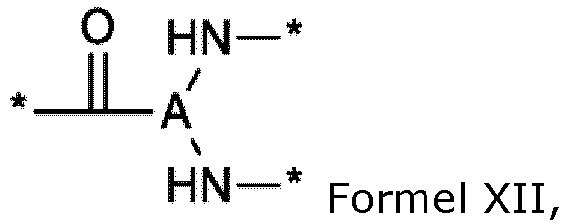 - GpC ein Rest der Formel IX ist:
 - * die Bindungsstellen von verschiedenen Gruppen angeben, die durch Funktionen von Amiden verbunden sind;- a eine ganze Zahl gleich 0 oder 1 ist und a' = 1 wenn a = 0 und a' = 1, 2 oder 3 wenn a = 1;- a' eine ganze Zahl gleich 1, 2 oder 3 ist;- b eine ganze Zahl gleich 0 oder 1 ist;- c eine ganze Zahl gleich 0 oder 1 ist, und wenn c gleich 0 ist, dann d gleich 1 oder 2 ist;- d eine ganze Zahl gleich 0, 1 oder 2 ist;- e eine ganze Zahl gleich 0 oder 1 ist;- g eine ganze Zahl gleich 0, 1, 2, 3, 4, 5 oder 6 ist;- h eine ganze Zahl gleich 0, 1, 2, 3, 4, 5 oder 6 ist;- l eine ganze Zahl gleich 0 oder 1 ist und l' = 1 wenn l = 0 und l' = 2 wenn l = 1;- r eine ganze Zahl gleich 0, 1 oder 2 ist, und- s' eine ganze Zahl gleich 0 oder 1 ist, und- wenn e ungleich 0 ist, dann mindestens eines von g, h oder l ungleich 0 ist; und- wenn a = 0, dann l = 0;- identische oder verschiedene A, A1, A2 oder A3 lineare oder verzweigte Alkylreste und optional durch einen Rest aus einem gesättigten, ungesättigten oder aromatischen Ring umfassend 1 bis 8 Kohlenstoffatome substituiert sind;- B ein linearer oder verzweigter Alkylrest, optional umfassend einen aromatischen Kern, umfassend 1 bis 9 Kohlenstoffatome, oder ein unsubstituierter Ether- oder Polyetherrest umfassend 4 bis 14 Kohlenstoffatome und 1 bis 5 Sauerstoffatome ist;- Cx ein einwertiger linearer oder verzweigter Alkylrest ist, optional umfassend einen zyklischen Teil, wobei x die Anzahl an Kohlenstoffatomen angibt, und• wenn der hydrophobe Rest -Hy 1 -GpC trägt, dann 9 ≤ x ≤ 25,• wenn der hydrophobe Rest -Hy 2 -GpC trägt, dann 9 ≤ x ≤ 15,• wenn der hydrophobe Rest -Hy 3 -GpC trägt, dann 7 ≤ x ≤ 13,• wenn der hydrophobe Rest -Hy 4 -GpC trägt, dann 7 ≤ x ≤ 11,• wenn der hydrophobe Rest -Hy mindestens 5 -GpC trägt, dann 6 ≤ x ≤ 11,- G ein verzweigter Alkylrest mit 1 bis 8 Kohlenstoffatomen ist, wobei der Alkylrest eine oder mehrere freie Carbonsäurefunktion(en) trägt;- R ein Rest ausgewählt aus der Gruppe bestehend aus einem zweiwertigen linearen oder verzweigten Alkylrest umfassend 1 bis 12 Kohlenstoffatome, einem zweiwertigen linearen oder verzweigten Alkylrest umfassend 1 bis 12 Kohlenstoffatome, die eine oder mehrere Funktionen von -CONH2 tragen, oder einem unsubstituierten Ether- oder Polyetherrest umfassend 4 bis 14 Kohlenstoffatome und 1 bis 5 Sauerstoffatome ist:- wobei der oder die hydrophoben Reste -Hy der Formel X verbunden sind mit PLG:∘ über eine kovalente Bindung zwischen einem Carbonyl des hydrophoben Rests -Hy und einem Stickstoffatom, das durch PLG getragen ist, wodurch eine Funktion von Amid gebildet wird, die aus der Reaktion einer Funktion von Amin getragen von PLG und einer Säurefunktion getragen von dem Vorläufer -Hy' des hydrophoben Rests -Hy resultiert, und∘ über eine kovalente Bindung zwischen einem Stickstoffatom des hydrophoben Rests -Hy und einem Carbonyl getragen von PLG, wodurch eine Funktion von Amid gebildet wird, die aus der Reaktion einer Funktion von Amin des Vorläufers -Hy' des hydrophoben Rests -Hy und einer Säurefunktion getragen von PLG resultiert,- das Verhältnis M zwischen der Anzahl an hydrophoben Resten und der Anzahl an Glutaminsäure- oder Asparaginsäureeinheiten zwischen 0 < M ≤ 0,5 umfasst;- wenn mehrere hydrophobe Reste durch eine Co-Polyaminosäure getragen werden, sie dann identisch oder verschieden sind,- der Grad der Polymerisation DP in Glutaminsäure- oder Asparaginsäureeinheiten für die PLG-Ketten zwischen 5 und 250 umfasst;- die freien Carbonsäurefunktionen in Form von alkalischem Kationensalz ausgewählt aus der Gruppe bestehend aus Na+ und K+ sind.
 - Zusammensetzung nach Anspruch 1, dadurch gekennzeichnet, dass die Co-Polyaminosäure, die Carboxylatladungen und hydrophobe Reste Hy trägt, ausgewählt ist aus den folgenden Co-Polyaminosäuren der Formel XXXa':
 - D unabhängig entweder eine -CH2-Gruppe (Asparaginsäureeinheit) oder eine - CH2-CH2-Gruppe (Glutaminsäureeinheit) darstellt,- Hy ein hydrophober Rest ausgewählt aus den hydrophoben Resten der Formeln X ist, wobei r = 1 und GpR ein Rest der Formel VII ist,- R1 ein hydrophober Rest ausgewählt aus den hydrophoben Resten der Formeln X ist, wobei R = 0 oder r = 1 und GpR ein Rest der Formel VII' ist, oder ein Rest ausgewählt aus der Gruppe, die aus einem H, einer linearen C2- bis C10-Acylgruppe, einer verzweigten C4- bis C10-Acylgruppe, einem Benzyl, einer terminalen "Aminosäure"-Einheit und einem Pyroglutamat besteht,- R2 ein hydrophober Rest ausgewählt aus den hydrophoben Resten der Formeln X ist, wobei r = 1 und GpR ein Rest der Formel VII ist, oder ein Rest -NR'R", wobei identische oder verschiedene R' und R" ausgewählt sind aus der Gruppe bestehend aus H, linearen oder verzweigten oder zyklischen C2- bis C10-Alkylen, Benzyl und R'- und R"-Alkyle zusammen einen oder mehrere gesättigte, ungesättigte und/oder aromatische Kohlenstoffringe bilden können und/oder Heteroatome beinhalten können, ausgewählt aus der Gruppe bestehend aus O, N und S;- X eine kationische Einheit ausgewählt aus der Gruppe umfassend Alkalikationen darstellt;- n + m den Grad der Polymerisation DP der Co-Polyaminosäure darstellen, also die mittlere Anzahl an monomeren Einheiten pro Kette an Co-Polyaminosäure und 5 ≤ n + m ≤ 250.
 - Zusammensetzung nach dem vorhergehenden Anspruch, dadurch gekennzeichnet, dass die Co-Polyaminosäure, die Carboxylatladungen und hydrophobe Reste trägt, ausgewählt ist aus Co-Polyaminosäuren der Formel XXXa', wobei R1 = R'1 und R2 = R'2, der folgenden Formel XXXa:
 - m, n, X, D und Hy wie in Anspruch 2 definiert sind,- R'1 ein Rest ausgewählt aus der Gruppe bestehend aus einem H, einer linearen C2-bis C10-Acylgruppe, einer verzweigten C4- bis C10-Acylgruppe, einem Benzyl, einer terminalen "Aminosäure"-Einheit und einem Pyroglutamat ist,- R'2 ein Rest -NR'R" ist, wobei identische oder verschiedene R' und R" ausgewählt sind aus der Gruppe bestehend aus H, linearen oder verzweigten oder zyklischen C2- bis C10-Alkylen, Benzyl und die R'- und R"-Alkyl zusammen einen oder mehrere gesättigte, ungesättigte und/oder aromatische Kohlenstoffringe bilden können und/oder Heteroatome ausgewählt aus der Gruppe bestehend aus O, N und S beinhalten können.
 - Zusammensetzung nach Anspruch 2, dadurch gekennzeichnet, dass die Co-Polyaminosäure, die Carboxylatladungen und hydrophobe Reste trägt, ausgewählt ist aus Co-Polyaminosäuren der Formel XXXa', wobei n = 0 der folgenden Formel XXXb:

- Zusammensetzung nach Anspruch 4, dadurch gekennzeichnet, dass die Co-Polyaminosäure, die Carboxylatladungen und hydrophobe Reste trägt, ausgewählt ist aus Co-Polyaminosäuren der Formel XXXa', wobei n = 0 der Formel XXXb und R1 oder R2 ein hydrophober Rest der Formel X ist.
- Zusammensetzung nach einem der Ansprüche 4 und 5, dadurch gekennzeichnet, dass die Co-Polyaminosäure, die Carboxylatladungen und hydrophobe Reste trägt, ausgewählt ist aus den Co-Polyaminosäuren der Formeln XXXb, wobei R2 ein hydrophober Rest der Formel X ist, wobei r = 1 und GpR von der Formel VII ist.
- Zusammensetzung nach einem der Ansprüche 2 bis 6, dadurch gekennzeichnet, dass R1 ein Rest ausgewählt aus der Gruppe bestehend aus einer linearen C2- bis C10-Acylgruppe, einer verzweigten C4- bis C10-Acylgruppe, einem Benzyl, einer terminalen "Aminosäure"-Einheit und einem Pyroglutamat ist.
- Zusammensetzung nach einem der Ansprüche 2 bis 7, dadurch gekennzeichnet, dass die Co-Polyaminosäure, die Carboxylatladungen und hydrophobe Reste trägt, ausgewählt ist aus Co-Polyaminosäuren der Formeln XXXa', XXXa oder XXXb, wobei die Co-Polyaminosäure ausgewählt ist aus den Co-Polyaminosäuren, wobei die Gruppe D eine -CH2-Gruppe (Asparaginsäureeinheit) ist.
- Zusammensetzung nach einem der Ansprüche 2 bis 7, dadurch gekennzeichnet, dass die Co-Polyaminosäure, die Carboxylatladungen und hydrophobe Reste trägt, ausgewählt ist aus Co-Polyaminosäuren der Formeln XXXa', XXXa oder XXXb, wobei die Co-Polyaminosäure ausgewählt ist aus den Co-Polyaminosäuren, wobei die Gruppe D eine -CH2-CH2-Gruppe (Glutaminsäureeinheit) ist.
- Zusammensetzung nach einem der vorhergehenden Ansprüche, dadurch gekennzeichnet, dass das Basalinsulin, dessen isoelektrischer Punkt zwischen 5,8 und 8,5 umfasst, Insulin glargin ist.
- Zusammensetzung nach einem der vorhergehenden Ansprüche, dadurch gekennzeichnet, dass sie zwischen 40 und 500 U/ml Basalinsulin umfasst, dessen isoelektrischer Punkt zwischen 5,8 und 8,5 umfasst.
- Zusammensetzung nach einem der vorhergehenden Ansprüche, dadurch gekennzeichnet, dass die Konzentration an Co-Polyaminosäure, die Carboxylatladungen und hydrophobe Reste trägt, höchstens 60 mg/ml ist.
- Co-Polyaminosäure, die Carboxylatladungen und hydrophobe Reste Hy trägt, wobei die Co-Polyaminosäure aus Glutaminsäure- oder Asparaginsäureeinheiten gebildet ist und die hydrophoben Reste Hy ausgewählt sind aus Resten der Formel X wie nachfolgend definiert:
 - GpR ausgewählt ist aus Resten der Formeln VII, VII' oder VII":
 - identische oder verschiedene GpG und GpH ausgewählt sind aus Resten der Formeln XI oder XI':
 - GpA ausgewählt ist aus Resten der Formel VIII
 - -GpL ausgewählt ist aus Resten der Formel VII
 - GpC ein Rest der Formel IX ist:
 - * die Bindungsstellen von verschiedenen Gruppen angeben, die durch Funktionen von Amiden verbunden sind;- a eine ganze Zahl gleich 0 oder 1 ist und a' = 1 wenn a = 0 und a' = 1, 2 oder 3 wenn a = 1;- a' eine ganze Zahl gleich 1, 2 oder 3 ist;- b eine ganze Zahl gleich 0 oder 1 ist;- c eine ganze Zahl gleich 0 oder 1 ist, und wenn c gleich 0 ist, dann d gleich 1 oder 2 ist;- d eine ganze Zahl gleich 0, 1 oder 2 ist;- e eine ganze Zahl gleich 0 oder 1 ist;- g eine ganze Zahl gleich 0, 1, 2, 3, 4, 5 oder 6 ist;- h eine ganze Zahl gleich 0, 1, 2, 3, 4, 5 oder 6 ist, und mindestens eines von g, h oder l ungleich 0 ist;- l eine ganze Zahl gleich 0 oder 1 ist und l' = 1 wenn l = 0 und l' = 2 wenn l = 1;- r eine ganze Zahl gleich 0, 1 oder 2 ist, und- s' eine ganze Zahl gleich 0 oder 1 ist;- und wenn e ungleich 0 ist, dann mindestens eines von g, h oder l ungleich 0 ist;- und wenn a = 0, dann l = 0;- identische oder verschiedene A, A1, A2 oder A3 lineare oder verzweigte Alkylreste umfassend 1 bis 8 Kohlenstoffatome und optional durch einen Rest aus einem gesättigten, ungesättigten oder aromatischen Ring substituiert sind;- B ein unsubstituierter Ether- oder Polyetherrest umfassend 4 bis 14 Kohlenstoffatome und 1 bis 5 Sauerstoffatome oder ein linearer oder verzweigter Alkylrest, optional umfassend einen aromatischen Kern, umfassend 1 bis 9 Kohlenstoffatome ist;- Cx ein einwertiger linearer oder verzweigter Alkylrest ist, optional umfassend einen zyklischen Teil, wobei x die Anzahl an Kohlenstoffatomen angibt, und• wenn der hydrophobe Rest -Hy 1 -GpC trägt, dann 9 ≤ x ≤ 25,• wenn der hydrophobe Rest -Hy 2 -GpC trägt, dann 9 ≤ x ≤ 15,• wenn der hydrophobe Rest -Hy 3 -GpC trägt, dann 7 ≤ x ≤ 13,• wenn der hydrophobe Rest -Hy 4 -GpC trägt, dann 7 ≤ x ≤ 11,• wenn der hydrophobe Rest -Hy mindestens 5 -GpC trägt, dann 6 ≤ x ≤ 11,- G ein zweiwertiger linearer oder verzweigter Alkylrest mit 1 bis 8 Kohlenstoffatomen ist, wobei der Alkylrest eine oder mehrere freie Carbonsäurefunktion(en) trägt;- R ein Rest ausgewählt aus der Gruppe bestehend aus einem zweiwertigen linearen oder verzweigten Alkylrest umfassend 1 bis 12 Kohlenstoffatome, einem zweiwertigen linearen oder verzweigten Alkylrest umfassend 1 bis 12 Kohlenstoffatome, die eine oder mehrere Funktionen von -CONH2 tragen, oder einem unsubstituierten Ether- oder Polyetherrest umfassend 4 bis 14 Kohlenstoffatome und 1 bis 5 Sauerstoffatome ist,- wobei der oder die hydrophoben Reste -Hy der Formel X verbunden sind mit PLG:∘ über eine kovalente Bindung zwischen einem Carbonyl des hydrophoben Rests -Hy und einem Stickstoffatom, das durch PLG getragen ist, wodurch eine Funktion von Amid gebildet wird, die aus der Reaktion einer Funktion von Amin getragen von PLG und einer Säurefunktion getragen von dem Vorläufer -Hy' des hydrophoben Rests -Hy resultiert, und∘ über eine kovalente Bindung zwischen einem Stickstoffatom des hydrophoben Rests -Hy und einem Carbonyl getragen von PLG, wodurch eine Funktion von Amid gebildet wird, die aus der Reaktion einer Funktion von Amin des Vorläufers -Hy' des hydrophoben Rests -Hy und einer Säurefunktion getragen von PLG resultiert,- das Verhältnis M zwischen der Anzahl an hydrophoben Resten und der Anzahl an Glutaminsäure- oder Asparaginsäureeinheiten zwischen 0 < M ≤ 0,5 umfasst;- wenn mehrere hydrophobe Reste durch eine Co-Polyaminosäure getragen werden, sie dann identisch oder verschieden sind,- der Grad der Polymerisation DP in Glutaminsäure- oder Asparaginsäureeinheiten für die PLG-Ketten zwischen 5 und 250 umfasst;- die freien Carbonsäurefunktionen in Form von alkalischem Kationensalz ausgewählt aus der Gruppe bestehend aus Na+ und K+ sind.
 - Vorläufer Hy' des hydrophoben Rests -Hy der Formel X' wie nachfolgend definiert:
 - GpR ausgewählt ist aus Resten der Formeln VII, VII' oder VII":
 - identische oder verschiedene GpG und GpH ausgewählt sind aus Resten der Formeln XI oder XI':
 - GpA ausgewählt ist aus Resten der Formel VIII
 - -GpL ausgewählt ist aus Resten der Formel VII
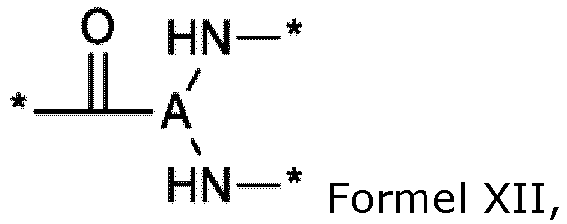 - GpC ein Rest der Formel IX ist:
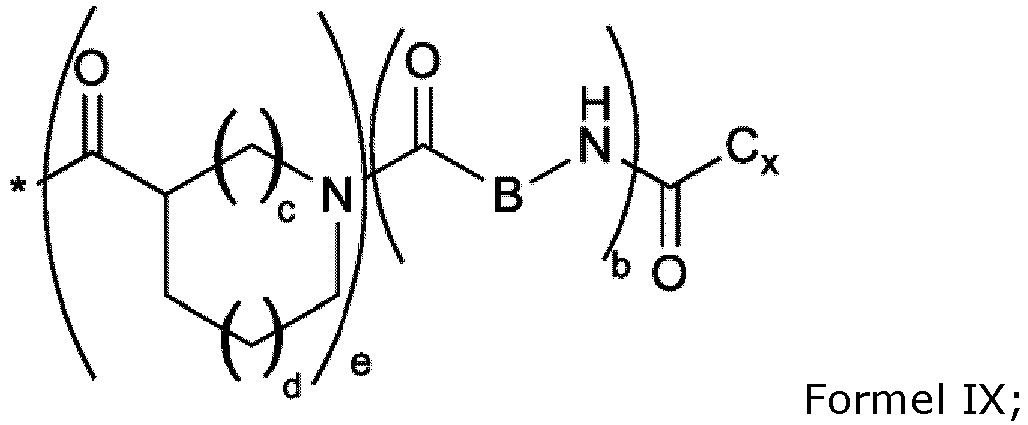 - * die Bindungsstellen von verschiedenen Gruppen angeben, die durch Funktionen von Amid verbunden sind;- a eine ganze Zahl gleich 0 oder 1 ist und a' = 1 wenn a = 0 und a' = 1, 2 oder 3 wenn a = 1;- a' eine ganze Zahl gleich 1, 2 oder 3 ist;- b eine ganze Zahl gleich 0 oder 1 ist;- c eine ganze Zahl gleich 0 oder 1 ist, und wenn c gleich 0 ist, dann d gleich 1 oder 2 ist;- d eine ganze Zahl gleich 0, 1 oder 2 ist;- e eine ganze Zahl gleich 0 oder 1 ist;- g eine ganze Zahl gleich 0, 1, 2, 3, 4, 5 oder 6 ist;- h eine ganze Zahl gleich 0, 1, 2, 3, 4, 5 oder 6 ist, und mindestens eines von g, h oder l ungleich 0 ist;- l eine ganze Zahl gleich 0 oder 1 ist und l' = 1 wenn l = 0 und l' = 2 wenn l = 1;- r eine ganze Zahl gleich 0, 1 oder 2 ist, und- s' eine ganze Zahl gleich 0 oder 1 ist;- und wenn e ungleich 0 ist, dann mindestens eines von g, h oder l ungleich 0 ist;- und wenn a = 0, dann l = 0;- identische oder verschiedene A, A1, A2 oder A3 lineare oder verzweigte Alkylreste umfassend 1 bis 8 Kohlenstoffatome und optional durch einen Rest aus einem gesättigten, ungesättigten oder aromatischen Ring substituiert sind;- B ein unsubstituierter Ether- oder Polyetherrest umfassend 4 bis 14 Kohlenstoffatome und 1 bis 5 Sauerstoffatome oder ein linearer oder verzweigter Alkylrest, optional umfassend einen aromatischen Kern, umfassend 1 bis 9 Kohlenstoffatome ist;- Cx ein einwertiger linearer oder verzweigter Alkylrest ist, optional umfassend einen zyklischen Teil, wobei x die Anzahl an Kohlenstoffatomen angibt, und• wenn der hydrophobe Rest -Hy 1 -GpC trägt, dann 9 ≤ x ≤ 25,• wenn der hydrophobe Rest -Hy 2 -GpC trägt, dann 9 ≤ x ≤ 15,• wenn der hydrophobe Rest -Hy 3 -GpC trägt, dann 7 ≤ x ≤ 13,• wenn der hydrophobe Rest -Hy 4 -GpC trägt, dann 7 ≤ x ≤ 11,• wenn der hydrophobe Rest -Hy mindestens 5 -GpC trägt, dann 6 ≤ x ≤ 11,- G ein zweiwertiger linearer oder verzweigter Alkylrest mit 1 bis 8 Kohlenstoffatomen ist, wobei der Alkylrest eine oder mehrere freie Carbonsäurefunktion(en) trägt;- R ein Rest ausgewählt aus der Gruppe bestehend aus einem zweiwertigen linearen oder verzweigten Alkylrest umfassend 1 bis 12 Kohlenstoffatome, einem zweiwertigen linearen oder verzweigten Alkylrest umfassend 1 bis 12 Kohlenstoffatome, die eine oder mehrere Funktionen von -CONH2 tragen, oder einem unsubstituierten Ether- oder Polyetherrest umfassend 4 bis 14 Kohlenstoffatome und 1 bis 5 Sauerstoffatome ist,- wobei der oder die hydrophoben Reste -Hy der Formel X verbunden sind mit PLG:∘ über eine kovalente Bindung zwischen einem Carbonyl des hydrophoben Rests -Hy und einem Stickstoffatom, das durch PLG getragen ist, wodurch eine Funktion von Amid gebildet wird, die aus der Reaktion einer Funktion von Amin getragen von PLG und einer Säurefunktion getragen von dem Vorläufer -Hy' des hydrophoben Rests -Hy resultiert, undo über eine kovalente Bindung zwischen einem Stickstoffatom des hydrophoben Rests -Hy und einem Carbonyl getragen von PLG, wodurch eine Funktion von Amid gebildet wird, die aus der Reaktion einer Funktion von Amin des Vorläufers -Hy' des hydrophoben Rests -Hy und einer Säurefunktion getragen von PLG resultiert,- das Verhältnis M zwischen der Anzahl an hydrophoben Resten und der Anzahl an Glutaminsäure- oder Asparaginsäureeinheiten zwischen 0 < M ≤ 0,5 umfasst;- wenn mehrere hydrophobe Reste durch eine Co-Polyaminosäure getragen werden, sie dann identisch oder verschieden sind,- die freien Carbonsäurefunktionen in Form von alkalischem Kationensalz ausgewählt aus der Gruppe bestehend aus Na+ und K+ sind.
 - Verwendung von ionischen Spezies ausgewählt aus der Gruppe der Anionen, Kationen und/oder Zwitterionen zum Verbessern der physikalisch-chemischen Stabilität einer Zusammensetzung wie in Anspruch 1 definiert.
Priority Applications (1)
| Application Number | Priority Date | Filing Date | Title |
|---|---|---|---|
| EP25168993.1A EP4671300A2 (de) | 2017-12-07 | 2018-12-07 | Injizierbare lösung mit ph 7 mit mindestens einem basalinsulin mit pi, welches zwischen 5,8 und 8,5 und einer co-polyaminosäure mit carboxylat- und hydrophoben radikalen enthält |
Applications Claiming Priority (4)
| Application Number | Priority Date | Filing Date | Title |
|---|---|---|---|
| US201762606138P | 2017-12-07 | 2017-12-07 | |
| FR1761807A FR3074681B1 (fr) | 2017-12-07 | 2017-12-07 | Solution injectable a ph 7 comprenant au moins une insuline basale dont le pi est compris entre 5,8 et 8,5 et un co-polyaminoacide porteur de charges carboxylates et de radicaux hydrophobes |
| FR1855934A FR3083088B1 (fr) | 2018-06-29 | 2018-06-29 | Solution injectable a ph 7 comprenant au moins une insuline basale dont le pi est compris entre 5,8 et 8,5 et un co-polyaminoacide porteur de charges carboxylates et de radicaux hydrophobes |
| PCT/EP2018/083896 WO2019110773A1 (fr) | 2017-12-07 | 2018-12-07 | Solution injectable a ph 7 comprenant au moins une insuline basale dont le pi est compris entre 5,8 et 8,5 et un co-polyaminoacide porteur de charges carboxylates et de radicaux hydrophobes |
Related Child Applications (1)
| Application Number | Title | Priority Date | Filing Date |
|---|---|---|---|
| EP25168993.1A Division EP4671300A2 (de) | 2017-12-07 | 2018-12-07 | Injizierbare lösung mit ph 7 mit mindestens einem basalinsulin mit pi, welches zwischen 5,8 und 8,5 und einer co-polyaminosäure mit carboxylat- und hydrophoben radikalen enthält |
Publications (2)
| Publication Number | Publication Date |
|---|---|
| EP3740229A1 EP3740229A1 (de) | 2020-11-25 |
| EP3740229B1 true EP3740229B1 (de) | 2025-04-09 |
Family
ID=64607017
Family Applications (1)
| Application Number | Title | Priority Date | Filing Date |
|---|---|---|---|
| EP18814899.3A Active EP3740229B1 (de) | 2017-12-07 | 2018-12-07 | Injektionslösung mit ph-wert 7 mit mindestens einem basalinsulin mit einem pi zwischen 5,8 und 8,5 und einer copolyaminosäure mit carboxylatladungen und hydrophoben radikalen |
Country Status (10)
| Country | Link |
|---|---|
| US (2) | US20190216931A1 (de) |
| EP (1) | EP3740229B1 (de) |
| JP (1) | JP7637965B2 (de) |
| KR (1) | KR20200106891A (de) |
| CN (1) | CN111727049A (de) |
| BR (1) | BR112020011570A2 (de) |
| CA (1) | CA3084688A1 (de) |
| MA (1) | MA51597A (de) |
| SG (1) | SG11202005322RA (de) |
| TW (1) | TWI813604B (de) |
Families Citing this family (11)
| Publication number | Priority date | Publication date | Assignee | Title |
|---|---|---|---|---|
| EP3740229B1 (de) | 2017-12-07 | 2025-04-09 | Adocia | Injektionslösung mit ph-wert 7 mit mindestens einem basalinsulin mit einem pi zwischen 5,8 und 8,5 und einer copolyaminosäure mit carboxylatladungen und hydrophoben radikalen |
| CN111836616B (zh) | 2017-12-07 | 2024-01-16 | 阿道恰公司 | 包含至少一种pi在5.8与8.5之间的基础胰岛素和带有羧酸根电荷及疏水基的共聚氨基酸的ph 7为7的可注射溶液 |
| KR20240171194A (ko) | 2017-12-07 | 2024-12-06 | 아도시아 | 아밀린, 아밀린 작용제 수용체 또는 아밀린 유사체 및 코-폴리아미노산을 포함하는 주사용 수용액 형태의 조성물 |
| US11129877B2 (en) * | 2017-12-07 | 2021-09-28 | Adocia | Compositions in the form of an injectable aqueous solution comprising amylin, an amylin agonist receptor or an amylin analogue and a co-polyamino acid |
| US20200179489A1 (en) * | 2018-12-07 | 2020-06-11 | Adocia | Injectable solution at ph 7 comprising at least one basal insulin which pi is from 5.8 to 8.5 and a co-polyamino-acid bearing carboxylate charges and hydrophobic radicals and a limited amount of m-cresol |
| EP4684802A1 (de) | 2024-07-23 | 2026-01-28 | Adocia | Zusammensetzung mit einem peptid mit einem isoelektrischen punkt von weniger als 6,5 und einer co-polyaminosäure mit carboxylatladungen und hydrophoben radikalen |
| EP4603080A1 (de) | 2024-02-16 | 2025-08-20 | Adocia | Zusammensetzung mit semaglutid, caglilintid und einer co-polyaminosäure mit carboxylatladungen und hydrophoben radikalen |
| WO2025172606A1 (en) | 2024-02-16 | 2025-08-21 | Adocia | Composition comprising semaglutide, cagrilintide and a co-polyamino acid bearing carboxylate charges and hydrophobic radicals |
| EP4603079A1 (de) | 2024-02-16 | 2025-08-20 | Adocia | Zusammensetzung mit einem peptid mit einem isoelektrischen punkt von weniger als 6,5 und einer co-polyaminosäure mit carboxylatladungen und hydrophoben radikalen |
| EP4684801A1 (de) | 2024-07-23 | 2026-01-28 | Adocia | Zusammensetzung mit semaglutid, caglilintid und einer co-polyaminosäure mit carboxylatladungen und hydrophoben radikalen |
| WO2025172605A1 (en) | 2024-02-16 | 2025-08-21 | Adocia | Composition comprising a peptide having an isoelectric point of less than 6.5 and a co-polyamino acid bearing carboxylate charges and hydrophobic radicals |
Family Cites Families (47)
| Publication number | Priority date | Publication date | Assignee | Title |
|---|---|---|---|---|
| GB8720115D0 (en) | 1987-08-26 | 1987-09-30 | Cooper G J S | Treatment of diabetes mellitus |
| DE3837825A1 (de) | 1988-11-08 | 1990-05-10 | Hoechst Ag | Neue insulinderivate, ihre verwendung und eine sie enthaltende pharmazeutische zubereitung |
| US5234906A (en) | 1991-01-10 | 1993-08-10 | Amylin Pharmaceuticals, Inc. | Hyperglycemic compositions |
| US5866538A (en) | 1996-06-20 | 1999-02-02 | Novo Nordisk A/S | Insulin preparations containing NaCl |
| EP1063254A1 (de) | 1999-06-25 | 2000-12-27 | Technische Uni München, Klinikum rechts der Isar, Inst. für Experiment. Onkoligie und Therapieforschung | Copolymere für den Transport von Nukleinsäuren in die Zelle |
| FR2801226B1 (fr) | 1999-11-23 | 2002-01-25 | Flamel Tech Sa | Suspension colloidale de particules submicroniques de vectorisation de principes actifs et son mode de preparation |
| FR2827069A1 (fr) | 2001-07-03 | 2003-01-10 | Thomson Multimedia Sa | Dispositifs et procede de production de musique en fonction de parametres physiologiques |
| FR2840614B1 (fr) | 2002-06-07 | 2004-08-27 | Flamel Tech Sa | Polyaminoacides fonctionnalises par de l'alpha-tocopherol et leurs applications notamment therapeutiques |
| FR2843117B1 (fr) * | 2002-07-30 | 2004-10-15 | Flamel Tech Sa | Polyaminoacides fonctionnalises par au moins un groupement hydrophobe et leurs applications notamment therapeutiques |
| CA2518776A1 (en) | 2003-04-29 | 2004-11-11 | Eli Lilly And Company | Insulin analogs having protracted time action |
| FR2855521B1 (fr) * | 2003-05-28 | 2005-08-05 | Flamel Tech Sa | Polyaminoacides fonctionnalises par au moins un groupement h ydrophobe et leurs applications notamment therapeutiques. |
| FR2860516B1 (fr) * | 2003-10-03 | 2006-01-13 | Flamel Tech Sa | Homopolyaminoacides telecheliques fonctionnalises par des groupements hydrophobes et leurs applications notamment therapeutiques |
| FR2873704B1 (fr) | 2004-07-30 | 2006-12-08 | Flamel Technologies Sa | Polyaminoacides fonctionnalises par des greffons hydrophobes portant une charge anionique et leurs applications notamment therapeutiques |
| FR2885521B1 (fr) | 2005-05-10 | 2009-07-24 | Oreal | Composition cosmetique |
| FR2910318B1 (fr) | 2006-12-20 | 2009-07-03 | Flamel Technologies Sa | Dispersion de polyaminoacides dans une phase lipidique continue. |
| EP2078713A1 (de) | 2007-12-28 | 2009-07-15 | QuoNova GmbH | Hemmer der Biofilmbildung grampositiver und gramnegativer Bakterien |
| EP2417982A1 (de) | 2010-07-30 | 2012-02-15 | Ferring B.V. | Stabilisierung von Gonadotropinen |
| TWI480070B (zh) | 2011-04-21 | 2015-04-11 | Univ Kaohsiung Medical | 具礦質親和能力之多歧狀胜肽構型 |
| EP2741765B9 (de) | 2011-08-10 | 2016-09-28 | Adocia | Injektionslösung mit mindestens einer art von basalinsulin |
| FR2985429B1 (fr) * | 2012-01-09 | 2016-07-29 | Adocia | Solution injectable a ph 7 comprenant au moins une insuline basale dont le pi est compris entre 5,8 et 8,5 et un polyaminoacide substitue obtenu par un procede de polymerisation controle |
| EP2814461B1 (de) | 2012-01-09 | 2019-07-24 | Adocia | Injektionslösung mit einem ph-wert von 7 mit wenigstens basalinsulin mit einem pi zwischen 5,8 und 8,5 sowie substituierter co-poly(aminosäure) |
| FR2985428B1 (fr) * | 2012-01-09 | 2016-05-27 | Adocia | Solution injectable a ph 7 comprenant au moins une insuline basale dont le pi est compris entre 5,8 et 8,5 et un polyaminoacide substitue |
| JP6167908B2 (ja) | 2012-02-09 | 2017-07-26 | 味の素株式会社 | 両性イオン型塩基性アミノ酸誘導体 |
| US20150314003A2 (en) | 2012-08-09 | 2015-11-05 | Adocia | Injectable solution at ph 7 comprising at least one basal insulin the isoelectric point of which is between 5.8 and 8.5 and a hydrophobized anionic polymer |
| FR3001896B1 (fr) | 2013-02-12 | 2015-07-03 | Adocia | Solution injectable a ph 7 comprenant au moins une insuline basale dont le point isolectrique est compris entre 5,8 et 8,5 et un polymere anionique hydrophobise |
| FR3001895B1 (fr) | 2013-02-12 | 2015-07-03 | Adocia | Solution injectable a ph7 comprenant au moins une insuline basale dont le point isoelectrique est compris en 5,8 et 8,5 et un compose anionique porteur de charges carboxylates et de radicaux hydrophobes |
| CA2889345A1 (fr) | 2012-11-13 | 2014-05-22 | Adocia | Composes anioniques substitues constitues d'un squelette forme d'un nombre discret d'unites saccharidiques |
| AU2013365945B2 (en) * | 2012-12-19 | 2017-03-02 | Wockhardt Limited | A stable aqueous composition comprising human insulin or an analogue or derivative thereof |
| US20160030672A1 (en) | 2013-03-15 | 2016-02-04 | Sanofi-Aventis Deutschland Gmbh | Body Party and Diaphragm Materials for Medical Devices |
| CA3151947A1 (en) | 2014-02-03 | 2015-08-06 | Eidgenoessische Technische Hochschule Zuerich | Low molecular weight drug conjugates for binding to carbonic anhydrase ix |
| US9682100B2 (en) | 2015-01-26 | 2017-06-20 | International Business Machines Corporation | Cationic polyamines for treatment of viruses |
| CN108351374A (zh) | 2015-10-22 | 2018-07-31 | 新纳公司 | 可扩展的平均电流传感器系统 |
| FR3052071B1 (fr) | 2016-06-07 | 2018-09-07 | Adocia | Compositions sous forme d'une solution aqueuse injectable comprenant du glucagon et un co-polyaminoacide |
| FR3052072A1 (fr) | 2016-06-07 | 2017-12-08 | Adocia | Solution injectable a ph 7 comprenant au moins une insuline basale dont le pi est compris entre 5,8 et 8,5 et un co-polyaminoacide porteur de charges carboxylates et de radicaux hydrophobes |
| CN109562063A (zh) | 2016-06-07 | 2019-04-02 | 阿道恰公司 | 包含人胰高血糖素和末端接枝的共聚氨基酸的可注射水溶液形式的组合物 |
| CN205959708U (zh) | 2016-08-15 | 2017-02-15 | 布里斯克磁业(上海)有限公司 | 一种漏磁式导磁板和漏磁式磁性吸持装置 |
| US10463717B2 (en) | 2016-12-27 | 2019-11-05 | Adocia | Compositions in the form of an injectable aqueous solution comprising amylin, an amylin receptor agonist or an amylin analog, and a co-polyamino acid |
| EP3740229B1 (de) | 2017-12-07 | 2025-04-09 | Adocia | Injektionslösung mit ph-wert 7 mit mindestens einem basalinsulin mit einem pi zwischen 5,8 und 8,5 und einer copolyaminosäure mit carboxylatladungen und hydrophoben radikalen |
| US11129877B2 (en) | 2017-12-07 | 2021-09-28 | Adocia | Compositions in the form of an injectable aqueous solution comprising amylin, an amylin agonist receptor or an amylin analogue and a co-polyamino acid |
| WO2019110836A1 (fr) | 2017-12-07 | 2019-06-13 | Adocia | Compositions sous forme d'une solution aqueuse injectable comprenant du glucagon humain et un co-polyaminoacide |
| CN111670042A (zh) | 2017-12-07 | 2020-09-15 | 阿道恰公司 | 包含人胰高血糖素和共聚氨基酸的可注射水溶液形式的组合物 |
| US20190388515A1 (en) | 2017-12-07 | 2019-12-26 | Adocia | Injectable solution at ph 7 comprising at least one basal insulin the pi of which is from 5.8 to 8.5 and a co-polyamino acid bearing carboxylate charges and hydrophobic radicals |
| US20190274953A1 (en) | 2017-12-07 | 2019-09-12 | Adocia | Ph 7 injectable solution comprising at least one basic insulin with a pi comprised from 5.8 to 8.5 and a co-polyaminoacide bearing carboxylate charges and hydrophobic radicals |
| CN111836616B (zh) | 2017-12-07 | 2024-01-16 | 阿道恰公司 | 包含至少一种pi在5.8与8.5之间的基础胰岛素和带有羧酸根电荷及疏水基的共聚氨基酸的ph 7为7的可注射溶液 |
| MX2020005913A (es) | 2017-12-07 | 2020-10-19 | Adocia | Solución inyectable a ph 7 que comprende al menos una insulina basal que tiene un pi de entre 5.8 y 8.5 y un copoliaminoácido con cargas de carboxilato y radicales hidrofóbicos. |
| EP3740195A1 (de) | 2017-12-07 | 2020-11-25 | Adocia | Zusammensetzungen in form einer injizierbaren wässrigen lösung mit amylin, einem amylin-rezeptor-agonist oder einem amylin-analogon und einer copolyaminosäure |
| US20200179489A1 (en) | 2018-12-07 | 2020-06-11 | Adocia | Injectable solution at ph 7 comprising at least one basal insulin which pi is from 5.8 to 8.5 and a co-polyamino-acid bearing carboxylate charges and hydrophobic radicals and a limited amount of m-cresol |
-
2018
- 2018-12-07 EP EP18814899.3A patent/EP3740229B1/de active Active
- 2018-12-07 CA CA3084688A patent/CA3084688A1/fr active Pending
- 2018-12-07 KR KR1020207019244A patent/KR20200106891A/ko not_active Ceased
- 2018-12-07 US US16/213,809 patent/US20190216931A1/en not_active Abandoned
- 2018-12-07 BR BR112020011570-3A patent/BR112020011570A2/pt unknown
- 2018-12-07 JP JP2020531052A patent/JP7637965B2/ja active Active
- 2018-12-07 MA MA051597A patent/MA51597A/fr unknown
- 2018-12-07 TW TW107144180A patent/TWI813604B/zh active
- 2018-12-07 CN CN201880088456.4A patent/CN111727049A/zh active Pending
- 2018-12-07 SG SG11202005322RA patent/SG11202005322RA/en unknown
-
2020
- 2020-06-15 US US16/902,176 patent/US11883496B2/en active Active
Also Published As
| Publication number | Publication date |
|---|---|
| CA3084688A1 (fr) | 2019-06-13 |
| MA51597A (fr) | 2020-11-25 |
| JP7637965B2 (ja) | 2025-03-03 |
| US11883496B2 (en) | 2024-01-30 |
| TWI813604B (zh) | 2023-09-01 |
| BR112020011570A2 (pt) | 2020-12-08 |
| SG11202005322RA (en) | 2020-07-29 |
| EP3740229A1 (de) | 2020-11-25 |
| US20190216931A1 (en) | 2019-07-18 |
| CN111727049A (zh) | 2020-09-29 |
| TW201938189A (zh) | 2019-10-01 |
| KR20200106891A (ko) | 2020-09-15 |
| US20200306379A1 (en) | 2020-10-01 |
| JP2021505607A (ja) | 2021-02-18 |
Similar Documents
| Publication | Publication Date | Title |
|---|---|---|
| EP3740229B1 (de) | Injektionslösung mit ph-wert 7 mit mindestens einem basalinsulin mit einem pi zwischen 5,8 und 8,5 und einer copolyaminosäure mit carboxylatladungen und hydrophoben radikalen | |
| EP4671300A2 (de) | Injizierbare lösung mit ph 7 mit mindestens einem basalinsulin mit pi, welches zwischen 5,8 und 8,5 und einer co-polyaminosäure mit carboxylat- und hydrophoben radikalen enthält | |
| EP3463293B1 (de) | Injektionslösung mit einem ph-wert 7 mit mindestens einem basalinsulin mit einem pi zwischen 5,8 und 8,5, einem prandialen insulin und/oder gastrointestinalen hormon und einer copolyaminosäure mit carboxylatladungen und hydrophoben radikalen | |
| EP3463294B1 (de) | Zusammensetzungen in form einer injizierbaren wässrigen lösung mit menschlichem glucagon und einer statistischen copolyaminosäure | |
| EP3723728A1 (de) | Injektionslösung mit einem ph-wert von 7 mit mindestens einem basalinsulin mit einem pi zwischen 5,8 und 8,5 und einer copolyaminosäure mit carboxylatladungen und hydrophoben radikalen | |
| EP3740195A1 (de) | Zusammensetzungen in form einer injizierbaren wässrigen lösung mit amylin, einem amylin-rezeptor-agonist oder einem amylin-analogon und einer copolyaminosäure | |
| EP3740227A1 (de) | Zusammensetzungen in form einer injizierbaren wässrigen lösung mit amylin, einem amylin-rezeptor-agonist oder einem amylin-analogon und einer copolyaminosäure | |
| EP3720472A1 (de) | Injektionslösung mit ph-wert 7 mit mindestens einem basalinsulin mit einem pi zwischen 5,8 und 8,5 und einer copolyaminosäure mit carboxylatladungen und hydrophoben radikalen | |
| FR3052071A1 (fr) | Compositions sous forme d'une solution aqueuse injectable comprenant du glucagon et un co-polyaminoacide | |
| EP3720471B1 (de) | Zusammensetzungen in form einer injizierbaren wässrigen lösung mit menschlichem glucagon und einer copolyaminosäure | |
| WO2019110837A1 (fr) | Compositions sous forme d'une solution aqueuse injectable comprenant du glucagon humain et un co-polyaminoacide | |
| WO2019110788A1 (fr) | Compositions sous forme d'une solution aqueuse injectable comprenant de l'amyline, un agoniste au recepteur de l'amyline ou un analogue d'amyline et un co-polyaminoacide | |
| WO2019243628A1 (fr) | Composition injectable a ph 7 comprenant un co-polyaminoacide porteur de charges carboxylates et de radicaux hydrophobes et au moins une insuline basale presentant au moins un effet prandial et un effet basal | |
| EP3672638A1 (de) | Injektionslösung mit ph-wert 7 mit mindestens einem basalinsulin mit einem pi zwischen 5,8 und 8,5 und einer copolyaminosäure mit carboxylatladungen und hydrophoben radikalen | |
| FR3083088A1 (fr) | Solution injectable a ph 7 comprenant au moins une insuline basale dont le pi est compris entre 5,8 et 8,5 et un co-polyaminoacide porteur de charges carboxylates et de radicaux hydrophobes | |
| FR3074681A1 (fr) | Solution injectable a ph 7 comprenant au moins une insuline basale dont le pi est compris entre 5,8 et 8,5 et un co-polyaminoacide porteur de charges carboxylates et de radicaux hydrophobes | |
| FR3074422A1 (fr) | Solution injectable a ph 7 comprenant au moins une insuline basale dont le pi est compris entre 5,8 et 8,5 et un co-polyaminoacide porteur de charges carboxylates et de radicaux hydrophobes | |
| WO2020002696A1 (fr) | Solution injectable a ph 7 comprenant au moins une insuline basale dont le pi est compris entre 5,8 et 8,5 et un co-polyaminoacide porteur de charges carboxylates et de radicaux hydrophobes | |
| FR3083085A1 (fr) | Compositions sous forme d'une solution aqueuse injectable comprenant de l'amyline, un agoniste au recepteur de l'amyline ou un analogue d'amyline et un co-polyaminoacide | |
| FR3084585A1 (fr) | Solution injectable a ph 7 comprenant au moins une insuline basale dont le pi est compris entre 5,8 et 8,5 et un compose amphiphile porteur de radicaux hydrophobes | |
| FR3074683A1 (fr) | Compositions sous forme d'une solution aqueuse injectable comprenant du glucagon humain et un co-polyaminoacide | |
| FR3061660A1 (fr) | Compositions sous forme d'une solution aqueuse injectable comprenant du glucagon humain et un co-polyaminoacide | |
| FR3074682A1 (fr) | Compositions sous forme d'une solution aqueuse injectable comprenant de l'amyline, un agoniste au recepteur de l'amyline ou un analogue d'amyline et un co-polyaminoacide |
Legal Events
| Date | Code | Title | Description |
|---|---|---|---|
| STAA | Information on the status of an ep patent application or granted ep patent |
Free format text: STATUS: UNKNOWN |
|
| STAA | Information on the status of an ep patent application or granted ep patent |
Free format text: STATUS: THE INTERNATIONAL PUBLICATION HAS BEEN MADE |
|
| PUAI | Public reference made under article 153(3) epc to a published international application that has entered the european phase |
Free format text: ORIGINAL CODE: 0009012 |
|
| STAA | Information on the status of an ep patent application or granted ep patent |
Free format text: STATUS: REQUEST FOR EXAMINATION WAS MADE |
|
| 17P | Request for examination filed |
Effective date: 20200707 |
|
| AK | Designated contracting states |
Kind code of ref document: A1 Designated state(s): AL AT BE BG CH CY CZ DE DK EE ES FI FR GB GR HR HU IE IS IT LI LT LU LV MC MK MT NL NO PL PT RO RS SE SI SK SM TR |
|
| 111Z | Information provided on other rights and legal means of execution |
Free format text: AL AT BE BG CH CY CZ DE DK EE ES FI FR GB GR HR HU IE IS IT LT LU LV MC MK MT NL NO PL PT RO RS SE SI SK SM TR Effective date: 20201011 |
|
| STAA | Information on the status of an ep patent application or granted ep patent |
Free format text: STATUS: EXAMINATION IS IN PROGRESS |
|
| 17Q | First examination report despatched |
Effective date: 20230301 |
|
| P01 | Opt-out of the competence of the unified patent court (upc) registered |
Effective date: 20230514 |
|
| D11X | Information provided on other rights and legal means of execution (deleted) | ||
| GRAP | Despatch of communication of intention to grant a patent |
Free format text: ORIGINAL CODE: EPIDOSNIGR1 |
|
| STAA | Information on the status of an ep patent application or granted ep patent |
Free format text: STATUS: GRANT OF PATENT IS INTENDED |
|
| RIC1 | Information provided on ipc code assigned before grant |
Ipc: C08G 69/10 20060101ALI20241011BHEP Ipc: A61K 47/42 20170101ALI20241011BHEP Ipc: A61P 3/08 20060101ALI20241011BHEP Ipc: A61K 9/00 20060101ALI20241011BHEP Ipc: A61K 47/34 20170101ALI20241011BHEP Ipc: A61K 38/28 20060101AFI20241011BHEP |
|
| INTG | Intention to grant announced |
Effective date: 20241029 |
|
| GRAS | Grant fee paid |
Free format text: ORIGINAL CODE: EPIDOSNIGR3 |
|
| GRAA | (expected) grant |
Free format text: ORIGINAL CODE: 0009210 |
|
| STAA | Information on the status of an ep patent application or granted ep patent |
Free format text: STATUS: THE PATENT HAS BEEN GRANTED |
|
| AK | Designated contracting states |
Kind code of ref document: B1 Designated state(s): AL AT BE BG CH CY CZ DE DK EE ES FI FR GB GR HR HU IE IS IT LI LT LU LV MC MK MT NL NO PL PT RO RS SE SI SK SM TR |
|
| REG | Reference to a national code |
Ref country code: GB Ref legal event code: FG4D Free format text: NOT ENGLISH |
|
| REG | Reference to a national code |
Ref country code: CH Ref legal event code: EP |
|
| REG | Reference to a national code |
Ref country code: DE Ref legal event code: R096 Ref document number: 602018080999 Country of ref document: DE |
|
| REG | Reference to a national code |
Ref country code: IE Ref legal event code: FG4D Free format text: LANGUAGE OF EP DOCUMENT: FRENCH |
|
| REG | Reference to a national code |
Ref country code: NL Ref legal event code: MP Effective date: 20250409 |
|
| PG25 | Lapsed in a contracting state [announced via postgrant information from national office to epo] |
Ref country code: NL Free format text: LAPSE BECAUSE OF FAILURE TO SUBMIT A TRANSLATION OF THE DESCRIPTION OR TO PAY THE FEE WITHIN THE PRESCRIBED TIME-LIMIT Effective date: 20250409 |
|
| REG | Reference to a national code |
Ref country code: AT Ref legal event code: MK05 Ref document number: 1782963 Country of ref document: AT Kind code of ref document: T Effective date: 20250409 |
|
| PG25 | Lapsed in a contracting state [announced via postgrant information from national office to epo] |
Ref country code: PT Free format text: LAPSE BECAUSE OF FAILURE TO SUBMIT A TRANSLATION OF THE DESCRIPTION OR TO PAY THE FEE WITHIN THE PRESCRIBED TIME-LIMIT Effective date: 20250811 Ref country code: ES Free format text: LAPSE BECAUSE OF FAILURE TO SUBMIT A TRANSLATION OF THE DESCRIPTION OR TO PAY THE FEE WITHIN THE PRESCRIBED TIME-LIMIT Effective date: 20250409 Ref country code: FI Free format text: LAPSE BECAUSE OF FAILURE TO SUBMIT A TRANSLATION OF THE DESCRIPTION OR TO PAY THE FEE WITHIN THE PRESCRIBED TIME-LIMIT Effective date: 20250409 |
|
| REG | Reference to a national code |
Ref country code: LT Ref legal event code: MG9D |
|
| PG25 | Lapsed in a contracting state [announced via postgrant information from national office to epo] |
Ref country code: NO Free format text: LAPSE BECAUSE OF FAILURE TO SUBMIT A TRANSLATION OF THE DESCRIPTION OR TO PAY THE FEE WITHIN THE PRESCRIBED TIME-LIMIT Effective date: 20250709 Ref country code: GR Free format text: LAPSE BECAUSE OF FAILURE TO SUBMIT A TRANSLATION OF THE DESCRIPTION OR TO PAY THE FEE WITHIN THE PRESCRIBED TIME-LIMIT Effective date: 20250710 |
|
| PG25 | Lapsed in a contracting state [announced via postgrant information from national office to epo] |
Ref country code: PL Free format text: LAPSE BECAUSE OF FAILURE TO SUBMIT A TRANSLATION OF THE DESCRIPTION OR TO PAY THE FEE WITHIN THE PRESCRIBED TIME-LIMIT Effective date: 20250409 |
|
| PG25 | Lapsed in a contracting state [announced via postgrant information from national office to epo] |
Ref country code: BG Free format text: LAPSE BECAUSE OF FAILURE TO SUBMIT A TRANSLATION OF THE DESCRIPTION OR TO PAY THE FEE WITHIN THE PRESCRIBED TIME-LIMIT Effective date: 20250409 |
|
| PG25 | Lapsed in a contracting state [announced via postgrant information from national office to epo] |
Ref country code: HR Free format text: LAPSE BECAUSE OF FAILURE TO SUBMIT A TRANSLATION OF THE DESCRIPTION OR TO PAY THE FEE WITHIN THE PRESCRIBED TIME-LIMIT Effective date: 20250409 |
|
| PG25 | Lapsed in a contracting state [announced via postgrant information from national office to epo] |
Ref country code: AT Free format text: LAPSE BECAUSE OF FAILURE TO SUBMIT A TRANSLATION OF THE DESCRIPTION OR TO PAY THE FEE WITHIN THE PRESCRIBED TIME-LIMIT Effective date: 20250409 |
|
| PG25 | Lapsed in a contracting state [announced via postgrant information from national office to epo] |
Ref country code: RS Free format text: LAPSE BECAUSE OF FAILURE TO SUBMIT A TRANSLATION OF THE DESCRIPTION OR TO PAY THE FEE WITHIN THE PRESCRIBED TIME-LIMIT Effective date: 20250709 |
|
| PG25 | Lapsed in a contracting state [announced via postgrant information from national office to epo] |
Ref country code: IS Free format text: LAPSE BECAUSE OF FAILURE TO SUBMIT A TRANSLATION OF THE DESCRIPTION OR TO PAY THE FEE WITHIN THE PRESCRIBED TIME-LIMIT Effective date: 20250809 |
|
| PG25 | Lapsed in a contracting state [announced via postgrant information from national office to epo] |
Ref country code: LV Free format text: LAPSE BECAUSE OF FAILURE TO SUBMIT A TRANSLATION OF THE DESCRIPTION OR TO PAY THE FEE WITHIN THE PRESCRIBED TIME-LIMIT Effective date: 20250409 |
|
| PGFP | Annual fee paid to national office [announced via postgrant information from national office to epo] |
Ref country code: DE Payment date: 20251205 Year of fee payment: 8 |
|
| PGFP | Annual fee paid to national office [announced via postgrant information from national office to epo] |
Ref country code: GB Payment date: 20251126 Year of fee payment: 8 |
|
| PG25 | Lapsed in a contracting state [announced via postgrant information from national office to epo] |
Ref country code: DK Free format text: LAPSE BECAUSE OF FAILURE TO SUBMIT A TRANSLATION OF THE DESCRIPTION OR TO PAY THE FEE WITHIN THE PRESCRIBED TIME-LIMIT Effective date: 20250409 Ref country code: SM Free format text: LAPSE BECAUSE OF FAILURE TO SUBMIT A TRANSLATION OF THE DESCRIPTION OR TO PAY THE FEE WITHIN THE PRESCRIBED TIME-LIMIT Effective date: 20250409 |
|
| PGFP | Annual fee paid to national office [announced via postgrant information from national office to epo] |
Ref country code: FR Payment date: 20251229 Year of fee payment: 8 |
|
| PG25 | Lapsed in a contracting state [announced via postgrant information from national office to epo] |
Ref country code: CZ Free format text: LAPSE BECAUSE OF FAILURE TO SUBMIT A TRANSLATION OF THE DESCRIPTION OR TO PAY THE FEE WITHIN THE PRESCRIBED TIME-LIMIT Effective date: 20250409 |
|
| PG25 | Lapsed in a contracting state [announced via postgrant information from national office to epo] |
Ref country code: EE Free format text: LAPSE BECAUSE OF FAILURE TO SUBMIT A TRANSLATION OF THE DESCRIPTION OR TO PAY THE FEE WITHIN THE PRESCRIBED TIME-LIMIT Effective date: 20250409 |
|
| PG25 | Lapsed in a contracting state [announced via postgrant information from national office to epo] |
Ref country code: RO Free format text: LAPSE BECAUSE OF FAILURE TO SUBMIT A TRANSLATION OF THE DESCRIPTION OR TO PAY THE FEE WITHIN THE PRESCRIBED TIME-LIMIT Effective date: 20250409 Ref country code: SK Free format text: LAPSE BECAUSE OF FAILURE TO SUBMIT A TRANSLATION OF THE DESCRIPTION OR TO PAY THE FEE WITHIN THE PRESCRIBED TIME-LIMIT Effective date: 20250409 |
|
| PG25 | Lapsed in a contracting state [announced via postgrant information from national office to epo] |
Ref country code: IT Free format text: LAPSE BECAUSE OF FAILURE TO SUBMIT A TRANSLATION OF THE DESCRIPTION OR TO PAY THE FEE WITHIN THE PRESCRIBED TIME-LIMIT Effective date: 20250409 |
|
| PLBE | No opposition filed within time limit |
Free format text: ORIGINAL CODE: 0009261 |
|
| STAA | Information on the status of an ep patent application or granted ep patent |
Free format text: STATUS: NO OPPOSITION FILED WITHIN TIME LIMIT |