EP3731032A1 - Verfahren und gerät zur uhrzeitanzeige im standby - Google Patents
Verfahren und gerät zur uhrzeitanzeige im standby Download PDFInfo
- Publication number
- EP3731032A1 EP3731032A1 EP20164402.8A EP20164402A EP3731032A1 EP 3731032 A1 EP3731032 A1 EP 3731032A1 EP 20164402 A EP20164402 A EP 20164402A EP 3731032 A1 EP3731032 A1 EP 3731032A1
- Authority
- EP
- European Patent Office
- Prior art keywords
- memory area
- display
- household appliance
- program
- images
- Prior art date
- Legal status (The legal status is an assumption and is not a legal conclusion. Google has not performed a legal analysis and makes no representation as to the accuracy of the status listed.)
- Granted
Links
Images

Classifications
-
- F—MECHANICAL ENGINEERING; LIGHTING; HEATING; WEAPONS; BLASTING
- F24—HEATING; RANGES; VENTILATING
- F24C—DOMESTIC STOVES OR RANGES ; DETAILS OF DOMESTIC STOVES OR RANGES, OF GENERAL APPLICATION
- F24C7/00—Stoves or ranges heated by electric energy
- F24C7/08—Arrangement or mounting of control or safety devices
- F24C7/082—Arrangement or mounting of control or safety devices on ranges, e.g. control panels, illumination
-
- G—PHYSICS
- G04—HOROLOGY
- G04G—ELECTRONIC TIME-PIECES
- G04G19/00—Electric power supply circuits specially adapted for use in electronic time-pieces
- G04G19/12—Arrangements for reducing power consumption during storage
Definitions
- the invention relates to a method for displaying the time in the standby state in a household appliance, a control unit operating according to the method, and a household appliance with the control unit.
- Simple LCD segment displays usually 7-segment displays, can only show a digital time, usually without a seconds display.
- These displays can be controlled with comparatively simple electronics, which also work independently of a main device control and can continuously display the time. They are therefore relatively easy to operate with low power consumption, even when the household appliance is in a standby state.
- a time display can also be easily implemented, here also in the form of a high-quality analog clock with pointers and seconds display.
- these displays and their control electronics are much more complex than LCD segment displays. Basically, the control electronics are a full-fledged computer. This increases the power consumption, as the entire computer has to be permanently supplied with power for the relatively simple task of displaying the time. A time display in the standby state of the household appliance therefore consumes a relatively large amount of power.
- a power-saving display of the second hand or the second digits which requires the display of a new image per second, is a challenge. This is, among other things, driven by European regulations that set a specification for the maximum power consumption in standby with information or set up a status display of currently 1 watt on average.
- Switching to the standby state can take place, for example, after a predetermined period of inactivity has elapsed without user input or door opening or closing, after the end of a device program or after the device has been switched off.
- the generation of images can also include the retrieval of precalculated images from a further, non-volatile memory.
- the power consumption in standby can be further reduced, particularly in the case of backlit, but also self-illuminating displays.
- the invention is particularly advantageous for an analog watch with a second hand, but can also be used in a digital watch with a seconds display.
- the seconds can either be displayed directly using numbers, or alternatively a Second indicator (for example ":") show the passage of a second, for example by means of alternating on / off switching or flashing. In any case, it remains clear to the user that the device clock is running.
- any desired combinations that is to say for example hour and minute hands and digits for the seconds, are just as possible according to the invention as any other graphic representation of a clock known per se.
- a seconds display does not necessarily have to be present, although the invention can be used most advantageously in such displays.
- the invention can also be used to reduce power consumption for clocks that are accurate to the minute.
- the second hand, the second digits or the second indicator is displayed in the form of an overlay.
- images are generated and displayed for at least 30, preferably at least 60 subsequent seconds.
- the number of images is limited by the size of the second memory area available. Therefore, on the one hand, a relatively small number of images is advantageous in order to be able to keep this memory small. On the other hand, the power consumption decreases with a larger number of images that are displayed from the power-saving second memory area. A minimum number of 30 images, preferably 60 images, has therefore proven to be an advantageous compromise.
- the storage of the images in the second memory area comprises a compression and the display of the images comprises a decompression.
- a compression of the images can be advantageous. Since the decompression requires computing time and causes increased power consumption, it is important to find a compromise between the degree of compression and the time / computing power required to decompress.
- the second program can advantageously also take over the monitoring of wake-up events during its runtime. In this way, in an energy-saving manner, without having to leave the standby mode, a check can be carried out on user inputs, door opening or the timing of a timer. If such a wake-up event is detected, for example when a user makes an input on the device, opens (or closes) a door of the device, or if a timer event such as a preprogrammed start of the device is pending, then the household device switches from the standby state to the operating state.
- the household appliance can be any built-in or floor-standing household appliance with a display, for example an oven, a microwave device, a steam cooker, a hob, a beverage maker, a refrigerator and / or freezer, a dishwasher, an automatic washing machine or dryer.
- a display for example an oven, a microwave device, a steam cooker, a hob, a beverage maker, a refrigerator and / or freezer, a dishwasher, an automatic washing machine or dryer.
- the first memory area is a dynamic random access memory memory and the second memory area is a static random access memory memory.
- the first memory area can be a volatile memory. Volatile means that the stored data is lost if the supply voltage is lost.
- the first memory area is in this embodiment a dynamic random access memory (DRAM), which requires regular refreshing to hold the data, which causes a relatively high power consumption.
- the second memory area is a Static Random Access Memory (SRAM) which does not require any cyclical refreshing to hold the data, so that only a very low power consumption arises when holding the data.
- DRAMs are much cheaper to manufacture than SRAMs, so that exclusive use of SRAMs is normally not possible for reasons of cost.
- the invention makes it possible to optimally utilize the advantages of the SRAM memory with regard to power consumption with an SRAM memory area that is relatively small compared to the DRAM memory area.
- the display is a matrix display.
- step 102 the household appliance is put into a standby state. This can be done, for example, after a predetermined period of time without user input, after the household appliance has been switched off or after a delay has elapsed after the end of a program.
- a first program is started in a first memory area.
- This first memory area can be a DRAM memory, for example.
- a volatile memory type requires not only the operating voltage but also regular refreshing of the memory content in order to hold the data. Therefore it has a relatively high power consumption, but on the other hand it is also relatively cheap to manufacture.
- the first program in step 106 generates a set of x images t x . Each image t x corresponds to the display of the time for a subsequent point in time t 1 , ..., t x .
- a preferred division here is one image per second for the following period, and the number is preferably at least 30, even more preferably at least 60.
- the generated images t x are stored in a second memory area in step 108.
- This second memory area can be an SRAM memory, for example.
- SRAM static random access memory
- Such a volatile memory type only needs the operating voltage with a low current flow, to keep the data. Therefore it has a relatively small power consumption, but on the other hand it is also relatively expensive to manufacture.
- the number of images must therefore generally be limited in order not to let the size of the storage area grow unnecessarily, which increases the cost of the household appliance.
- the saved images can be preceded by compression in order to reduce the space required by the images.
- step 110 the first memory area is deactivated. This can significantly reduce the power consumption in standby mode.
- a second program is started in the second memory area.
- This second program has the task of calling up and displaying the respective associated image for displaying the time at the appropriate times (step 114). If the images are saved in compressed form, they must be decompressed beforehand. The images are preferably output with a reduced brightness of the display, for example by reducing the strength of the background lighting in the case of background-lit displays.
- the first memory is activated again in step 116 in order to run through the method again beginning with step 102.
- the second program also serves to record the occurrence of wake-up events.
- wake-up events can be user inputs, the opening or closing of an appliance door, or the expiry of a timer for a programmed delayed program start. If such a wake-up event is detected, the second program can put the household appliance into an operating state, for example in order to implement user inputs, to activate interior and / or key lighting or to start device programs that are to be started with a delay.
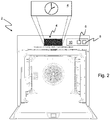
- FIG. 2 shows an embodiment of a household appliance of the invention.
- the household appliance 2 is shown here by way of example as an oven, but it can basically be any household appliance with a display 4 with a time display.
- the display 4 is shown enlarged here and shows an analog clock with pointers, ie with hour, minute and second hands. Any other form of representation of a time known per se can also be used. Since it is preferably a matrix display, in principle any form of time display is possible, in addition to the analog display, also the digital display using digits, which is also common.
- the household appliance 2 has a control device 10 which is set up to carry out the method as above.
- the household appliance 2 has a first memory area 6 and a second memory area 8.
- the first memory area 6 is preferably a DRAM memory and the second memory area 8 is preferably an SRAM memory.
Landscapes
- Engineering & Computer Science (AREA)
- Power Engineering (AREA)
- Physics & Mathematics (AREA)
- General Physics & Mathematics (AREA)
- Chemical & Material Sciences (AREA)
- Combustion & Propulsion (AREA)
- Mechanical Engineering (AREA)
- General Engineering & Computer Science (AREA)
- Controls And Circuits For Display Device (AREA)
- Electric Clocks (AREA)
Abstract
Description
- Die Erfindung betrifft ein Verfahren zur Anzeige der Uhrzeit im Standby-Zustand in einem Haushaltsgerät, eine nach dem Verfahren arbeitende Steuereinheit sowie ein Haushaltsgerät mit der Steuereinheit.
- Viele Haushaltsgeräte wie Backöfen und dergleichen sind mit einer Uhrzeitanzeige ausgestattet. Einfache LCD-Segment-Displays, üblicherweise 7-Segment-Displays, können allerdings lediglich eine digitale Uhrzeit anzeigen, üblicherweise ohne Sekundenanzeige. Diese Displays können mit einer vergleichsweise einfachen Elektronik angesteuert werden, die auch unabhängig von einer Hauptgerätesteuerung arbeiten und fortlaufend die Uhrzeit anzeigen kann. Sie sind daher relativ leicht mit geringem Stromverbrauch zu betreiben, auch wenn das Haushaltsgerät sich in einem Standby-Zustand befindet.
- Bei Haushaltsgeräten mit vollwertigem Matrix-Display kann eine Uhrzeitanzeige ebenfalls leicht realisiert werden, hier auch zusätzlich in Form einer hochwertigeren Analoguhr mit Zeigern und mit Sekundenanzeige. Allerdings sind diese Displays und deren Ansteuerelektronik wesentlich komplexer als LCD-Segment-Displays. Im Grunde handelt es sich bei deren Ansteuerelektronik um einen vollwertigen Rechner. Der Stromverbrauch wird dadurch in die Höhe getrieben, da für die relativ einfache Aufgabe der Uhrzeitanzeige der ganze Rechner permanent mit Strom versorgt werden muss. Eine Uhrzeitanzeige im Standby-Zustand des Haushaltsgeräts verbraucht daher verhältnismäßig viel Strom.
- Insbesondere eine Strom sparende Anzeige des Sekundenzeigers oder der Sekundenziffern, was ja pro Sekunde die Darstellung eines neuen Bilds erfordert, stellt dabei eine Herausforderung dar. Dies ist unter anderem auch durch europäische Verordnungen getrieben, die eine Vorgabe für den maximalen Stromverbrauch im Standby mit Information- oder Statusanzeige von derzeit im Schnitt 1 Watt aufstellen.
- Es ist daher die Aufgabe der vorliegenden Erfindung, ein Verfahren und eine Steuereinheit bereitzustellen, die eine Strom sparende Uhrzeitanzeige ermöglicht, insbesondere auch mit Sekundenanzeige. Weiterhin soll ein Haushaltsgerät mit einer solchen Steuereinheit bereitgestellt werden.
- Gemäß einem ersten Aspekt wird ein Verfahren zur Anzeige der Uhrzeit auf einem Display eines Haushaltsgeräts bereitgestellt, umfassend:
- Versetzen des Haushaltsgeräts in einen Standby-Zustand;
- Starten eines ersten Programms in einem ersten Speicherbereich, das die folgenden
- Erzeugen jeweils eines Bilds für die Anzeige der Uhrzeit für eine Anzahl x folgender Zeitpunkte t1, ..., tx;
- Speichern der Bilder in einem zweiten Speicherbereich, der einen geringeren Stromverbrauch aufweist als der erste Speicherbereich; und
- Deaktivieren des ersten Speicherbereichs;
- Starten eines zweiten Programms in dem zweiten Speicherbereich, das die folgenden
- Anzeigen, zu den Zeitpunkten t1, ..., tx, des jeweils dafür berechneten Bilds;
- Aktivieren des ersten Speicherbereichs; und
- Fortsetzen beginnend mit dem Starten des ersten Programms.
- Das Versetzen in den Standby-Zustand kann beispielsweise nach Ablauf einer vorgegebenen Inaktivitätszeitspanne ohne Benutzereingabe oder Türöffnung- bzw. Schließung, nach Ende eines Geräte-Programms oder nach dem Ausschalten des Geräts erfolgen. Das Erzeugen von Bildern kann neben dem Berechnen durch das erste Programm auch das Abrufen von vorberechneten Bildern aus einem weiteren, nichtflüchtigen Speicher umfassen.
- Gemäß einer Ausführungsform umfasst das Verfahren weiter:
- Verringern der Leuchtdichte des Displays, während das zweite Programm ausgeführt wird.
- Dadurch kann, insbesondere bei hintergrundbeleuchteten, aber auch bei selbstleuchtenden Displays, der Stromverbrauch im Standby weiter verringert werden.
- Gemäß einer Ausführungsform
- wird die Uhrzeit in Form einer Analoguhr mit Stunden-, Minuten- und Sekundenzeiger angezeigt; oder
- wird die Uhrzeit in Form einer Digitaluhr mit Stunden- und Minutenziffern sowie entweder Sekundenziffern oder einem Sekundenindikator angezeigt;
- entsprechen die folgenden Zeitpunkte t1, ..., tx den folgenden Sekunden.
- Die Erfindung ist insbesondere für eine Analoguhr mit Sekundenzeiger vorteilhaft, kann aber ebenso bei einer Digitaluhr mit Sekundenanzeige verwendet werden. Dabei können die Sekunden entweder direkt mittels Ziffern angezeigt werden, oder alternativ kann ein Sekundenindikator (beispielsweise ":") das Verstreichen einer Sekunde anzeigen, etwa mittels wechselndem Ein-/Ausschalten oder Blinken. In jedem Fall bleibt für den Benutzer klar ersichtlich, dass die Geräteuhr läuft.
- Beliebige Kombinationen, also etwa Stunden- und Minutenzeiger sowie Ziffern für die Sekunden, sind erfindungsgemäß ebenso möglich wie jede andere an sich bekannte grafische Darstellung einer Uhr. Ebenso muss nicht zwingend eine Sekundenanzeige vorhanden sein, obwohl bei derartigen Anzeigen die Erfindung am vorteilhaftesten einsetzbar ist. Auch für nur minutengenaue Uhren kann die Erfindung zur Verringerung des Stromverbrauchs verwendet werden.
- Gemäß einer Ausführungsform wird der Sekundenzeiger, die Sekundenziffern oder der Sekundenindikator in Form eines Overlays angezeigt.
- Da sich innerhalb derselben Minute nur der die Sekunden angebende Teil der Darstellung ändert, ist es vorteilhaft, nur diesen Teil neu zu erzeugen bzw. anzuzeigen, und ansonsten ein für die Stunden und Minuten identisches Grundbild zu verwenden. Der für die Sekundendarstellung verantwortliche Teil kann dann in Form eines Overlays über das Grundbild mit Stunden- und Minutenanzeige gelegt werden. Dieses Vorgehen kann in analoger Weise auch für den die Minuten darstellenden Teil angewendet werden, wobei dann ein Grundbild mit nur der Stundendarstellung verwendet wird.
- Gemäß einer Ausführungsform werden für mindestens 30, bevorzugt mindestens 60 folgende Sekunden Bilder erzeugt und angezeigt.
- Die Anzahl der Bilder wird durch die Größe des zur Verfügung stehenden zweiten Speicherbereichs begrenzt. Daher ist einerseits eine relativ geringe Anzahl an Bilder vorteilhaft, um diesen Speicher klein halten zu können. Andererseits verringert sich der Stromverbrauch mit größerer Anzahl von Bildern, die aus dem Strom sparenden zweiten Speicherbereich heraus dargestellt werden. Eine Mindestanzahl von 30 Bildern, bevorzugt 60 Bildern, hat sich daher als vorteilhafter Kompromiss herausgestellt.
- Gemäß einer Ausführungsform umfasst das Speichern der Bilder in dem zweiten Speicherbereich ein Komprimieren und das Anzeigen der Bilder ein Dekomprimieren.
- Um den zweiten Speicherbereich vorteilhaft klein halten zu können, kann sich eine Komprimierung der Bilder anbieten. Da die Dekomprimierung Rechenzeit benötigt und erhöhten Stromverbrauch verursacht, gilt es dabei, einen Kompromiss aus Komprimierungsgrad und zum Dekomprimieren benötigter Zeit/Rechenleistung zu finden.
- Gemäß einer Ausführungsform führt das zweite Programm weiter aus:
- Erfassen eines Weckereignisses; und
- Versetzen, in Reaktion auf ein erfasstes Weckereignis, des Haushaltsgeräts in einen Betriebs-Zustand.
- Vorteilhafterweise kann das zweite Programm während seiner Laufzeit auch die Überwachung in Bezug auf Weckereignisse übernehmen. So kann in Strom sparender Weise, ohne den Standby-Zustand verlassen zu müssen, eine Prüfung auf Benutzereingaben, Türöffnung oder Zeitablauf eines Timers erfolgen. Wird ein solches Weckereignis erfasst, beispielsweise wenn ein Benutzer eine Eingabe am Gerät tätigt, eine Tür des Geräts öffnet (oder schließt), oder wenn ein Timer-Ereignis wie ein vorprogrammierter Start des Geräts ansteht, dann wird das Haushaltsgerät aus dem Standby-Zustand in den Betriebs-Zustand versetzt.
- Gemäß einem zweiten Aspekt der Erfindung wird ein Haushaltsgerät bereitgestellt, umfassend:
- ein Display;
- einen ersten Speicherbereich;
- einen zweiten Speicherbereich, dessen Stromverbrauch geringer ist als der des ersten Speicherbereichs; und
- eine Steuereinheit, die eingerichtet ist, das Verfahren nach einem der vorhergehenden Ansprüche auszuführen.
- Das Haushaltsgerät kann ein beliebiges Einbau- oder Stand-Haushaltsgerät mit einem Display sein, beispielsweise ein Backofen, ein Mikrowellengerät, ein Dampfgarer, ein Kochfeld, ein Getränkebereiter, ein Kühl- und/oder Gefriergerät, ein Geschirrspüler, ein Waschautomat oder Trockner.
- Gemäß einer Ausführungsform ist der erste Speicherbereich ein Dynamic Random Access Memory-Speicher und der zweite Speicherbereich ein Static Random Access Memory-Speicher.
- Bei dem ersten Speicherbereich kann es sich ebenso wie bei dem zweiten Speicherbereich um einen flüchtigen Speicher handeln. Flüchtig bedeutet, dass beim Wegfall der Versorgungsspannung die gespeicherten Daten verlorengehen. Der erste Speicherbereich ist in dieser Ausführungsform ein Dynamic Random Access Memory (DRAM), der zum Halten der Daten eine regelmäßige Auffrischung erfordert, was einen relativ hohen Stromverbrauch bewirkt. Der zweite Speicherbereich ist in dieser Ausführungsform ein Static Random Access Memory (SRAM), der zum Halten der Daten kein zyklisches Auffrischen benötigt, so dass beim Halten der Daten nur ein sehr geringer Stromverbrauch entsteht. Allerdings sind DRAMs wesentlich kostengünstiger herzustellen als SRAMs, so dass eine ausschließliche Verwendung von SRAMs aus Kostengründen normalerweise nicht möglich ist. Mit der Erfindung wird es möglich, mit einem gegenüber dem DRAM-Speicherbereich relativ kleinen SRAM-Speicherbereich die Vorteile des SRAM-Speichers hinsichtlich des Stromverbrauchs optimal zu nutzen.
- Gemäß einer Ausführungsform ist das Display ein Matrix-Display.
- Ein Ausführungsbeispiel der Erfindung ist in den Zeichnungen rein schematisch dargestellt und wird nachfolgend näher beschrieben. Es zeigt
- Figur 1
- ein Flussdiagramm einer Ausführungsform des Verfahrens der Erfindung; und
- Figur 2
- eine schematische Zeichnung einer Ausführungsform der Erfindung.
- In
Figur 1 ist eine Ausführungsform des Verfahrens der Erfindung in Form eines Flussdiagramms gezeigt. In Schritt 102 wird das Haushaltsgerät in einen Standby-Zustand versetzt. Dies kann beispielsweise nach einer vorgegebenen Zeitspanne ohne Benutzereingabe, im Anschluss an ein Ausschalten des Haushaltsgeräts oder nach Ablauf einer Verzögerung nach Ende eines Programms. - In Schritt 104 wird ein erstes Programm in einem ersten Speicherbereich gestartet. Dieser erste Speicherbereich kann beispielsweise ein DRAM-Speicher sein. Ein solcher flüchtiger Speichertyp benötigt neben der Betriebsspannung auch eine regelmäßige Auffrischung des Speicherinhalts, um die Daten zu halten. Daher weist er einen relativ großen Stromverbrauch an, ist andererseits aber auch relativ günstig in der Herstellung. Das erste Programm erzeugt in Schritt 106 ein Satz von x Bildern tx. Jedes Bild tx entspricht der Anzeige der Uhrzeit für einen folgenden Zeitpunkt t1, ..., tx. Eine bevorzugte Einteilung ist hierbei ein Bild pro Sekunde des folgenden Zeitraums, und die Anzahl ist bevorzugt mindestens 30, noch mehr bevorzugt mindestens 60.
- Die erzeugten Bilder tx werden im Schritt 108 in einem zweiten Speicherbereich gespeichert. Dieser zweite Speicherbereich kann beispielsweise ein SRAM-Speicher sein. Ein solcher flüchtiger Speichertyp benötigt lediglich die Betriebsspannung mit einem geringen Stromfluss, um die Daten zu halten. Daher weist er einen relativ kleinen Stromverbrauch an, ist andererseits aber auch relativ teuer in der Herstellung. Die Anzahl der Bilder muss daher in der Regel begrenzt werden, um die Größe des Speicherbereichs nicht unnötig anwachsen zu lassen, was die Kosten des Haushaltsgeräts erhöht. Optional kann dem Speichern der erzeugten Bilder ein Komprimieren vorangehen, um den Platzbedarf der Bilder zu verringern.
- In Schritt 110 wird der erste Speicherbereich deaktiviert. Dadurch kann der Stromverbrauch im Standby-Zustand deutlich verringert werden.
- In Schritt 112 wird ein zweites Programm in dem zweiten Speicherbereich gestartet. Dieses zweite Programm hat die Aufgabe, zu den entsprechenden Zeitpunkten das jeweils zugehörige Bild für die Anzeige der Uhrzeit abzurufen und anzuzeigen (Schritt 114). Sofern die Bilder komprimiert gespeichert sind, müssen diese vorher dekomprimiert werden. Bevorzugt erfolgt die Ausgabe der Bilder mit einer verringerten Helligkeit des Displays, etwa durch Verringern der Stärke der Hintergrundbeleuchtung bei hintergrundbeleuchteten Displays. Nachdem alle gespeicherten Bilder angezeigt wurden, wird in Schritt 116 der erste Speicher erneut aktiviert, um das Verfahren beginnend mit Schritt 102 erneut zu durchlaufen.
- In einer weiteren Ausführungsform dient das zweite Programm weiterhin dazu, das Auftreten von Weckereignissen zu erfassen. Solche Weckereignisse können Benutzereingaben, das Öffnen oder Schließen einer Gerätetür, oder das Ablaufen eines Zeitgebers für einen programmierten verzögerten Programmstart sein. Wird ein solches Weckereignis erfasst, kann das zweite Programm das Haushaltsgerät in einen Betriebs-Zustand versetzen, beispielsweise um Benutzereingaben umsetzen, eine Innen- und/oder Tastenbeleuchtung zu aktivieren oder verzögert zu startende Geräte-Programme zu starten.
- In
Figur 2 ist eine Ausführungsform eines Haushaltsgeräts der Erfindung gezeigt. Das Haushaltsgerät 2 ist hier beispielhaft als Backofen gezeigt, es kann sich aber grundsätzlich um jedes Haushaltsgerät mit einem Display 4 mit Uhrzeitanzeige handeln. Das Display 4 ist hier vergrößert dargestellt und zeigt eine Analoguhr mit Zeigern, d.h. mit Stunden-, Minuten sowie Sekundenzeiger. Jede andere an sich bekannte Form der Darstellung einer Uhrzeit kann aber ebenso verwendet werden. Da es sich bevorzugt um ein Matrix-Display handelt, ist grundsätzlich jede Form der Darstellung der Uhrzeit möglich, neben der analogen auch die ebenso übliche digitale Anzeige mittels Ziffern. - Das Haushaltsgerät 2 weist eine Steuereinrichtung 10 auf, die dazu eingerichtet ist, das Verfahren wie vorstehend auszuführen. Das Haushaltsgerät 2 weist einen ersten Speicherbereich 6 und einen zweiten Speicherbereich 8 auf. Der erste Speicherbereich 6 ist bevorzugt ein DRAM-Speicher und der zweite Speicherbereich 8 ist bevorzugt ein SRAM-Speicher.
Claims (10)
- Verfahren zur Anzeige der Uhrzeit auf einem Display eines Haushaltsgeräts, umfassend:- Versetzen (102) des Haushaltsgeräts in einen Standby-Zustand;- Starten (104) eines ersten Programms in einem ersten Speicherbereich, das die folgenden Schritte ausführt:- Erzeugen (106) jeweils eines Bilds für die Anzeige der Uhrzeit für eine Anzahl x folgender Zeitpunkte t1, ..., tx;- Speichern (108) der Bilder in einem zweiten Speicherbereich, der einen geringeren Stromverbrauch aufweist als der erste Speicherbereich; und- Deaktivieren (110) des ersten Speicherbereichs;- Starten (112) eines zweiten Programms in dem zweiten Speicherbereich, das die folgenden Schritte ausführt:- Anzeigen (114), zu den Zeitpunkten t1, ..., tx, des jeweils dafür berechneten Bilds;- Aktivieren (116) des ersten Speicherbereichs; und- Fortsetzen beginnend mit dem Starten des ersten Programms.
- Verfahren nach Anspruch 1, weiter umfassend:- Verringern der Leuchtdichte des Displays, während das zweite Programm ausgeführt wird.
- Verfahren nach einem der vorhergehenden Ansprüche, wobei- die Uhrzeit in Form einer Analoguhr mit Stunden-, Minuten- und Sekundenzeiger angezeigt wird; oder- die Uhrzeit in Form einer Digitaluhr mit Stunden- und Minutenziffern sowie entweder Sekundenziffern oder einem Sekundenindikator angezeigt wird;und- die folgenden Zeitpunkte t1, ..., tx den folgenden Sekunden entsprechen.
- Verfahren nach Anspruch 3, wobei der Sekundenzeiger, die Sekundenziffern oder der Sekundenindikator in Form eines Overlays angezeigt wird.
- Verfahren nach Anspruch 3 oder 4, wobei für mindestens 30, bevorzugt mindestens 60 folgende Sekunden Bilder erzeugt und angezeigt werden.
- Verfahren nach einem der vorhergehenden Ansprüche, wobei das Speichern der Bilder in dem zweiten Speicherbereich ein Komprimieren und das Anzeigen der Bilder ein Dekomprimieren umfasst.
- Verfahren nach einem der vorhergehenden Ansprüche, wobei das zweite Programm weiter ausführt:- Erfassen eines Weckereignisses; und- Versetzen, in Reaktion auf ein erfasstes Weckereignis, des Haushaltsgeräts in einen Betriebs-Zustand.
- Haushaltsgerät (2), umfassend:- ein Display (4);- einen ersten Speicherbereich (6);- einen zweiten Speicherbereich (8), dessen Stromverbrauch geringer ist als der des ersten Speicherbereichs; und- eine Steuereinheit (10), die eingerichtet ist, das Verfahren nach einem der vorhergehenden Ansprüche auszuführen.
- Haushaltsgerät nach Anspruch 8, wobei der erste Speicherbereich (6) ein Dynamic Random Access Memory-Speicher und der zweite Speicherbereich (8) ein Static Random Access Memory-Speicher ist.
- Haushaltsgerät nach Anspruch 8 oder 9, wobei das Display (4) ein Matrix-Display ist.
Applications Claiming Priority (1)
| Application Number | Priority Date | Filing Date | Title |
|---|---|---|---|
| DE102019110643.5A DE102019110643A1 (de) | 2019-04-25 | 2019-04-25 | Verfahren und Gerät zur Uhrzeitanzeige im Standby |
Publications (2)
| Publication Number | Publication Date |
|---|---|
| EP3731032A1 true EP3731032A1 (de) | 2020-10-28 |
| EP3731032B1 EP3731032B1 (de) | 2022-02-23 |
Family
ID=69941173
Family Applications (1)
| Application Number | Title | Priority Date | Filing Date |
|---|---|---|---|
| EP20164402.8A Active EP3731032B1 (de) | 2019-04-25 | 2020-03-20 | Verfahren und gerät zur uhrzeitanzeige im standby |
Country Status (2)
| Country | Link |
|---|---|
| EP (1) | EP3731032B1 (de) |
| DE (1) | DE102019110643A1 (de) |
Citations (3)
| Publication number | Priority date | Publication date | Assignee | Title |
|---|---|---|---|---|
| EP0935099A2 (de) * | 1998-02-04 | 1999-08-11 | BSH Bosch und Siemens Hausgeräte GmbH | Elekrisches Haushaltsgerät mit Solarzelle |
| DE102012216758A1 (de) * | 2012-09-19 | 2013-10-10 | E.G.O. Elektro-Gerätebau GmbH | Haushaltsgerät mit Anzeige und Anzeigeverfahren für ein Haushaltsgerät |
| US20170153606A1 (en) * | 2015-12-01 | 2017-06-01 | Vector Watch Srl | Systems and Methods for Operating an Energy-Efficient Display |
-
2019
- 2019-04-25 DE DE102019110643.5A patent/DE102019110643A1/de not_active Withdrawn
-
2020
- 2020-03-20 EP EP20164402.8A patent/EP3731032B1/de active Active
Patent Citations (3)
| Publication number | Priority date | Publication date | Assignee | Title |
|---|---|---|---|---|
| EP0935099A2 (de) * | 1998-02-04 | 1999-08-11 | BSH Bosch und Siemens Hausgeräte GmbH | Elekrisches Haushaltsgerät mit Solarzelle |
| DE102012216758A1 (de) * | 2012-09-19 | 2013-10-10 | E.G.O. Elektro-Gerätebau GmbH | Haushaltsgerät mit Anzeige und Anzeigeverfahren für ein Haushaltsgerät |
| US20170153606A1 (en) * | 2015-12-01 | 2017-06-01 | Vector Watch Srl | Systems and Methods for Operating an Energy-Efficient Display |
Also Published As
| Publication number | Publication date |
|---|---|
| DE102019110643A1 (de) | 2020-10-29 |
| EP3731032B1 (de) | 2022-02-23 |
Similar Documents
| Publication | Publication Date | Title |
|---|---|---|
| DE69233728T2 (de) | Videoanzeigeeinstellung und Menüsystem auf Schirm | |
| DE69728496T2 (de) | Verbrauchskontrollsystem für Haushaltgeräte | |
| EP1379720B1 (de) | Verfahren zum betreiben eines programmgesteuerten haushaltgerätes | |
| DE69324094T2 (de) | Steuerungschaltung für Stromversorgung eines Kathodenstrahlröhrenanzeigegeräts und entsprechendes Verfahren | |
| DE10127197B4 (de) | Flüssigkristallanzeige und Verfahren zu ihrer Ansteuerung | |
| US8289306B2 (en) | Static retention mode for display panels | |
| DE68921729T2 (de) | Kraftfahrzeugaudiosystem. | |
| DE112021004857T5 (de) | Elektronische anzeigepipeline-leistungsverwaltungssysteme und verfahren | |
| DE102020133260A1 (de) | Verfahren und Einrichtungen zum Reduzieren des Energieverbrauchs und Verbessern der Batterielebensdauer von Anzeigesystemen unter Verwendung adaptiver Synchronisierung | |
| EP3731032B1 (de) | Verfahren und gerät zur uhrzeitanzeige im standby | |
| DE69923335T2 (de) | Digitale elektronische steuereinheit fuer haushalts- und kommerzielle anwendungsgeraete | |
| EP1855180A2 (de) | Bildschirmgerät und Verfahren zur Steuerung eines Bildschirmgeräts in einen Energiesparzustand | |
| DE19905690A1 (de) | Vorrichtung und Verfahren zur Anzeige der Verbrauchszeit der Hintergrundbeleuchtung für LCD-Monitore | |
| DE102015208830A1 (de) | Haushaltsgerät mit einer Türsteuerung | |
| DE69415730T2 (de) | Elektronische Anordnung mit einem Pseudo-SRAM | |
| DE2536190B2 (de) | Elektronische Uhr in Festkörper-Schaltkreistechnik | |
| DE69517641T2 (de) | Programmierbare elektronische Vorrichtung zur Steuerung von Bewässerungssystemen | |
| DE69207231T2 (de) | Initialisierungsverfahren für die ewige Kalenderuhr eines analogen Quartzchronographen und Quarzchronograph zur Durchführung dieses Verfahrens | |
| DE2730330A1 (de) | Elektronische uhr | |
| DE102006036301A1 (de) | Computer mit Energiesparfunktion | |
| DE10203355B4 (de) | Anzeigeeinheit mit Hintergrundlichtsteuerfunktion | |
| DE2857653C2 (de) | ||
| DE10337326B4 (de) | Verfahren und Steuervorrichtung zum Steuern eines wenigstens eine Garzone aufweisenden Gargerätes | |
| US20250218415A1 (en) | Image Ghosting Mitigation for Always-On Display Panels When Displaying High On-Pixel Ratio Images | |
| AT406216B (de) | Vorrichtung zur programmierung eines heizgerätes |
Legal Events
| Date | Code | Title | Description |
|---|---|---|---|
| PUAI | Public reference made under article 153(3) epc to a published international application that has entered the european phase |
Free format text: ORIGINAL CODE: 0009012 |
|
| STAA | Information on the status of an ep patent application or granted ep patent |
Free format text: STATUS: THE APPLICATION HAS BEEN PUBLISHED |
|
| AK | Designated contracting states |
Kind code of ref document: A1 Designated state(s): AL AT BE BG CH CY CZ DE DK EE ES FI FR GB GR HR HU IE IS IT LI LT LU LV MC MK MT NL NO PL PT RO RS SE SI SK SM TR |
|
| AX | Request for extension of the european patent |
Extension state: BA ME |
|
| STAA | Information on the status of an ep patent application or granted ep patent |
Free format text: STATUS: REQUEST FOR EXAMINATION WAS MADE |
|
| 17P | Request for examination filed |
Effective date: 20210428 |
|
| RBV | Designated contracting states (corrected) |
Designated state(s): AL AT BE BG CH CY CZ DE DK EE ES FI FR GB GR HR HU IE IS IT LI LT LU LV MC MK MT NL NO PL PT RO RS SE SI SK SM TR |
|
| GRAP | Despatch of communication of intention to grant a patent |
Free format text: ORIGINAL CODE: EPIDOSNIGR1 |
|
| STAA | Information on the status of an ep patent application or granted ep patent |
Free format text: STATUS: GRANT OF PATENT IS INTENDED |
|
| INTG | Intention to grant announced |
Effective date: 20211020 |
|
| GRAS | Grant fee paid |
Free format text: ORIGINAL CODE: EPIDOSNIGR3 |
|
| GRAA | (expected) grant |
Free format text: ORIGINAL CODE: 0009210 |
|
| STAA | Information on the status of an ep patent application or granted ep patent |
Free format text: STATUS: THE PATENT HAS BEEN GRANTED |
|
| AK | Designated contracting states |
Kind code of ref document: B1 Designated state(s): AL AT BE BG CH CY CZ DE DK EE ES FI FR GB GR HR HU IE IS IT LI LT LU LV MC MK MT NL NO PL PT RO RS SE SI SK SM TR |
|
| REG | Reference to a national code |
Ref country code: GB Ref legal event code: FG4D Free format text: NOT ENGLISH |
|
| REG | Reference to a national code |
Ref country code: DE Ref legal event code: R084 Ref document number: 502020000668 Country of ref document: DE |
|
| REG | Reference to a national code |
Ref country code: CH Ref legal event code: EP |
|
| REG | Reference to a national code |
Ref country code: DE Ref legal event code: R096 Ref document number: 502020000668 Country of ref document: DE |
|
| REG | Reference to a national code |
Ref country code: AT Ref legal event code: REF Ref document number: 1470931 Country of ref document: AT Kind code of ref document: T Effective date: 20220315 |
|
| REG | Reference to a national code |
Ref country code: IE Ref legal event code: FG4D Free format text: LANGUAGE OF EP DOCUMENT: GERMAN |
|
| REG | Reference to a national code |
Ref country code: GB Ref legal event code: 746 Effective date: 20220330 |
|
| REG | Reference to a national code |
Ref country code: LT Ref legal event code: MG9D |
|
| REG | Reference to a national code |
Ref country code: NL Ref legal event code: MP Effective date: 20220223 |
|
| PG25 | Lapsed in a contracting state [announced via postgrant information from national office to epo] |
Ref country code: SE Free format text: LAPSE BECAUSE OF FAILURE TO SUBMIT A TRANSLATION OF THE DESCRIPTION OR TO PAY THE FEE WITHIN THE PRESCRIBED TIME-LIMIT Effective date: 20220223 Ref country code: RS Free format text: LAPSE BECAUSE OF FAILURE TO SUBMIT A TRANSLATION OF THE DESCRIPTION OR TO PAY THE FEE WITHIN THE PRESCRIBED TIME-LIMIT Effective date: 20220223 Ref country code: PT Free format text: LAPSE BECAUSE OF FAILURE TO SUBMIT A TRANSLATION OF THE DESCRIPTION OR TO PAY THE FEE WITHIN THE PRESCRIBED TIME-LIMIT Effective date: 20220623 Ref country code: NO Free format text: LAPSE BECAUSE OF FAILURE TO SUBMIT A TRANSLATION OF THE DESCRIPTION OR TO PAY THE FEE WITHIN THE PRESCRIBED TIME-LIMIT Effective date: 20220523 Ref country code: NL Free format text: LAPSE BECAUSE OF FAILURE TO SUBMIT A TRANSLATION OF THE DESCRIPTION OR TO PAY THE FEE WITHIN THE PRESCRIBED TIME-LIMIT Effective date: 20220223 Ref country code: LT Free format text: LAPSE BECAUSE OF FAILURE TO SUBMIT A TRANSLATION OF THE DESCRIPTION OR TO PAY THE FEE WITHIN THE PRESCRIBED TIME-LIMIT Effective date: 20220223 Ref country code: HR Free format text: LAPSE BECAUSE OF FAILURE TO SUBMIT A TRANSLATION OF THE DESCRIPTION OR TO PAY THE FEE WITHIN THE PRESCRIBED TIME-LIMIT Effective date: 20220223 Ref country code: ES Free format text: LAPSE BECAUSE OF FAILURE TO SUBMIT A TRANSLATION OF THE DESCRIPTION OR TO PAY THE FEE WITHIN THE PRESCRIBED TIME-LIMIT Effective date: 20220223 Ref country code: BG Free format text: LAPSE BECAUSE OF FAILURE TO SUBMIT A TRANSLATION OF THE DESCRIPTION OR TO PAY THE FEE WITHIN THE PRESCRIBED TIME-LIMIT Effective date: 20220523 |
|
| PG25 | Lapsed in a contracting state [announced via postgrant information from national office to epo] |
Ref country code: PL Free format text: LAPSE BECAUSE OF FAILURE TO SUBMIT A TRANSLATION OF THE DESCRIPTION OR TO PAY THE FEE WITHIN THE PRESCRIBED TIME-LIMIT Effective date: 20220223 Ref country code: LV Free format text: LAPSE BECAUSE OF FAILURE TO SUBMIT A TRANSLATION OF THE DESCRIPTION OR TO PAY THE FEE WITHIN THE PRESCRIBED TIME-LIMIT Effective date: 20220223 Ref country code: GR Free format text: LAPSE BECAUSE OF FAILURE TO SUBMIT A TRANSLATION OF THE DESCRIPTION OR TO PAY THE FEE WITHIN THE PRESCRIBED TIME-LIMIT Effective date: 20220524 Ref country code: FI Free format text: LAPSE BECAUSE OF FAILURE TO SUBMIT A TRANSLATION OF THE DESCRIPTION OR TO PAY THE FEE WITHIN THE PRESCRIBED TIME-LIMIT Effective date: 20220223 |
|
| PG25 | Lapsed in a contracting state [announced via postgrant information from national office to epo] |
Ref country code: IS Free format text: LAPSE BECAUSE OF FAILURE TO SUBMIT A TRANSLATION OF THE DESCRIPTION OR TO PAY THE FEE WITHIN THE PRESCRIBED TIME-LIMIT Effective date: 20220623 |
|
| PG25 | Lapsed in a contracting state [announced via postgrant information from national office to epo] |
Ref country code: SM Free format text: LAPSE BECAUSE OF FAILURE TO SUBMIT A TRANSLATION OF THE DESCRIPTION OR TO PAY THE FEE WITHIN THE PRESCRIBED TIME-LIMIT Effective date: 20220223 Ref country code: SK Free format text: LAPSE BECAUSE OF FAILURE TO SUBMIT A TRANSLATION OF THE DESCRIPTION OR TO PAY THE FEE WITHIN THE PRESCRIBED TIME-LIMIT Effective date: 20220223 Ref country code: RO Free format text: LAPSE BECAUSE OF FAILURE TO SUBMIT A TRANSLATION OF THE DESCRIPTION OR TO PAY THE FEE WITHIN THE PRESCRIBED TIME-LIMIT Effective date: 20220223 Ref country code: EE Free format text: LAPSE BECAUSE OF FAILURE TO SUBMIT A TRANSLATION OF THE DESCRIPTION OR TO PAY THE FEE WITHIN THE PRESCRIBED TIME-LIMIT Effective date: 20220223 Ref country code: DK Free format text: LAPSE BECAUSE OF FAILURE TO SUBMIT A TRANSLATION OF THE DESCRIPTION OR TO PAY THE FEE WITHIN THE PRESCRIBED TIME-LIMIT Effective date: 20220223 Ref country code: CZ Free format text: LAPSE BECAUSE OF FAILURE TO SUBMIT A TRANSLATION OF THE DESCRIPTION OR TO PAY THE FEE WITHIN THE PRESCRIBED TIME-LIMIT Effective date: 20220223 |
|
| REG | Reference to a national code |
Ref country code: DE Ref legal event code: R097 Ref document number: 502020000668 Country of ref document: DE |
|
| PG25 | Lapsed in a contracting state [announced via postgrant information from national office to epo] |
Ref country code: MC Free format text: LAPSE BECAUSE OF FAILURE TO SUBMIT A TRANSLATION OF THE DESCRIPTION OR TO PAY THE FEE WITHIN THE PRESCRIBED TIME-LIMIT Effective date: 20220223 Ref country code: AL Free format text: LAPSE BECAUSE OF FAILURE TO SUBMIT A TRANSLATION OF THE DESCRIPTION OR TO PAY THE FEE WITHIN THE PRESCRIBED TIME-LIMIT Effective date: 20220223 |
|
| REG | Reference to a national code |
Ref country code: BE Ref legal event code: MM Effective date: 20220331 |
|
| PLBE | No opposition filed within time limit |
Free format text: ORIGINAL CODE: 0009261 |
|
| STAA | Information on the status of an ep patent application or granted ep patent |
Free format text: STATUS: NO OPPOSITION FILED WITHIN TIME LIMIT |
|
| PG25 | Lapsed in a contracting state [announced via postgrant information from national office to epo] |
Ref country code: LU Free format text: LAPSE BECAUSE OF NON-PAYMENT OF DUE FEES Effective date: 20220320 Ref country code: IE Free format text: LAPSE BECAUSE OF NON-PAYMENT OF DUE FEES Effective date: 20220320 |
|
| 26N | No opposition filed |
Effective date: 20221124 |
|
| PG25 | Lapsed in a contracting state [announced via postgrant information from national office to epo] |
Ref country code: SI Free format text: LAPSE BECAUSE OF FAILURE TO SUBMIT A TRANSLATION OF THE DESCRIPTION OR TO PAY THE FEE WITHIN THE PRESCRIBED TIME-LIMIT Effective date: 20220223 Ref country code: BE Free format text: LAPSE BECAUSE OF NON-PAYMENT OF DUE FEES Effective date: 20220331 |
|
| P01 | Opt-out of the competence of the unified patent court (upc) registered |
Effective date: 20230528 |
|
| REG | Reference to a national code |
Ref country code: CH Ref legal event code: PL |
|
| PG25 | Lapsed in a contracting state [announced via postgrant information from national office to epo] |
Ref country code: LI Free format text: LAPSE BECAUSE OF NON-PAYMENT OF DUE FEES Effective date: 20230331 Ref country code: CH Free format text: LAPSE BECAUSE OF NON-PAYMENT OF DUE FEES Effective date: 20230331 |
|
| PG25 | Lapsed in a contracting state [announced via postgrant information from national office to epo] |
Ref country code: MK Free format text: LAPSE BECAUSE OF FAILURE TO SUBMIT A TRANSLATION OF THE DESCRIPTION OR TO PAY THE FEE WITHIN THE PRESCRIBED TIME-LIMIT Effective date: 20220223 Ref country code: CY Free format text: LAPSE BECAUSE OF FAILURE TO SUBMIT A TRANSLATION OF THE DESCRIPTION OR TO PAY THE FEE WITHIN THE PRESCRIBED TIME-LIMIT Effective date: 20220223 |
|
| PG25 | Lapsed in a contracting state [announced via postgrant information from national office to epo] |
Ref country code: HU Free format text: LAPSE BECAUSE OF FAILURE TO SUBMIT A TRANSLATION OF THE DESCRIPTION OR TO PAY THE FEE WITHIN THE PRESCRIBED TIME-LIMIT; INVALID AB INITIO Effective date: 20200320 |
|
| PG25 | Lapsed in a contracting state [announced via postgrant information from national office to epo] |
Ref country code: MT Free format text: LAPSE BECAUSE OF FAILURE TO SUBMIT A TRANSLATION OF THE DESCRIPTION OR TO PAY THE FEE WITHIN THE PRESCRIBED TIME-LIMIT Effective date: 20220223 |
|
| PGFP | Annual fee paid to national office [announced via postgrant information from national office to epo] |
Ref country code: AT Payment date: 20250417 Year of fee payment: 5 |
|
| PGFP | Annual fee paid to national office [announced via postgrant information from national office to epo] |
Ref country code: GB Payment date: 20260319 Year of fee payment: 7 |
|
| PGFP | Annual fee paid to national office [announced via postgrant information from national office to epo] |
Ref country code: DE Payment date: 20260331 Year of fee payment: 7 |
|
| PGFP | Annual fee paid to national office [announced via postgrant information from national office to epo] |
Ref country code: IT Payment date: 20260320 Year of fee payment: 7 |
|
| PGFP | Annual fee paid to national office [announced via postgrant information from national office to epo] |
Ref country code: FR Payment date: 20260323 Year of fee payment: 7 |
|
| PGFP | Annual fee paid to national office [announced via postgrant information from national office to epo] |
Ref country code: TR Payment date: 20260310 Year of fee payment: 7 |
|
| REG | Reference to a national code |
Ref country code: AT Ref legal event code: MM01 Ref document number: 1470931 Country of ref document: AT Kind code of ref document: T Effective date: 20250320 |
|
| PG25 | Lapsed in a contracting state [announced via postgrant information from national office to epo] |
Ref country code: AT Free format text: LAPSE BECAUSE OF NON-PAYMENT OF DUE FEES Effective date: 20250320 |