EP3729797B1 - Audiovorrichtung für hdmi - Google Patents
Audiovorrichtung für hdmi Download PDFInfo
- Publication number
- EP3729797B1 EP3729797B1 EP18827322.1A EP18827322A EP3729797B1 EP 3729797 B1 EP3729797 B1 EP 3729797B1 EP 18827322 A EP18827322 A EP 18827322A EP 3729797 B1 EP3729797 B1 EP 3729797B1
- Authority
- EP
- European Patent Office
- Prior art keywords
- hdmi
- audio
- loopback
- sink device
- signal
- Prior art date
- Legal status (The legal status is an assumption and is not a legal conclusion. Google has not performed a legal analysis and makes no representation as to the accuracy of the status listed.)
- Active
Links
Images

Classifications
-
- H—ELECTRICITY
- H04—ELECTRIC COMMUNICATION TECHNIQUE
- H04N—PICTORIAL COMMUNICATION, e.g. TELEVISION
- H04N21/00—Selective content distribution, e.g. interactive television or video on demand [VOD]
- H04N21/40—Client devices specifically adapted for the reception of or interaction with content, e.g. set-top-box [STB]; Operations thereof
- H04N21/43—Processing of content or additional data, e.g. demultiplexing additional data from a digital video stream; Elementary client operations, e.g. monitoring of home network or synchronising decoder's clock; Client middleware
- H04N21/436—Interfacing a local distribution network, e.g. communicating with another STB or one or more peripheral devices inside the home
- H04N21/4363—Adapting the video stream to a specific local network, e.g. a Bluetooth® network
- H04N21/43632—Adapting the video stream to a specific local network, e.g. a Bluetooth® network involving a wired protocol, e.g. IEEE 1394
- H04N21/43635—HDMI
-
- H—ELECTRICITY
- H04—ELECTRIC COMMUNICATION TECHNIQUE
- H04N—PICTORIAL COMMUNICATION, e.g. TELEVISION
- H04N5/00—Details of television systems
- H04N5/44—Receiver circuitry for the reception of television signals according to analogue transmission standards
- H04N5/60—Receiver circuitry for the reception of television signals according to analogue transmission standards for the sound signals
- H04N5/602—Receiver circuitry for the reception of television signals according to analogue transmission standards for the sound signals for digital sound signals
-
- G—PHYSICS
- G06—COMPUTING OR CALCULATING; COUNTING
- G06F—ELECTRIC DIGITAL DATA PROCESSING
- G06F3/00—Input arrangements for transferring data to be processed into a form capable of being handled by the computer; Output arrangements for transferring data from processing unit to output unit, e.g. interface arrangements
- G06F3/16—Sound input; Sound output
- G06F3/162—Interface to dedicated audio devices, e.g. audio drivers, interface to CODECs
-
- H—ELECTRICITY
- H04—ELECTRIC COMMUNICATION TECHNIQUE
- H04N—PICTORIAL COMMUNICATION, e.g. TELEVISION
- H04N5/00—Details of television systems
- H04N5/76—Television signal recording
- H04N5/765—Interface circuits between an apparatus for recording and another apparatus
-
- H—ELECTRICITY
- H04—ELECTRIC COMMUNICATION TECHNIQUE
- H04R—LOUDSPEAKERS, MICROPHONES, GRAMOPHONE PICK-UPS OR LIKE ACOUSTIC ELECTROMECHANICAL TRANSDUCERS; ELECTRIC HEARING AIDS; PUBLIC ADDRESS SYSTEMS
- H04R3/00—Circuits for transducers
Definitions
- the present invention relates to audio/visual systems, and in particular, to interconnecting audio/video source devices, display devices, and speakers.
- An audio/video receiver (referred to as an AVR or simply a receiver) connects multiple source devices such as a first source device (e.g., a set-top box) and a second source device (e.g., a Blu-ray Disc ® player) to a sink device (e.g., a display device such as a high-definition television (HDTV)); a soundbar (e.g., a connection device that also includes speakers) may also perform the function of the AVR.
- the AVR (or soundbar) outputs audio via connected speakers (or included speakers, for the soundbar).
- the AVR receives a user selection to select one of the source devices, receives the audio/video stream from the selected source device, provides the video stream to the HDTV, and provides the audio stream to the speakers.
- each device typically is associated with its own remote control device.
- the user uses a first remote to control the AVR to select the source device and to control the volume for the speakers, a second remote to control the first source device when it is selected, a third remote to control the second source device when it is selected, and a fourth remote to control the display device.
- This quantity of remotes can be unwieldy.
- a potential solution is that often the functionality of multiple remotes may be combined into a single remote, but the configuration of such an arrangement still involves some effort.
- HDMI high-definition multimedia interface
- a second traditional setup is as follows.
- This second traditional setup is similar to the first traditional setup (a first source device, a second source device, a display device, an AVR, and speakers), with the addition of the display device being a smart display device for interacting with streaming media (e.g., a Netflix TM app, an Amazon Instant TM app, a Skype TM app, etc.).
- the display device receives a user selection to select the streaming media, displays the streaming media, and sends an audio signal to the AVR (e.g., over the audio return channel (ARC) of an HDMI connection) for output by the speakers.
- This second traditional setup has similar issues to the first traditional setup.
- a third traditional setup is as follows. In this third traditional setup, all source devices are connected to the sink device. The sink device may then output an audio signal via a S/PDIF (Sony/Philips Digital Interface Format) TOSLINK (Toshiba Link) cable to an AVR (or soundbar) via the optical input.
- S/PDIF Synchronization/Philips Digital Interface Format
- TOSLINK Toshiba Link
- AVR or soundbar
- US 2011/0176057 A1 discloses an information processing device which is provided with plural HDMI connectors through which an audio signal is supplied to the other information processing device.
- the device allows selection of an audio signal supply destination.
- the audio signal supply is requested, and the audio signal is supplied to the specified information processing device in the requested arriving order.
- the information processing device of a specific type is determined as a priority device which is preferentially selected to receive the audio signal. If the information processing device of specific type is determined as the priority device, and supply of the audio signal therefrom is requested, the audio signal is supplied to the priority device by terminating the audio signal supply to the other information processing device.
- the audio signal may be supplied to plural supply destinations.
- HDMI - Wikipedia, the free encyclopedia discloses HDMI (High-Definition Multimedia Interface) which is a compact audio/video interface for transferring uncompressed video data and compressed/uncompressed digital audio data from a HDMI-compliant device ("the source device") to a compatible computer monitor, video projector, digital television, or digital audio deviceY1 HDMI is a digital replacement for existing analog video standards.
- HDMI High-Definition Multimedia Interface
- An embodiment is directed to an improved audio/video receiver, referred to as a loopback device.
- the loopback device connects between one source device and the display device; the other source device connects directly to the display device.
- the user uses the display device to select the audio/video stream, and the display device sends the audio signal to the loopback device (e.g., over the ARC).
- embodiments have a number of differences and advantages.
- One difference is that the loopback device just "passes through" the audio/visual stream from the source device to the display device.
- the traditional AVR operates as a transmitter/receiver, to receive the stream from the source device, and to retransmit the stream to the display device.
- the user upgrades the source device and the display device, the user is not required to upgrade the loopback device.
- the loopback device may receives an audio stream over the ARC from a source other than the smart display app.
- a source other than the smart display app As an example, assume the loopback device is connected to the first source device, and the second source device is connected directly to the display device.
- the loopback device passes through the first audio/visual stream to the display device, the display device displays the first video stream, and the display device uses the ARC to "loop back" the first audio stream to the loopback device.
- the display device displays the second video stream (without involving the loopback device), and the display device uses the ARC to "loop back" the second audio stream to the loopback device.
- an apparatus connects High-Definition Multimedia Interface (HDMI) devices.
- the apparatus includes a first HDMI interface that is configured to connect to a first HDMI source device, a second HDMI interface that is configured to connect to an HDMI sink device, and a processor.
- the processor is configured to control the apparatus to pass a first signal through from the first HDMI source device to the HDMI sink device via a first HDMI connection.
- the HDMI sink device is configured to select a selected signal, where the selected signal is one of a plurality of signals including the first signal from the first HDMI source device via the first HDMI connection and a second signal from a second HDMI source device via a second HDMI connection.
- the selected audio signal When the selected audio signal is associated with the second HDMI connection, the selected audio signal may be received from the HDMI sink device via an audio return channel (ARC) of the first HDMI connection.
- ARC audio return channel
- the selected audio signal corresponds to one of a first audio signal associated with the first signal, a second audio signal associated with the second signal, and a third audio signal associated with a third signal (as selected by the HDMI sink device)
- the third audio signal may be associated with a different source than the first HDMI source device and the second HDMI source device, and the selected audio signal may be received from the HDMI sink device via an audio return channel (ARC) of the first HDMI connection.
- ARC audio return channel
- a method connects High-Definition Multimedia Interface (HDMI) devices.
- the method includes passing through, by a loopback device, a first signal from a first HDMI source device to an HDMI sink device via a first HDMI connection.
- HDMI High-Definition Multimedia Interface
- the method further includes receiving, by the loopback device from the HDMI sink device via loopback, a selected audio signal.
- the method further includes outputting, by the loopback device, the selected audio signal to a speaker.
- a system includes a first HDMI source device, a second HDMI source device, an HDMI sink device, a speaker, and a loopback device.
- the loopback device includes similar details to those discussed above regarding the apparatus, such as passing signals through from the first HDMI source device to the HDMI sink device, and receiving a selected audio signal via loopback from the HDMI sink device.
- ARC HDMI audio return channel
- HDMI is an audio/video interface for transmitting uncompressed video data and compressed or uncompressed digital audio data from an HDMI source device (e.g., a display controller, etc.) to an HDMI sink device (e.g., a computer monitor, video projector, digital television, digital audio device, etc.).
- HDMI implements the EIA/CEA (Electronic Industries Alliance/Consumer Electronics Association) 861 standard, which defines video formats, transport of compressed and uncompressed (i.e. linear pulse code modulation (LPCM)) audio, auxiliary data, and implementations of the Video Electronics Standards Association (VESA) Extended Display Identification Data (EDID).
- EIA/CEA Electrical Industries Alliance/Consumer Electronics Association
- LPCM linear pulse code modulation
- VESA Video Electronics Standards Association
- EDID Extended Display Identification Data
- HDMI has a baseline format of stereo (uncompressed) PCM.
- Other formats are optional, with HDMI allowing up to 8 channels of uncompressed audio at sample sizes of 16-bit, 20-bit and 24-bit, with sample rates of 32 kHz, 44.1 kHz, 48 kHz, 88.2 kHz, 96 kHz, 176.4 kHz and 192 kHz.
- HDMI also carries any International Electrotechnical Commission (IEC) 61937-compliant (e.g., Sony/Philips Digital Interface Format - S/PDIF) compressed audio stream, such as Dolby Digital ® and DTS ® (Dedicated To Sound), and up to 8 channels of one-bit Direct Stream Digital (DSD) audio (used on Super Audio compact discs (CDs)) at rates up to four times that of Super Audio CD.
- ISO International Electrotechnical Commission
- DTS Direct Stream Digital
- CDs Super Audio compact discs
- HDMI allows lossless compressed audio streams Dolby ® TrueHD and DTS-HD (Dedicated To Sound High Definition) Master Audio.
- the HDMI Audio Return Channel was introduced in the HDMI 1.4 standard. "Return” refers to the case where the audio comes from the TV and can be sent "upstream” to the AV receiver using the HDMI cable connected to the AV receiver.
- the ARC is associated with HDMI Ethernet, together referred to as the HDMI Ethernet and Audio Return Channel (HEAC) feature.
- HEAC adds a high-speed bidirectional data communication link (HEC) and the ability to send audio data upstream to the source device (ARC).
- eARC The HDMI Enhanced Audio Return Channel (eARC) was introduced in the HDMI 2.1 standard.
- eARC may be used for lossless audio formats such as Dolby ® TrueHD and DTS-HD (Dedicated To Sound High Definition) Master Audio, which can carry object-based audio formats such as Dolby ® Atmos TM and DTS:X TM format at the highest quality.
- eARC is otherwise similar to ARC, and references herein to ARC should be read as including references to eARC as appropriate.
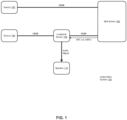
- FIG. 1 is a block diagram of an audio/video system 100.
- the audio/video system 100 includes a first source device 102, a second source device 104, a sink device 106, a loopback device 108, and a speaker 110.
- these devices are HDMI compatible devices, and implement HDMI connections.
- the audio/video system 100 is a typical system setup for a home environment, where a single sink device connects to multiple source devices, and is associated with speakers.
- the first source device 102 and the second source device 104 generally correspond to HDMI compatible devices, such as a set-top box (e.g., for receiving a cable or satellite signal), a disc player (e.g., a Blu-ray Disc ® player), a gaming console (e.g., Microsoft Xbox One TM ), a video camera, a computer, etc.
- the sink device 106 generally corresponds to an HDMI compatible display device, e.g. a high definition television (HDTV). In general, an HDMI cable connects the first source device 102 and the sink device 106.
- HDMI compatible display device e.g. a high definition television (HDTV).
- HDMI cable connects the first source device 102 and the sink device 106.
- the loopback device 108 provides an HDMI connection between the second source device 104 and the sink device 106. In general, the loopback device 108 "passes through" the HDMI signal from the second source device 104 to the sink device 106, as further detailed below.
- the loopback device 108 receives an audio signal from the sink device 106.
- the audio signal corresponds to a selected HDMI stream (e.g., an HDMI stream from the first source device 102, an HDMI stream from the second source device 104, etc.).
- the sink device 106 and the loopback device 108 use the HDMI Audio Return Channel (ARC) or eARC for this purpose. Since the loopback device 108 does not receive the HDMI stream from the first source device 102, the sink device 106 uses the ARC to provide the corresponding audio signal. However, even though the loopback device 108 does receive the HDMI stream from the second source device 104, since it passes the HDMI signal through to the sink device 106, the sink device 106 uses the ARC to provide the corresponding audio signal. In this manner, the audio signal is "looped back" to the loopback device 108.
- ARC HDMI Audio Return Channel
- the sink device 106 may perform decoding of the audio signal if the audio signal is encoded in the selected HDMI stream.
- the loopback device 108 may implement one or more of the features described in International Application Pub. No. WO 2016/148935 A1 .
- the loopback device 108 may include a wireless transceiver for communicating with a remote control device.
- the loopback device 108 may include an IEEE 802.15.1 compliant transceiver that pairs with a mobile telephone, enabling the loopback device 108 to be controlled by an app executed by the mobile telephone. It may also include audio amplification and speakers, depending on form factor.
- the speaker 110 generally outputs the audio signal provided by the loopback device 108. Although only one speaker 110 is shown, the speaker 110 may include multiple speakers, such as a headset, six speakers implementing 5.1 surround sound, etc.
- the loopback device 108 may provide the audio signal to the speaker 110 via a wired connection or a wireless connection.
- the operation of the audio/video system 100 is described below with reference to FIG. 2 .
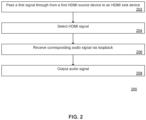
- a loopback device passes a first signal through from a first HDMI source device to an HDMI sink device via a first HDMI connection.
- the loopback device 108 passes HDMI signals through from the second source device 104 to the sink device 106.
- the various HDMI devices make HDMI connections using the various features of the HDMI protocol (e.g., using the Display Data Channel (DDC), the Consumer Electronics Control (CEC) channel, the HDMI Ethernet and Audio Return Channel (HEAC), the Enhanced Audio Return Channel (eARC), etc.).
- DDC Display Data Channel
- CEC Consumer Electronics Control
- HEAC HDMI Ethernet and Audio Return Channel
- eARC Enhanced Audio Return Channel
- the loopback device 108 (see FIG. 1 ) is configured to make this HDMI connection in a pass through manner.
- the HDMI connection includes a transition-minimized differential signaling (TMDS) or fixed-rate link (FRL) channel, and the loopback device 108 passes through the signals on the TMDS or FRL channel from the second source device 104 to the sink device 106.
- TMDS transition-minimized differential signaling
- FRL fixed-rate link
- the FRL channel uses the same wires as the TMDS channel, but instead of one clock pair and three data pairs, the FRL channel uses all four pairs for data, with an embedded clock. The following discussion refers specifically to the TMDS channel, but applies equally to the FRL channel.
- the HDMI sink device selects a signal, where the selected signal is one of a number of signals including the first signal from the first HDMI source device via the first HDMI connection and a second signal from the second HDMI source device via a second HDMI connection.
- the sink device 106 selects (e.g., according to a user input) the signal from one of the first source device 102 and the second source device 104.
- an HDTV the sink device 106
- the HDTV may switch among the signals from those devices for display.
- the second HDMI connection differs from the first HDMI connection.
- the second source device 104 has a first HDMI connection with the sink device 106 using the loopback device 108
- the first source device 102 has a second HDMI connection with the sink device 106.
- the loopback device receives, via loopback from the HDMI sink device, a selected audio signal.
- the selected audio signal corresponds to the selected signal, as selected by the HDMI sink device (see 204).
- the loopback device 108 receives the selected audio signal from the sink device 106, according to the selected signal (see 204).
- the HDMI sink device may use the HDMI ARC or eARC for sending the audio signal to the loopback device.
- the loopback device outputs the selected audio signal to a speaker.
- the loopback device 108 outputs the selected audio signal to the speaker 110 via a wired or wireless connection.
- the speaker 110 then outputs the selected audio signal.
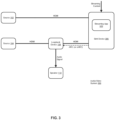
- FIG. 3 is a block diagram of an audio/video system 300.
- the audio/video system 300 is similar to the audio/video system 100 (see FIG. 1 ), with the added feature of the sink device 306 including a streaming app 320.
- the sink device 306 may also include another connection (e.g., to the Internet via a router or other device) for receiving streaming content for the streaming app 320.
- the sink device 306 is otherwise similar to the sink device 106 (see FIG. 1 ).
- the operation of the audio/video system 300 is similar to that described above with reference to the method 200 of FIG. 2 .
- the selected signal may include a third signal from the streaming app 320.
- the selected audio signal may correspond to the third signal from the streaming app 320.
- the audio/video system 300 differs from traditional systems in that since the loopback device 108 passes the HDMI signals through, the user is not required to upgrade the loopback device 108 when the source device 102 and the sink device 306 are upgraded to a new HDMI version.
- the HDMI source device 404 generally provides an HDMI signal, and generally corresponds to the second source device 104 (see FIG. 1 ). As shown in FIG. 4 , the HDMI source device 404 provides the HDMI signal via a connection to the HDMI loopback device 408, with the TMDS signals being passed through the HDMI loopback device 408 to the HDMI sink device 406 (as further discussed below).
- the HDMI source device 404 includes a receiver detection circuit 410, a TMDS transmitter circuit 412, a hot plug detection circuit 414, a High-bandwidth Digital Content Protection (HDCP) circuit 416, a DDC master circuit 418, and a CEC circuit 420.
- the HDMI source device 404 may also include other components, such as a processor and a memory (e.g., that control its operation); for brevity, the details of these other components are omitted.)
- the receiver detection circuit 410 generates and outputs a clock signal "Clock".
- the clock signal is a TMDS clock signal output using three pins (e.g., pin 10 for Clock+, pin 11 for Clock Shield, and pin 12 for Clock-).
- the TMDS transmitter circuit 412 generates and outputs three data signals, "Data 1", “Data 2" and "Data 3". These data signals are TMDS signals, each output using three pins (e.g., pins 7-9 for Data1+, Data1 Shield and Data1-; pins 4-6 for Data2+, Data2 Shield and Data2-; and pins 1-3 for Data3+, Data3 Shield and Data3-).
- the hot plug detection circuit 414 performs hot plug detection (e.g., using pin 19).
- a Hot-Plug Detect (HPD) event is initiated.
- the HDMI source device 404 reads the EDID information from the sink (here, the HDMI loopback device 408) over the DDC line (discussed in more detail below) and negotiates a format/resolution for the data in the TMDS signals.
- the hot plug detection circuit 414 also provides a voltage (5 volts as shown, using pin 18).
- the HDCP circuit 416 works with the DDC master circuit 418 to perform HDCP.
- the HDCP circuit 416 works with the DDC master circuit 418 to communicate this information, in order for the HDMI source device 404 to encrypt the data in the TMDS signals.
- the DDC master circuit 418 generates a serial clock signal "SCL” (e.g., using pin 15) and communicates a serial data signal "SDA” (e.g., using pin 16). These serial signals are I 2 C (Inter-Integrated Circuit) signals. As mentioned above, the DDC master circuit 418 exchanges HDCP-related information with other devices (e.g., the HDMI sink device 406, the HDMI loopback device 408, etc.). The DDC master circuit 418 also reads E-EDID data from other connected devices (e.g., the HDMI sink device 406) to learn what audio/video formats the other device can take. The DDC master circuit 418 may also exchange other information on the DDC channel with other connected devices.
- SCL serial clock signal
- SDA serial data signal
- the CEC circuit 420 generally implements CEC functionality (e.g., using pin 13).
- CEC allows a user to command and control up to 15 CEC-enabled devices, that are connected through HDMI, by using only one of their remote controls.
- TMDS signals (Clock, Data 1, Data 2 and Data 3) are passed through the HDMI loopback device 408 to the HDMI sink device 406; the other signals (e.g., SCL, SDA, etc.) are exchanged with the HDMI loopback device 408. Further features of the pass-through, and further features of the other signals, are discussed in more detail below.
- the HDMI loopback device 408 generally connects between the HDMI source device 404 and the HDMI sink device 406, and generally corresponds to the loopback device 108 (see FIG. 1 ).
- the HDMI loopback device 408 includes an HDMI interface 430 that connects (e.g., using an HDMI cable) to the HDMI source device 404, and HDMI interface 432 that connects (e.g., using an HDMI cable) to the HDMI sink device 406, and a processor 434 that generally controls the operation of the HDMI loopback device 408.
- the HDMI loopback device 408 also includes a power detection circuit 436, a DDC slave circuit 438, an EDID circuit 440, a CEC circuit 442, a hot plug detection circuit 444, a DDC master circuit 446, a HEAC circuit 448, and an eARC receiver circuit 450.
- the power detection circuit 436 receives a voltage from the HDMI source device 404 (e.g., from the hot plug detection circuit 414) and communicates the HPD event back to the hot plug detection circuit 414. In this manner, the HDMI loopback device 408 communicates the fact of its connection to the HDMI source device 404.
- the DDC master circuit 418 (in the HDMI source device 404) communicates with the DDC slave circuit 438 using the serial data signal SDA over the DDC link.
- this data may include HDCP-related information, E-EDID data, and other information.
- the DDC slave circuit 438 also receives the serial clock signal SCL (from the HDMI source device 404) over the DDC link.
- the EDID circuit 440 works with the DDC master circuit 446 to obtain the E-EDID data from the HDMI sink device 406, and works with the DDC slave circuit 438 to communicate the obtained and modified E-EDID data to the HDMI source device 404. In this manner, the HDMI source device 404 becomes aware of the capabilities of the HDMI sink device 406.
- the CEC circuit 442 generally implements CEC functionality (e.g., using pin 13).
- the CEC circuit 442 communicates with the CEC circuit 420 in the HDMI source device 404, and with a corresponding CEC circuit in the HDMI sink device 406, in order to transfer CEC information among the various connected devices.
- the DDC master circuit 446 generates a serial clock signal "SCL” (e.g., using pin 15) and communicates a serial data signal “SDA” (e.g., using pin 16). These serial signals are I 2 C (Inter-Integrated Circuit) signals. As mentioned above, the DDC master circuit 446 exchanges HDCP-related information with other devices (e.g., the HDMI sink device 406). The DDC master circuit 446 also reads E-EDID data from other connected devices (e.g., the HDMI sink device 406) to learn what audio/video formats the other device can take. The DDC master circuit 446 may also exchange other information on the DDC channel with other connected devices. In this manner, the HDMI loopback device 408 communicates the HDCP-related information and the E-EDID data between the HDMI source device 404 and the HDMI sink device 406.
- SCL serial clock signal
- SDA serial data signal
- the eARC receiver circuit 450 generally receives an audio signal from the HDMI sink device 406 on the enhanced audio return channel (eARC), and provides the audio signal to a speaker (e.g., the speaker 110 of FIG. 1 ).
- eARC is similar to ARC, but the connection for eARC uses two pins and a shield twisted pair for Ethernet.
- the eARC receiver circuit 450 may perform discovery independently of the CEC circuit 442 (whereas ARC interacts with the CEC circuit 442 to perform discovery).
- the HDMI sink device 406 generally receives an HDMI signal (and transmits ARC or eARC signals, as discussed above), and generally corresponds to the sink device 106 (see FIG. 1 ). As shown in FIG. 4 , the HDMI sink device 406 receives the HDMI signal via a connection to the HDMI loopback device 408, with the TMDS signals being passed through the HDMI operates similarly to an HDMI cable with respect to the TMDS signals without modifying the TMDS signals, without using active components to retransmit the TMDS signals, etc.
- the HDMI sink device 406 generally receives an HDMI signal (and transmits ARC or eARC signals, as discussed above), and generally corresponds to the sink device 106 (see FIG. 1 ). As shown in FIG. 4 , the HDMI sink device 406 receives the HDMI signal via a connection to the HDMI loopback device 408, with the TMDS signals being passed through the HDMI loopback device 408 from the HDMI source device 404; and the HDMI sink device 406 transmits ARC (or eARC) signals to the HDMI loopback device 408.
- the HDMI sink device 406 includes a clock detection circuit 460, a TMDS receiver circuit 462, a power detection circuit 464, a DDC slave circuit 466, a HDCP circuit 468, an EDID circuit 470, a CEC circuit 472, a HEAC circuit 474, and (optionally) an eARC transmitter circuit 476.
- the HDMI sink device 406 may also include other components, such as a processor and a memory (e.g., that control its operation); for brevity, the details of these other components are omitted.)
- the TMDS receiver circuit 462 receives the data signals "Data 1", “Data 2" and "Data 3". As discussed above, these data signals are TMDS signals, each received using three pins.
- the power detection circuit 464 receives a voltage from the HDMI loopback device 408 (e.g., from the hot plug detection circuit 444) and communicates the HPD event back to the hot plug detection circuit 444. In this manner, the HDMI sink device 406 communicates the fact of its connection to the HDMI loopback device 408.
- the DDC slave circuit 466 communicates with the DDC master circuit 446 (in the HDMI loopback device 408) using the serial data signal SDA over the DDC link. As discussed above, this data may include HDCP-related information, E-EDID data, and other information.
- the DDC slave circuit 466 also receives the serial clock signal SCL (from the HDMI loopback device 408) over the DDC link. with the CEC circuit 420 in the HDMI source device 404, in order to transfer CEC information among the various connected devices.
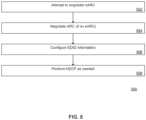
- FIG. 5 is a flowchart of a method 500 of connecting HDMI devices.
- the method 500 may be performed by one or more components of the audio/video system 400 (see FIG. 4 , e.g. the HDMI loopback device 408 and the other devices), for example according to a computer program executed by a processor.
- the HDMI loopback device 408 attempts to negotiate eARC with the HDMI sink device 406, using the common mode data channel of eARC.
- the HDMI loopback device 408 uses the eARC receiver circuit 450, and the HDMI sink device 406 uses the eARC transmitter circuit 476, to negotiate eARC.
- the HDMI loopback device 408 negotiates ARC with the HDMI sink device 406 over the CEC link. For example, the HDMI loopback device 408 uses the CEC circuit 442 to communicate with the CEC circuit 472 in the HDMI sink device 406.
- the HDMI loopback device 408 configures its EDID information.
- the HDMI loopback device 408 propagates power and hot plug information in a controlled way.
- the HDMI loopback device 408 uses the power detection circuit 436 to propagate power and hot plug information with the HDMI source device 404, and uses the hot plug detection circuit 444 to propagate power and hot plug information with the HDMI sink device 406.
- the HDMI loopback device 408 receives an individual HDMI physical address (PhysAddr) from the EDID of the HDMI sink device 406. To read the EDID, the HDMI loopback device 408 uses the DDC master circuit 446 to communicate with the DDC slave circuit 466 of the HDMI sink device 406.
- the DDC bus does not allow for multiple I 2 C masters, so the HDMI loopback device 408 maintains two independent DDC buses, one to the HDMI sink device 406 (using the DDC master circuit 446) and one to the HDMI source device 404 (using the DDC slave circuit 438).
- the HDMI loopback device 408 generates a modified EDID and provides the modified EDID to the HDMI source device 404, in order to propagate the HDMI PhysAddr to the HDMI source device 404. More details of the process of generating the modified EDID are provided below.
- the HDMI loopback device 408 reads all of the EDID data from the HDMI sink device 406.
- the HDMI loopback device 408 locates the HDMI Vendor Specific Data Block (HDMI VSDB) within the CTA (Consumer Technology Association) Data Block Collection of a CTA Extension Block version 3 (CTA Data Block of Type 3 with an IEEE identifier of 0x000C03).
- the HDMI loopback device 408 extracts the two bytes holding the HDMI Physical Address (at offset 4 of the VSDB).
- the HDMI loopback device 408 splits the two bytes (e.g. 0x10 0x00) into the 4 numbers representing the HDMI Physical Address (e.g. 1.0.0.0).
- the HDMI loopback device 408 amends the physical address by incrementing the first number that is zero (e.g. 1.1.0.0).
- the HDMI loopback device 408 encodes the new address into two bytes (e.g. 0x11 0x00) and inserts into the EDID data at the same offset, overwriting the old physical address.
- the HDMI loopback device 408 calculates a new checksum for the EDID block, and makes the new EDID data available to the source via the EDID circuit 440.
- the HDMI loopback device 408 performs HDCP functionality as needed.
- the HDMI loopback device 408 receives HDCP-related messages on the SDA link from the HDMI source device 404 (e.g., using the DDC slave circuit 438), and passes them on to the HDMI sink device 406 (e.g., using the DDC master circuit 446 and the corresponding SDA link).
- the HDMI loopback device 408 passes on the 44-byte HDCP 2.2 locality check in 20 msec.
- the pass-through is passive (as discussed above), similar to a straight cable.
- the requirements may be as described in HDMI 1.4b, Sections 4.2.1 through 4.2.6, and in HDMI 2.0b, Section 6.1.1.
- 5 Volts may be provided, as described in HDMI 1.4b, Section 4.2.7.
- Power out to the HDMI sink device may be between 4.8 and 5.3 Volt, and greater than or equal to 55 mA.
- the I 2 C bus may operate at 100 kHz, as described in HDMI 1.4b, Section 4.2.8.
- the transmitter e.g., the DDC master circuit 446, connecting to the HDMI sink device
- the receiver e.g., the DDC slave circuit 438, connecting to the HDMI source device
- the receiver may have a capacitance of 50 pF, and pull-up resistors with a resistance of 47 kOhm (+/-10%).
- All of the control lines may be implemented using 5 Volt or 3.3 Volt GPIO pins, with some external circuitry.
- the ARC line may be connected to a 192 kHz-capable S/PDIF (Sony/Philips Digital Interface Format) input pin.
- the eARC implementation may include an I 2 S (Inter-IC Sound) interface with 4 data lines, at up to 192 kHz.
- the CEC line and the DDC busses may be connected to hardware blocks implementing the low-level protocol functionality; alternatively, raw GPIOs with interrupt request (IRQ) may also be used.
- the DDC master circuit 446 may be implemented with a source-controlled clock, at up to 100 kHz respective kbit/s, having no IRQ requirement.
- the DDC slave circuit 438 may be implemented with an externally initiated clock, but the slave can hold the clock if it is too slow to respond (clock stretching); there is an IRQ requirement for the clock line, but no IRQ for the data line.
- the CEC circuit 442 may be a multi-node implementation, with a single wire transmitter and receiver with collision detection; it may operate slowly, nominally at 4.5 ms per bit (222 bit/second), with IRQ optional, and may perform polling (depending upon the speed of the processor).
- the power detection circuit 436 and hot plug detection circuit 444 may perform sampling at up to 100 ms granularity, with no IRQ required.
- the loopback device (e.g., the loopback device 108 of FIG. 1 , etc.) may be in the form factor of a dongle, with a male HDMI connector at one end for connecting to the second source device 104 via an HDMI cable, and a female connector at the other end (optionally on a short HDMI cable) for connecting to the sink device 106 (or a male connector, for connecting to the sink device 106 via another HDMI cable).
- the loopback device may be in the form factor of a soundbar, with no requirement to connect to additional external speakers (such as the speaker 110 of FIG. 1 ).
- An embodiment may be implemented in hardware, executable modules stored on a computer readable medium, or a combination of both (e.g., programmable logic arrays). Unless otherwise specified, the steps executed by embodiments need not inherently be related to any particular computer or other apparatus, although they may be in certain embodiments. In particular, various general-purpose machines may be used with programs written in accordance with the teachings herein, or it may be more convenient to construct more specialized apparatus (e.g., integrated circuits) to perform the required method steps.
- embodiments may be implemented in one or more computer programs executing on one or more programmable computer systems each comprising at least one processor, at least one data storage system (including volatile and non-volatile memory and/or storage elements), at least one input device or port, and at least one output device or port.
- Program code is applied to input data to perform the functions described herein and generate output information.
- the output information is applied to one or more output devices, in known fashion.
- Each such computer program is preferably stored on or downloaded to a storage media or device (e.g., solid state memory or media, or magnetic or optical media) readable by a general or special purpose programmable computer, for configuring and operating the computer when the storage media or device is read by the computer system to perform the procedures described herein.
- a storage media or device e.g., solid state memory or media, or magnetic or optical media
- the inventive system may also be considered to be implemented as a computer-readable storage medium, configured with a computer program, where the storage medium so configured causes a computer system to operate in a specific and predefined manner to perform the functions described herein. (Software per se and intangible or transitory signals are excluded to the extent that they are unpatentable subject matter.)
Landscapes
- Engineering & Computer Science (AREA)
- Signal Processing (AREA)
- Multimedia (AREA)
- Physics & Mathematics (AREA)
- Theoretical Computer Science (AREA)
- Audiology, Speech & Language Pathology (AREA)
- Health & Medical Sciences (AREA)
- General Health & Medical Sciences (AREA)
- Human Computer Interaction (AREA)
- General Engineering & Computer Science (AREA)
- General Physics & Mathematics (AREA)
- Acoustics & Sound (AREA)
- Computer Networks & Wireless Communication (AREA)
- Two-Way Televisions, Distribution Of Moving Picture Or The Like (AREA)
Claims (11)
- Einrichtung (108, 408) zum Verbinden von High-Definition-Multimedia-Interface-, HDMI-Vorrichtungen, wobei die Einrichtung umfasst:eine erste HDMI-Schnittstelle, die konfiguriert ist, um mit einer ersten HDMI-Quellvorrichtung (104) verbunden zu werden;eine zweite HDMI-Schnittstelle, die konfiguriert ist, um mit einer HDMI-Senkenvorrichtung (106, 306, 406) verbunden zu werden, wobei die erste HDMI-Schnittstelle und die zweite HDMI-Schnittstelle einen übergangsminimierten Differenzialsignal-, TMDS-Kanal beinhalten,wobei die Einrichtung (108, 408) konfiguriert ist, um TDMS-Signale, die ein erstes Audio- und Videosignal darstellen, durch die Einrichtung (108, 408) hindurch von der ersten HDMI-Quellvorrichtung (104) an die HDMI-Senkenvorrichtung (106, 306, 406) auf dem TDMS-Kanal über eine erste HDMI-Verbindung weiterzugeben, ohne aktive Komponenten zu verwenden, um die DMS-Signale weiterzusenden; undwobei die zweite HDMI-Schnittstelle konfiguriert ist, um ein Audiosignal von der HDMI-Senkenvorrichtung (106, 306, 406) zu empfangen, undwobei die Einrichtung konfiguriert ist, um das empfangene Audiosignal an einen Lautsprecher (110) auszugeben.wobei die Einrichtung weiter konfiguriert ist, umerweiterte Display-Identifikationsdaten-, EDID-Informationen, aus der HDMI-Senkenvorrichtung (106, 306, 406) zu lesen,eine physische HDMI-Adresse aus den EDID-Informationen zu extrahieren,die physische Adresse zu ändern,modifizierte EDID-Informationen durch Einfügen der geänderten physischen Adresse in die EDID-Informationen zu erzeugen, sodass die extrahierte physische HDMI-Adresse überschrieben wird, unddie geänderten EDID-Informationen an die erste HDMI-Quellvorrichtung (104) weiterzugeben.
- Einrichtung (108, 408) nach Anspruch 1, wobei die zweite HDMI-Schnittstelle einen HDMI-Audiorückkanal, ARC, beinhaltet, wobei die zweite HDMI-Schnittstelle konfiguriert ist, um das Audiosignal von der HDMI-Senkenvorrichtung über den Audiorückkanal, ARC zu empfangen.
- Einrichtung (108, 408) nach Anspruch 1, wobei die zweite HDMI-Schnittstelle einen erweiterten Audiorückkanal, eARC beinhaltet, wobei die zweite HDMI-Schnittstelle konfiguriert ist, um das Audiosignal von der HDMI-Senkenvorrichtung über den erweiterten Audiorückkanal, eARC zu empfangen.
- Einrichtung (108, 408) nach Anspruch 1, wobei das Audiosignal aus der HDMI-Senkenvorrichtung dem ersten Audio- und Videosignal, das durch die Einrichtung weitergegeben wird, zugeordnet ist.
- Einrichtung (108, 408) nach einem der Ansprüche 1-3, wobei das Audiosignal aus der HDMI-Senkenvorrichtung einem Audio- und Videosignal zugeordnet ist, das sich von dem ersten Audio- und Videosignal, das durch die Einrichtung weitergegeben wird, unterscheidet.
- Einrichtung (108; 408) nach einem der Ansprüche 1-5, wobei die Einrichtung konfiguriert ist, um das erste Audio- und Videosignal von der ersten HDMI-Schnittstelle an die zweite HDMI-Schnittstelle auf dem TMDS-Kanal weiterzugeben.
- Einrichtung (108; 408) nach einem der Ansprüche 1-6, wobei die Einrichtung konfiguriert ist, um der HDMI-Quellvorrichtung die geänderte EDID bereitzustellen, um es der HDMI-Quellvorrichtung zu ermöglichen, die geänderte EDID anstelle der EDID zu verwenden, um das erste Audio- und Videosignal zu erzeugen.
- Einrichtung nach einem der Ansprüche 1-7, wobei die Einrichtung einen Formfaktor eines Dongles aufweist.
- Einrichtung nach einem der Ansprüche 1-7, wobei die Einrichtung einen Formfaktor einer Soundbar aufweist, die den Lautsprecher beinhaltet.
- Verfahren zum Verbinden von High-Definition-Multimedia-Interface-, HDMI-Vorrichtungen, umfassend:Weitergeben (202) durch eine Loopback-Vorrichtung (108, 408) von übergangsminimierten Differenzial-Signalisierungs-, TDMS-Signalen, die ein erstes Audio- und Videosignal darstellen, von einer ersten HDMI-Quellvorrichtung (104, 404) an eine HDMI-Senkenvorrichtung (106, 306, 406) über eine erste HDMI-Verbindung auf einem TMDS-Kanal, ohne Verwendung aktiver Komponenten, um die TDMS-Signale weiterzusenden;
Empfangen (206) durch die Loopback-Vorrichtung eines Audiosignals von der HDMI-Senkenvorrichtung über Loopback; undAusgeben (208) durch die Loopback-Vorrichtung des empfangenen Audiosignals an einen Lautsprecher
wobei das Verfahren weiter umfasst:Lesen durch die Loopback-Vorrichtung der erweiterten Anzeigeidentifikationsdaten-, EDID-Informationen aus der HDMI-Senkenvorrichtung (106, 306, 406),Extrahieren durch die Loopback-Vorrichtung einer physischen HDMI-Adresse aus den EDID-Informationen,Ändern durch die Loopback-Vorrichtung der physischen Adresse,Erzeugen durch die Loopback-Vorrichtung geänderter EDID-Informationen durch Einfügen der geänderten physischen Adresse in die EDID-Informationen, sodass die extrahierte physische HDMI-Adresse überschrieben wird, undWeitergeben durch die Loopback-Vorrichtung der geänderten EDID-Informationen an die erste HDMI-Quellvorrichtung (104). - System zum Verbinden von High-Definition-Multimedia-Interface-, HDMI-Vorrichtungen, wobei das System eine Einrichtung nach einem der Ansprüche 1-9 umfasst:eine erste HDMI-Quellvorrichtung (104);eine zweite HDMI-Quellvorrichtung (102);eine HDMI-Senkenvorrichtung (106; 306);einen Lautsprecher; undwobei die HDMI-Senkenvorrichtung (106; 306) konfiguriert ist, um ein ausgewähltes Signal auszuwählen, wobei das ausgewählte Signal eines der ersten Audio- und Videosignale aus dem ersten HDMI-Quellvorrichtung über eine erste HDMI-Verbindung und ein zweites Audio- und Videosignal aus einer zweiten HDMI-Quellvorrichtung über eine zweite HDMI-Verbindung ist, wobei sich die zweite HDMI-Verbindung von der ersten HDMI-Verbindung unterscheidet,wobei die Einrichtung (108) konfiguriert ist, um über die zweite HDMI-Schnittstelle aus der HDMI-Senkenvorrichtung (106; 306) ein Audiosignal, das dem ausgewählten Audio- und Videosignal zugeordnet ist, zu empfangen, wobei das ausgewählte Audiosignal dem ausgewählten Signal entspricht, wie es von der HDMI-Senkenvorrichtung (106; 306) ausgewählt ist, und wobei die Einrichtung (108) konfiguriert ist, um das ausgewählte Audiosignal an einen Lautsprecher auszugeben.
Applications Claiming Priority (3)
| Application Number | Priority Date | Filing Date | Title |
|---|---|---|---|
| US201762608827P | 2017-12-21 | 2017-12-21 | |
| EP17209739 | 2017-12-21 | ||
| PCT/US2018/065546 WO2019125920A1 (en) | 2017-12-21 | 2018-12-13 | Audio device for hdmi |
Publications (2)
| Publication Number | Publication Date |
|---|---|
| EP3729797A1 EP3729797A1 (de) | 2020-10-28 |
| EP3729797B1 true EP3729797B1 (de) | 2025-01-29 |
Family
ID=64901673
Family Applications (1)
| Application Number | Title | Priority Date | Filing Date |
|---|---|---|---|
| EP18827322.1A Active EP3729797B1 (de) | 2017-12-21 | 2018-12-13 | Audiovorrichtung für hdmi |
Country Status (4)
| Country | Link |
|---|---|
| US (1) | US11115617B2 (de) |
| EP (1) | EP3729797B1 (de) |
| CN (1) | CN111492648B (de) |
| WO (1) | WO2019125920A1 (de) |
Families Citing this family (27)
| Publication number | Priority date | Publication date | Assignee | Title |
|---|---|---|---|---|
| KR102579313B1 (ko) * | 2018-09-11 | 2023-09-15 | 삼성전자주식회사 | 전자 장치 및 그 제어 방법 |
| US11563857B2 (en) * | 2019-05-31 | 2023-01-24 | Microsoft Technology Licensing, Llc | Aggregating hardware loopback |
| CN113079407B (zh) * | 2020-01-06 | 2023-01-10 | 瑞昱半导体股份有限公司 | 数据打包电路和数据打包方法 |
| CN113163192B (zh) * | 2020-01-23 | 2023-01-31 | 东莞市金锐显数码科技有限公司 | 一种hdmi接口的测试装置和测试系统 |
| CN112019782B (zh) * | 2020-08-24 | 2023-04-14 | 青岛海信传媒网络技术有限公司 | 增强型音频回传通道的控制方法及显示设备 |
| CN111970613A (zh) * | 2020-08-25 | 2020-11-20 | 海信视像科技股份有限公司 | 无线发射装置、控制方法及显示装置 |
| CN112399217B (zh) * | 2020-11-05 | 2022-11-25 | 海信视像科技股份有限公司 | 显示设备及与功放设备建立通信连接的方法 |
| WO2022042578A1 (zh) | 2020-08-25 | 2022-03-03 | 海信视像科技股份有限公司 | 显示设备、无线发射装置及音频输出控制方法 |
| TWI812887B (zh) * | 2020-10-07 | 2023-08-21 | 瑞昱半導體股份有限公司 | 偵測電路和喚醒方法 |
| CN112218152B (zh) * | 2020-10-15 | 2021-06-29 | 四川长虹电器股份有限公司 | 一种电视ARC和eARC兼容的方法 |
| JP7482407B2 (ja) * | 2020-11-02 | 2024-05-14 | プレミアムオーディオカンパニーテクノロジーセンター株式会社 | 音声処理装置 |
| TWI816071B (zh) * | 2020-12-09 | 2023-09-21 | 宏正自動科技股份有限公司 | 音訊轉換裝置及音訊處理方法 |
| CN113067995B (zh) * | 2021-03-18 | 2022-06-03 | 深圳市玩视科技有限公司 | Hdmi切换器和hdmi切换系统 |
| WO2022193732A1 (zh) | 2021-03-19 | 2022-09-22 | 海信视像科技股份有限公司 | 一种音频输出通道的切换控制方法及显示设备 |
| CN113055788B (zh) * | 2021-04-21 | 2022-09-30 | 海信视像科技股份有限公司 | 一种音频输出通道的切换控制方法及显示设备 |
| WO2022222724A1 (zh) | 2021-04-21 | 2022-10-27 | 海信视像科技股份有限公司 | 一种音频输出通道的切换控制方法及显示设备 |
| US12067384B2 (en) * | 2021-05-28 | 2024-08-20 | Vizio, Inc. | Consumer device firmware updating via HDMI |
| CN113763969B (zh) * | 2021-08-31 | 2024-04-30 | 惠州视维新技术有限公司 | 信号处理系统及远端设备 |
| KR20230036449A (ko) * | 2021-09-07 | 2023-03-14 | 삼성전자주식회사 | 전자 장치 및 그 제어 방법 |
| TWI887486B (zh) * | 2021-09-13 | 2025-06-21 | 瑞昱半導體股份有限公司 | 多媒體影音系統與其協定轉換器 |
| CN115834811A (zh) * | 2021-09-17 | 2023-03-21 | 瑞昱半导体股份有限公司 | 多媒体影音系统与其协议转换器 |
| CN113784074B (zh) * | 2021-09-24 | 2023-06-27 | 广东博华超高清创新中心有限公司 | 一种改进增强型音频回传通道互通互连的方法 |
| CN113905228B (zh) * | 2021-10-28 | 2023-11-17 | 广东博华超高清创新中心有限公司 | 一种hdmi中继器设备的回环测试方法 |
| CN114173077B (zh) * | 2021-11-30 | 2023-05-23 | 联想(北京)有限公司 | 控制方法及电子设备 |
| CN114900633B (zh) * | 2022-05-12 | 2024-09-10 | 广东博华超高清创新中心有限公司 | 一种增强型音频回传通道快速建立连接的方法 |
| TWI864924B (zh) * | 2023-08-01 | 2024-12-01 | 瑞昱半導體股份有限公司 | 消費者電子控制系統 |
| TWI898588B (zh) * | 2024-05-10 | 2025-09-21 | 瑞昱半導體股份有限公司 | 音訊處理系統以及音訊處理方法 |
Citations (1)
| Publication number | Priority date | Publication date | Assignee | Title |
|---|---|---|---|---|
| US9693109B1 (en) * | 2016-09-12 | 2017-06-27 | Bose Corporation | Configurable media processing based on mapping of remote controller buttons |
Family Cites Families (21)
| Publication number | Priority date | Publication date | Assignee | Title |
|---|---|---|---|---|
| JP2011124925A (ja) | 2009-12-14 | 2011-06-23 | Sony Corp | 出力制御装置、出力制御方法、プログラム、及び出力制御システム |
| JP5466519B2 (ja) | 2010-01-20 | 2014-04-09 | 日立コンシューマエレクトロニクス株式会社 | 情報処理装置、及び情報処理装置の信号処理方法 |
| EP2385517A1 (de) | 2010-05-05 | 2011-11-09 | NXP Semiconductors B.V. | System und Verfahren zum Betrieb einer elektronischen Vorrichtung mit einem HDMI-Anschluss, der zwischen einer HDMI-Quellenfunktion und einer HDMI-Sinkfunktion der elektronischen Vorrichtung gemeinsam verwendet wird |
| JP5553695B2 (ja) * | 2010-06-30 | 2014-07-16 | キヤノン株式会社 | 通信装置、及びその制御方法 |
| JP2012151725A (ja) * | 2011-01-20 | 2012-08-09 | Funai Electric Co Ltd | シンク機器 |
| JP2013026859A (ja) | 2011-07-21 | 2013-02-04 | Toshiba Corp | 映像表示装置、情報再生方法及び情報再生装置 |
| JP5284454B2 (ja) * | 2011-12-27 | 2013-09-11 | 株式会社東芝 | 送信装置、受信装置、及び通信経路切り替え方法 |
| WO2016060447A2 (ko) * | 2014-10-14 | 2016-04-21 | 엘지전자(주) | Hdmi를 사용한 데이터 송수신 기기 및 방법 |
| EP3222038B8 (de) * | 2014-11-18 | 2021-06-30 | Caavo Inc | Automatische identifizierung und mapping von unterhaltungselektronikvorrichtungen an ports eines hdmi-schalter |
| WO2016081636A1 (en) * | 2014-11-18 | 2016-05-26 | Branch Media Labs, Inc. | Seamless setup and control for home entertainment devices and content |
| WO2016136257A1 (ja) * | 2015-02-25 | 2016-09-01 | パナソニックIpマネジメント株式会社 | シンク機器 |
| US10491851B2 (en) | 2015-03-13 | 2019-11-26 | Dolby Laboratories Licensing Corporation | Media stick for controlling wireless speakers |
| WO2016153249A1 (ko) * | 2015-03-23 | 2016-09-29 | 엘지전자(주) | Hdmi를 사용하여 전력을 송수신하기 위한 방법 및 그 장치 |
| CN106331557B (zh) | 2015-06-17 | 2019-06-21 | 华为技术有限公司 | Arc控制方法、控制单元和显示设备 |
| US10038936B2 (en) * | 2015-11-18 | 2018-07-31 | Caavo Inc | Source device detection |
| KR102463418B1 (ko) | 2016-01-06 | 2022-11-08 | 삼성전자 주식회사 | 영상콘텐츠 제공장치 및 그 제어방법과, 시스템 |
| US10013328B2 (en) * | 2016-04-21 | 2018-07-03 | Arris Enterprises Llc | Incorrectly connected HDMI cable indicator |
| CN108668144B (zh) * | 2017-03-29 | 2020-06-26 | 华为机器有限公司 | 一种数据流控方法、装置及设备 |
| US9986200B1 (en) * | 2017-05-11 | 2018-05-29 | Novatek Microelectronics Corp. | Method and video conversion system of updating video setting |
| US10477141B1 (en) * | 2018-05-17 | 2019-11-12 | Futurewei Technologies, Inc. | Frame synchronous packet switching for high-definition multimedia interface (HDMI) video transitions |
| JP6952666B2 (ja) * | 2018-09-14 | 2021-10-20 | 株式会社東芝 | コネクタ装置および伝送ケーブル |
-
2018
- 2018-12-13 EP EP18827322.1A patent/EP3729797B1/de active Active
- 2018-12-13 US US16/770,089 patent/US11115617B2/en active Active
- 2018-12-13 WO PCT/US2018/065546 patent/WO2019125920A1/en not_active Ceased
- 2018-12-13 CN CN201880081749.XA patent/CN111492648B/zh active Active
Patent Citations (1)
| Publication number | Priority date | Publication date | Assignee | Title |
|---|---|---|---|---|
| US9693109B1 (en) * | 2016-09-12 | 2017-06-27 | Bose Corporation | Configurable media processing based on mapping of remote controller buttons |
Non-Patent Citations (1)
| Title |
|---|
| ANONYMOUS: "HDMI - Wikipedia, the free encyclopedia", 11 July 2013 (2013-07-11), XP055150625, Retrieved from the Internet <URL:http://en.wikipedia.org/w/index.php?title=HDMI&oldid=563854098> [retrieved on 20141104] * |
Also Published As
| Publication number | Publication date |
|---|---|
| WO2019125920A1 (en) | 2019-06-27 |
| EP3729797A1 (de) | 2020-10-28 |
| CN111492648A (zh) | 2020-08-04 |
| CN111492648B (zh) | 2023-03-21 |
| US11115617B2 (en) | 2021-09-07 |
| US20200351465A1 (en) | 2020-11-05 |
Similar Documents
| Publication | Publication Date | Title |
|---|---|---|
| EP3729797B1 (de) | Audiovorrichtung für hdmi | |
| KR102397289B1 (ko) | Hdmi를 사용하여 데이터를 송수신하기 위한 방법 및 장치 | |
| CN101573975B (zh) | 接收器、用于接收器的延迟信息发送方法、音频输出装置、及用于音频输出装置的延迟控制方法 | |
| KR102476605B1 (ko) | 전자 장치 및 그 제어 방법 | |
| US8776163B2 (en) | High definition video extender and method | |
| TWI483116B (zh) | 通過標準裝置連接器的可選擇內容之傳輸 | |
| CN102547195B (zh) | 电子装置、电子装置控制方法以及电子装置系统 | |
| US10474241B2 (en) | Method and device for transmitting/receiving data using HDMI | |
| US20170245003A1 (en) | Device and method for transmitting and receiving data using hdmi | |
| US10162769B2 (en) | Method and apparatus for transmitting and receiving data using HDMI | |
| CN101727873A (zh) | 信号转换装置与显示系统 | |
| WO2008056709A1 (fr) | Récepteur, procédé de transmission d'informations retardées destiné à des récepteurs, dispositif de sortie audio, et procédé de commande de retard destinés à des dispositifs de sortie audio | |
| WO2012043351A1 (ja) | 送信装置、送信方法、受信装置、受信方法、送受信システムおよびケーブル | |
| CN106134210A (zh) | 利用hdmi进行数据发送和接收的装置和方法 | |
| CN104937947B (zh) | 数据块传输方法/设备、确定传输信号内容的方法和收发系统 | |
| US20100271486A1 (en) | Method and apparatus for providing robust display digital channel transmission | |
| US10491851B2 (en) | Media stick for controlling wireless speakers | |
| US8972626B2 (en) | Content reproducing device and content reproduction control method | |
| US20120210384A1 (en) | High definition video extender and method | |
| US10009650B2 (en) | Method and apparatus for processing object-based audio data using high-speed interface | |
| JP5900552B2 (ja) | ケーブル | |
| WO2015118908A1 (ja) | 送信装置、受信装置、通信処理方法およびケーブル |
Legal Events
| Date | Code | Title | Description |
|---|---|---|---|
| STAA | Information on the status of an ep patent application or granted ep patent |
Free format text: STATUS: UNKNOWN |
|
| STAA | Information on the status of an ep patent application or granted ep patent |
Free format text: STATUS: THE INTERNATIONAL PUBLICATION HAS BEEN MADE |
|
| PUAI | Public reference made under article 153(3) epc to a published international application that has entered the european phase |
Free format text: ORIGINAL CODE: 0009012 |
|
| STAA | Information on the status of an ep patent application or granted ep patent |
Free format text: STATUS: REQUEST FOR EXAMINATION WAS MADE |
|
| 17P | Request for examination filed |
Effective date: 20200721 |
|
| AK | Designated contracting states |
Kind code of ref document: A1 Designated state(s): AL AT BE BG CH CY CZ DE DK EE ES FI FR GB GR HR HU IE IS IT LI LT LU LV MC MK MT NL NO PL PT RO RS SE SI SK SM TR |
|
| AX | Request for extension of the european patent |
Extension state: BA ME |
|
| DAV | Request for validation of the european patent (deleted) | ||
| DAX | Request for extension of the european patent (deleted) | ||
| STAA | Information on the status of an ep patent application or granted ep patent |
Free format text: STATUS: EXAMINATION IS IN PROGRESS |
|
| 17Q | First examination report despatched |
Effective date: 20220211 |
|
| P01 | Opt-out of the competence of the unified patent court (upc) registered |
Effective date: 20230417 |
|
| GRAP | Despatch of communication of intention to grant a patent |
Free format text: ORIGINAL CODE: EPIDOSNIGR1 |
|
| STAA | Information on the status of an ep patent application or granted ep patent |
Free format text: STATUS: GRANT OF PATENT IS INTENDED |
|
| GRAJ | Information related to disapproval of communication of intention to grant by the applicant or resumption of examination proceedings by the epo deleted |
Free format text: ORIGINAL CODE: EPIDOSDIGR1 |
|
| GRAP | Despatch of communication of intention to grant a patent |
Free format text: ORIGINAL CODE: EPIDOSNIGR1 |
|
| INTG | Intention to grant announced |
Effective date: 20240712 |
|
| INTG | Intention to grant announced |
Effective date: 20240712 |
|
| INTG | Intention to grant announced |
Effective date: 20240722 |
|
| GRAS | Grant fee paid |
Free format text: ORIGINAL CODE: EPIDOSNIGR3 |
|
| GRAA | (expected) grant |
Free format text: ORIGINAL CODE: 0009210 |
|
| STAA | Information on the status of an ep patent application or granted ep patent |
Free format text: STATUS: THE PATENT HAS BEEN GRANTED |
|
| AK | Designated contracting states |
Kind code of ref document: B1 Designated state(s): AL AT BE BG CH CY CZ DE DK EE ES FI FR GB GR HR HU IE IS IT LI LT LU LV MC MK MT NL NO PL PT RO RS SE SI SK SM TR |
|
| REG | Reference to a national code |
Ref country code: GB Ref legal event code: FG4D |
|
| REG | Reference to a national code |
Ref country code: CH Ref legal event code: EP |
|
| REG | Reference to a national code |
Ref country code: DE Ref legal event code: R096 Ref document number: 602018078871 Country of ref document: DE |
|
| REG | Reference to a national code |
Ref country code: IE Ref legal event code: FG4D |
|
| REG | Reference to a national code |
Ref country code: NL Ref legal event code: MP Effective date: 20250129 |
|
| PG25 | Lapsed in a contracting state [announced via postgrant information from national office to epo] |
Ref country code: NL Free format text: LAPSE BECAUSE OF FAILURE TO SUBMIT A TRANSLATION OF THE DESCRIPTION OR TO PAY THE FEE WITHIN THE PRESCRIBED TIME-LIMIT Effective date: 20250129 |
|
| PG25 | Lapsed in a contracting state [announced via postgrant information from national office to epo] |
Ref country code: RS Free format text: LAPSE BECAUSE OF FAILURE TO SUBMIT A TRANSLATION OF THE DESCRIPTION OR TO PAY THE FEE WITHIN THE PRESCRIBED TIME-LIMIT Effective date: 20250429 |
|
| PG25 | Lapsed in a contracting state [announced via postgrant information from national office to epo] |
Ref country code: FI Free format text: LAPSE BECAUSE OF FAILURE TO SUBMIT A TRANSLATION OF THE DESCRIPTION OR TO PAY THE FEE WITHIN THE PRESCRIBED TIME-LIMIT Effective date: 20250129 |
|
| PG25 | Lapsed in a contracting state [announced via postgrant information from national office to epo] |
Ref country code: PL Free format text: LAPSE BECAUSE OF FAILURE TO SUBMIT A TRANSLATION OF THE DESCRIPTION OR TO PAY THE FEE WITHIN THE PRESCRIBED TIME-LIMIT Effective date: 20250129 |
|
| PG25 | Lapsed in a contracting state [announced via postgrant information from national office to epo] |
Ref country code: ES Free format text: LAPSE BECAUSE OF FAILURE TO SUBMIT A TRANSLATION OF THE DESCRIPTION OR TO PAY THE FEE WITHIN THE PRESCRIBED TIME-LIMIT Effective date: 20250129 |
|
| REG | Reference to a national code |
Ref country code: LT Ref legal event code: MG9D |
|
| PG25 | Lapsed in a contracting state [announced via postgrant information from national office to epo] |
Ref country code: NO Free format text: LAPSE BECAUSE OF FAILURE TO SUBMIT A TRANSLATION OF THE DESCRIPTION OR TO PAY THE FEE WITHIN THE PRESCRIBED TIME-LIMIT Effective date: 20250429 Ref country code: IS Free format text: LAPSE BECAUSE OF FAILURE TO SUBMIT A TRANSLATION OF THE DESCRIPTION OR TO PAY THE FEE WITHIN THE PRESCRIBED TIME-LIMIT Effective date: 20250529 |
|
| REG | Reference to a national code |
Ref country code: AT Ref legal event code: MK05 Ref document number: 1764571 Country of ref document: AT Kind code of ref document: T Effective date: 20250129 |
|
| PG25 | Lapsed in a contracting state [announced via postgrant information from national office to epo] |
Ref country code: HR Free format text: LAPSE BECAUSE OF FAILURE TO SUBMIT A TRANSLATION OF THE DESCRIPTION OR TO PAY THE FEE WITHIN THE PRESCRIBED TIME-LIMIT Effective date: 20250129 |
|
| PG25 | Lapsed in a contracting state [announced via postgrant information from national office to epo] |
Ref country code: PT Free format text: LAPSE BECAUSE OF FAILURE TO SUBMIT A TRANSLATION OF THE DESCRIPTION OR TO PAY THE FEE WITHIN THE PRESCRIBED TIME-LIMIT Effective date: 20250529 Ref country code: LV Free format text: LAPSE BECAUSE OF FAILURE TO SUBMIT A TRANSLATION OF THE DESCRIPTION OR TO PAY THE FEE WITHIN THE PRESCRIBED TIME-LIMIT Effective date: 20250129 |
|
| PG25 | Lapsed in a contracting state [announced via postgrant information from national office to epo] |
Ref country code: BG Free format text: LAPSE BECAUSE OF FAILURE TO SUBMIT A TRANSLATION OF THE DESCRIPTION OR TO PAY THE FEE WITHIN THE PRESCRIBED TIME-LIMIT Effective date: 20250129 Ref country code: GR Free format text: LAPSE BECAUSE OF FAILURE TO SUBMIT A TRANSLATION OF THE DESCRIPTION OR TO PAY THE FEE WITHIN THE PRESCRIBED TIME-LIMIT Effective date: 20250430 |
|
| PG25 | Lapsed in a contracting state [announced via postgrant information from national office to epo] |
Ref country code: AT Free format text: LAPSE BECAUSE OF FAILURE TO SUBMIT A TRANSLATION OF THE DESCRIPTION OR TO PAY THE FEE WITHIN THE PRESCRIBED TIME-LIMIT Effective date: 20250129 |
|
| PG25 | Lapsed in a contracting state [announced via postgrant information from national office to epo] |
Ref country code: SE Free format text: LAPSE BECAUSE OF FAILURE TO SUBMIT A TRANSLATION OF THE DESCRIPTION OR TO PAY THE FEE WITHIN THE PRESCRIBED TIME-LIMIT Effective date: 20250129 |
|
| PG25 | Lapsed in a contracting state [announced via postgrant information from national office to epo] |
Ref country code: SM Free format text: LAPSE BECAUSE OF FAILURE TO SUBMIT A TRANSLATION OF THE DESCRIPTION OR TO PAY THE FEE WITHIN THE PRESCRIBED TIME-LIMIT Effective date: 20250129 |
|
| PG25 | Lapsed in a contracting state [announced via postgrant information from national office to epo] |
Ref country code: DK Free format text: LAPSE BECAUSE OF FAILURE TO SUBMIT A TRANSLATION OF THE DESCRIPTION OR TO PAY THE FEE WITHIN THE PRESCRIBED TIME-LIMIT Effective date: 20250129 |
|
| PG25 | Lapsed in a contracting state [announced via postgrant information from national office to epo] |
Ref country code: IT Free format text: LAPSE BECAUSE OF FAILURE TO SUBMIT A TRANSLATION OF THE DESCRIPTION OR TO PAY THE FEE WITHIN THE PRESCRIBED TIME-LIMIT Effective date: 20250129 |
|
| PG25 | Lapsed in a contracting state [announced via postgrant information from national office to epo] |
Ref country code: EE Free format text: LAPSE BECAUSE OF FAILURE TO SUBMIT A TRANSLATION OF THE DESCRIPTION OR TO PAY THE FEE WITHIN THE PRESCRIBED TIME-LIMIT Effective date: 20250129 Ref country code: CZ Free format text: LAPSE BECAUSE OF FAILURE TO SUBMIT A TRANSLATION OF THE DESCRIPTION OR TO PAY THE FEE WITHIN THE PRESCRIBED TIME-LIMIT Effective date: 20250129 |
|
| PG25 | Lapsed in a contracting state [announced via postgrant information from national office to epo] |
Ref country code: RO Free format text: LAPSE BECAUSE OF FAILURE TO SUBMIT A TRANSLATION OF THE DESCRIPTION OR TO PAY THE FEE WITHIN THE PRESCRIBED TIME-LIMIT Effective date: 20250129 |
|
| PG25 | Lapsed in a contracting state [announced via postgrant information from national office to epo] |
Ref country code: SK Free format text: LAPSE BECAUSE OF FAILURE TO SUBMIT A TRANSLATION OF THE DESCRIPTION OR TO PAY THE FEE WITHIN THE PRESCRIBED TIME-LIMIT Effective date: 20250129 |
|
| REG | Reference to a national code |
Ref country code: DE Ref legal event code: R097 Ref document number: 602018078871 Country of ref document: DE |
|
| PLBE | No opposition filed within time limit |
Free format text: ORIGINAL CODE: 0009261 |
|
| STAA | Information on the status of an ep patent application or granted ep patent |
Free format text: STATUS: NO OPPOSITION FILED WITHIN TIME LIMIT |
|
| 26N | No opposition filed |
Effective date: 20251030 |
|
| PGFP | Annual fee paid to national office [announced via postgrant information from national office to epo] |
Ref country code: DE Payment date: 20251126 Year of fee payment: 8 |
|
| PGFP | Annual fee paid to national office [announced via postgrant information from national office to epo] |
Ref country code: GB Payment date: 20251120 Year of fee payment: 8 |
|
| PGFP | Annual fee paid to national office [announced via postgrant information from national office to epo] |
Ref country code: FR Payment date: 20251120 Year of fee payment: 8 |