EP3724204B1 - Metallkomplexe mit triazenidoliganden und deren verwendungen zur abscheidung von metallen aus der gasphase - Google Patents
Metallkomplexe mit triazenidoliganden und deren verwendungen zur abscheidung von metallen aus der gasphase Download PDFInfo
- Publication number
- EP3724204B1 EP3724204B1 EP18814654.2A EP18814654A EP3724204B1 EP 3724204 B1 EP3724204 B1 EP 3724204B1 EP 18814654 A EP18814654 A EP 18814654A EP 3724204 B1 EP3724204 B1 EP 3724204B1
- Authority
- EP
- European Patent Office
- Prior art keywords
- metal
- use according
- metal complex
- tert
- gas phase
- Prior art date
- Legal status (The legal status is an assumption and is not a legal conclusion. Google has not performed a legal analysis and makes no representation as to the accuracy of the status listed.)
- Active
Links
Images





Classifications
-
- C—CHEMISTRY; METALLURGY
- C07—ORGANIC CHEMISTRY
- C07F—ACYCLIC, CARBOCYCLIC OR HETEROCYCLIC COMPOUNDS CONTAINING ELEMENTS OTHER THAN CARBON, HYDROGEN, HALOGEN, OXYGEN, NITROGEN, SULFUR, SELENIUM OR TELLURIUM
- C07F15/00—Compounds containing elements of Groups 8, 9, 10 or 18 of the Periodic Table
- C07F15/0006—Compounds containing elements of Groups 8, 9, 10 or 18 of the Periodic Table compounds of the platinum group
- C07F15/0046—Ruthenium compounds
- C07F15/0053—Ruthenium compounds without a metal-carbon linkage
-
- C—CHEMISTRY; METALLURGY
- C07—ORGANIC CHEMISTRY
- C07C—ACYCLIC OR CARBOCYCLIC COMPOUNDS
- C07C245/00—Compounds containing chains of at least two nitrogen atoms with at least one nitrogen-to-nitrogen multiple bond
- C07C245/22—Compounds containing chains of at least two nitrogen atoms with at least one nitrogen-to-nitrogen multiple bond containing chains of three or more nitrogen atoms with one or more nitrogen-to-nitrogen double bonds
- C07C245/24—Chains of only three nitrogen atoms, e.g. diazoamines
-
- C—CHEMISTRY; METALLURGY
- C07—ORGANIC CHEMISTRY
- C07F—ACYCLIC, CARBOCYCLIC OR HETEROCYCLIC COMPOUNDS CONTAINING ELEMENTS OTHER THAN CARBON, HYDROGEN, HALOGEN, OXYGEN, NITROGEN, SULFUR, SELENIUM OR TELLURIUM
- C07F1/00—Compounds containing elements of Groups 1 or 11 of the Periodic Table
- C07F1/02—Lithium compounds
-
- C—CHEMISTRY; METALLURGY
- C07—ORGANIC CHEMISTRY
- C07F—ACYCLIC, CARBOCYCLIC OR HETEROCYCLIC COMPOUNDS CONTAINING ELEMENTS OTHER THAN CARBON, HYDROGEN, HALOGEN, OXYGEN, NITROGEN, SULFUR, SELENIUM OR TELLURIUM
- C07F1/00—Compounds containing elements of Groups 1 or 11 of the Periodic Table
- C07F1/08—Copper compounds
-
- C—CHEMISTRY; METALLURGY
- C07—ORGANIC CHEMISTRY
- C07F—ACYCLIC, CARBOCYCLIC OR HETEROCYCLIC COMPOUNDS CONTAINING ELEMENTS OTHER THAN CARBON, HYDROGEN, HALOGEN, OXYGEN, NITROGEN, SULFUR, SELENIUM OR TELLURIUM
- C07F15/00—Compounds containing elements of Groups 8, 9, 10 or 18 of the Periodic Table
- C07F15/0006—Compounds containing elements of Groups 8, 9, 10 or 18 of the Periodic Table compounds of the platinum group
- C07F15/0046—Ruthenium compounds
-
- C—CHEMISTRY; METALLURGY
- C07—ORGANIC CHEMISTRY
- C07F—ACYCLIC, CARBOCYCLIC OR HETEROCYCLIC COMPOUNDS CONTAINING ELEMENTS OTHER THAN CARBON, HYDROGEN, HALOGEN, OXYGEN, NITROGEN, SULFUR, SELENIUM OR TELLURIUM
- C07F15/00—Compounds containing elements of Groups 8, 9, 10 or 18 of the Periodic Table
- C07F15/06—Cobalt compounds
-
- C—CHEMISTRY; METALLURGY
- C07—ORGANIC CHEMISTRY
- C07F—ACYCLIC, CARBOCYCLIC OR HETEROCYCLIC COMPOUNDS CONTAINING ELEMENTS OTHER THAN CARBON, HYDROGEN, HALOGEN, OXYGEN, NITROGEN, SULFUR, SELENIUM OR TELLURIUM
- C07F15/00—Compounds containing elements of Groups 8, 9, 10 or 18 of the Periodic Table
- C07F15/06—Cobalt compounds
- C07F15/065—Cobalt compounds without a metal-carbon linkage
-
- C—CHEMISTRY; METALLURGY
- C07—ORGANIC CHEMISTRY
- C07F—ACYCLIC, CARBOCYCLIC OR HETEROCYCLIC COMPOUNDS CONTAINING ELEMENTS OTHER THAN CARBON, HYDROGEN, HALOGEN, OXYGEN, NITROGEN, SULFUR, SELENIUM OR TELLURIUM
- C07F17/00—Metallocenes
- C07F17/02—Metallocenes of metals of Groups 8, 9 or 10 of the Periodic Table
-
- C—CHEMISTRY; METALLURGY
- C07—ORGANIC CHEMISTRY
- C07F—ACYCLIC, CARBOCYCLIC OR HETEROCYCLIC COMPOUNDS CONTAINING ELEMENTS OTHER THAN CARBON, HYDROGEN, HALOGEN, OXYGEN, NITROGEN, SULFUR, SELENIUM OR TELLURIUM
- C07F3/00—Compounds containing elements of Groups 2 or 12 of the Periodic Table
- C07F3/04—Calcium compounds
-
- C—CHEMISTRY; METALLURGY
- C07—ORGANIC CHEMISTRY
- C07F—ACYCLIC, CARBOCYCLIC OR HETEROCYCLIC COMPOUNDS CONTAINING ELEMENTS OTHER THAN CARBON, HYDROGEN, HALOGEN, OXYGEN, NITROGEN, SULFUR, SELENIUM OR TELLURIUM
- C07F5/00—Compounds containing elements of Groups 3 or 13 of the Periodic Table
-
- C—CHEMISTRY; METALLURGY
- C07—ORGANIC CHEMISTRY
- C07F—ACYCLIC, CARBOCYCLIC OR HETEROCYCLIC COMPOUNDS CONTAINING ELEMENTS OTHER THAN CARBON, HYDROGEN, HALOGEN, OXYGEN, NITROGEN, SULFUR, SELENIUM OR TELLURIUM
- C07F5/00—Compounds containing elements of Groups 3 or 13 of the Periodic Table
- C07F5/003—Compounds containing elements of Groups 3 or 13 of the Periodic Table without C-Metal linkages
-
- C—CHEMISTRY; METALLURGY
- C07—ORGANIC CHEMISTRY
- C07F—ACYCLIC, CARBOCYCLIC OR HETEROCYCLIC COMPOUNDS CONTAINING ELEMENTS OTHER THAN CARBON, HYDROGEN, HALOGEN, OXYGEN, NITROGEN, SULFUR, SELENIUM OR TELLURIUM
- C07F5/00—Compounds containing elements of Groups 3 or 13 of the Periodic Table
- C07F5/06—Aluminium compounds
- C07F5/061—Aluminium compounds with C-aluminium linkage
- C07F5/066—Aluminium compounds with C-aluminium linkage compounds with Al linked to an element other than Al, C, H or halogen (this includes Al-cyanide linkage)
-
- C—CHEMISTRY; METALLURGY
- C07—ORGANIC CHEMISTRY
- C07F—ACYCLIC, CARBOCYCLIC OR HETEROCYCLIC COMPOUNDS CONTAINING ELEMENTS OTHER THAN CARBON, HYDROGEN, HALOGEN, OXYGEN, NITROGEN, SULFUR, SELENIUM OR TELLURIUM
- C07F5/00—Compounds containing elements of Groups 3 or 13 of the Periodic Table
- C07F5/06—Aluminium compounds
- C07F5/069—Aluminium compounds without C-aluminium linkages
-
- C—CHEMISTRY; METALLURGY
- C07—ORGANIC CHEMISTRY
- C07F—ACYCLIC, CARBOCYCLIC OR HETEROCYCLIC COMPOUNDS CONTAINING ELEMENTS OTHER THAN CARBON, HYDROGEN, HALOGEN, OXYGEN, NITROGEN, SULFUR, SELENIUM OR TELLURIUM
- C07F7/00—Compounds containing elements of Groups 4 or 14 of the Periodic Table
- C07F7/02—Silicon compounds
- C07F7/08—Compounds having one or more C—Si linkages
- C07F7/10—Compounds having one or more C—Si linkages containing nitrogen having a Si-N linkage
-
- C—CHEMISTRY; METALLURGY
- C07—ORGANIC CHEMISTRY
- C07F—ACYCLIC, CARBOCYCLIC OR HETEROCYCLIC COMPOUNDS CONTAINING ELEMENTS OTHER THAN CARBON, HYDROGEN, HALOGEN, OXYGEN, NITROGEN, SULFUR, SELENIUM OR TELLURIUM
- C07F9/00—Compounds containing elements of Groups 5 or 15 of the Periodic Table
-
- C—CHEMISTRY; METALLURGY
- C23—COATING METALLIC MATERIAL; COATING MATERIAL WITH METALLIC MATERIAL; CHEMICAL SURFACE TREATMENT; DIFFUSION TREATMENT OF METALLIC MATERIAL; COATING BY VACUUM EVAPORATION, BY SPUTTERING, BY ION IMPLANTATION OR BY CHEMICAL VAPOUR DEPOSITION, IN GENERAL; INHIBITING CORROSION OF METALLIC MATERIAL OR INCRUSTATION IN GENERAL
- C23C—COATING METALLIC MATERIAL; COATING MATERIAL WITH METALLIC MATERIAL; SURFACE TREATMENT OF METALLIC MATERIAL BY DIFFUSION INTO THE SURFACE, BY CHEMICAL CONVERSION OR SUBSTITUTION; COATING BY VACUUM EVAPORATION, BY SPUTTERING, BY ION IMPLANTATION OR BY CHEMICAL VAPOUR DEPOSITION, IN GENERAL
- C23C16/00—Chemical coating by decomposition of gaseous compounds, without leaving reaction products of surface material in the coating, i.e. chemical vapour deposition [CVD] processes
- C23C16/06—Chemical coating by decomposition of gaseous compounds, without leaving reaction products of surface material in the coating, i.e. chemical vapour deposition [CVD] processes characterised by the deposition of metallic material
- C23C16/18—Chemical coating by decomposition of gaseous compounds, without leaving reaction products of surface material in the coating, i.e. chemical vapour deposition [CVD] processes characterised by the deposition of metallic material from metallo-organic compounds
-
- C—CHEMISTRY; METALLURGY
- C23—COATING METALLIC MATERIAL; COATING MATERIAL WITH METALLIC MATERIAL; CHEMICAL SURFACE TREATMENT; DIFFUSION TREATMENT OF METALLIC MATERIAL; COATING BY VACUUM EVAPORATION, BY SPUTTERING, BY ION IMPLANTATION OR BY CHEMICAL VAPOUR DEPOSITION, IN GENERAL; INHIBITING CORROSION OF METALLIC MATERIAL OR INCRUSTATION IN GENERAL
- C23C—COATING METALLIC MATERIAL; COATING MATERIAL WITH METALLIC MATERIAL; SURFACE TREATMENT OF METALLIC MATERIAL BY DIFFUSION INTO THE SURFACE, BY CHEMICAL CONVERSION OR SUBSTITUTION; COATING BY VACUUM EVAPORATION, BY SPUTTERING, BY ION IMPLANTATION OR BY CHEMICAL VAPOUR DEPOSITION, IN GENERAL
- C23C16/00—Chemical coating by decomposition of gaseous compounds, without leaving reaction products of surface material in the coating, i.e. chemical vapour deposition [CVD] processes
- C23C16/44—Chemical coating by decomposition of gaseous compounds, without leaving reaction products of surface material in the coating, i.e. chemical vapour deposition [CVD] processes characterised by the method of coating
- C23C16/455—Chemical coating by decomposition of gaseous compounds, without leaving reaction products of surface material in the coating, i.e. chemical vapour deposition [CVD] processes characterised by the method of coating characterised by the method used for introducing gases into reaction chamber or for modifying gas flows in reaction chamber
- C23C16/45523—Pulsed gas flow or change of composition over time
- C23C16/45525—Atomic layer deposition [ALD]
- C23C16/45553—Atomic layer deposition [ALD] characterized by the use of precursors specially adapted for ALD
Definitions
- the invention relates to the use of a metal complex which has at least one ligand of the formula R 1 -N 3 -R 2 , where R 1 and R 2 are alkyl radicals having 1 to 12 C atoms, for depositing the metal or a compound of the metal from the gas phase.
- the invention also relates to processes for depositing metals from the metal complexes.
- Metal-organic vapor deposition and in particular metal-organic vapor phase epitaxy, are important processes for producing thin layers of metals or metal compounds on substrates. These processes are used in particular in the semiconductor industry. In this process, metal-organic compounds, possibly in combination with other reactive compounds, are introduced into process chambers, where a reaction takes place on the surface of heated substrates at negative to normal pressure, which leads to the deposition of the layer. With such processes, a variety of metal-containing layers, such as semiconductor crystals, amorphous layers, metallic compounds or metal layers, can be deposited on substrates. For an overview, see the " Handbook of Thin Film Deposition - Processes and Technologies", 2nd edition 2001, Editor: Krishna Seshan, Chapter 4, pp. 151-203, by J. Zilko referred to.
- organometallic precursor compounds are suitable for producing high-purity metal-containing layers. This is often because a suitable organometallic precursor compound should be convertible into the gas phase at high temperatures.
- organometallic compounds are thermally unstable. They decompose (decompose) at higher temperatures and therefore cannot be converted into the gas phase by heating or in any other way. The problem is that organometallic compounds are often solids that have relatively high evaporation temperatures at which decomposition processes already take place, partly because of the reactive organic ligands.
- the temperature in the gas phase above the substrate i.e. the target of the deposition, is usually increased further until decomposition takes place.
- organometallic compounds that can be transferred to the gas phase are often not suitable for the deposition of metals.
- the reason for this is that the deposition of the metal on the substrate surface must be carried out in such a way that no contamination, no matter how small, occurs from components of the complex ligands, such as carbon, nitrogen or oxygen. This requirement is also often not met because the required high decomposition temperatures produce a mixture of highly reactive intermediates, ionic residues and radicals, so that undesirable side reactions often take place on the substrate surface.
- Metal alkyl compounds are often used as precursor compounds for the deposition of metal-containing layers in the gas phase.
- An overview of suitable compounds can be found in the publication by J. Zilko cited above.
- the alkyl compounds of many metals often have properties that impair their suitability for deposition reactions in the gas phase.
- One disadvantage is that many pure metal alkyl compounds of the transition metals are unstable, tend to decompose and cannot be stored.
- Another disadvantage is that anionic carbon bound to the transition metal is undesirably incorporated into the layer. They also often have relatively high evaporation temperatures, which is disadvantageous for applications in gas phase deposition.
- Organometallic complexes are known in the prior art which have N-aryl and N,N'-diaryl triazenido ligands.
- the prior art does not disclose the use of such complexes for the deposition of metals from the gas phase. This is not surprising because such metal complexes with these ligands do not have sufficient volatility and decomposability, which is absolutely necessary for use in the deposition of metals from the gas phase. Therefore, such reactions would result in non-volatile carbon impurities.
- Alkaline earth and alkali metal compounds of triazenes are only known from aryl-substituted systems.
- crystallographically characterized compounds are solvated compounds or compounds in which the corresponding metal is stabilized using TMEDA or [15]-crown-5. [6-10]
- Triazenido compounds with elements of the third main group have been known in the literature for several decades.
- Soussi et al. [5] describe the production of organometallic iron complexes that have alkyl triazenides as ligands and TMEDA ligands (tetramethylethylenediamine) for stabilization.
- the complexes are produced in a relatively complex process starting from Fe[N(SiMe 3 ) 2 ] 2 via the ligand exchange route.
- the metal complexes are used to produce intermetallic nanoparticles.
- the evaporation and decomposition behavior of the iron complexes when the temperature is increased is investigated by thermogravimetric analysis. It was found that the four metal complexes have a low thermal stability, so that the complexes cannot be evaporated.
- the weight curve shows a decrease in the evaporation rate when the temperature is increased. Temperatures up to 200°C show an irregular course, which is typical for chemical decomposition reactions. Therefore, the metal complexes are not suitable as precursor compounds for the production of metal-containing coatings from the gas phase.
- Oussama M. EI-Kadri et al., DALTON TRANSACTIONS, No. 16, 2006-01-01, pp. 1943-1953 shows a tungsten complex with a ligand of the formula R 1 -N 3 -R 2 where R 1 and R 2 are phenyl radicals and the tungsten complex is not sufficiently vaporizable to deposit the metal or a compound of the metal from the gas phase.
- the invention is based on the object of providing methods and compounds which overcome the disadvantages described above.
- the invention is based in particular on the object of providing new and improved compounds for depositing metals and metal-containing layers from the gas phase.
- the compounds should have a relatively high stability.
- the compounds should have a high vapor pressure and at the same time a low decomposition point. It should be possible to convert the compounds into gas phase without significant decomposition taking place. After transfer to the gas phase, i.e. at temperatures above the sublimation temperature or evaporation temperature, the compounds should decompose. Preferably, the decomposition should take place at a temperature that is only slightly above the sublimation temperature or evaporation temperature.
- the compounds should generally have high stability and volatility at temperatures at which deposition processes from the gas phase are usually carried out, and in particular from 100°C to 300°C. In particular, the compounds should be sublimable.
- the invention is based in particular on the object of providing compounds which can be stably converted into the gas phase at temperatures up to 100°C and which decompose at higher temperatures, for example in the range from 100°C to 400°C.
- the compounds should make it possible to deposit various metals and metal-containing compounds from the gas phase.
- the coatings should be extremely pure. In particular, no undesirable incorporation of carbon, oxygen or nitrogen into the coatings should occur during conventional deposition processes.
- the invention is also based on the object of providing processes for producing such compounds that are as simple and efficient as possible.
- the reagents used should be as easily accessible and safe to handle as possible.
- the processes should be able to be carried out with high yields.
- the processes should lead to the desired products in as few steps as possible and should be able to be carried out under the mildest possible reaction conditions.
- Compounds should also be provided from which the volatile precursor compounds can be produced as simply as possible.
- a solid layer consisting of or containing the metal is deposited from the gas phase onto a substrate.
- the metal complex is used as a metal-organic precursor compound.
- the metal from the metal complex is deposited in elemental form or specifically in the form of a compound of the metal.
- nitrogen from the ligand or from a suitable reaction partner can be incorporated into a layer so that a nitride of the deposited metal is formed.
- the metal complex is first transferred to the gas phase, or at least volatile intermediate products containing the metal are transferred to the gas phase. In the gas phase, the temperature is usually further increased under reduced pressure so that (further) decomposition of the metal complex takes place.
- the decomposition can also be stimulated or supported in other ways, for example by radiation.
- the decisive decomposition of the metal complex should only take place after the transfer to the gas phase. This ensures that the metal complex is present in the gas phase as quantitatively as possible and can be used to deposit the metal or a compound of the metal.
- the number of undesirable side reactions can usually be reduced if a controlled decomposition only occurs in the gas phase.
- the metal complex has at least one ligand L of the formula R 1 -N 3 -R 2 and at least one further ligand X.
- the further ligand X is preferably selected from halogen, H, CO and alkyl having 1 to 6 C atoms.
- the alkyl radicals R 1 and R 2 can in particular have 1 to 6 C atoms or 1 to 4 C atoms and can be branched alkyl radicals.
- R 1 and R 2 can be selected from methyl, ethyl, propyl, isopropyl, tert -butyl and n-propyl.
- radicals R 1 and R 2 can be tert -butyl.
- the metal complexes can be homoleptic and contain only ligands L 1 of the formula R 1 -N 3 -R 2 or they can be heteroleptic.
- R 1 and R 2 can also be the same.
- the metal complex may contain at least one ligand L 1 which is tert -butyl-N 3 - tert- butyl or tert -butyl-N 3 -methyl.
- all ligands L 1 in the metal complex may be tert -butyl-N 3 - tert -butyl or tert -butyl-N 3 -methyl.
- the metal complex can be sublimable or vaporizable without decomposition occurring.
- the molecular weight of the metal complex is less than 600 g/mol.
- the metal complex is advantageously thermally stable at 100°C and/or decomposes in a temperature range from 100°C to 400°C, wherein the temperature is determined at normal pressure or at reduced pressure in the range from 10 -3 to 900 mbar.
- the deposition of the metal or the compound of the metal from the gas phase is advantageously carried out at reduced pressure in the range from 10 -3 to 900 mbar, preferably in the range from 10 -2 to 1 mbar, and in particular 10 -2 mbar.
- the metal complex is liquid at 25°C and normal pressure (1013 mbar). Liquids are particularly suitable for such processes because the transition to the gas phase already takes place at low temperatures and because liquids are particularly easy to handle.
- the metal complex is solid at 25°C and normal pressure and has a relatively low evaporation temperature.
- the metal complex has a sublimation or evaporation temperature at normal pressure which is less than 120°C, in particular less than 100°C.
- the transition to the gas phase preferably takes place by evaporation or sublimation at a temperature which is less than 120°C, in particular less than 100°C.
- the evaporation or sublimation preferably takes place at reduced pressure in the range from 10 -3 to 900 mbar, preferably in the range from 10 -2 to 1 mbar, and in particular at 10 -2 mbar.
- the pressure in the process according to the invention is preferably set in ranges that are usual for such processes.
- the process and the use are preferably carried out at a pressure in the range from 10 -3 to 900 mbar, and particularly preferably in the range from 10 -2 to 1 mbar, and in particular at 10 -2 mbar.
- parameters in the reaction in the gas phase such as the evaporation, sublimation or decomposition temperatures, or temperatures at which compounds are stable, are preferably measured at the reduced pressures that are set in such reactions, and in particular at a pressure of 10 -2 mbar.
- the metal complex is sublimable or vaporizable in the gas phase at normal pressure and/or at reduced pressure without decomposition (decay) occurring. This means, for example, that up to 90% by weight, up to 95% by weight or up to 98% by weight can be transferred to the gas phase without decomposition occurring.
- the decay can be monitored using conventional methods, in particular SDTA (simultaneous differential thermal analysis).
- the metal complex is preferably thermally stable at normal pressure, but especially at reduced pressure in the gas phase at 100°C, particularly preferably at 120°C or 150°C. This means that at such a temperature no significant decomposition sets in, or that at least no more than 5% by weight, in particular no more than 2% by weight or no more than 1% by weight, is decomposed.
- the metal complex preferably passes into the gas phase below this temperature.
- the reduced pressure is in the range from 10 -3 to 900 mbar, preferably in the range from 10 -2 to 1 mbar, and in particular 10 -2 mbar.
- the metal complex has a relatively low molecular weight. Relatively light complexes can often be transferred to the gas phase more easily.
- the metal complexes described in this application can advantageously be prepared with ligands that have a relatively low molecular weight.
- the molecular weight of the metal complex is preferably less than 600 g/mol, particularly preferably less than 450 g/mol, and very particularly preferably less than 350 g/mol.
- the method is a metal-organic chemical vapor deposition (MOCVD).
- MOCVD metal-organic chemical vapor deposition
- CVD chemical vapor deposition
- the method is metal organic chemical vapor phase epitaxy (MOVPE; for “Metal Organic Vapor Phase Epitaxy”, also “Organometallic Vapor Phase Epitaxy”, OMVPE).
- MOVPE metal organic chemical vapor phase epitaxy
- MOCVD enables any deposition on a substrate
- MOVPE is an epitaxy method and thus relates to crystalline growth on a crystalline substrate.
- the methods, in particular MOVPE, are used in particular for the deposition of semiconducting materials.
- the metal or a compound of the metal is deposited from the gas phase.
- the deposition takes place on a substrate.
- the metal-containing deposit is generally referred to as a layer or coating.
- the metal compound is preferably selected from semiconductor compounds, alloys, nitrides, phosphides, arsenides and silicides. Such compounds are obtained by known methods by adding further compounds in the gas phase, which react with the metal under the conditions in the device.
- Such compounds are obtained by known methods by adding further compounds in the gas phase, which react with the metal under the conditions in the device.
- Processes of metal-organic vapor phase deposition and metal-organic vapor phase epitaxy are preferably carried out as described below.
- the metal-containing layers are produced in a reaction chamber.
- a substrate to be coated In this chamber there is a substrate to be coated, which is heated to an elevated temperature.
- a gas stream with the metal complex as a precursor compound and usually a carrier gas is introduced into the reaction chamber, where the precursor compound is pre-decomposed in the gas phase and radical groups are deposited on the substrate.
- Thermally activated, radical groups have a certain freedom of movement on the substrate until the metal atom is incorporated into the layer at a suitable location.
- the organic residue is saturated with elemental hydrogen, so that a volatile organic compound is formed.
- the residual gas is removed from the reaction chamber. It is preferred that the metal complex is transferred to the gas phase before being introduced into the reaction chamber. In a further embodiment, it is also conceivable to only evaporate a liquid containing the metal complex when it is introduced into the reaction chamber.
- the metal complexes described in this application are highly suitable as precursor compounds for the deposition of metals from the gas phase. Surprisingly, they combine several advantageous properties that are required for such processes. They are highly stable, volatile and can be used in such a way that almost no impurities are formed when the metal or a compound of the metal is deposited on a substrate.
- the metal complex is sublimated or evaporated in the process without decomposition occurring. While a solid is introduced in sublimation, a liquid or a solution is introduced in evaporation. Preferably, no decomposition or no significant decomposition occurs during the transfer of the metal complex into the gas phase.
- the decomposition process can be followed using conventional methods, in particular SDTA (Simultaneous Differential Thermal Analysis).
- the relevant properties of a metal complex when the temperature is increased can be determined by thermogravimetric analysis (TGA), which under normal Pressure (1013 mbar) or even at reduced pressure. It is preferred that the quantity/temperature curve (with a uniform increase in temperature, e.g. 5 or 10 K/min) shows a uniform course. Sublimation generally occurs when a rapid weight loss occurs at or above a sublimation temperature and little or no residue remains.
- the TGA curve preferably shows no significant irregularities such as bumps or dents.
- the metal complex is transferred to the gas phase as completely as possible. It is preferred that the TGA at normal pressure and/or reduced pressure leaves as little residue as possible, for example less than 20% by weight, less than 10% by weight, less than 5% by weight, or in particular less than 3% by weight, based on the amount of metal complex used.
- the residue corresponds to the plateau value that the weight of the residue approaches when the T is further increased to, for example, up to 500°C, 600°C or 700°C. If the weight of the residue is (significantly) below the weight of the metal in the initially charged compound, this indicates sublimation or evaporation of the compound.
- at least 50% by weight, in particular at least 80% by weight or at least 90% by weight of the metal is transferred to the gas phase during the TGA. In general, it is advantageous for efficiency reasons if the metal is evaporated quantitatively.
- the metal complexes according to the invention are relatively stable. They are preferably stable at room temperature and can therefore be stored for any length of time. In a preferred embodiment, the metal complex is thermally stable at temperatures up to 100°C.
- a mass loss of 3% only occurs at a temperature above 80°C, preferably above 100°C, and particularly preferably above 120°C.
- the mass loss of 3% occurs at a temperature between 80°C and 220°C, in particular between 80°C and 160°C.
- the metal complex preferably decomposes under conditions of gas phase deposition, which is usually carried out under reduced pressure, at temperatures between 100°C and 400°C, in particular between 120°C and 300°C, or between 150°C and 250°C.
- the complex is preferably present in the gas phase at these temperatures.
- the reduced pressure is in the range from 10 -3 to 900 mbar, preferably in the range from 10 -2 to 1 mbar, and in particular 10 -2 mbar.
- the decomposition often takes place in an exothermic reaction. The decomposition in this range is preferably complete.
- the metal complex is only decomposed after transfer to the gas phase.
- the decomposition therefore takes place at a temperature that is above the sublimation temperature or evaporation temperature.
- the decomposition temperature is not more than 200°C, not more than 100°C, or preferably not more than 50°C above the sublimation temperature or evaporation temperature, in particular at reduced pressure as stated above.
- the metal complex is completely, or 50%, decomposed at this decomposition temperature. If the decomposition takes place at a temperature that is not too far above the sublimation or evaporation temperature, the deposition in the gas phase can often be carried out particularly efficiently.
- the elemental metal or the desired compound of the metal is obtained in pure form during deposition from the gas phase.
- no or negligible impurities can be determined, for example less than 500 ppb, less than 100 ppb or less than 10 ppb.
- the purity of the deposited metal or the metal-containing compound can be determined by conventional methods, for example by secondary ion mass spectrometry.
- the coating contains at least one further atomic component, in particular at least one further metal or element selected from Si, N, P or As. It is thus possible to incorporate further metals or elements into the coating using known methods in order to obtain corresponding alloys or compounds.
- the compound of the formula R 1 -(N 3 )AR 2 then reacts with the compound of the metal to form the metal complex. This reaction preferably takes place in a single step.
- A is preferably alkali, in particular Li.
- the metal complexes and in particular the radicals R 1 , R 2 and A are selected as described above.
- the metal compound used in step (B) is a metal salt, an organometallic compound or another metal complex of the metal.
- the other metal complex preferably does not have a triazenido ligand, in particular no ligand L of the formula R 1 -N 3 -R 2 , in which R 1 and R 2 are hydrocarbon radicals.
- the process for preparing the metal complexes comprises, before step (A), the step of preparing the compound of formula R 1 -(N 3 )AR 2 from the compounds R 1 -N 3 and AR 2 , where A is an alkali metal.
- the entire process is preferably carried out in a single reaction mixture (as a "one-pot reaction").
- a process for preparing a compound of the formula R 1 -(N 3 )AR 2 is in a reaction mixture containing the compounds R 1 -N 3 and AR 2 , where A is an alkali metal, preferably Li.
- the radicals R 1 , R 2 and A are selected as described above.
- the preparation of a compound of the formula R 1 -(N 3 )AR 2 is preferably carried out in an inert solvent, in particular a hydrocarbon such as pentane or hexane.
- R 1 -(N 3 )AR 2 is an alkali metal salt.
- A is in particular Li, Na or K, and particularly preferably Li.
- Such compounds have been used, for example, to prepare salts of Co, Cu or Ru in a simple manner and with high yield, which is not part of the invention.
- the reaction preferably takes place in an organic aprotic solvent, in particular in hydrocarbons, particularly preferably in pentane or hexane.
- An alkali alkyl compound, in particular an organolithium compound, is preferably slowly added dropwise.
- the reaction mixture is preferably initially left at a low temperature, for example ⁇ 15°C, and then warmed to room temperature.
- a compound of the metal with sufficient reactivity such as a metal salt or an organometallic compound of the metal, in particular with a metal halide such as CoCl 2 or CuCl, or an organometallic compound such as AIMe 3 or InMe 3 , or a metal hydride such as GaH 3 (OEt 2 ),
- R 1 or R 2 is, for example, methyl or tert-butyl
- R 1 or R 2 have relatively low molecular weights. This leads to relatively good vaporizability or even sublimability at relatively low temperatures.
- the use of these two ligands in particular is, as was surprisingly found, of particular importance for the provision of highly volatile metal compounds for ALD and MOCVD.
- the synthesis via the easily accessible and, above all, technologically safe tert-butyl azide has considerable advantages over established 1,3-diazaallyl systems such as N,N'-dialkylacetamido or N,N ⁇ -dialkyl-N"-dialkylguanidato ligand systems.
- the decomposition temperatures of the triazenido complexes described below under ALD and CVD conditions are lower, and the undesirable carbon incorporation is less pronounced than in amidinato and guanidinato complexes.
- an organometallic compound is used in step (B), in particular an organolithium compound, in particular alkyllithium with 1 to 6 carbon atoms, such as methyllithium.
- the compound is used dissolved in ether. Pentane is preferably used as the solvent.
- the metal compound is added to the compound from step (A), in particular continuously, such as by dropwise addition.
- a salt of the ligand is used as an intermediate, in particular the lithium salt.
- the choice of solvent is important.
- the lithium salt of methyl- tert -butyltriazene precipitates in pentane as the solvent if methyllithium dissolved in ether is used as the starting material.
- the lithium salt can then be isolated by filtration.
- the lithium salt of di- tert -butyltriazene is soluble in pentane. It can be The reaction can be isolated by evaporating the clear reaction solution. In both syntheses, no by-products are produced and the yields are over 80%.
- the neutral ligand di- tert -butyltriazene can be easily obtained by aqueous workup of the reaction mixture.
- the lithium salts can be completely dried and processed further. They are soluble in non-polar solvents such as pentane or toluene, but also in other common solvents such as diethyl ether or THF. They can therefore be used in such solvents in subsequent reactions to produce the metal complexes.
- non-polar solvents such as pentane or toluene
- other common solvents such as diethyl ether or THF. They can therefore be used in such solvents in subsequent reactions to produce the metal complexes.
- the metal complexes are not decomposed when heated to temperatures of, for example, 100°C in the usual way in a device for gas phase deposition, in particular a "bubbler" storage vessel. They then decompose, preferably only after transitioning into the gas phase, at temperatures in the range of 100°C to 400°C.
- the metal complex has one of the formulas (7) to (12), (19), (20) and (104) to (107):
- R 1 and R 2 are alkyl radicals and A is a Alkali or alkaline earth metal is, in particular Li, Na, Cs, Ca or K, particularly preferably Li. These are not the subject of the invention.
- the metal compound has one of the formulas (21) to (23) or (116) to (117):
- the radicals R 1 and R 2 are selected as described above.
- New and improved compounds are provided for depositing metals from the gas phase.
- the compounds have a relatively high stability.
- compounds are provided which have a high vapor pressure and at the same time a low decomposition point. This allows the compounds to be transferred to the gas phase without significant decomposition taking place.
- the compounds have a high stability and volatility, in particular at temperatures at which deposition processes from the gas phase are usually carried out, and in particular from 100°C to 300°C.
- the Compounds make it possible to deposit various metals from the gas phase, with the metal-containing coatings being highly pure.
- the invention also relates to simple and efficient processes for producing such compounds.
- the reagents used are easily accessible and safe to handle. The processes can be carried out with high yields. They lead to the desired products in just a few steps, or even as a one-pot process, and can be carried out under gentle reaction conditions.
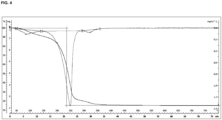
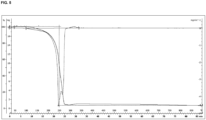
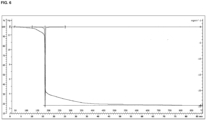
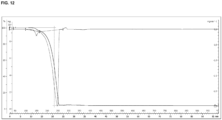
- thermogravimetric analyses of metal complexes (TGA) that were produced according to the embodiments.
- TGA curve shows how the amount of metal complex used decreases with increasing temperature (in % and mg per min and °C).
- the first integral of the curve is also shown in each case.
- the plateaus of the initial amount (100%) and the remaining amount are also shown, each of which is connected by a vertical line at 50% weight loss.
- the tert -butyl azide described here is classified as an explosive substance. However, no accidents during preparation or handling are known. In addition, it is a liquid that can be distilled at 79 °C for purification and has a N 2 elimination temperature of around 550 °C, which is comparatively high for organic azides.
- t BuN 3 (10.17 g, 102.6 mmol, 1.00 eq) was initially charged in 100 mL pentane and cooled to 5 °C.
- a solution of t BuLi in pentane (60 mL, 1.83 m, 110 mmol, 1.07 eq) was added dropwise over one hour.
- the dropping funnel was rinsed twice with 10 mL pentane.
- the reaction mixture was slowly warmed and stirred for 1 h at RT. 180 mL H 2 O were added to the slightly yellow suspension, which decolorized the mixture.
- the aqueous phase was separated and the organic phase was washed once more with 180 mL H 2 O.
- the organic phase was dried over Na 2 SO 4 and filtered, and then all volatile components were removed in a vacuum.
- the crude product was purified by distillation at 60 mbar and 70 °C.
- the yield of the desired product as a colorless, clear liquid was 32% (5.15 g, 32.7 mmol).
- t BuN 3 (1.27 g, 12.8 mmol, 1.00 eq) was initially charged in 10 mL pentane and cooled to 5 °C.
- a solution of t BuLi in hexane (7.4 mL, 1.83 m, 13.7 mmol, 1.07 eq) was slowly added dropwise, whereby a slight yellowing of the reaction mixture was observed.
- the reaction mixture was stirred for 1 h at 5 °C, then slowly warmed to RT and stirred for 1 h.
- the slightly cloudy solution was filtered through a syringe filter and the solvent of the slightly yellow filtrate was removed in the FV.
- the desired product was obtained with a yield of 83% (1.64 g, 10.0 mmol).
- Li(dbt) Based on the analytical tests carried out, no differences could be observed between the two batches of Li(dbt).
- the optimized synthesis of Li(dbt) is a one-step synthesis without by-products. While the neutral ligand was initially used as the starting point, the optimization leads to savings in reagents as well as various work steps, including distillation.
- Li(mbt) (143 mg, 1.18 mmol, 1.00 eq) was initially charged in pentane and cooled to 0 °C.
- F 3 CCOOH (135 mg, 1.18 mmol, 1.00 eq) was slowly added dropwise with stirring, whereby a slight foaming of the reaction solution could be observed.
- the Li(mbt) used dissolved when the reaction mixture was warmed to RT and the slightly cloudy suspension was stirred for 16 h at RT. After the suspension was filtered through a syringe filter and the pentane was removed in the FV, the desired product was obtained in the form of a colorless liquid.
- the crude product was analyzed by thermogravimetric analysis up to 700°C at 10 K/min ( FIG.1 ).
- Thermogravimetric analysis shows a one-step process with a total mass reduction of approximately 91.2%. A weight loss of 3% of the starting substance was observed at 127.2°C.
- the crude product was investigated by thermogravimetric analysis up to 900°C at 10 K/min ( FIG.2 ). Overall, 86.6% of the starting substance was transferred into the gas phase.
- H(dbt) 250 mg, 1.59 mmol, 1.00 eq
- pentane 8 mL pentane
- a toluene solution of InMe 3 (254 mg, 1.59 mmol, 1.00 eq) was added dropwise, whereby a slight evolution of gas was observed.
- the reaction mixture was stirred for 1 h at 0 °C and for 16 h at RT.
- the solvent of the clear solution was removed in the FV, whereby the desired product could be isolated as a colorless liquid.
- the product can be recondensed at 40 °C in a slight vacuum.
- the reaction can also be carried out in an analogous manner in toluene, but this leads to difficulties in isolating the indium complex due to the high volatility of the product.
- the crude product was investigated by thermogravimetric analysis up to 900°C at 10 K/min ( FIG.3 ).
- the analysis shows a one-step process with a total mass reduction of approximately 92.8%.
- a weight loss of 3% of the starting substance was observed at 196.7°C.
- thermogravimetric analysis shows a one-stage process with a total mass reduction of approximately 85%.
- a weight loss of 3% of the starting substance was determined at 85°C.
- Li(dbt) (654 mg, 4.00 mmol, 2.00 eq) was initially charged together with CoCl 2 (260 mg, 2.00 mmol, 1.00 eq) and 15 mL of toluene were added.
- the reaction mixture was heated to 80 °C for 8 h, during which a color change from blue to dark red could be observed.
- the solvent of the cooled reaction mixture was removed in the FV and the desired product was sublimated directly from the residue in the FV at 100 °C.
- [Co(dbt) 2 ] was obtained as a dark red, almost black solid with a yield of 53% (394 mg, 1.06 mmol).
- the TGA curve up to 900°C at 10 K/min ( FIG.6 ) of the cobalt complex shows a one-stage process, with the maximum mass reduction per unit time being observed at a temperature of 189 °C.
- the 3% reduction was determined at a temperature of 147 °C. From a temperature of 184 °C, an exothermic process can be seen, which leads to the maximum mass reduction per unit time and can be assigned to a decomposition process.
- the total mass reduction is 82%, and the residue obtained from this measurement was examined using XRPD. This was identified as elemental cobalt.
- IR: ⁇ / cm -1 2958 (m), 2860 (w), 1601 (w), 1473 (w), 1459 (w), 1384 (w), 1356 (m), 1295 (st), 1243 ( m), 1194 (vst), 1026 (f), 989 (f), 806 (f), 748 (f), 614 (st), 472 (st).
- RPD residue from TGA analysis: 20 ref . [62] (2 ⁇ obs .) for Ca 3 N 2 : 32.779 (32.785), 35.598 (35.545), 36.191 (36.175), 37.279 (37.375), 38.611 (38.455), 44.599 (44.755), 50.979 (50.665), 60.458 (60.415), 66.228 (66.265).
- GaMe 3 (146 mg, 1.27 mmol, 2.00 eq) was initially dissolved in 5 mL n pentane and added to a solution of GaCl 3 (112 mg, 0.64 mmol, 1.00 eq) in 10 mL n pentane at 0 °C.
- the colorless solution was warmed to RT, stirred for 16 h, cooled to 0 °C again and added to a solution of [Li(mbt)] (231 mg, 1.91 mmol, 3.00 eq) in 10 mL n pentane.
- the reaction mixture was warmed to RT and stirred for 16 h.
- the solvent of the suspension was removed in the FV and the desired product was isolated from the residue by condensation in the FV.
- the product was obtained as a colorless liquid with a yield of 57% (233 mg, 1.09 mmol).
- IR: ⁇ / cm -1 2969 (m), 2902 (w), 1524 (w), 1459 (w), 1435 (m), 1361 (vst), 1309 (m), 1271 (w), 1199 ( vst), 1068 (m), 1026 (f), 955 (f), 930 (f), 866 (st), 787 (f), 737 (st), 688 (m), 646 (st), 572 ( vst), 534 (vst), 481 (f), 460 (m), 438 (f).
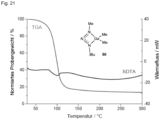
- Fig. 21 shows a graphical representation of the TGA and SDTA measurements.
- GaMe 3 (181 mg, 1.58 mmol, 2.00 eq) was initially charged in 10 mL n pentane and added at 0 °C to a solution of GaCl 3 (139 mg, 0.79 mmol, 1.00 eq) in 10 mL n pentane.
- the reaction mixture was warmed to RT and stirred for 16 h.
- a solution of [Li(dbt)] (387 mg, 2.37 mmol, 3.00 eq) was added dropwise, whereupon the precipitation of a colorless solid was immediately observed.
- the suspension was slowly warmed to RT and stirred for 16 h.
- the solvent was removed under fine vacuum (FV) and the product was condensed from the residue in the FV in the form of a colorless liquid.
- the product was obtained in a yield of 43% (261 mg, 1.02 mmol).
- IR: ⁇ / cm -1 2967 (st), 2870 (w), 1459 (w), 1387 (w), 1361 (m), 1295 (vst), 1217 (vst), 1029 (w), 924 ( w), 767 (m), 699 (m), 630 (m), 583 (st), 545 (st), 484 (m).
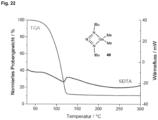
- Fig. 22 shows a graphical representation of the TGA and SDTA measurements.
- IR: ⁇ / cm -1 2968 (m), 2926 (m), 2896 (m), 2802 (w), 1473 (w), 1457 (w), 1415 (w), 1387 (w), 1358 ( m), 1300 (vst), 1263 (vst), 1229 (st), 1199 (st), 1106 (w), 1025 (w), 954 (w), 796 (w), 625 (m), 572 ( w), 524 (vst), 435 (w).
- Fig. 23 shows a graphical representation of the TGA and SDTA measurements.
- IR: ⁇ / cm -1 2972 (m), 2929 (s), 2870 (s), 2812 (s), 2767 (s), 1474 (s), 1387 (s), 1360 (m), 1302 ( vst), 1257 (st), 1201 (vst), 1160 (st), 1069 (s), 1034 (s), 977 (m), 899 (s), 845 (s), 767 (s), 627 ( m), 570 (m), 543 (vst), 438 (s).
- Fig. 24 shows a graphical representation of the TGA and SDTA measurements.
Landscapes
- Chemical & Material Sciences (AREA)
- Organic Chemistry (AREA)
- Engineering & Computer Science (AREA)
- Materials Engineering (AREA)
- General Chemical & Material Sciences (AREA)
- Chemical Kinetics & Catalysis (AREA)
- Mechanical Engineering (AREA)
- Metallurgy (AREA)
- Health & Medical Sciences (AREA)
- Toxicology (AREA)
- Chemical Vapour Deposition (AREA)
- Organic Low-Molecular-Weight Compounds And Preparation Thereof (AREA)
Description
- Die Erfindung betrifft die Verwendung eines Metallkomplexes, der mindestens einen Liganden der Formel R1-N3-R2 aufweist, wobei R1 und R2 Alkylreste mit 1 bis 12 C-Atomen sind, sind, zum Abscheiden des Metalls oder einer Verbindung des Metalls aus der Gasphase. Die Erfindung betrifft außerdem Verfahren zur Abscheidung von Metallen aus den Metallkomplexen.
- Die metallorganische Gasphasenabscheidung, und insbesondere die metallorganische Gasphasenepitaxie sind wichtige Verfahren, um dünne Schichten von Metallen oder Metallverbindungen auf Substraten zu erzeugen. Diese Verfahren werden insbesondere in der Halbleiterindustrie eingesetzt. Dabei werden metallorganische Verbindungen, gegebenenfalls in Verbindung mit weiteren reaktiven Verbindungen, in Prozesskammern eingeführt, wo bei Unterdruck bis Normaldruck eine Reaktion auf der Oberfläche erwärmter Substrate stattfindet, die zur Abscheidung der Schicht führt. Mit solchen Verfahren kann eine Vielzahl von metallhaltigen Schichten, wie Halbleiterkristalle, amorphen Schichten, metallische Verbindungen oder Metallschichten, auf Substraten abgeschieden werden. Für eine Übersicht wird beispielhaft auf das "Handbook of Thin Film Deposition - Processes and Technologies", 2. Auflage 2001, Herausgeber: Krishna Seshan, Kapitel 4, S. 151-203, von J. Zilko verwiesen.
- Für viele Anwendungen, insbesondere in dem Halbleiterbereich, ist es unabdingbar, dass solche metallhaltigen Schichten in hoher Reinheit erzeugt werden. Bereits geringfügige Spuren von Verunreinigungen können den bestimmungsgemäßen Gebrauch beeinträchtigen.
- Zur Erzeugung hochreiner metallhaltiger Schichten sind jedoch nur sehr wenige metallorganische Vorläuferverbindungen geeignet. Dies liegt oft daran, dass eine geeignete metallorganische Vorläuferverbindung bei hoher Temperatur in die Gasphase überführbar sein sollte. Viele metallorganische Verbindungen sind jedoch thermisch instabil. Sie zersetzen sich (zerfallen) bei höheren Temperaturen und können daher nicht durch Erwärmen oder auf andere Weise in die Gasphase überführt werden. Problematisch ist dabei, dass organometallische Verbindungen oft Feststoffe sind, die relativ hohe Verdampfungstemperaturen aufweisen, bei denen bereits Zersetzungsprozesse, unter anderem wegen den reaktiven organischen Liganden, stattfinden.
- Wenn eine metallorganische Verbindung verdampft werden kann, wird üblicherweise die Temperatur in der Gasphase über dem Substrat, also dem Target der Abscheidung, weiter erhöht, bis eine Zersetzung stattfindet. Jedoch sind selbst organometallische Verbindungen, die in die Gasphase überführbar sind, oft nicht zur Abscheidung von Metallen geeignet. Der Grund dafür ist, dass die Abscheidung des Metalls auf der Substratoberfläche derart erfolgen muss, dass keine noch so geringen Verunreinigungen durch Komponenten der Komplexliganden, wie Kohlenstoff, Stickstoff oder Sauerstoff, erfolgt. Auch diese Voraussetzung wird oft nicht erfüllt, weil bei den erforderlichen hohen Zerfallstemperaturen ein Gemisch von hochreaktiven Intermediaten, ionischen Resten und Radikalen entsteht, so dass auf der Substratoberfläche oft unerwünschte Nebenreaktionen stattfinden.
- Zur Abscheidung von metallhaltigen Schichten in der Gasphase werden oft Metallalkylverbindungen als Vorläuferverbindungen eingesetzt. Eine Übersicht über geeignete Verbindungen ist in der oben zitierten Publikation von J. Zilko enthalten. Allerdings weisen die Alkylverbindungen vieler Metalle oft Eigenschaften auf, welche die Eignung für Abscheidungsreaktionen in der Gasphase beeinträchtigen. Dabei ist zum einen nachteilig, dass viele reine Metallalkylverbindungen der Übergangsmetalle instabil sind, zum Zerfall neigen und nicht lagerfähig sind. Zum anderen neigen sie dazu, dass anionischer Kohlenstoff, der am Übergangsmetall gebunden ist, in unerwünschter Weise mit in die Schicht eingebaut wird. Sie weisen oft auch relativ hohe Verdampfungstemperaturen auf, was für Anwendungen bei der Gasphasenabscheidung nachteilig ist.
- Es besteht daher ein kontinuierlicher Bedarf nach verbesserten Verfahren und Materialien zur Abscheidung von Metallen und metallhaltiger Schichten durch metallorganische Gasphasenabscheidung.
- Im Stand der Technik sind metallorganische Komplexe bekannt, die N-Aryl- und N,N'-Diaryl-Triazenidoliganden aufweisen. Allerdings wird im Stand der Technik nicht offenbart, solche Komplexe zur Abscheidung von Metallen aus der Gasphase zu nutzen. Dies ist nicht überraschend, weil solche Metallkomplexe mit diesen Liganden nicht eine ausreichende Flüchtigkeit und Zersetzbarkeit besitzen, die für die Verwendung bei der Abscheidung von Metallen aus der Gasphase zwingend erforderlich ist. Daher würden bei solchen Reaktionen nichtflüchtige Kohlenstoff-Verunreinigungen erhalten.
- Metallorganische Komplexe mit Triazenidoliganden, die mit aromatischen Resten substituiert sind, werden in einer Vielzahl von Publikationen beschrieben. Allerdings betreffen nahezu alle diese Publikationen lediglich die Synthese und Struktur solcher Komplexe, während praktische Anwendungen der Verbindungen nur in Ausnahmefällen beschrieben werden.
- Dabei sind Methoden bekannt, um verschieden substituierte Vorläuferverbindungen für Triazenid-Anionen bereitzustellen. Im Jahr 1981 beschrieben Brand und Roberts die elektronische Konfiguration von 1,3-Dialkyltriazenyl-Radikalen und erwähnten in einer Fußnote, dass sich Di-tert-Butyltriazen ausgehend von tert-Butylazid und tert-Butyllithium darstellen lässt. Weder experimentelle noch spektroskopische Daten wurden veröffentlicht.[1] Ethyl- und methyl-substituierte Triazene wurden zudem 1983 von Smith und Michejda beschrieben, wobei die Synthesen entweder mit Methyllithium oder dem Grignard-Reagenz Ethylmagnesiumbromid durchgeführt wurden.[2] Darüber hinaus wurden Synthesen unterschiedlicher Alkyl- und Aryl-substituierten Triazene und Untersuchungen zu tautomeren Gleichgewichten in verschiedenen Veröffentlichungen diskutiert.[3,4]
- Erdalkali- und Alkalimetall-Verbindungen der Triazene sind ausschließlich von Aryl-substituierten Systemen bekannt. Bei kristallographisch charakterisierten Verbindungen handelt es sich in allen Publikationen um solvatisierte Verbindungen bzw. Verbindungen, in welchen das entsprechende Metall mithilfe von TMEDA oder [15]-Krone-5 stabilisiert wird.[6-10]
- Triazenido-Verbindungen mit Elementen der dritten Hauptgruppe sind seit mehreren Jahrzenten literaturbekannt.
- Das
US-Patent 3,386,985 beschreibt verschiedene metallorganische Verbindungen mit, die verschiedene Triazenidoliganden, unter anderem 1,3-Dimethyltriazen, aufweisen. Es wird vorgeschlagen, die Verbindungen als Kettentransfer-Reagentien oder Inhibitoren in Polymerisationsverfahren einzusetzen. Verfahren zur Abscheidung von Metallen werden nicht beschrieben. - Brinckman et al.[11] beschreiben metallorganische Komplexe mit 1,3-Dimethyltriazenid als Liganden, wobei die Ergebnisse weitgehend mit den in
US3,386,985 enthaltenen übereinstimmen. Zu praktischen Verwendungen der Komplexe werden keine Ausführungen gemacht. Die Ausbeuten bei den Herstellungsverfahren liegen bei maximal 76% und sind daher noch verbesserungsbedürftig. - Des Weiteren wurden in der Literatur verschiedene Komplexe, sowohl homoleptische, als auch heteroleptische, mit einem bzw. zwei Aryl-Triazenido-Liganden beschrieben.[12-16]
- Im Bereich der Übergangsmetalle ist eine Vielzahl an Triazenido-Verbindungen mit aromatisch substituierten Liganden bekannt, wobei als Zentralatom frühe Übergangsmetalle wie Titan und Zirkonium als auch späte Übergangsmetalle wie Silber und Kupfer untersucht wurden.[6,17-23] Sowohl homoleptische als auch heteroleptische, molekulare oder kationische Cobalt-Komplexe mit aromatisch substituierten Triazenido-Liganden wurden in Zusammenhang mit ESR-Messungen beschrieben. Ebenso wurde von Ruthenium-Verbindungen, in Zusammenhang mit theoretischen Berechnungen, berichtet.[24-30]
- Soussi et al.[5] beschreiben die Herstellung metallorganischer Eisenkomplexe, die als Liganden Alkyltriazenide, sowie zur Stabilisierung TMEDA-Liganden (Tetramethylethylendiamin) aufweisen. Die Herstellung der Komplexe erfolgt in einem relativ aufwändigen Verfahren ausgehend von Fe[N(SiMe3)2]2 über die Route des Ligandenaustausches. Die Metallkomplexe werden zur Herstellung von intermetallischen Nanopartikeln verwendet. Das Verdampfungs- und Zersetzungsverhalten der Eisenkomplexe bei Erhöhung der Temperatur wird durch thermogravimetrische Analyse untersucht. Dabei wurde gefunden, dass die vier Metallkomplexe eine geringe thermische Stabilität aufweisen, so dass die Komplexe nicht verdampft werden können. Bei Erhöhung der Temperatur auf mehr als 200°C verbleiben feste Rückstände, die etwa 20 bis 40 Gew.% der Einwaage ausmachen. Zudem zeigt die Gewichtskurve bei Erhöhung der Temperatur auf bis zu 200°C einen unregelmäßigen Verlauf, was typisch für chemische Zerfallsreaktionen ist. Daher sind die Metallkomplexe nicht als Vorläuferverbindungen zur Herstellung von metallhaltigen Beschichtungen aus der Gasphase geeignet.
- Oussama M. EI-Kadri et al., DALTON TRANSACTIONS, Nr 16, 2006-01-01, S. 1943-1953 zeigt einen Wolfram komplex mit einem Liganden der Formel R1-N3-R2 wobei R1 und R2 Phenylreste sind und der Wolframkomplex zum Abscheiden des Metalls oder einer Verbindung des Metalls aus der Gasphase nicht ausreichend verdampfbar ist.
- Dirk Pfeiffer et al., J. of Organomet. Chem., vol. 588, no. 2, 1999-10-01, pp. 167-175 zeigt Lanthanidkomplexe mit einem Liganden der Formel R1-N3-R2 wobei R1 und R2 Phenylreste sind.
- E. G. Rukhadze et al., Zhurnal Obshchei Khimii, vol. 39, no. 2, 1969-01-01, pp. 303-306 zeigt Komplexe von Silber und Quecksilber mit einem Liganden der Formel R1-N3-R2 wobei R1 ein tert.-Butylrest und R2 ein Phenylrest ist.
- Verschiedene Seltenerdmetall-Komplexe sind zwar literaturbekannt, jedoch lediglich mit sterisch sehr anspruchsvollen Aryl-Triazenido-Liganden.[31-33]
- Es besteht im Stand der Technik ein kontinuierlicher Bedarf nach Verfahren und Verbindungen, die zur Abscheidung von Metallen und metallhaltigen Schichten in der Gasphase verwendbar sind, welche die oben beschriebenen Nachteile überwinden.
- Der Erfindung liegt die Aufgabe zugrunde, Verfahren und Verbindungen bereitzustellen, welche die oben beschriebenen Nachteile überwinden. Der Erfindung liegt insbesondere die Aufgabe zugrunde, neue und verbesserte Verbindungen bereitzustellen, um Metalle und metallhaltige Schichten aus der Gasphase abzuscheiden.
- Die Verbindungen sollen eine relativ hohe Stabilität aufweisen. Dabei sollen die Verbindungen einen hohen Dampfdruck und gleichzeitig einen niedrigen Zersetzungspunkt aufweisen. Dabei soll es möglich sein, die Verbindungen in die Gasphase zu überführen, ohne dass eine wesentliche Zersetzung stattfindet. Nach Überführung in die Gasphase, also bei Temperaturen oberhalb der Sublimationstemperatur oder Verdampfungstemperatur, sollen sich die Verbindungen zersetzen. Bevorzugt soll die Zersetzung dabei bei einer Temperatur erfolgen, die nur wenig oberhalb der Sublimationstemperatur oder Verdampfungstemperatur liegt.
- Die Verbindungen sollen allgemein bei Temperaturen, bei denen Abscheidungsverfahren aus der Gasphase üblicherweise durchgeführt werden, und dabei insbesondere von 100°C bis 300°C, eine hohe Stabilität und Volatilität aufweisen. Insbesondere sollen die Verbindungen sublimierbar sein.
- Der Erfindung liegt insbesondere die Aufgabe zugrunde, Verbindungen bereitzustellen, die bei Temperaturen bis zu 100°C stabil in die Gasphase überführt werden können, und die bei höheren Temperaturen, beispielsweise im Bereich von 100°C bis 400°C, zerfallen.
- Die Verbindungen sollen es ermöglichen, verschiedene Metalle und metallhaltige Verbindungen aus der Gasphase abzuscheiden. Die Beschichtungen sollen hochrein sein. Insbesondere soll bei üblichen Abscheidungsverfahren kein unerwünschter Einbau von Kohlenstoff, Sauerstoff oder Stickstoff in die Beschichtungen stattfinden.
- Der Erfindung liegt außerdem die Aufgabe zugrunde, möglichst einfache und effiziente Verfahren zur Herstellung solcher Verbindungen bereitzustellen. Die eingesetzten Reagenzien sollen möglichst leicht zugänglich und sicher handhabbar sein. Die Verfahren sollen mit hohen Ausbeuten durchführbar sein. Die Verfahren sollen in möglichst wenig Stufen zu den gewünschten Produkten führen und sollen unter möglichst sanften Reaktionsbedingungen durchführbar sein. Es sollen auch Verbindungen bereitgestellt werden, aus denen sich die flüchtigen Vorläuferverbindungen auf möglichst einfache Weise herstellen lassen.
- Überraschenderweise wird die der Erfindung zugrunde liegende Aufgabe gelöst durch die Verwendungen und Verfahren gemäß den Patentansprüchen.
- Gegenstand der Erfindung ist die Verwendung eines Metallkomplexes der Formel (2):
M[(L1)aXd] (2)
wobei - L1 die Formel R1-N3-R2 aufweist, wobei R1 und R2 Alkylreste mit 1 bis 12 C-Atomen sind,
- X ausgewählt ist aus H, Halogen, CO und Alkyl mit 1 bis 6 C-Atomen,
- a = 2 oder 3 ist,
- d = 0 oder 1 ist, und
- Dabei wird aus der Gasphase eine feste Schicht auf einem Substrat abgeschieden, die aus dem Metall besteht oder dieses enthält. Der Metallkomplex wird dabei als metallorganische Vorläuferverbindung (Precursor) eingesetzt. Das Metall aus dem Metallkomplex wird in elementarer Form oder gezielt in Form einer Verbindung des Metalls abgeschieden. So kann beispielsweise Stickstoff aus dem Liganden oder aus einem geeigneten Reaktionspartner in eine Schicht eingebaut werden, so dass ein Nitrid des abgeschiedenen Metalls entsteht. Bevorzugt wird der Metallkomplex dabei zunächst in die Gasphase überführt, oder es werden zumindest flüchtige Zwischenprodukte in die Gasphase überführt, die das Metall enthalten. In der Gasphase wird die Temperatur bei reduziertem Druck üblicherweise weiter erhöht, so dass eine (weitere) Zersetzung des Metallkomplexes stattfindet. Der Zerfall kann auch auf andere Weise angeregt oder unterstützt werden, beispielsweise durch Strahlung. Die entscheidende Zersetzung des Metallkomplexes sollte erst nach der Überführung in die Gasphase stattfinden. Auf diese Weise wird gewährleistet, dass der Metallkomplex möglichst quantitativ in der Gasphase vorliegt und zur Abscheidung des Metalls oder einer Verbindung des Metalls genutzt werden kann. Außerdem kann regelmäßig die Zahl der unerwünschten Nebenreaktionen verringert werden, wenn ein kontrollierter Zerfall erst in der Gasphase erfolgt.
- In einer bevorzugten Ausführungsform weist der Metallkomplex mindestens einen Liganden L der Formel R1-N3-R2 und mindestens einen weiteren Liganden X auf. Der weitere Ligand X ist bevorzugt ausgewählt aus Halogen, H, CO und Alkyl mit 1 bis 6 C-Atomen. Das Halogen kann F, Cl, Br oder I sein, besonders bevorzugt ist Cl. Wenn X = H ist, liegt eine Hydridokomplex vor. Dieser Komplex kann einen Liganden X aufweisen.
- Der Metallkomplex weist die Formel (2) auf:
M[(L1)aXd] (2)
wobei - L1 die Formel R1-N3-R2 aufweist, wobei R1 und R2 Alkylreste mit 1 bis 12 C-Atomen sind,
- X ausgewählt ist aus H, Halogen, CO und Alkyl mit 1 bis 6 C-Atomen,
- a = 2 oder 3 ist,
- d = 0 oder 1 ist, und
- M ausgewählt ist aus In, Co, Cu, Al, Ga, TI und La.
- Die Alkylreste R1 und R2 können insbesondere 1 bis 6 C-Atome oder 1 bis 4 C-Atome aufweisen und können verzweigte Alkylreste sein.
- Insbesondere können R1 und R2 ausgewählt sein ausgewählt aus Methyl, Ethyl, Propyl, Isopropyl, tert-Butyl und n-Propyl.
- Insbesondere können alle oder ein Teil der Reste R1 und R2 tert-Butyl sein.
- Die Metallkomplexe können homoleptisch sein und ausschließlich Liganden L1 der Formel R1-N3-R2 aufweisen oder heteroleptisch sein.
- R1 und R2 können auch gleich sein.
- In einer Ausführungsform kann der Metallkomplex mindestens einen Liganden L1 enthalten, der tert-Butyl-N3-tert-Butyl oder tert-Butyl-N3-Methyl ist.
- In einer weiteren Ausführungsform können in dem Metallkomplex alle Liganden L1 der tert-Butyl-N3-tert-Butyl oder tert-Butyl-N3-Methyl sein.
- In der erfindungsgemäßen Verwendung kann der Metallkomplex sublimierbar oder verdampfbar sein, ohne dass eine Zersetzung erfolgt.
- Vorteilhaft ist das Molekulargewicht des Metallkomplexes kleiner kleiner als 600 g/Mol.
- In der Verwendung gemäß der Erfindung ist der Metallkomplex vorteilhaft bei 100°C thermisch stabil und/oder zerfällt in einem Temperaturbereich von 100°C bis 400°C, wobei die Temperatur bei Normaldruck oder bei reduziertem Druck im Bereich von 10-3 bis 900 mbar ermittelt wird.
- In der Verwendung gemäß der Erfindung erfolgt vorteilhaft das Abscheiden des Metalls oder der Verbindung des Metalls aus der Gasphase bei reduziertem Druck im Bereich von 10-3 bis 900 mbar, bevorzugt im Bereich von 10-2 bis 1 mbar, und insbesondere 10-2 mbar.
- In einer bevorzugten Ausführungsform weist der Metallkomplex eine der Formeln (3) bis (5) auf:
M[(L1)2X] (3)
wobei - L1 die Formel R1-N3-R2 aufweist, wobei R1 und R2 Alkylreste mit 1 bis 12 C-Atomen sind,
- X ausgewählt ist aus H und Alkyl mit 1 bis 6 C-Atomen, und
- M = AI oder Ga ist;
- L1 die Formel R1-N3-R2 aufweist, wobei R1 und R2 Alkylreste mit 1 bis 12 C-Atomen sind, und
- M = In, TI oder La ist;
- L1 die Formel R1-N3-R2 aufweist, wobei R1 und R2 Alkylreste mit 1 bis 12 C-Atomen sind,
- x eine ganze Zahl zwischen 1 und 4 ist, und
- a eine ganze Zahl zwischen 2 und 8 ist, mit der Maßgabe, dass a/x = 1 oder 2 ist, und
- M = Co oder Cu ist.
- Dabei ist insbesondere das Metall Co, wenn a/x = 2 ist, und das Metall Cu, wenn a/x = 1 ist.
- In einer bevorzugten Ausführungsform ist der Metallkomplex bei 25°C und Normaldruck (1013 mbar) flüssig. Flüssigkeiten sind besonders gut für solche Verfahren geeignet, weil der Übergang in die Gasphase bereits bei niedriger Temperatur erfolgt, und weil Flüssigkeiten besonders gut handhabbar sind. In einer bevorzugten Ausführungsform ist der Metallkomplex bei 25°C und Normaldruck fest und weist eine relativ niedrige Verdampfungstemperatur auf.
- Bevorzugt weist der Metallkomplex eine Sublimations- oder Verdampfungstemperatur bei Normaldruck auf, die kleiner als 120°C ist, insbesondere kleiner als 100°C.
- Bevorzugt erfolgt der Übergang in die Gasphase durch Verdampfung oder Sublimation bei einer Temperatur, die kleiner als 120°C ist, insbesondere kleiner als 100°C. Die Verdampfung oder Sublimation erfolgt dabei bevorzugt bei reduziertem Druck im Bereich von 10-3 bis 900 mbar, bevorzugt im Bereich von 10-2 bis 1 mbar, und insbesondere bei 10-2 mbar.
- Allgemein wird der Druck bei dem erfindungsgemäßen Verfahren bevorzugt in Bereichen eingestellt, die für solche Verfahren üblich sind. Somit werden das Verfahren und die Verwendung bevorzugt bei einem Druck im Bereich von 10-3 bis 900 mbar, und besonders bevorzugt im Bereich von 10-2 bis 1 mbar durchgeführt, und insbesondere bei 10-2 mbar. Im Rahmen dieser Anmeldung werden Parameter bei der Reaktion in der Gasphase, wie die Verdampfungs-, Sublimations- oder Zersetzungstemperaturen, oder Temperaturen, bei denen Verbindungen stabil sind, bevorzugt bei den reduzierten Drücken gemessen, die bei solchen Reaktionen eingestellt werden, und dabei insbesondere bei einem Druck von 10-2 mbar.
- In einer bevorzugten Ausführungsform ist der Metallkomplex bei Normaldruck und/oder bei reduziertem Druck in der Gasphase sublimierbar oder verdampfbar, ohne dass eine Zersetzung (ein Zerfall) erfolgt. Die bedeutet beispielsweise, dass bis zu 90% Gew.%, bis zu 95% Gew.% oder bis zu 98% Gew.% in die Gasphase überführt werden können, ohne dass eine Zersetzung erfolgt. Der Zerfall lässt sich nach üblichen Methoden verfolgen, insbesondere SDTA (Simultaneous differential thermal analysis).
- Bevorzugt ist der Metallkomplex bei Normaldruck, aber insbesondere bei reduziertem Druck in der Gasphase bei 100°C, besonders bevorzugt bei 120°C oder 150°C, thermisch stabil. Dies bedeutet, dass bei einer solchen Temperatur noch keine wesentliche Zersetzung einsetzt, oder dass zumindest nicht mehr als 5 Gew.%, insbesondere nicht mehr als 2 Gew.% oder nicht mehr als 1 Gew.% zersetzt werden. Bevorzugt geht der Metallkomplex unterhalb dieser Temperatur in die Gasphase über. Dabei liegt der reduzierte Druck im Bereich von 10-3 bis 900 mbar, bevorzugt im Bereich von 10-2 bis 1 mbar, und insbesondere bei 10-2 mbar.
- In einer bevorzugten Ausführungsform weist der Metallkomplex ein relativ niedriges Molekulargewicht auf. Relativ leichte Komplexe können oft besser in die Gasphase überführt werden. Die im Rahmen dieser Anmeldung beschriebenen Metallkomplexe können in vorteilhafter Weise mit Liganden hergestellt werden, die ein relativ geringes Molekulargewicht aufweisen. Das Molekulargewicht des Metallkomplexes ist bevorzugt kleiner als 600 g/Mol, besonders bevorzugt kleiner als 450 g/Mol, und ganz besonders bevorzugt kleiner als 350 g/Mol.
- Gegenstand der Erfindung ist auch ein Verfahren zur Herstellung von beschichteten Substraten, umfassend die Schritte:
- (a) Bereitstellen eines wie oben beschriebenen Metallkomplexes, und
- (b) Abscheiden des Metalls oder einer Verbindung des Metalls auf der Oberfläche des Substrats durch metallorganische Gasphasenabscheidung.
- In einer bevorzugten Ausführungsform ist das Verfahren eine metallorganische chemische Gasphasenabscheidung (MOCVD). Die metallorganische Gasphasenabscheidung (MOCVD, "Metallo-Organic Chemical Vapor Deposition") ist ein Beschichtungsverfahren aus der Gruppe der chemischen Gasphasenabscheidung (CVD), bei dem die Abscheidung einer festen Schicht auf ein Substrat aus der chemischen Dampfphase unter Einsatz einer metallorganischen Vorläuferverbindung (Precursor) erfolgt.
- In einer bevorzugten Ausführungsform ist das Verfahren eine metallorganische chemische Gasphasenepitaxie (MOVPE; für "Metal Organic Vapor Phase Epitaxy", auch "Organometallic Vapor Phase Epitaxy", OMVPE). Während durch MOCVD jede Abscheidung auf einem Substrat möglich ist, ist MOVPE ein Epitaxie-Verfahren und betrifft somit das kristalline Wachstum auf einem kristallinen Substrat. Die Verfahren, insbesondere MOVPE, werden insbesondere zur Abscheidung von halbleitenden Materialien verwendet.
- Mit den erfindungsgemäßen Verwendungen und Verfahren wird das Metall oder eine Verbindung des Metalls aus der Gasphase abgeschieden. Dabei erfolgt die Abscheidung auf einem Substrat. Die metallhaltige Abscheidung wird dabei im Allgemeinen als Schicht oder Beschichtung bezeichnet. Die Verbindung des Metalls ist bevorzugt ausgewählt aus Halbleiterverbindungen, Legierungen, Nitriden, Phosphiden, Arseniden und Siliziden. Solche Verbindungen werden nach bekannten Verfahren durch Zusatz von weiteren Verbindungen in der Gasphase erhalten, die mit dem Metall unter den Bedingungen in der Vorrichtung reagieren können. Für eine Übersicht wird ebenfalls auf die oben zitierte Publikation von J. Zilko verwiesen.
- Verfahren der metallorganischen Gasphasenabscheidung und der metallorganischen Gasphasenepitaxie werden bevorzugt wie nachfolgend beschrieben durchgeführt. Die Herstellung der metallhaltigen Schichten erfolgt in einer Reaktionskammer. In dieser liegt ein zu beschichtendes Substrat vor, das auf eine erhöhte Temperatur geheizt wird. Ein Gasstrom mit dem Metallkomplex als Vorläuferverbindung und üblicherweise einem Trägergas wird in die Reaktionskammer eingeführt, wo die Vorläuferverbindung in der Gasphase vorzerlegt und radikalische Gruppen sich auf dem Substrat anlagern. Thermisch aktiviert haben radikalische Gruppen eine gewisse Bewegungsfreiheit auf dem Substrat, bis sich das Metallatom an geeigneter Stelle in die Schicht einbaut. Der organische Rest wird mit elementarem Wasserstoff gesättigt, so dass eine volatile organische Verbindung entsteht. Das Restgas wird aus der Reaktionskammer abgeführt. Es ist bevorzugt, dass der Metallkomplex vor Einführung in die Reaktionskammer in die Gasphase überführt wird. In einer weiteren Ausführungsform ist es auch denkbar, eine Flüssigkeit, die den Metallkomplex enthält, erst bei Einführung in die Reaktionskammer zu verdampfen.
- Überraschenderweise wurde gefunden, dass die im Rahmen dieser Anmeldung beschriebenen Metallkomplexe in hohem Maße als Vorläuferverbindungen zur Abscheidung von Metallen aus der Gasphase geeignet sind. Sie vereinen dabei überraschenderweise mehrere vorteilhafte Eigenschaften, die für solche Verfahren erforderlich sind. Sie sind in hohem Maße stabil, volatil und können so eingesetzt werden, dass bei der Abscheidung des Metalls oder einer Verbindung des Metalls auf einem Substrat nahezu keine Verunreinigungen entstehen.
- Bevorzugt wird der Metallkomplex bei dem Verfahren sublimiert oder verdampft, ohne dass eine Zersetzung erfolgt. Während bei der Sublimation ein Feststoff vorgelegt wird, wird bei der Verdampfung eine Flüssigkeit oder eine Lösung vorgelegt. Bevorzugt erfolgt also während der Überführung des Metallkomplexes in die Gasphase kein Zerfall oder kein wesentlicher Zerfall. Der Zerfallsprozess lässt sich nach üblichen Methoden verfolgen, insbesondere SDTA (Simultaneous differential thermal analysis). Die relevanten Eigenschaften eines Metallkomplexes bei Erhöhung der Temperatur lassen sich durch Thermogravimetrische Analyse (TGA) bestimmen, die bei normalem Druck (1013 mbar) oder auch bei reduziertem Druck durchführbar ist. Dabei ist es bevorzugt, dass die Kurve Menge/Temperatur (bei gleichmäßiger T-Erhöhung, z. B. 5 oder 10 K/min) einen gleichmäßigen Verlauf zeigt. Eine Sublimation liegt dabei im Allgemeinen vor, wenn bei oder ab einer Sublimationstemperatur eine schnelle Gewichtsabnahme erfolgt, und dabei kein oder nur wenig Rückstand verbleibt. Bevorzugt zeigt die TGA-Kurve keine wesentlichen Unregelmäßigkeiten, wie Höcker oder Dellen.
- Bevorzugt erfolgt die Überführung des Metallkomplexes in die Gasphase möglichst vollständig. Dabei ist es bevorzugt, dass bei der TGA bei Normaldruck und/oder reduziertem Druck ein möglichst geringer Rückstand verbleibt, beispielsweise weniger als 20 Gew.-%, weniger als 10 Gew.%, weniger als 5 Gew.-%, oder insbesondere weniger als 3 Gew.%, bezogen auf die eingesetzte Menge des Metallkomplexes. Der Rückstand entspricht dem Plateauwert, an dass sich das das Gewicht des Rückstandes bei weiterer T-Erhöhung auf beispielsweise bis zu 500°C, 600°C oder 700°C annähert. Wenn das Gewicht des Rückstandes (deutlich) unterhalb dem Gewicht des Metalls in der vorgelegten Verbindung liegt, deutet dies auf eine Sublimation oder Verdampfung der Verbindung hin. Bevorzugt wird bei der TGA mindestens 50 Gew.%, insbesondere mindestens 80 Gew.% oder mindestens 90 Gew.% des Metalls in die Gasphase überführt. Allgemein ist es aus Effizienzgründen vorteilhaft, wenn das Metall quantitativ verdampft wird.
- Es wurde gefunden, dass die erfindungsgemäßen Metallkomplexe relativ stabil sind. Sie sind bevorzugt bei Raumtemperatur stabil und dadurch beliebig lange haltbar. In einer bevorzugten Ausführungsform ist der Metallkomplex bei Temperaturen bis zu 100°C thermisch stabil.
- Bevorzugt erfolgt bei der TGA bei Normaldruck ein Massenverlust von 3% erst bei einer Temperatur oberhalb 80°C, bevorzugt oberhalb 100°C, und besonders bevorzugt oberhalb 120°C. Bevorzugt erfolgt der Massenverlust von 3% bei einer Temperatur zwischen 80°C und 220°C, insbesondere zwischen 80°C und 160°C.
- Bevorzugt zerfällt der Metallkomplex unter Bedingungen der Gasphasenabscheidung, die üblicherweise bei reduziertem Druck durchgeführt wird, bei Temperaturen zwischen 100°C und 400°C, insbesondere zwischen 120°C und 300°C, oder zwischen 150°C und 250°C. Bevorzugt liegt der Komplex bei diesen Temperaturen in der Gasphase vor. Dabei liegt der reduzierte Druck im Bereich von 10-3 bis 900 mbar, bevorzugt im Bereich von 10-2 bis 1 mbar, und insbesondere bei 10-2 mbar. Der Zerfall erfolgt oft in einer exothermen Reaktion. Der Zerfall in diesem Bereich ist bevorzugt vollständig.
- Bevorzugt wird der Metallkomplex erst nach Überführung in die Gasphase zersetzt. Bevorzugt erfolgt somit die Zersetzung bei einer Temperatur, die oberhalb der Sublimationstemperatur oder Verdampfungstemperatur liegt. Bevorzugt liegt die Zersetzungstemperatur bei nicht mehr als 200°C, nicht mehr als 100°C, oder bevorzugt nicht mehr als 50°C oberhalb der Sublimationstemperatur oder Verdampfungstemperatur, insbesondere bei reduziertem Druck wie oben angegeben. Bevorzugt ist der Metallkomplex bei dieser Zersetzungstemperatur vollständig, oder zu 50%, zersetzt. Wenn die Zersetzung bei einer Temperatur erfolgt, die nicht allzu weit oberhalb der Sublimation- oder Verdampfungstemperatur liegt, kann die Abscheidung in der Gasphase oft besonders effizient durchführbar sein.
- Bevorzugt wird bei der Abscheidung aus der Gasphase das elementare Metall oder die gewünschte Verbindung des Metalls in Reinform erhalten. Dies bedeutet, dass keine oder vernachlässigbare Verunreinigungen bestimmt werden können, beispielsweise von weniger als 500 ppb, weniger als 100 ppb oder weniger als 10 ppb. Die Reinheit des abgeschiedenen Metalls oder der metallhaltigen Verbindung kann mittels üblicher Methoden bestimmt werden, beispielsweise durch Sekundärionenmassenspektrometrie.
- In einer weiteren bevorzugten Ausführungsform enthält die Beschichtung mindestens eine weitere atomare Komponente, insbesondere mindestens ein weiteres Metall, oder ein Element, ausgewählt aus Si, N, P oder As. So ist es nach bekannten Methoden möglich, weitere Metalle oder Elemente in die Beschichtung einzuarbeiten, um entsprechende Legierungen oder Verbindungen zu erhalten.
- Formel (2) eingesetzt wird ein Verfahren zur Herstellung des erfindungsgemäß verwendbaren Metallkomplexes, umfassend die Schritte
- (A) Bereitstellen einer Verbindung der Formel R1-(N3)A-R2, wobei A ausgewählt ist aus H oder einem Alkalimetall, insbesondere Li, Na oder K, besonders bevorzugt Li, und
- (B) in Kontakt bringen mit einer Verbindung des Metalls.
- Dieses Verfahren ist nicht Bestandteil der Erfindung.
- Die Verbindung der Formel R1-(N3)A-R2 reagiert dann mit der Verbindung des Metalls zu dem Metallkomplex. Bevorzugt erfolgt diese Reaktion in einem einzigen Schritt. Dabei ist A bevorzugt Alkali, insbesondere Li. Die Metallkomplexe und insbesondere die Reste R1, R2 und A sind dabei ausgewählt wie oben beschrieben.
- Bevorzugt ist dabei die in Schritt (B) eingesetzte Verbindung des Metalls ein Metallsalz, eine metallorganische Verbindung oder ein anderer Metallkomplex des Metalls. Dabei weist der andere Metallkomplex bevorzugt keinen Triazenidoliganden auf, insbesondere keinen Liganden L der Formel R1-N3-R2, bei dem R1 und R2 Kohlenwasserstoffreste sind.
- In einer bevorzugten Ausführungsform umfasst das Verfahren zur Herstellung der Metallkomplexe vor Schritt (A) den Schritt des Herstellens der Verbindung der Formel R1-(N3)A-R2 aus den Verbindungen R1-N3 und AR2, wobei A ein Alkalimetall ist. Dabei wird das gesamte Verfahren bevorzugt in einem einzigen Reaktionsgemisch durchgeführt (als "Eintopfreaktion").
- Ein Verfahren zur Herstellung einer Verbindung der Formel R1-(N3)A-R2 ist, in einem Reaktionsgemisch, das die Verbindungen R1-N3 und AR2 enthält, wobei A ein Alkalimetall ist, bevorzugt Li. Die Reste R1, R2 und A sind dabei ausgewählt wie oben beschrieben.
- Die Herstellung einer Verbindung der Formel R1-(N3)A-R2 erfolgt bevorzugt in einem inerten Lösungsmittel, insbesondere einem Kohlenwasserstoff, wie Pentan oder Hexan.
- In einer Variante wird die Verbindung der Formel R1-(N3)A-R2 nach der Reaktion aufgereinigt, indem die weiteren Komponenten aus dem Reaktionsgemisch verdampft werden (Methode A). Wenn A ein Alkalimetall ist und sich in Diethylether befindet, fällt das Produkt als festes und reines Diethyletheraddukt (Alkalisalz) aus und kann durch Filtration abgetrennt werden (Methode B). Das Diethyletheraddukt kann im Vakuum komplett von Ether befreit werden oder es kann, falls gewünscht, durch Hydrolyse mit Wasser in die korrespondierende Neutralverbindung (mit A = H) überführt werden.
- Es wurde gefunden, dass mit dem Verfahren Metallkomplexe, sowie die Verbindungen der Formel R1-(N3)A-R2, die wesentliche Zwischenprodukte für die Komplexsynthese sind, auf relativ einfache Weise, effizient und in hoher Ausbeute herstellbar sind. Bei der Herstellung des Metallkomplexes wird dabei von einer Verbindung der Formel R1-(N3)A-R2 ausgegangen. Dabei kann A ein Wasserstoffrest H sein. Die Verbindung ist dann insgesamt neutral. Es wurde gefunden, dass mit verschiedenen Metallsalzen eine effiziente Metallkomplexbildung unter relativ einfachen Bedingungen stattfindet. So sind beispielsweise Metallkomplexe von Al, Ga und In ausgehend von diesen Verbindungen erhältlich.
- Auch wurde gefunden, dass viele Metallkomplexe zugänglich sind, wenn die Verbindung der Formel R1-(N3)A-R2 ein Alkalimetallsalz ist. Dabei ist A insbesondere Li, Na oder K, und besonders bevorzugt Li. Solche Verbindungen wurden beispielsweise eingesetzt, um auf einfache Weise und mit hoher Ausbeute Salze von Co, Cu oder Ru herzustellen, was nicht Bestandteil der Erfindung ist.
- Die Verbindungen der Formel R1-(N3)A-R2, wobei A = H oder ein Alkalimetall ist, sind auf einfache Weise durch Reaktion der Vorläuferverbindungen R1-N3 und A-R2 erhältlich, wobei A bevorzugt ein Alkalimetall ist. Die Reaktion findet bevorzugt in einem organischen aprotischen Lösungsmittel statt, insbesondere in Kohlenwasserstoffen, besonders bevorzugt in Pentan oder Hexan. Dabei wird eine Alkalialkylverbindung, insbesondere eine Organo-Lithiumverbindung, bevorzugt langsam zugetropft. Bevorzugt wird das Reaktionsgemisch zunächst bei niedriger Temperatur, beispielsweise <15°C, belassen und anschließend auf Raumtemperatur erwärmt.
- Bei der Reaktion zu dem Metallkomplex wird die so erhaltene Verbindung der Formel R1-(N3)A-R2, oder die gleiche Verbindung aus anderer Herkunft, in Kontakt mit einer Verbindung des Metalls mit ausreichender Reaktivität gebracht, wie einem Metallsalz oder einer organometallischen Verbindung des Metalls, insbesondere mit einem Metallhalogenid, wie CoCl2 oder CuCI, oder einer organometallischen Verbindung, wie AIMe3 oder InMe3, oder einem Metallhydrid, wie GaH3 (OEt2), oder einem Vorläufermetallkomplex, wie La(HMDS)3 (HMDS = Hexamethyldisilazan) oder [RuCl2(p-Cymen)]2. Dabei wurde gefunden, dass beispielsweise im Falle von Kobalt bereits eine Reaktion mit einem einfachen Salz ausreicht, während bei Elementen der dritten Hauptgruppe metallorganische Vorläuferverbindungen bevorzugt sind. Um Lanthan in Metallkomplexe zu überführen, wird bevorzugt von anderen Metallkomplexen ausgegangen. In allen Fällen wurde gefunden, dass ausgehend von Verbindungen der Formel R1-(N3)A-R2 stabile Komplexe mit den entsprechenden Liganden in hohen Ausbeuten erhalten werden können.
- Ohne an eine Theorie gebunden zu sein, wird vermutet, dass die relativ schwache N-N-Einfachbindung in den Metallkomplexen zu einer relativ leichten thermischen Zersetzbarkeit bei relativ niedrigen Temperaturen führt. Dabei wird angenommen, dass N2 als stabiles Zersetzungsprodukt entsteht, während weitere stickstoffhaltige Alkylreste als molekulare flüchtige Verbindungen gebildet werden. Alle Reaktionsprodukte sind nicht oder wenig reaktiv und sicher in der Handhabung, so dass das Verfahren auf relativ einfache Weise und mit hoher Ausbeute durchführbar ist.
- Vorteilhaft ist auch, dass die Liganden, bei denen R1 oder R2 beispielsweise Methyl oder tert-Butyl ist, relativ niedrige Molekulargewichte aufweisen. Dies führt zu einer relativ guten Verdampfbarkeit oder sogar Sublimierbarkeit bei relativ niedrigen Temperaturen. Die Anwendung gerade dieser beiden Liganden ist, wie überraschend gefunden wurde, von besonderer Bedeutung für die Bereitstellung hochgradig flüchtiger Metallverbindungen für ALD und MOCVD. Die Synthese über das leicht zugängliche und vor allem technologisch sicher handhabbare tert-Butylazid birgt erhebliche Vorteile gegenüber etablierten 1,3-Diazaallyl-Systemen wie N,N'-Dialkylacetamido- oder N,N`-Dialkyl-N"-dialkylguanidato-Ligandensystemen. Die Zerfallstemperaturen der im folgenden beschriebenen Triazenido-Komplexe unter ALD- und CVD-Bedingungen ist niedriger, der unerwünschte Kohlenstoffeinbau weniger prägnant als in Amidinato- und Guanidinato-Komplexen.
- Bevorzugt wird bei Schritt (B) eine metallorganische Verbindung eingesetzt, insbesondere eine Organolithiumverbindung, insbesondere Alkyllithium mit 1 bis 6 C-Atomen, wie Methyllithium. Bevorzugt wird die Verbindung in Ether gelöst eingesetzt. Dabei wird als Lösungsmittel bevorzugt Pentan eingesetzt. Bevorzugt wird in Schritt (B) die Verbindung des Metalls zu der Verbindung aus Schritt (A) zugegeben, insbesondere kontinuierlich, wie durch Zutropfen.
- Besonders vorteilhaft ist es, wenn als Zwischenprodukt ein Salz des Liganden eingesetzt wird, insbesondere das Lithiumsalz. Bei der Herstellung solcher organischen Salze ist die Auswahl des Lösungsmittels von Bedeutung. So fällt das Lithiumsalz von Methyl-tert-Butyltriazen in Pentan als Lösungsmittel aus, wenn als Edukt Methyllithium in Ether gelöst eingesetzt wird. Das Lithiumsalz kann anschließend durch Filtration isoliert werden. Dagegen ist das Lithiumsalz von Di-tert-Butyltriazen in Pentan löslich. Es kann nach Ende der Reaktion durch Eindampfen der klaren Reaktionslösung isoliert werden. Bei beiden Synthesen fallen keine Nebenprodukte an und die Ausbeuten liegen bei über 80%. Falls gewünscht kann der Neutralligand Di-tert-Butyltriazen ohne weiteres durch wässrige Aufarbeitung des Reaktionsgemisches erhalten werden.
- Die Lithiumsalze können vollständig getrocknet und weiterverarbeitet werden. Sie sind in unpolaren Lösungsmitteln, wie Pentan oder Toluol, löslich, aber auch in anderen gängigen Lösungsmitteln, wie Diethylether oder THF. Sie können daher in solchen Lösungsmitteln ohne weiteres in Folgereaktionen zur Herstellung der Metallkomplexe eingesetzt werden. Auch die entsprechenden Neutralliganden mit A = H, bei denen es sich um destillierbare Flüssigkeiten handelt, können in allen gängigen Lösungsmitteln für Folgereaktionen eingesetzt werden. Die Verfahren und die Zwischenprodukte ermöglichen daher eine einfache und effiziente Herstellung von Metallkomplexen in hohen Ausbeuten.
- Ausgehend von den Verbindungen der Formel R1-(N3)A-R2 sind so verschiedene Komplexverbindungen über die Routen der Salz-, Alkan- (insbesondere Methan), Wasserstoff- oder Amin-Eliminierung zugänglich. Die beiden Triazenidoliganden sind dabei in der Lage, Hauptgruppenelemente der dritten oder fünften Hauptgruppe, wie Gallium, Indium oder Antimon, in homoleptischen oder heteroleptischen Verbindungen zu komplexieren. Auch die Herstellung von Komplexen mit Nebengruppenelementen, wie Co, Cu, Ru oder La, ist ohne weiteres möglich.
- Wegen der einfachen Herstellung der Zwischenprodukte und Metallkomplexe, die beispielsweise in einem einzigen Reaktionsansatz erfolgen kann, und da keine problematischen Nebenprodukte auftreten, kann das Verfahren ohne weiteres hochskaliert werden und beispielsweise im Industriemaßstab durchgeführt werden. Die Metallkomplexe werden bei üblichem Erwärmen in einer Vorrichtung zur Gasphasenabscheidung, insbesondere einem "Bubbler"-Vorratsgefäß, bei Erwärmung auf Temperaturen von beispielsweise 100°C nicht zersetzt. Sie zerfallen dann, bevorzugt erst nach Übergang in die Gasphase, bei Temperaturen im Bereich von 100°C bis 400°C.
- In einer bevorzugten Ausführungsform weist der Metallkomplex eine der Formeln (7) bis (12), (19), (20) sowie (104) bis (107) auf:


- Es existieren ausserdem Verbindungen, die ausgewählt sind aus tert-Butyl-(N3)H-CH3 und Verbindungen der Formel R1-(N3)A-R2, wobei R1 und R2 Alkylreste sind und A ein Alkali- oder Erdalkalimetall ist, insbesondere Li, Na, Cs, Ca oder K, besonders bevorzugt Li. Diese sind nicht Gegenstand der Erfindung.
- Insbesondere weist die Metallverbindung eine der Formeln (21) bis (23) oder (116) bis (117) auf:


- Die Reste R1 und R2 sind dabei ausgewählt wie weiter oben beschrieben. Die Alkalimetallverbindungen sind wichtige Zwischenprodukte bei der Herstellung der Metallkomplexe. Sie können auf einfache Weise wie oben beschrieben hergestellt werden und sind auf einfache Weise aus dem Reaktionsgemisch abtrennbar. Die Verbindungen sind stabil und können durch Zugabe von Wasser in die entsprechenden Neutralverbindungen (mit A=H) überführt werden. Sie eignen sich dadurch grundsätzlich auch für andere chemische Reaktionen und die Herstellung von Komplexen für andere Anwendungen als die Abscheidung von Metallen aus der Gasphase.
- Die Verwendungen, Verfahren und Verbindungen lösen die oben beschriebene Aufgabe. Es werden neue und verbesserte Verbindungen bereitgestellt, um Metalle aus der Gasphase abzuscheiden. Die Verbindungen weisen eine relativ hohe Stabilität auf. Insbesondere werden Verbindungen bereitgestellt, die einen hohen Dampfdruck und gleichzeitig einen niedrigen Zersetzungspunkt aufweisen. Dadurch können die Verbindungen in die Gasphase überführt werden, ohne dass eine wesentliche Zersetzung stattfindet. Die Verbindungen weisen insbesondere bei Temperaturen, bei denen Abscheidungsverfahren aus der Gasphase üblicherweise durchgeführt werden, und dabei insbesondere von 100°C bis 300°C, eine hohe Stabilität und Volatilität auf. Die Verbindungen ermöglichen es, verschiedene Metalle aus der Gasphase abzuscheiden, wobei die metallhaltigen Beschichtungen hochrein sind. Die Erfindung betrifft zudem einfache und effiziente Verfahren zur Herstellung solcher Verbindungen. Die eingesetzten Reagenzien sind leicht zugänglich und sicher handhabbar. Die Verfahren sind mit hohen Ausbeuten durchführbar. Sie führen in wenigen Stufen, oder sogar als Eintopfverfahren, zu den gewünschten Produkten und sind bei sanften Reaktionsbedingungen durchführbar.
- Die Figuren zeigen thermogravimetrische Analysen von Metallkomplexen (TGA), die gemäß den Ausführungsbeispielen hergestellt wurden. Die TGA-Kurve zeigt, wie sich die eingesetzte Menge des Metallkomplexes mit zunehmender Temperatur verringert (in % und mg pro min und °C). Gezeigt ist jeweils auch das erste Integral der Kurve. Außerdem sind die Plateaus der Ausgangsmenge (100%) und der verbleibende Menge dargestellt, die jeweils durch eine Senkrechte bei 50% Gewichtsabnahme verbunden sind.
-


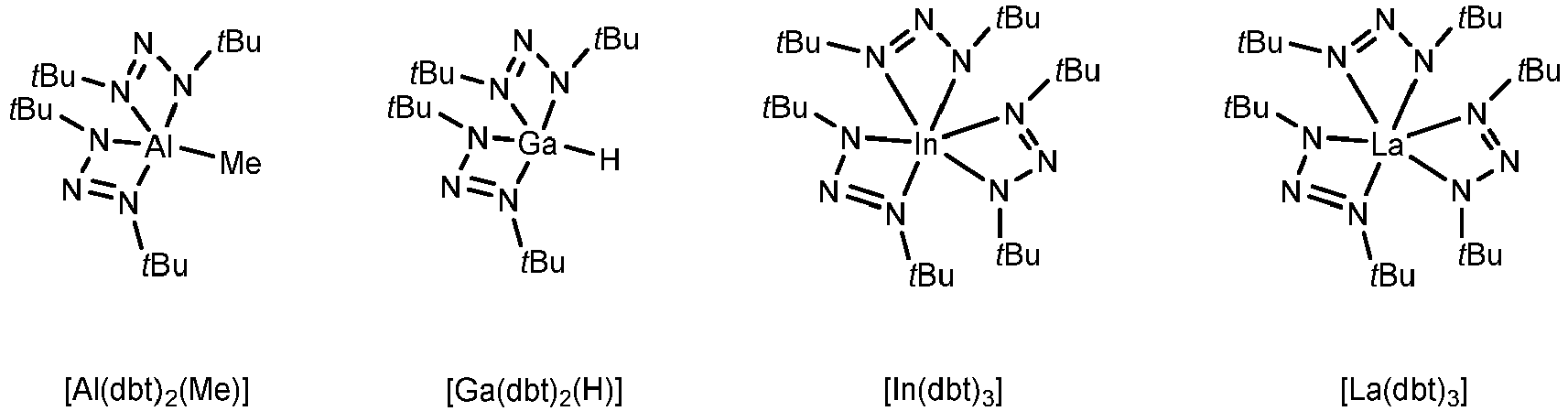


- Im Allgemeinen werden organische Azide anhand zweier Kriterien als explosionsgefährlich eingestuft, wobei es sich bei beiden Bedingungen um empirische Grenzen der Explosivität handelt.
- 1)

- 2)

- Nach beiden Kriterien ist das hier beschriebene tertButylazid als explosionsgefährlicher Stoff einzustufen. Unfälle bei der Darstellung oder Handhabung sind jedoch nicht bekannt. Zudem handelt es sich um eine Flüssigkeit, welche zur Aufreinigung bei 79 °C destilliert werden kann und eine N2-Abspaltungstemperatur von circa 550 °C besitzt, welche für organische Azide vergleichsweise hoch ist.
- Es gibt verschiedene synthetische Zugänge, von denen bereits seit Mitte der 1960er Jahre berichtet wurde. Eine Route geht beispielsweise von tertButylchlorid aus, welches mit NaN3 und ZnCl2 als Katalysator in CS2 umgesetzt wird.[34] Außerdem wird in einem weiteren synthetischen Zugang tertButylnitrat mit LiN3 in DMF umgesetzt.[35,36] Beide Routen können zu verschiedenen Komplikationen durch unvollständige Reaktionen oder unvollständiges Abtrennen der Nebenprodukte führen. Des Weiteren sollte der Einsatz von Kohlenstoffdisulfid aufgrund der hohen Toxizität vermieden werden. Deswegen wurde eine Route ausgehend von tertButanol untersucht, bei welcher der Alkohol mit NaN3 in einem Gemisch aus Wasser und Schwefelsäure umgesetzt wird.[37] Ein Upscaling der Reaktion zum tertButylazid bis zu mehreren 100 g ist laut Literatur problemlos und sicherheitstechnisch möglich. Dennoch sollte bei dieser Syntheseroute stets bedacht werden, dass im Reaktionsgemisch HN3 gebildet wird, welches unbedingt großzügig verdünnt gehandhabt werden sollte.
-

- 75 mL H2O und 50 mL konzentrierte H2SO4 wurden bei -5 °C vorgelegt. Mithilfe eines Feststoffdosierers wurde NaN3 (9.80 g, 151 mmol, 1.10 eq) langsam zugegeben. Die farblose Suspension wurde für 15 min gerührt und anschließend auf 0 °C erwärmt. tBuOH (10.2 g, 137 mmol, 1.00 eq) wurde über einen Tropftrichter langsam zugetropft. Dabei löste sich der im Reaktionsgemisch vorliegende Feststoff langsam auf. Die Reaktionslösung wurde für 16 h bei RT gerührt und anschließend in einen Scheidetrichter überführt um eine Trennung der Phasen zu erreichen. Die wässrige Phase wurde abgetrennt und umgehend mit NaOH (2 m) neutralisiert. Die organische Phase wurde zweimal mit je 20 mL NaOH (2 m) gewaschen, anschließend über Na2SO4 getrocknet. Das gewünschte Produkt wurde umkondensiert und konnte mit einer Ausbeute von 69% (9.40 g, 94.8 mmol) in Form einer farblosen Flüssigkeit erhalten werden.
-

- tBuN3 (10.17 g, 102.6 mmol, 1.00 eq) wurde in 100 mL Pentan vorgelegt und auf 5 °C gekühlt. Innerhalb einer Stunde wurde eine Lösung von tBuLi in Pentan (60 mL, 1.83 m, 110 mmol, 1.07 eq) zugetropft. Der Tropftrichter wurde zweimal mit 10 mL Pentan gespült. Das Reaktionsgemisch wurde langsam erwärmt und für 1 h bei RT gerührt. Zu der leicht gelben Suspension wurden 180 mL H2O zugeben, wodurch sich das Gemisch entfärbte. Die wässrige Phase wurde abgetrennt und die organische ein weiteres Mal mit 180 mL H2O gewaschen. Die organische Phase wurde über Na2SO4 getrocknet, filtriert und anschließend wurden alle flüchtigen Bestandteile im FV entfernt. Das Rohprodukt wurde destillativ bei 60 mbar und 70 °C aufgereinigt. Die Ausbeute des gewünschten Produktes in Form einer farblosen, klaren Flüssigkeit betrug 32% (5.15 g, 32.7 mmol).

- H(dbt) (700 mg, 4.45 mmol, 1.00 eq) wurde in 10 mL Et2O vorgelegt und auf 0 °C gekühlt. Eine Lösung von nBuLi in Hexan (1.8 mL, 2.5 m, 4.45 mmol, 1.00 eq) wurde langsam zugetropft. Die leicht gelbe Lösung wurde für 1 h bei RT gerührt, anschließend auf RT gebracht und für weitere 24 h gerührt. Das Lösungsmittel der klaren Lösung wurde im FV entfernt, wodurch ein leicht gelber Feststoff erhalten wurde. Das gewünschte Produkt wurde im FV getrocknet und konnte mit einer Ausbeute von 95% (687 mg, 4.21 mmol) isoliert werden.
-

- tBuN3 (1.27 g, 12.8 mmol, 1.00 eq) wurde in 10 mL Pentan vorgelegt und auf 5 °C gekühlt. Eine Lösung von tBuLi in Hexan (7.4 mL, 1.83 m, 13.7 mmol, 1.07 eq) wurde langsam zugetropft, wobei eine leichte Gelbfärbung des Reaktionsgemisches zu beobachten war. Das Reaktionsgemisch wurde 1 h bei 5 °C gerührt, anschließend langsam auf RT erwärmt und für 1 h gerührt. Die leicht trübe Lösung wurde über einen Spritzenfilter filtriert und das Lösungsmittel des leicht gelben Filtrats wurde im FV entfernt. Das gewünschte Produkt konnte mit einer Ausbeute von 83% (1.64 g, 10.0 mmol) erhalten werden.
- Anhand durchgeführter analytischer Untersuchungen konnten keine Unterschiede zwischen den beiden Chargen Li(dbt) beobachtet werden. Bei der optimierten Synthese des Li(dbt) handelt es sich um eine einstufige Synthese ohne Nebenprodukte. Während zunächst vom Neutralligand ausgegangen wurde, führt die Optimierung sowohl zum Einsparen an Reagenzien als auch verschiedenster Arbeitsschritte, u.a. einer Destillation.
-

- BnK (700 mg, 4.45 mmol, 1.00 eq) wurde in 10 mL Et2O aufgenommen und bei 0 °C tropfenweise mit H(dbt) (582 mg, 4.47 mmol, 1.00 eq) versetzt. Die farblose Suspension wurde auf RT erwärmt und für 16 h gerührt. Die leicht trübe Lösung wurde filtriert, das Lösungsmittel des farblosen Filtrats wurde im Unterdruck vollständig entfernt. Es konnten 85% (510 mg, 2.61 mmol) des gewünschten Produktes in Form eines farblosen Feststoffs erhalten werden.
-

- tBuN3 (1.00 g, 10.7 mmol, 1.00 eq) wurde in 15 mL Pentan vorgelegt und auf 4 °C gekühlt. Eine Lösung von MeLi in Et2O (6.8 mL, 1.60 m, 10.7 mmol, 1.07 eq) wurde langsam tropfenweise zur Reaktionslösung zugegeben, wodurch ein farbloser Feststoff ausfiel. Das Reaktionsgemisch wurde auf RT erwärmt, der entstandene farblose Niederschlag abfiltriert und im FV für mehrere Stunden getrocknet. Das gewünschte Produkt konnte als farbloser Feststoff mit einer Ausbeute von 87% (1.13 g, 9.31 mmol) erhalten werden. Ein Upscaling der Reaktion ist möglich.
-

- Li(mbt) (143 mg, 1.18 mmol, 1.00 eq) wurde in Pentan vorgelegt und auf 0 °C gekühlt. Unter Rühren wurde F3CCOOH (135 mg, 1.18 mmol, 1.00 eq) langsam zugetropft, wobei ein leichtes Aufschäumen der Reaktionslösung beobachtet werden konnte. Das eingesetzte Li(mbt) ging beim Erwärmen des Reaktionsgemischs auf RT in Lösung und die leicht trübe Suspension wurde für 16 h bei RT gerührt. Nachdem die Suspension über einen Spritzenfilter filtriert und das Pentan im FV entfernt wurde, konnte das gewünschte Produkt in Form einer farblosen Flüssigkeit erhalten werden.
-

- Eine toluolische Lösung von AlMe3 (33 mg, 0.46 mmol, 1.00 eq) wurde vorgelegt und bei RT tropfenweise mit H(dbt) (300 mg, 1.91 mmol, 3.00 eq) versetzt. Dabei konnte umgehend eine Gasentwicklung beobachtet werden. Das farblose Reaktionsgemisch wurde für 72 h bei RT gerührt und anschließend über einen Spritzenfilter filtriert. Das Lösungsmittel des Filtrats wurde im FV entfernt, wodurch ein farbloses Öl erhalten wurde. Nach mehrmaligem Gefriertrocknen wurde das gewünschte Produkt mit einer Ausbeute von 87% (276 mg, 0.56 mmol) als farbloser Feststoff erhalten (Schmelzpunkt: 46 °C).
- Das Rohprodukt wurde mittels thermogravimetrischer Analyse bis 700°C bei 10 K/min untersucht (
FIG. 1 ). Die thermogravimetrische Analyse zeigt einen einstufigen Prozess mit einem Gesamtmasseabbau von circa 91,2%. Eine Gewichtsabnahme von 3% der Ausgangssubstanz wurde bei 127,2°C festgestellt. -

- Eine auf -78 °C gekühlte Lösung von GaCl3 (440 mg, 2.50 mmol, 1.00 eq) in 5 mL Et2O wurde zu einer Suspension aus LiH (260 mg, 32.8 mmol, 13.1 eq) in 5 mL Et2O getropft. Dabei fiel sofort ein leicht grauer Niederschlag aus. Das Reaktionsgemisch wurde für 2 h bei -78 °C, anschließend für 16 h bei RT gerührt. Die leicht graue Suspension wurde in einen auf vorgekühlten Kolben filtriert. Zu dem klaren Filtrat wurde bei -78 °C eine auf -78 °C gekühlte Lösung aus GaCl3 (176 mg, 1.00 mmol, 0.40 eq) in 5 mL Et2O getropft. Die Suspension wurde unter Rühren bis auf 0 °C erwärmt und anschließend in einen auf -78 °C vorgekühlten Kolben filtriert. Das klare Filtrat wurde bei 0 °C zu einer Lösung aus H(dbt) (786 mg, 5.00 mmol, 2.00 eq) in 5 mL Et2O zugetropft. Dabei war umgehend eine Gasentwicklung zu beobachten. Die Suspension wurde langsam auf RT erwärmt und für 16 h gerührt. Das Gemisch wurde über einen Spritzenfilter filtriert und alle flüchtigen Bestandteile wurden im FV entfernt. Es blieb ein farbloser Feststoff zurück, welcher in 5 mL Hexan aufgenommen und erneut über einen Spritzenfilter filtriert wurde. Das Lösungsmittel des Filtrats wurde im FV entfernt, wodurch das Produkt mit einer Ausbeute 53% (508 mg, 1.33 mmol, Schmelzpunkt: 46 °C) erhalten wurde. Einkristalle für die Strukturanalyse konnten durch Sublimation im FV bei 60 °C erhalten werden.
- Der entsprechende Dihydrido-Gallium-Komplex [Ga(dbt)H2] konnte nicht durch die 1:1-Umsetzung von H(dbt) und [GaH3(OEt2)] erhalten werden.
- Das Rohprodukt wurde mittels thermogravimetrischer Analyse bis 900°C bei 10 K/min untersucht (
FIG. 2 ). Insgesamt wurden 86,6% der Ausgangssubstanz in die Gasphase überführt. -

- H(dbt) (250 mg, 1.59 mmol, 1.00 eq) wurde in 8 mL Pentan vorgelegt und auf 0 °C gekühlt. Eine toluolische Lösung von InMe3 (254 mg, 1.59 mmol, 1.00 eq) wurde tropfenweise zugegeben, wobei eine leichte Gasentwicklung zu beobachten war. Das Reaktionsgemisch wurde für 1 h bei 0 °C und für 16 h bei RT gerührt. Das Lösungsmittel der klaren Lösung wurde im FV entfernt, wodurch das gewünschte Produkt als farblose Flüssigkeit isoliert werden konnte. Zur Aufreinigung kann das Produkt bei 40 °C im leichten Vakuum umkondensiert werden.
- Die Reaktion kann in analoger Weise auch in Toluol durchgeführt werden, jedoch führt dies aufgrund der hohen Flüchtigkeit des Produktes zu Schwierigkeiten bei der Isolierung des Indium-Komplexes.
-

- InMe3 (150 mg, 0.94 mmol, 1.00 eq) wurde in 5 mL Toluol vorgelegt, auf 0 °C gekühlt und tropfenweise mit H(dbt) (444 mg, 2.83 mmol, 3.00 eq) versetzt. Das Reaktionsgemisch wurde langsam auf RT erwärmt und für 16 h gerührt. Das Lösungsmittel der klaren Lösung wurde im FV entfernt. Das gewünschte Produkt wurde in Form eines farblosen Feststoffs mit einer Ausbeute von 73% (403 mg, 0.69 mmol) erhalten und kann im FV bei 80 °C sublimiert werden.
- Das Rohprodukt wurde mittels thermogravimetrischer Analyse bis 900°C bei 10 K/min untersucht (
FIG. 3 ). Die Analyse zeigt einen einstufigen Prozess mit einem Gesamtmasseabbau von circa 92,8%. Eine Gewichtsabnahme von 3% der Ausgangssubstanz wurde bei 196,7°C festgestellt. -

- [La(hmds)3] (225 mg, 0.36 mmol, 1.00 eq) wurde in 10 mL Toluol vorgelegt und auf 0 °C gekühlt. Tropfenweise wurde H(dbt) (171 mg, 1.09 mmol, 3.00 eq) zu der farblosen Lösung gegeben. Das klare, farblose Reaktionsgemisch wurde auf RT erwärmt und für 16 h gerührt. Mithilfe einer 1H-NMR-Reaktionskontrolle wurde bestätigt, dass kein [La(hmds)3] mehr im Reaktionsgemisch vorhanden war. Alle flüchtigen Bestandteile der Reaktionslösung wurden im FV entfernt und der erhaltene farblose Feststoff wurde bei 60 °C im FV getrocknet. Das gewünschte Produkt wurde mit einer Ausbeute von 72% (158 mg, 0.26 mmol) erhalten.
- Das Rohprodukt wurde mittels thermogravimetrischer Analyse bis 800°C bei 10 K/min untersucht (
FIG. 4 ). Die thermogravimetrische Analyse zeigt einen einstufigen Prozess mit einem Gesamtmasseabbau von circa 85%. Eine Gewichtsabnahme von 3% der Ausgangssubstanz wurde bei 85°C festgestellt. Im Bereich bis 100 °C lässt sich erkennen, dass noch Restspuren Hhmds im Produkt vorhanden sind. Ab einer Temperatur von 103 °C kommt es zu einem einsetzenden Schmelzprozess des Lanthan-Komplexes, wobei der maximale Masseabbau bei einer Temperatur von 250 °C erreicht ist. Ab einer Temperatur von ungefähr 400 °C lässt sich kein signifikanter Masseabbau mehr beobachten. -

- Li(dbt) (654 mg, 4.00 mmol, 2.00 eq) wurde zusammen mit CoCl2 (260 mg, 2.00 mmol, 1.00 eq) vorgelegt und mit 15 mL Toluol versetzt. Das Reaktionsgemisch wurde für 8 h auf 80 °C erhitzt, wobei ein Farbwechsel von blau zu dunkelrot beobachtet werden konnte. Das Lösungsmittel des abgekühlten Reaktionsgemisches wurde im FV entfernt und das gewünschte Produkt wurde direkt aus dem Rückstand im FV bei 100 °C sublimiert. [Co(dbt)2] wurde in Form eines dunkelroten, fast schwarzen Feststoffs mit einer Ausbeute von 53% (394 mg, 1.06 mmol) erhalten.
- In der TGA-Kurve bis 900°C bei 10 K/min (
FIG. 5 ) lässt sich ein einstufiger Masseverlust beobachten, bei dem der maximale Masseabbau pro Zeit bei einer Temperatur von 248 °C beobachtet werden kann. Bei einer Temperatur von 156 °C hat sich die Probe zu 3% abgebaut. Ab einer Temperatur von 91 °C lässt sich ein endothermer, sehr breiter Peak beobachten, welcher einem unregelmäßigen Schmelzvorgang zugeordnet werden kann. Der Gesamtmasseverlust liegt bei 97%, wobei der erhaltene Rückstand mittels XRPD näher untersucht wurde. Dabei zeigte sich, dass es sich bei dem Rückstand um elementares Cobalt handelt. -
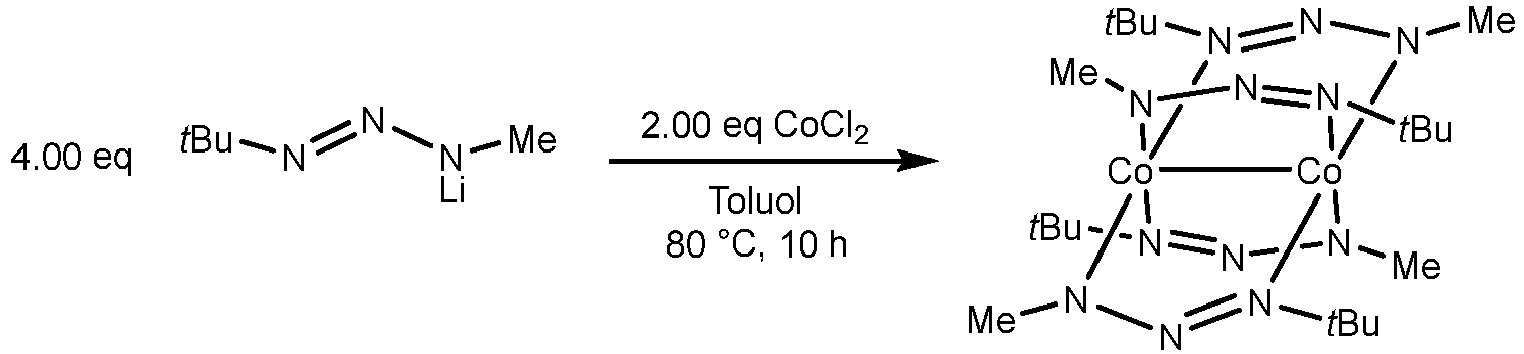
- Li(mbt) (193 mg, 1.59 mmol, 4.00 eq) und CoCl2 (103 mg, 0.79 mmol, 2.00 eq) wurden zusammen vorgelegt und bei 0 °C mit 10 mL Toluol versetzt. Beim Auftauen des Reaktionsgemisches konnte ein Farbwechsel von blau zu dunkelbraun beobachtet werden. Das Reaktionsgemisch wurde für 10 h auf 80 °C erhitzt und anschließend wurde das Lösungsmittel im FV bei RT entfernt. Aus dem dunkelbraunen Rückstand wurde das gewünschte Produkt im dynamischen Vakuum bei 85 °C sublimiert. Der dinukleare Cobalt-Komplex konnte als rotbrauner Feststoff mit einer Ausbeute von 51% (116 mg, 0.20 mmol) erhalten werden. Einkristalle für die Kristallstrukturanalyse konnten durch Sublimation im leichten Vakuumbei 100 °C erhalten werden. Aufgrund von Spinpaarung der beiden Cobalt-Kerne im [Co2(mbt)4], zeigt dieses im Gegensatz zu [Co(dbt)2] diamagnetisches Verhalten.
- Die TGA-Kurve bis 900°C bei 10 K/min (
FIG. 6 ) des Cobalt-Komplexes zeigt einen einstufigen Verlauf, wobei der maximale Masseabbau pro Zeit bei einer Temperatur von 189 °C beobachtet werden kann. Der 3%- Abbau wurde bei einer Temperatur von 147 °C ermittelt. Ab einer Temperatur von 184 °C lässt sich ein einsetzender exothermer Prozess erkennen, welcher zum maximalen Masseabbau pro Zeit führt und einem Zersetzungsprozess zugeordnet werden kann. Der Gesamtmasseabbau liegt bei 82%, wobei der aus dieser Messung erhaltene Rückstand mittels XRPD untersucht wurde. Dieser konnte als elementares Cobalt identifiziert werden. -

- Li(dbt) (280 mg, 1.72 mmol, 1.00 eq) wurde zusammen mit CuCI (170 mg, 1.72 mmol, 1.00 eq) vorgelegt und mit 10 mL vorgekühlten Toluol versetzt. Das Reaktionsgemisch wurde für 16 h bei RT gerührt, wobei ein Farbwechsel von gelb zu braun beobachtet werden konnte. Die Suspension wurde über Celite® filtriert und anschließend das Lösungsmittel des Filtrats im FV entfernt. Das Rohprodukt wurde im dynamischen Vakuum bei 70 °C sublimativ aufgereinigt und konnte mit einer Ausbeute von 71% (268 mg, 0.61 mmol) als gelber Feststoff erhalten werden. Einkristalle für die Kristallstrukturanalyse wurden aus einer gesättigten Lösung von n-Hexan bei -21 °C erhalten.
- Das Rohprodukt wurde mittels thermogravimetrischer Analyse bis 1000°C bei 10 K/min untersucht (
FIG. 12 ). [Cu2(dbt)2] zeigt einen einstufigen Masseabbau, wobei der 3%-Abbau bei 156 °C liegt. Der Gesamtmassenverlust liegt bei 96%, was auf die gute Sublimierbarkeit der Kupfer-Verbindung zurückzuführen ist. Ab einer Temperatur von circa 260 °C ist kein signifikanter Masseabbau mehr zu beobachten. Als Rückstand wurde elementares Kupfer im Tiegel beobachtet. -

- Li(mbt) (208 mg, 1.72 mmol, 1.00 eq) und CuCI (170 mg, 1.72 mmol, 1.00 eq) wurden vorgelegt und mit 10 mL vorgekühlten Toluol versetzt. Das farblose Reaktionsgemisch wurde für 48 h bei RT gerührt, wodurch eine Farbänderung zu leuchtend gelb beobachtet werden konnte. Die Suspension wurde über Celite® filtriert und das Lösungsmittel des Filtrats wurde im FV entfernt. Das leuchtend gelbe Rohprodukt wurde im dynamischen Vakuum bei 65 °C bis 75 °C sublimativ aufgereinigt und konnte mit einer Ausbeute von 82% (248 mg, 0.35 mmol) erhalten werden. Einkristalle für die Kristallstrukturanalyse konnten aus einer gesättigten Lösung von n-Hexan bei RT erhalten werden.
- Das Rohprodukt wurde mittels thermogravimetrischer Analyse bis 900°C bei 10 K/min untersucht (
FIG. 13 ). [Cu4(mbt)4] zeigt einen einstufigen Abbau mit einem Gesamtmassenverlust von 79%. Der 3%-Abbau liegt bei 198 °C, während der maximale Masseabbau bei circa 250 °C bestimmt wurde. Ab einer Temperatur von 255 °C lässt sich kein signifikanter Masseverlust mehr beobachten. Die SDTA-Kurve zeigt verschiedene Schmelz- bzw. Phasenumwandlungsprozesse bis zur einsetzenden Zersetzung, welche bei einer Temperatur von 236 °C beginnt (nicht gezeigt). Der Rückstand aus der thermogravimetrischen Untersuchung wurde mittels XRPD untersucht und konnte als elementares Kupfer identifiziert werden. -

- Ca(hmds)2 (122 mg, 0.338 mmol, 1.00 eq) wurde in 10 mL Toluol vorgelegt und auf 0 °C gekühlt. Tropfenweise wurde Hdbt (106 mg, 0.684 mmol, 2.00 eq) hinzu gegeben. Das farblose Reaktionsgemisch wurde für 72 h bei RT gerührt, anschließend filtriert und das Filtrat bis zur Trockene eingedampft. Das Produkt konnte mit einer Ausbeute von 63% (116 mg, 0.22 mmol) als leicht gelber Feststoff erhalten werden.
- 1H-NMR (C6D6, 300 MHz, 300 K): δ/ ppm = 1.38 (s, CMe3 ).
- 13C-NMR (C6D6, 75 MHz, 300 K): δ/ ppm = 31.1 (CMe3 ), 56.2 (CMe3).
- IR: υ̃ / cm-1 = 2958 (m), 2860 (w), 1601 (w), 1473 (w), 1459 (w), 1384 (w), 1356 (m), 1295 (st), 1243 (m), 1194 (vst), 1026 (w), 989 (w), 806 (w), 748 (w), 614 (st), 472 (st).
- TGA: (Ts = 25 °C, Tε = 800 °C, 10 °C / min), Stufen: 1
3%-Abbau: 115.3 °C, max. Abbau: 309.0 °C, Gesamtmassenabbau: 79.3%. - SDTA: TD(Onset): 194.4 °C, TD(max.): 263.7 °C.
- RPD: Rückstand aus TGA-Analyse: 20Lit.[62](2θobs.) für Ca3N2: 32.779 (32.785), 35.598 (35.545), 36.191 (36.175), 37.279 (37.375), 38.611 (38.455), 44.599 (44.755), 50.979 (50.665), 60.458 (60.415), 66.228 (66.265).
-

- Cshmds wurde in 10 mL Et2O aufgenommen und bei 0 °C tropfenweise mit Hdbt versetzt. Die leicht trübe Lösung wurde auf RT erwärmt, für 16 h gerührt und über Celite® filtriert. Das Lösungsmittel des Filtrats wurde im FV entfernt. Ausbeute: 76%.
- 1H-NMR (C6D6/THF-d8 (5/1), 300 MHz, 300 K): δ/ ppm = 1.35 (s, CMe3 ).
- 13C-NMR (C6D6/THF-d8 (5/1), 75 MHz, 300 K): δ / ppm = 31.3 (CMe3 ), 55.8 (CMe3).
- Elementaranalyse: für C8H18CsN3
berechnet: C: 33.23%, H: 6.27%, N: 14.53%. gefunden: C: 32.60%, H: 6.07%, N: 14.64%. -

- GaMe3 (146 mg, 1.27 mmol, 2.00 eq) wurde in 5 mL nPentan vorgelegt und bei 0 °C zu einer Lösung von GaCl3 (112 mg, 0.64 mmol, 1.00 eq) in 10 mL nPentan gegeben. Die farblose Lösung wurde auf RT erwärmt, für 16 h gerührt, erneut auf 0°C gekühlt und zu einer Lösung von [Li(mbt)] (231 mg, 1.91 mmol, 3.00 eq) in 10 mL nPentan gegeben. Das Reaktionsgemisch wurde auf RT erwärmt und für 16 h gerührt. Das Lösungsmittel der Suspension wurde im FV entfernt und das gewünschte Produkt aus dem Rückstand mittels Kondensation im FV isoliert. Das Produkt wurde in Form einer farblosen Flüssigkeit mit einer Ausbeute von 57% (233 mg, 1.09 mmol) erhalten.
- 1H-NMR (C6D6, 300 MHz, 300 K): δ / ppm = 0.05 (s, 6 H, GaMe2 ), 1.17 (s, 18 H, CMe3 ), 3.03 (s, 3 H, NMe).
- 13C-NMR (C6D6, 75 MHz, 300 K): δ / ppm = -5.6 (GaMe2 ), 29.7 (CMe3 ), 39.4 (NMe).
- IR: υ̃ / cm-1 = 2969 (m), 2902 (w), 1524 (w), 1459 (w), 1435 (m), 1361 (vst), 1309 (m), 1271 (w), 1199 (vst), 1068 (m), 1026 (w), 955 (w), 930 (w), 866 (st), 787 (w), 737 (st), 688 (m), 646 (st), 572 (vst), 534 (vst), 481 (w), 460 (m), 438 (w).
- TGA: (Ts = 25 °C, Tε = 450 °C, 10 °C / min), Stufen: 1
3%-Abbau: 63.2 °C, max. Abbau: 100.9 °C, Gesamtmasseabbau: 87.4%. - SDTA: TD(Onset): 81.6 °C, TD(max): 100.3 °C.
Fig. 21 zeigt eine graphische Darstellung der TGA- und SDTA-Messungen. -

- GaMe3 (181 mg, 1.58 mmol, 2.00 eq) wurde in 10 mL nPentan vorgelegt und bei 0 °C zu einer Lösung von GaCl3 (139 mg, 0.79 mmol, 1.00 eq) in 10 mL nPentan gegeben. Das Reaktionsgemisch wurde auf RT erwärmt und 16 h gerührt. Bei 0 °C wurde eine Lösung von [Li(dbt)] (387 mg, 2.37 mmol, 3.00 eq) zugetropft, wobei umgehend das Ausfallen eines farblosen Feststoffs beobachtet wurde. Die Suspension wurde langsam auf RT erwärmt und für 16 h gerührt. Das Lösungsmittel wurde im Feinvakuum (FV) entfernt und das Produkt in Form einer farblosen Flüssigkeit aus dem Rückstand im FV kondensiert. Das Produkt wurde mit einer Ausbeute von 43% (261 mg, 1.02 mmol) erhalten.
- 1H-NMR (C6D6, 300 MHz, 300 K): δ/ ppm = 0.10 (s, 6 H, GaMe2 ), 1.17 (s, 18 H, CMe3 ).
- 13C-NMR (C6D6, 75 MHz, 300 K): δ / ppm = -5.2 (GaMe2 ), 29.7 (CMe3 ), 55.8 (NMe).
- IR: υ̃ / cm-1 = 2967 (st), 2870 (w), 1459 (w), 1387 (w), 1361 (m), 1295 (vst), 1217 (vst), 1029 (w), 924 (w), 767 (m), 699 (m), 630 (m), 583 (st), 545 (st), 484 (m).
- TGA: (TS = 25 °C, TE = 450 °C, 10 °C / min), Stufen: 1
3%-Abbau: 64.2 °C, max. Abbau: 116.0 °C, Gesamtmasseabbau: 89.9%. - SDTA: TD(Onset): 79.5 °C, TD(max.): 115.7 °C.
Fig. 22 zeigt eine graphische Darstellung der TGA- und SDTA-Messungen. -

- Eine Lösung von AlCl3 (131 mg, 0.98 mmol, 1.00 eq) in 10 mL Et2O wurde bei 0°C zu einer Lösung von [Li(mbt)] (357 mg, 2.95 mmol, 3.00 eq) in 10 mL Et2O getropft. Das farblose Reaktionsgemisch wurde langsam auf RT erwärmt, für 16 h gerührt und anschließend filtriert. Der Rückstand wurde mit 10 mL Et2O extrahiert und das Filtrat im FV bis zur Trockene eingedampft. Der blass gelbe Feststoff wurde im Feinvakuum bei 45 °C sublimiert und das Produkt mit einer Ausbeute von 21% (76 mg, 0.21 mmol) erhalten. 1H-NMR (C6D6, 300 MHz, 300 K): δ / ppm = 1.31 (s, 27 H, CMe3 ), 3.16 (s, 9 H, NMe). 13C-NMR (C6D6, 75 MHz, 300 K): δ / ppm = 30.3 (CMe3 ), 37.5 (NMe), 55.8 (CMe3). 27Al-NMR (C6D6, 130 MHz, 300 K): δ / ppm = 28.1.
- IR: υ̃ / cm-1 = 2968 (m), 2926 (m), 2896 (m), 2802 (w), 1473 (w), 1457 (w), 1415 (w), 1387 (w), 1358 (m), 1300 (vst), 1263 (vst), 1229 (st), 1199 (st), 1106 (w), 1025 (w), 954 (w), 796 (w), 625 (m), 572 (w), 524 (vst), 435 (w).
- Elementaranalyse: für C15H36AlN9
berechnet: C: 48.76%, H: 9.82%, N: 34.12%. gefunden: C: 47.95%, H: 9.63%, N: 33.55%. - TGA: (Ts = 25 °C, Tε = 700 °C, 10 °C / min), Stufen: 1
3%-Abbau: 124.6 °C, max. Abbau: 216.1 °C, Gesamtmasseabbau: 96.4%. - SDTA: TM(Onset): 45.6 °C, TM(max): 49.7 °C, To(onset): 205.1 °C, TD(max.): 218.8 °C.
Fig. 23 zeigt eine graphische Darstellung der TGA- und SDTA-Messungen. -

- [Al(NMe2)3]2 (154 mg, 0.97 mmol, 0.50 eq) wurde in 10 mL Toluol vorgelegt, auf 0 °C gekühlt und tropfenweise mit H(dbt) (458 mg, 2.91 mmol, 3.00 eq) versetzt. Die Reaktionslösung wurde für 1 h bei 0 °C gerührt und anschließend auf RT erwärmt. Dabei war eine Gasentwicklung zu beobachten. Nachdem die gelbe Lösung für 16 h bei RT gerührt wurde, konnte durch Entfernen des Lösungsmittels im FV ein schwach gelber Feststoff erhalten werden. Das Rohprodukt wurde bei 55 °C im FV sublimativ aufgereinigt und als farbloser Feststoff mit einer Ausbeute von 51% (244 mg, 0.49 mmol) isoliert.
- 1H-NMR (C6D6, 300 MHz, 300 K): δ / ppm = 1.38 (s, CMe3 ).
- 13C-NMR (C6D6, 75 MHz, 300 K): δ / ppm = 31.2 (CMe3 ), 57.2 (CMe3).
- 27Al-NMR (C6D6, 130 MHz, 300 K): δ / ppm = 24.6.
- IR: υ̃ / cm-1 = 2972 (m), 2929 (s), 2870 (s), 2812 (s), 2767 (s), 1474 (s), 1387 (s), 1360 (m), 1302 (vst), 1257 (st), 1201 (vst), 1160 (st), 1069 (s), 1034 (s), 977 (m), 899 (s), 845 (s), 767 (s), 627 (m), 570 (m), 543 (vst), 438 (s).
- Elementaranalyse: für C24H54AlN9 berechnet: C: 58.15%, H: 10.98%, N: 25.43%. gefunden: C: 58.25%, H: 10.13%, N: 24.32%.
- TGA: (Ts = 25 °C, Tε = 700 °C, 10 °C / min), Stufen: 1
3%-Abbau: 126.8 °C, max. Abbau: 172.6, 302.0 °C, Gesamtmasseabbau: 95.3%. - SDTA: TD(Onset): 270.0 °C, TD(max.): 302.7 °C.
Fig. 24 zeigt eine graphische Darstellung der TGA- und SDTA-Messungen. -
- [1] J. C. Brand, B. P. Roberts, J. Chem. Soc. Chem. Comm. 1981, 748-749.
- [2] R. H. J. Smith, C. J. Michejda, Synthesis 1983, 476-477.
- [3] R. H. J. Smith, B. D. Wladowski, A. F. Mehl, M. J. Cleveland, E. A. Rudrow, G. N. Chmurny, C. J. Michejda, J. Org. Chem. 1989, 54, 1036-1042.
- [4] D. H. Sieh, D. J. Wilbur, C. J. Michejda, J. Am. Chem. Soc. 1980, 3883-3887.
- [5] Soussi, K., Mishra, S, Jeanneau, E, Millet, J.-M., Daniele, S., Dalton Transactions 2017, 46, 38, 13055 bis 13064
- [6] C. Lego, B. Neumüller, Z. Anorg. Allg. Chem. 2011, 637, 1784-1789 .
- [7] P. Gantzel, P. J. Walsh, Inorg. Chem. 1998, 37, 3450-3451.
- [8] D. Kalden, S. Krieck, H. Görls, M. Westerhausen, Dalt. Trans. 2015, 44, 8089-8099.
- [9] H. S. Lee, S.-O. Hauber, D. Vindus, M. Niemeyer, Inorg. Chem. 2008, 47, 4401-4412.
- [10] S. L. Hyui, M. Niemeyer, Inorg. Chem. 2006, 45, 6126-6128.
- [11] F. E. Brinckman, H. S. Haiss, R. A. Robb, Inorg. Chem. 1965, 4, 936-942.
- [12] J. T. Leman, A. R. Barron, J. W. Ziller, R. M. Kren, Polyhedron 1989, 8, 1909-1912.
- [13] J. T. Leman, H. A. Roman, A. R. Barron, J. Chem. Soc. Dalt. Trans. 1992, 1, 2183.
- [14] M. L. Cole, A. J. Davies, C. Jones, P. C. Junk, A. I. McKay, A. Stasch, Z. Anorg. Allg. Chem. 2015, 641, 2233-2244.
- [15] S. G. Alexander, M. L. Cole, C. M. Forsyth, S. K. Furfari, K. Konstas, Dalt. Trans. 2009, 2326-2336 .
- [16] J. T. Leman, J. Braddock-Wilking, A. J. Coolong, A. R. Barron, Inorg. Chem. 1993, 32, 4324-4336.
- [17] I. A. Guzei, L. M. Liable-Sands, A. L. Rheingold, C. H. Winter, Polyhedron 1997, 16, 4017-4022.
- [18]
V. C. Gibson, D. F. Reardon, A. K. Tomov, 2004, WO 2004063233 . - [19] E. Hartmann, J. Strähle, J. Inorg. Gen. Chem. 1990, 583, 31-40.
- [20] I. D. Brown, J. D. Dunitz, Acta Cryst. 1961, 14, 480-485.
- [21] L. R. Falvello, E. P. Urriolabettia, U. Mukhopadhyay, D. Ray, Acta Cryst. Comm. 1999, C55, 170-172.
- [22] H. S. Lee, M. Niemeyer, Inorg. Chim. Acta 2011, 374, 163-170.
- [23] A. L. Johnson, A. M. Willcocks, S. P. Richards, Inorg. Chem. 2009, 48, 8613-8622.
- [24] E. Pfeiffer, M. W. Kokkes, K. Vrieze, Transit. Met. Chem. 1979, 4, 389-393.
- [25] M. Venter, I. Haiduc, L. David, O. Cozar, J. Mol. Struct. 1997, 408-409, 483-486.
- [26] F. A. Cotton, X. Feng, Inorg. Chem. 1989, 28, 1180-1183 .
- [27] J. G. M. van der Linden, A. H. Dix, E. Pfeiffer, Inorg. Chim. Acta 1980, 39, 271-274.
- [28] S. F. Colson, S. D. Robinson, Inorg. Chim. Acta Lett. 1988, 149, 13-14.
- [29] S. F. Colson, S. D. Robinson, M. Motevalli, M. B. Hursthouse, Polyhedron 1988, 7, 1919-1924.
- [30] J. A. Cabeza, J. M. Fernhdez-Colinas, Coord. Chem. Rev. 1993, 126, 319-336.
- [31] C. J. Weiss, T. J. Marks, Dalt. Trans. 2010, 39, 6576.
- [32] B. Liu, D. Cui, Dalt. Trans. 2009, 550-556.
- [33] P. J. Eulgem, A. Klein, N. Maggiarosa, D. Naumann, R. W. H. Pohl, Chem. Eur. J. 2008, 14, 3727-3736.
- [34] S. G. Alvarez, M. T. Alvarez, Synthesis 1997, 4, 413-414.
- [35] P. Margaretha, S. Solar, O. E. Polansky, Angew. Chemie - Int. Ed. 1971, 10, 412-413.
- [36] P. Margaretha, S. Solar, O. E. Polansky, Angew. Chemie 1971, 11, 410.
- [37] J. C. Bottaro, P. E. Penwell, R. J. Schmitt, Synth. Commun. 1997, 27, 1465-1467.
M[(L1)3] (4)
wobei
Mx(L1)a (5)
wobei
Claims (21)
- Verwendung eines Metallkomplexes der
Formel (2):
M[(L1)aXd] (2)
wobeiL1 die Formel R1-N3-R2 aufweist, wobei R1 und R2 Alkylreste mit 1 bis 12 C-Atomen sind,X ausgewählt ist aus H, Halogen, CO und Alkyl mit 1 bis 6 C-Atomen,a = 2 oder 3 ist,d = 0 oder 1 ist, undM ausgewählt ist aus In, Co, Cu, Al, Ga, TI und La zum Abscheiden des Metalls oder einer Verbindung des Metalls aus der Gasphase. - Verwendung gemäß Anspruch 1, wobei die Alkylreste R1 und R2 1 bis 6 C-Atome aufweisen.
- Verwendung gemäß mindestens einem der vorhergehenden Ansprüche, wobei Alkylreste R1 und R2 1 bis 4 C-Atome aufweisen.
- Verwendung gemäß mindestens einem der vorhergehenden Ansprüche, wobei alle oder ein Teil der Reste R1 und/oder R2 verzweigte Alkylreste sind.
- Verwendung gemäß mindestens einem der vorhergehenden Ansprüche, wobei der Metallkomplex homoleptisch ist und ausschließlich Liganden L der Formel R1-N3-R2 aufweist.
- Verwendung gemäß mindestens einem der vorhergehenden Ansprüche, wobei der Metallkomplex heteroleptisch ist.
- Verwendung gemäß mindestens einem der vorhergehenden Ansprüche, wobei die Reste R1 und R2 gleich sind.
- Verwendung gemäß mindestens einem der vorhergehenden Ansprüche, wobei die Reste R1 und R2 ausgewählt aus Methyl, Ethyl, Propyl, Isopropyl, tert-Butyl und n-Propyl sind.
- Verwendung gemäß mindestens einem der vorhergehenden Ansprüche, wobei alle oder ein Teil der Reste R1 und/oder R2 tert-Butyl sind.
- Verwendung mindestens einem der vorhergehenden Ansprüche, wobei der Metallkomplex mindestens einen Liganden L aufweist, der tert-Butyl-N3-tert-Butyl oder tert-Butyl-N3-Methyl ist.
- Verwendung gemäß Anspruch 10 wobei alle Liganden L des Metallkomplexes tert-Butyl-N3-tert-Butyl oder tert-Butyl-N3-Methyl sind.
- Verwendung gemäß mindestens einem der vorhergehenden Ansprüche, wobei der Metallkomplex sublimierbar oder verdampfbar ist, ohne dass eine Zersetzung erfolgt.
- Verwendung gemäß mindestens einem der vorhergehenden Ansprüche, wobei das Molekulargewicht des Metallkomplexes kleiner ist als kleiner als 600 g/Mol.
- Verwendung gemäß mindestens einem der vorhergehenden Ansprüche, wobei der Metallkomplex bei 100°C thermisch stabil ist und/oder in einem Temperaturbereich von 100°C bis 400°C zerfällt, wobei die Temperatur bei Normaldruck oder bei reduziertem Druck im Bereich von 10-3 bis 900 mbar ermittelt wird.
- Verwendung gemäß mindestens einem der vorhergehenden Ansprüche, wobei das Abscheiden des Metalls oder der Verbindung des Metalls aus der Gasphase bei reduziertem Druck im Bereich von 10-3 bis 900 mbar, bevorzugt im Bereich von 10-2 bis 1 mbar, und insbesondere 10-2 mbar erfolgt.
- Verfahren zur Herstellung von beschichteten Substraten, umfassend die Schritte:(a) Bereitstellen eines Metallkomplexes gemäß mindestens einem der vorhergehenden Ansprüche, und(b) Abscheiden des Metalls oder einer Verbindung des Metalls auf der Oberfläche des Substrats durch metallorganische Gasphasenabscheidung.
- Verfahren oder Verwendung gemäß mindestens einem der vorhergehenden Ansprüche, wobei das Verfahren eine metallorganische chemische Gasphasenabscheidung (MOCVD) ist.
- Verfahren oder Verwendung gemäß mindestens einem der vorhergehenden Ansprüche, wobei das Verfahren eine metallorganische Gasphasenepitaxie (MOVPE) ist.
- Verfahren oder Verwendung gemäß mindestens einem der vorhergehenden Ansprüche, wobei die Verbindung des Metalls aus Halbleiterverbindungen, Legierungen, Nitriden, Phosphiden, Arseniden und Siliziden ausgewählt ist.
- Verfahren oder Verwendung gemäß mindestens einem der vorhergehenden Ansprüche, wobei der Metallkomplex sublimiert oder verdampft wird, ohne dass eine Zersetzung erfolgt.
- Verfahren oder Verwendung gemäß mindestens einem der vorhergehenden Ansprüche, wobei sich der Metallkomplex in der Gasphase zersetzt bei einer Temperatur, die nicht mehr als 100°C oberhalb der Sublimationstemperatur oder Verdampfungstemperatur liegt.
Applications Claiming Priority (2)
| Application Number | Priority Date | Filing Date | Title |
|---|---|---|---|
| EP17207806.5A EP3498721A1 (de) | 2017-12-15 | 2017-12-15 | Metallkomplexe mit triazenidoliganden und deren verwendungen zur abscheidung von metallen aus der gasphase |
| PCT/EP2018/084628 WO2019115646A1 (de) | 2017-12-15 | 2018-12-12 | Metallkomplexe mit triazenidoliganden und deren verwendungen zur abscheidung von metallen aus der gasphase |
Publications (2)
| Publication Number | Publication Date |
|---|---|
| EP3724204A1 EP3724204A1 (de) | 2020-10-21 |
| EP3724204B1 true EP3724204B1 (de) | 2024-08-21 |
Family
ID=60997227
Family Applications (2)
| Application Number | Title | Priority Date | Filing Date |
|---|---|---|---|
| EP17207806.5A Ceased EP3498721A1 (de) | 2017-12-15 | 2017-12-15 | Metallkomplexe mit triazenidoliganden und deren verwendungen zur abscheidung von metallen aus der gasphase |
| EP18814654.2A Active EP3724204B1 (de) | 2017-12-15 | 2018-12-12 | Metallkomplexe mit triazenidoliganden und deren verwendungen zur abscheidung von metallen aus der gasphase |
Family Applications Before (1)
| Application Number | Title | Priority Date | Filing Date |
|---|---|---|---|
| EP17207806.5A Ceased EP3498721A1 (de) | 2017-12-15 | 2017-12-15 | Metallkomplexe mit triazenidoliganden und deren verwendungen zur abscheidung von metallen aus der gasphase |
Country Status (6)
| Country | Link |
|---|---|
| US (2) | US12221456B2 (de) |
| EP (2) | EP3498721A1 (de) |
| JP (2) | JP7480041B2 (de) |
| KR (2) | KR102814758B1 (de) |
| CN (1) | CN111712506B (de) |
| WO (1) | WO2019115646A1 (de) |
Families Citing this family (3)
| Publication number | Priority date | Publication date | Assignee | Title |
|---|---|---|---|---|
| CN113582879A (zh) * | 2021-09-02 | 2021-11-02 | 合肥安德科铭半导体科技有限公司 | 一种有机镧前驱体La(iPr2-FMD)3的制备方法 |
| DE102023119428A1 (de) | 2023-07-21 | 2025-01-23 | Dockweiler Chemicals GmbH | Heteroleptische Triazenid-Metallkomplexe |
| KR102851576B1 (ko) * | 2023-08-22 | 2025-08-29 | 주식회사 한솔케미칼 | 신규 조성물, 이를 포함하는 전구체 조성물, 및 이를 이용한 박막의 제조방법 |
Citations (1)
| Publication number | Priority date | Publication date | Assignee | Title |
|---|---|---|---|---|
| US3386985A (en) * | 1964-06-12 | 1968-06-04 | Navy Usa | Triazenometal compounds and method of preparation |
Family Cites Families (10)
| Publication number | Priority date | Publication date | Assignee | Title |
|---|---|---|---|---|
| DE4242469A1 (de) * | 1992-12-16 | 1994-06-23 | Wacker Chemie Gmbh | Katalysatoren für Hydrosilylierungsreaktionen |
| GB0300821D0 (en) | 2003-01-14 | 2003-02-12 | Bp Chem Int Ltd | Polymerisation catalysts |
| JP5328135B2 (ja) * | 2006-11-29 | 2013-10-30 | 国立大学法人京都大学 | 新規ルテニウム系触媒およびそれを用いた1,1−ジチオ−1−アルケンの製造方法 |
| JP5451209B2 (ja) * | 2008-07-08 | 2014-03-26 | 国立大学法人東京工業大学 | エステル類およびラクトン類の実用的な還元方法 |
| WO2012057884A1 (en) * | 2010-10-29 | 2012-05-03 | Applied Materials, Inc. | Nitrogen-containing ligands and their use in atomic layer deposition methods |
| DE102011012515A1 (de) * | 2011-02-25 | 2012-08-30 | Umicore Ag & Co. Kg | Metallkomplexe mit N-Amino-Amidinat-Liganden |
| US10221481B2 (en) * | 2013-10-28 | 2019-03-05 | Merck Patent Gmbh | Metal complexes containing amidoimine ligands |
| US9708236B2 (en) * | 2014-01-09 | 2017-07-18 | San Diego State University Research Foundation | Terminal alkene monoisomerization catalysts and methods |
| EP2933274A1 (de) * | 2014-04-16 | 2015-10-21 | Evonik Degussa GmbH | Verfahren zur Herstellung von Polymeren mittels ringöffnender Polymerisation |
| JP2017071577A (ja) * | 2015-10-08 | 2017-04-13 | 国立大学法人京都大学 | ルテニウム錯体、ルテニウム錯体と多孔性配位高分子との複合体、及びそれらを含む二酸化炭素光還元触媒 |
-
2017
- 2017-12-15 EP EP17207806.5A patent/EP3498721A1/de not_active Ceased
-
2018
- 2018-12-12 JP JP2020532735A patent/JP7480041B2/ja active Active
- 2018-12-12 KR KR1020207020565A patent/KR102814758B1/ko active Active
- 2018-12-12 US US16/771,867 patent/US12221456B2/en active Active
- 2018-12-12 WO PCT/EP2018/084628 patent/WO2019115646A1/de not_active Ceased
- 2018-12-12 EP EP18814654.2A patent/EP3724204B1/de active Active
- 2018-12-12 KR KR1020257017384A patent/KR20250080918A/ko active Pending
- 2018-12-12 CN CN201880089213.2A patent/CN111712506B/zh active Active
-
2024
- 2024-02-13 JP JP2024019559A patent/JP7764514B2/ja active Active
- 2024-12-26 US US19/001,646 patent/US20250179105A1/en active Pending
Patent Citations (1)
| Publication number | Priority date | Publication date | Assignee | Title |
|---|---|---|---|---|
| US3386985A (en) * | 1964-06-12 | 1968-06-04 | Navy Usa | Triazenometal compounds and method of preparation |
Non-Patent Citations (4)
| Title |
|---|
| BRINCKMAN F E ET AL: "METAL-NITROGEN BONDING. COVALENT COMPLEXES OF 1,3-DIMETHYLTRIAZENE WITH ELEMENTS OF GROUPS I, II, III, IV, AND V", INORGANIC CHEMISTRY, AMERICAN CHEMICAL SOCIETY, EASTON , US, vol. 4, no. 7, 1 January 1965 (1965-01-01), pages 936 - 942, XP001188971, ISSN: 0020-1669, DOI: 10.1021/IC50029A003 * |
| DIMROTH OTTO: "Ueber das Diazoamino-methan (Dimethyl-triazen)", BERICHTE DER DEUTSCHEN CHEMISCHEN GESELLSCHAFT, vol. 39, no. 4, 1 November 1906 (1906-11-01), DE, pages 3905 - 3912, XP055960706, ISSN: 0365-9496, Retrieved from the Internet <URL:https://onlinelibrary.wiley.com/doi/pdf/10.1002/cber.19060390470> DOI: 10.1002/cber.19060390470 * |
| O'BRIEN NATHAN J. ET AL: "In Situ Activation of an Indium(III) Triazenide Precursor for Epitaxial Growth of Indium Nitride by Atomic Layer Deposition", CHEMISTRY OF MATERIALS, vol. 32, no. 11, 24 April 2020 (2020-04-24), US, pages 4481 - 4489, XP093119777, ISSN: 0897-4756, Retrieved from the Internet <URL:http://pubs.acs.org/doi/pdf/10.1021/acs.chemmater.9b05171> DOI: 10.1021/acs.chemmater.9b05171 * |
| ROUF POLLA ET AL: "Hexacoordinated Gallium(III) Triazenide Precursor for Epitaxial Gallium Nitride by Atomic Layer Deposition", CHEMISTRY OF MATERIALS, vol. 33, no. 9, 22 April 2021 (2021-04-22), US, pages 3266 - 3275, XP093119778, ISSN: 0897-4756, Retrieved from the Internet <URL:https://pubs.acs.org/doi/pdf/10.1021/acs.chemmater.1c00244> DOI: 10.1021/acs.chemmater.1c00244 * |
Also Published As
| Publication number | Publication date |
|---|---|
| KR20200098648A (ko) | 2020-08-20 |
| KR102814758B1 (ko) | 2025-05-29 |
| US20250179105A1 (en) | 2025-06-05 |
| WO2019115646A1 (de) | 2019-06-20 |
| CN111712506B (zh) | 2024-05-07 |
| JP2024045516A (ja) | 2024-04-02 |
| KR20250080918A (ko) | 2025-06-05 |
| JP7480041B2 (ja) | 2024-05-09 |
| JP2021507102A (ja) | 2021-02-22 |
| CN111712506A (zh) | 2020-09-25 |
| US20200392171A1 (en) | 2020-12-17 |
| US12221456B2 (en) | 2025-02-11 |
| EP3498721A1 (de) | 2019-06-19 |
| EP3724204A1 (de) | 2020-10-21 |
| JP7764514B2 (ja) | 2025-11-05 |
Similar Documents
| Publication | Publication Date | Title |
|---|---|---|
| DE102011012515A1 (de) | Metallkomplexe mit N-Amino-Amidinat-Liganden | |
| EP1689756B1 (de) | Verfahren zur herstellung von salzen schwach koordinierender aniomen, derartige salze sowie deren verwendung | |
| US20250179105A1 (en) | Metal complexes having triazenido ligands and uses thereof for depositing metals from the gas phase | |
| EP3894420A1 (de) | Metallorganische verbindungen | |
| EP3847126B1 (de) | Verfahren zur herstellung von dialkylamido-elementverbindungen | |
| EP1519914A1 (de) | Neue erdalkalimetallkomplexe und ihre verwendung | |
| EP3947405A1 (de) | Metallkomplexe für gasphasen-dünnschichtabscheidung | |
| EP3956339A1 (de) | Trimethylplatin(iv)-iodid | |
| DE69902249T2 (de) | Verfahren zur herstellung von zintl verbindungen, intermetallische verbindungen und elektronik bauteile mit diesen intermetallischen verbindungen | |
| EP3666782A1 (de) | Lithiumalkylaluminate, verwendung eines lithiumalkylaluminats als transferreagenz, verfahren zur übertragung wenigstens eines restes r, verbindungen e(x)q-prp und deren verwendung, substrat und verfahren zur herstellung von lithiumalkylaluminaten | |
| DE102023119428A1 (de) | Heteroleptische Triazenid-Metallkomplexe | |
| WO2020144155A1 (de) | Metallorganische verbindungen | |
| EP3166953B1 (de) | Verfahren zur herstellung von hydridocarbonyltris(triphenylphosphin)rhodium(i) | |
| EP3630781A1 (de) | Herstellung von trialkylindiumverbindungen in gegenwart von carboxylaten | |
| WO2007020298A1 (de) | Hochreaktive zinkform, verfahren zu deren herstellung und verwendung der hochreaktiven zinkform | |
| EP4702031A1 (de) | Neue halbsandwichkomplexe des rutheniums | |
| EP4126890A1 (de) | Metallorganische verbindungen | |
| EP3599241A1 (de) | Metallorganische verbindungen zur herstellung eines halbleiterelements oder eines elektronischen speichers | |
| DE1173471B (de) | Verfahren zur Herstellung von bestaendigen Arenmetallcarbonylen | |
| DE102012013941A1 (de) | Verfahren zur Herstellung von Galliumtrialkylverbindungen |
Legal Events
| Date | Code | Title | Description |
|---|---|---|---|
| STAA | Information on the status of an ep patent application or granted ep patent |
Free format text: STATUS: UNKNOWN |
|
| STAA | Information on the status of an ep patent application or granted ep patent |
Free format text: STATUS: THE INTERNATIONAL PUBLICATION HAS BEEN MADE |
|
| PUAI | Public reference made under article 153(3) epc to a published international application that has entered the european phase |
Free format text: ORIGINAL CODE: 0009012 |
|
| STAA | Information on the status of an ep patent application or granted ep patent |
Free format text: STATUS: REQUEST FOR EXAMINATION WAS MADE |
|
| 17P | Request for examination filed |
Effective date: 20200715 |
|
| AK | Designated contracting states |
Kind code of ref document: A1 Designated state(s): AL AT BE BG CH CY CZ DE DK EE ES FI FR GB GR HR HU IE IS IT LI LT LU LV MC MK MT NL NO PL PT RO RS SE SI SK SM TR |
|
| AX | Request for extension of the european patent |
Extension state: BA ME |
|
| RIN1 | Information on inventor provided before grant (corrected) |
Inventor name: SUNDERMEYER, JOERG Inventor name: HERRITSCH, SUSANNE Inventor name: SCHROEDER, FABIAN |
|
| DAV | Request for validation of the european patent (deleted) | ||
| DAX | Request for extension of the european patent (deleted) | ||
| STAA | Information on the status of an ep patent application or granted ep patent |
Free format text: STATUS: EXAMINATION IS IN PROGRESS |
|
| 17Q | First examination report despatched |
Effective date: 20210623 |
|
| GRAP | Despatch of communication of intention to grant a patent |
Free format text: ORIGINAL CODE: EPIDOSNIGR1 |
|
| STAA | Information on the status of an ep patent application or granted ep patent |
Free format text: STATUS: GRANT OF PATENT IS INTENDED |
|
| INTG | Intention to grant announced |
Effective date: 20240326 |
|
| RAP3 | Party data changed (applicant data changed or rights of an application transferred) |
Owner name: UMICORE AG & CO. KG |
|
| GRAS | Grant fee paid |
Free format text: ORIGINAL CODE: EPIDOSNIGR3 |
|
| GRAA | (expected) grant |
Free format text: ORIGINAL CODE: 0009210 |
|
| STAA | Information on the status of an ep patent application or granted ep patent |
Free format text: STATUS: THE PATENT HAS BEEN GRANTED |
|
| AK | Designated contracting states |
Kind code of ref document: B1 Designated state(s): AL AT BE BG CH CY CZ DE DK EE ES FI FR GB GR HR HU IE IS IT LI LT LU LV MC MK MT NL NO PL PT RO RS SE SI SK SM TR |
|
| REG | Reference to a national code |
Ref country code: GB Ref legal event code: FG4D Free format text: NOT ENGLISH |
|
| REG | Reference to a national code |
Ref country code: CH Ref legal event code: EP |
|
| REG | Reference to a national code |
Ref country code: IE Ref legal event code: FG4D Free format text: LANGUAGE OF EP DOCUMENT: GERMAN |
|
| REG | Reference to a national code |
Ref country code: DE Ref legal event code: R096 Ref document number: 502018015045 Country of ref document: DE |
|
| P01 | Opt-out of the competence of the unified patent court (upc) registered |
Free format text: CASE NUMBER: APP_46732/2024 Effective date: 20240812 |
|
| REG | Reference to a national code |
Ref country code: LT Ref legal event code: MG9D |
|
| REG | Reference to a national code |
Ref country code: NL Ref legal event code: MP Effective date: 20240821 |
|
| PG25 | Lapsed in a contracting state [announced via postgrant information from national office to epo] |
Ref country code: NO Free format text: LAPSE BECAUSE OF FAILURE TO SUBMIT A TRANSLATION OF THE DESCRIPTION OR TO PAY THE FEE WITHIN THE PRESCRIBED TIME-LIMIT Effective date: 20241121 |
|
| PG25 | Lapsed in a contracting state [announced via postgrant information from national office to epo] |
Ref country code: PT Free format text: LAPSE BECAUSE OF FAILURE TO SUBMIT A TRANSLATION OF THE DESCRIPTION OR TO PAY THE FEE WITHIN THE PRESCRIBED TIME-LIMIT Effective date: 20241223 Ref country code: NL Free format text: LAPSE BECAUSE OF FAILURE TO SUBMIT A TRANSLATION OF THE DESCRIPTION OR TO PAY THE FEE WITHIN THE PRESCRIBED TIME-LIMIT Effective date: 20240821 Ref country code: GR Free format text: LAPSE BECAUSE OF FAILURE TO SUBMIT A TRANSLATION OF THE DESCRIPTION OR TO PAY THE FEE WITHIN THE PRESCRIBED TIME-LIMIT Effective date: 20241122 Ref country code: FI Free format text: LAPSE BECAUSE OF FAILURE TO SUBMIT A TRANSLATION OF THE DESCRIPTION OR TO PAY THE FEE WITHIN THE PRESCRIBED TIME-LIMIT Effective date: 20240821 Ref country code: PL Free format text: LAPSE BECAUSE OF FAILURE TO SUBMIT A TRANSLATION OF THE DESCRIPTION OR TO PAY THE FEE WITHIN THE PRESCRIBED TIME-LIMIT Effective date: 20240821 |
|
| PG25 | Lapsed in a contracting state [announced via postgrant information from national office to epo] |
Ref country code: BG Free format text: LAPSE BECAUSE OF FAILURE TO SUBMIT A TRANSLATION OF THE DESCRIPTION OR TO PAY THE FEE WITHIN THE PRESCRIBED TIME-LIMIT Effective date: 20240821 |
|
| PG25 | Lapsed in a contracting state [announced via postgrant information from national office to epo] |
Ref country code: LV Free format text: LAPSE BECAUSE OF FAILURE TO SUBMIT A TRANSLATION OF THE DESCRIPTION OR TO PAY THE FEE WITHIN THE PRESCRIBED TIME-LIMIT Effective date: 20240821 |
|
| PG25 | Lapsed in a contracting state [announced via postgrant information from national office to epo] |
Ref country code: IS Free format text: LAPSE BECAUSE OF FAILURE TO SUBMIT A TRANSLATION OF THE DESCRIPTION OR TO PAY THE FEE WITHIN THE PRESCRIBED TIME-LIMIT Effective date: 20241221 |
|
| PG25 | Lapsed in a contracting state [announced via postgrant information from national office to epo] |
Ref country code: HR Free format text: LAPSE BECAUSE OF FAILURE TO SUBMIT A TRANSLATION OF THE DESCRIPTION OR TO PAY THE FEE WITHIN THE PRESCRIBED TIME-LIMIT Effective date: 20240821 |
|
| PG25 | Lapsed in a contracting state [announced via postgrant information from national office to epo] |
Ref country code: RS Free format text: LAPSE BECAUSE OF FAILURE TO SUBMIT A TRANSLATION OF THE DESCRIPTION OR TO PAY THE FEE WITHIN THE PRESCRIBED TIME-LIMIT Effective date: 20241121 Ref country code: ES Free format text: LAPSE BECAUSE OF FAILURE TO SUBMIT A TRANSLATION OF THE DESCRIPTION OR TO PAY THE FEE WITHIN THE PRESCRIBED TIME-LIMIT Effective date: 20240821 |
|
| PG25 | Lapsed in a contracting state [announced via postgrant information from national office to epo] |
Ref country code: RS Free format text: LAPSE BECAUSE OF FAILURE TO SUBMIT A TRANSLATION OF THE DESCRIPTION OR TO PAY THE FEE WITHIN THE PRESCRIBED TIME-LIMIT Effective date: 20241121 Ref country code: PT Free format text: LAPSE BECAUSE OF FAILURE TO SUBMIT A TRANSLATION OF THE DESCRIPTION OR TO PAY THE FEE WITHIN THE PRESCRIBED TIME-LIMIT Effective date: 20241223 Ref country code: PL Free format text: LAPSE BECAUSE OF FAILURE TO SUBMIT A TRANSLATION OF THE DESCRIPTION OR TO PAY THE FEE WITHIN THE PRESCRIBED TIME-LIMIT Effective date: 20240821 Ref country code: NO Free format text: LAPSE BECAUSE OF FAILURE TO SUBMIT A TRANSLATION OF THE DESCRIPTION OR TO PAY THE FEE WITHIN THE PRESCRIBED TIME-LIMIT Effective date: 20241121 Ref country code: NL Free format text: LAPSE BECAUSE OF FAILURE TO SUBMIT A TRANSLATION OF THE DESCRIPTION OR TO PAY THE FEE WITHIN THE PRESCRIBED TIME-LIMIT Effective date: 20240821 Ref country code: LV Free format text: LAPSE BECAUSE OF FAILURE TO SUBMIT A TRANSLATION OF THE DESCRIPTION OR TO PAY THE FEE WITHIN THE PRESCRIBED TIME-LIMIT Effective date: 20240821 Ref country code: IS Free format text: LAPSE BECAUSE OF FAILURE TO SUBMIT A TRANSLATION OF THE DESCRIPTION OR TO PAY THE FEE WITHIN THE PRESCRIBED TIME-LIMIT Effective date: 20241221 Ref country code: HR Free format text: LAPSE BECAUSE OF FAILURE TO SUBMIT A TRANSLATION OF THE DESCRIPTION OR TO PAY THE FEE WITHIN THE PRESCRIBED TIME-LIMIT Effective date: 20240821 Ref country code: GR Free format text: LAPSE BECAUSE OF FAILURE TO SUBMIT A TRANSLATION OF THE DESCRIPTION OR TO PAY THE FEE WITHIN THE PRESCRIBED TIME-LIMIT Effective date: 20241122 Ref country code: FI Free format text: LAPSE BECAUSE OF FAILURE TO SUBMIT A TRANSLATION OF THE DESCRIPTION OR TO PAY THE FEE WITHIN THE PRESCRIBED TIME-LIMIT Effective date: 20240821 Ref country code: ES Free format text: LAPSE BECAUSE OF FAILURE TO SUBMIT A TRANSLATION OF THE DESCRIPTION OR TO PAY THE FEE WITHIN THE PRESCRIBED TIME-LIMIT Effective date: 20240821 Ref country code: BG Free format text: LAPSE BECAUSE OF FAILURE TO SUBMIT A TRANSLATION OF THE DESCRIPTION OR TO PAY THE FEE WITHIN THE PRESCRIBED TIME-LIMIT Effective date: 20240821 |
|
| PG25 | Lapsed in a contracting state [announced via postgrant information from national office to epo] |
Ref country code: SM Free format text: LAPSE BECAUSE OF FAILURE TO SUBMIT A TRANSLATION OF THE DESCRIPTION OR TO PAY THE FEE WITHIN THE PRESCRIBED TIME-LIMIT Effective date: 20240821 Ref country code: RO Free format text: LAPSE BECAUSE OF FAILURE TO SUBMIT A TRANSLATION OF THE DESCRIPTION OR TO PAY THE FEE WITHIN THE PRESCRIBED TIME-LIMIT Effective date: 20240821 Ref country code: DK Free format text: LAPSE BECAUSE OF FAILURE TO SUBMIT A TRANSLATION OF THE DESCRIPTION OR TO PAY THE FEE WITHIN THE PRESCRIBED TIME-LIMIT Effective date: 20240821 |
|
| PG25 | Lapsed in a contracting state [announced via postgrant information from national office to epo] |
Ref country code: EE Free format text: LAPSE BECAUSE OF FAILURE TO SUBMIT A TRANSLATION OF THE DESCRIPTION OR TO PAY THE FEE WITHIN THE PRESCRIBED TIME-LIMIT Effective date: 20240821 |
|
| PG25 | Lapsed in a contracting state [announced via postgrant information from national office to epo] |
Ref country code: CZ Free format text: LAPSE BECAUSE OF FAILURE TO SUBMIT A TRANSLATION OF THE DESCRIPTION OR TO PAY THE FEE WITHIN THE PRESCRIBED TIME-LIMIT Effective date: 20240821 |
|
| PG25 | Lapsed in a contracting state [announced via postgrant information from national office to epo] |
Ref country code: SK Free format text: LAPSE BECAUSE OF FAILURE TO SUBMIT A TRANSLATION OF THE DESCRIPTION OR TO PAY THE FEE WITHIN THE PRESCRIBED TIME-LIMIT Effective date: 20240821 Ref country code: IT Free format text: LAPSE BECAUSE OF FAILURE TO SUBMIT A TRANSLATION OF THE DESCRIPTION OR TO PAY THE FEE WITHIN THE PRESCRIBED TIME-LIMIT Effective date: 20240821 |
|
| REG | Reference to a national code |
Ref country code: DE Ref legal event code: R097 Ref document number: 502018015045 Country of ref document: DE |
|
| PLBE | No opposition filed within time limit |
Free format text: ORIGINAL CODE: 0009261 |
|
| STAA | Information on the status of an ep patent application or granted ep patent |
Free format text: STATUS: NO OPPOSITION FILED WITHIN TIME LIMIT |
|
| PG25 | Lapsed in a contracting state [announced via postgrant information from national office to epo] |
Ref country code: MC Free format text: LAPSE BECAUSE OF FAILURE TO SUBMIT A TRANSLATION OF THE DESCRIPTION OR TO PAY THE FEE WITHIN THE PRESCRIBED TIME-LIMIT Effective date: 20240821 |
|
| 26N | No opposition filed |
Effective date: 20250522 |
|
| REG | Reference to a national code |
Ref country code: CH Ref legal event code: PL |
|
| PG25 | Lapsed in a contracting state [announced via postgrant information from national office to epo] |
Ref country code: LU Free format text: LAPSE BECAUSE OF NON-PAYMENT OF DUE FEES Effective date: 20241212 |
|
| GBPC | Gb: european patent ceased through non-payment of renewal fee |
Effective date: 20241212 |
|
| PG25 | Lapsed in a contracting state [announced via postgrant information from national office to epo] |
Ref country code: SE Free format text: LAPSE BECAUSE OF FAILURE TO SUBMIT A TRANSLATION OF THE DESCRIPTION OR TO PAY THE FEE WITHIN THE PRESCRIBED TIME-LIMIT Effective date: 20240821 |
|
| REG | Reference to a national code |
Ref country code: BE Ref legal event code: MM Effective date: 20241231 |
|
| PG25 | Lapsed in a contracting state [announced via postgrant information from national office to epo] |
Ref country code: GB Free format text: LAPSE BECAUSE OF NON-PAYMENT OF DUE FEES Effective date: 20241212 Ref country code: BE Free format text: LAPSE BECAUSE OF NON-PAYMENT OF DUE FEES Effective date: 20241231 |
|
| PG25 | Lapsed in a contracting state [announced via postgrant information from national office to epo] |
Ref country code: FR Free format text: LAPSE BECAUSE OF NON-PAYMENT OF DUE FEES Effective date: 20241231 |
|
| PG25 | Lapsed in a contracting state [announced via postgrant information from national office to epo] |
Ref country code: CH Free format text: LAPSE BECAUSE OF NON-PAYMENT OF DUE FEES Effective date: 20241231 |
|
| PG25 | Lapsed in a contracting state [announced via postgrant information from national office to epo] |
Ref country code: IE Free format text: LAPSE BECAUSE OF NON-PAYMENT OF DUE FEES Effective date: 20241212 |
|
| PGFP | Annual fee paid to national office [announced via postgrant information from national office to epo] |
Ref country code: DE Payment date: 20250930 Year of fee payment: 8 |
|
| REG | Reference to a national code |
Ref country code: AT Ref legal event code: MM01 Ref document number: 1715413 Country of ref document: AT Kind code of ref document: T Effective date: 20241212 |
|
| PG25 | Lapsed in a contracting state [announced via postgrant information from national office to epo] |
Ref country code: AT Free format text: LAPSE BECAUSE OF NON-PAYMENT OF DUE FEES Effective date: 20241212 |