EP3722748B1 - Führungslichtstrahlungsvorrichtung - Google Patents
Führungslichtstrahlungsvorrichtung Download PDFInfo
- Publication number
- EP3722748B1 EP3722748B1 EP20163618.0A EP20163618A EP3722748B1 EP 3722748 B1 EP3722748 B1 EP 3722748B1 EP 20163618 A EP20163618 A EP 20163618A EP 3722748 B1 EP3722748 B1 EP 3722748B1
- Authority
- EP
- European Patent Office
- Prior art keywords
- guide light
- light
- irradiators
- guide
- irradiation device
- Prior art date
- Legal status (The legal status is an assumption and is not a legal conclusion. Google has not performed a legal analysis and makes no representation as to the accuracy of the status listed.)
- Active
Links
Images


Classifications
-
- F—MECHANICAL ENGINEERING; LIGHTING; HEATING; WEAPONS; BLASTING
- F21—LIGHTING
- F21V—FUNCTIONAL FEATURES OR DETAILS OF LIGHTING DEVICES OR SYSTEMS THEREOF; STRUCTURAL COMBINATIONS OF LIGHTING DEVICES WITH OTHER ARTICLES, NOT OTHERWISE PROVIDED FOR
- F21V13/00—Producing particular characteristics or distribution of the light emitted by means of a combination of elements specified in two or more of main groups F21V1/00 - F21V11/00
- F21V13/02—Combinations of only two kinds of elements
- F21V13/04—Combinations of only two kinds of elements the elements being reflectors and refractors
-
- F—MECHANICAL ENGINEERING; LIGHTING; HEATING; WEAPONS; BLASTING
- F21—LIGHTING
- F21V—FUNCTIONAL FEATURES OR DETAILS OF LIGHTING DEVICES OR SYSTEMS THEREOF; STRUCTURAL COMBINATIONS OF LIGHTING DEVICES WITH OTHER ARTICLES, NOT OTHERWISE PROVIDED FOR
- F21V5/00—Refractors for light sources
-
- F—MECHANICAL ENGINEERING; LIGHTING; HEATING; WEAPONS; BLASTING
- F21—LIGHTING
- F21V—FUNCTIONAL FEATURES OR DETAILS OF LIGHTING DEVICES OR SYSTEMS THEREOF; STRUCTURAL COMBINATIONS OF LIGHTING DEVICES WITH OTHER ARTICLES, NOT OTHERWISE PROVIDED FOR
- F21V7/00—Reflectors for light sources
-
- G—PHYSICS
- G01—MEASURING; TESTING
- G01C—MEASURING DISTANCES, LEVELS OR BEARINGS; SURVEYING; NAVIGATION; GYROSCOPIC INSTRUMENTS; PHOTOGRAMMETRY OR VIDEOGRAMMETRY
- G01C15/00—Surveying instruments or accessories not provided for in groups G01C1/00 - G01C13/00
- G01C15/002—Active optical surveying means
- G01C15/004—Reference lines, planes or sectors
-
- G—PHYSICS
- G01—MEASURING; TESTING
- G01C—MEASURING DISTANCES, LEVELS OR BEARINGS; SURVEYING; NAVIGATION; GYROSCOPIC INSTRUMENTS; PHOTOGRAMMETRY OR VIDEOGRAMMETRY
- G01C15/00—Surveying instruments or accessories not provided for in groups G01C1/00 - G01C13/00
- G01C15/12—Instruments for setting out fixed angles, e.g. right angles
Definitions
- the present invention relates to a guide light irradiation device to irradiate guide light for guiding a survey operator.
- a guide light irradiation device that indicates, on a survey site, a piling point to a survey operator holding a surveying pole by irradiating guide light.
- light-emitting diodes are turned on in colors different between the left and the right of a boundary set to a collimation axis within a horizontal plane, and a survey operator is guided to a position at which left and right guide lights in different colors are equally viewable so that the operator can quickly move to the neighborhood of a survey setting point as a target point.
- a fan-shaped laser beam extending long in the up-down direction is used as guide light, and the guide light is easily found even on a survey site with level differences.
- Another similar guide light eradiation device is disclosed in Patent Literature 2.
- fan-shaped guide light extending in the up-down direction is created by expanding a guide light irradiation range in the up-down direction by using a cylindrical lens in a guide light irradiation optical system, and this poses a problem in which a guide light reach distance (distance at which a survey operator can visually recognize the guide light) is shortened by diffusion of the guide light.
- the present invention was made in view of this problem, and provides a guide light irradiation device with an extended guide light reach distance and a guide light irradiation range expanded in the up-down direction.
- a guide light irradiation device to irradiate guide light to indicate a direction to a survey operator includes a plurality of irradiators configured to each irradiate guide light differing in pattern between the left and the right of an irradiation direction as a center, and the plurality of irradiators are juxtaposed in the up-down direction and configured so that synthetic light of guide lights irradiated from the respective irradiators is irradiated as synthetic guide light.
- guide lights are irradiated from the respective irradiators arranged in the up-down direction, and are recognized from a distance as synthetic guide light that is a sum of brightnesses of the respective light sources, so that a guide light reach distance can be lengthened, and due to the arrangement in the up-down direction, a guide light irradiation range can be extended in the up-down direction.
- each of the irradiators includes a pair of light sources configured to respectively emit lights for left and right patterns of the guide light, an optical member configured to form lights emitted from the pair of light sources as light differing in pattern between the left and the right, and a condenser lens configured to make the guide light exit.
- the irradiators can irradiate guide light as light that differs between the left and the right.
- the plurality of irradiators are disposed so that their irradiation directions match in the horizontal direction, and make a predetermined angle with each other in the vertical direction.
- a light irradiation range in the up-down direction can be extended.
- the predetermined angle between irradiation directions of the plurality of irradiators is configured to be smaller than a light diffusion angle in the vertical direction in a single one of the irradiators.
- a distance in the vertical direction between light emitting units of the plurality of irradiators the irradiation directions of which make the predetermined angle with each other is configured so that an angle between line segments from a point at an assumed use distance of the guide light irradiation device from the guide light irradiation device to the respective light emitting units becomes 1 arc-minute or less.
- lights irradiated from the respective light sources are viewed as being summed, so that the guide light reach distance is extended. Accordingly, an effect of enabling the device to be used even on a survey site with great level differences and guide light to be easily found, is obtained.
- each of the irradiators includes a pair of light sources configured to respectively emit lights for left and right patterns of the guide light, an optical member configured to form lights emitted from the pair of light sources as light differing in pattern between the left and the right, wherein, the plurality of irradiators include a shared single condenser lens configured to make the guide light exit.
- the number of components can be reduced, and the device can be entirely reduced in size.
- each of the irradiators includes a pair of light sources configured to respectively emit lights for left and right patterns of the guide light, and a condenser lens configured to make the guide light exit, wherein, the plurality of irradiators includes a shared single optical member configured to form lights emitted from the pair of light sources as light differing in pattern between the left and the right. In this aspect, it is not necessary to match color boundary directions of the respective guide lights, so that the adjustment becomes unnecessary.
- the guide light reach distance is extended, and guide light extending in the up-down direction is irradiated.
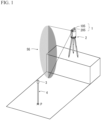
- FIG. 1 is a schematic perspective view to illustrate an outline of a guide light irradiation device 1 according to the present invention.
- the guide light irradiation device 1 is a device capable of irradiating synthetic guide light SG consisting of lights different in pattern between the left and the right of a center, and is equipped in a total station 2 having a distance and angle measuring function.
- the guide light irradiation device 1 includes irradiators 105 and 205 juxtaposed in the up-down direction. Synthetic light of lights respectively irradiated from the irradiators 105 and 205 is irradiated as the synthetic guide light SG from the guide light irradiation device 1.
- An irradiation direction of the synthetic guide light SG and a collimation direction of the total station 2 are configured so as to match in the horizontal direction, so that fan-shaped synthetic guide light SG that differs in pattern between the left and the right of a collimation axis of the total station 2 as a boundary on a horizontal plane, and extends in the up-down direction, is irradiated.
- the total station 2 is installed at a known point and collimated in a direction toward a piling point P, and irradiates the synthetic guide light SG by the guide light irradiation device 1.
- An operator who holds a pole 4 equipped with a prism 3 as a target of the total station 2 can determine which side the operator should move to, the left or the right by himself/herself according to a pattern of the synthetic guide light SG viewable from the guide light irradiation device 1.
- the synthetic guide light SG is configured so that, as viewed from an operator side, red light is viewed at the right side, and green light is viewed at the left side.
- the piling point P can be set by measuring the distance of the prism 3 at the total station 2 and confirming the distance.
- the synthetic guide light SG is light extending long in the vertical direction, so that even when there is a level difference between the installation position of the total station 2 and the piling point P as illustrated in FIG. 1 , an operator can confirm the synthetic guide light SG.
- the synthetic guide light SG is high in luminosity, and a range of use of the guide light irradiation device 1 (distance and range in which an operator can visually recognize the synthetic guide light SG) is comparatively large.
- the synthetic guide light SG is bright, and a range in which the synthetic guide light SG is visually recognized is large, so that an operator can easily find the synthetic guide light SG.
- lights in various patterns can be used such as, in addition to lights in colors different between the left and the right, a combination one of which being blinking light and the other being continuous light, or lights different in blinking period between the left and the right.
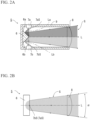
- FIGS. 2A and 2B illustrate an irradiator 5, and FIG. 2A is a horizontal sectional view of the irradiator 5, and FIG. 2B is a side view to illustrate irradiation light (guide light) of the irradiator 5.
- irradiation light is colored to describe a state of the guide light.
- light-emitting diodes 7a and 7b are omitted and only light sources 7aS and 7bS are illustrated, and the housing is also omitted (the same applies to FIG. 4 , FIG. 6 , FIG. 7 , FIG. 8, and FIG. 9 described later).
- Dispositions of the light sources 7aS and 7bS match in a side view, so that one disposed at the rear side is expressed using parentheses.
- each angle does not reflect an actual ratio, and the configuration is schematically illustrated (the same applies to FIG. 3 to FIG. 9 described later).
- the irradiator 5 includes, as optical systems, a pair of light-emitting diodes 7a and 7b, a right-angle mirror 6, and a lens 8 that is a collimating lens as a condenser lens. These optical systems are held in a housing 9.
- the right-angle mirror 6 has reflecting surfaces 6a and 6b, and they make a right angle with each other.
- the lens 8 is fixed to a tip end opening of the box-shaped housing 9, and the right-angle mirror 6 is disposed so that a ridge of the reflecting surfaces 6a and 6b matches a vertical line passing through a rear focal point of the lens 8 on an optical axis L of the lens 8.
- the reflecting surfaces 6a and 6b face the lens 8 side, and tilt at equal angles in directions opposite to the optical axis L.
- the red light-emitting diode 7a is disposed on a reflecting optical axis La of one reflecting surface 6a
- the green light-emitting diode 7b is disposed on a reflecting optical axis Lb of the other reflecting surface 6b, respectively.
- Red light irradiated from the light source 7aS of the red light-emitting diode 7a is reflected by the reflecting surface 6a
- green light irradiated from the light source 7bS of the green light-emitting diode 7b is reflected by the reflecting surface 6b, respectively, and are irradiated as guide light G from the lens 8 while being divided into two emission colors by the vertical line at the optical axis L.
- the guide light G that has exited from the lens 8 is irradiated forward in an irradiation direction set to the optical axis L while being diffused at a diffusion angle (expansion angle) ⁇ in the vertical direction.
- An apex of the right-angle mirror 6 is disposed at an image forming position (rear focal point) when looking into the lens 8 from a distance, so that a boundary between the red light and the green light can be projected sharply and clearly.
- the guide light irradiation device 1 includes two irradiators 105 and 205 each having the above-described configuration.
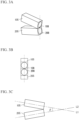
- FIGS. 3A, 3B, and 3C are layout drawings to describe dispositions of the respective irradiators, and FIG. 3A is a perspective view, FIG. 3B is a front view, and FIG. 3C is a left side view.
- FIG. 4 is a schematic left side view to describe a state of irradiation lights and dispositions of components of the guide light irradiation device 1.
- the irradiators 105 and 205 are arranged one above the other by disposing the irradiator 105 at the upper side and the irradiator 205 at the lower side while tilting the end portion sides with the lenses 108 and 208 close to each other so that optical axes L1 and L2 as irradiation directions of the irradiators 105 and 205 match in the horizontal direction, and make a predetermined angle ⁇ with each other in the vertical direction.
- the irradiator 105 has the same configuration as in FIG. 2 , and has a right-angle mirror 106 disposed on an optical axis L1 of a lens 108, lights emitted from light sources 107aS and 107bS are formed as guide light G1 that differs in pattern between the left and the right of a vertical axis by the right-angle mirror 106, and the guide light G1 is irradiated forward in an irradiation direction set to the optical axis L1 from the lens 108.
- the irradiator 205 is also configured in the same manner, and has a right-angle mirror 206 disposed on an optical axis L2 of a lens 208, and lights emitted from light sources 207aS and 207bS are formed as guide light G2 that differs in pattern between the left and the right of a vertical axis by the right-angle mirror 206, and the guide light G2 is irradiated forward in an irradiation direction set to the optical axis L2 from the lens 208.
- the dispositions are adjusted so that an angle ⁇ in the vertical direction between the irradiators 105 and 205 becomes smaller than a light diffusion angle ⁇ of a single irradiator 105, 205 in the vertical direction.
- an angle resolution (visual angle) of a human eye having 20/20 vision is 1 arc-minute
- the light sources are viewed as not individual light sources but one light source as a sum of brightnesses of the respective light sources viewed singly. That is, by setting the angle ⁇ to 1 arc-minute or less, lights irradiated from the irradiators 105 and 205 are viewed as being summed for an operator, and an effect of extending a reach distance of the synthetic guide light SG to be longer than the guide light G1 of a single irradiator 105 is obtained.
- two irradiators are arranged in the up-down direction and irradiate lights upward and downward, so that the synthetic guide light SG extends to be vertically longer than the guide light G1, and this enables use at a location with level differences, and enables the synthetic guide light SG to be easily found.
- the assumed use distance A is determined according to specifications such as a reach limit distance of the synthetic guide light SG determined from luminances of light-emitting diodes and lenses to be used, and use conditions such as a requested permissible level difference.
- FIGS. 5A, 5B, and 5C are layout drawings to describe dispositions of irradiators to be equipped in a guide light irradiation device 101 according to a second embodiment
- FIG. 5A is a perspective view
- FIG. 5B is a front view
- FIG. 5C is a left side view
- FIG. 6 is a schematic left side view to describe a state of irradiation lights of the guide light irradiation device 101 and dispositions of components.
- the guide light irradiation device 101 includes three irradiators 305, 405, and 505 juxtaposed in the up-down direction.
- the irradiators 305, 405, and 505 are juxtaposed in the up-down direction in the order of irradiators 305, 405, and 505 from the upper side while tilting the end portion sides with lenses 308, 408, and 508 close to each other so that optical axes L3, L4, and L5 as irradiation directions of the irradiators 305, 405, and 505 match each other in the horizontal direction, and optical axes of the irradiators adjacent to each other (L3 and L4, L4 and L5) make a predetermined angle ⁇ with each other in the vertical direction.
- the irradiator 305 includes a pair of light sources 307aS and 307bS, a right-angle mirror 306, and the lens 308,
- the irradiator 405 includes a pair of light sources 407aS and 407bS, a right-angle mirror 406, and the lens 408,
- the irradiator 505 includes a pair of light sources 507aS and 507bS, a right-angle mirror 506, and the lens 508, respectively configured in the same manner as in FIG. 2A and FIG. 2B .
- Synthetic light of guide lights G3, G4, and G5 irradiated from the respective irradiators 305, 405, and 505 becomes synthetic guide light SG1 of the guide light irradiation device 101.
- Irradiation directions of the respective guide lights are directions of the respective optical axes, and the predetermined angle ⁇ in the vertical direction is configured so as to become equal to or less than a diffusion angle ⁇ in the vertical direction, and therefore, a gap that is not covered by the synthetic guide light SG1 is not generated.
- a disposition distance d between irradiators adjacent to each other is also configured so that an angle ⁇ between line segments from the assumed use distance A to lens centers becomes equal to or less than 1 arc-minute.
- the Synthetic guide light SG1 irradiated from the guide light irradiation device 101 is visually recognized as one light obtained by summing brightnesses of the respective light sources as viewed from the assumed use distance A.
- luminosity of the synthetic guide light SG1 is viewed to be higher than luminosity of the guide light G in the case of using a single irradiator 5 and luminosity of the synthetic guide light SG made by two irradiators in the first embodiment, and as compared with these cases, the guide light irradiation device 101 can extend its use distance longer.
- the synthetic guide light SG1 can be extended longer in the up-down direction than in the embodiment described above, so that the device can be widely used even at locations with level differences, etc.
- FIG. 7 is a schematic side view illustrating a configuration of a guide light irradiation device 201 according to a third embodiment.
- the guide light irradiation device 201 includes two irradiators 605 and 705 arranged in the up-down direction as in the first embodiment.
- two pairs of light sources 607aS and 607bS, 707aS and 707bS, and two right-angle mirrors 606 and 706, are included, however, as a difference from the first embodiment, the lenses are unified and only one shared lens 608 is used.
- the light sources and the right-angle mirrors are disposed in the same manner as in the first embodiment, and in the irradiator 605, lights emitted from the pair of light sources 607aS and 607bS are reflected by the right-angle mirror 606, and guide light G6 that differs in pattern between the left and the right of a boundary set in the vertical direction is formed, and in the irradiator 705, lights emitted from the pair of light sources 707aS and 707bS are reflected in the same manner by the right-angle mirror 706, and guide light G7 patterned in the same manner as the guide light G6 is formed.
- the right-angle mirrors 606 and 706 are disposed so that ridges of the mirrors match a vertical plane including an optical axis L6 of the lens 608.
- the right-angle mirrors 606 and 706 and respective corresponding light sources are disposed vertically symmetrically about a central axis of the lens 608.
- Both of the guide lights G6 and G7 enter the single lens 608 and exit forward as synthetic guide light SG2 from the surface of the lens.
- the guide light G6 formed by the right-angle mirror 606 disposed higher than the center of the lens 608 enters the lens 608 from a side slightly higher than the front as a whole, and is irradiated while tilting downward at a gentle angle from the surface of the lens 608.
- the guide light G7 formed by the right-angle mirror 706 disposed lower than the center of the lens 608 enters the lens 608 from a side slightly lower than the front, and is irradiated while tilting upward at a gentle angle from the surface of the lens 608.
- Irradiation directions DR6 and DR7 that are exit directions of the guide lights G6 and G7 of the irradiators 605 and 705 from the lens 608, and further, the optical axis L6, cross each other at the center of the lens 608. That is, dispositions of the irradiators 605 and 705 are adjusted so that guide lights G6 and G7 of the irradiators pass through the center of the lens 608.
- an angle ⁇ between the irradiation directions DR6 and DR7 is configured to be smaller than light diffusion angles ⁇ of the respective guide lights G6 and G7 in the vertical direction.
- each irradiator includes a lens, however, in the present embodiment, the lenses are unified, and the guide light irradiation device 201 includes only a single lens 608.
- a disposition distance d (refer to FIG. 4 and FIG. 6 ) as a lens-to-lens distance can be set to 0, and the device can be reduced in size and simplified by reducing in the number of components.
- FIG. 8 is a schematic side view illustrating a configuration of a guide light irradiation device 301 according to a fourth embodiment.
- the guide light irradiation device 301 includes two irradiators 805 and 905 arranged in the up-down direction.
- the irradiators 805 and 905 respectively include a pair of light sources 807aS and 807bS and a pair of light sources 907aS and 907bS, they use a shared single lens 808 and a shared single right-angle mirror 806.
- a right-angle mirror is also shared.
- the right-angle mirror 806 is disposed so that its ridge matches a vertical line at a rear focal point of the lens 808 on an optical axis L8 of the lens 808.
- the pair of light sources 807aS and 807bS and the pair of light sources 907aS and 907bS of the irradiators 805 and 905 arranged one above the other, are disposed vertically symmetrically about a central horizontal plane of the lens 808 as an axis. It is preferable that lens shapes of diodes of these light sources are adjusted or the light sources are tilted from the horizontal direction while directly facing each other so that lights reflected by the right-angle mirror 806 turns slightly downward/upward with respect to the optical axis L8.
- Lights emitted from the pair of light sources 807aS and 807bS of the irradiator 805 disposed at the upper side are reflected by an upper portion of the right-angle mirror 806, and guide light G8 is formed.
- the guide light G8 enters the lens 808 at a downward angle as a whole.
- lights emitted from the pair of light sources 907aS and 907bS of the irradiator 905 disposed at the lower side are reflected by a lower portion of the right-angle mirror, and guide light G9 is formed.
- the guide light G9 enters the lens 808 at an upward angle as a whole.
- an angle ⁇ between the irradiation directions DR8 and DR9 of the guide lights G8 and G9 of the irradiators 805 and 905 is configured to be smaller than light diffusion angles ⁇ of the respective guide lights G8 and G9 in the vertical direction.
- a guide light irradiation device 301A is illustrated in FIG. 9 .
- the guide light irradiation device 301A is configured by further adding a lenticular lens 810 to the guide light irradiation device 301.
- the lenticular lens has properties to diffuse light in one direction, and the lenticular lens 810 is disposed on an optical axis L8 in front of an exit surface of the lens 808 by being adjusted in direction so as to diffuse light in the up-down direction.
- Synthetic guide light SG3A emitted through the lenticular lens 810 extends longer in the vertical direction than the synthetic guide light SG3, so that the guide light irradiation device 301 enable use on a survey site with larger level differences.
Landscapes
- Engineering & Computer Science (AREA)
- General Engineering & Computer Science (AREA)
- Physics & Mathematics (AREA)
- General Physics & Mathematics (AREA)
- Radar, Positioning & Navigation (AREA)
- Remote Sensing (AREA)
- Non-Portable Lighting Devices Or Systems Thereof (AREA)
- Planar Illumination Modules (AREA)
Claims (7)
- Führungslichtabstrahlvorrichtung (1) zum Abstrahlen von Führungslicht (G), um einem Vermessungsoperator eine Richtung anzuzeigen,
dadurch gekennzeichnet, dass sie aufweist:mehrere Strahlungsvorrichtungen (5), die jeweils dazu ausgebildet sind, Führungslicht (G) abzustrahlen, das sich hinsichtlich des Musters zwischen der linken und der rechten Seite einer Abstrahlrichtung als Mitte unterscheidet, wobeidie mehreren Strahlungsvorrichtungen (5) in von oben nach unten verlaufender Richtung nebeneinanderliegen, undsynthetisches Licht von Führungslichtern (G), welche von den jeweiligen Strahlungsvorrichtungen (5) abgestrahlt werden, als synthetisches Führungslicht (SG) abgestrahlt wird. - Führungslichtabstrahlvorrichtung (1) nach Anspruch 1, bei welcher
jede der Strahlungsvorrichtungen (5) zwei Lichtquellen (7a, 7b), die dazu ausgebildet sind, jeweils Licht für linke und rechte Muster des Führungslichts (G) zu emittieren, ein optisches Element (6), das dazu ausgebildet ist, von den beiden Lichtquellen emittiertes Licht als Lichter zu formen, die sich hinsichtlich des Musters zwischen der linken und der rechten Seite unterscheiden, und eine Sammellinse (8) aufweist, die dazu ausgebildet ist, das Austreten des Führungslichts (G) zu bewirken. - Führungslichtabstrahlvorrichtung (1) nach Anspruch 1 oder 2, bei welcher
die mehreren Strahlungsvorrichtungen (5) so angeordnet sind, dass ihre Abstrahlrichtungen in horizontaler Richtung übereinstimmen und in vertikaler Richtung einen vorbestimmten Winkel (β) miteinander bilden. - Führungslichtabstrahlvorrichtung (1) nach einem der Ansprüche 1 bis 3, bei welcher
der vorbestimmte Winkel (β) zwischen Abstrahlrichtungen der mehreren Strahlungsvorrichtungen (5) so ausgebildet ist, dass er kleiner ist als ein Lichtdiffusionswinkel (a) in der vertikalen Richtung in einer einzelnen der Strahlungsvorrichtungen (5). - Führungslichtabstrahlvorrichtung (1) nach einem der Ansprüche 1 bis 4, bei welcher
eine Entfernung (d) in der vertikalen Richtung zwischen Lichtemissionseinheiten der mehreren Strahlungsvorrichtungen (5), deren Abstrahlrichtungen einen vorbestimmten Winkel (β) miteinander bilden, so ausgelegt ist, dass ein Winkel (γ) zwischen Liniensegmenten von einem Punkt in einer angenommenen Nutzentfernung der Führungslichtabstrahlvorrichtung (1) von der Führungslichtabstrahlvorrichtung (1) zu den jeweiligen Lichtemissionseinheiten 1 Bogenminute oder geringer wird. - Führungslichtabstrahlvorrichtung (1) nach Anspruch 1, bei welcherjede der Strahlungsvorrichtungen (5) zwei Lichtquellen (7a, 7b), die dazu ausgebildet sind, jeweils Licht für linke und rechte Muster des Führungslichts (G) zu emittieren, aufweist,wobei die Führungslichtabstrahlvorrichtung (1) ein optisches Element (6) aufweist, das dazu ausgebildet ist, von den beiden Lichtquellen (7a, 7b) emittiertes Licht als Lichter zu formen, die sich hinsichtlich des Musters zwischen der linken und der rechten Seite unterscheiden,wobei die mehreren Strahlungsvorrichtungen (5) eine gemeinsame, einzelne Sammellinse (8) aufweisen, die dazu ausgebildet ist, das Austreten des Führungslichts (G) zu bewirken.
- Führungslichtabstrahlvorrichtung (1) nach Anspruch 1, bei welcherjede der Strahlungsvorrichtungen (5) zwei Lichtquellen (7a, 7b), die dazu ausgebildet sind, jeweils Licht für linke und rechte Muster des Führungslichts (G) zu emittieren, und eine Sammellinse (8) aufweist, die dazu ausgebildet ist, das Austreten des Führungslichts (G) zu bewirken,wobei die mehreren Strahlungsvorrichtungen (5) ein gemeinsames, einzelnes optisches Element (806) aufweisen, das dazu ausgebildet ist, von den beiden Lichtquellen (7a, 7b) emittiertes Licht als Lichter zu formen, die sich hinsichtlich des Musters zwischen der linken und der rechten Seite unterscheiden.
Applications Claiming Priority (1)
| Application Number | Priority Date | Filing Date | Title |
|---|---|---|---|
| JP2019067256A JP7178310B2 (ja) | 2019-03-29 | 2019-03-29 | ガイド光照射装置 |
Publications (2)
| Publication Number | Publication Date |
|---|---|
| EP3722748A1 EP3722748A1 (de) | 2020-10-14 |
| EP3722748B1 true EP3722748B1 (de) | 2024-09-18 |
Family
ID=69845195
Family Applications (1)
| Application Number | Title | Priority Date | Filing Date |
|---|---|---|---|
| EP20163618.0A Active EP3722748B1 (de) | 2019-03-29 | 2020-03-17 | Führungslichtstrahlungsvorrichtung |
Country Status (3)
| Country | Link |
|---|---|
| US (1) | US10900639B2 (de) |
| EP (1) | EP3722748B1 (de) |
| JP (1) | JP7178310B2 (de) |
Families Citing this family (1)
| Publication number | Priority date | Publication date | Assignee | Title |
|---|---|---|---|---|
| WO2024262412A1 (ja) * | 2023-06-22 | 2024-12-26 | 株式会社トプコン | 測量装置 |
Family Cites Families (10)
| Publication number | Priority date | Publication date | Assignee | Title |
|---|---|---|---|---|
| JP2587810Y2 (ja) * | 1991-09-26 | 1998-12-24 | 株式会社ソキア | ガイド光装置 |
| JPH0674770A (ja) * | 1992-08-25 | 1994-03-18 | Nikon Corp | ポイント設定装置 |
| JP3941215B2 (ja) * | 1998-04-16 | 2007-07-04 | 株式会社ニコン | 測量機及びポイント設定方法 |
| JP4379848B2 (ja) | 2000-09-25 | 2009-12-09 | 株式会社 ソキア・トプコン | 測量機のガイド光装置 |
| JP3809136B2 (ja) | 2002-08-21 | 2006-08-16 | ペンタックス株式会社 | 測点指示装置 |
| JP5725922B2 (ja) * | 2011-03-25 | 2015-05-27 | 株式会社トプコン | 測量システム及びこの測量システムに用いる測量用ポール及びこの測量システムに用いる携帯型無線送受信装置 |
| JP6025014B2 (ja) * | 2012-02-22 | 2016-11-16 | 株式会社リコー | 距離測定装置 |
| JP6111617B2 (ja) * | 2012-07-03 | 2017-04-12 | 株式会社リコー | レーザレーダ装置 |
| JP6227324B2 (ja) | 2013-08-23 | 2017-11-08 | 株式会社トプコン | 測量機及び測量作業システム |
| JP6167821B2 (ja) * | 2013-10-02 | 2017-07-26 | 富士ゼロックス株式会社 | 検査装置 |
-
2019
- 2019-03-29 JP JP2019067256A patent/JP7178310B2/ja active Active
-
2020
- 2020-03-12 US US16/817,060 patent/US10900639B2/en active Active
- 2020-03-17 EP EP20163618.0A patent/EP3722748B1/de active Active
Also Published As
| Publication number | Publication date |
|---|---|
| JP2020165838A (ja) | 2020-10-08 |
| JP7178310B2 (ja) | 2022-11-25 |
| US10900639B2 (en) | 2021-01-26 |
| US20200309350A1 (en) | 2020-10-01 |
| EP3722748A1 (de) | 2020-10-14 |
Similar Documents
| Publication | Publication Date | Title |
|---|---|---|
| CN107327777B (zh) | 车辆用灯具控制系统以及具备车辆用灯具控制系统的车辆 | |
| CN101285561B (zh) | 车辆用灯具单元 | |
| KR20200080838A (ko) | 차량용 램프 | |
| US20200341120A1 (en) | Lidar integrated lamp apparatus of vehicle | |
| US10746368B2 (en) | Vehicular headlight | |
| EP3786580B1 (de) | Vermessungsinstrument mit führungslichtbestrahlungseinheit | |
| KR102432262B1 (ko) | 차량 조명 모듈 | |
| JP2013257996A (ja) | 近赤外線投光器 | |
| EP2818789A2 (de) | Beleuchtungseinheit für Fahrzeuglampe | |
| KR20210086677A (ko) | 자동차 헤드램프용 조명 장치 및 자동차 헤드램프 | |
| CN112219062A (zh) | 用于机动车辆的照明模块,以及设有这种模块的照明和/或发信号装置 | |
| EP1795863B1 (de) | Optische Vorrichtung | |
| EP3722748B1 (de) | Führungslichtstrahlungsvorrichtung | |
| US11072274B2 (en) | Pixelated light module for a motor vehicle and lighting and/or signalling device provided with such a module | |
| EP3715784B1 (de) | Führungslichtstrahlungsvorrichtung | |
| US10690932B2 (en) | Lighting device | |
| JP6868491B2 (ja) | 車両用前照灯 | |
| JP6183650B2 (ja) | 車両用前照灯 | |
| JP7178312B2 (ja) | ガイド光照射装置 | |
| EP3992527B1 (de) | Beleuchtungsvorrichtung und beleuchtungsverfahren | |
| JP2022164850A (ja) | 光学装置、測距装置及び測距方法 | |
| JPH11249609A (ja) | 方位表示装置 | |
| KR20240113269A (ko) | 차량용 램프 | |
| JP2019029316A (ja) | 照明装置 |
Legal Events
| Date | Code | Title | Description |
|---|---|---|---|
| PUAI | Public reference made under article 153(3) epc to a published international application that has entered the european phase |
Free format text: ORIGINAL CODE: 0009012 |
|
| STAA | Information on the status of an ep patent application or granted ep patent |
Free format text: STATUS: THE APPLICATION HAS BEEN PUBLISHED |
|
| AK | Designated contracting states |
Kind code of ref document: A1 Designated state(s): AL AT BE BG CH CY CZ DE DK EE ES FI FR GB GR HR HU IE IS IT LI LT LU LV MC MK MT NL NO PL PT RO RS SE SI SK SM TR |
|
| AX | Request for extension of the european patent |
Extension state: BA ME |
|
| STAA | Information on the status of an ep patent application or granted ep patent |
Free format text: STATUS: REQUEST FOR EXAMINATION WAS MADE |
|
| 17P | Request for examination filed |
Effective date: 20210412 |
|
| RBV | Designated contracting states (corrected) |
Designated state(s): AL AT BE BG CH CY CZ DE DK EE ES FI FR GB GR HR HU IE IS IT LI LT LU LV MC MK MT NL NO PL PT RO RS SE SI SK SM TR |
|
| STAA | Information on the status of an ep patent application or granted ep patent |
Free format text: STATUS: EXAMINATION IS IN PROGRESS |
|
| 17Q | First examination report despatched |
Effective date: 20220225 |
|
| RIN1 | Information on inventor provided before grant (corrected) |
Inventor name: SUGIURA, AKINOBU |
|
| GRAP | Despatch of communication of intention to grant a patent |
Free format text: ORIGINAL CODE: EPIDOSNIGR1 |
|
| STAA | Information on the status of an ep patent application or granted ep patent |
Free format text: STATUS: GRANT OF PATENT IS INTENDED |
|
| INTG | Intention to grant announced |
Effective date: 20240412 |
|
| GRAS | Grant fee paid |
Free format text: ORIGINAL CODE: EPIDOSNIGR3 |
|
| GRAA | (expected) grant |
Free format text: ORIGINAL CODE: 0009210 |
|
| STAA | Information on the status of an ep patent application or granted ep patent |
Free format text: STATUS: THE PATENT HAS BEEN GRANTED |
|
| AK | Designated contracting states |
Kind code of ref document: B1 Designated state(s): AL AT BE BG CH CY CZ DE DK EE ES FI FR GB GR HR HU IE IS IT LI LT LU LV MC MK MT NL NO PL PT RO RS SE SI SK SM TR |
|
| REG | Reference to a national code |
Ref country code: GB Ref legal event code: FG4D |
|
| REG | Reference to a national code |
Ref country code: CH Ref legal event code: EP |
|
| REG | Reference to a national code |
Ref country code: IE Ref legal event code: FG4D |
|
| REG | Reference to a national code |
Ref country code: DE Ref legal event code: R096 Ref document number: 602020037786 Country of ref document: DE |
|
| REG | Reference to a national code |
Ref country code: LT Ref legal event code: MG9D |
|
| PG25 | Lapsed in a contracting state [announced via postgrant information from national office to epo] |
Ref country code: NO Free format text: LAPSE BECAUSE OF FAILURE TO SUBMIT A TRANSLATION OF THE DESCRIPTION OR TO PAY THE FEE WITHIN THE PRESCRIBED TIME-LIMIT Effective date: 20241218 |
|
| PG25 | Lapsed in a contracting state [announced via postgrant information from national office to epo] |
Ref country code: GR Free format text: LAPSE BECAUSE OF FAILURE TO SUBMIT A TRANSLATION OF THE DESCRIPTION OR TO PAY THE FEE WITHIN THE PRESCRIBED TIME-LIMIT Effective date: 20241219 Ref country code: FI Free format text: LAPSE BECAUSE OF FAILURE TO SUBMIT A TRANSLATION OF THE DESCRIPTION OR TO PAY THE FEE WITHIN THE PRESCRIBED TIME-LIMIT Effective date: 20240918 |
|
| PG25 | Lapsed in a contracting state [announced via postgrant information from national office to epo] |
Ref country code: BG Free format text: LAPSE BECAUSE OF FAILURE TO SUBMIT A TRANSLATION OF THE DESCRIPTION OR TO PAY THE FEE WITHIN THE PRESCRIBED TIME-LIMIT Effective date: 20240918 |
|
| PG25 | Lapsed in a contracting state [announced via postgrant information from national office to epo] |
Ref country code: LV Free format text: LAPSE BECAUSE OF FAILURE TO SUBMIT A TRANSLATION OF THE DESCRIPTION OR TO PAY THE FEE WITHIN THE PRESCRIBED TIME-LIMIT Effective date: 20240918 |
|
| PG25 | Lapsed in a contracting state [announced via postgrant information from national office to epo] |
Ref country code: HR Free format text: LAPSE BECAUSE OF FAILURE TO SUBMIT A TRANSLATION OF THE DESCRIPTION OR TO PAY THE FEE WITHIN THE PRESCRIBED TIME-LIMIT Effective date: 20240918 |
|
| REG | Reference to a national code |
Ref country code: NL Ref legal event code: MP Effective date: 20240918 |
|
| PG25 | Lapsed in a contracting state [announced via postgrant information from national office to epo] |
Ref country code: RS Free format text: LAPSE BECAUSE OF FAILURE TO SUBMIT A TRANSLATION OF THE DESCRIPTION OR TO PAY THE FEE WITHIN THE PRESCRIBED TIME-LIMIT Effective date: 20241218 |
|
| PG25 | Lapsed in a contracting state [announced via postgrant information from national office to epo] |
Ref country code: RS Free format text: LAPSE BECAUSE OF FAILURE TO SUBMIT A TRANSLATION OF THE DESCRIPTION OR TO PAY THE FEE WITHIN THE PRESCRIBED TIME-LIMIT Effective date: 20241218 Ref country code: NO Free format text: LAPSE BECAUSE OF FAILURE TO SUBMIT A TRANSLATION OF THE DESCRIPTION OR TO PAY THE FEE WITHIN THE PRESCRIBED TIME-LIMIT Effective date: 20241218 Ref country code: LV Free format text: LAPSE BECAUSE OF FAILURE TO SUBMIT A TRANSLATION OF THE DESCRIPTION OR TO PAY THE FEE WITHIN THE PRESCRIBED TIME-LIMIT Effective date: 20240918 Ref country code: HR Free format text: LAPSE BECAUSE OF FAILURE TO SUBMIT A TRANSLATION OF THE DESCRIPTION OR TO PAY THE FEE WITHIN THE PRESCRIBED TIME-LIMIT Effective date: 20240918 Ref country code: GR Free format text: LAPSE BECAUSE OF FAILURE TO SUBMIT A TRANSLATION OF THE DESCRIPTION OR TO PAY THE FEE WITHIN THE PRESCRIBED TIME-LIMIT Effective date: 20241219 Ref country code: FI Free format text: LAPSE BECAUSE OF FAILURE TO SUBMIT A TRANSLATION OF THE DESCRIPTION OR TO PAY THE FEE WITHIN THE PRESCRIBED TIME-LIMIT Effective date: 20240918 Ref country code: BG Free format text: LAPSE BECAUSE OF FAILURE TO SUBMIT A TRANSLATION OF THE DESCRIPTION OR TO PAY THE FEE WITHIN THE PRESCRIBED TIME-LIMIT Effective date: 20240918 |
|
| REG | Reference to a national code |
Ref country code: AT Ref legal event code: MK05 Ref document number: 1725036 Country of ref document: AT Kind code of ref document: T Effective date: 20240918 |
|
| PG25 | Lapsed in a contracting state [announced via postgrant information from national office to epo] |
Ref country code: NL Free format text: LAPSE BECAUSE OF FAILURE TO SUBMIT A TRANSLATION OF THE DESCRIPTION OR TO PAY THE FEE WITHIN THE PRESCRIBED TIME-LIMIT Effective date: 20240918 |
|
| PG25 | Lapsed in a contracting state [announced via postgrant information from national office to epo] |
Ref country code: PT Free format text: LAPSE BECAUSE OF FAILURE TO SUBMIT A TRANSLATION OF THE DESCRIPTION OR TO PAY THE FEE WITHIN THE PRESCRIBED TIME-LIMIT Effective date: 20250120 Ref country code: IS Free format text: LAPSE BECAUSE OF FAILURE TO SUBMIT A TRANSLATION OF THE DESCRIPTION OR TO PAY THE FEE WITHIN THE PRESCRIBED TIME-LIMIT Effective date: 20250118 |
|
| PGFP | Annual fee paid to national office [announced via postgrant information from national office to epo] |
Ref country code: DE Payment date: 20250128 Year of fee payment: 6 |
|
| PG25 | Lapsed in a contracting state [announced via postgrant information from national office to epo] |
Ref country code: RO Free format text: LAPSE BECAUSE OF FAILURE TO SUBMIT A TRANSLATION OF THE DESCRIPTION OR TO PAY THE FEE WITHIN THE PRESCRIBED TIME-LIMIT Effective date: 20240918 Ref country code: SM Free format text: LAPSE BECAUSE OF FAILURE TO SUBMIT A TRANSLATION OF THE DESCRIPTION OR TO PAY THE FEE WITHIN THE PRESCRIBED TIME-LIMIT Effective date: 20240918 |
|
| PG25 | Lapsed in a contracting state [announced via postgrant information from national office to epo] |
Ref country code: ES Free format text: LAPSE BECAUSE OF FAILURE TO SUBMIT A TRANSLATION OF THE DESCRIPTION OR TO PAY THE FEE WITHIN THE PRESCRIBED TIME-LIMIT Effective date: 20240918 |
|
| PG25 | Lapsed in a contracting state [announced via postgrant information from national office to epo] |
Ref country code: AT Free format text: LAPSE BECAUSE OF FAILURE TO SUBMIT A TRANSLATION OF THE DESCRIPTION OR TO PAY THE FEE WITHIN THE PRESCRIBED TIME-LIMIT Effective date: 20240918 Ref country code: EE Free format text: LAPSE BECAUSE OF FAILURE TO SUBMIT A TRANSLATION OF THE DESCRIPTION OR TO PAY THE FEE WITHIN THE PRESCRIBED TIME-LIMIT Effective date: 20240918 |
|
| PG25 | Lapsed in a contracting state [announced via postgrant information from national office to epo] |
Ref country code: CZ Free format text: LAPSE BECAUSE OF FAILURE TO SUBMIT A TRANSLATION OF THE DESCRIPTION OR TO PAY THE FEE WITHIN THE PRESCRIBED TIME-LIMIT Effective date: 20240918 Ref country code: PL Free format text: LAPSE BECAUSE OF FAILURE TO SUBMIT A TRANSLATION OF THE DESCRIPTION OR TO PAY THE FEE WITHIN THE PRESCRIBED TIME-LIMIT Effective date: 20240918 |
|
| PG25 | Lapsed in a contracting state [announced via postgrant information from national office to epo] |
Ref country code: IT Free format text: LAPSE BECAUSE OF FAILURE TO SUBMIT A TRANSLATION OF THE DESCRIPTION OR TO PAY THE FEE WITHIN THE PRESCRIBED TIME-LIMIT Effective date: 20240918 Ref country code: SK Free format text: LAPSE BECAUSE OF FAILURE TO SUBMIT A TRANSLATION OF THE DESCRIPTION OR TO PAY THE FEE WITHIN THE PRESCRIBED TIME-LIMIT Effective date: 20240918 |
|
| REG | Reference to a national code |
Ref country code: DE Ref legal event code: R097 Ref document number: 602020037786 Country of ref document: DE |
|
| PG25 | Lapsed in a contracting state [announced via postgrant information from national office to epo] |
Ref country code: DK Free format text: LAPSE BECAUSE OF FAILURE TO SUBMIT A TRANSLATION OF THE DESCRIPTION OR TO PAY THE FEE WITHIN THE PRESCRIBED TIME-LIMIT Effective date: 20240918 |
|
| PGFP | Annual fee paid to national office [announced via postgrant information from national office to epo] |
Ref country code: CH Payment date: 20250401 Year of fee payment: 6 |
|
| PLBE | No opposition filed within time limit |
Free format text: ORIGINAL CODE: 0009261 |
|
| STAA | Information on the status of an ep patent application or granted ep patent |
Free format text: STATUS: NO OPPOSITION FILED WITHIN TIME LIMIT |
|
| 26N | No opposition filed |
Effective date: 20250619 |
|
| PG25 | Lapsed in a contracting state [announced via postgrant information from national office to epo] |
Ref country code: SE Free format text: LAPSE BECAUSE OF FAILURE TO SUBMIT A TRANSLATION OF THE DESCRIPTION OR TO PAY THE FEE WITHIN THE PRESCRIBED TIME-LIMIT Effective date: 20240918 |
|
| PG25 | Lapsed in a contracting state [announced via postgrant information from national office to epo] |
Ref country code: MC Free format text: LAPSE BECAUSE OF FAILURE TO SUBMIT A TRANSLATION OF THE DESCRIPTION OR TO PAY THE FEE WITHIN THE PRESCRIBED TIME-LIMIT Effective date: 20240918 |
|
| PG25 | Lapsed in a contracting state [announced via postgrant information from national office to epo] |
Ref country code: LU Free format text: LAPSE BECAUSE OF NON-PAYMENT OF DUE FEES Effective date: 20250317 |
|
| GBPC | Gb: european patent ceased through non-payment of renewal fee |
Effective date: 20250317 |