EP3720526B1 - Medical delivery device with axially expandable drive ribbon - Google Patents
Medical delivery device with axially expandable drive ribbon Download PDFInfo
- Publication number
- EP3720526B1 EP3720526B1 EP18821853.1A EP18821853A EP3720526B1 EP 3720526 B1 EP3720526 B1 EP 3720526B1 EP 18821853 A EP18821853 A EP 18821853A EP 3720526 B1 EP3720526 B1 EP 3720526B1
- Authority
- EP
- European Patent Office
- Prior art keywords
- drive
- ribbon
- drive ribbon
- cassette
- module
- Prior art date
- Legal status (The legal status is an assumption and is not a legal conclusion. Google has not performed a legal analysis and makes no representation as to the accuracy of the status listed.)
- Active
Links
Images























Classifications
-
- A—HUMAN NECESSITIES
- A61—MEDICAL OR VETERINARY SCIENCE; HYGIENE
- A61M—DEVICES FOR INTRODUCING MEDIA INTO, OR ONTO, THE BODY; DEVICES FOR TRANSDUCING BODY MEDIA OR FOR TAKING MEDIA FROM THE BODY; DEVICES FOR PRODUCING OR ENDING SLEEP OR STUPOR
- A61M5/00—Devices for bringing media into the body in a subcutaneous, intra-vascular or intramuscular way; Accessories therefor, e.g. filling or cleaning devices, arm-rests
- A61M5/178—Syringes
- A61M5/31—Details
- A61M5/315—Pistons; Piston-rods; Guiding, blocking or restricting the movement of the rod or piston; Appliances on the rod for facilitating dosing ; Dosing mechanisms
- A61M5/31511—Piston or piston-rod constructions, e.g. connection of piston with piston-rod
-
- A—HUMAN NECESSITIES
- A61—MEDICAL OR VETERINARY SCIENCE; HYGIENE
- A61M—DEVICES FOR INTRODUCING MEDIA INTO, OR ONTO, THE BODY; DEVICES FOR TRANSDUCING BODY MEDIA OR FOR TAKING MEDIA FROM THE BODY; DEVICES FOR PRODUCING OR ENDING SLEEP OR STUPOR
- A61M5/00—Devices for bringing media into the body in a subcutaneous, intra-vascular or intramuscular way; Accessories therefor, e.g. filling or cleaning devices, arm-rests
- A61M5/178—Syringes
-
- A—HUMAN NECESSITIES
- A61—MEDICAL OR VETERINARY SCIENCE; HYGIENE
- A61M—DEVICES FOR INTRODUCING MEDIA INTO, OR ONTO, THE BODY; DEVICES FOR TRANSDUCING BODY MEDIA OR FOR TAKING MEDIA FROM THE BODY; DEVICES FOR PRODUCING OR ENDING SLEEP OR STUPOR
- A61M5/00—Devices for bringing media into the body in a subcutaneous, intra-vascular or intramuscular way; Accessories therefor, e.g. filling or cleaning devices, arm-rests
- A61M5/178—Syringes
- A61M5/24—Ampoule syringes, i.e. syringes with needle for use in combination with replaceable ampoules or carpules, e.g. automatic
-
- A—HUMAN NECESSITIES
- A61—MEDICAL OR VETERINARY SCIENCE; HYGIENE
- A61M—DEVICES FOR INTRODUCING MEDIA INTO, OR ONTO, THE BODY; DEVICES FOR TRANSDUCING BODY MEDIA OR FOR TAKING MEDIA FROM THE BODY; DEVICES FOR PRODUCING OR ENDING SLEEP OR STUPOR
- A61M5/00—Devices for bringing media into the body in a subcutaneous, intra-vascular or intramuscular way; Accessories therefor, e.g. filling or cleaning devices, arm-rests
- A61M5/178—Syringes
- A61M5/31—Details
- A61M5/315—Pistons; Piston-rods; Guiding, blocking or restricting the movement of the rod or piston; Appliances on the rod for facilitating dosing ; Dosing mechanisms
- A61M5/31501—Means for blocking or restricting the movement of the rod or piston
-
- A—HUMAN NECESSITIES
- A61—MEDICAL OR VETERINARY SCIENCE; HYGIENE
- A61M—DEVICES FOR INTRODUCING MEDIA INTO, OR ONTO, THE BODY; DEVICES FOR TRANSDUCING BODY MEDIA OR FOR TAKING MEDIA FROM THE BODY; DEVICES FOR PRODUCING OR ENDING SLEEP OR STUPOR
- A61M5/00—Devices for bringing media into the body in a subcutaneous, intra-vascular or intramuscular way; Accessories therefor, e.g. filling or cleaning devices, arm-rests
- A61M5/178—Syringes
- A61M5/31—Details
- A61M5/315—Pistons; Piston-rods; Guiding, blocking or restricting the movement of the rod or piston; Appliances on the rod for facilitating dosing ; Dosing mechanisms
- A61M5/31533—Dosing mechanisms, i.e. setting a dose
- A61M5/31545—Setting modes for dosing
- A61M5/31548—Mechanically operated dose setting member
- A61M5/3155—Mechanically operated dose setting member by rotational movement of dose setting member, e.g. during setting or filling of a syringe
- A61M5/31551—Mechanically operated dose setting member by rotational movement of dose setting member, e.g. during setting or filling of a syringe including axial movement of dose setting member
-
- A—HUMAN NECESSITIES
- A61—MEDICAL OR VETERINARY SCIENCE; HYGIENE
- A61M—DEVICES FOR INTRODUCING MEDIA INTO, OR ONTO, THE BODY; DEVICES FOR TRANSDUCING BODY MEDIA OR FOR TAKING MEDIA FROM THE BODY; DEVICES FOR PRODUCING OR ENDING SLEEP OR STUPOR
- A61M5/00—Devices for bringing media into the body in a subcutaneous, intra-vascular or intramuscular way; Accessories therefor, e.g. filling or cleaning devices, arm-rests
- A61M5/178—Syringes
- A61M5/31—Details
- A61M5/315—Pistons; Piston-rods; Guiding, blocking or restricting the movement of the rod or piston; Appliances on the rod for facilitating dosing ; Dosing mechanisms
- A61M5/31565—Administration mechanisms, i.e. constructional features, modes of administering a dose
- A61M5/31576—Constructional features or modes of drive mechanisms for piston rods
-
- A—HUMAN NECESSITIES
- A61—MEDICAL OR VETERINARY SCIENCE; HYGIENE
- A61M—DEVICES FOR INTRODUCING MEDIA INTO, OR ONTO, THE BODY; DEVICES FOR TRANSDUCING BODY MEDIA OR FOR TAKING MEDIA FROM THE BODY; DEVICES FOR PRODUCING OR ENDING SLEEP OR STUPOR
- A61M5/00—Devices for bringing media into the body in a subcutaneous, intra-vascular or intramuscular way; Accessories therefor, e.g. filling or cleaning devices, arm-rests
- A61M5/178—Syringes
- A61M5/31—Details
- A61M5/315—Pistons; Piston-rods; Guiding, blocking or restricting the movement of the rod or piston; Appliances on the rod for facilitating dosing ; Dosing mechanisms
- A61M5/31565—Administration mechanisms, i.e. constructional features, modes of administering a dose
- A61M5/31576—Constructional features or modes of drive mechanisms for piston rods
- A61M5/31578—Constructional features or modes of drive mechanisms for piston rods based on axial translation, i.e. components directly operatively associated and axially moved with plunger rod
- A61M5/31581—Constructional features or modes of drive mechanisms for piston rods based on axial translation, i.e. components directly operatively associated and axially moved with plunger rod performed by rotationally moving or pivoting actuator operated by user, e.g. an injection lever or handle
-
- A—HUMAN NECESSITIES
- A61—MEDICAL OR VETERINARY SCIENCE; HYGIENE
- A61M—DEVICES FOR INTRODUCING MEDIA INTO, OR ONTO, THE BODY; DEVICES FOR TRANSDUCING BODY MEDIA OR FOR TAKING MEDIA FROM THE BODY; DEVICES FOR PRODUCING OR ENDING SLEEP OR STUPOR
- A61M5/00—Devices for bringing media into the body in a subcutaneous, intra-vascular or intramuscular way; Accessories therefor, e.g. filling or cleaning devices, arm-rests
- A61M5/178—Syringes
- A61M5/31—Details
- A61M5/315—Pistons; Piston-rods; Guiding, blocking or restricting the movement of the rod or piston; Appliances on the rod for facilitating dosing ; Dosing mechanisms
- A61M5/31565—Administration mechanisms, i.e. constructional features, modes of administering a dose
- A61M5/31576—Constructional features or modes of drive mechanisms for piston rods
- A61M5/31583—Constructional features or modes of drive mechanisms for piston rods based on rotational translation, i.e. movement of piston rod is caused by relative rotation between the user activated actuator and the piston rod
- A61M5/31585—Constructional features or modes of drive mechanisms for piston rods based on rotational translation, i.e. movement of piston rod is caused by relative rotation between the user activated actuator and the piston rod performed by axially moving actuator, e.g. an injection button
-
- A—HUMAN NECESSITIES
- A61—MEDICAL OR VETERINARY SCIENCE; HYGIENE
- A61M—DEVICES FOR INTRODUCING MEDIA INTO, OR ONTO, THE BODY; DEVICES FOR TRANSDUCING BODY MEDIA OR FOR TAKING MEDIA FROM THE BODY; DEVICES FOR PRODUCING OR ENDING SLEEP OR STUPOR
- A61M5/00—Devices for bringing media into the body in a subcutaneous, intra-vascular or intramuscular way; Accessories therefor, e.g. filling or cleaning devices, arm-rests
- A61M5/178—Syringes
- A61M5/31—Details
- A61M2005/3125—Details specific display means, e.g. to indicate dose setting
-
- A—HUMAN NECESSITIES
- A61—MEDICAL OR VETERINARY SCIENCE; HYGIENE
- A61M—DEVICES FOR INTRODUCING MEDIA INTO, OR ONTO, THE BODY; DEVICES FOR TRANSDUCING BODY MEDIA OR FOR TAKING MEDIA FROM THE BODY; DEVICES FOR PRODUCING OR ENDING SLEEP OR STUPOR
- A61M5/00—Devices for bringing media into the body in a subcutaneous, intra-vascular or intramuscular way; Accessories therefor, e.g. filling or cleaning devices, arm-rests
- A61M5/178—Syringes
- A61M5/31—Details
- A61M5/315—Pistons; Piston-rods; Guiding, blocking or restricting the movement of the rod or piston; Appliances on the rod for facilitating dosing ; Dosing mechanisms
- A61M5/31511—Piston or piston-rod constructions, e.g. connection of piston with piston-rod
- A61M2005/31518—Piston or piston-rod constructions, e.g. connection of piston with piston-rod designed to reduce the overall size of an injection device, e.g. using flexible or pivotally connected chain-like rod members
-
- A—HUMAN NECESSITIES
- A61—MEDICAL OR VETERINARY SCIENCE; HYGIENE
- A61M—DEVICES FOR INTRODUCING MEDIA INTO, OR ONTO, THE BODY; DEVICES FOR TRANSDUCING BODY MEDIA OR FOR TAKING MEDIA FROM THE BODY; DEVICES FOR PRODUCING OR ENDING SLEEP OR STUPOR
- A61M5/00—Devices for bringing media into the body in a subcutaneous, intra-vascular or intramuscular way; Accessories therefor, e.g. filling or cleaning devices, arm-rests
- A61M5/178—Syringes
- A61M5/31—Details
- A61M5/315—Pistons; Piston-rods; Guiding, blocking or restricting the movement of the rod or piston; Appliances on the rod for facilitating dosing ; Dosing mechanisms
- A61M5/31565—Administration mechanisms, i.e. constructional features, modes of administering a dose
- A61M5/31576—Constructional features or modes of drive mechanisms for piston rods
- A61M2005/31588—Constructional features or modes of drive mechanisms for piston rods electrically driven
-
- A—HUMAN NECESSITIES
- A61—MEDICAL OR VETERINARY SCIENCE; HYGIENE
- A61M—DEVICES FOR INTRODUCING MEDIA INTO, OR ONTO, THE BODY; DEVICES FOR TRANSDUCING BODY MEDIA OR FOR TAKING MEDIA FROM THE BODY; DEVICES FOR PRODUCING OR ENDING SLEEP OR STUPOR
- A61M2205/00—General characteristics of the apparatus
- A61M2205/33—Controlling, regulating or measuring
- A61M2205/3379—Masses, volumes, levels of fluids in reservoirs, flow rates
-
- A—HUMAN NECESSITIES
- A61—MEDICAL OR VETERINARY SCIENCE; HYGIENE
- A61M—DEVICES FOR INTRODUCING MEDIA INTO, OR ONTO, THE BODY; DEVICES FOR TRANSDUCING BODY MEDIA OR FOR TAKING MEDIA FROM THE BODY; DEVICES FOR PRODUCING OR ENDING SLEEP OR STUPOR
- A61M2205/00—General characteristics of the apparatus
- A61M2205/50—General characteristics of the apparatus with microprocessors or computers
- A61M2205/502—User interfaces, e.g. screens or keyboards
-
- A—HUMAN NECESSITIES
- A61—MEDICAL OR VETERINARY SCIENCE; HYGIENE
- A61M—DEVICES FOR INTRODUCING MEDIA INTO, OR ONTO, THE BODY; DEVICES FOR TRANSDUCING BODY MEDIA OR FOR TAKING MEDIA FROM THE BODY; DEVICES FOR PRODUCING OR ENDING SLEEP OR STUPOR
- A61M2205/00—General characteristics of the apparatus
- A61M2205/50—General characteristics of the apparatus with microprocessors or computers
- A61M2205/52—General characteristics of the apparatus with microprocessors or computers with memories providing a history of measured variating parameters of apparatus or patient
-
- A—HUMAN NECESSITIES
- A61—MEDICAL OR VETERINARY SCIENCE; HYGIENE
- A61M—DEVICES FOR INTRODUCING MEDIA INTO, OR ONTO, THE BODY; DEVICES FOR TRANSDUCING BODY MEDIA OR FOR TAKING MEDIA FROM THE BODY; DEVICES FOR PRODUCING OR ENDING SLEEP OR STUPOR
- A61M2205/00—General characteristics of the apparatus
- A61M2205/60—General characteristics of the apparatus with identification means
- A61M2205/6063—Optical identification systems
- A61M2205/6081—Colour codes
Definitions
- the illustrated devices utilize an axially expandable drive ribbon as part of the drive assembly for dispensing a medication.
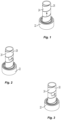
- the drive ribbons of the exemplary embodiments have a retracted configuration in which a retracted portion of the drive ribbon 22 defines a spiral and an extended configuration wherein an extended portion of the drive ribbon 24 defines a helix.
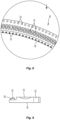
- Proximal edge section 38 can be seen in FIG. 6 and the outwardly facing surface of ribbon 32 includes a lip 50 and a recess 52 along the proximal edge of ribbon 32. Axially extending ribs 54 are located within recess 52. When the proximal and distal sections of ribbon 32 are engaged together, lip 50 fits within recess 40 with lip 42 and ledge 44 restraining its axial movement. Similarly, lip 42 fits within recess 52 and is axially restrained as a result.
- This axial engagement allows the extended portion of the ribbon 32 to exert axial compressive forces, such as when biasing a piston forward to expel medication, and resist axial tensile forces to thereby prevent the extended portion of the ribbon from becoming disengaged from itself due to being pulled apart axially.
- Ribs 54 fit within notches 46 to provide shear resistance and allow the extended portion of the ribbon to withstand torque that it may be subjected to when being rotated.
- FIGS. 7-9 An example of a drive ribbon that has proximal and distal edges that form projecting lips when engaged (similar to the ribbon of FIG. 2 ) and has sidewalls taking a slightly conical shape when in an extended position, is shown in FIGS. 7-9 .
- Ribbon 56 is shown laying on a flat surface in FIG. 7 .
- FIGS. 8 and 9 provide more detailed views of ribbon 56.
- Drive ribbon 56 includes a recessed area 58 along the proximal edge section of ribbon 56 that receives an adjacent portion of the distal edge section of ribbon 56 when ribbon 56 is extended and forms a helix.
- Recessed portion 58 does not, however, receive the full thickness of the distal edge section and a portion of both the distal and proximal edge sections project radially in opposite directions as a result.
- a plurality of pegs 60 are located in recess 58 and engage a corresponding plurality of holes 62.
- pegs 60 are located on the proximal edge section with holes 62 being located on the distal edge section. These positions, however, in other examples, can be reversed.
- the engagement of the proximal edge section with an adjacent portion of the distal edge section includes the engagement of pegs 60 with holes 62.
- pegs 60 have a chamfered tip surface that facilitates the entry and removal of pegs 60 from holes 62.
- the engagement of pegs 60 with holes 62 secures the adjacent portions of drive ribbon 56 together axially.
- the engagement of pegs 60 and holes 62 also provides for the transfer of torque between adjacent portions of the extended ribbon and maintains the stability of the column formed by the extended ribbon.
- drive ribbon 56 has a plurality of recesses 64 that provide a geared surface. Recesses 64 are engaged by a gear member or other suitable drive member whereby a drive assembly can rotate drive ribbon 56 by transmitting a rotational force to drive ribbon 56.
- drive ribbon 56 includes a tapered section 66 that, when formed into a helix, defines the distal end of the drive ribbon and has a bearing member, such as foot 34, mounted thereto.
- the illustrated drive ribbons utilize a flexible polymeric ribbon that has been machined to define the various features of the ribbon.
- Nylon, polypropylene, acetal (polyoxymethylene or POM), and high density polyethylene are examples of suitable polymeric materials that may be used to form a drive ribbon. While the illustrated embodiments are machined, alternative embodiments could use a molding process to form a polymeric ribbon with all of its features. It is envisioned that molding the ribbon in a flat arrangement and then rolling the ribbon into a spiral configuration will be the most efficient manufacturing method of forming a ribbon.
- a drive ribbon may also be used to form a drive ribbon.
- thin metal strip could be used to form the ribbon.
- Photo etching, laser etching or other suitable micro machining methods could be used to form the individual features of the ribbon.
- a metal ribbon could be formed by diffusion bonding two half-thickness layers instead of using a single metal strip.
- Still other ribbon embodiments might take the form of an overmolded metal strip.
- the metal strip would be provided with the distal edge features and the overmolded plastic portion of the ribbon would form the various features of the ribbon.
- This approach combines the desirable stiffness, elasticity and creep resistance of metal with the low friction and manufacturing ease of forming small features in molded plastic. It will generally be desirable for the ribbon to be flexible so that the ribbon can be extended and retracted, and undergo concomitant elastic strains, without permanent deformation.
- the various embodiments disclosed herein may be either single-use devices or multiple use devices with some of the devices being best suited for one or the other.
- a multiple-use device will have a drive ribbon that can be extended and retracted multiple times so that it may be re-used with a new medication container after depleting a medication container.
- a single use drive ribbon will be used with only a single medication container and, once extended, will be discarded.
- Such single use drive ribbons do not need to have the ability to be retracted after extension.
- the ability of drive ribbons to resist axial tension and thus resist axial separation in the extended portion of the drive ribbon is most important during the retraction of the drive ribbon and if the drive ribbon is exposed while extended. Such concerns are reduced, if not eliminated, for single-use drive ribbons and, for at least some applications, it may not be necessary for the extended portion of the drive ribbon to have the ability to resist axial separation forces.
- FIGS. 10-21 relate to devices having a drive ribbon that does not rotate as it is axially advanced.
- Such medication delivery devices are suitable for use with a container having a container body holding a medication and defining an outlet wherein the container includes a piston disposed within the container body and advancement of the piston within the container body expels medication through the outlet (e.g., a hollow needle).
- the delivery device includes a housing adapted to couple with the container and a drive assembly coupled with the housing and adapted to advance the piston within the container.
- the drive assembly includes a drive ribbon having a distal edge section and a proximal edge section.
- the drive ribbon has a retracted configuration and an extended configuration wherein a retracted portion of the drive ribbon in the retracted configuration defines a spiral and an extended portion of the drive ribbon in the extended configuration defines a helix.
- the drive ribbon is incrementally movable from the retracted configuration to the extended configuration. Movement of the drive ribbon from the retracted configuration to the extended configuration defines a drive axis and advances the piston within the container body.
- the drive ribbon moves from the retracted configuration to the extended configuration without rotating relative to the housing or the container.
- a thrust member is engaged with the drive ribbon. The thrust member is rotatable relative to both the drive ribbon and the housing. Rotation of the thrust member moves the drive ribbon from the retracted configuration to the extended configuration.
- the thrust member is axially stationary.
- Such an axially stationary thrust member may include a helical thread engageable with the drive ribbon and the device may further include a rotational restraint member wherein the rotational restraint member is rotationally fixed relative to the housing and engaged with the drive ribbon and the engagement of the drive ribbon and the rotational restraint member prevents relative rotation of the extended portion of the drive ribbon and the rotational restraint member.
- one of the rotational restraint member and the extended portion of the drive ribbon may define an axially extending key with the other one of the rotational restraint member and extended portion of the drive ribbon defining an axially extending keyway.
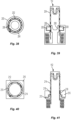
- the rotational restraint member may be disposed radially outside of the drive ribbon at an engagement location where the rotational restraint member engages the drive ribbon to prevent rotation. See, for example, the embodiment of FIGS. 10 and 11 , the embodiment of FIGS. 12 and 13 , and the embodiment of FIGS. 16 and 17 .
- the rotational restraint member may be disposed radially inside of the drive ribbon at the location where the rotational restraint member engages the drive ribbon to prevent rotation. See, for example, the embodiment of FIGS. 14 and 15 .
- the helical thread may be disposed radially outside of the drive ribbon at the location where the helical thread engages the drive ribbon. See, for example, the embodiment of FIGS. 10 and 11 , the embodiment of FIGS. 12 and 13 , and the embodiment of FIGS. 14 and 15 .
- the helical thread may be disposed radially inside of the drive ribbon at the location where the helical thread engages the drive ribbon. See, for example, the embodiment of FIGS. 16 and 17 .
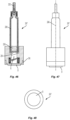
- this embodiment includes a rotational restraint member 68 that is disposed radially outside drive ribbon 70.
- Tabs 72 on rotational restraint member 68 engage axially extending slots 73 defined within the extended portion of drive ribbon 70 to define an engagement location 75.
- Restraint member 68 is fixed relative to the housing and the housing can also support a medication container without relative movement between the housing and the container.
- tabs 72 prevent rotation of the extended portion of drive ribbon 70 relative to the housing and the medication container.
- bearing member or foot 74 can be fixed to drive ribbon 70.
- Thrust member 76 includes at least one helical thread 78 that engages a groove 80 that forms a helical shape on the extended portion of drive ribbon 70. As thrust member 76 and thread 78 rotate, they pull and guide drive ribbon 70 from its retracted configuration 69 into its extended configuration 71. Thread 78 also exerts an axial force on ribbon 70 whereby ribbon 70 can exert a biasing force on a medication container piston via foot 74 to dispense medication.
- Thrust member 76 is axially stationary and rotatably mounted to restraint member 68. More specifically, thrust member 76 is rotatable relative to rotational restraint member 68 and axially captured by, and cannot move axially relative to, rotational restraint member 68. This is best understood with reference to FIG. 11 .
- Thrust member 76 includes an axially extending cylindrical section 77 on which helical thread 78 is located. A radially extending flange 79 is located at one end of section 77.
- Rotational restraint member 68 includes an annular groove 67 which receives flange 79 that, once inserted into groove 67 prevents thrust member 76 from being moved axially relative to restraint member 68.
- thrust member 76 with rotational restraint member 68 is a snap-fit type engagement that is facilitated by the inclined outer radial surface 79A of flange 79.
- Surface 79 acts as a camming ramp biasing flange 79 radially inwardly during engagement of thrust member 76 with rotational restraint member 68.
- a drive gear or other suitable drive member engages thrust member 76, such as on the outer radial surface 76A of thrust member 76, to drivingly rotate thrust member 76.
- outer radial surface 76A could be a geared surface that engages a motor driven gear to thereby rotate thrust member 76.
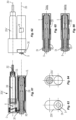
- FIGS. 12 and 13 has the same general structure as the embodiment of FIGS. 10 and 11 .
- the embodiment of FIGS. 12 and 13 differs, however, in that drive ribbon 82 has externally extending tabs or posts 84 which engage axially extending slots in rotational restraint member 86 to prevent rotation of drive ribbon 82.
- the use of tabs 84 avoids the use of axially aligned slots on the drive ribbon which may be difficult to form using a roll forming process.
- FIGS. 14 and 15 has a drive ribbon 88 with a groove on its external surface that takes a helical shape on the extended portion of the drive ribbon 88.
- Ribbon 88 also has grooves on its inner surface that extend axially in the extended portion of the ribbon.
- Rotational restraint member 90 is disposed radially inside of drive ribbon 88 and includes axially extending ribs 92 that engage the grooves on the inner surface of ribbon 88 to define the engagement location 93 to prevent rotation of the extended portion of drive ribbon 88.
- An axially stationary thrust member 94 is disposed radially outside of drive ribbon 88 and includes a helical thread 96 that engages the groove on the external surface of ribbon 88 that takes a helical shape on the extended portion of rib 88. As thrust member 94 rotates, it pulls ribbon 88 from its retracted configuration into its extended configuration and can exert an axial force on drive ribbon 88.
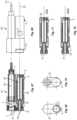
- FIGS. 16 and 17 has a drive ribbon 98 having an internal groove 99 that defines a helical shape in the extended portion of the drive ribbon and external grooves that extend axially in the extended portion of the drive ribbon.
- Rotational restraint member 100 is disposed radially outside ribbon 98 and includes ribs 102 that engage axially extending external slots on ribbon 98 to define the engagement location to prevent rotation of ribbon 98.
- An axially stationary thrust member 104 is rotatably mounted on a shaft and includes a helical thread 106. Thrust member 104 and thread 106 rotate and, as they rotate, pull ribbon 98 into the extended configuration. Thread 106 also exerts axial forces on ribbon 98.
- FIGS. 18 and 19 schematically depict two drive ribbons 108, 82 which include radially outward extending projections that engage slots in a rotational restraint member to prevent rotation of the ribbon.
- Drive ribbon 82 includes a plurality of outwardly extending tabs 84 that are separate both axially and circumferentially as can also be seen in FIGS. 12 and 13 .
- Drive ribbon 108 of FIG. 18 has elongate ribs 110 that are separated circumferentially but which are substantially continuous in the axial direction for the extended portion of the drive ribbon.
- the thrust member moves axially in a proximal direction P as it is rotated and a distal end of the drive ribbon remains axially stationary as the thrust member rotates.
- the thrust member and an extended portion of the drive ribbon are axially moved in a distal direction D, opposite to the proximal direction. Examples of such devices shown in FIGS. 20 and 21 . Orientation using proximal and distal is consistent throughout this disclosure.
- the device may further include a drive spring which is tensioned as the thrust member is rotated to extend the drive ribbon.
- a drive spring which is tensioned as the thrust member is rotated to extend the drive ribbon.
- the thrust member moves axially in the proximal direction and the distal end of drive ribbon remains stationary.
- the thrust member and drive spring are released and the drive spring axially advances the thrust member together with the extended portion of the drive ribbon.
- the drive ribbon thereby advances the piston in the medication container to dispense the medication.
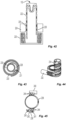
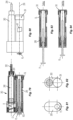
- FIG. 20 has an axially movable thrust member 112, the thrust member 112 includes a helical thread 114 engageable with the drive ribbon 124 wherein the helical thread 114 is disposed radially inside of the drive ribbon 124 at the location where the helical thread engages the drive ribbon.
- Rotational restraint member 122 is rotationally fixed relative to the housing and engaged with the drive ribbon 124 such that the engagement of the drive ribbon and the rotational restraint member prevents relative rotation of the extended portion of the drive ribbon 124 and the rotational restraint member 122.
- Thread 114 of thrust member 112 engages a helical groove on the inward facing surface of drive ribbon 124.
- Thrust member 112 has a hollow center which defines a central bore for receiving center shaft 118.
- Thrust member 112 has a helical thread 116 facing its central bore that engages a helical groove on shaft 118.
- FIG. 20 shows thrust member in its most proximal position.
- Shaft 118 can extend proximally of the drive assembly further than that shown in FIG. 20 and engage a locking mechanism that prevents the axial movement of shaft 118. After rotating thrust member 112 to move in the proximal direction and compress spring 120, shaft 118 can be released thereby also releasing thrust member 112 and spring 120. Spring 120 will then bias thrust member 112 distally and thread 114 on thrust member 112 will cause drive spring 120 to advance distally with thrust member 112.
- FIG. 21 includes an axially movable thrust member 126, the thrust member includes a helical thread 128 engageable with the drive ribbon 130 wherein the helical thread 128 is disposed radially outside of the drive ribbon 130 at the location where the helical thread engages the drive ribbon.
- Rotational restraint member 132 is rotationally fixed relative to the housing and engaged with the drive ribbon 130 such that the engagement of the drive ribbon 130 and the rotational restraint member 132 prevents relative rotation of the extended portion of the drive ribbon 130 and the rotational restraint member 132.
- Thrust member 126 may extend radially outwardly to a greater extent than is shown in FIG. 21 such that it threadingly engages the housing in a releasable manner. As thrust member 126 is rotated relative to the housing, it will move in a proximal direction and compress drive spring 134. Reference numeral 127 is used in FIG. 21 to identify the location of thrust member 126 after it has been rotated to proximally retract the thrust member. After retracting the thrust member 126, it can be released, which will also release drive spring 134 whereby spring 134 will axially advance thrust member 126 in the distal direction. Thread 128 on thrust member 126 will cause drive ribbon 130 to axially advance in the distal direction with thrust member 126 and thereby advance a medication container piston to dispense medication.
- FIGS. 22-45 relate to drive ribbons that rotate as they are axially advanced.
- Such ribbons may be employed in a medication delivery device for use with a container having a container body holding a medication and defining an outlet wherein the container includes a piston disposed within the container body and advancement of the piston within the container body expels medication through the outlet.
- the delivery device includes a housing adapted to couple with the container and a drive assembly coupled with the housing and adapted to advance the piston within the container.
- the drive assembly includes a drive ribbon having a distal edge section and a proximal edge section.
- the drive ribbon has a retracted configuration and an extended configuration wherein a retracted portion of the drive ribbon in the retracted configuration defines a spiral and an extended portion of the drive ribbon in the extended configuration defines a helix.
- the drive ribbon is incrementally movable from the retracted configuration to the extended configuration and movement of the drive ribbon from the retracted configuration to the extended configuration defines a drive axis.
- the drive ribbon rotates as it is moved from the retracted configuration to the extended configuration.
- FIGS. 22-24 relate to devices wherein a drive member is disposed radially inside the drive ribbon to engage and rotate the drive ribbon and a fixed component having a helical thread is disposed radially outside the drive ribbon.
- the helical thread of the fixed component engages the drive ribbon and controls the movement of the drive ribbon between the retracted configuration and the extended configuration.
- FIG. 22 illustrates an assembly wherein drive member 136 has a pair of keys 138 that engage grooves on the inner facing surface of drive ribbon 140 to drivingly rotate ribbon 140.
- Collar 142 is fixed relative to the housing and includes a helical thread 144 that engages a helical groove on the outer facing surface of drive ribbon 140.
- FIGS. 23 and 24 illustrate an assembly very similar to that shown in FIG. 22 but wherein the drive member 146 has a larger number of keys 148 to engage a corresponding larger number of grooves on the inner surface of drive ribbon 150 to define the engagement locations.
- a rotatable bearing assembly 152 having a first member 154 fixed to the drive ribbon 150 and a second member 156 that can rotate relative to member 154 and ribbon 150 is employed.
- Second member 156 can bear directly against the piston of a medication container without rotating relative to the piston while first member 154 and ribbon 150 both rotate relative to member 156 and the piston as the ribbon is advanced and biases member 156 against the piston to advance the piston.
- FIGS. 25 and 26 illustrate alternative drive arrangements that are disposed radially within the drive ribbon to engage and rotate the drive ribbon.
- FIG. 25 shows the use of a single gear member 158 while
- FIG. 26 shows the use of a plurality of gears 160.
- Gears 158, 160 would engage axially extending grooves or raised ribs (not shown) on the inner surface of the drive ribbon. Such grooves/ribs would be spaced apart by a distance corresponding to the distance between the gear teeth on the gears being used with the ribbon.
- FIGS. 27-41 relate to embodiments having a rotatable drive ribbon wherein a drive member disposed radially outside the drive ribbon engages and drivingly rotates the drive member.
- FIG. 27 schematically depicts the use of a single ring gear 162 with a drive ribbon 164.
- Ring gear 162 completely surrounds drive ribbon 164 and engages a portion of the outer surface of the drive ribbon 164.
- the central opening of ring gear 162 is larger than the outer diameter of drive ribbon 164 and, thus, a portion of the outer circumference of the drive ribbon is not engaged by ring gear 162.
- FIGS. 28 and 29 schematically depict the use of a plurality of ring gears.
- two ring gears 166 engage a drive ribbon 164.
- the use of two ring gears 166 allows the full outer circumference of the drive ribbon 164 to be engaged by a ring gear. As can be seen in FIG.
- the ring gears 166 are axially offset.
- the device of FIG. 29 also includes a spindle member 168 having a helical thread 170 which engages a groove on the inner surface of drive ribbon 164.
- Ring gears 166 are advantageously axially positioned such that the ring gears 166 engage the outer surface of the drive ribbon proximate to the location where thread 170 engages the inner surface of the drive ribbon.
- FIG. 30 schematically depicts the use of a belt drive arrangement wherein a belt 172 engages the outer surface of a drive ribbon 174 to rotate the drive ribbon.
- FIGS. 38 and 39 depict an example of a key drive arrangement.
- drive member 200 has a plurality of ribs or keys 202 that engage axially extending slots on the outer surface of drive ribbon 204.
- drive ribbon 204 is also rotated.
- a stationary spindle member 206 has a helical thread 208 which engages a groove on the inner surface of drive ribbon 204.
- FIG. 44 depicts an embodiment where a worm gear 232 engages a drive ribbon 234 in the retracted portion of the drive ribbon.
- the illustrated embodiment also includes a stationary ratchet member 240 which does not move relative to the housing and which includes a plurality of ratchet members 244 engaging the radially outward facing surface of drive ribbon 238.
- ratchet member 240 will ensure that drive ribbon 238 is not pulled rearwards with reciprocating ratchet member 236.
- the ratchet drive depicted in FIG. 45 is well suited for use in a single-use device where the ribbon is extended but is not later retracted.
- ratchet members 236 and 240 would have to be movable out of engagement with the drive ribbon and a second driving mechanism employed to rotate the drive ribbon in the opposite direction.
- a second driving mechanism employed to rotate the drive ribbon in the opposite direction.
- an oscillating escapement drive can be employed for generating the reciprocating movement of drive member 236, as well as drive member 228 discussed above.
- the various ribbons and drive member mechanisms disclosed herein can be combined in numerous ways to provide a medication delivery device.
- Two general categories of such devices include those having an inline architecture and those having a dual axis architecture. These two basic architectures are depicted in FIGS. 46-54 .
- the dual axis architecture can increase the bulk of the device, referred to here as 253, over part of the relatively shorter length of the device, which may be beneficial to patient users with dexterity or handling challenges due to a debilitating disease or condition.
- the device 253 depicted in FIGS. 49-51 is used to dispense medication from a conventional 3 ml syringe cartridge and has a drive ribbon defining a first primary axis 254 and a drive member mechanism that defines a secondary parallel axis 256.
- the device, referred to here as 253' depicted in FIGS.
- the drive ribbon has a retracted configuration and an extended configuration wherein a retracted portion of the drive ribbon in the retracted configuration defines a spiral and an extended portion of the drive ribbon in the extended configuration defines a helix.
- the drive ribbon is incrementally movable from the retracted configuration to the extended configuration. Movement of the drive ribbon from the retracted configuration to the extended configuration defines a drive axis and advances the piston within the container body.
- a drive member mechanism is operably coupled with the drive ribbon and defines a secondary axis parallel with the drive axis. The drive member mechanism generates a force that is transferred to the drive ribbon to move the drive ribbon from the retracted configuration to the extended configuration.
- a drive member mechanism includes that a plunger disposed along the secondary axis wherein linear translation of the plunger generates the force that is transferred to the drive ribbon R to move the drive ribbon from the retracted configuration to the extended configuration.
- Still other ones of the illustrated dual axis embodiments have a drive member mechanism that includes an electric motor M drivingly coupled with an element disposed along the secondary axis, the electric motor M generating the force that is transferred to the drive ribbon R to move the drive ribbon from the retracted configuration to the extended configuration.
- the element disposed along the secondary axis may be a drive shaft of the electric motor.
- the output ratchet O rotates the drive ribbon R.
- the output ratchet O engages a drive member that, in turn, engages and rotates either the ribbon or, if a non-rotating ribbon is used, a thrust member, such as described previously. Rotation of the drive ribbon, or thrust member, extends the ribbon axially and thereby advancing the piston and dispensing medication from the cartridge.
- a threaded member IRD is a "Turns-counting IRD" that functions as an insufficient remaining dosage indicator and prevents further rotation of the sleeve SL and, thus, the dialing knob DK after the member IRD has travelled the threaded length of the sleeve SL which is dimensioned to correspond to the quantity of medication in a 3 ml cartridge.
- FIG. 59 illustrates the device 253" when the dialing knob DK is being rotated to tension the torsion spring S, also referred to as a dialing configuration and set the dosage. Rotation of the dialing knob DK in turn rotates a dose indicator dial 259 which can be visible through a window W defined by the housing to provide indication of the amount dialed.
- FIG. 60 illustrates the device 253" during an injection procedure after the button is depressed by a user to release the spring S that rotates the sleeve 258.
- the device 253A" depicted in FIGS. 61-66 is similar to that depicted in FIGS. 55-60 but the dialing knob DK of the embodiment of FIGS. 61-66 is located on the proximal end of the device with the inject button B instead of the distal end. Rotation of the dialing knob DK rotates the internal sleeves SL by means of a dialing ratchet 261.
- FIG. 65 illustrates the device 253A" being placed in the dialing configuration to set the dosage.
- FIG. 66 illustrates the device 253A" during the injection procedure after the button is depressed by a user.
- the device 253′′′ depicted in FIGS. 67-72 has a drive ribbon R defining a primary axis 254 and a driving mechanism centered on a secondary axis 256.
- the drive member mechanism includes a dialing knob DK that is rotated by the user to set the dosage. Rotation of the dialing knob DK rotates an internal sleeves SL by means of a dialing ratchet 261. As the sleeve rotates SL, it tensions a torsion spring S. Depressing the inject button B moves a shift member 260 which shifts the sleeve and thereby releases the torsion spring. When the torsion spring is released, it rotates output sleeve 262.
- Output sleeve 262 has an output ratchet O disposed thereon which drives the ribbon assembly as output sleeve 262 is rotated.
- the input sleeve includes a threaded section on which a threaded member IRD (insufficient remaining dosage) is located.
- the device 253′′′′ depicted in FIGS. 73-78 also includes a shift member 264 to initiate the dispensing of medication in an injection procedure but it is configured differently than that of the embodiment of FIGS. 67-72 .
- the embodiment of FIGS. 73-78 includes a dialing knob DK that is used to set the dosage. Rotation of the dialing knob DK rotates the sleeve SL by means of a dialing ratchet 261. As the sleeve SL rotates, it tensions a torsion spring S. Shift member 264 also defines the inject button B and when shift member 264 is moved from the dialing dose setting position shown in FIG. 77 to the injection dose delivery position shown in FIG.
- FIGS. 55-78 do not experience a change in length when setting the dosage or when extending the drive ribbon with the limited exception that, when the inject button is disposed on one of the ends of the device and the button is depressed to actuate the injection procedure, the movement of the inject button alters the length an insignificant amount.
- the devices depicted in FIGS. 79-96 include plungers that are extended from the device and increase the length of the device when the dosage is being set and the subsequent manual depression of the plungers to return them to their original position provides the driving power to extend the drive ribbon, advance the piston within the medication container and dispense the medication.
- the device 263 depicted in FIGS. 79-84 has dialing knob DK for setting the dosage.
- a dialing clicker in the form of a one-way ratchet mechanism 261 rotates the sleeve SL.
- the plunger PL is extended out of the housing in the proximal direction due to the threaded engagement of the sleeve and plunger to place the device in the dialing dose setting configuration as shown in FIG. 83 .
- the plunger PL is manually depressed to force it back into the housing in the distal direction to place the device in the injecting dose delivery configuration shown in FIG.
- the sleeve SL rotates in the opposite direction and causes output sleeve 268 to rotate along with it.
- the plunger PL does not rotate when being extended or depressed.
- the stem of the plunger can have a non-circular cross section that passes through a corresponding opening in the housing.
- the output ratchet O on the output sleeve then transmits that rotational force to a drive member that rotates either the drive ribbon R or a thrust member to axially advance the piston and discharge medication.
- the device 263' depicted in FIGS. 85-90 is generally similar to that depicted in FIGS. 79-84 but the dialing knob DK has been relocated to the proximal end of the housing.
- Each of these embodiments may also include a threaded member IRD (insufficient remaining dosage) that is disposed on the threaded section of the sleeve.
- the device 263" depicted in FIGS. 91-96 has an extendable plunger wherein several components of the drive assembly centered on secondary axis 256 extend with the plunger when the dosage is being set and move with the plunger when it is being depressed.
- a dialing knob is used to set the dosage. When rotating the dialing knob DK, it rotates a dial sleeve 270 and plunger rod 274.
- Plunger rod 274 is threaded and engaged with a threaded opening 276 disposed on an internal portion of the housing. Rotation of plunger rod 274 relative to opening 276 causes the plunger rod 274 to be extended out of the housing in the proximal direction when setting the dosage, as shown in FIG.
- the device 283 depicted in FIGS. 97-102 has a modular architecture with a detachable electronic module having an inject button that can be attached to a cartridge unit having a medication container, a drive ribbon and a drive assembly.
- the electronic module can be re-used multiple times with different cartridge units having the same basic structure.
- Such cartridge units may also be disposable units.
- the device depicted in FIGS. 97-102 has a reusable electronic module 280 which can be detachably connected to a cartridge unit 282.
- Cartridge unit 282 includes a medication container 248 holding a medication and having a piston wherein advancement of the piston dispenses medication through an injection needle 252.
- a drive ribbon R is used to advance the piston and defines a primary drive axis 254.
- the illustrated cartridge unit 282 also includes a drive member mechanism centered on secondary axis 256.
- Illustrated cartridge unit 282 is a single use cartridge that is disposed of after depletion of the medication.
- a dialing knob DK is used to set the dosage. Rotation of the dialing knob DK rotates the sleeve SL by means of a dialing ratchet 261. Rotation of the sleeve SL tensions the torsion spring S. Moving the inject button B from the position shown in FIG. 101 to that shown in FIG. 102 an arm 285 of the button B engages the sleeve SL and allows the sleeve SL to shift axially and thereby releases the torsion spring S. Injection cannot be initiated when display is removed. When released, the torsion spring S rotates output sleeve 284.
- Rotation of output sleeve 284 is communicated to the ribbon assembly and extends the drive ribbon R to thereby advance the piston and discharge medication.
- the inject button B When the inject button B is in the position shown in FIG. 101 , the sleeve SL is in an axial position that prevents the communication of torque from the torsion spring S to the output sleeve 284 and thereby prevents the torsion spring S from advancing the drive ribbon R.
- the sleeve S remains in the position shown in FIG. 101 and, thus, the torsion spring S will not advance the drive ribbon R when the electronic module 280 is removed.
- FIGS. 103-136 also have a modular architecture.
- the reusable module of these embodiments includes a drive member mechanism centered on the secondary axis thereby allowing a greater percentage of the total assembly to be reused.
- the drive member mechanism is disposed within the housing and the device further includes a cartridge housing wherein the drive ribbon is disposed within the cartridge housing and the container is mounted on the cartridge housing with the cartridge housing being detachably securable to the housing.
- the devices have a drive member mechanism that includes a spring aligned with the secondary axis wherein setting a dose includes tensioning the spring and releasing the tension from the spring generates the force that is transferred to the drive ribbon to move the drive ribbon from the retracted configuration to the extended configuration.
- the device 293 depicted in FIGS. 103-108 includes cassette 286 having a cartridge housing 286A and a reusable module 288 having a main housing 288A.
- the drive ribbon R is disposed within cartridge housing 286A and the cartridge 148 holding a medication is mounted on the cartridge housing 286A.
- the drive member mechanism 290 which drives the axial advancement of the drive ribbon R is disposed in main housing 288A and is centered on secondary axis 256.
- the depicted device 293 includes a dialing knob DK that is used to set the dosage. Rotation of the dialing knob DK rotates the sleeve SL by means of the dialing ratchet 261. As the sleeve SL is rotated, the torsion spring S is tensioned. When the inject button B is depressed, the sleeve SL is shifted and the torsion spring S is released. When released, the torsion spring S rotates output member 292 that, in turn, rotates a drive member 294 engaged with the drive ribbon R to thereby extend the drive ribbon. Dial 297 is provided between the sleeve SL and spring S and is used with the interlock 295 for dose tracking.
- the reusable module 288 includes an electronic module (not shown) coupled with the display.
- An interlock 295 provides an electrical signal which the electronic module uses to determine if the reusable module 288 is attached to the cassette 286.
- a sensor senses the rotational movement of the sleeve SL and provides the electronic module with data concerning the quantity of medication to be dispensed based upon the extent to which the sleeve has been rotated due to rotation of the dialing knob DK.
- the interlock may be configured to return device to zero when cassette is removed, by resetting the positon of the dial 297.
- the cassette 286 may include a RFID (radio frequency identification) chip to identify the contents of the medication container.
- the RFID chip is read/write whereby the electronic module on the reusable module 288 can record data related to the quantity of medication dispensed from the cassette 286 after each injection procedure whereby the module will be able to determine the remaining quantity of medication in the cassette.
- the cassette 286 may have a read only RFID tag with another form of digital memory to record such data.
- the cassette 286 can be removed from the reusable module 288 before it is completely depleted and then later re-attached with the electronic module being able to read the data concerning the identification of medication and remaining amount when the cassette is reattached. This will allow the electronic module to accurately track the amount of remaining medicine and generate an IRD (insufficient remaining dose) message even when a cassette has been detached when partially empty and then subsequently reattached.
- IRD insufficient remaining dose
- the device 293" depicted in FIGS. 109-114 is similar to that shown in FIGS. 103- 108 but has a different reusable module 298 wherein the dialing knob DK is located on the distal end instead of the proximal end of the reusable module 298.
- the dialing knob DK is used to set the dosage and rotation of the knob rotates the sleeve SL by means of a dialing ratchet 261. Rotation of the sleeve SL tensions a torsion spring S. Depression of the inject button B releases the spring S which then rotates output member 296. Rotation of output member 296 drives the extension of the drive ribbon R.
- module 298 includes an electronic module that is coupled with a display and which can communicate with the cassette to identify the contents of the cassette and remaining volume.
- the reusable module may alternatively have an electric motor.
- the embodiments depicted in FIGS. 115-120 ; FIGS. 121-126 ; and FIGS. 127-132 each have a drive member mechanism that includes an electric motor drivingly coupled with an element disposed along the secondary axis, the electric motor generating the force that is transferred to the drive ribbon to move the drive ribbon from the retracted configuration to the extended configuration.
- the motor shaft may be the element disposed along and defining the secondary axis.
- An electronic module can be used to control the operation of the motor.
- a dialing knob DK can be used to generate signals to the electronic module to define the dosage and an inject button B communicates with the electronic module to initiate the operation of the motor.
- the dialing knob DK is located on the distal end of module 300 while the inject button B is located on the side of the module 300 farthest from the cartridge 248 of cassette 286 and near the dialing knob DK.
- the electronic module may also communicate with the cassette 286 as described above to identify the contents of the cartridge 248 and determine the quantity of medication remaining in the cassette.
- the device 303' depicted in FIGS. 121-126 has a reusable module 306 that can have a cassette 286 attached thereto.
- Module 306 has an electric motor M and the same general functionality of module 300.
- a motor shaft 308 extends from the motor M and a drive element 310 is mounted on shaft 308.
- Drive element 310 engages and rotates drive member 294 on the cassette 286 when the motor M is energized.
- Module 306 differs from module 300 in that it includes a proximal foot 312. Foot 312 is positioned adjacent the proximal end of cassette 286 and has an inject button B mounted thereon. Foot 312 helps to prevent accidental dislodgement of the cassette 286 and provides a more secure attachment for the cassette 286. It also allows the inject button B to be placed on the drive axis 254 defined by the drive ribbon. Some users may find this placement to be more intuitive and comfortable due to its similarity with a syringe having an inline manual plunger.
- the device 303" depicted in FIGS. 127-132 has a reusable module 314 that is similar to module 306 with the only distinction being that module 314 uses input buttons 316 to set the dosage instead of a dialing knob. As shown, one of the input buttons 316 is for increasing the dosage and the other of the input buttons 316 is for reducing the dosage.
- the display may be used to indicate the change in dosage as a result the use of the input buttons.
- an electronic module may be disposed on the housing of the reusable module and each of the plurality of cartridges may further include a digital memory device such as a read/write RFID or other form of digital memory (e.g., internal flash memory or on-board EEPROM).
- the electronic module of the reusable module will establish communication with the digital memory device of the cartridge coupled with the housing and, after completing an injection procedure, the electronic module records data on the digital memory device related to the injection procedure.
- the data recorded on the digital memory device may include data related to the volume of medication remaining in the container.
- the plurality of cartridges may all contain the same medication or they may contain a plurality of different medications.
- the cassettes 286 and 318 can be provided with read/write RFIDs or read only RFIDs and a digital memory whereby the patient can interchange the cassettes as needed and the module will still be able to identify the medicine contained in the cassette which is attached and the amount remaining in the cassette as discussed above.
- the patient may still find it convenient to carry the module 316 and two cassettes 286 and 318 which hold the same medication with the second cassette functioning as a back-up supply in case the first cassette is depleted or needs to be replaced for some other reason.
- FIG. 134 also illustrates how module 316 can be used with multiple cassettes of different medications in a medication delivery system 331.
- cassettes 320 and 322 all have the same structure as cassette 318.
- cassette 322 contains a different medication than cassettes 320.
- the RFID of the cassettes will identify the medication contained within the cassette and such information can be displayed for the user to see it on the display of the reusable module 319, the cassettes holding different medicines are also advantageously identifiable by visual inspection.
- cassettes 320 which all hold the same type of medication may advantageously have the same color cartridge housing while cassette 322, which holds a different medicine, has a cartridge housing of a different color.
- Printed labels identifying the contents of the cassettes may also be adhered to the cassettes.
- cassettes 286, 318, 320, 322 each may have a digital memory device 323 which includes data on the type of medication contained within the cartridge and remaining volume of the medication. Still other data, such as date of manufacture, serial numbers may also be recorded on digital memory device 323.
- Module 319 includes an electronic module 329 utilizing a controller which controls operation of the module and cassette. Electronic module 329 also communicates with the digital memory device 323 of the cassette engaged with the module 316 to acquire information about the type of medication and remaining amount of the medication in the cassette.
- FIGS. 133-134 Also shown in FIGS. 133-134 are electrical contacts 325 on cassettes 286, 318, 320, 322 and cooperating electrical contacts 327 on module 316.
- the cooperating contacts 325, 327 are engaged to provide electrical communication therebetween for data signal transmission and/or power.
- the use of contacts 325, 327 allows the electronic module 329 of module 316 to communicate in a hard-wired manner with digital memory device 323.
- electronic module 329 can communicate wirelessly with digital memory device 323 and contacts 325, 327 can be used to confirm that a cassette has been successfully docked on module 316.
- the circuit on module 316 with contacts 325 may be open.
- FIGS. 135 and 136 depict systems 333, 335, respectively, similar to systems 317, 331 in FIGS. 133 and 134 but have a reusable module 324 that differs from module 316 in that module 324 includes a foot 312 similar module 306. Otherwise, reusable module 324 functions the same as module 316 and can be used with cassettes 286, 318 and 320 and 322 in the same manner discussed above with regard to module 316.
- the reusable modules and cassettes may track the remaining quantity of medication in the cassette in various manners.
- the remaining quantity can be tracked by having the reusable module monitor the set dosages and/or the mechanical output delivered to the cassette to determine the amount of medication dispensed during each injection procedure.
- the original quantity of medication held in the medication container is known and, thus, by substracting the dispensed amount, the remaining quantity can be tracked and monitored.
- the extent to which the drive ribbon has been axially extended can be monitored to determine the remaining quantity.
- the drive ribbon may be provided with markings that can be read by an optical sensor.
- the optical sensor is positioned to sense the markings on the extended portion of the drive ribbon and, for devices having a modular architecture, may be positioned on the cassette or on the reusable module with a window in the housings allowing the optical sensor to view the extended portion of the drive ribbon.
- the sensor could count the passage of identical markings or be able to recognize distinct markings to determine the extent to which the drive ribbon has been axially extended.
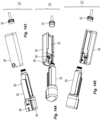
- FIGS. 137-145 illustrate an example of a reusable drive member mechanism module and a cassette having a cartridge housing and a drive ribbon disposed therein.
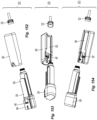
- FIGS. 146-211 also illustrate an example of a reusable drive member mechanism module and a cassette.
- One difference between the embodiment of FIGS. 137-145 and the embodiment of FIGS. 146-211 is that the size of the electric motor in the embodiment of FIGS. 137-145 and of the gear attached to the motor shaft are larger than those of the embodiment of FIGS. 137-145 .
- the parts of the two embodiments are the same and function in the same manner, the same reference number will be used in each embodiment.
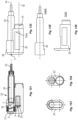
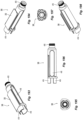
- Device 326 which is shown in FIGS. 137-145 , includes a reusable module 328 and a cassette 330.
- a needle assembly 332 is securable to the threaded distal end of a holding member for medication container 334.
- Module 328 includes a housing 336 within which an electric motor 338 is mounted.
- Gear 340 is coupled to and driven by the output shaft of motor 338.
- a portion of gear 340 projects outwardly from housing 336 whereby it can engage a gear member 342 within cassette 330 when cassette 330 is attached to module 328.
- Cassette 330 includes a housing 344 that defines a projection 346 having a T-shaped cross section.
- Module housing 336 defines a corresponding T-shaped slot 348 which receives projection 346.
- Cassette 330 also defines a second T-shaped projection 350 which is received by a second T-shaped slot 352 on housing 336.
- a spring biased, pivoting latch member 354 on module 328 engages a projecting lip on the cassette to prevent the cassette from sliding out of engagement.
- Button 356 is depressed to disengage latch member 354.
- Device 360 is shown in FIGS. 146-211 and includes a reusable module 362 and a cassette 330.
- Cassette 330 is detachably secured to module 362 in the same way that it is secured to module 328.
- Module 362 has a slimmer electric motor 364 and a smaller output gear 367 coupled to the motor shaft than module 328 but otherwise has the same construction.
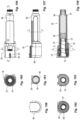
- FIG. 164 provides an exploded view of cassette 330.
- Cassette 330 includes a base member 366 and a holding member 368 which together define the cartridge housing.
- a drive ribbon 370 is disposed within the cartridge housing and a thrust member 372, ring 374 and collar 376 control the axial extension of drive ribbon 370.
- a bearing member 378 is secured to the distal end of drive ribbon 370 and engages piston 380 within medication container 334. Ribbon 370 extends without rotation and bearing member 378 is fixed directly to ribbon 370.
- a conventional 3 ml medication container 334 is held within holding member 368.
- Holding member 368 has a bayonet type engagement for attaching member 368 to the cassette although other suitable means such as permanent adhesive may alternatively be used.
- Cassette base 366 is shown in FIGS. 165-170 .
- Base 366 houses the proximal components of the cassette and includes a window 382 that allows gear member 367 to mesh with gear 342 which is formed on thrust member 372.
- Base 366 also defines T-shaped projection 346 and a pair of smaller projections 384, 386.
- Projection 384 is engaged by latch 354 when cassette 330 is engaged with a reusable module and projection 386 prevents the inadvertent external disengagement of latch 354.
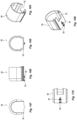
- Cassette collar 376 is shown in FIGS. 171-176 .
- Collar 376 defines a central cylindrical opening 388. Disposed within the central opening 388 are a plurality of axially extending ribs 390. As further discussed below, ribs 390 engage axially extending grooves 371 in drive ribbon 370 to prevent the rotation of the extended portion of drive ribbon 370.
- Collar 376 has a first section 392 with a non-circular cross section that fits within base member 366 and thereby prevents collar 376 from rotating relative to base 366. Ribs 390 thereby prevent the extended portion of drive ribbon 370 from rotating relative to base 366.
- a second section 394 is disposed distally of the end of base 366 and receives the bayonet projections of holder 368 to thereby attach holder 368 to cassette 330.
- Section 394 has a central opening which is cylindrical in shape with two projections 395 that fit between the bayonet fittings of holder 368.
- Collar 376 also includes a cylindrical projection 396 that extends proximally and defines a portion of the central bore 388. Cylindrical section 396 also defines an annular recess 397 on its outer surface.
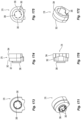
- Cassette ring 374 is shown in FIGS. 177-181 .
- Ring 374 encircles cylindrical section 396 and properly positions collar 376 relative to thrust member 372.
- Ring 374 also functions as a bearing between the rotatable thrust member 372 and the rotationally fixed collar 376.
- An annular projection 373 on ring 374 fits within on annular recess 397 on projection 396 and a threaded section 375 on ring 374 secures ring 374 to thrust member 372. Ring 374 thereby prevents the axial separation of collar 376 from thrust member 372 while still permitting the rotation of thrust member 372 and attached ring 374 relative to collar 376.
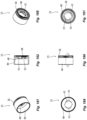
- Distal bearing member 378 is shown in FIGS. 182-186 .
- Member 378 includes a distal bearing flange 398 that engages piston 380 and a mounting stem 400 that is disposed radially inwardly of the most distal portion of drive ribbon 370.
- Mounting posts 402 on stem 400 are engaged with holes on drive ribbon 370 to mount bearing member 378 to drive ribbon 370.
- Thrust member 372 is shown in FIGS. 187-192 .
- Thrust member 372 has gear 342 formed on its outer perimeter.
- a gear component may be fixedly coupled to the thrust member.
- Gear 342 engages gear 367 and thrust member 372 is rotated when motor 364 is energized and rotating gear 367.
- Thrust member 372 has a generally cylindrical shape and rotates within and relative to base 366.
- the proximal end of thrust member 372 forms a cylindrical skirt 404 that functions as a storage bobbin for the retracted portion of drive ribbon 370.
- Threads 406 at the distal end of thrust member 372 engage threads 375 on ring 374 to secure ring 374 to thrust member 372. As discussed above, this also axially secures collar 376 to thrust member 372 while still permitting the rotation of thrust member 372 and ring 374 relative to collar 376.
- An inner partition 408 extends inwardly and defines a central opening 410 within thrust member 372. Partition 408 also defines a pair of generally helical threads 412 that act as camming ramps. Threads 412 engage grooves 369 in drive ribbon 370 that extend helically on the extended portion of drive ribbon 370. When initially assembling cassette 330, a portion of the drive ribbon 370 is placed in the extended configuration and threads 412 are engaged with grooves 369.
- module 328 When thrust member 372 is subsequently rotated, threads 412 will force ribbon 470 from the retracted configuration to the extended configuration thereby extending the axial length of the extended configuration, or, depending on the direction of rotation, force ribbon from the extended configuration to the retracted configuration thereby reducing the axial length of the extended portion of the drive ribbon. If module 328 is designed to work with only disposable cassettes 330, it will not be necessary to retract drive ribbon 370 after emptying the contents of container 334 and module 328 may be configured such that motor 364 will rotate in only one direction when energized with that direction corresponding to the axial extension of drive ribbon 370.
- Holding member 368 is shown in FIGS. 193-198 .
- Holding member 368 defines T-shaped projection 350 for engaging the reusable module.
- Holding member 368 also includes a pair of bayonet fittings 414 that are inserted into the bore defined by section 394 of collar 376 and tightly fit between projections 395 to thereby mount holding member 368 to cassette 330.
- Alternative attachment means such as permanent adhesive may be used to attach holding member 368 to cassette 330.
- a medication container 334 is placed within holder 368 before mounting the holding member 368 to cassette 330.
- a threaded distal end 416 on holding member 368 is used to attach needle assembly 332.
- Drive ribbon 370 is shown in FIGS. 199-211 .
- drive ribbon 370 is shown in a configuration that it will take within cassette 330.
- an extended portion 420 of ribbon 370 defines a helix while a retracted portion 422 of ribbon 370 defines a spiral.
- the distal section of ribbon 370 defines a pair of holes 401 that receive posts 402 to thereby mount bearing member 378 to ribbon 370.
- the outer surface of ribbon 370 includes a plurality of regularly spaced projections 424 that define grooves 369, 371 therebetween.
- projections 424 and grooves 369, 371 will face outwardly on the retracted portion 422 of ribbon 370 just like they do on the extended portion 420, however, FIGS. 199-201 do not show projections 424 or grooves 369, 371 for reasons of graphical simplification and clarity.
- FIGS. 203-207 show a drive ribbon 370 unrolled and laying on a flat surface.
- FIG. 203 and detail view FIG. 206 show the outward facing surface of drive ribbon 370 while
- FIG. 205 and detail view FIG. 207 show the inward facing surface of drive ribbon 370.
- FIG. 204 shows an edge of ribbon 370.
- projections 424 on the radially outward facing surface of ribbon 370 define two sets of parallel grooves, 369, 371 between the projections 424.
- Grooves 369 extend in a helical shape on the extended portion 420 of ribbon 370.
- Grooves 369 are engaged by threads 412 on thrust member 372 to form drive ribbon 370 into helical shape.
- the engagement of threads 412 with grooves 369 also allows axially directed forces to be transferred between ribbon 370 and thrust member 372.
- Grooves 371 extend in an axial direction on the extended portion 420 of ribbon 370 and, as explained above, engage ribs 390 on collar 376 to prevent rotation of extended portion 420.
- one of the edges (shown as the distal edge 426) of ribbon 370 defines a plurality of projections 432 while the other edge (shown as the proximal edge 428) defines a corresponding plurality of openings 430.
- projections 432 and projections 424 overlap along the distal edge 426.
- openings 430 and projections 432 will mesh to interlock the two edges and the overlapping projections 424 will prevent the projections 432 from being pushed completely through openings 430.
- the engagement of projections 432 and openings 430 provides shear resistance along the edges and the shape of projections 432 with openings 430 with projections 432 having an enlarged head on a narrower neck also resist axial separation of the two interlocked edges.
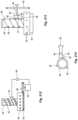
- FIGS. 212-216 illustrate several additional embodiments which use various types of control to enhance the control and precision of the individual doses delivered by the device.
- FIG. 212 schematically illustrates an embodiment which uses an encoder to enhance control and precision of the dosage amount delivered by the device, such as, for example, the device in FIG. 42 .
- a rotating drive ribbon 440 includes a set of gear teeth 442 along its proximal edge.
- An electric motor 444 drives a gear 446 that, in turn, engages gear teeth 442 and thereby drives rotation of drive ribbon 440.
- Drive ribbon 440 also includes a series of encoder targets 452 such as dark rectangles that are distinguishable from the drive ribbon 440 by optical sensor 450.
- Optical sensor 450 generates signals that are received by processor 448.
- FIGS. 213 and 214 schematically illustrate a device that uses a mechanical control to enhance the control and precision of the dosage amount.
- the embodiment of FIGS. 213-214 includes a rotating drive ribbon 454 which is driven by a pretensioned spring 458.
- Spring 458 is provided with sufficient pretensioning during manufacture to rotate drive ribbon 454 through its full extension.
- Drive ribbon 454 also includes a series of projections 456 that project radially outwardly from ribbon 454. The distance between each of the projections 456 corresponds to a predefined dosage of medication such as the amount of an individual dosage or a whole fraction thereof.
- An actuator 460 is mounted on housing 462 and includes a camming surface 464. When actuator 460 is depressed radially inwardly, camming surface 464 interacts with control member 466.
- Control member 466 is disposed adjacent the extended portion of drive ribbon 454 and is biased by a spring (not shown) or other biasing member into the position shown in FIGS. 213 and 214 . In this position, it blocks the passage of projections 456.
- Control member 466 also includes teeth that define camming surfaces 468 that are engageable with camming surface 464 on actuator 460.
- actuator 460 When actuator 460 is depressed, camming surfaces 464 and 468 interact to bias control member 466 upwards whereby opening 470 is aligned with a projection 456 engaged with the side of control member 466. This allows projection 456 to pass through opening 470 and drive ribbon 454 to be extended under the influence of pretensioned spring 458.
- Actuator 460 also includes a spring (not shown) that biases it out of engagement with control member 466.
- actuator 460 when actuator 460 is depressed and then released, it will move control member 466 into a position where a projection 456 can pass through opening 470 and then return control member 466 to a position where it blocks the passage of a projection 456. This allows a user to easily dispense a predefined dosage amount simply by depressing and releasing actuator 460.
- FIG. 215 illustrates a device that utilizes an image sensor 476 to read codes 474 on rotating drive ribbon 472.
- Codes 474 are located at predefined intervals on drive ribbon 472 and read by image sensor 476 to facilitate control of individual dosage deliveries. Signals generated by image sensor 476 are communicated to processer 478 and may be stored in a digital memory. Processor 478, in turn, controls an electric motor or other suitable mechanism for rotating drive ribbon 472 based upon the signals generated by image sensor 476.
- Codes 474 may take various forms, for example, they may be QR codes, bar codes, encoder strip codes. Codes 474 may also take the form of different colors whereby a particular color change corresponds to a predefined distance along ribbon 472. Codes 474 may formed by screen printing graphics on the drive ribbon and may also include other information readable by image sensor 476 such as the type of drug, original quantity of the drug, and other forms of information.
- the senor may be a part of the cassette. Alternatively, it could be a part of the reusable module with cooperating windows on the cassette and reusable module allowing the sensor to view the drive ribbon.
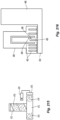
- FIG. 216 illustrates a device having an alternative configuration that facilitates the use of a sensor on the reusable module and may otherwise use a control system similar to that of the embodiments of FIGS. 212 and 215 .
- cassette 480 holds a rotatable drive ribbon 482 having codes 484 located on the inward facing surface of drive ribbon 482.
- Reusable module 486 includes a proximal foot 492 similar to the embodiments of FIGS. 121-126 , 127-132 , 135 and 136 . Extending from proximal foot 492 is a stem 490 having a sensor 488 mounted on its free end to read the codes 484 on the inward facing surface of drive ribbon 482.
- any of the devices described herein may includes a controller (also referred to herein as an electronic module) and/or an electronic display.
- the display may include any one of or any combination of two or more light emitting diodes, e-ink technology, or liquid crystal technology.
- the display is circuited to and controlled by the electronic controller or computing assembly mounted within the housing.
- the controller includes conventional components such as, for example, a processor, power supply, memory, etc.
- the controller is programmed to achieve the electronic features of any one of the devices described herein, including causing the display of set doses.
- the set dose displayed in the display may be determined by the interaction of the dose setting and/or dose delivery drive mechanism and any one or more of the sensing systems electrically circuited or wirelessly communicated with the controller.
- the controller includes control logic operative to perform the operations described herein, including detecting a dose delivered by the medication delivery device based on a detected rotation or linear extension of the drive ribbon member relative to the actuator.
- the controller is operable to determine the dose setting by the drive ribbon parameter(s), such as, position based on rotational and/or linear position of respective components, which is determined by associating the electrical characteristic (such as voltage or resistance) from the respective sensors and the number of rotations to an exact and/or absolute position from a database, look up table, or other data stored in memory.
- the controller is operable to determine the dose delivery by determining the drive ribbon position based on rotational and/or linear position of respective components, which is determined by associating the electrical characteristic (such as voltage or resistance) from the respective sensor bands and the number of rotations to an exact and/or absolute position from a database, look up table, or other data stored in memory.
- the controller is operative to store the detected dose in local memory (e.g., internal flash memory or on-board EEPROM).
- the controller is further operative to wirelessly transmit a signal representative of the detected dose to a paired remote electronic device, such as a user's smartphone, over a Bluetooth low energy (BLE) or other suitable short or long-range wireless communication protocol.
- BLE Bluetooth low energy
- the BLE control logic and controller are integrated on a same circuit.
Landscapes
- Health & Medical Sciences (AREA)
- Vascular Medicine (AREA)
- Engineering & Computer Science (AREA)
- Anesthesiology (AREA)
- Biomedical Technology (AREA)
- Heart & Thoracic Surgery (AREA)
- Hematology (AREA)
- Life Sciences & Earth Sciences (AREA)
- Animal Behavior & Ethology (AREA)
- General Health & Medical Sciences (AREA)
- Public Health (AREA)
- Veterinary Medicine (AREA)
- Infusion, Injection, And Reservoir Apparatuses (AREA)
Priority Applications (6)
| Application Number | Priority Date | Filing Date | Title |
|---|---|---|---|
| RS20250787A RS67090B1 (sr) | 2017-12-08 | 2018-11-30 | Medicinski uređaj za isporuku sa aksijalno proširivom pogonskom trakom |
| EP25184232.4A EP4596000A3 (en) | 2017-12-08 | 2018-11-30 | Medical delivery device with axially expandable drive ribbon |
| HRP20251145TT HRP20251145T1 (hr) | 2017-12-08 | 2018-11-30 | Uređaj za isporuku lijeka s pogonskom trakom koja se aksijalno širi |
| SI201831256T SI3720526T1 (sl) | 2017-12-08 | 2018-11-30 | Naprava za dovajanje zdravil z aksialno raztegljivim pogonskim trakom |
| SM20250310T SMT202500310T1 (it) | 2017-12-08 | 2018-11-30 | Dispositivo di erogazione medicale con nastro di azionamento espandibile assialmente |
| MA51013A MA51013B1 (fr) | 2017-12-08 | 2018-11-30 | Dispositif d'administration médicale muni d'un ruban d'entraînement extensible axialement |
Applications Claiming Priority (2)
| Application Number | Priority Date | Filing Date | Title |
|---|---|---|---|
| US201762596167P | 2017-12-08 | 2017-12-08 | |
| PCT/US2018/063201 WO2019112886A1 (en) | 2017-12-08 | 2018-11-30 | Medical delivery device with axially expandable drive ribbon |
Related Child Applications (1)
| Application Number | Title | Priority Date | Filing Date |
|---|---|---|---|
| EP25184232.4A Division EP4596000A3 (en) | 2017-12-08 | 2018-11-30 | Medical delivery device with axially expandable drive ribbon |
Publications (2)
| Publication Number | Publication Date |
|---|---|
| EP3720526A1 EP3720526A1 (en) | 2020-10-14 |
| EP3720526B1 true EP3720526B1 (en) | 2025-07-09 |
Family
ID=64734183
Family Applications (2)
| Application Number | Title | Priority Date | Filing Date |
|---|---|---|---|
| EP18821853.1A Active EP3720526B1 (en) | 2017-12-08 | 2018-11-30 | Medical delivery device with axially expandable drive ribbon |
| EP25184232.4A Pending EP4596000A3 (en) | 2017-12-08 | 2018-11-30 | Medical delivery device with axially expandable drive ribbon |
Family Applications After (1)
| Application Number | Title | Priority Date | Filing Date |
|---|---|---|---|
| EP25184232.4A Pending EP4596000A3 (en) | 2017-12-08 | 2018-11-30 | Medical delivery device with axially expandable drive ribbon |
Country Status (25)
| Country | Link |
|---|---|
| US (2) | US11957882B2 (https=) |
| EP (2) | EP3720526B1 (https=) |
| JP (6) | JP6965451B2 (https=) |
| KR (2) | KR102508085B1 (https=) |
| CN (3) | CN111432864B (https=) |
| AU (1) | AU2018381187B2 (https=) |
| CA (2) | CA3083278C (https=) |
| DK (1) | DK3720526T3 (https=) |
| EA (1) | EA202091156A1 (https=) |
| ES (1) | ES3037739T3 (https=) |
| FI (1) | FI3720526T3 (https=) |
| HR (1) | HRP20251145T1 (https=) |
| HU (1) | HUE073472T2 (https=) |
| IL (2) | IL275106B2 (https=) |
| LT (1) | LT3720526T (https=) |
| MA (1) | MA51013B1 (https=) |
| MD (1) | MD3720526T2 (https=) |
| MX (3) | MX2020005780A (https=) |
| PL (1) | PL3720526T3 (https=) |
| PT (1) | PT3720526T (https=) |
| RS (1) | RS67090B1 (https=) |
| SA (1) | SA520412151B1 (https=) |
| SI (1) | SI3720526T1 (https=) |
| SM (1) | SMT202500310T1 (https=) |
| WO (1) | WO2019112886A1 (https=) |
Families Citing this family (15)
| Publication number | Priority date | Publication date | Assignee | Title |
|---|---|---|---|---|
| EP4606404A3 (en) | 2019-09-11 | 2025-11-05 | Eli Lilly and Company | Medication delivery device with needle carrier |
| WO2022132677A1 (en) | 2020-12-17 | 2022-06-23 | Eli Lilly And Company | Fluid delivery system with needle assembly |
| JP2023554626A (ja) * | 2020-12-17 | 2023-12-28 | イーライ リリー アンド カンパニー | 針アセンブリを備えた流体送達システム |
| EP4019064A1 (en) | 2020-12-22 | 2022-06-29 | Ypsomed AG | Modular injection system |
| WO2022150907A1 (en) * | 2021-01-12 | 2022-07-21 | Gestion Laforest Inc. | Linear actuator with anti-rotation mechanism |
| EP4376918A1 (en) * | 2021-07-29 | 2024-06-05 | Becton, Dickinson and Company | Spiral zipper-driven pump mechanism in fluid delivery device |
| CN117794592A (zh) * | 2021-08-20 | 2024-03-29 | 伊莱利利公司 | 药物递送装置盒 |
| EP4166171A1 (en) | 2021-10-14 | 2023-04-19 | Ypsomed AG | Pre-assembled cartridge unit for injection device |
| WO2023217341A1 (en) * | 2022-05-11 | 2023-11-16 | Nateghi Elahi Ramin | Injector for subcutaneous injection of a drug into a patient |
| MA71244A (fr) * | 2022-06-22 | 2025-04-30 | Eli Lilly And Company | Cassette de distribution de fluide |
| JP7834044B2 (ja) | 2023-02-24 | 2026-03-23 | 三菱電機株式会社 | 半導体装置及び半導体装置の製造方法 |
| KR20260026541A (ko) | 2023-06-19 | 2026-02-26 | 일라이 릴리 앤드 캄파니 | 바늘 조립체 및 바늘 조립체를 갖는 유체 전달 시스템 |
| AU2024322564A1 (en) | 2023-08-10 | 2026-02-19 | Eli Lilly And Company | Needle system for drug delivery |
| WO2026024571A1 (en) | 2024-07-22 | 2026-01-29 | Eli Lilly And Company | Method of assembly of needle assembly |
| WO2026024570A1 (en) | 2024-07-22 | 2026-01-29 | Eli Lilly And Company | Medication delivery device with medication cartridge and needle assembly |
Citations (1)
| Publication number | Priority date | Publication date | Assignee | Title |
|---|---|---|---|---|
| US20170165415A1 (en) * | 2015-12-10 | 2017-06-15 | Repro-Med Systems, Inc. | System and method for a syringe micro pump with volute spring |
Family Cites Families (41)
| Publication number | Priority date | Publication date | Assignee | Title |
|---|---|---|---|---|
| US4313439A (en) * | 1980-03-24 | 1982-02-02 | Biotek, Inc. | Automated, spring-powered medicament infusion system |
| US4908017A (en) * | 1985-05-14 | 1990-03-13 | Ivion Corporation | Failsafe apparatus and method for effecting syringe drive |
| US4875660A (en) | 1988-02-02 | 1989-10-24 | Pierre Gagnon | Push actuator |
| JPH0451966A (ja) * | 1990-06-19 | 1992-02-20 | Toichi Ishikawa | 薬液連続注入器 |
| US5478316A (en) | 1994-02-02 | 1995-12-26 | Becton, Dickinson And Company | Automatic self-injection device |
| US5637095A (en) * | 1995-01-13 | 1997-06-10 | Minimed Inc. | Medication infusion pump with flexible drive plunger |
| DE19717107B4 (de) | 1997-04-23 | 2005-06-23 | Disetronic Licensing Ag | System aus Behältnis und Antriebsvorrichtung für einen Kolben, der in dem ein Medikamentfluid enthaltenden Behältnis gehalten ist |
| US6003736A (en) * | 1997-06-09 | 1999-12-21 | Novo Nordisk A/S | Device for controlled dispensing of a dose of a liquid contained in a cartridge |
| DE60004806T2 (de) | 1999-04-16 | 2004-07-01 | Gestion Laforest Inc., St. Hubert | Druckbetätigungsvorrichtung mit mehreren kugeln |
| TW523415B (en) | 2000-03-24 | 2003-03-11 | Novo Nordisk As | A flexible piston rod |
| US7500959B2 (en) | 2000-10-05 | 2009-03-10 | Novo Nordisk A/S | Medication delivery system with improved dose accuracy |
| US6537251B2 (en) * | 2000-10-05 | 2003-03-25 | Novo Nordisk A/S | Medication delivery device with bended piston rod |
| US7073505B2 (en) | 2002-09-06 | 2006-07-11 | Apneon, Inc. | Systems and methods for moving and/or restraining tissue in the oral cavity |
| ATE498421T1 (de) | 2002-12-23 | 2011-03-15 | Asante Solutions Inc | Biegsame kolbenstange |
| ES2555125T3 (es) | 2004-02-18 | 2015-12-29 | Ares Trading S.A. | Dispositivo manual de inyección controlada electrónicamente para inyectar medicamentos líquidos |
| US7213796B2 (en) | 2004-07-01 | 2007-05-08 | Gestion Laforest Inc. | Linear actuator with releasably interlocking bands |
| EP1830906A1 (en) | 2004-12-23 | 2007-09-12 | Novo Nordisk A/S | Segmented piston rod |
| ATE401921T1 (de) | 2005-06-01 | 2008-08-15 | Shl Medical Ab | Medikamentenabgabevorrichtung |
| US8105279B2 (en) * | 2005-09-26 | 2012-01-31 | M2 Group Holdings, Inc. | Dispensing fluid from an infusion pump system |
| EP1923084A1 (en) * | 2006-11-17 | 2008-05-21 | Sanofi-Aventis Deutschland GmbH | Dosing and drive mechanism for drug delivery device |
| US7935105B2 (en) * | 2007-09-07 | 2011-05-03 | Asante Solutions, Inc. | Data storage for an infusion pump system |
| US9138531B2 (en) * | 2008-05-29 | 2015-09-22 | Roche Diagnostics Operations, Inc. | Device, a system and a method for identification/authentication of parts of a medical device |
| CN102209567B (zh) * | 2008-10-01 | 2013-10-23 | Shl集团有限责任公司 | 锥形弹簧致动的药剂输送装置 |
| EP2349140B1 (en) | 2008-11-25 | 2016-06-22 | Lumen Devices LLC | Medical device for a patient |
| EP2198903A1 (en) | 2008-12-19 | 2010-06-23 | Sanofi-Aventis Deutschland GmbH | Motor mechanism for a drug delivery device and drug delivery device |
| RU2524122C2 (ru) | 2009-02-05 | 2014-07-27 | Санофи-Авентис Дойчланд Гмбх | Устройства введения лекарственного препарата |
| AR075234A1 (es) * | 2009-02-05 | 2011-03-16 | Sanofi Aventis Deutschland | Dispositivos de administracion de medicamentos. |
| CA2698027C (en) | 2009-03-31 | 2017-07-11 | Animas Corporation | Novel drive system for use with an insulin delivery device |
| US8740847B2 (en) | 2010-06-09 | 2014-06-03 | Valeritas, Inc. | Fluid delivery device needle retraction mechanisms, cartridges and expandable hydraulic fluid seals |
| US9289556B2 (en) | 2011-09-30 | 2016-03-22 | Becton Dickinson France, S.A.S. | Syringe with plunger rod having a flexible portion |
| EP2698180A1 (en) | 2012-08-15 | 2014-02-19 | Sanofi-Aventis Deutschland GmbH | Autoinjector |
| US20140214001A1 (en) | 2013-01-31 | 2014-07-31 | Alpimed Sarl | Fluid dispensing device |
| EP2964166B1 (en) | 2013-03-06 | 2018-11-28 | Black, Jed, Eric | Adhesive devices for improving breathing and/or sleep using such devices |
| HK1220648A1 (zh) | 2013-07-17 | 2017-05-12 | Sanofi | 驱动机构 |
| RU2016124541A (ru) * | 2013-11-22 | 2017-12-27 | Санофи-Авентис Дойчланд Гмбх | Устройство с пружинным механизмом для доставки лекарственного средства |
| KR101524678B1 (ko) | 2014-04-29 | 2015-06-03 | 최규동 | 길이단축형 주사기 구동장치 |
| TW201625324A (zh) | 2014-10-09 | 2016-07-16 | 賽諾菲公司 | 殼體及具有該殼體的藥物輸送裝置 |
| CN106999672A (zh) * | 2014-12-08 | 2017-08-01 | 赛诺菲 | 用于药物输送装置的驱动机构 |
| US10149943B2 (en) | 2015-05-29 | 2018-12-11 | West Pharma. Services IL, Ltd. | Linear rotation stabilizer for a telescoping syringe stopper driverdriving assembly |
| JOP20170042B1 (ar) | 2016-02-12 | 2022-09-15 | Amgen Inc | وسيلة توصيل عقار، طريقة تصنيعه وطريقة استخدامه |
| RS65082B1 (sr) | 2016-03-21 | 2024-02-29 | Lilly Co Eli | Medicinski uređaj za doziranje sa aksijalno proširivim pogonskim elementom |
-
2018
- 2018-11-30 KR KR1020227025394A patent/KR102508085B1/ko active Active
- 2018-11-30 CN CN201880079360.1A patent/CN111432864B/zh active Active
- 2018-11-30 RS RS20250787A patent/RS67090B1/sr unknown
- 2018-11-30 MA MA51013A patent/MA51013B1/fr unknown
- 2018-11-30 SM SM20250310T patent/SMT202500310T1/it unknown
- 2018-11-30 KR KR1020207015948A patent/KR102425783B1/ko active Active
- 2018-11-30 IL IL275106A patent/IL275106B2/en unknown
- 2018-11-30 US US16/764,638 patent/US11957882B2/en active Active
- 2018-11-30 FI FIEP18821853.1T patent/FI3720526T3/fi active
- 2018-11-30 EP EP18821853.1A patent/EP3720526B1/en active Active
- 2018-11-30 PT PT188218531T patent/PT3720526T/pt unknown
- 2018-11-30 WO PCT/US2018/063201 patent/WO2019112886A1/en not_active Ceased
- 2018-11-30 CN CN202510165786.0A patent/CN119925761A/zh active Pending
- 2018-11-30 EA EA202091156A patent/EA202091156A1/ru unknown
- 2018-11-30 ES ES18821853T patent/ES3037739T3/es active Active
- 2018-11-30 HU HUE18821853A patent/HUE073472T2/hu unknown
- 2018-11-30 AU AU2018381187A patent/AU2018381187B2/en active Active
- 2018-11-30 CN CN202210299640.1A patent/CN114652923B/zh active Active
- 2018-11-30 CA CA3083278A patent/CA3083278C/en active Active
- 2018-11-30 EP EP25184232.4A patent/EP4596000A3/en active Pending
- 2018-11-30 IL IL310135A patent/IL310135B2/en unknown
- 2018-11-30 MD MDE20201030T patent/MD3720526T2/ro unknown
- 2018-11-30 LT LTEPPCT/US2018/063201T patent/LT3720526T/lt unknown
- 2018-11-30 HR HRP20251145TT patent/HRP20251145T1/hr unknown
- 2018-11-30 JP JP2020530350A patent/JP6965451B2/ja active Active
- 2018-11-30 PL PL18821853.1T patent/PL3720526T3/pl unknown
- 2018-11-30 CA CA3224940A patent/CA3224940A1/en active Pending
- 2018-11-30 SI SI201831256T patent/SI3720526T1/sl unknown
- 2018-11-30 MX MX2020005780A patent/MX2020005780A/es unknown
- 2018-11-30 DK DK18821853.1T patent/DK3720526T3/da active
-
2020
- 2020-06-07 SA SA520412151A patent/SA520412151B1/ar unknown
- 2020-07-13 MX MX2024006767A patent/MX2024006767A/es unknown
- 2020-07-13 MX MX2026002088A patent/MX2026002088A/es unknown
-
2021
- 2021-10-20 JP JP2021171291A patent/JP7225346B2/ja active Active
-
2022
- 2022-12-13 JP JP2022198407A patent/JP7465941B2/ja active Active
-
2023
- 2023-02-08 JP JP2023017554A patent/JP2023053026A/ja active Pending
-
2024
- 2024-04-01 US US18/623,088 patent/US20240245866A1/en active Pending
- 2024-04-01 JP JP2024059084A patent/JP7600457B2/ja active Active
- 2024-12-04 JP JP2024211550A patent/JP7770521B2/ja active Active
Patent Citations (1)
| Publication number | Priority date | Publication date | Assignee | Title |
|---|---|---|---|---|
| US20170165415A1 (en) * | 2015-12-10 | 2017-06-15 | Repro-Med Systems, Inc. | System and method for a syringe micro pump with volute spring |
Also Published As
Similar Documents
| Publication | Publication Date | Title |
|---|---|---|
| EP3720526B1 (en) | Medical delivery device with axially expandable drive ribbon | |
| US12083324B2 (en) | Drive ribbon for moving piston within container | |
| US10894129B2 (en) | Drug injection device, cartridge adapter, and drug injection system | |
| EA040850B1 (ru) | Медицинское устройство для доставки с развертываемой в осевом направлении приводной лентой | |
| EA043621B1 (ru) | Медицинское устройство для доставки с развертываемой в осевом направлении приводной лентой | |
| HK1259416B (en) | Medical delivery device with axially expandable drive member |
Legal Events
| Date | Code | Title | Description |
|---|---|---|---|
| REG | Reference to a national code |
Ref country code: HR Ref legal event code: TUEP Ref document number: P20251145T Country of ref document: HR |
|
| STAA | Information on the status of an ep patent application or granted ep patent |
Free format text: STATUS: UNKNOWN |
|
| STAA | Information on the status of an ep patent application or granted ep patent |
Free format text: STATUS: THE INTERNATIONAL PUBLICATION HAS BEEN MADE |
|
| PUAI | Public reference made under article 153(3) epc to a published international application that has entered the european phase |
Free format text: ORIGINAL CODE: 0009012 |
|
| STAA | Information on the status of an ep patent application or granted ep patent |
Free format text: STATUS: REQUEST FOR EXAMINATION WAS MADE |
|
| 17P | Request for examination filed |
Effective date: 20200605 |
|
| AK | Designated contracting states |
Kind code of ref document: A1 Designated state(s): AL AT BE BG CH CY CZ DE DK EE ES FI FR GB GR HR HU IE IS IT LI LT LU LV MC MK MT NL NO PL PT RO RS SE SI SK SM TR |
|
| AX | Request for extension of the european patent |
Extension state: BA ME |
|
| RAV | Requested validation state of the european patent: fee paid |
Extension state: MA Effective date: 20200605 Extension state: MD Effective date: 20200605 |
|
| STAA | Information on the status of an ep patent application or granted ep patent |
Free format text: STATUS: EXAMINATION IS IN PROGRESS |
|
| 17Q | First examination report despatched |
Effective date: 20230324 |
|
| P01 | Opt-out of the competence of the unified patent court (upc) registered |
Effective date: 20230517 |
|
| GRAP | Despatch of communication of intention to grant a patent |
Free format text: ORIGINAL CODE: EPIDOSNIGR1 |
|
| STAA | Information on the status of an ep patent application or granted ep patent |
Free format text: STATUS: GRANT OF PATENT IS INTENDED |
|
| R17C | First examination report despatched (corrected) |
Effective date: 20230324 |
|
| INTG | Intention to grant announced |
Effective date: 20250203 |
|
| GRAS | Grant fee paid |
Free format text: ORIGINAL CODE: EPIDOSNIGR3 |
|
| GRAA | (expected) grant |
Free format text: ORIGINAL CODE: 0009210 |
|
| STAA | Information on the status of an ep patent application or granted ep patent |
Free format text: STATUS: THE PATENT HAS BEEN GRANTED |
|
| AK | Designated contracting states |
Kind code of ref document: B1 Designated state(s): AL AT BE BG CH CY CZ DE DK EE ES FI FR GB GR HR HU IE IS IT LI LT LU LV MC MK MT NL NO PL PT RO RS SE SI SK SM TR |
|
| REG | Reference to a national code |
Ref country code: GB Ref legal event code: FG4D |
|
| REG | Reference to a national code |
Ref country code: CH Ref legal event code: EP |
|
| REG | Reference to a national code |
Ref country code: IE Ref legal event code: FG4D |
|
| REG | Reference to a national code |
Ref country code: DE Ref legal event code: R096 Ref document number: 602018083458 Country of ref document: DE |
|
| REG | Reference to a national code |
Ref country code: PT Ref legal event code: SC4A Ref document number: 3720526 Country of ref document: PT Date of ref document: 20250814 Kind code of ref document: T Free format text: AVAILABILITY OF NATIONAL TRANSLATION Effective date: 20250808 |
|
| REG | Reference to a national code |
Ref country code: FI Ref legal event code: FGE |
|
| REG | Reference to a national code |
Ref country code: DK Ref legal event code: T3 Effective date: 20250808 |
|
| REG | Reference to a national code |
Ref country code: NL Ref legal event code: FP |
|
| REG | Reference to a national code |
Ref country code: SE Ref legal event code: TRGR |
|
| REG | Reference to a national code |
Ref country code: ES Ref legal event code: FG2A Ref document number: 3037739 Country of ref document: ES Kind code of ref document: T3 Effective date: 20251006 |
|
| REG | Reference to a national code |
Ref country code: EE Ref legal event code: FG4A Ref document number: E025225 Country of ref document: EE Effective date: 20250818 Ref country code: SK Ref legal event code: T3 Ref document number: E 46916 Country of ref document: SK |
|
| REG | Reference to a national code |
Ref country code: GR Ref legal event code: EP Ref document number: 20250401695 Country of ref document: GR Effective date: 20251009 Ref country code: MA Ref legal event code: VAGR Ref document number: 51013 Country of ref document: MA Kind code of ref document: B1 |
|
| REG | Reference to a national code |
Ref country code: HR Ref legal event code: ODRP Ref document number: P20251145T Country of ref document: HR Payment date: 20251027 Year of fee payment: 8 |
|
| PGFP | Annual fee paid to national office [announced via postgrant information from national office to epo] |
Ref country code: NL Payment date: 20251022 Year of fee payment: 8 Ref country code: LU Payment date: 20251022 Year of fee payment: 8 |
|
| REG | Reference to a national code |
Ref country code: HR Ref legal event code: T1PR Ref document number: P20251145 Country of ref document: HR |
|
| REG | Reference to a national code |
Ref country code: CH Ref legal event code: U11 Free format text: ST27 STATUS EVENT CODE: U-0-0-U10-U11 (AS PROVIDED BY THE NATIONAL OFFICE) Effective date: 20251201 |
|
| PGFP | Annual fee paid to national office [announced via postgrant information from national office to epo] |
Ref country code: PT Payment date: 20251024 Year of fee payment: 8 |
|
| PGFP | Annual fee paid to national office [announced via postgrant information from national office to epo] |
Ref country code: HU Payment date: 20251117 Year of fee payment: 8 |
|
| REG | Reference to a national code |
Ref country code: MD Ref legal event code: VAGR Ref document number: 3720526 Country of ref document: MD Date of ref document: 20251231 Kind code of ref document: T2 |
|
| PGFP | Annual fee paid to national office [announced via postgrant information from national office to epo] |
Ref country code: IS Payment date: 20251117 Year of fee payment: 8 Ref country code: DE Payment date: 20251022 Year of fee payment: 8 |
|
| PGFP | Annual fee paid to national office [announced via postgrant information from national office to epo] |
Ref country code: LT Payment date: 20251022 Year of fee payment: 8 Ref country code: GB Payment date: 20251023 Year of fee payment: 8 |
|
| PGFP | Annual fee paid to national office [announced via postgrant information from national office to epo] |
Ref country code: NO Payment date: 20251024 Year of fee payment: 8 Ref country code: MC Payment date: 20251028 Year of fee payment: 8 |
|
| PGFP | Annual fee paid to national office [announced via postgrant information from national office to epo] |
Ref country code: SM Payment date: 20251023 Year of fee payment: 8 Ref country code: MK Payment date: 20251027 Year of fee payment: 8 Ref country code: AT Payment date: 20251024 Year of fee payment: 8 |
|
| PGFP | Annual fee paid to national office [announced via postgrant information from national office to epo] |
Ref country code: FI Payment date: 20251022 Year of fee payment: 8 Ref country code: DK Payment date: 20251022 Year of fee payment: 8 Ref country code: IT Payment date: 20251022 Year of fee payment: 8 |
|
| PGFP | Annual fee paid to national office [announced via postgrant information from national office to epo] |
Ref country code: FR Payment date: 20251022 Year of fee payment: 8 Ref country code: HR Payment date: 20251027 Year of fee payment: 8 |
|
| VSFP | Annual fee paid to validation state [announced via postgrant information from national office to epo] |
Ref country code: MD Payment date: 20251127 Year of fee payment: 8 |
|
| PGFP | Annual fee paid to national office [announced via postgrant information from national office to epo] |
Ref country code: AL Payment date: 20251023 Year of fee payment: 8 Ref country code: GR Payment date: 20251024 Year of fee payment: 8 Ref country code: TR Payment date: 20251031 Year of fee payment: 8 Ref country code: BE Payment date: 20251022 Year of fee payment: 8 |
|
| PGFP | Annual fee paid to national office [announced via postgrant information from national office to epo] |
Ref country code: CH Payment date: 20251201 Year of fee payment: 8 Ref country code: SE Payment date: 20251022 Year of fee payment: 8 |
|
| PGFP | Annual fee paid to national office [announced via postgrant information from national office to epo] |
Ref country code: IE Payment date: 20251024 Year of fee payment: 8 Ref country code: CY Payment date: 20251027 Year of fee payment: 8 Ref country code: CZ Payment date: 20251104 Year of fee payment: 8 |
|
| PGFP | Annual fee paid to national office [announced via postgrant information from national office to epo] |
Ref country code: MT Payment date: 20251029 Year of fee payment: 8 Ref country code: LV Payment date: 20251022 Year of fee payment: 8 |
|
| PGFP | Annual fee paid to national office [announced via postgrant information from national office to epo] |
Ref country code: BG Payment date: 20251028 Year of fee payment: 8 Ref country code: PL Payment date: 20251113 Year of fee payment: 8 |
|
| PGFP | Annual fee paid to national office [announced via postgrant information from national office to epo] |
Ref country code: EE Payment date: 20251028 Year of fee payment: 8 |
|
| PGFP | Annual fee paid to national office [announced via postgrant information from national office to epo] |
Ref country code: RO Payment date: 20251103 Year of fee payment: 8 Ref country code: SK Payment date: 20251029 Year of fee payment: 8 |
|
| PGFP | Annual fee paid to national office [announced via postgrant information from national office to epo] |
Ref country code: RS Payment date: 20251024 Year of fee payment: 8 |
|
| REG | Reference to a national code |
Ref country code: HU Ref legal event code: AG4A Ref document number: E073472 Country of ref document: HU |
|
| PGFP | Annual fee paid to national office [announced via postgrant information from national office to epo] |
Ref country code: SI Payment date: 20251029 Year of fee payment: 8 Ref country code: ES Payment date: 20251201 Year of fee payment: 8 |
|
| VSFP | Annual fee paid to validation state [announced via postgrant information from national office to epo] |
Ref country code: MA Payment date: 20251204 Year of fee payment: 8 |