EP3709979B1 - Process for preparing a coated hard shell capsule - Google Patents
Process for preparing a coated hard shell capsule Download PDFInfo
- Publication number
- EP3709979B1 EP3709979B1 EP18811726.1A EP18811726A EP3709979B1 EP 3709979 B1 EP3709979 B1 EP 3709979B1 EP 18811726 A EP18811726 A EP 18811726A EP 3709979 B1 EP3709979 B1 EP 3709979B1
- Authority
- EP
- European Patent Office
- Prior art keywords
- capsule
- polymer
- cap
- weight
- hard shell
- Prior art date
- Legal status (The legal status is an assumption and is not a legal conclusion. Google has not performed a legal analysis and makes no representation as to the accuracy of the status listed.)
- Active
Links
Images


Classifications
-
- A—HUMAN NECESSITIES
- A61—MEDICAL OR VETERINARY SCIENCE; HYGIENE
- A61J—CONTAINERS SPECIALLY ADAPTED FOR MEDICAL OR PHARMACEUTICAL PURPOSES; DEVICES OR METHODS SPECIALLY ADAPTED FOR BRINGING PHARMACEUTICAL PRODUCTS INTO PARTICULAR PHYSICAL OR ADMINISTERING FORMS; DEVICES FOR ADMINISTERING FOOD OR MEDICINES ORALLY; BABY COMFORTERS; DEVICES FOR RECEIVING SPITTLE
- A61J3/00—Devices or methods specially adapted for bringing pharmaceutical products into particular physical or administering forms
- A61J3/07—Devices or methods specially adapted for bringing pharmaceutical products into particular physical or administering forms into the form of capsules or similar small containers for oral use
- A61J3/071—Devices or methods specially adapted for bringing pharmaceutical products into particular physical or administering forms into the form of capsules or similar small containers for oral use into the form of telescopically engaged two-piece capsules
- A61J3/074—Filling capsules; Related operations
-
- A—HUMAN NECESSITIES
- A61—MEDICAL OR VETERINARY SCIENCE; HYGIENE
- A61K—PREPARATIONS FOR MEDICAL, DENTAL OR TOILETRY PURPOSES
- A61K47/00—Medicinal preparations characterised by the non-active ingredients used, e.g. carriers or inert additives; Targeting or modifying agents chemically bound to the active ingredient
- A61K47/30—Macromolecular organic or inorganic compounds, e.g. inorganic polyphosphates
- A61K47/32—Macromolecular compounds obtained by reactions only involving carbon-to-carbon unsaturated bonds, e.g. carbomers, poly(meth)acrylates, or polyvinyl pyrrolidone
-
- A—HUMAN NECESSITIES
- A61—MEDICAL OR VETERINARY SCIENCE; HYGIENE
- A61K—PREPARATIONS FOR MEDICAL, DENTAL OR TOILETRY PURPOSES
- A61K47/00—Medicinal preparations characterised by the non-active ingredients used, e.g. carriers or inert additives; Targeting or modifying agents chemically bound to the active ingredient
- A61K47/30—Macromolecular organic or inorganic compounds, e.g. inorganic polyphosphates
- A61K47/36—Polysaccharides; Derivatives thereof, e.g. gums, starch, alginate, dextrin, hyaluronic acid, chitosan, inulin, agar or pectin
- A61K47/38—Cellulose; Derivatives thereof
-
- A—HUMAN NECESSITIES
- A61—MEDICAL OR VETERINARY SCIENCE; HYGIENE
- A61K—PREPARATIONS FOR MEDICAL, DENTAL OR TOILETRY PURPOSES
- A61K9/00—Medicinal preparations characterised by special physical form
- A61K9/48—Preparations in capsules, e.g. of gelatin, of chocolate
- A61K9/4808—Preparations in capsules, e.g. of gelatin, of chocolate characterised by the form of the capsule or the structure of the filling; Capsules containing small tablets; Capsules with outer layer for immediate drug release
-
- A—HUMAN NECESSITIES
- A61—MEDICAL OR VETERINARY SCIENCE; HYGIENE
- A61K—PREPARATIONS FOR MEDICAL, DENTAL OR TOILETRY PURPOSES
- A61K9/00—Medicinal preparations characterised by special physical form
- A61K9/48—Preparations in capsules, e.g. of gelatin, of chocolate
- A61K9/4816—Wall or shell material
-
- A—HUMAN NECESSITIES
- A61—MEDICAL OR VETERINARY SCIENCE; HYGIENE
- A61K—PREPARATIONS FOR MEDICAL, DENTAL OR TOILETRY PURPOSES
- A61K9/00—Medicinal preparations characterised by special physical form
- A61K9/48—Preparations in capsules, e.g. of gelatin, of chocolate
- A61K9/4891—Coated capsules; Multilayered drug free capsule shells
Definitions
- the invention is in the field of processes for preparing polymer-coated hard shell capsules.
- US 4138013 describes hard shell capsules with enteric properties.
- the hard shell capsules comprise telescopically engaged body and cap portions.
- the capsule body and cap portions are formed by dip-molding using homogeneous film-forming mixt comprising selected from hydroxypropyl methyl cellulose (HPMC), a mixture of (1) hydroxypropyl methyl cellulose and an ammonium salt of cellulose acetate phthalate or (2) gelatin and an ammonium salt of a copolymer of (meth)acrylic acid and methacrylic acid alkyl ester.
- HPMC hydroxypropyl methyl cellulose
- the capsules itself have already enteric properties without applying a further enteric coating layer.
- aqueous preparations (EUDRAGIT ® FS 30 D, EUDRAGIT ® L 30 D-55, Aquoat ® AS-HF or Sureteric ® ) based on (meth)acrylate copolymers or polyvinyl acetate phthalate, plasticizers such as triethyl citrate and further auxiliaries, such as, for example, talc, it is possible to provide HPMC capsules with an enteric film from separately coated bodies and caps. A separate sealing step can be prevented in the case of this coating technology.
- HPMC capsules which have been coated with (meth)acrylate copolymers are depicted as particularly advantageous in the sum of their properties.
- WO 2011/012369A1 describes a coating composition for the enteric coating of capsule halves made of water-soluble or water-swellable polymer material.
- US 8590278B2 describes a method for fluid-tight sealing of filled medicament capsules.
- the capsule parts are filled with a gas that is at a different temperature or pressure or both than the temperature or pressure or both outside the capsule.
- the capsule parts are fitted together such that a differential pressure reduction in the capsule body and the capsule cap results.
- a leak-tight seal is provided in the gap between the capsule body and the capsule cap, wherein the gap is around 20 to 50 microns.
- US 20170035699A1 describes an acid-resistant banding solution for acid resistant two piece hard capsules.
- WO 2015/177028 describes a capsule containing a non-liquid fill and comprising a modified release characterized in that the capsule is band sealed below the modified release coating.
- the modified release coating may be a delayed release coating or a controlled release coating, which may be an enteric coating.
- Film forming agents for the enteric coating may be selected from anionic (meth)acrylate copolymers or anionic celluloses.
- the coating amount may be in the range from about 2 to 12 mg per cm 2 of the relevant capsule surface area.
- WO2013/1710012A2 WO2007/070052A2 , WO2011/151722A2 and WO2017/120592A1 contain examples wherein hard shell capsules are filled with active ingredient containing powder formulations, are closed and subsequently coated with enteric (meth)acrylate copolymers.
- JP 2003 325642 A and JP S61 221117 A disclose coating a capsule with an enteric polymer in a pre-locked state.
- the invention is concerned with a process for preparing a polymer-coated hard shell capsule, suitable as container for pharmaceutical or nutraceutical biologically active ingredients, wherein the hard shell capsule is comprising a body and a cap, wherein in the closed stage the cap overlaps the body either in a pre-locked state or in a final-locked state, wherein the hard shell capsule having a gap of 10 to 100 ⁇ m (microns) is provided in the pre-locked state and spray-coated with a coating solution or dispersion comprising a polymer or a mixture of polymers to create a coating layer which covers the outer surface of the hard shell capsule in the pre-locked state, wherein the coating layer is applied in an amount of about 0.7 to 5.5 mg/cm 2 , wherein the polymer or a mixture of polymers is selected from the group of anionic polymers, cationic polymers, or neutral polymers, the anionic polymer is an anionic (meth)acrylate copolymer, the cationic polymer is a cationic (me
- the invention is also concerned with polymer-coated hard shell capsule obtained from the process as described and with a pharmaceutical or nutraceutical dosage form comprising the polymer-coated hard shell capsule in the final-locked stage containing a fill comprising a pharmaceutical or nutraceutical biologically active ingredient.
- Huyghebaert et al. European Journal of Pharmaceutical Sciences 21 (2004) 617-623 , describes the separate coating of bodies and caps of hard shell capsules with certain polymers.
- the bodies and caps can be filled with an active ingredient and show no leakage in release tests. There is also no need of additional banding.
- a disadvantage of this method is however that the separately polymer-coated bodies and caps must be subsequently filled and closed manually. Since bodies and caps often have tolerances, matching bodies and caps have to be manually selected. Furthermore, the previous form of the uncoated bodies and caps may suffer from the coating process in that their round form may be distorted. Thus, the percentage of out-of-specification parts is usually increased; meaning caps and bodies separately coated do not readily fit to each other. Therefore, fitting caps and bodies need to be manually selected, which requires multiple iteration and is not a first time right process. The need of manual processing limits the large scale industrial application.
- the described process has the advantage that only one coating process is necessary. No coating material is sprayed inside the capsule halves. Thus, the loss of expensive coating solution or dispersion is significantly less. It was found that when the capsules are used in the pre-locked state there is no or almost no distortion of the roundness of the body and the cap. This modified capsule shape stability is maybe related to a stabilizing effect of the two capsule halves at the overlap area in the pre-locked state. Thus, the pre-locked state provides sufficient mechanical stability during the coating and drying process in conventional coating equipment like fluidized bed coater and drum coater.
- the pre-locked coated capsules are suitable as a part of large scale industrial production, e.g. coated capsules in the pre-locked state opening, filling with an active ingredient or active ingredient containing composition and closing into the final-locked state, of pharmaceutical or nutraceutical dosage forms comprising a polymer-coated hard shell capsule in the final-locked stage containing a fill comprising a pharmaceutical or nutraceutical biologically active ingredient.
- hard shell capsules coated in the inventive process are tightly closed and show no leakage although only a part of the overlapping area between body and cap is sealed by a coating.
- the described process is especially useful for providing tightly final-locked polymer-coated hard shell capsules for pharmaceutical or nutraceutical dosage forms with gastric resistance and an intended rapid release in the small intestine.
- the described process is also useful for providing polymer-coated hard shell capsules and pharmaceutical or nutraceutical dosage forms based on these kind of capsules with improved moisture protection properties, especially with decreased moisture up-take during storage.
- a polymer or a mixture of polymers shall be understood as one polymer or a mixture of two or more polymers, for instance a mixture of two or three polymers. It is also possible that the coating layer may comprise or consist of several individual layers, maybe two layers with each containing a polymer or a polymer mixture, which may comprise the same or different polymers in the two or more layers. Preferably, the coating layer comprises or consists of only one coating layer. with preferably only one polymer or a mixture of two polymers.
- One polymer shall mean only one polymer or only one main polymer with the addition of negligible amounts of further polymers (5 or 2 or 1 or less % by weight calculated on the weight of the main polymer) that do not essentially influence the function of the main polymer. Negligible amounts of further polymers may be added for excipient functions such as improving the adhesion of the coating layer on the capsule material.
- a hard shell capsule for pharmaceutical or nutraceutical purposes are well known to a skilled person.
- a hard shell capsule is a two-piece encapsulation capsule comprising of the two capsule halves, called the body and the cap.
- the capsule body and cap material is usually made from a hard and sometimes brittle material.
- the hard shell capsule comprises a body and a cap.
- Body and cap are usually of a one end open cylindrical form with closed rounded hemispherical ends on the opposite end. The shape and size of the cap and body are such that the body can be pushed telescopically with its open end into the open end of the cap.
- the body and the cap comprise a potential overlapping matching area (overlap area) outside the body and inside the cap which partially overlap when the capsule is closed in the pre-locked stage and totally overlap in the final-locked stage.
- a potential overlapping matching area overlap area
- the capsule is in the pre-locked stage.
- the cap is totally slid over the overlapping matching area of the body the capsule is in the final-locked stage.
- the maintenance of the pre-locked stage or of the final-locked stage is usually supported by snap-in locking mechanisms of the body and the cap such as matching encircling notches or dimples, preferably elongated dimples.
- the body is longer than the cap.
- the outside overlapping area of the body can be covered by the cap in order to close or to lock the capsule.
- the cap covers the outside overlap area of the body either in a pre-locked state or in a final-locked state.
- the cap covers the outside overlap area of the body in total, in the pre-locked state the cap overlaps the outside overlapping area of the body only partially.
- the cap can be slid over the body to be fixed in usually one of two different positions in which the capsule is closed either in a pre-locked state or in a final-locked state.
- Hard shell capsules are commercially available in different sizes. Hard shell capsules are usually delivered as empty containers with the body and cap already positioned in the pre-locked state and on demand as separate capsules halves, bodies and caps,.
- the pre-locked hard shell capsules can be provided to a capsule-filling machine, which performs the opening, filling and closing of the capsule into the final-locked state.
- hard shell capsules are filled with dry materials, for instance with powders or granules comprising a biologically active ingredient.
- the cap and body are provided with closure means that are advantageous for the pre-locking (temporary) and/or final locking of the capsule.
- elevated points may be provided on the inner wall of the cap and somewhat larger indented points are provided on the outer wall of the body, which are arranged so that when the capsule is closed the elevations fit into the indentations.
- the elevations may be formed on the outer wall of the body and the indentations on the inner wall of the cap. Arrangements in which the elevations or indentations arranged in a ring or spiral around the wall. Instead of the point-like configuration of the elevations and indentations, these may encircle the wall of the cap or body in an annular configuration, although advantageously recesses and openings are provided which enable an exchange of gases into and out of the capsule interior.
- One or more elevations may be provided in an annular arrangement around the inner wall of the cap and the outer wall of the body such that, in the final-locked position of the capsule, an elevation on the cap is located adjacent to an elevation on the body.
- elevations are formed on the outside of the body close to the open end and indentations are formed in the cap close to the open end such that the elevations on the body latch into the indentations in the cap in the final-locked position of the capsule.
- the elevations may be such that the cap can be opened in the pre-locked state at any time without damage to the capsule or, alternatively, so that once it has been closed the capsule cannot be opened again without destroying it.
- Capsules with one or more such latching mechanisms are preferred. More prefered are capsules with at least two such latching means which secure the two capsule parts to different degrees.
- a first latching (dimples or encirculating notches) means may be formed close to the openings in the capsule cap and the capsule body and a second latching (encircilating notches) can be shifted somewhat further towards the closed end of the capsule parts.
- the first latching means secure the two capsule parts less strongly than the second does.
- This variant has the advantage that after the production of the empty capsules the capsule cap and capsule body can initially be pre-locked joined together using the first latching mechanism. In order to fill the capsule the two capsule parts are then separated again. After filling, the two capsule parts are pushed together until the second set of latches firmly secures the capsule parts in a final-locked stage.
- the body and the cap of the hard shell capsule are comprising each encircling notches and/or dimples in the area, where the cap can be slid over the body.
- Encircling notches of the body and dimples of the cap match to each other to provide a snap-in or snap into-place mechanism.
- the dimples may be circular or elongated (oval) in the longitudinal direction.
- Encircling notches of the body and encircling notches of the cap also match to each other to provide a snap-in or snap into-place mechanism. This allows the capsule to be closed by a snap-into-place mechanism either in a pre-locked state or in a final-locked state.
- matching encircling notches of the body and elongated dimples of the cap are used to fix the body and the cap to each other in the pre-locked state.
- Matching encircling notches of the body and the cap are preferably used to fix or lock the body and the cap to each other in the final-locked state.
- the area, where the cap can be slid over the body may be called the overlapping area of the body and the cap or briefly the overlap area. If the cap overlaps the body only partially, maybe to 20 to 90 or 60 to 85 % of the overlap area, the hard shell capsule is only partially closed (pre-locked). Preferably, in the presence of a locking mechanism, like matching encircling notches and/or dimples in body and cap, the partially closed capsule may be called pre-locked. When the capsule is polymer-coated in the pre-locked stage the coating will cover the completely outer surface including that part of the overlap area of the body and cap that is not overlapped by the cap in this pre-locked stage.
- the hard shell capsule is finally closed or in the final-locked state.
- the finally closed capsule may be called final-locked.
- dimples are preferred for the fixing the body and the cap in the pre-locked state.
- the matching area of dimples is smaller than the matching area of encircling notches.
- snapped-in dimples may be snapped-out again by applying less forces than those that would be necessary to snap-out a snapped-in fixation by matching encircling notches.
- the dimples of the body and cap are located in the area, where the cap can be slid over the body match to each other in the pre-locked state by a snap in or snap into-place mechanism.
- the dimples of the cap are and the encircling notches of the body in the area, where the cap can be slid over the body match to each other so that they that allow the capsule to be closed by a snap-into-place mechanism in the pre-locked state.
- the hard shell capsule In the pre-locked state, the hard shell capsule can be re-opened manually or by a machine without damaging, because the forces needed to open are comparatively low.
- the "pre-locked state” is sometimes designated also as “loosely capped”.
- the encircling notches or matching locking rings of the body and the cap in the area, where the cap can be slid over the body match to each other so that they that allow the capsule to be closed by a snap-into-place mechanism in the final-locked state.
- the hard shell capsule In the final-locked state, the hard shell capsule cannot or can be only hardly be re-opened manually or by a machine without damaging, because the forces needed to open are comparatively high.
- the capsule body or capsule cap When the capsule parts provided with these elevations and indentations are fitted into one another, defined uniform gaps of from 10 microns to 100 microns, more particularly 20 microns to 100 microns, are formed along the contact surface between the capsule body and the capsule cap placed thereon.
- the body of the hard shell capsule comprises a tapered rim. The tapered rim prevent the rims of the body and the cap to collide and becoming damaged when the capsule is closed manually or by a machine.
- a soft shell capsule In contrast to a hard shell capsule, a soft shell capsule is a welded one piece encapsulation capsule.
- a soft gel capsule is often made from blow molded soft gelling substances and is usually filled with liquids comprising a biologically active ingredient by injection.
- the invention is not concerned with welded soft shell one piece encapsulation capsules.
- a closed, final-locked hard shell capsule may have a total length in the range from about 5 to 40 mm.
- the diameter of the cap may be in the range from about 4 to 12 mm.
- the diameter of the body may be in the range from about 2 to 11 mm.
- the length of the cap may be in the range from about 4 to 20 mm and that of the body in the range from 8 to 30 mm.
- the fill volume may be between about from 0.1 to 2 ml.
- the difference between the pre-locked length and the final-locked length may be about 1 to 5 mm.
- Capsules can be divided into standardized sizes for example from sizes 000 to 5.
- a closed capsule of size 000 has, for example, a total length of about 28 mm with an outer diameter of the cap of about 9.9 mm and an outer diameter of the body of about 9.5 mm.
- the length of the cap is about 14 mm, that of the body about 22 mm.
- the fill volume is about 1.4 ml.
- a closed capsule of size 5 has, for example, a total length of about 10 mm and an outer diameter of the cap of about 4.8 mm and an outer diameter of the body of about 4.6 mm.
- the length of the cap is about 5.6 mm, that of the body about 9.4 mm.
- the fill volume is about 0.13 ml.
- a size 0 capsule may show a length of about 23 to 24 mm in the pre-locked stage and of about 20.5 to 21.5 mm in the final-locked stage.
- the difference between the pre-locked length and the final-locked length may be about 2 to 3 mm.
- the invention is concerned with a polymer-coated hard shell capsule, obtained from the process as described herein.
- the material of the body and the cap may be selected from hydroxypropyl methyl cellulose, starch, gelatin, pullulan and a copolymer of C1- to C4-alkylester of (meth)acrylic acid and (meth)acrylic acid.
- the polymer or polymer mixture comprised in the coating layer are preferably film-forming polymers and are selected from the groups of anionic polymers, cationic polymers and neutral polymers or any mixtures thereof, wherein the anionic polymer is an anionic (meth)acrylate copolymer, the cationic polymer is a cationic (meth)acrylate copolymer, and the neutral polymer is a neutral (meth)acrylate copolymer.
- the described process is especially useful for providing tightly closed polymer-coated hard shell capsules for pharmaceutical or nutraceutical dosage forms with gastric resistance and an intended rapid release in the small intestine (enteric coating) or large intestine (colon targeting).
- anionic polymers are also called "enteric polymers".
- enteric polymers are capable of providing enteric protection to the capsule.
- Enteric protection shall mean, when the capsule is in the final closed state and comprises a fill comprising a pharmaceutical or nutraceutical biologically active ingredient, less than 10 % of the comprised biologically active ingredient will be released after 120 min in 0.1 HCl, pH 1.2. Most preferred after 120 min in 0.1 HCl pH 1.2 and subsequent change to a buffered medium of pH 6.8 about 80 % or more of the comprised biologically active ingredient will be released after a total time of 165 min or 180 min.
- Colon targeting shall mean, when the capsule is in the final closed state and comprises a fill comprising a pharmaceutical or nutraceutical biologically active ingredient, less than 10 % of the comprised biologically active ingredient will be released after 120 min in 0.1 HCl, pH 1.2. Preferred after 120 min in 0.1 HCl pH 1.2 and subsequent change to a buffered medium of pH 6.8 about 80 % or more of the comprised biologically active ingredient will be released after a total time of 165 min.
- the dissolution test is performed according to the United States Pharmacopeia 40 (USP) chapter ⁇ 711> utilizing USP Apparatus II with a paddle speed of 75 rpm.
- the test media temperature will be adjusted to 37 + 0.5°C. Samples will be taken at appropriate time points.
- the anionic (meth)acrylate copolymer comprises 25 to 95, preferably 40 to 95, in particular 60 to 40, % by weight free-radical polymerized C1- to C12-alkyl esters, preferably C1- to C4-alkyl esters of acrylic or of methacrylic acid and 75 to 5, preferably 60 to 5, in particular 40 to 60 % by weight (meth)acrylate monomers having an anionic group.
- the proportions mentioned normally add up to 100% by weight.
- C1- to C4-alkyl esters of acrylic or methacrylic acid are in particular methyl methacrylate, ethyl meth ⁇ acrylate, butyl methacrylate, methyl acrylate, ethyl acrylate and butyl acrylate.
- a (meth)acrylate monomer having an anionic group is, for example, acrylic acid, with preference for meth ⁇ acrylic acid.
- Suitable anionic (meth)acrylate copolymers are those polymerized from of 40 to 60% by weight methacrylic acid and 60 to 40% by weight methyl methacrylate or 60 to 40% by weight ethyl acrylate (EUDRAGIT ® L or EUDRAGIT ® L 100 55 types).
- EUDRAGIT ® L is a copolymer polymerized from 50% by weight methyl methacrylate and 50% by weight methacrylic acid.
- the pH of the start of the specific active ingredient release in intestinal juice or simulated intestinal fluid can be stated to be at about pH 6.0.
- EUDRAGIT ® L 100-55 is a copolymer polymerized from 50% by weight ethyl acrylate and 50% by weight methacrylic acid.
- EUDRAGIT ® L 30 D-55 is a dispersion comprising 30% by weight EUDRAGIT ® L 100-55.
- the pH of the start of the specific active ingredient release in intestinal juice or simulated intestinal fluid can be stated to be at about pH 5.5.
- anionic (meth)acrylate copolymers polymerized from 20 to 40% by weight methacrylic acid and 80 to 60% by weight methyl methacrylate (EUDRAGIT ® S type).
- the pH of the start of the specific active ingredient release in intestinal juice or simulated intestinal fluid can be stated to be at about pH 7.0.
- Suitable (meth)acrylate copolymers are polymerized from 10 to 30% by weight methyl methacrylate, 50 to 70% by weight methyl acrylate and 5 to 15% by weight methacrylic acid (EUDRAGIT ® FS type).
- the pH at the start of the specific active ingredient release in intestinal juice or simulated intestinal fluid can be stated to be at about pH 7.0.
- EUDRAGIT ® FS is a copolymer polymerized from 25% by weight methyl methacrylate, 65% by weight methyl acrylate and 10% by weight methacrylic acid.
- EUDRAGIT ® FS 30 D is a dispersion comprising 30% by weight EUDRAGIT ® FS.
- Suitable is a copolymer composed of
- Suitable is a copolymer polymerized from
- the copolymer preferably consists essentially to exclusively of 90, 95 or 99 to 100% by weight of the monomers methacrylic acid, methyl acrylate, ethyl acrylate and butyl methacrylate in the ranges of amounts indicated above.
- methacrylic acid methacrylic acid
- methyl acrylate ethyl acrylate
- butyl methacrylate ethyl methacrylate
- further monomers capable of vinylic copolymerization e.g. 1 to 5% by weight of further monomers capable of vinylic copolymerization additionally to be present, such as, for example, methyl methacrylate, butyl acrylate, hydroxyethyl methacrylate, vinylpyrrolidone, vinyl-malonic acid, styrene, vinyl alcohol, vinyl acetate and/or derivatives thereof.
- suitable anionic (meth)acrylate copolymers may be so called core/shell polymers as described in WO 2012/171575A2 or 2012/171576A1 .
- a suitable Core Shell polymer is a copolymer from a two stage emulsion polymerzation process with a core of 75 % by weight comprising polymerized units of 30% by weight of ethyl acrylate and 70% by weight of methyl methacrylate and a shell of polymerized units comprising 25 % by weight of polymerized from 50% by weight ethyl acrylate and 50% by weight methacrylic acid.
- a suitable Core-Shell polymer may be a copolymer from a two stage emulsion polymerization process with a core with 70 to 80 % by weight, comprising polymerized units of 65 to 75 % by weight of ethyl acrylate and 25 to 35 % by weight of methyl methacrylate, and a shell with 20 to 30 % by weight, comprising polymerized units of 45 to 55 % by weight ethyl acrylate and 45 to 55 % by weight methacrylic acid.
- the described process is especially useful for providing polymer-coated hard shell capsules and pharmaceutical or nutraceutical dosage forms based on these kind of capsules with improved moisture protection properties, e.g. with decreased moisture up-take during storage.
- a coating with a cationic (meth)acrylate copolymer is suggested
- a suitable cationic (meth)acrylate copolymer comprised in the coating layer may be polymerized from monomers comprising C1- to C4-alkyl esters of acrylic or of methacrylic acid and an alkyl ester of acrylic or of methacrylic acid with a tertiary or a quaternary ammonium group in the alkyl group.
- the cationic, water-soluble (meth)acrylate copolymer may be polymerized partly or fully of alkyl from acrylates and/or alkyl methacrylates having a tertiary amino group in the alkyl radical.
- a coating comprising these kind of polymers may have the advantage of providing moisture protection to the hard shell capsule. Moisture protection shall be understood a reduced uptake of moisture or water during storage of the readily filled and final-locked capsules.
- a suitable cationic (meth)acrylate copolymer may be polymerized from 30 to 80% by weight of C1-to C4-alkyl esters of acrylic or of methacrylic acid, and 70 to 20% by weight of alkyl(meth)acrylate monomers having a tertiary amino group in the alkyl radical.
- the preferred cationic (meth)acrylate copolymer may be polymerized from 20 - 30% by weight of methyl methacrylate, 20 - 30% by weight of butyl methacrylate and 60 - 40% by weight of dimethylaminoethyl methacrylate (EUDRAGIT ® E type polymer).
- a specifically suitable commercial (meth)acrylate copolymer with tertiary amino groups is polymerized from from 25% by weight of methyl methacrylate, 25% by weight of butyl methacrylate and 50% by weight of dimethylaminoethyl methacrylate (EUDRAGIT ® E100 or EUDRAGIT ® E PO (powder form)).
- EUDRAGIT ® E 100 and EUDRAGIT ® E PO are water-soluble below approx. pH 5.0 and are thus also gastric juice-soluble.
- a suitable (meth)acrylate copolymer may be composed of 85 to 98% by weight of free-radical polymerized C1 to C4 alkyl esters of acrylic or methacrylic acid and 15 to 2% by weight of (meth)acrylate monomers with a quaternary amino group in the alkyl radical.
- Preferred C1 to C4 alkyl esters of acrylic or methacrylic acid are methyl acrylate, ethyl acrylate, butyl acrylate, butyl methacrylate and methyl methacrylate.
- suitable cationic (meth)acrylate polymers may contain polymerized monomer units of 2 trimethylammonium-ethyl methacrylate chloride or trimethylammonium-propyl methacrylate chloride.
- An appropriate copolymer may be polymerized from 50 70% by weight of methyl methacrylate, 20 40% by weight of ethyl acrylate and 7 2% by weight of 2 trimethylammoniumethyl methacrylate chloride.
- a specifically suitable copolymer is polymerized from 65% by weight of methyl methacrylate, 30% by weight of ethyl acrylate and 5% by weight of 2 trimethylammoniumethyl methacrylate chloride (EUDRAGIT ® RS).
- a further suitable (meth)acrylate copolymer may be polymerized from 85 to less than 93% by weight of C1 to C4 alkyl esters of acrylic or methacrylic acid and more than 7 to 15% by weight of (meth)acrylate monomers with a quaternary amino group in the alkyl radical.
- Such (meth)acrylate monomers are commercially available and have long been used for release-slowing coatings.
- a specifically suitable copolymer is polymerized from 60% by weight of methyl methacrylate, 30% by weight of ethyl acrylate and 10% by weight of 2 trimethylammoniumethyl methacrylate chloride (EUDRAGIT ® RL).
- Neutral polymers are defined as polymers which are polymerized from neutral monomers and less than 5, preferably less than 2 % by weight or most preferred not all of monomers with ionic groups.
- Suitable neutral polymers for the coating of the hard shell capsule are methacrylate copolymers, preferably copolymers of ethyl acrylate and methyl methacrylate like EUDRAGIT ® NE or EUDRAGIT ® NM, neutral celluloses, such as methyl-, ethyl- or proply ethers of cellulose, for instance hydroxypropyl cellulose, polyvinyl pyrrolidone, polyvinyl acetate or polyvinyl alcohol.
- Neutral methacrylate copolymers are often useful in mixture with anionic (meth)acrylate copolymers.
- Neutral methacrylate copolymers are polymerized from at least to an extent of more than 95% by weight, in particular to an extent of at least 98% by weight, preferably to an extent of at least 99% by weight, in particular to an extent of at least 99% by weight, more preferably to an extent of 100% by weight, of (meth)acrylate monomers with neutral radicals, especially C1- to C4-alkyl radicals.
- Suitable (meth)acrylate monomers with neutral radicals are, for example, methyl methacrylate, ethyl methacrylate, butyl methacrylate, methyl acrylate, ethyl acrylate, butyl acrylate. Preference is given to methyl methacrylate, ethyl acrylate and methyl acrylate.
- Methacrylate monomers with anionic radicals for example acrylic acid and/or methacrylic acid, may be present in small amounts of less than 5% by weight, preferably not more than 2% by weight, more preferably not more than 1 or 0.05 to 1% by weight.
- Suitable examples are neutral or virtually neutral (meth)acrylate copolymers polymerized from 20 to 40% by weight of ethyl acrylate, 60 to 80% by weight of methyl methacrylate and 0 to less than 5% by weight, preferably 0 to 2 or 0.05 to 1% by weight of methacrylic acid or acrylic acid.
- Suitable examples are neutral or virtually neutral (meth)acrylate copolymers polymerized from 20 to 40% methyl methacrylate by weight of, 60 to 80% by weight of ethyl acrylate and 0 to less than 5% by weight, preferably 0 to 2 or 0.05 to 1% by weight of methacrylic acid or acrylic acid.
- EUDRAGIT ® NE or EUDRAGIT ® NM type are neutral or virtually neutral (meth)acrylate copolymers polymerized from 20 to 40% methyl methacrylate by weight of, 60 to 80% by weight of ethyl acrylate and 0 to less than 5% by weight, preferably 0 to 2 or 0.05 to 1% by weight of methacrylic acid or acrylic acid.
- EUDRAGIT ® NE and EUDRAGIT ® NM are copolymers comprising free-radically polymerized units of 28 to 32% by weight of methyl methacrylate and 68 to 72% by weight of ethyl acrylate.
- corresponding, virtually neutral (meth)acrylate copolymers with small proportions of 0.05 to 1% by weight of monoolefinically unsaturated C3-C8-carboxylic acids can, however, also be prepared by emulsion polymerization in the presence of comparatively small amounts of anionic emulsifiers, for example 0.001 to 1 % by weight.
- the hard shell capsule is coated with a coating layer comprising the polymer or polymer mixtures as disclosed and optionally excipients, preferably pharmaceutical or nutraceutical acceptable excipients.
- the coating layer may comprise 10 % or more, 20 % or more, 30 % or more, 40 % or more, 50 % or more, 60 % or more, 70 % or more, 80 % or more, 90 % or more by weight or 100 % by weight of the polymer or polymer mixture as disclosed herein.
- the coating layer may comprise 10- 100, 10 - 90, 12 - 80, 15 - 70, 18 - 60 or 20 - 50 % by weight of the polymer as disclosed herein.
- the coating layer may optionally comprise up to 10, up to 20, up to 30, up to 40, up to 50, up to 60, up to 70, up to 80, up to 90 % by weight of excipients, preferably pharmaceutical and/or nutraceutical excipients (pharmaceutically or nutraceutical acceptable excipients).
- the coating layer may comprise 0 - 100, 10 - 90, 20 - 88, 30 - 85, 40 - 82 or 50 - 80 % by weight of excipients, preferably pharmaceutical and/or nutraceutical excipients.
- the polymer or polymer mixture and the optionally comprised pharmaceutical and/or nutraceutical excipients may add up to 100 %.
- the amount of the coating layer should not be too high. If the amount of coating layer applied is too high this may result in difficulties to process the polymer-coated pre-locked hard shell capsules subsequently in a capsule-filling machine. If the amount of coating layer is less than 8 mg/cm 2 , for instance 1 to 8 mg/cm 2 or 1 to 5 mg/cm 2 or 1 to 4 mg/cm 2 usually no problem with standard capsule-filling machines without modification will occur. In the range from 4 and up to about 8 mg/cm 2 capsule-filling machines can still be used, however the forms for the bodies and the caps should be adjusted to be somewhat wider. Such an adjustment can be easily performed by a mechanical engineer. Thus capsule-filling machines may be advantageously used within a range of an amount of coating layer from about 1 to about 8 mg/cm 2 .
- the amount of the coating layer should not be too high. If the amount of coating layer applied is too high this may result in difficulties to process the polymer-coated pre-locked hard shell capsules subsequently in a capsule-filling machine. If the amount of coating layer is less than 5 mg/cm 2 , for instance 1 to 4 mg/cm 2 usually no problem with standard capsule-filling machines without modification will occur. In the range from 4 and up to about 8 mg/cm 2 capsule-filling machines can still be used, however the forms for the bodies and the caps should be adjusted to be somewhat wider. Such an adjustment can be easily performed by a mechanical engineer. Thus capsule-filling machines may be advantageously used within a range of an amount of coating layer from about 1 to about 8 mg/cm 2 .
- the amount of the coating layer should not be too high. If the amount of coating layer applied is too high this may result in difficulties to process the polymer-coated pre-locked hard shell capsules subsequently in a capsule-filling machine. If the amount of coating layer is less than 4 mg/cm 2 , for instance 1 to 3.5 mg/cm 2 usually no problem with standard capsule-filling machines without modification will occur. In the range from 3.5 and up to about 8 mg/cm 2 capsule-filling machines can still be used, however the forms for the bodies and the caps should be adjusted to be somewhat wider. Such an adjustment can be easily performed by a mechanical engineer. Thus capsule-filling machines may be advantageously used within a range of an amount of coating layer from about 1 to about 8 mg/cm 2 .
- the amount of the coating layer should not be too high. If the amount of coating layer applied is too high this may result in difficulties to process the polymer-coated pre-locked hard shell capsules subsequently in a capsule-filling machine. If the amount of coating layer is less than 3 mg/cm 2 , for instance 1 to 2.5 mg/cm 2 usually no problem with standard capsule-filling machines without modification will occur. In the range from 2.5 and up to about 6 mg/cm 2 capsule-filling machines can still be used, however the forms for the bodies and the caps should be adjusted to be somewhat wider. Such an adjustment can be easily performed by a mechanical engineer. Thus capsule-filling machines may be advantageously used within a range of an amount of coating layer from about 1 to about 6 mg/cm 2 .
- the coating layer on the hard shell capsule may have an average thickness of about 5 to 100, 10 to 50, 15 to 75 ⁇ m. According to the invention, the coating layer thickness is less than the gap between the uncoated body and the cap.
- the coating layer on the hard shell capsule may be applied in an amount of 5 to 50, preferably 8 - 40 % dry weight in relation to the weight of the pre-locked capsule.
- the polymer-coated hard shell capsule of the first embodiment may be advantageously combined with a fill-in of the pharmaceutical active ingredients mesalamine or caffeine.
- the polymer-coated hard shell capsule of the second embodiment may be advantageously combined with a fill-in of the pharmaceutical active ingredients metoprolol or omeprazole.
- the polymer-coated hard shell capsule of the third embodiment may be advantageously combined with a fill-in of the pharmaceutical active ingredients mesalamine or metoprolol.
- the biologically active ingredient is preferably a pharmaceutical active ingredient and/or a nutraceutical active ingredient.
- the invention is preferably useful for immediate, enteric or sustained release formulated pharmaceutical or nutraceutical dosage forms with a fill-in of pharmaceutical or nutraceutical active ingredients.
- Suitable therapeutic and chemical classes of pharmaceutical active ingredients which members may be used as fill-in for the described polymer-coated hard shell capsules are for instance: analgesics, antibiotics or anti-infectives, antibodies, antiepileptics, antigens from plants, antirheumatics, benzimidazole derivatives, beta-blocker, cardiovascular drugs, chemotherapeutics, CNS drugs, digitalis glycosides, gastrointestinal drugs, e.g. proton pump inhibitors, enzymes, hormones, liquid or solid natural extracts, oligonucleotides, peptide hormones proteins, therapeutic bacteria, peptides, proteins (metal)salt i.e. aspartates, chlorides, orthates, urology drugs, vaccines
- drugs that may be used as fill-in for the described polymer-coated hard shell capsules are for instance acamprosat, aescin, amylase, acetylsalicylic acid, adrenalin, 5-amino salicylic acid, aureomycin, bacitracin, balsalazine, beta carotene, bicalutamid, bisacodyl, bromelain, bromelain, budesonide, calcitonin, carbamacipine, carboplatin, cephalosporins, cetrorelix, clarithromycin, chloromycetin, cimetidine, cisapride, cladribine, clorazepate, cromalyn, 1-deaminocysteine-8-D-arginine-vasopressin, deramciclane, detirelix, dexlansoprazole, diclofenac, didanosine, digitoxin and other digitalis glycosides, dihydrostre
- nutraceutical active ingredients examples include pharmaceutical, excipients and compositions respectively a pharmaceutical or a nutraceutical dosage form.
- nutraceuticals may also be used as pharmaceutical active ingredients.
- the same substance may be listed as a pharmaceutical or a nutraceutical active ingredient respectively a pharmaceutical or a nutraceutical composition or even both.
- nutraceuticals are well known to the skilled person. Nutraceuticals are often defined as extracts of foods claimed to have medical effects on human health. Thus, nutraceutical active ingredients may display pharmaceutical activities as well: Examples for nutraceutical active ingredients may be resveratrol from grape products as an antioxidant, soluble dietary fiber products, such as psyllium seed husk for reducing hypercholesterolemia, broccoli (sulphane) as a cancer preservative, and soy or clover (isoflavonoids) to improve arterial health. Thus, it is clear that many substances listed as nutraceuticals may also be used as pharmaceutical active ingredients.
- Typical nutraceuticals or nutraceutical active ingredients that may be used as fill-in for the described polymer-coated hard shell capsules may also include probiotics and prebiotics.
- Probiotics are living microorganisms believed to support human or animal health when consumed.
- Prebiotics are nutraceuticals or nutraceutical active ingredients that induce or promote the growth or activity of beneficial microorganisms in the human or animal intestine.
- nutraceuticals examples include resveratrol from grape products, omega-3-fatty acids or pro-anthocyanines from blueberries as antioxidants, soluble dietary fiber products, such as psyllium seed husk for reducing hypercholesterolemia, broccoli (sulphane) as a cancer preservative, and soy or clover (isoflavonoids) to improve arterial health.
- nutraceuticals examples are flavonoids, antioxidants, alpha-linoleic acid from flax seed, beta-carotene from marigold petals or antocyanins from berries.
- neutraceuticals or nutriceuticals are used as synonyms for nutraceuticals.
- Preferred biologically actvie ingredients are metoprolol, mesalamine and omeprazole.
- Excipients are well known to a skilled person and often formulated along with the biologically active ingredient contained in the coated hard shell capsule and/or with the polymer coating of the hard shell capsule as disclosed and claimed herein. All excipients used must be toxicologically safe and be used in pharmaceuticals or nutraceuticals without risk for patients or consumers.
- the dosage form may comprise excipients, preferably pharmaceutical or nutraceutical acceptable excipients, selected from the group of antioxidants, brighteners, binding agents, flavouring agents, flow aids, fragrances, glidants, penetration-promoting agents, pigments, plasticizers, emulsifier, pore-forming agents or stabilizers or combinations thereof.
- the pharmaceutically or nutraceutically acceptable excipients may be comprised in the core and/or in the coating layer comprising the polymer as disclosed.
- a pharmaceutical or nutraceutical acceptable excipient is an excipient, which is allowed to be used for the application in the pharmaceutical or nutraceutical field.
- the coating layer may comprise up to 90, up to 80, up to 70, up to 50, up to 60, up to 50, up to 40, up to 30, up to 20, up to 10 % by weight or not any (0 %) excipients at all, respectively pharmaceutically or nutraceutically acceptable excipients.
- excipient no further (excipient) polymers are present in the coating layer.
- the polymer coating of the hard shell capsule may comprise one or more plasticizers.
- Plasticizers achieve through physical interaction with a polymer a reduction in the glass transition temperature and promote film formation, depending on the added amount.
- Suitable substances usually have a molecular weight of between 100 and 20,000 and comprise one or more hydrophilic groups in the molecule, e.g. hydroxyl, ester or amino groups.
- plasticizers examples include alkyl citrates, glycerol esters, alkyl phthalates, alkyl sebacates, sucrose esters, sorbitan esters, diethyl sebacate, dibutyl sebacate, propylenglycol and polyethylene glycols 200 to 12,000.
- Preferred plasticizers are triethyl citrate (TEC), acetyl triethyl citrate (ATEC), diethyl sebacate and dibutyl sebacate (DBS).
- esters which are usually liquid at room temperature, such as citrates, phthalates, sebacates or castor oil. Esters of citric acid and sebacinic acid are preferably used.
- Glycerol monostearate has plasticizing properties.
- glycerol monostearate although it has some glidant properties as well and is sometimes designated as glidant, is regarded herein as a plasticizer.
- the polymer coating of the hard shell capsule may comprise one or more plasticizers, preferably up to 60, up to 30, up to 25, up to 20, up to 15, up to 10, up to 5, less than 5% by weight, calculated on the polymer or polymer mixture, of a plasticizer or any (0 %) plasticizer at all may be comprised. Most preferred 20 to 30 by weight of mixture of glycerol monostearate (GMS) and triethlycitate, calculated on the polymer or polymer muxture, may be comprised in the coating layer.
- GMS glycerol monostearate
- triethlycitate calculated on the polymer or polymer muxture
- Standard fillers are usually added to the inventive formulation during processing to coating and binding agents.
- the quantities introduced and the use of standard fillers in pharmaceutical coatings or over layers is familiar to those skilled in the art.
- Examples of standard fillers are release agents, pigments, stabilizers, antioxidants, pore-forming agents, penetration-promoting agents, brighteners, fragrances or flavoring agents. They are used as processing adjuvants and are intended to ensure a reliable and reproducible preparation process as well as good long-term storage stability, or they achieve additional advantageous properties in the pharmaceutical form. They are added to the polymer formulations before processing and can influence the permeability of the coatings. This property can be used if necessary as an additional control parameter.
- Glidants or release agents usually have lipophilic properties and are usually added to spray suspensions. They prevent agglomeration of cores during film formation. Suitable glidants are talc, Mg- or Ca-stearate, ground silica, kaolin or nonionic emulsifiers with an HLB value of between 2 and 8. Standard proportions for use of release agents in the inventive coating and binding agents range between 0.5 and 100 % by weight relative to polymer.
- the glidant or release agent is added in concentrated form as the outer layer.
- Application takes place in the form of powder or by spraying from aqueous suspension with 5 to 30% (weight/weight (w/w)) solid content.
- the necessary concentration is lower than for incorporation into the polymer layer and amounts to 0.1 to 2% by weight relative to the weight of the pharmaceutical form.
- the coating layer of the dosage form may for instance comprise 20 - 80, preferably 30 - 70 % by weight of the inventive polymer as disclosed and 20 - 80, 30 - 70 % by weight of talc.
- the inventive polymer and talc may add up to 100 % by weight.
- pigments such as aluminum oxide or iron oxide pigments are used in dispersed form. Titanium dioxide is used as a whitening pigment. Standard proportions for use of pigments are between 10 - 200, 20 - 200 % by weight relative to the polymer or polymer mixture in the coating layer. Proportions up to 200 % by weight calculated on the polymer or polymer mixture can be easily processed.
- the pigment is used directly in concentrated form as an additional outer layer a so called top coat.
- Application takes place in the form of powder or by spraying from aqueous suspension with 5 to 35% (w/w) solid content.
- the necessary concentration is lower than for incorporation into the polymer layer and amounts to 0.1 to 2% by weight relative to the weight of the pharmaceutical form.
- the hard shell capsule may be additionally coated with a sub coat or a top coat or both.
- a sub coat may be located between capsule and the coating layer, comprising the polymer or polymer mixture as disclosed.
- a sub coat has essentially no influence on the active ingredient release characteristics but may for instance improve the adhesion of the polymer coating layer.
- a sub coat is preferably essentially water-soluble, for instance it may consist of substances like HPMC as a film former.
- the average thickness of a sub coat layer is usually very thin, for example not more than 15 ⁇ m, preferably not more than 10 ⁇ m (0.1 - 0.6 mg/cm 2 ).
- a sub coat or a top coat has not necessarily to be applied on the hard shell capsule in the pre-locked state.
- a top coat may be located onto the coating layer, comprising the polymer or polymer mixture as disclosed.
- a top coat is also preferably water-soluble or essentially water-soluble.
- a top coat may have the function of colouring the pharmaceutical or nutraceutical form or protecting from environmental influences for instance from moisture during storage.
- the top coat may consist out of a binder, for instance a water-soluble polymer like a polysaccharide or HPMC, or a sugar compound like saccharose.
- the top coat may further contain pharmaceutically or nutraceutically acceptable excipients like pigments or glidants in high amounts.
- the topcoat has essentially no influence on the release characteristics.
- a top coat may be applied on top of the pharmaceutical or nutraceutical dosage form comprising the polymer-coated hard shell capsule in the final-locked stage as described herein.
- the average thickness of a top coat layer is usually very thin, for example not more than 15 ⁇ m, preferably not more than 10 ⁇ m (0.1 - 0.6 mg/cm 2 ).
- the pre-locked thard shell capsule may be provided with a fill comprising a pharmaceutical or a nutraceutical biologically active ingredient and is closed to the final-locked state.
- the polymer-coated hard shell capsule in the pre-locked state may be opened, filled with a fill comprising a pharmaceutical or a nutraceutical biologically active ingredient, and is closed in the final-locked state.
- This further process step is preferably performed in that the coated hard shell capsule in the pre-locked state is provided to a capsule-filling machine, which performs the opening, filling with a fill comprising a pharmaceutical or a nutraceutical biologically active ingredient and closing of the polymer-coated hard shell capsule to the final-locked state.
- This further process step results in a final-locked polymer-coated hard shell capsule, which is a container for pharmaceutical or nutraceutical biologically active ingredient.
- the final-locked polymer-coated hard shell capsule, which as a container for pharmaceutical or nutraceutical biologically active ingredient is a pharmaceutical or nutraceutical dosage form.
- the pharmaceutical or nutraceutical dosage form is comprising a polymer-coated hard shell capsule in the final-locked stage containing a fill comprising a pharmaceutical or nutraceutical biologically active ingredient, wherein the polymer-coated hard shell capsule comprises a coating layer comprising a polymer or a mixture of polymers, where the coating layer covers the outer surface area of the capsule in the pre-locked stage but not the overlapping area where the cap covers the body in the pre-locked stage.
- a coating solution comprising the polymer or polymer mixture and optional excipients may be the solution of the polymer in an organic solvent, for instance acetone, iso-propanol or ethanol.
- the concentration of dry weight material in the organic solvent may be about from 5 to 50 % by weight of polymer.
- a suitable spraying concentration may be about 5 to 25 % by dry weight.
- a coating dispersion may be the dispersion of the polymer or polymer mixture and optional excipients in an aqueous medium, for instance water or a mixture of 80 % by weight or more of water and 20 % or less by weight of water-soluble solvents, such as acetone or isopropanol.
- a suitable concentration of dry weight material in the aqueous medium may be from about 5 to 50 % by weigh.
- a suitable spraying concentration may be about 5 to 25 % by dry weight.
- the spray coating is preferably performed by spraying the coating solution or dispersion onto the pre-locked capsules in a drum coater or in a fluidized bed coating equipment.
- a suitable process for preparing the fill for the pharmaceutical or nutraceutical dosage form as disclosed herein may be by forming a core comprising the biologically active ingredient in the form of pellets by direct compression, compression of dry, wet or sintered granules, by extrusion and subsequent rounding off, by wet or dry granulation, by direct pelleting or by binding powders onto active ingredient-free beads or neutral cores or active ingredient-containing particles or pellets and optionally by applying coating layers in the form of aqueous dispersions or organic solutions in spray processes or by fluidized bed spray granulation.
- the process for preparing a polymer-coated hard shell capsule suitable as described herein may be understood as a method of use of a hard shell capsule comprising a body and a cap, wherein in the closed stage the cap overlaps the body either in a pre-locked state or in a final-locked state, for preparing a polymer-coated hard shell capsule, suitable as container for pharmaceutical or nutraceutical biologically active ingredients, comprising the steps of
- the spray-coating may be preferably applied by using a drum coater equipment or a fluidized bed coating equipment.
- a suitable product temperature during the spray-coating process may be in the range from about 15 to 40, preferably from about 20 to 35 °C.
- a suitable spray rate may be in the range from about 0.3 to 4.0, preferably 0.5 to 3.9 [g/min/kg]. After spray-coating a drying step is included.
- the polymer-coated hard shell capsule in the pre-locked state may be opened in a step c), filled with a fill comprising a pharmaceutical or a nutraceutical biologically active ingredient in a step d), and is then closed in a step e) to the final-locked state.
- Steps c) to e) may be performed manually or preferably supported by a suitable equipment, for instance a capsule-filling machine.
- a suitable equipment for instance a capsule-filling machine.
- the coated hard shell capsule in the pre-locked state is provided to a capsule-filling machine, which performs the opening step c), the filling with a fill comprising a pharmaceutical or a nutraceutical biologically active ingredient in step d) and the closing of the capsule to the final-locked state in step e).
- a pharmaceutical or nutraceutical dosage form comprising a polymer-coated hard shell capsule in the final-locked stage containing a fill comprising a pharmaceutical or nutraceutical biologically active ingredient, wherein the polymer-coated hard shell capsule comprises a coating layer comprising a polymer or a mixture of polymers, where the coating layer covers the outer surface area of the capsule in the pre-locked stage. Since the outer surface area of the capsule in the pre-locked stage is larger than outer surface area of the capsule in the final-locked stage a part of the polymer coating layer is hidden or enclosed between the body and the cap of the hard shell capsule, which provides an efficient sealing.
- Example 2 Surface area calculation and colon targeting coating of pre-locked capsules in drum coater
- a coating formulation may include in addition to the polymer further suitable excipients like plasticizer, anti-tacking agent, etc.
- suitable excipient amounts [E i ] the amount of each respective excipient based on dry polymer substance in % needs to be calculated.
- the polymer weight gain has to be multiplied with the factor [E].
- E 100 % + E 1 + E 2 + ... + E n 100 %
- Total dry substance g polymer weight gain mg 100 ⁇ cm 2 A Pre ⁇ locked capsule mm 2 Batch size g W Pre ⁇ locked capsule mg E
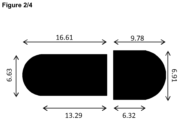
- Fig 2 / 4 shows a schematic drawing of the body (left) and the cap (right) of a Vcaps ® Plus size 1 hard shell capsule with the relevant dimensions in mm.
- the dimensions are used in the calculation example 2 for the calculation of the outer capsule surface in the pre-locked state.
- the dimensions are:
- Amount polymer dry polymer substance :
- EUDRAGIT ® FS 30 D and EUDRAGIT ® L 30 D-55 are aqueous polymer dispersions with each 30% by weight polymer content.
- the polymer dispersions EUDRAGIT ® FS 30 D and EUDRAGIT ® L 30 D-55 were mixed in a container.
- the excipients were added into the water while gently stirring.
- the excipient suspension was added to the polymer dispersion mixture.
- the spraying suspension was gently stirred during the coating process.
- Vcaps ® plus size 1 capsules were coated in the pre-locked state utilizing a drum coater. Afterwards, capsules were manually filled with 200mg Caffeine and closed to the final-locked state.
- Tab. 5 Formulation Example 2 - Vcaps ® Plus Size 1 (batch size 300g) Material Composition Amounts Dry substance Solid Composition Percentage EUDRAGIT ® FS 30 D 4.0 mg/cm 2 295.89 g 88.77 g 77.21 % EUDRAGIT ® L 30 D-55 1.0 mg/cm 2 Glyceryl Monostearate (40-55%) 8.5% on ds* 7.55 g 7.55 g 6.57 % Plosysorbat 80 (33% aq) 10.3% on ds* 27.81 g 9.18 g 7.99 % Triethyl citrate 10.7% on ds* 9.46 g 9.46 g 8.23 % Demineralized Water On demand 425.34 g n/a n/a
- Apparatus ERWEKA DT 700 Paddle Apparatus (USP II) Detection method: Online UV Temperature: 37.5°C Media I: 700 ml 0.1 N HCL adjusted to pH 1.20 (by using 2 N NaOH and 2 N HCl) Media II: After 2hours in media I 194 ml 0.2 N Na 3 PO 4 solution added to increase pH to 6.5 (fine adjustment of pH by using 2 N NaOH and 2 N HCl) Media III: After an additional hour in media II 67 ml 0.2 N Na 3 PO 4 solution added to increase pH to 7.2 (again fine adjustment of pH by using 2 N NaOH and 2 N HCl). Paddle Speed: 75rpm Tab.
- Example 3 Enteric coating of pre-locked capsules in drum coater
- EUDRAGIT ® L 30 D-55 was provided as 30 % by weight aqueous polymer dispersion. The Additional excipients were added into the water while gently stirring. The excipient suspension was added to the polymer dispersion. The spraying suspension was gently stirred during the coating process. The capsules were coated in the pre-locked state utilizing a drum coater. Afterwards, capsules were manually filled with 200mg Caffeine and closed to the final-locked state. Tab.
- the polymer-coated pre-locked capsules were manually filled with 200mg Caffeine, closed to the final-locked state and tested in a dissolution test.
- Apparatus ERWEKA DT 700 Paddle Apparatus (USP II) Detection method: Online UV Temperature: 37.5°C Media I: 700 ml 0.1 N HCL adjusted to pH 1.2 (by using 2 N NaOH and 2 N HCl) Media II: After 2hours in media I 214 ml 0.2 N Na 3 PO 4 solution added to increase pH to 6.8 (fine adjustment of pH by using 2 N NaOH and 2 N HCl) Paddle speed: 75rpm Tab.
- Example C4 (comparative example) - Fluidized bed coating of separated capsule halves (body and cap)
- EUDRAGIT ® FS 30 D was provided as 30 % by weight aqueous polymer dispersion. The excipients were added into the water while gently stirring. The excipient suspension was added to the polymer dispersion. The spraying suspension was gently stirred during the coating process.
- the microscope was set up with a 10-fold magnification, the focal area wans the capsule shell as observed from the vertical down direction.
- the capsules position was adjusted to avoid and shadow related to a non-vertical position. As relevant focal area, light intensity and contrast needs to be properly adjusted.
- the images were recorded as black and white images (capsule bodies figure 3 / 4 and caps figure 4 /4) und transferred into the scandium database.
- the capsule shell circumference as investigated from the vertical down position was selected utilizing the software toolbox. For that circumference the area [mm 2 ], feret diameter and circumference length was detected and calculated.
- the feret diameter or feret's diameter is a measure of an object size along a specified direction. In general, it can be defined as the distance between the two parallel planes restricting the object perpendicular to that direction. It is therefore also called the caliper diameter, referring to the measurement of the object size with a caliper.
- the normalized aspect ratio varies from about 1 for an uncoated capsule without deformation and increasing values depending on the degree of deformation.
- Apparatus ERWEKA DT 700 Paddle Apparatus (USP II) Detection method: Online UV Temperature: 37.5°C Media I: 700 ml 0.1 N HCL adjusted to pH 1.20 (by using 2 N NaOH and 2 N HCl) Media II: After 2hours in media I 214 ml 0.2 N Na 3 PO 4 solution added to increase pH to 6.8 (fine adjustment of pH by using 2 N NaOH and 2 N HCl) Media III: After an additional hour in media II 46 ml 0.2 N Na 3 PO 4 solution added to increase pH to 7.4 (again fine adjustment of pH by using 2 N NaOH and 2 N HCl). Paddle speed: 75rpm Tab.
- Example 5 Enteric coating pre-locked capsules in drum coater and automatic capsule filling
- the maximum layer thickness was predicted as equal to the gap width between capsule cap and body of pre-locked or final-locked capsules.
- the average gap width of Vcaps ® Plus capsules was calculated with 50 ⁇ m.
- the absolute density of a coating was predicted with approx. 1mg/cm 3 , the value was verified by scanning electron microscope investigations of samples.
- Layer thickness ⁇ m total weight gain mg ⁇ 10000 cm 2 / absolute density g ⁇ 1000 cm 3 Tab. 15: Predicted Layer Thickness Total weight gain Predicted layer thickness 2.6 mg/cm 2 26 ⁇ m 3.9 mg/cm 2 39 ⁇ m 5.1 mg/cm 2 51 ⁇ m
- the EUDRAGIT ® polymer (s) were mixed in a suitable sized container.
- the additional excipients were added into the water while gently stirring. After a suitable post stirring time the excipient suspension was added to the polymer dispersion. The spraying suspension was gently stirred during the coating process.
- the capsules were coated in the pre-locked state utilizing a drum coater. Tab.
- a 400 mg of a 50:50 blend with MCC and Caffeine was filled into the polymer-coated pre-locked capsules using an automatic MG2 Labby Capsule filling equipment with a powder filling set up using standard format size 0 tooling for capsule opening, transport, filling and closing.
- the machine output was set to 2000 cps/hour.
- the coating of the pre-locked capsules allows superior capsules filling in comparison to fluid be coated separated capsules.
- the advantage is that the pre-locked capsules provide more mechanical stability in comparison to separated capsule pieces.
- coated pre-locked capsules ensure that during the filling process the two capsules pieces will fit to each other. Furthermore, the tampered rim is intact and supports sliding of the caps over the body until the capsule is final-locked. It is proven that the pre-locked coated tablets could be separated in a capsule filling machine also when both pieces are slightly bridged.
- Apparatus ERWEKA DT 700 Paddle Apparatus (USP II) Detection method: Online UV Temperature: 37.5°C Media I: 700 ml 0.1 N HCL adjusted to pH 1.20 (by using 2 N NaOH and 2 N HCl) Media II: After 2hours in media I 214 ml 0.2 N Na 3 PO 4 solution added to increase pH to 6.8 (fine adjustment of pH by using 2 N NaOH and 2 N HCl) Paddle speed: 75rpm Tab.
- Sodium lauryl sulfate, stearic acid, and EUDRAGIT ® E PO are stirred successively into the water, using a dissolver plate, until a yellowish, light turbid solution is obtained which lasts about 1-1.5 h.
- Talc are added to the polymer solution and homogenized with a dissolver plate for 15 minutes.
- Apparatus ERWEKA DT 700 Paddle Apparatus (USP II) Detection method: Online UV Temperature: 37.5°C Media I: 700 ml 0.1 N HCL adjusted to pH 1.20 (by using 2 N NaOH and 2 N HCl) Media II: 700 ml Phosphate buffer adjusted to pH 4.5 (by using 2 N NaOH and 2 N HCI) Media III: 700 ml Phosphate buffer adjusted to pH 6.8 (by using 2 N NaOH and 2 N HCI) Paddle speed: 75rpm
- the example demonstrate the capabilities of the formulation concept also for moisture protective coatings.
- Silica filled and locked capsules show significant decrease of the water sorption when stored in a desiccator.
- This example demonstrates the capabilities of the concept especially for moisture sensitive formulations.
- Example 11 Average Gap Width of Vcaps ® Plus hard shell capsule
- the gap width between capsule body and cap in the pre-locked or final-locked state was calculated on basis of a value of 100 ⁇ m capsule cap wall thickness as described in Capsugel Product Brochure [Dominique Cadé; Vcaps ® Plus Capsules - A New HPMC Capsule for Optimum Formulation].
- the capsule cap wall thickness was subtracted from the external capsule cap diameter getting to the internal capsule cap diameter.
- the capsule cap internal diameter was subtracted from the capsule body external diameter and resulted in the average gap width between capsule body and cap in the pre-locked or final-locked state.
- the gap width ranges between 25 ⁇ m for Vcaps ® Plus size 3 and 75 ⁇ m for Vcaps ® Plus size 00.
- Tab. 25 Average Gap Width of Vcaps ® Plus Hard Shell Capsule Size 00el 00 0el 0el 0 1 1el 2 3 4 Average Cap Wall Thickness [ ⁇ m]* 100 100 100 100 100 100 100 100 100 100 100 100 100 100 100 100 100 100 100 100 100 100 100 100 100 100 100 100 100 100 100 100 100 100 100 100 100 100 100 100 100 100 100 100 100 100 100 100 100 100 100 100 100 100 100 100 100 100 100 100 100 100 100 100 100 100 100 100 100 100 100 100 100 100 100 100 100 100 100 100 100 100 100 100 100 100 100 100 100 100 100 100 100 100 100 100 100 100 100 100 100 100 100 100 100 100 100 100 100 100 100 100 100 100 100 100 100 100 100 100 100 100 100 100 100 100 100 100 100 100 100 100 100 100 100 100 100 100 100 100 100 100 100 100 100 100 100 100 100 100 100 100 100 100 100 100 100 100 100 100 100 100
Landscapes
- Health & Medical Sciences (AREA)
- Chemical & Material Sciences (AREA)
- General Health & Medical Sciences (AREA)
- Public Health (AREA)
- Pharmacology & Pharmacy (AREA)
- Veterinary Medicine (AREA)
- Life Sciences & Earth Sciences (AREA)
- Animal Behavior & Ethology (AREA)
- Medicinal Chemistry (AREA)
- Epidemiology (AREA)
- Engineering & Computer Science (AREA)
- Bioinformatics & Cheminformatics (AREA)
- Inorganic Chemistry (AREA)
- Medicinal Preparation (AREA)
- General Preparation And Processing Of Foods (AREA)
- Peptides Or Proteins (AREA)
Priority Applications (2)
| Application Number | Priority Date | Filing Date | Title |
|---|---|---|---|
| EP24207522.4A EP4477210A3 (en) | 2017-11-17 | 2018-11-14 | Process for preparing a coated hard shell capsule |
| SI201831199T SI3709979T1 (sl) | 2017-11-17 | 2018-11-14 | Postopek za pripravo obložene kapsule s trdo ovojnico |
Applications Claiming Priority (2)
| Application Number | Priority Date | Filing Date | Title |
|---|---|---|---|
| IN201731041169 | 2017-11-17 | ||
| PCT/EP2018/081204 WO2019096833A1 (en) | 2017-11-17 | 2018-11-14 | Process for preparing a coated hard shell capsule |
Related Child Applications (1)
| Application Number | Title | Priority Date | Filing Date |
|---|---|---|---|
| EP24207522.4A Division EP4477210A3 (en) | 2017-11-17 | 2018-11-14 | Process for preparing a coated hard shell capsule |
Publications (2)
| Publication Number | Publication Date |
|---|---|
| EP3709979A1 EP3709979A1 (en) | 2020-09-23 |
| EP3709979B1 true EP3709979B1 (en) | 2024-11-13 |
Family
ID=64564818
Family Applications (2)
| Application Number | Title | Priority Date | Filing Date |
|---|---|---|---|
| EP18811726.1A Active EP3709979B1 (en) | 2017-11-17 | 2018-11-14 | Process for preparing a coated hard shell capsule |
| EP24207522.4A Pending EP4477210A3 (en) | 2017-11-17 | 2018-11-14 | Process for preparing a coated hard shell capsule |
Family Applications After (1)
| Application Number | Title | Priority Date | Filing Date |
|---|---|---|---|
| EP24207522.4A Pending EP4477210A3 (en) | 2017-11-17 | 2018-11-14 | Process for preparing a coated hard shell capsule |
Country Status (14)
| Country | Link |
|---|---|
| US (1) | US11980692B2 (pl) |
| EP (2) | EP3709979B1 (pl) |
| JP (1) | JP7650660B2 (pl) |
| KR (1) | KR102724430B1 (pl) |
| CN (1) | CN111936121A (pl) |
| BR (1) | BR112020009567A2 (pl) |
| CA (1) | CA3084219A1 (pl) |
| ES (1) | ES3006512T3 (pl) |
| HU (1) | HUE069333T2 (pl) |
| IL (1) | IL274579B2 (pl) |
| MX (1) | MX2020005012A (pl) |
| PL (1) | PL3709979T3 (pl) |
| SI (1) | SI3709979T1 (pl) |
| WO (1) | WO2019096833A1 (pl) |
Families Citing this family (16)
| Publication number | Priority date | Publication date | Assignee | Title |
|---|---|---|---|---|
| WO2020182611A1 (en) * | 2019-03-14 | 2020-09-17 | Evonik Operations Gmbh | Capsule shell comprising a core-shell polymer and a cellulose |
| IL288006B1 (en) * | 2019-05-15 | 2025-09-01 | Evonik Operations Gmbh | Process for making hard shell filled capsules with cellulose or starch based coatings with a capsule filling machine |
| CN113993509A (zh) * | 2019-05-15 | 2022-01-28 | 赢创运营有限公司 | 用胶囊填充机制备具有基于(甲基)丙烯酸酯共聚物的包衣的填充硬壳胶囊的方法 |
| EP3916029A1 (en) * | 2020-05-28 | 2021-12-01 | Evonik Operations GmbH | Novel methacrylate copolymer and compositions comprising it |
| WO2022078823A1 (en) * | 2020-10-16 | 2022-04-21 | Evonik Operations Gmbh | Nutraceutical or pharmaceutical composition comprising a modified starch |
| CN117377466A (zh) | 2021-05-25 | 2024-01-09 | 赢创运营有限公司 | 防止胃液流入的硬壳胶囊 |
| BR112023024622A2 (pt) | 2021-05-25 | 2024-02-20 | Evonik Operations Gmbh | Cápsulas duras com revestimento de liberação modificada |
| WO2023280649A1 (en) * | 2021-07-09 | 2023-01-12 | Evonik Operations Gmbh | Hard shell capsules having improved colon release |
| CN113509449A (zh) * | 2021-08-30 | 2021-10-19 | 浙江新昌康平胶囊有限公司 | 一种肠溶植物空心胶囊 |
| WO2023161177A1 (en) | 2022-02-22 | 2023-08-31 | Evonik Operations Gmbh | Hard-shell capsule with at least one coating layer with a low oxygen permeability |
| JP2025508982A (ja) * | 2022-03-03 | 2025-04-10 | サイプルメド ゲーエムベーハー | 治療用ペプチドおよびタンパク質の改善された経口医薬製剤 |
| CN114848605B (zh) * | 2022-03-25 | 2023-08-11 | 上海方予健康医药科技有限公司 | 一种供吸入粉雾剂用的明胶胶囊 |
| EP4499050A1 (en) | 2022-03-30 | 2025-02-05 | Evonik Operations GmbH | Formulations composed of cationic lipids and poly(lactic-co-glycolic acid) for the delivery of polynucleotides into cells |
| JPWO2024019133A1 (pl) | 2022-07-22 | 2024-01-25 | ||
| WO2025036806A1 (en) | 2023-08-15 | 2025-02-20 | Evonik Operations Gmbh | An enteric coated hard shell capsule for delivery of a dosage form in the ileum and colon |
| AU2024201117A1 (en) * | 2024-02-21 | 2025-09-04 | FRYER, Peter Lee | Fingerprint forensics |
Family Cites Families (27)
| Publication number | Priority date | Publication date | Assignee | Title |
|---|---|---|---|---|
| JPS4930524A (pl) | 1972-07-17 | 1974-03-19 | ||
| US4138013A (en) | 1976-08-27 | 1979-02-06 | Parke, Davis & Company | Enteric capsules |
| DE2722806C2 (de) * | 1977-05-20 | 1984-12-13 | Capsugel AG, Basel | Kapselkörper für eine Steckkapsel für Arzneimittel oder andere portionsweise zu verpackende Stoffe, sowie Verfahren zu seiner Herstellung |
| JPS61221117A (ja) * | 1985-03-26 | 1986-10-01 | Fujisawa Pharmaceut Co Ltd | 腸溶性硬カプセル剤 |
| JPS6323172A (ja) | 1986-07-16 | 1988-01-30 | Canon Inc | 多色画像形成装置 |
| DE10011447A1 (de) | 2000-03-10 | 2001-09-20 | Roehm Gmbh | Dispersion mit nichtionischem Emulgator |
| JP2003325642A (ja) * | 2002-05-09 | 2003-11-18 | Sansho Pharmaceutical Co Ltd | 腸溶性皮膜付き硬質空カプセルと、腸溶性皮膜付き硬質空カプセルの製造方法と、腸溶性皮膜付き硬質カプセル剤 |
| DE102004011349A1 (de) | 2004-03-05 | 2005-09-22 | Basf Ag | Wässrige Polymerdispersion auf Basis von Alkyl(meth)-acrylaten |
| SI1962873T1 (sl) | 2005-12-14 | 2013-10-30 | Oxthera Intellectual Property Ab | Farmacevtski sestavki, ki vsebujejo bakterijo za zmanjšanje oksalata |
| DE102006035549A1 (de) | 2006-07-27 | 2008-01-31 | Evonik Röhm Gmbh | Arzneiform mit mindestens zweischichtiger Trennschicht |
| US20100212261A1 (en) | 2007-07-10 | 2010-08-26 | Boehringer Ingelheim International Gmbh | Tight sealing of filled medicament capsules |
| US9107451B2 (en) | 2009-07-29 | 2015-08-18 | Evonik Röhm Gmbh | Coating composition for the dip coating of capsule halves |
| DE102009028076A1 (de) | 2009-07-29 | 2011-02-03 | Evonik Röhm Gmbh | Beschichtungsmittel zum Tauchbeschichten von Kapselhälften |
| US8790692B2 (en) | 2009-09-09 | 2014-07-29 | Patheon Pharmaceuticals Inc. | Break resistant gel capsule |
| ES2614878T3 (es) | 2010-06-01 | 2017-06-02 | Geistlich Pharma Ag | Métodos y composiciones para terapia farmacéutica oral |
| EP2720682B1 (en) | 2011-06-17 | 2016-11-23 | Evonik Röhm GmbH | Coating composition suitable for pharmaceutical or nutraceutical dosage forms |
| EP2720681B1 (en) | 2011-06-17 | 2016-11-23 | Evonik Röhm GmbH | Coating composition suitable for pharmaceutical or nutraceutical dosage forms |
| EP3566698A1 (en) | 2011-11-09 | 2019-11-13 | Capsugel Belgium NV | Acid resistant banding solution for acid resistant two piece hard capsules |
| AR091006A1 (es) | 2012-05-09 | 2014-12-30 | Univ Western Health Sciences | Formulaciones de testosterona proliposomal |
| EP2946773A1 (en) | 2014-05-19 | 2015-11-25 | Tillotts Pharma AG | Modified release coated capsules |
| SI2946774T1 (sl) * | 2014-05-19 | 2020-07-31 | Tillotts Pharma Ag | Obložene kapsule s prirejenim sproščanjem |
| EP3167879A1 (en) | 2015-11-10 | 2017-05-17 | Evonik Technochemie GmbH | Gastric retention active delivery systems |
| JP2019501199A (ja) | 2016-01-08 | 2019-01-17 | ウエスタン ユニバーシティ オブ ヘルス サイエンシズ | プロリポソームテストステロンウンデカノエート製剤 |
| EP3646857A1 (en) | 2018-11-01 | 2020-05-06 | Evonik Operations GmbH | Colonic delivery system for microorganisms |
| WO2020182611A1 (en) | 2019-03-14 | 2020-09-17 | Evonik Operations Gmbh | Capsule shell comprising a core-shell polymer and a cellulose |
| IL288006B1 (en) | 2019-05-15 | 2025-09-01 | Evonik Operations Gmbh | Process for making hard shell filled capsules with cellulose or starch based coatings with a capsule filling machine |
| CN113993509A (zh) | 2019-05-15 | 2022-01-28 | 赢创运营有限公司 | 用胶囊填充机制备具有基于(甲基)丙烯酸酯共聚物的包衣的填充硬壳胶囊的方法 |
-
2018
- 2018-11-14 ES ES18811726T patent/ES3006512T3/es active Active
- 2018-11-14 IL IL274579A patent/IL274579B2/en unknown
- 2018-11-14 WO PCT/EP2018/081204 patent/WO2019096833A1/en not_active Ceased
- 2018-11-14 PL PL18811726.1T patent/PL3709979T3/pl unknown
- 2018-11-14 EP EP18811726.1A patent/EP3709979B1/en active Active
- 2018-11-14 MX MX2020005012A patent/MX2020005012A/es unknown
- 2018-11-14 US US15/733,083 patent/US11980692B2/en active Active
- 2018-11-14 HU HUE18811726A patent/HUE069333T2/hu unknown
- 2018-11-14 KR KR1020207016920A patent/KR102724430B1/ko active Active
- 2018-11-14 CA CA3084219A patent/CA3084219A1/en active Pending
- 2018-11-14 CN CN201880086513.5A patent/CN111936121A/zh active Pending
- 2018-11-14 JP JP2020526937A patent/JP7650660B2/ja active Active
- 2018-11-14 SI SI201831199T patent/SI3709979T1/sl unknown
- 2018-11-14 BR BR112020009567-2A patent/BR112020009567A2/pt unknown
- 2018-11-14 EP EP24207522.4A patent/EP4477210A3/en active Pending
Also Published As
| Publication number | Publication date |
|---|---|
| US20210361585A1 (en) | 2021-11-25 |
| MX2020005012A (es) | 2020-08-27 |
| HUE069333T2 (hu) | 2025-02-28 |
| US11980692B2 (en) | 2024-05-14 |
| JP2021503463A (ja) | 2021-02-12 |
| SI3709979T1 (sl) | 2025-03-31 |
| CN111936121A (zh) | 2020-11-13 |
| JP2024019417A (ja) | 2024-02-09 |
| ES3006512T3 (en) | 2025-03-18 |
| IL274579B2 (en) | 2025-04-01 |
| IL274579A (en) | 2020-06-30 |
| BR112020009567A2 (pt) | 2020-11-03 |
| EP3709979A1 (en) | 2020-09-23 |
| WO2019096833A1 (en) | 2019-05-23 |
| EP4477210A2 (en) | 2024-12-18 |
| IL274579B1 (en) | 2024-12-01 |
| JP7650660B2 (ja) | 2025-03-25 |
| KR102724430B1 (ko) | 2024-11-01 |
| PL3709979T3 (pl) | 2025-03-24 |
| EP4477210A3 (en) | 2025-03-05 |
| CA3084219A1 (en) | 2019-05-23 |
| KR20200088394A (ko) | 2020-07-22 |
Similar Documents
| Publication | Publication Date | Title |
|---|---|---|
| EP3709979B1 (en) | Process for preparing a coated hard shell capsule | |
| EP3968969B1 (en) | Process for preparing filled hard-shell capsules with (meth)acrylate copolymer based coatings with a capsule-filling machine | |
| CA2877525C (en) | Pharmaceutical or nutraceutical composition with sustained release characteristic and with resistance against the influence of ethanol | |
| CA2939018C (en) | Pharmaceutical or nutraceutical composition with sustained release characteristic and with resistance against the influence of ethanol | |
| EP3968967B1 (en) | Process for preparing filled hard-shell capsules with cellulose or starch-based coatings with a capsule-filling machine | |
| JP7787140B2 (ja) | コーティングされた硬カプセルを製造する方法 | |
| HK40026720A (en) | Process for preparing a coated hard shell capsule | |
| HK40026720B (en) | Process for preparing a coated hard shell capsule | |
| EP4518841B1 (en) | Dosage form with drug release at ph 3 to 6 using double coating system with at least one release acceleration agent | |
| US20250177315A1 (en) | Pre-functionalized hard shell capsule with accelerated drug release at ph value 5 to 5.5 | |
| US20250295597A1 (en) | Dosage form with drug release at ph 3 to 6 using double coating system with at least one release acceleration agent | |
| JP2024521153A (ja) | 改良された剥離コーティングを有する硬質シェルカプセル |
Legal Events
| Date | Code | Title | Description |
|---|---|---|---|
| STAA | Information on the status of an ep patent application or granted ep patent |
Free format text: STATUS: UNKNOWN |
|
| STAA | Information on the status of an ep patent application or granted ep patent |
Free format text: STATUS: THE INTERNATIONAL PUBLICATION HAS BEEN MADE |
|
| PUAI | Public reference made under article 153(3) epc to a published international application that has entered the european phase |
Free format text: ORIGINAL CODE: 0009012 |
|
| STAA | Information on the status of an ep patent application or granted ep patent |
Free format text: STATUS: REQUEST FOR EXAMINATION WAS MADE |
|
| 17P | Request for examination filed |
Effective date: 20200507 |
|
| AK | Designated contracting states |
Kind code of ref document: A1 Designated state(s): AL AT BE BG CH CY CZ DE DK EE ES FI FR GB GR HR HU IE IS IT LI LT LU LV MC MK MT NL NO PL PT RO RS SE SI SK SM TR |
|
| AX | Request for extension of the european patent |
Extension state: BA ME |
|
| REG | Reference to a national code |
Ref country code: HK Ref legal event code: DE Ref document number: 40026720 Country of ref document: HK |
|
| DAV | Request for validation of the european patent (deleted) | ||
| DAX | Request for extension of the european patent (deleted) | ||
| STAA | Information on the status of an ep patent application or granted ep patent |
Free format text: STATUS: EXAMINATION IS IN PROGRESS |
|
| 17Q | First examination report despatched |
Effective date: 20220428 |
|
| GRAP | Despatch of communication of intention to grant a patent |
Free format text: ORIGINAL CODE: EPIDOSNIGR1 |
|
| STAA | Information on the status of an ep patent application or granted ep patent |
Free format text: STATUS: GRANT OF PATENT IS INTENDED |
|
| INTG | Intention to grant announced |
Effective date: 20240604 |
|
| GRAS | Grant fee paid |
Free format text: ORIGINAL CODE: EPIDOSNIGR3 |
|
| GRAA | (expected) grant |
Free format text: ORIGINAL CODE: 0009210 |
|
| STAA | Information on the status of an ep patent application or granted ep patent |
Free format text: STATUS: THE PATENT HAS BEEN GRANTED |
|
| AK | Designated contracting states |
Kind code of ref document: B1 Designated state(s): AL AT BE BG CH CY CZ DE DK EE ES FI FR GB GR HR HU IE IS IT LI LT LU LV MC MK MT NL NO PL PT RO RS SE SI SK SM TR |
|
| P01 | Opt-out of the competence of the unified patent court (upc) registered |
Free format text: CASE NUMBER: APP_54775/2024 Effective date: 20241004 |
|
| REG | Reference to a national code |
Ref country code: GB Ref legal event code: FG4D |
|
| REG | Reference to a national code |
Ref country code: CH Ref legal event code: EP |
|
| REG | Reference to a national code |
Ref country code: DE Ref legal event code: R096 Ref document number: 602018076573 Country of ref document: DE |
|
| REG | Reference to a national code |
Ref country code: IE Ref legal event code: FG4D |
|
| PGFP | Annual fee paid to national office [announced via postgrant information from national office to epo] |
Ref country code: NL Payment date: 20241120 Year of fee payment: 7 |
|
| PGFP | Annual fee paid to national office [announced via postgrant information from national office to epo] |
Ref country code: DE Payment date: 20241121 Year of fee payment: 7 |
|
| PGFP | Annual fee paid to national office [announced via postgrant information from national office to epo] |
Ref country code: BE Payment date: 20241120 Year of fee payment: 7 |
|
| PGFP | Annual fee paid to national office [announced via postgrant information from national office to epo] |
Ref country code: GB Payment date: 20241226 Year of fee payment: 7 |
|
| PGFP | Annual fee paid to national office [announced via postgrant information from national office to epo] |
Ref country code: HU Payment date: 20241121 Year of fee payment: 7 Ref country code: AT Payment date: 20241121 Year of fee payment: 7 |
|
| PGFP | Annual fee paid to national office [announced via postgrant information from national office to epo] |
Ref country code: IE Payment date: 20241125 Year of fee payment: 7 |
|
| PGFP | Annual fee paid to national office [announced via postgrant information from national office to epo] |
Ref country code: ES Payment date: 20241230 Year of fee payment: 7 |
|
| PGFP | Annual fee paid to national office [announced via postgrant information from national office to epo] |
Ref country code: CH Payment date: 20241201 Year of fee payment: 7 |
|
| REG | Reference to a national code |
Ref country code: SE Ref legal event code: TRGR |
|
| REG | Reference to a national code |
Ref country code: NL Ref legal event code: FP |
|
| REG | Reference to a national code |
Ref country code: HU Ref legal event code: AG4A Ref document number: E069333 Country of ref document: HU |
|
| REG | Reference to a national code |
Ref country code: GR Ref legal event code: EP Ref document number: 20250400157 Country of ref document: GR Effective date: 20250211 |
|
| REG | Reference to a national code |
Ref country code: LT Ref legal event code: MG9D |
|
| REG | Reference to a national code |
Ref country code: ES Ref legal event code: FG2A Ref document number: 3006512 Country of ref document: ES Kind code of ref document: T3 Effective date: 20250318 |
|
| PG25 | Lapsed in a contracting state [announced via postgrant information from national office to epo] |
Ref country code: IS Free format text: LAPSE BECAUSE OF FAILURE TO SUBMIT A TRANSLATION OF THE DESCRIPTION OR TO PAY THE FEE WITHIN THE PRESCRIBED TIME-LIMIT Effective date: 20250313 Ref country code: PT Free format text: LAPSE BECAUSE OF FAILURE TO SUBMIT A TRANSLATION OF THE DESCRIPTION OR TO PAY THE FEE WITHIN THE PRESCRIBED TIME-LIMIT Effective date: 20250313 Ref country code: HR Free format text: LAPSE BECAUSE OF FAILURE TO SUBMIT A TRANSLATION OF THE DESCRIPTION OR TO PAY THE FEE WITHIN THE PRESCRIBED TIME-LIMIT Effective date: 20241113 |
|
| PG25 | Lapsed in a contracting state [announced via postgrant information from national office to epo] |
Ref country code: FI Free format text: LAPSE BECAUSE OF FAILURE TO SUBMIT A TRANSLATION OF THE DESCRIPTION OR TO PAY THE FEE WITHIN THE PRESCRIBED TIME-LIMIT Effective date: 20241113 |
|
| PG25 | Lapsed in a contracting state [announced via postgrant information from national office to epo] |
Ref country code: BG Free format text: LAPSE BECAUSE OF FAILURE TO SUBMIT A TRANSLATION OF THE DESCRIPTION OR TO PAY THE FEE WITHIN THE PRESCRIBED TIME-LIMIT Effective date: 20241113 |
|
| PGFP | Annual fee paid to national office [announced via postgrant information from national office to epo] |
Ref country code: SE Payment date: 20250107 Year of fee payment: 7 |
|
| PG25 | Lapsed in a contracting state [announced via postgrant information from national office to epo] |
Ref country code: NO Free format text: LAPSE BECAUSE OF FAILURE TO SUBMIT A TRANSLATION OF THE DESCRIPTION OR TO PAY THE FEE WITHIN THE PRESCRIBED TIME-LIMIT Effective date: 20250213 |
|
| PG25 | Lapsed in a contracting state [announced via postgrant information from national office to epo] |
Ref country code: LV Free format text: LAPSE BECAUSE OF FAILURE TO SUBMIT A TRANSLATION OF THE DESCRIPTION OR TO PAY THE FEE WITHIN THE PRESCRIBED TIME-LIMIT Effective date: 20241113 |
|
| PGFP | Annual fee paid to national office [announced via postgrant information from national office to epo] |
Ref country code: GR Payment date: 20250124 Year of fee payment: 7 Ref country code: SI Payment date: 20241114 Year of fee payment: 7 |
|
| PGFP | Annual fee paid to national office [announced via postgrant information from national office to epo] |
Ref country code: PL Payment date: 20250110 Year of fee payment: 7 Ref country code: FR Payment date: 20250107 Year of fee payment: 7 |
|
| PGFP | Annual fee paid to national office [announced via postgrant information from national office to epo] |
Ref country code: IT Payment date: 20250227 Year of fee payment: 7 |
|
| PG25 | Lapsed in a contracting state [announced via postgrant information from national office to epo] |
Ref country code: RS Free format text: LAPSE BECAUSE OF FAILURE TO SUBMIT A TRANSLATION OF THE DESCRIPTION OR TO PAY THE FEE WITHIN THE PRESCRIBED TIME-LIMIT Effective date: 20250213 |
|
| PGFP | Annual fee paid to national office [announced via postgrant information from national office to epo] |
Ref country code: TR Payment date: 20250131 Year of fee payment: 7 |
|
| PG25 | Lapsed in a contracting state [announced via postgrant information from national office to epo] |
Ref country code: SM Free format text: LAPSE BECAUSE OF FAILURE TO SUBMIT A TRANSLATION OF THE DESCRIPTION OR TO PAY THE FEE WITHIN THE PRESCRIBED TIME-LIMIT Effective date: 20241113 |
|
| PG25 | Lapsed in a contracting state [announced via postgrant information from national office to epo] |
Ref country code: DK Free format text: LAPSE BECAUSE OF FAILURE TO SUBMIT A TRANSLATION OF THE DESCRIPTION OR TO PAY THE FEE WITHIN THE PRESCRIBED TIME-LIMIT Effective date: 20241113 |
|
| PG25 | Lapsed in a contracting state [announced via postgrant information from national office to epo] |
Ref country code: LU Free format text: LAPSE BECAUSE OF NON-PAYMENT OF DUE FEES Effective date: 20241114 |
|
| PG25 | Lapsed in a contracting state [announced via postgrant information from national office to epo] |
Ref country code: EE Free format text: LAPSE BECAUSE OF FAILURE TO SUBMIT A TRANSLATION OF THE DESCRIPTION OR TO PAY THE FEE WITHIN THE PRESCRIBED TIME-LIMIT Effective date: 20241113 |
|
| PG25 | Lapsed in a contracting state [announced via postgrant information from national office to epo] |
Ref country code: RO Free format text: LAPSE BECAUSE OF FAILURE TO SUBMIT A TRANSLATION OF THE DESCRIPTION OR TO PAY THE FEE WITHIN THE PRESCRIBED TIME-LIMIT Effective date: 20241113 |
|
| PG25 | Lapsed in a contracting state [announced via postgrant information from national office to epo] |
Ref country code: SK Free format text: LAPSE BECAUSE OF FAILURE TO SUBMIT A TRANSLATION OF THE DESCRIPTION OR TO PAY THE FEE WITHIN THE PRESCRIBED TIME-LIMIT Effective date: 20241113 |
|
| PG25 | Lapsed in a contracting state [announced via postgrant information from national office to epo] |
Ref country code: CZ Free format text: LAPSE BECAUSE OF FAILURE TO SUBMIT A TRANSLATION OF THE DESCRIPTION OR TO PAY THE FEE WITHIN THE PRESCRIBED TIME-LIMIT Effective date: 20241113 |
|
| REG | Reference to a national code |
Ref country code: DE Ref legal event code: R097 Ref document number: 602018076573 Country of ref document: DE |
|
| PG25 | Lapsed in a contracting state [announced via postgrant information from national office to epo] |
Ref country code: MC Free format text: LAPSE BECAUSE OF FAILURE TO SUBMIT A TRANSLATION OF THE DESCRIPTION OR TO PAY THE FEE WITHIN THE PRESCRIBED TIME-LIMIT Effective date: 20241113 |
|
| PLBE | No opposition filed within time limit |
Free format text: ORIGINAL CODE: 0009261 |
|
| STAA | Information on the status of an ep patent application or granted ep patent |
Free format text: STATUS: NO OPPOSITION FILED WITHIN TIME LIMIT |
|
| 26N | No opposition filed |
Effective date: 20250814 |
|
| REG | Reference to a national code |
Ref country code: CH Ref legal event code: U11 Free format text: ST27 STATUS EVENT CODE: U-0-0-U10-U11 (AS PROVIDED BY THE NATIONAL OFFICE) Effective date: 20251201 |