EP3708982A1 - Zusammengesetzter temperaturanzeigeartikel und verfahren zu seiner herstellung und verwendung davon - Google Patents
Zusammengesetzter temperaturanzeigeartikel und verfahren zu seiner herstellung und verwendung davon Download PDFInfo
- Publication number
- EP3708982A1 EP3708982A1 EP17931611.2A EP17931611A EP3708982A1 EP 3708982 A1 EP3708982 A1 EP 3708982A1 EP 17931611 A EP17931611 A EP 17931611A EP 3708982 A1 EP3708982 A1 EP 3708982A1
- Authority
- EP
- European Patent Office
- Prior art keywords
- composite material
- temperature
- porous film
- product according
- indicating
- Prior art date
- Legal status (The legal status is an assumption and is not a legal conclusion. Google has not performed a legal analysis and makes no representation as to the accuracy of the status listed.)
- Withdrawn
Links
- 239000002131 composite material Substances 0.000 title claims abstract description 108
- 238000002360 preparation method Methods 0.000 title 1
- 239000000463 material Substances 0.000 claims abstract description 113
- 239000002178 crystalline material Substances 0.000 claims abstract description 74
- 239000004820 Pressure-sensitive adhesive Substances 0.000 claims abstract description 58
- 238000002844 melting Methods 0.000 claims abstract description 27
- 230000008018 melting Effects 0.000 claims abstract description 27
- 239000003086 colorant Substances 0.000 claims abstract description 24
- 239000011148 porous material Substances 0.000 claims abstract description 18
- 238000004519 manufacturing process Methods 0.000 claims abstract description 13
- 239000010410 layer Substances 0.000 claims description 92
- 239000001993 wax Substances 0.000 claims description 48
- 239000002390 adhesive tape Substances 0.000 claims description 23
- 239000007788 liquid Substances 0.000 claims description 22
- -1 polyethylene Polymers 0.000 claims description 18
- 239000004971 Cross linker Substances 0.000 claims description 13
- 239000002002 slurry Substances 0.000 claims description 12
- 238000000034 method Methods 0.000 claims description 11
- 239000012188 paraffin wax Substances 0.000 claims description 11
- 239000004698 Polyethylene Substances 0.000 claims description 8
- 229920001971 elastomer Polymers 0.000 claims description 8
- 229920000728 polyester Polymers 0.000 claims description 8
- 229920000573 polyethylene Polymers 0.000 claims description 8
- 230000001681 protective effect Effects 0.000 claims description 8
- 239000000049 pigment Substances 0.000 claims description 7
- 229920000058 polyacrylate Polymers 0.000 claims description 7
- 239000012790 adhesive layer Substances 0.000 claims description 6
- POULHZVOKOAJMA-UHFFFAOYSA-N dodecanoic acid Chemical compound CCCCCCCCCCCC(O)=O POULHZVOKOAJMA-UHFFFAOYSA-N 0.000 claims description 6
- 229920000642 polymer Polymers 0.000 claims description 6
- 229920000098 polyolefin Polymers 0.000 claims description 6
- 239000000654 additive Substances 0.000 claims description 5
- 238000002156 mixing Methods 0.000 claims description 5
- 239000000758 substrate Substances 0.000 claims description 5
- PEDCQBHIVMGVHV-UHFFFAOYSA-N Glycerol Natural products OCC(O)CO PEDCQBHIVMGVHV-UHFFFAOYSA-N 0.000 claims description 4
- PPBRXRYQALVLMV-UHFFFAOYSA-N Styrene Chemical compound C=CC1=CC=CC=C1 PPBRXRYQALVLMV-UHFFFAOYSA-N 0.000 claims description 4
- 239000006096 absorbing agent Substances 0.000 claims description 4
- UKMSUNONTOPOIO-UHFFFAOYSA-N docosanoic acid Chemical compound CCCCCCCCCCCCCCCCCCCCCC(O)=O UKMSUNONTOPOIO-UHFFFAOYSA-N 0.000 claims description 4
- ILRSCQWREDREME-UHFFFAOYSA-N dodecanamide Chemical compound CCCCCCCCCCCC(N)=O ILRSCQWREDREME-UHFFFAOYSA-N 0.000 claims description 4
- 238000001035 drying Methods 0.000 claims description 4
- 229920001600 hydrophobic polymer Polymers 0.000 claims description 4
- 238000010030 laminating Methods 0.000 claims description 4
- LYRFLYHAGKPMFH-UHFFFAOYSA-N octadecanamide Chemical compound CCCCCCCCCCCCCCCCCC(N)=O LYRFLYHAGKPMFH-UHFFFAOYSA-N 0.000 claims description 4
- DMCJFWXGXUEHFD-UHFFFAOYSA-N pentatriacontan-18-one Chemical compound CCCCCCCCCCCCCCCCCC(=O)CCCCCCCCCCCCCCCCC DMCJFWXGXUEHFD-UHFFFAOYSA-N 0.000 claims description 4
- 239000002861 polymer material Substances 0.000 claims description 4
- 229920002635 polyurethane Polymers 0.000 claims description 4
- 239000004814 polyurethane Substances 0.000 claims description 4
- 239000004695 Polyether sulfone Substances 0.000 claims description 3
- 239000004793 Polystyrene Substances 0.000 claims description 3
- 230000032683 aging Effects 0.000 claims description 3
- FTQWRYSLUYAIRQ-UHFFFAOYSA-N n-[(octadecanoylamino)methyl]octadecanamide Chemical compound CCCCCCCCCCCCCCCCCC(=O)NCNC(=O)CCCCCCCCCCCCCCCCC FTQWRYSLUYAIRQ-UHFFFAOYSA-N 0.000 claims description 3
- 229920006393 polyether sulfone Polymers 0.000 claims description 3
- 229920002223 polystyrene Polymers 0.000 claims description 3
- 235000021357 Behenic acid Nutrition 0.000 claims description 2
- KXDHJXZQYSOELW-UHFFFAOYSA-M Carbamate Chemical compound NC([O-])=O KXDHJXZQYSOELW-UHFFFAOYSA-M 0.000 claims description 2
- 239000005639 Lauric acid Substances 0.000 claims description 2
- VYPSYNLAJGMNEJ-UHFFFAOYSA-N Silicium dioxide Chemical compound O=[Si]=O VYPSYNLAJGMNEJ-UHFFFAOYSA-N 0.000 claims description 2
- 235000021355 Stearic acid Nutrition 0.000 claims description 2
- 239000012963 UV stabilizer Substances 0.000 claims description 2
- 230000000996 additive effect Effects 0.000 claims description 2
- 150000001408 amides Chemical class 0.000 claims description 2
- 239000003963 antioxidant agent Substances 0.000 claims description 2
- 229940116226 behenic acid Drugs 0.000 claims description 2
- 239000004203 carnauba wax Substances 0.000 claims description 2
- 235000013869 carnauba wax Nutrition 0.000 claims description 2
- 239000004359 castor oil Substances 0.000 claims description 2
- 235000019438 castor oil Nutrition 0.000 claims description 2
- KFEVDPWXEVUUMW-UHFFFAOYSA-N docosanoic acid Natural products CCCCCCCCCCCCCCCCCCCCCC(=O)OCCC1=CC=C(O)C=C1 KFEVDPWXEVUUMW-UHFFFAOYSA-N 0.000 claims description 2
- UAUDZVJPLUQNMU-KTKRTIGZSA-N erucamide Chemical compound CCCCCCCC\C=C/CCCCCCCCCCCC(N)=O UAUDZVJPLUQNMU-KTKRTIGZSA-N 0.000 claims description 2
- 150000002148 esters Chemical class 0.000 claims description 2
- ZEMPKEQAKRGZGQ-XOQCFJPHSA-N glycerol triricinoleate Natural products CCCCCC[C@@H](O)CC=CCCCCCCCC(=O)OC[C@@H](COC(=O)CCCCCCCC=CC[C@@H](O)CCCCCC)OC(=O)CCCCCCCC=CC[C@H](O)CCCCCC ZEMPKEQAKRGZGQ-XOQCFJPHSA-N 0.000 claims description 2
- 239000001023 inorganic pigment Substances 0.000 claims description 2
- 229940116335 lauramide Drugs 0.000 claims description 2
- 239000003077 lignite Substances 0.000 claims description 2
- 239000004200 microcrystalline wax Substances 0.000 claims description 2
- 235000019808 microcrystalline wax Nutrition 0.000 claims description 2
- QIQXTHQIDYTFRH-UHFFFAOYSA-N octadecanoic acid Chemical compound CCCCCCCCCCCCCCCCCC(O)=O QIQXTHQIDYTFRH-UHFFFAOYSA-N 0.000 claims description 2
- OQCDKBAXFALNLD-UHFFFAOYSA-N octadecanoic acid Natural products CCCCCCCC(C)CCCCCCCCC(O)=O OQCDKBAXFALNLD-UHFFFAOYSA-N 0.000 claims description 2
- FATBGEAMYMYZAF-KTKRTIGZSA-N oleamide Chemical compound CCCCCCCC\C=C/CCCCCCCC(N)=O FATBGEAMYMYZAF-KTKRTIGZSA-N 0.000 claims description 2
- FATBGEAMYMYZAF-UHFFFAOYSA-N oleicacidamide-heptaglycolether Natural products CCCCCCCCC=CCCCCCCCC(N)=O FATBGEAMYMYZAF-UHFFFAOYSA-N 0.000 claims description 2
- 239000004209 oxidized polyethylene wax Substances 0.000 claims description 2
- 235000013873 oxidized polyethylene wax Nutrition 0.000 claims description 2
- 239000000741 silica gel Substances 0.000 claims description 2
- 229910002027 silica gel Inorganic materials 0.000 claims description 2
- 239000011343 solid material Substances 0.000 claims description 2
- 229940037312 stearamide Drugs 0.000 claims description 2
- 239000008117 stearic acid Substances 0.000 claims description 2
- 239000004677 Nylon Substances 0.000 claims 1
- 230000003078 antioxidant effect Effects 0.000 claims 1
- DQXBYHZEEUGOBF-UHFFFAOYSA-N but-3-enoic acid;ethene Chemical compound C=C.OC(=O)CC=C DQXBYHZEEUGOBF-UHFFFAOYSA-N 0.000 claims 1
- 239000005038 ethylene vinyl acetate Substances 0.000 claims 1
- 229920002313 fluoropolymer Polymers 0.000 claims 1
- 229920001778 nylon Polymers 0.000 claims 1
- 229920001200 poly(ethylene-vinyl acetate) Polymers 0.000 claims 1
- 239000000047 product Substances 0.000 description 33
- XEKOWRVHYACXOJ-UHFFFAOYSA-N Ethyl acetate Chemical compound CCOC(C)=O XEKOWRVHYACXOJ-UHFFFAOYSA-N 0.000 description 19
- 238000011161 development Methods 0.000 description 16
- 230000018109 developmental process Effects 0.000 description 16
- 239000000843 powder Substances 0.000 description 14
- 238000000576 coating method Methods 0.000 description 13
- 238000012360 testing method Methods 0.000 description 12
- 239000002245 particle Substances 0.000 description 11
- 239000011248 coating agent Substances 0.000 description 10
- 239000004743 Polypropylene Substances 0.000 description 8
- 239000002033 PVDF binder Substances 0.000 description 7
- 229920002981 polyvinylidene fluoride Polymers 0.000 description 7
- 229920006310 Asahi-Kasei Polymers 0.000 description 6
- YXFVVABEGXRONW-UHFFFAOYSA-N Toluene Chemical compound CC1=CC=CC=C1 YXFVVABEGXRONW-UHFFFAOYSA-N 0.000 description 6
- 230000000694 effects Effects 0.000 description 6
- 238000007731 hot pressing Methods 0.000 description 6
- 238000000149 argon plasma sintering Methods 0.000 description 5
- 239000000155 melt Substances 0.000 description 5
- 238000001816 cooling Methods 0.000 description 4
- 238000004132 cross linking Methods 0.000 description 4
- 238000010438 heat treatment Methods 0.000 description 4
- 239000000203 mixture Substances 0.000 description 4
- 239000004745 nonwoven fabric Substances 0.000 description 4
- 229920000139 polyethylene terephthalate Polymers 0.000 description 4
- 239000005020 polyethylene terephthalate Substances 0.000 description 4
- 239000001054 red pigment Substances 0.000 description 4
- 229910001220 stainless steel Inorganic materials 0.000 description 4
- 239000010935 stainless steel Substances 0.000 description 4
- 238000002845 discoloration Methods 0.000 description 3
- 239000012466 permeate Substances 0.000 description 3
- 229920003023 plastic Polymers 0.000 description 3
- 239000004033 plastic Substances 0.000 description 3
- 229920001155 polypropylene Polymers 0.000 description 3
- 239000007787 solid Substances 0.000 description 3
- XLYOFNOQVPJJNP-UHFFFAOYSA-N water Substances O XLYOFNOQVPJJNP-UHFFFAOYSA-N 0.000 description 3
- KFZMGEQAYNKOFK-UHFFFAOYSA-N Isopropanol Chemical compound CC(C)O KFZMGEQAYNKOFK-UHFFFAOYSA-N 0.000 description 2
- 230000001070 adhesive effect Effects 0.000 description 2
- 238000005520 cutting process Methods 0.000 description 2
- 238000010586 diagram Methods 0.000 description 2
- 239000000975 dye Substances 0.000 description 2
- 238000009472 formulation Methods 0.000 description 2
- 230000002209 hydrophobic effect Effects 0.000 description 2
- 239000002075 main ingredient Substances 0.000 description 2
- 238000005259 measurement Methods 0.000 description 2
- 230000000704 physical effect Effects 0.000 description 2
- 229920001343 polytetrafluoroethylene Polymers 0.000 description 2
- 239000004810 polytetrafluoroethylene Substances 0.000 description 2
- YKYONYBAUNKHLG-UHFFFAOYSA-N propyl acetate Chemical compound CCCOC(C)=O YKYONYBAUNKHLG-UHFFFAOYSA-N 0.000 description 2
- 230000005855 radiation Effects 0.000 description 2
- 239000002904 solvent Substances 0.000 description 2
- KXGFMDJXCMQABM-UHFFFAOYSA-N 2-methoxy-6-methylphenol Chemical compound [CH]OC1=CC=CC([CH])=C1O KXGFMDJXCMQABM-UHFFFAOYSA-N 0.000 description 1
- NIXOWILDQLNWCW-UHFFFAOYSA-M Acrylate Chemical compound [O-]C(=O)C=C NIXOWILDQLNWCW-UHFFFAOYSA-M 0.000 description 1
- DKPFZGUDAPQIHT-UHFFFAOYSA-N Butyl acetate Natural products CCCCOC(C)=O DKPFZGUDAPQIHT-UHFFFAOYSA-N 0.000 description 1
- 244000043261 Hevea brasiliensis Species 0.000 description 1
- CTQNGGLPUBDAKN-UHFFFAOYSA-N O-Xylene Chemical compound CC1=CC=CC=C1C CTQNGGLPUBDAKN-UHFFFAOYSA-N 0.000 description 1
- 239000004952 Polyamide Substances 0.000 description 1
- 229920009405 Polyvinylidenefluoride (PVDF) Film Polymers 0.000 description 1
- 239000000853 adhesive Substances 0.000 description 1
- KVNRLNFWIYMESJ-UHFFFAOYSA-N butyronitrile Chemical compound CCCC#N KVNRLNFWIYMESJ-UHFFFAOYSA-N 0.000 description 1
- 239000001913 cellulose Substances 0.000 description 1
- 229920002678 cellulose Polymers 0.000 description 1
- 239000003795 chemical substances by application Substances 0.000 description 1
- 125000001309 chloro group Chemical group Cl* 0.000 description 1
- NEHMKBQYUWJMIP-UHFFFAOYSA-N chloromethane Chemical compound ClC NEHMKBQYUWJMIP-UHFFFAOYSA-N 0.000 description 1
- 230000000052 comparative effect Effects 0.000 description 1
- 238000013461 design Methods 0.000 description 1
- 238000001514 detection method Methods 0.000 description 1
- 238000011981 development test Methods 0.000 description 1
- 238000007865 diluting Methods 0.000 description 1
- 238000010790 dilution Methods 0.000 description 1
- 239000012895 dilution Substances 0.000 description 1
- UXGNZZKBCMGWAZ-UHFFFAOYSA-N dimethylformamide dmf Chemical compound CN(C)C=O.CN(C)C=O UXGNZZKBCMGWAZ-UHFFFAOYSA-N 0.000 description 1
- 238000009826 distribution Methods 0.000 description 1
- 239000003822 epoxy resin Substances 0.000 description 1
- 238000002474 experimental method Methods 0.000 description 1
- 239000000835 fiber Substances 0.000 description 1
- NBVXSUQYWXRMNV-UHFFFAOYSA-N fluoromethane Chemical compound FC NBVXSUQYWXRMNV-UHFFFAOYSA-N 0.000 description 1
- FUZZWVXGSFPDMH-UHFFFAOYSA-N hexanoic acid Chemical compound CCCCCC(O)=O FUZZWVXGSFPDMH-UHFFFAOYSA-N 0.000 description 1
- 238000005286 illumination Methods 0.000 description 1
- 238000007689 inspection Methods 0.000 description 1
- UQSXHKLRYXJYBZ-UHFFFAOYSA-N iron oxide Inorganic materials [Fe]=O UQSXHKLRYXJYBZ-UHFFFAOYSA-N 0.000 description 1
- 239000011344 liquid material Substances 0.000 description 1
- 239000007791 liquid phase Substances 0.000 description 1
- 230000007774 longterm Effects 0.000 description 1
- 229920002521 macromolecule Polymers 0.000 description 1
- 238000012423 maintenance Methods 0.000 description 1
- 239000012528 membrane Substances 0.000 description 1
- 238000012986 modification Methods 0.000 description 1
- 230000004048 modification Effects 0.000 description 1
- 238000012544 monitoring process Methods 0.000 description 1
- 229920003052 natural elastomer Polymers 0.000 description 1
- 229920001194 natural rubber Polymers 0.000 description 1
- 238000013021 overheating Methods 0.000 description 1
- NDLPOXTZKUMGOV-UHFFFAOYSA-N oxo(oxoferriooxy)iron hydrate Chemical compound O.O=[Fe]O[Fe]=O NDLPOXTZKUMGOV-UHFFFAOYSA-N 0.000 description 1
- 230000000149 penetrating effect Effects 0.000 description 1
- 230000035515 penetration Effects 0.000 description 1
- 239000012071 phase Substances 0.000 description 1
- 229920001568 phenolic resin Polymers 0.000 description 1
- 229920001084 poly(chloroprene) Polymers 0.000 description 1
- 229920002647 polyamide Polymers 0.000 description 1
- 229920000647 polyepoxide Polymers 0.000 description 1
- 239000005077 polysulfide Substances 0.000 description 1
- 229920001021 polysulfide Polymers 0.000 description 1
- 150000008117 polysulfides Polymers 0.000 description 1
- 229920000915 polyvinyl chloride Polymers 0.000 description 1
- 239000004800 polyvinyl chloride Substances 0.000 description 1
- 239000002994 raw material Substances 0.000 description 1
- 229920002379 silicone rubber Polymers 0.000 description 1
- 239000004945 silicone rubber Substances 0.000 description 1
- 239000000126 substance Substances 0.000 description 1
- 229920001059 synthetic polymer Polymers 0.000 description 1
- 239000008096 xylene Substances 0.000 description 1
Images
Classifications
-
- G—PHYSICS
- G01—MEASURING; TESTING
- G01K—MEASURING TEMPERATURE; MEASURING QUANTITY OF HEAT; THERMALLY-SENSITIVE ELEMENTS NOT OTHERWISE PROVIDED FOR
- G01K11/00—Measuring temperature based upon physical or chemical changes not covered by groups G01K3/00, G01K5/00, G01K7/00 or G01K9/00
- G01K11/06—Measuring temperature based upon physical or chemical changes not covered by groups G01K3/00, G01K5/00, G01K7/00 or G01K9/00 using melting, freezing, or softening
-
- G—PHYSICS
- G01—MEASURING; TESTING
- G01K—MEASURING TEMPERATURE; MEASURING QUANTITY OF HEAT; THERMALLY-SENSITIVE ELEMENTS NOT OTHERWISE PROVIDED FOR
- G01K11/00—Measuring temperature based upon physical or chemical changes not covered by groups G01K3/00, G01K5/00, G01K7/00 or G01K9/00
- G01K11/12—Measuring temperature based upon physical or chemical changes not covered by groups G01K3/00, G01K5/00, G01K7/00 or G01K9/00 using changes in colour, translucency or reflectance
-
- G—PHYSICS
- G01—MEASURING; TESTING
- G01K—MEASURING TEMPERATURE; MEASURING QUANTITY OF HEAT; THERMALLY-SENSITIVE ELEMENTS NOT OTHERWISE PROVIDED FOR
- G01K3/00—Thermometers giving results other than momentary value of temperature
- G01K3/02—Thermometers giving results other than momentary value of temperature giving means values; giving integrated values
- G01K3/04—Thermometers giving results other than momentary value of temperature giving means values; giving integrated values in respect of time
Definitions
- the present disclosure relates to a temperature-indicating composite material product, and especially to a thermochromic material product (such as a thermochromic label and a thermochromic adhesive tape) used in the electric power field.
- a thermochromic material product such as a thermochromic label and a thermochromic adhesive tape
- the method of temperature detection is taken very seriously in the industrial fields, as it is often related to whether an object to be detected is operating normally or within a safety range.
- the temperature of the cable connector and the strain clamper has exceeded a certain value, it means abnormally high power is passing through the cable, which is easy to result in operation safety problems, and inspection or maintenance needs to be carried out.
- One temperature monitoring method often used is to utilize a material that can generate solid-liquid phase changes at a certain temperature. When the phase change occurs, this material will experience a change in opacity or will exert influence on the ambient environment or materials, thereby serving a role of temperature indication.
- paraffin is made into a regular pattern. When the temperature rises above the melting point of paraffin, the pattern is destroyed, thereby serving a role of temperature indication.
- Patent Application CN1174987 in which a paper layer with wax attached thereon is hidden under another wax permeable layer exerting a shielding effect. The wax adopted in that invention was colored in advance. In the normal state, the color of the wax permeable layer, generally white, is seen.
- Patent US4428321 has designed a time-temperature indicator label of a three-layer structure.
- the top layer is a transparent blend coating containing rubber and a crystallizable material. At a certain temperature, this coating has fluidity.
- the middle layer is a shielding layer of a porous film layer, which is used to shield the color of the bottom layer.
- the bottom layer is a colored layer.
- the material of the top layer begins to have fluidity, and penetrates into the porous shielding layer, making the shielding layer transparent, thereby revealing the color of the bottom layer and exerting the indication effect.
- the physical action of the top layer material penetrating into the porous shielding layer is not only related to temperature, but also to time. Thus, even if color development is observed, it is impossible to determine the temperature which the label has been exposed to.
- the present disclosure provides a temperature-indicating composite material product and a manufacturing method and application thereof. Whether the surface temperature of the object exceeds the given temperature can be detected by the temperature-indicating composite material product through discoloration.
- the product has excellent weather resistance and high intrinsic viscosity, and can be directly stuck to or wound on the surface of the detected object. No such combination of the construct and the feature has been found among similar existing products to date. Existing products in the art do not perform well in outdoor conditions, and may require a more expensive pressure-sensitive adhesive.
- thermo-indicating composite material product comprising:
- Some aspects of the present disclosure provide a method for manufacturing the above temperature-indicating composite material product, comprising:
- thermochromic label or a thermochromic adhesive tape in electric power or original equipment manufacturing.
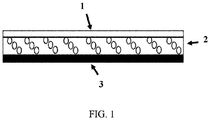
- FIG. 1 is a schematic diagram of a temperature-indicating multilayer composite structure provided according to one embodiment of the present disclosure.
- crystalline material used in this specification and claims means a material with a definite melting point or melting range.
- colorant used in this specification and claims is a generic term of pigments and dyes.
- the present disclosure provides a temperature-indicating composite material product, comprising: a porous film; and a colored composite material layer located at a lower surface of the porous film.
- a release film may be provided on the side of the colored composite material layer opposite to the porous film, as required.
- the temperature-indicating composite material product provided in the present disclosure may further comprise a UV-resistant transparent protective film located at the upper surface of the porous film, as required.
- the term “lower surface of the porous film” refers to the unexposed surface (the surface contacting the colored composite material layer) of the porous film
- the term “upper surface of the porous film” refers to the surface opposite to the "lower surface of the porous film” which is an exposed surface (i.e., the surface contacting the ambient environment), or the surface covered by the transparent protective film.
- the porous film in the temperature-indicating composite material product provided in the present disclosure is preferably a hydrophobic film, and opaque to at least a portion of visible light or opaque to at least a portion of visible light and at least a portion of ultraviolet light, thereby to play the roles of resisting weather and shielding the color of the lower layer. More preferably, the porous film is opaque to all visible light.
- the porous film has a pore size equivalent to the wavelength of the light to be scattered, such as an average pore size of 80 to 800 nm, for the purpose of scattering light.
- the average pore size of the porous film may also be 100 to 800 nm, or 200 to 800 nm.
- the thickness of the porous film ranges from 1 ⁇ m to 500 ⁇ m. With a thickness within this range, the porous film can fully function to scatter light and resist weather. Moreover, when the crystalline material is heated and melted, the liquid material formed thereby is allowed to fully penetrate, and fill a plurality of pores in the porous film, so as to transparentize the porous film. In certain particular embodiments, the thickness of the porous film may range from 30 ⁇ m to 500 ⁇ m.
- the porous film comprises a hydrophobic polymer material, e.g., polyolefin, polystyrene, polyacrylate, fluorocarbon macro-molecules, polyethersulfone, or copolymerized polymers containing the above polymers.
- a hydrophobic polymer material e.g., polyolefin, polystyrene, polyacrylate, fluorocarbon macro-molecules, polyethersulfone, or copolymerized polymers containing the above polymers.
- the hydrophobic polymer material may include polyethylene, polypropylene, polystyrene, polyvinylidene fluoride, polytetrafluoroethylene, polyethersulfone and the like.
- the porous film comprises a weather-resistant material, such as polyvinylidene fluoride, etc.
- a weather-resistant material such as polyvinylidene fluoride, etc.
- Porous films manufactured with other materials e.g., other materials with an additive such as a UV-absorber and a UV-stabilizer added, can also be used.
- a layer of a protective film acting to shield the ultraviolet light may be attached on the porous film.
- the material which can be used for the UV-resistant transparent protective film the following can be enumerated: polyacrylate, polyurethane, polyethylene-vinyl acetate, polyvinyl chloride, polyolefin, organosilicon, polyester (e.g., polyethylene terephthalate), etc.
- the colored composite material layer in the temperature-indicating composite material product provided in the present disclosure comprises: a macro-molecular connecting material; a crystalline material; and a colorant, wherein the crystalline material and the colorant are dispersed in the macro-molecular connecting material, the macro-molecular connecting material is an amorphous material or has a melting point higher than that of the crystalline material, and when the crystalline material is heated to melt into a liquid, the macro-molecular connecting material and the crystalline material are phase-separated.
- the thickness of the colored composite material layer ranges from 1 ⁇ m to 500 ⁇ m.
- the colored composite material layer can have a sufficient adhesion with a thickness in such a range, and a sufficient amount of liquid formed when the crystalline material is heated and melts can be allowed to permeate into the porous film to transparentize the porous film.
- the thickness of the colored composite material layer may range from 1 ⁇ m to 500 ⁇ m.
- the crystalline material in the colored composite material layer has one definite melting point or melting range. Below the temperature of the melting point, the crystalline material remains as a solid, and above the temperature of the melting point, it melts into a liquid and can penetrate into the porous film, and fill a plurality of pores therein, making the porous film transparent. In order to achieve a sufficient transparentizing effect, preferably the liquid formed after the melting of the crystalline material has a refractive index close to that of the solid material constituting the porous film.
- the melting point or melting range of the crystalline material can be determined according to the warning temperature of the object to be measured.
- the crystalline material may be a macro-molecular or small molecular material.
- the crystalline material may be low-molecular weight polyethylene, or other molecules with crystalline properties, including various natural waxes and synthetic waxes, synthetic polymers and the like, can also be used.
- the crystalline material includes stearic acid, lauric acid, linear polyethylene, docosanoic acid, stearone, carnauba wax, microcrystalline wax, paraffin, polyethylene wax, candlelight wax, lignite wax, Fischer-Tropsch synthetic wax, bisamide wax, amide wax, hydrogenated castor oil, synthetic ester wax, oxidized polyethylene wax, oleamide, stearamide, lauramide, erucyl amide, glycerol ester, chlorinated wax, carbamate modified wax, and other synthetic and natural waxes.
- the particle size of the crystalline material ranges from 0.1 ⁇ m to 500 ⁇ m. With the particle size within this range, the crystalline material can be uniformly dispersed in the colored composite material layer, and the liquid formed when it melts can easily penetrate into the porous film. According to certain particular embodiments, the particle size of the crystalline material may range from 0.5 ⁇ m to 500 ⁇ m.
- the macro-molecular connecting material in the colored composite material layer is used to secure the solid crystalline material and the colorant in the colored composite material layer, thereby to maintain stability of the structure.
- the macro-molecular connecting material is an amorphous material or has a melting point higher than that of the crystalline material, and when the crystalline material is heated to melt into a liquid, the macro-molecular connecting material and the crystalline material are phase-separated so that the liquid formed by melting the crystalline material can migrate into the porous film, and fill a plurality of pores therein, making the porous film transparent to visible light.
- non-pressure-sensitive adhesive material such as epoxy resin, phenol formaldehyde resin, acrylate, polyamide, polyurethane, polyolefin copolymer, cellulose, natural rubber, neoprene, butyronitrile rubber, polysulfide rubber, silicone rubber, chloro rubber and the like
- the macro-molecular connecting material is preferably a pressure-sensitive adhesive material, such as polyacrylate, silica gel, polyurethane, polyester, polyolefin, ethylene-ethylene acetate, polybutyronitrile, styrene block polymer, rubber pressure-sensitive adhesive, etc.
- the macro-molecular connecting material is a pressure-sensitive adhesive material or a non-pressure-sensitive adhesive material
- common requirements for them are the following: they do not react with molecules of the crystalline material; when the crystalline material melts into a liquid, the macro-molecular connecting material and the liquid formed by the crystalline material are phase-separated; and they do not penetrate into the porous film before the melting of the crystalline material to make it transparent to visible light.
- the macro-molecular connecting material is a pressure-sensitive adhesive material
- the pressure-sensitive adhesive material can also play the role of an adhesive, e.g., by bonding the porous film to the colored composite material layer.
- the pressure-sensitive adhesive material is preferably a crosslinked pressure-sensitive adhesive material, because it forms a macromolecular network such that molecules of the pressure-sensitive adhesive are difficult to penetrate into the porous film and fill a plurality of pores therein, thereby to prevent the porous film from becoming transparent to visible light due to the pressure-sensitive adhesive material.
- the aforementioned macro-molecular connecting material is a crosslinked pressure-sensitive adhesive material
- the compatibility between the pressure-sensitive adhesive material and the crystalline material is poor, for example, the pressure-sensitive adhesive material does not have a group that can react with the crystalline material.
- the mass of the crystalline material ranges from 1 to 300 parts, based on 100 parts by mass of the pressure-sensitive adhesive material. Within this proportion range, sufficient amount of liquid formed by the crystalline material can be ensured to penetrate into the porous film and fill in a plurality of pores thereof, so that the porous film becomes transparent to visible light and at the same time, it can be ensured that the colored composite material layer has sufficient adhesion to be able to adhere.
- the mass of the crystalline material may range from 1 to 100 parts, based on 100 parts by mass of the pressure-sensitive adhesive material.
- the pressure-sensitive adhesive material when the aforementioned macro-molecular connecting material is a pressure-sensitive adhesive material, the pressure-sensitive adhesive material includes a radiation-curable pressure-sensitive adhesive, for example, a UV-curable pressure-sensitive adhesive, e.g., a UV-curable polyacrylate pressure-sensitive adhesive.
- the colored composite material layer may contain no crosslinker.
- a crosslinker when the aforementioned macro-molecular connecting material is a pressure-sensitive adhesive material, a crosslinker may be added into the pressure-sensitive adhesive material, and the crosslinker is selected in accordance with the pressure-sensitive adhesive material used, and the crosslinker is used in an amount ranging from 0.01 to 1 part by mass, based on 100 parts by mass of the pressure-sensitive adhesive material. In certain particular embodiments, the crosslinker may be used in an amount ranging from 0.1 to 1 part by mass.
- the colorant in the colored composite material layer can be uniformly dispersed in this colored composite layer. After the porous film becomes transparent to visible light, the color of this layer can be seen and thereby exerts the indication effect.
- the colorant when the aforementioned macro-molecular connecting material is a pressure-sensitive adhesive material, the colorant is used in an amount ranging from 1 to 20 parts by mass, based on 100 parts by mass of the pressure-sensitive adhesive material. Within this content range, the colorant can fully exert the coloration effect, and can prevent drops in the dispersibility and viscosity. In certain particular embodiments, the colorant may be used in an amount ranging from 2 to 20 parts by mass.
- the colorant in the colored composite material layer may include a pigment and a dye, and preferably a pigment.
- the pigment is preferably an inorganic pigment.
- the colored composite material layer may further comprise other additives, including antioxidants, UV-absorbers, UV aging-resistant additives, and the like.
- the temperature-indicating composite material product provided in the present disclosure may further comprise a release film which is located at one side of the colored composite material layer opposite to the porous film and serves as a protection for the viscosity of the colored composite material layer.
- the upper surface of the porous film can be used as a low-viscosity back base.
- a layer of low-surface-energy coating e.g., a chlorocarbon-based macro-molecular material, such as polytetrafluoroethylene, polyvinylidene fluoride, chloroplastic macro-molecular materials, etc., or an organosilicon release agent, etc.
- the product can be rolled up directly without the use of a release film.
- FIG. 1 shows a schematic diagram of a temperature-indicating composite material product provided according to one embodiment of the present disclosure, wherein the temperature-indicating composite material product shown has a structure of a porous film 1, a colored composite material layer 2 and a release film 3 laminated in sequence.
- the colored composite material layer 2 comprises a crosslinked pressure-sensitive adhesive material, a crystalline material and a colorant.
- FIG. 1 only schematically shows the distribution of the crystalline material in the colored composite material layer 2. It should be noted that the release film 3 is not necessary for the temperature-indicating composite material product.
- the present disclosure provides a method for manufacturing the above temperature-indicating composite material product, the method comprising: mixing uniformly a slurry containing a macro-molecular connecting material, a crystalline material and a colorant, then drying to form a colored composite material layer; laminating the obtained colored composite material to the porous film; and optionally, attaching a UV-resistant transparent protective film onto the porous film.
- the above method comprises steps of: mixing uniformly a slurry containing a pressure-sensitive adhesive material, a crystalline material, a colorant, and optionally a crosslinker, then drying and crosslinking the pressure-sensitive adhesive material, so as to form a colored composite material layer; laminating the obtained colored composite material onto the porous film; and optionally, attaching a UV-resistant transparent protective film on the porous film.
- the slurry can be formed by diluting a pressure-sensitive adhesive material as the macro-molecular connecting material, a crystalline material, a colorant and optionally a crosslinker with a solvent, and then mixing uniformly.
- the solvent for dilution may include ethyl acetate, n-propyl acetate, butyl acetate, toluene, xylene, isopropanol and the like.
- the pressure-sensitive adhesive material when the macro-molecular connecting material is a pressure-sensitive adhesive material, the pressure-sensitive adhesive material can be crosslinked at a heating condition.
- the pressure-sensitive adhesive material when the macro-molecular connecting material is a pressure-sensitive adhesive material, can be crosslinked through radiation, e.g., ultraviolet irradiation.
- the colored composite material layer is laminated with the porous film at a temperature lower than the melting point of the crystalline material.
- the present disclosure provides application of the above temperature-indicating composite material product in electric power or original equipment manufacturing. After the temperature reaches the melting point of the crystalline material, as the crystalline material melts to form a liquid and flows into the porous film and fills the pores therein, the porous film of the upper layer will become transparent to the visible light, showing the color of the colored composite material layer, thus indicating whether there is overheating.
- the temperature-indicating composite material product is used as a thermochromic label or a thermochromic adhesive tape.
- thermochromic label When the temperature-indicating composite material product is used as a thermochromic label or a thermochromic adhesive tape, there may be several situations as follows:
- thermochromic label or the thermochromic adhesive tape is stuck to or wound on the surface of the object measured.
- the object measured includes a cable connector and clamp.
- Table 1 Material Brand Chemical name Material description POLYWAXTM M80 Polyethylene wax (Polyethylenes) 80° melting point, particles, Baker Hughes Inc. CSA 3020 Polyacrylate Pressure-sensitive adhesive, 42 mass% dissolved in ethyl acetate, 3M RD1054 Bisamide 5 mass% in toluene, 3020 pressure-sensitive adhesive crosslinker, 3M ES 6020 Polyvinylidene fluoride (PVDF) film Porous film, 3M.
- PVDF Polyvinylidene fluoride
- Table 2 Sample Transparency state of the original sample Heating at 80°C After cooling AsahiKASEI AS030; White semitransparent Transparent Transparent AsahiKASEI AS090; White semitransparent Transparent White semitransparent AsahiKASEI Regular A1290 White, opaque Semitransparent White ES6020 film White opaque Transparent Transparent MPF WH-J White opaque Transparent Transparent
- AS030, AS090 and A1290 were commercially available spunbond nonwoven fabrics.
- the fiber coarseness of the spunbond nonwoven fabrics was generally from a few microns to a few tens of microns. It is clear from the results shown in Table 2 that, after wax contact, the transparency of AS030 and AS090 after heating and cooling was acceptable; however, the shielding performance of the original sample with respect to visible light was not good. The transparency of A1290 after heating and cooling was not good. None of the above materials was suitable as the porous material of the present invention.
- the ES6020 film and the MPF WH-J film produced by 3M changed from opaque to transparent after the wax powder melted, and maintained good transparency after cooling, and thus they are suitable as the porous material of the present invention.
- the M80 wax powder was screened through 100-mesh and 60-mesh sieves, so as to separate out wax powders of particles of different sizes.
- the weighed 3020 pressure-sensitive adhesive, RD1054 crosslinker, M80 wax powder and a red pigment were added into a plastic bottle, diluted with ethyl acetate to a 30 wt% slurry, mixed for half an hour on a three-roll machine, then placed into a planetary mixer and mixed uniformly.
- the slurry was coated on a 50- ⁇ m PET release film (Loparex Paper Inc., release force 5 g/inch) by the comma roll coating method.
- the gap distance was controlled at 300 ⁇ m.
- the sample was kept in a 60° oven for 5 min, and then kept in a 105° oven for 10 min, for crosslinking.
- 3M MPF WH-J was attached to the sample obtained, and the composite material layer was transferred to the porous layer (at a hot pressing temperature of 65 °C) with a hot pressing roller through heat sticking, thereby forming a temperature-indicating adhesive tape sample to be tested.
- thermochromic adhesive tape (the parts in the table are given by weight of the solid content) Code 3020 RD1054 M80 60-mesh M80 100-mesh Pigment Discoloration time and status at 80°C CE-1 100 parts 0 part 0 part 0 part 4 parts Uniform color development occurred at 5 days.
- thermochromic adhesive tape may be caused by penetration of the uncrosslinked pressure-sensitive adhesive into the light scattering layer.
- This problem could be solved by adding a small amount of a crosslinker.
- the part of wax was less than 30, the color development was nonuniform.
- This problem could be solved by increasing the portion of wax.
- the selection of wax powder of larger particles could provide faster color development.
- the M80 wax powder was screened through 100-mesh and 60-mesh sieves, so as to separate out wax powders of particles of different sizes.
- the weighed 3020 (100 parts), RD1054 (0.12 part), M80 (50 parts) and a red pigment (4 parts) were added into a plastic bottle, diluted with ethyl acetate to a 30 wt% slurry, mixed for half an hour on a three-roll machine, then placed into a planetary mixer and mixed uniformly.
- the slurry was coated on a 50- ⁇ m PET release film (Loparex Paper Inc., release force 5 g/inch) by the comma roll coating method, to obtain samples F-K.
- the gap distance was controlled at 200 ⁇ m, 300 ⁇ m or 400 ⁇ m.
- the sample was kept in a 60° oven for 5 min, and then kept in a 105° oven for 10 min, for crosslinking.
- the 3M MPF WH-J or ES 6020 PVDF film was attached to the sample obtained, and the composite material layer was transferred to the porous layer (at a hot pressing temperature of 65 °C) with a hot pressing roller through heat sticking, thereby forming an adhesive tape sample to be tested.
- a 1-inch wide and about 8-inch long sample strip was obtained by cutting carefully with a cutting knife. After the release film was removed, the adhesive tape was adhered to a stainless steel (SS) (commercially available from Chemsultants International Corporation, Ohio, USA) plate. It was rolled with a 2-kg rubber roller back and forth once at a speed of 12 inch/min, then stored for a specific period of time, and measured for the force required to peel off the adhesive tape at an angle of 180°, at a peeling speed of 12 inch/min, wherein the machine used in the test was Instron 3343 (commercially available from Chemsultants International Corporation, Ohio, USA), and the measured values were given in N/cm. Measurements of three adhesive tape samples were averaged. Before the test, the plate with the sample strip of the adhesive tape attached thereon was stored at the condition as follows: 23 °C +/-2 / 50+/-5% RH, 1 day. Results obtained are summarized in Table 4.
- the tape sample to be tested which was prepared in Embodiment 4 was taken and a cutter knife was used to carefully cut out a sample strip with a width of 1 inch and a length of about 6 inches. After the release film was removed, the adhesive tape was adhered to a stainless steel (SS) substrate, and cut to leave a 1 inch x 1 inch sample for the shear test at a temperature of 70°C. It was rolled with a 2-kg rubber roller back and forth once at a speed of 12 inch/min, and then stored for 1 day at room temperature. The test was performed by loading a 1000-g load to the adhesive tape sample. Each sample was suspended until failure occurs or the experiment terminates.
- SS stainless steel
- the M80 wax powder was screened through a 100-mesh sieve, so as to separate out wax powder particles below 100 meshes.
- the weighed 3020 (100 parts), RD1054 (0.12 part), M80 (50 parts) and a red pigment (4 parts) were added into a plastic bottle, diluted with ethyl acetate to a 30 wt% slurry, mixed for half an hour on a three-roll machine, then placed into a planetary mixer and mixed uniformly.
- the slurry was coated on a 50- ⁇ m PET release film (Loparex Paper Inc., release force 5 g/inch) by the comma roll coating method.
- the gap distance was controlled at 300 ⁇ m.
- the sample was kept in a 60° oven for 5 min, and then kept in a 105° oven for 10 min for crosslinking.
- the obtained sample was combined with the 3M MPF WH-J or ES6020 PVDF film, and pressed with a hot pressing roller into a film sample (at a hot pressing temperature of 65°C).
- the sample obtained was tested with a QUV accelerated aging tester.
- the UV power was 0.87 W/m 2 , and the test temperature was 63 °C.
- the outer surface of the light scattering film was facing the ultraviolet lamp.
- Experimental results showed that none of the samples had a significant change after 500 h of continuous illumination. And within half an hour below 80 °C, the sample still had color development. The color development was not significantly different from samples without ultraviolet irradiation.
Landscapes
- Physics & Mathematics (AREA)
- General Physics & Mathematics (AREA)
- Laminated Bodies (AREA)
- Adhesive Tapes (AREA)
Applications Claiming Priority (1)
| Application Number | Priority Date | Filing Date | Title |
|---|---|---|---|
| PCT/CN2017/109717 WO2019090472A1 (zh) | 2017-11-07 | 2017-11-07 | 温度指示复合材料制品及其制备方法和应用 |
Publications (2)
| Publication Number | Publication Date |
|---|---|
| EP3708982A1 true EP3708982A1 (de) | 2020-09-16 |
| EP3708982A4 EP3708982A4 (de) | 2021-07-07 |
Family
ID=66437473
Family Applications (1)
| Application Number | Title | Priority Date | Filing Date |
|---|---|---|---|
| EP17931611.2A Withdrawn EP3708982A4 (de) | 2017-11-07 | 2017-11-07 | Zusammengesetzter temperaturanzeigeartikel und verfahren zu seiner herstellung und verwendung davon |
Country Status (4)
| Country | Link |
|---|---|
| US (1) | US20200348187A1 (de) |
| EP (1) | EP3708982A4 (de) |
| CN (1) | CN111295574B (de) |
| WO (1) | WO2019090472A1 (de) |
Families Citing this family (5)
| Publication number | Priority date | Publication date | Assignee | Title |
|---|---|---|---|---|
| US20220373406A1 (en) * | 2019-11-11 | 2022-11-24 | Korea Research Institute Of Chemical Technology | Temperature-change sensing substrate comprising self-healing polyurethane polymer |
| CN113278376B (zh) * | 2020-02-20 | 2023-02-24 | 长鑫存储技术有限公司 | 疏水膜结构及其检测方法、检测系统、晶圆载具 |
| US12590849B2 (en) | 2021-03-05 | 2026-03-31 | Zebra Technologies Corporation | Activatable warming indicator without dye |
| CN114381216A (zh) * | 2021-12-13 | 2022-04-22 | 苏州赛伍应用技术股份有限公司 | 一种热致变色胶带及其制备方法 |
| WO2024136696A2 (ru) * | 2022-12-07 | 2024-06-27 | Общество С Ограниченной Ответственностью "Термоэлектрика" | Устройство и способ контроля температуры поверхности |
Family Cites Families (11)
| Publication number | Priority date | Publication date | Assignee | Title |
|---|---|---|---|---|
| US4428321A (en) * | 1981-11-16 | 1984-01-31 | Minnesota Mining And Manufacturing Co. | Thermally-activated time-temperature indicator |
| CN1072562C (zh) * | 1995-06-20 | 2001-10-10 | 贵州大学 | 装饰性热致变色液晶夹膜的制法 |
| JPH1062269A (ja) * | 1996-08-22 | 1998-03-06 | Asahi Electric Works Ltd | 過熱検出表示装置 |
| JPH11258369A (ja) * | 1998-03-09 | 1999-09-24 | Toyo Ink Mfg Co Ltd | 時間または温度−時間積算値の表示材およびそれを用いた表示方法 |
| US6564742B2 (en) | 2001-08-03 | 2003-05-20 | Hewlett-Packard Development Company, Llp | Over-temperature warning device |
| JP3875869B2 (ja) * | 2001-10-22 | 2007-01-31 | 日油技研工業株式会社 | 温度履歴インジケータ |
| JP4789083B2 (ja) * | 2004-07-15 | 2011-10-05 | 株式会社ジークエスト | 温度感知シール |
| CN102634831B (zh) * | 2012-05-04 | 2016-08-17 | 东莞市创星自动化科技有限公司 | 一种阳极氧化铝板及其制备工艺 |
| CN103289590A (zh) * | 2013-06-27 | 2013-09-11 | 苏州工业园区依利电子贸易有限公司 | 一种感温变色双面胶带 |
| CN105172283B (zh) * | 2015-07-29 | 2017-12-19 | 深圳九星印刷包装集团有限公司 | 多层薄膜及其制备方法与时间温度指示装置 |
| CN104987759A (zh) * | 2015-07-30 | 2015-10-21 | 江南大学 | 一种多色系可逆热致变色涂料的制备方法 |
-
2017
- 2017-11-07 US US16/760,112 patent/US20200348187A1/en not_active Abandoned
- 2017-11-07 EP EP17931611.2A patent/EP3708982A4/de not_active Withdrawn
- 2017-11-07 WO PCT/CN2017/109717 patent/WO2019090472A1/zh not_active Ceased
- 2017-11-07 CN CN201780096574.5A patent/CN111295574B/zh active Active
Also Published As
| Publication number | Publication date |
|---|---|
| WO2019090472A1 (zh) | 2019-05-16 |
| CN111295574B (zh) | 2024-06-18 |
| US20200348187A1 (en) | 2020-11-05 |
| CN111295574A (zh) | 2020-06-16 |
| EP3708982A4 (de) | 2021-07-07 |
Similar Documents
| Publication | Publication Date | Title |
|---|---|---|
| EP3708982A1 (de) | Zusammengesetzter temperaturanzeigeartikel und verfahren zu seiner herstellung und verwendung davon | |
| KR101177956B1 (ko) | 타이어용 점착시트 | |
| US9644117B2 (en) | Adhesive composition | |
| US8066432B2 (en) | Temperature sensitive films | |
| JPS58501920A (ja) | 熱活性化時間−温度指示器 | |
| EP1073887A1 (de) | Zeit-temperatur integrierende anzeigevorrichtung mit sperrmaterial | |
| CN104981741B (zh) | 基于染料的时间指示标签 | |
| WO2007012132A1 (en) | Time-temperature indicators | |
| EP1674542B1 (de) | Klebfolie für reifen sowie deren herstellung | |
| JP6008666B2 (ja) | 温度履歴管理時の異常変色忌避方法 | |
| US20040014863A1 (en) | Uv-resistant hot-melt contact adhesive, a method for producing the same and adhesive objects produced therefrom | |
| JP3512567B2 (ja) | 耐候性表示組成物及びその使用方法 | |
| RU220294U1 (ru) | Необратимый термоиндикатор с низкомолекулярным термочувствительным элементом | |
| US20260079054A1 (en) | Device for visually indicating excess temperature and method for manufacturing same | |
| RU2831935C1 (ru) | Необратимый и невозвратный газонаполненный термоплавкий элемент и содержащий его термоиндикатор | |
| RU2800396C1 (ru) | Устройство для визуальной регистрации превышения температуры и способ его изготовления (варианты) | |
| US5723336A (en) | Valved extended time-temperature indicator | |
| RU221997U1 (ru) | Необратимая термоиндикаторная наклейка | |
| RU232413U1 (ru) | Многотемпературный необратимый термоиндикатор с термоиндикаторной шкалой и дополнительным термочувствительным элементом с отличающимся цветовым переходом | |
| RU235213U1 (ru) | Многотемпературный необратимый термоиндикатор с термоиндикаторной шкалой и дополнительным большим плавким термочувствительным элементом | |
| RU236986U1 (ru) | Многотемпературный необратимый термоиндикатор с цветовым переходом "белый-черный", с термоиндикаторной шкалой и дополнительным большим термочувствительным элементом | |
| RU234075U1 (ru) | Многотемпературный необратимый термоиндикатор с термоиндикаторной шкалой и дополнительным большим термочувствительным элементом с отличающимся цветовым переходом | |
| RU218896U1 (ru) | Светоотражающее устройство для регистрации перегревов поверхностей оборудования | |
| US20210095129A1 (en) | Thermal indicator, thermal indicating composition and thermal indicating structure | |
| WO2025009991A1 (ru) | Необратимая термоиндикаторная наклейка |
Legal Events
| Date | Code | Title | Description |
|---|---|---|---|
| STAA | Information on the status of an ep patent application or granted ep patent |
Free format text: STATUS: THE INTERNATIONAL PUBLICATION HAS BEEN MADE |
|
| PUAI | Public reference made under article 153(3) epc to a published international application that has entered the european phase |
Free format text: ORIGINAL CODE: 0009012 |
|
| STAA | Information on the status of an ep patent application or granted ep patent |
Free format text: STATUS: REQUEST FOR EXAMINATION WAS MADE |
|
| 17P | Request for examination filed |
Effective date: 20200430 |
|
| AK | Designated contracting states |
Kind code of ref document: A1 Designated state(s): AL AT BE BG CH CY CZ DE DK EE ES FI FR GB GR HR HU IE IS IT LI LT LU LV MC MK MT NL NO PL PT RO RS SE SI SK SM TR |
|
| AX | Request for extension of the european patent |
Extension state: BA ME |
|
| DAV | Request for validation of the european patent (deleted) | ||
| DAX | Request for extension of the european patent (deleted) | ||
| A4 | Supplementary search report drawn up and despatched |
Effective date: 20210609 |
|
| RIC1 | Information provided on ipc code assigned before grant |
Ipc: G01K 11/06 20060101AFI20210602BHEP Ipc: G01K 3/04 20060101ALI20210602BHEP Ipc: G01K 11/12 20210101ALI20210602BHEP |
|
| GRAP | Despatch of communication of intention to grant a patent |
Free format text: ORIGINAL CODE: EPIDOSNIGR1 |
|
| STAA | Information on the status of an ep patent application or granted ep patent |
Free format text: STATUS: GRANT OF PATENT IS INTENDED |
|
| INTG | Intention to grant announced |
Effective date: 20220214 |
|
| STAA | Information on the status of an ep patent application or granted ep patent |
Free format text: STATUS: THE APPLICATION IS DEEMED TO BE WITHDRAWN |
|
| 18D | Application deemed to be withdrawn |
Effective date: 20220625 |