EP3699221A1 - Harzzusammensetzung und formverfahren davon - Google Patents
Harzzusammensetzung und formverfahren davon Download PDFInfo
- Publication number
- EP3699221A1 EP3699221A1 EP19213417.9A EP19213417A EP3699221A1 EP 3699221 A1 EP3699221 A1 EP 3699221A1 EP 19213417 A EP19213417 A EP 19213417A EP 3699221 A1 EP3699221 A1 EP 3699221A1
- Authority
- EP
- European Patent Office
- Prior art keywords
- group
- resin
- resin composition
- weight
- percent
- Prior art date
- Legal status (The legal status is an assumption and is not a legal conclusion. Google has not performed a legal analysis and makes no representation as to the accuracy of the status listed.)
- Granted
Links
Images

Classifications
-
- C—CHEMISTRY; METALLURGY
- C08—ORGANIC MACROMOLECULAR COMPOUNDS; THEIR PREPARATION OR CHEMICAL WORKING-UP; COMPOSITIONS BASED THEREON
- C08H—DERIVATIVES OF NATURAL MACROMOLECULAR COMPOUNDS
- C08H8/00—Macromolecular compounds derived from lignocellulosic materials
-
- C—CHEMISTRY; METALLURGY
- C08—ORGANIC MACROMOLECULAR COMPOUNDS; THEIR PREPARATION OR CHEMICAL WORKING-UP; COMPOSITIONS BASED THEREON
- C08L—COMPOSITIONS OF MACROMOLECULAR COMPOUNDS
- C08L5/00—Compositions of polysaccharides or of their derivatives not provided for in groups C08L1/00 or C08L3/00
- C08L5/14—Hemicellulose; Derivatives thereof
-
- B—PERFORMING OPERATIONS; TRANSPORTING
- B29—WORKING OF PLASTICS; WORKING OF SUBSTANCES IN A PLASTIC STATE IN GENERAL
- B29C—SHAPING OR JOINING OF PLASTICS; SHAPING OF MATERIAL IN A PLASTIC STATE, NOT OTHERWISE PROVIDED FOR; AFTER-TREATMENT OF THE SHAPED PRODUCTS, e.g. REPAIRING
- B29C45/00—Injection moulding, i.e. forcing the required volume of moulding material through a nozzle into a closed mould; Apparatus therefor
- B29C45/17—Component parts, details or accessories; Auxiliary operations
- B29C45/18—Feeding the material into the injection moulding apparatus, i.e. feeding the non-plastified material into the injection unit
- B29C45/1816—Feeding auxiliary material, e.g. colouring material
-
- B—PERFORMING OPERATIONS; TRANSPORTING
- B29—WORKING OF PLASTICS; WORKING OF SUBSTANCES IN A PLASTIC STATE IN GENERAL
- B29C—SHAPING OR JOINING OF PLASTICS; SHAPING OF MATERIAL IN A PLASTIC STATE, NOT OTHERWISE PROVIDED FOR; AFTER-TREATMENT OF THE SHAPED PRODUCTS, e.g. REPAIRING
- B29C45/00—Injection moulding, i.e. forcing the required volume of moulding material through a nozzle into a closed mould; Apparatus therefor
- B29C45/17—Component parts, details or accessories; Auxiliary operations
- B29C45/46—Means for plasticising or homogenising the moulding material or forcing it into the mould
- B29C45/56—Means for plasticising or homogenising the moulding material or forcing it into the mould using mould parts movable during or after injection, e.g. injection-compression moulding
- B29C45/561—Injection-compression moulding
-
- B—PERFORMING OPERATIONS; TRANSPORTING
- B29—WORKING OF PLASTICS; WORKING OF SUBSTANCES IN A PLASTIC STATE IN GENERAL
- B29C—SHAPING OR JOINING OF PLASTICS; SHAPING OF MATERIAL IN A PLASTIC STATE, NOT OTHERWISE PROVIDED FOR; AFTER-TREATMENT OF THE SHAPED PRODUCTS, e.g. REPAIRING
- B29C45/00—Injection moulding, i.e. forcing the required volume of moulding material through a nozzle into a closed mould; Apparatus therefor
- B29C45/17—Component parts, details or accessories; Auxiliary operations
- B29C45/72—Heating or cooling
- B29C45/73—Heating or cooling of the mould
- B29C45/7337—Heating or cooling of the mould using gas or steam
-
- B—PERFORMING OPERATIONS; TRANSPORTING
- B29—WORKING OF PLASTICS; WORKING OF SUBSTANCES IN A PLASTIC STATE IN GENERAL
- B29C—SHAPING OR JOINING OF PLASTICS; SHAPING OF MATERIAL IN A PLASTIC STATE, NOT OTHERWISE PROVIDED FOR; AFTER-TREATMENT OF THE SHAPED PRODUCTS, e.g. REPAIRING
- B29C45/00—Injection moulding, i.e. forcing the required volume of moulding material through a nozzle into a closed mould; Apparatus therefor
- B29C45/17—Component parts, details or accessories; Auxiliary operations
- B29C45/72—Heating or cooling
- B29C45/74—Heating or cooling of the injection unit
-
- C—CHEMISTRY; METALLURGY
- C08—ORGANIC MACROMOLECULAR COMPOUNDS; THEIR PREPARATION OR CHEMICAL WORKING-UP; COMPOSITIONS BASED THEREON
- C08L—COMPOSITIONS OF MACROMOLECULAR COMPOUNDS
- C08L23/00—Compositions of homopolymers or copolymers of unsaturated aliphatic hydrocarbons having only one carbon-to-carbon double bond; Compositions of derivatives of such polymers
- C08L23/02—Compositions of homopolymers or copolymers of unsaturated aliphatic hydrocarbons having only one carbon-to-carbon double bond; Compositions of derivatives of such polymers not modified by chemical after-treatment
- C08L23/04—Homopolymers or copolymers of ethene
- C08L23/06—Polyethene
-
- C—CHEMISTRY; METALLURGY
- C08—ORGANIC MACROMOLECULAR COMPOUNDS; THEIR PREPARATION OR CHEMICAL WORKING-UP; COMPOSITIONS BASED THEREON
- C08L—COMPOSITIONS OF MACROMOLECULAR COMPOUNDS
- C08L23/00—Compositions of homopolymers or copolymers of unsaturated aliphatic hydrocarbons having only one carbon-to-carbon double bond; Compositions of derivatives of such polymers
- C08L23/02—Compositions of homopolymers or copolymers of unsaturated aliphatic hydrocarbons having only one carbon-to-carbon double bond; Compositions of derivatives of such polymers not modified by chemical after-treatment
- C08L23/10—Homopolymers or copolymers of propene
- C08L23/12—Polypropene
-
- C—CHEMISTRY; METALLURGY
- C08—ORGANIC MACROMOLECULAR COMPOUNDS; THEIR PREPARATION OR CHEMICAL WORKING-UP; COMPOSITIONS BASED THEREON
- C08L—COMPOSITIONS OF MACROMOLECULAR COMPOUNDS
- C08L33/00—Compositions of homopolymers or copolymers of compounds having one or more unsaturated aliphatic radicals, each having only one carbon-to-carbon double bond, and only one being terminated by only one carboxyl radical, or of salts, anhydrides, esters, amides, imides or nitriles thereof; Compositions of derivatives of such polymers
- C08L33/04—Homopolymers or copolymers of esters
- C08L33/06—Homopolymers or copolymers of esters of esters containing only carbon, hydrogen and oxygen, which oxygen atoms are present only as part of the carboxyl radical
- C08L33/10—Homopolymers or copolymers of methacrylic acid esters
- C08L33/12—Homopolymers or copolymers of methyl methacrylate
-
- C—CHEMISTRY; METALLURGY
- C08—ORGANIC MACROMOLECULAR COMPOUNDS; THEIR PREPARATION OR CHEMICAL WORKING-UP; COMPOSITIONS BASED THEREON
- C08L—COMPOSITIONS OF MACROMOLECULAR COMPOUNDS
- C08L67/00—Compositions of polyesters obtained by reactions forming a carboxylic ester link in the main chain; Compositions of derivatives of such polymers
- C08L67/02—Polyesters derived from dicarboxylic acids and dihydroxy compounds
-
- C—CHEMISTRY; METALLURGY
- C08—ORGANIC MACROMOLECULAR COMPOUNDS; THEIR PREPARATION OR CHEMICAL WORKING-UP; COMPOSITIONS BASED THEREON
- C08L—COMPOSITIONS OF MACROMOLECULAR COMPOUNDS
- C08L67/00—Compositions of polyesters obtained by reactions forming a carboxylic ester link in the main chain; Compositions of derivatives of such polymers
- C08L67/04—Polyesters derived from hydroxycarboxylic acids, e.g. lactones
-
- C—CHEMISTRY; METALLURGY
- C08—ORGANIC MACROMOLECULAR COMPOUNDS; THEIR PREPARATION OR CHEMICAL WORKING-UP; COMPOSITIONS BASED THEREON
- C08L—COMPOSITIONS OF MACROMOLECULAR COMPOUNDS
- C08L69/00—Compositions of polycarbonates; Compositions of derivatives of polycarbonates
-
- B—PERFORMING OPERATIONS; TRANSPORTING
- B29—WORKING OF PLASTICS; WORKING OF SUBSTANCES IN A PLASTIC STATE IN GENERAL
- B29C—SHAPING OR JOINING OF PLASTICS; SHAPING OF MATERIAL IN A PLASTIC STATE, NOT OTHERWISE PROVIDED FOR; AFTER-TREATMENT OF THE SHAPED PRODUCTS, e.g. REPAIRING
- B29C2945/00—Indexing scheme relating to injection moulding, i.e. forcing the required volume of moulding material through a nozzle into a closed mould
- B29C2945/76—Measuring, controlling or regulating
- B29C2945/76344—Phase or stage of measurement
- B29C2945/76351—Feeding
- B29C2945/76361—Feeding auxiliary fluids, e.g. gas, liquid
-
- B—PERFORMING OPERATIONS; TRANSPORTING
- B29—WORKING OF PLASTICS; WORKING OF SUBSTANCES IN A PLASTIC STATE IN GENERAL
- B29K—INDEXING SCHEME ASSOCIATED WITH SUBCLASSES B29B, B29C OR B29D, RELATING TO MOULDING MATERIALS OR TO MATERIALS FOR MOULDS, REINFORCEMENTS, FILLERS OR PREFORMED PARTS, e.g. INSERTS
- B29K2005/00—Use of polysaccharides or derivatives as moulding material
Definitions
- the present invention relates to a resin composition and injection molding method thereof.
- the present invention relates to a resin composition for molding having biodegradability and molding method thereof.
- Chemically synthesized plastics such as PP, PE, PET, PC, PMMA, PS, COP, and COC, have been used as resin materials for molding. Although these chemically synthesized plastics produce carbon dioxide and pose environmental pollution problems, they are currently being used with such problems are nearly neglected when synthesized plastics are used.
- resin compositions have been developed so that they do not produce carbon dioxide during preparation thereof and are made of a component of a natural material, such as a plant.
- biodegradable resin compositions have been developed so that they are biodegraded into low-molecular compounds not to have adverse effects on the environment by microorganisms.
- Examples of such a plant-derived, biodegradable resin composition include polylactic acid (PLA).
- PLA polylactic acid
- a molded product made of polylactic acid is disclosed in Japanese Unexamined Patent Application Publication No. 2016-179694 .
- PLA is made from corn or sugarcane and therefore produces less CO 2 .
- PLA requires many preparation processes and high preparation cost.
- PLA is a material that biodegrades only at high temperatures of 50 degrees Celsius or more. For this reason, PLA cannot exhibit biodegradability when disposed of in the natural environment.
- PLA is less heat resistant and therefore a molded product made of PLA, for example, a drink container such as a cup, is deformed when hot water is poured thereinto.
- a molded product made of PLA has less strength and therefore is cracked, damaged, or broken when it falls or is bent or pressed.
- a longer molding cycle time is required, or a molding failure is more likely to occur due to poor fluidity of PLA.
- the present inventors conducted intensive research and, as a result, here provide a resin composition for molding having excellent heat resistance, hardness, cost-effectiveness, and biodegradability by using an amorphous resin material component extracted from plant-derived wood.
- the present inventors also provide a molding method of this resin composition.
- a resin composition for molding of the present embodiment includes a first resin that is derived from a plant and has the following structural formula (Chemical Formula 1).
- the resin composition for molding preferably includes a second resin having the following structural formula (Chemical Formula 2).
- the resin composition for molding may include a second resin including one of polycarbonate (PC), cyclo olefin polymer (COP), cyclo olefin copolymer (COC), polypropylene (PP), polyethylene (PE), polyethylene terephthalate (PET), polystyrene (PS), polylactic acid (PLA), ABS resin (ABS), vinyl chloride (PVC), vinylidene chloride (PVDC), vinyl acetate (PVAC), polymethylpentene (PMP), polybutene (PB), hydroxybenzoic acid (HBP), polyetherimide (PEI), polyacetal (POM), polyphenylene ether (PPE), polyphenylene oxide (PPO), polyphenylene sulfide (PPS), polyurethane (PUR), ionomer resin (IO), fluorocarbon resin (FR), tetrafluoroethylene (PTFE), polycyclohexylenedimethylene terephthalate (PCT), polyethylene n
- Wood powder or wood pellets, bamboo powder or bamboo pellets, or grass powder or grass pellets obtained by freezing and crushing wood, bamboo, or grass; or paper powder or paper pellets obtained by freezing and crushing paper may be kneaded with the first resin, or may be kneaded with the first and second resins.
- these materials are very inexpensive, the cost of resin pellets and the price of molded products are expected to be reduced.
- the resin composition decreases in heat resistance, strength, and fluidity.
- the resin composition improves in heat resistance, strength, and fluidity and obtains biodegradability.
- a resin composition molding method of the present embodiment includes a step of charging a resin composition into a resin injector with the resin composition solidified, a step of liquidizing the resin composition in the resin injector by heating and compressing the resin composition, a step of injecting the liquidized resin composition from the resin injector into a mold by pressing the resin composition, and a step of cooling and solidifying the resin composition in the mold and extracting a molded product from the mold.
- the resin composition molding method preferably further includes a step of introducing a gas into the liquidized resin composition and dispersing the gas in the resin composition.
- the resin composition of the present invention has excellent heat resistance, hardness, cost-effectiveness, and biodegradability.
- a resin composition according to the present embodiment includes a plant-derived resin component.
- This resin component is one of the main components of a tree. That is, a tree includes three main components: cellulose, hemicellulose, and lignin.
- a first resin of the present embodiment includes a hemicellulose as a component.
- a hemicellulose is amorphous and has very high uniformity.
- a melted liquid hemicellulose has high fluidity and is suitable as a material for injection molding.
- Cellulose is a fibrous material having high crystallinity and is not suitable as a main component of a material for injection molding.
- Lignin is a material having high crystallinity and less fluidity and therefore is not suitable as a main component of a material for injection molding.
- a hemicellulose alone is an amorphous material, and a liquidized hemicellulose can uniformly flow through a cylinder during injection molding.
- Hemicelluloses include complex polysaccharides, such as mannan, glucan, xylan, and xyloglucan.
- the hemicellulose of the present embodiment may be any of these substances and may contain a small amount of cellulose or a small amount of lignin.
- xylan is preferably used.
- a typical hemicellulose has a molecular weight of (weight average molecular weight Mw) 1,000 to 100,000. If a hemicellulose having a molecular weight of 30,000 to 100,000 is injection-molded, a molded product having good strength is obtained.
- a hemicellulose has good biodegradability.
- a hemicellulose biodegrades at a higher rate than cellulose and lignin and favorably biodegrades at low to high temperatures, for example, at a low temperature of 5 degrees Celsius.
- a hemicellulose is biodegraded by microorganisms even at ordinary temperature and becomes water and carbon dioxide after three months. For example, when buried in soil, a hemicellulose is biodegraded by microorganisms in soil. A hemicellulose is also biodegraded by microorganisms in seawater.
- a hemicellulose is a material in harmony with the environment.
- a hemicellulose is a component of wood and therefore chemical synthesis is not required to obtain a hemicellulose. That is, a hemicellulose does not produce carbon dioxide, which occurs when chemically synthesizing a raw material, and plant-derived wood consumes carbon dioxide by photosynthesis.
- Use of a hemicellulose as the first resin of the composition for injection molding reduces occurrence of carbon dioxide.
- the basic structure of a hemicellulose as the first resin has the following structural formula (Chemical Formula 1). Any hemicellulose having the following structure in its molecular structure can be used in the present embodiment.
- R1 and R2 each represent a substituent group.
- R1 and R2 are each hydrogen, nitrogen, an alkyl group, an acetyl group, a hydroxy group, an acyl group, an aldehyde group, an amino group, an imino group, an aryl group, a phosphonyl group, a propenyl group, a propanyl group, an acetonyl group, a carbonyl group, a carboxyl group, a cyano group, an azo group, an azi group, a thiol group, a sulfo group, a nitro group, a vinyl group, an allyl group, a cycloalkyl group, a phenyl group, a naphthyl group, an aralkyl group, a benzyl group, a Schiff group, an alkylene group, an amyl group, an acetamidomethyl group, an adamantyl group, an
- R1 and R2 may be each a substituent group having any of these substances in the structure.
- R1 and R2 may be each fluorine, bromine, chlorine, iodine, or the like, or may be each a substituent group having any of these substances in the structure.
- R1 and R2 may each be an ionized substituent group, such as a cation or anion, that forms an ionic liquid structure, or may each be a substituent group having such a substance in the structure.
- R1 and R2 may be different substituent groups.
- a hemicellulose having such a basic structure provides the resin composition with biodegradability, as well as heat resistance, strength, fluidity, and transparency.
- a resin composition can be injection-molded, and an injection-molded product has biodegradability, as well as good heat resistance, strength, fluidity, and transparency.
- n is an integer greater than or equal to 2.
- a hemicellulose component extracted from a wood chip includes hydrogen as R1 and R2 and is called a "hemicellulose.”
- a hemicellulose has high hydrophilicity and therefore easily captures moisture.
- a molded product including a hemicellulose, which has high water absorbency may be unpreferable, since the size, volume, or weight thereof is more likely to vary with time, depending on the application.
- a molded product decreases in strength, transparency, or heat resistance, depending on the application.
- R in the molecule of the hemicellulose to a substituent group as description above, that is, a substituent group, such as an acetyl group, an acetonyl group, or an ionized substituent group.
- a substituent group such as an acetyl group, an acetonyl group, or an ionized substituent group.
- Hemicelluloses including various substituent groups other than hydrogen are called "hemicellulose derivatives.”
- a typical hemicellulose derivative includes acetyl groups as R1 and R2.
- Fragments obtained by crushing wood into small sizes are called wood chips.
- wood chips When these wood chips are put into an aqueous solution containing butanol and heated, this solution is separated into the butanol/lignin phase and the water/hemicellulose phase. Cellulose precipitates as a solid.
- hemicellulose powder By removing water from the water/hemicellulose phase, hemicellulose powder can be obtained.
- This hemicellulose powder has a basic structure represented by a structural formula in which R1 and R2 are hydrogen.
- This hemicellulose powder has high hydrophilicity and therefore easily captures moisture.
- a molded product including this hemicellulose powder having high water absorbency is more likely to change in size, volume, or weight with time, as well as may decrease in strength, transparency, or heat resistance.
- a hemicellulose derivative is prepared by changing R1 and R2 in the structural formula of the hemicellulose powder from hydrogen to acetyl groups so that an acetylation reaction occurs in the hemicellulose powder.
- a hemicellulose derivative may be prepared by changing R1 and R2 in the structural formula of the hemicellulose powder from hydrogen to substituent groups, such as acetonyl groups, propenyl groups, or carboxyl groups, rather than acetyl groups so that a corresponding chemical reaction occurs in the hemicellulose powder.
- the preparation of such a hemicellulose derivative was performed using a conventional sugar derivative preparation technology. This sugar derivative preparation technology is a technology proposed by Yamagata University, Nippon Kayaku Co., Ltd., HORIBA STEC, Co., Ltd., Kobe Natural Products Chemical Co., Ltd., or Hayashibara Co., Ltd.
- the hemicellulose or hemicellulose derivative, which is the first resin serves as a resin composition or resin pellets for injection molding on its own.
- the hemicellulose or hemicellulose derivative, which is the first resin may be mixed with a second resin.
- a resin composition for injection molding is obtained by mixing the powdery hemicellulose or hemicellulose derivative with powder, pellets, or the like of the second resin and charging the mixture into an extruder/kneader.
- the first resin and second resin are melted and kneaded in the extruder/kneader, and the kneaded resin composition is extruded in the form of a tube from the nozzle of the extruder/kneader.
- the tubular resin is cut into resin pellets made of the resin composition using a pelletizer.
- the resin pellets are resin strips having a diameter of 0.2 to 3 mm and a length of 0.2 to 5 mm.
- the second resin is polycarbonate (PC), cyclo olefin polymer (COP), cyclo olefin copolymer (COC), polypropylene (PP), polyethylene (PE), polyethylene terephthalate (PET), polystyrene (PS), polylactic acid (PLA), ABS resin (ABS), vinyl chloride (PVC), vinylidene chloride (PVDC), vinyl acetate (PVAC), polymethylpentene (PMP), polybutene (PB), hydroxybenzoic acid (HBP), polyetherimide (PEI), polyacetal (POM), polyphenylene ether (PPE), polyphenylene oxide (PPO), polyphenylene sulfide (PPS), polyurethane (PUR), ionomer resin (IO), fluorocarbon resin (FR), tetrafluoroethylene (PTFE), polycyclohexylenedimethylene terephthalate (PCT), polyethylene naphthalate (PEN), polyarylate (
- the second resin may be two or more of these resins.
- Wood powder or wood pellets, bamboo powder or bamboo pellets, or grass powder or grass pellets obtained by freezing and crushing wood, bamboo, or grass, or paper powder or paper pellets obtained by freezing and crushing paper may be kneaded with the first resin, or may be kneaded with the first and second resins. These materials are very inexpensive and therefore the kneaded resin pellets can be produced at lower cost and are expected to be sold at lower price. If the wood powder or wood pellets, bamboo powder or bamboo pellets, grass powder or grass pellets, or paper powder or paper pellets is directly mixed with the second resin, the heat resistance, strength, and fluidity decreases. On the other hand, by kneading those materials with the first resin, the resin composition improves in heat resistance, strength, and fluidity and obtains biodegradability.
- a resin having the following structural formula (Chemical Formula 2) may be mixed as the second resin.
- examples of such a resin include polymethylmethacrylate (PMMA, acrylic).
- R3 represents a substituent group and is hydrogen, nitrogen, an alkyl group, an acetyl group, a hydroxy group, an acyl group, an aldehyde group, an amino group, an imino group, an aryl group, a phosphonyl group, a propenyl group, a propanyl group, an acetonyl group, a carbonyl group, a carboxyl group, a cyano group, an azo group, an azi group, a thiol group, a sulfo group, a nitro group, a vinyl group, an allyl group, a cycloalkyl group, a phenyl group, a naphthyl group, an aralkyl group, a benzyl group, a Schiff group, an alkylene group, an amyl group, an acetamidomethyl group, an adamantyl group, an adamantyloxycarbonyl
- R3 may be fluorine, bromine, chlorine, iodine, or the like, or may be a substituent group having any of these substances in the structure.
- R3 may also be an ionized substituent group, such as a cation or anion, that forms an ionic liquid structure.
- R3 may also be a substituent group having any of the above substances in the structure.
- a and Q each independently represent a single bond or a linking group.
- Q which is a linking group include groups, such as an alkylene group, -O-, -NH2-, and an carbonyl group.
- n is an integer equal to or greater than 2, multiple R3 in the above structural formula may be the same or different, multiple Q may also be the same or different, and A and Q may be the same or different.
- the second resin has a molecular weight of (weight average molecular weight Mw) 1,000 to 10,000,000. If the second resin has a molecular weight of 30,000 to 1,000,000, an injection-molded product having good strength is obtained.
- the resin pellets made of the resin composition including the first and second resins are charged into an injection molding machine, and a molded product having a shape corresponding to a mold is obtained.
- the molded product made of the resin composition of the present embodiment enters soil or seawater, the first resin, which is mixed with the second resin in the resin composition at a molecular level, is biodegraded by microorganisms and thus the second resin is also biodegraded at a molecular level. In this way, biodegradation proceeds.
- the first resin performs a function of providing the second resin with biodegradability, which had never been predicted until this invention even by the present inventors.
- the present inventors also found that the resin composition including the first and second resins mixed at a molecular level has higher heat resistance, strength, fluidity, transcription properties, and optical properties than the resin composition including the first resin alone and had never predicted this finding.
- the present inventors believe that the resin composition became a material that is stable even at high temperatures, stronger, and optically uniform, due to the complicated intertwining between the molecules of the first resin and the molecules of the second resin and thus improved in total light transmittance and birefringence.
- the present inventors also believe that the second resin functioned as a solvent when the first resin melted and thus the resin composition decreased in viscosity and improved in fluidity and transcription properties.
- resin pellets were made of a resin composition including 100 percent by weight of a hemicellulose derivative.
- the hemicellulose derivative included acetyl groups as R1 and R2 in the above structural formula.
- the hemicellulose derivative had a molecular weight (weight average molecular weight Mw) of 100,000.
- Samples of a dumbbell piece, a strip piece, a disk substrate, a cup, and a flat plate were produced from the resin pellets by light molding.
- samples of a dumbbell piece, a strip piece, a disk substrate, a cup, and a flat plate were produced from resin pellets including 100 percent by weight of PLA (polylactic acid) (having a molecular weight (weight average molecular weight Mw) of 100,000). These samples were evaluated for heat-resistant temperature, tensile strength, bending strength, fluidity, transcription properties, total light transmittance, birefringence phase difference, impurity concentration, and biodegradation rate. The evaluation results are shown in Table 1.
- the samples including 100 percent by weight of the hemicellulose derivative exceeded the target values of heat-resistant temperature, tensile strength, bending strength, fluidity, transcription properties, total light transmittance, birefringence phase difference, impurity concentration, and biodegradation rate. Also, the samples including 100 percent by weight of the hemicellulose derivative were better in all the evaluation items than the samples including 100 percent by weight of PLA (polylactic acid). Note that in relation with seventh and eighth embodiments, resin pellets were made of a resin composition including 100 percent by weight of the hemicellulose derivative. Also, a hemicellulose derivative including acetyl groups as R1 and R2 is referred to as Example 10.
- each of resin compositions including a hemicellulose derivative and PMMA at different ratios was melted and kneaded in the extruder/kneader, and 3 kg of resin pellets was made of the kneaded resin composition.
- the hemicellulose derivative included acetyl groups as R1 and R2 in the above structural formula.
- PMMA had a molecular weight (weight average molecular weight Mw) of 120,000.
- Samples of a dumbbell piece, a strip piece, a disk substrate, a cup, and a flat plate were produced from the nine types of resin pellets by light molding. These samples were evaluated for heat-resistant temperature, tensile strength, bending strength, fluidity, transcription properties, total light transmittance, birefringence phase difference, impurity concentration, and biodegradation rate. The evaluation results are shown in Table 2. Although the measurement methods are not described in Table 2, those are the same as the measurement methods in Table 1. The same applies to Tables 3 to 7 below.
- the samples including PMMA as the second resin exceeded the target values of heat-resistant temperature, tensile strength, bending strength, fluidity, transcription properties, total light transmittance, birefringence phase difference, impurity concentration, and biodegradation rate, regardless the ratio of PMMA.
- the samples including 40% to 70 percent by weight of PMMA (60% to 30 percent by weight of the hemicellulose derivative) were excellent in heat-resistance temperature, tensile strength, bending strength, and biodegradation rate and showed better results in many evaluation items than even the samples including 100 percent by weight of the hemicellulose derivative.
- each of resin compositions including a hemicellulose derivative and PC at different ratios was melted and kneaded in the extruder/kneader, and 3 kg of resin pellets was made of the kneaded resin composition.
- the hemicellulose derivative included acetyl groups as R1 and R2 in the above structural formula.
- PC had a molecular weight (weight average molecular weight Mw) of PC of 140,000.
- Example 11 resin pellets were made of a resin composition including 10 percent by weight of the hemicellulose derivative and 90 percent by weight of PC.
- Example 12 resin pellets were made of a resin composition including 20 percent by weight of the hemicellulose derivative and 80 percent by weight of PC.
- Example 13 resin pellets were made of a resin composition including 30 percent by weight of the hemicellulose derivative and 70 percent by weight of PC.
- Example 14 resin pellets were made of a resin composition including 40 percent by weight of the hemicellulose derivative and 60 percent by weight of PC.
- Example 15 resin pellets were made of a resin composition including 50 percent by weight of the hemicellulose derivative and 50 percent by weight of PC.
- Example 16 resin pellets were made of a resin composition including 60 percent by weight of the hemicellulose derivative and 40 percent by weight of PC.
- Example 17 resin pellets were made of a resin composition including 70 percent by weight of the hemicellulose derivative and 30 percent by weight of PC.
- Example 18 resin pellets were made of a resin composition including 80 percent by weight of the hemicellulose derivative and 20 percent by weight of PC.
- Example 19 resin pellets were made of a resin composition including 90 percent by weight of the hemicellulose derivative and 10 percent by weight of PC. Note that Example 20 is an unassigned number.
- Samples of a dumbbell piece, a strip piece, a disk substrate, a cup, and a flat plate were produced from the nine types of resin pellets by light molding. These samples were evaluated for heat-resistant temperature, tensile strength, bending strength, fluidity, transcription properties, total light transmittance, birefringence phase difference, impurity concentration, and biodegradation rate. The evaluation results are shown in Table 3.
- the samples including PC as the second resin exceeded the target values of heat-resistant temperature, tensile strength, bending strength, fluidity, transcription properties, total light transmittance, birefringence phase difference, impurity concentration, and biodegradation rate, regardless the ratio of PC.
- the samples including 40% to 70 percent by weight of PC (60% to 30 percent by weight of the hemicellulose derivative) were excellent in the heat-resistance temperature, tensile strength, bending strength, and biodegradation rate and showed better results in many evaluation items than even the samples including 100 percent by weight of the hemicellulose derivative.
- each of resin compositions including a hemicellulose derivative and PE at different ratios was melted and kneaded in the extruder/kneader, and 3 kg of resin pellets was made of the kneaded resin composition.
- the hemicellulose derivative included acetyl groups as R1 and R2 in the above structural formula.
- PE had a molecular weight (weight average molecular weight Mw) of PE of 160,000.
- resin pellets were made of a resin composition including 10 percent by weight of the hemicellulose derivative and 90 percent by weight of PE.
- resin pellets were made of a resin composition including 20 percent by weight of the hemicellulose derivative and 80 percent by weight of PE.
- Example 23 resin pellets were made of a resin composition including 30 percent by weight of the hemicellulose derivative and 70 percent by weight of PE.
- resin pellets were made of a resin composition including 40 percent by weight of the hemicellulose derivative and 60 percent by weight of PE.
- Example 25 resin pellets were made of a resin composition including 50 percent by weight of the hemicellulose derivative and 50 percent by weight of PE.
- Example 26 resin pellets were made of a resin composition including 60 percent by weight of the hemicellulose derivative and 40 percent by weight of PE.
- Example 27 resin pellets were made of a resin composition including 70 percent by weight of the hemicellulose derivative and 30 percent by weight of PE.
- Example 28 resin pellets were made of a resin composition including 80 percent by weight of the hemicellulose derivative and 20 percent by weight of PE.
- Example 29 resin pellets were made of a resin composition including 90 percent by weight of the hemicellulose derivative and 10 percent by weight of PE. Note that Example 30 is an unassigned number.
- Samples of a dumbbell piece, a strip piece, a disk substrate, a cup, and a flat plate were produced from the nine types of resin pellets by light molding. These samples were evaluated for heat-resistant temperature, tensile strength, bending strength, fluidity, transcription properties, total light transmittance, birefringence phase difference, impurity concentration, and biodegradation rate. The evaluation results are shown in Table 4.
- the samples including PE as the second resin were poor in total light transmittance and birefringence phase difference and therefore cannot be applied to optical components, or molded products that are required to be transparent.
- the samples including 70% or less by weight of PE exceeded the target values of heat-resistant temperature, tensile strength, bending strength, fluidity, transcription properties, impurity concentration, and biodegradation rate.
- the samples including 40% to 70 percent by weight of PE (60% to 30 percent by weight of the hemicellulose derivative) were excellent in heat-resistance temperature, tensile strength, bending strength, and biodegradation rate and showed better results in fluidity than even the samples including 100 percent by weight of the hemicellulose derivative.
- each of resin compositions including a hemicellulose derivative and PP at different ratios was melted and kneaded in the extruder/kneader, and 3 kg of resin pellets was made of the kneaded resin composition.
- the hemicellulose derivative included acetyl groups as R1 and R2 in the above structural formula.
- PP had a molecular weight (weight average molecular weight Mw) of PP of 200,000.
- Example 31 resin pellets were made of a resin composition including 10 percent by weight of the hemicellulose derivative and 90 percent by weight of PP.
- Example 32 resin pellets were made of a resin composition including 20 percent by weight of the hemicellulose derivative and 80 percent by weight of PP.
- Example 33 resin pellets were made of a resin composition including 30 percent by weight of the hemicellulose derivative and 70 percent by weight of PP.
- Example 34 resin pellets were made of a resin composition including 40 percent by weight of the hemicellulose derivative and 60 percent by weight of PP.
- Example 35 resin pellets were made of a resin composition including 50 percent by weight of the hemicellulose derivative and 50 percent by weight of PP.
- Example 36 resin pellets were made of a resin composition including 60 percent by weight of the hemicellulose derivative and 40 percent by weight of PP.
- Example 37 resin pellets were made of a resin composition including 70 percent by weight of the hemicellulose derivative and 30 percent by weight of PP.
- Example 38 resin pellets were made of a resin composition including 80 percent by weight of the hemicellulose derivative and 20 percent by weight of PP.
- Example 39 resin pellets were made of a resin composition including 90 percent by weight of the hemicellulose derivative and 10 percent by weight of PP. Note that Example 40 is an unassigned number.
- Samples of a dumbbell piece, a strip piece, a disk substrate, a cup, and a flat plate were produced from the nine types of resin pellets by light molding. These samples were evaluated for heat-resistant temperature, tensile strength, bending strength, fluidity, transcription properties, total light transmittance, birefringence phase difference, impurity concentration, and biodegradation rate. The evaluation results are shown in Table 5.
- the samples including PP as the second resin were poor in total light transmittance and birefringence phase difference and therefore cannot be applied to optical components, or molded products that are required to be transparent.
- the samples including 70% or less by weight of PP exceeded the target values of heat-resistant temperature, tensile strength, bending strength, fluidity, transcription properties, impurity concentration, and biodegradation rate.
- the samples including 40% to 70 percent by weight of PP were excellent in heat-resistant temperature, tensile strength, bending strength, and biodegradation rate and showed better results in many evaluation items than even the samples including 100 percent by weight of the hemicellulose derivative.
- each of resin compositions including a hemicellulose derivative and PET at different ratios was melted and kneaded in the extruder/kneader, and 3 kg of resin pellets was made of the kneaded resin composition.
- the hemicellulose derivative included acetyl groups as R1 and R2 in the above structural formula.
- PET had a molecular weight (weight average molecular weight Mw) of 300,000.
- Example 41 resin pellets were made of a resin composition including 10 percent by weight of the hemicellulose derivative and 90 percent by weight of PET.
- Example 42 resin pellets were made of a resin composition including 20 percent by weight of the hemicellulose derivative and 80 percent by weight of PET.
- Example 43 resin pellets were made of a resin composition including 30 percent by weight of the hemicellulose derivative and 70 percent by weight of PET.
- Example 44 resin pellets were made of a resin composition including 40 percent by weight of the hemicellulose derivative and 60 percent by weight of PET.
- Example 45 resin pellets were made of a resin composition including 50 percent by weight of the hemicellulose derivative and 50 percent by weight of PET.
- Example 46 resin pellets were made of a resin composition including 60 percent by weight of the hemicellulose derivative and 40 percent by weight of PET.
- Example 47 resin pellets were made of a resin composition including 70 percent by weight of the hemicellulose derivative and 30 percent by weight of PET.
- Example 48 resin pellets were made of a resin composition including 80 percent by weight of the hemicellulose derivative and 20 percent by weight of PET.
- Example 49 resin pellets were made of a resin composition including 90 percent by weight of the hemicellulose derivative and 10 percent by weight of PET. Note that Example 50 is an unassigned number.
- Samples of a dumbbell piece, a strip piece, a disk substrate, a cup, and a flat plate were produced from the nine types of resin pellets by light molding. These samples were evaluated for heat-resistant temperature, tensile strength, bending strength, fluidity, transcription properties, total light transmittance, birefringence phase difference, impurity concentration, and biodegradation rate. The evaluation results are shown in Table 6.
- the samples including 80% or more by weight of PET as the second resin were poor in birefringence phase difference and therefore cannot be applied to optical components.
- the samples including 70% or less by weight of PET exceeded the target values of heat-resistant temperature, tensile strength, bending strength, fluidity, transcription properties, impurity concentration, and biodegradation rate.
- the samples including 40% to 70 percent by weight of PET were excellent in heat-resistant temperature, tensile strength, bending strength, and biodegradation rate and showed better results in many evaluation items than even the samples including 100 percent by weight of the hemicellulose derivative.
- each of resin compositions including a hemicellulose derivative and PMMA at different ratios was melted and kneaded in the extruder/kneader, and 3 kg of resin pellets was made of the kneaded resin composition.
- the hemicellulose derivative included acetonyl groups as R1 and R2. The acetonyl groups are described below.
- the hemicellulose derivative had a molecular weight (weight average molecular weight Mw) of 100,000.
- PMMA had a molecular weight (weight average molecular weight Mw) of 120,000.
- Example 51 resin pellets were made of a resin composition including 10 percent by weight of the hemicellulose derivative and 90 percent by weight of PMMA.
- Example 52 resin pellets were made of a resin composition including 20 percent by weight of the hemicellulose derivative and 80 percent by weight of PMMA.
- Example 53 resin pellets were made of a resin composition including 30 percent by weight of the hemicellulose derivative and 70 percent by weight of PMMA.
- Example 54 resin pellets were made of a resin composition including 40 percent by weight of the hemicellulose derivative and 60 percent by weight of PMMA.
- Example 55 resin pellets were made of a resin composition including 50 percent by weight of the hemicellulose derivative and 50 percent by weight of PMMA.
- Example 56 resin pellets were made of a resin composition including 60 percent by weight of the hemicellulose derivative and 40 percent by weight of PMMA.
- resin pellets were made of a resin composition including 70 percent by weight of the hemicellulose derivative and 30 percent by weight of PMMA.
- resin pellets were made of a resin composition including 80 percent by weight of the hemicellulose derivative and 20 percent by weight of PMMA.
- resin pellets were made of a resin composition including 90 percent by weight of the hemicellulose derivative and 10 percent by weight of PMMA.
- Example 60 resin pellets were made of a resin composition including 100 percent by weight of the hemicellulose derivative including acetonyl groups as R1 and R2.
- Samples of a dumbbell piece, a strip piece, a disk substrate, a cup, and a flat plate were produced from the 10 types of resin pellets by light molding. These samples were evaluated for heat-resistant temperature, tensile strength, bending strength, fluidity, transcription properties, total light transmittance, birefringence phase difference, impurity concentration, and biodegradation rate. The evaluation results are shown in Table 7.
- the samples including 100 percent by weight of the hemicellulose derivative including acetyl groups as R1 and R2 and the sample including 100 percent by weight of the hemicellulose derivative including acetonyl groups as R1 and R2 showed slightly better results.
- the samples in Table 7 showed slightly better results in the respective evaluation items than those in Table 2 even if the ratio of PMMA is the same.
- the samples including 40% to 70 percent by weight of PMMA were excellent in heat-resistant temperature, tensile strength, bending strength, and biodegradation rate.
- each of resin compositions including a hemicellulose derivative and PMMA at different ratios was melted and kneaded in the extruder/kneader, and 3 kg of resin pellets was made of the kneaded resin composition.
- the hemicellulose derivative included carboxyl groups (-COOH) as R1 and R2.
- the hemicellulose derivative had a molecular weight (weight average molecular weight Mw) of 100,000.
- PMMA had a molecular weight (weight average molecular weight Mw) of 120,000.
- resin pellets were made of a resin composition including 10 percent by weight of the hemicellulose derivative and 90 percent by weight of PMMA.
- resin pellets were made of a resin composition including 20 percent by weight of the hemicellulose derivative and 80 percent by weight of PMMA.
- Example 63 resin pellets were made of a resin composition including 30 percent by weight of the hemicellulose derivative and 70 percent by weight of PMMA.
- Example 64 resin pellets were made of a resin composition including 40 percent by weight of the hemicellulose derivative and 60 percent by weight of PMMA.
- Example 65 resin pellets were made of a resin composition including 50 percent by weight of the hemicellulose derivative and 50 percent by weight of PMMA.
- Example 66 resin pellets were made of a resin composition including 60 percent by weight of the hemicellulose derivative and 40 percent by weight of PMMA.
- resin pellets were made of a resin composition including 70 percent by weight of the hemicellulose derivative and 30 percent by weight of PMMA.
- resin pellets were made of a resin composition including 80 percent by weight of the hemicellulose derivative and 20 percent by weight of PMMA.
- resin pellets were made of a resin composition including 90 percent by weight of the hemicellulose derivative and 10 percent by weight of PMMA.
- Example 70 resin pellets were made of a resin composition including 100 percent by weight of the hemicellulose derivative including carboxyl groups as R1 and R2.
- Samples of a dumbbell piece, a strip piece, a disk substrate, a cup, and a flat plate were produced from the 10 types of resin pellets by light molding. These samples were evaluated for heat-resistant temperature, tensile strength, bending strength, fluidity, transcription properties, total light transmittance, birefringence phase difference, impurity concentration, and biodegradation rate. The evaluation results are shown in Table 8.
- the samples including 100 percent by weight of the hemicellulose derivative including acetyl groups as R1 and R2 and the samples including 100 percent by weight of the hemicellulose derivative including carboxyl groups as R1 and R2 showed slightly better results.
- the samples in Table 8 showed slightly better results in the respective evaluation items than those in Table 2 even if the ratio of PMMA is the same.
- the samples including 40% to 70 percent by weight of PMMA were excellent in heat-resistant temperature, tensile strength, bending strength, and biodegradation rate.
- the samples including 100 percent by weight of the hemicellulose derivative including acetyl groups, the samples including 100 percent by weight of the hemicellulose derivative including acetonyl groups, and the samples including 100 percent by weight of the hemicellulose derivative including carboxyl groups showed better results in all the evaluation items than the conventional samples including 100 percent by weight of PLA.
- the resin compositions including 30 to 60 percent by weight of the first resin, which is a hemicellulose derivative, and 40 to 70 percent by weight of the second resin are understood to have shown good results. Further, the resin compositions including 40 to 50 percent by weight of the first resin and 50 to 60 percent by weight of the second resin are understood to have shown better results.
- Injection-molded products were produced from resin pellets made of the resin compositions including the first resin and second resin described in the first to eighth embodiments (Examples 1 to 70).
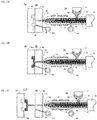
- FIGS. 1A to 1C are concept drawings that show production of an injection-molded product using an injection molding machine 10 and a mold 50, in which FIG. 1A is a drawing that shows a state in which resin pellets RP made of a resin composition are being heated and liquidized in a resin injector; FIG. 1B is a drawing that shows a state in which the liquidized resin composition is being injected from the resin injector into a mold; and FIG. 1C is a drawing that shows a state in which the mold is being opened and a resin molded product is being extracted.
- the injection molding machine 10 includes a hopper 11 into which the resin pellets RP made of the resin composition are charged, a cylinder 12 into which the resin pellets RP are charged from the hopper 11, a rotatable screw 13 disposed in the cylinder 12, and heaters 14 disposed outside the cylinder 12.
- the screw 13 can be moved by a driver 15 in the direction toward the mold and the opposite direction thereof.
- the liquidized resin composition is injected from an end nozzle 16 of the cylinder 12.
- the mold 50 includes a fixed mold 52 and a moving mold 54. When the fixed mold 52 and moving mold 54 closely contact each other, a cavity 56 is formed.
- the cavity 56 has a spool bush 55, which is a hole into which the liquidized resin composition is put.
- the resin pellets RP fall from the hopper 11 due to rotation of the screw 13 while being measured.
- the resin pellets RP are then melted (liquidized) by frictional heat caused by rotation and kneading of and by the screw 13 and the heat of the heaters 14.
- the screw 13 is moved by the driver 15 in the direction toward the mold, the measured and liquidized resin composition is injected from the end nozzle 16 of the cylinder 12 to the cavity 56 through the spool bush 55 of the mold 50.
- the resin composition injected into the cavity 56 is cooled and solidified in the mold 50.
- the moving mold 54 is moved and the nozzle 16 of the injection molding machine 10 is released from the spool bush 55, a molded product MD is extracted.
- the molded product MD is extracted from the mold 50 due to self-fall or by an extractor (not shown).
- samples of a dumbbell piece, a strip piece, a disk substrate, a cup, and a flat plate were made of the molded product MD.
- the evaluation results of the samples are shown in Tables 9A (ninth embodiment part 1) to 9G (ninth embodiment part 7). Since these samples are molded products, the molding cycle time, molded product defect density, and molded product weight were newly added as evaluation items. On the other hand, the fluidity, birefringence phase difference, and impurity concentration were removed from the evaluation items.
- Examples of the first and second embodiments correspond to Examples of the ninth embodiment part 1
- Examples of the third embodiment correspond to Examples of the ninth embodiment part 2
- Examples of the following embodiments correspond to Examples of the following parts of the ninth embodiment
- Examples of the eighth embodiment correspond to Examples of the ninth embodiment part 7.
- the samples including 100 percent by weight of the hemicellulose derivative including acetyl groups produced by light molding and the samples including 100 percent by weight of the hemicellulose derivative including acetyl groups produced by injection molding were the same in heat-resistant temperature, tensile strength, and the like.
- the resin compositions including the first and second resins showed good results in the molding cycle time, molded product defect density, and molded product weight, which relate to injection molding, compared to the conventional resin composition including 100 percent by weight of PLA. Also, the resin compositions including 30 to 60 t by weight of the first resin and 40 to 70 percent by weight of the second resin are understood to have shown good results. Further, the resin compositions including 40 to 50 percent by weight of the first resin and 50 to 60 percent by weight of the second resin are understood to have shown better results. These resin compositions including the first resin and second resin has high biodegradability, which solves environmental problems and ocean contamination problems, and injection-molded products can be easily produced from these resin compositions.
- Injection-molded products were produced from resin pellets made of the resin compositions including the first and second resins described in the first to eighth embodiments (Examples 1 to 70). Unlike in the ninth embodiment, in a tenth embodiment, an inert gas is supplied to at least one of the injection molding machine 10 and mold 50.
- FIGS. 2A to 2C are concept drawings that show production of an injection-molded product using an injection molding machine 10 and a mold 50, in which FIG. 2A is a drawing that shows a state in which resin pellets made of the resin composition are being heated and liquidized in a resin injector; FIG. 2B is a drawing that shows a state in which the liquidized resin composition is being injected from the resin injector to mold portions; and FIG. 2C is a drawing that shows a state in which the mold portions are being opened and a resin molded product is being extracted.
- a cylinder 12 is provided with a gas supply tube 18 connected to a pump PP.
- the mold 50 is provided a gas supply tube 58 to which the pump PP is connected.
- the pump PP supplies an inert gas or the like to the liquidized resin composition.
- the gas supply tube for supplying an inert gas or the like to the liquidized resin composition only has to be provided on at least one of the injection molding machine 10 and mold 50.
- foaming gas examples include inert gases typified by noble gases, such as nitrogen, helium, and argon, carbon dioxide, which is easily dissolved in thermoplastic resins and shows good plasticizer effects, chlorofluorocarbons obtained by substituting fluorine for C1 to C5 saturated hydrocarbon or part thereof, and vapor of liquid, such as water or alcohol.
- inert gases typified by noble gases, such as nitrogen, helium, and argon
- carbon dioxide which is easily dissolved in thermoplastic resins and shows good plasticizer effects
- chlorofluorocarbons obtained by substituting fluorine for C1 to C5 saturated hydrocarbon or part thereof
- vapor of liquid such as water or alcohol.
- carbon dioxide was used as the foaming gas.
- the following molding method is a method in which a gas is supplied to both the liquidized resin composition in the injection molding machine 10 and that in the mold 50.
- Resin pellets RP fall from a hopper 11 due to rotation of a screw 13 while being measured.
- the resin pellets RP are then melted (liquidized) by frictional heat caused by rotation and kneading of and by the screw 13 and the heat of heaters 14.
- the gas is introduced from the pump PP into the liquidized resin composition and dispersed in the liquid.
- the screw 13 is moved by a driver 15 in the direction toward the mold, the gas-dispersed resin composition is injected from an end nozzle 16 of the cylinder 12 into a cavity 56 through a spool bush 55 of the mold 50.
- the gas is introduced from the pump PP into the liquidized resin composition in the cavity 56 and dispersed in the liquid.
- the gas-containing resin composition is then cooled and solidified in the mold 50.
- the moving mold 54 is moved and the nozzle 16 of the injection molding machine 10 is released from the spool bush 55, a molded product MD is extracted.
- the molded product MD is extracted from the mold 50 due to self-fall or by an extractor (not shown).
- Example 10 of the ninth embodiment As is understood from a comparison between Example 10 of the ninth embodiment and Example 10 of the tenth embodiment, the samples including 100 percent by weight of the hemicellulose derivative including acetyl groups produced by foam injection molding were better not only in the injection molding-related evaluation items, such as the molding cycle time, but also in the items, such as heat-resistant temperature and tensile strength, than the samples including 100 percent by weight of the hemicellulose derivative including acetyl groups produced by injection molding. Also, the samples including 30 to 60 t by weight of the first resin and 40 to 70 percent by weight of the second resin are understood to have shown good results. Further, samples including 40 to 50 percent by weight of the first resin and 50 to 60 percent by weight of the second resin are understood to have shown better results.
- the foaming gas to be supplied into the resin pellets may be an inert gas typified by noble gases, such as nitrogen, helium, and argon, carbon dioxide, which is easily dissolved in thermoplastic resins and shows good plasticizer effects, a gas obtained by substituting fluorine for C1 to C5 saturated hydrocarbon or part thereof, or the like.
Landscapes
- Chemical & Material Sciences (AREA)
- Chemical Kinetics & Catalysis (AREA)
- Medicinal Chemistry (AREA)
- Polymers & Plastics (AREA)
- Organic Chemistry (AREA)
- Health & Medical Sciences (AREA)
- Engineering & Computer Science (AREA)
- Manufacturing & Machinery (AREA)
- Mechanical Engineering (AREA)
- Life Sciences & Earth Sciences (AREA)
- Materials Engineering (AREA)
- Biochemistry (AREA)
- Compositions Of Macromolecular Compounds (AREA)
- Injection Moulding Of Plastics Or The Like (AREA)
- Biological Depolymerization Polymers (AREA)
Applications Claiming Priority (1)
| Application Number | Priority Date | Filing Date | Title |
|---|---|---|---|
| JP2019030378A JP6821724B2 (ja) | 2019-02-22 | 2019-02-22 | 樹脂組成物及びその樹脂組成物を使用した成形方法 |
Publications (3)
| Publication Number | Publication Date |
|---|---|
| EP3699221A1 true EP3699221A1 (de) | 2020-08-26 |
| EP3699221B1 EP3699221B1 (de) | 2025-10-29 |
| EP3699221C0 EP3699221C0 (de) | 2025-10-29 |
Family
ID=68771424
Family Applications (1)
| Application Number | Title | Priority Date | Filing Date |
|---|---|---|---|
| EP19213417.9A Active EP3699221B1 (de) | 2019-02-22 | 2019-12-04 | Harzzusammensetzung und formverfahren davon |
Country Status (3)
| Country | Link |
|---|---|
| US (1) | US11807751B2 (de) |
| EP (1) | EP3699221B1 (de) |
| JP (1) | JP6821724B2 (de) |
Families Citing this family (2)
| Publication number | Priority date | Publication date | Assignee | Title |
|---|---|---|---|---|
| JP6821724B2 (ja) * | 2019-02-22 | 2021-01-27 | 株式会社事業革新パートナーズ | 樹脂組成物及びその樹脂組成物を使用した成形方法 |
| CN114773646B (zh) * | 2022-05-26 | 2022-12-27 | 悟锐新材料科技(江苏)有限公司 | 一种全降解的高韧性聚乙烯醇复合材料及其制备方法 |
Citations (2)
| Publication number | Priority date | Publication date | Assignee | Title |
|---|---|---|---|---|
| JP2011143561A (ja) * | 2010-01-12 | 2011-07-28 | Nissha Printing Co Ltd | 成形同時加飾成形品とその製造方法 |
| JP2016179694A (ja) | 2012-03-30 | 2016-10-13 | エルジー・ハウシス・リミテッドLg Hausys,Ltd. | ポリ乳酸と木繊維を用いた環境にやさしいボード及びその製造方法 |
Family Cites Families (17)
| Publication number | Priority date | Publication date | Assignee | Title |
|---|---|---|---|---|
| US4357616A (en) * | 1979-03-26 | 1982-11-02 | Hitachi, Ltd. | Recording medium |
| JPH01320103A (ja) * | 1988-06-13 | 1989-12-26 | A Dillong Edward | 分離された木質繊維素材料の成形方法および該方法により得られた製品 |
| JP2781986B2 (ja) * | 1989-05-15 | 1998-07-30 | 日本製粉株式会社 | ドライペットフードの製造法 |
| PL184356B1 (pl) * | 1996-04-12 | 2002-10-31 | Marlit Ltd | Sposób wytwarzania lignocelulozowych materiałów złożonych |
| US6124384A (en) * | 1997-08-19 | 2000-09-26 | Mitsui Chemicals, Inc. | Composite resin composition |
| US6164588A (en) * | 1999-03-08 | 2000-12-26 | Wood Composite Technologies, Inc. | Reel assembly |
| JP4527435B2 (ja) * | 2004-04-19 | 2010-08-18 | 関西ペイント株式会社 | 硬化型組成物及び該組成物を用いた塗装方法 |
| US20080090984A1 (en) * | 2004-08-27 | 2008-04-17 | Hajime Namikoshi | Glucan Derivative And Production Process Thereof |
| JP5168911B2 (ja) * | 2006-01-20 | 2013-03-27 | 江崎グリコ株式会社 | 導電性コーティング用水性組成物 |
| SE0700404L (sv) * | 2007-02-19 | 2008-08-20 | Xylophane Ab | Polymerfilm eller -beläggning innefattande hemicellulosa |
| US8772406B2 (en) * | 2009-08-06 | 2014-07-08 | Robert J. Linhardt | Synthetic wood composite |
| GB201115172D0 (en) * | 2011-09-02 | 2011-10-19 | Knauf Insulation Ltd | Carbohydrate based binder system and method of its production |
| CN107108204B (zh) * | 2014-12-08 | 2021-03-12 | 昆士兰大学 | 纳米复合弹性体 |
| JP6554816B2 (ja) * | 2015-02-25 | 2019-08-07 | 王子ホールディングス株式会社 | リグニン組成物およびその利用 |
| JP6580471B2 (ja) * | 2015-11-26 | 2019-09-25 | 大阪瓦斯株式会社 | ポリ乳酸組成物及びその製造方法並びに複合体 |
| WO2018190662A2 (ko) * | 2017-04-13 | 2018-10-18 | 씨제이제일제당(주) | 바인더 조성물, 물품 및 물품 제조방법 |
| JP6821724B2 (ja) * | 2019-02-22 | 2021-01-27 | 株式会社事業革新パートナーズ | 樹脂組成物及びその樹脂組成物を使用した成形方法 |
-
2019
- 2019-02-22 JP JP2019030378A patent/JP6821724B2/ja active Active
- 2019-12-04 EP EP19213417.9A patent/EP3699221B1/de active Active
- 2019-12-05 US US16/704,226 patent/US11807751B2/en active Active
Patent Citations (2)
| Publication number | Priority date | Publication date | Assignee | Title |
|---|---|---|---|---|
| JP2011143561A (ja) * | 2010-01-12 | 2011-07-28 | Nissha Printing Co Ltd | 成形同時加飾成形品とその製造方法 |
| JP2016179694A (ja) | 2012-03-30 | 2016-10-13 | エルジー・ハウシス・リミテッドLg Hausys,Ltd. | ポリ乳酸と木繊維を用いた環境にやさしいボード及びその製造方法 |
Non-Patent Citations (5)
| Title |
|---|
| ACHA B A ET AL: "COMPOSITES FROM PMMA MODIFIED THERMOSETS AND CHEMICALLY TREATED WOODFLOUR", POLYMER ENGINEERING AND SCIENCE, BROOKFIELD CENTER, US, vol. 43, no. 5, 1 May 2003 (2003-05-01), pages 999 - 1010, XP001192618, ISSN: 0032-3888, DOI: 10.1002/PEN.10084 * |
| MIKI TSUNEHISA ET AL: "Preparation of Wood Plastic Composite Sheets by Lateral Extrusion of Solid Woods Using their Fluidity", PROCEDIA ENGINEERING, ELSEVIER BV, NL, vol. 81, 15 October 2014 (2014-10-15), pages 580 - 585, XP029078227, ISSN: 1877-7058, DOI: 10.1016/J.PROENG.2014.10.043 * |
| STACK KAREN ET AL: "Complex formation and stability of colloidal wood resin pitch suspensions with hemicellulose polymers", COLLOIDS AND SURFACES A: PHYSIOCHEMICAL AND ENGINEERING ASPECTS, ELSEVIER, AMSTERDAM, NL, vol. 441, 4 September 2013 (2013-09-04), pages 101 - 108, XP028793728, ISSN: 0927-7757, DOI: 10.1016/J.COLSURFA.2013.08.057 * |
| THREEPOPNATKUL P ET AL: "Effect of surface treatment on performance of pineapple leaf fiber-polycarbonate composites", COMPOSITES:PART B, ELSEVIER, AMSTERDAM, NL, vol. 40, no. 7, 1 October 2009 (2009-10-01), pages 628 - 632, XP026521575, ISSN: 1359-8368, [retrieved on 20090418], DOI: 10.1016/J.COMPOSITESB.2009.04.008 * |
| WU SHU-PING ET AL: "Fabrication of carboxymethyl chitosan-hemicellulose resin for adsorptive removal of heavy metals from wastewater", CHINESE CHEMICAL LETTERS, ELSEVIER, AMSTERDAM, NL, vol. 28, no. 3, 18 November 2016 (2016-11-18), pages 625 - 632, XP029926840, ISSN: 1001-8417, DOI: 10.1016/J.CCLET.2016.11.015 * |
Also Published As
| Publication number | Publication date |
|---|---|
| EP3699221B1 (de) | 2025-10-29 |
| US20200270430A1 (en) | 2020-08-27 |
| JP6821724B2 (ja) | 2021-01-27 |
| US11807751B2 (en) | 2023-11-07 |
| JP2020132790A (ja) | 2020-08-31 |
| EP3699221C0 (de) | 2025-10-29 |
Similar Documents
| Publication | Publication Date | Title |
|---|---|---|
| CN1126762C (zh) | 可热塑性加工的淀粉或淀粉衍生物聚合物混合物,其制法和用途 | |
| EP2992030B1 (de) | Polymerprodukt, film, formkörper, folie, partikel, faser und verfahren zur herstellung eines polymers | |
| EP3699221B1 (de) | Harzzusammensetzung und formverfahren davon | |
| CA2072525A1 (en) | Thermoplastically processible composition of starch and acrylate polymers | |
| JP2009108141A (ja) | 熱可塑性樹脂組成物の製造方法及び熱可塑性樹脂成形体の製造方法 | |
| CN102603994A (zh) | 甲基丙烯酸缩水甘油酯接枝聚乳酸共聚物材料及其制备方法和应用 | |
| EP2157131A1 (de) | Biologisch abbaubare harzzusammensetzung und herstellungsverfahren dafür | |
| CN110408180A (zh) | 一种木质素-淀粉组合母粒复合的生物降解聚酯材料及其制备方法 | |
| US11767382B2 (en) | Resin composition and molding method thereof | |
| JP2025026464A (ja) | マルチモダルポリアルキレンテレフタレート | |
| CN105218856B (zh) | 一种耐析出的高效聚丙烯耐候母粒 | |
| Xia et al. | Investigating the effect of different substitution levels of starch carbamate on composite film properties | |
| JP7279090B2 (ja) | 容器又は平板の成形物及びその樹脂ペレットの製造方法 | |
| WO2018199155A1 (ja) | 液晶ポリエステル組成物 | |
| JP7279091B2 (ja) | 容器又は平板の成形物、樹脂組成物及びその樹脂ペレットの製造方法 | |
| EP0592240B1 (de) | Verfahren zur Kompatibilisierung von Harzen und diese kompatibilisierte Harze enthaltende Zusammensetzung | |
| CN111087766A (zh) | 热塑性共混物材料及共混物热塑性薄膜及其制备方法 | |
| JP2009167253A (ja) | 事務機器用部材 | |
| CN107793591B (zh) | 生物降解聚酯增韧热塑性聚多糖共混物及其制备方法和薄膜 | |
| KR101746583B1 (ko) | 버개스를 이용한 셀룰로우스 파이버 제조방법 | |
| KR102900975B1 (ko) | 바이오 기반 폴리프로필렌을 포함하는 바이오기반 플라스틱 복합재, 이의 제조방법 및 이의 용도 | |
| Wu et al. | Blends of cellulose diacetate and polyester: towards bioplastics with high melt flowability and good resistance to deformation at high temperature | |
| PODDENEZHNY et al. | Structural features and morphology of biodegradable composites based on polylactide and corn starch | |
| Wang et al. | Synthesis of grafted polylactic acid and polyhydroxyalkanoate by a green reactive extrusion process | |
| CN107936501B (zh) | 注塑制品及其制备方法 |
Legal Events
| Date | Code | Title | Description |
|---|---|---|---|
| PUAI | Public reference made under article 153(3) epc to a published international application that has entered the european phase |
Free format text: ORIGINAL CODE: 0009012 |
|
| STAA | Information on the status of an ep patent application or granted ep patent |
Free format text: STATUS: THE APPLICATION HAS BEEN PUBLISHED |
|
| AK | Designated contracting states |
Kind code of ref document: A1 Designated state(s): AL AT BE BG CH CY CZ DE DK EE ES FI FR GB GR HR HU IE IS IT LI LT LU LV MC MK MT NL NO PL PT RO RS SE SI SK SM TR |
|
| AX | Request for extension of the european patent |
Extension state: BA ME |
|
| STAA | Information on the status of an ep patent application or granted ep patent |
Free format text: STATUS: REQUEST FOR EXAMINATION WAS MADE |
|
| 17P | Request for examination filed |
Effective date: 20200904 |
|
| RBV | Designated contracting states (corrected) |
Designated state(s): AL AT BE BG CH CY CZ DE DK EE ES FI FR GB GR HR HU IE IS IT LI LT LU LV MC MK MT NL NO PL PT RO RS SE SI SK SM TR |
|
| STAA | Information on the status of an ep patent application or granted ep patent |
Free format text: STATUS: EXAMINATION IS IN PROGRESS |
|
| 17Q | First examination report despatched |
Effective date: 20201116 |
|
| RAP3 | Party data changed (applicant data changed or rights of an application transferred) |
Owner name: HEMICELLULOSE LTD. |
|
| GRAP | Despatch of communication of intention to grant a patent |
Free format text: ORIGINAL CODE: EPIDOSNIGR1 |
|
| STAA | Information on the status of an ep patent application or granted ep patent |
Free format text: STATUS: GRANT OF PATENT IS INTENDED |
|
| GRAS | Grant fee paid |
Free format text: ORIGINAL CODE: EPIDOSNIGR3 |
|
| GRAA | (expected) grant |
Free format text: ORIGINAL CODE: 0009210 |
|
| STAA | Information on the status of an ep patent application or granted ep patent |
Free format text: STATUS: THE PATENT HAS BEEN GRANTED |
|
| INTG | Intention to grant announced |
Effective date: 20250902 |
|
| AK | Designated contracting states |
Kind code of ref document: B1 Designated state(s): AL AT BE BG CH CY CZ DE DK EE ES FI FR GB GR HR HU IE IS IT LI LT LU LV MC MK MT NL NO PL PT RO RS SE SI SK SM TR |
|
| REG | Reference to a national code |
Ref country code: CH Ref legal event code: F10 Free format text: ST27 STATUS EVENT CODE: U-0-0-F10-F00 (AS PROVIDED BY THE NATIONAL OFFICE) Effective date: 20251029 Ref country code: GB Ref legal event code: FG4D |
|
| REG | Reference to a national code |
Ref country code: IE Ref legal event code: FG4D |
|
| REG | Reference to a national code |
Ref country code: DE Ref legal event code: R096 Ref document number: 602019077344 Country of ref document: DE |
|
| U01 | Request for unitary effect filed |
Effective date: 20251126 |
|
| U07 | Unitary effect registered |
Designated state(s): AT BE BG DE DK EE FI FR IT LT LU LV MT NL PT RO SE SI Effective date: 20251202 |
|
| U20 | Renewal fee for the european patent with unitary effect paid |
Year of fee payment: 7 Effective date: 20251128 |
|
| PGFP | Annual fee paid to national office [announced via postgrant information from national office to epo] |
Ref country code: GB Payment date: 20251218 Year of fee payment: 7 |