EP3694851B1 - In der umwelt abbaubare chinolon-antibiotika mit hemiaminal-struktureinheit - Google Patents
In der umwelt abbaubare chinolon-antibiotika mit hemiaminal-struktureinheit Download PDFInfo
- Publication number
- EP3694851B1 EP3694851B1 EP18786722.1A EP18786722A EP3694851B1 EP 3694851 B1 EP3694851 B1 EP 3694851B1 EP 18786722 A EP18786722 A EP 18786722A EP 3694851 B1 EP3694851 B1 EP 3694851B1
- Authority
- EP
- European Patent Office
- Prior art keywords
- cip
- activity
- hemi
- compound
- synthesis
- Prior art date
- Legal status (The legal status is an assumption and is not a legal conclusion. Google has not performed a legal analysis and makes no representation as to the accuracy of the status listed.)
- Active
Links
Images




Classifications
-
- A—HUMAN NECESSITIES
- A61—MEDICAL OR VETERINARY SCIENCE; HYGIENE
- A61P—SPECIFIC THERAPEUTIC ACTIVITY OF CHEMICAL COMPOUNDS OR MEDICINAL PREPARATIONS
- A61P31/00—Antiinfectives, i.e. antibiotics, antiseptics, chemotherapeutics
- A61P31/04—Antibacterial agents
-
- A—HUMAN NECESSITIES
- A61—MEDICAL OR VETERINARY SCIENCE; HYGIENE
- A61P—SPECIFIC THERAPEUTIC ACTIVITY OF CHEMICAL COMPOUNDS OR MEDICINAL PREPARATIONS
- A61P31/00—Antiinfectives, i.e. antibiotics, antiseptics, chemotherapeutics
-
- C—CHEMISTRY; METALLURGY
- C07—ORGANIC CHEMISTRY
- C07D—HETEROCYCLIC COMPOUNDS
- C07D405/00—Heterocyclic compounds containing both one or more hetero rings having oxygen atoms as the only ring hetero atoms, and one or more rings having nitrogen as the only ring hetero atom
- C07D405/02—Heterocyclic compounds containing both one or more hetero rings having oxygen atoms as the only ring hetero atoms, and one or more rings having nitrogen as the only ring hetero atom containing two hetero rings
- C07D405/04—Heterocyclic compounds containing both one or more hetero rings having oxygen atoms as the only ring hetero atoms, and one or more rings having nitrogen as the only ring hetero atom containing two hetero rings directly linked by a ring-member-to-ring-member bond
Definitions
- the present invention relates to novel quinolone antibiotics having a hemiamine moiety as defined in the claims and to these quinolone antibiotics for medical use as defined in the claims.
- Antibiotics are particularly problematic. Antibiotics are used to treat infections with pathogenic bacteria. Use of non-degradable antibiotics by human patients or in farm animals can lead to accumulation in water and could subsequently promote the development of resistance if large areas with relevant bacteria have sufficient active ingredient concentrations of antibiotics and thus exert constant selection pressure on the bacteria.
- antibiotic ciprofloxacin belongs to the second generation of the group of fluoroquinolones and is a broad-spectrum antibiotic that inhibits prokaryote-specific DNA gyrase.
- the fate of ciprofloxacin in the environment has now come into focus because the substance has been detected in wastewater, particularly from hospitals, and in sewage treatment plants, as well as in sewage sludge. Concentrations between 2 and 83 ⁇ g/l were measured in wastewater from Swiss hospitals. In sewage treatment plants it is only partially removed by adsorption to the sewage sludge. It is not broken down by microorganisms in sewage treatment plants (Kümmerer et al. 2000). Therefore, it cannot be ruled out that biological degradation processes in sewage treatment plants with high antibiotic intake are severely disrupted due to the accumulation of antibiotic activity and that resistance development or selection is promoted.
- EP0373531 also discloses ofloxacin derivatives with a hemiamine residue in the cyclic ether form -C(OR)(NR2)-, with the aim of providing new and effective antibiotics, but not to achieve improved degradability.
- WO2015/189560 discloses quinolones derivatives with common substituents. However, hemiamine ethers are not disclosed. According to claim 1 of the document, R2 can form a heterocyclic ring with Z. However, this does not correspond to the structures claimed here. Similar connections are also in DE 692 32 134 or. WO 01/36408 A1 described. DE 692 32 134 also does not describe hemiamine ethers.
- one of these derivatives (marbofloxacin) was tested at low pH and little instability was observed. This type of hemiaminal therefore does not exhibit any particular degradability in the environment. Since the general stability of antibiotics in the pharmaceutical sector has so far been the focus, no degradable active ingredients have been developed. In contrast, the present invention aims at a balance between degradability in the environment and sufficient stability and effectiveness in therapy.
- the advantage of the compounds disclosed herein over known antimicrobial agents that are optimized for stability lies in their chemical or biodegradability in the environment.
- this degradability also counteracts the selection pressure on environmental bacteria and the associated development or selection of resistance.
- the active effect is limited to the actual human or veterinary therapy, and the subsequent degradation in the environment ensures targeted inactivation. This could further effectively curb the selection pressure acting on environmental germs and the development of resistance.
- more environmentally friendly antibiotic variants based on the fluoroquinolone basic structure were developed through targeted molecular structural changes in order to subsequently mitigate the dangers caused by pharmaceuticals, including for water quality, by improving the degradability or at least the activity and toxicity of non-degradable metabolites, transformation products and fragments is neutralized.
- the compounds described herein may be referred to as “hemiaminals” or more specifically “O-derivatized hemiamines", where the name “hemiaminal” means that one of the two etherified oxygen atoms of an acetal is replaced by an N atom (ether by amino group).
- the structural element COCN on the quinolone N1 is crucial for the degradability according to the invention.
- Compound 1 (see Figure 1 ) has been tested for its activity (see Figures 2-4 ) and compared with the remaining fragment Cip-d-CP (ciprofloxacin delta cycloproyl, i.e. the Cipro backbone without cyclopropyl at N1).
- Cip-d-CP ciprofloxacin delta cycloproyl, i.e. the Cipro backbone without cyclopropyl at N1).
- Non-cyclic short hemiamines are expected to have increased antibacterial activity based on the structure-activity properties at this position.
- the present invention describes new antibiotic substances based on the known fluoroquinolone ciprofloxacin. These new substances should be able to be broken down in the environment (environmentally friendly ciprofloxacin derivatives).
- environment environmentally friendly ciprofloxacin derivatives
- drugs can be detected in both wastewater and drinking water. A reduction or degradation of these active ingredients would not only counteract the toxic environmental aspects but also the selection pressure on environmental bacteria and the associated development of resistance.
- Hemiaminals have the general structure -C(OH)(NR2)-.
- Compound 1 contains a cyclic ether residue (-C(OR)(NR2)-).
- the present invention targets all stereoisomers.
- the invention also relates to a medicament containing a quinolone antibiotic according to claim 1.
- the invention also relates to a quinolone antibiotic according to claim 1 for use in the treatment of bacterial infections.
- the invention relates to the antibiotics described herein for use against hospital germs (nosocomial germs), or germs that are to be treated without risking the development of resistance in other germs.
- the invention relates to the antibiotics described herein for the treatment of E. Coli -caused infections.
- Compound 1 and other antibiotics according to the invention can also be prepared using general technical knowledge.
- Escherichia coli K12 ATCC 23716 was obtained from DSMZ GmbH (Braunschweig, Germany).
- test substances were diluted in water and added to the bacterial suspension (in 2x bacterial medium (10 g peptone and 6 g meat extract in 1 liter)) on a 96-well plate so that the final concentration of the medium was 1x.
- the plate was incubated at 37°C for 4 h.
- Cell density was determined photometrically by measuring absorbance at 600 nm. The growth inhibition in percent of the untreated controls is plotted against the concentration of the test substance.
- HEK293 Human embryonic kidney cells (HEK293) were seeded in 384-well plates at a density of 6000 cells/well in a final volume of 50 ⁇ l with the desired concentration of the test substance. DMEM with 10% fetal bovine serum (FBS) was used as growth medium. The cells were incubated together with the test substances for 20 h at 37 °C with 5% COz.
- FBS fetal bovine serum
- Ciprofloxacin, compound 1 and Cip-D-CP were dissolved in 12 ml of phosphate-buffered saline at a concentration of 10 mg/L.
- the pH was adjusted to pH 6, pH 7.4 or pH 9.
- the mixtures were incubated at 37 °C for pH 6 and 7.4 and at room temperature for pH 9 with shaking (250 rpm) for 28 days.
- samples 700 ⁇ L were taken for HPLC analysis.
- the quotient of the initial concentration c o by the concentration at the respective time point (c t ) was calculated and plotted as a natural logarithm against the incubation time.
- Minimum inhibitory concentrations in different bacterial strains The antibiotic activity was determined using the broth microdilution method (Cockerill et al., 2012, see literature). The following bacterial strains were used: Staphylococcus aureus (ATCC 29213), Enterococcus faecalis (ATCC 29212), Escherichia coli (ATCC 25922) and Pseudomonas aeruginosa (ATCC 27853), as well as S. aureus (ATCC 43300), K. pneumoniae (ATCC 700603 ), A. baumanii (ATCC 19606). Determinations of minimum inhibitory concentrations were carried out by two independent laboratories.
- Bacterial cells were diluted at a cell density of 2 - 8 ⁇ 10 5 cfu/ml in 200 ⁇ l of Mueller-Hinton broth medium. The batches contained a series of dilutions of the test substances. These inoculated 96-well plates were incubated for 18 h at 36°C. The minimum inhibitory concentration was determined by visually estimating the lowest concentration that completely inhibited the bacteria.
- V. fischeri The antibiotic activity in V. fischeri was examined in a luminous bacteria test (LBT) with Vibrio fischeri NRRL-B-11177 (Hach-Lange GmbH, Düsseldorf, Germany).
- LBT luminous bacteria test
- the LBT was carried out according to the modified protocol of Menz et al. (2013), see literature list.
- HPLC High performance chromatography
- ciprofloxacin compound 1
- Cip-d-CP The Shimadzu Prominence HPLC system (Duisburg, Germany) was used for the chromatographic examinations of the test substances.
- a NUCLEODUR ® RP-C18 (CC 125/4 100-5 ⁇ m C18 ec) column and mobile phases consisting of 0.1% formic acid in highly pure water (CH 2 O 2 : Solution A) and 100% acetonitrile (CH 3 CN: Solution B) were used.
- the flow rate was set to 0.5 mL min -1 .
- the temperature of the column oven was set to 25 °C and the injection volume was 10 ⁇ L.
- Ciprofloxacin, Hemi and Cip-D-CP eluted at retention times [t R ] of 16.1 min, 16.5 min and 15.2 min, respectively.
- the test substances were detected by a UV/Vis detector at 270 nm.
- the flow gradient method was applied as listed in Table 1. ⁇ b>Table 1: ⁇ /b> Flow gradient conditions for chromatographic analysis of the test substances Time (min) % Solution B (acetonitrile) 0.01-2.0 1 5.0 5 7.0 10 10.0 15 13.0 25 15.0 30 17.0 35 20.0 40 22.0 50 25.0 60 27.0 65 29.0 20 30.0-32.0 1 32.01 Stop
- Ethyl 6,7-difluoro-4-oxo-1,4-dihydroquinoline-3-carboxylate (1) reacts with tetrahydrofuran-2-yl acetate (2) at ⁇ 120°C to form ethyl 6,7-difluoro-4- oxo-1-(tetrahydrofuran-2-yl)-1,4-dihydroquinoline-3-carboxylate (3) (see Yamashita et al. 1983).
- Ethyl 6,7-difluoro-4-oxo-1,4-dihydroquinoline-3-carboxylates (1) reacts with tetrahydrofuran-2-yl acetate (2) at ⁇ 120°C to form ethyl 6,7-difluoro-4- oxo-1-(tetrahydrofuran-2-yl)-1,4-dihydroquinoline-3-carboxylate (3) (see Yamashita et al. 1983). This then reacts with morpholine (4) in e.g.
Landscapes
- Health & Medical Sciences (AREA)
- Chemical & Material Sciences (AREA)
- Organic Chemistry (AREA)
- Chemical Kinetics & Catalysis (AREA)
- Oncology (AREA)
- General Chemical & Material Sciences (AREA)
- Medicinal Chemistry (AREA)
- Nuclear Medicine, Radiotherapy & Molecular Imaging (AREA)
- Communicable Diseases (AREA)
- Pharmacology & Pharmacy (AREA)
- Life Sciences & Earth Sciences (AREA)
- Animal Behavior & Ethology (AREA)
- General Health & Medical Sciences (AREA)
- Public Health (AREA)
- Veterinary Medicine (AREA)
- Pharmaceuticals Containing Other Organic And Inorganic Compounds (AREA)
Description
- Die vorliegende Erfindung betrifft neue Chinolon-Antibiotika mit Hemiaminal-Struktureinheit, wie in den Ansprüchen definiert, und diese Chinolon-Antibiotika zur medizinischen Verwendung, wie in den Ansprüchen definiert.
- Da sich die instrumentelle Analytik in den letzten Jahrzehnten rasant weiterentwickelt hat, wurden bisher schon annähernd zweihundert verschiedene Pharmazeutika weltweit im Ablauf von Kläranlagen, Oberflächengewässern, Grundwasser und vereinzelt auch Trinkwasser im Bereich von ng/L bis µg/L detektiert. Diese Mikroverunreinigungen werden daher mittlerweile als Risiko für die Wasserqualität und ein nachhaltiges Management der Wasserressourcen wahrgenommen. In dem Zusammenhang ist auch sehr wenig über das Auftreten und das umweltwissenschaftliche Schicksal der Zerfalls- und Abbauprodukte der applizierten oder unsachgemäß entsorgten Pharmazeutika bekannt. Persistenz, Akkumulation, Metabolisierung durch Mikroorganismen, Tiere und Pflanzen, Reaktion mit Sauerstoff oder Beeinflussung durch Licht können die Ausgangsstoffe so verändern, dass sich die Toxizität der Substanzen verändern kann und damit die Trinkwasserressourcen beeinträchtigt werden können.
- Besonders problematisch sind Antibiotika. Antibiotika werden zur Behandlung von Infektionen mit pathogenen Bakterien genutzt. Nutzung von nicht abbaubaren Antibiotika durch menschliche Patienten oder bei Nutztieren kann zur Akkumulation im Wasser führen und könnte anschließend die Resistenzentwicklung fördern, wenn große Areale mit relevanten Bakterien ausreichende Wirkstoffkonzentrationen von Antibiotika haben und somit ständigen Selektionsdruck auf die Bakterien ausüben.
- Zu nennen ist z.B. das bekannte Antibiotikum Ciprofloxacin. Es gehört zur zweiten Generation der Gruppe der Fluorochinolone und ist ein Breitband-Antibiotikum, das die prokaryonten-spezifische DNA-Gyrase inhibiert. Das Schicksal von Ciprofloxacin in der Umwelt ist mittlerweile in den Blickpunkt geraten, weil die Substanz im Abwasser, insbesondere von Krankenhäusern, und in Kläranlagen wie auch im Klärschlamm detektiert wurde. Im Abwasser von Schweizer Krankenhäusern wurden Konzentrationen zwischen 2- 83 µg/l gemessen. In Kläranlagen wird es lediglich teilweise durch Adsorption an den Klärschlamm entfernt. Es wird nicht von Mikroorganismen in Kläranlagen abgebaut (Kümmerer et al. 2000). Daher kann nicht ausgeschlossen werden, dass biologische Abbauprozesse in Kläranlagen mit hoher Antibiotika-Aufnahme aufgrund der Akkumulation der antibiotischen Aktivität empfindlich gestört werden und Resistenzbildungen oder - selektionen gefördert werden.
- Es ist bekannt, dass Hemiaminale insbesondere bei niedrigem pH-Werten instabil sind. Ob dies auf derivatisierte Fluorchinolone ebenfalls zutrifft, ist unbekannt.
- Takenouchi et al. offenbaren verschiedene Fluorchinolon-Derivate (z.B. Ciprofloxacin-Derivate), um deren Löslichkeiten und Aktivitäten zu analysieren (Antimicrobial Agents and Chemotherapy, 1996, 40(8), 1835-1842). Unter den gezeigten Ciprofloxacin-Derivaten gibt es auch ein Hemiaminal-Rest in der Form -C(OR)(NR2)- (Substanz 33, in der Publikation als R1 bezeichnet). Jedoch wird hier lediglich eine ähnliche Struktur offengelegt ohne Bezug auf eine verbesserte Abbaubarkeit. Die Verbindung 33 von Takenouchi weist allerdings keinen ausreichenden +I-Effekt auf, sodass dass die antibiotische Aktivität zu niedrig ist.
- Weiterhin offenbaren Radi et al. verschiedene Fluorchinolon-Derivate (z.B. Ofloxacin-Derivate) um weitere antibakteriell wirkende Substanzen zu synthetisieren ("Preparation of some 2,3-dihydro-7-oxo-7H-pyrido[1,2,3-de][1,4]benzoxazine derivatives." Collection of Czechoslovak Chemical Communications, 1992, 57(1), 216-18). Unter den gezeigten Ofloxacin-Derivaten gibt es auch einen Hemiaminal-Rest in der Form -C(OH)(NR2)-. Die Patentschrift
EP0373531 offenbart ebenfalls Ofloxacin-Derivate mit einem Hemiaminal-Rest in der cyclischen Ether-Form -C(OR)(NR2)-, mit dem Ziel neue und wirkungsvolle Antibiotika bereitzustellen, nicht aber um eine verbesserte Abbaubarkeit zu erreichen. -
WO2015/189560 offenbart Quinolone-Derivate mit gängigen Substituenten. Hemiaminalether werden jedoch nicht offenbart. Gemäß Anspruch 1 des Dokuments kann R2 einen heterozyklischen Ring mit Z bilden. Dies entspricht allerdings nicht den vorliegend beanspruchten Strukturen. Ähnliche Verbindungen sind auch inDE 692 32 134 bzw.WO 01/36408 A1 DE 692 32 134 beschreibt ebenfalls keine Hemiaminalether. -
DE 36 32 222 A1 offenbart antibakterielle Wirkstoffe, wobei gemäß Anspruch 1 der Substituent R1 2-Hydroxyethyl oder Methoxy sein kann. Beide Möglichkeiten entsprechen allerdings nicht den Vorgaben des N-Substituenten der vorliegenden Patentansprüche. Hemiaminalether werden auch generell nicht offenbart. - Im Rahmen der vorliegenden Erfindung wurde eines dieser Derivate (Marbofloxacin) bei niedrigem pH getestet und es wurde kaum Instabilität beobachtet. Diese Art von Hemiaminal weist daher keine besondere Abbaubarkeit in der Umwelt auf. Da bislang die generelle Stabilität von Antibiotika im Pharma-Bereich im Vordergrund stand, wurden keine abbaubaren Wirkstoffe entwickelt. Im Gegensatz dazu zielt die vorliegende Erfindung auf eine Balance zwischen Abbaubarkeit in der Umwelt und ausreichender Stabilität und Wirksamkeit in der Therapie ab.
- Weitere Chinolon-Derivate sind in den folgenden Veröffentlichungen beschrieben:
- Klaus Kümmerer: "Sustainable from the very beginning: rational design of molecules by life cycle engineering as an important approach for green pharmacy and green chemistry", GREEN CHEMISTRY, Bd. 9, Nr. 8, 2007, Seiten 899-907
-
EP0700912 - ANGELES DE LA CRUZ ET AL: "Synthesis and biological evaluation of 4-quinolone ribosides", JOURNAL OF THE CHEMICAL SOCIETY, PERKIN TRANSACTIONS 1, Nr. 7, 1993, Seite 845
- FABYANA A. SOARES ET AL: "Molecular design, synthesis and biological evaluation of 1,4-dihydro-4-oxoquinoline ribonucleosides as TcGAPDH inhibitors with trypanocidal activity", BIOORGANIC &MEDICINAL CHEMISTRY LETTERS, Bd. 23, Nr. 16, 2013, Seiten 4597-4601
- Magdalena Nascimento Renno ET AL: "Kinetics and docking studies of two potential new inhibitors of the nucleoside hydrolase from Leishmania donovani", European Journal of Medicinal Chemistry, Bd. 56, 2012, Seiten 301-307
- Carla Veronica ET AL: "Synthesis and Anti-HSV-1 Activity of 1,4- dihydro-4-oxoquinoline Ribonucleosides", Letters in Drug Design & Discovery, 2007, Seiten 404-409
- ED T. BUURMAN ET AL: "Antimicrobial Activity of Adenine-Based Inhibitors of NAD + - Dependent DNA Ligase", ACS MEDICINAL CHEMISTRY LETTERS, Bd. 3, Nr. 8, 2012, Seiten 663-667
-
US 2017/189556 -
JP S61 152682 A - TOMITA KYOJI ET AL: "Synthesis and Structure-Activity Relationships of Novel 7-Substituted 1,4-Dihydro-4-oxo-1-(2-thiazolyl)-1,8-naphthyridine-3- carboxylic Acids as antitumor Agents", JOURNAL OF MEDICINAL CHEMISTRY, Bd. 45, Nr. 25, 2002, Seiten 5564-5575, XP002450261,
- JIA XUE-DONG ET AL: "Synthesis and in vitro antitumor activity of novel naphthyridinone derivatives", CHINESE CHEMICAL LETTERS, ELSEVIER, Bd. 28, Nr. 2, 25. Juli 2016 (2016-07-25), Seiten 235-239, XP029893527,
- DATABASE CAPLUS [Online] 1. Januar 1991, Chen ET AL: "Pyridonecarboxylic acids as antibacterial agents. X. Synthesis and structure-activity relationships of 1,7-disubstituted-6- fluoro-1,4-dihydro-4-oxoquinoline-3-carboxylic acids", XP055917490, Database accession no. 1992:128614
- DATABASE REGISTRY [Online] 1. Januar 2008, Registry: "3-Quinolinecarboxylic acid", XP055917504, Database accession no. 1089336-20-8, 1089336-14-0.
- Der Vorteil der hierin offenbarten Verbindungen gegenüber bekannten antimikrobiellen Wirkstoffen, die auf Stabilität optimiert sind, liegt in der chemischen oder biologischen Abbaubarkeit in der Umwelt. Neben den toxischen Umweltaspekten wirkt diese Abbaubarkeit auch dem Selektionsdruck auf die Umweltbakterien und die damit einhergehende Resistenzausbildung oder -selektion entgegen. Insbesondere ist die aktive Wirkung zeitlich auf die eigentliche humane oder veterinäre Therapie begrenzt, und der nachfolgende Abbau in der Umwelt sorgt für eine gezielte Inaktivierung. Damit könnte der auf Umweltkeime einwirkende Selektionsdruck und die Resistenzausbildung weiter wirksam eingedämmt werden.
- Im Rahmen der vorliegenden Erfindung wurden durch gezielte molekulare Strukturveränderungen umweltfreundlichere Antibiotikavarianten auf Basis der Fluorchinolon-Grundstruktur entwickelt, um nachfolgend die durch Pharmazeutika verursachten Gefahren auch für die Wasserqualität abzumildern, indem die Abbaubarkeit verbessert wird oder zumindest die Aktivität und die Toxizität von nicht-abbaubaren Metaboliten, Transformationsprodukten und Fragmenten neutralisiert wird. Die hierin beschriebenen Verbindungen können als "Hemiaminale" oder genauer "O- derivatisierte Hemiaminale" bezeichnet werden, wobei der Name "Hemiaminal" bedeutet, dass eine der beiden verätherten Sauerstoffatome eines Acetals durch ein N-Atom (Äther durch Aminogruppe) ersetzt ist. Entscheidend für die erfindungsgemäße Abbaubarkeit ist das Struktur-Element C-O-C-N am Chinolon N1. Die Hydrolyse findet hierbei an der N-C-Bindung statt, wobei die Hydrolyse des Halbaminals zum Alkohol bzw. Halbacetal führt, das dann weiter hydrolysiert wird zum Aldehyd, da das N- Atom im Ring als Teil des Grundgerüstetes verbleibt (s. auch Struktur Cip_d_CP).
- Somit führt die Berücksichtigung von Umweltaspekten zu einer wechselseitigen Verbesserung der Medikamente. Dadurch können neue Medikamente entstehen, die pharmakologisch und umweltwissenschaftlich verbessert sind.
- Die vorliegend beschriebenen Verbindungen werden durch Verknüpfung der Chinolon-Grundstruktur mit chemisch/abiotisch abbaubaren Linkern hergestellt.
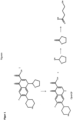
- Verbindung 1 (siehe
Figur 1 ) wurde hinsichtlich seiner Aktivität getestet (sieheFiguren 2-4 ) und mit dem verbleibenden Fragment Cip-d-CP (Ciprofloxacin delta Cycloproyl, d.h. das Cipro-Grundgerüst ohne Cyclopropyl an N1) verglichen. Die Aktivität von Verbindung 1 liegt in E. coli (ATCC 23716) im Bereich der mittelstarken Fluorchinolone (MIC = ca. 0,1-1 µg/ml) (sieheFigur 4 ). In anderen pathogenen Bakterien liegt sie über den Chinolonen der ersten Generation, aber unterhalb etablierter Fluorchinolone der zweiten Generation. Weiterhin konnte gezeigt werden, dass der labile Linker unter physiologischen Bedingungen langsam und bei niedrigem pH schnell abgespalten wird (Figuren 6a und6b ). Das verbleibende Fragment nach Abspaltung des Linkers (Cip-d-CP) war deutlich schwächer aktiv als die Ausgangssubstanz (Figur 2 ). Auch unter den Testbedingungen des standardisierten Abbautests "geschlossener Flaschentest" (OECD 301D), der näherungsweise Verhältnisse in Oberflächengewässern simuliert, findet der Zerfall von Verbindung 1 in Cip-d-CP statt. Weder das verbleibende Fragment noch die Ausgangssubstanz Ciprofloxacin waren unter den gewählten pH-Bedingungen instabil. Auch in den Umweltbakterien V. fischeri zeigte sich eine deutliche Abschwächung der antibiotischen Aktivität nach Abspaltung des Linkers (Figur 5 ). - Die Instabilität bei niedrigen pH-Werten macht eine enterische Formulierung oder intravenöse Applikation des Arzneimittels besonders interessant, um eine Freisetzung im sauren Magenmilieu zu verhindern.
- Das Risiko, dass sich gegen diese neuen Antibiotika-Varianten Resistenzen bilden, sollte dadurch verringert sein, dass es nach Ausscheidung zu einer raschen Inaktivierung kommt und somit über die eigentliche Behandlung hinaus kein Selektionsdruck, z.B. auf Bakterien im Abwasser und in der Umwelt, ausgeübt wird. Dadurch wird das Problem gelöst, dass die starke Anwendung von Antibiotika dazu führt, dass die nicht-abbaubaren Antibiotika (z.B. Fluorchinolon-Antibiotika) noch im Abwasser, in der Kläranlage und in der Umwelt aktiv bleiben und daher die Bildung oder Selektion von Resistenzen gefördert würde.
- Da die Inaktivierung unter bestimmten pH-Bedingungen abiotisch abläuft, könnte es weniger wahrscheinlich sein, dass diese Inaktivierung von Bakterien durch Mutation von Enzymen beschleunigt wird. D.h. die vorliegend beschriebenen Verbindungen führen wahrscheinlich nicht zu einer höheren intrinsischen Anfälligkeit für Resistenzbildungen.
- Für nicht-zyklische, kurze Hemiaminale wird aufgrund der Struktur-Aktivitäts-Eigenschaften an dieser Position eine erhöhte antibakterielle Aktivität erwartet.
- Es konnte bisher gezeigt werden, dass Verbindung 1 nicht durch intestinale und hepatische Enzyme abgebaut wird. Dies deutet darauf hin, dass das Molekül als Therapeutikum nutzbar sein wird. Des Weiteren konnten bisher keine Hinweise auf einen Zytotoxizität in humanen Zellen (HEK 293) durch Verbindung 1 festgestellt werden (
Figur 3 , HEK-293). - Die vorliegende Erfindung beschreibt neue antibiotische Substanzen auf Grundlage des bekannten Fluorchinolons Ciprofloxacin. Diese neuen Substanzen sollen in der Umwelt abgebaut werden können (umweltfreundliche Ciprofloxacin-Derivate). Heutzutage sind viele Medikamente sowohl im Abwasser als auch im Trinkwasser nachweisbar. Eine Verringerung bzw. ein Abbau dieser Wirkstoffe würde neben den toxischen Umweltaspekten auch den Selektionsdruck auf die Umweltbakterien und die damit einhergehende Resistenzausbildung entgegenwirken.
- Ausgehend von Ciprofloxacin als Breitbandantibiotikum der 2. Generation der Fluorchinolone modifizierten die Erfinder die Fluorchinolon-Grundstruktur, um mittels eines eingebrachten pH-labilen Hemiaminal-Restes ein biologisch (enzymatisch) oder abiotisch (pH-abhängig) spaltbares Antibiotikum zu erhalten. Halbaminale haben die allgemeine Struktur -C(OH)(NR2)-. Verbindung 1 enthält einen cyclischen Ether-Rest (-C(OR)(NR2)-).
- Dieses Derivat (Verbindung 1) wurde im Labor beispielsweise gegen Stämme von E. coli, K. pneumoniae, P. aeruginosa sowie V. fischeri getestet und zeigte zu mittelstarken Fluorchinolonen eine vergleichbare antibakterielle Aktivität. Labortests zeigten, dass unter physiologischen Bedingungen (pH= 7,4) dieser Rest innerhalb von 7 Tagen nur langsam abgebaut wurde, während es bei einem niedrigen pH von vier (z.B. im Urin) innerhalb dieser Zeitspanne zum größten Teil abgebaut wird. Das verbleibende Fragment nach Abspaltung war dabei deutlich schwächer aktiv (siehe auch
Figuren 2 und3 ). - Ausgehend von diesen Ergebnissen wird angenommen, dass man Chinolon-Antibiotika mit pH-labilen Hemiaminal-Resten derivatisieren kann, damit diese in der Umwelt besser abgebaut werden und gleichzeitig weiterhin vergleichbare oder bessere antibakterielle Aktivitäten besitzen.
- Aufgrund der pH-Abhängigkeit der gewählten Modifikation könnte eine enterische Antibiotikaformulierung (Freisetzung im Darm) z.B. mittels Kapseln besonders vorteilhaft sein. Alternativ dazu, könnte auch eine intravenöse Applikation erfolgen.
-
-
Figur 1 : Struktur und Abbau von Cip-Hemiaminal ("Hemi", Verbindung 1). Gezeigt sind die molekularen Strukturen des beispielhaften Fluorchinolon-Derivates (Verbindung 1) und dessen Zerfallsprodukte Cip-d-CP und ein abbaubarer Linker 2-Hydroxy-tetrahydrofuran. 2-Hydroxytetrahydrofuran wird in gamma-Butyrolacton und gamma-Hydroxybutyrat umgewandelt. Diese Moleküle sind als in der aquatischen Umwelt biologisch abbaubar bekannt. -
Figur 2 : Antibiotische Aktivität von Verbindung 1 (hier als "Hemi" bezeichnet) und Cip-d-CP. Gezeigt sind die minimalen Hemmkonzentrationen "MHK" [µg/ml] von Hemi im Vergleich zu Cip-D-CP in verschiedenen Bakterien (E. faecalis ATCC 29121, P. aeruginosa ATCC 27853, S. aureus ATCC 29213, E. coli ATCC 25922). -
Figur 3 : Antibiotische Aktivität von Verbindung 1 (hier als "Hemi" bezeichnet) und Cip-d-CP. Gezeigt sind die minimalen Hemmkonzentrationen "MHK" [µg/ml] in verschiedenen Bakterienstämmen und Zytotoxizität in humanen HEK 293 Zellen von Hemi im Vergleich zu Cip-D-CP in verschiedenen Bakterien (S. aureus ATCC 43300, E. coli ATCC 25922, K. pneumoniae ATCC 700603, A. baumanii ATCC 19606, P. aeruginosa ATCC 27853 und humane embryonale Nierenzellen (HEK 293 CRL-1573)). -
Figur 4 : Wachstumshemmung von E. coli durch Verbindung 1 ("Hemi") und Cip-d-CP. Gezeigt ist die Dosis-Wirkungsbeziehung der Wachstumshemmung von E. coli ATCC 23716 durch Verbindung 1 (hier als "Hemi" bezeichnet) im Vergleich zu Cip-d-CP -
Figur 5 : Leuchthemmung in V. fischeri durch Verbindung 1 ("Hemi") und Cip-d-CP. Gezeigt ist die Dosis-Wirkungsbeziehung der Leuchthemmung der Bakterien V. fischeri durch Hemi im Vergleich zu Cip-d-CP. -
Figuren 6a -c: Abiotische Hydrolyse von Verbindung 1 ("Hemi"), Cip-d-CP, und Ciprofloxacin. Gezeigt ist die pH-Abhängigkeit der abiotischen Hydrolyse von Hemi (Figur 6a ) im Vergleich zu Cip-d-CP (Figur 6b ) und Ciprofloxacin (Figur 6c ). 10 mg/L der Testsubstanzen in Phosphat gepufferter Salzlösung wurden bei unterschiedlichen pH-Bedingungen bei 37°C (pH 6 und pH 7,4) oder bei Raumtemperatur (pH 9) für 28 Tage inkubiert und durch chromatographische Methoden analysiert. Die Ausgangskonzentration co wurde mit der Konzentration am jeweiligen Zeitpunkt (ct) in Beziehung gesetzt und als natürlicher Logarithmus (in (co/ct)) gegen die Inkubationszeit aufgetragen. -
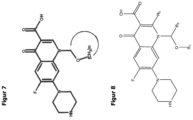
Figur 7 : Zyklische Hemiaminale. -
Figur 8 : Offene Hemiaminale (nicht beansprucht). -
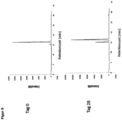
Figur 9 : Verbindung 1 ("Hemi") im Abbautest (geschlossener Flaschentest, OECD 301D), -
Figur 10 : Natürliche Aminosäuren. -
Figur 11 : Mögliches Syntheseschema für CIP-Hemi (siehe Verbindung 1 inFigur 1 ). -
Figur 12 : Mögliches Syntheseschema für CG008-Hemi (nicht beansprucht) (siehe Verbindung 1 inFigur 1 ). - Die vorliegende Erfindung betrifft die folgenden Ausführungsformen:
Chinolon-Antibiotikum der allgemeinen Formel I:
- Der +I-Effekt und der +M-Effekt der einzelnen Substituenten ist aus der chemischen Literatur wohl bekannt, er kann auch durch Berechnung der Elektronendichte am N1 modelliert werden.
- Der Begriff "+I-Effekt" bezieht sich bevorzugt auf Alkyl-, Alkenyl-, Alkinyl-, Cycloalkyl-, Cycloaryl- und Heterocyclyl-Reste mit Substituenten, ausgewählt aus der Gruppe bestehend aus O-, -NH2, -NR2, -OH, -OR, -NH(CO)R, -O(CO)R, -(Aryl), Br, -Cl, -I, und -F, wobei R = C1-10 Alkyl.
- Der Begriff "+I-Effekt" bezieht sich beispielsweise auf Cycloaryl-Reste mit +M (mesomerer Effekt)-Substituenten, wobei die +M-Substituenten bevorzugt ausgewählt sind aus der Gruppe bestehend aus, -O-, -NH2, -NR2, -OH, -OR, - NH(CO)R, -O(CO)R, -(Aryl), Br, -Cl, -I, und -F, wobei R = C1-10 Alkyl.
- Soweit nicht anders angegeben, zielt die vorliegenden Erfindung auf alle Stereoisomere ab.
- Die Erfindung betrifft auch ein Medikament enthaltend ein Chinolon-Antibiotikum nach Anspruch 1.
- Die Erfindung betrifft auch ein Chinolon-Antibiotikum nach Anspruch 1 zur Verwendung bei der Behandlung von bakteriellen Infektionen.
- Insbesondere betrifft die Erfindung die hierin beschriebenen Antibiotika zur Verwendung gegen Krankenhauskeime (nosokomiale Keime), bzw. Keime, die behandelt werden sollen, ohne eine Resistenzbildung bei anderen Keimen zu riskieren. Insbesondere betrifft die Erfindung die hierin beschriebenen Antibiotika zur Behandlung von E. Coli-verursachten Infektionen.
- Verbindung 1 und andere erfindungsgemäße Antibiotika können auch unter Anwendung allgemeinen Fachwissens hergestellt werden.
- Escherichia coli K12 ATCC 23716 wurde von DSMZ GmbH (Braunschweig, Germany) erhalten.
- Die Testsubstanzen wurden in Wasser verdünnt und auf einer 96-well-Platte zur Bakteriensuspension (in 2x Bakterienmedium (10 g Pepton and 6 g Fleischextrakt in 1 Liter)) gegeben, so dass die Endkonzentration des Mediums 1x war. Die Platte wurde 4h bei 37°C inkubiert. Die Zelldichte wurde photometrisch durch Messung der Absorption bei 600 nm bestimmt. Die Wachstumshemmung in Prozent der unbehandelten Kontrollen gegen die Konzentration der Testsubstanz aufgetragen.
- Humane embryonale Nierenzellen (HEK293) wurden in 384-well-Platten mit einer Dichte von 6000 Zellen/well in einem finalen Volumen von 50 µl mit der gewünschten Konzentration der Testsubstanz ausgesät. DMEM mit 10% fötalem Rinderserum (FBS) wurde als Wachstumsmedium verwendet. Die Zellen wurden zusammen mit den Testsubstanzen für 20 h bei 37 °C mit 5% COz inkubiert.
- Ciprofloxacin, Verbindung 1 und Cip-D-CP wurden in 12 ml phosphat-gepufferter Salzlösung in einer Konzentration von 10 mg/L gelöst. Der pH-Wert wurde auf pH 6, pH 7,4 oder pH 9 eingestellt. Die Ansätze wurden bei 37 °C für pH 6 und 7,4 und bei Raumtemperatur für pH 9 unter Schütteln (250 rpm) für 28 Tage inkubiert. An Tag 0, 1, 7, 14, 21 und 28 wurden Proben (700µL) für die HPLC Analyse entnommen. Der Quotient der Ausgangskonzentration co durch die Konzentration am jeweiligen Zeitpunkt (ct) wurde kalkuliert und als natürlicher Logarithmus gegen die Inkubationszeit aufgetragen.
- Minimale Hemmkonzentrationen in verschiedenen Bakterienstämmen:
Die antibiotische Aktivität wurde mittels Durchführung der Broth-Mikroverdünnungsmethode ermittelt (Cockerill et al., 2012, siehe Literatur). Es wurden die folgenden Bakterienstämme verwendet: Staphylococcus aureus (ATCC 29213), Enterococcus faecalis (ATCC 29212), Escherichia coli (ATCC 25922) und Pseudomonas aeruginosa (ATCC 27853), sowie S. aureus (ATCC 43300), K. pneumoniae (ATCC 700603), A. baumanii (ATCC 19606). Die Bestimmungen der minimalen Hemmkonzentrationen wurden durch zwei unabhängige Laboratorien durchgeführt. - Bakterienzellen wurden bei einer Zelldichte von 2 - 8 × 10⁵ cfu/ml in 200 µl Mueller-Hinton-Brothmedium verdünnt. Die Ansätze enthielten eine Verdünnungsreihe der Testsubstanzen. Diese inokulierten 96-well Platten wurden für 18 h bei 36°C inkubiert. Die minimale Hemmkonzentration wurde ermittelt durch visuelle Abschätzung der niedrigsten Konzentration, die die Bakterien vollständig gehemmt hatte.
- Die antibiotische Aktivität in V. fischeri wurden in einem Leuchtbakterientest (LBT) mit Vibrio fischeri NRRL-B-11177 (Hach-Lange GmbH, Düsseldorf, Germany) untersucht. Die Durchführung des LBT erfolgte nach dem modifizierten Protokoll von Menz et al. (2013), siehe Literaturliste.
- Hochleistungschromatographie (HPLC), insbesondere für Ciprofloxacin, Verbindung 1 und Cip-d-CP:
Das Shimadzu Prominence HPLC System (Duisburg, Germany) wurde für die chromatographischen Untersuchungen der Testsubstanzen verwendet. Eine NUCLEODUR® RP-C18 (CC 125/4 100-5µm C18 ec) Säule und mobile Phasen bestehend aus 0.1 % Ameisensäure in hochreinem Wasser (CH2O2: Solution A) and 100 % Acetonitril (CH3CN: Solution B) wurden verwendet. Die Flußrate wurde auf 0.5 mL min-1 eingestellt. Die Temperatur des Säulenofens wurde auf 25 °C eingestellt und das Injektionsvolumen betrug 10 µL. Ciprofloxacin, Hemi and Cip-D-CP eluierten bei den Retentionszeiten [tR] 16,1 min, 16,5 min beziehungsweise 15,2 min. Die Testsubstanzen wurden durch einen UV/Vis Detektor bei 270 nm detektiert. Die Fließgradientenmethode wurde angewendet wie in Tabelle 1 aufgelistet.Tabelle 1 : Fließgradientenbedingungen zur chromatographischen Analyse der Testsubstanzen Zeit (min) % Solution B (Acetonitril) 0.01-2.0 1 5.0 5 7.0 10 10.0 15 13.0 25 15.0 30 17.0 35 20.0 40 22.0 50 25.0 60 27.0 65 29.0 20 30.0-32.0 1 32.01 Stop - Ethyl-6,7-difluoro-4-oxo-1,4-dihydroquinolin-3-carboxylat (1) reagiert mit Tetrahydrofuran-2-ylacetat (2) bei ≥120°C zu Ethyl-6,7-difluoro-4-oxo-1-(tetrahydrofuran-2-yl)-1,4-dihydroquinolin-3-carboxylat (3) (siehe Yamashita et al. 1983). Nachfolgend wird (3) mit Benzylpiperazine-1-carboxylat (4) durch eine SN Reaktion zu Ethyl-7-(4-«benzyloxy)carbonyl)piperazin-1-yl)-6-fluoro-4-oxo-1-(tetrahydrofuran-2-yl)-1,4-dihydroquinoline-3-carboxylat (5) umgesetzt. Als Lösungsmittel können DMSO oder Acetonitril (ACN) mit Triethylamin (TEA) verwendet werden. Anschließend wird (5) mit NaOH zu 7-(4-((benzyloxy)carbonyl)piperazin-1-yl)-6-fluoro-4-oxo-1-(tetrahydrofuran-2-yl)-1,4-dihydroquinoline-3-carbonsäure (6) hydrolysiert und die Cbz(Benzyloxycarbonyl)-Gruppe mit z.B. Pd/C H2 entfernt (7).
-
- ▪ Ethyl 6,7-difluoro-4-oxo-1,4-dihydroquinolin-3-carboxylate (1), Cas. 121873-01-6, von ABCR, AB375454
- ▪ 1-Carbobenzoxypiperazine (4), Cas. 31166-44-6, von Chempur, BD28331-5
- ▪ Tetrahydro-2-furanyl acetate (2), Cas. 1608-67-9, kann nach Yamashita et al. 1983 synthetisiert werden
- Die Synthese von CG008-Hemi erfolgt analog zu CIP-Hemi. Ethyl-6,7-difluoro-4-oxo-1,4-dihydroquinolin-3-carboxylate (1) reagiert mit Tetrahydrofuran-2-ylacetat (2) bei ≥120°C zu Ethyl-6,7-difluoro-4-oxo-1-(tetrahydrofuran-2-yl)-1,4-dihydroquinolin-3-carboxylat (3) (siehe Yamashita et al. 1983). Nachfolgend reagiert dieses mit Morpholin (4) in z.B. ACN mit TEA zu Ethyl-6-fluoro-7-morpholino-4-oxo-1-(tetrahydrofuran-2-yl)-1,4-dihydroquinolin-3-carboxylat (5). Abschließend wird der Ester mit NaOH zu CG008-Hemi (6) hydrolysiert.
-
- ▪ Ethyl 6,7-difluoro-4-oxo-1,4-dihydroquinolin-3-carboxylat, Cas. 121873-01-6, von ABCR, AB375454
- ▪ Tetrahydro-2-furanylacetat, Cas. 1608-67-9, kann nach Yamashita et al. 1983 synthetisiert werden
- ▪ Morpholin, Cas. 110-91-8, von Carl Roth, 9691.1
- Die vorgestellten Synthesen stellen Standardmethoden in der Synthese von Fluoroquinolonen dar (Gould-Jacobs-Reaktion, SN am Aromaten und Hydrolyse des Esters). Weiterhin ist auch das Schützen mit einer Cbz-Gruppe eine Standardmethode. Für die Synthese des Hemi-Linkers können wiederum verschiedene Möglichkeiten genutzt werden, welche aus der Synthese des Zytostatikums Tegafur bekannt sind - siehe auch Lukevits & Zablotskaya 1991. Weitere generelle Synthesemöglichkeiten für Antibiotika bzw. chemische Reaktionen zum Einfügen bestimmter Gruppen eines Moleküls werden auch in der hierin zitierten Literatur beschrieben.
-
-
EP0373531 - Takenouchi, T, Tabata, F., Iwata, Y., Hanzawa, H. Sugawara, M. and Ohya, S. (Hydrophilicity of quinolones is not an exclusive factor for decreased activity in efflux-mediated resistant mutants of Staphylococcus aureus), Antimicrobial Agents and Chemotherapy, 1996, 40(8), 1835-1842
- Cockerill, Franklin R. (2012): Methods for dilution antimicrobial susceptibility tests for bacteria that grow aerobically. Approved standard - ninth edition. Wayne, Pa.: CLSI (Clinical and Laboratory Standards Institute, M07-A9 = 32,2).
- Menz, J.; Schneider, M.; Kümmerer, K. (2013): Toxicity testing with luminescent bacteriacharacterization of an automated method for the combined assessment of acute and chronic effects. In: Chemosphere 93 (6), S. 990-996. DOI: 10.1016/j.chemosphere.2013.05.067.
- Radi et al.; Collection of Czechoslovak Chemical Communications, 1992, 57(1), 216-18.
- Yamashita et al., "Studies on Tetrahydrofuryl-5-fluorouracils. IV. Mode of Reaction of 5-Fluorouracil with 2-Acetoxytetrahydrofuran", 1983 Chem. Pharm. Bull., 31, Seiten 3872-3877.
- Lukevits & Zablotskaya 1991, "Synthesis of Ftorafur", Chemistry of Heterocyclic Compounds c/c of Khimiia Geterotsiklicheskikh Soedinenii; 27, 12; 1271.
-
WO2015/189560 -
DE 692 32 134 -
WO 01/36408 A1 -
DE 36 32 222 A1
Claims (3)
- Chinolon-Antibiotikum der allgemeinen Formel I:

- Medikament enthaltend ein Chinolon-Antibiotikum nach Anspruch 1.
- Chinolon-Antibiotikum nach Anspruch 1 zur Verwendung bei der Behandlung von bakteriellen Infektionen.
Applications Claiming Priority (2)
| Application Number | Priority Date | Filing Date | Title |
|---|---|---|---|
| DE102017218119.2A DE102017218119A1 (de) | 2017-10-11 | 2017-10-11 | In der Umwelt abbaubare Chinolon-Antibiotika mit Hemiaminal-Struktureinheit |
| PCT/EP2018/077582 WO2019072905A1 (de) | 2017-10-11 | 2018-10-10 | In der umwelt abbaubare chinolon-antibiotika mit hemiaminal-struktureinheit |
Publications (2)
| Publication Number | Publication Date |
|---|---|
| EP3694851A1 EP3694851A1 (de) | 2020-08-19 |
| EP3694851B1 true EP3694851B1 (de) | 2023-12-27 |
Family
ID=63862127
Family Applications (1)
| Application Number | Title | Priority Date | Filing Date |
|---|---|---|---|
| EP18786722.1A Active EP3694851B1 (de) | 2017-10-11 | 2018-10-10 | In der umwelt abbaubare chinolon-antibiotika mit hemiaminal-struktureinheit |
Country Status (3)
| Country | Link |
|---|---|
| EP (1) | EP3694851B1 (de) |
| DE (1) | DE102017218119A1 (de) |
| WO (1) | WO2019072905A1 (de) |
Families Citing this family (2)
| Publication number | Priority date | Publication date | Assignee | Title |
|---|---|---|---|---|
| CN112159355B (zh) * | 2020-09-25 | 2022-06-24 | 西南大学 | 对氨基水杨酸氟喹诺酮类衍生物及其中间体、制备方法和应用 |
| CN112159354B (zh) * | 2020-09-25 | 2022-07-05 | 西南大学 | 对氨基水杨酸的氟喹诺酮类衍生物及其中间体、制备方法和应用 |
Citations (1)
| Publication number | Priority date | Publication date | Assignee | Title |
|---|---|---|---|---|
| JPS61152682A (ja) * | 1984-12-27 | 1986-07-11 | Dainippon Pharmaceut Co Ltd | ピリドンカルボン酸誘導体、そのエステルおよびその塩 |
Family Cites Families (7)
| Publication number | Priority date | Publication date | Assignee | Title |
|---|---|---|---|---|
| DE3632222A1 (de) * | 1986-09-23 | 1988-04-07 | Bayer Ag | Topisch anwendbare zubereitungen von gyrase-inhibitoren |
| JPH02157282A (ja) | 1988-12-12 | 1990-06-18 | Wakunaga Pharmaceut Co Ltd | 新規ピリドベンゾオキサジン誘導体 |
| GB9118183D0 (en) * | 1991-08-23 | 1991-10-09 | Solanki Kishor K | Imaging of infections |
| TW273551B (de) * | 1993-05-24 | 1996-04-01 | Wakiei Seiyaku Kk | |
| SE9904108D0 (sv) * | 1999-11-15 | 1999-11-15 | New Pharma Research Ab | Nya föreningar |
| GB201409044D0 (en) * | 2014-05-21 | 2014-07-02 | Ucl Business Plc | New compounds |
| US10301664B2 (en) * | 2015-12-31 | 2019-05-28 | Purdue Research Foundation | Repurposing non-antimicrobial drugs and clinical molecules to treat bacterial infections |
-
2017
- 2017-10-11 DE DE102017218119.2A patent/DE102017218119A1/de not_active Withdrawn
-
2018
- 2018-10-10 EP EP18786722.1A patent/EP3694851B1/de active Active
- 2018-10-10 WO PCT/EP2018/077582 patent/WO2019072905A1/de not_active Ceased
Patent Citations (1)
| Publication number | Priority date | Publication date | Assignee | Title |
|---|---|---|---|---|
| JPS61152682A (ja) * | 1984-12-27 | 1986-07-11 | Dainippon Pharmaceut Co Ltd | ピリドンカルボン酸誘導体、そのエステルおよびその塩 |
Non-Patent Citations (5)
| Title |
|---|
| DATABASE CAPLUS [online] 1 January 1991 (1991-01-01), CHEN ET AL: "Pyridonecarboxylic acids as antibacterial agents. X. Synthesis and structure-activity relationships of 1,7-disubstituted-6-fluoro-1,4-dihydro-4-oxoquinoline-3-carboxylic acids", XP055917490, Database accession no. 1992:128614 * |
| DATABASE CAPLUS [online] CHEMICAL ABSTRACTS SERVICE, COLUMBUS, OHIO, US; 1992, CHEN, J. X.; GUO, H. Y.: "Pyridonecarboxylic acids as antibacterial agents. X. Synthesis and structure-activity relationships of 1,7-disubstituted-6-fluoro-1,4-dihydro-4-oxoquinoline-3-carboxylic acids", XP055917490, Database accession no. 1992:128614 * |
| DATABASE REGISTRY [online] 1 January 2008 (2008-01-01), REGISTRY: "3-Quinolinecarboxylic acid", XP055917504, Database accession no. 1089336-20-8, 1089336-14-0 * |
| JIA XUE-DONG ET AL: "Synthesis andin vitroantitumor activity of novel naphthyridinone derivatives", CHINESE CHEMICAL LETTERS, ELSEVIER, AMSTERDAM, NL, vol. 28, no. 2, 25 July 2016 (2016-07-25), pages 235 - 239, XP029893527, ISSN: 1001-8417, DOI: 10.1016/J.CCLET.2016.07.024 * |
| TOMITA KYOJI ET AL: "Synthesis and Structure-Activity Relationships of Novel 7-Substituted 1,4-Dihydro-4-oxo-1-(2-thiazolyl)-1,8-naphthyridine-3-carboxylic Acids as antitumor Agents", JOURNAL OF MEDICINAL CHEMISTRY, AMERICAN CHEMICAL SOCIETY, US, vol. 45, no. 25, 1 January 2002 (2002-01-01), pages 5564 - 5575, XP002450261, ISSN: 0022-2623, DOI: 10.1021/JM010057B * |
Also Published As
| Publication number | Publication date |
|---|---|
| EP3694851A1 (de) | 2020-08-19 |
| DE102017218119A1 (de) | 2019-04-11 |
| WO2019072905A1 (de) | 2019-04-18 |
Similar Documents
| Publication | Publication Date | Title |
|---|---|---|
| Arkhipov et al. | The efficacy of the supramolecular complexes of niclosamide obtained by mechanochemical technology and targeted delivery against cestode infection of animals | |
| US20100004480A1 (en) | Methods and compositions for inhibiting biofilms | |
| US20190292212A1 (en) | Dicaffeoyl Spermidine Derivative Glycosides And Use Thereof | |
| EP3384915A1 (de) | Anwendungen von kelimycin bei resistenz gegen mycobacterium-tuberculosis-infektion | |
| Oscar et al. | Fatty alcohols isolated from Prosopis africana and evaluation of antibacterial and antituberculosis activities | |
| Al-Mehdhar et al. | Antibacterial Efficacy of AgNPs synthesized from Aloe vera extract and Staphylococcus aureus Culture Supernatant | |
| EP3694851A1 (de) | In der umwelt abbaubare chinolon-antibiotika mit hemiaminal-struktureinheit | |
| DE60010425T2 (de) | Mittel gegen medikamentenresistente bakterienstämme und antichlamydiamittel | |
| DE60110908T2 (de) | Antibiotische tripropeptine und verfahren ihrer herstellung | |
| DE3031788C2 (de) | ||
| EP3694516B1 (de) | Biologisch abbaubare chinolon-antibiotika | |
| CH643814A5 (de) | Hydroxamsaeureverbindungen, verfahren zu deren herstellung sowie diese verbindungen enthaltende medikamente. | |
| DE60310717T2 (de) | Teicoplanin-Zubereitung mit verbesserter antibiotischer Wirkung | |
| CN106943605B (zh) | 奥利司他包合物及其制备方法和在抗肿瘤药物中的应用 | |
| EP2120960A2 (de) | NEUE ß-LACTAM-ANTIBIOTIKA, VERFAHREN ZU IHRER HERSTELLUNG UND IHRE VERWENDUNG | |
| DE60003697T2 (de) | Aktive marine alkaloiden | |
| DE1670627A1 (de) | Verfahren zur Herstellung von neuen Hydantoinen | |
| Kabir et al. | Comparative study of hypoglycemic and antibacterial activity of organic extracts of four Bangladeshi plants | |
| Anika et al. | Antibacterial screening of two indigenous nigerian spices; piper guineense and Xylopia aethiopica | |
| Adeniyi et al. | In-vitro Antifungal Activities of Cola nitida Schott & Endl.(Sterculiaceae) against Five Candida species and Four Dermatophytes | |
| DE1915829C3 (de) | Niedere Acyljosamycine, Verfahren zu ihrer Herstellung und Arzneimittel mit einem Gehalt an diesen Verbindungen | |
| Ghaly et al. | Tamarindus indica Extract as a Promising Antimicrobial and Antivirulence Therapy. Antibiotics 2023, 12, 464 | |
| DE10308632A1 (de) | Helicobacter pylori Antibiotikum | |
| MEGANATHAN et al. | FORMULATION AND INVITRO EVALUATION OF LEAVES HIBISCUS ROSA-SINENSIS TRANSDERMAL PATCH | |
| DE60216518T2 (de) | Bioaktive hexan fraktion aus vetiveria zizanioides |
Legal Events
| Date | Code | Title | Description |
|---|---|---|---|
| STAA | Information on the status of an ep patent application or granted ep patent |
Free format text: STATUS: UNKNOWN |
|
| STAA | Information on the status of an ep patent application or granted ep patent |
Free format text: STATUS: THE INTERNATIONAL PUBLICATION HAS BEEN MADE |
|
| PUAI | Public reference made under article 153(3) epc to a published international application that has entered the european phase |
Free format text: ORIGINAL CODE: 0009012 |
|
| STAA | Information on the status of an ep patent application or granted ep patent |
Free format text: STATUS: REQUEST FOR EXAMINATION WAS MADE |
|
| 17P | Request for examination filed |
Effective date: 20200327 |
|
| AK | Designated contracting states |
Kind code of ref document: A1 Designated state(s): AL AT BE BG CH CY CZ DE DK EE ES FI FR GB GR HR HU IE IS IT LI LT LU LV MC MK MT NL NO PL PT RO RS SE SI SK SM TR |
|
| AX | Request for extension of the european patent |
Extension state: BA ME |
|
| DAV | Request for validation of the european patent (deleted) | ||
| DAX | Request for extension of the european patent (deleted) | ||
| STAA | Information on the status of an ep patent application or granted ep patent |
Free format text: STATUS: EXAMINATION IS IN PROGRESS |
|
| 17Q | First examination report despatched |
Effective date: 20220510 |
|
| RAP1 | Party data changed (applicant data changed or rights of an application transferred) |
Owner name: LEUPHANA UNIVERSITAET LUENEBURG STIFTUNG OEFFENTLICHEN RECHTS |
|
| GRAP | Despatch of communication of intention to grant a patent |
Free format text: ORIGINAL CODE: EPIDOSNIGR1 |
|
| STAA | Information on the status of an ep patent application or granted ep patent |
Free format text: STATUS: GRANT OF PATENT IS INTENDED |
|
| INTG | Intention to grant announced |
Effective date: 20230718 |
|
| GRAS | Grant fee paid |
Free format text: ORIGINAL CODE: EPIDOSNIGR3 |
|
| GRAA | (expected) grant |
Free format text: ORIGINAL CODE: 0009210 |
|
| STAA | Information on the status of an ep patent application or granted ep patent |
Free format text: STATUS: THE PATENT HAS BEEN GRANTED |
|
| AK | Designated contracting states |
Kind code of ref document: B1 Designated state(s): AL AT BE BG CH CY CZ DE DK EE ES FI FR GB GR HR HU IE IS IT LI LT LU LV MC MK MT NL NO PL PT RO RS SE SI SK SM TR |
|
| REG | Reference to a national code |
Ref country code: GB Ref legal event code: FG4D Free format text: NOT ENGLISH |
|
| REG | Reference to a national code |
Ref country code: CH Ref legal event code: EP |
|
| REG | Reference to a national code |
Ref country code: DE Ref legal event code: R096 Ref document number: 502018013886 Country of ref document: DE |
|
| REG | Reference to a national code |
Ref country code: IE Ref legal event code: FG4D Free format text: LANGUAGE OF EP DOCUMENT: GERMAN |
|
| P01 | Opt-out of the competence of the unified patent court (upc) registered |
Effective date: 20231214 |
|
| REG | Reference to a national code |
Ref country code: NL Ref legal event code: FP |
|
| PG25 | Lapsed in a contracting state [announced via postgrant information from national office to epo] |
Ref country code: GR Free format text: LAPSE BECAUSE OF FAILURE TO SUBMIT A TRANSLATION OF THE DESCRIPTION OR TO PAY THE FEE WITHIN THE PRESCRIBED TIME-LIMIT Effective date: 20240328 |
|
| REG | Reference to a national code |
Ref country code: LT Ref legal event code: MG9D |
|
| PG25 | Lapsed in a contracting state [announced via postgrant information from national office to epo] |
Ref country code: LT Free format text: LAPSE BECAUSE OF FAILURE TO SUBMIT A TRANSLATION OF THE DESCRIPTION OR TO PAY THE FEE WITHIN THE PRESCRIBED TIME-LIMIT Effective date: 20231227 |
|
| PG25 | Lapsed in a contracting state [announced via postgrant information from national office to epo] |
Ref country code: ES Free format text: LAPSE BECAUSE OF FAILURE TO SUBMIT A TRANSLATION OF THE DESCRIPTION OR TO PAY THE FEE WITHIN THE PRESCRIBED TIME-LIMIT Effective date: 20231227 |
|
| PG25 | Lapsed in a contracting state [announced via postgrant information from national office to epo] |
Ref country code: LT Free format text: LAPSE BECAUSE OF FAILURE TO SUBMIT A TRANSLATION OF THE DESCRIPTION OR TO PAY THE FEE WITHIN THE PRESCRIBED TIME-LIMIT Effective date: 20231227 Ref country code: GR Free format text: LAPSE BECAUSE OF FAILURE TO SUBMIT A TRANSLATION OF THE DESCRIPTION OR TO PAY THE FEE WITHIN THE PRESCRIBED TIME-LIMIT Effective date: 20240328 Ref country code: FI Free format text: LAPSE BECAUSE OF FAILURE TO SUBMIT A TRANSLATION OF THE DESCRIPTION OR TO PAY THE FEE WITHIN THE PRESCRIBED TIME-LIMIT Effective date: 20231227 Ref country code: ES Free format text: LAPSE BECAUSE OF FAILURE TO SUBMIT A TRANSLATION OF THE DESCRIPTION OR TO PAY THE FEE WITHIN THE PRESCRIBED TIME-LIMIT Effective date: 20231227 Ref country code: BG Free format text: LAPSE BECAUSE OF FAILURE TO SUBMIT A TRANSLATION OF THE DESCRIPTION OR TO PAY THE FEE WITHIN THE PRESCRIBED TIME-LIMIT Effective date: 20240327 |
|
| PG25 | Lapsed in a contracting state [announced via postgrant information from national office to epo] |
Ref country code: SE Free format text: LAPSE BECAUSE OF FAILURE TO SUBMIT A TRANSLATION OF THE DESCRIPTION OR TO PAY THE FEE WITHIN THE PRESCRIBED TIME-LIMIT Effective date: 20231227 Ref country code: RS Free format text: LAPSE BECAUSE OF FAILURE TO SUBMIT A TRANSLATION OF THE DESCRIPTION OR TO PAY THE FEE WITHIN THE PRESCRIBED TIME-LIMIT Effective date: 20231227 Ref country code: NO Free format text: LAPSE BECAUSE OF FAILURE TO SUBMIT A TRANSLATION OF THE DESCRIPTION OR TO PAY THE FEE WITHIN THE PRESCRIBED TIME-LIMIT Effective date: 20240327 Ref country code: LV Free format text: LAPSE BECAUSE OF FAILURE TO SUBMIT A TRANSLATION OF THE DESCRIPTION OR TO PAY THE FEE WITHIN THE PRESCRIBED TIME-LIMIT Effective date: 20231227 Ref country code: HR Free format text: LAPSE BECAUSE OF FAILURE TO SUBMIT A TRANSLATION OF THE DESCRIPTION OR TO PAY THE FEE WITHIN THE PRESCRIBED TIME-LIMIT Effective date: 20231227 |
|
| PG25 | Lapsed in a contracting state [announced via postgrant information from national office to epo] |
Ref country code: IS Free format text: LAPSE BECAUSE OF FAILURE TO SUBMIT A TRANSLATION OF THE DESCRIPTION OR TO PAY THE FEE WITHIN THE PRESCRIBED TIME-LIMIT Effective date: 20240427 |
|
| PG25 | Lapsed in a contracting state [announced via postgrant information from national office to epo] |
Ref country code: CZ Free format text: LAPSE BECAUSE OF FAILURE TO SUBMIT A TRANSLATION OF THE DESCRIPTION OR TO PAY THE FEE WITHIN THE PRESCRIBED TIME-LIMIT Effective date: 20231227 |
|
| PG25 | Lapsed in a contracting state [announced via postgrant information from national office to epo] |
Ref country code: SK Free format text: LAPSE BECAUSE OF FAILURE TO SUBMIT A TRANSLATION OF THE DESCRIPTION OR TO PAY THE FEE WITHIN THE PRESCRIBED TIME-LIMIT Effective date: 20231227 |
|
| PG25 | Lapsed in a contracting state [announced via postgrant information from national office to epo] |
Ref country code: SM Free format text: LAPSE BECAUSE OF FAILURE TO SUBMIT A TRANSLATION OF THE DESCRIPTION OR TO PAY THE FEE WITHIN THE PRESCRIBED TIME-LIMIT Effective date: 20231227 Ref country code: SK Free format text: LAPSE BECAUSE OF FAILURE TO SUBMIT A TRANSLATION OF THE DESCRIPTION OR TO PAY THE FEE WITHIN THE PRESCRIBED TIME-LIMIT Effective date: 20231227 Ref country code: RO Free format text: LAPSE BECAUSE OF FAILURE TO SUBMIT A TRANSLATION OF THE DESCRIPTION OR TO PAY THE FEE WITHIN THE PRESCRIBED TIME-LIMIT Effective date: 20231227 Ref country code: IT Free format text: LAPSE BECAUSE OF FAILURE TO SUBMIT A TRANSLATION OF THE DESCRIPTION OR TO PAY THE FEE WITHIN THE PRESCRIBED TIME-LIMIT Effective date: 20231227 Ref country code: IS Free format text: LAPSE BECAUSE OF FAILURE TO SUBMIT A TRANSLATION OF THE DESCRIPTION OR TO PAY THE FEE WITHIN THE PRESCRIBED TIME-LIMIT Effective date: 20240427 Ref country code: EE Free format text: LAPSE BECAUSE OF FAILURE TO SUBMIT A TRANSLATION OF THE DESCRIPTION OR TO PAY THE FEE WITHIN THE PRESCRIBED TIME-LIMIT Effective date: 20231227 Ref country code: CZ Free format text: LAPSE BECAUSE OF FAILURE TO SUBMIT A TRANSLATION OF THE DESCRIPTION OR TO PAY THE FEE WITHIN THE PRESCRIBED TIME-LIMIT Effective date: 20231227 |
|
| PG25 | Lapsed in a contracting state [announced via postgrant information from national office to epo] |
Ref country code: PL Free format text: LAPSE BECAUSE OF FAILURE TO SUBMIT A TRANSLATION OF THE DESCRIPTION OR TO PAY THE FEE WITHIN THE PRESCRIBED TIME-LIMIT Effective date: 20231227 Ref country code: PT Free format text: LAPSE BECAUSE OF FAILURE TO SUBMIT A TRANSLATION OF THE DESCRIPTION OR TO PAY THE FEE WITHIN THE PRESCRIBED TIME-LIMIT Effective date: 20240429 |
|
| PG25 | Lapsed in a contracting state [announced via postgrant information from national office to epo] |
Ref country code: PT Free format text: LAPSE BECAUSE OF FAILURE TO SUBMIT A TRANSLATION OF THE DESCRIPTION OR TO PAY THE FEE WITHIN THE PRESCRIBED TIME-LIMIT Effective date: 20240429 Ref country code: PL Free format text: LAPSE BECAUSE OF FAILURE TO SUBMIT A TRANSLATION OF THE DESCRIPTION OR TO PAY THE FEE WITHIN THE PRESCRIBED TIME-LIMIT Effective date: 20231227 |
|
| REG | Reference to a national code |
Ref country code: DE Ref legal event code: R097 Ref document number: 502018013886 Country of ref document: DE |
|
| PG25 | Lapsed in a contracting state [announced via postgrant information from national office to epo] |
Ref country code: DK Free format text: LAPSE BECAUSE OF FAILURE TO SUBMIT A TRANSLATION OF THE DESCRIPTION OR TO PAY THE FEE WITHIN THE PRESCRIBED TIME-LIMIT Effective date: 20231227 |
|
| PG25 | Lapsed in a contracting state [announced via postgrant information from national office to epo] |
Ref country code: DK Free format text: LAPSE BECAUSE OF FAILURE TO SUBMIT A TRANSLATION OF THE DESCRIPTION OR TO PAY THE FEE WITHIN THE PRESCRIBED TIME-LIMIT Effective date: 20231227 |
|
| PLBE | No opposition filed within time limit |
Free format text: ORIGINAL CODE: 0009261 |
|
| STAA | Information on the status of an ep patent application or granted ep patent |
Free format text: STATUS: NO OPPOSITION FILED WITHIN TIME LIMIT |
|
| 26N | No opposition filed |
Effective date: 20240930 |
|
| PG25 | Lapsed in a contracting state [announced via postgrant information from national office to epo] |
Ref country code: SI Free format text: LAPSE BECAUSE OF FAILURE TO SUBMIT A TRANSLATION OF THE DESCRIPTION OR TO PAY THE FEE WITHIN THE PRESCRIBED TIME-LIMIT Effective date: 20231227 |
|
| REG | Reference to a national code |
Ref country code: CH Ref legal event code: PL |
|
| PG25 | Lapsed in a contracting state [announced via postgrant information from national office to epo] |
Ref country code: MC Free format text: LAPSE BECAUSE OF FAILURE TO SUBMIT A TRANSLATION OF THE DESCRIPTION OR TO PAY THE FEE WITHIN THE PRESCRIBED TIME-LIMIT Effective date: 20231227 |
|
| PG25 | Lapsed in a contracting state [announced via postgrant information from national office to epo] |
Ref country code: LU Free format text: LAPSE BECAUSE OF NON-PAYMENT OF DUE FEES Effective date: 20241010 |
|
| PG25 | Lapsed in a contracting state [announced via postgrant information from national office to epo] |
Ref country code: CH Free format text: LAPSE BECAUSE OF NON-PAYMENT OF DUE FEES Effective date: 20241031 |
|
| PG25 | Lapsed in a contracting state [announced via postgrant information from national office to epo] |
Ref country code: IE Free format text: LAPSE BECAUSE OF NON-PAYMENT OF DUE FEES Effective date: 20241010 |
|
| PGFP | Annual fee paid to national office [announced via postgrant information from national office to epo] |
Ref country code: NL Payment date: 20251023 Year of fee payment: 8 |
|
| REG | Reference to a national code |
Ref country code: AT Ref legal event code: MM01 Ref document number: 1644413 Country of ref document: AT Kind code of ref document: T Effective date: 20241010 |
|
| PGFP | Annual fee paid to national office [announced via postgrant information from national office to epo] |
Ref country code: DE Payment date: 20251020 Year of fee payment: 8 |
|
| PGFP | Annual fee paid to national office [announced via postgrant information from national office to epo] |
Ref country code: GB Payment date: 20251024 Year of fee payment: 8 |
|
| PG25 | Lapsed in a contracting state [announced via postgrant information from national office to epo] |
Ref country code: AT Free format text: LAPSE BECAUSE OF NON-PAYMENT OF DUE FEES Effective date: 20241010 |
|
| PGFP | Annual fee paid to national office [announced via postgrant information from national office to epo] |
Ref country code: FR Payment date: 20251029 Year of fee payment: 8 |
|
| PGFP | Annual fee paid to national office [announced via postgrant information from national office to epo] |
Ref country code: BE Payment date: 20251022 Year of fee payment: 8 |
|
| PG25 | Lapsed in a contracting state [announced via postgrant information from national office to epo] |
Ref country code: CY Free format text: LAPSE BECAUSE OF FAILURE TO SUBMIT A TRANSLATION OF THE DESCRIPTION OR TO PAY THE FEE WITHIN THE PRESCRIBED TIME-LIMIT; INVALID AB INITIO Effective date: 20181010 |
|
| PG25 | Lapsed in a contracting state [announced via postgrant information from national office to epo] |
Ref country code: HU Free format text: LAPSE BECAUSE OF FAILURE TO SUBMIT A TRANSLATION OF THE DESCRIPTION OR TO PAY THE FEE WITHIN THE PRESCRIBED TIME-LIMIT; INVALID AB INITIO Effective date: 20181010 |
|
| PG25 | Lapsed in a contracting state [announced via postgrant information from national office to epo] |
Ref country code: TR Free format text: LAPSE BECAUSE OF FAILURE TO SUBMIT A TRANSLATION OF THE DESCRIPTION OR TO PAY THE FEE WITHIN THE PRESCRIBED TIME-LIMIT Effective date: 20231227 |