EP0373531A1 - Novel pyridobenzoxazine derivative - Google Patents
Novel pyridobenzoxazine derivative Download PDFInfo
- Publication number
- EP0373531A1 EP0373531A1 EP89122685A EP89122685A EP0373531A1 EP 0373531 A1 EP0373531 A1 EP 0373531A1 EP 89122685 A EP89122685 A EP 89122685A EP 89122685 A EP89122685 A EP 89122685A EP 0373531 A1 EP0373531 A1 EP 0373531A1
- Authority
- EP
- European Patent Office
- Prior art keywords
- group
- substituent
- lower alkyl
- cyclic amino
- alkyl group
- Prior art date
- Legal status (The legal status is an assumption and is not a legal conclusion. Google has not performed a legal analysis and makes no representation as to the accuracy of the status listed.)
- Withdrawn
Links
- QDEJGQKJMKXYLM-UHFFFAOYSA-N 2h-pyrido[2,3-h][1,2]benzoxazine Chemical class C1=CC2=NC=CC=C2C2=C1C=CNO2 QDEJGQKJMKXYLM-UHFFFAOYSA-N 0.000 title claims abstract description 6
- 150000003839 salts Chemical class 0.000 claims abstract description 18
- 125000001424 substituent group Chemical group 0.000 claims description 133
- 125000000217 alkyl group Chemical group 0.000 claims description 60
- 125000003277 amino group Chemical group 0.000 claims description 38
- 125000004122 cyclic group Chemical group 0.000 claims description 22
- 125000005843 halogen group Chemical group 0.000 claims description 22
- 125000003118 aryl group Chemical group 0.000 claims description 19
- 125000002887 hydroxy group Chemical group [H]O* 0.000 claims description 19
- 125000004435 hydrogen atom Chemical group [H]* 0.000 claims description 18
- 125000003342 alkenyl group Chemical group 0.000 claims description 15
- 125000004432 carbon atom Chemical group C* 0.000 claims description 14
- 125000003178 carboxy group Chemical group [H]OC(*)=O 0.000 claims description 13
- 125000002373 5 membered heterocyclic group Chemical group 0.000 claims description 12
- 125000004070 6 membered heterocyclic group Chemical group 0.000 claims description 12
- 125000002252 acyl group Chemical group 0.000 claims description 12
- 125000006239 protecting group Chemical group 0.000 claims description 11
- 125000004453 alkoxycarbonyl group Chemical group 0.000 claims description 10
- 125000003710 aryl alkyl group Chemical group 0.000 claims description 10
- 125000004390 alkyl sulfonyl group Chemical group 0.000 claims description 8
- 125000004391 aryl sulfonyl group Chemical group 0.000 claims description 8
- 229910052799 carbon Inorganic materials 0.000 claims description 8
- 125000003545 alkoxy group Chemical group 0.000 claims description 7
- 125000004093 cyano group Chemical group *C#N 0.000 claims description 6
- 125000003917 carbamoyl group Chemical group [H]N([H])C(*)=O 0.000 claims description 5
- 125000004442 acylamino group Chemical group 0.000 claims description 4
- 125000004423 acyloxy group Chemical group 0.000 claims description 4
- 125000004466 alkoxycarbonylamino group Chemical group 0.000 claims description 4
- 229910052757 nitrogen Inorganic materials 0.000 claims description 4
- 125000004433 nitrogen atom Chemical group N* 0.000 claims description 4
- 125000003396 thiol group Chemical group [H]S* 0.000 claims description 4
- 125000004414 alkyl thio group Chemical group 0.000 claims description 3
- 125000005098 aryl alkoxy carbonyl group Chemical group 0.000 claims description 3
- 150000001875 compounds Chemical class 0.000 abstract description 83
- 230000000845 anti-microbial effect Effects 0.000 abstract description 11
- 239000003814 drug Substances 0.000 abstract description 4
- 244000005700 microbiome Species 0.000 abstract description 3
- 150000005130 benzoxazines Chemical group 0.000 abstract description 2
- 238000001228 spectrum Methods 0.000 abstract description 2
- 239000005452 food preservative Substances 0.000 abstract 1
- 235000019249 food preservative Nutrition 0.000 abstract 1
- -1 acetoxymethyl Chemical group 0.000 description 186
- HEDRZPFGACZZDS-MICDWDOJSA-N Trichloro(2H)methane Chemical compound [2H]C(Cl)(Cl)Cl HEDRZPFGACZZDS-MICDWDOJSA-N 0.000 description 40
- 238000000034 method Methods 0.000 description 32
- ZMXDDKWLCZADIW-UHFFFAOYSA-N N,N-Dimethylformamide Chemical compound CN(C)C=O ZMXDDKWLCZADIW-UHFFFAOYSA-N 0.000 description 30
- 238000006243 chemical reaction Methods 0.000 description 29
- 239000013078 crystal Substances 0.000 description 28
- LFQSCWFLJHTTHZ-UHFFFAOYSA-N Ethanol Chemical compound CCO LFQSCWFLJHTTHZ-UHFFFAOYSA-N 0.000 description 25
- YMWUJEATGCHHMB-UHFFFAOYSA-N Dichloromethane Chemical compound ClCCl YMWUJEATGCHHMB-UHFFFAOYSA-N 0.000 description 24
- 238000005160 1H NMR spectroscopy Methods 0.000 description 22
- 239000000203 mixture Substances 0.000 description 22
- OKKJLVBELUTLKV-UHFFFAOYSA-N Methanol Chemical compound OC OKKJLVBELUTLKV-UHFFFAOYSA-N 0.000 description 21
- 230000015572 biosynthetic process Effects 0.000 description 21
- 238000003786 synthesis reaction Methods 0.000 description 21
- ZMANZCXQSJIPKH-UHFFFAOYSA-N Triethylamine Chemical compound CCN(CC)CC ZMANZCXQSJIPKH-UHFFFAOYSA-N 0.000 description 18
- KWYUFKZDYYNOTN-UHFFFAOYSA-M Potassium hydroxide Chemical compound [OH-].[K+] KWYUFKZDYYNOTN-UHFFFAOYSA-M 0.000 description 15
- IAZDPXIOMUYVGZ-UHFFFAOYSA-N Dimethylsulphoxide Chemical compound CS(C)=O IAZDPXIOMUYVGZ-UHFFFAOYSA-N 0.000 description 14
- 125000001495 ethyl group Chemical group [H]C([H])([H])C([H])([H])* 0.000 description 14
- HEDRZPFGACZZDS-UHFFFAOYSA-N Chloroform Chemical compound ClC(Cl)Cl HEDRZPFGACZZDS-UHFFFAOYSA-N 0.000 description 12
- HEMHJVSKTPXQMS-UHFFFAOYSA-M Sodium hydroxide Chemical compound [OH-].[Na+] HEMHJVSKTPXQMS-UHFFFAOYSA-M 0.000 description 12
- 238000001914 filtration Methods 0.000 description 12
- 125000002496 methyl group Chemical group [H]C([H])([H])* 0.000 description 11
- XLYOFNOQVPJJNP-UHFFFAOYSA-N water Substances O XLYOFNOQVPJJNP-UHFFFAOYSA-N 0.000 description 11
- 230000002829 reductive effect Effects 0.000 description 10
- 239000002904 solvent Substances 0.000 description 10
- UHOVQNZJYSORNB-UHFFFAOYSA-N Benzene Chemical compound C1=CC=CC=C1 UHOVQNZJYSORNB-UHFFFAOYSA-N 0.000 description 9
- ZAFNJMIOTHYJRJ-UHFFFAOYSA-N Diisopropyl ether Chemical compound CC(C)OC(C)C ZAFNJMIOTHYJRJ-UHFFFAOYSA-N 0.000 description 9
- VEXZGXHMUGYJMC-UHFFFAOYSA-N Hydrochloric acid Chemical compound Cl VEXZGXHMUGYJMC-UHFFFAOYSA-N 0.000 description 9
- YXFVVABEGXRONW-UHFFFAOYSA-N Toluene Chemical compound CC1=CC=CC=C1 YXFVVABEGXRONW-UHFFFAOYSA-N 0.000 description 9
- DHKHKXVYLBGOIT-UHFFFAOYSA-N acetaldehyde Diethyl Acetal Natural products CCOC(C)OCC DHKHKXVYLBGOIT-UHFFFAOYSA-N 0.000 description 9
- 239000002585 base Substances 0.000 description 9
- 238000003756 stirring Methods 0.000 description 9
- JUJWROOIHBZHMG-UHFFFAOYSA-N Pyridine Chemical compound C1=CC=NC=C1 JUJWROOIHBZHMG-UHFFFAOYSA-N 0.000 description 8
- CDBYLPFSWZWCQE-UHFFFAOYSA-L Sodium Carbonate Chemical compound [Na+].[Na+].[O-]C([O-])=O CDBYLPFSWZWCQE-UHFFFAOYSA-L 0.000 description 8
- UIIMBOGNXHQVGW-UHFFFAOYSA-M Sodium bicarbonate Chemical compound [Na+].OC([O-])=O UIIMBOGNXHQVGW-UHFFFAOYSA-M 0.000 description 8
- 229910052731 fluorine Inorganic materials 0.000 description 8
- BWHMMNNQKKPAPP-UHFFFAOYSA-L potassium carbonate Chemical compound [K+].[K+].[O-]C([O-])=O BWHMMNNQKKPAPP-UHFFFAOYSA-L 0.000 description 8
- 239000000126 substance Substances 0.000 description 7
- QTBSBXVTEAMEQO-UHFFFAOYSA-N Acetic acid Chemical compound CC(O)=O QTBSBXVTEAMEQO-UHFFFAOYSA-N 0.000 description 6
- WEVYAHXRMPXWCK-UHFFFAOYSA-N Acetonitrile Chemical compound CC#N WEVYAHXRMPXWCK-UHFFFAOYSA-N 0.000 description 6
- UFHFLCQGNIYNRP-UHFFFAOYSA-N Hydrogen Chemical compound [H][H] UFHFLCQGNIYNRP-UHFFFAOYSA-N 0.000 description 6
- SECXISVLQFMRJM-UHFFFAOYSA-N N-Methylpyrrolidone Chemical compound CN1CCCC1=O SECXISVLQFMRJM-UHFFFAOYSA-N 0.000 description 6
- DTQVDTLACAAQTR-UHFFFAOYSA-N Trifluoroacetic acid Chemical compound OC(=O)C(F)(F)F DTQVDTLACAAQTR-UHFFFAOYSA-N 0.000 description 6
- 229910052739 hydrogen Inorganic materials 0.000 description 6
- 239000001257 hydrogen Substances 0.000 description 6
- 239000000843 powder Substances 0.000 description 6
- 239000007787 solid Substances 0.000 description 6
- PXGOKWXKJXAPGV-UHFFFAOYSA-N Fluorine Chemical compound FF PXGOKWXKJXAPGV-UHFFFAOYSA-N 0.000 description 5
- PMZURENOXWZQFD-UHFFFAOYSA-L Sodium Sulfate Chemical compound [Na+].[Na+].[O-]S([O-])(=O)=O PMZURENOXWZQFD-UHFFFAOYSA-L 0.000 description 5
- QAOWNCQODCNURD-UHFFFAOYSA-N Sulfuric acid Chemical compound OS(O)(=O)=O QAOWNCQODCNURD-UHFFFAOYSA-N 0.000 description 5
- 125000002777 acetyl group Chemical group [H]C([H])([H])C(*)=O 0.000 description 5
- 239000002253 acid Substances 0.000 description 5
- 239000007864 aqueous solution Substances 0.000 description 5
- 229910052801 chlorine Inorganic materials 0.000 description 5
- 238000001816 cooling Methods 0.000 description 5
- 239000011737 fluorine Substances 0.000 description 5
- 239000012442 inert solvent Substances 0.000 description 5
- 125000004123 n-propyl group Chemical group [H]C([H])([H])C([H])([H])C([H])([H])* 0.000 description 5
- 125000001997 phenyl group Chemical group [H]C1=C([H])C([H])=C(*)C([H])=C1[H] 0.000 description 5
- 239000007858 starting material Substances 0.000 description 5
- MWFKWTVYKGMWEH-UHFFFAOYSA-N 2,3-dichloro-6-nitrobenzoic acid Chemical compound OC(=O)C1=C(Cl)C(Cl)=CC=C1[N+]([O-])=O MWFKWTVYKGMWEH-UHFFFAOYSA-N 0.000 description 4
- 125000003903 2-propenyl group Chemical group [H]C([*])([H])C([H])=C([H])[H] 0.000 description 4
- JLTDJTHDQAWBAV-UHFFFAOYSA-N N,N-dimethylaniline Chemical compound CN(C)C1=CC=CC=C1 JLTDJTHDQAWBAV-UHFFFAOYSA-N 0.000 description 4
- WQDUMFSSJAZKTM-UHFFFAOYSA-N Sodium methoxide Chemical compound [Na+].[O-]C WQDUMFSSJAZKTM-UHFFFAOYSA-N 0.000 description 4
- WYURNTSHIVDZCO-UHFFFAOYSA-N Tetrahydrofuran Chemical compound C1CCOC1 WYURNTSHIVDZCO-UHFFFAOYSA-N 0.000 description 4
- SPEUIVXLLWOEMJ-UHFFFAOYSA-N acetaldehyde dimethyl acetal Natural products COC(C)OC SPEUIVXLLWOEMJ-UHFFFAOYSA-N 0.000 description 4
- 238000005917 acylation reaction Methods 0.000 description 4
- 125000001797 benzyl group Chemical group [H]C1=C([H])C([H])=C(C([H])=C1[H])C([H])([H])* 0.000 description 4
- 125000000113 cyclohexyl group Chemical group [H]C1([H])C([H])([H])C([H])([H])C([H])(*)C([H])([H])C1([H])[H] 0.000 description 4
- 125000001511 cyclopentyl group Chemical group [H]C1([H])C([H])([H])C([H])([H])C([H])(*)C1([H])[H] 0.000 description 4
- USIUVYZYUHIAEV-UHFFFAOYSA-N diphenyl ether Chemical compound C=1C=CC=CC=1OC1=CC=CC=C1 USIUVYZYUHIAEV-UHFFFAOYSA-N 0.000 description 4
- 239000000706 filtrate Substances 0.000 description 4
- 229910000027 potassium carbonate Inorganic materials 0.000 description 4
- 125000002924 primary amino group Chemical group [H]N([H])* 0.000 description 4
- 125000001501 propionyl group Chemical group O=C([*])C([H])([H])C([H])([H])[H] 0.000 description 4
- UMJSCPRVCHMLSP-UHFFFAOYSA-N pyridine Natural products COC1=CC=CN=C1 UMJSCPRVCHMLSP-UHFFFAOYSA-N 0.000 description 4
- 239000011541 reaction mixture Substances 0.000 description 4
- 229910000030 sodium bicarbonate Inorganic materials 0.000 description 4
- 235000017557 sodium bicarbonate Nutrition 0.000 description 4
- 229910000029 sodium carbonate Inorganic materials 0.000 description 4
- 125000000335 thiazolyl group Chemical group 0.000 description 4
- JOXIMZWYDAKGHI-UHFFFAOYSA-N toluene-4-sulfonic acid Chemical compound CC1=CC=C(S(O)(=O)=O)C=C1 JOXIMZWYDAKGHI-UHFFFAOYSA-N 0.000 description 4
- GETQZCLCWQTVFV-UHFFFAOYSA-N trimethylamine Chemical compound CN(C)C GETQZCLCWQTVFV-UHFFFAOYSA-N 0.000 description 4
- UONVFMVRPMIPTB-UHFFFAOYSA-N (6-amino-2,3-difluorophenyl)methyl acetate Chemical compound CC(=O)OCC1=C(N)C=CC(F)=C1F UONVFMVRPMIPTB-UHFFFAOYSA-N 0.000 description 3
- CSCPPACGZOOCGX-UHFFFAOYSA-N Acetone Chemical compound CC(C)=O CSCPPACGZOOCGX-UHFFFAOYSA-N 0.000 description 3
- SJRJJKPEHAURKC-UHFFFAOYSA-N N-Methylmorpholine Chemical compound CN1CCOCC1 SJRJJKPEHAURKC-UHFFFAOYSA-N 0.000 description 3
- 230000010933 acylation Effects 0.000 description 3
- 229910052783 alkali metal Inorganic materials 0.000 description 3
- 150000001339 alkali metal compounds Chemical class 0.000 description 3
- 150000001340 alkali metals Chemical class 0.000 description 3
- 125000003236 benzoyl group Chemical group [H]C1=C([H])C([H])=C(C([H])=C1[H])C(*)=O 0.000 description 3
- FFBHFFJDDLITSX-UHFFFAOYSA-N benzyl N-[2-hydroxy-4-(3-oxomorpholin-4-yl)phenyl]carbamate Chemical compound OC1=C(NC(=O)OCC2=CC=CC=C2)C=CC(=C1)N1CCOCC1=O FFBHFFJDDLITSX-UHFFFAOYSA-N 0.000 description 3
- GDTBXPJZTBHREO-UHFFFAOYSA-N bromine Substances BrBr GDTBXPJZTBHREO-UHFFFAOYSA-N 0.000 description 3
- 239000000460 chlorine Substances 0.000 description 3
- KRKNYBCHXYNGOX-UHFFFAOYSA-N citric acid Chemical compound OC(=O)CC(O)(C(O)=O)CC(O)=O KRKNYBCHXYNGOX-UHFFFAOYSA-N 0.000 description 3
- 239000012230 colorless oil Substances 0.000 description 3
- LTMHNWPUDSTBKD-UHFFFAOYSA-N diethyl 2-(ethoxymethylidene)propanedioate Chemical compound CCOC=C(C(=O)OCC)C(=O)OCC LTMHNWPUDSTBKD-UHFFFAOYSA-N 0.000 description 3
- 125000003754 ethoxycarbonyl group Chemical group C(=O)(OCC)* 0.000 description 3
- ADFWBAIMZUHODI-UHFFFAOYSA-N ethyl 6,7-dichloro-8-(hydroxymethyl)-4-oxo-1h-quinoline-3-carboxylate Chemical compound ClC1=C(Cl)C=C2C(=O)C(C(=O)OCC)=CNC2=C1CO ADFWBAIMZUHODI-UHFFFAOYSA-N 0.000 description 3
- FYXFTQOCAHXQRZ-UHFFFAOYSA-N ethyl 6,7-difluoro-8-(hydroxymethyl)-4-oxo-1h-quinoline-3-carboxylate Chemical compound FC1=C(F)C=C2C(=O)C(C(=O)OCC)=CNC2=C1CO FYXFTQOCAHXQRZ-UHFFFAOYSA-N 0.000 description 3
- WMIXWNOGWHJKHP-UHFFFAOYSA-N ethyl 8-(acetyloxymethyl)-6,7-dichloro-4-oxo-1h-quinoline-3-carboxylate Chemical compound ClC1=C(Cl)C=C2C(=O)C(C(=O)OCC)=CNC2=C1COC(C)=O WMIXWNOGWHJKHP-UHFFFAOYSA-N 0.000 description 3
- QEPBYBHZSXVGMP-UHFFFAOYSA-N ethyl 8-(acetyloxymethyl)-6,7-difluoro-4-oxo-1h-quinoline-3-carboxylate Chemical compound CC(=O)OCC1=C(F)C(F)=CC2=C(O)C(C(=O)OCC)=CN=C21 QEPBYBHZSXVGMP-UHFFFAOYSA-N 0.000 description 3
- 125000001153 fluoro group Chemical group F* 0.000 description 3
- 125000004184 methoxymethyl group Chemical group [H]C([H])([H])OC([H])([H])* 0.000 description 3
- 125000004458 methylaminocarbonyl group Chemical group [H]N(C(*)=O)C([H])([H])[H] 0.000 description 3
- 125000002971 oxazolyl group Chemical group 0.000 description 3
- 125000003386 piperidinyl group Chemical group 0.000 description 3
- 238000002360 preparation method Methods 0.000 description 3
- 238000001953 recrystallisation Methods 0.000 description 3
- 238000007363 ring formation reaction Methods 0.000 description 3
- 125000000467 secondary amino group Chemical group [H]N([*:1])[*:2] 0.000 description 3
- 239000000243 solution Substances 0.000 description 3
- 125000000999 tert-butyl group Chemical group [H]C([H])([H])C(*)(C([H])([H])[H])C([H])([H])[H] 0.000 description 3
- WORJEOGGNQDSOE-ASTXPPQBSA-N trichloro(deuterio)methane;trideuterio(deuteriooxy)methane Chemical compound [2H]C(Cl)(Cl)Cl.[2H]OC([2H])([2H])[2H] WORJEOGGNQDSOE-ASTXPPQBSA-N 0.000 description 3
- YBUBOPFJKKJVDX-UHFFFAOYSA-N (3-fluorophenyl)methyl 2-fluoroacetate Chemical compound FCC(=O)OCC1=CC(=CC=C1)F YBUBOPFJKKJVDX-UHFFFAOYSA-N 0.000 description 2
- FQXHOORDPMHZMR-UHFFFAOYSA-N (6-amino-2,3-dichlorophenyl)methanol Chemical compound NC1=CC=C(Cl)C(Cl)=C1CO FQXHOORDPMHZMR-UHFFFAOYSA-N 0.000 description 2
- PAMIQIKDUOTOBW-UHFFFAOYSA-N 1-methylpiperidine Chemical compound CN1CCCCC1 PAMIQIKDUOTOBW-UHFFFAOYSA-N 0.000 description 2
- OISVCGZHLKNMSJ-UHFFFAOYSA-N 2,6-dimethylpyridine Chemical compound CC1=CC=CC(C)=N1 OISVCGZHLKNMSJ-UHFFFAOYSA-N 0.000 description 2
- SRTBBLNAKMLZTN-UHFFFAOYSA-N 6-amino-2,3-dichlorobenzoic acid Chemical compound NC1=CC=C(Cl)C(Cl)=C1C(O)=O SRTBBLNAKMLZTN-UHFFFAOYSA-N 0.000 description 2
- ZCYVEMRRCGMTRW-UHFFFAOYSA-N 7553-56-2 Chemical group [I] ZCYVEMRRCGMTRW-UHFFFAOYSA-N 0.000 description 2
- PAYRUJLWNCNPSJ-UHFFFAOYSA-N Aniline Chemical compound NC1=CC=CC=C1 PAYRUJLWNCNPSJ-UHFFFAOYSA-N 0.000 description 2
- ZAMOUSCENKQFHK-UHFFFAOYSA-N Chlorine atom Chemical compound [Cl] ZAMOUSCENKQFHK-UHFFFAOYSA-N 0.000 description 2
- RTZKZFJDLAIYFH-UHFFFAOYSA-N Diethyl ether Chemical compound CCOCC RTZKZFJDLAIYFH-UHFFFAOYSA-N 0.000 description 2
- KRHYYFGTRYWZRS-UHFFFAOYSA-N Fluorane Chemical compound F KRHYYFGTRYWZRS-UHFFFAOYSA-N 0.000 description 2
- AFVFQIVMOAPDHO-UHFFFAOYSA-N Methanesulfonic acid Chemical compound CS(O)(=O)=O AFVFQIVMOAPDHO-UHFFFAOYSA-N 0.000 description 2
- 238000005481 NMR spectroscopy Methods 0.000 description 2
- GRYLNZFGIOXLOG-UHFFFAOYSA-N Nitric acid Chemical compound O[N+]([O-])=O GRYLNZFGIOXLOG-UHFFFAOYSA-N 0.000 description 2
- WETWJCDKMRHUPV-UHFFFAOYSA-N acetyl chloride Chemical compound CC(Cl)=O WETWJCDKMRHUPV-UHFFFAOYSA-N 0.000 description 2
- 239000012346 acetyl chloride Substances 0.000 description 2
- 238000006136 alcoholysis reaction Methods 0.000 description 2
- 125000004202 aminomethyl group Chemical group [H]N([H])C([H])([H])* 0.000 description 2
- SRSXLGNVWSONIS-UHFFFAOYSA-N benzenesulfonic acid Chemical compound OS(=O)(=O)C1=CC=CC=C1 SRSXLGNVWSONIS-UHFFFAOYSA-N 0.000 description 2
- 229940092714 benzenesulfonic acid Drugs 0.000 description 2
- 125000001584 benzyloxycarbonyl group Chemical group C(=O)(OCC1=CC=CC=C1)* 0.000 description 2
- 229910052794 bromium Inorganic materials 0.000 description 2
- 150000001732 carboxylic acid derivatives Chemical class 0.000 description 2
- 239000003054 catalyst Substances 0.000 description 2
- 230000003197 catalytic effect Effects 0.000 description 2
- 238000002512 chemotherapy Methods 0.000 description 2
- 125000001309 chloro group Chemical group Cl* 0.000 description 2
- 125000004218 chloromethyl group Chemical group [H]C([H])(Cl)* 0.000 description 2
- MHDVGSVTJDSBDK-UHFFFAOYSA-N dibenzyl ether Chemical compound C=1C=CC=CC=1COCC1=CC=CC=C1 MHDVGSVTJDSBDK-UHFFFAOYSA-N 0.000 description 2
- 125000005745 ethoxymethyl group Chemical group [H]C([H])([H])C([H])([H])OC([H])([H])* 0.000 description 2
- 125000004216 fluoromethyl group Chemical group [H]C([H])(F)* 0.000 description 2
- IXCSERBJSXMMFS-UHFFFAOYSA-N hydrogen chloride Substances Cl.Cl IXCSERBJSXMMFS-UHFFFAOYSA-N 0.000 description 2
- 229910000041 hydrogen chloride Inorganic materials 0.000 description 2
- 229910000040 hydrogen fluoride Inorganic materials 0.000 description 2
- 230000007062 hydrolysis Effects 0.000 description 2
- 238000006460 hydrolysis reaction Methods 0.000 description 2
- 125000002883 imidazolyl group Chemical group 0.000 description 2
- 239000012535 impurity Substances 0.000 description 2
- 125000001449 isopropyl group Chemical group [H]C([H])([H])C([H])(*)C([H])([H])[H] 0.000 description 2
- 238000002844 melting Methods 0.000 description 2
- 230000008018 melting Effects 0.000 description 2
- 229910052751 metal Inorganic materials 0.000 description 2
- 239000002184 metal Substances 0.000 description 2
- UKVIEHSSVKSQBA-UHFFFAOYSA-N methane;palladium Chemical compound C.[Pd] UKVIEHSSVKSQBA-UHFFFAOYSA-N 0.000 description 2
- BDAGIHXWWSANSR-UHFFFAOYSA-N methanoic acid Natural products OC=O BDAGIHXWWSANSR-UHFFFAOYSA-N 0.000 description 2
- 125000001160 methoxycarbonyl group Chemical group [H]C([H])([H])OC(*)=O 0.000 description 2
- 125000004170 methylsulfonyl group Chemical group [H]C([H])([H])S(*)(=O)=O 0.000 description 2
- 150000007522 mineralic acids Chemical class 0.000 description 2
- 125000004108 n-butyl group Chemical group [H]C([H])([H])C([H])([H])C([H])([H])C([H])([H])* 0.000 description 2
- 125000000449 nitro group Chemical group [O-][N+](*)=O 0.000 description 2
- 230000003287 optical effect Effects 0.000 description 2
- UYWQUFXKFGHYNT-UHFFFAOYSA-N phenylmethyl ester of formic acid Natural products O=COCC1=CC=CC=C1 UYWQUFXKFGHYNT-UHFFFAOYSA-N 0.000 description 2
- 125000003170 phenylsulfonyl group Chemical group C1(=CC=CC=C1)S(=O)(=O)* 0.000 description 2
- 239000000047 product Substances 0.000 description 2
- 238000010992 reflux Methods 0.000 description 2
- YLQBMQCUIZJEEH-UHFFFAOYSA-N tetrahydrofuran Natural products C=1C=COC=1 YLQBMQCUIZJEEH-UHFFFAOYSA-N 0.000 description 2
- 125000000391 vinyl group Chemical group [H]C([*])=C([H])[H] 0.000 description 2
- WYATVSCUJQGVFK-UHFFFAOYSA-N (2,3-difluoro-5-nitrophenyl)methyl acetate Chemical compound CC(=O)OCC1=CC([N+]([O-])=O)=CC(F)=C1F WYATVSCUJQGVFK-UHFFFAOYSA-N 0.000 description 1
- VXHHVWWIFLCZRP-UHFFFAOYSA-N (2,3-difluoro-6-nitrophenyl)methyl acetate Chemical compound CC(=O)OCC1=C(F)C(F)=CC=C1[N+]([O-])=O VXHHVWWIFLCZRP-UHFFFAOYSA-N 0.000 description 1
- 0 *C(*)(*1C=C(C(O)=O)C2=O)OCc3c1c2c(*I)c(I)c3* Chemical compound *C(*)(*1C=C(C(O)=O)C2=O)OCc3c1c2c(*I)c(I)c3* 0.000 description 1
- MBNMGGKBGCIEGF-UHFFFAOYSA-N 1,1-diethoxypropane Chemical compound CCOC(CC)OCC MBNMGGKBGCIEGF-UHFFFAOYSA-N 0.000 description 1
- XPIJMQVLTXAGME-UHFFFAOYSA-N 1,1-dimethoxycyclohexane Chemical compound COC1(OC)CCCCC1 XPIJMQVLTXAGME-UHFFFAOYSA-N 0.000 description 1
- PWNQRCRMEYGPNQ-UHFFFAOYSA-N 1,2,3,4,5,7,8,9-octahydropyrido[1,2-d][1,4]diazepine Chemical compound C1CNCCN2CCCC=C21 PWNQRCRMEYGPNQ-UHFFFAOYSA-N 0.000 description 1
- SGUVLZREKBPKCE-UHFFFAOYSA-N 1,5-diazabicyclo[4.3.0]-non-5-ene Chemical compound C1CCN=C2CCCN21 SGUVLZREKBPKCE-UHFFFAOYSA-N 0.000 description 1
- LLAPDLPYIYKTGQ-UHFFFAOYSA-N 1-aminoethyl Chemical group C[CH]N LLAPDLPYIYKTGQ-UHFFFAOYSA-N 0.000 description 1
- 125000001478 1-chloroethyl group Chemical group [H]C([H])([H])C([H])(Cl)* 0.000 description 1
- 125000004066 1-hydroxyethyl group Chemical group [H]OC([H])([*])C([H])([H])[H] 0.000 description 1
- JQCSUVJDBHJKNG-UHFFFAOYSA-N 1-methoxy-ethyl Chemical group C[CH]OC JQCSUVJDBHJKNG-UHFFFAOYSA-N 0.000 description 1
- HEWZVZIVELJPQZ-UHFFFAOYSA-N 2,2-dimethoxypropane Chemical compound COC(C)(C)OC HEWZVZIVELJPQZ-UHFFFAOYSA-N 0.000 description 1
- GQHTUMJGOHRCHB-UHFFFAOYSA-N 2,3,4,6,7,8,9,10-octahydropyrimido[1,2-a]azepine Chemical compound C1CCCCN2CCCN=C21 GQHTUMJGOHRCHB-UHFFFAOYSA-N 0.000 description 1
- LLMLNAVBOAMOEE-UHFFFAOYSA-N 2,3-dichlorobenzaldehyde Chemical compound ClC1=CC=CC(C=O)=C1Cl LLMLNAVBOAMOEE-UHFFFAOYSA-N 0.000 description 1
- JSFGDUIJQWWBGY-UHFFFAOYSA-N 2,3-difluorobenzyl alcohol Chemical compound OCC1=CC=CC(F)=C1F JSFGDUIJQWWBGY-UHFFFAOYSA-N 0.000 description 1
- LXFQSRIDYRFTJW-UHFFFAOYSA-N 2,4,6-trimethylbenzenesulfonic acid Chemical compound CC1=CC(C)=C(S(O)(=O)=O)C(C)=C1 LXFQSRIDYRFTJW-UHFFFAOYSA-N 0.000 description 1
- JHKKTXXMAQLGJB-UHFFFAOYSA-N 2-(methylamino)phenol Chemical compound CNC1=CC=CC=C1O JHKKTXXMAQLGJB-UHFFFAOYSA-N 0.000 description 1
- 125000000022 2-aminoethyl group Chemical group [H]C([*])([H])C([H])([H])N([H])[H] 0.000 description 1
- 125000003006 2-dimethylaminoethyl group Chemical group [H]C([H])([H])N(C([H])([H])[H])C([H])([H])C([H])([H])* 0.000 description 1
- 125000000954 2-hydroxyethyl group Chemical group [H]C([*])([H])C([H])([H])O[H] 0.000 description 1
- 125000004200 2-methoxyethyl group Chemical group [H]C([H])([H])OC([H])([H])C([H])([H])* 0.000 description 1
- YSLIPUSJNFIFAB-UHFFFAOYSA-N 2-oxopyridine-1-carboxylic acid Chemical compound OC(=O)N1C=CC=CC1=O YSLIPUSJNFIFAB-UHFFFAOYSA-N 0.000 description 1
- PVTXJGJDOHYFOX-UHFFFAOYSA-N 2h-1,4-benzoxazine Chemical group C1=CC=C2N=CCOC2=C1 PVTXJGJDOHYFOX-UHFFFAOYSA-N 0.000 description 1
- OSWFIVFLDKOXQC-UHFFFAOYSA-N 4-(3-methoxyphenyl)aniline Chemical compound COC1=CC=CC(C=2C=CC(N)=CC=2)=C1 OSWFIVFLDKOXQC-UHFFFAOYSA-N 0.000 description 1
- GSDSWSVVBLHKDQ-UHFFFAOYSA-N 9-fluoro-3-methyl-10-(4-methylpiperazin-1-yl)-7-oxo-2,3-dihydro-7H-[1,4]oxazino[2,3,4-ij]quinoline-6-carboxylic acid Chemical compound FC1=CC(C(C(C(O)=O)=C2)=O)=C3N2C(C)COC3=C1N1CCN(C)CC1 GSDSWSVVBLHKDQ-UHFFFAOYSA-N 0.000 description 1
- 241000251468 Actinopterygii Species 0.000 description 1
- 241000894006 Bacteria Species 0.000 description 1
- LSNNMFCWUKXFEE-UHFFFAOYSA-M Bisulfite Chemical compound OS([O-])=O LSNNMFCWUKXFEE-UHFFFAOYSA-M 0.000 description 1
- CPELXLSAUQHCOX-UHFFFAOYSA-M Bromide Chemical compound [Br-] CPELXLSAUQHCOX-UHFFFAOYSA-M 0.000 description 1
- WKBOTKDWSSQWDR-UHFFFAOYSA-N Bromine atom Chemical compound [Br] WKBOTKDWSSQWDR-UHFFFAOYSA-N 0.000 description 1
- GAWIXWVDTYZWAW-UHFFFAOYSA-N C[CH]O Chemical group C[CH]O GAWIXWVDTYZWAW-UHFFFAOYSA-N 0.000 description 1
- OYPRJOBELJOOCE-UHFFFAOYSA-N Calcium Chemical compound [Ca] OYPRJOBELJOOCE-UHFFFAOYSA-N 0.000 description 1
- BVKZGUZCCUSVTD-UHFFFAOYSA-L Carbonate Chemical compound [O-]C([O-])=O BVKZGUZCCUSVTD-UHFFFAOYSA-L 0.000 description 1
- KZBUYRJDOAKODT-UHFFFAOYSA-N Chlorine Chemical compound ClCl KZBUYRJDOAKODT-UHFFFAOYSA-N 0.000 description 1
- BWLUMTFWVZZZND-UHFFFAOYSA-N Dibenzylamine Chemical compound C=1C=CC=CC=1CNCC1=CC=CC=C1 BWLUMTFWVZZZND-UHFFFAOYSA-N 0.000 description 1
- XBPCUCUWBYBCDP-UHFFFAOYSA-N Dicyclohexylamine Chemical compound C1CCCCC1NC1CCCCC1 XBPCUCUWBYBCDP-UHFFFAOYSA-N 0.000 description 1
- 241000588724 Escherichia coli Species 0.000 description 1
- 240000004859 Gamochaeta purpurea Species 0.000 description 1
- DGAQECJNVWCQMB-PUAWFVPOSA-M Ilexoside XXIX Chemical compound C[C@@H]1CC[C@@]2(CC[C@@]3(C(=CC[C@H]4[C@]3(CC[C@@H]5[C@@]4(CC[C@@H](C5(C)C)OS(=O)(=O)[O-])C)C)[C@@H]2[C@]1(C)O)C)C(=O)O[C@H]6[C@@H]([C@H]([C@@H]([C@H](O6)CO)O)O)O.[Na+] DGAQECJNVWCQMB-PUAWFVPOSA-M 0.000 description 1
- FYYHWMGAXLPEAU-UHFFFAOYSA-N Magnesium Chemical compound [Mg] FYYHWMGAXLPEAU-UHFFFAOYSA-N 0.000 description 1
- 241001465754 Metazoa Species 0.000 description 1
- CTQNGGLPUBDAKN-UHFFFAOYSA-N O-Xylene Chemical compound CC1=CC=CC=C1C CTQNGGLPUBDAKN-UHFFFAOYSA-N 0.000 description 1
- ZLMJMSJWJFRBEC-UHFFFAOYSA-N Potassium Chemical compound [K] ZLMJMSJWJFRBEC-UHFFFAOYSA-N 0.000 description 1
- 238000010521 absorption reaction Methods 0.000 description 1
- 150000001241 acetals Chemical class 0.000 description 1
- 125000001539 acetonyl group Chemical group [H]C([H])([H])C(=O)C([H])([H])* 0.000 description 1
- 125000003668 acetyloxy group Chemical group [H]C([H])([H])C(=O)O[*] 0.000 description 1
- 238000005903 acid hydrolysis reaction Methods 0.000 description 1
- 150000001263 acyl chlorides Chemical class 0.000 description 1
- 150000001299 aldehydes Chemical class 0.000 description 1
- 229910052784 alkaline earth metal Inorganic materials 0.000 description 1
- 150000001342 alkaline earth metals Chemical class 0.000 description 1
- 125000005205 alkoxycarbonyloxyalkyl group Chemical group 0.000 description 1
- 125000004849 alkoxymethyl group Chemical group 0.000 description 1
- 150000001350 alkyl halides Chemical class 0.000 description 1
- 150000001351 alkyl iodides Chemical class 0.000 description 1
- 230000029936 alkylation Effects 0.000 description 1
- 238000005804 alkylation reaction Methods 0.000 description 1
- 150000003863 ammonium salts Chemical class 0.000 description 1
- 238000004458 analytical method Methods 0.000 description 1
- 239000004599 antimicrobial Substances 0.000 description 1
- 125000002393 azetidinyl group Chemical group 0.000 description 1
- JUHORIMYRDESRB-UHFFFAOYSA-N benzathine Chemical compound C=1C=CC=CC=1CNCCNCC1=CC=CC=C1 JUHORIMYRDESRB-UHFFFAOYSA-N 0.000 description 1
- 125000000440 benzylamino group Chemical group [H]N(*)C([H])([H])C1=C([H])C([H])=C([H])C([H])=C1[H] 0.000 description 1
- 125000005997 bromomethyl group Chemical group 0.000 description 1
- 229910052791 calcium Inorganic materials 0.000 description 1
- 239000011575 calcium Substances 0.000 description 1
- 150000001733 carboxylic acid esters Chemical class 0.000 description 1
- 125000002057 carboxymethyl group Chemical group [H]OC(=O)C([H])([H])[*] 0.000 description 1
- 238000009903 catalytic hydrogenation reaction Methods 0.000 description 1
- 125000001995 cyclobutyl group Chemical group [H]C1([H])C([H])([H])C([H])(*)C1([H])[H] 0.000 description 1
- 125000001559 cyclopropyl group Chemical group [H]C1([H])C([H])([H])C1([H])* 0.000 description 1
- 230000003247 decreasing effect Effects 0.000 description 1
- HPNMFZURTQLUMO-UHFFFAOYSA-N diethylamine Chemical compound CCNCC HPNMFZURTQLUMO-UHFFFAOYSA-N 0.000 description 1
- 125000006264 diethylaminomethyl group Chemical group [H]C([H])([H])C([H])([H])N(C([H])([H])*)C([H])([H])C([H])([H])[H] 0.000 description 1
- 125000006222 dimethylaminomethyl group Chemical group [H]C([H])([H])N(C([H])([H])[H])C([H])([H])* 0.000 description 1
- HPYNZHMRTTWQTB-UHFFFAOYSA-N dimethylpyridine Natural products CC1=CC=CN=C1C HPYNZHMRTTWQTB-UHFFFAOYSA-N 0.000 description 1
- 201000010099 disease Diseases 0.000 description 1
- 208000037265 diseases, disorders, signs and symptoms Diseases 0.000 description 1
- 239000006185 dispersion Substances 0.000 description 1
- 230000000694 effects Effects 0.000 description 1
- 150000002148 esters Chemical group 0.000 description 1
- DQYBDCGIPTYXML-UHFFFAOYSA-N ethoxyethane;hydrate Chemical compound O.CCOCC DQYBDCGIPTYXML-UHFFFAOYSA-N 0.000 description 1
- CNYYBEANPIGPBT-UHFFFAOYSA-N ethyl 6,7-difluoro-8-hydroxy-2-methyl-4-oxo-1h-quinoline-3-carboxylate Chemical compound FC1=C(F)C=C2C(=O)C(C(=O)OCC)=C(C)NC2=C1O CNYYBEANPIGPBT-UHFFFAOYSA-N 0.000 description 1
- 125000006534 ethyl amino methyl group Chemical group [H]N(C([H])([H])*)C([H])([H])C([H])([H])[H] 0.000 description 1
- 125000004494 ethyl ester group Chemical group 0.000 description 1
- 125000006260 ethylaminocarbonyl group Chemical group [H]N(C(*)=O)C([H])([H])C([H])([H])[H] 0.000 description 1
- 125000004705 ethylthio group Chemical group C(C)S* 0.000 description 1
- 230000001747 exhibiting effect Effects 0.000 description 1
- 235000019253 formic acid Nutrition 0.000 description 1
- 125000002485 formyl group Chemical group [H]C(*)=O 0.000 description 1
- 150000004820 halides Chemical class 0.000 description 1
- 238000010438 heat treatment Methods 0.000 description 1
- 150000004677 hydrates Chemical class 0.000 description 1
- 150000004678 hydrides Chemical class 0.000 description 1
- 125000004029 hydroxymethyl group Chemical group [H]OC([H])([H])* 0.000 description 1
- 125000002636 imidazolinyl group Chemical group 0.000 description 1
- 238000000338 in vitro Methods 0.000 description 1
- 230000002401 inhibitory effect Effects 0.000 description 1
- 229910052740 iodine Inorganic materials 0.000 description 1
- 125000001786 isothiazolyl group Chemical group 0.000 description 1
- 150000002576 ketones Chemical class 0.000 description 1
- 230000000670 limiting effect Effects 0.000 description 1
- 239000012280 lithium aluminium hydride Substances 0.000 description 1
- 229910052749 magnesium Inorganic materials 0.000 description 1
- 239000011777 magnesium Substances 0.000 description 1
- 238000004519 manufacturing process Methods 0.000 description 1
- 229940098779 methanesulfonic acid Drugs 0.000 description 1
- 125000006626 methoxycarbonylamino group Chemical group 0.000 description 1
- 125000006533 methyl amino methyl group Chemical group [H]N(C([H])([H])[H])C([H])([H])* 0.000 description 1
- 150000004702 methyl esters Chemical class 0.000 description 1
- 230000004048 modification Effects 0.000 description 1
- 238000012986 modification Methods 0.000 description 1
- PSZYNBSKGUBXEH-UHFFFAOYSA-N naphthalene-1-sulfonic acid Chemical compound C1=CC=C2C(S(=O)(=O)O)=CC=CC2=C1 PSZYNBSKGUBXEH-UHFFFAOYSA-N 0.000 description 1
- 230000003472 neutralizing effect Effects 0.000 description 1
- 229910017604 nitric acid Inorganic materials 0.000 description 1
- 229960001699 ofloxacin Drugs 0.000 description 1
- 150000007524 organic acids Chemical class 0.000 description 1
- KJIFKLIQANRMOU-UHFFFAOYSA-N oxidanium;4-methylbenzenesulfonate Chemical compound O.CC1=CC=C(S(O)(=O)=O)C=C1 KJIFKLIQANRMOU-UHFFFAOYSA-N 0.000 description 1
- 238000005191 phase separation Methods 0.000 description 1
- 125000005633 phthalidyl group Chemical group 0.000 description 1
- 125000004193 piperazinyl group Chemical group 0.000 description 1
- 229920000137 polyphosphoric acid Polymers 0.000 description 1
- 229910052700 potassium Inorganic materials 0.000 description 1
- 239000011591 potassium Substances 0.000 description 1
- MFDFERRIHVXMIY-UHFFFAOYSA-N procaine Chemical compound CCN(CC)CCOC(=O)C1=CC=C(N)C=C1 MFDFERRIHVXMIY-UHFFFAOYSA-N 0.000 description 1
- 229960004919 procaine Drugs 0.000 description 1
- 125000004368 propenyl group Chemical group C(=CC)* 0.000 description 1
- WGYKZJWCGVVSQN-UHFFFAOYSA-N propylamine Chemical group CCCN WGYKZJWCGVVSQN-UHFFFAOYSA-N 0.000 description 1
- 125000003072 pyrazolidinyl group Chemical group 0.000 description 1
- 125000003226 pyrazolyl group Chemical group 0.000 description 1
- 125000004076 pyridyl group Chemical group 0.000 description 1
- MXAQYXXHPDEVDM-UHFFFAOYSA-N pyrrolidin-1-amine;dihydrochloride Chemical compound Cl.Cl.NN1CCCC1 MXAQYXXHPDEVDM-UHFFFAOYSA-N 0.000 description 1
- NJPNCMOUEXEGBL-UHFFFAOYSA-N pyrrolidin-1-ium-3-ylazanium;dichloride Chemical compound Cl.Cl.NC1CCNC1 NJPNCMOUEXEGBL-UHFFFAOYSA-N 0.000 description 1
- 125000000719 pyrrolidinyl group Chemical group 0.000 description 1
- 125000001422 pyrrolinyl group Chemical group 0.000 description 1
- 125000002914 sec-butyl group Chemical group [H]C([H])([H])C([H])([H])C([H])(*)C([H])([H])[H] 0.000 description 1
- 238000010898 silica gel chromatography Methods 0.000 description 1
- 239000011734 sodium Substances 0.000 description 1
- 229910052708 sodium Inorganic materials 0.000 description 1
- QDRKDTQENPPHOJ-UHFFFAOYSA-N sodium ethoxide Chemical compound [Na+].CC[O-] QDRKDTQENPPHOJ-UHFFFAOYSA-N 0.000 description 1
- 238000010561 standard procedure Methods 0.000 description 1
- 230000006103 sulfonylation Effects 0.000 description 1
- 238000005694 sulfonylation reaction Methods 0.000 description 1
- 125000001984 thiazolidinyl group Chemical group 0.000 description 1
- IMFACGCPASFAPR-UHFFFAOYSA-N tributylamine Chemical compound CCCCN(CCCC)CCCC IMFACGCPASFAPR-UHFFFAOYSA-N 0.000 description 1
- YNJBWRMUSHSURL-UHFFFAOYSA-N trichloroacetic acid Chemical compound OC(=O)C(Cl)(Cl)Cl YNJBWRMUSHSURL-UHFFFAOYSA-N 0.000 description 1
- 229920002554 vinyl polymer Polymers 0.000 description 1
- 239000008096 xylene Substances 0.000 description 1
Classifications
-
- C—CHEMISTRY; METALLURGY
- C07—ORGANIC CHEMISTRY
- C07D—HETEROCYCLIC COMPOUNDS
- C07D498/00—Heterocyclic compounds containing in the condensed system at least one hetero ring having nitrogen and oxygen atoms as the only ring hetero atoms
- C07D498/02—Heterocyclic compounds containing in the condensed system at least one hetero ring having nitrogen and oxygen atoms as the only ring hetero atoms in which the condensed system contains two hetero rings
- C07D498/06—Peri-condensed systems
-
- A—HUMAN NECESSITIES
- A61—MEDICAL OR VETERINARY SCIENCE; HYGIENE
- A61P—SPECIFIC THERAPEUTIC ACTIVITY OF CHEMICAL COMPOUNDS OR MEDICINAL PREPARATIONS
- A61P31/00—Antiinfectives, i.e. antibiotics, antiseptics, chemotherapeutics
- A61P31/04—Antibacterial agents
-
- Y—GENERAL TAGGING OF NEW TECHNOLOGICAL DEVELOPMENTS; GENERAL TAGGING OF CROSS-SECTIONAL TECHNOLOGIES SPANNING OVER SEVERAL SECTIONS OF THE IPC; TECHNICAL SUBJECTS COVERED BY FORMER USPC CROSS-REFERENCE ART COLLECTIONS [XRACs] AND DIGESTS
- Y02—TECHNOLOGIES OR APPLICATIONS FOR MITIGATION OR ADAPTATION AGAINST CLIMATE CHANGE
- Y02P—CLIMATE CHANGE MITIGATION TECHNOLOGIES IN THE PRODUCTION OR PROCESSING OF GOODS
- Y02P20/00—Technologies relating to chemical industry
- Y02P20/50—Improvements relating to the production of bulk chemicals
- Y02P20/55—Design of synthesis routes, e.g. reducing the use of auxiliary or protecting groups
Definitions
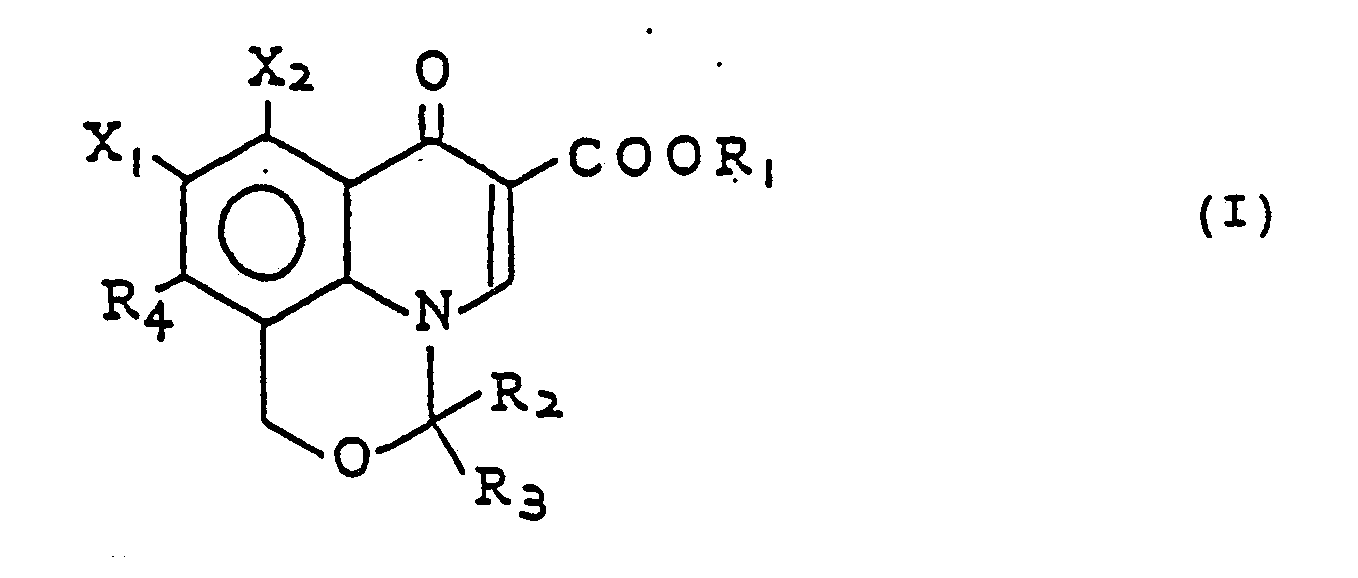
- This invention relates to novel pyridobenzoxazine derivatives and their salts which are excellent synthetic antimicrobial substances.
- a number of compounds having a pyridonecarboxylic acid basic structure have been used as pharmaceuticals in recent years because of their excellent antimicrobial capability and a wide antimicrobial spectrum.
- ofloxacin having a [1,2,3-de][1,4]benzoxazine structure Japanese Patent Publication No.11955/1986
- Japanese Patent Publication No.11955/1986 Japanese Patent Publication No.11955/1986
- physicochemical characteristics of chemical compounds depend largely upon their chemical structure. This applies also to antimicrobial chemical compounds, and for this reason, constant, ever-lasting desire exists for new compounds having antimicrobial activities.
- the present inventors have synthesized compounds having a [3,2,1-ij][3,1]benzoxazine structure and found that these compounds exhibited extremely strong antimicrobial activity. This finding has led to the completion of this invention.
- X1 and X2 individually represent a hydrogen atom or a halogen atom.
- R1 represents a hydrogen atom or a carboxyl protective group.
- R2 and R3 individually represent a hydrogen atom, a lower alkyl group which may be substituted by halogen atoms, or a lower alkenyl group; or R2 and R3 may, in combination, form a 3-6 membered ring together with the adjacent carbon atom.
- the compounds of formula (I) and their salts are novel compounds and exhibit a superior antimicrobial activities against both gram positive and gram negative microorganisms.
- the compounds of formula (I) and their salts therefore have a great value as antimicrobial agents. They can be used as a medicine for curing diseases caused by bacteria not only of man, but also of animals and fish.
- Pyridobenzoxazine derivatives of the present invention have a general formula: wherein X1, X2, and R1-R4 have the meanings defined above.
- the carbon atom to which R2 and R3 are bonded is asymmetrical, and therefore there can exist optically isometric compounds of formula (I).
- the present invention includes each of such optical isomers as well as mixtures of such optical isomers.
- Halogen atoms in this invention include fluorine, chlorine, bromine, and iodine atoms. Fluorine atom is a preferable halogen atom.
- a carboxyl protective group means an ester residue of carboxylic acid ester. It may be a lower alkyl group, e.g. methyl, ethyl, n-propyl, isopropyl, or t-butyl groups; or any group which hydrolyzes in a living body and produces a free carboxylic acid such as lower alkanoyloxyxalkyl group (e.g. acetoxymethyl, 1-acetoxyethyl, or pivaloyloxymethyl group), lower alkoxycarbonyloxyalkyl (e.g. methoxycarbonyloxymethyl group or 1-ethoxycarbonyloxymethyl group), lactonyl group (e.g.
- lower alkanoyloxyxalkyl group e.g. acetoxymethyl, 1-acetoxyethyl, or pivaloyloxymethyl group
- lower alkoxycarbonyloxyalkyl e.g. methoxycarbonyloxymethyl group or 1-
- phthalidyl group or thiophthalidyl group lower alkoxymethyl group (e.g. methoxymethyl group), (5-methyl-2-oxo-1,3-dioxol-4-yl)methyl group, or the like.
- a lower alkyl group which may be substituted by halogen atoms means a lower alkyl group which may be substituted by one or more halogen atoms, and includes such groups as methyl, ethyl, n-propyl, fluoromethyl, chloromethyl, and the like. Methyl group is preferable.
- a 3-6 membered ring which is formed by R2 and R3 together with the adjacent carbon atom is, for example, cyclopropane ring, cyclobutane ring, or the like.
- a halogen atom may be fluorine, chlorine, bromine, or iodine atom. Fluorine and chlorine are preferable halogen atoms.
- R5 represents a lower alkyl group which may have a substituent, a cyclo-lower alkyl group which may have a substituent, an aryl group which may have a substituent, a 5 or 6 membered heterocyclic group which may have a substituent, or an alkyl- or arylsulfonyl group which may have a substituent.
- a lower alkyl group include methyl, ethyl, and the like.
- a cyclo-lower alkyl group is, for example, cyclopentyl group, cyclohexyl group, or the like.
- a typical aryl group is phenyl group.
- Examples of a 5 or 6 membered heterocyclic group is thiazolyl group, oxazolyl group, and the like.
- An alkylsulfonyl group is exemplified by methanesulfonyl group, and an arylsulfonyl group by benzenesulfonyl group. These groups may have substituents such as a halogen atom, a hydroxyl group, a lower alkoxy group (e.g. methoxy, ethoxy, etc.), a lower alkyl group (e.g. methyl, ethyl, etc.), acyl group (e.g. acetyl, propionyl, etc.), amino group which may have substituents (e.g. methylamino, diethylamino, etc.), carboxy group, nitro group, cyano group, or the like.
- R6 represents a lower alkyl group which may have a substituent, a cyclo-lower alkyl group which may have a substituent, an aryl group which may have a substituent, or a 5 or 6 membered heterocyclic group which may have a substituent.
- a lower alkyl group include methyl, ethyl, and the like.
- a cyclo-lower alkyl group is, for example, cyclopentyl group, cyclohexyl group, or the like.
- a typical aryl group is phenyl group.
- Examples of a 5 or 6 membered heterocyclic group is thiazolyl group, oxazolyl group, and the like.
- These groups may have substituents such as a halogen atom, a hydroxyl group, a lower alkoxy group (e.g. methoxy, ethoxy, etc.), lower alkyl group (e.g. methyl, ethyl, etc.), acyl group (e.g. acetyl, propionyl, etc.), amino group which may have substituents (e.g. methylamino, diethylamino, etc.), carboxy group, nitro group, cyano group, or the like.
- substituents such as a halogen atom, a hydroxyl group, a lower alkoxy group (e.g. methoxy, ethoxy, etc.), lower alkyl group (e.g. methyl, ethyl, etc.), acyl group (e.g. acetyl, propionyl, etc.), amino group which may have substituents (e.g. methylamino, diethylamin
- R7 and R8 individually represent a lower alkyl group, a lower alkenyl group, a cyclo-lower alkyl group, a lower aralkyl group, an aryl group, or a 5 or 6 membered heterocyclic group, all of which may have a substituent.
- a lower alkyl group include methyl, ethyl, n-propyl and the like.
- a lower alkenyl group includes allyl group and the like.
- a cyclo-lower alkyl group is, for example, cyclopentyl group, cyclohexyl group, or the like.
- a lower aralkyl group may be benzyl or phenetyl group.
- a typical aryl group is phenyl group.
- Examples of a 5 or 6 membered heterocyclic group include pyridyl group, imidazolyl group, thiazolyl group, oxazolyl group, and the like. These groups may have substituents such as a halogen atom, a hydroxyl group, lower alkoxy group (e.g. methoxy, ethoxy, etc.), lower acyloxy group (acetoxy, propyoxy, etc.), acyl group (e.g.
- acetyl, benzoyl, etc. carboxy group, a lower alkoxycarbonyl group which may have a substituent (e.g. methoxycarbonyl, ethoxycarbonyl, etc.), aminocarbonyl group which may have a substituent (e.g. methylaminocarbonyl, dimethylaminocarbonyl, etc.), amino group which may have a substituent (e.g. amino, methylamino, ethylamino, dimethylamino, diethylamino, pyrrolidinyl, piperidinyl, benzylamino, etc.), acylamino group which may have a substituent (e.g.
- N-acetylmethylamino, N-acetylethylamino, etc. aminocarbonyl group which may have a substituent (e.g. methylaminocarbonyl, ethylaminocarbonyl, etc.), cyano group, alkoxycarbonylamino group which may have a substituent (e.g. methoxycarbonylamino, etc.), or the like.
- These cyclic amino groups may have substituents on the carbon atom.
- substituents include halogen atoms, hydroxyl group, alkoxy group (e.g. a lower alkoxy group such as methoxy, ethoxy, etc.), acyloxy group (e.g. acetoxy, benzoyloxy, etc.), carboxy group, alkoxycarbonyl group (e.g. ethoxycarbonyl, benzyloxycarbonyl, etc.), aminocarbonyl group which may have a substituent (e.g. methylaminocarbonyl, dimethylaminocarbonyl, etc.), alkylthio group (e.g.
- amino group which may have a substituent e.g. amino, methylamino, ethylamino, n-propylamino, dimethylamino, ethylmethylamino, diethylamino, benzylmethylamino, pyrrolidinyl, piperidinyl, cyclopropylamino, hydroxyethylamino, etc.
- acylamino group which may have a substituent (e.g.
- aralkyl group which may have a substituent e.g. benzyl, phenetyl, etc.
- aryl group which may have a substituent e.g. phenyl, etc.
- R9 group include, as lower alkyl groups which may have a substituent, methyl, ethyl, n-propyl, n-butyl, sec-butyl, t-butyl, hydroxyethyl, methoxymethyl, ethoxymethyl, 1-methoxyethyl, 2-methoxyethyl, 2-acetoxyethyl, 3-oxoybutyl, acetonyl, and the like; as lower alkenyl groups which may have a substituent, allyl and the like; as cyclo-lower alkyl group which may have a substituent, cyclopentyl, cyclohexyl, and the like; as lower aralkyl groups which may have a substituent, benzyl, p-methoxybenzyl, and the like; as aryl group,
- R7R8N- is a cyclic amino group containing a substituent on the carbon atom thereof or the nitrogen atom of -R9N-
- preferable examples of R7R8N- having such a substituent include 3-hydroxyazetidinyl, 3-aminoazetidinyl, 3-(N-t-butoxycarbonylamino)azetidinyl, 3-acetylaminoazetidinyl, 3-methylaminoazetidinyl, 3-dimethylaminoazetidinyl, 3-hydroxypyrrolidinyl, 3,4-dihydroxypyrrolidinyl, 3-methoxypyrrolidinyl, 3-methylpyrrolidinyl, 3-aminopyrrolidinyl, 3-methylaminopyrrolidinyl, 3-dimethylaminopyrrolidinyl, 3-ethylaminopyrrolidinyl, 3-diethylaminopyrrolidiny
- the compound of this invention may form a pharmacologically acceptable acid or base addition salt.
- acid addition salts are, for example, (a) a salt of inorganic acid such as hydrochloric acid, sulfuric acid, or the like, (b) a salt of organic carboxylic acid such as formic acid, citric acid, trichloroacetic acid, trifluoroacetic acid, or the like, and (c) a salt of sulfonic acid such as methanesulfonic acid, benzenesulfonic acid, p-toluenesulfonic acid, mesitylenesulfonic acid, naphthalenesulfonic acid, or the like.
- base addition salts include (a) a salt of alkali metal such as sodium, potassium, or the like, (b) a salt of alkaline earth metal such as calcium, magnesium, or the like, (c) an ammonium salt, and (d) a salt of nitrogen-containing organic base such as trimethylamine, triethylamine, tributylamine, pyridine, N,N-dimethylaniline, N-methylpiperidine, N-methylmorpholine, diethylamine, dicyclohexylamine, procaine, dibenzylamine, N-benzyl- ⁇ -phenetylamine, 1-ephenamine, N,N′-dibenzylethylenediamine, or the like.
- a salt of alkali metal such as sodium, potassium, or the like
- alkaline earth metal such as calcium, magnesium, or the like
- ammonium salt an ammonium salt
- a salt of nitrogen-containing organic base such as trimethylamine, triethylamine, tribu
- the compounds of this invention can be present in any molecular form containing or not containing a solvent combined therein. In other words, they are capable of taking any crystalline forms containing or not containing molecules of a solvent including water. Accordingly, the present invention encompasses all of crystal forms and hydrates of such compounds.
- a starting material of the process is o-hydroxymethylaniline [Compound (A)] or o-(acyloxymethyl)aniline [Compound (C)].
- An acyl group (R′) in Compound (C) may be any group which is commonly used as a hydroxyl protective group. Examples may be acetyl, propionyl, or benzoyl group.
- Compound (B) or Compound (D) is produced by reacting Compound (A) or Compound (C) with diethyl ethoxymethylene malonate.
- the reaction is carried out usually without using a solvent at a temperature of 80-150°C, although it is possible to carry out the reaction in the presence of a solvent having no active hydrogen such as toluene, xylene, or the like.
- Compound (B) can be converted into Compound (D) by acylation. Any acylation reaction commonly used for hydroxyl group acylation can be used for the conversion.
- an acylchloride corresponding to R′ can be reacted with Compound (B) in a solvent having no active hydrogen such as dichloromethane, ether, or acetone at a temperature of 0°C to room temperature, in the presence or absence of a base such as pyridine, triethylamine, sodium carbonate, potassium carbonate, or the like.
- Compound (E) is produced by a cyclization reaction of Compound (D).
- the reaction can be carried out by various methods.
- One example is a method of heating Compound (D) at 180-270°C in the presence of an inert solvent such as diphenylether, dibenzylether, or the like.
- Compound (D) is heated at 100-160°C in polyphosphoric acid.
- Compound (E) is converted into Compound (F) by alcoholysis.
- the alcoholysis reaction is carried out at a temperature of room temperature to 100°C using as a solvent an alcohol having R′1 group with which the carboxyl group of Compound (F) or Compound (G) is to be substituted, optionally in combination with other solvent such as benzene, toluene, dimethylformamide, dimethylsulfoxide, or N-methylpyrrolidone, and using a catalytic amount of sodium hydroxide, potassium hydroxide, sodium methylate, sodium ethylate, or a base such as metal alcoholate having a group R′1.
- Cyclization of Compound (F) into Compound (G) can be carried out by reacting Compound (F) with a ketone or aldehyde having desired R2 and R3, which is represented by the formula R2 R3, or a ketal or acetal thereof.
- the reaction is carried out at a temperature of room temperature to 150°C in the presence or absence of an inert solvent such as benzene, toluene, dimethylformamide, dimethylsulfoxide, or N-methyl-pyrrolidone, and using a catalytic amount of organic or inorganic acid such as p-toluenesulfonic acid, benzenesulfonic acid, trifluoroacetic acid, sulfuric acid, hydrochloric acid, perhydrochloric acid, or the like.
- an inert solvent such as benzene, toluene, dimethylformamide, dimethylsulfoxide, or N-methyl-pyrrolidone
- organic or inorganic acid such as p-toluenesulfonic acid, benzenesulfonic acid, trifluoroacetic acid, sulfuric acid, hydrochloric acid, perhydrochloric acid, or the like.
- Any commonly known method can be used for producing Compound (H) by hydrolysis of Compound (G).
- a method is used in which Compound (G) is treated at a temperature of room temperature to 100°C in an alkaline aqueous solution, such as an aqueous solution of sodium hydroxide, potassium hydroxide, sodium hydrogen carbonate, or the like, either using or without using a solvent which can dissolve into water, such as ethanol, methanol, tetrahydrofuran, dimethylformamide, or the like.
- those having a hydrogen atom or a lower alkyl group for R1 and R6S- or R7R8N- for R4 can be prepared by a process shown by the following reaction formula (II), wherein X1, X2, R2, and R3, have the same meanings as previously defined for formula (I), X ⁇ 3 represents a fluorine or chlorine atom, R ⁇ 1 represents a hydrogen atom or a lower alkyl group, R′4 has the meaning as previously defined in connection with R6S and R7R8N, and M is an alkali metal.
- reaction formula (II) wherein X1, X2, R2, and R3, have the same meanings as previously defined for formula (I), X ⁇ 3 represents a fluorine or chlorine atom, R ⁇ 1 represents a hydrogen atom or a lower alkyl group, R′4 has the meaning as previously defined in connection with R6S and R7R8N, and M is an alkali metal.
- This process comprises reacting Compound (I) which is produced in Process 1 with R′4-H or its alkali metal compound R′4-M.
- the reaction is desirably carried out in the presence of an inert solvent such as acetonitrile, dimethylformamide, dimethylsulfoxide, N-methylpyrrolidone, or the like, or a mixture of these solvents, at a temperature of 50-200°C, preferably of 80-150°C.
- an inert solvent such as acetonitrile, dimethylformamide, dimethylsulfoxide, N-methylpyrrolidone, or the like, or a mixture of these solvents, at a temperature of 50-200°C, preferably of 80-150°C.
- a base such as triethylamine, lutidine, 1,4-diazabicyclo[5,4,0]-undeca-7-ene, 1,5-diazabicyclo[4,3,0]nona-5-ene, an alakli metal carbonate, or the like in order to neutralize hydrogen fluoride or hydrogen chloride which is produced in the reaction.
- the product may be obtained as a salt.
- the salt can be converted into a free acid by treating with an acid such as acetic acid, trifluoroacetic acid, hydrochloric acid, or the like, or with a base such as sodium carbonate, potassium carbonate, sodium hydroxide, potassium hydroxide, or the like.
- R6, R7, or R8 in the group R′4 has a hydroxyl, mercapto, carboxyl, or amino group substituent
- an yield of Compound (J) in the above reaction may be extremely decreased.
- a better yield can be attained if R6, R7, or R8 can be subjected to the reaction of Process 2 after the hydroxyl, mercapto, carboxyl, or amino group substituent is modified with a suitable protective group.
- the protective group may be removed after the reaction. Any conventionally known protective groups can be used.
- Examples include, for protecting hydroxyl group, acyl, alkoxycarbonyl, or banzyl group; for protecting mercapto group, acyl or ethylthio group; for protecting carboxyl group, banzyl group; for protecting amino group, acyl, alkoxycarbonyl, or banzyl group.
- These protective groups can be removed after the reaction by a commonly known method such as acid hydrolysis, base hydrolysis, or catalytic hydrogenation.
- the step for producing Compound (M) from Compound (L) can be carried out by reacting Compound (L) with a lower alkyl halide, preferably with a lower alkyl iodide or bromide, having an R′1 group. It is desirable the reaction be carried out in the presence of a base such as triethylamine, trimethylamine, sodium hydroxide, potassium hydroxide, sodium carbonate, potassium carbonate, or the like, and an inert solvent such as dimethylformamide, dimethylsulfoxide, N-methylpyrrolidone, or the like.
- a preferable temperature range is from room temperature to 100°C.
- Compound (N) can be prepared by reacting Compound (M) having hydrogen atom for R′5 with an alkylsulfonyl halide or arylsulfonyl halide having a formula of R ⁇ 5SO2X. It is desirable to carry out this reaction in the presence of a base such as triethylamine, pyridine, N,N-dimethylaniline, potassium carbonate, sodium carbonate, or the like, and an inert solvent such as benzene, acetonitrile, dimethylformamide, dimethylsulfoxide, N-methylpyrrolidone, or the like.
- a preferable reaction temperature range is from room temperature to 80°C.
- those having a carboxyl protective group for R1 can be prepared by a process shown, for example, by the following reaction formula (IV), wherein X1, X2, R2, R3, and R4 have the same meanings as previously defined for formula (I), R ⁇ ⁇ 1 represents the same carboxy protective group as defined for R1, and X is a halogen atom.
- Compound (P) is prepared by reacting Compound (O) with a halide R ⁇ ⁇ 1X. The reaction is carried out using the same conditions as those used for the conversion of Compound (L) into Compound (M) as discussed in Process 3.
- Processes 1-4 discussed above are examples for the preparation of novel pyrido[3,2,1-ij][3,1]benzoxazine compounds of formula (I) of this invention. Methods for the production of the compounds of formula (I) are by no means limited to these Processes 1-4. Especially, substituents in the groups represented by R4 can be interchangeable by a variety of known methods. An example of such interchange of substituents was discussed in Process 2 in connection with protective group attachment and detachment.
- substituent interchange are the conversion of a hydroxyl group into halogen atom, acylation of hydroxyl, mercapto, or primary- or secondary amino group, conversion of halogen atom into amino or cyano group, removal of alkoxycarbonyl, benzyl, or acyl group, alkylation of hydroxyl, mercapto, carboxyl, or primary- or secondary amino group, sulfonylation of primary- or secondary amino group, conversion of alkenyl group into alkyl group, cyclization of two or more substituents.
- Efficient preparation of pyrido[3,2,1-ij][3,1]benzoxazine compounds of formula (I) of this invention is possible by siutable combinations of these reactions.
Landscapes
- Chemical & Material Sciences (AREA)
- Organic Chemistry (AREA)
- Health & Medical Sciences (AREA)
- Chemical Kinetics & Catalysis (AREA)
- Life Sciences & Earth Sciences (AREA)
- General Chemical & Material Sciences (AREA)
- Medicinal Chemistry (AREA)
- Nuclear Medicine, Radiotherapy & Molecular Imaging (AREA)
- Communicable Diseases (AREA)
- Pharmacology & Pharmacy (AREA)
- Oncology (AREA)
- Animal Behavior & Ethology (AREA)
- General Health & Medical Sciences (AREA)
- Public Health (AREA)
- Veterinary Medicine (AREA)
- Nitrogen And Oxygen Or Sulfur-Condensed Heterocyclic Ring Systems (AREA)
- Pharmaceuticals Containing Other Organic And Inorganic Compounds (AREA)
Abstract
Pyridobenzoxazine derivatives having a [3,2,1-ij][3,1]benzoxazine structure represented by the formula (I) and their salts are disclosed.
There are many varieties for the compound depending on the types of residues R₁-R₄, X₁, and X₂. The compounds of formula (I) and their salts have excellent antimicrobial activities and wide antimicrobial spectra, and are effective against both gram positive and gram negative microorganisms. They can be used as a medicine, an agrichemical, and a food preservative.
Description
- This invention relates to novel pyridobenzoxazine derivatives and their salts which are excellent synthetic antimicrobial substances.
- A number of compounds having a pyridonecarboxylic acid basic structure have been used as pharmaceuticals in recent years because of their excellent antimicrobial capability and a wide antimicrobial spectrum. Among these compounds, ofloxacin having a [1,2,3-de][1,4]benzoxazine structure (Japanese Patent Publication No.11955/1986) is highly evaluated as a medicine exhibiting both high antimicrobial capability and a superior absorption ratio. Generally, physicochemical characteristics of chemical compounds depend largely upon their chemical structure. This applies also to antimicrobial chemical compounds, and for this reason, constant, ever-lasting desire exists for new compounds having antimicrobial activities. In view of this situation, the present inventors have synthesized compounds having a [3,2,1-ij][3,1]benzoxazine structure and found that these compounds exhibited extremely strong antimicrobial activity. This finding has led to the completion of this invention.
- Accordingly, an object of this invention is to provide pyridobenzoxazine derivatives represented by the formula (I) or salts thereof.

- Various substituents in formula (I) have the following meanings:
X₁ and X₂: individually represent a hydrogen atom or a halogen atom.
R₁: represents a hydrogen atom or a carboxyl protective group.
R₂ and R₃: individually represent a hydrogen atom, a lower alkyl group which may be substituted by halogen atoms, or a lower alkenyl group; or R₂ and R₃ may, in combination, form a 3-6 membered ring together with the adjacent carbon atom.
R₄: represents a hydrogen atom, a hydroxyl group, a group R₅-O, wherein R₅ represents a lower alkyl group which may have a substituent, a cyclo-lower alkyl group which may have a substituent, an aryl group which may have a substituent, a 5 or 6 membered heterocyclic group which may have a substituent, or an alkyl- or arylsulfonyl group which may have a substituent; a group R₆S-, wherein R₆ represents a lower alkyl group which may have a substituent, a cyclo-lower alkyl group which may have a substituent, an aryl group which may have a substituent, or a 5 or 6 membered heterocyclic group which may have a substituent; or a group R₇R₈N-, wherein R₇ and R₈ individually represent a hydrogen atom, a lower alkyl group which may have a substituent, a lower alkenyl group which may have a substituent, a cyclo-lower alkyl group which may have a substituent, a lower aralkyl group which may have a substituent, an aryl group which may have a substituent, a 5 or 6 membered heterocyclic group which may have a substituent, or R₇ and R₈ may, in combination, form a 4-7 membered cyclic amino group together with the adjacent nitrogen atom; provided (i) that the carbon atoms of the cyclic amino group may have one or more substituents selected from the group consisting of halogen atom, hydroxyl group, alkoxy group, acyloxy group, carboxyl group, alkoxycarbonyl group, aminocarbonyl group which may have a substituent, cyano group, mercapto group, alkylthio group, amino group which may have a substituent, acylamino group which may have a substituent, alkoxycarbonylamino group which may have a substituent, lower alkyl group which may have a substituent, lower alkenyl group which may have a substituent, cyclo-lower alkyl group which may have a substituent, aralkyl group which may have a substituent, and aryl group which may have a substituent, provided that when carbon atoms have two or more substituents which are lower alkyl groups which may have a substituent, the two lower alkyl groups which may have a substituent and the cyclic amino group may together form a bi-cyclic amino group; (ii) that said cyclic amino group or said bi-cyclic amino group may contain in their rings a group -NR₉, --,
-O-, -S-, -SO-, or -SO₂-; wherein R₉ is a hydrogen atom, a hydroxyl group, lower alkyl group which may have a substituent, lower alkenyl group which may have a substituent, cyclo-lower alkyl group which may have a substituent, aralkyl group which may have a substituent, aryl group which may have a substituent, acyl group which may have a substituent, a lower alkyloxycarbonyl group which may have a substituent, aralkyloxycarbonyl group which may have a substituent, alkylsulfonyl group which may have a substituent, or arylsulfonyl group which may have a substituent; provided that when -NR₉- is contained in the ring, R₉ is a lower alkyl group which may have a substituent, and at least one lower alkyl group which may have a substituent is present on a carbon atom or carbon atoms of the cyclic amino group, one of the lower alkyl groups and said cyclic amino group which is represented by R₇R₈N- may together form a bi-cyclic amino group, and (iii) further that said cyclic amino group or said bi-cyclic amino group may contain therein a double bond. - Other objects, features and advantages of the invention will hereinafter become more readily apparent from the following description.
- The compounds of formula (I) and their salts are novel compounds and exhibit a superior antimicrobial activities against both gram positive and gram negative microorganisms. The compounds of formula (I) and their salts therefore have a great value as antimicrobial agents. They can be used as a medicine for curing diseases caused by bacteria not only of man, but also of animals and fish.
- Pyridobenzoxazine derivatives of the present invention have a general formula:
- In the above definitions, "lower" means C₁-C₇, preferably C₁-C₄, when the group in question is a linear or branched group, and C₃-C₇ when the group is a cyclic group.
- When R₂ and R₃ are different from each other, the carbon atom to which R₂ and R₃ are bonded is asymmetrical, and therefore there can exist optically isometric compounds of formula (I). The present invention includes each of such optical isomers as well as mixtures of such optical isomers.
- Each substituent of the compound of formula (I) is now discussed in detail.
- Halogen atoms in this invention include fluorine, chlorine, bromine, and iodine atoms. Fluorine atom is a preferable halogen atom.
- A carboxyl protective group means an ester residue of carboxylic acid ester. It may be a lower alkyl group, e.g. methyl, ethyl, n-propyl, isopropyl, or t-butyl groups; or any group which hydrolyzes in a living body and produces a free carboxylic acid such as lower alkanoyloxyxalkyl group (e.g. acetoxymethyl, 1-acetoxyethyl, or pivaloyloxymethyl group), lower alkoxycarbonyloxyalkyl (e.g. methoxycarbonyloxymethyl group or 1-ethoxycarbonyloxymethyl group), lactonyl group (e.g. phthalidyl group or thiophthalidyl group), lower alkoxymethyl group (e.g. methoxymethyl group), (5-methyl-2-oxo-1,3-dioxol-4-yl)methyl group, or the like.
- A lower alkyl group which may be substituted by halogen atoms means a lower alkyl group which may be substituted by one or more halogen atoms, and includes such groups as methyl, ethyl, n-propyl, fluoromethyl, chloromethyl, and the like. Methyl group is preferable.
- Examples of a lower alkenyl group is vinyl, allyl, propenyl, and the like. A preferable alkenyl group is vinyl group.
- A 3-6 membered ring which is formed by R₂ and R₃ together with the adjacent carbon atom is, for example, cyclopropane ring, cyclobutane ring, or the like.
- A halogen atom may be fluorine, chlorine, bromine, or iodine atom. Fluorine and chlorine are preferable halogen atoms.
- In the definition of R₅O-, R₅ represents a lower alkyl group which may have a substituent, a cyclo-lower alkyl group which may have a substituent, an aryl group which may have a substituent, a 5 or 6 membered heterocyclic group which may have a substituent, or an alkyl- or arylsulfonyl group which may have a substituent. Examples of a lower alkyl group include methyl, ethyl, and the like. A cyclo-lower alkyl group is, for example, cyclopentyl group, cyclohexyl group, or the like. A typical aryl group is phenyl group. Examples of a 5 or 6 membered heterocyclic group is thiazolyl group, oxazolyl group, and the like. An alkylsulfonyl group is exemplified by methanesulfonyl group, and an arylsulfonyl group by benzenesulfonyl group. These groups may have substituents such as a halogen atom, a hydroxyl group, a lower alkoxy group (e.g. methoxy, ethoxy, etc.), a lower alkyl group (e.g. methyl, ethyl, etc.), acyl group (e.g. acetyl, propionyl, etc.), amino group which may have substituents (e.g. methylamino, diethylamino, etc.), carboxy group, nitro group, cyano group, or the like.
- In the definition of R₆-S, R₆ represents a lower alkyl group which may have a substituent, a cyclo-lower alkyl group which may have a substituent, an aryl group which may have a substituent, or a 5 or 6 membered heterocyclic group which may have a substituent. Examples of a lower alkyl group include methyl, ethyl, and the like. A cyclo-lower alkyl group is, for example, cyclopentyl group, cyclohexyl group, or the like. A typical aryl group is phenyl group. Examples of a 5 or 6 membered heterocyclic group is thiazolyl group, oxazolyl group, and the like. These groups may have substituents such as a halogen atom, a hydroxyl group, a lower alkoxy group (e.g. methoxy, ethoxy, etc.), lower alkyl group (e.g. methyl, ethyl, etc.), acyl group (e.g. acetyl, propionyl, etc.), amino group which may have substituents (e.g. methylamino, diethylamino, etc.), carboxy group, nitro group, cyano group, or the like.
- In the definition of R₇R₈N-, R₇ and R₈ individually represent a lower alkyl group, a lower alkenyl group, a cyclo-lower alkyl group, a lower aralkyl group, an aryl group, or a 5 or 6 membered heterocyclic group, all of which may have a substituent. Examples of a lower alkyl group include methyl, ethyl, n-propyl and the like. A lower alkenyl group includes allyl group and the like. A cyclo-lower alkyl group is, for example, cyclopentyl group, cyclohexyl group, or the like. A lower aralkyl group may be benzyl or phenetyl group. A typical aryl group is phenyl group. Examples of a 5 or 6 membered heterocyclic group include pyridyl group, imidazolyl group, thiazolyl group, oxazolyl group, and the like. These groups may have substituents such as a halogen atom, a hydroxyl group, lower alkoxy group (e.g. methoxy, ethoxy, etc.), lower acyloxy group (acetoxy, propyoxy, etc.), acyl group (e.g. acetyl, benzoyl, etc.), carboxy group, a lower alkoxycarbonyl group which may have a substituent (e.g. methoxycarbonyl, ethoxycarbonyl, etc.), aminocarbonyl group which may have a substituent (e.g. methylaminocarbonyl, dimethylaminocarbonyl, etc.), amino group which may have a substituent (e.g. amino, methylamino, ethylamino, dimethylamino, diethylamino, pyrrolidinyl, piperidinyl, benzylamino, etc.), acylamino group which may have a substituent (e.g. N-acetylmethylamino, N-acetylethylamino, etc.), aminocarbonyl group which may have a substituent (e.g. methylaminocarbonyl, ethylaminocarbonyl, etc.), cyano group, alkoxycarbonylamino group which may have a substituent (e.g. methoxycarbonylamino, etc.), or the like.
- When R₇ and R₈ form a cyclic amino group together with the adjacent nitrogen atom, given as examples of such a cyclic amino group are azetidinyl, pyrrolidinyl, piperidinyl, piperazinyl, homopiperazinyl, morpholino, thiomorpholino, isooxazolidinyl, imidazolinyl, imidazolyl, pyrazolyl, pyrazolidinyl, thiazolidinyl, thiazolyl, isothiazolyl, pyrrolinyl, 4-oxopiperidinyl, 2-oxo-imdazolidinyl, 2-oxo-oxazolidinyl, and the like.
- These cyclic amino groups may have substituents on the carbon atom. Such substituents include halogen atoms, hydroxyl group, alkoxy group (e.g. a lower alkoxy group such as methoxy, ethoxy, etc.), acyloxy group (e.g. acetoxy, benzoyloxy, etc.), carboxy group, alkoxycarbonyl group (e.g. ethoxycarbonyl, benzyloxycarbonyl, etc.), aminocarbonyl group which may have a substituent (e.g. methylaminocarbonyl, dimethylaminocarbonyl, etc.), alkylthio group (e.g. methylthio, ethylthio, etc.), amino group which may have a substituent (e.g. amino, methylamino, ethylamino, n-propylamino, dimethylamino, ethylmethylamino, diethylamino, benzylmethylamino, pyrrolidinyl, piperidinyl, cyclopropylamino, hydroxyethylamino, etc.), acylamino group which may have a substituent (e.g. N-acetylmethylamino, N-acetylethylamino, N-benzoylethylamino, N-acetylamino, N-benzoylamino, etc.), alkoxycarbonylamino group which may have a substituent (e.g. N-methoxycarbonylmethylamino, N-ethoxycarbonylethylamino, N-t-butoxycarbonylmethylamino, N-benzyloxycarbonylmethylamino, N-ethoxycarbonylmethylamino, N-t-butoxycarbonylethylamino, N-benzyloxycarbonylethylamino, N-t-butoxycarbonylamino, N-benzyloxycarbonylamino, etc.), lower alkyl group which may have a substituent (e.g. methyl, ethyl, n-propyl, isopropyl, n-butyl, t-butyl, fluoromethyl, chloromethyl, bromomethyl, iodomethyl, 1-chloroethyl, hydroxymethyl, 1-hydroxyethyl, 2-hydroxyethyl, 1-hydroxy-n-propyl, methoxymethyl, ethoxymethyl, benzyloxymethyl, carboxymethyl, methoxycarbonylmethyl, ethoxycarbonylmethyl, t-butoxycarbonylmethyl, benzyloxycarbonylmethyl, cyanomethyl, aminocarbonylmethyl, methylaminocarbonylmethyl, dimethylaminocarbonylmethyl, aminomethyl, methylaminomethyl, dimethylaminomethyl, ethylaminomethyl, diethylaminomethyl, n-propylaminomethyl, bi-(n-propyl)aminomethyl, isopropylaminomethyl, n-butylaminomethyl, 1-aminoethyl, 1-methylaminoethyl, 1-dimethylaminoethyl, 2-aminoethyl, 2-methylaminoethyl, 2-dimethylaminoethyl, 2-ethylaminoethyl, 2-diethylaminoethyl, 3-aminopropyl, 3-dimethylaminopropyl, pyrrolidinylmethyl, benzylaminomethyl, benzylmethylaminomethyl, N-acetylaminomethyl, N-acetylmethylaminomethyl, N-acetylethylaminomethyl, N-benzoylaminomethyl, 1-(N-acetylamino)ethyl, 1-(N-acetylmethylamino)ethyl, 1-(N-benzoylamino)ethyl, N-methoxycarbonylaminomethyl, N-ethoxycarbonylaminomethyl, N-ethoxycarbonylmethylaminomethyl, N-t-butoxycarbonylaminomethyl, N-t-butoxycarbonylmethylaminomethyl, N-t-butoxycarbonylethylaminomethyl, 1-(N-t-butoxycarbonylamino)ethyl, 1-(N-t-butoxycarbonylmethylamino)ethyl, 2-(N-t-butoxycarbonylamino)ethyl, N-benzyloxycarbonylaminomethyl, N-benzyloxycarbonylmethylaminomethyl, N-benzyloxycarbonylethylaminomethyl, 2-hydroxyethylaminomethyl, etc.), lower alkenyl group which may have a substituent (e.g. allyl, etc.), aralkyl group which may have a substituent (e.g. benzyl, phenetyl, etc.), aryl group which may have a substituent (e.g. phenyl, etc.).
- Following groups are given as examples of groups containing -NR₉- in an amino group and the amino group is bi-cyclic.

- In the case where R₇R₈N- forms a cyclic amino group containing -NR₉- in the ring, preferable examples of R₉ group include, as lower alkyl groups which may have a substituent, methyl, ethyl, n-propyl, n-butyl, sec-butyl, t-butyl, hydroxyethyl, methoxymethyl, ethoxymethyl, 1-methoxyethyl, 2-methoxyethyl, 2-acetoxyethyl, 3-oxoybutyl, acetonyl, and the like; as lower alkenyl groups which may have a substituent, allyl and the like; as cyclo-lower alkyl group which may have a substituent, cyclopentyl, cyclohexyl, and the like; as lower aralkyl groups which may have a substituent, benzyl, p-methoxybenzyl, and the like; as aryl group, phenyl and the like; as acyl groups which may have a substituent, formyl, acetyl, propionyl, benzoyl, and the like; as lower alkoxycarbonyl groups which may have a substituent, methoxycarbonyl, ethoxycarbonyl, t-butoxycarbonyl, and the like; as aralkyloxycarbonyl groups which may have a substituent, benzyloxycarbonyl and the like; as alkylsulfonyl groups which may have a substituent, methylsulfonyl and the like; arylsulfonyl groups which may have a substituent, benzenesulfonyl, p-toluenesulfonyl, and the like.
- In the case where R₇R₈N- is a cyclic amino group containing a substituent on the carbon atom thereof or the nitrogen atom of -R₉N-, preferable examples of R₇R₈N- having such a substituent include 3-hydroxyazetidinyl, 3-aminoazetidinyl, 3-(N-t-butoxycarbonylamino)azetidinyl, 3-acetylaminoazetidinyl, 3-methylaminoazetidinyl, 3-dimethylaminoazetidinyl, 3-hydroxypyrrolidinyl, 3,4-dihydroxypyrrolidinyl, 3-methoxypyrrolidinyl, 3-methylpyrrolidinyl, 3-aminopyrrolidinyl, 3-methylaminopyrrolidinyl, 3-dimethylaminopyrrolidinyl, 3-ethylaminopyrrolidinyl, 3-diethylaminopyrrolidinyl, 3-aminomethylpyrrolidinyl, 3-methylaminomethylpyrrolidinyl, 3-dimethylaminomethylpyrrolidinyl, 3-ethylaminopyrrolidinyl, 3-diethylaminopyrrolidinyl, 3-(1-aminoethyl)pyrrolidinyl, 3-(2-aminoethyl)pyrrolidinyl, 3-(1-methylaminoethyl)-pyrrolidinyl, 3-methyl-3-aminopyrrolidinyl, 3-methyl-4-aminopyrrolidinyl, 3-methyl-4-methylaminopyrrolidinyl, 3-methyl-4-dimethylaminopyrrolidinyl, 2-methyl-3-aminopyrrolidinyl, 2-methyl-3-dimethylaminopyrrolidinyl, 3,4-diaminopyrrolidinyl, 3-amino-4-dimethylamino pyrrolidinyl, 3-hydroxy-4-aminopyrrolidinyl, 3-hydroxy-4-dimethylaminopyrrolidinyl, 4-hydroxypiperidinyl, 3-pyrrolidinylpyrrolidinyl, 4-aminopiperidinyl, 4-dimethylaminopiperidinyl, 4-pyrrolidinylpiperidinyl, 3-methylpiperazinyl, 4-methylpiperazinyl, 3,5-dimethylpiperazinyl, 3,4,5-trimethylpiperazinyl, 4-ethylpiperazinyl, 4-benzylpiperazinyl, 4-formylpiperazinyl, 4-acetylpiperazinyl, 4-benzoylpiperazinyl, 4-ethoxycarbonylpiperazinyl, 4-t-butoxycarbonylpiperazinyl, 4-benzyloxycarbonylpiperazinyl, 4-methylsulfonylpiperazinyl, 3-methyl-4-formylpiperazinyl, 3-methyl-4-acetylpiperazinyl, 3-methyl-4-t-butoxycarbonylpiperazinyl, 4-hydroxyethylpiperazinyl, 4-aminoethylpiperazinyl, 4-cyanomethylpiperazinyl, 4-cyanoethylpiperazinyl, 2-hydroxymethylmorpholino, 2-aminomethylmorpholino, 2-methylaminomethylmorpholino, 2-dimethylaminomethylmorpholino, 4-methylhomopiperazinyl, 2-methylimidazolyl, 2-methylimidazolidinyl, 3-methylpyrazolyl, 2-methylthiazolidinyl, and the like.
- The compound of this invention may form a pharmacologically acceptable acid or base addition salt. Examples of acid addition salts are, for example, (a) a salt of inorganic acid such as hydrochloric acid, sulfuric acid, or the like, (b) a salt of organic carboxylic acid such as formic acid, citric acid, trichloroacetic acid, trifluoroacetic acid, or the like, and (c) a salt of sulfonic acid such as methanesulfonic acid, benzenesulfonic acid, p-toluenesulfonic acid, mesitylenesulfonic acid, naphthalenesulfonic acid, or the like. Examples of base addition salts include (a) a salt of alkali metal such as sodium, potassium, or the like, (b) a salt of alkaline earth metal such as calcium, magnesium, or the like, (c) an ammonium salt, and (d) a salt of nitrogen-containing organic base such as trimethylamine, triethylamine, tributylamine, pyridine, N,N-dimethylaniline, N-methylpiperidine, N-methylmorpholine, diethylamine, dicyclohexylamine, procaine, dibenzylamine, N-benzyl-β-phenetylamine, 1-ephenamine, N,N′-dibenzylethylenediamine, or the like.
- The compounds of this invention can be present in any molecular form containing or not containing a solvent combined therein. In other words, they are capable of taking any crystalline forms containing or not containing molecules of a solvent including water. Accordingly, the present invention encompasses all of crystal forms and hydrates of such compounds.
- In the preparation of novel pyrido[3,2,1-ij]-[3,1]benzoxazine compounds of formula (I) of this invention, any appropriate methods can be used in forming chemical bonds in the compounds or in forming or introducing various substituents. Examples of preferable methods are given below.
- Among the compounds represented by the formula (I), those having a hydrogen atom or a lower alkyl group for R₁ and a hydrogen or halogen atom for R₄ can be prepared by a process shown by the following reaction formula (I),


- A starting material of the process is o-hydroxymethylaniline [Compound (A)] or o-(acyloxymethyl)aniline [Compound (C)]. An acyl group (R′) in Compound (C) may be any group which is commonly used as a hydroxyl protective group. Examples may be acetyl, propionyl, or benzoyl group.
- Compound (B) or Compound (D) is produced by reacting Compound (A) or Compound (C) with diethyl ethoxymethylene malonate. The reaction is carried out usually without using a solvent at a temperature of 80-150°C, although it is possible to carry out the reaction in the presence of a solvent having no active hydrogen such as toluene, xylene, or the like.
- Compound (B) can be converted into Compound (D) by acylation. Any acylation reaction commonly used for hydroxyl group acylation can be used for the conversion. For example, an acylchloride corresponding to R′ can be reacted with Compound (B) in a solvent having no active hydrogen such as dichloromethane, ether, or acetone at a temperature of 0°C to room temperature, in the presence or absence of a base such as pyridine, triethylamine, sodium carbonate, potassium carbonate, or the like.
- Compound (E) is produced by a cyclization reaction of Compound (D). The reaction can be carried out by various methods. One example is a method of heating Compound (D) at 180-270°C in the presence of an inert solvent such as diphenylether, dibenzylether, or the like. In another method Compound (D) is heated at 100-160°C in polyphosphoric acid.
- Compound (E) is converted into Compound (F) by alcoholysis. The alcoholysis reaction is carried out at a temperature of room temperature to 100°C using as a solvent an alcohol having R′₁ group with which the carboxyl group of Compound (F) or Compound (G) is to be substituted, optionally in combination with other solvent such as benzene, toluene, dimethylformamide, dimethylsulfoxide, or N-methylpyrrolidone, and using a catalytic amount of sodium hydroxide, potassium hydroxide, sodium methylate, sodium ethylate, or a base such as metal alcoholate having a group R′₁.
- Cyclization of Compound (F) into Compound (G) can be carried out by reacting Compound (F) with a ketone or aldehyde having desired R₂ and R₃, which is represented by the formula R₂R₃,

or a ketal or acetal thereof. The reaction is carried out at a temperature of room temperature to 150°C in the presence or absence of an inert solvent such as benzene, toluene, dimethylformamide, dimethylsulfoxide, or N-methyl-pyrrolidone, and using a catalytic amount of organic or inorganic acid such as p-toluenesulfonic acid, benzenesulfonic acid, trifluoroacetic acid, sulfuric acid, hydrochloric acid, perhydrochloric acid, or the like. - Any commonly known method can be used for producing Compound (H) by hydrolysis of Compound (G). For example, a method is used in which Compound (G) is treated at a temperature of room temperature to 100°C in an alkaline aqueous solution, such as an aqueous solution of sodium hydroxide, potassium hydroxide, sodium hydrogen carbonate, or the like, either using or without using a solvent which can dissolve into water, such as ethanol, methanol, tetrahydrofuran, dimethylformamide, or the like.
- Among the compounds represented by the formula (I), those having a hydrogen atom or a lower alkyl group for R₁ and R₆S- or R₇R₈N- for R₄ can be prepared by a process shown by the following reaction formula (II),

- This process comprises reacting Compound (I) which is produced in Process 1 with R′₄-H or its alkali metal compound R′₄-M.
- The reaction is desirably carried out in the presence of an inert solvent such as acetonitrile, dimethylformamide, dimethylsulfoxide, N-methylpyrrolidone, or the like, or a mixture of these solvents, at a temperature of 50-200°C, preferably of 80-150°C. It is desirable to use a base such as triethylamine, lutidine, 1,4-diazabicyclo[5,4,0]-undeca-7-ene, 1,5-diazabicyclo[4,3,0]nona-5-ene, an alakli metal carbonate, or the like in order to neutralize hydrogen fluoride or hydrogen chloride which is produced in the reaction. Another method of neutralizing hydrogen fluoride or hydrogen chloride produced in the reaction is to use an excess amount of an alkali metal compound or R₇R₈NH.
- In this reaction, the product may be obtained as a salt. If necessary, the salt can be converted into a free acid by treating with an acid such as acetic acid, trifluoroacetic acid, hydrochloric acid, or the like, or with a base such as sodium carbonate, potassium carbonate, sodium hydroxide, potassium hydroxide, or the like.
- In case where R₆, R₇, or R₈ in the group R′₄ has a hydroxyl, mercapto, carboxyl, or amino group substituent, an yield of Compound (J) in the above reaction may be extremely decreased. In such a case, a better yield can be attained if R₆, R₇, or R₈ can be subjected to the reaction of Process 2 after the hydroxyl, mercapto, carboxyl, or amino group substituent is modified with a suitable protective group. The protective group may be removed after the reaction. Any conventionally known protective groups can be used. Examples include, for protecting hydroxyl group, acyl, alkoxycarbonyl, or banzyl group; for protecting mercapto group, acyl or ethylthio group; for protecting carboxyl group, banzyl group; for protecting amino group, acyl, alkoxycarbonyl, or banzyl group. These protective groups can be removed after the reaction by a commonly known method such as acid hydrolysis, base hydrolysis, or catalytic hydrogenation.
- Among the compounds represented by the formula (I), those having a hydrogen atom or a lower alkyl group for R₁ and a hydroxyl group or R₅O- for R₄ can be prepared by a process shown in the following reaction formula (III),

- In the step for producing Compound (L) from Compound (K), a compound represented by R′₅OH or its alkali metal compound is reacted with Compound (K). The reaction is carried out under the same conditions as described for Process 2.
- The step for producing Compound (M) from Compound (L) can be carried out by reacting Compound (L) with a lower alkyl halide, preferably with a lower alkyl iodide or bromide, having an R′₁ group. It is desirable the reaction be carried out in the presence of a base such as triethylamine, trimethylamine, sodium hydroxide, potassium hydroxide, sodium carbonate, potassium carbonate, or the like, and an inert solvent such as dimethylformamide, dimethylsulfoxide, N-methylpyrrolidone, or the like. A preferable temperature range is from room temperature to 100°C. The same problem of a reduced yield on account of the substituent on R′₅ discussed in connection with Process 2 could take place in this reaction. The problem can be solved in the same manner as in Process 2.
- Compound (N) can be prepared by reacting Compound (M) having hydrogen atom for R′₅ with an alkylsulfonyl halide or arylsulfonyl halide having a formula of R˝₅SO₂X. It is desirable to carry out this reaction in the presence of a base such as triethylamine, pyridine, N,N-dimethylaniline, potassium carbonate, sodium carbonate, or the like, and an inert solvent such as benzene, acetonitrile, dimethylformamide, dimethylsulfoxide, N-methylpyrrolidone, or the like. A preferable reaction temperature range is from room temperature to 80°C.
- Among the compounds represented by the formula (I), those having a carboxyl protective group for R₁ can be prepared by a process shown, for example, by the following reaction formula (IV),

- Compound (P) is prepared by reacting Compound (O) with a halide R˝˝₁X. The reaction is carried out using the same conditions as those used for the conversion of Compound (L) into Compound (M) as discussed in Process 3.
- Processes 1-4 discussed above are examples for the preparation of novel pyrido[3,2,1-ij][3,1]benzoxazine compounds of formula (I) of this invention. Methods for the production of the compounds of formula (I) are by no means limited to these Processes 1-4. Especially, substituents in the groups represented by R₄ can be interchangeable by a variety of known methods. An example of such interchange of substituents was discussed in Process 2 in connection with protective group attachment and detachment. Other examples of such substituent interchange are the conversion of a hydroxyl group into halogen atom, acylation of hydroxyl, mercapto, or primary- or secondary amino group, conversion of halogen atom into amino or cyano group, removal of alkoxycarbonyl, benzyl, or acyl group, alkylation of hydroxyl, mercapto, carboxyl, or primary- or secondary amino group, sulfonylation of primary- or secondary amino group, conversion of alkenyl group into alkyl group, cyclization of two or more substituents. Efficient preparation of pyrido[3,2,1-ij][3,1]benzoxazine compounds of formula (I) of this invention is possible by siutable combinations of these reactions.
- Compounds (A) or (C) which are the starting materials of Process 1 can be prepared according to the following reaction.


- Other features of the invention will become apparent in the course of the following description of the exemplary embodiments which are given for illustration of the invention and are not intended to be limiting thereof.
- To 50 ml of dichloromethane were added 14.4 g of 2,3-difluorobenzyl alcohol and 8.7 g of pyridine. The mixture was ice-cooled and a solution of 8.8 g of acetylchloride in 20 ml of dichloromethane was added dropwise while stirring. After stirring for 1 hour at room temperature, water was added to effect phase separation. The dichloromethane layer was washed with 2% aqueous solution of sodium hydrogen carbonate, dried over anhydrous sodium sulfate, and concentrated under reduced pressure to produce 2,3-difluoroacetoxymethylbenzene as a colorless oil.
- The whole amount of 2,3-difluoroacetoxymethylbenzene was added dropwise to 70 ml of ice-cooled fuming nitric acid while stirring. After stirring for 30 minutes under ice-cooling, the mixture was added to 500 ml of ice-cold water and extracted with 150 ml of dichloromethane. The dichloromethane layer was washed with 2% aqueous solution of sodium hydrogen carbonate, dried over anhydrous sodium sulfate, and concentrated under reduced pressure to produce a colorless oil. ¹H-NMR analysis confirmed this product to be an approximately 3:2 mixture of 2-acetoxymethyl-3,4-difluoronitrobenzene [¹H-NMR, δ CDCl₃; 2.70(3H, s), 5.47(2H, s), 7.35(1H, dt, J=9Hz, 8Hz), 7.86(1H, ddd, J=9Hz, 4Hz, 2Hz)], and 3-acetoxymethyl-4,5-difluoronitrobenzene [¹H-NMR, δ CDCl₃; 5.24(3H, s), 2.18(3H, s), 8.03-8.17(2H, m)].
- The whole amount of the above mixture was mixed with 220 ml of methanol and stirred overnight in a hydrogen atmosphere in the presence of 2 g of 5% palladium-carbon. After removal of the catalyst by filtration, the filtrate was concentrated under reduced pressure and the residue was subjected to silica gel column chromatography to obtain 10 g of 2-acetoxymethyl-3,4-difluoroaniline as a colorless oil [¹H-NMR, 6 CDCl₃; 2.10(3H, s), 5.18(2H, s), 6.37(1H, ddd, J=9Hz, 4Hz, 2Hz), 6.96(1H, dt, J=9Hz, 8Hz)
- To a mixture of each 200 ml of concentrated nitric acid and concentrated sulfuric acid was added 105 g of 2,3- dichlorobenzaldehyde, followed by stirring at 90-100°C for 18 hours. After cooling to the room temperature, the resultant reaction mixture was added to 5 l of ice-cold water to collect the deposited substances by filtration. The deposit was dissolved into 1 l of chloroform, washed with water, dried over anhydrous sodium sulfate, and concentrated under reduced pressure to produce a solid residue. The residue was recrystallized in methanol to produce 50.5 g of 2,3-dichloro-6-nitrobenzoic acid. The filtrate was concentrated under reduced pressure and a solid residue was recrystallized in methanol to produce 25 g of 2,3-dichloro-6-nitrobenzoic acid, thus obtaining 75.5 g of 2,3-dichloro-6-nitrobenzoic acid (1/2 methanol adduct, mp: 118-120°C) in total.
- 16 g of the above 2,3-dichloro-6-nitrobenzoic acid was mixed with 150 ml of methanol and stirred overnight in a hydrogen atmosphere in the presence of 1 g of 5% palladium-carbon. After removal of the catalyst by filtration, the filtrate was concentrated under reduced pressure. Deposited colorless needle-like crystals were collected by filtration, washed with chloroform to produce 10.5 g of 6-amino-2,3-dichlorobenzoic acid (mp: 163-164°C).
- 4.1 g of 6-amino-2,3-dichlorobenzoic acid was added, a bit at a time, to a dispersion of 1.7 g of lithium aluminum hydride in 200 ml of tetrahydrofuran, and the mixture was stirred at the room temperature for 2 hours. Small amounts of methanol and then water were added to the resulting reaction mixture to decompose surplus hydride. The deposit thus produced was removed by filtration. 200 ml of water and 200 ml of chloroform were added to the filtrate to separate layers. Colorless needle-like crystals deposited from the chloroform layer was collected by filtration and washed with diisopropyl ether to produce 2.4 g of 3,4-dichloro-2-hydroxymethylaniline (mp: 136-137.5°C).
- A mixture of 2.36 g of 2-acetoxymethyl-3,4-difluoroaniline and 2.45 g of diethyl ethoxymethylene malonate was heated at 120°C with stirring for 3 hours. The resultant reaction mixture was cooled to the room temperature to collect deposited colorless crystals, which were washed with diisopropyl ether to obtain 2.93 g of diethyl N-(2-acetoxymethyl-3,4-difluorophenyl)aminomethylene malonate (mp: 108-109.5°C).
- A mixture of 1.92 g of 3,4-dichloror-2-hydroxymethylaniline and 2.36 g of diethyl ethoxymethylene malonate was heated at 120°C with stirring for 1 hour. The resultant reaction mixture was cooled to the room temperature to collect deposited colorless needle-like crystals, which were washed with diisopropyl ether to obtain 3.35 g of diethyl N-(3,4-dichloro-2-hydroxymethylphenyl)aminomethylene malonate (mp: 140-142°C).
- 1.6 g of diethyl N-(3,4-dichloro-2-hydroxymethylphenyl)aminomethylene malonate and 2 ml of triethylamine were dissolved in 20 ml of dichloromethane. To the mixture was dropwise added a solution of 0.6 g of acetylchloride in 6 ml of dichloromethane at room temperature while stirring. After the addition, the mixture was washed with water, dried over anhydrous sodium sulfate, and concentrated under reduced pressure. Deposited colorless crystals were collected by filtration and washed with diisopropyl ether to obtain 1.66 g of diethyl N-(2-acetoxymethyl-3,4-dichlorophenyl)aminomethylene malonate (mp: 148-150°C).
- 9.6 g of diethyl N-(2-acetoxymethyl-3,4-difluorophenyl)aminomethylene malonate was added to 100 ml of diphenyl ether and heated under refluxing for 20 minutes. After cooling to the room temperature, the deposited substances were collected by by filtration, and washed with diisopropyl ether to produce 6.67 g of pale brown solid ethyl 8-acetoxymethyl-6,7-difluoro-4-hydroxyquinoline-3-carboxylate. Colorless crystals of this compound were obtained by recrystallization from N,N-dimethylformamide [mp: 246-250°C (decomposed); ¹H-NMR, δ CDCl₃; 1.48(3H, t, J=7Hz), 2.09(3H, s), 4.50(2H, q, J=7Hz), 5.78(2H, s), 8.09(1H, dd, J=10Hz, 8Hz), 9.17(1H, s)].
- 400 mg of ethyl 8-acetoxymethyl-6,7-dichloro-4-hydroxyquinoline-3-carboxylate was prepared in the same manner as in Reference Example 6, using 780 mg of diethyl N-(2-acetoxymethyl-3,4-dichlorophenyl)aminomethylene malonate [mp: above 295°C; ¹H-NMR, δ CDCl₃; 1.46(3H, t, J=7Hz), 2.09(3H, s), 4.51(2H, q, J=7Hz), 5.93(2H, s), 8.50(1H, s), 9.17(1H, s)].
- 3.0 g of ethyl 8-acetoxymethyl-6,7-difluoro-4-hydroxyquinoline-3-carboxylate and 0.5 g of sodium methoxide were added to 150 ml of ethanol and heated under refluxing. After cooling, half the amount of ethanol was evaporated under reduced pressure. The deposited substances were collected by filtration, and washed with ethanol to produce 2.45 g of ethyl 6,7-difluoro-8-hydroxymethyl-4-hydroxy quinoline-3-carboxylate as a pale brown solid. Colorless crystals of this compound were obtained by recrystallization from N,N-dimethylformamide
[mp: 242-246°C; ¹H-NMR, δ CDCl₃-CD₃OD (10:1); 1.42(3H, t, J=7Hz), 4.41(2H, q, J=7Hz), 5.10(2H, s), 8.08(1H, dd, J=10Hz, 8Hz), 8.70(1H, s)]. - In the same manner as in Reference Example 8, but using 350 mg of ethyl 8-acetoxymethyl-6,7-dichloro-4-hydroxyquinoline-3-carboxylate, 275 mg of ethyl 6,7-dichloro-8-hydroxymethyl- 4-hydroxyquinoline-3-carboxylate was prepared [mp: 253-258°C; ¹H-NMR, δ CDCl₃-CD₃OD (10:1); 1.38(3H, t, J=7Hz), 4.30(2H, q, J=7Hz), 5.26(2H, s), 8.33(1H, s), 8.86(1H, s)].
- A mixture of 2.0 g of ethyl 6,7-difluoro-8-hydroxymethyl-4-hydroxyquinoline-3-carboxylate, 1.1 g of p-toluenesulfonic acid hydrate, 10 ml of acetaldehyde diethyl acetal, and 6 ml of N-methylpyrrolidone was stirred at 80°C for 1.5 hours. After cooling to the room temperature, 200 ml of chloroform was added and the mixture was washed with 5% aqueous solution of sodium hydrogen carbonate. The chloroform layer was dried with anhydrous sodium sulfate and concentrated under reduced pressure. Colorless crystals deposited was dispersed into diisopropyl ether, collected by filtration, and washed with the same solvent to obtain 1.82 g of the title compound [mp: 219-219.5°C; ¹H-NMR, δ CDCl₃; 1.41(3H, t, J=7Hz), 1.87(3H, d, J=6Hz), 4.40(2H, q, J=7Hz), 5.16(2H, *), 5.59(1H, q, J=6Hz), 8.14(1H, dd, J=10Hz, 8Hz), 8.46(1H, s)].
* designates the central value of AB pattern. - The same procedure as in Example 1 was followed, except that propionaldehyde diethyl acetal was used instead of acetaldehyde diethyl acetal to produce colorless crystals of the title compound [mp: 137-138.5°C; ¹H-NMR, δ CDCl₃; 1.14(3H, t, J=7Hz), 1.41(3H, t, J=7Hz), 2.05-2.16(2H, m), 4.40(2H, q, J=7Hz), 5.13(2H, *), 5.40(2H, dd, J=7Hz, 5Hz), 8.16(1H, dd, J=10Hz, 8Hz), 8.43(1H, s)].
- The same procedure as in Example 1 was followed, except that ethyl 6,7-dichloro-8-hydroxymethyl-4-hydroxyquinoline-3-carboxylate was used instead of ethyl 6,7-difluoro-8- hydroxymethyl-4-hydroxyquinoline-3-carboxylate to produce colorless crystals of the title compound [mp: 221.5-222°C; ¹H-NMR, δ CDCl₃; 1.41(3H, t, J=7Hz), 1.85(3H, d, J=6Hz), 4.40(2H, q, J=7Hz), 5.11(2H, *), 5.57(1H, q, J=6Hz), 8.46(1H, s)].
- The same procedure as in Example 1 was followed, except that 2,2-dimethoxypropane was used instead of acetaldehyde diethyl acetal to produce colorless solid of the title compound [¹H-NMR, δ CDCl₃; 1.85(s), 3.94(s), 5.13(s), 8.19(dd, J=10Hz, 8Hz), 8.62(s)] as a mixture of ethyl ester [¹H-NMR, δ CDCl₃; 1.42(t, J=7Hz), 1.85(s), 4.41(q, J=7Hz), 5.13(s), 8.19(dd, J=10Hz, 8Hz), 8.60(s)].
- The same procedure as in Example 1 was followed, except that cyclohexanonedimethyl acetal was used instead of acetaldehyde diethyl acetal to produce colorless solid of the title compound [¹H-NMR, δ CDCl₃; 1.42(t, J=7Hz), 1.70-2.04(m), 2.16-2.29(m), 4.41(q, J=7Hz), 5.09(s), 8.18(dd, J=10Hz, 8Hz), 8.66(s)] as a mixture of methyl ester [¹H-NMR, δ CDCl₃; 1.70-2.04(m), 2.16-2.29(m), 3.94(s), 5.09(s), 8.18(dd, J=10Hz, 8Hz), 8.68(s)].
- 620 mg of ethyl 9,10-difluoro-3-methyl-7-oxo-1H,3H,7H-pyrido[3,2,1-ij][3,1]benzoxadine-6-carboxylate was added to a solution of 230 mg of potassium hydroxide in 1.5 ml of water and 5 ml of ethanol. The mixture was stirred at 60°C for 10 minutes. After an addition of 230 ml of acetic acid and stirring for 5 minutes at the same temperature, the mixture was allowed to cooled and the deposited substance was washed with water, ethanol, and diisopropyl ether in this order to produce colorless powder of the title compound [¹H-NMR, δ CDCl₃; 1.93(3H, t, J=6Hz), 5.23(2H, *), 5.69(1H, q, J=6Hz), 8.20(1H, t, J=9Hz), 8.77(1H, s)] containing a small amount of 10-ethoxy-9-fluoro-3-methyl-7-oxo-1H,3H,7H-pyrido[3,2,1-ij][3,1]benzoxadine-6-carboxylic acid [¹H-NMR, δ CDCl₃; 1.44(3H, t, J=7Hz), 1.89(3H, d, J=6Hz), 4.45(2H, q, J=7Hz), 5.12(2H, *), 5.63(1H, q, J=6Hz), 8.80(1H, d, J=12Hz), 8.69(1H, s)]. Colorless crystals of this compound were obtained by recrystallization from N,N-dimethylformamide [mp: 270-273°C (decomposed)].
-
- The title compound in a form of colorless powder [1H-NMR, δ CDCl₃; 1.17(3H, t, J=7Hz), 2.06-2.22(2H, m), 5.20(2H, *), 5.54(1H, t, J=6Hz), 8.19(1H, t, J=9Hz), 8.73(1H, s)] containing a small amount of 10-ethoxy-9-fluoro-3-ethyl-7-oxo-1H,3H,7H-pyrido[3,2,1-ij][3,1]benzoxadine-6-carboxylic acid [¹H-NMR, δ CDCl₃; 1.17(3H, t, J=7Hz), 1.44(3H, t, J=7Hz), 2.06-2.22(2H, m), 4.45(2H, q, J=7Hz), 5.08(2H, *), 5.47(1H, t, J=6Hz), 8.07(1H, d, J=12Hz), 8.66(1H, s)] as an impurity was prepared in the same manner as in Example 6 but using the compounds prepared in Example 2 as a starting material.
- The title compound in a form of colorless powder [mp: 287-292 (decomposed); ¹H-NMR, δ CDCl₃; 1.92(3H, d, J=6Hz), 5.18(2H, *), 5.67(1H, q, J=6Hz), 8.53(1H, s), 8.75(1H, s)] was prepared in the same manner as in Example 6, but using the compounds prepared in Example 3 as a starting material.
- The title compound in a form of colorless powder [¹H-NMR, δ CDCl₃; 1.90(6H, s), 5.20(2H, s), 8.22(1H, t, J=9Hz), 8.87(1H, s)] containing a small amount of 10-ethoxy-9-fluoro-3,3-dimethyl-7-oxo-1H,3H,7H-pyrido[3,2,1-ij][3,1]benzoxadine-6-carboxylic acid [¹H-NMR, δ CDCl₃; 1.45(3H, t, J=7Hz), 1.86(6H, s), 4.47(2H, q, J=7Hz), 5.08(2H, s), 8.12(1H, α, J=12Hz), 8.81(1H, s)] as an impurity was prepared in the same manner as in Example 6 but using the compounds prepared in Example 4 as a starting material.
- To 300 mg of dimethylsulfoxide were added 100 mg of 9,10-difluoro-3-methyl-7-oxo-1H,3H,7H-pyrido[3,2,1-ij][3,1]benzoxadine-6-carboxylic acid and 180 mg N-methylpiperadine, and the mixture was stirred for 30 minutes at 130°C. Pale yellow needle-like crystals produced by allowing the mixture at room temperature was collected by filtration and washed with ethanol and then diisopropyl ether to obtain 67 mg of the title compound [mp: 249-253°C; recrystallized from N,N-dimethylformamide: ¹H-NMR, δ CDCl₃; 1.91(3H, d, J=6Hz), 2.38(3H, s), 2.56(4H, brs), 3.22(4H, brs), 5.12(2H, *), 5.65(1H, q, J=6Hz), 8.68(1H, s)]
- Derivatives of 9,10-difluoro-3-methyl-7-oxo- 1H,3H,7H-pyrido[3,2,1-ij][3,1]benzoxadine-6-carboxylic acid having a cyclic amino group in place of the fluorine atom at 10 position as shown in Table 1 were prepared in the same manner as in Example 10, except that N-methylpiperadine was replaced with various cyclic amines.
TABLE 1 Example No. Substituent at 10-Position Property Melting Point 11 Colorless crystals 286-278°C (decomposed) 12 Colorless crystals 242-243°C (decomposed) 13 Colorless crystals 275-277.5°C (decomposed) 14 Pale brown crystals 274-282°C (decomposed) 15 Colorless crystals above 295°C 16 Pale yellow crystals above 295°C 17 Pale yellow crystals 278-281°C (decomposed) 18 Colorless crystals 227-230°C (decomposed) 19 Colorless powder above 295°C - To 500 mg of dimethylsulfoxide were added 100 mg of 9,10-difluoro-3-methyl-7-oxo-1H,3H,7H-pyrido[3,2,1-ij]-[3,1]benzoxadine-6-carboxylic acid, 100 mg of 3-aminopyrrolidine dihydrochloride, and 300 mg 1,8-diazabicyclo-[5,4,0]-7-undecene, and the mixture was stirred for 1 hour at 100°C. Crystals produced by allowing the mixture at room temperature was collected by filtration and washed with ethanol and then diisopropyl ether to produce 36 mg of the title compound [mp: 228-233°C (decomposed); ¹H-NMR, 8 CDCl₃-CD₃OD (10:1); 1.72-1.95(1H, m), 1.92(3H, d, J=6Hz), 2.16-2.25(1H, m), 3.11-3.80(5H, m), 5.05(2H, *), 5.71(1H, q, J=6Hz), 7.94(1H, q, J=13Hz), 8.67(1H, s)]
- Derivatives of 9,10-difluoro-3-methyl-7-oxo-1H,3H,7H-pyrido[3,2,1-ij][3,1]benzoxadine-6-carboxylic acid having a cyclic amino group in place of the fluorine atom at 10 position as shown in Table 2 were prepared in the same manner as in Example 20 by using suitable cyclic amine or their hydrochloride instead of aminopyrrolidine dihydrochloride.
TABLE 2 Example No. Substituent at 10-Position Property Melting Point 21 Colorless crystals 220-225°C (decomposed) 22 Pale red powder 193-196°C (decomposed) 23 Colorless crystals 228-231°C (decomposed) 24 Colorless crystals 245-248°C (decomposed) 25 Pale yellow crystals 201-211°C 26 Pale yellow crystals 188-192°C 27 Pale yellow crystals 255-259°C (decomposed) - 36 mg of the title compound was prepared in the same manner as Example 10, except that 9,10-difluoro-3,3-dimethyl-7-oxo-1H,3H,7H-pyrido[3,2,1-ij][3,1]benzoxadine-6-carboxylic acid was used instead of 9,10-difluoro-3-methyl-7-oxo-1H,3H,7H-pyrido[3,2,1-ij][3,1]benzoxadine-6-carboxylic acid [mp: 249-253°C (decomposed)].
- Minimum inhibitive concentrations (MIC: µg/ml) of the compounds prepared in Examples 10, 11, and 21 were measured according to the standard method of Japan Chemotherapy Association [Chemotherapy, 29, No. 1, 76-79 (1981)]. The results are shown in Table 3.
TABLE 3 In vitro Antimicrobial Activity (MIC: µg/ml) Tested Microorganisms S. aureus 209P E.coli NIHJ-JC2 P.aeruginosa Compounds (IFO 12732) (IFO 12734) (IFO 3445)* Example 10 1.56 0.78 3.13 Example 11 0.78 0.39 1.56 Example 12 0.05 0.78 1.56 - Obviously, numerous modifications and variations of the present invention are possible in light of the above teachings. It is therefore to be understood that within the scope of the appended claims, the invention may be practiced otherwise than as specifically described herein.
Claims (6)
1. A pyridobenzoxazine derivative represented by the formula (I) or a salt thereof.

wherein X₁ and X₂ individually represent a hydrogen atom or a halogen atom; R₁ represents a hydrogen atom or a carboxyl protective group; R₂ and R₃ individually represent a hydrogen atom, a lower alkyl group which may be substituted by halogen atoms, or a lower alkenyl group; or R₂ and R₃ may, in combination, form a 3-6 membered ring together with the adjacent carbon atom; R₄ represents a hydrogen atom, a hydroxyl group, a group R₅-O, wherein R₅ represents a lower alkyl group which may have a substituent, a cyclo-lower alkyl group which may have a substituent, an aryl group which may have a substituent, a 5 or 6 membered heterocyclic group which may have a substituent, or an alkyl- or arylsulfonyl group which may have a substituent; a group R₆S-, wherein R₆ represents a lower alkyl group which may have a substituent, a cyclo-lower alkyl group which may have a substituent, an aryl group which may have a substituent, or a 5 or 6 membered heterocyclic group which may have a substituent; or a group R₇R₈N-, wherein R₇ and R₈ individually represent a hydrogen atom, a lower alkyl group which may have a substituent, a lower alkenyl group which may have a substituent, a cyclo-lower alkyl group which may have a substituent, a lower aralkyl group which may have a substituent, an aryl group which may have a substituent, a 5 or 6 membered heterocyclic group which may have a substituent, or R₇ and R₈ may, in combination, form a 4-7 membered cyclic amino group together with the adjacent nitrogen atom; provided (i) that the carbon atoms of the cyclic amino group may have one or more substituents selected from the group consisting of halogen atom, hydroxyl group, alkoxy group, acyloxy group, carboxyl group, alkoxycarbonyl group, aminocarbonyl group which may have a substituent, cyano group, mercapto group, alkylthio group, amino group which may have a substituent, acylamino group which may have a substituent, alkoxycarbonylamino group which may have a substituent, lower alkyl group which may have a substituent, lower alkenyl group which may have a substituent, cyclo-lower alkyl group which may have a substituent, aralkyl group which may have a substituent, and aryl group which may have a substituent, provided that when carbon atoms have two or more substituents which are lower alkyl groups which may have a substituent, the two lower alkyl groups which may have a substituent and the cyclic amino group may together form a bi-cyclic amino group; (ii) that said cyclic amino group or said bi-cyclic amino group may contain in their rings a group -NR₉, - -,
-,
-O-, -S-, -SO-, or -SO₂-; wherein R₉ is a hydrogen atom, a hydroxyl group, lower alkyl group which may have a substituent, lower alkenyl group which may have a substituent, cyclo-lower alkyl group which may have a substituent, aralkyl group which may have a substituent, aryl group which may have a substituent, acyl group which may have a substituent, a lower alkyloxycarbonyl group which may have a substituent, aralkyloxycarbonyl group which may have a substituent, alkylsulfonyl group which may have a substituent, or arylsulfonyl group which may have a substituent; provided that when -NR₉- is contained in the ring, R₉ is a lower alkyl group which may have a substituent, and at least one lower alkyl group which may have a substituent is present on a carbon atom or carbon atoms of the cyclic amino group, one of the lower alkyl groups and said cyclic amino group which is represented by R₇R₈N- may together form a bi-cyclic amino group, and (iii) further that said cyclic amino group or said bi-cyclic amino group may contain therein a double bond.
-O-, -S-, -SO-, or -SO₂-; wherein R₉ is a hydrogen atom, a hydroxyl group, lower alkyl group which may have a substituent, lower alkenyl group which may have a substituent, cyclo-lower alkyl group which may have a substituent, aralkyl group which may have a substituent, aryl group which may have a substituent, acyl group which may have a substituent, a lower alkyloxycarbonyl group which may have a substituent, aralkyloxycarbonyl group which may have a substituent, alkylsulfonyl group which may have a substituent, or arylsulfonyl group which may have a substituent; provided that when -NR₉- is contained in the ring, R₉ is a lower alkyl group which may have a substituent, and at least one lower alkyl group which may have a substituent is present on a carbon atom or carbon atoms of the cyclic amino group, one of the lower alkyl groups and said cyclic amino group which is represented by R₇R₈N- may together form a bi-cyclic amino group, and (iii) further that said cyclic amino group or said bi-cyclic amino group may contain therein a double bond.
Applications Claiming Priority (2)
| Application Number | Priority Date | Filing Date | Title |
|---|---|---|---|
| JP63313298A JPH02157282A (en) | 1988-12-12 | 1988-12-12 | New pyridobenzoxazine derivative |
| JP313298/88 | 1988-12-12 |
Publications (1)
| Publication Number | Publication Date |
|---|---|
| EP0373531A1 true EP0373531A1 (en) | 1990-06-20 |
Family
ID=18039539
Family Applications (1)
| Application Number | Title | Priority Date | Filing Date |
|---|---|---|---|
| EP89122685A Withdrawn EP0373531A1 (en) | 1988-12-12 | 1989-12-08 | Novel pyridobenzoxazine derivative |
Country Status (2)
| Country | Link |
|---|---|
| EP (1) | EP0373531A1 (en) |
| JP (1) | JPH02157282A (en) |
Cited By (4)
| Publication number | Priority date | Publication date | Assignee | Title |
|---|---|---|---|---|
| WO1996001829A1 (en) * | 1994-07-11 | 1996-01-25 | Bayer Aktiengesellschaft | PYRIDO[3,2,1-i,j][3,1]BENZOXAZINE DERIVATIVES |
| WO2002008228A3 (en) * | 2000-07-26 | 2003-10-09 | Shire Us Inc | Method for the manufacture of anagrelide |
| DE102017218114A1 (en) | 2017-10-11 | 2019-04-11 | Leuphana Universität Lüneburg Stiftung Öffentlichen Rechts | Biodegradable quinolone antibiotics |
| DE102017218119A1 (en) | 2017-10-11 | 2019-04-11 | Christian-Albrechts-Universität Zu Kiel | Environmentally degradable quinolone antibiotics with hemiaminal structural unit |
Citations (2)
| Publication number | Priority date | Publication date | Assignee | Title |
|---|---|---|---|---|
| EP0047005B1 (en) * | 1980-09-02 | 1984-11-14 | Daiichi Seiyaku Co., Ltd. | Benzoxazine derivatives |
| EP0234995A1 (en) * | 1986-01-24 | 1987-09-02 | Sanofi | Quinoline derivatives, process for their preparation, their use as medicaments and compositions containing them |
-
1988
- 1988-12-12 JP JP63313298A patent/JPH02157282A/en active Pending
-
1989
- 1989-12-08 EP EP89122685A patent/EP0373531A1/en not_active Withdrawn
Patent Citations (2)
| Publication number | Priority date | Publication date | Assignee | Title |
|---|---|---|---|---|
| EP0047005B1 (en) * | 1980-09-02 | 1984-11-14 | Daiichi Seiyaku Co., Ltd. | Benzoxazine derivatives |
| EP0234995A1 (en) * | 1986-01-24 | 1987-09-02 | Sanofi | Quinoline derivatives, process for their preparation, their use as medicaments and compositions containing them |
Non-Patent Citations (1)
| Title |
|---|
| CHEMICAL ABSTRACTS, vol. 98, no. 23, 6th June 1983, page 662, abstract no. 198294p, Columbus, Ohio, US; & JP-A-57 203 085 (DAIICHI SEIYAKU CO., LTD) 13-12-1982 * |
Cited By (12)
| Publication number | Priority date | Publication date | Assignee | Title |
|---|---|---|---|---|
| WO1996001829A1 (en) * | 1994-07-11 | 1996-01-25 | Bayer Aktiengesellschaft | PYRIDO[3,2,1-i,j][3,1]BENZOXAZINE DERIVATIVES |
| US5854241A (en) * | 1994-07-11 | 1998-12-29 | Bayer Aktiengesellschaft | Pyrido 3,2,1-I,J! 3,1!benzoxazine derivatives |
| WO2002008228A3 (en) * | 2000-07-26 | 2003-10-09 | Shire Us Inc | Method for the manufacture of anagrelide |
| EP1700840A3 (en) * | 2000-07-26 | 2010-02-24 | Shire US Inc. | Method for the Manufacture of Anagrelide |
| EP1700841A3 (en) * | 2000-07-26 | 2010-02-24 | Shire US Inc. | Method for the Manufacture of Anagrelide |
| EP1700843A3 (en) * | 2000-07-26 | 2010-02-24 | Shire US Inc. | Method for the Manufacture of Anagrelide |
| EP1700842A3 (en) * | 2000-07-26 | 2010-02-24 | Shire US Inc. | Method for the Manufacture of Anagrelide |
| EP1700859A3 (en) * | 2000-07-26 | 2010-02-24 | Shire US Inc. | Method for the manufacture of anagrelide |
| DE102017218114A1 (en) | 2017-10-11 | 2019-04-11 | Leuphana Universität Lüneburg Stiftung Öffentlichen Rechts | Biodegradable quinolone antibiotics |
| DE102017218119A1 (en) | 2017-10-11 | 2019-04-11 | Christian-Albrechts-Universität Zu Kiel | Environmentally degradable quinolone antibiotics with hemiaminal structural unit |
| WO2019072907A1 (en) | 2017-10-11 | 2019-04-18 | Leuphana Universitaet Lueneburg Stiftung Oeffentlichen Rechts | BIODEGRADABLE CHINOLON ANTIBIOTICS |
| WO2019072905A1 (en) | 2017-10-11 | 2019-04-18 | Leuphana Universitaet Lueneburg Stiftung Oeffentlichen Rechts | ENVIRONMENTALLY DERIVABLE CHINOLON ANTIBIOTICS WITH HEMIAMINAL STRUCTURE UNIT |
Also Published As
| Publication number | Publication date |
|---|---|
| JPH02157282A (en) | 1990-06-18 |
Similar Documents
| Publication | Publication Date | Title |
|---|---|---|
| US4665079A (en) | Antibacterial agents | |
| CA1340721C (en) | 1,4-dihydro-quinoline-and naphthyridine-3-carboxylic acid antibacterial agents | |
| US4638067A (en) | Antibacterial agents | |
| US4988709A (en) | Quinolone-carboxylic acids as antibacterial agents | |
| KR102688084B1 (en) | Improved process for preparing aminopyrimidine derivatives | |
| US4777175A (en) | Antibacterial agents | |
| EP0690862B1 (en) | Quinolone derivatives and processes for preparing the same | |
| SK2212000A3 (en) | Enantiomerically pure derivatives of quinolone carboxylic acid and naphthyridone carboxylic acid, process for their preparation, drugs containing these substances and their use | |
| KR102684954B1 (en) | Novel intermediates useful for the synthesis of aminopyrimidine derivatives, process for preparing the same, and process for preparing aminopyrimidine derivatives using the same | |
| CA2113513A1 (en) | Quinolone- und naphthyridonecarboxylic acid derivatives | |
| US4771054A (en) | Antibacterial agents | |
| US5254685A (en) | Tricyclic compound or salts thereof, method for producing the same and antimicrobial agent containing the same | |
| SK11982003A3 (en) | Process for the preparation of 4,6-diaminopyrimido [5,4-d] pyrimidines and intermediates | |
| JP6332818B2 (en) | Intermediate of ticagrelor and method for producing the same, and method for producing ticagrelor | |
| Abbott et al. | Fused mesoionic heterocycles: synthesis of [1, 2, 3] triazolo [1, 5-a] quinoline,[1, 2, 3] triazolo [1, 5-a] quinazoline,[1, 2, 3] triazolo [1, 5-a] quinoxaline and [1, 2, 3] triazolo [5, 1-c] benzotriazine derivatives | |
| US5399553A (en) | Tricyclic compound or salts thereof, method for producing the same and anti-microbial agent containing the same | |
| JPH08503224A (en) | New production method of β-carboline | |
| JPS63107966A (en) | Pyrimidine derivative | |
| JPH02157282A (en) | New pyridobenzoxazine derivative | |
| JPH0641135A (en) | Imidazopteridine derivative and its production | |
| EP0911336B1 (en) | Pyridonecarboxylic acid derivatives and intermediates for the synthesis thereof | |
| FI70219B (en) | PROCEDURE FOR THE FRAMSTATION OF BETA-LACTAMANT BIOOTICS | |
| JPS5970669A (en) | (2-((nitropyridinyl)amino)phenyl)arylmethanone, use and man-ufacture | |
| EP0970029A1 (en) | Process for the preparation of 9-deazaguanine derivatives | |
| KR100310786B1 (en) | Process for Preparing Optically Active Quinolone Carboxylic Acid Derivatives |
Legal Events
| Date | Code | Title | Description |
|---|---|---|---|
| PUAI | Public reference made under article 153(3) epc to a published international application that has entered the european phase |
Free format text: ORIGINAL CODE: 0009012 |
|
| AK | Designated contracting states |
Kind code of ref document: A1 Designated state(s): DE ES FR GB IT |
|
| 17P | Request for examination filed |
Effective date: 19901129 |
|
| 17Q | First examination report despatched |
Effective date: 19921106 |
|
| STAA | Information on the status of an ep patent application or granted ep patent |
Free format text: STATUS: THE APPLICATION IS DEEMED TO BE WITHDRAWN |
|
| 18D | Application deemed to be withdrawn |
Effective date: 19930519 |