EP3689613A1 - Auftragsvorrichtung für flüssiges medium - Google Patents
Auftragsvorrichtung für flüssiges medium Download PDFInfo
- Publication number
- EP3689613A1 EP3689613A1 EP18860279.1A EP18860279A EP3689613A1 EP 3689613 A1 EP3689613 A1 EP 3689613A1 EP 18860279 A EP18860279 A EP 18860279A EP 3689613 A1 EP3689613 A1 EP 3689613A1
- Authority
- EP
- European Patent Office
- Prior art keywords
- piezoelectric element
- liquid agent
- diaphragm
- horn
- drive unit
- Prior art date
- Legal status (The legal status is an assumption and is not a legal conclusion. Google has not performed a legal analysis and makes no representation as to the accuracy of the status listed.)
- Withdrawn
Links
- 239000007788 liquid Substances 0.000 title claims abstract description 78
- 230000004044 response Effects 0.000 claims abstract description 4
- 230000036316 preload Effects 0.000 claims description 20
- 238000006073 displacement reaction Methods 0.000 abstract description 16
- 239000003795 chemical substances by application Substances 0.000 description 57
- 238000010586 diagram Methods 0.000 description 9
- 239000000853 adhesive Substances 0.000 description 8
- 230000001070 adhesive effect Effects 0.000 description 8
- 239000003822 epoxy resin Substances 0.000 description 7
- 229920000647 polyepoxide Polymers 0.000 description 7
- 230000008602 contraction Effects 0.000 description 6
- 239000000463 material Substances 0.000 description 6
- 238000000034 method Methods 0.000 description 4
- 238000003825 pressing Methods 0.000 description 4
- 239000000956 alloy Substances 0.000 description 2
- 229910010293 ceramic material Inorganic materials 0.000 description 2
- 239000000470 constituent Substances 0.000 description 2
- 230000000694 effects Effects 0.000 description 2
- 229910052451 lead zirconate titanate Inorganic materials 0.000 description 2
- 230000002093 peripheral effect Effects 0.000 description 2
- 239000004065 semiconductor Substances 0.000 description 2
- 229920003002 synthetic resin Polymers 0.000 description 2
- 239000000057 synthetic resin Substances 0.000 description 2
- 238000005266 casting Methods 0.000 description 1
- 239000000919 ceramic Substances 0.000 description 1
- 239000011248 coating agent Substances 0.000 description 1
- 238000000576 coating method Methods 0.000 description 1
- 230000007423 decrease Effects 0.000 description 1
- 238000007599 discharging Methods 0.000 description 1
- 238000005401 electroluminescence Methods 0.000 description 1
- 230000001747 exhibiting effect Effects 0.000 description 1
- 230000005669 field effect Effects 0.000 description 1
- 239000010408 film Substances 0.000 description 1
- 239000000976 ink Substances 0.000 description 1
- HFGPZNIAWCZYJU-UHFFFAOYSA-N lead zirconate titanate Chemical compound [O-2].[O-2].[O-2].[O-2].[O-2].[Ti+4].[Zr+4].[Pb+2] HFGPZNIAWCZYJU-UHFFFAOYSA-N 0.000 description 1
- 238000004519 manufacturing process Methods 0.000 description 1
- 239000002184 metal Substances 0.000 description 1
- 238000012986 modification Methods 0.000 description 1
- 230000004048 modification Effects 0.000 description 1
- 238000000465 moulding Methods 0.000 description 1
- -1 printing Substances 0.000 description 1
- 229920005989 resin Polymers 0.000 description 1
- 239000011347 resin Substances 0.000 description 1
- 230000004043 responsiveness Effects 0.000 description 1
- 229910000679 solder Inorganic materials 0.000 description 1
- 239000000126 substance Substances 0.000 description 1
- 229920001187 thermosetting polymer Polymers 0.000 description 1
- 239000010409 thin film Substances 0.000 description 1
Images


Classifications
-
- B—PERFORMING OPERATIONS; TRANSPORTING
- B41—PRINTING; LINING MACHINES; TYPEWRITERS; STAMPS
- B41J—TYPEWRITERS; SELECTIVE PRINTING MECHANISMS, i.e. MECHANISMS PRINTING OTHERWISE THAN FROM A FORME; CORRECTION OF TYPOGRAPHICAL ERRORS
- B41J2/00—Typewriters or selective printing mechanisms characterised by the printing or marking process for which they are designed
- B41J2/005—Typewriters or selective printing mechanisms characterised by the printing or marking process for which they are designed characterised by bringing liquid or particles selectively into contact with a printing material
- B41J2/01—Ink jet
- B41J2/135—Nozzles
- B41J2/14—Structure thereof only for on-demand ink jet heads
- B41J2/14201—Structure of print heads with piezoelectric elements
- B41J2/14233—Structure of print heads with piezoelectric elements of film type, deformed by bending and disposed on a diaphragm
-
- F—MECHANICAL ENGINEERING; LIGHTING; HEATING; WEAPONS; BLASTING
- F04—POSITIVE - DISPLACEMENT MACHINES FOR LIQUIDS; PUMPS FOR LIQUIDS OR ELASTIC FLUIDS
- F04B—POSITIVE-DISPLACEMENT MACHINES FOR LIQUIDS; PUMPS
- F04B23/00—Pumping installations or systems
- F04B23/02—Pumping installations or systems having reservoirs
- F04B23/025—Pumping installations or systems having reservoirs the pump being located directly adjacent the reservoir
- F04B23/028—Pumping installations or systems having reservoirs the pump being located directly adjacent the reservoir the pump being mounted on top of the reservoir
-
- B—PERFORMING OPERATIONS; TRANSPORTING
- B05—SPRAYING OR ATOMISING IN GENERAL; APPLYING FLUENT MATERIALS TO SURFACES, IN GENERAL
- B05B—SPRAYING APPARATUS; ATOMISING APPARATUS; NOZZLES
- B05B17/00—Apparatus for spraying or atomising liquids or other fluent materials, not covered by the preceding groups
- B05B17/04—Apparatus for spraying or atomising liquids or other fluent materials, not covered by the preceding groups operating with special methods
- B05B17/06—Apparatus for spraying or atomising liquids or other fluent materials, not covered by the preceding groups operating with special methods using ultrasonic or other kinds of vibrations
- B05B17/0607—Apparatus for spraying or atomising liquids or other fluent materials, not covered by the preceding groups operating with special methods using ultrasonic or other kinds of vibrations generated by electrical means, e.g. piezoelectric transducers
-
- B—PERFORMING OPERATIONS; TRANSPORTING
- B05—SPRAYING OR ATOMISING IN GENERAL; APPLYING FLUENT MATERIALS TO SURFACES, IN GENERAL
- B05B—SPRAYING APPARATUS; ATOMISING APPARATUS; NOZZLES
- B05B17/00—Apparatus for spraying or atomising liquids or other fluent materials, not covered by the preceding groups
- B05B17/04—Apparatus for spraying or atomising liquids or other fluent materials, not covered by the preceding groups operating with special methods
- B05B17/06—Apparatus for spraying or atomising liquids or other fluent materials, not covered by the preceding groups operating with special methods using ultrasonic or other kinds of vibrations
- B05B17/0607—Apparatus for spraying or atomising liquids or other fluent materials, not covered by the preceding groups operating with special methods using ultrasonic or other kinds of vibrations generated by electrical means, e.g. piezoelectric transducers
- B05B17/0623—Apparatus for spraying or atomising liquids or other fluent materials, not covered by the preceding groups operating with special methods using ultrasonic or other kinds of vibrations generated by electrical means, e.g. piezoelectric transducers coupled with a vibrating horn
-
- B—PERFORMING OPERATIONS; TRANSPORTING
- B41—PRINTING; LINING MACHINES; TYPEWRITERS; STAMPS
- B41J—TYPEWRITERS; SELECTIVE PRINTING MECHANISMS, i.e. MECHANISMS PRINTING OTHERWISE THAN FROM A FORME; CORRECTION OF TYPOGRAPHICAL ERRORS
- B41J2/00—Typewriters or selective printing mechanisms characterised by the printing or marking process for which they are designed
- B41J2/005—Typewriters or selective printing mechanisms characterised by the printing or marking process for which they are designed characterised by bringing liquid or particles selectively into contact with a printing material
- B41J2/01—Ink jet
- B41J2/135—Nozzles
- B41J2/14—Structure thereof only for on-demand ink jet heads
- B41J2/14201—Structure of print heads with piezoelectric elements
-
- B—PERFORMING OPERATIONS; TRANSPORTING
- B41—PRINTING; LINING MACHINES; TYPEWRITERS; STAMPS
- B41J—TYPEWRITERS; SELECTIVE PRINTING MECHANISMS, i.e. MECHANISMS PRINTING OTHERWISE THAN FROM A FORME; CORRECTION OF TYPOGRAPHICAL ERRORS
- B41J2/00—Typewriters or selective printing mechanisms characterised by the printing or marking process for which they are designed
- B41J2/005—Typewriters or selective printing mechanisms characterised by the printing or marking process for which they are designed characterised by bringing liquid or particles selectively into contact with a printing material
- B41J2/01—Ink jet
- B41J2/135—Nozzles
- B41J2/14—Structure thereof only for on-demand ink jet heads
- B41J2/14201—Structure of print heads with piezoelectric elements
- B41J2/14274—Structure of print heads with piezoelectric elements of stacked structure type, deformed by compression/extension and disposed on a diaphragm
-
- F—MECHANICAL ENGINEERING; LIGHTING; HEATING; WEAPONS; BLASTING
- F04—POSITIVE - DISPLACEMENT MACHINES FOR LIQUIDS; PUMPS FOR LIQUIDS OR ELASTIC FLUIDS
- F04B—POSITIVE-DISPLACEMENT MACHINES FOR LIQUIDS; PUMPS
- F04B43/00—Machines, pumps, or pumping installations having flexible working members
- F04B43/02—Machines, pumps, or pumping installations having flexible working members having plate-like flexible members, e.g. diaphragms
- F04B43/04—Pumps having electric drive
- F04B43/043—Micropumps
- F04B43/046—Micropumps with piezoelectric drive
-
- H—ELECTRICITY
- H10—SEMICONDUCTOR DEVICES; ELECTRIC SOLID-STATE DEVICES NOT OTHERWISE PROVIDED FOR
- H10N—ELECTRIC SOLID-STATE DEVICES NOT OTHERWISE PROVIDED FOR
- H10N30/00—Piezoelectric or electrostrictive devices
- H10N30/20—Piezoelectric or electrostrictive devices with electrical input and mechanical output, e.g. functioning as actuators or vibrators
- H10N30/204—Piezoelectric or electrostrictive devices with electrical input and mechanical output, e.g. functioning as actuators or vibrators using bending displacement, e.g. unimorph, bimorph or multimorph cantilever or membrane benders
- H10N30/2047—Membrane type
-
- H—ELECTRICITY
- H10—SEMICONDUCTOR DEVICES; ELECTRIC SOLID-STATE DEVICES NOT OTHERWISE PROVIDED FOR
- H10N—ELECTRIC SOLID-STATE DEVICES NOT OTHERWISE PROVIDED FOR
- H10N30/00—Piezoelectric or electrostrictive devices
- H10N30/80—Constructional details
- H10N30/802—Circuitry or processes for operating piezoelectric or electrostrictive devices not otherwise provided for, e.g. drive circuits
-
- H—ELECTRICITY
- H10—SEMICONDUCTOR DEVICES; ELECTRIC SOLID-STATE DEVICES NOT OTHERWISE PROVIDED FOR
- H10N—ELECTRIC SOLID-STATE DEVICES NOT OTHERWISE PROVIDED FOR
- H10N30/00—Piezoelectric or electrostrictive devices
- H10N30/80—Constructional details
- H10N30/88—Mounts; Supports; Enclosures; Casings
- H10N30/886—Additional mechanical prestressing means, e.g. springs
Definitions
- the present invention relates to a liquid agent application device.
- the piezoelectric element that converts energy from electrical energy to mechanical energy by the piezoelectric effect are excellent in responsiveness, it is used in a liquid agent application device that discharges a liquid agent onto the surface of an object in wide fields such as semiconductor, printing, chemicals, etc.
- the liquid agent application device includes a liquid agent reservoir having a discharge port, a diaphragm for changing the volume in the liquid agent reservoir, and a piezoelectric element that pressurization vibrates the diaphragm (see, for example, Patent Literature 1).
- Patent Literature 1 JP 2007-160701 A
- an object of the present invention is to provide a liquid agent application device capable of adjusting a displacement amount of a diaphragm.
- the liquid agent application device includes a liquid agent reservoir, a diaphragm, and a drive unit.
- the liquid agent reservoir has a liquid agent discharge port.
- the diaphragm changes the internal volume of the liquid agent reservoir.
- the drive unit is located on the diaphragm.
- the drive unit includes a driving piezoelectric element that vibrates in response to application of a drive voltage signal and a horn that vibrates together with the driving piezoelectric element.
- connection means a state in which two members are fixed or coupled to each other. Thus, when two members are connected, they always operate together.
- Contact means a state where the two members are not fixed or connected to each other although the two members are in direct contact. When two members are in contact with each other, there is a case where both operate together and a case where both do not operate together.
- end portion of each member means an end portion in the expansion/contraction direction of the piezoelectric element.
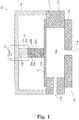
- FIG. 1 is a schematic diagram showing the configuration of a liquid agent application device 10 according to the first embodiment.
- the liquid agent application device 10 includes a liquid agent reservoir 11, a diaphragm 12, a drive unit 13, a fixing member 14, and a control unit 15.
- the liquid agent reservoir 11, the diaphragm 12, the drive unit 13, and the fixing member 14 constitute a head 16.
- the liquid agent reservoir 11 includes a housing 11a and a nozzle 11b.
- the housing 11a is formed in a hollow shape.
- the housing 11a is formed in a tubular shape, but is not limited thereto.
- the housing 11a can be made of, for example, an alloy material, a ceramic material, and a synthetic resin material, and the design is made to enhance the rigidity so that it is prevented from being deformed by the application of a pressing force by the drive unit 13 described later.
- the rigidity of the housing 11a can be appropriately adjusted by optimizing the thickness according to the constituent material. Also, when manufacturing the housing 11a by molding and casting, the rigidity of the housing 11a can be effectively improved by providing ribs on the outer peripheral face.
- a pressure chamber 11c is formed inside the housing 11a.
- a liquid agent is stored in the pressure chamber 11c.
- the liquid agent include solder, thermosetting resin, ink, coating liquid for forming functional thin films (oriented film, resist, color filter, organic electroluminescence, etc.), but are not limited to this.
- a liquid agent supply port 11d is formed in the side wall of the housing 11a.
- a liquid agent supplied from a liquid agent supply device passes through the liquid agent supply port 11d and is replenished into the pressure chamber 11c.
- the nozzle 11b is formed in a plate shape.
- the nozzle 11b is disposed so as to close one end opening of the housing 11a.
- a discharge port 11e is formed in the nozzle 11b.
- the liquid agent in the pressure chamber 11c is discharged as a droplet from the discharge port 11e.
- the diaphragm 12 is disposed so as to close the other end opening of the housing 11a.
- the diaphragm 12 vibrates elastically when a pressurization vibration is applied from the drive unit 13 described later. Accordingly, the diaphragm 12 changes the volume of the pressure chamber 11c formed in the liquid agent reservoir 11.
- the volume of the pressure chamber 11c decreases.
- the liquid agent is discharged from the discharge port 11e.
- the diaphragm 12 returns to a steady state by its own elasticity, the volume of the pressure chamber 11c also returns to the original state.
- the liquid agent is replenished to the pressure chamber 11c from the liquid agent supply port 11d.
- constituent material of the diaphragm 12 is not particularly limited, for example, an alloy material, a ceramic material, a synthetic resin material, or the like can be used.
- the drive unit 13 is a member for expansion and contraction driving the diaphragm 12.
- the drive unit 13 is located on the diaphragm 12.
- the drive unit 13 is disposed between the diaphragm 12 and the fixing member 14.
- the drive unit 13 is sandwiched between the diaphragm 12 and the fixing member 14.
- a first end portion 13p, of the drive unit 13, opposite to the diaphragm 12 is connected to the fixing member 14. That is, the first end portion 13p of the drive unit 13 is fixed to the fixing member 14. Accordingly, the first end portion 13p of the drive unit 13 is a fixed end portion.
- the first end portion 13p of the drive unit 13 can be connected to the fixing member 14 via an adhesive such as an epoxy resin, for example.
- the first end portion 13p of the drive unit 13 is part of a horn 21 described later.
- a second end portion 13q, of the drive unit 13, toward the diaphragm 12 is in contact with the diaphragm 12. That is, the second end portion 13q of the drive unit 13 is not fixed to the diaphragm 12.
- the second end portion 13q of the drive unit 13 is part of a driving piezoelectric element 20 described later.
- the drive unit 13 includes the driving piezoelectric element 20 and the horn 21.
- the driving piezoelectric element 20 is located on the diaphragm 12.
- the driving piezoelectric element 20 is disposed between the diaphragm 12 and the horn 21.
- the driving piezoelectric element 20 is sandwiched between the diaphragm 12 and the horn 21.
- the driving piezoelectric element 20 is connected to the horn 21.
- the driving piezoelectric element 20 is connected to the horn 21 via an adhesive such as an epoxy resin.
- the driving piezoelectric element 20 is in contact with the diaphragm 12. That is, the driving piezoelectric element 20 is not connected to the diaphragm 12. However, the driving piezoelectric element 20 may be connected to the diaphragm 12.
- the driving piezoelectric element 20 includes a plurality of piezoelectric bodies 20a, a plurality of internal electrodes 20b, and a pair of side surface electrodes 20c and 20c.
- the piezoelectric bodies 20a and the internal electrodes 20b are alternately stacked.
- Each of the piezoelectric bodies 20a is made of, for example, piezoelectric ceramic such as lead zirconate titanate (PZT).
- Each of the internal electrodes 20b is electrically connected to one of the pair of side surface electrodes 20c and 20c. That is, the internal electrode 20b electrically connected to one side surface electrode 20c is electrically insulated from the other side surface electrode 20c.
- Such a structure is generally referred to as a partial electrode structure.
- the driving piezoelectric element 20 only needs to include at least one piezoelectric body and a pair of electrodes, and various known piezoelectric elements can be used as the driving piezoelectric element 20.
- the driving piezoelectric element 20 vibrates according to a drive voltage signal (that is, a drive pulse) applied from the control unit 15 described later.
- a drive voltage signal that is, a drive pulse
- each of the piezoelectric bodies 20a expands and contracts.
- a pressurization vibration is applied to the diaphragm 12.
- the horn 21 is located on the driving piezoelectric element 20.
- the horn 21 is disposed between the fixing member 14 and the driving piezoelectric element 20.
- the horn 21 is sandwiched between the fixing member 14 and the driving piezoelectric element 20.
- the horn 21 is a tubular metal rod.
- the horn 21 is connected to the fixing member 14 and the driving piezoelectric element 20.
- the horn 21 can be connected to the fixing member 14 via an adhesive such as an epoxy resin.
- the horn 21 is a vibrating body which vibrates with the driving piezoelectric element 20 to increase the amount of displacement of the diaphragm 12 due to expansion and contraction of the driving piezoelectric element 20.
- the natural vibration frequency F1 of the horn 21 is equal to or lower than the drive critical frequency F2 of the driving piezoelectric element 20.
- the natural vibration frequency F1 of the horn 21 is a frequency at which the horn 21 performs free vibration.
- the natural vibration frequency F1 of the horn 21 is a frequency specific to the horn 21.
- the natural vibration frequency F1 of the horn 21 is determined by the shape, material, mass, and the like of the horn 21. Accordingly, the shape, material, mass and the like of the horn 21 are not particularly limited, and it is sufficient that the natural vibration frequency F1 is set to a desired value.
- the drive critical frequency F2 of the driving piezoelectric element 20 is the maximum value of the critical frequency at which the driving piezoelectric element 20 can be driven with a stable amplitude.
- the drive critical frequency F2 of the driving piezoelectric element 20 is a frequency specific to the driving piezoelectric element 20.
- the drive critical frequency F2 of the driving piezoelectric element 20 is determined by the configuration of the driving piezoelectric element 20.
- the frequency (hereinafter referred to as "drive voltage signal frequency”) F3 of the drive voltage signal applied to the driving piezoelectric element 20 is set to the drive critical frequency F2 or less.
- the horn 21 when the natural vibration frequency F1 of the horn 21 is equal to or lower than the drive critical frequency F2 of the driving piezoelectric element 20, and the natural vibration frequency F1 and the drive voltage signal frequency F3 are in a multiple relationship, the horn 21 resonates with the driving piezoelectric element 20.
- the natural vibration frequency F1 of the horn 21 is the same as the drive voltage signal frequency F3
- the degree of resonance between the horn 21 and the driving piezoelectric element 20 is maximized, and the amplitude between the horn 21 and the driving piezoelectric element 20 is also maximized.
- the amplitude between the horn 21 and the driving piezoelectric element 20 increases, so that the amount of displacement of the diaphragm 12 by the driving piezoelectric element 20 can be increased.
- the power consumption including the amount output as displacement force and the amount consumed as heat for the driving piezoelectric element 20 can be reduced.
- the amount of displacement of the diaphragm 12 can be reduced. In this way, the amount of displacement of the diaphragm 12 can be adjusted as appropriate by controlling the degree of resonance between the horn 21 and the driving piezoelectric element 20.
- the fixing member 14 is a member that fixes the first end portion 13p of the drive unit 13.
- the fixing member 14 is located on the liquid agent reservoir 11.
- the fixing member 14 only needs to fix the first end portion 13p of the drive unit 13, and may be separated from the liquid agent reservoir 11.
- the shape of the fixing member 14 is not limited to the shape shown in FIG. 1 , and can be appropriately changed in consideration of the positional relationship with the peripheral members.
- the control unit 15 is realized by a power amplifier composed of a microprocessor such as a central processing unit (CPU) and a digital signal processor (DSP), or an arithmetic device such as an application specific integrated circuit (ASIC), a power metal-oxide-semiconductor field-effect transistor (MOSFET) and the like.
- a microprocessor such as a central processing unit (CPU) and a digital signal processor (DSP)
- DSP digital signal processor
- ASIC application specific integrated circuit
- MOSFET power metal-oxide-semiconductor field-effect transistor
- the control unit 15 generates a drive voltage signal for driving the driving piezoelectric element 20.
- the control unit 15 sends the generated drive voltage signal to the power amplifier to amplify the power, and applies the power to each of the pair of side surface electrodes 20c and 20c of the driving piezoelectric element 20 to vibrate the driving piezoelectric element 20.
- the control unit 15 sets the drive voltage signal frequency F3 of the drive voltage signal to be equal to or lower than the drive critical frequency F2 of the driving piezoelectric element 20, and sets the natural vibration frequency F1 of the horn 21 and the drive voltage signal frequency F3 to have a multiple relationship.
- the amount of displacement of the diaphragm 12 can be changed as appropriate by controlling the frequency difference between the natural vibration frequency F1 of the horn 21 and the drive voltage signal frequency F3.
- the control unit 15 preferably adjusts the drive voltage signal frequency F3 of the drive voltage signal in accordance with the displacement of the driving piezoelectric element 20.
- a method of performing control so that the peak value is constant from the current and voltage in the waveform of the drive voltage signal or a method of performing control so that the phase difference between the current and voltage in the waveform of the drive voltage signal is constant can be used.
- the feedback is performed so that the phase difference at the resonance frequency which is obtained in advance is set as the control target value, and the phase difference detected in actual driving matches the control target value.
- the drive voltage signal frequency F3 can be matched with the natural vibration frequency F1, the driving piezoelectric element 20 can be vibrated more efficiently.
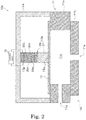
- FIG. 2 is a schematic diagram showing a configuration of a liquid agent application device 10a according to the second embodiment.
- the difference between the liquid agent application device 10 according to the first embodiment and the liquid agent application device 10a according to the second embodiment is that the driving piezoelectric element 20 and the horn 21 are arranged in reverse. Therefore, the difference will be mainly described below.
- a drive unit 13a is located on the diaphragm 12.
- the drive unit 13a is disposed between the diaphragm 12 and the fixing member 14.
- the first end portion 13p of the drive unit 13a is connected to the fixing member 14.
- the second end portion 13q of the drive unit 13a is in contact with the diaphragm 12.
- the first end portion 13p of the drive unit 13a is part of the driving piezoelectric element 20
- the second end portion 13q of the drive unit 13a is part of the horn 21.
- the drive unit 13 includes the driving piezoelectric element 20 and the horn 21.
- the driving piezoelectric element 20 is located on the horn 21.
- the driving piezoelectric element 20 is disposed between the fixing member 14 and the horn 21.
- the driving piezoelectric element 20 is sandwiched between the fixing member 14 and the horn 21.
- the driving piezoelectric element 20 is connected to the fixing member 14 and the horn 21.
- the horn 21 is located on the diaphragm 12.
- the horn 21 is disposed between the diaphragm 12 and the driving piezoelectric element 20.
- the horn 21 is sandwiched between the diaphragm 12 and the driving piezoelectric element 20.
- the horn 21 is connected to the driving piezoelectric element 20.
- the horn 21 is in contact with the diaphragm 12.
- the horn 21 may be connected to the diaphragm 12.
- the displacement amount of the diaphragm 12 by the driving piezoelectric element 20 can be appropriately changed by the horn 21 by adjusting the frequency difference between the natural vibration frequency F1 of the horn 21 and the drive voltage signal frequency F3 as described in the first embodiment.
- FIG. 3 is a schematic diagram showing the configuration of a liquid agent application device 10b according to the third embodiment.
- the difference between the liquid agent application device 10 according to the first embodiment and the liquid agent application device 10b according to the third embodiment is that the drive unit 13b includes an oscillating piezoelectric element 22. Therefore, the difference will be mainly described below.
- the drive unit 13b is located on the diaphragm 12.
- the drive unit 13b is disposed between the diaphragm 12 and the fixing member 14.
- the first end portion 13p of the drive unit 13b is connected to the fixing member 14.
- the second end portion 13q of the drive unit 13b is in contact with the diaphragm 12.
- the first end portion 13p of the drive unit 13b is part of the oscillating piezoelectric element 22 described later, and the second end portion 13q of the drive unit 13a is part of the driving piezoelectric element 20.
- the drive unit 13b includes the driving piezoelectric element 20, the horn 21, and the oscillating piezoelectric element 22.
- the configuration of the driving piezoelectric element 20 and the horn 21 is as described in the first embodiment. Therefore, also in this embodiment, the amount of displacement of the diaphragm 12 can be changed as appropriate by controlling the frequency difference between the natural vibration frequency F1 of the horn 21 and the drive voltage signal frequency F3.
- the oscillating piezoelectric element 22 is located on the horn 21.
- the oscillating piezoelectric element 22 is disposed between the fixing member 14 and the horn 21.
- the oscillating piezoelectric element 22 is sandwiched between the fixing member 14 and the horn 21.
- the oscillating piezoelectric element 22 is connected to the horn 21.
- the oscillating piezoelectric element 22 is connected to the horn 21 via an adhesive such as an epoxy resin.
- the oscillating piezoelectric element 22 is connected to the fixing member 14.
- the oscillating piezoelectric element 22 can be connected to the fixing member 14 via an adhesive such as an epoxy resin.
- the oscillating piezoelectric element 22 includes at least one piezoelectric body and a pair of electrodes. Examples of the oscillating piezoelectric element 22 can include various known piezoelectric elements.
- the oscillating piezoelectric element 22 vibrates according to the high-frequency signal applied from the control unit 15.
- the high-frequency signal applied to the oscillating piezoelectric element 22 is a signal having a higher frequency than that of the drive voltage signal applied to the driving piezoelectric element 20.
- the amplitude (potential difference) of the high-frequency signal is preferably smaller than the amplitude (potential difference) of the drive voltage signal.
- the oscillating piezoelectric element 22 to which the high-frequency signal is applied applies a minute pressurization vibration to the diaphragm 12 such that the liquid agent is not discharged from the discharge port 11e.
- the amplitude of the high-frequency signal is preferably between 1% to 20% of the amplitude of the drive voltage signal, and the frequency of the high-frequency signal is preferably between 1 kHz to 30 kHz.
- the fluidity can be improved.
- the amplitude of the high-frequency signal is preferably between 1% to 20% of the amplitude of the drive voltage signal, the frequency of the high-frequency signal is preferably between 1 kHz to 5 kHz.
- the form in which the oscillating piezoelectric element 22 is disposed between the fixing member 14 and the horn 21 is exemplified, but the present invention is not limited to this.
- the oscillating piezoelectric element 22 may be disposed between the driving piezoelectric element 20 and the horn 21, or may be disposed between the diaphragm 12 and the driving piezoelectric element 20.
- FIG. 3 the form in which the driving piezoelectric element 20 and the horn 21 are sequentially arranged from the diaphragm 12 side is exemplified. As explained in the second embodiment, the arrangement of the driving piezoelectric element 20 and the horn 21 may be reversed.
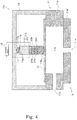
- FIG. 4 is a schematic diagram showing a configuration of a liquid agent application device 10c according to the fourth embodiment.
- the difference between the liquid agent application device 10 according to the first embodiment and the liquid agent application device 10c according to the fourth embodiment is that a preload spring 17 is disposed between the drive unit 13 and the fixing member 14. Therefore, the difference will be mainly described below.
- the preload spring 17 is located on the drive unit 13.
- the preload spring 17 is disposed between the drive unit 13 and the fixing member 14.
- the preload spring 17 is sandwiched between the drive unit 13 and the fixing member 14.
- a first end portion 17p, of the preload spring 17, opposite to the drive unit 13 is connected to the fixing member 14. That is, the first end portion 17p of the preload spring 17 is fixed to the fixing member 14. Accordingly, the first end portion 17p of the preload spring 17 is a fixed end portion.
- the first end portion 17p of the preload spring 17 may be directly fastened to the fixing member 14, or, for example, may be connected to the fixing member 14 via an adhesive such as an epoxy resin.
- a second end portion 17q, of the preload spring 17, toward the drive unit 13 is connected to the first end portion 13p of the drive unit 13. That is, the second end portion 17q of the preload spring 17 is fixed to the first end portion 13p of the drive unit 13. Therefore, in the present embodiment, the first end portion 13p of the drive unit 13 is not a fixed end portion.
- the second end portion 17q of the preload spring 17 may be directly fastened to the drive unit 13, or, for example, may be connected to the drive unit 13 via an adhesive such as an epoxy resin.
- the preload spring 17 may include known springs such as a disc spring, a leaf spring, or a spiral spring.
- the spring constant of the preload spring 17 is preferably larger than the spring constant of the diaphragm 12.
- the preload spring 17 presses the drive unit 13 against the diaphragm 12.
- the preload spring 17 constantly presses the drive unit 13 against the diaphragm 12 regardless of whether the driving piezoelectric element 20 is expanded or contracted.
- the drive unit 13 since the second end portion 13q of the drive unit 13 is only in contact with the diaphragm 12, when the expanded driving piezoelectric element 20 contracts, not only a tensile force due to expansion occurs inside the driving piezoelectric element 20, but also ringing of the drive unit 13 itself may occur. However, in this embodiment, as mentioned above, the drive unit 13 can be pressed against the diaphragm 12 by the pressing force of the preload spring 17. For this reason, while suppressing the tensile force generated in the driving piezoelectric element 20, ringing of the drive unit 13 can be suppressed.
- the contraction speed of the drive unit 13 is faster than the return speed of the diaphragm 12, so that there is a possibility that the drive unit 13 may be separated from the diaphragm 12.
- the drive unit 13 is pressed against the diaphragm 12 by the pressing force of the preload spring 17, so that the drive unit 13 can be prevented from being separate from the diaphragm 12.
- the first end portion 13p of the drive unit 13 is connected to the fixing member 14, but it may be only in contact with the fixing member 14.
- the second end portion 13q of the drive unit 13 is in contact with the diaphragm 12, but it may be connected to the diaphragm 12.
- the second end portion 13q of the drive unit 13 is in direct contact with the diaphragm 12, but an intermediate member that is in surface contact with the drive unit 13, and which is in point contact with the diaphragm 12 may be sandwiched between the second end portion 13q and the diaphragm 12.
- the intermediate member is fixed to the second end portion 13q of the drive unit 13, and can be brought into and out of contact with the diaphragm 12. Since it is possible to prevent the pressing force from being concentrated on part of the second end portion 13q of the drive unit 13 by sandwiching such an intermediate member, damage to the drive unit 13 can be suppressed.
- the driving piezoelectric element 20 is connected to the fixing member 14 and the horn 21, but as shown in FIG. 5 , may be fixed between the fixing member 14 and the horn 21 through a fastener 30.
- Example of the fastener 30 may include a screw and the like.
- the fastener 30 passes through the driving piezoelectric element 20 and is fastened to the horn 21.
- the fastener 30 preferably has a sufficient fastening force.
- the driving piezoelectric element 20 is formed in a shape (for example, a hollow ring shape) that allows the fastener 30 to pass therethrough.
- the end portion, of the driving piezoelectric element 20, toward the fixing member 14 is a fixed end portion.
- the vibration of the driving piezoelectric element 20 can be efficiently transmitted to the horn 21 by fixing the driving piezoelectric element 20 between the fixing member 14 and the horn 21 through the fastener 30, compared to, for example, the case where the both are connected via an elastic body such as an adhesive.
Landscapes
- Engineering & Computer Science (AREA)
- Mechanical Engineering (AREA)
- General Engineering & Computer Science (AREA)
- General Electrical Machinery Utilizing Piezoelectricity, Electrostriction Or Magnetostriction (AREA)
- Coating Apparatus (AREA)
- Reciprocating Pumps (AREA)
- Particle Formation And Scattering Control In Inkjet Printers (AREA)
Applications Claiming Priority (2)
| Application Number | Priority Date | Filing Date | Title |
|---|---|---|---|
| JP2017188842 | 2017-09-28 | ||
| PCT/JP2018/025146 WO2019064779A1 (ja) | 2017-09-28 | 2018-07-03 | 液剤塗布装置 |
Publications (2)
| Publication Number | Publication Date |
|---|---|
| EP3689613A1 true EP3689613A1 (de) | 2020-08-05 |
| EP3689613A4 EP3689613A4 (de) | 2021-06-30 |
Family
ID=65901215
Family Applications (1)
| Application Number | Title | Priority Date | Filing Date |
|---|---|---|---|
| EP18860279.1A Withdrawn EP3689613A4 (de) | 2017-09-28 | 2018-07-03 | Auftragsvorrichtung für flüssiges medium |
Country Status (5)
| Country | Link |
|---|---|
| US (1) | US20200282726A1 (de) |
| EP (1) | EP3689613A4 (de) |
| JP (1) | JPWO2019064779A1 (de) |
| CN (1) | CN111094001A (de) |
| WO (1) | WO2019064779A1 (de) |
Families Citing this family (1)
| Publication number | Priority date | Publication date | Assignee | Title |
|---|---|---|---|---|
| CN113123946A (zh) * | 2021-04-26 | 2021-07-16 | 长春工业大学 | 一种用于农业喷灌的有阀谐振压电泵 |
Family Cites Families (18)
| Publication number | Priority date | Publication date | Assignee | Title |
|---|---|---|---|---|
| JPS5242335B2 (de) * | 1972-06-22 | 1977-10-24 | ||
| JPS578163A (en) * | 1980-06-20 | 1982-01-16 | Sanyo Electric Co Ltd | Ink jet printer |
| JPS63130350A (ja) * | 1986-11-20 | 1988-06-02 | Sharp Corp | インクジエツトヘツド |
| JPH0465968U (de) * | 1990-10-12 | 1992-06-09 | ||
| CN2221176Y (zh) * | 1995-05-09 | 1996-02-28 | 王宇勤 | 超声波雾化装置 |
| JPH10119265A (ja) * | 1996-10-18 | 1998-05-12 | Citizen Watch Co Ltd | インクジェットヘッドおよびそのインクの脱泡方法 |
| JP4283007B2 (ja) * | 2003-02-28 | 2009-06-24 | トッパン・フォームズ株式会社 | インクジェットプリンタ |
| JP4696487B2 (ja) * | 2004-07-15 | 2011-06-08 | リコープリンティングシステムズ株式会社 | 記録ヘッド及びこれを備えたインクジェット記録装置 |
| JP5024589B2 (ja) | 2005-12-14 | 2012-09-12 | リコープリンティングシステムズ株式会社 | 液滴吐出装置、液滴吐出特性補正方法及びインクジェット記録装置 |
| US20080174620A1 (en) * | 2006-10-03 | 2008-07-24 | Adaptivenergy, Llc. | Synthetic jets |
| US8079676B2 (en) * | 2008-12-16 | 2011-12-20 | Palo Alto Research Center Incorporated | System and method for acoustic ejection of drops from a thin layer of fluid |
| JP2011022181A (ja) * | 2009-07-13 | 2011-02-03 | Ricoh Co Ltd | トナー製造用液吐出用ヘッド |
| JP6051711B2 (ja) * | 2012-09-14 | 2016-12-27 | 株式会社リコー | 液体吐出ヘッドの駆動方法及び吐出装置 |
| CN103029440B (zh) * | 2012-12-06 | 2015-03-25 | 中国科学技术大学 | 一种压电超声驱动液体喷射装置 |
| EP2783837B1 (de) * | 2013-03-28 | 2016-10-12 | Ivoclar Vivadent AG | Verfahren und Vorrichtung zum schichtweisen Aufbau eines Formkörpers |
| CN103433169B (zh) * | 2013-07-11 | 2015-09-02 | 江苏大学 | 一种高斯复合形角的中频超声雾化喷头及其设计方法 |
| JP6269084B2 (ja) * | 2014-01-15 | 2018-01-31 | 株式会社リコー | 画像形成装置及びヘッド駆動制御方法 |
| CN205685971U (zh) * | 2016-06-24 | 2016-11-16 | 广州奥凯迪喷码设备有限公司 | 喷码机防堵喷头 |
-
2018
- 2018-07-03 WO PCT/JP2018/025146 patent/WO2019064779A1/ja not_active Ceased
- 2018-07-03 US US16/645,008 patent/US20200282726A1/en not_active Abandoned
- 2018-07-03 JP JP2019544287A patent/JPWO2019064779A1/ja active Pending
- 2018-07-03 EP EP18860279.1A patent/EP3689613A4/de not_active Withdrawn
- 2018-07-03 CN CN201880057350.8A patent/CN111094001A/zh not_active Withdrawn
Also Published As
| Publication number | Publication date |
|---|---|
| US20200282726A1 (en) | 2020-09-10 |
| JPWO2019064779A1 (ja) | 2020-11-05 |
| WO2019064779A1 (ja) | 2019-04-04 |
| EP3689613A4 (de) | 2021-06-30 |
| CN111094001A (zh) | 2020-05-01 |
Similar Documents
| Publication | Publication Date | Title |
|---|---|---|
| KR101004161B1 (ko) | 압전 팬, 이를 이용하여 마이크로 전자 장치를 냉각하는방법, 및 이를 포함하는 시스템 | |
| US7834523B2 (en) | Vibration actuator | |
| US6713942B2 (en) | Piezoelectric device with feedback sensor | |
| US8358049B2 (en) | Energy converters and associated methods | |
| US9106160B2 (en) | Monolithic energy harvesting system, apparatus, and method | |
| US10069440B2 (en) | Vibrator and ultrasonic motor | |
| US9135906B2 (en) | Ultrasonic generator | |
| CN100430599C (zh) | 用于产生介质流的设备 | |
| JP2006254627A (ja) | 超音波モータ | |
| US20020175596A1 (en) | Thin profile piezoelectric jet device | |
| EP3689613A1 (de) | Auftragsvorrichtung für flüssiges medium | |
| US20090026884A1 (en) | Utrasonic actuator | |
| JP7337180B2 (ja) | 圧電ポンプおよびポンプユニット | |
| JP2010263061A (ja) | 圧電装置及びそれを備える送風機 | |
| JPWO2018180006A1 (ja) | 液滴吐出装置 | |
| WO2018173592A1 (ja) | 液滴吐出装置 | |
| WO2019064782A1 (ja) | 液剤塗布装置 | |
| KR20170057658A (ko) | 고효율 초음파 진동자 | |
| JP2008278721A (ja) | 超音波アクチュエータ装置 | |
| JP2021014788A (ja) | 液剤塗布装置 | |
| WO2019064770A1 (ja) | 液剤塗布装置 | |
| JP4643316B2 (ja) | マイクロマシンスイッチ及びその駆動方法 | |
| WO2019064780A1 (ja) | 液剤塗布装置 | |
| WO2019163705A1 (ja) | 液剤塗布装置 | |
| JP2026005891A (ja) | 振動発生装置 |
Legal Events
| Date | Code | Title | Description |
|---|---|---|---|
| STAA | Information on the status of an ep patent application or granted ep patent |
Free format text: STATUS: THE INTERNATIONAL PUBLICATION HAS BEEN MADE |
|
| PUAI | Public reference made under article 153(3) epc to a published international application that has entered the european phase |
Free format text: ORIGINAL CODE: 0009012 |
|
| STAA | Information on the status of an ep patent application or granted ep patent |
Free format text: STATUS: REQUEST FOR EXAMINATION WAS MADE |
|
| 17P | Request for examination filed |
Effective date: 20200306 |
|
| AK | Designated contracting states |
Kind code of ref document: A1 Designated state(s): AL AT BE BG CH CY CZ DE DK EE ES FI FR GB GR HR HU IE IS IT LI LT LU LV MC MK MT NL NO PL PT RO RS SE SI SK SM TR |
|
| AX | Request for extension of the european patent |
Extension state: BA ME |
|
| DAV | Request for validation of the european patent (deleted) | ||
| DAX | Request for extension of the european patent (deleted) | ||
| A4 | Supplementary search report drawn up and despatched |
Effective date: 20210602 |
|
| RIC1 | Information provided on ipc code assigned before grant |
Ipc: B41J 2/14 20060101AFI20210527BHEP Ipc: B05C 5/00 20060101ALI20210527BHEP Ipc: B05C 11/10 20060101ALI20210527BHEP Ipc: B41J 2/045 20060101ALI20210527BHEP Ipc: F04B 9/10 20060101ALI20210527BHEP |
|
| STAA | Information on the status of an ep patent application or granted ep patent |
Free format text: STATUS: THE APPLICATION IS DEEMED TO BE WITHDRAWN |
|
| 18D | Application deemed to be withdrawn |
Effective date: 20220104 |