EP3668721B1 - Verfahren zur herstellung eines folienbeschichteten artikels und folienbeschichteter artikel - Google Patents
Verfahren zur herstellung eines folienbeschichteten artikels und folienbeschichteter artikel Download PDFInfo
- Publication number
- EP3668721B1 EP3668721B1 EP18743476.6A EP18743476A EP3668721B1 EP 3668721 B1 EP3668721 B1 EP 3668721B1 EP 18743476 A EP18743476 A EP 18743476A EP 3668721 B1 EP3668721 B1 EP 3668721B1
- Authority
- EP
- European Patent Office
- Prior art keywords
- layer
- transfer
- layers
- ply
- substrate
- Prior art date
- Legal status (The legal status is an assumption and is not a legal conclusion. Google has not performed a legal analysis and makes no representation as to the accuracy of the status listed.)
- Active
Links
Images

Classifications
-
- B—PERFORMING OPERATIONS; TRANSPORTING
- B44—DECORATIVE ARTS
- B44C—PRODUCING DECORATIVE EFFECTS; MOSAICS; TARSIA WORK; PAPERHANGING
- B44C1/00—Processes, not specifically provided for elsewhere, for producing decorative surface effects
- B44C1/16—Processes, not specifically provided for elsewhere, for producing decorative surface effects for applying transfer pictures or the like
- B44C1/165—Processes, not specifically provided for elsewhere, for producing decorative surface effects for applying transfer pictures or the like for decalcomanias; sheet material therefor
- B44C1/17—Dry transfer
- B44C1/1712—Decalcomanias applied under heat and pressure, e.g. provided with a heat activable adhesive
- B44C1/1729—Hot stamping techniques
-
- B—PERFORMING OPERATIONS; TRANSPORTING
- B44—DECORATIVE ARTS
- B44C—PRODUCING DECORATIVE EFFECTS; MOSAICS; TARSIA WORK; PAPERHANGING
- B44C1/00—Processes, not specifically provided for elsewhere, for producing decorative surface effects
- B44C1/16—Processes, not specifically provided for elsewhere, for producing decorative surface effects for applying transfer pictures or the like
- B44C1/165—Processes, not specifically provided for elsewhere, for producing decorative surface effects for applying transfer pictures or the like for decalcomanias; sheet material therefor
- B44C1/17—Dry transfer
- B44C1/1712—Decalcomanias applied under heat and pressure, e.g. provided with a heat activable adhesive
-
- B—PERFORMING OPERATIONS; TRANSPORTING
- B29—WORKING OF PLASTICS; WORKING OF SUBSTANCES IN A PLASTIC STATE IN GENERAL
- B29C—SHAPING OR JOINING OF PLASTICS; SHAPING OF MATERIAL IN A PLASTIC STATE, NOT OTHERWISE PROVIDED FOR; AFTER-TREATMENT OF THE SHAPED PRODUCTS, e.g. REPAIRING
- B29C37/00—Component parts, details, accessories or auxiliary operations, not covered by group B29C33/00 or B29C35/00
- B29C37/0025—Applying surface layers, e.g. coatings, decorative layers, printed layers, to articles during shaping, e.g. in-mould printing
- B29C37/0028—In-mould coating, e.g. by introducing the coating material into the mould after forming the article
- B29C37/0032—In-mould coating, e.g. by introducing the coating material into the mould after forming the article the coating being applied upon the mould surface before introducing the moulding compound, e.g. applying a gelcoat
-
- B—PERFORMING OPERATIONS; TRANSPORTING
- B29—WORKING OF PLASTICS; WORKING OF SUBSTANCES IN A PLASTIC STATE IN GENERAL
- B29C—SHAPING OR JOINING OF PLASTICS; SHAPING OF MATERIAL IN A PLASTIC STATE, NOT OTHERWISE PROVIDED FOR; AFTER-TREATMENT OF THE SHAPED PRODUCTS, e.g. REPAIRING
- B29C45/00—Injection moulding, i.e. forcing the required volume of moulding material through a nozzle into a closed mould; Apparatus therefor
- B29C45/14—Injection moulding, i.e. forcing the required volume of moulding material through a nozzle into a closed mould; Apparatus therefor incorporating preformed parts or layers, e.g. injection moulding around inserts or for coating articles
- B29C45/14827—Injection moulding, i.e. forcing the required volume of moulding material through a nozzle into a closed mould; Apparatus therefor incorporating preformed parts or layers, e.g. injection moulding around inserts or for coating articles using a transfer foil detachable from the insert
-
- B—PERFORMING OPERATIONS; TRANSPORTING
- B44—DECORATIVE ARTS
- B44C—PRODUCING DECORATIVE EFFECTS; MOSAICS; TARSIA WORK; PAPERHANGING
- B44C5/00—Processes for producing special ornamental bodies
- B44C5/04—Ornamental plaques, e.g. decorative panels, decorative veneers
- B44C5/0453—Ornamental plaques, e.g. decorative panels, decorative veneers produced by processes involving moulding
-
- B—PERFORMING OPERATIONS; TRANSPORTING
- B29—WORKING OF PLASTICS; WORKING OF SUBSTANCES IN A PLASTIC STATE IN GENERAL
- B29C—SHAPING OR JOINING OF PLASTICS; SHAPING OF MATERIAL IN A PLASTIC STATE, NOT OTHERWISE PROVIDED FOR; AFTER-TREATMENT OF THE SHAPED PRODUCTS, e.g. REPAIRING
- B29C37/00—Component parts, details, accessories or auxiliary operations, not covered by group B29C33/00 or B29C35/00
- B29C37/0025—Applying surface layers, e.g. coatings, decorative layers, printed layers, to articles during shaping, e.g. in-mould printing
- B29C37/0028—In-mould coating, e.g. by introducing the coating material into the mould after forming the article
- B29C2037/0042—In-mould coating, e.g. by introducing the coating material into the mould after forming the article the coating being applied in solid sheet form, e.g. as meltable sheet
-
- B—PERFORMING OPERATIONS; TRANSPORTING
- B29—WORKING OF PLASTICS; WORKING OF SUBSTANCES IN A PLASTIC STATE IN GENERAL
- B29K—INDEXING SCHEME ASSOCIATED WITH SUBCLASSES B29B, B29C OR B29D, RELATING TO MOULDING MATERIALS OR TO MATERIALS FOR MOULDS, REINFORCEMENTS, FILLERS OR PREFORMED PARTS, e.g. INSERTS
- B29K2075/00—Use of PU, i.e. polyureas or polyurethanes or derivatives thereof, as moulding material
-
- B—PERFORMING OPERATIONS; TRANSPORTING
- B29—WORKING OF PLASTICS; WORKING OF SUBSTANCES IN A PLASTIC STATE IN GENERAL
- B29K—INDEXING SCHEME ASSOCIATED WITH SUBCLASSES B29B, B29C OR B29D, RELATING TO MOULDING MATERIALS OR TO MATERIALS FOR MOULDS, REINFORCEMENTS, FILLERS OR PREFORMED PARTS, e.g. INSERTS
- B29K2995/00—Properties of moulding materials, reinforcements, fillers, preformed parts or moulds
- B29K2995/0018—Properties of moulding materials, reinforcements, fillers, preformed parts or moulds having particular optical properties, e.g. fluorescent or phosphorescent
- B29K2995/002—Coloured
-
- B—PERFORMING OPERATIONS; TRANSPORTING
- B29—WORKING OF PLASTICS; WORKING OF SUBSTANCES IN A PLASTIC STATE IN GENERAL
- B29K—INDEXING SCHEME ASSOCIATED WITH SUBCLASSES B29B, B29C OR B29D, RELATING TO MOULDING MATERIALS OR TO MATERIALS FOR MOULDS, REINFORCEMENTS, FILLERS OR PREFORMED PARTS, e.g. INSERTS
- B29K2995/00—Properties of moulding materials, reinforcements, fillers, preformed parts or moulds
- B29K2995/0018—Properties of moulding materials, reinforcements, fillers, preformed parts or moulds having particular optical properties, e.g. fluorescent or phosphorescent
- B29K2995/0026—Transparent
-
- B—PERFORMING OPERATIONS; TRANSPORTING
- B29—WORKING OF PLASTICS; WORKING OF SUBSTANCES IN A PLASTIC STATE IN GENERAL
- B29L—INDEXING SCHEME ASSOCIATED WITH SUBCLASS B29C, RELATING TO PARTICULAR ARTICLES
- B29L2031/00—Other particular articles
- B29L2031/722—Decorative or ornamental articles
Definitions
- the present invention relates to a method for producing a film-coated article and a film-coated article.
- the DE 102 21 482 C1 a device for producing a molded part from a hardening injection molding material, which is decorated by in-mold injection molding with an embossed foil having a carrier film and a decorative layer that can be detached from the carrier layer.
- the embossed foil is placed in an open injection mold, with the decorative layer of the embossed foil facing an upper mold part.
- the injection mold is closed and liquid injection molding material is injected through an injection channel into the cavity of the injection mold, with the embossed foil clinging to the visible side of the injected molded part.
- the embossed foil and its decorative layer bond to the injection molding material, which is removed from the injection mold after hardening. After the carrier film has been removed from the decorative layer, the decorated molded part is finished.
- Injection-molded articles decorated in this way are used in particular for automotive interior parts such as door strips, strips in instrument panels, gear lever covers and center console covers, for automotive exterior parts such as door sill protection strips and covers on A, B and C pillars, in the audio and video sector for decorative strips on the housings of radio and television sets, and in the telecommunications sector for housing shells of mobile devices such as cell phones or navigation devices.
- Insert molding is a combined process of hot stamping, vacuum forming and casting, particularly injection molding. Compared to the IMD process, insert molding offers the possibility of deforming the film more strongly. This is an advantage if, for example, highly profiled and shaped parts are required.
- ABS acrylonitrile butadiene styrene
- This hot stamped carrier is vacuum formed under heat.
- the layers of hot stamping film and carrier vacuum formed in this way form the so-called “insert” and are cut or punched out with precise contours.
- the "insert” is positioned in an injection mold, the mold is filled with plastic (the "insert” is back-injected), then the decorated injection molded article is removed from the injection mold.
- the DE 102 36 810 A1 discloses partially structured multilayer films that are suitable for use in injection molds.
- Such an IMD-capable multilayer film or a multilayer film for in-mold decoration of injection molded parts has a carrier film with a decorative element for transfer to the injection molded part.
- the carrier film is removed after the decorative element has been applied to the injection molded body.
- the decorative element has a release layer, a protective lacquer layer, a structural layer with a spatial structure, an intermediate layer, a reflective layer and an adhesive layer.
- the WO 2006/021199 A1 relates to a decorated injection-molded article which is formed from at least one injection-molded plastic material and at least one decorative element which is mechanically firmly connected thereto and which is formed by a transfer layer of a transfer film and provides a decoration for the injection-molded article, wherein both sides of the decorative element are at least partially covered with at least one injection-molded plastic material.
- protective layers for hot stamping foils, IMD foils and insert molding foils are also known.
- the aim of these protective layers is always to have a very high level of resistance to mechanical, physical and chemical attacks.
- the adhesion of all possible foreign substances to the protective layer should be as low as possible so that, for example, an additional protective layer applied does not show sufficient adhesion.
- PU polyurethane
- an object to be coated is positioned in a tool that has two tool halves. A first tool half holds the object to be coated and a second tool half forms a slightly larger cavity than the object to be coated.
- PU is introduced into this space and the object to be coated is flooded with PU.
- Two-component PU systems (2K-PU) are also known, which harden within seconds after the components are mixed before and/or immediately during flooding. When the tool opens, the PU is already sufficiently hard.
- EN 10 2009 022 542 A1 describes a multilayer film for producing a decorated injection-molded article with a Base body and at least one decorative element arranged on the surface of the base body.
- US 2014/0113115 A1 describes a transfer film for an in-mold process and a method for producing it.
- US 2008/0277050 A1 describes a thermal transfer film, a method for producing it and a transfer method.
- US 2017/0210084 A1 describes a transfer film used in in-mold processes and a method for producing the transfer film.
- WO 2017/062822 A1 describes a transfer film for simulating a surface appearance, as well as a method according to the preamble of claim 1.
- the object of the present invention is therefore to provide a transfer film with a carrier layer and a transfer layer, from which it is possible to peel the carrier layer off the transfer layer without damaging the transfer layer.
- the adhesive force of the transfer layer to a subsequently applied protective layer should be so great that it is not possible to peel the protective layer off the transfer layer and/or the coated substrate without damaging the transfer layer.
- the top layer preferably comprises at least one binder selected from the group consisting of polyurethane resins, polyurethane dispersions, acrylic resins, methacrylic resins, phenolic resins, epoxy resins, polyureas, melamine resins, aminoplasts, polyester resins, alkyd resins, polyamide resins, vinyl ester resins and mixtures thereof, preferably polyurethane resins, polyurethane dispersions, phenolic resins, epoxy resins, polyureas, melamine resins, aminoplasts, polyester resins, alkyd resins, polyamide resins and mixtures thereof.
- binder selected from the group consisting of polyurethane resins, polyurethane dispersions, acrylic resins, methacrylic resins, phenolic resins, epoxy resins, polyureas, melamine resins, aminoplasts, polyester resins, alkyd resins, polyamide resins and mixtures thereof.
- the object of the present invention is further achieved by providing a film-coated article according to claim 15, produced by a method according to any one of claims 1 to 14.
- the transfer film comprises a carrier layer and a transfer layer arranged on the carrier layer, which contains at least one decorative element, wherein the transfer layer is preferably detachably arranged on the carrier layer.
- the transfer film is preferably used for transferring a transfer layer to an object, wherein at least one surface of the object is at least partially connected to at least one surface of the transfer layer facing away from the carrier layer, thereby obtaining a coated object.
- the carrier layer is preferably removed from the transfer layer, preferably completely, so that only the transfer layer is arranged on at least partial areas of the surface of the coated object, preferably at least partially forming the surface of the coated object.
- the detachment of the carrier layer from the transfer layer preferably takes place at a layer boundary between the carrier layer and the transfer layer.
- At least one decorative element is transferred to the object, wherein the at least one decorative element is arranged on at least partial areas of the surface of the coated object after the transfer layer has been transferred and the transfer layer has been removed and, depending on the design of the at least one decorative element, can influence the physical properties, preferably the haptic, optical, electrical and/or mechanical properties, and/or the chemical properties of the surface of the coated object.
- the at least one decorative element can influence the surface texture and/or color of the coated object, for example by providing embossing, roughening, patterns or smoothness and/or by providing reflection-determining properties such as transparency, gloss or matting and/or by providing a color.
- the at least one decorative element can influence the mechanical properties of the coated object, for example by providing a surface hardness, surface elasticity and/or fracture strength of the surface.
- the at least one decorative element can influence the chemical properties of the coated object, for example by providing resistance of the surface to the effects of acids and/or bases.
- the at least one decorative element can preferably be designed as a motif, as a decoration, for example a single image decoration or a continuous decoration, as a pattern, or a combination thereof.
- the at least one decorative element can be designed as a surface structure that is optically active or produces optical effects, wherein a suitable surface structure is preferably selected from the group consisting of diffractive surface structure, in particular hologram, zero-order diffraction structure, matt structure, in particular isotropic or anisotropic matt structure, blaze grating, lens structure, microlens structure, microprism structure, micromirror structure, or a combination of two or more of these surface structures.
- a suitable surface structure is preferably selected from the group consisting of diffractive surface structure, in particular hologram, zero-order diffraction structure, matt structure, in particular isotropic or anisotropic matt structure, blaze grating, lens structure, microlens structure, microprism structure, micromirror structure, or a combination of two or more of these surface structures.
- the at least one decorative element can be designed as an optically active and/or optically variable material, which is preferably present as a dye, liquid crystal material, pigment, or a mixture thereof.
- Suitable pigments are, for example, interference layer pigments, liquid crystal pigments, diffractive pigments, metallic pigments, thermochromic pigments, photochromic pigments or mixtures thereof.
- the material can show different or similar optical effects in particular in different wavelength ranges, for example in the infrared range, the ultraviolet range and the visible range.
- the material can also show different or similar optical effects in particular under different lighting and/or viewing angles or directions.
- the at least one decorative element is arranged in at least one decorative layer, which more preferably each independently comprises a UV-crosslinked lacquer and/or a thermoplastically deformable layer and which each independently is unpigmented or pigmented or colored.
- the at least one decorative layer is selected from the group consisting of at least partially arranged metal layers, at least partially arranged layers with relief structures, at least partially arranged color layers, at least partially arranged interference layers or combinations thereof.
- the at least one decorative layer is selected from the group consisting of transparent and/or colored lacquer layers, in particular comprising one or more dyes and/or pigments, replication layers with a molded optically active surface structure, reflection layers, in particular opaque reflection layers, transparent reflection layers, metallic reflection layers or dielectric reflection layers, optically variable layers, optically active layers, interference multilayer systems, volume hologram layers, liquid crystal layers, in particular cholesteric liquid crystal layers, electrically conductive layers, antenna layers, electrode layers, magnetic layers, magnetic storage layers, barrier layers and combinations thereof.
- transparent and/or colored lacquer layers in particular comprising one or more dyes and/or pigments
- replication layers with a molded optically active surface structure reflection layers, in particular opaque reflection layers, transparent reflection layers, metallic reflection layers or dielectric reflection layers, optically variable layers, optically active layers, interference multilayer systems, volume hologram layers, liquid crystal layers, in particular cholesteric liquid crystal layers, electrically conductive layers, antenna layers, electrode layers, magnetic layers, magnetic storage layers, barrier layers and combinations thereof
- the at least one decorative layer has a layer thickness which, independently of one another, is in a range from 0.1 ⁇ m to 15 ⁇ m, further preferably in a range from 4 to 8 ⁇ m.
- the transfer layer of the transfer film has, adjacent to the carrier layer, at least one upper layer which is not yet completely cured at least in some regions, wherein the at least one decorative element is arranged, preferably in at least one of the aforementioned decorative layers, on the side of the at least one upper layer of the transfer layer facing away from the carrier layer.
- a layer is referred to as "not yet fully cured" in the sense of the present invention if at most 90%, preferably at most 95%, of the functional groups capable of crosslinking of polymers or polymer mixtures, preferably binders or binder mixtures, contained in the at least one top layer which is not yet fully cured at least in some regions, exhibit crosslinking.
- the at least one top layer which is not yet completely cured at least in some regions, has free, reactive groups and/or capped, reactive groups which release the corresponding reactive group again at a temperature in a range from 30°C to 180°C.
- free, reactive group preferably refers to a functional group that can form a covalent bond in a polymerization reaction.
- Suitable reactive groups are preferably isocyanate groups (-NCO) and/or groups reactive towards isocyanate groups, preferably amino groups (-NH 2 ) and/or hydroxy groups (-OH).
- capped, reactive groups which can also be referred to as blocked, reactive groups, are addition compounds of blocking agents and the aforementioned reactive groups, which release the corresponding reactive group again at a temperature in a range from 30°C to 180°C, preferably at a temperature in a range from 40°C to 160°C, more preferably at a temperature in a range from 60°C to 140°C.
- Capped, reactive groups are preferably capped isocyanate groups which release the corresponding reactive group, preferably isocyanate group, at a temperature in the range of 30°C to 180°C.
- the at least one top layer which is not yet fully cured at least in some areas, can contain free, reactive isocyanate groups.
- Free, reactive isocyanate groups can react in the presence of water, for example atmospheric moisture, to form a carbamic acid, which can undergo further polymerization reactions.
- the penetration of water, for example air humidity, into the at least one top layer, which is not yet completely cured at least in some areas, of the transfer layer is preferably suppressed, preferably prevented, by arranging a carrier layer which comprises at least one carrier layer made of a polyester, a polyolefin or a combination thereof, in particular of PET.
- the at least one top layer which is not yet completely cured at least in some areas, has no free, ethylenically unsaturated groups.
- the carrier layer can be designed as a continuous film or as a single film sheet.
- a film sheet can be obtained from a previously continuous film by separating it.
- the at least one carrier layer has a layer thickness of 10 ⁇ m to 75 ⁇ m, more preferably of 23 ⁇ m to 40 ⁇ m.
- the carrier layer preferably the at least one carrier layer made of a polyester, a polyolefin or a combination thereof, in particular of PET, is arranged on the at least one upper layer of the transfer layer, which is at least partially not yet completely cured, with an adhesive force, preferably determined with a Z006 measuring device from Zwick, from a range of 2 cN to 50 cN, preferably from a range of 5 cN to 35 cN.
- a coated test specimen is preferably produced in a first step by firmly applying a transfer film with a width of 3.5 cm to a plastic plate as a test substrate by means of hot stamping.
- the carrier layer is preferably pulled vertically from the, preferably horizontally arranged, test specimen over a length of 100 mm in a second step.
- the required forces in the range of the length of 10 mm to 90 mm of the applied carrier film are preferably measured using a Z006 measuring device from Zwick GmbH & Co. KG (Ulm, DE).
- the aforementioned measuring device Z006 is preferably combined with a horizontal substrate holder.
- the substrate holder preferably has a movable carriage on which a test substrate is attached.
- the transfer film is preferably placed on the test substrate, in particular by means of hot stamping.
- the carrier layer of the applied transfer film is preferably deflected from the horizontal to the vertical using a deflection roller and attached to the aforementioned measuring device.
- the carriage with the test substrate is moved or pulled accordingly so that the carrier layer can be pulled off the transfer layer applied to the test substrate.
- PET polyethylene terephthalate
- the molecular interactions between the carrier layer made of the material specified above and the at least one upper layer of the transfer layer, which is at least partially not yet completely cured, are extremely weak.
- 3DHS 3D Hot Stamping
- the transfer film at least partially has a release layer, in particular made of a wax, with a layer thickness of 1 nm to 50 nm, preferably 1 nm to 20 nm, which is arranged between the at least one carrier layer and the at least one top layer, which is not yet completely cured at least in some areas.
- a release layer facilitates the removal of the carrier layer after transferring the absorption layer to a substrate.
- the carrier layer is preferably detached from the transfer layer at a layer boundary between the release layer and the at least one upper layer of the transfer layer, which is not yet completely cured in at least some areas.
- the wax-based release layer advantageously remains on the carrier layer.
- At least one protective layer is applied, preferably immediately, in step c) to the at least one top layer, which has not yet fully hardened at least in some areas, by at least partially flooding and/or pouring over the at least one top layer with at least one composition of polyurethane precursors (2K-PUR systems) and subsequent hardening, preferably at a temperature in a range of 25°C to 180°C.
- the at least one top layer which is not yet completely cured at least in some areas, and/or the protective layer applied thereto is cured, preferably completely cured.
- the at least one top layer, which is not yet completely cured at least in some areas, and the protective layer applied thereto are cured, preferably completely cured.
- the at least one composition of polyurethane precursors (2K-PUR systems) applied to the at least one top layer of the transfer layer, which is at least partially not yet completely cured, preferably also has free, reactive groups and/or capped, reactive groups which release the corresponding reactive group again at a temperature in a range of 30°C to 180°C.
- free isocyanate groups contained in the top layer of the transfer layer can therefore, for example, react with free groups reactive towards isocyanate groups of the composition of polyurethane precursors (2K-PUR systems) used to produce the at least one protective layer.
- the at least one top layer of the transfer layer which has not yet fully cured at least in some areas, has, for example, free groups that are reactive towards isocyanate groups, these can react accordingly with free isocyanate groups of the composition of polyurethane precursors (2K-PUR systems) used to produce the at least one protective layer.
- the adhesion of the at least one protective layer to the at least one top layer of the transfer layer after curing in step c) of the method according to the invention is preferably significantly improved.
- the at least one top layer which is not yet fully cured at least in some areas, has, for example, capped, reactive groups, these release the corresponding reactive groups again in the process according to the invention, preferably in step c), preferably at a temperature in a range of 30°C to 180°C.
- released isocyanate groups contained in the at least one top layer of the transfer layer can also react with free groups that are reactive towards isocyanate groups in the composition of polyurethane precursors (2K-PUR systems) used to produce the at least one protective layer.
- the at least one protective layer on the at least one top layer of the transfer layer adheres after curing with an adhesive force, determined according to the method described in DIN EN ISO 4624: 2016-08, preferably with a PosiTest ® AT series adhesion tester from DeFelsko Corporation (Ogdensburg, NY, USA) using a 20 mm test stamp, from a range of 2.5 MPa to 10 MPa, in particular from 2.5 MPa to 5 MPa.
- the at least one protective layer cannot be removed from a film-coated article according to the invention without damaging the transfer layer and/or detaching the transfer layer from the corresponding substrate.
- a simple method for producing the at least one protective layer is provided, in particular by applying the protective layer in step c) of the method according to the invention by at least partially flooding and/or pouring over the at least one top layer of the transfer layer, which is at least partially not yet completely cured, with a composition of polyurethane precursors (2K-PUR systems).
- the flooding and/or pouring preferably allows the use of a large number of different compositions of polyurethane precursors (2K-PUR systems), which can be specifically tailored to the composition of the at least one top layer of the transfer layer, which is not yet fully cured at least in some areas, and/or to the properties to be fulfilled by the at least one protective layer, for example with regard to optical properties, mechanical properties and/or chemical resistance.
- 2K-PUR systems polyurethane precursors
- the at least one top layer which is at least partially not yet completely cured, preferably has free, reactive groups and/or capped, reactive groups which release the corresponding reactive group again at a temperature in a range from 30°C to 180°C.
- Suitable methods for determining the content of free isocyanate groups are described, for example, in DIN EN ISO 14896:2009-07 ("Plastics - Polyurethane raw materials - Determination of isocyanate content", issue date 2009-07) or ASTM D2572-97(2010) ("Standard Test Method for Isocyanate Groups in Urethane Materials or Prepolymers", 2010, ASTM International, West Conshohocken, PA, USA).
- a suitable method for determining the content of free amino groups is given, for example, in ASTM D2074-07(2013) ("Standard Test Methods for Total, Primary, Secondary, and Tertiary Amine Values of Fatty Amines by Alternative Indicator Method", 2013, ASTM International, West Conshohocken, PA, USA).
- free, reactive groups preferably free isocyanate groups and/or free groups reactive towards isocyanate groups, preferably amino groups and/or hydroxy groups, or correspondingly capped analogues of the at least one top layer, which is at least partially not yet completely cured, are bound to monomers, prepolymers and/or mixtures thereof contained in the layer.
- free, reactive groups preferably free isocyanate groups and/or free groups reactive towards isocyanate groups, preferably amino groups and/or hydroxy groups, and/or correspondingly capped analogues thereof of the at least one top layer, which is not yet fully cured at least in some areas, are bound to binders, crosslinking agents and/or mixtures thereof contained in the top layer.
- the at least one top layer which is not yet fully cured at least in some areas, preferably comprises at least one binder which has free isocyanate groups and/or free groups reactive towards isocyanate groups, preferably amino groups and/or hydroxy groups, and/or correspondingly capped analogues thereof.
- Suitable binders are preferably selected from the group consisting of polyurethane resins, polyurethane dispersions, phenolic resins, epoxy resins, polyureas, melamine resins, aminoplasts, polyester resins, alkyd resins, polyamide resins and mixtures thereof, more preferably polyurethane resins, polyurethane dispersions, phenolic resins, polyureas, melamine resins, aminoplasts, polyester resins, alkyd resins, polyamide resins and mixtures thereof.
- the at least one top layer which is not yet fully cured at least in some areas, comprises the at least one binder which contains free isocyanate groups and/or free isocyanate-reactive Groups, preferably amino groups and/or hydroxy groups, and/or correspondingly capped analogues thereof, in a proportion of at least 15 wt.%, preferably from a range of 20 wt.% to 90 wt.%, in each case based on the total weight of the layer.
- the at least one binder contained in the at least one top layer which is not yet completely cured at least in some areas does not have any free, ethylenically unsaturated groups.
- the at least one top layer which is not yet fully cured at least in some areas, comprises or consists of at least one aqueous, uncrosslinked or crosslinked polyurethane dispersion, which preferably has free groups reactive towards isocyanate groups, more preferably amino groups and/or hydroxy groups, or at least one uncrosslinked or crosslinked polyurethane resin, which preferably has isocyanate groups and/or capped analogues thereof or groups reactive towards isocyanate groups, more preferably amino groups and/or hydroxy groups, and/or correspondingly capped analogues thereof.
- Capped, reactive groups can also be referred to as capped analogues of the aforementioned free groups reactive towards isocyanate groups or capped analogues of the aforementioned isocyanate groups.
- Suitable compounds with capped, reactive groups include, for example, isocyanate groups that have been blocked (capped) by the addition of organic compounds with acidic H atoms, so-called blocking agents.
- Suitable blocking agents with acidic H atoms are, for example, malonic acid dialkyl esters with alkyl groups, which may be the same or different from one another and have 1 to 4 carbon atoms, acetoacetic acid alkyl esters with an alkyl group which has 1 to 4 carbon atoms phenol derivatives, secondary amines, lactams, pyrazoles, oximes or mixtures thereof.
- malonic acid dialkyl esters examples include malonic acid dimethyl ester, malonic acid diethyl ester, malonic acid diisopropyl ester, malonic acid di-tert-butyl ester and mixtures thereof.
- alkyl acetoacetates examples include methyl acetoacetate, ethyl acetoacetate, isopropyl acetoacetate, tert-butyl acetoacetate and mixtures thereof.
- Suitable phenol derivatives are phenol, cresols, nonylphenols and mixtures thereof.
- suitable secondary amines are N-isopropyl-N-methylamine, N-isopropyl-N-ethylamine, N-tert-butyl-N-methylamine, N-tert-butyl-N-isopropylamine, N,N-diisopropylamine, N-tert-butyl-N-benzylamine (BEBA), N,N-dicyclohexylamine and mixtures thereof.
- lactams is ⁇ -caprolactam.
- pyrazoles is 3,5-dimethylpyrazole (DMP).
- Suitable oximes are aromatic aldoximes, aliphatic, cycloaliphatic or aromatic ketoximes and mixtures thereof.
- suitable aromatic aldoximes are benzaldoxime, tolylaldoxime, terephthaldialdoxime, isophthaldialdoxime and mixtures thereof.
- Suitable ketoximes are, for example, acetone oxime, methyl ethyl ketoxime, methyl propyl ketoxime, 2-butanone oxime, methyl isobutyl ketoxime, 3-methyl-2-butanone oxime, diisobutyl ketoxime, 2-pentanone oxime, 3-pentanone oxime, 4-methyl-2-pentanone oxime, 2-heptanone oxime, 3-heptanone oxime, ethylhexyl ketoxime, cyclohexanone oxime, acetophenone oxime, benzophenone oxime and mixtures thereof.
- the aforementioned compounds with capped, reactive groups can be used together with at least one catalyst.
- catalysts All known compounds that can catalyze isocyanate reactions can be used. Examples of these are titanates such as tetrabutyl titanate and tetrapropyl titanate, tin carboxylates such as dibutyltin dilaurate (DBTL), dibutyltin diacetate, tin octoate; tin oxides such as dibutyltin oxide and dioctyltin oxide; organoaluminum compounds such as aluminum trisacetylacetonate, aluminum trisethylacetoacetate; chelate compounds such as titanium tetraacetylacetonate; Amine compounds such as triethylenediamine, guanidine, diphenylguanidine, 2,4,6-tris(dimethylaminomethyl)phenol, morpholine, N-methylmorpholine, 2-ethyl-4-methylimid
- prepolymer preferably refers to reactive oligomers, which are preferably used to produce binders contained in the top layer, preferably polyurethane polymers.
- Prepolymers can, for example, have at least two identical groups, preferably at least two free isocyanate groups and/or at least two free groups reactive towards isocyanate groups, for example amino and/or hydroxy groups, and/or correspondingly capped analogues thereof.
- the at least one top layer which is not yet fully cured at least in some areas, can be produced, for example, by reacting at least one compound having two or more isocyanate groups with at least one compound having two or more groups reactive toward isocyanate groups, for example hydroxyl groups and/or amino groups, wherein preferably either the at least one compound having two or more isocyanate groups or the at least one compound having two or more groups reactive toward isocyanate groups is used in excess.
- Suitable compounds having two or more isocyanate groups include, for example, monomeric isocyanates having two or more isocyanate groups, isocyanate adducts, isocyanate prepolymers having two or more isocyanate groups or mixtures thereof.
- Monomeric isocyanates with two or more isocyanate groups are, for example, aliphatic isocyanates with two or more isocyanate groups, cycloaliphatic isocyanates with two or more isocyanate groups, aromatic isocyanates with two or more isocyanate groups, adducts thereof, or mixtures thereof, for example 1,6-hexamethylene diisocyanate (HDI), isophorone diisocyanate (IPDI), 2,4-toluene diisocyanate, 2,6-toluene diisocyanate, 2,4'-diphenylmethane diisocyanate, 2,2'-diphenylmethane diisocyanate, 4,4'-diphenylmethane diisocyanate, naphthylene diisocyanate (NDI), 4,4'-diisocyanatodicyclohexylmethane (H12MDI), xylylene diisocyanate (XDI), t
- Isocyanate adducts are commercially available and are preferably formed by dimerization or trimerization of one of the aforementioned aliphatic diisocyanates, cycloaliphatic diisocyanates or aromatic diisocyanates.
- HDI 1,6-hexamethylene diisocyanate
- Covestro AG Longkusen, DE
- Desmodur ® N Desmodur ® N
- Suitable compounds having two or more isocyanate groups are, for example, isocyanate prepolymers which have two or more isocyanate groups.
- Isocyanate prepolymers are commercially available and can preferably be obtained by reacting at least one of the aforementioned aliphatic diisocyanates, cycloaliphatic diisocyanates, aromatic diisocyanates, adducts thereof or mixtures thereof with at least one di- or polyol, wherein the diisocyanate used is preferably used in a molar excess, based on the number of free OH groups of the di- or polyol used.
- Isocyanate prepolymers therefore preferably have urethane groups and free, reactive isocyanate groups in the polymer chain, which can preferably be at least partially capped.
- Isocyanate prepolymers can still be partially converted to allophanates and/or biurets by increasing the temperature.
- Suitable compounds having two or more hydroxide groups are polyhydric alcohols selected, for example, from the group consisting of alkanediols, alkanetriols, alkanetetraols, polyester polyols, polyether polyols, and mixtures thereof.
- Suitable polyester polyols are preferably reaction products of polyfunctional, preferably difunctional alcohols, optionally together with small amounts of trifunctional alcohols, and polyfunctional, preferably difunctional and/or trifunctional carboxylic acids.
- polyfunctional, preferably difunctional alcohols optionally together with small amounts of trifunctional alcohols
- polyfunctional, preferably difunctional and/or trifunctional carboxylic acids instead of free polycarboxylic acids, the corresponding polycarboxylic acid anhydrides or corresponding polycarboxylic acid esters with alcohols with preferably 1 to 3 carbon atoms can also be used.
- the polyols and carboxylic acids known per se for the production of polyesters can be selected.
- diols suitable for producing such polyester polyols are ethylene glycol, 1,2-propanediol, 1,3-propanediol, 1,2-butanediol, 1,4-butanediol, pentanediol, the isomeric hexanediols, octanediol, 1,4-hydroxymethylcyclohexane, 2-methyl-1,3-propanediol, butanetriol-1,2,4, triethylene glycol, tetraethylene glycol, polyethylene glycol, dipropylene glycol, polypropylene glycol, dibutylene glycol or polybutylene glycol. Aromatic diols can also be used.
- the polycarboxylic acids used can be aliphatic, cycloaliphatic, aromatic or heterocyclic or both. They can optionally be substituted, for example by alkyl groups, alkenyl groups, ether groups or halogens.
- Examples of polycarboxylic acids are succinic acid, adipic acid, suberic acid, azelaic acid, sebacic acid, phthalic acid, isophthalic acid, terephthalic acid, trimellitic acid, phthalic anhydride, tetrahydrophthalic anhydride, Hexahydrophthalic anhydride, glutaric anhydride, maleic acid, maleic anhydride, fumaric acid or mixtures of two or more of these are suitable.
- Suitable tricarboxylic acids which may optionally be present in proportion, include citric acid or trimellitic acid. All of the acids mentioned can be used individually or as mixtures of two or more of them.
- polyester polyols of oleochemical origin can also be used.
- Such polyester polyols can be produced, for example, by complete ring opening of epoxidized triglycerides of a fat mixture containing at least partially olefinically unsaturated fatty acids with one or more alcohols having 1 to 12 carbon atoms and subsequent partial transesterification of the triglyceride derivatives to alkyl ester polyols having 1 to 12 carbon atoms in the alkyl radical.
- polyester polyols are polycarbonate polyols.
- Polycarbonates can be obtained, for example, by reacting diols such as propylene glycol, butanediol-1,4 or hexanediol-1,6, diethylene glycol, triethylene glycol or tetraethylene glycol or mixtures of two or more of these with diaryl carbonates, for example diphenyl carbonate, or with phosgene.
- diols such as propylene glycol, butanediol-1,4 or hexanediol-1,6, diethylene glycol, triethylene glycol or tetraethylene glycol or mixtures of two or more of these with diaryl carbonates, for example diphenyl carbonate, or with phosgene.
- Another group of suitable polyols are polylactones, for example polyesters based on ⁇ -caprolactone. Polyester polyols that contain one or more urethane groups in the molecular chain are also suitable
- Suitable polyether polyols are, for example, reaction products of low molecular weight polyfunctional alcohols with alkylene oxides.
- the alkylene oxides preferably have 2 to 4 C atoms.
- Suitable examples are the reaction products of ethylene oxide, propylene oxide, butylene oxide or mixtures thereof with aliphatic diols such as ethylene glycol, 1,2-propanediol, 1,3-propanediol, the isomeric butanediols, hexanediols, 2,2-dimethyl-1,3-propanediol, 2-methylpropanediol, 1,6-hexanediol, 2,4,4-trimethylhexanediol-1,6, 2,2,4-trimethylhexanediol-1,6, 1,4-cyclohexanedimethanol, or aromatic diols such as 4,4'-dihydroxydiphenylpropane, bisphenol A, bisphenol
- polyether polyols or polyester polyols can be amino-functionalized, wherein preferably one or more hydroxide groups are replaced by one or more amino groups, primary amino groups and/or secondary amino groups.
- amino-functionalized polyether polyols which can also be referred to as amino-terminated polyethers, are known to those skilled in the art and can be obtained commercially, for example, under the name JEFFAMINE ® from Huntsman Corporation (The Woodlands, TX, USA).
- the at least one top layer which is not yet fully cured at least in some areas, can comprise or consist of isocyanate prepolymers, which can be crosslinked or uncrosslinked, capped isocyanate prepolymers, which can be crosslinked or uncrosslinked, or mixtures thereof, wherein the aforementioned isocyanate prepolymers or capped isocyanate prepolymers can contain traces of monomeric diisocyanates and/or adducts thereof, preferably in a proportion of less than 5% by weight, preferably less than 1% by weight, in each case based on the total weight of the prepolymer used.
- Prepolymers with free groups reactive towards isocyanate groups can preferably be obtained by reacting at least one of the aforementioned aliphatic diisocyanates, cycloaliphatic diisocyanates, aromatic diisocyanates, adducts thereof or mixtures thereof with at least one diol, polyol and/or amino-functionalized polyether polyol, wherein the diols, polyols and/or amino-functionalized polyether polyols used are preferably used in a molar excess, based on the number of free isocyanate groups of the diisocyanate used.
- Prepolymers with free groups reactive towards isocyanate groups thus preferably have urethane groups and free, reactive hydroxy groups and/or amino groups in the polymer chain, which can preferably be at least partially capped, for example by thermally reversible addition of isocyanate.
- the at least one top layer which is not yet fully cured at least in some areas, can comprise or consist of prepolymers with free groups that are reactive towards isocyanate groups and can be crosslinked or uncrosslinked, prepolymers with capped groups that are reactive towards isocyanate groups and can be crosslinked or uncrosslinked, or mixtures thereof, wherein the aforementioned prepolymers can contain traces of diols, polyols and/or amino-functionalized polyether polyols used, preferably in a proportion of less than 5% by weight, preferably less than 1% by weight, in each case based on the total weight of the prepolymer used.
- the aforementioned isocyanate prepolymers, capped isocyanate prepolymers, prepolymers with free groups reactive toward isocyanate groups, and/or prepolymers with capped groups reactive toward isocyanate groups of the at least one top layer which is not yet fully cured at least in some areas can be crosslinked by using suitable crosslinking agents, for example polyfunctional aziridines (PFA).
- suitable crosslinking agents for example polyfunctional aziridines (PFA).
- the at least one top layer which is at least partially not yet completely cured, can comprise at least one co-binder, which is preferably selected from the group consisting of acrylic resins, methacrylic resins, vinyl ester resins and mixtures thereof, and more preferably has no free, ethylenically unsaturated groups.
- the at least one top layer which is at least partially not yet completely cured, comprises the at least one co-binder in a proportion from a range of at most 30 wt.%, more preferably of at most 25 wt.%, preferably from a range of 5 wt.% to 20 wt.%, each based on the total weight of the layer.
- the at least one top layer which is at least partially not yet completely cured, can contain at least one crosslinking agent which preferably has at least two free isocyanate groups and/or at least two free groups reactive towards isocyanate groups, for example amino and/or hydroxy groups.
- Suitable crosslinking agents include organic compounds having two or more free, reactive groups, for example aliphatic or alicyclic compounds having two or more free isocyanate groups, aliphatic or alicyclic compounds having two or more free hydroxide groups, aliphatic or alicyclic compounds having two or more free amine groups, in each case appropriately capped analogues thereof or mixtures thereof.
- the at least one top layer which is at least partially not yet completely cured, comprises the at least one crosslinking agent in a proportion from a range of at most 15% by weight, more preferably of at most 12% by weight, preferably from a range of 1% by weight to 10% by weight, in each case based on the total weight of the layer.
- the at least one top layer which is at least partially not yet completely cured, contains at least one, preferably inorganic, filler in a proportion of at most 15 wt. %, preferably from a range of 0.1 wt. % to 12 wt. %, more preferably from a range of 1 wt. % to 10 wt. %, in each case based on the total weight of the layer.
- the at least one top layer which is not yet fully cured at least in some areas, contains at least one, preferably organic, additive, for example at least one wetting agent, at least one flow agent, at least one defoamer, at least one thixotropic agent or a mixture thereof, preferably in a proportion of at most 12% by weight, preferably from a range of 0.1 wt.% to 10 wt.%, each based on the total weight of the layer.
- at least one, preferably organic, additive for example at least one wetting agent, at least one flow agent, at least one defoamer, at least one thixotropic agent or a mixture thereof, preferably in a proportion of at most 12% by weight, preferably from a range of 0.1 wt.% to 10 wt.%, each based on the total weight of the layer.
- the at least one top layer which is at least partially not yet completely cured, has a thickness in a range from 0.5 ⁇ m to 15 ⁇ m, more preferably in a range from 1 ⁇ m to 12 ⁇ m.
- the at least one top layer which is at least partially not yet completely cured, does not comprise any photoinitiators.
- Photoinitiators are chemical compounds that decompose in a photolysis reaction after absorbing light, forming reactive species that can start a reaction, such as polymerization.
- the reactive species can be radicals, anions or cations.
- the at least one top layer which is not yet fully cured at least in some areas, does not comprise any photoinitiators and no binders with free, ethylenically unsaturated groups.
- a first adhesion promoter layer is arranged between the at least one top layer of the transfer layer, which is at least partially not yet completely cured, and the at least one decorative element, which is preferably arranged in at least one of the aforementioned decorative layers or forms this, which preferably has a layer thickness in a range from 0.1 ⁇ m to 10 ⁇ m, more preferably in a range from 1 ⁇ m to 4 ⁇ m.
- the first adhesion promoter layer comprises or consists of at least one acrylic resin.
- the first adhesion promoter layer increases the adhesion between the at least one top layer of the transfer layer, which is not yet fully cured at least in some areas, and the at least one decorative element, which is preferably arranged in or forms at least one of the aforementioned decorative layers.
- the transfer layer of the transfer film further comprises at least one lacquer layer which is arranged on the surface of the transfer layer facing away from the carrier layer, preferably forming the latter.
- the at least one lacquer layer preferably has a layer thickness in a range from 0.5 ⁇ m to 10 ⁇ m, more preferably in a range from 1 ⁇ m to 5 ⁇ m.
- the at least one lacquer layer can be formed as a primer layer, for example based on acrylonitrile-butadiene-styrene copolymers (abbreviation: ABS) or polyvinyl chloride (abbreviation: PVC), and/or as an adhesive layer.
- ABS acrylonitrile-butadiene-styrene copolymers
- PVC polyvinyl chloride
- the at least one lacquer layer comprises or consists of at least one adhesive selected from the group consisting of physically curing adhesives, chemically curing adhesives, pressure-sensitive adhesives or mixtures thereof.
- the at least one lacquer layer provides adhesion between the at least one decorative element, which is preferably arranged in or forms at least one of the aforementioned decorative layers, and a substrate connected to the transfer layer.
- the at least one lacquer layer of the transfer layer serves to fix the transfer layer to a substrate.
- dyes and/or pigments for example color pigments, metal pigments, effect pigments, fluorescent pigments, thermochromic pigments or mixtures thereof, can be dissolved in the at least one lacquer layer and/or in the first adhesion promoter layer of the transfer layer, each independently of one another.
- the transfer film is preferably produced by sequentially, preferably full-surface or partial, application of the individual layers of the transfer layer to the transfer layer by methods known in the art, for example by printing methods such as gravure printing, screen printing, flexographic printing, inkjet printing, or offset printing, and/or by casting methods such as slot casting.
- Vapor-deposited metal and/or metal oxide layers can be applied, for example, by methods known in the art, for example physical vapor deposition (PVD) or chemical vapor deposition (CVD).
- PVD physical vapor deposition
- CVD chemical vapor deposition
- At least one decorative layer is vapor-deposited onto the replication layer, preferably in regions or over the entire surface.
- the at least one top layer of the transfer layer which is not yet completely cured at least in some areas, is first arranged or applied to the transfer layer, which comprises at least one carrier layer made of a polyester, a polyolefin or a combination thereof, in particular PET, by at least one of the aforementioned printing and/or casting methods.
- the transfer layer which comprises at least one carrier layer made of a polyester, a polyolefin or a combination thereof, in particular PET, by at least one of the aforementioned printing and/or casting methods.
- the at least one top layer which is at least partially not yet completely cured, as described above, can be applied to the carrier layer as a mixture of at least one of the aforementioned compounds with two or more isocyanate groups and at least one of the aforementioned compounds which has two or more groups reactive towards isocyanate groups.
- applied wherein preferably either the at least one compound having two or more isocyanate groups or the at least one compound having two or more groups reactive towards isocyanate groups is used in molar excess.
- the reaction of the at least one compound having two or more isocyanate groups and the at least one compound having two or more groups reactive toward isocyanate groups takes place before, during or after the application of the aforementioned mixture.
- the application of the at least one top layer, which is not yet fully cured at least in some regions, is carried out by applying at least one flowable, preferably solvent-containing, isocyanate-containing composition which comprises or consists of the aforementioned isocyanate prepolymers, which may be crosslinked or uncrosslinked, the aforementioned capped isocyanate prepolymers, which may be crosslinked or uncrosslinked, or mixtures thereof.
- at least one flowable, preferably solvent-containing, isocyanate-containing composition which comprises or consists of the aforementioned isocyanate prepolymers, which may be crosslinked or uncrosslinked, the aforementioned capped isocyanate prepolymers, which may be crosslinked or uncrosslinked, or mixtures thereof.
- a flowable, preferably solvent-containing, isocyanate-containing composition preferably has a dynamic viscosity at 25°C in a range from 2 mPa s to 1500 mPa s, preferably from 10 mPa s to 1000 mPa s, more preferably from 10 mPa s to 500 mPa s, preferably determined according to the method described in DIN EN ISO 3219:1994-10 ("Plastics - Polymers/resins in liquid, emulsified or dispersed state - Determination of viscosity with a rotational viscometer at a defined velocity gradient" issue date 1994-10), for example using a HAAKE Viscotester ® VT550 (Thermo Fischer Scientific Inc., Waltham, MA, USA), more preferably using a cylinder measuring device NV and a measuring cup NV.
- a flowable, preferably solvent-containing, isocyanate-containing composition comprises at least one organic solvent, for example ethyl acetate, 2-butanone, acetone, toluene, xylenes or mixtures thereof.
- An isocyanate-containing composition comprising the aforementioned isocyanate prepolymers is more preferably anhydrous.
- the aforementioned capped isocyanate prepolymers can be present as an aqueous dispersion.
- the application of the at least one top layer can be carried out by applying at least one flowable, preferably solvent-containing composition which is reactive towards isocyanate groups and which comprises or consists of the aforementioned prepolymers with free groups which are reactive towards isocyanate groups and which may be crosslinked or uncrosslinked, the aforementioned prepolymers with capped groups which are reactive towards isocyanate groups and which may be crosslinked or uncrosslinked, or mixtures thereof.
- at least one flowable, preferably solvent-containing composition which is reactive towards isocyanate groups and which comprises or consists of the aforementioned prepolymers with free groups which are reactive towards isocyanate groups and which may be crosslinked or uncrosslinked, the aforementioned prepolymers with capped groups which are reactive towards isocyanate groups and which may be crosslinked or uncrosslinked, or mixtures thereof.
- a flowable, preferably solvent-containing, isocyanate-reactive composition preferably has a dynamic viscosity at 25°C in a range from 2 mPa ⁇ s to 1500 mPa ⁇ s, preferably from 10 mPa ⁇ s to 1000 mPa ⁇ s, more preferably from 10 mPa ⁇ s to 500 mPa ⁇ s, preferably determined according to the method described in DIN EN ISO 3219:1994-10, for example using a HAAKE Viscotester ® VT550, more preferably using a cylinder measuring device NV and a measuring cup NV.
- a flowable, preferably solvent-containing composition reactive towards isocyanate groups comprises water and/or at least one organic solvent, for example ethyl acetate, 2-butanone, acetone, toluene, xylenes or mixtures thereof.
- organic solvent for example ethyl acetate, 2-butanone, acetone, toluene, xylenes or mixtures thereof.
- a flowable, preferably solvent-containing composition that is reactive towards isocyanate groups can be present as an aqueous dispersion.
- the at least one flowable, isocyanate-containing composition and/or the at least one flowable, isocyanate-sensitive composition can be designed as a thixotropic, stable paste which can be converted from a solid or pasty consistency to a flowable consistency, preferably by mechanical action such as stirring, shaking, spreading or doctoring, and which can preferably have a solid or pasty consistency again after application.
- At least one decorative element is then arranged on the at least one top layer of the transfer layer, which is not yet completely cured at least in some areas, on the side of the at least one top layer, which is not yet completely cured at least in some areas, facing away from the carrier layer.
- the arrangement of the at least one decorative element on the side of the at least one top layer, which is not yet completely cured at least in some areas and faces away from the carrier layer can be carried out by placing at least one suitable decorative element on the at least one top layer of the transfer layer, which is not yet completely cured at least in some areas.
- the at least one decorative element is arranged, for example dissolved and/or dispersed, in at least one decorative layer, each of which independently comprises a UV-crosslinked lacquer or a thermoplastically deformable layer and each of which is independently unpigmented or pigmented.
- the at least one decorative element can also form at least one decorative layer, for example a metal layer and/or metal oxide layer that is preferably vapor-deposited and/or printed, preferably over the entire surface or partially.
- a first adhesion promoter layer is arranged between the at least one upper layer of the transfer layer, which is not yet completely cured at least in some areas, and the at least one decorative element or the at least one decorative layer by means of at least one of the aforementioned printing and/or casting methods.
- transparent and/or colored lacquer layers in particular comprising one or more dyes and/or pigments
- replication layers with a molded optically active surface structure reflection layers, in particular opaque reflection layers, transparent reflection layers, metallic reflection layers or dielectric reflection layers, optically variable layers, optically active layers, interference multilayer systems, volume hologram layers, liquid crystal layers, in
- At least one lacquer layer is applied to the surface of the transfer layer facing away from the carrier layer by means of at least one of the aforementioned printing and/or casting methods.
- the method according to the invention enables the application of at least one protective layer to different substrates, which is preferably selected from the group consisting of paper, plastic, wood, composite, glass, metal and combinations thereof.
- a transfer film which, on the one hand, transfers a transfer layer containing at least one decorative element to at least one surface of a substrate and, on the other hand, improves the adhesion of at least one protective layer to the substrate.
- the transfer layer containing at least one decorative element can, depending on the design of the at least one decorative element, influence the physical properties, preferably the haptic, optical, electrical and/or mechanical properties, and/or the chemical properties of the surface of the coated substrate.
- the transfer layer containing at least one decorative element improves the adhesion of a subsequently applied protective layer through the specific design of the at least one top layer arranged between the carrier layer and the transfer layer, which is at least partially not yet completely cured.
- a substrate is connected to at least one surface of the transfer layer facing away from the carrier layer, preferably to obtain an at least partially coated article.
- a substrate is at least partially, preferably over the entire surface, connected to at least one surface of the transfer layer facing away from the carrier layer.
- Suitable plastics and/or plastic injection molding compounds are preferably selected from the group consisting of acrylonitrile-butadiene-styrene copolymers (abbreviation: ABS), polycarbonate (abbreviation: PC), a mixture of ABS and PC, polyoxymethylene (abbreviation: POM), polymethyl methacrylate (abbreviation: PMMA), styrene-acrylonitrile copolymers (abbreviation: SAN), acrylonitrile-styrene-acrylate copolymers (abbreviation: ASA), polypropylene (abbreviation: PP), olefin-based thermoplastic elastomers (abbreviation: TPO), polyamides (abbreviation: PA) and mixtures of at least two materials from this group that are compatible with each other.
- ABS acrylonitrile-butadiene-styrene copolymers
- PC polycarbonate
- POM polyoxymethylene
- PMMA poly
- the lamination of at least one surface of the transfer layer facing away from the carrier layer onto at least one surface of a substrate can be carried out, for example, in the presence of an adhesive or by reaching the glass transition temperature of the layer of the transfer film used for the connection and under appropriate pressure.
- the substrate is connected to at least one surface of the transfer layer facing away from the carrier layer by the at least a lacquer layer which is arranged on the surface of the transfer layer facing away from the carrier layer.
- the at least one lacquer layer comprises or consists of at least one adhesive which is selected from the group consisting of physically curing adhesives, chemically curing adhesives, pressure-sensitive adhesives or mixtures thereof.
- step b) of the method according to the invention the carrier layer is removed from the transfer layer bonded to the substrate, preferably without leaving any residue.
- the at least one top layer which is at least partially not yet completely cured, forms at least partially the outer layer of the at least partially coated article.
- the at least one top layer which is not yet completely cured at least in some regions, forms a surface of the transfer layer opposite the substrate.
- step c) of the method according to the invention at least one protective layer is applied to a surface of the transfer layer opposite the substrate, which is at least partially formed by the at least one top layer of the transfer layer which is not yet completely cured at least in some regions.
- the application of the at least one protective layer to the at least one upper layer of the transfer layer in step c) is carried out by at least partially flooding and/or pouring over the at least one upper layer of the transfer layer with at least one solvent-containing, preferably flowable, polyurethane-containing composition and subsequent hardening.
- the term "flowable polyurethane-containing composition” is understood to mean a polyurethane-containing composition which preferably has a dynamic viscosity from a range of 2 mPa ⁇ s to 1500 mPa ⁇ s, preferably from 10 mPa ⁇ s to 1000 mPa ⁇ s, at a temperature of 25°C. more preferably from 10 mPa s to 500 mPa s, preferably determined according to the method described in DIN EN ISO 3219:1994-10, for example using a HAAKE Viscotester ® VT550, more preferably using a cylinder measuring device NV and a measuring cup NV.
- the at least one composition of polyurethane precursors (2K-PUR systems) preferably also has free, reactive groups, preferably free isocyanate groups or free groups reactive towards isocyanate groups, and/or corresponding capped, reactive groups which release the corresponding reactive group again at a temperature in a range from 30°C to 180°C.
- free isocyanate groups contained in the top layer of the transfer layer can therefore, for example, react with free groups reactive towards isocyanate groups of the composition of polyurethane precursors (2K-PUR systems) used to produce the at least one protective layer.
- the adhesion of the at least one protective layer to the at least one top layer of the transfer layer after curing in step c) of the method according to the invention is preferably significantly improved.
- the at least one composition of polyurethane precursors (2K-PUR systems) preferably also has free, reactive groups, preferably isocyanate groups or groups reactive towards isocyanate groups and/or corresponding capped, reactive groups which release the corresponding reactive group at a temperature in the range of 30°C to 180°C.
- the at least one composition of polyurethane precursors (2K-PUR systems) can be applied to the at least one top layer of the transfer layer, in particular as a mixture of at least one of the aforementioned compounds with two or more isocyanate groups and at least one of the aforementioned compounds which has two or more groups reactive towards isocyanate groups, wherein preferably either the at least one compound with two or more isocyanate groups or the at least one compound which has two or more groups reactive towards isocyanate groups is used in molar excess.
- polyurethane-containing dispersions, polyurethane-containing resins and/or polyurethane solutions comprise the aforementioned prepolymers with free groups reactive toward isocyanate groups, which may be crosslinked or uncrosslinked, the aforementioned prepolymers with capped groups reactive toward isocyanate groups, which may be crosslinked or uncrosslinked, or mixtures thereof and/or the aforementioned isocyanate prepolymers, which may be crosslinked or uncrosslinked, the aforementioned capped isocyanate prepolymers, which may be crosslinked or uncrosslinked, or mixtures thereof.
- the at least one composition of polyurethane precursors (2K-PUR systems) used to produce the at least one protective layer comprises at least one organic solvent, for example ethyl acetate, 2-butanone, acetone, toluene, xylenes or mixtures thereof.
- composition of polyurethane precursors (2K-PUR systems) used to produce the at least one protective layer the aforementioned isocyanate prepolymers anhydrous.
- the above-mentioned capped isocyanate prepolymers can be present as an aqueous dispersion.
- a composition of polyurethane precursors (2K-PUR systems) used to produce the at least one protective layer which comprises the aforementioned prepolymers with free groups reactive towards isocyanate groups, which may be crosslinked or uncrosslinked, the aforementioned prepolymers with capped groups reactive towards isocyanate groups, which may be crosslinked or uncrosslinked, or mixtures thereof, comprises water and/or at least one organic solvent, for example ethyl acetate, 2-butanone, acetone, toluene, xylenes or mixtures thereof.
- At least one protective layer is applied, preferably immediately, in step c) to the at least one top layer, which has not yet fully cured at least in some areas, by at least partially flooding and/or pouring over the at least one top layer with at least one composition of polyurethane precursors (2K-PUR systems) and subsequent curing, preferably at a temperature in a range of 25°C to 180°C.
- the polyurethane precursors for example polyol-containing and isocyanate-containing components, are preferably stored separately and only brought together in the mixing head when required.
- the reaction heat generated during the reaction of the polyurethane precursors preferably leads to heating to a temperature of 60°C to 180°C, preferably 80°C to 120°C.
- the surfaces or walls of the molds used can also preferably have a temperature in a range from 40°C to 160°C, preferably in a range from 80°C to 120°C.
- the at least one protective layer is applied to the at least one top layer in step c) by open flooding, flooding in a casting tool or flooding in a 2K tool.
- the surface tension of the at least one composition of polyurethane precursors (2K-PUR systems) used to produce the at least one protective layer is preferably used in the outer edge area of the component to be flooded, whereby the protective layer is flooded onto the component without a tool contour-forming mold.
- Curing preferably takes place by appropriate storage, preferably for a period of 2 s to 60 s, of the flooded component at a temperature in a range of 20°C to 100°C.
- the filling of the at least one composition of polyurethane precursors (2K-PUR systems) used to produce the at least one protective layer is preferably carried out via a mixing head, preferably at a pressure of less than 10 bar.
- a first curing phase can be initiated by applying heat to the mold, for example at a temperature of 60°C to 160°C, preferably for a period of 60 s to 600 s.
- the component After removing the casting tool, the component is preferably stored for approx. 24 hours for residual curing before further use.
- the flooding is carried out in combination with an injection molding process, wherein preferably in a first region of the 2K tool, at least one surface of the transfer layer of the transfer film facing away from the carrier layer is at least partially covered with at least one Plastic injection molding compound which comprises a thermoplastic, a thermosetting plastic or a mixture thereof.
- the at least one top layer is at least partially flooded and/or poured over with at least one composition of polyurethane precursors (2K-PUR systems) by a PUR mixing head.
- the 2K tool has a rotating mechanism or a sliding plate that is brought into the respective position.
- free isocyanate groups contained in the top layer of the transfer layer can, for example, react with free groups reactive towards isocyanate groups of the composition of polyurethane precursors (2K-PUR systems) used to produce the at least one protective layer.
- a layer is referred to as "cured" in the sense of the present invention if the polymer components capable of crosslinking, preferably binders, for example free isocyanate groups and/or free groups reactive towards isocyanate groups, of the respective layer exhibit more than 95% crosslinking.
- binders for example free isocyanate groups and/or free groups reactive towards isocyanate groups
- the at least one protective layer can be modified and/or structured, preferably by inserting/placing particles on the at least one upper layer of the transfer layer after step b) and/or by using tool structures during the application in step c) and/or by subsequent lasering, overprinting, mechanical processing and/or embossing of the at least one protective layer.
- a modification of the protective layer and the at least one top layer of the transfer layer can take place in register with design features and/or motifs already present in the transfer layer, for example a surface structure in register with a wood grain or a tactilely perceptible structure in register with a motif.
- At least one protective layer produced by the method according to the invention preferably has transparent or reduced light-permeable properties.
- Transparent is preferably understood to mean a transmission in the visible wavelength range of more than 50%, preferably more than 80%, and more preferably more than 90%, of the corresponding part of the electromagnetic spectrum.
- a film-coated article according to the invention produced by a method according to one of claims 1 to 14, comprises a substrate and at least one transfer layer which is at least partially arranged on at least one surface of the substrate and which contains at least one decorative element, wherein the side of the transfer layer facing away from the substrate is formed by at least one, preferably cured, top layer, onto which at least one protective layer, which comprises at least one plastic based on a polyurethane, is arranged with a thickness in a range from 0.2 mm to 5 mm, wherein the at least one protective layer adheres to the at least one, preferably cured, top layer with an adhesive force, determined according to the method described in DIN EN ISO 4624: 2016-08, preferably with a PosiTest ® AT series adhesion tester from DeFelsko Corporation (Ogdensburg, NY, USA) using a 20 mm test stamp, in a range from 2.5 MPa to 10 MPa, in particular from 2.5 MPa to 5 MPa.
- the substrate is selected from the group consisting of paper, plastic, wood, composites, in particular woven or non-woven fiber composites or laminates, glass, metal and combinations thereof.
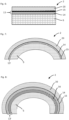
- the transfer film 1 comprises a carrier layer 10, 10' and a transfer layer 13, 13', 13", which is arranged on the carrier layer 10, 10' and contains at least one decorative element, wherein the transfer layer 13, 13', 13", adjacent to the carrier layer 10, 10', has at least one upper layer 15 which is not yet completely cured at least in some areas, wherein the at least one decorative element is arranged on the side of the at least one upper layer 15 facing away from the carrier layer 10, 10', and wherein the carrier layer 10, 10' is at least one carrier layer 11 made of a polyester, a polyolefin or a combination thereof, in particular of PET, with preferably a layer thickness of 10 ⁇ m to 75 ⁇ m, more preferably of 20 ⁇ m to 40 ⁇ m.
- the at least one top layer 15, which is at least partially not yet completely cured has a thickness of 0.5 ⁇ m to 15 ⁇ m, preferably of 1 ⁇ m to 12 ⁇ m.
- the at least one decorative element is arranged in at least one decorative layer 14, each of which independently comprises a UV-crosslinked lacquer or a thermoplastically deformable layer and each of which is independently unpigmented or pigmented or colored.
- the layer thickness of the at least one decorative layer 14 is, independently of one another, from 0.1 ⁇ m to 15 ⁇ m, more preferably from 4 to 8 ⁇ m.
- the at least one decorative element is arranged in at least one decorative layer 14.
- the at least one decorative layer 14 is arranged on the side of the at least one upper layer 15 of the transfer layer 13 facing away from the carrier layer 10, 10'.
- the at least one decorative layer 14 can comprise one or more layers which are arranged over the entire surface or partially in the one transfer layer 13, 13', 13" and which are preferably selected from: transparent and/or colored lacquer layer, in particular comprising one or more dyes and/or pigments, replication layer with molded optically active surface structure, reflection layer, in particular opaque reflection layer, transparent reflection layer, metallic reflection layer or dielectric reflection layer, optically variable layer, adhesion promoter layer, adhesive layer, hot-melt adhesive layer, hot-seal adhesive layer, cold-adhesive layer, interference multilayer system, volume hologram layer, liquid crystal layer, in particular cholesteric liquid crystal layer, electrically conductive layer, antenna layer, electrode layer, magnetic layer, magnetic storage layer, barrier layer, and/or combinations of two or more of the above layers.
- transparent and/or colored lacquer layer in particular comprising one or more dyes and/or pigments
- replication layer with molded optically active surface structure reflection layer, in particular opaque reflection layer, transparent reflection layer, metallic reflection layer or di
- At least one lacquer layer 16 with a layer thickness of preferably 0.5 ⁇ m to 10 ⁇ m, more preferably 1 ⁇ m to 5 ⁇ m, can be arranged on the surface of the transfer layer 13, 13', 13" facing away from the carrier layer 10, 10'.
- At the Fig.2 In the preferred embodiment of the transfer film 1 shown, at least one lacquer layer 16 is arranged on the surface of the transfer layer 13' facing away from the carrier layer 10.
- the at least one decorative layer 14 is in the Fig. 2 illustrated preferred embodiment between the at least one upper layer 15 of the transfer layer 13' and the at least one lacquer layer 16.
- the at least one lacquer layer 16 comprises or consists of at least one adhesive selected from the group consisting of physically curing adhesives, chemically curing adhesives, pressure-sensitive adhesives or mixtures thereof.
- a first adhesion promoter layer 17 can be arranged between the at least one top layer 15, which is not yet completely cured at least in some regions, and the at least one decorative layer 14, which preferably has a layer thickness of 0.1 ⁇ m to 10 ⁇ m, more preferably of 1 ⁇ m to 4 ⁇ m.
- the first adhesion promoter layer 17 comprises or consists of at least one acrylic resin.
- a first adhesion promoter layer 17 is arranged between the at least one top layer 15, which is not yet completely cured at least in some areas, and the at least one decorative layer 14, wherein at least one lacquer layer 16 can also be arranged on the surface of the transfer layer 13" facing away from the carrier layer 10.
- the transfer film 1 can have at least one release layer 12, preferably with a layer thickness of 0.1 nm to 50 nm, more preferably from 1 nm to 20 nm, which is arranged between the carrier layer 11 and the at least one upper layer (15).
- the at least one release layer 12 comprises or consists of at least one wax.
- the carrier layer 10' is formed by at least one carrier layer 11 and at least one release layer 12 arranged thereon.
- the transfer layer 13 arranged on the carrier layer 10' is preferably formed by at least one top layer 15 arranged on the release layer 12 and at least one decorative layer 14 arranged thereon.
- the carrier layer 10, 10' is arranged on the at least one upper layer 15 with an adhesive force, preferably determined with a measuring device Z006 from Zwick, from a range of 2 cN to 50 cN, preferably from a range of 5 cN to 35 cN.
- a coated test specimen is preferably produced in a first step by firmly applying a transfer film with a width of 3.5 cm to a plastic plate by means of hot stamping.
- the carrier layer is preferably pulled vertically from the test specimen over a length of 100 mm in a second step.
- the required forces in the range of the length of 10 mm to 90 mm of the applied carrier film are preferably measured using a Z006 measuring device from Zwick GmbH & Co. KG (Ulm, DE).
- the aforementioned measuring device Z006 is preferably combined with a horizontal substrate holder.
- the substrate holder has a movable carriage on which a test substrate is attached.
- the transfer film 1 is applied to the test substrate, in particular by means of hot stamping.
- the carrier layer 10, 10' of the applied transfer film 1 is preferably deflected from the horizontal to the vertical by means of a deflection roller and attached to the aforementioned measuring device.
- the carriage with the test substrate is moved or pulled accordingly so that the carrier layer 10, 10' can be pulled off the transfer layer 13, 13', 13" applied to the test substrate.
- a film-coated article 2 according to the invention produced by a method according to one of claims 1 to 14 using a transfer film 1, comprises a substrate S and at least one transfer layer 13, 13', 13", which is at least partially arranged on at least one surface of the substrate S and contains at least one decorative element, wherein the side of the transfer layer 13, 13', 13" facing away from the substrate S is formed by at least one, preferably cured, top layer 15, onto which at least one protective layer 20, which comprises at least one plastic based on a polyurethane, is arranged with a thickness in a range from 0.2 mm to 5 mm, wherein the at least one protective layer 20 is bonded to the at least one top layer 15 with an adhesive force determined according to the method described in DIN EN ISO 4624: 2016-08, preferably with a PosiTest ® AT series adhesion tester from DeFelsko Corporation (Ogdensburg, NY, USA) using a 20 mm test stamp, from a range of 2.5 MPa to 10 MPa, in particular from 2.5 MPa to 5
- the adhesive strength can be determined according to the procedures described in DIN EN ISO 4624: 2016-08 ("Paint and varnish materials - Tear-off test for determination of adhesion strength", issue date: 2016-08) and DIN EN ISO 16276-1: 2007-08 ("Corrosion protection of steel structures by coating systems - Assessment of adhesion/cohesion (bonding strength) of a coating and criteria for its acceptance - Part 1: Tear-off test", issue date: 2007-08), for example by using a PosiTest ® AT adhesion tester from DeFelsko Corporation (Ogdensburg, NY, USA), which uses hydraulic pressure preferably measures the force required to separate a specified test area of a coating from the substrate.
- the substrate S is selected from the group consisting of paper, plastic, wood, composite, glass, metal and combinations thereof.
- the transfer layer 13 has a cured top layer 15 and at least one decorative layer 14 which is partially arranged on at least one surface of the substrate S, wherein the side of the transfer layer 13 facing away from the substrate S is formed by at least one, preferably cured, top layer 15, on which at least one protective layer 20, which comprises at least one plastic based on a polyurethane, with a thickness in a range of 0.2 mm to 5 mm is arranged.
- the protective layer 20 is also arranged on the substrate S.
- the transfer layer 13 was created by partial hot stamping of a Fig. 1 or Fig. 4
- the transfer film 1 shown is connected to a plastic-containing substrate S, wherein after the connection the respective carrier layer 10 or 10' was removed from the transfer layer 13 arranged on the substrate S.
- the application of the at least one protective layer 20 to the at least one upper layer 15 of the transfer layer 13 is then carried out by flooding and/or pouring over the at least one upper layer 15 of the transfer layer 13 with at least one composition of polyurethane precursors (2K-PUR systems) and subsequent curing, preferably at a temperature in a range of 60°C to 160°C.
- 2K-PUR systems polyurethane precursors
- the transfer layer 13 has a cured top layer 15 and at least one decorative layer 14, which is arranged over the entire surface of at least one surface of the substrate S, wherein the side of the transfer layer 13 facing away from the substrate S is covered by at least a preferably cured upper layer 15 is formed, on which at least one protective layer 20, which comprises at least one plastic based on a polyurethane, with a thickness in a range of 0.2 mm to 5 mm is arranged.
- the protective layer 20 is arranged only on the transfer layer 13.
- the transfer layer 13 was created by full-surface hot stamping of a Fig. 1 or Fig. 4
- the transfer film 1 shown is connected to a plastic-containing substrate S, wherein after the connection the respective carrier layer 10 or 10' was removed from the transfer layer 13 arranged on the substrate S.
- the application of the at least one protective layer 20 to the at least one upper layer 15 of the transfer layer 13 is then carried out by flooding and/or pouring over the at least one upper layer 15 of the transfer layer 13 with at least one composition of polyurethane precursors (2K-PUR systems) and subsequent curing, preferably at a temperature in a range of 60°C to 160°C.
- 2K-PUR systems polyurethane precursors
- the transfer layer 13 has at least one cured top layer 15 and at least one decorative layer 14, which is arranged over the entire surface of at least one surface of the substrate S, wherein the side of the transfer layer 13 facing away from the substrate S is formed by at least one, preferably cured, top layer 15, on which at least one protective layer 20, which comprises at least one plastic based on a polyurethane, is arranged with a thickness in a range from 0.2 mm to 5 mm.
- the upper layer 15 has a thickness of 0.5 ⁇ m to 15 ⁇ m, preferably 1 ⁇ m to 12 ⁇ m.
- the substrate S was bonded to at least one surface of the transfer layer 13 of the transfer film facing away from the carrier layer by completely covering the surface of the transfer layer formed by the decorative layer 14 13 of the Fig. 1 or Fig. 4 illustrated transfer film 1 with at least one plastic injection molding compound comprising a thermoplastic, a thermosetting plastic or a mixture thereof.
- the respective carrier layer 10 or 10' was removed from the transfer layer 13 arranged on the substrate S.
- the application of the at least one protective layer 20 to the at least one upper layer 15 of the transfer layer 13 is then carried out by flooding and/or pouring over the at least one upper layer 15 of the transfer layer 13 with at least one composition of polyurethane precursors (2K-PUR systems) and subsequent curing, preferably at a temperature in a range of 60°C to 160°C.
- 2K-PUR systems polyurethane precursors
- the transfer layer 13' has at least one cured top layer 15, at least one decorative layer 14 and at least one lacquer layer 16, which is arranged over the entire surface of at least one surface of the substrate S, wherein the side of the transfer layer 13 facing away from the substrate S is formed by at least one, preferably cured, top layer 15, on which at least one protective layer 20, which comprises at least one plastic based on a polyurethane, is arranged with a thickness in a range of 0.2 mm to 5 mm.
- the upper layer 15 has a thickness of 0.5 ⁇ m to 15 ⁇ m, preferably 1 ⁇ m to 12 ⁇ m.
- connection of the substrate S with at least one surface of the transfer layer 13' of the transfer film 1 facing away from the carrier layer was carried out by full-surface lamination of the surface of the transfer layer 13' formed by the lacquer layer 16 of the Fig. 2 shown transfer film 1 onto at least one surface of a substrate S.
- the application of the at least one protective layer 20 to the at least one upper layer 15 of the transfer layer 13' is then carried out by flooding and/or pouring over the at least one upper layer 15 of the transfer layer 13' with at least one composition of polyurethane precursors (2K-PUR systems) and subsequent curing, preferably at a temperature in a range of 60°C to 160°C.
- decorative undercuts can be easily coated with at least one decoration and subsequently at least one protective layer.
Landscapes
- Engineering & Computer Science (AREA)
- Manufacturing & Machinery (AREA)
- Mechanical Engineering (AREA)
- Laminated Bodies (AREA)
- Duplication Or Marking (AREA)
Applications Claiming Priority (2)
| Application Number | Priority Date | Filing Date | Title |
|---|---|---|---|
| DE102017118904.1A DE102017118904A1 (de) | 2017-08-18 | 2017-08-18 | Transferfolie, Verfahren zur Herstellung eines folienbeschichteten Artikels und folienbeschichteter Artikel |
| PCT/EP2018/069600 WO2019034361A2 (de) | 2017-08-18 | 2018-07-19 | Transferfolie, verfahren zur herstellung eines folienbeschichteten artikels und folienbeschichteter artikel |
Publications (2)
| Publication Number | Publication Date |
|---|---|
| EP3668721A2 EP3668721A2 (de) | 2020-06-24 |
| EP3668721B1 true EP3668721B1 (de) | 2024-05-29 |
Family
ID=62981219
Family Applications (1)
| Application Number | Title | Priority Date | Filing Date |
|---|---|---|---|
| EP18743476.6A Active EP3668721B1 (de) | 2017-08-18 | 2018-07-19 | Verfahren zur herstellung eines folienbeschichteten artikels und folienbeschichteter artikel |
Country Status (8)
| Country | Link |
|---|---|
| US (1) | US11679619B2 (enExample) |
| EP (1) | EP3668721B1 (enExample) |
| JP (1) | JP7288430B2 (enExample) |
| KR (1) | KR102484899B1 (enExample) |
| CN (1) | CN111278659A (enExample) |
| DE (1) | DE102017118904A1 (enExample) |
| ES (1) | ES2983806T3 (enExample) |
| WO (1) | WO2019034361A2 (enExample) |
Families Citing this family (4)
| Publication number | Priority date | Publication date | Assignee | Title |
|---|---|---|---|---|
| DE102019127734A1 (de) * | 2019-10-15 | 2021-04-15 | Leonhard Kurz Stiftung & Co. Kg | Transferfolie, Bauteil sowie Verfahren zu deren Herstellung |
| DE102019132787A1 (de) | 2019-12-03 | 2021-06-10 | Leonhard Kurz Stiftung & Co. Kg | Dekorfolie, Verfahren zur Herstellung einer Dekorfolie und Verfahren zur Dekoration eines Zielsubstrats |
| DE102022107643A1 (de) | 2022-03-31 | 2023-10-05 | Leonhard Kurz Stiftung & Co. Kg | Folie, folienbeschichteter Artikel und Verfahren zur Herstellung eines folienbeschichteten Artikels |
| DE102022127334B4 (de) | 2022-10-18 | 2025-12-24 | Leonhard Kurz Stiftung & Co. Kg | Bauteil aufweisend einen Schichtaufbau, Verfahren zur Herstellung des Bauteils und Spritzgusswerkzeug zur Herstellung des Bauteils |
Family Cites Families (17)
| Publication number | Priority date | Publication date | Assignee | Title |
|---|---|---|---|---|
| JPH08183297A (ja) * | 1994-12-28 | 1996-07-16 | Dainippon Printing Co Ltd | 凹凸模様形成用転写シート、該転写シートの製造方法、及び凹凸模様形成方法 |
| US6245182B1 (en) * | 1997-08-12 | 2001-06-12 | Nissha Printing Co., Ltd. | Transfer material, surface-protective sheet, and process for producing molded article |
| JP3453679B2 (ja) * | 2000-04-27 | 2003-10-06 | 大日本印刷株式会社 | 化粧材 |
| DE10221482C1 (de) | 2002-05-15 | 2003-09-18 | Kurz Leonhard Fa | Vorrichtung zum Herstellen eines abgewinkelt profilierten Formteiles, das mit einer Prägefolie dekoriert wird |
| DE10236810A1 (de) | 2002-08-10 | 2004-02-26 | Leonhard Kurz Gmbh & Co. Kg | Teilstrukturierte IMD-fähige Mehrschichtfolie |
| US20050255314A1 (en) * | 2004-04-20 | 2005-11-17 | Fei Wang | Composition for release layer of in-mold decoration |
| DE102004041833A1 (de) * | 2004-08-27 | 2006-03-02 | Leonhard Kurz Gmbh & Co. Kg | Dekorierter Spritzgussartikel, Verfahren zur Herstellung eines dekorierten Spritzgussartikels sowie Transferfolie zur Verwendung in einem derartigen Verfahren |
| CN101077672B (zh) | 2006-05-26 | 2010-05-26 | 鸿富锦精密工业(深圳)有限公司 | 模内装饰用薄膜及其制造方法以及模内装饰制程 |
| CN101092050A (zh) * | 2006-06-22 | 2007-12-26 | 玉山精密涂布股份有限公司 | 应用于模内装饰射出成型的硬化膜制造方法 |
| WO2008051629A2 (en) * | 2006-10-23 | 2008-05-02 | Entrotech, Inc. | Articles comprising protective sheets and related methods |
| TWI322767B (en) * | 2007-05-10 | 2010-04-01 | Compal Electronics Inc | Thermal transfer film, method of manufacturing the same and thermal transfer method |
| DE102009022542A1 (de) * | 2009-05-25 | 2010-12-09 | Leonhard Kurz Stiftung & Co. Kg | Mehrschichtfolie |
| WO2012176742A1 (ja) | 2011-06-20 | 2012-12-27 | Jnc株式会社 | インモールド成形用転写フィルムおよびその製造方法 |
| DE102012220903B4 (de) | 2012-11-15 | 2023-06-07 | Bundesdruckerei Gmbh | Verfahren zum Erzeugen eines Sicherheitsmerkmals für ein Wert- und/oder Sicherheitsprodukt und Wert- und/oder Sicherheitsprodukt (Inkjetdrucken) |
| US20170021388A1 (en) | 2013-03-14 | 2017-01-26 | Illinois Tool Works Inc. | Surface appearance simulation system and method |
| WO2016139705A1 (ja) * | 2015-03-02 | 2016-09-09 | パナソニックIpマネジメント株式会社 | 転写フィルム及び転写フィルムの製造方法 |
| WO2017062822A1 (en) * | 2015-10-09 | 2017-04-13 | Illinois Tool Works Inc. | Surface appearance simulation system and method |
-
2017
- 2017-08-18 DE DE102017118904.1A patent/DE102017118904A1/de active Pending
-
2018
- 2018-07-19 WO PCT/EP2018/069600 patent/WO2019034361A2/de not_active Ceased
- 2018-07-19 EP EP18743476.6A patent/EP3668721B1/de active Active
- 2018-07-19 US US16/638,696 patent/US11679619B2/en active Active
- 2018-07-19 CN CN201880066138.8A patent/CN111278659A/zh active Pending
- 2018-07-19 JP JP2020509457A patent/JP7288430B2/ja active Active
- 2018-07-19 ES ES18743476T patent/ES2983806T3/es active Active
- 2018-07-19 KR KR1020207007510A patent/KR102484899B1/ko active Active
Also Published As
| Publication number | Publication date |
|---|---|
| US20200361233A1 (en) | 2020-11-19 |
| US11679619B2 (en) | 2023-06-20 |
| ES2983806T3 (es) | 2024-10-24 |
| EP3668721A2 (de) | 2020-06-24 |
| WO2019034361A3 (de) | 2019-04-11 |
| JP7288430B2 (ja) | 2023-06-07 |
| WO2019034361A2 (de) | 2019-02-21 |
| CN111278659A (zh) | 2020-06-12 |
| KR20200042501A (ko) | 2020-04-23 |
| DE102017118904A1 (de) | 2019-02-21 |
| KR102484899B1 (ko) | 2023-01-05 |
| JP2020531311A (ja) | 2020-11-05 |
Similar Documents
| Publication | Publication Date | Title |
|---|---|---|
| DE69914322T2 (de) | Dekorinnenteile für autos mit in der form beschichteter, integrierter elastomerabdeckung aus aromatischem polyurethan und verfahren zur herstellung derselben | |
| DE102009030684A1 (de) | Dekorelement und Verfahren zu dessen Herstellung, sowie Verfahren zum gesteuerten Beleuchten des Dekorelements | |
| EP1495862A1 (de) | Verbundsysteme zur Herstellung von dekorierten Kunststoffformteilen und ein Verfahren zur Herstellung der Verbundsysteme | |
| WO2019034361A2 (de) | Transferfolie, verfahren zur herstellung eines folienbeschichteten artikels und folienbeschichteter artikel | |
| EP3481632B1 (de) | Transferfolie, verfahren zur herstellung einer transferfolie sowie verwendung einer transferfolie und verfahren zur beschichtung eines bauteils | |
| DE102016224791B4 (de) | Echtholzfilm, Herstellungsverfahren davon, und Artikel, die denselben umfassen | |
| EP1784294A1 (de) | Dekorierter spritzgussartikel, sowie transferfolie und verfahren zur herstellung eines solchen | |
| EP3762202B1 (de) | Verfahren zur herstellung eines dekorierten formteils | |
| DE69909918T2 (de) | Geformter gegenstand und oberflächenbelagfolie dafür | |
| EP3883997B1 (de) | Selbsttrennendes in-mold-coating (imc) zur beschichtung von substraten | |
| DE2060452B2 (de) | Verfahren zur herstellung eines zusammenhaengenden, elastischen gegenstandes aus einem stueck aus einem wasserdampfdurchlaessigen, mikroporoesen polymeren material | |
| DE19832570C2 (de) | Hochtemperaturbeständige flexible Druckfarbe und deren Verwendung | |
| EP2552603B1 (de) | Herstellungsverfahren für substrate mit mehrfarbiger lackierung | |
| DE19526478A1 (de) | Lack, insbesondere zur Beschichtung von Polymerfolien, mit dem Lack beschichtete Polymerfolie und Verfahren zum Aufbringen der beschichteten Polymerfolie auf Formkörper | |
| DE102007060240B4 (de) | Verfahren zur Verklebung von zwei Schichten von flächigen Materialien | |
| EP4045332A1 (de) | Transferfolie, bauteil sowie verfahren zu deren herstellung | |
| EP3884003B1 (de) | Selbsttrennendes pigmentiertes in-mold-coating (imc) zur beschichtung von substraten | |
| DE112007001172T5 (de) | Laminiertes Material für ein metallisches Tasten-Sheet, metallisches Tasten-Sheet und metallisches Tastenfeld | |
| EP4499414A1 (de) | Folie, folienbeschichteter artikel und verfahren zur herstellung eines folienbeschichteten artikels | |
| DE102008034041A1 (de) | Kunststoff-Verbundscheibe für insbesondere die Fahrzeugverscheibung | |
| WO2026021846A1 (de) | Primerzusammensetzung zur herstellung einer klebeverbindung | |
| DE102024129175A1 (de) | Primerzusammensetzung zur Herstellung einer Klebeverbindung | |
| EP2199321B1 (de) | Verfahren zur Beschichtung von polymeren Kunststoffsubstraten | |
| DE102008032658A1 (de) | Verfahren zum Herstellen eines mehrschichtigen Bauteils |
Legal Events
| Date | Code | Title | Description |
|---|---|---|---|
| STAA | Information on the status of an ep patent application or granted ep patent |
Free format text: STATUS: UNKNOWN |
|
| STAA | Information on the status of an ep patent application or granted ep patent |
Free format text: STATUS: THE INTERNATIONAL PUBLICATION HAS BEEN MADE |
|
| PUAI | Public reference made under article 153(3) epc to a published international application that has entered the european phase |
Free format text: ORIGINAL CODE: 0009012 |
|
| STAA | Information on the status of an ep patent application or granted ep patent |
Free format text: STATUS: REQUEST FOR EXAMINATION WAS MADE |
|
| 17P | Request for examination filed |
Effective date: 20200212 |
|
| AK | Designated contracting states |
Kind code of ref document: A2 Designated state(s): AL AT BE BG CH CY CZ DE DK EE ES FI FR GB GR HR HU IE IS IT LI LT LU LV MC MK MT NL NO PL PT RO RS SE SI SK SM TR |
|
| AX | Request for extension of the european patent |
Extension state: BA ME |
|
| DAV | Request for validation of the european patent (deleted) | ||
| DAX | Request for extension of the european patent (deleted) | ||
| STAA | Information on the status of an ep patent application or granted ep patent |
Free format text: STATUS: EXAMINATION IS IN PROGRESS |
|
| 17Q | First examination report despatched |
Effective date: 20220103 |
|
| GRAP | Despatch of communication of intention to grant a patent |
Free format text: ORIGINAL CODE: EPIDOSNIGR1 |
|
| STAA | Information on the status of an ep patent application or granted ep patent |
Free format text: STATUS: GRANT OF PATENT IS INTENDED |
|
| INTG | Intention to grant announced |
Effective date: 20231215 |
|
| GRAJ | Information related to disapproval of communication of intention to grant by the applicant or resumption of examination proceedings by the epo deleted |
Free format text: ORIGINAL CODE: EPIDOSDIGR1 |
|
| STAA | Information on the status of an ep patent application or granted ep patent |
Free format text: STATUS: EXAMINATION IS IN PROGRESS |
|
| GRAP | Despatch of communication of intention to grant a patent |
Free format text: ORIGINAL CODE: EPIDOSNIGR1 |
|
| STAA | Information on the status of an ep patent application or granted ep patent |
Free format text: STATUS: GRANT OF PATENT IS INTENDED |
|
| INTC | Intention to grant announced (deleted) | ||
| INTG | Intention to grant announced |
Effective date: 20240314 |
|
| GRAS | Grant fee paid |
Free format text: ORIGINAL CODE: EPIDOSNIGR3 |
|
| GRAA | (expected) grant |
Free format text: ORIGINAL CODE: 0009210 |
|
| STAA | Information on the status of an ep patent application or granted ep patent |
Free format text: STATUS: THE PATENT HAS BEEN GRANTED |
|
| AK | Designated contracting states |
Kind code of ref document: B1 Designated state(s): AL AT BE BG CH CY CZ DE DK EE ES FI FR GB GR HR HU IE IS IT LI LT LU LV MC MK MT NL NO PL PT RO RS SE SI SK SM TR |
|
| REG | Reference to a national code |
Ref country code: CH Ref legal event code: EP |
|
| REG | Reference to a national code |
Ref country code: IE Ref legal event code: FG4D Free format text: LANGUAGE OF EP DOCUMENT: GERMAN |
|
| REG | Reference to a national code |
Ref country code: DE Ref legal event code: R096 Ref document number: 502018014685 Country of ref document: DE |
|
| REG | Reference to a national code |
Ref country code: LT Ref legal event code: MG9D |
|
| REG | Reference to a national code |
Ref country code: NL Ref legal event code: MP Effective date: 20240529 |
|
| PG25 | Lapsed in a contracting state [announced via postgrant information from national office to epo] |
Ref country code: IS Free format text: LAPSE BECAUSE OF FAILURE TO SUBMIT A TRANSLATION OF THE DESCRIPTION OR TO PAY THE FEE WITHIN THE PRESCRIBED TIME-LIMIT Effective date: 20240929 |
|
| PG25 | Lapsed in a contracting state [announced via postgrant information from national office to epo] |
Ref country code: BG Free format text: LAPSE BECAUSE OF FAILURE TO SUBMIT A TRANSLATION OF THE DESCRIPTION OR TO PAY THE FEE WITHIN THE PRESCRIBED TIME-LIMIT Effective date: 20240529 |
|
| PG25 | Lapsed in a contracting state [announced via postgrant information from national office to epo] |
Ref country code: HR Free format text: LAPSE BECAUSE OF FAILURE TO SUBMIT A TRANSLATION OF THE DESCRIPTION OR TO PAY THE FEE WITHIN THE PRESCRIBED TIME-LIMIT Effective date: 20240529 Ref country code: FI Free format text: LAPSE BECAUSE OF FAILURE TO SUBMIT A TRANSLATION OF THE DESCRIPTION OR TO PAY THE FEE WITHIN THE PRESCRIBED TIME-LIMIT Effective date: 20240529 |
|
| PG25 | Lapsed in a contracting state [announced via postgrant information from national office to epo] |
Ref country code: GR Free format text: LAPSE BECAUSE OF FAILURE TO SUBMIT A TRANSLATION OF THE DESCRIPTION OR TO PAY THE FEE WITHIN THE PRESCRIBED TIME-LIMIT Effective date: 20240830 |
|
| REG | Reference to a national code |
Ref country code: ES Ref legal event code: FG2A Ref document number: 2983806 Country of ref document: ES Kind code of ref document: T3 Effective date: 20241024 |
|
| PG25 | Lapsed in a contracting state [announced via postgrant information from national office to epo] |
Ref country code: PL Free format text: LAPSE BECAUSE OF FAILURE TO SUBMIT A TRANSLATION OF THE DESCRIPTION OR TO PAY THE FEE WITHIN THE PRESCRIBED TIME-LIMIT Effective date: 20240529 |
|
| PG25 | Lapsed in a contracting state [announced via postgrant information from national office to epo] |
Ref country code: LV Free format text: LAPSE BECAUSE OF FAILURE TO SUBMIT A TRANSLATION OF THE DESCRIPTION OR TO PAY THE FEE WITHIN THE PRESCRIBED TIME-LIMIT Effective date: 20240529 |
|
| PG25 | Lapsed in a contracting state [announced via postgrant information from national office to epo] |
Ref country code: PL Free format text: LAPSE BECAUSE OF FAILURE TO SUBMIT A TRANSLATION OF THE DESCRIPTION OR TO PAY THE FEE WITHIN THE PRESCRIBED TIME-LIMIT Effective date: 20240529 Ref country code: NO Free format text: LAPSE BECAUSE OF FAILURE TO SUBMIT A TRANSLATION OF THE DESCRIPTION OR TO PAY THE FEE WITHIN THE PRESCRIBED TIME-LIMIT Effective date: 20240829 Ref country code: LV Free format text: LAPSE BECAUSE OF FAILURE TO SUBMIT A TRANSLATION OF THE DESCRIPTION OR TO PAY THE FEE WITHIN THE PRESCRIBED TIME-LIMIT Effective date: 20240529 Ref country code: IS Free format text: LAPSE BECAUSE OF FAILURE TO SUBMIT A TRANSLATION OF THE DESCRIPTION OR TO PAY THE FEE WITHIN THE PRESCRIBED TIME-LIMIT Effective date: 20240929 Ref country code: HR Free format text: LAPSE BECAUSE OF FAILURE TO SUBMIT A TRANSLATION OF THE DESCRIPTION OR TO PAY THE FEE WITHIN THE PRESCRIBED TIME-LIMIT Effective date: 20240529 Ref country code: GR Free format text: LAPSE BECAUSE OF FAILURE TO SUBMIT A TRANSLATION OF THE DESCRIPTION OR TO PAY THE FEE WITHIN THE PRESCRIBED TIME-LIMIT Effective date: 20240830 Ref country code: FI Free format text: LAPSE BECAUSE OF FAILURE TO SUBMIT A TRANSLATION OF THE DESCRIPTION OR TO PAY THE FEE WITHIN THE PRESCRIBED TIME-LIMIT Effective date: 20240529 Ref country code: BG Free format text: LAPSE BECAUSE OF FAILURE TO SUBMIT A TRANSLATION OF THE DESCRIPTION OR TO PAY THE FEE WITHIN THE PRESCRIBED TIME-LIMIT Effective date: 20240529 Ref country code: RS Free format text: LAPSE BECAUSE OF FAILURE TO SUBMIT A TRANSLATION OF THE DESCRIPTION OR TO PAY THE FEE WITHIN THE PRESCRIBED TIME-LIMIT Effective date: 20240829 |
|
| PG25 | Lapsed in a contracting state [announced via postgrant information from national office to epo] |
Ref country code: NL Free format text: LAPSE BECAUSE OF FAILURE TO SUBMIT A TRANSLATION OF THE DESCRIPTION OR TO PAY THE FEE WITHIN THE PRESCRIBED TIME-LIMIT Effective date: 20240529 |
|
| PG25 | Lapsed in a contracting state [announced via postgrant information from national office to epo] |
Ref country code: NL Free format text: LAPSE BECAUSE OF FAILURE TO SUBMIT A TRANSLATION OF THE DESCRIPTION OR TO PAY THE FEE WITHIN THE PRESCRIBED TIME-LIMIT Effective date: 20240529 |
|
| PG25 | Lapsed in a contracting state [announced via postgrant information from national office to epo] |
Ref country code: DK Free format text: LAPSE BECAUSE OF FAILURE TO SUBMIT A TRANSLATION OF THE DESCRIPTION OR TO PAY THE FEE WITHIN THE PRESCRIBED TIME-LIMIT Effective date: 20240529 |
|
| PG25 | Lapsed in a contracting state [announced via postgrant information from national office to epo] |
Ref country code: EE Free format text: LAPSE BECAUSE OF FAILURE TO SUBMIT A TRANSLATION OF THE DESCRIPTION OR TO PAY THE FEE WITHIN THE PRESCRIBED TIME-LIMIT Effective date: 20240529 |
|
| PG25 | Lapsed in a contracting state [announced via postgrant information from national office to epo] |
Ref country code: CZ Free format text: LAPSE BECAUSE OF FAILURE TO SUBMIT A TRANSLATION OF THE DESCRIPTION OR TO PAY THE FEE WITHIN THE PRESCRIBED TIME-LIMIT Effective date: 20240529 |
|
| PG25 | Lapsed in a contracting state [announced via postgrant information from national office to epo] |
Ref country code: SK Free format text: LAPSE BECAUSE OF FAILURE TO SUBMIT A TRANSLATION OF THE DESCRIPTION OR TO PAY THE FEE WITHIN THE PRESCRIBED TIME-LIMIT Effective date: 20240529 Ref country code: RO Free format text: LAPSE BECAUSE OF FAILURE TO SUBMIT A TRANSLATION OF THE DESCRIPTION OR TO PAY THE FEE WITHIN THE PRESCRIBED TIME-LIMIT Effective date: 20240529 |
|
| PG25 | Lapsed in a contracting state [announced via postgrant information from national office to epo] |
Ref country code: SM Free format text: LAPSE BECAUSE OF FAILURE TO SUBMIT A TRANSLATION OF THE DESCRIPTION OR TO PAY THE FEE WITHIN THE PRESCRIBED TIME-LIMIT Effective date: 20240529 |
|
| PG25 | Lapsed in a contracting state [announced via postgrant information from national office to epo] |
Ref country code: SM Free format text: LAPSE BECAUSE OF FAILURE TO SUBMIT A TRANSLATION OF THE DESCRIPTION OR TO PAY THE FEE WITHIN THE PRESCRIBED TIME-LIMIT Effective date: 20240529 Ref country code: SK Free format text: LAPSE BECAUSE OF FAILURE TO SUBMIT A TRANSLATION OF THE DESCRIPTION OR TO PAY THE FEE WITHIN THE PRESCRIBED TIME-LIMIT Effective date: 20240529 Ref country code: RO Free format text: LAPSE BECAUSE OF FAILURE TO SUBMIT A TRANSLATION OF THE DESCRIPTION OR TO PAY THE FEE WITHIN THE PRESCRIBED TIME-LIMIT Effective date: 20240529 Ref country code: EE Free format text: LAPSE BECAUSE OF FAILURE TO SUBMIT A TRANSLATION OF THE DESCRIPTION OR TO PAY THE FEE WITHIN THE PRESCRIBED TIME-LIMIT Effective date: 20240529 Ref country code: DK Free format text: LAPSE BECAUSE OF FAILURE TO SUBMIT A TRANSLATION OF THE DESCRIPTION OR TO PAY THE FEE WITHIN THE PRESCRIBED TIME-LIMIT Effective date: 20240529 Ref country code: CZ Free format text: LAPSE BECAUSE OF FAILURE TO SUBMIT A TRANSLATION OF THE DESCRIPTION OR TO PAY THE FEE WITHIN THE PRESCRIBED TIME-LIMIT Effective date: 20240529 |
|
| PG25 | Lapsed in a contracting state [announced via postgrant information from national office to epo] |
Ref country code: MC Free format text: LAPSE BECAUSE OF FAILURE TO SUBMIT A TRANSLATION OF THE DESCRIPTION OR TO PAY THE FEE WITHIN THE PRESCRIBED TIME-LIMIT Effective date: 20240529 |
|
| REG | Reference to a national code |
Ref country code: CH Ref legal event code: PL |
|
| REG | Reference to a national code |
Ref country code: DE Ref legal event code: R097 Ref document number: 502018014685 Country of ref document: DE |
|
| PG25 | Lapsed in a contracting state [announced via postgrant information from national office to epo] |
Ref country code: LU Free format text: LAPSE BECAUSE OF NON-PAYMENT OF DUE FEES Effective date: 20240719 |
|
| PG25 | Lapsed in a contracting state [announced via postgrant information from national office to epo] |
Ref country code: LU Free format text: LAPSE BECAUSE OF NON-PAYMENT OF DUE FEES Effective date: 20240719 |
|
| PLBE | No opposition filed within time limit |
Free format text: ORIGINAL CODE: 0009261 |
|
| STAA | Information on the status of an ep patent application or granted ep patent |
Free format text: STATUS: NO OPPOSITION FILED WITHIN TIME LIMIT |
|
| PG25 | Lapsed in a contracting state [announced via postgrant information from national office to epo] |
Ref country code: SI Free format text: LAPSE BECAUSE OF FAILURE TO SUBMIT A TRANSLATION OF THE DESCRIPTION OR TO PAY THE FEE WITHIN THE PRESCRIBED TIME-LIMIT Effective date: 20240529 Ref country code: BE Free format text: LAPSE BECAUSE OF NON-PAYMENT OF DUE FEES Effective date: 20240731 Ref country code: CH Free format text: LAPSE BECAUSE OF NON-PAYMENT OF DUE FEES Effective date: 20240731 |
|
| 26N | No opposition filed |
Effective date: 20250303 |
|
| REG | Reference to a national code |
Ref country code: BE Ref legal event code: MM Effective date: 20240731 |
|
| PG25 | Lapsed in a contracting state [announced via postgrant information from national office to epo] |
Ref country code: IE Free format text: LAPSE BECAUSE OF NON-PAYMENT OF DUE FEES Effective date: 20240719 |
|
| PG25 | Lapsed in a contracting state [announced via postgrant information from national office to epo] |
Ref country code: SE Free format text: LAPSE BECAUSE OF FAILURE TO SUBMIT A TRANSLATION OF THE DESCRIPTION OR TO PAY THE FEE WITHIN THE PRESCRIBED TIME-LIMIT Effective date: 20240529 |
|
| REG | Reference to a national code |
Ref country code: AT Ref legal event code: MM01 Ref document number: 1690330 Country of ref document: AT Kind code of ref document: T Effective date: 20240719 |
|
| PGFP | Annual fee paid to national office [announced via postgrant information from national office to epo] |
Ref country code: ES Payment date: 20250819 Year of fee payment: 8 |
|
| PGFP | Annual fee paid to national office [announced via postgrant information from national office to epo] |
Ref country code: DE Payment date: 20250722 Year of fee payment: 8 |
|
| PGFP | Annual fee paid to national office [announced via postgrant information from national office to epo] |
Ref country code: IT Payment date: 20250731 Year of fee payment: 8 |
|
| PGFP | Annual fee paid to national office [announced via postgrant information from national office to epo] |
Ref country code: GB Payment date: 20250724 Year of fee payment: 8 |
|
| PG25 | Lapsed in a contracting state [announced via postgrant information from national office to epo] |
Ref country code: AT Free format text: LAPSE BECAUSE OF NON-PAYMENT OF DUE FEES Effective date: 20240719 |
|
| PGFP | Annual fee paid to national office [announced via postgrant information from national office to epo] |
Ref country code: FR Payment date: 20250723 Year of fee payment: 8 |
|
| PG25 | Lapsed in a contracting state [announced via postgrant information from national office to epo] |
Ref country code: PT Free format text: LAPSE BECAUSE OF NON-PAYMENT OF DUE FEES Effective date: 20240529 |
|
| PG25 | Lapsed in a contracting state [announced via postgrant information from national office to epo] |
Ref country code: CY Free format text: LAPSE BECAUSE OF FAILURE TO SUBMIT A TRANSLATION OF THE DESCRIPTION OR TO PAY THE FEE WITHIN THE PRESCRIBED TIME-LIMIT; INVALID AB INITIO Effective date: 20180719 |
|
| PG25 | Lapsed in a contracting state [announced via postgrant information from national office to epo] |
Ref country code: HU Free format text: LAPSE BECAUSE OF FAILURE TO SUBMIT A TRANSLATION OF THE DESCRIPTION OR TO PAY THE FEE WITHIN THE PRESCRIBED TIME-LIMIT; INVALID AB INITIO Effective date: 20180719 |
|
| PG25 | Lapsed in a contracting state [announced via postgrant information from national office to epo] |
Ref country code: TR Free format text: LAPSE BECAUSE OF FAILURE TO SUBMIT A TRANSLATION OF THE DESCRIPTION OR TO PAY THE FEE WITHIN THE PRESCRIBED TIME-LIMIT Effective date: 20240529 |
|
| PG25 | Lapsed in a contracting state [announced via postgrant information from national office to epo] |
Ref country code: LT Free format text: LAPSE BECAUSE OF FAILURE TO SUBMIT A TRANSLATION OF THE DESCRIPTION OR TO PAY THE FEE WITHIN THE PRESCRIBED TIME-LIMIT Effective date: 20240529 |