EP3665531B1 - Herstellungsverfahren für strukturiertes substrat - Google Patents
Herstellungsverfahren für strukturiertes substrat Download PDFInfo
- Publication number
- EP3665531B1 EP3665531B1 EP18855824.1A EP18855824A EP3665531B1 EP 3665531 B1 EP3665531 B1 EP 3665531B1 EP 18855824 A EP18855824 A EP 18855824A EP 3665531 B1 EP3665531 B1 EP 3665531B1
- Authority
- EP
- European Patent Office
- Prior art keywords
- etching
- block copolymer
- less
- sccm
- block
- Prior art date
- Legal status (The legal status is an assumption and is not a legal conclusion. Google has not performed a legal analysis and makes no representation as to the accuracy of the status listed.)
- Active
Links
Images



Classifications
-
- G—PHYSICS
- G03—PHOTOGRAPHY; CINEMATOGRAPHY; ANALOGOUS TECHNIQUES USING WAVES OTHER THAN OPTICAL WAVES; ELECTROGRAPHY; HOLOGRAPHY
- G03F—PHOTOMECHANICAL PRODUCTION OF TEXTURED OR PATTERNED SURFACES, e.g. FOR PRINTING, FOR PROCESSING OF SEMICONDUCTOR DEVICES; MATERIALS THEREFOR; ORIGINALS THEREFOR; APPARATUS SPECIALLY ADAPTED THEREFOR
- G03F7/00—Photomechanical, e.g. photolithographic, production of textured or patterned surfaces, e.g. printing surfaces; Materials therefor, e.g. comprising photoresists; Apparatus specially adapted therefor
- G03F7/004—Photosensitive materials
-
- B—PERFORMING OPERATIONS; TRANSPORTING
- B29—WORKING OF PLASTICS; WORKING OF SUBSTANCES IN A PLASTIC STATE IN GENERAL
- B29C—SHAPING OR JOINING OF PLASTICS; SHAPING OF MATERIAL IN A PLASTIC STATE, NOT OTHERWISE PROVIDED FOR; AFTER-TREATMENT OF THE SHAPED PRODUCTS, e.g. REPAIRING
- B29C59/00—Surface shaping of articles, e.g. embossing; Apparatus therefor
- B29C59/14—Surface shaping of articles, e.g. embossing; Apparatus therefor by plasma treatment
-
- G—PHYSICS
- G03—PHOTOGRAPHY; CINEMATOGRAPHY; ANALOGOUS TECHNIQUES USING WAVES OTHER THAN OPTICAL WAVES; ELECTROGRAPHY; HOLOGRAPHY
- G03F—PHOTOMECHANICAL PRODUCTION OF TEXTURED OR PATTERNED SURFACES, e.g. FOR PRINTING, FOR PROCESSING OF SEMICONDUCTOR DEVICES; MATERIALS THEREFOR; ORIGINALS THEREFOR; APPARATUS SPECIALLY ADAPTED THEREFOR
- G03F7/00—Photomechanical, e.g. photolithographic, production of textured or patterned surfaces, e.g. printing surfaces; Materials therefor, e.g. comprising photoresists; Apparatus specially adapted therefor
- G03F7/0002—Lithographic processes using patterning methods other than those involving the exposure to radiation, e.g. by stamping
-
- B—PERFORMING OPERATIONS; TRANSPORTING
- B29—WORKING OF PLASTICS; WORKING OF SUBSTANCES IN A PLASTIC STATE IN GENERAL
- B29C—SHAPING OR JOINING OF PLASTICS; SHAPING OF MATERIAL IN A PLASTIC STATE, NOT OTHERWISE PROVIDED FOR; AFTER-TREATMENT OF THE SHAPED PRODUCTS, e.g. REPAIRING
- B29C59/00—Surface shaping of articles, e.g. embossing; Apparatus therefor
- B29C59/005—Surface shaping of articles, e.g. embossing; Apparatus therefor characterised by the choice of material
-
- C—CHEMISTRY; METALLURGY
- C08—ORGANIC MACROMOLECULAR COMPOUNDS; THEIR PREPARATION OR CHEMICAL WORKING-UP; COMPOSITIONS BASED THEREON
- C08F—MACROMOLECULAR COMPOUNDS OBTAINED BY REACTIONS ONLY INVOLVING CARBON-TO-CARBON UNSATURATED BONDS
- C08F212/00—Copolymers of compounds having one or more unsaturated aliphatic radicals, each having only one carbon-to-carbon double bond, and at least one being terminated by an aromatic carbocyclic ring
- C08F212/02—Monomers containing only one unsaturated aliphatic radical
- C08F212/04—Monomers containing only one unsaturated aliphatic radical containing one ring
- C08F212/06—Hydrocarbons
- C08F212/08—Styrene
-
- C—CHEMISTRY; METALLURGY
- C08—ORGANIC MACROMOLECULAR COMPOUNDS; THEIR PREPARATION OR CHEMICAL WORKING-UP; COMPOSITIONS BASED THEREON
- C08F—MACROMOLECULAR COMPOUNDS OBTAINED BY REACTIONS ONLY INVOLVING CARBON-TO-CARBON UNSATURATED BONDS
- C08F220/00—Copolymers of compounds having one or more unsaturated aliphatic radicals, each having only one carbon-to-carbon double bond, and only one being terminated by only one carboxyl radical or a salt, anhydride ester, amide, imide or nitrile thereof
- C08F220/02—Monocarboxylic acids having less than ten carbon atoms; Derivatives thereof
- C08F220/10—Esters
- C08F220/26—Esters containing oxygen in addition to the carboxy oxygen
- C08F220/30—Esters containing oxygen in addition to the carboxy oxygen containing aromatic rings in the alcohol moiety
- C08F220/301—Esters containing oxygen in addition to the carboxy oxygen containing aromatic rings in the alcohol moiety and one oxygen in the alcohol moiety
-
- C—CHEMISTRY; METALLURGY
- C08—ORGANIC MACROMOLECULAR COMPOUNDS; THEIR PREPARATION OR CHEMICAL WORKING-UP; COMPOSITIONS BASED THEREON
- C08F—MACROMOLECULAR COMPOUNDS OBTAINED BY REACTIONS ONLY INVOLVING CARBON-TO-CARBON UNSATURATED BONDS
- C08F293/00—Macromolecular compounds obtained by polymerisation on to a macromolecule having groups capable of inducing the formation of new polymer chains bound exclusively at one or both ends of the starting macromolecule
- C08F293/005—Macromolecular compounds obtained by polymerisation on to a macromolecule having groups capable of inducing the formation of new polymer chains bound exclusively at one or both ends of the starting macromolecule using free radical "living" or "controlled" polymerisation, e.g. using a complexing agent
-
- C—CHEMISTRY; METALLURGY
- C08—ORGANIC MACROMOLECULAR COMPOUNDS; THEIR PREPARATION OR CHEMICAL WORKING-UP; COMPOSITIONS BASED THEREON
- C08L—COMPOSITIONS OF MACROMOLECULAR COMPOUNDS
- C08L33/00—Compositions of homopolymers or copolymers of compounds having one or more unsaturated aliphatic radicals, each having only one carbon-to-carbon double bond, and only one being terminated by only one carboxyl radical, or of salts, anhydrides, esters, amides, imides or nitriles thereof; Compositions of derivatives of such polymers
- C08L33/04—Homopolymers or copolymers of esters
- C08L33/06—Homopolymers or copolymers of esters of esters containing only carbon, hydrogen and oxygen, which oxygen atoms are present only as part of the carboxyl radical
- C08L33/10—Homopolymers or copolymers of methacrylic acid esters
- C08L33/12—Homopolymers or copolymers of methyl methacrylate
-
- G—PHYSICS
- G03—PHOTOGRAPHY; CINEMATOGRAPHY; ANALOGOUS TECHNIQUES USING WAVES OTHER THAN OPTICAL WAVES; ELECTROGRAPHY; HOLOGRAPHY
- G03F—PHOTOMECHANICAL PRODUCTION OF TEXTURED OR PATTERNED SURFACES, e.g. FOR PRINTING, FOR PROCESSING OF SEMICONDUCTOR DEVICES; MATERIALS THEREFOR; ORIGINALS THEREFOR; APPARATUS SPECIALLY ADAPTED THEREFOR
- G03F1/00—Originals for photomechanical production of textured or patterned surfaces, e.g., masks, photo-masks, reticles; Mask blanks or pellicles therefor; Containers specially adapted therefor; Preparation thereof
- G03F1/68—Preparation processes not covered by groups G03F1/20 - G03F1/50
- G03F1/80—Etching
-
- H—ELECTRICITY
- H10—SEMICONDUCTOR DEVICES; ELECTRIC SOLID-STATE DEVICES NOT OTHERWISE PROVIDED FOR
- H10P—GENERIC PROCESSES OR APPARATUS FOR THE MANUFACTURE OR TREATMENT OF DEVICES COVERED BY CLASS H10
- H10P50/00—Etching of wafers, substrates or parts of devices
- H10P50/20—Dry etching; Plasma etching; Reactive-ion etching
- H10P50/28—Dry etching; Plasma etching; Reactive-ion etching of insulating materials
- H10P50/286—Dry etching; Plasma etching; Reactive-ion etching of insulating materials of organic materials
- H10P50/287—Dry etching; Plasma etching; Reactive-ion etching of insulating materials of organic materials by chemical means
-
- H—ELECTRICITY
- H10—SEMICONDUCTOR DEVICES; ELECTRIC SOLID-STATE DEVICES NOT OTHERWISE PROVIDED FOR
- H10P—GENERIC PROCESSES OR APPARATUS FOR THE MANUFACTURE OR TREATMENT OF DEVICES COVERED BY CLASS H10
- H10P50/00—Etching of wafers, substrates or parts of devices
- H10P50/69—Etching of wafers, substrates or parts of devices using masks for semiconductor materials
- H10P50/691—Etching of wafers, substrates or parts of devices using masks for semiconductor materials for Group V materials or Group III-V materials
- H10P50/692—Etching of wafers, substrates or parts of devices using masks for semiconductor materials for Group V materials or Group III-V materials characterised by their composition, e.g. multilayer masks or materials
-
- H—ELECTRICITY
- H10—SEMICONDUCTOR DEVICES; ELECTRIC SOLID-STATE DEVICES NOT OTHERWISE PROVIDED FOR
- H10P—GENERIC PROCESSES OR APPARATUS FOR THE MANUFACTURE OR TREATMENT OF DEVICES COVERED BY CLASS H10
- H10P76/00—Manufacture or treatment of masks on semiconductor bodies, e.g. by lithography or photolithography
- H10P76/20—Manufacture or treatment of masks on semiconductor bodies, e.g. by lithography or photolithography of masks comprising organic materials
- H10P76/204—Manufacture or treatment of masks on semiconductor bodies, e.g. by lithography or photolithography of masks comprising organic materials of organic photoresist masks
- H10P76/2041—Photolithographic processes
-
- B—PERFORMING OPERATIONS; TRANSPORTING
- B29—WORKING OF PLASTICS; WORKING OF SUBSTANCES IN A PLASTIC STATE IN GENERAL
- B29K—INDEXING SCHEME ASSOCIATED WITH SUBCLASSES B29B, B29C OR B29D, RELATING TO MOULDING MATERIALS OR TO MATERIALS FOR MOULDS, REINFORCEMENTS, FILLERS OR PREFORMED PARTS, e.g. INSERTS
- B29K2096/00—Use of specified macromolecular materials not provided for in a single one of main groups B29K2001/00 - B29K2095/00, as moulding material
- B29K2096/04—Block polymers
-
- C—CHEMISTRY; METALLURGY
- C08—ORGANIC MACROMOLECULAR COMPOUNDS; THEIR PREPARATION OR CHEMICAL WORKING-UP; COMPOSITIONS BASED THEREON
- C08F—MACROMOLECULAR COMPOUNDS OBTAINED BY REACTIONS ONLY INVOLVING CARBON-TO-CARBON UNSATURATED BONDS
- C08F2438/00—Living radical polymerisation
- C08F2438/03—Use of a di- or tri-thiocarbonylthio compound, e.g. di- or tri-thioester, di- or tri-thiocarbamate, or a xanthate as chain transfer agent, e.g . Reversible Addition Fragmentation chain Transfer [RAFT] or Macromolecular Design via Interchange of Xanthates [MADIX]
Definitions
- the present application relates to a method for preparing a patterned substrate.
- a block copolymer has a structure in which polymer blocks having different chemical structures are linked via covalent bonds.
- the block copolymer can form a periodically arranged structure such as a sphere, a cylinder or a lamella by phase separation.
- the domain shape and size of the structure formed by a self-assembly phenomenon of the block copolymer can be extensively controlled by, for example, the kind of the monomer forming each block or the relative ratios between the blocks, and the like.
- the block copolymer is being considered for application to nanowire production, production of various next-generation nano devices such as quantum dots or metal dots, or a lithography method capable of forming high-density patterns on a predetermined substrate, and the like.
- etching selectivity varies depending on the kind and the constituent components of the block copolymer to be etched, where the selective etching may be difficult in some cases.
- each block of the block copolymer contains a compound having a similar structure, there is a problem that it is difficult to secure etching selectivity.
- JP 2014-066976 A WO2017042312 discloses a method for preparing a patterned substrate comprising a step of selectively etching from a laminate having a substrate and a block copolymer membrane formed on the substrate and containing a self-assembled block copolymer , and one segment block of the block copolymer , wherein the etching is performed using a reaction gas containing fluorocarbon and oxygen , and the etching is performed while maintaining a ratio (A/B) of a flow rate (A) of the fluorocarbon to a flow rate (B) of the oxygen in a range of 0. 5 to 7.5 .
- EP3203497 discloses the use of block copolymers having a ring structure.
- the present application provides a method for preparing a patterned substrate, comprising a step of selectively etching any one polymer segment from a polymer membrane which is formed on a substrate and includes a self-assembled structure of a block copolymer having a plurality of different polymer segments.
- the present application also provides a method for preparing a patterned substrate, wherein a substrate is etched using a polymer membrane including an etched block copolymer as an etching mask.
- monovalent or divalent hydrocarbon group may mean a monovalent or divalent residue derived from a compound consisting of carbon and hydrogen or a derivative thereof, unless otherwise specified.
- compound consisting of carbon and hydrogen alkane, alkene, alkyne or aromatic hydrocarbon can be exemplified.
- alkyl group may mean an alkyl group having 1 to 20 carbon atoms, 1 to 16 carbon atoms, 1 to 12 carbon atoms, 1 to 8 carbon atoms or 1 to 4 carbon atoms, unless otherwise specified.
- the alkyl group may be a linear, branched or cyclic alkyl group, which may be optionally substituted by one or more substituents.
- alkoxy group may mean an alkoxy group having 1 to 20 carbon atoms, 1 to 16 carbon atoms, 1 to 12 carbon atoms, 1 to 8 carbon atoms or 1 to 4 carbon atoms, unless otherwise specified.
- the alkoxy group may be a linear, branched or cyclic alkoxy group, which may be optionally substituted by one or more substituents.
- alkenyl group or alkynyl group herein means an alkenyl group or alkynyl group having 2 to 20 carbon atoms, 2 to 16 carbon atoms, 2 to 12 carbon atoms, 2 to 8 carbon atoms or 2 to 4 carbon atoms, unless otherwise specified.
- the alkenyl or alkynyl group may be linear, branched or cyclic, which may be optionally substituted by one or more substituents.
- alkylene group herein may mean an alkylene group having 1 to 20 carbon atoms, 1 to 16 carbon atoms, 1 to 12 carbon atoms, 1 to 8 carbon atoms or 1 to 4 carbon atoms, unless otherwise specified.
- the alkylene group may be a linear, branched or cyclic alkylene group, which may be optionally substituted by one or more substituents.
- alkenylene group or alkynylene group herein may mean an alkenylene group or alkynylene group having 2 to 20 carbon atoms, 2 to 16 carbon atoms, 2 to 12 carbon atoms, 2 to 8 carbon atoms or 2 to 4 carbon atoms.
- the alkenylene group or alkynylene group may be linear, branched or cyclic, which may be optionally substituted by one or more substituents.
- chain structure is a hydrocarbon structure other than a ring structure, which means a structure in which carbon atoms of the hydrocarbon are connected in a chain shape.
- linear structure means a straight chain structure.
- branched structure means a chain structure in which a branch is formed in a linear structure.
- ring structure means a structure in which both ends chained at the hydrocarbon skeleton are connected to form a ring shape.
- aryl group or arylene group herein may mean, unless otherwise specified, a monovalent residue or divalent residue derived from a compound comprising one benzene structure, or a structure in which two or more benzene rings are linked while sharing one or two carbon atoms, or linked by any linker, or a derivative thereof.
- the aryl group or arylene group may be, for example, an aryl group or arylene group having 6 to 30 carbon atoms, 6 to 25 carbon atoms, 6 to 21 carbon atoms, 6 to 18 carbon atoms or 6 to 13 carbon atoms, unless otherwise specified.
- aromatic structure may mean the aryl group or arylene group.
- alicyclic ring structure means a cyclic hydrocarbon structure other than an aromatic ring structure, unless otherwise specified.
- the alicyclic ring structure may be, for example, an alicyclic ring structure having 3 to 30 carbon atoms, 3 to 25 carbon atoms, 3 to 21 carbon atoms, 3 to 18 carbon atoms or 3 to 13 carbon atoms, unless otherwise specified.
- the term single bond may mean a case where no separate atom is present at the relevant site.
- B when B is a single bond, no separate atom exists at the site represented by B, and A and C are directly connected, so that it may mean to form a structure represented by A-C.
- the substituent with which the alkyl group, alkenyl group, alkynyl group, alkylene group, alkenylene group, alkynylene group, alkoxy group, aryl group, arylene group, chain or aromatic structure, and the like may be optionally substituted, may be exemplified by a hydroxy group, a halogen atom, a carboxyl group, a glycidyl group, an acryloyl group, a methacryloyl group, an acryloyloxy group, a methacryloyloxy group, a thiol group, an alkyl group, an alkenyl group, an alkynyl group, an alkylene group, an alkenylene group, an alkynylene group, an alkoxy group or an aryl group, and the like, but is not limited thereto.
- the present application relates to a method for preparing a patterned substrate.
- the preparation method of the present application comprises a step of selectively etching, from a laminate having a substrate; and a block copolymer membrane formed on the substrate and containing a self-assembled block copolymer, any one segment block of the block copolymer, wherein the etching is performed using a reaction gas containing fluorocarbon and oxygen and the etching is performed while maintaining a ratio (A/B) of a flow rate (A) of the fluorocarbon to a flow rate (B) of the oxygen in a range of 0.5 to 7.5.
- any one polymer segment block of a block copolymer is selectively removed, the polymer segment block remaining on the substrate can form a microstructure.
- a polymer membrane, in which any one polymer segment block of a block copolymer is selectively removed is used as an etching mask, a patterned substrate can be produced.
- the type of the substrate is not particularly limited.
- the substrate for example, various types of substrates requiring formation of a pattern on the surface may be used for application to the above-described applications.
- a semiconductor substrate such as a silicon substrate, a silicon germanium substrate, a GaAs substrate and a silicon oxide substrate is included.
- a substrate applied to formation of finFETs (fin field effect transistors) or other electronic devices such as diodes, transistors or capacitors may be used.
- other materials such as ceramics may be used as the substrate depending on the application, and the types of substrates that can be applied in the present application are not limited thereto.
- the block copolymer comprises a polymer segment A block comprising a ring structure comprising no halogen atom substituted with a chain having 8 or more chain-forming atoms, and a polymer segment B block whose structure is different from that of the polymer segment A block and which comprises a ring structure including a halogen atom.
- the etching is performed while maintaining a ratio (A/B) of a flow rate (A) of the fluorocarbon to a flow rate (B) of the oxygen in a range of 0.5 to 7.5.
- the ratio (A/B) of the flow rate (A) of the fluorocarbon to the flow rate (B) of the oxygen may be 0.50 or more, 0.51 or more, 0.52 or more, 0.53 or more, 0.54 or more, 0.55 or more, 0.56 or more, 0.57 or more, 0.58 or more, 0.59 or more, or 0.60 or more, and may be 7.5 or less, 7.4 or less, 7.3 or less, 7.2 or less, 7.1 or less, 7.0 or less, 6.9 or less, 6.8 or less, 6.7 or less, 6.6 or less, 6.5 or less, 6.4 or less, 6.3 or less, 6.2 or less, 6.1 or less, 6.0 or less, 5.9 or less, 5.8 or less, 5.7 or less, 5.6 or less, 5.5 or
- the selective etching of any one segment block in the block copolymer can be performed smoothly.
- the ratio is less than or more than the above range, the selective etching of any one segment block in the block copolymer is not performed or even if it is performed, the degree is insignificant, whereby there is a problem that it is not easy to distinguish between the segment blocks.
- the etching may maintain a flow rate of fluorocarbon of more than 0 sccm and 50 sccm or less.
- the flow rate of fluorocarbon in the etching step may be 50 sccm or less, 49 sccm or less, 48 sccm or less, 47 sccm or less, 46 sccm or less, 45 sccm or less, 44 sccm or less, 43 sccm or less, 42 sccm or less, 41 sccm or less, or 40 sccm or less, and may be more than 0 sccm, 1 sccm or more, 2 sccm or more, 3 sccm or more, 4 sccm or more, 5 sccm or more, 6 sccm or more, 7 sccm or more, 8 sccm or more, 9 sccm or more, 10 sccm or
- the etching may maintain a flow rate of oxygen of more than 0 sccm and 35 sccm or less. Specifically, the etching may maintain a flow rate of oxygen of 34 sccm or less, 33 or less sccm, 32 sccm or less, 31 sccm or less, 30 sccm or less, 29 sccm or less, 28 sccm or less, 27 sccm or less, 26 sccm or less, or 25 sccm or less, and the flow rate may be 1 sccm or more, 2 sccm or more, 3 sccm or more, 4 sccm or more, 5 sccm or more, 6 sccm or more, 7 sccm or more, 8 sccm or more, 9 sccm or more, or 10 sccm or more.
- the reaction gas may further comprise an inert gas such as neon, argon or xenon in addition to fluorocarbon and oxygen.
- the etching may further supply an inert gas at a flow rate of 200 sccm or less.
- the flow rate of the inert gas may be 180 sccm or less, 160 sccm or less, 140 sccm or less, 120 sccm or less, 110 sccm or less, or 100 sccm or less, and may be more than 0 sccm, 20 sccm or more, 40 sccm or more, 60 sccm or more, 80 sccm or more, 90 sccm or more, or 100 sccm or more.
- the etching may maintain a ratio (A/C) of a flow rate (A) of fluorocarbon to a flow rate (C) of an inert gas in a range of 0.1 to 1.
- the ratio (A/C) of the flow rate (A) of the fluorocarbon to the flow rate (C) of the inert gas may be 0.10 or more, 0.11 or more, 0.12 or more, 0.13 or more, 0.14 or more, or 0.15 or more, and may be 1.0 or less, 0.9 or less, 0.8 or less, 0.7 or less, 0.6 or less, 0.5 or less, 0.4 or less, 0.3 or less, 0.2 or less, 0.19 or less, 0.18 or less, 0.17 or less, 0.16 or less, or 0.15 or less.
- the etching is performed so that the ratio (A/C) of the flow rate (A) of the fluorocarbon to the flow rate (C) of the inert gas satisfies the above range, even if the inert gas is used, the above-described selective etching of any one segment in a block copolymer may be possible.
- reaction gas only fluorocarbon and oxygen may be supplied, or only fluorocarbon, oxygen and an inert gas may also be supplied.
- the method of the present application may selectively etch any one polymer segment of the block copolymer having the above-mentioned properties and may allow the non-etched polymer segment to form a microstructure on a substrate.
- fluorocarbon having two or more fluorine atoms and having a ratio (F/C) of fluorine atoms (F) to carbon atoms (C) of 2 or more can be used.
- the ratio of fluorine atoms to carbon atoms in the fluorocarbon may be 2.2 or more, 2.4 or more, 2.6 or more, 2.8 or more, or 3.0 or more, and may be 4.0 or less, 3.8 or less, 3.6 or less, 3.4 or less, 3.2 or less, or 3.0 or less.
- fluorocarbon may mean a compound containing at least one fluorine atom attached to a carbon atom.
- the fluorocarbon may be fluorocarbon having 1 to 20, 1 to 16, 1 to 12, 1 to 8 or 1 to 6 carbon atoms and may be fluorocarbon having 1 to 20, 1 to 16, 1 to 12, 1 to 10 or 2 to 10 fluorine atoms.
- the fluorocarbon having two or more fluorine atoms and having an F/C ratio of 2 or more is not particularly limited as long as it satisfies the above F/C ratio.
- a halogenated alkane can be applied, and as such a halogenated alkane, a halogenated alkane having 1 to 20 carbon atoms, 1 to 16 carbon atoms, 1 to 12 carbon atoms, 1 to 8 carbon atoms or 1 to 4 carbon atoms can be applied.
- An example of such a material may be one or more selected from the group consisting of CHF 3 , CH 2 F 2 , C 2 F 6 , C 3 F 8 , C 4 F 6 , C 4 F 8 , C 4 F 10 , C 5 F 10 , CCl 2 F 2 , CF 3 I, CF 3 Br, CHF 2 COF and CF 3 COF, but is not limited thereto.
- etching was attempted using a reaction gas containing an inert gas and oxygen, but selective etching of a block copolymer having a similar chemical composition was impossible.
- the method of the present application may use a fluorocarbon gas satisfying the F/C ratio as a reaction gas to improve etching selectivity for a block copolymer which is described below.
- the etching may be performed by a method such as inductively coupled plasma (ICP) etching or reactive ion etching (RIE), and specifically, may be performed by reactive ion etching.
- ICP inductively coupled plasma
- RIE reactive ion etching
- the process is described with reference to Figure 12 as follows.
- the etching is performed in a chamber in which two opposite cathode and anode electrodes are present, and the substrate on which the block copolymer membrane is formed is positioned on the cathode between the cathode and the anode, where an RF power source may be applied to the cathode.
- the reaction gas When the reaction gas is supplied into the reaction chamber and the RF power source is applied to the cathode, the reaction gas can be in a plasma state. In this case, the reaction gas can be ionized to form electrons, ions of the reaction gas and radicals of the reaction gas, whereby the non-ionized reaction gas, and the electrons, the ions of the reaction gas and the radicals of the reaction gas can coexist in the reaction chamber.
- the cathode In the case of electrons, they can enter the anode and the cathode by the applied RF power source. The electrons entering the anode can be released as they are. On the other hand, the electrons entering the cathode cannot flow due to the influence of the reaction chamber, and as a result, the cathode may exhibit a high voltage by accumulation of electrons to form a layer (ion sheath or ion shell) in which space charges are accumulated.
- the ions of the reaction gas are not affected by the RF power source, but are attracted by the high voltage of the ion sheath formed on the cathode and collide with the substrate including the block copolymer membrane formed on the cathode.
- the radicals of the reaction gas are neutral, there is no influence of the voltage, but since they have strong chemical activity, they can react with the block copolymer membrane. Accordingly, the polymer segment A block and the polymer segment B block included in the block copolymer can be selectively etched.
- the inside of the chamber that the cathode and anode electrodes exist can maintain a vacuum state, and for example, the pressure inside the chamber may be maintained at 30 mTorr or less, 28 mTorr or less, 26 mTorr or less, 24 mTorr or less, 22 mTorr or less, 20 mTorr or less, 18 mTorr or less, 16 mTorr or less, or 15 mTorr or less, and may be maintained at more than 0 mTorr, 2 mTorr or more, 4 mTorr or more, 6 mTorr or more, 8 mTorr or more, 10 mTorr or more, 12 mTorr or more, 14 mTorr or more, or 15 mTorr or more.
- the method of maintaining the inside of the reaction chamber under a vacuum is not particularly limited, but it is possible to use a known depressurization method such as passing a gas such as SF 6
- a known reactor can be used, and for example, a Plasmalab system from Oxford Instruments or 100RIE-1011PH from Samco Inc., and the like can be used.
- the applied electric power of a high-frequency induction coil (RF coil) used in the etching step of the present application can be maintained in a range of 150 W to 400 W.
- the applied electric power may mean an electric power applied to the cathode by a high-frequency induction coil (RF coil) of a reactive ion etching reactor, which may be 400 W or less, 390 W or less, 380 W or less, 370 W or less, 360 W or less, 350 W or less, 340 W or less, 330 W or less, 320 W or less, 310 W or less, or 300 W or less, but is not limited thereto.
- the lower limit of the applied electric power may be 150 W or more, 160 W or more, 170 W or more, 180 W or more, 190 W or 200 W or more, but is not limited thereto.
- the block copolymer to be applied to the method of the present application comprises a polymer segment A block and a polymer segment B block having a structure different from that of the polymer segment A.
- the polymer segment A block and the polymer segment B block comprise a ring structure.
- the ring structure means a structure in which both ends chained at the hydrocarbon skeleton are connected to form a ring shape.
- the ring structure may be an aromatic structure.
- the aromatic structure may mean an aryl group or arylene group having 6 to 30 carbon atoms, 6 to 25 carbon atoms, 6 to 21 carbon atoms, 6 to 18 carbon atoms or 6 to 13 carbon atoms.
- the ring structure may be an alicyclic structure.
- the alicyclic structure may be an alicyclic ring structure having 3 to 30 carbon atoms, 3 to 25 carbon atoms, 3 to 21 carbon atoms, 3 to 18 carbon atoms or 3 to 13 carbon atoms.
- the alicyclic ring structure means a cyclic hydrocarbon structure other than an aromatic ring structure, unless otherwise specified.
- the polymer segment A of the block copolymer comprises a chain having eight or more chain-forming atoms.
- the chain-forming atom of the present application means an atom which forms a straight chain structure (linear) among hydrocarbons having a chain-like structure.
- the number of chain-forming atoms is calculated by only the number of atoms forming the longest straight-chain, and the other atoms (for example, if the chain-forming atom is a carbon atom, hydrogen atoms bonded to the carbon atom, etc.) bonded to the chain-forming atoms are not calculated.
- the number of chain-forming atoms can be calculated as the number of chain-forming atoms forming the longest chain.
- the chain-forming atom when the chain is an n-pentyl group, all of the chain-forming atoms are carbon, where the number is 5, and even if the chain is a 2-methylpentyl group, all of the chain-forming atoms are carbon, where the number is 5.
- the chain-forming atom may be exemplified by carbon, oxygen, sulfur or nitrogen, and the like, and an appropriate chain-forming atom may be carbon, oxygen or nitrogen, or may be carbon or oxygen.
- the number of chain-forming atoms may be 8 or more, 9 or more, 10 or more, 11 or more, or 12 or more.
- the number of chain-forming atoms may also be 30 or less, 25 or less, 20 or less, 16 or less, 14 or less, or 12 or less.
- the polymer segment A block contains a chain having eight or more chain-forming atoms, it can have etching resistance to a reaction gas containing fluorocarbon. Specifically, when the reaction gas containing fluorocarbon is used as described above, the polymer segment B block may be etched.
- the polymer segment A block comprises a ring structure on which a chain having eight or more chain-forming atoms is substituted.
- the polymer segment A block comprises a ring structure, it can exhibit excellent self-assembling properties.
- the ring structure may be an aromatic structure or an alicyclic ring structure.
- the ring structure of the polymer segment A block does not comprise a halogen atom.
- the ring structure of the polymer segment B block comprises a halogen atom.
- the fact that the ring structure of the polymer segment A block does not comprise a halogen atom means a case where the ring structure is composed of atoms other than a halogen atom, a case of substantially comprising no halogen atom, or a case where even if the ring structure contains a halogen atom, the content is insignificant so as not to affect physical properties of the polymer segment A block.
- the polymer segment A block of the block copolymer according to the present application may comprise a unit represented by Formula 1 below.
- R is hydrogen or an alkyl group
- the monovalent substituent of Y in Formula 1 comprises a chain structure formed by at least eight chain-forming atoms.
- the unit of Formula 1 can make the block copolymer exhibit excellent self-assembling properties.
- the chain may be a linear hydrocarbon chain such as a linear alkyl group.
- the alkyl group may be an alkyl group having 8 or more carbon atoms, 8 to 30 carbon atoms, 8 to 25 carbon atoms, 8 to 20 carbon atoms or 8 to 16 carbon atoms.
- One or more of carbon atoms in the alkyl group may optionally be substituted with an oxygen atom, and at least one hydrogen atom in the alkyl group may be optionally substituted by another substituent.
- Y comprises a ring structure, where the chain may be connected to the ring structure.
- the ring structure may be an aromatic structure or an alicyclic structure.
- the chain may be directly connected to the ring structure, or may be connected via a linker.
- An appropriate linker may be exemplified by an oxygen atom or a nitrogen atom.
- the chain may be connected to an aromatic structure via, for example, an oxygen atom or a nitrogen atom.
- the linker may be an oxygen atom, or may be -NR 1 - (where R 1 is hydrogen, an alkyl group, an alkenyl group, an alkynyl group, an alkoxy group or an aryl group).
- Y of Formula 1 may be represented by Formula 2 below. [Formula 2] P-Q-Z
- P is an arylene group
- Q is a single bond, an oxygen atom or -NR 3 -
- R 3 is hydrogen, an alkyl group, an alkenyl group, an alkynyl group, an alkoxy group or an aryl group
- Z is the chain having eight or more chain-forming atoms.
- a suitable example of P in Formula 2 may be exemplified by an arylene group having 6 to 12 carbon atoms, such as a phenylene group, but is not limited thereto.
- a suitable example of Q in Formula 2 may include an oxygen atom or -NR 1 - (where R 1 is hydrogen, an alkyl group, an alkenyl group, an alkynyl group, an alkoxy group or an aryl group), and the like.
- the unit as a suitable example of Formula 1 may include a unit of Formula 3 below.
- R is hydrogen or an alkyl group having 1 to 4 carbon atoms
- P is an arylene group having 6 to 12 carbon atoms
- Q is an oxygen atom
- Z is the chain having 8 or more chain-forming atoms.
- block copolymer of the present application comprises a polymer segment A block containing units represented by Formulas 1, 2 and/or 3, it is possible to exhibit excellent self-assembling properties of the block copolymer, and the self-assembled structure can form a vertically oriented lamellar structure or a vertically oriented sphere structure.
- the polymer segment B block of the block copolymer may comprise an aromatic structure comprising one or more halogen atoms.
- the block copolymer contains an aromatic structure containing one or more halogen atoms as the polymer segment B, it is possible to exhibit excellent phase separation characteristics and etching selectivity.
- polymer segment B block of the block copolymer of the present application may comprise a unit represented by Formula 4 below.
- W may be an aryl group substituted with at least one halogen atom, for example, an aryl group having 6 to 12 carbon atoms substituted with 2 or more 3 or more, 4 or more, or 5 or more halogen atoms.
- the unit of Formula 4 above may be, for example, a unit represented by Formula 5 below.
- R 1 to R 5 are each independently hydrogen, an alkyl group, a haloalkyl group or a halogen atom, provided that R 1 to R 5 may comprise 1 or more, 2 or more, 3 or more, 4 or more, or 5 or more halogen atoms, for example, fluorine atoms.
- the halogen atoms, for example, fluorine atoms contained in R 1 to R 5 may be 10 or less, 9 or less, 8 or less, 7 or less, or 6 or less.
- the block copolymer according to the present application comprises the unit of Formula 4 or 5 above, the block copolymer can exhibit excellent self-assembling properties.
- the absolute value of the difference between the surface energy of the polymer segment A block and the surface energy of the polymer segment B block in the block copolymer of the present application may be 10 mN/m or less, 9 mN/m or less, 8 mN/ m or less, 7.5 mN/m or less, or 7 mN/m or less.
- the absolute value of the difference in surface energy may be 1.5 mN/m, 2 mN/m or 2.5 mN/m or more.
- the structure in which the polymer segment A block and B block having the absolute value of the difference in surface energy in this range are connected by covalent bonds can induce effective microphase separation.
- the polymer segment A block may mean, for example, the above-described polymer segment A block.
- the surface energy can be measured using a drop shape analyzer (DSA100 product from KRUSS). Specifically, the surface energy can be measured for a membrane in which a coating liquid obtained by diluting a target sample (block copolymer or homopolymer), which is measured, in fluorobenzene to a solid concentration of about 2 wt%, is coated on a substrate to a thickness of about 50 nm and a coating area of 4 cm 2 (width: 2 cm, height: 2 cm), and dried at room temperature for about 1 hour, and then subjected to thermal annealing at 160°C for about 1 hour.
- a target sample block copolymer or homopolymer
- 4 cm 2 width: 2 cm, height: 2 cm
- the process of dropping the deionized water whose surface tension is known on the membrane subjected to the thermal annealing and obtaining the contact angle thereof is repeated five times to obtain an average value of the obtained five contact angle values, and identically, the process of dropping the diiodomethane whose surface tension is known thereon and obtaining the contact angle thereof is repeated five times to obtain an average value of the obtained five contact angle values.
- the surface energy can be obtained by substituting the value (Strom value) regarding the solvent surface tension by the Owens-Wendt-Rabel-Kaelble method using the obtained average values of the contact angles for the deionized water and diiodomethane.
- the numerical value of the surface energy for each polymer segment of the block copolymer can be obtained for a homopolymer made of only the monomer forming the polymer segment by the above-described method.
- the block copolymer of the present application may embody a cyclic structure, including a sphere, a cylinder, a gyroid or a lamellar, and the like through self-assembly.
- the block copolymer may be in a vertically oriented state.
- a specific method for producing such a block copolymer is not particularly limited as long as it includes units represented by the above-described formulas.
- the block copolymer can be prepared by the LRP (Living Radical Polymerization) method using the above monomers.
- LRP Living Radical Polymerization
- anion polymerization in which polymerization is carried out in the presence of an inorganic acid salt such as an alkali metal or alkaline earth metal salt or an organoaluminum compound using an organic rare earth metal complex or an organic alkali metal compound as an initiator, an atom transfer radical polymerization method (ATRP) using an atom transfer radical polymerization agent as a polymerization inhibitor, an ARGET (Activators Regenerated by Electron Transfer) atom transfer radical polymerization method (ATRP), which uses an atom transfer radical polymerization agent as a polymerization initiator, but performs polymerization under an organic or inorganic reducing agent that generates electrons, an ICAR (Initiators for Continuous Activator Regeneration) atom transfer radical polymerization method, a polymerization method by reversible addition-fragmentation chain transfer (RAFT
- the block copolymer can be prepared in a manner which comprises polymerizing a reactant containing monomers capable of forming the block in the presence of a radical initiator and a living radical polymerization reagent by the living radical polymerization method.
- the method for forming other blocks included in the copolymer, together with the block formed by using the monomer, upon producing the block copolymer is not particularly limited, and the other blocks may be formed by selecting a suitable monomer in consideration of the kind of the desired block.
- the process for preparing the block copolymer may further comprise, for example, a step of precipitating the polymerization product produced through the above process in the non-solvent.
- the kind of the radical initiator is not particularly limited, may be appropriately selected in consideration of the polymerization efficiency, and for example, an azo compound such as AIBN (azobisisobutyronitrile), ABCN (1,1'-azobis(cyclohexanecarbonitrile)) or 2,2'-azobis-(2,4-dimethylvaleronitrile), or peroxide series such as BOP (benzoyl peroxide) or DTBP (di-t-butyl peroxide) may be used.
- AIBN azobisisobutyronitrile
- ABCN 1,1'-azobis(cyclohexanecarbonitrile)
- 2,2'-azobis-(2,4-dimethylvaleronitrile) 2,2'-azobis-(2,4-dimethylvaleronitrile
- peroxide series such as BOP (benzoyl peroxide) or DTBP (di-t-butyl peroxide)
- the living radical polymerization process can be carried out in a solvent such as, for example, methylene chloride, 1,2-dichloroethane, chlorobenzene, dichlorobenzene, benzene, toluene, acetone, chloroform, tetrahydrofuran, dioxane, monoglyme, diglyme, dimethylformamide, dimethylsulfoxide or dimethylacetamide.
- a solvent such as, for example, methylene chloride, 1,2-dichloroethane, chlorobenzene, dichlorobenzene, benzene, toluene, acetone, chloroform, tetrahydrofuran, dioxane, monoglyme, diglyme, dimethylformamide, dimethylsulfoxide or dimethylacetamide.
- an alcohol such as methanol, ethanol, normal propanol or isopropanol
- a glycol such as ethylene glycol
- ether series such as n-hexane, cyclohexane, n-heptane or petroleum ether, and the like
- n-hexane cyclohexane
- n-heptane petroleum ether
- the laminate may further comprise an intermediate layer between the substrate and the block copolymer membrane.
- the surface of the intermediate layer according to the present application may exhibit weak selectivity.
- the fact that the surface exhibits "neutral” may mean a surface that the first and second polymer components included in the block copolymer have substantially the same/similar level of surface tension (or affinity) to the relevant surface.
- the surface whose surface represents "selectivity" may mean that the surface energy for the first polymer component (or the second polymer component) is lower than the surface energy for the second polymer component (or the first polymer component) and thus, he first polymer component (or the second polymer component) preferentially contacts the relevant surface (the first polymer component (or the second polymer component) has a preferential wettability).
- the surface exhibiting "weak selectivity" may mean a surface exhibiting intermediate selectivity between a neutral surface and a surface having selectivity.
- the surface exhibiting weak selectivity can induce a state where in a self-assembled structure of the above-described block copolymer, vertical orientation and horizontal orientation are mixed, which can be formed using a random copolymer to be described below.
- the surface having weak selectivity may have, in a state where the vertical orientation and the horizontal orientation are mixed, a ratio that the vertical orientation occupies of 40 wt% or more, 45 wt% or more, 50 wt% or more, 55 wt% or more, or 60 wt% or more, and may have a ratio of 90 wt% or less, 85 wt% or less, 80 wt% or less, 75 wt% or less, or 70 wt% or less.
- the surface having weak selectivity may have, in a state where the vertical orientation and the horizontal orientation are mixed, a ratio that the horizontal orientation occupies of 10 wt% or more, 15 wt% or more, 20 wt% or more, 25 wt% or more, or 30 wt% or more, and may have a ratio of 60 wt% or less, 55 wt% or less, 50 wt% or less, 45 wt% or less, or 40 wt% or less.
- the polymer forming the intermediate layer may be a random copolymer of monomers having units capable of forming the above-mentioned block copolymer.
- the random copolymer may be a random copolymer of a monomer (first monomer) capable of forming the above-mentioned polymer segment A by containing the above-mentioned unit of Formula 1 or 3 as a main component and a monomer (second monomer) capable of forming the above-mentioned polymer segment B by containing the above-mentioned unit of Formula 4 or 4 as a main component.
- the weight ratio (X/Y) of the first monomer (X) to the second monomer (Y) is not particularly limited as long as it satisfies the weak selectivity of the above-mentioned intermediate layer, but may be less than 0.5, and the lower limit is not particularly limited, but may be, for example, 0 or more. In another example, the weight ratio (X/Y) of the first monomer (X) to the second monomer (Y) may be more than 0.5, and the upper limit is not particularly limited, but may be, for example, 1 or less.
- the intermediate layer has the above-described weak selectivity, whereby the membrane comprising the block copolymer formed on the intermediate layer can form a vertically oriented lamellar structure.
- the intermediate layer may be formed to a thickness of 5 nm or less, which may be, for example, 4.8 nm or less, 4.6 nm or less, 4.4 nm or less, 4.2 nm or less, 4.0 nm or less, 3.8 nm or less, or 3.6 nm or less, and may be 0.1 nm or more, 0.2 nm or more, 0.3 nm or more, 0.4 nm or more, or 0.5 nm or more.
- the method for preparing a patterned substrate of the present application may further comprise a step of etching the substrate using the polymer membrane, from which any one polymer segment block has been removed by the above-described etching method, as a mask.
- etching the substrate using the polymer membrane from which any one polymer segment block has been removed by the above-described etching method, as a mask.
- various types of patterns such as nano-rods or nano-holes can be formed on the substrate through the above method according to the shape of the block copolymer in the polymer membrane.
- the step of etching the substrate using the polymer membrane, from which the polymer segment has been selectively removed, as a mask is not particularly limited, which may be performed through a reactive ion etching step using, for example, SF 6 ions, and the like, and following this process, a step of removing the polymer membrane from the substrate by an oxygen plasma treatment or the like can also be performed.
- the self-assembled pattern of the block copolymer in a process of transferring a self-assembled pattern of a block copolymer on a substrate to form a pattern, the self-assembled pattern of the block copolymer can be efficiently and accurately transferred on the substrate to prepare a patterned substrate.
- Mn number average molecular weight
- MPC Gel Permeation Chromatography
- Analytes are introduced into a 5 mL vial and diluted in THF (tetrahydrofuran) so as to be a concentration of about 1 mg/mL. Then, the calibration standard sample and the sample to be analyzed were filtered through a PTFE syringe filter (pore size: 0.45 ⁇ m) and then measured.
- THF tetrahydrofuran
- the NMR analysis was performed at room temperature using an NMR spectrometer including a Varian Unity Inova (500 MHz) spectrometer with a triple resonance 5 mm probe.
- An analyte was diluted in a solvent (CDCl3) for measuring NMR 23 to a concentration of about 10 mg/ml and used, and chemical shifts were expressed in ppm.
- br wide signal
- s singlet
- d doublet
- dd double doublet
- t triplet
- dt double triplet
- q quartet
- p quintet
- m muliplet
- the compound (DPM-C12) of Formula A below was synthesized in the following manner. Hydroquinone (10.0 g, 94.2 mmol) and 1-bromododecane (23.5 g, 94.2 mmol) were placed in a 250 mL flask, dissolved in 100 mL of acetonitrile, and then an excess amount of potassium carbonate was added thereto and reacted at 75°C for about 48 hours under a nitrogen condition. After the reaction, the remaining potassium carbonate was filtered off and the acetonitrile used in the reaction was also removed. A mixed solvent of DCM (dichloromethane) and water was added thereto to work up the mixture, and the separated organic layers were collected and passed through MgSO 4 to be dehydrated. Subsequently, the target product (4-dodecyloxyphenol) (9.8 g, 35.2 mmol) in a white solid phase was obtained in a yield of about 37% using dichloromethane in column chromatography.
- R is a linear alkyl group having 12 carbon atoms.
- the reaction solution was precipitated in 250 mL of methanol as an extraction solvent, and then dried after filtering under reduced pressure to prepare a random copolymer.
- Mn number average molecular weight
- Mw/Mn molecular weight distribution
- the yield of the macro initiator was about 82.6 wt% and the number average molecular weight (Mn) and molecular weight distribution (Mw/Mn) were 9,000 and 1.16, respectively.
- Mn number average molecular weight
- Mw/Mn molecular weight distribution
- the block copolymer comprises a polymer segment A, which is derived from the monomer (A) of Preparation Example 1 and has 12 chain-forming atoms (the number of carbon atoms of R in Formula A), and a polymer segment B derived from the pentafluorostyrene monomer.
- the yield of the macro initiator was about 75 wt% and the number average molecular weight (Mn) and molecular weight distribution (Mw/Mn) were 33,100 and 1.25, respectively.
- Mn number average molecular weight
- Mw/Mn molecular weight distribution
- the block copolymer comprises a polymer segment A, which is derived from the monomer (A) of Preparation Example 1 and has 12 chain-forming atoms (the number of carbon atoms of R in Formula A), and a polymer segment B derived from the pentafluorostyrene monomer.
- the yield of the macro initiator was about 63 wt% and the number average molecular weight (Mn) and molecular weight distribution (Mw/Mn) were 7,100 and 1.16, respectively.
- Mn number average molecular weight
- Mw/Mn molecular weight distribution
- the block copolymer comprises a polymer segment A, which is derived from the monomer (A) of Preparation Example 1 and has 12 chain-forming atoms (the number of carbon atoms of R in Formula A), and a polymer segment B derived from the pentafluorostyrene monomer.
- the random copolymer (B) of Preparation Example 2 was coated on a silicon wafer substrate to a thickness of about 40 nm and subjected to thermal annealing at 160°C for 24 hours to form a polymer membrane.
- the substrate on which the polymer membrane was formed was subjected to sonication in fluorobenzene for about 10 minutes or so to remove unreacted materials.
- a block copolymer membrane was formed on the substrate, on which the random copolymer membrane was formed, using the block copolymer (A-1) of Preparation Example 3.
- a coating solution prepared by diluting the block copolymer (A-1) to a solid content concentration of about 1.5 wt% in fluorobenzene was spin-coated on the substrate to a thickness of about 60 nm, dried at room temperature for about 1 hour and then thermally annealed at a temperature of about 160°C for about 1 hour to form a self-assembled block copolymer membrane.
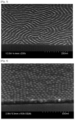
- Figure 1 is an SEM (scanning electron microscope) image of the formed membrane. As could be seen in Figure 1 , the block copolymer formed vertically oriented lamellar patterns highly self-aligned on the polymer membrane, and the pitch was about 31 nm or so. The self-assembled block copolymer membrane was subjected to plasma etching.
- the substrate on which the polymer membrane and the block copolymer membrane were sequentially formed was introduced into an etching chamber.
- the etching chamber two parallel plate electrodes were present facing each other, where the substrate on which the block copolymer membrane was formed was positioned on the electrode to which RF power to be described below was applied between the two electrodes.
- the RF power of 300 W was applied to the electrode that the block copolymer membrane was positioned thereon to perform etching.
- the etching was performed while feeding perfluorobutane (C 4 F 8 ), argon (Ar) and oxygen (O 2 ), as process gases, at flow rates of 15 sccm, 100 sccm and 25 sccm, respectively, into the chamber, where the etching time was 40 seconds or so.
- Figure 2 shows the results of the etching performed as above. As confirmed from Figure 2 , in the case of the etching conditions of the example, the domain formed by one segment of the block copolymer was selectively removed.
- FIG. 3 is an SEM image showing the etching result of Example 2. Through Figure 3 , it can be confirmed that the domain formed by one segment of the block copolymer can be selectively removed by performing the etching under the above conditions.
- Figure 4 is an SEM (scanning electron microscope) image of the formed block copolymer membrane.
- the block copolymer formed vertically oriented lamellar patterns highly aligned in the block copolymer membrane, and the pitch was about 37 nm or so.
- Plasma etching was performed on the polymer membrane comprising the assembled block copolymer. The etching was performed in the same manner as in Example 1 in the same etching chamber as that of Example 1, where the process pressure was about 15 mTorr or so and the etching was performed by applying RF power of 200 W or so.
- Plasma etching for pattern transferring the pattern of the block copolymer onto the substrate was performed by further etching the substrate using the membrane of the etched block copolymer of Example 2 as a mask.
- the pressure in the etching chamber was maintained at 50 mTorr, the RF power was maintained at 80 W, the flow rate of SF 6 supplied to the chamber was maintained at 45 sccm, and the etching time was maintained at 15 seconds.
- Etching of the block copolymer membrane was performed in the same manner as in Example 1, except that fluoroform (CHF 3 ) and oxygen (O 2 ) as process gases were supplied at flow rates of 40 sccm and 2 sccm, respectively, into the etching chamber, the applied RF power was 200 W, and the etching time was adjusted to 45 seconds or so.
- fluoroform (CHF 3 ) and oxygen (O 2 ) as process gases were supplied at flow rates of 40 sccm and 2 sccm, respectively, into the etching chamber, the applied RF power was 200 W, and the etching time was adjusted to 45 seconds or so.
- Figure 7 is an SEM image showing the etching result of Comparative Example 1. Through Figure 7 , it can be confirmed that as a result of performing the etching under the above conditions, the domain formed by one segment of the block copolymer cannot be selectively removed.
- Etching of the block copolymer membrane was performed in the same manner as in Example 1, except that fluoroform (CHF 3 ) and oxygen (O 2 ) as process gases were supplied at flow rates of 40 sccm and 5 sccm, respectively, into the etching chamber, the applied RF power was 100 W, and the etching time was adjusted to 45 seconds or so.
- fluoroform (CHF 3 ) and oxygen (O 2 ) as process gases were supplied at flow rates of 40 sccm and 5 sccm, respectively, into the etching chamber, the applied RF power was 100 W, and the etching time was adjusted to 45 seconds or so.
- Figure 8 is an SEM image showing the etching result of Comparative Example 2. Through Figure 8 , it can be confirmed that as a result of performing the etching under the above conditions, the domain formed by one segment of the block copolymer cannot be selectively removed.
- Etching of the block copolymer membrane was performed in the same manner as in Example 3, except that argon (Ar) and oxygen (O 2 ) as process gases were supplied at flow rates of 25 sccm and 10 sccm, respectively, into the etching chamber, the applied RF power was 50 W, and the etching time was adjusted to 30 seconds or so.
- Figure 9 is an SEM image showing the etching result of Comparative Example 3. Through Figure 9 , it can be confirmed that as a result of performing the etching under the above conditions, the segment of the block copolymer forming the matrix is not completely removed.
- Etching of the block copolymer membrane was performed in the same manner as in Example 1, except that fluoroform (CHF 3 ) and oxygen (O 2 ) as process gases were supplied at flow rates of 5 sccm and 15 sccm, respectively, into the etching chamber, the applied RF power was 100 W, and the etching time was adjusted to 45 seconds or so.
- fluoroform (CHF 3 ) and oxygen (O 2 ) as process gases were supplied at flow rates of 5 sccm and 15 sccm, respectively, into the etching chamber, the applied RF power was 100 W, and the etching time was adjusted to 45 seconds or so.
- Figure 10 is an SEM image showing the etching result of Comparative Example 4. Through Figure 10 , it can be confirmed that as a result of performing the etching under the above conditions, the domain formed by one segment of the block copolymer cannot be selectively removed.
- Etching of the block copolymer membrane was performed in the same manner as in Example 1, except that fluoroform (CHF 3 ) and oxygen (O 2 ) as process gases were supplied at flow rates of 38 sccm and 5 sccm, respectively, into the etching chamber, the applied RF power was 100 W, and the etching time was adjusted to 45 seconds or so.
- fluoroform (CHF 3 ) and oxygen (O 2 ) as process gases were supplied at flow rates of 38 sccm and 5 sccm, respectively, into the etching chamber, the applied RF power was 100 W, and the etching time was adjusted to 45 seconds or so.
- Figure 11 is an SEM image showing the etching result of Comparative Example 5. Through Figure 11 , it can be confirmed that as a result of performing the etching under the above conditions, the domain formed by one segment of the block copolymer cannot be selectively removed.
Landscapes
- Chemical & Material Sciences (AREA)
- Health & Medical Sciences (AREA)
- Chemical Kinetics & Catalysis (AREA)
- Medicinal Chemistry (AREA)
- Polymers & Plastics (AREA)
- Organic Chemistry (AREA)
- Physics & Mathematics (AREA)
- General Physics & Mathematics (AREA)
- Engineering & Computer Science (AREA)
- Plasma & Fusion (AREA)
- Graft Or Block Polymers (AREA)
- Drying Of Semiconductors (AREA)
Claims (10)
- Verfahren zur Herstellung eines strukturierten Substrats (30), umfassend einen Schritt zum selektiven Ätzen von einem Laminat, das ein Substrat und eine auf dem Substrat gebildete Block-Copolymermembran aufweist und ein autoaggregiertes Block-Copolymer enthält, irgendeines Segmentblocks des Block-Copolymers,worin das Ätzen unter Verwendung eines Reaktionsgases (50) durchgeführt wird, das Fluorkohlenstoff und Sauerstoff enthält, unddas Ätzen durchgeführt wird, während das Verhältnis (A/B) der Flussrate (A) des Fluorkohlenstoffs zur Flussrate (B) des Sauerstoffs im Bereich von 0,5 bis 7,5 gehalten wird,dadurch gekennzeichnet, dass das Block-Copolymer einen Polymersegmentblock A, der eine Ringstruktur umfasst, die kein Halogenatom umfasst, substituiert mit einer Kette mit 8 oder mehr kettenbildenden Atomen, und einen Polymersegmentblock B, dessen Struktur sich von dem Polymersegmentblock A unterscheidet und der eine Ringstruktur umfasst, die ein Halogenatom umfasst, umfasst.
- Verfahren gemäß Anspruch gemäß Anspruch 1, worin im Ätzschritt die Flussrate des Fluorkohlenstoffs größer als 0 sccm bis 50 sccm beträgt.
- Verfahren gemäß Anspruch 1, worin im Ätzschritt die Flussrate des Sauerstoffs größer als 0 sccm bis 35 sccm beträgt.
- Verfahren gemäß Anspruch 1, worin im Ätzschritt ein Inertgas mit einer Flussrate von 200 sccm oder kleiner zugeführt wird.
- Verfahren gemäß Anspruch 4, worin im Ätzschritt das Verhältnis (A/C) der Flussrate (A) des Fluorkohlenstoffs zur Flussrate (C) des Inertgases im Bereich von 0,1 bis 1 liegt.
- Verfahren gemäß Anspruch 1, worin der Fluorkohlenstoff zwei oder mehr Fluoratome und ein molares Verhältnis von Fluor- zu Kohlenstoffatomen von 2 oder größer aufweist.
- Verfahren gemäß Anspruch 1, worin im Ätzschritt als Reaktionsgas (50) nur Fluorkohlenstoff und Sauerstoff zugeführt werden oder worin nur Fluorkohlenstoff, Sauerstoff und ein Inertgas zugeführt werden.
- Verfahren gemäß Anspruch 1, umfassend das Beibehalten der in dem Ätzschritt zugeführten elektrischen Leistung im Bereich von 150 W bis 400 W.
- Verfahren gemäß Anspruch 1, worin der Ätzschritt in einer Kammer (100) durchgeführt wird, worin eine sich gegenüberliegende Kathode (20) und Anode (10) vorliegen, das Substrat (30), auf dem die Block-Copolymermembran gebildet ist, auf der Kathode zwischen der Kathode und der Anode positioniert ist und eine RF-Stromquelle (40) mit der Kathode verbunden ist.
- Verfahren gemäß Anspruch 1, ferner umfassend den Schritt des Ätzens des Substrats unter Verwendung der Block-Copolymermembran, von der der Polymersegmentblock entfernt worden ist, als Maske.
Applications Claiming Priority (2)
| Application Number | Priority Date | Filing Date | Title |
|---|---|---|---|
| KR20170117010 | 2017-09-13 | ||
| PCT/KR2018/010749 WO2019054768A1 (en) | 2017-09-13 | 2018-09-13 | METHOD FOR PREPARING A PATTERNED SUBSTRATE |
Publications (3)
| Publication Number | Publication Date |
|---|---|
| EP3665531A1 EP3665531A1 (de) | 2020-06-17 |
| EP3665531A4 EP3665531A4 (de) | 2020-10-28 |
| EP3665531B1 true EP3665531B1 (de) | 2023-12-13 |
Family
ID=65723787
Family Applications (1)
| Application Number | Title | Priority Date | Filing Date |
|---|---|---|---|
| EP18855824.1A Active EP3665531B1 (de) | 2017-09-13 | 2018-09-13 | Herstellungsverfahren für strukturiertes substrat |
Country Status (6)
| Country | Link |
|---|---|
| US (1) | US11613068B2 (de) |
| EP (1) | EP3665531B1 (de) |
| JP (1) | JP7027674B2 (de) |
| KR (1) | KR102191611B1 (de) |
| CN (1) | CN111065965B (de) |
| WO (1) | WO2019054768A1 (de) |
Family Cites Families (21)
| Publication number | Priority date | Publication date | Assignee | Title |
|---|---|---|---|---|
| US6451703B1 (en) | 2000-03-10 | 2002-09-17 | Applied Materials, Inc. | Magnetically enhanced plasma etch process using a heavy fluorocarbon etching gas |
| JP2004119839A (ja) * | 2002-09-27 | 2004-04-15 | Toshiba Corp | 光半導体装置及びその製造方法 |
| US9034197B2 (en) * | 2012-09-13 | 2015-05-19 | HGST Netherlands B.V. | Method for separately processing regions on a patterned medium |
| JP2014066976A (ja) | 2012-09-27 | 2014-04-17 | Asahi Kasei E-Materials Corp | 微細凹凸成形体及び微細凹凸成形鋳型並びにそれらの製造方法 |
| EP2733533B1 (de) * | 2012-11-14 | 2018-02-28 | IMEC vzw | Ätzverfahren unter Verwendung von Blockcopolymeren |
| JP6853038B2 (ja) * | 2013-06-26 | 2021-03-31 | アプライド マテリアルズ インコーポレイテッドApplied Materials,Incorporated | Icpプラズマ処理チャンバ内における高収率・基板最端部欠陥低減のための単一リング設計 |
| US9236255B2 (en) * | 2013-06-26 | 2016-01-12 | Applied Materials, Inc. | Methods for forming three dimensional NAND structures atop a substrate |
| US10150832B2 (en) | 2013-12-06 | 2018-12-11 | Lg Chem, Ltd. | Block copolymer |
| JP6419820B2 (ja) | 2013-12-06 | 2018-11-07 | エルジー・ケム・リミテッド | ブロック共重合体 |
| US9368370B2 (en) * | 2014-03-14 | 2016-06-14 | Applied Materials, Inc. | Temperature ramping using gas distribution plate heat |
| KR102133211B1 (ko) | 2014-03-28 | 2020-07-15 | 삼성디스플레이 주식회사 | 와이어 그리드 편광자의 제조방법 |
| KR102226116B1 (ko) * | 2014-09-12 | 2021-03-11 | 삼성디스플레이 주식회사 | 와이어 그리드 편광자 및 이의 제조방법 |
| FR3025937B1 (fr) | 2014-09-16 | 2017-11-24 | Commissariat Energie Atomique | Procede de grapho-epitaxie pour realiser des motifs a la surface d'un substrat |
| WO2016053005A1 (ko) * | 2014-09-30 | 2016-04-07 | 주식회사 엘지화학 | 블록 공중합체 |
| US10240035B2 (en) * | 2014-09-30 | 2019-03-26 | Lg Chem, Ltd. | Block copolymer |
| KR20160038711A (ko) | 2014-09-30 | 2016-04-07 | 주식회사 엘지화학 | 블록 공중합체 |
| JP6633062B2 (ja) * | 2014-09-30 | 2020-01-22 | エルジー・ケム・リミテッド | パターン化基板の製造方法 |
| US9396958B2 (en) * | 2014-10-14 | 2016-07-19 | Tokyo Electron Limited | Self-aligned patterning using directed self-assembly of block copolymers |
| JP6578145B2 (ja) | 2015-07-07 | 2019-09-18 | 東京エレクトロン株式会社 | エッチング方法 |
| FR3041119B1 (fr) * | 2015-09-11 | 2017-09-29 | Commissariat Energie Atomique | Procede de gravure selective d’un copolymere a blocs |
| FR3042794B1 (fr) | 2015-10-23 | 2020-03-27 | Arkema France | Procede permettant la creation de structures nanometriques par l'auto-assemblage de copolymeres di-blocs |
-
2018
- 2018-09-13 US US16/642,266 patent/US11613068B2/en active Active
- 2018-09-13 JP JP2020511762A patent/JP7027674B2/ja active Active
- 2018-09-13 WO PCT/KR2018/010749 patent/WO2019054768A1/en not_active Ceased
- 2018-09-13 KR KR1020180109592A patent/KR102191611B1/ko active Active
- 2018-09-13 EP EP18855824.1A patent/EP3665531B1/de active Active
- 2018-09-13 CN CN201880058225.9A patent/CN111065965B/zh active Active
Also Published As
| Publication number | Publication date |
|---|---|
| JP7027674B2 (ja) | 2022-03-02 |
| WO2019054768A1 (en) | 2019-03-21 |
| EP3665531A1 (de) | 2020-06-17 |
| EP3665531A4 (de) | 2020-10-28 |
| US11613068B2 (en) | 2023-03-28 |
| KR102191611B1 (ko) | 2020-12-15 |
| KR20190030187A (ko) | 2019-03-21 |
| US20210046691A1 (en) | 2021-02-18 |
| JP2020532134A (ja) | 2020-11-05 |
| CN111065965B (zh) | 2023-11-03 |
| CN111065965A (zh) | 2020-04-24 |
Similar Documents
| Publication | Publication Date | Title |
|---|---|---|
| KR101768288B1 (ko) | 블록 공중합체 | |
| EP3296335B1 (de) | Laminat mit neutralschichtzusammensetzung | |
| EP3078686A1 (de) | Blockcopolymer | |
| EP3203496A1 (de) | Verfahren zur herstellung eines strukturierten substrats | |
| EP3203497A1 (de) | Verfahren zur herstellung eines strukturierten substrats | |
| KR102261687B1 (ko) | 적층체 | |
| US11506972B2 (en) | Preparation method of patterned substrate | |
| US11059947B2 (en) | Method for producing polymer film | |
| EP3665531B1 (de) | Herstellungsverfahren für strukturiertes substrat | |
| KR101946775B1 (ko) | 블록 공중합체 | |
| EP3683245B1 (de) | Laminat | |
| EP3640298B1 (de) | Neutralschichtzusammensetzung | |
| KR102277770B1 (ko) | 블록 공중합체 막의 평탄화 방법 및 패턴 형성 방법 | |
| KR102159495B1 (ko) | 블록 공중합체 | |
| KR20180062395A (ko) | 블록 공중합체 | |
| KR102399191B1 (ko) | 적층체 | |
| KR20220153557A (ko) | 랜덤 공중합체 및 이를 포함하는 피닝 조성물 | |
| KR20200020230A (ko) | 블록 공중합체 | |
| KR20200020257A (ko) | 중성층 조성물 | |
| KR20180062165A (ko) | 블록 공중합체 | |
| KR20180062161A (ko) | 블록 공중합체 |
Legal Events
| Date | Code | Title | Description |
|---|---|---|---|
| STAA | Information on the status of an ep patent application or granted ep patent |
Free format text: STATUS: THE INTERNATIONAL PUBLICATION HAS BEEN MADE |
|
| PUAI | Public reference made under article 153(3) epc to a published international application that has entered the european phase |
Free format text: ORIGINAL CODE: 0009012 |
|
| STAA | Information on the status of an ep patent application or granted ep patent |
Free format text: STATUS: REQUEST FOR EXAMINATION WAS MADE |
|
| 17P | Request for examination filed |
Effective date: 20200312 |
|
| AK | Designated contracting states |
Kind code of ref document: A1 Designated state(s): AL AT BE BG CH CY CZ DE DK EE ES FI FR GB GR HR HU IE IS IT LI LT LU LV MC MK MT NL NO PL PT RO RS SE SI SK SM TR |
|
| AX | Request for extension of the european patent |
Extension state: BA ME |
|
| A4 | Supplementary search report drawn up and despatched |
Effective date: 20200925 |
|
| RIC1 | Information provided on ipc code assigned before grant |
Ipc: H01L 21/027 20060101ALI20200921BHEP Ipc: G03F 1/80 20120101ALI20200921BHEP Ipc: G03F 7/004 20060101AFI20200921BHEP Ipc: C08L 33/12 20060101ALI20200921BHEP |
|
| DAV | Request for validation of the european patent (deleted) | ||
| DAX | Request for extension of the european patent (deleted) | ||
| GRAP | Despatch of communication of intention to grant a patent |
Free format text: ORIGINAL CODE: EPIDOSNIGR1 |
|
| STAA | Information on the status of an ep patent application or granted ep patent |
Free format text: STATUS: GRANT OF PATENT IS INTENDED |
|
| GRAJ | Information related to disapproval of communication of intention to grant by the applicant or resumption of examination proceedings by the epo deleted |
Free format text: ORIGINAL CODE: EPIDOSDIGR1 |
|
| STAA | Information on the status of an ep patent application or granted ep patent |
Free format text: STATUS: REQUEST FOR EXAMINATION WAS MADE |
|
| INTG | Intention to grant announced |
Effective date: 20230419 |
|
| INTC | Intention to grant announced (deleted) | ||
| GRAP | Despatch of communication of intention to grant a patent |
Free format text: ORIGINAL CODE: EPIDOSNIGR1 |
|
| STAA | Information on the status of an ep patent application or granted ep patent |
Free format text: STATUS: GRANT OF PATENT IS INTENDED |
|
| INTG | Intention to grant announced |
Effective date: 20230719 |
|
| GRAS | Grant fee paid |
Free format text: ORIGINAL CODE: EPIDOSNIGR3 |
|
| GRAA | (expected) grant |
Free format text: ORIGINAL CODE: 0009210 |
|
| STAA | Information on the status of an ep patent application or granted ep patent |
Free format text: STATUS: THE PATENT HAS BEEN GRANTED |
|
| AK | Designated contracting states |
Kind code of ref document: B1 Designated state(s): AL AT BE BG CH CY CZ DE DK EE ES FI FR GB GR HR HU IE IS IT LI LT LU LV MC MK MT NL NO PL PT RO RS SE SI SK SM TR |
|
| REG | Reference to a national code |
Ref country code: GB Ref legal event code: FG4D |
|
| REG | Reference to a national code |
Ref country code: CH Ref legal event code: EP |
|
| REG | Reference to a national code |
Ref country code: DE Ref legal event code: R096 Ref document number: 602018062723 Country of ref document: DE |
|
| REG | Reference to a national code |
Ref country code: IE Ref legal event code: FG4D |
|
| PG25 | Lapsed in a contracting state [announced via postgrant information from national office to epo] |
Ref country code: GR Free format text: LAPSE BECAUSE OF FAILURE TO SUBMIT A TRANSLATION OF THE DESCRIPTION OR TO PAY THE FEE WITHIN THE PRESCRIBED TIME-LIMIT Effective date: 20240314 |
|
| REG | Reference to a national code |
Ref country code: LT Ref legal event code: MG9D |
|
| PG25 | Lapsed in a contracting state [announced via postgrant information from national office to epo] |
Ref country code: LT Free format text: LAPSE BECAUSE OF FAILURE TO SUBMIT A TRANSLATION OF THE DESCRIPTION OR TO PAY THE FEE WITHIN THE PRESCRIBED TIME-LIMIT Effective date: 20231213 |
|
| REG | Reference to a national code |
Ref country code: NL Ref legal event code: MP Effective date: 20231213 |
|
| PG25 | Lapsed in a contracting state [announced via postgrant information from national office to epo] |
Ref country code: ES Free format text: LAPSE BECAUSE OF FAILURE TO SUBMIT A TRANSLATION OF THE DESCRIPTION OR TO PAY THE FEE WITHIN THE PRESCRIBED TIME-LIMIT Effective date: 20231213 |
|
| PG25 | Lapsed in a contracting state [announced via postgrant information from national office to epo] |
Ref country code: LT Free format text: LAPSE BECAUSE OF FAILURE TO SUBMIT A TRANSLATION OF THE DESCRIPTION OR TO PAY THE FEE WITHIN THE PRESCRIBED TIME-LIMIT Effective date: 20231213 Ref country code: GR Free format text: LAPSE BECAUSE OF FAILURE TO SUBMIT A TRANSLATION OF THE DESCRIPTION OR TO PAY THE FEE WITHIN THE PRESCRIBED TIME-LIMIT Effective date: 20240314 Ref country code: ES Free format text: LAPSE BECAUSE OF FAILURE TO SUBMIT A TRANSLATION OF THE DESCRIPTION OR TO PAY THE FEE WITHIN THE PRESCRIBED TIME-LIMIT Effective date: 20231213 Ref country code: BG Free format text: LAPSE BECAUSE OF FAILURE TO SUBMIT A TRANSLATION OF THE DESCRIPTION OR TO PAY THE FEE WITHIN THE PRESCRIBED TIME-LIMIT Effective date: 20240313 |
|
| REG | Reference to a national code |
Ref country code: AT Ref legal event code: MK05 Ref document number: 1640950 Country of ref document: AT Kind code of ref document: T Effective date: 20231213 |
|
| PG25 | Lapsed in a contracting state [announced via postgrant information from national office to epo] |
Ref country code: NL Free format text: LAPSE BECAUSE OF FAILURE TO SUBMIT A TRANSLATION OF THE DESCRIPTION OR TO PAY THE FEE WITHIN THE PRESCRIBED TIME-LIMIT Effective date: 20231213 |
|
| PG25 | Lapsed in a contracting state [announced via postgrant information from national office to epo] |
Ref country code: SE Free format text: LAPSE BECAUSE OF FAILURE TO SUBMIT A TRANSLATION OF THE DESCRIPTION OR TO PAY THE FEE WITHIN THE PRESCRIBED TIME-LIMIT Effective date: 20231213 Ref country code: RS Free format text: LAPSE BECAUSE OF FAILURE TO SUBMIT A TRANSLATION OF THE DESCRIPTION OR TO PAY THE FEE WITHIN THE PRESCRIBED TIME-LIMIT Effective date: 20231213 Ref country code: NO Free format text: LAPSE BECAUSE OF FAILURE TO SUBMIT A TRANSLATION OF THE DESCRIPTION OR TO PAY THE FEE WITHIN THE PRESCRIBED TIME-LIMIT Effective date: 20240313 Ref country code: NL Free format text: LAPSE BECAUSE OF FAILURE TO SUBMIT A TRANSLATION OF THE DESCRIPTION OR TO PAY THE FEE WITHIN THE PRESCRIBED TIME-LIMIT Effective date: 20231213 Ref country code: LV Free format text: LAPSE BECAUSE OF FAILURE TO SUBMIT A TRANSLATION OF THE DESCRIPTION OR TO PAY THE FEE WITHIN THE PRESCRIBED TIME-LIMIT Effective date: 20231213 Ref country code: HR Free format text: LAPSE BECAUSE OF FAILURE TO SUBMIT A TRANSLATION OF THE DESCRIPTION OR TO PAY THE FEE WITHIN THE PRESCRIBED TIME-LIMIT Effective date: 20231213 |
|
| PG25 | Lapsed in a contracting state [announced via postgrant information from national office to epo] |
Ref country code: IS Free format text: LAPSE BECAUSE OF FAILURE TO SUBMIT A TRANSLATION OF THE DESCRIPTION OR TO PAY THE FEE WITHIN THE PRESCRIBED TIME-LIMIT Effective date: 20240413 |
|
| PG25 | Lapsed in a contracting state [announced via postgrant information from national office to epo] |
Ref country code: CZ Free format text: LAPSE BECAUSE OF FAILURE TO SUBMIT A TRANSLATION OF THE DESCRIPTION OR TO PAY THE FEE WITHIN THE PRESCRIBED TIME-LIMIT Effective date: 20231213 Ref country code: AT Free format text: LAPSE BECAUSE OF FAILURE TO SUBMIT A TRANSLATION OF THE DESCRIPTION OR TO PAY THE FEE WITHIN THE PRESCRIBED TIME-LIMIT Effective date: 20231213 |
|
| PG25 | Lapsed in a contracting state [announced via postgrant information from national office to epo] |
Ref country code: SK Free format text: LAPSE BECAUSE OF FAILURE TO SUBMIT A TRANSLATION OF THE DESCRIPTION OR TO PAY THE FEE WITHIN THE PRESCRIBED TIME-LIMIT Effective date: 20231213 |
|
| PG25 | Lapsed in a contracting state [announced via postgrant information from national office to epo] |
Ref country code: SM Free format text: LAPSE BECAUSE OF FAILURE TO SUBMIT A TRANSLATION OF THE DESCRIPTION OR TO PAY THE FEE WITHIN THE PRESCRIBED TIME-LIMIT Effective date: 20231213 Ref country code: SK Free format text: LAPSE BECAUSE OF FAILURE TO SUBMIT A TRANSLATION OF THE DESCRIPTION OR TO PAY THE FEE WITHIN THE PRESCRIBED TIME-LIMIT Effective date: 20231213 Ref country code: RO Free format text: LAPSE BECAUSE OF FAILURE TO SUBMIT A TRANSLATION OF THE DESCRIPTION OR TO PAY THE FEE WITHIN THE PRESCRIBED TIME-LIMIT Effective date: 20231213 Ref country code: IT Free format text: LAPSE BECAUSE OF FAILURE TO SUBMIT A TRANSLATION OF THE DESCRIPTION OR TO PAY THE FEE WITHIN THE PRESCRIBED TIME-LIMIT Effective date: 20231213 Ref country code: IS Free format text: LAPSE BECAUSE OF FAILURE TO SUBMIT A TRANSLATION OF THE DESCRIPTION OR TO PAY THE FEE WITHIN THE PRESCRIBED TIME-LIMIT Effective date: 20240413 Ref country code: EE Free format text: LAPSE BECAUSE OF FAILURE TO SUBMIT A TRANSLATION OF THE DESCRIPTION OR TO PAY THE FEE WITHIN THE PRESCRIBED TIME-LIMIT Effective date: 20231213 Ref country code: CZ Free format text: LAPSE BECAUSE OF FAILURE TO SUBMIT A TRANSLATION OF THE DESCRIPTION OR TO PAY THE FEE WITHIN THE PRESCRIBED TIME-LIMIT Effective date: 20231213 Ref country code: AT Free format text: LAPSE BECAUSE OF FAILURE TO SUBMIT A TRANSLATION OF THE DESCRIPTION OR TO PAY THE FEE WITHIN THE PRESCRIBED TIME-LIMIT Effective date: 20231213 |
|
| PG25 | Lapsed in a contracting state [announced via postgrant information from national office to epo] |
Ref country code: PL Free format text: LAPSE BECAUSE OF FAILURE TO SUBMIT A TRANSLATION OF THE DESCRIPTION OR TO PAY THE FEE WITHIN THE PRESCRIBED TIME-LIMIT Effective date: 20231213 Ref country code: PT Free format text: LAPSE BECAUSE OF FAILURE TO SUBMIT A TRANSLATION OF THE DESCRIPTION OR TO PAY THE FEE WITHIN THE PRESCRIBED TIME-LIMIT Effective date: 20240415 |
|
| PG25 | Lapsed in a contracting state [announced via postgrant information from national office to epo] |
Ref country code: PT Free format text: LAPSE BECAUSE OF FAILURE TO SUBMIT A TRANSLATION OF THE DESCRIPTION OR TO PAY THE FEE WITHIN THE PRESCRIBED TIME-LIMIT Effective date: 20240415 Ref country code: PL Free format text: LAPSE BECAUSE OF FAILURE TO SUBMIT A TRANSLATION OF THE DESCRIPTION OR TO PAY THE FEE WITHIN THE PRESCRIBED TIME-LIMIT Effective date: 20231213 |
|
| REG | Reference to a national code |
Ref country code: DE Ref legal event code: R097 Ref document number: 602018062723 Country of ref document: DE |
|
| PG25 | Lapsed in a contracting state [announced via postgrant information from national office to epo] |
Ref country code: DK Free format text: LAPSE BECAUSE OF FAILURE TO SUBMIT A TRANSLATION OF THE DESCRIPTION OR TO PAY THE FEE WITHIN THE PRESCRIBED TIME-LIMIT Effective date: 20231213 |
|
| PLBE | No opposition filed within time limit |
Free format text: ORIGINAL CODE: 0009261 |
|
| STAA | Information on the status of an ep patent application or granted ep patent |
Free format text: STATUS: NO OPPOSITION FILED WITHIN TIME LIMIT |
|
| PG25 | Lapsed in a contracting state [announced via postgrant information from national office to epo] |
Ref country code: SI Free format text: LAPSE BECAUSE OF FAILURE TO SUBMIT A TRANSLATION OF THE DESCRIPTION OR TO PAY THE FEE WITHIN THE PRESCRIBED TIME-LIMIT Effective date: 20231213 |
|
| PG25 | Lapsed in a contracting state [announced via postgrant information from national office to epo] |
Ref country code: SI Free format text: LAPSE BECAUSE OF FAILURE TO SUBMIT A TRANSLATION OF THE DESCRIPTION OR TO PAY THE FEE WITHIN THE PRESCRIBED TIME-LIMIT Effective date: 20231213 Ref country code: DK Free format text: LAPSE BECAUSE OF FAILURE TO SUBMIT A TRANSLATION OF THE DESCRIPTION OR TO PAY THE FEE WITHIN THE PRESCRIBED TIME-LIMIT Effective date: 20231213 |
|
| 26N | No opposition filed |
Effective date: 20240916 |
|
| PG25 | Lapsed in a contracting state [announced via postgrant information from national office to epo] |
Ref country code: MC Free format text: LAPSE BECAUSE OF FAILURE TO SUBMIT A TRANSLATION OF THE DESCRIPTION OR TO PAY THE FEE WITHIN THE PRESCRIBED TIME-LIMIT Effective date: 20231213 |
|
| REG | Reference to a national code |
Ref country code: CH Ref legal event code: PL |
|
| PG25 | Lapsed in a contracting state [announced via postgrant information from national office to epo] |
Ref country code: LU Free format text: LAPSE BECAUSE OF NON-PAYMENT OF DUE FEES Effective date: 20240913 |
|
| REG | Reference to a national code |
Ref country code: BE Ref legal event code: MM Effective date: 20240930 |
|
| PG25 | Lapsed in a contracting state [announced via postgrant information from national office to epo] |
Ref country code: BE Free format text: LAPSE BECAUSE OF NON-PAYMENT OF DUE FEES Effective date: 20240930 |
|
| PG25 | Lapsed in a contracting state [announced via postgrant information from national office to epo] |
Ref country code: CH Free format text: LAPSE BECAUSE OF NON-PAYMENT OF DUE FEES Effective date: 20240930 |
|
| PG25 | Lapsed in a contracting state [announced via postgrant information from national office to epo] |
Ref country code: IE Free format text: LAPSE BECAUSE OF NON-PAYMENT OF DUE FEES Effective date: 20240913 |
|
| PG25 | Lapsed in a contracting state [announced via postgrant information from national office to epo] |
Ref country code: FI Free format text: LAPSE BECAUSE OF FAILURE TO SUBMIT A TRANSLATION OF THE DESCRIPTION OR TO PAY THE FEE WITHIN THE PRESCRIBED TIME-LIMIT Effective date: 20231213 |
|
| PGFP | Annual fee paid to national office [announced via postgrant information from national office to epo] |
Ref country code: DE Payment date: 20250820 Year of fee payment: 8 |
|
| PGFP | Annual fee paid to national office [announced via postgrant information from national office to epo] |
Ref country code: GB Payment date: 20250820 Year of fee payment: 8 |
|
| PGFP | Annual fee paid to national office [announced via postgrant information from national office to epo] |
Ref country code: FR Payment date: 20250821 Year of fee payment: 8 |
|
| PG25 | Lapsed in a contracting state [announced via postgrant information from national office to epo] |
Ref country code: CY Free format text: LAPSE BECAUSE OF FAILURE TO SUBMIT A TRANSLATION OF THE DESCRIPTION OR TO PAY THE FEE WITHIN THE PRESCRIBED TIME-LIMIT; INVALID AB INITIO Effective date: 20180913 |
|
| PG25 | Lapsed in a contracting state [announced via postgrant information from national office to epo] |
Ref country code: HU Free format text: LAPSE BECAUSE OF FAILURE TO SUBMIT A TRANSLATION OF THE DESCRIPTION OR TO PAY THE FEE WITHIN THE PRESCRIBED TIME-LIMIT; INVALID AB INITIO Effective date: 20180913 |