EP3638625B9 - Hydrophobic surface modified aluminas and method for making thereof - Google Patents
Hydrophobic surface modified aluminas and method for making thereof Download PDFInfo
- Publication number
- EP3638625B9 EP3638625B9 EP18737457.4A EP18737457A EP3638625B9 EP 3638625 B9 EP3638625 B9 EP 3638625B9 EP 18737457 A EP18737457 A EP 18737457A EP 3638625 B9 EP3638625 B9 EP 3638625B9
- Authority
- EP
- European Patent Office
- Prior art keywords
- alumina
- slurry
- organic composition
- hydrophobic
- content
- Prior art date
- Legal status (The legal status is an assumption and is not a legal conclusion. Google has not performed a legal analysis and makes no representation as to the accuracy of the status listed.)
- Active
Links
Images


Classifications
-
- C—CHEMISTRY; METALLURGY
- C01—INORGANIC CHEMISTRY
- C01F—COMPOUNDS OF THE METALS BERYLLIUM, MAGNESIUM, ALUMINIUM, CALCIUM, STRONTIUM, BARIUM, RADIUM, THORIUM, OR OF THE RARE-EARTH METALS
- C01F7/00—Compounds of aluminium
- C01F7/02—Aluminium oxide; Aluminium hydroxide; Aluminates
- C01F7/021—After-treatment of oxides or hydroxides
-
- C—CHEMISTRY; METALLURGY
- C01—INORGANIC CHEMISTRY
- C01F—COMPOUNDS OF THE METALS BERYLLIUM, MAGNESIUM, ALUMINIUM, CALCIUM, STRONTIUM, BARIUM, RADIUM, THORIUM, OR OF THE RARE-EARTH METALS
- C01F7/00—Compounds of aluminium
- C01F7/02—Aluminium oxide; Aluminium hydroxide; Aluminates
- C01F7/30—Preparation of aluminium oxide or hydroxide by thermal decomposition or by hydrolysis or oxidation of aluminium compounds
-
- C—CHEMISTRY; METALLURGY
- C09—DYES; PAINTS; POLISHES; NATURAL RESINS; ADHESIVES; COMPOSITIONS NOT OTHERWISE PROVIDED FOR; APPLICATIONS OF MATERIALS NOT OTHERWISE PROVIDED FOR
- C09C—TREATMENT OF INORGANIC MATERIALS, OTHER THAN FIBROUS FILLERS, TO ENHANCE THEIR PIGMENTING OR FILLING PROPERTIES ; PREPARATION OF CARBON BLACK ; PREPARATION OF INORGANIC MATERIALS WHICH ARE NO SINGLE CHEMICAL COMPOUNDS AND WHICH ARE MAINLY USED AS PIGMENTS OR FILLERS
- C09C1/00—Treatment of specific inorganic materials other than fibrous fillers; Preparation of carbon black
- C09C1/40—Compounds of aluminium
- C09C1/407—Aluminium oxides or hydroxides
-
- C—CHEMISTRY; METALLURGY
- C09—DYES; PAINTS; POLISHES; NATURAL RESINS; ADHESIVES; COMPOSITIONS NOT OTHERWISE PROVIDED FOR; APPLICATIONS OF MATERIALS NOT OTHERWISE PROVIDED FOR
- C09C—TREATMENT OF INORGANIC MATERIALS, OTHER THAN FIBROUS FILLERS, TO ENHANCE THEIR PIGMENTING OR FILLING PROPERTIES ; PREPARATION OF CARBON BLACK ; PREPARATION OF INORGANIC MATERIALS WHICH ARE NO SINGLE CHEMICAL COMPOUNDS AND WHICH ARE MAINLY USED AS PIGMENTS OR FILLERS
- C09C3/00—Treatment in general of inorganic materials, other than fibrous fillers, to enhance their pigmenting or filling properties
- C09C3/08—Treatment with low-molecular-weight non-polymer organic compounds
-
- C—CHEMISTRY; METALLURGY
- C01—INORGANIC CHEMISTRY
- C01P—INDEXING SCHEME RELATING TO STRUCTURAL AND PHYSICAL ASPECTS OF SOLID INORGANIC COMPOUNDS
- C01P2002/00—Crystal-structural characteristics
- C01P2002/60—Compounds characterised by their crystallite size
-
- C—CHEMISTRY; METALLURGY
- C01—INORGANIC CHEMISTRY
- C01P—INDEXING SCHEME RELATING TO STRUCTURAL AND PHYSICAL ASPECTS OF SOLID INORGANIC COMPOUNDS
- C01P2002/00—Crystal-structural characteristics
- C01P2002/80—Crystal-structural characteristics defined by measured data other than those specified in group C01P2002/70
- C01P2002/82—Crystal-structural characteristics defined by measured data other than those specified in group C01P2002/70 by IR- or Raman-data
-
- C—CHEMISTRY; METALLURGY
- C01—INORGANIC CHEMISTRY
- C01P—INDEXING SCHEME RELATING TO STRUCTURAL AND PHYSICAL ASPECTS OF SOLID INORGANIC COMPOUNDS
- C01P2004/00—Particle morphology
- C01P2004/01—Particle morphology depicted by an image
- C01P2004/03—Particle morphology depicted by an image obtained by SEM
-
- C—CHEMISTRY; METALLURGY
- C01—INORGANIC CHEMISTRY
- C01P—INDEXING SCHEME RELATING TO STRUCTURAL AND PHYSICAL ASPECTS OF SOLID INORGANIC COMPOUNDS
- C01P2004/00—Particle morphology
- C01P2004/20—Particle morphology extending in two dimensions, e.g. plate-like
-
- C—CHEMISTRY; METALLURGY
- C01—INORGANIC CHEMISTRY
- C01P—INDEXING SCHEME RELATING TO STRUCTURAL AND PHYSICAL ASPECTS OF SOLID INORGANIC COMPOUNDS
- C01P2004/00—Particle morphology
- C01P2004/30—Particle morphology extending in three dimensions
- C01P2004/38—Particle morphology extending in three dimensions cube-like
-
- C—CHEMISTRY; METALLURGY
- C01—INORGANIC CHEMISTRY
- C01P—INDEXING SCHEME RELATING TO STRUCTURAL AND PHYSICAL ASPECTS OF SOLID INORGANIC COMPOUNDS
- C01P2004/00—Particle morphology
- C01P2004/54—Particles characterised by their aspect ratio, i.e. the ratio of sizes in the longest to the shortest dimension
-
- C—CHEMISTRY; METALLURGY
- C01—INORGANIC CHEMISTRY
- C01P—INDEXING SCHEME RELATING TO STRUCTURAL AND PHYSICAL ASPECTS OF SOLID INORGANIC COMPOUNDS
- C01P2004/00—Particle morphology
- C01P2004/60—Particles characterised by their size
- C01P2004/64—Nanometer sized, i.e. from 1-100 nanometer
-
- C—CHEMISTRY; METALLURGY
- C01—INORGANIC CHEMISTRY
- C01P—INDEXING SCHEME RELATING TO STRUCTURAL AND PHYSICAL ASPECTS OF SOLID INORGANIC COMPOUNDS
- C01P2006/00—Physical properties of inorganic compounds
- C01P2006/12—Surface area
-
- C—CHEMISTRY; METALLURGY
- C01—INORGANIC CHEMISTRY
- C01P—INDEXING SCHEME RELATING TO STRUCTURAL AND PHYSICAL ASPECTS OF SOLID INORGANIC COMPOUNDS
- C01P2006/00—Physical properties of inorganic compounds
- C01P2006/14—Pore volume
-
- C—CHEMISTRY; METALLURGY
- C01—INORGANIC CHEMISTRY
- C01P—INDEXING SCHEME RELATING TO STRUCTURAL AND PHYSICAL ASPECTS OF SOLID INORGANIC COMPOUNDS
- C01P2006/00—Physical properties of inorganic compounds
- C01P2006/80—Compositional purity
-
- C—CHEMISTRY; METALLURGY
- C01—INORGANIC CHEMISTRY
- C01P—INDEXING SCHEME RELATING TO STRUCTURAL AND PHYSICAL ASPECTS OF SOLID INORGANIC COMPOUNDS
- C01P2006/00—Physical properties of inorganic compounds
- C01P2006/80—Compositional purity
- C01P2006/82—Compositional purity water content
-
- C—CHEMISTRY; METALLURGY
- C01—INORGANIC CHEMISTRY
- C01P—INDEXING SCHEME RELATING TO STRUCTURAL AND PHYSICAL ASPECTS OF SOLID INORGANIC COMPOUNDS
- C01P2006/00—Physical properties of inorganic compounds
- C01P2006/90—Other properties not specified above
Definitions
- THE INVENTION relates to a novel method for producing a new hydrophobic porous alumina, to a new hydrophobic porous alumina, and to a composition comprising a new hydrophobic porous alumina and a substrate.
- hydrophobic surface modified metal oxides include spacers or antiblocking agents which improve the performance of substrates including polymers, toners, coating systems, surface additives, and other high value-added products for applications that require a high degree of dispersibility.
- the ability of the hydrophobic surface modified metal oxides to be deagglomerated down to submicron size, as well as their ability to adhere to specific substrate surfaces is necessary to achieve and enhance the propertiesof high value-added products, an example being toner products.
- WO 2017/075333 A1 discloses a method of producing hydrophobic aluminas by i) providing a slurry comprising an alumina compound, the slurry having a pH of above 5.5; ii) mixing an organic composition comprising carboxylic acids with hydrocarbon chain lengths of between 12 and 24 with the slurry to form an acid modified slurry; iii) hydrothermally conditioning the acid modified slurry to form a hydrothermally aged slurry; and iv) drying the hydrothermally aged slurry.
- the hydrophobic aluminas can be dispersed in polymers.
- Factors which affect the properties of the hydrophobic surface modified metal oxides include the type of base metal oxide selected, particle morphology of the surface additive, surface area of the particles of the surface additive, and surface chemistry of the particles of the surface additive.
- the choice of the base metal oxide is important when determining what properties the hydrophobic surface modified metal oxides require. For example a person skilled in the art of the invention knows that not all chemical treatments can be applied equally to all metal oxides, for instance, not all treatments used for silica particles can be applied to alumina.
- the main problem when dealing with hydrophobic surface modified metal oxides is the agglomeration of fine or nano metal oxide particles which form due to interaction forces.
- Submicron particles can be highly agglomerated and these agglomerations in turn reduce the exposed surface area of the particles forming part of the agglomeration.
- Such agglomerations therefore reduce the advantages that the hydrophobic surface modified metal oxides offer to the products into which they are incorporated.
- hydrophobic surface modified metal oxides are critical for the successful creation of desired characteristics of subsequent products into which they are incorporated.
- Another problem with these hydrophobic surface modified metal oxides is their relatively low stability and in order to improve this stability and prevent the degradation of the hydrophobic surface modified metal oxides, specialized treatment under low temperature and vacuum are used during their synthesis.
- a method of producing a hydrophobic porous alumina comprising the following steps:
- the alumina compound includes an aluminum oxide hydroxide (AIOOH), a boehmite or a pseudoboehmite (namely ⁇ -alumina monohydrate, identifiable by X-ray diffraction as described in the A.S.T.M. (American Society for Testing and Materials).
- AIOOH aluminum oxide hydroxide
- boehmite or a pseudoboehmite namely ⁇ -alumina monohydrate, identifiable by X-ray diffraction as described in the A.S.T.M. (American Society for Testing and Materials.
- the alumina compound includes a boehmite or a pseudoboehmite, and most preferably a boehmite.
- the alumina compound may be derived from water hydrolysis of an aluminum alkoxide, or from other alumina sources such as a sodium aluminate source, an alum source, or numerous other variations.
- the alumina compound suitable for the method of the present invention may be obtained from hydrolysis of aluminum alkoxide.
- the alumina compound is made up of crystallite sizes on the (020) axis in the range of 1 to 60 nm, preferably 2 to 50 nm, and most preferably 3 to 40 nm.
- the aluminum compound has an aspect ratio of 1 to 5; preferably the alumina compound has an aspect ratio of 1 to 3.
- the alumina compound is made up of different shaped crystals including hexahedral, tablet-like, block-like, plate-like structures, or combinations thereof. It preferably has a plate-like or block-like structure or combinations thereof. Most preferably, the alumina compound has a block-like structure i.e. an aspect ratio of 1.
- the slurry is preferably an aqueous slurry.
- a fluid for example water, can be added to maintain a fluid slurry before or after the addition of the organic composition.
- the aqueous slurry comprising the alumina compound is an intermediate stream of the Ziegler industrial production of AIOOH from the hydrolysis of aluminum alkoxide.
- the aqueous slurry preferably has a pH of greater than 7.0 to 10.0, preferably a pH of 8.0 to 10.0.
- the organic composition comprises a carboxylic acid functional group with alkyl hydrocarbon chains binding to a surface of the alumina compound.
- the organic composition comprises a matrix of short chain fatty acids, short chain hydroxy fatty acids, interlinked chains of the above and esters.
- the organic composition has a carboxylic acid functional group with alkyl hydrocarbon chains having a specific length that bind to a surface of the alumina compound.
- the organic composition comprises carboxylic acids with an alkyl hydrocarbon chain having a carbon length less than 10, preferably 9, and more preferably a carbon length of 8 or less than 8.
- the organic composition may have a carboxylic acid functional group comprising hydroxyl and/ or amino groups with alkyl hydrocarbon chains having carbon lengths less than 10, preferably less than 9, and more preferably a carbon length of 8 or less than 8.
- the acidic modified slurry has a pH of between 3 and less than 7, preferably a pH of between 3.5 and 5.5.
- the organic composition content relative to the content of alumina compound in the acid modified slurry is between 0.5 and 10 %wt, preferably 0.5 and 5%wt. This is less than the stoichiometric value of the organic composition.
- the acidic modified slurry is then hydrothermally aged under moderate conditions.
- the hydrothermal aging treatment is performed at a temperature between 90°C to 200°C, more preferably 100 to 180 °C, even more preferably 100 to 140 °C and most preferably 100 to 120°C.
- the heat can be supplied through an external source, e.g. electrical or via circulating oil in external jacket, or through direct injection of high pressurized steam.
- the resultant hydrothermally aged slurry is maintained at the temperature of the hydrothermal aging for a period of time that depends mainly on the temperature and agitation. Generally speaking, the duration of such aging can be between 1 hour and 6 hours, preferably 1 to 5 hours and most preferably 2 hours.
- concomitant growth of the alumina crystal particles occurs to provide for specialized morphologies.
- the hydrophobic porous alumina of the invention has a residual amount of organic composition measured through catalytic combustion analysis (equipment used - Laboratory Equipment Corporation, hereinafter "LECO") of between 0.5 and 10 parts in 100 parts of alumina compound. This is lower than the estimated stoichiometric amount.
- LECO catalytic combustion analysis
- alumina compound for example shape, porosity and hydrophobicity of the alumina compound by changing the surface coverage of the organic composition, the type of organic composition used and drying conditions.
- the alumina compound crystallites grow due to an Ostwald ripening mechanism.
- the major face of an alumina crystallite is the (020) face on which the OH groups are exposed.
- the thickness of the crystallites decreases (increasing the value of 200/020 aspect ratio) with decreasing length of the alkyl carbon chain of the organic composition added to the alumina slurry.
- step ii) of the process allows one to work with an acidic modified slurry in step ii) of the process at an acidic pH of pH 4.0 or 5.0 for example.
- the loose agglomerates can be obtained through the use of a small amount of organic composition on the surface of the alumina, between 2 and 4% of the organic compound on the surface of the alumina (about 40% of the estimated stoichiometric amount).
- the effectiveness of the process of the present invention is that one is able to obtain a variety of product characteristics for a wide range of conditions.
- the resulting system enters a drying chamber where the hydrothermally aged slurry is dried and a powder is obtained.
- the drying temperature can range in gas temperature of from 95° C to 280°C, preferably 120 to 260 ⁇ c, most preferably 230 to 260 ⁇ c. Any free water is removed by drying; and the only reactive surface is the alumina modified by the organic composition.
- the hydrothermally aged slurry may be dried in a spray dryer or a contact dryer, but other dryers that can operate under appropriate temperature conditions can be used.
- a drying gas can be passed co-current, or counter-current, where hot air flows against the flow of the atomizer. With co-current flow, particles spend less time in the system and in the particle separator (typically a cyclone device).
- the advantage of the method of the present invention is that the particles of the hydrophobic porous alumina can be deagglomerated to a size of primary nanocrystallites by blending, for example, a dry mixing with soft mechanical action of the powder with a solid substrate.
- the process of the present invention may further include the step of dry mixing hydrophobic porous alumina having different properties for example hydrophobic alumina having different crystal sizes.
- the crystallites particles grow with a unique morphology characterized by a macro- reticular porous network, yielding to a softer agglomeration in a powder material. It was surprisingly found that such modified aluminas can be deagglomerated to submicron size with substrates including polymer particles, polymeric resins comprising nylon, polystyrene, acrylic and other, or metal oxides such as silica glass, zinc oxide, iron oxide etc. and adhere to these substrates. This makes the hydrophobic porous alumina a candidate for use in toner applications for example as the nano-crystal particles disperse onto the surface, regardless of the chemical affinity between the surface and the dispersed nano particles. The particles can be dispersed through dry mixing without additional wetting chemicals or compatibilizers.
- hydrophobic porous alumina produced by the method of the present invention can be uniformly dispersed into a substrate, for example a polymer, as single nano crystal particles by direct melt compounding with a high level of deagglomeration.
- nano structured hydrophobic porous alumina product does not require the intense mixing of the known prior art methods.
- a porous hydrophobic alumina prepared according to the method of the invention.
- the porous hydrophobic alumina comprises an alumina compound and an organic composition, the organic composition comprising carboxylic acids with alkyl hydrocarbon chains having a carbon length less than 10 and preferably 8 or less than 8, the organic composition being strongly bonded to a surface of the alumina compound to form a layer on the alumina surface, the hydrophobic porous alumina having a residual amount of organic composition measured through catalytic combustion analysis (LECO) of between 2 and 100 parts of the alumina compound.
- LECO catalytic combustion analysis
- the final product is a porous hydrophobic alumina.
- the particles of this alumina are characterized by a unique macro-reticular morphology of platy-oblong nanocrystallites distributed in a porous network, as showed by Scanning Electron Microscopy (SEM).
- SEM Scanning Electron Microscopy
- the porous structure is generated through the crystallites morphology. Due to the morphology, the tendency of the powder to be deagglomerated by simple methods is greatly enhanced; thus the powder can be dispersed below 100 nm by blending, and forms a stable coating layer on the surface of substrates, for example polymers.
- the porous hydrophobic alumina product has a residual moisture value below 5000 ppm.
- the aspect ratio of the porous hydrophobic alumina product is between 1.80 to 5.0, preferably, 1.80. and 3.5, most preferably between 2 and 3.5.
- the aspect ratio can be calculated by the size of crystals that are derived in directions along lines perpendicular to the planes of the X-ray diffraction patterns by using the Scherrer formula.
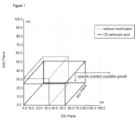
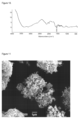
- the aspect ratio is calculated by the ratio between the (200) plane and the (020) plane. This is illustrated in Figure 1 .
- the crystallite size of the porous hydrophobic alumina product is between 1 and 60 nm along the (020) plane.
- the total pore volume is between 0.55 cc/g to 2.0 cc/g, more preferably between 0.55 cc/g and 1.1 cc /g.
- the pore structure of the porous hydrophobic alumina is formed through an open packing arrangement of crystallites forming a macroporous network.
- the specific surface area (BET method N 2 adsorption) of the porous hydrophobic alumina product is between 30 m2/g and 300 m2/g, preferably between 30 m2/g and 150 m2/g and most preferably between 30 m2/g and 100 m2/g.
- porous network morphology Due to the porous network morphology, materials can be dispersed through the breakdown of the soft agglomerates to colloidal sizes without intense mixing in organic systems.
- the inherent properties of the porous hydrophobic alumina product make it advantageous in polymer resins and in processes for fabricating nanocomposites by direct mixing over other developed methods already known to those skilled in the art
- composition including a porous hydrophobic alumina prepared according to the method of the invention and a substrate
- the substrate may include polymers, crosslinked polymers, nylon resins, and acrylic resins e.g. polymethylmethlacrylate (PMMA), polystyrenes, styrene acrylate resins, polyester resins, waxes, polyolefins e.g. polyethylene, polypropylene, polycarbonate, polyurethane, polyethylene terephthalate, rubber, epoxy resins, silicone, cellulose, fabric, polytetrafluoroethylene, silica glass particles, metal oxides, ceramics and carbon substrates.
- the substrate preferably includes polystyrene, acrylic, polyesters resins, polyolefins, polycarbonate, and crosslinked polymers.
- compositions obtained by this process include coatings; spacer or anti-blocking agents; plastics and elastomers; scratch resistant coatings; polishes, thickening agents and rheology modifiers; additives for improving flow behaviour of powders; additives for enhancing the heat transfer behaviour of fluids and solids; fabric treatment; paper treatment; soil resistant coatings; flame retardants; inkjet recording media (toners;) and barrier coatings
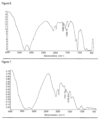
- DRIFT spectra were registered on self-supporting powders with an FTIR Variant apparatus, 32 spectral acquisitions per sample. Information about the functional group of the organic compound is easily obtained by the presence of the band in the range of 1700 - 1800 cm- 1 . Differences became evident after reaction by the spectral behaviour in the range 1580-1590 cm-1 assigned to the organic linked to the alumina surface.
- Crystal size information is obtained from three diffraction peaks, the (020), the (200), the (002) peaks. These three peaks (crystal planes) are the most accessible in alumina's x-ray diffraction pattern.
- the ratio of the 200/ 020 crystal size is the aspect ratio. This ratio can only approach unity if the (200) crystal size is short relative to the (020) size.
- a representation of the (020), the (200) and the (002) is showed in Figure 1 .
- the procedure consists of: data collection, calculation of the scattering factor; and finally the x-ray diffraction profile.
- the data treatment and curve fitting is carried out with high accuracy and requires several hours as long collection times are required to improve the signal to noise ratio with several scans per step.
- the BET surface area and pore volume data were determined by N 2 adsorption according to the ASTM method. Data was collected after a heat treatment at 110°C for 2 hours with vacuum at 1 Torr. The surface area (m2/g) was evaluated using the BET equation. The total pore volume was determined from the volume of nitrogen adsorbed at relative pressure p/p 0 equal to 0.992.
- the samples for SEM were prepared on an SEM stub, spin coated with gold and therefore evaluated on a JEOL SEM microscope.
- the amount of organic composition utilized is determined by means of a carbon analyzer by using a LECO Apparatus.
- a sample of the powder that contains the organic composition is weighted in a crucible and combusted inside a furnace system that operates with pure oxygen to ensure the complete combustion of all organic composition in the sample, the carbon content of the sample by % weight is determined.
- the amount of organic composition on the powder is calculated from the carbon amount by using the molecular formula.
- Deagglomeration tests were carried by weighting 0.5 parts of powder per 100 part of substrate in a closed container and shaken with a vortex for 5 minutes.
- Dispersibility tests were carried out by weighting 3 parts of powder per 100 part of liquid solvent and hand shaking for 10 minutes.
- 30 sec of sonication treatment in a water batch was subsequently applied in order to homogenize the dispersion.
- the dispersion quality was judged by observation of sedimentation behavior after 30 minutes.
- the %wt. of particles dispersed was also evaluated after centrifugation from the solid residue after drying at 120°C and determined taking into account the total amount of powder initially added.
- a boehmite (AIOOH) slurry from the Ziegler alcohol process having a pH of about 9.0 was prepared.
- the starting boehmite alumina crystallite had a blocky-like shape with size from the X-ray (020) reflex of 31 nm, 33nm (200) and 36nm (002), with aspect ratio 200/020 equal to 1.06.
- octanoic acid (carboxylic acid having a carbon chain length of 8) equal to 7.8 parts in 100 parts of powder (0.54 mmol/g of powder) was reacted in a stirred vessel with the boehmite slurry at 105°C for 2 hours to form an acidic modified slurry.
- the acid underwent fast homogenization with the alumina slurry to obtain a milky acidic modified slurry having a pH of 4.0.
- the milky acidic modified slurry was dried under nitrogen flow with a nozzle spray atomizer at temperature of the in-gas of 230°C and out-gas temperature of 90+/- 5°C by adjusting the acidic modified slurry flow rate.
- the resulting crystallites were thinner along the (020) axis and wider along the (200) axis, have an aspect ratio of 2.16 that shows it is platy-oblong.
- the BET surface area available for adsorption was 46 m2/g.
- the estimated number of OH groups was about 2.51 020/ g, which accounts for about 0.42 mmol/g of organic modification to be added.
- the hydrophobic porous alumina had a residual amount of organic composition measured through catalytic combustion analysis of 4.2 parts in 100 parts of powder (0.29 mmol/g powder) that is less than the estimated stoichiometric amount of 0.42 mmol/g.
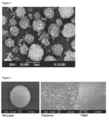
- the organic composition was strongly bonded to the alumina compound as confirmed by the FTIR spectra Figure 6 by the appearance of the band at 1590 cm-1 , and the complete disappearance of the organic functional group band at 1700 cm-1 . This was not shown in Comparative Examples 1 and 2 ( Figures 8 and 9 ). The particles morphology is shown in Figure 2 .
- N 2 adsorption method was applied on the hydrophobic porous alumina. Data was collected on heat treated samples at 110°C for 2 hours with vacuum at 1 Torr. The specific surface area of the hydrophobic porous alumina (m2/g) was evaluated using the B.E.T. equation. The pore volume was determined from the volume of nitrogen adsorbed at saturation (evaluated at relative pressure p/p o equal to 0.992). The pore volume determined with this method was contained in pores filled up to about 269 nm.
- the hydrophobic porous alumina powders were deagglomerated to nanosize with single nano crystals by light blending and incorporated with different substrates including polymeric and non polymeric substrates. As can be seen from Figure 3 the powders coat the different substrates.
- the particles were not wetted by water but could be wetted by hexane for example and have dispersed giving opalescent systems without sedimentation.
- the porous hydrophobic alumina was prepared according to Example 1, but the amount of organic composition i.e. C8 carbon chain was decreased.
- the final powder had a residual amount of organic composition measured through catalytic combustion analysis of 2.6 parts in 100 parts of powder, that counts for only 0.18 mmol/g of the organic composition on surface.
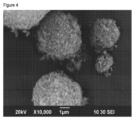
- Figure 4 shows the morphology of the particles.
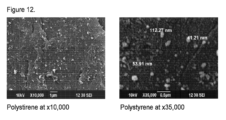
- Figure 5 shows the deagglomerated hydrophobic porous alumina on several substrates including silica glass, polystryrene, sulfonic polystyrene resin, PMMA and nylon (nylon 12).
- the particles were dispersed giving opalescent systems without sedimentation.
- This example exemplifies the use of an organic composition including an alkyl hydrocarbon chain length of 18.
- An amount of an organic modifier composition which is a polymerized chain fatty acid having a carbon chain of greater than 16 was reacted in a stirred vessel with the boehmite slurry of Example 1 at 105°C for 2 hours. The resulting mixture had a pH of 7.0.
- the final powder had an amount of organic composition of 14 parts in 100 parts of powder (0.49 mmol/ g powder) that is higher than in the Example 1 and is comparable to the stoichiometric estimated value.
- This example exemplifies a modified drying operation for producing modified boehmite with an organic composition having a C18 chain by using a screen to deagglomerate particles before drying.
- An amount of the organic modifier composition which has been used in the Comparative Example 1 was reacted in a stirred vessel with the boehmite slurry of Comparative Example 1 at 105°C for 2 hours.
- the resulting milky mixture had a pH of 7.0.
- a screen pack was installed on the line to the nozzle dryer to remove clots or agglomerates.
- the milky mixture was dried under air flow with a nozzle spray atomizer at temperature of the inlet air of 260°C.
- the resulting crystallites were thinner than the starting alumina compound, the aspect ratio was 1.69.
- the final powder had an amount of organic composition of 14 parts in 100 parts of powder (0.49 mmol/ g powder).
- the FTIR spectra, Figure 9 has similar features to Comparative Example1.
- the following example describes the use of an organic composition having an amino group and an alkyl carbon chain of 6.
- Leucine amino acid with alkyl chain of 6
- a weighted amount of Leucine (amino acid with alkyl chain of 6) was added to water and stirred at room temperature until a not- completely clear solution was obtained.
- the not-completely clear solution was mixed with a boehmite (AIOOH) slurry from the Ziegler alcohol process of Example 1 in a vessel operating at a suitable revolution rate of low RPM at 105°C for 2 hours.
- the pH was in the range of 5.5 - 6.0.
- the slurry was dried using a spray atomizer to obtain a final powder with an amount of organic composition of 8.9 parts in 100 parts of powder (0.68 mmol/g).
- the powders had a BET surface area of 37 m2/g and pore volume of 0.73 Cc/g.
- the mixture was centrifuged and the solid residue was evaluated after drying at 120°C.
- the % wt. of particles that remained in the supernatant after centrifugation with respect to the total amount initially added was 99%wt, which showed that particles were highly dispersible.
- Figure 11 shows the alumina particle morphologies and Figure 12 shows the deagglomerated alumina particles on polystryrene.
- the preparation with Leucine was carried out with the same starting reagent solution and in the same mixing vessel under a revolution rate of higher RPM. After reaction the powder, which had essentially the same surface area as above, 37.3 m2/g, had a pore volume of 0.53 cc/g. Thus if an appropriate mixing rate is applied in the vessel, the pore volume may be adjusted being as much higher as the mixing rate is lowered.
Landscapes
- Chemical & Material Sciences (AREA)
- Organic Chemistry (AREA)
- Life Sciences & Earth Sciences (AREA)
- Geology (AREA)
- Inorganic Chemistry (AREA)
- Physics & Mathematics (AREA)
- Thermal Sciences (AREA)
- Compounds Of Alkaline-Earth Elements, Aluminum Or Rare-Earth Metals (AREA)
- Pigments, Carbon Blacks, Or Wood Stains (AREA)
- Compositions Of Macromolecular Compounds (AREA)
Applications Claiming Priority (2)
| Application Number | Priority Date | Filing Date | Title |
|---|---|---|---|
| US201762520163P | 2017-06-15 | 2017-06-15 | |
| PCT/US2018/037007 WO2018231761A1 (en) | 2017-06-15 | 2018-06-12 | Hydrophobic surface modified aluminas and method for making thereof |
Publications (4)
| Publication Number | Publication Date |
|---|---|
| EP3638625A1 EP3638625A1 (en) | 2020-04-22 |
| EP3638625C0 EP3638625C0 (en) | 2024-10-02 |
| EP3638625B1 EP3638625B1 (en) | 2024-10-02 |
| EP3638625B9 true EP3638625B9 (en) | 2025-01-15 |
Family
ID=62817073
Family Applications (1)
| Application Number | Title | Priority Date | Filing Date |
|---|---|---|---|
| EP18737457.4A Active EP3638625B9 (en) | 2017-06-15 | 2018-06-12 | Hydrophobic surface modified aluminas and method for making thereof |
Country Status (8)
| Country | Link |
|---|---|
| US (1) | US11078367B2 (enExample) |
| EP (1) | EP3638625B9 (enExample) |
| JP (1) | JP7391667B2 (enExample) |
| KR (1) | KR102563994B1 (enExample) |
| CN (1) | CN111010873A (enExample) |
| CA (1) | CA3061987A1 (enExample) |
| RU (1) | RU2769341C2 (enExample) |
| WO (1) | WO2018231761A1 (enExample) |
Families Citing this family (3)
| Publication number | Priority date | Publication date | Assignee | Title |
|---|---|---|---|---|
| CN115605551A (zh) | 2020-03-10 | 2023-01-13 | 萨索尔(美国)公司(Us) | 用作涂层的利用短链羧酸改性的矾土及其生产方法 |
| CN111924865B (zh) * | 2020-08-05 | 2022-05-06 | 北京化工大学 | 一种晶面选择性生长勃姆石及其制备方法 |
| CN114433041B (zh) * | 2020-10-30 | 2024-03-08 | 中国石油化工股份有限公司 | 一种超大孔氧化铝材料及其制备方法 |
Family Cites Families (20)
| Publication number | Priority date | Publication date | Assignee | Title |
|---|---|---|---|---|
| US4066740A (en) * | 1971-12-06 | 1978-01-03 | Atlantic Richfield Company | Method for producing alumina |
| GB2199541A (en) * | 1986-10-16 | 1988-07-13 | Rig Design Services | Production of engineering drawings |
| CN1095807C (zh) * | 1995-09-01 | 2002-12-11 | 水泽化学工业株式会社 | 碱金属铝配合氢氧化物碳酸盐、和生产该盐的方法及其应用 |
| RU2094116C1 (ru) * | 1996-06-18 | 1997-10-27 | Институт клинической и экспериментальной лимфологии СО РАМН | Пористый сорбент на основе оксида алюминия |
| RU2126293C1 (ru) * | 1998-05-07 | 1999-02-20 | Рачковская Любовь Никифоровна | Пористый сорбент на основе оксида алюминия |
| FR2819518B1 (fr) * | 2001-01-12 | 2005-03-11 | Omya Ag | Procede de traitement d'une charge minerale par un polydialkylsiloxane et un acide gras, charges hydrophobes ainsi obtenues, et leurs applications dans des polymeres pour films "respirables" |
| DE10152745A1 (de) * | 2001-10-25 | 2003-05-15 | Degussa | Dispersion von Aluminiumoxid |
| US7244498B2 (en) * | 2002-06-12 | 2007-07-17 | Tda Research, Inc. | Nanoparticles modified with multiple organic acids |
| JP4940556B2 (ja) * | 2004-09-07 | 2012-05-30 | 日産自動車株式会社 | 樹脂組成物 |
| DE102005032427A1 (de) * | 2005-07-12 | 2007-01-18 | Degussa Ag | Aluminiumoxid-Dispersion |
| DE102005039436B4 (de) * | 2005-08-18 | 2009-05-07 | Clariant International Limited | Beschichtungsmassen enthaltend mit Silanen modifizierte Nanopartikel |
| MX2008002612A (es) * | 2005-08-25 | 2009-02-25 | Sasol North America Inc | Proceso para producir aluminas de boehmita de alta porosidad. |
| DE602006009042D1 (de) | 2005-10-21 | 2009-10-22 | Du Pont | Mehrlagige anpassungsfähige Membranstruktur |
| JPWO2007135977A1 (ja) * | 2006-05-19 | 2009-10-01 | サトーリサーチ株式会社 | 粉粒状アルミナ組成物およびその製造方法 |
| EP2620212B1 (en) * | 2006-11-01 | 2026-07-29 | Dow Global Technologies LLC | Method for modifying the surface composition of alpha-alumina |
| EP2094774A1 (en) * | 2006-12-06 | 2009-09-02 | Saint-Gobain Ceramics and Plastics, Inc. | Treated alumina hydrate material and uses thereof |
| US20100324193A1 (en) * | 2008-02-19 | 2010-12-23 | Albemarle Corporation | A process for the production of nanodispersible boehmite and the use thereof in flame retardant synthetic resins |
| JP2014062011A (ja) * | 2012-09-21 | 2014-04-10 | Jgc Catalysts & Chemicals Ltd | アルミナ水和物微粒子粉末、アルミナ水和物微粒子分散液およびアルミナ水和物微粒子またはアルミナ微粒子層付基材 |
| CA2936975C (en) | 2014-01-21 | 2022-12-13 | Sasol Performance Chemicals Gmbh | Alumina compositions and methods for producing same |
| JP6906513B2 (ja) * | 2015-10-30 | 2021-07-21 | サソール(ユーエスエイ)コーポレーシヨン | ポリマー組成物のための疎水性表面改変アルミナおよびそれらの製法 |
-
2018
- 2018-06-12 US US16/608,483 patent/US11078367B2/en active Active
- 2018-06-12 WO PCT/US2018/037007 patent/WO2018231761A1/en not_active Ceased
- 2018-06-12 CN CN201880038470.3A patent/CN111010873A/zh active Pending
- 2018-06-12 CA CA3061987A patent/CA3061987A1/en active Pending
- 2018-06-12 KR KR1020197038053A patent/KR102563994B1/ko active Active
- 2018-06-12 RU RU2019141838A patent/RU2769341C2/ru active
- 2018-06-12 EP EP18737457.4A patent/EP3638625B9/en active Active
- 2018-06-12 JP JP2019569328A patent/JP7391667B2/ja active Active
Also Published As
| Publication number | Publication date |
|---|---|
| KR102563994B1 (ko) | 2023-08-04 |
| WO2018231761A1 (en) | 2018-12-20 |
| EP3638625C0 (en) | 2024-10-02 |
| US20200056049A1 (en) | 2020-02-20 |
| JP7391667B2 (ja) | 2023-12-05 |
| JP2020524126A (ja) | 2020-08-13 |
| WO2018231761A4 (en) | 2019-01-24 |
| CN111010873A (zh) | 2020-04-14 |
| US11078367B2 (en) | 2021-08-03 |
| RU2769341C2 (ru) | 2022-03-30 |
| CA3061987A1 (en) | 2018-12-20 |
| KR20200038891A (ko) | 2020-04-14 |
| EP3638625B1 (en) | 2024-10-02 |
| RU2019141838A3 (enExample) | 2021-09-28 |
| RU2019141838A (ru) | 2021-07-15 |
| EP3638625A1 (en) | 2020-04-22 |
Similar Documents
| Publication | Publication Date | Title |
|---|---|---|
| Mallakpour et al. | Efficient preparation of hybrid nanocomposite coatings based on poly (vinyl alcohol) and silane coupling agent modified TiO2 nanoparticles | |
| Osman et al. | Surface treatment of calcite with fatty acids: structure and properties of the organic monolayer | |
| EP3097154B1 (en) | Alumina compositions and methods for producing same | |
| EP3638625B1 (en) | Hydrophobic surface modified aluminas and method for making thereof | |
| US11814525B2 (en) | Hydrophobic surface modified aluminas for polymer compositions and method for making thereof | |
| Klapiszewski et al. | Silica/lignosulfonate hybrid materials: Preparation and characterization | |
| CN112236397B (zh) | 经表面处理含氢氧化镁材料的开发 | |
| Siahpoosh et al. | Synthesis of γ-Alumina nanoparticles with high-surface-area via Sol-Gel method and their performance for the removal of Nickel from aqueous solution | |
| Wyns et al. | Iron (III) removal from acidic solutions using mesoporous titania microspheres prepared by vibrational droplet coagulation | |
| HK40017802A (en) | Hydrophobic surface modified aluminas and method for making thereof | |
| Siahpoosh et al. | Preparation and Characterization of High Specific Surface Area γ-Alumina Nanoparticles Via Sol-Gel Method |
Legal Events
| Date | Code | Title | Description |
|---|---|---|---|
| STAA | Information on the status of an ep patent application or granted ep patent |
Free format text: STATUS: UNKNOWN |
|
| STAA | Information on the status of an ep patent application or granted ep patent |
Free format text: STATUS: THE INTERNATIONAL PUBLICATION HAS BEEN MADE |
|
| PUAI | Public reference made under article 153(3) epc to a published international application that has entered the european phase |
Free format text: ORIGINAL CODE: 0009012 |
|
| STAA | Information on the status of an ep patent application or granted ep patent |
Free format text: STATUS: REQUEST FOR EXAMINATION WAS MADE |
|
| 17P | Request for examination filed |
Effective date: 20200115 |
|
| AK | Designated contracting states |
Kind code of ref document: A1 Designated state(s): AL AT BE BG CH CY CZ DE DK EE ES FI FR GB GR HR HU IE IS IT LI LT LU LV MC MK MT NL NO PL PT RO RS SE SI SK SM TR |
|
| AX | Request for extension of the european patent |
Extension state: BA ME |
|
| DAV | Request for validation of the european patent (deleted) | ||
| DAX | Request for extension of the european patent (deleted) | ||
| STAA | Information on the status of an ep patent application or granted ep patent |
Free format text: STATUS: EXAMINATION IS IN PROGRESS |
|
| 17Q | First examination report despatched |
Effective date: 20220719 |
|
| P01 | Opt-out of the competence of the unified patent court (upc) registered |
Effective date: 20230502 |
|
| REG | Reference to a national code |
Ref country code: DE Ref legal event code: R079 Free format text: PREVIOUS MAIN CLASS: C01F0007020000 Ipc: C01F0007021000 Ref country code: DE Ref legal event code: R079 Ref document number: 602018074928 Country of ref document: DE Free format text: PREVIOUS MAIN CLASS: C01F0007020000 Ipc: C01F0007021000 |
|
| GRAP | Despatch of communication of intention to grant a patent |
Free format text: ORIGINAL CODE: EPIDOSNIGR1 |
|
| STAA | Information on the status of an ep patent application or granted ep patent |
Free format text: STATUS: GRANT OF PATENT IS INTENDED |
|
| RIC1 | Information provided on ipc code assigned before grant |
Ipc: C09C 1/40 20060101ALI20240423BHEP Ipc: C09C 3/08 20060101ALI20240423BHEP Ipc: C01F 7/021 20220101AFI20240423BHEP |
|
| INTG | Intention to grant announced |
Effective date: 20240516 |
|
| GRAS | Grant fee paid |
Free format text: ORIGINAL CODE: EPIDOSNIGR3 |
|
| GRAA | (expected) grant |
Free format text: ORIGINAL CODE: 0009210 |
|
| STAA | Information on the status of an ep patent application or granted ep patent |
Free format text: STATUS: THE PATENT HAS BEEN GRANTED |
|
| AK | Designated contracting states |
Kind code of ref document: B1 Designated state(s): AL AT BE BG CH CY CZ DE DK EE ES FI FR GB GR HR HU IE IS IT LI LT LU LV MC MK MT NL NO PL PT RO RS SE SI SK SM TR |
|
| REG | Reference to a national code |
Ref country code: GB Ref legal event code: FG4D |
|
| REG | Reference to a national code |
Ref country code: CH Ref legal event code: EP |
|
| REG | Reference to a national code |
Ref country code: DE Ref legal event code: R096 Ref document number: 602018074928 Country of ref document: DE |
|
| REG | Reference to a national code |
Ref country code: IE Ref legal event code: FG4D |
|
| U01 | Request for unitary effect filed |
Effective date: 20241101 |
|
| U07 | Unitary effect registered |
Designated state(s): AT BE BG DE DK EE FI FR IT LT LU LV MT NL PT RO SE SI Effective date: 20241112 |
|
| P04 | Withdrawal of opt-out of the competence of the unified patent court (upc) registered |
Free format text: CASE NUMBER: APP_60280/2024 Effective date: 20241108 |
|
| REG | Reference to a national code |
Ref country code: CH Ref legal event code: PK Free format text: BERICHTIGUNG B9 |
|
| PG25 | Lapsed in a contracting state [announced via postgrant information from national office to epo] |
Ref country code: IS Free format text: LAPSE BECAUSE OF FAILURE TO SUBMIT A TRANSLATION OF THE DESCRIPTION OR TO PAY THE FEE WITHIN THE PRESCRIBED TIME-LIMIT Effective date: 20250202 Ref country code: HR Free format text: LAPSE BECAUSE OF FAILURE TO SUBMIT A TRANSLATION OF THE DESCRIPTION OR TO PAY THE FEE WITHIN THE PRESCRIBED TIME-LIMIT Effective date: 20241002 |
|
| PG25 | Lapsed in a contracting state [announced via postgrant information from national office to epo] |
Ref country code: ES Free format text: LAPSE BECAUSE OF FAILURE TO SUBMIT A TRANSLATION OF THE DESCRIPTION OR TO PAY THE FEE WITHIN THE PRESCRIBED TIME-LIMIT Effective date: 20241002 |
|
| PG25 | Lapsed in a contracting state [announced via postgrant information from national office to epo] |
Ref country code: NO Free format text: LAPSE BECAUSE OF FAILURE TO SUBMIT A TRANSLATION OF THE DESCRIPTION OR TO PAY THE FEE WITHIN THE PRESCRIBED TIME-LIMIT Effective date: 20250102 |
|
| PG25 | Lapsed in a contracting state [announced via postgrant information from national office to epo] |
Ref country code: GR Free format text: LAPSE BECAUSE OF FAILURE TO SUBMIT A TRANSLATION OF THE DESCRIPTION OR TO PAY THE FEE WITHIN THE PRESCRIBED TIME-LIMIT Effective date: 20250103 |
|
| PG25 | Lapsed in a contracting state [announced via postgrant information from national office to epo] |
Ref country code: PL Free format text: LAPSE BECAUSE OF FAILURE TO SUBMIT A TRANSLATION OF THE DESCRIPTION OR TO PAY THE FEE WITHIN THE PRESCRIBED TIME-LIMIT Effective date: 20241002 Ref country code: CZ Free format text: LAPSE BECAUSE OF FAILURE TO SUBMIT A TRANSLATION OF THE DESCRIPTION OR TO PAY THE FEE WITHIN THE PRESCRIBED TIME-LIMIT Effective date: 20241002 |
|
| PG25 | Lapsed in a contracting state [announced via postgrant information from national office to epo] |
Ref country code: RS Free format text: LAPSE BECAUSE OF FAILURE TO SUBMIT A TRANSLATION OF THE DESCRIPTION OR TO PAY THE FEE WITHIN THE PRESCRIBED TIME-LIMIT Effective date: 20250102 |
|
| PG25 | Lapsed in a contracting state [announced via postgrant information from national office to epo] |
Ref country code: SM Free format text: LAPSE BECAUSE OF FAILURE TO SUBMIT A TRANSLATION OF THE DESCRIPTION OR TO PAY THE FEE WITHIN THE PRESCRIBED TIME-LIMIT Effective date: 20241002 |
|
| PGFP | Annual fee paid to national office [announced via postgrant information from national office to epo] |
Ref country code: GB Payment date: 20250627 Year of fee payment: 8 |
|
| PG25 | Lapsed in a contracting state [announced via postgrant information from national office to epo] |
Ref country code: SK Free format text: LAPSE BECAUSE OF FAILURE TO SUBMIT A TRANSLATION OF THE DESCRIPTION OR TO PAY THE FEE WITHIN THE PRESCRIBED TIME-LIMIT Effective date: 20241002 |
|
| U20 | Renewal fee for the european patent with unitary effect paid |
Year of fee payment: 8 Effective date: 20250628 |
|
| PLBE | No opposition filed within time limit |
Free format text: ORIGINAL CODE: 0009261 |
|
| STAA | Information on the status of an ep patent application or granted ep patent |
Free format text: STATUS: NO OPPOSITION FILED WITHIN TIME LIMIT |
|
| 26N | No opposition filed |
Effective date: 20250703 |
|
| PGFP | Annual fee paid to national office [announced via postgrant information from national office to epo] |
Ref country code: CH Payment date: 20250701 Year of fee payment: 8 |
|
| PG25 | Lapsed in a contracting state [announced via postgrant information from national office to epo] |
Ref country code: MC Free format text: LAPSE BECAUSE OF FAILURE TO SUBMIT A TRANSLATION OF THE DESCRIPTION OR TO PAY THE FEE WITHIN THE PRESCRIBED TIME-LIMIT Effective date: 20241002 |
|
| PG25 | Lapsed in a contracting state [announced via postgrant information from national office to epo] |
Ref country code: IE Free format text: LAPSE BECAUSE OF NON-PAYMENT OF DUE FEES Effective date: 20250612 |
|
| U20 | Renewal fee for the european patent with unitary effect paid |
Year of fee payment: 9 Effective date: 20260622 |
|
| PG25 | Lapsed in a contracting state [announced via postgrant information from national office to epo] |
Ref country code: CY Free format text: LAPSE BECAUSE OF FAILURE TO SUBMIT A TRANSLATION OF THE DESCRIPTION OR TO PAY THE FEE WITHIN THE PRESCRIBED TIME-LIMIT Effective date: 20241002 |