EP3634842B1 - Velo pliant - Google Patents
Velo pliant Download PDFInfo
- Publication number
- EP3634842B1 EP3634842B1 EP18729053.1A EP18729053A EP3634842B1 EP 3634842 B1 EP3634842 B1 EP 3634842B1 EP 18729053 A EP18729053 A EP 18729053A EP 3634842 B1 EP3634842 B1 EP 3634842B1
- Authority
- EP
- European Patent Office
- Prior art keywords
- bar
- bicycle
- oblique
- joints
- bolt
- Prior art date
- Legal status (The legal status is an assumption and is not a legal conclusion. Google has not performed a legal analysis and makes no representation as to the accuracy of the status listed.)
- Active
Links
Images




Classifications
-
- B—PERFORMING OPERATIONS; TRANSPORTING
- B62—LAND VEHICLES FOR TRAVELLING OTHERWISE THAN ON RAILS
- B62K—CYCLES; CYCLE FRAMES; CYCLE STEERING DEVICES; RIDER-OPERATED TERMINAL CONTROLS SPECIALLY ADAPTED FOR CYCLES; CYCLE AXLE SUSPENSIONS; CYCLE SIDE-CARS, FORECARS, OR THE LIKE
- B62K15/00—Collapsible or foldable cycles
- B62K15/006—Collapsible or foldable cycles the frame being foldable
- B62K15/008—Collapsible or foldable cycles the frame being foldable foldable about 2 or more axes
-
- B—PERFORMING OPERATIONS; TRANSPORTING
- B62—LAND VEHICLES FOR TRAVELLING OTHERWISE THAN ON RAILS
- B62K—CYCLES; CYCLE FRAMES; CYCLE STEERING DEVICES; RIDER-OPERATED TERMINAL CONTROLS SPECIALLY ADAPTED FOR CYCLES; CYCLE AXLE SUSPENSIONS; CYCLE SIDE-CARS, FORECARS, OR THE LIKE
- B62K3/00—Bicycles
- B62K3/02—Frames
- B62K3/04—Frames having a substantially horizontal top bar
Definitions
- the present disclosure relates to a folding bicycle, that is to say a bicycle which can be deformed between an unfolded position in which the bicycle can be used as a means of transport and a folded position in which the size of the bicycle is less. Once folded, the bike can be stored or transported more easily.
- the invention relates to a folding bicycle according to the appended independent claims 1 and 2. Particular embodiments are defined by the dependent claims.
- Such a folding bicycle includes a front wheel, a rear wheel and a frame.
- the frame comprises a front frame part on which the front wheel is mounted, via a pivoting fork, and a rear frame part on which the rear wheel is mounted.
- the front frame part includes a top bar, a saddle bar and a slash.
- the seat bar is also part of the rear frame part.
- the rear frame portion may include at least one seat stay, at least one lower bar, and the saddle bar.
- the oblique bar comprises an upper oblique rod and a lower oblique rod.
- the lower oblique rod, the upper oblique rod, the upper bar and the saddle bar are interconnected by joints, in that order, so as to form a deformable hinged quadrilateral between a folded position and an unfolded position.
- the deformable hinged quadrilateral is configured such that, on deforming to its folded position, the bicycle folds lengthwise with the front and rear wheels moving transversely apart from each other while moving closer together lengthwise until the front wheel is superimposed on the rear wheel in a transverse direction of the bicycle.
- the front frame part comprises an upper bar, a portion of the saddle bar, a junction bar and an oblique bar.
- the top bar, the saddle bar portion, the junction bar and the slash are connected together, in that order, by hinges so as to form a deformable hinged quadrilateral between a folded position and an unfolded position.
- the deformable hinged quadrilateral is configured such that, on deforming to its folded position, the bicycle folds lengthwise with the front and rear wheels moving transversely apart from each other while moving closer together lengthwise until the front wheel is superimposed on the rear wheel in a transverse direction of the bicycle.
- the front wheel when the bicycle is in the folded position, the front wheel is superimposed on the rear wheel in a transverse direction of the bicycle.
- the front wheel and the rear wheel are arranged substantially opposite each other in the transverse direction of the bicycle, it being understood that these wheels may be slightly offset from one another. in a direction perpendicular to the transverse direction, without departing from the scope of the invention.
- the length of the bicycle is considered between the front end of the front wheel and the rear end of the rear wheel of the bicycle.
- the longitudinal direction of the bicycle is the direction along the length of the bicycle. The direction longitudinal therefore corresponds to the front-rear direction of the bicycle when the latter is in the unfolded position, the front and the rear being defined with respect to the normal direction of travel of the bicycle when the latter is used as a means of transport.
- the height of the bicycle is considered vertically when the bicycle rests on its wheels, in the unfolded position, on a horizontal surface.
- the median plane of the rear wheel of the bicycle is called the “midplane” of the bicycle.
- the front and rear wheels are in the midplane and the longitudinal axis of the bicycle is contained in this plane.
- the transverse direction is the direction perpendicular to the midplane of the bicycle.
- the fact that the front and rear wheels are superimposed in the folded position in the transverse direction makes it possible to limit the size of the bicycle in the folded position while keeping the wheels of normal size, ie of diameter proportional to the size of the user of the bicycle. .
- the comfort and stability of the bicycle when using it in the unfolded position are thus preserved and, in the folded position, the bicycle can be easily stored (for example in an apartment, a cellar, on a balcony, etc.) and easily transported (for example in a car trunk, in public transport, etc.).
- Said articulated quadrilateral is delimited by the four aforementioned articulations which form the four vertices of the quadrilateral.
- the four sides of the quadrilateral are, in turn, formed by the elements that connect the joints between them.
- the four sides are formed essentially by the lower oblique rod, the upper oblique rod, the upper bar and the saddle bar, respectively.
- the four sides are formed essentially by the upper bar, the upper portion of the saddle bar, the junction bar and the slash, respectively.
- the aforementioned rods and bars are generally essentially straight, but they are not necessarily so. The concept of a quadrilateral should therefore not be interpreted in the strict sense in this regard. By example, these rods and bars may be curved or in the form of broken lines without departing from the scope of the invention.
- the joints are pivot links. These structurally simple connections make it possible to guide the four sides of the deformable articulated quadrilateral in rotation while allowing only one rotation around the axis of the connection. Folding the bicycle is facilitated by this guidance. The bike can therefore be folded flexibly, quickly and intuitively.
- the joints are pivot links and the axes of these links intersect at the same point.
- the axes of the links are mutually parallel.
- the axes of the connections are preferably inclined at the same angle with respect to the transverse direction of the bicycle.
- the axes of the links can be horizontal when the bicycle is unfolded and rests on a horizontal surface.
- the rear frame portion is dimensionally stable. This improves the stability of the bicycle during use.
- the bicycle includes a locking system for locking the articulated quadrilateral in its unfolded position.
- the locking system can be provided between the lower oblique rod and the upper oblique rod, or between the portion of the saddle bar and the junction bar.
- the locking system may include, for example, a clamp or a clamp held by a screw, or a hook system operated by a lever.
- the locking system comprises a bolt slidably mounted inside one of the oblique rods, between an extended position and a retracted position, and a keeper arranged inside the other oblique rod and cooperating with the bolt in the extended position to prevent the relative rotation of the oblique rods around the joint.
- one of the oblique rods has an extension extending axially beyond the joint, while the other rod has a cutout whose shape is complementary to that of the extension, and the bolt slides axially inside the extension. This configuration makes it possible to ensure better locking of the articulated quadrilateral in its unfolded position.
- the locking system comprises an unlocking lever mounted on the same oblique rod as the bolt and cooperating with the bolt to drive the latter towards its retracted position, and thus allow the rotation of the oblique rods one. compared to each other.
- the locking system comprises a lock mounted movably in said extension, between a locking position of the bolt and an unlocking position of the bolt.
- the lock With reference to the central axis of the oblique rod, the lock is movable in translation laterally but not axially.
- a pin is provided in front of the lock, on the side face of the cutout, so that the pin comes to press on the lock to unlock the bolt when the oblique rods are unfolded to be aligned.
- the bicycle includes a locking system for locking the bicycle crankset in a particular position when folding or unfolding the bicycle.
- the crankset may include a bottom bracket rotating around an axis and the locking system may include a pin fixed on the lower oblique rod near the plate; and a stopper fixed on the inside face of the plate. In the unfolded position, the pin does not interfere with the travel of the stopper and the plate can therefore rotate freely around its axis.
- the pin approaches the axis of the plate and cuts the stroke of the stop. The bottom bracket can then no longer turn freely.
- the horizontal and vertical directions are considered with reference to the unfolded position of the bicycle when the latter rests, under normal conditions of use, on a horizontal surface.
- the top and bottom are defined in the vertical direction.
- the front and rear, right and left, are defined in relation to the normal rolling direction of the bicycle.
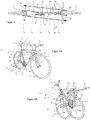
- the saddle bar 5 is, typically, a tube inside which the saddle post 4 is slidably mounted, so that the saddle 3 can be adjusted in height.
- the bicycle has a frame comprising a rear frame part A (sometimes called a rear triangle) and a front frame part C (sometimes called a front triangle or central triangle).
- the rear frame part A is formed by the saddle bar 5, at least one seat stay 8 and at least one lower bar 9 (sometimes called a chain bar).
- the stay 8 and the lower bar 9 are doubled (ie there are two seat stays and two lower bars) and located on either side of the rear wheel 2.
- the left and right shrouds are respectively denoted 8g and 8d
- the lower left and right bars are respectively denoted 9g and 9d.
- the fork 7 if it is not single-sided, comprises a left fork arm 7g and a right fork arm 7d.
- the front frame part C is formed by the saddle bar 5, an upper bar 10 (sometimes called a horizontal bar) and an oblique bar 11.
- a head tube 12 is attached to the front frame part C, at the top. before this part.
- the fork 7 and the handlebars 6 pivot inside the steering tube.
- the bicycle of the figure 1 is equipped with a crankset (not shown) which is fixed to a bottom bracket 13, the axis of which is located at the intersection of the saddle bar 5, of the oblique bar 11 and of the lower bar (s) 9.
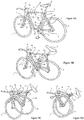
- the figure 2A shows an example of a folding bicycle according to the invention, in the unfolded position, seen in profile.
- the oblique bar is formed in two parts articulated to each other by the articulation P4: the upper oblique rod 14 and the lower oblique rod 15.
- the bars and rods 5, 10, 14, 15 which form the four sides of the articulated quadrilateral D are rigid.
- the steering tube 12 forms an integral part of the upper oblique rod 14 and forms the upper end of the latter.
- the joint P2 connects this steering tube 12 to the horizontal bar 10.
- the steering tube 12 could however be connected differently to the upper oblique rod 14 or to the horizontal bar 10.
- the steering tube may be an integral part. of the horizontal bar 10 and form the front end thereof.
- the joint P2 can connect the steering tube 12 to the upper oblique rod 14.
- the articulation P3 is located near the axis of the bottom bracket 13 but is not necessarily positioned on this axis.
- the frame of the bike figure 2 thus comprises a front frame part on which the front wheel 1 is mounted, via the pivoting fork 7, and a rear frame part A on which the rear wheel 2 is mounted.
- the front frame part forming the articulated quadrilateral D comprises the upper bar 10, the saddle bar 5 and the oblique bar formed by the lower oblique rod 15 and the upper oblique rod 14.
- the rear frame part A comprises the stay (s) 8, the lower bar (s) 9 and the saddle bar 5.
- the articulated quadrilateral D In its unfolded position shown on the figure 2A , the articulated quadrilateral D has a shape close to the triangle.
- the upper oblique rod 14 and the rod lower oblique 15 are substantially aligned and together form one side of said triangle.
- a deformable articulated quadrilateral connected by joints offering only one degree of freedom in rotation (rotation alone or combined with a translation) offers the advantage of being able to fold and unfold easily without having to disconnect one of its elements.
- the bicycle has a rigidity substantially equivalent to that of a conventional bicycle like that of the figure 1 .
- FIG 8 An example of a locking system 40 is shown in figure 8 .
- This system comprises an eccentric lever 41 fixed to the lower oblique rod 15, a ring 42 passed around the lever 41 and a hook 43 fixed to the upper oblique tube 14.
- the hook 43, the ring 42 and the lever 41 cooperate so that , when the ring 42 is hooked on the hook 43, the pivoting of the lever 41 puts the ring 42 in tension.
- the articulation P4 which connects the upper 14 and lower 15 oblique rods together, is located on one side of the rods 14, 15 when these are aligned.
- the pivot axis I4 of the joint is oriented perpendicularly and offset from the central axis of the rods 14 and 15.
- the locking system is located on the side opposite the joint P4, relative to the central axis rods 14 and 15.
- this system is locked by tensioning the ring 42, it prevents any relative movement between the rods 14, 15 and the joint P4 is blocked; the rods 14, 15 are kept aligned with each other, as shown in figure 8 .
- this is only an example of a locking system and other systems could be considered.
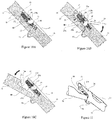
- the figures 10A to 10C and 11 show another example of a locking system located at the level of the articulation P4 which connects the upper 14 and lower 15 oblique rods to one another.
- the articulation P4 is located on one side of the rods 14, 15 when the latter are aligned.
- the articulation P4 is offset laterally with respect to the central axis of the rods, when the bicycle is unfolded.
- "axial" or “axially” refer to a parallel direction. to the central axis of the rods 14, 15, when the bicycle is unfolded
- lateral or “laterally” refer to a direction perpendicular to the axial direction.
- One of the rods, in the example rod 15, has an extension 15a extending axially beyond the articulation P4, while the other rod 14 has a cutout 14a whose shape is complementary to that of the joint. extension 15a.
- the extension 15a When the bicycle is unfolded, the extension 15a is housed in the cutout 14a.
- the bolt 21 is housed at least in part in the extension 15a and slides axially inside the latter, while the keeper 23 is provided at the level of the cutout 14a. In the extended position, the bolt 21 protrudes at the free end of the extension 15a.
- the zone of engagement of the bolt 21 in the keeper 23 is offset axially with respect to the articulation P4. Such a configuration makes it possible to obtain better locking.
- the bolt 21 In the extended position, the bolt 21 is engaged or pressed into the strike 23 (cf. figure 10A ). A compression spring 26 can act on the bolt 21 to keep it in this depressed position.
- a lock 27 can be mounted in the lower oblique rod 15 to keep the bolt 21 in its retracted position (cf. figures 10B, 10C ).
- the lock 27 at least partially surrounds the bolt 21 so that a first end 27a of the lock is located on one side of the bolt 21 and the opposite end of the lock, or second end 27b, is located on the other side of the bolt 21.
- the latch 27 is mounted inside the extension 15a of the rod 15 and is movable in translation in a lateral direction. On the other hand, the lock 27 is not axially movable.
- a notch 29 is provided in a lateral face of the bolt 21 to receive the second end 27b of the latch 27.
- a groove 31 may be formed in the lateral face of the bolt 21 located opposite the notch 29 to receive the first end 27a of the lock.
- the first end 27a of the lock In the unlocked position, the first end 27a of the lock is engaged in the groove 31, as shown in figure 10A , and this end 27a slides axially in the groove 31 when the bolt 21 slides. The end 27a comes out of the groove 31 when the second end 27b enters the notch 29, and vice versa.
- a pin 50 can be provided, opposite the first end 27a, on the side face of the cutout 14a of the upper oblique rod 14, so that the pin 50 comes to press on the end 27a to make it penetrate. in the groove 31, and so that the second end 27b comes out of the notch 29, thus unlocking the bolt 21, when the bicycle is unfolded.
- the lever 24 is pivotally mounted on the lower oblique rod 15 about an axis 25 and cooperates with a stop 22 of the bar 21. This lever 24 makes it possible to act against the return force exerted by the spring 26 on the bolt 21.
- the user raises the lever 24 which acts on the stop 22 to slide the bolt 21 towards its retracted position and compress the spring 26, until the second end 27b of the latch 27, under the effect of the spring 28, enters the notch 29.
- the bolt 21 is disengaged from the keeper 23 and maintained in this retracted position by the latch 27.
- the lever 24 also includes one or more pushers 24a.
- the pusher (s) 24a press on the upper oblique rod 14, forcing it to move away from the lower oblique rod 15 by pivoting around the joint P4.
- the pin 50 stops pressing on the first end 27a of the latch 27, which makes the lateral displacement of the latch 27 possible and allows the second end 27b to engage in notch 29. Latch 27 then maintains bolt 21 in its retracted position.
- a return device may be provided to allow the lever 24 to return against the lower oblique rod 15, as shown in FIG. figure 10A or 10C .
- the figure 11 is a perspective view of the unlocking system described above, in a position identical to that of the figure 10C . Thanks to such an unlocking system, the bicycle has a simple mechanism allowing easy unlocking of the bicycle, and automatic locking when unfolding.
- the shapes of the rods 14 and 15 could be reversed, i.e. the bolt 21 could be mounted on the upper oblique rod 14 and the keeper 23 be provided in the lower oblique rod 15.
- the articulated quadrilateral D In folded position ( figure 2C ), the articulated quadrilateral D reaches an almost flattened shape, allowing all of the elements that compose it to fold up into a small space, close to the wheels, in order to limit the bulk of the folded bicycle as much as possible.
- the respective positions of the joints P1, P2, P3 and P4 and the dimensions of the bars and rods 5, 10, 14, 15 are adapted so that, in this folded position, the front wheel 1 and the rear wheel 2 are superimposed in the transverse direction of the bicycle.
- This configuration makes it possible to limit the bulk of the folded bicycle as much as possible. It also allows the user to roll the folded bicycle on the ground and thus ride with the folded bicycle without having to carry it.
- the saddle 3 can also be retracted in the folded position, by sliding the seat post 4 inside the saddle bar 5 to the lowest position ( figure 2C ).
- a normal-size bicycle is thus obtained which is simple and reliable to fold, does not require dismantling a part of the frame or a wheel, having a rigid structure in the unfolded position and offering a small footprint in the folded position.
- the joints P1, P2, P3 and P4 are helical links, that is to say links offering mobility according to rotational and translational movements combined, whose axes are perpendicular to the median plane of the bicycle, and whose directions of rotation as well as the respective pitches are calculated so that, during folding, the plane of the front frame and of the front wheel 1 deviates transversely from that of the part of the rear frame A and of the rear wheel 2.
- helical links that is to say links offering mobility according to rotational and translational movements combined, whose axes are perpendicular to the median plane of the bicycle, and whose directions of rotation as well as the respective pitches are calculated so that, during folding, the plane of the front frame and of the front wheel 1 deviates transversely from that of the part of the rear frame A and of the rear wheel 2.
- the figure 3 describes another example of a bicycle, seen from above.
- the joints P1, P2, P3 and P4 are pivot links whose axes, respectively called I1, I2, I3 and I4, are parallel and inclined at the same angle A1 by relative to the transverse direction T of the bicycle.
- the axes I1, I2, I3 and I4 are inclined at an angle A1 in the direction of clockwise (viewed from above) or towards the rear on the right part of the bicycle.
- This configuration makes it possible, during folding, if the upper bar 10 is considered as fixed, to pivot the front part of the bicycle, in particular the front wheel 1, towards the rear around the articulation P2 while moving away transversely. , on the left on the figure 3 , of the upper bar 10.
- the rear part of the bicycle, in particular the rear wheel 2 pivots forwards around the articulation P1 while moving away transversely, on the right on the figure 3 , of the upper bar 10.
- the front and rear wheels of the bicycle will thus move away transversely from one another while approaching longitudinally.
- the bicycle is equipped, in addition to a bottom bracket 13, with a chainring 17 generally located on the right of the bicycle.
- the steering tube 12 is fixedly connected to the upper oblique rod 14, by means of an arm 16 allowing the steering tube 12 to be offset forwards with respect to the upper oblique rod. 14.
- the steering tube 12 could however be connected differently to the upper oblique rod 14 or to the horizontal bar 10 without this affecting the folding or proper functioning of the bicycle.
- the figures 4A to 4C illustrate in perspective the sequence of folding the bicycle according to this exemplary embodiment.
- the front 1 and rear 2 wheels are not parallel in the folded position, but inclined with respect to each other at an angle B1 which depends on the value of angle A1.
- the angle A1 can therefore be adjusted to allow trouble-free folding ( figure 4B ), while optimizing the final gap between the wheels ( figures 4C and 5 ).
- the bicycle crankset is not complete in that the pedals are not shown.
- the presence of the pedals and, in the example, of the left pedal, can however be taken into account to adjust the angle A1.
- the pedal in question can be placed in a particular position before folding the bicycle in order to interfere as little as possible with the passage of the front wheel 1 and of the right fork leg 7d.
- the pedal in question can be removable. This latter variant, although acceptable, is not fully satisfactory because it requires additional handling when folding the bicycle.
- FIGS. 6A to 6D are perspective views of an exemplary embodiment of the bicycle according to the invention.
- Such a configuration allows the deformable quadrilateral D to fold up as easily as in the other embodiments and, if the point S is sufficiently separated transversely from the median plane of the bicycle, the assembly has sufficient rigidity in the unfolded position, a once one of the joints (for example, the joint P4) is locked in rotation by a locking device (not shown). Indeed, the volume formed by the joints P1, P2, P3, P4 and the point S is then a stable pyramid.
- the figures 6A to 6D illustrate the complete folding kinematics of the bicycle.
- the front wheel 1 In the folded position, the front wheel 1 is positioned near and vis-à-vis the rear wheel 2 in the transverse direction, giving the bike a configuration and a volume similar to those of the embodiment of the figure 4C .
- This solution has the advantage of not having to position the crankset in a particular position or to remove the crankset before folding.
- the pin 32 extends in a direction substantially perpendicular to the median plane of the bicycle, without however touching the plate 17.
- the stop 33 and the pin 32 are respectively mounted fixed on the plate 17 and the rod 15.
- the figure 13 schematically illustrates the operation of this mechanism, in left side view.
- crank pin 32 In the unfolded position, that is to say in the position of use of the bicycle, the crank pin 32 is in a position 32a which does not interfere with the travel of the stop 33.
- the crankset can therefore turn freely around it. of its axis A17.
- Such a locking system makes it possible to avoid any interference of the pedal 18g with another part of the bicycle during the folding and unfolding operations, without prior manual intervention on the pedal of the bicycle and, in particular, without having to dismantle or fold up. the 18g pedal or the 19g crank. At most it can be recommended to the user, prior to folding, to check that the pedal 18g is in the low position, and if not, to rotate the latter with the foot until it reaches an adequate position.
- the figure 7A shows a right profile view of the folded bicycle, in a configuration similar to that of the figures 4C and 6D .
- the saddle 3 is pivotally mounted on a saddle support 20, and pivots around an articulation P5 formed by a pivot connection whose axis is perpendicular to that of the median plane of the bicycle.
- the handlebars 6 also have an articulation P6 whose axis I6 is oblique, in order to allow the handlebars 6 to switch to the left side of the bike, so as not to be hampered by the plate 17.
- the handlebar 6 In fully folded position ( figure 7B ), the handlebar 6 is folded in a plane substantially parallel to that of the front wheel 1.
- the saddle 3 can for its part be positioned between the front 1 and rear 2 wheels, by rotating the seat post 4 to the left if necessary. 'inside the saddle bar 5.
- the saddle 3 and the handlebars 6 are thus folded inside the volume delimited by the front 1 and rear 2 wheels.
- the figures 9A to 9D illustrate, in perspective, the folding sequence of another example of a folding bicycle according to the invention comprising a front wheel 1, a rear wheel 2 and a frame.
- the frame comprises a front frame part on which the front wheel 1 is mounted, via a pivoting fork 7, and a rear frame part A on which the rear wheel 2 is mounted,
- the rear frame part A comprises at least one seat stay 8, at least a lower bar 9 and a saddle bar 5.
- the front frame part comprises an upper bar 10, an upper portion 5A of the saddle bar 5, a bar junction 30 and a slash 11.
- the upper portion 5A of the saddle bar, the upper bar 10, the oblique bar 11 and the junction bar 30 are connected to each other, in this order, by joints P1 to P4 so as to form an articulated quadrilateral D deformable between a folded position and an unfolded position.
- the articulated quadrilateral D is configured such that, by deforming to its folded position, the bicycle can be folded lengthwise until the front wheel 1 comes to overlap with the rear wheel 2 in a direction cross section of the bike.
- This example of a bicycle therefore differs from that of the preceding figures in that its frame comprises an additional structural element, namely the junction bar 30, and in that the oblique bar 11 is not formed by a lower oblique rod. and an upper oblique rod articulated between them.
- the articulation P4 is on the contrary provided on the saddle bar 5 to connect the upper portion 5A of the saddle bar to the junction bar 30.
Landscapes
- Engineering & Computer Science (AREA)
- Mechanical Engineering (AREA)
- Motorcycle And Bicycle Frame (AREA)
Applications Claiming Priority (2)
| Application Number | Priority Date | Filing Date | Title |
|---|---|---|---|
| FR1754460A FR3066469B1 (fr) | 2017-05-19 | 2017-05-19 | Velo pliant |
| PCT/EP2018/063184 WO2018211104A1 (fr) | 2017-05-19 | 2018-05-18 | Velo pliant |
Publications (2)
| Publication Number | Publication Date |
|---|---|
| EP3634842A1 EP3634842A1 (fr) | 2020-04-15 |
| EP3634842B1 true EP3634842B1 (fr) | 2021-02-24 |
Family
ID=59381510
Family Applications (1)
| Application Number | Title | Priority Date | Filing Date |
|---|---|---|---|
| EP18729053.1A Active EP3634842B1 (fr) | 2017-05-19 | 2018-05-18 | Velo pliant |
Country Status (9)
| Country | Link |
|---|---|
| US (1) | US11242109B2 (https=) |
| EP (1) | EP3634842B1 (https=) |
| JP (1) | JP7083017B2 (https=) |
| CN (1) | CN110944903B (https=) |
| CA (1) | CA3064155A1 (https=) |
| ES (1) | ES2868880T3 (https=) |
| FR (1) | FR3066469B1 (https=) |
| PT (1) | PT3634842T (https=) |
| WO (1) | WO2018211104A1 (https=) |
Cited By (2)
| Publication number | Priority date | Publication date | Assignee | Title |
|---|---|---|---|---|
| WO2024003293A1 (fr) | 2022-06-29 | 2024-01-04 | Bastille Cycles | Ensemble de tige de selle |
| FR3153071A1 (fr) | 2023-09-19 | 2025-03-21 | Bastille Cycles | Potence de vélo |
Families Citing this family (1)
| Publication number | Priority date | Publication date | Assignee | Title |
|---|---|---|---|---|
| JP6784427B1 (ja) * | 2019-12-20 | 2020-11-11 | 株式会社トラストコーポレーション | 二輪車の補助輪機構 |
Family Cites Families (20)
| Publication number | Priority date | Publication date | Assignee | Title |
|---|---|---|---|---|
| FR927215A (fr) * | 1945-05-22 | 1947-10-23 | Bicyclette pliante | |
| US4202561A (en) * | 1977-08-11 | 1980-05-13 | Yonkers Edward H | Collapsible bicycle |
| EP0108832A1 (en) * | 1982-11-16 | 1984-05-23 | Bridgestone Cycle Co., Ltd. | Frame for folding bicycle |
| EP0163988A3 (en) * | 1984-05-25 | 1987-05-06 | PAIOLI S.p.A. | Bicycle frame having a modifiable structure |
| US4842292A (en) * | 1987-12-16 | 1989-06-27 | Wang Fu Chao | Foldable multipurpose bicycle |
| US4900047A (en) | 1988-10-28 | 1990-02-13 | Harry Montague | Foldable bicycle |
| US5069468A (en) * | 1990-08-14 | 1991-12-03 | Tsai Shu Huey | Collapsible bicycle |
| DE69110448T2 (de) * | 1991-03-28 | 1995-12-14 | Idit Int Design Nv | Fahrrad mit Klapprahmen. |
| DE4311998C2 (de) * | 1993-04-13 | 1996-12-12 | Vinzens Schulte | Zusammenlegbarer Fahrradrahmen |
| JPH10236371A (ja) * | 1997-03-03 | 1998-09-08 | Bridgestone Cycle Co | 折畳み自転車フレーム |
| DE19738770A1 (de) * | 1997-09-04 | 1999-03-11 | Bayerische Motoren Werke Ag | Zweirädiges Klappfahrrad |
| US6595536B1 (en) * | 1999-12-29 | 2003-07-22 | Timothy R. Tucker | Collapsible vehicle |
| JP3100460U (ja) * | 2003-09-16 | 2004-05-20 | 巨大機械工業股▲分▼有限公司 | 折畳み可能な自転車 |
| FI20070192A0 (fi) * | 2007-03-06 | 2007-03-06 | Ulf Laxstroem | Pyörän runko ja pyörä |
| CN201193071Y (zh) * | 2008-04-18 | 2009-02-11 | 昆山好孩子百瑞康健康用品有限公司 | 折叠自行车 |
| KR100981059B1 (ko) * | 2010-02-09 | 2010-09-08 | 윤근수 | 접철식 자전거 |
| EP2409906A3 (de) * | 2010-07-21 | 2013-09-25 | Georg Mies | Faltrad |
| AT15724U1 (de) * | 2014-07-29 | 2018-04-15 | Thomas Schwaiger | Zusammenfaltbarer Fahrradrahmen |
| CN106184551A (zh) * | 2016-08-08 | 2016-12-07 | 周茂敬 | 自动折叠电动车 |
| US10328992B2 (en) * | 2016-10-12 | 2019-06-25 | Zakarias LAXSTRÖM | Bicycle |
-
2017
- 2017-05-19 FR FR1754460A patent/FR3066469B1/fr active Active
-
2018
- 2018-05-18 EP EP18729053.1A patent/EP3634842B1/fr active Active
- 2018-05-18 JP JP2020514343A patent/JP7083017B2/ja active Active
- 2018-05-18 US US16/614,976 patent/US11242109B2/en active Active
- 2018-05-18 ES ES18729053T patent/ES2868880T3/es active Active
- 2018-05-18 WO PCT/EP2018/063184 patent/WO2018211104A1/fr not_active Ceased
- 2018-05-18 CN CN201880048617.7A patent/CN110944903B/zh active Active
- 2018-05-18 CA CA3064155A patent/CA3064155A1/fr active Pending
- 2018-05-18 PT PT187290531T patent/PT3634842T/pt unknown
Non-Patent Citations (1)
| Title |
|---|
| None * |
Cited By (4)
| Publication number | Priority date | Publication date | Assignee | Title |
|---|---|---|---|---|
| WO2024003293A1 (fr) | 2022-06-29 | 2024-01-04 | Bastille Cycles | Ensemble de tige de selle |
| FR3137360A1 (fr) | 2022-06-29 | 2024-01-05 | Bastille Cycles | ensemble de tige de selle |
| FR3153071A1 (fr) | 2023-09-19 | 2025-03-21 | Bastille Cycles | Potence de vélo |
| EP4527726A1 (fr) | 2023-09-19 | 2025-03-26 | Bastille Cycles | Potence de velo |
Also Published As
| Publication number | Publication date |
|---|---|
| JP7083017B2 (ja) | 2022-06-09 |
| EP3634842A1 (fr) | 2020-04-15 |
| ES2868880T3 (es) | 2021-10-22 |
| PT3634842T (pt) | 2021-05-05 |
| CA3064155A1 (fr) | 2018-11-22 |
| US20200198722A1 (en) | 2020-06-25 |
| WO2018211104A1 (fr) | 2018-11-22 |
| US11242109B2 (en) | 2022-02-08 |
| FR3066469A1 (fr) | 2018-11-23 |
| CN110944903A (zh) | 2020-03-31 |
| CN110944903B (zh) | 2021-08-17 |
| FR3066469B1 (fr) | 2020-11-06 |
| JP2020520856A (ja) | 2020-07-16 |
Similar Documents
| Publication | Publication Date | Title |
|---|---|---|
| EP1349769A1 (fr) | Bicyclette pliable | |
| WO2020008132A1 (fr) | Trottinette pliable a encombrement reduit | |
| EP3173308A1 (fr) | Poussette pliable | |
| EP3256344B1 (fr) | Siege auto a structure rigide amelioree | |
| EP3634842B1 (fr) | Velo pliant | |
| WO2011161335A1 (fr) | Bicyclette pliable | |
| FR3030436A1 (fr) | Vehicule de type trottinette a pliage assiste | |
| FR2829082A1 (fr) | Dispositif formant porte-velos pour le transport d'au moins une bicyclette transversalement a l'arriere d'un vehicule automobile | |
| FR2745244A1 (fr) | Vehicule automobile equipe d'une banquette arriere deplacable et transformable | |
| EP2189355B1 (fr) | Châssis pliant de poussette pour enfant, et poussette correspondante | |
| WO2011036424A1 (fr) | Cycle pliable transformable en chariot a provisions | |
| FR2936773A1 (fr) | Velo pliable a roulette de stabilisation | |
| EP2946994B1 (fr) | Remorque pour véhicule à deux roues | |
| WO2021156281A1 (fr) | Véhicule à deux roues pliable à encombrement réduit en position pliée | |
| EP3286064B1 (fr) | Châssis pliant de poussette pour enfant, et poussette correspondante | |
| FR3036367A1 (fr) | Trottinette pliable | |
| EP1931295B1 (fr) | Châssis de fauteuil roulant pliable et fauteuil roulant pliable | |
| FR2928338A1 (fr) | Velo pliant et habillage pour ce velo | |
| CN104210598A (zh) | 一种折叠自行车 | |
| FR2827829A1 (fr) | Bicyclette pliante | |
| FR2783229A1 (fr) | Chassis pliant pour cycles | |
| EP1195319A1 (fr) | Cycle pliant | |
| FR2578207A2 (fr) | Perfectionnements aux sieges de vehicule a dossier reglable en inclinaison | |
| WO2022254099A1 (fr) | Bicyclette pliable | |
| BE464801A (https=) |
Legal Events
| Date | Code | Title | Description |
|---|---|---|---|
| STAA | Information on the status of an ep patent application or granted ep patent |
Free format text: STATUS: UNKNOWN |
|
| STAA | Information on the status of an ep patent application or granted ep patent |
Free format text: STATUS: THE INTERNATIONAL PUBLICATION HAS BEEN MADE |
|
| PUAI | Public reference made under article 153(3) epc to a published international application that has entered the european phase |
Free format text: ORIGINAL CODE: 0009012 |
|
| STAA | Information on the status of an ep patent application or granted ep patent |
Free format text: STATUS: REQUEST FOR EXAMINATION WAS MADE |
|
| 17P | Request for examination filed |
Effective date: 20191216 |
|
| AK | Designated contracting states |
Kind code of ref document: A1 Designated state(s): AL AT BE BG CH CY CZ DE DK EE ES FI FR GB GR HR HU IE IS IT LI LT LU LV MC MK MT NL NO PL PT RO RS SE SI SK SM TR |
|
| AX | Request for extension of the european patent |
Extension state: BA ME |
|
| STAA | Information on the status of an ep patent application or granted ep patent |
Free format text: STATUS: EXAMINATION IS IN PROGRESS |
|
| 17Q | First examination report despatched |
Effective date: 20200504 |
|
| DAV | Request for validation of the european patent (deleted) | ||
| DAX | Request for extension of the european patent (deleted) | ||
| RIC1 | Information provided on ipc code assigned before grant |
Ipc: B62K 15/00 20060101AFI20200720BHEP Ipc: B62K 3/04 20060101ALI20200720BHEP |
|
| GRAP | Despatch of communication of intention to grant a patent |
Free format text: ORIGINAL CODE: EPIDOSNIGR1 |
|
| STAA | Information on the status of an ep patent application or granted ep patent |
Free format text: STATUS: GRANT OF PATENT IS INTENDED |
|
| INTG | Intention to grant announced |
Effective date: 20200908 |
|
| GRAS | Grant fee paid |
Free format text: ORIGINAL CODE: EPIDOSNIGR3 |
|
| GRAA | (expected) grant |
Free format text: ORIGINAL CODE: 0009210 |
|
| STAA | Information on the status of an ep patent application or granted ep patent |
Free format text: STATUS: THE PATENT HAS BEEN GRANTED |
|
| AK | Designated contracting states |
Kind code of ref document: B1 Designated state(s): AL AT BE BG CH CY CZ DE DK EE ES FI FR GB GR HR HU IE IS IT LI LT LU LV MC MK MT NL NO PL PT RO RS SE SI SK SM TR |
|
| REG | Reference to a national code |
Ref country code: CH Ref legal event code: EP |
|
| REG | Reference to a national code |
Ref country code: AT Ref legal event code: REF Ref document number: 1364123 Country of ref document: AT Kind code of ref document: T Effective date: 20210315 |
|
| REG | Reference to a national code |
Ref country code: IE Ref legal event code: FG4D Free format text: LANGUAGE OF EP DOCUMENT: FRENCH |
|
| REG | Reference to a national code |
Ref country code: DE Ref legal event code: R096 Ref document number: 602018013091 Country of ref document: DE |
|
| REG | Reference to a national code |
Ref country code: PT Ref legal event code: SC4A Ref document number: 3634842 Country of ref document: PT Date of ref document: 20210505 Kind code of ref document: T Free format text: AVAILABILITY OF NATIONAL TRANSLATION Effective date: 20210429 |
|
| REG | Reference to a national code |
Ref country code: CH Ref legal event code: NV Representative=s name: FREIGUTPARTNERS IP LAW FIRM DR. ROLF DITTMANN, CH |
|
| REG | Reference to a national code |
Ref country code: NL Ref legal event code: FP |
|
| REG | Reference to a national code |
Ref country code: SE Ref legal event code: TRGR |
|
| REG | Reference to a national code |
Ref country code: LT Ref legal event code: MG9D |
|
| PG25 | Lapsed in a contracting state [announced via postgrant information from national office to epo] |
Ref country code: BG Free format text: LAPSE BECAUSE OF FAILURE TO SUBMIT A TRANSLATION OF THE DESCRIPTION OR TO PAY THE FEE WITHIN THE PRESCRIBED TIME-LIMIT Effective date: 20210524 Ref country code: HR Free format text: LAPSE BECAUSE OF FAILURE TO SUBMIT A TRANSLATION OF THE DESCRIPTION OR TO PAY THE FEE WITHIN THE PRESCRIBED TIME-LIMIT Effective date: 20210224 Ref country code: FI Free format text: LAPSE BECAUSE OF FAILURE TO SUBMIT A TRANSLATION OF THE DESCRIPTION OR TO PAY THE FEE WITHIN THE PRESCRIBED TIME-LIMIT Effective date: 20210224 Ref country code: GR Free format text: LAPSE BECAUSE OF FAILURE TO SUBMIT A TRANSLATION OF THE DESCRIPTION OR TO PAY THE FEE WITHIN THE PRESCRIBED TIME-LIMIT Effective date: 20210525 Ref country code: LT Free format text: LAPSE BECAUSE OF FAILURE TO SUBMIT A TRANSLATION OF THE DESCRIPTION OR TO PAY THE FEE WITHIN THE PRESCRIBED TIME-LIMIT Effective date: 20210224 Ref country code: NO Free format text: LAPSE BECAUSE OF FAILURE TO SUBMIT A TRANSLATION OF THE DESCRIPTION OR TO PAY THE FEE WITHIN THE PRESCRIBED TIME-LIMIT Effective date: 20210524 |
|
| REG | Reference to a national code |
Ref country code: AT Ref legal event code: MK05 Ref document number: 1364123 Country of ref document: AT Kind code of ref document: T Effective date: 20210224 |
|
| PG25 | Lapsed in a contracting state [announced via postgrant information from national office to epo] |
Ref country code: PL Free format text: LAPSE BECAUSE OF FAILURE TO SUBMIT A TRANSLATION OF THE DESCRIPTION OR TO PAY THE FEE WITHIN THE PRESCRIBED TIME-LIMIT Effective date: 20210224 Ref country code: LV Free format text: LAPSE BECAUSE OF FAILURE TO SUBMIT A TRANSLATION OF THE DESCRIPTION OR TO PAY THE FEE WITHIN THE PRESCRIBED TIME-LIMIT Effective date: 20210224 Ref country code: RS Free format text: LAPSE BECAUSE OF FAILURE TO SUBMIT A TRANSLATION OF THE DESCRIPTION OR TO PAY THE FEE WITHIN THE PRESCRIBED TIME-LIMIT Effective date: 20210224 |
|
| PG25 | Lapsed in a contracting state [announced via postgrant information from national office to epo] |
Ref country code: IS Free format text: LAPSE BECAUSE OF FAILURE TO SUBMIT A TRANSLATION OF THE DESCRIPTION OR TO PAY THE FEE WITHIN THE PRESCRIBED TIME-LIMIT Effective date: 20210624 |
|
| REG | Reference to a national code |
Ref country code: ES Ref legal event code: FG2A Ref document number: 2868880 Country of ref document: ES Kind code of ref document: T3 Effective date: 20211022 |
|
| PG25 | Lapsed in a contracting state [announced via postgrant information from national office to epo] |
Ref country code: EE Free format text: LAPSE BECAUSE OF FAILURE TO SUBMIT A TRANSLATION OF THE DESCRIPTION OR TO PAY THE FEE WITHIN THE PRESCRIBED TIME-LIMIT Effective date: 20210224 Ref country code: CZ Free format text: LAPSE BECAUSE OF FAILURE TO SUBMIT A TRANSLATION OF THE DESCRIPTION OR TO PAY THE FEE WITHIN THE PRESCRIBED TIME-LIMIT Effective date: 20210224 Ref country code: SM Free format text: LAPSE BECAUSE OF FAILURE TO SUBMIT A TRANSLATION OF THE DESCRIPTION OR TO PAY THE FEE WITHIN THE PRESCRIBED TIME-LIMIT Effective date: 20210224 Ref country code: AT Free format text: LAPSE BECAUSE OF FAILURE TO SUBMIT A TRANSLATION OF THE DESCRIPTION OR TO PAY THE FEE WITHIN THE PRESCRIBED TIME-LIMIT Effective date: 20210224 |
|
| REG | Reference to a national code |
Ref country code: DE Ref legal event code: R097 Ref document number: 602018013091 Country of ref document: DE |
|
| PG25 | Lapsed in a contracting state [announced via postgrant information from national office to epo] |
Ref country code: DK Free format text: LAPSE BECAUSE OF FAILURE TO SUBMIT A TRANSLATION OF THE DESCRIPTION OR TO PAY THE FEE WITHIN THE PRESCRIBED TIME-LIMIT Effective date: 20210224 Ref country code: SK Free format text: LAPSE BECAUSE OF FAILURE TO SUBMIT A TRANSLATION OF THE DESCRIPTION OR TO PAY THE FEE WITHIN THE PRESCRIBED TIME-LIMIT Effective date: 20210224 Ref country code: RO Free format text: LAPSE BECAUSE OF FAILURE TO SUBMIT A TRANSLATION OF THE DESCRIPTION OR TO PAY THE FEE WITHIN THE PRESCRIBED TIME-LIMIT Effective date: 20210224 |
|
| PLBE | No opposition filed within time limit |
Free format text: ORIGINAL CODE: 0009261 |
|
| STAA | Information on the status of an ep patent application or granted ep patent |
Free format text: STATUS: NO OPPOSITION FILED WITHIN TIME LIMIT |
|
| PG25 | Lapsed in a contracting state [announced via postgrant information from national office to epo] |
Ref country code: LU Free format text: LAPSE BECAUSE OF NON-PAYMENT OF DUE FEES Effective date: 20210518 Ref country code: MC Free format text: LAPSE BECAUSE OF FAILURE TO SUBMIT A TRANSLATION OF THE DESCRIPTION OR TO PAY THE FEE WITHIN THE PRESCRIBED TIME-LIMIT Effective date: 20210224 Ref country code: AL Free format text: LAPSE BECAUSE OF FAILURE TO SUBMIT A TRANSLATION OF THE DESCRIPTION OR TO PAY THE FEE WITHIN THE PRESCRIBED TIME-LIMIT Effective date: 20210224 |
|
| 26N | No opposition filed |
Effective date: 20211125 |
|
| PG25 | Lapsed in a contracting state [announced via postgrant information from national office to epo] |
Ref country code: SI Free format text: LAPSE BECAUSE OF FAILURE TO SUBMIT A TRANSLATION OF THE DESCRIPTION OR TO PAY THE FEE WITHIN THE PRESCRIBED TIME-LIMIT Effective date: 20210224 |
|
| PG25 | Lapsed in a contracting state [announced via postgrant information from national office to epo] |
Ref country code: IE Free format text: LAPSE BECAUSE OF NON-PAYMENT OF DUE FEES Effective date: 20210518 |
|
| PG25 | Lapsed in a contracting state [announced via postgrant information from national office to epo] |
Ref country code: IS Free format text: LAPSE BECAUSE OF FAILURE TO SUBMIT A TRANSLATION OF THE DESCRIPTION OR TO PAY THE FEE WITHIN THE PRESCRIBED TIME-LIMIT Effective date: 20210624 |
|
| P01 | Opt-out of the competence of the unified patent court (upc) registered |
Effective date: 20230519 |
|
| PG25 | Lapsed in a contracting state [announced via postgrant information from national office to epo] |
Ref country code: CY Free format text: LAPSE BECAUSE OF FAILURE TO SUBMIT A TRANSLATION OF THE DESCRIPTION OR TO PAY THE FEE WITHIN THE PRESCRIBED TIME-LIMIT Effective date: 20210224 |
|
| PG25 | Lapsed in a contracting state [announced via postgrant information from national office to epo] |
Ref country code: HU Free format text: LAPSE BECAUSE OF FAILURE TO SUBMIT A TRANSLATION OF THE DESCRIPTION OR TO PAY THE FEE WITHIN THE PRESCRIBED TIME-LIMIT; INVALID AB INITIO Effective date: 20180518 |
|
| PG25 | Lapsed in a contracting state [announced via postgrant information from national office to epo] |
Ref country code: MK Free format text: LAPSE BECAUSE OF FAILURE TO SUBMIT A TRANSLATION OF THE DESCRIPTION OR TO PAY THE FEE WITHIN THE PRESCRIBED TIME-LIMIT Effective date: 20210224 |
|
| PG25 | Lapsed in a contracting state [announced via postgrant information from national office to epo] |
Ref country code: TR Free format text: LAPSE BECAUSE OF FAILURE TO SUBMIT A TRANSLATION OF THE DESCRIPTION OR TO PAY THE FEE WITHIN THE PRESCRIBED TIME-LIMIT Effective date: 20210224 |
|
| PG25 | Lapsed in a contracting state [announced via postgrant information from national office to epo] |
Ref country code: MT Free format text: LAPSE BECAUSE OF FAILURE TO SUBMIT A TRANSLATION OF THE DESCRIPTION OR TO PAY THE FEE WITHIN THE PRESCRIBED TIME-LIMIT Effective date: 20210224 |
|
| PGFP | Annual fee paid to national office [announced via postgrant information from national office to epo] |
Ref country code: DE Payment date: 20250325 Year of fee payment: 8 |
|
| PGFP | Annual fee paid to national office [announced via postgrant information from national office to epo] |
Ref country code: ES Payment date: 20250605 Year of fee payment: 8 |
|
| PGFP | Annual fee paid to national office [announced via postgrant information from national office to epo] |
Ref country code: BE Payment date: 20250410 Year of fee payment: 8 Ref country code: IT Payment date: 20250422 Year of fee payment: 8 |
|
| PGFP | Annual fee paid to national office [announced via postgrant information from national office to epo] |
Ref country code: PT Payment date: 20250516 Year of fee payment: 8 |
|
| PGFP | Annual fee paid to national office [announced via postgrant information from national office to epo] |
Ref country code: CH Payment date: 20250601 Year of fee payment: 8 |
|
| PGFP | Annual fee paid to national office [announced via postgrant information from national office to epo] |
Ref country code: SE Payment date: 20260312 Year of fee payment: 9 |
|
| PGFP | Annual fee paid to national office [announced via postgrant information from national office to epo] |
Ref country code: GB Payment date: 20260312 Year of fee payment: 9 |
|
| PGFP | Annual fee paid to national office [announced via postgrant information from national office to epo] |
Ref country code: NL Payment date: 20260317 Year of fee payment: 9 |
|
| PGFP | Annual fee paid to national office [announced via postgrant information from national office to epo] |
Ref country code: FR Payment date: 20260309 Year of fee payment: 9 |