EP3630786B1 - Synthese von aminopnictogenen - Google Patents
Synthese von aminopnictogenen Download PDFInfo
- Publication number
- EP3630786B1 EP3630786B1 EP18729073.9A EP18729073A EP3630786B1 EP 3630786 B1 EP3630786 B1 EP 3630786B1 EP 18729073 A EP18729073 A EP 18729073A EP 3630786 B1 EP3630786 B1 EP 3630786B1
- Authority
- EP
- European Patent Office
- Prior art keywords
- synthesis
- nmr
- ppm
- quantum dots
- compounds
- Prior art date
- Legal status (The legal status is an assumption and is not a legal conclusion. Google has not performed a legal analysis and makes no representation as to the accuracy of the status listed.)
- Active
Links
- 0 *C1=NC(*)=N[N+]1[O-] Chemical compound *C1=NC(*)=N[N+]1[O-] 0.000 description 3
Images



Classifications
-
- C—CHEMISTRY; METALLURGY
- C07—ORGANIC CHEMISTRY
- C07F—ACYCLIC, CARBOCYCLIC OR HETEROCYCLIC COMPOUNDS CONTAINING ELEMENTS OTHER THAN CARBON, HYDROGEN, HALOGEN, OXYGEN, NITROGEN, SULFUR, SELENIUM OR TELLURIUM
- C07F9/00—Compounds containing elements of Groups 5 or 15 of the Periodic Table
- C07F9/02—Phosphorus compounds
- C07F9/06—Phosphorus compounds without P—C bonds
- C07F9/22—Amides of acids of phosphorus
- C07F9/224—Phosphorus triamides
-
- C—CHEMISTRY; METALLURGY
- C07—ORGANIC CHEMISTRY
- C07F—ACYCLIC, CARBOCYCLIC OR HETEROCYCLIC COMPOUNDS CONTAINING ELEMENTS OTHER THAN CARBON, HYDROGEN, HALOGEN, OXYGEN, NITROGEN, SULFUR, SELENIUM OR TELLURIUM
- C07F9/00—Compounds containing elements of Groups 5 or 15 of the Periodic Table
- C07F9/02—Phosphorus compounds
- C07F9/28—Phosphorus compounds with one or more P—C bonds
- C07F9/535—Organo-phosphoranes
- C07F9/5355—Phosphoranes containing the structure P=N-
-
- C—CHEMISTRY; METALLURGY
- C07—ORGANIC CHEMISTRY
- C07F—ACYCLIC, CARBOCYCLIC OR HETEROCYCLIC COMPOUNDS CONTAINING ELEMENTS OTHER THAN CARBON, HYDROGEN, HALOGEN, OXYGEN, NITROGEN, SULFUR, SELENIUM OR TELLURIUM
- C07F9/00—Compounds containing elements of Groups 5 or 15 of the Periodic Table
- C07F9/02—Phosphorus compounds
- C07F9/547—Heterocyclic compounds, e.g. containing phosphorus as a ring hetero atom
- C07F9/645—Heterocyclic compounds, e.g. containing phosphorus as a ring hetero atom having two nitrogen atoms as the only ring hetero atoms
- C07F9/6503—Five-membered rings
- C07F9/65031—Five-membered rings having the nitrogen atoms in the positions 1 and 2
-
- C—CHEMISTRY; METALLURGY
- C07—ORGANIC CHEMISTRY
- C07F—ACYCLIC, CARBOCYCLIC OR HETEROCYCLIC COMPOUNDS CONTAINING ELEMENTS OTHER THAN CARBON, HYDROGEN, HALOGEN, OXYGEN, NITROGEN, SULFUR, SELENIUM OR TELLURIUM
- C07F9/00—Compounds containing elements of Groups 5 or 15 of the Periodic Table
- C07F9/66—Arsenic compounds
- C07F9/70—Organo-arsenic compounds
- C07F9/80—Heterocyclic compounds
-
- C—CHEMISTRY; METALLURGY
- C07—ORGANIC CHEMISTRY
- C07F—ACYCLIC, CARBOCYCLIC OR HETEROCYCLIC COMPOUNDS CONTAINING ELEMENTS OTHER THAN CARBON, HYDROGEN, HALOGEN, OXYGEN, NITROGEN, SULFUR, SELENIUM OR TELLURIUM
- C07F9/00—Compounds containing elements of Groups 5 or 15 of the Periodic Table
- C07F9/90—Antimony compounds
- C07F9/902—Compounds without antimony-carbon linkages
-
- C—CHEMISTRY; METALLURGY
- C09—DYES; PAINTS; POLISHES; NATURAL RESINS; ADHESIVES; COMPOSITIONS NOT OTHERWISE PROVIDED FOR; APPLICATIONS OF MATERIALS NOT OTHERWISE PROVIDED FOR
- C09K—MATERIALS FOR MISCELLANEOUS APPLICATIONS, NOT PROVIDED FOR ELSEWHERE
- C09K11/00—Luminescent materials, e.g. electroluminescent or chemiluminescent
- C09K11/08—Luminescent materials, e.g. electroluminescent or chemiluminescent containing inorganic luminescent materials
- C09K11/56—Luminescent materials, e.g. electroluminescent or chemiluminescent containing inorganic luminescent materials containing sulfur
- C09K11/562—Chalcogenides
- C09K11/565—Chalcogenides with zinc cadmium
-
- C—CHEMISTRY; METALLURGY
- C09—DYES; PAINTS; POLISHES; NATURAL RESINS; ADHESIVES; COMPOSITIONS NOT OTHERWISE PROVIDED FOR; APPLICATIONS OF MATERIALS NOT OTHERWISE PROVIDED FOR
- C09K—MATERIALS FOR MISCELLANEOUS APPLICATIONS, NOT PROVIDED FOR ELSEWHERE
- C09K11/00—Luminescent materials, e.g. electroluminescent or chemiluminescent
- C09K11/08—Luminescent materials, e.g. electroluminescent or chemiluminescent containing inorganic luminescent materials
- C09K11/70—Luminescent materials, e.g. electroluminescent or chemiluminescent containing inorganic luminescent materials containing phosphorus
Definitions
- the present application relates to a method for the synthesis of aminopnictogens and their use, for example for the synthesis of quantum dots.
- Quantum dots are used for a variety of applications, for example LEDs and displays (especially backlighting), but also as a dye for markers in flow cytometry, etc.
- cadmium- and lead-based quantum dots especially CdSe
- CdSe lead-based quantum dots
- pnictogen precursors for example phosphor precursors, which lead to quantum dots with the desired photoluminescence, quantum yield and full width at half maximum (FWHM), is limited.
- the synthesis of the InP quantum dots usually takes place in a primary amine as solvent (for example oleylamine), see for example Tessier, MD et al., Aminophosphines: A Double Role in Synthesis of Colloidal Indium Phosphide Quantum Dots, J. Am. Chem. Soc. 2016, 138, 5923-5929 .
- a transamination with the primary amine takes place here, which, however, in the case of P (NMe 2 ) 3 leads to unidentified by-products in addition to the transaminated species (visible in 31 P-NMR).
- A. Buffard et al. disclose in "Mechanistic Insight and Optimization of InP Nanocrystals Synthesized with Aminophosphines" (Chem. Mater. 2016, 28, 16, 5925-5934 ) Studies on the synthesis of InP quantum dots from InCl 3 , tris (dimethylamino) phosphine (P (NMe 2 ) 3 ), and oleylamine.
- N. Burford et al. disclose in "Sequential dehydrochloride coupling of trichlorophosphine with 2,6-di-isopropylaniline: aminophosphine precursors to phosphetidines" solutions containing trisaminophosphanes (Can. J. Chem. 80: 1404-1409 (2002 )).
- the compounds obtained according to the process of the present invention have no by-products and the cyclic amines released from the compound I can be easily recovered.
- the solutions obtained have a high storage stability, which makes them suitable as "stock solutions”.
- the process takes place under milder conditions than an analogous synthesis starting, for example, from P (NMe 2 ) 3 . These precursors are therefore suitable, among other things, for the synthesis of quantum dots.
- hydrocarbyl groups consist of carbon and hydrogen.
- amide denotes compounds which have been obtained from amines having at least one N-H bond by splitting off a proton.
- a primary amine has exactly two hydrogen atoms on one nitrogen atom.
- a secondary amine has exactly one hydrogen atom on one nitrogen atom.
- organic groups includes groups that consist only of nitrogen.
- R 1 , R 2 and R 3 consist of 2 nitrogen atoms.
- the organic groups according to the present invention can be partially or fully fluorinated groups.
- the number of atoms other than C, F and H in the organic groups is usually not more than four, preferably not more than three and particularly preferably not more than two.
- the atoms different from C, F and H in the organic groups, if present, consist of N, O or S, in particular N.
- step b) at least three equivalents of the primary amine H 2 NR 8 are preferably reacted. In other words, it is preferred that a full transamination be performed.
- the phrase “at least three equivalents” results from the fact that the amine used for transamination is also used as a solvent, for example in the synthesis of quantum dots, that is to say is present in excess.
- R 8 is preferably a linear or branched, saturated or unsaturated hydrocarbon radical having 15 to 21 carbon atoms, and most preferably a linear, saturated or unsaturated hydrocarbon radical having 15 to 21 carbon atoms.
- a particularly suitable primary amine of the formula H 2 NR 8 is oleylamine.
- R 9 and R 10 are preferably independently selected from hydrogen and organic groups having up to six carbon atoms, for example phenyl, linear or branched C 1 - to C 6 -alkyl, more preferably independently selected from hydrogen and organic groups having up to three Carbon atoms, for example linear or branched C 1 - bis C 3 -alkyl, preferably the aforementioned organic groups are hydrocarbyl groups, for example phenyl, linear or branched C 1 - to C 6 -alkyl, more preferably the aforementioned organic groups are aliphatic hydrocarbyl groups, even more preferably the aforementioned organic groups are linear or branched alkyl groups, for example linear or branched C 1 to C 6 alkyl groups or linear or branched C 1 to C 3 alkyl groups.
- A P or As, in particular P.
- Step b) is preferably carried out at a temperature of not more than 150 ° C, more preferably at a temperature of 70 to 120 ° C, even more preferably at a temperature of 90 to 110 ° C.
- the duration of step b) is usually not more than 60 minutes, preferably not more than 30 minutes and more preferably not more than 20 minutes.
- the pressure during step b) is preferably not more than 1 ⁇ 10 -2 mbar.
- Step b) can be carried out using the primary amine H 2 NR 8 as solvent, ie without additional solvents, or in a separate solvent, for example MeCN or pentane. Step b) is preferably carried out using the primary amine H 2 NR 8 as solvent without additional solvents.
- the method according to the present invention preferably further comprises the following step: c) recovery of the compounds
- the product from the process of the present invention differs from the products from other prior art processes.
- a solution obtainable from the process of the present invention containing P (HNR 8 ) 3 shows in the 31 P-NMR spectrum a ratio of the signal of P (HNR 8 ) 3 to the sum of the signals at 50 ppm or less of at least 75/25 , or at least 90/10, or at least 95/5 or at least 98/2.
- HNR 8 in the above formula P (HNR 8 ) 3 is the amide obtained from the primary amine H 2 NR 8.
- HNR 8 in the above formula A (HNR 8 ) 3 is the amide obtained from the primary amine H 2 NR 8.
- a solution obtainable from the process of the present invention containing P (HNR 8 ) 3 has a mol / mol ratio between the compound P (HNR 8 ) 3 and the compound of the structure whereby R 8 is as defined above; of at least 75/25, or of at least 90/10, or of at least 95/5, or of at least 98/2.
- HNR 8 in the above formula P (HNR 8 ) 3 is the amide obtained from the primary amine H 2 NR 8.
- Methods of making quantum dots can be carried out using the products of the method for synthesizing aminopnictogens according to the present invention.
- Methods for producing quantum dots are known from the prior art.
- the method can be a hot injection or a heating-up method. In the heating-up process, all precursors are mixed at room temperature and brought together to the target temperature at a defined heating rate.
- Such a method is for example in Joong Pill Park et al., Highly luminescent InP / GaP / ZnS QDs emitting in the entire color range via a heating up process, Nature, Scientific Reports 6, Article number 30094, 2016
- the product of the method for synthesizing aminopnictogens can also be used as a reducing agent.
- a reaction is, for example, in Grigel, V. et al., InAs Colloidal Quantum Dots Synthesis via Aminopnictogen Precursor Chemistry, J. Am. Chem. Soc. 2016, 138, 13485-13488 described.
- UV / vis absorption spectra were measured with a Cary 50 spectrophotometer (Varian) in 10 ⁇ 10 mm quartz cuvettes.
- Quantum yields were determined on a FluoroLog-3 spectrofluorometer (Horiba Jobin Yvon) equipped with a Quanta- ⁇ integrating sphere.
- the quantum dot solutions were examined in 10 ⁇ 10 mm quartz cuvettes.
- the absorbance of the samples was set between 0.01 and 0.05 before the measurement.
- A P : 2.13 g (quantitative); Mp .: 73-77 ° C;
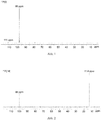
- the 31 P-NMR spectrum showed one signal at 98 ppm and another signal at 11.4 ppm in a ratio of 1: 2. As stated above, the signal at 11.4 ppm was assigned to the corresponding PH tautomer.
- tris (pyrrolidenyl) phosphine was prepared according to the literature [ Boltukhina, EV; Sheshenev, AE; Lyapkalo, IM Tetrahedron, 2011, 67, 5382-5388 .].
- the compound Y known from the literature has a chemical shift in the 31 P-NMR spectrum of 104 ppm.
- a test NMR of compound Y in oleylamine also showed the known resonance at 104 ppm ( Figure 3 ).
- a P (OLA) 3 stock solution can be synthesized starting from tris (pyrrolidinyl) phosphanes (vacuum (less than 1 ⁇ 10 -2 mbar), 80 ° C., 30 minutes).
- the amount of PH tautomer ( 31 P-NMR at 11.4 ppm) is slightly higher than in the other examples, but still significantly less than in the synthesis starting from P (NMe 2 ) 3 .
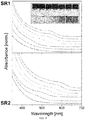
- Figure 9 shows the temporal development of the absorption maximum of the quantum dots (redshift).
- the curves (stacked from bottom to top) in both graphs were recorded after 5 min, 7.5 min, 10 min, 15 min, 30 min, 60 min and 120 min.
- Figure 11 shows the 31 P-NMR spectrum after 15 minutes, which contains a single signal at 29.3 ppm and no longer a signal at 98 ppm (which would correspond to P (OLA) 3). P (OLA) 3 has consequently reacted completely after just 15 minutes.
- Table 2 Summary of the spectroscopic properties of the synthesized InP / ZnS quantum dots. Synthesis route SR1 SR2 Emission maximum in nm 530 555 595 620 538 570 587 619 Abs. Quantum yield in% 44 58 51 33 62 51 55 59 FWHM in nm 59 67 83 90 66 82 75 81
- InP / ZnS quantum dots with emission maxima between 500 and 620 nm can thus be obtained at an FWHM of 60 to 90 nm.
- the curves show (from left to right) green, green-yellow, yellow and orange quantum dots (corresponding to SR2).
Landscapes
- Chemical & Material Sciences (AREA)
- Organic Chemistry (AREA)
- Health & Medical Sciences (AREA)
- Life Sciences & Earth Sciences (AREA)
- Biochemistry (AREA)
- General Health & Medical Sciences (AREA)
- Molecular Biology (AREA)
- Inorganic Chemistry (AREA)
- Engineering & Computer Science (AREA)
- Materials Engineering (AREA)
Description
- Die vorliegende Anmeldung betrifft ein Verfahren zur Synthese von Aminopnictogenen und deren Verwendung, beispielsweise zur Synthese von Quantenpunkten.
- Quantenpunkte werden für eine Vielzahl von Anwendungen eingesetzt, beispielsweise LEDs und Displays (insbesondere Hintergrundbeleuchtung), aber auch als Farbstoff für Marker in der Durchflusszytometrie etc. Hier fanden und finden cadmium- und bleibasierte Quantenpunkte (insbesondere CdSe) Anwendung, welche jedoch durch weniger toxische Verbindungen, z.B. InP-basierte Quantenpunkte, ersetzt werden sollen.
- Die Auswahl an Pnictogenprecursoren, beispielsweise Phosphorprecursoren, welche zu Quantenpunkten mit der gewünschten Photolumineszenz, Quantenausbeute und Halbwertsbreite (engl. full width at half maximum, FWHM) führen, ist jedoch beschränkt.
- Zudem werden für Prozesse auf industriellem Maßstab günstige, umweltfreundliche und möglichst nicht gesundheitsschädliche Stoffe benötigt.
- Als Phosphorprecursor werden heutzutage häufig (Me3Si)3P und P(NMe2)3)/(P(NEt2)3 eingesetzt. Ersteres verlangt jedoch besondere Vorsichtsmaßnahmen während der Lagerung und der Verwendung. Bei P(NMe2)3)/(P(NEt2)3 wird während der Umsetzung HNMe2 (Siedepunkt 7 °C) bzw. HNEt2 (Siedepunkt 56 °C) freigesetzt, welche aufgefangen werden müssen, da sie unter anderem (hoch)entzündlich und ätzend sind.
- Die Synthese der InP-Quantenpunkte erfolgt üblicherweise in einem primären Amin als Lösemittel (beispielsweise Oleylamin), siehe beispielsweise Tessier, M.D. et al., Aminophosphines: A Double Role in Synthesis of Colloidal Indium Phosphide Quantum Dots, J. Am. Chem. Soc. 2016, 138, 5923-5929. Hierbei findet in der Regel eine Transaminierung mit dem primären Amin statt, welche jedoch im Falle von P(NMe2)3 neben der transaminierten Spezies zu unidentifizierten Nebenprodukten führt (sichtbar im 31P-NMR).
- A. Buffard et al. offenbaren in "Mechanistic Insight and Optimization of InP Nanocrystals Synthesized with Aminophosphines" (Chem. Mater. 2016, 28, 16, 5925-5934) Untersuchungen zur Synthese von InP-Quantenpunkten aus InCl3, Tris(dimethylamino)phosphin (P(NMe2)3), and Oleylamin.
- Aus einem Vortrag von Rene Panzer mit dem Titel "Tri(pyrazolyl)phosphane - Synthese und Koordinationschemie mit ECl3 (E = B, Al, Ga) sind bereits Synthese und Koordinationseigenschaften von Tripyrazolylphosphanen bekannt. Allerdings wurde in dem Vortrag nicht auf deren Reaktivität gegenüber Aminen eingegangen (12. Mitteldeutsches Anorganiker-Nachwuchssymposium, 1. September 2014 in Freiberg).
- Aus einem Vortrag von Rene Panzer mit dem Titel "Tri(pyrazolyl)phosphanes - Synthesis and Coordination Chemistry with Group 13 and 15 Elements " sind bereits Synthese und Koordinationseigenschaften von Tripyrazolylphosphanen bekannt. Allerdings wurde in dem Vortrag nicht auf deren Reaktivität gegenüber Aminen eingegangen (ICPC 2014, 1. Juli 2014 in Dublin).
- O.I. Kolodyazhnyi et al. offenbaren in "Diad Phosphorus-Nitrogen Prototropism of Tris(alkylamino)phosphines" Lösungen enthaltend tautomere Trisaminophosphane (Russian Journal of General Chemistry. Vol. 71. No. 4. 2001. 646-647).
- N. Burford et al. offenbaren in "Sequential dehydrochloride coupling of trichlorophosphine with 2,6-di-isopropylaniline: aminophosphine precursors to phosphetidines" Lösungen enthaltend Trisaminophosphane (Can. J. Chem. 80: 1404-1409 (2002)).
- Es werden also Pnictogenprecursoren benötigt, welche die oben genannten Nachteile nicht aufweisen und zusätzlich synthetisch leicht zugänglich sind.
- Daher stellt die vorliegende Erfindung ein Verfahren zur Synthese von Aminopnictogenen eines primären Amins zur Verfügung, aufweisend die folgenden Schritte:
- a) Bereitstellen einer oder mehrerer Verbindungen gemäß der folgenden Formel (I)

A ausgewählt ist aus P, As, Sb und Bi; wobei


- R4 und R6
- unabhängig voneinander ausgewählt sind aus Wasserstoff und organischen Gruppen aufweisend bis zu sechs Kohlenstoffatome;
- R9 und R10
- unabhängig voneinander ausgewählt sind aus Wasserstoff und organischen Gruppen aufweisend bis zu zehn Kohlenstoffatome;
- b) Umsetzen der Verbindungen gemäß der Formel (I) mit mindestens einem Äquivalent eines primären Amins gemäß der Formel H2NR8, wobei R8 ein linearer oder verzweigter, gesättigter oder ungesättigter Kohlenwasserstoffrest ist, der 12 bis 24 Kohlenstoffatome aufweist.
- Es wurde gefunden, dass die gemäß dem Verfahren der vorliegenden Erfindung erhaltenen Verbindungen keine Nebenprodukte aufweisen und die aus der Verbindung I freigesetzten cyclischen Amine leicht zurückgewonnen werden können. Zudem weisen die erhaltenen Lösungen eine hohe Lagerstabilität auf, wodurch sie sich als "stock solution" eignen. Des Weiteren läuft das Verfahren unter milderen Bedingungen ab, als eine analoge Synthese ausgehend beispielsweise von P(NMe2)3. Somit eignen sich diese Precursoren unter anderem für die Synthese von Quantenpunkten.
- In der vorliegenden Erfindung bestehen Hydrocarbylgruppen aus Kohlenstoff und Wasserstoff.
- In der vorliegenden Erfindung bezeichnet der Begriff "Amid" Verbindungen, die aus Aminen aufweisend mindestens eine N-H-Bindung durch Abspaltung eines Protons erhalten wurden.
- In der vorliegenden Erfindung weist ein primäres Amin genau zwei Wasserstoffatome an einem Stickstoffatom auf.
- In der vorliegenden Erfindung weist ein sekundäres Amin genau ein Wasserstoffatom an einem Stickstoffatom auf.
- Der Ausdruck "organische Gruppen" schließt Gruppen ein, die nur aus Stickstoff bestehen. Beispielsweise besteht in Tetrazol, 1,3,4-Triazol oder deren Derivaten R1, R2 bzw. R3 aus 2 Stickstoffatomen.
- Die organischen Gruppen gemäß der vorliegenden Erfindung können teilweise oder vollständig fluorierte Gruppen sein. Üblicherweise beträgt die Zahl an Atomen unterschiedlich von C, F und H in den organischen Gruppen nicht mehr als vier, vorzugsweise nicht mehr als drei und insbesondere bevorzugt nicht mehr als zwei. Insbesondere bevorzugt bestehen die Atome unterschiedlich von C, F und H in den organischen Gruppen, falls vorhanden, aus N, O oder S, insbesondere N.
- In Schritt b) wird vorzugsweise mit mindestens drei Äquivalenten des primären Amins H2NR8 umgesetzt. Mit anderen Worten ist es bevorzugt, dass eine vollständige Transaminierung durchgeführt wird. Die Formulierung "mindestens drei Äquivalenten" resultiert daraus, dass das zur Transaminierung verwendete Amin beispielsweise bei der Synthese von Quantenpunkten auch als Lösemittel eingesetzt wird, also im Überschuss vorhanden ist.
- R8 ist vorzugsweise ein linearer oder verzweigter, gesättigter oder ungesättigter Kohlenwasserstoffrest, der 15 bis 21 Kohlenstoffatome aufweist und am stärksten bevorzugt ein linearer, gesättigter oder ungesättigter Kohlenwasserstoffrest, der 15 bis 21 Kohlenstoffatome aufweist.
- Ein insbesondere geeignetes primäres Amin der Formel H2NR8 ist Oleylamin.
- R9 und R10 sind vorzugsweise unabhängig voneinander ausgewählt aus Wasserstoff und organischen Gruppen aufweisend bis zu sechs Kohlenstoffatome, beispielsweise Phenyl, lineares oder verzweigtes C1- bis C6-Alkyl, stärker bevorzugt unabhängig voneinander ausgewählt aus Wasserstoff und organischen Gruppen aufweisend bis zu drei Kohlenstoffatomen, beispielsweise lineares oder verzweigtes C1- bis C3-Alkyl, vorzugsweise sind die zuvor genannten organischen Gruppen Hydrocarbylgruppen, beispielsweise Phenyl, lineares oder verzweigtes C1- bis C6-Alkyl, stärker bevorzugt sind die zuvor genannten organischen Gruppen aliphatische Hydrocarbylgruppen, noch stärker bevorzugt sind die zuvor genannten organischen Gruppen lineare oder verzweigte Alkylgruppen, beispielsweise lineare oder verzweigte C1- bis C6-Alkylgruppen oder lineare oder verzweigte C1-bis C3-Alkylgruppen.
- Vorzugsweise wird in Schritt a) eine Verbindung gemäß Formel (I) bereitgestellt in der
- X1 = X2 = X3
- Y1 = Y2 = Y3; und
- R1 = R2 = R3
- Vorzugsweise ist A = P oder As, insbesondere P.
- Die Synthese der Verbindungen I erfolgte unter Modifikation der in S. Fischer, L. K. Peterson, J. F. Nixon, Can. J. Chem. 1974, 52, 3981-3985 und S. Fischer, J. Hoyano, L. K. Peterson, Canadian Chem. Journal 1976, 54, 2710-2714 beschriebenen Synthesen.
- Schritt b) wird vorzugsweise bei einer Temperatur von nicht mehr als 150 °C, stärker bevorzugt bei einer Temperatur von 70 bis 120 °C, noch stärker bevorzugt bei einer Temperatur von 90 bis 110 °C durchgeführt.
- Die Dauer von Schritt b) ist üblicherweise nicht mehr als 60 min, vorzugsweise nicht mehr als 30 min und stärker bevorzugt nicht mehr als 20 min.
- Der Druck während Schritt b) beträgt vorzugsweise nicht mehr als 1 × 10⁻² mbar.
- Schritt b) kann unter Verwendung des primären Amins H2NR8 als Lösemittel, d.h. ohne zusätzliche Lösungsmittel, erfolgen oder in einem separaten Lösemittel, beispielsweise MeCN oder Pentan. Vorzugsweise erfolgt Schritt b) unter Verwendung des primären Amins H2NR8 als Lösemittel ohne zusätzliche Lösungsmittel.
- Falls in Schritt b) mit mindestens drei Äquivalenten des primären Amins H2NR8 umgesetzt wird, so wird davon ausgegangen, dass die Reaktion über verbrückte Diphosphane abläuft. Ausgehend von einer Gesamtmenge an zwei Verbindungen der Formel (I) lautet der Reaktionsweg also wie folgt:

- Das Verfahren gemäß der vorliegenden Erfindung weist vorzugsweise ferner den folgenden Schritt auf:
c) Rückgewinnung der Verbindungen
- Die Rückgewinnung erfolgt üblicherweise durch Sublimation bzw. Destillation.
- Es wurde gefunden, dass das Produkt aus dem Verfahren der vorliegenden Erfindung wenn A = P ist, im Gegensatz beispielsweise zu der Synthese ausgehend von P(NMe2)3, keine Nebenprodukte aufweist, welche im 31P-NMR ein Signal bei 50 ppm oder weniger haben (siehe Tessier, M.D. et al., Aminophosphines: A Double Role in Synthesis of Colloidal Indium Phosphide Quantum Dots, J. Am. Chem. Soc. 2016, 138, 5923-5929).
- Folglich unterscheidet sich das Produkt aus dem Verfahren der vorliegenden Erfindung von den Produkten aus anderen Verfahren aus dem Stand der Technik.
- Eine Lösung erhältlich aus dem Verfahren der vorliegenden Erfindung enthaltend P(HNR8)3 zeigt im 31P-NMR-Spektrum ein Verhältnis des Signals von P(HNR8)3 zu der Summe der Signale bei 50 ppm oder weniger von mindestens 75/25, oder von mindestens 90/10, oder von mindestens 95/5 oder von mindestens 98/2.
- HNR8 in der obigen Formel P(HNR8)3 ist das aus dem primären Amin H2NR8 erhaltene Amid.
- Das Produktspektrum weist typischerweise einen Verschiebungsbereich von δ = 80-140 ppm auf.
- Die Methode zur Bestimmung der 31P-NMR-Spektren ist im experimentellen Teil beschrieben.
- Eine Lösung erhältlich aus dem Verfahren der vorliegenden Erfindung enthaltend A(HNR8)3, hat ein Verhältnis mol/mol zwischen der Verbindung A(HNR8)3 und der Verbindung der Struktur

- A P, As, Sb, Bi ist; und
- R8 wie oben definiert ist;
- HNR8 in der obigen Formel A(HNR8)3 ist das aus dem primären Amin H2NR8 erhaltene Amid.
- Eine Lösung erhältlich aus dem Verfahren der vorliegenden Erfindung enthaltend P(HNR8)3 hat ein Verhältnis mol/mol zwischen der Verbindung P(HNR8)3 und der Verbindung der Struktur

R8 wie oben definiert ist;
von mindestens 75/25, oder von mindestens 90/10, oder von mindestens 95/5, oder von mindestens 98/2. - HNR8 in der obigen Formel P(HNR8)3 ist das aus dem primären Amin H2NR8 erhaltene Amid.
- Verfahren zur Herstellung von Quantenpunkten können unter Verwendung der Produkte des Verfahrens zur Synthese von Aminopnictogenen gemäß der vorliegenden Erfindung erfolgen. Verfahren zur Herstellung von Quantenpunkten sind aus dem Stand der Technik bekannt. Beispielsweise kann das Verfahren ein Heißinjektions- (hot injection) oder ein Heating-Up-Verfahren sein. Bei dem Heating-Up-Verfahren werden alle Precursoren bei Raumtemperatur vermengt und zusammen bei einer definierten Heizrate auf die Zieltemperatur gebracht. Ein derartiges Verfahren ist beispielsweise in Joong Pill Park et al., Highly luminescent InP/GaP/ZnS QDs emitting in the entire color range via a heating up process, Nature, Scientific Reports 6, Article number 30094, 2016 | DOI: 10.1038/srep30094 beschrieben.
- In dem Verfahren zur Herstellung von Quantenpunkten kann das Produkt des Verfahrens zur Synthese von Aminopnictogenen auch als Reduktionsmittel eingesetzt werden. Eine derartige Reaktion ist beispielsweise in Grigel, V. et al., InAs Colloidal Quantum Dots Synthesis via Aminopnictogen Precursor Chemistry, J. Am. Chem. Soc. 2016, 138, 13485-13488 beschrieben.
- NMR Spektren wurden an einem Bruker AVANCE III HD Nanobay (1H (400.13 MHz), 13C (100.61 MHz), 31P (161.98 MHz), oder 400 MHz UltraSield oder Bruker AVANCE III HDX, 500 MHz Ascend (1H (500.13 MHz), 13C (125.75 MHz), 31P (202.45 MHz)) gemessen.
- Zur Quantifizierung von Nebenprodukten, wie beispielsweise des A-H-Tautomers, in Verbindungen mit A = P, As, Sb und Bi wurden die o.g. Geräte eingesetzt und eine EXSY-Messung wie in S. Braun, H.-O. Kalinowski, S. Berger, 150 and More Basic NMR Experiments - A Practical Course, 2. Auflage., WILEY-VCH, 1998, ab Seite 420 beschrieben, durchgeführt.
- UV/vis Absorptionsspektren wurden mit einem Cary 50 Spectrophotometer (Varian) in 10×10 mm Quarzküvetten gemessen.
- Quantenausbeuten wurden an einem FluoroLog-3 Spectrofluorometer (Horiba Jobin Yvon) ausgestattet mit einer Quanta-ϕ Ulbrichtkugel bestimmt. Die Quantenpunktlösungen wurden in 10×10 mm Quarzküvetten untersucht. Die Extinktion der Proben wurde vor der Messung zwischen 0.01 und 0.05 eingestellt.
- Folgende Verbindungen (Substituenten siehe Tabelle 1) wurden unter Modifizierung literaturbekannter Synthesewege, wie in a) S. Fischer, L. K. Peterson, J. F. Nixon, Can. J. Chem. 1974, 52, 3981-3985; b) S. Fischer, J. Hoyano, L. K. Peterson, Canadian Chem. Journal 1976, 54, 2710-2714 beschrieben, hergestellt. Das jeweilige Signal im 31P-NMR ist ebenfalls angegeben (siehe Tabelle 1).
- Eine Mischung von 1-Trimethylsilyl-3,5-dimethylpyrazol (4.58 g, 27.22 mmol) und ACl3 (A = P: 0.59 mL, 0.93 g, 6.81 mmol; A = As: 0.57 mL, 1.23 g, 6.81 mmol) wird ohne Lösungsmittel 12 h bei Raumtemperatur gerührt. Nach Entfernen aller flüchtigen Bestandteile im Vakuum werden die Verbindungen (Me2pyr)3A als farblose, langsam kristallisierende, analysenreine Feststoffe erhalten. Einkristalle zur Strukturanalyse lassen sich durch Sublimation gewinnen.
- A = P: 2.13 g (quantitativ); Mp.: 73-77 °C; IR (KBr, 300 K, [cm-1]): 3110(w), 2594(vw), 2922(m), 2861(vw), 1576(m), 1564(vw), 1461(w), 1442(w), 1411(m), 1291(vs), 1165(w), 1130(m), 1100(w), 1090(vw), 1024(w), 962(m), 818(m), 802(w), 790(w), 767(w), 760(w), 745(w), 593(w), 554(m), 512(m), 478(s), 444(w), 415(w); 1H NMR (CDCl3, 300 K, [ppm]): δ = 2.12 (9H, s, C5-H), 2.20 (9H, s, C4-H), 5.92 (3H, s, C2-H); 13C NMR (CDCl3, 300 K, [ppm]): δ = 11.6 (3C, d, 3JPC = 8.8 Hz, C5), 13.8 (3C, s, C4), 109.6 (3C, s, C2), 147,3 (3C, d, 2JPC = 10.8 Hz, C3), 153.5 (3C, d, C1, 3JPC = 10.3 Hz); 31P{1H} NMR (CDCl3, 300 K, [ppm]): δ = 71.9 (s); m/z (EI): 95(12), 96(30), 97(7), 125(7), 126(8), 127(18), 177(8), 179(10), 180(4), 192(6), 205(6), 220(100), 221(16), 222(22), 316(46), 317(8); Elementaranalyse: berechnet für C15H21PN6: C: 57.0, H: 6.7, N: 26.6, gefunden: C: 56.9, H: 6.4, N:26.7.
- A = As: 2.39 g (quantitativ); Mp.: 105-109 °C; IR (KBr, 300 K, [cm-1]): 3202 (vw), 3131 (vw), 3110 (vw), 3038 (vw), 2976 (vw), 2959 (vw), 2931 (m), 1561 (vw), 1551 (m), 1439 (w), 1408 (m), 1319 (vw), 1295 (vs), 1246 (vw), 1152 (w), 1109 (m), 1018 (w), 964 (m), 801 (w), 786 (s), 754 (w), 738 (w), 587 (w), 470 (m), 461 (w); 1H-NMR (CD2Cl2, 300 K, [ppm]): δ = 2.02 (9H, d, 4JHH = 0.9 Hz, C5-H), 2.21 (9H, s, C4-H), 5.97 (3H, m, C2-H); 13C NMR (CD2Cl2, 300 K, [ppm]): δ = 11.3 (3C, s, C5), 13.8 (3C, s, C4), 108.9 (s, 3C, C2), 147.5 (3C, s, C3), 152.9 (3C, s, C1); m/z (EI): 42(4), 81(5), 91(4), 95(28), 96(64), 97(8), 169(6), 170(20), 171(4), 264(6), 266(100), 267(12), 289(7), 360(3), 396(25); Elementaranalyse: berechnet für C15H21PN6: C: 50.0, H: 5.9, N: 23.3, gefunden: C: 49.5, H: 5.5, N: 22.9.
- Analog zur Verbindung (Me2pyr3)P wurden folgende Verbindungen hergestellt. Die Ausbeute und die 31P-NMR-Verschiebung sind in folgender Tabelle 1 aufgeführt.

Tabelle 1 Beispiel R4 R9 Ausbeute [%] 31P-NMR δ in [ppm] 1 H H 92 61.1 2 Me Me 98 71.9 3 iso-Pr iso-Pr 98 69.4 4 Ph Ph 88 74.8 5 H CF3 96 63.9 6 Me CF3 95 76.4 - 0.5 mmol der jeweiligen Verbindung wurden anschließend in 1 mL Oleylamin suspendiert und bei 50 °C und einem Druck von unter 1 × 10⁻² mbar 12 h lang umgesetzt. In allen Fällen wurde P(OLA)3 erhalten, welches ein Signal im 31P-NMR bei den o.g. chemischen Verschiebungen aufweist (δ = 80-140 ppm). Ein weiteres Signal trat bei höheren Frequenzen ("tieffeldverschoben") auf, welches dem korrespondierenden, aminoverbrückten Diphosphan zugeordnet werden konnte.

- Im Falle von Verbindung 2 trat das Signal des aminoverbrückten Diphosphans bei 111 ppm auf und das Verhältnis betrug 97:3. Spuren des entsprechenden P-H-Tautomers der Formel

Abbildung 1 zeigt das entsprechende 31P-NMR Spektrum der synthetisierten P(OLA)3 Lösung. - An Verbindung 2 wurde das abgespaltene 3,5-Dimethylpyrazol in Ausbeuten von über 90% zurück gewonnen.
- Im Laufe von Monaten wird lediglich eine minimale Umlagerung zu dem P-H-Tautomer beobachtet, wobei das Verhältnis nach 3 Monaten lediglich bei 98:2 liegt.
- In einem Vergleichsversuch wurde 81.6 mg (0.5 mmol) P(NMe2)3 und 1 mL Oleylamin 12 h unter Normaldruck auf 50 °C erwärmt und anschließend auf Raumtemperatur abgekühlt. Nach Abkühlen wurde ein Vakuum (weniger als 1 × 10⁻² mbar) angelegt und weitere 60 Minuten bei 100 °C gerührt. Das entsprechende 31P-NMR-Spektrum ist in
Abbildung 2 gezeigt. - Das 31P-NMR-Spektrum zeigte ein Signal bei 98 ppm und ein weiteres Signal bei 11.4 ppm in einem Verhältnis von 1:2. Das Signal bei 11.4 ppm wurde, wie oben ausgeführt, dem entsprechenden P-H-Tautomeren zugeordnet.
- In einem weiteren Beispiel wurde Tris(pyrrolidenyl)phosphan (Y) nach Literaturvorschrift hergestellt [Boltukhina, E. V.; Sheshenev, A. E.; Lyapkalo, I. M. Tetrahedron, 2011, 67, 5382-5388.]. Die literaturbekannte Verbindung Y weist eine chemische Verschiebung im 31P-NMR-Spektrum von 104 ppm auf. Ein Test-NMR der Verbindung Y in Oleylamin zeigte ebenfalls die bekannte Resonanz bei 104 ppm (
Abbildung 3 ). - 1 mmol der Verbindung Y wurde in 2 mL Oleylamin gelöst und unter Vakuum auf 80 °C erhitzt. Nach 10 Minuten wurde ein Reaktions-NMR aufgezeichnet (
Abbildung 4 ). - Die Transaminierung mit Oleylamin verläuft unter der erhöhten Temperatur, erkennbar an dem Signal bei 98 ppm. Nach weiteren 10 Minuten wurde erneut ein Reaktions-NMR aufgenommen, welches die sukzessive Umwandlung von Y zu P(OLA)3 zeigt (
Abbildung 5 ). - Folglich kann unter gleichen Bedingungen zu den Tris(pyrazolyl)phosphanen eine P(OLA)3-Stammlösung ausgehend von Tris(pyrrolidinyl)phosphanen synthetisiert werden (Vakuum (weniger als 1×10⁻² mbar), 80 °C, 30 Minuten). Die Menge an P-H-Tautomer (31P-NMR bei 11.4 ppm) ist zwar geringfügig höher als bei den anderen Beispielen, aber noch deutlich geringer als bei der Synthese ausgehend von P(NMe2)3.
- Kalium-3,5-di-tert-butylpyrazolat (655 mg, 3.0 mmol) und SbCl3 (228 mg, 1.0 mmol) werden in THF 72 h bei Raumtemperatur gerührt. Nach Entfernen aller flüchtigen Bestandteile im Vakuum wird der Rückstand in Toluol aufgenommen, die Suspension filtriert und das Filtrat im Vakuum getrocknet. Das Produkt wird als farbloser Feststoff nach Umkristallisation in n-Pentane erhalten.
- 266 mg (40 %); Smp. 130-132 °C; 1H-NMR (CD2Cl2, 300 K, [ppm]): δ = 1.19 (54H, s, C5-H), 6.09 (3H, s, C4-H); 13C NMR (CD2Cl2, 300 K, [ppm]): δ = 31.4 (18C, s, C5), 32.5 (6C, s, C4), 102.0 (3C, s, C2), 163.1 (6C, s, C3); IR (ATR, 300 K, [cm-1]): 3228 (vw), 2953 (vs), 2926 (m), 2901 (m), 2866 (w), 1570 (vw), 1529 (vs), 1485 (w), 1460 (m), 1425 (m), 1409 (w), 1391 (w), 1360 (s), 1287 (s), 1250 (vs), 1222 (s), 1195 (s), 1129 (vw), 1114 (w), 1091 (s), 1059 (w), 1036 (w), 1020 (w), 1004 (w), 987 (vs), 933 (vw), 805 (w), 794 (vs), 765 (w), 718 (w), 698 (w), 678 (vw), 629 (w), 563 (vw), 533 (m), 517 (vw), 493 (vw), 462 (vs), 416 (vw); Raman (80 mW, 500 scans, 300 K, [cm-1]): 3129 (27), 3013 (10), 2961 (96), 2924 (87), 2902 (100), 2874 (44), 2777 (8), 2709 (14), 1530 (18), 1486 (23), 1463 (41), 1446 (61), 1419 (40), 1391 (14), 1290 (15), 1251 (13), 1206 (47), 1060 (11), 1037 (15), 1028 (12), 1004 (9), 988 (16), 934 (30), 824 (72), 699 (9), 566 (49), 533 (22), 499 (12), 495 (12), 469 (16), 416 (10), 388 (15), 372 (30), 327 (13), 264 (41), 233 (41), 188 (35), 165 (30), Elementaranalyse: berechnet für C33H57PN6Sb: C: 60.1, H: 8.7, N: 12.7, gefunden: C: 60.3, H: 8.5, N:12.4.
- Zu einer Lösung aus (tBu2pyr)3Sb (66 mg, 0.1 mmol) in n-Pentan wurde Oleylamin (80.3 mg, 98.8 µL, 0.3 mmol) gegeben. Die resultierende Suspension wurde filtriert und der Rückstand im Vakuum getrocknet. Der Rückstand wurde in CD2Cl2 aufgenommen. In
Abbildung 6 ist das 1H NMR Spektrum der isolierten Verbindung, welche als 3,5-di-tert-butylpyrazol identifiziert werden konnte, gezeigt. Von einer Transaminierung mit Oleylamin ist folglich auszugehen. Durch Abkühlen des Filtrats auf-29 °C für 16 Stunden konnte weiteres 3,5-di-tert-butylpyrazol aus der Reaktionslösung auskristallisiert und zudem durch Einkristallstrukturanalyse charakterisiert werden. - Anschließend wurde das Filtrat im Vakuum getrocknet und restliches 3,5-di-tert-butylpyrazol mit Acetonitril extrahiert. Das erhaltene Öl wurde getrocknet. In
Abbildung 7 ist das 13C{1H}-NMR-Spektrum des Öls in CD2Cl2 abgebildet. Es sind keine Signale mehr für das 3,5-di-tert-butylpyrazol (δ (13C) = 31.3 ppm, 32.7 ppm, 96.2 ppm, 156.0 ppm) zu erkennen, wobei die übrigen Signale dem transaminierten Produkt Sb(OLA)3 zuzuordnen sind. - Als weiteren Nachweis zeigen ICP-OES-Messungen der isolierten Verbindung die charakteristischen Emissionslinien von Antimon bei 206.83 nm und 217.57 nm (
Abbildung 8 ). Im Falle von (tBu2pyr)3Sb kann somit von einer analogen Transaminierung mit Oleylamin, im Vergleich zu den leichteren homologen P und As, ausgegangen werden. - 55.3 mg (0.25 mmol) InCl3 und 170.4 mg (1.25 mmol) ZnCl2 wurden in 3 mL Oleylamin suspendiert und bei 100 °C für 15 Minuten bei einem Druck von 1 × 10⁻³ mbar entgast. Es wurde entweder eine vorgeheizte (180 °C) Lösung von Tris(3,5dimethyl)pyrazolphosphan (332.1 mg, 1.05 mmol) (SR1) oder 2 mL von der o.g Lösung von P(OLA)3 ausgehend von Verbindung 2 (1 mmol) bei 200 °C (SR2) injiziert. Bei 180 °C wurden durch Variation der Wachstumszeit (15-60 Minuten) unterschiedlich große InP-Nanopartikel erhalten.
-
Abbildung 9 zeigt die temporale Entwicklung des Absorptionsmaximums der Quantenpunkte (Rotverschiebung). Die Kurven (gestapelt von unten nach oben) in beiden Graphen wurden nach 5 min, 7.5 min, 10 min, 15 min, 30 min, 60 min und 120 min aufgenommen. - NMR-spektroskopische Untersuchungen der Reaktionsgemische unter Verwendung von Syntheseprotokoll SR2 zeigen eine quantitative Umwandlung der Verbindung P(OLA)3 zu dem Koppelprodukt [P(OLA)4][Cl]. Letzteres resultiert aus der ablaufenden Redoxreaktion der Verbindung P(OLA)3 mit InCl3.

- Die Verbindung [P(OLA)4][Cl] konnte durch die charakteristische chemische Verschiebung bei 29.3 ppm im 31P-NMR-Spektrum identifiziert werden. Es werden somit sehr saubere Reaktionsverläufe beobachtet. Vergleichbare Synthesen, ausgehend von P(NMe2)3, verlaufen NMR-spektroskopisch nicht derart zielgerichtet ab (siehe beispielsweise Tessier, M.D. et al., Aminophosphines: A Double Role in Synthesis of Colloidal Indium Phosphide Quantum Dots, J. Am. Chem. Soc. 2016, 138, 5923-5929.).
-
Abbildung 11 zeigt das 31P-NMR-Spektrum nach 15 Minuten, welches ein einzelnes Signal bei 29.3 ppm und kein Signal mehr bei 98 ppm (welches P(OLA)3 entspräche) enthält. P(OLA)3 hat folglich bereits nach 15 Minuten vollständig abreagiert. - Da derartige InP-Quantenpunkte nicht lumineszieren, wurde eine ZnS-Schale aufgetragen. Für die ZnS-Beschalung der InP-Kerne wurden bei 180 °C 5 mmol 1-Dodecanthiol (DDT) tropfenweise zugegeben. Nach 5 Minuten wurde die Temperatur auf 260 °C erhöht und für 4 (SR2) bis 5 (SR1) h gehalten. Die erhaltenen InP/ZnS Quantenpunkte wurden durch mehrmaliges Ausfällen und Redispergieren mittels Aceton und Toluol aufgereinigt. Die auf diese Weise aufgereinigten Nanopartikel wurden final in Toluol redispergiert und für die weitere Charakterisierung genutzt. Die erhaltenen spektroskopischen Daten der synthetisierten InP/ZnS Quantenpunkte sind in Tabelle 2 zusammengefasst.
Tabelle 2: Zusammenfassung der spektroskopischen Eigenschaften der synthetisierten InP/ZnS Quantenpunkte. Syntheseroute SR1 SR2 Emissionsmaximum in nm 530 555 595 620 538 570 587 619 Abs. Quantenausbeute in % 44 58 51 33 62 51 55 59 FWHM in nm 59 67 83 90 66 82 75 81 - Wie aus Tabelle 2 und
Abbildung 10 ersichtlich ist, lassen sich somit InP/ZnS Quantenpunkte mit Emissionsmaxima zwischen 500 und 620 nm bei einer FWHM von 60 bis 90 nm erhalten. Die Kurven zeigen (von links nach rechts) grüne, grüngelbe, gelbe und orangene Quantenpunkte (entsprechend SR2).
Claims (4)
- Verfahren zur Synthese von Aminopnictogenen eines primären Amins aufweisend die folgenden Schritte:a) Bereitstellen einer oder mehrerer Verbindungen gemäß der folgenden Formel (I)

A ausgewählt ist aus P, As, Sb und Bi;
wobei

 R4 und R6 unabhängig voneinander ausgewählt sind aus Wasserstoff und organischen Gruppen aufweisend bis zu sechs Kohlenstoffatome;R9 und R10 unabhängig voneinander ausgewählt sind aus Wasserstoff und organischen Gruppen aufweisend bis zu zehn Kohlenstoffatome;und die Verbindungen gemäß der Formel (I) elektrisch neutral sind;b) Umsetzen der Verbindungen gemäß der Formel (I) mit mindestens einem Äquivalent eines primären Amins H2NR8, wobei R8 ein linearer oder verzweigter, gesättigter oder ungesättigter Kohlenwasserstoffrest ist, der 12 bis 24 Kohlenstoffatome aufweist.
 - Das Verfahren gemäß Anspruch 1, wobei in Schritt b) mit mindestens drei Äquivalenten des primären Amins H2NR8 umgesetzt wird.
- Das Verfahren gemäß einem der vorangegangen Ansprüche, ferner aufweisend den folgenden Schritt
c) Rückgewinnung der Verbindungen
- Das Verfahren gemäß einem der vorangegangen Ansprüche, wobei A = P ist.
Applications Claiming Priority (2)
| Application Number | Priority Date | Filing Date | Title |
|---|---|---|---|
| DE102017209324.2A DE102017209324A1 (de) | 2017-06-01 | 2017-06-01 | Synthese und Anwendung von Aminopnictogenen |
| PCT/EP2018/064017 WO2018219917A1 (de) | 2017-06-01 | 2018-05-29 | Synthese und anwendung von aminopnictogenen |
Publications (2)
| Publication Number | Publication Date |
|---|---|
| EP3630786A1 EP3630786A1 (de) | 2020-04-08 |
| EP3630786B1 true EP3630786B1 (de) | 2021-09-08 |
Family
ID=62528418
Family Applications (1)
| Application Number | Title | Priority Date | Filing Date |
|---|---|---|---|
| EP18729073.9A Active EP3630786B1 (de) | 2017-06-01 | 2018-05-29 | Synthese von aminopnictogenen |
Country Status (3)
| Country | Link |
|---|---|
| EP (1) | EP3630786B1 (de) |
| DE (1) | DE102017209324A1 (de) |
| WO (1) | WO2018219917A1 (de) |
Families Citing this family (1)
| Publication number | Priority date | Publication date | Assignee | Title |
|---|---|---|---|---|
| DE102022109554A1 (de) | 2022-04-20 | 2023-10-26 | Technische Universität Dresden, Körperschaft des öffentlichen Rechts | Synthese von Metallpnictidnanopartikeln |
-
2017
- 2017-06-01 DE DE102017209324.2A patent/DE102017209324A1/de not_active Ceased
-
2018
- 2018-05-29 EP EP18729073.9A patent/EP3630786B1/de active Active
- 2018-05-29 WO PCT/EP2018/064017 patent/WO2018219917A1/de not_active Ceased
Also Published As
| Publication number | Publication date |
|---|---|
| EP3630786A1 (de) | 2020-04-08 |
| WO2018219917A1 (de) | 2018-12-06 |
| DE102017209324A1 (de) | 2018-12-06 |
Similar Documents
| Publication | Publication Date | Title |
|---|---|---|
| EP0317744B1 (de) | Verfahren zur Herstellung (cyclo)-aliphatischer Uretdione | |
| DE60023859T2 (de) | Verfahren zur herstellung von amin-platin-komplexen | |
| EP0101927A1 (de) | Organische Nickel-Verbindungen deren Herstellung und Verwendung als Katalysatoren bei der Polymerisation von Olefinen | |
| DE2065236B2 (de) | Phosphonsäuresalze, ihre Herstellung und Verwendung | |
| EP0680462A1 (de) | Thermisch stabile fullerenderivate und verfahren zu ihrer herstellung. | |
| DE2032738A1 (de) | Neue Pyridinthioacetamiddenvate und Verfahren zu ihrer Herstellung | |
| EP3630786B1 (de) | Synthese von aminopnictogenen | |
| DE2602175A1 (de) | Neue 5-fluor-uracilderivate, ihre herstellung und ihre verwendung | |
| DE1272910B (de) | ||
| EP0435071B1 (de) | Verfahren zur Herstellung hydrolysestabiler organischer Phosphite | |
| EP0072987A1 (de) | Neue cytostatisch wirksame Epoxidgruppen tragende 1,3,2-Oxazaphosphorin-Verbindungen, Verfahren zu ihrer Herstellung sowie ihre Verwendung in pharmazeutischen Zubereitungen | |
| DE2409675C3 (de) | 5-Hydroxytryptophan-Derivate und Verfahren zu ihrer Herstellung | |
| DE2617917B2 (de) | Verfahren zur herstellung von thiocarbamidsaeureestern | |
| DE2109880A1 (de) | Verfahren zur Herstellung von Pyrimidinen | |
| DE1200318B (de) | Verfahren zur Herstellung von N-(omega-Aminoalkyl)-aminoalkansulfonsaeuren | |
| DE1670296A1 (de) | Verfahren zur Herstellung von substituierten Phosphiniminen und entsprechenden Amidophosphoniumhalogeniden | |
| DE1793412C3 (de) | Verfahren zur Herstellung von N hoch 1 Acyl N hochl aryl N hoch 2, N hoch 2 dialkylharnstoffen | |
| EP3577105B1 (de) | Herstellung n-substituierter aromatischer hydroxylamine | |
| DE60103986T2 (de) | Verbessertes verfahren zur herstellung von n,n-disubstituiertem p-phenylendiamin | |
| EP0779294A1 (de) | Halogenfreie cyclische Phosphorsäureester und Verfahren zu ihrer Herstellung | |
| EP3621969A1 (de) | Cupratverbindungen sowie verfahren zu deren herstellung und anwendungsmöglichkeiten | |
| EP0043024A1 (de) | Verfahren zur Herstellung von 5-Aminoisoxazolen | |
| DE2264638C2 (de) | 5'-Acetyl-2,2'-cyclocytidin-Derivate | |
| DE1008316B (de) | Verfahren zur Herstellung von 2-Oxo-1, 3, 2-dioxaphospholanen und 2-Oxo-1, 3, 2-dioxaphosphorinanen | |
| DE2427503A1 (de) | Halogenfusarsaeureamide, verfahren zur herstellung derselben und mittel mit einem gehalt derselben |
Legal Events
| Date | Code | Title | Description |
|---|---|---|---|
| STAA | Information on the status of an ep patent application or granted ep patent |
Free format text: STATUS: UNKNOWN |
|
| STAA | Information on the status of an ep patent application or granted ep patent |
Free format text: STATUS: THE INTERNATIONAL PUBLICATION HAS BEEN MADE |
|
| PUAI | Public reference made under article 153(3) epc to a published international application that has entered the european phase |
Free format text: ORIGINAL CODE: 0009012 |
|
| STAA | Information on the status of an ep patent application or granted ep patent |
Free format text: STATUS: REQUEST FOR EXAMINATION WAS MADE |
|
| 17P | Request for examination filed |
Effective date: 20191223 |
|
| AK | Designated contracting states |
Kind code of ref document: A1 Designated state(s): AL AT BE BG CH CY CZ DE DK EE ES FI FR GB GR HR HU IE IS IT LI LT LU LV MC MK MT NL NO PL PT RO RS SE SI SK SM TR |
|
| AX | Request for extension of the european patent |
Extension state: BA ME |
|
| RIN1 | Information on inventor provided before grant (corrected) |
Inventor name: GUHRENZ, CHRIS Inventor name: WEIGAND, JAN Inventor name: EYCHM LLER, ALEXANDER Inventor name: PANZER, RENE |
|
| DAV | Request for validation of the european patent (deleted) | ||
| DAX | Request for extension of the european patent (deleted) | ||
| STAA | Information on the status of an ep patent application or granted ep patent |
Free format text: STATUS: EXAMINATION IS IN PROGRESS |
|
| 17Q | First examination report despatched |
Effective date: 20200928 |
|
| RIC1 | Information provided on ipc code assigned before grant |
Ipc: C09K 11/56 20060101ALI20210412BHEP Ipc: C09K 11/70 20060101ALI20210412BHEP Ipc: C09K 11/62 20060101ALI20210412BHEP Ipc: C09K 11/02 20060101ALI20210412BHEP Ipc: C07F 9/22 20060101ALI20210412BHEP Ipc: C07F 9/90 20060101ALI20210412BHEP Ipc: C07F 9/80 20060101ALI20210412BHEP Ipc: C07F 9/6503 20060101ALI20210412BHEP Ipc: C07F 9/535 20060101AFI20210412BHEP |
|
| GRAP | Despatch of communication of intention to grant a patent |
Free format text: ORIGINAL CODE: EPIDOSNIGR1 |
|
| STAA | Information on the status of an ep patent application or granted ep patent |
Free format text: STATUS: GRANT OF PATENT IS INTENDED |
|
| INTG | Intention to grant announced |
Effective date: 20210521 |
|
| RIN1 | Information on inventor provided before grant (corrected) |
Inventor name: GUHRENZ, CHRIS Inventor name: EYCHMUELLER, ALEXANDER Inventor name: PANZER, RENE Inventor name: WEIGAND, JAN |
|
| GRAS | Grant fee paid |
Free format text: ORIGINAL CODE: EPIDOSNIGR3 |
|
| GRAA | (expected) grant |
Free format text: ORIGINAL CODE: 0009210 |
|
| STAA | Information on the status of an ep patent application or granted ep patent |
Free format text: STATUS: THE PATENT HAS BEEN GRANTED |
|
| AK | Designated contracting states |
Kind code of ref document: B1 Designated state(s): AL AT BE BG CH CY CZ DE DK EE ES FI FR GB GR HR HU IE IS IT LI LT LU LV MC MK MT NL NO PL PT RO RS SE SI SK SM TR |
|
| REG | Reference to a national code |
Ref country code: GB Ref legal event code: FG4D Free format text: NOT ENGLISH |
|
| REG | Reference to a national code |
Ref country code: CH Ref legal event code: EP Ref country code: AT Ref legal event code: REF Ref document number: 1428525 Country of ref document: AT Kind code of ref document: T Effective date: 20210915 |
|
| REG | Reference to a national code |
Ref country code: DE Ref legal event code: R096 Ref document number: 502018006971 Country of ref document: DE |
|
| REG | Reference to a national code |
Ref country code: IE Ref legal event code: FG4D Free format text: LANGUAGE OF EP DOCUMENT: GERMAN |
|
| REG | Reference to a national code |
Ref country code: LT Ref legal event code: MG9D |
|
| REG | Reference to a national code |
Ref country code: NL Ref legal event code: FP |
|
| PG25 | Lapsed in a contracting state [announced via postgrant information from national office to epo] |
Ref country code: LT Free format text: LAPSE BECAUSE OF FAILURE TO SUBMIT A TRANSLATION OF THE DESCRIPTION OR TO PAY THE FEE WITHIN THE PRESCRIBED TIME-LIMIT Effective date: 20210908 Ref country code: BG Free format text: LAPSE BECAUSE OF FAILURE TO SUBMIT A TRANSLATION OF THE DESCRIPTION OR TO PAY THE FEE WITHIN THE PRESCRIBED TIME-LIMIT Effective date: 20211208 Ref country code: NO Free format text: LAPSE BECAUSE OF FAILURE TO SUBMIT A TRANSLATION OF THE DESCRIPTION OR TO PAY THE FEE WITHIN THE PRESCRIBED TIME-LIMIT Effective date: 20211208 Ref country code: FI Free format text: LAPSE BECAUSE OF FAILURE TO SUBMIT A TRANSLATION OF THE DESCRIPTION OR TO PAY THE FEE WITHIN THE PRESCRIBED TIME-LIMIT Effective date: 20210908 Ref country code: ES Free format text: LAPSE BECAUSE OF FAILURE TO SUBMIT A TRANSLATION OF THE DESCRIPTION OR TO PAY THE FEE WITHIN THE PRESCRIBED TIME-LIMIT Effective date: 20210908 Ref country code: HR Free format text: LAPSE BECAUSE OF FAILURE TO SUBMIT A TRANSLATION OF THE DESCRIPTION OR TO PAY THE FEE WITHIN THE PRESCRIBED TIME-LIMIT Effective date: 20210908 Ref country code: RS Free format text: LAPSE BECAUSE OF FAILURE TO SUBMIT A TRANSLATION OF THE DESCRIPTION OR TO PAY THE FEE WITHIN THE PRESCRIBED TIME-LIMIT Effective date: 20210908 Ref country code: SE Free format text: LAPSE BECAUSE OF FAILURE TO SUBMIT A TRANSLATION OF THE DESCRIPTION OR TO PAY THE FEE WITHIN THE PRESCRIBED TIME-LIMIT Effective date: 20210908 |
|
| PG25 | Lapsed in a contracting state [announced via postgrant information from national office to epo] |
Ref country code: LV Free format text: LAPSE BECAUSE OF FAILURE TO SUBMIT A TRANSLATION OF THE DESCRIPTION OR TO PAY THE FEE WITHIN THE PRESCRIBED TIME-LIMIT Effective date: 20210908 Ref country code: GR Free format text: LAPSE BECAUSE OF FAILURE TO SUBMIT A TRANSLATION OF THE DESCRIPTION OR TO PAY THE FEE WITHIN THE PRESCRIBED TIME-LIMIT Effective date: 20211209 |
|
| PG25 | Lapsed in a contracting state [announced via postgrant information from national office to epo] |
Ref country code: IS Free format text: LAPSE BECAUSE OF FAILURE TO SUBMIT A TRANSLATION OF THE DESCRIPTION OR TO PAY THE FEE WITHIN THE PRESCRIBED TIME-LIMIT Effective date: 20220108 Ref country code: SM Free format text: LAPSE BECAUSE OF FAILURE TO SUBMIT A TRANSLATION OF THE DESCRIPTION OR TO PAY THE FEE WITHIN THE PRESCRIBED TIME-LIMIT Effective date: 20210908 Ref country code: SK Free format text: LAPSE BECAUSE OF FAILURE TO SUBMIT A TRANSLATION OF THE DESCRIPTION OR TO PAY THE FEE WITHIN THE PRESCRIBED TIME-LIMIT Effective date: 20210908 Ref country code: RO Free format text: LAPSE BECAUSE OF FAILURE TO SUBMIT A TRANSLATION OF THE DESCRIPTION OR TO PAY THE FEE WITHIN THE PRESCRIBED TIME-LIMIT Effective date: 20210908 Ref country code: PT Free format text: LAPSE BECAUSE OF FAILURE TO SUBMIT A TRANSLATION OF THE DESCRIPTION OR TO PAY THE FEE WITHIN THE PRESCRIBED TIME-LIMIT Effective date: 20220110 Ref country code: PL Free format text: LAPSE BECAUSE OF FAILURE TO SUBMIT A TRANSLATION OF THE DESCRIPTION OR TO PAY THE FEE WITHIN THE PRESCRIBED TIME-LIMIT Effective date: 20210908 Ref country code: EE Free format text: LAPSE BECAUSE OF FAILURE TO SUBMIT A TRANSLATION OF THE DESCRIPTION OR TO PAY THE FEE WITHIN THE PRESCRIBED TIME-LIMIT Effective date: 20210908 Ref country code: CZ Free format text: LAPSE BECAUSE OF FAILURE TO SUBMIT A TRANSLATION OF THE DESCRIPTION OR TO PAY THE FEE WITHIN THE PRESCRIBED TIME-LIMIT Effective date: 20210908 Ref country code: AL Free format text: LAPSE BECAUSE OF FAILURE TO SUBMIT A TRANSLATION OF THE DESCRIPTION OR TO PAY THE FEE WITHIN THE PRESCRIBED TIME-LIMIT Effective date: 20210908 |
|
| REG | Reference to a national code |
Ref country code: DE Ref legal event code: R097 Ref document number: 502018006971 Country of ref document: DE |
|
| PLBE | No opposition filed within time limit |
Free format text: ORIGINAL CODE: 0009261 |
|
| STAA | Information on the status of an ep patent application or granted ep patent |
Free format text: STATUS: NO OPPOSITION FILED WITHIN TIME LIMIT |
|
| PG25 | Lapsed in a contracting state [announced via postgrant information from national office to epo] |
Ref country code: DK Free format text: LAPSE BECAUSE OF FAILURE TO SUBMIT A TRANSLATION OF THE DESCRIPTION OR TO PAY THE FEE WITHIN THE PRESCRIBED TIME-LIMIT Effective date: 20210908 |
|
| 26N | No opposition filed |
Effective date: 20220609 |
|
| PG25 | Lapsed in a contracting state [announced via postgrant information from national office to epo] |
Ref country code: SI Free format text: LAPSE BECAUSE OF FAILURE TO SUBMIT A TRANSLATION OF THE DESCRIPTION OR TO PAY THE FEE WITHIN THE PRESCRIBED TIME-LIMIT Effective date: 20210908 |
|
| REG | Reference to a national code |
Ref country code: CH Ref legal event code: PL |
|
| PG25 | Lapsed in a contracting state [announced via postgrant information from national office to epo] |
Ref country code: MC Free format text: LAPSE BECAUSE OF FAILURE TO SUBMIT A TRANSLATION OF THE DESCRIPTION OR TO PAY THE FEE WITHIN THE PRESCRIBED TIME-LIMIT Effective date: 20210908 Ref country code: LU Free format text: LAPSE BECAUSE OF NON-PAYMENT OF DUE FEES Effective date: 20220529 Ref country code: LI Free format text: LAPSE BECAUSE OF NON-PAYMENT OF DUE FEES Effective date: 20220531 Ref country code: IT Free format text: LAPSE BECAUSE OF FAILURE TO SUBMIT A TRANSLATION OF THE DESCRIPTION OR TO PAY THE FEE WITHIN THE PRESCRIBED TIME-LIMIT Effective date: 20210908 Ref country code: CH Free format text: LAPSE BECAUSE OF NON-PAYMENT OF DUE FEES Effective date: 20220531 |
|
| PG25 | Lapsed in a contracting state [announced via postgrant information from national office to epo] |
Ref country code: IE Free format text: LAPSE BECAUSE OF NON-PAYMENT OF DUE FEES Effective date: 20220529 |
|
| P01 | Opt-out of the competence of the unified patent court (upc) registered |
Effective date: 20230524 |
|
| PG25 | Lapsed in a contracting state [announced via postgrant information from national office to epo] |
Ref country code: MK Free format text: LAPSE BECAUSE OF FAILURE TO SUBMIT A TRANSLATION OF THE DESCRIPTION OR TO PAY THE FEE WITHIN THE PRESCRIBED TIME-LIMIT Effective date: 20210908 Ref country code: CY Free format text: LAPSE BECAUSE OF FAILURE TO SUBMIT A TRANSLATION OF THE DESCRIPTION OR TO PAY THE FEE WITHIN THE PRESCRIBED TIME-LIMIT Effective date: 20210908 |
|
| PG25 | Lapsed in a contracting state [announced via postgrant information from national office to epo] |
Ref country code: HU Free format text: LAPSE BECAUSE OF FAILURE TO SUBMIT A TRANSLATION OF THE DESCRIPTION OR TO PAY THE FEE WITHIN THE PRESCRIBED TIME-LIMIT; INVALID AB INITIO Effective date: 20180529 |
|
| REG | Reference to a national code |
Ref country code: AT Ref legal event code: MM01 Ref document number: 1428525 Country of ref document: AT Kind code of ref document: T Effective date: 20230529 |
|
| PG25 | Lapsed in a contracting state [announced via postgrant information from national office to epo] |
Ref country code: AT Free format text: LAPSE BECAUSE OF NON-PAYMENT OF DUE FEES Effective date: 20230529 |
|
| PG25 | Lapsed in a contracting state [announced via postgrant information from national office to epo] |
Ref country code: AT Free format text: LAPSE BECAUSE OF NON-PAYMENT OF DUE FEES Effective date: 20230529 |
|
| PG25 | Lapsed in a contracting state [announced via postgrant information from national office to epo] |
Ref country code: MT Free format text: LAPSE BECAUSE OF FAILURE TO SUBMIT A TRANSLATION OF THE DESCRIPTION OR TO PAY THE FEE WITHIN THE PRESCRIBED TIME-LIMIT Effective date: 20210908 |
|
| PGFP | Annual fee paid to national office [announced via postgrant information from national office to epo] |
Ref country code: NL Payment date: 20250522 Year of fee payment: 8 |
|
| PGFP | Annual fee paid to national office [announced via postgrant information from national office to epo] |
Ref country code: DE Payment date: 20250519 Year of fee payment: 8 |
|
| PGFP | Annual fee paid to national office [announced via postgrant information from national office to epo] |
Ref country code: GB Payment date: 20250522 Year of fee payment: 8 |
|
| PGFP | Annual fee paid to national office [announced via postgrant information from national office to epo] |
Ref country code: BE Payment date: 20250520 Year of fee payment: 8 |
|
| PGFP | Annual fee paid to national office [announced via postgrant information from national office to epo] |
Ref country code: FR Payment date: 20250521 Year of fee payment: 8 |
|
| PG25 | Lapsed in a contracting state [announced via postgrant information from national office to epo] |
Ref country code: TR Free format text: LAPSE BECAUSE OF FAILURE TO SUBMIT A TRANSLATION OF THE DESCRIPTION OR TO PAY THE FEE WITHIN THE PRESCRIBED TIME-LIMIT Effective date: 20210908 |
|
| PGFP | Annual fee paid to national office [announced via postgrant information from national office to epo] |
Ref country code: AT Payment date: 20260410 Year of fee payment: 5 |