EP3612609B1 - Klebstoffzusammensetzungen - Google Patents
Klebstoffzusammensetzungen Download PDFInfo
- Publication number
- EP3612609B1 EP3612609B1 EP18787067.0A EP18787067A EP3612609B1 EP 3612609 B1 EP3612609 B1 EP 3612609B1 EP 18787067 A EP18787067 A EP 18787067A EP 3612609 B1 EP3612609 B1 EP 3612609B1
- Authority
- EP
- European Patent Office
- Prior art keywords
- meth
- acrylate
- acid
- derivatives
- component
- Prior art date
- Legal status (The legal status is an assumption and is not a legal conclusion. Google has not performed a legal analysis and makes no representation as to the accuracy of the status listed.)
- Active
Links
Classifications
-
- C—CHEMISTRY; METALLURGY
- C09—DYES; PAINTS; POLISHES; NATURAL RESINS; ADHESIVES; COMPOSITIONS NOT OTHERWISE PROVIDED FOR; APPLICATIONS OF MATERIALS NOT OTHERWISE PROVIDED FOR
- C09J—ADHESIVES; NON-MECHANICAL ASPECTS OF ADHESIVE PROCESSES IN GENERAL; ADHESIVE PROCESSES NOT PROVIDED FOR ELSEWHERE; USE OF MATERIALS AS ADHESIVES
- C09J4/00—Adhesives based on organic non-macromolecular compounds having at least one polymerisable carbon-to-carbon unsaturated bond ; adhesives, based on monomers of macromolecular compounds of groups C09J183/00 - C09J183/16
-
- C—CHEMISTRY; METALLURGY
- C08—ORGANIC MACROMOLECULAR COMPOUNDS; THEIR PREPARATION OR CHEMICAL WORKING-UP; COMPOSITIONS BASED THEREON
- C08F—MACROMOLECULAR COMPOUNDS OBTAINED BY REACTIONS ONLY INVOLVING CARBON-TO-CARBON UNSATURATED BONDS
- C08F220/00—Copolymers of compounds having one or more unsaturated aliphatic radicals, each having only one carbon-to-carbon double bond, and only one being terminated by only one carboxyl radical or a salt, anhydride ester, amide, imide or nitrile thereof
- C08F220/02—Monocarboxylic acids having less than ten carbon atoms; Derivatives thereof
- C08F220/04—Acids; Metal salts or ammonium salts thereof
- C08F220/06—Acrylic acid; Methacrylic acid; Metal salts or ammonium salts thereof
-
- C—CHEMISTRY; METALLURGY
- C08—ORGANIC MACROMOLECULAR COMPOUNDS; THEIR PREPARATION OR CHEMICAL WORKING-UP; COMPOSITIONS BASED THEREON
- C08F—MACROMOLECULAR COMPOUNDS OBTAINED BY REACTIONS ONLY INVOLVING CARBON-TO-CARBON UNSATURATED BONDS
- C08F220/00—Copolymers of compounds having one or more unsaturated aliphatic radicals, each having only one carbon-to-carbon double bond, and only one being terminated by only one carboxyl radical or a salt, anhydride ester, amide, imide or nitrile thereof
- C08F220/02—Monocarboxylic acids having less than ten carbon atoms; Derivatives thereof
- C08F220/10—Esters
- C08F220/26—Esters containing oxygen in addition to the carboxy oxygen
- C08F220/28—Esters containing oxygen in addition to the carboxy oxygen containing no aromatic rings in the alcohol moiety
- C08F220/281—Esters containing oxygen in addition to the carboxy oxygen containing no aromatic rings in the alcohol moiety and containing only one oxygen, e.g. furfuryl (meth)acrylate or 2-methoxyethyl (meth)acrylate
-
- C—CHEMISTRY; METALLURGY
- C08—ORGANIC MACROMOLECULAR COMPOUNDS; THEIR PREPARATION OR CHEMICAL WORKING-UP; COMPOSITIONS BASED THEREON
- C08F—MACROMOLECULAR COMPOUNDS OBTAINED BY REACTIONS ONLY INVOLVING CARBON-TO-CARBON UNSATURATED BONDS
- C08F222/00—Copolymers of compounds having one or more unsaturated aliphatic radicals, each having only one carbon-to-carbon double bond, and at least one being terminated by a carboxyl radical and containing at least one other carboxyl radical in the molecule; Salts, anhydrides, esters, amides, imides, or nitriles thereof
- C08F222/10—Esters
- C08F222/1006—Esters of polyhydric alcohols or polyhydric phenols
-
- C—CHEMISTRY; METALLURGY
- C08—ORGANIC MACROMOLECULAR COMPOUNDS; THEIR PREPARATION OR CHEMICAL WORKING-UP; COMPOSITIONS BASED THEREON
- C08F—MACROMOLECULAR COMPOUNDS OBTAINED BY REACTIONS ONLY INVOLVING CARBON-TO-CARBON UNSATURATED BONDS
- C08F222/00—Copolymers of compounds having one or more unsaturated aliphatic radicals, each having only one carbon-to-carbon double bond, and at least one being terminated by a carboxyl radical and containing at least one other carboxyl radical in the molecule; Salts, anhydrides, esters, amides, imides, or nitriles thereof
- C08F222/10—Esters
- C08F222/1006—Esters of polyhydric alcohols or polyhydric phenols
- C08F222/102—Esters of polyhydric alcohols or polyhydric phenols of dialcohols, e.g. ethylene glycol di(meth)acrylate or 1,4-butanediol dimethacrylate
-
- C—CHEMISTRY; METALLURGY
- C08—ORGANIC MACROMOLECULAR COMPOUNDS; THEIR PREPARATION OR CHEMICAL WORKING-UP; COMPOSITIONS BASED THEREON
- C08F—MACROMOLECULAR COMPOUNDS OBTAINED BY REACTIONS ONLY INVOLVING CARBON-TO-CARBON UNSATURATED BONDS
- C08F279/00—Macromolecular compounds obtained by polymerising monomers on to polymers of monomers having two or more carbon-to-carbon double bonds as defined in group C08F36/00
- C08F279/02—Macromolecular compounds obtained by polymerising monomers on to polymers of monomers having two or more carbon-to-carbon double bonds as defined in group C08F36/00 on to polymers of conjugated dienes
- C08F279/04—Vinyl aromatic monomers and nitriles as the only monomers
-
- C—CHEMISTRY; METALLURGY
- C09—DYES; PAINTS; POLISHES; NATURAL RESINS; ADHESIVES; COMPOSITIONS NOT OTHERWISE PROVIDED FOR; APPLICATIONS OF MATERIALS NOT OTHERWISE PROVIDED FOR
- C09J—ADHESIVES; NON-MECHANICAL ASPECTS OF ADHESIVE PROCESSES IN GENERAL; ADHESIVE PROCESSES NOT PROVIDED FOR ELSEWHERE; USE OF MATERIALS AS ADHESIVES
- C09J11/00—Features of adhesives not provided for in group C09J9/00, e.g. additives
- C09J11/02—Non-macromolecular additives
- C09J11/06—Non-macromolecular additives organic
-
- C—CHEMISTRY; METALLURGY
- C09—DYES; PAINTS; POLISHES; NATURAL RESINS; ADHESIVES; COMPOSITIONS NOT OTHERWISE PROVIDED FOR; APPLICATIONS OF MATERIALS NOT OTHERWISE PROVIDED FOR
- C09J—ADHESIVES; NON-MECHANICAL ASPECTS OF ADHESIVE PROCESSES IN GENERAL; ADHESIVE PROCESSES NOT PROVIDED FOR ELSEWHERE; USE OF MATERIALS AS ADHESIVES
- C09J151/00—Adhesives based on graft polymers in which the grafted component is obtained by reactions only involving carbon-to-carbon unsaturated bonds; Adhesives based on derivatives of such polymers
- C09J151/003—Adhesives based on graft polymers in which the grafted component is obtained by reactions only involving carbon-to-carbon unsaturated bonds; Adhesives based on derivatives of such polymers grafted on to macromolecular compounds obtained by reactions only involving unsaturated carbon-to-carbon bonds
-
- C—CHEMISTRY; METALLURGY
- C09—DYES; PAINTS; POLISHES; NATURAL RESINS; ADHESIVES; COMPOSITIONS NOT OTHERWISE PROVIDED FOR; APPLICATIONS OF MATERIALS NOT OTHERWISE PROVIDED FOR
- C09J—ADHESIVES; NON-MECHANICAL ASPECTS OF ADHESIVE PROCESSES IN GENERAL; ADHESIVE PROCESSES NOT PROVIDED FOR ELSEWHERE; USE OF MATERIALS AS ADHESIVES
- C09J153/00—Adhesives based on block copolymers containing at least one sequence of a polymer obtained by reactions only involving carbon-to-carbon unsaturated bonds; Adhesives based on derivatives of such polymers
- C09J153/005—Modified block copolymers
-
- C—CHEMISTRY; METALLURGY
- C09—DYES; PAINTS; POLISHES; NATURAL RESINS; ADHESIVES; COMPOSITIONS NOT OTHERWISE PROVIDED FOR; APPLICATIONS OF MATERIALS NOT OTHERWISE PROVIDED FOR
- C09J—ADHESIVES; NON-MECHANICAL ASPECTS OF ADHESIVE PROCESSES IN GENERAL; ADHESIVE PROCESSES NOT PROVIDED FOR ELSEWHERE; USE OF MATERIALS AS ADHESIVES
- C09J4/00—Adhesives based on organic non-macromolecular compounds having at least one polymerisable carbon-to-carbon unsaturated bond ; adhesives, based on monomers of macromolecular compounds of groups C09J183/00 - C09J183/16
- C09J4/06—Organic non-macromolecular compounds having at least one polymerisable carbon-to-carbon unsaturated bond in combination with a macromolecular compound other than an unsaturated polymer of groups C09J159/00 - C09J187/00
-
- C—CHEMISTRY; METALLURGY
- C08—ORGANIC MACROMOLECULAR COMPOUNDS; THEIR PREPARATION OR CHEMICAL WORKING-UP; COMPOSITIONS BASED THEREON
- C08K—Use of inorganic or non-macromolecular organic substances as compounding ingredients
- C08K5/00—Use of organic ingredients
- C08K5/04—Oxygen-containing compounds
- C08K5/14—Peroxides
-
- C—CHEMISTRY; METALLURGY
- C08—ORGANIC MACROMOLECULAR COMPOUNDS; THEIR PREPARATION OR CHEMICAL WORKING-UP; COMPOSITIONS BASED THEREON
- C08K—Use of inorganic or non-macromolecular organic substances as compounding ingredients
- C08K5/00—Use of organic ingredients
- C08K5/36—Sulfur-, selenium-, or tellurium-containing compounds
- C08K5/39—Thiocarbamic acids; Derivatives thereof, e.g. dithiocarbamates
- C08K5/405—Thioureas; Derivatives thereof
-
- C—CHEMISTRY; METALLURGY
- C09—DYES; PAINTS; POLISHES; NATURAL RESINS; ADHESIVES; COMPOSITIONS NOT OTHERWISE PROVIDED FOR; APPLICATIONS OF MATERIALS NOT OTHERWISE PROVIDED FOR
- C09J—ADHESIVES; NON-MECHANICAL ASPECTS OF ADHESIVE PROCESSES IN GENERAL; ADHESIVE PROCESSES NOT PROVIDED FOR ELSEWHERE; USE OF MATERIALS AS ADHESIVES
- C09J2433/00—Presence of (meth)acrylic polymer
Definitions
- the present invention provides adhesive compositions, sometimes in a two part configuration which include a first part containing a (meth)acrylate component, an organic peroxide and an acetal-containing free radically curable component, and a second part containing a (meth)acrylate component, benzoylthiourea derivatives or benzoylthiourethane derivatives, and an acid or acid ester.
- Acrylic-based adhesive compositions are well known. See e.g. U.S. Patent No. 4,536,546 (Briggs ). While adhesives based on this technology appear to have been sold under the tradename PLEXUS MA 300 and 310 by Illinois Tool Works Inc., Chicago, IL, they can exhibit an obnoxious odor and they are toxic to handle, which are significant drawbacks to their use.
- the first and second parts are of sufficiently low viscosity to be easily dispensed with a pumping apparatus.
- the first and second parts are mixed, and immediately after mixing, the mixture is of a higher viscosity, such that the adhesive does not sag, drip, or migrate, after application to a surface within the open time of the mixture, and the mixed first and second parts cure.
- open time is meant the elapsed time between the mixture of the adhesive to the curing.
- WO2002/46291 discloses multi-functional alphaalkoxyalkyl (meth)acrylate and methacrylate ester compositions.
- compositions do not possess the desired fast fixturing and good adhesion properties for the assembly of laminates, such as hand held display devices, coupled with the ability to enable debonding of substrates adhesively mated with the composition therebetween. A need exists for such compositions.
- the present invention provides a solution to that need, and more.
- the present invention relates to an adhesive composition in a two part configuration comprising:
- the composition When the first and second parts are mixed and applied to at least one substrate to be adhesively mated, the composition will have up to 5 minutes of open time and when the substrates are mated they will show a fixture time of 5 minutes of less at room temperature (23°C).
- a method of bonding a first surface to a second surface which includes the step of: providing a two part composition comprising: Part (A) comprising a (meth)acrylate component, an organic peroxide and a hemiacetal ester-containing free radically curable component wherein the hemiacetal ester-containing free radically curable component is represented by compounds selected from the group consisting of
- an adhesive composition which comprising:
- the adhesive compositions of this invention provide enhanced adhesion to substrate surfaces constructed from a variety of materials, many of which are metallic.
- the present invention therefore provides adhesive compositions in a two part configuration as defined in claim 1.
- metal substrates such as mild steel, stainless steel and aluminum, glass substrates (such as ink-coated glass substrates), and various plastic substrates (such as acrylics, polycarbonate, polycarbonate-ABS and nylon).
- glass substrates such as ink-coated glass substrates
- plastic substrates such as acrylics, polycarbonate, polycarbonate-ABS and nylon.
- the combination of the Part (A) composition and the Part (B) composition results in a curable composition suitable for use in mating adhesively one substrate surface to another substrate surface.
- One or more of the substrates may be constructed to form an adhesive joint or a laminate.
- the reaction product of the composition is an adhesive bond between the two substrate surfaces.
- compositions may be used in a variety of commercial applications, they are particularly useful in the assembly of electronic display devices, such as hand-held phone and computer devices.
- the useful amount of the (meth)acrylate component typically ranges from 20 percent by weight to 80 percent by weight of the total composition. Desirably, the inventive compositions contain from 50 percent by weight to 70 percent by weight of (meth)acrylate component.
- the (meth)acrylate component of the Part (A) and the Part (B) is selected from the group consisting of tetrahydrofurfuryl (meth)acrylate, methyl (meth)acrylate, ethyl (meth)acrylate, n-propyl (meth)acrylate, isopropyl (meth)acrylate, n-butyl (meth)acrylate, isobutyl (meth)acrylate, tert-butyl (meth)acrylate, n-pentyl (meth)acrylate, n-hexyl (meth)acrylate, cyclohexyl (meth)acrylate, n-heptyl (meth)acrylate, n-octyl (meth)acrylate, 2-ethylhexyl (meth)acrylate, nonyl (meth)acrylate, decyl (meth)acrylate, dodecyl (meth)acrylate, phenyl
- Particularly desirable (meth)acrylate ester monomers include those where the alcohol portion of the ester group contains 1-8 carbon atoms.
- 2-ethylhexyl methacrylate, hydroxyethyl methacrylate, cyclohexyl methacrylate, ethyl methacrylate, 1,3-butanedioldimethacrylate (BDMA), butyl methacrylate and methyl methacrylate (MMA) are examples.
- the amount of the (meth)acrylate component used in the Part (A) composition may be from 20 to 95 percent by weight, such as 40 to 75 percent by weight.
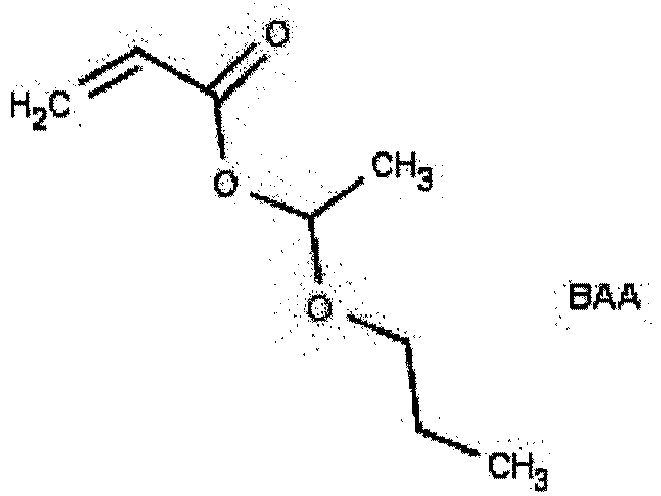
- the hemiacetal ester-containing free radically curable component used in the present invention is represented by compounds selected from the group consisting of
- the amount of the acetal-containing (meth)acrylate compound used in the Part (A) composition may be from 1 to 20 percent by weight, such as 2.5 to 10 percent by weight.
- a class of peroxy initiators particularly suitable to the present invention is the hydroperoxy initiators.
- organic hydroperoxides are particularly.
- Particularly preferred organic hydroperoxides include, p-methane hydroperoxide, diisopropyl benzene hydroperoxide, pinene hydroperoxide, methyl ethyl ketone hydroperoxide, t-butyl-2-hydroxyethyl peroxide, t-butyl peroxymaleic acid, cumene hydroperoxide (CHP), tertiarybutyl hydroperoxide (TBH), and benzoyl peroxide (BP).
- CHP cumene hydroperoxide
- TH tertiarybutyl hydroperoxide
- BP benzoyl peroxide
- peroxides and compositions such as peroxy esters as for example t-butyl perbenzoate, benzophone peroxyesters and fluorenone peroxyesters, peroxy carbonates and halogen containing compounds having electronic structures which facilitate free radical formation, esters which decompose to form free radicals are also useful.
- peroxy is intended to mean peroxides, hydroperoxides and peresters which are suitable for preparing anaerobically curing system.
- the peroxy polymerization initiators may be used in the Part (A) compositions in amounts sufficient to perform their initiation function.
- Useful, non-limiting amounts include 0.25 percent by weight to 10 percent by weight based on the total composition, and desirably 1 percent by weight to 3 percent by weight based on the total composition.
- Free radical polymerization inhibitors may be used in the present invention to prevent premature reaction prior to mixing.
- free-radical polymerization inhibitors include quinones, hydroquinones, hydroxylamines, nitroxyl compounds, phenols, amines, arylamines, quinolines, phenothiazines, and the like.
- Particularly useful free radical inhibitors include hydroquinone, tertiary butylhydroquinone ("TBHQ"), methyl hydroquinone, hydroxyethylhydroquinone, phenothiazine, and NAUGARD-R (blend of N-alkyl substituted p-phenylenediamines, from Crompton Corp.).
- TBHQ tertiary butylhydroquinone
- NAUGARD-R blend of N-alkyl substituted p-phenylenediamines, from Crompton Corp.
- One or more individual free radical inhibitor components may also be combined.
- the amount of the free radical inhibitor component used in the Part (A) composition may be from 0 to 1 percent by weight, such as 0.05 to 0.2 percent by weight.
- the (meth)acrylate component used in part (B) may be any one or more of the (meth)acrylates used in part (A).
- the amount of the (meth)acrylate component used in the Part (B) composition may be from 20 to 95 percent by weight, such as 40 to 75 percent by weight.
- the inventive compositions include an acid or acid ester. Desirably, this component is only in the Part (B) composition.
- Suitable acids or acid esters include phosphoric acid or derivatives, phosphate acid esters, and sulfonic acids or derivatives.
- a preferred reactive acid component is a phosphate acid ester.
- the acid monomer is a free-radical polymerizable acid monomer, such as ethylenically unsaturated mono or polycarboxylic acids, maleic acid and crotonic acid. Desirable ones include methacrylic acid (“MAA”) and acrylic acid.
- the reactive acid component also modulates and decelerates the curing time of the thermoset composition.
- Suitable phosphate esters include those represented by the formula: where here R 1 is H or CH 3 , and R 2 is H, or a radical represented by the structure: where R 1 is H or CH 3 .
- a particularly useful phosphate ester is hydroxyl ethyl methacrylate (“HEMA”) phosphate ester, which is sold under the tradenames T-MULZ 1228 or HARCRYL 1228 or 1228M, each available from Harcross Chemicals, Kansas City, KS.
- HEMA hydroxyl ethyl methacrylate
- structures with at least one strong acid “active hydrogen” group or with at least one phosphonic acid active hydrogen group (R 1 R 2 POOH), such as hydroxyl ethyl diphosphonic acid, phosphonic acid, and derivatives, or oligomeric or polymeric structures with phosphonic acid functionality or similar acid strength functionality.
- R 1 R 2 POOH phosphonic acid active hydrogen group
- the reactive acid component may be present from 0.25 percent by weight to 15 percent by weight of the total composition.
- the benzoylthiourea derivatives or benzoylthiourethane derivatives may be within general structure I where Z is 0 or N-R, where R is selected from hydrogen, alkyl, alkenyl, hydroxyalkyl, hydroxyalkenyl, carbonyl, alkylene (meth)acrylate, carboxyl, or sulfonato, or R' is a direct bond attaching to the phenyl ring; R' is selected from hydrogen, alkyl, alkenyl, cycloalkyl, aryl, hydroxyalkyl, hydroxyalkenyl, alkylene- or alkenylene-ether, carbonyl, alkylene (meth)acrylate, carboxyl, nitroso or sulfonato; X is halogen, alkyl, alkenyl, hydroxyalkyl, hydroxyalkenyl, alkoxy, amino, carboxyl, nitroso, sulfonate, hydroxyl or hal
- R and R' are independently selected from hydrogen, alkyl, alkenyl, aryl, hydroxyalkyl, hydroxyalkenyl, alkylene (meth)acrylate, carbonyl, carboxyl, or sulfonato, or R and R' taken together form a carbocyclic or hetero atom-containing ring, or R' is a direct bond attaching to the phenyl ring;
- X is halogen, alkyl, alkenyl, cycloalkyl, hydroxyalkyl, hydroxyalkenyl, alkoxy, amino, alkylene- or alkenylene-ether, alkylene (meth)acrylate, carbonyl, carboxyl, nitroso, sulfonate, hydroxyl or haloalkyl; and
- Y is -SO 2 NH-, -CONH-, -NH-, and - PO(NHCONHCSNH 2 )NH-; and n is 0
- benzoylthiourea or benzoylthiourethane derivatives may be within structures II or IIA , respectively where R, R', Z, X, Y, and n are as defined above.
- benzoylthiourea or benzoylthiourethane derivatives within structure I may be a bis version, where R' is a linker. That is, where R, R', X, Y, and n are as defined above, and m is 2.
- the benzoylthiourea or benzoylthiourethane derivatives may be Benzoyl morpholinethiourea (BMTU) Benzoyl octylthiourea (BOTU) Benzoyl thiodiethylurea (BTDEU) Benzoyl thiodihydroxyethylurea (BTDHEU) Benzoyl tetrahydroquinoline thiourea (BTHQTU) Benzoyl cyclohexylthiourea (BCHTU) Cyclohexyl bis-Benzoylthiourea (CH bis-BTU) Benzoyl napthosultam thiourea (BNSTU) Benzoyl phenylhydrazide thiourea (BPHTU) Benzoyl thiourea propyl trimethoxysilane (BTU-PTS) BTU-H Adduct BTU-HEMA Adduct BTU-
- the benzoylthiourea or benzoylthiourethane derivatives may be employed in the adhesive compositions in amounts useful to enhance the adhesive properties of the compositions. For example, they may be present in amounts of 0.25 percent by weight to 10 percent by weight, such as 1 percent by weight to 5 percent by weight of the total composition.
- Plasticizers may be used in either part or in both parts of the two part composition.
- Plasticizers may be any liquid or soluble compound that assists with the flexibility of the reactive portion of the composition and/or may act as a carrier vehicle for other components of the composition. Examples include aromatic sulfonamides, aromatic phosphate esters, alkyl phosphate esters, dialkylether aromatic esters, polymeric plasticizers, dialkylether diesters, polyglycol diesters, tricarboxylic esters, polyester resins, aromatic diesters, aromatic triesters (trimellitates), aliphatic diesters, epoxidized esters, chlorinated hydrocarbons, aromatic oils, alkylether monoesters, naphthenic oils, alkyl monoesters, paraffinic oils, silicone oils, di-n-butyl phthalate, diisobutyl phthalate, di-n-hexyl phthalate, di-n-hepytl phthalate, di-2-ethy
- the amount of the plasticizer used in the composition as a whole may be from 0 to 5 percent by weight, such as 0.1 to 1 percent by weight of the total composition.
- the block copolymer may be any block copolymer capable of contributing to the physical properties desired for the disclosed composition.
- the block copolymers may be present in either or both parts of the two part composition.
- the block copolymer rubber may be constructed using blocks of either butadiene or isoprene with styrene (for example, SBS, SIS, SEBS and SB), commercial examples of which are available from Shell Chemical Co. as KRATON D-1116 and other KRATON D-grade elastomers from Dexco as VECTOR 2411IP.
- elastomers with Tg below about 25°C which are soluble in methacrylate/acrylate monomers, can be used in place of the block copolymer rubbers.
- examples of such are the homopolymer of epichlorohydrin and its copolymers with ethylene oxide, available from Zeon Chemicals as HYDRIN, acrylate rubber pellets, available from Zeon as HYTEMP, polyisoprene rubber, polybutadiene rubber, nitrile rubber, and SBR rubber (random copolymer of butadiene and styrene).
- Still other block copolymers may be a styrene maleic anhydride copolymer, represented by the formula: where v is from 1 to 12; w is from 1 to 6; and n is from 1 to 50.
- Styrene maleic anhydride copolymers are well known and some of which are available commercially from Sartomer Company, Inc., Exton, PA under the trade name SMA EF80, for example.
- Styrene maleic anhydride copolymers represent the copolymerization product of styrene and maleic anhydride and are characterized by alternating blocks of styrene and maleic anhydride moieties.
- Amphiphilic block copolymers may be particularly desirable. Arkema offers for sale commercially an amphiphilic block copolymer under the trademark NANOSTRENGTH. Such block copolymers are currently available in two versions: SBM and MAM.
- SBM copolymer is reportedly made of polystyrene, 1,4-polybutadiene and syndiotactic poly(methyl methacrylate).
- a polymer material constructed from polymethyl methacrylate (“PMMA”) and polybutyl acrylate (“PB”) may be used too.
- Polymer materials within this class are referred to as polymethylmethacrylate-block-polybutylacrylateblock polymethylmethacrylate copolymers (“MAM").
- MAM is a triblock copolymer, consisting of about 70% PMMA and 30% PB. MAM is constructed from distinct segments, which provides for the ability to selfassemble at the molecular scale. That is, M confers hardness to the polymer and A confers elastomeric properties to the polymer.
- a hard polymer segment tends to be soluble in (meth)acrylates, whereas the elastomeric segments provide toughness to the polymeric (meth)acrylate, which forms upon cure.
- MAM also reinforces mechanical properties, without compromising inherent physical properties.
- MAM is commercially available under the tradename NANOSTRENGTH, at present under several different grades i.e., E-21 and M-52N.
- Arkema promotes the NANOSTRENGTH product line as an acrylic block copolymer that is miscible with many polymers, most of which according to the manufacturer are major industrial epoxy resins. See also U.S. Patent No. 6,894,113 (Court ), where in its abstract the '113 patent speaks to a thermoset material with improved impact resistance.
- the impact resistance is derived from 1 to 80% of an impact modifier comprising at least one copolymer comprising S-B-M, B-M and M-B-M blocks, where each block is connected to the other by a covalent bond or of an intermediary connected to one of the blocks by a covalent bond and to the other block by another covalent bond, M is a PMMA homopolymer or a copolymer comprising at least 50% by weight of methyl methacrylate, B is incompatible with the thermoset resin and with the M block and its glass transition temperature Tg is less than the operating temperature of the thermoset material, and S is incompatible with the thermoset resin, the B block and the M block and its Tg or its melting temperature is greater than the Tg of B.
- an impact modifier comprising at least one copolymer comprising S-B-M, B-M and M-B-M blocks, where each block is connected to the other by a covalent bond or of an intermediary connected to one of the blocks by a covalent bond and to the other block
- FORTEGRA 100 Another commercially available example of an amphiphilic block copolymer is a polyether block copolymer known to the trade as FORTEGRA 100, from Dow Chemical Co. Dow describes FORTEGRA 100 as a low viscosity toughening agent designed for use as a high efficiency second phase, in amine cured epoxy systems. FORTEGRA 100 is reported to provide improved toughness without significantly affecting the viscosity, glass transition temperature, corrosion resistance, cure rate or chemical resistance of the final coating or composition. FORTEGRA 100 is also reported to be useful for formulation into standard bisphenol A and bisphenol F epoxy systems as it does not participate in the epoxy cure reaction. As a second phase toughening agent, FORTEGRA 100 is promoted as being effective when formulated at a specific volume fraction of the finish film or part, typically 3% to 8% by dry volume is said to achieve the toughening effect.
- Additional block copolymers include those which comprise both hydrophobic and hydrophilic segments or portions, of the general formula: -[(R 1 ) v -(R 2 ) w ] n - where here R 1 is independently a hydrophobic olefin, such as ethylene, propylene, 1-butene, 1-hexene, 3-methyl-1-pentene, or 4-methyl-1-pentene or a polymerizable hydrophobic aromatic hydrocarbon such as styrene; each R 2 is a hydrophilic acid anhydride, such as maleic anhydride; v is from 1 to 12; w is from 1 to 6; and n is from 1 to 50.
- R 1 is independently a hydrophobic olefin, such as ethylene, propylene, 1-butene, 1-hexene, 3-methyl-1-pentene, or 4-methyl-1-pentene or a polymerizable hydrophobic aromatic hydrocarbon such as styrene
- each R 2 is
- the ratio of the hydrophobic segments to the hydrophilic segments in the styrene maleic anhydride block copolymer may be at least 2:1, such as between 3:1 and 12:1.
- the hydrophilic segments in the block copolymer should comprise an anhydride, such as maleic anhydride.
- the hydrophobic segments in the block copolymer should comprise at least one of ethylene, propylene, 1-butene, 1-hexene, 3-methyl-1-pentene, 4-methyl-1-pentene, or styrene.
- the block copolymer should be prepared with the hydrophilic segments comprising maleic anhydride and the hydrophobic segments comprising styrene.
- U.S. Patent No. 7,745,535 (Schmidt ) is directed to and claims an amphiphilic multiblock copolymer where at least one block is a profiled block consisting of a) a hydrophilic middle block made from one or more monomeric units selected from acrylic acid, methacrylic acid, and the salts, esters, anhydrides and amides of acrylic acid and methacrylic acid; dicarboxylic acid anhydrides; carboxyethyl acrylate; and acrylamides; and b) hydrophobic end blocks where the multiblock copolymer is water insoluble, water indispersible, and not soluble or dispersible in C 1-3 alcohols.
- U.S. Patent No. 7,820,760 is directed to and claims a curable adhesive epoxy resin composition including (a) an epoxy resin; (b) an amphiphilic block copolymer containing at least one epoxy resin miscible block segments and at least one epoxy resin immiscible block segments (where the immiscible block segment comprises at least one polyether structure provided that the polyether structure of the immiscible block segment contains at least one or more alkylene oxide monomer units having at least four carbon atoms); and (c) at least one curing agent.
- the amphiphilic block copolymer in the '760 patent is an all polyether block copolymer such as a PEO-PBO diblock copolymer or a PEO-PBO-PEO triblock copolymer.
- the amphiphilic block copolymer is present in an amount such that when in the '760 patent the epoxy resin composition is cured, the bond strength of the resulting cured epoxy adhesive resin composition increases compared to an epoxy resin composition without the amphiphilic polyether block copolymer.
- U.S. Patent No. 7,670,649 is directed to and claims a curable ambient cure high-solids coating composition including (a) an epoxy resin; (b) an amphiphilic block copolymer containing at least one epoxy resin miscible block segment (where the immiscible block segment comprises at least one polyether structure provided that the polyether structure of the immiscible block segment contains at least one or more alkylene oxide monomer units) and at least one epoxy resin immiscible block segment; and (c) a sufficient amount of a nitrogencontaining curing agent to cure the coating composition at ambient temperature of less than about 60°C.
- the epoxy resin composition is cured, the toughness of the resulting cured epoxy resin composition is increased.
- U.S. Patent No. 6,887,574 (Dean ) is directed to and claims a curable flame retardant epoxy resin composition including (a) at least one flame retardant epoxy resin; (b) at least one amphiphilic block copolymer; and (c) a curing agent.
- Such components are present in the curable composition in the appropriate amounts and ratios such that, upon curing, the block copolymer self-assembles into a nano structure morphology, such as a worm-like micelle morphology.
- the resulting cured product is reported to have a remarkably increased high fracture resistance; and allows the use of flame retardant epoxies in applications where fracture resistance is an issue.
- U.S. Patent Application Publication No. 2008/0287595 (Verghese ) is directed to a composition comprising (1) a thermosettable resin selected from an epoxy resin, an epoxy vinyl ester resin, an unsaturated polyester resin or a mixture thereof, and (2) an amphiphilic mock copolymer dispersed in the thermosettable resin.
- a thermosettable resin selected from an epoxy resin, an epoxy vinyl ester resin, an unsaturated polyester resin or a mixture thereof
- FRP fiber-reinforced plastics
- coatings and composites prepared from the composition are provided as well.
- WO 2010/008931 is directed to a structural composite that uses a block copolymer toughening agent to increase the fracture resistance (toughness) of the structural composite.
- the structural composite comprises (i) a carbon fiber reinforcing material and (ii) a thermosettable resin composition; wherein the thermosettable resin composition comprises (a) a thermosettable resin and (b) at least one block copolymer toughening agent.
- the block copolymer may be used herein in an amount up to 50 weight percent, desirably from 5 to 40 weight percent based on the total weight of the adhesive composition.
- the glass transition temperature ("Tg") of the block copolymer should be above 40°C. In one embodiment, the Tg of the block copolymer is between 40°C and 155°C.
- the Tg of a polymer is the temperature at which the polymer becomes brittle on cooling or soft on heating. More specifically, Tg defines a pseudo second order phase transition in which a polymer yields, on cooling, a glassy structure with properties similar to those of a crystalline material. Above Tg, the polymer becomes soft and capable of plastic deformation without fracture. While the Tg is occasionally described as the "softening temperature" of a polymer, it is not uncommon for the polymer to begin softening at a temperature below the Tg. This is because, due to the nature of many non-crystalline polymers, the softening of the polymer may occur over a temperature range rather than abruptly at a single temperature value. Tg generally refers to the middle point of this range even though the polymer may begin to soften at a different temperature. For purposes of this application, the Tg of a polymer refers to the value as determined by ASTM E-1356.
- the amount of the block copolymer used in the composition as a whole may be from 5 percent by weight to 75 percent by weight, such as 10 percent by weight to 50 percent by weight of the total composition.
- Either or both parts may contain additional additives, such as fillers, lubricants, thickeners, and coloring agents.
- the fillers provide bulk without sacrificing strength of the adhesive and can be selected from high or low density fillers.
- certain fillers, such as silica can confer rheological modification or small particle reinforcements.
- Commercially available examples include Cab-O-Sil 610 and AEROSIL R8200.
- core shell polymers may be desirable.
- the core shell polymer is desirably a graft copolymer of the "core shell” type, or may also be a "shell-less” cross-linked rubbery particulate, such as acrylonitrile-butadiene-styrene ("ABS”), methacrylate-butadiene-styrene (“MBS”), and methacrylateacrylonitrile-butadiene-styrene (“MABS”).
- ABS acrylonitrile-butadiene-styrene
- MVS methacrylate-butadiene-styrene
- MABS methacrylateacrylonitrile-butadiene-styrene
- BLENDEX 338 is an ABS powder from GE Plastics.
- each of Part (A) and Part (B) are packaged in separate containers, such as bottles, cans, tubes, or drums.
- Part (A) and Part (B) are mixed in a ratio of 1 to 10 Part (a) to 10 to 1 Part (b). Desirably, the ratio of Part (A) to Part (B) is 1 Part (A) to 1 Part (B).
- the mixing of the two parts can employ a mixing nozzle, which has fluid inputs for the two components, performs a suitable mixing operation, and dispenses the adhesive mixture directly onto the surface to be bonded.
- a mixing nozzle which has fluid inputs for the two components, performs a suitable mixing operation, and dispenses the adhesive mixture directly onto the surface to be bonded.
- An example of a commercially available mixing and dispensing device is MIXPAC ® , available from ConProTec, Salem, NH.
- the two parts can also be mixed manually in a bowl, bucket, or the like, but the operator needs to ensure that the mixing is thorough.
- each part can be formulated with a dye or pigment, so that after mixing, a third color is formed. For example, one part may have a yellow dye, the other part may have a blue dye, so that after mixing, the complete adhesive composition will be green.
- compositions are excellent adhesives and sealants.
- a first surface such as a sheet of metal, fabric or plastic that can be incorporated into a laminated material
- a second surface will be mated with the first surface and the two surfaces will be bonded together as the adhesive cures.
- a further advantage is that no surface preparation is required to bond clean substrates.
- curing is meant that the chemical reaction converting the fluid mix to the solid bond of this invention.
- the curing process of this composition is exothermic, and may reach a temperature of 120°C or so, when a large bead of adhesive is used.
- the adhesive compositions After mixing, the adhesive compositions fully cure in 20 minutes at 80°C and within 24 hours at room temperature. Fixture times range from 7 to 10 minutes, at which time the bond will support a 3 Kg load.
- the following two part adhesive compositions were prepared as set forth in Table I below.
- the Part (A) composition was prepared by mixing together the components in the amounts (phr) as listed to form a homogeneous blend, using mixing speeds of about 2500 RPMs for about 2-3 minutes.
- the Part (B) composition was similarly separately formed.
- the Part (A) composition was used without change throughout the examples.
- Table 1 Part A Constituents Wt.% 30 wt.% Magnum 3904 ABS Rubber in THFMA 82.5 Methacrylic Acid 10 Cyclohexyl BTU 5 Hydrophobic Silica 2.5
- Part B acetal-containing (meth)acrylate compound chosen and a control formulation (Part (B1)) without such a compound.
- Part B1 acetal-containing (meth)acrylate compound chosen and a control formulation (Part (B1)) without such a compound.
- Table 2 -- Part B Constituents B1 B2 B3 B4 B5 Wt.% Wt.% Wt.% Wt.% Wt.% 30 wt%
- Table 3 shows the results observed and recorded for tensile shear values obtained according to ASTM D3163 when using an adhesive formulation with a Part (B) Composition from Table 2 above. These Part (B) Compositions were mixed in equal parts by weight with the Part (A) Composition from Table 1.
- Inked glass substrates were bonded to PC-ABS substrates with the Part (A)/Part (B) combinations mixed above.
- Ink coated glass substrates were bonded to PC-ABS substrates using these Part (A)/Part (B) combinations as above. After 24 hours of curing at room temperature. The bonded lap shears were stored in a humidity chamber for 10 days in an 85°C/95% relative humidity environment. The samples were evaluated after conditioning for a period of 1 hour under ambient conditions. Table 4 below shows the bond strengths after heat/humidity conditioning in comparison to bond strengths after 24 hour room temperature cure.
- Thermal cycle chamber parameters 20 cycles of 25°/95%RH for 1.5 hours, ramped to 65°/95%RH for 4 hours, then ramped to 30°C/95%RH for 1.5 hours and left at 30°C/95%RH for 1 hour. Lap shear specimens were then removed and left at room temperature for 24 hours. Table 5 Part B Initial (psi) Post Thermal Cycling (psi) B1 (No acetal monomer) 489 488 B2 (5 wt.% BDDA) 519 457
Landscapes
- Chemical & Material Sciences (AREA)
- Organic Chemistry (AREA)
- Chemical Kinetics & Catalysis (AREA)
- Health & Medical Sciences (AREA)
- Medicinal Chemistry (AREA)
- Polymers & Plastics (AREA)
- Adhesives Or Adhesive Processes (AREA)
- Addition Polymer Or Copolymer, Post-Treatments, Or Chemical Modifications (AREA)
Claims (9)
- Klebstoffzusammensetzung in einer zweiteiligen Konfiguration, umfassend:(a) Teil (A), umfassend eine (Meth)acrylatkomponente, ein organisches Peroxid und eine Hemiacetalester enthaltende radikalisch härtbare Komponente, wobei die Hemiacetalester enthaltende radikalisch härtbare Komponente durch Verbindungen dargestellt wird, die aus der Gruppe ausgewählt sind, bestehend aus


 (b) Teil (B), umfassend eine (Meth)acrylatkomponente und Benzoylthioharnstoffderivate oder Benzoylthiourethanderivate, und eine Säure oder einen Säureester, wobei die (Meth)acrylatkomponente des Teils (A) und des Teils (B) aus der Gruppe ausgewählt ist, bestehend aus Tetrahydrofurfuryl(meth)acrylat, Methyl(meth)acrylat, Ethyl(meth)acrylat, n-Propyl(meth)acrylat, Isopropyl(meth)acrylat, n-Butyl(meth)acrylat, Isobutyl(meth)acrylat, tert-Butyl(meth)acrylat, n-Pentyl(meth)acrylat, n-Hexyl(meth)acrylat, Cyclohexyl(meth)acrylat, n-Heptyl(meth)acrylat, n-Octyl(meth)acrylat, 2-Ethylhexyl(meth)acrylat, Nonyl(meth)acrylat, Decyl(meth)acrylat, Dodecyl(meth)acrylat, Phenyl(meth)acrylat, Tolyl(meth)acrylat, Benzyl(meth)acrylat, 2-Methoxyethyl(meth)acrylat, 3-Methoxybutyl(meth)acrylat, 2-Hydroxyethyl(meth)acrylat, 2-Hydroxypropyl(meth)acrylat, Stearyl(meth)acrylat, Glycidyl(meth)acrylat, 2-Aminoethyl(meth)acrylat, γ-(Meth)acryloyloxypropyltrimethoxysilan, (Meth)acrylsäureethylenoxidaddukt, Trifluormethylmethyl(meth)acrylat, 2-trifluormethylethyl(meth)acrylat, 2-Perfluorethylethyl(meth)acrylat, 2-Perfluorethyl-2-perfluorbutylethyl(meth)acrylat, 2-Perfluorethyl(meth)acrylat, Perfluormethyl(meth)acrylat, Diperfluormethylmethyl(meth)acrylate, 2-Perfluormethyl-2-perfluorethylmethyl(meth)acrylat, 2-Perfluorhexylethyl(meth)acrylat, 2-Perfluordecylethyl(meth)acrylat,2-Perfluorhexadecylethyl(meth)acrylat, ethoxyliertem Trimethylolpropantriacrylat, Trimethylolpropantrimethacrylat, Dipentaerythritmonohydroxypentacrylat, Pentaerythrittriacrylat, ethoxyliertem Trimethylolpropantriacrylat, 1,6-Hexandioldiacrylat, Neopentylglycoldiacrylat, Pentaerythrittetraacrylat, 1,2-Butylenglycoldiacrylat, Trimethylpropanethoxylattri(meth)acrylat, Glycerylpropoxylattri(meth)acrylat, Trimethylolpropantri(meth)acrylat, Dipentaerythritmonohydroxypenta(meth)acrylat, Tri(propylenglycol)di(meth)acrylat, Neopentylglycolpropoxylatdi(meth)acrylat, 1,4-Butandioldi(meth)acrylat, Polyethylenglycoldi(meth)acrylat, Triethylenglycoldi(meth)acrylat, Butylenglycoldi(meth)acrylat, ethoxyliertem Bisphenol-A-di(meth)acrylat und Kombinationen davon.
 - Zusammensetzung nach Anspruch 1, wobei die Benzoylthioharnstoffderivate oder die Benzoylthiourethanderivate durch Verbindungen innerhalb der nachstehenden allgemeinen Struktur dargestellt werden:
 wobei Z O oder N-R ist, wobei R aus Wasserstoff, Alkyl, Alkenyl, Hydroxyalkyl, Hydroxyalkenyl, Carbonyl, Alkylen(meth)acrylat, Carboxyl oder Sulfonato ausgewählt ist, oder R' eine direkte Bindung ist, die sich an den Phenylring anlagert; R' aus Wasserstoff, Alkyl, Alkenyl, Cycloalkyl, Aryl, Hydroxyalkyl, Hydroxyalkenyl, Alkylen- oder Alkenylenether, Carbonyl, Alkylen(meth)acrylat, Carboxyl, Nitroso oder Sulfonato ausgewählt ist; X Halogen, Alkyl, Alkenyl, Hydroxyalkyl, Hydroxyalkenyl, Alkoxy, Amino, Carboxyl, Nitroso, Sulfonat, Hydroxyl oder Haloalkyl ist; und Y -SO2NH-, -CONH-, -NH- und -PO (NHCONHCSNH2)NH- ist; und n 0 oder 1 ist und m 1 oder 2 ist; oder
 wobei R und R' unabhängig aus Wasserstoff, Alkyl, Alkenyl, Aryl, Hydroxyalkyl, Hydroxyalkenyl, Alkylen(meth)acrylat, Carbonyl, Carboxyl oder Sulfonato ausgewählt sind, oder R und R' zusammengenommen einen carbocyclischen oder Heteroatom enthaltenden Ring ausbilden, oder R' eine direkte Bindung ist, die sich an den Phenylring anlagert; X Halogen, Alkyl, Alkenyl, Cycloalkyl, Hydroxyalkyl, Hydroxyalkenyl, Alkoxy, Amino, Alkylen- oder Alkenylenether, Alkylen(meth)acrylat, Carbonyl, Carboxyl, Nitroso, Sulfonat, Hydroxyl oder Haloalkyl ist; und Y -SO2NH-, -CONH-,-NH-und -PO(NHCONHCSNH2)NH ist; und n 0 oder 1 ist und m 1 oder 2 ist.
 - Zusammensetzung nach Anspruch 1, wobei die Benzoylthioharnstoffderivate oder die Benzoylthiourethanderivate durch Verbindungen innerhalb der nachstehenden allgemeinen Struktur dargestellt werden:


- Zusammensetzung nach Anspruch 1, wobei die Benzoylthioharnstoffderivate oder die Benzoylthiourethanderivate durch Verbindungen innerhalb der nachstehenden allgemeinen Struktur dargestellt werden:

- Klebstoffzusammensetzung nach Anspruch 1, ferner umfassend ein Blockcopolymer.
- Zusammensetzung nach Anspruch 1, wobei die Säure oder der Säureester Acrylsäure, Methacrylsäure, Sulfonsäure, Sulfonsäurederivate, Phosphorsäure oder Phosphatester ist.
- Verfahren zum Herstellen der zweiteiligen Klebstoffzusammensetzung nach Anspruch 1, umfassend:(a) Ausbilden von Teil (A), umfassend eine (Meth)acrylatkomponente, ein organisches Peroxid und eine Hemiacetalester enthaltende radikalisch härtbare Komponente, wobei die Hemiacetalester enthaltende radikalisch härtbare Komponente durch Verbindungen dargestellt wird, die aus der Gruppe ausgewählt sind, bestehend aus


 (b) Ausbilden von Teil (B), umfassend eine (Meth)acrylatkomponente und Benzoylthioharnstoffderivate oder Benzoylthiourethanderivate und eine Säure oder einen Säureester.
 - Verfahren zum Binden einer ersten Oberfläche an eine zweite Oberfläche, umfassend:
Bereitstellen der zweiteiligen Zusammensetzung nach Anspruch 1, umfassend:
Teil (A), umfassend eine (Meth)acrylatkomponente, ein organisches Peroxid und eine Hemiacetalester enthaltende radikalisch härtbare Komponente, wobei die Hemiacetalester enthaltende radikalisch härtbare Komponente durch Verbindungen dargestellt wird, die aus der Gruppe ausgewählt sind, bestehend aus


 (a) ; und(b) Teil (B), umfassend eine (Meth)acrylatkomponente und Benzoylthioharnstoffderivate oder Benzoylthiourethanderivate und eine Säure oder einen Säureester.
 - Klebstoffzusammensetzung, umfassend:(a) eine (Meth)acrylatkomponente, ausgewählt aus jenen, die in Anspruch 1 aufgeführt sind;(b) ein Härtungspaket, umfassend ein organisches Peroxid und Benzoylthioharnstoffderivate oder Benzoylthiourethanderivate;(c) eine Säure oder einen Säureester und eine Hemiacetalester enthaltende radikalisch härtbare Komponente, wobei die Hemiacetalester enthaltende radikalisch härtbare Komponente durch Verbindungen dargestellt wird, die aus der Gruppe ausgewählt sind, bestehend aus


Applications Claiming Priority (2)
| Application Number | Priority Date | Filing Date | Title |
|---|---|---|---|
| US201762488354P | 2017-04-21 | 2017-04-21 | |
| PCT/US2018/027907 WO2018195038A1 (en) | 2017-04-21 | 2018-04-17 | Adhesive compositions |
Publications (3)
| Publication Number | Publication Date |
|---|---|
| EP3612609A1 EP3612609A1 (de) | 2020-02-26 |
| EP3612609A4 EP3612609A4 (de) | 2021-01-20 |
| EP3612609B1 true EP3612609B1 (de) | 2022-12-28 |
Family
ID=63857054
Family Applications (1)
| Application Number | Title | Priority Date | Filing Date |
|---|---|---|---|
| EP18787067.0A Active EP3612609B1 (de) | 2017-04-21 | 2018-04-17 | Klebstoffzusammensetzungen |
Country Status (7)
| Country | Link |
|---|---|
| US (1) | US20180320025A1 (de) |
| EP (1) | EP3612609B1 (de) |
| JP (1) | JP7162008B2 (de) |
| KR (1) | KR102492069B1 (de) |
| CN (1) | CN110536941B (de) |
| TW (1) | TWI795399B (de) |
| WO (1) | WO2018195038A1 (de) |
Families Citing this family (3)
| Publication number | Priority date | Publication date | Assignee | Title |
|---|---|---|---|---|
| GB2576703B (en) * | 2018-08-16 | 2022-07-13 | Henkel IP & Holding GmbH | Two step adhesive systems |
| PL3835381T3 (pl) | 2019-12-13 | 2023-06-26 | Henkel Ag & Co. Kgaa | Dwuskładnikowa (2k) utwardzalna kompozycja klejowa |
| KR102315050B1 (ko) * | 2020-04-07 | 2021-10-21 | 대주전자재료 주식회사 | 고온 이형 가능한 도전성 접착제 및 태양 전지 모듈 |
Family Cites Families (23)
| Publication number | Priority date | Publication date | Assignee | Title |
|---|---|---|---|---|
| US4536546A (en) | 1983-09-22 | 1985-08-20 | Illinois Tool Works Inc. | (Meth)acrylate-based compositions |
| US5872158A (en) * | 1997-06-12 | 1999-02-16 | International Business Machines Corporation | Cleavable diacrylate for removable acrylate compositions |
| FR2809741B1 (fr) | 2000-05-31 | 2002-08-16 | Atofina | Materiaux thermodurs a tenue au choc amelioree |
| AU2002241549A1 (en) | 2000-11-15 | 2002-06-18 | Henkel Loctite Corporation | Multi-functional alpha-alkoxyalkyl acrylate and methacrylate ester compositions and reworkable polymers formed therefrom |
| US6660805B1 (en) * | 2002-05-16 | 2003-12-09 | Lord Corporation | Two-part adhesive: part A-monomer, toughener(s), optional adhesion promotor and reducing agent; part B-epoxy resin |
| US6887574B2 (en) | 2003-06-06 | 2005-05-03 | Dow Global Technologies Inc. | Curable flame retardant epoxy compositions |
| RU2006138618A (ru) | 2004-04-02 | 2008-05-10 | Дау Глобал Текнолоджиз Инк. (Us) | Модифицированные амфифильным блок-сополимером термоотверждающиеся смолы с повышенной ударной вязкостью |
| CN102936445A (zh) | 2004-11-10 | 2013-02-20 | 陶氏环球技术有限责任公司 | 两性嵌段共聚物增韧的环氧树脂以及由此制造的环境固化的高固含量的涂料 |
| KR101226379B1 (ko) | 2004-11-10 | 2013-01-24 | 다우 글로벌 테크놀로지스 엘엘씨 | 양친매성 블록 공중합체-개질된 에폭시 수지 및 그로부터제조된 접착제 |
| US7745535B2 (en) | 2006-07-21 | 2010-06-29 | Arkema Inc. | Amphiphilic block copolymers |
| US7582691B2 (en) | 2007-01-17 | 2009-09-01 | Sabic Innovative Plastics Ip B.V. | Poly(arylene ether) compositions and articles |
| KR20150063590A (ko) | 2007-08-02 | 2015-06-09 | 다우 글로벌 테크놀로지스 엘엘씨 | 열경화성 중합체의 성능을 개선시키기 위한 양친매성 블록 공중합체 및 무기 나노충진제 |
| WO2009070172A1 (en) | 2007-11-30 | 2009-06-04 | Henkel Ag & Co. Kgaa | Curable resins containing acetal, ketal, acetal ester, or ketal ester linkages |
| EP2303953A1 (de) | 2008-07-17 | 2011-04-06 | Dow Global Technologies Inc. | Strukturelle verbundstoffe mit verbesserter festigkeit |
| WO2010144787A1 (en) * | 2009-06-11 | 2010-12-16 | Pentron Clinical Technologies, Llc | Epoxy-containing composition curable by multiple polymerization mechanisms |
| US8420121B2 (en) * | 2009-07-29 | 2013-04-16 | University Of Massachusetts | Drug delivery vehicles, methods of manufacture, and methods of use thereof |
| JP5543844B2 (ja) | 2010-05-20 | 2014-07-09 | 大倉工業株式会社 | 2液硬化型アクリル系接着剤 |
| US10590311B2 (en) * | 2012-06-27 | 2020-03-17 | Henkel IP & Holding GmbH | Accelerators for two part curable compositions |
| US8986847B2 (en) * | 2012-06-27 | 2015-03-24 | Henkel IP & Holding GmbH | Accelerator/oxidant/proton source combinations for two part curable compositions |
| TWI553089B (zh) * | 2012-09-28 | 2016-10-11 | 長興材料工業股份有限公司 | 塗料組合物及其用途 |
| US9405189B2 (en) * | 2013-09-06 | 2016-08-02 | Rohm And Haas Electronic Materials Llc | Self-assembled structures, method of manufacture thereof and articles comprising the same |
| WO2015164087A1 (en) * | 2014-04-24 | 2015-10-29 | 3M Innovative Properties Company | Compositions comprising cleavable crosslinker and methods |
| EP3137565B1 (de) * | 2014-05-01 | 2022-09-14 | Henkel AG & Co. KGaA | Anaerobe härtbare zusammensetzungen mit einem block poly(carbonsäure)segment |
-
2018
- 2018-04-17 EP EP18787067.0A patent/EP3612609B1/de active Active
- 2018-04-17 KR KR1020197031219A patent/KR102492069B1/ko active Active
- 2018-04-17 WO PCT/US2018/027907 patent/WO2018195038A1/en not_active Ceased
- 2018-04-17 CN CN201880026225.0A patent/CN110536941B/zh active Active
- 2018-04-17 JP JP2019556948A patent/JP7162008B2/ja active Active
- 2018-04-18 TW TW107113169A patent/TWI795399B/zh active
- 2018-07-10 US US16/031,504 patent/US20180320025A1/en not_active Abandoned
Also Published As
| Publication number | Publication date |
|---|---|
| JP2020517775A (ja) | 2020-06-18 |
| TW201842101A (zh) | 2018-12-01 |
| KR20190139893A (ko) | 2019-12-18 |
| KR102492069B1 (ko) | 2023-01-27 |
| EP3612609A4 (de) | 2021-01-20 |
| CN110536941B (zh) | 2022-04-19 |
| EP3612609A1 (de) | 2020-02-26 |
| TWI795399B (zh) | 2023-03-11 |
| CN110536941A (zh) | 2019-12-03 |
| US20180320025A1 (en) | 2018-11-08 |
| JP7162008B2 (ja) | 2022-10-27 |
| WO2018195038A1 (en) | 2018-10-25 |
Similar Documents
| Publication | Publication Date | Title |
|---|---|---|
| US9574118B2 (en) | Adhesive compositions | |
| US20190136102A1 (en) | Adhesive compositions containing reactive silsesquioxanes | |
| US11732158B2 (en) | Adhesive compositions | |
| EP3612609B1 (de) | Klebstoffzusammensetzungen | |
| US20220325151A1 (en) | Two part curable compositions | |
| CN116710527A (zh) | 不含mma的丙烯酸酯结构粘合剂 | |
| CN119487145A (zh) | 基于(甲基)丙烯酸酯的增韧粘合剂 | |
| JP4459372B2 (ja) | 難燃性接着剤組成物及び金属接合体 | |
| JP4672103B2 (ja) | 難燃性樹脂組成物、難燃性接着剤組成物及び金属接合体 |
Legal Events
| Date | Code | Title | Description |
|---|---|---|---|
| STAA | Information on the status of an ep patent application or granted ep patent |
Free format text: STATUS: THE INTERNATIONAL PUBLICATION HAS BEEN MADE |
|
| PUAI | Public reference made under article 153(3) epc to a published international application that has entered the european phase |
Free format text: ORIGINAL CODE: 0009012 |
|
| STAA | Information on the status of an ep patent application or granted ep patent |
Free format text: STATUS: REQUEST FOR EXAMINATION WAS MADE |
|
| 17P | Request for examination filed |
Effective date: 20191008 |
|
| AK | Designated contracting states |
Kind code of ref document: A1 Designated state(s): AL AT BE BG CH CY CZ DE DK EE ES FI FR GB GR HR HU IE IS IT LI LT LU LV MC MK MT NL NO PL PT RO RS SE SI SK SM TR |
|
| AX | Request for extension of the european patent |
Extension state: BA ME |
|
| RIN1 | Information on inventor provided before grant (corrected) |
Inventor name: GALLIGAN, MARC Inventor name: SWEENEY, NIGEL Inventor name: DEEGAN, BRIAN Inventor name: MESSANA, ANDREW D. Inventor name: HURLBURT, LYNNETTE |
|
| DAV | Request for validation of the european patent (deleted) | ||
| DAX | Request for extension of the european patent (deleted) | ||
| A4 | Supplementary search report drawn up and despatched |
Effective date: 20201217 |
|
| RIC1 | Information provided on ipc code assigned before grant |
Ipc: C09J 4/02 20060101AFI20201211BHEP Ipc: C08F 285/00 20060101ALI20201211BHEP Ipc: C08F 287/00 20060101ALI20201211BHEP Ipc: C09J 4/06 20060101ALI20201211BHEP |
|
| STAA | Information on the status of an ep patent application or granted ep patent |
Free format text: STATUS: EXAMINATION IS IN PROGRESS |
|
| 17Q | First examination report despatched |
Effective date: 20211115 |
|
| GRAP | Despatch of communication of intention to grant a patent |
Free format text: ORIGINAL CODE: EPIDOSNIGR1 |
|
| STAA | Information on the status of an ep patent application or granted ep patent |
Free format text: STATUS: GRANT OF PATENT IS INTENDED |
|
| INTG | Intention to grant announced |
Effective date: 20220802 |
|
| RAP1 | Party data changed (applicant data changed or rights of an application transferred) |
Owner name: HENKEL AG & CO. KGAA |
|
| GRAS | Grant fee paid |
Free format text: ORIGINAL CODE: EPIDOSNIGR3 |
|
| GRAA | (expected) grant |
Free format text: ORIGINAL CODE: 0009210 |
|
| STAA | Information on the status of an ep patent application or granted ep patent |
Free format text: STATUS: THE PATENT HAS BEEN GRANTED |
|
| AK | Designated contracting states |
Kind code of ref document: B1 Designated state(s): AL AT BE BG CH CY CZ DE DK EE ES FI FR GB GR HR HU IE IS IT LI LT LU LV MC MK MT NL NO PL PT RO RS SE SI SK SM TR |
|
| REG | Reference to a national code |
Ref country code: GB Ref legal event code: FG4D |
|
| REG | Reference to a national code |
Ref country code: CH Ref legal event code: EP |
|
| REG | Reference to a national code |
Ref country code: DE Ref legal event code: R096 Ref document number: 602018044790 Country of ref document: DE |
|
| REG | Reference to a national code |
Ref country code: AT Ref legal event code: REF Ref document number: 1540477 Country of ref document: AT Kind code of ref document: T Effective date: 20230115 |
|
| REG | Reference to a national code |
Ref country code: IE Ref legal event code: FG4D |
|
| REG | Reference to a national code |
Ref country code: LT Ref legal event code: MG9D |
|
| PG25 | Lapsed in a contracting state [announced via postgrant information from national office to epo] |
Ref country code: SE Free format text: LAPSE BECAUSE OF FAILURE TO SUBMIT A TRANSLATION OF THE DESCRIPTION OR TO PAY THE FEE WITHIN THE PRESCRIBED TIME-LIMIT Effective date: 20221228 Ref country code: NO Free format text: LAPSE BECAUSE OF FAILURE TO SUBMIT A TRANSLATION OF THE DESCRIPTION OR TO PAY THE FEE WITHIN THE PRESCRIBED TIME-LIMIT Effective date: 20230328 Ref country code: LT Free format text: LAPSE BECAUSE OF FAILURE TO SUBMIT A TRANSLATION OF THE DESCRIPTION OR TO PAY THE FEE WITHIN THE PRESCRIBED TIME-LIMIT Effective date: 20221228 Ref country code: FI Free format text: LAPSE BECAUSE OF FAILURE TO SUBMIT A TRANSLATION OF THE DESCRIPTION OR TO PAY THE FEE WITHIN THE PRESCRIBED TIME-LIMIT Effective date: 20221228 |
|
| REG | Reference to a national code |
Ref country code: NL Ref legal event code: MP Effective date: 20221228 |
|
| REG | Reference to a national code |
Ref country code: AT Ref legal event code: MK05 Ref document number: 1540477 Country of ref document: AT Kind code of ref document: T Effective date: 20221228 |
|
| PG25 | Lapsed in a contracting state [announced via postgrant information from national office to epo] |
Ref country code: RS Free format text: LAPSE BECAUSE OF FAILURE TO SUBMIT A TRANSLATION OF THE DESCRIPTION OR TO PAY THE FEE WITHIN THE PRESCRIBED TIME-LIMIT Effective date: 20221228 Ref country code: LV Free format text: LAPSE BECAUSE OF FAILURE TO SUBMIT A TRANSLATION OF THE DESCRIPTION OR TO PAY THE FEE WITHIN THE PRESCRIBED TIME-LIMIT Effective date: 20221228 Ref country code: HR Free format text: LAPSE BECAUSE OF FAILURE TO SUBMIT A TRANSLATION OF THE DESCRIPTION OR TO PAY THE FEE WITHIN THE PRESCRIBED TIME-LIMIT Effective date: 20221228 Ref country code: GR Free format text: LAPSE BECAUSE OF FAILURE TO SUBMIT A TRANSLATION OF THE DESCRIPTION OR TO PAY THE FEE WITHIN THE PRESCRIBED TIME-LIMIT Effective date: 20230329 |
|
| PG25 | Lapsed in a contracting state [announced via postgrant information from national office to epo] |
Ref country code: NL Free format text: LAPSE BECAUSE OF FAILURE TO SUBMIT A TRANSLATION OF THE DESCRIPTION OR TO PAY THE FEE WITHIN THE PRESCRIBED TIME-LIMIT Effective date: 20221228 |
|
| P01 | Opt-out of the competence of the unified patent court (upc) registered |
Effective date: 20230530 |
|
| PG25 | Lapsed in a contracting state [announced via postgrant information from national office to epo] |
Ref country code: SM Free format text: LAPSE BECAUSE OF FAILURE TO SUBMIT A TRANSLATION OF THE DESCRIPTION OR TO PAY THE FEE WITHIN THE PRESCRIBED TIME-LIMIT Effective date: 20221228 Ref country code: RO Free format text: LAPSE BECAUSE OF FAILURE TO SUBMIT A TRANSLATION OF THE DESCRIPTION OR TO PAY THE FEE WITHIN THE PRESCRIBED TIME-LIMIT Effective date: 20221228 Ref country code: PT Free format text: LAPSE BECAUSE OF FAILURE TO SUBMIT A TRANSLATION OF THE DESCRIPTION OR TO PAY THE FEE WITHIN THE PRESCRIBED TIME-LIMIT Effective date: 20230428 Ref country code: ES Free format text: LAPSE BECAUSE OF FAILURE TO SUBMIT A TRANSLATION OF THE DESCRIPTION OR TO PAY THE FEE WITHIN THE PRESCRIBED TIME-LIMIT Effective date: 20221228 Ref country code: EE Free format text: LAPSE BECAUSE OF FAILURE TO SUBMIT A TRANSLATION OF THE DESCRIPTION OR TO PAY THE FEE WITHIN THE PRESCRIBED TIME-LIMIT Effective date: 20221228 Ref country code: CZ Free format text: LAPSE BECAUSE OF FAILURE TO SUBMIT A TRANSLATION OF THE DESCRIPTION OR TO PAY THE FEE WITHIN THE PRESCRIBED TIME-LIMIT Effective date: 20221228 Ref country code: AT Free format text: LAPSE BECAUSE OF FAILURE TO SUBMIT A TRANSLATION OF THE DESCRIPTION OR TO PAY THE FEE WITHIN THE PRESCRIBED TIME-LIMIT Effective date: 20221228 |
|
| PG25 | Lapsed in a contracting state [announced via postgrant information from national office to epo] |
Ref country code: SK Free format text: LAPSE BECAUSE OF FAILURE TO SUBMIT A TRANSLATION OF THE DESCRIPTION OR TO PAY THE FEE WITHIN THE PRESCRIBED TIME-LIMIT Effective date: 20221228 Ref country code: PL Free format text: LAPSE BECAUSE OF FAILURE TO SUBMIT A TRANSLATION OF THE DESCRIPTION OR TO PAY THE FEE WITHIN THE PRESCRIBED TIME-LIMIT Effective date: 20221228 Ref country code: IS Free format text: LAPSE BECAUSE OF FAILURE TO SUBMIT A TRANSLATION OF THE DESCRIPTION OR TO PAY THE FEE WITHIN THE PRESCRIBED TIME-LIMIT Effective date: 20230428 Ref country code: AL Free format text: LAPSE BECAUSE OF FAILURE TO SUBMIT A TRANSLATION OF THE DESCRIPTION OR TO PAY THE FEE WITHIN THE PRESCRIBED TIME-LIMIT Effective date: 20221228 |
|
| REG | Reference to a national code |
Ref country code: DE Ref legal event code: R097 Ref document number: 602018044790 Country of ref document: DE |
|
| PG25 | Lapsed in a contracting state [announced via postgrant information from national office to epo] |
Ref country code: DK Free format text: LAPSE BECAUSE OF FAILURE TO SUBMIT A TRANSLATION OF THE DESCRIPTION OR TO PAY THE FEE WITHIN THE PRESCRIBED TIME-LIMIT Effective date: 20221228 |
|
| PLBE | No opposition filed within time limit |
Free format text: ORIGINAL CODE: 0009261 |
|
| STAA | Information on the status of an ep patent application or granted ep patent |
Free format text: STATUS: NO OPPOSITION FILED WITHIN TIME LIMIT |
|
| REG | Reference to a national code |
Ref country code: CH Ref legal event code: PL |
|
| 26N | No opposition filed |
Effective date: 20230929 |
|
| GBPC | Gb: european patent ceased through non-payment of renewal fee |
Effective date: 20230417 |
|
| PG25 | Lapsed in a contracting state [announced via postgrant information from national office to epo] |
Ref country code: LU Free format text: LAPSE BECAUSE OF NON-PAYMENT OF DUE FEES Effective date: 20230417 |
|
| PG25 | Lapsed in a contracting state [announced via postgrant information from national office to epo] |
Ref country code: MC Free format text: LAPSE BECAUSE OF FAILURE TO SUBMIT A TRANSLATION OF THE DESCRIPTION OR TO PAY THE FEE WITHIN THE PRESCRIBED TIME-LIMIT Effective date: 20221228 |
|
| PG25 | Lapsed in a contracting state [announced via postgrant information from national office to epo] |
Ref country code: GB Free format text: LAPSE BECAUSE OF NON-PAYMENT OF DUE FEES Effective date: 20230417 |
|
| PG25 | Lapsed in a contracting state [announced via postgrant information from national office to epo] |
Ref country code: SI Free format text: LAPSE BECAUSE OF FAILURE TO SUBMIT A TRANSLATION OF THE DESCRIPTION OR TO PAY THE FEE WITHIN THE PRESCRIBED TIME-LIMIT Effective date: 20221228 Ref country code: MC Free format text: LAPSE BECAUSE OF FAILURE TO SUBMIT A TRANSLATION OF THE DESCRIPTION OR TO PAY THE FEE WITHIN THE PRESCRIBED TIME-LIMIT Effective date: 20221228 Ref country code: LI Free format text: LAPSE BECAUSE OF NON-PAYMENT OF DUE FEES Effective date: 20230430 Ref country code: GB Free format text: LAPSE BECAUSE OF NON-PAYMENT OF DUE FEES Effective date: 20230417 Ref country code: CH Free format text: LAPSE BECAUSE OF NON-PAYMENT OF DUE FEES Effective date: 20230430 |
|
| REG | Reference to a national code |
Ref country code: IE Ref legal event code: MM4A |
|
| PG25 | Lapsed in a contracting state [announced via postgrant information from national office to epo] |
Ref country code: IE Free format text: LAPSE BECAUSE OF NON-PAYMENT OF DUE FEES Effective date: 20230417 |
|
| PG25 | Lapsed in a contracting state [announced via postgrant information from national office to epo] |
Ref country code: IE Free format text: LAPSE BECAUSE OF NON-PAYMENT OF DUE FEES Effective date: 20230417 |
|
| PG25 | Lapsed in a contracting state [announced via postgrant information from national office to epo] |
Ref country code: IT Free format text: LAPSE BECAUSE OF FAILURE TO SUBMIT A TRANSLATION OF THE DESCRIPTION OR TO PAY THE FEE WITHIN THE PRESCRIBED TIME-LIMIT Effective date: 20221228 |
|
| PG25 | Lapsed in a contracting state [announced via postgrant information from national office to epo] |
Ref country code: BG Free format text: LAPSE BECAUSE OF FAILURE TO SUBMIT A TRANSLATION OF THE DESCRIPTION OR TO PAY THE FEE WITHIN THE PRESCRIBED TIME-LIMIT Effective date: 20221228 |
|
| PG25 | Lapsed in a contracting state [announced via postgrant information from national office to epo] |
Ref country code: BG Free format text: LAPSE BECAUSE OF FAILURE TO SUBMIT A TRANSLATION OF THE DESCRIPTION OR TO PAY THE FEE WITHIN THE PRESCRIBED TIME-LIMIT Effective date: 20221228 |
|
| PGFP | Annual fee paid to national office [announced via postgrant information from national office to epo] |
Ref country code: DE Payment date: 20250422 Year of fee payment: 8 |
|
| PGFP | Annual fee paid to national office [announced via postgrant information from national office to epo] |
Ref country code: BE Payment date: 20250418 Year of fee payment: 8 |
|
| PGFP | Annual fee paid to national office [announced via postgrant information from national office to epo] |
Ref country code: FR Payment date: 20250425 Year of fee payment: 8 |
|
| PG25 | Lapsed in a contracting state [announced via postgrant information from national office to epo] |
Ref country code: CY Free format text: LAPSE BECAUSE OF FAILURE TO SUBMIT A TRANSLATION OF THE DESCRIPTION OR TO PAY THE FEE WITHIN THE PRESCRIBED TIME-LIMIT; INVALID AB INITIO Effective date: 20180417 |
|
| PG25 | Lapsed in a contracting state [announced via postgrant information from national office to epo] |
Ref country code: HU Free format text: LAPSE BECAUSE OF FAILURE TO SUBMIT A TRANSLATION OF THE DESCRIPTION OR TO PAY THE FEE WITHIN THE PRESCRIBED TIME-LIMIT; INVALID AB INITIO Effective date: 20180417 |
|
| PG25 | Lapsed in a contracting state [announced via postgrant information from national office to epo] |
Ref country code: TR Free format text: LAPSE BECAUSE OF FAILURE TO SUBMIT A TRANSLATION OF THE DESCRIPTION OR TO PAY THE FEE WITHIN THE PRESCRIBED TIME-LIMIT Effective date: 20221228 |