EP3611711B1 - Verfahren zum klassifizieren von daten betreffend eine parklücke für ein kraftfahrzeug - Google Patents
Verfahren zum klassifizieren von daten betreffend eine parklücke für ein kraftfahrzeug Download PDFInfo
- Publication number
- EP3611711B1 EP3611711B1 EP19176146.9A EP19176146A EP3611711B1 EP 3611711 B1 EP3611711 B1 EP 3611711B1 EP 19176146 A EP19176146 A EP 19176146A EP 3611711 B1 EP3611711 B1 EP 3611711B1
- Authority
- EP
- European Patent Office
- Prior art keywords
- handheld device
- mobile handheld
- data
- motor vehicle
- parking
- Prior art date
- Legal status (The legal status is an assumption and is not a legal conclusion. Google has not performed a legal analysis and makes no representation as to the accuracy of the status listed.)
- Active
Links
Images
Classifications
-
- G—PHYSICS
- G08—SIGNALLING
- G08G—TRAFFIC CONTROL SYSTEMS
- G08G1/00—Traffic control systems for road vehicles
- G08G1/14—Traffic control systems for road vehicles indicating individual free spaces in parking areas
- G08G1/141—Traffic control systems for road vehicles indicating individual free spaces in parking areas with means giving the indication of available parking spaces
- G08G1/144—Traffic control systems for road vehicles indicating individual free spaces in parking areas with means giving the indication of available parking spaces on portable or mobile units, e.g. personal digital assistant [PDA]
-
- G—PHYSICS
- G06—COMPUTING OR CALCULATING; COUNTING
- G06N—COMPUTING ARRANGEMENTS BASED ON SPECIFIC COMPUTATIONAL MODELS
- G06N3/00—Computing arrangements based on biological models
- G06N3/02—Neural networks
- G06N3/04—Architecture, e.g. interconnection topology
- G06N3/0464—Convolutional networks [CNN, ConvNet]
-
- G—PHYSICS
- G06—COMPUTING OR CALCULATING; COUNTING
- G06N—COMPUTING ARRANGEMENTS BASED ON SPECIFIC COMPUTATIONAL MODELS
- G06N3/00—Computing arrangements based on biological models
- G06N3/02—Neural networks
- G06N3/08—Learning methods
-
- G—PHYSICS
- G06—COMPUTING OR CALCULATING; COUNTING
- G06V—IMAGE OR VIDEO RECOGNITION OR UNDERSTANDING
- G06V10/00—Arrangements for image or video recognition or understanding
- G06V10/10—Image acquisition
- G06V10/17—Image acquisition using hand-held instruments
-
- G—PHYSICS
- G06—COMPUTING OR CALCULATING; COUNTING
- G06V—IMAGE OR VIDEO RECOGNITION OR UNDERSTANDING
- G06V10/00—Arrangements for image or video recognition or understanding
- G06V10/70—Arrangements for image or video recognition or understanding using pattern recognition or machine learning
- G06V10/764—Arrangements for image or video recognition or understanding using pattern recognition or machine learning using classification, e.g. of video objects
-
- G—PHYSICS
- G06—COMPUTING OR CALCULATING; COUNTING
- G06V—IMAGE OR VIDEO RECOGNITION OR UNDERSTANDING
- G06V10/00—Arrangements for image or video recognition or understanding
- G06V10/70—Arrangements for image or video recognition or understanding using pattern recognition or machine learning
- G06V10/82—Arrangements for image or video recognition or understanding using pattern recognition or machine learning using neural networks
-
- G—PHYSICS
- G06—COMPUTING OR CALCULATING; COUNTING
- G06V—IMAGE OR VIDEO RECOGNITION OR UNDERSTANDING
- G06V20/00—Scenes; Scene-specific elements
- G06V20/50—Context or environment of the image
- G06V20/56—Context or environment of the image exterior to a vehicle by using sensors mounted on the vehicle
- G06V20/58—Recognition of moving objects or obstacles, e.g. vehicles or pedestrians; Recognition of traffic objects, e.g. traffic signs, traffic lights or roads
- G06V20/586—Recognition of moving objects or obstacles, e.g. vehicles or pedestrians; Recognition of traffic objects, e.g. traffic signs, traffic lights or roads of parking space
-
- G—PHYSICS
- G08—SIGNALLING
- G08G—TRAFFIC CONTROL SYSTEMS
- G08G1/00—Traffic control systems for road vehicles
- G08G1/01—Detecting movement of traffic to be counted or controlled
- G08G1/0104—Measuring and analyzing of parameters relative to traffic conditions
- G08G1/0108—Measuring and analyzing of parameters relative to traffic conditions based on the source of data
- G08G1/0112—Measuring and analyzing of parameters relative to traffic conditions based on the source of data from the vehicle, e.g. floating car data [FCD]
-
- G—PHYSICS
- G08—SIGNALLING
- G08G—TRAFFIC CONTROL SYSTEMS
- G08G1/00—Traffic control systems for road vehicles
- G08G1/01—Detecting movement of traffic to be counted or controlled
- G08G1/0104—Measuring and analyzing of parameters relative to traffic conditions
- G08G1/0125—Traffic data processing
- G08G1/0129—Traffic data processing for creating historical data or processing based on historical data
Definitions
- the present invention relates to a method for classifying data relating to a parking space for a motor vehicle using a mobile handheld device.
- This invention also describes a parking assistance system of a motor vehicle for classifying data relating to a parking space.
- the disclosure document EN 10 2013 100 953 A1 describes a method and a system for finding free parking spaces in a large area.
- Data on the occupancy status of areas within a large area in particular information on unoccupied parking spaces, are provided and can be retrieved.
- the data on the occupancy status of areas is recorded using sensors arranged in a large area and/or using sensors that are arranged on vehicles parked in the large area.
- This information can be linked to information that can be obtained using a position determination device.
- This linked data can be transmitted to the parking control center assigned to the large area.
- the disclosure document also discloses a processing device of the parking control center, which is designed to determine a probability or the average free time of these parking spaces using the data collected or transmitted.
- the disclosure document EN 10 2012 216 994 A1 describes a method for finding parking spaces and a free parking space assistance system.
- Road users collect information about free parking spaces and this information is transmitted to a cloud computing system.
- meta-information about free and occupied parking spaces can be determined and this information transmitted to the cloud computing system.
- EN 20 2015 104709 U1 discloses a mobile communication device, in particular a mobile phone, with a display means, with input means, a vehicle connection interface for a connection to a vehicle and an infrastructure interface for a connection to a structure, in particular a parking garage, wherein the vehicle and the structure have sensors and/or actuators and/or data which can be queried via the vehicle connection interface and/or the infrastructure interface.
- the mobile communication device is set up in such a way that when there is a communication connection with the structure - in particular a site plan of the structure, in particular via the infrastructure interface, is transmitted to the mobile communication device, - vehicle data, in particular height, length and/or width of the vehicle is transmitted to the mobile communication device via the vehicle connection interface, - a selection or allocation of a parking space for the vehicle is transmitted to the mobile communication device via the infrastructure interface, - navigation information is provided and/or position information is determined which is determined by means of the sensors of the structure.
- EP 3 349 201 A1 discloses a vehicle parking assistance system comprising an omnidirectional vehicle camera having a field of view of approximately 360 degrees at least in the horizontal plane, which is mounted on a roof of the vehicle, the omnidirectional vehicle camera being configured and arranged to capture at least one image of an environment in the vicinity of the vehicle, a computing unit coupled to the omnidirectional vehicle camera for receiving data of the at least one image, the computing unit being configured to determine from the data of the at least one image for the vehicle at least one set of parameters indicative of at least one property of a candidate parking space for the vehicle, a plurality of vehicles located in the environment, and a processing unit operatively coupled to the computing unit and configured to determine at least one candidate parking space from the set of parameters.
- the processing unit is configured to generate a data representation of at least a portion of the environment with a Representation of the determined at least one candidate parking space for a graphical user interface for a driver assistance system.
- US 2017/294121 A1 discloses methods, systems, and computer program products for detecting available parking spaces in a parking environment.
- Radar systems are used to collect data about the environment of a parking space.
- the radar data is provided as input to a neural network model.
- Algorithms using neural networks can be trained to detect parked vehicles and conflicting data regarding debris, shopping carts, street lights, traffic signs, pedestrians, etc.
- the neural network model processes the radar data to estimate parking space boundaries and approximates the parking space boundaries as splines.
- the neural network model outputs spline estimates to a vehicle computer system.
- the vehicle computer system uses the spline estimates to detect available parking spaces.
- the spline estimates are updated as the vehicle navigates through the parking environment.
- the object of the present invention is to provide an improved method for classifying data relating to a parking space and a corresponding parking assistance system.
- This invention provides a method for classifying data relating to a parking space for a motor vehicle using a mobile handheld device. Through the classification, information about the parking space is determined in the form of metadata and made available to a driver of the motor vehicle.
- a parking space can be, in particular, a free space on the earth's surface on which a motor vehicle can be parked. Accordingly, the term parking space does not necessarily mean that a gap must exist due to other objects.
- a parking space is provided by several motor vehicles. For example, two motor vehicles can be arranged in a parking area in such a way that there is a parking space between these two motor vehicles. However, these two motor vehicles can also be parked on the side of a road in such a way that there is a parking space between these two motor vehicles along a longitudinal extension of these motor vehicles. In this case, another Motor vehicles can be parked sideways. Parking spaces can therefore enable parallel or vertical parking. The parking spaces can therefore be arranged vertically, parallel or diagonally to an adjoining roadway. In a parking garage, for example, the parking spaces can be arranged diagonally to the roadway.
- Parking spaces are often marked with appropriate markings. However, no markings or other objects are required for a parking space to exist. In principle, any location that would allow the respective vehicle to be parked due to its dimensions can therefore be considered a parking space. In principle, a field path or a meadow can also be considered a parking space. For the purposes of this application, it is of course assumed that the parking space is always located on a surface. The parking space must theoretically be accessible to the vehicle by maneuvering the vehicle. The respective surface is usually designed as a roadway, but can also be designed differently in special cases (for example, a level of a parking lift).
- step a) data representing a potential parking space for the motor vehicle is transmitted to the mobile handset.
- the mobile handset retrieves the data from a computing module of the motor vehicle.
- the mobile handheld device receives data on potential parking spaces from a parking control center in a parking garage. However, the mobile handheld device can receive this data from another different mobile handheld device. This data can be transmitted to the mobile handheld device from a computing module in the parking control center or the other different mobile handheld device, or the mobile handheld device can retrieve this data from the other devices.
- step b) the transmitted data regarding the parking space is classified by the mobile handheld device.
- the classification of the transmitted data is not carried out by an external computing unit or a computing module of the motor vehicle, but by the mobile handheld device.
- the mobile handheld device has a neural network and the mobile handheld device uses the neural network to classify the transmitted data. After classification, the mobile handheld device transmits a result regarding the parking space to the computing module of the motor vehicle.
- the neural network in particular has deep learning algorithms.
- the aim is to replicate human thought structures using the neural network.
- the neural network is preferably trained in advance. This means that the neural network has been trained in advance with training data. Different data sets, different features from different situations or different images can be used as training data.
- Images, text, speech recognition, and various sensor data are often used as training data.
- Training the neural network usually requires a lot of digital resources, so training the neural network is ideally carried out in advance by a high-performance computer. If the neural network has already been trained, it can easily be installed on the mobile handset and used there. This allows the mobile handset to specify the data relating to the parking space in more detail and thus classify it.
- classification refers to the generation and provision of metadata.
- the data relating to the parking space usually describes position data of a possible parking space. As part of the classification by the neural network of the mobile handset, further information of interest to a driver of the vehicle is obtained and provided.
- This information includes, for example, parking fees, parking statistics, burglary statistics of vehicles parked in this parking lot, parking permits, type of parking space (disabled parking space, resident parking space, family or women's parking space), expected fine for illegal parking, etc. All of this information is determined in the form of metadata by the mobile handheld device, which uses a neural network, and made available to a driver.
- such metadata is transmitted from the mobile handheld device to a computing module of a parking control center. If this is temporarily not possible due to a lack of data connection, which is often not available in parking garages, it is particularly provided that this metadata is temporarily stored and then transmitted as soon as a data connection is available.
- the classification of the data relating to the parking space can be carried out by the corresponding mobile handheld device.
- a central computing module This can significantly reduce the workload of a parking control center. Since the mobile handheld device usually only evaluates data relating to the parking space for a particular vehicle, As a rule, the mobile device is not overloaded. Since many car owners also have a smartphone, the classification of data can be distributed across several smartphones.
- the mobile device can therefore be designed as a smartphone, tablet or mini-computer (PDA).
- the data is transmitted in encrypted form.
- Many motor vehicle users attach great importance to the security of their data. It is usually not desirable for strangers to know the exact parking space or parking location of their own motor vehicle. For this reason, the data relating to the parking space is preferably transmitted in encrypted form.
- the encryption does not only extend to the transmission of the data relating to the parking space, but the encryption can also extend to the transmission of the classified data, which can be sent to a computer module in the parking control center. This ensures that only an authorized user receives information or metadata relating to the parking space.
- a further embodiment of this invention provides that the mobile handheld device uses the retrieved data for classification to carry out a pattern analysis regarding the possible parking space.
- a pattern analysis can be carried out, for example, using several images that can be captured using a camera. The image as a whole can be understood as a pattern that can be divided into sub-patterns. The respective sub-patterns can be examined in more detail with regard to the potential parking space. For example, if a parking space has enough space to park a motor vehicle, this does not necessarily mean that it is an actual parking space.
- the parking space can have a curved shape, which would make the parking space unsuitable as a parking space.
- the pattern analysis can recognize this curved shape of the parking space, which can be described as banana-shaped.
- the mobile handheld device can therefore determine that this banana-shaped parking space is not suitable as a parking space for the motor vehicle.
- the pattern analysis can therefore be used to determine whether the parking space has an atypical shape that makes parking the motor vehicle difficult or impossible.
- a further embodiment of this invention provides that the mobile handheld device retrieves the data from a computer device and, after classification, transmits a result concerning the parking space to the computer device.
- the Computer equipment can be located inside the motor vehicle or outside the motor vehicle. If the computer equipment is located inside the motor vehicle, it is often part of a vehicle assistance system. This computer equipment is usually connected to various sensors in the motor vehicle and can thus collect data relating to the parking space. These sensors can be cameras, ultrasonic sensors, lidar sensors, GPS sensors or WLAN modules, for example. It is also possible that only a single sensor records the data relating to the parking space. If the computer equipment is located outside the motor vehicle, it can be referred to as an external computer equipment. In this case, it is often referred to as a cloud server.
- This cloud server can, for example, be part of a parking guidance system for a parking garage. However, several parking garages can also share a cloud server. This means that data relating to several parking spaces can be available on the cloud server for several parking garages. Since the mobile handheld device classifies the data relating to the parking space in more detail, it is particularly advantageous to make this processed data or metadata available to the computer equipment. This means that other users can also benefit from this metadata.
- a further embodiment of this invention provides that the mobile handheld device transmits the result to the computer device depending on an approval signal.
- the approval signal can be generated by the user of the mobile handheld device. This means that the result of the classification by the mobile handheld device is only transmitted to the computer device if the user gives his permission in the form of the approval signal.
- the mobile handheld device is designed as a smartphone. Here, the user can use a global setting in the smartphone to give permission for the mobile handheld device to transmit the result of the classification to the computer device. The user of the smartphone or mobile handheld device can thus decide on the further use of the processed data. Concerns about data protection law can thus be refuted and trust in the use of this technology can be increased.
- a further embodiment provides that the mobile handset identifies a user assigned to the motor vehicle.
- the mobile handset is assigned to one or more users. It is often not desired that third-party users can carry out the method according to the invention. Therefore, this embodiment of the invention explicitly provides for identification of the user by the mobile handheld device.
- the mobile handheld device would only classify the transmitted data regarding the parking space if the user of the mobile handheld device exactly matches the user assigned to the motor vehicle. This can prevent the mobile handheld device from being wrongfully misused by a stranger.
- a further variant of this invention provides that identification takes place by entering a PIN code and/or using the user's biometric data.
- the PIN code is only known to the authorized user.
- the user's biometric data can describe the user.
- Biometric data can be, for example, the sound of a voice, a fingerprint, a facial shape, an iris of the eye. In the vast majority of cases, this biometric data can be clearly assigned to a specific person.
- the mobile handheld device generates control signals for maneuvering the motor vehicle in addition to classifying the data.
- An example of this is remote parking using a smartphone.
- the motor vehicle is preferably remotely controlled using the mobile handheld device.
- the mobile handheld device acts as a kind of "remote control of the motor vehicle.”
- no human driver needs to be inside the motor vehicle during remote parking.
- most remote parking systems to date have required the driver to constantly monitor the remote parking process and to be able to abort the process at any time. For example, an attempt is made to ensure that the driver must be actively involved in remote parking by means of a circular movement of a finger on a surface of the mobile handheld device.
- the mobile handheld device can be networked with a vehicle assistance system. This allows the mobile handheld device to transmit control signals to the vehicle assistance system.
- the mobile handheld device can not only be used to identify suitable parking spaces, but also to park the vehicle itself.
- the parking space can even be smaller than usual, as the driver or user of the vehicle no longer needs to get out.
- a parking space that would normally be too small to park in can still be used as a parking space for the Motor vehicle can be selected.
- the user of the motor vehicle can leave his motor vehicle before parking and maneuver the motor vehicle into the parking space using the mobile handheld device. To do this, the user of the motor vehicle can use his mobile handheld device to generate control signals that maneuver the motor vehicle.
- the mobile handheld device can therefore help the user of the motor vehicle not only to find a suitable parking space, but also to maneuver his motor vehicle into this parking space. If the mobile handheld device can take into account the remote parking function, the mobile handheld device can also take into account parking spaces that are narrower than normal parking spaces because it is no longer necessary to get out of the car.
- a further variant of this invention provides that the mobile handheld device stores a result of the classification in an internal memory of the mobile handheld device.
- the result of the classification can be shared with other users. This can be done, for example, by transmitting the data to the external computer device.
- the result of the classification can then be transmitted later when a data connection to the external computer device is available again. This ensures that the data processed by the mobile handheld device regarding the parking space is not lost and can be used by other users.
- Another variant of this invention provides that the position of the mobile handheld device is determined using WLAN-based positioning. Positioning is often carried out using GPS, as is common with navigation devices. However, this technology may not be available inside buildings. In this situation, this variant of the invention provides that the position of the mobile handheld device is determined using WLAN-based positioning. This ensures that the data processed by the mobile handheld device can always be assigned to a position. Other drivers of motor vehicles can thus be informed in advance about possible free parking spaces. This can significantly simplify and shorten the search for a parking space.
- the invention provides a parking assistance system of a motor vehicle with a computing module which has a first interface for communicating with a mobile handheld device.
- the computing module is also designed to generate data relating to a parking space for a motor vehicle.
- the parking assistance system also has the mobile handheld device, which has a second interface for communicating with the computing module and a neural network.
- the mobile handheld device is designed to classify the transmitted data relating to the parking space using the neural network. Through the classification, information about the parking space is determined in the form of metadata and made available to a driver of the motor vehicle. After classification, the mobile handheld device transmits a result relating to the parking space to the computing module.
- the computing module can transmit the data relating to the parking space to the mobile handheld device or the mobile handheld device can retrieve the data from the computing module on its own.
- the communication between the computing module and the mobile handheld device takes place via the first interface and the second interface.
- the computing module can be arranged within a vehicle assistance system or implemented in the vehicle assistance system.
- the computing module can be arranged outside the motor vehicle. In this case, it can be referred to as an external computing module.
- the computing module can in particular be designed as an external cloud server.
- a further embodiment provides a parking assistance system with a sensor device that is designed to record information about the surroundings of the motor vehicle and to transmit this information to the mobile handheld device.
- the sensor device is preferably arranged in or on the motor vehicle.
- the sensor device can have one or more sensors.
- the sensor device has several sensors. These sensors are used in particular to generate the data relating to the parking space.
- the data relating to the parking space can thus be determined on site. In particular, they can also be determined if no radio connection to an external computer device is possible. This ensures that data relating to the parking space can always be generated and can subsequently be classified by the mobile handheld device. The reliability of the method according to the invention can thus be increased.
- the mobile handheld device is part of the sensor device.
- the mobile handheld device itself is used to provide data about the parking space.
- the mobile handheld device can be designed as a smartphone with a camera. This could be used to take pictures of a potential parking space. The mobile handheld device can then evaluate or classify this data. In this case, transmitting the data from step a) would only mean "internal provision" of the data.
- the mobile handheld device can be used for more than just classifying the data. In principle, it can also be used to collect data about potential parking spaces.
- a further embodiment of this invention provides a parking assistance system, wherein the sensor device has an ultrasonic sensor, a camera, a lidar sensor and/or a WLAN module.
- an ultrasonic sensor parking spaces can be detected at least roughly. Ultrasonic sensors are often used to avoid collisions.
- a camera is used to take pictures of the surroundings of the motor vehicle. Potential parking spaces can thus be detected using appropriate image processing.
- the mobile handheld device can use its neural network to examine these images generated by the camera in more detail and thus carry out the classification.
- the WLAN module With the help of the WLAN module, the mobile handheld device can be located even if GPS positioning does not work inside a building.
- the lidar sensor can also provide detailed data on its surroundings. Ideally, the sensor device has several different sensors, which ideally complement each other in their effect. In this way, meaningful data about the parking space can be generated. The more detailed and meaningful this data is, the better the mobile handheld device can process this data as part of the classification.
- the mobile handset can use information from different sensors to classify the data regarding the
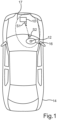
- Fig.1 shows a motor vehicle 14 according to an embodiment in a top view.
- the motor vehicle 14 has a parking assistance system 17.
- the parking assistance system 17 includes further components.
- the parking assistance system 17 has a computing module 10, which has a first interface S1.
- a second interface S2 is arranged on a mobile handset 16.
- the mobile handset 16 has a neural network 12.
- the mobile handset can communicate with the computing module 10 via the two interfaces S1 and S2.
- Information relating to a parking space 22 is exchanged between these two interfaces.
- the computing module 10 can transmit the data relating to the parking space 22 to the mobile handset 16 or the mobile handset 16 can request this data from the computing module 10.
- Fig.1 indicated by a dashed arrow, which connects the first interface S1 with the second interface S2.
- the computing module 10 is arranged in the motor vehicle 14.
- the computing module is located outside the vehicle.
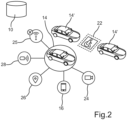
- Fig.2 shows an example of a situation that often occurs in parking garages.
- the motor vehicle 14 and the other different motor vehicles 14' are in a parking garage.
- a driver of the motor vehicle 14 is looking for a parking space, for example.
- the motor vehicle 14 can have several different sensors.
- the motor vehicle 14 has a camera 24, the mobile handset 16, a GPS sensor 26, an ultrasonic sensor 28 and a WLAN module 25. All of these sensors can be combined to form a sensor device.
- the mobile handset 16 can connect to the vehicle assistance system of the motor vehicle 14 using a Bluetooth connection.
- the camera 24 could take pictures of the parking space 22.
- the ultrasonic sensor 28 could, for example, determine that there is in principle sufficient space for the motor vehicle 14 in the area of the parking space 22. This data is subsequently transmitted to the mobile handset 16. The mobile handset 16 can instead request or retrieve this data directly. It is fundamentally irrelevant whether the data relating to the parking space 22 was obtained from the sensor device of the motor vehicle 14 or whether this data was transmitted by the computing module 10.
- the computing module 10 is no longer part of the motor vehicle 14, but in this case represents an external cloud server.
- This external cloud server can, for example, be part of a parking guidance system.
- the mobile handheld device 16 classifies the data relating to the parking space 22. In doing so, the mobile handheld device 16 uses the neural network 12 in particular. In this case, the mobile handheld device 16 can recognize that there is a disabled symbol in the area of the parking space 22. Experience has shown that this means that this parking space is not open to all drivers. It is assumed that a driver of the motor vehicle 14 is not authorized to park in the parking space 22. In this case, the mobile handheld device 16 informs the user of the motor vehicle 14 that he is not allowed to use the parking space 22. The mobile handheld device 16 can generate and provide further useful metadata relating to the parking space 22 using sign recognition. For example, there could be a QR code in the area of the parking space 22 that the mobile handheld device 16 can read and evaluate. The mobile handheld device can also retrieve statistical information about this parking space 22 or add the newly processed data to these statistics.
- the mobile handset 16 can process the data relating to the parking space 22 and classify it in the form of metadata.
- the mobile handset 16 stores these processed metadata in an internal memory. This is particularly advantageous when there is temporarily no data connection to the computing module 10. If the motor vehicle 14 leaves the vehicle in the example of Fig.2 the parking garage, the mobile handset 16 can usually then establish a data connection to the computing module 10 at the latest and transmit the processed data to the computing module 10. However, this can also be dependent on the permission of the user of the motor vehicle 14.
- the classification of the data relating to the parking space can be carried out within an app of the mobile handheld device 16. Since the mobile handheld device 16 carries out the classification, the generation of metadata relating to the parking space 22 can also take place independently of an external computer device. The classification of the data relating to the parking space 22 can thus also take place in areas of a parking garage where no data connection is possible. This means that the database relating to the data of the possible parking spaces can be increased. This increased database can in turn be used to effectively train the neural network 12.
- a particularly advantageous fact is that no permanent data connection to an external computer device is necessary in order to classify the data relating to the parking space 22. This means that the latency can be reduced and the mobile handheld device 16 can generate rapid feedback regarding a potential parking space.
- the classification still works even if the mobile handheld device has no data connection with an external unit or loses this data connection. As soon as the mobile handset 16 has received the data relating to the parking space 22, the classification can be carried out. Data that has already been classified as a parking space can be temporarily stored within an app. This allows other users to use this information for themselves and find a parking space more quickly and conveniently.
- the mobile handheld device 16 can in particular recognize whether the parking space is suitable as a parking space or not.
- the mobile handheld device 16 can also recognize whether the motor vehicle 14 should be parked forwards, backwards or sideways.
- the mobile handheld device 16 can generate further metadata such as parking fees or parking statistics and make them available to other users.
- the metadata is preferably made available to other users by transmitting the processed data to the computing module 10. The mobile handheld device 16 can thus retrieve data from the external computer device and thus benefit from information from other mobile handheld devices.
- a friend of the driver may also be in a parking garage in which the driver of the motor vehicle is looking for a parking space.
- This friend could, for example, discover a parking space 22 and use his smartphone to transmit data about this parking space to the driver's mobile handset 16.
- the mobile handset 16 can receive a photo of the parking space 22 from the smartphone.
- the mobile handset 16 can analyze this photo and classify the data (here the photo).
- the mobile handset 16 can access data from a cloud server and use this data for classification.
- this cloud server provides current data on parking spaces 22. This allows the driver of the motor vehicle to find a suitable parking space more quickly. This can shorten the search for a parking space.
Landscapes
- Engineering & Computer Science (AREA)
- Theoretical Computer Science (AREA)
- Physics & Mathematics (AREA)
- General Physics & Mathematics (AREA)
- Multimedia (AREA)
- Evolutionary Computation (AREA)
- General Health & Medical Sciences (AREA)
- Health & Medical Sciences (AREA)
- Artificial Intelligence (AREA)
- Software Systems (AREA)
- Computing Systems (AREA)
- Medical Informatics (AREA)
- Databases & Information Systems (AREA)
- Computer Vision & Pattern Recognition (AREA)
- Biophysics (AREA)
- Analytical Chemistry (AREA)
- Life Sciences & Earth Sciences (AREA)
- Biomedical Technology (AREA)
- Chemical & Material Sciences (AREA)
- Computational Linguistics (AREA)
- Data Mining & Analysis (AREA)
- Molecular Biology (AREA)
- General Engineering & Computer Science (AREA)
- Mathematical Physics (AREA)
- Traffic Control Systems (AREA)
Description
- Die vorliegende Erfindung betrifft ein Verfahren zum Klassifizieren von Daten betreffend eine Parklücke für ein Kraftfahrzeug mittels eines mobilen Handgeräts. Diese Erfindung beschreibt ebenfalls ein Parkassistenzsystem eines Kraftfahrzeugs zum Klassifizieren von Daten betreffend eine Parklücke.
- Heutzutage sind viele Kraftfahrzeuge mit Parkassistenzsystemen ausgestattet. Diese Parkassistenzsysteme verwenden meistens Ultraschallsignale, welche von Ultraschallsensoren gewonnen werden. Dabei kommt es häufig vor, dass die Ultraschallsignale fälschlicherweise einen freien Raum als Parkplatz anzeigen. Dies kann beispielsweise daran liegen, dass mittels der Ultraschallsignale zwar eine Parklücke als freier Raum erkannt werden kann, jedoch daraus nicht zwangsläufig folgt, dass es sich dabei um einen Parkplatz für das Kraftfahrzeug handelt. In vielen Fällen kann diese zusätzliche Information einem Parkassistenzsystem durch eine externe Recheneinheit übermittelt werden. Doch gerade bei Parkvorgängen innerhalb von Gebäuden kann es häufig vorkommen, dass zwischen dem Parkassistenzsystem des Kraftfahrzeugs und der externen Recheneinheit keine Datenverbindung möglich ist. Zudem verfügen viele externe Recheneinheiten nicht zwangsläufig über die notwendigen Hardwarekapazitäten, um für alle Kraftfahrzeuge aufbereitete Daten für mögliche Parkplätze zur Verfügung stellen zu können.
- Die Offenlegungsschrift
DE 10 2013 100 953 A1 beschreibt ein Verfahren und ein System zum Auffinden freier Parkplatzpositionen in einem Großraum. Daten zu Belegungszuständen von Flächen innerhalb eines Großraums, insbesondere Informationen über unbelegte Parkplätze, werden bereitgestellt und können abgerufen werden. Dabei erfolgt die Erfassung der Daten zu den Belegungszuständen von Flächen mittels in einem Großraum angeordneten Sensoren und/oder mittels Sensoren, die an sich aufhaltenden Fahrzeugen im Großraum angeordnet sind. Diese Informationen können mit Informationen, welche mittels einer Positionsbestimmungseinrichtung gewonnen werden können, verknüpft werden. Diese verknüpften Daten können an die dem Großraum zugeordnete Parkleitzentrale übertragen werden. Die Offenlegungsschrift offenbart ferner eine Verarbeitungseinrichtung der Parkleitzentrale, welche dazu ausgebildet ist, mittels der erhobenen beziehungsweise übermittelten Daten eine Wahrscheinlichkeit oder die mittlere Frei-Zeit dieser Parkplatzpositionen zu ermitteln. - Die Offenlegungsschrift
DE 10 2012 216 994 A1 beschreibt ein Verfahren zur Parkplatzvermittlung und ein freier-Parkplatz-Assistenzsystem. Dabei ermitteln Verkehrsteilnehmer Informationen über freie Parkplätze und diese Informationen werden an ein Cloud-Computing-System übermittelt. Dabei können insbesondere Meta-Informationen über freie und belegte Parkplätze ermittelt werden und diese Informationen dem Cloud-Computing-System übermittelt werden. -
DE 20 2015 104709 U1 offenbart eine mobile Kommunikationseinrichtung, insbesondere Mobilfunktelefon, mit einem Anzeigemittel, mit Eingabemitteln, einer Fahrzeugkonnektierungs-Schnittstelle für eine Verbindung zu einem Fahrzeug und einer Infrastruktur-Schnittstelle für eine Verbindung zu einem Bauwerk, insbesondere Parkhaus, wobei das Fahrzeug und das Bauwerk Sensoren und/oder Aktuatoren und/oder Daten aufweisen, welche über die Fahrzeugkonnektierungs-Schnittstelle und/oder die Infrastruktur-Schnittstelle abfragbar sind. Die mobile Kommunikationseinrichtung ist derart eingerichtet, dass bei einer Kommunikationsverbindung mit dem Bauwerk - insbesondere ein Lageplan des Bauwerks, insbesondere über die Infrastruktur-Schnittstelle, an die mobile Kommunikationseinrichtung übermittelt wird, - Fahrzeugdaten, insbesondere Höhe, Länge und/oder Breite des Fahrzeugs über die Fahrzeugkonnektierungs-Schnittstelle an die mobile Kommunikationseinrichtung übermittelt werden, - eine Auswahl oder Zuweisung eines Parkplatzes für das Fahrzeug über die Infrastruktur-Schnittstelle an die mobile Kommunikationseinrichtung übermittelt wird, - Navigationsinformationen bereitgestellt und/oder Positionsinformationen bestimmt werden, welche mittels der Sensoren des Bauwerks ermittelt werden. -
EP 3 349 201 A1 offenbart ein Fahrzeug-Einparkhilfesystem umfassend eine omnidirektionale Fahrzeugkamera mit einem Sichtfeld von etwa 360 Grad zumindest in der horizontalen Ebene, die an einem Dach des Fahrzeugs angebracht ist, wobei die omnidirektionale Fahrzeugkamera so konfiguriert und angeordnet ist, dass sie mindestens ein Bild einer Umgebung in der Nähe des Fahrzeugs aufnimmt, eine Recheneinheit, die mit der omnidirektionalen Fahrzeugkamera zum Empfangen von Daten des mindestens einen Bildes gekoppelt ist, wobei die Recheneinheit konfiguriert ist, um aus den Daten des mindestens einen Bildes für das Fahrzeug mindestens einen Parametersatz zu bestimmen, der auf mindestens eine Eigenschaft eines Kandidatenparkplatzes für das Fahrzeug hinweist, eine Vielzahl von Fahrzeugen, die sich in der Umgebung befinden, und eine Verarbeitungseinheit, die mit der Recheneinheit wirksam gekoppelt und konfiguriert ist, um mindestens einen Kandidatenparkplatz aus dem Parametersatz zu ermitteln. Die Verarbeitungseinheit ist so konfiguriert, dass sie eine Datendarstellung zumindest eines Teils der Umgebung mit einer Darstellung des ermittelten mindestens einen Kandidatenparkplatzes für eine grafische Benutzerschnittstelle für eine Fahrerassistenz bereitstellt. -
US 2017/294121 A1 offenbart Verfahren, Systeme und Computerprogrammprodukte zum Erfassen verfügbarer Parkplätze in einer Parkumgebung. Radarsysteme werden verwendet, um Daten über die Umgebung eines Parkplatzes zu sammeln. Die Radardaten werden einem neuronalen Netzmodell als Input zur Verfügung gestellt. Algorithmen, die neuronale Netze verwenden, können darauf trainiert werden, geparkte Fahrzeuge und widersprüchliche Daten bezüglich Trümmern, Einkaufswagen, Straßenlaternen, Verkehrsschildern, Fußgängern usw. zu erkennen. Das neuronale Netzmodell verarbeitet die Radardaten, um Parkraumgrenzen abzuschätzen und die Parkraumgrenzen als Splines anzunähern. Das neuronale Netzmodell gibt Spline-Schätzungen an ein Fahrzeugcomputersystem aus. Das Computersystem des Fahrzeugs nutzt die Spline-Schätzungen, um freie Parkplätze zu erkennen. Die Spline-Schätzungen werden aktualisiert, wenn das Fahrzeug durch die Parkumgebung navigiert. - Die Aufgabe der vorliegenden Erfindung besteht darin, ein verbessertes Verfahren zum Klassifizieren von Daten betreffend eine Parklücke und entsprechendes Parkassistenzsystem bereitzustellen.
- Diese Aufgabe wird durch die unabhängigen Ansprüche dieser Erfindung gelöst. Vorteilhafte Weiterbildungen sind in den Unteransprüchen und in den Beispielen gegeben.
- Diese Erfindung sieht ein Verfahren zum Klassifizieren von Daten betreffend eine Parklücke für ein Kraftfahrzeug mittels eines mobilen Handgeräts vor. Durch das Klassifizieren werden Informationen über die Parklücke in Form von Metadaten ermittelt und einem Fahrer des Kraftfahrzeugs zur Verfügung gestellt.
- Eine Parklücke kann insbesondere ein freier Raum auf der Erdoberfläche sein, auf dem ein Kraftfahrzeug abgestellt werden kann. Demzufolge bedeutet der Begriff Parklücke nicht zwingend, dass anhand anderer Objekte eine Lücke gegeben sein muss. In vielen Fällen ist jedoch eine Parklücke anhand mehrerer Kraftfahrzeuge gegeben. Beispielsweise können zwei Kraftfahrzeuge auf einem Parkareal so angeordnet sein, dass zwischen diesen beiden Kraftfahrzeugen eine Parklücke gegeben ist. Diese beiden Kraftfahrzeuge können jedoch auch an der Seite einer Straße so geparkt sein, dass entlang einer Längsausdehnung dieser Kraftfahrzeuge zwischen diesen beiden Kraftfahrzeugen eine Parklücke gegeben ist. In diesem Fall könnte ein weiteres Kraftfahrzeug seitlich eingeparkt werden. Somit können Parklücken ein paralleles oder ein senkrechtes Einparken ermöglichen. Die Parklücken können demnach senkrecht, parallel oder schräg zu einer sich daran anschließenden Fahrbahn angeordnet sein. In einem Parkhaus beispielsweise können die Parklücken schräg zu der Fahrbahn angeordnet sein.
- Häufig sind Parklücken durch entsprechende Markierungen gekennzeichnet. Jedoch bedarf es grundsätzlich keiner Markierung oder anderer Objekte, damit eine Parklücke gegeben ist. Somit kann grundsätzlich jeder Ort als Parklücke gelten, welcher aufgrund seiner Abmessungen grundsätzlich ein Abstellen des jeweiligen Kraftfahrzeugs erlauben würde. Somit kann prinzipiell auch ein Feldweg oder eine Wiese theoretisch als Parklücke aufgefasst werden. Im Rahmen dieser Anmeldung wird selbstverständlich davon ausgegangen, dass die Parklücke stets auf einer Oberfläche angeordnet ist. Die Parklücke muss für das Kraftfahrzeug theoretisch durch Manövrieren des Kraftfahrzeugs erreichbar sein. Die jeweilige Oberfläche ist in aller Regel als Fahrbahn ausgebildet, kann jedoch in speziellen Fällen auch anders ausgestaltet sein (zum Beispiel eine Ebene eines Parklifts).
- In einem Schritt a) werden Daten, welche einen potentiellen Parkplatz für das Kraftfahrzeug darstellen, zu dem mobilen Handgerät übermittelt. Das mobile Handgerät ruft die Daten von einem Rechenmodul des Kraftfahrzeugs ab.
- Häufig erhält das mobile Handgerät Daten zu potentiellen Parkplätzen von einer Parkleitzentrale eines Parkhauses. Das mobile Handgerät kann jedoch diese Daten von einem anderen verschiedenen mobilen Handgerät erhalten. Diese Daten können von einem Rechenmodul der Parkleitzentrale oder dem anderen verschiedenen mobilen Handgerät dem mobilen Handgerät übermittelt werden beziehungsweise das mobile Handgerät kann diese Daten von den anderen Geräten abrufen.
- In einem Schritt b) werden die übermittelten Daten betreffend die Parklücke durch das mobile Handgerät klassifiziert. Dies bedeutet, dass das Klassifizieren der übermittelten Daten nicht durch eine externe Recheneinheit oder ein Rechenmodul des Kraftfahrzeugs erfolgt, sondern durch das mobile Handgerät. Dabei weist das mobile Handgerät ein neuronales Netz auf und das mobile Handgerät setzt das neuronale Netz zum Klassifizieren der übermittelten Daten ein. Das mobile Handgerät übermittelt nach dem Klassifizieren ein Ergebnis betreffend die Parklücke an das Rechenmodul des Kraftfahrzeugs.
- Das neuronale Netz weist insbesondere Deep Learning-Algorithmen auf. Damit wird beabsichtigt, menschliche Denkstrukturen mittels des neuronalen Netzes nachzubilden. Dazu wird das neuronale Netz vorzugsweise im Vorfeld trainiert. Dies bedeutet, dass das neuronale Netz vorab mit Trainingsdaten trainiert wurde. Als Trainingsdaten können verschiedene Datensätze, verschiedene Merkmale aus unterschiedlichen Situationen oder verschiedene Bilder infrage kommen.
- Häufig werden Bilder, Texte sowie eine Spracherkennung und verschiedene Sensordaten (beispielsweise Ultraschalldaten) als Trainingsdaten verwendet. Das Trainieren des neuronalen Netzes beansprucht in der Regel sehr viele digitale Ressourcen, sodass das Trainieren des neuronalen Netzes idealerweise vorab durch einen Hochleistungscomputer durchgeführt wird. Ist das neuronale Netz bereits trainiert, so kann es problemlos auf dem mobilen Handgerät installiert werden und dort zum Einsatz kommen. Damit kann das mobile Handgerät die Daten betreffend die Parklücke näher spezifizieren und somit klassifizieren. Unter dem Begriff Klassifizieren versteht man das Erzeugen und Bereitstellen von Metadaten. In der Regel beschreiben die Daten betreffend die Parklücke Positionsdaten eines möglichen Parkplatzes. Im Rahmen der Klassifizierung durch das neuronale Netz des mobilen Handgeräts werden weitere für einen Fahrer des Kraftfahrzeugs interessante Informationen gewonnen und bereitgestellt. Zu diesen Informationen zählen beispielsweise anfallende Parkgebühren, Parkstatistiken, Einbruchstatistiken von Kraftfahrzeugen, welche an diesem Parkplatz abgestellt wurden, Parkberechtigungen, Art des Parkplatzes (Behindertenparkplatz, Anwohnerparkplatz, Familien- oder Frauenparkplatz), zu erwartende Geldstrafe bei einem nicht erlaubten Parkvorgang etc. All diese Informationen werden in Form von Metadaten durch das mobile Handgerät, welches ein neuronales Netz einsetzt, ermittelt und einem Fahrer zur Verfügung gestellt
- Es ist vorzugsweise vorgesehen, dass derartige Metadaten von dem mobilen Handgerät an ein Rechenmodul einer Parkleitzentrale übermittelt wird. Sollte dies aufgrund einer fehlenden Datenverbindung, welche häufig innerhalb von Parkhäusern nicht gegeben ist, zeitweise nicht möglich sein, so ist insbesondere vorgesehen, dass diese Metadaten temporär zwischengespeichert werden und dann übermittelt werden, sobald eine Datenverbindung verfügbar ist. Durch den Einsatz des mobilen Handgeräts kann die Klassifizierung der Daten betreffend die Parklücke jeweils durch das entsprechende mobile Handgerät vorgenommen werden. Ein zentrales Rechenmodul einer Parkleitzentrale kann so deutlich entlastet werden. Da das mobile Handgerät in der Regel lediglich Daten betreffend die Parklücke für ein jeweiliges Kraftfahrzeug auswertet, ist in aller Regel keine Überforderung des mobilen Handgeräts gegeben. Da viele Besitzer eines Kraftfahrzeugs ebenfalls ein Smartphone besitzen, kann so das Klassifizieren der Daten auf mehrere Smartphones verteilt werden. Das mobile Handgerät kann demnach als Smartphone, Tablet oder als Mini-Computer (PDA) ausgebildet sein.
- Eine weitere Variante dieser Erfindung sieht vor, dass die Daten verschlüsselt übermittelt werden. Viele Benutzer des Kraftfahrzeugs legen hohen Wert auf eine Sicherheit ihrer Daten. Es ist meistens nicht erwünscht, dass fremde Personen den genauen Parkplatz beziehungsweise Abstellort des eigenen Kraftfahrzeugs erfahren. Aus diesem Grund werden die Daten betreffend die Parklücke bevorzugt verschlüsselt übermittelt. Die Verschlüsselung erstreckt sich insbesondere nicht nur auf das Übermitteln der Daten betreffend die Parklücke, sondern die Verschlüsselung kann sich auch auf das Übermitteln der klassifizierten Daten erstrecken, welche an ein Rechenmodul der Parkleitzentrale gesendet werden können. Somit kann gewährleistet werden, dass lediglich ein berechtigter Benutzer Informationen beziehungsweise Metadaten bezüglich des Parkplatzes erhält.
- Eine weitere Ausführungsform dieser Erfindung sieht vor, dass das mobile Handgerät anhand der abgerufenen Daten für das Klassifizieren eine Musteranalyse betreffend den möglichen Parkplatz durchführt. Eine Musteranalyse kann beispielsweise anhand mehrerer Bilder vorgenommen werden, welche mittels einer Kamera erfasst werden können. Dabei kann das Bild als Ganzes als Muster aufgefasst werden, welches in Untermuster zerteilt werden kann. Die jeweiligen Untermuster können hinsichtlich des potentiellen Parkplatzes detaillierter untersucht werden. Hat beispielsweise eine Parklücke zwar genügend Fläche zum Abstellen eines Kraftfahrzeugs, so bedeutet dies noch nicht zwangsläufig, dass es sich um einen tatsächlichen Parkplatz handelt. Beispielsweise kann die Parklücke eine gebogene Form aufweisen, womit die Parklücke sich nicht als Parkplatz eignen würde. Die Musteranalyse kann in diesem Fall diese gebogene Form der Parklücke, welche als bananenförmig beschrieben werden kann, erkennen. Damit kann das mobile Handgerät feststellen, dass diese bananenförmige Parklücke sich nicht als Parkplatz für das Kraftfahrzeug eignet. Damit kann mithilfe der Musteranalyse festgestellt werden, ob die Parklücke eine atypische Form aufweist, welche das Abstellen des Kraftfahrzeugs erschwert oder nicht möglich macht.
- Eine weitere Ausführungsform dieser Erfindung sieht vor, dass das mobile Handgerät die Daten von einer Computereinrichtung abruft und nach dem Klassifizieren ein Ergebnis betreffend die Parklücke an die Computereinrichtung übermittelt. Die Computereinrichtung kann innerhalb des Kraftfahrzeugs angeordnet sein oder außerhalb des Kraftfahrzeugs angeordnet sein. Ist die Computereinrichtung innerhalb des Kraftfahrzeugs angeordnet, so ist sie häufig Teil eines Fahrzeugassistenzsystems. In der Regel ist diese Computereinrichtung mit verschiedenen Sensoren des Kraftfahrzeugs verbunden und kann so die Daten betreffend die Parklücke erheben. Diese Sensoren können beispielsweise Kameras, Ultraschallsensoren, Lidar-Sensoren, GPS-Sensoren oder WLAN-Module sein. Es ist auch möglich, dass lediglich ein einziger Sensor die Daten betreffend die Parklücke erfasst. Ist die Computereinrichtung außerhalb des Kraftfahrzeugs angeordnet so kann von einer externen Computereinrichtung gesprochen werden. In diesem Fall wird häufig von einem Cloudserver gesprochen. Dieser Cloudserver kann beispielsweise Teil eines Parkleitsystems für ein Parkhaus sein. Mehrere Parkhäuser können sich jedoch auch einen Cloudserver teilen. Somit können auf dem Cloudserver zu mehreren Parkhäusern Daten betreffend von mehreren Parklücken abrufbar vorhanden sein. Da das mobile Handgerät die Daten betreffend die Parklücke näher klassifiziert, ist es besonders vorteilhaft diese aufbereiteten Daten beziehungsweise Metadaten der Computereinrichtung zur Verfügung zu stellen. Somit können andere Benutzer ebenfalls in den Genuss dieser Metadaten kommen.
- Eine weitere Ausführungsform dieser Erfindung sieht vor, dass das mobile Handgerät das Ergebnis in Abhängigkeit von einem Freigabesignal an die Computereinrichtung übermittelt. Das Freigabesignal kann dabei durch den Benutzer des mobilen Handgeräts erzeugt werden. Dies bedeutet, dass das Ergebnis des Klassifizierens durch das mobile Handgerät nur dann an die Computereinrichtung übermittelt wird, wenn der Benutzer dazu seine Erlaubnis in Form des Freigabesignals erteilt. In vielen Fällen ist das mobile Handgerät als Smartphone ausgebildet. Hier kann der Benutzer durch eine globale Einstellung in dem Smartphone die Erlaubnis erteilen, dass das mobile Handgerät das Ergebnis des Klassifizierens an die Computereinrichtung übermittelt. Somit kann der Nutzer des Smartphones beziehungsweise des mobilen Handgeräts über die Weiterverwendung der aufbereiteten Daten entscheiden. Datenschutzrechtliche Bedenken können so entkräftet werden und das Vertrauen in die Nutzung dieser Technik kann so gesteigert werden.
- Eine weitere Ausführungsform sieht vor, dass das mobile Handgerät einen dem Kraftfahrzeug zugeordneten Benutzer identifiziert. In den meisten Fällen ist das mobile Handgerät einem oder mehreren Benutzern zugeordnet. Dabei ist es oft nicht erwünscht, dass fremde Benutzer das erfindungsgemäße Verfahren ausführen können. Daher sieht diese Ausführungsform der Erfindung explizit eine Identifikation des Benutzers durch das mobile Handgerät vor. Das mobile Handgerät würde das Klassifizieren der übermittelten Daten betreffend die Parklücke nur dann ausführen, wenn der Benutzer des mobilen Handgeräts genau dem Kraftfahrzeug zugeordneten Benutzer entspricht. Somit kann verhindert werden, dass das mobile Handgerät fälschlicherweise zu Unrecht durch eine fremde Person missbraucht wird.
- Eine weitere Variante dieser Erfindung sieht vor, dass das Identifizieren mittels einer Eingabe eines PIN-Codes und/oder mittels biometrischer Daten des Benutzers erfolgt. In der Regel ist der PIN-Code lediglich dem berechtigten Benutzer bekannt. Die biometrischen Daten des Benutzers können den Benutzer beschreiben. Als biometrische Daten können beispielsweise der Klang einer Stimme, ein Fingerabdruck, eine Gesichtsform, eine Iris des Auges in Betracht kommen. Diese biometrischen Daten können in den allermeisten Fällen eindeutig einer ganz bestimmten Person zugeordnet werden. Durch das Verwenden des PIN-Codes und/oder der biometrischen Daten zum Identifizieren kann sichergestellt werden, dass ausschließlich der berechtigte Benutzer das Klassifizieren der übermittelten Daten ausführen kann.
- Eine weitere Ausführungsform dieser Erfindung sieht vor, dass das mobile Handgerät zusätzlich zum Klassifizieren der Daten Steuersignale zum Manövrieren des Kraftfahrzeugs erzeugt. Als Beispiel sei hier das Remoteparken mittels eines Smartphones genannt. Beim Remoteparken wird das Kraftfahrzeug vorzugsweise mittels des mobilen Handgeräts ferngesteuert. Das mobile Handgerät fungiert in diesem Fall wie eine Art "Fernbedienung des Kraftfahrzeugs". In vielen Fällen muss beim Remoteparken kein menschlicher Fahrer innerhalb des Kraftfahrzeugs sein. Jedoch sehen bis jetzt die meisten Remoteparken-Systeme vor, dass der Fahrer den Remoteparkvorgang ständig überwacht und jederzeit den Vorgang abbrechen kann. So wird beispielsweise versucht, mittels einer Kreisbewegung eines Fingers auf einer Oberfläche des mobilen Handgeräts sicherzustellen, dass der Fahrer am Remoteparken aktiv beteiligt sein muss.
- Grundsätzlich kann sich das mobile Handgerät mit einem Fahrzeugassistenzsystem vernetzen. Damit kann das mobile Handgerät Steuersignale zu dem Fahrzeugassistenzsystem übertragen. Somit kann das mobile Handgerät nicht nur zum Erkennen geeigneter Parkplätze verwendet werden, sondern darüber hinaus zusätzlich zum Einparken des Kraftfahrzeugs selbst. In diesem Fall kann die Parklücke sogar kleiner als üblich ausfallen, da ein Aussteigen des Fahrers beziehungsweise Nutzers des Kraftfahrzeugs nicht mehr nötig ist. Das heißt eine Parklücke, welche üblicherweise zu klein zum Einparken wäre, kann in diesem Fall dennoch als Abstellort für das Kraftfahrzeug gewählt werden. In diesem Fall kann der Benutzer des Kraftfahrzeugs vor einem Einparkvorgang sein Kraftfahrzeug verlassen und das Kraftfahrzeug mittels des mobilen Handgeräts in den Parkplatz manövrieren. Dazu kann der Benutzer des Kraftfahrzeugs mittels seines mobilen Handgeräts Steuersignale erzeugen, welche das Kraftfahrzeug manövrieren. Somit kann das mobile Handgerät dem Benutzer des Kraftfahrzeugs dabei helfen, nicht nur einen geeigneten Parkplatz zu finden, sondern sein Kraftfahrzeug auch in diesen Parkplatz zu manövrieren. Wenn das mobile Handgerät die Funktion Remoteparken berücksichtigen kann, kann das mobile Handgerät auch Parkplätze berücksichtigen, welche im Vergleich zu üblichen Parkplätzen schmäler sind, da nicht mehr ausgestiegen werden muss.
- Eine weitere Variante dieser Erfindung sieht vor, dass das mobile Handgerät ein Ergebnis des Klassifizierens auf einem internen Speicher des mobilen Handgeräts speichert. In vielen Fällen ist es erwünscht, dass das Ergebnis des Klassifizierens mit anderen Benutzern geteilt wird. Dies kann beispielsweise durch ein Übermitteln der Daten an die externe Computereinrichtung erfolgen. Innerhalb von Gebäuden kann es jedoch häufig vorkommen, dass eine Datenverbindung zu dieser externen Computereinrichtung nicht vorhanden ist. Daher ist es sehr vorteilhaft, das Ergebnis des Klassifizierens auf dem internen Speicher des mobilen Handgeräts temporär zu speichern. Das Ergebnis des Klassifizierens kann dann später übermittelt werden, wenn eine Datenverbindung zu der externen Computereinrichtung wieder vorhanden ist. Somit kann sichergestellt werden, dass die von dem mobilen Handgerät aufbereiteten Daten betreffend die Parklücke nicht verloren gehen und von anderen Benutzern genutzt werden können.
- Eine weitere Variante dieser Erfindung sieht vor, dass mittels einer WLAN-basierten Ortung eine Position des mobilen Handgeräts bestimmt wird. Häufig wird eine Ortung mittels GPS durchgeführt, wie es bei Navigationsgeräten üblich ist. Diese Technik kann jedoch innerhalb von Gebäuden nicht zur Verfügung stehen. In dieser Situation sieht diese Variante der Erfindung vor, dass die Position des mobilen Handgeräts mittels der WLAN-basierten Ortung festgestellt wird. Somit kann sichergestellt werden, dass die durch das mobile Handgerät aufbereiteten Daten stets einer Position zugeordnet werden können. Andere Fahrer von Kraftfahrzeugen können so im Vorfeld über mögliche freie Parkplätze informiert werden. Dies kann die Parkplatzsuche erheblich vereinfachen und verkürzen.
- Die Erfindung sieht ein Parkassistenzsystem eines Kraftfahrzeugs mit einem Rechenmodul vor, welches eine erste Schnittstelle zum Kommunizieren mit einem mobilen Handgerät aufweist. Das Rechenmodul ist zudem ausgebildet, Daten betreffend eine Parklücke für ein Kraftfahrzeug zu erzeugen. Das Parkassistenzsystem weist ferner das mobile Handgerät auf, welches eine zweite Schnittstelle zum Kommunizieren mit dem Rechenmodul und ein neuronales Netz aufweist. Dabei ist das mobile Handgerät ausgebildet, die übermittelten Daten betreffend die Parklücke mittels des neuronalen Netzes zu klassifizieren. Durch das Klassifizieren werden Informationen über die Parklücke in Form von Metadaten ermittelt und einem Fahrer des Kraftfahrzeugs zur Verfügung gestellt. Das mobile Handgerät übermittelt nach dem Klassifizieren ein Ergebnis betreffend die Parklücke an das Rechenmodul.
- Das Rechenmodul kann die Daten betreffend die Parklücke zu dem mobilen Handgerät übertragen oder das mobile Handgerät kann von sich aus die Daten von dem Rechenmodul abrufen. Dabei erfolgt die Kommunikation zwischen dem Rechenmodul und dem mobilen Handgerät über die erste Schnittstelle und die zweite Schnittstelle. Das Rechenmodul kann innerhalb eines Fahrzeugassistenzsystems angeordnet sein beziehungsweise in dem Fahrzeugassistenzsystem implementiert sein.
- In einer Ausführungsform, die nicht durch die beanspruchte Erfindung abgedeckt ist, kann das Rechenmodul außerhalb des Kraftfahrzeugs angeordnet sein. In diesem Fall kann von einem externen Rechenmodul gesprochen werden. Das Rechenmodul kann insbesondere als externer Cloudserver ausgebildet sein. Die genannten Beispiele und Vorteile der vorangegangenen Ausführungsformen und Varianten gelten sinngemäß für das Parkassistenzsystem.
- Eine weitere Ausführungsform sieht ein Parkassistenzsystem mit einer Sensoreinrichtung vor, die ausgebildet ist, Informationen zu einer Umgebung des Kraftfahrzeugs zu erfassen und diese Informationen dem mobilen Handgerät zu übermitteln. Die Sensoreinrichtung ist vorzugsweise in oder an dem Kraftfahrzeug angeordnet. Die Sensoreinrichtung kann über einen oder mehrere Sensoren verfügen. In der Regel verfügt die Sensoreinrichtung über mehrere Sensoren. Diese Sensoren dienen dabei insbesondere zur Generierung der die Parklücke betreffenden Daten. Somit können die die Parklücke betreffenden Daten vor Ort ermittelt werden. Sie können insbesondere auch dann ermittelt werden, wenn zu einer externen Computereinrichtung keine Funkverbindung möglich ist. Somit kann sichergestellt werden, dass stets Daten betreffend die Parklücke erzeugt werden können und diese im weiteren Verlauf durch das mobile Handgerät klassifiziert werden können. Die Ausfallsicherheit des erfindungsgemäßen Verfahrens kann so gesteigert werden.
- Es kann vorgesehen sein, dass das mobile Handgerät Teil der Sensoreinrichtung ist. In diesem Fall wird das mobile Handgerät selbst dazu verwendet, Daten betreffend die Parklücke bereitzustellen. So kann das mobile Handgerät zum Beispiel als Smartphone ausgeführt sein, welches eine Kamera aufweist. Damit könnten Bilder von einem potentiellen Parkplatz gemacht werden. Im weiteren Verlauf kann das mobile Handgerät diese Daten bewerten beziehungsweise klassifizieren. In diesem Fall würde das Übermitteln der Daten aus Schritt a) lediglich eine "interne Bereitstellung" der Daten bedeuten. Das mobile Handgerät kann nicht nur zum Klassifizieren der Daten eingesetzt werden. Darüber hinaus kann es prinzipiell auch zur Datenerfassung von Daten zu potentiellen Parkplätzen verwendet werden.
- Eine weitere Ausführungsform dieser Erfindung sieht ein Parkassistenzsystem vor, wobei die Sensoreinrichtung einen Ultraschallsensor, eine Kamera, einen Lidar-Sensor und/oder ein WLAN-Modul aufweist. Mithilfe eines Ultraschallsensors können Parklücken zumindest grob erfasst werden. Ultraschallsensoren werden häufig zur Kollisionsvermeidung eingesetzt. Eine Kamera dient dazu, Bilder von der Umgebung des Kraftfahrzeugs aufzunehmen. Mittels einer entsprechenden Bildverarbeitung können so potentielle Parklücken erkannt werden. Das mobile Handgerät kann mittels seines neuronalen Netzes diese von der Kamera erzeugten Bilder detaillierter untersuchen und somit die Klassifizierung durchführen. Mithilfe des WLAN-Moduls kann das mobile Handgerät auch dann geortet werden, wenn innerhalb eines Gebäudes die GPS-Ortung nicht funktioniert. Der Lidar-Sensor kann darüber hinaus detaillierte Daten seiner Umgebung bereitstellen. Idealerweise verfügt die Sensoreinrichtung über mehrere unterschiedliche Sensoren, welche sich in ihrer Wirkung idealerweise ergänzen. Somit können aussagekräftige Daten betreffend die Parklücke erzeugt werden. Je detaillierter und aussagekräftiger diese Daten ausgestaltet sind, desto besser kann das mobile Handgerät diese Daten im Rahmen der Klassifizierung aufbereiten. Das mobile Handgerät kann Informationen von unterschiedlichen Sensoren zum Klassifizieren der Daten betreffend die Parklücke verwerten.
- Weitere Merkmale der Erfindung ergeben sich aus den Ansprüchen, den Figuren und der Figurenbeschreibung. Die vorstehend in der Beschreibung genannten Merkmale und Merkmalskombinationen sowie die nachfolgend in der Figurenbeschreibung genannten und/oder in den Figuren alleine gezeigten Merkmale und Merkmalskombinationen sind nicht nur in der jeweils angegebenen Kombination, sondern auch in anderen Kombinationen verwendbar, ohne den Rahmen der Erfindung zu verlassen. Der Schutzumfang der Erfindung ist durch die nachstehenden Patentansprüche definiert.
- Die Erfindung wird nun anhand von bevorzugten Ausführungsbeispielen sowie unter Bezugnahme auf die beigefügten Zeichnungen näher erläutert. Dabei zeigt:
- Fig. 1
- ein Kraftfahrzeug mit einem Parkassistenzsystem; und
- Fig. 2
- eine schematische Darstellung des Kraftfahrzeugs mit weiteren Kraftfahrzeugen und einer externen Computereinrichtung.
- In den Figuren werden gleiche und funktionsgleiche Elemente mit den gleichen Bezugszeichen versehen.
-
Fig. 1 zeigt ein Kraftfahrzeug 14 gemäß einer Ausführungsform in einer Draufsicht. Das Kraftfahrzeug 14 weist ein Parkassistenzsystem 17 auf. Das Parkassistenzsystem 17 beinhaltet weitere Komponenten. Das Parkassistenzsystem 17 weist ein Rechenmodul 10 auf, welches über eine erste Schnittstelle S1 verfügt. Eine zweite Schnittstelle S2 ist an einem mobilen Handgerät 16 angeordnet. Das mobile Handgerät 16 verfügt über ein neuronales Netz 12. Das mobile Handgerät kann mit dem Rechenmodul 10 über die beiden Schnittstellen S1 und S2 kommunizieren. Zwischen diesen beiden Schnittstellen werden Informationen betreffend eine Parklücke 22 ausgetauscht. Das Rechenmodul 10 kann die Daten betreffend die Parklücke 22 an das mobile Handgerät 16 übertragen beziehungsweise das mobile Handgerät 16 kann diese Daten von dem Rechenmodul 10 anfordern. Das Kommunizieren dieser beiden Geräte wird inFig. 1 durch einen gestrichelten Pfeil angedeutet, welcher die erste Schnittstelle S1 mit der zweiten Schnittstelle S2 verbindet. Im Beispiel vonFig. 1 ist das Rechenmodul 10 in dem Kraftfahrzeug 14 angeordnet. Im Beispiel vonFig. 2 ist das Rechenmodul außerhalb des Kraftfahrzeugs angeordnet. -
Fig. 2 zeigt beispielhaft eine Situation, wie sie in Parkhäusern häufig auftritt. Im Beispiel vonFig. 2 sei angenommen, dass das Kraftfahrzeug 14 sowie die weiteren unterschiedlichen Kraftfahrzeuge 14' sich in einem Parkhaus befinden. Ein Fahrer des Kraftfahrzeugs 14 sei beispielsweise auf der Suche nach einem Parkplatz. Das Kraftfahrzeug 14 kann über mehrere unterschiedliche Sensoren verfügen. In diesem Beispiel verfügt das Kraftfahrzeug 14 über eine Kamera 24, das mobile Handgerät 16, einen GPS-Sensor 26, einen Ultraschallsensor 28 sowie ein WLAN-Modul 25. All diese Sensoren können zu einer Sensoreinrichtung zusammengefasst werden. Das mobile Handgerät 16 kann sich mittels einer Bluetooth-Verbindung mit dem Fahrzeugassistenzsystem des Kraftfahrzeugs 14 verbinden. Im Beispiel vonFig. 2 könnte die Kamera 24 Bilder von der Parklücke 22 aufnehmen. Der Ultraschallsensor 28 könnte beispielsweise feststellen, dass im Bereich der Parklücke 22 prinzipiell ausreichend Platz für das Kraftfahrzeug 14 vorhanden wäre. Diese Daten werden im weiteren Verlauf dem mobilen Handgerät 16 übermittelt. Das mobile Handgerät 16 kann anstelle dessen diese Daten direkt anfordern beziehungsweise abrufen. Es spielt grundsätzlich keine Rolle, ob die Daten betreffend die Parklücke 22 von der Sensoreinrichtung des Kraftfahrzeugs 14 gewonnen wurden oder ob diese Daten durch das Rechenmodul 10 übermittelt wurden. Im Beispiel vonFig. 2 ist das Rechenmodul 10 nicht länger Teil des Kraftfahrzeugs 14, sondern stellt in diesem Fall einen externen Cloudserver dar. Dieser externe Cloudserver kann beispielsweise Teil eines Parkleitsystems sein. - Im Beispiel von
Fig. 2 klassifiziert das mobile Handgerät 16 die Daten betreffend die Parklücke 22. Dabei bedient sich das mobile Handgerät 16 insbesondere dem neuronalen Netz 12. In diesem Fall kann das mobile Handgerät 16 erkennen, dass im Bereich der Parklücke 22 ein Behindertensymbol vorhanden ist. Dies bedeutet erfahrungsgemäß, dass dieser Parkplatz nicht für alle Fahrer freigegeben ist. Es sei angenommen, dass ein Fahrer des Kraftfahrzeugs 14 keine Berechtigung zum Parken in der Parklücke 22 hat. In diesem Fall teilt das mobile Handgerät 16 dem Benutzer des Kraftfahrzeugs 14 mit, dass er die Parklücke 22 nicht benutzen darf. Das mobile Handgerät 16 kann mittels einer Schilderkennung weitere nützliche Metadaten betreffend die Parklücke 22 erzeugen und bereitstellen. Beispielsweise könnte sich im Bereich der Parklücke 22 ein QR-Code befinden, den das mobile Handgerät 16 auslesen und bewerten kann. Das mobile Handgerät kann ferner statistische Informationen zu dieser Parklücke 22 abrufen beziehungsweise die neu aufbereiteten Daten dieser Statistik hinzufügen. - Im vorliegenden Fall der
Fig. 2 kann das mobile Handgerät 16 die Daten betreffend die Parklücke 22 aufbereiten und in Form von Metadaten klassifizieren. Vorzugsweise speichert das mobile Handgerät 16 diese aufbereiteten Metadaten in einem internen Speicher ab. Dies ist besonders dann vorteilhaft, wenn vorübergehend keine Datenverbindung zu dem Rechenmodul 10 vorhanden ist. Verlässt das Kraftfahrzeug 14 im Beispiel vonFig. 2 das Parkhaus, so kann das mobile Handgerät 16 meistens spätestens dann eine Datenverbindung zu dem Rechenmodul 10 aufbauen und die aufbereiteten Daten dem Rechenmodul 10 übertragen. Dies kann jedoch zusätzlich von der Erlaubnis des Benutzers des Kraftfahrzeugs 14 abhängig sein. - Das Klassifizieren der Daten betreffend die Parklücke kann innerhalb einer App des mobilen Handgeräts 16 realisiert werden. Da das mobile Handgerät 16 das Klassifizieren durchführt, kann das Erzeugen von Metadaten betreffend die Parklücke 22 auch unabhängig von einer externen Computereinrichtung erfolgen. Das Klassifizieren der Daten bezüglich der Parklücke 22 kann so auch in Bereichen eines Parkhauses erfolgen, in denen keine Datenverbindung möglich ist. Somit kann die Datenbasis betreffend die Daten der möglichen Parklücken vergrößert werden. Diese vergrößerte Datenbasis kann wiederum zu einem effektiven Trainieren des neuronalen Netzes 12 verwendet werden. Besonders vorteilhaft ist der Umstand, dass keine dauerhafte Datenverbindung zu einer externen Computereinrichtung notwendig ist, um die Daten betreffend die Parklücke 22 zu klassifizieren. Damit kann die Latenzzeit reduziert werden und das mobile Handgerät 16 kann eine rasche Rückmeldung bezüglich eines potentiellen Parkplatzes erzeugen. Das Klassifizieren funktioniert auch dann noch, wenn das mobile Handgerät keine Datenverbindung mit einer externen Einheit hat beziehungsweise diese Datenverbindung verliert. Sobald das mobile Handgerät 16 die Daten betreffend die Parklücke 22 erhalten hat, kann die Klassifizierung durchgeführt werden. Bereits als Parkplätze klassifizierte Daten können innerhalb einer App zwischengespeichert werden. Damit können andere Benutzer diese Informationen für sich nutzen und schneller und bequemer einen Parkplatz finden.
- Das mobile Handgerät 16 kann insbesondere erkennen, ob die Parklücke als Parkplatz geeignet ist oder nicht. Das mobile Handgerät 16 kann ferner erkennen, ob das Kraftfahrzeug 14 vorwärts, rückwärts oder seitlich eingeparkt werden sollte. Darüber hinaus kann das mobile Handgerät 16 weitere Metadaten wie zum Beispiel die Parkgebühren oder Parkstatistiken erzeugen und für andere Nutzer bereitstellen. Das Bereitstellen der Metadaten für andere Benutzer erfolgt vorzugsweise durch Übermitteln der aufbereiteten Daten an das Rechenmodul 10. Somit kann das mobile Handgerät 16 Daten von der externen Computereinrichtung abrufen und somit von Informationen von anderen mobilen Handgeräten profitieren.
- So kann beispielsweise ein Freund des Fahrers sich ebenfalls in einem Parkhaus aufhalten, in dem der Fahrer des Kraftfahrzeugs einen Parkplatz sucht. Dieser Freund könnte zum Beispiel eine Parklücke 22 entdecken und mittels seines Smartphones dem mobilen Handgerät 16 des Fahrers Daten betreffend diese Parklücke übermitteln. Denkbar wäre, dass das mobile Handgerät 16 von dem Smartphone ein Foto der Parklücke 22 erhält. Das mobile Handgerät 16 kann dieses Foto analysieren und die Daten (hier das Foto) klassifizieren. Anstelle des Fotos von einem anderen Smartphone kann das mobile Handgerät 16 auf Daten von einem Cloudserver zugreifen und diese Daten zum Klassifizieren verwenden. Idealerweise stellt dieser Cloudserver aktuelle Daten zu Parklücken 22 bereit. Somit kann der Fahrer des Kraftfahrzeugs schneller einen für ihn passenden Parkplatz finden. Dies kann die Parkplatzsuche abkürzen.
Claims (15)
- Verfahren zum Klassifizieren von Daten betreffend eine Parklücke (22) für ein Kraftfahrzeug (14) mittels eines mobilen Handgeräts (16), wobei durch das Klassifizieren Informationen über die Parklücke in Form von Metadaten ermittelt werden und einem Fahrer des Kraftfahrzeugs (14) zur Verfügung gestellt werden, durch Ausführen folgender Verfahrensschritte:a) Übermitteln der Daten, welche einen potentiellen Parkplatz für das Kraftfahrzeug (14) darstellen, zu dem mobilen Handgerät (16), wobei das mobile Handgerät (16) die Daten von einem Rechenmodul (10) des Kraftfahrzeugs (14) abruft, undb) Klassifizieren der übermittelten Daten betreffend die Parklücke (22) durch das mobile Handgerät (16), wobei das mobile Handgerät (16) ein neuronales Netz (12) aufweist und das neuronale Netz (12) zum Klassifizieren der übermittelten Daten einsetzt, wobei das mobile Handgerät (16) nach dem Klassifizieren ein Ergebnis betreffend die Parklücke (22) an das Rechenmodul (10) des Kraftfahrzeugs (14) übermittelt.
- Verfahren nach Anspruch 1, wobei die Daten verschlüsselt übermittelt werden.
- Verfahren nach einem der vorigen Ansprüche, wobei das mobile Handgerät (16) anhand der abgerufenen Daten für das Klassifizieren eine Musteranalyse betreffend den möglichen Parkplatz durchführt.
- Verfahren nach einem der vorhergehenden Ansprüche, wobei das mobile Handgerät (16) das Ergebnis in Abhängigkeit von einem Freigabesignal an das Rechenmodul (10) übermittelt.
- Verfahren nach einem der vorigen Ansprüche, wobei das mobile Handgerät (16) einen dem Kraftfahrzeug (14) zugeordneten Benutzer identifiziert.
- Verfahren nach Anspruch 5, wobei das Identifizieren mittels einer Eingabe eines PIN-Codes und/oder mittels biometrischer Daten des Benutzers erfolgt.
- Verfahren nach einem der vorigen Ansprüche, wobei das mobile Handgerät (16) zusätzlich zum Klassifizieren der Daten Steuersignale zum Manövrieren des Kraftfahrzeugs (14) erzeugt.
- Verfahren nach Anspruch 7, wobei das Kraftfahrzeug (14) mittels des mobilen Handgeräts (16) ferngesteuert wird beim Remoteparken.
- Verfahren nach einem der vorigen Ansprüche, wobei das mobile Handgerät (16) ein Ergebnis des Klassifizierens auf einem internen Speicher des mobilen Handgeräts (16) speichert.
- Verfahren nach einem der vorigen Ansprüche, wobei mittels einer WLAN-basierten Ortung eine Position des mobilen Handgeräts (16) bestimmt wird.
- Verfahren nach einem der vorhergehenden Ansprüche, wobei das Rechenmodul (10) Teil eines Fahrzeugassistenzsystems des Kraftfahrzeugs (14) ist, wobei das Rechenmodul (10) mit einem oder verschiedenen Sensoren des Kraftfahrzeugs (14) verbunden ist und so Daten betreffend die Parklücke (22) erheben kann.
- Verfahren nach einem der vorherigen Ansprüche, wobei sich das mobile Handgerät (16) mit einem Fahrzeugassistenzsystem des Kraftfahrzeugs (14) vernetzt, insbesondere wobei das mobile Handgerät (16) Steuersignale zu dem Fahrzeugassistenzsystem übertragen kann.
- Verfahren nach einem der vorherigen Ansprüche, wobei das mobile Handgerät (16) Daten zu potentiellen Parkplätzen von einer Parkleitzentrale eines Parkhauses oder von einem anderen verschiedenen mobilen Handgerät erhält, insbesondere wobei die Daten von einem Rechenmodul einer Parkleitzentrale oder dem anderen verschiedenen mobilen Handgerät dem mobilen Handgerät (16) übermittelt werden.
- Verfahren nach einem der vorherigen Ansprüche, wobei die Metadaten von dem mobilen Handgerät (16) an ein Rechenmodul einer Parkleitzentrale übermittelt werden.
- Parkassistenzsystem (17) eines Kraftfahrzeugs (14) mit- einem Rechenmodul (10), welches eine erste Schnittstelle (S1) zum Kommunizieren mit einem mobilen Handgerät (16) aufweist und ausgebildet ist, Daten betreffend eine Parklücke (22) für das Kraftfahrzeug (14) zu erzeugen, wobei das mobile Handgerät (16) die Daten von dem Rechenmodul (10) abruft, und- dem mobilen Handgerät (16), welches eine zweite Schnittstelle (S2) zum Kommunizieren mit dem Rechenmodul (10) und ein neuronales Netz (12) aufweist, wobei das mobile Handgerät (16) ausgebildet ist, die übermittelten Daten betreffend die Parklücke (22) mittels des neuronalen Netzes (12) zu klassifizieren, wobei durch das Klassifizieren Informationen über die Parklücke in Form von Metadaten ermittelt werden und einem Fahrer des Kraftfahrzeugs (14) zur Verfügung gestellt werden, wobei das mobile Handgerät (16) nach dem Klassifizieren ein Ergebnis betreffend die Parklücke (22) an das Rechenmodul (10) übermittelt.
Applications Claiming Priority (1)
| Application Number | Priority Date | Filing Date | Title |
|---|---|---|---|
| DE102018119897.3A DE102018119897A1 (de) | 2018-08-16 | 2018-08-16 | Verfahren zum Klassifizieren von Daten betreffend eine Parklücke für ein Kraftfahrzeug |
Publications (2)
| Publication Number | Publication Date |
|---|---|
| EP3611711A1 EP3611711A1 (de) | 2020-02-19 |
| EP3611711B1 true EP3611711B1 (de) | 2024-06-19 |
Family
ID=66647094
Family Applications (1)
| Application Number | Title | Priority Date | Filing Date |
|---|---|---|---|
| EP19176146.9A Active EP3611711B1 (de) | 2018-08-16 | 2019-05-23 | Verfahren zum klassifizieren von daten betreffend eine parklücke für ein kraftfahrzeug |
Country Status (2)
| Country | Link |
|---|---|
| EP (1) | EP3611711B1 (de) |
| DE (1) | DE102018119897A1 (de) |
Families Citing this family (2)
| Publication number | Priority date | Publication date | Assignee | Title |
|---|---|---|---|---|
| DE102020129520A1 (de) | 2020-11-10 | 2022-05-12 | Valeo Schalter Und Sensoren Gmbh | Verfahren zum betreiben eines parkassistenzsystems, computerprogramprodukt, parkassistenzsystem, fahrzeug und system |
| DE102023125683A1 (de) * | 2023-09-21 | 2025-03-27 | Cariad Se | Verfahren zum Freigeben eines zumindest teilweise automatisierten Parkmanövers, Computerprogrammprodukt sowie Assistenzsystem |
Family Cites Families (8)
| Publication number | Priority date | Publication date | Assignee | Title |
|---|---|---|---|---|
| DE102013100953A1 (de) * | 2012-01-31 | 2013-08-01 | Deutsche Telekom Ag | Verfahren und System zum Auffinden freier Parkplatzpositionen in einem Großraum |
| DE102012216994A1 (de) * | 2012-09-21 | 2014-03-27 | Robert Bosch Gmbh | Verfahren zur Parkplatzvermittlung und Freier-Parkplatz-Assistenzsystem |
| DE102013209298A1 (de) * | 2013-05-21 | 2014-11-27 | Bayerische Motoren Werke Aktiengesellschaft | System und Verfahren zum Erkennen von einem potentiell frei werdenden Parkplatz |
| DE102014209453A1 (de) * | 2014-05-19 | 2015-11-19 | Continental Automotive Gmbh | Verfahren zum Vereinfachen der Suche nach einem freien Parkplatz |
| DE202015104709U1 (de) * | 2015-09-04 | 2015-10-13 | Edag Engineering Gmbh | Mobile Kommunikationseinrichtung und Softwarecode sowie Verkehrsentität |
| DE102016205285A1 (de) * | 2016-03-31 | 2017-10-05 | Ford Global Technologies, Llc | Fernsteuervorrichtung zum Fernsteuern eines Kraftfahrzeugs |
| US10304335B2 (en) * | 2016-04-12 | 2019-05-28 | Ford Global Technologies, Llc | Detecting available parking spaces |
| EP3349201B1 (de) * | 2017-01-12 | 2019-03-06 | Alpine Electronics, Inc. | Einparkassistenzverfahren und fahrzeugeinparkassistenzsystem |
-
2018
- 2018-08-16 DE DE102018119897.3A patent/DE102018119897A1/de active Pending
-
2019
- 2019-05-23 EP EP19176146.9A patent/EP3611711B1/de active Active
Also Published As
| Publication number | Publication date |
|---|---|
| EP3611711A1 (de) | 2020-02-19 |
| DE102018119897A1 (de) | 2020-02-20 |
Similar Documents
| Publication | Publication Date | Title |
|---|---|---|
| EP3204279B1 (de) | Verfahren zum betrieb eines automatisiert geführten, fahrerlosen kraftfahrzeugs und überwachungssystem | |
| WO2020083446A1 (de) | Verfahren zum steuern eines parkvorgangs | |
| EP2953111B1 (de) | Verfahren und vorrichtung zur ermittlung freier abstellplätze auf lkw-parkplätzen und mitteilung an lkw-fahrer | |
| DE102017130488A1 (de) | Verfahren zur Klassifizierung von Parklücken in einem Umgebungsbereich eines Fahrzeugs mit einem neuronalen Netzwerk | |
| DE102014005693B4 (de) | Geschwindigkeitsüberwachungsverfahren für ein fahrzeug unter verwendung von drahtloskommunikation | |
| WO2018189076A1 (de) | Verfahren zum erfassen von parklücken in einem umgebungsbereich eines kraftfahrzeugs, auswerteeinrichtung, parkassistenzsystem, kraftfahrzeug sowie vernetztes system | |
| DE112015006297T5 (de) | Fahrzeuggruppenverwaltungsvorrichtung, fahrzeuggruppenverwaltungsverfahren, fahrzeuggruppenverwaltungsprogramm und fahrzeuggruppenanzeigevorrichtung | |
| DE102013107959A1 (de) | Verfahren zur Unterstützung des Parkens von Fahrzeugen auf einer Parkfläche, Parkflächenmanagementsystem, fahrzeugseitiges System und Computerprogramm dafür | |
| DE102015221183B4 (de) | Verfahren und Vorrichtung zur Zuordnung von Verkehrsteilnehmern und Kommunikations-Identifikatoren | |
| DE102020101903A1 (de) | SYSTEME UND VERFAHREN ZUM VORHERSAGEN DES VERHALTENS VON FUßGÄNGERN | |
| EP2521070A2 (de) | Verfahren und System zum Erfassen einer statischen oder dynamischen Szene, zum Bestimmen von Rohereignissen und zum Erkennen von freien Flächen in einem Beobachtungsgebiet | |
| DE102015208139A1 (de) | Fahrzeuginsassenerfassung mittels des Abstands zwischen Beifahrer- und Fahrermerkmalen | |
| DE102015218970A1 (de) | Verfahren und System zum Vergleich von Eigenschaften eines Verkehrsteilnehmers | |
| DE102020133506A1 (de) | Parkplatzsteuerungssystem, Parkplatzsteuerungsverfahren und Programm | |
| EP3511920B1 (de) | Parkassistenzsystem mit entfernter konfiguration eines lokalen neuronalen netzes | |
| DE102017209370B4 (de) | Verfahren zur Ermittlung einer Überholinformation | |
| DE102020213862B4 (de) | Verfahren, Umgebungserfassungssystem und Computerprogramm zum Bereitstellen von Umgebungsdaten | |
| DE102020129520A1 (de) | Verfahren zum betreiben eines parkassistenzsystems, computerprogramprodukt, parkassistenzsystem, fahrzeug und system | |
| EP3611711A1 (de) | Verfahren zum klassifizieren von daten betreffend eine parklücke für ein kraftfahrzeug | |
| WO2017020879A1 (de) | System zur beobachtung und beeinflussung von objekten von interesse sowie davon ausgeführten prozessen und entsprechendes verfahren | |
| EP3008636B1 (de) | Verfahren und system zum auffinden einer oder mehrerer personen durch ein fahrzeug | |
| EP3482384B1 (de) | Bestimmung von seitlich entfernten parklücken | |
| WO2017036648A1 (de) | Verfahren und system zum betreiben eines parkraums | |
| EP3267700B1 (de) | Verfahren zum austausch und anzeigen von standortbezogenen informationen | |
| EP3627370B1 (de) | Verfahren und system zum verarbeiten von personenbezogenen optischen und/oder akustischen signalen |
Legal Events
| Date | Code | Title | Description |
|---|---|---|---|
| PUAI | Public reference made under article 153(3) epc to a published international application that has entered the european phase |
Free format text: ORIGINAL CODE: 0009012 |
|
| STAA | Information on the status of an ep patent application or granted ep patent |
Free format text: STATUS: THE APPLICATION HAS BEEN PUBLISHED |
|
| AK | Designated contracting states |
Kind code of ref document: A1 Designated state(s): AL AT BE BG CH CY CZ DE DK EE ES FI FR GB GR HR HU IE IS IT LI LT LU LV MC MK MT NL NO PL PT RO RS SE SI SK SM TR |
|
| AX | Request for extension of the european patent |
Extension state: BA ME |
|
| STAA | Information on the status of an ep patent application or granted ep patent |
Free format text: STATUS: REQUEST FOR EXAMINATION WAS MADE |
|
| 17P | Request for examination filed |
Effective date: 20200806 |
|
| RBV | Designated contracting states (corrected) |
Designated state(s): AL AT BE BG CH CY CZ DE DK EE ES FI FR GB GR HR HU IE IS IT LI LT LU LV MC MK MT NL NO PL PT RO RS SE SI SK SM TR |
|
| STAA | Information on the status of an ep patent application or granted ep patent |
Free format text: STATUS: EXAMINATION IS IN PROGRESS |
|
| 17Q | First examination report despatched |
Effective date: 20211015 |
|
| P01 | Opt-out of the competence of the unified patent court (upc) registered |
Effective date: 20230528 |
|
| RIC1 | Information provided on ipc code assigned before grant |
Ipc: G06V 20/58 20220101ALI20231218BHEP Ipc: G06V 10/82 20220101ALI20231218BHEP Ipc: G06V 10/764 20220101ALI20231218BHEP Ipc: G06V 10/10 20220101ALI20231218BHEP Ipc: G06N 3/08 20060101ALI20231218BHEP Ipc: G08G 1/01 20060101ALI20231218BHEP Ipc: G08G 1/14 20060101AFI20231218BHEP |
|
| GRAP | Despatch of communication of intention to grant a patent |
Free format text: ORIGINAL CODE: EPIDOSNIGR1 |
|
| STAA | Information on the status of an ep patent application or granted ep patent |
Free format text: STATUS: GRANT OF PATENT IS INTENDED |
|
| INTG | Intention to grant announced |
Effective date: 20240201 |
|
| GRAS | Grant fee paid |
Free format text: ORIGINAL CODE: EPIDOSNIGR3 |
|
| GRAA | (expected) grant |
Free format text: ORIGINAL CODE: 0009210 |
|
| STAA | Information on the status of an ep patent application or granted ep patent |
Free format text: STATUS: THE PATENT HAS BEEN GRANTED |
|
| AK | Designated contracting states |
Kind code of ref document: B1 Designated state(s): AL AT BE BG CH CY CZ DE DK EE ES FI FR GB GR HR HU IE IS IT LI LT LU LV MC MK MT NL NO PL PT RO RS SE SI SK SM TR |
|
| REG | Reference to a national code |
Ref country code: GB Ref legal event code: FG4D Free format text: NOT ENGLISH |
|
| REG | Reference to a national code |
Ref country code: CH Ref legal event code: EP |
|
| REG | Reference to a national code |
Ref country code: DE Ref legal event code: R096 Ref document number: 502019011462 Country of ref document: DE |
|
| PG25 | Lapsed in a contracting state [announced via postgrant information from national office to epo] |
Ref country code: BG Free format text: LAPSE BECAUSE OF FAILURE TO SUBMIT A TRANSLATION OF THE DESCRIPTION OR TO PAY THE FEE WITHIN THE PRESCRIBED TIME-LIMIT Effective date: 20240619 |
|
| PG25 | Lapsed in a contracting state [announced via postgrant information from national office to epo] |
Ref country code: FI Free format text: LAPSE BECAUSE OF FAILURE TO SUBMIT A TRANSLATION OF THE DESCRIPTION OR TO PAY THE FEE WITHIN THE PRESCRIBED TIME-LIMIT Effective date: 20240619 Ref country code: HR Free format text: LAPSE BECAUSE OF FAILURE TO SUBMIT A TRANSLATION OF THE DESCRIPTION OR TO PAY THE FEE WITHIN THE PRESCRIBED TIME-LIMIT Effective date: 20240619 |
|
| REG | Reference to a national code |
Ref country code: LT Ref legal event code: MG9D |
|
| PG25 | Lapsed in a contracting state [announced via postgrant information from national office to epo] |
Ref country code: GR Free format text: LAPSE BECAUSE OF FAILURE TO SUBMIT A TRANSLATION OF THE DESCRIPTION OR TO PAY THE FEE WITHIN THE PRESCRIBED TIME-LIMIT Effective date: 20240920 |
|
| REG | Reference to a national code |
Ref country code: NL Ref legal event code: MP Effective date: 20240619 |
|
| PG25 | Lapsed in a contracting state [announced via postgrant information from national office to epo] |
Ref country code: LV Free format text: LAPSE BECAUSE OF FAILURE TO SUBMIT A TRANSLATION OF THE DESCRIPTION OR TO PAY THE FEE WITHIN THE PRESCRIBED TIME-LIMIT Effective date: 20240619 |
|
| PG25 | Lapsed in a contracting state [announced via postgrant information from national office to epo] |
Ref country code: NO Free format text: LAPSE BECAUSE OF FAILURE TO SUBMIT A TRANSLATION OF THE DESCRIPTION OR TO PAY THE FEE WITHIN THE PRESCRIBED TIME-LIMIT Effective date: 20240919 Ref country code: LV Free format text: LAPSE BECAUSE OF FAILURE TO SUBMIT A TRANSLATION OF THE DESCRIPTION OR TO PAY THE FEE WITHIN THE PRESCRIBED TIME-LIMIT Effective date: 20240619 Ref country code: HR Free format text: LAPSE BECAUSE OF FAILURE TO SUBMIT A TRANSLATION OF THE DESCRIPTION OR TO PAY THE FEE WITHIN THE PRESCRIBED TIME-LIMIT Effective date: 20240619 Ref country code: GR Free format text: LAPSE BECAUSE OF FAILURE TO SUBMIT A TRANSLATION OF THE DESCRIPTION OR TO PAY THE FEE WITHIN THE PRESCRIBED TIME-LIMIT Effective date: 20240920 Ref country code: FI Free format text: LAPSE BECAUSE OF FAILURE TO SUBMIT A TRANSLATION OF THE DESCRIPTION OR TO PAY THE FEE WITHIN THE PRESCRIBED TIME-LIMIT Effective date: 20240619 Ref country code: BG Free format text: LAPSE BECAUSE OF FAILURE TO SUBMIT A TRANSLATION OF THE DESCRIPTION OR TO PAY THE FEE WITHIN THE PRESCRIBED TIME-LIMIT Effective date: 20240619 Ref country code: RS Free format text: LAPSE BECAUSE OF FAILURE TO SUBMIT A TRANSLATION OF THE DESCRIPTION OR TO PAY THE FEE WITHIN THE PRESCRIBED TIME-LIMIT Effective date: 20240919 |
|
| PG25 | Lapsed in a contracting state [announced via postgrant information from national office to epo] |
Ref country code: NL Free format text: LAPSE BECAUSE OF FAILURE TO SUBMIT A TRANSLATION OF THE DESCRIPTION OR TO PAY THE FEE WITHIN THE PRESCRIBED TIME-LIMIT Effective date: 20240619 |
|
| PG25 | Lapsed in a contracting state [announced via postgrant information from national office to epo] |
Ref country code: NL Free format text: LAPSE BECAUSE OF FAILURE TO SUBMIT A TRANSLATION OF THE DESCRIPTION OR TO PAY THE FEE WITHIN THE PRESCRIBED TIME-LIMIT Effective date: 20240619 |
|
| PG25 | Lapsed in a contracting state [announced via postgrant information from national office to epo] |
Ref country code: PT Free format text: LAPSE BECAUSE OF FAILURE TO SUBMIT A TRANSLATION OF THE DESCRIPTION OR TO PAY THE FEE WITHIN THE PRESCRIBED TIME-LIMIT Effective date: 20241021 |
|
| PG25 | Lapsed in a contracting state [announced via postgrant information from national office to epo] |
Ref country code: PT Free format text: LAPSE BECAUSE OF FAILURE TO SUBMIT A TRANSLATION OF THE DESCRIPTION OR TO PAY THE FEE WITHIN THE PRESCRIBED TIME-LIMIT Effective date: 20241021 |
|
| PG25 | Lapsed in a contracting state [announced via postgrant information from national office to epo] |
Ref country code: PL Free format text: LAPSE BECAUSE OF FAILURE TO SUBMIT A TRANSLATION OF THE DESCRIPTION OR TO PAY THE FEE WITHIN THE PRESCRIBED TIME-LIMIT Effective date: 20240619 |
|
| PG25 | Lapsed in a contracting state [announced via postgrant information from national office to epo] |
Ref country code: EE Free format text: LAPSE BECAUSE OF FAILURE TO SUBMIT A TRANSLATION OF THE DESCRIPTION OR TO PAY THE FEE WITHIN THE PRESCRIBED TIME-LIMIT Effective date: 20240619 |
|
| PG25 | Lapsed in a contracting state [announced via postgrant information from national office to epo] |
Ref country code: IS Free format text: LAPSE BECAUSE OF FAILURE TO SUBMIT A TRANSLATION OF THE DESCRIPTION OR TO PAY THE FEE WITHIN THE PRESCRIBED TIME-LIMIT Effective date: 20241019 |
|
| PG25 | Lapsed in a contracting state [announced via postgrant information from national office to epo] |
Ref country code: CZ Free format text: LAPSE BECAUSE OF FAILURE TO SUBMIT A TRANSLATION OF THE DESCRIPTION OR TO PAY THE FEE WITHIN THE PRESCRIBED TIME-LIMIT Effective date: 20240619 |
|
| PG25 | Lapsed in a contracting state [announced via postgrant information from national office to epo] |
Ref country code: RO Free format text: LAPSE BECAUSE OF FAILURE TO SUBMIT A TRANSLATION OF THE DESCRIPTION OR TO PAY THE FEE WITHIN THE PRESCRIBED TIME-LIMIT Effective date: 20240619 Ref country code: SK Free format text: LAPSE BECAUSE OF FAILURE TO SUBMIT A TRANSLATION OF THE DESCRIPTION OR TO PAY THE FEE WITHIN THE PRESCRIBED TIME-LIMIT Effective date: 20240619 |
|
| PG25 | Lapsed in a contracting state [announced via postgrant information from national office to epo] |
Ref country code: SM Free format text: LAPSE BECAUSE OF FAILURE TO SUBMIT A TRANSLATION OF THE DESCRIPTION OR TO PAY THE FEE WITHIN THE PRESCRIBED TIME-LIMIT Effective date: 20240619 Ref country code: ES Free format text: LAPSE BECAUSE OF FAILURE TO SUBMIT A TRANSLATION OF THE DESCRIPTION OR TO PAY THE FEE WITHIN THE PRESCRIBED TIME-LIMIT Effective date: 20240619 |
|
| PG25 | Lapsed in a contracting state [announced via postgrant information from national office to epo] |
Ref country code: SM Free format text: LAPSE BECAUSE OF FAILURE TO SUBMIT A TRANSLATION OF THE DESCRIPTION OR TO PAY THE FEE WITHIN THE PRESCRIBED TIME-LIMIT Effective date: 20240619 Ref country code: SK Free format text: LAPSE BECAUSE OF FAILURE TO SUBMIT A TRANSLATION OF THE DESCRIPTION OR TO PAY THE FEE WITHIN THE PRESCRIBED TIME-LIMIT Effective date: 20240619 Ref country code: RO Free format text: LAPSE BECAUSE OF FAILURE TO SUBMIT A TRANSLATION OF THE DESCRIPTION OR TO PAY THE FEE WITHIN THE PRESCRIBED TIME-LIMIT Effective date: 20240619 Ref country code: PL Free format text: LAPSE BECAUSE OF FAILURE TO SUBMIT A TRANSLATION OF THE DESCRIPTION OR TO PAY THE FEE WITHIN THE PRESCRIBED TIME-LIMIT Effective date: 20240619 Ref country code: IS Free format text: LAPSE BECAUSE OF FAILURE TO SUBMIT A TRANSLATION OF THE DESCRIPTION OR TO PAY THE FEE WITHIN THE PRESCRIBED TIME-LIMIT Effective date: 20241019 Ref country code: ES Free format text: LAPSE BECAUSE OF FAILURE TO SUBMIT A TRANSLATION OF THE DESCRIPTION OR TO PAY THE FEE WITHIN THE PRESCRIBED TIME-LIMIT Effective date: 20240619 Ref country code: EE Free format text: LAPSE BECAUSE OF FAILURE TO SUBMIT A TRANSLATION OF THE DESCRIPTION OR TO PAY THE FEE WITHIN THE PRESCRIBED TIME-LIMIT Effective date: 20240619 Ref country code: CZ Free format text: LAPSE BECAUSE OF FAILURE TO SUBMIT A TRANSLATION OF THE DESCRIPTION OR TO PAY THE FEE WITHIN THE PRESCRIBED TIME-LIMIT Effective date: 20240619 |
|
| PG25 | Lapsed in a contracting state [announced via postgrant information from national office to epo] |
Ref country code: IT Free format text: LAPSE BECAUSE OF FAILURE TO SUBMIT A TRANSLATION OF THE DESCRIPTION OR TO PAY THE FEE WITHIN THE PRESCRIBED TIME-LIMIT Effective date: 20240619 |
|
| REG | Reference to a national code |
Ref country code: DE Ref legal event code: R097 Ref document number: 502019011462 Country of ref document: DE |
|
| PG25 | Lapsed in a contracting state [announced via postgrant information from national office to epo] |
Ref country code: DK Free format text: LAPSE BECAUSE OF FAILURE TO SUBMIT A TRANSLATION OF THE DESCRIPTION OR TO PAY THE FEE WITHIN THE PRESCRIBED TIME-LIMIT Effective date: 20240619 |
|
| PLBE | No opposition filed within time limit |
Free format text: ORIGINAL CODE: 0009261 |
|
| STAA | Information on the status of an ep patent application or granted ep patent |
Free format text: STATUS: NO OPPOSITION FILED WITHIN TIME LIMIT |
|
| 26N | No opposition filed |
Effective date: 20250320 |
|
| PGFP | Annual fee paid to national office [announced via postgrant information from national office to epo] |
Ref country code: DE Payment date: 20250513 Year of fee payment: 7 |
|
| PGFP | Annual fee paid to national office [announced via postgrant information from national office to epo] |
Ref country code: FR Payment date: 20250530 Year of fee payment: 7 |
|
| PG25 | Lapsed in a contracting state [announced via postgrant information from national office to epo] |
Ref country code: SE Free format text: LAPSE BECAUSE OF FAILURE TO SUBMIT A TRANSLATION OF THE DESCRIPTION OR TO PAY THE FEE WITHIN THE PRESCRIBED TIME-LIMIT Effective date: 20240619 |
|
| REG | Reference to a national code |
Ref country code: CH Ref legal event code: H13 Free format text: ST27 STATUS EVENT CODE: U-0-0-H10-H13 (AS PROVIDED BY THE NATIONAL OFFICE) Effective date: 20251223 |
|
| PG25 | Lapsed in a contracting state [announced via postgrant information from national office to epo] |
Ref country code: LU Free format text: LAPSE BECAUSE OF NON-PAYMENT OF DUE FEES Effective date: 20250523 |
|
| PG25 | Lapsed in a contracting state [announced via postgrant information from national office to epo] |
Ref country code: CH Free format text: LAPSE BECAUSE OF NON-PAYMENT OF DUE FEES Effective date: 20250531 |
|
| GBPC | Gb: european patent ceased through non-payment of renewal fee |
Effective date: 20250523 |
|
| REG | Reference to a national code |
Ref country code: BE Ref legal event code: MM Effective date: 20250531 |
|
| PG25 | Lapsed in a contracting state [announced via postgrant information from national office to epo] |
Ref country code: MC Free format text: LAPSE BECAUSE OF FAILURE TO SUBMIT A TRANSLATION OF THE DESCRIPTION OR TO PAY THE FEE WITHIN THE PRESCRIBED TIME-LIMIT Effective date: 20240619 |
|
| PG25 | Lapsed in a contracting state [announced via postgrant information from national office to epo] |
Ref country code: GB Free format text: LAPSE BECAUSE OF NON-PAYMENT OF DUE FEES Effective date: 20250523 |
|
| PG25 | Lapsed in a contracting state [announced via postgrant information from national office to epo] |
Ref country code: IE Free format text: LAPSE BECAUSE OF NON-PAYMENT OF DUE FEES Effective date: 20250523 |
|
| PG25 | Lapsed in a contracting state [announced via postgrant information from national office to epo] |
Ref country code: BE Free format text: LAPSE BECAUSE OF NON-PAYMENT OF DUE FEES Effective date: 20250531 |