EP3603388A1 - Verhaltensspezifizierungsvorrichtung, verhaltensspezifizierungsverfahren und programm - Google Patents
Verhaltensspezifizierungsvorrichtung, verhaltensspezifizierungsverfahren und programm Download PDFInfo
- Publication number
- EP3603388A1 EP3603388A1 EP18776765.2A EP18776765A EP3603388A1 EP 3603388 A1 EP3603388 A1 EP 3603388A1 EP 18776765 A EP18776765 A EP 18776765A EP 3603388 A1 EP3603388 A1 EP 3603388A1
- Authority
- EP
- European Patent Office
- Prior art keywords
- behavior
- atmospheric pressure
- identifying
- farm animal
- value
- Prior art date
- Legal status (The legal status is an assumption and is not a legal conclusion. Google has not performed a legal analysis and makes no representation as to the accuracy of the status listed.)
- Pending
Links
Images







Classifications
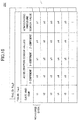
-
- A—HUMAN NECESSITIES
- A01—AGRICULTURE; FORESTRY; ANIMAL HUSBANDRY; HUNTING; TRAPPING; FISHING
- A01K—ANIMAL HUSBANDRY; AVICULTURE; APICULTURE; PISCICULTURE; FISHING; REARING OR BREEDING ANIMALS, NOT OTHERWISE PROVIDED FOR; NEW BREEDS OF ANIMALS
- A01K29/00—Other apparatus for animal husbandry
- A01K29/005—Monitoring or measuring activity
-
- A—HUMAN NECESSITIES
- A01—AGRICULTURE; FORESTRY; ANIMAL HUSBANDRY; HUNTING; TRAPPING; FISHING
- A01K—ANIMAL HUSBANDRY; AVICULTURE; APICULTURE; PISCICULTURE; FISHING; REARING OR BREEDING ANIMALS, NOT OTHERWISE PROVIDED FOR; NEW BREEDS OF ANIMALS
- A01K11/00—Marking of animals
-
- A—HUMAN NECESSITIES
- A01—AGRICULTURE; FORESTRY; ANIMAL HUSBANDRY; HUNTING; TRAPPING; FISHING
- A01K—ANIMAL HUSBANDRY; AVICULTURE; APICULTURE; PISCICULTURE; FISHING; REARING OR BREEDING ANIMALS, NOT OTHERWISE PROVIDED FOR; NEW BREEDS OF ANIMALS
- A01K67/00—Rearing or breeding animals, not otherwise provided for; New or modified breeds of animals
-
- G—PHYSICS
- G06—COMPUTING OR CALCULATING; COUNTING
- G06Q—INFORMATION AND COMMUNICATION TECHNOLOGY [ICT] SPECIALLY ADAPTED FOR ADMINISTRATIVE, COMMERCIAL, FINANCIAL, MANAGERIAL OR SUPERVISORY PURPOSES; SYSTEMS OR METHODS SPECIALLY ADAPTED FOR ADMINISTRATIVE, COMMERCIAL, FINANCIAL, MANAGERIAL OR SUPERVISORY PURPOSES, NOT OTHERWISE PROVIDED FOR
- G06Q50/00—Information and communication technology [ICT] specially adapted for implementation of business processes of specific business sectors, e.g. utilities or tourism
- G06Q50/02—Agriculture; Fishing; Forestry; Mining
Definitions
- the present invention relates to a behavior identifying device, a behavior identifying method, and a program.
- the milking period of dairy cows starts after mating (artificial insemination) and giving birth to calves (after delivery), and this period is called the lactation period. It has been known that the lactation period lasts approximately 305 days. Also, in preparation for the next delivery, it is common to stop milking approximately 60 days before the next scheduled delivery date. This 60-day period is called the dry period. Dairy cows repeat delivery, a lactation period, and a dry period every year.
- Dairy farmers who keep dairy cows are required to cross (artificial insemination) dairy cows within the dry period every year in order to continuously milk cows.
- mating (artificial insemination) of dairy cows it is necessary to discover the estrus of dairy cows.
- management of the estrus period based on breeding records using a ledger is also practiced.
- Non-Patent Document 1 Ryo Abe, "Basic Agricultural Seminar: Basics of Farm Animal Breeding", New Edition, Rural Culture Association Japan, Incorporated Association, April 2008, p.109, p.122-124
- identifying the behaviors of dairy cows also enables not only to find the estrus, but also to find abnormal behaviors due to illness, injury, and the like, and to contribute to health care of the dairy cows.
- One embodiment of the present invention has been made in view of the above points, and has an object to identify the behavior of a farm animal.
- a behavior identifying device that identifies a behavior of a farm animal includes a memory unit configured to store acceleration data measured by an acceleration sensor attached to the farm animal; an obtainer configured to obtain one or more acceleration data items for a predetermined period of time from among the acceleration data stored in the memory unit; an indicator calculator configured to calculate predetermined indicators from the one or more acceleration data items obtained by the obtainer; and an identifying unit configured to identify the behavior of the farm animal based on the indicators calculated by the indicator calculator and an identification model generated in advance for identifying the behavior of the farm animal.
- FIG. 1 is a diagram illustrating an example of an overall configuration of the behavior identifying system 1 according to the first embodiment.
- the behavior identifying system 1 includes a behavior identifying device 10 to identify the behavior of a cow, one or more tags 20 attached to cows, and one or more leaky coaxial antennas 30 to transmit a predetermined radio wave to the surroundings.
- the tag 20 is favorably attached to be fixed to the neck portion of a cow.
- the tag 20 is a device attached to a cow.
- One tag 20 is attached to one cow.
- the tag 20 includes an acceleration sensor that measures the acceleration of a cow (triaxial acceleration in X-axis, Y-axis, and Z-axis) to which the tag 20 is attached, and a radio wave sensor to measure an RSSI (Received Signal Strength Indicator) of a radio wave received from the leaky coaxial antenna 30.
- an acceleration sensor measures the acceleration of a cow (triaxial acceleration in X-axis, Y-axis, and Z-axis) to which the tag 20 is attached
- a radio wave sensor to measure an RSSI (Received Signal Strength Indicator) of a radio wave received from the leaky coaxial antenna 30.
- the tag 20 transmits measured data including acceleration sensor values measured by the acceleration sensor and an RSSI value measured by the radio wave sensor to the behavior identifying device 10 every predetermined interval (e.g., every two seconds).
- the measured data transmitted to the behavior identifying device 10 is accumulated (stored) in a measured data memory unit 200, which will be described later.
- the measured data memory unit 200 stores multiple measured data items for each predetermined interval (e.g., every two seconds).
- the leaky coaxial antenna 30 is an antenna that is installed in a predetermined place such as a feeding place and a watering place in a cowshed.
- the leaky coaxial antenna 30 transmits a predetermined radio wave to the surroundings through a leaky coaxial cable. Note that in the following, in the case of distinguishing a leaky coaxial antenna 30 installed in a feeding place from a leaky coaxial antenna 30 installed in a watering place, these are denoted as the “leaky coaxial antenna 301" and the “leaky coaxial antenna 302", respectively.
- the behavior identifying device 10 is one or more computers that identify the behavior of a cow.
- the behavior identifying device 10 includes a behavior identifying processor 100, the measured data memory unit 200, and a behavior identifying model 300.
- the behavior identifying processor 100 identifies the behavior of a cow based on measured data stored in the measured data memory unit 200 and the behavior identifying model 300.
- the behavior identifying processor 100 is implemented by a process which one or more programs installed in the behavior identifying device 10 cause a CPU (Central Processing Unit) or the like to execute.
- a CPU Central Processing Unit
- the measured data memory unit 200 stores measured data received from the tag 20.
- the measured data memory unit 200 can be implemented by using an auxiliary storage device such as an HDD (Hard Disk Drive) or SSD (Solid State Drive).
- the behavior identifying model 300 is a model for identifying a behavior from acceleration sensor values included in measured data.
- the behavior identifying model 300 is generated in advance by a method of machine learning such as SVM (Support Vector Machine), in accordance with, for example, the type of farm animal or the type of behavior to be identified.
- SVM Small Vector Machine
- the behavior identifying model 300 is stored in an auxiliary storage device such as an HDD or SSD.
- the configuration of the behavior identifying system 1 illustrated in FIG. 1 is an example, and another configuration may be adopted.
- the behavior identifying device 10 may be constituted with multiple computers.
- a device connected to the behavior identifying device 10 via a network may have a part of the functions of the behavior identifying processor 100.
- an acceleration sensor and a radio wave sensor may be separately attached to a cow.
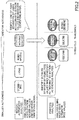
- FIG. 2 is a diagram illustrating an example of behavior identification of a cow.
- behaviors of a cow to be identified by the behavior identifying system 1 include four behaviors of "standing”, “lying”, “ruminating”, and “moving” in ascending order of activeness of the motions. Note that the activeness of the behaviors of "standing” and “lying” may be reversed. In other words, the four behaviors may be arranged in the order of "lying”, “standing”, “ruminating”, and “moving” in ascending order of activeness of the motions.
- the behavior of "standing” is a state of a cow that is standing.
- the behavior of "lying” is a state of a cow that is lying down. Note that these two behaviors of "standing” and “lying” are states in which a cow is not actively moving (i.e., the cow is standing still or the cow is lying still).
- the behavior of "ruminating” is a state of a cow that is ruminating (a behavior of chewing food that has been once swallowed and returned to the mouth).
- the behavior of "moving” is a state of a cow that is performing one of the three behaviors of "feeding", “walking", and “water-drinking”.
- the behavior of "feeding” is a state of a cow that is feeding itself with feed.
- the behavior of "walking” is a state of a cow that is walking.
- the behavior of "water-drinking” is a state of a cow that is drinking water.
- the motion-activeness analysis identifies the behavior of a cow among “standing”, “lying”, “ruminating”, and “moving”, based on acceleration sensor values included in measured data and the behavior identifying model 300. More specifically, the motion-activeness analysis calculates predetermined indicators from acceleration sensor values for a predetermined period of time (e.g., 10 minutes), where the indicators include a maximum value of swing of the L2 norms of the acceleration sensor values, and the standard deviation of the L2 norms of the acceleration sensor values during the predetermined period of time.
- a predetermined period of time e.g. 10 minutes
- the maximum value of swing of the L2 norms is a maximum absolute value from among differences between the average value of the L2 norms of the acceleration sensor values for the predetermined period of time, and the values of the L2 norms of the acceleration sensor values for the predetermined period of time.
- the behavior is identified on the behavior identifying model 300 that classifies a behavior into one of four regions of "standing”, “lying”, “ruminating”, and “moving”, by determining in which of the four regions the calculated indicators are included.
- a behavior is identified as "moving" by the motion-activeness analysis
- which of the three behaviors among “feeding”, “walking”, and “water-drinking” the cow is performing is identified by position analysis.
- the position analysis identifies the behavior of a cow as one of the three behaviors of "feeding", “walking”, and “water-drinking”, based on RSSI values included in measured data and a predetermined threshold value. More specifically, the position analysis identifies the behavior as "feeding” if the RSSI value of a radio wave received from the leaky coaxial antenna 301 installed in a feeding place exceeds a predetermined threshold value (i.e., when the cow is in the feeding place).
- the behavior is identified as "water-drinking”. Meanwhile, if neither of the above conditions is satisfied (i.e., when the cow is not in the feeding place and not in the watering place), the behavior is identified as "walking".
- the position analysis may be performed using positional information obtained from the GPS receiver.
- the positional information obtained from the tag 20 it is possible to locate whether the cow is in the feeding place, in the watering place, or not in the feeding place and not in the watering place.
- the behavior identifying system 1 identifies one of the four behaviors of "standing”, “lying”, “ruminating”, and “moving” from acceleration sensor values received from the tag 20 attached to a cow. Also, in the case of identifying "moving" as the behavior of the cow, the behavior identifying system 1 according to the present embodiment further details the behavior into one of the three behaviors of "feeding”, “walking”, and “water-drinking” from RSSI values received from the tag 20 attached to the cow. This enables to identify the behavior of the cow as one of the six behaviors of "standing”, “lying”, “ruminating”, “feeding", “walking”, and “water-drinking".
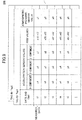
- FIG. 3 is a diagram illustrating an example of measured data stored in the measured data memory unit 200 according to the first embodiment. Note that in the case of receiving measured data from the tag 20, the behavior identifying device 10 may cause the behavior identifying processor 100 to store (accumulate) the received measured data in the measured data memory unit 200.
- the measured data memory unit 200 stores one or more items of measured data for each tag ID that identifies a tag.
- the tag ID may serve as information for identifying a cow (individual identification information for a cow) .
- Measured data includes date and time, acceleration sensor values, and RSSI values.
- the date and time are, for example, a date and time when the tag 20 transmitted the measured data. Note that the date and time may be a date and time when the behavior identifying device 10 received the measured data.
- the acceleration sensor values are acceleration values measured by an acceleration sensor included in the tag 20.
- the acceleration sensor values include an X-component representing an acceleration component in the X-axis direction, a Y-component representing an acceleration component in the Y-axis direction, and a Z-component representing an acceleration component in the Z-axis direction.
- measured data at a date and time "t1" includes the X-component "x1", the Y-component "y1", and the Z-component "z1" as the acceleration sensor values.
- the RSSI values are values of the RSSI measured by a radio wave sensor included in the tag 20.
- the RSSI values include, for example, an RSSI value of a radio wave received from the leaky coaxial antenna 301 installed in the feeding place, and an RSSI value of a radio wave received from the leaky coaxial antenna 302 installed in the watering place.
- the measured data at the date and time "t1" includes an RSSI value "r11” received from the leaky coaxial antenna 301 installed in the feeding place, and an RSSI value "r12” received from the leaky coaxial antenna 302 installed in the watering place.
- measured data including date and time, acceleration sensor values, and RSSI values is accumulated (stored) for each tag ID.
- FIG. 4 is a diagram illustrating an example of the behavior identifying model 300.
- the behavior identifying model 300 is represented as a relationship graph that illustrates a relationship between the maximum value of swing of the L2 norms of acceleration sensor values for a predetermined period of time (e.g., 10 minutes) and the standard deviation of the L2 norms, where the horizontal axis represents the maximum value of swing and the vertical axis represents the standard deviation.
- the behavior of the cow for the 10 minutes is identified as "standing”. Also, for example, if the maximum value of swing of the L2 norms of acceleration sensor values and the standard deviation for a certain 10 minutes fall in a region D2, the behavior of the cow for the 10 minutes is identified as "lying".
- region D3 identified as “ruminating” may be further divided into a region where a cow is “ruminating” while the cow is in a state of standing (denoted as “ruminating while standing") and a region where a cow is "ruminating” while the cow in a state of lying (denoted as "ruminating while lying”).
- FIG. 4 illustrates a case where the regions D1 to D4 in the behavior identifying model 300 do not overlap each other, two or more of the regions D1 to D4 may partially overlap each other.
- the behavior identifying model 300 is a model in which regions are defined to represent a relationship between the maximum value and the standard deviation of the L2 norms of acceleration sensor values for a predetermined period of time (e.g., 10 minutes) and behaviors of a cow.
- a behavior identifying model 300 is generated in advance by a machine learning method such as SVM.
- SVM is an example; and a model may be generated by various machine learning methods such as a neural network.
- specific acceleration sensor values vary depending on the type of acceleration sensor.
- the positional relationship among the regions D1 to D4 representing the respective behaviors virtually remains unchanged.
- the maximum value of swing of the L2 norms may also simply referred to as the "maximum value of the L2 norms" or the “maximum value”.
- FIG. 5 is a diagram illustrating an example of a functional configuration of the behavior identifying processor 100 according to the first embodiment.
- the behavior identifying processor 100 includes an obtainer 101, a preprocessor 102, an indicator calculator 103, and a behavior identifying unit 104.
- the obtainer 101 obtains measured data from the measured data memory unit 200. At this time, the obtainer 101 obtains measured data for a predetermined period of time (e.g., 10 minutes) from the measured data memory unit 200, for example, for each tag ID.
- a predetermined period of time e.g. 10 minutes
- the preprocessor 102 applies preprocessing to the measured data obtained by the obtainer 101.
- the preprocessing includes, for example, missing data completion (resampling) of measured data, noise removal, and the like.
- the preprocessor 102 calculates the L2 norms of acceleration sensor values included in the measured data after the missing data completion, and performs noise removal by using the calculated L2 norms.
- the indicator calculator 103 calculates indicators from the L2 norms of the acceleration sensor values included in the measured data after the preprocessing by the preprocessor 102. For example, the indicator calculator 103 calculates, as indicators, the maximum value and the standard deviation from the L2 norms of the acceleration sensor values included in the measured data after the preprocessing.
- the behavior identifying unit 104 identifies one of the four behaviors of "standing”, “lying”, “ruminating”, and “moving” from the maximum value and the standard deviation calculated by the indicator calculator 103 and the behavior identifying model 300. Also, in the case of having identified "moving" as the behavior, the behavior identifying unit 104 further identifies one of detailed behaviors ("feeding", “walking”, and “water-drinking") from RSSI values included in the measured data. Note that the behavior identifying unit 104 may identify one of the four behaviors from the maximum value, the standard deviation, and a processed result by a program or the like that generates data equivalent to the behavior identifying model 300.
- information representing a behavior identified by the behavior identifying unit 104 may be stored in, for example, a DB (database) or a file implemented by an auxiliary storage device such as an HDD or SSD, or may be displayed on a display device such as a display. Also, the information may be output to another device (e.g., a PC, smartphone, tablet terminal, or the like) connected to the behavior identifying device 10.
- a DB database
- auxiliary storage device such as an HDD or SSD
- the information may be output to another device (e.g., a PC, smartphone, tablet terminal, or the like) connected to the behavior identifying device 10.
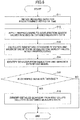
- FIG. 6 is a flow chart illustrating an example of a behavior identifying process according to the first embodiment. Note that the behavior identifying process illustrated in FIG. 6 may be executed, for example, at a date and time set in advance, or may be repeatedly executed every predetermined interval (e.g., 24 hours).
- the obtainer 101 obtains measured data for a predetermined period of time (e.g., 10 minutes) from the measured data memory unit 200 for each tag ID (Step S11). In this way, the obtainer 101 obtains measured data in a predetermined unit of time (e.g., unit of 10 minutes) from the measured data memory unit 200 for each cow (tag ID). Note that such a predetermined unit of time is not limited to 10 minutes, and can be set, for example, by the user of the behavior identifying device 10 with any length of time.
- the preprocessor 102 applies preprocessing to the measured data obtained by the obtainer 101 (Step S12).
- the preprocessor 102 performs missing data completion (resampling), noise removal, and the like with respect to the measured data.
- missing data completion is a process of complementing missing data when data cannot be obtained, in order to improve the accuracy of collected data.
- noise removal is a process of removing data that represents an instantaneous movement of a cow (e.g., a movement of momentarily shaking the body or a movement of trembling). As a result, measured data 1, measured data 2, ..., measured data N 2 after the preprocessing are obtained.
- the indicator calculator 103 calculates indicators (the maximum value and the standard deviation of the L2 norms) from the L2 norms of acceleration sensor values included in each item of the measured data after the preprocessing by the preprocessor 102 (Step S13).
- the standard deviation ⁇ and the maximum value m are calculated for these a1, a2, ..., aN 2 .
- the behavior identifying unit 104 identifies one of the four behaviors of "standing”, “lying”, “ruminating”, and “moving” from the standard deviation ⁇ and the maximum value m calculated by the indicator calculator 103 and the behavior identifying model 300 (Step S14). In other words, the behavior identifying unit 104 identifies the behavior by identifying which of the regions D1 to D4 on the behavior identifying model 300 includes the standard deviation ⁇ and the maximum value m calculated by the indicator calculator 103.
- the behavior identifying unit 104 determines whether or not the behavior identified at Step S14 is "moving" (Step S15).
- Step S15 If having determined at Step S15 that the identified behavior is not “moving” (i.e., if the identified behavior is "standing”, “lying", or “ruminating"), the behavior identifying processor 100 ends the process.
- the behavior identifying unit 104 identifies a detailed behavior ("feeding", “walking”, or “water-drinking") from the RSSI values included in the measured data 1, measured data 2, ..., measured data N2 after the preprocessing at Step S12 (Step S16).
- the behavior identifying unit 104 identifies the detailed behavior as "feeding” or "water-drinking".
- the behavior identifying unit 104 identifies the detailed behavior as "walking".
- the behavior identifying system 1 can identify a behavior of a cow from measured data received from the tag 20 attached to the cow.
- the behavior identifying system 1 according to the present embodiment identifies the behavior of the cow by using indicators calculated from acceleration sensor values included in the measured data and the behavior identifying model 300 generated in advance by a machine learning method.
- the standard deviation and the maximum value of the L2 norms as the indicators, it is possible to identify "ruminating” as a behavior peculiar to cows with high accuracy. In other words, it is possible to distinguish "ruminating” as a behavior peculiar to cows from "standing", “lying", and the like with high accuracy.
- FIG. 7 is a diagram illustrating an example of an overall configuration of the behavior identifying system 1 according to the second embodiment.
- the behavior identifying system 1 includes a reference atmospheric pressure sensor 40 to measure reference atmospheric pressure.
- the reference atmospheric pressure sensor 40 is installed at a predetermined position in a cowshed (e.g., above the ground in the cowshed) to measure reference atmospheric pressure.
- the reference atmospheric pressure sensor 40 transmits reference atmospheric pressure data including a reference atmospheric pressure sensor value that represents a measured atmospheric pressure to the behavior identifying device 10 every predetermined interval (e.g., every two seconds).
- the reference atmospheric pressure data transmitted to the behavior identifying device 10 is accumulated (stored) in a reference atmospheric pressure data memory unit 400, which will be described later.
- a tag 20 further includes an atmospheric pressure sensor to measure atmospheric pressure. Further, the tag 20 transmits measured data including an atmospheric pressure sensor value to the behavior identifying device 10 every predetermined interval (e.g., every two seconds). Note that the tag 20 does not necessarily need to include an atmospheric pressure sensor; for example, an atmospheric pressure sensor may be attached to the cow separately from the tag 20.
- the behavior identifying device 10 further includes the reference atmospheric pressure data memory unit 400.
- the reference atmospheric pressure data memory unit 400 stores reference atmospheric pressure data received from the reference atmospheric pressure sensor 40.
- the reference atmospheric pressure data memory unit 400 may be implemented by using an auxiliary storage device such as an HDD or SSD.
- the reference atmospheric pressure data memory unit 400 stores multiple reference atmospheric pressure data items for predetermined intervals (e.g., every two seconds).
- the behavior identifying processor 100 further identifies a behavior of a cow (among “standing” and “lying") based on atmospheric pressure sensor values included in the measured data stored in the measured data memory unit 200 and reference atmospheric pressure sensor values included in the reference atmospheric pressure data stored in the reference atmospheric pressure data memory unit 400.
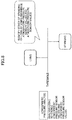
- FIG. 8 is a diagram illustrating an example of a case of identifying "standing” or “lying” by atmospheric pressure analysis.
- the atmospheric pressure analysis according to the present embodiment identifies a behavior of a cow as either of "standing” or “lying” based on atmospheric pressure sensor values included in the measured data and reference atmospheric pressure sensor values included in the reference atmospheric pressure data. More specifically, the atmospheric pressure analysis according to the present embodiment calculates differences between atmospheric pressure sensor values and reference sensor values, respectively, for a predetermined period of time (e.g., 24 hours). Then, if a calculated difference (this difference is referred to as an "atmospheric pressure sensor difference value") exceeds a predetermined threshold value, the behavior is identified as "lying".
- a predetermined period of time e.g. 24 hours
- atmospheric pressure sensor difference value does not exceed the predetermined threshold value, the behavior is identified as "standing".
- Using atmospheric pressure sensor difference values measured by the reference atmospheric pressure sensor 40 enables to determine, for example, whether a measured value of the atmospheric pressure sensor included in the tag 20 attached to a cow has increased or decreased relatively, regardless of the weather (approaching low atmospheric depression, etc.).
- FIG. 9 is a diagram illustrating an example of measured data stored in the measured data memory unit 200 according to the second embodiment. Note that in the case of receiving measured data from the tag 20, the behavior identifying device 10 may cause the behavior identifying processor 100 to store (accumulate) the received measured data in the measured data memory unit 200.
- the measured data memory unit 200 stores one or more items of measured data for each tag ID that identifies a tag.
- the measured data according to the present embodiment further includes an atmospheric pressure sensor value.
- An atmospheric pressure sensor value is a value of atmospheric pressure measured by the atmospheric pressure sensor included in the tag 20.
- measured data including a date and time, acceleration sensor values, RSSI values, and an atmospheric pressure sensor value is accumulated (stored) for each tag ID.
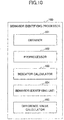
- FIG. 10 is a diagram illustrating an example of a functional configuration of the behavior identifying processor 100 according to the second embodiment.
- the behavior identifying processor 100 further includes a difference value calculator 105. Also, an obtainer 101 and a behavior identifying unit 104 according to the present embodiment have different functions from those in the first embodiment.
- the obtainer 101 When performing behavior identification by position analysis, the obtainer 101 according to the present embodiment obtains measured data for a predetermined period of time (e.g., 24 hours) from the measured data memory unit 200 for each tag ID, and obtains reference atmospheric pressure data for the predetermined period of time from the reference atmospheric pressure data memory unit 400.
- a predetermined period of time e.g. 24 hours
- the difference value calculator 105 calculates atmospheric pressure sensor difference values each representing a difference between an atmospheric pressure sensor value included in the measured data obtained by the obtainer 101 and a reference atmospheric pressure sensor value included in the reference atmospheric pressure data.
- the preprocessor 102 may apply preprocessing to the measured data obtained by the obtainer 101.
- the preprocessor 102 may perform missing data completion, noise removal (i.e., noise removal in the atmospheric pressure sensor values), and the like with respect to the measured data.
- the difference value calculator 105 may calculate atmospheric pressure sensor difference values from the atmospheric pressure sensor values included in the measured data preprocessed by the preprocessor 102 and the reference atmospheric pressure sensor values included in the reference atmospheric pressure data.
- the behavior identifying unit 104 determines whether or not an atmospheric pressure sensor difference value calculated by the differential value calculator 105 exceeds a predetermined threshold value, to identify whether the behavior of a cow is "standing" or "lying".
- a predetermined threshold value for example, an intermediate value between the maximum value and the minimum value of the atmospheric pressure sensor difference values calculated from the atmospheric pressure sensor values included in the measured data obtained by the obtainer 101, may be used. This is because a cow is considered to perform "standing” and "lying", for example, at least once in 24 hours.
- an atmospheric pressure sensor value may be increased by a behavior of "feeding” or "water-drinking” by the cow. This is because a cow performs feeding or drinking water by lowering the neck in a standing position.
- the tag 20 is attached to a collar or the like of a cow, it is often the case that the height of the tag 20 from the ground when a cow performs "feeding” or "water-drinking” is roughly the same as the height of the tag 20 from the ground when a cow is "lying”.
- the obtainer 101 may obtain measured data including hours before and after a behavior of "feeding” or “water-drinking” was identified by the motion-activeness analysis and position analysis, to set an intermediate value between the maximum value and the minimum value of the atmospheric pressure sensor difference values calculated from the atmospheric pressure sensor values included in the obtained measured data, as the threshold value.
- FIG. 11 is a flow chart illustrating an example of the behavior identifying process for standing or lying behavior according to the second embodiment. Note that the behavior identifying process illustrated in FIG. 11 may be executed, for example, at a date and time set in advance, or may be repeatedly executed every predetermined interval (e.g., 24 hours).
- the obtainer 101 obtains, for each tag ID, measured data for a predetermined period of time (e.g., 24 hours) from the measured data memory unit 200, and obtains reference atmospheric pressure data for the predetermined period of time from the reference atmospheric pressure data memory unit 400 (Step S21).
- a predetermined period of time e.g. 24 hours
- measured data 1, measured data 2, ..., and measured data N 4 for 24 hours of a tag having an ID "Tag1”, and reference atmospheric pressure data 1, reference atmospheric pressure data 2, ..., and reference atmospheric pressure data N 4 for the 24 hours are obtained by the obtainer 101.
- the difference value calculator 105 calculates atmospheric pressure sensor difference values each representing a difference between an atmospheric pressure sensor value included in the measured data obtained by the obtainer 101 and a reference atmospheric pressure sensor value included in the reference atmospheric pressure data (Step S22) .
- the difference value calculator 105 calculates an atmospheric pressure sensor difference value 1 between an atmospheric pressure sensor value included in the measured data 1 and a reference atmospheric pressure sensor value included in the reference atmospheric pressure data 1.
- the difference value calculator 105 also calculates an atmospheric pressure sensor difference value 2 between an atmospheric pressure sensor value included in the measured data 2 and a reference atmospheric pressure sensor value included in the reference atmospheric pressure data 2.
- the difference value calculator 105 calculates an atmospheric pressure sensor difference value N 4 between an atmospheric pressure sensor value included in the measured data N 4 and a reference atmospheric pressure sensor value included in the reference atmospheric pressure data N 4 .
- the behavior identifying unit 104 determines whether or not an atmospheric pressure sensor difference value calculated by the differential value calculator 105 exceeds a predetermined threshold value, to identify whether the behavior of the cow is "standing" or "lying” (Step S23). In other words, the behavior identifying unit 104 determines whether the atmospheric pressure sensor difference value 1, the atmospheric pressure sensor difference value 2, ..., or the atmospheric pressure sensor difference value N 4 exceeds the predetermined threshold value, to identify whether the behavior of the cow is "standing" or "lying”.
- the behavior identifying unit 104 identifies the behavior of the cow as "lying" at the date and time for which the atmospheric pressure sensor difference value is calculated.
- the behavior identifying unit 104 identifies the behavior of the cow as "standing” at the date and time for which the atmospheric pressure sensor difference value is calculated.
- the behavior identifying unit 104 may take into account a result of the motion-activeness analysis to consider whether the behavior of the cow is "standing” or "lying". More specifically, at a date and time at which the behavior of the cow is identified as “ruminating” or “moving” by the motion-activeness analysis, the atmospheric pressure analysis may not be performed. Meanwhile, if the behavior of the cow is identified as “standing” or “lying” by the motion-activeness analysis, measured data and reference atmospheric pressure data within a predetermined range including the identified date and time may be obtained to perform the atmospheric pressure analysis.
- the atmospheric pressure analysis may be not performed; on the other hand, if the behavior of the cow is identified as “standing” or “lying” by the motion-activeness analysis, the atmospheric pressure analysis may be performed. Thereby, if "standing” or “lying” is identified by the motion-activeness analysis, the atmospheric pressure analysis is performed for identifying "standing” or “lying” with higher accuracy. In this way, the atmospheric pressure analysis may be performed depending on a result of the motion-activeness analysis.
- the behavior identifying system 1 can identify a "standing” or “lying” behavior of a cow by the atmospheric pressure analysis using an atmospheric pressure sensor. Moreover, the behavior identifying system 1 according to the present embodiment can identify one of the two behaviors of "standing” and “lying” with high accuracy as compared to the case of using the motion-activeness analysis singly, by using the atmospheric pressure analysis singly or in combination with the motion-activeness analysis.
- cowsheds In general, free-stall type cowsheds and free-barn type cowsheds have been known as cowsheds. Unlike free-stall type cowsheds, it is often the case that there are mounds in free-barn type cowsheds. For this reason, in a free-barn type cowshed, behavioral identification by the atmospheric pressure analysis may be incorrect.
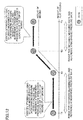
- FIG. 12 is a diagram illustrating an example of a range in which measured data and reference atmospheric pressure data are obtained in a free-barn type cowshed.
- Whether the cow is on the flat ground, climbing up the mound, or on the mound can be determined by using acceleration sensor values and atmospheric pressure sensor values.
- the atmospheric pressure sensor value hardly changes for a certain period of time while the acceleration sensor value changes, it is possible to determine that the cow is on the flat ground.
- both the atmospheric pressure sensor value and the acceleration sensor values change for a certain period of time, it is possible to determine that the cow is climbing up the mound.
- the cow is determined as being on the flat ground, it is possible to determine that the cow is on the mound. Note that it is possible to determine that the cow is climbing down the mound similarly to the case of climbing up the mound.
- a cow may be “lying” in the course of climbing up the mound (or climbing down the mound). Also, a cow may be “lying", and then, “standing” up in the course of climbing up the mound (or climbing down the mound). These cases may be determined, for example, from changing patterns of the acceleration sensor value or changing patterns of the atmospheric pressure sensor value in the course of climbing up the mound (or climbing down the mound).
- the behavior identifying system 1 can identify a "standing” or “lying” behavior of a cow by the atmospheric pressure analysis using an atmospheric pressure sensor even in a free-barn type cowshed.
- FIG. 13 is a diagram illustrating an example of an overall configuration of the behavior identifying system 1 according to the fourth embodiment.
- the behavior identifying system 1 does not include a leaky coaxial antenna 30.
- a tag 20 does not include a radio wave sensor that measures received signal strength of a radio wave received from a leaky coaxial antenna 30.
- the behavior identifying device 10 includes a behavior data memory unit 500. Also, the behavior identifying processor 100 according to the present embodiment identifies a behavior of a cow by motion-activeness analysis based on measured data stored in a measured data memory unit 200 and a behavior identifying model 300. Then, once a predetermined behavior has been identified by the motion-activeness analysis, the behavior identifying processor 100 identifies the behavior of the cow more precisely by atmospheric pressure analysis based on the measured data stored in the measured data memory unit 200, the reference atmospheric pressure data stored in the reference atmospheric pressure data memory unit 400, and the behavior data stored in the behavior data memory unit 500.
- the behavior data memory unit 500 stores behavior data that represents behaviors identified by the behavior identifying processor 100.
- the behavior data memory unit 500 can be implemented by an auxiliary storage device such as an HDD or SSD.
- the behavior data memory unit 500 stores behavior data that represents behaviors identified by the behavior identifying processor 100 at predetermined time intervals (e.g., every 10 minutes).
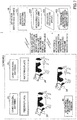
- FIG. 14 is a diagram illustrating an example of behavior identification of a cow.
- behaviors of a cow to be identified by the behavior identifying system 1 include four behaviors of "standing”, “lying”, “ruminating”, and “moving” in ascending order of activeness of the motions. Therefore, it is assumed in the present embodiment that one of the four behaviors of "standing”, “lying”, “ruminating”, and “moving” performed by a cow is identified.
- the behavior is identified as “standing”, “lying”, or “ruminating” by the motion-activeness analysis, the behavior is identified more precisely by the atmospheric pressure analysis. This is because in some cases, the motion-activeness analysis cannot precisely identify the posture of the cow performing the behavior identified by using the behavior identifying model 300.
- the atmospheric pressure analysis identifies a behavior of a cow, based on a minimum atmospheric pressure difference value that represents a minimum value from among differences between atmospheric pressure sensor values included in the measured data and reference atmospheric pressure sensor values included in the reference atmospheric pressure data, respectively, for a predetermined period of time (e.g., five minutes), and a predetermined threshold value.
- a minimum atmospheric pressure difference value that represents a minimum value from among differences between atmospheric pressure sensor values included in the measured data and reference atmospheric pressure sensor values included in the reference atmospheric pressure data, respectively, for a predetermined period of time (e.g., five minutes), and a predetermined threshold value.
- the atmospheric pressure analysis determines whether or not a first atmospheric pressure difference minimum value between five minutes ago and the present time has decreased from a second atmospheric pressure difference minimum value between 10 minutes ago and five minutes ago by a predetermined threshold value or greater. Then, if the first minimum atmospheric pressure difference value has decreased from the second minimum atmospheric pressure difference value by the predetermined threshold value or greater, the behavior is identified as "standing”. On the other hand, if the first minimum atmospheric pressure difference value has not decreased from the second minimum atmospheric pressure difference value by the predetermined threshold value or greater, the behavior is identified as the same behavior as the previous one (i.e., "lying").
- the atmospheric pressure analysis determines whether or not the first atmospheric pressure difference minimum value has increased from the second atmospheric pressure difference minimum value by a predetermined threshold value or greater. Then, if the first minimum atmospheric pressure difference value has increased from the second minimum atmospheric pressure difference value by the predetermined threshold value or greater, the behavior is identified as "lying”. On the other hand, if the first minimum atmospheric pressure difference value has not increased from the second minimum atmospheric pressure difference value by the predetermined threshold value or greater, the behavior is identified as the same behavior as the previous one (i.e., "standing” or "ruminating").
- the behavior identifying system 1 identifies one of the four behaviors of "standing”, “lying”, “ruminating”, and “moving” from acceleration sensor values received from the tag 20 attached to a cow. Further, if the behavior of the cow is identified as “standing”, “lying” or “ruminating", the behavior identifying system 1 according to the present embodiment identifies the behavior more precisely from atmospheric pressure sensor values and reference atmospheric pressure sensor values.
- the atmospheric pressure analysis enables to identify “standing”, “lying”, or “ruminating” with high accuracy. Further, according to the atmospheric pressure analysis according to the present embodiment, “standing”, “lying”, or “ruminating” can be identified with high accuracy even in a cowshed where there is a mound or the like, such as a free-barn type cowshed.
- FIG. 15 is a diagram illustrating an example of measured data stored in the measured data memory unit 200 according to the present embodiment.
- the measured data memory unit 200 stores one or more items of measured data for each tag ID that identifies a tag.
- Measured data according to the present embodiment includes date and time, acceleration sensor values, and an atmospheric pressure sensor value. In other words, the measured data according to the present embodiment does not include RSSI values.
- measured data including date and time, acceleration sensor values, and an atmospheric pressure sensor value are accumulated (stored) for each tag ID.
- FIG. 16 is a diagram illustrating an example of a functional configuration of the behavior identifying processor 100 according to the fourth embodiment.
- the behavior identifying processor 100 includes a minimum difference value calculator 106 instead of a difference value calculator 105.
- an obtainer 101 obtains the latest behavior data (i.e., behavior data that represents the identified previous behavior) from among behavior data stored in the behavior data memory unit 500.
- the minimum difference value calculator 106 calculates a minimum atmospheric pressure difference value from measured data and reference atmospheric pressure data obtained by the obtainer 101. In other words, the minimum difference value calculator 106 calculates, from the measured data and reference atmospheric pressure data obtained by the obtainer 101, for example, for 10 minutes, a first minimum atmospheric pressure difference value for the latter-half five minutes and a second minimum atmospheric pressure difference value for the first-half five minutes.
- a minimum atmospheric pressure difference value is a minimum value from among differences between atmospheric pressure sensor values included in the measured data for a predetermined period of time, and reference atmospheric pressure sensor values included in the reference atmospheric pressure data, respectively, for a predetermined period of time.
- the behavior identifying unit 104 identifies the behavior more precisely from the first minimum atmospheric pressure difference value and the second minimum atmospheric pressure difference value calculated by the minimum difference value calculator 106 (behavior identification by atmospheric pressure analysis), in accordance with the behavior represented by the behavior data obtained by the obtaining unit 101 (i.e., the identified previous behavior).
- the behavior identifying unit 104 identifies the behavior as "standing” if the previous behavior is “lying”, and the first minimum atmospheric pressure difference value has decreased from the second minimum atmospheric pressure difference value by a predetermined threshold value or greater.
- the behavior identifying unit 104 according to the present embodiment identifies the same behavior as previous one if the previous behavior is "lying", and the first minimum atmospheric pressure difference value has not decreased from the second minimum atmospheric pressure difference value by the predetermined threshold value or greater.
- the behavior identifying unit 104 identifies the behavior as "lying” if the previous behavior is other than “lying”, and the first minimum atmospheric pressure difference value has increased from the second minimum atmospheric pressure difference value by a predetermined threshold value or greater.
- the behavior identifying unit 104 according to the present embodiment identifies the same behavior as previous one if the previous behavior is other than "lying", and the first minimum atmospheric pressure difference value has not increased from the second minimum atmospheric pressure difference value by the predetermined threshold value or greater.
- the predetermined threshold value is a value, for example, set in advance by the user. Such a threshold value is determined, for example, based on an empirical rule regarding the behavior identification of cows.
- FIG. 17 is a flow chart illustrating an example of a behavior identifying process by motion-activeness analysis. Note that the behavior identifying process illustrated in FIG. 6 is repeatedly executed, for example, every 10 minutes. However, the behavior identifying process illustrated in FIG. 6 may be executed, for example, at date and time set in advance, or may be executed every predetermined interval.
- Steps S11 to S14 in FIG. 17 are substantially the same as Steps S11 to S14 in FIG. 6 , and the description is omitted here.
- the behavior identifying unit 104 determines whether the behavior identified at Step S14 is "standing”, “lying”, or “ruminating” (Step S31) .
- Step S31 If having determined at Step S31 that the identified behavior is "standing”, “lying” or “ruminating”, the behavior identifying processor 100 identifies the behavior more precisely by the atmospheric pressure analysis (Step S32). Details of the processing at this step will be described later.
- the behavior identifying unit 104 stores behavior data that represents the identified behavior in the behavior data memory unit 500 (Step S33). At this time, the behavior identifying unit 104 stores behavior data, for example, in which the identified behavior is associated with the current date and time, in the behavior data memory unit 500.
- the behavior identifying unit 104 stores the behavior data in which the behavior of "moving" is associated with the current date and time in the behavior data memory unit 500. Similarly, following Step S32, the behavior identifying unit 104 stores the behavior data in which the behavior identified at Step S32 is associated with the current date and time, in the behavior data memory unit 500.
- FIG. 18 is a flow chart illustrating an example of a behavior identifying process based on the atmospheric pressure analysis.
- the obtainer 101 obtains reference atmospheric pressure data for the same period of time as at Step S11 from the reference atmospheric pressure data memory unit 400 (Step S41).
- the obtainer 101 similarly obtains reference atmospheric pressure data for the dates and times t1 to tN 3 from the reference atmospheric pressure data memory unit 400.
- the minimum difference value calculator 106 calculates, from the measured data and the reference atmospheric pressure data obtained by the obtainer 101, a first minimum atmospheric pressure difference value for the latest predetermined period of time (e.g., the latest five minutes), and a second minimum atmospheric pressure difference value for a predetermined period of time before the latest (e.g., five minutes before the latest) (Step S42).
- the minimum difference value calculator 106 calculates, for example, differences between atmospheric pressure sensor values and reference atmospheric pressure sensor values, respectively, for the latest five minutes, and takes a minimum difference from among the calculated differences as the first minimum atmospheric pressure difference value.
- the minimum difference value calculator 106 calculates, for example, differences between atmospheric pressure sensor values and reference atmospheric pressure sensor values, respectively, for the previous five minutes (i.e., five minutes before the last five minutes), and takes a minimum difference from among the calculated differences as the second minimum atmospheric pressure difference value.
- the minimum difference value calculator 106 may use, for example, an average or a maximum value of differences between atmospheric pressure sensor values and reference atmospheric pressure sensor values, for a predetermined period of time. More specifically, for example, an "average atmospheric pressure difference value” that represents an average of differences between atmospheric pressure sensor values and reference atmospheric pressure sensor values for a predetermined period of time may be used instead of a "minimum atmospheric pressure difference value”. Similarly, for example, a “maximum atmospheric pressure difference value” that represents a maximum value of differences between atmospheric pressure sensor values and reference atmospheric pressure sensor values for a predetermined period of time may be used instead of a "minimum atmospheric pressure difference value”. However, in the case of using an "average atmospheric pressure difference value” or "maximum atmospheric pressure difference value", the accuracy of behavior identification is reduced compared to the case of using a "minimum atmospheric pressure difference value".
- the obtainer 101 obtains the latest behavior data from the behavior data stored in the behavior data memory unit 500 (i.e., behavior data that represents the identified previous behavior) (Step S43) .
- the behavior identifying unit 104 determines whether or not the behavior represented by the behavior data obtained at Step S43 is "lying" (Step S44). In other words, the behavior identifying unit 104 determines whether or not the identified previous behavior is "lying".
- the behavior identifying unit 104 determines whether or not the first minimum atmospheric pressure difference value has decreased from the second minimum atmospheric pressure difference value by a predetermined threshold value TH 1 (> 0) or greater (Step S45). In other words, the behavior identifying unit 104 determines whether or not the changed amount of the first minimum atmospheric pressure difference value with respect to the second minimum atmospheric pressure difference value is less than or equal to a predetermined threshold value TH 1 ' ( ⁇ 0). Note that the threshold value TH 1 ' is obtained by reversing the sign of the threshold value TH 1 .
- Step S45 If having determined at Step S45 that the changed amount in the first minimum atmospheric pressure difference value with respect to the second minimum atmospheric pressure difference value is less than or equal to the predetermined threshold value TH 1 ', the behavior identifying unit 104 identifies the behavior as "standing" (Step S46). This is because the case where the changed amount in the first minimum atmospheric pressure difference value with respect to the second minimum atmospheric pressure difference value is less than or equal to the predetermined threshold value TH 1 ' is equivalent to the case where the altitude of the tag 20 attached to the cow has increased by the predetermined threshold value TH 1 or greater.
- Step S45 if not having determined at Step S45 that the changed amount of the first minimum atmospheric pressure difference value with respect to the second minimum atmospheric pressure difference value is less than or equal to the predetermined threshold value TH 1 ', the behavior identifying unit 104 identifies the same behavior as the previous one (i.e., "lying") (Step S47).
- the changed amount in the first minimum atmospheric pressure difference value with respect to the second minimum atmospheric pressure difference value is not less than or equal to the predetermined threshold value TH 1 ' is equivalent to the case where the altitude of the tag 20 attached to the cow has not increased by the predetermined threshold value TH 1 or greater, and hence, the cow is considered to be continuously in a state of "lying".
- the behavior identifying unit 104 determines whether or not the first minimum atmospheric pressure difference value has increased from the second minimum atmospheric pressure difference value by a predetermined threshold value TH 2 ( ⁇ 0) or greater (Step S48). In other words, the behavior identifying unit 104 determines whether or not the changed amount of the first minimum atmospheric pressure difference value with respect to the second minimum atmospheric pressure difference value is greater than or equal to a predetermined threshold value TH 2 ' (> 0). Note that the threshold value TH 2 ' is obtained by reversing the sign of the threshold value TH 2 .
- Step S49 If having determined at Step S48 that the changed amount in the first minimum atmospheric pressure difference value with respect to the second minimum atmospheric pressure difference value is greater than or equal to the predetermined threshold value TH 2 ', the behavior identifying unit 104 identifies the behavior as "lying" (Step S49). This is because the case where the changed amount in the first minimum atmospheric pressure difference value with respect to the second minimum atmospheric pressure difference value is greater than or equal to the predetermined threshold value TH 2 ' is equivalent to the case where the altitude of the tag 20 attached to the cow has decreased by the predetermined threshold value TH 2 ' or greater.
- Step S50 the behavior identifying unit 104 identifies the same behavior as the previous one (i.e., "standing") (Step S50).
- the changed amount of the first minimum atmospheric pressure difference value with respect to the second minimum atmospheric pressure difference value is not greater than or equal to the predetermined threshold value TH 2 ' is equivalent to the case where the altitude of the tag 20 attached to the cow has not decreased by the predetermined threshold value TH 2 ', and hence, the cow is considered to be continuously in a state of "standing".
- the behavior identifying system 1 can identify a behavior of a cow from measured data received from a tag 20 attached to the cow.
- the behavior identifying system 1 according to the present embodiment identifies a behavior of the cow by using indicators calculated from acceleration sensor values included in the measured data and the behavior identifying model 300 generated in advance by a machine learning method (behavior identification by motion-activeness analysis).
- a machine learning method be used to identify "ruminating” as a behavior peculiar to cows with high accuracy.
- "ruminating” as a behavior peculiar to cows can be distinguished from behaviors such as "standing” and “lying” with high accuracy.
- the behavior identifying system 1 identifies the behavior more precisely from atmospheric pressure sensor values and reference atmospheric pressure sensor values (behavior identification by atmospheric pressure analysis). This enables to identify “standing” (including “ruminating while standing") or “lying” (including “ruminating while lying”) with high accuracy. Further, for example, even in a cowshed where there is a mound or the like such as a free-barn type cowshed, it is possible to identify “standing” (including “ruminating while standing") or “lying” (including “ruminating while lying”) with high accuracy.
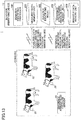
- FIG. 20 is a diagram illustrating an example in the case of identifying a behavior by the atmospheric pressure analysis in a free-barn type cowshed.
- the atmospheric pressure analysis according to the present embodiment can identify one of the behavior of the cow among "standing” (including “ruminating while standing") or “lying” (including “ruminating while lying”) with high accuracy.
- the method of identifying the behavior of a cow by comparing atmospheric pressure sensor values with a predetermined threshold value may erroneously identify the behavior of the cow lying on the mound as "standing".
- the atmospheric pressure analysis according to the present embodiment identifies a behavior of a cow based on whether a minimum atmospheric pressure difference value has increased (or decreased) by a predetermined threshold value or greater; therefore, if the cow lies down after climbing the mound from the foot of the mound, it is possible to correctly identify the behavior of the cow as "lying".
- the behavior identifying system 1 can identify a behavior of a cow by atmospheric pressure analysis with high accuracy, for example, even if there is a mound in a cowshed as in a free-barn type cowshed, and the cow climbs the mound.
Landscapes
- Life Sciences & Earth Sciences (AREA)
- Environmental Sciences (AREA)
- Animal Husbandry (AREA)
- Biodiversity & Conservation Biology (AREA)
- Business, Economics & Management (AREA)
- Zoology (AREA)
- Engineering & Computer Science (AREA)
- Economics (AREA)
- Primary Health Care (AREA)
- Mining & Mineral Resources (AREA)
- Agronomy & Crop Science (AREA)
- Health & Medical Sciences (AREA)
- Birds (AREA)
- General Health & Medical Sciences (AREA)
- Human Resources & Organizations (AREA)
- Marketing (AREA)
- Marine Sciences & Fisheries (AREA)
- Strategic Management (AREA)
- Tourism & Hospitality (AREA)
- Physics & Mathematics (AREA)
- General Business, Economics & Management (AREA)
- General Physics & Mathematics (AREA)
- Theoretical Computer Science (AREA)
- Animal Behavior & Ethology (AREA)
- Biophysics (AREA)
- Measurement Of The Respiration, Hearing Ability, Form, And Blood Characteristics Of Living Organisms (AREA)
Applications Claiming Priority (3)
| Application Number | Priority Date | Filing Date | Title |
|---|---|---|---|
| JP2017070138A JP6635968B2 (ja) | 2017-03-31 | 2017-03-31 | 行動特定装置、行動特定方法、及びプログラム |
| JP2017192742A JP6635995B2 (ja) | 2017-10-02 | 2017-10-02 | 行動特定装置、行動特定方法、及びプログラム |
| PCT/JP2018/008311 WO2018180242A1 (ja) | 2017-03-31 | 2018-03-05 | 行動特定装置、行動特定方法、及びプログラム |
Publications (2)
| Publication Number | Publication Date |
|---|---|
| EP3603388A1 true EP3603388A1 (de) | 2020-02-05 |
| EP3603388A4 EP3603388A4 (de) | 2020-12-16 |
Family
ID=63675451
Family Applications (1)
| Application Number | Title | Priority Date | Filing Date |
|---|---|---|---|
| EP18776765.2A Pending EP3603388A4 (de) | 2017-03-31 | 2018-03-05 | Verhaltensspezifizierungsvorrichtung, verhaltensspezifizierungsverfahren und programm |
Country Status (2)
| Country | Link |
|---|---|
| EP (1) | EP3603388A4 (de) |
| WO (1) | WO2018180242A1 (de) |
Cited By (2)
| Publication number | Priority date | Publication date | Assignee | Title |
|---|---|---|---|---|
| WO2022115916A1 (en) * | 2020-12-04 | 2022-06-09 | Finchain.Ai Pty Ltd | Livestock monitoring and management |
| US12453336B2 (en) | 2018-11-29 | 2025-10-28 | Nitto Denko Corporation | BRDC sign detecting system |
Families Citing this family (2)
| Publication number | Priority date | Publication date | Assignee | Title |
|---|---|---|---|---|
| WO2021234490A2 (en) * | 2020-05-19 | 2021-11-25 | Agverse Technologies Private Limited | System and method for nutrition management and estrus detection and insemination in milch animals |
| CN113854181B (zh) * | 2020-06-30 | 2023-07-28 | 杨多燕 | 一种奶牛行为检测项圈及其检测方法 |
Family Cites Families (15)
| Publication number | Priority date | Publication date | Assignee | Title |
|---|---|---|---|---|
| JP2007256051A (ja) * | 2006-03-23 | 2007-10-04 | Fujikura Ltd | 移動体の位置検出方法 |
| JP4931653B2 (ja) * | 2007-03-16 | 2012-05-16 | オリオン機械株式会社 | 反芻動物の健康管理システムおよび反芻動物の健康管理方法 |
| US20090187392A1 (en) * | 2008-01-23 | 2009-07-23 | Tenxsys Inc. | System and method for monitoring a health condition of an animal |
| JP2011224122A (ja) * | 2010-04-19 | 2011-11-10 | Sharp Corp | 行動認識装置 |
| GB2488521A (en) * | 2011-02-16 | 2012-09-05 | Cascom Ltd | Activity recognition in living species using tri-axial acceleration data |
| JP2013101093A (ja) * | 2011-11-09 | 2013-05-23 | Toshiba It & Control Systems Corp | 位置検出装置 |
| JP6091842B2 (ja) * | 2012-10-29 | 2017-03-08 | 株式会社システムクラフト | 居住者見守り装置、居住者見守りプログラム及び居住者の見守り方法 |
| US20160073614A1 (en) * | 2013-09-13 | 2016-03-17 | Kyle Douglas Lampe | System and Method for Detection of Lameness in Sport Horses and other Quadrupeds |
| EP3260062B1 (de) | 2013-11-29 | 2019-04-03 | Chongqing Xishan Science & Technology Co.,Ltd. | Seitlicher schleifbohrer mit kontinuierlich variablem winkel und antrieb dafür |
| WO2015175686A1 (en) * | 2014-05-13 | 2015-11-19 | Michael Mchugh | Animal health sensor system |
| CN106455525A (zh) * | 2014-05-15 | 2017-02-22 | 奥格唯有限公司 | 宠物行为识别的系统和方法 |
| CN107426984A (zh) * | 2015-04-24 | 2017-12-01 | 株式会社日本动物高度医疗中心 | 信息处理系统 |
| JP2017060407A (ja) * | 2015-09-21 | 2017-03-30 | 株式会社グリーン&ライフ・イノベーション | 反芻動物の健康管理システムおよび反芻動物の健康管理方法 |
| JP6542092B2 (ja) | 2015-10-01 | 2019-07-10 | アルプスアルパイン株式会社 | 高分子アクチュエータ |
| NZ749318A (en) * | 2016-06-08 | 2023-03-31 | Commw Scient Ind Res Org | System for monitoring pasture intake |
-
2018
- 2018-03-05 WO PCT/JP2018/008311 patent/WO2018180242A1/ja not_active Ceased
- 2018-03-05 EP EP18776765.2A patent/EP3603388A4/de active Pending
Cited By (2)
| Publication number | Priority date | Publication date | Assignee | Title |
|---|---|---|---|---|
| US12453336B2 (en) | 2018-11-29 | 2025-10-28 | Nitto Denko Corporation | BRDC sign detecting system |
| WO2022115916A1 (en) * | 2020-12-04 | 2022-06-09 | Finchain.Ai Pty Ltd | Livestock monitoring and management |
Also Published As
| Publication number | Publication date |
|---|---|
| EP3603388A4 (de) | 2020-12-16 |
| WO2018180242A1 (ja) | 2018-10-04 |
Similar Documents
| Publication | Publication Date | Title |
|---|---|---|
| Unold et al. | IoT-based cow health monitoring system | |
| EP3603388A1 (de) | Verhaltensspezifizierungsvorrichtung, verhaltensspezifizierungsverfahren und programm | |
| JP6635968B2 (ja) | 行動特定装置、行動特定方法、及びプログラム | |
| JP7092624B2 (ja) | 行動特定装置、行動特定方法及びプログラム | |
| US20160029601A1 (en) | Computer product, vegetation assessing apparatus, and vegetation assessing method | |
| JP7204093B2 (ja) | 検知装置、検知方法及びプログラム | |
| JP7410200B2 (ja) | 特定装置、特定方法、及びプログラム | |
| JP6635995B2 (ja) | 行動特定装置、行動特定方法、及びプログラム | |
| EP4501104A1 (de) | Vorrichtung zur aufzeichnung des tierverhaltens, verfahren zur aufzeichnung des tierverhaltens und programm | |
| WO2023106993A1 (en) | Parturition surveillance and alerting | |
| JP7089098B2 (ja) | 行動特定装置、行動特定方法、及びプログラム | |
| JP7376255B2 (ja) | 特定装置、特定方法及びプログラム | |
| US20250212847A1 (en) | A system and method for determining the readiness of suckling mammals for weaning | |
| KR102575889B1 (ko) | 영양소 요구량 정보 제공 장치 및 이에 의한 영양소 요구량 정보 제공 방법 | |
| JP7376254B2 (ja) | 特定装置、特定方法及びプログラム | |
| WO2023191044A1 (ja) | 動物管理装置、プログラム、及び動物の体調出力方法 | |
| Adriaens et al. | Detecting dairy cows' lying behaviour using noisy 3D ultra-wide band positioning data | |
| JP6636204B2 (ja) | 行動特定装置、行動特定方法、及びプログラム | |
| JP2019097475A (ja) | 特定装置、特定方法、及びプログラム | |
| Hirata et al. | Development of quality control and breeding management system of goats based on information and communication technology | |
| EP4501105A1 (de) | Informationsverarbeitungsvorrichtung, informationsverarbeitungsverfahren und programm | |
| US20250021917A1 (en) | Evaluation apparatus, system, method, and program | |
| JP2025023246A (ja) | 情報処理装置、情報処理方法、及びプログラム | |
| Hsiao-Mei et al. | Employing ultrahigh-frequency RFID technology on deer farm managment | |
| CN118401101A (zh) | 信息管理设备、系统、方法和程序 |
Legal Events
| Date | Code | Title | Description |
|---|---|---|---|
| STAA | Information on the status of an ep patent application or granted ep patent |
Free format text: STATUS: THE INTERNATIONAL PUBLICATION HAS BEEN MADE |
|
| PUAI | Public reference made under article 153(3) epc to a published international application that has entered the european phase |
Free format text: ORIGINAL CODE: 0009012 |
|
| STAA | Information on the status of an ep patent application or granted ep patent |
Free format text: STATUS: REQUEST FOR EXAMINATION WAS MADE |
|
| 17P | Request for examination filed |
Effective date: 20191014 |
|
| AK | Designated contracting states |
Kind code of ref document: A1 Designated state(s): AL AT BE BG CH CY CZ DE DK EE ES FI FR GB GR HR HU IE IS IT LI LT LU LV MC MK MT NL NO PL PT RO RS SE SI SK SM TR |
|
| AX | Request for extension of the european patent |
Extension state: BA ME |
|
| DAV | Request for validation of the european patent (deleted) | ||
| DAX | Request for extension of the european patent (deleted) | ||
| A4 | Supplementary search report drawn up and despatched |
Effective date: 20201118 |
|
| RIC1 | Information provided on ipc code assigned before grant |
Ipc: A01K 29/00 20060101ALI20201112BHEP Ipc: G06Q 50/02 20120101ALI20201112BHEP Ipc: A01K 67/00 20060101AFI20201112BHEP Ipc: A01K 11/00 20060101ALI20201112BHEP |