EP3601647B1 - Method for spreading a tow of textile non-braided filaments, preferably chemical or inorganic filaments - Google Patents
Method for spreading a tow of textile non-braided filaments, preferably chemical or inorganic filaments Download PDFInfo
- Publication number
- EP3601647B1 EP3601647B1 EP18718516.0A EP18718516A EP3601647B1 EP 3601647 B1 EP3601647 B1 EP 3601647B1 EP 18718516 A EP18718516 A EP 18718516A EP 3601647 B1 EP3601647 B1 EP 3601647B1
- Authority
- EP
- European Patent Office
- Prior art keywords
- tow
- waves
- spreading
- bath
- filaments
- Prior art date
- Legal status (The legal status is an assumption and is not a legal conclusion. Google has not performed a legal analysis and makes no representation as to the accuracy of the status listed.)
- Active
Links
Images

Classifications
-
- D—TEXTILES; PAPER
- D02—YARNS; MECHANICAL FINISHING OF YARNS OR ROPES; WARPING OR BEAMING
- D02J—FINISHING OR DRESSING OF FILAMENTS, YARNS, THREADS, CORDS, ROPES OR THE LIKE
- D02J1/00—Modifying the structure or properties resulting from a particular structure; Modifying, retaining, or restoring the physical form or cross-sectional shape, e.g. by use of dies or squeeze rollers
- D02J1/18—Separating or spreading
-
- B—PERFORMING OPERATIONS; TRANSPORTING
- B65—CONVEYING; PACKING; STORING; HANDLING THIN OR FILAMENTARY MATERIAL
- B65H—HANDLING THIN OR FILAMENTARY MATERIAL, e.g. SHEETS, WEBS, CABLES
- B65H51/00—Forwarding filamentary material
- B65H51/005—Separating a bundle of forwarding filamentary materials into a plurality of groups
-
- B—PERFORMING OPERATIONS; TRANSPORTING
- B65—CONVEYING; PACKING; STORING; HANDLING THIN OR FILAMENTARY MATERIAL
- B65H—HANDLING THIN OR FILAMENTARY MATERIAL, e.g. SHEETS, WEBS, CABLES
- B65H54/00—Winding, coiling, or depositing filamentary material
- B65H54/02—Winding and traversing material on to reels, bobbins, tubes, or like package cores or formers
-
- B—PERFORMING OPERATIONS; TRANSPORTING
- B65—CONVEYING; PACKING; STORING; HANDLING THIN OR FILAMENTARY MATERIAL
- B65H—HANDLING THIN OR FILAMENTARY MATERIAL, e.g. SHEETS, WEBS, CABLES
- B65H57/00—Guides for filamentary materials; Supports therefor
- B65H57/14—Pulleys, rollers, or rotary bars
-
- D—TEXTILES; PAPER
- D06—TREATMENT OF TEXTILES OR THE LIKE; LAUNDERING; FLEXIBLE MATERIALS NOT OTHERWISE PROVIDED FOR
- D06B—TREATING TEXTILE MATERIALS USING LIQUIDS, GASES OR VAPOURS
- D06B23/00—Component parts, details, or accessories of apparatus or machines, specially adapted for the treating of textile materials, not restricted to a particular kind of apparatus, provided for in groups D06B1/00 - D06B21/00
- D06B23/02—Rollers
- D06B23/025—Perforated rollers
-
- D—TEXTILES; PAPER
- D06—TREATMENT OF TEXTILES OR THE LIKE; LAUNDERING; FLEXIBLE MATERIALS NOT OTHERWISE PROVIDED FOR
- D06B—TREATING TEXTILE MATERIALS USING LIQUIDS, GASES OR VAPOURS
- D06B3/00—Passing of textile materials through liquids, gases or vapours to effect treatment, e.g. washing, dyeing, bleaching, sizing, impregnating
- D06B3/02—Passing of textile materials through liquids, gases or vapours to effect treatment, e.g. washing, dyeing, bleaching, sizing, impregnating of fibres, slivers or rovings
-
- D—TEXTILES; PAPER
- D06—TREATMENT OF TEXTILES OR THE LIKE; LAUNDERING; FLEXIBLE MATERIALS NOT OTHERWISE PROVIDED FOR
- D06B—TREATING TEXTILE MATERIALS USING LIQUIDS, GASES OR VAPOURS
- D06B3/00—Passing of textile materials through liquids, gases or vapours to effect treatment, e.g. washing, dyeing, bleaching, sizing, impregnating
- D06B3/10—Passing of textile materials through liquids, gases or vapours to effect treatment, e.g. washing, dyeing, bleaching, sizing, impregnating of fabrics
- D06B3/20—Passing of textile materials through liquids, gases or vapours to effect treatment, e.g. washing, dyeing, bleaching, sizing, impregnating of fabrics with means to improve the circulation of the treating material on the surface of the fabric
- D06B3/205—Passing of textile materials through liquids, gases or vapours to effect treatment, e.g. washing, dyeing, bleaching, sizing, impregnating of fabrics with means to improve the circulation of the treating material on the surface of the fabric by vibrating
- D06B3/208—Passing of textile materials through liquids, gases or vapours to effect treatment, e.g. washing, dyeing, bleaching, sizing, impregnating of fabrics with means to improve the circulation of the treating material on the surface of the fabric by vibrating the treating material
-
- D—TEXTILES; PAPER
- D06—TREATMENT OF TEXTILES OR THE LIKE; LAUNDERING; FLEXIBLE MATERIALS NOT OTHERWISE PROVIDED FOR
- D06B—TREATING TEXTILE MATERIALS USING LIQUIDS, GASES OR VAPOURS
- D06B5/00—Forcing liquids, gases or vapours through textile materials to effect treatment, e.g. washing, dyeing, bleaching, sizing impregnating
- D06B5/02—Forcing liquids, gases or vapours through textile materials to effect treatment, e.g. washing, dyeing, bleaching, sizing impregnating through moving materials of indefinite length
- D06B5/04—Forcing liquids, gases or vapours through textile materials to effect treatment, e.g. washing, dyeing, bleaching, sizing impregnating through moving materials of indefinite length through slivers or rovings
-
- B—PERFORMING OPERATIONS; TRANSPORTING
- B65—CONVEYING; PACKING; STORING; HANDLING THIN OR FILAMENTARY MATERIAL
- B65H—HANDLING THIN OR FILAMENTARY MATERIAL, e.g. SHEETS, WEBS, CABLES
- B65H2701/00—Handled material; Storage means
- B65H2701/30—Handled filamentary material
- B65H2701/31—Textiles threads or artificial strands of filaments
- B65H2701/314—Carbon fibres
-
- B—PERFORMING OPERATIONS; TRANSPORTING
- B65—CONVEYING; PACKING; STORING; HANDLING THIN OR FILAMENTARY MATERIAL
- B65H—HANDLING THIN OR FILAMENTARY MATERIAL, e.g. SHEETS, WEBS, CABLES
- B65H2701/00—Handled material; Storage means
- B65H2701/30—Handled filamentary material
- B65H2701/38—Thread sheet, e.g. sheet of parallel yarns or wires
-
- D—TEXTILES; PAPER
- D01—NATURAL OR MAN-MADE THREADS OR FIBRES; SPINNING
- D01D—MECHANICAL METHODS OR APPARATUS IN THE MANUFACTURE OF ARTIFICIAL FILAMENTS, THREADS, FIBRES, BRISTLES OR RIBBONS
- D01D11/00—Other features of manufacture
- D01D11/02—Opening bundles to space the threads or filaments from one another
-
- D—TEXTILES; PAPER
- D02—YARNS; MECHANICAL FINISHING OF YARNS OR ROPES; WARPING OR BEAMING
- D02J—FINISHING OR DRESSING OF FILAMENTS, YARNS, THREADS, CORDS, ROPES OR THE LIKE
- D02J1/00—Modifying the structure or properties resulting from a particular structure; Modifying, retaining, or restoring the physical form or cross-sectional shape, e.g. by use of dies or squeeze rollers
- D02J1/20—Stressing or stress-relieving, e.g. by vibration or subjection to electrostatic stress or electric discharge
Definitions
- the present invention relates to a method for spreading a tow of textile non-braided filaments, preferably chemical or inorganic filaments, more preferably carbon fibre filaments.
- the present invention preferably relates to a method for spreading a tow of textile non-braided filaments prior to the winding up thereof to form a coil, or to its direct use in processes that benefit from the increased width of the tow, such as for example systems of pre-impregnation of single-thread sheets ("prepregs").
- the present invention hence finds its main application in the manufacture and processing of textile fibres for reinforcing composite materials.
- tows of reinforcing fibres in composite materials typically involves their homogeneous and oriented distribution in sheets then impregnated with subsequently cured resins.
- This uniform distribution typically consists of either a 1-24K tow weaving or a side-by-side arrangement of such fibre tows according to predefined directions then crossed in different orientations over successive layers.
- K means the quantity in thousands of fibres constituting the tow.
- 1-, 3-, 6-, 12- or even 24-K tows are defined as "small tows", while larger tows, such as the 48- to 1000-K tows typical of the carbon fibre produced by a textile precursor fibre, are defined as "large tows”.
- a first example is known from US document US2014/0115848 , wherein the tow is spread thanks to the action of a plurality of nozzles, which deliver pressurized air transversely to the tow so that the individual air jets pass through it in order to distance the individual fibres from each other.
- document CN203729003 shows a system for spreading the fibre that uses ultrasounds, a solution whose effect seems limited and sometimes difficult to control.
- document CN104674485 shows a bundle-spreading system acting mechanically on the fibre, by calendering might affect the quality and performance of the fibre due to the mechanical action and friction generated between the calenders and the fibres themselves.
- a further prior art solution is disclosed in document JP2002227053 .
- the object of the present invention is to provide a method for spreading a tow of textile non-braided filaments, preferably chemical or inorganic fibre filaments, which is capable of obviating the drawbacks of the prior art.
- the object of the present invention is to provide a method for spreading a tow of textile non-braided filaments, preferably chemical or inorganic fibre filaments, which is highly effective and not very aggressive to the fibres/filaments.
- Still a further object of the present invention is to provide a method for spreading a tow of textile non-braided filaments, preferably chemical or inorganic fibre filaments, which can be easily implemented and allows reduced energy consumption.
- this method comprises providing a tow of textile non-braided filaments extending along its own main direction.
- the section transverse to the main direction of this tow has a predetermined thickness and a predetermined width (i.e. the initial thickness and width).
- the predetermined width or initial width is equal to at least 1 cm.
- the tow is fed along a travel path, then spread in order to increase its width and reduce its thickness, thus defining a spread tow, and subsequently extracted from the bath.
- the spreading step comprises immersing the tow in a bath; preferably, the bath is an aqueous bath in which the tow is immersed.
- the filaments are kept in an atraumatic and lubricated environment, so that any tow spreading movement is not very aggressive to the filaments and does not damage them.
- an ordered and pulsating turbulence is generated in the vicinity of the tow, inside the bath, so that the liquid passes several times through the tow itself in two opposite directions, causing this passage to induce the displacement of the filaments and the spreading of the tow.
- the tow entering the bath and/or the spread tow extracted from the bath is/are unsized.
- the tow spreading step is carried out on an unsized (or partially sized) tow.
- the generation of the waves is obtained by stirring the bath in the vicinity of the tow.
- the waves that hit the tow are generated in the vicinity of the tow itself, they are strongly localized and high-powered (with regard to the application).
- the step of generating the sequence of waves preferably comprises generating, alternately, a succession of first waves crossing the tow in a first direction, and a succession of second waves crossing the tow in a second direction opposite the first.
- both (first and second) directions are transverse to both the main direction and the width of the tow.
- the tow is fed along the travel path on a support provided with a plurality of through holes.
- the first waves are therefore generated by pumping the liquid (of the bath) exiting said holes along said first direction (i.e. by generating an overpressure on the opposite side of the hole with respect to the tow).
- the second waves are generated by sucking up the liquid entering said holes along said second direction (i.e. by generating a negative pressure on the opposite side of the hole with respect to the tow).
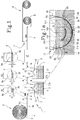
- numeral 1 indicates an apparatus for spreading a tow F of textile non-braided filaments adapted to implement the method according to the present invention.
- textile filaments is intended to define the set of fibrous products which, due to their structure, length, strength and elasticity, have the ability to combine with each other, through spinning, into thin, tenacious and flexible threads that are used in the textile industry for the manufacture of tows or yarns, which in turn, by weaving and/or resin finishing processes, are transformed into fabrics and/or processed to make composite materials.
- non-braided is intended to mean that the tow consists of filaments that are substantially placed side by side/parallel to each other, neither interwoven nor twisted or interlaced, so that they are substantially unbound from a structural/mechanical point of view.
- the method according to the present invention finds application in the processing of chemical or inorganic fibre filaments.
- chemical fibres are to be regarded as all the fibres of a chemical nature, whether they are artificial or synthetic, such as for example cellulose, polyolefin, aramid, polyamide, polyester, polyvinyl, polyacrylic fibres
- inorganic fibres is intended to classify those fibres produced from minerals or inorganic substances, such as for example glass fibre, metallic fibres, metallised fibres and carbon fibre.
- the method according to the present invention finds its main and preferred application in the processing of carbon fibre.
- the method thus comprises providing a tow F of textile non-braided filaments extending along its own main direction A.
- the initially provided tow F is unsized.
- the tow F has a section (schematically illustrated in Figure 1 ) transverse to the main direction A with a predetermined thickness "s1" and a predetermined width W1, W2, W31.
- said predetermined width is equal to at least 1 cm.
- This value preferably corresponds to a 48K-count tow F, the lower limit below which the method according to the invention reduces its effectiveness (albeit without eliminating it).
- the term "tow” is intended to define a set of individual filaments (or fibres) placed side by side/grouped together so as to define a single element that can be handled by the operator; the cross-sectional distribution of the individual filaments (or individual fibres) thus defines the thickness s1, s2, s3 and the width W1, W2, W3 of the above described cross-section.
- the step of providing the tow F preferably comprises providing a coil 2 consisting of the tow F itself wound around a winding axis on a suitable support 3.
- the coil 2 is thus rotatable relative to the support 3 about the aforementioned winding axis, so that it can "unwind".
- the tow F is then fed along a predetermined travel path P.
- the feed is preferably performed by unwinding the coil 2, which has a weight preferably comprised between 40 and 500 kg, and passing the tow F through a series of return rollers and tensioning means 4, which keep it in traction to allow it to advance.
- a second feeding method instead, comprises the use of a container in which the tow F is arranged in an orderly, zigzag fashion until said container is filled.
- the container is generally used when the tow exceeds 24K and has large dimensions (e.g. approximately 1 m x 1 m x 1.5 m).
- the tow F undergoes a spreading or widening action along the travel path M through a special spreading station 5.
- the aforesaid spreading step has the purpose of increasing the width W1 of the tow F, while reducing its thickness s1, so as to obtain a spread tow with a W2 width and an s2 thickness.
- the spreading steps performed in the method are more than one, in succession; in the preferred embodiment, the spreading steps (and therefore the spreading stations 5) are at least two, arranged in succession.
- the first spreading station 5 brings the tow F from the width W1 to the (larger) width W2 and from the thickness s1 to the (smaller) thickness s2, providing the spread tow ST1.
- the second spreading station 5 brings the tow F from the width W2 to the width W3 (larger than W2) and from the thickness s2 to the thickness s3 (smaller than s2), providing the spread tow ST2.
- the spreading steps may also be more than two.
- each spreading operation leads to an extension of the width at least equal to or greater than 50% of the initial width.
- the widening in the first/second step ranges from 3 to 20 times the initial width, while the subsequent steps can be more effective in uniformly redistributing the thickness of the tow even with the same overall width.
- the spreading steps are preferably carried out in "direct" succession, i.e. without other operations, other than return operations, being performed on the tow F.
- the spreading stations 5 are preferably immediately adjacent to one another.
- the first spreading station 5 is arranged immediately upstream of the second spreading station 5.
- the only devices (optionally) present between the two spreading stations 5 are return rollers or feeding members, but, preferably, no mechanical, chemical or thermal operation is performed between one spreading and the next.
- the spreading step first of all it comprises immersing the tow F in a bath 6, preferably an aqueous (i.e. water-, preferably demineralized water-based) bath, and generating a sequence of transverse waves 8a, 8b, crossing the tow F transversely to the main direction A in order to obtain a spread tow ST1, ST2.
- a bath 6 preferably an aqueous (i.e. water-, preferably demineralized water-based) bath
- generating a sequence of transverse waves 8a, 8b crossing the tow F transversely to the main direction A in order to obtain a spread tow ST1, ST2.
- the spread tow ST1, ST2 is extracted from the bath 6.
- the tow F entering (or immersed in) the bath 6 and/or the spread tow ST1, ST2 extracted from the bath 6 is/are unsized.
- unsized refers to the so-called unsized, i.e. devoid of sizing (or sizing agent or gluing agent), condition of the filament or tow, which is used in the textile and carbon fibre processing industry to facilitate subsequent steps of resin finishing of the tow F.
- the tow F in the bath can be the result of a sized tow from which the bath 6 removes the size, an unsized tow to which the bath 6 applies the size or an unsized tow in a bath devoid of sizing.
- the spreading step comprises physically and "rigidly” translating the filaments so as to place them side-by-side.
- the bath 6 is preferably defined by one or more tanks 7, each filled with a predetermined quantity of liquid (preferably with said emulsion).
- the tow F is plunged into the tank 7 (or tanks) by means of a traction return system (i.e. rollers) and the spreading is carried out inside the bath 6.
- a traction return system i.e. rollers
- a sequence of transverse waves 8a, 8b crossing the tow F transversely to the main direction A is generated in the bath 6.
- the method comprises generating in the bath 6 a plurality of liquid flows or currents crossing the tow F (i.e. transverse to the tow F) in order to separate and place the individual filaments side by side.
- the hydraulic action of the waves/currents allows a highly effective and at the same time not very traumatic/aggressive separation of the filaments, thus optimizing the performance and succeeding in minimizing the problems of the prior art.
- the bath 6 is stirred in the vicinity of the tow F (or of the area of passage of the tow (F).
- turbulence is generated at the tow F so that the aforementioned waves 8a, 8b, which cross the tow F in mutually opposite directions to separate the filaments, are generated.
- the turbulence that is imparted is ordered, i.e. defined by a sequence of waves 8a, 8b appropriately localized and directed, and pulsed, i.e. such that each portion of the tow F is subjected to the action of waves which are cyclically differently directed.
- the step of generating the waves 8a, 8b comprises generating, alternately, a succession of first waves 8a crossing the tow F in a first direction D1, and a succession of second waves 8b crossing the tow F in a second direction D2.
- the second direction D2 is substantially opposite to the first D1; both directions (first D1 and second D2) are transverse to the main direction A and the width W1, W2, W3 of the tow F.
- the tow F has a first 9a and a second face 9a opposite to each other.
- the first waves 8a cross the tow F from the first 9a to the second face 9b.
- the second waves 8b cross the tow F from the second 9b to the first face 9a.
- the spreading station 5 comprises a suitable stirring device 8.
- Such stirring device 8 comprises at least one support 10 provided with a plurality of through holes 11 on which the tow F is fed.
- the support 10 is at least partly embedded in the bath 6 and the tow F is at least abutted against it at one immersed portion thereof 10a.
- the first face 9a of the tow F is abutted against the support 10 at one immersed portion thereof 10a.
- the tow F is fed along the travel path P above the support 10; preferably, the support and the tow F are integral with each other.
- the tow F that moves the support 10 by dragging it as it advances along the travel path P.
- the support 10 is defined by a rotating drum 12 that is rotatable about an axis transverse, preferably orthogonal, to the main direction of the tow F.
- the axis of rotation of the drum 12 is parallel to the axis of unwinding of the coil 2.
- the method comprises, respectively, pumping the bath liquid exiting the holes 11 along the first direction D1 and sucking up the bath liquid entering said holes 11 along said second direction D2.
- the step of pumping the liquid causes a first wave 8a or a stream of fluid to exit the hole 11 and then pass through the tow from the first face 9a (abutted against the support 10) to the second face 9b.
- the suction step causes a second wave 8b or a stream of fluid distal to the support 10 with respect to the tow F (i.e. radially external with respect to the drum 12), to pass through the tow F itself from the second face 9b to the first face 9a, then back into the hole 11.
- the support 10 is interposed between the tow F and a stirrer member 13 configured to pump the fluid in the first direction D1 out of a respective hole 11 and suck up the fluid along the second direction D2 from a further hole 11.
- first 8a and second waves 8b are simultaneously generated at different portions of the tow F in contact with the support 10.
- the stirrer member 13 is located inside the drum 12.
- the first D1 and the second direction D2, respectively, have a main component oriented radially outwardly and a main component oriented radially inwardly.
- the step of generating the sequence of waves 8a, 8b comprises:
- the method comprises generating:
- the stirrer member 13 comprises a lobed roller 14 arranged inside the drum 12 and rotatably associated therewith; preferably, the lobed roller 14 is coaxial with the drum 12.
- Lobed roller 14 is intended to define a roller that extends circumferentially along its periphery with a plurality of grooves 14b and apexes 14a, which are preferably at least partly rounded.
- the lobed roller 14 is rotated in the drum 12 with a rotation speed different from that of the drum 12, preferably in counter-rotation.
- stirrer member may also have a different shape, such as for example that of a roller which is eccentric with respect to the drum or an array of stirring elements arranged at the inner periphery of the drum.
- this allows the generation of a turbulent motion located in the vicinity of the tow F in a simple and very cheap way, as no pneumatic blowing or pumping systems or heating systems are necessary, but simply a rotary actuation system (only the lobed roller 14, the drum 12 being preferably idle).
- the method also comprises the step of sizing the tow F.
- This sizing step is performed simultaneously or following said spreading step.
- the sizing step is performed in the bath 6.
- the bath 6 is preferably defined by a water-based liquid containing a sizing agent.
- the bath 6 is preferably made with an emulsion of (demineralized) water and resin (a limited quantity), preferably epoxy resin.
- the bath i.e. emulsion
- the bath defines the sizing (or base layer) for the tow F, on which a resin is then (in subsequent processes) preferably deposited, which will make it suitable for use as a composite material.
- the tow F may initially be sized, mainly for facilitating its handling qualities.
- the bath 6 preferably comprises a solvent suitable to remove the size, allowing the widening of the filaments.
- the two embodiments described above can be complementary, i.e. comprise a sizing step upon removal of the size by a solvent.
- a step of drying the spread tow FT1, ST2 is further provided after the spreading.
- the drying step is preferably carried out in a suitable drying station or oven 15 operatively arranged downstream of the spreading station(s) 5, as shown schematically in Figure 1 .
- a step of winding the spread tow ST2 is preferably provided in order to achieve a widened coil C, which can be easily stored by the manufacturer.
- a step of coupling the spread tow ST2 with a sheet or film 16 of material is preferably provided and operatively performed before said winding step.
- the spreading device 1 preferably comprises a coupling station 17 configured to carry out said operation.
- the invention achieves the intended objects and attains important advantages.
Landscapes
- Engineering & Computer Science (AREA)
- Textile Engineering (AREA)
- Chemical & Material Sciences (AREA)
- Materials Engineering (AREA)
- Treatment Of Fiber Materials (AREA)
- Yarns And Mechanical Finishing Of Yarns Or Ropes (AREA)
- Reinforced Plastic Materials (AREA)
- Treatments For Attaching Organic Compounds To Fibrous Goods (AREA)
Applications Claiming Priority (2)
| Application Number | Priority Date | Filing Date | Title |
|---|---|---|---|
| IT102017000035017A IT201700035017A1 (it) | 2017-03-30 | 2017-03-30 | Metodo per l'apertura di un fascio di fibre tessili, preferibilmente fibre chimiche o inorganiche |
| PCT/IB2018/052070 WO2018178857A1 (en) | 2017-03-30 | 2018-03-27 | Method for spreading a tow of textile non-braided filaments, preferably chemical or inorganic filaments |
Publications (2)
| Publication Number | Publication Date |
|---|---|
| EP3601647A1 EP3601647A1 (en) | 2020-02-05 |
| EP3601647B1 true EP3601647B1 (en) | 2021-01-27 |
Family
ID=59683769
Family Applications (1)
| Application Number | Title | Priority Date | Filing Date |
|---|---|---|---|
| EP18718516.0A Active EP3601647B1 (en) | 2017-03-30 | 2018-03-27 | Method for spreading a tow of textile non-braided filaments, preferably chemical or inorganic filaments |
Country Status (9)
| Country | Link |
|---|---|
| US (1) | US11401630B2 (https=) |
| EP (1) | EP3601647B1 (https=) |
| JP (1) | JP7265993B2 (https=) |
| KR (1) | KR20200024124A (https=) |
| CN (1) | CN110268112B (https=) |
| ES (1) | ES2863599T3 (https=) |
| IT (1) | IT201700035017A1 (https=) |
| RU (1) | RU2760972C2 (https=) |
| WO (1) | WO2018178857A1 (https=) |
Families Citing this family (4)
| Publication number | Priority date | Publication date | Assignee | Title |
|---|---|---|---|---|
| CN109972329B (zh) * | 2019-03-14 | 2021-07-02 | 北京百年初心科技有限公司 | 一种高强度碳纤维专用生产工装 |
| CN110820053A (zh) * | 2019-11-25 | 2020-02-21 | 上海科技大学 | 一种连续功能化纤维、装置及其制备方法和用途 |
| DE102020124168B4 (de) | 2020-09-16 | 2023-07-27 | Deutsches Zentrum für Luft- und Raumfahrt e.V. | Verfahren und Vorrichtung zum Aufspreizen eines Faserbündels |
| CN113809336B (zh) * | 2021-08-23 | 2023-10-24 | 安徽大学 | 一种碳纤维与石墨烯复合的高强度多孔材料和气体扩散层及其制备方法 |
Family Cites Families (30)
| Publication number | Priority date | Publication date | Assignee | Title |
|---|---|---|---|---|
| GB1068858A (en) * | 1964-12-28 | 1967-05-17 | Yoshikazu Yamanaka | Improvements in apparatus for dyeing or washing cloth |
| JPS4828969B1 (https=) * | 1970-08-26 | 1973-09-06 | ||
| GB2086444B (en) * | 1980-09-18 | 1985-01-23 | Sumitomo Chemical Co | Process for continuous production of prepreg sheets |
| JPS62184172A (ja) * | 1986-02-07 | 1987-08-12 | 三菱レイヨン株式会社 | 繊維束の拡幅法 |
| FR2618456B1 (fr) * | 1987-07-24 | 1990-08-17 | Centre Nat Etd Spatiales | Procede et dispositif pour l'etalement en continu de fibres fragiles |
| JPH02251664A (ja) * | 1989-03-27 | 1990-10-09 | Unitika Ltd | ガラスクロスの処理方法 |
| DE4010831A1 (de) | 1990-04-04 | 1991-10-10 | Hoechst Ag | Verfahren und vorrichtung zum fuehren eines faserkabels |
| US5042111A (en) * | 1990-11-01 | 1991-08-27 | Board Of Trustees Operating Michigan State University | Method and system for spreading a tow of fibers |
| JP3562205B2 (ja) * | 1997-04-10 | 2004-09-08 | 東レ株式会社 | 熱硬化性プリプレグ用の炭素繊維束の開繊装置および開繊方法およびプリプレグの製造方法 |
| JP3837872B2 (ja) * | 1997-10-15 | 2006-10-25 | 日東紡績株式会社 | ガラス繊維織物の開繊処理方法 |
| CA2355710C (en) * | 1999-01-12 | 2008-03-18 | Hunter Douglas Inc. | Nonwoven fabric and method and apparatus for manufacturing same |
| GB9908561D0 (en) * | 1999-04-15 | 1999-06-09 | Goller Max Gmbh & Co | Web treatment apparatus |
| FR2792656B1 (fr) * | 1999-04-23 | 2001-06-01 | Icbt Perfojet Sa | Dispositif permettant d'assurer l'ouverture et la repartition d'un faisceau de filaments lors de la realisation d'une nappe textile non tissee |
| US6049956A (en) * | 1999-06-18 | 2000-04-18 | Adherent Technologies, Inc. | Method and apparatus for spreading fiber bundles |
| WO2001051265A1 (fr) * | 2000-01-12 | 2001-07-19 | Toray Industries, Inc. | Procede et dispositif de production pour faisceau de fibres ouvert et procede de fabrication de preimpregne |
| JP3382607B2 (ja) * | 2001-02-01 | 2003-03-04 | 株式会社オー・ビー・エス | 拡繊システム |
| DE602005022281D1 (de) * | 2004-02-13 | 2010-08-26 | Mitsubishi Rayon Co | Carbonfaservorgängerfaserbündel, produktionsverfahren und produktions-vorrichtung dafür sowie carbonfaser und produktionsverfahren dafür |
| JP4128169B2 (ja) * | 2004-10-27 | 2008-07-30 | 弘治 大石橋 | 拡繊装置 |
| DE102005052660B3 (de) * | 2005-11-04 | 2007-04-26 | Karl Mayer Malimo Textilmaschinenfabrik Gmbh | Vorrichtung und Verfahren zum Ausbreiten eines Karbonfaserstrangs |
| DE102007012607B4 (de) * | 2007-03-13 | 2009-02-26 | Eads Deutschland Gmbh | Spreizvorrichtung zum Aufspreizen von Faserfilamentbündeln sowie damit versehene Preform-Herstellvorrichtung |
| JP4584323B2 (ja) * | 2008-04-04 | 2010-11-17 | 弘治 大石橋 | 拡繊方法 |
| EP2151517B1 (de) * | 2008-08-07 | 2013-06-26 | Liba Maschinenfabrik GmbH | Verfahren zum Herstellen einer unidirektionalen Faserlage und Vorrichtung zum Spreizen von Fasern |
| JP5195232B2 (ja) * | 2008-09-29 | 2013-05-08 | 日東紡績株式会社 | ガラス繊維織物の製造方法 |
| JP5326170B2 (ja) | 2009-05-25 | 2013-10-30 | 福井県 | 繊維束の開繊方法及び開繊糸シート並びに繊維補強シートの製造方法 |
| WO2012165574A1 (ja) | 2011-06-03 | 2012-12-06 | 三菱レイヨン株式会社 | 炭素繊維前駆体アクリル繊維束の製造方法 |
| RU123415U1 (ru) * | 2012-09-11 | 2012-12-27 | Общество с ограниченной ответственностью "Аспро" | Устройство для площения жгута волокнистого материала |
| CN203729003U (zh) | 2014-01-22 | 2014-07-23 | 东华大学 | 低成本高性能大丝束碳纤维展开装置 |
| CN104674485B (zh) | 2015-02-11 | 2017-01-04 | 广州金发碳纤维新材料发展有限公司 | 一种超薄碳纤维束的开纤定型装置及方法 |
| JP6077577B2 (ja) * | 2015-02-26 | 2017-02-08 | 帝人株式会社 | 補強繊維ストランド分繊糸の製造方法 |
| US10518442B2 (en) * | 2018-03-06 | 2019-12-31 | Aerlyte, Inc. | Fiber-reinforced composites and methods of forming and using same |
-
2017
- 2017-03-30 IT IT102017000035017A patent/IT201700035017A1/it unknown
-
2018
- 2018-03-27 CN CN201880009404.3A patent/CN110268112B/zh active Active
- 2018-03-27 KR KR1020197027450A patent/KR20200024124A/ko not_active Ceased
- 2018-03-27 US US16/478,965 patent/US11401630B2/en active Active
- 2018-03-27 ES ES18718516T patent/ES2863599T3/es active Active
- 2018-03-27 EP EP18718516.0A patent/EP3601647B1/en active Active
- 2018-03-27 WO PCT/IB2018/052070 patent/WO2018178857A1/en not_active Ceased
- 2018-03-27 RU RU2019120749A patent/RU2760972C2/ru active
- 2018-03-27 JP JP2019552854A patent/JP7265993B2/ja active Active
Non-Patent Citations (1)
| Title |
|---|
| None * |
Also Published As
| Publication number | Publication date |
|---|---|
| CN110268112A (zh) | 2019-09-20 |
| KR20200024124A (ko) | 2020-03-06 |
| RU2019120749A3 (https=) | 2021-04-30 |
| CN110268112B (zh) | 2022-05-17 |
| RU2760972C2 (ru) | 2021-12-02 |
| US20190352809A1 (en) | 2019-11-21 |
| ES2863599T3 (es) | 2021-10-11 |
| IT201700035017A1 (it) | 2018-09-30 |
| JP2020515729A (ja) | 2020-05-28 |
| JP7265993B2 (ja) | 2023-04-27 |
| US11401630B2 (en) | 2022-08-02 |
| EP3601647A1 (en) | 2020-02-05 |
| RU2019120749A (ru) | 2021-04-30 |
| WO2018178857A1 (en) | 2018-10-04 |
Similar Documents
| Publication | Publication Date | Title |
|---|---|---|
| EP3601647B1 (en) | Method for spreading a tow of textile non-braided filaments, preferably chemical or inorganic filaments | |
| JP5726292B2 (ja) | プリプレグの連続的製造のために繊維の束を拡幅するための装置および方法 | |
| KR102048276B1 (ko) | Smc 제조방법 및 그 제조장치 | |
| CN1816653B (zh) | 制造分散的复丝束的方法和所应用的设备 | |
| KR102585419B1 (ko) | 분말 형태의 열가소성 폴리머로 예비 함침된 섬유성 재료를 제조하기 위한 방법 | |
| KR20120031476A (ko) | 섬유 다발의 개섬 방법, 개섬사 시트 및 섬유 보강 시트의 제조 방법 | |
| CN110234805B (zh) | 部分分纤纤维束及其制造方法、以及使用其的短切纤维束及纤维增强树脂成型材料 | |
| JP7726203B2 (ja) | Smcの製造方法 | |
| BRPI0612214A2 (pt) | Composição ou correia para a fabricação de papel e método para a formação de um pano ou correia para a fabricação de papel | |
| KR20130042506A (ko) | 만곡된 다발을 구비하는 파일 층 | |
| CN109312505B (zh) | 部分分纤纤维束及其制造方法、以及纤维增强树脂成型材料及其制造方法 | |
| JP2020515729A5 (https=) | ||
| CA1210314A (en) | Apparatus for the production of reinforcing non-woven fabrics for composites | |
| JP2020028845A (ja) | 塗液含浸強化繊維シートおよびシート状一体物の製造方法、塗工装置 | |
| US10501889B2 (en) | Extruded paper machine clothing and method for the production thereof | |
| TWI541397B (zh) | 連續性纖維絲束之處理設備及方法 | |
| RU2685341C1 (ru) | Способ площения жгута, способ производства однонаправленного полотна и установка для производства однонаправленного полотна | |
| JP3719922B2 (ja) | Frp用の繊維織物の製造方法及びfrp用のプリプレグの製造方法 | |
| JPWO2018178857A5 (https=) | ||
| JP2019015015A (ja) | 繊維束を延展する装置および方法 | |
| JP2020029013A (ja) | プリプレグおよびシート状一体物の製造方法、塗工装置 | |
| RU2574802C2 (ru) | Способ создания плоских нетканых полотен | |
| KR101100232B1 (ko) | 섬유전개장치 | |
| CN103160980A (zh) | 纤维束集束装置的穿孔输送带 | |
| JPH03180556A (ja) | ガラス繊維マットの製造方法およびその装置 |
Legal Events
| Date | Code | Title | Description |
|---|---|---|---|
| STAA | Information on the status of an ep patent application or granted ep patent |
Free format text: STATUS: UNKNOWN |
|
| STAA | Information on the status of an ep patent application or granted ep patent |
Free format text: STATUS: THE INTERNATIONAL PUBLICATION HAS BEEN MADE |
|
| PUAI | Public reference made under article 153(3) epc to a published international application that has entered the european phase |
Free format text: ORIGINAL CODE: 0009012 |
|
| STAA | Information on the status of an ep patent application or granted ep patent |
Free format text: STATUS: REQUEST FOR EXAMINATION WAS MADE |
|
| 17P | Request for examination filed |
Effective date: 20190704 |
|
| AK | Designated contracting states |
Kind code of ref document: A1 Designated state(s): AL AT BE BG CH CY CZ DE DK EE ES FI FR GB GR HR HU IE IS IT LI LT LU LV MC MK MT NL NO PL PT RO RS SE SI SK SM TR |
|
| AX | Request for extension of the european patent |
Extension state: BA ME |
|
| DAV | Request for validation of the european patent (deleted) | ||
| DAX | Request for extension of the european patent (deleted) | ||
| REG | Reference to a national code |
Ref country code: DE Ref legal event code: R079 Ref document number: 602018012342 Country of ref document: DE Free format text: PREVIOUS MAIN CLASS: D02J0001180000 Ipc: B65H0057140000 |
|
| GRAP | Despatch of communication of intention to grant a patent |
Free format text: ORIGINAL CODE: EPIDOSNIGR1 |
|
| STAA | Information on the status of an ep patent application or granted ep patent |
Free format text: STATUS: GRANT OF PATENT IS INTENDED |
|
| RIC1 | Information provided on ipc code assigned before grant |
Ipc: B65H 51/005 20060101ALI20201023BHEP Ipc: D06B 23/02 20060101ALI20201023BHEP Ipc: B65H 57/14 20060101AFI20201023BHEP Ipc: D02J 1/18 20060101ALI20201023BHEP Ipc: D06B 3/02 20060101ALI20201023BHEP Ipc: D06B 3/20 20060101ALI20201023BHEP Ipc: D06B 5/04 20060101ALI20201023BHEP |
|
| INTG | Intention to grant announced |
Effective date: 20201118 |
|
| GRAS | Grant fee paid |
Free format text: ORIGINAL CODE: EPIDOSNIGR3 |
|
| GRAA | (expected) grant |
Free format text: ORIGINAL CODE: 0009210 |
|
| STAA | Information on the status of an ep patent application or granted ep patent |
Free format text: STATUS: THE PATENT HAS BEEN GRANTED |
|
| AK | Designated contracting states |
Kind code of ref document: B1 Designated state(s): AL AT BE BG CH CY CZ DE DK EE ES FI FR GB GR HR HU IE IS IT LI LT LU LV MC MK MT NL NO PL PT RO RS SE SI SK SM TR |
|
| REG | Reference to a national code |
Ref country code: GB Ref legal event code: FG4D |
|
| REG | Reference to a national code |
Ref country code: CH Ref legal event code: EP |
|
| REG | Reference to a national code |
Ref country code: AT Ref legal event code: REF Ref document number: 1358187 Country of ref document: AT Kind code of ref document: T Effective date: 20210215 |
|
| REG | Reference to a national code |
Ref country code: IE Ref legal event code: FG4D |
|
| REG | Reference to a national code |
Ref country code: DE Ref legal event code: R096 Ref document number: 602018012342 Country of ref document: DE |
|
| REG | Reference to a national code |
Ref country code: NL Ref legal event code: MP Effective date: 20210127 |
|
| REG | Reference to a national code |
Ref country code: LT Ref legal event code: MG9D |
|
| REG | Reference to a national code |
Ref country code: AT Ref legal event code: MK05 Ref document number: 1358187 Country of ref document: AT Kind code of ref document: T Effective date: 20210127 |
|
| PG25 | Lapsed in a contracting state [announced via postgrant information from national office to epo] |
Ref country code: LT Free format text: LAPSE BECAUSE OF FAILURE TO SUBMIT A TRANSLATION OF THE DESCRIPTION OR TO PAY THE FEE WITHIN THE PRESCRIBED TIME-LIMIT Effective date: 20210127 Ref country code: NO Free format text: LAPSE BECAUSE OF FAILURE TO SUBMIT A TRANSLATION OF THE DESCRIPTION OR TO PAY THE FEE WITHIN THE PRESCRIBED TIME-LIMIT Effective date: 20210427 Ref country code: PT Free format text: LAPSE BECAUSE OF FAILURE TO SUBMIT A TRANSLATION OF THE DESCRIPTION OR TO PAY THE FEE WITHIN THE PRESCRIBED TIME-LIMIT Effective date: 20210527 Ref country code: FI Free format text: LAPSE BECAUSE OF FAILURE TO SUBMIT A TRANSLATION OF THE DESCRIPTION OR TO PAY THE FEE WITHIN THE PRESCRIBED TIME-LIMIT Effective date: 20210127 Ref country code: HR Free format text: LAPSE BECAUSE OF FAILURE TO SUBMIT A TRANSLATION OF THE DESCRIPTION OR TO PAY THE FEE WITHIN THE PRESCRIBED TIME-LIMIT Effective date: 20210127 Ref country code: GR Free format text: LAPSE BECAUSE OF FAILURE TO SUBMIT A TRANSLATION OF THE DESCRIPTION OR TO PAY THE FEE WITHIN THE PRESCRIBED TIME-LIMIT Effective date: 20210428 Ref country code: BG Free format text: LAPSE BECAUSE OF FAILURE TO SUBMIT A TRANSLATION OF THE DESCRIPTION OR TO PAY THE FEE WITHIN THE PRESCRIBED TIME-LIMIT Effective date: 20210427 |
|
| PG25 | Lapsed in a contracting state [announced via postgrant information from national office to epo] |
Ref country code: SE Free format text: LAPSE BECAUSE OF FAILURE TO SUBMIT A TRANSLATION OF THE DESCRIPTION OR TO PAY THE FEE WITHIN THE PRESCRIBED TIME-LIMIT Effective date: 20210127 Ref country code: AT Free format text: LAPSE BECAUSE OF FAILURE TO SUBMIT A TRANSLATION OF THE DESCRIPTION OR TO PAY THE FEE WITHIN THE PRESCRIBED TIME-LIMIT Effective date: 20210127 Ref country code: RS Free format text: LAPSE BECAUSE OF FAILURE TO SUBMIT A TRANSLATION OF THE DESCRIPTION OR TO PAY THE FEE WITHIN THE PRESCRIBED TIME-LIMIT Effective date: 20210127 Ref country code: LV Free format text: LAPSE BECAUSE OF FAILURE TO SUBMIT A TRANSLATION OF THE DESCRIPTION OR TO PAY THE FEE WITHIN THE PRESCRIBED TIME-LIMIT Effective date: 20210127 Ref country code: PL Free format text: LAPSE BECAUSE OF FAILURE TO SUBMIT A TRANSLATION OF THE DESCRIPTION OR TO PAY THE FEE WITHIN THE PRESCRIBED TIME-LIMIT Effective date: 20210127 |
|
| PG25 | Lapsed in a contracting state [announced via postgrant information from national office to epo] |
Ref country code: IS Free format text: LAPSE BECAUSE OF FAILURE TO SUBMIT A TRANSLATION OF THE DESCRIPTION OR TO PAY THE FEE WITHIN THE PRESCRIBED TIME-LIMIT Effective date: 20210527 |
|
| REG | Reference to a national code |
Ref country code: ES Ref legal event code: FG2A Ref document number: 2863599 Country of ref document: ES Kind code of ref document: T3 Effective date: 20211011 |
|
| REG | Reference to a national code |
Ref country code: DE Ref legal event code: R097 Ref document number: 602018012342 Country of ref document: DE |
|
| PG25 | Lapsed in a contracting state [announced via postgrant information from national office to epo] |
Ref country code: SM Free format text: LAPSE BECAUSE OF FAILURE TO SUBMIT A TRANSLATION OF THE DESCRIPTION OR TO PAY THE FEE WITHIN THE PRESCRIBED TIME-LIMIT Effective date: 20210127 Ref country code: CZ Free format text: LAPSE BECAUSE OF FAILURE TO SUBMIT A TRANSLATION OF THE DESCRIPTION OR TO PAY THE FEE WITHIN THE PRESCRIBED TIME-LIMIT Effective date: 20210127 Ref country code: EE Free format text: LAPSE BECAUSE OF FAILURE TO SUBMIT A TRANSLATION OF THE DESCRIPTION OR TO PAY THE FEE WITHIN THE PRESCRIBED TIME-LIMIT Effective date: 20210127 Ref country code: MC Free format text: LAPSE BECAUSE OF FAILURE TO SUBMIT A TRANSLATION OF THE DESCRIPTION OR TO PAY THE FEE WITHIN THE PRESCRIBED TIME-LIMIT Effective date: 20210127 |
|
| REG | Reference to a national code |
Ref country code: CH Ref legal event code: PL |
|
| PG25 | Lapsed in a contracting state [announced via postgrant information from national office to epo] |
Ref country code: DK Free format text: LAPSE BECAUSE OF FAILURE TO SUBMIT A TRANSLATION OF THE DESCRIPTION OR TO PAY THE FEE WITHIN THE PRESCRIBED TIME-LIMIT Effective date: 20210127 Ref country code: SK Free format text: LAPSE BECAUSE OF FAILURE TO SUBMIT A TRANSLATION OF THE DESCRIPTION OR TO PAY THE FEE WITHIN THE PRESCRIBED TIME-LIMIT Effective date: 20210127 Ref country code: RO Free format text: LAPSE BECAUSE OF FAILURE TO SUBMIT A TRANSLATION OF THE DESCRIPTION OR TO PAY THE FEE WITHIN THE PRESCRIBED TIME-LIMIT Effective date: 20210127 |
|
| PLBE | No opposition filed within time limit |
Free format text: ORIGINAL CODE: 0009261 |
|
| STAA | Information on the status of an ep patent application or granted ep patent |
Free format text: STATUS: NO OPPOSITION FILED WITHIN TIME LIMIT |
|
| REG | Reference to a national code |
Ref country code: BE Ref legal event code: MM Effective date: 20210331 |
|
| 26N | No opposition filed |
Effective date: 20211028 |
|
| PG25 | Lapsed in a contracting state [announced via postgrant information from national office to epo] |
Ref country code: CH Free format text: LAPSE BECAUSE OF NON-PAYMENT OF DUE FEES Effective date: 20210331 Ref country code: AL Free format text: LAPSE BECAUSE OF FAILURE TO SUBMIT A TRANSLATION OF THE DESCRIPTION OR TO PAY THE FEE WITHIN THE PRESCRIBED TIME-LIMIT Effective date: 20210127 Ref country code: IE Free format text: LAPSE BECAUSE OF NON-PAYMENT OF DUE FEES Effective date: 20210327 Ref country code: LI Free format text: LAPSE BECAUSE OF NON-PAYMENT OF DUE FEES Effective date: 20210331 Ref country code: LU Free format text: LAPSE BECAUSE OF NON-PAYMENT OF DUE FEES Effective date: 20210327 |
|
| PG25 | Lapsed in a contracting state [announced via postgrant information from national office to epo] |
Ref country code: SI Free format text: LAPSE BECAUSE OF FAILURE TO SUBMIT A TRANSLATION OF THE DESCRIPTION OR TO PAY THE FEE WITHIN THE PRESCRIBED TIME-LIMIT Effective date: 20210127 |
|
| PG25 | Lapsed in a contracting state [announced via postgrant information from national office to epo] |
Ref country code: IS Free format text: LAPSE BECAUSE OF FAILURE TO SUBMIT A TRANSLATION OF THE DESCRIPTION OR TO PAY THE FEE WITHIN THE PRESCRIBED TIME-LIMIT Effective date: 20210527 |
|
| PG25 | Lapsed in a contracting state [announced via postgrant information from national office to epo] |
Ref country code: BE Free format text: LAPSE BECAUSE OF NON-PAYMENT OF DUE FEES Effective date: 20210331 |
|
| P01 | Opt-out of the competence of the unified patent court (upc) registered |
Effective date: 20230520 |
|
| PG25 | Lapsed in a contracting state [announced via postgrant information from national office to epo] |
Ref country code: NL Free format text: LAPSE BECAUSE OF NON-PAYMENT OF DUE FEES Effective date: 20210127 Ref country code: CY Free format text: LAPSE BECAUSE OF FAILURE TO SUBMIT A TRANSLATION OF THE DESCRIPTION OR TO PAY THE FEE WITHIN THE PRESCRIBED TIME-LIMIT Effective date: 20210127 |
|
| PG25 | Lapsed in a contracting state [announced via postgrant information from national office to epo] |
Ref country code: HU Free format text: LAPSE BECAUSE OF FAILURE TO SUBMIT A TRANSLATION OF THE DESCRIPTION OR TO PAY THE FEE WITHIN THE PRESCRIBED TIME-LIMIT; INVALID AB INITIO Effective date: 20180327 |
|
| PG25 | Lapsed in a contracting state [announced via postgrant information from national office to epo] |
Ref country code: MK Free format text: LAPSE BECAUSE OF FAILURE TO SUBMIT A TRANSLATION OF THE DESCRIPTION OR TO PAY THE FEE WITHIN THE PRESCRIBED TIME-LIMIT Effective date: 20210127 |
|
| PGFP | Annual fee paid to national office [announced via postgrant information from national office to epo] |
Ref country code: TR Payment date: 20240307 Year of fee payment: 7 |
|
| PG25 | Lapsed in a contracting state [announced via postgrant information from national office to epo] |
Ref country code: MT Free format text: LAPSE BECAUSE OF FAILURE TO SUBMIT A TRANSLATION OF THE DESCRIPTION OR TO PAY THE FEE WITHIN THE PRESCRIBED TIME-LIMIT Effective date: 20210127 |
|
| PGFP | Annual fee paid to national office [announced via postgrant information from national office to epo] |
Ref country code: ES Payment date: 20250417 Year of fee payment: 8 |
|
| PGFP | Annual fee paid to national office [announced via postgrant information from national office to epo] |
Ref country code: IT Payment date: 20250327 Year of fee payment: 8 |
|
| PGFP | Annual fee paid to national office [announced via postgrant information from national office to epo] |
Ref country code: GB Payment date: 20260304 Year of fee payment: 9 |
|
| PGFP | Annual fee paid to national office [announced via postgrant information from national office to epo] |
Ref country code: DE Payment date: 20260320 Year of fee payment: 9 |
|
| PGFP | Annual fee paid to national office [announced via postgrant information from national office to epo] |
Ref country code: FR Payment date: 20260323 Year of fee payment: 9 |