EP3599518A1 - Verfahren zum kodieren und übertragen mindestens einer sonnenstunde - Google Patents
Verfahren zum kodieren und übertragen mindestens einer sonnenstunde Download PDFInfo
- Publication number
- EP3599518A1 EP3599518A1 EP18185320.1A EP18185320A EP3599518A1 EP 3599518 A1 EP3599518 A1 EP 3599518A1 EP 18185320 A EP18185320 A EP 18185320A EP 3599518 A1 EP3599518 A1 EP 3599518A1
- Authority
- EP
- European Patent Office
- Prior art keywords
- solar
- initial
- hours
- time
- href
- Prior art date
- Legal status (The legal status is an assumption and is not a legal conclusion. Google has not performed a legal analysis and makes no representation as to the accuracy of the status listed.)
- Granted
Links
Images


Classifications
-
- G—PHYSICS
- G04—HOROLOGY
- G04G—ELECTRONIC TIME-PIECES
- G04G5/00—Setting, i.e. correcting or changing, the time-indication
- G04G5/04—Setting, i.e. correcting or changing, the time-indication by setting each of the displayed values, e.g. date, hour, independently
-
- G—PHYSICS
- G04—HOROLOGY
- G04B—MECHANICALLY-DRIVEN CLOCKS OR WATCHES; MECHANICAL PARTS OF CLOCKS OR WATCHES IN GENERAL; TIME PIECES USING THE POSITION OF THE SUN, MOON OR STARS
- G04B19/00—Indicating the time by visual means
- G04B19/26—Clocks or watches with indicators for tides, for the phases of the moon, or the like
-
- H—ELECTRICITY
- H04—ELECTRIC COMMUNICATION TECHNIQUE
- H04L—TRANSMISSION OF DIGITAL INFORMATION, e.g. TELEGRAPHIC COMMUNICATION
- H04L1/00—Arrangements for detecting or preventing errors in the information received
- H04L1/004—Arrangements for detecting or preventing errors in the information received by using forward error control
- H04L1/0041—Arrangements at the transmitter end
-
- G—PHYSICS
- G04—HOROLOGY
- G04B—MECHANICALLY-DRIVEN CLOCKS OR WATCHES; MECHANICAL PARTS OF CLOCKS OR WATCHES IN GENERAL; TIME PIECES USING THE POSITION OF THE SUN, MOON OR STARS
- G04B47/00—Time-pieces combined with other articles which do not interfere with the running or the time-keeping of the time-piece
- G04B47/06—Time-pieces combined with other articles which do not interfere with the running or the time-keeping of the time-piece with attached measuring instruments, e.g. pedometer, barometer, thermometer or compass
-
- G—PHYSICS
- G04—HOROLOGY
- G04B—MECHANICALLY-DRIVEN CLOCKS OR WATCHES; MECHANICAL PARTS OF CLOCKS OR WATCHES IN GENERAL; TIME PIECES USING THE POSITION OF THE SUN, MOON OR STARS
- G04B49/00—Time-pieces using the position of the sun, moon or stars
-
- G—PHYSICS
- G04—HOROLOGY
- G04G—ELECTRONIC TIME-PIECES
- G04G9/00—Visual time or date indication means
- G04G9/0076—Visual time or date indication means in which the time in another time-zone or in another city can be displayed at will
-
- G—PHYSICS
- G04—HOROLOGY
- G04R—RADIO-CONTROLLED TIME-PIECES
- G04R20/00—Setting the time according to the time information carried or implied by the radio signal
- G04R20/02—Setting the time according to the time information carried or implied by the radio signal the radio signal being sent by a satellite, e.g. GPS
- G04R20/06—Decoding time data; Circuits therefor
-
- H—ELECTRICITY
- H04—ELECTRIC COMMUNICATION TECHNIQUE
- H04L—TRANSMISSION OF DIGITAL INFORMATION, e.g. TELEGRAPHIC COMMUNICATION
- H04L1/00—Arrangements for detecting or preventing errors in the information received
- H04L1/004—Arrangements for detecting or preventing errors in the information received by using forward error control
- H04L1/0041—Arrangements at the transmitter end
- H04L1/0043—Realisations of complexity reduction techniques, e.g. use of look-up tables
Definitions
- the invention relates to a coding method and to a method for transmitting at least one solar time, said solar time being a function of a geographical position and of a day of the year.
- solar hour is meant, for example, the time of sunrise, the time of sunset, or the hour of the zenith.
- the length of the day varies throughout the year and depends on the latitude and longitude where we are. This variation is caused by the inclination of the Earth's axis of rotation on itself relative to the plane of the ecliptic. We know that day length is shortest during the December solstice in the northern hemisphere, and June in the southern hemisphere. During the equinoxes, the length of the day is equal to that of the night all over the Earth. The time of sunrise and sunset therefore varies depending not only on the day of the year but also on the precise geographical position where one is.
- Electronic and / or connected watches are known capable of indicating the time of sunrise and sunset as a function of seasonal variations and of the geographical position of the wearer of the watch.
- These watches generally incorporate a location system so as to calculate the time of sunrise and sunset by means of an algorithm which takes into account said location data.
- the localization system is for example a GPS, a triangulation module using the position of base stations of a cellular network (2, 3, 4 or 5G) to which the watch is connected or even a localization module of a router IP of an Internet network to which the watch is connected.
- these watches have the disadvantage of having a processor whose computing power is adapted to the complexity of the algorithm used to determine the exact time as a function of the day of the year and the geographical position of the wearer of the watch. Furthermore, the integration of a localization system in a watch has a significant impact on the cost of the watch and its autonomy.
- the object of the present invention is to overcome the drawbacks mentioned above.
- the invention relates to a coding method of at least one solar hour according to claim 1.
- the invention therefore proposes a method for coding at least one solar hour of the sunrise or sunset type for example, capable of being implemented by an electronic device of the Smartphone type, the method making it possible to code the time. solar on a reduced number of bits.
- the coded data can then be transmitted to a watch comprising a processor whose computing power is low, since said watch will not have to calculate the solar time itself but simply to decode it.
- Such a watch will therefore not have to integrate localization means or a powerful processor.
- the invention also relates to a transmission method according to claim 8.
- the methods may include the features of the dependent claims, taken alone or in any technically possible combination.
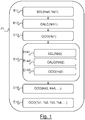
- the coding method P1 of a solar time is described with reference to figures 1 and 2 .
- the coding method P1 is capable of being implemented by an electronic device of the Smartphone type.
- the initial solar time Hs1 is associated with a geographic location Loc and with a day D1 of the year, which is for example the current year.
- the geographic location Loc corresponds to the city of Ottawa and the day D1 of the year is the 1 st of the month of January (referenced 1 on the figure 2 ).
- the initial solar time Hs1 is one of the following types: sunrise (ls), zenith (z) or sunset (cs).
- the coding method P1 comprises the following steps.
- step E11 illustrated SEL (Href, Nb1) a reference time Href and an initial number of bits Nb1 are selected as a function of the type of the initial solar time Hs1.
- the reference time is noon and the initial number of bits Nb1 is equal to 8. In a nonlimiting embodiment, if the initial solar time Hs1 is of sunrise type, the reference time is midnight and the initial number of bits Nb1 is equal to 10. In a nonlimiting embodiment, if the initial solar time Hs1 is of sunset type, the time is midnight and the initial number of bits Nb1 is 10.
- step E12 illustrated CALC (Nm1), a number of minutes Nm1 separating said initial solar time Hs1 and the reference time Href is calculated.
- the number of minutes Nm1 is equal to the difference between the initial solar time Hs1 and the reference time Href.
- the initial time Hs1 is for example predetermined by means of an algorithm of the NOAA “National Oceanic and Atmospheric Administration”, known to those skilled in the art, or even be retrieved via the internet by the electronic device.
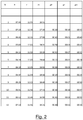
- the table of the figure 2 illustrates the hours of sunrise (ls), zenith (z) and sunset (cs) for the city of Ottawa on the 1st of each of the 12 months (M) in the year 2017.
- the initial solar time Hs1 is of zenith type, it is worth 12:06 am on January 1 in Ottawa.
- the initial solar time Hs1 is therefore 6 minutes apart from the reference time, here at noon.
- the initial solar time Hs1 is of type sunrise, it is 7:43 am on January 1 in Ottawa.
- the initial solar time Hs1 is therefore separated by 463 minutes from the reference time, here midnight.
- the number of minutes Nm1 is coded on the number of initial bits Nb1.
- the value 6 is coded on Nm1 bits, here 6 bits.
- the value 463 is coded on Nm1 bits, here 10bits.
- the coding method P1 further comprises a coding step E14 of a first additional solar hour Hs2 of the same type as the initial solar time Hs1, associated with the same localization Loc but with one day D2 of the different year.
- the day D2 corresponds to the same calendar as the day D1, but to the following month.
- the J1 date is 1 January of a year
- the J2 date is 1 February of the same year.
- J1 and J2 days could match the 21 th day of the month.
- the coding step E14 comprises a substep E141 illustrated SEL (Nb2), in which a number of additional bits Nb2 is selected as a function of the type of the initial solar time Hs1.
- the number of additional bits Nb2 selected is equal to 8 bits.
- the number of additional bits Nb2 selected is equal to 5 bits.
- the number of additional bits Nb2 selected is equal to 8 bits.
- the coding step E14 comprises a substep E142 illustrated CALC (Nm2), in which a number of minutes Nm2 separating the first additional solar time Hs2 and the initial solar time Hs1 is calculated.
- the first overtime Hs2 February 1 is 12:16.
- the number of minutes Nm2 separating the initial solar time Hs1 from the first additional hour Hs2 is then equal to 10.
- the first overtime Hs2 February 1 is 7:23.
- the number of minutes Nm2 separating the initial solar time Hs1 from the first additional hour Hs2 is then equal to 20.
- the coding step E14 comprises a substep E143 illustrated COD (Hs2) in which said number of minutes Nm2 is coded on the number of additional bits Nb2.
- Hs2 substep E143 illustrated COD
- the value 10 is coded on 5 bits, or the value 20 is coded on 8 bits.
- the coding method P1 further comprises a step E15 illustrated COD (Hs3, Hs4, ...) for coding a plurality of other additional solar hours Hs3, Hs4, ...
- the other additional solar hours Hs3, Hs4, ... are such that the plurality of days D1, D2, D3, D4, ... associated with the initial solar hours Hs1 and additional hours Hs2, Hs3, Hs4, ... correspond to a same date but at months M1, M2, M3, M4, ... different from the year.
- the J3 day is March 1
- J4 day is April 1, etc.
- day J1, J2, J3, J4, ... could match the 21 th day of the month.
- the number of minutes Nm3, Nm4, ... separating the other additional solar hour Hs3, Hs4, ... from the previous additional solar hour Hs2, Hs3, ..., that is to say the additional solar time corresponding to the previous month, is calculated and then coded on the number of additional bits Nb2.
- the first extra solar time is Hs2 type and sunset is 5:10 p.m. to 1 February
- the third extra solar time Hs3 March 1 5:50 p.m. is the number of minutes between the Nm3 third additional solar hour Hs3 of the previous additional solar hour (second solar hour Hs2) is 40.
- the value 40 is then coded on 8 bits.
- step E15 is carried out for a series of five additional solar hours Hs2 to Hs6 so as to cover the first 6 months of the year.
- the numbers of minutes Nm1 to Nm6 relating to only six solar hours will be transmitted to a timepiece, and the timepiece will be able to calculate the solar hours Hs7 to Hs12 for the last 6 months of the year by symmetry of the beginning of the year with respect to the end of the year.
- the solar hours calculated for months Hs7 to Hs12 will be imprecise, but the accuracy achieved may be considered sufficient.
- the solar hours for the last 6 months of the year could be coded and transmitted to the timepiece, and the timepiece could symmetrically deduce the solar hours for the first 6 months of the year.
- the solar hours for the first 7, respectively the last 7 months of the year could be coded and transmitted to the timepiece, and the timepiece could deduce by symmetry the solar hours for the last 5, respectively the first 5 months of the year.
- the difference between summer time and winter time must be taken into account when calculating by symmetry.
- step E15 is carried out for a series of eleven additional solar hours Hs2 to Hs12 so as to cover all the months of the year.
- the solar hours will all be precisely known by the timepiece, but the data to be transmitted will be more voluminous.
- step E15 is carried out for a series of
- the coding method P1 further comprises the illustrated step E16 COD (Ts1, Ts2, Ts3, Ts4, ...) the coding of a second initial hour, called initial solar time Ts1, and of a second series of overtime hours, called additional solar time Ts2 , Ts3, Ts4, ....
- the solar times Ts1, Ts2, Ts3, Ts4, ... and the solar hours Hs1, Hs2, Hs3, Hs4, ... are of different types but correspond two by two on the same days D1, D2, D3, D4, ... of the year.
- the solar times Ts1, Ts2, Ts3, Ts4, ... are of the sunrise type and the solar hours Hs1, Hs2, Hs3, Ts4, ... are of the sunset type .
- the solar times Ts1, Ts2, Ts3, Ts4, ... are of the sunrise type and the solar hours Hs1, Hs2, Hs3, Ts4, ... are of the zenith type. As we will see later, this allows to calculate by symmetry a series of solar hours Gs1, Gs2, Gs3, Gs4, ... of the sunset type.
- the solar times Ts1, Ts2, Ts3, ... are of the sunset type and the solar hours Hs1, Hs2, Hs3, ... are of the zenith type. As we will see later, this allows to calculate by symmetry a series of solar hours Gs1, Gs2, Gs3, Gs4, ... of sunrise type.
- the solar times Ts1, Ts2, Ts3, Ts4, ... are calculated in a similar way to the solar times Hs1, Hs2, Hs3, Hs4, ...
- the method for transmitting P2 of a plurality of solar hours is described with reference to figures 3 to 5 .
- the P2 transmission method is able to be implemented in part by the electronic device of the Smartphone type and in part by the timepiece.
- the timepiece is an electronic watch not connected to an analog display.
- the P2 transmission method comprises the following steps.
- the electronic device implements the coding method P1, so as to code an initial solar time Hs1 and a plurality of solar hours additional Hs2, Hs3, Hs4, ....
- step E22 TX (Hs1, Hs2, Hs3, Hs4; Href ).
- the coded solar hours Hs1, Hs2, Hs3, Hs4, ... are transmitted from the electronic device to the timepiece .
- the reference time Href used to code the solar hours is also transmitted.
- the transmission is carried out via an optical communication link, Bluetooth Low Energy or a near field communication NFC "Near Field Communication" in English terminology.
- the timepiece decodes the solar hours coded Hs1, Hs2, Hs3, Hs4, .... Due to the low number Nb1, Nb2 of bits used for their coding, the timepiece may include only a weak processor.
- the timepiece receives and extracts the 10 encoded value of 5 bits and adds it to the value to determine 12:06 the first additional solar hour Hs2: 12:16.
- the timepiece receives and extracts the 40 coded 8-bit value and adds value to 5:10 p.m. to determine the third additional hour Hs3: 5:50 p.m.
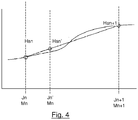
- the timepiece calculates the intermediate solar hours for every other day, by linear interpolation.
- the timepiece decoded the solar time Hsn of the first day of the month Mn (Jn) and decoded the solar time Hsn + 1 of the first day of the month Mn + 1 (Jn + 1).
- Linear interpolation allows it to calculate approximately an intermediate solar hour Hsn 'for an intermediate day Jn' located between day Jn and day Jn + 1.
- the timepiece After having thus decoded all the solar hours received and calculated by linear interpolation the solar hours of the intermediate days, the timepiece is aware of the solar hours for each of the days of the year.
- the P2 transmission method further comprises three or even four additional steps, carried out following or in parallel with the three preceding steps.
- the electronic device implements the coding method P1, so as to code a second initial solar time, called the initial solar time Ts1, and a second series of additional solar hours, called additional solar times Ts2, Ts3, Ts4, ..., the solar times Ts1, Ts2, Ts3, Ts4, ... and the solar hours Hs1, Hs2, Hs3, Hs4, ... being of a different type as explained above.
- step E25 illustrated TX (Ts1, Ts2, Ts3, Ts4, ...; Href '), the coded solar times Ts1, Ts2, Ts3, Ts4, ... are transmitted from the electronic device to the part d watchmaking.
- the reference time Href 'used to code the solar times is also transmitted.
- Step E25 is carried out in a similar manner to step E22.
- step E26 illustrated DEC (Ts1, Ts2, Ts3, Ts4, ...), the timepiece decodes the coded solar times Ts1, Ts2, Ts3, Ts4, ....
- the step E26 is performed by similar to step E23.
- the timepiece calculates the intermediate solar times for every other day, by linear interpolation, as explained above.
- the timepiece calculates by symmetry with respect to the solar hours a series of other hours solar Gs1, Gs2, Gs3, Gs4, .... If the solar times Ts1, Ts2, Ts3, Ts4, ... are of sunrise type, the series of solar hours Gs1, Gs2, Gs3, Gs4,. .. is of the sunset type. On the contrary, if the solar times Ts1, Ts2, Ts3, Ts4, ... are of the sunset type, the series of solar hours Gs1, Gs2, Gs3, Gs4, ... is of the sunrise type.
- the figure 5 illustrates a graph in which solar hours Hs1 to Hs12, solar times Ts1 to Ts12 and solar hours Gs1 to Gs12 are illustrated.
- the days D1 to D12 are defined on the abscissa, and the hours H on the ordinate.
- Ts4 is approximately equal to 6 hours
- Hs4 is approximately equal to 12:01: the difference in minutes between these two hours is therefore equal to 361 minutes.
- Gs4 by the following calculation: 12:01 + 361 minutes, or 1082 minutes, or 18:03.
- the timepiece calculates the intermediate solar hours for every other day, by linear interpolation.
- the watch can receive information allowing it to very easily calculate the solar hours for every day of a year, so it does not need to be connected to the internet or to have a powerful processor.
Landscapes
- Physics & Mathematics (AREA)
- General Physics & Mathematics (AREA)
- Astronomy & Astrophysics (AREA)
- Engineering & Computer Science (AREA)
- Computer Networks & Wireless Communication (AREA)
- Signal Processing (AREA)
- Radar, Positioning & Navigation (AREA)
- Remote Sensing (AREA)
- Electric Clocks (AREA)
Priority Applications (5)
| Application Number | Priority Date | Filing Date | Title |
|---|---|---|---|
| EP18185320.1A EP3599518B1 (de) | 2018-07-24 | 2018-07-24 | Verfahren zum kodieren und übertragen mindestens einer sonnenstunde |
| US16/454,115 US11899403B2 (en) | 2018-07-24 | 2019-06-27 | Method for coding and transmitting at least one solar time |
| JP2019127423A JP6898389B2 (ja) | 2018-07-24 | 2019-07-09 | 少なくとも1つの太陽時を符号化し送信する方法 |
| KR1020190087809A KR102349240B1 (ko) | 2018-07-24 | 2019-07-19 | 적어도 하나의 태양시를 코딩 및 송신하기 위한 방법 |
| CN201910660782.4A CN110784281B (zh) | 2018-07-24 | 2019-07-22 | 用于编码和传输至少一个太阳时的方法 |
Applications Claiming Priority (1)
| Application Number | Priority Date | Filing Date | Title |
|---|---|---|---|
| EP18185320.1A EP3599518B1 (de) | 2018-07-24 | 2018-07-24 | Verfahren zum kodieren und übertragen mindestens einer sonnenstunde |
Publications (2)
| Publication Number | Publication Date |
|---|---|
| EP3599518A1 true EP3599518A1 (de) | 2020-01-29 |
| EP3599518B1 EP3599518B1 (de) | 2026-02-25 |
Family
ID=63041925
Family Applications (1)
| Application Number | Title | Priority Date | Filing Date |
|---|---|---|---|
| EP18185320.1A Active EP3599518B1 (de) | 2018-07-24 | 2018-07-24 | Verfahren zum kodieren und übertragen mindestens einer sonnenstunde |
Country Status (5)
| Country | Link |
|---|---|
| US (1) | US11899403B2 (de) |
| EP (1) | EP3599518B1 (de) |
| JP (1) | JP6898389B2 (de) |
| KR (1) | KR102349240B1 (de) |
| CN (1) | CN110784281B (de) |
Families Citing this family (1)
| Publication number | Priority date | Publication date | Assignee | Title |
|---|---|---|---|---|
| EP4139751B1 (de) * | 2020-04-22 | 2025-07-16 | ESA - European Space Agency | Elektronische uhr zur raum- und/oder oberflächenexploration |
Citations (3)
| Publication number | Priority date | Publication date | Assignee | Title |
|---|---|---|---|---|
| US5408444A (en) * | 1991-06-19 | 1995-04-18 | Casio Computer Co., Ltd. | Electronic timepiece capable of receiving signals from satellites |
| WO2006117059A2 (de) * | 2005-05-03 | 2006-11-09 | Junghans Uhren Gmbh | Verfahren und speichereinrichtung zum speichern der örtlichen zeitzone sowie verfahren und vorrichtung zur bestimmung der ortszeit anhand von standortkoordinaten |
| CN101206118A (zh) * | 2007-12-13 | 2008-06-25 | 浙江交通职业技术学院 | 太阳方位的自动计算方法及其自动计算器 |
Family Cites Families (17)
| Publication number | Priority date | Publication date | Assignee | Title |
|---|---|---|---|---|
| JPH04370791A (ja) * | 1991-06-19 | 1992-12-24 | Casio Comput Co Ltd | 時計機能付電子機器および表示制御方法 |
| JP3135103B2 (ja) * | 1994-10-12 | 2001-02-13 | 三菱電機株式会社 | ソーラータイムスイッチ |
| JP2000133106A (ja) | 1998-10-28 | 2000-05-12 | Kawamura Electric Inc | ソーラータイムスイッチ |
| US7218575B2 (en) | 2003-10-31 | 2007-05-15 | Rosevear John M | Angular twilight clock |
| US20060074497A1 (en) | 2004-09-29 | 2006-04-06 | Pollin Robert E | Methods, systems, and articles of manufacture for providing a timing apparatus with an almanac memory |
| JP2014048136A (ja) | 2012-08-30 | 2014-03-17 | Seiko Precision Inc | 時刻修正システム、時刻送信装置、時刻修正装置、時刻修正方法およびプログラム |
| JP2015072144A (ja) | 2013-10-02 | 2015-04-16 | 扇矢工事株式会社 | 生活時計 |
| JP6435762B2 (ja) * | 2013-12-26 | 2018-12-12 | カシオ計算機株式会社 | 電子機器、プログラム、及び、日時情報の取得方法 |
| JPWO2015132925A1 (ja) | 2014-03-06 | 2017-03-30 | 三菱電機株式会社 | 地図情報処理装置及び地図情報処理方法 |
| CN103995877B (zh) | 2014-05-26 | 2017-05-17 | 中国科学院空间科学与应用研究中心 | 一种大尺度日地空间太阳风数据的剖分、编码及存取方法 |
| US20160037134A1 (en) | 2014-07-31 | 2016-02-04 | Todd MEDEMA | Methods and systems of simulating time of day and environment of remote locations |
| JP6511834B2 (ja) * | 2015-01-30 | 2019-05-15 | セイコーエプソン株式会社 | 電子時計、電子機器、更新情報送信装置、および更新情報送信プログラム |
| JP6202017B2 (ja) * | 2015-02-24 | 2017-09-27 | カシオ計算機株式会社 | 電子時計、通信システム及びプログラム |
| US10607520B2 (en) | 2015-05-14 | 2020-03-31 | Manufacturing Resources International, Inc. | Method for environmental adaptation of display characteristics based on location |
| US10739971B2 (en) * | 2015-06-05 | 2020-08-11 | Apple Inc. | Accessing and displaying information corresponding to past times and future times |
| JP6710918B2 (ja) * | 2015-09-02 | 2020-06-17 | カシオ計算機株式会社 | アナログ表示装置 |
| JP6734139B2 (ja) | 2016-07-26 | 2020-08-05 | シチズン時計株式会社 | 時刻修正システム、電子機器、プログラム及び時刻修正方法 |
-
2018
- 2018-07-24 EP EP18185320.1A patent/EP3599518B1/de active Active
-
2019
- 2019-06-27 US US16/454,115 patent/US11899403B2/en active Active
- 2019-07-09 JP JP2019127423A patent/JP6898389B2/ja active Active
- 2019-07-19 KR KR1020190087809A patent/KR102349240B1/ko active Active
- 2019-07-22 CN CN201910660782.4A patent/CN110784281B/zh active Active
Patent Citations (3)
| Publication number | Priority date | Publication date | Assignee | Title |
|---|---|---|---|---|
| US5408444A (en) * | 1991-06-19 | 1995-04-18 | Casio Computer Co., Ltd. | Electronic timepiece capable of receiving signals from satellites |
| WO2006117059A2 (de) * | 2005-05-03 | 2006-11-09 | Junghans Uhren Gmbh | Verfahren und speichereinrichtung zum speichern der örtlichen zeitzone sowie verfahren und vorrichtung zur bestimmung der ortszeit anhand von standortkoordinaten |
| CN101206118A (zh) * | 2007-12-13 | 2008-06-25 | 浙江交通职业技术学院 | 太阳方位的自动计算方法及其自动计算器 |
Also Published As
| Publication number | Publication date |
|---|---|
| US11899403B2 (en) | 2024-02-13 |
| JP6898389B2 (ja) | 2021-07-07 |
| CN110784281B (zh) | 2023-02-17 |
| JP2020017949A (ja) | 2020-01-30 |
| CN110784281A (zh) | 2020-02-11 |
| US20200033808A1 (en) | 2020-01-30 |
| KR102349240B1 (ko) | 2022-01-07 |
| KR20200011366A (ko) | 2020-02-03 |
| EP3599518B1 (de) | 2026-02-25 |
Similar Documents
| Publication | Publication Date | Title |
|---|---|---|
| EP3379348B1 (de) | Universelle mondphasenanzeige | |
| EP2211300A1 (de) | Prognoseverfahren der Stromproduktion einer Photovoltaik-Anlage | |
| JP2008003092A (ja) | Gnssアプリケーションのためのエフェメリス拡張方法及び機器 | |
| EP3379347B1 (de) | Verfahren zur regulierung der gangfrequenz einer elektronischen uhr | |
| EP3599518B1 (de) | Verfahren zum kodieren und übertragen mindestens einer sonnenstunde | |
| CH715197A2 (fr) | Procédé de codage et de transmission d'au moins une heure solaire. | |
| EP2872921B1 (de) | Gnss-funksignal mit verbesserter navigationsnachricht | |
| EP3945725B1 (de) | Verfahren zur übertragung von messwerten zur entlastung des netzes | |
| Stephenson et al. | The solar eclipse observed by Clavius in AD 1567. | |
| EP3644138A1 (de) | Uhr, die die sonnenposition in bezug auf den horizont an jedem punkt des erdballs anzeigen kann | |
| EP2442137B1 (de) | System zur Erhöhung der Verfügbarkeit und der Leistungen eines Geolokalisierungssystems über Satellit | |
| CH713590A2 (fr) | Affichage de phase de lune universel. | |
| HK40020861A (en) | Method for coding and transmitting at least one solar time | |
| HK40020861B (en) | Method for coding and transmitting at least one solar time | |
| CH715490A2 (fr) | Pièce d`horlogerie pouvant indiquer la position du soleil par rapport à l`horizon en tout point du globe. | |
| EP1943539A1 (de) | Verfahren zur bestimmung der position von satelliten in einem navigationssystem | |
| US20050013200A1 (en) | Method for displaying time in mobile terminal | |
| EP1477004B1 (de) | Frequenzmodulator für digitale übertragungen | |
| FR3142961A1 (fr) | Procédé de gestion d’au moins un dispositif d’éclairage d’ambiance d’un habitacle de véhicule automobile. | |
| JP2000292571A (ja) | 時間帯出力装置、及び時間帯出力方法 | |
| CH693599A5 (fr) | Pièce d'horlogerie comportant une représentation d'un hémisphère terrestre. | |
| FR2945400A1 (fr) | Procede et dispositif de mise a jour de la date et de l'heure d'un systeme electronique, en particulier un telephone mobile cellulaire | |
| FR2622315A1 (fr) | Cadran d'horlogerie permettant la lecture simultanee de l'heure selon le systeme decimal et le systeme duodecimal | |
| FR3046687A1 (fr) | Detection de defaillances de production industrielle | |
| Meeus | La Comète Bradfield (1975d) |
Legal Events
| Date | Code | Title | Description |
|---|---|---|---|
| PUAI | Public reference made under article 153(3) epc to a published international application that has entered the european phase |
Free format text: ORIGINAL CODE: 0009012 |
|
| STAA | Information on the status of an ep patent application or granted ep patent |
Free format text: STATUS: THE APPLICATION HAS BEEN PUBLISHED |
|
| AK | Designated contracting states |
Kind code of ref document: A1 Designated state(s): AL AT BE BG CH CY CZ DE DK EE ES FI FR GB GR HR HU IE IS IT LI LT LU LV MC MK MT NL NO PL PT RO RS SE SI SK SM TR |
|
| AX | Request for extension of the european patent |
Extension state: BA ME |
|
| STAA | Information on the status of an ep patent application or granted ep patent |
Free format text: STATUS: REQUEST FOR EXAMINATION WAS MADE |
|
| 17P | Request for examination filed |
Effective date: 20200729 |
|
| RBV | Designated contracting states (corrected) |
Designated state(s): AL AT BE BG CH CY CZ DE DK EE ES FI FR GB GR HR HU IE IS IT LI LT LU LV MC MK MT NL NO PL PT RO RS SE SI SK SM TR |
|
| STAA | Information on the status of an ep patent application or granted ep patent |
Free format text: STATUS: EXAMINATION IS IN PROGRESS |
|
| 17Q | First examination report despatched |
Effective date: 20201210 |
|
| P01 | Opt-out of the competence of the unified patent court (upc) registered |
Effective date: 20230701 |
|
| GRAP | Despatch of communication of intention to grant a patent |
Free format text: ORIGINAL CODE: EPIDOSNIGR1 |
|
| STAA | Information on the status of an ep patent application or granted ep patent |
Free format text: STATUS: GRANT OF PATENT IS INTENDED |
|
| INTG | Intention to grant announced |
Effective date: 20251007 |
|
| GRAS | Grant fee paid |
Free format text: ORIGINAL CODE: EPIDOSNIGR3 |
|
| GRAA | (expected) grant |
Free format text: ORIGINAL CODE: 0009210 |
|
| STAA | Information on the status of an ep patent application or granted ep patent |
Free format text: STATUS: THE PATENT HAS BEEN GRANTED |
|
| AK | Designated contracting states |
Kind code of ref document: B1 Designated state(s): AL AT BE BG CH CY CZ DE DK EE ES FI FR GB GR HR HU IE IS IT LI LT LU LV MC MK MT NL NO PL PT RO RS SE SI SK SM TR |
|
| REG | Reference to a national code |
Ref country code: CH Ref legal event code: F10 Free format text: ST27 STATUS EVENT CODE: U-0-0-F10-F00 (AS PROVIDED BY THE NATIONAL OFFICE) Effective date: 20260225 Ref country code: GB Ref legal event code: FG4D Free format text: NOT ENGLISH |
|
| REG | Reference to a national code |
Ref country code: DE Ref legal event code: R096 Ref document number: 602018089351 Country of ref document: DE |
|
| REG | Reference to a national code |
Ref country code: IE Ref legal event code: FG4D Free format text: LANGUAGE OF EP DOCUMENT: FRENCH |
|
| REG | Reference to a national code |
Ref country code: CH Ref legal event code: R17 Free format text: ST27 STATUS EVENT CODE: U-0-0-R10-R17 (AS PROVIDED BY THE NATIONAL OFFICE) Effective date: 20260413 |