EP3599226A1 - Verfahren und vorrichtung zur anreicherung von silikat in trinkwasser - Google Patents
Verfahren und vorrichtung zur anreicherung von silikat in trinkwasser Download PDFInfo
- Publication number
- EP3599226A1 EP3599226A1 EP19187724.0A EP19187724A EP3599226A1 EP 3599226 A1 EP3599226 A1 EP 3599226A1 EP 19187724 A EP19187724 A EP 19187724A EP 3599226 A1 EP3599226 A1 EP 3599226A1
- Authority
- EP
- European Patent Office
- Prior art keywords
- silicate
- water
- sodium
- raw water
- drinking water
- Prior art date
- Legal status (The legal status is an assumption and is not a legal conclusion. Google has not performed a legal analysis and makes no representation as to the accuracy of the status listed.)
- Granted
Links
Images

Classifications
-
- C—CHEMISTRY; METALLURGY
- C02—TREATMENT OF WATER, WASTE WATER, SEWAGE, OR SLUDGE
- C02F—TREATMENT OF WATER, WASTE WATER, SEWAGE, OR SLUDGE
- C02F9/00—Multistage treatment of water, waste water or sewage
-
- A—HUMAN NECESSITIES
- A23—FOODS OR FOODSTUFFS; TREATMENT THEREOF, NOT COVERED BY OTHER CLASSES
- A23L—FOODS, FOODSTUFFS OR NON-ALCOHOLIC BEVERAGES, NOT OTHERWISE PROVIDED FOR; PREPARATION OR TREATMENT THEREOF
- A23L2/00—Non-alcoholic beverages; Dry compositions or concentrates therefor; Preparation or treatment thereof
- A23L2/52—Adding ingredients
-
- A—HUMAN NECESSITIES
- A23—FOODS OR FOODSTUFFS; TREATMENT THEREOF, NOT COVERED BY OTHER CLASSES
- A23L—FOODS, FOODSTUFFS OR NON-ALCOHOLIC BEVERAGES, NOT OTHERWISE PROVIDED FOR; PREPARATION OR TREATMENT THEREOF
- A23L2/00—Non-alcoholic beverages; Dry compositions or concentrates therefor; Preparation or treatment thereof
- A23L2/70—Clarifying or fining of non-alcoholic beverages; Removing unwanted matter
-
- A—HUMAN NECESSITIES
- A23—FOODS OR FOODSTUFFS; TREATMENT THEREOF, NOT COVERED BY OTHER CLASSES
- A23L—FOODS, FOODSTUFFS OR NON-ALCOHOLIC BEVERAGES, NOT OTHERWISE PROVIDED FOR; PREPARATION OR TREATMENT THEREOF
- A23L2/00—Non-alcoholic beverages; Dry compositions or concentrates therefor; Preparation or treatment thereof
- A23L2/70—Clarifying or fining of non-alcoholic beverages; Removing unwanted matter
- A23L2/80—Clarifying or fining of non-alcoholic beverages; Removing unwanted matter by adsorption
-
- B—PERFORMING OPERATIONS; TRANSPORTING
- B01—PHYSICAL OR CHEMICAL PROCESSES OR APPARATUS IN GENERAL
- B01D—SEPARATION
- B01D19/00—Degasification of liquids
- B01D19/0036—Flash degasification
-
- B—PERFORMING OPERATIONS; TRANSPORTING
- B01—PHYSICAL OR CHEMICAL PROCESSES OR APPARATUS IN GENERAL
- B01D—SEPARATION
- B01D61/00—Processes of separation using semi-permeable membranes, e.g. dialysis, osmosis or ultrafiltration; Apparatus, accessories or auxiliary operations specially adapted therefor
- B01D61/02—Reverse osmosis; Hyperfiltration ; Nanofiltration
- B01D61/025—Reverse osmosis; Hyperfiltration
-
- B—PERFORMING OPERATIONS; TRANSPORTING
- B01—PHYSICAL OR CHEMICAL PROCESSES OR APPARATUS IN GENERAL
- B01D—SEPARATION
- B01D61/00—Processes of separation using semi-permeable membranes, e.g. dialysis, osmosis or ultrafiltration; Apparatus, accessories or auxiliary operations specially adapted therefor
- B01D61/02—Reverse osmosis; Hyperfiltration ; Nanofiltration
- B01D61/08—Apparatus therefor
-
- B—PERFORMING OPERATIONS; TRANSPORTING
- B01—PHYSICAL OR CHEMICAL PROCESSES OR APPARATUS IN GENERAL
- B01D—SEPARATION
- B01D61/00—Processes of separation using semi-permeable membranes, e.g. dialysis, osmosis or ultrafiltration; Apparatus, accessories or auxiliary operations specially adapted therefor
- B01D61/14—Ultrafiltration; Microfiltration
- B01D61/145—Ultrafiltration
-
- B—PERFORMING OPERATIONS; TRANSPORTING
- B01—PHYSICAL OR CHEMICAL PROCESSES OR APPARATUS IN GENERAL
- B01D—SEPARATION
- B01D61/00—Processes of separation using semi-permeable membranes, e.g. dialysis, osmosis or ultrafiltration; Apparatus, accessories or auxiliary operations specially adapted therefor
- B01D61/14—Ultrafiltration; Microfiltration
- B01D61/18—Apparatus therefor
-
- B—PERFORMING OPERATIONS; TRANSPORTING
- B01—PHYSICAL OR CHEMICAL PROCESSES OR APPARATUS IN GENERAL
- B01D—SEPARATION
- B01D61/00—Processes of separation using semi-permeable membranes, e.g. dialysis, osmosis or ultrafiltration; Apparatus, accessories or auxiliary operations specially adapted therefor
- B01D61/42—Electrodialysis; Electro-osmosis ; Electro-ultrafiltration; Membrane capacitive deionization
- B01D61/422—Electrodialysis
-
- B—PERFORMING OPERATIONS; TRANSPORTING
- B01—PHYSICAL OR CHEMICAL PROCESSES OR APPARATUS IN GENERAL
- B01D—SEPARATION
- B01D61/00—Processes of separation using semi-permeable membranes, e.g. dialysis, osmosis or ultrafiltration; Apparatus, accessories or auxiliary operations specially adapted therefor
- B01D61/42—Electrodialysis; Electro-osmosis ; Electro-ultrafiltration; Membrane capacitive deionization
- B01D61/44—Ion-selective electrodialysis
-
- B—PERFORMING OPERATIONS; TRANSPORTING
- B01—PHYSICAL OR CHEMICAL PROCESSES OR APPARATUS IN GENERAL
- B01D—SEPARATION
- B01D61/00—Processes of separation using semi-permeable membranes, e.g. dialysis, osmosis or ultrafiltration; Apparatus, accessories or auxiliary operations specially adapted therefor
- B01D61/42—Electrodialysis; Electro-osmosis ; Electro-ultrafiltration; Membrane capacitive deionization
- B01D61/44—Ion-selective electrodialysis
- B01D61/46—Apparatus therefor
- B01D61/464—Apparatus therefor comprising the membrane sequence CC
-
- B—PERFORMING OPERATIONS; TRANSPORTING
- B01—PHYSICAL OR CHEMICAL PROCESSES OR APPARATUS IN GENERAL
- B01D—SEPARATION
- B01D61/00—Processes of separation using semi-permeable membranes, e.g. dialysis, osmosis or ultrafiltration; Apparatus, accessories or auxiliary operations specially adapted therefor
- B01D61/42—Electrodialysis; Electro-osmosis ; Electro-ultrafiltration; Membrane capacitive deionization
- B01D61/44—Ion-selective electrodialysis
- B01D61/46—Apparatus therefor
- B01D61/465—Apparatus therefor comprising the membrane sequence AB or BA, where B is a bipolar membrane
-
- B—PERFORMING OPERATIONS; TRANSPORTING
- B01—PHYSICAL OR CHEMICAL PROCESSES OR APPARATUS IN GENERAL
- B01D—SEPARATION
- B01D61/00—Processes of separation using semi-permeable membranes, e.g. dialysis, osmosis or ultrafiltration; Apparatus, accessories or auxiliary operations specially adapted therefor
- B01D61/42—Electrodialysis; Electro-osmosis ; Electro-ultrafiltration; Membrane capacitive deionization
- B01D61/44—Ion-selective electrodialysis
- B01D61/46—Apparatus therefor
- B01D61/466—Apparatus therefor comprising the membrane sequence BC or CB
-
- B—PERFORMING OPERATIONS; TRANSPORTING
- B01—PHYSICAL OR CHEMICAL PROCESSES OR APPARATUS IN GENERAL
- B01D—SEPARATION
- B01D61/00—Processes of separation using semi-permeable membranes, e.g. dialysis, osmosis or ultrafiltration; Apparatus, accessories or auxiliary operations specially adapted therefor
- B01D61/42—Electrodialysis; Electro-osmosis ; Electro-ultrafiltration; Membrane capacitive deionization
- B01D61/44—Ion-selective electrodialysis
- B01D61/46—Apparatus therefor
- B01D61/467—Apparatus therefor comprising the membrane sequence BB
-
- B—PERFORMING OPERATIONS; TRANSPORTING
- B01—PHYSICAL OR CHEMICAL PROCESSES OR APPARATUS IN GENERAL
- B01D—SEPARATION
- B01D61/00—Processes of separation using semi-permeable membranes, e.g. dialysis, osmosis or ultrafiltration; Apparatus, accessories or auxiliary operations specially adapted therefor
- B01D61/42—Electrodialysis; Electro-osmosis ; Electro-ultrafiltration; Membrane capacitive deionization
- B01D61/44—Ion-selective electrodialysis
- B01D61/46—Apparatus therefor
- B01D61/468—Apparatus therefor comprising more than two electrodes
-
- B—PERFORMING OPERATIONS; TRANSPORTING
- B01—PHYSICAL OR CHEMICAL PROCESSES OR APPARATUS IN GENERAL
- B01D—SEPARATION
- B01D61/00—Processes of separation using semi-permeable membranes, e.g. dialysis, osmosis or ultrafiltration; Apparatus, accessories or auxiliary operations specially adapted therefor
- B01D61/42—Electrodialysis; Electro-osmosis ; Electro-ultrafiltration; Membrane capacitive deionization
- B01D61/44—Ion-selective electrodialysis
- B01D61/46—Apparatus therefor
- B01D61/48—Apparatus therefor having one or more compartments filled with ion-exchange material, e.g. electrodeionisation
-
- B—PERFORMING OPERATIONS; TRANSPORTING
- B01—PHYSICAL OR CHEMICAL PROCESSES OR APPARATUS IN GENERAL
- B01D—SEPARATION
- B01D61/00—Processes of separation using semi-permeable membranes, e.g. dialysis, osmosis or ultrafiltration; Apparatus, accessories or auxiliary operations specially adapted therefor
- B01D61/58—Multistep processes
-
- B—PERFORMING OPERATIONS; TRANSPORTING
- B67—OPENING, CLOSING OR CLEANING BOTTLES, JARS OR SIMILAR CONTAINERS; LIQUID HANDLING
- B67C—CLEANING, FILLING WITH LIQUIDS OR SEMILIQUIDS, OR EMPTYING, OF BOTTLES, JARS, CANS, CASKS, BARRELS, OR SIMILAR CONTAINERS, NOT OTHERWISE PROVIDED FOR; FUNNELS
- B67C3/00—Bottling liquids or semiliquids; Filling jars or cans with liquids or semiliquids using bottling or like apparatus; Filling casks or barrels with liquids or semiliquids
- B67C3/02—Bottling liquids or semiliquids; Filling jars or cans with liquids or semiliquids using bottling or like apparatus
- B67C3/22—Details
- B67C3/225—Means for filling simultaneously, e.g. in a rotary filling apparatus or multiple rows of containers
-
- C—CHEMISTRY; METALLURGY
- C02—TREATMENT OF WATER, WASTE WATER, SEWAGE, OR SLUDGE
- C02F—TREATMENT OF WATER, WASTE WATER, SEWAGE, OR SLUDGE
- C02F1/00—Treatment of water, waste water, or sewage
- C02F1/68—Treatment of water, waste water, or sewage by addition of specified substances, e.g. trace elements, for ameliorating potable water
-
- B—PERFORMING OPERATIONS; TRANSPORTING
- B01—PHYSICAL OR CHEMICAL PROCESSES OR APPARATUS IN GENERAL
- B01D—SEPARATION
- B01D2311/00—Details relating to membrane separation process operations and control
- B01D2311/08—Specific process operations in the concentrate stream
-
- B—PERFORMING OPERATIONS; TRANSPORTING
- B01—PHYSICAL OR CHEMICAL PROCESSES OR APPARATUS IN GENERAL
- B01D—SEPARATION
- B01D2311/00—Details relating to membrane separation process operations and control
- B01D2311/12—Addition of chemical agents
-
- B—PERFORMING OPERATIONS; TRANSPORTING
- B01—PHYSICAL OR CHEMICAL PROCESSES OR APPARATUS IN GENERAL
- B01D—SEPARATION
- B01D2311/00—Details relating to membrane separation process operations and control
- B01D2311/24—Quality control
- B01D2311/246—Concentration control
-
- B—PERFORMING OPERATIONS; TRANSPORTING
- B01—PHYSICAL OR CHEMICAL PROCESSES OR APPARATUS IN GENERAL
- B01D—SEPARATION
- B01D2311/00—Details relating to membrane separation process operations and control
- B01D2311/25—Recirculation, recycling or bypass, e.g. recirculation of concentrate into the feed
- B01D2311/252—Recirculation of concentrate
- B01D2311/2521—Recirculation of concentrate to permeate side
-
- B—PERFORMING OPERATIONS; TRANSPORTING
- B01—PHYSICAL OR CHEMICAL PROCESSES OR APPARATUS IN GENERAL
- B01D—SEPARATION
- B01D2311/00—Details relating to membrane separation process operations and control
- B01D2311/26—Further operations combined with membrane separation processes
- B01D2311/2653—Degassing
-
- B—PERFORMING OPERATIONS; TRANSPORTING
- B01—PHYSICAL OR CHEMICAL PROCESSES OR APPARATUS IN GENERAL
- B01D—SEPARATION
- B01D2311/00—Details relating to membrane separation process operations and control
- B01D2311/26—Further operations combined with membrane separation processes
- B01D2311/268—Water softening
-
- B—PERFORMING OPERATIONS; TRANSPORTING
- B01—PHYSICAL OR CHEMICAL PROCESSES OR APPARATUS IN GENERAL
- B01D—SEPARATION
- B01D2317/00—Membrane module arrangements within a plant or an apparatus
- B01D2317/02—Elements in series
- B01D2317/025—Permeate series
-
- B—PERFORMING OPERATIONS; TRANSPORTING
- B01—PHYSICAL OR CHEMICAL PROCESSES OR APPARATUS IN GENERAL
- B01D—SEPARATION
- B01D61/00—Processes of separation using semi-permeable membranes, e.g. dialysis, osmosis or ultrafiltration; Apparatus, accessories or auxiliary operations specially adapted therefor
- B01D61/02—Reverse osmosis; Hyperfiltration ; Nanofiltration
- B01D61/04—Feed pretreatment
-
- B—PERFORMING OPERATIONS; TRANSPORTING
- B01—PHYSICAL OR CHEMICAL PROCESSES OR APPARATUS IN GENERAL
- B01D—SEPARATION
- B01D61/00—Processes of separation using semi-permeable membranes, e.g. dialysis, osmosis or ultrafiltration; Apparatus, accessories or auxiliary operations specially adapted therefor
- B01D61/42—Electrodialysis; Electro-osmosis ; Electro-ultrafiltration; Membrane capacitive deionization
- B01D61/44—Ion-selective electrodialysis
- B01D61/445—Ion-selective electrodialysis with bipolar membranes; Water splitting
-
- C—CHEMISTRY; METALLURGY
- C02—TREATMENT OF WATER, WASTE WATER, SEWAGE, OR SLUDGE
- C02F—TREATMENT OF WATER, WASTE WATER, SEWAGE, OR SLUDGE
- C02F1/00—Treatment of water, waste water, or sewage
- C02F1/006—Water distributors either inside a treatment tank or directing the water to several treatment tanks; Water treatment plants incorporating these distributors, with or without chemical or biological tanks
-
- C—CHEMISTRY; METALLURGY
- C02—TREATMENT OF WATER, WASTE WATER, SEWAGE, OR SLUDGE
- C02F—TREATMENT OF WATER, WASTE WATER, SEWAGE, OR SLUDGE
- C02F1/00—Treatment of water, waste water, or sewage
- C02F1/20—Treatment of water, waste water, or sewage by degassing, i.e. liberation of dissolved gases
-
- C—CHEMISTRY; METALLURGY
- C02—TREATMENT OF WATER, WASTE WATER, SEWAGE, OR SLUDGE
- C02F—TREATMENT OF WATER, WASTE WATER, SEWAGE, OR SLUDGE
- C02F1/00—Treatment of water, waste water, or sewage
- C02F1/30—Treatment of water, waste water, or sewage by irradiation
- C02F1/32—Treatment of water, waste water, or sewage by irradiation with ultraviolet light
-
- C—CHEMISTRY; METALLURGY
- C02—TREATMENT OF WATER, WASTE WATER, SEWAGE, OR SLUDGE
- C02F—TREATMENT OF WATER, WASTE WATER, SEWAGE, OR SLUDGE
- C02F1/00—Treatment of water, waste water, or sewage
- C02F1/42—Treatment of water, waste water, or sewage by ion-exchange
-
- C—CHEMISTRY; METALLURGY
- C02—TREATMENT OF WATER, WASTE WATER, SEWAGE, OR SLUDGE
- C02F—TREATMENT OF WATER, WASTE WATER, SEWAGE, OR SLUDGE
- C02F1/00—Treatment of water, waste water, or sewage
- C02F1/44—Treatment of water, waste water, or sewage by dialysis, osmosis or reverse osmosis
- C02F1/441—Treatment of water, waste water, or sewage by dialysis, osmosis or reverse osmosis by reverse osmosis
-
- C—CHEMISTRY; METALLURGY
- C02—TREATMENT OF WATER, WASTE WATER, SEWAGE, OR SLUDGE
- C02F—TREATMENT OF WATER, WASTE WATER, SEWAGE, OR SLUDGE
- C02F1/00—Treatment of water, waste water, or sewage
- C02F1/44—Treatment of water, waste water, or sewage by dialysis, osmosis or reverse osmosis
- C02F1/444—Treatment of water, waste water, or sewage by dialysis, osmosis or reverse osmosis by ultrafiltration or microfiltration
-
- C—CHEMISTRY; METALLURGY
- C02—TREATMENT OF WATER, WASTE WATER, SEWAGE, OR SLUDGE
- C02F—TREATMENT OF WATER, WASTE WATER, SEWAGE, OR SLUDGE
- C02F1/00—Treatment of water, waste water, or sewage
- C02F1/46—Treatment of water, waste water, or sewage by electrochemical methods
- C02F1/469—Treatment of water, waste water, or sewage by electrochemical methods by electrochemical separation, e.g. by electro-osmosis, electrodialysis, electrophoresis
- C02F1/4693—Treatment of water, waste water, or sewage by electrochemical methods by electrochemical separation, e.g. by electro-osmosis, electrodialysis, electrophoresis electrodialysis
-
- C—CHEMISTRY; METALLURGY
- C02—TREATMENT OF WATER, WASTE WATER, SEWAGE, OR SLUDGE
- C02F—TREATMENT OF WATER, WASTE WATER, SEWAGE, OR SLUDGE
- C02F1/00—Treatment of water, waste water, or sewage
- C02F1/46—Treatment of water, waste water, or sewage by electrochemical methods
- C02F1/469—Treatment of water, waste water, or sewage by electrochemical methods by electrochemical separation, e.g. by electro-osmosis, electrodialysis, electrophoresis
- C02F1/4693—Treatment of water, waste water, or sewage by electrochemical methods by electrochemical separation, e.g. by electro-osmosis, electrodialysis, electrophoresis electrodialysis
- C02F1/4695—Treatment of water, waste water, or sewage by electrochemical methods by electrochemical separation, e.g. by electro-osmosis, electrodialysis, electrophoresis electrodialysis electrodeionisation
-
- C—CHEMISTRY; METALLURGY
- C02—TREATMENT OF WATER, WASTE WATER, SEWAGE, OR SLUDGE
- C02F—TREATMENT OF WATER, WASTE WATER, SEWAGE, OR SLUDGE
- C02F1/00—Treatment of water, waste water, or sewage
- C02F1/66—Treatment of water, waste water, or sewage by neutralisation; pH adjustment
-
- C—CHEMISTRY; METALLURGY
- C02—TREATMENT OF WATER, WASTE WATER, SEWAGE, OR SLUDGE
- C02F—TREATMENT OF WATER, WASTE WATER, SEWAGE, OR SLUDGE
- C02F2101/00—Nature of the contaminant
- C02F2101/10—Inorganic compounds
-
- C—CHEMISTRY; METALLURGY
- C02—TREATMENT OF WATER, WASTE WATER, SEWAGE, OR SLUDGE
- C02F—TREATMENT OF WATER, WASTE WATER, SEWAGE, OR SLUDGE
- C02F2103/00—Nature of the water, waste water, sewage or sludge to be treated
- C02F2103/02—Non-contaminated water, e.g. for industrial water supply
-
- C—CHEMISTRY; METALLURGY
- C02—TREATMENT OF WATER, WASTE WATER, SEWAGE, OR SLUDGE
- C02F—TREATMENT OF WATER, WASTE WATER, SEWAGE, OR SLUDGE
- C02F2201/00—Apparatus for treatment of water, waste water or sewage
- C02F2201/46—Apparatus for electrochemical processes
- C02F2201/461—Electrolysis apparatus
- C02F2201/46105—Details relating to the electrolytic devices
- C02F2201/46115—Electrolytic cell with membranes or diaphragms
-
- C—CHEMISTRY; METALLURGY
- C02—TREATMENT OF WATER, WASTE WATER, SEWAGE, OR SLUDGE
- C02F—TREATMENT OF WATER, WASTE WATER, SEWAGE, OR SLUDGE
- C02F2201/00—Apparatus for treatment of water, waste water or sewage
- C02F2201/46—Apparatus for electrochemical processes
- C02F2201/461—Electrolysis apparatus
- C02F2201/46105—Details relating to the electrolytic devices
- C02F2201/4612—Controlling or monitoring
- C02F2201/46125—Electrical variables
- C02F2201/4613—Inversing polarity
-
- C—CHEMISTRY; METALLURGY
- C02—TREATMENT OF WATER, WASTE WATER, SEWAGE, OR SLUDGE
- C02F—TREATMENT OF WATER, WASTE WATER, SEWAGE, OR SLUDGE
- C02F2301/00—General aspects of water treatment
- C02F2301/04—Flow arrangements
- C02F2301/043—Treatment of partial or bypass streams
-
- C—CHEMISTRY; METALLURGY
- C02—TREATMENT OF WATER, WASTE WATER, SEWAGE, OR SLUDGE
- C02F—TREATMENT OF WATER, WASTE WATER, SEWAGE, OR SLUDGE
- C02F2303/00—Specific treatment goals
- C02F2303/04—Disinfection
-
- C—CHEMISTRY; METALLURGY
- C02—TREATMENT OF WATER, WASTE WATER, SEWAGE, OR SLUDGE
- C02F—TREATMENT OF WATER, WASTE WATER, SEWAGE, OR SLUDGE
- C02F2303/00—Specific treatment goals
- C02F2303/18—Removal of treatment agents after treatment
-
- C—CHEMISTRY; METALLURGY
- C02—TREATMENT OF WATER, WASTE WATER, SEWAGE, OR SLUDGE
- C02F—TREATMENT OF WATER, WASTE WATER, SEWAGE, OR SLUDGE
- C02F2303/00—Specific treatment goals
- C02F2303/22—Eliminating or preventing deposits, scale removal, scale prevention
-
- C—CHEMISTRY; METALLURGY
- C02—TREATMENT OF WATER, WASTE WATER, SEWAGE, OR SLUDGE
- C02F—TREATMENT OF WATER, WASTE WATER, SEWAGE, OR SLUDGE
- C02F2305/00—Use of specific compounds during water treatment
-
- C—CHEMISTRY; METALLURGY
- C02—TREATMENT OF WATER, WASTE WATER, SEWAGE, OR SLUDGE
- C02F—TREATMENT OF WATER, WASTE WATER, SEWAGE, OR SLUDGE
- C02F5/00—Softening water; Preventing scale; Adding scale preventatives or scale removers to water, e.g. adding sequestering agents
- C02F5/08—Treatment of water with complexing chemicals or other solubilising agents for softening, scale prevention or scale removal, e.g. adding sequestering agents
Definitions
- the invention relates to a method for the enrichment of silicate in drinking water, and a device for producing a drinking water enriched with silicate.
- the main mineral components in water are calcium, magnesium, sodium, potassium, bicarbonate, sulfate, chloride, nitrate, fluoride and silicate, which have positive effects on the human body for various reasons.
- calcium is needed in the human body for bone formation.
- the element silicon which is present in the form of silicate in the drinking water, has various positive properties on the human body, so that it is advantageous to absorb silicates via the drinking water.
- silicates are able to bind toxic aluminum and thus prevent or alleviate neurodegenerative diseases such as Alzheimer's ( V. Rondeau, American Journal of Epidemiology, 169, 4, 2009, pages 489-496 ; Exley et al., Journal of Alzheimers Disease, 10, 2006, pages 17-24 ).
- the US 2005/0247626 A1 discloses a method and an apparatus for producing calcareous water from deionized water.
- the WO 2011/010188 A1 discloses a process for producing silica-enriched water.
- the WO 2011/009950 A1 discloses a process for producing silica-enriched water.
- the DE 10 2008 052 001 A1 discloses a method of water treatment.
- the processes disclosed in the prior art have the disadvantage that drinking water with an enriched silicate content can only be produced economically in large-scale quantities with great expenditure on equipment.
- the methods and devices known in the prior art have the disadvantage that they are disadvantageous from a cost point of view.
- it is difficult to maintain the original mineral composition in the raw water with the known methods and devices ie the concentration is difficult other minerals present in the raw water to be left in the resulting drinking water. For this reason, the natural sensory character of drinking water is often not preserved.
- Aqueous glass of sodium, potassium, and / or lithium silicate are referred to as water glass, which have a high solubility in water.
- water glass made from sodium or potassium silicates is commercially available in large quantities and at the same time contains the drinking water-relevant elements sodium and potassium, and could therefore potentially serve as an additive for silicate-containing drinking water.
- water glass made of sodium or potassium silicates has not previously been used for the commercial production of drinking water, since this would also be associated with a high increase in the sodium and / or potassium concentration in the drinking water. This is undesirable from a health point of view and also goes hand in hand with a deteriorated sensor system, in particular the natural sensory character of the drinking water not being retained.
- the object of the present invention is therefore to provide a method for enriching silicate in drinking water, the drinking water being able to be produced inexpensively in large-scale quantities.
- Another object is to provide a device for producing drinking water which is enriched with silicate and which can be produced inexpensively in large-scale quantities.
- the process for the enrichment of silicate in drinking water comprises the following steps: separation of raw water via a reverse osmosis process into a permeate, comprising demineralized raw water, and a retentate, comprising raw water enriched with minerals; Mixing the permeate and a water glass solution comprising sodium and / or potassium silicate; Subjecting at least a portion of the mixture to an ion exchange process to reduce the concentration of sodium and / or potassium ions; and adding at least a portion of the retentate to the mixture with reduced concentration of sodium and / or potassium ions to obtain drinking water enriched with silicate.
- the raw water is separated into a permeate and a retentate via reverse osmosis ("osmosis reversal", OR).
- osmosis reversal reverse osmosis processes are known in the prior art, so that suitable devices and process parameters are known to the person skilled in the art.
- the permeate comprises demineralized raw water, which is separated from the retentate (i.e. the proportion of water that has a high concentration of minerals after reverse osmosis).
- the term "demineralized raw water” in the context of the present invention is pure water which has a total solids content of preferably 5 ppm or less.
- the total solids content corresponds to the dry residue.
- the reverse osmosis is typically carried out in such a way that the permeate is approximately 40 to 99% by volume and the retentate is approximately 1 to 60% by volume, preferably 45 to 95% by volume of permeate and 5 to 55% by volume of retentate , more preferably about 60 to 90% by volume of permeate and 10 to 40% by volume of retentate of the total volume of the raw water used.
- the volume ratio is particularly preferably set to 75% by volume of permeate and 25% by volume of retentate.
- Raw water according to the present invention is, for example, groundwater, surface water or river water. In general, all types of raw water can be used that are not harmful to humans or animals.
- water glass solution defines an aqueous solution comprising sodium and / or potassium silicate, and is preferably a saturated solution.
- concentration of sodium and / or potassium silicate in the water glass solution is 1 mol / l or greater, preferably 2 mol / l or greater, more preferably 3 mol / l or greater, particularly preferably greater than 3.2 mol / l.
- the production of such water glass solutions is known in the prior art and is not described further here.
- mixing the permeate and the water glass solution including sodium and / or potassium silicate, produces a mixture whose silicate concentration can be enriched in a targeted manner depending on the mixing ratio, so that drinking water with an enriched silicate content results.
- Preferred mixing ratios of water glass solution to water (permeate) are in the range from 1:10 to 1: 10000, preferably 1: 100 to 1: 5000, more preferably 1: 184 to 1: 3061.
- the mixture of the permeate, i.e. of the demineralized raw water, and the water glass solution have a very high concentration of sodium and / or potassium ions, so that the mixture, at least in the case of relevant mixing ratios with regard to the silicate content, is only suitable as drinking water to a limited extent without subsequent treatment, since this is possible with a undesirable sensors would go hand in hand.
- at least part of the mixture is subjected to an ion exchange process in order to reduce the concentration of sodium and / or potassium ions, i.e. to set the desired concentration of sodium and / or potassium ions in the resulting drinking water.
- ion exchange processes can be used according to the invention. Examples include Processes based on the use of column exchangers, cocurrent exchangers, countercurrent exchangers, stratified bed exchangers, multi-chamber exchangers, mixed bed exchangers, double flow exchangers or sandwich exchangers.
- the type of materials that can be used is not limited and includes e.g. Synthetic resins, clay minerals or zeolites.
- the ion exchange process can be carried out by electrochemical processes using membranes, in particular by means of reverse electrodialysis and / or electroionization.
- ion exchange process encompasses all processes which are suitable for removing cations, and in particular sodium and / or potassium ions, from the mixture of the demineralized raw water and the water glass solution and replacing them with H +.
- concentration of anions, such as silicate is not changed by the ion exchange process.
- the pH of the water glass solution or the mixture of the demineralized raw water and the water glass solution is preferably in the basic range, such as pH 9 or higher, since this requires a higher solubility of the sodium and / or potassium silicate.
- the solubility at pH 9 or higher is 250 mg / l SiO 2 or more.
- the solubility is lower at neutral or acidic pH, for example about 150 to less than 250 mg / l SiO 2 .
- the pH drops again during the ion exchange process, so that the process is preferably carried out in such a way that the resulting drinking water has a neutral pH.
- the ion exchange process is a reverse electrodialysis and / or an electroionization.
- Reverse electrodialysis is preferably used, since it enables particularly effective removal of sodium and / or potassium ions.
- Reverse electrodialysis (English: “electrodialysis reversal”; EDR) uses electrical voltage to separate ions after their charge.
- the principle of reverse electrodialysis with a cation, anion and bipolar membrane is in Fig. 1 shown.
- the aqueous solution of demineralized raw water (RO H 2 O) and a water glass solution, comprising potassium silicate (K 2 OSiO 2 ) is made up of a sequence of cation membranes (CM), anion membranes (AM) and bipolar membranes (BM) by applying electrical voltage divided into anions and cations.
- RO H 2 O demineralized raw water
- K 2 OSiO 2 potassium silicate
- the cation membrane is designed so that only cations can permeate, while only anions can permeate through the anion membrane.
- Bipolar membranes split water molecules into hydrogen ions and hydroxide ions, preventing other ions from switching to the other side of the membrane. After performing the procedure there is a separation into an acid and a base, that is, silica and potassium hydroxide.
- Commercially available systems can be used to carry out the reverse electrodialysis. Suitable EDR systems are sold, for example, by the manufacturers MEGA as / Czechia or FUJiFilm Manufacturing Europe BV / Netherlands. Reverse electrodialysis is carried out according to the manufacturer's instructions.
- the reverse electrodialysis is carried out using only a bipolar and / or cation membrane.
- a corresponding embodiment is in Fig. 2 shown in which only cation membranes and bipolar membranes are used.
- This embodiment is advantageous because it enables ion transfer to be carried out faster and more efficiently. It was also surprisingly observed that unpleasant smells, which in particular in one embodiment Fig.1 occurred while performing at basic pH values, in the embodiment according to Fig.2 were not detected. Another advantage of this embodiment is that there is no significant loss of silicate in the membrane.
- sulfate ions which can be used as an electrolyte, to increase the conductivity from migrating into the product.
- the ion exchange process is electrodeionization (EDI).
- Electrodeionization processes are known in the prior art. EDI is preferably carried out with SAC resin in the H + cycle. The EDI regenerates continuously through the applied voltage and the associated splitting of water on the bipolar membranes. Suitable EDI systems are sold, for example, by the manufacturers SnowPure Water Technologies / USA or EVOQUA Water Technologies LLC. The electrodeionization is carried out according to the manufacturer's instructions.
- the water glass solution is preferably a potassium silicate water glass solution (CAS No. 1312-76-1). Potassium silicate water glass solutions are slightly more expensive than sodium silicate water glass solutions. However, due to their specific manufacturing process, sodium silicates have the disadvantage that undesired constituents, e.g. Amines can be present, which negatively affect the quality and sensor technology of the water.
- the mixing of the permeate and the water glass solution is preferably carried out in such a way that the concentration of the silicate in the mixture, taking into account a subsequent backmixing with at least part of the retentate, corresponds to the final silicate concentration in the desired drinking water.
- concentration of the silicate in the mixture is preferably in the range of 50 to 500 mg / l, more preferably from 100 to 300 mg / l, particularly preferably from 130 to 250 mg / l.
- Such a process design is commercially preferred, since it makes it possible to dispense with further concentration adjustments. This simply ensures the desired increased final silicate concentration in drinking water.
- the ion exchange process is preferably carried out such that the resulting concentration of sodium and / or potassium ions is in the range from 0-10 mg / l, preferably in the range from 0-5 mg / l, particularly preferably in the range from 0-1 mg / l, more preferably in the range of 0-0.1 mg / l.
- the concentration of sodium and / or potassium ions is 0.001 mg / l or less. Such a low concentration is preferred from a health point of view and results in a natural sensor system for the resulting drinking water.
- a food-grade hardness stabilizer is added to the raw water before the reverse osmosis process.
- the addition of hardness stabilizers to the raw water has the advantage that the precipitation and deposition of metal salts, e.g. Calcium carbonate or iron salts, is suppressed. On the one hand, this prevents unwanted deposits in process components. On the other hand, this can suppress any undesirable clouding of the resulting drinking water that results from precipitated metal salt particles.
- a hardness stabilizer is added, this must be a food-safe hardness stabilizer according to the invention.
- Food safe in the sense of the present invention means that the hardness stabilizer can be safely added to the drinking water from a health point of view. The use of non-food-grade hardness stabilizers is not possible, as this would otherwise get into the drinking water produced via the retentate.
- all materials which meet these conditions ie which are food-safe and function as hardness stabilizers in water, can be used as food-safe hardness stabilizers.
- Suitable, commercially available, food-safe hardness stabilizers are, for example, compounds based on phosphate. In embodiments, these can be added in a concentration of up to 7 mg / l.
- the food-safe hardness stabilizer is CO 2 , since an easy and inexpensive metering is possible in this way.
- CO 2 can be removed from the drinking water easily and inexpensively if still drinking water is to be produced.
- the method includes a step of removing CO 2 after the reverse osmosis process.
- the removal of CO 2 is preferred after the step of supplying of the retentate to the mixture with reduced concentration of sodium and / or potassium ions.
- Such a process design enables CO 2 to be removed from the drinking water quickly and effectively.
- the drinking water with a high silicate content is still drinking water.
- the method further comprises a step of removing CO 2 by means of vacuum degassing, pressure degassing or membrane degassing.
- vacuum degassing degassing is done by applying a vacuum.
- pressure degassing a second gas (such as nitrogen or air) is added to the water, which displaces the first gas (ie CO 2 ).
- the pressure degassing is carried out by using a CO 2 sprinkler, with which the surface can be enlarged, which is associated with an increased process speed.
- Vacuum degassing and pressure degassing can also be carried out at elevated temperature in order to increase the process speed.
- the vacuum degassing can be carried out with or without using stripping gas.
- O 2 , N 2 or other inert gases are preferably used as stripping gases.
- the pH in the drinking water is preferably set here. When removing CO 2, the pH value can be used as a control variable for control.
- the method further comprises a step of disinfecting the raw water and / or a step of disinfecting the drinking water enriched with silicate.
- the sterilization is preferably carried out using a membrane separation process.
- other methods are also possible, such as UV radiation etc. as long as they are able to ensure the necessary disinfection so that all drinking water requirements are met. This ensures that the resulting drinking water has the required water quality in every case (ie also when using dirty raw water).
- the membrane separation process is preferably carried out via ultrafiltration (UF), which enables particularly effective disinfection.
- Ultrafiltration is a filtration process in which particles with specific particle sizes can be filtered, the ultrafiltration in embodiments filtering particles with minimal diameters in the range from 0.05 ⁇ m to 0.005 ⁇ m.
- ultrafiltration filters particles with diameters of 0.02 ⁇ m or larger.
- Corresponding membrane separation processes are known in the prior art and are not further explained here. Nanofiltration is not, at least in embodiments possible because nanofiltration already filters out particles with very small diameters, so that in embodiments, ions are already separated from the mineral substances with relatively large molecular diameters (such as Ca 2+ , Mg 2+ or SO4 2- ).
- further cleaning processes for cleaning or treating raw water can be carried out.
- Examples include Absorption processes via activated carbon filters to separate e.g. organic compounds, biochemical processes such as Denitrification of waters contaminated with nitrate, disinfection such as treatment with chlorine, ozone or UV radiation, as well as precipitation, flocculation, flotation, oxidation, sedimentation or sieving processes.
- a step according to the invention of the disclosed method is the remixing or feeding of at least part of the retentate to the mixture of permeate with the water glass solution (after the above-described treatment of at least part of the mixture by ion exchange processes).
- the method comprises supplying at least 50% by volume, preferably at least 70% by volume, more preferably at least 90% by volume, of the retentate.
- Complete re-mixing is preferred since the entire volume of the raw water used is used to produce the drinking water.
- further treatment of the retentate is also possible using the processes described here, such as disinfection, and further processes, such as dilution with drinking water, etc.
- the raw water used has such a quality (as a mineral content in particular), that the complete retentate can be returned. This allows an extremely effective and commercially inexpensive procedure.
- suitable additional minerals can be added to the drinking water in suitable concentrations. This is preferably done via the retentate. Furthermore, the addition can also take place after the retentate has been supplied. Methods and processes for adding minerals are generally known and are not explained in detail here.
- the present invention further relates to a device for the enrichment of silicate in drinking water.
- This device comprises a reverse osmosis unit for separating raw water into a permeate, comprising demineralized raw water, and a retentate comprising raw water enriched with minerals; a mixing unit for mixing the permeate and a water glass solution comprising sodium and / or potassium silicate; an ion exchanger to subject at least a portion of the mixture to an ion exchange process to reduce the concentration of sodium and / or potassium ions; and a feed unit for feeding at least a portion of the retentate to the treated permeate.
- a reverse osmosis unit for separating raw water into a permeate, comprising demineralized raw water, and a retentate comprising raw water enriched with minerals
- a mixing unit for mixing the permeate and a water glass solution comprising sodium and / or potassium silicate
- an ion exchanger to subject at least a portion of the mixture
- This device is suitable for carrying out a method for enriching silicate in drinking water as described above. With this device it is possible to obtain drinking water that is enriched with silicate, that can be produced inexpensively in large-scale quantities, and that maintains its natural sensory character if the concentration of other minerals is not changed compared to the raw water (that is, with the complete delivery of the retentate without further treatment). Further advantages and embodiments of the device are described in relation to the method and also apply to the device.
- the ion exchanger is preferably a component for performing a reverse electrodialysis and / or an electroionization.
- a reverse electrodialysis is preferred, comprising exclusively bipolar and / or cation membranes.
- the device comprises a component for adding a food-grade hardness stabilizer.
- the component for metering in a food-grade hardness stabilizer is preferably connected to the device according to the invention in such a way that the hardness stabilizer is supplied to the raw water before it is introduced into the reverse osmosis unit.
- This component is preferably suitable for metering in CO 2 as a hardness stabilizer.
- a component for removing the food-safe hardness stabilizer can optionally be present.
- This can be a suitable device for the chemical and / or physical removal of the hardness stabilizer.
- a component is particularly useful when CO 2 is used as hardness stabilizers and if the device is intended to produce still drinking water.
- the component for removing CO 2 is a vacuum degassing unit, a pressure degassing unit, or a membrane degassing unit, the vacuum degassing unit preferably comprising a dosing unit of stripping gas.
- the component for removing the hardness stabilizer is preferably provided in such a way that the removal can take place after the retentate has been returned.
- the device comprises a disinfection unit for disinfecting the raw water and / or a disinfection unit for disinfecting the drinking water enriched with silicate.
- the disinfection unit comprises a separating membrane, preferably an ultrafiltration (UF) membrane.
- the invention further comprises a filling system, in particular a beverage filling system, for filling the drinking water enriched with silicate, the filling system comprising the device described above.
- the filling system comprises a carousel that rotates around a vertical axis of rotation and has a plurality of identical filling stations for filling the drinking water enriched with silicate, which are arranged along the circumference of the carousel.
- the bottling plant can be used to fill the drinking water enriched with silicate effectively and inexpensively in bottles.
- the method and the device are particularly suitable for producing drinking water with an enriched silicate content, which is used for the treatment of neurodegenerative diseases such as e.g. Alzheimer's is used.
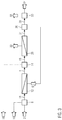
- Fig. 3 shows schematically an embodiment of a device according to the invention for the production of drinking water with enriched silicate content.
- the device comprises a component (8) for adding CO 2 (10) as a food-grade hardness stabilizer to raw water (2).
- the device further comprises a reverse osmosis unit (12) in which the raw water (11) enriched with CO 2 is separated into a permeate (4) comprising raw demineralized water and a retentate (6) comprising raw water enriched with minerals.
- the device includes a mixing unit (14) for producing a mixture (18) of the permeate (4) and a water glass solution (16) comprising sodium and / or potassium silicate.
- the device further comprises an ion exchanger (20) in which the mixture (18) can be converted into a mixture (24) with a reduced concentration of sodium and / or potassium ions and sodium and / or potassium ions (22) via an ion exchange process.
- the device also includes a supply unit (26) for supplying the retentate (6) to the mixture (24) with a reduced concentration of sodium and / or potassium ions, so that drinking water (28) enriched with silicate can be produced.
- the device comprises a component (30) for removing CO 2 (32), namely a vacuum degassing unit, comprising a dosing unit of stripping gas (not shown).
- the device further optionally includes a sterilization unit for sterilizing the raw water and / or a sterilization unit for sterilizing the silicate-enriched drinking water (not shown).
- the method according to the invention can be carried out as follows: In the device after Fig. 3 raw water (2) in component (8) is mixed with CO 2 (10) and the raw water (11) mixed with CO 2 is separated into permeate (4) and retentate (6) in the reverse osmosis unit (12). A water glass solution (16) comprising sodium and / or potassium silicate is then added to the retentate (4) in the mixing unit (14). The mixture (18) of permeate and water glass solution is transferred to the ion exchanger (20). The concentration of sodium and / or potassium ions, which are carried out as potassium and / or sodium ions (22) from the ion exchanger (20), is reduced there by means of reverse electrodialysis.
- the mixture (24) with a reduced concentration of potassium and / or sodium ions is transferred to the feed unit (26), in which the retentate (6) is fed to the mixture (24), whereby drinking water (28) enriched with silicate is produced , Subsequently, CO 2 (32) is removed in the component (30) via a vacuum degassing unit with N 2 stripping gas, so that still drinking water (34) enriched with water is produced.
Landscapes
- Engineering & Computer Science (AREA)
- Water Supply & Treatment (AREA)
- Chemical & Material Sciences (AREA)
- Chemical Kinetics & Catalysis (AREA)
- Health & Medical Sciences (AREA)
- Urology & Nephrology (AREA)
- Life Sciences & Earth Sciences (AREA)
- Nanotechnology (AREA)
- Organic Chemistry (AREA)
- Environmental & Geological Engineering (AREA)
- Hydrology & Water Resources (AREA)
- Nutrition Science (AREA)
- Food Science & Technology (AREA)
- Polymers & Plastics (AREA)
- Medicinal Chemistry (AREA)
- Separation Using Semi-Permeable Membranes (AREA)
Abstract
Description
- Die Erfindung betrifft ein Verfahren zur Anreicherung von Silikat in Trinkwasser, sowie eine Vorrichtung zur Herstellung eines mit Silikat angereicherten Trinkwassers.
- Vor dem Hintergrund des steigenden Trinkwasserverbrauchs, der unter anderem in Verbindung mit sinkender Wasserqualität einhergeht, ist es heutzutage bei der Herstellung von Trinkwasser üblich und vielfach nötig, verschiedene Reinigungsschritte für die Aufbereitung von Rohwasser einzusetzen. Insbesondere ist es üblich, in Flaschen abgefülltes Trinkwasser durch Demineralisieren von Rohwasser z.B. mittels Umkehrosmose und anschließender Zugabe von Mineralstoffen herzustellen. Dabei erfolgt die Einstellung des pH-Werts oft durch Zugabe von Laugen oder Säuren bei der Mineralisierung oder vor der Umkehrosmose.
- Dies hat den Vorteil, dass eine gleichbleibende Trinkwasserqualität auch bei Einsatz von unterschiedlichem Rohwasser gewährleistet werden kann. Weiter ist es dadurch möglich, verschiedenste Zusätze wie Mineralstoffe, die gesundheitsförderliche Eigenschaften besitzen, gezielt im Trinkwasser anzureichern. Die Hauptmineralbestandteile im Wasser sind Calcium, Magnesium, Natrium, Kalium, Bicarbonat, Sulfat, Chlorid, Nitrat, Fluorid und Silikat, die aus verschiedenen Gründen positive Auswirkungen auf den menschlichen Körper besitzen. So wird z.B. Calcium im menschlichen Körper für die Knochenbildung benötigt. Insbesondere besitzt das Element Silizium, das im Trinkwasser vornehmlich in der Form in von Silikat vorliegt, diverse positive Eigenschaften auf den menschlichen Körper, so dass es vorteilhaft ist, Silikate über das Trinkwasser aufzunehmen. Zum Beispiel ist bekannt, dass Silikate in der Lage sind, toxisches Aluminium zu binden, und so neurodegenerative Krankheiten wie z.B. Alzheimer zu verhindern bzw. zu lindern (V. Rondeau, American Journal of Epidemiology, 169, 4, 2009, Seiten 489-496; Exley et al., Journal of Alzheimers Disease, 10, 2006, Seiten 17-24).
- Diese üblichen Verfahren, bei denen Mineralstoffe demineralisiertem Rohwasser, das z.B. unter Verwendung eines über Umkehrosmose hergestellten Permeats hergestellt, zugegeben werden, sind aber aus Kostengesichtspunkten ungünstig, insbesondere da ein nicht unerheblicher Anteil des Rohwassers (nämlich das bei der Umkerosmose anfallende Retentat) verworfen wird. Weiter ist es oft schwierig, den natürlichen sensorischen Charakter des Rohwassers beizubehalten. Der sensorische Charakter des Rohwassers ist von der Mineralstoffkonzentration abhängig, und die genaue Einstellung bzw. Wiederherstellung der relevanten Mineralstoffkonzentrationen auf das Niveau des Rohwassers ist in den üblichen Verfahren schwierig und ungenau.
- Im Stand der Technik sind darüber hinaus weitere Ansätze bekannt, Silizium in höheren Konzentrationen im Trinkwasser anzureichern, um so dieses Element dem menschlichen Körper in ausreichenden Mengen zuzuführen. Die
US 2014/0271995A1 zeigt z.B. ein Verfahren zum Herstellen von Trinkwasser, bei dem Rohwasser als Zusatzstoff SiO2 zugegeben wird, um die gewünschte Menge an Silikat im Trinkwasser zu erzielen. Weiter offenbart dieCN104098169B die Zugabe von amorphen Si-Kristallen als Partikel oder Pulver zu gereinigtem Wasser. Generell haben diese Ansätze den Nachteil, dass das Silizium in der Form von SiO2 (d.h. Kieselsäure) eingesetzt wird. Kieselsäure weist aber eine relativ geringe Löslichkeit im sauren und neutralen pH-Bereich auf, so dass zumindest zum Teil aufwändige Prozessschritte wie z.B. Filterschritte durchgeführt werden müssen, um den gewünschten Silikatgehalt im Trinkwasser einzustellen und unerwünschte Partikel zu entfernen. - Weiter offenbaren die
WO2011/009950 A1 undWO2011/010188 A1 Verfahren zum Anreichern von ortho-Kieselsäure ([Si(OH)4]) in Trinkwasser, bei denen ein Umkehrosmose-Prozessschritt mit nachfolgender Elektrodialyse dazu benützt wird, um zunächst Silizium im Wasser anzureichern und danach unerwünschte Mineralstoffe zu entfernen. Diese Verfahren sind aber auch aus kommerzieller Sicht ungünstig, da sie nur das bei der Umkehrosmose anfallende Retentat (das mit Silizium angereichert ist) zur Trinkwasserherstellung verwenden, das erhaltene Permeat dagegen verworfen wird. - Die
US 2005/0247626 A1 offenbart ein Verfahren sowie eine Vorrichtung zur Herstellung von kalkhaltigem Wasser aus deionisiertem Wasser. DieWO 2011/010188 A1 offenbart ein Verfahren zur Herstellung von mit Kieselsäure angereichertem Wasser. DieWO 2011/009950 A1 offenbart ein Verfahren zur Herstellung von mit Kieselsäure angereichertem Wasser. DieDE 10 2008 052 001 A1 offenbart ein Verfahren zur Wasserbehandlung. - Insgesamt haben die im Stand der Technik offenbarten Verfahren den Nachteil, dass sich nur unter hohem apparativem Aufwand Trinkwasser mit angereichertem Silikatgehalt in großtechnischen Mengen wirtschaftlich herstellen lässt. Somit besitzen die im Stand der Technik bekannten Verfahren und Vorrichtungen den Nachteil, dass sich aus Kostengesichtspunkten ungünstig sind. Weiter ist es schwierig, mit den bekannten Verfahren und Vorrichtungen die ursprüngliche Mineralstoffzusammensetzung im Rohwasser beizubehalten, d.h. es ist schwierig die Konzentration anderer Mineralstoffe, die im Rohwasser vorliegen, im resultierenden Trinkwasser gleich zu belassen. Aus diesen Grund bleibt der natürliche sensorische Charakter des Trinkwassers vielfach nicht erhalten.
- Als alternative Siliziumquelle zu Kieselsäure existiert z.B. Wasserglas. Als Wasserglas werden wässrige Lösungen aus Natrium-, Kalium-, und/oder Lithiumsilikat bezeichnet, die eine hohe Löslichkeit in Wasser aufweisen. Insbesondere Wasserglas aus Natrium- oder Kaliumsilikaten ist kommerziell in großen Mengen erhältlich und beinhaltet gleichzeitig die trinkwasserrelevanten Elemente Natrium und Kalium, und könnte deswegen potentiell als Additiv für silikathaltiges Trinkwasser dienen. Allerdings wurde Wasserglas aus Natrium- oder Kaliumsilikaten bisher nicht zur kommerziellen Herstellung von Trinkwasser eingesetzt, da dies gleichzeitig mit einem hohen Anstieg der Natrium- und/oder Kaliumkonzentration im Trinkwasser verbunden wäre. Dies ist aus Gesundheitsgesichtspunkten unerwünscht und geht auch mit einer verschlechterten Sensorik einher, wobei insbesondere der natürliche sensorische Charakter des Trinkwassers nicht erhalten bleibt.
- Somit ist die Aufgabe der vorliegenden Erfindung das Bereitstellen eines Verfahrens zum Anreichern von Silikat in Trinkwasser, wobei sich das Trinkwasser in großtechnischen Mengen kostengünstig herstellen lässt.
- Weiter ist die Aufgabe das Bereitstellen einer Vorrichtung zum Herstellen von Trinkwasser, das mit Silikat angereichert ist, das sich in großtechnischen Mengen kostengünstig herstellen lässt.
- Diese Aufgabe wird durch das Verfahren gemäß Anspruch 1 gelöst. Bevorzugte Ausführungsformen des Verfahrens sind in den Unteransprüchen 2 bis 9 definiert, die auch in Kombination untereinander umfasst sind. Weiter wird die Aufgabe durch die Vorrichtung gemäß Anspruch 10 gelöst. Bevorzugte Ausführungsformen der Vorrichtung sind in den Unteransprüchen 11 bis 15 definiert, die auch in Kombination untereinander umfasst sind.
-
-
Fig. 1 zeigt schematisch das Prinzip einer reversen Elektrodialyse mit einer Kation-, Anion- und Bipolarmembran. -
Fig. 2 zeigt schematisch eine Ausführungsform einer reversen Elektrodialyse unter ausschließlicher Verwendung einer Bipolar- und/oder Kationmembran. -
Fig. 3 zeigt schematisch ein Ausführungsbeispiel einer erfindungsgemäßen Vorrichtung zur Anreicherung von Silikat in Trinkwasser. - Das Verfahren zur Anreicherung von Silikat in Trinkwasser umfasst die folgenden Schritte: Auftrennen von Rohwasser über einen Umkehrosmoseprozess in ein Permeat, umfassend demineralisiertes Rohwasser, und ein Retentat, umfassend mit Mineralstoffen angereichertes Rohwasser; Mischen des Permeats und einer Wasserglaslösung, umfassend Natrium- und/oder Kaliumsilikat; Unterziehen von zumindest einem Teil der Mischung einem lonenaustauschprozess zum Verringern der Konzentration von Natrium- und/oder Kaliumionen; und Zuführen zumindest eines Teils des Retentats zu der Mischung mit verringerter Konzentration von Natrium- und/oder Kaliumionen, um ein mit Silikat angereichertes Trinkwasser zu erhalten.
- Erfindungsgemäß erfolgt das Auftrennen des Rohwassers über Umkehrosmose (englisch: "osmosis reversal", OR) in ein Permeat und ein Retentat. Umkehrosmoseprozesse sind im Stand der Technik bekannt, so dass dafür geeignete Vorrichtungen und Verfahrensparameter dem Durchschnittsfachmann bekannt sind. Das Permeat umfasst demineralisiertes Rohwasser, das vom Retentat (d.h. dem Anteil des Wassers, der nach der Umkehrosmose eine hohe Konzentration an Mineralstoffen aufweist) abgetrennt wird.
- Der Begriff "demineralisiertes Rohwasser" im Sinne der vorliegenden Erfindung ist reines Wasser, das einen Gesamtfeststoffanteil von bevorzugt 5 ppm oder weniger besitzt. Der Gesamtfeststoffanteil entspricht dem Trockenrückstand. Typischerweise wird die Umkehrosose so durchgeführt, dass das Permeat ca. 40 bis 99 Vol.-% und das Retentat ca. 1 bis 60 Vol.-%, bevorzugt 45 bis 95 Vol.-% Permeat und 5 bis 55 Vol.-% Retentat, mehr bevorzugt ca. 60 bis 90 Vol.% Permeat und 10 bis 40 Vol.% Retentat des Gesamtvolumens des eingesetzten Rohwassers ausmacht. Insbesondere bevorzugt wird das Volumenverhältnis auf 75 Vol.-% Permeat und 25 Vol.-% Retentat eingestellt. Rohwasser gemäß der vorliegenden Erfindung ist z.B. Grundwasser, Oberflächenwasser oder Flusswasser. Generell können alle Arten von Rohwasser eingesetzt werden, die für Menschen oder Tiere nicht gesundheitsschädlich sind.
- Der Begriff "Wasserglaslösung" gemäß der vorliegenden Erfindung definiert eine wässrige Lösung, umfassend Natrium- und/oder Kaliumsilikat, und ist bevorzugt eine gesättigte Lösung. In Ausführungsformen ist die Konzentration an Natrium- und/oder Kaliumsilikat in der Wasserglaslösung 1 mol/l oder größer, bevorzugt 2 mol/l oder größer, mehr bevorzugt 3 mol/l oder größer, insbesondere bevorzugt größer 3,2 mol/l. Die Herstellung solcher Wasserglaslösungen ist im Stand der Technik bekannt und wird hier nicht weiter beschrieben.
- Durch das Mischen des Permeats und der Wasserglaslösung, umfassend Natrium- und/oder Kaliumsilikat, erfolgt das Herstellen einer Mischung, deren Silikatkonzentration je nach Mischungsverhältnis gezielt angereichert werden kann, so dass ein Trinkwasser mit angereichertem Silikatgehalt resultiert. Bevorzugte Mischungsverhältnisse von Wasserglaslösung zu Wasser (Permeat) liegen massenbezogen im Bereich zwischen 1:10 bis 1:10000, bevorzugt 1:100 bis 1: 5000, mehr bevorzugt 1:184 bis 1:3061.
- Allerdings weist die Mischung des Permeats, d.h. des demineralisierten Rohwassers, und der Wasserglaslösung eine sehr hohe Konzentration an Natrium- und/oder Kaliumionen auf, so dass die Mischung, zumindest bei relevanten Mischungsverhältnissen in Bezug auf den Silikatgehalt, ohne eine nachfolgende Behandlung nur bedingt als Trinkwasser geeignet ist, da dies mit einer unerwünschten Sensorik einhergehen würde. Aus diesem Grund wird erfindungsgemäß zumindest ein Teil der Mischung einen lonenaustauschprozess unterzogen, um die Konzentration von Natrium- und/oder Kaliumionen zu verringern, d.h. um die gewünschte Konzentration an Natrium- und/oder Kaliumionen im resultierenden Trinkwasser einzustellen.
- Alle gängigen lonenaustauschprozesse sind erfindungsgemäß einsetzbar. Beispiele sind u.a. Prozesse, die auf der Verwendung von Säulenaustauschern, Gleichstromaustauschern, Gegenstromaustauschern, Schichtbettaustauschern, Mehrkammeraustauschern, Mischbettaustauschern, Doppelflussaustauschern oder Sandwichaustauschern beruhen. Die Art der einsetzbaren Materialien ist nicht limitiert und umfasst z.B. Kunstharze, Tonmineralien oder Zeolithe. Weiter kann der lonenaustauschprozess durch elektrochemische Prozesse unter Verwendung von Membranen erfolgen, insbesondere über eine reverse Elektrodialyse und/oder eine Elektroionisation.
- Der Begriff "lonenaustauschprozess" gemäß der vorliegenden Erfindung umfasst alle Prozesse, die geeignet sind, Kationen, und insbesondere Natrium- und/oder Kaliumionen, aus der Mischung des demineralisierten Rohwassers und der Wasserglaslösung zu entfernen und durch H+ zu ersetzen. Dabei wird die Konzentration an Anionen, wie z.B. Silikat, durch den lonenaustauschprozess nicht verändert.
- Der pH-Wert der Wasserglaslösung bzw. der Mischung des demineralisiertem Rohwassers und der Wasserglaslösung liegt dabei bevorzugt im basischen Bereich, wie z.B. pH 9 oder höher, da dies eine höhere Löslichkeit des Natrium- und/oder Kaliumsilikat bedingt. So ist die Löslichkeit bei pH 9 oder höher 250 mg/l SiO2 oder mehr. Im Vergleich dazu ist die Löslichkeit bei neutralem oder saurem pH geringer, z.B. ca. 150 bis kleiner als 250 mg/l SiO2. Allerdings sinkt beim lonenaustauschprozess der pH wieder, so dass der Prozess bevorzugt so durchgeführt wird, dass das resultierende Trinkwasser einen neutralen pH-Wert aufweist. Diese pH Wertverschiebung beim lonenaustauschprozess ist auch der Grund, wieso es nicht möglich ist eine gesättigte Wasserglaslösung einem lonenaustauschprozess zu unterziehen, da sonst beim lonenaustauschprozess Silikat ausfallen würde. Beim erfindungsgemäßen Verfahren ist es somit notwendig, das Mischen des demineralisierten Rohwassers mit der Wasserglaslösung vor dem lonenaustauschprozess durchzuführen, d.h. es ist nicht möglich, eine konzentrierte Wasserglaslösung von Natrium- und/oder Kaliumionen zu befreien und das mineralisierte Rohwasser erst nach dem lonenaustauschprozess hinzuzufügen.
- Mit diesem Verfahren ist es möglich, Trinkwasser, das einen angereicherten Silikatgehalt aufweist, in großtechnischen Mengen wirtschaftlich herzustellen. Weiter bleibt der natürliche sensorische Charakter des Trinkwassers erhalten (bei einer vollständigen Wiedervermischung mit dem Retentat, da die Zusammensetzung des Rohwassers in Bezug auf dessen Mineralstoffgehalt, bis auf den angereicherten Silikatgehalt, nicht geändert wird).
- In einer bevorzugten Ausführungsform ist der lonenaustauschprozess eine reverse Elektrodialyse und/oder eine Elektroionisation.
- Eine reverse Elektrodialyse wird dabei bevorzugt verwendet, da damit eine besonders effektive Entfernung von Natrium-und/oder Kaliumionen möglich ist. Die reverse Elektrodialyse (englisch: "electrodialysis reversal"; EDR) verwendet elektrische Spannung um Ionen nach ihrer Ladung zu separieren. Das Prinzip der reversen Elektrodialyse mit einer Kation-, Anion- und Bipolarmembran ist in
Fig. 1 gezeigt. Die wässrige Lösung aus demineralisiertem Rohwasser (RO H2O) und einer Wasserglaslösung, umfassend Kaliumsilikat (K2OSiO2), wird dabei über eine Abfolge von Kationmembranen (CM), Anionmembranen (AM) und Bipolarmembranen (BM) durch Anlegen von elektrischer Spannung in Anionen und Kationen aufgeteilt. Dabei ist die Kationmembran so beschaffen, dass ausschließlich Kationen permeieren können, während ausschließlich Anionen durch die Anionmembran permeieren. Bipolaremembranen spalten Wassermoleküle in Wasserstoffionen und Hydroxidionen auf, wobei verhindert wird, dass andere Ionen auf die jeweils andere Seite der Membran wechseln. Nach Durchführen des Verfahrens ist ein Auftrennen in eine Säure und eine Base, d.h. Kieselsäure und Kaliumhydroxid, erfolgt. Für die Durchführung der reversen Elektrodialyse können kommerziell erhältliche Anlagen verwendet werden. Geeignete EDR Anlagen werden z.B. von den Herstellern MEGA a.s. / Czechia oder FUJiFilm Manufacturing Europe B.V. / Netherlands vertrieben. Die Durchführung der reversen Elektrodialyse erfolgt gemäß Herstellerangaben . - In einer bevorzugten Ausführungsform wird die reverse Elektrodialyse unter ausschließlicher Verwendung einer Bipolar- und/oder Kationmembran durchgeführt. Eine entsprechende Ausführungsform ist in
Fig. 2 gezeigt, bei der lediglich Kationmembranen und Bipolarmembranen eingesetzt werden. Diese Ausführungsform ist vorteilhaft, da damit der lonentransfer schneller und effizienter durchgeführt werden kann. Weiter wurde überraschenderweise beobachtet, dass unvorteilhafte Gerüche, die insbesondere bei einer Ausführungsform gemäßFig.1 unter Durchführung bei basischen pH-Werten aufgetreten sind, in der Ausführungsform gemäßFig.2 nicht detektiert wurden. Ein weiterer Vorteil dieser Ausführungsform ist, dass kein signifikanter Verlust von Silikat in der Membran stattfindet. Außerdem ist es mit einer solche Membrananordnung in einem EDR-System möglich zu verhindern, dass Sulfationen, die als Elektrolyt eingesetzt werden können, um die Leitfähigkeit zu erhöhen, ins Produkt wandern. - In einer anderen Ausführungsform ist der lonenaustauschprozess eine Elektrodeionisation (EDI). Elektrodeionisationsprozesse sind im Stand der Technik bekannt. Bevorzugt wird die EDI mit SAC-Harz im H+-Zyklus durchgeführt. Die Regeneration erfolgt bei der EDI kontinuierlich durch die angelegte Spannung und die damit verbundene Spaltung von Wasser an den Bipolarmembranen. Geeignete EDI Anlagen werden z.B. von den Herstellern SnowPure Water Technologies / USA oder EVOQUA Water Technologies LLC vertrieben. Die Durchführung der Elektrodeionisation erfolgt gemäß Herstellerangaben.
- Bevorzugt ist die Wasserglaslösung eine Kaliumsilikat-Wasserglaslösung (CAS No. 1312-76-1). Kaliumsilikat-Wasserglaslösungen sind zwar geringfügig teurer als Natriumsilikat-Wasserglaslösungen. Allerdings haben Natriumsilikate aufgrund ihres spezifischen Herstellungsprozesses den Nachteil, dass unerwünschte Bestandteile, wie z.B. Amine, vorhanden sein können, die die Qualität und Sensorik des Wassers negativ beeinflussen.
- Bevorzugt wird das Mischen des Permeats und der Wasserglaslösung so durchgeführt, dass die Konzentration des Silikats in der Mischung, unter Berücksichtigung einer noch folgenden Rückvermischung mit zumindest einem Teil des Retentats, der Silikat Endkonzentration im gewünschten Trinkwasser entspricht. Dieses liegt bevorzugt im Bereich von 50 bis 500 mg/l, mehr bevorzugt von 100 bis 300 mg/l, insbesondere bevorzugt von 130 bis 250 mg/l. Eine solche Verfahrensausgestaltung ist kommerziell bevorzugt, da dadurch weitere Konzentrationsanpassungen entfallen können. Dadurch wird die erwünschte erhöhte Silikat-Endkonzentration im Trinkwasser einfach sichergestellt.
- Bevorzugt erfolgt der lonenaustauschprozess derart, dass die resultierende Konzentration von Natrium- und/oder Kaliumionen im Bereich von 0-10 mg/l, bevorzugt im Bereich von 0-5 mg/l, insbesondere bevorzugt im Bereich von 0-1 mg/l, weiter bevorzugt im Bereich von 0-0,1 mg/l, liegt. In Ausführungsformen ist die Konzentration von Natrium- und/oder Kaliumionen 0,001 mg/l oder weniger. Eine solch niedrige Konzentration ist aus Gesundheitsgesichtspunkten bevorzugt und resultiert in einer natürlichen Sensorik des resultierenden Trinkwassers.
- In einer bevorzugten Ausführungsform des Verfahrens wird dem Rohwasser vor dem Umkehrosmoseprozess ein lebensmittelechter Härtestabilisator zugegeben. Die Zugabe von Härtestabilisatoren zum Rohwasser hat den Vorteil, dass das Ausfallen und Ablagern von Metallsalzen, wie z.B. Calziumcarbonat oder Eisensalzen, unterdrückt wird. Dadurch werden zum einen unerwünschte Ablagerungen in Prozessbauteilen verhindert. Zum anderen kann dadurch eine gegebenenfalls auftretende, unerwünschte Trübung des resultierenden Trinkwassers unterdrückt werden, die von ausgefallenen Metallsalzpartikeln herrührt. Falls ein Härtestabilisator zugesetzt wird, muss dieser erfindungsgemäß ein lebensmittelechter Härtestabilisator sein. "Lebensmittelecht" im Sinne der vorliegenden Erfindung bedeutet, dass der Härtestabilisator aus gesundheitlicher Sicht unbedenklich dem Trinkwasser zugesetzt werden kann. Die Verwendung von nicht-lebensmittelechten Härtestabilisatoren ist nicht möglich, da dieser ansonsten über das Retentat ins hergestellte Trinkwasser gelangen würde.
- Als lebensmittelechte Härtestabilisatoren können erfindungsgemäß alle Materialen verwendet werden, die diese Bedingungen erfüllen, d.h. die lebensmittelecht sind und als Härtestabilisatoren in Wasser fungieren. Geeignete, kommerziell erhältliche, lebensmittelechte Härtestabilisatoren sind z.B. Verbindungen auf Phosphatbasis. Diese können in Ausführungsformen in einer Konzentration von bis zu 7 mg/l zugegeben werden. Erfindungsgemäß ist es aber bevorzugt, dass der lebensmittelechte Härtestabilisator CO2 ist, da so eine leichte und kostengünstige Zudosierung möglich ist. Zudem kann CO2 leicht und kostengünstig aus dem Trinkwasser entfernt werden, falls die Herstellung eines stillen Trinkwassers erfolgen soll.
- In einer Ausführungsform umfasst das Verfahren einen Schritt des Entfernens von CO2 nach dem Umkehrosmoseprozess. Dabei wird das Entfernen von CO2 bevorzugt nach dem Schritt des Zuführens des Retentats zu der Mischung mit verringerter Konzentration von Natrium- und/oder Kaliumionen durchgeführt. Durch eine solche Verfahrensausgestaltung lässt sich schnell und effektiv CO2 aus dem Trinkwasser entfernen.
- In einer bevorzugten Ausführungsform ist das Trinkwasser mit hohem Silikatgehalt ein stilles Trinkwasser. Für das erfindungsgemäße Verfahren bedeutet das in Bezug auf den Einsatz von CO2 als Härtestabilisator, dass das Verfahren weiter einen Schritt des Entfernens von CO2 über Vakuumentgasung, Druckentgasung oder Membranentgasung umfasst. Auch eine Kombination dieser Entgasungsverfahren ist erfindungsgemäß möglich. Bei der Vakuumentgasung erfolgt das Entgasen durch Anlegen eines Vakuums. Bei der Druckentgasung wird dem Wasser ein zweites Gas (wie z.B. Stickstoff oder Luft) zugesetzt, das das erste Gas (d.h. CO2) verdrängt. Insbesondere erfolgt die Druckentgasung durch Verwenden eines CO2-Rieslers, mit dem die Oberfläche vergrößert werden kann, was mit einer erhöhten Prozessgeschwindigkeit einhergeht. Weiter können die Vakuumentgasung und die Druckentgasung bei erhöhter Temperatur erfolgen, um die Prozessgeschwindigkeit zu erhöhen. Entsprechende Verfahrensausgestaltungen sind hinlänglich bekannt und werden hier nicht weiter erläutert. Falls das Entfernen von CO2 mit Vakuumentgasung durchgeführt wird, kann die Vakuumentgasung mit oder ohne Verwenden von Strippgas erfolgen. Als Strippgase werden bevorzugt O2, N2 oder andere Inertgase eingesetzt. Vorzugsweise erfolgt dabei die Einstellung des pH-Werts im Trinkwasser. Dabei kann bei der CO2-Entfernung der pH-Wert als Regelgröße zur Steuerung verwendet werden.
- In einer Ausführungsform umfasst das Verfahren weiter einen Schritt des Entkeimens des Rohwassers und/oder einen Schritt des Entkeimens des mit Silikat angereicherten Trinkwassers. Das Entkeimen wird dabei bevorzugt mit einem Membrantrennprozess durchgeführt. Allerdings sind auch andere Verfahren möglich, wie UV-Bestrahlung etc. solange diese in der Lage sind die notwendige Entkeimung sicherzustellen, so dass alle Erfordernisse an ein Trinkwasser erfüllt werden. Somit wird gewährleistet, dass das resultierende Trinkwasser in jedem Fall (d.h. auch bei Verwenden von verschmutztem Rohwasser) die erforderliche Wasserqualität aufweist. Bevorzugt erfolgt die Durchführung des Membrantrennprozesses über Ultrafiltration (UF), womit eine besonders effektive Entkeimung möglich ist. Die Ultrafiltration ist ein Filtrationsverfahren, bei dem Partikel mit spezifischen Partikelgrößen gefiltert werden können, wobei die Ultrafiltration in Ausführungsformen Partikel mit minimalen Durchmessern im Bereich von 0,05 µm bis 0,005 µm filtert. Insbesondere ist bevorzugt, dass die Ultrafiltration Partikel mit Durchmessern von 0,02 µm oder größer filtert. Entsprechende Membrantrennprozesses sind im Stand der Technik bekannt und werden hier nicht weiter erläutert. Eine Nanofiltration, ist zumindest in Ausführungsformen nicht möglich, da mit einer Nanofiltration bereits Partikel mit sehr kleinen Durchmessern gefiltert werden, so dass in Ausführungsformen bereits Ionen vom Mineralstoffen mit relativ großen Moleküldurchmessern (wie z.B. Ca2+, Mg2+ oder SO42-) abgetrennt werden.
- Zusätzlich können weitere Reinigungsprozesse zur Reinigung bzw. Aufbereitung von Rohwasser durchgeführt werden. Beispiele sind u.a. Absorptionsprozesse über Aktivkohlefilter zur Abtrennung von z.B. organischen Verbindungen, Biochemische Verfahren wie z.B. Denitrifikation von mit Nitrat belasteten Gewässern, Desinfektion wie Behandlung mit Chlor, Ozon oder UV-Strahlung, sowie Fällungs-, Flockungs-, Flotations-, Oxidations-, Sedimentations- oder Siebungsprozesse.
- Ein erfindungsgemäßer Schritt des offenbarten Verfahrens ist die Wiedervermischung oder Zuführung zumindest eines Teils des Retentats zur Mischung aus Permeats mit der Wasserglaslösung (nach der oben beschriebenen Behandlung mindestens eines Teils der Mischung durch lonenaustauschprozesse). In Ausführungsformen umfasst das Verfahren die Zuführung von mindestens 50 Vol.%, bevorzugt mindestens 70 Vol.%, mehr bevorzugt mindestens 90 Vol.% des Retentats. Bevorzugt ist eine vollständige Wiedervermischung, da so das gesamte Volumen des eingesetzten Rohwassers zur Herstellung des Trinkwassers eingesetzt wird. Optional ist vor der Wiedervermischung auch eine weitere Behandlung des Retentats durch hier beschriebene Verfahren möglich, wie Entkeimung, sowie weitere Verfahren, wie Verdünnung mit Trinkwasser etc. Erfindungsgemäß bevorzugt ist es allerdings, wenn das eingesetzte Rohwasser eine derartige Qualität (als insbesondere Mineraliengehalt) aufweist, dass das komplette Retentat wieder zugeführt werden kann. Dies erlaubt eine äußerst effektive und kommerziell günstige Verfahrensführung.
- Weiter können in Ausführungsformen, wenn benötigt, dem Trinkwasser geeignete weitere Mineralstoffe in geeigneten Konzentrationen zugegeben werden. Dies geschieht bevorzugt über das Retentat. Weiter kann die Zugabe auch nach der Zuführung des Retentats erfolgen. Verfahren und Prozesse zur Zugabe von Mineralstoffen sind allgemein bekannt und werden hier nicht näher erläutert.
- Die vorliegende Erfindung betrifft weiter eine Vorrichtung zur Anreicherung von Silikat im Trinkwasser. Diese Vorrichtung umfasst eine Umkehrosmoseeinheit zum Auftrennen von Rohwasser in ein Permeat, umfassend demineralisiertes Rohwasser, und ein Retentat, umfassend mit Mineralstoffen angereichertes Rohwasser; eine Mischeinheit zum Mischen des Permeats und einer Wasserglaslösung, umfassend Natrium- und/oder Kaliumsilikat; einen Ionenaustauscher zum Unterziehen von zumindest einem Teil der Mischung einem lonenaustauschprozess zum Verringern der Konzentration von Natrium- und/oder Kaliumionen; und eine Zuführeinheit zum Zuführen mindestens eines Teils des Retentats zum behandelten Permeat. So kann einfach und in einem kontinuierlichen Verfahren ein mit Silikat angereichertes Trinkwasser erhalten werden.
- Diese Vorrichtung ist dazu geeignet, ein Verfahren zur Anreicherung von Silikat im Trinkwasser wie oben beschrieben durchzuführen. Mit dieser Vorrichtung ist es möglich, ein Trinkwasser zu erhalten, das mit Silikat angereichert ist, das sich in großtechnischen Mengen kostengünstig herstellen lässt, und bei dem der natürliche sensorische Charakter erhalten bleibt, wenn die Konzentration anderer Mineralstoffe im Vergleich zum Rohwasser nicht verändert wird (also bei der vollständigen Zuführung des Retentats ohne weitere Behandlung). Weitere Vorteile und Ausführungsformen der Vorrichtung sind in Bezug auf das Verfahren beschrieben und gelten auch für die Vorrichtung.
- Bevorzugt ist dabei der Ionenaustauscher ein Bauteil zum Durchführen einer reversen Elektrodialyse und/oder einer Elektroionisation. Bevorzugt ist eine reverse Elektrodialyse, umfassend ausschließlich Bipolar- und/oder Kationmembranen.
- In einer weiteren Ausführungsform umfasst die Vorrichtung ein Bauteil zum Zugeben eines lebensmittelechten Härtestabilisators. Das Bauteil zur Eindosierung eines lebensmittelechten Härtestabilisators ist bevorzugt so mit der erfindungsgemäßen Vorrichtung verbunden, dass der Härtestabilisator dem Rohwasser vor der Einleitung in die Umkehrosmoseeinheit zugeführt wird. Bevorzugt ist dieses Bauteil zur Eindosierung von CO2 als Härtestabilisator geeignet.
- Optional kann erfindungsgemäß ein Bauteil zum Entfernen des lebensmittelechten Härtestabilisators vorhanden sein. Dies kann eine geeignete Vorrichtung zur chemischen und/oder physikalischen Entfernung des Härtestabilisatoren sein. Insbesondere beim Einsatz von CO2 als Härtestabilisatoren und falls die Vorrichtung zur Herstellung von stillem Trinkwasser dienen soll, ist ein derartiges Bauteil sinnvoll. Ist der lebensmittelechte Härtestabilisator CO2, so ist es bevorzugt, dass das Bauteil zum Entfernen von CO2 eine Vakuumentgasungseinheit, eine Druckentgasungseinheit, oder eine Membranentgasungseinheit ist, wobei die Vakuumentgasungseinheit bevorzugt eine Dosiereinheit von Strippgas umfasst. Das Bauteil zur Entfernung des Härtestabilisatoren ist bevorzugt so vorgesehen, dass die Entfernung nach der Rückführung des Retentats erfolgen kann.
- In Ausführungsformen umfasst die Vorrichtung eine Entkeimungseinheit zum Entkeimen des Rohwassers und/oder eine Entkeimungseinheit zum Entkeimen des mit Silikat angereicherten Trinkwassers. Dabei umfasst die Entkeimungseinheit eine Trennmembran, bevorzugt eine Ultrafiltrations(UF)-Membran.
- Weiter umfasst die Erfindung eine Abfüllanlage, insbesondere eine Getränkeabfüllanlage, zum Abfüllen des mit Silikat angereicherten Trinkwassers, wobei die Abfüllanlage die oben beschriebene Vorrichtung umfasst. Die Abfüllanlage umfasst in Ausführungsformen eine um eine vertikale Drehachse rundlaufendes Karussell mit einer Vielzahl von baugleichen Abfüllstationen zum Abfüllen des mit Silikat angereicherten Trinkwassers, die entlang des Umfangs des Karussells angeordnet sind. Insbesondere kann mit der Abfüllanlage das mit Silikat angereicherte Trinkwasser effektiv und kostengünstig in Flaschen abgefüllt werden.
- Das Verfahren und die Vorrichtung sind insbesondere dazu geeignet, ein Trinkwasser mit angereichertem Silikatgehalt herzustellen, das zur Behandlung von neurodegenerativen Krankheiten wie z.B. Alzheimer verwendet wird.
- Die Erfindung und ihre Vorteile werden anhand des in
Fig. 3 dargestellten Ausführungsbeispiels weiter erklärt. -
Fig. 3 zeigt schematisch ein Ausführungsbeispiel einer erfindungsgemäßen Vorrichtung zur Herstellung von Trinkwasser mit angereichertem Silikatgehalt. - Die Vorrichtung umfasst ein Bauteil (8) zum Zugeben CO2 (10) als lebensmittelechten Härtestabilisator zu Rohwasser (2). Weiter umfasst die Vorrichtung eine Umkehrosmoseeinheit (12), in der das mit CO2 angereicherte Rohwasser (11) in ein Permeat (4), umfassend demineralisiertes Rohwasser, und ein Retentat (6), umfassend mit Mineralstoffen angereichertes Rohwasser aufgetrennt wird. Zusätzlich beinhaltet die Vorrichtung eine Mischeinheit (14) zum Herstellen einer Mischung (18) des Permeats (4) und einer Wasserglaslösung (16), umfassend Natrium- und/oder Kaliumsilikat. Weiter umfasst die Vorrichtung einen Ionenaustauscher (20), in dem die Mischung (18) über einen lonenaustauschprozess in eine Mischung (24) mit verringerter Konzentration von Natrium- und/oder Kaliumionen und Natrium- und/oder Kaliumionen (22) umgewandelt werden kann. Auch beinhaltet die Vorrichtung eine Zuführeinheit (26) zum Zuführen des Retentats (6) zur Mischung (24) mit verringerter Konzentration von Natrium- und/oder Kaliumionen, so dass mit Silikat angereichertes Trinkwasser (28) hergestellt werden kann. Schließlich umfasst die Vorrichtung ein Bauteil (30) zum Entfernen von CO2 (32), nämlich eine Vakuumentgasungseinheit, umfassend eine Dosiereinheit von Strippgas (nicht gezeigt). Die Vorrichtung umfasst weiter optional eine Entkeimungseinheit zum Entkeimen des Rohwassers und/oder eine Entkeimungseinheit zum Entkeimen des mit Silikat angereicherten Trinkwassers (nicht gezeigt).
- Mit der Vorrichtung gemäß
Fig. 3 kann das erfindungsgemäße Verfahren wie folgt durchgeführt werden:
In der Vorrichtung nachFig. 3 wird Rohwasser (2) im Bauteil (8) mit CO2 (10) versetzt und das mit CO2 versetzte Rohwasser (11) in der Umkehrosmoseeinheit (12) in Permeat (4) und Retentat (6) aufgetrennt. Anschließend wird in der Mischeinheit (14) zum Retentat (4) eine Wasserglaslösung (16), umfassend Natrium- und/oder Kaliumsilikat, zugegeben. Die Mischung (18) aus Permeat und Wasserglaslösung wird in den Ionenaustauscher (20) überführt. Dort wird über eine reverse Elektrodialyse die Konzentration von Natrium- und/oder Kaliumionen verringert, die als Kalium- und/oder Natriumionen (22) aus dem Ionenaustauscher (20) ausgeführt werden. Die Mischung (24) mit verringerter Konzentration an Kalium- und/oder Natriumionen wird in die Zuführeinheit (26) überführt, in der zur Mischung (24) das Retentat (6) zugeführt wird, wodurch ein mit Silikat angereichertes Trinkwasser (28) hergestellt wird. Anschließend wird im Bauteil (30) über eine Vakuumentgasungseinheit mit N2 Strippgas CO2 (32) entfernt, wodurch mit Wasser angereichertes stilles Trinkwasser (34) hergestellt wird.
Claims (15)
- Verfahren zur Anreicherung von Silikat in Trinkwasser, umfassend die Schritte:Auftrennen von Rohwasser über einen Umkehrosmoseprozess in ein Permeat, umfassend demineralisiertes Rohwasser, und ein Retentat, umfassend mit Mineralstoffen angereichertes Rohwasser,Mischen des Permeats und einer Wasserglaslösung, umfassend Natrium- und/oder Kaliumsilikat,Unterziehen von zumindest einem Teil der Mischung einem lonenaustauschprozess zum Verringern der Konzentration von Natrium- und/oder Kaliumionen, undZuführen mindestens eines Teils des Retentats zu der Mischung mit verringerter Konzentration von Natrium- und/oder Kaliumionen.
- Verfahren nach Anspruch 1, wobei der lonenaustauschprozess eine reverse Elektrodialyse und/oder eine Elektrodeionisation ist, bevorzugt unter ausschließlicher Verwendung einer Bipolar- und/oder Kationen-Membran.
- Verfahren nach Anspruch 1 oder 2, wobei das Mischen des Permeats und der Wasserglaslösung so durchgeführt wird, dass die Konzentration des Silikats in der Mischung, unter Berücksichtigung der Rückführung mindestens eines Teils des Retentats, der gewünschten Silikat Endkonzentration im Trinkwasser entspricht, die bevorzugt im Bereich von 50 bis 500 mg/l, mehr bevorzugt von 100 bis 300 mg/l, insbesondere bevorzugt von 130 bis 250 mg/l, liegt.
- Verfahren nach einem der Ansprüche 1 bis 3, wobei dem Rohwasser vor dem Umkehrosmoseprozess ein lebensmittelechter Härtestabilisator zugegeben wird.
- Verfahren nach Anspruch 4, wobei der lebensmittelechte Härtestabilisator CO2 ist.
- Verfahren nach Anspruch 5, weiter umfassend einen Schritt des Entfernens von CO2 nach dem Umkehrosmoseprozess, bevorzugt nach dem Schritt des Zuführens des Retentats zu der Mischung mit verringerter Konzentration von Natrium- und/oder Kaliumionen.
- Verfahren nach Anspruch 6, wobei der Schritt des Entfernens von CO2 über Vakuumentgasung, Druckentgasung oder Membranentgasung durchgeführt wird, wobei das Entfernen mit Vakuumentgasung mit oder ohne Verwenden von Strippgas durchgeführt wird.
- Verfahren nach einem der Ansprüche 1 bis 7, weiter umfassend einen Schritt des Entkeimens des Rohwassers und/oder einen Schritt des Entkeimens des mit Silikat angereicherten Trinkwassers mit einem Membrantrennprozess, bevorzugt über Ultrafiltration (UF).
- Vorrichtung zur Herstellung eines mit Silikat angereicherten Trinkwassers, umfassend:eine Umkehrosmoseeinheit zum Auftrennen von Rohwasser in ein Permeat, umfassend demineralisiertes Rohwasser, und ein Retentat, umfassend mit Mineralstoffen angereichertes Rohwasser,eine Mischeinheit zum Mischen des Permeats und einer Wasserglaslösung, umfassend Natrium- und/oder Kaliumsilikat,einen Ionenaustauscher zum Unterziehen von zumindest einem Teil der Mischung einem lonenaustauschprozess zum Verringern der Konzentration von Natrium- und/oder Kaliumionen, undeine Zuführeinheit zum Zuführen mindestens eines Teils des Retentats zur Mischung mit verringerter Konzentration von Natrium- und/oder Kaliumionen.
- Vorrichtung nach Anspruch 9, wobei der Ionenaustauscher ein Bauteil zum Durchführen einer reversen Elektrodialyse und/oder einer Elektrodeionisation ist, bevorzugt umfassend eine Bipolar- und/oder eine Kationen-Membran.
- Vorrichtung nach Anspruch 9 oder 10, weiter umfassend ein Bauteil zum Zugeben eines lebensmittelechten Härtestabilisators und optional ein Bauteil zum Entfernen des lebensmittelechten Härtestabilisators.
- Vorrichtung nach Anspruch 11, wobei das Bauteil zur Zugabe des Härtestabilisatoren eine CO2 Eindosierungseinheit ist.
- Vorrichtung nach Anspruch 11 und/oder 12, wobei das Bauteil zum Entfernen des Härtestabilisatoren ein Bauteil zur Entfernung von CO2 ist, bevorzugt eine Vakuumentgasungseinheit, eine Druckentgasungseinheit, oder eine Membranentgasungseinheit ist, und wobei die Vakuumentgasungseinheit bevorzugt eine Dosiereinheit von Strippgas umfasst.
- Vorrichtung nach einem der Ansprüche 9 bis 13, weiter umfassend eine Entkeimungseinheit zum Entkeimen des Rohwassers und/oder eine Entkeimungseinheit zum Entkeimen des mit Silikat angereicherten Trinkwassers, wobei die Entkeimungseinheit eine Trennmembran, bevorzugt eine Ultrafiltration(UF)-Membran.
- Abfüllanlage, insbesondere eine Getränkeabfüllanlage, zum Abfüllen von mit Silikat angereichertem Trinkwasser, umfassend eine Vorrichtung gemäß einem der Ansprüche 9 bis 14, wobei die Abfüllanlage bevorzugt ein um eine vertikale Drehachse rundlaufendes Karussell mit einer Vielzahl von baugleichen Abfüllstationen zum Abfüllen des mit Silikat angereicherten Wassers, die entlang des Umfangs des Karussells angeordnet sind, umfasst.
Applications Claiming Priority (1)
| Application Number | Priority Date | Filing Date | Title |
|---|---|---|---|
| DE102018005796.9A DE102018005796A1 (de) | 2018-07-23 | 2018-07-23 | Verfahren und Vorrichtung zur Anreicherung von Silikat in Trinkwasser |
Publications (2)
| Publication Number | Publication Date |
|---|---|
| EP3599226A1 true EP3599226A1 (de) | 2020-01-29 |
| EP3599226B1 EP3599226B1 (de) | 2022-01-05 |
Family
ID=67438493
Family Applications (1)
| Application Number | Title | Priority Date | Filing Date |
|---|---|---|---|
| EP19187724.0A Active EP3599226B1 (de) | 2018-07-23 | 2019-07-23 | Verfahren und vorrichtung zur anreicherung von silikat in trinkwasser |
Country Status (4)
| Country | Link |
|---|---|
| US (1) | US11220448B2 (de) |
| EP (1) | EP3599226B1 (de) |
| CN (1) | CN110759552B (de) |
| DE (1) | DE102018005796A1 (de) |
Cited By (1)
| Publication number | Priority date | Publication date | Assignee | Title |
|---|---|---|---|---|
| EP3611128A1 (de) * | 2018-08-16 | 2020-02-19 | Riprup Company S.A. | Kundenspezifischer getränke-mineralisierer und spender mit ionenaustauscher und verfahren dafür |
Families Citing this family (6)
| Publication number | Priority date | Publication date | Assignee | Title |
|---|---|---|---|---|
| US11502323B1 (en) | 2022-05-09 | 2022-11-15 | Rahul S Nana | Reverse electrodialysis cell and methods of use thereof |
| US11502322B1 (en) | 2022-05-09 | 2022-11-15 | Rahul S Nana | Reverse electrodialysis cell with heat pump |
| JP2024037212A (ja) * | 2022-09-07 | 2024-03-19 | 住友大阪セメント株式会社 | バイポーラ膜電気透析装置及びその運転方法 |
| US12040517B2 (en) | 2022-11-15 | 2024-07-16 | Rahul S. Nana | Reverse electrodialysis or pressure-retarded osmosis cell and methods of use thereof |
| KR20250114333A (ko) | 2022-11-15 | 2025-07-29 | 라훌 에스 나나 | 역-전기투석 또는 압력-지연 삼투 셀 및 이의 사용 방법 |
| US11855324B1 (en) | 2022-11-15 | 2023-12-26 | Rahul S. Nana | Reverse electrodialysis or pressure-retarded osmosis cell with heat pump |
Citations (10)
| Publication number | Priority date | Publication date | Assignee | Title |
|---|---|---|---|---|
| JPH0884992A (ja) * | 1994-09-14 | 1996-04-02 | Matsushita Electric Works Ltd | ミネラル水の生成方法及びその生成装置 |
| WO2004112515A1 (en) * | 2003-06-26 | 2004-12-29 | Saltino S.A. | Alkaline drinking water, a colloidal complex from peat and a crossflow filter. |
| US20050247626A1 (en) | 2002-07-26 | 2005-11-10 | Franck Clausse | Method and installation for the production of lime water from deionised water |
| DE102008052001A1 (de) | 2008-10-16 | 2010-04-29 | Krones Ag | Verfahren zur Wasserbehandlung |
| WO2011010188A1 (en) | 2009-07-23 | 2011-01-27 | Societe Anonyme Des Eaux Minerales D'evian "S.A.E.M.E" | A process for producing water enriched with natural orthosilicic acid |
| US20110064824A1 (en) * | 2007-12-21 | 2011-03-17 | Christophe Lascoste | Method for enriching water with oxygen by an electrolytic process, oxygen enriched water or beverage and uses thereof |
| KR20120115873A (ko) * | 2011-04-11 | 2012-10-19 | 이동희 | 규소 및 미네랄이 포함된 물을 제공하기 위한 기능수 공급장치 |
| US20140271995A1 (en) | 2013-03-15 | 2014-09-18 | Beverly Hills Drink Company, Inc. | Drinking water composition and method of production |
| CN104098169A (zh) | 2014-07-28 | 2014-10-15 | 叶卫斌 | 一种制备含有水溶性硅的净化水的生产工艺 |
| EP3483124A1 (de) * | 2017-11-10 | 2019-05-15 | Krones Ag | Verfahren und vorrichtung zur herstellung von trinkwasser mit hohem silikatgehalt |
Family Cites Families (13)
| Publication number | Priority date | Publication date | Assignee | Title |
|---|---|---|---|---|
| GB8325479D0 (en) | 1983-09-23 | 1983-10-26 | Ici Plc | Alkali metal silicates |
| DE19942227A1 (de) | 1999-09-03 | 2001-03-08 | Andreas Moesch | Frischung von entsalztem Wasser |
| FR2818630B1 (fr) | 2000-12-26 | 2003-10-03 | Rhodia Chimie Sa | Procede pour la preparation de sols de silice |
| US6929748B2 (en) | 2003-03-28 | 2005-08-16 | Chemitreat Pte Ltd | Apparatus and method for continuous electrodeionization |
| US7744760B2 (en) * | 2006-09-20 | 2010-06-29 | Siemens Water Technologies Corp. | Method and apparatus for desalination |
| CN101318744A (zh) * | 2008-01-21 | 2008-12-10 | 付全贵 | 一种直接饮用健康水设备加减法工艺 |
| CN101643284A (zh) * | 2008-08-06 | 2010-02-10 | 郭静 | 高脱盐高产水率反渗透水处理方法及设备 |
| JP2010235430A (ja) * | 2009-03-30 | 2010-10-21 | Nippon Sozai Kogaku Kenkyusho:Kk | ケイ酸ナトリウム水溶液の脱アルカリケイ酸水溶液の製造方法、及び製造装置 |
| AU2010246959A1 (en) | 2009-05-13 | 2012-01-12 | Renewed Water Minerals Ltd. | Separation of Mg2+ ions from sea-and brackish water for the purpose of re-mineralization of water and wastewater |
| KR101152895B1 (ko) | 2010-09-14 | 2012-06-08 | 이동희 | 미네랄을 함유한 규소 수 제조 및 그 이용방법 |
| RU2463059C1 (ru) | 2011-05-13 | 2012-10-10 | Федеральное государственное бюджетное учреждение науки Иркутский институт химии им. А.Е. Фаворского Сибирского отделения Российской академии наук (ИрИХ СО РАМН) | Способ получения воды, обогащенной кремнием |
| PL2565165T3 (pl) * | 2011-08-31 | 2017-04-28 | Omya International Ag | Remineralizacja odsolonej i słodkiej wody przez dozowanie roztworu węglanu wapnia w miękkiej wodzie |
| EP3181521A1 (de) * | 2015-12-16 | 2017-06-21 | Nestec S.A. | Gereinigtes und remineralisiertes wasser |
-
2018
- 2018-07-23 DE DE102018005796.9A patent/DE102018005796A1/de not_active Withdrawn
-
2019
- 2019-07-18 US US16/515,833 patent/US11220448B2/en not_active Expired - Fee Related
- 2019-07-23 EP EP19187724.0A patent/EP3599226B1/de active Active
- 2019-07-23 CN CN201910665494.8A patent/CN110759552B/zh active Active
Patent Citations (11)
| Publication number | Priority date | Publication date | Assignee | Title |
|---|---|---|---|---|
| JPH0884992A (ja) * | 1994-09-14 | 1996-04-02 | Matsushita Electric Works Ltd | ミネラル水の生成方法及びその生成装置 |
| US20050247626A1 (en) | 2002-07-26 | 2005-11-10 | Franck Clausse | Method and installation for the production of lime water from deionised water |
| WO2004112515A1 (en) * | 2003-06-26 | 2004-12-29 | Saltino S.A. | Alkaline drinking water, a colloidal complex from peat and a crossflow filter. |
| US20110064824A1 (en) * | 2007-12-21 | 2011-03-17 | Christophe Lascoste | Method for enriching water with oxygen by an electrolytic process, oxygen enriched water or beverage and uses thereof |
| DE102008052001A1 (de) | 2008-10-16 | 2010-04-29 | Krones Ag | Verfahren zur Wasserbehandlung |
| WO2011010188A1 (en) | 2009-07-23 | 2011-01-27 | Societe Anonyme Des Eaux Minerales D'evian "S.A.E.M.E" | A process for producing water enriched with natural orthosilicic acid |
| WO2011009950A1 (en) | 2009-07-23 | 2011-01-27 | Societe Anonyme Des Eaux Minerales D'evian, "S.A.E.M.E" | A process for producing water enriched with natural orthosilicic acid |
| KR20120115873A (ko) * | 2011-04-11 | 2012-10-19 | 이동희 | 규소 및 미네랄이 포함된 물을 제공하기 위한 기능수 공급장치 |
| US20140271995A1 (en) | 2013-03-15 | 2014-09-18 | Beverly Hills Drink Company, Inc. | Drinking water composition and method of production |
| CN104098169A (zh) | 2014-07-28 | 2014-10-15 | 叶卫斌 | 一种制备含有水溶性硅的净化水的生产工艺 |
| EP3483124A1 (de) * | 2017-11-10 | 2019-05-15 | Krones Ag | Verfahren und vorrichtung zur herstellung von trinkwasser mit hohem silikatgehalt |
Non-Patent Citations (3)
| Title |
|---|
| CHEMICAL ABSTRACTS, Columbus, Ohio, US; abstract no. 1312-76-1 |
| EXLEY ET AL., JOURNAL OF ALZHEIMER'S DISEASE, vol. 10, 2006, pages 17 - 24 |
| V. RONDEAU, AMERICAN JOURNAL OF EPIDEMIOLOGY, vol. 169, no. 4, 2009, pages 489 - 496 |
Cited By (1)
| Publication number | Priority date | Publication date | Assignee | Title |
|---|---|---|---|---|
| EP3611128A1 (de) * | 2018-08-16 | 2020-02-19 | Riprup Company S.A. | Kundenspezifischer getränke-mineralisierer und spender mit ionenaustauscher und verfahren dafür |
Also Published As
| Publication number | Publication date |
|---|---|
| CN110759552B (zh) | 2022-05-24 |
| EP3599226B1 (de) | 2022-01-05 |
| US20200024173A1 (en) | 2020-01-23 |
| DE102018005796A1 (de) | 2020-01-23 |
| US11220448B2 (en) | 2022-01-11 |
| CN110759552A (zh) | 2020-02-07 |
Similar Documents
| Publication | Publication Date | Title |
|---|---|---|
| EP3599226B1 (de) | Verfahren und vorrichtung zur anreicherung von silikat in trinkwasser | |
| DE69720310T2 (de) | Vorrichtung und Verfahren zur Reinigung einer Flüssigkeit mittels Elektrodeionisation | |
| EP0571744B1 (de) | Verfahren und Anordnung zur Aufbereitung von Abwassern, insbesondere in Flugzeugen | |
| EP3483124B1 (de) | Verfahren zur herstellung von trinkwasser mit hohem silikatgehalt | |
| DE69019690T2 (de) | Verfahren zur Filtrierung und Reinigung von Wasser. | |
| DE3623796A1 (de) | Vorrichtung und adsorptionsverfahren zur selektiven entfernung von ionen aus fluessigkeiten | |
| DE2951703C1 (de) | Verfahren und Vorrichtung zur Verhinderung einer Verschmutzung von halbdurchlaessigen Trennmembranen | |
| EP2893817B1 (de) | Vorrichtung und Verfahren zur Herstellung eines entalkoholisierten Getränks | |
| DE4135166A1 (de) | Verfahren und einrichtung zum reinigen von wasser | |
| CH619432A5 (en) | Process for producing drinking water and apparatus for carrying out the process | |
| DE102010043662B4 (de) | Brauereiabwasseraufbereitungsverfahren sowie Brauereiabwasseraufbereitungsvorrichtung | |
| KR20160004063A (ko) | 이온교환 장치를 이용한 해수의 황산이온 제거 시스템 | |
| DE3922391C2 (de) | ||
| DE19603494C2 (de) | Verfahren zur Teilentsalzung von Wasser | |
| DE4302319C2 (de) | Verfahren und Anordnung zur Aufbereitung von Abwassern in Flugzeugen | |
| EP1565918A1 (de) | Verfahren zum behandeln von radioaktivem abwasser | |
| EP2598446B1 (de) | Verfahren und anlage zur aufbereitung von wasser | |
| DE102011077500B4 (de) | Brauwasseraufbereitungsverfahren, Brauverfahren sowie Brauwasseraufbereitungsvorrichtung | |
| DE60020077T2 (de) | Verfahren zur Weinsteinstabilisierung von Wein und Vorrichtung zu deren Implementierung | |
| DE19630826A1 (de) | Verfahren zur Aufbereitung von Chlor und gegebenenfalls chlororganische Verbindung enthaltendem Rohwasser, insbesondere Badwasser, sowie Vorrichtung zur Durchführung des vorgenannten Verfahrens | |
| EP2754158B1 (de) | Verfahren zur abtrennung von radioaktiven nukliden mittels keramischer filtermembranen | |
| DE102018006337A1 (de) | Anlage und Verfahren zur Aufbereitung von Gärresten, Gülle und anderen hochbelasteten Abwässern | |
| DE202005019293U1 (de) | Vorrichtung zur Abtrennung partikulärer und echt gelöster Substanzen aus Flüssigkeiten | |
| DE102005058968A1 (de) | Verfahren und Anlage zur Abtrennung partikulärer sowie echt gelöster Substanzen aus Flüssigkeiten | |
| DE102006050608A1 (de) | Verfahren zur Enthärtung von Wasser |
Legal Events
| Date | Code | Title | Description |
|---|---|---|---|
| PUAI | Public reference made under article 153(3) epc to a published international application that has entered the european phase |
Free format text: ORIGINAL CODE: 0009012 |
|
| STAA | Information on the status of an ep patent application or granted ep patent |
Free format text: STATUS: THE APPLICATION HAS BEEN PUBLISHED |
|
| AK | Designated contracting states |
Kind code of ref document: A1 Designated state(s): AL AT BE BG CH CY CZ DE DK EE ES FI FR GB GR HR HU IE IS IT LI LT LU LV MC MK MT NL NO PL PT RO RS SE SI SK SM TR |
|
| AX | Request for extension of the european patent |
Extension state: BA ME |
|
| STAA | Information on the status of an ep patent application or granted ep patent |
Free format text: STATUS: REQUEST FOR EXAMINATION WAS MADE |
|
| 17P | Request for examination filed |
Effective date: 20200625 |
|
| RBV | Designated contracting states (corrected) |
Designated state(s): AL AT BE BG CH CY CZ DE DK EE ES FI FR GB GR HR HU IE IS IT LI LT LU LV MC MK MT NL NO PL PT RO RS SE SI SK SM TR |
|
| GRAP | Despatch of communication of intention to grant a patent |
Free format text: ORIGINAL CODE: EPIDOSNIGR1 |
|
| RIC1 | Information provided on ipc code assigned before grant |
Ipc: C02F 9/00 20060101AFI20210624BHEP Ipc: B01D 61/02 20060101ALI20210624BHEP Ipc: B01D 61/42 20060101ALI20210624BHEP Ipc: C02F 1/44 20060101ALI20210624BHEP Ipc: C02F 1/469 20060101ALI20210624BHEP Ipc: C02F 1/68 20060101ALI20210624BHEP Ipc: B01D 61/58 20060101ALI20210624BHEP Ipc: B01D 61/48 20060101ALI20210624BHEP Ipc: B01D 61/44 20060101ALI20210624BHEP Ipc: A23L 2/52 20060101ALI20210624BHEP Ipc: C02F 1/20 20060101ALN20210624BHEP Ipc: C02F 1/66 20060101ALN20210624BHEP Ipc: C02F 1/32 20060101ALN20210624BHEP Ipc: B01D 61/04 20060101ALN20210624BHEP Ipc: B01D 61/14 20060101ALN20210624BHEP |
|
| STAA | Information on the status of an ep patent application or granted ep patent |
Free format text: STATUS: GRANT OF PATENT IS INTENDED |
|
| INTG | Intention to grant announced |
Effective date: 20210729 |
|
| GRAS | Grant fee paid |
Free format text: ORIGINAL CODE: EPIDOSNIGR3 |
|
| GRAA | (expected) grant |
Free format text: ORIGINAL CODE: 0009210 |
|
| STAA | Information on the status of an ep patent application or granted ep patent |
Free format text: STATUS: THE PATENT HAS BEEN GRANTED |
|
| AK | Designated contracting states |
Kind code of ref document: B1 Designated state(s): AL AT BE BG CH CY CZ DE DK EE ES FI FR GB GR HR HU IE IS IT LI LT LU LV MC MK MT NL NO PL PT RO RS SE SI SK SM TR |
|
| REG | Reference to a national code |
Ref country code: GB Ref legal event code: FG4D Free format text: NOT ENGLISH |
|
| REG | Reference to a national code |
Ref country code: CH Ref legal event code: EP |
|
| REG | Reference to a national code |
Ref country code: AT Ref legal event code: REF Ref document number: 1460406 Country of ref document: AT Kind code of ref document: T Effective date: 20220115 |
|
| REG | Reference to a national code |
Ref country code: DE Ref legal event code: R096 Ref document number: 502019003147 Country of ref document: DE |
|
| REG | Reference to a national code |
Ref country code: IE Ref legal event code: FG4D Free format text: LANGUAGE OF EP DOCUMENT: GERMAN |
|
| REG | Reference to a national code |
Ref country code: NL Ref legal event code: FP |
|
| REG | Reference to a national code |
Ref country code: LT Ref legal event code: MG9D |
|
| PG25 | Lapsed in a contracting state [announced via postgrant information from national office to epo] |
Ref country code: SE Free format text: LAPSE BECAUSE OF FAILURE TO SUBMIT A TRANSLATION OF THE DESCRIPTION OR TO PAY THE FEE WITHIN THE PRESCRIBED TIME-LIMIT Effective date: 20220105 Ref country code: RS Free format text: LAPSE BECAUSE OF FAILURE TO SUBMIT A TRANSLATION OF THE DESCRIPTION OR TO PAY THE FEE WITHIN THE PRESCRIBED TIME-LIMIT Effective date: 20220105 Ref country code: PT Free format text: LAPSE BECAUSE OF FAILURE TO SUBMIT A TRANSLATION OF THE DESCRIPTION OR TO PAY THE FEE WITHIN THE PRESCRIBED TIME-LIMIT Effective date: 20220505 Ref country code: NO Free format text: LAPSE BECAUSE OF FAILURE TO SUBMIT A TRANSLATION OF THE DESCRIPTION OR TO PAY THE FEE WITHIN THE PRESCRIBED TIME-LIMIT Effective date: 20220405 Ref country code: LT Free format text: LAPSE BECAUSE OF FAILURE TO SUBMIT A TRANSLATION OF THE DESCRIPTION OR TO PAY THE FEE WITHIN THE PRESCRIBED TIME-LIMIT Effective date: 20220105 Ref country code: HR Free format text: LAPSE BECAUSE OF FAILURE TO SUBMIT A TRANSLATION OF THE DESCRIPTION OR TO PAY THE FEE WITHIN THE PRESCRIBED TIME-LIMIT Effective date: 20220105 Ref country code: ES Free format text: LAPSE BECAUSE OF FAILURE TO SUBMIT A TRANSLATION OF THE DESCRIPTION OR TO PAY THE FEE WITHIN THE PRESCRIBED TIME-LIMIT Effective date: 20220105 Ref country code: BG Free format text: LAPSE BECAUSE OF FAILURE TO SUBMIT A TRANSLATION OF THE DESCRIPTION OR TO PAY THE FEE WITHIN THE PRESCRIBED TIME-LIMIT Effective date: 20220405 |
|
| PG25 | Lapsed in a contracting state [announced via postgrant information from national office to epo] |
Ref country code: PL Free format text: LAPSE BECAUSE OF FAILURE TO SUBMIT A TRANSLATION OF THE DESCRIPTION OR TO PAY THE FEE WITHIN THE PRESCRIBED TIME-LIMIT Effective date: 20220105 Ref country code: LV Free format text: LAPSE BECAUSE OF FAILURE TO SUBMIT A TRANSLATION OF THE DESCRIPTION OR TO PAY THE FEE WITHIN THE PRESCRIBED TIME-LIMIT Effective date: 20220105 Ref country code: GR Free format text: LAPSE BECAUSE OF FAILURE TO SUBMIT A TRANSLATION OF THE DESCRIPTION OR TO PAY THE FEE WITHIN THE PRESCRIBED TIME-LIMIT Effective date: 20220406 Ref country code: FI Free format text: LAPSE BECAUSE OF FAILURE TO SUBMIT A TRANSLATION OF THE DESCRIPTION OR TO PAY THE FEE WITHIN THE PRESCRIBED TIME-LIMIT Effective date: 20220105 |
|
| PG25 | Lapsed in a contracting state [announced via postgrant information from national office to epo] |
Ref country code: IS Free format text: LAPSE BECAUSE OF FAILURE TO SUBMIT A TRANSLATION OF THE DESCRIPTION OR TO PAY THE FEE WITHIN THE PRESCRIBED TIME-LIMIT Effective date: 20220505 |
|
| REG | Reference to a national code |
Ref country code: DE Ref legal event code: R097 Ref document number: 502019003147 Country of ref document: DE |
|
| PG25 | Lapsed in a contracting state [announced via postgrant information from national office to epo] |
Ref country code: SM Free format text: LAPSE BECAUSE OF FAILURE TO SUBMIT A TRANSLATION OF THE DESCRIPTION OR TO PAY THE FEE WITHIN THE PRESCRIBED TIME-LIMIT Effective date: 20220105 Ref country code: SK Free format text: LAPSE BECAUSE OF FAILURE TO SUBMIT A TRANSLATION OF THE DESCRIPTION OR TO PAY THE FEE WITHIN THE PRESCRIBED TIME-LIMIT Effective date: 20220105 Ref country code: RO Free format text: LAPSE BECAUSE OF FAILURE TO SUBMIT A TRANSLATION OF THE DESCRIPTION OR TO PAY THE FEE WITHIN THE PRESCRIBED TIME-LIMIT Effective date: 20220105 Ref country code: EE Free format text: LAPSE BECAUSE OF FAILURE TO SUBMIT A TRANSLATION OF THE DESCRIPTION OR TO PAY THE FEE WITHIN THE PRESCRIBED TIME-LIMIT Effective date: 20220105 Ref country code: DK Free format text: LAPSE BECAUSE OF FAILURE TO SUBMIT A TRANSLATION OF THE DESCRIPTION OR TO PAY THE FEE WITHIN THE PRESCRIBED TIME-LIMIT Effective date: 20220105 Ref country code: CZ Free format text: LAPSE BECAUSE OF FAILURE TO SUBMIT A TRANSLATION OF THE DESCRIPTION OR TO PAY THE FEE WITHIN THE PRESCRIBED TIME-LIMIT Effective date: 20220105 |
|
| PLBE | No opposition filed within time limit |
Free format text: ORIGINAL CODE: 0009261 |
|
| STAA | Information on the status of an ep patent application or granted ep patent |
Free format text: STATUS: NO OPPOSITION FILED WITHIN TIME LIMIT |
|
| PG25 | Lapsed in a contracting state [announced via postgrant information from national office to epo] |
Ref country code: AL Free format text: LAPSE BECAUSE OF FAILURE TO SUBMIT A TRANSLATION OF THE DESCRIPTION OR TO PAY THE FEE WITHIN THE PRESCRIBED TIME-LIMIT Effective date: 20220105 |
|
| 26N | No opposition filed |
Effective date: 20221006 |
|
| PG25 | Lapsed in a contracting state [announced via postgrant information from national office to epo] |
Ref country code: SI Free format text: LAPSE BECAUSE OF FAILURE TO SUBMIT A TRANSLATION OF THE DESCRIPTION OR TO PAY THE FEE WITHIN THE PRESCRIBED TIME-LIMIT Effective date: 20220105 Ref country code: MC Free format text: LAPSE BECAUSE OF FAILURE TO SUBMIT A TRANSLATION OF THE DESCRIPTION OR TO PAY THE FEE WITHIN THE PRESCRIBED TIME-LIMIT Effective date: 20220105 |
|
| REG | Reference to a national code |
Ref country code: CH Ref legal event code: PL |
|
| REG | Reference to a national code |
Ref country code: BE Ref legal event code: MM Effective date: 20220731 |
|
| PG25 | Lapsed in a contracting state [announced via postgrant information from national office to epo] |
Ref country code: LU Free format text: LAPSE BECAUSE OF NON-PAYMENT OF DUE FEES Effective date: 20220723 Ref country code: LI Free format text: LAPSE BECAUSE OF NON-PAYMENT OF DUE FEES Effective date: 20220731 Ref country code: CH Free format text: LAPSE BECAUSE OF NON-PAYMENT OF DUE FEES Effective date: 20220731 |
|
| PG25 | Lapsed in a contracting state [announced via postgrant information from national office to epo] |
Ref country code: BE Free format text: LAPSE BECAUSE OF NON-PAYMENT OF DUE FEES Effective date: 20220731 |
|
| P01 | Opt-out of the competence of the unified patent court (upc) registered |
Effective date: 20230523 |
|
| PG25 | Lapsed in a contracting state [announced via postgrant information from national office to epo] |
Ref country code: IE Free format text: LAPSE BECAUSE OF NON-PAYMENT OF DUE FEES Effective date: 20220723 |
|
| GBPC | Gb: european patent ceased through non-payment of renewal fee |
Effective date: 20230723 |
|
| PG25 | Lapsed in a contracting state [announced via postgrant information from national office to epo] |
Ref country code: HU Free format text: LAPSE BECAUSE OF FAILURE TO SUBMIT A TRANSLATION OF THE DESCRIPTION OR TO PAY THE FEE WITHIN THE PRESCRIBED TIME-LIMIT; INVALID AB INITIO Effective date: 20190723 |
|
| PG25 | Lapsed in a contracting state [announced via postgrant information from national office to epo] |
Ref country code: MK Free format text: LAPSE BECAUSE OF FAILURE TO SUBMIT A TRANSLATION OF THE DESCRIPTION OR TO PAY THE FEE WITHIN THE PRESCRIBED TIME-LIMIT Effective date: 20220105 Ref country code: CY Free format text: LAPSE BECAUSE OF FAILURE TO SUBMIT A TRANSLATION OF THE DESCRIPTION OR TO PAY THE FEE WITHIN THE PRESCRIBED TIME-LIMIT Effective date: 20220105 Ref country code: GB Free format text: LAPSE BECAUSE OF NON-PAYMENT OF DUE FEES Effective date: 20230723 |
|
| PGFP | Annual fee paid to national office [announced via postgrant information from national office to epo] |
Ref country code: NL Payment date: 20240613 Year of fee payment: 6 |
|
| PG25 | Lapsed in a contracting state [announced via postgrant information from national office to epo] |
Ref country code: MT Free format text: LAPSE BECAUSE OF FAILURE TO SUBMIT A TRANSLATION OF THE DESCRIPTION OR TO PAY THE FEE WITHIN THE PRESCRIBED TIME-LIMIT Effective date: 20220105 |
|
| PGFP | Annual fee paid to national office [announced via postgrant information from national office to epo] |
Ref country code: AT Payment date: 20240625 Year of fee payment: 6 |
|
| PGFP | Annual fee paid to national office [announced via postgrant information from national office to epo] |
Ref country code: FR Payment date: 20250610 Year of fee payment: 7 |
|
| PGFP | Annual fee paid to national office [announced via postgrant information from national office to epo] |
Ref country code: DE Payment date: 20250604 Year of fee payment: 7 |
|
| PGFP | Annual fee paid to national office [announced via postgrant information from national office to epo] |
Ref country code: IT Payment date: 20250623 Year of fee payment: 7 |
|
| PG25 | Lapsed in a contracting state [announced via postgrant information from national office to epo] |
Ref country code: TR Free format text: LAPSE BECAUSE OF FAILURE TO SUBMIT A TRANSLATION OF THE DESCRIPTION OR TO PAY THE FEE WITHIN THE PRESCRIBED TIME-LIMIT Effective date: 20220105 |
|
| REG | Reference to a national code |
Ref country code: NL Ref legal event code: MM Effective date: 20250801 |
|
| REG | Reference to a national code |
Ref country code: AT Ref legal event code: MM01 Ref document number: 1460406 Country of ref document: AT Kind code of ref document: T Effective date: 20250723 |
|
| PG25 | Lapsed in a contracting state [announced via postgrant information from national office to epo] |
Ref country code: AT Free format text: LAPSE BECAUSE OF NON-PAYMENT OF DUE FEES Effective date: 20250723 |
|
| PG25 | Lapsed in a contracting state [announced via postgrant information from national office to epo] |
Ref country code: NL Free format text: LAPSE BECAUSE OF NON-PAYMENT OF DUE FEES Effective date: 20250801 |